Developing Elite Rice ZH381 and ZLY381 by Pyramiding badh2, Pi2, and Wxb


 , ,
, ,  ,
,
Abstract
1. Introduction
2. Materials and Methods
2.1. Plant Materials
2.2. Molecular Marker Analysis
2.3. Rice Quality Testing
2.4. Identification of Resistance to Rice Blast Disease
2.5. Statistical Analysis
3. Results
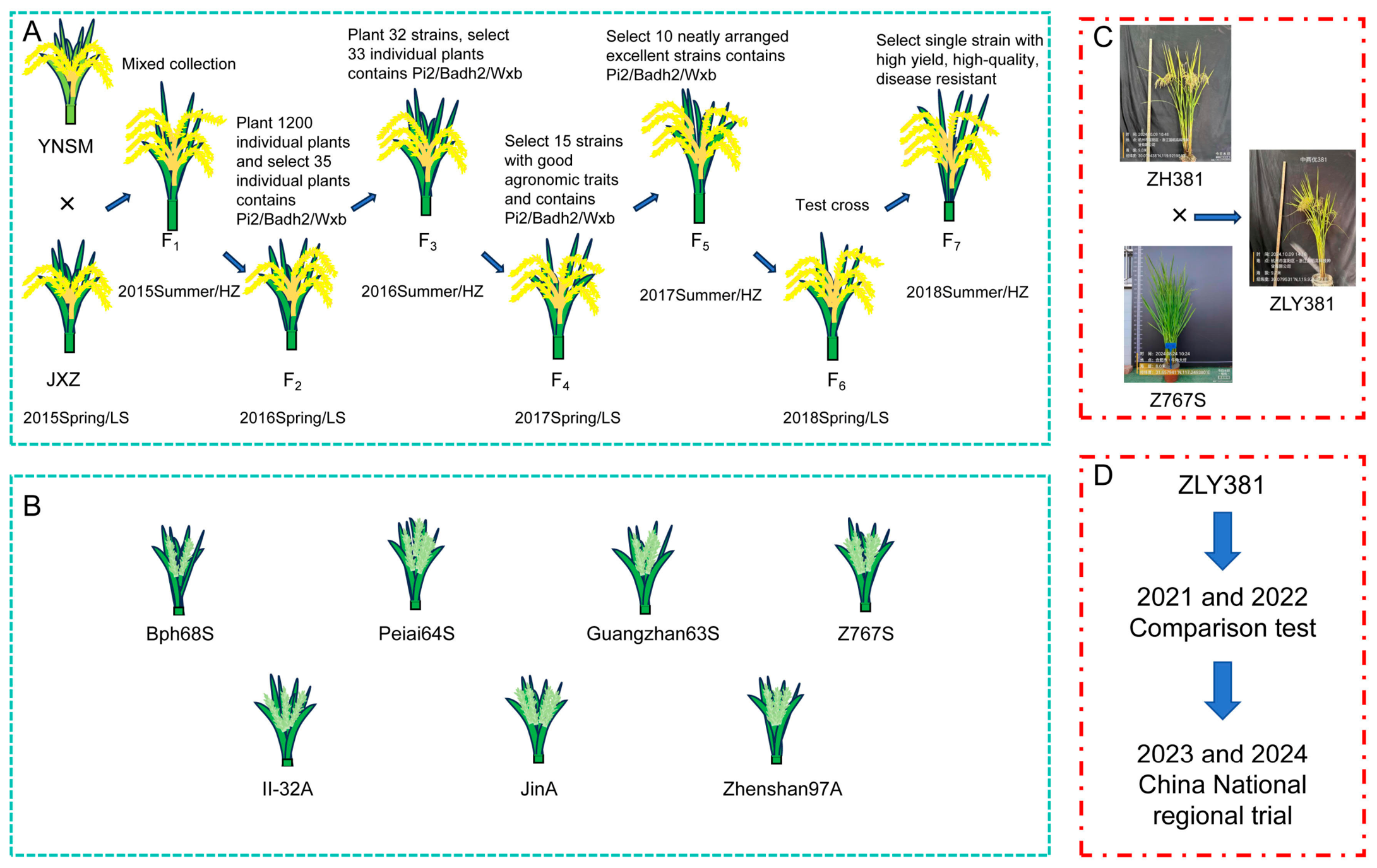
3.1. The Breeding Process of Zhongliangyou381
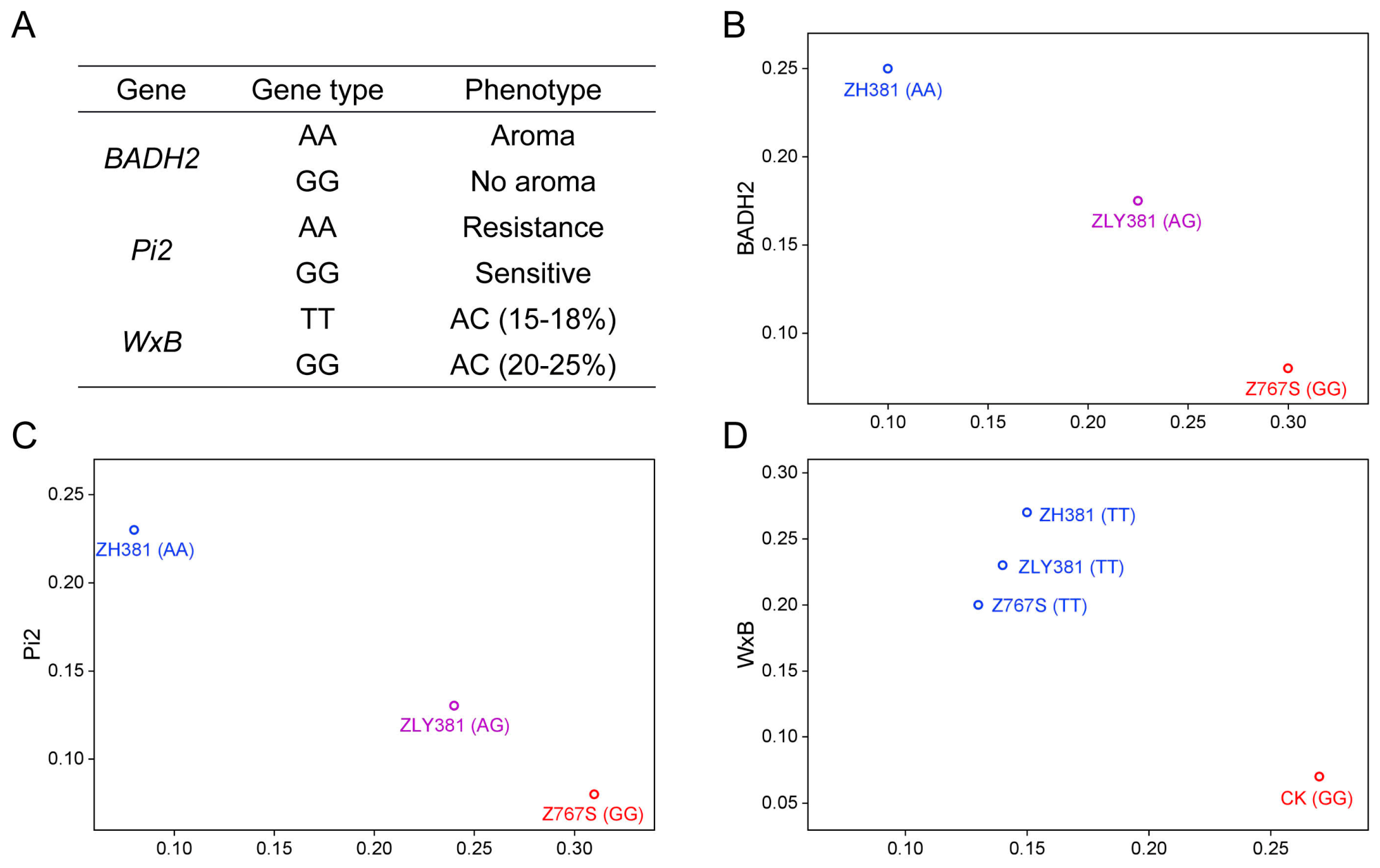
3.2. Molecular Marker Detection
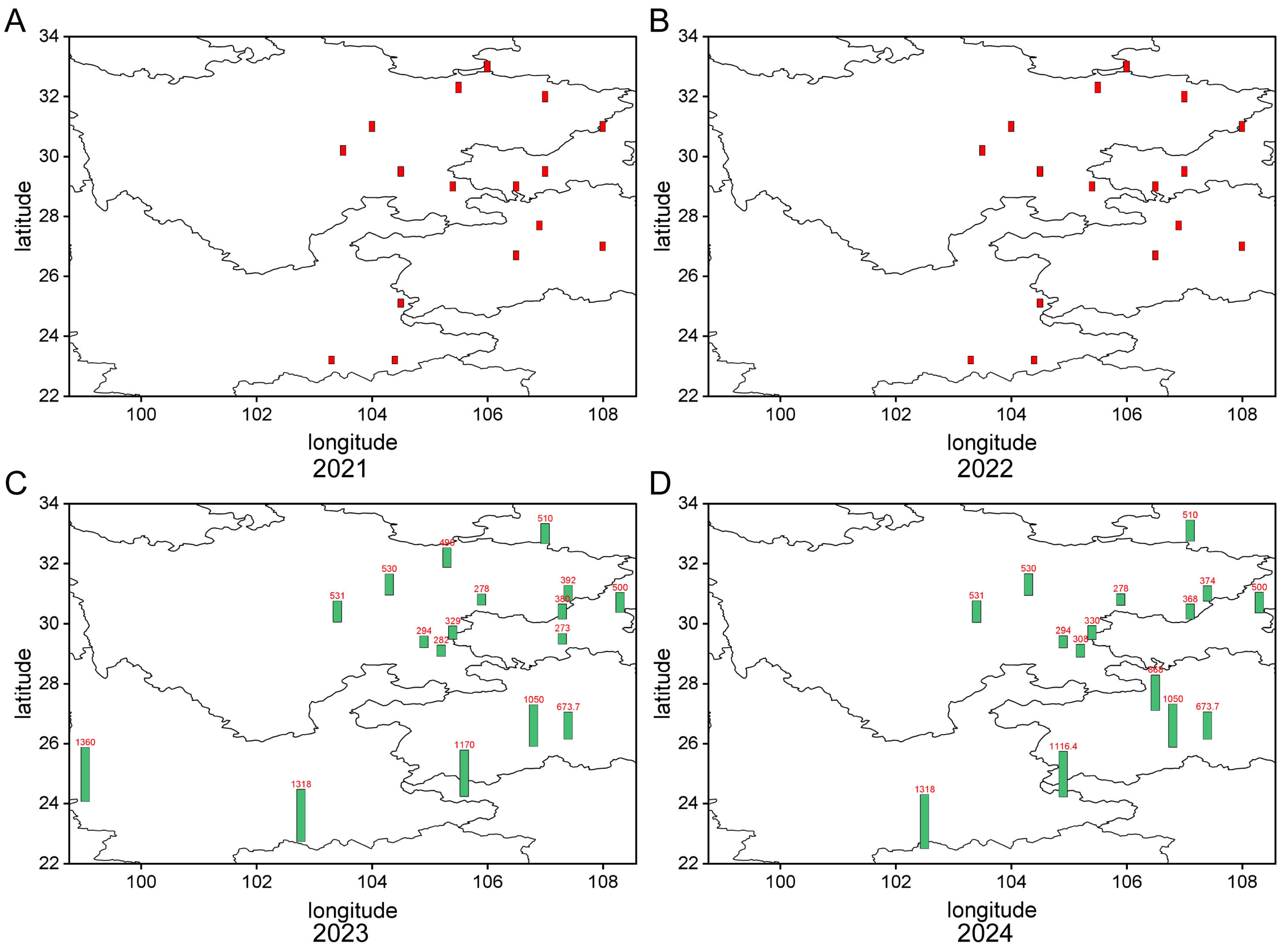
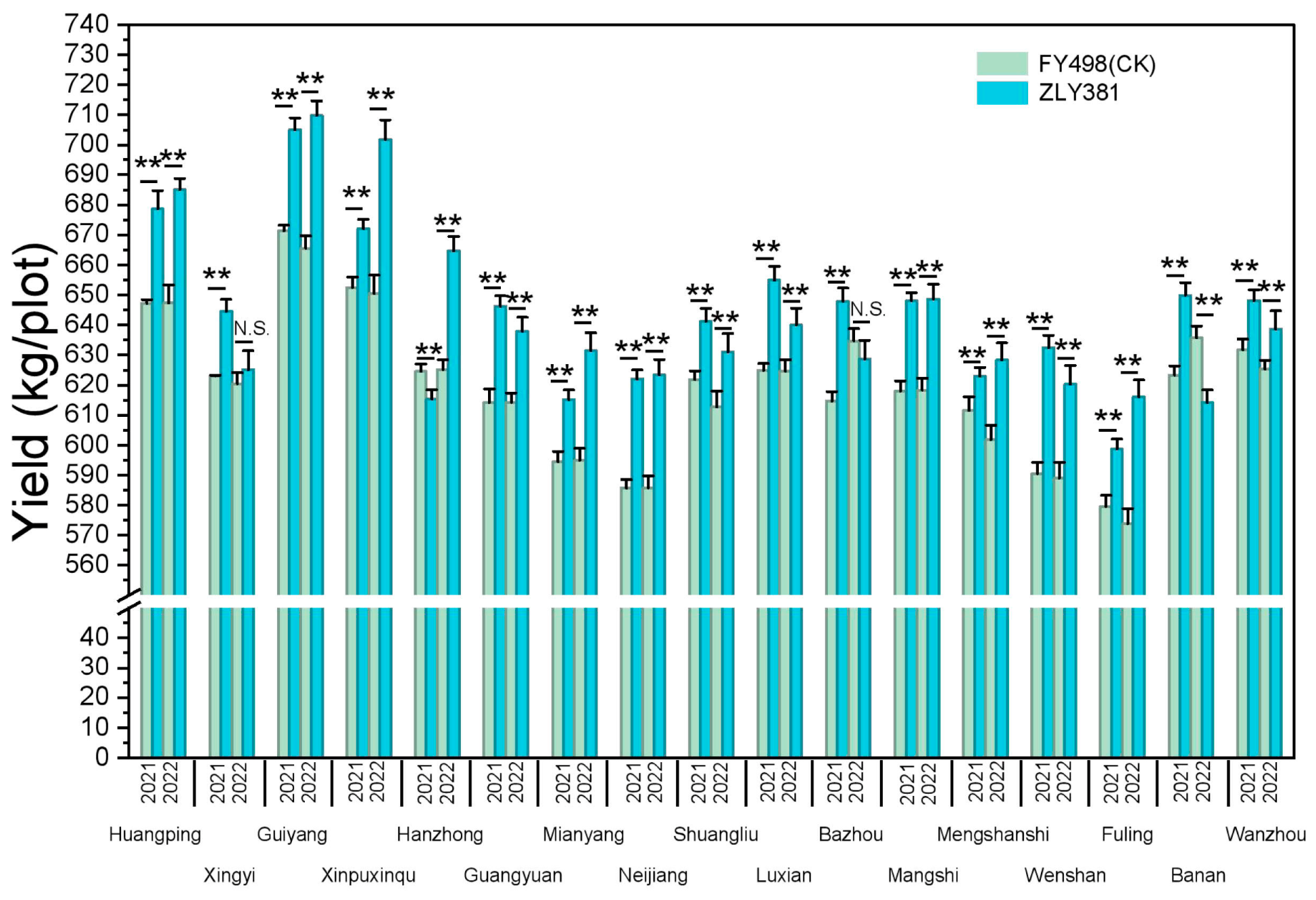
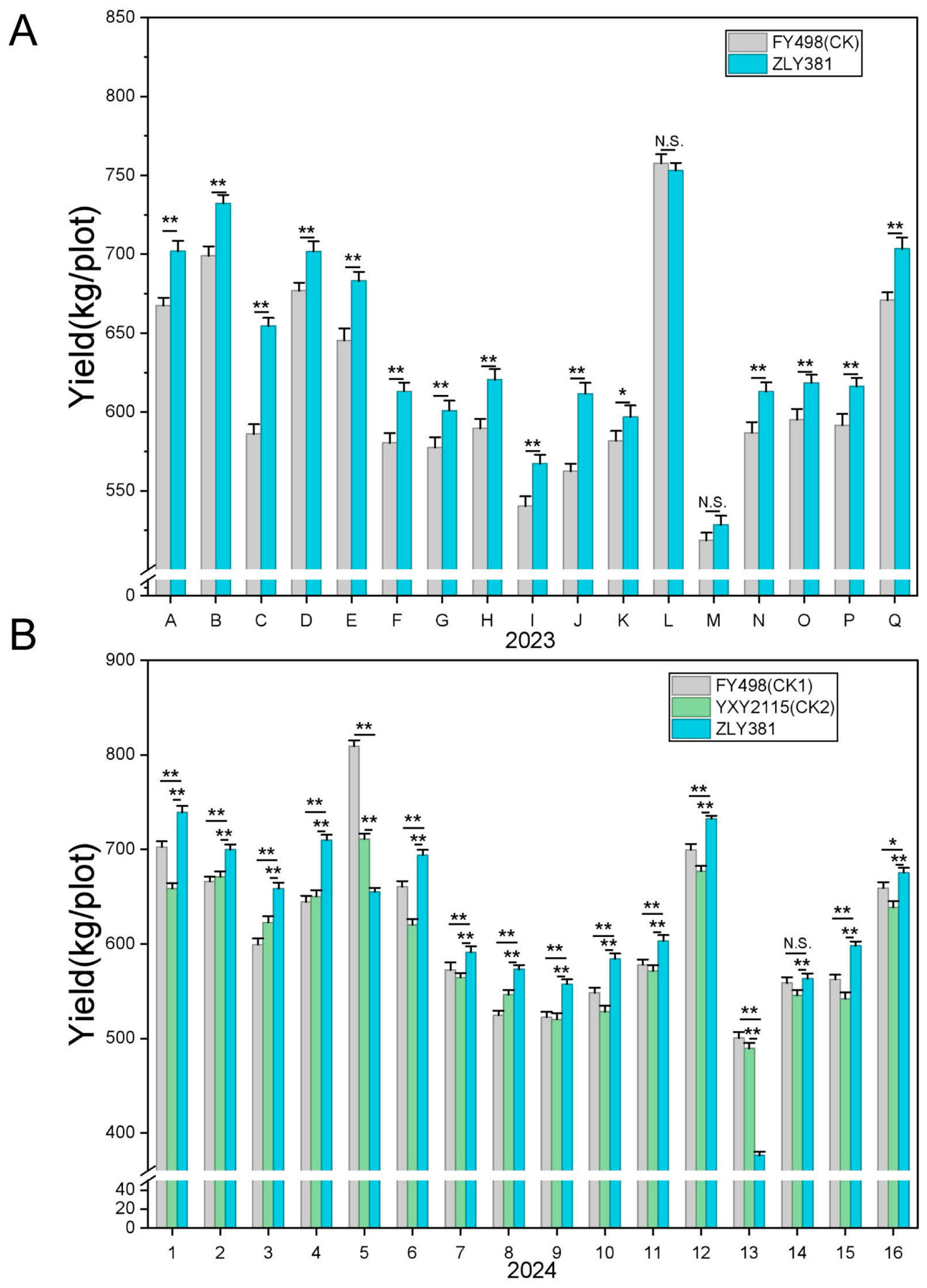
3.3. Yield Performance of ZLY381 in Comparative and Regional Tests
3.4. Quality Performance of ZLY381 in Two-Year Regional Trials
3.5. Disease Reaction of ZLY381
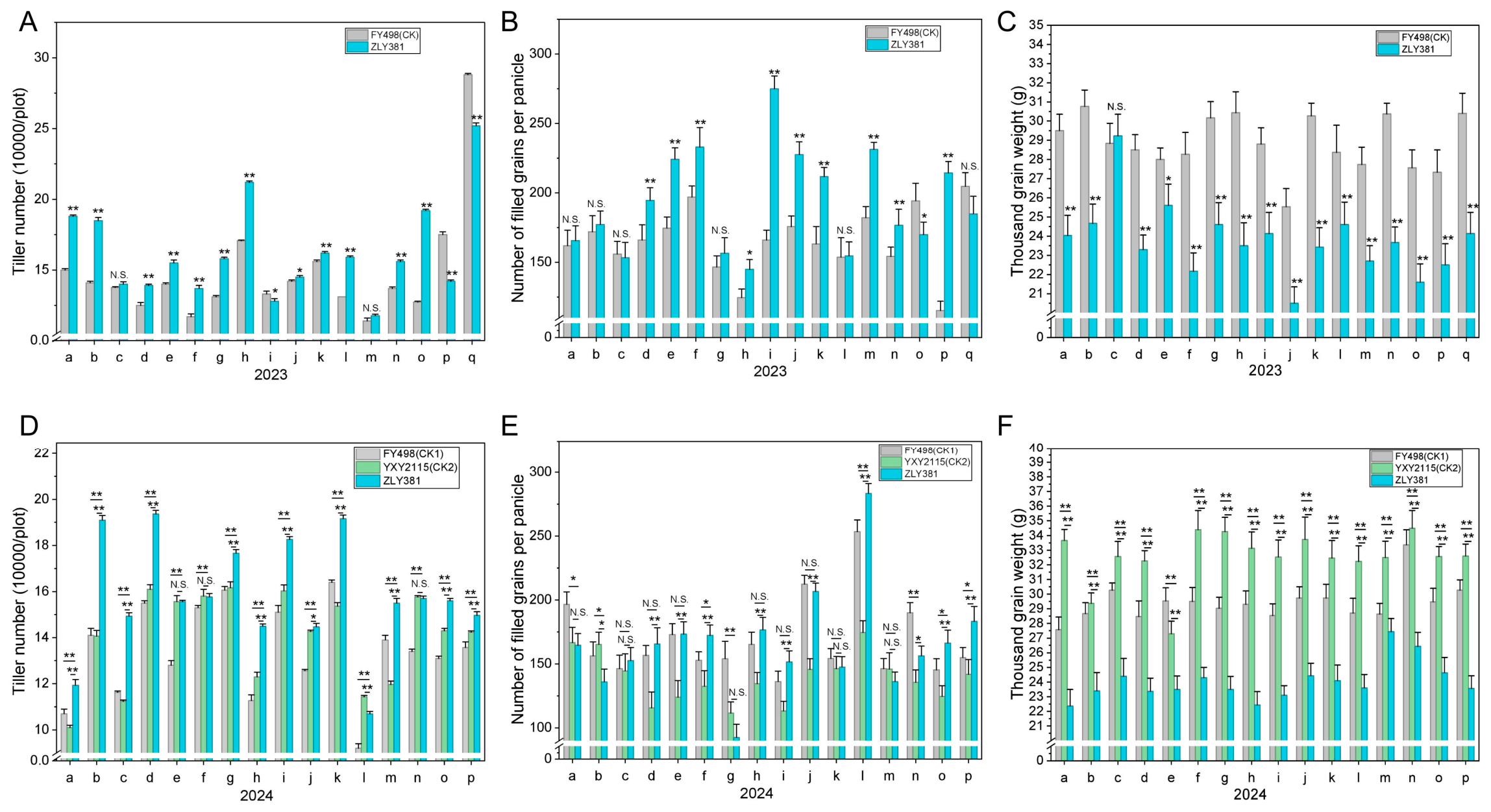
3.6. Agronomic Performance of ZLY381
4. Discussion
5. Conclusions
Author Contributions
Funding
Data Availability Statement
Conflicts of Interest
References
- Hodson, R. Food security. Nature 2017, 544, 7651. [Google Scholar] [CrossRef]
- Virmani, S.S. Hybrid Rice. Adv. Agron. 1996, 57, 377–462. [Google Scholar] [CrossRef]
- Skamnioti, P.; Gurr, S.J. Against the grain: Safeguarding rice from rice blast disease. Trends Biotechnol. 2009, 27, 141–150. [Google Scholar] [CrossRef] [PubMed]
- Luo, W.; Huang, M.; Guo, T.; Xiao, W.; Wang, J.; Yang, G.; Liu, Y.; Wang, H.; Chen, Z.; Zhuang, C. Marker-assisted selection for rice blast resistance genes Pi2 and Pi9 through high-resolution melting of a gene-targeted amplicon. Plant Breed. 2017, 136, 67–73. [Google Scholar]
- Xie, Z.; Yan, B.; Shou, J.; Tang, J.; Wang, X.; Zhai, K.; Liu, J.; Li, Q.; Luo, M.; Deng, Y.; et al. A nucleotide-binding site-leucine-rich repeat receptor pair confers broad-spectrum disease resistance through physical association in rice. Philos. Trans. R. Soc. Lond. 2019, 374, 20180308. [Google Scholar] [CrossRef]
- Zhou, B.; Qu, S.; Liu, G.; Dolan, M.; Sakai, H.; Lu, G.; Bellizzi, M.; Wang, G.L. The eight amino-acid differences within three leucine-rich repeats between Pi2 and Piz-t resistance proteins determine the resistance specificity to Magnaporthe grisea. Mol. Plant-Microbe Interact. 2006, 19, 1216–1228. [Google Scholar] [CrossRef] [PubMed]
- Chen, H.L.; Chen, B.T.; Zhang, D.P.; Xie, Y.F.; Zhang, Q. Pathotypes of Pyricularia grisea in Rice Fields of Central and Southern China. Plant Dis. 2001, 85, 843–850. [Google Scholar] [CrossRef] [PubMed]
- Guo, N.; An, R.; Ren, Z.; Jiang, J.; Cai, B.; Hu, S.; Shao, G.; Jiao, G.; Xie, L.; Wang, L.; et al. Developing super rice varieties resistant to rice blast with enhanced yield and improved quality. Plant Biotechnol. J. 2025, 23, 232–234. [Google Scholar] [PubMed]
- Sano, Y. Differential regulation of waxy gene expression in rice endosperm. Theor. Appl. Genet. 1984, 68, 467–473. [Google Scholar] [CrossRef] [PubMed]
- Sano, Y.; Katsumata, M.; Okuno, K. Genetic studies of speciation in cultivated rice. 5. Inter- and intraspecific differentiation in the waxy gene expression of rice. Euphytica 1986, 35, 1–9. [Google Scholar] [CrossRef]
- Hirano, H.Y.; Eiguchi, M.; Sano, Y. A single base change altered the regulation of the Waxy gene at the posttranscriptional level during the domestication of rice. Mol. Biol. Evol. 1998, 15, 978–987. [Google Scholar] [CrossRef] [PubMed]
- Isshiki, M.; Morino, K.; Nakajima, M.; Okagaki, R.J.; Wessler, S.R.; Izawa, T.; Shimamoto, K. A naturally occurring functional allele of the rice waxy locus has a GT to TT mutation at the 5’ splice site of the first intron. Plant J. 1998, 15, 133–138. [Google Scholar] [CrossRef] [PubMed]
- Chen, S.; Yang, Y.; Shi, W.; Ji, Q.; He, F.; Zhang, Z.; Cheng, Z.; Liu, X.; Xu, M. Badh2, encoding betaine aldehyde dehydrogenase, inhibits the biosynthesis of 2-acetyl-1-pyrroline, a major component in rice fragrance. Plant Cell 2008, 20, 1850–1861. [Google Scholar] [CrossRef] [PubMed]
- Chen, M.; Wei, X.; Shao, G.; Tang, S.; Luo, J.; Hu, P. Fragrance of the rice grain achieved via artificial microRNA-induced down-regulation of OsBADH2. Plant Breed. 2012, 131, 584–590. [Google Scholar] [CrossRef]
- Hui, S.; Li, H.; Mawia, A.M.; Zhou, L.; Cai, J.; Ahmad, S.; Lai, C.; Wang, J.; Jiao, G.; Xie, L.; et al. Production of aromatic three-line hybrid rice using novel alleles of BADH2. Plant Biotechnol. J. 2022, 20, 59–74. [Google Scholar] [PubMed]
- Niu, X.; Tang, W.; Huang, W.; Ren, G.; Wang, Q.; Luo, D.; Xiao, Y.; Yang, S.; Wang, F.; Lu, B.R.; et al. RNAi-directed downregulation of OsBADH2 results in aroma (2-acetyl-1-pyrroline) production in rice (Oryza sativa L.). BMC Plant Biol. 2008, 8, 100. [Google Scholar] [CrossRef] [PubMed]
- Shan, Q.; Zhang, Y.; Chen, K.; Zhang, K.; Gao, C. Creation of fragrant rice by targeted knockout of the OsBADH2 gene using TALEN technology. Plant Biotechnol. J. 2015, 13, 791–800. [Google Scholar] [CrossRef] [PubMed]
- Mwamahonje, A.; Eleblu, J.S.Y.; Ofori, K.; Deshpande, S.; Feyissa, T.; Tongoona, P. Drought Tolerance and Application of Marker-Assisted Selection in Sorghum. Biology 2021, 10, 1249. [Google Scholar] [CrossRef] [PubMed]
- Prasanna, B.M.; Pixley, K.; Warburton, M.L.; Xie, C.X. Molecular marker-assisted breeding options for maize improvement in Asia. Mol. Breed. 2010, 26, 339–356. [Google Scholar] [CrossRef]
- Dong, J.; Zhang, X.; Li, Y.; Fu, H. Molecular-Marker-Based Design for Breeding Indica-Japonica Hybrid Rice with Bacterial Blight Resistance. Genes 2025, 16, 719. [Google Scholar] [CrossRef] [PubMed]
- Zhou, H.; Zhang, Q.; Liu, F.; Cao, W.; Li, Y.; Wan, Y. Identification and molecular marker analysis of PHS resistance of high generation wheat materials. Sci. Rep. 2025, 15, 7609. [Google Scholar] [CrossRef] [PubMed]
- Åhman, I.; Bengtsson, T. Introgression of resistance to Rhopalosiphum padi L. from wild barley into cultivated barley facilitated by doubled haploid and molecular marker techniques. Theor. Appl. Genet. 2019, 132, 1397–1408. [Google Scholar] [CrossRef] [PubMed]
- Huang, L.; Fang, N.; Zhang, L.; Xu, R.; Zhang, B.; Duan, P.; Li, G.; Luo, Y.; Li, Y. The Mediator subunit OsMED23 associates with the histone demethylase OsJMJ703 and the transcription factor OsWOX3A to control grain size and yield in rice. Proc. Natl. Acad. Sci. USA 2025, 122, e2419464122. [Google Scholar] [CrossRef] [PubMed]
- Simmonds, J.; Scott, P.; Leverington-Waite, M.; Turner, A.S.; Brinton, J.; Korzun, V.; Snape, J.; Uauy, C. Identification and independent validation of a stable yield and thousand grain weight QTL on chromosome 6A of hexaploid wheat (Triticum aestivum L.). BMC Plant Biol. 2014, 14, 191. [Google Scholar] [CrossRef] [PubMed]
- Song, X.; Meng, X.; Guo, H.; Cheng, Q.; Jing, Y.; Chen, M.; Liu, G.; Wang, B.; Wang, Y.; Li, J.; et al. Targeting a gene regulatory element enhances rice grain yield by decoupling panicle number and size. Nat. Biotechnol. 2022, 40, 1403–1411. [Google Scholar] [CrossRef] [PubMed]
- Xiao, N.; Pan, C.; Li, Y.; Wu, Y.; Cai, Y.; Lu, Y.; Wang, R.; Yu, L.; Shi, W.; Kang, H.; et al. Genomic insight into balancing high yield, good quality, and blast resistance of japonica rice. Genome Biol. 2021, 22, 283. [Google Scholar] [CrossRef] [PubMed]
- Mao, T.; Zhu, M.; Ahmad, S.; Ye, G.; Sheng, Z.; Hu, S.; Jiao, G.; Xie, L.; Tang, S.; Wei, X.; et al. Superior japonica rice variety YJ144 with improved rice blast resistance, yield, and quality achieved using molecular design and multiple breeding strategies. Mol. Breed. 2021, 41, 65. [Google Scholar] [CrossRef] [PubMed]
- Qiu, T.; Wei, S.; Fang, K.; Zhang, M.; Li, Y.; Feng, Y.; Cheng, Y.; Zhang, S.; Tian, J.; Gao, A.; et al. The atypical Dof transcriptional factor OsDes1 contributes to stay-green, grain yield, and disease resistance in rice. Sci. Adv. 2024, 10, eadp0345. [Google Scholar] [CrossRef] [PubMed]



| Gene | Sequence Name | Sequence |
|---|---|---|
| BADH2 | FAM sequence | GAAGGTGACCAAGTTCATGCTTAACCATAGGAGCAGCTGAAG |
| Hex sequence | GAAGGTCGGAGTCAACGGATTACCTTAACCATAGGAGCAGCTGAAA | |
| Reverse sequence | TGCATTTACTGGGAGTTATGAAACTGGTA | |
| Pi2 | FAM sequence | GAAGGTGACCAAGTTCATGCTAGTTATGTATTTAAAACACAGCATGGTG |
| Hex sequence | GAAGGTCGGAGTCAACGGATTAGTTATGTATTTAAAACACAGCATGGTA | |
| Reverse sequence | ACAAGTCTCCATGCATGTATCGAT | |
| Wxb | FAM sequence | GAAGGTGACCAAGTTCATGCTTCATCAGGAAGAACATCTGCAAGG |
| Hex sequence | GAAGGTCGGAGTCAACGGATTGTTCATCAGGAAGAACATCTGCAAGT | |
| Reverse sequence | CGATCTGAATAAGAGGGGAAACAAAGAAT |
| Disease Level | Resistance Comprehensive Index | Disease-Resistant Type |
|---|---|---|
| 0 | ≤0.1 | High resistance (HR) |
| 1 | 0.1–2.0 | Resistance (R) |
| 3 | 2.1–4.0 | Moderate resistance (MR) |
| 5 | 4.1–6.0 | Moderate susceptibility (MS) |
| 7 | 6.1–7.5 | Susceptibility (S) |
| 9 | 7.6–9.0 | High susceptibility (HS) |
| I | II | III | ||||
|---|---|---|---|---|---|---|
| FY498 (CK) | ZLY381 | FY498 (CK) | ZLY381 | FY498 (CK) | ZLY381 | |
| HRR | 38.7 ± 0.6 | 68.1 ± 2.0 ** | 52.1 ± 2.0 | 60.0 ± 2.0 ** | 35.2 ± 2.0 | 50.2 ± 2.0 ** |
| CH | 4.9 ± 0.3 | 0.5 ± 0.0 ** | 7.0 ± 0.2 | 1.6 ± 0.2 ** | 6.6 ± 0.3 | 0.6 ± 0.1 ** |
| TR | 2 ± 0 | 1 ± 0 | 2 ± 0 | 2 ± 0 | 3 ± 0 | 2 ± 0 |
| ASV | 6.3 ± 0.1 | 6.7 ± 0.0 | 6.4 ± 0.1 | 7 ± 0.0 | 5.8 ± 0.1 | 6.8 ± 0.0 ** |
| GC | 80 ± 0 | 70 ± 2 | 78 ± 2 | 82 ± 2 | 80 ± 1 | 77 ± 2 |
| AC | 25.2 ± 0.2 | 18.0 ± 0.3 ** | 25.4 ± 0.2 | 18.3 ± 0.3 ** | 24.7 ± 0.2 | 15.7 ± 0.2 ** |
| GL | 7.2 ± 0.2 | 7.0 ± 0.2 | 7.0 ± 0.2 | 6.8 ± 0.1 | 6.8 ± 0.1 | 6.6 ± 0.1 |
| LWR | 3.1 ± 0.1 | 3.2 ± 0.1 | 3.0 ± 0.1 | 3.2 ± 0.1 | 3.0 ± 0.2 | 3.3 ± 0.1 |
| BRP | 81.9 ± 2.0 | 81.1 ± 1.0 | 80.1 ± 2.0 | 80.2 ± 2.1 | 79.6 ± 1.9 | 78.7 ± 2.1 |
| PRR | 70.5 ± 1.1 | 73.6 ± 2.2 | 69.3 ± 1.9 | 69.8 ± 1.9 | 66.3 ± 0.9 | 67.0 ± 1.0 |
| CRR | 31 ± 1 | 4 ± 0 ** | 48 ± 2 | 10 ± 1 ** | 40 ± 1 | 4 ± 0 ** |
| I | II | III | |||||||
|---|---|---|---|---|---|---|---|---|---|
| FY498 (CK1) | YXY2115 (CK2) | ZLY381 | FY498 (CK1) | YXY2115 (CK2) | ZLY381 | FY498 (CK1) | YXY2115 (CK2) | ZLY381 | |
| HRR | 32.4 ± 1.1 | 41.8 ± 1.2 ** | 36.3 ± 1.0 | 61.7 ± 0.9 ** | 67.4 ± 1.5 | 66.7 ± 1.4 | 50.5 ± 1.1 ** | 46.1 ± 1.4 ** | 57.5 ± 1.2 |
| CH | 12.7 ± 0.7 ** | 3.2 ± 0.4 ** | 1.7 ± 0.2 | 5.9 ± 0.5 ** | 1.9 ± 0.1 ** | 0.6 ± 0.1 | 8.7 ± 0.6 ** | 4.4 ± 0.1 ** | 1.6 ± 0.1 |
| TR | 3 ± 0 | 2 ± 0 | 2 ± 0 | 2 ± 0 | 1 ± 0 | 1 ± 0 | 2 ± 0 | 1 ± 0 | 1 ± 0 |
| ASV | 6.0 ± 0.2 | 6.7 ± 0.3 | 6.8 ± 0.2 | 6.2 ± 0.4 | 7.0 ± 0.0 | 7.0 ± 0.0 | 5.9 ± 0.4 ** | 7.0 ± 0.0 | 7.0 ± 0.0 |
| GC | 78.0 ± 3.0 | 82.0 ± 2.0 | 78.0 ± 0.0 | 76.0 ± 3.0 ** | 84.0 ± 2.0 ** | 70.0 ± 2.0 | 78.0 ± 1.0 | 82.3 ± 2.5 | 80.0 ± 2.0 |
| AC | 21.6 ± 0.6 ** | 13.7 ± 0.4 | 13.9 ± 0.4 ** | 23.1 ± 0.6 ** | 16.7 ± 0.3 | 16.3 ± 0.3 | 21.7 ± 0.6 ** | 14.7 ± 0.5 | 14.6 ± 0.5 |
| GL | 6.8 ± 0.2 | 7.4 ± 0.3 ** | 6.7 ± 0.0 | 7.0 ± 0.0 | 7.6 ± 0.3 ** | 6.8 ± 0.4 | 6.9 ± 0.3 | 7.5 ± 0.2 ** | 6.7 ± 0.2 |
| LWR | 2.8 ± 0.3 | 3.0 ± 0.0 | 3.2 ± 0.3 | 2.9 ± 0.3 | 3.1 ± 0.1 | 3.1 ± 0.2 | 2.9 ± 0.0 | 3.0 ± 0.3 | 3.2 ± 0.1 |
| BRP | 78.6 ± 1.7 | 76.3 ± 2.3 | 77.7 ± 2.3 | 82.0 ± 2.0 | 80.7 ± 2.7 | 80.4 ± 1.9 | 80.5 ± 2.0 | 78.4 ± 2.1 | 79.3 ± 2.2 |
| PRR | 66.7 ± 1.9 | 68.8 ± 1.1 | 65.8 ± 0.7 | 73.1 ± 2.1 | 72.8 ± 2.0 | 72.5 ± 0.6 | 69.8 ± 1.3 | 70.7 ± 1.6 | 70.1 ± 2.0 |
| CRR | 57.0 ± 2.0 ** | 19.7 ± 1.5 ** | 9.0 ± 0.0 | 29.3 ± 1.5 ** | 12.0 ± 0.0 ** | 4.7 ± 0.6 | 52.3 ± 2.5 ** | 15.0 ± 1.0 ** | 6.0 ± 0.0 |
| Sichuan | Chongqing | Guizhou | d | ||||||||||
|---|---|---|---|---|---|---|---|---|---|---|---|---|---|
| a | b | c | d | a | b | c | d | a | b | c | d | ||
| L (CK) | 8 | 9 | 9 | 8.8 | 8 | 9 | 9 | 8.8 | 6 | 9 | 7 | 7.7 | |
| FY498 (CK) | 7 | 9 | 9 | 8.5 | 6 | 9 | 9 | 8.3 | 4 | 9 | 7 | 8.1 | 9 |
| ZLY381 | 3 | 3 | 1 | 2 | 4 | 7 | 3 | 4.3 | 3 | 7 | 5 | 4 | 5 |
| Sichuan | Chongqing | Guizhou | d | ||||||||||
|---|---|---|---|---|---|---|---|---|---|---|---|---|---|
| a | b | c | d | a | b | c | d | a | b | c | d | ||
| L (CK) | 8 | 9 | 9 | 8.8 | 7 | 9 | 9 | 8.5 | 5 | 9 | 7 | 7.7 | |
| FY498 (CK1) | 7 | 9 | 9 | 8.5 | 6 | 9 | 9 | 8.3 | 4 | 9 | 5 | 6.3 | 7.7 |
| YXY2115 (CK2) | 5 | 5 | 1 | 3 | 4 | 5 | 3 | 3.8 | 3 | 7 | 5 | 5.7 | 4.2 |
| ZLY381 | 4 | 3 | 1 | 2.3 | 4 | 7 | 3 | 4.3 | 3 | 7 | 5 | 5.7 | 4.1 |
Disclaimer/Publisher’s Note: The statements, opinions and data contained in all publications are solely those of the individual author(s) and contributor(s) and not of MDPI and/or the editor(s). MDPI and/or the editor(s) disclaim responsibility for any injury to people or property resulting from any ideas, methods, instructions or products referred to in the content. |
© 2026 by the authors. Licensee MDPI, Basel, Switzerland. This article is an open access article distributed under the terms and conditions of the Creative Commons Attribution (CC BY) license.
Share and Cite
Guo, N.; Jiang, J.; An, R.; Li, Y.; Ren, Z.; Cai, B.; Huang, X.; Hu, S.; Shao, G.; Jiao, G.; et al. Developing Elite Rice ZH381 and ZLY381 by Pyramiding badh2, Pi2, and Wxb. Agronomy 2026, 16, 1391. https://doi.org/10.3390/agronomy16141391
Guo N, Jiang J, An R, Li Y, Ren Z, Cai B, Huang X, Hu S, Shao G, Jiao G, et al. Developing Elite Rice ZH381 and ZLY381 by Pyramiding badh2, Pi2, and Wxb. Agronomy. 2026; 16(14):1391. https://doi.org/10.3390/agronomy16141391
Chicago/Turabian StyleGuo, Naihui, Jun Jiang, Ruihu An, Yuanyuan Li, Zongliang Ren, Bonian Cai, Xinzhu Huang, Shikai Hu, Gaoneng Shao, Guiai Jiao, and et al. 2026. "Developing Elite Rice ZH381 and ZLY381 by Pyramiding badh2, Pi2, and Wxb" Agronomy 16, no. 14: 1391. https://doi.org/10.3390/agronomy16141391
APA StyleGuo, N., Jiang, J., An, R., Li, Y., Ren, Z., Cai, B., Huang, X., Hu, S., Shao, G., Jiao, G., Xie, L., Wang, L., Zhao, F., Zhu, Y., Tang, S., Sheng, Z., & Hu, P. (2026). Developing Elite Rice ZH381 and ZLY381 by Pyramiding badh2, Pi2, and Wxb. Agronomy, 16(14), 1391. https://doi.org/10.3390/agronomy16141391