Article

Spent Mushroom Substrate Amendment Reshapes Soil Aggregate Structure and Organic Carbon Fractions


1
Henan Academy of Agricultural Sciences, Zhengzhou 450002, China
2
Center of Agro-Product Safety and Quality, Ministry of Agriculture and Rural Affairs, Beijing 100081, China
3
School of Agriculture, Policy and Development, University of Reading, Reading RG6 6UR, UK
4
Institute of Social Sciences in Agriculture, University of Hohenheim, Schloss Hohenheim 1C, 70593 Stuttgart, Germany
*
Author to whom correspondence should be addressed.
These authors contributed equally to this work and share first authorship.
Agronomy 2026, 16(12), 1142; https://doi.org/10.3390/agronomy16121142
Submission received: 21 March 2026 / Revised: 20 May 2026 / Accepted: 21 May 2026 / Published: 10 June 2026
(This article belongs to the Section Soil and Plant Nutrition)

Abstract

Global food security and climate mitigation goals are placing unprecedented demands on agricultural systems to simultaneously improve soil productivity and reduce carbon emissions. Spent mushroom substrate (SMS), the mushroom industry’s principal waste stream, offers considerable recycling potential, yet its influence on dissolved organic carbon (DOC) chemistry and soil aggregate stability remains unclear. We tested four SMS return regimes on a medium-textured fluvo-aquic soil: CK, 0 t·ha−1; ORS, 22.5 t/ha; ERS, 22.5 t/ha; and SRS, 45 t/ha in total, with 22.5 t/ha applied per SMS return event. It was found that SMS improved soil structural stability across all regimes, with SRS delivering the strongest effects. Compared with CK, SRS raised the proportions of >2 mm and 0.25–2 mm aggregates by 31.62% and 33.42%, while the mean weight diameter (MWD) and geometric mean diameter (GMD) increased by 23.25% and 22.68%. SMS also elevated aromatic carbon abundance, DOC concentration, UV254, and SUVA254. Fluorescence EEM-PARAFAC resolved DOC into three component: namely, two humic-like and one protein-like, and SMS expanded the relative contribution of the humic-like C1 fraction. Overall, under the tested fluvo-aquic soil and wheat–maize rotation conditions, SMS return was associated with changes in DOC composition, higher aggregate stability, and greater aggregate-associated carbon accumulation. These findings suggest that SMS return may be a promising strategy for improving soil structure and recycling agricultural waste under similar field conditions, but its broader applicability requires further validation.

1. Introduction

Intensively managed cereal-based agroecosystems underpin global food security, yet long-term intensification has widely degraded soil structure and accelerated soil organic carbon (SOC) losses, constraining both productivity and climate-change mitigation potential [1,2]. Because agricultural soils store a large share of terrestrial carbon, improving soil aggregate stability is central to enhancing SOC stabilization and sequestration [3].
Mushroom cultivation is a globally important circular-agriculture practice that converts large quantities of agricultural and forestry residues into edible biomass [4]. The rapid expansion of this industry generates substantial amounts of SMS, which is a nutrient-rich organic by-product [5]. Returning SMS to cropland has been increasingly proposed as a practical strategy to close nutrient–carbon loops and improve soil health in cereal-based systems [6].
Previous studies have shown that [7,8] SMS application can improve soil physical properties, promote macroaggregate formation, and increase SOC storage, which is often attributed to enhanced organic inputs and stimulated microbial activity. However, the mechanistic link between SMS-induced changes in DOC chemistry and aggregate stabilization remains insufficiently resolved. In particular, it is still unclear which DOC fractions, such as humic-like and protein-like components, and which optical signatures, including UV254, SUVA254, E2/E3, and E3/E4, are most closely associated with aggregate stability, and whether these relationships differ among contrasting SMS return regimes. Moreover, direct evidence connecting DOC compositional shifts to aggregate-associated carbon chemistry at the clay/mineral interface remains limited [9].
To address these knowledge gaps, this study established four different SMS return regimes, including no SMS return (CK), one-year SMS return (ORS), alternate-year SMS return (ERS), and two-year continuous SMS return (SRS). By integrating UV–Vis optical indices, EEM–PARAFAC component analysis, aggregate stability indicators, and XPS analysis of aggregate-associated clay fractions, this study aimed to (1) evaluate the effects of different SMS return regimes on soil aggregate size distribution and stability; (2) characterize changes in DOC concentration and compositional features following SMS return; and (3) examine the potential associations between DOC compositional changes and aggregate stability.
The findings of this study are expected to provide mechanistic evidence for the agricultural recycling of SMS and a theoretical basis for soil improvement strategies based on agricultural residue recycling in cereal-based cropping systems. By elucidating the effects of SMS return on DOC composition and aggregate stability, this study may provide preliminary mechanistic evidence for optimizing SMS return regimes under similar fluvo-aquic soil and cereal-based cropping systems.
This study hypothesized that SMS return would increase DOC availability and alter its optical and chemical characteristics, and these changes would be associated with macroaggregate formation and aggregate stability. We further hypothesized that, due to the cumulative effect of organic material input, two-year continuous SMS return would exert stronger effects than one-year or alternate-year SMS return. In addition, DOC compositional changes were expected to be closely associated with changes in aggregate-associated organic carbon chemistry.

2. Methods

2.1. Site Description

The field experiment was conducted at the Jinlong Mushroom Industry Base in Wenji Township, Yucheng County, Shangqiu City, Henan Province, China (34.26° N, 115.90° E). The site experiences a warm temperate continental monsoon climate, characterized as semi-humid to semi-arid, with a mean annual temperature of 14 °C, a 53% sunshine percentage, and 216 frost-free days. The particle-size composition of the 0–20 cm soil layer was 738 g·kg−1 sand, 189 g·kg−1 silt, and 73 g·kg−1 clay. The soil is classified as a medium-textured fluvo-aquic soil. The 0–20 cm surface soil layer contained 14.53 g·kg−1 organic matter, 0.85 g·kg−1 total N, 78.30 mg·kg−1 alkali-hydrolysable N, 13.30 mg·kg−1 available P, and 79.87 mg·kg−1 available K, with a pH of 7.83. Although this field experiment was conducted at a single site with one soil type, fluvo-aquic soil is widely distributed in intensively managed cereal-based systems in this region, making it a representative setting to examine SMS-driven changes in DOC composition and aggregate stabilization mechanisms.

2.2. Experimental Design

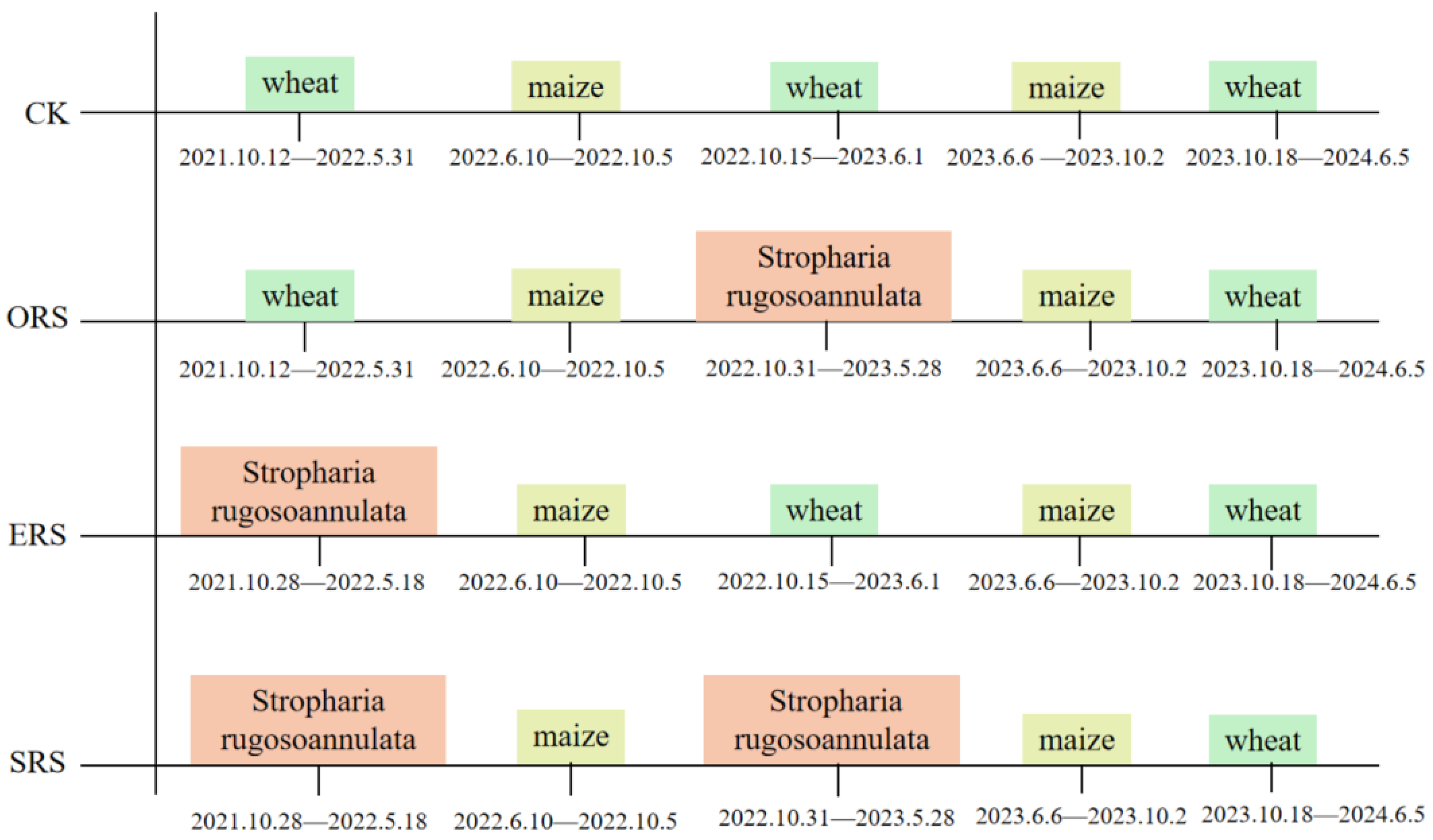
The experiment was carried out from 2021 to 2024 with the rotation schemes, including no SMS return (wheat–maize–wheat–maize–wheat; CK), one-year SMS return (wheat–maize–Stropharia rugosoannulata–maize–wheat; ORS), alternate-year SMS return (S. rugosoannulata–maize–wheat–maize–wheat; ERS), and two-year continuous SMS return (S. rugosoannulata–maize–S. rugosoannulata–maize–wheat; SRS). Each treatment was replicated three times in a randomized complete block design, resulting in twelve 140 m2 (7 m × 20 m) experimental plots. The four treatments were designed to represent contrasting SMS return strategies under the local wheat–maize rotation system. CK represented the conventional rotation without SMS return and served as the baseline control. ORS represented a short-term SMS return strategy, ERS represented an intermittent SMS return strategy, and SRS represented a continuous SMS return strategy with cumulative organic input. This design allowed us to compare the effects of no SMS return, single SMS return, intermittent SMS return, and continuous SMS return on soil aggregate stability and DOC characteristics. Table 1 lists the baseline soil physicochemical properties for each treatment.
Under the four rotation patterns, chemical fertilizer inputs for wheat and maize were kept consistent and followed the CK fertilization regime. During the wheat season, N, P2O5, and K2O were applied at 225, 90, and 150 kg/ha, respectively. P and K fertilizers were applied once as basal fertilizers, while N fertilizer was applied with 60% as the basal fertilizer and 40% as a topdressing at the green-up stage. During the maize season, N, P2O5, and K2O were also applied at 225, 90, and 150 kg/ha, respectively, and all fertilizers were applied once as seed fertilizer at sowing (Table 2). No fertilizer was applied during the Stropharia rugosoannulata season, and other field management practices followed local high-standard farmland management practices.
For the SMS return treatments (ORS, ERS, and SRS), spent mushroom substrate was returned to the field as surface mulch after the harvest of Stropharia rugosoannulata. The application rate was 22.5 t ha−1 fresh weight for each SMS return event. Therefore, ORS and ERS each received SMS once during the experimental period, with a cumulative SMS input of 22.5 t ha−1, whereas SRS received SMS twice, with a cumulative SMS input of 45.0 t ha−1. At the plot scale, each SMS return event corresponded to approximately 315 kg SMS per 140 m2 plot (Table 2).
In the ORS pattern, the substrate for S. rugosoannulata cultivation was mainly composed of maize straw (58%), maize cob (25%), and other auxiliary materials. The cultivation procedure was conducted based on relevant literature and adjusted according to local open-field cultivation conditions, with detailed cultivation operations provided in the Supplementary Materials. In the ERS pattern, S. rugosoannulata was sown on 28 October 2021, and harvesting ended on 18 May 2022. In the SRS pattern, S. rugosoannulata was continuously sown for two mushroom seasons on 28 October 2021 and 31 October 2022, and the SMS was returned to the field as surface mulch after each harvest. The remaining crop rotation schedule is shown in Figure 1. and detailed management practices for the four rotation patterns are provided in the Supplementary Materials.

2.3. Sample Collection and Analysis

2.3.1. Soil Sampling and Basic Soil Properties

In late March 2025, surface soil samples (0–20 cm) were collected from each treatment plot using a five-point sampling method [10]. The subsamples from each plot were thoroughly mixed and transported to the laboratory. During air-drying, the soil samples were gently broken along natural fracture planes into soil clods smaller than 1 cm. After air-drying, visible plant residues and fine sand particles were removed. A portion of each sample was used for aggregate fractionation and stability determination, while the remaining soil was ground for physicochemical analysis.
Soil texture was classified by sedimentation following international standards [11]. Organic matter content and cation exchange capacity (CEC) were determined using the external-heating dichromate oxidation–ferrous sulfate titration method and ammonium acetate exchange method, respectively [12]. Soil pH was measured potentiometrically in a 1:2.5 soil-to-water suspension, and alkali-hydrolysable N and total N were determined by alkali hydrolysis–diffusion and semimicro-Kjeldahl digestion, respectively [13]. Available P was extracted with 0.5 mol L−1 NaHCO3 at pH 8.5, and available K was extracted with ammonium acetate; they were then quantified colorimetrically and by flame photometry, respectively [14].

2.3.2. Aggregate Stability

Aggregate stability and fragmentation patterns were determined using a wet-sieving procedure modified from the Le Bissonnais method [15]. Air-dried soil was gently dry-sieved, and the obtained aggregate samples were used for subsequent wet-sieving analysis. For wet sieving, 50 g of air-dried soil was placed in a 1 L beaker, and 50 mL of deionized water was slowly added. The soil suspension was pre-wetted for 15 min and then shaken horizontally at 100 rpm for 5 min. After settling, floating debris was removed, and the suspension was sequentially passed through 0.250 mm and 0.053 mm sieves. All fractions were oven-dried at 40 °C and weighed to calculate the percentage of each size class. The aggregate fractions were classified as >2 mm, 0.25–2 mm, 0.053–0.25 mm, and <0.053 mm. Aggregate stability was expressed as the mean weight diameter (MWD) and geometric mean diameter (GMD), which were calculated as follows [16]:
MWD = Σ(wᵢ xᵢ)/Σwᵢ
GMD = exp [Σ(wᵢ ln xᵢ)/Σwᵢ]
where wᵢ indicates the mass of aggregates in the i-th size class, Σwᵢ is the total mass of all fractions, and xᵢ represents the mean diameter of the i-th size class.

2.4. Organic Carbon Analyses

2.4.1. Aggregate-Associated Organic Carbon

The aggregate-associated clay fraction was ground to pass through a 100-mesh sieve and oven-dried at 80 °C to constant weight. After surface cleaning under vacuum, the samples were loaded into the instrument. C 1s spectra were recorded using an X-ray photoelectron spectrometer (ESCALAB 250Xi, Thermo Fisher Scientific, Waltham, MA, USA) equipped with a monochromatic Al Kα source (1486.6 eV). Survey spectra were collected over a binding energy range of 100–1500 eV with a step size of 0.050 eV, and 10 scans were accumulated for each plot-level replicate. The energy scale was calibrated using the C 1s peak at 284.8 eV. Peak fitting and deconvolution were performed using Avantage software (version 5.9924, Thermo Fisher Scientific, Waltham, MA, USA)with Gaussian–Lorentzian line shapes [17]. The C 1s spectra were deconvoluted into the main carbon functional groups according to their binding energies, including C–C/C–H at approximately 284.8 eV, C–O at approximately 286.2 eV, C=O/O–C–O at approximately 287.6 eV, and O–C=O at approximately 288.8 eV [18]. The relative proportion of each carbon functional group was calculated as the ratio of the corresponding peak area to the total C 1s peak area:
Relative proportion (%) = Ai/ΣAi × 100
where Ai represents the peak area of the i-th carbon functional group, and ΣAi represents the sum of the peak areas of all deconvoluted C 1s components.

2.4.2. Dissolved Organic Carbon (DOC)

DOC was extracted from air-dried bulk soil (<2 mm) using deionized water at a soil-to-water ratio of 1:10 (w/v), following the method of Jones and Willett [19] with minor modifications. Briefly, 3 g of air-dried soil from each plot-level replicate was mixed with 30 mL of deionized water. The suspension was shaken on an orbital shaker at 25 °C for 24 h and then centrifuged at 4000 rpm for 20 min. The supernatant was filtered through a 0.45 μm membrane filter. The DOC concentration in the filtrate was determined using a total organic carbon analyzer (TOC-V, Shimadzu, Japan).
For UV–Vis analysis, DOC extracts were diluted to 10 mg L−1 to reduce concentration-related optical interference. Absorbance spectra were recorded from 200 to 800 nm at 1 nm intervals using a UV-2540 spectrophotometer (Shimadzu, Kyoto, Japan). Absorbance values at 200, 254, 300, and 400 nm were recorded as E200, E254, E300, and E400, respectively. Specific UV absorbance at 254 nm (SUVA254), the E2/E3 ratio (E200/E300), and the E3/E4 ratio (E300/E400) were calculated to provide information on DOC aromaticity, apparent molecular size, and humification characteristics [20,21]:
SUVA254 = (E254/DOC) × 10
Three-dimensional excitation–emission matrix (3D-EEM) fluorescence spectroscopy was used to characterize DOC fluorescent components. The standardized DOC solutions were placed in 3 cm quartz cuvettes and scanned using an F-4600 fluorescence spectrophotometer (Hitachi, Tokyo, Japan) equipped with a 150 W xenon lamp. The excitation and emission slit widths were both set to 5 nm, the scan speed was 3000 nm min−1, and the response time was 0.5 s. The excitation wavelength ranged from 220 to 450 nm, and the emission wavelength ranged from 300 to 550 nm. Deionized water blanks were used to correct for Raman scattering.
The fluorescence index (FI), which provides information on DOM source, was calculated as the ratio of emission intensity at 450 nm to that at 500 nm under 370 nm excitation [22]. The biological index (BIX), which reflects autochthonous contribution and recent biological activity, was calculated as the ratio of emission intensity at 380 nm to that at 430 nm under 310 nm excitation [23]. The humification index (HIX), which indicates the degree of humification, was calculated as the ratio of the integrated emission intensity from 435 to 480 nm to that from 300 to 345 nm under 254 nm excitation [24].

2.5. Statistical Analysis

All data are presented as the mean ± standard error (n = 3). Statistical analyses were performed using SPSS 19.0. Before analysis of variance, data normality and homogeneity of variance were tested using the Shapiro–Wilk test and Levene’s test, respectively. When necessary, data were logarithmically or square-root transformed to meet the assumptions of the analysis of variance. One-way analysis of variance (one-way ANOVA) was used to test the effects of different SMS return regimes on soil physicochemical properties, aggregate stability, DOC characteristics, and aggregate-associated organic carbon fractions. When significant differences were detected, post hoc multiple comparisons were performed using Duncan’s multiple range test at p < 0.05. Figures were generated using Origin 2021.
EEM spectra were preprocessed and analyzed by PARAFAC using the DOMFluor and drEEM in MATLAB 2019b. following established procedures for fluorescence EEM–PARAFAC analysis [25,26,27] The number of PARAFAC components was determined by comparing the fitting residuals of models with different component numbers and further validated using a split-half analysis. Specifically, the samples were randomly divided into two subsets and modeled separately; the model was considered reliable when the component peak positions and spectral shapes obtained from the two subsets were consistent.
PLS-PM was used to analyze the direct and indirect effects among DOC optical indices, fluorescence components, and aggregate stability. The significance of path coefficients was evaluated by bootstrapping with 5000 resampling iterations to obtain p-values and confidence intervals, and variable collinearity was checked using VIF < 5.
The Mantel test was performed using the vegan package in R(version 4.6.0). The Random Forest model was used to identify key factors affecting aggregate stability and was implemented using the A3R and rfPermute packages in R. The model was built with ntree = 1000 trees, and mtry = √p, where p represents the number of explanatory variables, rounded to the nearest integer, was used as the number of candidate variables at each split. Variable importance was calculated using permutation importance. The significance of variable importance was estimated by rfPermute based on 999 permutations, with p < 0.05 considered statistically significant.

3. Results

3.1. Effects of SMS Return on Soil Aggregate Size Distribution, Stability, and DOC Content

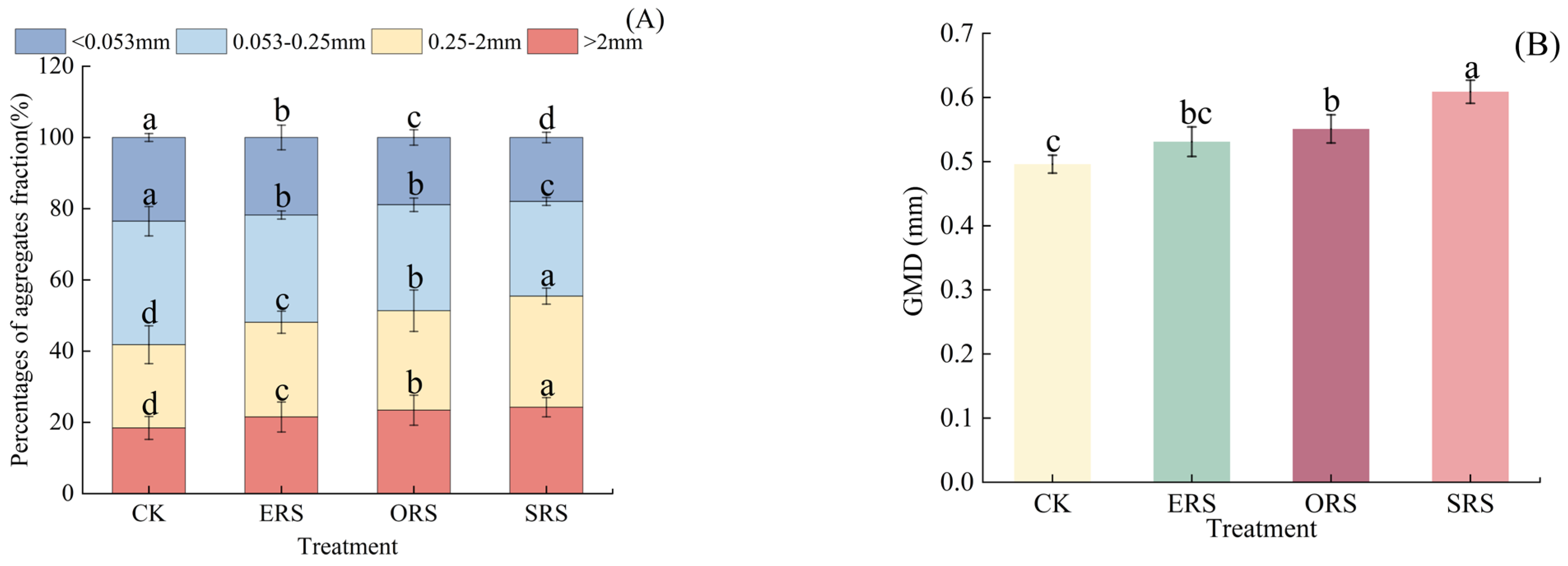
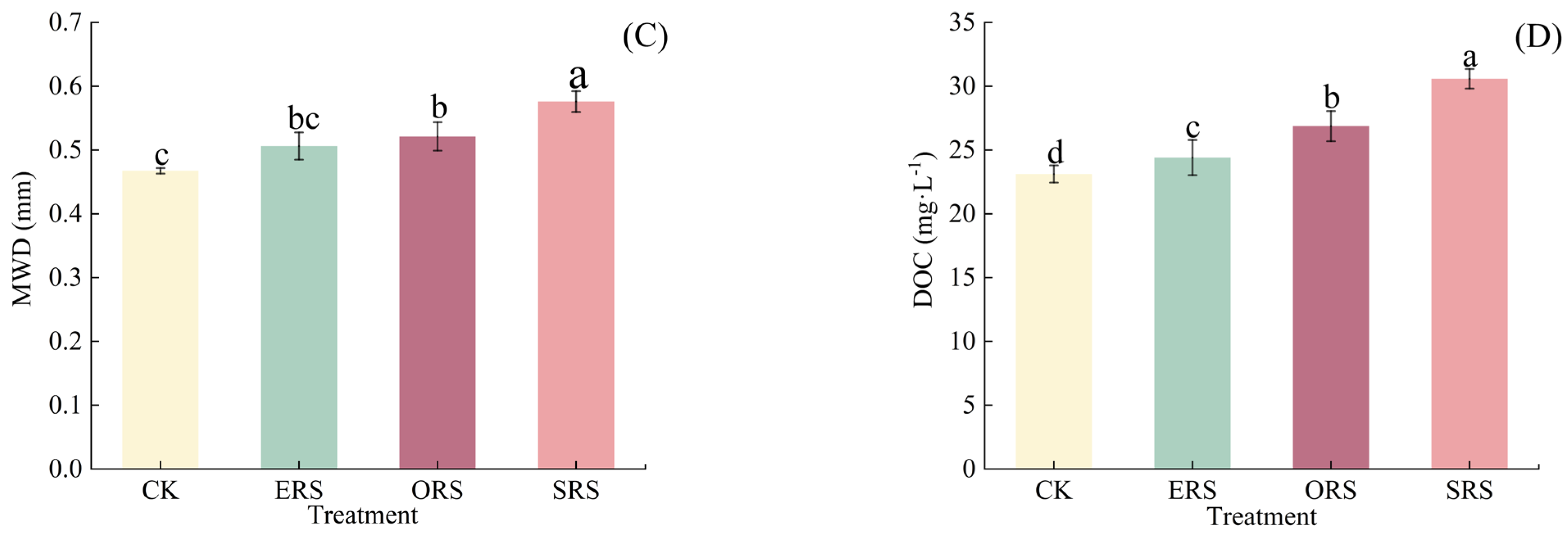
As shown in Figure 2, SMS return shifted soil aggregate composition toward larger size classes. Compared with CK, the >2 mm and 0.25–2 mm aggregate fractions increased most strongly under the SRS treatment, by 30.74% and 32.53%, respectively, whereas the 0.053–0.25 mm and <0.053 mm fractions declined most markedly under the same treatment. In parallel, SRS also produced the largest increases in GMD and MWD, by 22.68% and 23.24%, respectively. The DOC content increased by 5.58%, 16.24%, and 32.29% under ERS, ORS, and SRS, respectively, indicating a gradual increase with SMS return intensity. Overall, these results indicate that continuous SMS return was associated with greater macroaggregate abundance, higher aggregate stability, and increased DOC content. Effect sizes and 95% confidence intervals for the main comparisons are provided in Table S1, with intervals not crossing zero indicating statistically significant differences at p < 0.05.

3.2. Effects of SMS Return on the UV–Vis Spectral Characteristics of Soil DOC

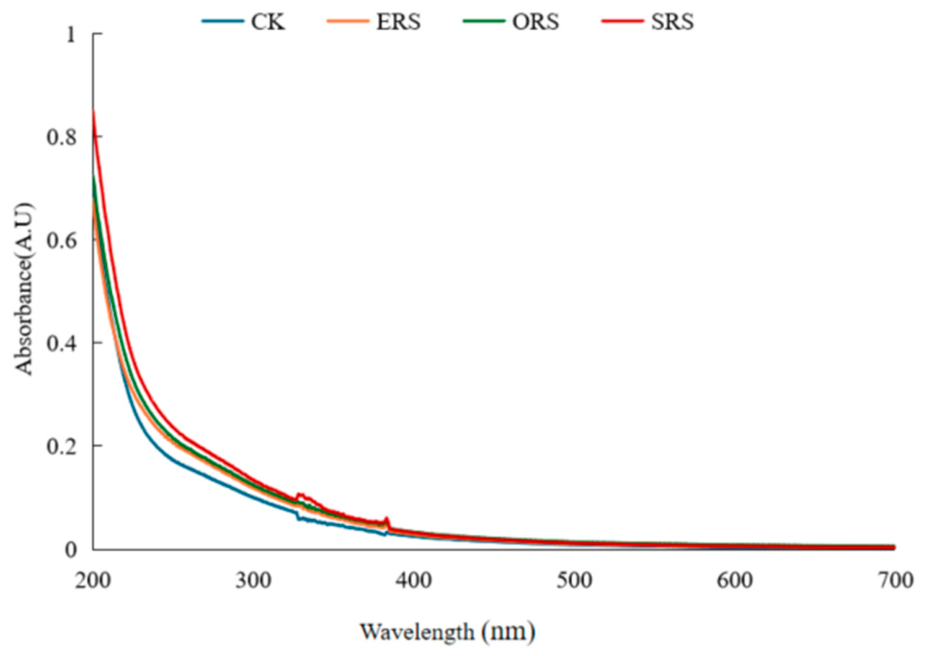
As shown in Figure 3, SMS return altered the UV–Vis spectral characteristics of soil DOC, mainly by increasing UV absorbance and reducing the E2/E3 ratio. Across all treatments, DOC absorbance decreased sharply from 200 to 400 nm and then gradually approached zero beyond 400 nm. Compared with CK, UV254 increased by 15.59%, 23.95%, and 47.40% under ERS, ORS, and SRS, respectively, with the strongest response observed under SRS. This suggests that continuous SMS return increased the abundance of UV-absorbing DOC components.
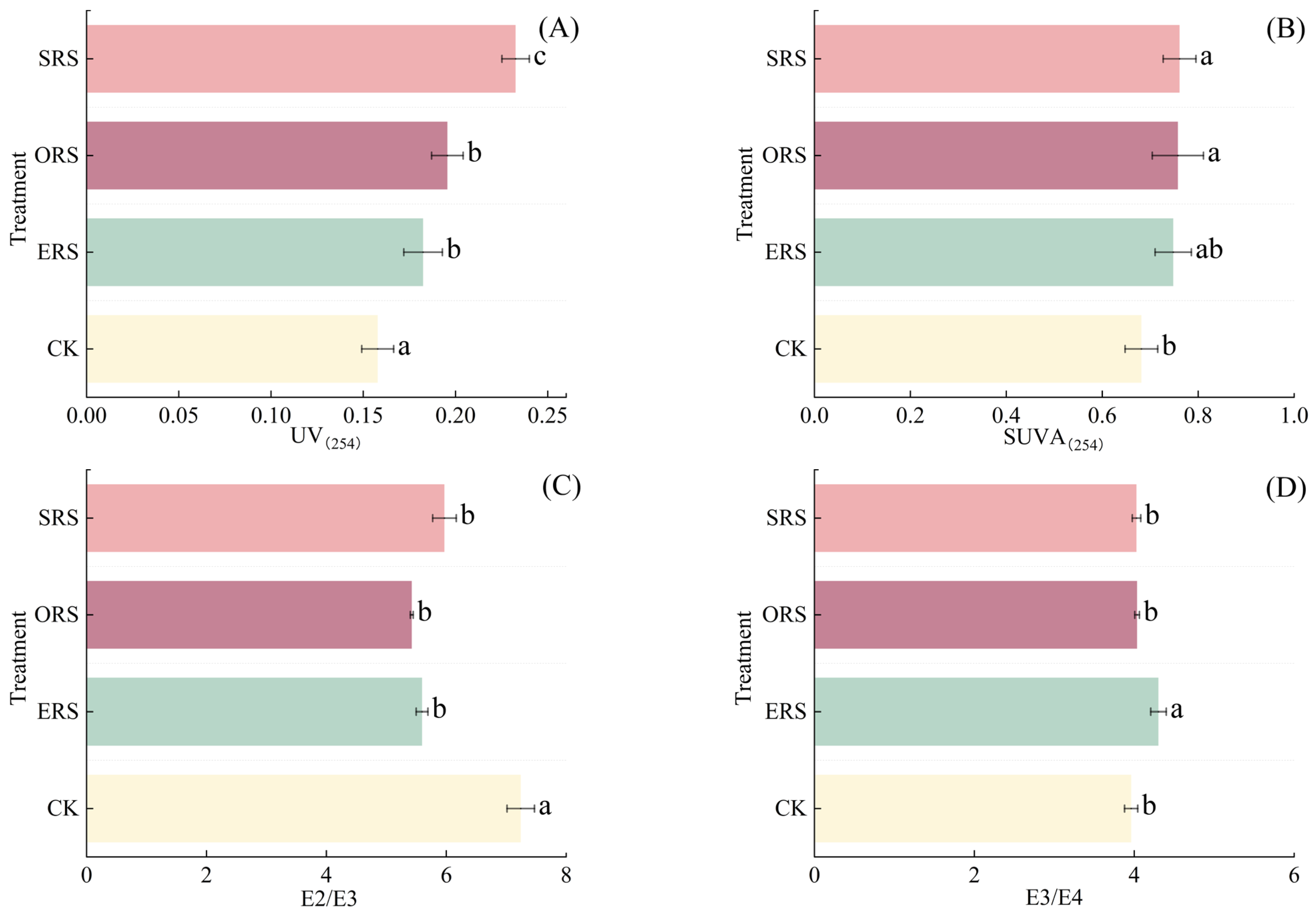
As shown in Figure 4, Among the spectral indices, SUVA254 showed only limited variation among treatments, suggesting that the increase in UV254 was not necessarily accompanied by a clear change in specific UV absorbance. In contrast, the E2/E3 ratio decreased by 22.73%, 25.10%, and 17.57% under ERS, ORS, and SRS, respectively, indicating changes in DOC optical properties related to molecular size or condensation degree. The E3/E4 ratio increased mainly under ERS, whereas ORS and SRS showed only minor changes. Overall, SMS return modified the optical characteristics of soil DOC, but these UV–Vis indices should be interpreted as indirect indicators rather than direct evidence of DOC compositional changes. Effect sizes and 95% confidence intervals for the main comparisons are provided in Table S2, with intervals not crossing zero indicating statistically significant differences at p < 0.05.

3.3. Effects of SMS Return on the Fluorescence Indices of Soil DOC

Fluorescence index results indicated that SMS return had relatively limited effects on the source- and humification-related optical properties of soil DOC (Table 3). FI values were higher than 1.9 across all treatments. Compared with CK, FI decreased slightly under ORS and SRS, but the magnitude of change was small. BIX values ranged from 0.62 to 0.68, indicating a relatively clear microbial contribution, but no significant differences were observed among treatments. HIX values ranged from 0.81 to 0.83, all below 4, and SMS return did not significantly alter the humification-related characteristics of DOC. Overall, SMS return caused only slight changes in some fluorescence indices and did not provide strong evidence for significant changes in recent biological contribution or DOC humification degree. Effect sizes and 95% confidence intervals for the main comparisons are provided in Table S3, with intervals not crossing zero indicating statistically significant differences at p < 0.05.

3.4. PARAFAC Identification and Relative Contributions of Soil DOC Fluorescence Components

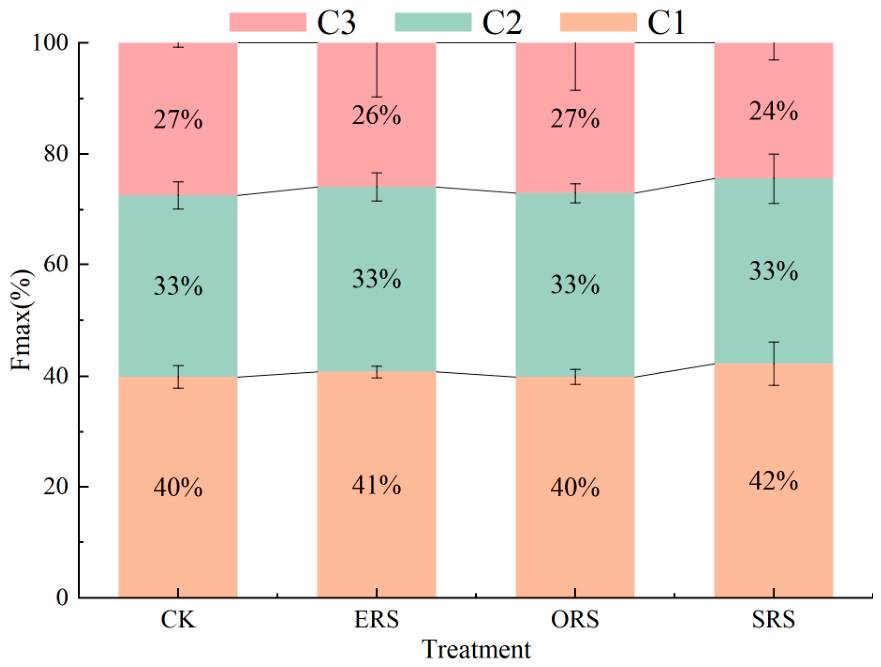
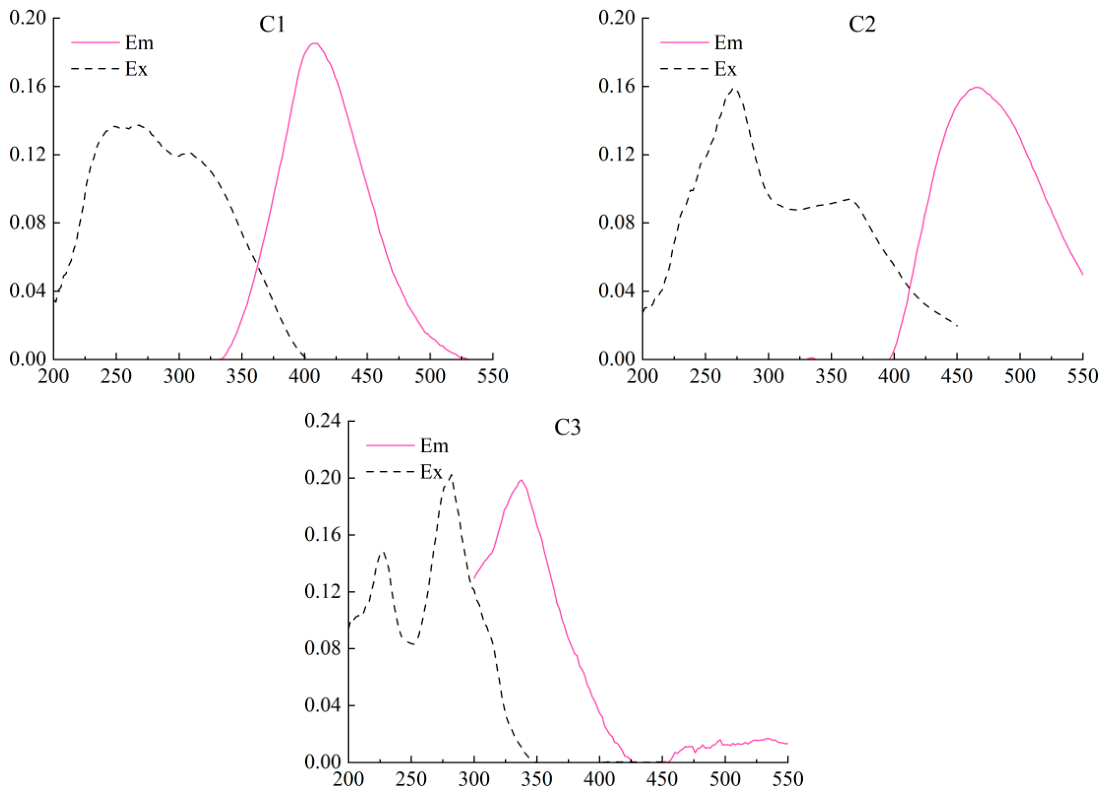
PARAFAC resolved the soil DOC fluorescence spectra into three components, and their relative contributions across treatments are shown in Figure 5. These components were tentatively assigned to fulvic-like C1, humic-like C2, and protein-like C3 based on their excitation and emission loadings (Figure 6). Across all treatments, C1 and C2 were the dominant components, together accounting for approximately 73–76% of the total fluorescence intensity, whereas C3 accounted for 24–27% (Figure 5). SRS showed the highest C1 contribution, which was 6.60%, 3.24%, and 5.56% higher than that under CK, ERS, and ORS, respectively. By contrast, SRS showed the lowest C3 contribution, decreasing by 11.07%, 3.86%, and 8.14% compared with CK, ERS, and ORS, respectively. C2 remained relatively stable across treatments (Figure 5). Overall, SMS return caused only modest shifts in PARAFAC-derived DOC fluorescence components, mainly reflected by a slight increase in C1 and a decrease in C3 under SRS. Effect sizes and 95% confidence intervals are provided in Supplementary Table S4.

3.5. Effects of SMS Return on the Chemical Bonding Environment of Aggregate-Associated Organic Carbon

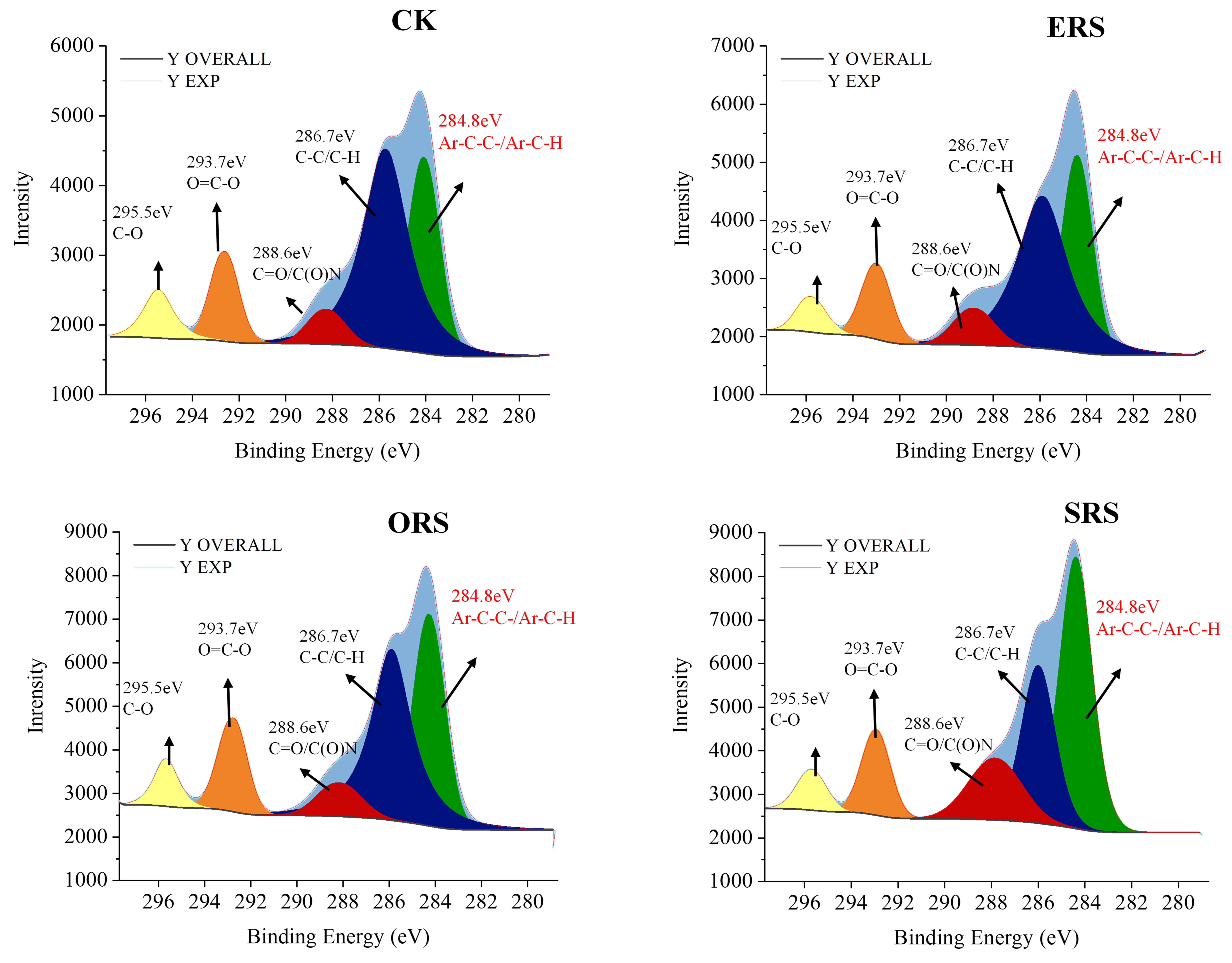
To further characterize changes in the chemical bonding environment of aggregate-associated organic carbon, XPS C1s spectra were analyzed. Curve fitting of the C1s spectra resolved five carbon fractions, including aromatic carbon, aliphatic carbon, carbonyl/amide carbon, carboxyl carbon, and ether/alcohol carbon (Figure 7; Supplementary Table S5). SMS return increased the relative proportion of aromatic carbon and decreased that of aliphatic carbon, with the strongest change observed under SRS. Specifically, compared with CK, SRS increased the relative proportion of aromatic carbon by 52.85%, while reducing that of aliphatic carbon by 47.35%. In addition, SRS showed a higher proportion of carbonyl/amide carbon than CK. Overall, these results suggest that SMS return was associated with a higher relative abundance of aromatic and oxygen-containing carbon fractions in aggregate-associated organic carbon.

3.6. Statistical Associations Between DOC-Related Indices and Aggregate Stability

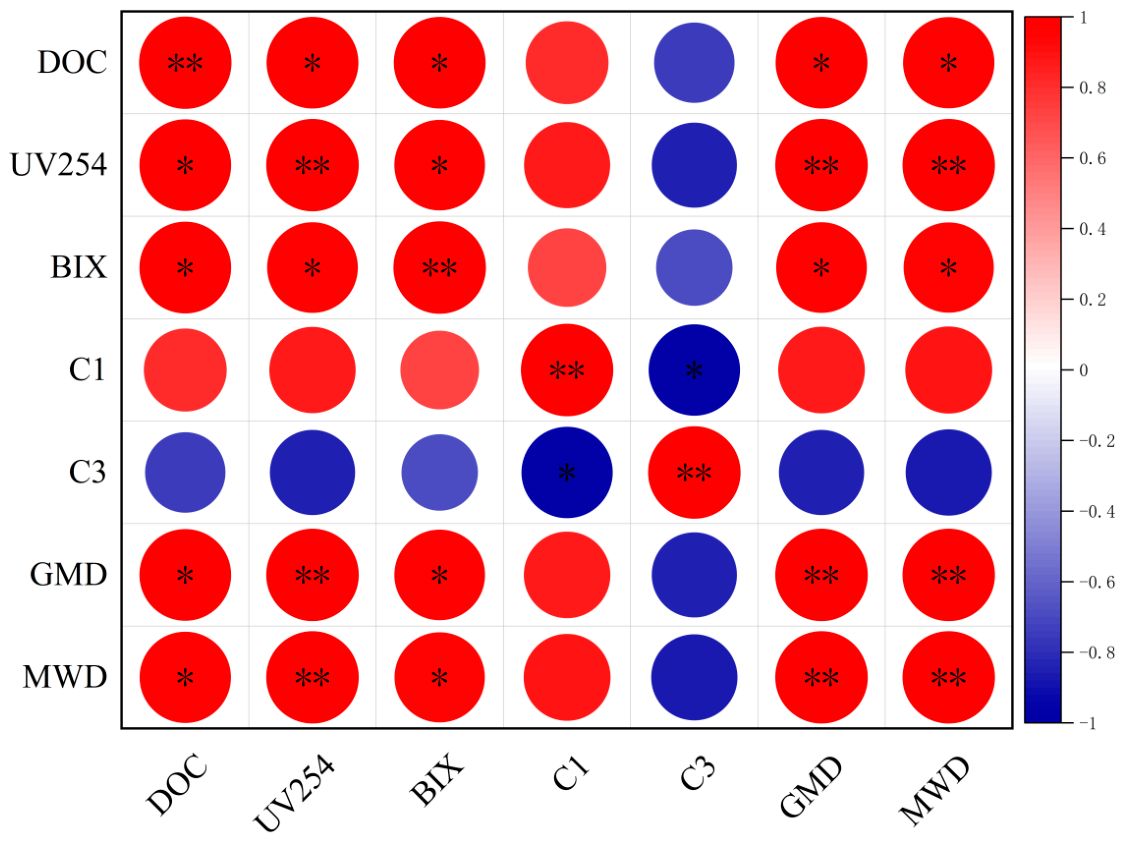
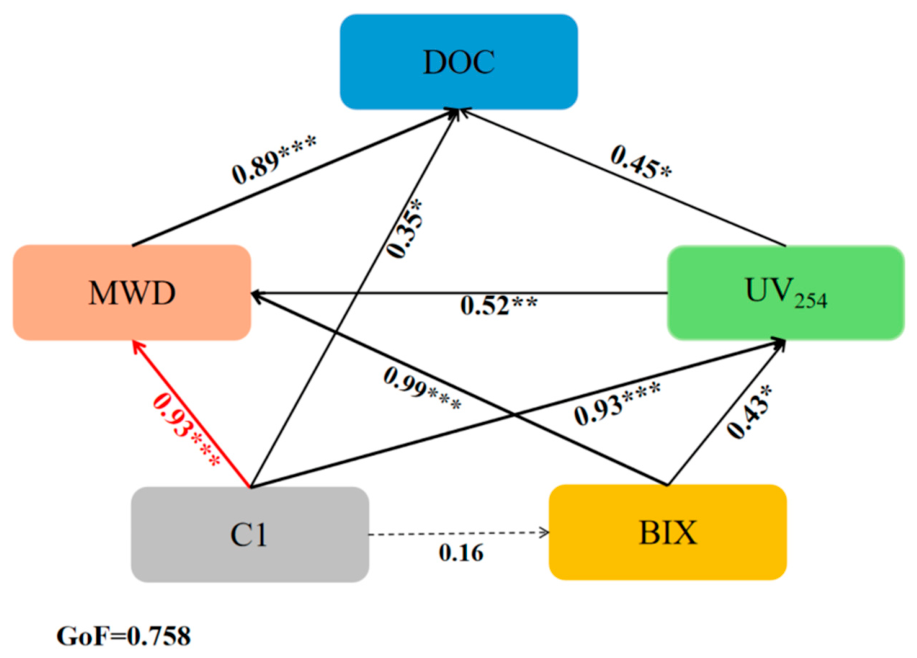
To improve the readability of the multivariate analyses, a correlation matrix and PLS-PM were used to provide a visual summary of statistical associations among DOC-related indices and aggregate stability indicators. Correlation analysis showed that GMD and MWD were positively correlated with DOC, UV254, and BIX, whereas C3 was negatively correlated with these variables (Figure 8). PLS-PM further indicated potential associations between DOC optical characteristics and aggregate stability (Figure 9). DOC, UV254, and BIX showed positive path coefficients with MWD, whereas C1 showed a negative direct path coefficient with MWD. In addition, UV254 and C1 were positively associated with DOC, and BIX was positively associated with UV254. The non-significant path from C1 to BIX suggested that their direct association was weak in the model.

4. Discussion

4.1. Effects of SMS Return on Soil Aggregate Distribution and Stability

Soil aggregates are generally regarded as the basic units of soil structure, and their stability is closely related to soil structural integrity, erosion resistance, and organic carbon protection [9]. The mean weight diameter (MWD) and geometric mean diameter (GMD) are commonly used indicators for evaluating aggregate stability [15], because they integrate changes in the mass distribution of aggregates across different size classes.
The results of this study showed that continuous two-year SMS return (SRS) had the most pronounced effect on improving soil aggregate structure. Compared with CK, SRS increased MWD and GMD by 23.24% and 22.68%, respectively. Meanwhile, SRS significantly increased the proportions of macroaggregates, with the >2 mm and 0.25–2 mm aggregate fractions increasing by 30.74% and 32.53%, respectively, whereas the 0.053–0.25 mm and <0.053 mm fractions decreased by 23.89% and 24.02%, respectively. These results indicate that SMS return was closely associated with a shift in aggregate-size distribution toward macroaggregates [28].
This shift may be related to the input and decomposition of SMS-derived organic materials. On the one hand, SMS contains relatively abundant organic matter and labile carbon fractions, which can provide carbon substrates for microbial activity after entering the soil. This may promote the formation of microbial metabolites, extracellular polysaccharides, fungal hyphae, and other binding agents, thereby strengthening the cohesion among soil particles and facilitating the transformation of smaller aggregates into macroaggregates [8]. Tisdall [9] reported that organic binding agents such as roots, fungal hyphae, and microbial polysaccharides play important roles in the formation and stabilization of water-stable aggregates. Six et al. [29]. also showed that macroaggregate formation is closely related to organic carbon input and soil organic matter turnover. On the other hand, SMS return may increase soil organic carbon and active carbon inputs, providing material support for organo-mineral associations and carbon protection within aggregates [30].
Overall, the results indicate that SMS return, especially continuous two-year return, was associated with a shift in aggregate-size distribution and higher aggregate stability in the tested soil. However, because this study was conducted under specific regional soil and management conditions, the broader applicability of these findings still needs to be further evaluated through long-term experiments across different soil types and cropping systems.

4.2. SMS Return Alters Soil Carbon Composition and Optical Properties

Soil aggregates play an important role in soil organic carbon protection because aggregate formation can physically protect organic matter from rapid decomposition. In this study, SMS return increased DOC content. Compared with CK, SRS increased the DOC content by 32.29% and UV254 by 47.40%, indicating that continuous SMS return was associated with higher DOC abundance and stronger UV-absorbing components. This finding is consistent with previous studies showing that organic material inputs can increase labile carbon input and influence aggregate-associated carbon dynamics [7].
The XPS results further indicated that under SRS, the relative proportion of aromatic carbon increased from 27.68% under CK to 42.31%, corresponding to an increase of 52.85%, whereas the relative proportion of aliphatic carbon decreased from 47.75% to 25.14%, corresponding to a decrease of 47.35%. This change may be related to the decomposition and transformation of SMS-derived organic materials in the soil [31]. After SMS incorporation, a large amount of organic carbon can be introduced into the soil [32]. However, relatively labile aliphatic carbon fractions may be preferentially utilized and mineralized by microorganisms [33], resulting in a decrease in their relative proportion. In contrast, aromatic carbon structures are generally more chemically stable and resistant to microbial decomposition [34] and therefore may become relatively enriched during organic matter decomposition. In addition, humified components and aromatic organic molecules derived from SMS decomposition may interact with mineral surfaces or metal ions, further favoring the accumulation of relatively stable carbon forms within soil aggregates [35]. Therefore, the increase in aromatic carbon and the decrease in aliphatic carbon under SRS reflected a shift in aggregate-associated organic carbon from relatively labile fractions toward more stable carbon forms under continuous SMS return. Similar changes have been reported in previous studies, where organic amendments such as manure or straw increased the proportion of aromatic carbon and reduced aliphatic carbon fractions compared with mineral fertilization alone [36]. Aromatic carbon is generally considered more resistant to microbial decomposition than aliphatic carbon, and its enrichment may be related to the greater chemical stability of organic carbon [37]. In addition, aromatic carbon and oxygen-containing functional groups can interact with mineral surfaces and metal ions, which may contribute to the formation of organo-mineral associations [38,39]. Therefore, the increase in aromatic and oxygen-containing carbon fractions suggests that SMS return may favor the formation of relatively stable carbon forms within soil aggregates. However, this interpretation is mainly based on XPS peak fitting and should be further verified using direct measurements of organo-mineral associations and carbon turnover processes.
The UV–Vis and fluorescence results showed that SMS return modified the optical properties of DOC, but the magnitude and direction of these changes differed among indices. Previous studies have generally suggested that UV254 reflects the UV-absorbing components and aromatic structural characteristics of DOM, SUVA254 is commonly used as an important proxy for DOM aromaticity [20], and the E2/E3 ratio is related to changes in DOM molecular weight or aromaticity, with lower E2/E3 values usually corresponding to a higher molecular weight or stronger aromatic characteristics [21].
In this study, SRS significantly increased UV254 while decreasing the E2/E3 ratio. This may be because continuous SMS return supplied more organic carbon substrates to the soil, and these materials could form humified or aromatic components with stronger UV absorbance during microbial decomposition and transformation processes [40], thereby leading to higher UV254 values. Meanwhile, a lower E2/E3 ratio is generally associated with higher DOM molecular weight or stronger aromaticity, indicating that DOC under SRS may have a relatively higher molecular complexity or condensation degree [41]. Therefore, the increase in UV254 together with the decrease in E2/E3 suggests that continuous SMS return may have promoted the accumulation of higher-molecular-weight or more aromatic DOC components.
For fluorescence indices, FI, BIX, and HIX are commonly used to characterize optical properties related to DOM source, biological contribution, and humification degree [24]. Specifically, FI is often used to distinguish terrestrial and microbial DOM sources, BIX indicates recent autochthonous or microbial contribution, and HIX reflects DOM humification characteristics. In this study, FI values were higher than 1.9 across all treatments, which may be related to microbial activity and the decomposition and transformation of SMS-derived organic materials in the soil. SMS contains a certain amount of labile organic carbon and nutrients, which can provide substrates for microbial growth and metabolism after incorporation into the soil. During the decomposition of SMS and soil organic matter, microbial metabolites, cell-lysis products, and newly formed soluble organic compounds may enter the DOC pool, thereby strengthening the microbial-source signal of DOC [22]. Therefore, the relatively high FI values may reflect the contribution of microbial processes to DOC formation and transformation under SMS return.
However, BIX and HIX showed no significant differences among treatments. There fore, although SMS return changed some UV–Vis optical parameters, the fluorescence results did not provide strong evidence for significant changes in recent biological contribution or DOC humification degree. Overall, SMS return altered the optical characteristics of DOC, but the UV–Vis and fluorescence indices are indirect indicators and should not be interpreted as direct evidence of a DOC compositional transformation.
PARAFAC analysis is commonly used to decompose three-dimensional fluorescence spectra into several independent fluorescence components and to tentatively assign DOM/DOC components according to their excitation and emission spectral characteristics [27]. In this study, PARAFAC resolved the soil DOC fluorescence spectra into three components. Based on their excitation and emission loadings and comparisons with previous studies on DOM fluorescence peak assignments [25], these components were tentatively assigned to fulvic-like C1, humic-like C2, and protein-like C3.
Across treatments, C1 and C2 were the dominant fluorescence components, together accounting for approximately 73–76% of the total fluorescence intensity. SRS showed the highest C1 contribution, which was 6.60%, 3.24%, and 5.56% higher than that under CK, ERS, and ORS, respectively. In contrast, SRS showed the lowest C3 contribution, which was 11.07%, 3.86%, and 8.14% lower than that under CK, ERS, and ORS, respectively. These changes may be because continuous two-year SMS return supplied more organic carbon substrates to the soil. Relatively labile protein-like or microbial-derived components may have been preferentially utilized and transformed by microorganisms, resulting in a decrease in the C3 contribution. Meanwhile, soluble organic compounds and microbial metabolites generated during SMS decomposition may have further participated in humification processes, leading to the formation or accumulation of more fulvic-like and humic-like fluorescence components [42]. Therefore, the C1 contribution was relatively higher under SRS.
In addition, strong correlations among the DOC concentration, UV254, BIX, C1, C3, GMD, and MWD indicate that changes in DOC quantity, optical characteristics, and fluorescence components may be closely associated with aggregate stability [29]. This may be because SMS return can supply organic carbon substrates to the soil, promote DOC accumulation, and alter the optical properties of DOM. Therefore, the DOC concentration, UV254, and BIX may show coordinated changes, reflecting synchronous variations in the quantity of dissolved organic matter, UV-absorbing characteristics, and biological-source signals, respectively [23]. Meanwhile, increased DOC can provide substrates for microbial activity and the formation of organic binding agents, promoting the production of microbial metabolites, extracellular polysaccharides, and organo-mineral associations, thereby facilitating macroaggregate formation and improving aggregate stability [9]. Therefore, a higher DOC concentration, stronger UV254 absorbance, and changes in fluorescence components may occur together with increases in GMD and MWD.
When SMS return increases the proportion of macroaggregates and decreases the proportion of smaller aggregate fractions, GMD and MWD usually increase synchronously. In addition, the opposite relationships of C1 and C3 with aggregate stability may reflect a shift in DOC fluorescence components. The increase in C1 and the decrease in C3 may be attributed to the transformation of DOC from relatively labile protein-like components toward more humified components under continuous SMS return, and this shift was consistent with the improvement in aggregate stability [43]. However, these results only indicate statistical associations among variables and do not prove that changes in DOC optical components directly drive the improvement of aggregate stability. The underlying mechanisms still need to be further verified by integrating microbial processes, organo-mineral associations, and carbon turnover.
In addition, the DOC concentration, UV–Vis indices, fluorescence components, and aggregate stability indicators may covary because they are jointly influenced by SMS input, microbial activity, organic matter decomposition, and soil physicochemical conditions. Therefore, the strong correlations observed in this study may partly reflect shared responses to SMS return rather than independent causal effects of individual DOC indicators. Although collinearity was checked before PLS-PM analysis, the limited sample size and field-based design still restrict the strength of causal inference. Thus, the multivariate results should be interpreted as exploratory evidence for potential linkages rather than definitive proof of direct mechanisms.
Overall, in the tested fluvo-aquic soil, SMS return was associated with changes in the DOC content, DOC optical characteristics, and the chemical bonding environment of aggregate-associated organic carbon. These changes may partly explain the improvement in aggregate stability, but they should not be interpreted as definitive evidence of long-term carbon sequestration or universal soil improvement. Because this study was conducted under specific regional soil and management conditions, the broader applicability of SMS return should be further evaluated through long-term, multi-site experiments across different soil types, climatic regions, and cropping systems.
Several limitations should be acknowledged. First, this study was conducted at a single experimental site with one medium-textured fluvo-aquic soil under a wheat–maize rotation system. Therefore, the observed effects of SMS return on DOC characteristics and aggregate stability may be influenced by local soil texture, initial fertility, climate conditions, the cropping system, and field management practices. Second, the experiment focused mainly on soil aggregate stability, DOC optical properties, and aggregate-associated organic carbon composition, whereas crop yield response, nutrient release dynamics, microbial community succession, and greenhouse gas emissions were not fully evaluated. Third, the study period was relatively short for assessing long-term carbon stabilization. Therefore, the results should be interpreted as site-specific mechanistic evidence rather than a universal recommendation for SMS application.
In addition to these potential benefits, the practical application of SMS should also consider possible biological risks. Fresh or insufficiently treated SMS may create favorable conditions for certain soilborne organisms, including nematodes, and direct application without proper pretreatment may increase the risk of crop damage and yield loss under unfavorable conditions. Therefore, SMS should be properly composted, stabilized, or sanitized before field application to reduce potential pathogen and nematode risks [44,45]. Appropriate pretreatment, controlled application rates, and field monitoring are essential for safe SMS recycling in cereal-based systems.
Future studies on SMS resource utilization should further focus on safe, efficient, and site-specific recycling strategies. First, long-term field experiments across different soil types, climatic regions, and cropping systems are needed to evaluate the persistence of SMS-induced improvements in aggregate stability and carbon accumulation. Second, the effects of SMS application rate, return frequency, maturity degree, and pretreatment method should be systematically compared to identify appropriate application thresholds. Third, future work should pay greater attention to the coupled dynamics of DOC transformation, microbial community succession, nutrient release, inorganic nitrogen forms such as NH4+-N and NO3-N, greenhouse gas emissions, and crop yield formation. Finally, integrated assessments combining soil quality, crop productivity, environmental risk, and economic feasibility are needed to develop practical guidelines for the safe and sustainable agricultural utilization of SMS.

5. Conclusions

This study showed that SMS return was associated with changes in soil aggregate distribution, DOC characteristics, and aggregate-associated organic carbon composition in a medium-textured fluvo-aquic soil. Among the tested regimes, SRS showed the strongest effect. Compared with CK, SRS increased the proportions of >2 mm and 0.25–2 mm aggregates by 31.62% and 33.42%, respectively, and increased MWD and GMD by 23.25% and 22.68%, respectively, indicating that SRS was associated with macroaggregate formation and improved aggregate stability.
SMS return also changed DOC-related indicators and aggregate-associated organic carbon composition. Compared with CK, SRS increased the DOC concentration and UV254 by 32.29% and 47.40%, respectively. XPS analysis showed that the relative proportion of aromatic carbon increased from 27.68% under CK to 42.31% under SRS, whereas that of aliphatic carbon decreased from 47.75% to 25.14%. PARAFAC analysis identified three DOC fluorescence components, including fulvic-like C1, humic-like C2, and protein-like C3. Under SRS, the relative contribution of C1 increased by 6.60% compared with CK, while that of C3 decreased by 11.07%.
Overall, under the tested fluvo-aquic soil and wheat–maize rotation conditions, SRS was associated with higher aggregate stability and changes in DOC and aggregate-associated carbon characteristics. These findings suggest potential linkages among SMS return, DOC characteristics, aggregate-associated carbon composition, and aggregate stability, but they do not prove direct, DOC-mediated causal mechanisms. Therefore, a wider application of SMS return should be based on proper pretreatment, appropriate application rates, and long-term field verification across different soil types, cropping systems, and climatic conditions.

Supplementary Materials

The following supporting information can be downloaded at: https://www.mdpi.com/article/10.3390/agronomy16121142/s1, Table S1: Effect sizes and 95% confidence intervals for the effects of SMS return on soil aggregate fractions, aggregate stability indices, and DOC content; Table S2: Effect sizes and 95% confidence intervals for the effects of SMS return on DOC UV–Vis spectral parameters; Table S3: Effect sizes and 95% confidence intervals for the effects of SMS return on soil DOC fluorescence indices; Table S4: Effect sizes and 95% confidence intervals for pairwise comparisons of PARAFAC-derived DOC fluorescence components between CK and SMS return treatments; Table S5: Content of organic functional groups on the aggregate surfaces under different treatments; Table S6: Spectral features of the three PARAFAC-resolved fluorescence components; Figure S1: Excitation and emission spectral loadings of the three PARAFAC-resolved fluorescence components of soil DOC; Figure S2: Excitation–emission matrix spectra of DOM under different treatments.

Author Contributions

Conceptualization, X.S. and W.K.; methodology, X.S., Q.L. (Qingxin Li), K.Z. and J.Z.; investigation, Q.L. (Qingxin Li), K.Z., J.Z., T.G., F.G., Q.L. (Qirui Li), X.Z. and J.L.; formal analysis, X.S., Q.L. (Qingxin Li) and K.Z.; data curation, Q.L. (Qingxin Li), K.Z. and J.Z.; writing—original draft preparation, X.S.; writing—review and editing, W.K., S.P.W. and T.L.; visualization, X.S. and K.Z.; supervision, W.K. and T.L.; project administration, W.K.; funding acquisition, W.K. All authors have read and agreed to the published version of the manuscript.

Funding

This study was supported by the International Science and Technology Innovation Cooperation Program (2023YFE0105000) and the Henan Provincial Key Research and Development Program (251111520600). and the Research Project on Key Technologies for High-Yield Cultivation of Stropharia rugosoannulata through Carbon–Nitrogen Coordination (262102110198).

Data Availability Statement

The original contributions presented in this study are included in the article/Supplementary Material. Further inquiries can be directed to the corresponding author.

Conflicts of Interest

The authors declare no conflicts of interest.

References

  1. Lal, R. Soil carbon sequestration impacts on global climate change and food security. Science 2004, 304, 1623–1627. [Google Scholar] [CrossRef] [PubMed]
  2. Kopittke, P.M.; Menzies, N.W.; Wang, P.; McKenna, B.A.; Lombi, E. Soil and the intensification of agriculture for global food security. Environ. Int. 2019, 132, 105078. [Google Scholar] [CrossRef]
  3. IPCC. Food Security. In Climate Change and Land: An IPCC Special Report on Climate Change, Desertification, Land Degradation, Sustainable Land Management, Food Security, and Greenhouse Gas Fluxes in Terrestrial Ecosystems; Shukla, P.R., Skea, J., Calvo Buendia, E., Masson-Delmotte, V., Pörtner, H.-O., Roberts, D.C., Zhai, P., Slade, R., Connors, S., van Diemen, R., et al., Eds.; IPCC: Geneva, Switzerland, 2019. [Google Scholar]
  4. Grimm, D.; Wösten, H.A.B. Mushroom cultivation in the circular economy. Appl. Microbiol. Biotechnol. 2018, 102, 7795–7803. [Google Scholar] [CrossRef]
  5. Martín, C.; Zervakis, G.I.; Xiong, S.; Koutrotsios, G. Spent substrate from mushroom cultivation: Exploitation potential toward various applications and value-added products. Bioengineered 2023, 14, 2252138. [Google Scholar] [CrossRef]
  6. Quisth, I.; Hasper, T.B.; Carlsson, G.; Friberg, H. Spent mushroom substrate (SMS) as a sustainable soil amendment and biofertilizer: A review of opportunities and challenges in agricultural and horticultural systems. Agric. Food Sci. 2025, 34, 256–274. [Google Scholar] [CrossRef]
  7. Medina, E.; Paredes, C.; Bustamante, M.A.; Moral, R.; Moreno-Caselles, J. Relationships between soil physico-chemical, chemical and biological properties in a soil amended with spent mushroom substrate. Geoderma 2012, 173–174, 152–161. [Google Scholar] [CrossRef]
  8. Yang, G.; Zhang, J.; Zhang, X.; Yang, Y.; Yu, J.; Shao, B.; Li, J.; Guo, Z.; Shao, X.; Wang, G.; et al. Changes in soil organic carbon components and microbial community characteristics after the application of spent mushroom substrates. Front. Microbiol. 2024, 15, 1351921. [Google Scholar]
  9. Tisdall, J.M.; Oades, J.M. Organic matter and water-stable aggregates in soils. J. Soil Sci. 1982, 33, 141–163. [Google Scholar]
  10. Shu, W.; Zhou, X.; Ma, Y.; Liu, L.; Duan, Y.; Huang, C.; Li, Y. Effects of spent mushroom substrate incorporation depth on soil microbial dynamics, carbon-nutrient cycling, and maize productivity in black soil ecosystems. Environ. Technol. Innov. 2025, 40, 104481. [Google Scholar] [CrossRef]
  11. Gee, G.W.; Bauder, J.W. Particle-size analysis. In Methods of Soil Analysis, Part 1: Physical and Mineralogical Methods; Klute, A., Ed.; ASA and SSSA: Madison, WI, USA, 1986; pp. 383–411. [Google Scholar]
  12. Nelson, D.W.; Sommers, L.E. Total carbon, organic carbon, and organic matter. In Methods of Soil Analysis, Part 2: Chemical and Microbiological Properties; Page, A.L., Ed.; ASA and SSSA: Madison, WI, USA, 1982; pp. 539–579. [Google Scholar]
  13. Walkley, A.; Black, I.A. An examination of the Degtjareff method for determining soil organic matter, and a proposed modification of the chromic acid titration method. Soil Sci. 1934, 37, 29–38. [Google Scholar] [CrossRef]
  14. Rhoades, J.D. Cation exchange capacity. In Methods of Soil Analysis, Part 2, 2nd ed.; Page, A.L., Ed.; ASA and SSSA: Madison, WI, USA, 1982; pp. 149–157. [Google Scholar]
  15. Mulvaney, R.L. Nitrogen—Inorganic forms. In Methods of Soil Analysis, Part 3; Sparks, D.L., Ed.; SSSA and ASA: Madison, WI, USA, 1996; pp. 1123–1184. [Google Scholar]
  16. Carter, M.R.; Gregorich, E.G. (Eds.) Soil Sampling and Methods of Analysis, 2nd ed.; CRC Press: Boca Raton, FL, USA, 2007. [Google Scholar]
  17. Le Bissonnais, Y. Aggregate stability and assessment of soil crustability and erodibility: I. Theory and methodology. Eur. J. Soil Sci. 1996, 47, 425–437. [Google Scholar] [CrossRef]
  18. Solomon, D.; Lehmann, J.; Kinyangi, J.; Liang, B.; Schäfer, T. Carbon K-edge NEXAFS and FTIR-ATR spectroscopic investigation of organic carbon speciation in soils. Soil Sci. Soc. Am. J. 2005, 69, 107–119. [Google Scholar] [CrossRef]
  19. Jones, D.L.; Willett, V.B. Experimental evaluation of methods to quantify dissolved organic nitrogen (DON) and dissolved organic carbon (DOC) in soil. Soil Biol. Biochem. 2006, 38, 991–999. [Google Scholar] [CrossRef]
  20. Weishaar, J.L.; Aiken, G.R.; Bergamaschi, B.A.; Fram, M.S.; Fujii, R.; Mopper, K. Evaluation of specific ultraviolet absorbance as an indicator of the chemical composition and reactivity of dissolved organic carbon. Environ. Sci. Technol. 2003, 37, 4702–4708. [Google Scholar] [CrossRef]
  21. Peuravuori, J.; Pihlaja, K. Molecular size distribution and spectroscopic properties of aquatic humic substances. Anal. Chim. Acta 1997, 337, 133–149. [Google Scholar] [CrossRef]
  22. McKnight, D.M.; Boyer, E.W.; Westerhoff, P.K.; Doran, P.T.; Kulbe, T.; Andersen, D.T. Spectrofluorometric characterization of dissolved organic matter for indication of precursor organic material and aromaticity. Limnol. Oceanogr. 2001, 46, 38–48. [Google Scholar] [CrossRef]
  23. Huguet, A.; Vacher, L.; Relexans, S.; Saubusse, S.; Froidefond, J.M.; Parlanti, E. Properties of fluorescent dissolved organic matter in the Gironde Estuary. Org. Geochem. 2009, 40, 706–719. [Google Scholar] [CrossRef]
  24. Zsolnay, A.; Baigar, E.; Jimenez, M.; Steinweg, B.; Saccomandi, F. Differentiating with fluorescence spectroscopy the sources of dissolved organic matter in soils subjected to drying. Chemosphere 1999, 38, 45–50. [Google Scholar] [CrossRef]
  25. Coble, P.G. Characterization of marine and terrestrial DOM in seawater using excitation–emission matrix spectroscopy. Mar. Chem. 1996, 51, 325–346. [Google Scholar] [CrossRef]
  26. Stedmon, C.A.; Bro, R. Characterizing dissolved organic matter fluorescence with parallel factor analysis: A tutorial. Limnol. Oceanogr. Methods 2008, 6, 572–579. [Google Scholar] [CrossRef]
  27. Murphy, K.R.; Stedmon, C.A.; Graeber, D.; Bro, R. Fluorescence spectroscopy and multi-way techniques. PARAFAC. Anal. Methods 2013, 5, 6557–6566. [Google Scholar] [CrossRef]
  28. Udom, B.E.; Nuga, B.O.; Adesodun, J.K. Water-stable aggregates and aggregate-associated organic carbon and nitrogen after three annual applications of poultry manure and spent mushroom wastes. Appl. Soil Ecol. 2016, 101, 5–10. [Google Scholar] [CrossRef]
  29. Six, J.; Elliott, E.T.; Paustian, K. Soil macroaggregate turnover and microaggregate formation: A mechanism for C sequestration under no-tillage agriculture. Soil Biol. Biochem. 2000, 32, 2099–2103. [Google Scholar] [CrossRef]
  30. Kleber, M.; Sollins, P.; Sutton, R. A conceptual model of organo-mineral interactions in soils: Self-assembly of organic molecular fragments into zonal structures on mineral surfaces. Biogeochemistry 2007, 85, 9–24. [Google Scholar] [CrossRef]
  31. Li, F.; Chen, L.; Zhang, J.; Yin, J.; Huang, S. Spent mushroom substrates affect soil humus composition, microbial biomass and functional diversity in paddy fields. Appl. Soil Ecol. 2020, 149, 103489. [Google Scholar] [CrossRef]
  32. von Lützow, M.; Kögel-Knabner, I.; Ekschmitt, K.; Matzner, E.; Guggenberger, G.; Marschner, B.; Flessa, H. Stabilization of organic matter in temperate soils: Mechanisms and their relevance under different soil conditions—A review. Eur. J. Soil Sci. 2006, 57, 426–445. [Google Scholar] [CrossRef]
  33. Baldock, J.A.; Oades, J.M.; Waters, A.G.; Peng, X.; Vassallo, A.M.; Wilson, M.A. Aspects of the chemical structure of soil organic materials as revealed by solid-state 13C NMR spectroscopy. Biogeochemistry 1992, 16, 1–42. [Google Scholar] [CrossRef]
  34. Sollins, P.; Homann, P.; Caldwell, B.A. Stabilization and destabilization of soil organic matter: Mechanisms and controls. Geoderma 1996, 74, 65–105. [Google Scholar] [CrossRef]
  35. Wattel-Koekkoek, E.J.W.; van Genuchten, P.P.L.; Buurman, P.; van Lagen, B. Amount and composition of clay-associated soil organic matter in a range of kaolinitic and smectitic soils. Geoderma 2001, 99, 27–49. [Google Scholar] [CrossRef]
  36. Wu, S.L.; Nguyen, T.A.; Liu, Y.J.; Southam, G.; Wang, S.C.; Chan, T.S.; Lu, Y.R.; Huang, L.B. Deficiencies of secondary Fe (oxy)hydroxides associated with phyllosilicates and organic carbon limit the formation of water-stable aggregates in Fe-ore tailings. Chem. Geol. 2019, 523, 73–87. [Google Scholar] [CrossRef]
  37. Jiang, G.Y.; Zhang, W.J.; Xu, M.G.; Kuzyakov, Y.; Zhang, X.B.; Wang, J.Z.; Di, J.Y.; Murphy, D.V. Manure and mineral fertilizer effects on crop yield and soil carbon sequestration: A meta-analysis and modeling across China. Glob. Biogeochem. Cycles 2018, 32, 1659–1672. [Google Scholar] [CrossRef]
  38. Wen, Y.; Liu, W.; Deng, W.; He, X.; Yu, G. Impact of agricultural fertilization practices on organo-mineral associations in four long-term field experiments: Implications for soil C sequestration. Sci. Total Environ. 2019, 651, 591–600. [Google Scholar] [CrossRef]
  39. Zhang, X.; Shen, S.; Xue, S.; Hu, Y.; Wang, X. Long-term tillage and cropping systems affect soil organic carbon components and mineralization in aggregates in semiarid regions. Soil Tillage Res. 2023, 231, 105742. [Google Scholar] [CrossRef]
  40. Huang, C.; Han, X.; Luo, Q.; Nie, Y.; Kang, M.; Chen, Y.; Tang, M.; Fu, Y.; Li, X.; Chen, Y. Agro-Based Spent Mushroom Compost Substrates Improve Soil Properties and Microbial Diversity in Greenhouse Tomatoes. Agronomy 2023, 13, 2291. [Google Scholar] [CrossRef]
  41. Helms, J.R.; Stubbins, A.; Ritchie, J.D.; Minor, E.C.; Kieber, D.J.; Mopper, K. Absorption spectral slopes and slope ratios as indicators of molecular weight, source, and photobleaching of chromophoric dissolved organic matter. Limnol. Oceanogr. 2008, 53, 955–969. [Google Scholar] [CrossRef]
  42. Becher, M.; Pakuła, K.; Jaremko, D. Organic matter properties of spent button mushroom substrate in the context of soil organic matter reproduction. Agronomy 2021, 11, 204. [Google Scholar] [CrossRef]
  43. Hur, J.; Park, M.H.; Schlautman, M.A. Microbial transformation of dissolved leaf litter organic matter and its effects on selected organic matter operational descriptors. Environ. Sci. Technol. 2009, 43, 2315–2321. [Google Scholar] [CrossRef]
  44. Akhtar, M.; Malik, A. Roles of organic soil amendments and soil organisms in the biological control of plant-parasitic nematodes: A review. Bioresour. Technol. 2000, 74, 35–47. [Google Scholar] [CrossRef]
  45. Thoden, T.C.; Korthals, G.W.; Termorshuizen, A.J. Organic amendments and their influences on plant-parasitic and free-living nematodes: A promising method for nematode management. Nematology 2011, 13, 133–153. [Google Scholar] [CrossRef]
Figure 1. Crop planting timeline across rotation schemes. CK, ERS, ORS, and SRS represent the control, every-other-year SMS return, one-year SMS return, and successive SMS return treatments, respectively.
Agronomy 16 01142 g001
Figure 2. Effects of SMS return on soil aggregate properties: (A) aggregate size distribution; (B) geometric mean diameter (GMD); (C) mean weight diameter (MWD); (D) dissolved organic carbon (DOC) content. CK, no SMS return; ERS, alternate-year SMS return; ORS, one-year SMS return; SRS, two-year continuous SMS return. Different lowercase letters indicate significant differences among treatments within the same aggregate size class or index according to one-way ANOVA followed by Duncan’s multiple range test at p < 0.05. Values are means ± standard errors (n = 3). This convention applies to all subsequent figures.
Agronomy 16 01142 g002aAgronomy 16 01142 g002b
Figure 3. UV–Vis absorption spectra of soil DOC across treatments. CK, no SMS return; ERS, alternate-year SMS return; ORS, one-year SMS return; SRS, two-year continuous SMS return.
Agronomy 16 01142 g003
Figure 4. Effects of SMS return on DOC spectral parameters: (A) UV absorbance at 254 nm (UV254); (B) specific UV absorbance at 254 nm (SUVA254); (C) E2/E3 ratio; (D) E3/E4 ratio. CK, no SMS return; ERS, alternate-year SMS return; ORS, one-year SMS return; SRS, two-year continuous SMS return. Different lowercase letters indicate significant differences among treatments according to one-way ANOVA followed by Duncan’s multiple range test at p < 0.05. Values are means ± standard errors (n = 3).
Agronomy 16 01142 g004
Figure 5. Relative fluorescence contribution of DOC components across treatments. CK, no SMS return; ERS, alternate-year SMS return; ORS, one-year SMS return; SRS, two-year continuous SMS return; SMS, spent mushroom substrate.
Agronomy 16 01142 g005
Figure 6. Excitation and emission spectral loadings of the three PARAFAC-resolved fluorescence components of soil DOC: (C1) fulvic-like component; (C2) humic-like component; (C3) protein-like component. The red solid lines represent emission loadings, and the blue dashed lines represent excitation loadings.
Agronomy 16 01142 g006
Figure 7. XPS C1s spectra of aggregate-associated organic carbon under different SMS return regimes. CK, no SMS return; ERS, alternate-year SMS return; ORS, one-year SMS return; and SRS, two-year continuous SMS return.
Agronomy 16 01142 g007
Figure 8. Correlations between DOC-related indices and aggregate stability. Pearson correlation analysis was used to examine statistical associations among variables. Red and blue circles indicate positive and negative correlations, respectively, and circle size represents the absolute strength of the correlation coefficient. Significance levels are indicated as follows: * p < 0.05, ** p < 0.01. This analysis was used to explore statistical associations rather than to establish direct causal relationships.
Agronomy 16 01142 g008
Figure 9. Partial least squares path model (PLS-PM) showing potential associations between DOC-related indices and aggregate stability. Numbers on arrows indicate standardized path coefficients. Black and red solid arrows indicate significant positive and negative paths, respectively, whereas dashed arrows indicate non-significant paths. Significance levels are indicated as follows: * p < 0.05, ** p < 0.01, and *** p < 0.001. GoF = 0.758. This model was used as an exploratory tool to evaluate potential linkages among variables rather than to prove direct causal mechanisms.
Agronomy 16 01142 g009
Table 1. Physicochemical properties of the 0–20 cm soil layer under different SMS return regimes.
TreatmentTotal N (g·kg−1)Olsen P (mg·kg−1)Available K (mg·kg−1)Organic Matter (g·kg−1)
CK1.21 ± 0.05 b19.78 ± 1.80 c94.63 ± 2.20 d15.82 ± 0.9 c
ERS1.27 ± 0.08 ab29.47 ± 1.60 b124.02 ± 2.71 c18.02 ± 0.2 b
ORS1.31 ± 0.05 ab30.31 ± 1.60 b116.78 ± 4.08 b17.90 ± 0.7 b
SRS1.35 ± 0.05 a34.54 ± 1.71 a140.24 ± 4.16 a19.62 ± 0.9 a
Note: Values are means ± standard errors (n = 3). Different lowercase letters within the same column indicate significant differences among SMS return regimes according to one-way ANOVA followed by Duncan’s multiple range test at p < 0.05.
Table 2. Fertilization regime and cumulative SMS input under different rotation schemes.
TreatmentN (kg·ha−1)P2O5 (kg·ha−1)K2O (kg·ha−1)Cumulative SMS Input
(t·ha−1 Fresh Weight)
CK225901500
ORS2259015022.5
ERS2259015022.5
SRS2259015045
Note: SMS was applied at 22.5 t ha−1 fresh weight per return event. ORS and ERS each received one SMS return event, whereas SRS received two SMS return events during the experimental period. The N, P2O5, and K2O rates refer to the fertilization regime for wheat and maize seasons.
Table 3. DOC fluorescence indices.
TreatmentFluorescence Spectral Indices
FIBIXHIX
CK2.15 ± 0.032 a0.62 ± 0.016 a0.81 ± 0.008 a
ERS2.10 ± 0.007 a0.63 ± 0.062 a0.82 ± 0.052 a
ORS2.09 ± 0.011 a0.65 ± 0.061 a0.82 ± 0.042 a
SRS2.09 ± 0.013 a0.68 ± 0.039 a0.83 ± 0.004 a
Note: Values are means ± standard errors (n = 3). Different lowercase letters within the same column indicate significant differences among treatments according to one-way ANOVA followed by Duncan’s multiple range test at p < 0.05. CK, no SMS return; ERS, alternate-year SMS return; ORS, one-year SMS return; SRS, two-year continuous SMS return; SMS, spent mushroom substrate; DOC, dissolved organic carbon; FI, fluorescence index; BIX, biological index; HIX, humification index.
Disclaimer/Publisher’s Note: The statements, opinions and data contained in all publications are solely those of the individual author(s) and contributor(s) and not of MDPI and/or the editor(s). MDPI and/or the editor(s) disclaim responsibility for any injury to people or property resulting from any ideas, methods, instructions or products referred to in the content.