Article

Effects of Tillage Practices on Soil Organo-Mineral Complexes and Organic Carbon Distribution Under Continuous Maize Cropping in the Black Soil Region of Northeast China

College of Resources and Environment, Jilin Agricultural University, Changchun 130118, China
*
Author to whom correspondence should be addressed.
Agronomy 2026, 16(11), 1093; https://doi.org/10.3390/agronomy16111093
Submission received: 17 April 2026 / Revised: 18 May 2026 / Accepted: 24 May 2026 / Published: 31 May 2026
(This article belongs to the Section Soil and Plant Nutrition)

Abstract

Organo-mineral complexes are intimately involved in protecting the stability of soil organic carbon (SOC), as they are influenced by environmental factors such as pH and redox conditions, as well as by the implementation of appropriate management practices. Nevertheless, the influencing factors of organo-mineral complexes, as well as their response to tillage practices, remain poorly understood. This study investigated the effects of rotary tillage (RT), plow tillage (PT), and no tillage (NT) on organo-mineral complexes (water-dispersible G0 fraction, sodium-dispersible G1 fraction, grinding-dispersible G2 fraction) and their organic carbon (OC) in the black soil region of Northeast China in 2002 and 2022. Compared to 2002, the content of organo-mineral complexes and their OC in 2022 increased by 5.54% and 3.15%, respectively. Relative to RT, PT and NT increased the organo-mineral complex content by −0.39% and 7.98% and increased the OC content by −8.60% and 10.19%, respectively. Between 2002 and 2022, tillage measures led to greater contributions (78.71%) of organo-mineral complexes to soil carbon sequestration. In 2022, the NT treatment showed significantly higher exchangeable Ca2+ content than both the RT and PT treatments by 17.35% and 24.16%, respectively. Relative to RT, the PT treatment resulted in decreased levels of free and crystalline oxides of iron and aluminum, alongside increased levels of amorphous and complexed forms. By contrast, the NT treatment displayed a reverse trend. Redundancy and correlation analyses identified exchangeable Ca2+ in G1, pH, clay, and TP, along with iron and aluminum oxides, as key environmental factors influencing the transformation pathways among the complex fractions.

1. Introduction

Soil organic matter and soil minerals are the most important components of soil. Through organic–mineral interactions, they form stable organo-mineral complexes, which play a significant role in improving soil morphological structure and water and thermal regimes and enhancing the accumulation of soil organic carbon (SOC) [1]. During soil formation, differences in material composition and content give rise to organo-mineral complexes of various types and fractions. Meanwhile, environmental conditions and tillage practices can induce transformations in the fraction and quantity of these complexes, thereby affecting the water and nutrient retention capacity of the soil [2].
However, long-term continuous maize monoculture and conventional tillage practices, primarily based on moldboard plowing over the years, have led to severe degradation of the black soil in Northeast China. This degradation is characterized by marked compaction of the plow layer, soil structure destruction, depletion of organic matter, and diminished soil fertility [3]. The SOC content in the top 17 cm of uncultivated soil was nearly double that of its cultivated equivalent after 50 years [4], and the average thickness of the topsoil has decreased by 13.7 cm [5]. The cation exchange capacity (CEC) of surface Chinese Mollisol declined with cultivation, from 45.8 cmol kg−1 in uncultivated soil to 31.5 cmol kg−1 after cultivation [6]. To fight this degradation, restoring soil productivity and reconstructing a high-yield farmland ecosystem are therefore critical challenges that demand immediate resolution for the region’s sustainable agricultural and economic development. Enhancing the protection and rational utilization of black soil is of great importance for safeguarding both global food security and ecological safety.
The SOC long-term persistence is predominantly regulated by mineral protection [7,8]. Soil organic matter binds with minerals to form organo-mineral complexes (as the core of mineral-associated organic matter, MAOM) [9,10], which are relatively active components in the soil and have significant impacts on the stability of soil structure and the retention of soil moisture and nutrients, as well as the transformation of inorganic cementing substances [11,12].
Up to 73% of organic matter is protected by organo-mineral complexes [13]. The protection of SOC by minerals is stabilized through the formation of organo-mineral complexes [14,15]. This is not the only mechanism for stabilizing SOC. The formation, composition characteristics and functional roles of soil organo-mineral complexes are extremely complex. They are influenced not only by the material composition of the inherent soil properties but also by tillage measures and environmental factors. Thus, despite organo-mineral complexes being of great significance in the stability of soil organic matter, fundamental knowledge gaps regarding the nature and behavior of organo-mineral complexes persist.
In the 0–17 cm topsoil layer, physical protection of SOC is greatly diminished by agricultural disturbances like tillage, thereby accelerating decomposition [16]. Studies have shown that different tillage measures (no tillage, rotary tillage, plow tillage, etc.) affect the content of soil organo-mineral complexes [17,18]. The stabilization of organo-mineral complexes was enhanced under notillage, as the reduced turnover rate of aggregates facilitated the formation and persistence of micro-aggregates within macro-aggregates [19]. The effects of tillage measures on the protection of organic matter may depend on the type of soil. However, the effects of tillage measures on organo-mineral complexes of low-weathered soils might be greater than that of high-weathered soils [20]. It remains unclear how different tillage measures affect the impact on the stability of organo-mineral complexes and sequestration of SOC.
Globally, exchangeable calcium (Ca) in most soils (from slightly acidic soil to alkaline soil) is positively correlated with SOC. Ca in the soil facilitates the formation of organo-mineral complexes by creating cation bridges between organic colloids and mineral surfaces [21]. This process improves soil permeability and water retention, thereby promoting the accumulation of SOC. Furthermore, soil minerals, particularly iron (Fe) and aluminum (Al) oxides, are regarded as the key controlling factors for the formation of organo-mineral complexes [13,22,23]. Most studies suggest that the morphology of Fe/Al oxides in soil is influenced by various environmental factors, including soil physicochemical properties and vegetation. Factors such as SOC, pH, total nitrogen, total phosphorus, moisture content, and clay particle content can all drive the transformation of Fe/Al oxide morphology [24,25]. Consequently, the mechanism by which these oxides influence SOC remains uncertain and varies under different soil conditions. The surface of Fe oxides carries a large number of positive charges, enabling them to effectively adsorb negatively charged organic matter and form stable organo-mineral complexes through mechanisms such as ligand exchange, cation bridging, and hydrogen bonding [26,27]. Meanwhile, during continuous redox processes, Fe/Al oxides constantly co-precipitate with organic matter, which can effectively sequester SOC, reduce its accessibility to environmental microorganisms, and thereby slow down SOC decomposition [28,29]. Lower soil pH values promote the adsorption of SOC by Fe/Al oxides by increasing the solubility of Fe/Al ions and the positive charge on the surface of metal oxides [30]. Different tillage measures cause substantial variation in the depth of soil disturbance, resulting in significant differences in soil redox conditions and, consequently, in the protective effects of Fe/Al oxides on organo-mineral complexes [31]. Current, in-depth analysis of the key factors influencing the content of organic–mineral complexes and their bound organic carbon accumulation by tillage measures remains insufficient [32].
The grouping of soil organo-mineral complexes based on Tyulin’s dispersion method has long been regarded as the basic classification of complexes [33,34]. MAOM can be studied based on particle size and density. Currently, the more mainstream and functionally significant analytical method is density fractionation. The gel dispersion method is based on the settling velocity of particles. As a type of MAOM analysis method, it has limitations such as “inability to effectively distinguish the composition of organic matter, interference from dispersants, and potential cross-contamination between fractions”. However, this study focuses on exploring the composition of soil particles and their relationship with the soil environment. During the experiment, sodium chloride with lower dispersibility was selected as the dispersant. Therefore, the experimental method is feasible and operable.
According to the gel dispersion classification method, the soil organo-mineral complex can be successively divided into the water dispersion fraction (G0), the sodium dispersion fraction (G1), and the sodium and abrasive dispersion fraction (G2) [35]. The G0 fraction consists of free mineral particles along with micro-aggregates smaller than 10 μm [33]. Colloids in the G1 fraction are complexes bound by calcium linkages, whereas those in the G2 fraction are complexes bound by iron and aluminum linkages [36]. Recent frameworks separate soil organic matter into distinct pools: particulate organic matter (POM) and MAOM. The G0 fraction is the core component of POM, while the G2 fraction constitutes the core of MAOM. Functionally and in terms of stability, the G1 fraction is intermediate between POM and MAOM. Upon disruption of micro-aggregates, G1 can be released, potentially transforming into POM or, through further processing, into MAOM. The decomposition of particulate organic matter (POM) provides a key pathway connecting it to the MAOM pool, by releasing dissolved organic compounds that can subsequently associate with soil minerals [10].
Tillage measures strongly affect SOC and their binding agents [37,38]. Tillage practices influence soil acidity and redox conditions, which in turn affect the content of soil Ca2+ and forms of iron–aluminum oxides, and ultimately determine the content and fractions of soil organo-mineral complexes. We hypothesized that (1) tillage measures would modify the fractions of organo-mineral complexes and factors of soil circumstance; (2) there would be a strong correlation between different fractions of organo-mineral complexes and actors of soil circumstance.
Based on the existing research work, the objectives were (1) to clarify the changes in three fractions of organo-mineral complexes and organic carbon distribution within them under rotary tillage, plow tillage and no tillage of long-term continuous corn cropping; (2) to explain the contribution of organo-mineral complexes to the fixation of organic carbon in black soil and study the characteristics of soil minerals (exchangeable calcium ions and Fe/Al oxides) under different tillage measures; (3) to further explore the influencing factors of organo-mineral complexes in fractions of G0, G1 and G2, with the aim of providing a theoretical basis for the protection, utilization and fertilization improvement of black soil.

2. Materials and Methods

2.1. Experimental Site

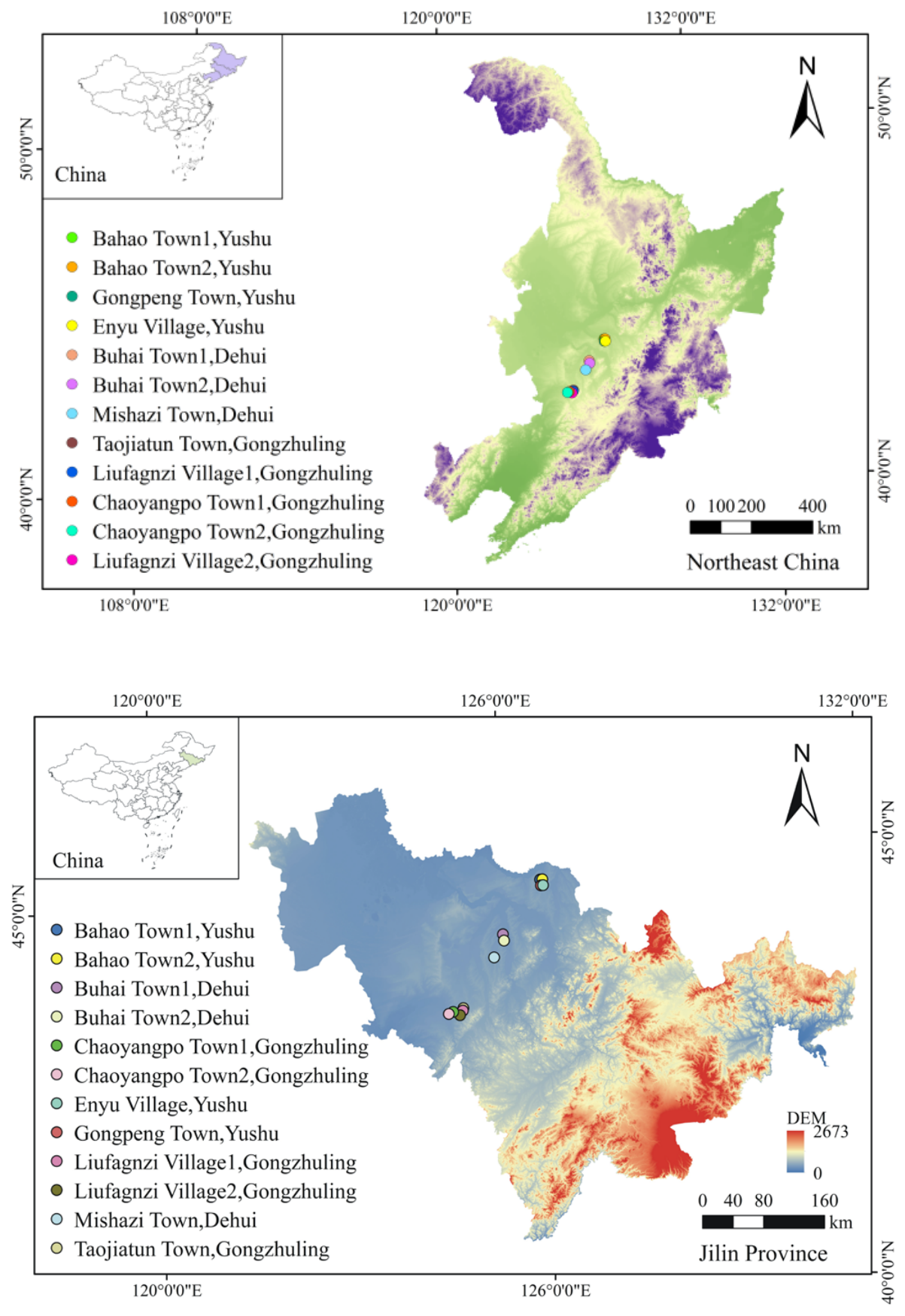
The study area was situated in the premium black soil region of Northeast China, widely known as the golden maize belt. The selected experimental sites were characterized by flat topography and with no evidence of water erosion. A latitudinal transect was established, encompassing three zones from north to south, high latitude (4 points), middle latitude (3 points), and low latitude (5 points), as shown in Figure 1. Three tillage measures were applied and compared at every sampling point.
The climate of the region is temperate, semi-humid continental monsoon. The soil at the experimental site is classified as Mollisols (Typic Hapludoll, USDA Soil Taxonomy) with a clay loam texture. All 12 sampling points were located in thin-layer black soil regions, characterized by similar soil textures, temperatures, and precipitation levels. The main components of soil clay minerals are montmorillonite, illite, chlorite, quartz and vermiculite. The mean values (0–20 cm) of SOC, pH, TN, and TP are 15.93 g kg−1, 6.74, 2.07 g kg−1, and 1.31 g kg−1, respectively, at 12 sampling sites after autumn harvesting in 2002. The region has a mean annual temperature of 5.2 °C and receives approximately 600 mm of precipitation. The frost-free period averages 120 days per year. The experimental field is nearly flat (<1% slope) and has been under continuous maize monoculture for over two decades.
From 2002 to 2022, all field management practices were consistent across the experimental plots, with the exception of the tillage measures. The basic characteristics of the sampling points are shown in Table 1.

2.2. Experimental Design

The experimental sites (Table 1) had been under continuous corn cultivation for several years prior to 2002. Before 2002, these experimental sites had undergone at least five years of rotary tillage. Starting from 2002, some plots were randomly selected from sites for the implementation of deep plowing and no-tillage methods, and this practice continued until 2022. To facilitate the full mechanization of corn production, this study employed a regional experimental design arranged randomly. The plot covers an area of approximately 3120 m2. The growth stages of corn are shown in the Table 2. Three representative tillage measures were implemented as follows:
(1)
RT (rotary tillage with stubble returning, conventional tillage method). After corn harvest, all above-ground straw was packed and removed. The field was then rotary-tilled twice to a depth of 10–15 cm, with stubble incorporated at 0–12 cm. The amount of stubble returned to the field was approximately 2200 kg ha−1. The soil was leveled and compacted, leaving the surface exposed. Conventional sowing was performed in spring.
(2)
PT (plow tillage with straw returning). After harvest, straw was crushed and spread on the surface, followed by moldboard plowing to a depth of 30–35 cm, breaking the plough pan and effectively mitigating soil compaction. Straw was fully buried at 20–30 cm, leaving the surface exposed. The amount of straw returned to the field is approximately 11,000 kg ha−1. Seeds were sown the following spring after heavy harrowing.
(3)
NT (notillage with straw mulching). About 30 cm of stubble was retained, and crushed straw was evenly spread on the surface (incorporated at 0–3 cm). The amount of straw returned to the field was approximately 11,000 kg ha−1. No tillage was performed throughout the year, and sowing was done with a no-till seeder the following spring.
A systematic sampling design with sufficient sample size and uniform spatial coverage was adopted to account for spatial heterogeneity, thereby ensuring representative parameter estimates and minimizing bias from spatial variation.
Fertilization followed conventional local farming practices, and a locally adapted corn cultivar was used. The chemical fertilizers used were commercially available compound fertilizer (with a N:P2O5:K2O ratio of 26-10-12) and urea. The application rates were 260 kg ha−1 for N, 102 kg ha−1 for P, and 100 kg ha−1 for K. Among these, 40% of the nitrogen fertilizer was applied as basal fertilizer together with all of the phosphorus and potassium fertilizers, while the remaining nitrogen fertilizer was applied as top dressing during the 8–10 leaf expansion stage. No organic fertilizer was applied.
Sowing and harvesting typically occurred in mid-May and early October, respectively. Soil properties under the three tillage measures across the 12 sampling sites, measured after the autumn harvest in 2002 and 2022, are shown in Table 3.

2.3. Soil Sampling and Analysis

The sampling was conducted during the maize harvest period in October 2002 and 2022. For each plot, five sampling points were established along an “S”-shaped transect. The soil sample was taken using a stainless-steel shovel, and any stones, gravel, and residues of animal or plant origin were removed. At each point, approximately 1 kg of soil was collected from a depth of 0–20 cm. Subsequently, all subsamples from a single plot were combined and thoroughly homogenized in a stainless-steel pot by quartering to form a bulk sample. Then, the sample was placed into a cloth bag and marked clearly. After air-drying, the soil samples were sieved (0.25 mm mesh) for determination of soil pH, SOC, Ca2+ and various forms of Fe/Al oxides. The remaining un-sieved, air-dried soil was reserved for the extraction of organo-mineral complexes.
Soil pH was determined by the potentiometric method (water:soil ratio of 5:1) with a pH meter (PHS-3C, Leici, Shanghai China). The content of dissolved organic carbon (DOC) was determined by the potassium dichromate external heating method [39]. The salicylic acid–Kjeldahl method was developed to determine total nitrogen (TN). The determination of the total phosphorus (TP) was carried out using the acid-soluble molybdenum antimony colorimetric method. The cation exchange capacity (CEC) was determined by the method of ammonium acetate exchange–atomic absorption–flame photometry. After being dispersed by the ultrasonic method (at 21.5 kHz, 300 mA, for 30 min), the <2 μm clay particles were extracted based on the settling time determined by the Stokes principle [40]. The determination of Fe (II) and Fe (III) was carried out using the phenanthroline colorimetric method [41].
In order not to introduce chemical reagents, organo-mineral complexes were isolated from the soil using a modified physical fractionation procedure according to previous reports [1,9]. Specifically, air-dried soil samples were placed into a 1000 mL glass cylinder and mixed with distilled water to form a suspension at a 4% concentration (w/v), which was then soaked for 24 h. The suspension was stirred vertically for 1 min using a perforated-plate stirrer at a rate of 10 up-and-down strokes and then let stand. According to Stokes’s law, the fraction with a particle size of <10 μm was collected by siphoning the upper 10 cm of the suspension after a settling time of 4 min and 15 s at 25 °C. This siphoning process was repeated until the entire suspension was processed. The extracted fraction was the organo-mineral complex of the G0 fraction.
Following the extraction of the G0 fraction, the remaining suspension was repeatedly rinsed with a 1 M sodium chloride solution until the eluent no longer showed a detectable calcium ion reaction to calcium reagent. Distilled water was then added to bring the volume back to the mark on the glass cylinder. The organo-mineral complexes corresponding to the G1 fraction were subsequently collected by repeating the same extraction procedure as described for the G0 fraction.
After extracting the G1 fraction, the remaining soil residue was transferred to a 200 mL beaker and subjected to ultrasonic dispersion using ultrasonic disintegrator (JY92-11, Dongzhi, Ningbo, China) operating at 21 kHz and 200 W for 10 min. The G2 fraction was then collected by repeating the same extraction procedure as used for the G0 fraction. The resulting suspensions from the extractions of three fractions of organo-mineral complexes were concentrated by natural sedimentation and subsequent centrifugation. The collected wet samples were air-dried, weighed, and sieved (0.15 mm) for further analysis. The organic carbon content in both the organo-mineral complexes and the bulk soil was determined by the potassium dichromate external heating method [39].
According to the gel dispersion classification method, exchangeable Ca2+ is specifically associated with the G1 fraction of organo-mineral complexes but not with the G0 or G2 fraction. To quantify this, the sodium chloride eluent collected during the extraction of the G1 fraction was used to determine the content of exchangeable Ca2+. Measurements were performed at a wavelength of 422.7 nm using an ultraviolet spectrophotometer (SP-723, Spectrum, Shanghai China). Exchangeable Ca2+ in the bulk soil was measured by the same method.
According to Inda et al. [42] and Chang et al. [13], free iron (Fed) and aluminum (Ald) were extracted from bulk soil samples using the dithionite–citrate–bicarbonate (DCB) method. Briefly, 0.3 g of pretreated soil was combined with 0.5 g of sodium dithionite, 20 mL of 0.3 M sodium citrate, and 2.5 mL of 1 M sodium bicarbonate in a 50 mL centrifuge tube. The mixture was then shaken continuously for 16 h. After centrifugation, the supernatant was collected and transferred into a 200 mL volumetric flask. This extraction procedure was repeated twice, and all supernatants were combined for subsequent analysis.
Amorphous iron (Feo) and aluminum (Alo) were extracted using the acid–ammonium oxalate method [43]. Briefly, 0.5 g ofpretreated soil was mixed with 50 mL of 0.2 M ammonium oxalate solution (pH 3.0). The suspension was shaken continuously for 2 h in the dark and subsequently centrifuged at 4000× g for 10 min.
Complexed iron (Fep) and aluminum (Alp) were extracted using sodium pyrophosphate at pH 8.5 [44]. Briefly, 0.5 g of pretreated soil was mixed with 10 mL of 0.2 M sodium pyrophosphate. After shaking for 2 h, the mixture was centrifuged at 2000× g for 10 min and filtered. The concentrations of Fed and Ald, Feo and Alo, Fep and Alp were measured at 520 nm by ultraviolet spectrophotometer (SP-723, Spectrum, Shanghai China).
The organic carbon content in the organo-mineral complex per unit of soil, as well as the crystalline iron (Fec) and aluminum (Alc) oxide contents in the bulk soil, were calculated using the following equations:
Organic carbon content per unit soil organo-mineral complex = Organic carbon content of the organo-mineral complex × Content of the organo-mineral complex in soil
Fec= Fed − Feo
Alc = Ald − Alo
There may be situations where some amorphous Fe/Al extracted by DCB or some crystalline Fe/Al are not completely dissolved by ammonium oxalate, and it is noted that this is an inherent methodological deviation.

2.4. Statistical Analyses

A one-way analysis of variance (ANOVA) followed by the least-significant difference (LSD) test was conducted using SPSS 17.0 (IBM, US) to evaluate the statistically significant (p < 0.05) differences in the contents of organo-mineral complexes, organic carbon in organo-mineral complexes, exchangeable Ca2+ in the G1 fraction and in bulk soil, and Fe/Al oxide in bulk soil among treatments. To analyze the interaction between soil properties and tillage practices in organo-mineral complexes, a two-way ANOVA was performed. The following indicators from 2002 and 2022—SOC, dissolved organic carbon, cation exchange capacity, total nitrogen, total phosphorus, clay (<0.002 mm), and Fe(III)/Fe(II)—were subjected to standardization prior to this analysis. Relationships between the organo-mineral complex and soil properties under different tillage measures were assessed using Pearson correlation analysis. Furthermore, redundancy analysis (RDA) was performed with Canoco 5 to examine the relationships between soil properties and organo-mineral complexes under three tillage measures, eliminating the variables with high collinearity. To ensure comparability across variables, both the response and explanatory variables were standardized.

3. Results and Discussion

3.1. The Effect of Tillage Measures on the Content of Each Fraction of Organo-Mineral Complexes

The content of each fraction of organo-mineral complex in soil per unit mass under different tillage measures is presented in Table 4. In 2002 and 2022, the contents of the soil organo-mineral complexes under the RT, PT, and NT treatments all followed the same decreasing order from G1 to G0 and then further to G2. Compared to 2002, the organo-mineral complex content exhibited a decline in the G1 and G2 fractions and an increase in the G0 fraction and G0 + G1 + G2 across all three tillage measures in 2022.
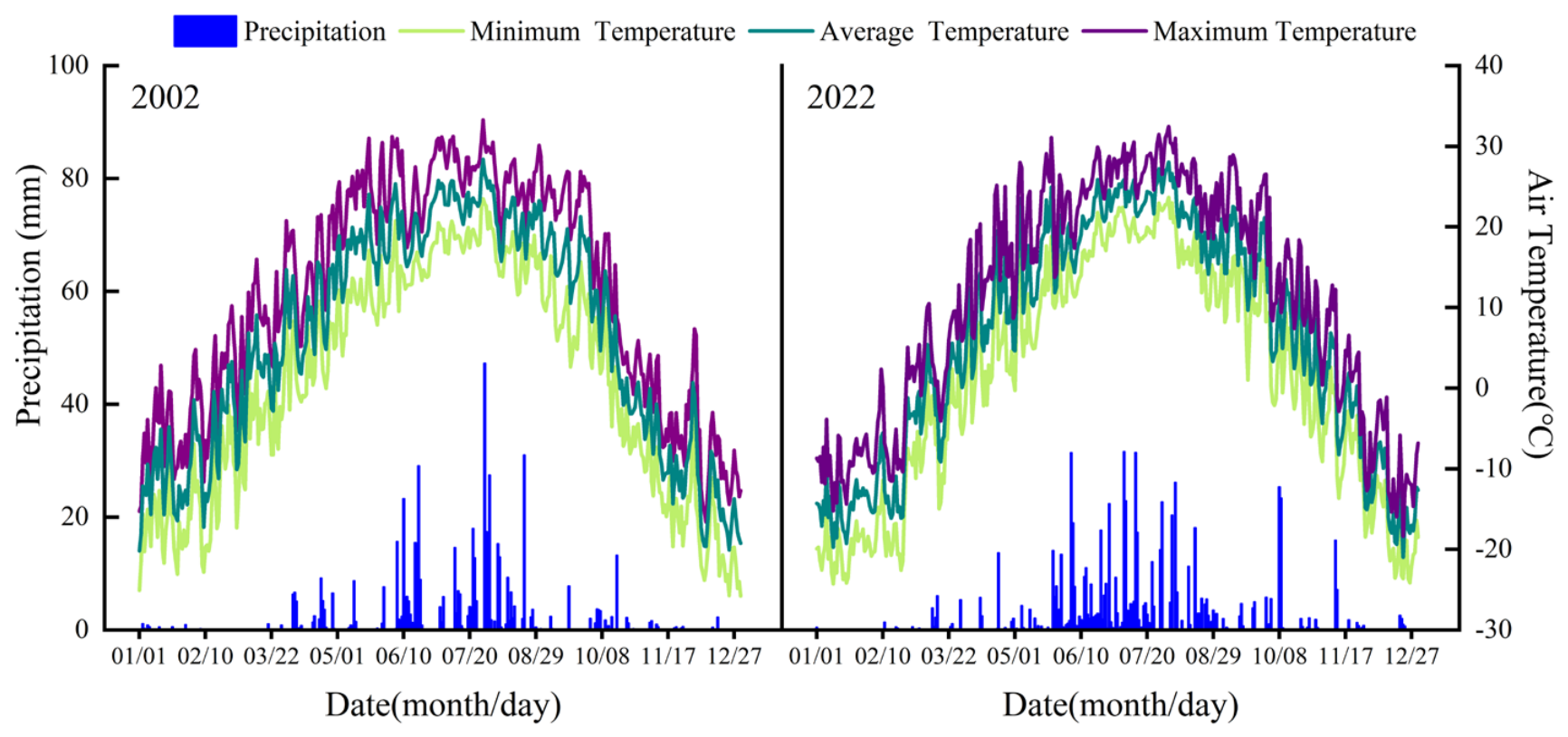
While soil properties and tillage practices shape the changes in soil organo-mineral complex fractions, these fractions are also influenced by additional factors (e.g., soil moisture content, metal oxides).G0 and G1 were less affected by soil properties and tillage methods, whereas G2 was significantly influenced by both (Table 5). The interaction between the two factors was not significant for any of the three fractions. From 2002 to 2022, the average temperature in the study area decreased by 0.12 °C, while precipitation increased by 0.52 mm (Figure 2). Moisture conditions influence the morphology of soil metal oxides and soil structure, while also contributing to the stability of organic–inorganic complexes [45,46].
The G0 fraction represents the combination of free mineral particles and micro-aggregates (<10 μm) [9]. Both G1 and G2 fractions are water-stable complexes. Notillage with straw mulching favors the formation of larger aggregates over smaller ones [19,20], which may explain the reduced G0 content under NT treatment. In contrast, years of ploughing in PT treatment caused considerable soil disturbance and structural degradation, resulting in a higher G0 content compared to RT and NT treatments. Compared with RT treatment, increasing straw addition under PT and NT treatments, the content of the non-water-stable G0 fraction decreases, while that of the water-stable G1 fraction increases, indicating a transformation of organo-mineral complexes from non-water-stable to water-stable forms [47,48]. Specifically, the G1 fraction consists of complexes formed by calcium and humus, whereas the G2 fraction is composed of complexes associated with Fe/Al oxides and humus [33]. For the content of the G1 + G2 organo-mineral complex, the order was NT > PT > RT (in 2022), suggesting that the NT treatment promoted the transformation of organo-mineral complexes from non-water-stable to water-stable.
For all three tillage measures, the content of organo-mineral complexes followed the order G1 > G0 > G2. The total content of organo-mineral complexes under NT treatment was higher than that under RT and PT treatments. Among the three fractions of organo-mineral complexes, the G1 fraction was absolutely dominant, accounting for more than 50% of the total organo-mineral complex content, followed by the G0 fraction (34.63%), while the G2 fraction constituted only 4.42%. This distribution can be attributed to the pedogenic process of black soil, in which humic acid readily combines with inorganic minerals such as Ca and Fe/Al oxides, leading to the notably high proportion of the G1 fraction. Consistent with this, the G1/G2 ratio exceeded 10 under all three tillage measures in this study.
The formation of soil organo-mineral complexes depends not only on the abundance of ionic binders but also on the stability of the resulting bonds. Although Fe/Al bonds are considerably more stable than Ca bonds, the content of the G2 fraction (associated with Fe/Al) remained notably low across all three tillage measures. This observed distribution may, however, deviate from the actual situation, as the sequential extraction method defined organo-mineral complexes operationally rather than functionally. Potential errors during the separation of organo-mineral complexes with different binding states could also influence the results. Moreover, a substantial portion of Fe/Al oxides tends to precipitate in hydroxylated forms, which may further limit their availability for the formation of the G2 fraction.

3.2. The Influence of Tillage Measures on the Content of Organic Carbon in Each Fraction of Organo-Mineral Complexes

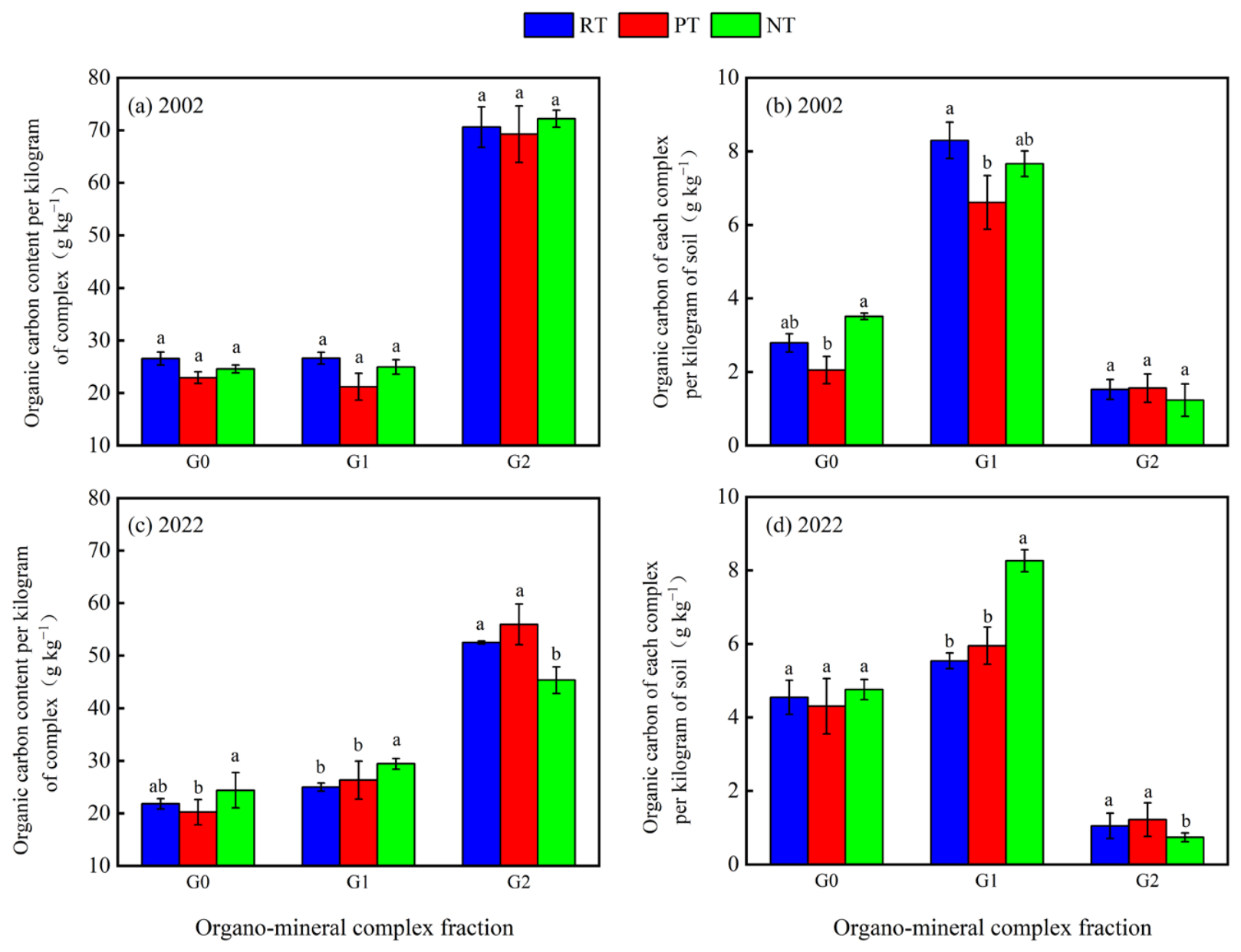
The organic carbon content per unit mass of each organo-mineral complex reflects its capacity for carbon sequestration. Among the three fractions, the G2 fraction exhibited the highest organic carbon content (averaging 61.00 g kg−1), which was approximately twice that of the G0 and G1 fractions (Figure 3a,c). The organic carbon contents in both the G0 and G1 fractions were significantly lower than that in the G2 fraction. Additionally, the G1 fraction showed slightly higher average organic carbon content (25.60 g kg−1) compared to the G0 fraction (23.43 g kg−1). These results are consistent with previous studies indicating that the G2 fraction contains the highest organic carbon content among all organo-mineral complex fractions [49].
Compared with the RT treatment, the NT treatment increased the organic carbon content in the G0 and G1 fractions by 11.81% and 11.78%, respectively, in 2022 (Figure 3b,d). In contrast, the PT treatment led to increases of 5.35% and 6.54% in the G1 and G2 fractions, respectively, relative to the RT treatment. However, in 2002, except for the G2 fraction under the NT treatment, the organic carbon content per unit mass of each organo-mineral complex decreased relative to the RT treatment.
The organic carbon content in the organo-mineral complex is influenced by both the abundance of inorganic minerals and their surface-binding capacity. Calcium (Ca) is known to effectively bind fresh organic matter, whereas aluminum (Al) shows a stronger affinity for humic and fulvic acids, though it exhibits a relatively weak stabilizing effect on fresh organic residues [50,51]. No tillage causes less soil disturbance and weaker aeration, thereby reducing the oxidation and decomposition of organic matter by microorganisms. Meanwhile, straw that is covered and returned to the field primarily forms macromolecular organic compounds that are resistant to oxidation [52,53], collectively resulting in a relatively low degree of soil humification [54]. It made the bonding effect of Ca prominent and increased the content of organic carbon in the G0 and G1 fraction significantly. In terms of the bonding mechanisms between organic matter and soil minerals, the transformation and condensation of humus from G0 to G1 and further to G2 involve progressively stronger interactions and higher stability. Although both G1 and G2 were considered water-stable organo-mineral complexes, they differed in the degree and strength of organic–mineral bonding.
While soil acidification-driven base cation (e.g., Ca2+ and Mg2+) leaching compromises MAOM formation and stability, the concurrent solubility of Al3+ and Fe3+ promotes carbon stabilization via organo-mineral complexes. We propose that under global nitrogen enrichment, a ubiquitous trade-off governs the balance between cation-bridged carbon depletion and the formation of new organo-mineral complexes. This trade-off represents a previously underexploited yet potentially critical mechanism underpinning MAOM pool persistence [55].

3.3. The Contribution of Each Fraction of Organo-Mineral Complexes Under Different Tillage Measures to Soil Organic Carbon Fixation

The organic carbon content associated with each fraction of organo-mineral complex per unit mass of soil reflects its contribution to overall SOC retention. Across the three tillage measures, the G1 fraction contained significantly more organic carbon (avg. 7.06 g kg−1) than the G0 and G2 fractions (Figure 3). This was primarily attributed to its higher mass proportion in the soil relative to the other two fractions of organo-mineral complexes. The G0 fraction also showed a higher organic carbon content (avg. 3.66 g kg−1) than the G2 fraction (avg. 1.22 g kg−1). Although the G2 fraction exhibited a higher organic carbon content per unit mass of complex than the G0 and G1 fractions (Figure 3a,c), its content per unit mass of soil was considerably lower (Table 4). This explained the reduced overall organic carbon retention associated with the G2 fraction at the soil scale.
The effects of tillage measures on the organic carbon content of the organo-mineral complex per unit soil mass varied significantly across organo-mineral complex fractions. In the G0 fraction, no significant differences in soil organic carbon content were observed among tillage practices in 2022. However, in 2002, the PT treatment showed significantly lower organic carbon content compared to the NT treatment. In the G1 fraction during 2022, both PT and NT treatments resulted in higher organic carbon content than the RT treatment by 7.51% and 49.24%, respectively. In contrast, in 2002, the organic carbon content of PT and NT treatments were lower than the RT treatment by 7.64% and 20.33%, respectively. In the G2 fraction, no statistically significant differences were detected among the tillage treatments in either 2002 or 2022 (except NT). The results indicated that although changes in tillage practices may lead to a short-term reduction in the organic carbon content of organo-mineral complexes, their long-term impacts are likely to differ.
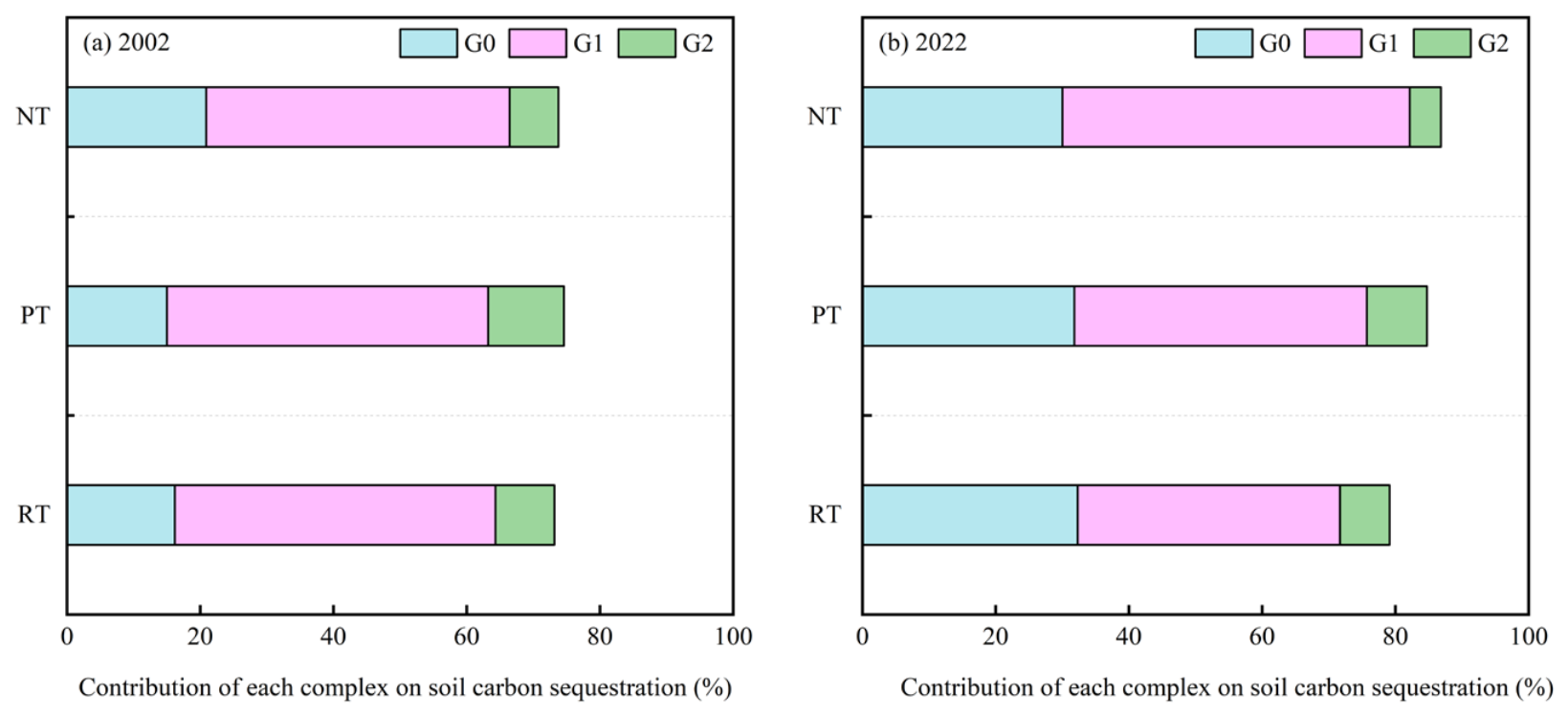
In terms of the contribution rate to soil carbon sequestration, the G1 fraction of organo-mineral complexes was the most significant, accounting for 39.35–52.12%, nearly half of the total (Figure 4). It was followed by the G0 fraction (14.99–32.32%), while the G2 fraction contributed the least, ranging only from 4.67% to 11.40%. Compared to the RT treatment, both PT and NT treatments reduced the contribution of the G0 fraction but enhanced that of the G1 fraction, with the NT treatment showing the most pronounced increase in 2022. The sum organic carbon content of the three complex fractions (G0, G1, and G2) accounted for 73.17% to 86.82% of the total organic carbon in bulk soil, indicating that organo-mineral complexes play a dominant role in SOC sequestration. The remaining portion (approximately one-fifth) of organic carbon was not associated with these complexes, suggesting the presence of other carbon forms or stabilization mechanisms.
The total mass of the three organo-mineral complex fractions accounted for 42.39% to 49.21% of the soil mass (Table 4), less than 50%, yet they contained nearly 80% of the total soil organic carbon. This clearly demonstrated the crucial role of organo-mineral complexes in sequestering organic carbon and enhancing soil fertility [2,56]. The results of this study indicated that both NT and PT treatments could effectively increase organic carbon sequestering compared to the RT treatment. In particular, the NT treatment was the most conducive to the transformation of soil organic carbon into stable organo-mineral complexes.

3.4. Characteristics of Exchangeable Calcium Ions and Fe/Al Oxides Under Different Tillage Measures

The association of organic carbon with reactive minerals through the formation of organo-mineral complexes represents a key mechanism for long-term soil carbon storage [8]. Cementing agents such as Ca+2, Fe/Al oxides play crucial roles in this process [57,58]. In support of this, Huang et al. [59] reported that over 47.1% of SOC was bound to Fe/Al oxides.
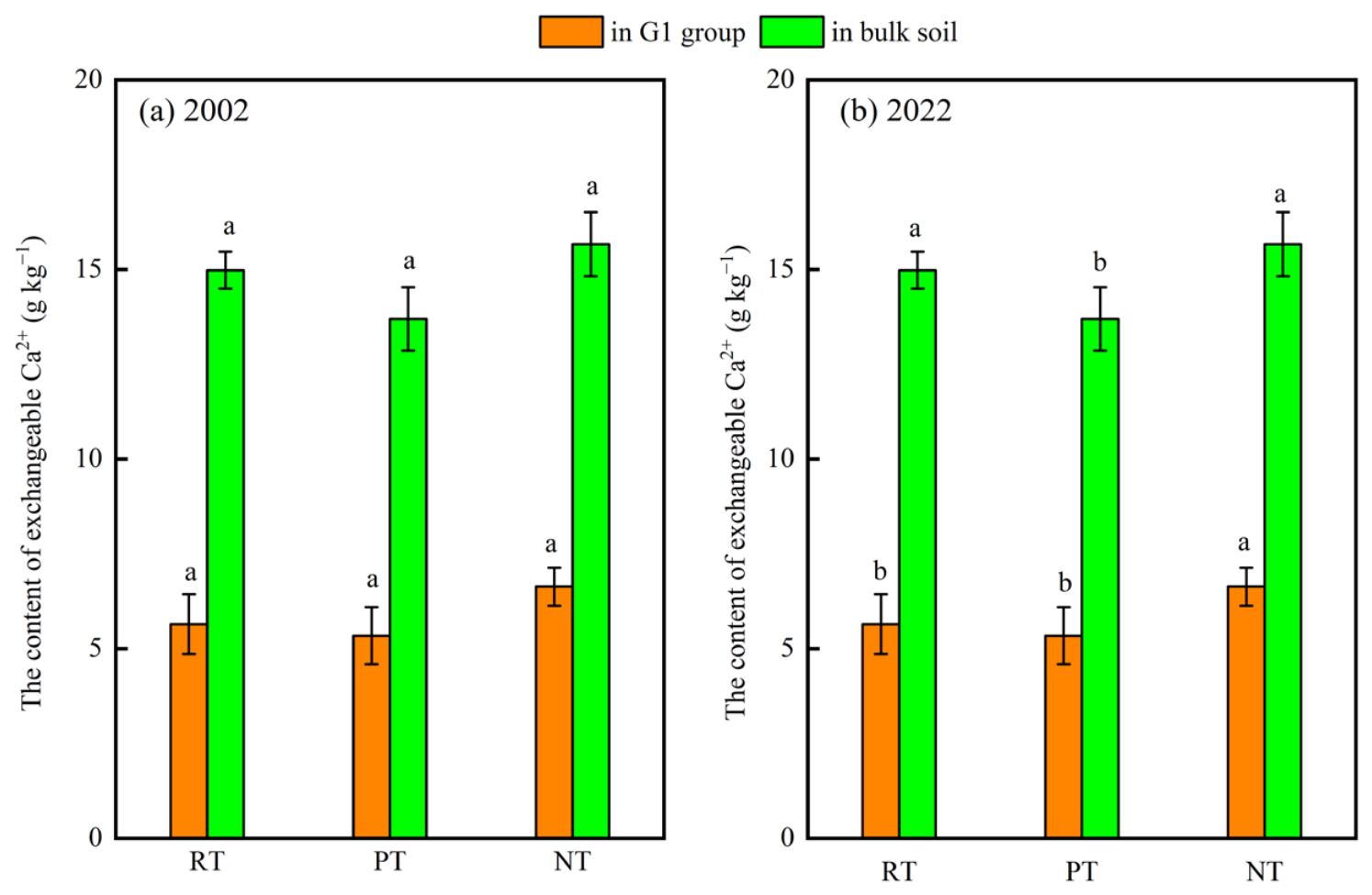
In 2002, no significant difference was observed in the exchangeable Ca2+ content across the three tillage practices (Figure 5a). In 2022, the NT treatment showed significantly higher exchangeable Ca2+ content than both the RT and PT treatments, by 17.35% and 24.16%, respectively (Figure 5b). No significant difference was detected between the RT and PT treatments in that year. The proportions of exchangeable Ca2+ in the G1 fraction relative to exchangeable Ca2+ in the bulk soil were 36.62%, 37.64%, and 39.67%, respectively, under RT, PT, and NT treatments. The lower exchangeable Ca2+ content in PT and RT treatments may be attributed to frequent soil disturbance, which promoted Ca2+ leaching. Furthermore, soil acidification and Ca2+ depletion formed a feedback cycle (Table 3). Acidification accelerated the loss of alkaline Ca2+, while the reduction in Ca2+ and other alkaline substances further exacerbated soil acidification [60].
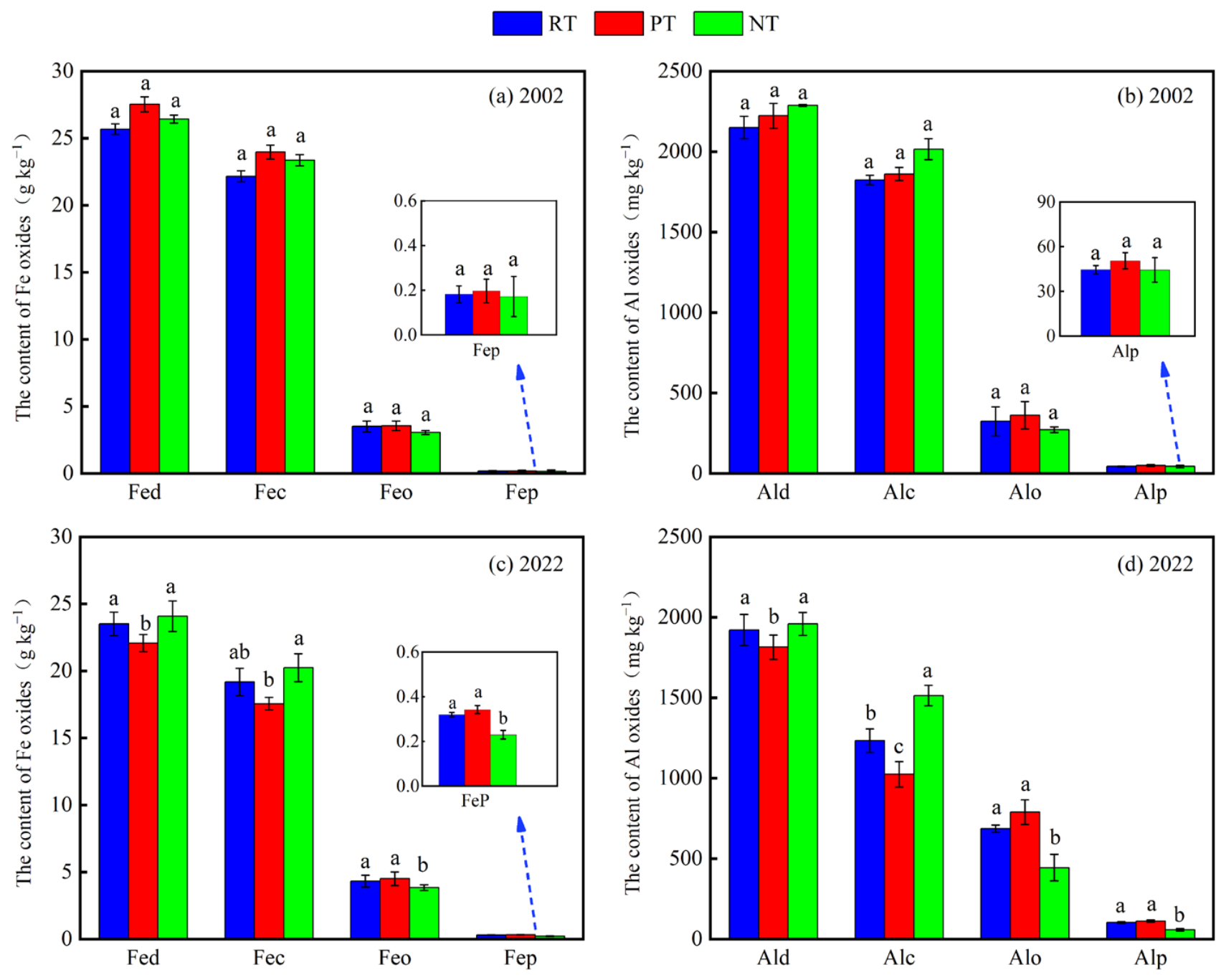
Relative to 2002, Fed and Fec levels in 2022 exhibited a consistent decline across all tillage measures (RT, PT, and NT), while Feo and Fep showed an overall increasing trend over the same period (Figure 6a,c). A similar pattern was observed for aluminum oxides, with Ald and Alc, as well as Alo and Alp, following analogous trends to their iron oxide counterparts (Figure 6b,d). Compared with RT in 2002, PT exhibited an overall increase in the content of both iron and aluminum oxides. By 2022, however, this pattern had shifted: free and crystalline forms of these oxides decreased, whereas amorphous and complexed forms increased under the PT treatment. In contrast, the NT treatment displayed a largely consistent trend relative to the RT treatment in both years, characterized by an increase in free and crystalline forms and a decrease in amorphous and complexed forms.
This pattern suggests that tillage practices, particularly repeated soil aeration, may deplete reactive Fe and Al pools. Fe and Al minerals play a crucial role in stabilizing soil organic carbon by adsorbing or co-precipitating with organic matter to form refractory organo-mineral complexes [13,61]. These complexes function as effective “rusty sinks”, enhancing SOC stability through strong chemical bonds and physical protection, thereby representing a key mechanism for SOC storage [62,63].
A decline in soil acidity not only accelerates the loss of exchangeable Ca2+ but also influences the content of various Fe/Al oxide forms [13]. Further soil acidification below pH 6–7 increases the solubility of Fe/Al oxides, promoting their activation [62,64]. No-tillage practices help reduce the soil Fe(III)/Fe(II) relative to PT measure (Table 3). No tillage effectively alleviated the decline in exchangeable Ca2+ in the G1 fraction and suppressed the transformation of crystalline Fe/Al oxides into amorphous and complex forms (Figure 6). It also limited the transition from the G1 fraction to the G0 fraction (Table 4). Thus, notillage aids in preserving soil structure and improving the stability of SOC.

3.5. Influencing Factors of Organo-Mineral Complexes

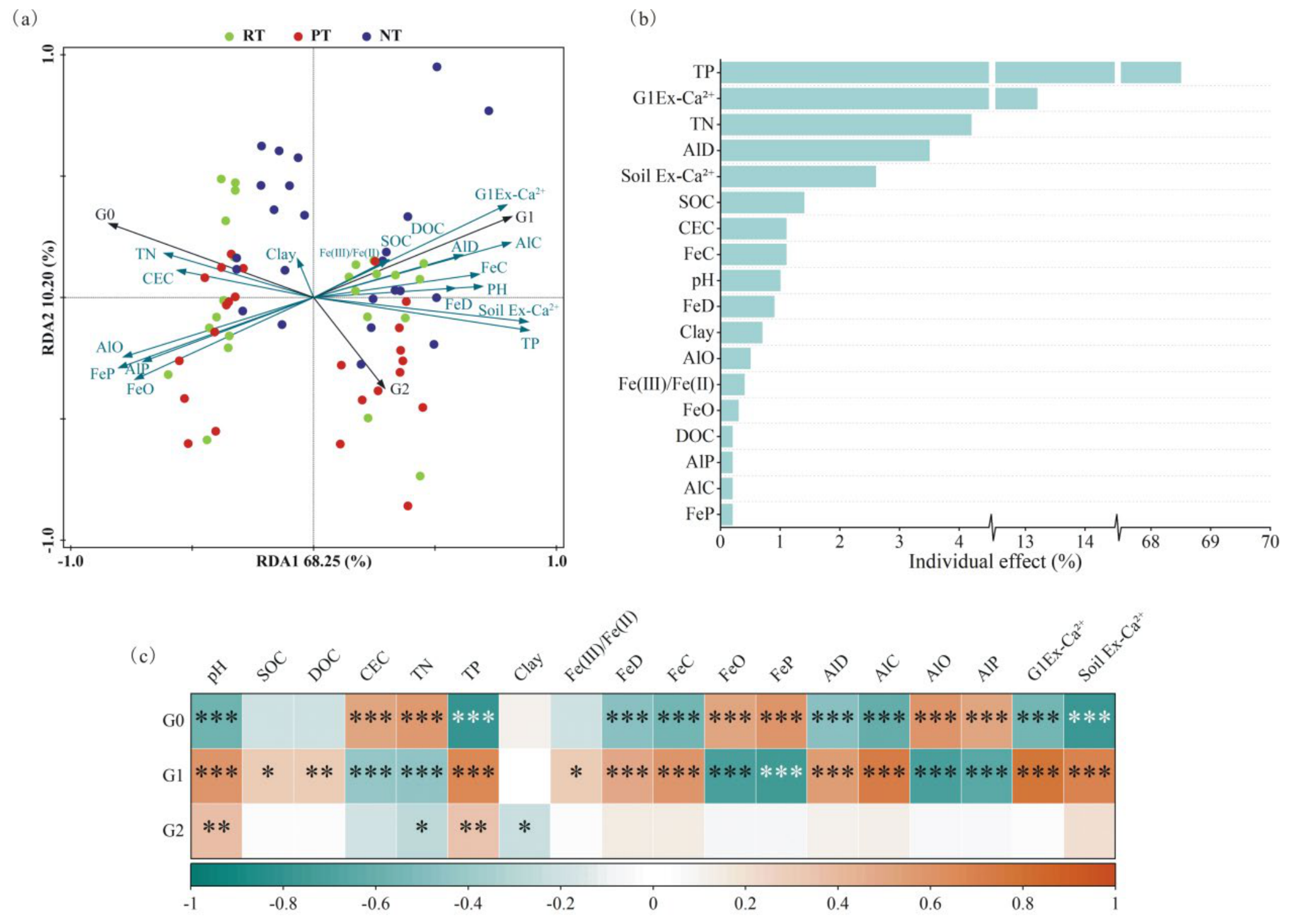
Redundancy analysis (RDA) showed that 78.45% of the variation in tillage measures could be explained by the soil properties and fraction distribution of organo-mineral complexes in the black soil (Figure 7a). The organo-mineral complexes in the G0 and G1 fractions formed acute angles with clay and an obtuse angle with the G2 fraction, indicating that the contents of organo-mineral complexes were largely dependent of clay. The angles between SOC, DOC, Fe(III)/Fe(II), exchangeable Ca2+ in the G1 fraction, and the organo-mineral complexes in fractions of G0 and G2 were close to 90°, indicating that the contents of the G0 and G2 fractions were largely independent of these factors. In contrast, the organo-mineral complexes in the G1 fraction formed acute angles with exchangeable Ca2+, SOC, free and crystalline Fe/Al oxides, pH, and TP, suggesting a strong positive correlation (p < 0.01). On the other hand, they exhibited obtuse angles with amorphous and complexed Fe/Al oxides, implying a strong negative correlation (p < 0.01). The G0 fraction displayed opposite trends. These results indicated that exchangeable Ca2+, along with TP, Fe/Al oxides, pH, and clay, were key environmental factors driving the transformation among the G0, G1, and G2 fractions of organo-mineral complexes.
The individual effects of exchangeable Ca2+, TN, Ald, and SOC on each organo-mineral complex fraction (G0, G1, and G2) under tillage measures were relatively high, ranging from 1.1% to 10.4% (Figure 7b). Notably, exchangeable Ca2+ in the G1 fraction alone accounted for 53.8% of the explained variance. Pairwise correlation analysis further revealed that Fe/Al oxides and exchangeable Ca2+ (both in the G1 fraction and in bulk soil) were positively correlated with the G0 and G1 fractions (Figure 7c), whereas pH CEC, TN, and TP were negatively correlated with them. The results also suggested that pH, TN, TP and clay were only negatively correlated with the G2 fraction. These relationships can be interpreted in the context of the compositional nature of the organo-mineral complexes. The G0 fraction likely represents a mixture of sols—comprised of Fe/Al oxides coating the surface of individual clay particles or micro-aggregates—without further cementation. In contrast, the formation of water-stable complexes (G2 fraction) involves the transition of these Fe/Al oxide film sols into gels, followed by cementation upon drying and dehydration [65].
Fe/Al can act as a cationic bridge between phosphorus and SOC, thereby maintaining P availability. In addition, nitrogen leaching can lead to soil acidification, which in turn accelerates soil weathering and the solubilization of soil minerals [9]. Nanometer-scale investigation of soil organo-mineral interfaces reveals unambiguous evidence of Al-mediated organic matter association and Fe-bearing surface coatings on silicate clays and primary minerals [66]. Soil clay particle content is a key determinant of organic carbon content within soil MAOM. Owing to their high specific surface area, clay minerals effectively limit the exposure of SOC to enzymes and oxygen, thereby suppressing oxidative degradation. This physical protection mechanism enhances the storage and stability of organic carbon within organo-mineral complexes [51,67].
Soil processes are highly complex, and transformations among organo-mineral complex fractions are shaped by the interplay of climate, biology, soil properties, and tillage. Based on the characteristics of organo-mineral complexes, exchangeable Ca2+ in the G1 fraction, and Fe/Al oxides, along with their sol-gel transformation mechanisms [9,65,68], a preliminary model summarizing the potential transformation pathways among the G0, G1, and G2 fractions was proposed. G1–G2 transformation was primarily governed by variations in hydrostable gels of Fec, A1c, Feo, Alo, Fep, and A1p (Figure 7). G0–G2 transformation was affected by the changes in both sols and hydrostable gels of Feo, Alo, FeP, and AlP. G0–G1 transformation was influenced by exchangeable Ca2+ in G1, along with the hydrostable gels of Fec and Alc and the sols of Feo, Alo, Fep, and Alp. Tillage practices likely intensify the redox cycling of Fe/Al, thereby accelerating the depletion of organo-mineral complexes. This phenomenon is consistent with previously observed lignin degradation under fluctuating redox conditions [69]. Since indicators such as pH, moisture content, and redox potential are difficult to control in field experiments, further research is required—using laboratory incubation experiments—on the transformation of Ca2+, various forms of Fe/Al oxides, and their sol–gel forms.

4. Conclusions

The distribution of organo-mineral complexes and the associated organic carbon in black soil were affected by tillage measures. Compared to rotary tillage (RT), no tillage (NT) increased the content of organo-mineral complexes, the organic carbon stored within them, and overall soil carbon sequestration, but plow tillage (PT) exhibited the opposite trend to NT. After 20 years of tillage, the levels of exchangeable Ca2+ and Fe/Al oxides decreased under all three tillage measures. However, the NT treatment maintained significantly higher levels of both properties compared to RT and PT. Furthermore, exchangeable Ca2+ in the G1 fraction, pH, clay, and TP, along with Fe/Al oxides, were identified as key factors governing the transformation among the G0, G1, and G2 fractions of organo-mineral complexes. These findings elucidate that continuous annual ploughing is detrimental to the formation of organo-mineral complexes and the accumulation of organic carbon. A combined approach—such as one year of ploughing followed by two years or no fixed years of no tillage—is recommended. This study provides a scientific basis for optimizing tillage practices, enhancing organic carbon retention, and promoting the sustainable use of black soil.

Author Contributions

Writing—original draft and writing—review and editing, C.L.; investigation and data curation, M.Z.; resources and funding acquisition, H.W. All authors have read and agreed to the published version of the manuscript.

Funding

This work was funded by the National Key R&D Program of China (2024YFD1500300) and the Black soil granary of science projects of Jilin Province (JJKH20240455HT).

Data Availability Statement

The original contributions presented in this study are included in the article. Further inquiries can be directed to the corresponding author.

Acknowledgments

We thank the anonymous reviewers and editors for their valuable comments on this manuscript, and we thank the use of AI (DeepSeek-V4) for text editing, including grammar, spelling, and punctuation.

Conflicts of Interest

The authors declare no conflict of interest.

References

  1. Lopez-Sangil, L.; Rovira, P. Sequential chemical extractions of the mineral-associated soil organic matter: An integrated approach for the fractionation of organo-mineral complexes. Soil Biol. Biochem. 2013, 62, 57–67. [Google Scholar] [CrossRef]
  2. Xu, J.M.; Yuan, K.N. Study on organo-mineral complexes in soil: V. Distribution of organo-mineral complexes in zonal soils of China. Acta Pedol. Sin. 1993, 30, 43–51, (In Chinese with English Abstract). [Google Scholar]
  3. Zhang, S.X.; Li, Q.; Zhang, X.P.; Wei, K.; Chen, L.J.; Liang, W.J. Effects of conservation tillage on soil aggregation and aggregate binding agents in black soil of Northeast China. Soil Tillage Res. 2012, 124, 196–202. [Google Scholar] [CrossRef]
  4. Liu, X.B.; Han, X.Z.; Herbert, S.J.; Xing, B. Dynamics of soil organic carbon under different agricultural management system in the black soil of China. Commun. Soil Sci. Plant Anal. 2003, 34, 973–984. [Google Scholar] [CrossRef]
  5. Zhang, X.Y.; Sui, Y.Y.; Zhang, X.D.; Meng, K.; Herbert, S.J. Spatial variability of nutrient properties in black soil of northeast China. Pedosphere 2007, 17, 19–29. [Google Scholar] [CrossRef]
  6. Liu, X.B.; Zhang, X.Y.; Wang, Y.X.; Sui, Y.Y.; Zhang, S.L.; Herbert, S.J.; Ding, G. Soil degradation: A problem threatening the sustainable development of agriculture in Northeast China. Plant Soil Environ. 2010, 56, 87–97. [Google Scholar] [CrossRef]
  7. Zhou, Z.H.; Ren, C.J.; Wang, C.K.; Delgado-Baquerizo, M.; Luo, Y.Q.; Luo, Z.K.; Du, Z.G.; Zhu, B.; Yang, Y.H.; Jiao, S.; et al. Global turnover of soil mineral-associated and particulate organic carbon. Nat. Commun. 2024, 15, 5329. [Google Scholar] [CrossRef] [PubMed]
  8. Chen, M.M.; Zhang, S.R.; Liu, L.; Chang, B.J.; Li, Y.Y.; Ding, X.D. Organo-mineral complexes in soil colloids: Implications for carbon storage in saline-alkaline paddy soils from an eight-year field experiment. Pedosphere 2024, 34, 97–109. [Google Scholar] [CrossRef]
  9. Zhang, N.Y.; Zhang, X.Z.; Chen, Y.H.; Matelele, L.A.; Zhu, P.; Liu, H.F.; Zhang, X.M.; Gao, H.J.; Feng, G.; Peng, C.; et al. Mineral-associated organic carbon promoted phosphorus accumulation in long-term fertilized black soil. Pedosphere 2024, 36, 484–496. [Google Scholar] [CrossRef]
  10. Gerrit, A.; Kevin, E.M.; Michael, J.C.; Cordula, V.; Martin, W.; Carsten, W.M. Unlocking complex soil systems as carbon sinks: Multi-pool management as the key. Nat. Commun. 2023, 14, 2967. [Google Scholar] [CrossRef]
  11. Huang, H.L.; Zeng, G.M.; Tang, L.; Yu, H.Y.; Xi, X.M.; Chen, Z.M.; Huang, G.H. Effect of biodelignification of rice straw on humification and humus quality by Phanerochaetechrysosporium and Streptomyces badius. Int. Biodeterior. Biodegrad. 2008, 61, 331–336. [Google Scholar] [CrossRef]
  12. Arcand, M.M.; Knight, J.D.; Farrell, R.E. Differentiating between the supply of N to wheat from above and belowground residues of preceding crops of pea and canola. Biol. Fertil. Soils 2014, 50, 563–570. [Google Scholar] [CrossRef]
  13. Chang, Z.F.; Tian, L.P.; Li, F.F.; Wu, M.; Steinberg, C.E.W.; Pan, B.; Xing, B.S. Organo-mineral complexes protect condensed organic matter as revealed by benzene-polycarboxylic acids. Environ. Pollut. 2020, 260, 113977. [Google Scholar] [CrossRef]
  14. Li, F.F.; Zhang, P.C.; Wu, D.P.; Xu, Y.; Chen, F.Y.; Chang, Z.F.; Chu, G.; Wang, L.; Pan, B.; Xing, B.S. Acid pretreatment increased lipid biomarker extractability: A case study to reveal soil organic matter input from rubber trees after long-term cultivation. Eur. J. Soil Sci. 2018, 69, 315–324. [Google Scholar] [CrossRef]
  15. Throckmorton, H.M.; Bird, J.A.; Monte, N.; Doane, T.; Firestone, M.K.; Horwath, W.R. The soil matrix increases microbial C stabilization in temperate and tropical forest soils. Biogeochemistry 2015, 122, 35–45. [Google Scholar] [CrossRef]
  16. Lützow, M.V.; Gel-knabner, I.K.; Ekschmitt, K.; Matzner, E.; Guggenberger, G.; Marschner, B.; Flessa, H. Stabilization oforganicmatter in temperate soils: Mechanisms and their relevance under different soil conditions—A review. Eur. J. Soil Sci. 2006, 57, 426–445. [Google Scholar] [CrossRef]
  17. Han, Z.X.; Wu, X.P.; Gao, H.Z.; Jia, A.Y.; Gao, Q.Q. Long-term conservation tillage increases soil organic carbon stability by modulating microbial nutrient limitations and aggregate protection. Agronomy 2025, 15, 1571. [Google Scholar] [CrossRef]
  18. Xu, P.D.; Wu, J.; Wang, H.; Tang, S.; Cheng, W.L.; Li, M.; Bu, R.Y.; Han, S.; Geng, M.J. Combined application of chemical fertilizer with green manure increased the stabilization of organic carbon in the organo-mineral complexes of paddy soil. Environ. Sci. Pollut. Res. 2023, 30, 2676–2684. [Google Scholar] [CrossRef]
  19. Han, Z.X.; Wu, X.P.; Liang, A.Z.; Li, S.P.; Gao, H.Z.; Song, X.J.; Liu, X.T.; Jia, A.Y.; Aurore, D. Conservation tillage enhances the sequestration and iron-mediated stabilization of aggregate-associated organic carbon in Mollisols. Catena 2024, 243, 108197. [Google Scholar] [CrossRef]
  20. Bayer, C.; Mielniczuk, J.; Giasson, E.; Martin-Neto, L.; Pavinato, A. Tillage effects on particulate and mineral-associated organic matter in two Tropical Brazilian soils. Commun. Soil Sci. Plant Anal. 2006, 37, 389–400. [Google Scholar] [CrossRef]
  21. Shabtai, I.A.; Wilhelm, R.C.; Schweizer, S.A.; Höschen, C.; Buckley, D.H.; Lehmann, J. Calcium promotes persistent soil organic matter by altering microbial transformation of plant litter. Nat. Commun. 2023, 14, 6609. [Google Scholar] [CrossRef]
  22. Khomo, L.; Trumbore, S.; Bern, C.R.; Chadwick, O.A. Timescales of carbon turnover in soils with mixed crystalline mineralogies. Soils 2017, 3, 17–30. [Google Scholar] [CrossRef]
  23. Van De Vreken, P.; Gobin, A.; Baken, S.; Van Holm, L.; Verhasselt, A.; Smolders, E.; Merckx, R. Crop residue management and oxalate-extractable iron and aluminium explain long-term soil organic carbon sequestration and dynamics. Eur. J. Soil Sci. 2016, 67, 332–340. [Google Scholar] [CrossRef]
  24. Wu, D.; Wu, L.; Liu, K.L.; Shang, J.Y.; Zhang, W.J. Contrasting effects of iron oxides on soil organic carbon accumulation in paddy and upland fields under long-term fertilization. J. Environ. Manag. 2024, 369, 122286. [Google Scholar] [CrossRef]
  25. Ye, C.L.; Huang, W.J.; Hall, S.J.; Hu, S.J. Association of organic carbon with reactive iron oxides driven by soil pH at the global scale. Glob. Biogeochem. Cycles 2022, 36, e2021GB007128. [Google Scholar] [CrossRef]
  26. Chen, C.M.; Hall, S.J.; Coward, E.; Thompson, A. Iron-mediated organic matter decomposition in humid soils can counteract protection. Nat. Commun. 2020, 11, 2255. [Google Scholar] [CrossRef]
  27. Georgiou, K.; Jackson, R.B.; Vindušková, O.; Abramoff, R.Z.; Ahlström, A.; Harden, J.W.; Pellegrini, A.F.A.; Wayne Polley, H.; Soong, J.L.; Riley, W.J.; et al. Global stocks and capacity ofmineral-associated soil organic carbon. Nat. Commun. 2022, 13, 3797. [Google Scholar] [CrossRef]
  28. Riedel, T.; Zak, D.; Biester, H.; Dittmar, T. Iron traps terrestrially derived dissolved organic matter at redox interfaces. Proc. Natl. Acad. Sci. USA 2013, 110, 10101–10105. [Google Scholar] [CrossRef] [PubMed]
  29. Chen, C.; Dynes, J.J.; Wang, J.; Sparks, D.L. Properties of Fe-organic matter associations via coprecipitation versus adsorption. Environ. Sci. Technol. 2014, 48, 13751–13759. [Google Scholar] [CrossRef]
  30. Porras, R.C.; Hicks Pries, C.E.; McFarlane, K.J.; Hanson, P.J.; Torn, M.S. Association with pedogenic iron and aluminum: Effects on soil organic carbon storage and stability in four temperate forest soils. Biogeochemistry 2017, 133, 333–345. [Google Scholar] [CrossRef]
  31. Jia, N.; Li, L.; Guo, H.; Xie, M.Y. Important role of Fe oxides in global soil carbon stabilization and stocks. Nat. Commun. 2024, 15, 10318. [Google Scholar] [CrossRef] [PubMed]
  32. Zhao, B.; Dou, A.M.; Zhang, Z.W.; Chen, Z.Y.; Sun, W.B.; Feng, Y.L.; Wang, X.J.; Wang, Q. Ecosystem-specific patterns and drivers of global reactive iron mineral-associated organic carbon. Biogeosciences 2023, 20, 4761–4774. [Google Scholar] [CrossRef]
  33. Tyulin, A.T.H. The composition and structure of soil of organo-mineral gels and soil fertility. Soil Sci. 1938, 45, 343–358. [Google Scholar] [CrossRef]
  34. Hashimoto, H.; Harada, T.; Hara, M.; Yumoto, T. Studies on the organo-mineral colloidal complexes of paddy soil III: G1 colloidal complexes of paddy soil as affected by drainage. Soil Sci. Plant Nutr. 1959, 5, 28–35. [Google Scholar] [CrossRef][Green Version]
  35. Yan, C.S. Soil Fertility Research Method; Agriculture Publisher: Beijing, China, 1988. [Google Scholar]
  36. Edwards, A.P.; Bremner, J.M. Microaggregates in soil. Soil Sci. 1967, 18, 64–73. [Google Scholar] [CrossRef]
  37. Bronick, C.J.; Lal, R. Soil structure and management: A review. Geoderma 2005, 124, 3–22. [Google Scholar] [CrossRef]
  38. Curaqueo, G.; Miguel Barea, J.; Acevedo, E.; Rubio, R.; Cornejo, P.; Borie, F. Effects of different tillage system on arbuscular mycorrhizal fungal propagules and physical properties in a Mediterranean agroecosystem in central Chile. Soil Tillage Res. 2011, 113, 11–18. [Google Scholar] [CrossRef]
  39. Lu, R.K. Analysis Methods of Soil and Agricultural Chemistry; Chinese Agricultural Science and Technology Press: Beijing, China, 2000. [Google Scholar]
  40. Holtzapffel, T. Les minérauxargileux: Préparation, analysediffractométrique et determination. Soc. Géol. Nord Publ. 1985, 12, 15–43. [Google Scholar]
  41. Li, Y.; Yu, S.; Strong, J.; Wang, H.L. Are the bioGoechemical cycles of carbon, nitrogen, sulfur, and phosphorus driven by the “FeIII–FeII redox wheel” in dynamic redox environments? J. Soils Sediments 2012, 12, 683–693. [Google Scholar] [CrossRef]
  42. Inda, A.V.; Torrent, J.; Barrón, V.; Bayer, C.; Fink, J.R. Iron oxides dynamics in a subtropical Brazilian Paleudult under long-term no-tillage management. Sci. Agric. 2013, 70, 48–54. [Google Scholar] [CrossRef]
  43. Barberis, E.; Ajmone, M.F.; Boero, V.; Arduino, E. Aggregation of soil particles by iron oxides in various size fractions of soil B horizons. Eur. J. Soil Sci. 1991, 42, 535–542. [Google Scholar] [CrossRef]
  44. Saidy, A.R.; Smernik, R.J.; Baldock, J.A.; Kaiser, K.; Sanderman, J.; Macdonald, L.M. Effects of clay mineralogy and hydrous iron oxides on labile organic carbon stabilisation. Geoderma 2012, 173–174, 104–110. [Google Scholar] [CrossRef]
  45. Yao, B.M.; Wang, S.Q.; Xie, S.T.; Li, G.; Sun, G.X. Optimal soil Eh, pH for simultaneous decrease of bioavailable Cd, As in co-contaminated paddy soil under water management strategies. Sci. Total Environ. 2022, 806, 151342. [Google Scholar] [CrossRef] [PubMed]
  46. Sun, L.N.; Chen, S.; Chao, L.; Sun, T.H. Effects of flooding on changes in Eh, pH and speciation of cadmium and lead in contaminated soil. Bull. Environ. Contam. Toxicol. 2007, 79, 514–518. [Google Scholar] [CrossRef]
  47. Tisdall, J.M.; Oades, J.M. Organic Matter and Water-stable Aggregates in Soils. Eur. J. Soil Sci. 2006, 33, 141–163. [Google Scholar] [CrossRef]
  48. Liu, C.; Lu, M.; Cui, J.; Li, B.; Fang, C.M. Effects of straw carbon input on carbon dynamics in agricultural soils: A meta-analysis. Glob. Change Biol. 2014, 20, 1366–1381. [Google Scholar] [CrossRef]
  49. Inoue, K.; Zhao, L.P.; Huang, P.M. Adsorption of humic substances by hydroxylaluminum-and hydroxylaluminosilicate-montmorillonite complexes. Soil Sci. Soc. Am. J. 1990, 54, 1166–1172. [Google Scholar] [CrossRef]
  50. Xiong, Y. Soil Colloids; Science Press: Beijing, China, 1983; Volume 1, pp. 343–344. [Google Scholar]
  51. Kleber, M.; Sollins, P.; Sutton, R.A. A conceptual model of organo-mineral interactions in soils: Self-assembly of organic molecular fragments into zonal structures on mineral surfaces. Biogeochemistry 2007, 85, 9–24. [Google Scholar] [CrossRef]
  52. Chen, Z.M.; Wang, H.Y.; Liu, X.W.; Zhao, X.L.; Lu, D.J.; Zhou, J.M.; Li, C.Z. Changes in soil microbial community and organic carbon fractions under short-termstraw return in a rice-wheat cropping system. Soil Tillage Res. 2017, 165, 121–127. [Google Scholar] [CrossRef]
  53. Garcia-Franco, N.; Albaladejo, J.; Almagro, M.; Martínez-Mena, M. Beneficial effects of reduced tillage and green manureon soil aggregation and stabilization of organic carbon in a Mediterranean agroecosystem. Soil Tillage Res. 2015, 153, 66–75. [Google Scholar] [CrossRef]
  54. Wang, X.Y.; Bian, Q.; Jiang, Y.J.; Zhu, L.Y.; Chen, Y.; Liang, Y.T.; Sun, B. Organic amendments drive shifts inmicrobial community structure and keystone taxa which increase Cmineralization across aggregate size classes. Soil Biol. Biochem. 2020, 153, 108062. [Google Scholar] [CrossRef]
  55. Tang, B.; Rocci, K.S.; Lehmann, A.; Rillig, M.C. Nitrogen increases soil organic carbon accrual and alters its functionality. Glob. Change Biol. 2023, 29, 1971–1983. [Google Scholar] [CrossRef]
  56. Six, J.; Bossuyt, H.; Degryze, S.; Denef, K. A history of research on the link between (micro) aggregates, soil biota, and soil organic matter dynamics. Soil Tillage Res. 2004, 79, 7–31. [Google Scholar] [CrossRef]
  57. Boudot, J.P.; Hadj Brahis, A.B.; Steiman, R.; Seigle-Murandi, F. Biodegradation of synthetic organo-metalic complexes of iron and aluminum with selected metal to carbon ratios. Soil Biol. Biochem. 1989, 21, 961–966. [Google Scholar] [CrossRef]
  58. Duchaufour, P. Dynamics of organic matter soils of temperate regions: Action pedogenesis. Geoderma 1976, 15, 31–40. [Google Scholar] [CrossRef]
  59. Huang, X.L.; Kang, W.J.; Guo, J.J.; Wang, L.; Tang, H.Y.; Li, T.L.; Yu, G.H.; Ran, W.; Hong, J.P.; Shen, Q.R. Highly reactive nanomineral assembly in soil colloids: Implications for paddy soil carbon storage. Sci. Total Environ. 2020, 703, 134728. [Google Scholar] [CrossRef]
  60. Rowley, M.C.; Nico, P.S.; Bone, S.E.; Marcus, M.A.; Pegoraro, E.F.; Cristina, C.; Kang, K.; Bhattacharyya, A.; Torn, M.S.; Peña, J. Association between soil organic carbon and calcium in acidic grassland soils from Point Reyes National Seashore, CA. Biogeochemistry 2023, 165, 91–111. [Google Scholar] [CrossRef]
  61. Li, Q.; Hu, W.F.; Li, L.F. Interactions between organic matter and Fe oxides at soil micro-interfaces: Quantification, associations, and influencing factors. Sci. Total Environ. 2023, 855, 158710. [Google Scholar] [CrossRef]
  62. Lindsay, W.L. Chemical Equilibria in Soils; John Wiley and Sons Ltd.: New York, NY, USA, 1979. [Google Scholar]
  63. Che, M.; Gong, Y.; Xu, M.; Kang, C.; Lv, C.; He, S.; Zheng, J. Effects of elevation and slope aspect on the distribution of the soil organic carbon associated with Al and Fe mineral phases in alpine shrub-meadow soil. Sci. Total Environ. 2021, 753, 141933. [Google Scholar] [CrossRef]
  64. Sey, B.K.; Whalen, J.K.; Gregorich, E.G.; Rochette, P.; Cue, R.I. Carbon dioxide and nitrous oxide content in soils under corn and soybean. Soil Sci. Soc. Am. J. 2008, 72, 931–938. [Google Scholar] [CrossRef]
  65. Zhang, B.; Horn, R. Mechanisms of aggregate stabilization in Ultisols from subtropical China. Geoderma 2001, 99, 123–145. [Google Scholar] [CrossRef]
  66. Possinger, A.R.; Zachman, M.J.; Enders, A.; Levin, B.D.A.; Muller, D.A.; Kourkoutis, L.F.; Lehmann, J. Organo–organic and organo–mineral interfaces in soil at the nanometer scale. Nat. Commun. 2020, 11, 6103. [Google Scholar] [CrossRef]
  67. Kaiser, K.; Guggenberger, G. Mineral surfaces and soil organic matter. Eur. J. Soil Sci. 2003, 54, 219–236. [Google Scholar] [CrossRef]
  68. Underwood, T.R.; Bourg, I.C.; Rosso, K.M. Mineral-associated organic matter is heterogeneous and structured by hydrophobic, charged, and polar interactions. Proc. Natl. Acad. Sci. USA 2024, 121, e2413216121. [Google Scholar] [CrossRef]
  69. Hall, S.J.; Silver, W.L.; Timokhin, V.I.; Hammel, K.E. Lignin decomposition issustained under fluctuating redox conditions in humid tropical forest soils. Glob. Change Biol. 2015, 21, 2818–2828. [Google Scholar] [CrossRef]
Figure 1. Locations of experimental sites.
Agronomy 16 01093 g001
Figure 2. Air temperature and precipitation in the experimental sites of 2002 and 2022.
Agronomy 16 01093 g002
Figure 3. Effect of tillage measures on organic carbon distribution in organo-mineral complexes. (a,c) Organic carbon content per kilogram of complex in 2002 and 2022; (b,d) organic carbon content per kilogram of soil in 2002 and 2022. Different lowercase letters indicate significant differences among tillage measures at 0.05 level according to LSD test. The error bars represent the standard error. G0, G1 and G2 represent the organo-mineral complex of G0, G1 and G2 fractions, respectively. RT = rotary tillage; PT = plow tillage; NT = no tillage.
Agronomy 16 01093 g003
Figure 4. Contribution of each organo-mineral complex to soil carbon sequestration under three tillage measures. G0, G1 and G2 represent the organo-mineral complex of G0, G1 and G2 fractions, respectively. RT = rotary tillage; PT = plow tillage; NT = notillage.
Agronomy 16 01093 g004
Figure 5. Effects of tillage measures on organo-mineral complexes’ exchangeable Ca2+ in 2002 and 2022. Different lowercase letters indicate significant differences among tillage measures at 0.05 level according to LSD test. The error bars represent the standard error. RT = rotary tillage; PT = plow tillage; NT = no tillage.
Agronomy 16 01093 g005
Figure 6. Effects of tillage measures on organo-mineral complexes’ various forms of iron and aluminum oxides. (a) Iron oxides in 2002; (b) aluminum oxides in 2002; (c) iron oxides in 2022; (d) aluminum oxides in 2022. Different lowercase letters indicate significant differences among tillage measures at 0.05 level according to LSD test. The error bars represent the standard error. RT = rotary tillage; PT = plow tillage; NT = no tillage.
Agronomy 16 01093 g006
Figure 7. Relationship among tillage measures, organo-mineral complex fractions, and soil properties. (a) Redundancy analysis and (b) individual effect of chemical properties on organo-mineral complex fractions. (c) Pairwise Pearson’s correlation analysis of organo-mineral complex fractions, and soil properties. The color of the boxes indicates the strength and sign of the correlation; “*”, “**” and “***” indicate significant correlations at p < 0.05, p < 0.01 and p < 0.001, respectively. G0, G1 and G2 represent the organo-mineral complex of G0, G1 and G2 fractions, respectively. SOC, soil organic carbon; DOC, dissolved organic carbon; CEC, cation exchange capacity; TN, total nitrogen; TP, total phosphorus.G1Ex-Ca2+ represents the exchange Ca2+ in G1 fraction. Soil Ex-Ca2+ represents the exchange Ca2+ in bulk soil. Fed, Fec, Feo and FeP represent free, crystalline, amorphous and complex iron oxides, respectively. Ald, Alc, Alo and AlP represent free, crystalline, amorphous and complex aluminum oxides, respectively.
Agronomy 16 01093 g007
Table 1. Information on sampling sites.
Serial NumberExperimental SiteLongitude and LatitudeCharacteristic
1Bahao Town 145°02′30.8″ N 126°26′20.4″ EFlat and open
2Bahao Town 245°02′29.7″ N 126°28′31.5″ EFlat and open
3Gongpeng Town44°58′22.4″ N 126°26′30.1″ EFlat and open
4Enyu Village44°58′21.1″ N 126°28′34.3″ EFlat and open
5Buhai Town 144°27′24.7″ N 125°43′47.9″ EFlat and open
6Buhai Town 244°22′59.5″ N 125°44′11.1″ EFlat and open
7Mishazi Town 44°12′00.6″ N 125°32′47.9″ EFlat and open
8Taojiatun Town 43°38′49.4″ N 124°58′04.5″ EFlat and open
9Liufagnzi Village 143°37′08.6″ N 124°57′24.2″ EFlat and open
10Liufagnzi Village 243°34′08.4″ N 124°54′11.6″ EFlat and open
11Chaoyangpo Town 143°36′54.7″ N 124°47′48.9″ EFlat and open
12Chaoyangpo Town 243°35′45.3″ N 124°43′27.6″ EFlat and open
Mishazi Town is part of Kuancheng District, Changchun City, Jilin Province, and is administered by Dehui City.
Table 2. Average growth stages of maize in the study region.
StageSowingEmergenceSeven-LeafJointingTasselingFloweringFillingMaturity
Description30
April
18
May
10
June
4
July
23
July
26
July
21
August
19
September
Table 3. Soil properties of three tillage measures after harvesting in 2002 and 2022.
YearTillage MethodspHSOC (g kg−1)DOC
(mg kg−1)
CEC
(cmol kg−1)
TN
(g kg−1)
TP
(g kg−1)
Clay
<0.002
(mm)
Fe(III)
/Fe(II)
2002RT6.32 17.25 122.53 17.10 2.12 1.33 38.5812.72
PT6.91 13.72 97.41 22.05 1.90 1.20 34.9510.11
NT7.23 16.83 119.55 21.07 2.18 1.41 35.8012.41
2022RT6.08 14.07 99.94 25.07 3.17 0.53 37.7910.37
PT5.42 13.55 96.24 24.48 2.48 0.44 35.669.99
NT6.13 15.85 112.59 26.36 2.46 0.42 36.1111.69
SOC, soil organic carbon; DOC, dissolved organic carbon; CEC, cation exchange capacity; TN, total nitrogen; TP, total phosphorus. RT, rotary tillage; PT, plow tillage; NT, no tillage.
Table 4. Effect of tillage measures on the concentration of each organo-mineral complex in black soil.
YearTillage Content of Each Complex in Unit Soil
(g·kg−1)
Percentage of Each Complex (%)Ratios of Content of Each Complex (%)
MeasuresG0G1G2G1 + G2G0 + G1 + G2G0G1G2G0/G1G0/G2G1/G2
2002RT105.150 ± 14.324 Bb311.500 ± 12.780 Aa21.638 ± 1.527 Aa333.138 438.288 23.813 71.168 5.0180.3385.05714.991
PT89.638 ± 6.301 Bb311.738 ± 3.939 Aa22.563 ± 1.920 Aa334.301 423.939 21.15173.5555.2940.2884.67616.252
NT142.950 ± 12.310 Ba306.925 ± 4.353 Aa17.125 ± 2.148 Aa324.050 467.000 30.675 65.6313.6940.4748.43318.212
2022RT208.384 ± 15.462 Aa221.528 ± 7.668 Bb20.031 ± 1.207 Aab241.559449.94346.31349.2354.4520.94110.40311.059
PT212.884 ± 8.368 Aa226.063 ± 5.113 Bb21.865 ± 1.052 Aa247.928460.81246.19849.0574.7450.9429.73610.339
NT195.063 ± 7.765 Aa280.710 ± 3.917 Aa16.320 ± 1.558 Ab297.030492.09339.64057.0443.3160.396 11.95317.201
G0, G1 and G2 represent the organo-mineral complex of G0, G1 and G2 fractions, respectively. RT, rotary tillage; PT, plow tillage; NT, no tillage. Different uppercase letters indicate significant differences between different years for the same tillage measure at 0.05 level according to LSD test. Different lowercase letters indicate significant differences among tillage measures in the same year at 0.05 level according to LSD test.
Table 5. Statistical difference for fractions of organo-mineral complexes under soil property and tillage measures.
FactorsG0G1G2
Soil Property0.965 0.869 0.040 *
Tillage0.883 0.525 0.038 *
Soil Property × Tillage0.970 0.975 0.279
G0, G1 and G2 represent the organo-mineral complex of G0, G1 and G2 fractions, respectively. The p-values from two-way ANOVA tests are presented. * Significant effect at the 95% confidence interval.
Disclaimer/Publisher’s Note: The statements, opinions and data contained in all publications are solely those of the individual author(s) and contributor(s) and not of MDPI and/or the editor(s). MDPI and/or the editor(s) disclaim responsibility for any injury to people or property resulting from any ideas, methods, instructions or products referred to in the content.