Article

Orchard Floor Management Strategies Enhance Kiwifruit Sugar Accumulation in Semi-Arid Regions: Synergistic Regulation Through Soil Water Conservation and Photosynthetic Improvement


Key Laboratory of Agricultural Soil and Water Engineering in Arid and Semiarid Areas, Ministry of Education, Northwest A&F University, Yangling 712100, China
*
Author to whom correspondence should be addressed.
Agronomy 2026, 16(10), 991; https://doi.org/10.3390/agronomy16100991 (registering DOI)
Submission received: 16 April 2026 / Revised: 15 May 2026 / Accepted: 15 May 2026 / Published: 17 May 2026
(This article belongs to the Section Soil and Plant Nutrition)

Abstract

Optimizing orchard mulching regimes is a pivotal strategy for mitigating the detrimental effects of water scarcity and soil degradation on kiwifruit productivity in the Guanzhong Plain, China. To characterize the integrated effects of varying mulching patterns, a two-year field study was conducted in a kiwifruit (Actinidia deliciosa) orchard, evaluating four treatments: (1) FG: intra-row fabric with inter-row grass (multiple mulch); (2) FN: intra-row fabric with inter-row bare soil; (3) NG: intra-row bare soil with inter-row grass; and (4) NN: intra-row bare soil with inter-row bare soil. Understanding the impacts of these regimes on the edaphic environment, photosynthetic performance, and sugar metabolism is essential for improving kiwifruit production under semi-arid conditions. The results demonstrated that the FG treatment significantly improved soil water storage (SWS), with an increase of 1.83–55.16 mm, and enhanced the soil nutrient content (NH4+-N, NO3-N, and soil organic matter), thereby optimizing the rhizosphere environment. During the critical phenological stages, the FG treatment increased the leaf photosynthetic parameters, such as the net photosynthetic rate (Pn), transpiration rate (Tr), and stomatal conductance (Gs), while reducing the intercellular CO2 concentration (Ci). Specifically, grass mulching (FG and NG) elevated the chlorophyll a content during early growth and carotenoids levels throughout reproduction, whereas fabric mulching (FG and FN) enhanced the chlorophyll b content throughout the entire reproductive period. Collectively, these improvements bolstered photosynthetic efficiency and may have contributed to improved carbon allocation and sugar accumulation. All three mulching treatments (FG, FN, and NG) significantly improved the fruit yield-related parameters, including the total fruit number per plant (PFN), single fruit weight (SFW), and yield (Y), as well as the fruit sugar-related indices, such as soluble solids content (TSS), total soluble sugar content (TS), reducing sugar (TRS), and the sugar–acid ratio (SAR). The partial least squares path modeling (PLS-PM) revealed that these improvements were primarily driven by the synergistic optimization of SWS and photosynthetic productivity. Notably, the model identified a physiological trade-off between yield formation and sugar accumulation, while the overall fruit quality exerted a strong positive influence on sugar metabolism. The correlation analysis indicated that the higher fruit sucrose accumulation under the FG and FN treatments were associated with increased sucrose phosphate synthase (SPS) and sucrose synthase (SS) activities, suggesting a potential link between mulching-induced improvements in plant physiological status and sucrose metabolism. These findings suggest that the combined use of intra-row fabric and inter-row grass mulching (FG) provides a sustainable strategy for enhancing soil conditions and fruit quality in water-limited kiwifruit orchards.

1. Introduction

Kiwifruit (Actinidia spp.) is a perennial woody vine. The fruit is known for being juicy, fresh and sweet, and is rich in nutrients, earning it the epithet ‘King of Fruits’ [1,2]. In China, kiwifruit cultivation has expanded rapidly, particularly in Shaanxi Province, which accounts for nearly 30% of the global kiwifruit production area and 60% of China’s total [3]. The main production region within Shaanxi is the Guanzhong Plain, which features a typical semi-arid to sub-humid monsoon climate that relies heavily on seasonal precipitation [4]. However, the rainfall in this region is limited and unevenly distributed in both time and space [5]. This water scarcity restricts crop growth and constrains the development of the kiwifruit industry in Northwest China. Therefore, identifying effective strategies to alleviate water limitation has become an urgent priority for sustaining and improving kiwifruit productivity in the Guanzhong Plain [6].
Orchard soil management plays a critical role in regulating soil physicochemical properties, enhancing soil fertility, and creating favorable conditions for root development, thereby improving fruit yield and quality. At present, the commonly used management methods are clean cultivation, mulching, grass, no-tillage and so on [7]. Although orchard clean cultivation and no-tillage soil can effectively remove weeds and maintain soil nutrients in the short term, their long-term use often accelerates soil organic matter depletion, degrades soil structure, and adversely affects root system stability and function. Horticultural fabric mulching has been shown to improve soil water and thermal conditions, enhance tree vigor, and promote flowering and fruit quality. However, excessive or full-orchard fabric mulching may restrict gas exchange between the soil and atmosphere, leading to suboptimal soil temperature regulation and potentially limiting root growth [8]. Inter-row fabric mulching can significantly improve the soil moisture content of apple orchards, and offset part of the irrigation effect [9]. Compared with the traditional clear-cutting mode, grass mulching systems (particularly inter-row or full-orchard mulching) are widely recognized for their ecological benefits, including improved soil structure, enhanced fertility, increased biodiversity, and reduced weed pressure [10,11]. In addition, ref. [12] found that whole-growth grass mulching can promote the growth of peach trees, increase the sugar content and sugar–acid ratio of fruits, and reduce the acid content. However, in some arid or non-irrigated fruit production areas, total grass mulching in orchards can lead to intense competition between fruit trees and grasses for water, resulting in mild water stress in fruit trees, which further inhibits nutrient growth and reduces apple yield in raw apple orchards [13,14]. In summary, no single mulching practice simultaneously optimizes soil water, vine growth, yield, and quality under water-limited conditions. Whether integrated mulching strategies can overcome these limitations and establish a more stable soil–plant–water system in kiwifruit orchards remains unknown.
Soil water, nutrients, and hydrothermal conditions directly regulate plant physiology, influencing crop growth, yield, and fruit quality. Photosynthetic carbon assimilation and carbohydrate metabolism link soil conditions to plant productivity. Therefore, changes in soil hydrothermal regimes induced by mulching affect photosynthesis and downstream carbon metabolism. Photosynthesis is the fundamental process determining carbon assimilation and biomass accumulation in plants [15], and sucrose metabolism represents the primary pathway for the conversion and transport of photosynthetic products [16]. The total sugar content (TS), which directly reflects the sweetness of fruits, is mainly composed of glucose, fructose and sucrose, with glucose and fructose being the main components of reducing sugars (TRS) in fruits. Carbohydrate substrates, such as TS, TRS and sucrose, play an important role in fruit carbohydrate accumulation [17]. Accumulation of soluble sugar under stress further regulates processes such as photosynthesis, carbon partitioning and carbohydrate utilization. Sucrose metabolism plays a key role in fruit development, yield formation and biosynthesis of essential compounds. It is now widely accepted that sucrose-converting enzymes (Ivrs) (including acidic invertase (AI), neutral invertase (NI), and cell wall invertase (CWI)), sucrose synthase (SS), and sucrose phosphate synthase (SPS) are the main enzymes of sucrose metabolism [18]. In higher plants, carbohydrates synthesized via photosynthesis are primarily transported and distributed to various sink tissues in the form of sucrose, providing a carbon source for plant metabolic activities [19].
In recent years, mulching technology has been widely adopted in orchard management to improve soil water retention and enhance fruit quality. However, the effects on yield improvement and quality optimization in kiwifruit orchards remain insufficiently investigated, particularly regarding the underlying metabolic mechanisms, given the physiological specificity of fruit vines and the diversity of mulching material combinations. To address these research gaps, this two-year study evaluated the effects of different mulching treatments on the soil properties, yield, fruit quality, and photosynthetic performance of a semi-arid kiwifruit orchard. The main originality of this work lies in the integrated analysis of soil water regime, photosynthesis, and sugar metabolism under different mulching strategies. The objectives of this study were to (1) investigate the effects of mulching treatments on the soil environment of kiwifruit orchards; (2) determine the changes in kiwifruit leaf photosynthesis, chlorophyll, yield and quality under different mulching treatments; (3) elucidate the mechanisms of leaf photosynthetic regulation and fruit sugar accumulation and metabolism in kiwifruit at different growth stages under different mulching treatments; and (4) propose a ground management model suitable for the sustained and high-quality development of kiwifruit production under the semi-arid and young-orchard conditions examined in this study.

2. Materials and Methods

2.1. Experimental Site Description

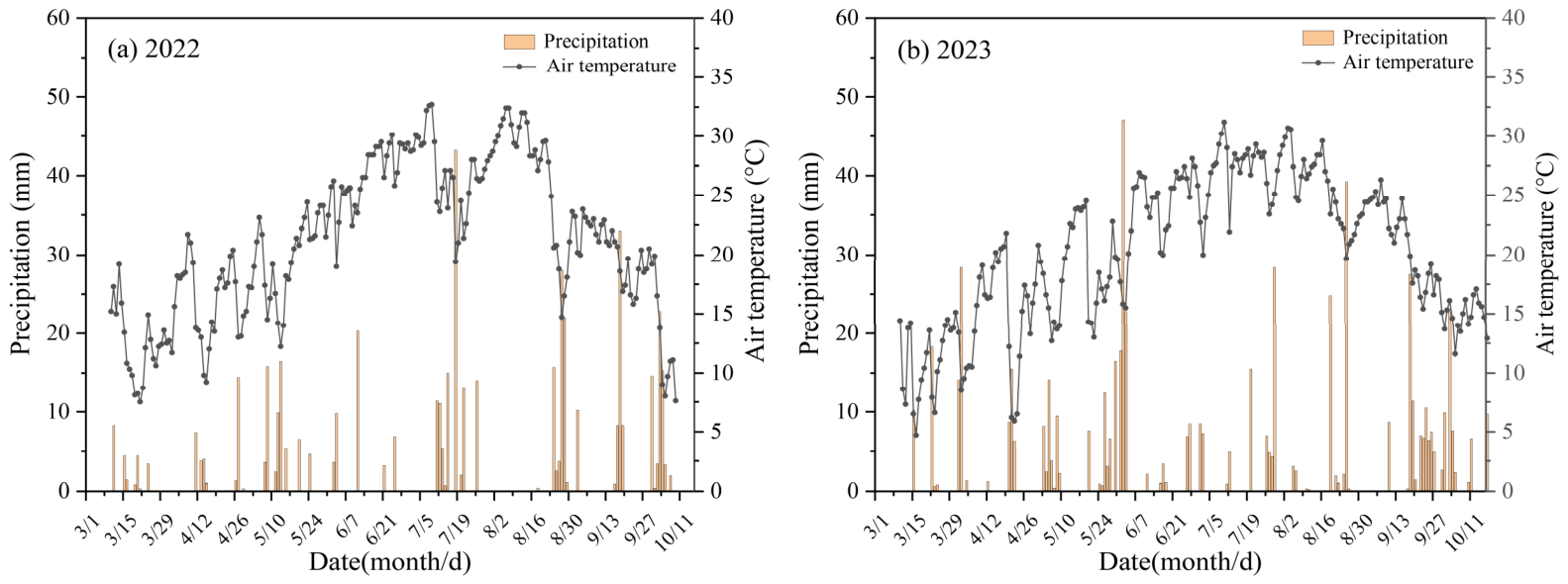
The field experiment was conducted during the 2022–2023 growing seasons in Wugong County, Xianyang City, Shaanxi Province, China (34°20′15″ N, 108°06′00″ E; 516 m a.s.l.). The experimental site lies within a warm temperate zone characterized by a semi-humid continental monsoon climate. The total precipitation during the kiwifruit growing seasons measured 479.2 mm in 2022 and 625 mm in 2023 (Figure 1). The region has an annual frost-free period of 315 days, with the ≥10 °C active cumulative temperatures reaching 4184 °C. The average annual sunshine duration totals 2094.9 h, with the total annual radiation measuring 480.78 kJ/cm2. The mean daily temperatures at the experimental site were 20.05 °C in 2022 and 19.55 °C in 2023. The orchard has a flat topography, representative of typical kiwifruit cultivation areas in the region. The basic physicochemical properties of the soil (0–40 cm depth) are presented in Table 1.

2.2. Field Experiments

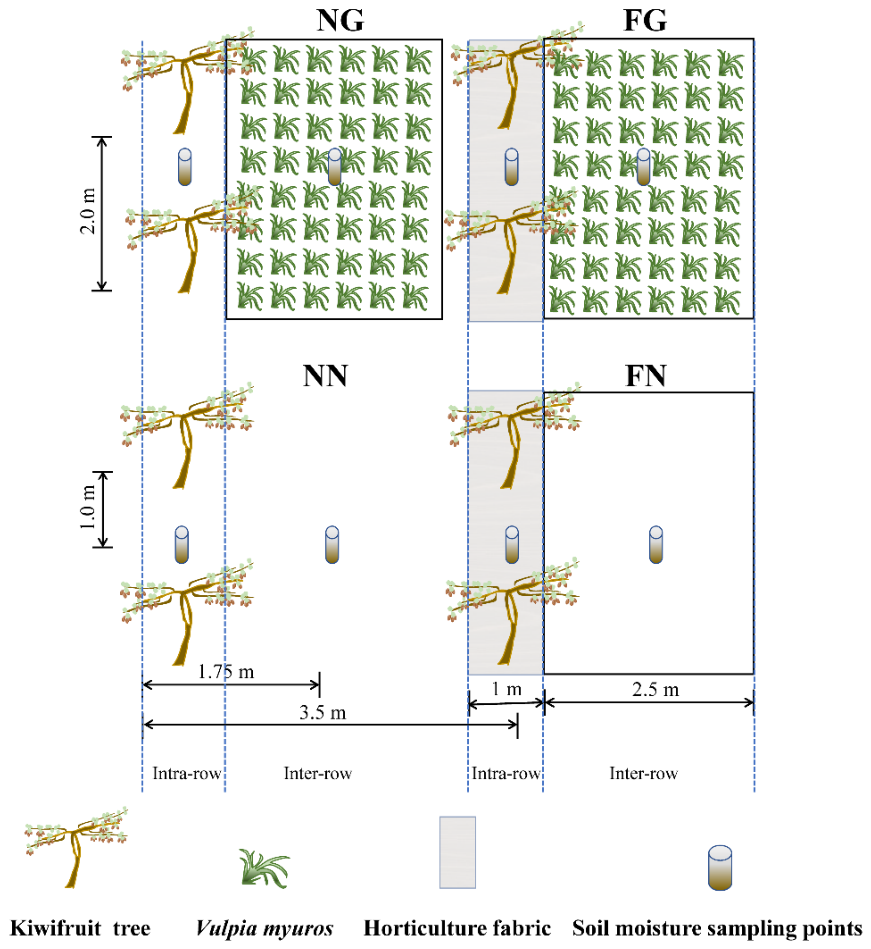
A field experiment was conducted using three-year-old kiwifruit vines (Actinidia deliciosa cv. ‘Xuxiang’) trained on a T-bar trellis system with 2.0 m intra-row and 3.0 m inter-row spacing. Four mulching treatments were established in a randomized complete block design with three replicates per treatment: FG: combination of intra-row horticultural fabric mulching (F) + inter-row grass mulching (G); FN: only intra-row horticultural fabric mulching (F) + inter-row clean tillage (N); NG: only inter-row grass mulching (G) + intra-row clean tillage (N); and NN: intra-row clean tillage (N) and inter-row clean tillage (N), was used as the control. Each plot (60 m2, 6 m × 10 m) contained 10 vines, with 2 m buffer zones between plots. The total experimental area was approximately 720 m2. For the intra-row fabric mulching, black polypropylene landscape fabric (70 g·m−2) was laid along both sides of the kiwifruit vine rows, covering a width of 1.0 m. This breathable and permeable fabric effectively suppresses intra-row weed growth, reduces soil moisture evaporation, and prevents soil erosion caused by surface runoff during the rainy season. For the inter-row grass mulching, the 2.5 m wide strips between the fabric-mulched intra-row areas were sown with rat’s-tail fescue (Vulpia myuros (L.) C. C. Gmel.). This annual grass effectively suppresses summer weeds. Upon decomposition, the plant material enhances soil fertility. Due to its natural reseeding ability, it can persist for several years, offering a labor-saving and efficient system with a single sowing providing long-term benefits. The grass was manually broadcast seeded in October 2020 at a rate of 22.5 kg·hm−2. Before sowing, the topsoil in the inter-row area was lightly rotary tilled (approximately 10 cm depth) to remove weeds, and the seedbed was leveled. After broadcasting, the seeds were covered with about 1 cm of soil. The inter-row grass (Vulpia myuros) in the NG and FG treatments was mowed 1–2 times per year as needed: (i) during the spring dry period (March–April) to a stubble height of 10–15 cm to reduce water competition, and (ii) when the canopy height exceeded 40 cm (usually April–May) to a height of 20–30 cm to improve light and ventilation. As an annual species, reseeding was conducted each autumn (September–October). The cut grass biomass was collected and removed from the orchard rather than retained on the soil surface. All plots received uniform agronomic management, including irrigation, fertilization, and pest control, except for the mulching treatments. Drip irrigation was supplied through a 16 mm diameter drip line installed along the planting row. In the fabric mulch treatments (FG and FN), the drip line was positioned beneath the fabric. The soil moisture was measured every 15 days at a depth of 100 cm using a TRIME-TDR moisture analysis system. Irrigation was initiated when the soil water content in the control treatment (NN) fell below 70% of field capacity (θf), which served as the lower irrigation threshold. The irrigation timing was determined based on the TDR measurements combined with daily meteorological data (precipitation, temperature, and solar radiation) from the on-site automatic weather station to ensure accurate scheduling between fixed sampling dates. After irrigation, the soil water content was restored to 85% θf (the upper limit). The irrigation amount per tree was calculated as follows:
I = γ · P · H ( θ m a x θ )
where I is the irrigation amount per tree (mm); P is the planned wetting ratio (0.3); H is the planned wetting depth (0.8 m); θmax is the upper irrigation limit (85% θf); θ is the soil water content before irrigation; and γ is the soil bulk density (g cm−3). The total irrigation amounts and frequencies for each growth stage are presented in Table 2. The precipitation data recorded by the automatic weather station at the experimental site are also included in Table 2 to show the total water input (irrigation + precipitation) received by the plants.
Basal fertilizer was applied at a rate of 750 kg·ha−1 in March of each year. Pest and disease control followed local standard practices. Three representative vines per plot were selected for leaf and fruit measurements. A schematic diagram of the field layout is shown in Figure 2. The growing season was divided into four phenological stages: Stage Ι (sprouting and leaf development: mid-March to mid-May), Stage II (flowering and fruit-set: mid-May to late May), Stage III (fruit expansion: early June to early August), and Stage IV (fruit ripening: mid-August to early October). The implementation of the mulching treatments is illustrated in Figure 2. All agronomic practices other than the mulching treatments, including pruning, pest and disease control, and fruit harvesting, were uniformly applied across all plots.

2.3. Data Collection and Measurements

2.3.1. Soil Water Content and Physicochemical Properties

The soil moisture was monitored throughout the experimental period using time-domain reflectometry (TDR) by burying one TRIME tube (TRIME-PICO, IMKO GmbH, Ettlingen, Germany) in one intra-row (30 cm longitudinally from the vine) and another inter-row (175 cm laterally from the vine) of each plot. Measurements of volumetric soil moisture content were taken at 100 cm depth during each growth stage. Measurements were taken at 20 cm intervals from the surface to a depth of 100 cm during each phenological stage. The soil water storage (SWS) was calculated using the following equation:
S W S = i n H i × θ i × 10
where SWS is the soil water storage capacity (mm); Hi is the soil depth (cm); θi is the soil mass water content (%); and i = 20, 40, 60, 80, and 100.
At the end of the kiwifruit reproductive period, soil samples (0–40 cm depth) were collected from intra-row (30 cm from the vine trunk) and inter-row (175 cm from the vine) positions. For each plot, soil from the same position was thoroughly mixed to form a composite sample. The soil organic matter (SOM) content was measured using the potassium dichromate volumetric method, while the nitrate nitrogen (NO3-N) and ammonium nitrogen (NH4+-N) concentrations were determined by continuous flow analysis (AA3, SEAL Analytical GmbH, Germany) according to the manufacturer’s instructions.

2.3.2. Leaf Physiological Parameters and Photosynthetic Pigments

The photosynthetic parameters were measured using a portable photosynthesis system (LI-6800, LI-COR Biosciences, Lincoln, NE, USA) on sunny mornings between 09:00 and 11:30 during four phenological stages. For each plot, four fully expanded, healthy leaves from the middle section of current-year shoots (one from each cardinal direction) were selected and tagged for repeated measurements. The measured parameters included the net photosynthetic rate (Pn), transpiration rate (Tr), stomatal conductance (Gs) and intercellular CO2 concentration (Ci). Concurrently, the third fully expanded leaf from the shoot apex was collected for pigment analysis and chlorophyll fluorescence measurements. The leaf pigment contents (chlorophyll a, chlorophyll b, and carotenoids) were determined using the ethanol–acetone extraction method.

2.3.3. Determination of Yield and Quality Indicators of Kiwifruit

The yield-related indicators were investigated prior to fruit harvest. Three sample vines randomly selected from each individual plot (replicate) were used to determine the following parameters. Number of fruits per plant (PFN): All fruits on each sample vine were manually counted. Average single fruit weight (SFW): From each sample vine, ten uniform fruits free from pests, diseases, and mechanical damage were randomly collected from the outer canopy in the east, south, west, and north directions (40 fruits per vine in total). All fruits from the three vines within the same plot were pooled. The individual weight of each fruit was measured using a digital balance (ME204, Mettler Toledo, Greifensee, Switzerland; precision 0.01 g). The average single fruit weight for the plot was calculated as the mean value of all these fruits. Yield per plant (FYP): This was calculated as the product of the number of fruits per plant and the average single fruit weight, according to the formula
FYP (kg·plant−1) = (PFN × SFW (g))/1000
where PFN represents the number of fruits per plant (fruit·plant−1) and SFW represents the average single fruit weight (g).
At fruit maturity, sampling was conducted. Three uniform, defect-free fruits were collected from each sample vine and pooled to form one replicate. For the kiwifruit pulp, one portion was immediately frozen in liquid nitrogen, ground into a fine powder, and stored in a −80 °C freezer for later analysis. Another portion was used to prepare fresh juice. Total soluble solids (TSS): Fresh juice was used to determine the TSS with a digital refractometer (PAL-1, Atago, Tokyo, Japan). Total soluble sugar (TS): This content was determined using the anthrone–sulfuric acid method, with glucose as the standard. The fruit pulp powder was weighed and extracted with distilled water in a boiling water bath for 30 min. The extract was mixed with the anthrone reagent, reacted at 100 °C for 10 min, and the absorbance was measured at 625 nm using a UV-Vis spectrophotometer (UV-1800, Shimadzu, Kyoto, Japan). Total reducing sugar (TRS): This content was determined using the 3,5-dinitrosalicylic acid (DNS) method. The sample extract was mixed with DNS reagent, heated at 100 °C for 5 min, and the absorbance was measured at 540 nm. Titratable acidity (TA): The TA was determined using the NaOH titration method. Fresh fruit pulp was weighed and homogenized. Using phenolphthalein as an indicator, the homogenate was titrated with 0.1 mol·L−1 NaOH to pH 8.2. The titratable acidity was expressed as a percentage of citric acid equivalent. Vitamin C (VC): This content was determined using the molybdenum blue colorimetric method. Fruit pulp powder was extracted with a metaphosphoric–acetic acid solution. The extract was mixed with sulfuric acid and ammonium molybdate for color development, and the absorbance was measured at 700 nm. Sugar–acid ratio (SAR): This was calculated as the ratio of SSC to TA.

2.3.4. Determination of Kiwifruit Sugar Fractions and Related Enzymes

A 1.0 g aliquot of the kiwifruit homogenate was accurately weighed, ground in liquid nitrogen, and mixed with 3 mL of deionized water. The mixture was then extracted at 50 °C for 3 min. After extraction, the samples were centrifuged at 12,000× g for 15 min, and the supernatant was collected in 10 mL tubes. The extract was filtered through a 0.22 μm membrane and transferred to an autosampler vial for HPLC analysis. The sucrose, fructose, and glucose contents were determined using a high-performance liquid chromatography (HPLC) system (1260 Infinity II, Agilent Technologies, Santa Clara, CA, USA) equipped with a refractive index detector and a Sugar-Pak™ I column (6.5 × 300 mm, Waters, Milford, MA, USA).
The kiwifruit homogenates were analyzed for enzymatic activities, including sucrose phosphate synthase (SPS), sucrose synthase (SS), sucrose synthase catabolic direction activity (SS-I), and acid invertase (AI), using commercial assay kits according to the manufacturer’s protocols. The kits used were: SPS (BC0580), SS (BC0600), SS-I (BC4310), and AI (BC0560) (Solarbio Science & Technology, Beijing, China). Enzyme activities were quantified in units per milligram of protein (U·mg−1 protein).

2.4. Statistical Analysis

Data were organized using Excel 2021 (Microsoft Corporation, Redmond, WA, USA). Statistical analyses were performed based on randomized complete block design (RCBD) using SPSS 25.0 (IBM Corporation, Armonk, NY, USA) with three biological replicates per treatment. Figures were generated using Origin 2021 (OriginLab Corporation, Northampton, MA, USA) and Adobe Illustrator 2021 (Adobe Inc., San Jose, CA, USA). Normality and homogeneity of variance were verified using Shapiro–Wilk and Levene’s tests (p > 0.05). Two-way ANOVA was performed to evaluate effects of mulching treatment (M), year (Y), and their interaction (M × Y). When interactions were significant, Fisher’s LSD test was used for post hoc comparisons. One-way ANOVA with Tukey’s HSD test was used to compare differences among treatments within same year. False Discovery Rate (FDR) correction was applied for multiple testing, and adjusted p < 0.05 was considered statistically significant. Pearson correlation analysis was carried out. Partial least squares path modeling (PLS-PM) was performed using SmartPLS 4.0 (SmartPLS GmbH, Bonningstedt, Germany). Model comprised four latent variables: soil properties (soil water content, soil organic matter, and mineral N), photosynthesis (Pn, Gs, and chlorophyll content), yield (fruit yield per tree), and fruit quality (TSS, TS, and sugar–acid ratio). Path coefficients were estimated using bootstrap resampling with 5000 iterations to obtain standard errors and confidence intervals.

3. Results

3.1. Soil Water Storage

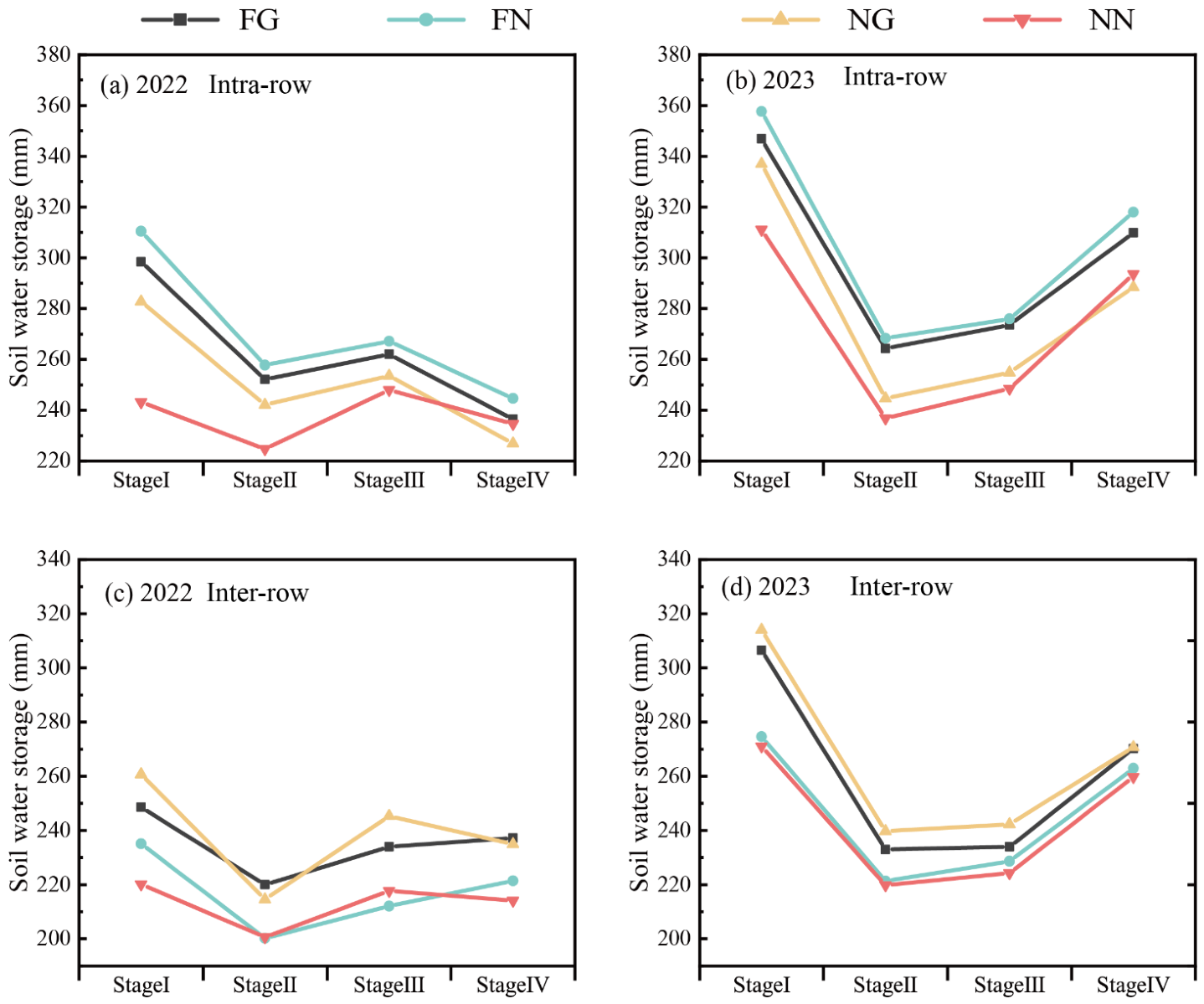
Soil water storage (SWS) in the 0–100 cm soil layer was significantly higher in 2023 than in 2022 (p < 0.05). The two-way analysis of variance (ANOVA) showed that the interaction between mulching treatment (M) and year (Y) was significant only in the intra-row position in Stage I and Stage III (p < 0.05) (Table S1). SWS in both intra-row and inter-row positions exhibited a U-shaped trend from Stage I to Stage III, with significant differences among the treatments in Stage I. Compared with NN, mulching generally increased SWS. In the intra-row position, FN showed the highest intra-row SWS. In the inter-row position, the NG treatment increased SWS by 6.94–17.13% compared with NN; however, this grass-only mulching (G) treatment reduced the intra-row SWS during Stages III and IV, where it reduced the intra-row SWS by 3.31–8.01%. The FG treatment maintained a relatively high SWS at both positions. This treatment maintained an inter-row SWS comparable to that under the NG treatment while increasing the intra-row SWS by 1.83–55.16 mm relative to NG. Additionally, FG maintained the intra-row SWS at levels comparable to those under FN (Figure 3).

3.2. Soil Nitrogen and Organic Matter Content

The soil ammonium nitrogen (NH4+-N), nitrate nitrogen (NO3-N), and organic matter (SOM) contents in the 0–40 cm soil layer under different mulching treatments during 2022 and 2023 are presented in Table 3. For all treatments, the contents of NH4+-N, NO3-N, and SOM were higher in 2023 than in 2022. The two-way ANOVA revealed that mulching treatment (M) and year (Y) had significant effects on NH4+-N, NO3-N, and SOM in both the intra-row and inter-row positions (p < 0.05 or p < 0.01), while the M × Y interaction was highly significant for NO3-N and SOM (p < 0.01). Across the two years, the treatments with fabric mulching (F) or grass mulching (G) generally showed higher NH4+-N, NO3-N, and SOM contents. The F mulching (FG and FN) treatments consistently exhibited significantly higher intra-row NH4+-N, NO3-N, and SOM contents than the NG and NN treatments in both years. The FG and NG treatments consistently exhibited significantly higher inter-row NO3-N and SOM contents than the FN and NN treatments in both years. For the inter-row NH4+-N, however, the G mulching treatments (FG and NG) were not significantly different from that of bare ground in 2022, with values only 15.35–27.14% higher; in 2023, the difference became significant.

3.3. Pigment Content and Photosynthetic Parameters of Leaves

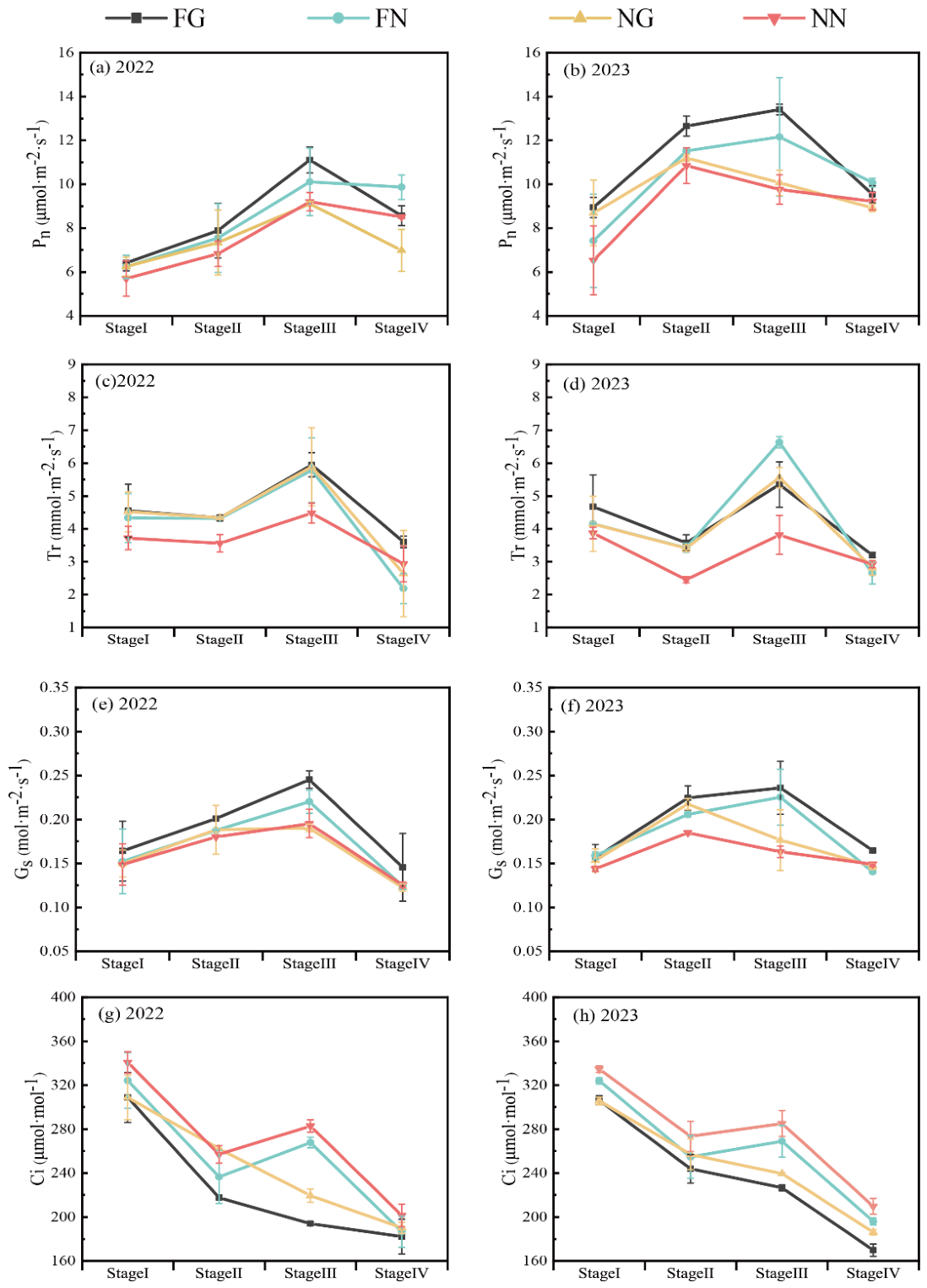
The leaf gas exchange parameters responded significantly to the mulching treatment, growth stage, and year. The two-way ANOVA (Table S2) showed that the mulching treatment (M) significantly affected the net photosynthetic rate (Pn) at all stages (p < 0.01). The year (Y) significantly affected the transpiration rate (Tr) and stomatal conductance (Gs) during Stages II and III, and significantly affected the Pn during Stages II and IV (p < 0.01). A significant M × Y interaction was observed only for Tr and Gs in Stage II (p < 0.01). The effects of different mulching treatments on the leaf photosynthetic parameters in each growth stage are presented in Figure 4. The Pn and Gs followed a unimodal pattern, with peak values in Stage III. Compared with NN, the mulching treatments significantly increased the Pn and Gs, with the most pronounced effects observed in Stage III. NN exhibited the lowest gas exchange capacity in all stages. F mulching (FG and FN) significantly increased the Pn and Gs throughout the entire growth period. The NG treatment also increased these parameters, albeit to a lesser extent, with Pn and Gs values ranging from 1.49% to 33.16% higher than those of NN. Notably, the intercellular CO2 concentration (Ci) differed insignificantly among treatments, although it showed slightly higher values under mulching than under NN. Compared with FN, FG maintained comparable Pn and Gs levels across most stages, with differences ranging from 1.21% to 18.77%, and performed better during the late growth stage. Compared with NG, FG significantly increased both the Gs and Pn across all four growth stages, with the most pronounced enhancement observed in Stage III. Overall, the Tr and Gs were higher in 2023 than in 2022, particularly during Stages II and III.
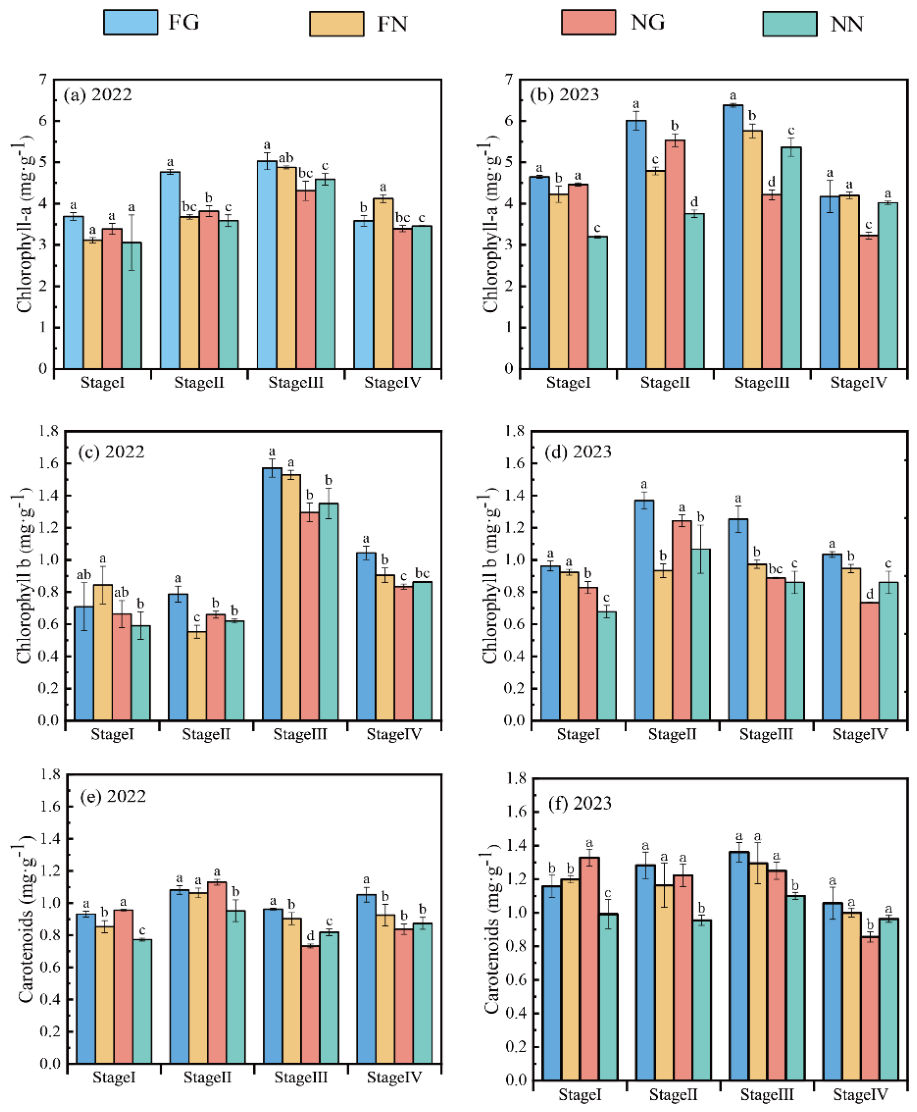
The trends in pigment content were generally consistent with those in gas exchange. The two-way ANOVA showed that the mulching treatment (M) had a highly significant effect on chlorophyll a, chlorophyll b, and carotenoid contents in all stages except for chlorophyll b in Stage II (p < 0.01). The year (Y) had a significant or highly significant effect on most parameters, with the exception of chlorophyll b in Stage IV. The M × Y interaction was significant for most pigments in Stages I and III (p < 0.05 or p < 0.01), but not significant in Stages II and IV (Table S3). Chlorophyll a and chlorophyll b increased first and then decreased, peaking in Stage III. The carotenoid content showed no significant change across growth stages. Compared with the NN treatment, all mulching treatments significantly increased the pigment contents, with the most pronounced effects observed in the treatments with F mulching (FG and FN). FG maintained the highest chlorophyll a content throughout the entire growth period. NG significantly increased the chlorophyll a content during the early growth stages (Stages I–II), but showed reductions of 14.34% in Stage III and 11.46% in Stage IV compared with FG. For chlorophyll b, FN exhibited the highest content in Stage I, while FG exhibited the highest content from Stages II to IV. All three mulching treatments (FG, FN, and NG) increased the carotenoid content during Stages I–III. From Stages II to IV, FG exhibited the highest carotenoid content, which was 14.81–23.99% higher than the next-best treatment, whereas NG showed a significant reduction in the carotenoid content in Stage IV. FG generally maintained higher pigment levels compared with the single mulching patterns. Compared with FN, FG demonstrated clear advantages during the late growth stage. Compared with NG, FG achieved significantly higher chlorophyll a and chlorophyll b contents during Stages III–IV while maintaining comparable carotenoid levels. Overall, the chlorophyll a and carotenoid contents were higher in 2023 than in 2022 across all treatments (Figure 5).

3.4. Kiwifruit Fruit Quality and Yield

The mulching strategies significantly influenced the kiwifruit yield components. The two-way ANOVA showed that the mulching treatment (M) and year (Y) had highly significant effects on number of fruits per plant (PFN), single fruit weight (SFW), and yield per plant (FYP) (p < 0.01). A significant M × Y interaction was observed for FYP (p < 0.01) and PFN (p < 0.05) (Table 3). Compared with the NN treatment, all mulching treatments significantly increased the yield parameters across both years. F mulching (FG and FN) generally produced higher yield values than treatments without fabric mulching (NG and NN), with FG showing the highest values for most yield components. Although NG provided benefits, the increases were relatively modest, with the FYP being 17.38% and 9.18% higher than that of NN for the two years, respectively. In contrast, the increases in the PFN and SFW were significant in different years, with values of 8.02% in 2022 and 13.86% in 2023.
Mulching also affected fruit quality, but the responses varied among parameters and years. The two-way ANOVA showed that the mulching treatment (M) and year (Y) had significant or highly significant effects on total soluble solids (TSS), titratable acidity (TA), total sugars (TS), reducing sugars (TRS), vitamin C (VC), and soluble organic acid content (SAR) (p < 0.05 or p < 0.01). A significant M × Y interaction was observed only for TS (p < 0.05). Compared with NN, FG and FN significantly increased TSS and SAR. NG showed mixed performance compared with NN. It significantly increased TSS in 2023 and TRS in 2022. However, it did not significantly improve TS. In both years, NG showed lower VC than NN. In 2023, NG showed no improvement in VC compared with NN, with a decrease of 1.79%, whereas SAR was 5.54% higher than that of NN. FG generally showed higher quality values than FN and NG for several traits, especially TSS, TS, and SAR, but the differences were not consistent across years. The advantages of FG were even more pronounced compared with NG. TSS, TA, and VC were higher in 2022 than in 2023, whereas TRS was generally higher in 2023. Overall, yield responses were more stable than quality responses between years (Table 4).

3.5. Sugar Components

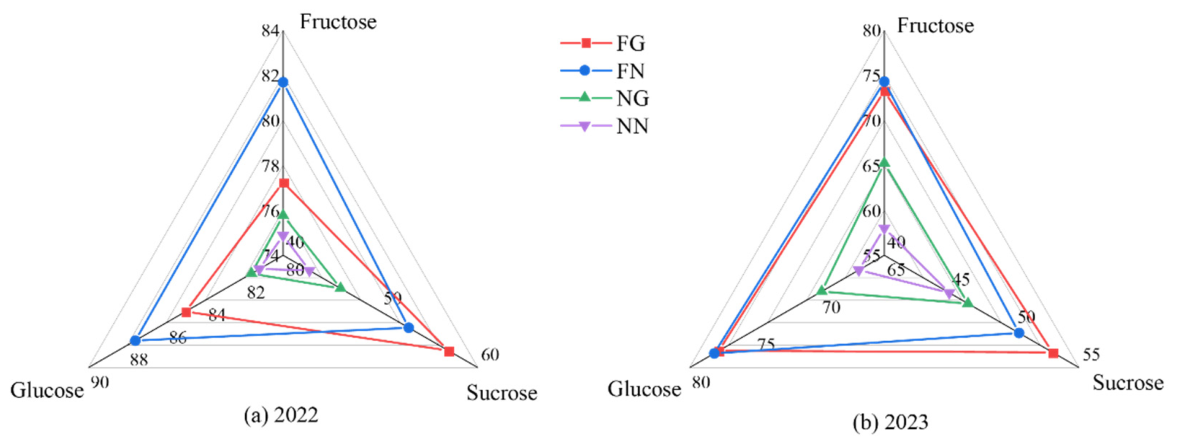
Fruit sugar composition is a key determinant of fruit sweetness, flavor, and taste quality. The two-way ANOVA (Table S4) showed that the mulching treatment (M) and year (Y) had highly significant effects on fructose, glucose, and sucrose contents (p < 0.01). The M × Y interaction was significant only for sucrose content (p < 0.05), with no significant interaction observed for fructose or glucose. All mulching treatments generally increased the sugar contents relative to NN. F mulching (FG and FN) significantly enhanced sugar accumulation, whereas NG also increased the sugar contents but to a lesser extent, with only the increase in sucrose reaching significance. For fructose and glucose, the differences between NG and NN were 0.50–1.19% in 2022, increasing to 4.28–12.46% in 2023. Compared with FN, FG had significantly higher sucrose contents in both years, whereas the differences in fructose and glucose were smaller, ranging from 0.45% to 5.45%. For all treatments, the fructose, sucrose, and glucose contents were higher in 2022 than in 2023, with interannual differences ranging from 5.17% to 8.54% (Figure 6).

3.6. The Relationship Between Soil Environment, Plant Photosynthesis, Yield, and Quality

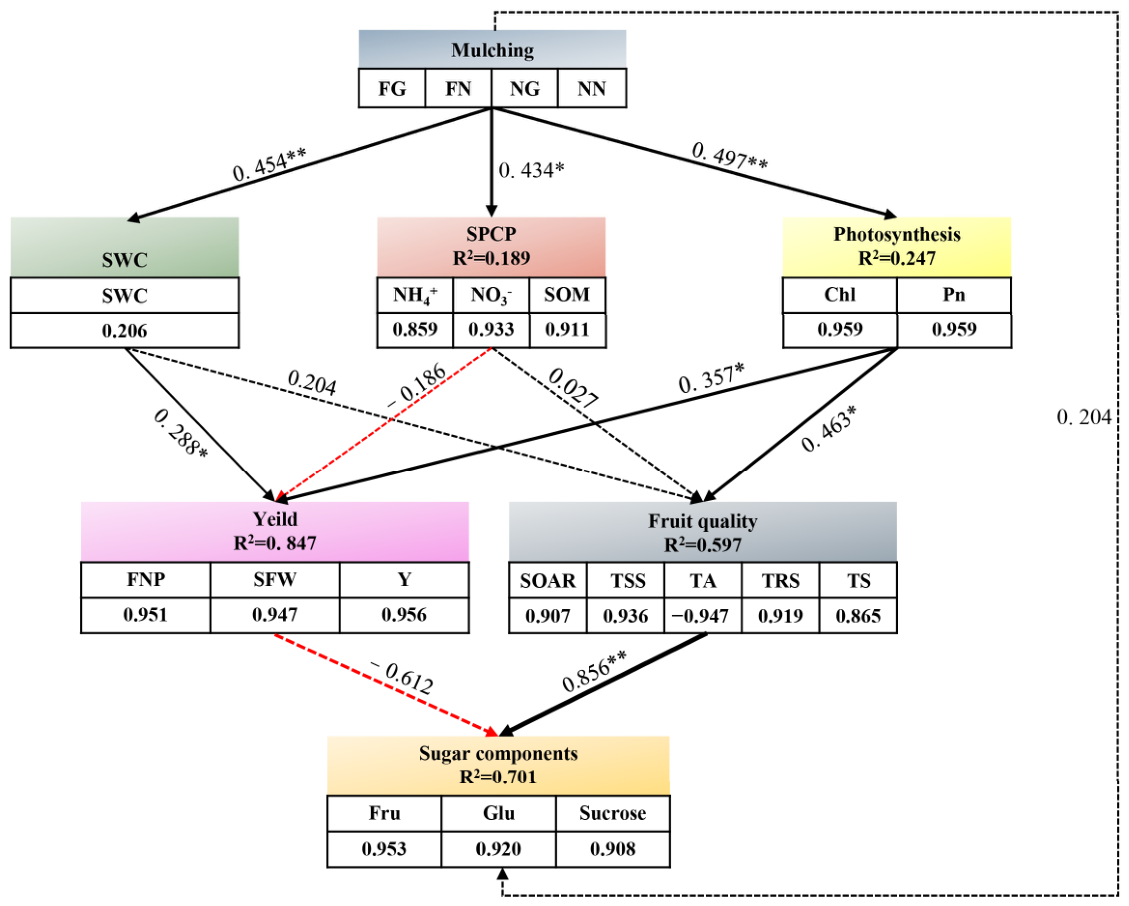
Partial least squares path modeling (PLS-PM) was used to analyze the direct and indirect effects of mulching on kiwifruit yield and sugar components through soil, physiological, and quality pathways (Figure 7). The model fitting results showed that the mulching treatment (M) had significant direct positive effects on soil water content (SWC), soil physicochemical properties (SPCPs), and photosynthetic capacity (photosynthesis), with path coefficients of 0.454, 0.434, and 0.497, respectively (p < 0.01 or p < 0.05). SWC had a significant direct positive effect on yield (p < 0.05), whereas the direct positive effect of SPCPs on fruit quality was not significant. The photosynthetic capacity (chlorophyll and photosynthetic rate) also had significant direct effects on both yield and fruit quality (p < 0.05). The yield exhibited a highly significant direct positive effect on sugar components (p < 0.01), whereas fruit quality showed a direct negative effect on sugar components. These results indicate that mulching improved the yield and sugar accumulation mainly by enhancing the soil water status and photosynthetic capacity. The yield further drove fruit sugar accumulation, while fruit quality modulated sugar metabolism through complex feedback regulation.
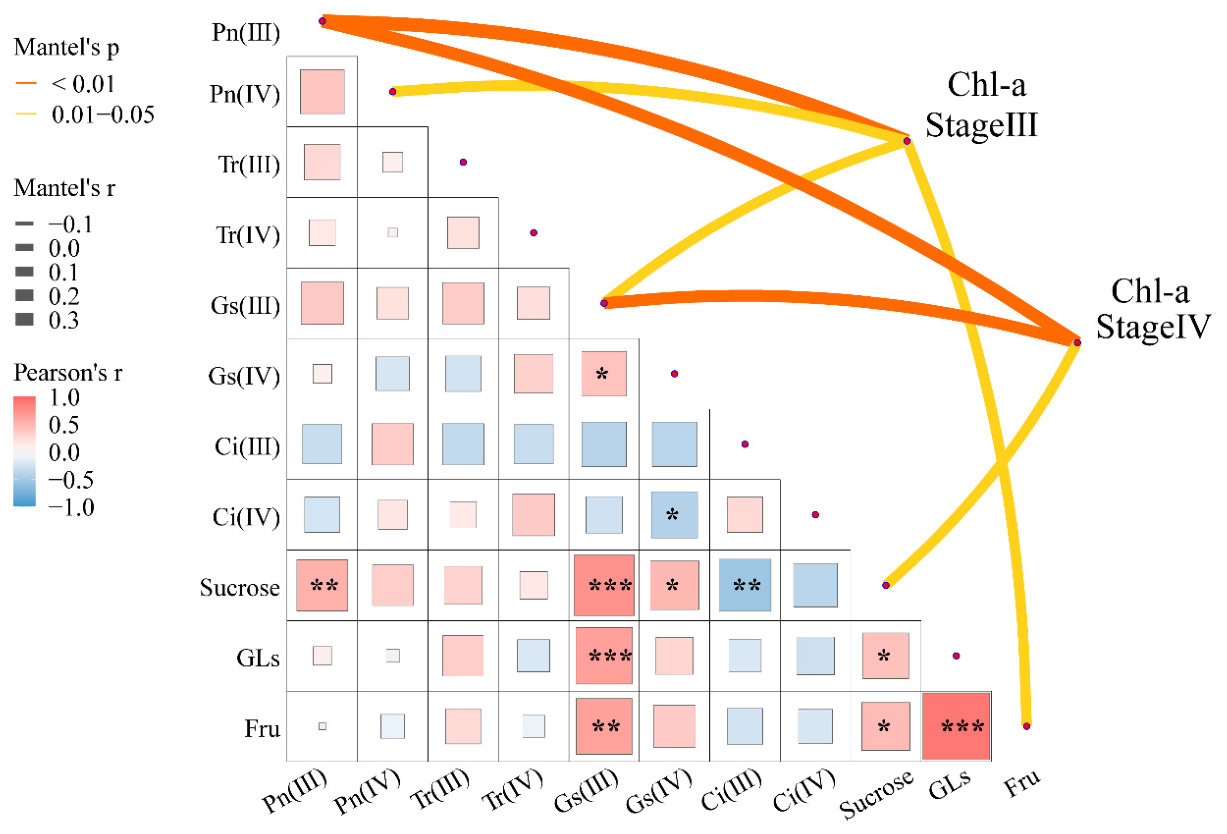
Based on the Pearson correlation analysis, significant associations were identified between the photosynthetic physiological indices during the late growth stage and the fruit sugar components (Figure 8). Under the mulching treatments, the photosynthetic parameters during the late growth stage (Stages III–IV) were closely associated with the sugar components. The chlorophyll a (Chl-a) content during both Stages III and IV was highly significantly correlated with the fruit sugar components (fructose, glucose, and sucrose) (p < 0.01), indicating that leaf photosynthetic pigment levels during the late growth stage were closely related to fruit sugar accumulation. The glucose and fructose contents in fruits were positively correlated with Pn, Tr, and Gs during Stage III, and negatively correlated with Ci, with a particularly significant positive correlation observed for Gs (p < 0.01). These results suggest that higher stomatal conductance in the late growth stage is associated with greater accumulation of sugar components in the fruit.

3.7. Activities of Sucrose-Metabolizing Enzymes

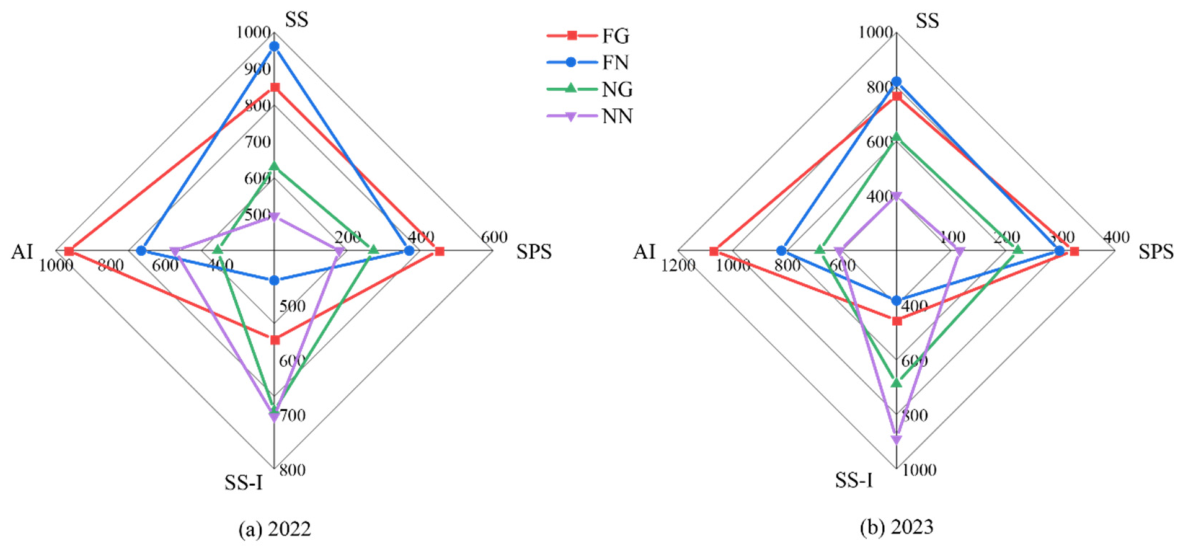
Fruit sugar accumulation is closely associated with the dynamic regulation of sucrose metabolism-related enzymes. This study further analyzed the effects of mulching treatments on the activities of key enzymes involved in sucrose synthesis and degradation, as well as their relationships with sugar components. The two-way ANOVA (Table S4) showed that the mulching treatment (M) and year (Y) had highly significant effects on the activities of sucrose synthase (SS), sucrose phosphate synthase (SPS), sucrose synthase (catabolic direction) (SS-I), and acid invertase (AI) (p < 0.01). A significant M × Y interaction was observed for all four enzymes (p < 0.05 or p < 0.01). The mulching treatments increased SS and SPS activities while suppressing SS-I and AI activities. F mulching (FG and FN) significantly increased SS and SPS activities, whereas NG also increased these activities but to a lesser extent. FG and FN consistently maintained significantly lower SS-I and AI activities than NN across both years. For NG, SS-I activity differed insignificantly from that of NN (1.60–11.90%), whereas AI activity was significantly reduced. Compared with FN, FG maintained comparable or higher synthetic enzyme activities across both years, while showing generally lower degradation enzyme activities, with AI activity being significantly lower than that of FN in both years. SS and SPS activities were generally higher in 2022 than in 2023, whereas SS-I and AI activities showed the opposite trend (Figure 9).

4. Discussion

4.1. Mulching Effects on Soil Water and Nutrients

In arid regions, fruit tree growth is often constrained by the availability of soil water and nutrients [20]. Mulching practices can achieve synergistic improvements in water and nutrient use efficiency by regulating the soil micro-environment. In the present study, the fabric mulching treatments (FG and FN) consistently maintained the highest soil water storage (SWS), ammonium nitrogen (NH4+-N), nitrate nitrogen (NO3-N), and soil organic matter (SOM) contents in the intra-row zone, indicating that fabric mulching may improve soil water and nutrient availability. Compared with NN, plastic film mulching has been shown to effectively reduce soil water loss and increase intra-row SWS during various growth stages [21]. This effect may be attributed to the physical barrier created by fabric mulching, which reduces soil evaporation while stabilizing soil temperature, thereby creating favorable conditions for microbial activity and nutrient retention. Stable soil hydrothermal conditions promote microbial biomass accumulation and metabolic activity, accelerating organic matter mineralization and the release of available nitrogen. Fabric mulching can alter soil total nitrogen transformation by enhancing microbial activity and enzyme secretion, thereby accelerating nitrogen mineralization and nitrification rates and improving soil nitrogen availability [22]. Consequently, fabric mulching significantly increases soil NH4+-N and NO3-N contents, which may be associated with increased microbial abundance and enzyme-mediated nitrogen mineralization and nitrification rates that enhance plant-available nitrogen [23].
The inter-row grass mulching treatments (FG and NG) significantly increased the inter-row SWS and SOM. Previous studies have reported that grass mulching may increase water consumption, potentially leading to competition for water between grass and fruit vines [24]. However, other research has shown that under normal rainfall conditions, appropriate selection of grass species and planting density can reduce such competition [25]. In the present study, grass mulching did not always produce strong water competition, but its effects were more variable than those of fabric-based treatments. Instead, it likely stimulated rapid microbial proliferation and metabolism in the rhizosphere through root exudates, inducing a “rhizosphere priming effect” that promoted SOM turnover [26]. The mechanisms by which grass mulching promotes soil nutrient accumulation may involve several aspects, but these effects are likely to depend strongly on rainfall, the grass growth stage, and decomposition dynamics. First, the turnover and decomposition of grass roots during their growth cycle can directly input organic matter into the soil, thereby increasing SOM [27]. Second, root exudates from grass can activate soil microbial activity, promoting nitrogen mineralization and organic matter decomposition, which in turn increases the available nutrient content [28]. Additionally, the rhizosphere micro-environment created by grass mulching favors the proliferation of microbial communities, particularly the colonization of arbuscular mycorrhizal fungi (AMF), which can enhance soil phosphorus mobilization and nutrient cycling [29]. In this study, the grass mulching treatments significantly increased soil organic matter and nitrate nitrogen contents while also enhancing the inter-row SWS, reflecting a synergistic effect of water and nutrient co-benefits.
FG achieved synergistic optimization of soil water and nutrients in both spatial zones. It maintained an inter-row SWS comparable to that of NG while increasing intra-row SWS by 1.83–55.16 mm relative to NG, and achieved intra-row nutrient levels comparable to those of FN. In the NG treatment, root systems of grass and fruit vines overlapped in the intra-row position, potentially leading to competition for water and nutrients, with resource competition intensifying during periods of peak water demand [30]. In the present study, the significant decrease in intra-row SWS during the late growth stage (3.31–8.01%) in the NG treatment confirmed the existence of such competition. In contrast, under the multiple mulch treatment (FG), fabric mulching acted as a physical barrier in the intra-row zone, effectively preventing the expansion of grass roots into this zone and eliminating the source of competition [31]. Meanwhile, the retention of grass mulching in the inter-row zone maintained its beneficial effects on soil structure, creating a complementary spatial configuration [32]. Higher rainfall in 2023 (29.50% higher than in 2022) led to increased SWS across all treatments. However, the relative advantage of fabric mulching was more pronounced in the dry year (2022), whereas its benefit was weaker in the wet year (2023) [24]. In contrast, the negative effect of grass mulching on intra-row water status appeared to be stronger in the dry year. These responses suggest that the benefits of mulching are strongly context dependent and may be most pronounced in environments where soil water limitation is a major constraint.

4.2. Photosynthetic Performance and Chlorophyll Regulation Under Mulching

Photosynthesis is an essential process for plant survival, providing organic matter and energy, and is strongly influenced by soil water availability. The chlorophyll content plays a critical role in photosynthesis and tends to decrease under water stress conditions [33]. In the present study, the F mulching treatments (FG and FN) significantly increased Pn, Gs, and the contents of chlorophyll a, chlorophyll b, and carotenoids during the mid-growth stages of kiwifruit. These findings are consistent with previous studies of crops such as peaches and maize [12,34,35]. No significant differences in the intercellular CO2 concentration (Ci) were observed among treatments, suggesting that the increase in Pn was largely associated with the increase in Gs, a pattern consistent with the “stomatal limitation” model under water stress conditions [36]. Structural equation modeling (SEM) further confirmed that the mulching treatments had significant positive effects on the SWC and soil physicochemical properties (SPCPs), which in turn directly enhanced the photosynthetic capacity (p < 0.01). However, these relationships should be interpreted cautiously, as they indicate potential pathways rather than direct causal evidence. Although three biological replicates were used per treatment, which is common in field trials, this replication level is relatively limited for multivariate analyses, such as SEM and correlation analyses. Therefore, these relationships should be interpreted cautiously as indicative of potential associations rather than definitive causal relationships. Similarly, Betancur [37] reported that grass mulching increased leaf Gs and Pn in a high-density apple orchard, attributing this improvement to enhanced soil water conditions. Soil drought can affect photosynthesis through changes in stomatal closure, metabolism, and leaf structure. When soil water availability decreases, stomatal closure occurs to prevent water loss, leading to reductions in Pn and Gs [38].
The chlorophyll content typically peaks during the mid-growth stage and declines toward the end of the growth period, a pattern associated with nutrient remobilization and leaf senescence [39]. This reduction in total chlorophyll may be attributed to leaf damage and chlorosis induced by water deficit in arid regions [40]. In the present study, the FG and FN treatments effectively maintained chlorophyll a and chlorophyll b contents during the late growth stage, indicating that leaf senescence may have been delayed. The highly significant positive correlation between the chlorophyll a content and fruit sugar components during the late growth stage further supports the importance of maintaining leaf functionality for fruit quality formation (p < 0.01). In contrast, the NG treatment exhibited marked photosynthetic pigment degradation during the late growth stage, with the chlorophyll a content being 14.34% and 11.46% lower than that of FG during Stages III and IV, respectively, accompanied by a decline in Pn, which suggests that grass mulching alone may become less effective under late-season water limitation. This may be attributed to photosynthetic inhibition induced by water competition. Competition for water and nutrients between inter-row grass and fruit vines intensifies during the late growth stage, coinciding with the rapid fruit expansion period when fruit vines have peak water and nutrient demands, while inter-row grass remains in a vigorous growth phase, leading to intensified competition for root-zone resources [41]. Photosynthetic inhibition induced by water stress may result from a rapid increase in abscisic acid (ABA) levels triggered by decreased leaf water potential, subsequently leading to stomatal closure [42]. Pn and Gs exhibited a unimodal trend across the growth stages, increasing initially and then decreasing, with peak values observed in Stage III, which aligns with the typical pattern of photosynthetic function development in kiwifruit leaves during the fruit expansion stage [43]. In this study, under all three mulching treatments, PN increased during the mid-growth stage but declined toward the end of the growth period, likely due to leaf aging and the rapid breakdown of photosynthetic mechanisms, resulting in reduced Pn [11,44]. Overall, all three mulching treatments resulted in higher Pn compared with NN.
FG increased leaf Gs while reducing the transpiration rate (Tr), consistent with previous findings [45]. Mulching also significantly reduced leaf Ci, which is consistent with the results reported by [46]. Mulching enhanced the assimilation capacity of leaves under saturating light intensity, reflecting a stronger photosynthetic capacity, as evidenced by the increased maximum Pn, elevated light saturation point, higher maximum quantum yield, and reduced light compensation point [47]. Ref. [48] reported that the net CO2 assimilation rate, Gs, and Tr increased with an increasing substrate volumetric water content. The improvement in photosynthetic efficiency under mulching may be attributed to improved soil conditions, including higher soil moisture and stable soil temperature, as well as improved canopy temperature and humidity, which is consistent with findings in grapes and blueberries [49,50]. In 2023, Tr and Gs were generally higher than in 2022, particularly during Stages II and III. This pattern may reflect adaptive plant responses to changes in water availability. In years with sufficient water, plants tend to maintain higher stomatal conductance to maximize carbon assimilation [51]. The water conservation advantage of fabric mulching treatments was more pronounced in the dry year (2022), with greater relative increases in Gs and Pn, whereas the differences among treatments narrowed in the wet year (2023). This suggests that the effects of mulching are related to climatic conditions rather than being uniform across years. These findings indicate that the photosynthetic advantage of mulching is likely to be strongest under water-limited conditions and may be attenuated when rainfall is sufficient.

4.3. Trade-Offs and Synergies in Fruit Yield and Quality

The effects of mulching treatments on fruit yield and quality are closely linked, primarily reflected in the changes in single fruit weight (SFW) and yield per plant (FYP), along with trait-specific changes in total soluble solids (TSS), total sugar (TS), and vitamin C (VC). Adequate soil water availability promotes root growth, yield formation, and quality improvement, whereas a water deficit negatively affects kiwifruit fruit size and internal quality [52]. SWS during the fruit expansion and ripening stages plays a regulatory role in both kiwifruit yield and quality [53]. The multiple mulch treatment (FG) increased the kiwifruit yield and quality to varying degrees, but the magnitude of improvement differed among traits and years. However, the NG treatment may have resulted in the fruit vines competing with inter-row grass for water during the critical growth stages, which could have limited improvements in yield and quality. In contrast, the FG treatment maintained SWS while simultaneously increasing fruit yield and improving fruit quality [8].
Mulching treatments primarily promote yield and quality formation by improving soil water status and enhancing photosynthetic capacity. Improved soil water availability directly promotes fruit cell division and expansion, which plays a critical role in determining final fruit yield, while also providing spatial capacity for the accumulation of soluble compounds in fruit cells. Under the fabric mulching treatments, the SFW and VC contents remained consistently high across both years, a pattern consistent with the higher intra-row soil water storage observed during the critical growth stages. The mulching treatments also enhanced the leaf photosynthetic capacity. The FG and FN treatments maintained a higher net photosynthetic rate (Pn) and stomatal conductance (Gs) during the critical growth stages, increasing the amount of carbon allocated to the fruits and providing an adequate carbon skeleton for the synthesis of quality components, such as sugars and VC [54].
Mulching treatments influence number of fruits per plant (PFN) and single fruit weight (SFW), reflecting a source–sink balance that may shift depending on the treatment and environmental conditions. When the photosynthetic product supply is limited, an increase in fruit number often leads to a reduction in single fruit weight, as well as decreased carbon allocation to the quality components [55]. By improving water and nutrient availability, the fabric mulching treatments enhanced the photosynthetic capacity and carbon supply, which may help explain the simultaneous increases in fruit number, single fruit weight, and quality attributes observed under FG. In contrast, although the grass treatment increased PFN, the water and nutrient competition during the late growth stage resulted in non-significant increases in SFW, sugar content, and VC content. This explains why its improvements in yield and quality were considerably lower than those of fabric mulching treatments. Soil water availability affects fruit quality in two main ways. A moderate water deficit may reduce the fruit water content while increasing the concentration of total soluble solids (TSS), and may also promote the accumulation of soluble compounds through active osmotic regulation, thereby improving fruit quality [24]. The FG mulching practices improved kiwifruit yield to some extent, alleviating the limited effect of NG mulching on yield increase. FG mulching significantly increased the total soluble solids (TSS), total soluble sugar (TS), and sugar–acid ratio (SAR) while reducing the titratable acidity (TA), and maintained high vitamin C (VC) content across both years, likely due to its higher photosynthetic capacity and stable water supply. The negative correlation observed between yield and fruit sugar content in this study may be better interpreted as a context-dependent source–sink balance rather than a universal trade-off [56]. Under high-yield conditions, photosynthetic products are preferentially allocated to meet the carbon demand for fruit expansion, thereby reducing the carbon available for sugar synthesis [57]. In high-yielding treatments such as FG, adequate soil moisture promoted fruit expansion and yield formation but may have diluted the sugar concentration due to the higher water content. Conversely, a moderate water deficit reduced yield but enhanced sugar accumulation through osmotic regulation [58]. When the carbon supply is limited, competition for resources among these pathways occurs, resulting in negative correlations among quality traits. By improving the soil water and nutrient availability and enhancing photosynthetic capacity, FG increased the total carbon pool available for allocation, thereby possibly reducing this metabolic competition and contributing to improvements in both yield and quality. This finding is consistent with predictions from fruit carbon allocation models, which indicate that when photosynthetic capacity increases, the total carbon allocated to various sinks increases, reducing the intensity of competition among sinks [59]. These yield–quality relationships are likely to be most relevant in orchards experiencing seasonal water limitation, and may differ under more humid conditions or different management regimes.

4.4. Sucrose Metabolism and Sugar Accumulation in Response to Mulching

Sucrose metabolism and accumulation in fruits not only influence fruit quality and flavor but also regulate photosynthetic product allocation and tree growth and development. Mulching treatments affect the root-zone environment, thereby modulating source–sink relationships, plant nutritional status, and water supply, ultimately influencing fruit sugar accumulation [60]. Compared with NN, mulching showed a negative correlation with water stress, although differences in sugar accumulation were observed among the mulching types [61], suggesting that sugar accumulation is influenced by both water status and mulch-specific physiological effects. In the present study, the fabric mulching treatments significantly increased the contents of sucrose, glucose, and fructose in the kiwifruit fruits. FG had a significantly higher sucrose content than FN in both years, whereas the differences in glucose and fructose were smaller (0.45–5.45%). Sucrose is the primary transport sugar and a key determinant of sweetness in kiwifruit [62]. This pattern may be attributed to the central role of sucrose in the sugar metabolic network, where its metabolism is co-regulated by synthetic and degradative enzymes, whereas glucose and fructose, as downstream metabolites, may show relatively more stable dynamics [63]. Analysis of sugar-metabolizing enzyme activities revealed the enzymatic mechanisms underlying the optimization of sugar accumulation under mulching. Activities of sucrose synthase (SS) and sucrose phosphate synthase (SPS) were increased, enhancing sucrose biosynthesis in the fruits, while activities of sucrose synthase (catabolic direction) (SS-I) and acid invertase (AI) were reduced, decreasing sucrose degradation. The fabric mulching treatments significantly increased SS and SPS activities while suppressing SS-I and AI activities. The synthetic enzyme activities under FG were comparable to those under FN, whereas the degradative enzyme activities were consistently lower under FG, with AI activity being significantly lower than that of FN in both years. This explains how FG, through improved soil water and nutrient conditions and potentially via hormonal balance in fruits, may have contributed to increased sucrose content [64].
The correlation analysis revealed significant relationships between the sucrose content and photosynthetic indicators during Stages III–IV. Notably, the chlorophyll a content was highly significantly positively correlated with the fructose, glucose, and sucrose contents (p < 0.01), indicating that the maintenance of leaf photosynthetic machinery directly influences the final fruit sugar accumulation [65]. The FG and FN treatments maintained higher chlorophyll contents during the late growth stage, likely due to improved soil water conditions under fabric mulching, which provided a sustained carbon fixation capacity for fruit sugar accumulation [66]. Stomatal conductance (Gs) was also highly significantly positively correlated with fruit sugar components (p < 0.01), as Gs determines the rate of CO2 supply to leaves, thereby influencing the production of photosynthetic products [67]. The FG and FN treatments maintained a higher Gs during the late growth stage. Favorable soil water conditions also facilitated sugar transport from the leaves to fruits by maintaining phloem turgor and assimilating loading efficiency [68]. The sugar contents were generally higher in 2022 than in 2023 (differences of 5.17–8.54%). This may be attributed to differences in rainfall and soil water status between the years, which likely affected the carbon concentration in fruit tissues and the activities of sucrose-metabolizing enzymes. The consistently superior performance of FG across all sugar components reflects the synergy of multiple mechanisms: fabric mulching ensured the water supply in the root zone, maintained leaf photosynthetic function, improved soil water conditions that sustained stomatal opening and phloem transport, and optimized hormonal signals, resulting in upregulation of synthetic enzymes and downregulation of degradative enzymes. This integrated advantage enabled FG to maintain the most favorable sugar accumulation levels across both years, but the magnitude of this response may vary under different climatic or management conditions. These results suggest that the positive effect of mulching on sugar accumulation is context-dependent and may be most pronounced under seasonal water limitation. Overall, the present results suggest potential links among mulching, soil water status, photosynthetic performance, enzyme activity, and sugar accumulation, but further direct experimental evidence is needed to confirm the underlying causal relationships.
Despite the promising performance of the FG treatment, two potential drawbacks warrant consideration for practical application. First, the disposal of worn or damaged fabric mulch poses an environmental concern, as most commercially available fabrics are made from non-biodegradable polypropylene or polyethylene. Future research should explore biodegradable alternatives (e.g., paper-based or starch-based mulches) or recyclable fabric systems. Second, the combination of fabric and monospecific turf may reduce orchard biodiversity by suppressing spontaneous flora, which could cascade into reduced diversity of higher trophic levels, including beneficial insects and soil biota. Integrated management strategies that maintain partial habitat heterogeneity—such as leaving unmanaged strips within the inter-row, incorporating flowering plants into the turf mixture, or rotating fabric placement—may mitigate this trade-off between production efficiency and ecological sustainability.

5. Conclusions

In conclusion, this study demonstrates that different mulching practices can improve kiwifruit production under the semi-arid conditions evaluated here by modifying soil water status, nutrient availability, photosynthetic performance, and sucrose metabolism during fruit ripening. The multiple mulching treatment (FG) performed best overall, significantly improving soil water storage and maintaining inter-row soil water status, while also increasing soil NH4+-N, NO3-N, and SOM contents. FG further enhanced leaf photosynthetic traits during key growth stages and promoted sucrose accumulation in fruits through higher SS and SPS activities and lower degradative enzyme activities. All mulching methods improved the yield-related parameters and sugar-related indices to varying degrees. The PLS-PM analysis demonstrated that orchard mulching enhances both fruit yield and quality through improved soil water retention and increased photosynthetic efficiency. However, the analysis revealed a negative effect of fruit yield on sugar content, whereas fruit quality exhibited a significant positive effect on sugar accumulation. FG further enhanced leaf photosynthetic traits during key growth stages and promoted sucrose accumulation in fruits through higher SS and SPS activities and lower degradative enzyme activities. These findings provide a practical reference for selecting mulching strategies in similar semi-arid orchards with comparable soil and climatic characteristics, rather than a general recommendation for all production regions. Further research is warranted to verify the long-term performance of these mulching practices across different agroecological settings and to better understand their impacts on soil environment, yield formation, and sugar accumulation dynamics.

Supplementary Materials

The following supporting information can be downloaded at: https://www.mdpi.com/article/10.3390/agronomy16100991/s1. Table S1: Analysis of variance for soil water storage in intra-row and inter-row positions during different growth stages. Table S2: Analysis of variance for net photosynthetic rate (Pn), transpiration rate (Tr), stomatal conductance (Gs), and intercellular CO2 concentration (Ci) in intra-row and inter-row across growth stages. Table S3: Analysis of variance for chlorophyll a (Chl-a), chlorophyll b (Chl-b), and carotenoid (Car) contents in intra-row and inter-row across growth stages. Table S4: Analysis of variance for sucrose, fructose, glucose, sucrose phosphate synthase (SPS), sucrose synthase (SS), sucrose synthase catabolic direction activity (SS-I), and acid invertase (AI).

Author Contributions

Conceptualization, M.L. and H.C.; methodology, M.L.; software, J.Z.; validation, J.Z.; formal analysis, M.L.; investigation, M.L., J.Z., Z.H., B.D. and Z.L.; resources, H.C., B.D. and Z.L.; data curation, M.L., Z.H., B.D. and Z.L.; writing—original draft preparation, M.L.; writing—review and editing, M.L., H.C., J.Z., Z.H., B.D. and Z.L.; visualization, J.Z.; supervision, H.C.; project administration, H.C.; funding acquisition, H.C. All authors have read and agreed to the published version of the manuscript.

Funding

This research was funded by the Key Research and Development Project of Shaanxi Provincial Science and Technology Department, grant number 2024NC-YBXM-025. The APC was funded by the corresponding author.

Data Availability Statement

The original contributions presented in this study are included in the article/Supplementary Materials. Further inquiries can be directed to the corresponding author.

Conflicts of Interest

The authors declare no conflicts of interest.

References

  1. Gong, X.; Lin, M.; Song, J.; Mao, J.; Yao, D.; Gao, Z.; Wang, X. Genome-wide identification of the AcBAM family in kiwifruit (Actinidia chinensis cv. Hongyang) and the expression profiling analysis of AcBAMs reveal their role in starch metabolism. BMC Plant Biol. 2025, 25, 415. [Google Scholar] [CrossRef]
  2. Hu, X.M.; Chen, Y.; Wu, X.Y.; Liu, W.X.; Jing, X.Y.; Liu, Y.W.; Yan, J.; Liu, S.X.; Qin, W. Combination of calcium lactate impregnation with UV-C irradiation maintains quality and improves antioxidant capacity of fresh-cut kiwifruit slices. Food Chem. X 2022, 14, 100329. [Google Scholar] [CrossRef]
  3. Lu, Y.L.; Chen, Z.J.; Kang, T.T.; Zhang, X.J.; Bellarby, J.; Zhou, J.B. Land-use changes from arable crop to kiwi-orchard increased nutrient surpluses and accumulation in soils. Agric. Ecosyst. Environ. 2016, 223, 270–277. [Google Scholar] [CrossRef]
  4. Wu, Y.; Jia, Z.K.; Ren, X.L.; Zhang, Y.; Chen, X.; Bing, H.Y.; Zhang, P. Effects of ridge and furrow rainwater harvesting system combined with irrigation on improving water use efficiency of maize (Zea mays L.) in semi-humid area of China. Agric. Water Manag. 2015, 158, 1–9. [Google Scholar] [CrossRef]
  5. Ding, L.; Lu, Z.F.; Gao, L.M.; Guo, S.W.; Shen, Q.R. Is Nitrogen a Key Determinant of Water Transport and Photosynthesis in Higher Plants Upon Drought Stress? Front. Plant Sci. 2018, 9, 1143. [Google Scholar] [CrossRef]
  6. Rajan, P.; Natraj, P.; Kim, M.; Lee, M.; Jang, Y.J.; Lee, Y.J.; Kim, S.C. Climate Change Impacts on and Response Strategies for Kiwifruit Production: A Comprehensive Review. Plants 2024, 13, 2354. [Google Scholar] [CrossRef] [PubMed]
  7. Bargaz, A.; Lyamlouli, K.; Chtouki, M.; Zeroual, Y.; Dhiba, D. Soil Microbial Resources for Improving Fertilizers Efficiency in an Integrated Plant Nutrient Management System. Front. Microbiol. 2018, 9, 1606. [Google Scholar] [CrossRef]
  8. Tu, A.G.; Xie, S.H.; Zheng, H.J.; Li, H.R.; Li, Y.; Mo, M.H. Long-term effects of living grass mulching on soil and water conservation and fruit yield of citrus orchard in south China. Agric. Water Manag. 2021, 252, 106897. [Google Scholar] [CrossRef]
  9. Liao, Y.; Cao, H.X.; Liu, X.; Li, H.T.; Hu, Q.Y.; Xue, W.K. By increasing infiltration and reducing evaporation, mulching can improve the soil water environment and apple yield of orchards in semiarid areas. Agric. Water Manag. 2021, 253, 106936. [Google Scholar] [CrossRef]
  10. Xiang, Y.Z.; Li, Y.; Liu, Y.; Zhang, S.Y.; Yue, X.J.; Yao, B.; Xue, J.M.; Lv, W.Q.; Zhang, L.Y.; Xu, X.Y.; et al. Factors shaping soil organic carbon stocks in grass covered orchards across China: A meta-analysis. Sci. Total Environ. 2022, 807, 150632. [Google Scholar] [CrossRef] [PubMed]
  11. Zheng, J.; Fan, J.L.; Zhang, F.C.; Guo, J.J.; Yan, S.C.; Zhuang, Q.L.; Cui, N.B.; Guo, L. Interactive effects of mulching practice and nitrogen rate on grain yield, water productivity, fertilizer use efficiency and greenhouse gas emissions of rainfed summer maize in northwest China. Agric. Water Manag. 2021, 248, 106778. [Google Scholar] [CrossRef]
  12. Wang, C.B.; Wang, H.; Zhao, X.M.; Chen, B.H.; Wang, F.L. Mulching affects photosynthetic and chlorophyll a fluorescence characteristics during stage III of peach fruit growth on the rain-fed semiarid Loess Plateau of China. Sci. Hortic. 2015, 194, 246–254. [Google Scholar] [CrossRef]
  13. de Melo, E.N.; Souto, A.; Cavalcante, L.F.; Diniz, B.; Cavalcante, I.; Ferreira, R.M.; Da Silva, M.; Oliveira, C.; de Melo, P. Leaf mineral composition and noni fruit production under vegetal mulching and potassium fertilization. Sci. Hortic. 2021, 281, 109990. [Google Scholar] [CrossRef]
  14. Fang, K.K.; Li, H.K.; Wang, Z.K.; Du, Y.F.; Wang, J. Comparative analysis on spatial variability of soil moisture under different land use types in orchard. Sci. Hortic. 2016, 207, 65–72. [Google Scholar] [CrossRef]
  15. Loka, D.A.; Oosterhuis, D.M.; Baxevanos, D.; Noulas, C.; Hu, W. Single and combined effects of heat and water stress and recovery on cotton (Gossypium hirsutum L.) leaf physiology and sucrose metabolism. Plant Physiol. Bioch. 2020, 148, 166–179. [Google Scholar] [CrossRef] [PubMed]
  16. Salmeron-Santiago, I.A.; Martínez-Trujillo, M.; Valdez-Alarcón, J.J.; Pedraza-Santos, M.E.; Santoyo, G.; Pozo, M.J.; Chávez-Bárcenas, A.T. An Updated Review on the Modulation of Carbon Partitioning and Allocation in Arbuscular Mycorrhizal Plants. Microorganisms 2022, 10, 75. [Google Scholar] [CrossRef]
  17. Fang, H.; Shi, Y.; Liu, S.; Jin, R.; Sun, J.; Grierson, D.; Li, S.; Chen, K. The transcription factor CitZAT5 modifies sugar accumulation and hexose proportion in citrus fruit. Plant Physiol. 2023, 192, 1858–1876. [Google Scholar] [CrossRef] [PubMed]
  18. Khan, Q.; Qin, Y.; Guo, D.; Huang, Y.; Yang, L.; Liang, Q.; Song, X.; Xing, Y.; Li, Y. Comparative Analysis of Sucrose-Regulatory Genes in High- and Low-Sucrose Sister Clones of Sugarcane. Plants 2024, 13, 707. [Google Scholar] [CrossRef]
  19. Yan, W.; Wu, X.; Li, Y.; Liu, G.; Cui, Z.; Jiang, T.; Ma, Q.; Luo, L.; Zhang, P. Cell Wall Invertase 3 Affects Cassava Productivity via Regulating Sugar Allocation From Source to Sink. Front. Plant Sci. 2019, 10, 541. [Google Scholar] [CrossRef]
  20. Xing, Y.Y.; Wang, X.K. Precision Agriculture and Water Conservation Strategies for Sustainable Crop Production in Arid Regions. Plants 2024, 13, 3184. [Google Scholar] [CrossRef] [PubMed]
  21. Li, Y.; Feng, H.; Wu, W.J.; Jiang, Y.; Sun, J.; Zhang, Y.F.; Cheng, H.; Li, C.; Dong, Q.G.; Siddique, K.; et al. Decreased greenhouse gas intensity of winter wheat production under plastic film mulching in semi-arid areas. Agric. Water Manag. 2022, 274, 107941. [Google Scholar] [CrossRef]
  22. Zhang, J.R.; Wang, K.; Hao, T.X.; Zhang, J.B.; Mueller, C.; Florent, P.; Yan, H.; Ren, S.Y.; Qu, K.J.; Ren, K.G.; et al. Long-term plastic film mulching promotes microplastic accumulation and alters gross nitrogen transformation in soil. Appl. Soil Ecol. 2025, 208, 106007. [Google Scholar] [CrossRef]
  23. Sun, C.W.; Wu, H.; Gopalakrishnan, S.; Liu, E.K.; Mei, X.R. Plastic film mulching with nitrogen application activates rhizosphere microbial nitrification and dissimilatory nitrate reduction in the Loess Plateau. Soil Tillage Res. 2025, 248, 106423. [Google Scholar] [CrossRef]
  24. Berríos, P.; Temnani, A.; Zapata-García, S.; Sánchez-Navarro, V.; Zornoza, R.; Pérez-Pastor, A. Effect of deficit irrigation and mulching on the agronomic and physiological response of mandarin trees as strategies to cope with water scarcity in a semi-arid climate. Sci. Hortic. 2024, 324, 112572. [Google Scholar] [CrossRef]
  25. Huang, J.; Wang, J.; Zhao, X.; Wu, P.; Qi, Z.; Li, H. Effects of permanent ground cover on soil moisture in jujube orchards under sloping ground: A simulation study. Agric. Water Manag. 2014, 138, 68–77. [Google Scholar] [CrossRef]
  26. Pausch, J.; Holz, M.; Zhu, B.; Cheng, W. Rhizosphere priming promotes plant nitrogen acquisition by microbial necromass recycling. Plant Cell Environ. 2024, 47, 1987–1996. [Google Scholar] [CrossRef] [PubMed]
  27. Wang, L.J.; Zhang, G.H.; Wang, X.; Zhu, P.Z. Soil loss: Effect of plant litter incorporation rate under simulated rainfall conditions. Land Degrad. Dev. 2019, 30, 1193–1203. [Google Scholar] [CrossRef]
  28. Henneron, L.; Kardol, P.; Wardle, D.A.; Cros, C.; Fontaine, S. Rhizosphere control of soil nitrogen cycling: A key component of plant economic strategies. New Phytol. 2020, 228, 1269–1282. [Google Scholar] [CrossRef]
  29. Khan, M.T.; Aleinikoviene, J.; Butkeviciene, L. Innovative Organic Fertilizers and Cover Crops: Perspectives for Sustainable Agriculture in the Era of Climate Change and Organic Agriculture. Agronomy 2024, 14, 2871. [Google Scholar] [CrossRef]
  30. Gao, C.; Li, M.S.; Li, D.W. Root architecture and visualization model of cotton group with different planting spacing under local irrigation. Front. Plant Sci. 2023, 14, 1080234. [Google Scholar] [CrossRef]
  31. Scavo, A.; Mauromicale, G. Integrated Weed Management in Herbaceous Field Crops. Agronomy 2020, 10, 466. [Google Scholar] [CrossRef]
  32. Chapela-Oliva, C.; Winter, S.; Ochoa-Hueso, R. Edaphoclimatic drivers of the effect of extensive vegetation management on ecosystem services and biodiversity in vineyards. Agric. Ecosyst. Environ. 2022, 339, 108115. [Google Scholar] [CrossRef]
  33. Croft, H.; Chen, J.M.; Wang, R.; Mo, G.; Luo, S.; Luo, X.; He, L.; Gonsamo, A.; Arabian, J.; Zhang, Y.; et al. The global distribution of leaf chlorophyll content. Remote Sens. Environ. 2020, 236, 111479. [Google Scholar] [CrossRef]
  34. Niu, L.; Yan, Y.Y.; Hou, P.; Bai, W.B.; Zhao, R.L.; Wang, Y.H.; Li, S.K.; Du, T.S.; Zhao, M.; Song, J.Q.; et al. Influence of plastic film mulching and planting density on yield, leaf anatomy, and root characteristics of maize on the Loess Plateau. Crop J. 2020, 8, 548–564. [Google Scholar] [CrossRef]
  35. Zhang, X.D.; Yang, L.C.; Xue, X.K.; Kamran, M.; Ahmad, I.; Dong, Z.Y.; Liu, T.N.; Jia, Z.K.; Zhang, P.; Han, Q.F. Plastic film mulching stimulates soil wet-dry alternation and stomatal behavior to improve maize yield and resource use efficiency in a semi-arid region. Field Crops Res. 2019, 233, 101–113. [Google Scholar] [CrossRef]
  36. Ma, P.; Bai, T.H.; Ma, F.W. Effects of progressive drought on photosynthesis and partitioning of absorbed light in apple trees. J. Integr. Agric. 2015, 14, 681–690. [Google Scholar] [CrossRef]
  37. Betancur, M.; Retamal-Salgado, J.; Lopez, M.D.; Vergara-Retamales, R.; Schoebitz, M. Novel Approach to Organic Mulching from Natural-Based Solutions to Enhance Soil Health and Functional Value of Calafate Fruit. Horticulturae 2023, 9, 1202. [Google Scholar] [CrossRef]
  38. Zhang, Q.; Phillips, R.P.; Manzoni, S.; Scott, R.L.; Oishi, A.C.; Finzi, A.C.; Daly, E.; Vargas, R.; Novick, K.A. Changes in photosynthesis and soil moisture drive the seasonal soil respiration-temperature hysteresis relationship. Agric. For. Meteorol. 2018, 259, 184–195. [Google Scholar] [CrossRef]
  39. Molla, M.; Kumdee, O.; Worathongchai, N.; Khongchiu, P.; Ali, M.A.; Anwar, M.M.; Wongkaew, A.; Nakasathien, S. Efforts to Stimulate Morpho-Physio-Biochemical Traits of Maize for Efficient Production under Drought Stress in Tropics Field. Agronomy 2023, 13, 2673. [Google Scholar] [CrossRef]
  40. Gauthey, A.; Kahmen, A.; Limousin, J.; Vilagrosa, A.; Didion-Gency, M.; Mas, E.; Milano, A.; Tunas, A.; Grossiord, C. High heat tolerance, evaporative cooling, and stomatal decoupling regulate canopy temperature and their safety margins in three European oak species. Glob. Chang. Biol. 2024, 30, e17439. [Google Scholar] [CrossRef]
  41. Calderón-Pavón, A.; García-Tejero, I.F.; Noguera-Artiaga, L.; Lipan, L.; Sendra, E.; Hernández, F.; Herencia-Galán, J.F.; Carbonell-Barrachina, A.A.; Zuazo, V. Linking Almond Yield and Quality to the Production System and Irrigation Strategy Considering the Plantation Age in a Mediterranean Semiarid Environment. Agronomy 2025, 15, 1448. [Google Scholar] [CrossRef]
  42. Dahal, K.; Li, X.Q.; Tai, H.; Creelman, A.; Bizimungu, B. Improving Potato Stress Tolerance and Tuber Yield Under a Climate Change Scenario-A Current Overview. Front. Plant Sci. 2019, 10, 563. [Google Scholar] [CrossRef]
  43. Zhang, Y.L.; Zhu, Z.X.; Zhao, C.X.; Chen, X.L. Optimizing Planting Density to Improve Source-Sink Relationship and Yield of Hybrid Wheat Under Late-Sowing Conditions. Plants 2026, 15, 195. [Google Scholar] [CrossRef]
  44. Ali, S.; Xu, Y.; Jia, Q.; Ahmed, I.; Ma, X.; Henchiri, M.; Ren, X.; Zhang, P.; Cai, T.; Zhang, J.; et al. Ridge-furrow mulched with plastic film improves the anti-oxidative defence system and photosynthesis in leaves of winter wheat under deficit irrigation. PLoS ONE 2018, 13, e0200277. [Google Scholar] [CrossRef] [PubMed]
  45. Zhao, S.P.; Ruan, F.J.; Shen, W.J.; Deng, K.M.; Jiang, T.; Wu, P.; Feng, K.; Li, L.J. The Effect of Nitrogen Fertilizer on Rhizome Quality and Starch Physicochemical Properties in Nelumbo nucifera. Agronomy 2022, 12, 794. [Google Scholar] [CrossRef]
  46. Yang, D.Q.; Liu, Y.; Wang, Y.; Gao, F.; Zhao, J.H.; Li, Y.; Li, X.D. Effects of Soil Tillage, Management Practices, and Mulching Film Application on Soil Health and Peanut Yield in a Continuous Cropping System. Front. Microbiol. 2020, 11, 570924. [Google Scholar] [CrossRef] [PubMed]
  47. Petridis, A.; van der Kaay, J.; Archibald, I.W.; McCallum, S.; Graham, J.; Hancock, R.D. Reflective mulch increases fruit yield of highbush blueberry (Vaccinium corymbosum L. cv. Darrow) grown in a northern maritime environment while maintaining key fruit quality traits. J. Sci. Food Agric. 2021, 101, 3376–3385. [Google Scholar] [CrossRef] [PubMed]
  48. An, S.K.; Lee, H.B.; Kim, J.; Kim, K.S. Soil moisture sensor-based automated irrigation of Cymbidium under various substrate conditions. Sci. Hortic. 2021, 286, 110133. [Google Scholar] [CrossRef]
  49. Muneer, S.; Kim, J.H.; Park, J.G.; Shin, M.H.; Cha, G.H.; Kim, H.L.; Ban, T.; Kumarihami, H.; Kim, S.H.; Jeong, G.; et al. Reflective plastic film mulches enhance light intensity, floral induction, and bioactive compounds in ‘O’Neal’ southern highbush blueberry. Sci. Hortic. 2019, 246, 448–452. [Google Scholar] [CrossRef]
  50. Zhang, Q.T.; Wang, S.P.; Li, L.; Inoue, M.; Xiang, J.; Qiu, G.Y.; Jin, W.B. Effects of mulching and sub-surface irrigation on vine growth, berry sugar content and water use of grapevines. Agric. Water Manag. 2014, 143, 1–8. [Google Scholar] [CrossRef]
  51. Caine, R.S.; Yin, X.J.; Sloan, J.; Harrison, E.L.; Mohammed, U.; Fulton, T.; Biswal, A.K.; Dionora, J.; Chater, C.C.; Coe, R.A.; et al. Rice with reduced stomatal density conserves water and has improved drought tolerance under future climate conditions. New Phytol. 2019, 221, 371–384. [Google Scholar] [CrossRef]
  52. Costa, J.M.; Vaz, M.; Escalona, J.; Egipto, R.; Lopes, C.; Medrano, H.; Chaves, M.M. Modern viticulture in southern Europe: Vulnerabilities and strategies for adaptation to water scarcity. Agric. Water Manag. 2016, 164, 5–18. [Google Scholar] [CrossRef]
  53. Chen, Z.; Liu, Z.; Han, S.; Jiang, H.; Xu, S.; Zhao, H.; Ren, S. Using the diurnal variation characteristics of effective quantum yield of PSII photochemistry for drought stress detection in maize. Ecol. Indic. 2022, 138, 108842. [Google Scholar] [CrossRef]
  54. Simkin, A.J.; Lopez-Calcagno, P.E.; Raines, C.A. Feeding the world: Improving photosynthetic efficiency for sustainable crop production. J. Exp. Bot. 2019, 70, 1119–1140. [Google Scholar] [CrossRef]
  55. Kawaguchi, K.; Takei-Hoshi, R.; Yoshikawa, I.; Nishida, K.; Kobayashi, M.; Kusano, M.; Lu, Y.; Ariizumi, T.; Ezura, H.; Otagaki, S.; et al. Functional disruption of cell wall invertase inhibitor by genome editing increases sugar content of tomato fruit without decrease fruit weight. Sci. Rep. 2021, 11, 21534. [Google Scholar] [CrossRef]
  56. Qiang, W.; Ai, P.; Ma, Y.; Zhao, J. The Impact of Water Deficit at Various Growth Stages on Physiological Characteristics, Fruit Yield, and Quality of Drip-Irrigated Jujube Trees. Agronomy 2025, 15, 1205. [Google Scholar] [CrossRef]
  57. Zhou, H.; Kang, S.; Genard, M.; Vercambre, G.; Chen, J. Integrated model simulates bigger, sweeter tomatoes under changing climate under reduced nitrogen and water input. Hortic. Res. 2023, 10, uhad045. [Google Scholar] [CrossRef]
  58. Li, H.; Wang, Z.; Zhou, C.; Wang, H.; Chen, L.; Yang, H.; Liu, D. Harnessing nanoparticles to enhance crop production under drought stress: A quantitative meta-analysis. Agric. Water Manag. 2025, 315, 109550. [Google Scholar] [CrossRef]
  59. Chiewchankaset, P.; Thaiprasit, J.; Kalapanulak, S.; Wojciechowski, T.; Boonjing, P.; Saithong, T. Effective Metabolic Carbon Utilization and Shoot-to-Root Partitioning Modulate Distinctive Yield in High Yielding Cassava Variety. Front. Plant Sci. 2022, 13, 832304. [Google Scholar] [CrossRef]
  60. Romero-Munoz, M.; Galvez, A.; Martinez-Melgarejo, P.A.; Pinero, M.C.; Del Amor, F.M.; Albacete, A.; Lopez-Marin, J. Hydromulching Enhances the Growth of Artichoke (Cynara cardunculus var. scolymus) Plants Subjected to Drought Stress through Hormonal Regulation of Source-Sink Relationships. Agronomy 2022, 12, 1713. [Google Scholar] [CrossRef]
  61. Giordano, M.; Petropoulos, S.A.; Cirillo, C.; Rouphael, Y. Biochemical, Physiological, and Molecular Aspects of Ornamental Plants Adaptation to Deficit Irrigation. Horticulturae 2021, 7, 107. [Google Scholar] [CrossRef]
  62. Han, X.; Zhang, Y.; Zhang, Q.; Ma, N.; Liu, X.; Tao, W.; Lou, Z.; Zhong, C.; Deng, X.W.; Li, D.; et al. Two haplotype-resolved, gap-free genome assemblies for Actinidia latifolia and Actinidia chinensis shed light on the regulatory mechanisms of vitamin C and sucrose metabolism in kiwifruit. Mol. Plant 2023, 16, 452–470. [Google Scholar] [CrossRef] [PubMed]
  63. Iskandar, H.M.; Casu, R.E.; Fletcher, A.T.; Schmidt, S.; Xu, J.; Maclean, D.J.; Manners, J.M.; Bonnett, G.D. Identification of drought-response genes and a study of their expression during sucrose accumulation and water deficit in sugarcane culms. BMC Plant Biol. 2011, 11, 12. [Google Scholar] [CrossRef]
  64. Xing, Y.; Wang, X. Precise application of water and fertilizer to crops: Challenges and opportunities. Front. Plant Sci. 2024, 15, 1444560. [Google Scholar] [CrossRef]
  65. Li, Z.; Duan, S.; Lu, B.; Yang, C.; Ding, H.; Shen, H. Spraying alginate oligosaccharide improves photosynthetic performance and sugar accumulation in citrus by regulating antioxidant system and related gene expression. Front. Plant Sci. 2023, 13, 1108848. [Google Scholar] [CrossRef]
  66. Hou, X.; Zhang, W.; Du, T.; Kang, S.; Davies, W.J. Responses of water accumulation and solute metabolism in tomato fruit to water scarcity and implications for main fruit quality variables. J. Exp. Bot. 2020, 71, 1249–1264. [Google Scholar] [CrossRef] [PubMed]
  67. Liu, Y.; Qi, H.; Bai, C.; Qi, M.; Xu, C.; Hao, J.; Li, Y.; Li, T. Grafting Helps Improve Photosynthesis and Carbohydrate Metabolism in Leaves of Muskmelon. Int. J. Biol. Sci. 2011, 7, 1161–1170. [Google Scholar] [CrossRef] [PubMed][Green Version]
  68. Luo, A.; Kang, S.; Chen, J. SUGAR Model-Assisted Analysis of Carbon Allocation and Transformation in Tomato Fruit Under Different Water Along With Potassium Conditions. Front. Plant Sci. 2020, 11, 712. [Google Scholar] [CrossRef]
Figure 1. Precipitation and daily mean air temperature during the kiwifruit growing seasons in 2022 and 2023.
Agronomy 16 00991 g001
Figure 2. Kiwifruit test plot field layout. Mulching treatments: FG: intra-row horticultural fabric and inter-row grass mulching combination; FN: intra-row horticultural fabric and inter-row bare soil combination; NG: intra-row bare soil and inter-row grass mulching combination; and NN: intra-row bare soil and inter-row bare soil.
Agronomy 16 00991 g002
Figure 3. Soil water storage in 0–100 cm soil layer during different growth stages of kiwifruit under different treatments from 2022 to 2023. Mulching treatments: FG: intra-row horticultural fabric and inter-row grass mulching combination; FN: intra-row horticultural fabric and inter-row bare soil combination; NG: intra-row bare soil and inter-row grass mulching combination; NN: intra-row bare soil and inter-row bare soil. Stage I: germination and leaf expansion stage; Stage II: flowering and fruit setting stage; Stage III: fruit expansion stage; Stage IV: fruit ripening stage.
Agronomy 16 00991 g003
Figure 4. Photosynthetic parameters of kiwifruit during different growth stages under different treatments in 2022 and 2023. Values are presented as mean ± standard deviation (SD) of three replicates. Error bars represent SD.
Agronomy 16 00991 g004
Figure 5. Chlorophyll content of kiwifruit during different growth stages under different treatments in 2022 and 2023. Values are presented as mean ± standard deviation (SD) of three replicates. Error bars represent SD. Different letters indicate significant differences among treatments within same growth stage and year (p < 0.05).
Agronomy 16 00991 g005
Figure 6. Effect of mulching treatments on sugar components in kiwifruit.
Agronomy 16 00991 g006
Figure 7. Partial least squares path modeling (PLS-PM) illustrating the direct and indirect effects of mulching treatments on soil environment, photosynthesis, yield, and quality. Arrow width is proportional to the standardized path coefficient. Solid and dashed arrows indicate significant and non-significant paths, respectively. Black and red arrows represent positive and negative causal relationships, respectively. * means a significant difference at p < 0.05 level. ** means a significant difference at p < 0.01 level. R2 represents the total interpretation rate of all independent variables to the dependent variable.
Agronomy 16 00991 g007
Figure 8. Relationships between photosynthetic indicators and sugar components during the critical growth stages of kiwifruit. * means a significant difference at p < 0.05 level. ** means a significant difference at p < 0.01 level. *** indicates significant difference at p < 0.001. R2 represents the total interpretation rate of all independent variables to the dependent variable.
Agronomy 16 00991 g008
Figure 9. Effects of different mulching treatments on sucrose metabolism enzymes in kiwifruit.
Agronomy 16 00991 g009
Table 1. Basic physical and chemical properties of the soil at the experimental site.
Soil PropertiesSoil Bulk Density
(g/cm3)
pHField Capacity
(%)
Available Nitrogen
(g/kg)
Organic Matter
(%)
20221.467.832.018.3711.50
20231.477.632.020.3411.10
Average1.477.732.019.3611.30
Table 2. Irrigation amounts (mm) and frequency (in parentheses) at different growth stages of kiwifruit in 2022 and 2023.
YearGrowth StageBud Burst to Leafing StageFlowering to Fruit Set StageFruit Expansion StageFruit Maturation
Stage
Total (mm)
2022Total irrigation amount (mm) [times]26.1 (3 times)8.7 (1 times)26.1 (3 times)17.4 (2 times)78.3
Precipitation (mm)103.516.5159.7199.5479.2
2023Total irrigation amount (mm) [times]17.4 (2 times)8.7 (1 times)17.4 (2 times)17.4 (2 times)60.9
Precipitation (mm)146.147.8198.0233.1625
Table 3. Soil ammonium nitrogen (NH4+-N), nitrate nitrogen (NO3-N) and soil organic matter contents in different soil horizons under different mulching strategies during 2022 and 2023.
YearTreatmentNH4+-N (mg/kg)NO3-N (mg/kg)Organic Matter (%)
Intra-RowInter-RowIntra-RowInter-RowIntra-RowInter-Row
2022FG4.46 ± 0.15 a3.56 ± 0.10 a23.66 ± 0.24 a14.48 ± 0.03 a18.37 ± 0.19 a16.90 ± 0.79 a
FN4.42 ± 0.21 a2.97 ± 0.20 b23.28 ± 0.40 b9.32 ± 0.17 c16.64 ± 0.46 b9.67 ± 0.41 c
NG2.55 ± 0.20 c3.23 ± 0.52 ab11.70 ± 0.08 c11.07 ± 0.06 b13.59 ± 0.40 c14.91 ± 0.33 b
NN3.35 ± 0.23 b2.80 ± 0.15 b10.65 ± 0.06 d8.83 ± 0.05 d13.57 ± 0.26 c9.42 ± 0.66 c
2023FG5.19 ± 0.18 a4.56 ± 0.44 a28.88 ± 0.23 b22.04 ± 0.50 b16.44 ± 0.72 a14.59 ± 0.69 b
FN5.30 ± 0.36 a4.39 ± 0.60 ab32.07 ± 0.63 a16.40 ± 0.97 c15.53 ± 0.59 a11.83 ± 0.35 c
NG3.56 ± 0.37 b5.30 ± 0.46 a16.28 ± 1.21 c23.74 ± 0.91 a13.92 ± 0.24 c20.33 ± 0.78 a
NN3.85 ± 0.23 b3.56 ± 0.32 b14.23 ± 0.34 d17.67 ± 0.29 c11.97 ± 0.35 d10.23 ± 0.38 d
ANOVAM***********
Y************
M × Ynsns********
Note: Values are presented as mean ± standard deviation (SD) of three replicates. Error bars represent SD. Different letters indicate significant differences among treatments within same growth stage and year (p < 0.05). * indicates significant difference at p < 0.05; ** indicates significant difference at p < 0.01; ns indicates no significant difference.
Table 4. Kiwifruit fruit yield and quality under different mulching strategies in 2022 and 2023.
YearTreatmentNumber of FruitsSingle Fruit Weight (g)Yield per Plant (g)TSS
(mg g−1)
TA
(mg g−1)
TS
(mg g−1)
TRS
(mg g−1)
VC
(mg 100 g−1)
SAR
2022FG41.89 ± 1.17 a117.25 ± 1.58 a4907.75 ± 66.15 a15.27 ± 0.25 a1.77 ± 0.05 b11.51 ± 0.63 a7.00 ± 0.49 a353.34 ± 15.33 a8.60 ± 0.44 a
FN37.38 ± 1.34 b110.66 ± 1.43 b4141.53 ± 53.47 b14.80 ± 0.75 ab1.84 ± 0.01 a9.38 ± 0.38 b7.22 ± 00.27 a362.27 ± 14.11 a8.02 ± 0.12 b
NG34.33 ± 1.20 c107.55 ± 1.13 b3702.79 ± 38.79 c14.07 ± 0.40 bc1.78 ± 0.02 b8.58 ± 0.49 b6.10 ± 0.24 b340.23 ± 7.07 a7.95 ± 0.18 bc
NN31.78 ± 0.19 d103.02 ± 2.82 c3154.43 ± 62.57 d13.83 ± 0.15 c1.86 ± 0.02 a8.77 ± 0.41 b5.38 ± 0.16 c349.26 ± 3.66 a7.49 ± 0.08 c
2023FG37.85 ± 0.65 a114.07 ± 7.84 a3999.33 ± 48.86 a14.73 ± 0.15 a1.69 ± 0.02 c9.64 ± 0.20 a8.60 ± 0.75 ab315.17 ± 4.03 a8.70 ± 0.11 a
FN36.15 ± 0.78 b104.66 ± 3.87 ab3570.75 ± 15.80 b13.63 ± 0.15 b1.79 ± 0.02 a9.17 ± 0.08 ab9.15 ± 0.51 a318.29 ± 7.44 a7.60 ± 0.13 b
NG33.75 ± 0.57 c101.11 ± 3.96 b3206.40 ± 59.22 c13.27 ± 0.15 c1.74 ± 0.01 b8.45 ± 0.72 b8.00 ± 0.93 ab277.65 ± 5.43 b7.62 ± 0.08 b
NN32.46 ± 1.17 c88.80 ± 4.06 c2936.68 ± 40.96 d13.00 ± 0.10 d1.80 ± 0.01 a8.62 ± 0.04 b7.38 ± 0.13 b282.70 ± 7.70 b7.22 ± 0.08 c
ANOVAM******************
Y****************
M × Y*ns**nsns*nsnsns
Note: Values are presented as mean ± standard deviation (SD) of three replicates. Error bars represent SD. Different letters indicate significant differences among treatments within same growth stage and year (p < 0.05). * indicates significant difference at p < 0.05; ** indicates significant difference at p < 0.01; ns indicates no significant difference.
Disclaimer/Publisher’s Note: The statements, opinions and data contained in all publications are solely those of the individual author(s) and contributor(s) and not of MDPI and/or the editor(s). MDPI and/or the editor(s) disclaim responsibility for any injury to people or property resulting from any ideas, methods, instructions or products referred to in the content.