Article

Nitrogen Addition Reduces Negative Plant-Soil Feedback in Invasive Spartina alterniflora: Preliminary Findings from a Mesocosm Experiment

1
Tianjin Key Laboratory of Animal and Plant Resistance, College of Life Sciences, Tianjin Normal University, Tianjin 300387, China
2
Tianjin Key Laboratory of Water Resources and Environment, Tianjin Normal University, Tianjin 300387, China
3
College of Life Sciences, Nankai University, Tianjin 300071, China
*
Author to whom correspondence should be addressed.
Agronomy 2026, 16(1), 86; https://doi.org/10.3390/agronomy16010086 (registering DOI)
Submission received: 21 November 2025 / Revised: 26 December 2025 / Accepted: 27 December 2025 / Published: 28 December 2025
(This article belongs to the Special Issue Weed Biology and Ecology: Importance to Integrated Weed Management)

Abstract

Spartina alterniflora, an invasive plant species in coastal regions of China, poses significant threats to local biodiversity and has become a pervasive weed in coastal wetlands and agricultural systems. With increasing nitrogen inputs in coastal areas, understanding the impact of nitrogen addition on plant–soil feedback dynamics in S. alterniflora is essential but remains poorly explored. This study aimed to investigate how nitrogen addition affects plant–soil feedback in S. alterniflora and its growth dynamics. We conducted a mesocosm experiment where nitrogen was added at different levels to assess its effects on the plant–soil feedback in S. alterniflora. The results showed that nitrogen addition significantly increased the aboveground biomass of S. alterniflora by approximately 38% to 88%, while decreasing its belowground biomass by about 22% to 41% Nitrogen addition weakened the negative plant–soil feedback, which typically limits the growth of S. alterniflora. This reduction in microbial resistance at higher nitrogen levels contributed to enhanced overall growth of the plant. These findings highlight the critical role of nitrogen inputs in facilitating the growth of invasive S. alterniflora and suggest that excessive nitrogen in coastal ecosystems could accelerate the spread of this invasive species. Future research should focus on exploring strategies to regulate nitrogen levels in coastal wetlands and agricultural systems to mitigate the ecological impact of invasive species.

1. Introduction

Spartina alterniflora, commonly known as smooth cordgrass, is a perennial halophytic species native to the eastern coast of North America [1]. Due to its ability to thrive in coastal habitats, it was intentionally introduced to various regions, including China, for the purpose of erosion control and habitat restoration [2]. However, the rapid spread and vigorous growth of S. alterniflora have made it a significant invasive species, particularly in coastal areas of China [3]. It outcompetes native vegetation through its fast-growing rhizomes and high tolerance to saline conditions [4], posing a severe threat to coastal wetlands and agricultural systems [5,6,7]. As a result, S. alterniflora is considered a major invasive weed that undermines the stability and sustainability of coastal ecosystems [8]. Consequently, controlling the spread of S. alterniflora has become a key priority for the conservation of coastal wetlands and agricultural systems, especially in China.
As human activities intensify, significant amounts of nitrogen are being introduced into natural ecosystems [9], with human-induced nitrogen emissions now exceeding 60% of the natural nitrogen fixation capacity of ecosystems [10]. Key sources of this excess nitrogen include agricultural practices, industrial emissions, and transportation pollution [11]. In coastal regions, elevated nitrogen levels often lead to eutrophication [12], fueling algal blooms that deplete oxygen and create hypoxic zones [13]. These zones can have a devastating effect on biodiversity and disrupt essential ecosystem functions [14]. Additionally, the influx of nitrogen may alter the biogeochemical cycles in coastal soils, impacting the growth of plant species in these areas [15]. Coastal wetlands, which are vital for the sustainability of coastal agriculture and ecosystem health, are particularly susceptible to these nitrogen-induced changes [16]. Excessive nitrogen can shift plant community composition, reducing species diversity and undermining ecosystem stability [17]. Over time, these disturbances may accelerate coastal degradation, threaten ecosystem health, and endanger the livelihoods of communities dependent on these environments [18].
Plant–soil feedback refers to the reciprocal interactions between plants and their surrounding soil environment [19], where plants influence soil conditions through their root exudates, litter, and interactions with soil organisms, and, in turn, these soil changes can affect plant growth and community composition [20]. These interactions are essential in shaping ecosystem dynamics and can be either positive, negative, or neutral, depending on the specific plant and soil interactions [21]. Positive plant–soil feedback occurs when plants modify the soil in ways that promote their own growth. For example, Crawford and Knight (2017) discovered that the invasive forb Lespedeza cuneata could alter the composition of soil biota, thereby enhancing its growth and creating a positive plant–soil feedback [22]. Duchesneau et al. (2021) found that the invasive plant Alliaria petiolata could modify the community composition of soil nitrogen-cycling bacteria, promoting its own growth and resulting in a positive plant–soil feedback [23]. In contrast, negative plant–soil feedback happens when plants alter the soil in ways that inhibit their growth. For instance, Zhou et al. (2024) revealed that monocot plants increased the proportion of pathogens in the soil of an alpine grassland on the Tibetan Plateau, thereby inhibiting their growth and creating a negative plant–soil feedback [24]. Idbella et al. (2024) found that the legume plant Glycine max could promote soil fungal pathogens, which in turn suppress its growth, resulting in a negative plant–soil feedback [25].
Although considerable research has been conducted on the general effects of nitrogen addition on plant growth [26,27,28], the specific impact of nitrogen enrichment on plant–soil feedbacks in invasive S. alterniflora remains largely unexplored. Understanding how nitrogen influences plant–soil interactions in the context of this invasive species is crucial for maintaining the long-term sustainability of coastal wetlands and agricultural systems. As coastal areas become increasingly exposed to anthropogenic nitrogen inputs [29,30,31], it is essential to investigate how these nutrients may alter the delicate balance between S. alterniflora and the surrounding soil environment [32,33,34]. Such insights are vital for developing effective management strategies to mitigate the ecological and agricultural challenges posed by this invasive species, particularly in regions that are increasingly influenced by anthropogenic nitrogen inputs. This study examined the effects of nitrogen addition on plant–soil feedback in S. alterniflora, focusing on how nitrogen inputs may modify ecological interactions between this invasive species and coastal wetland soils.

2. Materials and Methods

2.1. Plant Material

In November 2024, we collected S. alterniflora seeds from five locations within a coastal wetland (38°39′ N, 117°34′ E) in Tianjin, China, where the invasive species has been expanding, currently covering an area of 570 hm2 [35]. Phragmites australis is the dominant native plant species in the coastal wetland. Additionally, human activities have resulted in a nitrogen input level of approximately 10 g N·m−2·a−1 in the coastal wetland [36], and this level is expected to continue rising in the future. We gathered approximately 300 seeds from each location, and after thoroughly mixing the seeds from all locations, we carefully selected healthy ones, focusing on those within a specific size range around the median to minimize size-related growth variation. These selected seeds were then stored at 4 °C in the laboratory throughout the winter.

2.2. Mesocosm Experiment

A mesocosm experiment was carried out in a glasshouse at Tianjin Normal University. The glasshouse was open to the surrounding environment, allowing for natural sunlight, while the temperature was maintained at 25 ± 5 °C to closely simulate outdoor conditions during the study period. The glass roof prevented rainfall from entering the experimental setup.
In early March 2025, we collected rhizosphere soil of Phragmites australis (the dominant native wetland plant species) from the coastal wetland in Tianjin. The collected soil was thoroughly mixed, with a portion reserved as inoculum soil, while the remaining soil was autoclaved twice at 121 °C for 30 min, with a 24 h interval, to prepare sterilized soil, as described in the study by Crawford and Hawkes (2020) [37]. This sterilized soil was then transferred into 100 cultivation pots (20 cm in diameter, 40 cm in height, with drainage holes at the bottom) to a depth of 35 cm, all of which had been surface-sterilized. Half of the pots with sterilized soil were randomly selected for the sterilized soil treatment, while the other half received inoculated soil treatment. For the inoculated soil treatment, the soil in these pots was thoroughly mixed with the previously reserved inoculum soil (constituting 10% (v/v) of the total soil volume), as described in the studies by Crawford and Hawkes (2020) [37] and Zuma et al. (2025) [38]. This approach minimizes potential disturbances to abiotic soil properties, ensuring that the observed plant–soil feedbacks are primarily due to microbial interactions rather than changes in soil chemistry or structure [37,39].
In mid-March 2025, we planted the S. alterniflora seeds into the 100 pots, placing one seed per pot approximately 1 cm below the soil surface. The pots were regularly watered with fresh water to promote the germination of S. alterniflora seeds. Each pot was placed in a water basin, with the water level in the basin maintained at about 3 cm. This setup allowed the soil to absorb water through the drainage holes at the bottom of the pots, thereby keeping the soil moisture level at approximately 35% throughout the experiment. By the end of April 2025, we selected 15 pots with sterilized soil (SS treatment) and 15 pots with inoculated soil (IS treatment), each containing healthy, similarly sized S. alterniflora seedlings (1.5 months old) to minimize variation in initial growth before the experiment began. The 15 pots with sterilized soil and the 15 pots with inoculated soil were each randomly assigned to three nitrogen addition levels (N0: 0 gN·m−2·a−1, N1: 10 gN·m−2·a−1, N2: 20 gN·m−2·a−1), with five replicates per nitrogen level. To reduce shading from adjacent plants, the pots were placed about 0.5 m apart.
Starting on May 5, 2025, we initiated the nitrogen addition treatments for the pots. Each week, NH4NO3 (Solomon Biotechnology Co., Ltd., Tianjin, China) was evenly applied to the surface of the soil, corresponding to the designated nitrogen addition levels. To minimize potential biases from temperature, light, and other environmental factors, the experimental pots were rotated regularly.
At the end of the growing season in October 2025, we measured the plant height (defined as the highest point of the leaves after vertical stretching), basal stem diameter, leaf count, and aboveground and belowground biomass of S. alterniflora. During the collection of belowground biomass, nearly all roots and rhizomes were intact and viable. The belowground biomass was carefully washed with freshwater using a 0.25 mm mesh sieve to remove soil particles. All plant samples were dried at 60 °C until they reached a constant weight, after which they were weighed. We also measured soil properties, including water content, salinity, pH, organic carbon content, total nitrogen content, and available phosphorus content. Soil water content was determined gravimetrically by drying fresh soil samples at 105 °C to a constant weight. Salinity was measured by determining the water content gravimetrically, rehydrating the dried soils in a known volume of distilled water, measuring the salinity of the supernatant, and then back-calculating to obtain the original pore-water volume [40]. Soil pH was assessed using a pH meter (Orion Star A211, Thermo Fisher Scientific Inc., Waltham, USA) in a soil-water suspension (1:2.5 ratio). Organic carbon content was analyzed using the Walkley-Black method, which involves oxidizing organic matter with potassium dichromate and subsequently titrating the excess reagent. Total nitrogen content was measured using the Kjeldahl method, which involves digestion with sulfuric acid followed by distillation and titration. Available phosphorus content was determined using the Olsen method, where phosphorus is extracted with sodium bicarbonate and quantified spectrophotometrically.

2.3. Data Analysis

To evaluate the effects of soil condition (sterilized soil and inoculated soil), nitrogen addition, and their interaction on S. alterniflora growth metrics, we performed ANOVAs with Tukey HSD post hoc tests for multiple comparisons, setting a significance level at 0.05. Data were logarithmically transformed to meet the normality and homogeneity of variance assumptions for ANOVA. We calculated the plant–soil feedback index for S. alterniflora based on various growth metrics across different nitrogen addition levels. The index was determined using the formula: plant–soil feedback index = Ln [(mean growth metric value in inoculated soil) / (mean growth metric value in sterilized soil)] [41,42]. A positive plant–soil feedback index indicates a beneficial effect of the soil microbial community on the growth of invasive S. alterniflora, while a negative value reflects an inhibitory effect. Soil property data were analyzed using Tukey HSD tests to compare differences between treatments. All statistical analyses were conducted using SPSS 21 (IBM Corp., Chicago, IL, USA).

3. Results

3.1. Soil Properties Under Different Experimental Treatments

The soil water content, salinity, and organic carbon content were not significantly different among the treatments (Table 1). Soil pH decreased with increasing nitrogen addition levels, while total nitrogen content and available phosphorus content increased with higher nitrogen addition levels (Table 1).

3.2. Effects of Soil Condition and Nitrogen Addition on Height of S. alterniflora

The height of S. alterniflora was significantly lower when grown in inoculated soil compared to sterilized soil across all nitrogen addition levels (Figure 1a, Table 2). Nitrogen addition, however, consistently promoted the height of S. alterniflora, regardless of the soil conditions (Figure 1a, Table 2). Additionally, the negative plant–soil feedback index, in terms of S. alterniflora height, reduced as nitrogen addition levels increased (Figure 1b), resulting in a significant interaction between soil condition and nitrogen addition (Table 2).

3.3. Effects of Soil Condition and Nitrogen Addition on Basal Stem Diameter of S. alterniflora

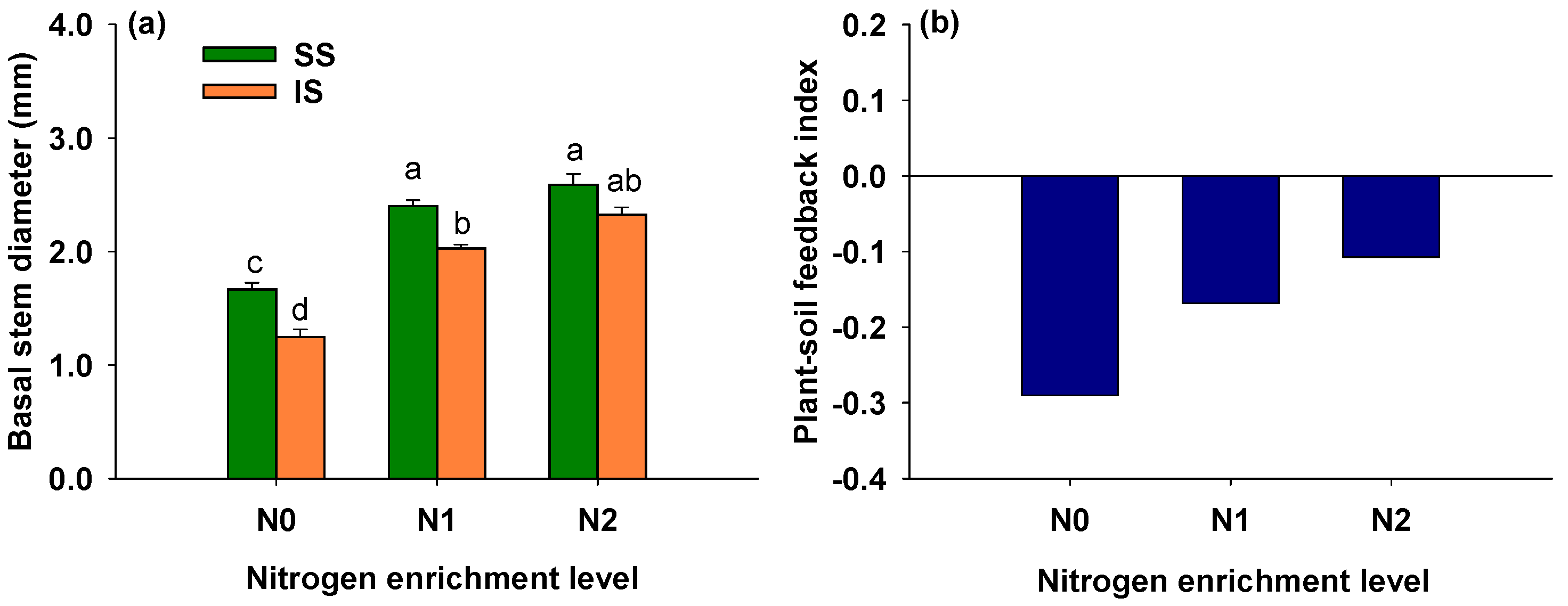
The basal stem diameter of S. alterniflora was lower when grown in inoculated soil compared to sterilized soil across all nitrogen addition levels (Figure 2a, Table 2). However, nitrogen addition consistently enhanced the basal stem diameter of S. alterniflora, irrespective of the soil conditions (Figure 2a, Table 2). Furthermore, the negative plant- soil feedback index, based on basal stem diameter, reduced as nitrogen addition levels increased (Figure 2b), leading to a significant interaction between soil condition and nitrogen addition (Table 2).

3.4. Effects of Soil Condition and Nitrogen Addition on Number of Leaves of S. alterniflora

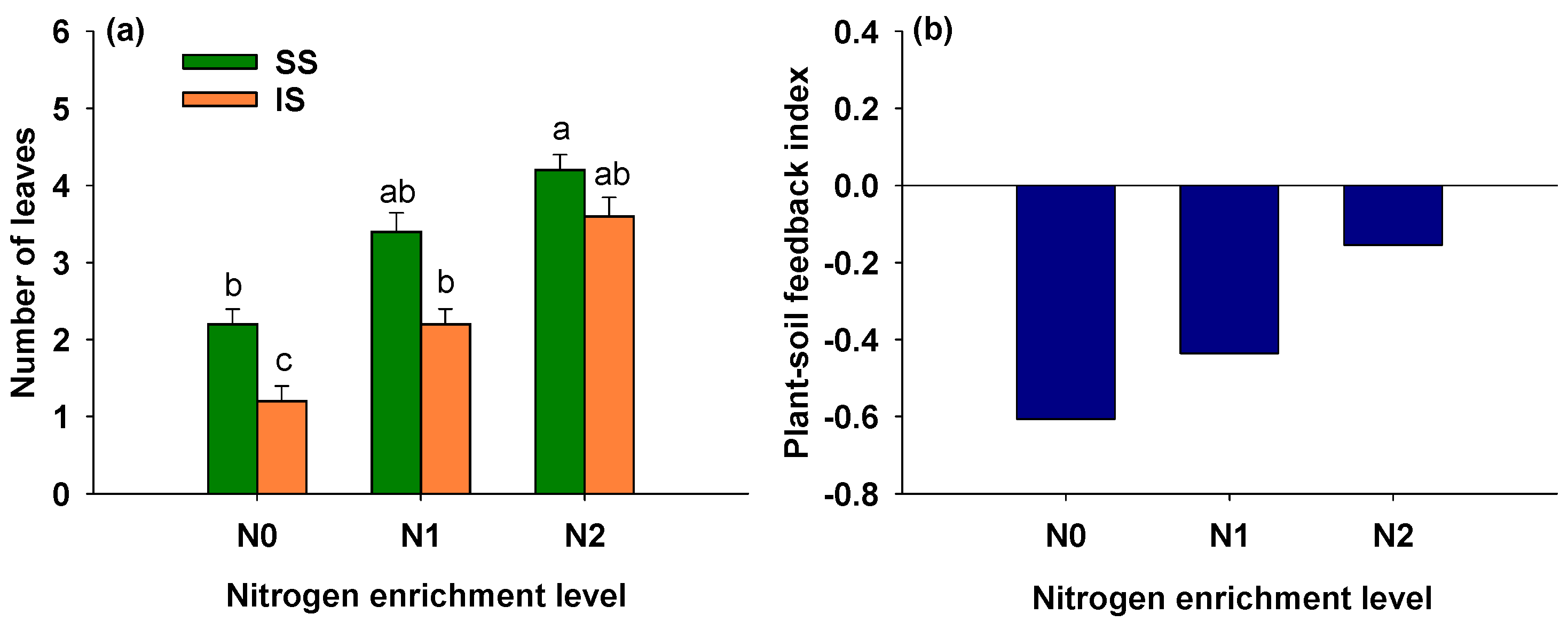
The number of leaves of S. alterniflora was significantly decreased when grown in inoculated soil compared to sterilized soil across all nitrogen addition levels (Figure 3a, Table 2). In contrast, nitrogen addition consistently increased the number of leaves, regardless of soil condition (Figure 3a, Table 2). Moreover, the negative plant–soil feedback, in terms of the number of leaves, reduced as nitrogen addition levels increased (Figure 3b), resulting in a significant interaction between soil condition and nitrogen addition (Table 2).

3.5. Effects of Soil Condition and Nitrogen Addition on Aboveground Biomass of S. alterniflora

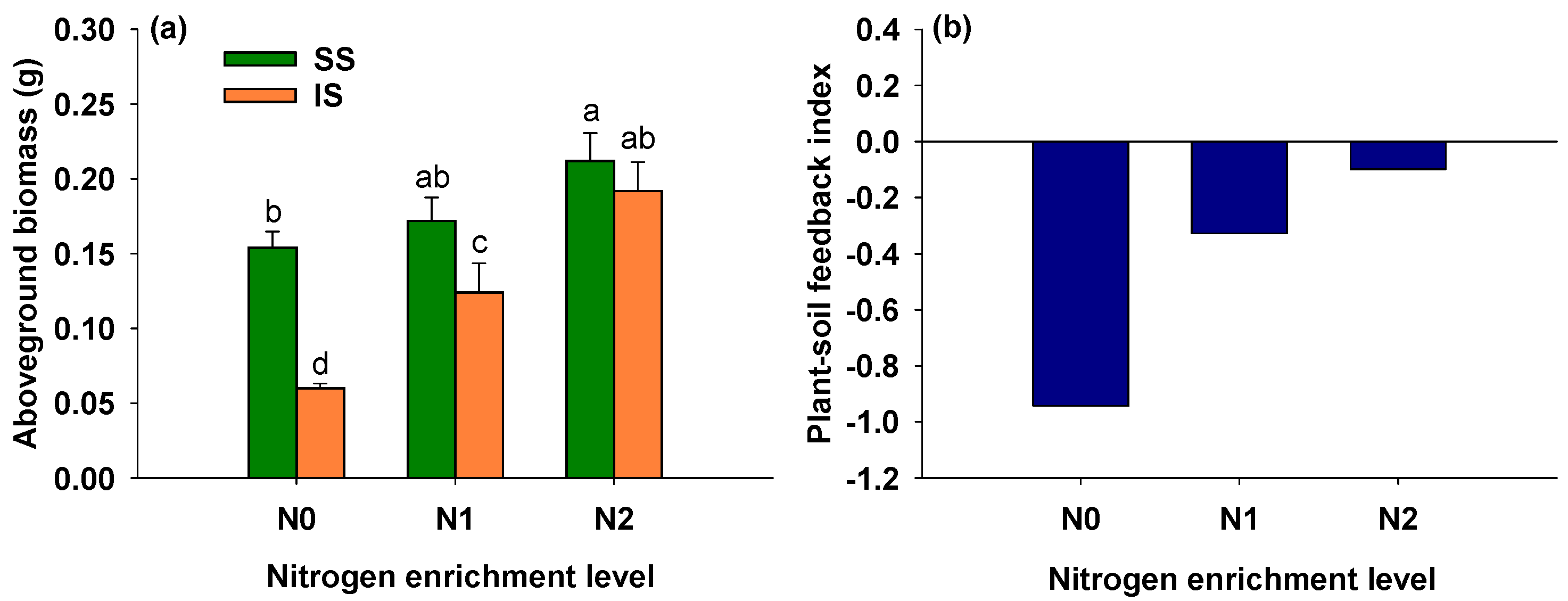
The aboveground biomass of S. alterniflora was significantly lower when grown in inoculated soil compared to sterilized soil at all nitrogen addition levels (Figure 4a, Table 2). Nitrogen addition, however, consistently boosted the aboveground biomass, regardless of soil condition (Figure 4a, Table 2). In addition, the negative plant–soil feedback, based on aboveground biomass, reduced as nitrogen addition levels increased (Figure 4b), resulting in a significant interaction between soil condition and nitrogen addition (Table 2).

3.6. Effects of Soil Condition and Nitrogen Addition on Belowground Biomass of S. alterniflora

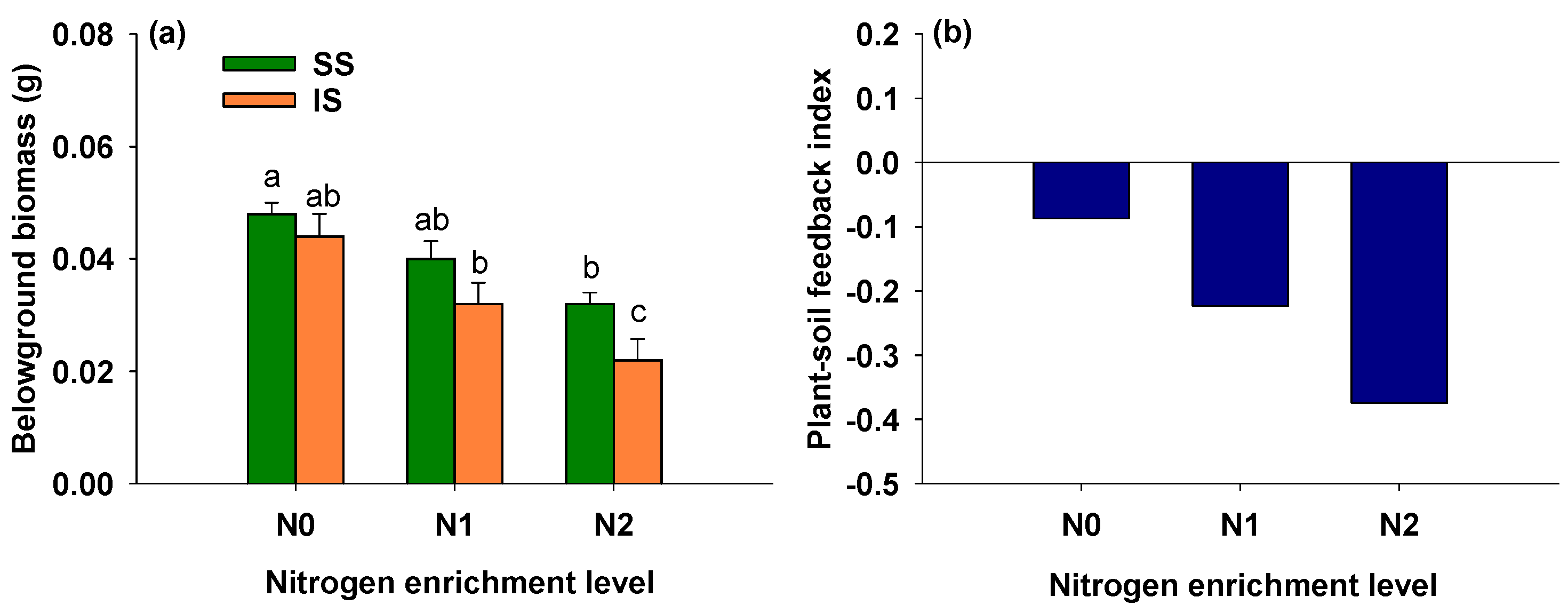
The belowground biomass of S. alterniflora was significantly lower in inoculated soil compared to sterilized soil across all nitrogen addition levels (Figure 5a, Table 2). On the other hand, nitrogen addition consistently reduced the belowground biomass of S. alterniflora, regardless of the soil condition (Figure 5a, Table 2). Moreover, the negative plant–soil feedback, in relation to belowground biomass, tended to intensify as nitrogen addition levels increased (Figure 5b).

3.7. Effects of Soil Condition and Nitrogen Addition on Total Biomass of S. alterniflora

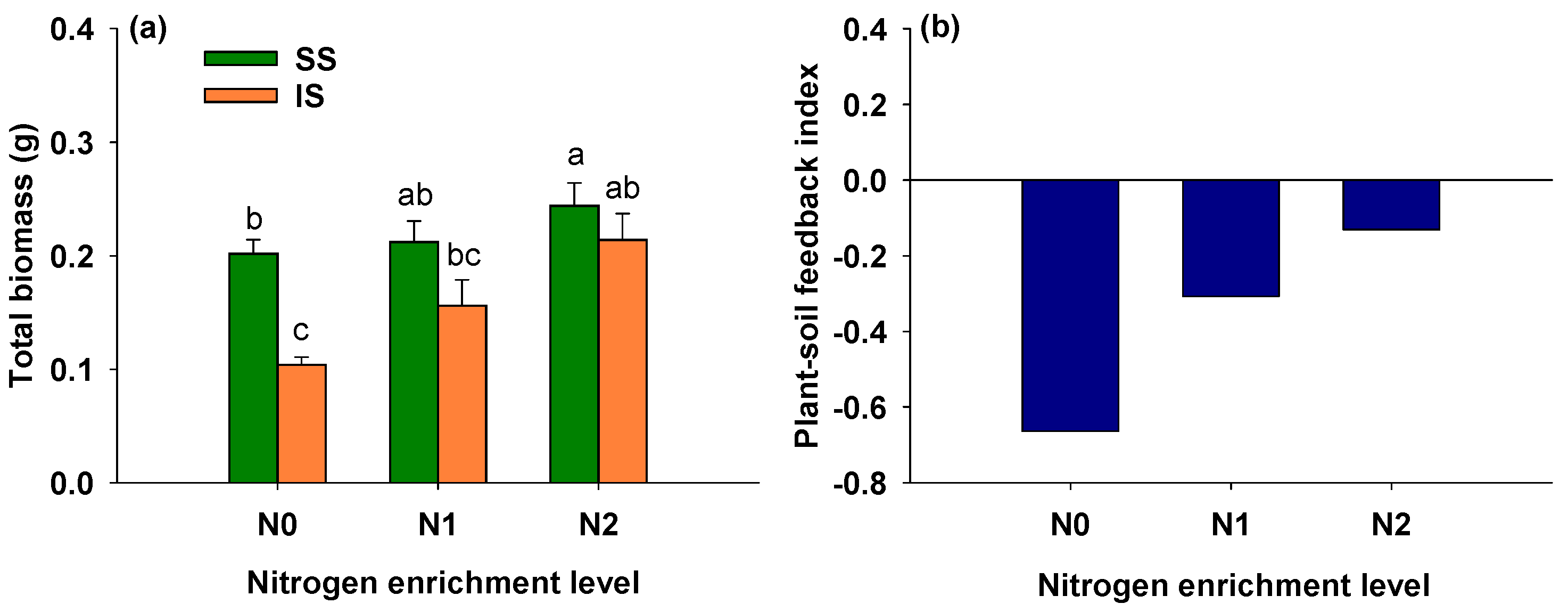
The total biomass of S. alterniflora was significantly lower when grown in inoculated soil compared to sterilized soil across all nitrogen addition levels (Figure 6a, Table 2). In contrast, nitrogen addition consistently enhanced the total biomass, irrespective of the soil condition (Figure 6a, Table 2). Furthermore, the negative plant–soil feedback, based on total biomass, reduced as nitrogen addition levels increased (Figure 6b), leading to a significant interaction between soil condition and nitrogen addition (Table 2).

4. Discussion

4.1. Aboveground Growth of S. alterniflora under Different Soil Conditions and Nitrogen Addition Levels

Firstly, we clarify that a limitation of the research is that the experiment was conducted once, and therefore, the results should be interpreted cautiously until validated in repeated trials or under field conditions. Our results demonstrated that nitrogen addition consistently increased the aboveground growth of S. alterniflora, irrespective of whether the soil was inoculated with native microbial communities or sterilized. This finding is in line with previous studies that highlight the positive effect of nitrogen on the growth of invasive species in coastal ecosystems [43,44,45].
Nitrogen is a critical macronutrient for plant growth, and its availability directly influences the physiological processes underlying plant growth, such as photosynthesis, nutrient uptake, and cellular division [46]. In the case of S. alterniflora, the positive correlation between nitrogen addition and increased aboveground growth may be attributed to its ability to assimilate additional nitrogen and other nutrients, such as phosphorus (Table 1) into its tissues, thereby enhancing aboveground biomass accumulation. Li et al. (2021) showed that the invasive S. alterniflora is competitively superior to native plant species in the Yellow River Delta in terms of nitrogen uptake and nitrogen utilization efficiency [34]. This is especially important in coastal wetlands, where nitrogen often limits plant productivity [47]. When nitrogen is added, S. alterniflora appears to benefit from this additional resource, potentially boosting its competitive ability over native species. This enhanced efficiency may be particularly evident in ecosystems that have experienced chronic nitrogen deposition, where S. alterniflora is able to exploit nitrogen more effectively than the resident plant species [43,48].
Moreover, the positive effect of nitrogen addition on the growth of S. alterniflora may be compounded by the plant’s ability to adapt to, or even thrive in environments with elevated nitrogen levels, which is often observed in coastal wetlands due to atmospheric deposition [49]. This adaptation may give S. alterniflora an advantage in ecosystems where nitrogen availability increases, thereby facilitating its invasion and establishment. Xu et al. (2022) demonstrated that under nitrogen enrichment, S. alterniflora exhibited enhanced ecophysiological adaptation in terms of light-use efficiency [50].
Interestingly, the interaction between soil condition and nitrogen addition is significant, suggesting that the impact of nitrogen on S. alterniflora growth is influenced by the underlying soil environment. In sterilized soils, where microbial communities are absent, nitrogen addition likely provides a direct boost to plant growth, with no microbial competition or regulation. In contrast, in inoculated soils, where native microbial communities are present, S. alterniflora may face more complex interactions, including competition for nutrients [51], potential pathogen presence [52], and altered microbial activity [53]. Nonetheless, the fact that nitrogen still consistently promoted growth under both soil conditions suggests that nitrogen’s role in plant growth is a dominant factor, capable of enhancing S. alterniflora aboveground growth even when microbial interactions are at play.

4.2. Belowground Biomass of S. alterniflora under Different Soil Conditions and Nitrogen Addition Levels

In this study, we observed that the belowground biomass of S. alterniflora was significantly lower in inoculated soils compared to sterilized soils across all nitrogen addition levels. This suggests that the soil microbes play a crucial role in regulating root growth and biomass accumulation of S. alterniflora. The microbial community in inoculated soils likely exerts competitive or pathogenic pressure on the roots of S. alterniflora, limiting their growth [54,55,56]. In contrast, sterilized soils, which lack microbial communities, may have provided a more favorable environment for root development of S. alterniflora, resulting in higher belowground biomass in these soils. These findings align with previous studies, which have demonstrated that soil microorganisms may influence root growth, particularly in the context of plant-microbe interactions involving invasive species [57,58,59].
Regarding the effects of nitrogen addition, our results indicated that while nitrogen fertilization consistently increased the aboveground biomass, it had an inhibitory effect on belowground biomass. This phenomenon suggests that S. alterniflora may reallocate resources under nitrogen enrichment, favoring the growth of aboveground structures over root biomass. Nitrogen is a key nutrient for cell division and elongation, particularly in aboveground tissues, such as stems and leaves [60,61]. Therefore, with nitrogen addition, S. alterniflora may prioritize aboveground growth, resulting in a reduced allocation of resources to root biomass. This shift in biomass allocation, driven by nitrogen, is commonly observed in many plant species under nutrient-enriched conditions [62]. For example, Negrini et al. (2020) showed that nitrogen addition increased leaf mass, but decreased root mass in barley [63]. Cheng et al. (2025) demonstrated that nitrogen addition led to a reduction in root biomass, coupled with an increase in shoot biomass of the dominant plant species in sandy ecosystems [64].
Additionally, nitrogen addition may indirectly affect root growth of S. alterniflora by altering the microbial community composition in the soil. Increased nitrogen availability, along with associated phosphorus availability (Table 1), could promote microbial activity [65,66], which in turn may increase competition for resources or exacerbate pathogen pressure on the roots. Such changes in microbial dynamics could limit the plant’s ability to invest in root growth, even in the presence of sufficient nitrogen. These indirect effects highlight the complexity of plant-microbe-nutrient interactions, where the plant’s response to nitrogen is modulated by the soil microbiome [67].
The interaction between soil condition and nitrogen addition further emphasized the complexity of S. alterniflora’s growth responses. In inoculated soils, nitrogen addition exacerbated the reduction in root biomass, suggesting that microbial communities may became more active in the presence of additional nitrogen [68]. This interaction points to the need for a more nuanced understanding of how soil microbes and nitrogen inputs jointly influence plant growth [69], which is especially important for managing S. alterniflora invasions in coastal wetland ecosystems.

4.3. Plant–Soil Feedback in Invasive Spartina alterniflora Across Nitrogen Addition Levels

As nitrogen input levels increased, we observed a consistent reduction in the negative plant–soil feedback for aboveground growth metrics, such as plant height, basal stem diameter, number of leaves, and aboveground biomass. These findings suggest that nitrogen enrichment weakens the inhibitory effects of soil microbes, which would suppress the growth of invasive S. alterniflora. This phenomenon is likely due to the shift in microbial community composition that favors nitrogen-tolerant microbes, which may enhance nutrient availability (Table 1) to the plant. Dong et al. (2025) showed that nitrogen enrichment enhanced soil enzyme activities, which may promote the decomposition of organic matter and the release of nutrients in grassland soils [70]. Weng et al. (2022) demonstrated that moderate nitrogen addition promoted the utilization rates of carbohydrates, amino acids, and esters by soil microorganisms [71]. As a result, invasive S. alterniflora may benefit from increased nitrogen input, enabling it to grow taller, develop a thicker stem base, produce more leaves, and accumulate more aboveground biomass, all of which would enhance its competitive ability in coastal wetlands and agricultural systems.
However, the dynamics observed for the belowground biomass of S. alterniflora are notably different. While nitrogen addition consistently reduced belowground biomass across different soil conditions, the negative plant–soil feedback based on belowground biomass intensified with increased nitrogen levels. This suggests that although nitrogen promotes the aboveground growth of S. alterniflora, it also leads to a redistribution of the plant’s resources away from root development. This trade-off between aboveground and belowground growth is also observed in other plants under nutrient-enriched conditions, where resources are often directed toward maximizing aboveground growth rather than reinforcing the root systems [72]. For instance, Gong et al. (2015) demonstrated that nitrogen addition significantly increased aboveground production but had no effect on belowground production in a grassland in Inner Mongolia [73]. Zhang et al. (2020) showed that nitrogen addition reduced the root-to-shoot ratio of plant species in a semiarid sandy grassland [74]. The intensification of negative feedback for belowground biomass may be related to changes in soil microbial interactions that inhibit root expansion, possibly due to nitrogen-induced shifts in microbial communities that promote antagonistic interactions with the plant’s root system.
The weakening of overall negative plant–soil feedback with nitrogen addition is particularly significant for understanding the mechanisms behind S. alterniflora’s invasion success in coastal wetlands and coastal agricultural systems. As nitrogen inputs increase, a key factor influencing the invasive plant’s competitive advantage is the shift from a system where soil microbes regulate the growth of the plant to one where microbial communities become more conducive to the establishment of the invasion [75]. In the context of coastal wetlands and agricultural systems, which are often subjected to elevated nitrogen inputs from atmospheric deposition [76], this phenomenon could exacerbate the spread of invasive S. alterniflora [77]. The weakening of negative plant–soil feedback under higher nitrogen levels may remove a critical natural limitation on the growth of invasive S. alterniflora, promoting its encroachment into native coastal wetlands and coastal agricultural systems, where it may further displace native vegetation and alter ecosystem functions [78,79,80].
These findings have significant implications for the management of coastal wetland ecosystems and sustainable agriculture practices. By demonstrating that nitrogen addition weakens the overall negative plant–soil feedback in invasive S. alterniflora, this study highlights the need to manage nutrient inputs carefully, in order to control invasive species in coastal habitats. Strategies that reduce nitrogen pollution could help restore the natural plant–soil feedback mechanisms, thereby mitigating the impact of invasive S. alterniflora on native plant communities and preserving the ecological integrity of coastal wetlands and coastal agricultural systems. Furthermore, understanding how nitrogen affects plant–soil feedback in invasive species offers valuable insights for developing integrated management approaches that combine nutrient regulation with invasive species control to maintain the health of these critical coastal ecosystems.

5. Conclusions

This study examined the effects of nitrogen addition on plant–soil feedback dynamics in invasive S. alterniflora under controlled pot conditions. Our findings suggest that nitrogen addition weakens the negative plant–soil feedback typically limiting the growth of S. alterniflora, thereby promoting its aboveground growth. Specifically, nitrogen enrichment enhanced aboveground biomass while consistently reducing belowground biomass, indicating a shift in resource allocation. The results also suggest that the reduction in negative plant–soil feedback, driven by nitrogen inputs, could facilitate the growth and competitive advantage of S. alterniflora in coastal ecosystems. Although the pot-based design limits the direct application of these findings to field conditions, the study provides valuable insights into the potential mechanisms behind S. alterniflora invasion success in nitrogen-enriched environments. These findings underscore the importance of understanding nutrient dynamics in controlling invasive species. However, further studies, including more in-depth investigations into changes in soil microbial communities and field-based research, are needed to confirm the underlying mechanisms and broader ecological implications of nitrogen inputs on plant–soil feedback in coastal ecosystems.

Author Contributions

Conceptualization, Y.W. and H.G.; funding acquisition, Y.W. and H.G.; methodology, Y.W. and H.G.; investigation, N.L., Y.Z., C.G., L.X. and Y.L.; formal analysis, Y.W., N.L., Y.Z., C.G., L.X., Y.L. and H.G.; writing—original draft preparation, Y.W., N.L., Y.Z., C.G., L.X., Y.L. and H.G.; writing—review and editing, Y.W., N.L., Y.Z., C.G., L.X., Y.L. and H.G. All authors have read and agreed to the published version of the manuscript.

Funding

This study was funded by National Natural Science Foundation of China (31300357, 32001179) and Natural Science Foundation of Tianjin City (20JCZDJC00220).

Data Availability Statement

All data supporting the findings of this study were included within the manuscript.

Conflicts of Interest

The authors declare no conflicts of interest.

References

  1. Liu, W.W.; Zhang, Y.H.; Chen, X.C.; Maung-Douglass, K.; Strong, D.R.; Pennings, S.C. Contrasting plant adaptation strategies to latitude in the native and invasive range of Spartina alterniflora. New Phytol. 2020, 226, 623–634. [Google Scholar] [CrossRef] [PubMed]
  2. Zheng, X.J.; Javed, Z.; Liu, B.; Zhong, S.; Cheng, Z.; Rehman, A.; Du, D.L.; Li, J. Impact of Spartina alterniflora Invasion in Coastal Wetlands of China: Boon or Bane? Biology 2023, 12, 1057. [Google Scholar] [CrossRef]
  3. Nie, M.; Liu, W.W.; Pennings, S.C.; Li, B. Lessons from the invasion of Spartina alterniflora in coastal China. Ecology 2023, 104, e3874. [Google Scholar] [CrossRef] [PubMed]
  4. Tang, L.; Gao, Y.; Li, B.; Wang, Q.; Wang, C.H.; Zhao, B. Spartina alterniflora with high tolerance to salt stress changes vegetation pattern by outcompeting native species. Ecosphere 2014, 5, 1–18. [Google Scholar] [CrossRef]
  5. Jia, P.; Qu, G.J.; Jia, J.; Li, D.Z.; Sun, Y.M.; Liu, L. Long-term Spartina alterniflora invasion simplified soil seed bank and regenerated community in a coastal marsh wetland. Ecol. Appl. 2024, 34, e2754. [Google Scholar] [CrossRef] [PubMed]
  6. Ren, G.B.; Zhao, Y.J.; Wang, J.B.; Wu, P.Q.; Ma, Y. Ecological effects analysis of Spartina alterniflora invasion within Yellow River delta using long time series remote sensing imagery. Estuar. Coast. Shelf Sci. 2021, 249, 107111. [Google Scholar] [CrossRef]
  7. Li, S.H.; Ge, Z.M.; Tan, L.S.; Xie, L.N.; Li, Y.L. Multiple competitive superiority made a great successful invasion of Spartina alterniflora in Eastern China: Hints for management. J. Environ. Manag. 2025, 389, 126287. [Google Scholar] [CrossRef]
  8. Wang, Q.; An, S.Q.; Ma, Z.J.; Zhao, B.; Chen, J.K.; Li, B. Invasive Spartina alterniflora: Biology, ecology and management. Acta Phytotaxon. Sin. 2006, 44, 559–588. [Google Scholar] [CrossRef]
  9. Stevens, C.J. Nitrogen in the environment. Science 2019, 363, 578–580. [Google Scholar] [CrossRef]
  10. Gruber, N.; Galloway, J.N. An Earth-system perspective of the global nitrogen cycle. Nature 2008, 451, 293–296. [Google Scholar] [CrossRef]
  11. Sun, Q.H.; Li, J.N.; Zhou, C.H.; Lei, K.; Jiang, W.J. Source analysis of nitrogen pollution in basin by export coefficient modeling and microbial source tracking with mutual verification. Front. Mar. Sci. 2025, 12, 1527098. [Google Scholar] [CrossRef]
  12. Duarte, C.M.; Krause-Jensen, D. Intervention options to accelerate ecosystem recovery from coastal eutrophication. Front. Mar. Sci. 2018, 5, 470. [Google Scholar] [CrossRef]
  13. Rabalais, N.N.; Turner, R.E.; Díaz, R.J.; Justic, D. Global change and eutrophication of coastal waters. ICES J. Mar. Sci. 2009, 66, 1528–1537. [Google Scholar] [CrossRef]
  14. Gilbert, P.M. Eutrophication, harmful algae and biodiversity-Challenging paradigms in a world of complex nutrient changes. Mar. Pollut. Bull. 2017, 124, 591–606. [Google Scholar] [CrossRef]
  15. Johnson, D.S.; Warren, R.S.; Deegan, L.A.; Mozdzer, T.J. Saltmarsh plant responses to eutrophication. Ecol. Appl. 2016, 26, 2647–2659. [Google Scholar] [CrossRef]
  16. White, J.R.; DeLaune, R.D.; Justic, D.; Day, J.W.; Pahl, J.; Lane, R.R.; Boynton, W.R.; Twilley, R.R. Consequences of Mississippi River diversions on nutrient dynamics of coastal wetland soils and estuarine sediments: A review. Estuar. Coast. Shelf Sci. 2019, 224, 209–216. [Google Scholar] [CrossRef]
  17. Goodwillie, C.; McCoy, M.W.; Peralta, A.L. Long-term nutrient enrichment, mowing, and ditch drainage interact in the dynamics of a wetland plant community. Ecosphere 2020, 11, e03252. [Google Scholar] [CrossRef]
  18. Smith, V.H. Eutrophication of freshwater and coastal marine ecosystems—A global problem. Environ. Sci. Pollut. Res. 2003, 10, 126–139. [Google Scholar] [CrossRef]
  19. Wang, G.Z.; van der Putten, W.H.; Klironomos, J.; Zhang, F.S.; Zhang, J.L. Steering plant-soil feedback for sustainable agriculture. Science 2025, 389, eads2506. [Google Scholar] [CrossRef]
  20. Frouz, J. Plant-soil feedback across spatiotemporal scales from immediate effects to legacy. Soil. Biol. Biochem. 2024, 189, 109289. [Google Scholar] [CrossRef]
  21. Collings, J.A.; Shoemaker, L.G.; Diez, J.M. Environmental context alters plant-soil feedback effects on plant coexistence. Ecology 2025, 106, e70170. [Google Scholar] [CrossRef] [PubMed]
  22. Crawford, K.M.; Knight, T.M. Competition overwhelms the positive plant-soil feedback generated by an invasive plant. Oecologia 2017, 183, 211–220. [Google Scholar] [CrossRef] [PubMed]
  23. Duchesneau, K.; Golemiec, A.; Colautti, R.I.; Antunes, P.M. Functional shifts of soil microbial communities associated with Alliaria petiolata invasion. Pedobiologia 2021, 84, 150700. [Google Scholar] [CrossRef]
  24. Zhou, T.C.; Sun, J.; Shi, P.L. Mechanism of plant-soil feedback in a degraded alpine grassland on the Tibetan Plateau. J. Plant Ecol. 2024, 17, rtae025. [Google Scholar] [CrossRef]
  25. Idbella, M.; Abd-ElGawad, A.M.; Chouyia, F.E.; Bonanomi, G. Impact of soil legacy on plant-soil feedback in grasses and legumes through beneficial and pathogenic microbiota accumulation. Front. Microbiol. 2024, 15, 1454617. [Google Scholar] [CrossRef]
  26. Xing, A.J.; Shen, H.H.; Xu, L.C.; Zhao, M.Y.; Yan, Z.B.; Fang, J.Y. Linking nutrient resorption stoichiometry with plant growth under long-term nitrogen addition. For. Ecosyst. 2024, 11, 100221. [Google Scholar] [CrossRef]
  27. Chen, J.B.; Dong, C.C.; Yao, X.D.; Wang, W. Effects of nitrogen addition on plant biomass and tissue elemental content in different degradation stages of temperate steppe in northern China. J. Plant Ecol. 2018, 11, 730–739. [Google Scholar] [CrossRef]
  28. Zhang, L.W.; Zhao, L.J.; Yi, H.P.; Lan, S.Q.; Chen, L.; Han, G.X. Nitrogen addition alters plant growth in China’s Yellow River Delta coastal wetland through direct and indirect effects. Front. Plant Sci. 2022, 13, 1016949. [Google Scholar] [CrossRef]
  29. Purvaja, R.; Ramesh, R.; Ray, A.K.; Rixen, T. Nitrogen cycling: A review of the processes, transformations and fluxes in coastal ecosystems. Curr. Sci. 2008, 94, 1419–1438. [Google Scholar]
  30. Jiang, S.; Jin, L.Q.; Jin, J.; Ibánhez, J.S.P.; Wu, Y.; Zhang, J. Exploring feedback mechanisms for nitrogen and organic carbon cycling in tropical coastal zones. Front. Mar. Sci. 2022, 9, 996655. [Google Scholar] [CrossRef]
  31. Li, Y.Q.; Wang, F.; Yan, W.J.; Lv, S.C.; Li, Q.Q.; Yu, Q.B.; Wang, J. Enhanced nitrogen imbalances in agroecosystems driven by changing cropping systems in a coastal area of eastern China: From field to watershed scale. Environ. Sci. Process. Impacts 2019, 21, 1532–1548. [Google Scholar] [CrossRef]
  32. Xu, X.; Li, S.S.; Zhang, Y.; Zhang, X.; He, Q.; Wan, N.F.; Liu, H.; Guo, H.Q.; Ma, J.; Zhang, Q.; et al. Reducing nitrogen inputs mitigates Spartina invasion in the Yangtze estuary. J. Appl. Ecol. 2024, 61, 588–598. [Google Scholar] [CrossRef]
  33. Jia, P.; Qu, G.J.; Jia, J.; Xu, H.W.; Li, D.Z. Water and nitrogen coupling regulates the present and future restoration trends under Spartina alterniiora invasion in a coastal salt marsh. Ecol. Eng. 2024, 209, 107416. [Google Scholar] [CrossRef]
  34. Li, Q.W.; Zhang, X.Y.; Liang, J.F.; Gao, J.Q.; Xu, X.L.; Yu, F.H. High nitrogen uptake and utilization contribute to the dominance of invasive Spartina alterniflora over native Phragmites australis. Biol. Fertil. Soils 2021, 57, 1007–1013. [Google Scholar] [CrossRef]
  35. Meng, W.Q.; Feagin, R.A.; Innocenti, R.A.; Hu, B.B.; He, M.X.; Li, H.Y. Invasion and ecological effects of exotic smooth cordgrass Spartina alterniflora in China. Ecol. Eng. 2020, 143, 105670. [Google Scholar] [CrossRef]
  36. Wang, Y.Z.; Duan, X.J.; Li, P.X.; Wang, L.Q. Spatiotemporal intensification of net anthropogenic nitrogen input driven by human activities in China from 1990 to 2020. Ecol. Indic. 2024, 160, 111841. [Google Scholar] [CrossRef]
  37. Crawford, K.M.; Hawkes, C.V. Soil precipitation legacies influence intraspecific plant-soil feedback. Ecology 2020, 101, e03142. [Google Scholar] [CrossRef]
  38. Zuma, M.C.; Burgess, T.I.; Sapsford, S.J. Addressing variability and advancing methodological clarity in plant-soil feedback experiments. J. Plant Interact. 2025, 20, 2529228. [Google Scholar] [CrossRef]
  39. Kostenko, O.; Bezemer, T.M. Abiotic and biotic soil legacy effects of plant diversity on plant performance. Front. Ecol. Evol. 2020, 8, e03142. [Google Scholar] [CrossRef]
  40. Guo, H.; Pennings, S.C. Mechanisms mediating plant distributions across estuarine landscapes in a low-latitude tidal estuary. Ecology 2012, 93, 90–100. [Google Scholar] [CrossRef]
  41. Hassan, K.; Dastogeer, K.M.G.; Carrillo, Y.; Nielsen, U.N. Climate change-driven shifts in plant-soil feedbacks: A meta-analysis. Ecol. Process. 2022, 11, 64. [Google Scholar] [CrossRef]
  42. Bennett, J.A.; Klironomos, J. Mechanisms of plant-soil feedback: Interactions among biotic and abiotic drivers. New Phytol. 2019, 222, 91–96. [Google Scholar] [CrossRef]
  43. Tyler, A.C.; Lambrinos, J.G.; Grosholz, E.D. Nitrogen inputs promote the spread of an invasive marsh grass. Ecol. Appl. 2007, 17, 1886–1898. [Google Scholar] [CrossRef] [PubMed]
  44. Zhao, H.; Yang, W.; Xia, L.; Qiao, Y.J.; Xiao, Y.; Cheng, X.L.; An, S.Q. Nitrogen-enriched eutrophication promotes the invasion of Spartina alterniflora in coastal China. Clean Soil. Air Water 2015, 43, 244–250. [Google Scholar] [CrossRef]
  45. Zhang, Y.; Cui, B.S.; Xie, T.; Wang, Q.; Yan, J.G. Effect of coastal eutrophication on growth and physiology of Spartina alterniflora Loisel. Phys. Chem. Earth 2018, 103, 62–67. [Google Scholar] [CrossRef]
  46. Farhan, M.; Sathish, M.; Kiran, R.; Mushtaq, A.; Baazeem, A.; Hasnain, A.; Hakim, F.; Naqvi, S.A.H.; Mubeen, M.; Iftikhar, Y.; et al. Plant nitrogen metabolism: Balancing resilience to nutritional stress and abiotic challenges. Phyton Int. J. Exp. Bot. 2024, 93, 581–609. [Google Scholar] [CrossRef]
  47. Xiong, J.; Shao, X.X.; Yuan, H.J.; Liu, E.J.; Wu, M. Carbon, nitrogen, and phosphorus stoichiometry and plant growth strategy as related to land-use in Hangzhou Bay coastal wetland, China. Front. Plant Sci. 2022, 13, 946949. [Google Scholar] [CrossRef]
  48. Qing, H.; Cai, Y.; Xiao, Y.; Yao, Y.H.; An, S.Q. Nitrogen uptake and use efficiency of invasive Spartina alterniflora and native Phragmites australis: Effect of nitrogen supply. Clean Soil. Air Water 2015, 43, 305–311. [Google Scholar] [CrossRef]
  49. Chen, S.T.; Gao, D.Z.; Zhang, J.B.; Müller, C.; Li, X.F.; Zheng, Y.L.; Dong, H.P.; Yin, G.Y.; Han, P.; Liang, X.; et al. Invasive Spartina alterniflora accelerates soil gross nitrogen transformations to optimize its nitrogen acquisition in an estuarine and coastal wetland of China. Soil. Biol. Biochem. 2022, 174, 108835. [Google Scholar] [CrossRef]
  50. Xu, X.; Zhou, C.H.; He, Q.; Qiu, S.Y.; Zhang, Y.; Yang, J.; Li, B.; Nie, M. Phenotypic plasticity of light use favors a plant invader in nitrogen-enriched ecosystems. Ecology 2022, 103, e3665. [Google Scholar] [CrossRef]
  51. Moreau, D.; Pivato, B.; Bru, D.; Busset, H.; Deau, F.; Faivre, C.; Matejicek, A.; Strbik, F.; Philippot, L.; Mougel, C. Plant traits related to nitrogen uptake influence plant-microbe competition. Ecology 2015, 96, 2300–2310. [Google Scholar] [CrossRef]
  52. Domínguez-Begines, J.; Avila, J.M.; García, L.V.; Gómez-Aparicio, L. Disentangling the role of oomycete soil pathogens as drivers of plant-soil feedbacks. Ecology 2021, 102, e03430. [Google Scholar] [CrossRef] [PubMed]
  53. Biederman, L.A.; Mortensen, B.; Sullivan, L.; Harpole, W.S. Soil microbial community structure and function in non-target and plant-influenced soils respond similarly to nitrogen enrichment. Soil. Biol. Biochem. 2025, 207, 109830. [Google Scholar] [CrossRef]
  54. Kuzyakov, Y.; Xu, X.L. Competition between roots and microorganisms for nitrogen: Mechanisms and ecological relevance. New Phytol. 2013, 198, 656–669. [Google Scholar] [CrossRef] [PubMed]
  55. Korsaeth, A.; Molstad, L.; Bakken, L.R. Modelling the competition for nitrogen between plants and microflora as a function of soil heterogeneity. Soil. Biol. Biochem. 2001, 33, 215–226. [Google Scholar] [CrossRef]
  56. Nelson, E.B.; Karp, M.A. Soil pathogen communities associated with native and non-native Phragmites australis populations in freshwater wetlands. Ecol. Evol. 2013, 3, 5254–5267. [Google Scholar] [CrossRef]
  57. Li, J.M.; Oduor, A.M.O.; Yu, F.H.; Dong, M. A native parasitic plant and soil microorganisms facilitate a native plant co-occurrence with an invasive plant. Ecol. Evol. 2019, 9, 8652–8663. [Google Scholar] [CrossRef] [PubMed]
  58. Zhang, V.M.; Kotanen, P.M. Development of negative soil feedback by an invasive plant near the northern limit of its invaded range. Plant Ecol. 2023, 224, 635–645. [Google Scholar] [CrossRef]
  59. Nijjer, S.; Rogers, W.E.; Siemann, E. Negative plant-soil feedbacks may limit persistence of an invasive tree due to rapid accumulation of soil pathogens. Proc. R. Soc. B Biol. Sci. 2007, 274, 2621–2627. [Google Scholar] [CrossRef]
  60. Sahoo, G.R.; Swamy, S.L.; Mishra, A.; Thakur, T.K. Effect of seed source, light, and nitrogen levels on biomass and nutrient allocation pattern in seedlings of Pongamia pinnata. Environ. Sci. Pollut. Res. 2021, 28, 15005–15020. [Google Scholar] [CrossRef]
  61. Liang, Y.; Cossani, C.M.; Sadras, V.O.; Yang, Q.C.; Wang, Z. The interaction between nitrogen supply and light quality modulates plant growth and resource allocation. Front. Plant Sci. 2022, 13, 864090. [Google Scholar] [CrossRef]
  62. Peng, Y.F.; Yang, Y.H. Allometric biomass partitioning under nitrogen enrichment: Evidence from manipulative experiments around the world. Sci. Rep. 2016, 6, 28918. [Google Scholar] [CrossRef]
  63. Negrini, A.C.A.; Evans, J.R.; Kaiser, B.N.; Millar, A.H.; Kariyawasam, B.C.; Atkin, O.K. Effect of N supply on the carbon economy of barley when accounting for plant size. Funct. Plant Biol. 2020, 47, 368–381. [Google Scholar] [CrossRef] [PubMed]
  64. Cheng, L.; Zhan, J.; Ning, Z.Y.; Li, Y.L. Influence of nitrogen inputs on biomass allocation strategies of dominant plant species in sandy ecosystems. J. Arid. Land 2025, 17, 1118–1146. [Google Scholar] [CrossRef]
  65. Wang, M.Y.; Frey, B.; Li, D.T.; Liu, X.Y.; Chen, C.R.; Liu, Y.N.; Zhang, R.T.; Sui, X.; Li, M.H. Effects of organic nitrogen addition on soil microbial community assembly patterns in the Sanjiang Plain wetlands, northeastern China. Appl. Soil. Ecol. 2024, 204, 105685. [Google Scholar] [CrossRef]
  66. Zhu, M.Y.; Song, Y.Y.; Li, M.T.; Gong, C.; Liu, Z.D.; Yuan, J.B.; Li, X.Y.; Song, C.C. Ammonia nitrogen and dissolved organic carbon regulate soil microbial gene abundances and enzyme activities in wetlands under different vegetation types. Appl. Soil. Ecol. 2024, 196, 105310. [Google Scholar] [CrossRef]
  67. Manning, P.; Morrison, S.A.; Bonkowski, M.; Bardgett, R.D. Nitrogen enrichment modifies plant community structure via changes to plant-soil feedback. Oecologia 2008, 157, 661–673. [Google Scholar] [CrossRef] [PubMed]
  68. Zhu, M.Y.; Liu, Z.D.; Song, Y.Y.; Wang, X.W.; Yuan, J.B.; Li, M.T.; Lou, Y.J.; Gao, Z.L.; Song, C.C. Soil microbial functional diversity is primarily affected by soil nitrogen, salinity and alkalinity in wetland ecosystem. Appl. Soil. Ecol. 2024, 199, 105407. [Google Scholar] [CrossRef]
  69. Quattrone, A.; Yang, Y.G.; Yadav, P.; Weber, K.A.; Russo, S.E. Nutrient and microbiome-mediated plant-soil feedback in domesticated and wild andropogoneae: Implications for agroecosystems. Microorganisms 2023, 11, 2978. [Google Scholar] [CrossRef]
  70. Dong, L.L.; Berg, B.; Gu, W.P.; Wang, Z.W.; Sun, T. Effects of different forms of nitrogen addition on microbial extracellular enzyme activity in temperate grassland soil. Ecol. Process. 2022, 11, 36. [Google Scholar] [CrossRef]
  71. Weng, X.H.; Sui, X.; Liu, Y.N.; Yang, L.B.; Zhang, R.T. Effect of nitrogen addition on the carbon metabolism of soil microorganisms in a Calamagrostis angustifolia wetland of the Sanjiang Plain, northeastern China. Ann. Microbiol. 2022, 72, 18. [Google Scholar] [CrossRef]
  72. Yue, K.; Fornara, D.A.; Li, W.; Ni, X.Y.; Peng, Y.; Liao, S.; Tan, S.Y.; Wang, D.Y.; Wu, F.Z.; Yang, Y.S. Nitrogen addition affects plant biomass allocation but not allometric relationships among different organs across the globe. J. Plant Ecol. 2021, 14, 361–371. [Google Scholar] [CrossRef]
  73. Gong, X.Y.; Fanselow, N.; Dittert, K.; Taube, F.; Lin, S. Response of primary production and biomass allocation to nitrogen and water supplementation along a grazing intensity gradient in semiarid grassland. Eur. J. Agron. 2015, 63, 27–35. [Google Scholar] [CrossRef]
  74. Zhang, J.; Zuo, X.A.; Zhao, X.Y.; Ma, J.X.; Medina-Roldán, E. Effects of rainfall manipulation and nitrogen addition on plant biomass allocation in a semiarid sandy grassland. Sci. Rep. 2020, 10, 9026. [Google Scholar] [CrossRef]
  75. Xu, Z.W.; Guo, X.; Skálová, H.; Hu, Y.; Wang, J.F.; Li, M.Y.; Guo, W.H. Shift in the effects of invasive soil legacy on subsequent native and invasive trees driven by nitrogen deposition. Neobiota 2024, 93, 25–37. [Google Scholar] [CrossRef]
  76. Wang, J.Q.; Yao, X.W.; Jia, Z.J.; Zhu, L.Z.; Zheng, P.; Kartal, B.; Hu, B.L. Nitrogen input promotes denitrifying methanotrophs’ abundance and contribution to methane emission reduction in coastal wetland and paddy soil. Environ. Pollut. 2022, 302, 119090. [Google Scholar] [CrossRef] [PubMed]
  77. Qiu, S.Y.; Huang, J.X.; Lu, M.; Xu, X.; Li, X.C.; Zhang, Q.; Xin, F.F.; Zhou, C.H.; Zhang, X.; Nie, M.; et al. Nutrient enrichment undermines invasion resistance to Spartina alterniflora in a saltmarsh: Insights from modern coexistence theory. J. Appl. Ecol. 2023, 60, 2472–2481. [Google Scholar] [CrossRef]
  78. Cui, J.; Chen, X.P.; Nie, M.; Fang, S.B.; Tang, B.P.; Quan, Z.X.; Li, B.; Fang, C.M. Effects of Spartina alterniflora invasion on the abundance, diversity, and community structure of sulfate reducing bacteria along a successional gradient of coastal salt marshes in China. Wetlands 2017, 37, 221–232. [Google Scholar] [CrossRef]
  79. Lin, Y.Z.; Chen, Q.Q.; Qiu, Y.F.; Xie, R.R.; Zhang, H.; Zhang, Y.; Li, J.B.; Han, Y.H. Spartina alterniflora invasion altered phosphorus retention and microbial phosphate solubilization of the Minjiang estuary wetland in southeastern China. J. Environ. Manag. 2024, 358, 120817. [Google Scholar] [CrossRef]
  80. Chen, Q.; Yu, Z.W.; Wang, M.L. Effects of Spartina alterniflora invasion on macrobenthic faunal community in different habitats of a mangrove wetland in Zhanjiang, South China. Reg. Stud. Mar. Sci. 2023, 66, 103148. [Google Scholar] [CrossRef]
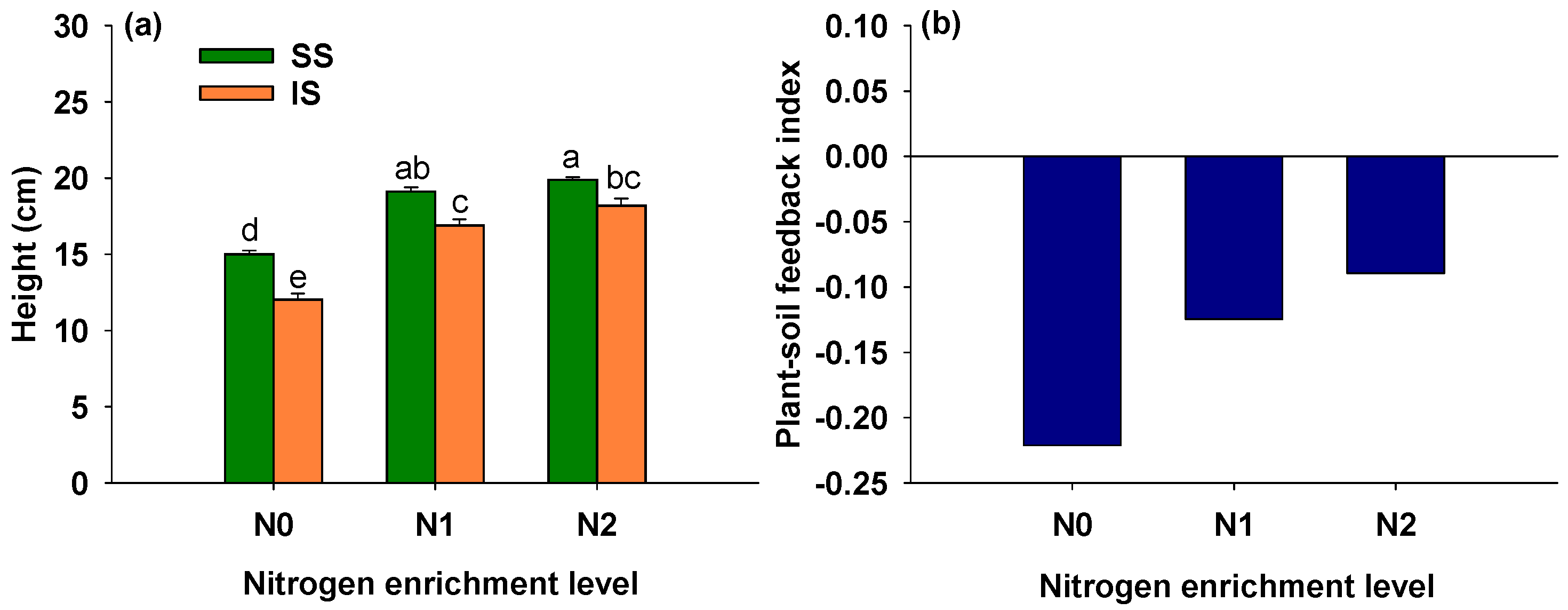
Figure 1. Height of S. alterniflora under different soil conditions (SS: sterilized soil; IS: inoculated soil) and nitrogen addition levels (a), and the plant–soil feedback index based on height of S. alterniflora, across different nitrogen addition levels (b). N0: 0 gN·m−2·a−1; N1: 10 gN·m−2·a−1; N2: 20 gN·m−2·a−1. Panel (a) displays data as means + SE (n = 5). Means with shared letters are not significantly different from each other, based on Tukey’s HSD tests at the 0.05 significance level. Data were logarithmically transformed before statistical analysis.
Agronomy 16 00086 g001
Figure 2. Basal stem diameter of S. alterniflora under different soil conditions (SS: sterilized soil; IS: inoculated soil) and nitrogen addition levels (a), and the plant–soil feedback index based on basal stem diameter of S. alterniflora, across different nitrogen addition levels (b). N0: 0 gN·m−2·a−1; N1: 10 gN·m−2·a−1; N2: 20 gN·m−2·a−1. Panel (a) displays data as means + SE (n = 5). Means with shared letters are not significantly different from each other, based on Tukey’s HSD tests at the 0.05 significance level. Data were logarithmically transformed before statistical analysis.
Agronomy 16 00086 g002
Figure 3. Number of leaves of S. alterniflora under different soil conditions (SS: sterilized soil; IS: inoculated soil) and nitrogen addition levels (a), and the plant–soil feedback index based on number of leaves of S. alterniflora, across different nitrogen addition levels (b). N0: 0 gN·m−2·a−1; N1: 10 gN·m−2·a−1; N2: 20 gN·m−2·a−1. Panel (a) displays data as means + SE (n = 5). Means with shared letters are not significantly different from each other, based on Tukey’s HSD tests at the 0.05 significance level. Data were logarithmically transformed before statistical analysis.
Agronomy 16 00086 g003
Figure 4. Aboveground biomass of S. alterniflora under different soil conditions (SS: sterilized soil; IS: inoculated soil) and nitrogen addition levels (a), and the plant–soil feedback index based on aboveground biomass of S. alterniflora, across different nitrogen addition levels (b). N0: 0 gN·m−2·a−1; N1: 10 gN·m−2·a−1; N2: 20 gN·m−2·a−1. Panel (a) displays data as means + SE (n = 5). Means with shared letters are not significantly different from each other, based on Tukey’s HSD tests at the 0.05 significance level. Data were logarithmically transformed before statistical analysis.
Agronomy 16 00086 g004
Figure 5. Belowground biomass of S. alterniflora under different soil conditions (SS: sterilized soil; IS: inoculated soil) and nitrogen addition levels (a), and the plant–soil feedback index based on belowground biomass of S. alterniflora, across different nitrogen addition levels (b). N0: 0 gN·m−2·a−1; N1: 10 gN·m−2·a−1; N2: 20 gN·m−2·a−1. Panel (a) displays data as means + SE (n = 5). Means with shared letters are not significantly different from each other, based on Tukey’s HSD tests at the 0.05 significance level. Data were logarithmically transformed before statistical analysis.
Agronomy 16 00086 g005
Figure 6. Total biomass of S. alterniflora under different soil conditions (SS: sterilized soil; IS: inoculated soil) and nitrogen addition levels (a), and the plant–soil feedback index based on total biomass of S. alterniflora, across different nitrogen addition levels (b). N0: 0 gN·m−2·a−1; N1: 10 gN·m−2·a−1; N2: 20 gN·m−2·a−1. Panel (a) displays data as means + SE (n = 5). Means with shared letters are not significantly different from each other, based on Tukey’s HSD tests at the 0.05 significance level. Data were logarithmically transformed before statistical analysis.
Agronomy 16 00086 g006
Table 1. Soil properties under different experimental treatments. N0: 0 gN·m−2·a−1; N1: 10 gN·m−2·a−1; N2: 20 gN·m−2·a−1. Data are means ± SE (n = 5). Means with shared letters are not significantly different from each other, based on Tukey’s HSD tests at the 0.05 significance level.
Soil PropertiesSterilized Soil (SS)Inoculated Soil (IS)
N0N1N2N0N1N2
Water content (%)35.37 ± 0.07 a35.52 ± 0.06 a35.53 ± 0.07 a35.51 ± 0.03 a35.39 ± 0.11 a35.53 ± 0.04 a
Salinity (PSU)20.10 ± 0.12 a20.22 ± 0.21 a20.15 ± 0.23 a20.08 ± 0.18 a20.29 ± 0.19 a20.22 ± 0.03 a
pH7.53 ± 0.02 a7.45 ± 0.03 b7.39 ± 0.02 c7.54 ± 0.02 a7.45 ± 0.02 b7.36 ± 0.02 c
Organic carbon
content (g/kg)
15.37 ± 0.14 a15.38 ± 0.13 a15.33 ± 0.05 a15.40 ± 0.14 a15.50 ± 0.16 a15.46 ± 0.18 a
Total nitrogen
content (mg/kg)
61.51 ± 0.09 c70.52 ± 0.18 b79.57 ± 0.25 a61.34 ± 0.22 c70.60 ± 0.23 b79.58 ± 0.21 a
Available phosphorus
content (mg/kg)
15.56 ± 0.23 c16.68 ± 0.17 b17.61 ± 0.29 a15.80 ± 0.13 c16.72 ± 0.19 b17.81 ± 0.14 a
Table 2. Summary of ANOVAs examining the effects of soil condition (sterilized soil and inoculated soil), nitrogen addition (N0, N1 and N2), and the interaction between them on height, basal stem diameter, number of leaves, aboveground biomass, belowground biomass, and total biomass (all Ln-transformed) of invasive S. alterniflora.
Source of VariancedfFp
Height of S. alterniflora
  Soil condition1, 2469.993<0.001 ***
  Nitrogen addition2, 24151.828<0.001 ***
  Soil condition × Nitrogen addition2, 244.8600.017 *
Basal stem diameter of S. alterniflora
  Soil condition1, 2443.835<0.001 ***
  Nitrogen addition2, 24130.672<0.001 ***
  Soil condition × Nitrogen addition2, 243.5890.043 *
Number of leaves of S. alterniflora
  Soil condition1, 2434.426<0.001 ***
  Nitrogen addition2, 2455.181<0.001 ***
  Soil condition × Nitrogen addition2, 243.8350.036 *
Aboveground biomass of S. alterniflora
  Soil condition1, 2432.053<0.001 ***
  Nitrogen addition2, 2425.816<0.001 ***
  Soil condition × Nitrogen addition2, 248.7630.002 **
Belowground biomass of S. alterniflora
  Soil condition1, 247.7910.010 *
  Nitrogen addition2, 2412.765<0.001 ***
  Soil condition × Nitrogen addition2, 241.0970.350
Total biomass of S. alterniflora
  Soil condition1, 2422.548<0.001 ***
  Nitrogen addition2, 2410.232<0.001 ***
  Soil condition × Nitrogen addition2, 243.6180.042 *
Note: *, 0.01 < p < 0.05; **, p < 0.01; ***, p < 0.001.
Disclaimer/Publisher’s Note: The statements, opinions and data contained in all publications are solely those of the individual author(s) and contributor(s) and not of MDPI and/or the editor(s). MDPI and/or the editor(s) disclaim responsibility for any injury to people or property resulting from any ideas, methods, instructions or products referred to in the content.