
Incidence of the Two-Spotted Cotton Leafhopper (Hemiptera: Cicadellidae) Infesting Hibiscus syriacus in Ornamentals

Abstract
1. Introduction
2. Materials and Methods
2.1. Study Site
2.2. Occurrence of A. biguttula on H. syiacus
2.3. Leaf Assessment for A. biguttula Movement to Adjacent Plant Species
2.4. Yellow Sticky Card Assessment
2.5. Feeding Damage
2.6. Statistical Analyses
3. Results
3.1. Occurrence and Influence of H. syiacus Cultivar on A. biguttula
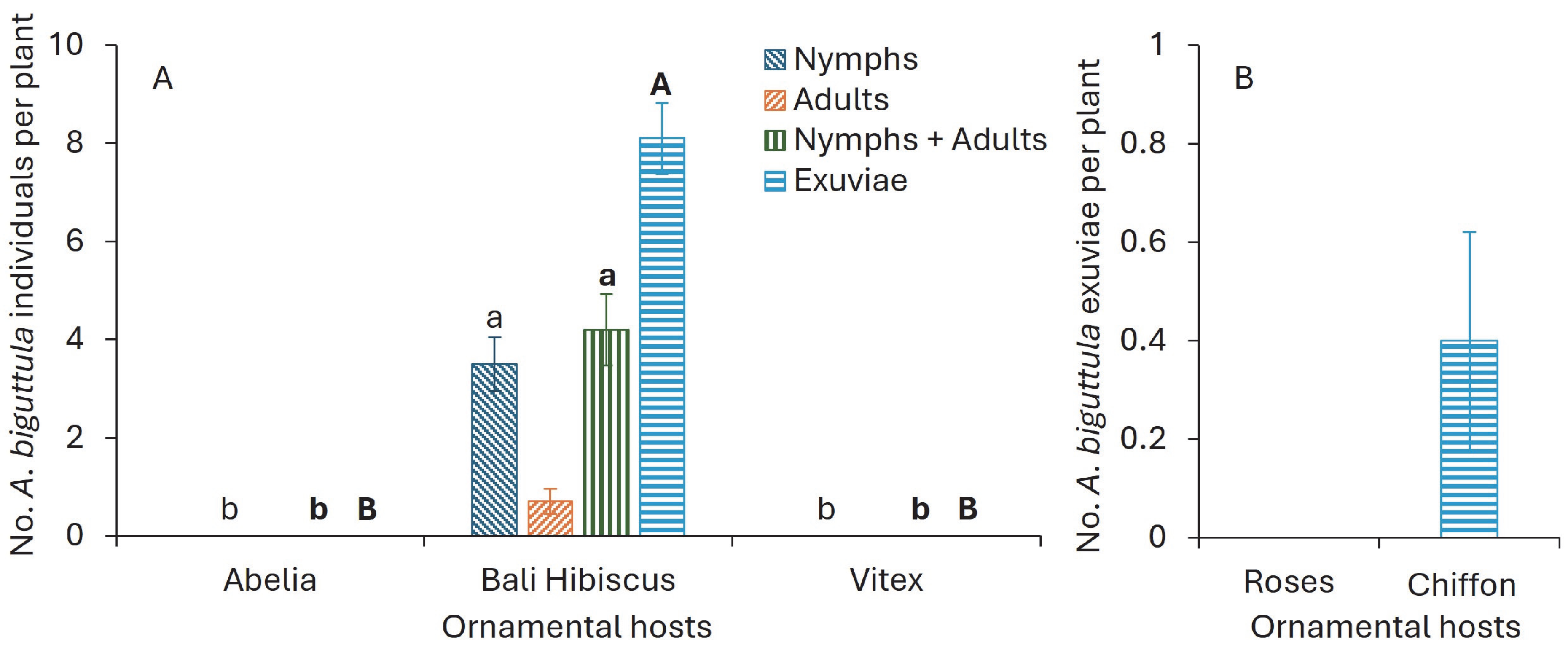
3.2. Amrasca biguttula Movement to Adjacent Plant Species
3.3. Adult A. biguttula Captures on Yellows Sticky Cards
3.4. Leaf Feeding Damage Assessment on H. syriacus Cultivars
4. Discussion
5. Conclusions
Author Contributions
Funding
Data Availability Statement
Acknowledgments
Conflicts of Interest
References
- Pimentel, D.; Zuniga, R.; Morrison, D. Update on the Environmental and Economic Costs Associated with Alien-Invasive Species in the United States. Ecol. Econ. 2005, 52, 273–288. [Google Scholar] [CrossRef]
- Asplen, M.K.; Anfora, G.; Biondi, A.; Choi, D.S.; Chu, D.; Daane, K.M.; Gibert, P.; Gutierrez, A.P.; Hoelmer, K.A.; Hutchison, W.D.; et al. Invasion Biology of Spotted Wing Drosophila (Drosophila suzukii): A Global Perspective and Future Priorities. J. Pest Sci. 2015, 88, 469–494. [Google Scholar] [CrossRef]
- Pimentel, D.; Lach, L.; Zuniga, R.; Morrison, D. Environmental and Economic Costs of Nonindigenous Species in the United States. Bio. Sci. 2000, 50, 53–65. [Google Scholar] [CrossRef]
- Simberloff, D.; Martin, J.L.; Genovesi, P.; Maris, V.; Wardle, D.A.; Aronson, J.; Courchamp, F.; Galil, B.; Garcia-Berthou, E.; Pascal, M.P.; et al. Impacts of Biological Invasions: What’s What and the Way Forward. Trends Ecol. Evol. 2013, 28, 58–66. [Google Scholar] [CrossRef] [PubMed]
- Cabrera-Asencio, I.; Dietrich, C.H.; Zahniser, J.N. A New Invasive Pest in the Western Hemisphere: Amrasca biguttula (Hemiptera: Cicadellidae). Fla. Entomol. 2023, 106, 263–266. [Google Scholar] [CrossRef]
- CABI Digital Library. Amrasca biguttula (Indian Cotton Jassid). 2025. Available online: https://plantwiseplusknowledgebank.org/doi/10.1079/pwkb.species.20857 (accessed on 11 October 2025).
- Liburd, O.E.; Halbert, S.E.; Samuel, N.; Dreves, A.J. Two-Spot Cotton Leafhopper (Amrasca biguttula): A Serious Pest of Cotton, Okra and Eggplant Established in the Caribbean Basin. Pest Alert 2024 Florida Department of Agriculture and Consumer Services, FDACS-P-02229. 2024. Available online: https://ccmedia.fdacs.gov/content/download/117692/file/two-spot-cotton-leaf-hopper-pest-alert.pdf (accessed on 10 October 2025).
- Xu, Y.E.; Wang, Y.; Dietrich, C.H.; Fletcher, M.J.; Qin, D. Review of Chinese Species of the Leafhopper Genus Amrasca Ghauri. Zootaxa 2017, 4353, 360–370. [Google Scholar] [CrossRef]
- Sharma, R.; Singh, A. Host Range and Biology of Amrasca biguttula biguttula. Int. J. Environ. Ecol. Fam. Urban Stud. 2020, 10, 55–63. [Google Scholar]
- Azrag, A.A.; Niassy, S.; Bloukounon-Goubalan, A.Y.; Abdel-Rahman, E.M.; Tonnang, H.E.; Mohamed, S.A. Cotton Production Areas at High Risk of Invasion by Amrasca biguttula Under Climate Change. Pest Manag. Sci. 2025, 81, 2910–2921. [Google Scholar] [CrossRef]
- Georgia Public Broadcasting. GA Okra and Cotton Under Threat from New Invasive Pest That’s Smaller than a Paperclip. 2025. Available online: https://www.gpb.org/news/2025/09/09/ga-okra-and-cotton-under-threat-new-invasive-pest-thats-smaller-paperclip (accessed on 5 October 2025).
- Reisig, D. Invasive Cotton Jassid Spreading Across Southeastern States. NC State Extension Pest Manag. Bull. 2025. Available online: http://cotton.ces.ncsu.edu/2025/09/invasive-cotton-jassid (accessed on 7 October 2025).
- O’Halloran, J. Gwydir Valley “What’s Happening in the North West“. Cotton Catchement Communities CRC. 2007. Available online: https://www.insidecotton.com/sites/default/files/article-files/200607ct_gv06no12.pdf (accessed on 6 December 2025).
- Kranthi, S.; Ghodke, A.B.; Puttuswamy, R.K.; Mandle, M.; Nandanwar, R.; Satija, U.; Pareek, R.K.; Desai, H.; Udikeri, S.S.; Balakrishna, D.J.; et al. Mitochondria COI-Based Genetic Diversity of Amrasca biguttula biguttula Populations From India. Mitochondrial DNA Part A 2018, 29, 228–235. [Google Scholar] [CrossRef]
- Nagrare, V.S.; Kranthi, S.; Biradar, V.K.; Zade, N.N.; Sangode, V.; Kakde, G.; Shukla, R.M.; Shivare, D.; Khadi, B.M.; Kranthi, K.R. Widespread Infestation of the Exotic Mealybug Phenacoccus solenopsis on Cotton in India. Bull. Entomol. Res. 2009, 99, 537–541. [Google Scholar] [CrossRef]
- Singh, A.; Singh, J.; Singh, K.; Rani, P. Host Range and Biology of Amrasca biguttula biguttula (Hemiptera: Cicadellidae). Int. J. Environ. Ecol. Fam. Urban Stud. 2018, 8, 19–24. [Google Scholar] [CrossRef]
- Thirumalaraju, G.T. Bionomics and Control of Cotton Jassid, Amrasca biguttula biguttula (Ishida) and Screening of Cotton Varieties for Resistance. Master’s Thesis, University of Agricultural Sciences, Dharwad, India, 1984. [Google Scholar]
- Jayasimha, G.T.; Rachana, R.R.; Manjunatha, M.; Rajkumar, V.B. Biology and Seasonal Incidence of Leafhopper, Amrasca biguttula biguttula (Ishida) on Okra. Pest Manag. Hortic. Ecosyst. 2012, 18, 149–157. [Google Scholar]
- National Cotton Council of America. Cotton Jassid Alert Flyer. 2025. Available online: www.cotton.org (accessed on 11 November 2025).
- Shivanna, B.K.; Nagaraja, D.N.; Manjunatha, M.; Devi, S.G.; Predeep, S.; Girijesh, G.K. Bionomics of Leafhopper, Amrasca biguttula biguttula (Ishida) on Transgenic Bt-Cotton, Karnataka. J. Agric. Sci. 2009, 22, 538–540. [Google Scholar]
- Thomas, K.M.; Krishnaswami, C.S. Little Leaf a Transmissible Disease of Brinjal. Indian Acad. Sci. Proc. Sect. B 10 1939, 10, 201–212. [Google Scholar] [CrossRef]
- Nielson, M.W. The Leafhopper Vectors of Phytopathogenic Viruses (Homoptera, Cicadellidae) Taxonomy, Biology, and Virus Transmission; USDA Technical Bulletin No. 1382; US Agricultural Research Service: Washington, DC, USA, 1975; 386p.
- Lysandrou, M.; Ahmad, M.; Longhurst, C. Comparative Efficacy of Sulfoxaflor Against Cotton Leafhopper, Amrasca devastans (Distant) Under Field Conditions of Punjab and Sindh. J. Agric. Res. 2010, 48, 517–527. [Google Scholar]
- USDA. Integration of Measures to Manage Amrasca (biguttula) biguttula Risk in Nursery Stock Movement. In Animal and Plant Health Inspection Service, Plant Protection and Quarantine, Plant Pest Risk Analysis (PPRA), Science & Technology; United States Department of Agriculture: Raleigh, NC, USA, 2025. [Google Scholar]
- Dreistadt, S.H.; Newman, J.P.; Robb, K.L. Sticky Trap Monitoring of Insect Pests; UC ANR Publication No. 21572E; University of California Division of Agriculture and Natural Resources: Oakland, CA, USA, 1998; 8p. [Google Scholar]
- UConn Extension. Using Sticky Cards to Monitor for Greenhouse Insects. Department of Plant Science and Landscape Architecture, University of Connecticut Extension. 2022. Available online: https://ipm.cahnr.uconn.edu/wp-content/uploads/sites/3216/2022/12/2019stickycardsfactsheet-1.pdf (accessed on 15 December 2025).
- SAS Institute. Statistical Analysis Software (SAS) User’s Guide, Version 9.4; SAS Institute Inc.: Cary, NC, USA, 2024.
- Stiegel, S.; Entling, H.M.; Mantilla-Contreras, J. Reading the Leaves’ Palm: Leaf Traits and Herbivory along the Microclimatic Gradient of Forest Layers. PLoS ONE 2017, 12, e0169741. [Google Scholar] [CrossRef] [PubMed]
- Mahdhu, B.; Sivakumari, S.; Manickam, S.; Murugan, M.; Rajeswari, S.; Boopathi, M.N. Unraveling the Association Between Cotton Leafhopper Amrasca biguttula and Leaf Morphological Traits Through Stereo Microscope and FESEM Analysis. Indian J. Agric. Sci. 2024, 94, 583–588. [Google Scholar] [CrossRef]
- Mattson, W.J., Jr. Herbivory in Relation to Plant Nitrogen Content. Annu. Rev. Ecol. Syst. 1980, 11, 119–161. [Google Scholar] [CrossRef]
- Awmack, C.S.; Leather, S.R. Host Plant Quality and Fecundity in Herbivorous Insects. Annu. Rev. Entomol. 2002, 47, 817–844. [Google Scholar] [CrossRef]
- Patel, Z.N.; Pathan, N.P.; Chachpara, B.A. Seasonal Incidence of Leafhopper, Amrasca biguttula biguttula (Ishida) Infesting Summer Okra. Int. J. Adv. Biochem. 2024, 8, 24–27. [Google Scholar] [CrossRef]
- Duan, X.; Pan, S.; Fan, M.; Chu, B.; Ma, Z.; Gao, F.; Zhao, Z. Cultivar Mixture Enhances Crop Yield by Decreasing Aphids. Agronomy 2022, 12, 2–9. [Google Scholar] [CrossRef]
- Greene, R.W. Cotton Jassid Detected in Candler and Evans Counties. Candler–Evans Ag Updates. 2025. Available online: https://site.extension.uga.edu/evansag/2025/08/cotton-jassid-detected-in-georgia/ (accessed on 11 November 2025).
- Ratnadass, A.; Fernandes, P.; Avelino, J.; Habib, R. Plant Species Diversity for Sustainable Management of Crop Pests and Diseases in Agroecosystems: A review. Agron. Sustain. Dev. 2012, 32, 273–303. [Google Scholar] [CrossRef]
- Kogan, M. Integrated Pest Management: Historical Perspectives and Contemporary Developments. Annu. Rev. Entomol. 1998, 43, 243–270. [Google Scholar] [CrossRef] [PubMed]
- Pedigo, L.P.; Rice, M.E.; Krell, R.K. Entomology and Pest Management, 7th ed.; Waveland Press: Long Grove, IL, USA, 2021; p. 584. [Google Scholar]
- Sandhu, K.R.; Kang, B.K. Baseline Susceptibility of Cotton Leafhopper, Amrasca biguttula biguttula Against Different Insecticides in Punjab. Indian J. Plant Prot. 2016, 44, 3. [Google Scholar]
- Attaway, D. Clemson Launches First Chemical Trial to Combat Invasive Leafhopper in Ornamentals. Clemson News. 2025. Available online: https://news.clemson.edu/clemson-launches-first-chemical-trial-to-combat-invasive-leafhopper-in-ornamentals/ (accessed on 6 December 2025).
- Singh, L.; Singh, R. Influence of Leaf Vein Morphology in Okra Genotypes (Malvaceae) on the Oviposition of the Leafhopper species Amrasca biguttula (Hemiptera: Cicadellidae). Entomol. Gen. 2005, 28, 103–114. [Google Scholar] [CrossRef]
- Sharma, A.; Singh, R. Oviposition Preference of Cotton Leafhopper in Relation to Leaf-Vein Morphology. J. Appl. Entomol. 2002, 126, 538–544. [Google Scholar] [CrossRef]



| Plant Species, Cultivar | Commercial Source of Liners | Plot Area (m2) | Number of Plants | Plant Height (cm) |
|---|---|---|---|---|
| H. syriacus ‘Bali’ | First Editions® | 158.0 | 5092 | 68.6 |
| H. syriacus ‘Dark Lavender Chiffon’ | Proven Winners® | 111.5 | 3021 | 53.3 |
| Abelia | - | 1579.4 | 2000 | 30.5 |
| Vitex | - | 260.1 | 3000 | 76.2 |
| Rose | - | 12,541.9 | 800 | 68.6 |
| Appli. Date * | Trade Name | Active Ingredient (a.i.) | % a.i. | Appl. Rate per L | Manufacturer/City, Country |
|---|---|---|---|---|---|
| 4 October 2025 | Merit® 2F | Imidacloprid | 21 | 0.12 mL | Bayer Environmental Science, Research Triangle Park, NC, USA |
| 14 October 2025 | Ultra-Pure® Oil | Mineral oil | 98 | 1% v/v | BASF Corporation, Research Triangle Park, NC, USA |
| 24 October 2025 | Avalon® | Bifenthrin | 7.9 | 0.16 mL | PROKOZ Inc., Alpharetta, GA, USA |
| 24 October 2025 | Talus® 70DF | Buprofezin | 70 | 0.094 g | SePRO Corporation, Carmel, IN, USA |
| 24 October 2025 | Acephate | Acephate | 97 | 1.2 g | AMVAC Chemical Corporation, Newport Beach, CA, USA |
| A. biguttula Stage or Exuviae/Treatment | F | df | p |
|---|---|---|---|
| Nymphs | |||
| Cultivar | 11.7 | 1,45 | 0.001 |
| Canopy | 0.3 | 2,45 | 0.736 |
| Cultivar × Canopy | 0.3 | 2,45 | 0.736 |
| Adults | |||
| Cultivar | 0.5 | 1,45 | 0.507 |
| Canopy | 0.2 | 2,45 | 0.795 |
| Cultivar × Canopy | 0.3 | 2,45 | 0.774 |
| Nymphs + Adults | |||
| Cultivar | 14.5 | 1,45 | <0.001 |
| Canopy | 0.6 | 2,45 | 0.582 |
| Cultivar × Canopy | 0.3 | 2,45 | 0.748 |
| Exuviae | |||
| Cultivar | 30.7 | 1,45 | <0.001 |
| Canopy | 2.8 | 2,45 | 0.070 |
| Cultivar × Canopy | 1.6 | 2,45 | 0.212 |
| Cultivar/Treatment | F | df | p |
|---|---|---|---|
| ‘Bali’ H. syriacus with abelia and vitex | |||
| Nymphs | 15.7 | 2,18 | <0.001 |
| Adults | 1.3 | 2,18 | 0.299 |
| Nymphs + Adults | 19.6 | 2,18 | <0.001 |
| Exuviae | 39.9 | 2,18 | <0.001 |
| ‘Dark Lavender Chiffon’ H. syriacus with rose | |||
| Nymphs | 0.0 | 1,9 | 1.000 |
| Adults | 0.0 | 1,9 | 1.000 |
| Nymphs + Adults | 0.0 | 1,9 | 1.000 |
| Exuviae | 0.7 | 1,9 | 0.437 |
Disclaimer/Publisher’s Note: The statements, opinions and data contained in all publications are solely those of the individual author(s) and contributor(s) and not of MDPI and/or the editor(s). MDPI and/or the editor(s) disclaim responsibility for any injury to people or property resulting from any ideas, methods, instructions or products referred to in the content. |
© 2025 by the authors. Licensee MDPI, Basel, Switzerland. This article is an open access article distributed under the terms and conditions of the Creative Commons Attribution (CC BY) license.
Share and Cite
Attia, S.; Joseph, S.V. Incidence of the Two-Spotted Cotton Leafhopper (Hemiptera: Cicadellidae) Infesting Hibiscus syriacus in Ornamentals. Agronomy 2026, 16, 32. https://doi.org/10.3390/agronomy16010032
Attia S, Joseph SV. Incidence of the Two-Spotted Cotton Leafhopper (Hemiptera: Cicadellidae) Infesting Hibiscus syriacus in Ornamentals. Agronomy. 2026; 16(1):32. https://doi.org/10.3390/agronomy16010032
Chicago/Turabian StyleAttia, Sabrine, and Shimat V. Joseph. 2026. "Incidence of the Two-Spotted Cotton Leafhopper (Hemiptera: Cicadellidae) Infesting Hibiscus syriacus in Ornamentals" Agronomy 16, no. 1: 32. https://doi.org/10.3390/agronomy16010032
APA StyleAttia, S., & Joseph, S. V. (2026). Incidence of the Two-Spotted Cotton Leafhopper (Hemiptera: Cicadellidae) Infesting Hibiscus syriacus in Ornamentals. Agronomy, 16(1), 32. https://doi.org/10.3390/agronomy16010032