Article

Incidence of the Two-Spotted Cotton Leafhopper (Hemiptera: Cicadellidae) Infesting Hibiscus syriacus in Ornamentals

by
Sabrine Attia
1,2,* and
Shimat V. Joseph
1,*
1
Department of Entomology, University of Georgia, 1109 Experiment Street, Griffin, GA 30223, USA
2
Laboratory of Bioaggressors and Integrated Pest Management in Agriculture (LR14AGR02), National Agronomic Institute of Tunisia (INAT), 43 Avenue Charles Nicolle, Cité Mahrajène 1082, University of Carthage, Tunis 1054, Tunisia
*
Authors to whom correspondence should be addressed.
Agronomy 2026, 16(1), 32; https://doi.org/10.3390/agronomy16010032 (registering DOI)
Submission received: 15 November 2025 / Revised: 16 December 2025 / Accepted: 18 December 2025 / Published: 22 December 2025
(This article belongs to the Section Horticultural and Floricultural Crops)

Abstract

The two-spotted cotton leafhopper, Amrasca biguttula (Ishida) (Hemiptera: Cicadellidae), is an invasive species native to the Indian subcontinent and an emerging pest of cotton, okra, eggplant, and hibiscus (Hibiscus syriacus; Malvaceae) in the southeastern United States. Its presence in ornamental nurseries has not been previously documented, posing a serious threat to hibiscus. This study aimed to evaluate the incidence of feeding damage and the potential spread of the pest across plant species within a nursery; thus, a study was conducted in a Georgia (USA) wholesale nursery in 2025. We used leaf samples to determine establishment, and leaf discoloration to categorize damage. We used yellow sticky cards to detect the presence of adults. Results showed that the life stages of A. biguttula were more common in the upper canopy than in the middle and lower levels. Both leafhopper numbers and exuviae were higher on the ‘Bali’ cultivar of H. syriacus compared to ‘Dark Lavender Chiffon’. No stages were found on neighboring species, including abelia, vitex, and rose. Yellow sticky card captures confirmed that adults were present on hibiscus cultivars. Feeding injury on H. syriacus was characterized by yellowing at the margins that spread inward and puckering of young leaves. Feeding damage ratings were significantly higher on ‘Bali’ than on ‘Dark Lavender Chiffon’, and adult captures were positively linked to damage severity. This is the first report of A. biguttula infestation and related injury on hibiscus in a U.S. wholesale nursery.

1. Introduction

Invasive insects demonstrate remarkable ecological adaptability, allowing them to establish, spread, colonize, and thrive in new environments [1,2]. Many insect species have become serious threats to global agriculture, biodiversity, and ecosystem stability, causing severe economic losses and long-term ecological disturbances [1,3,4]. Among economically important invasive insects, the two-spotted cotton leafhopper, Amrasca biguttula (Ishida) (Hemiptera: Cicadellidae), also known as the cotton jassid, is a major pest native to the Indian subcontinent and extending eastward to Japan and Micronesia [5]. Historically, A. biguttula’s range has extended from Iran to Japan and from South Asia to Indonesia, with records from Afghanistan, Vietnam, China, Taiwan, and Guam [6]. Amrasca biguttula was first detected in the United States, in the Virgin Islands, and Puerto Rico, in the spring of 2023 [7]. Recent reports from Florida and Georgia since late 2025 indicate a significant expansion into the United States. In Florida, the pest was first reported on vegetables and ornamental plants [7], although how it spread remains unclear. It is considered a destructive pest of row crops, cotton [Gossypium hirsutum L.; Malvaceae], okra [Abelmoschus esculentus (L.) Moench.; Malvaceae], and eggplant [Solanum melongena L.; (Solanaceae)], where infestations can cause yield losses exceeding 40% under epidemic conditions [7,8,9,10]. In Georgia, infestations later occurred in cotton, okra, and hibiscus, raising major concerns for the state’s high-value ornamental industry [11]. Confirmed sightings now cover more than 100 counties across seven southeastern states, including Florida, Georgia, Alabama, Texas, Louisiana, South Carolina, and Mississippi [6]. This highlights the pest’s ability to thrive in warm climates and adapt to new regions, as well as the urgent need for coordinated regional monitoring and control efforts [12]. Feeding damage occurs when piercing–sucking mouthparts insert into leaf tissues [13], causing chlorosis, necrosis, leaf curling, and the distinctive “hopper burn” symptoms that impair photosynthesis and overall plant health [14,15]. Both nymphs and adults cause injury, with adults easily identified by two dark spots on their forewings [8].
The life history traits and reproductive biology of A. biguttula contribute to its potential to invade new areas. Females lay eggs within leaf tissues, producing 15–21 eggs during their lifespan, with embryonic development completed in 6–10 days under favorable conditions [16]. Nymphal development averages seven days, allowing multiple overlapping generations per season [7,17]. This quick turnover, along with high fecundity, enables populations to grow rapidly in suitable environments. Additionally, A. biguttula exhibits broad host specificity, attacking more than 25 plant species, including potato, sunflower, beans, sorghum, maize, and ornamentals such as hibiscus, as well as cotton, okra, and eggplant [14,16,17]. Such a broad host range helps it survive across different agroecosystems and spread more easily.
The economic effects go beyond field crops. Ornamental plants are particularly vulnerable because esthetic quality is crucial, and even moderate feeding damage can render them unmarketable. Infested hibiscus plants have been found at major retail garden centers in Florida, Louisiana, and Texas [18], which suggests the pest may be spreading through the commercial movement of ornamental plants. Developing and implementing effective control tactics against this pest is therefore a priority for successful and sustainable management worldwide. The ability of A. biguttula to establish on ornamental plants adds a significant layer of complexity to management efforts, as these plants could serve as a reservoir for local spread and dispersal through the trade of plant material. Control strategies in nursery systems must be effective while minimizing phytotoxic risks and complying with stricter regulations on insecticide use on ornamental crops [8]. This insect has become an economic pest in most invaded areas because of its high reproductive potential, driven by a short generation time, a wide host range, thermal adaptability, and the capacity to develop insecticide resistance [17,19,20]. Additionally, females lay their eggs within epidermal tissues, protecting the developing stages and aiding successful establishment. As a result, infestations often go unnoticed until nymphs emerge, leading to underestimations of pest presence and delays in control measures. However, unlike many other leafhopper species, the cotton leafhopper is not known to transmit viral or mycoplasma diseases [21,22]. Its economic impact mainly stems from direct feeding injury rather than pathogen transmission, although its full effect on feeding damage remains uncertain.
Despite the increasing threat posed by A. biguttula, significant knowledge gaps remain. Extensive research has described their biology, host range, and economic effects on major field crops, especially cotton and okra, in the native range [6,7,17,23,24], but not in the new range, such as in the USA. There are limited studies on ornamental plants in the native range of A. biguttula. In the USA, the ornamental trade through nursery systems has the potential to facilitate long-distance pest spread. There is little information on their distribution within plants, host preferences, or seasonal population changes in these systems. This information will help to develop effective management strategies.
To develop management strategies for the nursery, it is important to understand the localized movement and behavior of A. biguttula, especially on hibiscus. Thus, the objectives of this study were to determine (1) the incidence of nymphs and adults within hibiscus, (2) potential movement to plant species adjacent to hibiscus using leaf samples, (3) the utility of yellow sticky cards and leaf samples for detection, and (4) the damage symptoms caused by A. biguttula feeding in the wholesale ornamental container nursery.

2. Materials and Methods

2.1. Study Site

The study was conducted at a commercial nursery specializing in growing container-grown ornamentals. The nursery comprises multiple production blocks, in total, approximately 53,425 m2, with ‘Bali’ and ‘Dark Lavender Chiffon’ Hibiscus syriacus, abelia (Abelia spp.), vitex (Vitex agnus-castus), and ‘Pink Double Knockout’ rose (Rosa sp.) (Table 1).
Vitex and abelia plant blocks were on either side of the ‘Bali’ block, whereas the rose plant block was adjacent to one side of the ‘Dark Lavender Chiffon’ block, and the other side was an unpaved road. The distance between the ‘Bali’ and ‘Dark Lavender Chiffon’ blocks was 200 m in the nursery. Hibiscus syriacus plants were planted on 10 July 2025, using 10 cm liners.
In July 2025, all plants, as listed in Table 1, were planted in 7.6 L containers using pine-based growing media with hydro-fiber, bifenthrin (Talstar P®, bifenthrin [7.9%], FMC Corporation, Philadelphia, PA, USA), and a homogeneous granular micronutrient fertilizer (Micromax®, ICL Specialty Fertilizers, Lincoln, NE, USA). They received 20 min irrigation daily. Once the plants were established in containers, they were fertilized with 18N-6P-8K fertilizer (Osmocote®, 6 months, ICL Specialty Fertilizers, Lincoln, NE, USA). The plants received insecticide applications after planting to control A. biguttula, as outlined in Table 2.
Between 7 and 20 October 2025, maximum daily temperatures ranged from 20.3 to 30.6 °C, minimum daily temperatures from 6.6 to 18.8 °C, and rainfall was negligible (0–0.254 mm) (University of Georgia Weather station, Central Georgia [USA]). These conditions are representative of autumn weather in the southeastern United States, characterized by warm, dry days favorable for A. biguttula activity.

2.2. Occurrence of A. biguttula on H. syiacus

To determine the vertical distribution of A. biguttula, leaves from H. syriacus ‘Bali’ and ‘Dark Lavender Chiffon’ were sampled. From each plant, nine leaves were collected at each sampling date, with three fully expanded leaves randomly taken from each canopy level: upper, middle, and lower, with each level ~22 cm and ~17 cm for ‘Bali’ and ‘Dark Lavender Chiffon’, respectively. The upper canopy was defined as apical, sun-exposed leaves; the middle canopy as central leaves receiving partial sunlight; and the lower canopy as basal, shaded leaves near the surface of the growing media in the container.
Ten plants of each cultivar were sampled during each sampling date. For ‘Bali’ H. syriacus, leaf samples were collected from the edge (10 plants) and interior of the block (10 plants) during each sampling date. The edge and interior sites were 1 m apart because the block was narrow. For ‘Dark Lavender Chiffon’ H. syriacus, leaf samples were only taken from the edge of the block, as the block was not wide enough, and thus, interior and exterior (edge) sampling may not be valuable. The collected leaves were transported to the Entomology Laboratory at the University of Georgia’s Griffin Campus in Griffin, GA, for analysis. Canopy-level sampling occurred on 7, 8, 14, 16, and 20 October 2025. The leaves were examined carefully under a dissecting microscope (10×) (Leica Microsystems GmbH, Wetzlar, Germany) for nymphs, adults, and exuviae, and then quantified. Adult A. biguttula were identified based on distinctive morphological features, particularly the presence of two dark spots on the forewings. Nymphs and exuviae on the leaves were recorded. Nymphs and exuviae were present on leaves along with the adults. No other leafhopper species were detected on the leaves.

2.3. Leaf Assessment for A. biguttula Movement to Adjacent Plant Species

The presence of A. biguttula nymphs, adults, or exuviae was assessed on leaves of surrounding plant species adjacent to H. syriacus cultivars, ‘Bali’ and ‘Dark Lavender Chiffon’. The abelia and vitex plants were on either side of ‘Bali’ H. syriacus, while ‘Pink Double Knockout’ rose was next to ‘Dark Lavender Chiffon’ H. syriacus. For each plant, 10 leaves were randomly collected from the edges of these non-hibiscus plant species on 7, 8, 14, 16, and 20 October 2025, regardless of canopy level. The leaves were transported and evaluated as described in the previous section.

2.4. Yellow Sticky Card Assessment

Adult populations of A. biguttula were monitored using 10 × 15 cm yellow sticky cards within the hibiscus block. These yellow sticky cards are widely used in integrated pest management programs because they effectively capture the adult stages of flying insects and provide a reliable estimate of population presence and relative abundance [25,26]. Three sticky cards were placed at mid-canopy height at the edge and interior of the ‘Bali’ block and at the edge of the ‘Dark Lavender Chiffon’ H. syriacus block. Traps were spaced 5 m apart (edge and interior in ‘Bali’) within the hibiscus block.
Sticky cards were set out on 7, 14, and 20 October 2025, and were replaced with new cards every 7 d over a three-week period. The cards were transported to the laboratory and examined under a dissecting microscope (10×) (Leica Microsystems GmbH, Germany) to count adults.

2.5. Feeding Damage

Feeding damage caused by A. biguttula was evaluated on the leaves of H. syriacus cultivars ‘Bali’ and ‘Dark Lavender Chiffon’ using a numerical rating from 0 to 10 based on yellowing or chlorosis symptoms (Figure 1). The ratings were assigned based on the degree of chlorosis, with 0 representing 0% or no visible damage; 1 for 1–10%; 2 for 11–20%; 3 for 21–30%; 4 for 31–40%; 5 for 41–50%; 6 for 51–60%; 7 for 61–70%; 8 for 71–80%; 9 for 81–90%; and 10 for more than 91% chlorosis. Chlorosis was reported as feeding damage on hibiscus [9] and was observed in preliminary greenhouse studies of A. biguttula exposure to hibiscus. For this assessment, more than 100 leaves per cultivar were examined across three sampling dates: 16, 22, and 28 October 2025. All leaves were carefully inspected under a microscope, and visible feeding symptoms, primarily chlorosis, were recorded. When examining the leaves, the number of exuviae on each leaf was also documented.

2.6. Statistical Analyses

The data were analyzed using Statistical Analysis Software [27]. The numbers of nymphs, adults, and exuviae of A. biguttula from three leaves of ‘Bali’ H. syriacus were organized by canopy levels of each plant from the edge and interior of the block. For ‘Dark Lavender Chiffon’ H. syriacus, numbers of nymphs, adults, and exuviae of A. biguttula from three leaves were organized by canopy levels only from the edge. Thus, the three leaves served as the experimental unit for each canopy height. Ten plants, sampled on each date, serve as replicates. To assess the effects of H. syriacus cultivar and canopy levels on nymphs, adults, and exuviae, the A. biguttula stage and exuviae data were analyzed with a generalized linear model using the PROC GLIMMIX procedure in SAS. Independent variables, such as cultivar and canopy level were treated as fixed effects, and replication was treated as a random effect in the model. For the analysis, a value of 1 was added to all data points for A. biguttula stages and exuviae on leaves to address zero inflation.
To evaluate the overall effect of canopy level regardless of H. syriacus cultivars, the same approach was applied to the A. biguttula stage and exuviae data. Data from both the edge and interior of ‘Bali’ H. syriacus were used for canopy-level analysis. The A. biguttula stage and exuviae data were analyzed with a generalized linear model using the PROC GLIMMIX procedure in SAS. Canopy level was treated as fixed effect, and replication was treated as a random effect in the model. For the analysis, a value of 1 was added to all data points for A. biguttula stages and exuviae on leaves to address zero inflation.
To determine if A. biguttula dispersed to adjacent plant species, a single leaf was randomly collected from each non-hibiscus host (vitex, abelia, and rose), regardless of canopy level, from 10 plants, where the numbers of nymphs, adults, and exuviae of A. biguttula from a single plant or leaf served as the experimental unit. Data on A. biguttula nymphs, adults, and exuviae collected from leaves, by H. syriacus cultivar and specific adjacent hosts, were analyzed using a generalized linear model (PROC GLIMMIX in SAS). For the analysis, a value of 1 was added to all data points for A. biguttula and exuviae on leaves to address zero inflation, except for adult A. biguttula data. Host species was treated as fixed effect, and replication was treated as a random effect in the model.
For sticky card data, three sticky cards were placed on the edge and interior of ‘Bali’ and edge of ‘Dark Lavender Chiffon’ H. syriacus blocks. The number of A. biguttula adults collected from a sticky card placed on a plant at the edge or center of the block served as the experimental unit. Analysis was conducted for adult A. biguttula on sticky cards using the PROC GLIMMIX. Sampling date was treated as fixed effect, and replication was treated as a random effect in the model.
For the damage ratings, more than 100 leaves were randomly sampled from the ‘Bali’ and ‘Dark Lavender Chiffon’ H. syriacus block, with one leaf per plant. From each leaf, the number of A. biguttula exuviae and damage rating was assessed. Thus, a single leaf served as the experimental unit. To assess the impact of A. biguttula feeding damage, damage ratings on H. syriacus leaves were analyzed by cultivar and sampling date using the PROC GLIMMIX. A. biguttula exuviae data were only used for Pearson’s correlation analysis. Pearson’s correlation analysis was performed between damage ratings and the number of exuviae on leaves to examine the relationship between damage and A. biguttula.
All analyses using generalized linear models (PROC GLIMMIX) assumed a Poisson distribution, employed the Laplace method, and used a log link function. Independent variables, such as cultivar, host species, canopy level, and sampling date, were treated as fixed effects, and replication was treated as a random effect across all models. Means and standard errors for nymphs, adults, nymphs + adults, and exuviae by H. syriacus cultivar and canopy levels were calculated using the PROC MEANS procedure in SAS, with means separated by the Tukey–Kramer test (α = 0.05).

3. Results

3.1. Occurrence and Influence of H. syiacus Cultivar on A. biguttula

The analysis showed that the number of A. biguttula nymphs, nymphs + adults, and exuviae were significantly greater for the ‘Bali’ H. syriacus than for the ‘Dark Lavender Chiffon’ H. syriacus (Table 3; Figure 2A). The number of adults detected on leaves did not differ significantly for H. syriacus cultivar (Figure 2A). The canopy level and the interaction between H. syriacus cultivar and canopy level were not significantly different for the numbers of A. biguttula nymphs, nymphs + adults, and exuviae (Table 3).
To understand the occurrence of A. biguttula on H. syriacus plants, data from both cultivars were combined and analyzed. When A. biguttula nymphs + adults were combined, they were significantly more abundant on the upper canopy level treatment than on the lower canopy level treatment (F = 9.9; df = 2,78; p < 0.001; Figure 2B). There were no significant differences for nymphs (F = 1.8; df = 2,78; p = 0.174), adults (F = 1.1; df = 2,78; p = 0.340) and exuviae (F = 2.5; df = 2,78; p = 0.087).

3.2. Amrasca biguttula Movement to Adjacent Plant Species

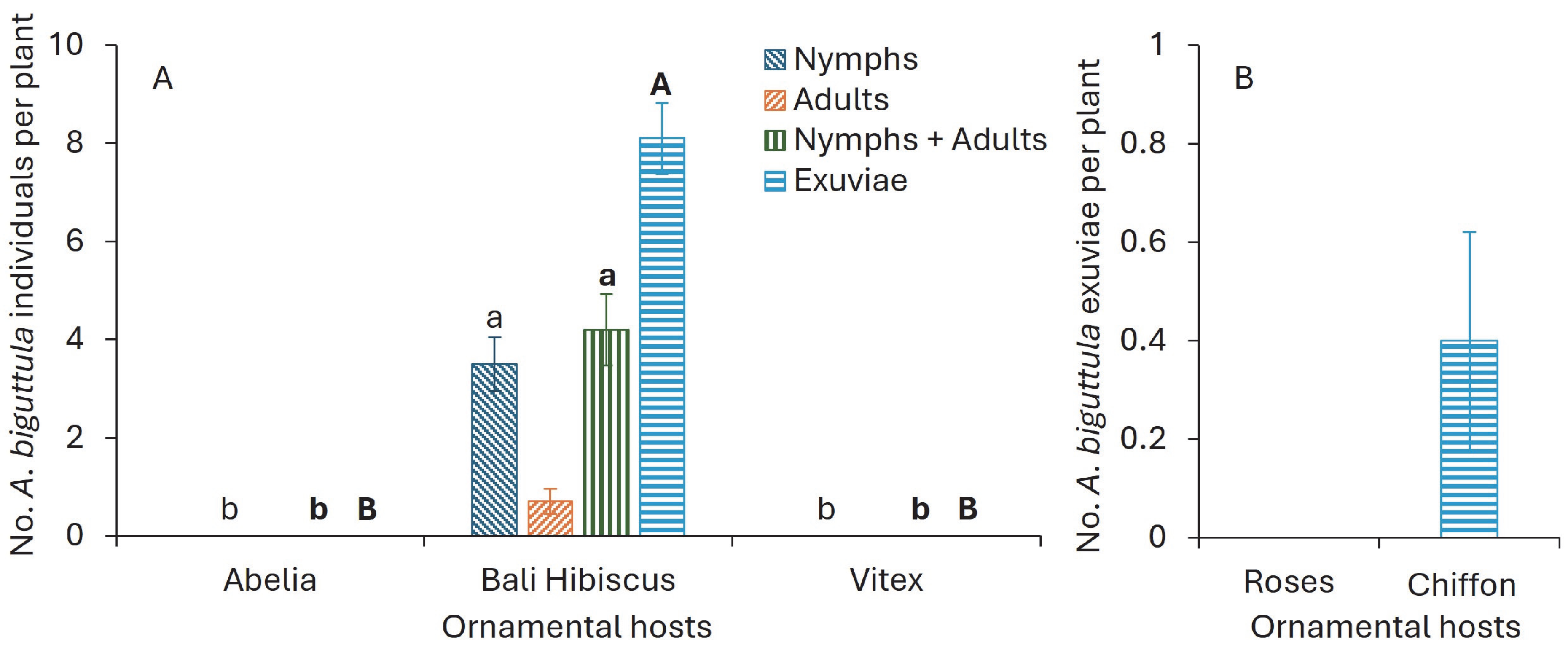
When A. biguttula stages were examined on the leaves of plant species near the ‘Bali’ and ‘Dark Lavender Chiffon’ H. syriacus blocks, no stages of A. biguttula were detected, neither on abelia and vitex plants around ‘Bali’ H. syriacus nor on rose plants around the ‘Dark Lavender Chiffon’ H. syriacus blocks (Figure 3A,B). Significantly higher numbers of A. biguttula were found on the ‘Bali’ and ‘Dark Lavender Chiffon’ H. syriacus leaves than on the leaves of adjacent plant species (Table 4; Figure 3).

3.3. Adult A. biguttula Captures on Yellows Sticky Cards

On ‘Bali’ H. syriacus edge, significantly greater numbers of adult A. biguttula were detected on the first two dates of sampling than on the last date (edge: F = 41.1; df = 2,4; p = 0.002; interior: F = 34.2; df = 2,4; p = 0.003; Figure 4). When the sticky cards were evaluated from ‘Dark Lavender Chiffon’ H. syriacus, the number of adult A. biguttula was significantly greater on the first sampling date than on the last two dates (F = 22.8; df = 2,4; p = 0.006; Figure 4).

3.4. Leaf Feeding Damage Assessment on H. syriacus Cultivars

The feeding damage ratings were significantly greater on the ‘Bali’ H. syriacus leaves than on the ‘Dark Lavender Chiffon’ H. syriacus leaves (F = 427.3; 1,536; p < 0.001; Figure 5A). The sampling date was significantly different (F = 5.7; df = 2,536; p = 0.003), whereas the interaction between cultivar and sampling date was not significantly different (F = 0.3; df = 2,536; p = 0.731). In addition, the same pattern was observed on all sampling dates. On all the sampling dates, feeding damage ratings were significantly greater on the ‘Bali’ H. syriacus leaves than on the ‘Dark Lavender Chiffon’ H. syriacus leaves (Figure 5B).
Pearson’s correlation analysis showed that there was a significant relationship between damage ratings on the leaves and the number of exuviae found on the leaves (r = 0.230; N = 653; p < 0.001).

4. Discussion

The results showed that A. biguttula populations occur on H. syriacus cultivars and are more abundant on some cultivars than on others. This suggests that A. biguttula may prefer certain cultivars, such as ‘Bali’ over ‘Dark Lavender Chiffon,’ for oviposition and nymph development. These two cultivars were planted simultaneously in the nursery, suggesting they were introduced at the same time and are unlikely to have been introduced later with A. biguttula. The number of adults did not differ significantly between cultivars in leaf samples, likely due to sampling bias, as adults are mobile and may have contributed to reduced capture on the sampled leaves. However, variation across adult and immature stages highlights the importance of considering life-stage–specific interactions when evaluating host-plant infestations. In addition, these results confirm the first report of A. biguttula on H. syriacus cultivars in the United States. Besides H. syriacus, Hibiscus rosa-sinensis L. (SVJ personal comm.) and Hibiscus mutabilis × moscheutos hybrid (J. Ruter personal comm.) are also hosts. This indicates that close monitoring of A. biguttula on Hibiscus spp. is necessary, as it could spread through the movement of plant material. Since the abundance of A. biguttula varies across cultivars, further research is needed to determine whether certain hibiscus cultivars are more likely to host high populations of A. biguttula.
Vertical distribution within the canopy was also a key factor. The greater occurrence of A. biguttula in the upper canopy suggests that factors such as microhabitat conditions, leaf age, light exposure, and microclimate influence pest occurrence [28,29,30,31]. Upper canopy leaves are typically younger, more tender, and richer in nitrogen, traits known to promote herbivore feeding and oviposition [32,33]. The absence of a significant cultivar × canopy interaction indicates that canopy effects are consistent across host genotypes. These findings align with those of Greene (2025) [34], who reported that treatment thresholds in cotton are based on nymph counts in the upper canopy, thereby reinforcing the practical importance of canopy-level monitoring. These results also suggest that monitoring activities could focus on the upper canopy levels of the plants. The monitoring tools include yellow sticky cards or visual examination of the leaves. The yellow sticky card appears to be a useful tool, according to the current study. Monitoring will be essential as growers introduce new hibiscus species and cultivars to the nursery. Stringent monitoring will be required before moving the newly introduced plants to the nursery’s main blocks. The monitoring should be continued for about a week, as the eggs are concealed in leaf tissue and hatch occurs ~3–4 d, depending on temperature and relative humidity. The current study suggests that yellow sticky cards can be used for monitoring adult activity throughout the growing season.
No stages of A. biguttula were detected on abelia, vitex, or rose plants near hibiscus blocks based on leaf samples, and the yellow sticky card confirmed that adults were concentrated within hibiscus stands. This finding aligns with previous reports of A. biguttula as a pest of malvaceous plants, such as cotton, okra, and hibiscus, but not of unrelated taxa [35]. However, closer monitoring is warranted, as we evaluated only vitex and rose plants; many other potential hosts present in the nursery were not evaluated in the current study. These results also suggest that infestations are likely to stay localized within susceptible hibiscus cultivars rather than spreading widely across mixed plantings. Such specificity reduces the risk of cross-species outbreaks and supports the use of spatially diversified plantings as a buffer against pest spread [36,37]. This concept requires further investigation under field conditions.
Yellowing is a major feeding injury caused by A. biguttula on H. syriacus leaves, accompanied by some leaf curling symptoms [10]. We did not find any other arthropod pests on the leaves or on the yellow sticky cards. Feeding damage was higher on ‘Bali’ leaves compared to ‘Dark Lavender Chiffon’, which correlates with the greater abundance of immature stages. The high adult populations were observed on ‘Bali’ and ‘Dark Lavender Chiffon’ from yellow sticky cards. The strong correlation between exuviae count and damage suggests that exuviae can serve as a reliable proxy for feeding intensity and population pressure. Once the presence of A. biguttula is confirmed, exuviae can be used as a monitoring tool; however, training may be required for scouting personnel to detect them. This method could be particularly useful for detecting nymphal activity before adults become dominant, and yellow sticky cards could be readily used to detect early adult activity. Monitoring aligns with IPM principles, where indirect indicators of pest activity help set intervention thresholds and reduce reliance on chemical controls [38,39].
Currently, the management of A. biguttula relies on insecticides [40,41]. Growers in the current study used insecticides (Table 2) to reduce the A. biguttula population, as indicated by yellow sticky cards (Figure 4). From an IPM perspective, several strategies emerge to manage A. biguttula. First, cultivar choice serves as a preventive measure, enabling growers to select cultivars that are less susceptible to pests, thereby reducing pest pressure and feeding damage and, consequently, lowering their reliance on chemical interventions. Second, monitoring protocols should incorporate exuviae counts and upper canopy-level sampling to improve detection accuracy and provide early warnings of population increases. Third, the strong host fidelity, especially to hibiscus, observed suggests that planting non-hibiscus ornamentals adjacent to hibiscus blocks does not exacerbate infestations, supporting the use of mixed plantings to enhance biodiversity without increasing pest risk. The susceptibility of non-hibiscus ornamentals warrants further detailed research. Finally, future research should investigate the physiological and morphological traits underlying cultivar resistance, as well as the role of natural enemies in regulating A. biguttula populations. Studies on secondary metabolites, trichome density, and volatile emissions could provide mechanistic insights into cultivar-specific susceptibility and inform breeding programs to enhance resistance.
Beyond ornamental systems, these findings have broader agronomic implications. Although A. biguttula is primarily known as a pest of cotton and okra, its presence on H. syriacus highlights the potential for crossover between agricultural and ornamental environments. As urban and suburban plantings increasingly combine ornamentals with food crops, understanding pest behavior across these systems becomes essential. Hibiscus spp. may serve as a reservoir for A. biguttula, potentially affecting pest pressure in nearby cotton or okra fields. Conversely, resistant ornamental cultivars could function as “dead-end” hosts, reducing pest spillover into crops. This dual role of ornamentals as reservoirs or sinks underscores the need for integrated, landscape-level pest management strategies that address both agricultural and ornamental elements.

5. Conclusions

The current research, although brief, showed that important information on local dispersal, movement, susceptibility, and the monitoring of A. biguttula in the early stages of invasion in the United States. This study demonstrated that Hibiscus spp. can play a significant role in dispersing A. biguttula through the nursery trade in the United States, as hibiscus plants were extensively infested, resulting in economic damage such as yellowing and leaf curling. Based on differences in the A. biguttula population across two H. syriacus cultivars examined, this suggests that certain hibiscus cultivars may harbor higher numbers of A. biguttula, thereby facilitating population growth, which may be important for A. biguttula population dynamics. This warrants more in-depth research. The current study also demonstrated that yellow stick cards can be a valuable tool for monitoring adult A. biguttula, particularly when new plants are introduced into a new nursery facility. Deploying yellow sticky cards in the upper canopy of plants may yield more adult A. biguttula captures, as A. biguttula individuals were more abundant there than in the middle or lower canopy. The presence of A. biguttula across the canopy suggests that improved insecticide spray coverage is warranted for effective management. The current study reveals that yellowing is the primary feeding injury inflicted by A. biguttula on H. syriacus leaves, accompanied by leaf curling. However, further research is needed to determine whether these feeding symptoms, or similar ones, also occur on other Hibiscus spp., hybrids, and cultivars.

Author Contributions

Conceptualization, S.V.J.; methodology, S.V.J. and S.A.; validation, S.V.J. and S.A.; formal analysis, S.V.J.; investigation, S.V.J. and S.A.; resources, S.V.J.; data curation, S.A.; writing—original draft preparation, S.A.; writing—review and editing, S.V.J.; visualization, S.V.J. and S.A.; supervision, S.V.J.; project administration, S.V.J. and S.A.; funding acquisition, S.V.J. and S.A. All authors have read and agreed to the published version of the manuscript.

Funding

This research was supported by funding from agro-chemical companies and the University of Georgia’s Hatch Project. Additional support was provided by the U.S. Fulbright Program, which funded the scholarship that enabled the research.

Data Availability Statement

The raw data supporting the conclusions of this article will be made available by the authors on request.

Acknowledgments

We thank Aaron Chapman and Chris Hardin for assistance in setting up and evaluating plants. Additionally, we thank the nursery grower and managers for their assistance with the research. The authors have reviewed and edited the output and take full responsibility for the content of this publication.

Conflicts of Interest

The authors declare that they have no conflicts of interest.

References

  1. Pimentel, D.; Zuniga, R.; Morrison, D. Update on the Environmental and Economic Costs Associated with Alien-Invasive Species in the United States. Ecol. Econ. 2005, 52, 273–288. [Google Scholar] [CrossRef]
  2. Asplen, M.K.; Anfora, G.; Biondi, A.; Choi, D.S.; Chu, D.; Daane, K.M.; Gibert, P.; Gutierrez, A.P.; Hoelmer, K.A.; Hutchison, W.D.; et al. Invasion Biology of Spotted Wing Drosophila (Drosophila suzukii): A Global Perspective and Future Priorities. J. Pest Sci. 2015, 88, 469–494. [Google Scholar] [CrossRef]
  3. Pimentel, D.; Lach, L.; Zuniga, R.; Morrison, D. Environmental and Economic Costs of Nonindigenous Species in the United States. Bio. Sci. 2000, 50, 53–65. [Google Scholar] [CrossRef]
  4. Simberloff, D.; Martin, J.L.; Genovesi, P.; Maris, V.; Wardle, D.A.; Aronson, J.; Courchamp, F.; Galil, B.; Garcia-Berthou, E.; Pascal, M.P.; et al. Impacts of Biological Invasions: What’s What and the Way Forward. Trends Ecol. Evol. 2013, 28, 58–66. [Google Scholar] [CrossRef] [PubMed]
  5. Cabrera-Asencio, I.; Dietrich, C.H.; Zahniser, J.N. A New Invasive Pest in the Western Hemisphere: Amrasca biguttula (Hemiptera: Cicadellidae). Fla. Entomol. 2023, 106, 263–266. [Google Scholar] [CrossRef]
  6. CABI Digital Library. Amrasca biguttula (Indian Cotton Jassid). 2025. Available online: https://plantwiseplusknowledgebank.org/doi/10.1079/pwkb.species.20857 (accessed on 11 October 2025).
  7. Liburd, O.E.; Halbert, S.E.; Samuel, N.; Dreves, A.J. Two-Spot Cotton Leafhopper (Amrasca biguttula): A Serious Pest of Cotton, Okra and Eggplant Established in the Caribbean Basin. Pest Alert 2024 Florida Department of Agriculture and Consumer Services, FDACS-P-02229. 2024. Available online: https://ccmedia.fdacs.gov/content/download/117692/file/two-spot-cotton-leaf-hopper-pest-alert.pdf (accessed on 10 October 2025).
  8. Xu, Y.E.; Wang, Y.; Dietrich, C.H.; Fletcher, M.J.; Qin, D. Review of Chinese Species of the Leafhopper Genus Amrasca Ghauri. Zootaxa 2017, 4353, 360–370. [Google Scholar] [CrossRef]
  9. Sharma, R.; Singh, A. Host Range and Biology of Amrasca biguttula biguttula. Int. J. Environ. Ecol. Fam. Urban Stud. 2020, 10, 55–63. [Google Scholar]
  10. Azrag, A.A.; Niassy, S.; Bloukounon-Goubalan, A.Y.; Abdel-Rahman, E.M.; Tonnang, H.E.; Mohamed, S.A. Cotton Production Areas at High Risk of Invasion by Amrasca biguttula Under Climate Change. Pest Manag. Sci. 2025, 81, 2910–2921. [Google Scholar] [CrossRef]
  11. Georgia Public Broadcasting. GA Okra and Cotton Under Threat from New Invasive Pest That’s Smaller than a Paperclip. 2025. Available online: https://www.gpb.org/news/2025/09/09/ga-okra-and-cotton-under-threat-new-invasive-pest-thats-smaller-paperclip (accessed on 5 October 2025).
  12. Reisig, D. Invasive Cotton Jassid Spreading Across Southeastern States. NC State Extension Pest Manag. Bull. 2025. Available online: http://cotton.ces.ncsu.edu/2025/09/invasive-cotton-jassid (accessed on 7 October 2025).
  13. O’Halloran, J. Gwydir Valley “What’s Happening in the North West“. Cotton Catchement Communities CRC. 2007. Available online: https://www.insidecotton.com/sites/default/files/article-files/200607ct_gv06no12.pdf (accessed on 6 December 2025).
  14. Kranthi, S.; Ghodke, A.B.; Puttuswamy, R.K.; Mandle, M.; Nandanwar, R.; Satija, U.; Pareek, R.K.; Desai, H.; Udikeri, S.S.; Balakrishna, D.J.; et al. Mitochondria COI-Based Genetic Diversity of Amrasca biguttula biguttula Populations From India. Mitochondrial DNA Part A 2018, 29, 228–235. [Google Scholar] [CrossRef]
  15. Nagrare, V.S.; Kranthi, S.; Biradar, V.K.; Zade, N.N.; Sangode, V.; Kakde, G.; Shukla, R.M.; Shivare, D.; Khadi, B.M.; Kranthi, K.R. Widespread Infestation of the Exotic Mealybug Phenacoccus solenopsis on Cotton in India. Bull. Entomol. Res. 2009, 99, 537–541. [Google Scholar] [CrossRef]
  16. Singh, A.; Singh, J.; Singh, K.; Rani, P. Host Range and Biology of Amrasca biguttula biguttula (Hemiptera: Cicadellidae). Int. J. Environ. Ecol. Fam. Urban Stud. 2018, 8, 19–24. [Google Scholar] [CrossRef]
  17. Thirumalaraju, G.T. Bionomics and Control of Cotton Jassid, Amrasca biguttula biguttula (Ishida) and Screening of Cotton Varieties for Resistance. Master’s Thesis, University of Agricultural Sciences, Dharwad, India, 1984. [Google Scholar]
  18. Jayasimha, G.T.; Rachana, R.R.; Manjunatha, M.; Rajkumar, V.B. Biology and Seasonal Incidence of Leafhopper, Amrasca biguttula biguttula (Ishida) on Okra. Pest Manag. Hortic. Ecosyst. 2012, 18, 149–157. [Google Scholar]
  19. National Cotton Council of America. Cotton Jassid Alert Flyer. 2025. Available online: www.cotton.org (accessed on 11 November 2025).
  20. Shivanna, B.K.; Nagaraja, D.N.; Manjunatha, M.; Devi, S.G.; Predeep, S.; Girijesh, G.K. Bionomics of Leafhopper, Amrasca biguttula biguttula (Ishida) on Transgenic Bt-Cotton, Karnataka. J. Agric. Sci. 2009, 22, 538–540. [Google Scholar]
  21. Thomas, K.M.; Krishnaswami, C.S. Little Leaf a Transmissible Disease of Brinjal. Indian Acad. Sci. Proc. Sect. B 10 1939, 10, 201–212. [Google Scholar] [CrossRef]
  22. Nielson, M.W. The Leafhopper Vectors of Phytopathogenic Viruses (Homoptera, Cicadellidae) Taxonomy, Biology, and Virus Transmission; USDA Technical Bulletin No. 1382; US Agricultural Research Service: Washington, DC, USA, 1975; 386p.
  23. Lysandrou, M.; Ahmad, M.; Longhurst, C. Comparative Efficacy of Sulfoxaflor Against Cotton Leafhopper, Amrasca devastans (Distant) Under Field Conditions of Punjab and Sindh. J. Agric. Res. 2010, 48, 517–527. [Google Scholar]
  24. USDA. Integration of Measures to Manage Amrasca (biguttula) biguttula Risk in Nursery Stock Movement. In Animal and Plant Health Inspection Service, Plant Protection and Quarantine, Plant Pest Risk Analysis (PPRA), Science & Technology; United States Department of Agriculture: Raleigh, NC, USA, 2025. [Google Scholar]
  25. Dreistadt, S.H.; Newman, J.P.; Robb, K.L. Sticky Trap Monitoring of Insect Pests; UC ANR Publication No. 21572E; University of California Division of Agriculture and Natural Resources: Oakland, CA, USA, 1998; 8p. [Google Scholar]
  26. UConn Extension. Using Sticky Cards to Monitor for Greenhouse Insects. Department of Plant Science and Landscape Architecture, University of Connecticut Extension. 2022. Available online: https://ipm.cahnr.uconn.edu/wp-content/uploads/sites/3216/2022/12/2019stickycardsfactsheet-1.pdf (accessed on 15 December 2025).
  27. SAS Institute. Statistical Analysis Software (SAS) User’s Guide, Version 9.4; SAS Institute Inc.: Cary, NC, USA, 2024.
  28. Stiegel, S.; Entling, H.M.; Mantilla-Contreras, J. Reading the Leaves’ Palm: Leaf Traits and Herbivory along the Microclimatic Gradient of Forest Layers. PLoS ONE 2017, 12, e0169741. [Google Scholar] [CrossRef] [PubMed]
  29. Mahdhu, B.; Sivakumari, S.; Manickam, S.; Murugan, M.; Rajeswari, S.; Boopathi, M.N. Unraveling the Association Between Cotton Leafhopper Amrasca biguttula and Leaf Morphological Traits Through Stereo Microscope and FESEM Analysis. Indian J. Agric. Sci. 2024, 94, 583–588. [Google Scholar] [CrossRef]
  30. Mattson, W.J., Jr. Herbivory in Relation to Plant Nitrogen Content. Annu. Rev. Ecol. Syst. 1980, 11, 119–161. [Google Scholar] [CrossRef]
  31. Awmack, C.S.; Leather, S.R. Host Plant Quality and Fecundity in Herbivorous Insects. Annu. Rev. Entomol. 2002, 47, 817–844. [Google Scholar] [CrossRef]
  32. Patel, Z.N.; Pathan, N.P.; Chachpara, B.A. Seasonal Incidence of Leafhopper, Amrasca biguttula biguttula (Ishida) Infesting Summer Okra. Int. J. Adv. Biochem. 2024, 8, 24–27. [Google Scholar] [CrossRef]
  33. Duan, X.; Pan, S.; Fan, M.; Chu, B.; Ma, Z.; Gao, F.; Zhao, Z. Cultivar Mixture Enhances Crop Yield by Decreasing Aphids. Agronomy 2022, 12, 2–9. [Google Scholar] [CrossRef]
  34. Greene, R.W. Cotton Jassid Detected in Candler and Evans Counties. Candler–Evans Ag Updates. 2025. Available online: https://site.extension.uga.edu/evansag/2025/08/cotton-jassid-detected-in-georgia/ (accessed on 11 November 2025).
  35. Ratnadass, A.; Fernandes, P.; Avelino, J.; Habib, R. Plant Species Diversity for Sustainable Management of Crop Pests and Diseases in Agroecosystems: A review. Agron. Sustain. Dev. 2012, 32, 273–303. [Google Scholar] [CrossRef]
  36. Kogan, M. Integrated Pest Management: Historical Perspectives and Contemporary Developments. Annu. Rev. Entomol. 1998, 43, 243–270. [Google Scholar] [CrossRef] [PubMed]
  37. Pedigo, L.P.; Rice, M.E.; Krell, R.K. Entomology and Pest Management, 7th ed.; Waveland Press: Long Grove, IL, USA, 2021; p. 584. [Google Scholar]
  38. Sandhu, K.R.; Kang, B.K. Baseline Susceptibility of Cotton Leafhopper, Amrasca biguttula biguttula Against Different Insecticides in Punjab. Indian J. Plant Prot. 2016, 44, 3. [Google Scholar]
  39. Attaway, D. Clemson Launches First Chemical Trial to Combat Invasive Leafhopper in Ornamentals. Clemson News. 2025. Available online: https://news.clemson.edu/clemson-launches-first-chemical-trial-to-combat-invasive-leafhopper-in-ornamentals/ (accessed on 6 December 2025).
  40. Singh, L.; Singh, R. Influence of Leaf Vein Morphology in Okra Genotypes (Malvaceae) on the Oviposition of the Leafhopper species Amrasca biguttula (Hemiptera: Cicadellidae). Entomol. Gen. 2005, 28, 103–114. [Google Scholar] [CrossRef]
  41. Sharma, A.; Singh, R. Oviposition Preference of Cotton Leafhopper in Relation to Leaf-Vein Morphology. J. Appl. Entomol. 2002, 126, 538–544. [Google Scholar] [CrossRef]
Figure 1. Feeding damage caused by A. biguttula on leaves of Hibiscus syriacus ‘Bali’ assessed using ratings based on degree of chlorosis as 0, 0% or no visible damage; 1, 1–10%; 2, 11–20%; 3, 21–30%; 4, 31–40%; 5, 41–50%; 6, 51–60%; 7, 61–70%; 8, 71–80%; 9, 81–90%; 10, >91%.
Agronomy 16 00032 g001
Figure 2. Mean (±SEM) number of Amrasca biguttula collected from leaves of Hibiscus syriacus cultivars by (A) cultivars and (B) canopy levels, where data from both cultivars were combined. (A) Bars with the same letters between cultivars are not significantly different at α = 0.05 (Tukey–Kramer test), and (B) bars with the same letters for each A. biguttula stage or exuviae are not significantly different at α = 0.05 (Tukey–Kramer test). Where no differences were observed among treatments, no letters are given.
Agronomy 16 00032 g002
Figure 3. Mean (±SEM) (A) number of Amrasca biguttula and exuviae collected from leaves of Hibiscus syriacus cultivars and neighboring plants for ‘Bali’ H. syriacus block, and (B) number of A. biguttula exuviae for ‘Dark Lavender Chiffon’ H. syriacus block. Bars with the same letter types (lower case unbold [nymphs], lower case bold [nymphs + adults], and upper case [exuviae]) among plant species are not significantly different at α = 0.05 (Tukey–Kramer test). Where no differences were observed among treatments, no letters are given.
Agronomy 16 00032 g003
Figure 4. Mean (±SEM) number of adult A. biguttula collected from yellow sticky cards on the edge and interior of ‘Bali’ and edge of ‘Dark Lavender Chiffon’ H. syriacus blocks by sampling date. The same letters (letter types: ‘Bali’ edge, unbold lower case; ‘Bali’ interior, bold lower case; ‘Dark Lavender Chiffon’, upper case) indicate not significantly different at α = 0.05 (Tukey–Kramer test).
Agronomy 16 00032 g004
Figure 5. Mean (±SEM) (A) overall, and (B) by sampling date A. biguttula feeding damage ‘Bali’ and ‘Dark Lavender Chiffon’ H. syriacus plants, Asterisks (*) between bars or above lines indicate significantly different at α = 0.05 (Tukey–Kramer test).
Agronomy 16 00032 g005
Table 1. Details of the plant materials and the general layout of the nursery block used to study the Amrasca biguttula population.
Plant Species, CultivarCommercial Source of Liners Plot Area (m2) Number of Plants Plant Height (cm)
H. syriacus ‘Bali’ First Editions®158.0 5092 68.6
H. syriacus ‘Dark Lavender Chiffon’ Proven Winners®111.5 3021 53.3
Abelia -1579.4 2000 30.5
Vitex -260.1 3000 76.2
Rose-12,541.9 800 68.6
Table 2. Details of insecticides used in the ‘Bali’ and ‘Dark Lavender Chiffon’ Hibiscus syriacus plants in 2025, after planting in July 2025.
Appli. Date *Trade Name Active Ingredient (a.i.)% a.i.Appl. Rate per LManufacturer/City, Country
4 October 2025Merit® 2F Imidacloprid 21 0.12 mL Bayer Environmental Science, Research Triangle Park, NC, USA
14 October 2025Ultra-Pure® Oil Mineral oil 98 1% v/vBASF Corporation, Research Triangle Park, NC, USA
24 October 2025Avalon® Bifenthrin 7.9 0.16 mL PROKOZ Inc., Alpharetta, GA, USA
24 October 2025Talus® 70DF Buprofezin 70 0.094 g SePRO Corporation, Carmel, IN, USA
24 October 2025AcephateAcephate 97 1.2 gAMVAC Chemical Corporation, Newport Beach, CA, USA
* A. biguttula population was either not noticed or recognized as an invasive pest until late September, when researchers identified it as A. biguttula. The grower chose these insecticides based on experience and the researcher’s recommendations. Recommendations were based on efficacy studies conducted in Georgia on cotton. This spray schedule was not a grower standard program.
Table 3. Statistics on Amrasca biguttula stage or exuviae found on leaves of Hibiscus syriacus cultivar plants in 2025.
A. biguttula Stage or Exuviae/TreatmentFdfp
Nymphs
   Cultivar11.71,450.001
   Canopy0.32,450.736
   Cultivar × Canopy0.32,450.736
Adults
   Cultivar0.51,450.507
   Canopy0.22,450.795
   Cultivar × Canopy0.32,450.774
Nymphs + Adults
   Cultivar14.51,45<0.001
   Canopy0.62,450.582
   Cultivar × Canopy0.32,450.748
Exuviae
  Cultivar30.71,45<0.001
  Canopy2.82,450.070
  Cultivar × Canopy1.62,450.212
Table 4. Statistics on Amrasca biguttula stage or exuviae found on leaves of Hibiscus syriacus cultivars and adjacent plant species in 2025.
Cultivar/TreatmentFdfp
‘Bali’ H. syriacus with abelia and vitex
  Nymphs15.72,18<0.001
  Adults1.32,180.299
  Nymphs + Adults19.62,18<0.001
  Exuviae39.92,18<0.001
‘Dark Lavender Chiffon’ H. syriacus with rose
  Nymphs0.01,91.000
  Adults0.01,91.000
  Nymphs + Adults0.01,91.000
  Exuviae0.71,90.437
Disclaimer/Publisher’s Note: The statements, opinions and data contained in all publications are solely those of the individual author(s) and contributor(s) and not of MDPI and/or the editor(s). MDPI and/or the editor(s) disclaim responsibility for any injury to people or property resulting from any ideas, methods, instructions or products referred to in the content.