


Abstract
Coastal saline-alkali areas represent huge under-exploited land and water resources. Due to the high salinity, there exists a great discrepancy between the benefits derived from the cultivation of agricultural crops and the cost in terms of manpower and material resources. The mud crab Scylla paramamosain can survive across a wide range of salinity, making it an excellent aquaculture species in crop–fish co-cropping in coastal saline-alkali areas. However, detailed research concerning economic and ecological efficiency remains unclear. This study investigated the effect of stocking density of S. paramamosain co-cropping with salt-tolerant rice on the economic benefits, physiochemical parameters, and the microecological changes. By elaborate management of aquaculture and rice cropping, together with the comprehensive investigation of physiochemical influence on paddy water and soil, microbial community alteration, and functional gene dynamics, we found that an appropriate density of 6000 ind/ha generated the highest net profit, which is more than 9-fold higher than the rice monoculture. In addition, nutrient inflow increased the environmental burden of higher stocking densities. Microbial community composition and structure were altered, as shown by the 16S amplicon sequencing of water and soil samples. Functional gene chips confirmed that the carbon, nitrogen, sulfur, and phosphorus cycle genes in the microbial community contributed to the microecological function. This study proposes a new salt-tolerant rice–mud crab integrated culture mode, which is customized for the underdeveloped saline-alkali areas, and will be helpful in promoting aquaculture as well as sustainable development.
1. Introduction
Rice is essential globally, feeding nearly half of the world’s population [1] and over 65% of Chinese people [2]. However, it faces challenges from rising costs and environmental issues due to chemical input use [3,4]. Fisheries and aquaculture are crucial for food security, providing high-quality protein. Yet, they encounter issues such as over-reliance on nutrient-rich feeds and pesticide misuse, harming aquatic environments and animal health [5]. Global aquaculture production reached 122.6 million tons in 2020, including over 87.5 million tons of aquatic animals (FAO). To address these challenges, sustainable and efficient practices in rice production and aquaculture are emphasized. Integrated rice–fishery farming models can share water resources, improve yields, and enhance quality, offering a solution to these dual challenges.
Rice is a water-intensive crop, distinct for its ability to tolerate periodic underwater conditions, often requiring advanced irrigation systems [6]. This characteristic also creates an ideal habitat for aquatic animals, leading to the emergence of integrated rice–fishery farming. This model maximizes paddy field wetland resources for moderate aquatic farming while ensuring rice growth, promoting eco-friendly and efficient production. The benefits of this model include increased biodiversity and system stability [7], effective biological control of rice pests, improved resource use efficiency, and reduced external energy/material dependence [8]. Additionally, aquatic animals enhance soil quality through bioturbation, while rice shades aquatic habitats, aiding growth. Despite the success of mixed farming in inland areas [9], coastal salt-alkali regions, termed “agricultural deserts” due to high soil salinity, pose unique challenges. However, advancements in saline-tolerant rice [10] make rice cultivation feasible in these areas, highlighting the potential for integrated rice–fishery farming to optimize land and water use, boost food and aquatic production, and increase income.
The rice–fishery co-culture, specifically with crustaceans like crayfish or Chinese mitten crab, serves as a model for integrated farming. Mud crabs, known for fast growth and flavor, thrive in salinity ranging from 20 to 30‰ [11], but can tolerate 1–42‰ due to their osmoregulation [12]. In southeast China, a mixed culture of mud crab and shrimp, Penaeus vannamei, in low-salt environments has emerged [13]. With advancements in salinity-tolerant rice [10], rice–crab co-culture becomes viable. The salinity-tolerant rice–mud crab co-culture (SARC) system combines rice and crustaceans, offering a promising farming method. This model leverages ecological differences, ensuring food security and expanding mud crab cultivation. However, stocking density impacts aquatic animal growth and welfare. Higher density can boost production but may reduce output due to resource competition [14]. Based on these previous reports, we hypothesized that an optimized stocking density may maximize the comprehensive benefits of SARC.
In recent years, microbiome technologies and analytical methods have become increasingly mature. A growing number of analytical approaches have been applied to various scenarios within rice–fish integrated farming systems to explore different microbial community response patterns and the functional roles of microbial communities in co-cultivation systems [15,16]. Functional annotation based on ecologically relevant databases such as FAPROTAX [17] and metabolic pathway analysis based on KEGG [18] have provided new perspectives for microbial functional profiling. Previous reports indicate that rice–fish co-culture systems can enhance microbial diversity and increase the complexity of microbial communities [19]. Moreover, changes in microbial communities are often accompanied by alterations in microbial functions within soil and water environments. Some studies have shown that the introduction of cultured animals increases dissolved oxygen levels in the water and enhances soil microbial utilization of nitrogen elements [20]. However, in SARC systems, how the introduction of mud crab influences the microecological environment in soil and water, and whether different stocking densities lead to significant changes in microbial community composition and function, remain questions to be addressed.
Coastal salt-alkali areas historically faced challenges in land and water use, but advances in saline-tolerant rice and mud crab culture have led to the emergence of integrated seawater rice–mud crab aquaculture. This study explores this co-cropping system, examining stocking densities’ impact on yields, water quality, soil nutrients, microbial diversity, and nutrient cycles. We aim to understand the relationship between functional genes and microbial communities in the SARC system, identifying optimal crab stocking densities. These insights will enhance the co-cropping model, boost resource efficiency, mitigate environmental impacts, and promote sustainable development in these areas.
2. Materials and Methods
2.1. Rice Paddy Modification and Subdivision
The experimental site was Fenghuangshan Agricultural Reclamation Field in Taizhou City, Zhejiang Province (E 121°57′, N 29°06′) in China, with an average annual precipitation of 1456.4 mm and a temperature of 23 °C. Water salinity ranged from 1 to 6‰. Twelve 300 m2 fields were divided by escape-proof netting. The experiment included four treatment groups: (a) Rice monoculture (RM); (b) Rice–mud crab co-cropping at 6000 ind/ha (RC1); (c) RC at 12,000 ind/ha (RC2); (d) RC at 24,000 ind/ha (RC3), with three replications each. Each field had a 2.5 m wide and 1.2 m deep ditch for water intake and crab habitat, covering 8.3% of the field area. Oxygenation pipes were installed at the ditch bottom. Rice transplanting occurred on 20 June 2022, using 15:15:15 (N:P:K) fertilizer (Yara International, Siilinjärvi, Finland). The transplanting density was 25 cm × 17 cm with Yuan Seed No. 1 (Qingdao Yuance Group Co., Ltd., Qingdao, China), a salt-tolerant variety. Following the initial fertilization, no further fertilizers or chemicals were introduced during the subsequent crab co-culture phase. Mud crab harvesting began on October 10, followed by the rice harvest in early November.
2.2. Desalination and Seedling Release of Mud Crabs
Juvenile mud crabs, sourced from sea catch, were introduced to the transformed rice fields on 10 August 2022, with an average weight of 16.22 ± 3.89 g. Before release, they underwent desalination in a 30 m2 cement pond, utilizing oxygenation and aeration as described in our prior patent [21]. The process maintained dissolved oxygen levels above 5 mg/L and water temperature above 20 °C. Juveniles were disinfected with 5 mg/L povidone–iodine (Anhui Tianchu Biotechnology Co., Ltd., Bengbu, China) for 10 min and acclimated to the initial salinity for 12 h. Salinity was reduced stepwise: first to 12‰, then to 8‰, and finally to 1‰ over 72 h, stabilizing for 6 h at each step. The survival rate post-desalination was 75–80%. Desalinated crabs were packed in foam boxes (45 cm × 45 cm × 10 cm) at 150 crabs/box, with ventilation holes, moist sponge pads, and reed leaves to maintain >90% humidity. They were then transported and released into the paddy fields at preset densities.
2.3. Daily Management of Mud Crabs
After placing juvenile mud crabs, the water depth of the paddy field is maintained at 0.2–0.3 m, and the water depth of the ditch is 1.2 m at this time. There are no water changes during the experiment period, only replenishment of evaporated and seepage water. An oxygenator was used during the stocking of mud crabs, and the inflation time and duration were adjusted according to the weather conditions. During the experimental period, the mud crabs were fed once a day in the evening with Seglin 2# feed (crude protein ≥ 41.0%, crude fat ≥ 6.0%, lysine ≥ 2.4%) (Qingdao Saigelin Marine Biological Feed Co., Ltd., Qingdao, China), and the feed amount was 2% of the weight of the crabs, and was adjusted in time according to the weather and feeding conditions. The aquaculture period was 60 days.
2.4. Measurement of Growth Parameters of Mud Crabs
The growth performance of mud crabs was assessed during the experimental period. Six mud crabs were randomly taken from each paddy field, and the weight of the mud crabs was measured by an electronic analytical balance (Kunshan Ante Measuring Equipment Co., Ltd., Suzhou, China), while the width, length, and height of the mud crabs were measured by electronic vernier calipers (Yantai Greenery Tools Co., Ltd., Yantai, China). At the end of the experiment, the weight, length, width, height, yield, and recapture rate of mud crabs were measured and counted, and the rice yield was calculated from 1 m2 of the experimental field.
2.5. Analysis of Environmental Physicochemical Indicators
Water physicochemical properties. The physicochemical properties of the water body were measured after the mud crabs were recaptured, using a seawater thermometer to measure water temperature, a portable dissolved oxygen meter (LH-Y506, Zhejiang Lohand Environment Technology Co., Ltd., Hangzhou, China) to measure dissolved oxygen, a portable optical salinometer (DSM-25, Shanghai Lichen Instrument Technology Co., Ltd., Shanghai, China) to measure salinity, and a pH meter (pH-100A, Shanghai Lichen Instrument Technology Co., Ltd., Shanghai, China) to measure pH. Water samples were collected in the paddy field using the five-point method, mixed, and filtered with a 0.45 μm filter membrane. The DR900 Multiparameter Portable Colorimeter (Hach Company, Loveland, CO, USA) was used to determine multi physiochemical parameters according to the protocols, including total nitrogen (2672245), total phosphorus (2742645), nitrate (2106069), nitrite (2107169), nitrate (2429800), ammonia nitrogen (2604545), COD (2125825), and sulfide (2244500) [22]. During the co-culture period, the water pH was maintained at 7.01–7.52, salinity 1–7‰, dissolved oxygen ≥ 5 mg/L, and the water temperature was 25.3–35.6 °C.
Soil physicochemical properties. Soil samples (0–15 cm) were collected from each experimental plot by the five-point method using a columnar soil picker (r = 4 cm), placed in sampling bags, and immediately transported back to the laboratory. All samples from each test plot were thoroughly mixed to remove visible plant tissues, animals, and stones, and stored at 4 °C for the determination of soil physicochemical properties. A portion of fresh soil was taken and used for the determination of NH4+-N and NO3−-N. Soil NH4+-N was determined using the 2 mol/L KCl-indophenol blue colorimetric method [23], and soil NO3−-N was determined using UV spectrophotometry [24]. The remaining soil was spread out and air-dried, ground and sieved through a 100-mesh sieve, and used as a residual physicochemical property: soil pH was determined using a pH meter (soil-water ratio 1:2.5, suspension stood after sufficient shaking) [25], quick phosphorus was determined using the 0.5 mol/L NaHCO3 method [23], and total soil nitrogen was determined using an elemental analyzer (Elementar, Hanau, Hessen, Germany) for determination.
2.6. Microbial Sampling Methods
Water microorganisms and soil microorganisms were sampled at the end of the culture. Paddy field water was collected by the five-point method, pre-filtered through a 100-mesh sterilized nylon mesh, pumped onto a 0.22 μm polycarbonate membrane (Millipore, Billerica, MA, USA), placed into a freezing tube, quick-frozen in liquid nitrogen, and stored at −80 °C until extraction of microorganisms [26]. 2–3 g of soil was collected into a freezing tube, quick frozen in liquid nitrogen, and stored at −80 °C until microbial extraction.
2.7. DNA Extraction and Illumina Sequencing
High-throughput sequencing was conducted by Magigene Biotechnology (Guangzhou, China). Genomic DNA was extracted from water and soil samples following the respective DNA extraction kit protocols (DMA5101, Vazyme, Nanjing, China). DNA concentration and purity were assessed using 1% agarose gel electrophoresis and a NanoDropOne spectrophotometer (Thermo, Waltham, MA, USA). PCR amplification targeted the V3-V4 region of the bacterial 16S rRNA gene using universal primers (338F and 806R) [27]. PCR products were quantified with Gene Tools Analysis Software (Version 4.03.05.0, SynGene, Baltimore, MD, USA), normalized based on mass, and pooled. DNA was recovered using the E.Z.N.A.® Gel Extraction Kit (Promega, Madison, WI, USA), and target fragments were eluted with TE buffer. Libraries were prepared with the NEB Next® Ultra™ DNA Library Prep Kit for Illumina® (NEB, Ipswich, MA, USA) and sequenced on the Miseq high-throughput platform. Raw image data underwent Base Calling to generate raw reads, stored in FASTQ format, containing sequence and corresponding quality information. The raw reads of water and soil bacteria were uploaded to the NCBI (SRA, Study number: SRP653373).
2.8. Functional Gene Chip Sampling Methods
Water and soil samples were collected from rice monoculture (RM) and rice–mud crab co-cropping (RC1, density 6000 ind/ha) fields. Magigene Technology (Guangzhou, China) performed carbon, nitrogen, phosphorus, and sulfur functional gene chip analyses, targeting nitrogen-cycle-related genes among 71 functional genes. Following Zhu et al.’s patent [28], extracted DNA was loaded onto a smart chip nanochip for qPCR and fluorescence signal detection using a real-time PCR system. Amplification and dissolution curves were auto-generated, with quality control criteria set: genes with amplification efficiency <1.8 or >2.2, positive amplification in negative controls, or Ct values > 31 were discarded. Only genes detected in all three replicates were considered positive. The mean Ct value was calculated for positive genes. Using the 16S rRNA gene as an internal reference, relative copy numbers and quantifications were determined. Absolute gene quantifications were derived from 16S rRNA relative quantifications using a conversion formula.
2.9. Statistical Analysis
Data were presented as mean ± SD. Homogeneity (Levene’s test) and normality (Kolmogorov-Smirnov test) were assessed. Group differences were analyzed using one-way ANOVA and Duncan’s method, with p < 0.05 indicating significance. The statistical analyses involved were performed using SPSS 22.0 software, and the results were graphed using GraphPad Prism 8.0.2. Graphic layout was performed using CorelDraw software 2022. Alpha diversity indices for prokaryotic communities were calculated using the “vegan” R package (Version 2.6-6.1). Non-metric multidimensional scaling (NMDS) was used to analyze differences in community samples and functional genes across areas. Heatmaps were generated in R (4.1.0) with the ‘pheatmap’ package (Version 1.0.12). Relative abundance was calculated by dividing the absolute abundance by the total species abundance per taxonomic rank. R (4.1.0) plotted the most abundant phylum-level taxa. Prokaryotic community co-occurrence patterns were analyzed using Spearman correlation (|R| > 0.9, p < 0.01) in more than 80% of samples, visualized in Gephi (0.9.7).
3. Results
3.1. Impact of the SARC System on Rice and Crab Yield, and Economic Performance
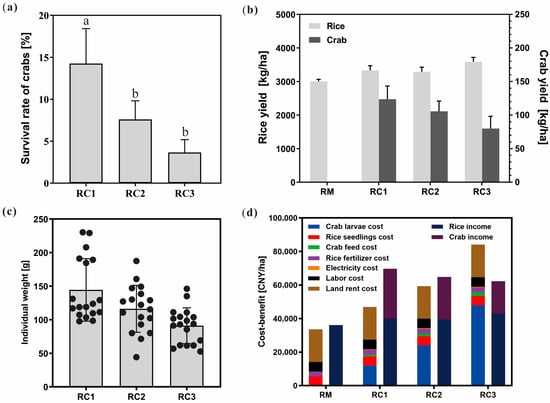
To investigate the yield of rice and crab under different stocking densities and the resulting economic benefits, we conducted a detailed tally of the year’s harvest. As illustrated in Figure 1a–c, under varying stocking densities (RC) as well as the rice monoculture mode (RM), rice yields were similar across all groups, showing no significant differences. While the survival rate of crabs, the average weight of individual crabs, and the yield of crabs were all highest under the RC3 group with the lowest stocking density of 6000 crabs per hectare. Moreover, the survival rate, average weight, and yield were negatively correlated with the stocking densities, which were 14.26% vs. 7.59% (RC1 vs. RC3), 144.44 g vs. 91.12 g (RC1 vs. RC3), and 123.67 kg/ha vs. 80.00 kg/ha (RC1 vs. RC3). Furthermore, we also analyzed the economic benefits based on the local prices of that year, including costs (land rent, labor costs, electricity costs, etc.) and income (rice and crabs). As seen from Figure 1d, in the RC groups, the cost of juvenile crabs and crab feed during the experiment increased with stocking density. While in the RM mode, land rent constituted the major part of the costs. Interestingly, in terms of income, the RC1 mode with the lowest crab stocking density generated the highest profit of 22,790.94 CNY/ha (3222.87 USD/ha), about a 9-fold increase compared with the monoculture of rice (2517.35 CNY/ha, 355.98 USD/ha).
Figure 1.
Rice and crab production in the SARC system. (a) Survival rates of crabs under different stocking densities. (b) Comparative yields of rice and crabs under different stocking densities. (c) Individual weight of crabs under different stocking densities. (d) Cost–benefit analysis of rice and crab production under different stocking densities. RC1_6000 ind/ha, RC2_12000 ind/ha, and RC3_24000 ind/ha. Different superscripts denote significant differences between treatments (p < 0.05).
3.2. Influence of the SARC System on Water Quality and Soil Nutrients
To investigate the effect of stocking densities of the SARC system on the water quality and soil physiochemical properties, we detected the representative parameters in detail at the end of the experiment. Regarding water quality parameters (Table 1), the results showed significant changes in chemical oxygen demand (COD), ammonia nitrogen, nitrate nitrogen, nitrite nitrogen, and phosphate concentrations with increasing stocking density. Specifically, in high-density stocking groups (such as RC2 and RC3), there were significant increases in COD, ammonia nitrogen, nitrite nitrogen levels, and phosphate levels, indicating that water pollution worsens with higher stocking densities. In terms of soil nutrients (Table 2), this study found that at the end of the cultivation, nitrate nitrogen, ammonium nitrogen, and available phosphorus levels in higher stocking density groups (RC2 and RC3) were significantly higher than those in the RM group. This suggested that the SARC system might lead to an increase in soil nutrient content, particularly under high stocking density conditions. Moreover, although there were no significant differences in total nitrogen content among the treatment groups at the end of cultivation, compared to the start, the total nitrogen content in the RM group had increased, whereas in the SARC system, it generally showed a decreasing trend.
Table 1.
Water quality in different treatment groups.
Table 2.
Soil physiochemical properties of different treatment groups.
3.3. Dynamics of Water and Soil Microbial Communities in the SARC System
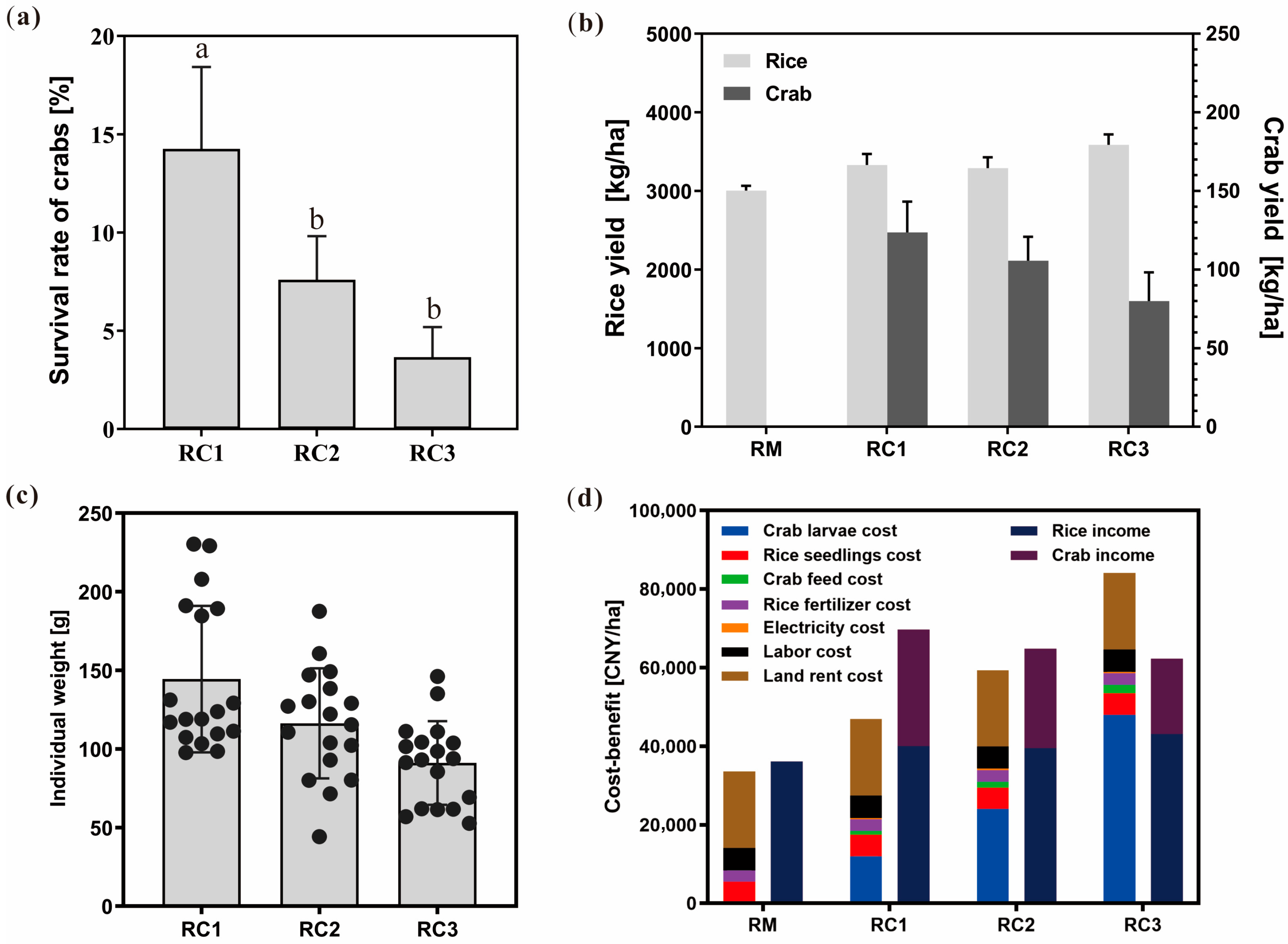
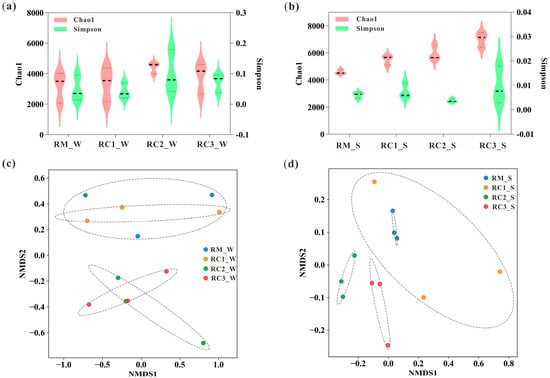
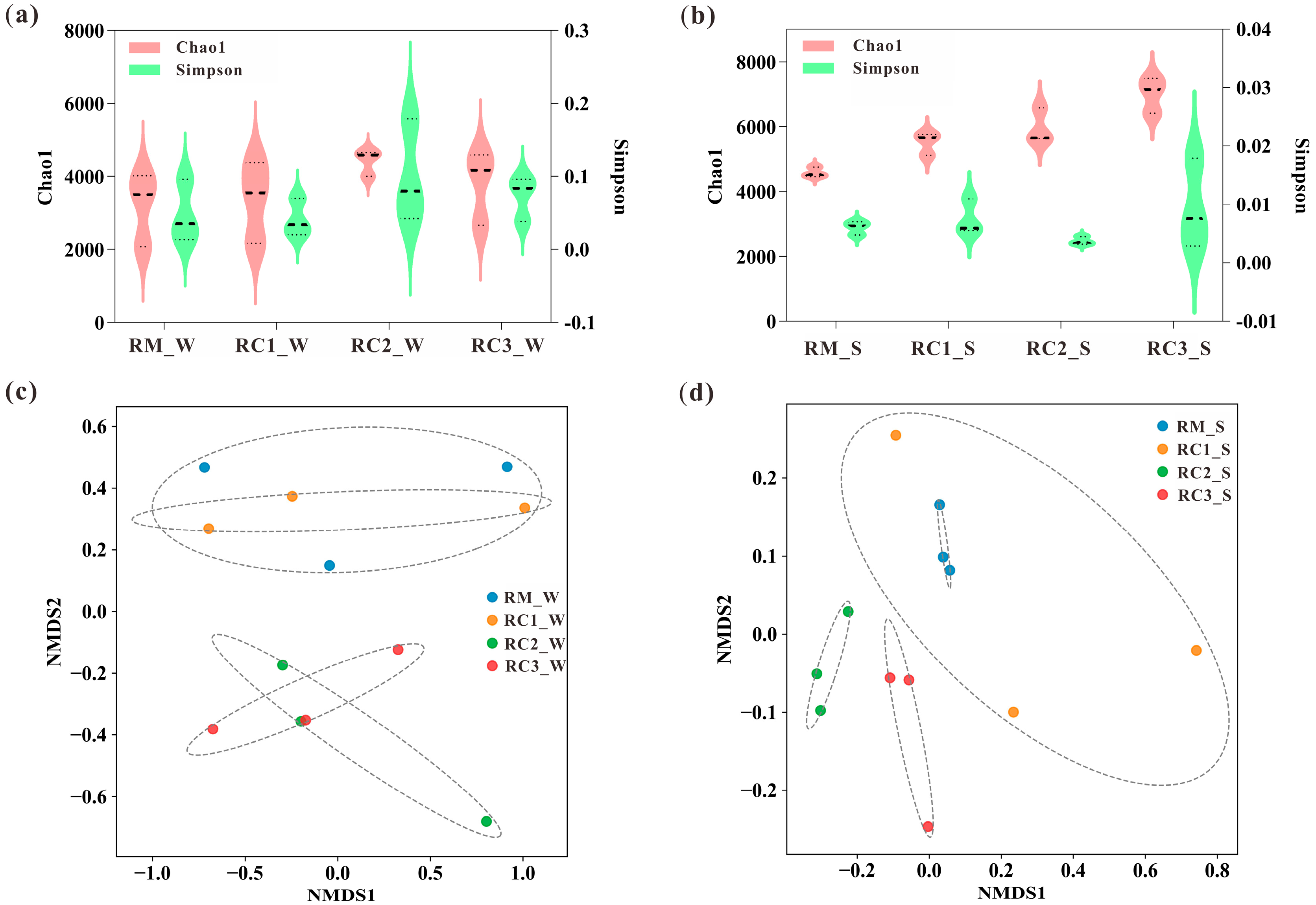
To investigate the microbial community of the SARC system, water samples and soil samples were collected and analyzed. According to Figure 2a,b, different stocking densities of mud crabs did not significantly alter (p > 0.05) the alpha diversity of the microbial community in the water body, as determined by the Chao1 and Simpson indexes. This suggests that the microbial community of salt-alkali rice paddies is highly stable and is less susceptible to changes in stocking density. Notably, the Chao1 index in soil samples gradually increased with the stocking density, indicating the elevated richness in the SARC system.
Figure 2.
Microbial community diversity in RM and various RC modes. (a) Alpha diversity in the water sample. (b) Alpha diversity in a soil sample. (c) Beta diversity in a water sample. (d) Beta diversity in a soil sample.
In contrast with the alpha diversity, the beta diversity calculated by the NMDS method exhibits a significant difference. As can be seen from Figure 2c, water samples in RM and RC modes showed different degrees of separation. Samples from the RM_W group are more widely distributed on the NMDS1 axis and more concentrated on the NMDS2 axis. The samples of the RC1_W, RC2_W, and RC3_W groups are more centrally distributed on both NMDS axes, and there is some overlap between them. Moreover, the RM_W group was better separated from the other three groups on the NMDS1 axis, suggesting that there may be large differences in beta diversity between these groups. Regarding the soil sample in Figure 2d, samples from the RM_S group showed greater dispersion on both NMDS axes. Samples from the RC1_S, RC2_S, and RC3_S groups are relatively more concentrated in NMDS space but show some degree of separation on the NMDS2 axis when compared to the RM_S group. Moreover, the samples from the RM_S group show some degree of separation from the other groups in NMDS space, suggesting that there are differences in beta diversity between the different groups.
3.4. Microbial Community Composition and Structure in the SARC System
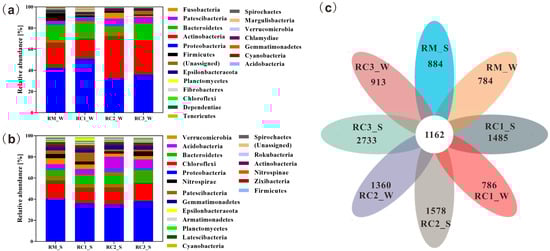
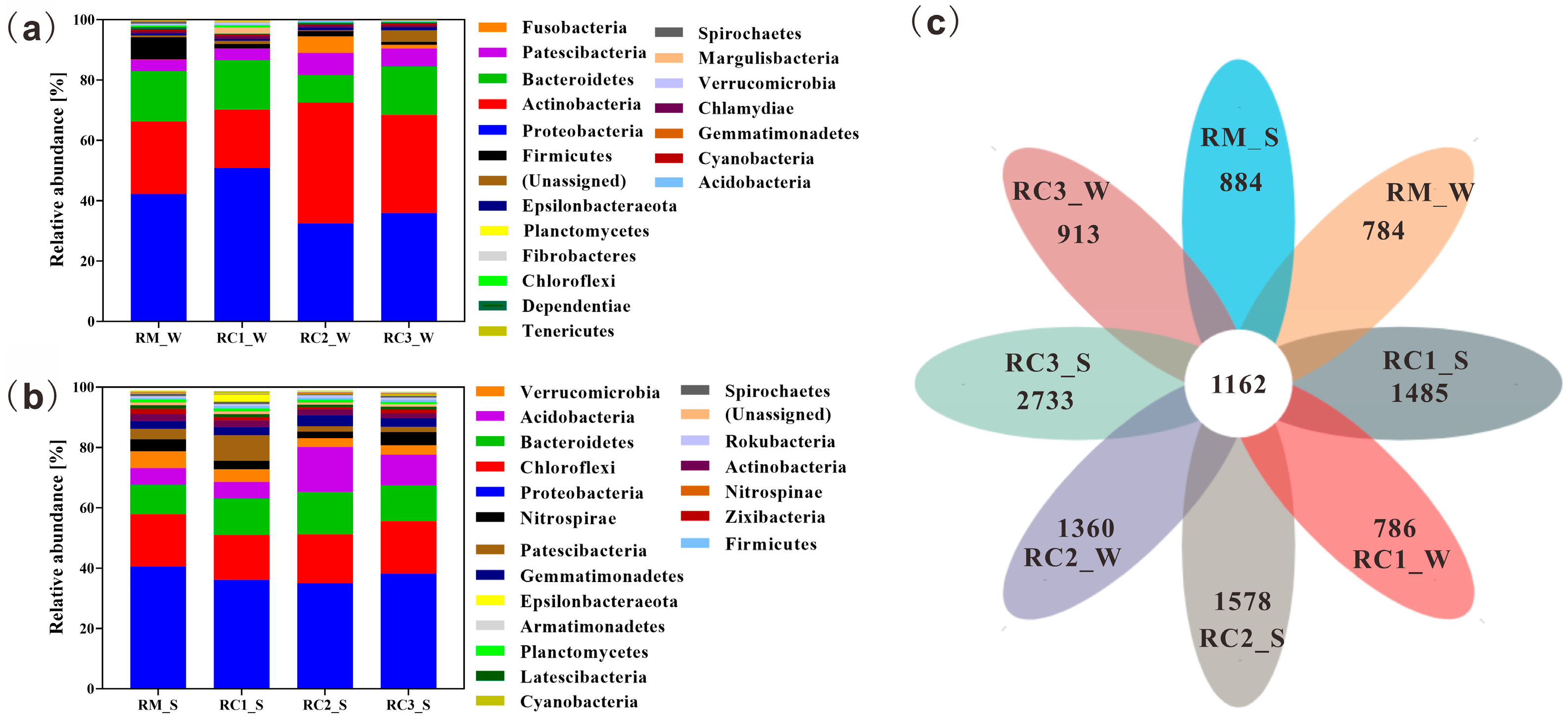
The composition and structure of a microbial community in water and soil were determined. The dominant phylum in the water and soil samples varied. From Figure 3a, the top 10 phyla in water samples were Proteobacteria, Actinobacteria, Bacteroidetes, Patescibacteria, Firmicutes, Fusobacteria, Chlamydiae, Epsilonbacteraeota, Margulisbacteria, and Cyanobacteria, respectively. Whereas in soil samples, Proteobacteria, Chloroflexi, Bacteroidetes, Acidobacteria, Verrucomicrobia, Patescibacteria, Nitrospirae, Gemmatimonadetes, Actinobacteria, and Zixibacteria constituted the top 10 phyla, as can be seen from Figure 3b. Among them, Firmicutes showed a significant decrease in the three RC_W groups compared with the RM_W group. While Patescibacteria, Fusobacteria, and Epsilonbacteraeota showed a significant increase in RC2_W and RC3_W groups compared with the RM group. In the soil sample, Proteobacteria, Verrucomicrobia, and Zixibacteria showed a significant decrease in the RC_S groups, compared with the RM_S group. The phylum of Bacteroidetes increased significantly in three RC_S groups. From the Venn graph in Figure 3c, there exist 1162 common OTU in SARC system, and the unique OTU counts in RC2_W and RC3_W were relatively higher than the RM_W group, while the unique counts in all three RC_S groups were higher than the RM_S group.
Figure 3.
Taxonomic profiling and OTUs statistics in the SARC system. (a) Top 20 phyla in the water sample. (b) Top 20 phyla in the soil sample. (c) Overlapped bacterial OTUs among different samples using Venn diagrams. OTU numbers are shown in each segment.
3.5. Microbial Functional Genes of C/N/S/P in the SACRC System
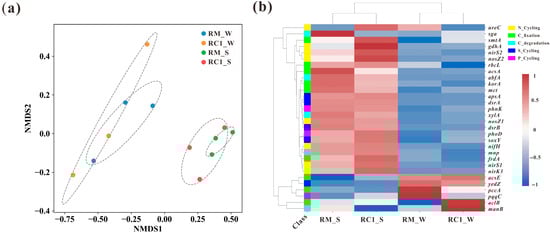
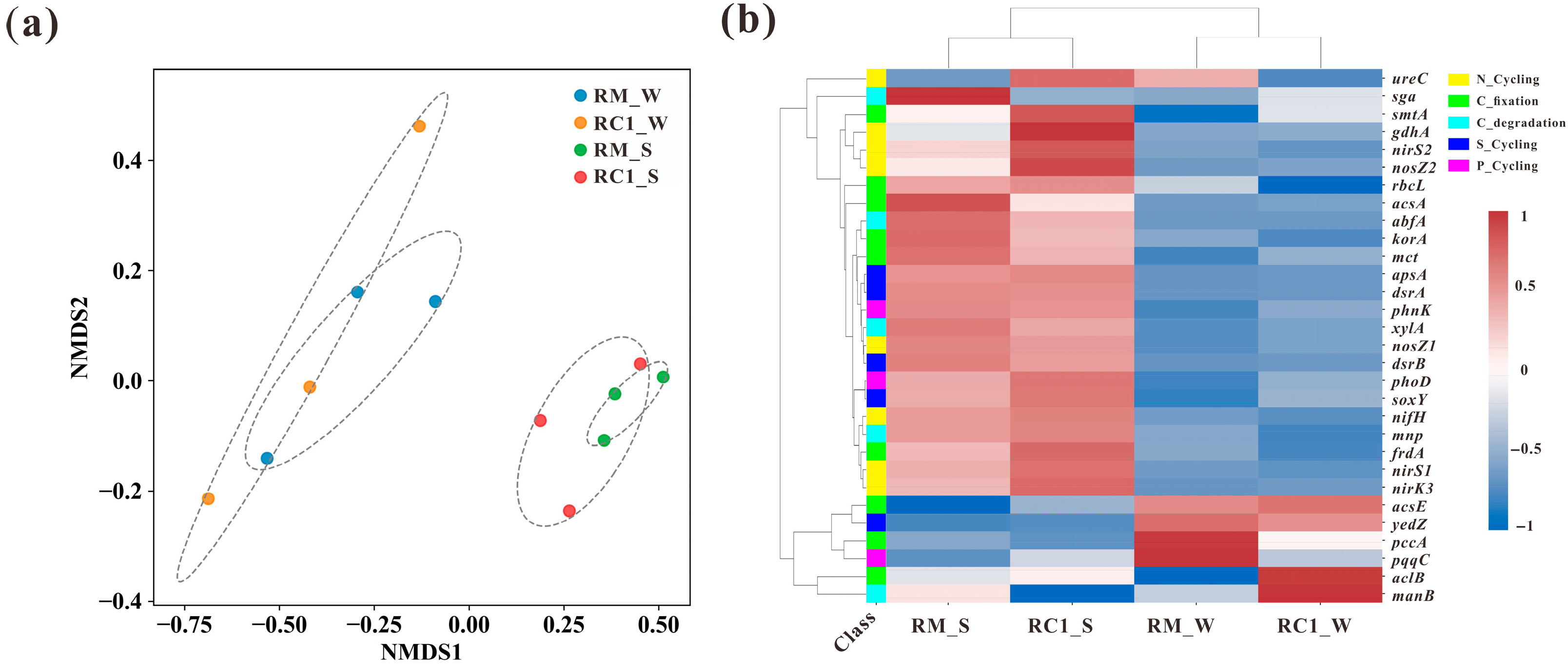
To investigate the differences in microbial CNSP functional genes under the SARC system, we analyzed the beta diversity of functional genes and the abundance of the top 30 functional genes. As can be seen from Figure 4a, there was a clear separation of water and soil functional genes in the SARC system, indicating a significant difference in beta diversity between the two types of samples. The heatmap results in Figure 4b showed that the abundance of various functional genes in soil was significantly higher in SARC than in water body samples, except for the S-cycle related functional genes of acsE and pccA, the C fixation gene of yedZ, and the P-cycle related gene of pqqC. In addition, the C fixation and C degradation genes showed a significant difference in abundance between the water and soil samples. C fixation and C degradation genes in water and soil samples did not show significant synchronized upward or downward trends in both RM and RC models, indicating that C-cycle functions are more variable in the SARC system. The vast majority of N cycle-related genes in soil samples showed a significant increase in the RC1 groups compared with the RM group; while the opposite trend was observed in water samples, suggesting that the N cycle-related genes assumed different functions in soil and water. S cycle genes did not show a significant change in the RM and RC modes in the two groups of samples, indicating that the S cycle function was more stable in the SARC mode. P cycle-related genes had a significant upward trend in the RC1_S and RC1_W groups compared to the RM groups, except for the phnK gene.
Figure 4.
Microbial functional gene abundances of SARC systems. (a) Beta diversity of functional genes in water and soil samples. (b) Heatmap of gene abundance in RM and RC1 groups.
3.6. Co-Occurrence Network
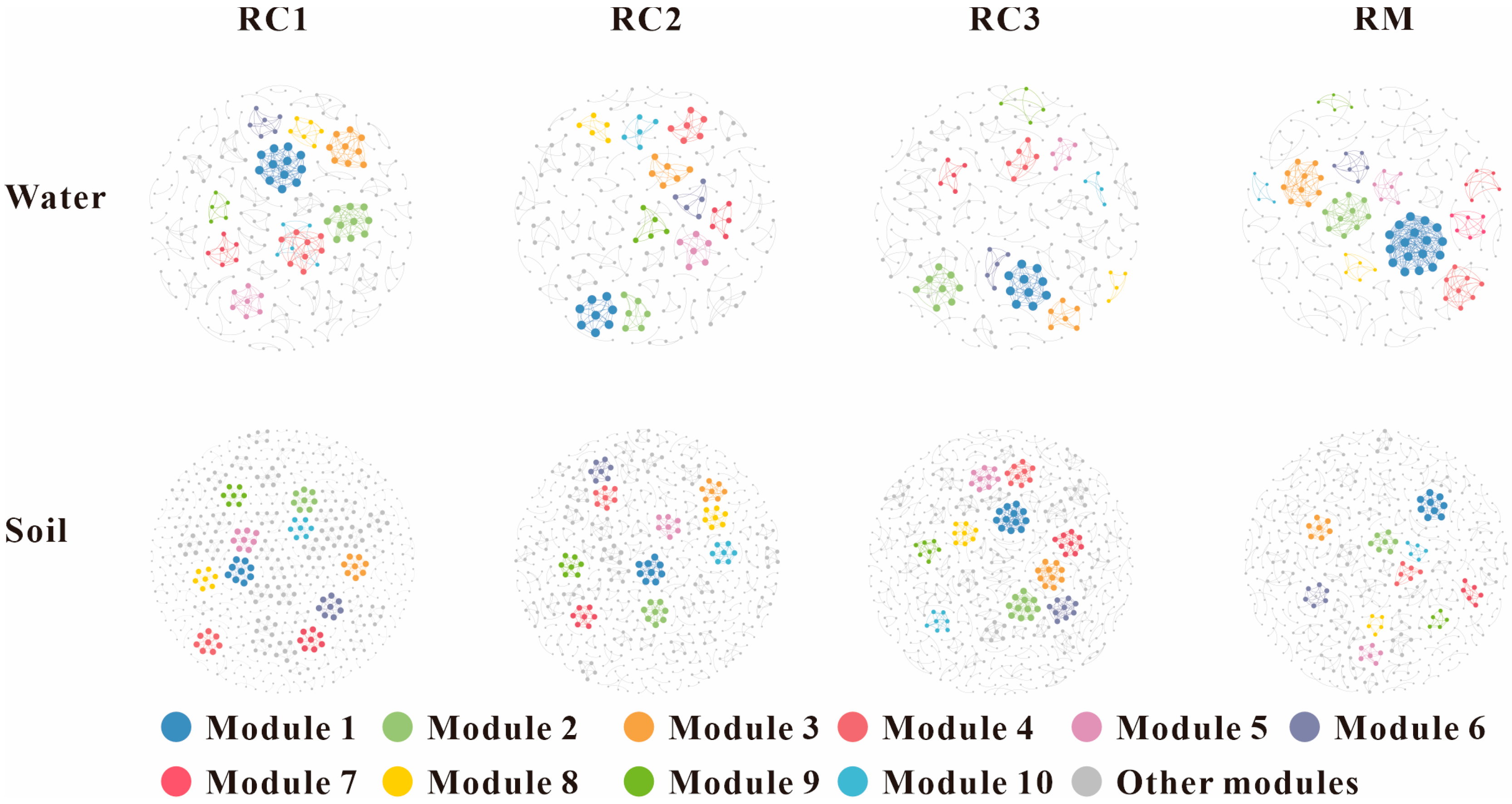
To understand the potential interactions among taxa in the microbial community, co-occurrence network analysis was conducted by calculating pairwise Spearman correlation coefficients (R > 0.9). As can be seen from Figure 5, the number of correlated OTUs in the soil microbial community was found to be higher than that in the water. This indicates that the microbial community network in the soil is more complex than in the water. If the modularity index is >0.4, the network exhibits a modular structure. In this study, the modularity index of the network ranged from 0.871 to 0.985, indicating a well-defined modular structure.
Figure 5.
Modularized networks of microbial communities in soil and water of the SARC system. Each edge depicts a significant (FDR-adjusted p < 0.01) and strong (Spearman |R| < 0.9) correlation coefficient. The node size is scaled according to the number of connections (i.e., degree). In modularized networks, the nodes were colored according to the modularity class.
Specifically, in water and soil, slight differences were observed in microbial networks (Figure 5) and topological parameters (Table 3) with varying stocking densities. In water, the microbial network of RC1 consisted of 264 nodes and 455 edges, slightly higher than the RM group (224 nodes and 437 edges). The modularity of the RC1, RC2, and RC3 networks was significantly higher than that of the RM group. The positive correlation ratios of RC1, RC2, and RC3 were significantly higher than those of the RM group. In soil, based on the number of nodes and edges, rice–crab co-culture also increased the complexity of the soil microbial community network. The positive correlation ratios of RC1, RC2, and RC3 were lower than those of the RM group, indicating that rice–crab co-culture reduced cooperation in the microbial community in the soil.
Table 3.
Topological parameters of co-occurrence networks.
4. Discussion
4.1. Suitable Stocking Density Can Significantly Improve the Comprehensive Economic Efficiency of the SARC System
The growth of aquatic animals depends on various environmental factors, with stocking density being a crucial factor affecting growth, health, and welfare [14,29,30]. In the SARC system, the optimal stocking density was 6000 ind/ha in the RC1 group, showing higher survival rates and individual weights compared to RC2 and RC3 groups (Figure 1a,c). Similar trends were observed in a study on rice-Chinese mitten crab co-culture, identifying an optimal density of 6746 ind/ha [31]. Increasing stocking density likely reduces space and resources, leading to interspecific competition, elevated stress, and increased energy consumption, impacting crab growth and survival [32,33,34]. Rice yields did not significantly differ across RC groups and RM groups, consistent with previous findings in rice-Chinese mitten crab and rice-fish co-cropping systems [15,35,36,37]. Some studies even suggest increased rice yields in integrated systems [6], influenced by various factors like aquatic species, rice variety, and farming practices [38]. Despite increasing costs with stocking density, the RC1 group achieved the highest net profit of 22,790.94 CNY/ha (3222.87 USD/ha), over 9 times more than the RM group (2517.35 CNY/ha, 355.98 USD/ha). Based on the data trend, it is evident that the high-density group has already led to negative returns. Continuing to increase the breeding density is highly likely to result in even greater losses and potential ecological burdens. It is also worth noting that the optimal density obtained in this study is based on the consideration of the current costs of rice fields and crabs. It may produce good benefits near the density of 6000 ind/ha. More accurate data under different densities need to be further explored in combination with the actual variable costs and benefits. Overall, the SARC system promises increased income for farmers with proper stocking density and management.
4.2. The SARC System Changes the Physicochemical Properties of Paddy Water and Soil
Water quality and soil fertility in rice–crab co-culture systems play vital roles in mud crab and rice growth. Aquatic animals require a consistent food and oxygen supply during aquaculture [39]. In SARC systems, residual feed and mud crab waste become primary nitrogen sources [40], leading to nutrient accumulation in water and soil [41]. Meanwhile, TP and phosphate levels in RC1 were similar to rice monoculture, suggesting effective P element purification at this density. However, higher mud crab densities in RC2 and RC3 resulted in elevated physicochemical parameters compared to RM_W, indicating increased wastewater load. While NH4+-N typically dominates paddy water during aquaculture [42,43], this study found higher nitrate nitrogen, likely due to enhanced nitrification from increased dissolved oxygen levels. Soil parameters like NO2− and NH4+ remained stable in RC1, suggesting effective low-level nitrogen purification. However, elevated levels of NO2−, NH4+, and AP in RC3 and RC2 groups indicated increased nutrient loads. Total nitrogen trends differed between water and soil, highlighting distinct nitrogen metabolism in each medium.
4.3. SARC Altered the Microbial Community Composition and Structure of Paddy Water
Microbial communities serve as indicators of environmental health [44,45]. Stability in these communities maintains ecosystem functions and indicates microbial population variations [44,46,47]. Our study revealed stable microbial communities across stocking densities, with the RC1 stocking creating a homeostatic environmental structure in the rice paddy ecosystem [48].
Proteobacteria, Actinobacteria, and Bacteroidetes dominate the rice–fishery ecosystem [16,49]. Firmicutes degrade organic matter and thrive in extreme conditions [50]. Their abundance decreased with stocking density, likely due to increased feed and excreta affecting water quality. Patescibacteria are challenging to cultivate and may co-metabolize with other microorganisms [51,52]. Their increase at higher densities suggests adaptation to nutrient changes. Fusobacteria, often associated with animal pathologies, increased with high-density stocking, indicating potential disease risks linked to organic loading changes [53]. Although no pathological manifestations have been observed in cultured animals in current studies, the increased abundance of opportunistic pathogens still reminds us that, while pursuing economic benefits, ecological management measures must be prioritized. Epsilonbacteraeota may contribute to nitrogen removal, suggesting their role in excess N treatment. In soil, Verrucomicrobia fix nitrogen and reduce methane emissions [54,55], while Bacteroidetes aid in organic matter decomposition [56,57]. Their increased abundance suggests favorable soil conditions under specific density conditions.
Network analysis provides insights into microbial community dynamics, revealing differences in soil and water microbial networks. Soil networks displayed greater complexity, possibly due to spatial variations [58,59]. The RC stocking influenced network modularity and negative correlations, indicators of network stability [60]. Water samples with RC stocking showed increased stability compared to RM, while soil showed the opposite. Different culture densities altered network characteristics, with RC promoting cooperation in water but reducing it in soil. Thus, soil and water bacterial networks respond differently to stocking patterns. Overall, this approach captures the final microbial outcomes under different stocking densities. Considering the dynamic successional processes of microbial communities over time [61], future research should incorporate multi-time-point monitoring in the SARC system, thereby providing a basis for precise management and regulation.
4.4. SARC Altered the Functional Gene Abundance and Structure
Geochemical cycles of C/N/P/S genes sustain ecosystem functions, including nutrient provision for crops and animals and environmental improvement [62]. The distinct microbial community structures between water and soil, as revealed by 16S rRNA gene analysis (Figure 2), directly underpinned the differential distribution of functional genes involved in biogeochemical cycles (Figure 4). NMDS-based beta diversity analysis indicated distinct separation of functional genes between water and soil. Heatmap results revealed higher functional gene abundance in soil than water (Figure 5), possibly due to increased organic matter promoting microbial activity and elemental cycling in soil [63]. The ammonification of ureC [64] and gdhA can convert organic nitrogen into inorganic nitrogen, and the increase in the abundance of ureC and gdhA had a significant effect on the increase in NH4+-N content of the water and soil environments after stocking of mud crabs. nosZ, nirS, and nirK genes contribute to denitrification, and nifH is capable of nitrogen fixation [65,66,67]. Moreover, the enrichment of key nitrogen-cycling genes in soil corresponds to the observed increase in NH4+-N content after crab introduction. Therefore, it is suggested that the crab-induced shift in the soil microbial community enhanced organic nitrogen mineralization, thereby converting crab-derived organic nitrogen into plant-available forms.
Similarly, the diverse abundance of C-cycle-related genes might be due to the different nutrient availability in water and soil. For example, soil is richer in organic matter, which may promote the utilization of carbon sources by microorganisms in soil, whereas water bodies have relatively fewer carbon sources, and microorganisms may rely more on other nutrients. Only three phosphorus cycling genes constituted the top 30 functional genes, of which pqqC and phoD encode pyrroloquinoline quinone synthase and phosphatase [68,69], respectively, regulating inorganic and organic phosphorus. While phnK is involved in the catabolism of organophosphate [70]. Of the top five sulfur cycling genes, the dsrAB, soxY, and apsA are for S reduction [71], while the soxY gene is for sulfur oxidation [72]. In essence, the compartment-specific microbial assemblies, shaped by the integrated rice–crab environment, functionally diverged to modulate the bioavailability of nutrients (e.g., NH4+, soluble P, S). This microbial-mediated transformation of nutrients, particularly the enhanced mineralization of crab waste, constitutes a critical ecological feedback that supports the concurrent growth of both rice and crabs, ultimately contributing to the observed productivity gains in the SARC system.
5. Conclusions
In conclusion, this present study established the newly emerging SARC system, applying salt-tolerant rice with diverse stocking densities of mud crabs co-cropping. Under a suitable stocking density of 6000 ind/ha and elaborate farm management, nearly a 10-fold increase in the net profit was produced. Relatively higher stocking densities altered the water and soil physicochemical properties, imposing an extra nutrient burden for the original rice paddy ecosystem. Although higher stocking densities did not significantly alter soil microbial alpha diversity, they increased species richness. By modifying the physicochemical properties of water and soil, these densities introduced additional nutrient loads into the system, significantly influencing microbial community structure and the distribution of functional genes related to carbon, nitrogen, sulfur, and phosphorus cycles. Network analysis further revealed that aquatic microorganisms tended to exhibit cooperative and symbiotic relationships, while soil microorganisms showed a trend toward intensified competition. The study demonstrates that the SARC system drives the restructuring of microbial community composition and function through aquaculture activities, and the metabolic responses and interaction patterns of microorganisms transform nutrient inputs into productivity gains for the system. This study provided a theoretical reference for the SARC system, beneficial to the under-exploited coastal saline land resources.
Author Contributions
C.Z.: Writing—Original Draft; Writing—Review and Editing; Visualization; Methodology; Formal Analysis; Data Curation; Investigation; Conceptualization. H.Z.: Visualization; Investigation; Formal Analysis; Conceptualization. F.Z.: Visualization; Formal Analysis; Conceptualization. J.X.: Visualization; Formal Analysis; Conceptualization. X.W.: Visualization; Writing—Review and Editing; Formal Analysis; Conceptualization. Z.Y.: Supervision; Methodology; Investigation; Formal Analysis; Conceptualization. C.W.: Visualization; Validation; Funding acquisition; Methodology; Investigation; Formal Analysis; Conceptualization. C.M.: Methodology; Investigation. Y.Y.: Validation; Funding acquisition. Y.Z.: Investigation; Formal Analysis. Q.W.: Formal Analysis; Resources; Supervision. C.S.: Supervision; Data Curation; Writing—Review and Editing; Validation. All authors have read and agreed to the published version of the manuscript.
Funding
This work was supported by the National Key R&D Program of China (2023YFD2401001), the Ningbo International Collaboration Project (2023H012), and the China Agriculture Research System of MOF and MARA (No. CARS-48).
Data Availability Statement
The original contributions presented in this study are included in the article. Further inquiries can be directed to the corresponding author.
Acknowledgments
We sincerely thank all the students for their valuable help in the field experiment. Thank the Research Academy of Sanmen Mud Crab Industrial Technology for providing experimental sites and juvenile mud crabs.
Conflicts of Interest
The authors declare that they have no conflicts of interest.
Abbreviations
The following abbreviations are used in this manuscript:
| SARC | The Salinity-tolerant Rice–Mud Crab Co-culture |
| NMDS | Non-metric multidimensional scaling |
| COD | Chemical oxygen demand |
References
- Xia, L.; Li, X.; Ma, Q.; Lam, S.K.; Wolf, B.; Kiese, R.; Butterbach-Bahl, K.; Chen, D.; Li, Z.; Yan, X. Simultaneous quantification of N2, NH3 and N2O emissions from a flooded paddy field under different N fertilization regimes. Glob. Change Biol. 2020, 26, 2292–2303. [Google Scholar] [CrossRef] [Scilit]
- Li, Z.; Liu, Z.; Anderson, W.; Yang, P.; Wu, W.; Tang, H.; You, L. Chinese rice production area adaptations to climate changes, 1949–2010. Environ. Sci. Technol. 2015, 49, 2032–2037. [Google Scholar] [CrossRef] [Scilit] [PubMed]
- Gao, C.; Zhang, T. Eutrophication in a Chinese context: Understanding various physical and socio-economic aspects. Ambio 2010, 39, 385–393. [Google Scholar] [CrossRef] [Scilit]
- van Wesenbeeck, C.F.A.; Keyzer, M.A.; van Veen, W.C.M.; Qiu, H. Can China’s overuse of fertilizer be reduced without threatening food security and farm incomes? Agric. Syst. 2021, 190, 103093. [Google Scholar] [CrossRef] [Scilit]
- Sattler, C.; Gianuca, A.T.; Schweiger, O.; Franzén, M.; Settele, J. Pesticides and land cover heterogeneity affect functional group and taxonomic diversity of arthropods in rice agroecosystems. Agric. Ecosyst. Environ. 2020, 297, 106927. [Google Scholar] [CrossRef] [Scilit]
- Frei, M.; Becker, K. Integrated rice-fish culture: Coupled production saves resources. Nat. Resour. Forum. 2005, 29, 135–143. [Google Scholar] [CrossRef] [Scilit]
- Phillips, M.; De Silva, S. Finfish cage culture in Asia: An overview of status, lessons learned and future developments. In Proceedings of the FAO Regional Technical Expert Workshop on Cage Culture in Africa, Entebbe, Uganda, 20–23 October 2004; pp. 49–72. [Google Scholar]
- Wheatcroft, R.A. Time-series measurements of macrobenthos abundance and sediment bioturbation intensity on a flood-dominated shelf. Prog. Oceanogr. 2006, 71, 88–122. [Google Scholar] [CrossRef] [Scilit]
- Yu, X.; Hao, X.; Dang, Z.; Yang, L. Development report on integrated rice-fish farming industry in China (2022). Chin. Fish. 2023, 1, 39–46. [Google Scholar]
- Qin, H.; Li, Y.; Huang, R. Advances and challenges in the breeding of salt-tolerant rice. Int. J. Mol. Sci. 2020, 21, 8385. [Google Scholar] [CrossRef] [Scilit]
- Nurdiani, R.; Zeng, C. Effects of temperature and salinity on the survival and development of mud crab, Scylla serrata (Forsskål), larvae. Aquacult. Res. 2007, 38, 1529–1538. [Google Scholar] [CrossRef] [Scilit]
- Davenport, J.; Wong, T.M. Responses of adult mud crabs (Scylla serrata) (Forskal) to salinity and low oxygen tension. Comp. Biochem. Physiol. Part A Physiol. 1987, 86, 43–47. [Google Scholar] [CrossRef] [Scilit]
- Wu, Q.; Shi, X.; Fang, S.; Xie, Z.; Guan, M.; Li, S.; Zheng, H.; Zhang, Y.; Ikhwanuddin, M.; Ma, H. Different biochemical composition and nutritional value attribute to salinity and rearing period in male and female mud crab Scylla paramamosain. Aquaculture 2019, 513, 734417. [Google Scholar] [CrossRef] [Scilit]
- Refaey, M.M.; Li, D.; Tian, X.; Zhang, Z.; Zhang, X.; Li, L.; Tang, R. High stocking density alters growth performance, blood biochemistry, intestinal histology, and muscle quality of channel catfish Ictalurus punctatus. Aquaculture 2018, 492, 73–81. [Google Scholar] [CrossRef] [Scilit]
- Berg, H. Rice monoculture and integrated rice-fish farming in the Mekong Delta, Vietnam—Economic and ecological considerations. Ecol. Econ. 2002, 41, 95–107. [Google Scholar] [CrossRef] [Scilit]
- Li, P.; Wu, G.; Li, Y.; Hu, C.; Ge, L.; Zheng, X.; Zhang, J.; Chen, J.; Zhang, H.; Bai, N.; et al. Long-term rice-crayfish-turtle co-culture maintains high crop yields by improving soil health and increasing soil microbial community stability. Geoderma 2022, 413, 115745. [Google Scholar] [CrossRef] [Scilit]
- Reiss, K.; Mander, Ü.; Öpik, M.; Sepp, S.; Kanger, K.; Schindler, T.; Soosaar, K.; Pihlatie, M.; Butterbach-Bahl, K.; Putkinen, A.; et al. Temporal and spatial dynamics of microbial communities and greenhouse gas flux responses to experimental flooding in riparian forest soils. FEMS Microbiol. Ecol. 2025, 101, fiaf109. [Google Scholar] [CrossRef] [Scilit]
- Liu, Z.; Jiang, A.; Kong, Z.; Lv, X.; Zhang, J.; Wu, J.; Zhou, C.; Tan, Z. Multi-omics analysis reveals the mechanism of rosemary extract supplementation in increasing milk production in Sanhe dairy cows via the “rumen-serum-milk” metabolic pathway. Anim. Nutr. 2025, 23, 396–414. [Google Scholar] [CrossRef] [Scilit]
- Ma, L.; Zhang, C.; Qin, B.; Yang, T.; Xu, R.; Zhu, L.; Han, G.; Wu, L.; Li, S.; Bi, J.; et al. Microbial mechanisms of biochar reducing methane emission in a rice-crayfish integrated system. J. Environ. Manag. 2025, 395, 127790. [Google Scholar] [CrossRef] [Scilit]
- Liu, X.; Jia, Q.; Sun, D.; Zhang, J.; Zheng, H.; Chen, Y. Influence of nitrogen substitution at an equivalent total nitrogen level on bacterial and fungal communities, as well as enzyme activities of the ditch bottom soil in a rice-fish coculture system. J. Sci. Food Agric. 2024, 104, 4206–4217. [Google Scholar] [CrossRef] [Scilit] [PubMed]
- Yao, H.; Wang, H.; Tang, L.; Li, X.; Wang, C.; Mu, C.; Shi, C. A Method for Effectively Improving the Survival Rate of Juvenile Eriocheir Sinensis During Desalination. CN110463638A, 19 November 2019. [Google Scholar]
- Ni, M.; Yuan, J.; Zhang, L.; Hua, J.; Rong, H.; Gu, Z. In- situ and ex- situ purification effect of ecological ponds of Euryale ferox Salisb on shrimp aquaculture. Aquaculture 2021, 540, 736678. [Google Scholar] [CrossRef] [Scilit]
- Bao, S. Soil Agrochemical Analysis, 3rd ed.; China Agricultural Press: Beijing, China, 2000. [Google Scholar]
- Song, G.; Sun, B.; Jiao, J. Comparison of ultraviolet spectrophotometry method for determination of soil nitrate nitrogen with other methods. Acta Pedol. Sin. 2007, 44, 6. [Google Scholar]
- Luo, D.; Li, Y.; Yao, H.; Chapman, S.J. Effects of different carbon sources on methane production and the methanogenic communities in iron rich flooded paddy soil. Sci. Total Environ. 2022, 823, 153636. [Google Scholar] [CrossRef] [Scilit] [PubMed]
- Wang, Y.; Wang, K.; Huang, L.; Dong, P.; Wang, S.; Chen, H.; Lu, Z.; Hou, D.; Zhang, D. Fine-scale succession patterns and assembly mechanisms of bacterial community of Litopenaeus vannamei larvae across the developmental cycle. Microbiome 2020, 8, 106. [Google Scholar] [CrossRef] [Scilit]
- Zhou, X.; Liu, X.; Liu, M.; Liu, W.; Xu, J.; Li, Y. Comparative evaluation of 16S rRNA primer pairs in identifying nitrifying guilds in soils under long-term organic fertilization and water management. Front. Microbiol. 2024, 15, 1424795. [Google Scholar] [CrossRef] [Scilit]
- Zhu, Y.; Zheng, B.; Su, J.; Li, H.; Yao, H. High-Throughput Detection Primers and Detection Methods for Microbial Carbon, Nitrogen, Phosphorus, and Sulfur Element Functional Genes. CN106048041B, 26 April 2017. [Google Scholar]
- Lisboa, V.; Barcarolli, I.F.; Sampaio, L.; Bianchini, A. Effect of salinity on survival, growth and biochemical parameters in juvenile Lebranch mullet Mugil liza (Perciformes: Mugilidae). Neotrop. Ichthyol. 2015, 13, 447–452. [Google Scholar] [CrossRef] [Scilit]
- Imsland, A.K.D.; Roth, B.; Fjelldal, P.G.; Stefansson, S.O.; Handeland, S.; Mikalsen, B. The effect of continuous light at low temperatures on growth in Atlantic salmon reared in commercial size sea pens. Aquaculture 2017, 479, 645–651. [Google Scholar] [CrossRef] [Scilit]
- Zheng, Y.; Liu, X.; Geng, D.; Xu, X.; Li, Y. Effect of crab stocking density on cultivation efficiency in paddy crab aquaculture. Hunan Agric. Sci. 2019, 8, 74–77. [Google Scholar] [CrossRef]
- Sammouth, S.; d’Orbcastel, E.R.; Gasset, E.; Lemarié, G.; Breuil, G.; Marino, G.; Coeurdacier, J.; Fivelstad, S.; Blancheton, J. The effect of density on sea bass (Dicentrarchus labrax) performance in a tank-based recirculating system. Aquacult. Eng. 2009, 40, 72–78. [Google Scholar] [CrossRef] [Scilit]
- Laursen, D.C.; Silva, P.I.M.; Larsen, B.K.; Höglund, E. High oxygen consumption rates and scale loss indicate elevated aggressive behaviour at low rearing density, while elevated brain serotonergic activity suggests chronic stress at high rearing densities in farmed rainbow trout. Physiol. Behav. 2013, 122, 147–154. [Google Scholar] [CrossRef] [Scilit]
- Naderi, M.; Keyvanshokooh, S.; Salati, A.P.; Ghaedi, A. Effects of chronic high stocking density on liver proteome of rainbow trout (Oncorhynchus mykiss). Fish Physiol. Biochem. 2017, 43, 1373–1385. [Google Scholar] [CrossRef] [Scilit]
- Li, X.; Dong, S.; Lei, Y.; Li, Y. The effect of stocking density of Chinese mitten crab Eriocheir sinensis on rice and crab seed yields in rice–crab culture systems. Aquaculture 2007, 273, 487–493. [Google Scholar] [CrossRef] [Scilit]
- Vromant, N.; Chau, N.T.H. Overall effect of rice biomass and fish on the aquatic ecology of experimental rice plots. Agric. Ecosyst. Environ. 2005, 111, 153–165. [Google Scholar] [CrossRef] [Scilit]
- Halwart, M.; Litsinger, J.; Barrion, A.; Viray, M.; Kaule, G. Efficacy of Common Carp and Nile Tilapia as biocontrol agents of rice insect pests in the Philippines. Int. J. Pest Manag. 2012, 58, 330–346. [Google Scholar] [CrossRef] [Scilit]
- Lightfoot, C.; van Dam, A.; Costa-Pierce, B. What’s Happening to the Rice Yields in Rice-Fish Systems. In Rice-Fish Research and Development in Asia; International Center for Living Aquatic Resources Management: Manila, Philippines, 1992. [Google Scholar]
- da Silva, K.R.; Wasielesky, W.; Abreu, P.C. Nitrogen and phosphorus dynamics in the biofloc production of the pacific white shrimp, Litopenaeus vannamei. J. World Aquacult. Soc. 2013, 44, 30–41. [Google Scholar] [CrossRef] [Scilit]
- Bai, D.; Li, X.; Liu, Z.; Wan, L.; Song, C.; Zhou, Y.; Cao, X. Nitrogen and phosphorus turnover and coupling in ponds with different aquaculture species. Aquaculture 2023, 563, 738997. [Google Scholar] [CrossRef] [Scilit]
- Jackson, C.; Preston, N.; Thompson, P.J.; Burford, M. Nitrogen budget and effluent nitrogen components at an intensive shrimp farm. Aquaculture 2003, 218, 397–411. [Google Scholar] [CrossRef] [Scilit]
- Pan, S.; Huang, S.; Cao, C.; Cai, M.; Zhai, J.; Jiang, Y.; Zhang, F. Effects of nitrogen fertilizer management on dynamics of nitrogen in rice field surface water and nitrogen absorption utilization efficiency. J. Agro-Environ. Sci. 2010, 29, 6. [Google Scholar]
- Li, J.; Li, S.; Wu, Q.; Zhu, X.; Wu, J. Effects of different fertilization treatments on nitrogen runoff and leaching losses in paddy fields. J. Soil Water Conserv. 2016, 30, 23–28+33. [Google Scholar] [CrossRef]
- Balvanera, P.; Pfisterer, A.B.; Buchmann, N.; He, J.; Nakashizuka, T.; Raffaelli, D.; Schmid, B. Quantifying the evidence for biodiversity effects on ecosystem functioning and services. Ecol. Lett. 2006, 9, 1146–1156. [Google Scholar] [CrossRef] [Scilit]
- Falkowski, P.G.; Fenchel, T.; Delong, E.F. The Microbial Engines That Drive Earth’s Biogeochemical Cycles. Science 2008, 320, 1034–1039. [Google Scholar] [CrossRef] [Scilit]
- Griffiths, B.S.; Philippot, L. Insights into the resistance and resilience of the soil microbial community. FEMS Microbiol. Rev. 2013, 37, 112–129. [Google Scholar] [CrossRef] [Scilit]
- Xun, W.; Liu, Y.; Li, W.; Ren, Y.; Xiong, W.; Xu, Z.; Zhang, N.; Miao, Y.; Shen, Q.; Zhang, R. Specialized metabolic functions of keystone taxa sustain soil microbiome stability. Microbiome 2021, 9, 35. [Google Scholar] [CrossRef] [Scilit]
- Wu, D.; Wang, W.; Yao, Y.; Li, H.; Wang, Q.; Niu, B. Microbial interactions within beneficial consortia promote soil health. Sci. Total Environ. 2023, 900, 165801. [Google Scholar] [CrossRef] [Scilit] [PubMed]
- Wei, D.; Xing, C.; Hou, D.; Zeng, S.; Zhou, R.; Yu, L.; Wang, H.; Deng, Z.; Weng, S.; He, J.; et al. Distinct bacterial communities in the environmental water, sediment and intestine between two crayfish-plant coculture ecosystems. Appl. Microbiol. Biotechnol. 2021, 105, 5087–5101. [Google Scholar] [CrossRef] [Scilit]
- Mahdy, A.; Wandera, S.M.; Bi, S.; Song, Y.; Qiao, W.; Dong, R. Response of the microbial community to the methanogenic performance of biologically hydrolyzed sewage sludge with variable hydraulic retention times. Bioresour. Technol. 2019, 288, 121581. [Google Scholar] [CrossRef] [Scilit] [PubMed]
- Lemos, L.N.; Medeiros, J.D.; Dini-Andreote, F.; Fernandes, G.R.; Varani, A.M.; Oliveira, G.; Pylro, V.S. Genomic signatures and co-occurrence patterns of the ultra-small Saccharimonadia (phylum CPR/Patescibacteria) suggest a symbiotic lifestyle. Mol. Ecol. 2019, 28, 4259–4271. [Google Scholar] [CrossRef] [Scilit] [PubMed]
- Hu, H.; Kristensen, J.M.; Herbold, C.W.; Pjevac, P.; Kitzinger, K.; Hausmann, B.; Dueholm, M.K.D.; Nielsen, P.H.; Wagner, M. Global abundance patterns, diversity, and ecology of Patescibacteria in wastewater treatment plants. Microbiome 2024, 12, 55. [Google Scholar] [CrossRef] [Scilit]
- Li, J.; Fang, L.; Liang, X.; Guo, W.; Lv, L.; Li, L. Influence of environmental factors and bacterial community diversity in pond water on health of Chinese perch through Gut Microbiota change. Aquac. Rep. 2021, 20, 100629. [Google Scholar] [CrossRef] [Scilit]
- Dunfield, P.F.; Yuryev, A.; Senin, P.; Smirnova, A.V.; Stott, M.B.; Hou, S.; Ly, B.; Saw, J.H.; Zhou, Z.; Ren, Y.; et al. Methane oxidation by an extremely acidophilic bacterium of the phylum Verrucomicrobia. Nature 2007, 450, 879–882. [Google Scholar] [CrossRef] [Scilit]
- Nixon, S.L.; Daly, R.A.; Borton, M.A.; Solden, L.M.; Welch, S.A.; Cole, D.R.; Mouser, P.J.; Wilkins, M.J.; Wrighton, K.C. Genome-resolved metagenomics extends the environmental distribution of the Verrucomicrobia phylum to the deep terrestrial subsurface. mSphere 2019, 4, e00613-19. [Google Scholar] [CrossRef] [Scilit]
- Zhang, J.; Ji, Y.; Guo, Y.; Yin, X.; Li, Y.; Han, J.; Liu, Y.; Wang, C.; Wang, W.; Liu, Y.; et al. Responses of soil respiration and microbial community structure to fertilizer and irrigation regimes over 2 years in temperate vineyards in North China. Sci. Total Environ. 2022, 840, 156469. [Google Scholar] [CrossRef] [Scilit]
- Liao, J.; Dou, Y.; Yang, X.; An, S. Soil microbial community and their functional genes during grassland restoration. J. Environ. Manag. 2023, 325, 116488. [Google Scholar] [CrossRef] [Scilit] [PubMed]
- Gravuer, K.; Eskelinen, A.; Winbourne, J.B.; Harrison, S.P. Vulnerability and resistance in the spatial heterogeneity of soil microbial communities under resource additions. Proc. Natl. Acad. Sci. USA 2020, 117, 7263–7270. [Google Scholar] [CrossRef] [Scilit]
- Nunan, N.; Schmidt, H.; Raynaud, X. The ecology of heterogeneity: Soil bacterial communities and C dynamics. Philos. Trans. R. Soc. B Biol. Sci. 2020, 375, 20190249. [Google Scholar] [CrossRef] [Scilit]
- Liu, S.; Yu, H.; Yu, Y.; Huang, J.; Zhou, Z.; Zeng, J.; Chen, P.; Xiao, F.; He, Z.; Yan, Q. Ecological stability of microbial communities in Lake Donghu regulated by keystone taxa. Ecol. Indic. 2022, 136, 108695. [Google Scholar] [CrossRef] [Scilit]
- Sun, Y.; Lin, W.; Wu, Q.; Shi, C.; Wang, C.; Ye, Y. Bacterial dynamics and biotic sources in the developing swimming crab embryos. Aquaculture 2025, 595, 741523. [Google Scholar] [CrossRef] [Scilit]
- Xue, K.; Wu, L.; Deng, Y.; He, Z.; Van Nostrand, J.; Robertson, P.G.; Schmidt, T.M.; Zhou, J. Functional gene differences in soil microbial communities from conventional, low-input, and organic farmlands. Appl. Environ. Microbiol. 2013, 79, 1284–1292. [Google Scholar] [CrossRef] [Scilit] [PubMed]
- Tian, J.; Wang, J.; Dippold, M.; Gao, Y.; Blagodatskaya, E.; Kuzyakov, Y. Biochar affects soil organic matter cycling and microbial functions but does not alter microbial community structure in a paddy soil. Sci. Total Environ. 2016, 556, 89–97. [Google Scholar] [CrossRef] [Scilit]
- Fisher, K.A.; Yarwood, S.A.; James, B.R. Soil urease activity and bacterial ureC gene copy numbers: Effect of pH. Geoderma 2017, 285, 1–8. [Google Scholar] [CrossRef] [Scilit]
- Tong, S. Diversity and Activity of Nitrogenase Nifh Genes of Endophytic Nitrogen-Fixing Bacteria in Rice and Wheat; Chinese Academy Of Agricultural Sciences: Beijing, China, 2020.
- Zhang, X.; Wang, H.; Li, Z.; Xie, J.; Ni, J. Hydrological and soil physiochemical variables determine the rhizospheric microbiota in subtropical lakeshore areas. PeerJ 2020, 8, e10078. [Google Scholar] [CrossRef] [Scilit]
- Liao, J.; He, J.; Liu, G.; Ma, Y.; Ding, Y.; Zhou, H. Influence of salinity on the diversity of nitrogen-fixing microbial nifH genes in rice soil. Anhui Agric. Sci. 2022, 50, 1–4. [Google Scholar]
- Shi, W.; Xing, Y.; Zhu, Y.; Gao, N.; Ying, Y. Diverse responses of pqqC- and phoD-harbouring bacterial communities to variation in soil properties of Moso bamboo forests. Microb. Biotechnol. 2022, 15, 2097–2111. [Google Scholar] [CrossRef] [Scilit]
- Yang, C.; Lu, S. Straw and straw biochar differently affect phosphorus availability, enzyme activity and microbial functional genes in an Ultisol. Sci. Total Environ. 2022, 805, 150325. [Google Scholar] [CrossRef] [Scilit]
- Jochimsen, B.; Lolle, S.; McSorley, F.R.; Nabi, M.; Stougaard, J.; Zechel, D.L.; Hove-Jensen, B. Five phosphonate operon gene products as components of a multi-subunit complex of the carbon-phosphorus lyase pathway. Proc. Natl. Acad. Sci. USA 2011, 108, 11393–11398. [Google Scholar] [CrossRef] [Scilit] [PubMed]
- Imhoff, J.F. New dimensions in microbial ecology-functional genes in studies to unravel the biodiversity and role of functional microbial groups in the environment. Microorganisms 2016, 4, 19. [Google Scholar] [CrossRef] [Scilit]
- Ding, W.; Wang, S.; Qin, P.; Fan, S.; Su, X.; Cai, P.; Lu, J.; Cui, H.; Wang, M.; Shu, Y.; et al. Anaerobic thiosulfate oxidation by the Roseobacter group is prevalent in marine biofilms. Nat. Commun. 2023, 14, 2033. [Google Scholar] [CrossRef] [Scilit] [PubMed]

Disclaimer/Publisher’s Note: The statements, opinions and data contained in all publications are solely those of the individual author(s) and contributor(s) and not of MDPI and/or the editor(s). MDPI and/or the editor(s) disclaim responsibility for any injury to people or property resulting from any ideas, methods, instructions or products referred to in the content. |
© 2025 by the authors. Licensee MDPI, Basel, Switzerland. This article is an open access article distributed under the terms and conditions of the Creative Commons Attribution (CC BY) license.