Machine Learning Assessment of Soil Carbon Sequestration Potential: Integrating Land Use, Pedology, and Machine Learning in Croatia




Abstract
1. Introduction
2. Materials and Methods
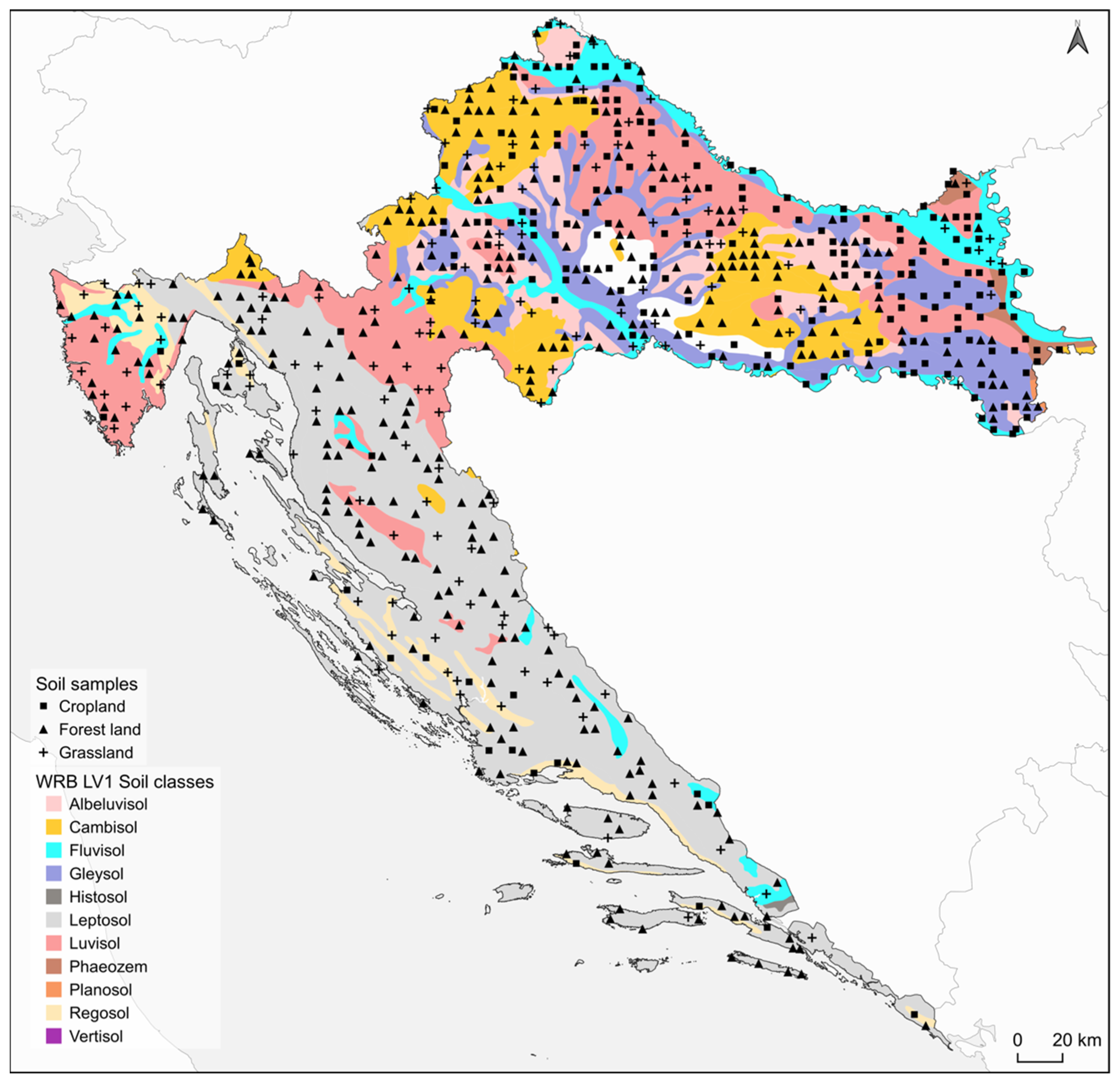
2.1. Study Area—Sampling Data, Pedology and Climate
2.2. Physical and Chemical Soil Properties
2.3. Prediction of SOC Content Based on Machine Learning and Feature Importance Calculation
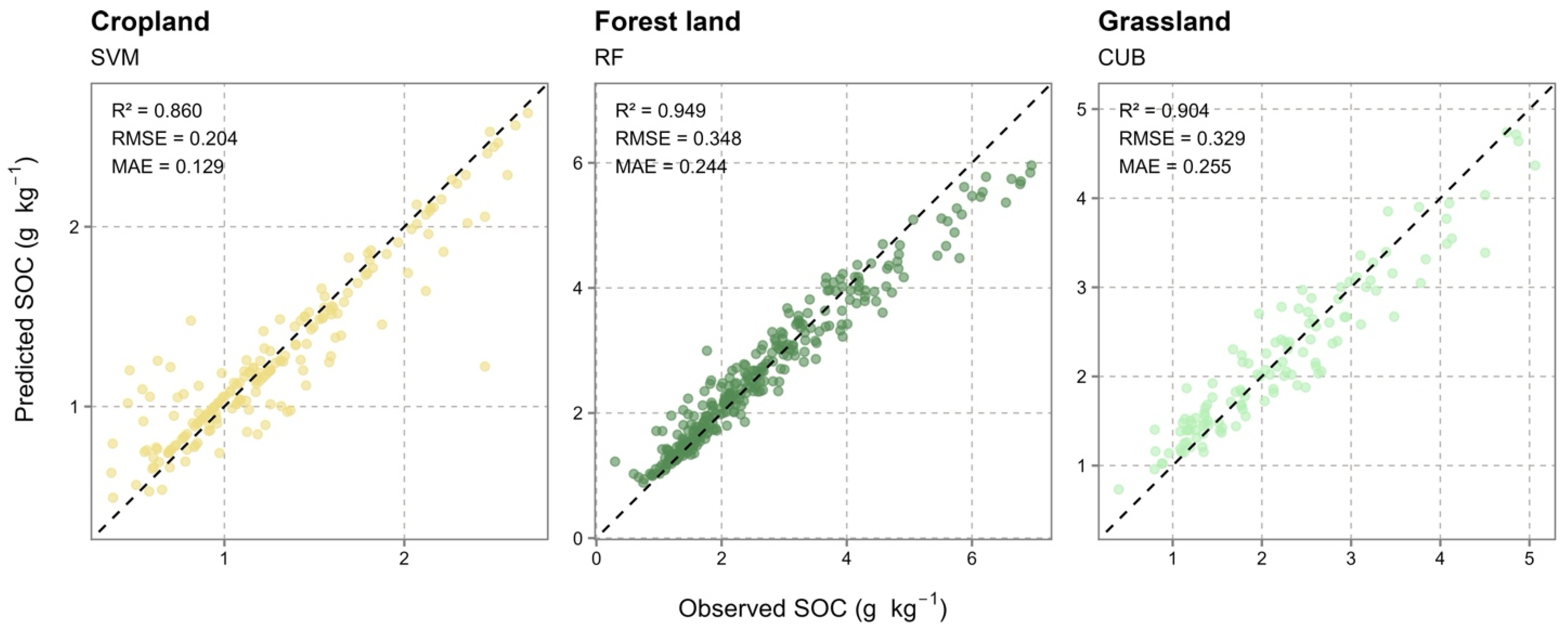
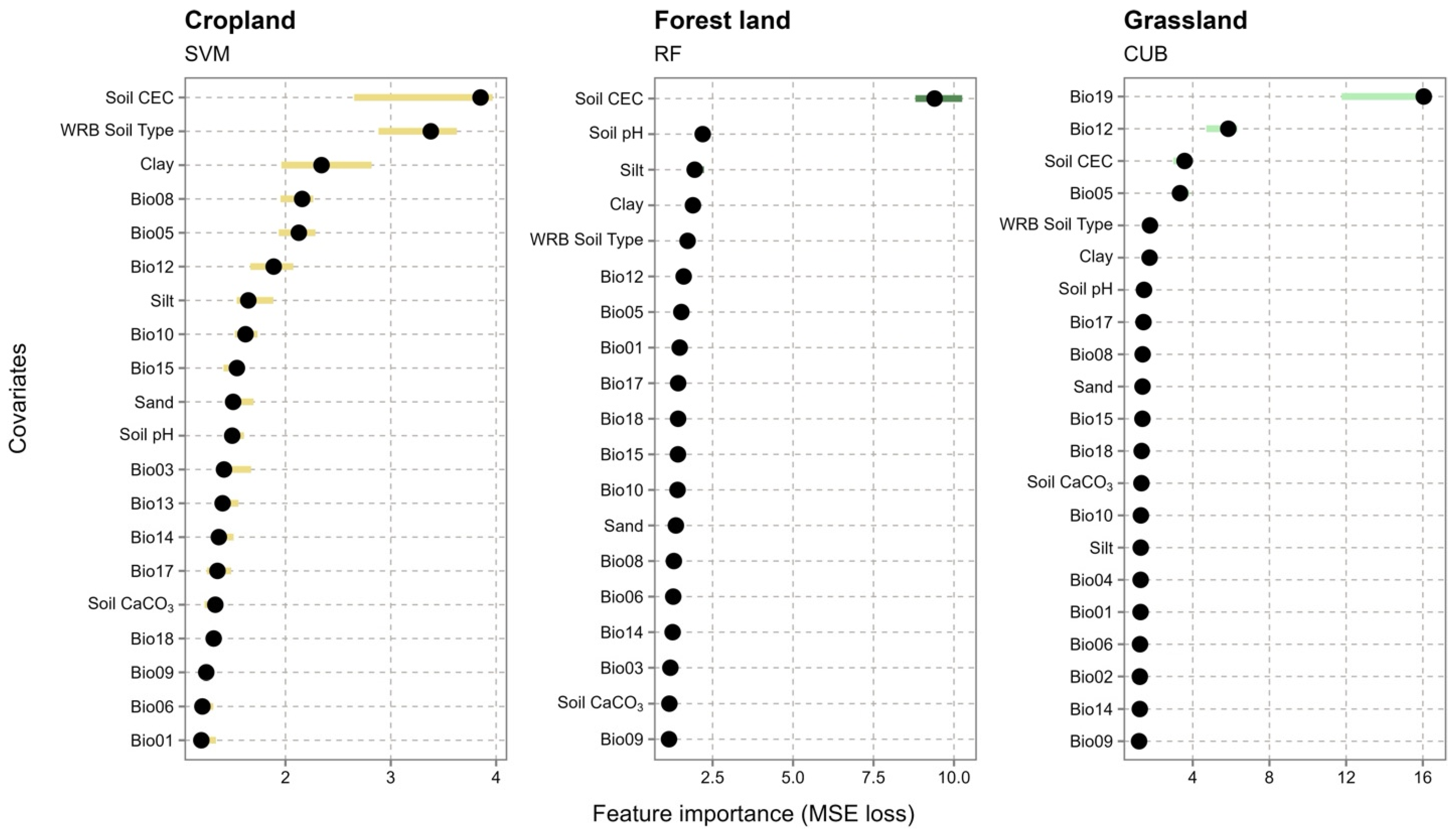
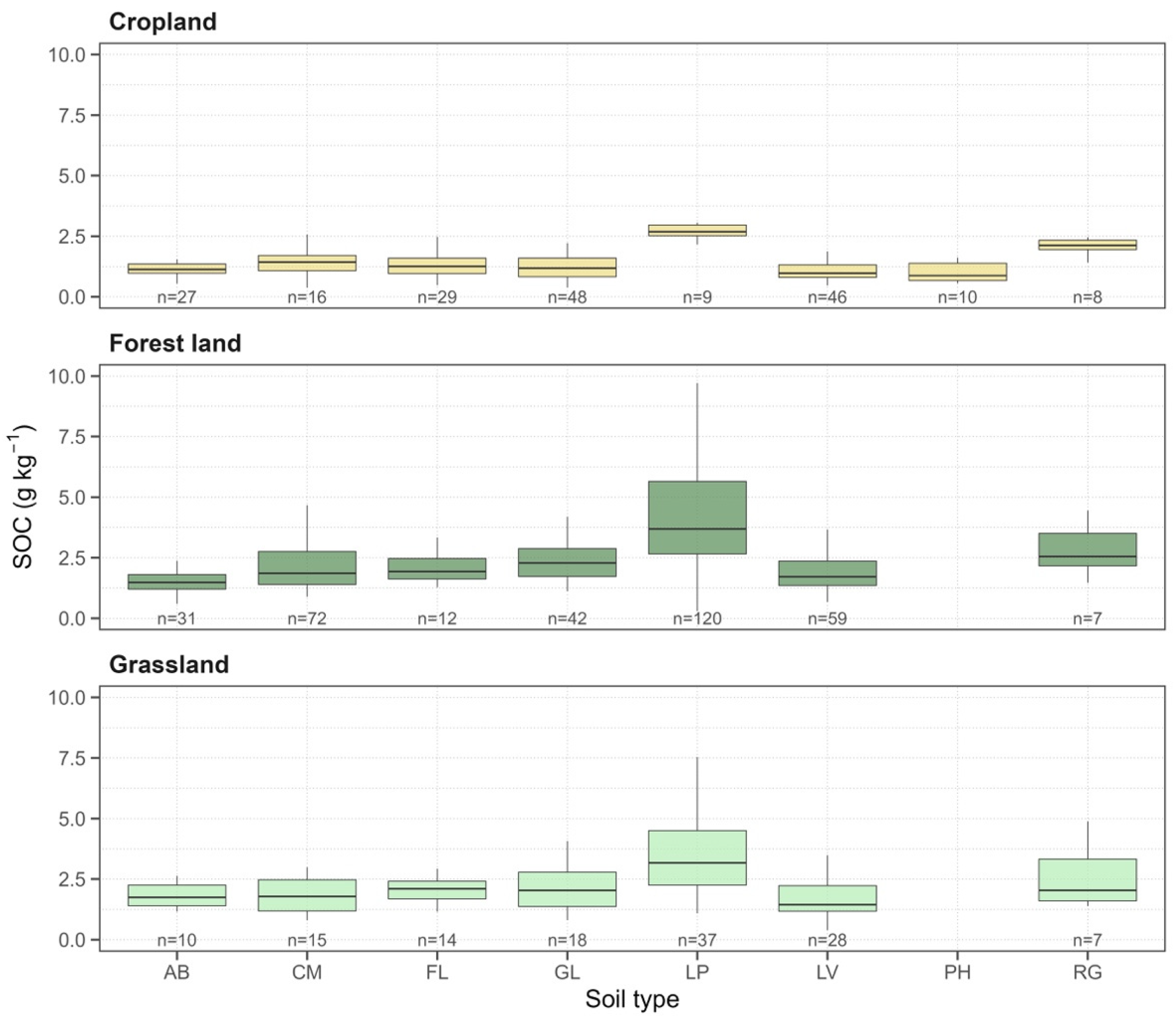
3. Results
4. Discussion
5. Conclusions
Author Contributions
Funding
Data Availability Statement
Acknowledgments
Conflicts of Interest
References
- FAO. State of Knowledge of Soil Biodiversity—Status, Challenges and Potentialities; FAO: Rome, Italy, 2020. [Google Scholar]
- Corvalan, C.; Hales, S.; McMichael, A.J. Ecosystems and Human Well-Being: Synthesis; Island Press: Chicago, IL, USA, 2005; ISBN 1597260401. [Google Scholar]
- Zhang, Y.; Zhang, X.; Fang, W.; Cai, Y.; Zhang, G.; Liang, J.; Chang, J.; Chen, L.; Wang, H.; Zhang, P.; et al. Carbon Sequestration Potential of Wetlands and Regulating Strategies Response to Climate Change. Environ. Res. 2025, 269, 120890. [Google Scholar] [CrossRef] [PubMed]
- Rodrigues, C.I.D.; Brito, L.M.; Nunes, L.J.R. Soil Carbon Sequestration in the Context of Climate Change Mitigation: A Review. Soil Syst. 2023, 7, 64. [Google Scholar] [CrossRef]
- Luo, L.; Sun, T.; Pan, Z.; Lv, J.; Peňuelas, J.; Sardans, J.; Xiao, K.Q.; Liu, Z.; Zhu, Y.G. Rethinking Organic Carbon Sequestration in Agricultural Soils from the Elemental Stoichiometry Perspective. Glob. Chang. Biol. 2025, 31, e70319. [Google Scholar] [CrossRef] [PubMed]
- Tyagi, A.; Haritash, A.K. Climate-Smart Agriculture, Enhanced Agroproduction, and Carbon Sequestration Potential of Agroecosystems in India: A Meta-Analysis. J. Environ. Stud. Sci. 2025, 15, 167–185. [Google Scholar] [CrossRef]
- Rehberger, E.; West, P.C.; Spillane, C.; McKeown, P.C. What Climate and Environmental Benefits of Regenerative Agriculture Practices? An Evidence Review. Environ. Res. Commun. 2023, 5, 052001. [Google Scholar] [CrossRef]
- Don, A.; Seidel, F.; Leifeld, J.; Kätterer, T.; Martin, M.; Pellerin, S.; Emde, D.; Seitz, D.; Chenu, C. Carbon Sequestration in Soils and Climate Change Mitigation—Definitions and Pitfalls. Glob. Chang. Biol. 2024, 30, e16983. [Google Scholar] [CrossRef]
- Lessmann, M.; Ros, G.H.; Young, M.D.; de Vries, W. Global Variation in Soil Carbon Sequestration Potential through Improved Cropland Management. Glob. Chang. Biol. 2022, 28, 1162–1177. [Google Scholar] [CrossRef]
- Terhorst, B.; Ottner, F. Polycyclic Luvisols in Northern Italy: Palaeopedological and Clay Mineralogical Characteristics. Quat. Int. 2003, 106–107, 215–231. [Google Scholar] [CrossRef]
- Németh, T.; Jiménez-Millán, J.; Sipos, P.; Abad, I.; Jiménez-Espinosa, R.; Szalai, Z. Effect of Pedogenic Clay Minerals on the Sorption of Copper in a Luvisol B Horizon. Geoderma 2011, 160, 509–516. [Google Scholar] [CrossRef]
- Dong, H. Mineral-Microbe Interactions: A Review. Front. Earth Sci. China 2010, 4, 127–147. [Google Scholar] [CrossRef]
- Mansfeldt, T.; Schuth, S.; Häusler, W.; Wagner, F.E.; Kaufhold, S.; Overesch, M. Iron Oxide Mineralogy and Stable Iron Isotope Composition in a Gleysol with Petrogleyic Properties. J. Soils Sediments 2012, 12, 97–114. [Google Scholar] [CrossRef]
- Xue, S.; Li, X.; Fu, Y.; Zhu, P.; Liu, J.; Kou, W.; Huang, D.; Gao, Y.; Wang, X. New Insights into Organic Carbon Mineralization: Combining Soil Organic Carbon Fractions, Soil Bacterial Composition, Microbial Metabolic Potential, and Soil Metabolites. Soil Tillage Res. 2024, 244, 106243. [Google Scholar] [CrossRef]
- Michalyna, W. Distribution of various forms of aluminum, iron and manganese in the Orthic Gray Wooded, Gleyed Orthic Gray Wooded and related Gleysolic soils in Manitoba. Can. J. Soil Sci. 1971, 36, 23–36. [Google Scholar] [CrossRef]
- Wilson, C.A.; Cloy, J.M.; Graham, M.C.; Hamlet, L.E. A Microanalytical Study of Iron, Aluminium and Organic Matter Relationships in Soils with Contrasting Hydrological Regimes. Geoderma 2013, 202–203, 71–81. [Google Scholar] [CrossRef]
- Kowalska, J.B.; Zaleski, T.; Józefowska, A.; Mazurek, R. Soil Formation on Calcium Carbonate-Rich Parent Material in the Outer Carpathian Mountains—A Case Study. Catena (Amst) 2019, 174, 436–451. [Google Scholar] [CrossRef]
- Saggar, S.; Yeates, G.W.; Shepherd, T.G. Cultivation Effects on Soil Biological Properties, Microfauna and Organic Matter Dynamics in Eutric Gleysol and Gleyic Luvisol Soils in New Zealand. Soil Tillage Res. 2001, 58, 55–68. [Google Scholar] [CrossRef]
- Nelson, D.W.; Sommers, L.E. Total Carbon, Organic Carbon, and Organic Matter. Methods of Soil Analysis, Part 3: Chemical Methods; Soil Science Society of America and American Society of Agronomy: Madison, WI, USA, 2018; pp. 961–1010. [Google Scholar] [CrossRef]
- Voltr, V.; Menšík, L.; Hlisnikovský, L.; Hruška, M.; Pokorný, E.; Pospíšilová, L. The Soil Organic Matter in Connection with Soil Properties and Soil Inputs. Agronomy 2021, 11, 779. [Google Scholar] [CrossRef]
- Global Microbial Necromass Contribution to Soil Organic Matter–Research Square. Available online: https://www.researchsquare.com/article/rs-473688/v1 (accessed on 18 December 2025).
- Kästner, M.; Miltner, A.; Thiele-Bruhn, S.; Liang, C. Microbial Necromass in Soils—Linking Microbes to Soil Processes and Carbon Turnover. Front. Environ. Sci. 2021, 9, 756378. [Google Scholar] [CrossRef]
- Růžek, L.; Voříšek, K.; Strnadová, S.; Nováková, M.; Barabasz, W. Microbial Characteristics, Carbon and Nitrogen Content in Cambisols and Luvisols. Plant Soil Environ. 2004, 50, 196–204. [Google Scholar] [CrossRef]
- Camenzind, T.; Mason-Jones, K.; Mansour, I.; Rillig, M.C.; Lehmann, J. Formation of Necromass-Derived Soil Organic Carbon Determined by Microbial Death Pathways. Nat. Geosci. 2023, 16, 115–122. [Google Scholar] [CrossRef]
- Hirschi, M.; Seneviratne, S.I.; Alexandrov, V.; Boberg, F.; Boroneant, C.; Christensen, O.B.; Formayer, H.; Orlowsky, B.; Stepanek, P. Observational Evidence for Soil-Moisture Impact on Hot Extremes in Southeastern Europe. Nat. Geosci. 2011, 4, 17–21. [Google Scholar] [CrossRef]
- Głąb, T.; Pużyńska, K.; Pużyński, S.; Palmowska, J.; Kowalik, K. Effect of Organic Farming on a Stagnic Luvisol Soil Physical Quality. Geoderma 2016, 282, 16–25. [Google Scholar] [CrossRef]
- Morais, T.G.; Teixeira, R.F.M.; Domingos, T. Detailed Global Modelling of Soil Organic Carbon in Cropland, Grassland and Forest Soils. PLoS ONE 2019, 14, e0222604. [Google Scholar] [CrossRef] [PubMed]
- Rubinić, V.; Galović, L.; Husnjak, S.; Durn, G. Climate vs. Parent Material—Which Is the Key of Stagnosol Diversity in Croatia? Geoderma 2015, 241–242, 250–261. [Google Scholar] [CrossRef]
- Galić, L.; Vinković, T.; Ravnjak, B.; Lončarić, Z. Agronomic Biofortification of Significant Cereal Crops with Selenium—A Review. Agronomy 2021, 11, 1015. [Google Scholar] [CrossRef]
- FAO. WRB-IUSS World Reference Base for Soil Resources. In World Soil Resources Reports 106; FAO: Rome, Italy, 2014; ISBN 9789251083697. [Google Scholar]
- Panagos, P.; Van Liedekerke, M.; Borrelli, P.; Köninger, J.; Ballabio, C.; Orgiazzi, A.; Lugato, E.; Liakos, L.; Hervas, J.; Jones, A.; et al. European Soil Data Centre 2.0: Soil Data and Knowledge in Support of the EU Policies. Eur. J. Soil Sci. 2022, 73, e13315. [Google Scholar] [CrossRef]
- Stolbovoy, V.; Montanarella, L.; Panagos, P. Carbon Sink Enhancement in Soils of Europe: Data, Modeling, Verification; OPOCE: Luxembourg, 2008. [Google Scholar]
- Brun, P.; Zimmermann, N.E.; Hari, C.; Pellissier, L.; Karger, D.N. Global Climate-Related Predictors at Kilometer Resolution for the Past and Future. Earth Syst. Sci. Data 2022, 14, 5573–5603. [Google Scholar] [CrossRef]
- ISO 11464:2006; Soil Quality—Pretreatment of Samples for Physico-Chemical Analysis. International Organization for Standardization: Geneva, Switzerland, 2006. Available online: https://www.iso.org/standard/37718.html (accessed on 18 December 2025).
- ISO 10694:1995; Soil Quality—Determination of Organic and Total Carbon After Dry Combustion (Elementary Analysis). International Organization for Standardization: Geneva, Switzerland, 1995. Available online: https://www.iso.org/standard/18782.html (accessed on 18 December 2025).
- ISO 10390:1994; Soil Quality—Determination of PH. International Organization for Standardization: Geneva, Switzerland, 1994. Available online: https://www.iso.org/standard/18454.html (accessed on 18 December 2025).
- ISO 14235:1998; Soil Quality—Determination of Organic Carbon by Sulfochromic Oxidation. International Organization for Standardization: Geneva, Switzerland, 1998. Available online: https://www.iso.org/standard/23140.html (accessed on 18 December 2025).
- ISO 11277:2020; Soil Quality—Determination of Particle Size Distribution in Mineral Soil Material—Method by Sieving and Sedimentation. International Organization for Standardization: Geneva, Switzerland, 2020. Available online: https://www.iso.org/standard/69496.html (accessed on 18 December 2025).
- Genuer, R.; Poggi, J.-M. Random Forests with R; Springer Nature: Cham, Switzerland, 2020. [Google Scholar]
- Syam, N.; Kaul, R. Chapter 5: Random Forest, Bagging, and Boosting of Decision Trees. In Machine Learning and Artificial Intelligence in Marketing and Sales: Essential Reference for Practitioners and Data Scientists; Emerald Publishing Limited: Leeds, UK, 2021. [Google Scholar]
- Breiman, L.; Cutler, A.; Liaw, A.; Wiener, M. RandomForest: Breiman and Cutlers Random Forests for Classification and Regression. CRAN: Contributed Packages. 2002. Available online: https://cran.r-project.org/web/packages/randomForest/index.html (accessed on 18 December 2025).
- John, K.; Kebonye, N.M.; Agyeman, P.C.; Ahado, S.K. Comparison of Cubist Models for Soil Organic Carbon Prediction via Portable XRF Measured Data. Environ. Monit. Assess. 2021, 193, 197. [Google Scholar] [CrossRef]
- Rule- and Instance-Based Regression Modeling • Cubist. Available online: https://topepo.github.io/Cubist/ (accessed on 18 December 2025).
- Montesinos López, O.A.; López, A.M.; Crossa, J. Multivariate Statistical Machine Learning Methods for Genomic Prediction; Springer International Publishing: Cham, Switzerland, 2022; ISBN 9783030890100. [Google Scholar]
- Karatzoglou, A.; Smola, A.; Hornik, K. Kernel-Based Machine Learning Lab [R Package Kernlab Version 0.9-33]. CRAN: Contributed Packages. 2024. Available online: https://CRAN.R-project.org/package=kernlab (accessed on 18 December 2025).
- Zhang, F.; O’Donnell, L.J. Support Vector Regression. In Machine Learning: Methods and Applications to Brain Disorders; Elsevier: Amsterdam, The Netherlands, 2020; pp. 123–140. [Google Scholar] [CrossRef]
- Mullachery, V.; Khera, A.; Husain, A. Bayesian Neural Networks. arXiv 2018. [Google Scholar] [CrossRef]
- Perez Rodriguez, P.; Gianola, D. Bayesian Regularization for Feed-Forward Neural Networks [R Package Brnn Version 0.9.4]. CRAN: Contributed Packages. 2025. Available online: https://CRAN.R-project.org/package=brnn (accessed on 18 December 2025).
- Kiran, K.K.; Pal, S.; Chand, P.; Kandpal, A. Carbon Sequestration Potential of Sustainable Agricultural Practices to Mitigate Climate Change in Indian Agriculture: A Meta-Analysis. Sustain. Prod. Consum. 2023, 35, 697–708. [Google Scholar] [CrossRef]
- Panwar, P.; Mahalingappa, D.G.; Kaushal, R.; Bhardwaj, D.R.; Chakravarty, S.; Shukla, G.; Thakur, N.S.; Chavan, S.B.; Pal, S.; Nayak, B.G.; et al. Biomass Production and Carbon Sequestration Potential of Different Agroforestry Systems in India: A Critical Review. Forests 2022, 13, 1274. [Google Scholar] [CrossRef]
- Zhou, T.; Lv, Y.; Xie, B.; Xu, L.; Zhou, Y.; Mei, T.; Li, Y.; Yuan, N.; Shi, Y. Topography and Soil Organic Carbon in Subtropical Forests of China. Forests 2023, 14, 1023. [Google Scholar] [CrossRef]
- Fernández-Romero, M.L.; Lozano-García, B.; Parras-Alcántara, L. Topography and Land Use Change Effects on the Soil Organic Carbon Stock of Forest Soils in Mediterranean Natural Areas. Agric. Ecosyst. Environ. 2014, 195, 1–9. [Google Scholar] [CrossRef]
- Lal, R. Forest Soils and Carbon Sequestration. For. Ecol. Manag. 2005, 220, 242–258. [Google Scholar] [CrossRef]
- Zhang, L.; Du, H.; Song, T.; Yang, Z.; Peng, W.; Gong, J.; Huang, G.; Li, Y. Conversion of Farmland to Forest or Grassland Improves Soil Carbon, Nitrogen, and Ecosystem Multi-Functionality in a Subtropical Karst Region of Southwest China. Sci. Rep. 2024, 14, 17745. [Google Scholar] [CrossRef]
- FAO. World Reference Base for Soil Resources; FAO: Rome, Italy, 1998. [Google Scholar]
- Paradelo, R.; Eden, M.; Martínez, I.; Keller, T.; Houot, S. Soil Physical Properties of a Luvisol Developed on Loess after 15 Years of Amendment with Compost. Soil Tillage Res. 2019, 191, 207–215. [Google Scholar] [CrossRef]
- Shah, A.M.; Khan, I.M.; Shah, T.I.; Bangroo, S.A.; Kirmani, N.A.; Nazir, S.; Malik, A.R.; Aezum, A.M.; Mir, Y.H.; Hilal, A.; et al. Soil Microbiome: A Treasure Trove for Soil Health Sustainability under Changing Climate. Land 2022, 11, 1887. [Google Scholar] [CrossRef]
- Gupta, A.; Joia, J. Microbes as Potential Tool for Remediation of Heavy Metals: A Review. J. Microb Biochem. Technol. 2016, 8, 364–372. [Google Scholar] [CrossRef]
- Mason, A.R.G.; Salomon, M.J.; Lowe, A.J.; Cavagnaro, T.R. Microbial Solutions to Soil Carbon Sequestration. J. Clean. Prod. 2023, 417, 137993. [Google Scholar] [CrossRef]
- Bhattacharyya, P.N.; Goswami, M.P.; Bhattacharyya, L.H. Perspective of Beneficial Microbes in Agriculture under Changing Climatic Scenario: A Review. J. Phytol. 2016, 8, 26. [Google Scholar] [CrossRef]
- Wankhade, A.; Wilkinson, E.; Britt, D.W.; Kaundal, A. Plant-Microbe Interactions in the Rhizosphere and the Role of Root Exudates in Chemical Signaling and Microbiome Engineering. Appl. Sci. 2025, 15, 7127. [Google Scholar] [CrossRef]
- Schuster, J.; Hagn, L.; Mittermayer, M.; Hülsbergen, K.J. After Effects of Historical Grassland on Soil Organic Carbon Content and Plant Growth in Croplands in Southern Germany Determined Using Satellite Data. Sci. Total Environ. 2024, 947, 174507. [Google Scholar] [CrossRef] [PubMed]
- De Rosa, D.; Ballabio, C.; Lugato, E.; Fasiolo, M.; Jones, A.; Panagos, P. Soil Organic Carbon Stocks in European Croplands and Grasslands: How Much Have We Lost in the Past Decade? Glob. Chang. Biol. 2024, 30, e16992. [Google Scholar] [CrossRef] [PubMed]
- Gajda, A.M.; Czyż, E.A.; Klimkowicz-Pawlas, A. Effects of Different Tillage Intensities on Physicochemical and Microbial Properties of a Eutric Fluvisol Soil. Agronomy 2021, 11, 1497. [Google Scholar] [CrossRef]
- Soucémarianadin, L.N.; Cécillon, L.; Guenet, B.; Chenu, C.; Baudin, F.; Nicolas, M.; Girardin, C.; Barré, P. Environmental Factors Controlling Soil Organic Carbon Stability in French Forest Soils. Plant Soil 2018, 426, 267–286. [Google Scholar] [CrossRef]
- BALL, D.F. Loss-on-Ignition As an Estimate of Organic Matter and Organic Carbon in Non-Calcareous Soils. J. Soil Sci. 1964, 15, 84–92. [Google Scholar] [CrossRef]
- Bruun, T.B.; Elberling, B.; de Neergaard, A.; Magid, J. Organic Carbon Dynamics in Different Soil Types after Conversion of Forest to Agriculture. Land Degrad. Dev. 2015, 26, 272–283. [Google Scholar] [CrossRef]
- Jiao, N.; Luo, T.; Chen, Q.; Zhao, Z.; Xiao, X.; Liu, J.; Jian, Z.; Xie, S.; Thomas, H.; Herndl, G.J.; et al. The Microbial Carbon Pump and Climate Change. Nat. Rev. Microbiol. 2024, 22, 408–419. [Google Scholar] [CrossRef]
- Das, S.; Deb, S.; Sahoo, S.S.; Sahoo, U.K. Soil Microbial Biomass Carbon Stock and Its Relation with Climatic and Other Environmental Factors in Forest Ecosystems: A Review. Acta Ecol. Sin. 2023, 43, 933–945. [Google Scholar] [CrossRef]
- Paul, C.; Bartkowski, B.; Dönmez, C.; Don, A.; Mayer, S.; Steffens, M.; Weigl, S.; Wiesmeier, M.; Wolf, A.; Helming, K. Carbon Farming: Are Soil Carbon Certificates a Suitable Tool for Climate Change Mitigation? J. Environ. Manag. 2023, 330, 117142. [Google Scholar] [CrossRef]
- Sharma, M.; Kaushal, R.; Kaushik, P.; Ramakrishna, S. Carbon Farming: Prospects and Challenges. Sustainability 2021, 13, 11122. [Google Scholar] [CrossRef]
- Gui, X.; Xu, X.; Zhang, Z.; Hu, L.; Huang, W.; Zhao, L.; Cao, X. Biochar-Amended Soil Can Further Sorb Atmospheric CO2 for More Carbon Sequestration. Commun Earth Environ. 2025, 6, 5. [Google Scholar] [CrossRef]
- Obasi, S.N.; Peters, O.A.; Tenebe, V.A.; Obasi, C.C.; Omodara, M.A. Role of Soil Microbial Diversity in Mitigating Soil-Borne Diseases and Postharvest Losses. Niger. Agric. J. 2024, 55, 297–319. [Google Scholar]
- Vahedi, R.; Rasouli-Sadaghiani, M.H.; Barin, M.; Vetukuri, R.R. Effect of Biochar and Microbial Inoculation on P, Fe, and Zn Bioavailability in a Calcareous Soil. Processes 2022, 10, 343. [Google Scholar] [CrossRef]
- Friedel, J.K.; Munch, J.C.; Fischer, W.R. Soil Microbial Properties and the Assessment of Available Soil Organic Matter in a Haplic Luvisol after Several Years of Different Cultivation and Crop Rotation. Soil Biol. Biochem. 1996, 28, 479–488. [Google Scholar] [CrossRef]



| Land Use | Model | Statistical Metrics | |||||
|---|---|---|---|---|---|---|---|
| R2 (Mean) | R2 (SD) | RMSE (Mean) | RMSE (SD) | MAE (Mean) | MAE (SD) | ||
| Cropland | BRNN | 0.396 | 0.198 | 0.423 | 0.044 | 0.322 | 0.022 |
| CUB | 0.262 | 0.055 | 0.476 | 0.028 | 0.355 | 0.032 | |
| RF | 0.376 | 0.128 | 0.427 | 0.026 | 0.330 | 0.020 | |
| SVM | 0.411 | 0.101 | 0.420 | 0.034 | 0.326 | 0.031 | |
| Forest land | BRNN | 0.525 | 0.122 | 0.955 | 0.151 | 0.696 | 0.069 |
| CUB | 0.586 | 0.062 | 0.890 | 0.070 | 0.625 | 0.045 | |
| RF | 0.604 | 0.076 | 0.871 | 0.078 | 0.614 | 0.044 | |
| SVM | 0.549 | 0.068 | 0.937 | 0.090 | 0.634 | 0.053 | |
| Grassland | BRNN | 0.352 | 0.146 | 0.880 | 0.198 | 0.670 | 0.105 |
| CUB | 0.591 | 0.172 | 0.654 | 0.098 | 0.486 | 0.063 | |
| RF | 0.541 | 0.127 | 0.703 | 0.062 | 0.527 | 0.039 | |
| SVM | 0.363 | 0.167 | 0.826 | 0.091 | 0.620 | 0.060 | |
Disclaimer/Publisher’s Note: The statements, opinions and data contained in all publications are solely those of the individual author(s) and contributor(s) and not of MDPI and/or the editor(s). MDPI and/or the editor(s) disclaim responsibility for any injury to people or property resulting from any ideas, methods, instructions or products referred to in the content. |
© 2025 by the authors. Licensee MDPI, Basel, Switzerland. This article is an open access article distributed under the terms and conditions of the Creative Commons Attribution (CC BY) license.
Share and Cite
Galić, L.; Jurišić, M.; Plaščak, I.; Radočaj, D. Machine Learning Assessment of Soil Carbon Sequestration Potential: Integrating Land Use, Pedology, and Machine Learning in Croatia. Agronomy 2026, 16, 14. https://doi.org/10.3390/agronomy16010014
Galić L, Jurišić M, Plaščak I, Radočaj D. Machine Learning Assessment of Soil Carbon Sequestration Potential: Integrating Land Use, Pedology, and Machine Learning in Croatia. Agronomy. 2026; 16(1):14. https://doi.org/10.3390/agronomy16010014
Chicago/Turabian StyleGalić, Lucija, Mladen Jurišić, Ivan Plaščak, and Dorijan Radočaj. 2026. "Machine Learning Assessment of Soil Carbon Sequestration Potential: Integrating Land Use, Pedology, and Machine Learning in Croatia" Agronomy 16, no. 1: 14. https://doi.org/10.3390/agronomy16010014
APA StyleGalić, L., Jurišić, M., Plaščak, I., & Radočaj, D. (2026). Machine Learning Assessment of Soil Carbon Sequestration Potential: Integrating Land Use, Pedology, and Machine Learning in Croatia. Agronomy, 16(1), 14. https://doi.org/10.3390/agronomy16010014