1. Introduction
Peanut (
Arachis hypogaea L.) and soybean (
Glycine max [L.] Merr.) are globally important oilseed and protein crops that support the food, feed, and industrial sectors across both developed and developing regions [
1,
2,
3,
4,
5]. Global peanut production reached approximately 54 million metric tons in 2023, with China, India, and the United States leading production, while soybean production exceeded 371 million metric tons, highlighting its role as one of the world’s most essential protein sources [
6]. Owing to the economic and nutritional value of these crops, their stable production is indispensable for global food security. However, both crops are highly vulnerable to soil-borne diseases, which can cause annual yield losses of 15–40% under favorable conditions, with localized epidemics sometimes exceeding 80% in severely affected fields [
7,
8].
Among these pathogens,
Calonectria ilicicola Boedijn & Reitsma (anamorph:
Cylindrocladium parasiticum Crous, M.J. Wingf. & Alfenas) is particularly problematic because of its long-term survival in soil and broad host range [
9,
10]. The pathogen produces melanized microsclerotia capable of persisting in soil for extended periods. This persistence complicates eradication and elevates the pathogen’s global economic relevance as the causal agent of Cylindrocladium black rot (CBR) in peanut and red crown rot (RCR) in soybean. CBR, first described in the southwestern United States in 1965, is now reported in more than 20 countries across Asia, North America, South America, Africa, and Oceania, with potential yield losses reaching 50% [
9,
11,
12,
13]. RCR, first identified in Japan in 1968, has since expanded to many soybean-producing regions worldwide [
11,
14,
15,
16]. A particularly urgent development is the recent and rapid expansion of the RCR in the U.S. Midwest, a region not historically associated with this disease. The outbreaks reported in Illinois (2018) [
17], Indiana (2022) [
18], Kentucky (2023) [
14], and Missouri (2024) [
15] indicate a significant epidemiological shift, suggesting ongoing adaptation of the pathogen to cooler climates and diverse soil environments [
18,
19]. Evidence from recent molecular epidemiological studies points to contaminated seed lots and the movement of farm machinery as major pathways of regional spread [
20]. Understanding the ecological and genetic factors driving this expansion is essential for safeguarding soybean production in currently unaffected areas.
The pathogenesis of C. ilicicola exhibits multi-dimensional characteristics: The pathogen employs a suite of virulence factors, including cell wall-degrading enzymes, effector proteins, and the production of melanized microsclerotia for persistence and invasion. In response, host plants activate multi-layered defense mechanisms. Structural barriers, such as rapid periderm formation in peanut taproots, provide physical resistance. At the molecular level, resistant genotypes trigger robust immune responses, potentially involving pathogenesis-related protein upregulation, phytohormone signaling, and the accumulation of antimicrobial compounds. Unraveling these interaction dynamics is crucial for developing targeted control strategies. Despite more than five decades of research, substantial knowledge gaps remain. These include the molecular basis of host specificity, the genetic determinants of resistance, and the environmental and agronomic factors that facilitate pathogen spread to new regions. Furthermore, while individual management tactics, such as soil fumigation, crop rotation, and resistance varieties, have been explored, integrated strategies that combine host resistance with sustainable cultural, environmental, and biological approaches are still underdeveloped and often not optimized for different production systems.
This review addresses these gaps by providing a consolidated and up-to-date synthesis tailored to current research needs. Specifically, it (i) compiles and clarifies existing knowledge on disease symptoms, pathogen isolation and identification, biological characteristics, and epidemiological conditions; (ii) highlights recent advances in genomic, transcriptomic, and other multiomics studies that are reshaping our understanding of virulence and host–pathogen interactions; and (iii) synthesizes new insights into host–specific mechanisms used by C. ilicicola. We believe that by integrating classical pathology, modern molecular research, and practical agronomy, this review provides comprehensive, cross-disciplinary analyses that support both scientific advancements and on-farm applications.
This paper provides a comprehensive, evidence-based review of current knowledge on C. ilicicola-induced diseases in peanut and soybean, with the following specific objectives:
To consolidate and clarify existing knowledge on disease symptoms, pathogen biology, isolation and identification methods, and epidemiological conditions;
To highlight recent advances in genomic, transcriptomic, and proteomic studies that reveal virulence mechanisms, effector repertoires, and host–pathogen interactions;
To critically evaluate integrated disease management strategies—including host resistance, chemical, biological, cultural, and physical control methods—with comparative analysis of their effectiveness in peanut versus soybean production systems;
To discuss the implications of climate change for disease epidemiology and management;
To identify critical knowledge gaps and propose future research directions for sustainable disease management under evolving agroecological conditions.
By addressing these objectives, this review aims to offer researchers, extension specialists, and crop managers a coherent foundation for developing more effective, sustainable, and regionally adaptable management strategies against these increasingly consequential diseases.
2. Disease Symptoms and Distribution
C.
ilicicola is widely distributed across major agricultural regions in Asia, North America, Europe, Oceania, South America, and Africa. Its broad ecological amplitude and survival capacity have enabled the pathogen to establish itself across diverse soil types and climates. The species infects a wide range of economically important and ornamental hosts, including members of the Ericaceae, Theaceae, Rosaceae, Araceae, Myrtaceae, and Fabaceae (
Table 1). Among the multiple diseases attributed to this pathogen, Eucalyptus leaf blight and soybean RCR are among the most damaging in commercial production systems, frequently resulting in substantial yield and quality losses.
2.1. CBR in Peanut
CBR is caused by
C. ilicicola, whose anamorph (asexual stage) is
C.
parasiticum [
13,
41]. Current nomenclatural standards prioritize the teleomorph name
C. ilicicola, rendering the former designation
Calonectria crotalariae obsolete. The pathogen infects nearly all subterranean tissues of the peanut plant, including its roots, stem base, pegs, and pods [
42,
43,
44]. Infection usually begins at the root tips, resulting in blackening and necrosis of the primary root and hypocotyl. Water uptake becomes impaired, leading to wilting and leaf desiccation. Although these symptoms mimic bacterial wilt, the distinctive blackening of the stem base provides a reliable diagnostic clue.
As CBR progresses, stem tissues and pegs become brittle, and infected pods contain shriveled, darkened seeds. Under moist conditions, bright orange to reddish perithecia develop abundantly on infected tissues. Affected plants exhibit severe black rot, brown discoloration of vascular bundles, complete foliar wilt, and ultimately plant death [
9,
45]. In the field, CBR typically appears in discrete patches or disease foci. Although seedlings can be affected, the disease is most destructive during the pod-filling stage, when it sharply reduces yield and seed quality [
42,
46,
47]. A notable defensive mechanism in less susceptible peanut cultivars is rapid periderm formation in the taproot, which limits pathogen penetration and systemic invasion [
48]. This periderm-associated resistance is increasingly recognized as a valuable trait for breeding programs.
Surveys in major peanut-producing regions have revealed that CBR incidence varies widely depending on cultivar selection, environmental conditions, and cropping system. In the southeastern United States, the CBR incidence ranges from minimal levels (<5%) in fields planted with moderately resistant cultivars to severe epidemics (>40%) in fields subjected to continuous peanut monoculture and high pathogen inoculum densities [
49]. Yield losses correlate strongly with the timing of infection; early-season infections produce greater reductions in both pod number and seed weight. Economic damage is intensified by declining seed quality, increased risk of aflatoxin contamination in damaged seeds, and reduced marketability due to poor kernel characteristics [
47,
50].
2.2. RCR in Soybean
C.
ilicicola also causes a major soybean disease known as RCR. This disease was first reported in 1968 in Chiba Prefecture, Japan, and was originally referred to as “black root rot of soybean” [
51]. By 2001, RCR had spread throughout Japan, including Hokkaido, and became a serious threat to soybean production [
52]. Today, RCR occurs in more than ten soybean-producing countries, including the United States, Brazil, Indonesia, China, Japan, South Korea, Australia, and Cameroon [
15,
22,
23,
52,
53,
54,
55]. Soybeans are particularly vulnerable during pod set, and the disease incidence can reach 80% in individual fields, causing severe reductions in yield and grain quality [
13,
56,
57,
58].
RCR symptoms typically become evident during reproductive development, although root infection begins soon after germination [
8,
54,
59]. Early foliar symptoms include yellowing of upper leaves and light brown discoloration along the veins. As the disease progresses, a reddish-brown band develops at the stem base and lower roots, often accompanied by conspicuous orange–red perithecia near the soil line. Scraping the root epidermis reveals the most reliable diagnostic feature: reddish-brown discoloration of the cortex, the intensity of which is strongly correlated with disease severity [
8].
In severe cases, cortical tissues rot, vascular tissues darken, and the entire root system deteriorates [
57], leading to plant death and reduced seed quality and yield [
60]. Severely infected plants often lose most of their lateral roots, leaving only a taproot (referred to as a “pencil-like root”). Soybean yield losses caused by RCR vary with disease severity, ranging from 13% to 30% in southern China, the United States, and Japan [
17,
61,
62]. In waterlogged Louisiana soils, losses reached 50% when susceptible cultivars were grown under conditions conducive to 100% disease incidence [
63]. Grain shrinkage rates often mirror disease incidence, reflecting significant declines in seed quality [
64].
C.
ilicicola persists as microsclerotia within infected debris and soil, facilitating dissemination by water, machinery, and human activities [
13,
65]. Recent epidemiological studies have refined global yield–loss estimates and demonstrated that RCR severity is increasing in several regions. In Japan, yield losses of 25–30% are regularly observed in moderately infested fields, with reductions exceeding 50% under optimal disease conditions [
62,
66]. In the United States, RCR outbreaks recently documented in Illinois, Indiana, Kentucky, and Missouri have resulted in losses ranging from 10% to 30%, including reports of localized crop failure [
14,
18,
67]. Disease management programs may cost producers an additional 75–150 USD per hectare in heavily infested areas [
65].
3. Pathogen Biology
The causal agent of CBR was originally described as
Cylindrocladium crotalariae (Loos) Bell & Sobers (anamorph) and
Calonectria crotalariae (Loos) Bell & Sobers (teleomorph), a filamentous ascomycete fungus [
9,
68]. Subsequent taxonomic revision established the correct name as
C.
parasiticum (anamorph) with
C.
ilicicola (teleomorph) [
10]. In accordance with the “one fungus = one name” principle,
C. ilicicola is now the accepted name for this plant pathogen [
69]. On potato dextrose agar (PDA), the fungus displays fast-growing, white to light gray or reddish-brown colonies. Previous studies have demonstrated that conidiophores are erect, hyaline, slender, and broom-like, with simple branching and phialidic conidiogenous cells that produce conidia enteroblastically [
70]. The conidia are hyaline, cylindrical, typically containing 1–3 septa. They often accumulate in slimy masses and can parasitize root tissues or persist saprophytically in soil [
9]. Hyphal tips occasionally form spherical vesicles, whereas brown chlamydospores develop in chains and aggregate into dark microsclerotia [
53]. These microsclerotia, with their melanized walls, constitute the primary long-term survival structures and confer protection against UV radiation, desiccation, and microbial degradation, enabling extended persistence in soil ecosystems [
65].
The pathogen is homothallic and produces red to orange–red perithecia that are elliptical to spherical or obovate, bear a roughened surface and an ostiole. Each one forms singly. Gentle pressure on mature perithecia releases large numbers of asci. Asci are long-stalked, clavate, each containing eight ascospores that are fusiform to filiform, curved, and 1–3 septate, generally occurring in pairs [
13,
56,
57,
58]. Morphological traits are largely consistent across isolates, although slight differences in conidial size have been observed between peanut and soybean isolates [
71].
The homothallic nature
C. ilicicola has profoundly implications for its epidemiology and disease management. This trait allows the pathogen to undergo sexual reproduction in the absence of outcrossing, enabling rapidly proliferation and produce large quantities of ascospores, thereby accelerating the spread of highly virulent pathotypes in the field [
72]. Furthermore, homothallism results leads to highly clonal population structures that limit the accumulation of genetic diversity. While this somewhat reduces the pathogen’s adaptability to environmental changes, it also allows a single disease-resistant cultivar to maintain stable control efficacy in the short term; Thirdly, the spread of clonal populations relies on human-mediated transmission, providing targeted approaches for disease quarantine and field sanitation. Furthermore, the synergistic effect of homothallic reproduction and the long-term survival of microsclerotia enables the pathogen to form stable inoculum reservoirs in soil, significantly increasing the difficulty of disease control.
Optimal mycelial growth occurs at 26–28 °C, with a minimum of 8 °C, and no growth occurs above 35 °C. Microsclerotia formation is optimal between 24 °C and 28 °C and ceases below 12 °C or above 32 °C [
73]. Conidial production peaks at 28 °C, whereas perithecial development is favored at temperatures ranging from 28 to 30 °C. Recent research has reported temperature sensitivity differences among isolates from distinct geographic regions, suggesting potential local climatic adaptations [
74]. This finding is particularly important in the context of the pathogen’s recent expansion into cooler environments, such as the U.S. Midwest, and underscores the need to revisit long-held assumptions about its ecological limits. Mycelial growth is largely unaffected by photoperiod. Moderate light promotes conidiation, whereas excessive light inhibits it. The fungus prefers neutral to slightly acidic pH ranges and can utilize diverse carbon and nitrogen sources. The pathogen utilizes diverse carbon sources for vigorous growth, ranging from monosaccharides like glucose and disaccharides such as lactose to complex polysaccharides like starch. Sodium nitrate is the most suitable inorganic nitrogen source for mycelial expansion, whereas urea promotes abundant conidial production. Perithecia typically develop only when sodium nitrate is present as the nitrogen source. Commonly used media include PDA, yeast extract peptone, synthetic fungal media, V8 juice agar, and oat agar [
13]. V8 juice agar is particularly effective for inducing sporulation under laboratory conditions [
67,
75].
4. Isolation and Identification of Pathogenic Fungi
The isolation and accurate identification of
C. ilicicola remain central to advancing disease management strategies for CBR and RCR. Although many classical techniques are well established, their standardization across host species and regions has been inconsistent, contributing to challenges in disease surveillance, field diagnostics, and breeding programs. Currently, the standard isolation of
C. ilicicola relies on infected seeds and infected root tissues and employs selective media to suppress microbial competitors. For seed-based isolation, a selective PDA medium is supplemented with 52.5 mg of pentachloronitrobenzene (PCNB), 2.3 mg of thiabendazole, 100 mg of aureomycin, 100 mg of chloramphenicol, and 2 mg of chlorothalonil per liter. After surface sterilization in 0.26% NaClO for 1 min, biscected peanut seeds are placed on the medium and incubated at room temperature for 14 days, after which diagnostic structures can be isolated under a stereomicroscope. Isolation from infected roots follows similar principles: tissue segments are sterilized with 0.53% NaClO for 1.5 min and are plated onto modified PDA containing 100 μg/mL chloramphenicol or aureomycin. Hyphal tips emerging from disinfected tissues are transferred to fresh selective media for purification [
44]. Quarter-strength PDA (QPDA) has proven effective for isolating
C. ilicicola from soybean, as its relatively low nutrient content prevents rapid overgrowth by competing saprophytes [
18]. Pure isolates are maintained long-term on PDA slants at 4–5 °C or as glycerol stocks stored at −80 °C [
75].
4.1. Morphological Identification
Morphological identification continues to provide an essential foundation for the diagnosis of
C. ilicicola. The conidia are cylindrical and hyaline with one to three septa, measuring 64–76 × 5–8 μm; the perithecia are orange–red to bright red and measure 300–550 × 280–400 μm; the ascospores are falcate, septate, and measure 30–65 × 4.5–6.5 μm; and the microsclerotia form as aggregated chains of dark brown chlamydospores. These features remain indispensable for preliminary characterization; however, morphological overlap among
Calonectria species and subtle host-associated variation complicate identification, particularly in regions where mixed populations occur. Consequently, molecular methods have become increasingly important for confirming species identity [
67,
76].
4.2. Pathogenicity Testing and Resistance Screening
Pathogenicity testing and resistance evaluation remain cornerstones of disease management research. Traditionally, the pathogenicity of
C. parasiticum and cultivar resistance have been assessed through field observations of natural disease incidence, microplot inoculation experiments, and controlled greenhouse assays [
77]. Each approach has clear advantages but also limitations. Field and microplot studies provide realistic disease pressure and host–environment interactions but are time-consuming and influenced by fluctuating soil conditions, uneven inoculum distribution, and variable climate. Greenhouse assays offer more controlled environments and shorter experimental cycles, although they do not always correlate fully with field outcomes owing to environmental effects on disease expression [
77,
78,
79,
80]. Importantly, some peanut genotypes present consistent resistance rankings across greenhouse and field assessments, emphasizing that standardized inoculation protocols and awareness of the host genetic background can significantly improve predictive accuracy. A noteworthy recent advancement is the development of a fresh-weight-based resistance evaluation method for soybean, enabling faster, more quantitative, and more reproducible assessments of RCR resistance than visual scoring [
81].
4.3. Molecular Diagnostic Methods
Given the diagnostic ambiguity created by overlapping symptoms of RCR and other root–rot diseases, molecular diagnostics are increasingly indispensable. The ITS region of rDNA remains the primary fungal barcode and is amplified via the ITS1/ITS4 or ITS1-F/ITS4 primer pairs. ITS sequencing enables species-level identification via BLAST 2.15.0+ searches in NCBI GenBank or UNITE; however, the ITS region lacks sufficient variation to distinguish among closely related
Calonectria species [
24]. Consequently, multilocus sequence typing (MLST) incorporating
HIS3,
TEF1,
TUB2, and
CAL has emerged as the standard for high-resolution species delimitation [
24,
71]. In addition to sequencing-based tools, rapid diagnostic methods have advanced significantly. Loop-mediated isothermal amplification (LAMP) enables specific detection of
C. ilicicola within an hour and does not require thermocycling equipment, making it highly suitable for field testing, quarantine inspection, and high-throughput breeding screens [
82]. Species-specific qPCR assays provide sensitive quantification of pathogen DNA in plant tissues or soil [
76], enabling precise estimation of inoculum density and supporting the evaluation of cultural, chemical, or biological management practices.
Finally, emerging metagenomic approaches such as ITS and
TEF1 metabarcoding allow simultaneous detection of
C. ilicicola and cooccurring soil-borne pathogens, supporting both ecological studies and practical diagnostics. Multiplex PCR assays capable of simultaneously detecting
C. ilicicola and other major soybean pathogens are under development [
83], representing a key future direction for integrated disease surveillance.
5. Genomes and Genetic Diversity of Pathogens
Rapid advances in high-throughput sequencing have transformed our understanding of
C. ilicicola and related taxa, offering unprecedented insight into genome architecture, virulence mechanisms, host adaptation, and population biology. The first near-complete genome of
C. ilicicola was produced via Oxford Nanopore GridION long-read sequencing [
84]. This high-quality assembly consists of 16 contigs for isolate F018, which are estimated to represent 11 chromosomes [
85]. Among the available
Calonectria genomic resources, the F018 assembly remains the most contiguous, distinguished by its low contig number and high contig N50 value [
85]. This resource provides a firm foundation for comparative genomics, gene family evolution studies, and the identification of candidate pathogenicity determinants.
Comparative studies reveal substantial genetic divergence associated with host origin and geography. Analysis of Chinese isolates revealed that C. ilicicola populations separate into two well-supported clades corresponding to their regional distribution. Pathogenicity testing of the peanut variety Yueyou 13 revealed that although all the isolates were virulent, the virulence of the soybean-derived strains was generally weaker than that of the peanut-derived strains, suggesting the emergence of host specialization. However, static genomic sequences alone cannot fully elucidate the dynamic infection process. Therefore, the availability of high-quality reference genomes has been pivotal in enabling the comprehensive functional analyses required to dissect the complex molecular networks governing pathogenicity.
Multiomics studies have substantially advanced our understanding of virulence in
C. ilicicola, particularly through analyses of the peanut-derived strain Ci14017 [
8,
86,
87]. After identification via ITS-based phylogeny and verification through Koch’s postulates, Ci14017 was subjected to integrated genomic, transcriptomic, and proteomic characterization during interactions with susceptible and resistant peanut cultivars. The 68.97 Mb genome contains 17,308 predicted protein-coding genes. Forty-six putative virulence-associated genes exhibited elevated expression in susceptible hosts and encoded a broad suite of pathogenicity factors, including MEROPS proteases, CAZymes, lipases, cytochrome P450 enzymes, and proteins with multiple conserved enzyme domains. During infection, 10,311 fungal genes were transcriptionally active, and 805 fungal proteins could be quantified. Pathogen responses mirrored this pattern of complexity: transcriptome profiling revealed 2318 and 2363 differentially expressed genes in susceptible P562 and resistant T09 peanut lines, respectively, whereas proteomic analysis revealed 536 upregulated proteins in P562 relative to T09. Integrative analysis revealed 46 core pathogenicity-related genes, indicating that
C. ilicicola employs a multifaceted infection strategy characterized by a dynamic interplay of cell wall-degrading enzymes, detoxification systems, and effector-like proteins [
86].
Population genetic studies indicate that field populations can be highly clonal. Wright et al. developed 12 SSR markers to analyze the genetic diversity of
C. parasiticum (anamorph of
C. ilicicola) from multiple hosts and locations [
20]. A subsequent study of 200 strains from Georgia revealed low genetic diversity, with the population comprising only 10 multilocus haplotypes and 176 strains sharing a single, dominant haplotype [
20]. This lack of diversity, with a reported range of 0.054–0.094, and the absence of evidence for random mating are consistent with a clonal population structure, likely driven by the pathogen’s haploid and homothallic nature, which limits genetic recombination. The observed minor variation among isolates is therefore likely attributable to the accumulation of point mutations over time. Recent genome-wide association studies in soybean germplasm have begun to identify candidate resistance loci that may be useful for marker-assisted breeding programs [
88]. Functional validation of these candidates represents a priority for accelerating the development of resistant varieties.
6. Disease Cycle, Transmission and Host Range
The disease cycle of both CBR and RCR is anchored by microsclerotia, the durable survival structures that allow
C. ilicicola to persist for years in soil and plant debris [
20,
89,
90]. These structures germinate to produce infectious hyphae capable of directly penetrating roots, initiating infection primarily in the cortex. Microsclerotia form abundantly within diseased tissue and are readily disseminated by irrigation water, soil movement, and contaminated implements [
91]. Seed contamination is particularly consequential, as it accelerates the local spread of disease and enables long-distance dissemination across production regions [
54]. Long-term field studies have demonstrated that
C. ilicicola microsclerotia can remain viable for at least seven years under natural conditions [
92].
Temperature profoundly shapes disease development, with the optimum temperature for microsclerotia germination being approximately 25 °C, and disease severity peaks between 20 and 30 °C, which are conditions common in many subtropical and temperate legume-growing areas. Infection decreases sharply at temperatures below 20 °C or above 30 °C, and no infection occurs at 40 °C; moreover, the viability of microsclerotia decreases with prolonged exposure to 35 °C and above [
93]. These temperature thresholds create opportunities for cultural management, such as adjusting planting dates to avoid early-season windows that are favorable for infection [
54]. Cold temperatures also influence long-term pathogen survival, with microsclerotia populations declining after sustained freezing [
94]. Inoculum density and microsclerotia size further determine infection success, with larger propagules generating more aggressive infections [
95,
96]. Soil moisture is another key determinant: waterlogged or poorly drained soils consistently favor disease development, increasing pathogen activity and root susceptibility [
66]. In addition, take the outbreak of RCR in the U.S. Midwest since 2018 as an example, climate change drives the expansion of the pathogen to high-latitude temperate regions. Previously, low temperatures in these regions limited the survival of microsclerotia, but current climatic conditions have met the overwintering requirements of the pathogen. Elevated atmospheric CO
2 concentrations may affect the defense mechanisms of host plants, altering the cell wall thickness and lignin content of peanut and soybean, thereby indirectly changing the host’s resistance to
C. ilicicola.
C.
ilicicola spreads readily through contaminated soil transported by machinery, livestock, and even foot traffic. Tillage, harvest operations, and soil adhesion further accelerate pathogen dissemination. Because microsclerotia tolerate extended fallow intervals, peanut black rot remains difficult to suppress even with multiyear crop rotations. In one case, a five-year break from peanut cultivation failed to reduce disease incidence in infested soil [
97]. This persistence underscores the importance of strict sanitation protocols and cleaning equipment between fields.
C. ilicicola has a broad host range, infecting over 20 plant species across multiple families, including other legumes, ornamental plants, forest trees, and weeds. In addition to infecting
Arachis hypogaea and
Glycine max, it can infect other legumes, such as
Medicago sativa L. [
25],
Trifolium pratense L. [
98],
Acacia koa A. Gray [
99],
Howea belmoreana (C. Moore & F. Muell.) Becc. [
100] and
Howea forsteriana (C. Moore & F. Muell.) Becc. [
38] of the palm family,
Liriodendron tulipifera L. [
101] in the Magnoliaceae family,
Carica papaya L. [
102] in the Caricaceae family,
Anthurium andraeanum Linden ex André [
103] in the Araceae family, and
Liquidambar formosana Hance [
37]. The breadth of this host range complicates field management because alternative hosts, including ornamentals and forest species, can maintain inoculum reservoirs even when primary crops are absent.
Symptom expression also varies widely among hosts, underscoring the pathogen’s ecological flexibility.
C. ilicicola causes black root rot in
Persea americana Mill. [
35], root and stem rot occur in
Vaccinium corymbosum L. [
104], and collar rot and leaf spot occur in
Leea coccinea Planch [
39]. It induces Cylindrocladium root rot in
Actinidia chinensis Planch [
36], black rot in
Senna obtusifolia (L.) H.S. Irwin & Barneby [
26], and brown leaf spot in
H. belmoreana (C. Moore & F. Muell.) Becc. [
100]. This capacity for cross-seasonal, multihost cycles substantially increases pathogen pressure in soybean and peanut systems. Weedy hosts along field margins intensify this problem by serving as persistent reservoirs of inoculum, making integrated weed management a necessary component of sustainable disease control [
65].
7. Disease Management Strategies
Effective management of diseases caused by
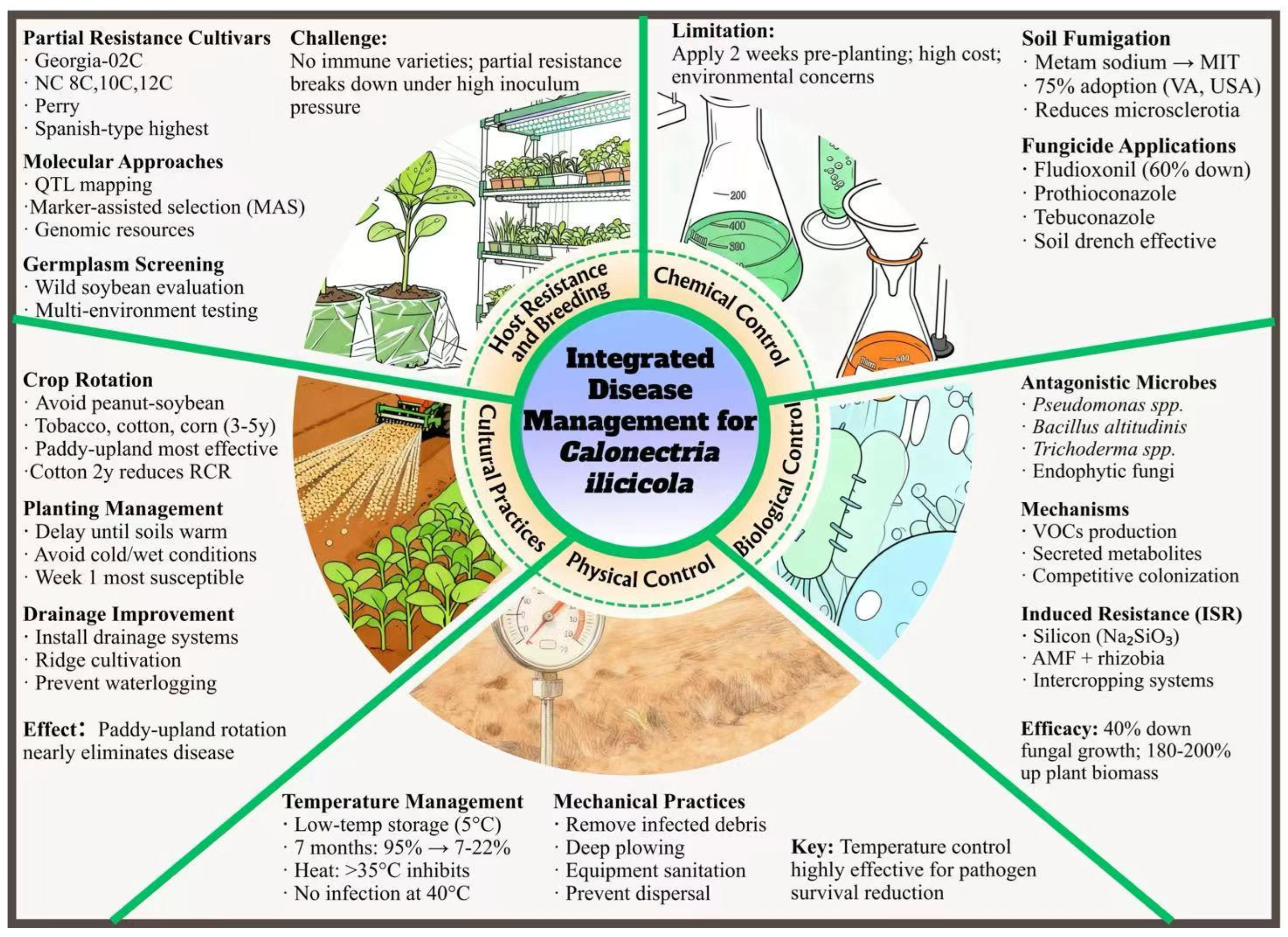
C. ilicicola necessarily involves an integrated framework that unites genetic, chemical, biological, physical, and cultural tactics. Because no single intervention provides durable suppression of CBR or RCR, contemporary strategies increasingly emphasize synergistic combinations that reduce pathogen inoculum, strengthen host defense, and promote resilience within agroecosystems. A rapidly expanding body of genomic, epidemiological, and ecological evidence, which has been generated within the last decade, now permits a more mechanistic understanding of pathogen survival, host interactions, and environmental determinants of disease. This review synthesizes these new insights to provide a timely, evidence-based foundation for designing next-generation management systems. In particular, recent advances in host–pathogen genomics, microbiome-assisted suppression, and climate-responsive agronomy justify a reevaluation of long-standing practices and highlight novel opportunities for disease mitigation in peanut and soybean production systems (
Figure 1).
7.1. Host Resistance and Breeding
Breeding for host resistance remains the most sustainable long-term strategy for managing CBR. Screening programs in the United States established that Spanish-type peanuts exhibit the highest resistance, whereas Valencia has the greatest susceptibility, and Virginia has an intermediate level [
77]. Although no immune cultivars exist, partial resistance has been deployed effectively. ‘NC 3033’ was the first resistant cultivar released, followed by ‘NC 8C’, ‘NC 10C’, ‘NC 12C’, ‘Perry’, and the widely adopted ‘Georgia-02C’ [
105,
106,
107,
108,
109]. ‘Georgia-02C’ was the first major resistant cultivar widely commercialized [
49]. Since the early 1970s, systematic screening has evaluated thousands of lines, but partial resistance can still fail under high inoculum loads [
50]. This underscores the need to define resistance mechanisms at the molecular level and pyramid complementary resistance loci to increase durability.
High-throughput sequencing now provides complete genomes of both pathogens and hosts [
110], supporting the construction of variation maps, functional annotations, and gene expression resources that have accelerated resistance discovery. Resistance to
C. ilicicola is a quantitative trait governed by multiple loci [
111]. QTL mapping has become a central tool for identifying genomic regions associated with resistance phenotypes [
112,
113]. Through marker–assisted selection (MAS), breeders can select favorable alleles at the seedling stage, bypassing lengthy field-based screens that are sensitive to environmental variation [
114,
115]. Recent genome–wide association studies (GWAS) efforts identified SNPs linked to RCR resistance in soybean germplasm [
88], providing new candidate loci for breeding. These developments, which have been enabled only recently, represent an important step toward designing predictive breeding pipelines for resistance. Wild relatives provide an additional reservoir of untapped resistance alleles. Many cultivated crops lost beneficial genes during domestication [
116], and
Glycine soja accessions with high-level resistance to
C. ilicicola have been identified [
117]. The incorporation of alleles from wild germplasm can broaden the genetic base of cultivated varieties and counteract the evolutionary potential of the pathogen.
7.2. Chemical Control
Chemical control remains an important component of integrated management, especially in fields with high inoculum pressure. Soil fumigation with metam sodium, which hydrolyzes to methyl isothiocyanate (MIT), effectively reduces populations of microsclerotia and nematodes in the root zone [
118,
119]. More than 75% of peanut fields in Virginia utilize metam sodium for CBR suppression. Fungicides such as diniconazole, tebuconazole, benomyl, fluazinam, and iprodione provide additional suppression of pod rot [
120], although their efficacy under diverse field conditions varies. The broad-spectrum toxicity of metam sodium necessitates its application at least two weeks before planting to avoid phytotoxicity, and the high cost of large-scale fumigation limits its adoption [
121]. Seed treatments present an ongoing challenge. Although early laboratory work indicated that captan, chloramine, and PCNB could suppress seedborne
C. ilicicola [
122,
123], subsequent field trials revealed that treated but infected seeds could still develop disease [
124].
Recent studies have identified fludioxonil as particularly effective against RCR in soybean. It inhibits mycelial growth at very low concentrations, and all tested strains exhibit a unimodal sensitivity distribution, with no evidence of resistance [
74]. Fludioxonil is also effective in combination with cyprodinil against other
Calonectria species that affect ornamentals [
125]. Baseline sensitivity data should be established for monitoring potential resistance development in field populations [
74]. Proactive resistance monitoring programs are essential to preserve the long-term efficacy of this fungicide class.
7.3. Biological Control
Rapid advances in microbial ecology have expanded the potential of biological control agents (BCAs) against
C.
ilicicola. Several
Pseudomonas Migula strains, such as OFT2, OFT5, and Cab57, suppress pathogen growth through secondary metabolites and reduce RCR severity in soybean [
75].
Bacillus Cohn species, specifically
Bacillus altitudinis strains TN5S8 and TN3S3, show broad-spectrum antagonistic activity and can colonize soybean roots, reducing seed rot and cotyledon damage [
126]. Recent studies have demonstrated that seed-associated
B. altitudinis populations confer resistance to seed rot through their ability to colonize specific soybean varieties [
126].
These bacteria act through multiple mechanisms: the production of volatile organic compounds that inhibit spore germination [
127]; the secretion of antifungal metabolites that disrupt cell membranes and metabolic pathways [
75,
127]; competition for nutrients and niche occupation in the rhizosphere [
126]; and the activation of plant defense pathways (salicylic acid, jasmonic acid, and ethylene) when combined with silicon treatments such as Na
2SiO
3 [
128].
7.4. Physical Control
Physical measures offer practical tools for reducing pathogen transmission. Long-term storage of seeds at low temperatures (approximately 5 °C) significantly reduces the recovery of
C. ilicicola. For the cultivars NC 8C and NC 6, the isolation rates decreased from 6.8% and 37.2%, respectively, after one month to an overall average of 2.8% after seven months [
129]. Similar reductions were observed in peanut seeds, where pathogen detection rates decreased during the eight-month storage period [
124]. These decreases highlight the value of temperature-mediated suppression of seedborne inoculum.
Field sanitation plays an equally critical role. The removal and destruction of infected plant debris reduce the soil inoculum and disease risk in subsequent seasons [
117]. Deep plowing can bury microsclerotia into unfavorable soil layers, where oxygen limitation, microbial antagonism, and temperature instability reduce their survival [
125]. However, such practices must be balanced against soil conservation considerations in modern cropping systems.
Farm-level biosecurity is essential for controlling pathogen movement. Cleaning tools, machinery, and footwear prevents the transport of contaminated soil between fields. Using certified disease-free seeds and establishing isolation zones within infected fields further reduces spread [
17]. Such zones are particularly effective at limiting the movement of contaminated soil via equipment, people, or water. Together, these physical measures constitute a critical line of defense against pathogen dissemination [
125]. Power washing of equipment and the application of quaternary ammonium disinfectants have been recommended for field sanitation [
18]. Establishing a farm-wide biosecurity protocol that includes equipment cleaning stations and boot dips can significantly reduce the risk of pathogen spread between fields.
7.5. Cultural Practices
Cultural practices form the backbone of sustainable management, particularly where chemical inputs are restricted or pathogen inoculum is entrenched. Crop rotation is fundamental, although its effectiveness varies. Rotating peanuts with soybeans should be avoided because both serve as primary hosts and can increase microsclerotial densities [
130]. More effective options include rotations with nonleguminous crops such as tobacco, cotton, or corn over 3–5 years, which can reduce, but not eliminate, soil inoculum [
131]. Adjusting sowing dates to coincide with warmer soil temperatures at planting can mitigate disease severity for both the CBR and RCR [
54]. Studies have observed that long-term soybean monoculture led to severe disease, whereas paddy-upland rotation systems such as rice rotation with wheat or maize nearly eliminated diseased plants [
56]. After two years of cotton cultivation, the incidence of soybean red crown rot decreased markedly. Furthermore, improving field drainage is essential, as heavy rainfall can disseminate conidia, ascospores, and microsclerotia to noninfested areas via runoff [
132]. Field studies have demonstrated that delaying planting by 2–3 weeks when the soil temperature exceeds 25 °C can significantly reduce disease severity [
66]. Phytosanitary and quarantine measures remain essential for preventing long-distance spread. The pathogen has been reported in Guangdong, Yunnan, Jiangsu, Fujian, and Jiangxi provinces in China, emphasizing the need for strict containment. Integrated regional strategies that combine resistant cultivars with rational crop rotation, along with the enforcement of seed certification standards, are crucial for limiting the transboundary movement of the pathogen.
8. Summary and Prospects
C. ilicicola remains one of the most formidable soil-borne pathogens affecting legume production worldwide. This review has synthesized the current understanding of CBR in peanut and RCR in soybean, which are two diseases that, while exhibiting distinct host symptoms, share a common causal agent and present parallel challenges for management. The remarkable ability of this pathogen to form melanized microsclerotia capable of persisting in soil for up to seven years, combined with its exceptionally broad host range encompassing more than 20 plant families, underscores why conventional single-tactic approaches are insufficient. Recent genomic and multiomics studies have substantially improved our knowledge of C. ilicicola, revealing significant genetic diversity within populations, host-associated differentiation at both the nuclear and mitochondrial levels, and a sophisticated repertoire of virulence factors. Integrated transcriptomic and proteomic analyses have identified 46 virulence-associated genes, offering insight into the molecular strategies employed during host colonization and infection. These findings provide a critical foundation for targeted breeding, functional validation of pathogen effectors, and the development of novel disease management interventions.
This review also highlights the urgency of this topic in light of recent epidemiological trends. Since 2018, the geographic range of the RCR has expanded in the U.S. Midwest, with confirmed outbreaks in Illinois, Indiana, Kentucky, and Missouri. This rapid spread illustrates the adaptive capacity of C. ilicicola and signals emerging threats to soybean production in regions previously considered at low risk, emphasizing the necessity of proactive surveillance and IDM strategies. Despite these advances, key gaps remain that limit our ability to deploy fully effective control measures. The molecular basis of host specificity is not yet fully understood, leaving open questions about whether distinct, host-adapted populations are emerging. While partially resistant peanut cultivars have been developed, the genetic architecture of resistance remains incompletely characterized, limiting the application of MAS and the pyramiding of multiple resistance loci for durable protection. Soybean presents an even greater challenge, as systematic screening for RCR resistance lags behind that for other major diseases, leaving producers in newly affected areas with limited options. Similarly, translating promising BCAs from controlled studies to reliable field performance continues to be a critical bottleneck, reflecting the complexity of ecological interactions in diverse soil environments. Additionally, the potential impacts of climate change on pathogen distribution, microsclerotia survival, and disease dynamics have been insufficiently explored, even though current data suggest that C. ilicicola can establish in regions with previously unfavorable climates.
Several innovative research directions promise to transform disease management. High-throughput phenotyping combined with genome-wide association studies could accelerate the discovery of resistance alleles in both cultivated germplasm and wild relatives, with wild soybean accessions representing a particularly valuable but underutilized resource. Functional characterization of the effector proteins and virulence genes identified through recent genomic analyses may reveal novel molecular targets for intervention, potentially including RNA interference and other emerging biotechnologies. The burgeoning field of plant microbiome research also offers opportunities for microbiome-informed management strategies, whether by identifying disease-suppressive microbial communities, designing rational biocontrol consortia, or modifying agronomic practices to favor beneficial microbial assemblies. Ultimately, durable and sustainable control of CBR and RCR will require an integrated, systems-level approach that leverages pathogen biology, host genetics, soil ecology, and management innovations, providing the foundation for resilient legume production in the face of environmental change and evolving pathogen threats.
Author Contributions
Conceptualization, Y.G. and B.L.; methodology, B.L. and Y.X.; software, X.G. and X.L.; validation, Y.X., G.S., L.W., C.C. and Y.G.; formal analysis, X.L.; investigation, Y.X.; resources, L.W. and C.C.; data curation, X.G.; writing—original draft preparation, Y.X., X.G. and X.L.; writing—review and editing, Y.X., X.G., X.L., G.L., G.S., L.W., C.C., Y.G. and B.L.; visualization, X.G. and G.L.; supervision, Y.G.; project administration, Y.G. and B.L.; funding acquisition, Y.G. and B.L. All authors have read and agreed to the published version of the manuscript.
Funding
This work was supported by the Jiangsu Provincial Higher Education Basic Science (Natural Science) Research General Program (22KJB210020), the Yangzhou “Lvyangjinfeng” Excellent Doctoral Project (YZLYJFJH2021YXBS028), the Yangzhou Polytechnic University School-level Regular Project (SC202402511) and the Fundamental Research Funds for the Central Universities (No: ZZK202503).
Institutional Review Board Statement
Not applicable.
Informed Consent Statement
Not applicable.
Data Availability Statement
The data presented in this study are available within the article.
Acknowledgments
The authors would like to express their sincere gratitude to the anonymous reviewers for their insightful comments and suggestions, which have greatly helped improve the quality of this manuscript.
Conflicts of Interest
The authors declare that they have no conflicts of interest.
References
- Çiftçi, S.; Suna, G. Functional components of peanuts (Arachis hypogaea L.) and health benefits: A review. Future Foods 2022, 5, 100140. [Google Scholar] [CrossRef]
- Gelaye, Y.; Luo, H. Optimizing Peanut (Arachis hypogaea L.) production: Genetic insights, climate adaptation, and efficient management practices: Systematic review. Plants 2024, 13, 2988. [Google Scholar] [CrossRef]
- Guo, B.; Sun, L.; Jiang, S.; Ren, H.; Sun, R.; Wei, Z.; Hong, H.; Luan, X.; Wang, J.; Wang, X. Soybean genetic resources contributing to sustainable protein production. Theor. Appl. Genet. 2022, 135, 4095–4121. [Google Scholar] [CrossRef] [PubMed]
- Rajni, M.; Beenu, T.; Ankit, G.; Vikas, K. Soybean (Glycine max). In Oil Seeds: Health Attributes and Food Applications; Springer Publishers: Singapore, 2020. [Google Scholar] [CrossRef]
- Variath, M.T.; Janila, P. Economic and academic importance of peanut. In The Peanut Genome; Springer: Berlin/Heidelberg, Germany, 2017; pp. 7–26. [Google Scholar]
- Crops and Livestock Products. Available online: https://www.fao.org/faostat/en/#data/QCL (accessed on 9 May 2025).
- Zhang, X.; Li, Q. A Brief Introduction of Main Diseases and Insect Pests in Soybean Production in the Global Top Five Soybean Producing Countries. Plant Dis. Pests 2018, 9, 17. [Google Scholar]
- Jiang, C.J.; Xie, X. Soybean red crown rot: Current knowledge and future challenges. Plant Pathol. 2023, 72, 1557–1569. [Google Scholar] [CrossRef]
- Bell, D.K.; Sobers, E.K. A peg, pod, and root necrosis of peanuts caused by a species of Calonectria. Phytopathology 1966, 56, 1361–1364. [Google Scholar]
- Crous, P.; Wingfield, M.; Alfenas, A. Cylindrocladium parasiticum sp. nov., a new name for C. crotalariae. Mycol. Res. 1993, 97, 889–896. [Google Scholar] [CrossRef]
- Pradeepa, M. Studies on Major Soil Fungal Flora of Groundnut (Arachis hypogaea L.). Master’s Thesis, University of Agricultural Sciences, Dharwad, India, 2016. [Google Scholar]
- Garren, K.; Beute, M.; Porter, D. The Cylindrocladium black rot of peanut in Virginia and North Carolina. J. Am. Peanut Res. Educ. Assoc. 1972, 4, 67–71. [Google Scholar]
- Gai, Y.; Deng, Q.; Chen, X.; Guan, M.; Xiao, X.; Xu, D.; Deng, M.; Pan, R. Phylogenetic diversity of Calonectria ilicicola causing Cylindrocladium black rot of peanut and red crown rot of soybean in southern China. J. Gen. Plant Pathol. 2017, 83, 273–282. [Google Scholar] [CrossRef]
- Neves, D.L.; Mehl, K.M.; Bradley, C.A. First report of red crown rot, caused by Calonectria ilicicola, and its effect on soybean in Kentucky. Plant Health Prog. 2023, 24, 303–305. [Google Scholar] [CrossRef]
- Bish, M.D.; Herman, T.K.; McCoppin, N.; Tian, P.; Clough, S.J.; Karki, H.S. First Report of Red Crown Rot of Soybean, caused by Calonectria ilicicola, in Missouri. Plant Dis. 2025, 109, 1181. [Google Scholar] [CrossRef]
- Lu, C.; Dai, T.; Zhang, H.; Zeng, D.; Wang, Y.; Yang, W.; Zheng, X. A novel LAMP assay using hot water in vacuum insulated bottle for rapid detection of the soybean red crown rot pathogen Calonectria ilicicola. Australas. Plant Pathol. 2022, 51, 251–259. [Google Scholar] [CrossRef]
- Kleczewski, N.; Plewa, D.; Kangas, C.; Phillippi, E.; Kleczewski, V. First report of red crown rot of soybeans caused by Calonectria ilicicola (anamorph: Cylindrocladium parasiticum) in Illinois. Plant Dis. 2019, 103, 1777. [Google Scholar] [CrossRef]
- Bonkowski, J.; Goodnight, K.M.; Grskovich, M.R.; Telenko, D.E.P. First report of Calonectria ilicicola causing red crown rot of soybean in Indiana. Plant Dis. 2024, 108, 811. [Google Scholar] [CrossRef]
- Dann, E.; Gazis, R. Foliar, fruit and soilborne diseases. In The avocado: Botany, Production and Uses; CABI: Wallingford, UK, 2024; pp. 481–547. [Google Scholar]
- Wright, L.P.; Davis, A.J.; Wingfield, B.D.; Crous, P.W.; Brenneman, T.; Wingfield, M.J. Population structure of Cylindrocladium parasiticum infecting peanuts (Arachis hypogaea) in Georgia, USA. Eur. J. Plant Pathol. 2010, 127, 199–206. [Google Scholar] [CrossRef]
- Bernaux, P. Identification de quelques maladies du soja au Cameroun. Agron. Trop. 1979, 34, 301–304. [Google Scholar]
- Dianese, J.; Ribeiro, W.; Urben, A. Root rot of soybean caused by Cylindrocladium clavatum in central Brazil. Plant Dis. 1986, 70, 977–980. [Google Scholar] [CrossRef]
- Sung, J.M. An investigation of undescribed black root rot disease of soybean caused by Cylindrocladium (Calonectria) crotalariae in Korea. Korean J. Mycol. 1980, 8, 53–57. [Google Scholar]
- Liu, H.H.; Shen, Y.M.; Chang, H.X.; Tseng, M.N.; Lin, Y.H. First Report of Soybean Red Crown Rot Caused by Calonectria ilicicola in Taiwan. Plant Dis. 2020, 104, 979. [Google Scholar] [CrossRef]
- Pei, W.H.; Cao, J.F.; Yang, M.Y.; Zhao, Z.J.; Xue, S.M. First Report of Black Rot of Medicago sativa Caused by Cylindrocladium parasiticum (teleomorph Calonectria ilicicola) in Yunnan Province, China. Plant Dis. 2015, 99, 890. [Google Scholar] [CrossRef]
- Brenneman, T.; Padgett, G.; McDaniel, R. First report of Cylindrocladium black rot (C. parasiticum) on partridgepea and sicklepod. Plant Dis. 1998, 82, 1064. [Google Scholar] [CrossRef] [PubMed]
- Polizzi, G.; Vitale, A.; Aiello, D.; Guarnaccia, V.; Crous, P.; Lombard, L. First Report of Calonectria ilicicola Causing a New Disease on Laurus (Laurus nobilis) in Europe. J. Phytopathol. 2011, 160, 41–44. [Google Scholar] [CrossRef]
- Fei, N.Y.; Qi, Y.B.; Meng, T.T.; Fu, J.F.; Yan, X.R. First Report of Root Rot Caused by Calonectria ilicicola on Blueberry in Yunnan Province, China. Plant Dis. 2018, 102, 1036. [Google Scholar] [CrossRef]
- Wan, K.; Linghu, M.; Li, X.; Li, Z.; Song, X.; Qiang, S. First Report of Calonectria ilicicola Causing Leaf Spot on Camellia sinensis in Yunnan Province, China. Plant Dis. 2024, 108, 801. [Google Scholar] [CrossRef]
- Wang, H.; Wu, J.; Fang, L.; Xie, Y.; Wang, L. First Report of Calonectria ilicicola Causing Fruit Rot on Postharvest Prunus persica in Zhejiang Province, China. Plant Dis. 2023, 107, 3313. [Google Scholar] [CrossRef]
- Mirabolfathy, M.; Groenewald, J.Z.; Crous, P.W. Root and Crown Rot of Anthurium Caused by Calonectria ilicicola in Iran. Plant Dis. 2010, 94, 278. [Google Scholar] [CrossRef]
- Liang, X.; Wang, Q.; Chen, S. Phylogeny, Morphology, Distribution, and Pathogenicity of Seven Calonectria Species from Leaf-Blighted Eucalyptus in HaiNan Island, China. Plant Dis. 2023, 107, 2579–2605. [Google Scholar] [CrossRef]
- Yi, R.H.; Su, J.J.; Li, H.J.; Li, D.; Long, G.G. First Report of Root Rot on Manglietia decidua Caused by Calonectria ilicicola in China. Plant Dis. 2022, 106, 1522. [Google Scholar] [CrossRef]
- Male, M.F.; Tan, Y.P.; Vawdrey, L.L.; Shivas, R.G. Recovery, pathogenicity and molecular sequencing of Calonectria ilicicola which causes collar rot on Carica papaya in Australia. Australas. Plant Dis. Notes 2012, 7, 137–138. [Google Scholar] [CrossRef]
- Dann, E.K.; Cooke, A.W.; Forsberg, L.; Pegg, K.G.; Tan, Y.P.; Shivas, R.G. Pathogenicity studies in avocado with three nectriaceous fungi, Calonectria ilicicola, Gliocladiopsis sp. and Ilyonectria liriodendri. Plant Pathol. 2012, 61, 896–902. [Google Scholar] [CrossRef]
- Krausz, J.; Caldwell, J. Cylindrocladium root rot of kiwifruit. Plant Dis. 1987, 71, 374–375. [Google Scholar] [CrossRef]
- Haralson, J.C. Pathogens Associated with Blueberry Cutting Failure in South Georgia Nurseries and Their Control. Master’s Thesis, University of Georgia, Athens, GA, USA, 2009. [Google Scholar]
- Uchida, J.; Aragaki, M. Comparative morphology and pathology of Calonectria theae and C. colhounii in Hawaii. Plant Dis. 1997, 81, 298–300. [Google Scholar] [CrossRef] [PubMed]
- Ko, W.; Uchida, J.; Kunimoto, R.; Aragaki, M. Collar rot and leaf spot of Leea caused by Calonectria crotalariae. Plant Dis. 1981, 65, 621. [Google Scholar] [CrossRef]
- Liu, Q.; Wingfield, M.J.; Duong, T.A.; Wingfield, B.D.; Chen, S. Diversity and Distribution of Calonectria Species from Plantation and Forest Soils in Fujian Province, China. J. Fungi 2022, 8, 811. [Google Scholar] [CrossRef]
- Dong, W. Identifying Resistance to, and Interactions of, Root-Knot Nematodes and Cylindrocladium black rot in Peanut. Ph.D. Thesis, University of Georgia, Athens, GA, USA, 2007. [Google Scholar]
- Beute, M.K. Cylindrocladium black rot (CBR) disease of peanut (Arachis hypogaea). In International Workshop on Groundnuts; International Crops Research Institute for the Semi-Arid Tropics: Patancheru, India, 1980; p. 171. [Google Scholar]
- Sarkar, S.; Oakes, J.; Cazenave, A.-B.; Burow, M.D.; Bennett, R.S.; Chamberlin, K.D.; Wang, N.; White, M.; Payton, P.; Mahan, J. Evaluation of the US peanut germplasm mini-core collection in the Virginia-Carolina region using traditional and new high-throughput methods. Agronomy 2022, 12, 1945. [Google Scholar] [CrossRef]
- Glenn, D.L. Incidence and Management of Seed Transmission of Cylindrocladium Black Rot of Peanut in Virginia. Master’s Thesis, Virginia Tech, Blacksburg, VA, USA, 2001. [Google Scholar]
- Wilson, J.N. Greenhouse Techniques to Screen for Resistance to Peanut Diseases. Master’s Thesis, Texas Tech University, Lubbock, TX, USA, 2008. [Google Scholar]
- Bell, D. Effects of mechanical injury, fungi, and soil temperature on peanut seed decay in soil. Phytopathology 1969, 64, 241–243. [Google Scholar] [CrossRef]
- Dos Santos, F.; Medina, P.F.; Lourenção, A.L.; Parisi, J.J.D.; de Godoy, I.J. Damage caused by fungi and insects to stored peanut seeds before processing. Bragantia 2016, 75, 184–192. [Google Scholar] [CrossRef]
- Yamamoto, R.; Nakagawa, A.; Shimada, S.; Komatsu, S.; Kanematsu, S. Histopathology of red crown rot of soybean. J. Gen. Plant Pathol. 2017, 83, 23–32. [Google Scholar] [CrossRef]
- Branch, W.; Brenneman, T. Registration of ‘Georgia-22MPR’ peanut. J. Plant Regist. 2023, 17, 299–303. [Google Scholar] [CrossRef]
- Hollowell, J.; Isleib, T.; Tallury, S.; Copeland, S.; Shew, B. Screening of Virginia-type peanut breeding lines for resistance to Cylindrocladium black rot and Sclerotinia blight in the greenhouse. Peanut Sci. 2008, 35, 18–24. [Google Scholar] [CrossRef]
- Krigsvold, D.T.; Garren, K.H.; Griffin, G.J. Importance of peanut field cultivation and soybean cropping in the spread of Cylindrocladium crotalariae within and among peanut fields. Plant Dis. Report 1977, 61, 195–499. [Google Scholar]
- Souma, J.; Takeda, N. Occurrence of soybean root necrosis caused by Calonectria ilicicola in Hokkaido. In 53rd Annual Report of the Society of Plant Protection of North Japan; The Society of Plant Protection of North Japan: Daisen, Japan, 2002. [Google Scholar]
- Rowe, R.; Beute, M.; Wells, J. Cylindrocladium black rot of peanuts in North Carolina-1972. Plant Dis. Report. 1973, 57, 387–389. [Google Scholar]
- Kuruppu, P.; Schneider, R.; Russin, J. Factors affecting soybean root colonization by Calonectria ilicicola and development of red crown rot following delayed planting. Plant Dis. 2004, 88, 613–619. [Google Scholar] [CrossRef] [PubMed]
- Djaeni, M. Effect of depth of soil on the inoculum population of Calonectria crotolariae. In 53rd Annual Report of the Society of Plant Protection of North Japan; The Society of Plant Protection of North Japan: Daisen, Japan, 1991. [Google Scholar]
- Gai, J.; Lin, M. A report on black root rot of soybeans in Jiangsu, China. Soybean Sci. 1992, 11, 113–119. [Google Scholar]
- Guan, M.; Pan, R.; Gao, X.; Xu, D.; Deng, Q.; Deng, M. First report of red crown rot caused by Cylindrocladium parasiticum on soybean in Guangdong, Southern China. Plant Dis. 2010, 94, 485. [Google Scholar] [CrossRef]
- Ma, Z.; Zhang, Z.; Wang, Y.; Yang, X. Cylindrocladium crotalariae causing red crown rot of soybean in China. Plant Pathol. 2004, 53, 537. [Google Scholar] [CrossRef]
- Edwards Molina, J.; Navarro, B.; Allen, T.; Godoy, C. Soybean target spot caused by Corynespora cassiicola: A resurgent disease in the Americas. Trop. Plant Pathol. 2022, 47, 315–331. [Google Scholar] [CrossRef]
- Blessing, D.J.; Gu, Y.; Cao, M.; Cui, Y.; Wang, X.; Asante-Badu, B. Overview of the advantages and limitations of maize-soybean intercropping in sustainable agriculture and future prospects: A review. Chil. J. Agric. Res. 2022, 82, 177–188. [Google Scholar] [CrossRef]
- Wrather, J.; Anderson, T.; Arsyad, D.; Tan, Y.; Ploper, L.D.; Porta-Puglia, A.; Ram, H.; Yorinori, J. Soybean disease loss estimates for the top ten soybean-producing counries in 1998. Can. J. Plant Pathol. 2001, 23, 115–121. [Google Scholar] [CrossRef]
- Yamamoto, S.; Nomoto, S.; Hashimoto, N.; Maki, M.; Hongo, C.; Shiraiwa, T.; Homma, K. Monitoring spatial and time-series variations in red crown rot damage of soybean in farmer fields based on UAV remote sensing. Plant Prod. Sci. 2023, 26, 36–47. [Google Scholar] [CrossRef]
- Berner, D.; Berggren, G.; Snow, J.; White, E. Distribution and management of red crown rot of soybean in Louisiana. Appl. Agric. Res. 1988, 3, 160–166. [Google Scholar]
- Ochi, S.; Mimuro, G.; Kishi, S. Effect of red crown rot of soybean on occurrence of wrinkled seeds. J. Gen. Plant Pathol. 2022, 88, 232–238. [Google Scholar] [CrossRef]
- Aiello, D.; Guarnaccia, V.; Vitale, A.; LeBlanc, N.; Shishkoff, N.; Polizzi, G. Impact of Calonectria diseases on ornamental horticulture: Diagnosis and control strategies. Plant Dis. 2022, 106, 1773–1787. [Google Scholar] [CrossRef] [PubMed]
- Akamatsu, H.; Fujii, N.; Saito, T.; Sayama, A.; Matsuda, H.; Kato, M.; Kowada, R.; Yasuta, Y.; Igarashi, Y.; Komori, H. Factors affecting red crown rot caused by Calonectria ilicicola in soybean cultivation. J. Gen. Plant Pathol. 2020, 86, 363–375. [Google Scholar] [CrossRef]
- Kleczewski, N.M.; Bradley, C.A.; Hartman, G.; Kandel, Y.; Mueller, D.; Salamanca, L.R. A diagnostic guide for red crown rot of soybean. Plant Health Prog. 2023, 24, 123–129. [Google Scholar] [CrossRef]
- Kleczewski, N.; Geisler, S. Assessment of selected commercially available seed treatments on suppressing the effects of red crown rot on soybeans under a controlled environment. Plant Dis. 2022, 106, 2060–2065. [Google Scholar] [CrossRef]
- Hawksworth, D.L.; Crous, P.W.; Redhead, S.A.; Reynolds, D.R.; Samson, R.A.; Seifert, K.A.; Taylor, J.W.; Wingfield, M.J.; Abaci, Ö.; Aime, C. The Amsterdam declaration on fungal nomenclature. IMA Fungus 2011, 2, 105–111. [Google Scholar] [CrossRef]
- Barnett, H.L.; Hunter, B.B. Illustrated Genera of Imperfect Fungi; Burgess Publishing Company: Minneapolis, MN, USA, 1972. [Google Scholar]
- Crous, P.W.; Groenewald, J.Z.; Risède, J.-M.; Simoneau, P.; Hywel-Jones, N.L. Calonectria species and their Cylindrocladium anamorphs: Species with Sphaeropedunculate vesicles. Stud. Mycol. 2004, 50, 415–430. [Google Scholar]
- Heitman, J. Sexual reproduction and the evolution of microbial pathogens. Curr. Biol. 2006, 16, R711–R725. [Google Scholar] [CrossRef]
- Hunter, B.B.; Barnett, H. Production of microsclerotia by species of Cylindrocladium. Phytopathology 1976, 66, 777–780. [Google Scholar] [CrossRef]
- Li, X.; Liu, S.; Xie, S.; Hu, H.; Li, G.; Chen, B.; Li, J.; Wei, L.; Chen, W.; Song, X.; et al. CiOs1, CiOs4 and CiOs5 modulate temperature-dependent growth and fludioxonil resistance in Calonectria ilicicola, causing soybean red crown rot. Pestic. Biochem. Physiol. 2025, 213, 106536. [Google Scholar] [CrossRef] [PubMed]
- Win, K.T.; Kobayashi, M.; Tanaka, F.; Takeuchi, K.; Oo, A.Z.; Jiang, C.J. Identification of Pseudomonas strains for the biological control of soybean red crown root rot. Sci. Rep. 2022, 12, 14510. [Google Scholar] [CrossRef] [PubMed]
- Ochi, S.; Kuroda, T. Developing a qPCR assay for the quantification of Calonectria ilicicola in soil of soybean field. Trop. Plant Pathol. 2021, 46, 186–194. [Google Scholar] [CrossRef]
- Coffelt, T.; Garren, K. Screening for resistance to Cylindrocladium black rot in peanuts (Arachis hypogaea L.). Peanut Sci. 1982, 9, 1–5. [Google Scholar] [CrossRef]
- Coffelt, T. Reaction of spanish-type peanut genotypes to Cylindrocladium black rot. Peanut Sci. 1980, 7, 91–94. [Google Scholar] [CrossRef]
- Garren, K.; Coffelt, T. Reaction to Cylindrocladium black rot in Virginia-type peanut cultivars. Plant Dis. Report. 1976, 60, 175–178. [Google Scholar]
- Pataky, J.; Beute, M.; Wynne, J.; Carlson, G. A critical-point yield loss model for Cylindrocladium black rot of peanut. Phytopathology 1983, 73, 1559–1563. [Google Scholar] [CrossRef]
- Win, K.T.; Jiang, C.J. A fresh weight-based method for evaluating soybean resistance to red crown rot. Breed. Sci. 2021, 71, 384–389. [Google Scholar] [CrossRef]
- Parkinson, L.E.; Le, D.; Shivas, R.G.; Dann, E. Pathogenicity and molecular detection of nectriaceous fungi associated with black root rot of avocado. In Proceedings of the IX World Avocado Congress, Medellín, Colombia, 23–27 September 2019. [Google Scholar]
- Ye, W.-W.; Zeng, D.-D.; Xu, M.; Yang, J.; Ma, J.-X.; Wang, Y.-C.; Zheng, X.-B. A LAMP-assay-based specific microbiota analysis reveals community dynamics and potential interactions of 13 major soybean root pathogens. J. Integr. Agric. 2020, 19, 2056–2063. [Google Scholar] [CrossRef]
- Liu, Y.; Rosikiewicz, W.; Pan, Z.; Jillette, N.; Wang, P.; Taghbalout, A.; Foox, J.; Mason, C.; Carroll, M.; Cheng, A. DNA methylation-calling tools for Oxford Nanopore sequencing: A survey and human epigenome-wide evaluation. Genome Biol. 2021, 22, 295. [Google Scholar] [CrossRef]
- Liu, H.-H.; Wang, J.; Wu, P.-H.; Lu, M.-Y.J.; Li, J.-Y.; Shen, Y.-M.; Tzeng, M.-N.; Kuo, C.-H.; Lin, Y.-H.; Chang, H.-X. Whole-genome sequence resource of Calonectria ilicicola, the casual pathogen of soybean red crown rot. Mol. Plant-Microbe Interact. 2021, 34, 848–851. [Google Scholar] [CrossRef] [PubMed]
- Chen, X.; Luo, M.; Wu, W.; Dong, Z.; Zou, H. Virulence-associated genes of Calonectria ilicola, responsible for Cylindrocladium black rot. J. Fungi 2022, 8, 869. [Google Scholar] [CrossRef] [PubMed]
- Chen, X.; Luo, M.; Xiang, M.; Xiong, L.; Shu, Y.; Yu, G.; Dong, Z.; Sun, Y. Comparative proteomic analysis of the moderately resistant and susceptible peanut cultivars during infestation by Cylindrocladium parasiticum. Can. J. Plant Pathol. 2024, 46, 50–64. [Google Scholar] [CrossRef]
- Antwi-Boasiako, A.; Jia, S.; Liu, J.; Guo, N.; Chen, C.; Karikari, B.; Feng, J.; Zhao, T. Identification and Genetic Dissection of Resistance to Red Crown Rot Disease in a Diverse Soybean Germplasm Population. Plants 2024, 13, 940. [Google Scholar] [CrossRef]
- Lone, T.A. Fungal Pathogens of the Oilseed Crops: Loss of Yield and Crop Management. In Oilseed Crops; Scrivener Publishing LLC: Beverly, MA, USA, 2025; pp. 113–140. [Google Scholar]
- Pal, K.K.; Dey, R.; Tilak, K. Fungal diseases of groundnut: Control and future challenges. In Future Challenges in crop Protection Against Fungal Pathogens; Springer: Berlin/Heidelberg, Germany, 2014; pp. 1–29. [Google Scholar]
- Tikami, Í.; Boufleur, T.R.; Prataviera, F.; Panciera, L.G.; Neves, V.H.; Ciampi-Guillardi, M.; Massola, N.S., Jr. Survival of Colletotrichum truncatum as microsclerotia in soil. Plant Dis. 2023, 107, 2460–2466. [Google Scholar] [CrossRef]
- Nishi, K. Ecology and control of root necrosis of soybean caused by Calonectria crotalariae. Bull. Nat. Agric. Res. Cent. 1999, 30, 11–109. [Google Scholar]
- Krigsvold, D.; Griffin, G.; Hale, M. Microsclerotial Germination of Cylindrocladium crotalariae in the Rhizospheres of Susceptible and Resistant Peanut Plants. Phytopathology 1982, 72, 859–864. [Google Scholar] [CrossRef]
- Phipps, R.L. Simulation of wetlands forest vegetation dynamics. Ecol. Model. 1979, 7, 257–288. [Google Scholar] [CrossRef]
- Black, M.; Beute, M. Relationships among inoculum density, microsclerotium size, and inoculum efficiency of Cylindrocladium crotalariae causing root rot on peanuts. Phytopathology 1984, 74, 1128–1132. [Google Scholar] [CrossRef]
- Black, M.; Beute, M.; Leonard, K. Effects of monoculture with susceptible and resistant peanuts on the virulence of Cylindrocladium crotalariae. Phytopathology 1984, 74, 945–950. [Google Scholar] [CrossRef]
- Weeks, J.M., Jr. Perennial Grass Based Crop Rotations in Virginia: Effects on Soil Quality, Disease Incidence, and Cotton and Peanut Growth. Master’s Thesis, Virginia Tech, Blacksburg, VA, USA, 2008. [Google Scholar]
- Nan, Z.; Long, P.; Skipp, R. Effect of several root pathogenic fungi on growth of red clover under field conditions. N. Z. J. Agric. Res. 1991, 34, 263–269. [Google Scholar] [CrossRef]
- Old, K.M.; See, L.S.; Sharma, J.K.; Yuan, Z.Q. A Manual of Diseases of Tropical Acacias in Australia, South-East Asia, and India; Center for International Forestry Research: Bogor, Indonesia, 2020. [Google Scholar]
- Hirooka, Y.; Takeuchi, J.; Horie, H.; Natsuaki, K.T. Cylindrocladium brown leaf spot on Howea belmoreana caused by Calonectria ilicicola (anamorph: Cylindrocladium parasiticum) in Japan. J. Gen. Plant Pathol. 2008, 74, 66–70. [Google Scholar] [CrossRef]
- Cordell, C.; Juttner, A.; Stambaugh, W. Cylindrocladium floridanum causes severe mortality of seedling Yellow-Poplar in a North Carolina nursery. Plant Dis. Report. 1971, 55, 700–702. [Google Scholar]
- Nishijima, W.T.; Aragaki, M. Pathogenicity and further characterization of Calonectria crotalariae causing collar rot of papaya. Phytopathology 1973, 63, 553. [Google Scholar] [CrossRef]
- Dehgan, B. Angiosperms: Flowering plants. In Garden Plants Taxonomy: Volume 1: Ferns, Gymnosperms, and Angiosperms (Monocots); Springer: Berlin/Heidelberg, Germany, 2023; pp. 173–603. [Google Scholar]
- Milholland, R. Stem and root rot of blueberry caused by Calonectria crotalariae. Phytopathology 1974, 64, 831. [Google Scholar] [CrossRef]
- Beute, M.; Wynne, J.; Emery, D. Registration of NC3033 peanut germplasm (Reg. No. GP 9). Crop Sci. 1976, 16, 887. [Google Scholar] [CrossRef]
- Wynne, J.; Beute, M. Registration of NC 8C peanut (Reg. No. 27). Crop Sci. 1983, 23, 183–184. [Google Scholar] [CrossRef]
- Lanier, J.E.; Jordan, D.L.; Spears, J.F.; Wells, R.; Johnson, P.D.; Barnes, J.S.; Hurt, C.A.; Brandenburg, R.L.; Bailey, J.E. Peanut response to planting pattern, row spacing, and irrigation. Agron. J. 2004, 96, 1066–1072. [Google Scholar] [CrossRef]
- Isleib, T.; Rice, P.; Bailey, J.; Mozingo, R.; Pattee, H. Registration of’ NC 12C’peanut. Crop Sci. 1997, 37, 1976. [Google Scholar] [CrossRef]
- Isleib, T.; Rice, P.; Mozingo, R., II; Bailey, J. Registration of’ Perry’ peanut. Crop Sci. 2003, 43, 739. [Google Scholar] [CrossRef]
- Wu, C.T.; Shropshire, W.C.; Bhatti, M.M.; Cantu, S.; Glover, I.K.; Anand, S.S.; Liu, X.; Kalia, A.; Treangen, T.J.; Chemaly, R.F.; et al. Rapid Whole Genome Characterization of High-Risk Pathogens Using Long-Read Sequencing to Identify Potential Healthcare Transmission. medRxiv 2024. [Google Scholar] [CrossRef]
- Semagn, K.; Crossa, J.; Cuevas, J.; Iqbal, M.; Ciechanowska, I.; Henriquez, M.A.; Randhawa, H.; Beres, B.L.; Aboukhaddour, R.; McCallum, B.D.; et al. Comparison of single-trait and multi-trait genomic predictions on agronomic and disease resistance traits in spring wheat. Theor. Appl. Genet. 2022, 135, 2747–2767. [Google Scholar] [CrossRef] [PubMed]
- Ontoy, J.C.; Ham, J.H. Mapping and Omics Integration: Towards Precise Rice Disease Resistance Breeding. Plants 2024, 13, 1205. [Google Scholar] [CrossRef] [PubMed]
- Nelson, R.; Wiesner-Hanks, T.; Wisser, R.; Balint-Kurti, P. Navigating complexity to breed disease-resistant crops. Nat. Rev. Genet. 2018, 19, 21–33. [Google Scholar] [CrossRef]
- Collard, B.C.; Mackill, D.J. Marker-assisted selection: An approach for precision plant breeding in the twenty-first century. Philos. Trans. R. Soc. Lond. B Biol. Sci. 2008, 363, 557–572. [Google Scholar] [CrossRef]
- Francia, E.; Tacconi, G.; Crosatti, C.; Barabaschi, D.; Bulgarelli, D.; Dall’Aglio, E.; Valè, G. Marker assisted selection in crop plants. Plant Cell Tissue Organ Cult. 2005, 82, 317–342. [Google Scholar] [CrossRef]
- Leal-Bertioli, S.C.; Cavalcante, U.; Gouvea, E.G.; Ballen-Taborda, C.; Shirasawa, K.; Guimaraes, P.M.; Jackson, S.A.; Bertioli, D.J.; Moretzsohn, M.C. Identification of QTLs for Rust Resistance in the Peanut Wild Species Arachis magna and the Development of KASP Markers for Marker-Assisted Selection. G3 Genes Genomes Genet. 2015, 5, 1403–1413. [Google Scholar] [CrossRef]
- Jiang, C.-J.; Sugano, S.; Ochi, S.; Kaga, A.; Ishimoto, M. Evaluation of Glycine max and Glycine soja for Resistance to Calonectria ilicicola. Agronomy 2020, 10, 887. [Google Scholar] [CrossRef]
- Sarenqimuge, S.; Rahman, S.; Wang, Y.; Von Tiedemann, A. Dormancy and germination of microsclerotia of Verticillium longisporum are regulated by soil bacteria and soil moisture levels but not by nutrients. Front. Microbiol. 2022, 13, 979218. [Google Scholar] [CrossRef]
- Zhang, Y.; Fang, W.; Yan, D.; Ji, Y.; Chen, X.; Guo, A.; Song, Z.; Li, Y.; Cao, A.; Wang, Q. Encapsulated allyl isothiocyanate improves soil distribution, efficacy against soil-borne pathogens and tomato yield. Pest. Manag. Sci. 2024, 80, 3967–3978. [Google Scholar] [CrossRef]
- Kucharek, T.; Atkins, J. Occurrence and control of Cylindrocladium black rot in peanuts in Florida. Proc. Soil Crop Sci. Soc. Fla 1993, 52, 17–20. [Google Scholar]
- Cline, K. Import of proteins into chloroplasts. Membrane integration of a thylakoid precursor protein reconstituted in chloroplast lysates. J. Biol. Chem. 1986, 261, 14804–14810. [Google Scholar] [CrossRef] [PubMed]
- Salam, S.; Arif, A.; Mahmood, R. Thiram-induced cytotoxicity and oxidative stress in human erythrocytes: An in vitro study. Pestic. Biochem. Physiol. 2020, 164, 14–25. [Google Scholar] [CrossRef] [PubMed]
- Yang, J.; Ye, T.; Liu, G.; Xu, X.; Zheng, Y.; Wang, W. Synthesis and bioactivity of indoleacetic acid-carbendazim and its effects on Cylindrocladium parasiticum. Pestic. Biochem. Physiol. 2019, 158, 128–134. [Google Scholar] [CrossRef] [PubMed]
- Randall-Schadel, B.L. Seed Transmission of Cylindrocladium Parasiticum in Peanut (Arachis Hypogaea L.). Ph.D. Thesis, North Carolina State University, Raleigh, NC, USA, 1999. [Google Scholar]
- Ochi, S.; Nakagawa, A. Improved quantitative method for isolating Calonectria ilicicola from naturally infested soils. J. Gen. Plant Pathol. 2012, 78, 147–150. [Google Scholar] [CrossRef]
- Wu, P.-H.; Chang, H.-X. Colonization of Bacillus altitudinis on the Compatible Soybean Varieties to Provide Seed Rot Resistance. bioRxiv 2023. [Google Scholar] [CrossRef]
- Samavat, S. A novel biocontrol strain Pseudomonas canadensis FRPC18 against box blight (causative agent Calonectria pseudonaviculata). Egypt. J. Biol. Pest Control. 2024, 34, 17. [Google Scholar] [CrossRef]
- Win, K.T.; Maeda, S.; Kobayashi, M.; Jiang, C.-J. Silicon Enhances Resistance to Red Crown Rot Caused by Calonectria ilicicola in Soybean. Agronomy 2021, 11, 899. [Google Scholar] [CrossRef]
- Porter, D.M.; Wright, F.S.; Taber, R.A.; Smith, D.H. Colonization of peanut seed by Cylindrocladium crotalariae. Phytopathology 1991, 81, 896–900. [Google Scholar] [CrossRef]
- Dell’Olmo, E.; Tiberini, A.; Sigillo, L. Leguminous seedborne pathogens: Seed health and sustainable crop management. Plants 2023, 12, 2040. [Google Scholar] [CrossRef]
- Naseri, B. Legume root rot control through soil management for sustainable agriculture. In Sustainable Management of Soil and Environment; Springer: Berlin/Heidelberg, Germany, 2019; pp. 217–258. [Google Scholar]
- Yadav, V.; Khare, C.; Tiwari, P.; Srivastava, J. Important diseases of soybean crop and their management. In Diseases of Field Crops Diagnosis and Management; Apple Academic Press: Palm Bay, FL, USA, 2020; pp. 145–171. [Google Scholar]
| Disclaimer/Publisher’s Note: The statements, opinions and data contained in all publications are solely those of the individual author(s) and contributor(s) and not of MDPI and/or the editor(s). MDPI and/or the editor(s) disclaim responsibility for any injury to people or property resulting from any ideas, methods, instructions or products referred to in the content. |





 ,
,