Article

In Vitro Phytochemical Profiling, and Antioxidant Activity Analysis of Callus and Cell Suspension Cultures of Washingtonia filifera Elicited with Chitosan


by
Huda Enaya Mahood
1,
Virginia Sarropoulou
2,
Thalia Tsapraili
3 and
Thiresia-Teresa Tzatzani
3,*
1
Department of Agriculture Biotechnology, College of Biotechnology, University of Al-Qadisiyah, Al Diwaniyah 58002, Iraq
2
Institute of Plant Breeding and Genetic Resources, Hellenic Agricultural Organization (ELGO)-DIMITRA, 57001 Thessaloniki, Greece
3
Laboratory of Subtropical Plants & Tissue Culture, Institute of Olive Tree, Subtropical Crops & Viticulture, Hellenic Agricultural Organization (ELGO)-DIMITRA, 73134 Chania, Greece
*
Author to whom correspondence should be addressed.
Agronomy 2026, 16(1), 106; https://doi.org/10.3390/agronomy16010106
Submission received: 25 November 2025 / Revised: 17 December 2025 / Accepted: 26 December 2025 / Published: 31 December 2025
(This article belongs to the Special Issue Plant Tissue Culture and Regeneration Techniques for Crop Enhancement)

Abstract

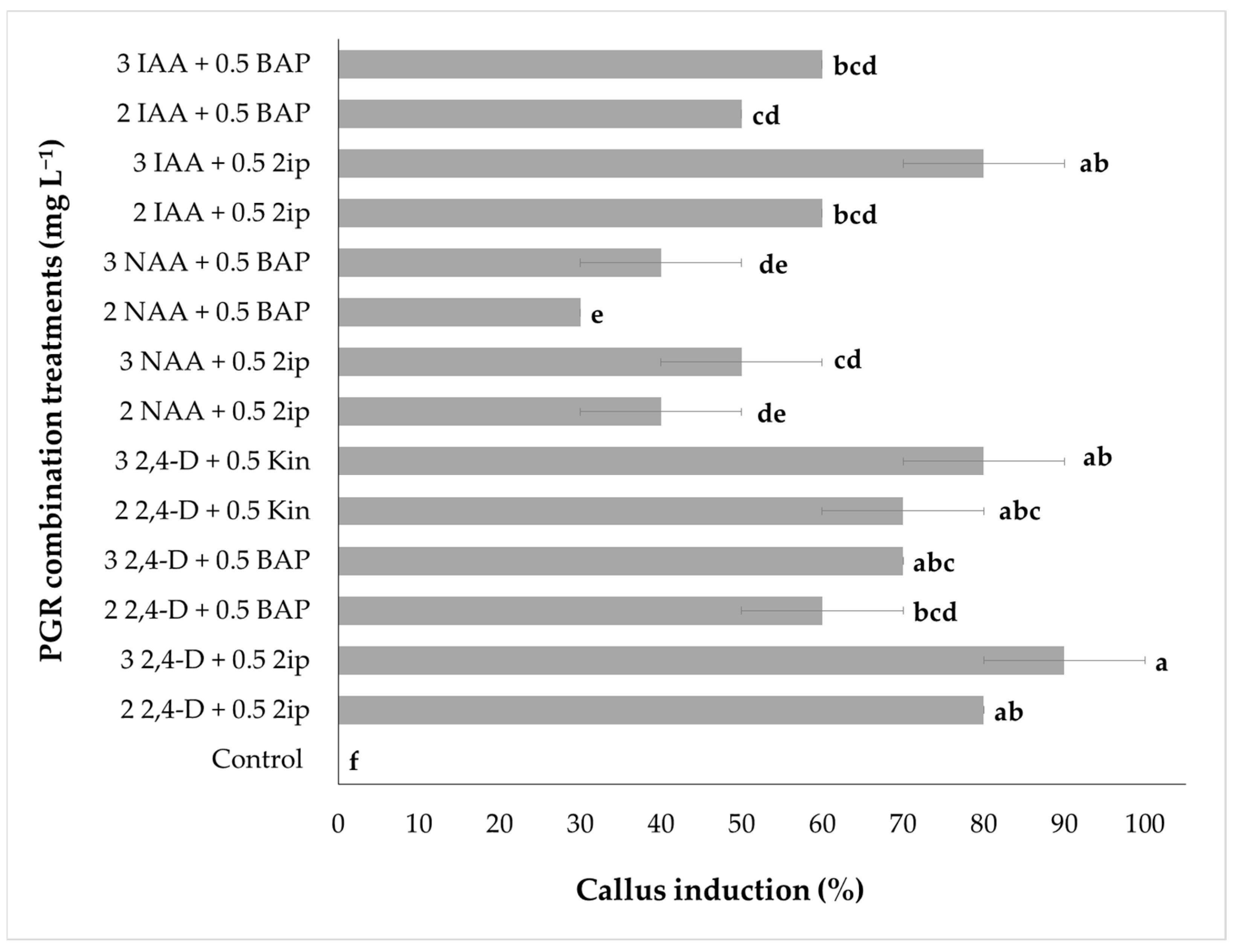
Washingtonia filifera is important for its ecological, economic, cultural, horticultural, ornamental, and medicinal potential. Elicitation of in vitro cultures presents a promising and efficient method for the large-scale production of valuable bioactive compounds. This study assessed the effect of chitosan concentration (0, 20, 40, 60, 80, 100 mg L−1) on biomass growth [fresh weight (FW), dry weight (DW)] and phytochemical profile [total phenolic content (TPC), total flavonoid content (TFC), DPPH antioxidant activity, total phenolic productivity (TPP), total flavonoid productivity (TFP)] in W. filifera callus and cell suspension cultures. Among different plant growth regulator combinations tested, 3 mg L−1 2,4-D + 0.5 mg L−1 2ip gave higher callus induction (90%) (MS medium, 12 weeks). A maximum growth curve (FW: 180 mg) of cell suspension culture was achieved 7 weeks after initiation (shaker at 90 rpm for 24 h). Cell suspension exhibited higher FW, DW, TPC, TFC, DPPH, TPP, and TFP than callus, while flavonoid production was higher than phenolic production. FW and DW were higher in both systems, with 40 mg L−1 chitosan. Chitosan at 60 mg L−1 best enhanced the phytochemical profile of both the 4-week solidified callus and the 7-week liquid cell suspension (TPC: 29.9 and 32.1 mg GAE g−1 DW; TFC: 40.5 and 56.1 mg QE g−1 DW; TPP: 969.2 and 1122.6 mg L−1; TFP: 1313.9 and 1521.7 mg L−1; DPPH: 87.4 and 92.3%), respectively, while 40 mg L−1 chitosan was equally effective regarding DW, TFC, and TFP in cell suspension. Chitosan elicitation provides a powerful strategy to upregulate phenolic and flavonoid biosynthesis in W. filifera in vitro systems, conferring superior antioxidant potential. The identification of peak elicitation parameters (chitosan concentration, exposure time) allows for the targeted enhancement of bioactive compound yields, suggesting a viable path for industrial bioproduction and commercialization in pharmaceuticals, nutraceuticals, and functional foods, leveraging bioreactor technology for efficient scale-up.

1. Introduction

Palms (Arecales), members of the Arecaceae family, are widely cultivated as ornamentals in tropical and subtropical regions [1]. Washingtonia, consisting of Washingtonia filifera and Washingtonia robusta, occurs in parts of Mexico and the southwestern United States (California, Arizona) [2]. Under a coastal Mediterranean climate, W. filifera exhibits close-to-optimal performance even in the absence of irrigation [3]. This species adapts to a wide range of soils and climates but performs best in well-drained sandy loam within tropical zones [1]. It has a lifespan of 100–250 years and yields edible fruits, each containing a single small hard-coated seed that germinates within 70 to 90 days in well-drained soil substrates [1]. Transplanting is typically feasible six months post-sowing [1]. In W. filifera, the endosperm exhibits low metabolic activity, suggesting a dormant state [4].
Extracts from W. filifera leaves and roots are rich in various secondary metabolites (SMs), such as alkaloids, saponins, tannins, glycosides, and phenolic compounds, known for their medicinal and industrial uses [5]. Preliminary evidence suggests that methanolic and ethyl acetate extracts of W. filifera could serve as chemopreventive compounds for breast cancer [6] and against bacterial strains and metabolic disorders (i.e., diabetes) [7]. Phytochemical studies highlight the nutritional value of W. filifera fruit, rich in carbohydrates, soluble sugars, minerals (calcium, phosphorus, potassium, magnesium, zinc), and bioactive compounds with antioxidant, antibacterial, antifungal, and anti-inflammatory properties [8]. W. filifera seed oil shows potential for use in cosmetic, pharmaceutical, and food products due to its high proportion in oleic acid and an unusual tocopherol composition [9], exhibiting preventive efficacy against diabetic type 2 nephropathy in animals [10].
Plant cell/organ cultures offer a controlled, reproducible, and eco-friendly method for the industrial production of plant natural products, addressing challenges like inconsistent quality from wild plants, seasonality, and geographic limitations, allowing year-round, pathogen-free production of high-value compounds for pharmaceuticals, cosmetics, and food industries [11]. Callus and suspension cultures and bioreactors play a crucial role in the commercial-scale synthesis of these compounds [12]. SMs of pharmaceutical interest, including alkaloids, glycosides, flavonoids, and tannins, can be synthesized by plant cells exposed to elicitors—specific microbial, chemical, or physical stimuli [13]. Callus development is shaped by several factors, including the explant type, media composition, and the levels and types of plant growth regulators (PGRs) used [13]. Established from friable callus, the cells in suspension cultures are kept in a state of ongoing growth and division, typically cultivated in liquid media enriched with essential nutrients and PGRs such as auxins and cytokinins [13]. Cell suspension cultures have been successfully derived from shoot tip-induced callus of Phoenix dactylifera L. [14]. PGRs are widely used in tissue culture systems to stimulate callus formation, and its subsequent differentiation to cell suspension morphogenesis, and SM accumulation [15]. Chitosan, a natural polysaccharide obtained by the deacetylation of chitin (crustaceans/fungi), has emerged as a potent biotic elicitor due to its ability to stimulate the accumulation of SMs through the activation of plant defense signaling pathways [16]. Studies employing chitosan have demonstrated significant increases in phenolic and flavonoid accumulation in Achillea fragrantissima [17] and Plantago ovata callus cultures [18]. Chitosan is biodegradable, promotes plant growth (nutrient uptake, cell division, protein synthesis) and SM production, and enhances stress resistance and overall plant health by activating defense genes like PAL (phenylalanine ammonia-lyase), all of which are well-suited properties enabling its use in sustainable farming [19].
Using elicitors like salicylic acid (SA) in date palm cv. Shishi cell suspension cultures significantly boosted total phenolic and flavonoid content, individual phenolic compound production, and antioxidant activity, with 50 mg L−1 SA being optimal; other elicitors like yeast extract (YE), pectin, cadmium, and silver nitrate at 50–200 mg L−1 also showed effects, but often less effectively or even inhibiting growth at higher doses [20]. In a recent study, Fusarium oxysporum at 50 mg L−1 significantly triggered the production of beneficial compounds in date palm cell suspension cultures, leading to optimal biomass growth, and high levels of antioxidants like phenolics (gallic acid, caffeic acid, catechin) and flavonoids (kaempferol, quercetin, rutin) [21]. In date palm (cv. Barhi) tissue culture, combining jasmonic acid (JA) with specific PGRs (2iP, 2,4-D, NAA) enhanced callus biochemical potential, and led to a rich array of 50 compounds, strong antioxidant activity, and high phenolic/flavonoid production [22].
Given the increasing interest in sustainable approaches to producing bioactive compounds, the use of elicitors such as chitosan in plant tissue culture has emerged as a promising strategy to enhance the phytochemical potential of underutilized species. Although W. filifera has notable ethnobotanical importance and documented pharmacological activities, it remains largely understudied from a biotechnological standpoint. This gap is particularly evident in research focusing on in vitro culture systems. This study aims to establish callus and cell suspension cultures of W. filifera, evaluate their phytochemical profiles, and assess their antioxidant activities following elicitation with chitosan. The findings are expected to contribute valuable insights into the metabolic capacity of W. filifera under controlled conditions, paving the way for its future application in pharmaceutical and nutraceutical industries.
The uniqueness of W. filifera (California Fan Palm) in chitosan elicitation lies in its specific, valuable metabolites, like rare flavonoid sulfates, its inherent resistance to pests (i.e., the red palm weevil), and its potential as a dual-purpose palm (food/bioactives), making it a novel model for boosting specialized compounds in a resilient palm species, differing from common herbaceous medicinal plants, with research potentially uncovering unique elicitation responses for palm-specific phytochemicals. The novelty of this study is highlighted by applying advanced cell culture and elicitation techniques (chitosan) to an underutilized and less explored palm species (W. filifera) primarily of ornamental/ecological potential to unlock its unique phytochemical potential for the scalable, sustainable production of novel or enhanced antioxidant compounds, differentiating it from standard practices in other typical model medicinal plants known for their medicinal properties.

2. Materials and Methods

2.1. Plant Seed Sterilization and Germination

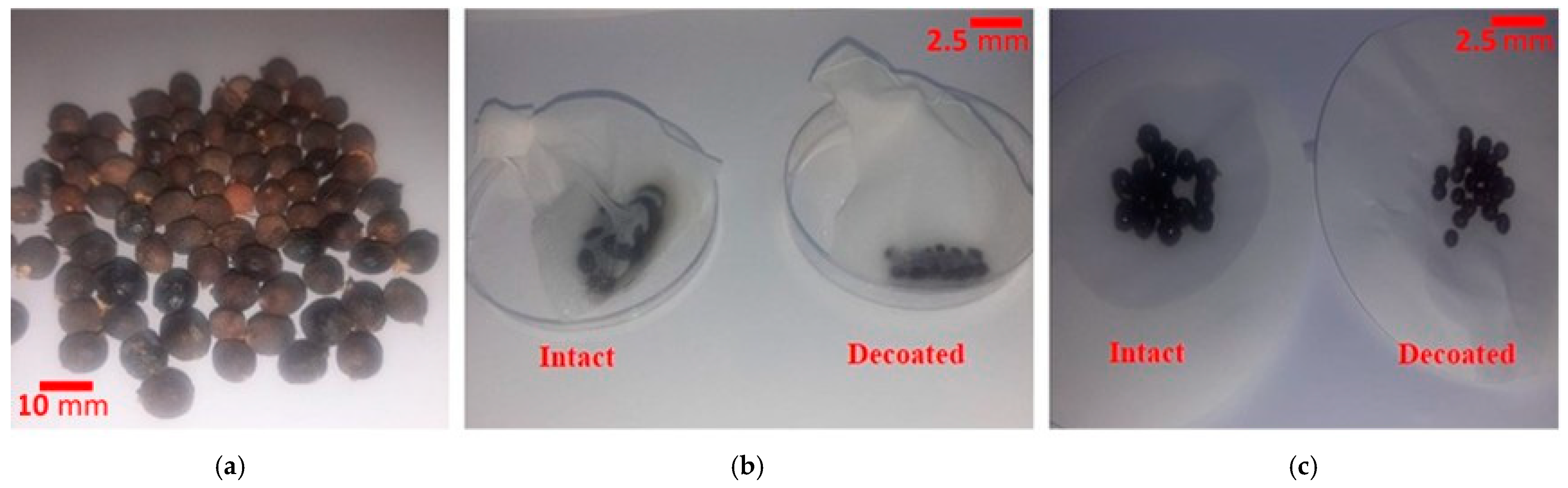
All seeds used in this study were collected from a single mature wild type of W. filifera tree growing in the Garden of Diwaniyah City, Iraq (Figure 1a); therefore, they represent the same genotype source. Seeds were randomly selected from the bulk collection and, for each treatment, individual seeds were randomly assigned to culture vessels to avoid positional or selection biases. Mahood et al. [21] described a process for sterilizing W. filifera seeds, which was employed with a few minor changes. Seeds were rinsed under running tap water for 20 min. To determine seed germination rate, seeds were divided into two groups; decoated seeds (i.e., the coat was removed by hand) and intact seeds (with coat) (Figure 1b). The seeds were placed in small bags (teabags), with 10 seeds in each bag. Surface sterilization of seeds was carried out inside a laminar air flow cabinet by immersion in 30% (v/v) sodium hypochlorite (NaClO) for 15 min, followed by washing three times in sterile distilled water. Once the seeds had been thoroughly cleaned to remove any NaClO residue, they were carefully placed on sterile filter paper (Figure 1c).
The seeds were cultured in MS [23] medium enriched with sucrose (30 g L−1), and agar (8 g L−1) with the pH adjusted to 5.5–5.7 (Mettler-Toledo GmbH, Gießen, Germany) before autoclaving (121 °C, 15 min, Priorclave Ltd., London, UK). The flask samples were transported to a growth environment at 25 ± 2 °C with a 16/8 (light/dark) photoperiod cycle. For each group, fifty replicates (one seed per universal vial) were used in the experiment. All chemical reagents used during the seed disinfection and germination stage (i.e., NaClO, sucrose, and agar) were obtained from Sigma-Aldrich Inc., St. Louis, MO, USA.

2.2. Callus Establishment

Leaf segments (~2 cm in length) were excised from the middle section of the leaves of the 28-day-old in vitro seed-germinated plantlets (Figure S1). This region provides tissues that are physiologically active, less prone to phenolic accumulation compared with the leaf tip, and more responsive to callus induction. These leaf segments were then immersed in an antioxidant solution containing 150 mg L−1 citric acid and 100 mg L−1 ascorbic acid for 15 min to reduce browning caused by phenolic oxidation during tissue culture.
Subsequently, the treated leaf segments were cultured on MS medium supplemented with 30 g L−1 sucrose and 8 g L−1 agar. The medium was enriched with two concentrations of plant growth regulators (PGRs): 2 and 3 mg L−1 of auxins—specifically 2,4-dichlorophenoxyacetic acid (2,4-D), α-naphthaleneacetic acid (NAA), and indole-3-acetic acid (IAA). These were combined with 0.5 mg L−1 of three different cytokinins: N6-[A2 isopentyl] adenine (2ip), 6-benzylaminopurine (BAP), and kinetin (Kin). A control treatment without any plant growth regulators was also included for comparison.
Prior to autoclaving, the pH of the medium was adjusted to 5.5–5.6 using 0.1 N NaOH or 1.0 N HCl. The medium was then sterilized in an autoclave at 121 °C for 20 min. The purpose of this setup was to identify the optimal combination of PGRs that would effectively induce friable callus formation and promote callus growth.
The cultured tissues were maintained in a dark culture room at 25 ± 2 °C for 12 weeks, with subculturing onto fresh medium every two weeks. After this period, the percentage (%) of callus induction was recorded, and the friable callus was harvested for subsequent use in establishing cell suspension cultures. Each experiment was conducted in triplicate, with 10 replicates per treatment.
All chemical reagents and PGRs used during the callus establishment phase, including ascorbic acid, citric acid, 2,4-D, NAA, IAA, 2ip, BAP, Kin, NaOH, and HCL, were sourced from Sigma-Aldrich Inc., St. Louis, MO, USA.

2.3. Establishment of Cell Suspension Culture and Growth Curve

To establish a cell suspension culture, 50 mg of friable callus tissue was transferred into 150 mL Erlenmeyer flasks containing 30 mL of liquid MS medium supplemented with 3 mg L−1 2,4-D and 0.5 mg L−1 2ip—the combination yielding the best results—and 30 g L−1 sucrose. The cultures were maintained on an Heidolph Unimax 1010 orbital shaker (Heidolph Instruments GmbH & Co., KG, Schwabach, Bavaria, Germany) set at 90 rpm within a controlled environment chamber illuminated with cool white LED light, following a 16 h light/8 h dark photoperiod at 25 ± 2 °C. To monitor growth, samples were collected weekly for 12 weeks. For each time point, three flasks were harvested, and the suspension cells were separated from the medium via suction filtration using a porcelain filter funnel (90 mm diameter) fitted with Whatman No. 1 filter paper. The fresh weight (FW) of the filtered cells was measured in milligrams (mg) and plotted against time to generate a growth curve illustrating the various phases of cellular development.

2.4. Establishment of Callus and Cell Suspension with Elicitor

2.4.1. Preparation of Chitosan Elicitor

A stock solution of medium molecular weight chitosan (Sigma-Aldrich Inc., St. Louis, MO, USA) was prepared by dissolving it in 5% 1 N hydrochloric acid (HCl). The mixture was heated to 60 °C and stirred continuously on a magnetic stirrer for 15 min to ensure complete dissolution, following the method described by Vanda et al. [24].

2.4.2. Establishment of Callus with Chitosan

Friable callus weighing approximately 500 mg (FW) was cultured within Erlenmeyer flasks (250 mL) containing 50 mL of MS medium supplemented with 3 mg L−1 2,4-D and 0.5 mg L−1 2ip, 30 g L−1 sucrose, and 8 g L−1 agar. To evaluate the effect of chitosan as an elicitor, different concentrations (20, 40, 60, 80, and 100 mg L−1) of chitosan were added to separate media. A control medium without chitosan was included for comparison. The cultures were maintained in a controlled environment at 25 ± 2 °C under a 16 h light/8 h dark photoperiod. After four weeks of incubation, measurements were taken for callus FW and dry weight (DW), as well as biochemical analyses, including flavonoid and phenolic contents and antioxidant activity. Each treatment was replicated ten times.

2.4.3. Establishment of Cell Suspension with Chitosan

Friable callus (500 mg) was transferred for the establishment of cell suspension culture into Erlenmeyer flasks (250 mL) containing 50 mL of liquid MS media with 3 mg L−1 2,4-D + 0.5 mg L−1 2ip, sucrose 30 g L−1, and different concentrations of chitosan (20, 40, 60, 80, and 100 mg L−1); a medium without chitosan addition was used as the control. Flasks were kept in a 16/8 h (light/dark) photoperiod at a temperature of 25 ± 2 °C on an orbital shaker at 90 rpm. Cell suspension FW, DW, flavonoid and phenolic contents, and antioxidant activity were recorded seven weeks after elicitation (depending on the results of the growth curve of cell suspension). Each treatment was performed in 10 replicates.

2.5. Extraction of Plant Materials

The initial inoculum of 500 mg was the FW of callus or cell suspension used per flask. Each treatment included 10 replicates (10 flasks), and the biomass obtained after the elicitation period was pooled from all replicates for extraction. The dried biomass used for extraction was a mixture from multiple flasks, not a single culture, and no large-scale culture system was used. According to Selim et al. [25], at room temperature, the dry callus and the cell suspension of each treatment (25 mg) were extracted in continuous stirring, in 100 mL of petroleum ether followed by ethanol (90%) for 72 h. After filtration and centrifugation at 10,000 rpm, ethanol extracts were concentrated under a vacuum, using a rotary evaporator (model: Rotavac Vario Power Unit No: 11-300-004-33-3, Heidolph Instruments GmbH & Co., KG, Schwabach, Bavaria, Germany) for further analysis. The dried ethanolic extracts of samples were weighed (1 mg mL−1) and dissolved in dimethyl sulfoxide (DMSO) before use. Ethanol, methanol, DMSO and all reagents and solvents used for the extraction of plant materials, and determination of total phenolic and flavonoid content, and DPPH activity were obtained from Sigma-Aldrich (St. Louis, MO, USA).

2.6. Total Flavonoid and Phenolic Content (TFC and TPC) Determination

Total phenolic and flavonoid contents (TPC and TFC) were determined colorimetrically using the Folin–Ciocalteu and aluminum trichloride (AlCl3) assays, respectively [25,26]. The absorption at 765 nm for TPC and 415 nm for TFC was measured on a Shimadzu double-beam UV-VIS spectrophotometer Model. SP-3000DB (Optima Inc., Tokyo, Japan). The total phenolic content (TPC) of the samples was determined as gallic acid equivalent (GAE) mg g−1 DW, while the total flavonoid content (TFC) of the samples was determined as quercetin equivalent (QE) mg g−1 DW, using the following formula: Total (Phenolic or Flavonoid) Content = c × v/m, where c = the concentration of gallic acid or quercetin established from the calibration curve in mg μL−1 DW; v = the volume of sample extract in micro liters (μL); m = the weight of sample extract in grams (g). All determinations were performed in triplicate.
The productivity (yield) of total flavonoids (TFPs) and total phenolics (TPPs) was calculated by multiplying the content of total flavonoids (TFC) or total phenolics (TPC) expressed in mg g−1 DW and the callus dry biomass DW yield expressed in g L−1 [i.e., TPP (mg L−1) = TPC (mg g−1 DW) × DW (g L−1), TFP (mg L−1) = TFC (mg g−1) × DW (g L−1)]. Considering that callus and cell suspension cultures were grown within flasks containing 50 mL (=0.05 L) of nutrient medium, their DW yield (g L−1) was calculated as follows: DW yield (g L−1) = DW (g)/0.05 L × 20 (i.e., 50 mL or 0.05 L × 20 times = 1000 mL or 1 L).

2.7. Antioxidant Activity

The antioxidant activity of callus and cell suspension extracts was investigated using the 1,1-diphenyl-2-picrylhydrazyl (DPPH) method. To prepare a 0.004% μM DPPH solution, dissolve 0.004 g of DPPH in 100 mL of methanol. We combined 3.8 mL of the 0.004% DPPH solution with 200 μL of extract [26,27]. The standard curve was established using gallic acid concentrations of 0.2, 0.1, 0.05, 0.025, 0.020, and 0.01 mg mL−1. The absorbance of each sample was measured three times, and the decrease in absorbance at 517 nm caused by antioxidants after 30 min of incubation in the dark served as a measure of the ability of DPPH radicals to inhibit. The mathematical expression for the test samples’ activity, defined as a decrease in DPPH, commonly known as inhibition or quenching, is % Inhibition = (c − s)/c × 100, where s is the sample absorbance and c is the blank absorbance.

2.8. Statistical Analysis

The ‘Microsoft Office Professional Plus,’ version 2013 including Word 2013, Excel 2013, and PowerPoint 2013 was the software used in this study (Publisher/Company: Microsoft Corporation, year of release: 2013).
All the experiments were carried out following the completely randomized layout, and analysis of variance (ANOVA) was performed using the IBM® SPSS® Statistics Version 21.0 package and Tukey’s b multiple range test at a 5% significance level (p ≤ 0.05).
In the callus induction experiment, the experimental layout was a 2 × 3 × 3 factorial with 2 auxin concentrations, 3 auxin types, and 3 cytokinin types, thus including 15 treatments with 3 replications (3 petri dishes × 10 leaf explants per petri) per treatment.
In the FW curve growth of the cell suspension culture, one-way ANOVA was performed to determine the differences among the 12 weekly intervals (i.e., treatments) from the initiation of the culture, with 3 replications (i.e., 3 Erlenmeyer flasks) per treatment.
The chitosan elicitation experiment was a 2 × 6 factorial involving 2 culture systems and 6 chitosan concentrations, thus including 12 treatments with 10 replications/treatment for biomass and 3 replications/treatment for phytochemical profile traits. The main effects of factors (culture system, chitosan concentration) and their interactions were determined by a general linear model. Pearson correlation and multiple regression analyses were performed for the seven dependent variables, using the culture system and chitosan concentration as constant independent variables—predictors—with data visualized in a histogram and normal P-P plot. Furthermore, principle component analysis (PCA) was applied, including initial and extraction communalities, scree plot using Eigenvalues above 1, total variance explained, component, component correlation, pattern and component score coefficient matrix, with data visualization in component bi-plot in rotated space. Hierarchical cluster analysis was performed using ‘between-groups linkage’ and ‘Euclidean distance’ methods, visualized in a dendrogram.

3. Results

3.1. Seed Germination

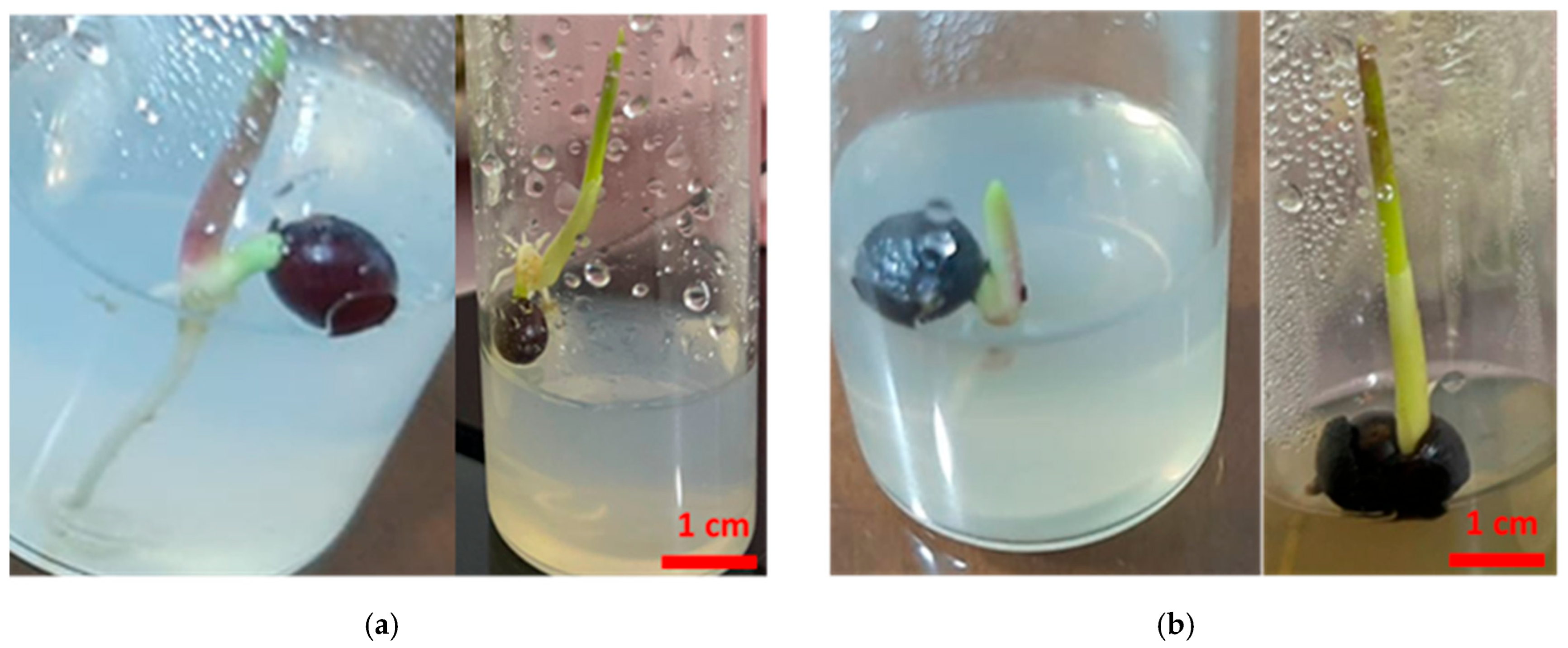
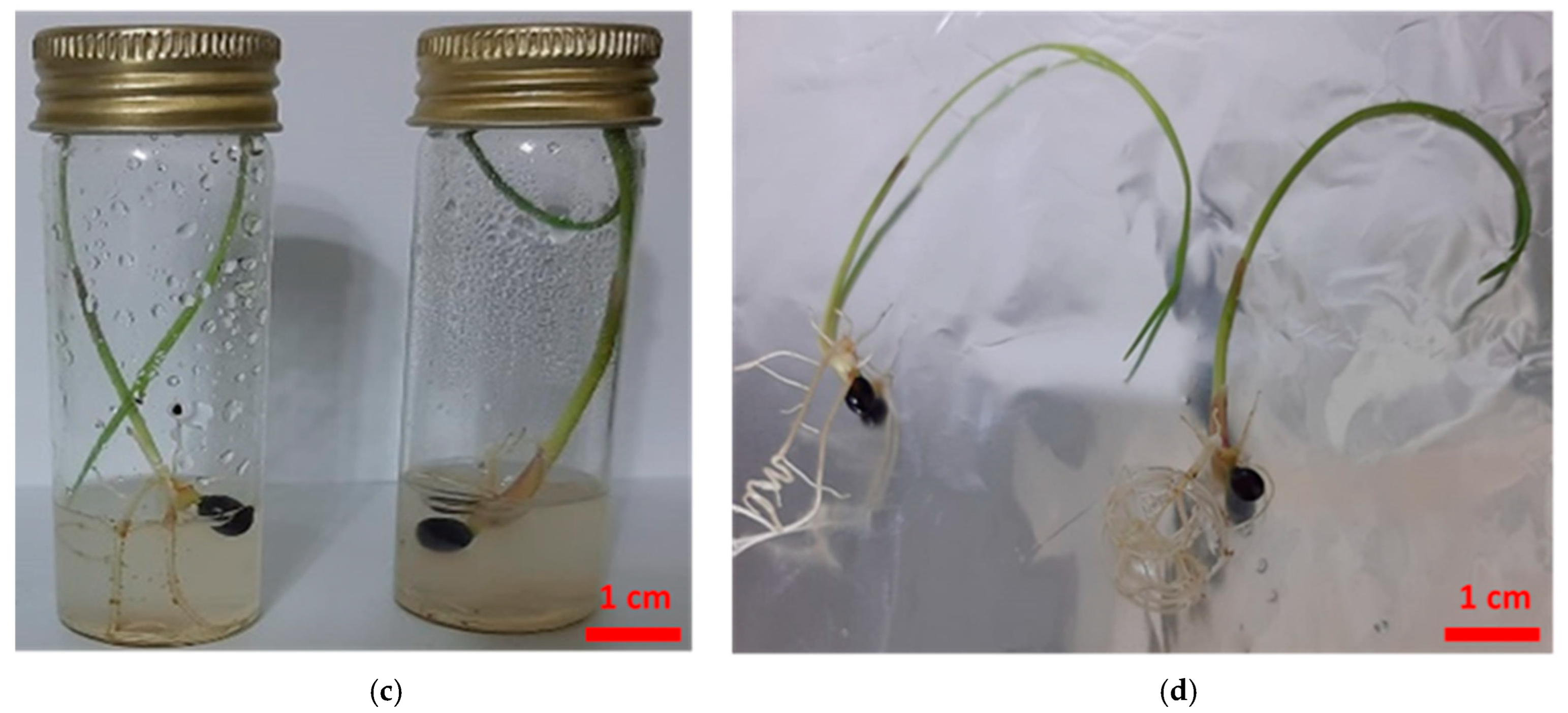
The decoated seeds had 100% germination after one week of culture (Figure 2a), whereas the intact seeds did not germinate. Intact seeds germinated after a two-week period (Figure 2b). After 28 days, complete seedlings, with radicle and sprout, were developed, regardless of origin (Figure 2c,d).

3.2. Callus Induction Under Different PGR Treatments

Callus induction was significantly higher (90%) under 3 mg L−1 2,4-D + 0.5 mg L−1 2ip, whereas no callusing occurred in the control treatment (Figure 3).
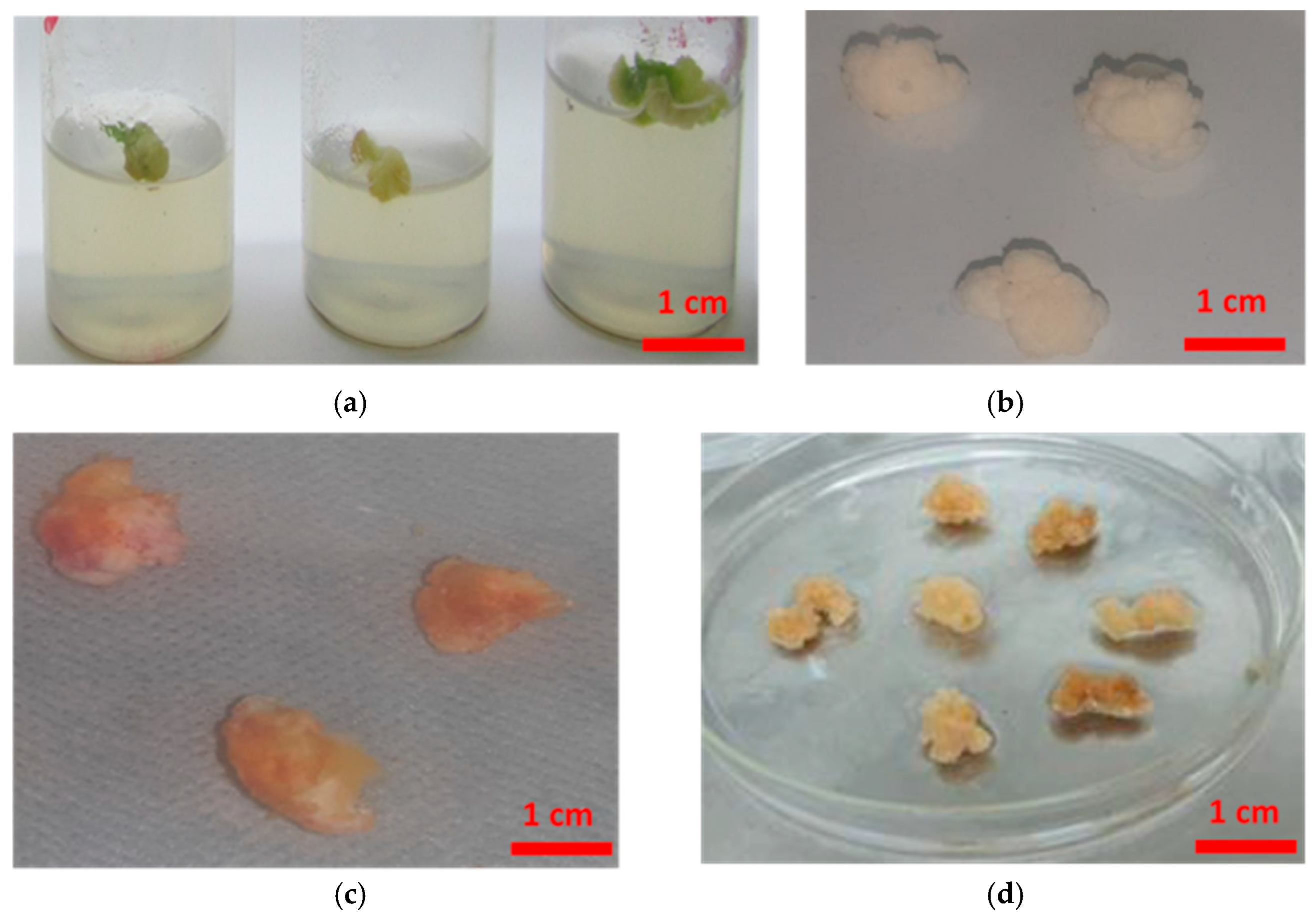
Callus texture was friable in all PGR treatments, while IAA + 2ip, 2,4-D + 2ip, NAA + BAP, and 2,4-D + Kin induced the formation of green (Figure 4a), white (Figure 4b), brown (Figure 4c), and cream callus (Figure 4d), respectively.

3.3. Multiple Regression Analysis for Callus Induction Under Different PGR Treatments

The multiple correlation coefficient (R) value was 0.612 (>0.5), indicating a high-quality level of prediction of callus induction % as the dependent variable. Coefficient of determination (R2) and adjusted R2 were 0.374 and 0.328 (<0.5), showing that the independent variables (auxin concentration, auxin type, cytokinin type) explain 37.4% of the variability of the dependent variable at a 32.8% accuracy (Table S1). All three independent variables with F(3,41) ratio = 8.174 of ANOVA (Table S2) and only ‘auxin concentration’ in the significance column of coefficients (Table S3) significantly predicted ‘callus induction %’ with p = 0.000, with the residuals normally distributed (Figure S2a,b).

3.4. Cell Suspension Culture Growth Curve

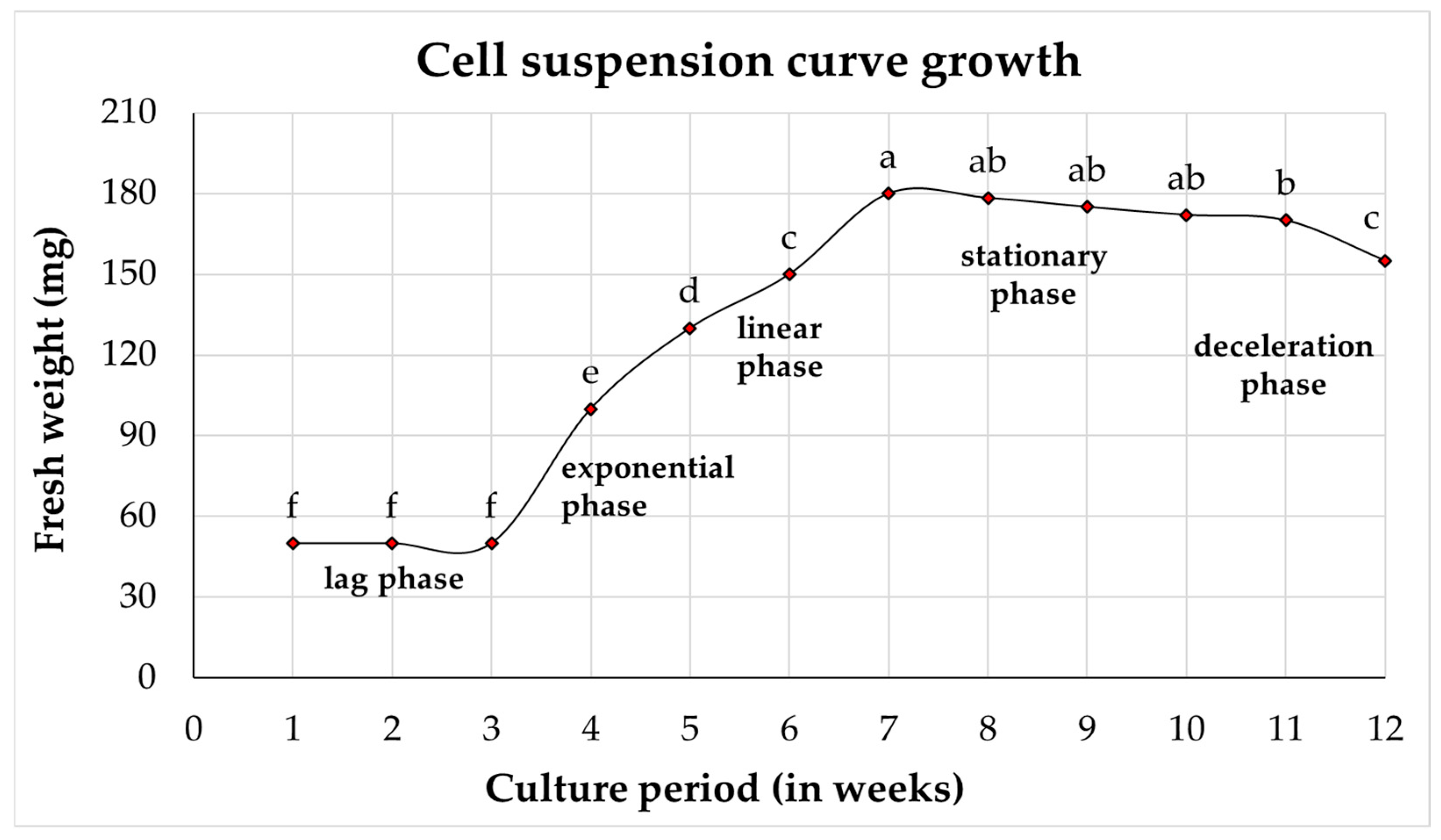
The growth of W. filifera cell suspension, expressed in FW, was influenced by the culture period. The growth pattern was divided into the lag, exponential (or log), linear, stationary, and deceleration phase. The period of low growth or no growth at all, associated with the lag phase, extended from the initiation of the suspension cultures (day 1) until the third week of culture (FW: 50 mg). The exponential phase, determined by a doubling of FW was observed between the third and fourth weeks of culture initiation (FW: 50–100 mg). Following this phase, a linear growth pattern characterized by the highest growth rate, began from the fourth to the seventh week (FW: 130–180 mg). The stationary phase started at the seventh week and lasted until the tenth week (FW: 172–180 mg), followed by a growth deceleration phase that started at the tenth week and continued to the twelfth week (FW: 170–155 mg). Maximum growth (180 mg) was achieved seven weeks after the initiation of the culture (Figure 5).

3.5. Multiple Regression Analysis for FW of Cell Suspension Cultures During the 12 Weekly Culture Intervals

The R value 0.858 (>0.5) indicated a high-quality level of prediction of cell suspension FW as the dependent variable. The R2 and adjusted R2 values were 0.736 and 0.728, which showed that the independent variable (culture period) explained 73.6% of the variability of cell suspension FW at a 72.8% accuracy (Table S4). The F(1,34) = 94.743 ratio of ANOVA (Table S5) and the significance column of coefficients (Table S6) showed that the ‘culture period’ significantly predicted cell suspension FW with p = 0.000, with the residuals normally distributed, as seen in the histogram and normal P-P plot (Figure S3a and Figure 2b).

3.6. Biomass Growth and Phytochemical Profile of Chitosan-Elicited Callus/Cell Suspension Cultures

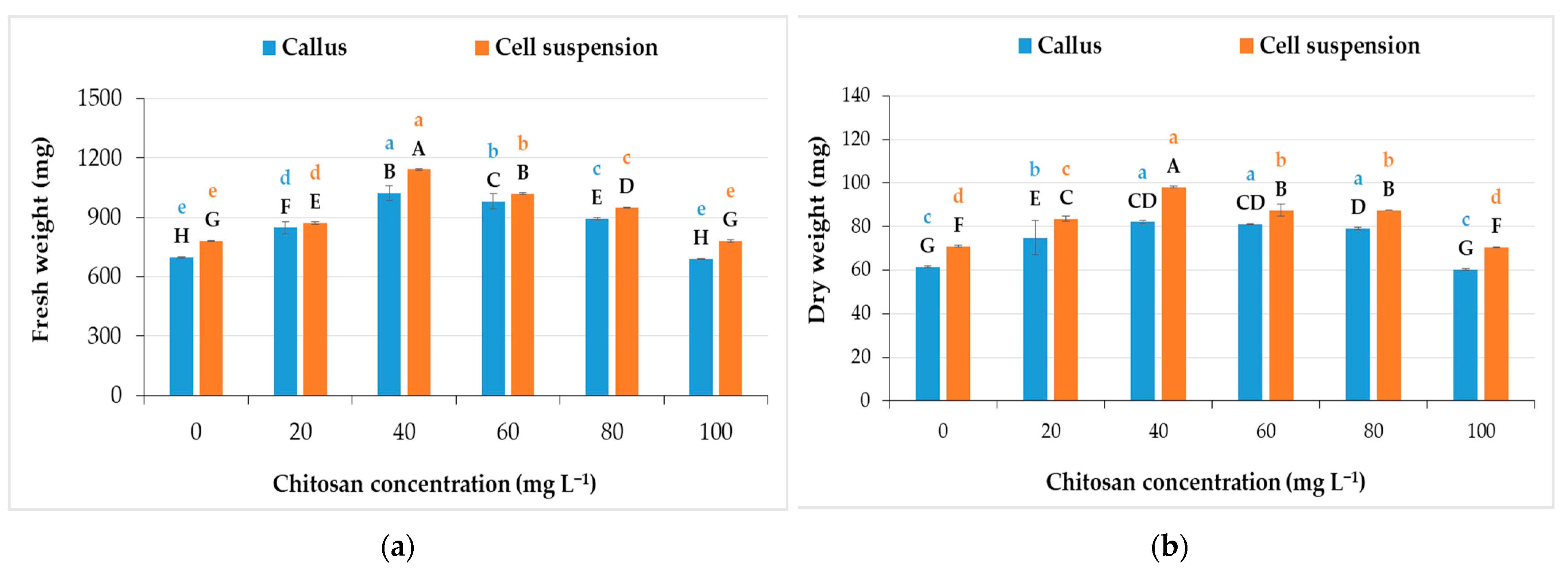
Chitosan at 40 mg L−1 was the optimum concentration for both biomass of callus (FW: 1021 mg, DW: 82.1 mg) and cell suspension (FW: 1141.8 mg, DW: 98.1 mg) cultures (Figure 6a,b). Callus DW was significantly higher (79.1–82.1 mg), with 40–80 mg L−1 of chitosan (Figure 6b). Cell suspension cultures gave significantly higher FW (Figure 6a) and DW (Figure 6b) than callus cultures, optimized by 40 mg L−1 chitosan.
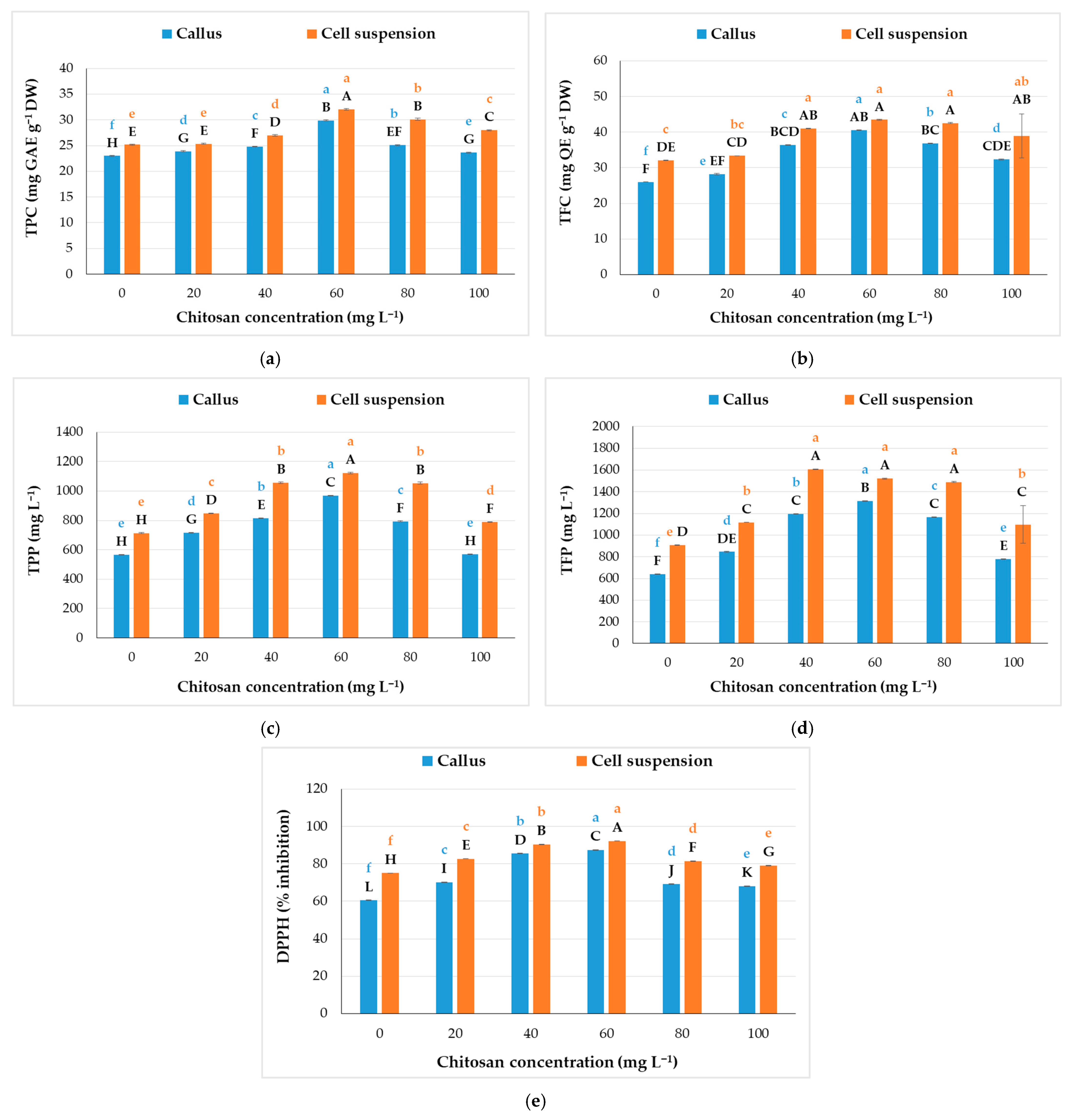
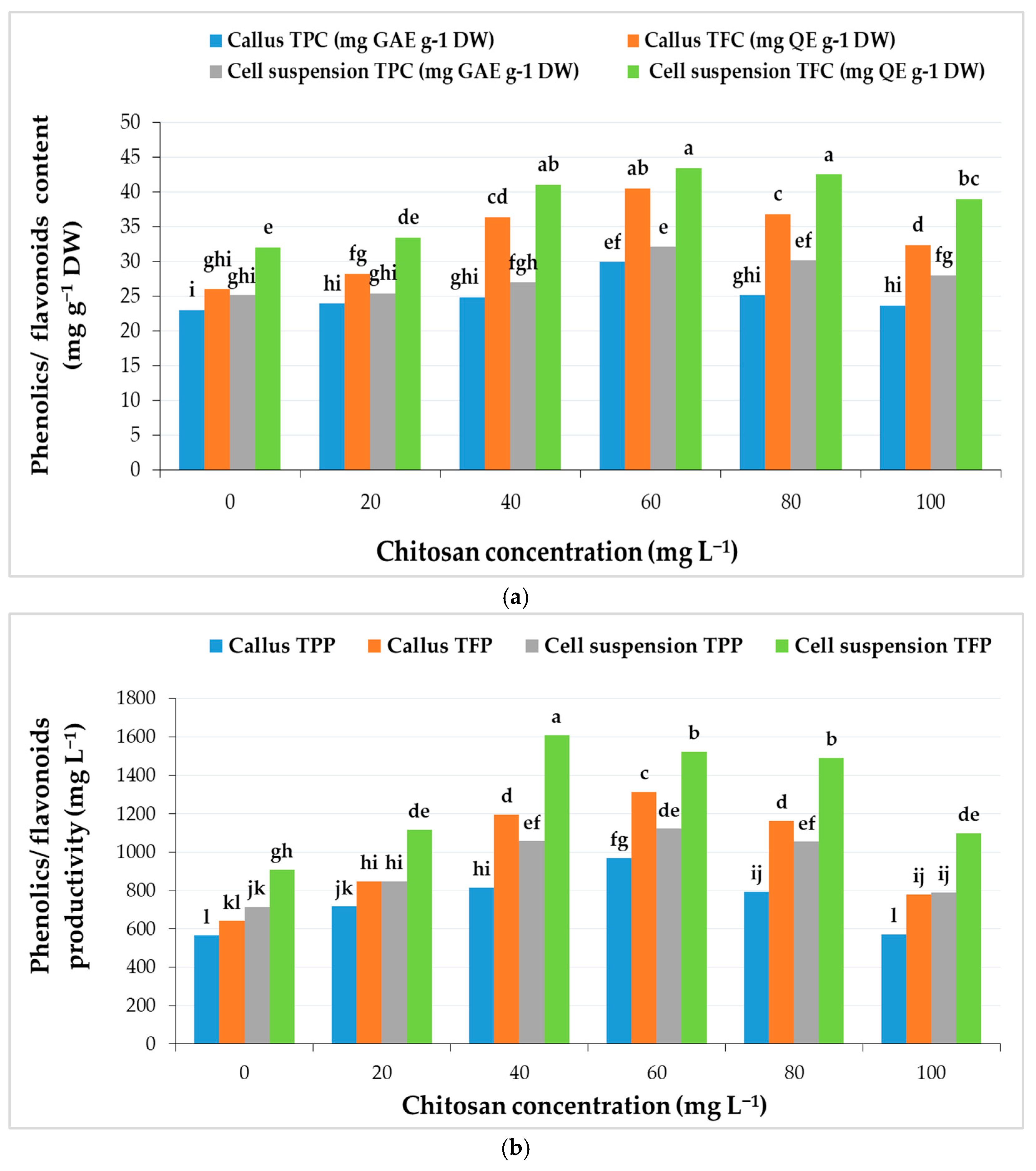
In callus cultures, chitosan at 60 mg L−1 exhibited significantly higher TPC (29.9 mg GAE g−1 DW) (Figure 7a), TFC (40.5 mg QE g−1 DW) (Figure 7b), TPP (969.2 mg L−1) (Figure 7c), TFP (1313.9 mg L−1) (Figure 7d), and DPPH (87.4% inhibition) (Figure 7e). In cell suspension cultures, TPC (32.1 mg GAE g−1 DW) (Figure 7a), TPP (1122.6 mg L−1) (Figure 7c), and DPPH (92.3% inhibition) (Figure 7e) were significantly higher with 60 mg L−1 chitosan, while TFC (41–43.5 mg QE g−1 DW) (Figure 7b) and TFP (1489.3–1609.7 mg L−1) (Figure 7d) with 40–80 mg L−1 chitosan. Cell suspension cultures gave significantly higher TPC (Figure 7a), TPP (Figure 7c), TFP (Figure 7d), and DPPH (Figure 7e) than callus cultures at the same chitosan concentration, while both culture systems exhibited comparable TFC, with 40 and 60 mg L−1 chitosan (Figure 7b). The combined statistical analysis among the 12 treatments (2 culture types × 6 chitosan concentrations) revealed the superiority of cell suspension cultures elicited with 60 mg L−1 chitosan for greater phytochemical profile potential (Figure 7a–e).
FW, DW, TPC, TPP, TFP, and DPPH were significantly affected by culture type, chitosan concentration, and their interaction (p = 0.000–0.035 < 0.05), whereas TFC only by the two main factors (p = 0.000) (Table S7).
The descending effectiveness order (higher to lower) of either content or productivity of SMs in the two culture systems regardless of chitosan concentration was as follows: cell suspension TFC > callus TFC > cell suspension TPC > callus TPC (Figure 8a) and cell suspension TFP > callus TFP > cell suspension TPP > callus TPP (Figure 8b). Callus and cell suspension cultures proved to have more abundant sources of flavonoids than phenolics (TFC > TPC, TFP > TPP), with cell suspension cultures exhibiting a superior phytochemical profile than callus cultures (Figure 8a,b).

3.7. Multiple Pearson Correlation Analysis in Chitosan-Elicited Callus and Cell Suspension Cultures

In callus cultures, the correlation between FW–DW, TFC–TFP, and TPP–TFP (r = 0.945–0.972, p = 0.001–0.005 < 0.01) was extremely strong. The correlation was very strong between FW–DPPH, TPP, TFP or DPPH, DW–TPP or TFP, TPC–TFC or TPP, TFC–TPP, DPPH–TPP or TFP, TPP–FW, DW, TPC, TFC, or DPPH, and TFP with FW, DW or DPPH (r = 0.816–0.916, p = 0.01–0.047 < 0.05). Pearson coefficients ranged between 0.624 and 0.972 (>0.5), indicating moderate (r = 0.6–0.8) to high (r = 0.8–1.0) positive correlations (Table S8).
In cell suspension cultures, the correlation between FW–DW or TFP, TFC–TFP, and TPP–TFP (r = 0.925–0.972, p = 0.001–0.008 < 0.01) was extremely strong. The correlation between FW–DPPH or TPP, DW–DPPH, TPP or TFP, TPC–TFC or TPP, TFC–TPP, and DPPH–TPP or TFP (r = 0.816–0.916, p = 0.010–0.048 < 0.05) was very strong. Pearson coefficients ranged between 0.311 and 0.972, indicating low/weak (r = 0.3–0.5), moderate (r = 0.5–0.8), and high/strong (r = 0.8–1.0) positive correlations (Table S9).

3.8. Multiple Regression Analysis in Callus/Cell Suspension Cultures Elicited with Chitosan

The R value was 0.546–0.719 (>0.5) indicating a high quality level of prediction of TPC, TFC, DPPH, TPP, and TFP dependent variables, while their R2 (0.298–0.516) and adjusted R2 (0.255–0.487) values showed that the two independent variables/predictors (culture system, chitosan concentration) explained 29.8–51.6% of their variability at a 25.5–48.7% accuracy (Table S10). The F-ratio of ANOVA showed the two independent variables significantly predicted six out of the seven variables (DW, TPC, TFC, DPPH, TPP, TFP), with p = 0.000–0.003 < 0.0005 (Table S11). In the significance column of coefficients, both independent variables contributed significantly to the prediction of TPC, TFC, and TFP (p = 0.000–0.036 < 0.05), and the residuals were normally distributed based on the histogram and normal P-P plot (Table S12, Figure S4a–f), while FW, DW, DPPH, and TPP were significantly predicted only by the ‘culture system’ (p = 0.000–0.001 ≤ 0.05) (Table S12, Figure S5a–h).

3.9. PCA in Callus and Cell Suspension Cultures Elicited with Chitosan

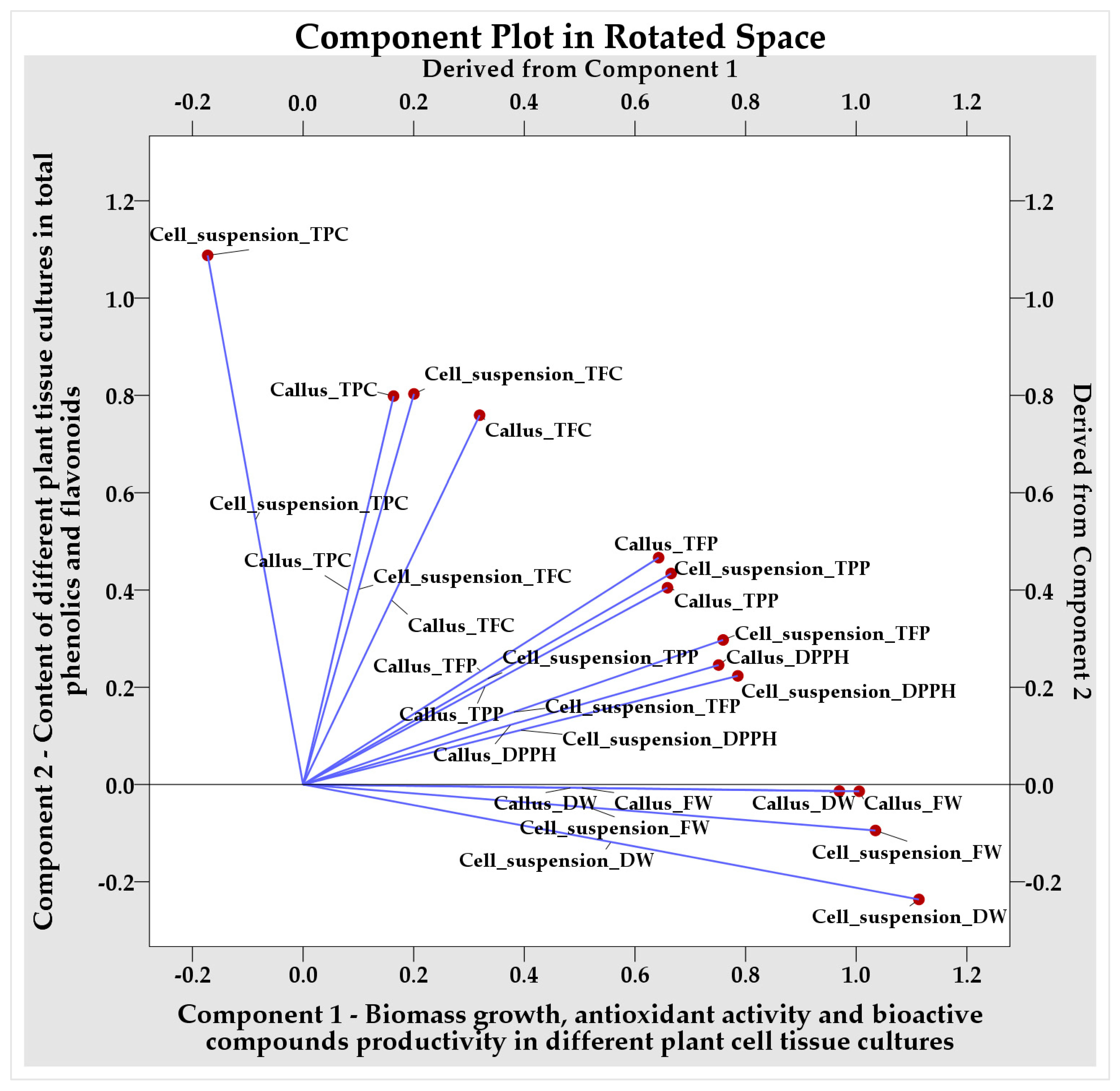
Kaiser’s eigenvalue was greater than 1 and the Scree plot identified two distinct extracted factors (Figure S6). All extracted communalities of the 14 variables were high (0.820–0.994) (Table S13). In the component matrix, all variables had high loadings (0.727–0.993) in component 1 (Table S14). The total eigenvalues for the first dimension was 11.55, accounting for 82.5% of the variance extracted, while the total eigenvalues for the second dimension was 1.508, accounting for 10.768% of the variance extracted; thus, together these factors accounted for 93.268% of total variance (Table S15). In the component correlation matrix, the positive correlation (0.599) between components 1 and 2 was moderate (Table S16).
In the pattern matrix, the 10 variables that corresponded with component 1 (higher positive rotated loadings of 0.644–1.113) were FW, DW, DPPH, TPP, and TFP for both callus and cell suspension cultures, thus labeled ‘Biomass growth, antioxidant activity, and bioactive compound productivity in different plant tissue cultures’. Component 2 was labeled ‘Content of different plant tissue cultures in total phenolics and flavonoids’ and included the following four items: callus TPC and TFC, cell suspension TPC, and TFC (higher positive rotated loadings of 0.759–1.088). Components 1 and 2 were well-related to the variables, as seen in the component plot in rotated space (Figure 9, Table S17).
In the component score coefficient matrix, FW and DW of callus and cell suspension cultures had higher positive scores in component 1 and lower negative ones in component 2. TPC and TFC of both culture systems presented lower negative scores in component 1 and higher positive ones in component 2. TPP and TFP had positive scores in both components; however, callus TFP had higher scores in component 2 and cell suspension TFP in component 1 (Figure 9, Table S18).

3.10. Hierarchical Cluster Analysis in Callus and Cell Suspension Cultures Elicited with Chitosan

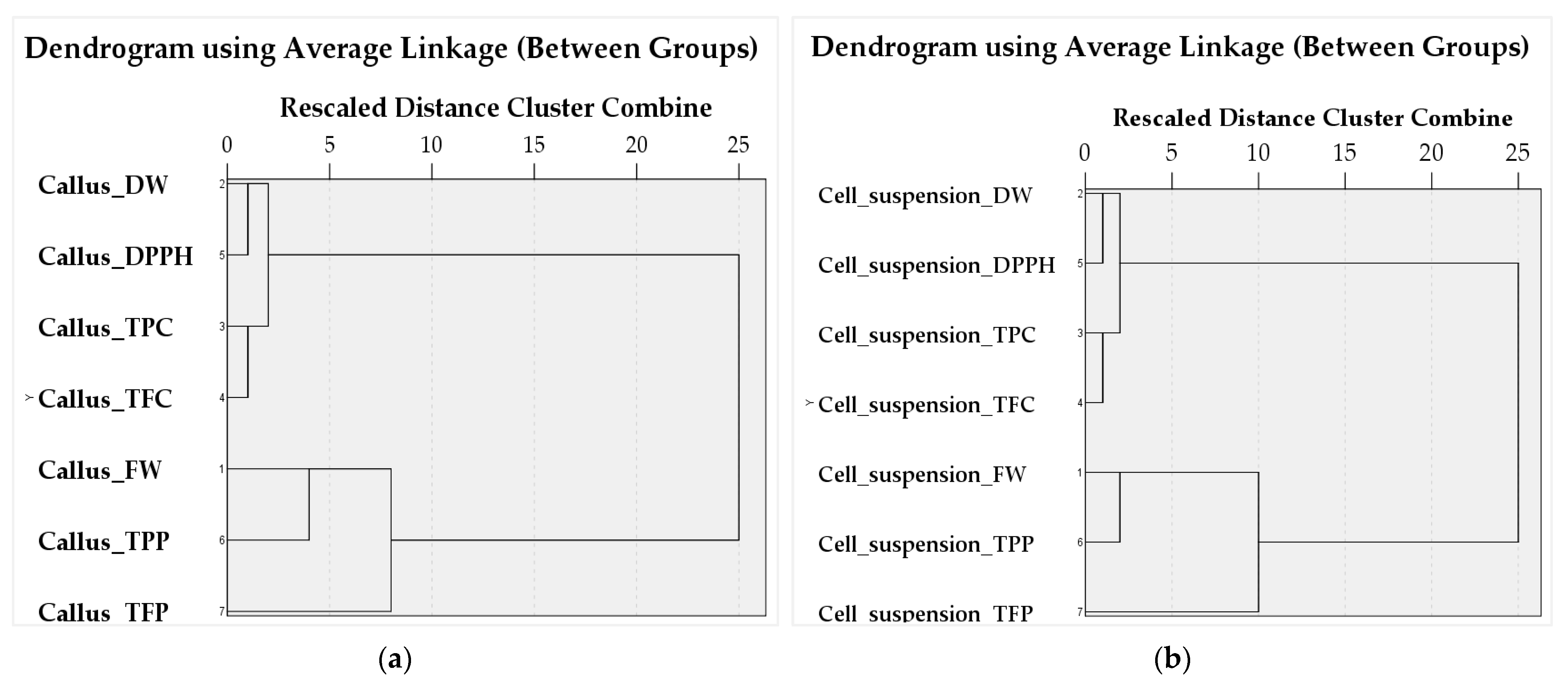
The dendrogram shows the proximity between DW-DPPH activity was the greatest, the proximity between TPC-TFP was the farthest, while FW was the most distinct and less similar from the other traits, in both callus (Figure 10a) and cell suspension (Figure 10b) cultures. Six merged clusters were revealed based on the lower distance–higher proximity or greater similarity to higher distance–lower proximity or greater dissimilarity order between variables as follows: DW and DPPH (cluster 1) > TPC and TFC (cluster 2) > DW, DPPH, TPC, and TFC (cluster 3) > FW and TPP (cluster 4) > FW and TFP (cluster 5) > FW, DW, DPPH, TPC, TFC, TPP, and TFP (all variables, cluster 6) (Figure 10a,b).

4. Discussion

4.1. Seed Germination

In this study, 100% in vitro germination within a 1-week period was achieved by W. filifera decoated seeds, whereas intact seeds germinated only after 2 weeks of culture. The absence of seed coat enhances the in vitro germination rate and completeness because it removes physical barriers to water, oxygen, and nutrient uptake, which are essential for activating the embryo and breaking seed dormancy, promoting faster metabolic reactivation and faster and more complete germination [28], as shown in Phoenix dactylifera [29]. In vitro germination after seed coat removal allows for the rapid propagation and conservation of rare and threatened palm species [30], providing uniform, axenic plant material for genetic transformation [29,31]. The seeds of W. filifera seeds contain germination-inhibiting substances within their hard coat, primarily phenolic compounds like procyanidins (flavan-3-ols), showing significant antioxidant and enzyme-inhibiting activity, and potentially abscisic acid (ABA), which creates dormancy and slow germination, requiring treatments like scarification (removing the coat) or gibberellic acid (GA3) to break it effectively [32]. Potential mechanisms of seed coat dormancy in W. filifera include physical (preventing the exit of germination inhibitors, water uptake, and oxygen uptake), mechanical (seed coat acting as a mechanical barrier for embryo to expand during germination), and chemical (presence of germination inhibitors in the seed coat) [28,33]. A germination rate difference of just a week between the two groups of W. filifera seeds (intact, decoated) under study highlights seed dormancy because dormant seeds delay germination despite ideal conditions (water, air, temperature), while non-dormant seeds sprout quickly; this delay, even if short, signifies an internal block (like a hard coat or hormonal state) needing time (after-ripening, stratification, scarification) to break, proving dormancy’s role in timing germination for survival not just a lack of resources [34,35]. Future perspectives for faster in vitro germination of decoated seeds involve leveraging genetic and molecular insights, i.e., targeted gene editing, hormonal regulation: GA3 vs. ABA) to tailor coat removal [30,36], using advanced imaging for real-time and predictive monitoring [37], and integrating biotechnology (i.e., automated decortication by developing robotic systems, microfluidics, and high-throughput screening) for uniform, rapid seedling production for conservation and agriculture uses, overcoming the seed coat’s physical/chemical dormancy for immediate, synchronized growth, especially for recalcitrant species or limited seed resources [38]. The beneficial impact of hard coat removal on in vitro germination versus intact seeds has previously been highlighted for wild mandrake (Mandragora autumnalis Bertol.) [30], ornamental palm [31], legumes [36], bitter gourd (Momordica charantia) [37], and Cnidium monnieri [38], among others.

4.2. Callus Morphology (Color, Texture) Under Different PGRs in Medium

In W. filifera callus cultures herein, 2,4-D + 2ip resulted in white calli, 2,4-D + Kin in cream calli, and IAA + 2ip in green calli. Callus color is a key visual indicator in plant tissue culture, with white, cream, or yellow calli suggesting healthy, actively growing cells, while browning often signals stress, oxidation (phenolics), cell death, or issues like light exposure, impacting regeneration potential and requiring adjustments like adding antioxidants or changing culture conditions (e.g., light/dark), as has been reported in maize (Zea mays L.) [39]. The white/cream calli in media enriched with 2,4-D and 2ip or kinetin may be attributed to the inhibitory effect of 2,4-D, particularly at supra-optimal concentrations, on chlorophyll formation, leading to whitish or yellowish callus, as shown in rice [40]. The callus texture of W. filifera cultures herein was friable in all PGR combinations. A callus texture remains friable (loose, watery) despite PGRs in medium because friability is determined by complex interactions between genetics (genotype), explant source, specific PGR combinations, nutrient balance (like nitrogen/phosphorus), and even physical factors (light, media additives, subculture timing), not just the presence of auxins/cytokinins; some plants inherently form compact calli, while others easily form friable ones, and imbalances (e.g., high ammonium, low nitrate) can shift it to compact, requiring specific fine-tuning for that species, as observed in Hovenia dulcis, Gloriosa superba L., and chrysanthemum ‘Jimba’ [41,42,43]. White/cream and friable callus often produces fine, dispersed cells capable of proliferating in liquid medium, enabling successful initiation of cell suspension cultures (e.g., Calendula officinalis L.) [44]. Future perspectives for in vitro callus color and texture focus on using them as indicators for optimizing bioactive compound production, linking visual traits to metabolic states (e.g., brown/compact = stress/phenolics; green/fragile = healthy/photosynthetic). Key areas involve genomics for precise control via editing, data-driven models for prediction, and novel stimuli like nanoparticles (SeNPs, ZnO-NPs) [45,46,47] and specific light regimes (blue/red LEDs) [48] to manipulate these traits for enhanced pharmaceuticals, nutraceuticals, and sustainable biomaterials, moving from simple indicators to targeted manipulation.

4.3. Callus Induction

In this study with W. filifera, callus induction was maximized reaching 90% with 3 mg L−1 2,4-D + 0.5 mg L−1 2ip. In line with our results, the 2,4-D+2ip combination has been associated with higher callus induction potential in various plant species, including Phoenix canariensis starting from shoot tips [49], date palm [50], sago palm [51], and Atropa belladonna L. from leaf explants [52]. While auxins provide the initial trigger for callus formation by promoting cell proliferation and the acquisition of pluripotency, cytokinins provide continuous stimulation for cell division and sustained callus growth by modulating cell wall characteristics, with both PGRs acting together in a carefully balanced ratio [53]. 2,4-D is a well-known synthetic auxin inducing callus formation, often resulting in friable callus through DNA hypermethylation, and maintains cells in an actively dividing state [54]. 2,4-D has more stable properties than natural auxins (IAA); in addition, it resists enzymatic and thermal decomposition, and remains stable after medium sterilization [55]. Furthermore, it persists longer in plant tissues and is less efficiently transported out of cells by auxin efflux carriers [55]. Cytokinin 2-ip may be more effective for callusing than BAP and Kin due to differences in their specific action on molecular pathways and cellular processes, plant species, and the balance with auxin levels [56]. Future perspectives for leaf-derived callus of W. filifera herein focus on optimizing PGRs, refining media and state (MS, liquid vs. solid), controlling environmental factors (pH, sugar), exploring genetic/epigenetic cues (like variegation levels), and using advanced techniques like elicitation/metabolic engineering for enhanced SMs, ultimately enabling mass propagation through indirect organogenesis (callus → somatic embryos → plantlets), conservation, and improved ornamental/medicinal use, overcoming slow natural germination [57].

4.4. Cell Suspension Growth Curve

The sigmoid pattern of the growth curve of W. filifera cell suspension culture herein was divided into five growth phases including lag (from day 1 to 3 weeks), exponential (or log) (3–4 weeks), linear (4–7 weeks), stationary (7–10 weeks), and progressive deceleration (10–12 weeks), with maximum FW (180 mg) obtained after a 7-week period (around the 49th day of culture). In cell suspension cultures of other plant species, the peak FW accumulation is achieved on day 14–32 in three Ocimum species [58], between days 25 and 30 in two Calendula species [59], and on day 20 in Gazania rigens [60]. The peak FW for a palm cell culture, typically ranging from 6 to 11 weeks, is dependent on palm species and culture conditions, especially the type and concentration of auxins and cytokinins, regulating cell division and differentiation [61,62]. In palm species, the production of SMs is often maximized when the cell suspension culture reaches the mid-exponential or stationary phase of growth, when nutrients start depleting, triggering cells to produce protective compounds rather than focusing solely on growth, but precise timing depends on the specific genotype and compound [61,62].
The decline in plant cell suspension culture biomass after several weeks (like week 7 for W. filifera herein) is typical, representing the transition from exponential growth to stationary/death phases, driven by nutrient exhaustion, buildup of toxic wastes (inhibiting growth and damaging membranes), pH shifts from nutrient imbalance (ammonium/nitrate), limited oxygen/gas exchange in dense cultures, and physical crowding, all standard challenges in batch cultures needing subculturing to maintain vitality [63]. These stressors can trigger cell stress response such as growth inhibition and browning, lead to cell death, and disrupt growth homeostasis, impairing cell ability to maintain growth and division coordination [64].
Future perspectives after the growth curve establishment and optimization of W. filifera cell suspension cultures in this study involve optimizing conditions (light, nutrients, and abiotic and other biotic elicitors), designing advanced bioreactors (microencapsulation, bioprinting) to mimic natural environments, leveraging stationary/death phases for diverse metabolites, integrating process analytical technology (PAT), cryopreservation for long-term storage and genetic stability, and applying genetic engineering for enhanced production, aiming for sustainable, large-scale yields of valuable compounds for nutraceuticals, cosmetics, or pharmaceuticals, much like date palms [65].

4.5. Biomass Growth and Phytochemical Profile of In Vitro Cultures Elicited with Chitosan

In W. filifera callus cultures herein, DPPH activity, TPC, TFC, TPP, and TFP were best optimized with 60 mg L−1 chitosan, FW with 40 mg L−1 chitosan, while DW with chitosan at 40–80 mg L−1. In consistency with our outcomes, the assertive impact of chitosan on FW, DW, TPC, TFC, TPP, TFP, and DPPH activity has been reported in callus cultures of other species, including Fagonia indica [66], Pelargonium graveolens [67], Ginkgo biloba at 100 mg L−1 [68], and Rhazya stricta at 5–10 mg L−1 [69]. In date palm (Phoenix dactylifera) callus cultures, FW, DW, TPC, TPP, TFC, and TFP were optimized after biotic elicitation with 50 mg L−1 Fusarium oxysporum [21].
In W. filifera cell suspension cultures of this study, 40 mg L−1 chitosan led to higher biomass yields, 60 mg L−1 chitosan was more effective for TPC, TPP and DPPH activity, while chitosan at 40–80 mg L−1 exhibited greater TFP. The beneficial effect of chitosan on FW, DW, TPC, TFC, and DPPH antioxidant activity in cell suspension cultures has been previously demonstrated for Silybum marianum (L.) Gaertn [70]. Depending on the concentration, chitosan may have a negative impact on plant biomass accumulation, counterbalanced by its beneficial nutritional action, including phenolic and flavonoid production in cell suspension cultures of flax (Linum usitatissimum L.) [71] and Ocimum spp. [58].
Despite the optimal biomass growth of W. filifera callus and cell suspension cultures herein with 40 mg L−1 chitosan, their phytochemical profile was best boosted with 60 mg L−1 chitosan. Chitosan elicitation has been used to stimulate biomass production in cell suspension cultures of basil (Ocimum spp.) species [58], S. marianum [70], and red sage (Salvia miltiorhiza) [72], and in callus cultures of F. indica [66], flax (L. usitatissimum L.) [71], and Hypericum perforatum L. [73]. Chitosan enhances biomass accumulation by stimulating enzymes in carbon and nitrogen metabolism, and the accumulation of carbohydrates due to its stimulating effect on water and nutrient uptake optimizing cell osmotic pressure [74]. Chitosan mimics biotic stress, triggering plant defense pathways through nitric oxide signaling and signal transduction to boost the activity of enzymes like phenylalanine ammonia-lyase involved in phenolic compound biosynthesis [67], and chalcone synthase and flavonoid 3′-hydroxylase as key components of the flavonoid biosynthetic pathway [68]. The superior antioxidant activity in chitosan-elicited cultures herein can be attributed to elevated levels of phenolics and flavonoids as well-established contributors to the antioxidant capacity of plants due to gene stimulation encoding antioxidant enzymes for scavenging ROS and protecting cells from damage [75]. Pelargonium graveolens [67] and Mentha piperita [76] cultures elicited with chitosan lead to enhanced TPC, TFC, and DPPH activity. Chitosan has been verified as a low-cost, non-toxic elicitor that increases SMS production in medicinal plants [77]. Higher chitosan concentrations can inhibit growth, leading to phytochemical profile decline in in vitro cultures (herein, 80–100 mg L−1 chitosan, W. filifera cultures) because they can trigger a stress response, causing plants to divert resources from growth and defense compound synthesis towards direct survival mechanisms, inhibiting metabolic enzymes [66,67,68].
In W. filifera callus cultures herein, the increase in both DW and SMs (TPC, TFC, TPP, TFP, DPPH activity) upon chitosan treatment at 60 mg L−1 indicates a successful application of the elicitor, as the callus is responding to the simulated stress by not only growing but also producing protective compounds [70,78]. In the studied W. filifera cell suspension cultures, however, the results indicate a ‘dose-dependent effect’ of chitosan; a higher concentration (60 mg L−1) stimulated the plant to produce more phenolics (TPC, TPP) with increased DPPH activity, a lower concentration (40 mg L−1) promoted the accumulation of biomass, while 40–80 mg L−1 chitosan led to a higher production of flavonoids (TFC, TFP). Different chitosan concentrations trigger varied plant responses, with some boosting desirable compounds (SMs) while others promote overall plant size (biomass), showing chitosan’s dual role as a growth enhancer and stress-inducer depending on application [74]. The optimal chitosan concentration depends on plant species. Specifically, higher concentrations can be inhibitory or toxic, while lower doses may be ineffective, towards the desired outcome (biomass vs. SMs) [67,68], duration, and type of elicitation [69]. The higher biomass in both W. filifera culture systems herein was linearly associated with higher levels of phenolics and flavonoids, which in turn led to greater DPPH activity. Most likely that happened due to chitosan triggering growth and SM production, highlighting the integral role of polyphenols and flavonoids in plant defensive and regulatory processes as potent antioxidants [67,70]. Balancing enzymatic and non-enzymatic antioxidant systems to maintain redox homeostasis and resist stress-induced cellular damage explains why elicitation (chitosan herein, W. filifera) enhances both the growth and phytochemical profile of in vitro cultures by optimizing these coordinated antioxidant responses [79]. The higher production of flavonoids than phenolics in both W. filifera callus and cell suspension cultures herein means that plant cells are producing significantly more flavonoid compounds compared with the broader category of phenolic compounds [80]. Since flavonoids are a specific subclass of phenolics, this indicates an enrichment in flavonoid biosynthesis, potentially due to specific culture conditions (i.e., PGRs, medium composition), genetic expression (i.e., upregulation of specific genes involved in flavonoid biosynthesis), or the plant’s inherent metabolic capabilities in these in vitro systems [81]. In a previous study on date palm (Phoenix dactylifera), TPC and TPP were two-fold higher than TFC and TFP, respectively, regardless of fungal Fusarium oxysporum elicitor concentration [21].
In this study, FW, DW, TPC, TFC, TPP, TFP, and DPPH activity was higher in cell suspension cultures (7 weeks) than callus cultures (4 weeks), regardless of chitosan concentration. High SM levels often correlate with greater biological activity and efficacy for therapeutic purposes, though their slower production may lead to higher costs or longer lead times [82]. While callus is crucial for initiating faster in vitro cultures, easier setup, and suitability for smaller-scale needs [83], it has limitations for scale-up industrial use. These include slow growth, genetic instability, erratic SM production, restricted and less uniform diffusion of nutrients, elicitors, and oxygen into the dense and undifferentiated mass of cells in a solid medium, and heterogeneous metabolic activity [70,84,85]. Consequently, cell suspension cultures are preferred for industrial applications because they exhibit rapid growth, high biomass yields, and greater genetic uniformity, while providing a homogeneous, well-mixed liquid environment that supports more stable and enhanced SM production, facilitates efficient harvesting, and enables scalable biomass production in large-scale bioreactors [70,84,85].
In this study, the high correlation between TPP or TFP (mg/L) with DW (mg) in both callus and cell suspension cultures of W. filifera (0.913 for TPP and 0.900 for TFP) (Tables S8 and S9) indicates that bioactive compound synthesis is a primary function strongly dependent on the cultures’ overall metabolic capacity and biomass accumulation (e.g., exponential growth phase), suggesting biomass can be a good predictor of total yield, useful for large-scale SM (phenolic/flavonoid) production optimization [86]. The low to moderate correlation between TPC or TFC (mg/g) with DW in both W. filifera culture systems of this study (0.624 or 0.711 for callus, 0.311 and 0.574 for cell suspension) (Tables S8 and S9) highlights that cells change their internal biochemistry during their growth, shifting from primary metabolites to SMs or vice-versa [87]. The content (mg/g) of bioactive compounds might peak during the stationary phase (stress response), while total production (mg/L) is high during exponential growth, showing different physiological strategies—rapid growth vs. defense compound synthesis [88,89,90,91]. The biological significance of a stronger Pearson correlation between bioactive compound productivity (mg/L) and dry weight (DW, mg) (total output) compared with bioactive content (mg/g) and DW is that it reflects a more integrated physiological process; cells are producing more total compounds as biomass increases, meaning growth and biosynthesis are closely linked, whereas content (mg/g) might plateau or decrease due to dilution as cells grow rapidly (growth vs. accumulation trade-off) [68,92,93]. This higher correlation (productivity/DW) signifies better bioreactor efficiency, linking biomass yield directly to product yield, crucial for industrial scale-up where total product is the goal, not just concentration [68,92,93]. Analyzing both the productivity and content of bioactive compounds (TPC, TFC, TPP, TFP in this study) helps understand if the culture prioritizes total output (productivity) or internal concentration (content) as it grows, crucial for optimizing yields in biotechnology or understanding ecological roles [94]. The correlation between TPC or TFC and DW in callus cultures (0.624 and 0.711) was higher than in cell suspension cultures (0.311 and 0.574) despite similar productivity correlation (TPP or TFP and DW, 0.913 and 0.900) in the studied W. filifera (Tables S8 and S9). This response suggests callus cultures maintain a more stable, integrated metabolic state where these compounds are strongly linked to structural biomass accumulation and cellular differentiation, while cell suspensions, often optimized for rapid growth (biomass) or specific elicitation, might prioritize SM production as a stress response or defense mechanism, leading to decoupled productivity (high yield) but weaker content-to-biomass correlation [83,95,96]. In the present study with W. filifera, the differing correlations (stronger with DW for TPC/TFC but weaker for DPPH in callus vs. cell suspension) (Tables S8 and S9) likely stem from differences in cell structure/density, compartmentalization, presence of non-antioxidant phenolics, and the DPPH assay’s sensitivity to extract concentration vs. total antioxidant capacity; calli might store more diverse phenolics/flavonoids (some not fully active in DPPH), while suspensions are more homogenous and actively secrete/release compounds, affecting how DPPH reacts to their biomass [83,95,96]. Previous studies have demonstrated differential correlations between biomass and phytochemical profile (phenolic/flavonoid content or productivity, DPPH activity) in callus cultures of date palm (P. dactylifera) [21], F. indica [66], P. graveolens [67], G. biloba [68], R. stricta [69], L. usitatissimum [88], Ocimum basilicum L. var purpurascens [89], hazel [92], blackberry and blueberry [95], and Givotia moluccana (L.) Sreem [96], as well as in cell suspension cultures of Ocimum spp. [58], S. marianum (L.) Gaertn [70], and L. usitatissimum L. [71].
Future perspectives based on the outcomes of this study involve using advanced techniques (LC-MS/MS, in silico) to map chitosan-induced phytochemical changes in Washingtonia filifera cultures, confirming enhanced antioxidants (phenolics, flavonoids) for nutraceutical/cosmeceutical use, understanding elicitation mechanisms (signaling), optimizing yields (scale-up bioreactors, elicitor concentration with other stimuli such as light and nutrients), and assessing in vivo efficacy and safety for drug development, for elucidating metabolic pathways (using transcriptomics/proteomics, identifying targeted genes/enzymes), exploring novel compounds, and translating lab findings into the sustainable production of high-value palm extracts [83,97,98].

5. Conclusions

In W. filifera, the seed coat removal proved a more effective method to alleviate dormancy, promote embryo development, and ensure faster germination. The better callusing potential (90%) coupled with white-colored and friable-textured callus was obtained in the 3 mg L−1 2,4-D + 0.5 mg L−1 2ip treatment. Callus color, texture, and induction are crucial parameters for assessing the quality, viability, and potential applications of the callus (differentiation into cell suspension, plant regeneration, somatic embryogenesis). The maximum FW of cell suspension cultures was obtained 7 weeks after initiation. Undifferentiated tissues can be cryopreserved for long-term storage, genetic engineering and SM production, and germplasm conservation.
The elicited-chitosan cell suspension cultures exhibited higher levels of TPC, TPP, TFC, TFP, and DPPH antioxidant activity than callus cultures. In both culture systems, TFC and TFP were higher than TPC and TPP. Chitosan at 60 mg L−1 was more beneficial for DW, DPPH, and bioactive compound (phenolic, flavonoid) production in callus solidified 4-week cultures. In cell suspension liquid 7-week cultures, 40 mg L−1 chitosan was associated with better biomass growth, 40–60 mg L−1 chitosan showed equally higher potential for TFC and TFP, while TPC, TPP, and DPPH were best boosted by 60 mg L−1 chitosan.
Future research should focus on standardizing methodologies, understanding precise molecular mechanisms, and exploring nano-formulations to optimize SM production and stress tolerance, as the properties of chitosan (origin, molecular weight, deacetylation degree) significantly influence its effectiveness. Implementing advanced multi-omics (genomics, transcriptomics, metabolomics) to identify specific genes and pathways involved in chitosan-induced SM production will allow for targeted metabolic engineering. Analyzing the antioxidant, anti-inflammatory, or other bioactivities of the extracted metabolites will demonstrate their potential as high-value compounds for the nutraceutical, cosmetic, or pharmaceutical industries. W. filifera in vitro cultures, stimulated by chitosan elicitation, can serve as ‘biofactories’ for the sustainable production of valuable compounds, reducing the reliance on traditional agricultural harvesting.

Supplementary Materials

The following supporting information can be downloaded at: https://www.mdpi.com/article/10.3390/agronomy16010106/s1, Figure S1: Multiple regression analysis for callus induction % as dependent variable using cytokinin concentration, auxin type, and auxin concentration as constant independent variables—predictors in: (a) histogram; (b) normal P-P plot; Figure S2: Multiple regression analysis for cell suspension FW (mg) as dependent variable using culture period (in weeks) as constant independent variable—predictor in: (a) histogram; (b) normal P-P plot; Figure S3: Multiple regression analysis for total phenolic content (TPC), total flavonoid content (TFC), and total flavonoid productivity (TFP) as dependent variables, using culture type (callus, cell suspension) and chitosan concentration as constant independent variables—predictors in histogram and normal P-P plot: (a,b) TPC; (c,d) TFC; (e,f) TFP; Figure S4: Multiple regression analysis for fresh weight (FW), dry weight (DW), DPPH activity, and total phenolic productivity (TPP), as dependent variables, using culture type (callus, cell suspension) and chitosan concentration as constant independent variables—predictors in histogram and normal P-P plot: (a,b) FW; (c,d) DW; (e,f) DPPH; (g,h) TPP; Figure S5: Scree plot of the 14 variables related to chitosan experiment using PCA as extraction method; Figure S6: Scree plot of the 14 variables related to chitosan experiment using PCA as extraction method. Scree plot using Eigenvalues above 1 as extraction criterion setting maximum iteration for convergence at the 25 default value in the SPSS statistical program; Table S1: Multiple regression analysis including model summary for callus induction % as dependent variable, using cytokinin concentration, auxin type, and auxin concentration as constant independent variables—predictors; Table S2: Multiple regression analysis including ANOVA for callus induction % as dependent variable, using cytokinin concentration, auxin type, and auxin concentration as constant independent variables—predictors; Table S3: Multiple regression analysis including coefficients for callus induction % as dependent variable, using cytokinin concentration, auxin type, and auxin concentration as constant independent variables—predictors; Table S4: Multiple regression analysis including model summary for cell suspension FW as dependent variable, using culture period as constant independent variable—predictor; Table S5: Multiple regression analysis including ANOVA for cell suspension FW as dependent variable, using culture period as constant independent variable—predictor; Table S6: Multiple regression analysis including coefficients for cell suspension FW as dependent variable, using culture period as constant independent variable—predictor; Table S7: Effect of culture type (callus, cell suspension) and chitosan concentration as main factors and their interaction on biomass growth and phytochemical profile parameters, based on general linear model; Table S8: Multivariate Pearson correlation analysis and 2-tailed significance p-value among the different parameters (FW, DW, TPC, TFC, DPPH, TPP, TFP) of callus cultures elicited with chitosan; Table S9: Multivariate Pearson correlation analysis and 2-tailed significance p-value among the different parameters (FW, DW, TPC, TFC, DPPH, TPP, TFP) of cell suspension cultures elicited with chitosan; Table S10: Multiple regression analysis including model summary for FW, DW, TPC, TFC, DPPH, TPP, and TPF as dependent variables, using culture type and chitosan concentration as constant independent variables—predictors; Table S11: Multiple regression analysis including ANOVA for FW, DW, TPC, TFC, DPPH, TPP, and TPF as dependent variables, using culture type and chitosan concentration as constant independent variables—predictors; Table S12: Multiple regression analysis including coefficients for FW, DW, TPC, TFC, DPPH, TPP, and TPF as dependent variables, using culture type and chitosan concentration as constant independent variables—predictors; Table S13: Initial and extraction communalities of PCA; Table S14: Component matrix of PCA; Table S15: Total variance explained of PCA; Table S16: Component coefficient matrix of PCA; Table S17: Pattern matrix of PCA; Table S18: Component score coefficient matrix of PCA.

Author Contributions

Conceptualization, H.E.M.; methodology, H.E.M.; software, V.S.; validation, H.E.M.; formal analysis, V.S.; investigation, H.E.M.; resources, H.E.M.; data curation, V.S.; writing—original draft preparation, H.E.M., V.S., T.T., and T.-T.T.; writing—review and editing, V.S. and T.-T.T.; visualization, V.S.; supervision, H.E.M.; project administration, H.E.M.; funding acquisition, H.E.M. All authors have read and agreed to the published version of the manuscript.

Funding

This research received no external funding.

Data Availability Statement

The original contributions presented in this study are included in the article and Supplementary Material. Further inquiries can be directed to the corresponding author.

Acknowledgments

The authors thank Ali Al-Tamimi, Ministry of Higher Education and Scientific Research/Authority of Scientific Research/Food Pollution Research Department, Iraq, for completing the chemical analyses of this manuscript.

Conflicts of Interest

The authors declare no conflicts of interest. The funders had no role in the design of the study; in the collection, analyses, or interpretation of data; in the writing of the manuscript; or in the decision to publish the results.

Abbreviations

The following abbreviations are used in this manuscript:
FWFresh Weight
DWDry Weight
TPCTotal Phenolic Content
TFCTotal Flavonoid Content
TPPTotal Phenolic Productivity
TFPTotal Flavonoid Productivity
DPPH1,1-DiPhenyl-2-PicrylHydrazyl
PGRsPlant Growth Regulators
2,4-D2,4-Dichlorophenoxy Acetic Acid
IAAIndole-3-acetic Acid
NAAα-Naphthalene Acetic Acid
KinKinetin
BAP6-Benzylaminopourine
2ipN6-[A2 isopentyl] adenine
MSMurashige–Skoog
SMsSecondary Metabolites
DMSODimethyl Sulfoxide
GAEGallic Acid Equivalent
QEQuercetin Equivalent
HCLHydrochloric Acid
ANOVAAnalysis of Variance
PCAPrincipal Component Analysis
RMultiple Correlation Coefficient
R2Coefficient of Determination
rPearson Correlation Coefficient
minMinutes
%Percentage
mgMilligram
mmMillimeters
rpmRotations Per Minute
LEDLight Emitting Diodes
NaOHSodium Hydroxide
AlCl3Aluminum Trichloride

References

  1. Ahmad, I.; Saeed, H.A.U.R.; Khan, M.A.S. Ornamental horticulture: Economic importance, current scenario and future prospects. In Etiology And Integrated Management of Economically Important Fungal Diseases of Ornamental Palms. Sustainability in Plant and Crop Protection; Ul Haq, I., Ijaz, S., Eds.; Springer: Cham, Switzerland, 2020; Volume 16, pp. 3–40. [Google Scholar] [CrossRef]
  2. Villanueva-Almanza, L.; Landis, J.B.; Koenig, D.; Ezcurra, E. Genetic and morphological differentiation in Washingtonia (Arecaceae): Solving a century-old palm mystery. Bot. J. Linn. Soc. 2021, 196, 506–523. [Google Scholar] [CrossRef]
  3. Pittenger, D.R.; Downer, A.J.; Hodel, D.R.; Mochizuki, M. Estimating water needs of landscape palms in Mediterranean climates. HortTechnology 2009, 19, 700–704. [Google Scholar] [CrossRef]
  4. DeMason, D.A. Endosperm structure and storage reserve histochemistry in the palm, Washingtonia filifera. Am. J. Bot. 1986, 73, 1332–1340. [Google Scholar] [CrossRef]
  5. Alpresem, W.F.; Al-Showily, A.K.N.; Alnajjar, M.A. Detection of medicinally effective compounds in two genera of ornamental palm leaves and roots (Washingtonia filifera and Phoenix sp.). IOP Conf. Ser. Earth Environ. Sci. 2025, 1487, 012047. [Google Scholar] [CrossRef]
  6. Abutaha, N.; Al-Mekhlafi, F.A.; Alsayadi, A.I.; Wadaan, M.A. ROS-dependent apoptotic effect of Washingtonia filifera H. Wendl. extracts on human breast cancer cell MCF-7. Appl. Biol. Res. 2022, 24, 175–183. [Google Scholar] [CrossRef]
  7. Abutaha, N.; Al-Mekhlafi, F.A.; Wadaan, M.A. Phytochemical analysis and antibacterial activity of Washingtonia filifera (Lindl.) H. Wendl. fruit extract from Saudi Arabia. J. King Saud. Univ. Sci. 2023, 35, 102899. [Google Scholar] [CrossRef]
  8. Dewir, Y.H.; El-Mahrouk, M.E.; Seliem, M.K.; Murthy, H.N. Bioactive compounds of California fan palm Washingtonia filifera (Linden ex André) H. Wendl. ex de Bary. In Bioactive Compounds in Underutilized Fruits and Nuts; Murthy, H., Bapat, V., Eds.; Springer: Cham, Switzerland, 2019; pp. 1–12. [Google Scholar] [CrossRef]
  9. Nehdi, I.A. Characteristics and composition of Washingtonia filifera (Linden ex André) H. Wendl. seed and seed oil. Food Chem. 2011, 126, 197–202. [Google Scholar] [CrossRef]
  10. El-Beeh, M.E.; El-Badawi, A.A.; Qari, S.H.; Ramadan, M.F.; Filfilan, W.M. Protective and health-promoting impact of Washingtonia filifera oil on the kidney of STZ-induced diabetic mice. Appl. Biol. Chem. 2022, 65, 41. [Google Scholar] [CrossRef]
  11. Wijerathna-Yapa, A.; Hiti-Bandaralage, J.; Pathirana, R. Harnessing metabolites from plant cell tissue and organ culture for sustainable biotechnology. Plant. Cell Tiss. Organ. Cult. 2025, 162, 55. [Google Scholar] [CrossRef]
  12. Hussain, M.S.; Fareed, S.; Ansari, S.; Rahman, M.A.; Ahmad, I.Z.; Saeed, M. Current approaches toward production of secondary plant metabolites. J. Pharm. Bioallied Sci. 2012, 4, 10–20. [Google Scholar] [CrossRef] [PubMed]
  13. Indu, B.K.; Balasubramanya, S.; Anuradha, M.; Shilpa, P. Callus and cell suspension cultures for secondary metabolite production. In In Vitro Production of Plant Secondary Metabolites: Theory and Practice; Anuradha, M., Balasubramanya, S., Eds.; Springer: Singapore, 2025; pp. 71–88. [Google Scholar] [CrossRef]
  14. Al-Khayri, J.M. Determination of the date palm cell suspension growth curve, optimum plating efficiency, and influence of liquid medium on somatic embryogenesis. Emir. J. Food Agric. 2012, 24, 444–455. [Google Scholar]
  15. Babu, R.S.H.; Srilatha, V.; Joshi, V. Plant growth regulators. In Plant Growth Regulators in Tropical and Sub-Tropical Fruit Crops, 1st ed.; Babu, R.S.H., Srilatha, V., Joshi, V., Eds.; CRC Press: London, UK, 2022; pp. 1–13. [Google Scholar] [CrossRef]
  16. El Hadrami, A.; Adam, L.R.; El Hadrami, I.; Daayf, F. Chitosan in plant protection. Mar. Drugs 2010, 8, 968–987. [Google Scholar] [CrossRef]
  17. Khalifa, A.M.; Eid, M.A.; Gaafar, R.M.; Saad-Allah, K.M.; Gad, D. Induction of bioactive constituents and antioxidant enzyme activities in Achillea fragrantissima (Forskal) callus cultures using ZnO nanoparticles. Vitr. Cell. Dev. Biol.-Plant 2023, 59, 808–824. [Google Scholar] [CrossRef]
  18. Talukder, P.; Talapatra, S.; Ghoshal, N.; Sen Raychaudhuri, S. Antioxidant activity and high-performance liquid chromatographic analysis of phenolic compounds during in vitro callus culture of Plantago ovata Forsk. and effect of exogenous additives on accumulation of phenolic compounds. J. Sci. Food Agric. 2016, 96, 232–244. [Google Scholar] [CrossRef] [PubMed]
  19. Chakraborty, M.; Hasanuzzaman, M.; Rahman, M.; Khan, M.A.R.; Bhowmik, P.; Mahmud, N.U.; Tanveer, M.; Islam, T. Mechanism of plant growth promotion and disease suppression by chitosan biopolymer. Agriculture 2020, 10, 624. [Google Scholar] [CrossRef]
  20. Al-Khayri, J.M.; Naik, P.M. Elicitor-induced production of biomass and pharmaceutical phenolic compounds in cell suspension culture of date palm (Phoenix dactylifera L.). Molecules 2020, 25, 4669. [Google Scholar] [CrossRef] [PubMed]
  21. Mahood, H.E.; Sarropoulou, V.; Tzatzani, T.T.; Javed, M.U.; Abbasi, B.A. Biomass and polyphenolic enhancement in date palm (Phoenix dactylifera L.) callus cultures through Fusarium oxysporum elicitation. Plant Cell Tissue Organ Cult. 2024, 159, 76. [Google Scholar] [CrossRef]
  22. Albushmainah, H.S.; Al-Rekaby, L.S.; Musa, A.J. Impact of jasmonic acid and selected grow regulators on the in vitro biosynthesis of secondary metabolic products in Phoenix dactylifera L. cv. Barhi assessed by GC-MS. IOP Conf. Ser. Earth Environ. Sci. 2025, 1538, 012039. [Google Scholar] [CrossRef]
  23. Murashige, T.; Skoog, F. A revised medium for rapid growth and bioassays with tobacco tissue cultures. Physiol. Plant 1962, 15, 473–497. [Google Scholar] [CrossRef]
  24. Vanda, H.; Verpoorte, R.; Klinkhamer, P.G.L.; Choi, Y.H. Natural deep eutectic solvents: From their discovery to their applications. In Deep Eutectic Solvents: Synthesis, Properties, and Applications, 1st ed.; Ramón, D.J., Guillena, G., Eds.; Wiley-VCH Verlag GmbH & Co., KGaA: Boschstr, Germany, 2019; pp. 61–81. [Google Scholar] [CrossRef]
  25. Selim, Y.A.; Azb, M.A.; Ragab, I.; Abd El-Azim, M.H.M. Green synthesis of zinc oxide nanoparticles using aqueous extract of Deverra tortuosa and their cytotoxic activities. Sci. Rep. 2020, 10, 3445. [Google Scholar] [CrossRef]
  26. Mahood, H.E.; Dahham, A.A.; Sarropoulou, V.; Tzatzani, T.T. Extraction of phenolic and flavonoid compounds and evaluation of their antioxidant activity in saffron anthers (Crocus sativus L.). Not. Sci. Biol. 2023, 15, 11640. [Google Scholar] [CrossRef]
  27. Mahood, H.E.; Sarropoulou, V. Growth, yield and phenolic compounds in okra (Abelmoschus esculentus) with culture condition and germination of seeds elicited by gamma radiation. Int. J. Veg. Sci. 2025, 31, 376–408. [Google Scholar] [CrossRef]
  28. Lamont, B.B.; Pausas, J.G. Seed dormancy revisited: Dormancy-release pathways and environmental interactions. Funct. Ecol. 2023, 37, 1106–1125. [Google Scholar] [CrossRef]
  29. Al Zoubi, O.M. Effect of mechanical and chemical scarifications of date palm seeds (Phoenix dactylifera L.) on in vitro germination. Bulg. J. Agric. Sci. 2020, 26, 105–113. [Google Scholar]
  30. Al-Ahmad, H. In vitro decoated seed germination and seedling development for propagation of wild mandrake (Mandragora autumnalis Bertol.). Plants 2020, 9, 1339. [Google Scholar] [CrossRef]
  31. Pérez, H. Promoting germination in ornamental palm seeds through dormancy alleviation. HortTechnology 2009, 19, 682–685. [Google Scholar] [CrossRef]
  32. Floris, S.; Fais, A.; Rosa, A.; Piras, A.; Marzouki, H.; Medda, R.; González-Paramás, A.M.; Kumar, A.; Santos-Buelga, C.; Era, B. Phytochemical composition and the cholinesterase and xanthine oxidase inhibitory properties of seed extracts from the Washingtonia filifera palm fruit. RSC Adv. 2019, 9, 21278–21287. [Google Scholar] [CrossRef]
  33. Upretee, P.; Bandara, M.S.; Tanino, K.K. The role of seed characteristics on water uptake preceding germination. Seeds 2024, 3, 559–574. [Google Scholar] [CrossRef]
  34. Gianinetti, A.A. Travel through landscapes of seed dormancy. Plants 2023, 12, 3963. [Google Scholar] [CrossRef] [PubMed]
  35. Nautiyal, P.C.; Sivasubramaniam, K.; Dadlani, M. Seed dormancy and regulation of germination. In Seed Science and Technology; Dadlani, M., Yadava, D.K., Eds.; Springer: Singapore, 2023; pp. 39–66. [Google Scholar] [CrossRef]
  36. Wen, Z.; Lu, X.; Wen, J.; Wang, Z.; Chai, M. Physical seed dormancy in legumes: Molecular advances and perspectives. Plants 2024, 13, 1473. [Google Scholar] [CrossRef]
  37. Byregowda, R.; Nagarajappa, N.; Madhusudan, K.; Nagarathna, T.K.; Kesaratagi, S.A. Probing the impact of seed coat removal on the germination performance of bitter gourd (Momordica charantia) using an image analyzer. Seeds 2025, 4, 3. [Google Scholar] [CrossRef]
  38. Wei, Q.; Shan, S.; Zhao, S.; Liu, C.; Ge, F.; Cui, H.; Chen, F. Analysis of the factors affecting germination of Cnidium monnieri seeds and its endogenous inhibitory substances. Plants 2025, 14, 3801. [Google Scholar] [CrossRef]
  39. Suhartanto, B.; Astutik, M.; Umami, N.; Suseno, N.; Haq, M. The effect of explants and light conditions on callus induction of srikandi putih maize (Zea mays L.). IOP Conf. Ser. Earth Environ. Sci. 2022, 1001, 012006. [Google Scholar] [CrossRef]
  40. Shukla, R.; Dube, A.; Koshy, E. Production of high quality embryogenic callus of rice. Bioscan 2014, 9, 1077–1080. [Google Scholar]
  41. Echternacht-Ribeiro, I.G.; Castro, T.; Coelho, M.; Albarello, N. Effects of different factors on friable callus induction and establishment of cell suspension culture of Hovenia dulcis (Rhamnaceae). Rodriguésia 2021, 72, e00102020. [Google Scholar] [CrossRef]
  42. Mosoh, D.A.; Khandel, A.K.; Verma, S.K.; Vendrame, W.A. Optimizing callus induction and indirect organogenesis in nondormant corm explants of Gloriosa superba (L.) via media priming. Front. Hortic. 2024, 3, 1378098. [Google Scholar] [CrossRef]
  43. Fu, R.; Deng, Q.; Wang, J.; Li, Y.; Xu, L.; Tang, G.; Li, W.; Yu, X.; Xiang, L. Induction and transformation of friable callus in chrysanthemum ‘Jimba’. Horticulturae 2025, 11, 1267. [Google Scholar] [CrossRef]
  44. Kaňuková, Š.; Lenkavská, K.; Gubišová, M.; Kraic, J. Suspension culture of stem cells established of Calendula officinalis L. Sci. Rep. 2024, 14, 441. [Google Scholar] [CrossRef]
  45. Rakhimol, K.R. Casein stabilized metal and metal oxide nanoparticles for the efficient in vitro culturing of Scoparia dulcis L. J. Sib. Fed. Univ. Biol. 2022, 14, 498–509. [Google Scholar] [CrossRef]
  46. Ali, A.; Mashwani, Z.-U.-R.; Raja, N.I.; Mohammad, S.; Luna-Arias, J.P.; Ahmad, A.; Kaushik, P. Phytomediated selenium nanoparticles and light regimes elicited in vitro callus cultures for biomass accumulation and secondary metabolite production in Caralluma tuberculata. Front. Plant Sci. 2023, 14, 1253193. [Google Scholar] [CrossRef]
  47. Khan, S.; Al-Hashimi, A.; Nadeem, M.; Tarroum, M.; Salih, A.M.; Alsharif, N.A.; Al-Qurainy, F. Effect of biofabricated zinc oxide nanoparticles on callus and in vitro regenerated shoots of Reseda lutea, and assessment of biochemical responses, polyphenolic content, and genetic stability. Plant Signal. Behav. 2025, 20, 2558871. [Google Scholar] [CrossRef] [PubMed]
  48. Cheng, J.; Guo, F.; Liang, W.; Wang, H.; Chen, Y.; Dong, P. Callus culture system from Lonicera japonica Thunb anthers: Light quality effects on callus quality evaluation. Int. J. Mol. Sci. 2025, 26, 2351. [Google Scholar] [CrossRef]
  49. Huong, L.T.L.; Baiocco, M.; Huy, B.P.; Mezzetti, B.; Santilocchi, R.; Rosati, P. Somatic embryogenesis in Canary Island date palm. Plant Cell Tissue Organ Cult. 1999, 56, 1–7. [Google Scholar] [CrossRef]
  50. Veramendi, J.; Navarro, L. Influence of physical conditions of nutrient medium and sucrose on somatic embryogenesis of date palm. Plant Cell Tissue Organ Cult. 1996, 45, 159–164. [Google Scholar] [CrossRef]
  51. Riyadi, I.; Tahardi, J.S.T.; Sumaryono. The development of somatic embryos of sago palm (Metroxylon sagu Rottb.) on solid media. Menara Perkeb. 2016, 73, 35–43. [Google Scholar] [CrossRef]
  52. Mahood, H.E.; Sarropoulou, V.; Javed, M.U. Enhanced production of scopolamine and atropine alkaloids in in vitro cell suspension cultures of Atropa belladonna L. under 2-iP, 2,4-D, and ornithine. Biotechnol. Bioproc Eng. 2025, 30, 214–233. [Google Scholar] [CrossRef]
  53. Hoque, A.; Nahar, A.; Razvy, M.A.; Biswas, M.K.; Kabir, A.H. Micropropagation of water chestnut (Trapa sp.) through local varieties of Rajshahi division. Asian J. Plant Sci. 2006, 5, 409–413. [Google Scholar] [CrossRef]
  54. Noor, W.; Lone, R.; Kamili, A.N.; Husaini, A.M. Callus induction and regeneration in high-altitude Himalayan rice genotype SR4 via seed explant. Biotechnol. Rep. 2022, 36, e00762. [Google Scholar] [CrossRef] [PubMed]
  55. George, E.F.; Hall, M.A.; De Klerk, G. Plant Propagation by Tissue Culture, 3rd ed.; Springer: Berlin, Germany, 2008; pp. 1–6. [Google Scholar] [CrossRef]
  56. Coronel Montesdeoca, N.T.; Jácome Sarchi, G.A.; Martínez, R.; Hernández, F. In vitro techniques to domesticate mortiño (Vaccinium floribundum Kunth) and other Vaccinium species: A review. Plants 2025, 14, 1596. [Google Scholar] [CrossRef]
  57. Okello, D.; Yang, S.; Komakech, R.; Chung, Y.; Rahmat, E.; Gang, R.; Omujal, F.; Lamwaka, A.V.; Kang, Y. Indirect in vitro regeneration of the medicinal plant, Aspilia africana, and histological assessment at different developmental stages. Front. Plant Sci. 2021, 12, 797721. [Google Scholar] [CrossRef]
  58. Mathew, R.; Sankar, D.P. Effect of methyl jasmonate and chitosan on growth characteristics of Ocimum basilicum L., Ocimum sanctum L. and Ocimum gratissimum L. cell suspension cultures. Afr. J. Biotechnol. 2012, 11, 4759–4766. [Google Scholar] [CrossRef]
  59. Kaya, N. The effect of some plant growth regulators on cell biomass in the cell suspension culture of Calendula officinalis L. and Calendula arvensis L. species. Int. J. Sci. Res. 2019, 8, 1719–1728. [Google Scholar]
  60. Mahood, H.E.; Sarropoulou, V.; Tzatzani, T.T. Effect of explant type (leaf, stem) and 2,4-D concentration on callus induction: Influence of elicitor type (biotic, abiotic), elicitor concentration and elicitation time on biomass growth rate and costunolide biosynthesis in gazania (Gazania rigens) cell suspension cultures. Bioresour. Bioprocess. 2022, 9, 100. [Google Scholar] [CrossRef] [PubMed]
  61. Naik, P.M.; Al-Khayri, J.M. Extraction and estimation of secondary metabolites from date palm cell suspension cultures. In Date Palm Biotechnology Protocols Volume I. Methods in Molecular Biology; Al-Khayri, J., Jain, S., Johnson, D., Eds.; Humana Press: New York, NY, USA, 2017; Volume 1637, pp. 319–332. [Google Scholar] [CrossRef]
  62. Naik, P.; Al-Khayri, J. Cell suspension culture as a means to produce polyphenols from date palm (Phoenix dactylifera L.). Ciênc Agrotecnologia 2018, 42, 464–473. [Google Scholar] [CrossRef]
  63. Leventić, M.; Mišković Špoljarić, K.; Vojvodić, K.; Kovačević, N.; Obradović, M.; Opačak-Bernardi, T. The response of cell cultures to nutrient- and serum-induced changes in the medium. Sci 2025, 7, 105. [Google Scholar] [CrossRef]
  64. Menbari, A.; Bahramnejad, B.; Abuzaripoor, M.; Shahmansouri, E.; Zarei, M.A. Establishment of callus and cell suspension cultures of Granny Smith apple fruit and antityrosinase activity of their extracts. Sci. Hortic. 2022, 286, 110222. [Google Scholar] [CrossRef]
  65. Häkkinen, S.T.; Legay, S.; Rischer, H.; Renaut, J.; Guerriero, G. Editorial: Plant cell factories: Current and future uses of plant cell cultures. Front. Plant Sci. 2024, 15, 1439261. [Google Scholar] [CrossRef]
  66. Khan, T.; Khan, T.; Hano, C.; Abbasi, B.H. Effects of chitosan and salicylic acid on the production of pharmacologically attractive secondary metabolites in callus cultures of Fagonia indica. Ind. Crops Prod. 2019, 129, 525–535. [Google Scholar] [CrossRef]
  67. Elbouzidi, A.; Taibi, M.; Baraich, A.; Haddou, M.; Mothana, R.A.; Alsufyani, S.A.; Darwish, H.W.; Molinié, R.; Fontaine, J.X.; Fliniaux, O.; et al. Elicitor-driven enhancement of phenolic compounds in geranium callus cultures: Phytochemical profiling via LC-MS/MS and biological activities. Front. Chem. 2025, 13, 1537877. [Google Scholar] [CrossRef]
  68. Elateeq, A.A.; Saad, Z.H.; Eissa, M.A.; Ullah, S. Effect of chitosan and light conditions on the production of callus biomass, total flavonoids and total phenolics in Ginkgo biloba L. Al-Azhar J. Agric. Res. 2021, 46, 28–42. [Google Scholar] [CrossRef]
  69. Javed, M.U.; Mahmood, T.; Khan, U.A.; Alvi, Z.A.; Zaman, G.; Khurshid, R.; Giglioli-Guivarch, N.; Williams, C.B.; Courdavault, V.; Abbasi, B.H. Chitosan-mediated elicitation of secondary metabolism in Rhazya stricta and the in-silico exploration of phytochemicals as potential drug candidates against H1299-NSLC cell lines. Ind. Crops Prod. 2025, 224, 120180. [Google Scholar] [CrossRef]
  70. Shah, M.; Jan, H.; Drouet, S.; Tungmunnithum, D.; Shirazi, J.H.; Hano, C.; Abbasi, B.H. Chitosan elicitation impacts flavonolignan biosynthesis in Silybum marianum (L.) Gaertn cell suspension and enhances antioxidant and anti-inflammatory activities of cell extracts. Molecules 2021, 26, 791. [Google Scholar] [CrossRef]
  71. Ahmad, W.; Zahir, A.; Nadeem, M.; Garros, L.; Drouet, S.; Renouard, S.; Doussot, J.; Giglioli-Guivarćh, N.; Hano, C.; Abbasi, B.H. Enhanced production of lignans and neolignans in chitosan-treated flax (Linum usitatissimum L.) cell cultures. Process Biochem. 2019, 79, 155–165. [Google Scholar] [CrossRef]
  72. Zhao, J.L.; Zhou, L.G.; Wu, J.Y. Effects of biotic and abiotic elicitors on cell growth and tanshinone accumulation in Salvia miltiorrhiza cell cultures. Appl. Microbiol. Biotechnol. 2010, 87, 137–144. [Google Scholar] [CrossRef]
  73. Abdollahpoor, M.; Kalantari, S.; Azizi, M.; Saadat, Y.A. Effects of methyl jasmonate and chitosan on shoot and callus growth of Iranian Hypericum perforatum L. in vitro cultures. J. Med. By-Prod. 2017, 2, 165–172. [Google Scholar]
  74. Roy Chowdhury, M.; Mehmet, M.; Mukherjee, J.; Debnath, A.J.; Ražná, K. Chitosan as an elicitor in plant tissue cultures: Methodological challenges. Molecules 2025, 30, 3476. [Google Scholar] [CrossRef]
  75. Humbal, A.; Pathak, B. Influence of exogenous elicitors on the production of secondary metabolite in plants: A review (“VSI: Secondary metabolites”). Plant Stress 2023, 8, 100166. [Google Scholar] [CrossRef]
  76. Salimgandomi, S.; Shabrangy, A. The effect of chitosan on antioxidant activity and some secondary metabolites of Mentha piperita L. J. Pharm. Health Sci. 2016, 4, 135–142. [Google Scholar]
  77. Udomsin, O.; Yusakul, G.; Kraithong, W.; Udomsuk, L.; Kitisripanya, T.; Juengwatanatrakul, T.; Putalun, W. Enhanced accumulation of high-value deoxymiroestrol and isoflavonoids using hairy root as a sustainable source of Pueraria candollei var. mirifica. Plant Cell Tissue Organ Cult. 2019, 13, 141–151. [Google Scholar] [CrossRef]
  78. Strzemski, M.; Dresler, S.; Hawrylak-Nowak, B.; Tkaczyk, P.; Kulinowska, M.; Feldo, M.; Maggi, F.; Hanaka, A. Chitosan elicitation enhances biomass and secondary metabolite production in Carlina acaulis L. Sci. Rep. 2025, 15, 23411. [Google Scholar] [CrossRef]
  79. Halka, J.; Saravanan, K.; Vidya, N.; Kowsalya, K.; Senthilvelan, T.; Gurusaravanan, P.; Vijaya Anand, A.V.; Arun, M. Current elicitation strategies for improving secondary metabolites in medicinal plants with antiallergy properties. In Biotechnology of Medicinal Plants with Anti-Allergy Properties; Gantait, S., Majumder, J., Sharangi, A.B., Eds.; Springer: Singapore, 2024; pp. 409–432. [Google Scholar] [CrossRef]
  80. Orcan, P.; Orcan, M.Y. Insights into total phenolic, flavonoid, and antioxidant activity of callus subculture frequency in rare endemic Ajuga xylorrhiza Kit Tan. Sci. Rep. 2024, 14, 31720. [Google Scholar] [CrossRef]
  81. Rybin, D.A.; Sukhova, A.A.; Syomin, A.A.; Zdobnova, T.A.; Berezina, E.V.; Brilkina, A.A. Characteristics of callus and cell suspension cultures of highbush blueberry (Vaccinium corymbosum L.) cultivated in the presence of different concentrations of 2,4-D and BAP in a nutrient medium. Plants 2024, 13, 3279. [Google Scholar] [CrossRef]
  82. Twaij, B.M.; Hasan, M.N. Bioactive secondary metabolites from plant sources: Types, synthesis, and their therapeutic uses. Int. J. Plant Biol. 2022, 13, 4–14. [Google Scholar] [CrossRef]
  83. Mamdouh, D.; Smetanska, I. Optimization of callus and cell suspension cultures of Lycium schweinfurthii for improved production of phenolics, flavonoids, and antioxidant activity. Horticulturae 2022, 8, 394. [Google Scholar] [CrossRef]
  84. Fazili, M.A.; Bashir, I.; Ahmad, M.; Yaqoob, U.; Geelani, S.N. In vitro strategies for the enhancement of secondary metabolite production in plants: A review. Bull. Natl. Res. Cent. 2022, 46, 35. [Google Scholar] [CrossRef]
  85. Shukla, P.K.; Pulamolu, R.K.; Misra, P.S.N. Integrative approaches for enhanced secondary metabolite production. In Ethnopharmacology and OMICS Advances in Medicinal Plants; Nandave, M., Joshi, R., Upadhyay, J., Eds.; Springer: Singapore, 2024; Volume 1, pp. 331–371. [Google Scholar] [CrossRef]
  86. Martínez-Chávez, L.A.; Hernández-Ramírez, M.Y.; Feregrino-Pérez, A.A.; Esquivel Escalante, K. Cutting-edge strategies to enhance bioactive compound production in plants: Potential value of integration of elicitation, metabolic engineering, and green nanotechnology. Agronomy 2024, 14, 2822. [Google Scholar] [CrossRef]
  87. Erb, M.; Kliebenstein, D.J. Plant secondary metabolites as defenses, regulators, and primary metabolites: The blurred functional trichotomy. Plant Physiol. 2020, 184, 39–52. [Google Scholar] [CrossRef]
  88. Anjum, S.; Abbasi, B.; Hano, C. Trends in accumulation of pharmacologically important antioxidant-secondary metabolites in callus cultures of Linum usitatissimum L. Plant Cell Tissue Organ Cult. 2017, 129, 73–87. [Google Scholar] [CrossRef]
  89. Nazir, M.; Ullah, M.A.; Younas, M.; Siddiquah, A.; Shah, M.; Giglioli-Guivarc’h, N.; Hano, C.; Abbasi, B. Light-mediated biosynthesis of phenylpropanoid metabolites and antioxidant potential in callus cultures of purple basil (Ocimum basilicum L. var purpurascens). Plant Cell Tissue Organ Cult. 2020, 142, 107–120. [Google Scholar] [CrossRef]
  90. Torres-Añorve, D.; Sandoval, G. Comparative analysis of the biomass production and nutritional profiles of two wild-type strains of Yarrowia lipolytica. Appl. Microbiol. 2025, 5, 77. [Google Scholar] [CrossRef]
  91. Wanyo, P.; Chamsai, T.; Toontom, N.; Nghiep, L.K.; Tudpor, K. Evaluation of in vitro digested mulberry leaf tea Kombucha: A functional fermented beverage with antioxidant, anti-inflammatory, antihyperglycemic, and antihypertensive potentials. Fermentation 2025, 11, 258. [Google Scholar] [CrossRef]
  92. Hazrati, R.; Zare, N.; Asghari-Zakaria, R.; Sheikhzadeh, P.; Johari-Ahar, M. Factors affecting the growth, antioxidant potential, and secondary metabolites production in hazel callus cultures. AMB Exp. 2022, 12, 109. [Google Scholar] [CrossRef] [PubMed]
  93. Vilvert, J.C.; de Freitas, S.T.; Ferreira, M.A.R.; Costa, C.d.S.R.; Leite, R.H.d.L.; dos Santos, F.K.G.; Aroucha, E.M.M. Preservation of quality and bioactive compounds in mangoes using chitosan-grapheneoxide-based biodegradable packaging. Horticulturae 2023, 9, 1145. [Google Scholar] [CrossRef]
  94. Li, R.; Ru, Y.; Feng, L.; Wang, Z.; He, X.; Zhang, X. A comparative study of nutrient composition, bioactive properties and phytochemical characteristics of Stauntonia obovatifoliola flesh and pericarp. Front Nutr. 2022, 9, 1013971. [Google Scholar] [CrossRef]
  95. Kolarević, T.; Milinčić, D.D.; Vujović, T.; Gašić, U.M.; Prokić, L.; Kostić, A.Ž.; Cerović, R.; Stanojevic, S.P.; Tešić, Ž.L.; Pešić, M.B. Phenolic compounds and antioxidant properties of field-grown and in vitro leaves, and calluses in blackberry and blueberry. Horticulturae 2021, 7, 420. [Google Scholar] [CrossRef]
  96. Woch, N.; Laha, S.; Gudipalli, P. Salicylic acid and jasmonic acid induced enhanced production of total phenolics, flavonoids, and antioxidant metabolism in callus cultures of Givotia moluccana (L.) Sreem. Vitr. Cell. Dev. Biol.-Plant 2023, 59, 227–248. [Google Scholar] [CrossRef]
  97. Era, B.; Floris, S.; Sogos, V.; Porcedda, C.; Piras, A.; Medda, R.; Fais, A.; Pintus, F. Anti-aging potential of extracts from Washingtonia filifera seeds. Plants 2021, 10, 151. [Google Scholar] [CrossRef]
  98. Aati, H.Y.; Anwar, M.; Al-Qahtani, J.; Al-Taweel, A.; Khan, K.U.; Aati, S.; Usman, F.; Ghalloo, B.A.; Asif, H.M.; Shirazi, J.H.; et al. Phytochemical profiling, in vitro biological activities, and in-silico studies of Ficus vasta Forssk.: An unexplored plant. Antibiotics 2022, 11, 1155. [Google Scholar] [CrossRef] [PubMed]
Figure 1. Collection and sterilization process for in vitro germination of Washingtonia filifera seeds: (a) seeds collected from a single tree cultivated in the Garden of Diwaniyah City/Iraq; (b) two seed- groups were placed in small bags (teabags), including intact and decoated seeds; (c) intact (8–10 mm long, 5–6 mm diameter) and decoated (6–8 mm long, 3 mm diameter) seeds were placed on sterile filter paper after being cleaned to remove any sodium hypochlorite residue. Scale bar: 2.5–10 mm.
Agronomy 16 00106 g001
Figure 2. In vitro germination of Washingtonia filifera seeds: (a) germination onset with radicle prtrusion and sprout emergence and development from intact seeds; (b) decoated seeds with radicle and sprout development; (c,d) seed-germinated plantlets that were 28 days old. Scale bar: 1 cm.
Agronomy 16 00106 g002aAgronomy 16 00106 g002b
Figure 3. Callus induction (%) of Washingtonia filifera leaf explants after 12 weeks of culture in MS medium (30 g L−1 sucrose, 8 g L−1 agar, dark, 25 °C) under different plant growth regulator (PGR) type [auxins: 2,4-dichlorophenoxy acetic acid (2,4-D), α-naphthalene acetic acid (NAA), indole-3-acetic acid (IAA), cytokinins: N6-(A2-isopentyl) adenine (2ip), 6-benzylaminopurine (BAP), kinetin (Kin)] and concentration (2 and 3 mg L−−1 for auxins, 0.5 mg L−1 for cytokinins) combinations. The control was PGR-free. Error bars represent standard deviations. Column bars accompanied by different letters denote significant differences among treatments (one-way ANOVA, Tukey’s test, p ≤ 0.05).
Agronomy 16 00106 g003
Figure 4. Color of friable-textured callus under different PGR treatments: (a) green from indole-3-acetic acid (IAA) + 2-isopentenyladenine (2ip); (b) white from 2,4-dichlorophenoxy acetic acid (2,4-D) + 2ip; (c) brown from α-naphthalene acetic acid (NAA) + 6-benzylaminopourine (BAP); (d) cream from 2,4-D + Kinetin (Kin). Scale bar: 1 cm.
Agronomy 16 00106 g004
Figure 5. Fresh weight (FW) and growth curve at weekly culture intervals (from 1 to 12) of Washingtonia filifera cell suspension cultures within 150 mL Erlenmeyer flasks containing 30 mL of liquid MS medium supplemented with 3 mg L−1 2,4-dichlorophenoxy acetic acid (2,4-D), 0.5 mg L−1 N6-(A2-isopentyl) adenine (2ip), and 30 g L−1 sucrose, and incubated on an orbital shaker at 90 rpm for 24 h (white LED light, 16 h photoperiod, 25 °C). Row bars accompanied by different letters denote significant differences among the 12 weekly culture intervals (one-way ANOVA, Tukey’s b test, p ≤ 0.05).
Agronomy 16 00106 g005
Figure 6. Effect of chitosan concentration (0, 20, 40, 60, 80, and 100 mg L−1) as an elicitor in callus (4 weeks, 8 g L−1 agar, solidified medium) and cell suspension cultures (7 weeks, liquid medium, orbital shaker 90 rpm for 24 h) of Washingtonia filifera in MS medium supplemented with 30 g L−1 sucrose (16 h light/8 h dark, 25 °C) within 250 mL flasks on: (a) fresh weight (FW); (b) dry weight (DW). Error bars represent standard deviations. Column bars accompanied by different lowercase letters of the same color (blue for callus, orange for cell suspension) denote significant differences among the 6 chitosan concentration per culture system (one-way ANOVA, Tukey’s b test, p ≤ 0.05), while column bars accompanied by different uppercase letters denote significant differences among the 12 treatments [2 culture types × 6 chitosan concentrations] (two-way ANOVA, Tukey’s b test, p ≤ 0.05).
Agronomy 16 00106 g006
Figure 7. Effect of chitosan concentration (0, 20, 40, 60, 80,100 mg L−1) on callus (4 weeks, 8 g L−1 agar, solidified medium) and cell suspension cultures (7 weeks, liquid medium, orbital shaker 90 rpm for 24 h) of Washingtonia filifera in MS medium supplemented with 30 g L−1 sucrose (16 h light/8 h dark, 25 °C) within 250 mL flasks on (a) total phenolic content (TPC); (b) total flavonoid content (TFC); (c) total phenolic productivity (TPP); (d) total flavonoid productivity (TFP); (e) DPPH activity. Error bars represent standard deviations. Column bars accompanied by different lowercase letters of the same color (blue for callus, orange for cell suspension) denote significant differences among the 6 chitosan concentrations per culture system (one-way ANOVA, Tukey’s b test, p ≤ 0.05), while column bars accompanied by different uppercase letters denote significant differences among the 12 treatments [2 culture types × 6 chitosan concentrations] (two-way ANOVA, Tukey’s b test, p ≤ 0.05).
Agronomy 16 00106 g007
Figure 8. Effect of chitosan concentration (0, 20, 40, 60, 80, 100 mg L−1) on callus (4 weeks, 8 g L−1 agar, solidified medium) and cell suspension cultures (7 weeks, liquid medium, orbital shaker 90 rpm for 24 h) of Washingtonia filifera in MS medium supplemented with 30 g L−1 sucrose (16 h light/8 h dark, 25 °C) within 250 mL flasks on (a) total phenolic and flavonoid content (TPC and TFC); (b) total phenolic and flavonoid productivity (TPP and TFP). Column bars accompanied by different lowercase letters denote significant differences among the 24 treatments (6 chitosan concentrations × 2 culture systems × 2 phytochemical profile parameters) (one-way ANOVA, Tukey’s b test, p ≤ 0.05).
Agronomy 16 00106 g008
Figure 9. Principal component analysis (PCA) component bi-plot (PCA score plot + loading plot) in rotated space of the 14 dependent variables after extraction from two main components including 10 variables: FW, DW, DPPH, TPP, and TFP of both callus and cell suspension cultures in component 1 labeled as ‘Biomass growth, antioxidant activity, and bioactive compound productivity in different plant tissue cultures, and 4 variables: callus TPC, callus TFC, cell suspension TPC, cell suspension TFC in component 2 labeled as ‘Content of different plant tissue cultures in total phenolics and flavonoids’. The rotated loadings of the original variables in components 1 and 2 in the plot are represented by red points from the pattern matrix, while the PCA score coefficient plot of rotated loadings (components 1 and 2) is represented by blue strikes of origin (bottom axis: PC1 score, left axis: PC2 score, top axis: loadings on PC1, right axis: loadings on PC2). Smaller angles between the blue strikes indicate higher correlation between variables.
Agronomy 16 00106 g009
Figure 10. Dendrogram plot of hierarchical cluster analysis among the seven different variables [fresh weight (FW), dry weight (DW), total phenolic content (TPC), total flavonoid content (TFC), DPPH antioxidant activity, total phenolic productivity (TPP), total flavonoid productivity (TFP)] in two different in vitro culture systems of Washingtonia filifera elicited with different chitosan concentrations using average linkage between groups (interval measure: Euclidean distance). The dendrogram represents rescaled distances of cluster combinations in relation to the variables: (a) callus cultures; (b) cell suspension cultures.
Agronomy 16 00106 g010
Disclaimer/Publisher’s Note: The statements, opinions and data contained in all publications are solely those of the individual author(s) and contributor(s) and not of MDPI and/or the editor(s). MDPI and/or the editor(s) disclaim responsibility for any injury to people or property resulting from any ideas, methods, instructions or products referred to in the content.