Article

Effects of Cassava Brown Streak Disease and Harvest Time on Two Cassava Mosaic Disease-Resistant Varieties in Eastern Democratic Republic of the Congo


1
International Institute of Tropical Agriculture (IITA), Olusegun Obasanjo Research Campus, Bukavu 1222, Democratic Republic of the Congo
2
Département d’Environnement, Faculté des Sciences, Université du Cinquantenaire de Lwiro, Kabare, Cyangugu 51, Democratic Republic of the Congo
3
International Institute of Tropical Agriculture (IITA), Dar es Salam 34441, Tanzania
4
Faculté des Sciences Agronomiques et Environnementales, Université Catholique de Bukavu, Bukavu 285, Democratic Republic of the Congo
5
Programme National Manioc, Institut National d’Etude et de Recherche Agronomiques de Mulungu, Bukavu 11000, Democratic Republic of the Congo
6
Laboratoire de Phytopathologie et Biotechnologies Végétales, WAVE-IFA Yangambi, Kisangani 1232, Democratic Republic of the Congo
7
International Institute of Tropical Agriculture (IITA), Kinshasa 4163, Democratic Republic of the Congo
8
International Institute of Tropical Agriculture (IITA), Ibadan 200001, Nigeria
*
Author to whom correspondence should be addressed.
Agronomy 2025, 15(12), 2891; https://doi.org/10.3390/agronomy15122891
Submission received: 29 October 2025 / Revised: 24 November 2025 / Accepted: 3 December 2025 / Published: 16 December 2025
(This article belongs to the Section Farming Sustainability)

Abstract

Cassava mosaic disease (CMD) and cassava brown streak disease (CBSD) are the two main viral diseases threatening cassava production in the Democratic Republic of the Congo (DRC). CMD can be effectively controlled using resistant varieties; however, currently, there are no cassava varieties that exhibit durable resistance to CBSD. As the deleterious effects of CBSD become more pronounced with the maturity of the cassava, we assessed the potential benefits of early harvesting on mitigating the impact of CBSD on the performance of two improved CMD-resistant cassava varieties, Nabana (MM 96/4653) and Sawasawa (MM 96/3920). The percentage yield reduction was calculated by comparing the yield of infected treatments to that of uninfected treatments. At 9 months after planting (MAP) and 12 MAP, overall fresh root yield from farmer-selected healthy planting material of varieties Nabana and Sawasawa was significantly higher than the yield of crops established using CBSD-infected cuttings of the same varieties. Fresh root yield losses due to CBSD for Nabana were 44% at 9 MAP and 86% at 12 MAP, while for Sawasawa, they were 40% at 9 MAP and 72% at 12 MAP. Healthy planting material of the two varieties yielded 5% more at 12 MAP than at 9 MAP, while infected planting material yielded 52.5% less at 12 MAP than at 9 MAP. These results highlight the benefits of using healthy planting material in conjunction with early harvesting to minimize losses among CBSD-susceptible cassava varieties. These results suggest the need for a robust seed system that can deliver disease-free planting material of market-preferred varieties to farmers, thereby promoting food security.

1. Introduction

Cassava (Manihot esculenta Crantz) is one of the most important staple food crops in many countries of sub-Saharan Africa due its underground storability and flexibility in harvesting, which ensures a year-round food supply [1,2,3]. However, its production is hampered by a diverse set of biotic constraints, among which the most economically important and dangerous is cassava brown streak disease (CBSD) [1,4,5]. CBSD is a viral disease that has been known for many years in coastal East Africa [6,7] and is a key biotic constraint threatening cassava production, its quality, and quantity [4,8,9]. Two cassava brown streak ipomoviruses (CBSIs), named Cassava brown streak virus (CBSV) and Ugandan cassava brown streak virus (UCBSV), cause CBSD [10,11] and heavily constrain the food and income security of millions of rural farmers in eastern, central, and southern Africa [1,4,12]. The impact of CBSD is devastating [12,13,14] in eastern and central Africa, where the disease is now established and from which it is spreading to neighbouring countries [1,4,15,16].
There are several different symptoms in the CBSD syndrome [13]. On leaves, the disease appears as a feathery chlorosis on either side along secondary and tertiary veins [6,17]. There are several variants of this symptom, depending on cultivar, crop age, and weather conditions [17,18]. Characteristic CBSD foliar symptoms normally occur only on mature lower leaves, while young expanding leaves are symptomless [19]. On the stem, elongated necrotic brown lesions appear, resulting in dieback, although these symptoms only occur in highly sensitive varieties infected [17,18,20]. The most important and economically damaging symptoms are the yellow or brown corky necrotic root rot that occurs in the storage roots in the starch-bearing tissues [1,6,17]. Consequently, this renders them unsuitable for consumption or marketing, thereby affecting the livelihoods of poor farmers [4,17,21]. CBSD causes yield loss in susceptible varieties by reducing growth, as well as through the induction of root necrosis [1,17,22,23]. Root necrosis increases in severity as plants age. Where this damage is severe, the tuberous roots become inedible and unusable, resulting in their disposal as waste [4,18,21].
Root necrosis typically begins to develop around 9 MAP and gradually increases in severity up to and beyond normal harvesting time [12,17,22,23]. Losses due to CBSD have been estimated at US$ 75–100 million annually [8,13,24]. Originally confined to East Africa, CBSD started to spread in central Africa in the 2000s [25,26]. Recent regional cassava disease and pest surveys have shown that CBSD is spreading rapidly in eastern DRC and now poses a significant threat to cassava production in the country [4,9,27].
In the late 1990s and early 2000s in the DRC, the annual cassava production, which was around 20 million tonnes, declined drastically to 14 million tonnes due to severe CMD associated with East African cassava mosaic virus-Uganda (EACMV-Ug) [28,29,30]. This was successfully addressed through the deployment and large-scale multiplication of CMD-resistant varieties [31]. More recently, there has been an increasing focus on controlling cassava virus diseases through the improvement of seed systems [1,12,32]. These approaches emphasize establishing centres for producing virus-free planting material and managing seed quality in extensive seed propagation networks using seed quality certification based on phytosanitary controls [1,15,33]. However, the development of a sustainable cassava seed system in the DRC is facing multiple constraints, with one of the most significant being the scarcity of disease-free cassava planting material due to the degeneration of existing plant material, which is susceptible to CBSD [4,9,34].
The impact of CBSD on yield is often assessed through farmers’ estimations of their harvested quantities, which are captured during socioeconomic surveys instead of experimental research [8,32,35]. The recommended harvest time for the optimum yield of released varieties in the DRC is 12 months, but there is no information available on how CMD-resistant varieties perform in terms of CBSD root necrosis when left in the ground for the recommended time or when harvested earlier [36]. It was reported that yield losses of cassava roots due to CBSD ranged from 70 to 100% depending on the susceptibility of the varieties under cultivation and the prevailing CBSD inoculum pressure [5,12,35,37,38]. However, no quantitative experimental data are available for DRC. Therefore, in this study, we assessed the effects of CBSD and harvest time on the fresh root yield of two popular CMD-resistant varieties, Nabana (MM 96/4653) and Sawasawa (MM 96/3920), in eastern DRC.

2. Materials and Methods

2.1. Location and Experimental Design

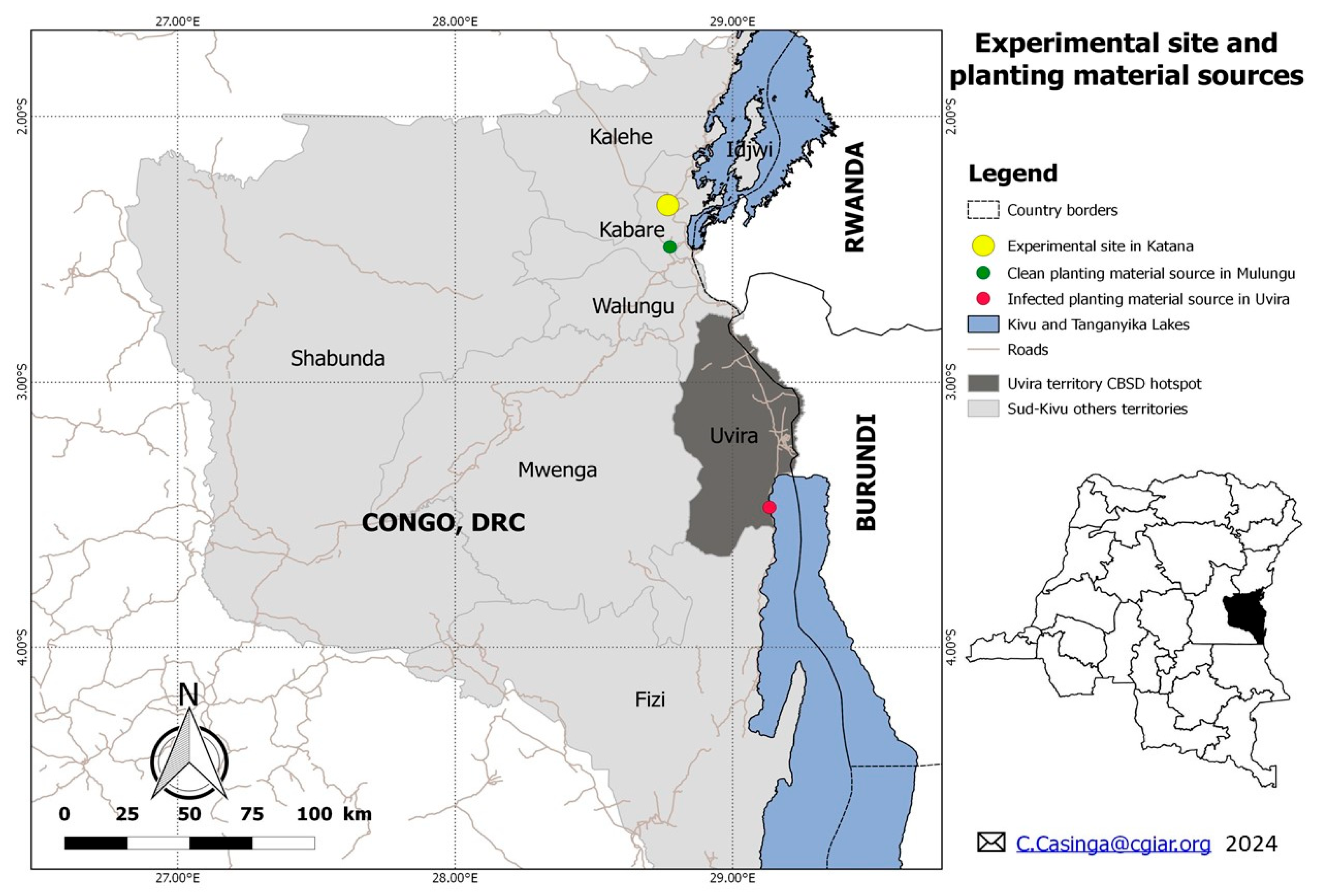
Trials were established at Mwanda-Katana village, in Kabare territory (Alt: 1479 m.a.s.l, Lat: S2.3333°, Long: E28.7667°), in Sud-Kivu province, eastern DRC (Figure 1). The site is regarded as a low-CBSD-pressure location due to its low whitefly abundance, indicating that there is likely to be minimal CBSD spread within cassava fields planted there.
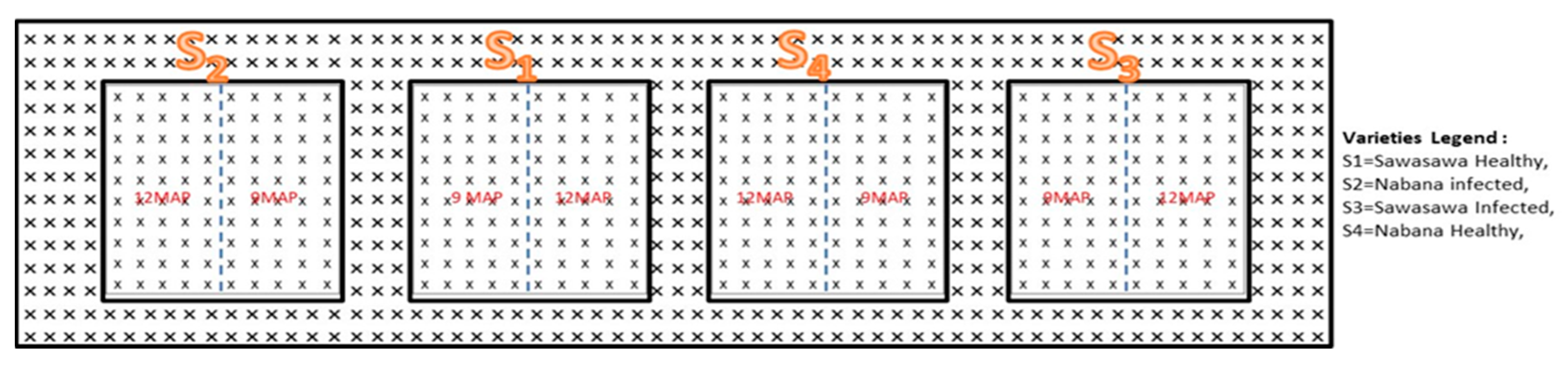
A randomized split-plot design with four replications was used. Two popular CMD-resistant cassava varieties, Nabana (MM 96/4653) and Sawasawa (MM 96/3920), were used in this experiment. Variety/infection combinations were the main plots (measuring 10 m × 10 m), which comprised two varieties planted with either healthy or infected cuttings. Each main plot was subdivided into two sub-plots, each measuring 10 m × 5 m, separated by a 1 m isolation distance. This design allowed us to treat the subplots as harvest times (9 MAP and 12 MAP). Each harvest time and the main plots were randomly assigned (Figure 2).
There were spacings of 3 m between replicates and between the main plots within each replication. One month after planting cassava, three rows of sorghum, spaced 50 cm apart, were planted between the main plots and replicates to create barriers to inhibit whitefly movement between plots and therefore the transmission of CBIs. During the experimental period, the annual rainfall was 1461 mm, while the average temperature was 20.1 °C [39].

2.2. Planting Material and Virus Status Confirmation

Infected planting materials (stem cuttings) of each variety were obtained from plants with typical CBSD foliar symptoms from farmers’ fields at Uvira in the Ruzizi Plain (Alt: 851m.a.s.l, Lat: S3.4723°, Long: E029.1331°), a hotspot for CBSD (Figure 1). Healthy planting materials were obtained from the INERA-Mulungu germplasm bank, a high-altitude location (Alt: 1170m.a.s.l, Lat: S02.3333°, Long: E028.78190°) where CBSD pressure is low. Virus testing was conducted to ascertain the health status of the source plants using CBSV- and UCBSV-specific real-time TaqMan RT-qPCR assays [40,41] at the IITA-Kalambo Plant Pathology and Microbiology Laboratory in Bukavu, DRC. The trials were planted in February 2019–2020 and February 2021–2022. For each year, tuberous root harvesting was performed twice in each plot at 9 MAP and 12 MAP.

2.3. Planting

Approximately 25 cm long cassava cuttings from each of the selected varieties and treatments were planted at a spacing of 1 m × 1 m at the selected site in Mwanda-Katana, eastern DRC. The experimental plots were managed similarly to local farmer practices to generate comparable data. For instance, no fertilizer was applied, the trials were rain-fed, and weeding was performed manually using a hand hoe. However, for the control of whitefly virus transmission, systemic insecticide imidacloprid (WINNER® 100EC, OSHO Industry, Nairobi, Kenya) sprays were used at a rate of 3 mL/20 L [42] at monthly intervals on all treatments, starting from 1 MAP up to 9 MAP in the evening. To achieve an effective isolation distance, the experiment was planted more than 50 m from any other cassava fields to reduce the likelihood of virus introduction by viruliferous whiteflies from neighbouring fields. Additionally, between different plots and replications, three sorghum lines were planted at high density to create barriers to inhibit whitefly movement across plots.

2.4. Soil Characteristics and Climatic Conditions

Prior to the trial planting, soil samples were taken at five points at regular intervals along a diagonal through each of the four plots in a replication. An Edelman auger was used to sample 0 to 30 cm of topsoil. This was air-dried, passed through a 2 mm sieve, and analyzed for standard physico-chemical properties (Table 1). A composite soil sample was then obtained from 20 random sampling points across the experimental plot. Soil texture analysis was performed using the sedimentation method [43] (French and European Norme NF X31-107 2022). After pre-treatment of this sample [44] (French and European 2022 ISO 11263:1994), the pH was measured using a glass pH meter [45] (French and European 2022 ISO 10390:2021). The total nitrogen was determined using the Kjeldahl method [46] (French and European 2022 ISO 11261:1995). Potassium, calcium, magnesium and CEC were determined using the ammonium acetate method [47] (Global Spex AFNOR- NF X31-130), and available phosphorus using the Olsen method [44] (French and European 2022 ISO 11263:1994). The results of the soil analysis did not reveal any nutrient deficiencies, suggesting ideal edaphic conditions for the experimental trial. All analyses were conducted in the soil and plant analysis laboratory of the International Institute of Tropical Agriculture (IITA-Kalambo), Bukavu, DRC.
Weather data (temperature (°C) and rainfall (mm)) were obtained using the HOBO U30 USB weather station equipment installed at CRSN-Lwiro, and mean temperatures and annual rainfall values were calculated for the period of experimentation [39].

2.5. Assessment of CBSD Foliar and Root Symptoms

Foliar disease symptoms were scored at 3, 6, 9, and 12 MAP on a 1 to 5 scale, where 1 = no symptoms; 2 = mild feathery chlorosis of the secondary and tertiary veins in the leaf lamella; 3 = pronounced feathery chlorosis and yellow blotches on leaves and mild stem lesions; 4 = severe feathery chlorotic mottle on leaves and stem lesions; and 5 = very severe chlorotic mottle on leaves and stem dieback [4,21,48].
Foliar data were collected from 10 plants selected at equal intervals within the net plot area of each harvest date category (9 and 12 MAP), which had a total of 24 plants in the net plot. Harvesting was performed by randomly selecting ten plants and uprooting them. At the same time, these plants were individually assessed for CBSD root symptoms. This was achieved by scoring root symptom severity at five cross-sectional cuts made into each root at regularly spaced sections, starting at the base of the root where it was attached to the stem [12,23]. Classification of severity scores followed a 1 to 5 scale, where 1 = no necrosis; 2 = mild necrotic lesions (1–10%); 3 = pronounced necrotic lesions (11–25%); 4 = severe necrotic lesions (26–50%) with mild root constriction; and 5 = very severe necrotic lesions (> 50%) with severe root constrictions for some varieties [12,48,49].

2.6. Growth and Yield Assessment

Plant height was measured with a graduated metre rule, while the diameter at the collar was measured with a Vernier calliper, and the weight per plant was measured with a 50 kg scale [50]. For each harvest period, ten plants were uprooted in the net sub-plot area. Following the necrosis severity score assessment, cassava roots were batched into usable (CBSD root necrosis severity score of less than 3) and unusable (CBSD root necrosis severity score of 3 or more). The number of roots in each batch was recorded, and they were weighed for each plant to estimate marketable and total fresh root yield (FRY) [12,49].
For yield estimation, fresh root weight and the total number of tuberous roots were recorded for each plant. To express results at the standard agricultural scale (t/ha), the average yield/plant was multiplied by the theoretical stand density (10,000 plants/ha). This conversion assumes that all planting positions were occupied and that plant survival was 100%.
Cassava roots were detached from the plants and separated into marketable (CBSD root necrosis severity score ≤ 2) and unmarketable (CBSD root necrosis severity score ≥ 3), and they were counted and weighed to estimate marketable (MFRY), unmarketable, and total fresh root yield (TFRY) components. Marketable fresh root yield (FRY) percentage was calculated as the ratio of marketable FRY (t/ha) to the total fresh root yield (TFRY; t/ha) [12,22,49,51]. To assess the impact of CBSD on productivity, we calculated the percentage of total yield reduction by comparing the yield of infected treatments (IT) with that of non-infected treatments (NIT) using Equation (1), given below [12,22,49,51]. This allowed us to evaluate the effectiveness of the different treatments in terms of reducing yield losses due to the severity of CBSD.
Y i e l d   l o s s   % = y i e l d   o f   N I T   t / h a y i e l d   o f   I T t / h a y i e l d   o f   N I T t / h a   × 100
The yield loss percentage, including losses due to unusable roots, was calculated as follows: First, we calculated the root yield for the uninfected treatment (A). Next, we calculate the uninfected root yield by subtracting the infected root yield and the unusable root yield in the infected treatment (B).
Overall loss = AB
Percentage loss = ((AB)/A) × 100

2.7. Data Analysis

Data analysis was performed using R software (Version 4.4.1) [52]. All analyses were conducted separately for each year and combined for the two years. The experimental design employed a split-plot structure, which was incorporated into the statistical model. For continuous variables, including yield and growth parameters, a linear mixed-effects model was fitted, and the model was specified as follows in Equation (2):
Y = μ + Rep + Tr + Ht+ (Tr × Ht) + (1|Rep/Tr) + ε,
where Y is the response variable, μ is the overall mean, Rep is the fixed effect of replication, Tr is the fixed effect of the variety-infection combination, Ht is the fixed effect of the harvest time, Tr × Ht is the fixed interaction effect, (1|Rep/Tr) is the random effect for main plots serving as the error term for testing the Tr effect, and ε is the residual error used for testing the Ht effect and its interaction with Tr.
The assumptions of the model were verified prior to inference. Data normality was checked using the Shapiro–Wilk test, and the homogeneity of variances was assessed using Levene’s test. For data that violated the normality assumption, the non-parametric Kruskal–Wallis test was used [53]. When the ANOVA revealed significant effects, multiple comparisons of means were performed. For the linear mixed model, the Tukey Honest Significant Difference (HSD) test was applied at a significance level of α = 0.05. For the non-parametric analyses, Dunnett’s test with a Bonferroni correction was employed as a post hoc test [54].

3. Results

3.1. Cassava Brown Streak Disease Foliar and Roots Symptoms

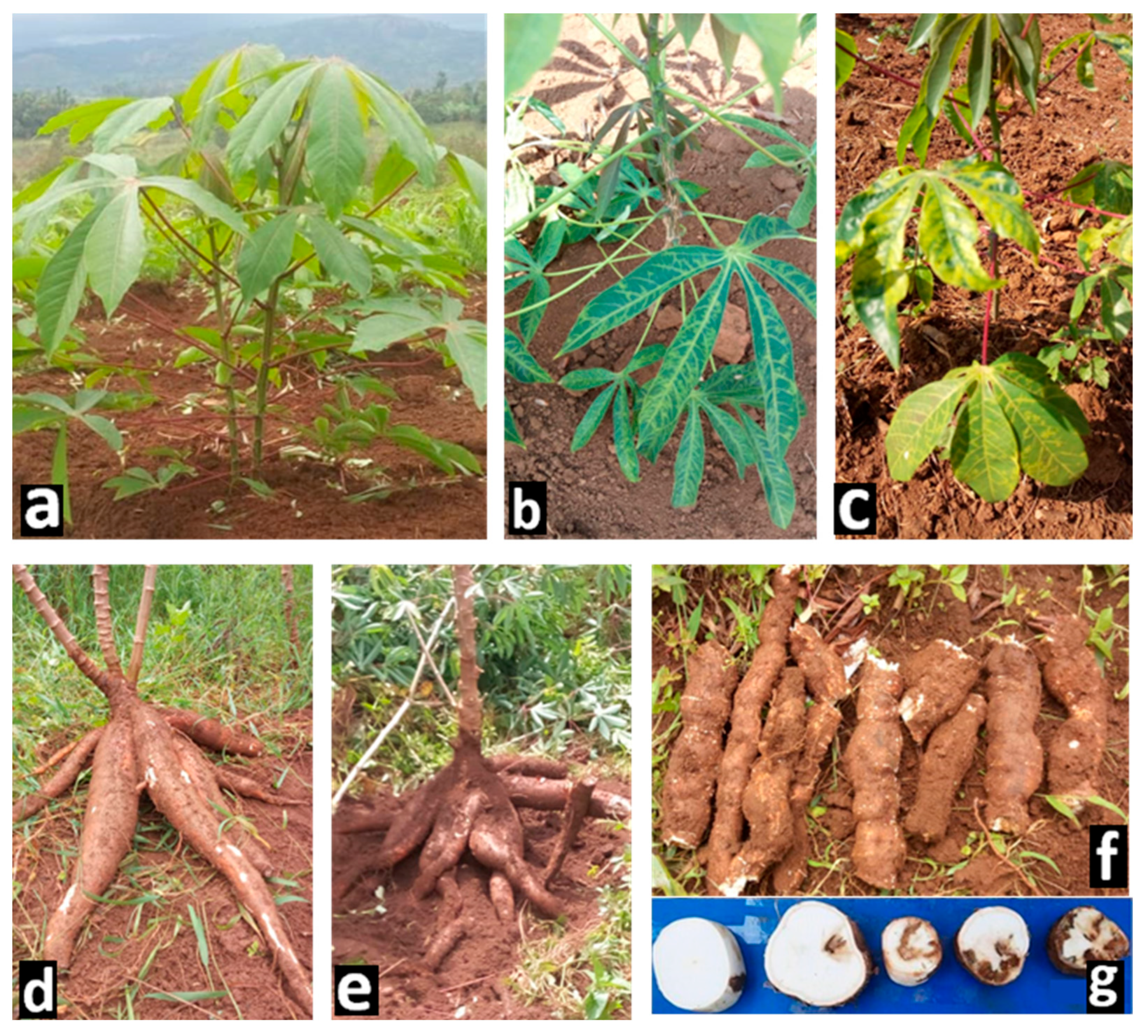
Plants of both the Nabana and Sawasawa varieties in the plots planted with infected cuttings expressed typical CBSD symptoms during the crop growth cycle and at harvest, including feathery chlorosis on leaves, corky necrosis in roots, and root constrictions (Figure 3). The severity of CBSD leaf symptoms varied among different varieties, reflecting their varying levels of susceptibility. At 9 MAP, Nabana’s score was 3.49, rising to 4.24 at 12 MAP, while Sawasawa’s score was 3.36 at 9 MAP and 3.61 at 12 MAP. Generally, slight CBSD symptoms with an average severity of 2 and 30% average incidence were observed in the healthy treatments of both Nabana and Sawasawa.
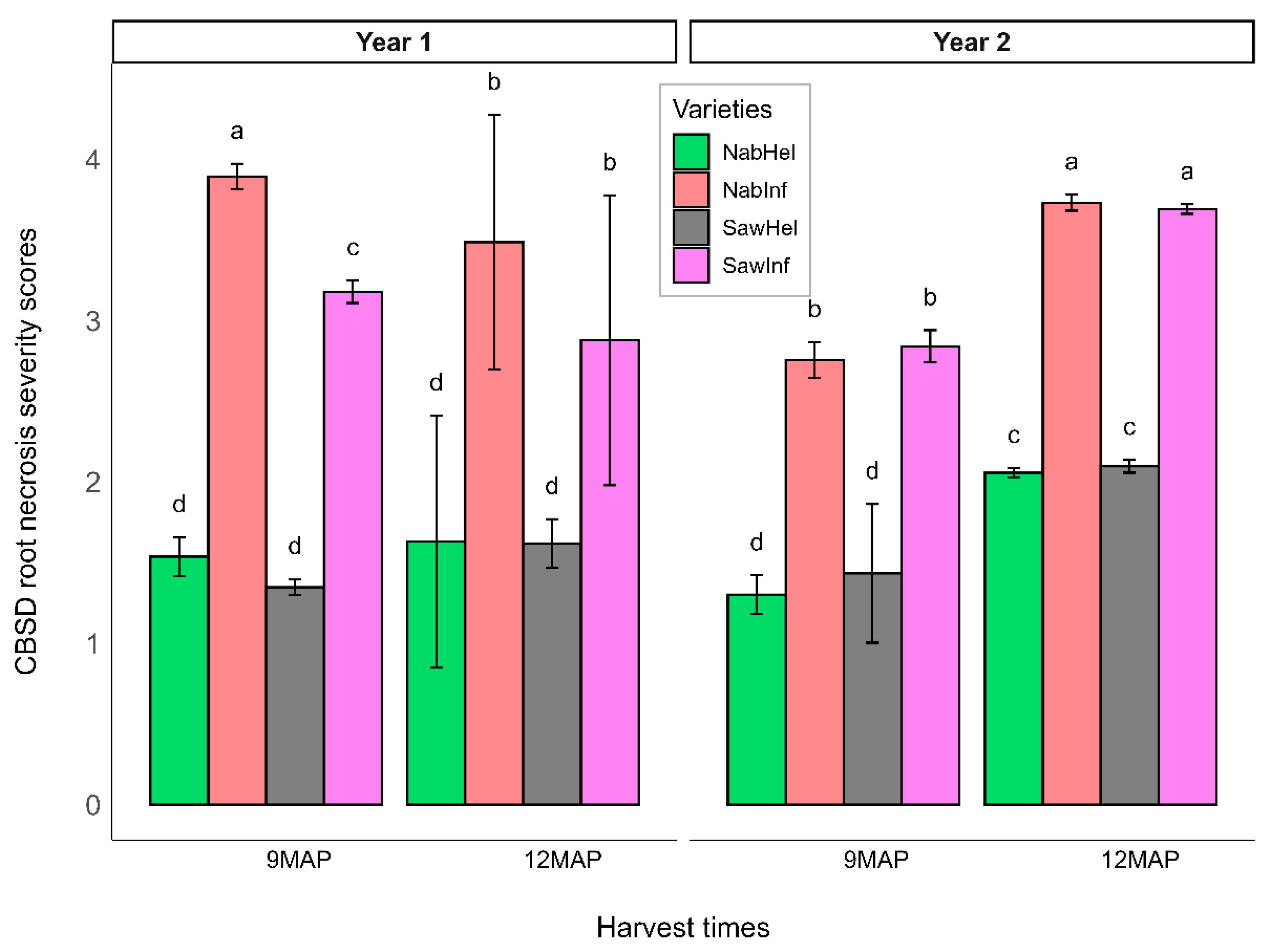
Differences in the severity of CBSD root symptoms were significant between varieties at both 9 MAP and 12 MAP. CBSD root severity scores were higher for infected treatments compared to healthy treatments, with significant variation attributable to cassava variety (p < 0.001) and time of harvesting (p < 0.001). However, the interaction between harvest time and treatment was not significant (p = 0.39), indicating that the effects of harvest time and treatment were independent (Figure 4).

3.2. Effect of CBSD on Vegetative Growth of Nabana and Sawasawa Cassava Varieties

The results presented in Table 2 below show distinct growth differences in cassava varieties (Nabana and Sawasawa) under healthy and infected conditions over two years, with parameters measured at four intervals (3, 6, 9, and 12 MAP). For plant height, the results highlight the impact of virus infection on growth performance. Healthy plants were significantly taller than those in the infected treatment (p < 0.0001). Sawasawa was typically taller than Nabana, regardless of infection status (p < 0.001). Diameter measurements followed a similar trend, with Sawasawa diameters greater than those of Nabana (p < 0.001) and healthy diameters greater than those of infected (p < 0.001).
CBSD leaf scores revealed pronounced differences, with infected plants exhibiting significantly higher scores than clean plants, especially for Nabana infected, which had the highest CBSD scores across both years. There were highly significant (p < 0.001) MAP, variety, and MAP × variety effects on CBSD leaf symptoms.

3.3. Total Fresh Root Yield Assessment (t/ha)

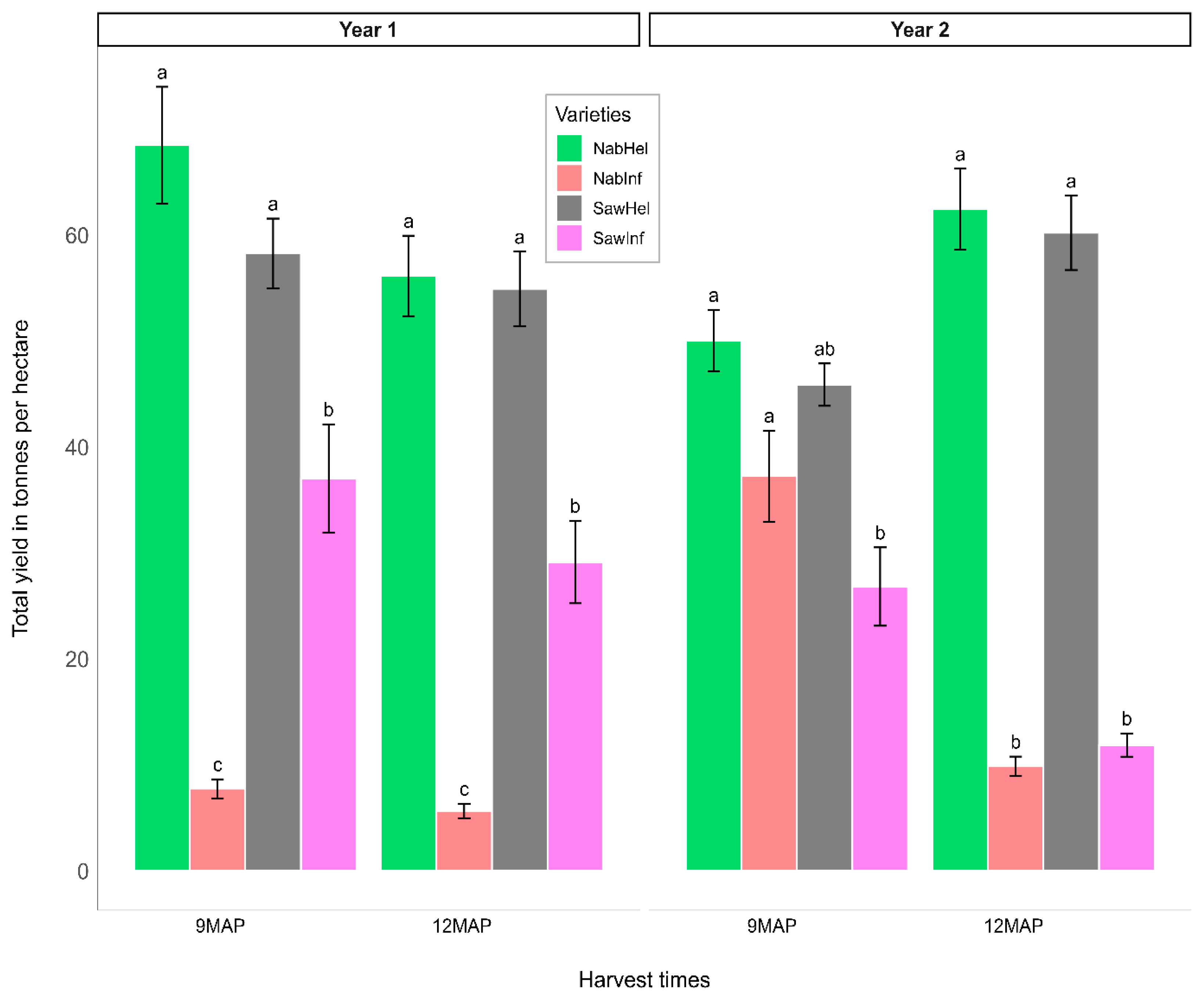
Considering both years, the effects of harvest date, treatment, and their interaction on the total fresh root yield (tFRY) of Nabana and Sawasawa were significant. Harvest time had a considerable influence on tFRY (p = 0.0028), with consistently higher yields observed for healthy treatments compared to infected treatments. At 9 MAP, healthy Nabana yielded 59.2 t/ha, significantly higher (p < 0.001) than 22.5 t/ha for infected Nabana, while at 12 MAP, yields were 59.3 t/ha and 7.7 t/ha, respectively. For Sawasawa, the pattern was similar: at 9 MAP, the healthy treatment yielded 52 t/ha compared to 31.9 t/ha for the infected treatment, and at 12 MAP, yields were 57.5 t/ha and 20.5 t/ha, respectively. The significant interaction between time of harvest and treatment (p < 0.0011) indicates that infection effects varied depending on the time of harvest, with notable yield declines from 9 MAP to 12 MAP for both varieties in the infected treatment (Figure 5). Considering both varieties, the average yield for the infected treatment was 46.6% less than that of the uninfected treatment at 9 MAP, while the difference between the treatments increased to 75.9% by 12 MAP. Yields for the healthy treatment increased 5.0% from 9 MAP to 12 MAP, while for the infected treatment, there was a 52.5% reduction in yield between these two harvesting dates.

3.4. Assessment of Marketable Fresh Root Yield

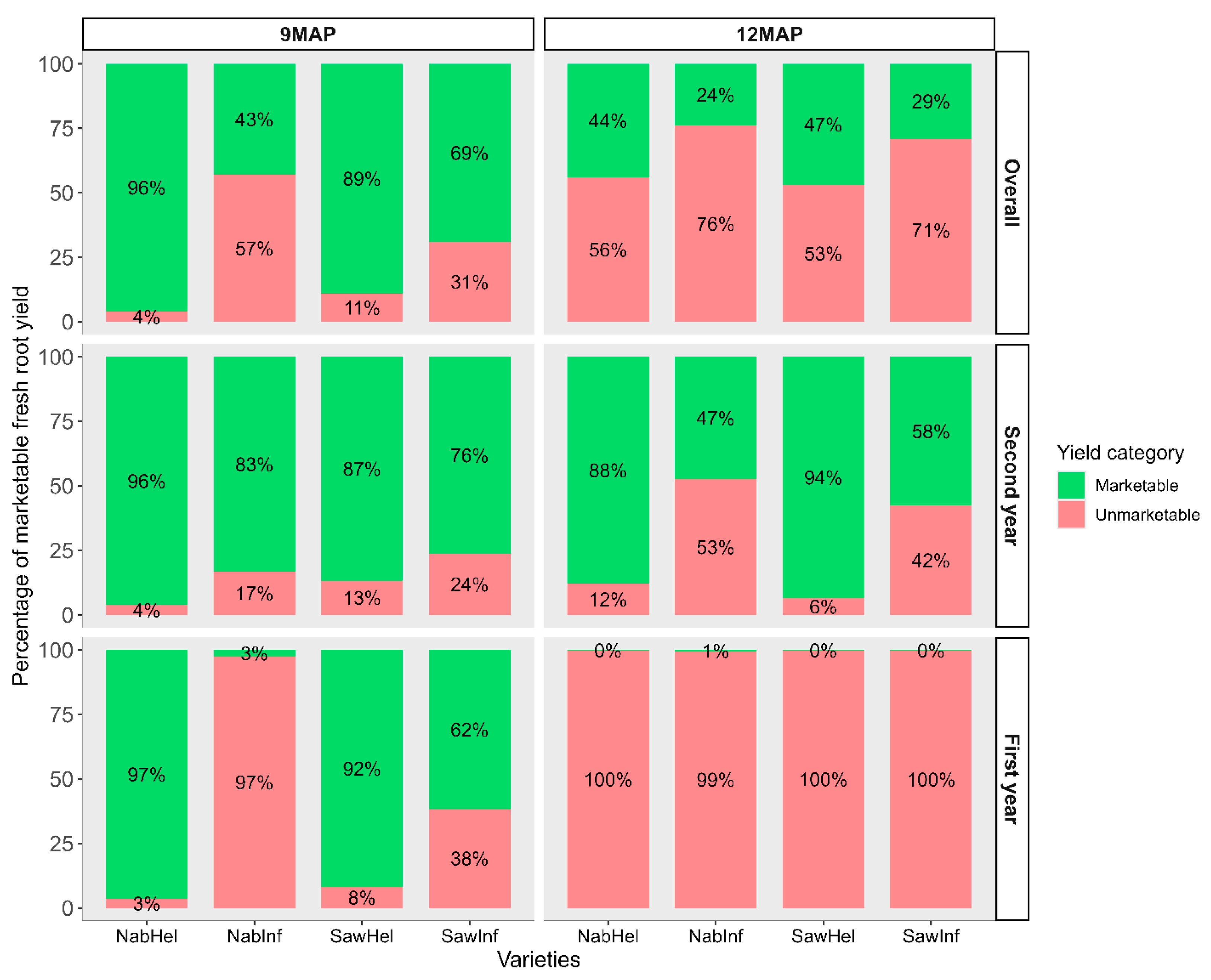
Analyses revealed significant differences in the percentage of marketable fresh root yield between healthy and infected treatments for both Nabana and Sawasawa varieties between the two harvest dates (9 MAP and 12 MAP) (p < 0.05; Figure 6). Overall, healthy Nabana had the highest levels of marketable root yield (96% at 9 MAP and 44% at 12 MAP). In contrast, infected Nabana exhibited the lowest percentages of marketable root yield, with only 24% marketable fresh root yield at 12 MAP, which was significantly lower than the 43% at 9 MAP (p < 0.01). Similarly, the proportions of marketable root yield for healthy Sawasawa (89% at 9 MAP and 47% at 12 MAP) were higher than those for infected Sawasawa (69% at 9 MAP and 29% at 12 MAP (p < 0.01). The unmarketable root percentage increased significantly with the date of harvest for both varieties, while the percentage of marketable roots decreased (Figure 6).
The results indicate differences in varietal response to CBSD, with greater losses for Nabana compared to Sawasawa. Additionally, these findings demonstrated that delaying cassava harvest beyond 9 MAP substantially increased the proportion of unmarketable yield, particularly when infection was present.

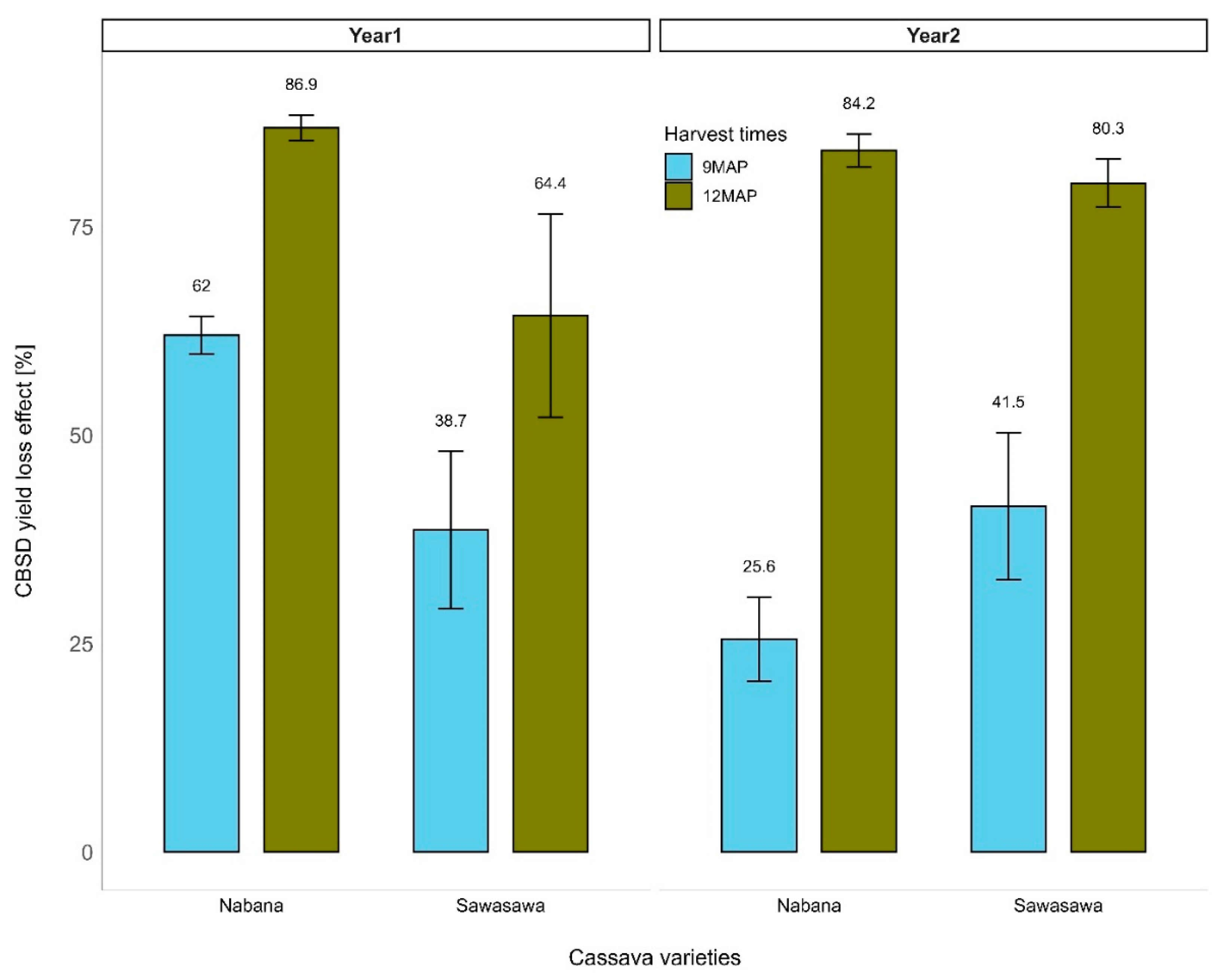
3.5. Cassava Brown Streak Disease Percentage Reduction Losses Effects

Yield losses intensified markedly between 9 MAP and 12 MAP, with the magnitude of the increase varying by variety and season. Nabana exhibited a particularly acute response to extended field retention, with yield losses rising from 62% to 86.9% in year 1 and from 25.6% to 84.2% in year 2. Sawasawa also showed increased losses, rising from 38.7% to 64.4% in year 1 and from 41.5% to 80.3% in year 2, but the progression was comparatively less abrupt, suggesting a relatively greater tolerance to CBSD under delayed harvest conditions (Figure 7).

4. Discussion

Cassava brown streak disease continues to represent one of the most important challenges facing cassava farmers in parts of East, central, and southern Africa, where it is widespread [4,8,27,33,48]. Country- and region-wide strategies are being deployed to restrict the spread of the causal viruses, including diagnostics and surveillance and the prevention and control of infection using community phytosanitation [1,33,37], as well as the implementation of systems for the production and dissemination of healthy seed for planting [4,33]. The quality of seed is an important element in realizing the potential yields of cassava in farmers’ fields. Studies conducted in CBSD-affected areas have shown that the use of healthy seed can reduce the impact of CBSD in cassava varieties with varying levels of resistance to CBSD [22,55]. Such information provides an important basis for developing effective control measures that meet the needs of affected farmers.
This study investigated the effects of CBSD on the yield quantity and quality of two CMD-resistant cassava varieties at two harvest times in eastern DRC. It aimed to provide information on the effects of CBSD on the yield performance of these varieties, which had been hitherto lacking in DRC [4,23]. The healthy treatments for each of the two varieties tested showed high yields, which compare favourably with the high cassava yields achieved in several Asian countries in 2022 [56]. It is interesting to note that the yields obtained at 9 MAP were similar for the two healthy varieties (59.2 t/ha for Nabana and 57.5 t/ha for Sawasawa), confirming 2009 findings [57,58,59] that estimated a cassava yield potential range of 50 to 60 t/ha. However, the research yields estimated in this study are greater than those previously published in the DRC National Catalogue [36], most likely due to variations in agroecological cultivation conditions. Furthermore, the high yield confirms the finding of [60] in 2017 and can be attributed to the relatively short dry period experienced by the experimental site of the current study. This means that the plants do not deplete their reserves during the dry season, unlike in many other parts of sub-Saharan Africa [12,61]. Additionally, soil analyses confirmed that there were no mineral deficiencies, but that all soil mineral components were at near-optimum levels. This in part explains the unusually high yields recorded and confirms the finding of [62], who established a positive correlation between cassava yield, weather conditions (rainfall amount and temperature), and soil fertility.
Our field-based results demonstrate a consistent association between foliar symptoms of CBSD and root necrosis, as previously recorded [17,54,63]. CBSD symptom expression differed between Nabana and Sawasawa, where foliar symptom severities increased from 2–3 at 9 MAP to 2–4 at 12 MAP, with Nabana expressing more severe symptoms. These results contradict those of [64], who found in 2022, during the screening of cultivars against cassava brown streak disease and the molecular identification of the phytopathogenic infection-associated viruses, that the Nabana variety was asymptomatic, and, though resistant to CBSD in the Ruzizi plain, confirmed that the disease inspection period is crucial for symptom identification. However, our findings confirm those of others, who have established that diseased cassava plants can sometimes recover and become asymptomatic for the above-ground plant parts, whereas roots continue to degenerate [24,55].
CBSD root necrosis severity and incidence showed a similar trend, as they increased for both varieties towards the end of the experiment. This confirms the finding of [12,55], who established that the severity of diseased plants in CBSD-infected fields increases over time. There were differences in the pattern of development of CBSD root necrosis during the growth cycle, with Sawasawa exhibiting a severity of 2.9 at 9 MAP and Nabana having a much higher CBSD severity. Similarly, at 12 MAP, the CBSD root severity of the infected Nabana treatment (4.2) was higher than that of the infected Sawasawa (3.2). The CBSD-associated yield loss for Nabana at 9 MAP was 43.8%, while it was 85.5% at 12 MAP. A similar trend was observed for Sawasawa, where a yield reduction of 40.1% was observed for infected material at 9 MAP and 72.3% at 12 MAP. These yield loss trends align with the findings from previous studies [12,22,33,65], which reported that, in susceptible varieties, CBSD can cause up to 100% yield loss. Analogous sorts correlated with delayed harvest have resulted in increased CBSD severity and the number of affected roots, leading to major losses, which have been attributed to CBSD in studies conducted elsewhere in East Africa [1,12,22,48,55].
The proportions of marketable fresh roots yields were a function of variety susceptibility and harvesting period, with Nabana infected showing the lowest percentage of marketable roots (23.7% at 9 MAP and 45% at 12 MAP) compared with Sawasawa infected (approximately 70% at both harvesting times). These results corroborate previous findings that confirm, based on variety susceptibility, that CBSD causes the rotting of roots in some varieties, resulting in a reduction in the number of marketable roots [1,12,22,55]. These results also indicate the necessity of harvesting Sawasawa at 9 MAP at the latest and of not harvesting it piecemeal when the seed planted was infected. The reason for this is that delayed harvesting increases CBSD severity and the number of affected roots, which are not good for consumption [12,55,66]. Additionally, the yield losses are affordable for the latest 9 MAP, mainly because this is the active bulking period for cassava, and thus the tuberous roots can outgrow the damage caused by the disease [22,23,67].
Farmers actively remove the minimally damaged portions of such roots and use the remaining healthy parts for consumption, which contributes to the lower losses observed at 9 MAP [22,35]. Furthermore, during this period of active growth, several roots escape disease infection and develop into completely healthy roots, further contributing to the observed lower losses [12,22]. Therefore, to minimize CBSD root damages, farmers should adopt early harvesting before the full physiological maturity of cassava plants, even if it can significantly reduce yields due to the low starch accumulation in root tissues [12,22,49].
These results may help seed specialists and agricultural extension officers to provide specific recommendations and guidance to farmers on the ideal harvesting time for each cassava variety they grow [22]. The reason why each cassava variety has an ideal harvesting time is that each variety is affected differently in terms of disease spread, root necrosis damage, and severity of leaf symptoms [5,12,23].
The same results can also be used to develop longer-term strategies in developing and managing seed systems and in conducting evaluations of breeders’ seeds for various purposes, including yield performance and disease resistance [55,68]. Moreover, other factors that affect root CBSD symptoms such as cultivar (genotype) susceptibility and environmental variations like rainfall, altitude, temperature, and soil conditions [5,35,68] need to be taken into consideration in future studies.
There were significant yield differences between the healthy treatments of the two CMD-resistant varieties at 9 and 12 MAP, which suggests that the optimal harvest time is 9 MAP. This contrasts with the National Catalogue recommendation for released varieties in the DRC and suggests 12 MAP as the optimal harvest time for maximizing yield [36]. For both cassava varieties, CBSD-associated root necrosis increases in infected plants from 9 to 12 MAP, and this increase in root necrosis leads to higher CBSD losses as plants mature. For this reason, infected plants should certainly not be left in the ground beyond 12 MAP. This conflicts with local socio-cultural norms where piecemeal harvesting is often practiced and continued for up to two years after planting. This in-ground storage characteristic of some cassava varieties is particularly important in areas with a prolonged dry season [12,63]. Piecemeal harvesting allows cassava to function as a famine-reserve crop [69]. Although early harvesting appears to maximize yield potential where there is little CBSD and mitigates the worst effects of the disease where CBSD is widespread, researchers need to identify solutions for CBSD management that will enable farmers to continue practicing piecemeal harvesting. This will require increased investments in research to breed for durable resistance to both CMD and CBSD [1,22].
At 9 MAP, CBSD causes tuberous root yield losses ranging from 70 to 100%, depending on the cassava variety. This finding confirms the results of previous research conducted in East Africa [5,22,32,37]. The gradual onset of root necrosis in tuberous cassava roots as they mature through harvest age is a phenomenon recognized from the earliest years of CBSD research [17] and is particularly important in areas with high disease severity and incidence [35,49,61]. Notably, our results differ from those of [12], who, based on research conducted in Uganda, suggested that, to minimize the effects of CBSD on roots, the best harvesting time is 16 MAP. This difference can, in part, be explained by the very different agro-ecological conditions of these two environments and the likely inherent differences in response to CBSD among the varieties tested in the DRC and Uganda [48].

5. Conclusions

This study shows that CBSD has a severe impact on the two popular CMD-resistant cassava varieties in eastern DRC, and that early harvesting can provide the optimal combination of high fresh root yield and reduced losses due to CBSD. Based on these findings, we recommend the following two practices: (i) the investigated varieties should be cultivated only in areas where CBSD is not prevalent; and (ii) in cases where alternative varieties are unavailable and CBSD pressure is significant, farmers should cultivate the Sawasawa variety and harvest it at 9 MAP to minimize yield losses due to CBSD. This study also suggests an urgent need for new cassava varieties with dual resistance to CMD and CBSD with long in-ground storability. Furthermore, the cassava research and extension organizations, in collaboration with private entrepreneurs, need to develop and strengthen sustainable seed multiplication and distribution systems to ensure that farmers in DRC have access to clean seed for planting.

Author Contributions

Conceptualization, B.B., C.M.C., and J.P.L.; methodology, C.M.C., R.R.S., G.M., H.U.U., E.N.W., and J.P.L.; software, C.M.C., A.K., and B.B.; validation, C.M.C., Z.B., E.N.W., R.R.S., L.K., and J.P.L.; formal analysis, C.M.C., A.K., L.N.N., E.N.W., and R.R.S.; investigation, B.B., G.M., C.M.C., H.U.U., and L.N.N.; resources, J.P.L., L.N.N., Z.B., and L.K.; data curation, C.M.C., H.U.U., G.M., A.K., B.B., R.R.S., and J.P.L.; writing—original draft preparation, C.M.C., G.M., H.U.U., A.K., E.N.W., R.R.S., L.K., and J.P.L.; writing—review and editing, C.M.C., A.K., L.N.N., E.N.W., R.R.S., L.K., and J.P.L.; visualization, C.M.C., E.N.W., G.M., R.R.S., and J.P.L.; supervision, R.R.S., L.K., and J.P.L.; project administration, C.M.C., Z.B., L.N.N., and J.P.L.; funding acquisition, Z.B., J.P.L., and L.N.N. All authors have read and agreed to the published version of the manuscript.

Funding

This research was funded by the U.S. Agency for International Development (USAID), Award No. AID-BFS-IO-17-00005. Contributions of J.P. Legg, E. Wosula, L. Kumar, C.M. Casinga, and R.R. Shirima were supported through the CGIAR Initiative on Plant Health and Rapid Response to Protect Food Security and Livelihoods (Plant Health Initiative) and the current Sustainable Farming Program funded by the CGIAR Trust Fund (www.cgiar.org/funders/, accessed on 22 November 2025).

Data Availability Statement

The original contributions presented in the study are included in the article, further inquiries can be directed to the corresponding authors.

Acknowledgments

The authors gratefully acknowledge the support received from farmers, researchers, and agricultural staff in the DRC.

Conflicts of Interest

The authors declare no conflicts of interest.

References

  1. Chikoti, P.C.; Tembo, M. Expansion and impact of cassava brown streak and cassava mosaic diseases in Africa: A review. Front. Sustain. Food Syst. 2022, 6, 1076364. [Google Scholar] [CrossRef]
  2. Houngue, J.A.; Pita, J.S.; Cacaï, G.H.T.; Zandjanakou-Tachin, M.; Abidjo, E.A.E.; Ahanhanzo, C. Survey of farmers’ knowledge of cassava mosaic disease and their preferences for cassava cultivars in three agro-ecological zones in Benin. J. Ethnobiol. Ethnomed. 2018, 14, 29. [Google Scholar] [CrossRef]
  3. Sanginga, N.; Mbabu, A. Root and Tuber Crops (Cassava, Yam, Potato and Sweet Potato), Feeding Africa, Background Paper on Action Plan for African Agricultural Transformation. In Proceedings of the Feeding Africa, Abdou Diouf International Conference Center, Dakar, Senegal, 21–23 October 2015. [Google Scholar]
  4. Casinga, C.M.; Shirima, R.R.; Mahungu, N.M.; Tata-Hangy, W.; Bashizi, K.B.; Munyerenkana, C.M.; Ughento, H.; Enene, J.; Sikirou, M.; Dhed’a, B.; et al. Expansion of the cassava brown streak disease epidemic in eastern Democratic Republic of Congo. Plant Dis. 2021, 105, 2177–2188. [Google Scholar] [CrossRef]
  5. Kaweesi, T.; Kawuki, R.; Kyaligonza, V.; Baguma, Y.; Tusiime, G.; Morag, E.F. Field evaluation of selected cassava genotypes for cassava brown streak disease based on symptom expression and virus load. Virol. J. 2014, 11, 216. [Google Scholar] [CrossRef]
  6. Storey, H.H. Virus diseases of East African plants: VI-A progress report on studies of the diseases of cassava. East Afr. Agric. J. 1936, 2, 34–39. [Google Scholar]
  7. Hillocks, R.J.; Raya, M.; Mtunda, K.; Kiozia, H. Effects of brown streak virus disease on yield and quality of cassava in Tanzania. J. Phytopathol. 2001, 149, 389–394. [Google Scholar] [CrossRef]
  8. Manyong, V.M.; Maeda, C.; Kanju, E.; Legg, J. Economic damage of cassava brown streak disease in sub-Saharan Africa. In Tropical Roots and Tuber Crops and the Challenges of Globalization and Climate Changes = Plantes à Racines et Tubercules Tropicales et les Défis de Mondialisation et du Changement Climatique, 1st ed., Proceedings of the 11th Triennial Symposium of the ISTRC-AB, Kinshasa, RD Congo, 4–8 October 2010; Okechukwu, R.U., Ntawururuhunga, P., Eds.; ISTRC-AB: Oyo State, Nigeria, 2012; Volume 1, pp. 78–82. [Google Scholar]
  9. Kwibuka, Y.; Nyirakanani, C.; Bizimana, J.P.; Bisimwa, E.; Brostaux, Y.; Lassois, L.; Vanderschuren, H.; Massart, S. Risk factors associated with cassava brown streak disease dissemination through seed pathways in Eastern D.R. Congo. Front. Plant Sci. 2022, 13, 803980. [Google Scholar] [CrossRef] [PubMed]
  10. Mbanzibwa, D.R.; Tian, Y.P.; Tugume, A.K.; Mukasa, S.B.; Tairo, F. Genetically distinct strains of Cassava brown streak virus in the Lake Victoria basin and the Indian Ocean coastal area of East Africa. Arch. Virol. 2009, 154, 353–359. [Google Scholar] [CrossRef]
  11. Winter, S.; Koerbler, M.; Stein, B.; Pietruszka, A.; Paape, M. Analysis of cassava brown streak viruses reveals the presence of distinct virus species causing cassava brown streak disease in East Africa. J. Gen. Virol. 2010, 91, 1365–1372. [Google Scholar] [CrossRef]
  12. Kanju, E.; Uzokwe, V.N.E.; Ntawuruhunga, P.; Tumwegamire, S.; Yabeja, J.; Pariyo, A.; Kawuki, R. Varietal response of cassava root yield components and root necrosis from cassava Brown streak disease to time of harvesting in Uganda. Crop Prot. 2019, 120, 58–66. [Google Scholar] [CrossRef]
  13. Ndunguru, J.; Sseruwagi, P.; Tairo, F.; Stomeo, F.; Maina, S.; Djinkeng, A.; Monica, K.M.; Boykin, L.M. Analyses of twelve new whole genome sequences of cassava brown streak viruses and Ugandan cassava brown streak viruses from East Africa: Diversity, supercomputing and evidence for further speciation. PLoS ONE 2015, 10, e01411939. [Google Scholar]
  14. Patil, B.L.; Legg, J.P.; Kanju, E.; Fauquet, C.M. Cassava brown streak disease: A threat to food security in Africa. J. Gen. Virol. 2015, 96, 956–968. [Google Scholar] [CrossRef]
  15. Mulenga, R.M.; Boykin, L.M.; Chikoti, P.C.; Sichilima, S.; Ng’uni, D.; Alabi, O.J. Cassava brown streak disease and Ugandan cassava brown streak virus reported for the first time in Zambia. Plant Dis. 2018, 102, 1410–1418. [Google Scholar] [CrossRef] [PubMed]
  16. Robson, F.; Hird, D.L.; Boa, E. Cassava brown streak: A deadly virus on the move. Plant Pathol. 2023, 73, 221–241. [Google Scholar] [CrossRef]
  17. Nichols, R.F.J. The brown streak disease of cassava: Distribution, climatic effects and diagnostic symptoms. East. Afr. Agr. J. 1950, 15, 154–160. [Google Scholar] [CrossRef]
  18. Hillocks, R.J.; Raya, M.D.; Thresh, J.M. Distribution and symptom expression of cassava brown streak disease in southern Tanzania. East Afr. J. Root Tuber. Crops 1999, 3, 57–61. [Google Scholar]
  19. Bock, K.R. Studies on cassava brown streak disease in Kenya. Trop. Sci. 1994, 34, 134–145. [Google Scholar]
  20. Munganyinka, E.; Ateka, E.M.; Kihurani, A.W.; Kanyange, M.C.; Tairo, F.; Sseruwagi, P.; Ndunguru, J. Cassava brown streak disease in Rwanda, the associated viruses and disease phenotypes. Plant Pathol. 2018, 67, 377–387. [Google Scholar] [CrossRef]
  21. Hillocks, R.J.; Jennings, D.L. Cassava brown streak disease: A review of present knowledge and research needs. Int. J. Pest. Manag. 2003, 49, 225–234. [Google Scholar] [CrossRef]
  22. Maruthi, M.N.; Kimata, B.; Masinde, E.A.; Mkamilo, G. Effect of time of harvesting and disease resistance in reducing Cassava (Manihot esculenta Crantz) yield losses by two viral diseases. Mod. Concepts Dev. Agron. 2020, 6, 606–616. [Google Scholar] [CrossRef]
  23. Ndyetabula, I.L.; Merumba, S.M.; Jeremiah, S.C.; Kasele, S.; Mkamilo, G.S.; Kagimbo, F.M.; Legg, J.P. Analysis of interactions between cassava brown streak disease symptom types facilitates the determination of varietal responses and yield losses. Plant Dis. 2016, 100, 1388–1396. [Google Scholar] [CrossRef]
  24. Mohammed, I.U.; Ghosh, S.; Maruthi, M.N. Host and virus effects on reversion in cassava affected by cassava brown streak disease. Plant Pathol. 2016, 65, 593–600. [Google Scholar] [CrossRef]
  25. Bigirimana, S.; Barumbanze, P.; Ndayihanzamaso, P.; Shirima, R.R.; Legg, J.P. First report of cassava brown streak disease and associated Ugandan cassava brown streak virus in Burundi. New Dis. Rep. 2011, 24, 26. [Google Scholar] [CrossRef]
  26. Mulimbi, W.; Phemba, X.; Assumani, B.; Kasereka, P.; Muyisa, S.; Ugentho, H.; Reeder, R.; Legg, J.P.; Laurenson, L.; Weekes, R.; et al. First report of Ugandan cassava brown streak virus on cassava in Democratic Republic of Congo. New Dis. Rep. 2012, 26, 11. [Google Scholar] [CrossRef]
  27. Casinga, C.M.; Wosula, E.N.; Sikirou, M.; Shirima, R.R.; Munyerenkana, C.M.; Nabahungu, L.N.; Bashizi, B.K.; Ugentho, H.; Monde, G.; Legg, J.P. Diversity and Distribution of Whiteflies Colonizing Cassava in Eastern Democratic Republic of Congo. Insects 2022, 13, 849. [Google Scholar] [CrossRef] [PubMed]
  28. Neuenschwander, P.; Hughes, J.; Ogbe, F.d’A.; Ngatse, J.M.; Legg, J.P. The occurrence the Uganda Variant of East African Cassava Mosaic Virus (EACMV-Ug) in western Democratic Republic of Congo and the Congo Republic defines the westernmost extent of the CMD pandemic in East/Central Africa. Plant Pathol. 2001, 51, 385. [Google Scholar] [CrossRef]
  29. Muengula-Manyi, M.; Nkongolo, K.K.; Bragard, C.; Tshilenge-Djim, P.; Winter, S.; Kalonji-Mbuyi, A. Incidence, Severity and Gravity of Cassava Mosaic Disease in Savannah Agro-Ecological Region of DR-Congo: Analysis of Agro-Environmental Factors. Am. J. Plant Sci. 2012, 3, 512–519. [Google Scholar] [CrossRef]
  30. Bisimwa, E.; Walangululu, J.; Bragard, C. Cassava Mosaic Disease Yield Loss Assessment under Various Altitude Agroecosystems in the Sud-Kivu Region, Democratic Republic of Congo. Tropicultura 2015, 33, 101–110. [Google Scholar]
  31. Dixon, A.G.O.; Bandyopadhyay, R.; Coyne, D.; Ferguson, M.; Ferris, R.S.B.; Hanna, R.; Hughes, J.; Ingelbrecht, I.; Legg, J.; Mahungu, N.; et al. Cassava: From a poor farmer’s crop to a pacesetter of African rural development. Chronica Hort. 2003, 43, 8–14. [Google Scholar]
  32. Bundi, M.; Kasoma, C.; Mbugua, F.; Williams, F.; Tambo, J.; Rwomushana, I. Cassava Brown Streak Disease: An Evidence notes on impacts and management strategies for Zambia. CABI 2022, 1, 45. [Google Scholar]
  33. Yabeja, J.W.; Manoko, M.L.K.; Legg, J.P. Comparing fresh root yield and quality of certified and farmer-saved cassava seed. Crop Prot. 2025, 187, 106932. [Google Scholar] [CrossRef] [PubMed]
  34. Jandrain, A. Politique semencière de la RDC: Politique importée, des bailleurs pour l’implémenter. Conj Afr. Cent. 2020, 1, 213–238. [Google Scholar]
  35. Masinde, E.A.; Ogendo, J.; Mkamilo, G.; Maruthi, M.N.; Hillocks, R.; Mulwa, R.M.S.; Arama, P.F. Occurrence and estimated losses caused by cassava viruses in Migori County, Kenya. Afr. J. Agric. Res. 2016, 11, 2064–2074. [Google Scholar] [CrossRef]
  36. SENASEM. Catalogue National Variétal des Cultures Vivrières: Répertoire des variétés homologuées de plantes à racines, tubercules et du bananier. Min. Agr. 2019, 1, 124. [Google Scholar]
  37. Alicai, T.; Omongo, C.A.; Maruthi, M.N.; Hillocks, R.J.; Baguma, Y.; Kawuki, R.; Bua, A.; Otim-Nape, G.W.; Colvin, J. Re-emergence of cassava brown streak disease in Uganda. Plant Dis. 2007, 91, 24–29. [Google Scholar] [CrossRef]
  38. Ogwok, E.; Ilyas, M.; Alicai, T.M.E.; Taylor, N.J. Comparative analysis of virus-derived small RNAs within cassava (Manihot esculenta Crantz) infected with cassava brown streak viruses. Virus Res. 2016, 215, 1–11. [Google Scholar] [CrossRef] [PubMed]
  39. Centre de Recherche en Sciences Naturelles de Lwiro. Les données climatiques de la station météorologique de Civanga. CRSN-Lwiro 2022, 7, 35–47. [Google Scholar]
  40. Adams, I.P.; Abidrabo, P.; Miano, D.W.; Alicai, T.; Kinyua, Z.M.; Clarke, J.; Macarthur, R.; Weekes, R.; Laurenson, L.; Hany, U.; et al. High throughput real-time RTPCR assays for specific detection of cassava brown streak disease causal viruses and their application to testing planting material. Plant Pathol. 2013, 62, 233–242. [Google Scholar] [CrossRef]
  41. Shirima, R.R.; Maeda, D.G.; Kanju, E.; Ceasar, G.; Tibazarwa, F.I.; Legg, J.P. Absolute quantification of cassava brown streak virus mRNA by real-time qPCR. J. Virol. Methods 2017, 245, 5–13. [Google Scholar] [CrossRef]
  42. Moreira, D.R.; Gigliolli, A.A.; Falco, J.R.; Julio, A.H.; Volnistem, E.A.; Chagas, F.; Toledo, V.A.; Ruvolo-Takasusuki, M.C. Toxicity and effects of the neonicotinoid thiamethoxam on Scaptotrigona bipunctatalepeletier, 1836 (Hymenoptera: Apidae). Environ. Toxicol. 2018, 33, 463–475. [Google Scholar] [CrossRef] [PubMed]
  43. French and European Standards. Norme NF X31-107. Available online: https://www.boutique.afnor.org/fr-fr/norme/nf-x31107/qualite-du-sol-determination-de-la-distribution-granulometrique-des-particu/fa124875/21997 (accessed on 12 March 2022).
  44. French and European Standards. ISO 11263: 1994—Soil Quality—Determination of Phosphorus—Spectrometric Determination of Phosphorus Soluble in Sodium Hydrogen Carbonate Solution. Available online: https://www.iso.org/standard/19241.html (accessed on 12 March 2022).
  45. French and European Standards. ISO 10390: 2021—Soil, Treated Biowaste and Sludge—Determination of pH. Available online: https://www.iso.org/standard/75243.html (accessed on 6 August 2025).
  46. French and European Standards. ISO 11261: 1995—Soil Quality—Determination of Total Nitrogen—Modified Kjeldahl Method. Available online: https://www.iso.org/standard/19239.html (accessed on 12 March 2022).
  47. Globalspex. AFNOR—NF X31-130—Soil Quality—Chemical Methods—Determination of Cationic Exchange Capacity (CEC) and Extractible Cations|GlobalSpec. Available online: https://standards.globalspec.com/std/675558/nf-x31-130 (accessed on 6 August 2025).
  48. Okul, V.A.; Ochwo-Ssemakula, M.; Kaweesi, T.; Ozimati, A.; Mrema, E.; Mwale, S.; Gibson, P.; Achola, E.; Edema, R.; Baguma, Y.; et al. Plot based heritability estimates and categorization of cassava genotype response to cassava brown streak disease. Crop Prot. 2018, 108, 39–46. [Google Scholar] [CrossRef]
  49. Gondwe, F.M.; Mahungu, N.M.; Hillocks, R.J.; Raya, M.D.; Moyo, C.C.; Soko, M.M.; Chipungu, F.P.; Benesi, I.R. Economic losses experienced by small-scale farmers in Malawi due to CBSVD. In Cassava Brown Streak Virus Disease: Past Present and Future, 1st ed., Proceedings of an International Workshop, Mombasa, Kenya, 27–30 October 2005; Legg, J., Hillocks, R., Eds.; Natural Resources International Limited: Aylesford, UK, 2002; Volume 1, pp. 28–36. [Google Scholar]
  50. Bakayoko, S.; Soro, D.; N’dri, B.; Kouadio, K.K.; Tschannen, A.; Nindjin, C.; Dao, D.; Girardin, O. Etude de l’architecture végétale de 14 variétés améliorées de manioc (Manihot esculenta Crantz) dans le centre de la Côte d’Ivoire. J. Appl. Biosci. 2013, 61, 4471–4477. [Google Scholar] [CrossRef]
  51. Hillocks, R.; Maruthi, M.; Kulembeka, H.; Jeremiah, S.; Alacho, F.; Masinde, E.; Ogendo, J.; Arama, P.; Mulwa, R.; Mkamilo, G.; et al. Disparity between leaf and root symptoms and crop losses associated with cassava Brown streak disease in four countries in eastern Africa. J. Phytopathol. 2015, 164, 86–93. [Google Scholar] [CrossRef]
  52. R Core Team. Available online: https://www.R-project.org (accessed on 22 March 2025).
  53. Kruskal, W.H.; Wallis, W.A. Use of ranks in one-criterion variance analysis. J. Am. Stat. Assoc. 1952, 47, 583–621. [Google Scholar] [CrossRef]
  54. Wickham, H.; Averick, M.; Bryan, J.; Chang, W.; McGowan, L.D.; François, R.; Grolemund, G.; Hayes, A.; Henry, L.; Hester, J.; et al. Welcome to the tidyverse. J. Open Source Softw. 2019, 4, 1686. [Google Scholar] [CrossRef]
  55. Shirima, R.R.; Maeda, D.G.; Kanju, E.E.; Tumwegamire, S.; Ceasar, G.; Mushi, E.; Sichalwe, C.; Mtunda, K.; Mkamilo, G.; Legg, J.P. Assessing the degeneration of cassava under high virus inoculum conditions in Coastal Tanzania. Plant Dis. 2019, 103, 2652–2664. [Google Scholar] [CrossRef]
  56. Production Volume of Cassava in Thailand from 2016 to 2024 with a Forecast for 2025. Thailand: Production Volume of Cassava 2025|Statista. Available online: https://www.statista.com/statistics/1041126/thailand-cassava-production-volume/ (accessed on 17 January 2025).
  57. Fermont, A.M.; Van Asten, P.J.; Tittonell, P.; Van Wijk, M.T.; Giller, K.E. Closing the cassava yield gap: An analysis from smallholder farms in East Africa. Field Crops Res. 2009, 112, 24–36. [Google Scholar] [CrossRef]
  58. Mahungu, N.; Ndonda, A.; Frangoie, A.; Moango, A. Effet du labour et du mode de bouturage sur les rendements en racines et en feuilles de manioc dans les zones de savane et de jachères forestières de la République Démocratique du Congo. Tropicultura 2015, 33, 176–185. [Google Scholar]
  59. Mondo, J.M.; Irenge, A.B.; Ayagirwe, R.B.B.; Dontsop-Nguezet, P.; Karume, K.; Njukwe, E.; Mapatano, S.M.; Zamukulu, P.M.; Basimine, G.C.; Musungayi, E.M.; et al. Determinants of Adoption and Farmers’ Preferences for Cassava Varieties in Kabare Territory, Eastern Democratic Republic of Congo. Am. J. Rural Dev. 2017, 7, 44–52. [Google Scholar]
  60. Munyahali, W.; Pypers, P.; Swennen, R.; Walangululu, J.; Vanlauwe, B.; Merckx, R. Responses of cassava growth and yield to leaf harvesting frequency and NPK fertilizer in South Kivu, Democratic Republic of Congo. Field Crops Res. 2017, 214, 194–201. [Google Scholar] [CrossRef]
  61. Mtunguja, M.K.; Henry, S.L.; Kanju, E.; Ndunguru, J.; Muzanila, Y.C. Effect of genotype and genotype by environment interaction on total cyanide content, fresh root, and starch yield in farmer-preferred cassava landraces in Tanzania. Food Sci. Nutr. 2016, 4, 791–801. [Google Scholar] [CrossRef]
  62. Birindwa, D.R.; Van Laere, J.; Munyahali, W.; De Bauw, P.; Dercon, G.; Kintche, K.; Merckx, R. Early planting of cassava enhanced the response of improved cultivars to potassium fertilization in South Kivu, Democratic Republic of Congo. Field Crops Res. 2023, 296, 108903. [Google Scholar]
  63. Hillocks, R.J.; Raya, M.; Thresh, J.M. The association between root necrosis and above-ground symptoms of brown streak virus infection of cassava in southern Tanzania. Int. J. Pest. Manag. 1996, 42, 285–289. [Google Scholar] [CrossRef]
  64. Shukuru, B.N.; Archana, T.S.; Bisimwa, E.B.; Birindwa, D.R.; Sharma, S.; Kurian, J.A.; Casinga, C.M. Screening of cultivars against cassava brown streak disease and molecular identification of the phytopathogenic infection-associated viruses. Arch. Phytopathol. Plant Prot. 2022, 55, 1899–1929. [Google Scholar] [CrossRef]
  65. Kawuki, R.S.; Kaweesi, T.; Esuma, W.; Pariyo, A.; Kayondo, I.S.; Ozimati, A.; Kyaligonza, V.; Abaca, A.; Orone, J.; Tumuhimbise, R.; et al. Eleven years of breeding efforts to combat cassava brown streak disease. Breed Sci. 2016, 66, 560–571. [Google Scholar] [CrossRef] [PubMed]
  66. Nweke, F.I.; Spencer, D.S.C.; Lynam, J.K. The Cassava Transformation: Africa’s Best-Kept Secret, 1st ed.; Michigan State University Press: East Lansing, MI, USA, 2002; Volume 1, pp. 239–257. [Google Scholar]
  67. Wongnoi, S.; Banterng, P.; Vorasoot, N.; Jogloy, S.; Theerakulpisut, P. Physiology, Growth and Yield of Different Cassava Genotypes Planted in Upland with Dry Environment during High Storage Root Accumulation Stage. Agronomy 2020, 10, 576. [Google Scholar] [CrossRef]
  68. Mbanzibwa, D.R.; Tian, Y.P.; Tugume, A.K.; Patil, B.L.; Yadav, J.S.; Bagewadi, B.; Abarshi, M.M.; Alicai, T.; Changadeya, W.; Mkumbira, J.; et al. Evolution of cassava brown streak disease-associated viruses. J. Gen. Virol. 2011, 92, 974–987. [Google Scholar] [CrossRef]
  69. Fresco, L.O. Cassava in Shifting Cultivation. In A Systems Approach to Agricultural Technology Development in Africa in Experimental Agriculture; Royal Tropical Institute: Amsterdam, The Netherlands, 1986; Volume 24, pp. 265–266. [Google Scholar]
Figure 1. Location of the experimental site and cassava planting material sources.
Agronomy 15 02891 g001
Figure 2. Design of the experimental field layout. Small x’s represent cassava plants and large x’s represent sorghum plant barriers. S1 and S2 are Sawasawa health and infected plantings; and S3 and S4 are Nabana healthy and infected plantings, respectively.
Agronomy 15 02891 g002
Figure 3. (a) Sawasawa healthy; (b) Nabana infected; (c) Sawasawa infected; (d) Nabana healthy roots; (e) Sawasawa healthy roots; (f) root constrictions; (g) root severity scoring (1-left to 5-right).
Agronomy 15 02891 g003
Figure 4. CBSD root symptom severity scores at two harvest times (9 MAP and 12 MAP) for the varieties Nabana and Sawasawa. NabHel: Nabana healthy, NabInf: Nabana infected, SawHel: Sawasawa healthy, and SawInf: Sawasawa infected. Means with the same letter for treatments are not significantly different at p = 0.05, Tukey–Kramer test (means ± SE).
Agronomy 15 02891 g004
Figure 5. Comparison of total fresh yield in t/ha for two harvest times (9 MAP and 12 MAP: months after planting) between varieties with NabHel: Nabana healthy, NabInf: Nabana infected, SawHel: Sawasawa healthy and SawInf: Sawasawa infected. Means with the same letter for treatments are not significantly different at p = 0.05, Tukey–Kramer test (means ± SE).
Agronomy 15 02891 g005
Figure 6. Marketable and unmarketable fresh cassava root yield (% of total) for four treatments (NabHel, NabInf, SawHel, and SawInf) at 9 and 12 MAP.
Agronomy 15 02891 g006
Figure 7. Yield loss induced by cassava brown streak disease at 9 and 12 MAP in Nabana and Sawasawa cassava varieties (means ± SE).
Agronomy 15 02891 g007
Table 1. Soil description of location used for the time of harvest analysis.
ReplicationspH% NP-Bray1Exchangeable Bases cmol/kgCEC
mg/kgKCaMgcmol/kg
I6.890.1920.590.8612.422.4728.46
II7.280.1921.522.1116.854.9638.54
III7.170.2110.992.0718.124.8739.58
IV7.010.267.031.5515.374.2535.1
Average7.070.277.271.6115.64.0935.2
CEC: cation exchange capacity, pH: hydrogen potential, p-Bray-1: phospore-bray-1, N: nitrogen, K: potassium, Ca: calcium, Mg: magnesium.
Table 2. Growth parameters and severity of CBSD on cassava varieties during the experimental period.
Year 1 Year 2
3 MAP6 MAP9 MAP12 MAPMean3 MAP6 MAP9 MAP12 MAPMean
Height (cm)
Nabana Healthy46.30 (2.54)97.56 (4.35)160.84 (5.40)216.65 (4.88)130.3 c52.08 (3.39)88.25 (4.41)153.40 (5.19)204.43 (7.11)125 c
Nabana Infected34.35 (2.41)73.00 (4.05)120.30 (5.34)142.65 (5.72)92.6 d41.35 (3.83)78.22 (5.64)117.10 (6.12)168.72 (7.40)101 d
Sawasawa Healthy68.36 (3.53)120.29 (4.91)220.01 (7.94)274.46 (5.67)170.8 a86.50 (4.36)122.60 (4.58)201.07 (6.25)277.80 (8.88)172 a
Sawasawa Infected52.17 (2.88)118.30 (4.54)196.43 (7.36)263.57 (6.81)157.6 b60.62 (4.77)103.00 (6.14)162.30 (8.21)250.05 (7.33)144 b
Mean50.3102.3174.4224.3 60.198.0158.5225.2
CV (%)63.657.9
MSD MAP27.9 (***)23.4 (***)
MSD Cassava Varieties6.36 (***)7.45 (***)
MSD MAP × Cassava Varieties12.7 (***)14.9 (***)
Diameter (cm)
Nabana Healthy0.76 (0.04)1.54 (0.08)2.18 (0.08)2.74 (0.07)1.80 b0.96 (0.05)1.43 (0.05)1.96 (0.08)2.56 (0.08)1.73 c
Nabana Infected0.62 (0.05)1.18 (0.06)1.85 (0.07)2.14 (0.08)1.45 c0.84 (0.07)1.33 (0.07)1.75 (0.08)2.47 (0.11)1.60 d
Sawasawa Healthy0.94 (0.06)1.78 (0.09)2.49 (0.10)3.05 (0.06)2.07 a1.25 (0.08)1.71 (0.08)2.24 (0.08)2.90 (0.09)2.03 a
Sawasawa Infected0.75 (0.05)1.88 (0.08)2.51 (0.10)3.16 (0.08)2.08 a0.96 (0.07)1.62 (0.09)2.10 (0.09)2.91 (0.07)1.90 b
Mean0.7671.5982.2572.770 1.011.522.022.71
CV (%)56.145.2
MSD MAP0.264 (***)0.245 (***)
MSD Cassava Varieties0.0949 (**)0.097 (*)
MSD MAP × Cassava Varieties0.19 (***)0.195 (ns)
CBSD leaf score
Nabana Healthy1.00 (0.00)1.31 (0.08)1.29 (0.08)1.12 (0.05)1.18 b1.00 (0.00)1.27 (0.11)1.18 (0.10)1.25 (0.10)1.18 c
Nabana Infected2.88 (0.04)2.99 (0.08)2.71 (0.12)3.35 (0.08)2.98 a2.90 (0.06)2.90 (0.11)1.98 (0.13)3.52 (0.12)2.83 b
Sawasawa Healthy1.00 (0.00)1.35 (0.08)1.34 (0.09)1.10 (0.05)1.20 b1.00 (0.00)1.32 (0.12)1.10 (0.06)1.20 (0.09)1.16 c
Sawasawa Infected2.85 (0.04)3.05 (0.07)2.98 (0.06)3.08 (0.10)2.99 a2.77 (0.07)2.92 (0.08)2.85 (0.08)3.48 (0.11)3.01 a
Mean1.932.172.082.16 1.922.111.772.36
CV (%)53.253.7
MSD MAP0.19 (***)0.244 (***)
MSD Cassava Varieties0.097 (***)0.125 (***)
MSD MAP × Cassava Varieties0.195 (***)0.25 (***)
Means (± standard error) of the growth parameters at four assessment times. The significance levels of probabilities of the F-test on the split-plot two-way ANOVA are presented as follows: *, **, *** at p ≤ 0.05, p ≤ 0.01, and p ≤ 0.001, respectively. MSD denotes minimum significant difference. Means sharing the same letter are not significantly different according to the Tukey’s post-hoc test (p < 0.05).
Disclaimer/Publisher’s Note: The statements, opinions and data contained in all publications are solely those of the individual author(s) and contributor(s) and not of MDPI and/or the editor(s). MDPI and/or the editor(s) disclaim responsibility for any injury to people or property resulting from any ideas, methods, instructions or products referred to in the content.