Article

Genome-Wide Identification and Expression Analysis of the SiLOR Gene Family in Foxtail Millet (Setaria italica)

College of Life Sciences, Northwest Normal University, Lanzhou 730070, China
*
Author to whom correspondence should be addressed.
Agronomy 2025, 15(12), 2787; https://doi.org/10.3390/agronomy15122787
Submission received: 30 October 2025 / Revised: 25 November 2025 / Accepted: 2 December 2025 / Published: 3 December 2025
(This article belongs to the Section Crop Breeding and Genetics)

Abstract

Highly conserved LOR structural domains are found in proteins encoded by LURP-ONE-RELATED (LOR) family genes, which is named after LATE UP-REGULATED IN RESPONSE TO HYALOPERONOSPORA PARASITICA 1 (LURP1), the first characterized member in Arabidopsis thaliana. Members of the AtLOR gene family play a role in the biotic stress responses in Arabidopsis. In contrast, functional studies on the role of the LOR gene in plant responses to abiotic stresses (such as drought) remain relatively scarce. Using foxtail millet (Setaria italica), a drought-tolerant C4 model plant, this study systematically investigates the LOR gene family. It provides a foundation for improving crop stress tolerance. In this study, forty-two LOR family members were identified via genome-wide analysis of foxtail millet, and phylogenetic tree analysis revealed that the SiLOR gene family could be divided into seven subgroups, which are distributed across six chromosomes of the genome. Furthermore, RNA-Seq data analysis showed that SiLOR genes exhibited differential expression across roots, stems, leaves, and panicles, with the majority predominantly expressed in roots. Cis-acting element analysis indicated that SiLOR genes may be implicated in multiple biological processes, including hormone response, low-temperature response, and dehydration response. The involvement of foxtail millet LOR gene family members in abiotic stress was strongly supported by RNA-Seq and quantitative real-time PCR (qRT-PCR) results, which confirmed their drought stress-induced expression and demonstrated that SiLOR3, SiLOR11, SiLOR12, SiLOR16, and SiLOR18 were significantly upregulated. Collectively, this study provides vital starting points for further investigation into the functional roles of SiLOR genes in foxtail millet.

1. Introduction

As sessile organisms lacking the ability to evade unfavorable environmental conditions, plants are constantly exposed to various abiotic and biotic stresses such as drought, salinity, cold, heat, and pathogen infection. These stresses exert detrimental effects on plant growth, development, metabolism, photosynthesis, and immune responses, as well as crop yield and quality [1,2]. Plants defend against environmental stresses through complex metabolic pathways and signaling modules. Their stress tolerance depends on functional genes. Therefore, identifying the novel gene family functions is crucial for improving the plant stress tolerance regulatory network.
The LURP-ONE-RELATED (LOR) gene family is primarily distributed in plants (such as soybean (Glycine max) and rapeseed (Brassica napus)) and microorganisms (such as fungi, eubacteria, and some archaea) [3]. In the Pfam database, it is classified under accession number Pfam 04525, with all members containing a conserved LOR domain [4,5]. LOR family members typically have a protein structure consisting of a 12-chain β-barrel enclosing a central C-terminal α-helix, similar to the C-terminal domain of Tubby proteins [3]. The β-barrel and α-helix are two common protein structural motifs essential for protein molecular organization. These conserved structural motifs regulate gene expression, transcriptional regulatory mechanisms, and chromatin organization by modulating protein–protein interactions, protein stability, and protein-DNA interactions [6]. The Arabidopsis LOR family comprises twenty members, among which AtLURP1 is widely recognized for its crucial role in defense against pathogens. Specifically, its expression level remains relatively low under normal growth conditions but increases more than 30-fold at 48 h post-inoculation with H. parasitica [5]. This gene mediates plant defense responses via the salicylic acid (SA) signaling pathway [5,7]. Studies have shown that AtLURP1 not only negatively regulates plant cell death induced by Pseudomonas syringae pv. tomato (Pst DC3000) and Alternaria brassicicola [8], but also participates in defense against the widespread pest Myzus persicae [9]. Besides AtLURP1, AtLOR1 is another well-characterized member of the family. As one of the few LOR family members with strong constitutive expression, AtLOR1 is a key component of plant basal defense against Hyaloperonospora arabidopsidis [10]. Beyond Arabidopsis, genome-wide identification and expression profiling of the LOR gene family have been conducted in soybean and rapeseed, with their family members implicated in responses to drought, salt stress and abscisic acid (ABA) signaling [6,11]. Collectively, these findings highlight the potential significance of the LOR gene family in plant responses to various environmental stimuli.
Foxtail millet (Setaria italica), cultivated in China, Russia, Africa, India, and the Americas, has a long cultivation history and ranks among the world’s major food crops [12]. As an annual C4 cereal crop, it possesses key characteristics: a small genome size (≈515 Mb), diploid self-pollinating habit [13,14], and high tolerance to drought and saline-alkali stresses [15,16], making it an emerging model species for investigating abiotic stress resistance mechanisms in C4 cereals. Identifying stress resistance gene families in this model species will refine the stress response network in C4 plants, supporting both conventional and modern breeding practices. Although foxtail millet genome sequencing was completed in 2012 [17], its functional genomics research has advanced relatively slowly. To date, the LOR gene family has been extensively studied in multiple species; however, systematic research on foxtail millet LOR genes and their functions in response to abiotic stress remains unclear. Therefore, this study aims to comprehensively analyze the SiLOR gene family using bioinformatics approaches, including phylogenetic relationship, chromosomal location, gene structure, protein physicochemical properties, and protein domain analyses, to elucidate their conservation and specificity. Subsequently, we investigate the expression patterns of these genes in different tissues and under 300 mM mannitol treatment (simulating drought stress). This study establishes a theoretical foundation for exploring the drought response mechanisms of the foxtail millet LOR gene family and provides important references for breeding drought-tolerant foxtail millet germplasm.

2. Materials and Methods

2.1. Plant Materials and Treatments

This study employed foxtail millet cultivar “Yugu 1” as the experimental material. Since the release of its genome in 2012, this cultivar has been widely used, and intact seeds were selected for subsequent experiments. The seeds were surface-sterilized with anhydrous ethanol for 5 min, followed by 75% ethanol for 2 min, and rinsed with sterile water for 1 min. Subsequently, the seeds were disinfected with 20% sodium hypochlorite for 8 min, and finally rinsed 8 times with sterile water (1 min per rinse). Sterilized seeds were inoculated into culture vessels containing MS medium, with the following culture conditions: temperature 28 °C, light intensity 150 μmol·m−2·s−1, and photoperiod 16/8 h (light/dark). The seeds were cultured for approximately two weeks until seedlings reached the two-leaf-one-bud stage for subsequent use. Uniformly developed seedlings were selected and treated with 300 mM mannitol. Samples were collected at 0, 1, 3, 6, and 12 h post-treatment, rapidly frozen in liquid nitrogen immediately after collection, and stored at −80 °C for subsequent gene expression analysis. There were three biological replicates for each time point.

2.2. Identification of SiLOR Genes in Foxtail Millet

Genome and annotation files of foxtail millet (Setaria italica v2.2) were retrieved from the plant genome database Phytozome v13 (https://phytozome-next.jgi.doe.gov/ (accessed on 15 July 2024)) [18]. Only sequences with complete open reading frames (ORFs) were retained for subsequent analysis. To ensure the accuracy of LOR family member identification in foxtail millet, two complementary methods were employed based on this dataset and previously reported protocols. First, BLASTp analysis was performed using Toolbox for Biologists (TBtools) v2.376 [19], with Arabidopsis AtLOR protein sequences as queries against the foxtail millet proteome database to preliminarily screen potential LOR candidate genes with E-value < 1 × 10⁻⁵. Subsequently, the Hidden Markov Model (HMM) profile for the LOR domain (PF04525) was downloaded from Pfam 38.0 (http://pfam.xfam.org/ (accessed on 15 July 2024)) [20], a widely used database for identifying conserved protein domains. Using HMMER 3.0 (https://plants.ensembl.org/hmmer/index.html (accessed on 15 July 2024)) with an E-value < 0.01, LOR-related protein sequences were retrieved from the foxtail millet genomic database. All candidates were further checked for the conserved LOR domain using the Conserved Domain Database (CDD; https://www.ncbi.nlm.nih.gov/cdd/ (accessed on 16 July 2024)) with an E-value < 0.01. Following these dual screening and validation steps, a total of 42 SiLOR gene family genes were identified, with the length, molecular weight (Mw), and isoelectric point (pI) of SiLOR proteins analyzed via TBtools v2.376 [19].

2.3. Sequence Alignment and Phylogenetic Analysis of Foxtail Millet SiLOR Proteins

A phylogenetic tree was constructed using MEGA 6.0 [21] via the “Neighbor-Joining” (NJ) method, with 1000 bootstrap replicates and the pairwise option to ensure tree reliability. The tree was visualized via iTOL v6 (https://itol.embl.de/ (accessed on 20 July 2024)) [22]. This analysis not only enables intuitive understanding of the evolutionary relationships between SiLOR and AtLOR proteins but also provides critical references for subsequent gene classification and functional research.

2.4. Gene Structure and Conserved Motifs Analysis

Exons, introns, and conserved protein motifs of SiLOR family genes were analyzed. Specifically, exon-intron structures were determined using the “Gene Structure View” tool in TBtools v2.376, by comparing predicted coding sequences (CDS) with their full-length genomic sequences [6]. Conserved motifs were predicted via Multiple EM for Motif Elicitation (MEME v5.5.9; https://meme-suite.org/meme/ (accessed on 20 July 2024)) with default parameter settings: motif occurrence frequency set to zero or one per sequence, a maximum of 10 motifs, and an optimal motif length of 6–50 amino acids [11]. Subsequently, conserved motifs were integrated with the identified exon-intron structures for visualization using the Simple “MEME Wrapper” tool in TBtools v2.376 [23].

2.5. Chromosomal Localization and Expansion Patterns of Foxtail Millet LOR Genes

The foxtail millet GFF3 annotation file was retrieved from the plant genome database Phytozome v13. Using the “Gene Location Visualize from GTF/GFF” tool in TBtools v2.376, a gene ID list was input to visualize the chromosomal localization of SiLOR genes [6]. Subsequently, all SiLOR genes were renamed based on their chromosomal locations. SiLOR gene duplication events, including tandem and segmental duplications, in the foxtail millet genome were analyzed via the “MCScanX” tool in TBtools v2.376 [24]. Tandem duplication refers to homologous gene pairs located adjacent to each other on the same chromosome, while segmental duplication refers to those on non-homologous chromosomes. With parameters set to default, the collinearity results file generated by MCScanX in the collinearity format was subsequently imported into the “Circos” tool in TBtools v2.376 to visually display the collinearity relationships among SiLOR genes in a circular layout, yielding a collinearity analysis diagram [15,16].

2.6. Analysis of Cis-Acting Elements in the Promoter Region of Foxtail Millet SiLOR Genes

Promoter sequences of SiLOR gene family members (approximately 2000 bp upstream of the translation start codon) were extracted from the foxtail millet genome in Phytozome v13. To predict cis-acting regulatory elements within these sequences, the online database PlantCARE (http://bioinformatics.psb.ugent.be/webtools/plantcare/html/ (accessed on 24 July 2024)) [25] was used to identify putative cis-acting regulatory elements responsive to biotic and abiotic stresses.

2.7. Expression Patterns of Foxtail Millet SiLOR Members in Different Tissues

Illumina paired-end sequencing data of four foxtail millet tissues were retrieved from the European Nucleotide Archive (ENA; http://www.ebi.ac.uk/ena/ (accessed on 28 July 2024)), under the sample accessions: SRX128226 (panicle), SRX128225 (stem), SRX128224 (leaf), SRX128223 (root) [26]. Bowtie 2 v2.5.4 software (https://bowtie-bio.sourceforge.net/bowtie2/index.shtml (accessed on 28 July 2024)) was used to map these sequencing reads onto the foxtail millet genome [27]. A heatmap illustrating the tissue-specific expression patterns of SiLOR genes was subsequently generated using the “HeatMap” feature in TBtools v2.376 [19], based on the log2 values of Transcripts Per Million (TPM) for each gene across the four tissues.

2.8. Foxtail Millet SiLOR Gene Differential Expression Analysis

Control groups (Control 1, 2, 3) and 300 mM mannitol treatment groups (Mannitol 1, 2, 3) were selected for transcriptome sequencing by Biomarker Technologies. After obtaining the sequencing data, in-depth analysis was performed. A heatmap depicting the expression profiles of the SiLOR genes was constructed using the “HeatMap” feature in TBtools v2.376, based on log2 values of fragments per kilobase of transcript per million mapped reads (FPKM). This heatmap visually illustrates the differential expression levels of SiLOR genes under different treatment conditions.

2.9. Expression Analysis of Foxtail Millet SiLOR Genes

Total RNA was extracted from whole foxtail millet plants using the SPARKJade plant RNA Rapid Extraction Kit (SPARKJade Biotechnology Co., Ltd., Jinan, Shandong, China). First-strand cDNA was synthesized via reverse transcription with 50 ng of total RNA as a template, using the SPARKJade RT kit (SPARKJade Biotechnology Co., Ltd., Jinan, Shandong, China). qRT-PCR was performed on a QuantStudioTM 1Plus instrument with the 2 × SYBR Green qPCR Master Mix (Thermo Fisher Scientific Co., Ltd., Shanghai, China). SiACTIN7 was used as the reference gene for normalization. All qRT-PCR primers were listed in Table S1. Relative expression levels of SiLOR genes at 0, 1, 3, 6, and 12 h post-300 mM mannitol treatment were calculated using the 2−∆∆CT method, with the 0 h time point as the control [28].

3. Results

3.1. Identification and Characterization of SiLOR Gene Family Members in Foxtail Millet

By integrating gene family identification methods from previous studies, we ultimately identified 42 SiLOR gene family members, which were further named SiLOR1 to SiLOR42 based on their chromosomal locations (Table 1). To systematically characterize these genes, we meticulously compiled key information, including amino acid count, molecular weight, isoelectric point, and other physicochemical properties. Specifically, the full-length amino acid sequences of the SiLOR proteins range from 119 (SiLOR6) to 341 (SiLOR19), with molecular weights (Mw) spanning 13.19–38.03 kDa and isoelectric points (pI) varying from 5.09 (SiLOR19) to 10.17 (SiLOR1 and SiLOR9). These data reveal the structural diversity of SiLOR proteins, providing valuable insights into their roles in foxtail millet growth, development, and responses to environmental stresses, and laying a solid foundation for subsequent research.

3.2. Phylogenetic Relationships of LOR Proteins in Foxtail Millet and Arabidopsis

Based on sequence similarity, a phylogenetic tree was constructed via bioinformatics methods, incorporating 42 identified SiLOR proteins from foxtail millet and 20 AtLOR proteins from the model plant Arabidopsis (Figure 1). These proteins can be divided into seven subgroups (A–G). Among them, subgroups B and G contain the most members, with 20 and 14 SiLOR proteins, respectively, while subgroups A, C, D, E, and F each have 4–9 members. Notably, subgroup B not only has the highest number of members but also includes 15 SiLOR proteins and 5 AtLOR proteins. Generally, proteins within the same subgroup share functional similarities, which provides valuable clues for investigating the potential biological functions of the foxtail millet LOR family members.
In the Arabidopsis LOR family, AtLURP1 and AtLOR1 are well-documented to mediate plant defense responses. These findings clarify the functional implications of LOR family members and support the hypothesis that subgroup B SiLOR proteins may act as key components in the basic defense mechanisms of foxtail millet. Notably, detailed reports on the specific functions of other subgroup members remain limited. Future studies will explore the diversity and biological significance of LOR family members in plant growth, development, environmental adaptation, and defense responses, aiming to elucidate their potential applications in agricultural production and plant protection.

3.3. Gene Structure and Protein Motifs of the SiLOR Gene Family

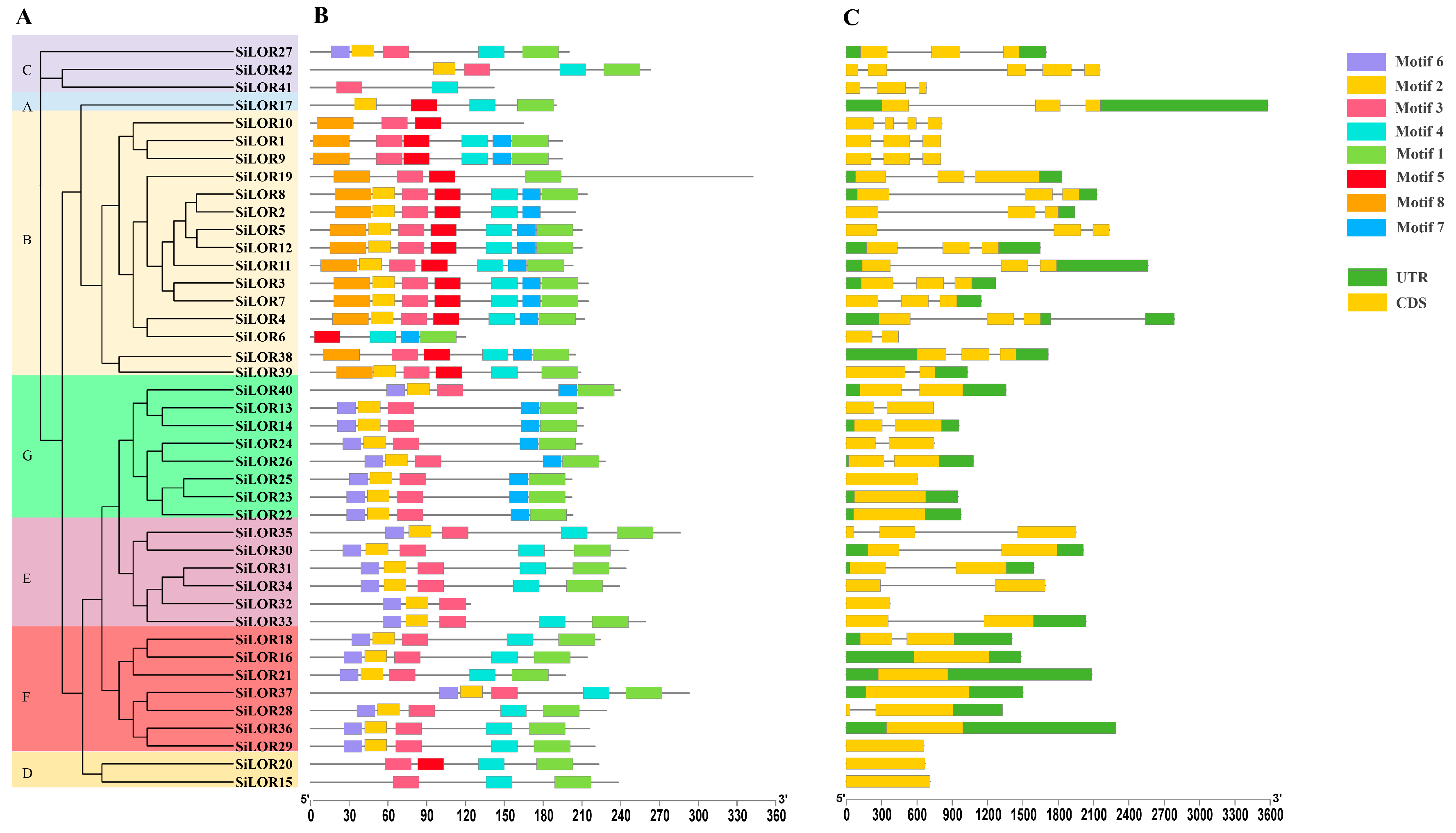
Using foxtail millet protein sequences and annotation files, we performed an in-depth analysis of the structure and conserved motifs of SiLOR genes. The results indicated that these genes have introns ranging from 0 to 4 and exons ranging from 1 to 5, with most harboring 0 to 2 introns. Specifically, among the 42 SiLOR genes, 10 lack introns, 13 contain 1 intron, 15 have 2 introns, 3 possess 3 introns, and SiLOR42 is unique in having 4 introns (Figure 2C).
Furthermore, the 42 identified foxtail millet LOR protein sequences were uploaded to the MEME Suite for conserved motif identification. The results showed that MEME successfully identified 8 conserved motifs (Figure S1), each with a specified E-value, and detailed information on these motifs was provided in Figure S1. Among them, motifs 1, 2, and 3 are the most conserved and are considered essential components of the SiLOR gene family. Motifs 1 and 2 are located at the N-terminus and C-terminus of SiLOR proteins, respectively, while motif 3 is positioned in the middle. These LOR proteins share a similar motif structure: all proteins in subgroup B except SiLOR6 contain the same motifs except motif 6 (Figure 2B); proteins in subgroups G, E, and F also have identical motif compositions (Figure 2A and Figure 2B). However, proteins in subgroups A, C, and D exhibit distinct motif distributions. Notably, the motif distribution in SiLOR proteins is subgroup-specific: SiLOR6 in subgroup B lacks motifs 2, 3, and 8, differing from other members of the same subgroup; motif 6 is unique to subgroups G, E, and F; and the arrangement of conserved structures in subgroups A, C, and D appears irregular. These results suggest that due to the differences in conserved structures among foxtail millet LOR subgroups, the functions of family members may have diverged.

3.4. Distribution of SiLOR Genes in Foxtail Millet Chromosomes and Collinearity Analysis

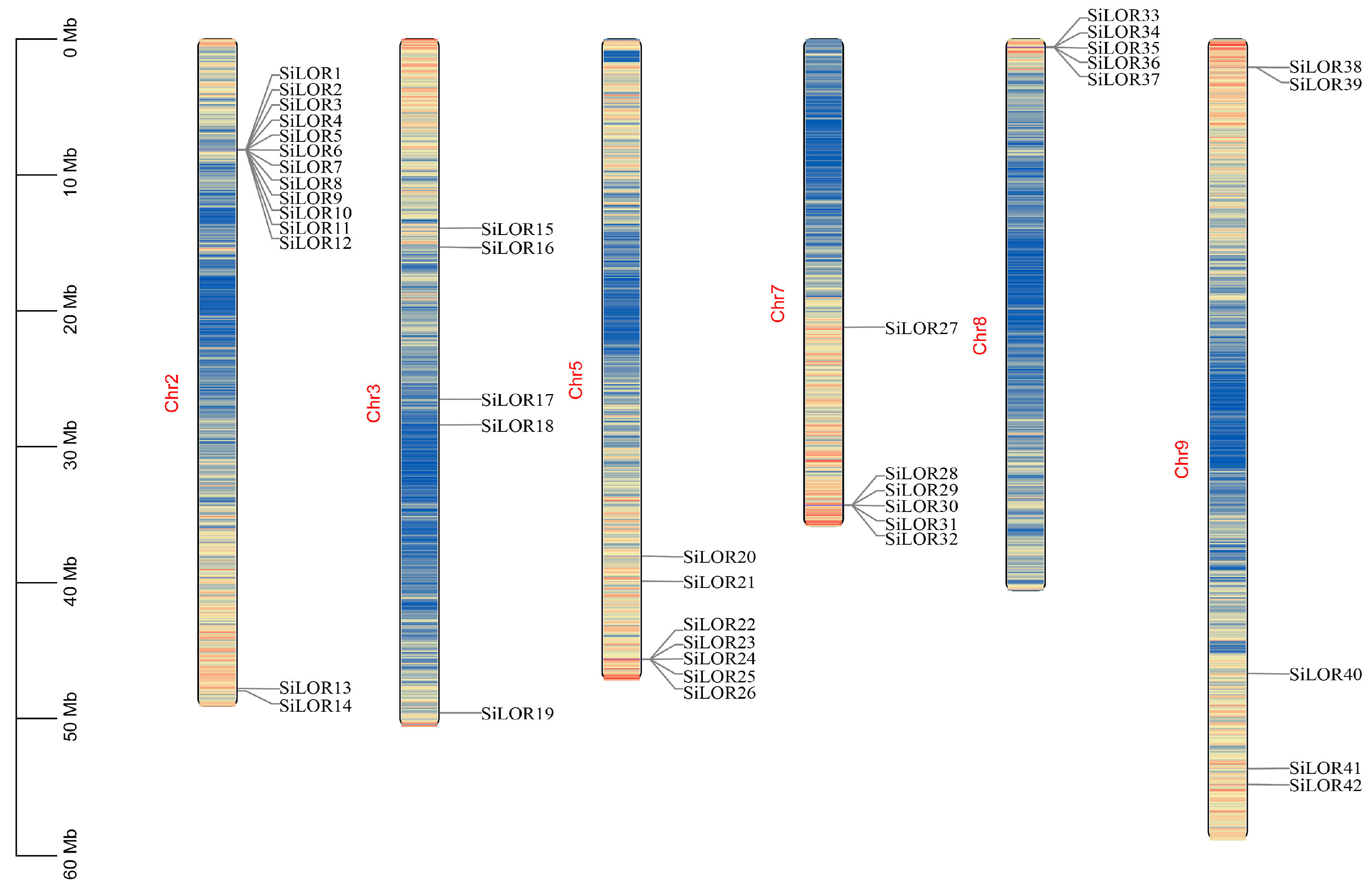
Furthermore, TBtools v2.376 was used to analyze the chromosomal distribution of SiLOR genes in foxtail millet. To facilitate differentiation, we named the 42 identified genes SiLOR1 to SiLOR42 based on their chromosomal positions. The analysis revealed that these 42 SiLOR genes were unevenly distributed across the six foxtail millet chromosomes (Figure 3). Chromosome 2 contained the highest number of SiLOR genes, while the other chromosomes harbored 5–7 SiLOR genes each. Notably, chromosomes 1, 4, and 6 did not carry any SiLOR genes. Except for six genes (SiLOR15, SiLOR16, SiLOR17, SiLOR18, SiLOR27, and SiLOR40), the remaining 36 SiLOR genes (accounting for 86%) were located at the chromosome ends.
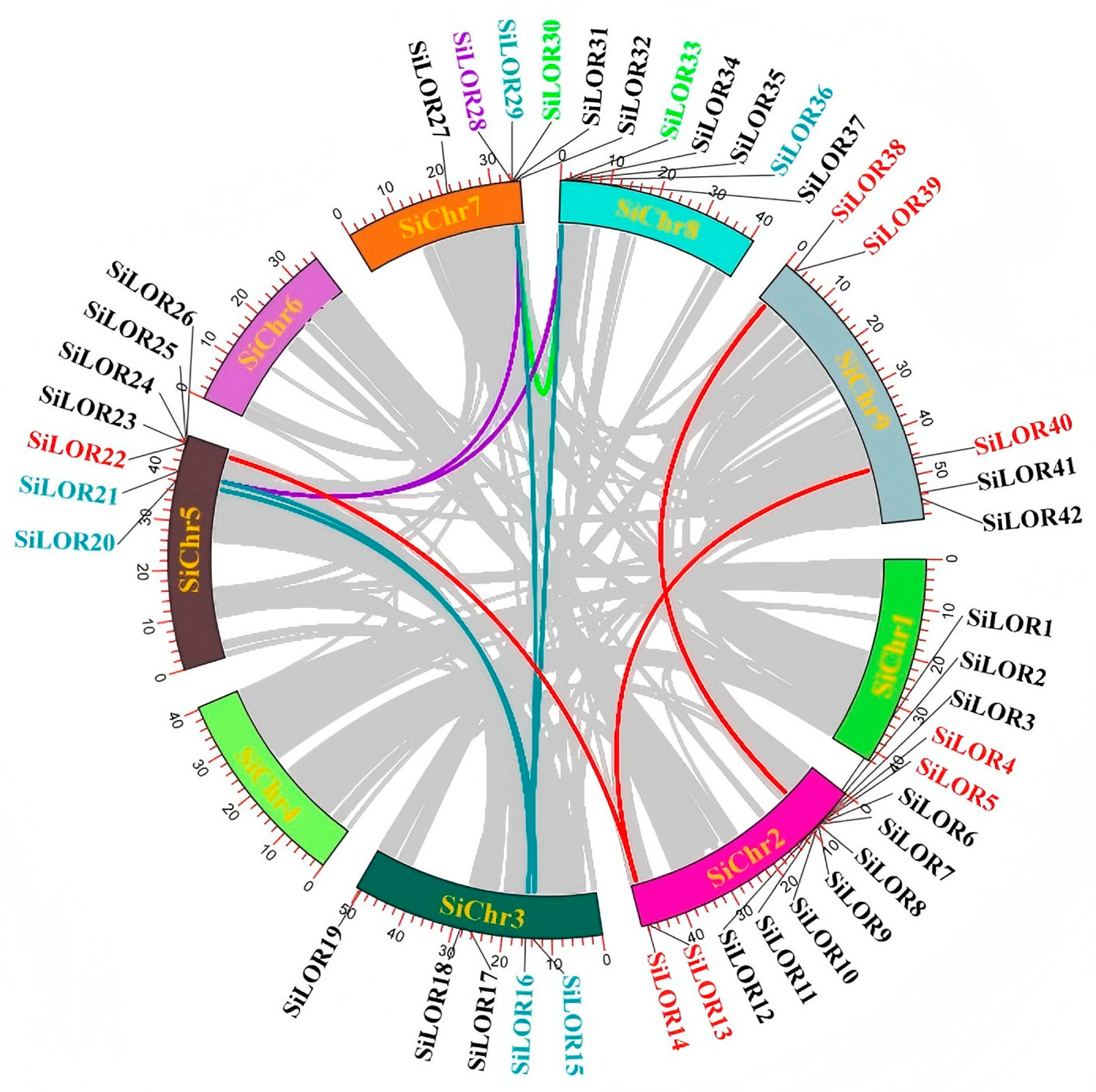
Gene duplication is a primary driver of gene family expansion during genome expansion [29]. To investigate the evolutionary history of the LOR family in foxtail millet, synteny analysis was performed for its members. The results revealed 11 duplication events involving 17 SiLOR gene family members distributed across six chromosomes (Figure 4). All 11 duplication events were classified as segmental duplications, corresponding to the following gene pairs: SiLOR4/39, SiLOR5/38, SiLOR13/22, SiLOR14/40, SiLOR15/20, SiLOR16/21, SiLOR16/29, SiLOR16/36, SiLOR28/21, SiLOR28/36, and SiLOR30/33. These findings indicated that SiLOR genes have undergone extensive duplication during evolution, which has contributed to the expansion of the SiLOR gene family.

3.5. Cis-Elements Analysis of the SiLOR Promoters

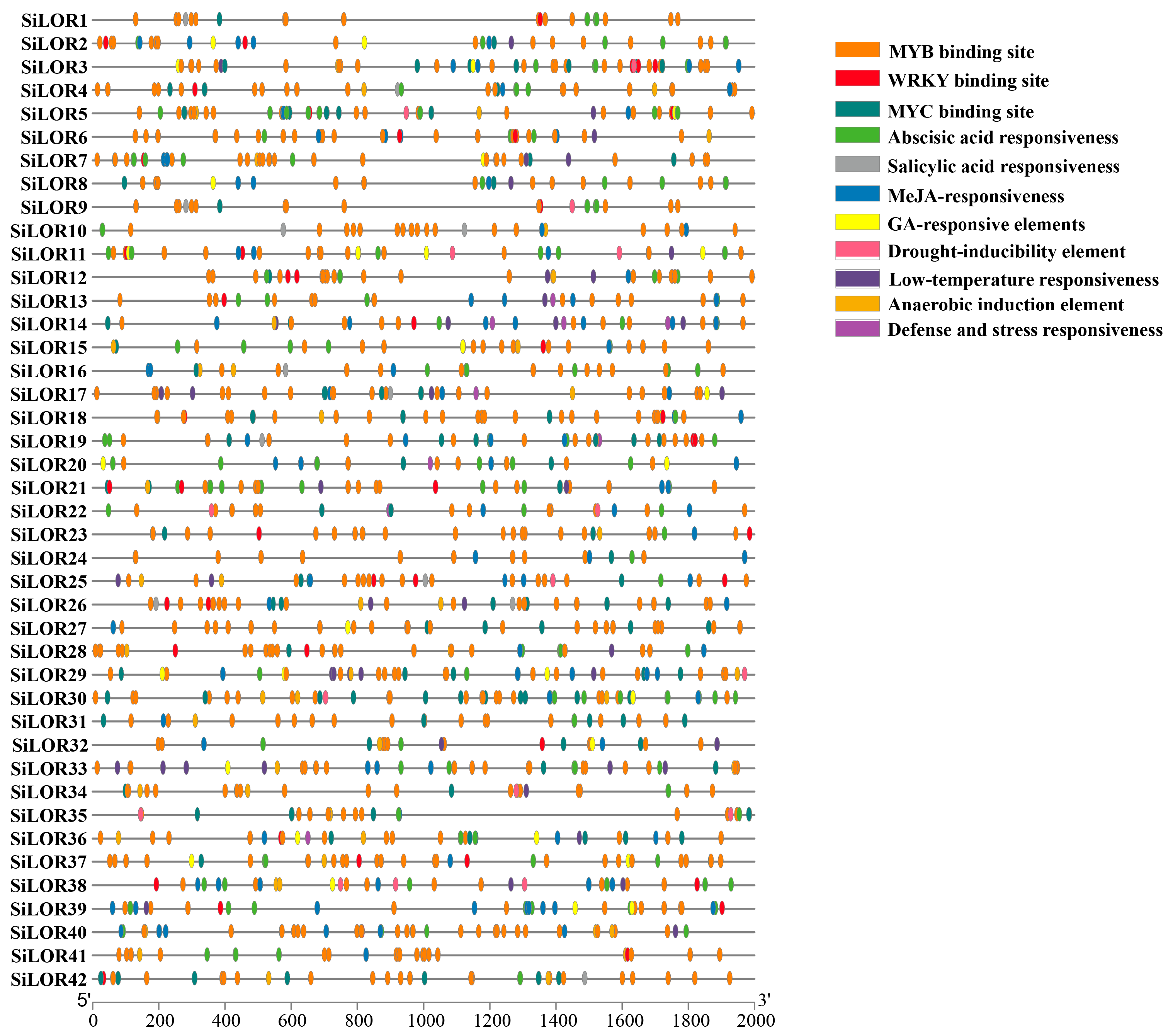
Cis-acting elements in promoter regions play a pivotal role in plant life activities, especially in responses to growth stages and environmental stresses. These elements precisely regulate gene expression levels, thus playing central roles in plant growth and development, stress responses, and environmental adaptation. In this study, we analyzed the 2000 bp upstream sequences of SiLOR genes to further explore the functions of SiLOR in foxtail millet (Figure 5 and Table S2). Promoter analysis showed that nearly all SiLOR promoters are enriched with core cis-acting elements, such as the CAAT-box, a hallmark of transcriptional initiation. Most promoters also contain the CGTCA-motif/TGACG-motif and ABA-responsive element (ABRE), indicating that SiLOR genes may be induced by hormones including methyl jasmonate (MeJA) and ABA. In addition to hormone-responsive elements, we identified stress-related elements involved in drought, dehydration, cold, and anaerobic responses, including low-temperature-responsive element (LTR), anaerobic response element (ARE), and MYB binding site (MBS). Notably, drought-related elements are the most abundant among SiLOR gene family members, underscoring the critical role of the SiLOR gene family in drought stress adaptation.

3.6. Expression Analysis of Foxtail Millet SiLOR Genes in Different Tissues

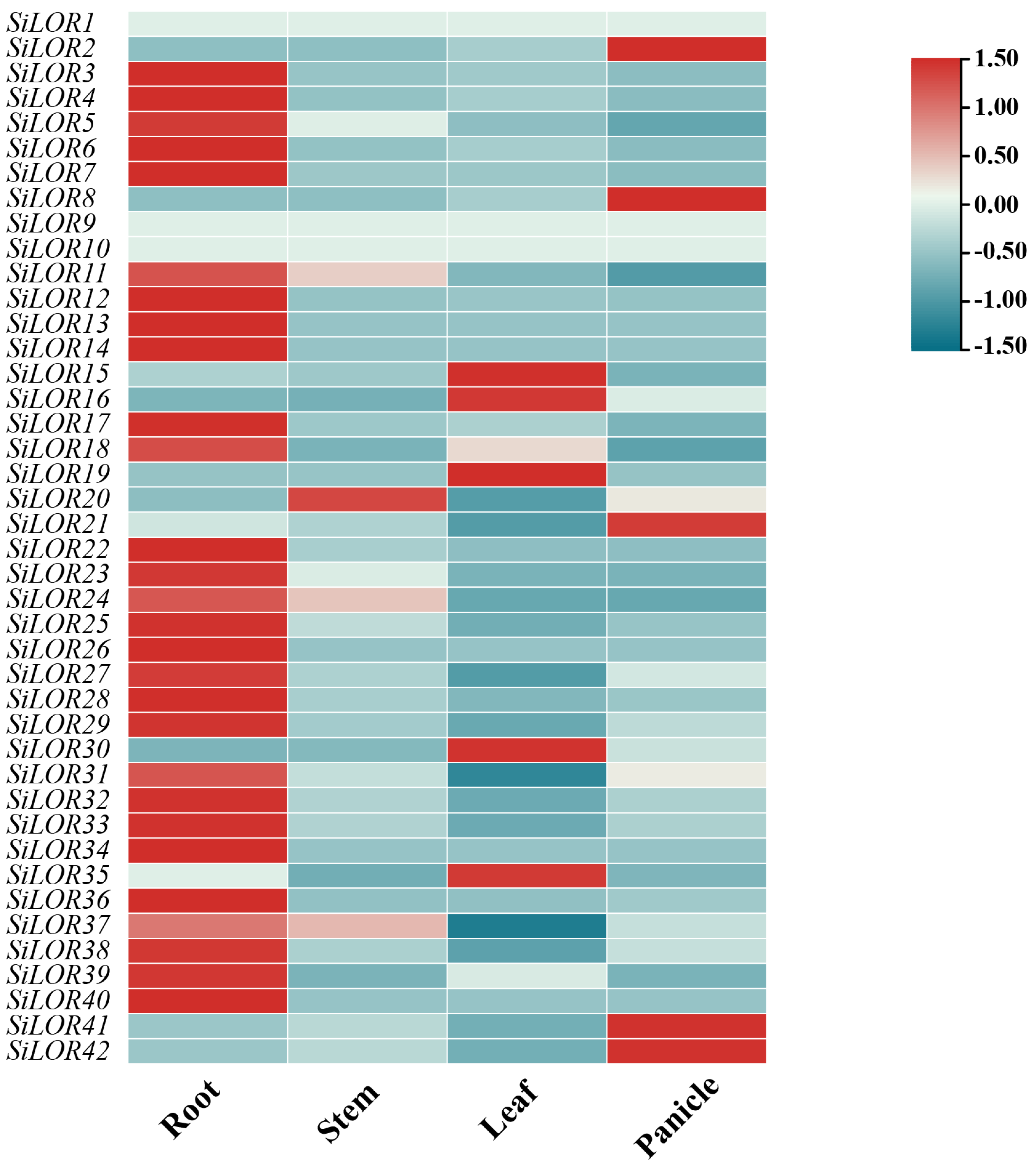
To explore the expression patterns of SiLOR in different tissues of foxtail millet, this study analyzed four tissues (roots, stems, leaves, and panicles) using publicly available Illumina RNA-Seq data. The heatmap (Figure 6) illustrated the tissue-specific expression differences in SiLOR genes. Among the 42 LOR genes analyzed, SiLOR2, SiLOR8, SiLOR21, SiLOR41, and SiLOR42 were highly expressed in panicles. SiLOR15, SiLOR16, SiLOR19, SiLOR30, and SiLOR35 had relatively high expression in leaves, while SiLOR20 showed relatively high expression in stems. Additionally, most members of the SiLOR gene family were highly expressed primarily in roots. These results provide an important theoretical basis for further investigating the functions of SiLOR genes under adverse stresses.

3.7. Expression Analysis of SiLOR Genes in Foxtail Millet Under Mannitol Treatment

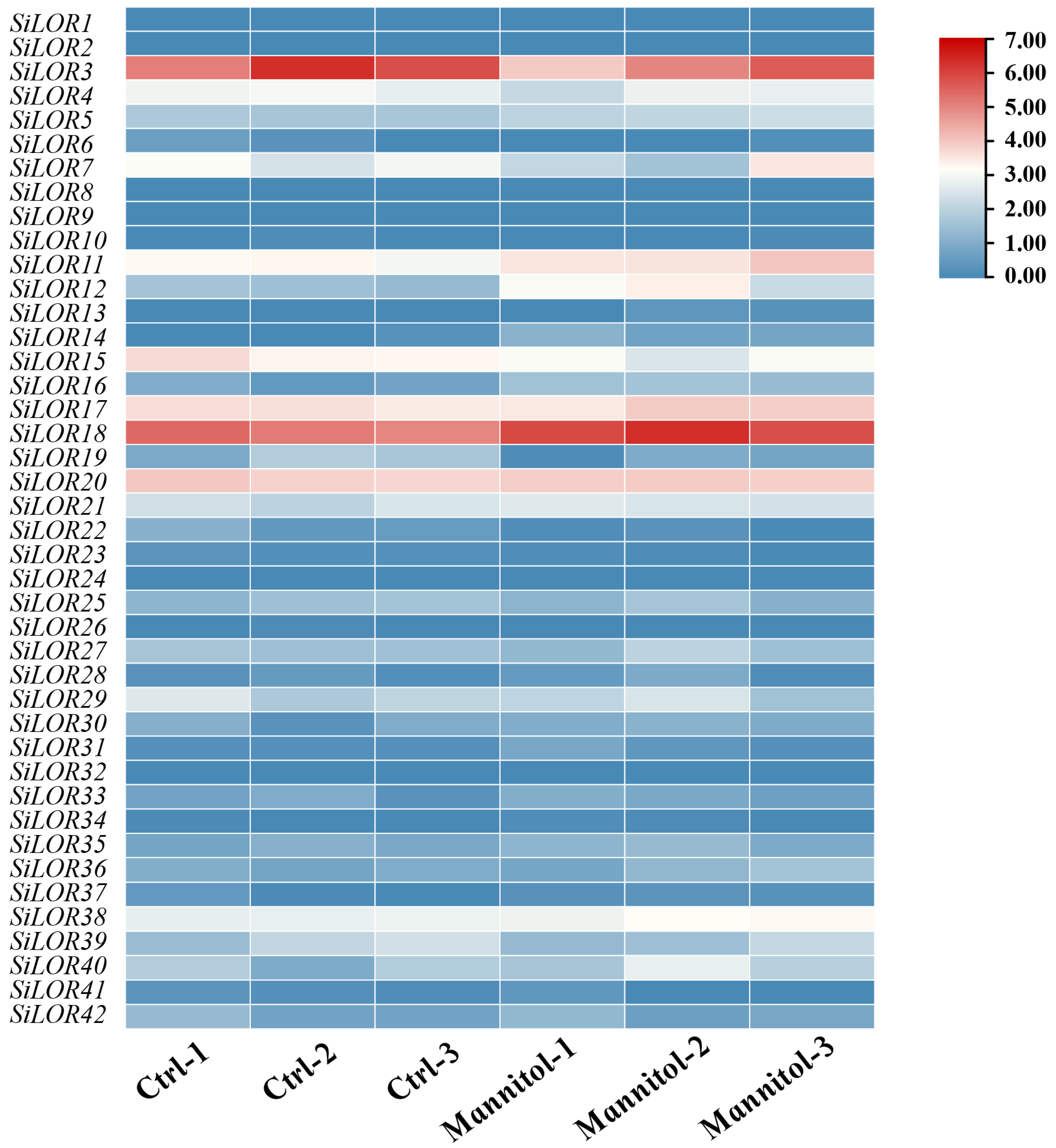
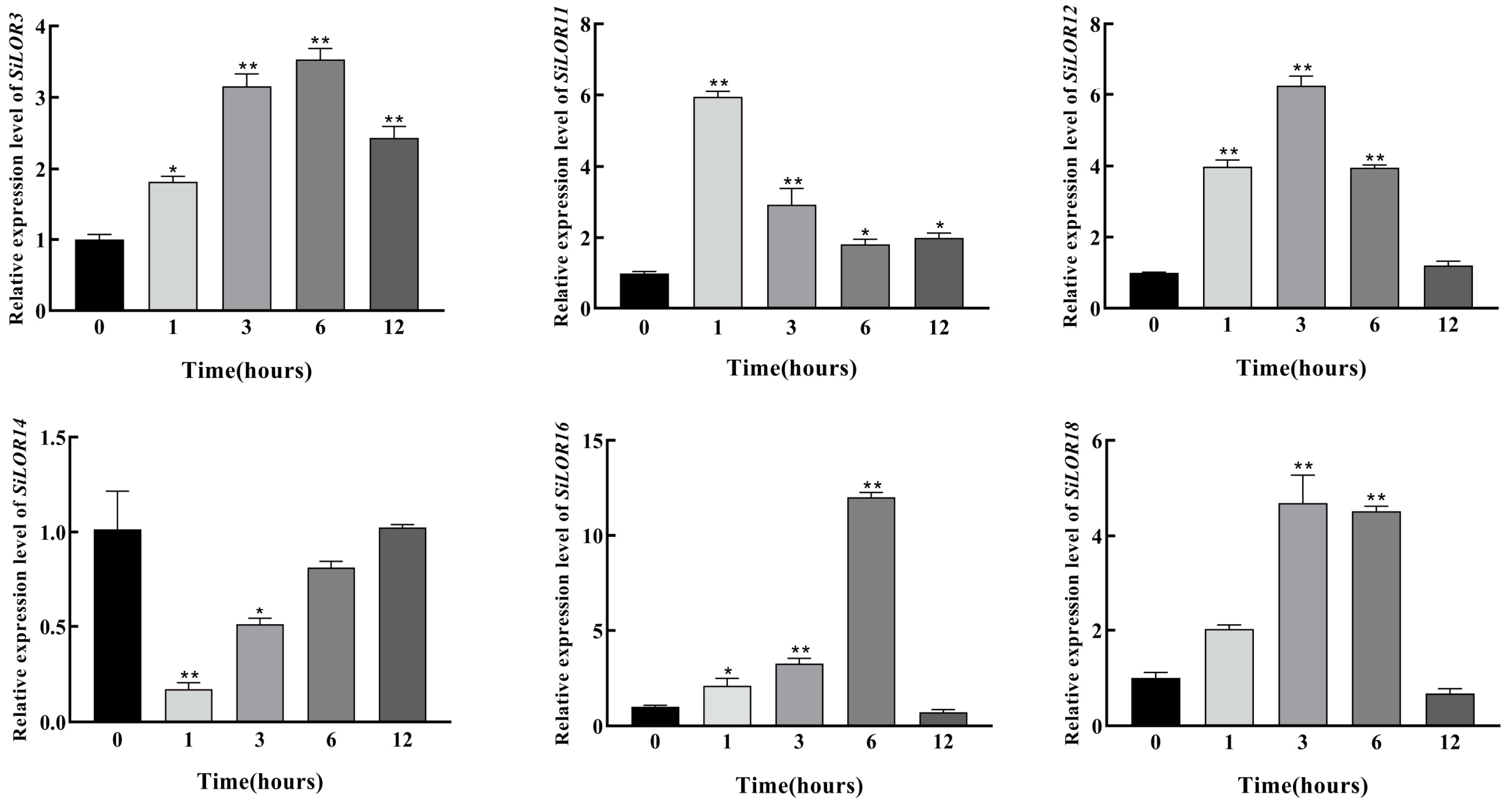
In the analysis of cis-acting elements in SiLOR genes’ promoters (Figure 5), drought-related elements accounted for the highest proportion among SiLOR gene family members. This fully indicates that the SiLOR gene family plays a crucial role in plant drought stress resistance. To further explore the SiLOR gene family’s expression patterns in foxtail millet under drought stress, we systematically analyzed the transcriptome of 300 mM mannitol-stressed foxtail millet. Based on heatmap analysis results (Figure 7), we selected several differentially expressed genes (SiLOR3, SiLOR11, SiLOR12, SiLOR14, SiLOR16, SiLOR18) from the SiLOR gene family and verified them via qRT-PCR (Figure 8). The experimental data showed that after treatment with 300 mM mannitol for 0, 1, 3, 6, and 12 h, SiLOR11 was significantly upregulated at 1 h compared to the control; the expression level of the SiLOR16 gene reached its peak at 6 h; and four genes (SiLOR3, SiLOR11, SiLOR12, and SiLOR18) exhibited a dynamic trend of first increasing and then decreasing.

4. Discussion

With the growing public availability of plant reference genomic data, a large number of gene families have been discovered and characterized. However, research on the LOR gene family remains relatively limited [30]. In this study, we identified the LOR gene family in foxtail millet and analyzed its phylogenetic relationships, gene structures, conserved motifs, chromosomal locations, gene duplications, and promoter cis-acting elements. Additionally, we investigated the expression patterns of SiLOR genes across different foxtail millet tissues and in response to drought stress. Our study provides a foundation for future functional research on SiLOR genes in foxtail millet.
The LOR gene family is widely distributed in plants, fungi, eubacteria, and some archaea, and its members all contain a conserved LOR domain. In this study, through phylogenetic analysis, we classified the SiLOR genes of foxtail millet and AtLOR of Arabidopsis genes into seven subgroups (A–G). Our study revealed that the LOR proteins of foxtail millet and Arabidopsis share high structural similarity (Figure 2). Consistent with this, the LOR proteins of soybean and Arabidopsis in the same subgroup or clade showed a high degree of structural similarity. Previous studies have confirmed that AtLURP1 and AtLOR1 both belong to clade A and play a key role in plant defense against H. parasitica [5,10]. Based on this, we speculate that SiLOR subgroup B members are also likely to be involved in plant defense mechanisms.
We analyzed the number of introns in 42 SiLOR gene members of foxtail millet. Our The results showed the following: 10 genes had no introns, 13 genes had one intron, 15 genes had two introns, and three genes had three introns. It is worth noting that SiLOR42 is relatively special, containing 4 exons and 3 introns (Figure 2C). Some studies have shown that introns are an important way for genes to acquire new functions. They occur more frequently in the early stages of gene expansion and then gradually decrease over time [31]. In addition, a compact gene structure with fewer introns helps genes to be rapidly activated, enabling plants to respond promptly to various stresses [32]. In previous studies, the soybean GmLOR genes were shown to respond rapidly to osmotic and salt stresses, thereby supporting this perspective. In the present study, most SiLOR genes were rapidly and efficiently induced under drought stress (Figure 7 and Figure 8), a finding that further corroborates the aforementioned viewpoint.
In our analysis of SiLOR proteins, the distribution of their motifs showed significant specificity. With the help of the MEME online tool, we identified a total of 8 putative conserved motifs (Figure 2B, Supplementary Figure S1). Among these, Motifs 1, Motif 2, and Motif 3 are highly conserved and serve as essential components of the SiLOR family. Motif 1 is located at the C-terminus of SiLOR protein family, Motif 2 is located at the N-terminus, and Motif 3 in the middle position. The remaining motifs exhibit distinct differences across different subgroups or clades: SiLOR6 in subgroup B lacks Motifs 2, 3, and 8, differing significantly from other members of this subgroup; Motif 6 is unique to subgroups G, E, and F; and while in subgroups A, C, and D, the arrangement of conserved structure arrangements is relatively disordered in subgroups A, C, and D. Given our limited Since our understanding of the SiLOR gene family in foxtail millet, is still limited, these putative motifs are very likely to play important roles in the interaction between LOR proteins and their substrates. It is of great scientific value to deeply explore their specific action mechanisms of action. We It can be speculated that Motif 1, Motif 2, and Motif 3 may be the key elements determining the basic molecular functions of the SiLOR genes in foxtail millet SiLOR genes.
Gene duplication events, combined with the high retention rate of existing duplicates, have led to the accumulation of numerous duplicated genes in plant genomes. As a core driver of gene family expansion and novel function evolution (e.g., environmental stress adaptation and disease resistance induction), gene duplication is critical to plant evolution. Two or more genes on the same chromosome indicate a tandem duplication event; multiple genes on different chromosomes imply a segmental duplication event. Tandem and segmental duplication have long been recognized as the main drivers of gene family expansion [11]. Notably, segmental duplication occurs more frequently, as most plants retain numerous duplicated chromosomal segments in their genomes via polyploidization and subsequent chromosomal rearrangements [33]. In this study, we found that 11 of the 42 SiLOR genes underwent segmental duplication (Figure 4). Specifically, these include the gene pairs SiLOR4/39, SiLOR5/38, SiLOR13/22, SiLOR14/40, SiLOR15/20, SiLOR16/21, SiLOR16/29, SiLOR16/36, SiLOR28/21, SiLOR28/36, and SiLOR30/33. Thus, SiLOR genes have undergone frequent duplication events over long evolution, likely the main driver of the gene family’s rapid expansion.
Cis-acting elements play a key role in regulating the transcription of genes linked to plant responses to environmental stresses. In this study, we analyzed the cis-acting elements in the promoter regions of SiLOR genes (Figure 5 and Supplementary Table S2). Transcriptional regulation is crucial for coordinating gene expression in plant development and under abiotic stress [34]. This process is mediated by transcription factors (TFs) that function as pivotal regulatory switches, binding to specific cis-regulatory elements to activate or repress downstream target genes [35]. Our results indicate that the promoter regions of the SiLOR gene family contain multiple elements, including stress-responsive (such as drought and low temperature) and hormone-responsive elements (such as ABA and SA). The presence of these elements not only suggests that SiLOR genes play a crucial role in foxtail millet tolerance to abiotic stresses (such as low temperature, high temperature, drought, and salt stress) and biotic stresses but also provides clues for deciphering the differential expression patterns of duplicated genes and their stress response mechanisms. Additionally, this study identified transcription factor binding sites for MYB, MYC, and others on the promoters of the SiLOR gene family. It is hypothesized that these TFs can induce SiLOR gene expression, thereby enhancing foxtail millet’s tolerance to abiotic stresses. Previous studies have shown that the AtLURP1 promoter primarily contains salicylic acid-responsive elements (TCA-element) and pathogen-inducible elements, as well as a WRKY binding site (W-box) [36]. In this study, the presence of the TCA-element and the W-box element in the promoters of SiLOR9, SiLOR10, and other genes within the SiLOR gene family suggests that these genes play a significant role in the biotic stress response of foxtail millet.
Given that expression pattern analysis is pivotal for exploring gene functions, we systematically analyzed SiLOR gene expression profiles across four foxtail millet tissues (roots, stems, leaves, and panicles) using publicly available Illumina RNA-Seq data. Heatmap results (Figure 6) reveal that the expression patterns of certain SiLOR genes in different tissues are as follows: five SiLOR genes are highly expressed in the panicle; five SiLOR genes are significantly upregulated in leaves; only SiLOR20 exhibits relatively high expression in stems; and most members of the millet SiLOR gene family exhibit high expression in roots. This tissue-specific distribution indicates that SiLOR gene family members are widely involved in foxtail millet’s growth and development across different organs and stages. Under drought conditions, the root system remains the key organ for sensing water deficit signals in plants and can transmit stress signals to the aboveground parts [37]. Under drought stress, TFs like MYC can bind to root-specific SiLOR genes (which possess MYC binding sites). The MYC family is a subfamily of the bHLH family. By binding to the G-box element (CACGTG), it regulates the expression of downstream genes and participates in various biological processes, such as plant growth and development, secondary metabolite synthesis, hormone signal transduction, and abiotic stress responses. A study has shown that AtMYC2 enhances Arabidopsis tolerance to osmotic stress by activating the expression of AtADH1 and rd22 [38]. Most foxtail millet SiLOR gene family members are highly expressed in roots. This contrasts with previous studies showing that more soybean GmLOR genes are expressed in leaves than in roots in response to salt stress [11]. This difference may stem from foxtail millet’s status as a drought-tolerant crop, which has evolved a well-developed root system to cope with aridity. These findings suggest that the stress response functions of the LOR gene family exhibit a “stress type-tissue site” differentiation pattern across different crops.
Previous studies have demonstrated that certain genes within the LOR gene family participate in plant responses to abiotic stress in both rapeseed [6] and soybean [11]. This study analyzed the cis-acting elements in the promoters of foxtail millet SiLOR genes and found that most family members contain drought-responsive elements. Under 300 mM mannitol-simulated drought stress, combined transcriptome and qRT-PCR analyses identified six differentially expressed genes: SiLOR3, SiLOR11, SiLOR12, SiLOR14, SiLOR16, and SiLOR18 (Figure 7 and Figure 8). Although qRT-PCR and transcriptome data showed quantitative discrepancies, their expression trends were relatively consistent. Drought has now become one of the most critical abiotic factors limiting crop growth and productivity [39]. Studies indicate that approximately 40% of the yield reduction in wheat (Triticum aestivum) and maize (Zea mays) is primarily due to drought stress [40]. To address this challenge, researchers are actively exploring the genetic and genomic characteristics of crops with enhanced stress resistance [41]. This study fills the gap in understanding the role of the LOR gene family in foxtail millet drought tolerance and advances our knowledge of the foxtail millet stress response network. The marked expression changes in these genes under drought stress make them promising candidate genes for genetic engineering, providing key targets to enhance plant drought tolerance and adaptability to arid environments.

5. Conclusions

In this study, we systematically identified and analyzed the SiLOR gene family, identifying 42 potential members via in-depth mining of foxtail millet genome data. We also conducted detailed analyses of the SiLOR gene family at multiple levels: phylogenetic relationships, gene structures, base sequence compositions, chromosomal distributions, expansion patterns, cis-acting elements, and tissue expression patterns. Additionally, we analyzed SiLOR gene expression characteristics in foxtail millet under drought stress. This study not only enhances our understanding of the foxtail millet SiLOR gene family but also provides new insights for improving foxtail millet’s performance under adverse conditions.

Supplementary Materials

The following supporting information can be downloaded at https://www.mdpi.com/article/10.3390/agronomy15122787/s1, Figure S1: The distribution of LOR proteins in millet pertaining to motif occurrence; Table S1: The sequences of primers used for qRT-PCR; Table S2: Details of the abiotic stress related Cis-acting elements identified in SiLOR gene family.

Author Contributions

Conceptualization, G.W.; Validation and Writing—Original Draft, G.W. and X.W.; Methodology, X.W. and X.Z.; Resources, X.W. and X.Z.; Software and Visualization, X.Z. and R.L.; Data Curation and Writing—Review and Editing, R.Z. and J.W.; Resources and Writing—Review and Editing, W.W., S.Z. and N.Y. All authors have read and agreed to the published version of the manuscript.

Funding

This research received no external funding.

Data Availability Statement

The original contributions presented in this study are included in the article/Supplementary Materials. Further inquiries can be directed to the corresponding author.

Acknowledgments

For the preparation of this manuscript, the AI-assisted tool Ernie Bot was utilized to enhance the readability of the text. The authors have thoroughly reviewed and revised the final version, and hereby assume full responsibility for the content of this article. AI tools are used solely for language optimization; all scientific analysis and interpretation are conducted independently by the authors.

Conflicts of Interest

The authors declare no conflicts of interest.

References

  1. Suzuki, N.; Rivero, R.M.; Shulaev, V.; Blumwald, E.; Mittler, R. Abiotic and biotic stress combinations. New Phytol. 2014, 203, 32–43. [Google Scholar] [CrossRef]
  2. Ohama, N.; Sato, H.; Shinozaki, K.; Yamaguchi-Shinozaki, K. Transcriptional Regulatory Network of Plant Heat Stress Response. Trends Plant Sci. 2017, 22, 53–65. [Google Scholar] [CrossRef]
  3. Bateman, A.; Finn, R.D.; Sims, P.J.; Wiedmer, T.; Biegert, A.; Söding, J. Phospholipid scramblases and Tubby-like proteins belong to a new superfamily of membrane tethered transcription factors. Bioinformatics 2009, 25, 159–162. [Google Scholar] [CrossRef]
  4. Finn, R.D.; Tate, J.; Mistry, J.; Coggill, P.C.; Sammut, S.J.; Hotz, H.R.; Ceric, G.; Forslund, K.; Eddy, S.R.; Sonnhammer, E.L.L.; et al. The Pfam protein families database. Nucleic Acids Res. 2008, 32, D281–D288. [Google Scholar]
  5. Knoth, C.; Eulgem, T. The oomycete response gene LURP1 is required for defense against Hyaloperonospora parasitica in Arabidopsis thaliana. Plant J. 2008, 55, 53–64. [Google Scholar] [CrossRef]
  6. Yang, S.; Chen, J.; Ding, Y.; Huang, Q.; Chen, G.; Ulhassan, Z.; Wei, J.; Wang, J. Genome-wide investigation and expression profiling of LOR gene family in rapeseed under salinity and ABA stress. Front. Plant Sci. 2023, 14, 1197781. [Google Scholar] [CrossRef] [PubMed]
  7. Coker, T.L.; Cevik, V.; Beynon, J.L.; Gifford, M.L. Spatial dissection of the Arabidopsis thaliana transcriptional response to downy mildew using Fluorescence Activated Cell Sorting. Front. Plant Sci. 2015, 6, 527. [Google Scholar] [CrossRef]
  8. Lee, M.H.; Jeon, H.S.; Kim, H.G.; Park, O.K. An Arabidopsis NAC transcription factor NAC4 promotes pathogen-induced cell death under negative regulation by microRNA164. New Phytol. 2017, 214, 343–360. [Google Scholar] [CrossRef] [PubMed]
  9. Bricchi, I.; Bertea, C.M.; Occhipinti, A.; Paponov, I.A.; Maffei, M.E. Dynamics of Membrane Potential Variation and Gene Expression Induced by Spodoptera littoralis, Myzus persicae, and Pseudomonas syringae in Arabidopsis. PLoS ONE 2012, 7, e46673. [Google Scholar] [CrossRef]
  10. Baig, A. Role of Arabidopsis LOR1 (LURP-one related one) in basal defense against Hyaloperonospora arabidopsidis. Physiol. Mol. Plant Pathol. 2018, 103, 71–77. [Google Scholar] [CrossRef]
  11. Fang, Y.; Cao, D.; Yang, H.; Guo, W.; Ouyang, W.; Chen, H.; Shan, Z.; Yang, Z.; Chen, S.; Li, X.; et al. Genome-Wide Identification and Characterization of Soybean GmLOR Gene Family and Expression Analysis in Response to Abiotic Stresses. Int. J. Mol. Sci. 2021, 22, 12515. [Google Scholar] [CrossRef] [PubMed]
  12. Nadeem, F.; Ahmad, Z.; Ul Hassan, M.; Wang, R.; Diao, X.; Li, X. Adaptation of Foxtail Millet (Setaria italica L.) to abiotic stresses: A special perspective of responses to nitrogen and phosphate limitations. Front. Plant Sci. 2020, 11, 187. [Google Scholar] [CrossRef]
  13. Wang, Z.M.; Devos, K.M.; Liu, C.J.; Wang, R.Q.; Gale, M.D. Construction of RFLP-based maps of foxtail millet, Setaria italica (L.) P. Beauv. Theor. Appl. Genet. 1998, 96, 31–36. [Google Scholar] [CrossRef]
  14. Muthamilarasan, M.; Bonthala, V.S.; Khandelwal, R.; Jaishankar, J.; Shweta, S.; Nawaz, K.; Prasad, M. Global analysis of WRKY transcription factor superfamily in Setaria identifies potential candidates involved in abiotic stress signaling. Front. Plant Sci. 2015, 6, 910. [Google Scholar] [CrossRef]
  15. Zhang, L.; Ma, C.; Kang, X.; Pei, Z.Q.; Bai, X.; Wang, J.; Zheng, S.; Zhang, T.G. Identification and expression analysis of MAPK cascade gene family in foxtail millet (Setaria italica). Plant Signal Behav. 2023, 18, 2246228. [Google Scholar] [CrossRef]
  16. Wang, H.; Li, Y.; Guo, Z.; Zhou, X.; Zhao, Y.; Han, Y.; Lin, X. Genome-wide identification of AAAP gene family and expression analysis in response to saline-alkali stress in foxtail millet (Setaria italica L.). Sci. Rep. 2024, 14, 3106. [Google Scholar] [CrossRef]
  17. Zhang, G.; Liu, X.; Quan, Z.; Cheng, S.; Xu, X.; Pan, S.; Xie, M.; Zeng, P.; Yue, Z.; Wang, W.; et al. Genome sequence of foxtail millet (Setaria italica) provides insights into grass evolution and biofuel potential. Nat. Biotechnol. 2012, 30, 549–554. [Google Scholar] [CrossRef]
  18. Jia, G.; Huang, X.; Zhi, H.; Zhao, Y.; Zhao, Q.; Li, W.; Chai, Y.; Yang, L.; Liu, K.; Lu, H.; et al. A haplotype map of genomic variations and genome-wide association studies of agronomic traits in foxtail millet (Setaria italica). Nat. Genet. 2013, 45, 957. [Google Scholar] [CrossRef]
  19. Bennetzen, J.L.; Schmutz, J.; Wang, H.; Percifield, R.; Hawkins, J.; Pontaroli, A.C.; Estep, M.; Feng, L.; Vaughn, J.N.; Grimwood, J.; et al. Reference genome sequence of the model plant Setaria. Nat. Biotechnol. 2012, 30, 555–561. [Google Scholar] [CrossRef]
  20. Chen, C.; Chen, H.; Zhang, Y.; Thomas, H.R.; Frank, M.H.; He, Y.; Xia, R. TBtools: An Integrative Toolkit Developed for Interactive Analyses of Big Biological Data. Mol. Plant 2020, 13, 1194–1202. [Google Scholar] [CrossRef]
  21. El-Gebali, S.; Mistry, J.; Bateman, A.; Eddy, S.R.; Luciani, A.; Potter, S.C.; Qureshi, M.; Richardson, L.J.; Salazar, G.A.; Smart, A.; et al. The Pfam protein families database in 2019. Nucleic Acids Res. 2019, 47, D427–D432. [Google Scholar] [CrossRef] [PubMed]
  22. Tamura, K.; Stecher, G.; Peterson, D.; Filipski, A.; Kumar, S. MEGA6: Molecular Evolutionary Genetics Analysis Version 6.0. Mol. Biol. Evol. 2013, 30, 2725–2729. [Google Scholar] [CrossRef]
  23. Letunic, I.; Bork, P. Interactive Tree Of Life (iTOL): An online tool for phylogenetic tree display and annotation. Bioinformatics 2007, 23, 127–128. [Google Scholar] [CrossRef]
  24. Bailey, T.L.; Mikael, B.; Buske, F.A.; Frith, M.; Grant, C.E.; Clement, I.L.; Ren, J.; Li, W.W.; Noble, W.S. MEME SUITE: Tools for motif discovery and searching. Nucleic Acids Res. 2009, 37, W202–W208. [Google Scholar] [CrossRef] [PubMed]
  25. Wang, Y.; Tang, H.; Debarry, J.D.; Tan, X.; Li, J.; Wang, X.; Lee, T.H.; Jin, H.; Marler, B.; Guo, H.; et al. MCScanX: A toolkit for detection and evolutionary analysis of gene synteny and collinearity. Nucleic Acids Res. 2012, 40, e49. [Google Scholar] [CrossRef] [PubMed]
  26. Lescot, M.; Déhais, P.; Thijs, G.; Marchal, K.; Moreau, Y.; Van de Peer, Y.; Rouzé, P.; Rombauts, S. PlantCARE, a database of plant cis-acting regulatory elements and a portal to tools for in silico analysis of promoter sequences. Nucleic Acids Res. 2002, 30, 325–327. [Google Scholar] [CrossRef]
  27. O’Cathail, C.; Ahamed, A.; Burgin, J.; Cummins, C.; Devaraj, R.; Gueye, K.; Gupta, D.; Gupta, V.; Haseeb, M.; Ihsan, M.; et al. Facing growth in the European Nucleotide Archive. Nucleic Acids Res. 2013, 41, D30–D35. [Google Scholar]
  28. Langmead, B.; Salzberg, S.L. Fast gapped-read alignment with Bowtie 2. Nat. Methods 2012, 9, 357–359. [Google Scholar] [CrossRef]
  29. Livak, K.J.; Schmittgen, T.D. Analysis of relative gene expression data using real-time quantitative PCR and the 2(-Delta Delta C(T)) Method. Methods 2001, 25, 402–408. [Google Scholar] [CrossRef]
  30. Cannon, S.B.; Mitra, A.; Baumgarten, A.; Young, N.D.; May, G. The roles of segmental and tandem gene duplication in the evolution of large gene families in Arabidopsis thaliana. BMC Plant Biol. 2004, 4, 10. [Google Scholar] [CrossRef]
  31. Rose, A.B. Introns as Gene Regulators: A Brick on the Accelerator Frontiers in genetics. Front. Genet. 2018, 9, 672. [Google Scholar]
  32. Chung, B.Y.; Simons, C.; Firth, A.E.; Brown, C.M.; Hellens, R.P. Effect of 5’UTR introns on gene expression in Arabidopsis thaliana. BMC Genom. 2006, 7, 120. [Google Scholar] [CrossRef]
  33. Yu, J.; Wang, J.; Lin, W.; Li, S.; Li, H.; Zhou, J.; Ni, P.; Dong, W.; Hu, S.; Zeng, C.; et al. The Genomes of Oryza sativa: A history of duplications. PLoS Biol. 2005, 3, e38. [Google Scholar] [CrossRef] [PubMed]
  34. Yeger-Lotem, E.; Sattath, S.; Kashtan, N.; Itzkovitz, S.; Milo, R.; Pinter, R.Y.; Alon, U.; Margalit, H. Network motifs in integrated cellular networks of transcription-regulation and protein-protein interaction. Proc. Natl. Acad. Sci. USA 2004, 101, 5934–5939. [Google Scholar] [CrossRef]
  35. Jin, J.; Zhang, H.; Kong, L.; Gao, G.; Luo, J. PlantTFDB 3.0: A portal for the functional and evolutionary study of plant transcription factors. Nucleic Acids Res. 2014, 42, D1182–D1187. [Google Scholar] [CrossRef]
  36. Brunner, I.; Herzog, C.; Dawes, M.A.; Arend, M.; Sperisen, C. How tree roots respond to drought. Front. Plant Sci. 2015, 6, 547. [Google Scholar] [CrossRef]
  37. Abe, H.; Urao, T.; Ito, T.; Seki, M.; Shinozaki, K.; Yamaguchi-Shinozaki, K. Arabidopsis AtMYC2 (bHLH) and AtMYB2 (MYB) function as transcriptional activators in abscisic acid signaling. Plant Cell 2003, 15, 63–78. [Google Scholar] [CrossRef]
  38. Knoth, C.; Ringler, J.; Dangl, J.L.; Eulgem, T. Arabidopsis WRKY70 is required for full RPP4-mediated disease resistance and basal defense against Hyaloperonospora parasitica. Mol. Plant Microbe Interact. 2007, 20, 120–128. [Google Scholar] [CrossRef]
  39. Mora-Sanhueza, R.; Soto-Cerda, B.; Tighe-Neira, R.; Reyes-Díaz, M.; Alvarez, J.M.; Nunes-Nesi, A.; Ibáñez, C.; Inostroza-Blancheteau, C. Plant resilience to abiotic stresses: Revealing the role of silicon in drought and metal(loid) tolerance. J. Exp. Bot. 2025, 76, 4869–4883. [Google Scholar] [CrossRef]
  40. Daryanto, S.; Wang, L.; Jacinthe, P.A. Global Synthesis of Drought Effects on Maize and Wheat Production. PLoS ONE 2016, 11, e0156362. [Google Scholar] [CrossRef]
  41. Terfa, G.N.; Pan, W.; Hu, L.; Hao, J.; Zhao, Q.; Jia, Y.; Nie, X. Mechanisms of Salt and Drought Stress Responses in Foxtail Millet. Plants 2025, 14, 1215. [Google Scholar] [CrossRef] [PubMed]
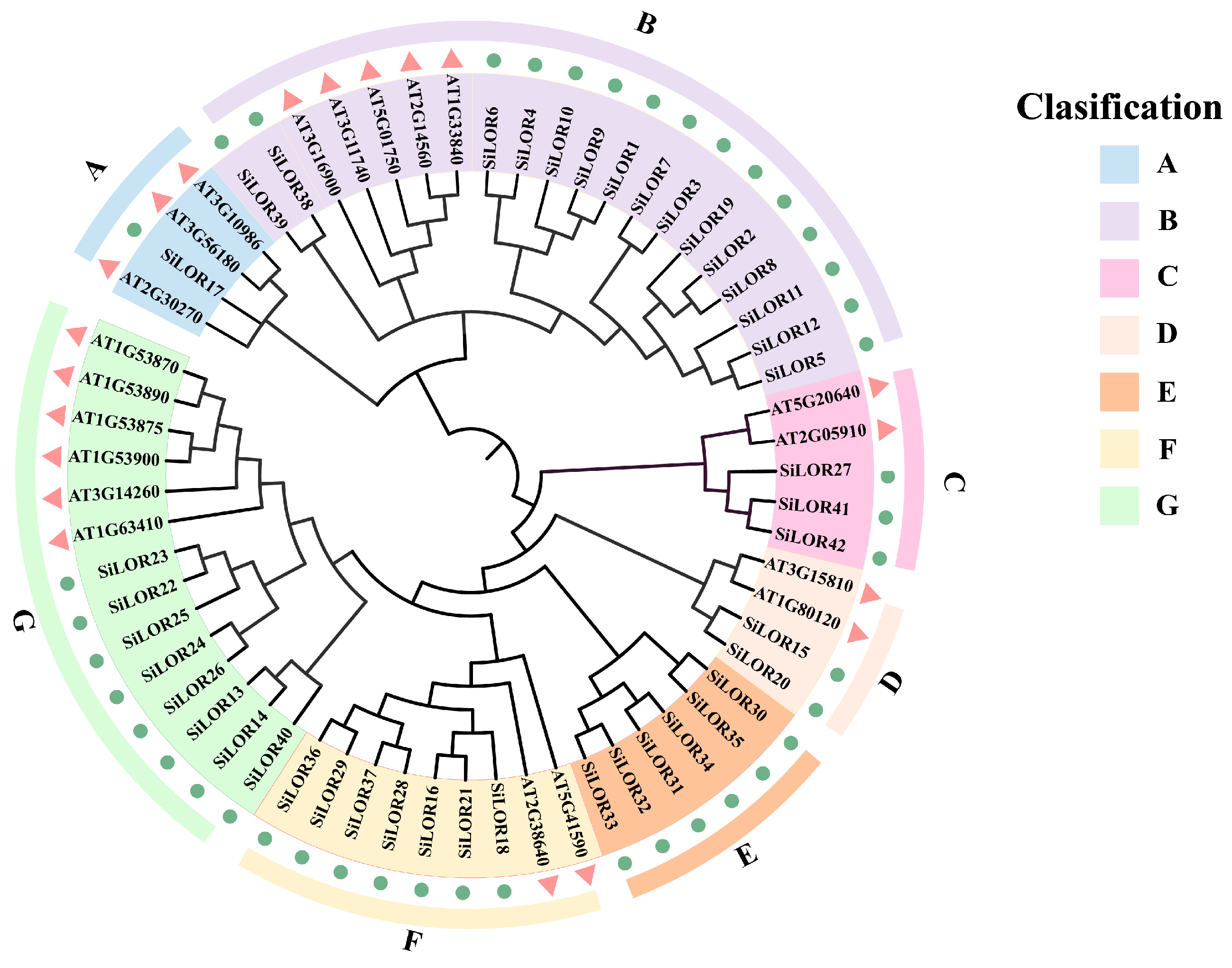
Figure 1. Phylogenetic analysis of LOR proteins from foxtail millet and Arabidopsis. The tree was constructed in MEGA 6.0 using the full-length amino acid sequences and the neighbor-joining method with 1000 bootstrap replicates. Red triangles represent AtLOR family members, and green solid circles represent SiLOR gene family members. Based on sequence similarity and phylogenetic clustering results, this phylogenetic tree is divided into seven subgroups (A–G), each distinguished by a different background color.
Agronomy 15 02787 g001
Figure 2. Gene structure and protein motif analysis of SiLOR gene family members in foxtail millet. (A) According to the phylogenetic relationships, the SiLOR gene family members are divided into seven subgroups. (B) Conserved motifs in SiLOR proteins: eight are highlighted with differently colored boxes. (C) SiLOR gene structures: yellow boxes, gray lines, and green boxes represent exons, introns, and untranslated regions (UTRs), respectively. The bottom scale bar indicates the relative positions and sizes of these elements.
Agronomy 15 02787 g002
Figure 3. Chromosomal distribution of the SiLOR gene family members. Forty-two SiLOR members are distributed across six chromosomes, and the left scale bar is labeled in megabases (Mb).
Agronomy 15 02787 g003
Figure 4. Distribution and intra-species synteny analysis of SiLOR genes in foxtail millet. The chromosomes of foxtail millet are depicted as segmented arcs in varying colors. Gray lines denote the collinearity relationships of other genes in the foxtail millet genome, whilst colored lines serve to visually represent collinear gene pairs of the SiLOR gene family across different chromosomes.
Agronomy 15 02787 g004
Figure 5. Cis-acting element analysis of SiLOR gene promoter regions. Two thousand bp sequences upstream of SiLOR genes are analyzed, with cis-acting element names indicated by different colored boxes. The bottom scale indicates the relative positions of each cis-acting element with respect to the ATG start codon.
Agronomy 15 02787 g005
Figure 6. Expression characteristics of SiLOR genes in different tissues of foxtail millet. TBtools v2.376 is used to generate a heatmap based on the log2 (TPM) values. Different color gradients in the heatmap intuitively reflect differences in SiLOR gene family expression levels.
Agronomy 15 02787 g006
Figure 7. SiLOR gene expression profiles under 300 mM mannitol treatment. TBtools v2.376 is used to generate a heatmap based on log2 (FPKM) values. The heatmap shows expression differences among SiLOR gene family members via distinct color gradients.
Agronomy 15 02787 g007
Figure 8. Relative expression levels of SiLOR genes under 300 mM mannitol treatment. Whole seedlings of “Yugu 1” were harvested at 0, 1, 3, 6, and 12 h after 300 mM mannitol treatment. Using SiACTIN7 as the housekeeping gene (to correct for RNA extraction yields and reverse transcription efficiency), the relative expression levels of each gene were calculated using the 2−ΔΔCT method. Experimental data are presented as the mean ± standard error (SE) of three replicates, and statistical significance was determined via t-tests (* p < 0.05, ** p < 0.01).
Agronomy 15 02787 g008
Table 1. Analysis of LOR Protein Characteristics in Foxtail Millet.
NumberGenePhytozome Setaria italica Gene IDInstability IndexAliphatic IndexGrand Average of HydropathicityProtein Physicochemical Characteristics
Length (aa)MW (kDa)pI
1SiLOR1Seita.2G08880043.4394.540.26719421,281.8810.17
3SiLOR3Seita.2G08910046.5995.510.07821423,473.987.73
4SiLOR4Seita.2G08920039.0282.650.12121123,109.959.77
5SiLOR5Seita.2G08930042.0188.130.05320922,993.458.41
6SiLOR6Seita.2G08940028.4883.45−0.07811913,564.789.75
7SiLOR7Seita.2G08950048.2893.270.05721423,389.827.73
8SiLOR8Seita.2G08960047.386.95−0.06921323,680.26.22
9SiLOR9Seita.2G08980043.4394.540.26719421,281.8810.17
10SiLOR10Seita.2G08990047.3883.230.20416417,800.548.33
11SiLOR11Seita.2G09000041.499.90.28220222,083.568.43
12SiLOR12Seita.2G09010036.6989.090.10820922,950.377.74
13SiLOR13Seita.2G42540038.1679.19−0.1121022,823.39.28
14SiLOR14Seita.2G42760038.1678.71−0.14521022,890.339.48
15SiLOR15Seita.3G18410037.5881.05−0.223725,087.065.19
16SiLOR16Seita.3G20110049.3285.63−0.0421322,931.429.51
17SiLOR17Seita.3G28280049.1979.470.05718920,516.869.94
18SiLOR18Seita.3G29100057.7581.93−0.03522323,459.718.87
19SiLOR19Seita.3G39450060.4772.67−0.38834138,039.425.09
20SiLOR20Seita.5G33360043.3886.22−0.05622223,363.688.86
21SiLOR21Seita.5G35980056.8480.1−0.14919621,317.388.84
22SiLOR22Seita.5G44070036.174.36−0.12720221,618.79.24
23SiLOR23Seita.5G44080042.6470.3−0.120121,662.859.14
24SiLOR24Seita.5G44090031.4986.6−0.15920923,167.818.96
25SiLOR25Seita.5G44100039.1980.55−0.02620121,535.829.8
26SiLOR26Seita.5G44110024.590.53−0.09122724,951.019.14
27SiLOR27Seita.7G11290042.7788.54−0.02519921,860.387.59
28SiLOR28Seita.7G30450054.3982.19−0.23422824,812.319.61
29SiLOR29Seita.7G30460045.9488.72−0.04221923,489.059.95
30SiLOR30Seita.7G3048005867.71−0.40924526,561.129.69
31SiLOR31Seita.7G30500056.0271.07−0.41124327,151.828.88
32SiLOR32Seita.7G30510068.1772.44−0.19512313,194.969.5
33SiLOR33Seita.8G00960053.9663.18−0.38325828,573.458.82
34SiLOR34Seita.8G00970050.8172.94−0.41623826,809.48.77
35SiLOR35Seita.8G00980054.7667.16−0.32628530,657.789.34
36SiLOR36Seita.8G01060049.7389.81−0.09221523,192.610.01
37SiLOR37Seita.8G01070055.6780.96−0.2629231,418.869.67
38SiLOR38Seita.9G03750041.04105.150.36620421,932.296.11
39SiLOR39Seita.9G03760051.1688.850.12120822,214.489.26
40SiLOR40Seita.9G40760036.2386.190.04623925,497.339.32
41SiLOR41Seita.9G50270021.1387.66−0.24414115,544.738.48
42SiLOR42Seita.9G51900041.787.06−0.03426228,044.098.62
Disclaimer/Publisher’s Note: The statements, opinions and data contained in all publications are solely those of the individual author(s) and contributor(s) and not of MDPI and/or the editor(s). MDPI and/or the editor(s) disclaim responsibility for any injury to people or property resulting from any ideas, methods, instructions or products referred to in the content.