Article

Fine Mapping of Phytophthora sojae PNJ1 Resistance Locus Rps15 in Soybean (Glycine max (L.) Merr.)


by
Bo Chen
1,2,†,
Si Bai
1,2,3,†,
Ximeng Yang
1,2,†,
Chanyu Niu
1,2,
Qiuju Xia
4,
Zhandong Cai
1,2,
Jia Jia
1,2,
Qibin Ma
1,2,
Tengxiang Lian
1,2,
Hai Nian
1,2,* and
Yanbo Cheng
1,2,*
1
Guangdong Laboratory for Lingnan Modern Agriculture, Guangdong Basic Research Center of Excellence for Precise Breeding of Future Crops, College of Agriculture, South China Agricultural University, Guangzhou 510642, China
2
The Key Laboratory of Plant Molecular Breeding of Guangdong Province, College of Agriculture, South China Agricultural University, Guangzhou 510642, China
3
Qiyang Forestry Bureau, Yongzhou 426100, China
4
Rice Molecular Breeding Institute, Granlux Associated Grains, Shenzhen 518023, China
*
Authors to whom correspondence should be addressed.
These authors contributed equally to this work.
Agronomy 2025, 15(12), 2736; https://doi.org/10.3390/agronomy15122736
Submission received: 27 October 2025 / Revised: 18 November 2025 / Accepted: 25 November 2025 / Published: 27 November 2025
(This article belongs to the Special Issue Functional Genomics and Molecular Breeding of Soybeans—2nd Edition)

Abstract

Phytophthora root rot (PRR), which is caused by the oomycete pathogen Phytophthora sojae (P. sojae), is one of the most devastating diseases affecting global soybean production. The deployment of resistance (Rps) genes through molecular breeding is a sustainable strategy to control this disease. In this study, we finely mapped a novel resistance gene using two recombinant inbred line (RIL) populations: one comprising 248 F8:11 lines from a cross between the resistant cultivar ‘Guizao 1’ and the susceptible ‘B13’, and another consisting of 196 F7:8 lines from a cross between ‘Wayao’ (resistant) and ‘Huachun 2’ (susceptible). The gene in ‘Guizao 1’, designated as Rps15, was delimited to a 78 kb genomic interval on chromosome 3 (bin31), spanning the physical positions from 4,292,416 to 4,370,772 bp. This region contains eight predicted genes. Similarly, the resistance locus in ‘Wayao’ was mapped to a broader region on chromosome 3 (approximately 324 kb; 3,968,039–4,292,863 bp), which encompasses 16 genes. Expression analysis via quantitative real-time PCR of the candidate genes suggested that Glyma.03g036000 is likely involved in the resistance response to PRR. The fine mapping of this novel Rps locus provides a foundation for the future cloning of Rps15 and can be expected to accelerate the development of P. sojae-resistant soybean cultivars through marker-assisted selection.

1. Introduction

Soybean (Glycine max (L.) Merr.) is a globally important crop that serves as a vital source of high-quality protein and oil for food and feed, thus holding significant economic value [1,2]. However, soybean production is severely constrained by Phytophthora root rot (PRR), a devastating disease caused by the oomycete pathogen Phytophthora sojae [3,4]. Host resistance to P. sojae is broadly categorized into two types: complete (qualitative) resistance mediated by single Rps (Resistance to Phytophthora sojae) genes, and partial (quantitative) resistance conferred by multiple genes [5,6,7,8].
To date, at least 47 Rps genes or alleles have been reported, distributed across 10 soybean chromosomes (chromosomes 2, 3, 7, 8, 10, 13, 15, 16, 17, 18, and 19). Notably, chromosome 3 represents a major hotspot for Rps genes, harboring a significant number including Rps1 (with its five alleles, Rps1a, Rps1b, Rps1c, Rps1d, and Rps1k), Rps7, Rps9, RpsYD25, and RpsYD29, among others [4,6,9,10,11,12,13,14,15,16,17,18,19,20,21,22,23,24,25,26,27,28,29,30,31,32]. Beyond chromosome 3, several other chromosomes harbor important Rps gene clusters. For instance, on chromosome 13, the Rps3 locus (encompassing alleles Rps3a, Rps3b, and Rps3c) and RpsSN10 are linked with Rps8, suggesting a complex resistance gene region [31,32,33,34]. Similarly, chromosome 16 is known to carry Rps2 and RpsUN2 [21,34]. Chromosome 18 is another critical region, containing a dense cluster of Rps genes including Rps4, Rps5, Rps6, Rps12, RpsJS, and Rps13 [16,34,35,36,37]. Furthermore, key Rps genes have been mapped to additional chromosomes, including RpsYB30 on chromosome 19, RpsZS18 on chromosome 2, RpsSu on chromosome 10, Rps10 on chromosome 17, Rps11 on chromosome 7, and RpsMLP on chromosome 15 [17,36,37,38]. Most recently, a novel Rps locus was identified on chromosome 8 through the analysis of a large association panel comprising 376 germplasm accessions and recombinant inbred line (RIL) populations, highlighting the ongoing discovery of resistance genetic resources.
Advances in massively parallel sequencing have established whole-genome sequencing (WGS) as a cornerstone of next-generation sequencing (NGS) strategies. It is particularly powerful for single-nucleotide polymorphism (SNP) discovery and genotyping in large populations. Alongside WGS, several reduced-representation sequencing (RRS) methods provide cost-effective alternatives. These include genotyping-by-sequencing (GBS) [39], restriction-site-associated DNA sequencing (RAD-seq) [40], specific-locus amplified fragment sequencing (SLAF-seq), and 2b-RAD [41]. These NGS-based technologies have been widely adopted in crops such as soybean, wheat, and sunflower, significantly advancing the development of SNP markers and the mapping of genes and quantitative trait loci (QTLs) [16,42,43,44,45]. For example, the dominant Phytophthora root rot resistance gene RpsWY was mapped in soybean using a high-density genetic map generated by RAD-seq. This map contained 3469 recombination bin markers within a population of 196 F7:8 recombinant inbred lines (RILs) [18]. Clevinger et al. (2024) developed recombinant inbred lines (RILs) from crosses between the susceptible cultivar ‘Williams’ and several resistant plant introductions (PIs), including PI407985, PI408029, PI408097, and PI424477 [12]. Their genetic analysis led to the discovery of five novel Rps alleles, three of which were mapped to chromosome 3 and two to chromosome 13 [12]. Subsequently, Clevinger et al. (2025) developed additional RIL populations from crosses between ‘Williams’ and the resistant accessions PI399079 and PI408132 [9]. In this follow-up work, they identified and mapped a novel resistance gene to chromosome 7 [9].
In this study, we aimed to identify and finely map the resistance gene(s) in two RIL populations: one derived from a cross between the resistant cultivar ‘Guizao 1’ and the susceptible ‘B13’, and the other from a cross between the resistant ‘Wayao’ and the susceptible ‘Huachun 2’. The resistance of the parental cultivars and RILs to P. sojae race PNJ1 was evaluated. Subsequently, a major quantitative trait locus (QTL) was detected and finely mapped using a high-density genetic map and composite interval mapping. A major resistance gene, designated as Rps15, was delineated within the target genomic interval. The fine mapping of Rps15 provides a valuable resource and foundational framework for future map-based cloning efforts. Moreover, it enables the development of functional molecular markers for assisted selection, which is expected to significantly accelerate the breeding of soybean cultivars with durable resistance to PRR.

2. Materials and Methods

2.1. Plant Materials

An F8:11 recombinant inbred line (RIL) population consisting of 248 lines was developed from a cross between ‘Guizao 1’ (resistant to PRR) and ‘B13’ (susceptible to PRR) using the single-seed descent method. The female parent, ‘Guizao 1’, is a cultivar bred in Guangxi, China, while the male parent, ‘B13’, was introduced from Brazil. Similarly, an F7:8 RIL population of 196 lines was developed from a cross between the susceptible cultivar ‘Huachun 2’ and the resistant cultivar ‘Wayao’. ‘Huachun 2’ originates from southern China, and ‘Wayao’ is a local variety from Guangxi, characterized as a phosphorus-inefficient genotype with a deeper root system. All parental cultivars were provided by the Guangdong Subcenter of the National Center for Soybean Improvement at South China Agricultural University.
To identify the specific Rps gene(s) in ‘Guizao 1’ and ‘Wayao’, we employed a differential host set comprising 13 cultivars/genotypes. Each genotype in this set carries a single, known Rps gene: ‘Harlon’ (Rps1a), ‘Harosoy13XX’ (Rps1b), ‘Williams79’ (Rps1c), ‘PI103091’ (Rps1d), ‘Williams82’ (Rps1k), ‘L76-988’ (Rps2), ‘L83-570’ (Rps3a), ‘PRX146-36’ (Rps3b), ‘PRX145-48’ (Rps3c), ‘L85-2352’ (Rps4), ‘L85-3059’ (Rps5), ‘Harosoy62XX’ (Rps6), and ‘Harosoy’ (Rps7). The cultivar ‘Williams’, which lacks any known Rps gene, was included as a susceptible control to verify inoculation success. All differential hosts were kindly provided by the National Center for Soybean Improvement at Nanjing Agricultural University.

2.2. P. sojae Isolates

Seven isolates of Phytophthora sojae (PGD1, Pm14, Pm28, PNJ4, PNJ1, PNJ3, and P6497) were kindly provided by Professor Yuanchao Wang and Han Xing at Nanjing Agricultural University. These isolates were maintained on V8 juice agar medium (containing 10% V8 juice, 0.02% CaCO3, and 1.5% agar) [46,47]. This collection of isolates was used to phenotype the reactions of the parental cultivars (‘Guizao 1’, ‘B13’, ‘Huachun 2’, and ‘Wayao’) and the 13 differential hosts to PRR. The P. sojae strain PNJ4 (which has a virulence formula of 1a, 1b, 1c, 1d, 1k, 2, 3b, 3c, 4, and 6) was specifically used to screen for resistance in the two RIL populations: the Guizao 1 × B13 (F8:11) population and the Huachun 2 × Wayao (F7:8) population.

2.3. Evaluation of Genetic Materials for Phytophthora Resistance

Disease resistance was evaluated using a slightly modified injured hypocotyl inoculation method [46,47]. Prior to inoculation, ten plants per line of both the parental and RIL populations were grown in plastic pots (11.8 cm in diameter) containing vermiculite. The plants were maintained in a growth chamber set at 26/22 °C (day/night) and 75% relative humidity, with a 12 h photoperiod and an average light intensity of 10,000 lux.
Inoculation was performed on seven-day-old seedlings. A single-sided blade, sterilized by flaming with an alcohol lamp, was used to make a thin, uniform incision (1–2 cm in length) on the hypocotyl of each seedling. Mycelial plugs (approximately 3 mm2) were aseptically cut from the actively growing margins of five-day-old P. sojae colonies cultured on V8 agar at 25 °C. A single plug was then inserted into each incision with the mycelial side facing inward. Immediately after inoculation, the seedlings were transferred to a culture room and maintained at 25 °C with high humidity (approximately 90% RH) for 24 h to facilitate infection. High humidity was maintained by covering the plants with a transparent plastic film. Following this 24 h incubation period, the plastic film was removed. The plants were then transferred to a growth chamber set to the conditions described earlier for seedling cultivation (26/22 °C day/night temperatures, 75% RH, 12 h photoperiod, and 10,000 lux light intensity) and were regularly watered as needed. The entire disease evaluation assay, including plant cultivation and inoculation, was conducted with three independent biological replicates to ensure statistical reliability. All experiments were carried out in 2021 and 2022 at South China Agricultural University.

2.4. Data Analysis and Candidate Gene Prediction

The segregation pattern of the phenotypes was assessed by a Chi-square (χ2) test for goodness-of-fit to the expected Mendelian ratio. The linkage map used in this study was constructed as previously described [4,18,48]. The GB population map spanned 3031.9 centiMorgans (cM) with 3748 intervals, yielding an average marker density of 0.81 cM across 20 chromosomes. In comparison, the CY population map covered a total genetic distance of 3855.5 cM and comprised 3469 bin markers on 20 chromosomes. To identify quantitative trait loci (QTLs) associated with PRR resistance, we performed composite interval mapping (CIM) using the phenotypic data within the WinQTLCart 2.5 software environment (http://statgen.ncsu.edu/qtlcart/WQTLCart.htm, accessed on 10 September 2025). The LOD thresholds for gene/QTL significance were determined using a test (1000 replications) with a genome-wide scope at the 5% level of significance. The genomic intervals identified by QTL mapping were delineated based on the soybean reference genome assembly Wm82.a2.v1 in SoyBase (http://www.soybase.org/, accessed on 10 September 2025). Subsequently, all annotated genes within these defined QTL regions were retrieved as candidate genes for further analysis. To validate and refine the functional annotations, the protein sequences of these candidate genes were subjected to homology-based analysis using the blastp algorithm against the non-redundant protein database at the National Center for Biotechnology Information (NCBI, http://www.ebi.ac.uk/Tools/sss/ncbiblast/, accessed on 10 September 2025) and the plant genomics resource Phytozome v.12 (https://phytozome.jgi.doe.gov). All other statistical analyses, including the calculation of Pearson’s correlation coefficients, one-way analysis of variance (ANOVA), and visualization of frequency distributions, were conducted using GraphPad Prism® 5 (version 5.01, GraphPad Software, Inc., Boston, MA, USA).

2.5. Identification of Molecular Markers

Initial resistance QTLs were identified based on population genotypic and phenotypic data. Subsequently, publicly available SSR markers flanking these target loci were retrieved from the SoyBase database. Primers for these SSR markers were synthesized and first screened for polymorphisms between the resistant and susceptible parental lines. Polymorphic markers were then further validated using resistant and susceptible bulked DNA pools. Finally, the confirmed polymorphic markers were used to genotype all individuals in the mapping population. The PCR cycle consists of 35 cycles, with annealing temperatures ranging from 53 °C to 55 °C and an extension time of 1 min and 30 s. The sequences of all primers used in this study are provided in Table S1.

2.6. Expression Analysis of Candidate Genes

Seven-day-old seedlings of the resistant cultivar ‘Guizao 1’ and the susceptible cultivar ‘B13’ were inoculated with P. sojae race PNJ1. Following inoculation, all seedlings were transferred to a growth chamber maintained at 25 °C and 75% relative humidity, with a 12 h/12 h light/dark photoperiod to facilitate disease development. Tissue samples, primarily comprising the inoculated hypocotyl tissue, were collected at 0, 12, 24, 36, 48, and 72 h post-inoculation. Total RNA was extracted from these samples using a Plant Total RNA Purification Kit (TR02-150, GeneMarkbio), following the manufacturer’s instructions [4]. For each sample, one microgram of total RNA was first treated with DNase to remove genomic DNA contamination and then reverse-transcribed into first-strand cDNA using the TransScript One-Step gDNA Removal and cDNA Synthesis SuperMix kit (Transgen). Quantitative real-time PCR (qRT-PCR) was performed to analyze the relative expression levels of target genes using a CFX96 Real-Time PCR Detection System (Bio-Rad). Each qRT-PCR reaction had a total volume of 20 μL, containing 1 μL of diluted cDNA, 0.3 μM of each gene-specific primer, and 10 μL of SsoFast EvaGreen Supermix (Bio-Rad). The thermal cycling protocol was initiated with a 3 min denaturation at 95 °C, followed by 40 cycles of 95 °C for 10 s and a primer-specific annealing temperature (ranging from 55.0 to 60.0 °C) for 10 s. A final melt curve analysis was performed to confirm amplification specificity.
The soybean ACT3gene was used as an internal reference gene for normalization of qRT-PCR data. A no-template control (NTC), in which nuclease-free water was substituted for cDNA, was included in each run to rule out genomic DNA contamination or reagent carryover. The relative expression levels of the target genes were calculated using the comparative 2−ΔΔCt method. For each biological replicate, the threshold cycle (Ct) values from three technical replicates were averaged before applying the 2−ΔΔCt calculation [48]. The sequences of all gene-specific primers used for qRT-PCR analysis are provided in Table S2.

3. Results

3.1. Phenotype Reaction of the Parents to P. sojae Isolates

The reactions of the four parental cultivars (‘Guizao 1’, ‘B13’, ‘Huachun 2’, and ‘Wayao’) and a set of differential lines to seven distinct Phytophthora sojae isolates were evaluated (Table 1). Notably, the susceptible parents ‘B13’ and ‘Huachun 2’ displayed a reaction pattern identical to the universally susceptible control ‘Williams’ across all tested isolates, confirming the absence of functional Rps genes. Screening against the key virulent strain PNJ1 identified several resistant cultivars, including ‘Guizao 1’, ‘Wayao’, and a subset of the differential lines (Table 1). A detailed analysis revealed divergent resistance spectra between the two resistant parents. ‘Wayao’ was susceptible to PNJ4 but resistant to PNJ1, PGD1, Pm14, Pm28, and P6497. In contrast, ‘Guizao 1’ was resistant to both PNJ1 and PNJ4 but susceptible to PGD1, Pm14, Pm28, and P6497. This distinct pattern of resistance, particularly the unique resistance of ‘Guizao 1’ to both PNJ1 and PNJ4, strongly suggests that it harbors a novel Rps gene or resistance locus that is different from the one present in ‘Wayao’.

3.2. Genetic Analysis of Resistance to P. sojae Isolate PNJ1 in the Guizao 1 × B13 (GB) Population

Genetic analysis of the Guizao 1 × B13 population revealed a clear monogenic segregation pattern. In the F8:11 RIL population (n = 248), the phenotypes segregated into 138 resistant and 110 susceptible lines, which fit the expected 1:1 ratio (χ2 = 3.16, p = 0.075) for a single dominant gene (Table 2). Consistent with this model, all F1 hybrid plants (n = 12) were resistant, and their F2 progeny segregated in a ratio of 151 resistant to 59 susceptible plants, fitting the expected 3:1 ratio (χ2 = 0.30, p = 0.583; Table 2).

3.3. Fine Mapping of Rps15 by High-Throughput Genome-Wide Resequencing

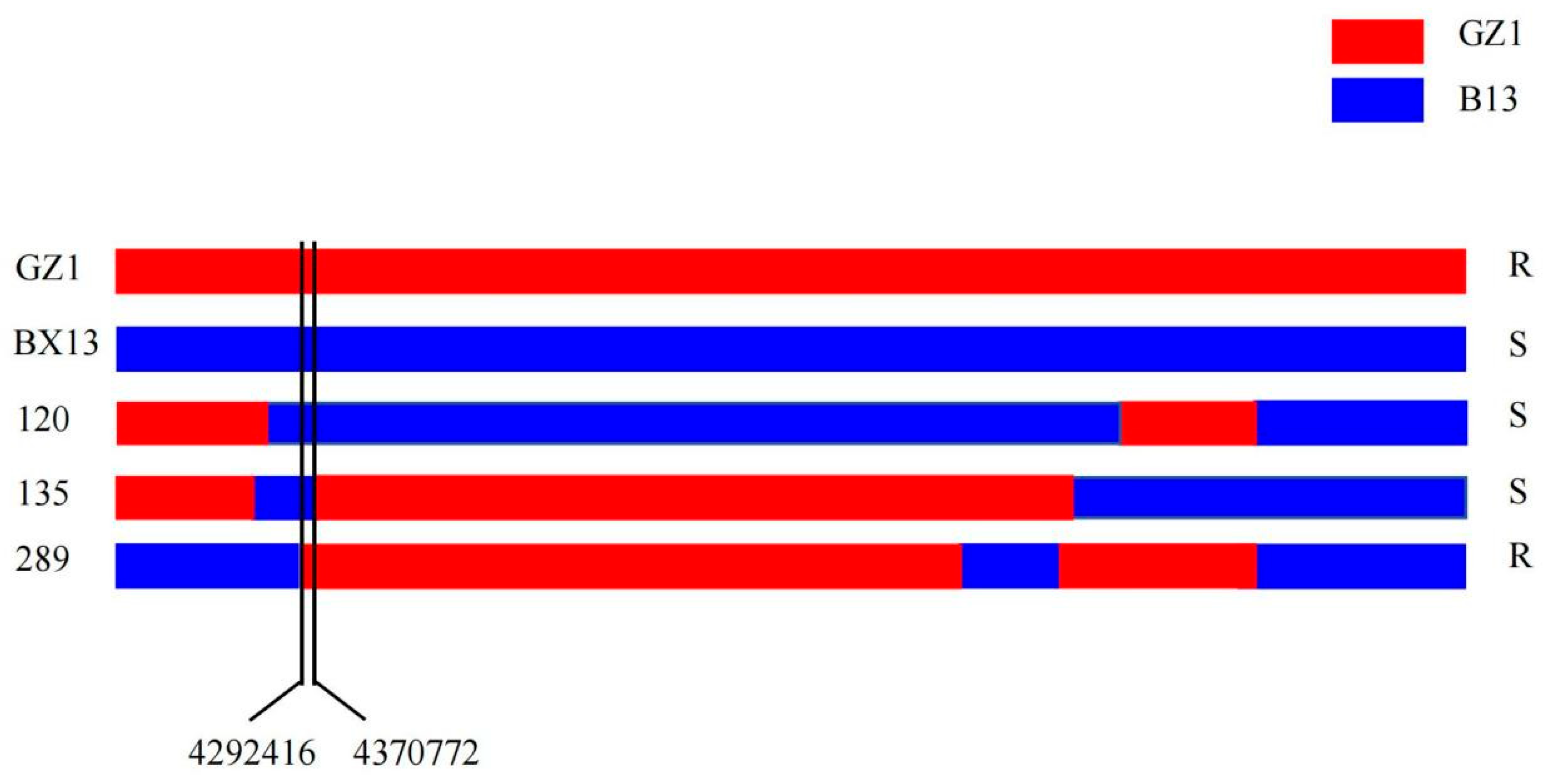
Using a high-density map constructed with bins as markers and composite interval mapping (CIM) with WinQTLCart for PRR resistance locus localization, only one PRR resistance locus was identified on chromosome 3 in both Guizao1 and Wayao. The LOD scores were 74.84 and 70.43, explaining 68.85% and 66.41% of the phenotypic variance, respectively (Figure 1). In the high-density linkage map [4], Rps15 was mapped to bin31 based on the results from three recombinant monoclonal lines (Figure 2). This positioned Rps15 within a region from 4,292,416 to 4,370,772 bp in the GlymaWm82.a2.v1 genome assembly of Guizao1, spanning approximately 78 kb. In Wayao, Rps15 was located in a region between 3,968,039 and 4,292,863 bp in the GlymaWm82.a2.v1 assembly, covering approximately 324 kb. A BLAST search revealed 8 and 16 annotated genes in these regions, respectively (Table 3; http://www.soybase.org, accessed on 10 September 2025). The putative functions of these predicted genes were annotated using BLAST searches against the TAIR protein database and the Phytozome genomics resource (https://phytozome.jgi.doe.gov/pz/portal.html, accessed on 10 September 2025). Glyma.03g035600 is annotated as a lipid transfer protein (LTP), which is categorized as a disease process-related protein. LTPs are known for their inhibitory or lethal effects in microorganisms such as bacteria and fungi, exhibiting strong antimicrobial activity and high stability. In Wayao, five genes (Glyma.03G034400, Glyma.03G034500, Glyma.03G034800, Glyma.03G034900, and Glyma.03G035300) were found to contain nucleotide-binding site (NBS) leucine-rich repeat (LRR) domains, which are key domains in plant disease resistance genes. Therefore, these six genes were most likely the candidate genes for Rps15.

3.4. Identification of SSR Molecular Markers

We searched the SoyBase database and identified nine SSR molecular markers located within the target resistance gene locus interval of the resistant parent ‘Guizao 1’. These markers were initially assessed for polymorphism between the resistant parent ‘Guizao 1’ and the susceptible parent ‘B13’. Three of these markers showed clear polymorphism not only between the parents, but also between the resistant and susceptible bulk segregant pools. This result supported that the Rps15 gene is located within this genomic interval. Subsequently, these three polymorphic SSR markers were used to genotype the entire GB recombinant inbred line (RIL) population derived from the ‘Guizao 1’ × ‘B13’ cross. Chi-square tests confirmed that the segregation of resistance and susceptibility for each of these three markers in the RIL population fit the expected 1:1 ratio. Genetic linkage analysis demonstrated that all three markers were significantly linked to the Rps15 resistance gene derived from ‘Guizao 1’ (Table S3). Therefore, the three SSR markers (BARCSOYSSR_03_0250, BARCSOYSSR_03_0251, and BARCSOYSSR_03_0258) developed and validated in this study represent practical and effective tools for marker-assisted selection (MAS) in breeding programs aimed at developing soybean varieties resistant to P. sojae race PNJ1.

3.5. Quantitative Real-Time PCR (qRT-PCR) Analysis

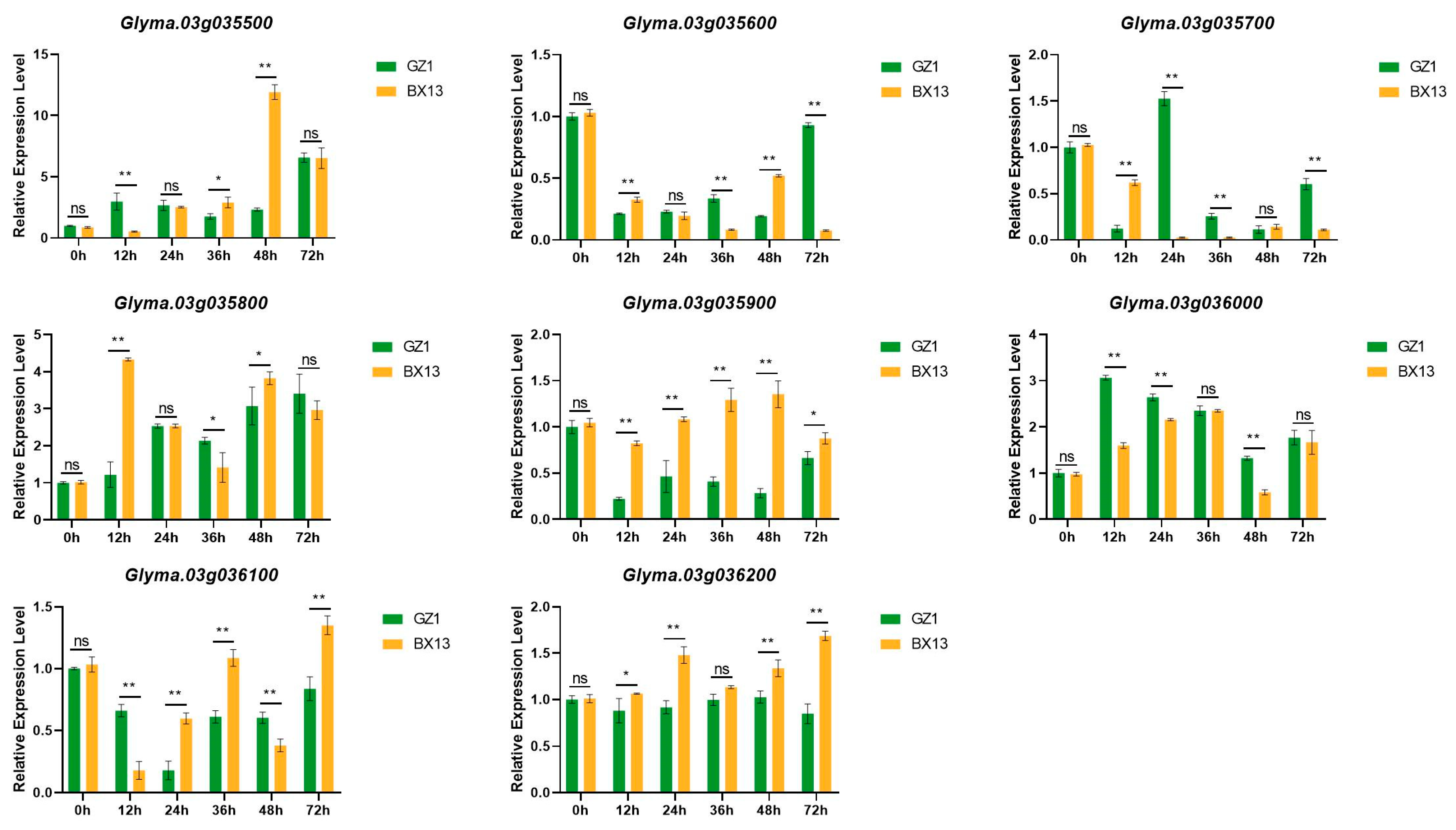
To investigate the transcriptional response of candidate genes to P. sojae infection, we analyzed the expression patterns of eight genes located within the target locus in both the resistant parent ‘Guizao 1’ (R) and the susceptible parent ‘B13’ (S) using quantitative real-time PCR (qRT-PCR) at various time points post-inoculation (Figure 3). The expression of Glyma.03g035700 in the resistant ‘Guizao 1’ exhibited a transient change, showing an initial decrease at 12 h, followed by a recovery to near-baseline levels by 24 h, before declining again at later time points. Notably, the expression levels of four genes (Glyma.03g035500, Glyma.03g035800, Glyma.03g035900, and Glyma.03g036200) were consistently higher in the susceptible ‘B13’ than in the resistant ‘Guizao 1’ following inoculation. Two genes, Glyma.03g035600 and Glyma.03g036100, were down-regulated at 12 and 24 h in both parental lines, suggesting a common response not specifically associated with the resistance mechanism. A striking difference was observed for Glyma.03g036000. This gene was significantly up-regulated at all observed time points after inoculation specifically in the resistant ‘Guizao 1’, while its expression in ‘B13’ remained largely unchanged or was induced to a much lesser extent. These results strongly suggest that Glyma.03g036000 plays a critical role in the resistance of ‘Guizao 1’ to P. sojae race PNJ1, making it the most promising candidate gene for Rps15, which is involved in the soybean defense mechanism.

4. Discussion

4.1. Comparison Between Rps15 and Other Reported Rps Genes on Chromosome 3

Soybean is a vital global crop, and China possesses a rich diversity of soybean germplasm resources. Screening efforts have identified numerous sources of resistance to Phytophthora sojae, the causal agent of PRR, underscoring the importance of characterizing these genetic resources for breeding programs [16,19,46,49,50,51,52]. In this study, we characterized two distinct resistance sources. The cultivar ‘Guizao 1’ exhibited resistance to both P. sojae races PNJ1 and PNJ4, while ‘Wayao’ was resistant to PNJ1 but susceptible to PNJ4. This differential reaction pattern distinguishes them from previously reported resistant cultivars and suggests the presence of unique Rps genes or alleles. Genetic segregation analysis in the RIL population derived from the cross between ‘Guizao 1’ (resistant) and ‘B13’ (susceptible) confirmed that the resistance to race PNJ1 in ‘Guizao 1’ is conferred by a single dominant locus, which we designate as Rps15. It is important to note that while ‘Wayao’ and its derived population with ‘Huachun 2’ provided valuable supplementary mapping information, the primary genetic and functional analyses presented in this study were conducted using the ‘Guizao 1’ × ‘B13’ system to characterize Rps15.
To finely map the Rps15 locus, we utilized a high-density genetic map constructed for the primary mapping population, GB (derived from ‘Guizao 1’ × ‘B13’). This map was generated by integrating 54,002 SNPs into 3748 high-resolution recombination bin units, providing exceptional genomic coverage [16,19,46,49,50,51,52]. For comparative purposes, a previously published map for the supplementary CY population (‘Wayao’ × ‘Huachun 2’), which spanned 3855.5 cM and contained 3469 bin markers, was also referenced [18]. The high-density bin map for the GB population exhibited evenly distributed linkage distances and a resolution significantly higher than that of conventional genetic maps. This enhanced resolution ensured greater accuracy and reliability in the subsequent QTL/gene mapping analysis. Fine-mapping efforts using the GB population successfully delimited the Rps15 locus to a critical genomic region on chromosome 3. In the resistant parent ‘Guizao 1’, Rps15 was confined to an interval between 4,292,416 and 4,370,772 bp. For reference, the corresponding interval in the supplementary resistant parent ‘Wayao’ was mapped between 3,968,039 and 4,292,863 bp. Notably, this chromosomal region is a well-characterized hotspot harboring multiple known Rps genes, which corroborates the identity of our mapped locus.
Previous studies have identified 22 known Rps genes (alleles) and mapped them to chromosome 3 before Rps15, including five alleles of Rps1 (Rps1a, 1b, 1c, 1d, 1k) [26,27,28,29,30], Rps7 [34], RpsYu25 [23], Rps9 [22], RpsYD29, RpsUN [21], RpsWY [18], RpsQ [19], RpsHN [46], RpsHC18 [16], RpsX [15], RpsGZ, Rps14 [14] and Rpsan1. However, the precise physical positions and allelic relationships among many of these genes remained unresolved, as the genetic intervals reported for different Rps genes often overlapped. This ambiguity necessitated a systematic effort to clarify the genetic architecture of this resistance gene cluster. Therefore, when a novel resistance source was identified in the cultivar ‘Guizao 1’ (crossed with the susceptible parent ‘B13’ for genetic analysis), it was crucial to determine whether its resistance was conferred by a new locus or an allele of a known gene. While the resistant cultivar ‘Wayao’ (used in a supplementary population with ‘Huachun 2’) was also informative for initial mapping comparisons, the definitive fine-mapping and characterization efforts were focused on the ‘Guizao 1’ × ‘B13’ system to confirm the novelty of the locus, designated Rps15.
In this study, although the candidate region for Rps15 partially overlapped with the reported interval for RpsHN, several lines of evidence indicate they are distinct genes. Crucially, the soybean line carrying RpsHN is susceptible to P. sojae race PNJ1 [46], whereas our resistant parent ‘Guizao 1’ (from the primary GB population with ‘B13’) exhibits strong resistance to PNJ1. This clear differential reaction in allelism tests strongly suggests that Rps15 is a novel locus, different from RpsHN. Furthermore, while the RpsGZ gene confers resistance to race PNJ4 [4], the resistance spectrum of the parents in our study reveals a distinction. The primary resistant parent ‘Guizao 1’ (from the GB population) is resistant to both PNJ1 and PNJ4, indicating the presence of at least two resistance factors. Importantly, the resistance to PNJ1 in ‘Guizao 1’ is conferred by Rps15. This is further supported by the phenotype of ‘Wayao’ (the resistant parent of the supplementary CY population), which is resistant to PNJ1 but susceptible to PNJ4, confirming that the PNJ1 resistance (Rps15) is genetically separable from resistance to PNJ4 (such as that conferred by RpsGZ), and thus represents a distinct gene. Finally, a comprehensive comparison of the physical position of Rps15, finely mapped using the ‘Guizao 1’ × ‘B13’ population, with the documented positions of 22 known Rps genes on chromosome 3 (based on the Glyma.Wm82.a2.v1 genome assembly; Table 4) confirms that Rps15 is located at a distinct genomic location. This collective evidence firmly establishes Rps15 as a novel resistance gene.
Furthermore, the resistance gene Rps7 was previously mapped to a large genomic interval of approximately 14.5 Mb pairs (from 3,931,955 to 18,415,710 bp) on chromosome 3, with the SSR markers Satt009 and Satt125 [4]. Similarly, RpsUN1 was localized to a narrower interval between 4,020,587 and 4,171,402 bp, flanked by the markers BARCSOYSSR_03_0233 and BARCSOYSSR_03_0246, according to the Williams 82 genome assembly (GlymaWm82.a2.v1, also referred to as Glyma 2.0). Based on the earlier Glyma2.0 genome annotation, the Rps gene from the soybean cultivar Waseshiroge was mapped between the markers Satt009 and T003044871, potentially residing within the nucleotide region from 3,910,260 to 4,486,048 bp [21]. Separately, an Rps gene identified in cultivar E00003 was positioned within the interval of 4,475,877 to 4,563,799 bp. Another Rps gene, found in Ilpumgeomjeong, was mapped to the interval between 3,990,383 and 4,260,579 bp [11]. The RpsHN gene was mapped to a 278.7 kb genomic region, potentially between nucleotides 4,227,863 and 4,506,526 bp, with the flanking markers SSRSOYN25 and SSRSOYN-44 [46]. For RpsYD29, its flanking markers SattWM82-50 and Satt1k4b correspond to nucleotide positions 3,857,715 and 4,062,474 bp, respectively, defining its genomic interval [6]. RpsGZ was located in a region between 4,022,530 and 4,483,231 bp [4]. Rpssan1 was mapped to a 278.7 kb genomic region flanked by the markers Gm03_4487138_A_C and Gm03_5451606_A_C and may reside at nucleotide position 4,296,322 and 5,354,087 bp [10]. The substantial overlap in the physical intervals of these Rps genes suggests they could represent either tightly linked loci, distinct alleles of a single locus, or even identical alleles reported under different names. This ambiguity highlights the critical need for precise fine-mapping and allelism tests to clarify their genetic relationships, a key objective addressed in the present study through the analysis of the ‘Guizao 1’ × ‘B13’ population. If future studies confirm that these resistance sources are indeed distinct genes, then pyramiding them through marker-assisted selection could be a highly effective strategy for developing soybean cultivars with durable and broad-spectrum resistance to P. sojae.

4.2. The Selection of Potential Rps Genes

Nucleotide-binding site leucine-rich repeat (NBS-LRR) genes constitute one of the largest families of plant disease resistance (R) genes [53]. Their prevalence in legumes is attributed to local tandem duplication events, which have generated numerous homogeneous gene clusters within their genomes [54]. As highlighted by Meziadi et al. (2016), these genes encode proteins that belong to one of the most extensive and variable multigene families in plants, and they are frequently organized into complex clusters of tightly linked genes [55]. In the soybean genome, 319 putative NBS-LRR genes and 175 disease resistance quantitative trait loci (QTLs) have been identified. Notably, a significant cluster of 36 NBS-LRR genes is located on chromosome 3, with the majority residing in the pericentromeric region of the chromosome [56]. Consistent with this genomic architecture, all 22 identified Rps genes conferring resistance to Phytophthora sojae have been mapped to a specific interval on chromosome 3, approximately between approximately 2.91 and 9.23 Mb. Furthermore, several other genes or QTLs associated with resistance to both abiotic and biotic stresses in soybean have also been mapped to regions proximal to the Rps15 locus on chromosome 3. A minor foxglove aphid resistance QTL in PI 366121 [57], two soybean sudden death syndrome resistance QTLs, di1 [58,59], also known as qRfs6 [60], and SDS14-1 [61], and the major QTLs or dominant loci underlying salt tolerance in the soybean cultivars Tiefeng8 and Jidou12 [62] might be clustered in the region as Rps resistance genes. In the supplementary resistant parent ‘Wayao’, analysis of the 16 genes within the mapped resistance locus revealed that five encode proteins with NBS-LRR domains, and one encodes a leucine-rich repeat receptor-like kinase (LRR-RLK). These are both classic types of disease resistance genes, identifying them as strong candidates involved in the defense response. However, it is important to note that functional validation was primarily pursued using the main experimental system. Within the eight-gene candidate region finely mapped in the primary resistant parent ‘Guizao 1’, Glyma.03g036000 was identified as encoding a serine/threonine protein kinase. Kinases are central components of signaling pathways, suggesting that Glyma.03g036000 may play a role in activating downstream defense mechanisms. Gene Ontology (GO) terms associated with kinase activity (GO:0004672 and GO:0004713) support its predicted function in mediating signal transduction, potentially triggering immune responses such as phosphorylation cascades upon pathogen perception. Although definitive proof through functional studies like gene editing is required, the collective evidence positions Glyma.03g036000 as the most promising candidate gene for Rps15.

5. Conclusions

In this study, we conclusively identified and finely mapped a novel resistance locus, designated Rps15, on chromosome 3 in the soybean cultivar ‘Guizao 1’. Furthermore, we identified Glyma.03g036000 as the most promising candidate gene for Rps15. This gene encodes a serine/threonine protein kinase, suggesting its potential role in mediating signal transduction during the plant’s defense response. The precise genetic and molecular characterization of Rps15 provides a foundational resource for breeding Phytophthora root rot-resistant soybean cultivars through marker-assisted selection, ultimately accelerating the development of elite cultivars with durable resistance.

Supplementary Materials

The following supporting information can be downloaded at: https://www.mdpi.com/article/10.3390/agronomy15122736/s1, Table S1: Primers of the SSR markers. Table S2: Primers of the candidate genes for real-time PCR. Table S3: Segregation analysis of SSR marker to P. sojae PNJ1 in 248 F8:11 (Guizao 1 × B13).

Author Contributions

B.C., S.B., X.Y., C.N. and J.J. collected the plant materials used in this study. Q.X. performed the QTL mapping. B.C. and Y.C. prepared the first draft of the manuscript. B.C., S.B. and X.Y. contributed to the data analysis. Y.C., H.N., Q.M., Z.C. and T.L. planned, supervised, and secured funding for this work, and edited the manuscript. All authors have read and agreed to the published version of the manuscript.

Funding

This work was supported by National Science and Technology Major Biological Breeding Project (2023ZD04034), China Agriculture Research System (CARS-04-PS12), and Molecular basis and germplasm innovation of soybean adaptation to tropical and subtropical environments (NT25003-4).

Data Availability Statement

The data that support the findings of this study are available from the Genome Sequence Archive database. The data that support the findings of this study are available from the Genome Sequence Archive database at the National Genomics Data Center, Beijing Institute of Genomics (BIG), Chinese Academy of Sciences, under accession numbers CRA004753 (https://bigd.big.ac.cn/gsa/browse/CRA004753, accessed on 10 September 2025), CRA004754 (https://bigd.big.ac.cn/gsa/browse/CRA004754, accessed on 10 September 2025), and CRR2073086 (https://download.cncb.ac.cn/gsa5/CRA029288, accessed on 10 September 2025).

Conflicts of Interest

The authors declare that they have no known competing financial interests or personal relationships that could have appeared to influence the work reported in this paper.

References

  1. Hao, Q.; Yang, H.; Chen, S.; Zhang, C.; Chen, L.; Cao, D.; Yuan, S.; Guo, W.; Yang, Z.; Huang, Y.; et al. An pair of an atypical NLR encoding genes confer Asian soybean rust resistance in soybean. Nat. Commun. 2024, 15, 3310. [Google Scholar] [CrossRef]
  2. Qin, C.; Li, Y.H.; Li, D.; Zhang, X.; Kong, L.; Zhou, Y.; Lyu, X.; Ji, R.; Wei, X.; Cheng, Q.; et al. PH13 improves soybean shade traits and enhances yield for high-density planting at high latitudes. Nat. Commun. 2023, 14, 6813. [Google Scholar] [CrossRef]
  3. Wang, W.; Chen, L.; Fengler, K.; Bolar, J.; Llaca, V.; Wang, X.; Clark, C.B.; Fleury, T.J.; Myrvold, J.; Oneal, D.; et al. A giant NLR gene confers broad-spectrum resistance to Phytophthora sojae in soybean. Nat. Commun. 2021, 12, 6263. [Google Scholar] [CrossRef] [PubMed]
  4. Jiang, B.; Cheng, Y.; Cai, Z.; Li, M.; Jiang, Z.; Ma, R.; Yuan, Y.; Xia, Q.; Nian, H. Fine mapping of a Phytophthora-resistance locus RpsGZ in soybean using genotyping-by-sequencing. BMC Genom. 2020, 21, 280. [Google Scholar] [CrossRef] [PubMed]
  5. Sun, J.; Li, L.; Zhao, J.; Huang, J.; Yan, Q.; Xing, H.; Guo, N. Genetic analysis and fine mapping of RpsJS, a novel resistance gene to Phytophthora sojae in soybean [Glycine max (L.) Merr]. Theor. Appl. Genet. 2014, 127, 913–919. [Google Scholar] [CrossRef]
  6. Zhang, J.; Xia, C.; Wang, X.; Duan, C.; Sun, S.; Wu, X.; Zhu, Z. Genetic characterization and fine mapping of the novel Phytophthora resistance gene in a Chinese soybean cultivar. Theor. Appl. Genet. 2013, 126, 1555–1561. [Google Scholar] [CrossRef]
  7. Sugimoto, T.; Kato, M.; Yoshida, S.; Matsumoto, I.; Kobayashi, T.; Kaga, A.; Hajika, M.; Yamamoto, R.; Watanabe, K.; Aino, M.; et al. Pathogenic diversity of Phytophthora sojae and breeding strategies to develop Phytophthora-resistant soybeans. Breed. Sci. 2012, 61, 511–522. [Google Scholar] [CrossRef]
  8. Dorrance, A.E.; McClure, S.A.; St. Martin, S.K. Effect of Partial Resistance on Phytophthora Stem Rot Incidence and Yield of Soybean in Ohio. Plant Dis. 2003, 87, 308–312. [Google Scholar] [CrossRef]
  9. Clevinger, E.M.; Biyashev, R.; Schmidt, C.; Song, Q.; Robertson, A.E.; Dorrance, A.E.; Maroof, M.A.S. Mapping of Phytophthora sojae resistance in soybean genotypes PI 399079 and PI 408132. Crop Sci. 2025, 65, e70027. [Google Scholar] [CrossRef]
  10. Lin, F.; Salman, M.; Zhang, Z.; McCoy, A.G.; Li, W.; Magar, R.T.; Mitchell, D.; Zhao, M.; Gu, C.; Chilvers, M.I.; et al. Identification and molecular mapping of a major gene conferring resistance to Phytophthora sansomeana in soybean ‘Colfax’. Theor. Appl. Genet. 2024, 137, 55. [Google Scholar] [CrossRef]
  11. You, H.J.; Jang, I.H.; Moon, J.K.; Kang, I.J.; Kim, J.M.; Kang, S.; Lee, S. Genetic dissection of resistance to Phytophthora sojae using genome-wide association and linkage analysis in soybean [Glycine max (L.) Merr.]. Theor. Appl. Genet. 2024, 137, 263. [Google Scholar] [CrossRef]
  12. Clevinger, E.M.; Biyashev, R.; Schmidt, C.; Song, Q.; Batnini, A.; Bolanos-Carriel, C.; Robertson, A.E.; Dorrance, A.E.; Saghai Maroof, M.A. Comparison of Rps loci toward isolates, singly and combined inocula, of Phytophthora sojae in soybean PI 407985, PI 408029, PI 408097, and PI424477. Front. Plant Sci. 2024, 15, 1394676. [Google Scholar] [CrossRef] [PubMed]
  13. Sahoo, D.K.; Das, A.; Huang, X.; Cianzio, S.; Bhattacharyya, M.K. Tightly linked Rps12 and Rps13 genes provide broad-spectrum Phytophthora resistance in soybean. Sci. Rep. 2021, 11, 16907. [Google Scholar] [CrossRef] [PubMed]
  14. Chen, L.; Wang, W.; Ping, J.; Fitzgerald, J.C.; Cai, G.; Clark, C.B.; Aggarwal, R.; Ma, J. Identification and molecular mapping of Rps14, a gene conferring broad-spectrum resistance to Phytophthora sojae in soybean. Theor. Appl. Genet. 2021, 134, 3863–3872. [Google Scholar] [CrossRef]
  15. Zhong, C.; Li, Y.; Sun, S.; Duan, C.; Zhu, Z. Genetic Mapping and Molecular Characterization of a Broad-spectrum Phytophthora sojae Resistance Gene in Chinese Soybean. Int. J. Mol. Sci. 2019, 20, 1809. [Google Scholar] [CrossRef]
  16. Zhong, C.; Sun, S.; Li, Y.; Duan, C.; Zhu, Z. Next-generation sequencing to identify candidate genes and develop diagnostic markers for a novel Phytophthora resistance gene, RpsHC18, in soybean. Theor. Appl. Genet. 2018, 131, 525–538. [Google Scholar] [CrossRef]
  17. Zhong, C.; Sun, S.; Yao, L.; Ding, J.; Duan, C.; Zhu, Z. Fine Mapping and Identification of a Novel Phytophthora Root Rot Resistance Locus RpsZS18 on Chromosome 2 in Soybean. Front. Plant Sci. 2018, 9, 44. [Google Scholar] [CrossRef] [PubMed]
  18. Cheng, Y.; Ma, Q.; Ren, H.; Xia, Q.; Song, E.; Tan, Z.; Li, S.; Zhang, G.; Nian, H. Fine mapping of a Phytophthora-resistance gene RpsWY in soybean (Glycine max L.) by high-throughput genome-wide sequencing. Theor. Appl. Genet. 2017, 130, 1041–1051. [Google Scholar] [CrossRef] [PubMed]
  19. Li, Y.; Sun, S.; Zhong, C.; Wang, X.; Wu, X.; Zhu, Z. Genetic mapping and development of co-segregating markers of RpsQ, which provides resistance to Phytophthora sojae in soybean. Theor. Appl. Genet. 2017, 130, 1223–1233. [Google Scholar] [CrossRef]
  20. Zhang, Z.; Hao, J.; Yuan, J.; Song, Q.; Hyten, D.L.; Cregan, P.B.; Zhang, G.; Gu, C.; Li, M.; Wang, D. Phytophthora Root Rot Resistance in Soybean E00003. Crop Sci. 2014, 54, 492–499. [Google Scholar] [CrossRef]
  21. Lin, F.; Zhao, M.; Ping, J.; Johnson, A.; Zhang, B.; Abney, T.S.; Hughes, T.J.; Ma, J. Molecular mapping of two genes conferring resistance to Phytophthora sojae in a soybean landrace PI 567139B. Theor. Appl. Genet. 2013, 126, 2177–2185. [Google Scholar] [CrossRef]
  22. Wu, X.L.; Zhang, B.Q.; Sun, S.; Zhao, J.M.; Yang, F.; Guo, N.; Gai, J.Y.; Xing, H. Identification, Genetic Analysis and Mapping of Resistance to Phytophthora sojae of Pm28 in Soybean. Agric. Sci. China 2011, 10, 1506–1511. [Google Scholar] [CrossRef]
  23. Sun, S.; Wu, X.L.; Zhao, J.M.; Wang, Y.C.; Tang, Q.H.; Yu, D.Y.; Gai, J.Y.; Xing, H. Characterization and mapping of RpsYu25, a novel resistance gene to Phytophthora sojae. Plant Breed. 2011, 130, 139–143. [Google Scholar] [CrossRef]
  24. Sugimoto, T.; Yoshida, S.; Biggs, A.R.; Ishimoto, M.; Kaga, A.; Hajika, M.; Watanabe, K.; Aino, M.; Tatsuda, K.; Yamamoto, R.; et al. Genetic analysis and identification of DNA markers linked to a novel Phytophthora sojae resistance gene in the Japanese soybean cultivar Waseshiroge. Euphytica 2011, 182, 133–145. [Google Scholar] [CrossRef]
  25. Fan AiYing, W.X.F.X. Molecular identification of Phytophthora resistance gene in soybean cultivar Yudou 25. Acta Agron. Sin. 2009, 35, 1844–1850. [Google Scholar] [CrossRef]
  26. Gao, H.; Bhattacharyya, M.K. The soybean-Phytophthora resistance locus Rps1-k encompasses coiled coil-nucleotide binding-leucine rich repeat-like genes and repetitive sequences. BMC Plant Biol. 2008, 8, 29. [Google Scholar] [CrossRef]
  27. Sugimoto, T.; Yoshida, S.; Watanabe, K.; Aino, M.; Kanto, T.; Maekawa, K.; Irie, K. Identification of SSR markers linked to the Phytophthora resistance gene Rps1-d in soybean. Plant Breed. 2008, 127, 154–159. [Google Scholar] [CrossRef]
  28. Gao, H.; Narayanan, N.N.; Ellison, L.; Bhattacharyya, M.K. Two classes of highly similar coiled coil-nucleotide binding-leucine rich repeat genes isolated from the Rps1-k locus encode Phytophthora resistance in soybean. Mol. Plant Microbe Interact. 2005, 18, 1035–1045. [Google Scholar] [CrossRef]
  29. Weng, C.; Yu, K.; Anderson, T.R.; Poysa, V. Mapping genes conferring resistance to Phytophthora root rot of soybean, Rps1a and Rps7. J. Hered. 2001, 92, 442–446. [Google Scholar] [CrossRef] [PubMed]
  30. Bernard, R.L.; Smith, P.E.; Kaufmann, M.J.; Schmitthenner, A.F. Inheritance of resistance to Phytophthora root and stem rot in the soybean. Agron. J. 1957, 49, 3391. [Google Scholar] [CrossRef]
  31. Yu, A.L.; Xu, P.F.; Wang, J.S.; Zhang, S.Z.; Wu, J.J.; Li, W.; Chen, W.Y.; Li, N.H.; Fan, S.J.; Wang, X.; et al. Genetic analysis and SSR mapping of gene resistance to Phytophthora sojae race 1 in soybean cv Suinong 10. Chin. J. Oil Crop Sci. 2010, 32, 462–466. [Google Scholar]
  32. Gordon, S.G.; St Martin, S.K.; Dorrance, A.E. Rps8 maps to a resistance gene rich region on soybean molecular linkage group F. Crop Sci. 2006, 46, 168–173. [Google Scholar] [CrossRef]
  33. Burnham, K.D.; Dorrance, A.E.; Francis, D.M.; Fioritto, R.J.; St. Martin, S.K. Rps8, A New Locus in Soybean for Resistance to Phytophthora sojae. Crop Sci. 2003, 43, 101–105. [Google Scholar] [CrossRef]
  34. Demirbas, A.; Rector, B.G.; Lohnes, D.G.; Fioritto, R.J.; Graef, G.L.; Cregan, P.B.; Shoemaker, R.C.; Specht, J.E. Simple Sequence Repeat Markers Linked to the Soybean Rps Genes for Phytophthora Resistance. Crop Sci. 2001, 41, 1220–1227. [Google Scholar] [CrossRef]
  35. Sahoo, D.K.; Abeysekara, N.S.; Cianzio, S.R.; Robertson, A.E.; Bhattacharyya, M.K. A Novel Phytophthora sojae Resistance Rps12 Gene Mapped to a Genomic Region That Contains Several Rps Genes. PLoS ONE 2017, 12, e169950. [Google Scholar] [CrossRef] [PubMed]
  36. Ping, J.; Fitzgerald, J.C.; Zhang, C.; Lin, F.; Bai, Y.; Wang, D.; Aggarwal, R.; Rehman, M.; Crasta, O.; Ma, J. Identification and molecular mapping of Rps11, a novel gene conferring resistance to Phytophthora sojae in soybean. Theor. Appl. Genet. 2016, 129, 445–451. [Google Scholar] [CrossRef]
  37. Yao, H.; Wang, X.; Wu, X.; Xiao, Y.; Zhu, Z. Molecular Mapping of Phytophthora Resistance Gene in Soybean Cultivar Zaoshu18. J. Plant Genet. Resour. 2010, 11, 213–217. [Google Scholar]
  38. de Ronne, M.; Santhanam, P.; Cinget, B.; Labbe, C.; Lebreton, A.; Ye, H.; Vuong, T.D.; Hu, H.; Valliyodan, B.; Edwards, D.; et al. Mapping of partial resistance to Phytophthora sojae in soybean PIs using whole-genome sequencing reveals a major QTL. Plant Genome 2022, 15, e20184. [Google Scholar] [CrossRef] [PubMed]
  39. Elshire, R.J.; Glaubitz, J.C.; Sun, Q.; Poland, J.A.; Kawamoto, K.; Buckler, E.S.; Mitchell, S.E. A robust, simple genotyping-by-sequencing (GBS) approach for high diversity species. PLoS ONE 2011, 6, e19379. [Google Scholar] [CrossRef]
  40. Miller, M.R.; Dunham, J.P.; Amores, A.; Cresko, W.A.; Johnson, E.A. Rapid and cost-effective polymorphism identification and genotyping using restriction site associated DNA (RAD) markers. Genome Res. 2007, 17, 240–248. [Google Scholar] [CrossRef]
  41. Wang, S.; Meyer, E.; McKay, J.K.; Matz, M.V. 2b-RAD: A simple and flexible method for genome-wide genotyping. Nat. Methods 2012, 9, 808–810. [Google Scholar] [CrossRef] [PubMed]
  42. Ma, G.J.; Markell, S.G.; Song, Q.J.; Qi, L.L. Genotyping-by-sequencing targeting of a novel downy mildew resistance gene Pl (20) from wild Helianthus argophyllus for sunflower (Helianthus annuus L.). Theor. Appl. Genet. 2017, 130, 1519–1529. [Google Scholar] [CrossRef]
  43. Xu, X.; Chao, J.; Cheng, X.; Wang, R.; Sun, B.; Wang, H.; Luo, S.; Xu, X.; Wu, T.; Li, Y. Mapping of a Novel Race Specific Resistance Gene to Phytophthora Root Rot of Pepper (Capsicum annuum) Using Bulked Segregant Analysis Combined with Specific Length Amplified Fragment Sequencing Strategy. PLoS ONE 2016, 11, e151401. [Google Scholar] [CrossRef]
  44. Zhao, X.; Han, Y.; Li, Y.; Liu, D.; Sun, M.; Zhao, Y.; Lv, C.; Li, D.; Yang, Z.; Huang, L.; et al. Loci and candidate gene identification for resistance to Sclerotinia sclerotiorum in soybean (Glycine max L. Merr.) via association and linkage maps. Plant J. 2015, 82, 245–255. [Google Scholar] [CrossRef] [PubMed]
  45. Li, G.; Wang, Y.; Chen, M.S.; Edae, E.; Poland, J.; Akhunov, E.; Chao, S.; Bai, G.; Carver, B.F.; Yan, L. Precisely mapping a major gene conferring resistance to Hessian fly in bread wheat using genotyping-by-sequencing. BMC Genom. 2015, 16, 108. [Google Scholar] [CrossRef] [PubMed][Green Version]
  46. Niu, J.; Guo, N.; Sun, J.; Li, L.; Cao, Y.; Li, S.; Huang, J.; Zhao, J.; Zhao, T.; Xing, H. Fine Mapping of a Resistance Gene RpsHN that Controls Phytophthora sojae Using Recombinant Inbred Lines and Secondary Populations. Front. Plant Sci. 2017, 8, 538. [Google Scholar] [CrossRef]
  47. Sandhu, D.; Gao, H.; Cianzio, S.; Bhattacharyya, M.K. Deletion of a disease resistance nucleotide-binding-site leucine-rich- repeat-like sequence is associated with the loss of the Phytophthora resistance gene Rps4 in soybean. Genetics 2004, 168, 2157–2167. [Google Scholar] [CrossRef]
  48. Cai, Z.; Cheng, Y.; Ma, Z.; Liu, X.; Ma, Q.; Xia, Q.; Zhang, G.; Mu, Y.; Nian, H. Fine-mapping of QTLs for individual and total isoflavone content in soybean (Glycine max L.) using a high-density genetic map. Theor. Appl. Genet. 2018, 131, 555–568. [Google Scholar] [CrossRef]
  49. Jiang, C.J.; Sugano, S.; Kaga, A.; Lee, S.S.; Sugimoto, T.; Takahashi, M.; Ishimoto, M. Evaluation of Resistance to Phytophthora sojae in Soybean Mini Core Collections Using an Improved Assay System. Phytopathology 2017, 107, 216–223. [Google Scholar] [CrossRef]
  50. Huang, J.; Guo, N.; Li, Y.; Sun, J.; Hu, G.; Zhang, H.; Li, Y.; Zhang, X.; Zhao, J.; Xing, H.; et al. Phenotypic evaluation and genetic dissection of resistance to Phytophthora sojae in the Chinese soybean mini core collection. BMC Genet. 2016, 17, 85. [Google Scholar] [CrossRef]
  51. Zhang, J.; Sun, S.; Wang, G.; Duan, C.; Wang, X.; Wu, X.; Zhu, Z. Characterization of Phytophthora resistance in soybean cultivars/lines bred in Henan province. Euphytica 2014, 196, 375–384. [Google Scholar] [CrossRef]
  52. Kyle, D.E.; Nickell, C.D.; Nelson, R.L.; Pedersen, W.L. Response of Soybean Accessions from Provinces in Southern China to Phytophthora sojae. Plant Dis. 1998, 82, 555–559. [Google Scholar] [CrossRef]
  53. Shao, Z.Q.; Xue, J.Y.; Wu, P.; Zhang, Y.M.; Wu, Y.; Hang, Y.Y.; Wang, B.; Chen, J.Q. Large-Scale Analyses of Angiosperm Nucleotide-Binding Site-Leucine-Rich Repeat Genes Reveal Three Anciently Diverged Classes with Distinct Evolutionary Patterns. Plant Physiol. 2016, 170, 2095–2109. [Google Scholar] [CrossRef]
  54. Shao, Z.Q.; Zhang, Y.M.; Hang, Y.Y.; Xue, J.Y.; Zhou, G.C.; Wu, P.; Wu, X.Y.; Wu, X.Z.; Wang, Q.; Wang, B.; et al. Long-term evolution of nucleotide-binding site-leucine-rich repeat genes: Understanding gained from and beyond the legume family. Plant Physiol. 2014, 166, 217–234. [Google Scholar] [CrossRef] [PubMed]
  55. Meziadi, C.; Richard, M.; Derquennes, A.; Thareau, V.; Blanchet, S.; Gratias, A.; Pflieger, S.; Geffroy, V. Development of molecular markers linked to disease resistance genes in common bean based on whole genome sequence. Plant Sci. 2016, 242, 351–357. [Google Scholar] [CrossRef] [PubMed]
  56. Kang, Y.J.; Kim, K.H.; Shim, S.; Yoon, M.Y.; Sun, S.; Kim, M.Y.; Van, K.; Lee, S.H. Genome-wide mapping of NBS-LRR genes and their association with disease resistance in soybean. BMC Plant Biol. 2012, 12, 139. [Google Scholar] [CrossRef]
  57. Lee, J.S.; Yoo, M.H.; Jung, J.K.; Bilyeu, K.D.; Lee, J.D.; Kang, S. Detection of novel QTLs for foxglove aphid resistance in soybean. Theor. Appl. Genet. 2015, 128, 1481–1488. [Google Scholar] [CrossRef] [PubMed]
  58. Njiti, V.N.; Meksem, K.; Iqbal, M.J.; Johnson, J.E.; Kassem, M.A.; Zobrist, K.F.; Kilo, V.Y.; Lightfoot, D.A. Common loci underlie field resistance to soybean sudden death syndrome in Forrest, Pyramid, Essex, and Douglas. Theor. Appl. Genet. 2002, 104, 294–300. [Google Scholar] [CrossRef]
  59. Chang, S.J.C.; Doubler, T.W.; Kilo, V.; Suttner, R.; Klein, J.; Schmidt, M.E.; Gibson, P.T.; Lightfoot, D.A. Two Additional Loci underlying Durable Field Resistance to Soybean Sudden Death Syndrome (SDS). Crop Sci. 1996, 36, 1684–1688. [Google Scholar] [CrossRef]
  60. Luckew, A.S.; Leandro, L.F.; Bhattacharyya, M.K.; Nordman, D.J.; Lightfoot, D.A.; Cianzio, S.R. Usefulness of 10 genomic regions in soybean associated with sudden death syndrome resistance. Theor. Appl. Genet. 2013, 126, 2391–2403. [Google Scholar] [CrossRef]
  61. Bao, Y.; Kurle, J.E.; Anderson, G.; Young, N.D. Association mapping and genomic prediction for resistance to sudden death syndrome in early maturing soybean germplasm. Mol. Breed. 2015, 35, 128. [Google Scholar] [CrossRef] [PubMed]
  62. Guan, R.; Chen, J.; Jiang, J.; Liu, G.; Liu, Y.; Tian, L.; Yu, L.; Chang, R.; Qiu, L. Mapping and validation of a dominant salt tolerance gene in the cultivated soybean (Glycine max) variety Tiefeng 8. Crop J. 2014, 2, 358–365. [Google Scholar] [CrossRef]
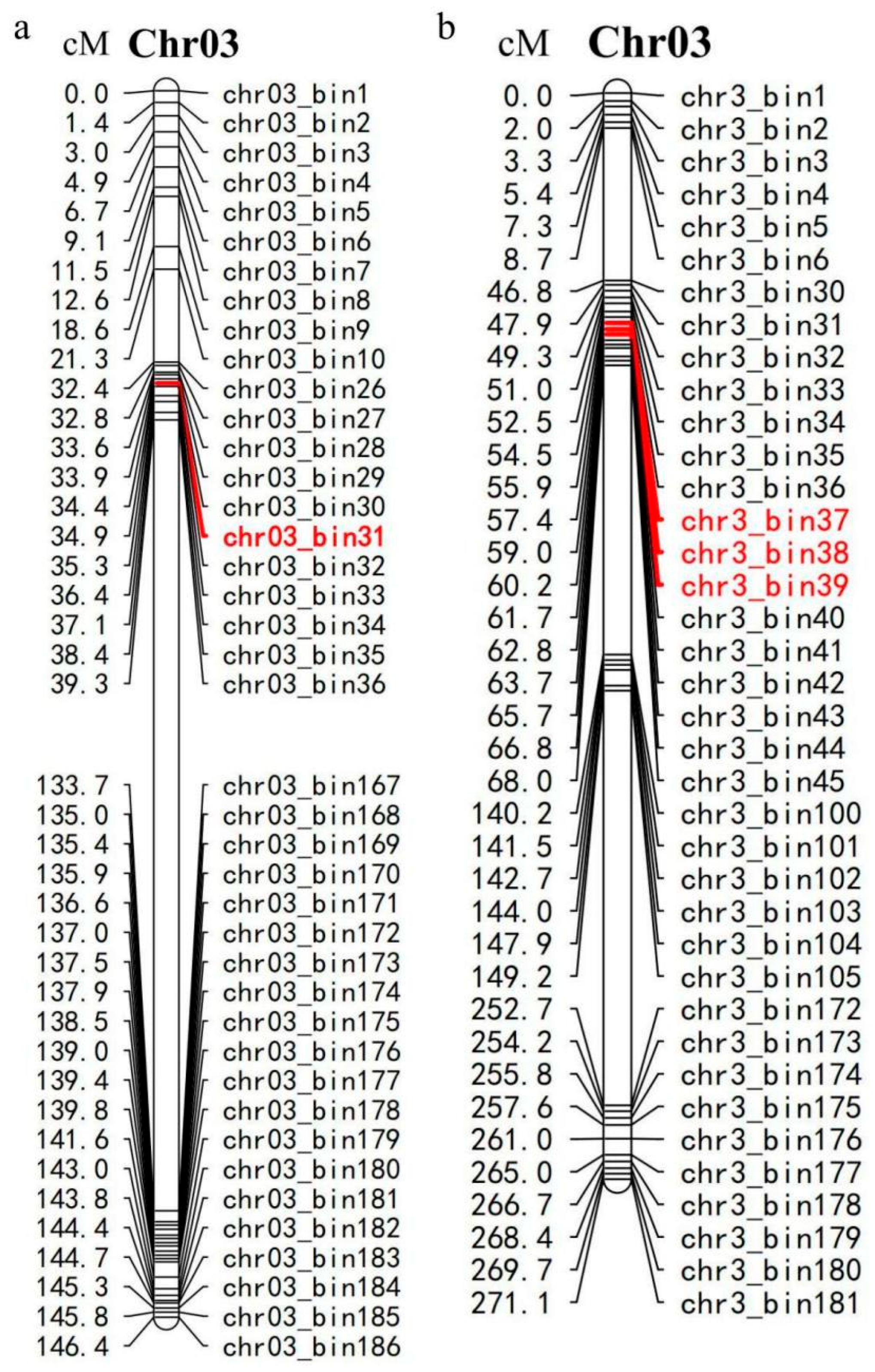
Figure 1. Results of Rps15 locus analysis using the CIM method in the two RILs. (a) Chromosome 3 of GB population, the red bin indicates the Rps gene locus. (b) Chromosome 3 of CY population, the red bin indicates the Rps gene locus.
Agronomy 15 02736 g001
Figure 2. Fine mapping of the Rps15 locus. Recombinant inbred lines showing recombination near the Rps15 locus are shown with blue and red bars representing homozygous genotypes from B13 and Guizao 1, respectively. Line 120, and 135 were PRR-susceptible plants (S). Line 289 was PRR-resistant plants (R).
Agronomy 15 02736 g002
Figure 3. Relative expression levels of the candidate genes of the Rps15 locus. Y-axes indicate the ratios of the relative fold differences in expression levels between samples infected with P. sojae PNJ1. The primary leaf samples were harvested at 0, 12, 24, 36, 48, and 72 h post-inoculation. The transcript levels of the candidate genes of the Rps15 locus were assessed by qRT-PCR using the 2–ΔΔCt method with the actin gene as an internal control. Error bars indicate standard deviation (n = 3). Asterisks indicate significant differences determined by t-test (*, p < 0.05; **, p < 0.01).
Agronomy 15 02736 g003
Table 1. Differential reactions of soybean hosts and cultivars to strains of P. sojae.
CultivarRpsPhytophthora sojae Strains
PNJ1PGD1Pm14Pm28PNJ3PNJ4P6497
Harlon1aRSSSSSR
Harosoy13XX1bRSSSSSS
Williams791cRRSSSSR
PI1030911dSRSSSSR
Williams821kRSSSSSR
L76-19882SSSSSSS
Chapman3aRSSRRRR
PRX146-363bSsRRSSSR
PRX145-483cSSSSSSS
L85-23524SSSRRSR
L85-30595RSSSSRR
Harosoy62XX6SSSSRSR
Harosoy7SSSSSRS
WilliamsrpsSSSSSSS
Huachun 2 SSSSSSS
Wayao RRRRSSR
Guizao 1 RSSSSRS
B13 SSSSSSS
S is susceptible, R is resistant.
Table 2. Segregation analysis of resistance to P. sojae PNJ1 in F8:11 (Guizao 1 × B13).
Cross or Parent (1)Total No. of Plants/LinesExpected Ratio and Goodness of Fit
ResistanceSusceptibilityExpected ratioχ2p
Guizao 1 (R)2000
B13 (S)0200
F1120
F2151593:10.30.583
F8:111381101:13.160.075
(1) R, resistant; S, susceptible.
Table 3. Annotations of the candidate genes in the Rps15 region on chromosome 3.
Population (1)No.Gene Name (2)AnnotationOrtholog (3)
GB1Glyma.03g035500Plant mobile domainAT2G04865.1
2Glyma.03g035600Lipid transfer protein 1 (LTP)AT3G08770.1
3Glyma.03g035700Lipid transfer protein 5 (LTP)AT5G59310.1
4Glyma.03g035800Pollen allergen; Rare lipoprotein A (RlpA)-like double-psi beta-barrelAT5G05290.1
5Glyma.03g035900MAC/Perforin domain-containing protein (MACPF)AT1G29690.1
6Glyma.03g036000Serine/threonine protein kinase (Ser/Thr)AT5G01850.1
7Glyma.03g036100No items to show
8Glyma.03g036200Multidrug resistance proteinAT2G38510.1
CY1Glyma.03g034000(bHLH) DNA-binding superfamily proteinAT4G00050.1
2Glyma.03g034100Preprotein translocase Sec, Sec61-beta subunit proteinAT3G60540.1
3Glyma.03g034200Leucine-rich repeat protein kinase family proteinAT3G56370.1
4Glyma.03g034300No items to show
5Glyma.03g034400Disease resistance protein (NBS-LRR class), putativeAT3G14470.1
6Glyma.03g034500Disease resistance protein (NBS-LRR class), putativeAT3G14470.1
7Glyma.03g034600No items to showAT1G62130.1
8Glyma.03g034700No items to showAT2G01050.1
9Glyma.03g034800Disease resistance protein (NBS-LRR class), putativeAT3G14470.1
10Glyma.03g034900Disease resistance protein (NBS-LRR class), putativeAT3G14470.1
11Glyma.03g035000Domain of unknown function DUF223AT2G05642.1
12Glyma.03g035100PIF1-like helicaseAT3G51690.1
13Glyma.03g035200CW-type Zinc Finger; B3 DNA binding domainAT4G32010.1
14Glyma.03g035300Disease resistance protein (NBS-LRR class), putative. Protein tyrosine kinaseAT3G08760.1
15Glyma.03g035400PPR repeatAT3G42630.1
16Glyma.03g035500Plant mobile domainAT2G04865.1
(1) GB, Guizao1 × B13; CY, Huachun 2 × Wayao. (2) Glyma ID from the Williams 82 soybean reference genome Wm82.a2.v1 (http://soybase.org, accessed on 10 September 2025). (3) Accession number of Arabidopsis orthologs were obtained from the Arabidopsis Information Resource (TAIR10, http://www.arabidopsis.org/, accessed on 10 September 2025).
Table 4. The location of Rps genes on chromosome 3.
No.Rps GeneMolecular Marker IntervalPhysical Posistion (bp)
1Rps1aSatt159Satt0093,197,8453,932,116
2Rps1bSatt530Satt5845,669,8779,228,144
3Rps1cSatt530Satt5845,669,8779,228,144
4Rps1dSatt152Sat_1863,366,4053,488,905
5Rps1k 4,457,8104,641,921
6Rps7Satt009Satt1253,931,95518,415,710
7RpsYu25Satt152Sat_1863,366,4053,488,905
8Rps9Satt631Satt1522,943,8833,366,655
9RpsYD29SattWM82–50Satt1 k4b3,857,7154,062,474
10RpsHNSSRSOYN-25SSRSOYN-444,227,8634,506,526
11Rps gene in WaseshirogeSatt009T0030448713,910,2604,486,048
12Rps gene in E00003 4,475,8774,563,799
13RpsUN1BARCSOYSSR_03_0233BARCSOYSSR_03_02464,020,5874,171,402
14RpsWY 4,466,2304,502,773
15RpsQBARCSOYSSR_03_0165InDel2812,968,5663,087,579
16RpsHC18BARCSOYSSR_03_0265BARCSOYSSR_03_02724,446,5944,611,282
17RpsX 2,910,9133,153,254
18RpsGZ 4,003,4014,370,772
19Rps14Satt631BARCSOYSSR_03_02662,944,0314,470,352
20RpsSDBAX-90419199AX-903174363,373,6444,295,128
21Rpsan1Gm03_4487138_A_CGm03_5451606_A_C4,296,3225,354,087
22Rps gene in Ilpumgeomjeong 3,990,3834,260,579
23Rps15 4,292,4164,370,772
Disclaimer/Publisher’s Note: The statements, opinions and data contained in all publications are solely those of the individual author(s) and contributor(s) and not of MDPI and/or the editor(s). MDPI and/or the editor(s) disclaim responsibility for any injury to people or property resulting from any ideas, methods, instructions or products referred to in the content.