Article

Flower Thinning Strategy of Flat Peach Inflorescence Based on RBCN-YOLO

1
College of Mechanical and Electrical Engineering, Shihezi University, Shihezi 832003, China
2
Key Laboratory of Northwest Agricultural Equipment, Ministry of Agriculture and Rural Affairs, Shihezi 832003, China
3
Engineering Research Center for Production Mechanization of Oasis Characteristic Cash Crop, Ministry of Education, Shihezi 832003, China
4
Mechanical Equipment Research Institute, Xinjiang Academy of Agricultural and Reclamation Science, Shihezi 832000, China
*
Author to whom correspondence should be addressed.
Agronomy 2025, 15(12), 2715; https://doi.org/10.3390/agronomy15122715
Submission received: 13 October 2025 / Revised: 12 November 2025 / Accepted: 22 November 2025 / Published: 25 November 2025

Abstract

Accurately identifying the morphology and spatial distribution of flat peach inflorescence is crucial for guiding precise flower thinning operations. In this study, based on the YOLOv8 framework, a flat peach inflorescence detection model (RBCN-YOLO) was developed for detecting all growth stages, from bud to initial flowering and full flowering. The model optimized the neck network architecture by incorporating RepBlock and BiFusion modules, integrating the CAFM module into the backbone network, and combining the NWD loss function with the CIoU loss function. The improved model showed better detection performance in remote viewing angles, backlight conditions, and complex scenarios. Moreover, it demonstrated good real-time performance on edge devices. Based on this model, a flower thinning strategy was designed by combining the density classification algorithm, inflorescence membership categorization, and interval flower-thinning requirements. The results showed that the RBCN-YOLO model achieved a mAP@0.5 of 82.9% and an F1 score of 78.9%. These scores represented improvements of 3.0% and 2.4%, respectively, compared to YOLOv8. Notably, the model performance in the initial flowering stage showed the most significant improvement, with the mAP@0.5 increasing from 65.1% to 70.7%. Additionally, the flower thinning strategy based on RBCN-YOLO achieved a flower thinning ratio of 54.55%, with a thinning accuracy of 78.84%. To further enhance the application of the research, a visualization system with integrated object detection and flower thinning functions was designed. This study provides a valuable reference for flower-thinning operations in flat peach orchards.

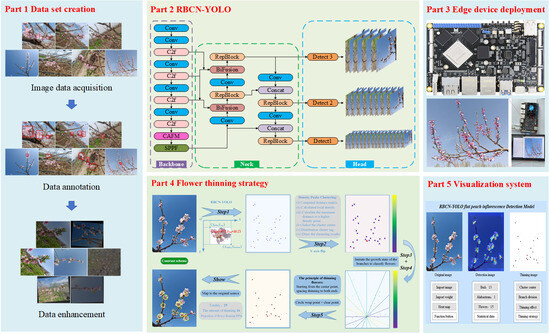
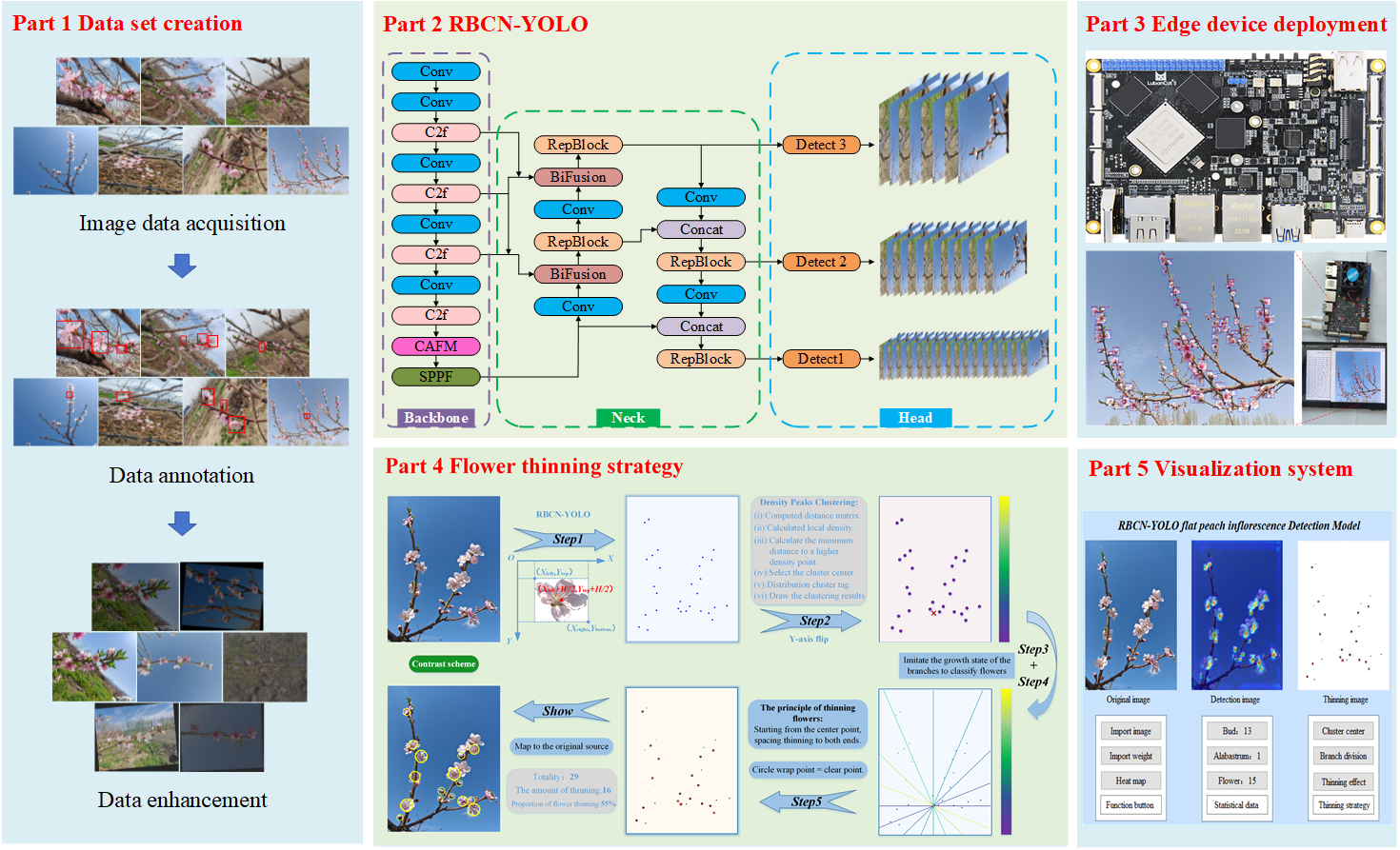
Graphical Abstract

1. Introduction

In the precision production of orchards, scientific control of flower and fruit retention is the core link to achieve high quality and increased yield. Among them, as a critical component of orchard management, flower thinning operation plays an irreplaceable role in balancing tree nutrition distribution and improving fruit quality [1]. Flat peach, as a kind of fruit with tough skin and easy peeling, delicate flesh, and sweet juice, is deeply adored by consumers [2], and it is crucial to perform thinning operations on it. According to the literature investigation, flower thinning technology can be categorized into three types. These types include manual flower thinning, chemical flower thinning (which usually refers to the employment of chemical thinning agents for the operation), and mechanical flower thinning [3]. While manual flower thinning ensures a certain level of operational precision, it is labor-intensive and costly, presenting several limitations in practical applications [4]. Meanwhile, chemical flower thinning is susceptible to various factors such as climatic conditions, tree age, and tree vitality [5]. Furthermore, chemical substances may persist after usage, which contradicts contemporary principles of pollution-free fruit and vegetable production. Previous pump-type mechanical flower-thinning equipment often inflicts unnecessary damage to trees while demonstrating suboptimal effectiveness in flower thinning [6]. Therefore, exploring and implementing intelligent and precise flower thinning solutions that integrate machine vision with other artificial intelligence technology is particularly crucial [7].
Review the existing literature, traditional machine vision technology primarily depends on key feature information such as color, shape, texture, and spectral information to detect flowers and fruits [8,9]. Among them, color features have been extensively utilized in flower recognition. For instance, Hočevar et al. [10] employed the HSL color space and threshold method to precisely assess the flowering intensity of individual apple trees. Pornpanomchai et al. [11] combined RGB color information with the size characteristics of herbal flowers and the complex characteristics of petal edges to develop an intelligent approach for the automatic identification of herbal flowers. Similarly, shape characteristics also play a role in the detection of flowers and fruits. Krikeb et al. [12] combined morphological techniques with the threshold method, successfully identifying flowers while also predicting the specific blooming time period. Utilizing contour segments and color information, Lu et al. [13] developed an effective method for the identification of citrus in various lighting conditions. Meanwhile, in the utilization of texture features for fruit identification, Lin et al. [14] proposed a support vector machine (SVM) model that employs color and texture features to accurately detect a range of fruits, including citrus and tomatoes. In practical applications, Wouters et al. [15] developed a multi-spectral camera system to establish an accurate discrimination model by collecting the pixel information of buds and to achieve precise prediction of the number of buds (with an accuracy of 87%). In the aforementioned research, the recognition technology employing the traditional image processing algorithm is prone to interference from factors such as changes in illumination, diversity of forms, complexity of textures, and complexity of the environmental background, and its applicability and stability are low [16]. By contrast, in recent years, Deep Learning (DL) technology has demonstrated superior outcomes in the domain of orchard flower recognition.
By extracting more abundant and profound feature information from image data, deep learning technology significantly reduces the influence of surrounding environmental factors on image processing results. And it effectively enhances the precision of object detection in complex dynamic environments. Owing to the powerful feature extraction and classification capability of deep learning, semantic segmentation performs well in flower recognition. For instance, Dias et al. [17] and Sun et al. [18] employed the DeepLab+RGR and DeepLab-Resnet semantic segmentation models, respectively, to detect apple flowers, peach flowers, and pear flowers, and both achieved highly precise segmentation of the target flowers. Concurrently, Wang et al. [19] introduced a method based on Fully Convolutional Networks (FCN) for precise pixel-level segmentation of apple flowers (with an average KL value of 0.23). Furthermore, to meet the purpose of precise flower thinning and to identify the same type of flowers at different growth stages, the case segmentation technique is employed. Tian et al. [20] proposed a mask scoring R-CNN instance segmentation model (MASU R-CNN) utilizing a U-Net backbone network, which was specifically optimized for three different growth stages of apple flower (bud stage, semi-open, and fully open) to achieve accurate identification of apple flower. Nevertheless, with the continuous advancement of flower thinning devices, the real-time performance of flower identification models is increasingly important.
In recent years, as single-stage object detection algorithms with excellent real-time performance in the field of deep learning, the SSD and YOLO series models have been extensively utilized in the area of flower recognition. For instance, Tian et al. [21] applied the SSD (Single Shot MultiBox Detector) deep learning technology to the field of flower detection and recognition, and the processing time of a single image by the trained model was 0.13 s. Wu et al. [22] and Shang et al. [23] developed real-time apple flower detection models using the YOLOv4 and YOLOv5s deep learning algorithms, respectively. These models provide valuable references for orchard yield estimation and the development of flower thinning machinery. Li et al. [24] employed YOLOv4 to precisely and rapidly detect kiwifruit flowers and buds simultaneously (with a recognition rate of 38.6 ms per piece and a mAP of 97.6%), contributing to the development of kiwifruit pollinator robots. Jing et al. [25] used the improved Sunflower-YOLO to effectively detect the open, half-open, and bud growth stages of sunflowers (model size was 13.8 MB, FPS was 188.52). Bai et al. [26] proposed a real-time detection model for strawberry flowers and fruits based on YOLOv7 (the frame rate of the improved algorithm was 45 f/s), laying a foundation for the sparse flowers and fruits of strawberries in the greenhouse. Chen et al. [27] identified apple flowers (buds and flowers) in different growth stages by using an improved YOLOv7 model. The model was capable of accurately and quickly identifying apple flowers in natural scenes (with an accuracy rate of 80.1% and a recognition speed of 42.58 f/s). Although the aforementioned research has classified and identified the different growth stages of the target and can also meet the requirements of real-time detection, the strategy for the subsequent practical operation is not provided.
The formulation of the flower thinning strategy is the continuation of the accurate identification of the model. And it is the prerequisite for realizing the accurate flower thinning operation. For example, Zhou et al. [28] utilized YOLOv4 to detect pear flowers, optimized the density peak clustering algorithm, and achieved density classification of pear flowers, providing technical support for intelligent pear thinning technology. By enhancing the YOLOv8-Seg model, Si et al. [29] were capable of offering a reference for the thinning of apple single-branch inflorescences. However, it does not involve coordinate-based spatial thinning decisions. The above research still has certain limitations for achieving accurate flower thinning in natural scenes. Furthermore, most existing research has focused on flower clusters such as apple flowers and pear flowers, with relatively little research on flat peach inflorescence. In fact, a detailed delineation of each growth stage is essential for flat peach inflorescence. This can accurately assess flowering intensity [20], determine flowering time, and provide scientific guidance for flower thinning operations.
To address the above situation, an object detection model (RBCN-YOLO) specifically designed for flat peach inflorescence was proposed. This model is based on the YOLOv8 framework by optimizing the neck network architecture, integrating an attention mechanism, and enhancing the loss function. Building upon this foundation, a flat peach flower thinning strategy was proposed. This study presents a systematic detection of flat peach inflorescences across multiple phenological stages in complex natural environments, and directly combines the detection results with the flower sparsity strategy. During this process, this study quantitatively characterized the inflorescence at the initial flowering stage. The novelty of this study lies in this comprehensive closed-loop solution, with RBCN-YOLO serving as the core detection component. Specifically, the contributions of this study are primarily reflected in the following aspects:
  • Data on flat peach inflorescences were collected in a complex natural environment, covering the entire phenological period from the bud stage, the initial flowering stage, to the flowering stage.
  • Based on the YOLOv8 network, combined with the RepBlock and BiFusion modules, the CAFM module, and the NWD loss function, a detection model capable of accurately identifying peach blossom sequences in different phenological periods was constructed. It has also been deployed and verified on edge devices.
  • Based on the output information of the detection model, combined with the density classification algorithm, intra-flower membership degree classification, and interval thinning requirements, a new pruning strategy for almond inflorescences was proposed.
  • By integrating the model recognition effect, heat map, and flower thinning strategy, a visualization system supporting orchard management was designed.

2. Materials and Methods

2.1. Image Data Collection

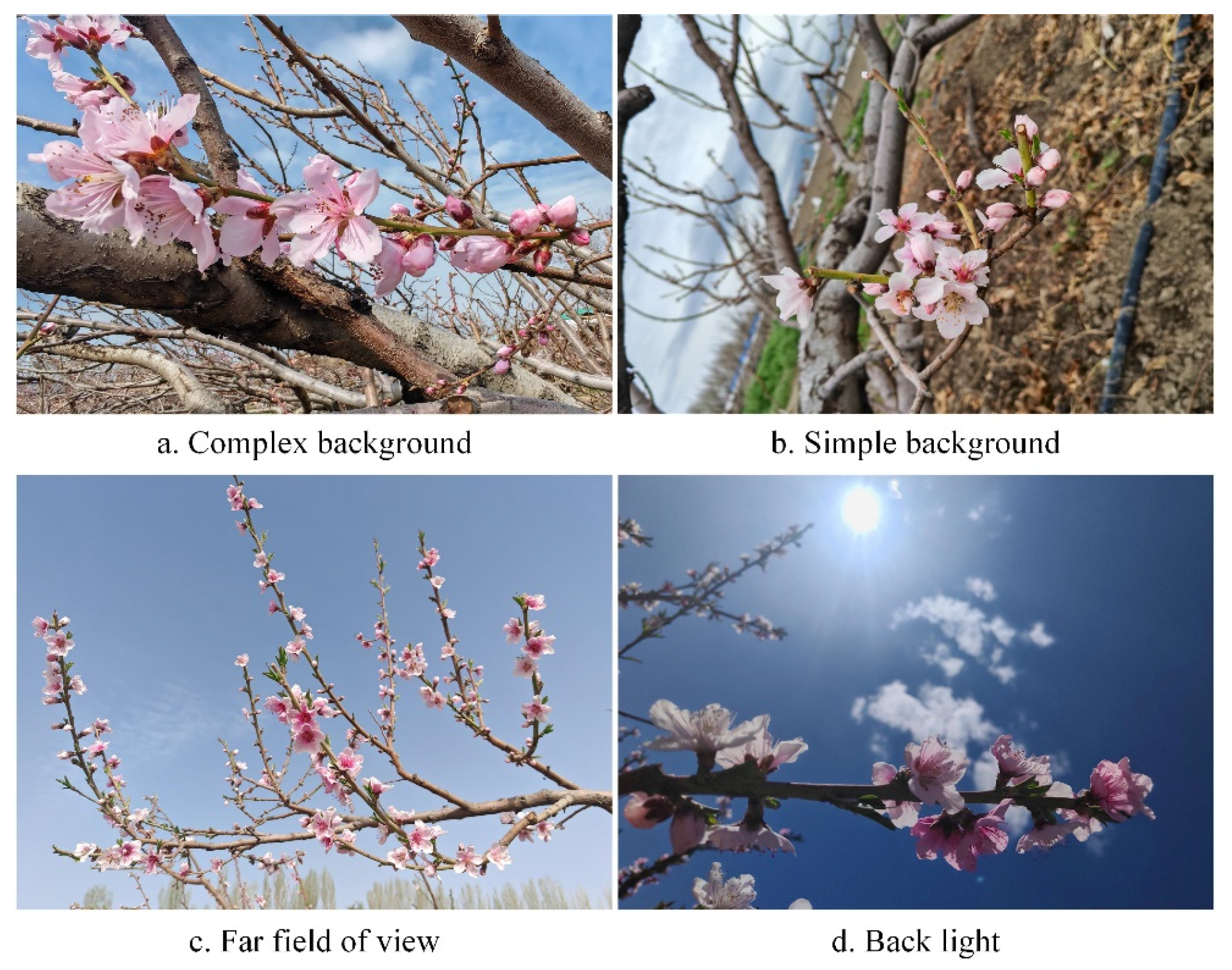
Images were collected from a flat peach orchard managed by the 10th Company, 143rd Regiment, 8th Division of Shihezi city in Xinjiang, China. The image collection equipment is a smartphone (Honor 100 Pro, Honor Device Co., Ltd., Shenzhen, China). Image data were collected between 8 April and 21 April, 2024. In this process, the flat peach inflorescence in various states was collected to the greatest extent possible to ensure the comprehensiveness and richness of the data. Specifically, these images were collected at varied angles, at different times of the day (morning, noon, and afternoon), and with varying light intensity, distance (0.2–1.5 m), occlusion, background complexity, and other natural scenes. A total of 1893 images with a resolution of 4000 × 3000 were collected, and the representative images are shown in Figure 1. It should be noted that this study defines scenarios with an imaging distance of 0.8 m or more as far-field [30]. An image is classified as a complex background if it contains two or more types of interference elements and the total area of these elements exceeds 40% of the total image area. The back-light scenario assessment method in this study is based on the angle between the direction of the light and the imaging direction. An image is classified as a backlit scenario when the angle exceeds 120°.

2.2. Dataset Construction

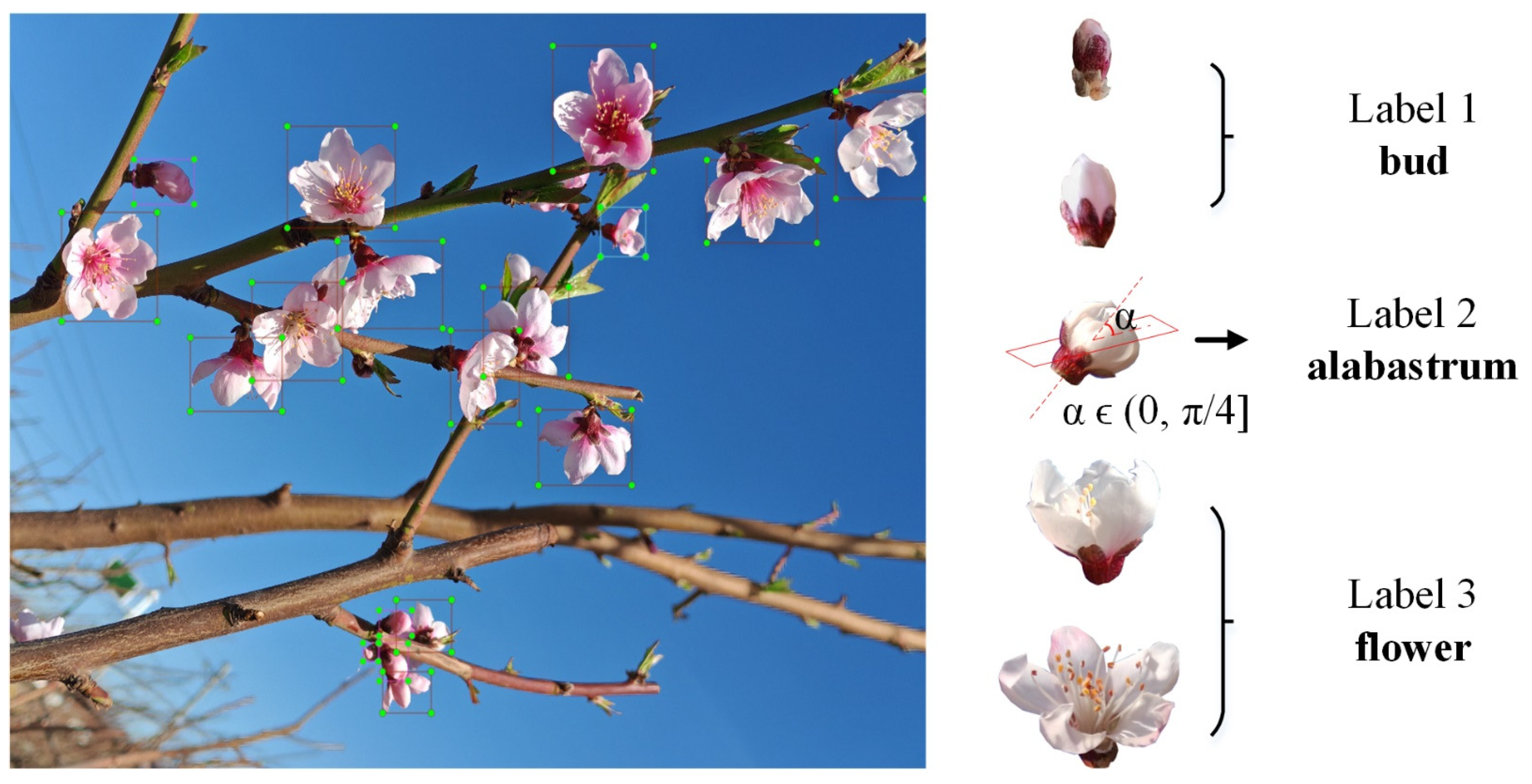
Based on the phenological characteristics of flat peach inflorescence, their morphological development can be categorized into three distinct stages: bud stage, initial flowering stage, and full flowering stage. At the bud stage, the inflorescence is small and the base color is reddish-brown; the inflorescence head is light red. At the initial flowering stage, the inflorescence is moist red or white, with small petal spread, and the stamens are initially revealed. At the full flowering stage, the buds open completely to form flowers, the stamens are fully visible, and the petals appear red or white. The LabelImg annotation tool (v1.8.6, a graphical image annotation tool) was used to manually label all images for this study. The marking process for flat peach inflorescence is illustrated in Figure 2, where the labelling frame is the smallest outer rectangle of the flat peach inflorescence. For the bud stage, the inflorescence was closed and the entire inflorescence was labelled as “bud”; for the initial flowering stage, the inflorescence was semi-closed and the petals were initially open (the angle between the plane of the petal and the line of the stamen is less than 45°), the entire inflorescence was labelled as “alabastrum”; for the full flowering stage, the petals were fully open and the entire inflorescence was labelled as “flower”. The resulting annotation is an XML file that stores the coordinates of the inflorescence along with their corresponding categories. In addition, data enhancement was easier in this format than in others.
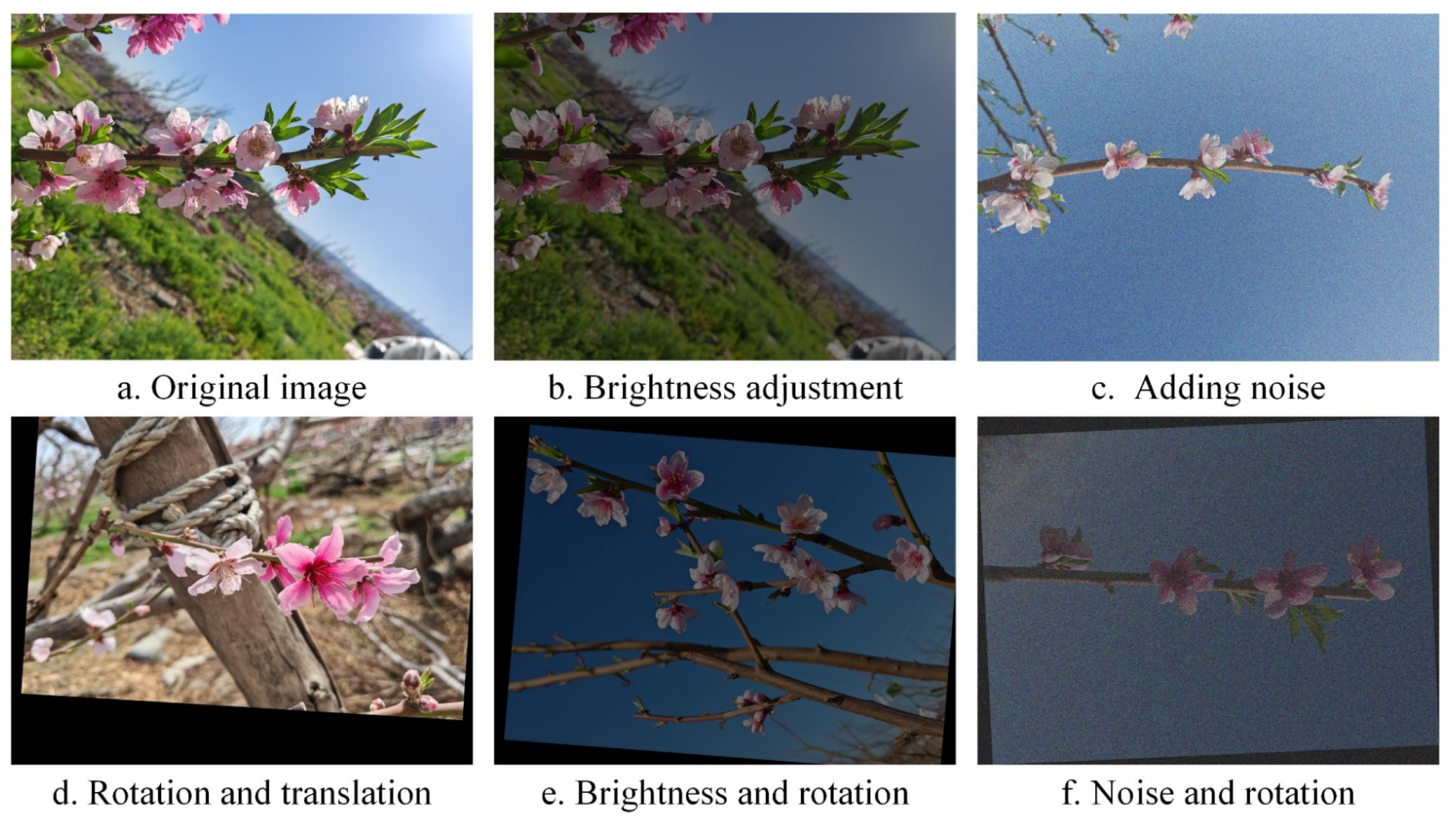
To enhance the generalization performance of the model, the dataset had been augmented. During the process, the real situation of the orchard machinery working environment and weather conditions (light fog, etc.) were considered. The dataset was enhanced in the following ways, including translation, rotation (simulating different shooting angles), brightness adjustment (simulating different weather conditions for shooting), noise addition, occlusion, clipping, and flip. These enhancements help alleviate the influences of interfering factors (such as noise, image gamut changes, occlusion, etc.). It should be noted that among the 1893 images in total, 50 images were selected for the verification of the subsequent flower thinning strategy. In the process of enhancement, two of the above enhancement methods were randomly adopted for each image. The dataset was expanded to 5529 pieces, and Figure 3 shows the dataset after using data enhancement techniques. According to the principle of partition before enhancement, the dataset was randomly divided into a training set, a verification set, and a test set according to the ratio of 7:1:2. Subsequently, a flat peach inflorescence dataset in YOLO format was built.
After augmentation, the number of bounding box instances for each class in the training set is as Table 1.
The total number of instances after augmentation is approximately 42,000, with a class ratio of approximately bud: alabastrum: flower = 1.6:1:3.2. This distribution truthfully reflects the phenological patterns of flat peach inflorescences under natural conditions. The full bloom stage lasts relatively long, with numerous flower clusters that are most distinctive and easier to annotate, hence the largest sample size. The bud stage also extends over a considerable period, and each bud constitutes one annotation instance, resulting in a similarly large quantity. The alabastrum stage, serving as the transition from bud to flower, is the shortest in duration and exhibits ambiguous, transitional morphological features. It is the most challenging stage to collect and annotate, thus becoming the minority class in the dataset.

2.3. Improve YOLOv8 Model

As a fast one-stage object detection model, YOLOv8 (You Only Look Once version 8) is an improvement on YOLOv5. The network structure of the YOLOv8 model comprises three components: Backbone, Neck, and Head [31].
In the Backbone part, the C3 module in YOLOv5 is replaced by the Faster Implementation of CSP Bottleneck with 2 Convolutions (C2f) module. By adding parallel gradient flow branches and Split operations, this improvement not only obtains more abundant gradient flow information while maintaining lightweight, but also improves the convergence speed and effect of the model. Owing to the reduction of input tensor channels by half compared to the previous layer, the computational load of C2f is significantly decreased, thereby enhancing the inference speed of the model. This is more conducive to resource-constrained environments. In the Neck part, PAN-FPN (Path Aggregation Network with Feature Pyramid Network) is improved, the convolution structure in the up-sampling stage is deleted, and the C3 module is replaced by the C2f module, which not only simplifies the model structure, but also reduces the calculation amount. At the same time, the feature extraction ability is improved. In the Head part, the Decoupled Head design is introduced, where the detection head and classification head are decoupled so that they can be optimized independently. The aforementioned enhancements have significantly improved the real-time performance and precision of YOLOv8.
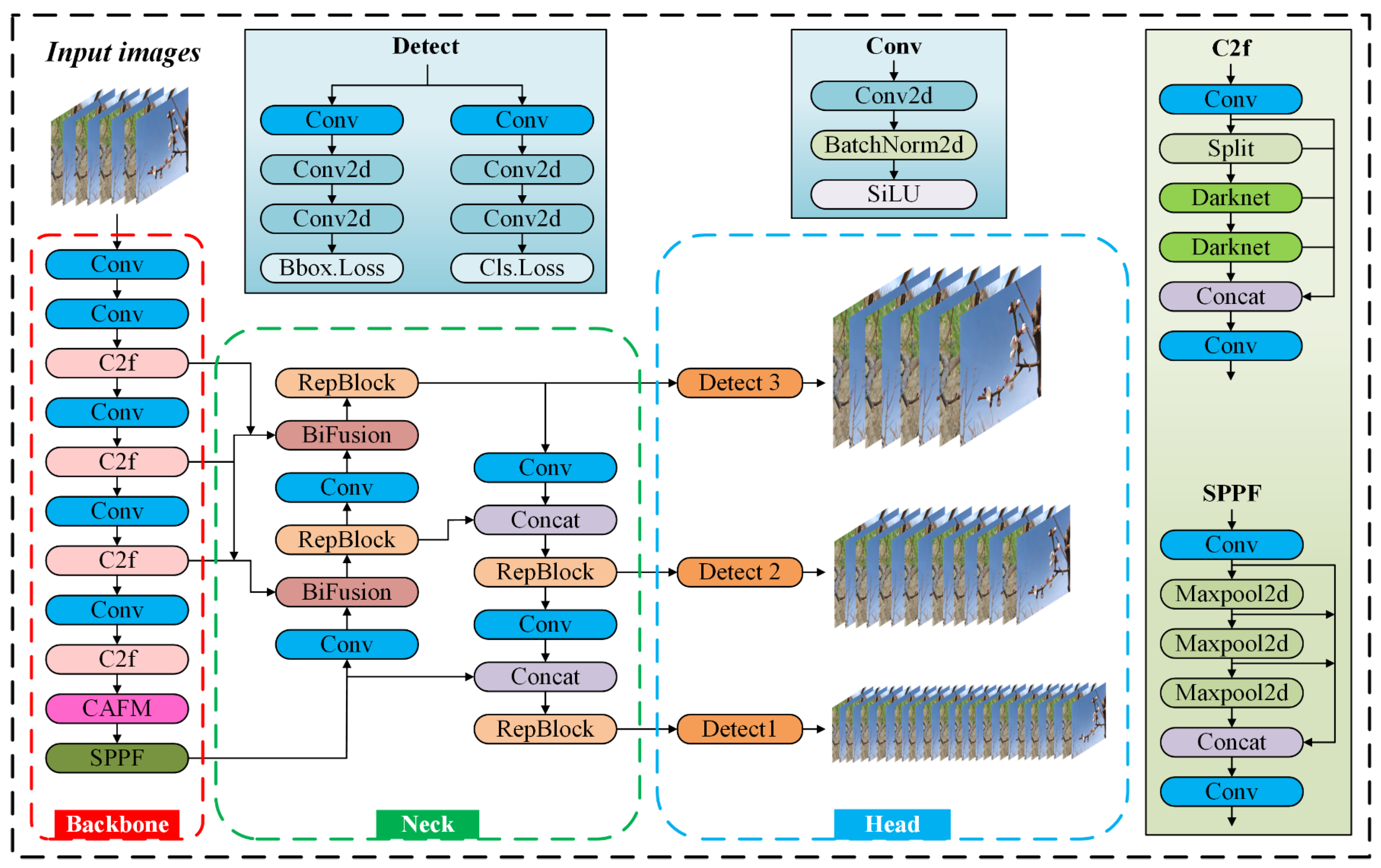
However, for the detection of flat peach inflorescence in natural scenes, due to the small size, indistinct features, overlap, and complex recognition background of flat peach inflorescence, as shown in Figure 4, the YOLOv8 network architecture has been enhanced in the following aspects (RBCN is the acronym for the four core improvement modules introduced):
  • In the neck network, a core structure mainly composed of the RepBlock module [32] and the BiFusion module was constructed [33]. Among them, the BiFusion module fuses feature maps from three adjacent levels and integrates other low-level features output by the Backbone network, achieving multi-level feature fusion. The RepBlock module is based on the Structural Re-parameterization technology. During the training phase, this module enhances the expressive ability of the neck network through a multi-branch complex structure. During the inference stage, each RepBlock is efficiently transformed into a single stacked 3 × 3 convolutional layer and is combined with a synchronous activation function. The combination of the two not only significantly enhances the multi-level information fusion capability of the model, but also effectively balances speed and accuracy. This design makes information dissemination more flexible and efficient, while reducing the consumption of computing resources.
  • Adding Convolution and Attention Fusion Module (CAFM) previous to the SPPF in the backbone [34]. This module consists of local branches and global branches. Local branches use convolution and channel rearrangement to extract local features, while global branches use attention mechanisms to capture long-distance dependencies. This model can synthesize the global and local features and improve the performance of denoising.
  • The NWD (Normalized Wasserstein Distance) loss function can show its unique advantages when dealing with small targets [35]. Thanks to the ability to more finely measure the distance between the two boxes (predicted box and real box), it allows the model to better locate small targets. When the NWD loss function and CIoU loss function are combined, the shortcomings of the CIoU loss function in small target detection can be further made up, and the detection accuracy of small targets such as flat peach inflorescence can be improved by more refined distance measurement.

2.3.1. RepBlock

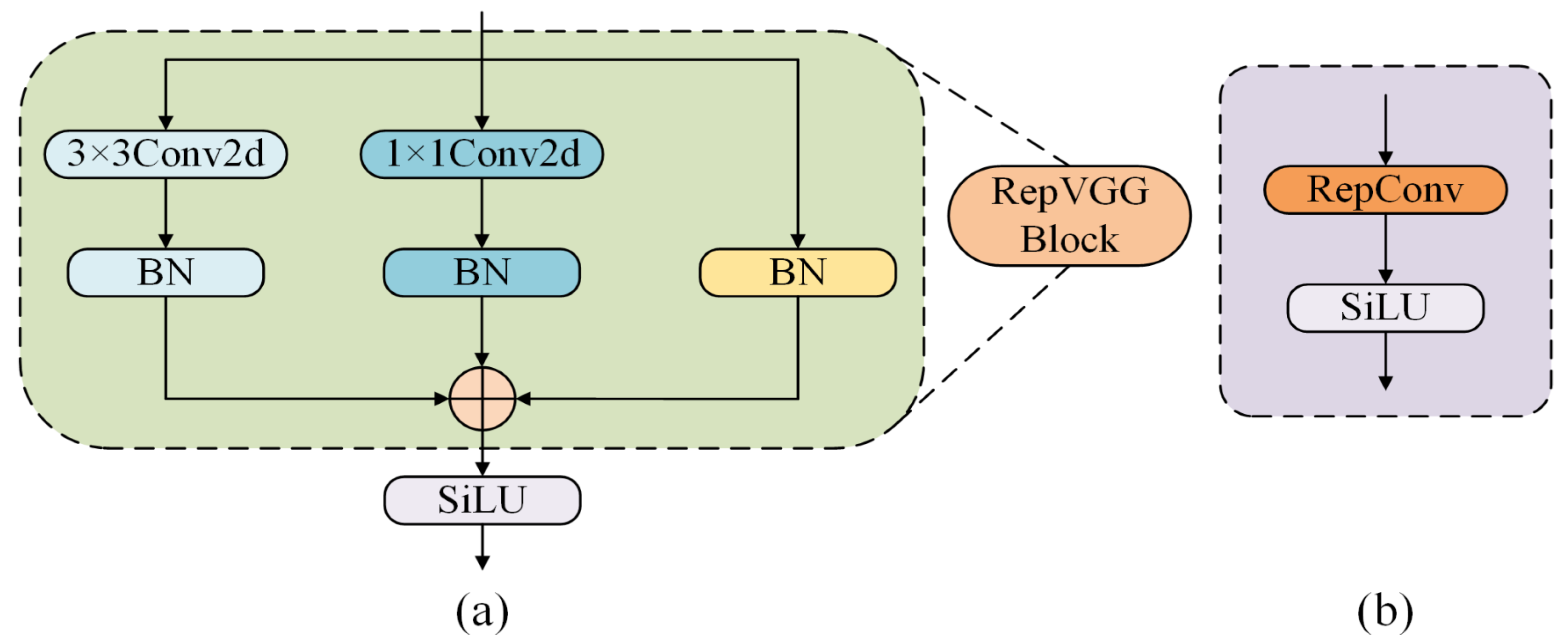
The basic structure of the RepBlock module consists of multiple branches, which adopt a multi-branch topology in the training phase and are converted to a single branch structure in the inference phase [32]. As shown in Figure 5, during training, the RepBlock internally uses the RepVGG module, which has a multi-branch topology. These branches can include convolution kernels of different sizes (e.g., 1 × 1, 3 × 3, etc.) and identity maps. The outputs of these branches are fused internally by means of addition or splicing to form the final output features. In the inference phase, the multi-branch structure of the RepBlock is converted to a single-branch structure to improve computational efficiency and speed. Specifically, the multi-branch RepVGG module used during training is re-parameterized to an equivalent 3 × 3 convolution layer (RepConv) that contains all the feature information learned by the multi-branch structure during training.
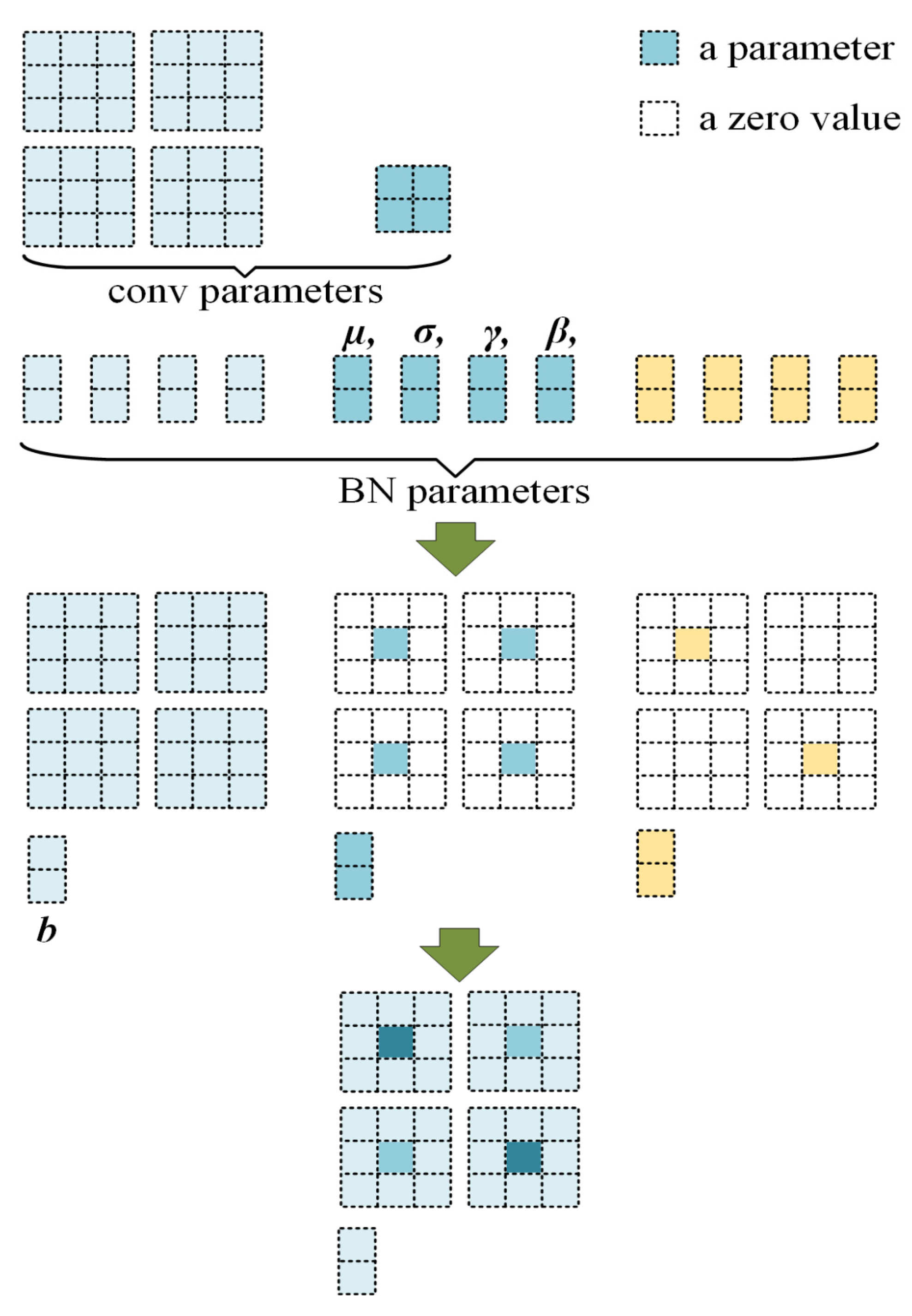
The reparameterization of the RepConv structure is shown in Figure 6. The 1 × 1 convolution and residual structures are converted to 3 × 3 convolution. In the process of convolution conversion, the original 3 × 3 convolution is not changed, and the 1 × 1 convolution is converted to a 3 × 3 convolution by the operation of compensating for 0 around it. The residual structure can construct four convolution nuclei, two of which have a central value of 1, and the rest are 0. The output of the input eigenmatrix processed by the four convolution kernels is the same as that of the input. By merging the BN layer and the convolution layer, the convolution plus BN layer structure is transformed into the convolution structure with bias. Let X ϵ RH×W×C be the input tensor. The calculation formula of the BN layer is as Equation (1):
B N X = γ X μ σ + β
where μ represents the mean value of the sample; σ represents the variance of the sample; γ and β are learnable parameters, corresponding to scale factor and offset factor, respectively.
The unbiased convolution is calculated as Equation (2):
C o n v X = X     W
where W is the weight matrix used for weighted summation of input signals, represents the convolution operator.
Defined as Equations (3)–(5):
W f u s e d = γ σ W
b f u s e d = γ μ σ
where Wfused and bfused are the weight parameters and bias of the fused convolution kernel, respectively.
B N C o n v X = X     W f u s e d + b f u s e d
Through the fusion method mentioned above, the 3 × 3 convolutional layer can be fused with the BN layer to reduce the number of parameters in the network. To sum up, the working principle of RepBlock is mainly based on structural reparameterization techniques. These techniques allow models to adopt a multi-branch structure for training to learn richer features, and switch to a single branch structure for speed when reasoning.

2.3.2. BiFusion

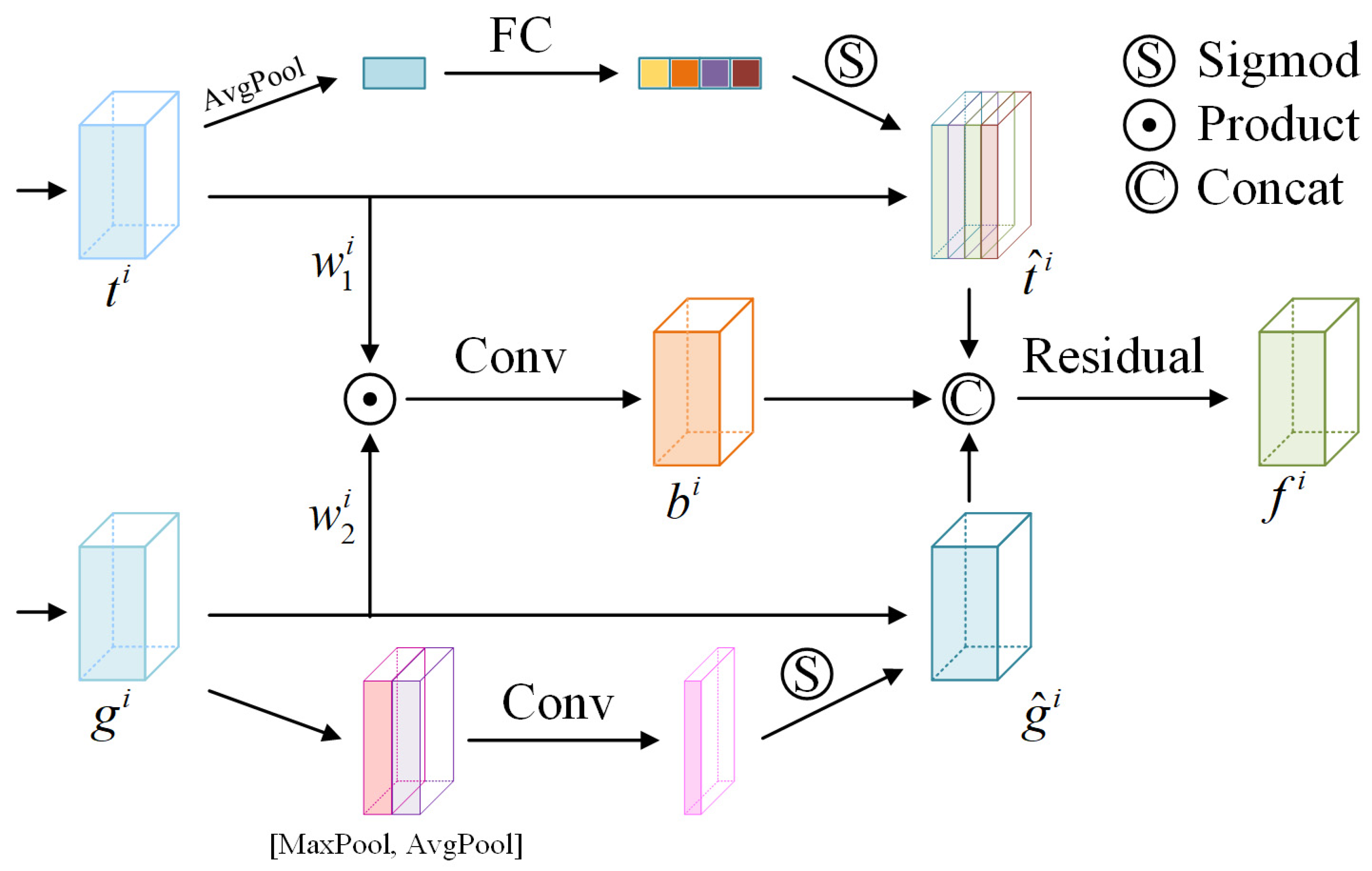
The BiFusion module possesses a robust feature fusion capability, which improves the precision and robustness of target detection by fusing feature mappings at various levels [33]. This module primarily consists of spatial attention mechanisms, channel attention mechanisms, and multimodal fusion. As shown in Figure 7, the module initially extracts features from the input image via distinct network branches. Subsequently, the channel attention and spatial attention mechanisms are applied to the extracted features to emphasize critical information within the feature map while suppressing irrelevant data. The features, after being processed by these attention mechanisms, are then fed into the feature fusion layer for integration. Ultimately, the input features are combined with the fused features by a residual connection to ensure the integrity and stability of the feature representation. Overall, the BiFusion module achieves effective fusion and utilization of feature maps at different levels in the flat peach inflorescence recognition model through a series of steps, including feature extraction, fusion, and residual connection.

2.3.3. Convolution and Attention Fusion Module

The Convolutional Attention Fusion Module (CAFM) fuses convolution with attention, consisting of a Global Branch and a Local Branch [34]. Specifically, the global branch uses a self-attention mechanism to capture a wider range of data information, while the local branch focuses on extracting local feature information. The convolution operation is limited by its local characteristics and limited perception domain, which is not enough to model global features. However, CAFM can effectively capture long-distance dependencies, enhance global and local feature modelling capabilities, and improve the feature extraction capability of backbone networks.
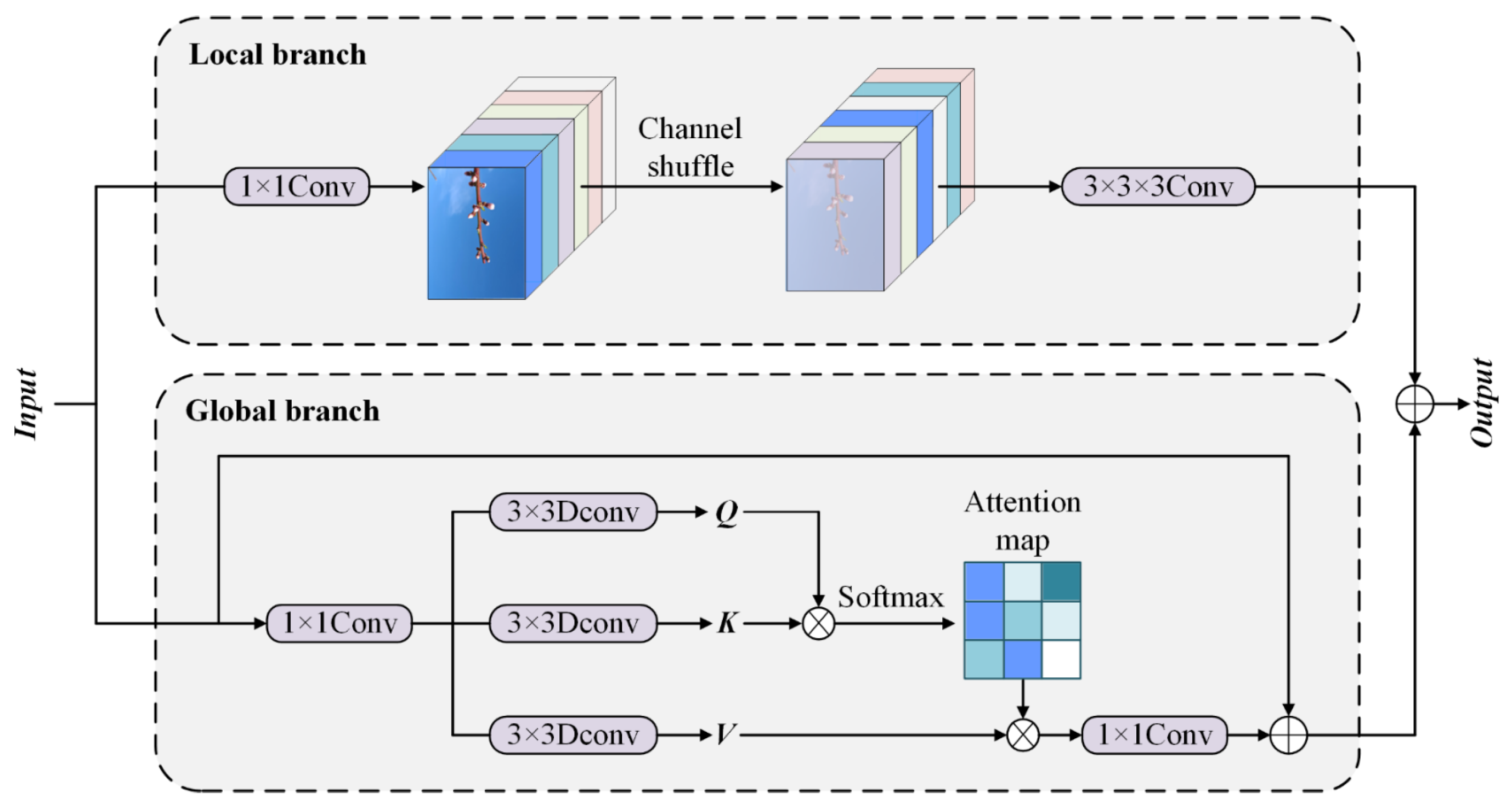
As shown in Figure 8, in the local branch, a 1 × 1 convolution operation is initially employed to adjust the number of channels to strengthen the interaction between channels and improve the model to integrate the input image. Subsequently, a channel mixing operation is conducted to facilitate channel information blending. Specifically, the channel shuffle operation partitions the input tensor into multiple groups based on channel dimensions and applies depthwise separable convolution within each group to promote inter-channel information exchange. The output tensors from each group are then concatenated along the channel dimension to form a new output tensor, which is extracted using 3 × 3 × 3 convolution. The calculation formula of the local branch structure as Equation (6):
F c o n v = W 3 × 3 × 3 ( C S ( W 1 × 1 ( Y ) ) )
where Fconv is the output of the local branch and W3×3×3 represents 3 × 3 × 3 convolution; W1×1 means convolution; CS( ) means channel mixing operation; Y is the input feature map.
In the global branch, query (Q), key (K), and value (V) are initially generated by a 1 × 1 convolution and a 3 × 3 deep convolution. This process results in three tensors, each with the shape S × A × B × P, where S denotes the number of samples, A represents the height of the feature map, B represents the width of the feature map, and P denotes the number of channels. The spatial dimensions of Q, K, and V are flattened and reshaped into the shape of S × N × P using the Softmax function to calculate the Attention Map. Where N = A × B, Q, K, and V after remodeling are Q ^ , K ^ , and V ^ , respectively. The calculation of the global branch structure can be expressed by the formulas in Equations (7) and (8):
F a t t = W 1 × 1 A t t e n t i o n Q , ^ K , ^ V ^ + Y
A t t e n t i o n Q , ^ K , ^ V ^ = V ^ S o f t m a x ( K ^ Q ^ α )
where Fatt is the output of the global branch, A t t e n t i o n Q , ^ K , ^ V ^ is the weighted output feature map, V ^ is the weighted value, and α is the learnable scaling parameter. The output of CAFM can be obtained by adding the global branch output and the local branch output as in Equation (9):
F o u t = F a t t + F c o n v
In the backbone network of YOLOv8, a CAFM module was integrated before the SPPF module. The feature mapping of the input SPPF module is more discriminant, and the adaptability of the model to scale change is enhanced.

2.3.4. NWD (Normalized Wasserstein Distance) Loss Function

Traditional CIoU loss functions exhibit greater sensitivity to minor positional changes in small targets. This sensitivity is mainly due to the discrete variation of the position of the bounding box, which means that the CIoU measure is no longer scale-invariant for targets with discrete position deviations. This ultimately leads to inaccuracies in label assignment, making CIoU a poor metric for tiny targets, which further degrades the performance of anchor-based target detectors. In this study, the NWD loss function [35] is introduced to quantify the degree of coincidence between two bounding boxes, thereby enhancing the detection capability for flat peach inflorescence (small target). Specifically, the bounding box is first modelled with a 2D Gaussian distribution, and then the NWD metric method is adopted to quantify the degree of coincidence between them by calculating their corresponding Gaussian distribution. The NWD exhibits insensitivity to targets of varying scales and is more suitable for evaluating the fit degree between two boxes of small targets. In the loss function, this paper introduces NWD and retains the original CIoU measure by setting a balance factor α to reconcile the two measures.
For small objects such as the flat peach inflorescence, there is no strictly structured shape, and background pixels often contaminate the bounding box. In these bounding boxes, foreground pixels are predominantly concentrated in the central region, while background pixels are primarily distributed in the peripheral areas. To more accurately reflect the varying importance of each pixel within the bounding box, the bounding box can be modelled as a two-dimensional (2D) Gaussian distribution. In this model, pixels at the center of the bounding box are assigned the highest weight, with the importance gradually decreasing as the distance from the center increases. The probability density function of a two-dimensional Gaussian distribution is calculated using Equation (10):
f x μ 1 , Σ = e x p 1 2 x μ 1 T Σ 1 x μ 1 2 π Σ 1 2
For the horizontal boundary box R = (dx, dy, w, h), the two-dimensional Gaussian distribution N (μ1, Σ) can be modelled. Where, μ1 = d x d y , Σ = ω 2 4 0 0 h 2 4 .
For the two boundary boxes A = (dxa, dya, wa, ha) and B = (dxb, dyb, wb, hb), the Gaussian distributions Na and Nb are modelled as Equation (11):
W 2 2 N a , N b = d x a , d y a , w a 2 , h a 2 T , d x b , d y b , w b 2 , h b 2 T 2 2
As a distance measure, W 2 2 N a , N b is not suitable for direct use in similarity measures (i.e., using values between 0 and 1 to represent IoU). Therefore, its exponential form is normalized, and a new measurement method called NWD is obtained. The formula is as Equation (12):
N W D N a , N b = e x p W 2 2 N a , N b C
where C is a constant
In this study, the CIoU-NWD weighted loss function is used to optimize the CIoU loss function. A balance factor α was introduced to strike a balance between the two measures. The improved loss function is defined as Equation (13):
L o b j = α × 1 I o U + ( 1 α ) × ( 1 N W D N a , N b )
The NWD loss function can ensure the effectiveness and smoothness in small target detection tasks such as flat peach inflorescence. It can effectively make up for the performance defect caused by the rapid failure of the IoU coefficient in the CIoU loss function.

2.4. Experimental Environment and Model Evaluation Index

2.4.1. Experimental Environment Configuration

To ensure the reliability of the experimental results, the training and inference processes are conducted under the same environment. The computer configuration and key hyperparameter settings in this model training are shown in Table 2.

2.4.2. Evaluation Indicators of the Model

To evaluate the performance of this model in flat peach inflorescence detection, several evaluation indicators were adopted in this paper, including Precision (P), Recall rate (R), mean Average Precision (mAP), and F1 score. In intersection over union (IoU), the threshold value ranges from 0.5 to 0.95, 10 thresholds are taken with a step of 0.05, and the 10 average accuracy averages obtained are averaged to obtain mAP@0.5:0.95. The mAP@0.5 is obtained by averaging the accuracy obtained when the crossover ratio threshold is 0.5. The specific calculation formula of various evaluation indicators is as Equation (14):
P = T P T P + F P × 100 % R = T P T P + F N × 100 % F 1 = 2 × P × R P + R × 100 % A P = P R d R × 100 % m A P = 1 n i n A P i × 100 %
where TP (True Positive) represents the number of samples that accurately identify the flat peach inflorescence; FP (False Positive) means the number of samples in which other targets are detected as flat peach inflorescences; FN (False Negative) represents the number of samples in which the flat peach inflorescence is detected as background or other objects. And where i represents a specific category and n represents the total number of categories. In this paper, n = 3.

3. Results

3.1. Specific Details of Model Improvements

3.1.1. Ablation Experiment

To rigorously verify the practical necessity of each model improvement, a series of ablation experiments was conducted.
As shown in Table 3, the improved neck network architecture proposed in this study is compared with other enhancement approaches. Compared with other improvements, RB-YOLO has the highest mAP@0.5 value of 81.6%. The weight of the improved model is reduced by 11.1% compared with the original YOLOv8n model. In addition, the single-image reasoning time of the improved RB-YOLO model is the smallest in several improved ways. Compared with the improved approach that only uses the down-sampling module Adown (YOLOv8-Adown), RB-YOLO shows a higher mAP value and a faster inference speed. Its mAP@0.5 value is 0.9% higher than that of YOLOv8-Adown, and the inference time is 0.1 ms shorter than that of YOLOv8-Adown. Meanwhile, both YOLOv8-ASF and YOLOv8-BiFPN focus on the correlation reinforcement of multi-scale features. In comparison, RB-YOLO places more emphasis on the fusion of features of different scales and the balance of reasoning speed. Its p-value, mAP@0.5 value, and F1 are all higher than those of YOLOv8-ASF and YOLOv8-BiFPN. Its reasoning speed is also less than that of the latter two. In conclusion, the improved neck network architecture proposed in this paper has indeed made progress in terms of feature fusion efficiency and inference speed.
To verify the effectiveness of the added attention mechanism, different attention mechanisms are added based on RB-YOLO for comparison. These several attention mechanisms include the CAA (Context Anchor Attention) module [36], MHSA (Multi-Head Self-Attention) module [37], and SE (Squeeze-and-Excitation) module [38]. It is important to emphasize that the location and number of attention mechanisms added are consistent. Table 4 shows that the mAP@0.5 value of the RBC-YOLO model with added CAFM attention mechanism is the highest, which is 82.0%. It was 0.6%, 0.1%, and 0.3% higher than CAA, MHSA, and SE, respectively. Meanwhile, its mAP@0.5:0.95 value is second only to the addition of the SE attention mechanism. Although the weight of its model increases to a maximum of 6.1 M, it is still lower than the weight of the YOLOv8 model. The inference time of a single image is also minimal.
Table 5 shows the specific effect of combining the introduced NWD loss function with the CIoU loss function. Compared with the EIoU loss function, the SIoU loss function, and the PIoU loss function, the mAP@0.5 of the NWD-CIoU loss function is improved by 1.5%, 1.3%, and 0.7%, respectively. Recall rates increased by 0.6%, 2.4%, and 0.7%, respectively. Furthermore, the mAP@0.5:0.95 value of NWD-CIoU is the highest, at 65.3%. This fully proves the effectiveness of the improved loss function.
Table 6 shows the specific results of the ablation experiment between YOLOv8 and RBCN-YOLO. The enhanced YOLOv8 model incorporates RepBlock and BiFusion modules at the neck network and integrates CAFM attention mechanisms before the SPPF module in the backbone network. These improvements, combined with the application of the NWD and CIoU loss functions, resulted in a 3.0% increase in mAP@0.5, a 2.4% increase in F1 Score, and a 0.2 M reduction in weight.
Specifically, by improving the neck network, the detection precision and speed of the model are further improved. Compared to YOLOv8, RB-YOLO has increased mAP@0.5 and F1 by 1.7% and 1.2%, respectively. At the same time, the weight dropped by 0.7 M, and the inference time per image only rose to 1.3 ms. Adding a CAFM attention mechanism before SPPF in the model backbone network enables the model to simultaneously utilize local and global information, which helps to more accurately identify peach inflorescences of different sizes, shapes, and occlusions. The mAP@0.5 of RBC-YOLO has increased by 0.4 and 2.1 percentage points, respectively, compared to RB-YOLO and Baseline models. The combination of NWD and CIoU loss function effectively solves the problem of CIoU measurement being sensitive to the bias of small objects, enabling the model to converge better during training and improving the detection accuracy of the model for small targets in the flat peach inflorescence. RBCN-YOLO introduces NWD combined with the loss function CIoU on the basis of RBC-YOLO, effectively improving the detection performance of the model, with mAP@0.5 and F1 increased by 0.9% and 1.5%, respectively.

3.1.2. Comparative Experiment of Different Detection Models

To further verify the detection performance of the proposed model, a series of lightweight models and models specifically designed for small targets were used as comparative experiments. These models include EfficientDet, SlimYOLOv3, YOLOv10n, and YOLOv11n, etc.
The test results are shown in Table 7. Specifically, compared to SlimYOLOv3 (designed for small object detection) and lightweight models such as YOLOv5s, YOLOv7-tiny, and YOLOv11n, RBCN-YOLO achieves higher Precision by 0.7%, 1.2%, 1.1%, and 3.2%, respectively. Its Recall and F1-score are second only to those of YOLOv8m. With a mAP@0.5 of 82.9%, it achieves the highest value among the compared models. However, it should be noted that its model size is not optimal, being larger than lightweight models such as YOLOv9t, YOLOv10n, and YOLOv11n, indicating that there remains room for further optimization. In summary, the proposed RBCN-YOLO model demonstrates strong overall performance.
The aforementioned experiments not only accurately quantify the marginal contributions of each component to the overall performance enhancement of the model but also provide an analysis of the relative importance and mechanisms of each model component. To further elucidate the internal logic of model operations and provide a more scientific foundation and clear guidance for subsequent model optimization efforts, the application of heatmaps has become increasingly prevalent.

3.1.3. Heat Map of Ablation Experiment

To intuitively reveal the key areas of the image that the model focuses on during decision-making, the Grad-CAM method was employed to generate heat maps as a visualization tool to present the recognition effect [39].
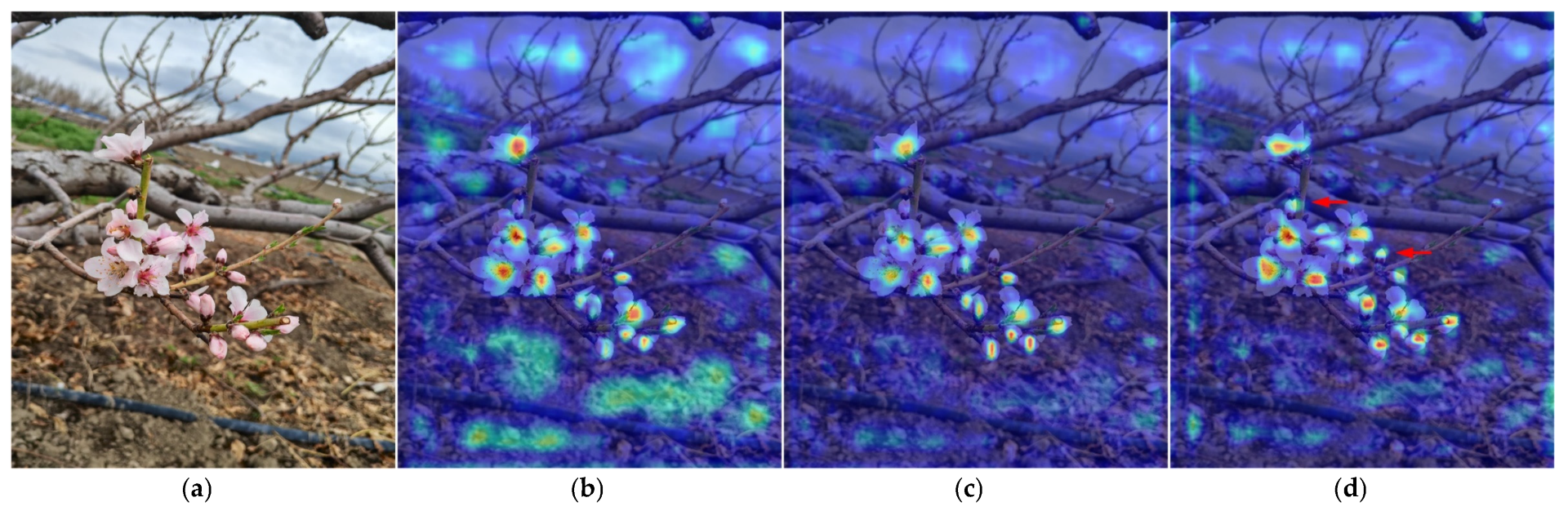
Figure 9b visually presents the attention of the baseline model in identifying the flat peach inflorescence, where the darker the color, the greater the attention of the model. However, the model not only pays attention to the target inflorescence but also to the ground debris and the background sky. In contrast, the RB-YOLO model optimized by the backbone network in Figure 9c significantly reduces ineffective attention to non-target objects, such as the background, and focuses more on detecting the object itself. Furthermore, the RBCN-YOLO model shown in Figure 9d, after the introduction of the attention mechanism, has a more accurate and efficient recognition of the flat peach inflorescence. Additionally, it demonstrates excellent detection ability for some hard-to-identify areas (as indicated by the red arrow). Although the model is slightly more concentrated on the irrelevant background than RB-YOLO, it is better able to focus on the target to be detected compared to YOLOv8. The aforementioned heatmaps clearly reveal the varying importance of different input features as perceived by the model. They also effectively identify and locate the possible flaws of the model in processing specific features or data. This enhances the interpretability and transparency of the model, which fully validates the effectiveness of our model improvement strategy.
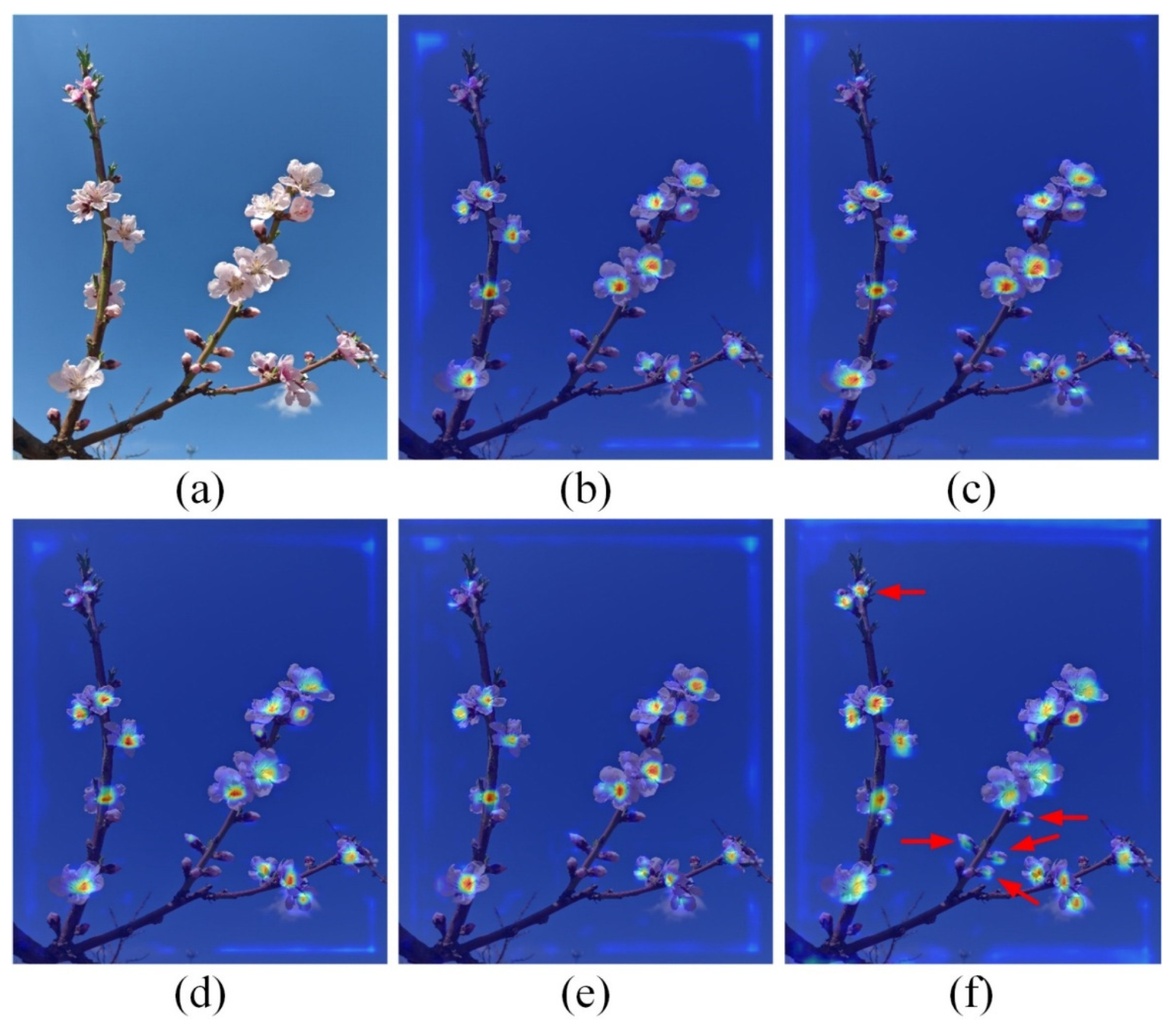
Figure 10 presents heatmaps generated by different neck networks. It can be observed that among the compared neck architectures, RB-YOLO demonstrates superior performance in detecting small targets. As indicated by the arrows in Figure 10f, it more effectively identifies small-sized inflorescences located at the treetop and branch roots. In contrast, although ASF and BiFPN also detect some smaller inflorescences, they exhibit less focused attention on these objects compared to RB-YOLO. Furthermore, YOLOv8-ADown shows a stronger interest in the objects it does recognize. However, its overall detection performance remains lower than that of RB-YOLO.
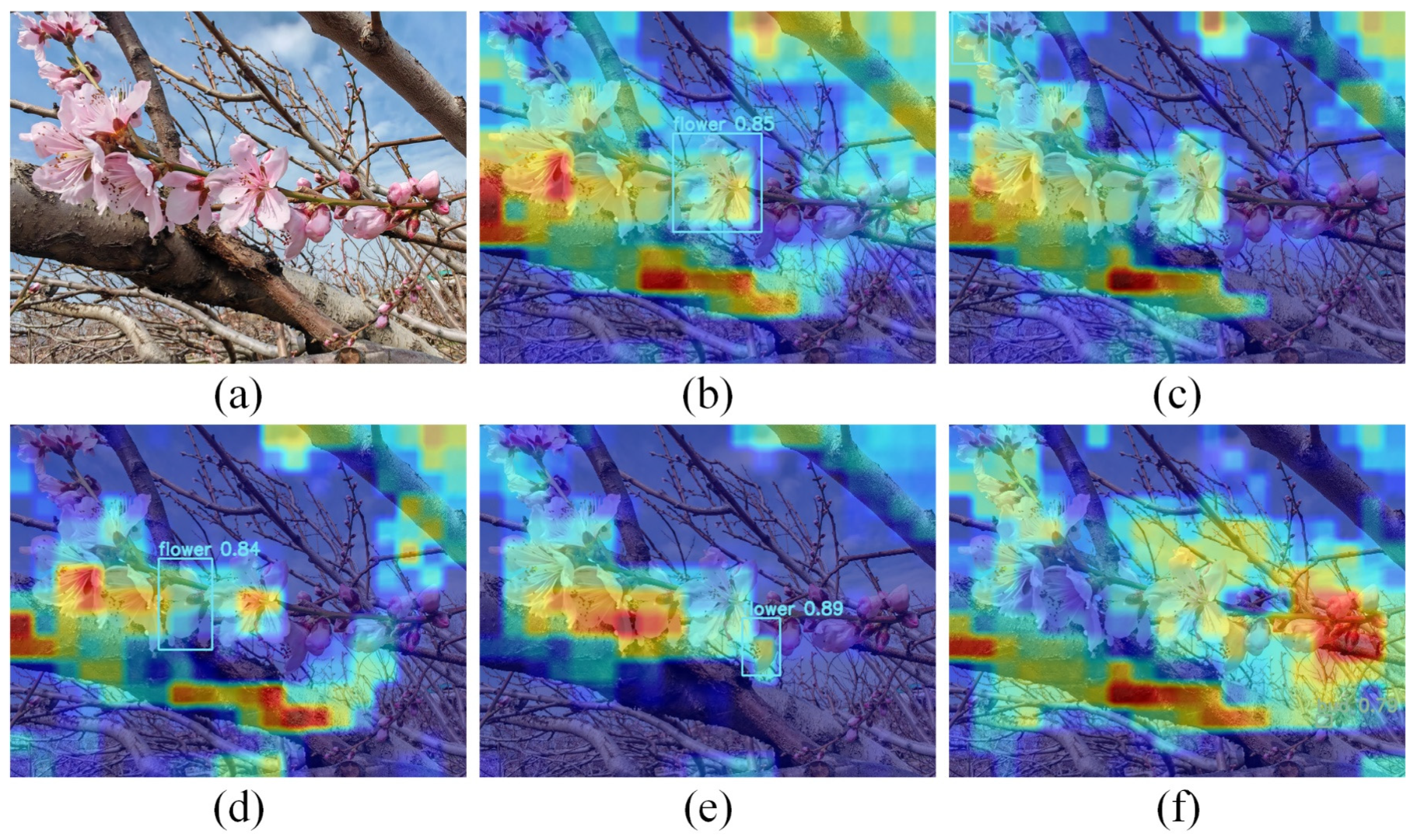
Figure 11 displays heatmaps generated using different attention mechanisms. It can be observed that RB-YOLO exhibits strong attention to the inflorescences in the front-left area. But it fails to show sufficient interest in the darker inflorescences located in the rear-right region. Additionally, it demonstrates certain responses to non-target objects such as branches and the sky. The introduction of attention mechanisms, including CAA, MHSA, SE, and CAFM based on RB-YOLO, enhances the model’s focus on target regions. While CAA and MHSA partially reduce the model’s attention to non-target areas, they still do not adequately emphasize the darker inflorescences in the rear-right. Although SE most effectively suppresses attention to branches, it also sacrifices considerable focus on the target inflorescences. In comparison, the CAFM module delivers overall better performance in highlighting target inflorescences. It comprehensively focuses on the target inflorescence and demonstrates sufficient interest.

3.2. Comparison of Model Effects in Different Natural Scenes

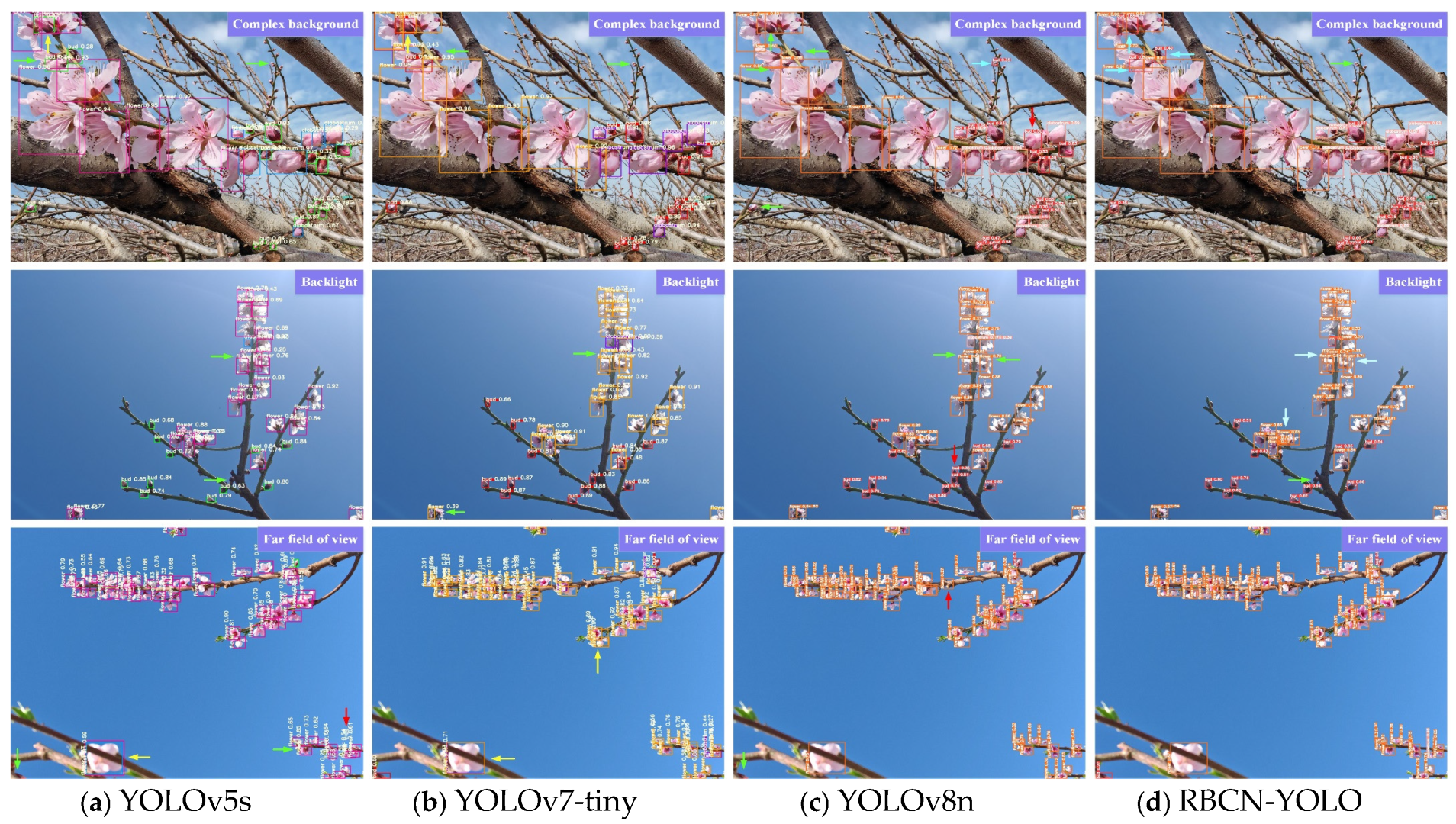
To comprehensively assess the performance of RBCN-YOLO, the recognition performance of RBCN-YOLO was compared with that of YOLOv5s, YOLOv7-tiny, and YOLOv8n models in the flat peach inflorescences dataset. Figure 12a–d shows the detection effects of several models under complex background interference, the challenge of backlight conditions, and the far field of view.
In a complex background, YOLOv5s, YOLOv7-tiny, and YOLOv8n tend to have repeated detections and missed detections for small and heavily occluded objects (such as the bud class) and non-distinctive objects (such as the alabastrum class). However, RBCN-YOLO demonstrates higher accuracy and comprehensiveness in such detection tasks (such as the bright blue region), effectively reducing the risk of false detection and missed detection.
In the condition of backlight, the interaction between the specific irradiation angle of sunlight and the pink color of the flat peach inflorescence renders the inflorescence nearly transparent. Additionally, the interweaving of shadows in the recognition area poses significant challenges for image recognition. Under such circumstances, in comparison with the other three models, RBCN-YOLO can identify areas with severe occlusion more effectively. And it can also determine the number and category of detection targets (the bright blue area in the figure) more precisely. In the far field of view, the distance of the target and the extremely dense distribution of the flat peach inflorescence result in a narrow detectable area, and the occlusion is serious. Faced with this challenge, detection models such as YOLOv5s, YOLOv7-tiny, and YOLOv8n exhibited varying degrees of detection flaws, such as missed detection, incorrect detection, and repeated detection (as indicated by the arrow area). In contrast, the RBCN-YOLO has demonstrated advantages in achieving accurate detection results in the aforementioned problem areas. Table 8 quantitatively shows the detection effects of several models in Figure 12 under three natural environments. In the three scenarios, the detection effect of RBCN-YOLO is better than other models.
To conclude, RBCN-YOLO has attained excellent detection outcomes in the aforementioned scenarios. This effectively demonstrates the feasibility of the model improvement strategy.

3.3. Model Evaluation of RBCN-YOLO

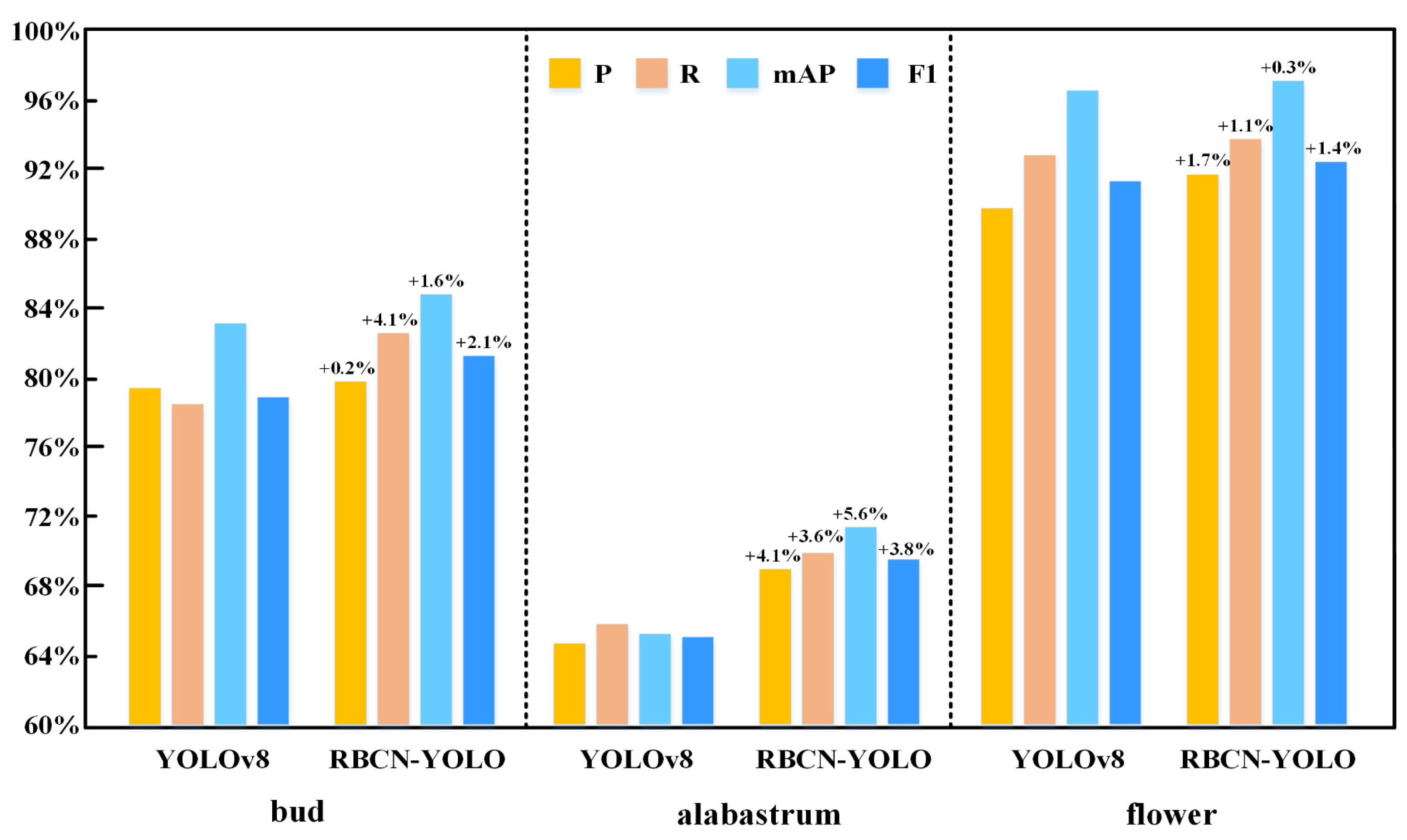
To further substantiate the efficacy of the enhanced model, detailed recognition outcomes are provided. Table 9 shows the recognition precision, recall rate, mAP value, and F1 scores of the improved RBCN-YOLO and Baseline model (YOLOv8) for bud, alabastrum, and flower. Specifically, the RBCN-YOLO significantly improves the recognition precision by 0.2%, 4.1%, and 1.7%, recall rates by 4.1%, 3.6%, and 1.1%, mAP@0.5 value by 1.6%, 5.6%, and 0.3%, and F1 scores by 2.1%, 3.8%, and 1.4% for bud, alabastrum, and flower. In addition, the mAP@0.5:0.95 values of bud, alabastrum, and flower all increased by 2.1%, 3.1%, and 1.5%, respectively.
To provide a more detailed and intuitive presentation, Figure 13 illustrates the specifics. As shown in Figure 13, the recognition indicators of category “alabastrum” showed the most significant increase, with recognition precision and mAP@0.5 value increasing by 4.1% and 5.6%, respectively. For the majority flower class, the mAP@0.5 value increased by a modest 0.3% and the F1-score by 1.4%, with no signs of performance inflation due to overfitting. This indicates that our model avoided underfitting the alabastrum class and overfitting the flower class.
In this study, the classification of alabastrum falls between flower and bud. Its morphological characteristics have certain similarities with the other two types of flat peach inflorescence at different stages, which poses a huge challenge for the accurate identification of the model. After optimization, the recognition index of flat peach inflorescence in the alabastrum category has been effectively improved, while the recognition ability of inflorescence in the bud and flower categories has also been correspondingly enhanced. This achievement fully validates the efficiency and practicality of the improvement measures we have taken for the model.

3.4. Test Results of Edge Device Deployment

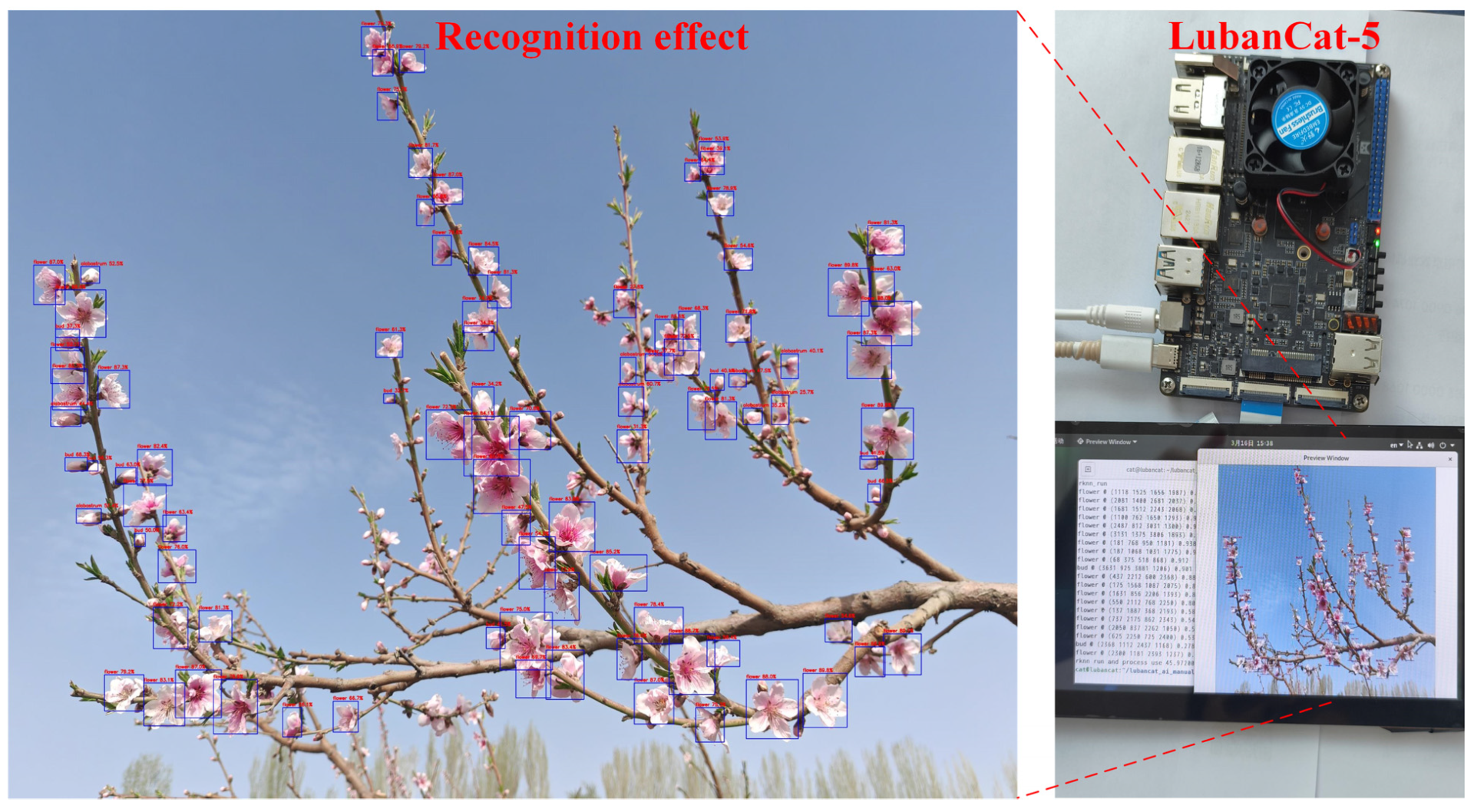
To test the real-time detection effect of the RBCN-YOLO model, YOLOv8n and RBCN-YOLO were deployed on the edge device LubanCat-5 8GB. The data set of 50 images mentioned in Section 2.2 was tested. The average single image detection time of the YOLOv8n model is 65 ms, and the average single image detection time of the RBCN-YOLO model is 57 ms, which is 12.31% shorter than that of the original model.
To make the results more convincing, the test with deployment on an NVIDIA (Santa Clara, CA, USA) Jetson Nano (4 GB) was also supplemented. Under the same set of 50 test images, both the YOLOv8n model and the RBCN-YOLO model were deployed and executed using TensorRT (v8.6.1, NVIDIA) for inference acceleration. The experimental results are summarized in Table 10.
As shown in Table 10, on the Jetson Nano, the RBCN-YOLO model maintained its advantage over the baseline model, demonstrating faster detection speed (an improvement of approximately 17%). This confirms the effectiveness and generalizability of our model improvements, which are not dependent on specific hardware. The computational capacity of the Jetson Nano (4 GB) is lower than that of the LubanCat-5 (8 GB), resulting in longer inference times. This underscores the importance of testing across platforms with different computational constraints.
The single image detection results of RBCN-YOLO are shown in Figure 14 (LubanCat-5). The number of bud, alabastrum, and flower categories detected by the RBCN-YOLO model was 10, 9, and 74, respectively. The number of missed detections was 9, and the number of wrong detections was 3. In summary, the improved RBCN-YOLO model has the characteristics of lighter weight, which can provide support for the development of intelligent flower-thinning equipment.

3.5. Flower Thinning Strategy Based on RBCN-YOLO

3.5.1. Flat Peach Flower Thinning Strategy Overall Overview

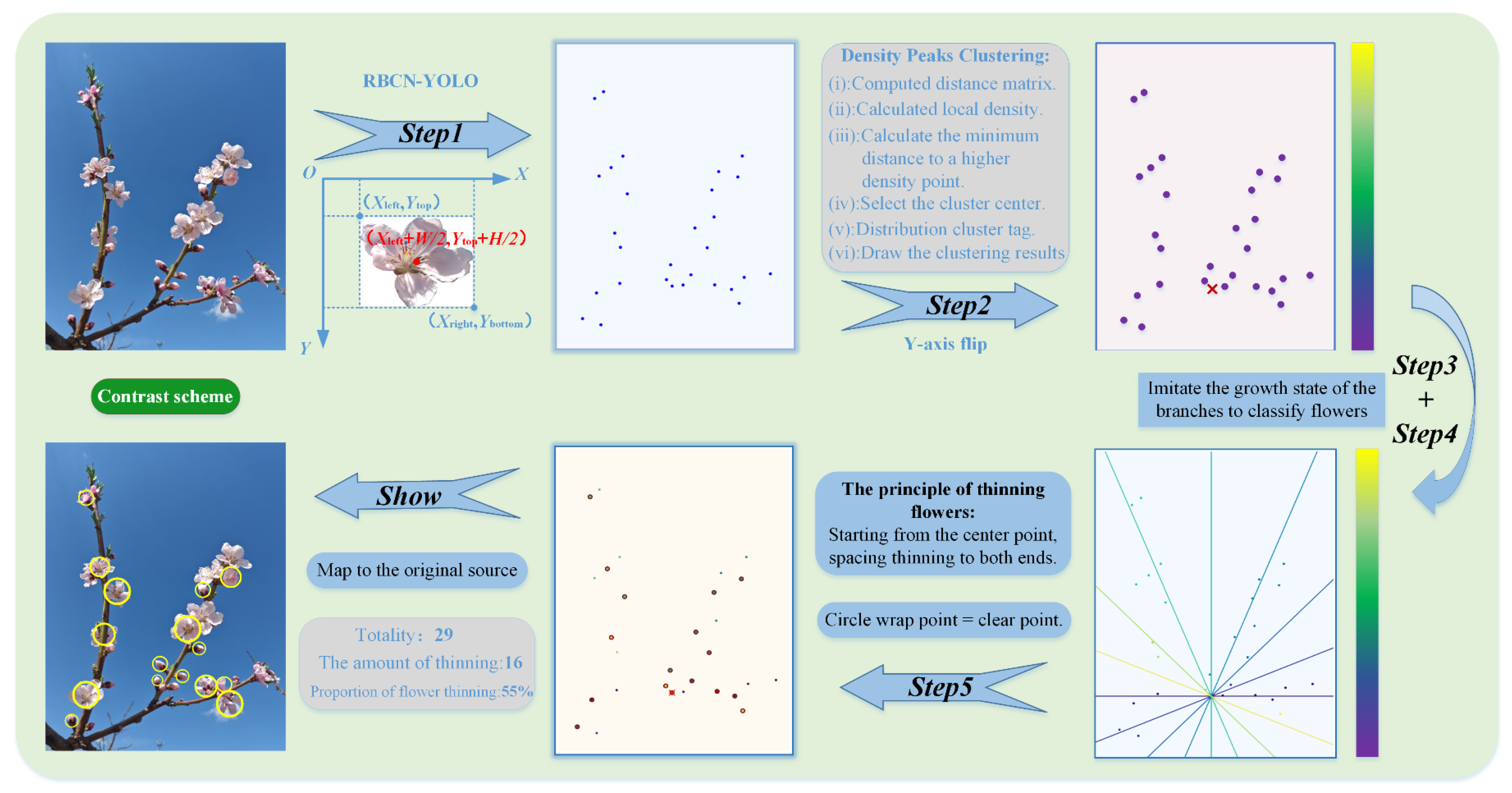
To fully utilize the RBCN-YOLO model and further advance the research progress of flat peach flower thinning technology, a strategy for flat peach flower thinning based on the RBCN-YOLO model was proposed. Figure 15 presents the specific process of the flower thinning strategy. It is imperative to highlight that the images utilized in the flower thinning strategy are RGB color images. These images are captured using mobile phones, so the reference point of image collection is located at the location of the camera of the mobile phone. This is also in line with the requirements of image acquisition when the robot is actually working. The specific process of the flat peach flower thinning strategy is as follows:
Step 1: The RBCN-YOLO network is employed to recognize the images of the flat peach inflorescence, accurately capture and output the coordinate information of each target class, which is then properly stored.
Step 2: The density peak clustering algorithm is utilized to analyze the density distribution of the flat peach inflorescence and scientifically determine the center point for flower thinning.
Step 3: With this central point as the core, the natural growth state of the peach branches is ingeniously simulated, and eight radiating straight lines are drawn from the horizontal position to evenly divide the entire area.
Step 4: By calculating the distance between the remaining points and these eight lines, and in accordance with the principle of “the closest line belongs to”, the branch of each flat peach inflorescence is precisely determined.
Step 5: When addressing the central point of the inflorescence in each line, based on the specific principles of flower thinning, interval markers are placed from the central point towards both ends (simulating an interval thinning operation).
Through this strategy, not only can efficient management of the flat peach inflorescence be achieved, but also the scientific and accurate flower thinning work can be ensured.

3.5.2. Extraction and Storage of Coordinates of Flat Peach Inflorescence

In this paper, the Pascal VOC2007 data set format was adopted. When predicting the flat peach inflorescence through the RBCN-YOLO network model, the coordinates of the upper left point (Xleft, Ytop) and lower right point (Xright, Ybuttom) of the prediction box could be obtained. The specific calculation is shown in Figure 15. In the pixel coordinate system, where O serves as the coordinate origin, with X as the horizontal axis and Y as the vertical axis, the coordinate point (Xleft, Ytop) represents the pixel point in the top row and left column of the image. And (Xright, Ybuttom) refers to the identical concept. The central coordinates of the target detection box are calculated as Equations (15)–(17):
H 1 = Y b o t t o m Y t o p
W 1 = X r i g h t X l e f t
( X c e n t e r , Y c e n t e r ) = ( X l e f t + W 1 / 2 , Y t o p + H 1 / 2 )
The extracted center point coordinates of the target box are stored in the txt file, and subsequent operations are carried out.

3.5.3. Determination of Flower Thinning Center Point

Estimating the density of the flat peach inflorescence and determining its density center are the prerequisites for achieving accurate thinning [28]. As a classical density-dependent clustering approach, the density peak clustering algorithm can precisely identify and determine the density core region of the peach inflorescence based on the acquired coordinate information. The following is the detailed decision-making process:
(i) The Euclidean distance between the points is calculated to form a distance matrix. This matrix is then used to calculate the local density of points and the distance between points. Given that the dataset encompasses N sample points, calculate the distance dij between any two of the sample points as Equation (18):
d i j = d i s t x i , x j = k = 1 D x i , k x j , k 2
where xi and xj represent the coordinates of the i and j sample points, respectively; dist (xi, xj) represents the Euclidean distance of two coordinates xi and xj; D represents dimension; xi,k and xj,k represent the coordinates of the i and j sample points on dimension k, respectively, i, j ∈ {1,2,... N}.
(ii) The local density ρi for the point i is calculated by the Gaussian kernel function, the specific formula as Equation (19):
ρ i = j i e x p d i j d c 2
where dij is the Euclidean distance between points i and j, obtained from the distance matrix, dc is a cutoff distance used to control the range of the Gaussian kernel, usually chosen so that the average number of neighbors per point is a certain percentage of the total number of points (such as 1–2%).
(iii) For point i, points denser than it needs to be found, and the minimum distance to these points δi is calculated as in Equation (20):
δ i = min j : ρ j > ρ i d i j
(iv) The clustering center is selected based on the product of the local density ρi of points and the minimum distance δi to higher density points. Specifically, select the top n points with the maximum product ρi × δi as the clustering centers. In this study, one cluster center was selected, and its specific value could be adjusted in accordance with the circumstances.
(v) For other points that are not cluster centers, they are assigned to the nearest cluster center to form distinct clusters based on their distance from the cluster center.
(vi) Depict the clustering results, with the cluster centers marked by red ‘x’.

3.5.4. Evaluation of Flower Thinning Strategy

To better assess the accuracy of the flower thinning strategy based on the RBCN-YOLO model, the effect of the implemented flower thinning strategy was compared with the outcome of manual thinning on the same data set. It is worth pointing out that the dataset used for this comparison is a dataset of 50 images mentioned in Section 2.2. These images contain the scenes mentioned above, and each image contains multiple branches.
Table 11 elaborates on the specific indicators of artificial flower thinning effectiveness under the new dataset. Flower thinning aims at precisely eliminating redundant flowers to ensure an appropriate distance between adjacent inflorescences. According to this principle, during the artificial flower thinning process, the proportion of flat peach inflorescence was 50.16%, with nearly half of the flat peach inflorescence being evacuated, to achieve the optimal flower thinning effect. In contrast, the proposed flower thinning strategy based on the RBCN-YOLO model has a thinning rate of 54.55%, which is similar to that of artificial flower thinning. By comparing the inflorescence of the flower thinning strategy and the inflorescence of the artificial decision, the correct thinning rate was 78.84%, thus demonstrating the effectiveness of the flower thinning strategy. Notably, artificial flower thinning is typically conducted by inspecting peach branches one by one and dividing them at intervals. However, our flower thinning strategy first determines the density center of inflorescences in the area, then divides the inflorescences on the same branch, and subsequently performs interval thinning. There are differences in the implementation principles of these two methods, resulting in distinct specific removal points. Therefore, the accurate removal rate cannot reach 100.00%. It should be emphasized that the implementation of the flower thinning strategy ensures an appropriate distance between peach inflorescences after the spacing thinning operation and can also meet the requirements of flower thinning.

3.6. Application Practice of Model Improvement

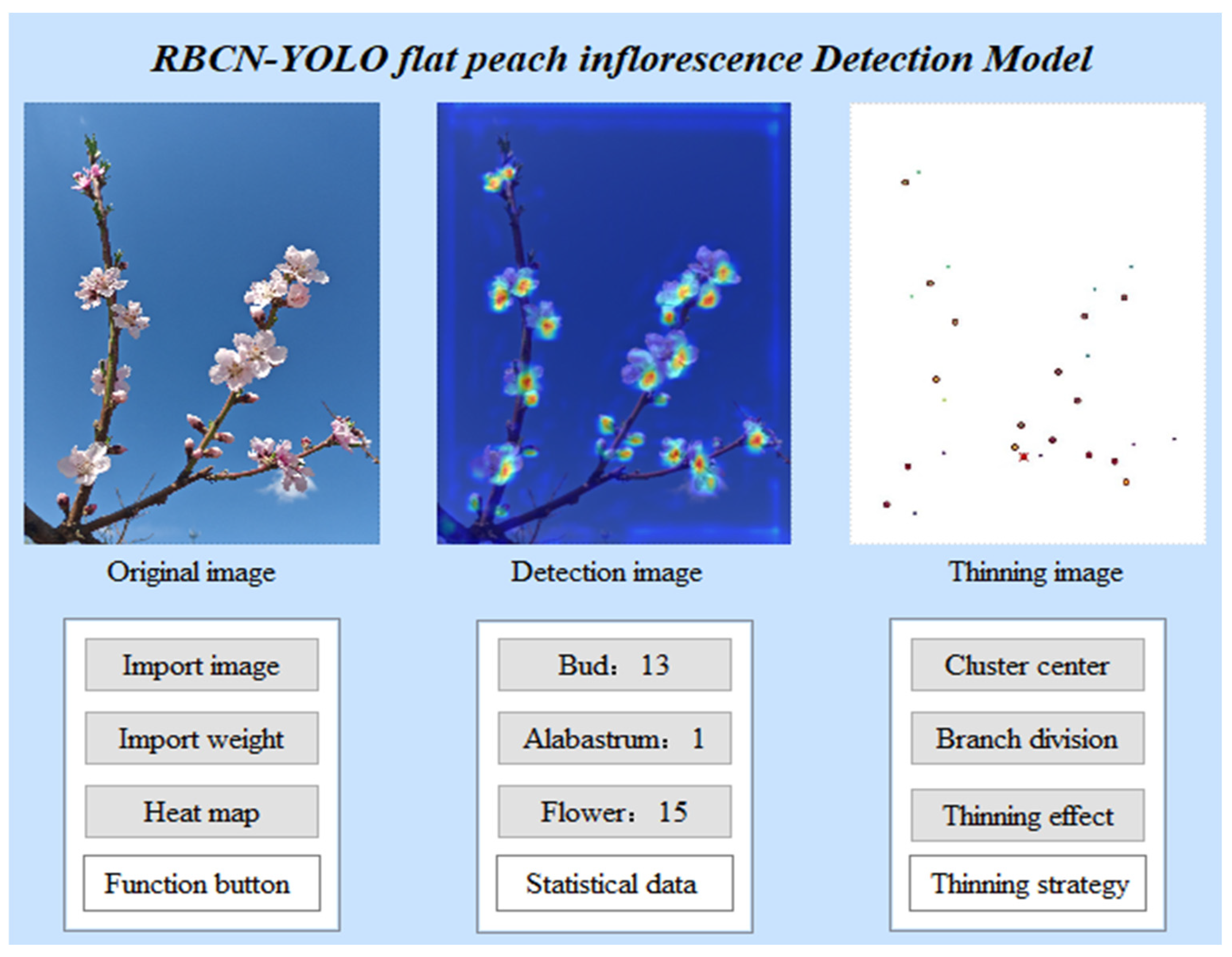
To enhance the visual interactivity and practicality of the model, the RBCN-YOLO model is integrated with the PyQt5 framework and OpenCV library to develop a system dedicated to the detection and recognition of flat peach inflorescence. Figure 16 shows the composition of the system. The specific operation of the system includes image input, model weight import, heat map display, inflorescence number statistics, and flower thinning strategy detail display [40]. Through this system, users can clearly and intuitively understand the flower flowering situation and the specific flower thinning strategy, and it can provide help for precise flower thinning management of orchards.

4. Discussion

This research proposes a precise flower thinning strategy for flat peach inflorescence based on RBCN-YOLO, which is deeply focused on achieving precise flower thinning. In the field of precise flower thinning, numerous scholars have contributed a series of inspiring algorithms and ideas, laying a solid foundation for our work and providing valuable references. For instance, Zhou et al. [28] effectively classified the density of pear flowers by enhancing the density peak clustering algorithm. They utilized a deep learning model to accurately extract pear flower location information and scientifically classify local pear flowers in their natural environment. However, while the classification method is highly effective, it does not address the specific flower thinning strategy post-classification. In contrast, our study builds upon this foundation and clearly outlines a feasible flower thinning protocol. Another noteworthy study is the method proposed by Si et al. [29] for thinning single-branch inflorescence of apple trees using YOLOv8-Seg. This method addresses the challenge of inflorescence thinning on a single branch of apple trees through semantic segmentation technology. Although this method performs well in specific scenarios, its application is relatively limited, primarily to the processing of single branches. Conversely, our proposed flower thinning strategy based on RBCN-YOLO demonstrates broader applicability. It integrates a target detection deep learning model with a relatively fast detection rate and successfully extends the flower thinning operation to larger scenes, beyond the thinning of a single branch. Importantly, empirical validation has shown that the accuracy of our flower thinning strategy reaches 78.84% of the manual thinning effect, thereby confirming its effectiveness and practicality.
In summary, the precise flower thinning strategy for flat peach inflorescence based on RBCN-YOLO not only offers a novel perspective and approach to precise flower thinning research but also provides a robust reference for achieving intelligent agricultural production.

Limitations

Although the RBCN-YOLO model and flower thinning strategy proposed in this study performed well in the task of almond inflorescence detection, the following limitations were recognized.
The training and validation data of this model were collected from a specific orchard and the flowering period of the same year. Although the dataset contains diverse lighting, angles, and occlusion conditions, its generalization ability still needs further verification under different geographical regions, climatic conditions, or planting patterns. However, enhanced robustness against conditions such as backlighting by improving the model structure and loss function, and simulated illumination variations in data augmentation, extreme or abnormal lighting conditions (such as strong overexposure at noon or extremely low illuminance at dawn and dusk) may still pose challenges to detection accuracy. Although the model has achieved real-time detection on LubanCat-5 and Jetson Nano, its power consumption and thermal management are crucial in long-duration, large-scale field operations. We have not yet conducted a quantitative assessment of the power consumption and heat dissipation of the equipment under continuous full-load operation, which is related to the equipment selection and system durability in practical applications.
Acknowledging these limitations does not diminish the contribution of this study but rather aims to more clearly define its scope of application and provide clear improvement goals for future research. The subsequent research work will focus on the above limitations.

5. Conclusions

In this study, the RBCN-YOLO model was proposed to precisely identify each growth stage of the flat peach inflorescence, particularly the alabastrum stage between bud and flower. This model provided technical support for subsequent flower thinning operations and other orchard management practices. To strengthen the core architecture of the model, the RepBlock and BiFusion modules were incorporated into the model’s neck network, which enhanced the efficiency of the model in extracting context information and fusing features. Meanwhile, by integrating the CAFM attention mechanism into the backbone structure of the model, the accuracy of feature extraction was further improved. Additionally, the NWD measure was combined with the CIoU loss function, which greatly enhanced the detection sensitivity of the model for small-sized targets. Through systematic comparative analysis and ablation experiment verification, the RBCN-YOLO model demonstrated performance improvement in the detection task of flat peach inflorescence. Specifically, the mAP@0.5 value reached 82.9%, the precision (P) was 78.3%, the recall rate (R) was 79.5%, and the F1 score was 78.9%. Especially in the detection of the alabastrum category, the mAP@0.5 was as high as 70.7%. Moreover, it demonstrated good real-time performance on an edge device (LubanCat-5), and the single image detection time is reduced by 12.31% compared with the original model. Furthermore, the flower thinning strategy based on RBCN-YOLO provides a scientific basis for the intelligent operation of the flower thinning robot and achieves an accurate flower thinning rate of 78.84%. And the integrated visualized system combining object detection and flower thinning strategy provides a valuable reference for orchard management.
In future studies, we aim to introduce depth image technology to address the sensitivity of the model to changes in light. This will further enhance the accuracy of flat peach inflorescence detection and reduce reliance on high-quality labelled data. The SAHI was combined with the RBCN-YOLO model to systematically evaluate its recall improvement effect on the bud and snowflake categories on the dataset. It is planned to deploy the RBCN-YOLO model on the orchard inspection robot platform for on-site verification. Furthermore, in future work, we will evaluate the stability and energy efficiency ratio of the model under long-term high-load inference tasks.


Author Contributions

Conceptualization, Y.X. (Yongchuang Xiong), Y.X. (Ying Xu) and J.C.; methodology, Y.X. (Yongchuang Xiong) and Y.C.; software, Y.X. (Yongchuang Xiong); validation, Y.X. (Ying Xu) and J.C.; formal analysis, Y.X. (Yongchuang Xiong); investigation, Y.X. (Yongchuang Xiong); resources, B.M.; data curation, Y.X. (Ying Xu) and J.C.; writing—original draft preparation, Y.X. (Yongchuang Xiong); writing—review and editing, Y.X. (Yongchuang Xiong) and B.M.; visualization, Y.C.; project administration, B.M.; funding acquisition, B.M. and J.C. All authors have read and agreed to the published version of the manuscript.

Funding

This research was funded by the Science and Technology Innovation Talent Program of XPCC (grant number 2021CB035).

Data Availability Statement

The datasets presented in this article are not readily available because the data are part of an ongoing study. Requests to access the datasets should be directed to the corresponding author, Benxue Ma (email: mbx_mac@shzu.edu.cn).

Acknowledgments

We sincerely thank those who have offered us help and guidance during this research process. The authors would like to thank Fujia Dong and Guowei Yu for their supervision during this research. During the preparation of this manuscript, the author used ERNIE Bot 4.0 for the purposes of language polishing. The authors have reviewed and edited the output and take full responsibility for the content of this publication.

Conflicts of Interest

The authors declare no conflicts of interest.

References

  1. Farjon, G.; Krikeb, O.; Hillel, A.B.; Alchanatis, V. Detection and counting of flowers on apple trees for better chemical thinning decisions. Precis. Agric. 2020, 21, 503–521. [Google Scholar] [CrossRef]
  2. Zhao, R.; Xu, Y.; Li, C.; Wang, X.; Du, J.; Wang, C.; Shi, X.; Wang, B. Analysis of physicochemical characteristics, antioxidant activity, and key aroma compounds of five flat peach cultivars grown in Xinjiang. LWT 2023, 176, 114550. [Google Scholar] [CrossRef]
  3. Pan, Y.; Zhou, Y.; He, L.; Wang, Q.; Song, Z.; Song, L. Research progress of thinning flowers and fruits in orchard management. Trans. CSAE 2021, 42, 198–204. [Google Scholar] [CrossRef]
  4. Bhattarai, U.; Bhusal, S.; Zhang, Q.; Karkee, M. AgRegNet: A deep regression network for flower and fruit density estimation, localization, and counting in orchards. Comput. Electron. Agric. 2024, 227, 109534. [Google Scholar] [CrossRef]
  5. Li, Y.; Liu, Y.; Wu, C.; Zhao, R.; Li, M.; Cai, J.; Ma, L.; He, X.; Wu, X.; Zhenhua, Z. Effect of adjuvants on physicochemical properties of lime sulfur on flower/paraffin and application on flower thinning. Front. Plant Sci. 2023, 14, 1257672. [Google Scholar] [CrossRef]
  6. Lei, X.; Yuan, Q.; Xyu, T.; Qi, Y.; Zeng, J.; Huang, K.; Sun, Y.; Herbst, A.; Lyu, X. Technologies and Equipment of Mechanized Blossom Thinning in Orchards: A Review. Agronomy 2023, 13, 2753. [Google Scholar] [CrossRef]
  7. Khanal, S.R.; Sapkota, R.; Ahmed, D.; Bhattarai, U.; Karkee, M. Machine Vision System for Early-stage Apple Flowers and Flower Clusters Detection for Precision Thinning and Pollination. IFAC-PapersOnLine 2023, 56, 8914–8919. [Google Scholar] [CrossRef]
  8. Ireri, D.; Belal, E.; Okinda, C.; Makange, N.; Ji, C. A computer vision system for defect discrimination and grading in tomatoes using machine learning and image processing. Artif. Intell. Agric. 2019, 2, 28–37. [Google Scholar] [CrossRef]
  9. Guo, Q.; Chen, Y.; Tang, Y.; Zhuang, J.; He, Y.; Hou, C.; Chu, X.; Zhong, Z.; Luo, S. Lychee Fruit Detection Based on Monocular Machine Vision in Orchard Environment. Sensors 2019, 19, 4091. [Google Scholar] [CrossRef]
  10. Hočevar, M.; Širok, B.; Godeša, T.; Stopar, M. Flowering estimation in apple orchards by image analysis. Precis. Agric. 2014, 15, 466–478. [Google Scholar] [CrossRef]
  11. Pornpanomchai, C.; Sakunreraratsame, P.; Wongsasirinart, R.; Youngtavichavhart, N. Herb flower recognition system (HFRS). In Proceedings of the 2010 International Conference on Electronics and Information Engineering, Kyoto, Japan, 1–3 August 2010; pp. V1-123–V121-127. [Google Scholar] [CrossRef]
  12. Krikeb, O.; Alchanatis, V.; Crane, O.; Naor, A. Evaluation of apple flowering intensity using color image processing for tree specific chemical thinning. Adv. Anim. Biosci. 2017, 8, 466–470. [Google Scholar] [CrossRef]
  13. Lu, J.; Sang, N. Detecting citrus fruits and occlusion recovery under natural illumination conditions. Comput. Electron. Agric. 2015, 110, 121–130. [Google Scholar] [CrossRef]
  14. Lin, G.; Tang, Y.; Zou, X.; Cheng, J.; Xiong, J. Fruit detection in natural environment using partial shape matching and probabilistic Hough transform. Precis. Agric. 2020, 21, 160–177. [Google Scholar] [CrossRef]
  15. Wouters, N.; De Ketelaere, B.; Deckers, T.; De Baerdemaeker, J.; Saeys, W. Multispectral detection of floral buds for automated thinning of pear. Comput. Electron. Agric. 2015, 113, 93–103. [Google Scholar] [CrossRef]
  16. Wang, Z.; Verma, B.; Walsh, K.B.; Subedi, P.; Koirala, A. Automated mango flowering assessment via refinement segmentation. In Proceedings of the 2016 International Conference on Image and Vision Computing New Zealand (IVCNZ), Palmerston North, New Zealand, 21–22 November 2016; pp. 1–6. [Google Scholar] [CrossRef]
  17. Dias, P.A.; Tabb, A.; Medeiros, H. Multispecies Fruit Flower Detection Using a Refined Semantic Segmentation Network. IEEE Robot. Autom. Lett. 2018, 3, 3003–3010. [Google Scholar] [CrossRef]
  18. Sun, K.; Wang, X.; Liu, S.; Liu, C. Apple, peach, and pear flower detection using semantic segmentation network and shape constraint level set. Comput. Electron. Agric. 2021, 185, 106150. [Google Scholar] [CrossRef]
  19. Wang, X.; Tang, J.; Whitty, M. DeepPhenology: Estimation of apple flower phenology distributions based on deep learning. Comput. Electron. Agric. 2021, 185, 106123. [Google Scholar] [CrossRef]
  20. Tian, Y.; Yang, G.; Wang, Z.; Li, E.; Liang, Z. Instance segmentation of apple flowers using the improved mask R–CNN model. Biosyst. Eng. 2020, 193, 264–278. [Google Scholar] [CrossRef]
  21. Tian, M.; Chen, H.; Wang, Q. Detection and Recognition of Flower Image Based on SSD network in Video Stream. J. Phys. Conf. Ser. 2019, 1237, 032045. [Google Scholar] [CrossRef]
  22. Wu, D.; Lv, S.; Jiang, M.; Song, H. Using channel pruning-based YOLO v4 deep learning algorithm for the real-time and accurate detection of apple flowers in natural environments. Comput. Electron. Agric. 2020, 178, 105742. [Google Scholar] [CrossRef]
  23. Shang, Y.; Xu, X.; Jiao, Y.; Wang, Z.; Hua, Z.; Song, H. Using lightweight deep learning algorithm for real-time detection of apple flowers in natural environments. Comput. Electron. Agric. 2023, 207, 107765. [Google Scholar] [CrossRef]
  24. Li, G.; Suo, R.; Zhao, G.; Gao, C.; Fu, L.; Shi, F.; Dhupia, J.; Li, R.; Cui, Y. Real-time detection of kiwifruit flower and bud simultaneously in orchard using YOLOv4 for robotic pollination. Comput. Electron. Agric. 2022, 193, 106641. [Google Scholar] [CrossRef]
  25. Jing, R.; Niu, Q.; Tian, Y.; Zhang, H.; Zhao, Q.; Li, Z.; Zhou, X.; Li, D. Sunflower-YOLO: Detection of sunflower capitula in UAV remote sensing images. Eur. J. Agron. 2024, 160, 127332. [Google Scholar] [CrossRef]
  26. Bai, Y.; Yu, J.; Yang, S.; Ning, J. An improved YOLO algorithm for detecting flowers and fruits on strawberry seedlings. Biosyst. Eng. 2024, 237, 1–12. [Google Scholar] [CrossRef]
  27. Chen, J.; Ma, B.; Ji, C.; Zhang, J.; Feng, Q.; Liu, X.; Li, Y. Apple inflorescence recognition of phenology stage in complex background based on improved YOLOv7. Comput. Electron. Agric. 2023, 211, 108048. [Google Scholar] [CrossRef]
  28. Zhou, G.; Sun, L.; Liang, F.; Zhang, X. Pear flower density classification based on improved density peak clustering algorithm. Trans. CSAE 2023, 39, 126–135. [Google Scholar] [CrossRef]
  29. Si, Y.; Kong, D.; Wang, K.; Liu, L.; Yang, X. Method of thinning inflorescence of single branch of apple based on improved YOLOv8-Seg. Trans. CSAE 2024, 40, 100–108. [Google Scholar] [CrossRef]
  30. Wang, C.; Han, Q.; Zhang, T.; Li, C.; Sun, X. Litchi picking points localization in natural environment based on the Litchi-YOSO model and branch morphology reconstruction algorithm. Comput. Electron. Agric. 2024, 226, 109473. [Google Scholar] [CrossRef]
  31. Varghese, R.; Sambath, M. YOLOv8: A Novel Object Detection Algorithm with Enhanced Performance and Robustness. In Proceedings of the 2024 International Conference on Advances in Data Engineering and Intelligent Computing Systems (ADICS), Chennai, India, 28–29 March 2024; pp. 1–6. [Google Scholar] [CrossRef]
  32. Ding, X.; Zhang, X.; Ma, N.; Han, J.; Ding, G.; Sun, J. RepVGG: Making VGG-style ConvNets Great Again. In Proceedings of the 2021 IEEE/CVF Conference on Computer Vision and Pattern Recognition (CVPR), Virtual, 19–25 June 2021; pp. 13728–13737. [Google Scholar] [CrossRef]
  33. Chen, P.Y.; Chang, M.C.; Hsieh, J.W.; Chen, Y.S. Parallel Residual Bi-Fusion Feature Pyramid Network for Accurate Single-Shot Object Detection. IEEE Trans. Image Process. 2021, 30, 9099–9111. [Google Scholar] [CrossRef]
  34. Hu, S.; Gao, F.; Zhou, X.; Dong, J.; Du, Q. Hybrid Convolutional and Attention Network for Hyperspectral Image Denoising. IEEE Geosci. Remote Sens. Lett. 2024, 21, 5504005. [Google Scholar] [CrossRef]
  35. Xu, C.; Wang, J.; Yang, W.; Yu, H.; Yu, L.; Xia, G.-S. Detecting tiny objects in aerial images: A normalized Wasserstein distance and a new benchmark. ISPRS J. Photogramm. Remote Sens. 2022, 190, 79–93. [Google Scholar] [CrossRef]
  36. Cai, X.; Lai, Q.; Wang, Y.; Wang, W.; Sun, Z.; Yao, Y. Poly Kernel Inception Network for Remote Sensing Detection. arXiv 2024, arXiv:2403.06258. [Google Scholar] [CrossRef]
  37. Voita, E.; Talbot, D.; Moiseev, F.; Sennrich, R.; Titov, I. Analyzing Multi-Head Self-Attention: Specialized Heads Do the Heavy Lifting, the Rest Can Be Pruned. arXiv 2019, arXiv:1905.09418. [Google Scholar]
  38. Hu, J.; Shen, L.; Albanie, S.; Sun, G.; Wu, E. Squeeze-and-Excitation Networks. IEEE Trans. Pattern Anal. Mach. Intell. 2020, 42, 2011–2023. [Google Scholar] [CrossRef] [PubMed]
  39. Selvaraju, R.R.; Cogswell, M.; Das, A.; Vedantam, R.; Parikh, D.; Batra, D. Grad-CAM: Visual Explanations from Deep Networks via Gradient-Based Localization. In Proceedings of the 2017 IEEE International Conference on Computer Vision (ICCV), Venice, Italy, 22–29 October 2017; pp. 618–626. [Google Scholar] [CrossRef]
  40. Li, H.; Huang, J.; Gu, Z.; He, D.; Huang, J.; Wang, C. Positioning of mango picking point using an improved YOLOv8 architecture with object detection and instance segmentation. Biosyst. Eng. 2024, 247, 202–220. [Google Scholar] [CrossRef]
Figure 1. Flat peach inflorescence data samples under different natural scenes.
Agronomy 15 02715 g001
Figure 2. Dataset annotation diagram.
Agronomy 15 02715 g002
Figure 3. Presentation of the enhanced dataset.
Agronomy 15 02715 g003
Figure 4. The network structure of improved YOLOv8.
Agronomy 15 02715 g004
Figure 5. Diagram of the RepBlock structure. (a) During training, the RepVGG block is connected to a SiLU. (b) During inference, the RepVGG block is replaced with RepConv.
Agronomy 15 02715 g005
Figure 6. Reparameterization diagram of RepConv structure.
Agronomy 15 02715 g006
Figure 7. Schematic diagram of BiFusion structure.
Agronomy 15 02715 g007
Figure 8. Schematic diagram of CAFM structure.
Agronomy 15 02715 g008
Figure 9. Different networks recognize heat map representations of flat peach inflorescence: (a) Original Image. (b) YOLOv8 (Baseline model). (c) YOLOv8 with improved backbone network (RB-YOLO). (d) RBCN-YOLO.
Agronomy 15 02715 g009
Figure 10. Different neck networks recognize heat map representations of flat peach inflorescence: (a) Original Image. (b) YOLOv8. (c) YOLOv8-ADown. (d) YOLOv8-BiFPN. (e) YOLOv8-ASF. (f) RB-YOLO.
Agronomy 15 02715 g010
Figure 11. Different attention mechanisms recognize heat map representations of flat peach inflorescence: (a) Original Image. (b) RB-YOLO. (c) +CAA. (d) +MHSA. (e) +SE. (f) +CAFM.
Agronomy 15 02715 g011
Figure 12. Different models are adopted for the recognition effect of peach inflorescence in different scenes. Note: the area indicated by the arrow represents the disparity between the detection effect of the current image and that of other images, in which the prediction box indicated by the green arrow implies missed detection; the prediction box marked by the red arrow implies wrong detection; the prediction box pointed to by the yellow arrow implies repeated detection; the prediction box pointed to by the bright blue arrow implies difficult detection.
Agronomy 15 02715 g012
Figure 13. Comparison of specific results before and after model improvement.
Agronomy 15 02715 g013
Figure 14. The effect of edge device detection.
Agronomy 15 02715 g014
Figure 15. Flower-thinning strategy flowchart.
Agronomy 15 02715 g015
Figure 16. Detection and thinning system of flat peach inflorescence based on RBCN-YOLO.
Agronomy 15 02715 g016
Table 1. Number and proportion of categories after data expansion.
TypeAfter Expansion
QuantityProportion
bud11,78127.52%
alabastrum734717.16%
flower23,67955.32%
Table 2. The running environment configuration and key hyperparameter.
ComputerConfigurationKey HyperparameterParameters
OSWindow 10Image size640 × 640
RAM16 GEpoch200
CPU12th i7-12700Batch size16
GPUNVIDIA GeForce RTX3090OptimizerSGD
CuDA11.6Momentum0.937
Pytorch1.13Workers8
Table 3. Comparison of the results of improvement of different neck networks.
ModelP/%R/%mAP@0.5/%F1/%Weight/MInference Time/ms
YOLOv8n75.477.779.976.56.31.2
YOLOv8-Adown78.678.880.778.75.21.9
YOLOv8-BiFPN75.379.281.277.24.21.4
YOLOv8-ASF76.079.281.077.66.32.5
RB-YOLO76.379.281.677.75.61.3
Table 4. Comparison of results of different attention mechanisms in backbone networks.
ModelP/%R/%mAP@0.5/%mAP@0.5:0.95/%F1/%Weight/MInference Time/ms
RB-YOLO76.379.281.663.877.75.61.3
+CAA78.477.881.463.578.15.91.5
+MHSA77.278.681.963.177.96.02.0
+SE77.376.981.764.477.15.71.9
+CAFM77.777.182.064.077.46.11.5
Table 5. Comparison of results of different loss functions.
ModelP/%R/%mAP@0.5/%mAP@0.5:0.95/%F1/%
RBC-YOLO77.777.182.064.077.4
+EIoU76.479.281.463.377.8
+SIoU77.177.481.663.577.2
+PIoU77.679.182.264.178.3
+NWD-CIoU78.079.882.965.378.9
Table 6. Results of ablation experiments between YOLOv8 and RBCN-YOLO.
ModelRepBlock and BiFusionCAFMNWD-CIoUmAP@0.5/%F1/%Weight/MInference Time/ms
YOLOv8n 79.976.56.31.2
RB-YOLO 81.677.75.61.3
C-YOLO 80.577.36.62.1
N-YOLO 81.078.46.31.5
RBC-YOLO 82.077.46.11.5
RBN-YOLO 82.678.55.61.4
CN-YOLO 81.378.26.61.9
RBCN-YOLO82.978.96.11.6
Table 7. Comparison of detection results of different detection models.
ModelsP/%R/%mAP@0.5/%F1/%Flops/GWeight/M
Faster-RCNN77.276.478.976.8368.7108.1
EfficientDet78.976.981.777.92.714.9
SlimYOLOv377.675.279.776.414.419.3
YOLOv5s77.178.479.977.716.514.4
YOLOv7-tiny77.277.580.077.413.212.3
YOLOv777.979.181.278.5105.1284.0
YOLOv8n75.477.779.976.58.76.3
YOLOv8s78.678.081.378.328.422.5
YOLOv8m77.580.881.579.178.752.0
YOLOv9t78.977.982.478.410.75.8
YOLOv10n79.976.680.878.28.25.5
YOLOv11n75.176.379.075.76.35.2
RBCN-YOLO78.379.582.978.98.56.1
Table 8. Test results of several models in different natural scenes.
ModelEnvironmentMissed DetectionWrong
Detection
Manual StatisticsModel Correct RecognitionAccuracy/%
YOLOv5scomplex background62413380.48
backlight52484185.42
far field of view22595593.22
YOLOv7-tinycomplex background62413380.48
backlight41484389.58
far field of view02595796.61
YOLOv8ncomplex background71413380.48
backlight32484389.58
far field of view11595796.61
RBCN-YOLOcomplex background40413790.24
backlight31484491.67
far field of view005959100.00
Table 9. Comparison of experimental results before and after improvement.
ModelClassP/%R/%mAP@0.5/%mAP@0.5:0.95/%F1/%
YOLOv8bud79.478.483.060.178.9
alabastrum64.465.665.155.565.0
flower89.592.696.180.991.0
all75.477.779.963.876.5
RBCN-YOLObud79.682.584.662.281.0
alabastrum68.569.270.758.668.8
flower91.293.796.479.392.4
all78.379.582.965.378.9
Table 10. Comparison of inference time deployed to different edge devices.
ModelEdge DeviceAverage Detection Time/msFPS
YOLOv8nJetson Nano1835.46
RBCN-YOLOJetson Nano1526.58
YOLOv8nLubanCat-56515.38
RBCN-YOLOLubanCat-55717.54
Table 11. Comparison of the flower thinning effect.
ModelClassTotal NumberThinning NumberThinning Rate (%)Correct
Thinning Rate (%)
ArtificialAlgorithmArtificialAlgorithm
RBCN-
YOLO
bud35220320957.7059.3879.39
alabastrum157728345.8652.8774.91
flower173485093249.0253.7579.08
all22431125122450.1654.5578.84
Disclaimer/Publisher’s Note: The statements, opinions and data contained in all publications are solely those of the individual author(s) and contributor(s) and not of MDPI and/or the editor(s). MDPI and/or the editor(s) disclaim responsibility for any injury to people or property resulting from any ideas, methods, instructions or products referred to in the content.