Article

Determining the Genetic Architecture and Breeding Potential of Quality Traits in Alfalfa (Medicago sativa L.) Through Genome-Wide Association Study and Genomic Prediction


1
Institute of Animal Science, Chinese Academy of Agricultural Sciences, Beijing 100193, China
2
State Key Laboratory of Tropical Crop Breeding, Shenzhen Branch, Guangdong Laboratory of Lingnan Modern Agriculture, Key Laboratory of Synthetic Biology, Ministry of Agriculture and Rural Affairs, Agricultural Genomics Institute at Shenzhen, Chinese Academy of Agricultural Sciences, Shenzhen 518000, China
3
Institute of Animal Science, Ningxia Academy of Agricultural and Forestry Sciences, Yinchuan 750002, China
*
Authors to whom correspondence should be addressed.
These authors contributed equally to this work.
Agronomy 2025, 15(12), 2679; https://doi.org/10.3390/agronomy15122679
Submission received: 19 October 2025 / Revised: 14 November 2025 / Accepted: 21 November 2025 / Published: 21 November 2025

Abstract

Alfalfa (Medicago sativa L.) is a high-nutritive-value forage crop that provides livestock with abundant protein and essential nutrients. Breeding elite cultivars with superior quality has become a major goal in modern alfalfa improvement. This study systematically evaluated 12 quality-related traits under field conditions using a diverse panel of 176 alfalfa accessions and investigated the genetic basis underlying these traits. Phenotypic analysis revealed variability across all traits, with coefficients of variation ranging from 2.56% to 15.72%. Based on multi-trait clustering analysis, 16 accessions with overall superior quality were identified. Genome-wide association studies (GWAS) detected 45 significant single nucleotide polymorphisms (SNPs) and 12 structural variants (SVs). Within the associated genomic regions, eight candidate genes were prioritized. RT-qPCR validation indicated that three of these genes (Msa.H.0301430, Msa.H.0290550, and Msa.H.0313490) negatively regulate quality traits, while one gene (Msa.H.0479570) acts as a positive regulator. Haplotype analysis further revealed a positive correlation between the number of favorable haplotypes and phenotypic performance. Genomic prediction (GP) achieved accuracies ranging from 0.71 to 0.86 for the traits when incorporating the top 5000 SNPs identified from GWAS. This study provides valuable insights into the genetic architecture of quality-related traits in alfalfa and lays a solid foundation for future molecular design breeding.
Keywords:
alfalfa; quality; GWAS; GP

1. Introduction

Alfalfa (Medicago sativa L.), cultivated worldwide as a perennial leguminous forage crop, is hailed as the “Queen of Forages” [1,2]. It possesses exceptional nutritional value, providing abundant crude protein, vitamins, minerals, and essential amino acids crucial for animal health [3]. Alfalfa’s high digestibility and palatability make it a superior source of high-quality forage [4]. Consequently, breeding cultivars with superior forage quality has become the primary objective in modern alfalfa breeding programs.
Protein content, fiber content, lignin content, and digestibility are critical factors determining alfalfa quality [5]. Alfalfa converts environmental nitrogen into organic nitrogen through rhizobial nitrogen fixation, nitrate reduction, and ammonium assimilation [6,7,8]. This enables the crude protein content of alfalfa to exceed 20% at the early flowering stage [9], significantly enhancing the nutritional status, product quality, and yield of ruminants [10]. Acid detergent fiber (ADF) and neutral detergent fiber (NDF) serve as essential indicators for evaluating forage fiber quality. ADF represents the fraction of NDF devoid of hemicellulose [11]. After acid detergent treatment, ADF consists exclusively of cellulose, lignin, and cutin, with lower values indicating superior alfalfa quality [12]. NDF quantifies available forage mass and predicts its energy value because it includes hemicellulose, a component that livestock can partially digest. Neutral detergent fiber digestibility (NDFD) assesses the disappearance of NDF in the rumen over a 24–48 h period. Lignin, the second most abundant component in plant secondary walls after cellulose, is a complex polymer derived from hydroxylated and methoxylated phenylpropane monomers [13]. Although indispensable for plant development, mechanical support, and pathogen resistance, elevated lignin content substantially reduces digestibility and compromises forage quality. Consequently, strategic modulation of lignin content or composition is crucial and must be achieved without disrupting normal plant growth.
Substantial progress has been made in enhancing alfalfa forage quality through genetic engineering. Research demonstrates that low-level expression of the WRKY dominant repressor (WRKY-DR) improves cell wall saccharification efficiency by enhancing pith lignification, whereas high expression impairs fiber quality by suppressing NST1. Synergistic downregulation with the lignin biosynthetic gene COMT further amplifies this effect, resulting in comprehensive quality improvement [14]. CRISPR/Cas9-mediated knockout of MsC3H significantly reduces stem lignin content while concurrently improving ADF and NDF digestibility. This intervention also enhances key nutritional metrics including total digestible nutrients (TDNs), relative feed value (RFV), and in vitro true dry matter digestibility (IVTDMD), thereby providing a novel strategy for developing transgene-free elite alfalfa cultivars [15]. Heterologous expression of the Arabidopsis orphan gene QQS elevates crude protein content through enhanced nodular nitrogen fixation efficiency. Concurrently, it suppresses lignin biosynthesis to reduce NDF and lignin levels while increasing branch number and plant height. These coordinated effects optimize both biomass yield and digestibility [16]. Furthermore, indirect quality enhancement via agronomic trait modification contributes to superior forage quality. Examples include increasing the leaf-to-stem ratio to boost digestible nutrient proportion [17] and delaying flowering to retard fiber deposition [18].
While genetic engineering has demonstrated marked efficacy in enhancing quality traits of alfalfa, elucidating the polygenic synergistic regulatory networks governing forage quality necessitates genome-wide analytical strategies. As a cornerstone methodology for dissecting the genetic architecture of complex quantitative traits, genome-wide association studies (GWAS) identify phenotype-associated single nucleotide polymorphisms (SNPs) through linkage disequilibrium (LD)-based genome scanning, achieving breakthroughs in crops including rice [19,20], maize [21,22], and wheat [23,24,25]. In alfalfa, GWAS investigations have similarly unraveled the genetic foundations of quality traits: Lin et al. [26] identified 131 multi-trait-associated markers and 24 functional genes via water-stress gradient trials, elucidating coordinated drought resistance-quality regulatory mechanisms. Building upon this foundation, the team precisely localized 28 SNPs associated with 16 quality traits, pinpointing core genetic loci for fiber digestibility and protein content while discovering candidate genes for cell wall biosynthesis [5]. Notably, structural variations (SVs) function as pivotal drivers in genomic evolution and play critical roles in crop domestication and agronomic trait regulation [27,28,29,30]. Pan-genomic research advances precise gene functional annotation through integration of species-wide complex SVs. He et al. [31] identified the quality-trait-associated candidate gene MsGA3ox1 by SV-GWAS, demonstrating that its overexpression significantly reduces the stem-to-leaf ratio while enhancing forage quality. Collectively, multidimensional genomics integrating SNP and SV analyses systematically deciphers alfalfa’s quality formation mechanisms, thereby furnishing targeted resources for precision molecular design of elite germplasm.
Genomic prediction (GP) enables precise assessment of individual genetic merit by integrating genome-wide molecular markers with phenotypic data to construct predictive models, thereby significantly reducing breeding costs and improving breeding efficiency [32]. Driven by rapid advances in high-throughput sequencing technologies and continually decreasing sequencing costs, GP has emerged as a transformative innovation in crop breeding. Studies have shown that significant loci identified through GWAS can be utilized to optimize GP statistical models, further enhancing the accuracy of genetic prediction [33,34]. For instance, in genomic prediction of fall dormancy in alfalfa, the use of the top 3000 markers selected via GWAS, combined with Support Vector Machine (SVM) regression, achieved the highest prediction accuracy of 0.64 [35]. Therefore, the integration of GP and GWAS has become a highly promising strategy in crop breeding, providing a scientific basis and operational guidance for accelerating breeding cycles through systematic integration of multi-source data and prior knowledge.
Despite the well-established agronomic value of alfalfa forage quality, significant knowledge gaps persist regarding its genetic basis and molecular regulatory mechanisms, especially in applying GWAS to dissect quality traits. To address this, we established a field trial population comprising 176 alfalfa accessions and conducted multidimensional GWAS integrating SNPs and SVs. This analysis targeted 12 key quality traits: ADF, ash, calcium (Ca), CP, insoluble protein (ISP), in vitro total dry matter digestibility 24/30/48 h (IVTDMD24, IVTDMD30, and IVTDMD48), lignin, NDF, NDFD48, and water-soluble carbohydrates (WSCs). Meanwhile, we employed machine learning-based GP approaches to predict these quality-related traits. This study aims to identify key genetic loci and candidate genes regulating quality formation, thereby providing critical targets and optimized strategies for alfalfa quality improvement.

2. Materials and Methods

2.1. Plant Materials and Growth Conditions

In this study, we employed an association panel comprising 176 alfalfa accessions to investigate the relationships between SNP markers, SV markers, and alfalfa forage quality-related traits [31]. These accessions originated from Asia, Africa, Europe, North America, and South America, including 14 wild accessions, 73 landraces, 72 cultivated varieties, and 17 accessions of unknown cultivation status (Table S1). The germplasm resources were obtained from the U.S. National Plant Germplasm System online database (https://npgsweb.ars-grin.gov/gringlobal/search, accessed on 7 July 2024) and the Medium Term Library of the National Grass Seed Resources of China.
Based on 176 alfalfa accessions, we established genetically identical association populations at two locations in Yinchuan City, Ningxia Hui Autonomous Region (Yongning County: 38.21° N, 106.22° E; Xixia District: 38.64° N, 106.12° E). Both sites experience a temperate continental climate. To ensure germplasm genotype uniformity, populations were established through asexual propagation. Each location featured three replicates with five seedlings per plot, arranged in a randomized complete block design with 100 cm row spacing and 60 cm plant spacing. Manual weeding was conducted for plant maintenance without additional field management practices such as fertilization or irrigation.

2.2. Phenotypic Data Collection and Analysis

Forage samples were collected at the initial flowering stage, placed in nylon mesh bags for shade-drying in a well-ventilated shelter, with consecutive two-year sampling (2024–2025) for each population. Brittle stems were oven-dried at 60 °C for 6 h, ground through a 1 mm sieve, and analyzed using a Foss NIRS D2500F spectrometer in reflectance mode across ~850–2500 nm, following manufacturer-recommended standardization and QC. Twelve phenotypes were selected: acid detergent fiber (ADF), ash, calcium (Ca), crude protein (CP), insoluble protein (ISP), in vitro total dry matter digestibility 24/30/48 h (IVTDMD24, IVTDMD30, and IVTDMD48), lignin, neutral detergent fiber (NDF), neutral detergent fiber digestibility 48 h (NDFD48), and water-soluble carbohydrates (WSCs). The R (v4.4.3) package lme4 computed best linear unbiased predictions (BLUPs) values for these traits and estimated broad-sense heritability:
H 2 = Vg Vg + Vge L + Vgy Y + Ve Y × R × L
where Vg represents genetic variance, Vge signifies genotype × environment interaction variance, Vgy represents genotype × year interaction variance, and Ve refers to residual variance, with R = 3 (number of replicates), Y = 2 (number of years), and L = 2 (number of locations). Phenotypic data were statistically analyzed using R software (v4.4.3) to calculate means, standard deviations, and other descriptive statistics. Differences in phenotypes based on geographical origins were assessed using Student’s t-tests, while phenotypic correlations and cluster analyses were performed and visualized using the online platform Chiplot (https://www.chiplot.online/, accessed on 16 August 2025).

2.3. Variant Discovery and Genotyping, GWAS, and Candidate Gene Annotation

Total genomic DNA was extracted using the CWBIO Plant Genomic DNA Kit (Beijing ComWin Biotech Co., Ltd., Beijing, China), following the manufacturer’s protocol. Sequencing was performed on the DNBSEQ platform at BGI-Shenzhen (Shenzhen, China). Approximately 36 Gb of raw sequencing data was generated for each genotype. Subsequently, paired-end reads were aligned to the ZM4 reference genome using BWA-MEM software (v0.7.17) [36]. Approximately 29.6 million SNPs were detected via the SAMtools VarScan pipeline [37]. Data filtering was conducted using vcftools (v0.1.16) [38] with the following criteria: missing rate ≤ 10%, mean read depth ≥ 5, and minor allele frequency (MAF) > 0.05. This resulted in a final set of 2,043,025 high-quality SNPs. Based on our previous pan-genome study, we curated 54,649 structural variants (SVs) [31] and genotyped them across the 176-accession panel.
After a comparison of multiple models, the FarmCPU model was selected for its optimal balance between controlling false positives and maintaining detection power and was subsequently implemented in the R package (v4.4.3) rMVP for GWAS, including the top three principal components (PC1–PC3) as fixed effects. To control multiplicity-induced false positives, we applied Bonferroni correction separately to SNPs and SVs using the LD-derived effective number of independent tests (α = 0.05/n). Results were visualized using CMplot. Candidate genes were defined on the ZM4 reference by scanning ±20 kb around each significant SNP/SV, followed by BLASTP searches against the NCBI database. For key SVs, genes within ±500 kb were subjected to GO enrichment analysis in TBtools [39], and outputs were visualized with Chiplot (https://www.chiplot.online/, accessed on 25 August 2025).

2.4. Analysis of Haplotypes and Favorable Haplotypes

Haplotype analysis was performed on key SNP and their surrounding regions to evaluate their potential application in alfalfa breeding programs. Based on the biological implications of the phenotypic BLUP values, lower BLUP values for ADF, lignin, and NDF indicated superior phenotypes, whereas higher BLUP values represented better performance for the remaining traits. The analytical procedure was conducted as follows: First, R was used to extract detailed genotypic information for all significant SNPs, each of which contained at least two distinct haplotypes. Subsequently, independent samples t-tests were performed for the phenotypic BLUP values corresponding to each haplotype of the significant SNPs using the R packages (v4.4.3) broom, magrittr, and dplyr to assess significant differences between groups. Finally, boxplots were generated with the ggplot2 package to visualize the distribution of phenotypic BLUP values, and favorable haplotypes were identified based on the phenotypic superiority inferred from BLUP values. The resulting visualizations were finalized using the online platform Chiplot.

2.5. RT-qPCR Analysis of Candidate Genes

Based on the phenotypic traits associated with candidate genes, this study selected two accessions with superior and inferior phenotypes, respectively. Leaf samples were collected at the early flowering stage. Total RNA was extracted from these samples using the Eastep® Super Total RNA Extraction Kit (Promega, Beijing, China) according to the manufacturer’s instructions. The above-mentioned RNA was reverse-transcribed into cDNA using Novizan’s HisScript Ⅲ All-in-one RT SuperMix Perfect for qPCR kit, and the resulting cDNA was diluted five-fold for subsequent experiments. Gene-specific primers were designed using Primer 5.0 software (Table S2). RT-qPCR was performed using SYBR® Premix Ex Taq™ (Takara, Tokyo, Japan) on a 7500 Real-Time PCR System (Applied Biosystems, Foster City, CA, USA). Three technical replicates were included for each sample to ensure reliability. Gene expression levels were normalized to the alfalfa ACTIN gene as an internal control, and relative gene expression was calculated using the 2−ΔΔCT method.

2.6. Genomic Prediction for Quality-Related Traits in Alfalfa

This study employed the GBLUP model and five machine learning algorithms from the Python (v3.10.12) scikit-learn library (https://scikit-learn.org/stable/, accessed on 20 August 2025) to perform genomic prediction for 12 quality-related traits in alfalfa. The GBLUP model was implemented using the GAPIT software (v3) [40], with its computations carried out via the internal rrBLUP package [41]. The machine learning approaches employed include: ElasticNetCV (elastic net regression), KernelRidge (kernel-based ridge regression), PLSRegression (partial least squares regression), along with two support vector machine-based models (linear and polynomial kernel SVR). A five-fold cross-validation scheme was employed wherein genotypic data were repeatedly partitioned into 80% training and 20% testing sets over 100 repeated iterations to ensure statistical robustness. To avoid circularity and information leakage, within each 5-fold CV iteration (and across the 100 repeats), GWAS-based SNP ranking for the top-100/500/1000/5000 panels and any model tuning were performed exclusively on the training partition. The held-out fold was used only for final evaluation. Model performance was quantified using the Pearson correlation coefficient between predicted and experimentally measured phenotypic values. The analysis incorporated SNP markers pre-filtered by linkage disequilibrium, in addition to multiple GWAS-informed SNP panels comprising the top 100, 500, 1000, and 5000 most significantly associated markers.

3. Results

3.1. Phenotypic Variation and Correlation Analysis of Quality-Related Traits in Alfalfa

The coefficients of variation (CV) ranged from 5.11% to 15.72% across the traits (Table S3), with the following specific ranges: ADF (6.26–10.06%), ash (7.70–12.22%), Ca (5.11–8.81%), CP (7.52–8.68%), ISP (9.94–12.26%), IVTDMD24 (3.28–4.84%), IVTDMD30 (2.56–4.78%), IVTDMD48 (3.55–5.24%), lignin (13.52–15.72%), NDF (6.82–9.17%), NDFD48 (3.62–3.94%), and WSC (11.70–13.68%). Skewness and kurtosis based on BLUP values for all traits fell within the range of −1 to 1 (Table S4). Combined with histogram visualization of data distribution (Figure S1), these results indicate that all 12 traits exhibited approximately normal distributions, consistent with characteristics of quantitative traits. Furthermore, broad-sense heritability estimates ranged from 38.09% (NDFD48) to 71.08% (Ca). Notably, ADF, Ca, CP, IVTDMD24/30/48, lignin, and NDF displayed heritability estimates exceeding 55%, suggesting greater influence of genetic factors on these traits under field conditions.
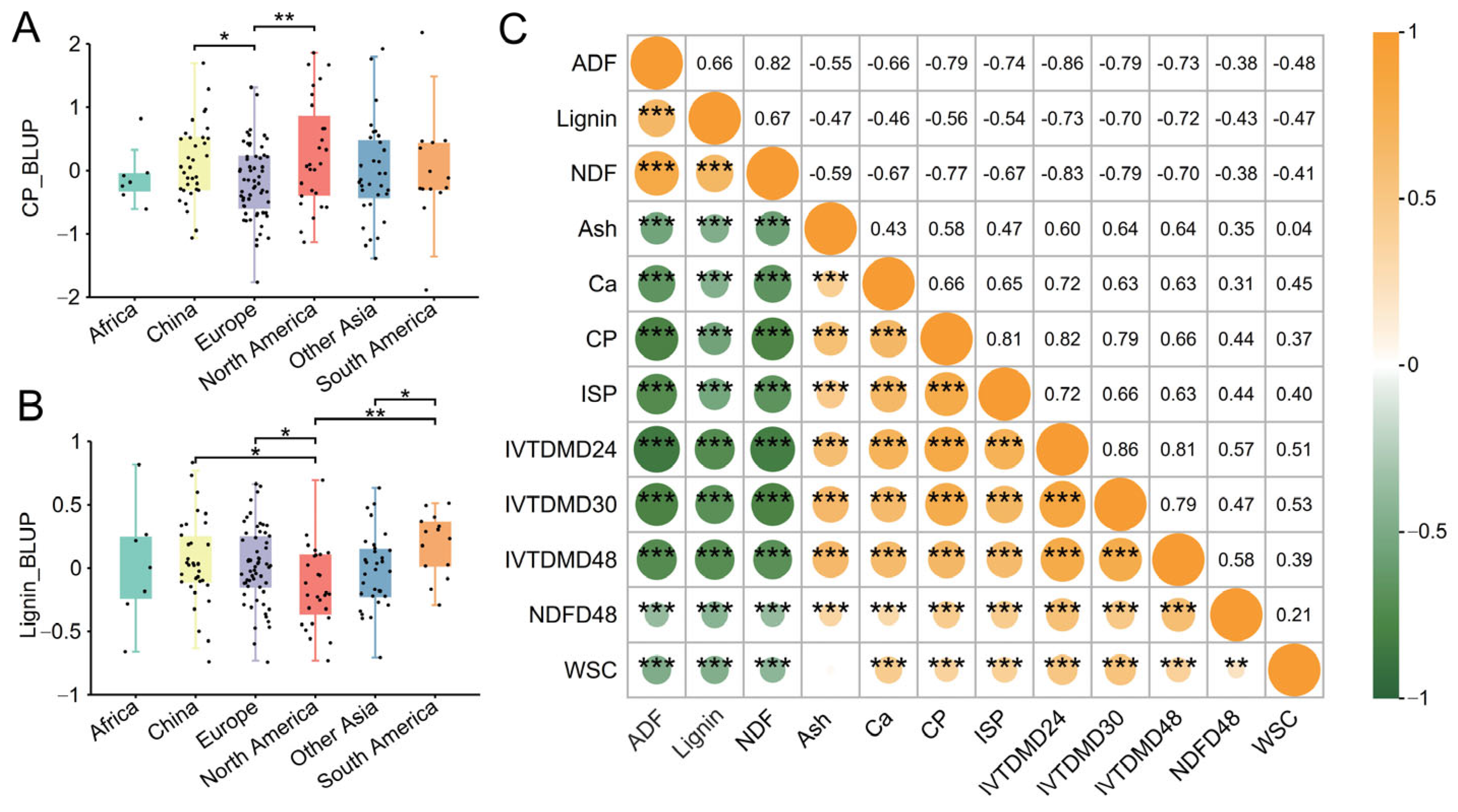
Based on geographical origin, the association panel was classified into six groups: Africa, China, Europe, North America, Other Asia, and South America (Figure 1A,B). Analysis revealed that accessions from North America and China possessed significantly higher CP content than those from Europe (p < 0.05). Furthermore, North American accessions exhibited significantly lower lignin content compared to accessions from China, Europe, and South America (p < 0.05). Correlation analysis revealed significant positive correlations among ADF, lignin, and NDF, with Pearson correlation coefficients ranging from 0.66 to 0.82 (p < 0.001, Figure 1C). Furthermore, positive correlations were observed among ash, Ca, CP, ISP, IVTDMD24/30/48, NDFD48, and WSC (except between ash and WSC, which was not significant), with Pearson correlation coefficients ranging from 0.21 to 0.86 (p < 0.01). In contrast, the aforementioned traits (ash, Ca, CP, ISP, IVTDMD24/30/48, NDFD48, and WSC) all showed significant negative correlations with ADF, lignin, and NDF, with correlation coefficients ranging from −0.86 to −0.38 (p < 0.001).

3.2. Screening of Accessions with Excellent Phenotypes Based on Cluster Analysis

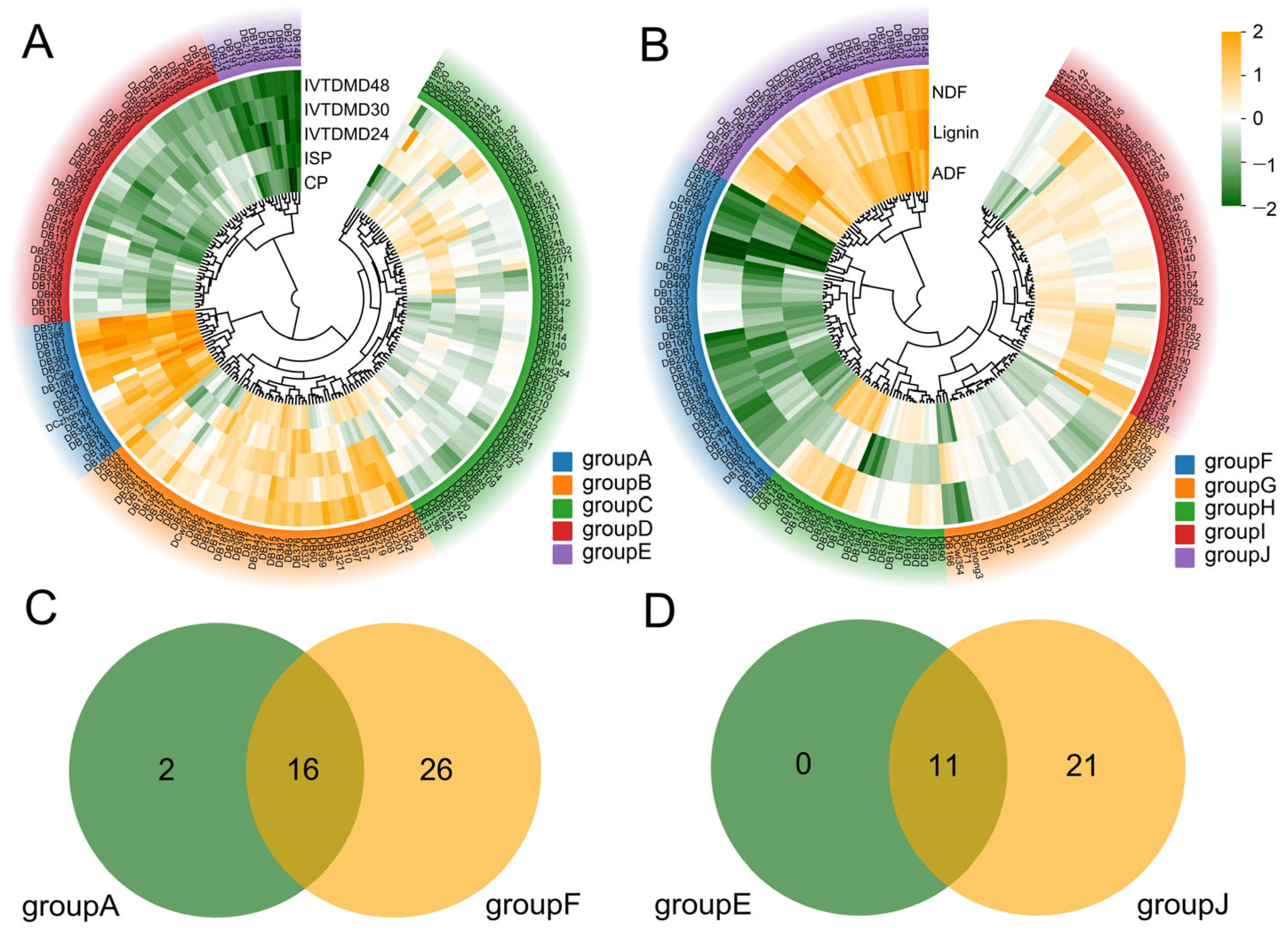
To identify alfalfa accessions with superior comprehensive quality, cluster analysis was conducted based on selection criteria emphasizing high protein and digestibility alongside low lignin and fiber content. Phenotypic correlation analysis selected ISP and IVTDMD24/30/48, exhibiting the strongest positive correlations with CP, for the first clustering analysis (Figure 2A). This analysis partitioned the 176 accessions into five distinct groups (groups A–E), with significant inter-group differences in trait (p < 0.05, Figure S2). Group A demonstrated optimal overall performance across these five traits (n = 18), while group E exhibited the lowest content values (n = 11). A second clustering analysis of ADF, lignin, and NDF similarly divided the accessions into five groups (groups F–J; Figure 2B). Group F showed the lowest combined content of these three traits and was identified as the optimal group (n = 42), contrasting with group J, which displayed the highest content (n = 32). Intersection analysis revealed that 16 accessions were co-selected within both optimal groups (group A and group F; Figure 2C): DB572, DB386, DB161, DB181, DB383, DB201, DCalg, DB1061, DB28, DB341, DB172, DB3841, DB1832, DB76, DB148, and DB1801. Similarly, 11 accessions were co-identified within both inferior groups (group E and group J; Figure 2D): DB145, DB2131, DB953, DB105, DB133, DB1802, DB2161, DB13, DB191, DB12, and DB621. Detailed accession information is provided in Table S1.

3.3. Genome-Wide Association Study Based on SNPs

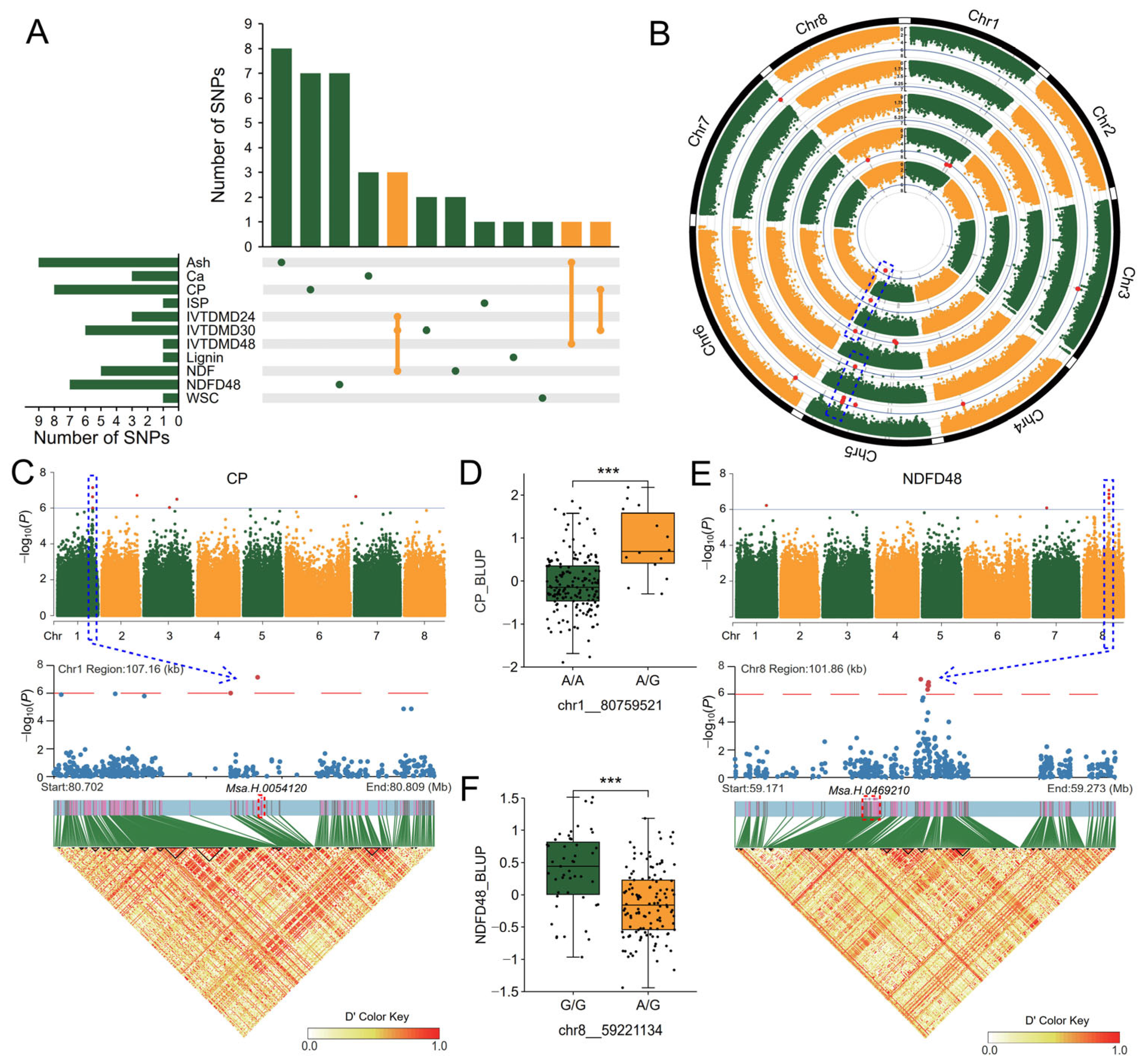
GWAS identified 45 significant SNPs associated with 11 traits (no significant SNPs were associated with ADF). These SNPs were distributed across all eight chromosomes (Figure 3, Figure S3 and Table S5), with chromosome 5 harboring the highest number (19 SNPs) and chromosome 6 the lowest (only 1 SNP). Notably, six SNPs exhibited pleiotropic effects, associating with multiple distinct traits: chr5_83524482, chr5_83524497, and chr5_83524504 were simultaneously associated with IVTDMD24, IVTDMD30, and NDF; chr5_67968871 was simultaneously associated with ash and IVTDMD48; and chr1_80759521 was simultaneously associated with CP and IVTDMD30 (Figure 3A,B).
GWAS for CP identified two adjacent significant SNPs (chr1_80751908 and chr1_80759521) within an 80.7–80.8 Mb region on chromosome 1 (Figure 3C). Among these, chr1_80759521 was also significantly associated with IVTDMD30. Using the LD information from these two loci, we identified a downstream candidate gene (Msa.H.0054120) that encodes a ribosomal protein L1p/L10e family protein. Furthermore, two haplotypes (A/A and A/G) were detected at chr1_80759521 across the 176 accessions. Phenotype–genotype association analysis showed that accessions carrying the A/G haplotype had significantly higher CP content than those with the A/A haplotype (p < 0.001, Figure 3D). GWAS for NDFD30 detected five physically clustered significant SNPs (chr8_59221134, chr8_59222958, chr8_59223028, chr8_59223232, and chr8_59223250) within a 59.221–59.224 Mb region on chromosome 8 (Figure 3E). The G2/mitotic-specific cyclin-2-encoding gene Msa.H.0469210 was located upstream of these significant SNPs. Among these, the most significantly associated SNP (chr8_59221134) displayed two haplotypes (G/G and A/G) in the 176 accessions. Accessions with the G/G haplotype showed significantly higher NDFD48 values than those carrying the A/G haplotype (p < 0.001, Figure 3F).

3.4. Genetic Effects of Haplotypes and Favorable Haplotypes on Alfalfa Quality Traits

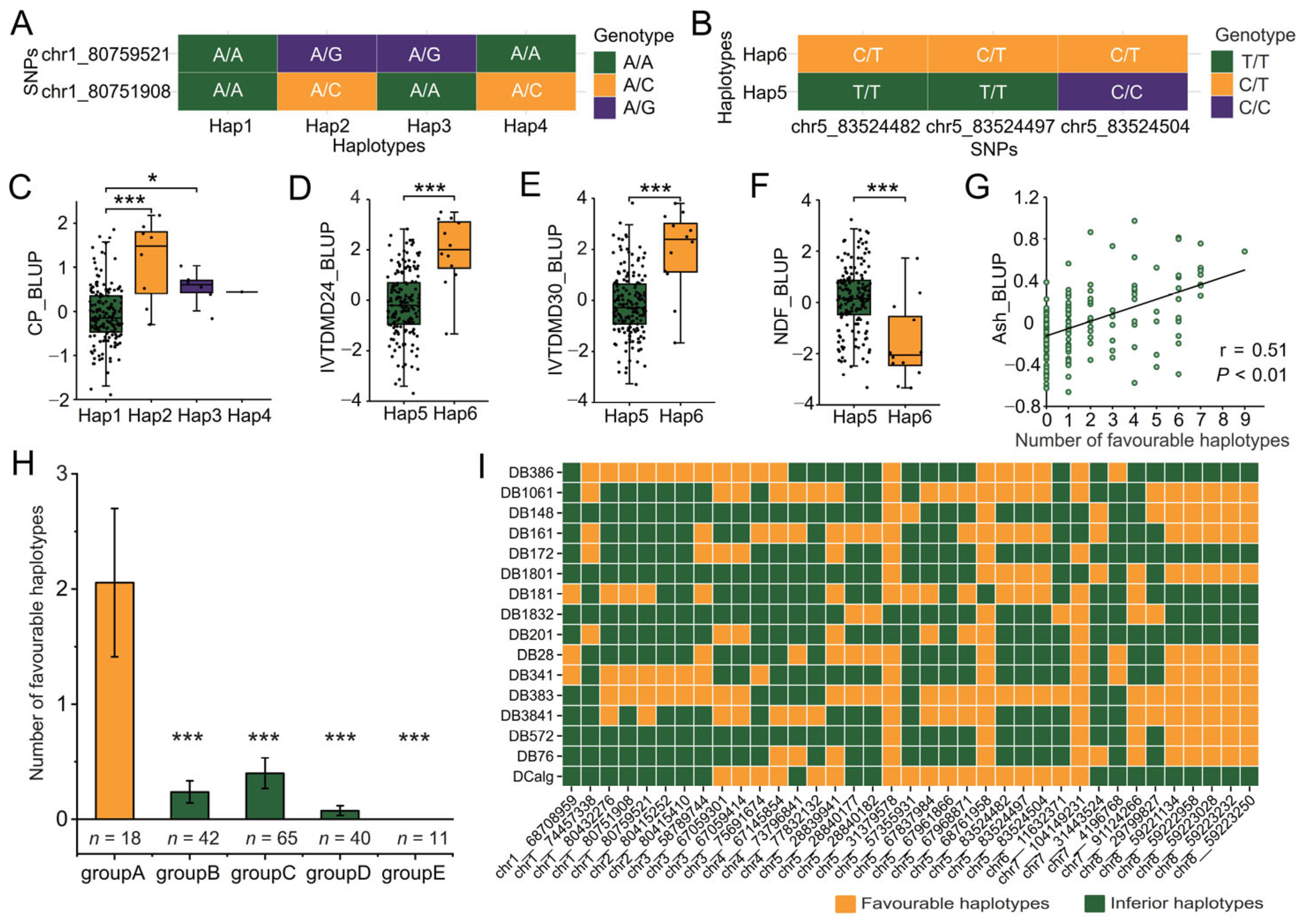
In the CP-based genome-wide association study, two key SNPs were identified within the 80.7–80.8 Mb region on chromosome 1. Further analysis revealed four haplotype combinations for these two SNPs among the 176 accessions, with Hap4 present in only one accession (Figure 4A). The CP content in accessions carrying Hap2 was significantly higher than that in those carrying Hap1 and Hap3 (Figure 4C, p < 0.05). The chr5_83524482, chr5_83524497, and chr5_83524504 were simultaneously associated with three traits and formed two haplotype combinations in the 176 accessions (Figure 4B). Among these, accessions with Hap6 exhibited significantly higher IVTDMD24 and IVTDMD30 but lower NDF content than those carrying Hap5 (Figure 4D–F, p < 0.01). These results indicate that Hap6 represents a favorable haplotype capable of effectively improving alfalfa quality.
To further elucidate the genetic effects of favorable haplotypes on quality-related traits in alfalfa, this study first focused on the ash trait, which contained the largest number of significant SNPs. For each significant SNP, phenotypic differences among its haplotypes were compared, and the haplotype with the optimal phenotypic performance was selected as the favorable haplotype for that locus (Figure S4). Analysis revealed a significant positive correlation between the number of favorable haplotypes carried by each accession and its ash phenotypic value (Pearson r = 0.51, p < 0.01; Figure 4G). Furthermore, the number of favorable haplotypes for CP was quantified within the clusters (groups A–E) obtained from CP-based clustering. The results showed that the average number of favorable haplotypes in group A was significantly higher than that in the other four groups (Figure 4H). Notably, no favorable haplotypes were detected in any of the 11 accessions in group E. Therefore, favorable haplotypes were systematically identified from the 37 significant SNPs obtained through GWAS (Figure S4), and their distribution was statistically analyzed in the 16 high-quality accessions previously selected via clustering analysis. This study provides a theoretical foundation for future molecular breeding aimed at integrating multi-locus favorable haplotypes to develop high-quality alfalfa varieties.

3.5. Genome-Wide Association Study Based on SVs

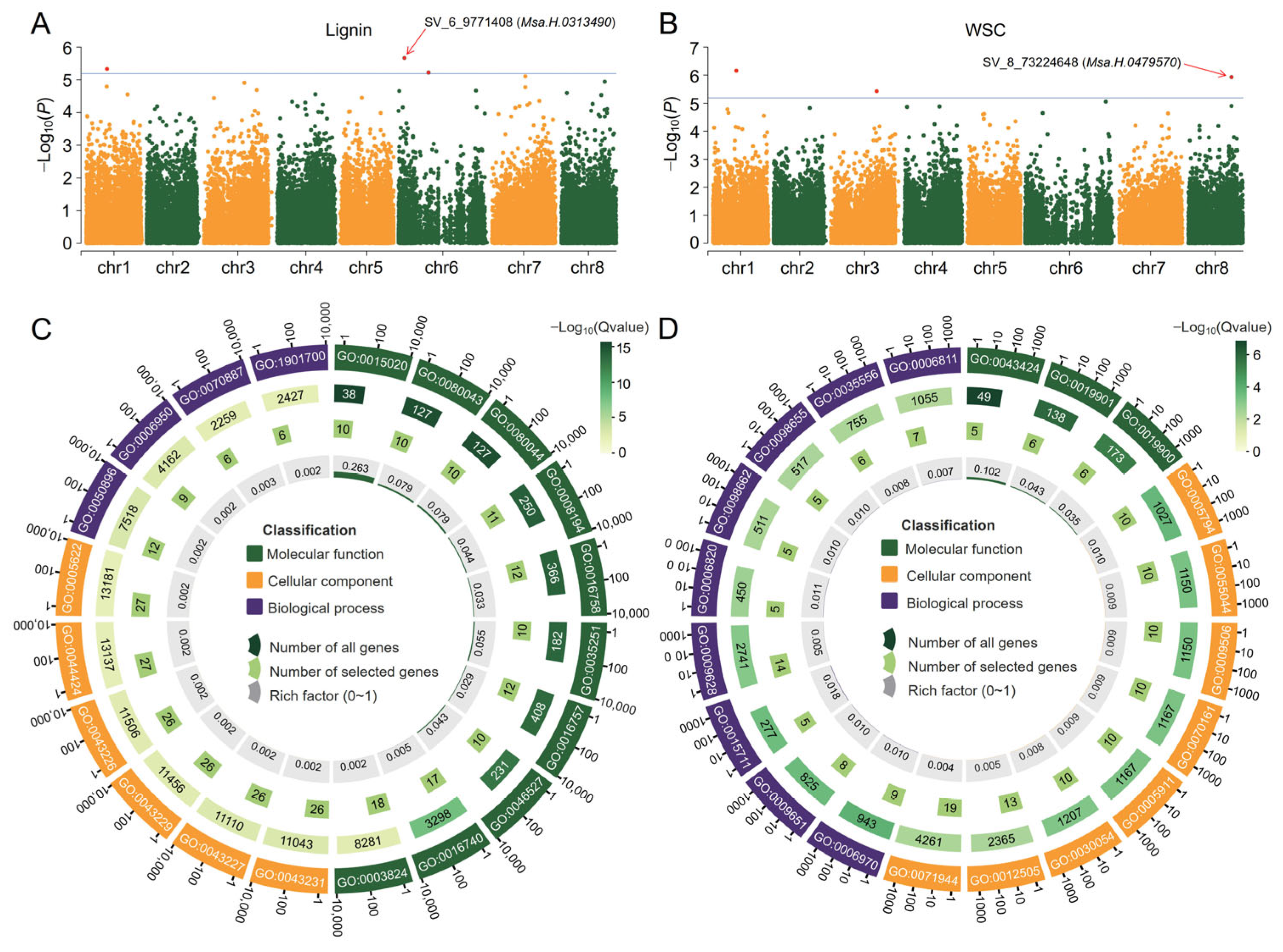
Through SV-GWAS, a total of 12 significantly associated SVs were identified across three phenotypes. Among these, six were associated with IVTDMD48 (Figure S3E), three with lignin, and three with WSC (Table S6). The SV marker SV_6_9771048 on chromosome 6 was significantly associated with lignin. The gene Msa.H.0313490 was located upstream within its LD region (Figure 5A). It encodes a RING/U-box superfamily protein. Further Gene Ontology (GO) enrichment analysis of genes within the 500 kb region flanking this locus revealed significant enrichment in the molecular function category, with all significantly enriched terms related to glycosyltransferase activity (Figure 5C and Table S7). Another SV marker (SV_8_73224648 on chromosome 8) showed a significant association with WSC. Within its LD region, the upstream gene Msa.H.0479570 was found to encode a protein from the NRT1/PTR FAMILY 2.9 (Figure 5B). GO enrichment analysis of genes within the 500 kb region surrounding this locus showed significant enrichment in the molecular function category for protein histidine kinase binding (GO:0043423), protein kinase binding (GO:0019901), and kinase binding (GO:0019900). Additionally, in the biological process category, several terms related to ion transport (GO:0015711, GO:0006820, GO:0098662, GO:0098655, GO:0006811) and stress response (GO:0006970, GO:0009651, GO:0006811) were significantly enriched (Figure 5D and Table S7).

3.6. Candidate Genes and RT-qPCR Analysis

Through GWAS analysis based on SNP and SV markers, this study identified a total of eight candidate genes associated with quality traits in alfalfa (Table 1). In addition to the four genes previously described in this study, four other genes were found to be significantly associated with the quality traits under investigation. These include: Msa.H.0231490, which is linked to ash content and encodes a protein REDUCED WALL ACETYLATION 3; Msa.H.0154760, associated with CP and encoding a nodulation protein; and Msa.H.0290550, correlated with lignin and encoding a NAC domain-containing protein. Furthermore, Msa.H.0301430, which encodes a WRKY family transcription factor, showed associations with three traits: IVTDMD24, IVTDMD30, and NDF. To investigate the expression level relationships of these genes across different accessions,, we performed RT-qPCR expression analysis on selected genes. The results revealed that the expression levels of Msa.H.0301430, Msa.H.0290550, and Msa.H.0313490 were lower in phenotypically superior accessions compared to inferior ones, suggesting that they may act as negative regulators in the formation of these traits. Conversely, Msa.H.0479570 exhibited higher expression in superior materials, indicating a potential positive regulatory role (Figure S5).

3.7. Genomic Prediction for 12 Quality-Related Traits in Alfalfa

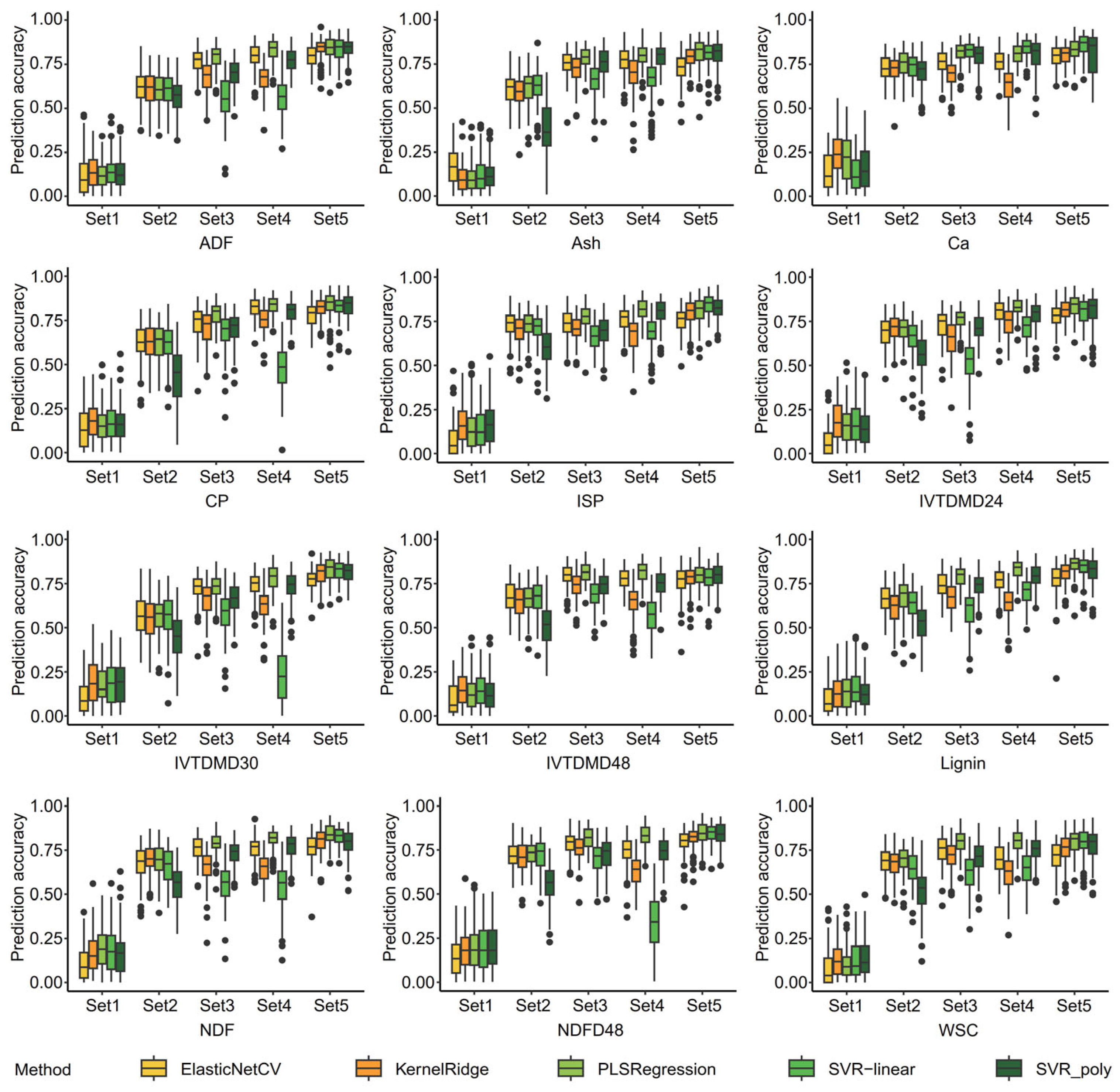
This study conducted genomic prediction for 12 quality-related traits in alfalfa using GBLUP and five machine learning models with five SNP sets (Set1–Set5). As shown in Table S8, we report the mean prediction accuracy of each model–trait combination across 100 replicated validations. The results demonstrated that when using all LD-pruned markers for genomic prediction, all models achieved very low prediction accuracy across the 12 traits. The five machine learning models showed mean prediction accuracies ranging from 0.074 (IVTDMD24) to 0.239 (Ca), while the GBLUP model achieved mean accuracies between 0.099 (ISP) and 0.242 (Ca) (Figure S6). In contrast, when using the top 100, 500, and 1000 GWAS-selected SNPs, the prediction accuracy of the five machine learning models improved significantly, ranging from 0.238 (IVTDMD30) to 0.844 (Ca). Despite this substantial overall improvement, some models still exhibited relatively low predictive performance. When employing the top 5000 GWAS-selected SNPs, the prediction accuracy of the machine learning models further increased to between 0.714 (WSC) and 0.861 (Ca), demonstrating not only higher accuracy but also more consistent performance across different models (Figure 6 and Table S8)

4. Discussion

Alfalfa is a forage crop with exceptionally high nutritional value, providing livestock with abundant protein and other essential nutrients. Therefore, quality traits have always held a paramount importance in alfalfa breeding. In recent years, the release of high-quality genome and pan-genome sequences for alfalfa has provided critical resources for elucidating its genetic diversity [17,31,42]. In this study, GWAS was conducted based on SNPs and SVs for multiple quality-related traits. Furthermore, genomic prediction was performed leveraging the GWAS results. This work aims to unravel the genetic basis underlying alfalfa quality formation and to provide a theoretical foundation for breeding new high-quality alfalfa varieties.
In GWAS analysis, the accuracy of phenotypic measurement is crucial. This study adhered strictly to standardized protocols, including sampling at the initial flowering stage and shade drying, to systematically collect samples from an association population comprising 176 accessions of alfalfa. Quality traits were assessed using near-infrared spectroscopy (NIRS), a method recognized for its high efficiency and reliability [43], which has been widely applied in quality evaluation of forage crops such as soybean (Glycine max) [44], forage maize (Zea mays) [45], and winter pea (Pisum sativum) [46]. To minimize the impact of variation due to different growing environments, BLUP values based on multi-year and multi-location phenotypic data were calculated for subsequent analyses. The results indicated that the heritability of the 12 traits ranged from 38.09% (NDFD48) to 71.08% (Ca). With the exception of NDFD48, all traits exhibited moderate to high heritability. Previous studies have reported that the heritability of NDFD in alfalfa leaves (22%) is significantly lower than that in stems (55%) [34], suggesting that variation in leaf NDFD is more susceptible to environmental influences, while variation in stem NDFD is primarily genetically controlled. Correlation analysis revealed that the fiber-related traits (ADF, lignin, and NDF) were significantly negatively correlated with the other nine quality traits, consistent with existing research findings [47]. This further supports the breeding strategy in alfalfa aimed at increasing protein content and digestibility while reducing lignin and fiber content.
A SNP-based GWAS identified two significant and physically proximate SNPs within the 80.7–80.8 Mb region on chromosome 1. Among these, the chr1_80759521 was significantly associated with both CP and IVTDMD30, suggesting its pleiotropic potential. Downstream of this SNP, a gene encoding a ribosomal protein L1p/L10e family protein, Msa.H.0054120, was identified. This protein family represents a key component of the large ribosomal subunit and is directly involved in the translation process [48]. In plants, its expression level is positively correlated with ribosome biogenesis efficiency and global protein synthesis rate [49]. Furthermore, on chromosome 8, the gene Msa.H.0469210, significantly associated with NDFD48, was found to encode a G2/mitotic-specific cyclin-2 (CCNB2) protein. CCNB2 is a key regulator of mitotic progression in plant cells. Studies have shown that overexpression of CCNB2 in tobacco cells accelerates the transition from G2 to M phase, promoting premature entry into mitosis [50]. This process may shorten the duration of secondary cell wall synthesis and reduce lignin deposition [51], thereby potentially affecting cell wall degradability. Through haplotype analysis of significant SNPs, we further demonstrated significant associations between specific haplotypes and target phenotypes. The cumulative number of favorable haplotypes across materials was positively correlated with phenotypic values, validating the reliability of the GWAS. To date, favorable haplotypes have been successfully applied in crop genetic improvement. For instance, Sinha et al. [52] significantly enhanced drought tolerance in pigeonpea (Cajanus cajan L.) using haplotype-based breeding with superior haplotypes. Therefore, our findings provide a theoretical basis for promoting haplotype-based breeding of quality-related traits in alfalfa.
A GWAS based on SVs identified a significant SV (SV_6_9771048) associated with lignin on chromosome 6. Located upstream of this SV is a gene, Msa.H.0313490, which encodes a RING/U-box superfamily protein. As E3 ubiquitin ligases, proteins of this class regulate the stability of lignin biosynthesis-related proteins through ubiquitination modification, thereby influencing lignin accumulation in plants. For instance, in soybean, the RING/U-box superfamily gene LRM3 promotes lignin synthesis by degrading the transcriptional repressor MYB6 [53]. Our RT-qPCR results verified that it may positively regulate lignin biosynthesis, which consequently negatively affects forage quality in alfalfa. To further elucidate the potential impact of this SV on quality traits in alfalfa, we performed GO enrichment analysis of genes near this locus. The results revealed significant enrichment in glycosyltransferase activity, suggesting that these genes may indirectly affect quality traits by regulating secondary metabolic pathways. On the other hand, near another SV locus (SV_8_73224648) significantly associated with WSC, we identified a gene, Msa.H.0479570, encoding an NRT1/PTR FAMILY 2.9 protein. This protein is a key transporter in plant nitrogen metabolism, which regulates nitrogen allocation and recycling, facilitates the flow of carbon skeletons toward sink organs, and may thereby indirectly influence WSC metabolism and distribution [54,55]. Combined with our RT-qPCR results, these findings suggest that this gene also likely acts as a positive regulator in alfalfa. GO enrichment analysis of genes near this locus showed significant association with kinase binding function. Previous studies have reported that protein kinase CK1 phosphorylates the transcription factor Opaque2 (O2), enhancing its regulatory capacity toward downstream genes, promoting the synthesis of starch and zein proteins, and significantly improving kernel size and nutritional quality in maize [56]. Additionally, the GO enrichment results indicated functional terms related to stress resistance, suggesting that these genes also play important roles in fundamental physiological processes that support the accumulation of superior quality traits.
In addition to the candidate genes mentioned above, other genes identified in this study that are significantly associated with various traits may also play functional roles in regulating quality-related traits in alfalfa. For instance, Msa.H.0231490, which is significantly associated with ash, is annotated as “REDUCED WALL ACETYLATION 3,” a protein involved in modulating acetylation modifications in the plant cell wall [57]. Alterations in cell wall composition may influence its ion exchange and adsorption capacities, thereby regulating the fixation and distribution of minerals within the plant [58]. The gene Msa.H.0154760, significantly correlated with CP, encodes a nodulation protein. Its product facilitates the synthesis of nodulation factors and promotes root nodule formation, thereby supporting nitrogen assimilation and ultimately contributing to an increase in overall crude protein content [59]. Furthermore, Msa.H.0301430, which is significantly associated with IVTDMD24, IVTDMD30, and NDF, encodes a WRKY family transcription factor. Previous studies have shown that its homolog in tobacco, NtWRKY28, acts as a positive regulator that promotes lignin accumulation by activating key genes in the lignin biosynthesis pathway [60]. Combined with our RT-qPCR results, these findings suggest that this transcription factor may play a similar role in regulating lignin metabolism in alfalfa. Another gene, Msa.H.0290550, significantly associated with lignin content, encodes a NAC domain-containing protein. Yang et al. reported that the NAC transcription factor PdWND3A in poplar regulates the biosynthesis of lignin [61], indicating that the function of NAC transcription factors in lignin synthesis may be conserved across species.
GP utilizes genome-wide molecular markers to enable accurate prediction and selection of complex traits, significantly shortening the breeding cycle compared to conventional breeding methods. To date, several studies have reported GP for quality-related traits in alfalfa. For instance, Jia et al. used three Bayesian methods (BayesA, BayesB, and BayesCπ) to predict 15 quality traits in a population of 322 alfalfa genotypes, achieving prediction accuracies ranging from 0.05 to 0.25 [62]. Biazzi et al. evaluated eight quality-related traits in a reference population comprising 154 alfalfa genotypes and found that CP had the highest prediction accuracy (around 0.4), while accuracies for most other traits were below 0.2 [34]. In the present study, based on all SNP markers after linkage disequilibrium filtering, the prediction accuracies of the five machine learning models for the 12 traits ranged from 0.074 to 0.239, while the GBLUP model achieved accuracies between 0.099 and 0.242. These results indicate that, at the current dataset scale, although the machine learning models did not significantly outperform the traditional GBLUP model, their comparable performance demonstrates both feasibility and applicability in genomic prediction. When using all available markers, the relatively low prediction accuracy is primarily due to the fact that when the number of markers far exceeds the number of samples, a large number of markers unrelated to the traits or exhibiting high collinearity (linkage disequilibrium redundancy) introduce noise and amplify estimation variance, thereby weakening the true signals [63]. Thus, using all markers may not be the optimal choice. After integrating GWAS-derived significant SNP markers, the predictive performance of the machine learning models improved substantially. When using the top 5000 SNP markers, the prediction accuracy increased to between 0.71 and 0.861. This finding is consistent with Yu et al.’s research in rapeseed, in which incorporating GWAS-significant markers led to prediction accuracies exceeding 0.9 for flowering time and thousand-seed weight [64]. Therefore, our results demonstrate that integrating GWAS results can significantly enhance the accuracy of genomic prediction, providing an effective strategy for high-accuracy prediction and genomic selection of complex quality traits in alfalfa breeding.

5. Conclusions

This study conducted precise phenotypic evaluation of 12 quality-related traits across two locations and two years in a collection of 176 alfalfa accessions, revealing extensive genetic variation in all traits. Cluster analysis identified 16 accessions with superior comprehensive characteristics. A GWAS detected 45 significant SNPs and 12 significant SVs, from which eight key candidate genes potentially regulating alfalfa quality formation were identified. Haplotype analysis further elucidated the distribution of favorable allelic variations, providing a theoretical foundation for molecular design breeding through the aggregation of superior haplotypes. Additionally, GP based on 5000 significant GWAS SNPs achieved prediction accuracies ranging from 0.71 to 0.86 for the 12 traits. In summary, this study integrates GWAS and GP analyses to provide new insights and genetic resources for the genetic improvement of quality traits in alfalfa.

Supplementary Materials

The following supporting information can be downloaded at: https://www.mdpi.com/article/10.3390/agronomy15122679/s1, Figure S1: Histogram of phenotypic distribution for 12 quality-related traits. In each subplot, the histogram shows the frequency distribution of the BLUP values for each trait, and the overlaid curve in the plot is used to present the distribution trend of the data. Figure S2: Analysis of phenotypic variation among cluster-based groups. Group A–J represent different clusters obtained from cluster analysis (Figure 2). In each subplot, the box represents the interquartile range (25th–75th percentiles), the horizontal line inside the box is the median, and the scatter points are the original data points; different letters (a, b, c, etc.) indicate significant differences between groups at the 0.05 significance level. Figure S3: Manhattan plot of GWAS results for the remaining phenotypic traits. Figures A–D are Manhattan plots of GWAS analysis based on SNPs for Ca, ISP, Lignin, and WSC, respectively, and Figure is the Manhattan plot of GWAS analysis for IVTDMD48 based on SVs. Figure S4: Haplotype analysis of 45 significantly associated SNPs with superior haplotypes highlighted in red. Significance levels: * denotes p < 0.05, ** denotes p < 0.01, and *** denotes p < 0.001. Figure S5: RT-qPCR expression validation of four candidate genes with phenotypic performance highlighted in green (superior) and orange (inferior). Different letters (a, b, c, etc.) indicate significant differences between groups at the 0.05 significance level. Figure S6: Genomic prediction was performed for 12 quality-related traits using the GBLUP model with all SNPs after linkage disequilibrium filtering. Black dots represent outliers deviating from the overall data distribution. Table S1: Detailed information of the 176 accessions. Table S2: Primers of candidate genes used for RT-qPCR. Table S3: Phenotypic statistical analysis of 12 alfalfa quality traits across different years and locations. Table S4: Statistical summary of BLUP values for alfalfa quality traits. Table S5: Details of significant SNPs identified for 11 quality-related traits based on GWAS. Table S6: Details of significant SVs identified for 3 quality-related traits based on GWAS. Table S7: GO-term enrichment analysis of genes within the 500 kb flanking regions of the two significant SVs identified by GWAS. Table S8: Average prediction accuracy of the GBLUP and five machine learning-based GP models for 12 quality-related phenotypes.

Author Contributions

Conceptualization, F.H., R.L. and L.C.; methodology, M.X., K.Z., Q.Y., J.K. and T.Z. (Tiejun Zhang); software, X.J., F.Z., B.S., M.L. and X.W.; validation, F.Z., B.S., M.L. and X.W.; formal analysis, H.L., T.Z. (Tian Zhang), Y.X. and T.Y.; resources, Q.Y., J.K., L.C., R.L. and F.H.; data curation, M.X., K.Z., X.J., F.Z., B.S., H.L., T.Z. (Tian Zhang), Y.X. and T.Y.; writing—original draft preparation, M.X., K.Z. and X.J.; writing—review and editing, M.L., X.W. and T.Z. (Tiejun Zhang); visualization, L.C., R.L. and F.H.; supervision, Q.Y., J.K. and T.Z. (Tiejun Zhang). All authors have read and agreed to the published version of the manuscript.

Funding

This work was funded by the Biological Breeding-National Science and Technology Major Project, grant number 2023ZD04060; Central Public-interest Scientific Institution Basal Research Fund, grant number No. Y2025YC44; the Central Public-interest Scientific Institution Basal Research Fund, grant number 2025-YWF-ZYSQ-04; Major Science and Technology Support Program Project of Hebei Province, grant number 242N7501Z.

Data Availability Statement

The original data presented in the study are openly available in NCBI database at PRJNA1197171 and PRJNA1220045. The haploid reference genome presented in the study are openly available in NGDC at GWHBECI00000000.

Acknowledgments

We thank all members of the Forage Breeding and Cultivation Technology Innovation Team for their help and support with the experiments and data analysis.

Conflicts of Interest

The authors declare that they have no conflicts of interest.

References

  1. Zhao, X.; Han, X.; Lu, X.; Yang, H.; Wang, Z.Y.; Chai, M. Genome-wide identification and characterization of the Msr gene family in alfalfa under abiotic stress. Int. J. Mol. Sci. 2023, 24, 9638. [Google Scholar] [CrossRef]
  2. Nasrollahi, V.; Allam, G.; Kohalmi, S.E.; Hannoufa, A. MsSPL9 Modulates Nodulation under Nitrate Sufficiency Condition in Medicago sativa. Int. J. Mol. Sci. 2023, 24, 9615. [Google Scholar] [CrossRef] [PubMed]
  3. Suwignyo, B.; Mustika, A.; Kustantinah; Yusiati, L.M.; Suhartanto, B. Effect of drying method on physical-chemical characteristics and amino acid content of tropical alfalfa (Medicago sativa L.) hay for poultry feed. Am. J. Anim. Vet. Sci. 2020, 15, 118–122. [Google Scholar] [CrossRef]
  4. Soto-Zarazúa, M.G.; Bah, M.; Costa, A.S.G.; Rodrigues, F.; Pimentel, F.B.; Rojas-Molina, I.; Rojas, A.; Oliveira, M. Nutraceutical potential of new alfalfa (Medicago sativa) ingredients for beverage preparations. J. Med. Food 2017, 20, 1039–1046. [Google Scholar] [CrossRef] [PubMed]
  5. Lin, S.; Medina, C.A.; Norberg, O.S.; Combs, D.; Wang, G.; Shewmaker, G.; Fransen, S.; Llewellyn, D.; Yu, L.X. Genome-wide association studies identifying multiple loci associated with alfalfa forage quality. Front. Plant Sci. 2021, 12, 648192. [Google Scholar] [CrossRef]
  6. Trepp, G.B.; Plank, D.W.; Stephen Gantt, J.; Vance, C.P. NADH-Glutamate synthase in alfalfa root nodules. Immunocytochemical localization. Plant Physiol. 1999, 119, 829–838. [Google Scholar] [CrossRef]
  7. Sengupta-Gopalan, C.; Ortega-Carranza, J. An insight into the role and regulation of glutamine synthetase in plants. In Amino Acids in Higher Plants; CAB International: Oxfordshire, UK, 2015; pp. 82–99. [Google Scholar]
  8. Yang, S.; Zu, Y.; Li, B.; Bi, Y.; Jia, L.; He, Y.; Li, Y. Response and intraspecific differences in nitrogen metabolism of alfalfa (Medicago sativa L.) under cadmium stress. Chemosphere 2019, 220, 69–76. [Google Scholar] [CrossRef]
  9. Annicchiarico, P.; Barrett, B.; Brummer, E.C.; Julier, B.; Marshall, A.H. Achievements and challenges in improving temperate perennial forage legumes. Crit. Rev. Plant Sci. 2015, 34, 327–380. [Google Scholar] [CrossRef]
  10. Ye, S.; Zhong, K.; Zhang, J.; Hu, W.; Hirst, J.D.; Zhang, G.; Mukamel, S.; Jiang, J. A machine learning protocol for predicting protein infrared spectra. J. Am. Chem. Soc. 2020, 142, 19071–19077. [Google Scholar] [CrossRef]
  11. Bonsi, M.L.K.; Osuji, P.O.; Tuah, A.K.; Umunna, N.N. Vernonia amygdalina as a supplement to teff straw (Eragrostis tef) fed to Ethiopian Menz sheep. Agrofor. Syst. 1995, 31, 229–241. [Google Scholar] [CrossRef]
  12. Riday, H.; Brummer, C.; Moore, K. Heterosis of forage quality in alfalfa. Crop Sci. 2002, 42, 1088–1093. [Google Scholar] [CrossRef]
  13. Li, X.; Zhang, Y.; Hannoufa, A.; Yu, P. Transformation with TT8 and HB12 RNAi Constructs in Model Forage (Medicago sativa, Alfalfa) Affects Carbohydrate Structure and Metabolic Characteristics in Ruminant Livestock Systems. J. Agric. Food Chem. 2015, 63, 9590–9600. [Google Scholar] [CrossRef]
  14. Gallego-Giraldo, L.; Shadle, G.; Shen, H.; Barros-Rios, J.; Fresquet Corrales, S.; Wang, H.; Dixon, R.A. Combining enhanced biomass density with reduced lignin level for improved forage quality. Plant Biotechnol. J. 2016, 14, 895–904. [Google Scholar] [CrossRef] [PubMed]
  15. Wolabu, T.W.; Mahmood, K.; Chen, F.; Torres-Jerez, I.; Udvardi, M.; Tadege, M.; Cong, L.; Wang, Z.; Wen, J. Mutating alfalfa COUMARATE 3-HYDROXYLASE using multiplex CRISPR/Cas9 leads to reduced lignin deposition and improved forage quality. Front. Plant Sci. 2024, 15, 1363182. [Google Scholar] [CrossRef] [PubMed]
  16. Wang, K.; Yan, J.; Tanvir, R.; Li, L.; Liu, Y.; Zhang, W. Improved forage quality and biomass yield of alfalfa (Medicago sativa L.) by Arabidopsis QQS orphan gene. Curr. Plant Biol. 2023, 35–36, 100295. [Google Scholar] [CrossRef]
  17. Chen, H.; Zeng, Y.; Yang, Y.; Huang, L.; Tang, B.; Zhang, H.; Hao, F.; Liu, W.; Li, Y.; Liu, Y.; et al. Allele-aware chromosome-level genome assembly and efficient transgene-free genome editing for the autotetraploid cultivated alfalfa. Nat. Commun. 2020, 11, 2494. [Google Scholar] [CrossRef]
  18. Lorenzo, C.D.; García-Gagliardi, P.; Antonietti, M.S.; Sánchez-Lamas, M.; Mancini, E.; Dezar, C.A.; Vazquez, M.; Watson, G.; Yanovsky, M.J.; Cerdán, P.D. Improvement of alfalfa forage quality and management through the down-regulation of MsFTa1. Plant Biotechnol. J. 2020, 18, 944–954. [Google Scholar] [CrossRef]
  19. Li, Y.; Miao, Y.; Yuan, H.; Huang, F.; Sun, M.; He, L.; Liu, X.; Luo, J. Volatilome-based GWAS identifies OsWRKY19 and OsNAC021 as key regulators of rice aroma. Mol. Plant 2024, 17, 1866–1882. [Google Scholar] [CrossRef]
  20. Yu, J.; Zhu, C.; Xuan, W.; An, H.; Tian, Y.; Wang, B.; Chi, W.; Chen, G.; Ge, Y.; Li, J.; et al. Genome-wide association studies identify OsWRKY53 as a key regulator of salt tolerance in rice. Nat. Commun. 2023, 14, 3550. [Google Scholar] [CrossRef]
  21. Wang, W.; Guo, W.; Le, L.; Yu, J.; Wu, Y.; Li, D.; Wang, Y.; Wang, H.; Lu, X.; Qiao, H.; et al. Integration of high-throughput phenotyping, GWAS, and predictive models reveals the genetic architecture of plant height in maize. Mol. Plant 2023, 16, 354–373. [Google Scholar] [CrossRef]
  22. Wu, X.; Li, Y.; Shi, Y.; Song, Y.; Zhang, D.; Li, C.; Buckler, E.S.; Li, Y.; Zhang, Z.; Wang, T. Joint-linkage mapping and GWAS reveal extensive genetic loci that regulate male inflorescence size in maize. Plant Biotechnol. J. 2016, 14, 1551–1562. [Google Scholar] [CrossRef] [PubMed]
  23. Jaegle, B.; Voichek, Y.; Haupt, M.; Sotiropoulos, A.G.; Gauthier, K.; Heuberger, M.; Jung, E.; Herren, G.; Widrig, V.; Leber, R.; et al. k-mer-based GWAS in a wheat collection reveals novel and diverse sources of powdery mildew resistance. Genome Biol. 2025, 26, 172. [Google Scholar] [CrossRef] [PubMed]
  24. Yang, X.; Zhang, L.; Wei, J.; Liu, L.; Liu, D.; Yan, X.; Yuan, M.; Zhang, L.; Zhang, N.; Ren, Y.; et al. A TaSnRK1α-TaCAT2 model mediates resistance to Fusarium crown rot by scavenging ROS in common wheat. Nat. Commun. 2025, 16, 2549. [Google Scholar] [CrossRef] [PubMed]
  25. Lin, X.; Xu, Y.; Wang, D.; Yang, Y.; Zhang, X.; Bie, X.; Gui, L.; Chen, Z.; Ding, Y.; Mao, L.; et al. Systematic identification of wheat spike developmental regulators by integrated multi-omics, transcriptional network, GWAS, and genetic analyses. Mol. Plant 2024, 17, 438–459. [Google Scholar] [CrossRef]
  26. Lin, S.; Medina, C.A.; Boge, B.; Hu, J.; Fransen, S.; Norberg, S.; Yu, L.X. Identification of genetic loci associated with forage quality in response to water deficit in autotetraploid alfalfa (Medicago sativa L.). BMC Plant Biol. 2020, 20, 303. [Google Scholar] [CrossRef]
  27. Zhang, Z.; Mao, L.; Chen, H.; Bu, F.; Li, G.; Sun, J.; Li, S.; Sun, H.; Jiao, C.; Blakely, R.; et al. Genome-wide mapping of structural variations reveals a copy number variant that determines reproductive morphology in cucumber. Plant Cell 2015, 27, 1595–1604. [Google Scholar] [CrossRef]
  28. Chen, S.; Wang, P.; Kong, W.; Chai, K.; Zhang, S.; Yu, J.; Wang, Y.; Jiang, M.; Lei, W.; Chen, X.; et al. Gene mining and genomics-assisted breeding empowered by the pangenome of tea plant Camellia sinensis. Nat. Plants 2023, 9, 1986–1999. [Google Scholar] [CrossRef]
  29. Zhou, Y.; Minio, A.; Massonnet, M.; Solares, E.; Lv, Y.; Beridze, T.; Cantu, D.; Gaut, B.S. The population genetics of structural variants in grapevine domestication. Nat. Plants 2019, 5, 965–979. [Google Scholar] [CrossRef]
  30. Kirkpatrick, M.; Barton, N. Chromosome inversions, local adaptation and speciation. Genetics 2018, 208, 433. [Google Scholar] [CrossRef]
  31. He, F.; Chen, S.; Zhang, Y.; Chai, K.; Zhang, Q.; Kong, W.; Qu, S.; Chen, L.; Zhang, F.; Li, M.; et al. Pan-genomic analysis highlights genes associated with agronomic traits and enhances genomics-assisted breeding in alfalfa. Nat. Genet. 2025, 57, 1262–1273. [Google Scholar] [CrossRef]
  32. Meuwissen, T.H.; Hayes, B.J.; Goddard, M.E. Prediction of total genetic value using genome-wide dense marker maps. Genetics 2001, 157, 1819–1829. [Google Scholar] [CrossRef] [PubMed]
  33. Xu, Y.; Liu, X.; Fu, J.; Wang, H.; Wang, J.; Huang, C.; Prasanna, B.M.; Olsen, M.S.; Wang, G.; Zhang, A. Enhancing genetic gain through genomic selection: From livestock to plants. Plant Commun. 2020, 1, 100005. [Google Scholar] [CrossRef] [PubMed]
  34. Biazzi, E.; Nazzicari, N.; Pecetti, L.; Brummer, E.C.; Palmonari, A.; Tava, A.; Annicchiarico, P. Genome-wide association mapping and genomic selection for alfalfa (Medicago sativa) forage quality traits. PLoS ONE 2017, 12, e0169234. [Google Scholar] [CrossRef] [PubMed]
  35. Zhang, F.; Kang, J.; Long, R.; Li, M.; Sun, Y.; He, F.; Jiang, X.; Yang, C.; Yang, X.; Kong, J.; et al. Application of machine learning to explore the genomic prediction accuracy of fall dormancy in autotetraploid alfalfa. Hortic. Res. 2023, 10, uhac225. [Google Scholar] [CrossRef]
  36. Li, H.; Durbin, R. Fast and accurate short read alignment with Burrows-Wheeler transform. Bioinformatics 2009, 25, 1754–1760. [Google Scholar] [CrossRef]
  37. Li, H.; Handsaker, B.; Wysoker, A.; Fennell, T.; Ruan, J.; Homer, N.; Marth, G.; Abecasis, G.; Durbin, R. The Sequence Alignment/Map format and SAMtools. Bioinformatics 2009, 25, 2078–2079. [Google Scholar] [CrossRef]
  38. Danecek, P.; Auton, A.; Abecasis, G.; Albers, C.A.; Banks, E.; DePristo, M.A.; Handsaker, R.E.; Lunter, G.; Marth, G.T.; Sherry, S.T.; et al. The variant call format and VCFtools. Bioinformatics 2011, 27, 2156–2158. [Google Scholar] [CrossRef]
  39. Chen, C.; Chen, H.; Zhang, Y.; Thomas, H.R.; Frank, M.H.; He, Y.; Xia, R. TBtools: An integrative toolkit developed for interactive analyses of big biological data. Mol. Plant 2020, 13, 1194–1202. [Google Scholar] [CrossRef]
  40. Lipka, A.E.; Tian, F.; Wang, Q.; Peiffer, J.; Li, M.; Bradbury, P.J.; Gore, M.A.; Buckler, E.S.; Zhang, Z. GAPIT: Genome association and prediction integrated tool. Bioinformatics 2012, 28, 2397–2399. [Google Scholar] [CrossRef]
  41. Endelman, J.B. Ridge Regression and Other Kernels for Genomic Selection with R Package rrBLUP. Plant Genome 2011, 4, 250–255. [Google Scholar] [CrossRef]
  42. Long, R.; Zhang, F.; Zhang, Z.; Li, M.; Chen, L.; Wang, X.; Liu, W.; Zhang, T.; Yu, L.X.; He, F.; et al. Genome assembly of alfalfa cultivar zhongmu-4 and identification of SNPs associated with agronomic traits. Genom. Proteom. Bioinform. 2022, 20, 14–28. [Google Scholar] [CrossRef] [PubMed]
  43. Gonçalves, M.T.V.; Morota, G.; Costa, P.M.A.; Vidigal, P.M.P.; Barbosa, M.H.P.; Peternelli, L.A. Near-infrared spectroscopy outperforms genomics for predicting sugarcane feedstock quality traits. PLoS ONE 2021, 16, e0236853. [Google Scholar] [CrossRef] [PubMed]
  44. Asekova, S.; Han, S.I.; Choi, H.J.; Park, S.J.; Lee, J.D. Determination of forage quality by near-infrared reflectance spectroscopy in soybean. Turk. J. Agric. For. 2016, 40, 45–52. [Google Scholar] [CrossRef]
  45. Gao, F.; Zhang, Y.; Liu, X. A study of the reliability and accuracy of the real-time detection of forage maize quality using a home-built near-infrared spectrometer. Foods 2022, 11, 3490. [Google Scholar] [CrossRef]
  46. Saha, U.; Vann, R.A.; Chris Reberg-Horton, S.; Castillo, M.S.; Mirsky, S.B.; McGee, R.J.; Sonon, L. Near-infrared spectroscopic models for analysis of winter pea (Pisum sativum L.) quality constituents. J. Sci. Food Agric. 2018, 98, 4253–4267. [Google Scholar] [CrossRef]
  47. Jiang, X.; Yu, A.; Zhang, F.; Yang, T.; Wang, C.; Gao, T.; Yang, Q.; Yu, L.X.; Wang, Z.; Kang, J. Identification of QTL and candidate genes associated with biomass yield and feed quality in response to water deficit in alfalfa (Medicago sativa L.) using linkage mapping and RNA-Seq. Front. Plant Sci. 2022, 13, 996672. [Google Scholar] [CrossRef]
  48. Ban, N.; Nissen, P.; Hansen, J.; Moore, P.B.; Steitz, T.A. The complete atomic structure of the large ribosomal subunit at 2.4 A resolution. Science 2000, 289, 905–920. [Google Scholar] [CrossRef]
  49. Byrne, M.E. A role for the ribosome in development. Trends Plant Sci. 2009, 14, 512–519. [Google Scholar] [CrossRef]
  50. Weingartner, M.; Criqui, M.C.; Mészáros, T.; Binarova, P.; Schmit, A.C.; Helfer, A.; Derevier, A.; Erhardt, M.; Bögre, L.; Genschik, P. Expression of a nondegradable cyclin B1 affects plant development and leads to endomitosis by inhibiting the formation of a phragmoplast. Plant Cell 2004, 16, 643–657. [Google Scholar] [CrossRef]
  51. Weingartner, M.; Pelayo, H.R.; Binarova, P.; Zwerger, K.; Melikant, B.; de la Torre, C.; Heberle-Bors, E.; Bögre, L. A plant cyclin B2 is degraded early in mitosis and its ectopic expression shortens G2-phase and alleviates the DNA-damage checkpoint. J. Cell Sci. 2003, 116 Pt 3, 487–498. [Google Scholar] [CrossRef]
  52. Sinha, P.; Singh, V.K.; Saxena, R.K.; Khan, A.W.; Abbai, R.; Chitikineni, A.; Desai, A.; Molla, J.; Upadhyaya, H.D.; Kumar, A.; et al. Superior haplotypes for haplotype-based breeding for drought tolerance in pigeonpea (Cajanus cajan L.). Plant Biotechnol. J. 2020, 18, 2482–2490. [Google Scholar] [CrossRef] [PubMed]
  53. Ye, Y.; Cheng, Z.; Yang, X.; Yang, S.; Tang, K.; Yu, H.; Gao, J.; Zhang, Y.; Leng, J.; Zhang, W.; et al. LRM3 positively regulates stem lodging resistance by degradating MYB6 transcriptional repressor in soybean. Plant Biotechnol. J. 2025, 23, 2978–2993. [Google Scholar] [CrossRef] [PubMed]
  54. Steiner, H.Y.; Song, W.; Zhang, L.; Naider, F.; Becker, J.M.; Stacey, G. An Arabidopsis peptide transporter is a member of a new class of membrane transport proteins. Plant Cell 1994, 6, 1289–1299. [Google Scholar] [PubMed]
  55. Coruzzi, G.M.; Zhou, L. Carbon and nitrogen sensing and signaling in plants: Emerging ‘matrix effects’. Curr. Opin. Plant Biol. 2001, 4, 247–253. [Google Scholar] [CrossRef]
  56. Liao, L.; Huang, Y.; Wang, S.; Zhang, H.; Pan, J.; Long, Z.; Huang, Y.; Li, X.; Chen, D.; Yang, T.J.C.J. The CK1-Opaque2 module orchestrates endosperm filling and nutrient storage in maize seeds. Crop J. 2025, 13, 192–203. [Google Scholar] [CrossRef]
  57. Manabe, Y.; Verhertbruggen, Y.; Gille, S.; Harholt, J.; Chong, S.L.; Pawar, P.M.; Mellerowicz, E.J.; Tenkanen, M.; Cheng, K.; Pauly, M.; et al. Reduced Wall Acetylation proteins play vital and distinct roles in cell wall O-acetylation in Arabidopsis. Plant Physiol. 2013, 163, 1107–1117. [Google Scholar] [CrossRef]
  58. Gille, S.; de Souza, A.; Xiong, G.; Benz, M.; Cheng, K.; Schultink, A.; Reca, I.B.; Pauly, M. O-acetylation of Arabidopsis hemicellulose xyloglucan requires AXY4 or AXY4L, proteins with a TBL and DUF231 domain. Plant Cell 2011, 23, 4041–4053. [Google Scholar] [CrossRef]
  59. Dénarié, J.; Debellé, F.; Promé, J.C. Rhizobium lipo-chitooligosaccharide nodulation factors: Signaling molecules mediating recognition and morphogenesis. Annu. Rev. Biochem. 1996, 65, 503–535. [Google Scholar] [CrossRef]
  60. Chu, L.Y.; Liu, T.; Xia, P.L.; Li, J.P.; Tang, Z.R.; Zheng, Y.L.; Wang, X.P.; Zhang, J.M.; Xu, R.B. NtWRKY28 orchestrates flavonoid and lignin biosynthesis to defense aphid attack in tobacco plants. Plant Physiol. Biochem. PPB 2025, 221, 109673. [Google Scholar] [CrossRef]
  61. Yang, Y.; Yoo, C.G.; Rottmann, W.; Winkeler, K.A.; Collins, C.M.; Gunter, L.E.; Jawdy, S.S.; Yang, X.; Pu, Y.; Ragauskas, A.J.; et al. PdWND3A, a wood-associated NAC domain-containing protein, affects lignin biosynthesis and composition in Populus. BMC Plant Biol. 2019, 19, 486. [Google Scholar] [CrossRef]
  62. Jia, C.; Zhao, F.; Wang, X.; Han, J.; Zhao, H.; Liu, G.; Wang, Z. Genomic prediction for 25 agronomic and quality traits in alfalfa (Medicago sativa). Front. Plant Sci. 2018, 9, 1220. [Google Scholar] [CrossRef]
  63. Jeong, S.; Kim, J.Y.; Kim, N. GMStool. GWAS-based marker selection tool for genomic prediction from genomic data. Sci. Rep. 2020, 10, 19653. [Google Scholar] [CrossRef]
  64. Yu, W.; Wang, X.; Wang, H.; Wang, W.; Cheng, H.; Mei, D.; Jiang, L.; Hu, Q.; Liu, J. Optimization and application of genome prediction model in rapeseed: Flowering time, yield components, and oil content as examples. Hortic. Res. 2025, 12, uhaf115. [Google Scholar] [CrossRef]
Figure 1. Phenotypic analysis of 12 quality-related traits across 176 accessions. (A) Comparison of CP content among geographical origins. BLUP values for CP content (y-axis) are shown for six geographical groups (x-axis). Significant differences were determined by Student’s t-test. Black dots represent the phenotypic distribution of the samples. (B) Comparison of lignin content among geographical origins. BLUP values for lignin content (y-axis) are shown for six geographical groups (x-axis). Significance levels as in (A). (C) Analysis of correlations among the 12 quality-related traits. The numbers in the upper right half display the Pearson correlation coefficients between each pair of traits, while the lower left half uses color gradients and circle sizes to represent the strength of the correlations. Orange indicates positive correlations, and green indicates negative correlations, with darker color intensities denoting stronger correlations. Significance levels: * denotes p < 0.05, ** denotes p < 0.01, and *** denotes p < 0.001.
Agronomy 15 02679 g001
Figure 2. Cluster analysis of quality-related phenotypes in alfalfa. (A,B) Heatmaps depicting hierarchical clustering based on five traits (CP, ISP, IVTDMD24/30/48) and three traits (ADF, lignin, NDF). The color scale (top-right inset) indicates standardized relative phenotypic content, with green to orange representing low to high values, respectively. Clustering parameters: Complete linkage method, Euclidean distance metric, StandardScaler normalization. (C,D) Venn diagrams illustrating intersection analysis of clustered groups. Green circles represent groups from clustering (A), yellow circles represent groups from clustering (B). Numbers indicate germplasm material counts (n).
Agronomy 15 02679 g002
Figure 3. GWAS of 12 quality-related traits based on SNPs in 176 alfalfa accessions. (A) Analysis of the number of significant SNPs associated with each trait. Horizontal bar plot shows the number of significant SNPs associated with individual traits; vertical bar plot indicates the number of SNPs linked to each trait across categories, green represents SNPs associated with a single trait, and orange represents SNPs associated with multiple traits. (B) Circular Manhattan plot of GWAS for five traits. Significantly associated SNPs are highlighted in red. From inner to outer circles: IVTDMD24, IVTDMD30, NDF, IVTDMD48, and ash. Genomic regions containing pleiotropic SNPs shared across traits are marked with blue dashed boxes. (C,E) Upper panels: Manhattan plots for CP and NDFD48, respectively. Lower panels: LD heatmaps of regions within blue dashed boxes, along with positional information of candidate genes. The regions within the red dashed boxes indicate the positions and structures of the candidate genes. (D,F) Box plots showing phenotypic differences (BLUP values) among haplotypes of significant SNPs associated with CP and NDFD48, respectively. *** indicates p < 0.001.
Agronomy 15 02679 g003
Figure 4. Haplotype and favorable haplotype analysis. (A) Four haplotype combinations derived from two significant SNPs associated with CP. The x-axis represents haplotype types, and the y-axis indicates SNPs. (B) Two haplotype combinations formed by three significant SNPs associated with IVTDMD24, IVTDMD30, and NDF. The x-axis shows SNPs, and the y-axis indicates haplotype types. (CF) Box plots displaying phenotypic differences among haplotypes. * indicates p < 0.05; *** indicates p < 0.001. (G) Scatter plot showing the correlation between the number of favorable haplotypes per accession and the ash phenotype. r denotes the Pearson correlation coefficient. (H) Bar plot showing the number of favorable haplotypes in clusters (groups A–E) obtained from clustering based on five traits: CP, IVTDMD24/30/48, and ISP. Bar height represents the mean number of favorable alleles per group. *** indicates a significant difference (p < 0.001) between groups B–E and group A; n indicates the number of accessions in each group. (I) Presence/absence of favorable haplotypes corresponding to 37 significant SNPs from GWAS in 16 high-quality accessions: orange indicates presence, dark green indicates absence.
Agronomy 15 02679 g004
Figure 5. Genome-wide association study based on SVs. (A,B) Manhattan plots of SV-based genome-wide association study for lignin and WSC traits, respectively. Key significantly associated SVs and candidate genes within their LD regions are indicated by red arrows. (C,D) Circle plots of GO enrichment analysis for genes within the 500 kb regions upstream and downstream of the SV markers SV_6_9771048 and SV_8_73224648, respectively. A color gradient from light yellow to dark green indicates increasing enrichment significance (see legend in the “Number of all genes” color bar). The outer scale represents the range of gene numbers corresponding to the color bar. Rich Factor represents the ratio of the number of significantly enriched genes to the number of background genes in a given GO term.
Agronomy 15 02679 g005
Figure 6. Genomic prediction results for 12 quality-related traits in alfalfa using five machine learning models. For each trait, five distinct SNP panels were employed: the first panel comprises all SNPs after linkage disequilibrium filtering (denoted as “Set1”); the subsequent four panels contain the top 100, 500, 1000, and 5000 most significant SNPs identified through GWAS analysis, respectively (denoted as “Set2–Set5”). The y-axis represents the prediction accuracy, and different colors in the legend indicate different prediction models. Black dots represent outliers deviating from the overall data distribution.
Agronomy 15 02679 g006
Table 1. Candidate genes identified by GWAS and their functional annotations.
Candidate GeneTraitMarkerStart PositionEnd PositionAnnotation
Msa.H.0231490Ashchr4_778321327783506777843231protein REDUCED WALL ACETYLATION 3
Msa.H.0054120CP, IVTDMD30chr1_80751908, chr1_807519088076029980760853ribosomal protein L1p/L10e family protein
Msa.H.0154760CPchr3_756916747567933475682700nodulation protein
Msa.H.0301430IVTDMD24, IVTDMD30, NDFchr5_83524482, chr5_83524497, chr5_835245048353751483538589WRKY family transcription factor
Msa.H.0290550Ligninchr5_687619586877473768781598NAC domain-containing protein
Msa.H.0469210NDFD48chr8_59221134, chr8_59222958, chr8_59223028, chr8_59223232, chr8_592232505920571659209956G2/mitotic-specific cyclin-2
Msa.H.0313490LigninSV_6_977140897437059752687RING/U-box superfamily protein
Msa.H.0479570WSCSV_8_732246487320411973208190protein NRT1/PTR FAMILY 2.9
Disclaimer/Publisher’s Note: The statements, opinions and data contained in all publications are solely those of the individual author(s) and contributor(s) and not of MDPI and/or the editor(s). MDPI and/or the editor(s) disclaim responsibility for any injury to people or property resulting from any ideas, methods, instructions or products referred to in the content.