Article

Forest-to-Tea Conversion Intensifies Microbial Phosphorus Limitation and Enhances Oxidative Enzyme Pathways


1
College of Resources and Environment, Southwest University, Beibei District, Chongqing 400715, China
2
College of Ecological Engineering, Guizhou University of Engineering Science, Bijie 551700, China
*
Author to whom correspondence should be addressed.
Agronomy 2025, 15(11), 2615; https://doi.org/10.3390/agronomy15112615
Submission received: 10 October 2025 / Revised: 9 November 2025 / Accepted: 12 November 2025 / Published: 14 November 2025
(This article belongs to the Section Agricultural Biosystem and Biological Engineering)

Abstract

Tea plantations are one of the most intensive land-use systems in subtropical China, but the long-term effects on soil microbial functioning remain insufficiently understood. This study combined extracellular enzyme activity, ecoenzymatic stoichiometry, and partial least squares path modeling (PLS-PM) to assess the impacts of forest-to-tea conversion and plantation age on microbial nutrient acquisition and metabolic limitations. The results showed that tea plantations had significantly higher activities of carbon (C)-, nitrogen (N)-, and phosphorus (P)-acquiring hydrolases compared to adjacent pine forests, and oxidase activity increased significantly with plantation age, reaching a fivefold higher level in the oldest plantation. Soil acidification, decreased soil organic carbon, and shifts in microbial composition (decline in bacteria and actinomycetes, increase in fungi) were the main drivers of these changes. The study indicates that tea planting intensifies microbial limitations on carbon and phosphorus and shifts microbial metabolism toward oxidative pathways, which may destabilize soil carbon pools and reduce long-term fertility. These findings highlight the importance of balanced nutrient management in tea plantation practices. However, the study is limited by the short duration of field sampling. Future research should focus on long-term monitoring to better understand the sustained impacts of tea cultivation on soil microbial functions and explore the role of different management practices in mitigating these effects.

1. Introduction

Tea (Camellia sinensis Kuntze) is one of the most important commercial crops in the subtropical regions of China, and in recent years, the area of tea plantations has been continuously expanding [1,2,3,4]. The long-term monoculture and intensive management practices have contributed significantly to increasing yields and economic benefits but have also resulted in a series of ecological problems, including soil acidification, organic carbon (C) depletion, and phosphorus (P) fixation [3,4,5,6,7]. These soil degradation issues may threaten soil fertility and microbial functionality, which in turn affects the sustainability of tea plantations [8,9,10,11]. Therefore, understanding how tea cultivation alters soil microbial processes is crucial for maintaining high productivity, quality, and ecosystem sustainability [8].
Soil microorganisms are pivotal in nutrient cycling through the secretion of extracellular enzymes [12,13]. Hydrolytic enzymes decompose labile substrates, facilitating the acquisition of C, nitrogen (N), and P, whereas oxidative enzymes target recalcitrant compounds such as lignin and polyphenols [14,15,16,17]. The activity of these enzymes not only reflects microbial nutrient demand but also provides integrative signals of resource limitation and decomposition strategies [16]. Ecoenzymatic stoichiometry and vector models have been widely applied to infer microbial metabolic limitations across forests, grasslands, deserts, and agricultural soils [18,19]. However, it remains uncertain whether hydrolytic-based metrics are adequate to capture microbial carbon limitation in systems dominated by low soil organic carbon (SOC) and recalcitrant organic matter, such as tea plantations [20,21].
Previous studies have shown that land-use change and fertilization practices significantly influence extracellular enzyme activity and microbial nutrient acquisition strategies [22,23,24]. In intensively fertilized orchards or bamboo forests, the input of P or organic amendments can alleviate microbial nutrient limitation and sustain enzymatic activity [25]. However, tea plantations typically use large doses of N fertilizer but minimal P or organic inputs, which may intensify microbial P limitation, alter enzyme allocation, and enhance oxidative pathways [15]. The relationships linking soil properties, microbial communities, enzyme activities, and metabolic limitations under tea cultivation are not yet fully understood, as the interactions between these factors are complex and context-dependent [26,27]. In particular, the potential mismatch between hydrolytic-based vector indicators and oxidative enzyme responses under low organic C conditions warrants further investigation.
To fill these gaps, we conducted a field study in Meitan County, Guizhou Province, Southwest China, a major tea-producing region with over 40,000 hectares of tea gardens. We established a chronosequence, including a 60-year-old pine forest and tea plantations aged 6, 12, 20, and 25 years, representing the typical trajectory of forest-to-tea conversion. Comprehensive soil sampling was carried out, and we measured: (i) soil physicochemical properties and nutrient stoichiometry; (ii) microbial biomass and community composition were assessed using phospholipid fatty acid (PLFA) analysis; (iii) extracellular enzyme activities of six hydrolases and two oxidases; and (iv) microbial metabolic limitation using ecoenzymatic stoichiometry and vector models. In addition, Spearman correlation analysis and partial least squares path modeling (PLS-PM) were applied to unravel the direct and indirect drivers of enzyme activities and microbial metabolic stress.
This study aims to: (i) evaluate the effects of forest-to-tea conversion and plantation age on extracellular enzyme activities, enzyme stoichiometry, and microbial metabolic limitation; (ii) identify key soil and microbial factors regulating enzyme dynamics through correlation and path analysis; and (iii) nvestigate the roles of hydrolytic and oxidative pathways in microbial C limitation under low-SOC, nutrient-impoverished conditions. By linking soil chemistry, microbial traits, and enzyme activities, our study provides insights into microbial metabolic reorganization under tea cultivation and offers management strategies for maintaining soil fertility and ecosystem productivity in subtropical tea plantations.

2. Materials and Methods

2.1. Study Area

The study site is located in Meitan County, Guizhou Province, Southwest China (27°20′18″ N, 107°15′36″ E), with an elevation of approximately 778.7 m. The area experiences a subtropical monsoon climate, with an average annual temperature of about 15.5 °C, a mean temperature of 4.4 °C in the coldest month (January), and a mean temperature of 25.3 °C in the hottest month (July). The average annual precipitation is 1115.7 mm, with about 75% concentrated in spring and summer. The sunshine duration is 1034.1 h, and the frost-free period is 286 days. The climatic climax community in this region is the subtropical evergreen broad-leaved forest, and the main type of plantation is the pine (Pinus massoniana Lamb.) forest. The region has a long history of tea cultivation. In the past 30 years, with the adoption of dwarfing and dense planting techniques, the area of tea gardens has expanded rapidly. At present, the tea garden area is more than 40,000 hectares, making it one of the most important tea-producing areas in China. The soil at the study site is classified as Ferralsols, developed from Quaternary red soils, with a loamy clay texture and an acidic pH value (<4.5).
These tea gardens in the study have the same planting and management methods, including four tea gardens of different ages (planted in early 2019, 2013, 2005, and 2000) and an adjacent pine forest (over 60 years old). Camellia sinensis cv. Qianmei 601, a variety commonly grown in the region, is cultivated at the experimental station. The tea gardens are planted in wide and narrow rows, with wide rows about 110 cm and narrow rows about 50 cm, and a plant spacing of about 50 cm. The pruning height is about 0.9 m. The tea gardens receive a substantial amount of nitrogen fertilizer in May, July, and November each year, with an annual nitrogen fertilizer application rate of 1200.0 kg hm−2 urea (554.4 kg hm−2 N). Since the establishment of the tea gardens, all have followed the same nitrogen-only fertilization scheme, with no application of phosphate or organic fertilizers [28].

2.2. Field Sampling

In June 2025, soil samples were collected from four tea plantations of different ages (6-year-old tea garden, T6; 12-year-old tea garden, T12; 20-year-old tea garden, T20; and 25-year-old tea garden, T25) as well as from the adjacent pine forest (PF). For each treatment, four 5 m × 5 m plots were established for soil sampling, representing four replicates. Within each treatment, the minimum distance between plots was not less than 5 m. The distances between the different tea plantations were all greater than 200 m, and the maximum distance between all soil sampling locations was approximately 800 m. This sampling time was selected due to its stable temperature and humidity, which are ideal for microbial activity and reflect microbial responses after spring fertilization.
Soil from 0 to 20 cm was collected using a stainless-steel soil auger, and five cores were combined into one sample. A total of 20 soil samples were collected. During sampling, obvious plant residues were removed. The soil samples were passed through a 2 mm sieve and subsequently divided into two subsamples, each sealed in a plastic bag for further analysis or storage. The first portion was transported to the laboratory for soil moisture determination and subsequently air-dried for the analysis of basic soil physicochemical properties. The second portion was stored at −20 °C for subsequent analysis of microbial biomass, soil enzyme activities, and PLFAs.

2.3. Soil Basic Property and Nutrient Analysis

Basic soil properties were determined according to standard protocols [1]. Soil water content (SWC) was measured gravimetrically by oven-drying fresh soil samples at 105 °C for 24 h. Soil pH was measured in a 1:2.5 (w/v) soil-to-water suspension using a calibrated pH meter (Mettler Toledo, Shanghai, China). SOC was determined using the potassium dichromate–sulfuric acid oxidation method, followed by titration with ferrous ammonium sulfate. Total nitrogen (TN) was determined using the semi-micro Kjeldahl method with an AA3 continuous-flow analyzer (SEAL Analytical, Norderstedt, Germany). Total phosphorus (TP) was measured colorimetrically using the molybdenum–antimony method on a UV-1900i spectrophotometer (Shimadzu, Kyoto, Japan). Soil ecological stoichiometric ratios, including SOC/TN, SOC/TP, and TN/TP, were subsequently calculated.
Microbial biomass carbon (MBC), nitrogen (MBN), and phosphorus (MBP) were estimated using the chloroform fumigation–extraction method. Fumigated and non-fumigated soils were extracted with 0.5 M K2SO4 (for MBC and MBN) or 0.5 M NaHCO3 (for MBP) [29]. MBC was quantified using a TOC-L analyzer (Shimadzu, Kyoto, Japan), while MBN was measured as total dissolved nitrogen with an AA3 continuous-flow analyzer (SEAL Analytical, Norderstedt, Germany). MBP was analyzed by the molybdenum-blue method on the UV-1900i spectrophotometer (Shimadzu, Kyoto, Japan). Conversion factors kEC = kEN = 0.45 and kEP = 0.40 were used to calculate MBC, MBN, and MBP, respectively [13]. Microbial ecological stoichiometric ratios were calculated as MBC/MBN (M-C/N), MBC/MBP (M-C/P), and MBN/MBP (M-N/P).

2.4. Soil Microbial Composition Analysis

PLFA analysis was performed to characterize microbial community structure following the protocol of Frostegård et al. with minor modifications [30]. Fresh soil samples (2 g, <2 mm) were extracted using a single-phase solvent mixture of chloroform, methanol, and citrate buffer (1:2:0.8 v:v:v). Lipids were separated into neutral lipids, glycolipids, and phospholipids using silica-bonded solid-phase extraction columns (Supelco, Bellefonte, PA, USA). Phospholipids were subjected to mild alkaline methanolysis to generate fatty acid methyl esters (FAMEs), which were subsequently identified and quantified using gas chromatography (GC 7890B, Agilent Technologies, Santa Clara, CA, USA) equipped with a Sherlock MIDI microbial identification system (MIDI Inc., Newark, DE, USA). Biomarkers were assigned according to published guidelines: i14:0, a14:0, i15:0, a15:0, i16:0, 16:1ω7c, 16:1ω9c, i17:0, a17:0, cy17:0, 18:1ω7c and cy19:0 was used to represent bacteria (Bac); 18:2ω6,9c and 18:1ω9c was used to represent fungi (Fun); 10Me 16:0, 10Me 17:0, 10Me 18:0 was used to represent actinomycetes (Act). PLFA concentrations were expressed as nmol PLFA g−1 dry soil. The ratios of fungi to bacteria (Fun/Bac) were calculated.

2.5. Soil Extracellular Enzyme Activity Analysis and Assessment of Microbial Metabolic Limitation

Soil extracellular enzyme activities were determined using 96-well microplates and a microplate reader (Infinite M200, TECAN Group Ltd., Männedorf, Switzerland), following the protocol of [17] with minor modifications. A total of eight enzymes were analyzed: six hydrolases involved in C, N, and P acquisition—β-1,4-glucosidase (βG), β-D-cellobiohydrolase (CBH), β-1,4-xylosidase (XY), β-1,4-N-acetylglucosaminidase (NAG), leucine aminopeptidase (LAP), and acid phosphatase (APH)—and two oxidative enzymes—polyphenol oxidase (PPO) and peroxidase (PER) [17,31]. Fresh soil slurries were prepared by homogenizing 2 g of field-moist soil (<2 mm) in 100 mL of 50 mM sodium acetate buffer (pH 4.5, matching the mean soil pH). For hydrolases, 200 µL of soil slurry was incubated with 50 µL of 4-methylumbelliferyl (MUB)- or 7-amino-4-methylcoumarin (AMC)-linked substrates at saturating concentrations; fluorescence was measured at 365 nm excitation and 450 nm emission after 3 h at 25 °C. Polyphenol oxidase (PPO) activity was determined colorimetrically using L-3,4-dihydroxyphenylalanine (L-DOPA) as the substrate. For peroxidase (PER), 25 µL of 0.3% H2O2 was added to each well [31]. Absorbance was read at 450 nm after 0 and 20 h. Finally, hydrolase activities are expressed as nmol g−1 dry soil h−1, and oxidative enzyme activities are expressed as µmol g−1 dry soil h−1. The C-acquiring hydrolases are the sum of βG, CBH, and XY activities, the N-acquiring hydrolases are the sum of NAG and LAP activities, and the P-acquiring hydrolase is represented by the activity of APH. The activity of oxidases is the sum of PPO and PER.

2.6. Assessment of Microbial Metabolic Limitation

Microbial metabolic limitations were inferred from eco-enzymatic stoichiometry using two complementary approaches. The first method is the eco-enzymatic vector model [13]. The activities of carbon-, nitrogen-, and phosphorus-acquiring enzymes were used to calculate the vector length (indicating microbial carbon limitation) and vector angle (reflecting the relative limitation between nitrogen and phosphorus).
Vector length = SQRT(x2 + y2)
Vector angle (°) = Degrees(ATAN2(x, y))
where x = the fraction of C-acquiring hydrolases relative to the total sum of C-acquiring and P-acquiring hydrolases, and y = the fraction of C-acquiring hydrolases relative to the total sum of C-acquiring and N-acquiring hydrolases. A vector length greater than 0.61 indicates C limitation, while a value less than 0.61 indicates primary N or P limitation. Similarly, a vector angle greater than 55° indicates primary P limitation, while less than 55° indicates N limitation [19].
The second method is the two-dimensional threshold model [13]: Plotting N-acquiring hydrolases: P-acquiring hydrolases (x-axis) against C-acquiring hydrolases: N-acquiring hydrolases (y-axis) with both axes set to 1 as baselines discriminates four resource-limitation categories: N limited, P limited, C and P limited, and N and P limited. Sample coordinates were assigned to the respective quadrant to classify simultaneous C, N, and P limitations.

2.7. Statistical Analysis

One-way analysis of variance (ANOVA) was first conducted to assess differences in soil physicochemical properties, nutrient contents and stoichiometric ratios, microbial community composition, extracellular enzyme activities and their stoichiometry, as well as microbial metabolic limitation indices among forest land and tea plantations of different stand ages. Duncan’s post hoc tests were applied at p < 0.05. Normality and homogeneity of variances were checked prior to analyses, and data were log-transformed when necessary. Second, Spearman correlation analysis and PLS-PM were employed to identify factors influencing soil extracellular enzyme activities and microbial metabolic limitations. One-way ANOVA and t-tests were performed in IBM SPSS Statistics 27 (IBM Corp., Armonk, NY, USA), PLS-PM was conducted with the plspm package in R 4.5.0 (R Core Team 2025), and figures were prepared in OriginPro 2024b (OriginLab Corporation, Northampton, MA, USA).

3. Results

3.1. Soil Basic Properties and Nutrients

We found some changes in both soil physical and chemical properties, as well as microbial characteristics, that might be related to the conversion from pine forest (PF) to tea plantations and to the increasing age of the plantations (Table 1). SWC ranged from 32.22% to 36.08%, with the highest value found in T12, which was significantly greater than that in T20, but did not differ significantly from PF, T6, or T25. Soil pH consistently declined with increasing plantation age, from 4.40 in PF to 3.67 in T25. The differences among all groups were statistically significant, indicating progressive acidification as tea plantations aged.
SOC was significantly higher in PF compared to all tea plantations. SOC declined with increasing plantation age, reaching its lowest level in T25. TN was significantly higher in T6 than in other sites, while PF and T20 had the lowest values. TP peaked significantly in T12, followed by T25, with PF and T20 showing the lowest values (0.71 and 0.69 g kg−1, respectively). All groups differed significantly in TP. The stoichiometric ratios of soil nutrients also showed significant shifts. The SOC/TN ratio was significantly higher in PF than in all tea plantations. Similarly, the SOC/TP ratio decreased markedly from PF to T12 and T25, with all differences being statistically significant. The TN/TP ratio was highest in T6, significantly greater than in other treatments, while T12 exhibited the lowest ratio.
MBC was significantly higher in PF and T6, but sharply declined in T20, with all groups showing significant differences. MBN increased significantly with plantation age, peaking in T25, which was significantly higher than in all other groups. MBP followed a similar trend, with the highest value found in T25 and the lowest in PF. The increase in MBP from PF and T6 to T12 and T25 was statistically significant. Microbial stoichiometric ratios also exhibited substantial changes. The M-C/N ratio decreased significantly from PF to T25. The M-C/P ratio showed a similar trend, with PF and T6 being significantly higher than the other treatments. The M-N/P ratio was highest in T6, and significantly lower in all other treatments.

3.2. Soil Microbial Composition

We noticed some shifts in soil microbial community composition that may relate to the conversion from pine forest (PF) to tea plantations and to plantation age (p < 0.001; Figure 1). Bacterial biomass was significantly higher in PF and T6 than in T12, T20, and T25, with a clear declining trend as plantation age increased. Fungal biomass was lowest in PF and significantly higher in T12 and T25, indicating a shift toward fungal dominance with tea plantation aging. Actinomycetes abundance peaked in T6, significantly higher than in PF and older tea gardens. The fungi-to-bacteria ratio increased significantly from PF to T25, with T25 showing the highest ratio.

3.3. Soil Enzyme Activity

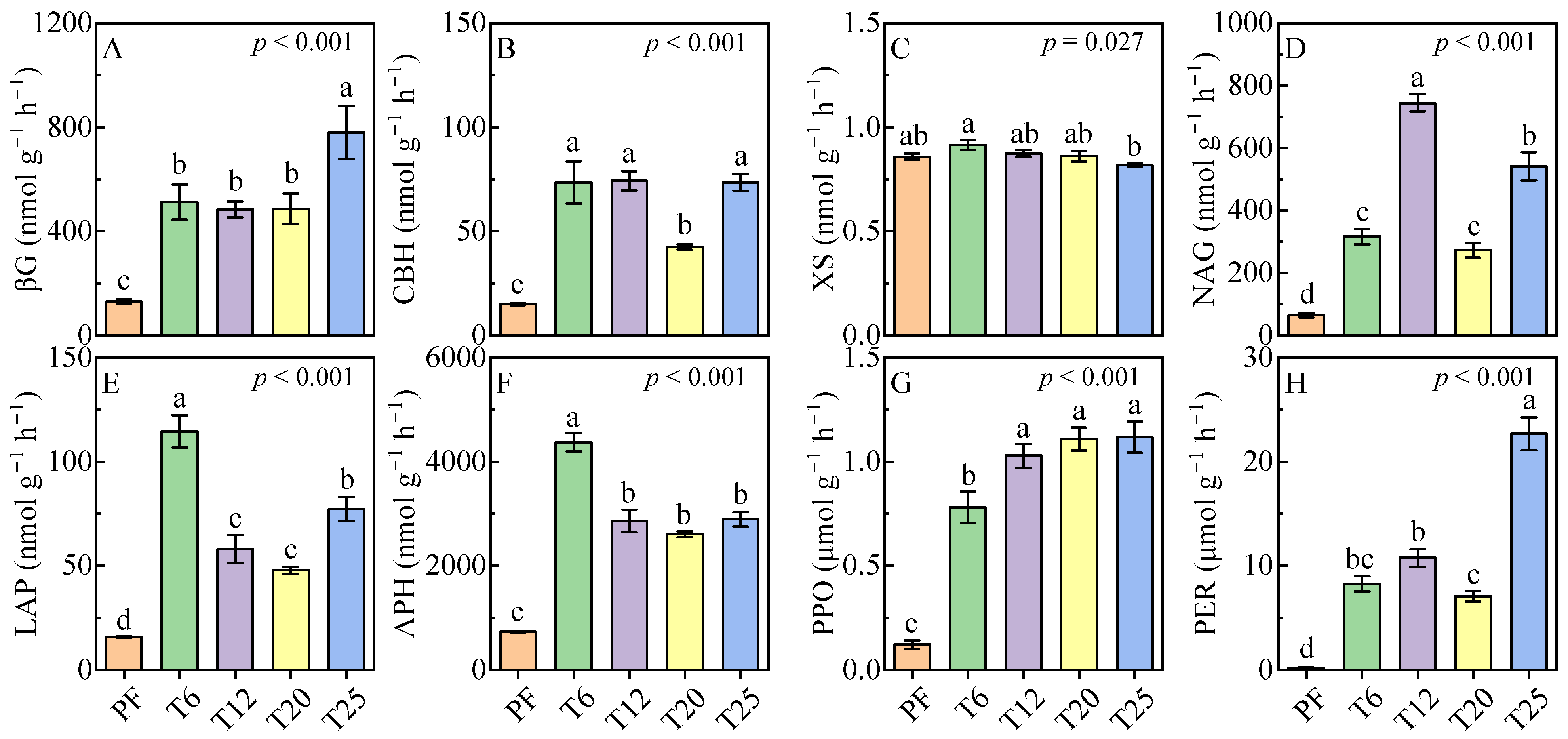
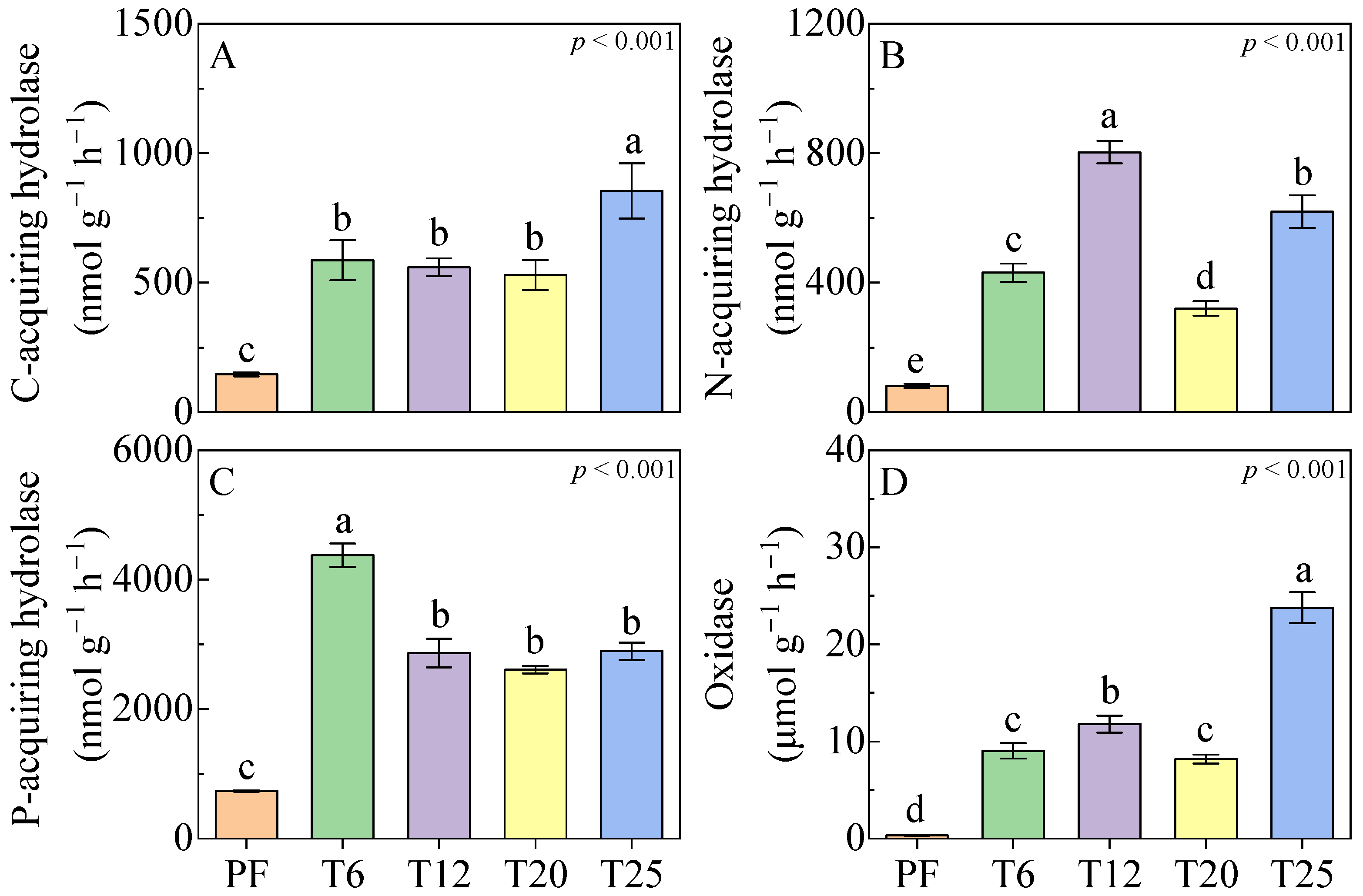
Soil enzyme activities varied among the PF and tea plantations of different ages (p < 0.001; Figure A1). The activity of βG showed a significant increasing trend with plantation age, being lowest in PF, intermediate in T6, T12, and T20, and highest in T25 (Figure A1A). CBH activity was significantly higher in all tea plantations compared to PF, but it was notably lower in T20 than in T6, T12, and T25 (Figure A1B). For XY, the highest activity was observed in T6, while the lowest was in T25, with significant differences observed across all sites (Figure A1C). The combined activity of these three enzymes—representing total C-acquiring hydrolase activity—followed a similar pattern to βG, showing a significant increase across plantation age classes (p < 0.001; Figure 2A).
For N-acquiring enzymes, the activity of NAG and LAP was lowest in the forest (PF), and tea cultivation significantly enhanced their activity, exhibiting non-linear changes with increasing plantation age. Specifically, NAG exhibited the highest activity in T12, followed by T25, T6, and T20, with the lowest activity observed in PF (Figure A1D). LAP activity peaked in T6, followed by T25, T12, and T20, with the lowest value again found in PF (Figure A1E). As a result, total N-acquiring hydrolase activity differed significantly among sites, ranked as T12 > T25 > T6 > T20 > PF (p < 0.05; Figure 2B). APH, representing P-acquiring potential, showed significantly higher activity in T6, followed by T12, T20, and T25, with PF exhibiting the lowest value (Figure 2C).
For oxidases, the activity of both PPO (Figure A1G) and PER (Figure A1H) was significantly higher than in the forest soil, and increased progressively with plantation age (except for PER in T20). Consequently, total oxidase activity (PPO + PER) ranked as T25 > T12 > T6 ≈ T20 > PF (Figure 2D).

3.4. Soil Enzyme Stoichiometry and Microbial Metabolic Limitation

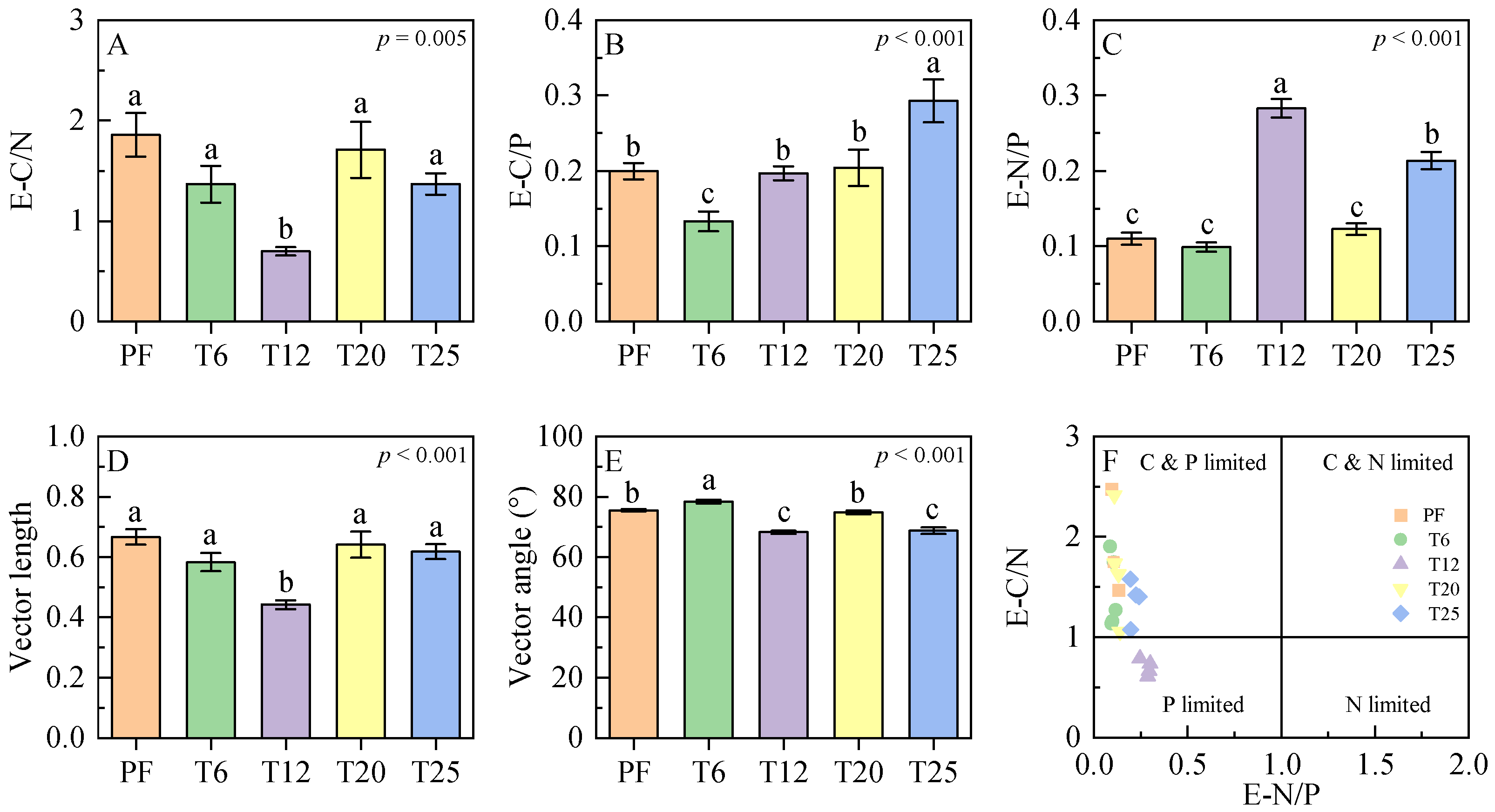
Soil enzyme stoichiometry and microbial metabolic limitation indicators exhibited changes, which may reflect the conversion from pine forest to tea plantations and plantation age (p < 0.005; Figure 3). The ratio of E-C/N was significantly lower in T12 compared to other sites (Figure 3A). In contrast, the ratio of E-C/P showed an increasing trend from PF to T25, with the pattern T6 < PF < T12 and T20 < T25 (Figure 3B). The E-N/P ratio was significantly higher in T12 and T25 than in PF, T6, and T20 (Figure 3C), indicating increased microbial investment in N relative to P at these sites.
Vector length, reflecting the overall intensity of microbial resource limitation, was significantly lower in T12 than in the other treatments (Figure 3D). In contrast, vector angle, which indicates the type of nutrient limitation, was highest in T6, followed by PF and T20, and lowest in T12 and T25—all values exceeding 45° or 55°, suggesting P limitation across all sites (Figure 3E). Scatter plots of enzyme stoichiometry (Figure 3F) illustrated a clear directional shift in microbial nutrient acquisition strategy from PF to T25. Notably, while T12 was primarily limited by P, the other sites (PF, T6, T20, and T25) exhibited co-limitation by C and P.

3.5. Factors Regulating Soil Enzyme Stoichiometry and Microbial Metabolic Limitation

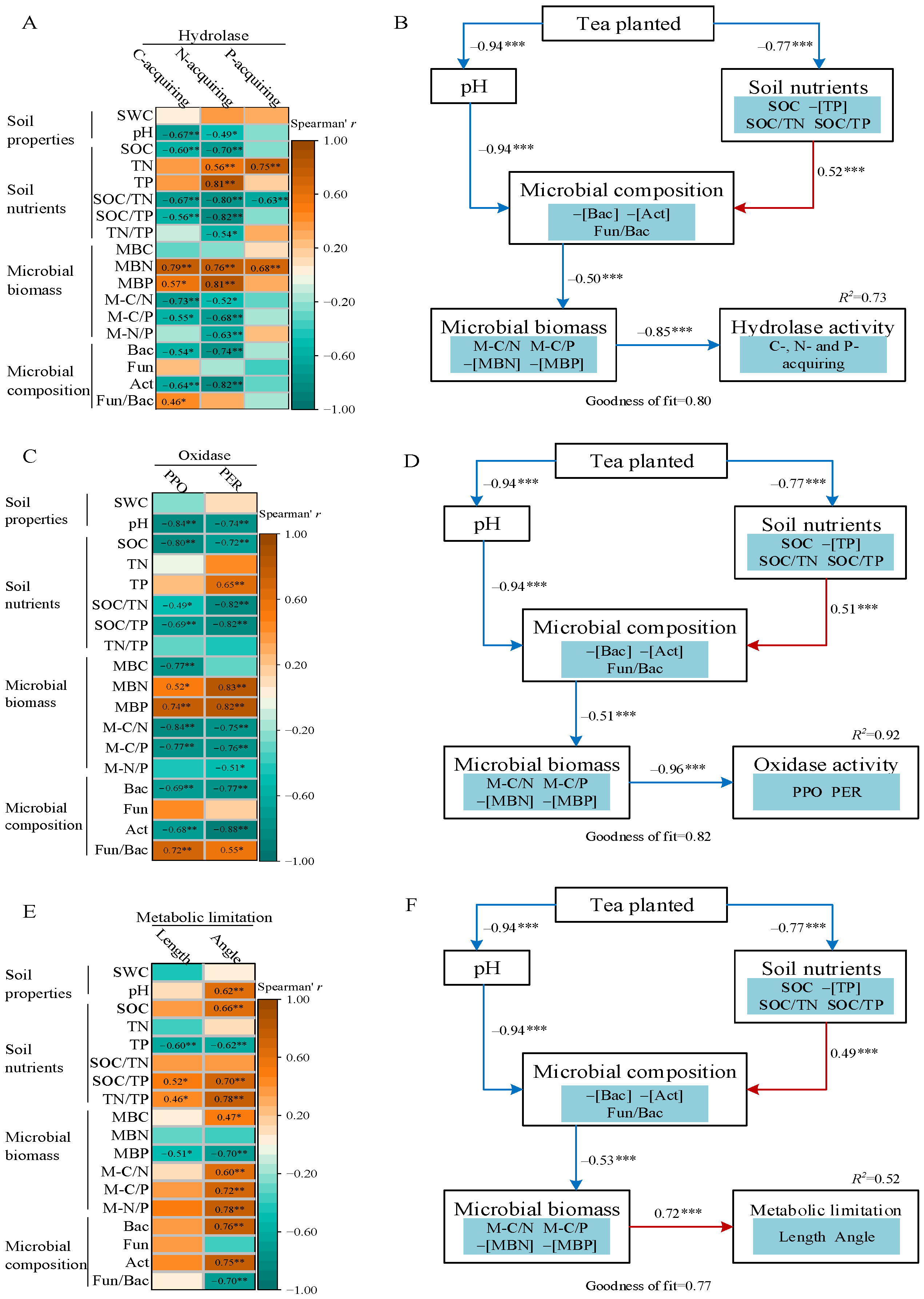
Spearman correlation analysis (Figure 4A) revealed that C-acquiring hydrolase activities were significantly negatively correlated with pH, SOC, SOC/TN, SOC/TP, M-C/N, M-C/P, and the abundances of bacterial (Bac) and actinomycete (Act) PLFAs, but positively correlated with MBN, MBP, and the fungi-to-bacteria ratio (Fun/Bac). Similarly, N-acquiring hydrolases showed significant negative correlations with pH, SOC, SOC/TN, SOC/TP, TN/TP, M-C/N, M-C/P, M-N/P, Bac, and Act, and positive correlations with TN, TP, MBN, and MBP. In contrast, P-acquiring hydrolase activity was negatively correlated only with SOC/TN and positively with TN and MBN.
The PLS-PM model (Figure 4B) further demonstrated that tea plantations indirectly influenced C-, N-, and P-acquiring hydrolase activities by lowering soil pH and altering nutrient stoichiometry (i.e., decreased SOC, SOC/TN, SOC/TP, and TP). These changes subsequently affected microbial community structure (reducing Bac and Act, increasing Fun/Bac) and microbial biomass stoichiometry (decreasing M-C/N and M-C/P, increasing MBN and MBP), ultimately driving the observed variation in hydrolase activity. This pathway explained 73% of the variance in hydrolase activities (R2 = 0.73).
For oxidases, Spearman correlation analysis (Figure 4C) showed that PPO activity was significantly negatively correlated with pH, SOC, SOC/TN, SOC/TP, MBC, M-C/N, M-C/P, Bac, and Act, while positively correlated with MBN, MBP, and Fun/Bac. PER activity exhibited similar trends, with significant negative associations with pH, SOC, SOC/TN, SOC/TP, TN/TP, M-C/N, M-C/P, M-N/P, Bac, and Act, and positive correlations with TP, MBN, MBP, and Fun/Bac. According to the PLS-PM results (Figure 4D), tea cultivation altered oxidative enzyme activity through reductions in SOC and TP, and increases in SOC/TN and SOC/TP, which led to community shifts (lower Bac and Act, higher Fun/Bac) and changes in microbial stoichiometry (reduced M-C/N, M-C/P; elevated MBN, MBP). These alterations collectively enhanced PPO and PER activities, with the model explaining 92% of the variance in oxidative enzyme activity (R2 = 0.92).
Regarding microbial metabolic limitation (Figure 4E), C limitation (vector length) was negatively correlated with TP and MBP, but positively with SOC/TP and TN/TP. P limitation (vector angle) was negatively correlated with TP, MBP, and Fun/Bac, and positively correlated with pH, SOC, SOC/TP, TN/TP, MBC, M-C/N, M-C/P, M-N/P, and the abundances of Bac and Act. PLS-PM (Figure 4F) indicated that tea plantations intensified microbial nutrient limitation by modifying soil pH and nutrient stoichiometry (decreasing SOC, TP; increasing SOC/TN, SOC/TP), which in turn altered the microbial community (reducing Bac, Act; increasing Fun/Bac) and biomass stoichiometry (lower M-C/N, M-C/P; higher MBN, MBP). This pathway explained 52% of the variance in microbial metabolic limitation (R2 = 0.52).

4. Discussion

4.1. Effects of Tea Planted on Soil Basic Properties, Nutrients, and Microbial Composition

One of the most notable changes associated with tea plantation management is a decline in soil pH. Continuous tea cultivation—especially under prolonged nitrogen fertilization—has been widely reported to accelerate soil acidification, a phenomenon well documented across many tea-producing regions [5,32]. In our study, we also found that with tea cultivation, soil pH gradually decreased, accompanied by a reduction in SOC. Although the trends of SOC changes with plantation age vary across different tea-growing regions, including increases, decreases, no significant change, and an initial increase followed by a decrease [33,34,35,36,37,38,39,40], our study observed a consistent decline in SOC. SOC in tea plantation soils consistently decreased with the decline in pH. This suggests that tea cultivation may deplete organic carbon sources. More importantly, this decline in SOC is closely linked to changes in nutrient ratios, particularly the decreasing availability of C relative to N and P. These changes exacerbate nutrient imbalances, particularly with regard to P availability. The TN/TP ratio was highest in the younger tea plantations (T6), indicating a greater availability of N relative to P. Such changes suggest that tea plantations are susceptible to nutrient depletion [41,42]. The reduction in SOC and changes in stoichiometric ratios will fundamentally impact the nutrient balance and cycling in the tea garden soil ecosystem, with long-term consequences for the microbial community [43,44].
The changes in soil nutrient availability and pH have a significant impact on microbial community composition. Our analysis of PLFA profiles showed that bacterial and actinomycete biomass decreased in tea plantations, while fungal biomass increased with plantation age. This shift suggests that fungal communities dominate in tea plantations, which is consistent with other studies showing that fungi tend to thrive under acidic and nutrient-poor conditions [41]. The Fun/Bac ratio, a widely used indicator of microbial community composition, increased with plantation age, further confirming that fungi become more dominant in older tea plantations. This change in microbial community structure likely reflects the altered nutrient dynamics of the soil, where fungi are better equipped to degrade complex organic matter, particularly in the context of low available C [21].
As the tea plantation age increased, significant declines in MBC and changes in microbial biomass stoichiometry were observed, particularly in T20 and T25. The changes in microbial biomass stoichiometry may be related to two aspects of influence [42]. First, the decrease in pH inhibits microbial growth, reducing MBC [45]. Second, the increased availability of N alters microbial uptake of N and P, and also changes community composition. This decrease in microbial biomass correlates with a decline in SOC and the increase in fungal biomass, suggesting that microbial communities are adapting to the nutrient-limited conditions of tea plantation soil by shifting to more resilient forms of carbon utilization, such as the breakdown of complex organic matter. This is consistent with the results of PLS-PM. Conversely, some studies have observed that SOC and MBC in tea plantations increase together with increasing stand age [46]. This evidence may imply the fundamental role of tea plantation SOC in the changes in tea plantation soil properties.

4.2. Effects of Tea Planted on Soil Extracellular Enzymes

Tea cultivation significantly reshaped the profile of soil extracellular enzymes. Compared to the adjacent pine forest, tea plantations showed overall increases in the activities of hydrolases involved in C (βG, CBH), N (NAG, LAP), and P (APH) acquisition. This reflects enhanced microbial nutrient demand driven by land-use change, fertilization, and altered substrate supply [11,21]. However, in absolute terms, enzyme activities in these tea plantations were still lower than those reported in intensively fertilized forest or orchard systems (e.g., bamboo forests or citrus orchards), where organic or phosphate fertilization promotes microbial metabolism [23].
The land-use conversion from forest to tea plantation exhibited complex and non-linear changes in soil enzyme activities across different plantation ages. In the early stage, most hydrolase activities increased sharply, likely reflecting initial responses to soil disturbance, nitrogen fertilization, and enhanced root exudation. In mid- to late-stage plantations (T12–T25), C- and N-acquiring enzymes displayed divergent trends: βG and CBH either increased or stabilized, while LAP declined in T20. These patterns may suggest shifts in microbial resource demand or nutrient feedbacks, but the underlying mechanisms remain uncertain. Notably, P limitation is commonly observed in tea plantations [47,48], and in our study, long-term nitrogen input without phosphorus or organic amendments likely induced chronic P limitation and microbial stoichiometric imbalance, thereby constraining enzymatic potential [15,18]. The persistently high activity of P-acquiring enzymes across plantations supports the notion of sustained microbial P mining under prolonged P stress [14]. Overall, our chronosequence design reveals non-linear responses, which cannot yet be fully explained by the current data. They may result from ecological thresholds [49], legacy effects of past management, or local environmental heterogeneity. Future long-term and mechanism-oriented studies are essential to disentangle these complex feedbacks and to better understand how tea cultivation reshapes soil microbial functions over time.
Spearman correlations and PLS-PM modeling revealed that the changes in enzyme activities were strongly associated with soil acidification, nutrient stoichiometry, and microbial traits. Hydrolase activities were negatively correlated with pH, SOC, and microbial biomass C/N/P ratios, but positively with MBN, MBP, and Fun/Bac. Path analysis indicated that tea cultivation altered enzyme activities through changes in soil chemistry, community composition, and microbial biomass stoichiometry. The PLS-PM model explained 73% of the variance in hydrolase activity. This is consistent with our initial hypothesis.
Oxidases (PPO and PER) showed a significant increase with plantation age, reaching more than five times higher in T25 compared to the native forest (PF). Unlike C- or N-hydrolases, oxidative enzymes target recalcitrant polyphenols and lignin-like compounds and are highly sensitive to fungal abundance, substrate quality, and nutrient availability [16,17]. In contrast to many fertilized forest systems where oxidase activity remains stable or declines, the sharp increase observed here suggests that microbial communities under acidic, nutrient-limited conditions shift toward oxidative metabolism [21]. PLS-PM confirmed that oxidase activity was positively influenced by Fun/Bac and MBP, and negatively by SOC and TP.

4.3. Effects of Tea Planted on Microbial Metabolic Limitation

Tea planting significantly reshaped microbial metabolic limitation, as indicated by changes in vector-based enzymatic stoichiometry. As the plantation age increased, the vector angle reflected intensified microbial P limitation, suggesting increased microbial effort to acquire limiting resources under altered soil conditions. Compared with the adjacent forest, tea plantations exhibited stronger metabolic constraints. Vector length, representing microbial C limitation, peaked in T25, while vector angle (indicative of N vs. P limitation) exceeded 55°, implying a clear shift toward P limitation. These findings are consistent with the general trend that long-term N-only fertilization and soil acidification reduce P availability, thereby enhancing microbial P stress [18]. This contrasts with some fertilized forest or orchard systems, where balanced N and P inputs can alleviate microbial limitation [25]. For instance, in bamboo forests with organic and phosphate amendment, vector angle tends to decrease, suggesting reduced P limitation. Our results highlight the risk of prolonged single-nutrient input systems, like conventional tea plantations, which may exacerbate microbial nutrient imbalance.
The land-use conversion from forest to tea plantation also played a critical role. While early-stage plantations (T6) showed moderate increases in vector metrics, more pronounced limitations emerged with time. PLS-PM analysis revealed that tea planting indirectly intensified microbial C and P limitations by lowering soil pH, and altering microbial community composition (decreased Bac and Act, increased Fun). Vector length was negatively correlated with TP and MBP, while vector angle correlated positively with fungal dominance (Fun/Bac), suggesting that changes in microbial biomass stoichiometry and community structure are key drivers. In addition, these trends are functionally consistent with the observed increases in oxidase activities (PPO, PER) discussed in Section 4.1. Under nutrient-limited conditions, fungi may shift toward the expression of oxidases to access recalcitrant C pools [17,21]. Therefore, while ecoenzymatic vectors reflect microbial resource limitation, oxidase upregulation represents an adaptive metabolic strategy under such constraints. It is worth noting that microbial C limitation (vector length) did not show a significant or consistent trend across plantation ages, which may reflect a limitation of the current vector model, which is based solely on C-acquiring hydrolases (βG, CBH, XY). In tea plantations, where SOC is low and recalcitrant compounds such as polyphenols and lignin increase, microbes may rely more heavily on oxidative metabolism. Since hydrolytic enzymes primarily target labile carbohydrates, the reliance on hydrolytic enzymes alone can underestimate the true microbial C limitation under these conditions. The strong increase in oxidase activity, especially in older tea plantations, compensates for this blind spot and suggests that oxidase pathways are more sensitive indicators of C scarcity in low-labile-C systems [2,14]. Future ecoenzymatic frameworks should incorporate both hydrolytic and oxidative pathways to provide a more accurate and comprehensive understanding of microbial metabolic stress.
In summary, tea cultivation enhanced microbial metabolic limitations by reducing soil nutrient availability and by shifting microbial communities toward fungal dominance. These limitations not only influence enzyme allocation but may also slow down organic matter turnover, affect soil C storage, and signal the need for more balanced nutrient management strategies—particularly P and organic fertilizer inputs—to support microbial function and long-term soil health [48,50].

5. Conclusions

Our study demonstrates that tea planting fundamentally restructures soil microbial functioning by altering extracellular enzyme activities and metabolic limitations. Compared with adjacent forests, tea plantations exhibited increased C-, N-, and P-acquiring hydrolase activities and substantially elevated oxidative enzyme activities, especially in older stands. These shifts indicate that microbial communities progressively invest more in nutrient acquisition and oxidative decomposition under long-term monoculture and N-only fertilization. Vector-based stoichiometric analysis further revealed enhanced microbial P limitation, while C limitation was less evident when assessed using hydrolytic enzymes alone. This highlights a limitation of the standard hydrolytic enzyme-based vector model, especially in low-SOC, high-recalcitrance systems such as tea plantations. However, the strong increase in oxidative enzyme activity suggests that microbial C limitation is more severe than what is indicated by hydrolytic-based metrics, reflecting a shift toward recalcitrant C utilization. Together, these results highlight that the concurrent analysis of oxidative enzymes is essential for a more accurate and comprehensive understanding of microbial C stress in such environments.
Overall, the transition from forest to tea plantation leads to soil acidification, reduced SOC content, nutrient imbalance, and fungal dominance. Collectively, these factors exacerbate microbial C and P limitations and reshape enzyme allocation strategies. These changes may further result in the decomposition of organic matter and reduce long–term soil fertility. Therefore, sustainable tea plantation management should incorporate P and organic matter amendments to mitigate microbial metabolic stress, support soil functional stability, and maintain ecosystem productivity. However, the study is limited by the short duration of field sampling and the lack of long-term data. Future research should focus on long-term monitoring to better understand the sustained impacts of tea cultivation on soil microbial functions and explore the role of different management practices in mitigating these effects.

Author Contributions

Conceptualization, X.J.; Project administration, X.J.; funding acquisition, S.Z. and Y.C.; Methodology, X.J.; Investigation, S.Z.; Formal analysis, C.H.; Data curation, C.H.; Visualization, Y.C.; Writing—original draft preparation, C.H.; Writing—review and editing, C.H., X.J., S.Z. and Y.C. All authors have read and agreed to the published version of the manuscript.

Funding

This work was funded by the Guizhou Provincial Science and Technology Project (qiankehejichu-ZK-[2022]yiban167 and ZK-[2024]key077), the Bijie Science and Technology Project (bikelianhe [2023]22 and bikelianhe [2023]10), the Young Science and Technology Talent Development Project of the Guizhou Provincial Department of Education (Qianjiaohe KY [2022]120 and Qianjiaohe KY [2022]123), and the Guizhou Province High-Level Innovative Talent Project (BiKeRenCaiHe [2025]7).

Data Availability Statement

The original contributions presented in this study are included in this article. Further inquiries can be directed to the corresponding author.

Conflicts of Interest

The authors declare no conflicts of interest.

Abbreviations

The following abbreviations are used in this manuscript:
PLS-PMPartial least squares path modeling
CCarbon
NNitrogen
PPhosphorus
SOCSoil organic carbon
PLFAPhospholipid fatty acid
PFForest land
T66-year-old tea garden
T1212-year-old tea garden
T2020-year-old tea garden
T25 25-year-old tea garden
SWCSoil water content
TNTotal nitrogen
TPTotal phosphorus
MBCMicrobial biomass carbon
MBNMicrobial biomass nitrogen
MBPMicrobial biomass phosphorus
M-C/NThe ratio of Microbial biomass carbon/Microbial biomass nitrogen
M-C/PThe ratio of Microbial biomass carbon/Microbial biomass phosphorus
M-N/PThe ratio of Microbial biomass nitrogen/Microbial biomass phosphorus
BacBacteria
FunFungi
ActActinomycetes
Fun/BacThe ratios of fungi to bacteria
βGβ-1,4-glucosidase
CBHβ-D-cellobiohydrolase
XYβ-1,4-xylosidase
NAGβ-1,4-N-acetylglucosaminidase
LAPleucine aminopeptidase
APHacid phosphatase
PPOpolyphenol oxidase
PERperoxidase
MUB4-methylumbelliferyl
AMC7-amino-4-methylcoumarin
L-DOPAL-3,4-dihydroxyphenylalanine
ANOVAOne-way analysis of variance

Appendix A

Figure A1. One-way analysis of variance of soil enzyme activities among forest land and tea gardens of different ages. (A) β-1,4-glucosidase (βG); (B) β-D-cellobiohydrolase (CBH); (C) β-1,4-xylosidase (XS); (D) β-1,4-N-acetylglucosaminidase (NAG); (E) leucine aminopeptidase (LAP); (F) acid phosphatase (APH); (G) polyphenol oxidase (PPO); (H) peroxidase (PER). Different lowercase letters indicate significant differences among forest land and tea gardens of different ages (p < 0.05). Values are means ± SE. PF, pine forest; T6, 6-year-old tea garden; T12, 12-year-old tea garden; T20, 20-year-old tea garden; T25, 25-year-old tea garden.
Agronomy 15 02615 g0a1

References

  1. Zou, S.; Huang, C.; Feng, T.; Chen, Y.; Bai, X.; Li, W.; He, B. Effects of Woodland Conversion to Tea Plantations and Tea Planting Age on Soil Organic Carbon Accrual in Subtropical China. Forests 2024, 15, 1862. [Google Scholar] [CrossRef]
  2. Wang, H.; Jin, J.; Yu, P.; Fu, W.; Morrison, L.; Lin, H.; Meng, M.; Zhou, X.; Lv, Y.; Wu, J. Converting evergreen broad-leaved forests into tea and Moso bamboo plantations affects labile carbon pools and the chemical composition of soil organic carbon. Sci. Total Environ. 2020, 711, 135225. [Google Scholar] [CrossRef]
  3. Ma, S.; Zhu, B.; Chen, G.; Ni, X.; Zhou, L.; Su, H.; Cai, Q.; Chen, X.; Zhu, J.; Ji, C.; et al. Loss of soil microbial residue carbon by converting a tropical forest to tea plantation. Sci. Total Environ. 2022, 818, 151742. [Google Scholar] [CrossRef] [PubMed]
  4. Fan, L.; Shao, G.; Pang, Y.; Dai, H.; Zhang, L.; Yan, P.; Zou, Z.; Zhang, Z.; Xu, J.; Zamanian, K.; et al. Enhanced soil quality after forest conversion to vegetable cropland and tea plantations has contrasting effects on soil microbial structure and functions. Catena 2022, 211, 106029. [Google Scholar] [CrossRef]
  5. Yang, X.; Ni, K.; Shi, Y.; Yi, X.; Zhang, Q.; Fang, L.; Ma, L.; Ruan, J. Effects of long-term nitrogen application on soil acidification and solution chemistry of a tea plantation in China. Agric. Ecosyst. Environ. 2018, 252, 74–82. [Google Scholar] [CrossRef]
  6. Xue, D.; Yao, H.; Huang, C. Study on Soil Microbial Properties and Enzyme Activities in Tea Gardens. J. Soil Water Conserv. 2005, 19, 84–87. [Google Scholar]
  7. Gao, X.B.; Liu, C.Y.; Guo, C.; Duan, X.Y.; Zhang, Y.; Ma, C.Y. Soil Acidification and Its Temporal Changes in Tea Plantations of Guizhou Province, Southwest China. Land Degrad. Dev. 2024, 35, 5648–5658. [Google Scholar] [CrossRef]
  8. Zhang, S.; Yanagisawa, N.; Asahina, M.; Yamashita, H.; Ikka, T. Soil chemical factors contributing to differences in bacterial communities among tea field soils and their relationships with tea quality. Front. Plant Sci. 2025, 16, 1540659. [Google Scholar] [CrossRef] [PubMed]
  9. Tang, S.; Zhou, J.; Pan, W.; Tang, R.; Ma, Q.; Xu, M.; Qi, T.; Ma, Z.; Fu, H.; Wu, L. Impact of N application rate on tea (Camellia sinensis) growth and soil bacterial and fungi communities. Plant Soil 2022, 475, 343–359. [Google Scholar] [CrossRef]
  10. Hu, Z.; Ji, L.; Wan, Q.; Li, H.; Li, R.; Yang, Y. Short-Term Effects of Bio-Organic Fertilizer on Soil Fertility and Bacterial Community Composition in Tea Plantation Soils. Agronomy 2022, 12, 2168. [Google Scholar] [CrossRef]
  11. Yin, R.; Li, L.; Liu, H.; Yao, J.; Ma, C.; Pu, L.; Lei, Z. Biochar, Organic Fertilizer, and Bio-Organic Fertilizer Improve Soil Fertility and Tea Quality. Agronomy 2024, 14, 2339. [Google Scholar] [CrossRef]
  12. Wang, X.Y.; Li, Y.Q.; Wang, L.L.; Duan, Y.L.; Yao, B.; Chen, Y.; Cao, W.J. Soil extracellular enzyme stoichiometry reflects microbial metabolic limitations in different desert types of northwestern China. Sci. Total Environ. 2023, 874, 162504. [Google Scholar] [CrossRef]
  13. Pang, C.L.; Zhang, Z.H.; Zhu, X.M.; Wei, W.T.; Mustafa, A.; Chen, W.B.; Mao, Q.G.; Mo, J.M.; Li, S.; Lu, X.K. Divergent microbial metabolic limitations across soil depths after two decades of high nitrogen inputs in a primary tropical forest. Glob. Change Biol. 2025, 31, 70440. [Google Scholar] [CrossRef] [PubMed]
  14. Xu, G.; Long, Z.J.; Ren, P.; Ren, C.J.; Cao, Y.; Huang, Y.; Hu, S.L. Differential responses of soil hydrolytic and oxidative enzyme activities to the natural forest conversion. Sci. Total Environ. 2020, 716, 136414. [Google Scholar] [CrossRef]
  15. Lin, S.; Liu, Z.; Wang, Y.; Li, J.; Wang, G.; Ye, J.; Wang, H.; He, H. Soil metagenomic analysis on changes of functional genes and microorganisms involved in nitrogen-cycle processes of acidified tea soils. Front. Plant Sci. 2022, 13, 998178. [Google Scholar] [CrossRef]
  16. Kunito, T.; Moro, H.; Mise, K.; Sawada, K.; Otsuka, S.; Nagaoka, K.; Fujita, K. Ecoenzymatic stoichiometry as a temporally integrated indicator of nutrient availability in soils. Soil Sci. Plant Nutr. 2024, 70, 246–269. [Google Scholar] [CrossRef]
  17. Sinsabaugh, R.L.; Lauber, C.L.; Weintraub, M.N.; Ahmed, B.; Allison, S.D.; Crenshaw, C.; Contosta, A.R.; Cusack, D.; Frey, S.; Gallo, M.E.; et al. Stoichiometry of soil enzyme activity at global scale. Ecol. Lett. 2008, 11, 1252–1264. [Google Scholar] [CrossRef]
  18. Cui, Y.X.; Bing, H.J.; Moorhead, D.L.; Delgado-Baquerizo, M.; Ye, L.P.; Yu, J.L.; Zhang, S.P.; Wang, X.; Peng, S.S.; Guo, X.; et al. Ecoenzymatic stoichiometry reveals widespread soil phosphorus limitation to microbial metabolism across Chinese forests. Commun. Earth Environ. 2022, 3, 184. [Google Scholar] [CrossRef]
  19. Cui, Y.; Moorhead, D.L.; Peng, S.; Sinsabaugh, R.L.; Peñuelas, J. Predicting microbial nutrient limitations from a stoichiometry-based threshold framework. Innov. Geosci. 2024, 2, 100048. [Google Scholar] [CrossRef]
  20. Zhu, R.; Zheng, Z.; Li, T.; He, S.; Zhang, X.; Wang, Y.; Liu, T. Effect of tea plantation age on the distribution of glomalin-related soil protein in soil water-stable aggregates in southwestern China. Environ. Sci. Pollut. Res. 2019, 26, 1973–1982. [Google Scholar] [CrossRef] [PubMed]
  21. Yang, X.; Ni, K.; Shi, Y.; Yi, X.; Ji, L.; Wei, S.; Jiang, Y.; Zhang, Y.; Cai, Y.; Ma, Q.; et al. Metagenomics reveals N-induced changes in carbon-degrading genes and microbial communities of tea (Camellia sinensis L.) plantation soil under long-term fertilization. Sci. Total Environ. 2023, 856, 159231. [Google Scholar] [CrossRef]
  22. Li, Y.; Zhang, J.; Qiu, Q.; Zhou, Y.; You, W. Changes in soil properties and enzyme stoichiometry in three different forest types changed to tea plantations. Forests 2023, 14, 2043. [Google Scholar] [CrossRef]
  23. Huang, C.Y.; Zhang, K.R.; Guo, W.T.; Huang, H.J.; Gou, Z.Y.; Yang, L.; Chen, Y.; Oh, K.; Fang, C.G.; Luo, L. The effects of partial substitution of fertilizer using different organic materials on soil nutrient condition, aggregate stability and enzyme activity in a tea plantation. Plants 2023, 12, 3791. [Google Scholar] [CrossRef]
  24. Gui, H.; Fan, L.; Wang, D.; Yan, P.; Li, X.; Zhang, L.; Han, W. Organic management practices shape the structure and associations of soil bacterial communities in tea plantations. Appl. Soil Ecol. 2021, 163, 103975. [Google Scholar] [CrossRef]
  25. Ren, Y.; Wang, Y.; Zhang, X.L.; Liu, X.H.; Liu, P.; Chen, L. Enzymatic stoichiometry reveals the metabolic limitations of soil microbes under nitrogen and phosphorus addition in Chinese fir plantations. Microorganisms 2024, 12, 1716. [Google Scholar] [CrossRef] [PubMed]
  26. Fei, Y.; Huang, S.; Zhang, H.; Tong, Y.; Wen, D.; Xia, X.; Wang, H.; Luo, Y.; Barceló, D. Response of soil enzyme activities and bacterial communities to the accumulation of microplastics in an acid cropped soil. Sci. Total Environ. 2020, 707, 135634. [Google Scholar] [CrossRef] [PubMed]
  27. Chen, Y.P.; Tsai, C.F.; Rekha, P.D.; Ghate, S.D.; Huang, H.Y.; Hsu, Y.H.; Liaw, L.L.; Young, C.C. Agricultural management practices influence the soil enzyme activity and bacterial community structure in tea plantations. Bot. Stud. 2021, 62, 8. [Google Scholar] [CrossRef] [PubMed]
  28. Zou, S.; Huang, C.; Chen, Y.; Bai, X.; Li, W.; He, B. Patterns of nitrogen and phosphorus along a chronosequence of tea plantations in subtropical China. Agriculture 2024, 14, 110. [Google Scholar] [CrossRef]
  29. Vance, E.D.; Brookes, P.C.; Jenkinson, D.S. An extraction method for measuring soil microbial biomass C. Soil Biol. Biochem. 1987, 19, 703–707. [Google Scholar] [CrossRef]
  30. Frostegard, A.; Tunlid, A.; Baath, E. Phospholipid fatty-acid composition, biomass, and activity of microbial communities from two soil types experimentally exposed to different heavy metals. Appl. Environ. Microbiol. 1993, 59, 3605–3617. [Google Scholar] [CrossRef]
  31. German, D.P.; Weintraub, M.N.; Grandy, A.S.; Lauber, C.L.; Rinkes, Z.L.; Allison, S.D. Optimization of hydrolytic and oxidative enzyme methods for ecosystem studies. Soil Biol. Biochem. 2011, 43, 1387–1397. [Google Scholar] [CrossRef]
  32. Yan, P.; Wu, L.; Wang, D.; Fu, J.; Shen, C.; Li, X.; Zhang, L.; Zhang, L.; Fan, L.; Wenyan, H. Soil acidification in Chinese tea plantations. Sci. Total Environ. 2020, 715, 136963. [Google Scholar] [CrossRef] [PubMed]
  33. Wang, M.; Zhao, J.; Chen, J.; Zhang, X.; Zhu, S. Soil organic carbon content and its relationship with the stand age in tea plantations (Camellia sinensis L.) in Fujian Province, China. Land 2024, 13, 834. [Google Scholar] [CrossRef]
  34. Tang, S.; Pan, W.; Yang, Y.; Luo, Z.; Wanek, W.; Kuzyakov, Y.; Marsden, K.A.; Liang, G.; Chadwick, D.R.; Gregory, A.S.; et al. Soil carbon sequestration enhanced by long-term nitrogen and phosphorus fertilization. Nat. Geosci. 2025, 18, 1005–1013. [Google Scholar] [CrossRef]
  35. Tang, Q.; Li, W.; Dai, W.; Wang, J.; Zhang, F.; Daniell, T.J.; Cheng, Y.; Wang, S.; Yin, W.; Wang, X. Patterns and determinants of microbial- and plant-derived carbon contributions to soil organic carbon in tea plantation chronosequence. Plant Soil 2024, 505, 811–825. [Google Scholar] [CrossRef]
  36. Shu, Y.; Xie, S.; Fan, H.; Duan, C.; Liu, Y.; Chen, Z. Tea cultivation: Facilitating soil organic carbon accumulation and altering soil bacterial community—Leishan County, Guizhou Province, Southwest China. PeerJ 2025, 13, e18683. [Google Scholar] [CrossRef]
  37. Ma, X.; Ou, X.; Chen, D.; Li, Y.; McMillan, C.; Ge, T.D.; Liu, J.; Xue, M.; Wang, C.; Shen, W. Shifts in fungal communities and potential functions under Masson pine forest-to-tea plantation conversion in subtropical China. Microorganisms 2025, 13, 1614. [Google Scholar] [CrossRef]
  38. Luo, Y.; Zhang, S.; Hu, Q.; Huang, F.; Bao, D.; Li, X.; Dong, C.; Zhu, S.; Fu, J.; Yan, P. Long-term agricultural management alters soil fungal communities and soil carbon and nitrogen contents in tea plantations. Agronomy 2024, 14, 2779. [Google Scholar] [CrossRef]
  39. Li, W.; Zheng, Z.; Li, T.; Zhang, X.; Wang, Y.; Yu, H.; He, S.; Liu, T. Effect of tea plantation age on the distribution of soil organic carbon fractions within water-stable aggregates in the hilly region of Western Sichuan, China. Catena 2015, 133, 198–205. [Google Scholar] [CrossRef]
  40. He, S.; Zheng, Z.; Zhu, R. Long-term tea plantation effects on composition and stabilization of soil organic matter in Southwest China. Catena 2021, 199, 105132. [Google Scholar] [CrossRef]
  41. Zheng, X.; Wu, Y.; Xu, A.; Lin, C.; Wang, H.; Yu, J.; Ding, H.; Zhang, Y. Response of soil microbial communities and functions to long-term tea (Camellia sinensis L.) planting in a subtropical region. Forests 2023, 14, 1288. [Google Scholar] [CrossRef]
  42. Zhang, G.; Yang, W.; Hu, J.; Liu, J.; Ding, W.; Huang, J. Effects of tea planting age on soil microbial biomass C:N:P stoichiometry and microbial quotient. Plant Soil Environ. 2023, 69, 221–229. [Google Scholar] [CrossRef]
  43. Yang, X.; Yi, X.; Ni, K.; Zhang, Q.; Shi, Y.; Chen, L.; Zhao, Y.; Zhang, Y.; Ma, Q.; Cai, Y.; et al. Patterns and abiotic drivers of soil organic carbon in perennial tea (Camellia sinensis L.) plantation system of China. Environ. Res. 2023, 237, 116925. [Google Scholar] [CrossRef]
  44. Li, Y.; Liu, Y.; Huang, X.; Zhang, Y.; Zhou, G.; Zhou, F.; Jiang, T. Assessing soil nutrient and microbial biomass in tea plantation regions of Guizhou Province. J. Irrig. Drain. 2018, 37, 98–105. [Google Scholar]
  45. Ge, C.; Xue, D.; Yao, H. Microbial biomass, community diversity, and enzyme activities in response to urea application in tea orchard soils. Commun. Soil Sci. Plant Anal. 2010, 41, 797–810. [Google Scholar] [CrossRef]
  46. Yao, H.; Liu, Y.; Xue, D. Influence of tea cultivation on soil microbial biomass and substrate utilization pattern. Commun. Soil Sci. Plant Anal. 2006, 37, 641–651. [Google Scholar] [CrossRef]
  47. Yuan, S.; Shen, C.; Gao, K.; Feng, S.; Li, D.; Hu, Q.; Liu, Y.; Luo, Z. Microbial nutrient limitation of different tea cultivars: Evidence from five representative cultivars. Agronomy 2024, 14, 467. [Google Scholar] [CrossRef]
  48. Chang, Y.; Wu, Z.; Penuelas, J.; Sardans, J.; Chen, Y.; Jiang, F.; Wang, F. Organic management improves soil P availability via increasing inorganic P solubilization in tea plantations. Environ. Technol. Innov. 2025, 39, 104223. [Google Scholar] [CrossRef]
  49. Rothenberg, D.O.N.; Abbas, F.; Mei, X.; Yan, C.; Zeng, Z.; Mo, X.; Chen, S.; Zhang, L.; Huang, Y. Metabarcoding of organic tea (Camellia sinensis L.) chronosequence plots elucidates soil acidification-induced shifts in microbial community structure and putative function. Appl. Soil Ecol. 2022, 178, 104580. [Google Scholar] [CrossRef]
  50. Tian, Y.; Cao, F.; Wang, G. Soil microbiological properties and enzyme activity in Ginkgo-tea agroforestry compared with monoculture. Agrofor. Syst. 2013, 87, 1201–1210. [Google Scholar] [CrossRef]
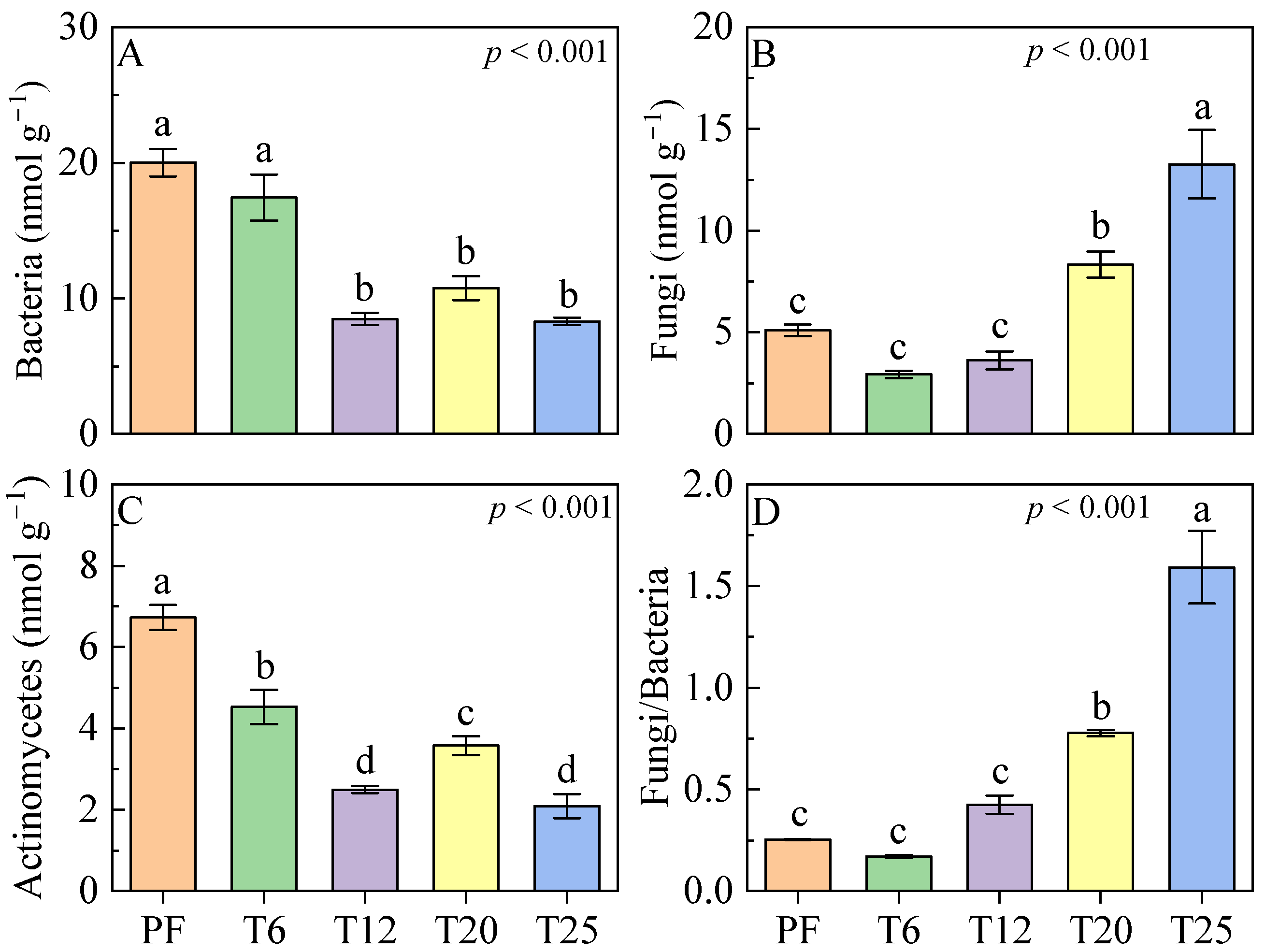
Figure 1. One-way analysis of variance of soil microbial composition (based on the PLFA method) among forest land and tea gardens of different ages. (A) Bacteria; (B) Fungi; (C) Actinomycetes; (D) Fungi to bacteria ratio. Different lowercase letters indicate significant differences among forest land and tea gardens of different ages (p < 0.05). Values are means ± SE (n = 4). PF, pine forest; T6, 6-year-old tea garden; T12, 12-year-old tea garden; T20, 20-year-old tea garden; T25, 25-year-old tea garden.
Agronomy 15 02615 g001
Figure 2. One-way analysis of variance of soil enzyme activities among forest land and tea gardens of different ages. (A) C-acquiring hydrolase; (B) N-acquiring hydrolase; (C) P-acquiring hydrolase; (D) oxidase. Different lowercase letters indicate significant differences among forest land and tea gardens of different ages (p < 0.05). Values are means ± SE (n = 4). PF, pine forest; T6, 6-year-old tea garden; T12, 12-year-old tea garden; T20, 20-year-old tea garden; T25, 25-year-old tea garden.
Agronomy 15 02615 g002
Figure 3. Soil enzyme stoichiometry and microbial metabolic limitations in forest land and tea garden. (A) ratios of C-acquiring hydrolase to N-acquiring hydrolase activity (E-C/N); (B) ratios of C-acquiring hydrolase to P-acquiring hydrolase activity (E-C/P); (C) ratios of N-acquiring hydrolase to P-acquiring hydrolase activity (E-N/P); (D) vector length; (E) vector angle; (F) scatter plots of soil enzyme stoichiometry. Different lowercase letters indicate significant differences among forest land and tea gardens of different ages (p < 0.05). Values are means ± SE (n = 4). PF, pine forest; T6, 6-year-old tea garden; T12, 12-year-old tea garden; T20, 20-year-old tea garden; T25, 25-year-old tea garden.
Agronomy 15 02615 g003
Figure 4. Analysis of factors affecting soil hydrolase and oxidase activities and microbial metabolic limitations. (A) Spearman correlation analysis of soil hydrolase activity (C, N, and P-acquiring hydrolases) and soil conditions; (B) partial least squares path modeling (PLS-PM) of soil hydrolase activity; (C) Spearman correlation analysis of soil oxidase activity (PPO, polyphenol oxidase; PER, peroxidase) and soil conditions; (D) PLS-PM of soil oxidase activity; (E) Spearman correlation analysis of microbial metabolic limitation (vector length and angle) and soil conditions; (F) PLS-PM of microbial metabolic limitation. SWC, gravimetric soil moisture content; SOC, soil organic carbon; TN, soil total nitrogen; TP, soil total phosphorus; SOC/TN, ratios of SOC to TN; SOC/TP, ratios of SOC to TP; TN/TP, ratios of TN to TP; MBC, microbial biomass carbon; MBN, microbial biomass nitrogen; MBP, microbial biomass phosphorus; M-C/N, ratios of MBC to MBN; M-C/P, ratios of MBC to MBP; M-N/P, ratios of MBN to MBP; Bac, bacteria; Fun, fungi; Act, actinomyces; Fun/Bac, ratios of Fun to Bac. The red lines represent positive correlations, while the blue lines represent negative correlations. Significance level: * 0.01 ≤ p < 0.05; ** 0.001 ≤ p < 0.01; *** p < 0.001.
Agronomy 15 02615 g004
Table 1. One-way analysis of variance of soil basic properties and nutrients among forest land and tea gardens of different ages.
Soil PropertiesTea Planted
PFT6T12T20T25
SWC (%)33.37 ± 1.88 ab35.62 ± 0.65 ab36.08 ± 0.57 a32.22 ± 1.49 b33.84 ± 0.42 ab
pH4.40 ± 0.05 a4.06 ± 0.02 b3.88 ± 0.01 c3.84 ± 0.01 c3.67 ± 0.03 d
SOC (g kg−1)20.22 ± 0.25 a16.00 ± 0.20 b12.45 ± 0.13 c13.07 ± 0.34 cd11.80 ± 0.59 d
TN (g kg−1)1.21 ± 0.02 c1.86 ± 0.02 a1.43 ± 0.02 b1.18 ± 0.01 c1.44 ± 0.05 b
TP (g kg−1)0.71 ± 0.01 d0.79 ± 0.04 c0.99 ± 0.01 a0.69 ± 0.01 d0.93 ± 0.01 b
SOC/TN16.75 ± 0.24 a8.62 ± 0.09 c8.72 ± 0.18 c11.06 ± 0.33 b8.18 ± 0.12 c
SOC/TP28.47 ± 0.37 a20.49 ± 0.88 b12.53 ± 0.22 c18.97 ± 0.78 b12.75 ± 0.57 c
TN/TP1.7 ± 0.03 b2.38 ± 0.11 a1.44 ± 0.03 c1.71 ± 0.02 b1.56 ± 0.05 bc
MBC (mg kg−1)169.78 ± 2.91 a182.47 ± 12.65 a83.48 ± 6.76 b30.43 ± 2.67 c70.51 ± 4.23 b
MBN (mg kg−1)2.44 ± 0.07 d10.67 ± 0.66 b9.67 ± 1.28 b6.02 ± 0.62 c20.03 ± 0.44 a
MBP (mg kg−1)2.11 ± 0.14 c2.78 ± 0.40 c17.56 ± 2.15 b4.01 ± 0.61 c23.42 ± 2.04 a
M-C/N69.78 ± 2.18 a17.14 ± 0.77 b9.39 ± 1.94 c5.13 ± 0.43 d3.52 ± 0.22 d
M-C/P81.57 ± 5.86 a69.68 ± 9.91 a5.03 ± 0.82 b8.29 ± 1.67 b3.10 ± 0.37 b
M-N/P1.16 ± 0.05 b4.13 ± 0.69 a0.57 ± 0.09 b1.66 ± 0.37 b0.87 ± 0.07 b
Note: Different lowercase letters (within the same row) indicate significant differences among forest land and tea gardens of different ages (p < 0.05). Values are means ± SE (n = 4). SWC, gravimetric soil moisture content; SOC, soil organic carbon; TN, soil total nitrogen; TP, soil total phosphorus; SOC/TN, ratios of SOC to TN; SOC/TP, ratios of SOC to TP; TN/TP, ratios of TN to TP; MBC, microbial biomass carbon; MBN, microbial biomass nitrogen; MBP, microbial biomass phosphorus; M-C/N, ratios of MBC to MBN; M-C/P, ratios of MBC to MBP; M-N/P, ratios of MBN to MBP. PF, pine forest; T6, 6-year-old tea garden; T12, 12-year-old tea garden; T20, 20-year-old tea garden; T25, 25-year-old tea garden.
Disclaimer/Publisher’s Note: The statements, opinions and data contained in all publications are solely those of the individual author(s) and contributor(s) and not of MDPI and/or the editor(s). MDPI and/or the editor(s) disclaim responsibility for any injury to people or property resulting from any ideas, methods, instructions or products referred to in the content.