Article

Water and Nitrogen Management Drive Soil Nutrient Dynamics and Microbial–Enzyme Activity in Silage Maize Systems in Northwest China
1
College of Prataculture Science, Gansu Agricultural University, Lanzhou 730070, China
2
College of Forestry, Gansu Agricultural University, Lanzhou 730070, China
3
State Key Laboratory of Aridland Crop Science, Gansu Agricultural University, Lanzhou 730070, China
4
College of Agriculture and Ecological Engineering, Hexi University, Zhangye 734000, China
*
Authors to whom correspondence should be addressed.
Agronomy 2025, 15(10), 2405; https://doi.org/10.3390/agronomy15102405
Submission received: 15 September 2025 / Revised: 12 October 2025 / Accepted: 14 October 2025 / Published: 16 October 2025
(This article belongs to the Special Issue Impact of Irrigation or Drainage on Soil Environment and Crop Growth)

Abstract

Efficient water and nitrogen management is essential for maintaining soil fertility and achieving sustainable agricultural production, especially in arid oasis regions where soil degradation and nutrient loss are common challenges. However, the interactions between irrigation regimes, nitrogen application, and soil biological processes in such environments remain insufficiently understood. This study investigated the effects of water and nitrogen management on the sustainability of sandy soil nutrients within the context of the sustainable development goals during silage maize cultivation in the oasis irrigation area of the Hexi Corridor, Northwest China. Four irrigation regimes and five nitrogen management regimes were tested. The results indicate that ammonium nitrogen (NH4+-N) varied significantly during the jointing stage (W4 treatment), ranging from 3.52 to 16.38 mg/kg (p < 0.05). Nitrate nitrogen (NO3-N) exhibited significant differences during the tasseling stage (W1 treatment), with a range of 6.16–21.58 mg/kg (p < 0.05). Soil total phosphorus (STP) gradually declined from early to late growth stages, ranging from 0.20 to 0.97 g/kg. Regarding enzyme activity, alkaline phosphatase (ALP) increased progressively throughout the growth period, with a range of 0.02–0.14 mg/g/d, while urease (URE) showed a declining trend, ranging from 0.25 to 0.66 mg/g/d. Water management exerted a significant negative effect on soil enzyme activity (p < 0.05), while nitrogen fertilization had a minimal impact on soil microbial communities (p > 0.05). Growth stage and irrigation regime are key regulators of the soil–microbe–enzyme activity system. The crop’s nutrient demand cycles and microbially mediated nutrient transformations exhibited strong dependence on growth stage. Enzyme activity is notably and positively affected by nitrogen inputs and plant developmental stages, while microbial biomass is mainly regulated by soil C, N, and P contents and enzyme activities. These findings provide a scientific basis for implementing water-saving irrigation and high-efficiency fertilization strategies in oasis agricultural systems.

1. Introduction

Irrigated agriculture, which is applied to 20% of global farmland, contributes 40% of global food production, consuming approximately 70% of the world’s freshwater withdrawals and accounting for the largest share of consumptive water use (~90%) [1,2]. In most water-scarce irrigated regions, suboptimal water management has hindered yield and profit maximization, thereby reducing overall production capacity [3]. In most cases, water-saving irrigation enhances nitrogen use efficiency in both natural and artificial oases of desert regions. Moreover, integrated water–nitrogen management significantly reduces nitrogen losses in paddy fields while conserving water and increasing yields [4]. Because soil is typically a “black box” characterized by high spatial heterogeneity and structural complexity, analyzing and predicting nutrient availability within the soil is challenging [5]. Previous studies have indicated that changes in nitrogen input and water availability may have either independent or synergistic effects on the cycling of nitrogen and other nutrients in semi-arid and arid ecosystems [6,7]. Farmland sustainability must be taken into account, as decades of oasis agriculture have clearly altered soil nutrient effectiveness. Continued reliance on traditional fertilization practices can evidently affect soil sustainability, as nutrient losses caused by irrigation may no longer meet crop growth requirements, whereas excessive additions can lead to nutrient surpluses and avoidable losses. Desertification has emerged a global challenge, driving unsustainable land management and threatening the livelihoods of vulnerable populations [8,9]. Drip irrigation, as an innovative and efficient irrigation technology for arid regions, has been widely adopted in recent years and plays a crucial role in uniformly distributing water and nutrients within the crop root zone, and is characterized by the synchronized delivery of water and fertilizers compared to conventional irrigation and nitrogen application methods. For maize under drip irrigation, nitrogen use efficiency is not only higher than that under border irrigation or rainfed conditions, but also markedly enhances water productivity and nitrogen utilization efficiency relative to traditional farmer practices of irrigation and fertilization [10]. If unsustainable agricultural practices persist, they will inevitably lead to the gradual degradation of ecosystems; research into fertilization strategies aligned with soil requirements is crucial for improving soil quality, protecting the environment, and establishing scientific management standards [11].
Studies have demonstrated that proper water and fertilizer management can effectively improve land quality and increase crop yields [12,13,14]. Inappropriate irrigation levels—whether excessive or insufficient—can lead to reduced crop yields [15]. Prolonged irrigation can also impair nutrient retention in sandy soils. Plants may fail to fully absorb nutrients applied to the soil. Due to their large pore sizes, sandy soils are highly susceptible to nutrient leaching and subsequent groundwater eutrophication when irrigation is not precisely managed, thereby imposing stress on the broader ecosystem [16,17]. The use of chemical fertilizers represents a double-edged sword, exerting both positive and negative effects on soil microbial diversity [18]. Variations in water availability can also impact soil microbial diversity, as reduced soil moisture leads to declines in extracellular enzyme production and microbial activity [19,20]. Additionally, microbial communities are shaped by soil fertility factors, and soil enzyme activity serves as a key indicator of both microbial function and soil fertility [21,22]. Under equivalent fertilization conditions, drip irrigation can enhance the activity of various soil enzymes. Moreover, the dynamic changes in soil enzyme activities are jointly regulated by factors such as fertilizer inputs and soil moisture. Within an appropriate range of fertigation management, drip irrigation can maximize soil enzyme activity [23]. Soil microbes drive biogeochemical cycling through the production of extracellular enzymes, whose stoichiometry reflects the microbial nutrient limitation status. Under environmental stress, microbes modulate enzyme ratios to adapt to nutrient demands [24]. Another important consideration is that numerous soil microorganisms and physicochemical properties are strongly associated with soil moisture. Consequently, fluctuations in moisture can modify nutrient and salinity distributions, potentially creating trade-offs that undermine soil health, disrupt microbial communities, and alter biogeochemical cycles at the field scale [25,26].
Desert ecosystems have historically limited regional economic development, whereas irrigated agriculture remains the primary pillar of oasis economies. Strengthening the structure and function integrity of these systems is essential for sustainable oasis development, providing a strong foundation for food and livestock production and ensuring the livelihood security of local populations [27]. The Hexi Corridor, serving as an important transit zone connecting China with Central Asia and Europe, is a vital part of the ancient Silk Road. The region is characterized by vast desert landscapes, where limited water resources, harsh environmental conditions, and ecological fragility have constrained its socio-economic development [28]. Currently, irrigated agriculture in the Hexi Corridor faces significant challenges arising from regional constraints, arid climatic conditions, and rapid urbanization. Historically reliant on river systems for irrigation, the region’s agricultural and pastoral economy now experiences acute water scarcity, resulting in increased reliance on glacier meltwater and groundwater resources. The Hexi Corridor possesses net consumable water resources of 43.33 × 10⁸ m3, with a near-balanced supply–demand ratio. The net utilization efficiency of these water resources is 59%, highlighting substantial potential for water conservation in agriculture practices [29]. In addition, the future development of the Hexi Corridor is constrained by several factors. The region’s soils are mainly sandy loam, and its topography presents a typical “mountain–oasis–desert” ecological pattern. The oases, which are less ecologically fragile overall, are densely populated areas characterized by farmland cultivation and afforestation activities [30]. At present, water scarcity remains a major constraint on the economic development of the Hexi Corridor. Local water resources have long depended on meltwater from the Qilian Mountains. Developing water-saving irrigation agriculture poses a major challenge, and identifying crop water-use characteristics, adopting efficient irrigation methods, and improving water-use efficiency are key strategies to alleviate the imbalance between water supply and demand [31]. Furthermore, rational control of fertilizer application not only promotes the sustainable functioning of agricultural ecosystems, but also reduces the financial burden of excessive input on local farmers. In this regard, the national and local governments have introduced relevant policies to encourage the development of “green agriculture”, aiming to reduce chemical fertilizer use [32]. Most local farms currently rely on traditional, experience-based irrigation practices, which can result in either excessive water use or inadequate irrigation during critical crop growth stages with high water demand. Over the past three decades, oasis expansion in the Hexi Corridor has disrupted the balance of water and soil resources and intensified the agricultural water crisis. The pursuit of higher yields has led to over-irrigation and excessive fertilization, whereas traditional production models remain inefficient and environmentally detrimental. Achieving sustainable agricultural production and establishing a positive ecological feedback loop requires the rational allocation of land and water resources along with the optimization of irrigation and fertilization strategies [14,33]. Although numerous studies have examined the impacts of water stress on agricultural ecosystems, regional heterogeneity and limited research attention have resulted in persistent knowledge gaps in the Hexi Irrigation District. This study aims to develop an optimal water-saving fertilization scheme for the region, emphasizing water conservation and fertilizer control, and to evaluate the effects of water and fertilizer management on the sustainability of nutrient availability in sandy soils. The findings will provide a theoretical basis for the development of agricultural water-saving irrigation technologies in the Hexi Corridor and adjacent arid regions.

2. Materials and Methods

2.1. Study Area Overview

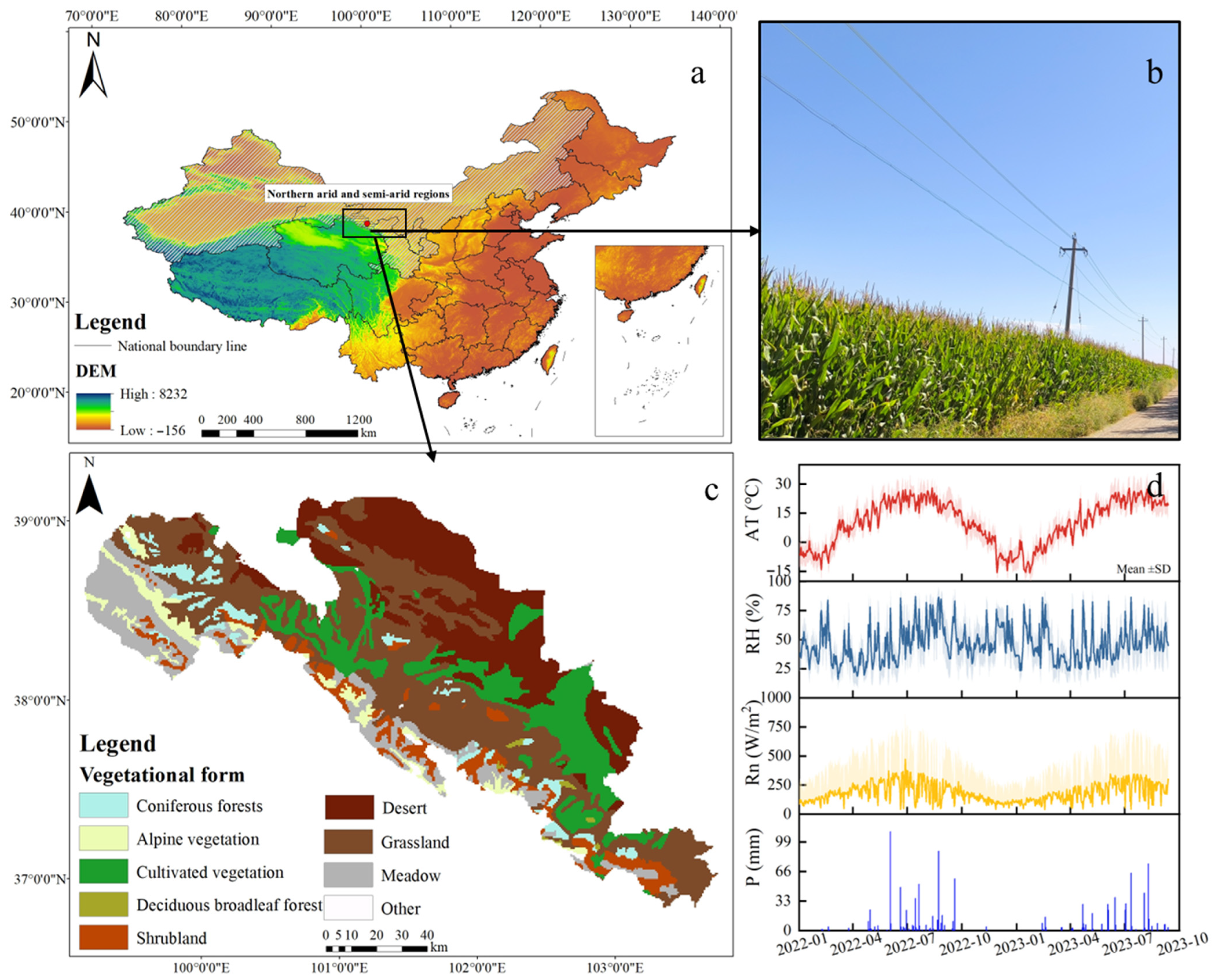
The field experiment was conducted over two consecutive years (April–October 2022 and 2023) on a representative local farm in Minle County, Zhangye City, Gansu Province (100°40′36″ E, 38°43′36″ N). The site is located in an oasis area of the Hexi Corridor, characterized by distinct seasonal variations in precipitation and temperature, and belongs to the Heihe River system, with water mainly supplied by glacial meltwater from the Qilian Mountains. The region is situated at an average elevation of 1632 m, nearly 3000 h of sunshine. According to long-term meteorological data from the local weather station, the annual mean temperature ranges from 3.4 to 5.6 °C, with an average annual precipitation of approximately 300 mm, about 60% of which occurs between July and September. Annual evaporation reaches 2036.8 mm, and the aridity index is 4.3, indicating a significant imbalance between water supply and atmospheric demand [34]. The frost-free period averages 140 days, and the region is characterized by limited precipitation and high evapotranspiration [35,36]. The climate is classified as a temperate continental desert grassland zone. Agricultural production in the region relies entirely on irrigation. The soil is classified as sandy loam, and the basic fertility status of the 0–30 cm plow layer is as follows: soil pH 7.55, bulk density 1.18 g/cm3, organic matter 10.13 g/kg, total nitrogen 0.70 g/kg, available phosphorus 6.89 mg/kg, and nitrate nitrogen 15.31 mg/kg [36]. Climatic variables, including rainfall, solar radiation, and average temperature during the study period, are illustrated in Figure 1.

2.2. Experimental Design

The Hexi Corridor, a typical oasis agricultural region in the arid zone of northwestern China, serves as a representative area of irrigated agriculture. As the dominant crop in this region, silage maize cultivation heavily depends on efficient water and nitrogen management due to limited precipitation, high evapotranspiration, and fragile soil conditions [37]. Therefore, conducting field experiments in this representative area is of great significance for investigating the interactions between irrigation and nitrogen application under realistic management conditions. The findings not only reflect the actual agricultural production characteristics of the region but also provide valuable insights for optimizing water–nitrogen management strategies in similar arid and semi-arid oasis ecosystems, ultimately contributing to improved crop productivity and resource-use efficiency. The experiment was conducted from April to September during the 2022 and 2023 growing seasons. Different irrigation and nitrogen treatments were established, using the local conventional irrigation volume (6150 m3/hm2) and pure nitrogen application (311 kg N/hm2) as the reference [36]. The four irrigation treatments were W1 (6765 m3/hm2, +10% water), W2 (6150 m3/hm2, conventional irrigation), W3 (5535 m3/hm2, −10% water), and W4 (4920 m3/hm2, −20% water). The five nitrogen treatments were N0 (0 kg N/hm2, no nitrogen), N1 (218 kg N/hm2, −30% nitrogen), N2 (249 kg N/hm2, −20% nitrogen), N3 (280 kg N/hm2, −10% nitrogen), and N4 (311 kg N/hm2, conventional nitrogen). The experiment was arranged in a randomized complete block design with 3 replicates per W × N treatment, a total of 60 experimental plots were established, each measuring 25 m in length and 1.6 m in width (40 m2 per plot). A 1 m buffer strip was installed between adjacent plots to minimize edge effects. The crop planted was silage maize (Jinling 67), a local cultivar provided by a nearby farm. Silage maize was sown using plastic mulch. Each plot had a planting spacing of 25 cm (in-row) and 50 cm (between rows), and irrigated using a subsurface drip irrigation system. The drip tape had a lateral diameter of 16 mm, wall thickness of 0.2 mm, emitter spacing of 300 mm, and emitter discharge rate of 2.2 L/h. The tape was laid parallel to the crop rows. Fertilizers were applied via a hydraulic pump system along with irrigation. Irrigation was applied from late April to early September. Nitrogen, phosphorus, and potassium fertilizers were applied as urea (46% N), urea phosphate (44.06% P2O5), and potassium chloride (57% K2O), respectively. The application rates are expressed based on the nutrient element content (kg N/ha, kg P /ha, and kg K /ha). Total application rates for phosphorus and potassium were 146 kg /hm2 and 107 kg/hm2, respectively. Nitrogen, phosphorus, and potassium fertilizers were applied at each stages.

2.3. Sample Collection and Measurement

Soil samples were collected from the root-zone soil (0–30 cm depth) at five key growth stages of silage maize—seedling, jointing, tasseling, silking, and maturity. These stages represent the most critical phases of crop development and are commonly used in agronomic management to assess maize growth status and guide split fertilization strategies. Following the S-shaped sampling method, nine subsampling points were established in each plot, and soil was collected using a soil auger from a depth of 0–30 cm. Samples were homogenized, and plant roots and stones were removed. Each sample was sealed in plastic bags and transported in a cooler with ice packs to maintain low temperature. In the laboratory, one portion of each soil sample was used for microbial biomass analysis, while the remainder was sieved through a 0.25 mm mesh and stored in sealed bags for subsequent chemical analyses. Soil organic carbon (SOC) was determined using the H2SO4-K2Cr2O7 oxidation and heating method. Soil total nitrogen (STN) and phosphorus (STP) were measured using the semi-micro Kjeldahl method and the vanadium-molybdenum yellow colorimetric method, respectively. Soil Ammonium nitrogen (NH4+-N) and nitrate nitrogen (NO3-N) were measured using the MgO–Denigès alloy distillation method [38], specifically, five replicates of fresh soil samples (10 g each, passed through a 2 mm sieve) were taken and extracted with 50 mL of 2 M KCl on a shaker for 1 h. After standing for 30 min to allow clarification, the extracts were filtered. For ammonium nitrogen (NH4+-N), 10 mL of the filtrate was placed into a Kjeldahl tube, 0.5 g MgO was added, and the mixture was distilled for 3 min in a Kjeldahl nitrogen analyzer. The distillate was absorbed in 5 mL of boric acid solution and titrated with 0.005 M H2SO4. For nitrate nitrogen (NO3-N), 1 mL of sulfamic acid solution (2 g sulfamic acid dissolved in 100 mL distilled water) was added to the distillate, shaken for 5 s, followed by the addition of 0.5 g Devarda’s alloy. The mixture was distilled for 3 min in the Kjeldahl apparatus, with the distillate collected in 5 mL of boric acid and titrated with H2SO4 standard solution. Soil urease (URE) activity, reflecting the nitrogen transformation rate and availability for plant uptake, was assessed using the urea colorimetric method [39], to assess soil fertility and nitrogen status [40]. Specifically, 5 g of soil was placed in a 50 mL conical flask, and 1 mL of toluene was added, followed by thorough mixing. After standing for 15 min, 10 mL of 10% urea solution and 20 mL of citrate buffer (pH 6.7) were added, and the mixture was homogenized and incubated at 37 °C for 24 h in a constant-temperature incubator. Following incubation, the mixture was filtered, and 1 mL of the filtrate was transferred to a 50 mL volumetric flask. Subsequently, 4 mL of sodium phenolate solution and 3 mL of sodium hypochlorite solution were added sequentially, with thorough mixing after each addition. After 20 min of color development, the solution volume was adjusted to the mark with distilled water. The absorbance was measured at 578 nm using a spectrophotometer within 1 h. Sucrase (Su) activity was analyzed as an indicator of labile sugar dynamics and soil carbon balance. This enzyme catalyzes the breakdown of carbohydrate polymers into simple sugars, enhancing soluble nutrient content and providing a primary energy source for soil microbes [41], Specifically, 3 g of air-dried soil was placed in a 50 mL Erlenmeyer flask, followed by the addition of 9 mL of 8% sucrose solution, 3 mL of phosphate buffer (pH 5.5), and 1 mL of toluene. After thorough mixing, the flasks were incubated at 37 °C for 24 h. The mixture was then immediately filtered, and 1 mL of the filtrate was transferred into a 50 mL volumetric flask. Subsequently, 3 mL of 3,5-dinitrosalicylic acid (DNS) reagent was added, and the mixture was heated in a boiling water bath for 5 min. The flask was then cooled under running tap water for 3 min, diluted to 50 mL with distilled water after the solution turned orange-yellow, and its absorbance was determined at 508 nm using a spectrophotometer. Alkaline phosphatase (ALP) activity was assessed to evaluate phosphorus dynamics and its contribution to plant growth in phosphorus-deficient soils [42], Specifically, 2.5 g of air-dried soil was placed in a 200 mL Erlenmeyer flask, and 1 mL of toluene was added. The mixture was gently shaken for 15 min, followed by the addition of 10 mL of 0.5% disodium phenyl phosphate (substrate). After thorough mixing, the flasks were incubated at 37 °C for 24 h. Subsequently, 20 mL of 0.3% aluminum sulfate solution was added to the culture, and the mixture was filtered. Then, 3 mL of the filtrate was transferred into a 50 mL volumetric flask, followed by the addition of 5 mL of borate buffer and four drops of 2,6-dibromoquinone-4-chlorimide reagent for color development. After standing for 30 min, the absorbance was measured at 660 nm using a spectrophotometer. In addition, nitrate reductase (NR) activity was measured as a key indicator of nitrogen cycling, briefly, 1 g of soil was mixed with 0.02 g of CaCO3 and 2 mL of 0.2% NaNO2 solution. Subsequently, 2 mL of 1% glucose solution was added, and the total volume was brought to 10 mL with 5 mL of distilled water. The mixture was sealed and incubated at 30 °C for 24 h. After incubation, the contents were transferred into a 100 mL conical flask using 50 mL of distilled water and 1 mL of saturated potassium aluminum sulfate solution, thoroughly mixed, and then filtered. Then, 1 mL of the filtrate was transferred into a 50 mL volumetric flask, supplemented with a small amount of distilled water and 4 mL of the color reagent. Following 15 min of color development and final volume adjustment, the absorbance was measured at 520 nm using a spectrophotometer. Soil microbial biomass carbon (MBC) and nitrogen (MBN) were determined using the chloroform fumigation–extraction method [43]. Specifically, fresh soil samples (5.0 g) were placed in glass dishes and put into a vacuum desiccator, along with a small beaker containing 30–50 mL ethanol-free chloroform, a small beaker with dilute NaOH (to absorb CO2), and a small beaker of distilled water. Vaseline was applied evenly to the desiccator seal, the vacuum pump was turned on, and chloroform was boiled for 5 min. After sealing the desiccator, the samples were incubated in the dark at 25–28 °C for 24 h. Corresponding non-fumigated control samples (5.0 g each, five replicates) were placed in 100 mL sealable plastic bottles, with soil moisture content determined simultaneously. After fumigation, chloroform was removed, residual chloroform was evacuated using a vacuum pump, and soil samples were weighed and water content determined. Each sample was then extracted with 50 mL of 0.5 mol /L K2SO4, shaken on a reciprocating shaker for 30 min, and filtered; the filtrate was collected in 50 mL ground-glass flasks. For MBC determination, 5 mL of filtrate was taken in a digestion tube, 2 mL of 0.3125 mol/L K2Cr2O7 and 7 mL concentrated H2SO4 were added, with five blanks prepared similarly. Samples were digested at 200 °C for 30 min, cooled for 10 min, and 2–3 drops of o-phenanthroline indicator were added. The solution was titrated with 0.05 mol /L FeSO4 until the color changed from orange-red to blue and finally to light brown, recording the FeSO4 consumption to calculate the carbon content in fumigated and non-fumigated samples. A conversion factor of 2.64 was applied to calculate MBC. For MBN determination, 10 mL of filtrate was mixed with 1.08 g K2SO4–CuSO4–Se catalyst and 4 mL concentrated H2SO4. Two to three blanks were prepared in the same manner. Samples were left overnight, then subjected to low-temperature digestion (~150 °C) to remove moisture, followed by high-temperature digestion (320 °C) until clear. After digestion, the volume was adjusted to 100 mL and allowed to stand for 2–3 h. Then, 10 mL of solution was analyzed using a nitrogen analyzer according to the total nitrogen determination procedure. A conversion factor of 1.85 was applied to calculate MBN.

2.4. Statistical Analysis

In this study, a three-way analysis of variance (ANOVA) was conducted to evaluate the effects of irrigation, fertilization, and growth stage on soil parameters. Prior to ANOVA, data were tested for normality using the Shapiro–Wilk test and for homogeneity of variance using Levene’s test. When both assumptions were met, ANOVA was performed; otherwise, non-parametric paired comparisons were used to analyze differences among treatments. Pearson correlation analysis was applied to assess relationships among soil indicators. Structural equation modeling (SEM) was employed to explore the interrelationships among soil variables, SEM was performed using AMOS 28.0 (IBM Corp., Chicago, IL, USA) to examine the direct and indirect pathways among soil nutrient, microbial, and enzymatic variables, and model fit was evaluated using AGFI, RMSEA, P, and CFI indices. All statistical analyses were conducted using IBM SPSS Statistics version 27 (IBM Corp., Chicago, IL, USA), and graphs were generated using Origin 2024 (OriginLab Corporation, Northampton, MA, USA).

3. Results

3.1. Temporal Variations in Soil Nutrition Under Different Water and Nitrogen Management Levels

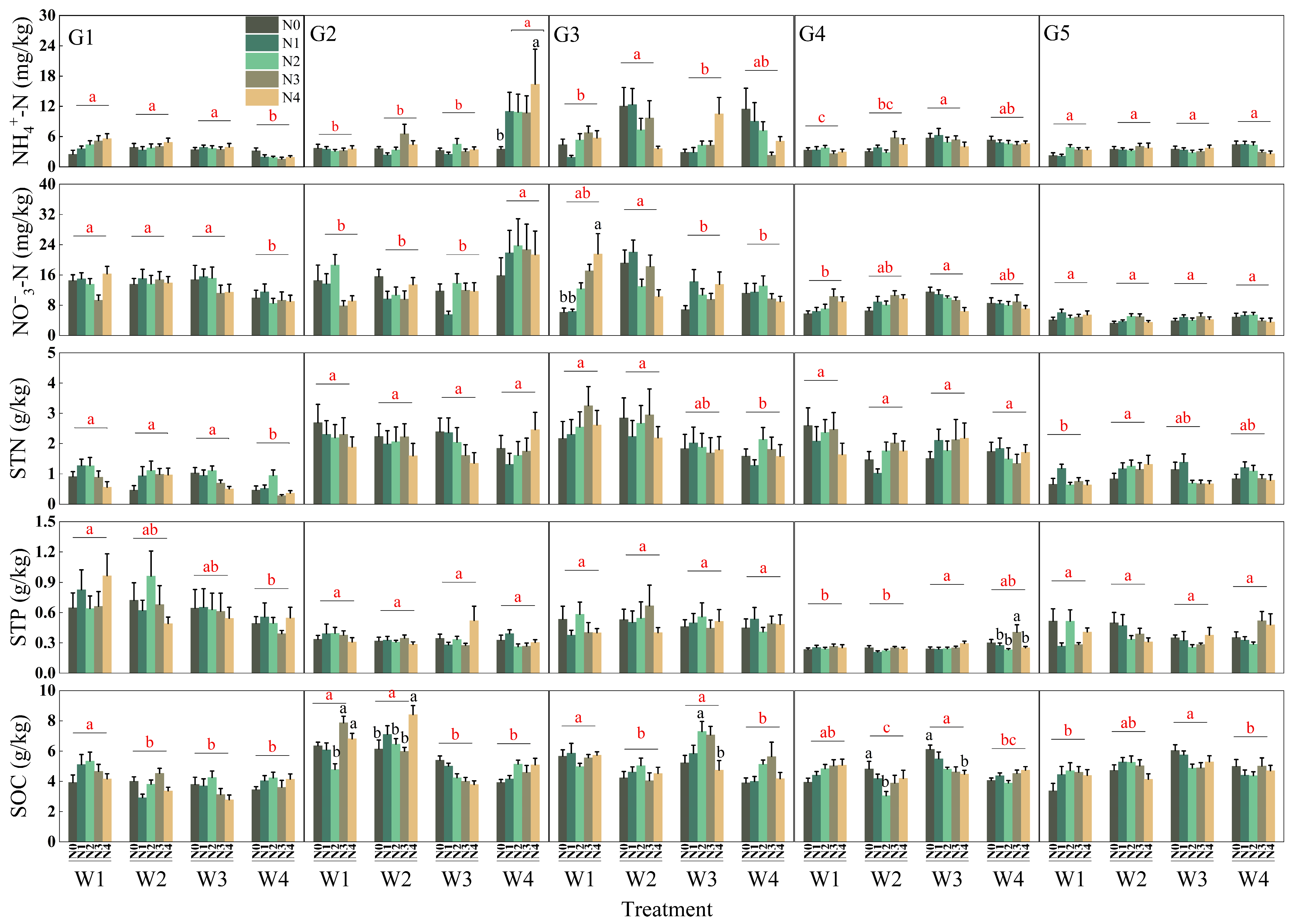
Soil nutrient concentrations exhibited clear temporal variations across maize growth stages and were markedly influenced by irrigation and nitrogen management (Figure 2). Soil total nitrogen (STN) exhibited higher concentrations during the middle growth stages and lower concentrations at the early and late stages. Soil total phosphorus (STP) decreased over the growth period, with concentrations at the maturity stage being 3.95 times higher than at the seedling stage. Under different nitrogen treatments, ammonium nitrogen (NH4+-N) at the jointing stage and STP at the silking stage showed significant differences under W4 irrigation (p < 0.05). Significant differences in nitrate nitrogen (NO3-N) were observed at the tasseling stage under W1. Soil organic carbon (SOC) showed no significant differences across treatments at the early growth and maturity stages; however, differences were evident at the jointing stage under W1 and W2, at the tasseling stage under W3, and at the silking stage under W2 and W3. For different irrigation levels, all soil nutrient parameters showed significant differences under W1 and W4 during the seedling stage (p < 0.05). However, NH4+-N, NO3-N, STN, and STP at the jointing stage did not differ significantly among irrigation treatments. Significant differences were found in NH4+-N, NO3-N, and SOC at the tasseling stage and in NH4+-N, STP, and SOC at the silking stage under W2 and W3, respectively (p < 0.05). According to the three-way ANOVA (Table 1), growth stage was the most influential factor affecting all soil parameters, followed by the interaction between growth stage and irrigation level.

3.2. Temporal Variations in Soil Enzyme and Microbial Biomass Under Different Water and Nitrogen Management Levels

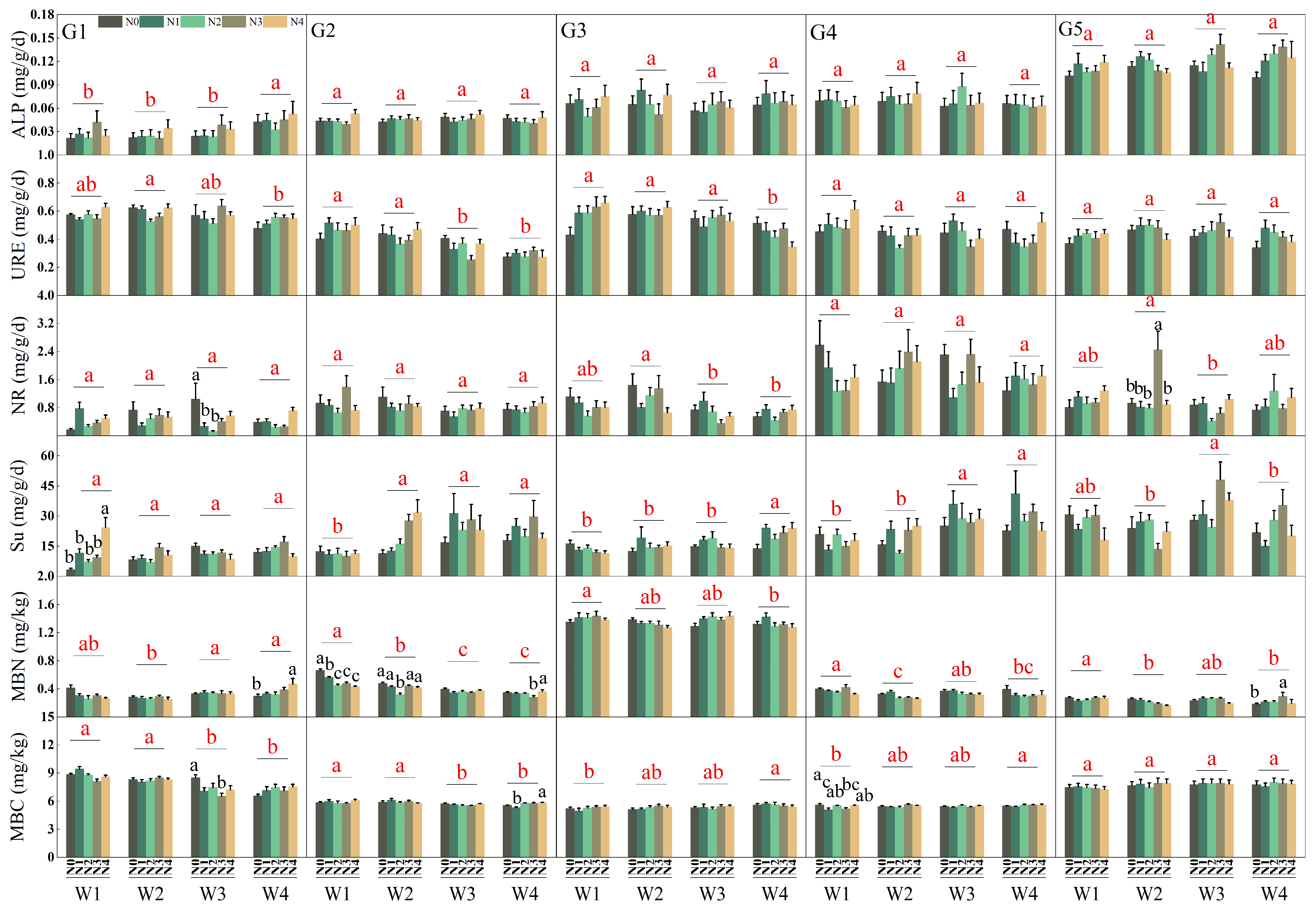
The activities of alkaline phosphatase (ALP), nitrate reductase (NR), and sucrase (Su) exhibited increasing trends with plant growth (Figure 3). In contrast, soil urease (URE) activity decreased throughout the growth period. For microbial biomass, microbial biomass carbon (MBC) and microbial biomass nitrogen (MBN) showed opposite trends over the plant growth stages: MBC values were lower during the tasseling stage, whereas MBN values peaked at the same stage. The enzyme activities of ALP, NR, URE, and Su were sensitive to nitrogen levels during the early and late growth stages but showed no significant differences at the tasseling stage (p < 0.05). These enzymes also displayed different sensitivities to water treatments at various growth stages. ALP and URE were more responsive during the seedling stage, while NR was more sensitive at the tasseling and maturity stages. The activities of Su, MBN, and MBC exhibited significant differences under different water treatments, particularly under W1 and W4. According to the three-way ANOVA (Table 2), growth stage was the most influential factor affecting all soil enzyme activities and microbial biomass, followed by irrigation water.

3.3. Correlations Among Soil Nutrients, Soil Enzyme Microbial Biomass, and Potential Influencing Factors

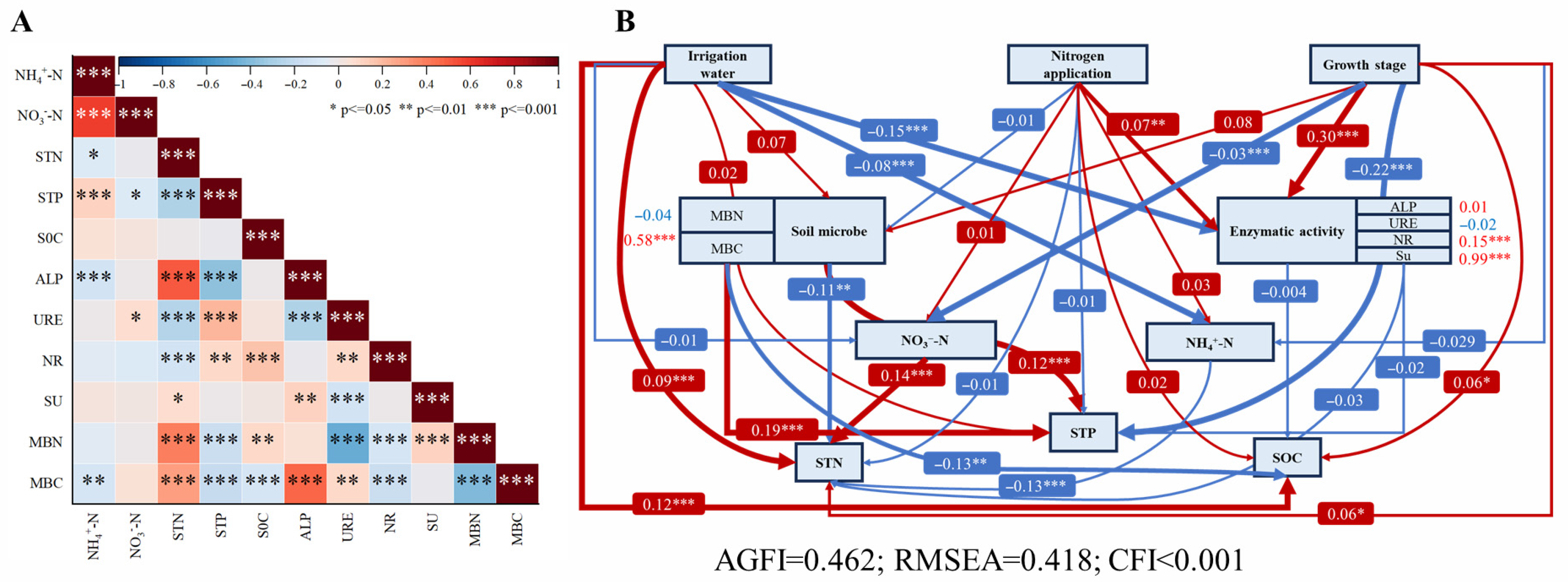
The correlations between soil nutrients and soil enzyme activities were investigated (Figure 4A). The results showed that NH4+-N, NO3-N, STP, URE, and NR were negatively correlated with MBN, whereas STN and SOC were positively correlated with MBN. Significant correlations were also observed between soil nutrients and enzyme activities. NH4+-N, NO3-N, and STN were negatively correlated with NR, while STN was negatively and STP positively correlated with URE. Both STN and STP showed significant correlations with ALP. In general, microbial biomass was influenced by soil enzyme activities. URE and NR were significantly correlated with MBN, while ALP and URE were significantly negatively correlated with MBC.
A structural equation model was employed to further reveal the influencing mechanisms (Figure 4B). The results indicated that irrigation water had a significant negative effect on soil enzyme activities, whereas nitrogen addition and the plant growth period had significant positive effects (p < 0.05). In contrast, irrigation, nitrogen addition, and growth stages did not significantly affect microbial biomass (p > 0.05). Notably, the growth period exerted a significant negative effect on NH4+-N, and STP (p < 0.05), likely due to nutrient uptake by the plant during development. This influence is likely mediated through changes in soil microbial activity.

4. Discussion

4.1. Effects of Water and Nitrogen Management Level on the Soil Nutrient

Water and nitrogen management significantly influence soil nutrient dynamics throughout the plant growth period. The concentrations of NH4+-N, NO3-N, STN, STP, and SOC exhibited distinct temporal variations under different water and nitrogen treatments. This finding is consistent with previous studies Tuo et al. (2024) and Tuo et al. (2023) [44,45]. Notably, soil nitrogen content was higher during the mid-growth stage, whereas it was relatively lower at the early and maturity stages, indicating that soil nitrogen dynamics are influenced by both crop nitrogen uptake intensity and nitrogen transformation processes in the soil. The effects of water and nitrogen management on soil nutrients varied across different growth stages. These differences may be closely associated with the effects of water management on rhizosphere soil microenvironment regulation and the release of readily available nutrients. Although nutrient uptake by crops is a key mechanism driving soil nutrient depletion. However, the indirect effects of irrigation and nitrogen should not be overlooked, as these are mainly mediated through the regulation of soil microbial community structure and function activities. For example, it is well established that soil water deficiency affects soil microbial communities and their functions [46]. For example, under water–nitrogen regulation, complex interactions occur among soil microorganisms, enzyme activities, and nutrient dynamics. Soil nutrient cycling and biogeochemical processes are primarily microbially mediated, as the composition and function of microbial communities largely determine soil fertility. Changes in irrigation regimes may reshape soil microbial communities and their functional potential by altering microbial physiological tolerance, metabolic capacity, and adaptive strategies, thereby influencing soil biogeochemical cycling and overall agroecosystem functioning [47]. More specifically, microorganisms regulate nutrient turnover by decomposing soil organic matter, which in turn affects soil enzyme properties and secretion patterns. Soil enzymes catalyze biochemical reactions involved in the decomposition of microbial and plant residues, providing essential nutrients for plant growth [48]. Previous studies have also demonstrated that soil enzyme activity is closely linked to microbial traits that enhance soil and plant health. Moreover, plants exhibit distinct physiological responses under varying water and nitrogen conditions; their roots continuously release diverse primary and secondary metabolites into the rhizosphere, which can increase nutrient bioavailability, shape functional microbial communities, and mitigate root competition to regulate soil nutrient dynamics [49]. Furthermore, the significant correlations observed between soil nutrients and enzyme activities underscore the functional roles of key enzymes in nutrient transformation processes. In terms of agricultural management practices, drip irrigation enhances the efficiency of water and fertilizer utilization. However, due to its inherent localized water delivery, drip irrigation introduces spatial heterogeneity in soil moisture and nutrient availability. This heterogeneity can lead to imbalanced nutrient inputs, where nutrient availability is higher in wetter zones and nutrient delivery to drier zones is reduced. Over time, such imbalances may cause localized nutrient depletion, reduced organic matter inputs, and alterations in soil carbon and nutrient stocks, particularly in arid and semi-arid regions [50]. Previous studies have demonstrated that water and nitrogen inputs influence the distribution and leaching losses of SOC in dryland systems, particularly under high water input conditions [51]. Under nitrogen-rich conditions, root-mediated pathways enhance SOC accumulation [52]. The temporal variation in SOC across maize growth stages can be attributed to the limited development of maize roots during the seedling stage, when the rhizosphere microenvironment contributes minimally to SOC inputs, resulting in lower SOC levels measured in early growth stages. As the jointing stage begins, maize roots expand rapidly, entering a phase of vigorous vegetative growth (from jointing to tasseling). During this period, enhanced carbon inputs from root exudates and decaying root tissues contribute to the stabilization of SOC levels. On the other hand, seasonal and regional heterogeneity in maize cultivation has long been a focus of research. Previous studies have revealed that, compared to cooler growing seasons, warmer growing seasons tend to increase microbial diversity while reducing network complexity, yet enhancing community stability, decreasing microbial co-occurrence, and increasing modularity. Warm-season conditions favor oligotrophic species and enhance the abundance of microbial taxa and functional genes associated with nitrogen, phosphorus, and sulfur cycling, confirming that shifts in key soil microbial groups are closely linked to maize nutrient uptake efficiency [53]. In contrast to our findings in arid regions, non-arid areas exhibit substantially different nutrient cycling patterns due to the absence of severe water limitations. For instance, a study conducted in subtropical maize systems demonstrated that under adequate water supply, maize nitrogen uptake and yield significantly increased with higher nitrogen fertilizer application rates [54].
Water scarcity and soil nutrient depletion are widely recognized as the two major factors influencing crop yield [55,56]. Soil moisture regulates nutrient mineralization and transformation by influencing microbial activity and enzyme functions, whereas nitrogen application alters microbial community composition, thereby affecting nutrient cycling. While water does not directly influence soil nutrient levels, it facilitates the dissolution and mobilization of soil nutrients, which are then transformed by soil microorganisms into forms that can be absorbed by plants. Moderate water deficit conditions support microbial activity and maintain soil permeability, thereby creating favorable conditions for soil microbial communities. Adequate soil moisture enhances nutrient exchange between soil and plants and accelerates the mineralization of soil organic matter [57]. Numerous studies have demonstrated that excessive irrigation reduces soil nutrient availability [58,59,60]. Although irrigation and nitrogen addition may decrease soil nutrient availability, they can simultaneously promote the accumulation of soil carbon and nitrogen. This is because, under suitable moisture conditions, the application of exogenous nitrogen directly enhances soil nitrogen availability. Moreover, optimal water and nitrogen conditions facilitate the transformation and uptake of inorganic nutrients, indirectly increasing soil carbon and nitrogen reserves [61]. From a microbial perspective, moderate reductions in irrigation benefit the colonization of beneficial bacteria and fungi in the rhizosphere. While excessive irrigation may increase crop yields, it can impair soil aeration and cause hypoxic conditions in the root zone. Both insufficient and excessive water use act as limiting factors for sustainable agriculture [62,63]. Fertilization significantly influences soil physical and chemical properties and microbial communities, with nitrogen utilization playing a crucial role in enhancing crop productivity. However, excessive nitrogen application reduces nitrogen use efficiency, contributes to environmental pollution, and may negatively impact crop yield. Therefore, rational nitrogen management is essential to balance agricultural productivity with ecological sustainability, enhance nitrogen use efficiency, and reduce nitrogen volatilization [64]. In arid desert oasis regions, the main objective is to reduce water evaporation and leakage, thereby enhancing water use efficiency and improving nutrient availability in the root zone. Nonetheless, some studies warn that excessive water-saving efforts may induce soil salinization, which can negatively affect nutrient uptake. Thus, a rational irrigation system is necessary to mitigate potential risks [65]. Additionally, since plant nutrient demands vary across different growth stages, fertilization strategies should be tailored accordingly to maintain optimal nutrient availability throughout the crop life cycle [66].

4.2. Effects of Water and Nitrogen Management Level on the Soil Enzyme and Soil Microbe

Water and nitrogen management alter soil nutrient cycling and availability by influencing soil microbial communities and enzyme activities. Enzymes play crucial roles in nutrient uptake by plants and in the decomposition of organic matter. Among them, ALP activity is particularly sensitive to water and nitrogen treatments during the seedling stage, while NR activity shows heightened sensitivity during the heading and maturity stages, in contrast to our findings, some previous studies reported that alkaline phosphatase (ALP) activity peaked at the maturity stage [67], whereas nitrate reductase (NR) activity was higher during the flowering stage [68]. Regarding NR, in addition to being influenced by irrigation, its activity is also modulated by crop developmental stages. Nitrate reductase catalyzes the reduction in nitrate during assimilation during plant assimilation, responding to external nitrogen inputs and indirectly contributing to variation in nitrogen uptake and utilization in crop [69,70]. MBC and MBN are significantly influenced by water and nitrogen conditions, as well as by crop growth stages, reflecting the specific regulatory effects of different water and nitrogen regimes on microbial community structure and function. Studies have shown that microbial carbon and nitrogen contents increase under high moisture and low nitrogen input, and that MBC and MBN at different growth stages are predominantly affected by climatic conditions. In summer, elevated soil temperatures, abundant moisture, frequent rainfall, and reduced evaporation collectively foster favorable conditions for microbial growth, reproduction, and decomposition [44]. Excessive fertilization has also been reported to reduce MBC [71]. Soil biological processes are co-regulated by multiple ecological factors under varying management regimes. These findings indicate that the regulation of soil biological processes under water and nitrogen management is primarily mediated through the interplay between enzyme activities and microbial community dynamics.
Soil is the primary source of nutrients for plant roots, which supports their growth and development. The effectiveness of these soil nutrients is regulated by various factors, including the microbial composition in the soil ecosystem and soil enzyme activities [72]. Fertilization is a common agricultural practice worldwide that aims to enhance crop yields. It alters soil properties, including microbial community composition and the metabolic processes mediated by microbial enzymes [73]. Soil microorganisms play a pivotal role in ecosystems by producing extracellular enzymes that decompose complex organic matter into nutrients absorbable by plants and microbes. These enzymes are critical in the mineralization and cycling of elements such as carbon, nitrogen, and phosphorus. Extracellular microbial enzymes are released into the soil by both living and dead microbial cells, and their activities is closely linked to microbial biomass, community structure, substrate availability, soil texture, and environmental conditions. Their activity reflects microbial functional diversity and plays a critical role in maintaining soil health and functionality [74,75]. Notably, fertilization practices can also influence soil enzyme activities and microbial communities. For example, some studies have suggested that mineral phosphorus fertilization generally suppresses ALP activity [76,77]. The incorporation of green manure, on the other hand, can supplement soil nitrogen through microbial nitrogen fixation and activate the insoluble nutrients released by plant root exudates during cultivation. This process enhances the retention of soil carbon and nitrogen, thereby alleviating microbial carbon limitation [78]. Irrigation conditions can lead to nutrient loss, as frequent waterlogging may saturate soil pores, resulting in poor aeration and suppressed microbial activity, which negatively affects enzyme function [79]. In this study, enzyme activities responded variably to irrigation and nitrogen addition. Specifically for urease activity, negatively correlated with STN. Urease activity is typically linked to soil urea content and its hydrolysis rate. When soil total nitrogen and MBN content is high, it suggests an adequate nitrogen supply, thereby reducing the microbial demand for urea decomposition and resulting in lower urease activity. Moreover, distinct microbial communities in desert oasis soils may have different nitrogen requirements and utilization strategies, and nitrogen addition could alter microbial community structure, further affecting urease activity [80,81]. Plants require nitrogen and utilize nitrate reductase (NR) to convert soil nitrates into plant-available forms. However, excessive fertilization may lead to environmental pollution and inefficient nutrient use. Unabsorbed nitrogen fertilizers may leach from the soil profile or be lost via runoff, volatilization, and denitrification [82,83]. In near-surface soils—where tillage, fertilization, and root activity are concentrated—soil texture is generally looser, which promotes better aeration. Due to the frequent input of organic matter and intense biological activity, this layer tends to have higher oxygen levels. Since nitrate reductase is mainly produced by soil microorganisms, a high-oxygen environment may suppress the growth of nitrate-reducing microbes, thereby reducing NR activity. In conclusion, the influence of biotic and abiotic factors on soil enzyme activities under different fertilization regimes is a complex process involving soil microbial community structure, physicochemical properties, and plant root dynamics. Future research should explore these relationships in greater detail and under diverse environmental conditions [84]. In summary, reducing irrigation water has become an inevitable trend for achieving sustainable agricultural development in the Hexi region. Under the goal of green development, fertilizer reduction is expected to be implemented in synergy with water-saving measures. Although this study elucidated the key mechanisms underlying soil nutrient–enzyme–microbe interactions under different water and nitrogen management regimes, certain limitations remain with respect to spatial and seasonal variability. Future research involving multi-location and long-term studies is necessary to validate the generality of these findings and further support the sustainable development of agriculture in arid regions.

4.3. Potential Impacts of Field Water–Nitrogen Management on Economic Benefits and Crop Quality

Economic returns and nutritional quality are key indicators for evaluating the sustainability of different water–nitrogen management strategies. Although most previous studies have mainly focused on yield and soil nutrient responses [85,86,87], a comprehensive assessment that also accounts for input costs and forage quality provides a more integrated understanding of management efficiency. In this study, variations among nitrogen application levels were primarily reflected in fertilizer input costs, with nitrogen fertilizer constituting the largest portion of total expenditures. Results from the structural equation model indicated that while lower nitrogen inputs reduced fertilization costs, they did not significantly affect most soil parameters, except for a notable positive impact on soil enzyme activities. Clearly, the minor variations in soil biochemical properties under different fertilization levels suggest a degree of stability and resilience within the soil–plant system, consistent with previous findings [88,89]. The persistence of this stability under reduced nitrogen inputs highlights the potential for sustainable nutrient management, emphasizing the importance of optimizing rather than maximizing fertilization in silage maize production. Irrigation and fertilization are primary factors influencing crop yield and quality; however, their interactive effects and crop responses often vary across growth stages. For example, previous studies have shown that irrigation and fertilization exert an insignificant effect on photosynthetic patterns during the reproductive phase, although irrigation can increase the seed moisture content of maize [90]. Other studies have reported that nitrogen application rates did not significantly affect the dry matter yield of forage maize, suggesting that maize may absorb most of its nitrogen from the soil rather than from fertilizers, thereby explaining the lack of yield response to nitrogen input [91]. Conversely, some findings indicate that increased water and nitrogen availability can positively influence forage maize quality, enhancing crude protein, crude ash, and fat contents [92]. Silage maize production currently faces multiple challenges, including a lack of superior cultivars and suboptimal water and fertilizer management, which result in low and unstable yields, reduced forage quality, and environmental pollution. Therefore, developing high-yielding, high-quality, cost-effective, and environmentally friendly production technologies for silage maize is imperative [93]. Overall, integrating economic and quality indicators provides a multidimensional perspective for assessing the comprehensive benefits of water–nitrogen management. Balanced water and nitrogen allocation not only maintains soil fertility and microbial activity but also enhances production efficiency and potential forage quality, offering practical guidance for sustainable silage maize cultivation in arid oasis regions.
In summary, this study reveals the distinct response patterns of soil nutrient dynamics to water–nitrogen coupling in an arid oasis ecosystem, emphasizing the importance of synchronizing nutrient availability with maize growth stages. And demonstrating that moderate water and nitrogen inputs can sustain soil fertility and nutrient balance without excessive resource use, and provides new evidence that soil enzyme activities and microbial biomass act as sensitive indicators linking water–nitrogen regulation to nutrient turnover and soil health. Elucidating the coordination among microbial community activity, enzyme function, and nutrient availability under limited irrigation and nitrogen inputs. Future research should further investigate the long-term nutrient cycling processes under continuous water–nitrogen regulation and explore model-based predictions under changing climatic conditions, focus on microbial functional diversity and metagenomic profiling to clarify the molecular mechanisms driving these interactions across different soil types and environmental gradients, and incorporate life-cycle assessments and multi-year economic modeling to further quantify the trade-offs between input intensity, environmental impact, and economic return.

5. Conclusions

This study reveals the coupled effects of water and nitrogen management on soil nutrient dynamics, microbial biomass, and enzyme activities throughout the maize growth cycle in an arid oasis ecosystem, highlighting that soil biochemical responses are stage-dependent and strongly shaped by irrigation intensity. It demonstrates that moderate irrigation and nitrogen inputs sustain soil fertility and nutrient turnover through enhanced microbial–enzyme interactions, providing new insights into the mechanisms driving soil ecological regulation under limited water and nutrient resources. The results show that water treatment significantly affects soil indicators, especially during the seedling and jointing stages, with all indicators exhibiting significant differences (p < 0.05) under W1 and W4 treatments. Enzyme activity was sensitive to both water and nitrogen management. Nitrogen fertilization indirectly influences soil nutrients (STN, STP) by affecting microbial biomass and soil enzyme activities. Growth stage is the primary factor influencing all these indicators, followed by irrigation water. The findings provide theoretical insights into the coordination among soil nutrients, microbial communities, and enzyme activities, while offering practical guidance for optimizing water–nitrogen strategies to enhance soil fertility and productivity in arid maize systems. Future research should emphasize long-term monitoring and model-based prediction of water–nitrogen interactions to assess cumulative effects on soil health and ecosystem sustainability under changing climatic conditions.

Author Contributions

N.Z.: Conceptualization, Data curation, Formal analysis, Investigation, Methodology, Software, Visualization, Roles/Writing—original draft. W.M.: Conceptualization, Data curation, Funding acquisition, Project administration, Supervision, Validation, Writing—review and editing. G.L. and J.W.: Conceptualization, Supervision, Validation, Writing—review and editing. C.L., W.H. and Y.Z.: Data curation, Project administration, Writing—review and editing. All authors have read and agreed to the published version of the manuscript.

Funding

This research was financially supported by Gansu Provincial Department of Education: Industry Support Program Project (Grant No. 2025CYZC-042); the Central Government-Guided Local Science and Technology Development Fund Project (Grant No. 24ZYQA023); and Gansu Provincial Leading Talent Program Project (Grant No. GSBJLJ-2023-09).

Data Availability Statement

Data will be made available on request.

Acknowledgments

We sincerely thank Gansu Huarui Farm for providing the experimental field site and technical support. We also acknowledge the valuable assistance of our colleagues and students during the field experiments and laboratory analyses.

Conflicts of Interest

The authors declare no conflicts of interest.

References

  1. Siebert, S.; Doell, P. Quantifying blue and green virtual water contents in global crop production as well as potential production losses without irrigation. J. Hydrol. 2010, 384, 198–217. [Google Scholar] [CrossRef]
  2. Xu, X.; Chen, F.; Barlage, M.; Gochis, D.; Miao, S.; Shen, S. Lessons Learned from Modeling Irrigation from Field to Regional Scales. J. Adv. Model. Earth Syst. 2019, 11, 2428–2448. [Google Scholar] [CrossRef]
  3. Moyo, M.; Van Rooyen, A.; Bjornlund, H.; Parry, K.; Stirzaker, R.; Dube, T.; Maya, M. The dynamics between irrigation frequency and soil nutrient management: Transitioning smallholder irrigation towards more profitable and sustainable systems in Zimbabwe. Int. J. Water Resour. Dev. 2020, 36, S102–S126. [Google Scholar] [CrossRef]
  4. Qiu, H.; Yang, S.; Jiang, Z.; Xu, Y.; Jiao, X. Effect of Irrigation and Fertilizer Management on Rice Yield and Nitrogen Loss: A Meta-Analysis. Plants 2022, 11, 1690. [Google Scholar] [CrossRef]
  5. Bünemann, E.K.; Bongiorno, G.; Bai, Z.; Creamer, R.E.; De Deyn, G.; de Goede, R.; Fleskens, L.; Geissen, V.; Kuyper, T.W.; Mäder, P.; et al. Soil quality—A critical review. Soil Biol. Biochem. 2018, 120, 105–125. [Google Scholar] [CrossRef]
  6. Wu, Z.; Dijkstra, P.; Koch, G.W.; PeÑUelas, J.; Hungate, B.A. Responses of terrestrial ecosystems to temperature and precipitation change: A meta-analysis of experimental manipulation. Glob. Change Biol. 2011, 17, 927–942. [Google Scholar] [CrossRef]
  7. Nielsen, U.N.; Ball, B.A. Impacts of altered precipitation regimes on soil communities and biogeochemistry in arid and semi-arid ecosystems. Glob. Change Biol. 2015, 21, 1407–1421. [Google Scholar] [CrossRef] [PubMed]
  8. Barbier, E.B.; Hochard, J.P. Land degradation and poverty. Nat. Sustain. 2018, 1, 623–631. [Google Scholar] [CrossRef]
  9. Cai, D.; Wang, X.; Hua, T.; Jiao, L.; Geng, X. Baseline and status of desertification in Central Asia. Land Degrad. Dev. 2022, 33, 771–784. [Google Scholar] [CrossRef]
  10. Sun, Q.; Zhang, H.; Li, X.; Zhao, Z.; Li, Z.; Zhang, P.; Liu, S.; Jiang, W.; Sun, X. Effects of Drip Tape Layout and Flow Rate on Water and Nitrogen Distributions within the Root Zone and Summer Maize Yield in Sandy Tidal Soil. Agronomy 2023, 13, 2689. [Google Scholar] [CrossRef]
  11. Zhao, X.; Wang, Y.; Cai, D.; Xi, B. Tailored Composting and Fertilization Strategies Can Inspire the Transformation of Agriculture for Sustainable Development. J. Agric. Food Chem. 2024, 72, 8874–8875. [Google Scholar] [CrossRef] [PubMed]
  12. Luo, W.; Li, Y.; Yang, Z.; Wang, Y.; Chen, J.; Xiao, X.; Chen, Y.; Wei, C.; Zou, Z. Water and Nitrogen Balance under Various Water and Fertilizer Regulation Modes. Agronomy 2023, 13, 2870. [Google Scholar] [CrossRef]
  13. Wang, X.; Guo, T.; Wang, Y.; Xing, Y.; Wang, Y.; He, X. Exploring the optimization of water and fertilizer management practices for potato production in the sandy loam soils of Northwest China based on PCA. Agric. Water Manag. 2020, 237, 106180. [Google Scholar] [CrossRef]
  14. Chen, X.; Zhang, H.; Yu, S.; Zhou, C.; Teng, A.; Lei, L.; Ba, Y.; Li, F. Optimizing irrigation and nitrogen application strategies to improve sunflower yield and resource use efficiency in a cold and arid oasis region of Northwest China. Front. Plant Sci. 2024, 15, 1429548. [Google Scholar] [CrossRef]
  15. Wang, J.; Niu, W.; Zhang, M.; Li, Y. Effect of alternate partial root-zone drip irrigation on soil bacterial communities and tomato yield. Appl. Soil Ecol. 2017, 119, 250–259. [Google Scholar] [CrossRef]
  16. Headley, T.R.; Huett, D.O.; Davison, L. The removal of nutrients from plant nursery irrigation runoff in subsurface horizontal-flow wetlands. Water Sci. Technol. 2001, 44, 77–84. [Google Scholar] [CrossRef]
  17. Ding, Y.; Huang, X.; Li, Y.; Liu, H.; Zhang, Q.; Liu, X.; Xu, J.; Di, H. Nitrate leaching losses mitigated with intercropping of deep-rooted and shallow-rooted plants. J. Soils Sediments 2021, 21, 364–375. [Google Scholar] [CrossRef]
  18. Huo, C.; Mao, J.; Zhang, J.; Yang, X.; Gao, S.; Li, J.; He, Q.; Tang, G.; Xie, X.; Chen, Z. Fertilization- and Irrigation-Modified Bacterial Community Composition and Stimulated Enzyme Activity of Eucalyptus Plantations Soil. Int. J. Mol. Sci. 2024, 25, 1385. [Google Scholar] [CrossRef]
  19. Preece, C.; Verbruggen, E.; Liu, L.; Weedon, J.T.; Peñuelas, J. Effects of past and current drought on the composition and diversity of soil microbial communities. Soil Biol. Biochem. 2019, 131, 28–39. [Google Scholar] [CrossRef]
  20. Wang, R.; Dorodnikov, M.; Yang, S.; Zhang, Y.; Filley, T.R.; Turco, R.F.; Zhang, Y.; Xu, Z.; Li, H.; Jiang, Y. Responses of enzymatic activities within soil aggregates to 9-year nitrogen and water addition in a semi-arid grassland. Soil Biol. Biochem. 2015, 81, 159–167. [Google Scholar] [CrossRef]
  21. Schütz, K.; Kandeler, E.; Nagel, P.; Scheu, S.; Ruess, L. Functional microbial community response to nutrient pulses by artificial groundwater recharge practice in surface soils and subsoils. FEMS Microbiol. Ecol. 2010, 72, 445–455. [Google Scholar] [CrossRef]
  22. Luo, X.; Yang, Y.; Wang, L.; Zhang, Y.; Liao, H.; Peng, S.; Chen, W.; Huang, Q. Relations between bacterial communities and enzyme functions of two paddy soils. Eur. J. Soil Sci. 2018, 69, 655–665. [Google Scholar] [CrossRef]
  23. Qu, Z.; Chen, Q.; Yin, S.; Feng, H.; Liu, Y.; Li, C. Effects of drip irrigation coupled with controlled release potassium fertilizer on maize growth and soil properties. Agric. Water Manag. 2024, 301, 108948. [Google Scholar] [CrossRef]
  24. Zhang, Z.; Zhao, Y.; Li, Z.; Wang, H.; Li, Z.; Chen, Y.; Li, B.L. Vegetation drives soil microbial metabolic limitation through modifications of soil properties and microbial biomass during desert grassland-shrubland state anthropogenic transition. Appl. Soil Ecol. 2024, 202, 105609. [Google Scholar] [CrossRef]
  25. Austin, A.T.; Yahdjian, L.; Stark, J.M.; Belnap, J.; Porporato, A.; Norton, U.; Ravetta, D.A.; Schaeffer, S.M. Water pulses and biogeochemical cycles in arid and semiarid ecosystems. Oecologia 2004, 141, 221–235. [Google Scholar] [CrossRef]
  26. Schmidt, J.E.; Peterson, C.; Wang, D.; Scow, K.M.; Gaudin, A.C.M. Agroecosystem tradeoffs associated with conversion to subsurface drip irrigation in organic systems. Agric. Water Manag. 2018, 202, 1–8. [Google Scholar] [CrossRef]
  27. Zhang, L.; Liu, Y.; Yin, C.; Xue, D.; Gui, D.; Qi, Z. Effects of Farmland Landscape Fragmentation on Agricultural Irrigation in Hotan Oasis. Agriculture 2022, 12, 1503. [Google Scholar] [CrossRef]
  28. Cheng, X.; Ma, W.; Yang, J.; Yang, Q.; Yue, Y.; Kolli, M.K. Supply-demand and interplay of food-energy-water nexus system of Hexi Corridor, China. Energy Sustain. Dev. 2025, 88, 101782. [Google Scholar] [CrossRef]
  29. Gao, Q.-z.; Du, H.-l.; Zu, R.-p. The balance between supply and demand of water resources and the water-saving potential for agriculture in the Hexi Corridor. Chin. Geogr. Sci. 2002, 12, 23–29. [Google Scholar] [CrossRef]
  30. Yao, L.; Zhang, X.; Yu, J.; Liu, Y.; Du, H.; Li, X. Exploring Ecological Management Plans for Typical Systems in Arid Areas from the Perspective of Ecosystem Service Value Evolution. Systems 2024, 12, 166. [Google Scholar] [CrossRef]
  31. Fang, Y.; Zhang, X.; Li, L.; Effah, Z.; Muhammad Nizamani, M. Effects of the plastic mulching system and fertilizer application on the yield of tartary buckwheat (fagopyrum tataricum) and water consumption characteristics in a semi-arid area. Agronomy 2024, 14, 735. [Google Scholar] [CrossRef]
  32. Li, N.; Tian, Y.; Zhang, L.; Wang, S.; Zhu, C.; Li, H. Research on action and technology for reducing fertilizer usage and enhancing efficiency in China. J. Agric. Resour. Environ. 2025, 42, 1. (In Chinese) [Google Scholar]
  33. Sun, Q.; Zhou, L.; Tang, X.; Sun, D.; Dang, X. Spatial influence and prediction of oasis urban expansion on cultivated land in arid areas: A case study of the Hexi Corridor. J. Nat. Resour. 2021, 36, 1008. (In Chinese) [Google Scholar] [CrossRef]
  34. Yan, J.; Wang, Y.; Guo, Z.; Wang, W.; Ma, Y.; Li, J.; Yao, X.; Li, Q.; Cheng, K.; Li, G.; et al. Estimation of regional-scale maize plant nitrogen content based on multi-source remote sensing data. Front. Plant Sci. 2025, 16, 2025. [Google Scholar] [CrossRef] [PubMed]
  35. Deng, H.; Li, G.; Pan, X.; Wang, Q.; Xiao, Z. Quantifying the impact of extreme climatic compound events and adaptation strategies on seed maize yield: Insights from a six-year field experiment in the Hexi Corridor Oasis, China. Eur. J. Agron. 2026, 172, 127864. [Google Scholar] [CrossRef]
  36. Jianxi, Z.; Guang, L.; Wuqing, Z.; Weiwei, M.; Yan, T.; Yanhua, L.; Yuyin, W. Effects of nitrogen application on soil-plant stoichiometry and stability of silage maize in Hexi irrigation area. J. Nanjing Agric. Univ. 2025, 48, 152–160. (In Chinese) [Google Scholar]
  37. Yang, G.; Wang, J.; Qi, Z. Remote Sensing and Data-Driven Optimization of Water and Fertilizer Use: A Case Study of Maize Yield Estimation and Sustainable Agriculture in the Hexi Corridor. Sustainability 2025, 17, 8182. [Google Scholar] [CrossRef]
  38. Dimmock, S.J.; Martinez, J. Nitrite plus nitrate recoveries in piggery slurry by direct distillation and modified Kjeldahl methods. Bioresour. Technol. 1994, 48, 21–24. [Google Scholar] [CrossRef]
  39. He, W.; Ma, W.; Du, J.; Chang, W.; Li, G. Effect of Vegetation Degradation on Soil Nitrogen Components and N-Cycling Enzyme Activities in a Wet Meadow on the Qinghai–Tibetan Plateau. Plants 2025, 14, 1549. [Google Scholar] [CrossRef]
  40. Cordero, I.; Snell, H.; Bardgett, R.D. High throughput method for measuring urease activity in soil. Soil Biol. Biochem. 2019, 134, 72–77. [Google Scholar] [CrossRef]
  41. Bai, Y.; Li, F.; Yang, G.; Shi, S.; Dong, F.; Liu, M.; Nie, X.; Hai, J. Meta-analysis of experimental warming on soil invertase and urease activities. Acta Agric. Scand. Sect. B–Soil Plant Sci. 2018, 68, 104–109. [Google Scholar] [CrossRef]
  42. Wang, G.; Jin, Z.; Wang, X.; George, T.S.; Feng, G.; Zhang, L. Simulated root exudates stimulate the abundance of Saccharimonadales to improve the alkaline phosphatase activity in maize rhizosphere. Appl. Soil Ecol. 2022, 170, 104274. [Google Scholar] [CrossRef]
  43. Li, Y.; Zhu, Q.; Zhang, Y.; Liu, S.; Wang, X.; Wang, E. Impact of Winter Cover Crops on Total and Microbial Carbon and Nitrogen in Black Soil. Agronomy 2024, 14, 603. [Google Scholar] [CrossRef]
  44. Tuo, Y.; Luo, X.; Wang, Z.; Liang, J.; Shi, R.; Wang, Z.; Wang, S.; Xiang, P.; Yang, Q.; He, X. Effects of water and fertilizer regulation on soil microbial community, fruit nutrients, and saponin content of Panax notoginseng: A three years field experiment. Ind. Crops Prod. 2024, 220, 119166. [Google Scholar] [CrossRef]
  45. Tuo, Y.; Wang, Z.; Zheng, Y.; Shi, X.; Liu, X.; Ding, M.; Yang, Q. Effect of water and fertilizer regulation on the soil microbial biomass carbon and nitrogen, enzyme activity, and saponin content of Panax notoginseng. Agric. Water Manag. 2023, 278, 108145. [Google Scholar] [CrossRef]
  46. Kaisermann, A.; de Vries, F.T.; Griffiths, R.I.; Bardgett, R.D. Legacy effects of drought on plant–soil feedbacks and plant–plant interactions. New Phytol. 2017, 215, 1413–1424. [Google Scholar] [CrossRef]
  47. Sun, K.; Yang, R.; Che, Z.; Zhao, W.; Song, S.; Ren, H. Soil texture modulates microbial responses to irrigation: Implications for nutrient cycling in arid agroecosystem. Soil Tillage Res. 2026, 256, 106838. [Google Scholar] [CrossRef]
  48. Bai, Y.-C.; Li, B.-X.; Xu, C.-Y.; Raza, M.; Wang, Q.; Wang, Q.-Z.; Fu, Y.-N.; Hu, J.-Y.; Imoulan, A.; Hussain, M.; et al. Intercropping Walnut and Tea: Effects on Soil Nutrients, Enzyme Activity, and Microbial Communities. Front. Microbiol. 2022, 13, 852342. [Google Scholar] [CrossRef]
  49. Zhou, D.; Li, S.; Yu, P.; Xiu, N.; Zhao, Y.; Dong, Q.; Liu, Z.; Zhang, H.; Wang, J.; Wang, X.; et al. Microbial mechanisms underlying complementary soil nutrient utilization regulated by maize-peanut root exudate interactions. Rhizosphere 2025, 33, 101051. [Google Scholar] [CrossRef]
  50. Sun, W.; He, Z.; Liu, B.; Ma, D.; Li, R.; Wang, S.; Malekian, A. Impact of long-term drip irrigation on soil organic carbon and nutrient stocks in arid oasis farmlands. Catena 2025, 252, 108895. [Google Scholar] [CrossRef]
  51. Zhang, B.; Gao, Z.; Zhi, J.; Bai, X.; Yang, L.; Xia, W. Effects of Irrigation and Nitrogen Fertilizer on Soil Carbon Leaching in Cotton Fields in Arid Areas. Sustainability 2023, 15, 11356. [Google Scholar] [CrossRef]
  52. Zhu, X.; Zhang, Z.; Wang, Q.; Peñuelas, J.; Sardans, J.; Lambers, H.; Li, N.; Liu, Q.; Yin, H.; Liu, Z. More soil organic carbon is sequestered through the mycelium pathway than through the root pathway under nitrogen enrichment in an alpine forest. Glob. Change Biol. 2022, 28, 4947–4961. [Google Scholar] [CrossRef] [PubMed]
  53. He, C.; Harindintwali, J.D.; Cui, H.; Yao, J.; Wang, Z.; Zhu, Q.; Wang, F.; Yang, J. Warm growing season activates microbial nutrient cycling to promote fertilizer nitrogen uptake by maize. Microbiol. Res. 2025, 290, 127936. [Google Scholar] [CrossRef] [PubMed]
  54. Wang, G.-Y.; Hu, Y.-X.; Liu, Y.-X.; Ahmad, S.; Zhou, X.-B. Effects of Supplement Irrigation and Nitrogen Application Levels on Soil Carbon–Nitrogen Content and Yield of One-Year Double Cropping Maize in Subtropical Region. Water 2021, 13, 1180. [Google Scholar] [CrossRef]
  55. Sandoval López, D.M.; Arturi, M.F.; Goya, J.F.; Pérez, C.A.; Frangi, J.L. Eucalyptus grandis plantations: Effects of management on soil carbon, nutrient contents and yields. J. For. Res. 2020, 31, 601–611. [Google Scholar] [CrossRef]
  56. Wan, F.; Ross-Davis, A.L.; Davis, A.S.; Song, X.; Chang, X.; Zhang, J.; Liu, Y. Nutrient retranslocation in Larix principis-rupprechtii Mayr relative to fertilization and irrigation. New For. 2021, 52, 69–88. [Google Scholar] [CrossRef]
  57. Denef, K.; Six, J.; Paustian, K.; Merckx, R. Importance of macroaggregate dynamics in controlling soil carbon stabilization: Short-term effects of physical disturbance induced by dry–wet cycles. Soil Biol. Biochem. 2001, 33, 2145–2153. [Google Scholar] [CrossRef]
  58. Zhang, R.; Nie, L.; Huang, M.; Yang, H.; Shi, C.; Wei, Y.; Song, L.; Zhu, J.; Bo, H.; Wang, J.; et al. Effects of Irrigation and Nitrogen Application on Soil Nutrients in Triploid Populus tomentosa Stands. Forests 2022, 13, 1046. [Google Scholar] [CrossRef]
  59. Ronnenberg, K.; Wesche, K. Effects of fertilization and irrigation on productivity, plant nutrient contents and soil nutrients in southern Mongolia. Plant Soil 2011, 340, 239–251. [Google Scholar] [CrossRef]
  60. Hu, A.; Yu, Z.; Liu, X.; Gao, W.; He, Y.; Li, J. The effects of irrigation and fertilization on the migration and transformation processes of main chemical components in the soil profile. Environ. Geochem. Health 2019, 41, 2631–2648. [Google Scholar] [CrossRef]
  61. Yin, J.; Ma, Z.; Yang, Y.; Du, B.; Sun, F.; Yang, Z. Water and Nitrogen Coupling on the Regulation of Soil Nutrient–Microbial Biomass Balance and Its Effect on the Yield of Wolfberry (Lycium barbarum L.). Plants 2023, 12, 2768. [Google Scholar] [CrossRef]
  62. Dhungel, J.; Bhattarai, S.; Midmore, D. Aerated water irrigation (oxygation) benefits to pineapple yield, water use efficiency and crop health. Adv. Hortic. Sci. 2012, 26, 3–16. [Google Scholar]
  63. Chen, J.; Kang, S.; Du, T.; Qiu, R.; Guo, P.; Chen, R. Quantitative response of greenhouse tomato yield and quality to water deficit at different growth stages. Agric. Water Manag. 2013, 129, 152–162. [Google Scholar] [CrossRef]
  64. Bai, Y.; Zhang, H.; Jia, S.; Sun, D.; Zhang, J.; Zhao, X.; Fang, X.; Wang, X.; Xu, C.; Cao, R. Optimized sand tube irrigation combined with nitrogen application improves jujube yield as well as water and nitrogen use efficiencies in an arid desert region of Northwest China. Front. Plant Sci. 2024, 15, 1351392. [Google Scholar] [CrossRef]
  65. Hoffman, G.J.; Evans, R.G.; Jensen, M.E.; Martin, D.L.; Elliott, R.L. Design and Operation of Farm Irrigation Systems; American Society of Agricultural and Biological Engineers: St. Joseph, MI, USA, 2007. [Google Scholar]
  66. Marschner, H. Marschner’s Mineral Nutrition of Higher Plants; Academic Press: New York, NY, USA, 2011. [Google Scholar]
  67. Zhang, Y.; Wang, G.; Liu, Y.; Xu, B.; Zheng, H.; Tian, D.; Guo, J.; Su, J.; Ma, Z.; Zhou, F.; et al. Effects of Restricted Irrigation and Straw Mulching on Corn Quality, Soil Enzyme Activity, and Water Use Efficiency in West Ordos. Agronomy 2024, 14, 1691. [Google Scholar] [CrossRef]
  68. Li, J.; Ma, H.; Ma, H.; Lei, F.; He, D.; Huang, X.; Yang, H.; Fan, G. Comprehensive Effects of N Reduction Combined with Biostimulants on N Use Efficiency and Yield of the Winter Wheat–Summer Maize Rotation System. Agronomy 2023, 13, 2319. [Google Scholar] [CrossRef]
  69. Pu, Y.; Zhu, B.; Dong, Z.; Liu, Y.; Wang, C.; Ye, C. Soil N2O and NOx emissions are directly linked with N-cycling enzymatic activities. Appl. Soil Ecol. 2019, 139, 15–24. [Google Scholar]
  70. Siwik-Ziomek, A.; Kuśmierek-Tomaszewska, R. Responses of Soil Enzymes Activities to Sprinkler Irrigation and Differentiated Nitrogen Fertilization in Barley Cultivation. Agriculture 2024, 14, 1255. [Google Scholar] [CrossRef]
  71. Ebhin Masto, R.; Chhonkar, P.K.; Singh, D.; Patra, A.K. Changes in soil biological and biochemical characteristics in a long-term field trial on a sub-tropical inceptisol. Soil Biol. Biochem. 2006, 38, 1577–1582. [Google Scholar]
  72. Zungu, N.S.; Egbewale, S.O.; Olaniran, A.O.; Pérez-Fernández, M.; Magadlela, A. Soil nutrition, microbial composition and associated soil enzyme activities in KwaZulu-Natal grasslands and savannah ecosystems soils. Appl. Soil Ecol. 2020, 155, 103663. [Google Scholar] [CrossRef]
  73. Kracmarova, M.; Kratochvilova, H.; Uhlik, O.; Strejcek, M.; Szakova, J.; Cerny, J.; Tlustos, P.; Balik, J.; Demnerova, K.; Stiborova, H. Response of Soil Microbes and Soil Enzymatic Activity to 20 Years of Fertilization. Agronomy 2020, 10, 1542. [Google Scholar] [CrossRef]
  74. Knight, T.R.; Dick, R.P. Differentiating microbial and stabilized β-glucosidase activity relative to soil quality. Soil Biol. Biochem. 2004, 36, 2089–2096. [Google Scholar] [CrossRef]
  75. Marx, M.C.; Kandeler, E.; Wood, M.; Wermbter, N.; Jarvis, S.C. Exploring the enzymatic landscape: Distribution and kinetics of hydrolytic enzymes in soil particle-size fractions. Soil Biol. Biochem. 2005, 37, 35–48. [Google Scholar] [CrossRef]
  76. Li, J.; Xie, T.; Zhu, H.; Zhou, J.; Li, C.; Xiong, W.; Xu, L.; Wu, Y.; He, Z.; Li, X. Alkaline phosphatase activity mediates soil organic phosphorus mineralization in a subalpine forest ecosystem. Geoderma 2021, 404, 115376. [Google Scholar] [CrossRef]
  77. Luo, G.; Ling, N.; Nannipieri, P.; Chen, H.; Raza, W.; Wang, M.; Guo, S.; Shen, Q. Long-term fertilisation regimes affect the composition of the alkaline phosphomonoesterase encoding microbial community of a vertisol and its derivative soil fractions. Biol. Fertil. Soils 2017, 53, 375–388. [Google Scholar] [CrossRef]
  78. Jia, L.; Zhang, H.; Lu, J.; Liang, Y.; Li, Y.; Xu, L.; Ye, J.; Yang, R.; Li, P.; Jiao, J.; et al. Green manuring with balanced fertilization improves soil ecosystem multifunctionality by enhancing soil quality and enzyme activities in a smooth vetch-maize rotation system. Agric. Ecosyst. Environ. 2025, 387, 109632. [Google Scholar] [CrossRef]
  79. Drenovsky, R.E.; Vo, D.; Graham, K.J.; Scow, K.M. Soil Water Content and Organic Carbon Availability Are Major Determinants of Soil Microbial Community Composition. Microb. Ecol. 2004, 48, 424–430. [Google Scholar] [CrossRef]
  80. Lloyd, A.B.; Sheaffe, M.J. Urease activity in soils. Plant Soil 1973, 39, 71–80. [Google Scholar] [CrossRef]
  81. Xiao, L.; Huang, Y.; Zeng, Q.; Zhao, J.; Zhou, J. Soil enzyme activities and microbial biomass response to crop types on the terraces of the Loess Plateau, China. J. Soils Sediments 2018, 18, 1971–1980. [Google Scholar] [CrossRef]
  82. Goel, P.; Singh, A.K. Abiotic Stresses Downregulate Key Genes Involved in Nitrogen Uptake and Assimilation in Brassica juncea L. PLoS ONE 2015, 10, e0143645. [Google Scholar] [CrossRef]
  83. Le, Q.T.; Truong, H.A.; Nguyen, D.T.; Yang, S.; Xiong, L.; Lee, H. Enhanced growth performance of abi5 plants under high salt and nitrate is associated with reduced nitric oxide levels. J. Plant Physiol. 2023, 286, 154000. [Google Scholar] [CrossRef]
  84. Jiao, X.-G.; Gao, C.-S.; LÜ, G.-H.; Sui, Y.-Y. Effect of Long-Term Fertilization on Soil Enzyme Activities Under Different Hydrothermal Conditions in Northeast China. Agric. Sci. China 2011, 10, 412–422. [Google Scholar] [CrossRef]
  85. Yang, Y.; Long, Y.; Li, S.; Liu, X. Straw Return Decomposition Characteristics and Effects on Soil Nutrients and Maize Yield. Agriculture 2023, 13, 1570. [Google Scholar] [CrossRef]
  86. Guo, Y.; Wang, Z.; Li, J. Coupling effects of phosphate fertilizer type and drip fertigation strategy on soil nutrient distribution, maize yield and nutrient uptake. Agric. Water Manag. 2023, 290, 108602. [Google Scholar] [CrossRef]
  87. Ogundijo, D.S.; Adetunji, M.T.; Azeez, J.O.; Arowolo, T.A. Integrated Fertilizer Management: Influence on Soil Nitrogen, Available Phosphorus, Potassium, Nutrient Uptake and Maize Yield. Commun. Soil Sci. Plant Anal. 2017, 48, 943–954. [Google Scholar] [CrossRef]
  88. Merzlaya, H.Y. Agrocenosis Stability during Long-Term Application of Fertilizers on Soddy-Podzolic Soil. Eurasian Soil Sci. 2021, 54, 424–430. [Google Scholar] [CrossRef]
  89. Macholdt, J.; Piepho, H.-P.; Honermeier, B. Mineral NPK and manure fertilisation affecting the yield stability of winter wheat: Results from a long-term field experiment. Eur. J. Agron. 2019, 102, 14–22. [Google Scholar] [CrossRef]
  90. Liu, X.; Herbert, S.J.; Jin, J.; Zhang, Q.; Wang, G. Responses of photosynthetic rates and yield/quality of main crops to irrigation and manure application in the black soil area of Northeast China. Plant Soil 2004, 261, 55–60. [Google Scholar] [CrossRef]
  91. Liimatainen, A.; Sairanen, A.; Jaakkola, S.; Kokkonen, T.; Kuoppala, K.; Jokiniemi, T.; Mäkelä, P.S.A. Yield, Quality and Nitrogen Use of Forage Maize under Different Nitrogen Application Rates in Two Boreal Locations. Agronomy 2022, 12, 887. [Google Scholar] [CrossRef]
  92. Kale, H.; Kaplan, M.; Ulger, I.; Akar, T. Feed value of maize (Zea mays var. Indentata (Sturtev.) L.H.Bailey) grain under different irrigation levels and nitrogen doses. Turk. J. Field Crops 2018, 23, 56–61. [Google Scholar]
  93. Li, C.; Tong, B.; Jia, M.; Xu, H.; Wang, J.; Sun, Z. Integrated management strategies increased silage maize yield and quality with lower nitrogen losses in cold regions. Front. Plant Sci. 2024, 15, 1434926. [Google Scholar] [CrossRef] [PubMed]
Figure 1. Overview of the study area. ((a) Location of the experimental site in the northern arid and semi-arid region of China, showing the digital elevation model (DEM). (b) Field view of silage maize under drip irrigation. (c) Vegetation distribution of the study area. (d) Temporal variations in air temperature (AT), relative humidity (RH), net radiation (Rn), and precipitation (P) during 2022–2023. The DEM, vegetation, and boundary data were retrieved from the Ministry of Natural Resources of China (http://bzdt.ch.mnr.gov.cn, accessed on 10 August 2025)).
Agronomy 15 02405 g001
Figure 2. Temporal changes in soil nutrient concentrations and significance of differences under various treatments. (G1–G5) denote the five maize growth stages (seedling, jointing, tasseling, silking, and maturity stages), respectively. Different lowercase letters indicate significant differences among treatments at p < 0.05, according to Tukey’s HSD test. Error bars represent ± SE (n = 18)). Note: Abbreviations used in this figure are as follows: soil total nitrogen (STN), soil total phosphorus (STP), soil ammonium nitrogen (NH4+-N), nitrate nitrogen (NO3-N), and soil organic carbon (SOC).
Agronomy 15 02405 g002
Figure 3. Changes in soil enzyme activity and microbial biomass carbon and nitrogen under different treatments. (G1–G5) denote the five maize growth stages (seedling, jointing, tasseling, silking, and maturity stages), respectively. Different lowercase letters indicate significant differences among treatments at p < 0.05 according to Tukey’s HSD test. Error bars represent ± SE (n = 18)). Note: Abbreviations used in this figure are as follows: soil urease (URE), sucrase (Su), alkaline phosphatase (ALP), nitrate reductase (NR), microbial biomass carbon (MBC), and microbial biomass nitrogen (MBN).
Agronomy 15 02405 g003
Figure 4. Correlation and regulation mechanisms between soil nitrogen, microorganisms, and enzyme activities. (A) Correlation among soil indicators; (B) Structural equation model analysis among indicators. Note: Abbreviations used in this figure are as follows: soil total nitrogen (STN), soil total phosphorus (STP), soil ammonium nitrogen (NH4+-N), nitrate nitrogen (NO3-N), and soil organic carbon (SOC), soil urease (URE), sucrase (Su), alkaline phosphatase (ALP), nitrate reductase (NR), microbial biomass carbon (MBC), and microbial biomass nitrogen (MBN).
Agronomy 15 02405 g004
Table 1. Three-way ANOVA results for soil nutrient parameters under different water and nitrogen management levels.
IndexFactorsFp
NH4+-NGrowth stage16.066<0.001
Irrigation water8.934<0.001
Nitrogen application0.3880.817
Growth stage * Irrigation water9.330<0.001
Growth stage * Nitrogen application1.0980.351
Irrigation water * Nitrogen application1.5060.115
Growth stage * Irrigation water * Nitrogen application2.069<0.001
NO3-NGrowth stage63.334<0.001
Irrigation water1.3480.257
Nitrogen application0.4230.793
Growth stage * Irrigation water8.092<0.001
Growth stage * Nitrogen application1.0610.388
Irrigation water * Nitrogen application1.0360.412
Growth stage * Irrigation water * Nitrogen application1.7310.002
STNGrowth stage59.637<0.001
Irrigation water7.109<0.001
Nitrogen application0.9000.463
Growth stage * Irrigation water2.1290.013
Growth stage * Nitrogen application0.8290.653
Irrigation water * Nitrogen application0.9810.465
Growth stage * Irrigation water * Nitrogen application0.5730.992
STPGrowth stage52.178<0.001
Irrigation water1.6310.180
Nitrogen application0.0760.989
Growth stage * Irrigation water1.9120.029
Growth stage * Nitrogen application0.4620.965
Irrigation water * Nitrogen application1.1280.332
Growth stage * Irrigation water * Nitrogen application0.8680.727
SOCGrowth stage48.008<0.001
Irrigation water13.51<0.001
Nitrogen application0.9060.460
Growth stage * Irrigation water17.706<0.001
Growth stage * Nitrogen application2.4500.001
Irrigation water * Nitrogen application3.735<0.001
Growth stage * Irrigation water * Nitrogen application2.601<0.001
Note: Interaction terms are indicated by “*”.Abbreviations used in this table are as follows: soil total nitrogen (STN), soil total phosphorus (STP), soil ammonium nitrogen (NH4+-N), nitrate nitrogen (NO3-N), and soil organic carbon (SOC).
Table 2. Three-way ANOVA of soil enzyme activities and microbial biomass under different water and nitrogen management levels.
IndexFactorsFp
ALPGrowth stage214.22<0.001
Irrigation water1.4420.229
Nitrogen application0.9080.458
Growth stage * Irrigation water1.1300.330
Growth stage * Nitrogen application0.8480.631
Irrigation water * Nitrogen application0.9710.475
Growth stage * Irrigation water * Nitrogen application0.4770.999
UREGrowth stage57.68<0.001
Irrigation water19.730<0.001
Nitrogen application1.0960.357
Growth stage * Irrigation water3.659<0.001
Growth stage * Nitrogen application1.3310.169
Irrigation water * Nitrogen application1.7100.059
Growth stage * Irrigation water * Nitrogen application1.1090.284
NRGrowth stage70.512<0.001
Irrigation water5.2930.001
Nitrogen application2.8670.022
Growth stage * Irrigation water0.6740.777
Growth stage * Nitrogen application0.7740.717
Irrigation water * Nitrogen application2.6130.002
Growth stage * Irrigation water * Nitrogen application1.6000.006
SuGrowth stage49.432<0.001
Irrigation water18.907<0.001
Nitrogen application3.9430.003
Growth stage * Irrigation water4.058<0.001
Growth stage * Nitrogen application1.3420.163
Irrigation water * Nitrogen application1.8850.032
Growth stage * Irrigation water * Nitrogen application2.026<0.001
MBNGrowth stage5153.894<0.001
Irrigation water26.964<0.001
Nitrogen application6.510<0.001
Growth stage * Irrigation water9.065<0.001
Growth stage * Nitrogen application2.694<0.001
Irrigation water * Nitrogen application2.8440.001
Growth stage * Irrigation water * Nitrogen application2.315<0.001
MBCGrowth stage283.127<0.001
Irrigation water2.8420.037
Nitrogen application0.2280.923
Growth stage * Irrigation water6.117<0.001
Growth stage * Nitrogen application0.3740.988
Irrigation water * Nitrogen application0.7390.714
Growth stage * Irrigation water * Nitrogen application0.5280.997
Note: Interaction terms are indicated by “*”. Abbreviations used in this table are as follows: soil urease (URE), sucrase (Su), alkaline phosphatase (ALP), nitrate reductase (NR), microbial biomass carbon (MBC), and microbial biomass nitrogen (MBN).
Disclaimer/Publisher’s Note: The statements, opinions and data contained in all publications are solely those of the individual author(s) and contributor(s) and not of MDPI and/or the editor(s). MDPI and/or the editor(s) disclaim responsibility for any injury to people or property resulting from any ideas, methods, instructions or products referred to in the content.