




Differential Responses to Integrated Nutrient Management of Cabbage–Capsicum–Radish Cropping Sequence with Fertilizers and Plant-Growth-Promoting Rhizobacteria
 , ,
, ,  ,
, 
Abstract
1. Introduction
2. Materials and Methodology
2.1. Experimental Location
2.2. Treatment Details
2.3. Planting Material
2.4. Cultural Practices
2.5. Growth Parameters
2.6. Yielding Attributes
2.7. Physicochemical Attributes
2.8. Cost Economics
2.9. Statistical Analysis
3. Results
3.1. Differential Effects of Assimilated Nutrient Management on the Growth Attributes
3.2. Differential Effects of Assimilated Nutrient Management on the Yielding Attributes
3.3. Differential Effects of Assimilated Nutrient Management on the Physicochemical Attributes
3.4. Differential Effects of Assimilated Nutrient Management on the Cost Economics
4. Discussion
5. Conclusions
Author Contributions
Funding
Institutional Review Board Statement
Informed Consent Statement
Data Availability Statement
Acknowledgments
Conflicts of Interest
References
- Darjee, S.; Shrivastava, M.; Langyan, S.; Singh, G.; Pandey, R.; Sharma, A.; Khandelwal, A.; Singh, R. Integrated nutrient management reduced the nutrient losses and increased crop yield in irrigated wheat. Arch. Agron. Soil Sci. 2022, 69, 1298–1309. [Google Scholar] [CrossRef]
- NHB. National Horticultural Board. Horticultural Statistics. 2022. Available online: https://nhb.gov.in/ (accessed on 12 February 2023).
- IIVR. Vision 2030; Indian Institute of Vegetable Research: Varanasi, India; Available online: https://www.iivr.org.in (accessed on 12 February 2023).
- Thakur, K.S.; Yadav, N.; Bhardwaj, R.K. Effect of organic amendments in seed production of radish (Raphanus sativus). Ind. J. Agric. Sci. 2023, 93, 181–184. [Google Scholar] [CrossRef]
- Balbande, V.; Tembhre, D.; Bhandari, C.S. Effect of integrated nutrient management on growth, yield and quality of radish (Raphanus sativus L.) cv MAHY 22. Pharma Innov. 2023, 12, 1103–1107. [Google Scholar]
- Sharma, A.; Kumar, P.; Parmar, D.K.; Singh, Y.; Sharma, K.C. Bio-inoculants amendment substitutes synthetic fertilizers in cauliflower (Brassica oleracea var. botrytis L.) and influences growth, yield, nutrient uptake and residual soil fertility. Veg. Sci. 2009, 36, 22–26. [Google Scholar]
- Wani, I.M.; Narayan, S.; Magray, M.M.; Khan, F.A.; Mir, S.A.; Yaseen, I.; Khurshid, A. Effect of Organic Manures and Biofertilizers on Seed Quality of Radish (Raphanus sativus L.) under Temperate conditions of Kashmir. Pharma Innov. 2023, 15, 315–319. [Google Scholar]
- Gangwar, B.; Prasad, K. Cropping system management for mitigation of second generation problems in agriculture. Ind. J. Agric. Sci. 2005, 75, 65–68. [Google Scholar]
- Chettri, M.; Bandhopadhaya, P. Effect of integrated nutrient management on fertilizer use efficiency and changes in soil-fertility status under rice (Oryza sativa) based cropping system. Ind. J. Agric. Sci. 2005, 75, 596–599. [Google Scholar]
- Sharma, A.; Chandra, A. Economic evaluation and different treatment combinations of plant spacing and nitrogen in cabbage and cauliflower. Curr. Agric. 2002, 26, 103–105. [Google Scholar]
- Choudhary, R.K.; Choudhary, D.N. Effect of different levels of nitrogen and phosphorus on growth, yield and quality of hybrid cabbage. Har. J. Hortic. Sci. 2005, 34, 145–146. [Google Scholar]
- Sharma, A.; Sharma, R.P.; Sharma, G.D.; Sankhyan, N.K.; Sharma, M. Integrated nutrient supply system for cauliflower-French bean-okra cropping sequence in the humid temperate zone of north-western Himalayas. Ind. J. Hortic. 2014, 71, 211–216. [Google Scholar]
- Flores, P.; Castellar, I.; Hellin, P.; Fenoll, J.; Navarro, J. Response of pepper plants to different rates of mineral fertilizers after soil biofumigation and solarization. J. Plant Nutri. 2007, 30, 367–379. [Google Scholar] [CrossRef]
- Escalona, A.; Pire, R. Growth and N-P-K removal in chicken manure fertilized bell pepper (Capsicum annuum L.) plants in Quibor, Lara State, Venezuela. Rev. Fac. Agron. Univ. Zulia 2008, 25, 243–260. [Google Scholar]
- Fawzy, Z.F.; El-Bassiony, A.M.; Yunsheng, L.; Zhu, O.; Ghoname, A.A. Effect of mineral, organic and bio-N fertilizers on growth, yield and fruit quality of sweet pepper. J. App. Sci. Res. 2012, 8, 3921–3933. [Google Scholar]
- Kumar, P.; Meghwal, P.R.; Painuli, D.K. Effect of organic and inorganic sources on soil health and quality of carrot. Ind. J. Hortic. 2014, 71, 22–226. [Google Scholar]
- Kirad, K.S.; Barche, S.; Singh, D.B. Integrated nutrient management on growth, yield and quality of carrot. Kar. J. Agric. Sci. 2010, 23, 542–543. [Google Scholar]
- Kumar, A.; Dhar, S. Evaluation of organic and inorganic sources of nutrients in maize (Zea mays) and their residual effect on wheat (Triticum aestivum) under different fertility levels. Ind. J. Agric. Sci. 2010, 80, 364–371. [Google Scholar]
- EL-Shimi, N.M.M.; El-Sayeda, H.M.; El-Badawy, M.; Tolba, H.I. Response of sweet pepper plants to some organic and bio-fertilizers and its effect on fruit yield and quality. Mid. East J. Agric. Res. 2015, 4, 435–445. [Google Scholar]
- Kondapa, D.; Radder, B.M.; Patil, P.L.; Hebsur, N.S.; Alagundagi, S.C. Effect of integrated nutrient management on growth, yield and economics of chilli (cv. Byadgi Dabba) in a vertisol. Kar. J. Agric. Sci. 2009, 22, 438–440. [Google Scholar]
- Jadhav, P.B.; Patel, D.J.; Kireeti, A.; Patil, N.B.; Dekhane, S.S.; Harad, N.B.; Jadhav, K.P. Effect of different levels of vermicompost on growth and yield of radish cv. local variety. Int. J. Infor. Res. Rev. 2014, 2, 29–31. [Google Scholar]
- Kanaujia, S.P. Integrated nutrient management on productivity of carrot and fertility of soil. SAARC J. Agric. 2013, 1, 173–181. [Google Scholar]
- Meena, J.S.; Meena, M.L.; Meena, N.K.; Meena, R.K. Impact of integrated nutrient management on yield and quality of Broccoli (Brassica oleracea L. var. Italic Plenck) cv. KTS-1. J. Plant Dev. Sci. 2017, 9, 371–374. [Google Scholar]
- Rani, P.L.; Balaswamy, K.; Rao, A.R.; Masthan, S.C. Evaluation of integrated nutrient management practices on growth, yield and economics of green chilli cv. Pusa Jwala (Capsicum annuum L.). Int. J. Bio-Res. Stress Manag. 2015, 6, 76–80. [Google Scholar] [CrossRef]
- Patil, A.; Mangesh, G.; Rajkumar, M. Integrated nutrient management in carrot (Daucus carrota) under north eastern transitional track of Karnataka. Bioscan 2016, 11, 271–273. [Google Scholar]
- Gadagi, R.S.; Krishnaraj, P.U.; Kulkarni, J.H.; Sa, T. The effect of combined Azospirillum inoculation and nitrogen fertilizer on plant growth promotion and yield response of the blanket flower Gaillardia pulchella. Sci. Hortic. 2004, 100, 323–333. [Google Scholar] [CrossRef]
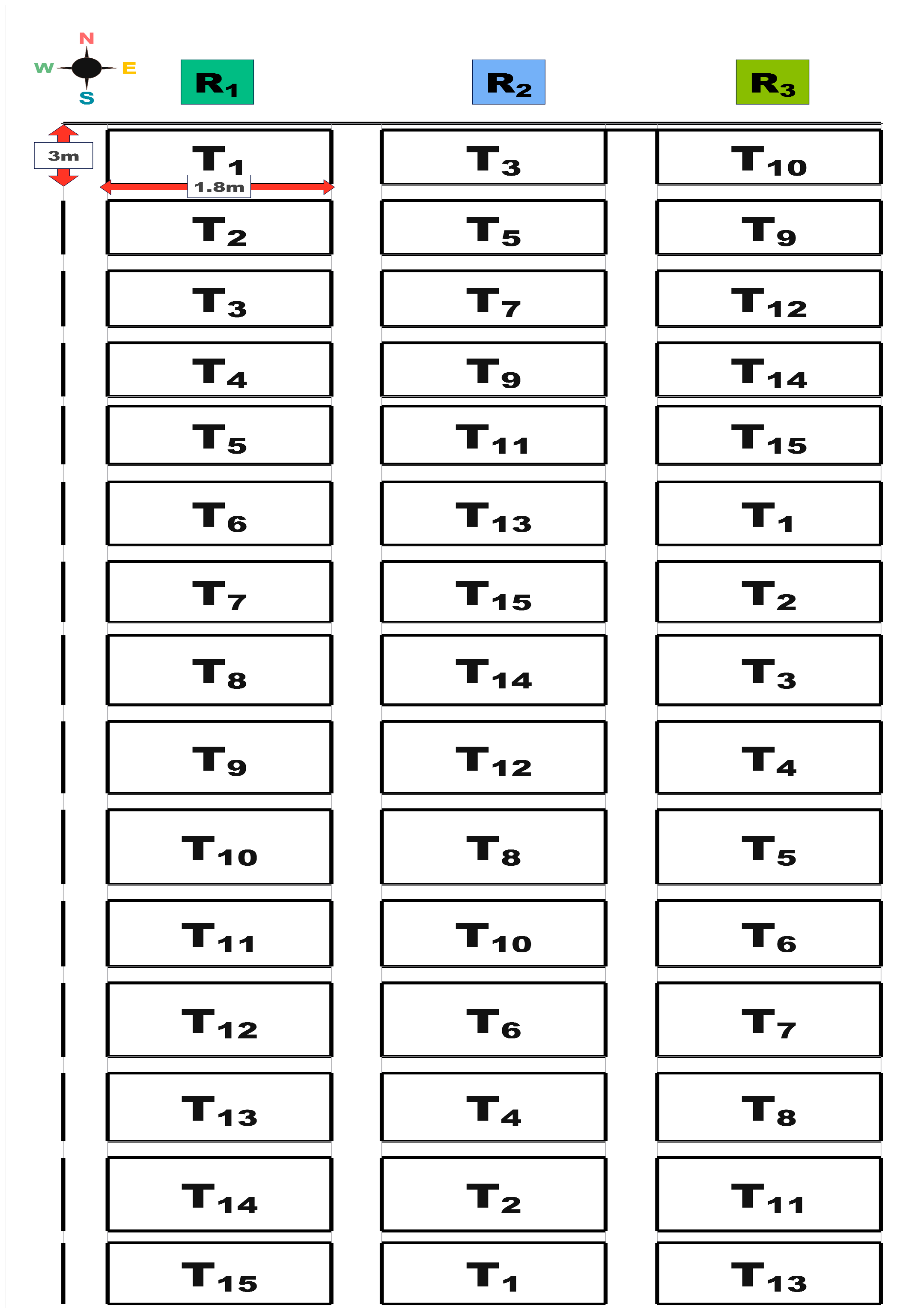

| Crop | Cabbage | Capsicum | Radish | |
|---|---|---|---|---|
| Parameters | ||||
| Design | (RCBD) | (RCBD) | (RCBD) | |
| Replication (s) | 3 | 3 | 3 | |
| Treatments | 15 | 15 | 15 | |
| Plot size | 3 × 1.8 m2 | 3 × 1.8 m2 | 3 × 1.8 m2 | |
| Variety | Pusa Mukta | Solan Bharpur | Chinese Pink | |
| Date of seed sowing (nursery/direct sowing) | 8 September | 7 March | 22 August | |
| Date of transplanting | 12 October | 17 April | - | |
| Code | Treatment | Cabbage | Capsicum | Radish | |||
|---|---|---|---|---|---|---|---|
| Plant Height (cm) | Plant Spread (cm) | Plant Height (cm) | Number of Branches | Root Length (cm) | Root Diameter (cm) | ||
| T1 | RDFs + FYM (Control) | 26.22 ± 0.22 a | 62.38 ± 1.05 a | 60.75 ± 0.47 a | 4.07 ± 0.16 a | 9.59 ± 0.47 d–f | 3.23 ± 0.03 c–g |
| T2 | NP + VC (75% + 2.5 t/ha) | 25.14 ± 0.20 b–d | 57.28 ± 0.48 b | 56.60 ± 0.44 d | 3.67 ± 0.12 bc | 10.63 ± 0.25 a–d | 3.15 ± 0.04 g |
| T3 | NP + VC (50% + 2.5 t/ha) | 23.71 ± 0.48 fg | 51.66 ± 0.39 e–g | 52.54 ± 1.14 f | 3.00 ± 0.03 gh | 9.29 ± 0.20 f | 3.17 ± 0.2 fg |
| T4 | NP + EC (75% + 2.5 t/ha) | 24.45 ± 0.22 d–f | 54.66 ± 0.93 cd | 51.75 ± 0.89 f | 3.30 ± 0.10 de | 10.02 ± 0.43 c–f | 3.20 ± 0.04 d–g |
| T5 | NP + EC (50% + 2.5 t/ha) | 23.63 ± 0.40 g | 51.47 ± 0.75 fg | 49.69 ± 1.21 g | 3.17 ± 0.07 e–g | 9.69 ± 0.38 d–f | 3.05 ± 0.01 h |
| T6 | NP + PGPR (75% + 5 kg/ha) | 25.67 ± 0.72 ab | 54.63 ± 1.21 cd | 57.91 ± 0.57 bc | 3.53 ± 0.12 bc | 9.78 ± 0.42 c–f | 3.24 ± 0.03 b–g |
| T7 | NP + PGPR (50% + 5 kg/ha) | 24.20 ± 0.02 e–g | 51.93 ± 0.73 e–g | 54.45 ± 1.05 e | 3.53 ± 0.08 bc | 9.40 ± 0.72 ef | 3.17 ± 0.03 e–g |
| T8 | NP + VC + PGPR (75% + 2.5 t/ha + 5 kg/ha) | 24.83 ± 0.22 c–e | 54.79 ± 0.56 cd | 56.73 ± 0.71 cd | 3.17 ± 0.12 e–g | 10.90 ± 0.39 a–c | 3.22 ± 0.04 c–g |
| T9 | NP + VC + PGPR (50% + 2.5 t/ha + 5 kg/ha) | 23.73 ± 0.11 fg | 50.31 ± 0.43 g | 51.88 ± 0.43 f | 2.93 ± 0.02 h | 10.06 ± 0.29 c–f | 3.27 ± 0.01 b–d |
| T10 | NP + EC + PGPR (50% + 2.5 t/ha + 5 kg/ha) | 24.95 ± 0.29 b–e | 54.34 ± 0.34 cd | 53.95 ± 0.59 e | 3.57 ± 0.02 bc | 10.92 ± 0.46 a–c | 3.29 ± 0.03 a–d |
| T11 | NP + EC + PGPR (50% + 2.5 t/ha + 5 kg/ha), | 24.55 ± 0.34 de | 52.88 ± 0.85 d–f | 49.59 ± 0.60 g | 3.03 ± 0.07 f–h | 10.48 ± 0.21 a–e | 3.24 ± 0.06 b–f |
| T12 | NP + VC and EC (75% + 2.5 t/ha and 2.5 t/ha) | 24.67 ± 0.33 c–e | 55.72 ± 1.07 bc | 57.16 ± 0.50 cd | 3.45 ± 0.08 cd | 10.56 ± 0.25 a–d | 3.32 ± 0.03 ab |
| T13 | NP + VC and EC (50% + 2.5 t/ha and 2.5 t/ha) | 24.30 ± 0.49 e–g | 51.18 ± 0.48 fg | 52.60 ± 1.09 f | 3.26 ± 0.07 d–f | 10.30 ± 0.41 b–f | 3.26 ± 0.02 b–e |
| T14 | NP + VC and EC + PGPR (75% + 2.5 t/ha and 2.5 t/ha + 5 kg/ha) | 26.19 ± 0.06 a | 53.57 ± 0.45 de | 58.82 ± 0.20 b | 4.02 ± 0.09 a | 11.62 ± 0.32 a | 3.36 ± 0.03 a |
| T15 | NP + VC and EC + PGPR (50% + 2.5 t/ha and 2.5 t/ha + 5 kg/ha) | 25.48 ± 0.21 a–c | 51.09 ± 0.30 fg | 51.90 ± 1.36 f | 3.70 ± 0.15 b | 11.29 ± 0.35 ab | 3.29 ± 0.04 a–c |
| Significance | *** | *** | *** | *** | *** | *** | |
| Code | Treatment Details | Cabbage | Capsicum | Radish | |||||||
|---|---|---|---|---|---|---|---|---|---|---|---|
| Polar Diameter (cm) | Equatorial Diameter (cm) | Yield/ha (q) | Fruit Length (cm) | Fruit Breadth (cm) | Number of Fruits | Fruit Weight (g) | Yield/ ha (q) | Root Weight (g) | Yield /ha (q) | ||
| T1 | RDFs + FYM (Control) | 11.34 ± 0.13 g | 13.21 ± 0.19 a | 365.25 ± 9.55 d–f | 5.33 ± 0.15 fg | 4.81 ± 0.19 ef | 19.87 ± 0.03 ef | 47.92 ± 1.00 de | 260.64 ± 8.37 e–g | 72.79 ± 2.23 c–e | 192.47 ± 5.89 c-e |
| T2 | NP + VC (75% + 2.5 t/ha) | 11.56 ± 0.06 c | 13.23 ± 0.14 a | 393.73 ± 9.19 bc | 5.88 ± 0.11 a–c | 5.01 ± 0.29 b–d | 21.84 ± 0.69 cd | 50.25 ± 1.69 b–d | 307.77 ± 2.68 cd | 61.63 ± 2.96 e–g | 162.98 ± 7.83 e-g |
| T3 | NP + VC (50% + 2.5 t/ha) | 11.15 ± 0.02 m | 12.33 ± 0.31 f | 357.67 ± 10.30 e–g | 5.51 ± 0.09 ef | 4.84 ± 0.24 ef | 19.52 ± 0.77 e–g | 47.32 ± 1.41 de | 257.11 ± 8.30 fg | 51.24 ± 2.26 g | 135.51 ± 5.97 g |
| T4 | NP + EC (75% + 2.5 t/ha) | 11.55 ± 0.22 d | 13.11 ± 0.09 ab | 351.87 ± 4.65 e–g | 5.33 ± 0.08 fg | 4.85 ± 0.21 ef | 20.12 ± 0.75 d–f | 49.25 ± 1.13 b–e | 271.04 ± 4.24 ef | 64.81 ± 0.87 d–f | 171.37 ± 2.30 d-f |
| T5 | NP + EC (50% + 2.5 t/ha) | 11.18 ± 0.39 k | 12.98 ± 0.21 a–d | 322.10 ± 6.59 h | 5.03 ± 0.04 h | 4.18 ± 0.02 ef | 18.66 ± 1.05 fg | 47.63 ± 0.88 de | 251.24 ± 4.88 g | 54.92 ± 3.42 fg | 145.23 ± 9.04 fg |
| T6 | NP + PGPR (75% + 5 kg/ha) | 11.61 ± 0.25 b | 13.01 ± 0.23 a–c | 395.74 ± 13.09 bc | 6.00 ± 0.09 a–c | 4.95 ± 0.35 c–e | 24.59 ± 1.09 b | 51.51 ± 0.70 bc | 321.96 ± 5.28 bc | 67.63 ± 3.11 c–e | 178.85 ± 8.22 c-e |
| T7 | NP + PGPR (50% + 5 kg/ha) | 11.42 ± 0.37 f | 12.96 ± 0.21 a–e | 369.23 ± 5.40 c–f | 5.81 ± 0.07 b–d | 5.02 ± 0.22 b–d | 20.10 ± 1.03 d–f | 48.61 ± 0.26 c–e | 268.75 ± 6.40 ef | 66.45 ± 4.92 d–f | 175.71 ± 13.01 d-f |
| T8 | NP + VC + PGPR (75% + 2.5 t/ha + 5 kg/ha) | 11.21 ± 0.19 j | 12.52 ± 0.29 d–f | 388.99 ± 10.20 b–d | 5.78 ± 0.14 cd | 4.92 ± 0.21 d–f | 20.45 ± 1.09 d–f | 47.45 ± 2.33 de | 323.83 ± 4.66 b | 76.75 ± 2.75 b–d | 202.95 ± 7.28 b-d |
| T9 | NP + VC + PGPR (50% + 2.5 t/ha + 5 kg/ha) | 11.15 ± 0.10 m | 12.21 ± 0.14 f | 347.48 ± 9.08 f–h | 5.46 ± 0.06 ef | 4.80 ± 0.21 ef | 19.19 ± 0.62 fg | 46.22 ± 0.38 e | 262.87 ± 4.28 e–g | 75.42 ± 6.01 b–d | 199.43 ± 15.88 b-d |
| T10 | NP + EC + PGPR (50% + 2.5 t/ha + 5 kg/ha) | 11.17 ± 0.19 l | 12.66 ± 0.20 b–f | 379.11 ± 1.23 c–e | 5.59 ± 0.08 de | 4.86 ± 0.24 ef | 19.79 ± 0.37 ef | 48.91 ± 2.22 c–e | 273.28 ± 9.38 e | 79.49 ± 5.33 bc | 210.20 ± 14.11 bc |
| T11 | NP + EC + PGPR (50% + 2.5 t/ha + 5 kg/ha) | 11.04 ± 0.11 n | 12.52 ± 0.17 d–f | 335.50 ± 6.47 gh | 5.14 ± 0.14 gh | 4.77 ± 0.29 f | 17.75 ± 0.57 g | 47.95 ± 1.57 de | 227.65 ± 8.18 h | 71.32 ± 3.29 c–e | 188.59 ± 8.70 c-e |
| T12 | NP +VC and EC (75% + 2.5 t/ha and 2.5 t/ha) | 11.25 ± 0.38 i | 12.55 ± 0.05 c–f | 396.61 ± 9.38 bc | 5.87 ± 0.12 a–c | 5.07 ± 0.21 bc | 21.31 ± 0.84 c–e | 52.39 ± 1.09 ab | 301.67 ± 7.23 d | 86.55 ± 6.35 ab | 228.88 ± 16.81 ab |
| T13 | NP + VC and EC (50% + 2.5 t/ha and 2.5 t/ha) | 11.31 ± 0.14 h | 12.51 ± 0.09 ef | 336.34 ± 19.49 gh | 5.46 ± 0.02 ef | 4.91 ± 0.26 d–f | 20.09 ± 0.38 d–f | 48.95 ± 1.93 c–e | 268.92 ± 11.61 ef | 73.95 ± 4.88 c–e | 195.56 ± 12.92 c-e |
| T14 | NP + VC and EC + PGPR (75% + 2.5 t/ha and 2.5 t/ha + 5 kg/ha) | 12.18 ± 0.03 a | 13.12 ± 0.07 ab | 472.35 ± 9.79 a | 6.10 ± 0.05 a | 5.26 ± 0.26 a | 27.22 ± 0.38 a | 54.92 ± 2.37 a | 367.74 ± 3.07 a | 95.43 ± 5.47 a | 252.36 ± 14.47 a |
| T15 | NP + VC and EC + PGPR (50% + 2.5 t/ha and 2.5 t/ha + 5 kg/ha) | 11.50 ± 0.38 e | 12.56 ± 0.07 c–f | 408.66 ± 4.60 b | 6.06 ± 0.08 ab | 5.11 ± 0.26 ab | 22.73 ± 0.54 bc | 50.37 ± 0.94 b–d | 313.71 ± 10.98 b–d | 94.68 ± 4.58 a | 250.39 ± 12.12 a |
| Significance | NS | *** | *** | *** | *** | *** | *** | *** | *** | *** | |
| Code | Treatment Details | Cabbage | Capsicum | Radish | |||
|---|---|---|---|---|---|---|---|
| Protein (%) | Ascorbic Acid (mg/100 g) | TSSs (0Brix) | Ascorbic Acid (mg/100 g) | TSSs (0Brix) | Ascorbic Acid (mg/100 g) | ||
| T1 | RDFs + FYM (Control) | 16.44 ± 0.61 b–d | 11.91 ± 0.36 g | 4.53 ± 0.03 g | 164.43 ± 1.18 e | 2.67 ± 0.17 g | 29.69 ± 0.90 e–h |
| T2 | NP + VC (75% + 2.5 t/ha) | 15.59 ± 0.25 e–g | 12.96 ± 0.87 d–f | 4.77 ± 0.09 d–f | 165.58 ± 0.75 de | 3.17 ± 0.17 f | 30.10 ± 0.61 ef |
| T3 | NP + VC (50% + 2.5 t/ha) | 15.04 ± 0.12 gh | 13.48 ± 0.62 d | 5.00 ± 0.10 bc | 167.24 ± 2.45 c–e | 3.83 ± 0.17 c | 31.91 ± 1.36 bc |
| T4 | NP + EC (75% + 2.5 t/ha) | 14.87 ± 0.52 h | 12.39 ± 0.36 fg | 4.67 ± 0.09 fg | 161.39 ± 1.29 f | 3.80 ± 0.15 cd | 29.81 ± 0.25 e–h |
| T5 | NP + EC (50% + 2.5 t/ha) | 14.14 ± 0.62 i | 13.26 ± 0.48 de | 4.90 ± 0.06 c–e | 166.51 ± 3.29 c–e | 3.17 ± 0.17 f | 30.39 ± 0.58 de |
| T6 | NP + PGPR (75% + 5 kg/ha) | 15.86 ± 0.24 d–f | 12.08 ± 0.65 g | 4.73 ± 0.09 e–g | 166.02 ± 2.28 c–e | 3.67 ± 0.17 d | 30.41 ± 0.71 de |
| T7 | NP + PGPR (50% + 5 kg/ha) | 15.18 ± 0.45 gh | 14.38 ± 0.79 c | 4.97 ± 0.12 cd | 167.69 ± 1.45 cd | 3.33 ± 0.17 e | 30.87 ± 1.02 b–e |
| T8 | NP + VC + PGPR (75% + 2.5 t/ha + 5 kg/ha) | 16.52 ± 0.33 bc | 12.78 ± 0.18 ef | 4.67 ± 0.09 fg | 164.91 ± 1.29 de | 3.67 ± 0.17 d | 28.63 ± 0.09 h |
| T9 | NP + VC + PGPR (50% + 2.5 t/ha + 5 kg/ha) | 15.65 ± 0.62 e–g | 15.05 ± 0.16 bc | 4.83 ± 0.09 cd–f | 165.14 ± 1.37 de | 3.33 ± 0.17 e | 29.97 ± 0.0.90 e–g |
| T10 | NP + EC + PGPR (50% + 2.5 t/ha + 5 kg/ha) | 16.35 ± 0.39 cd | 13.02 ± 0.29 d–f | 4.67 ± 0.17 fg | 167.19 ± 2.20 c–e | 3.33 ± 0.17 e | 28.77 ± 0.0.32 gh |
| T11 | NP + EC + PGPR (50% + 2.5 t/ha + 5 kg/ha), | 15.50 ± 0.29 f–h | 15.32 ± 0.38 ab | 4.93 ± 0.03 cd | 165.11 ± 2.35 de | 3.17 ± 0.17 f | 30.73 ± 1.24 c–e |
| T12 | NP +VC and EC (75% + 2.5 t/ha and 2.5 t/ha) | 16.19 ± 0.91 c–e | 12.92 ± 0.43 d–f | 4.80 ± 0.06 d–f | 168.81 ± 1.05 bc | 3.67 ± 0.67 d | 29.10 ± 0.40 f–h |
| T13 | NP + VC and EC (50% + 2.5 t/ha and 2.5 t/ha) | 15.21 ± 0.14 gh | 14.98 ± 0.16 bc | 4.90 ± 0.06 c–e | 170.84 ± 0.56 ab | 3.33 ± 0.17 e | 31.47 ± 1.41 b–d |
| T14 | NP + VC and EC + PGPR (75% + 2.5 t/ha and 2.5 t/ha + 5 kg/ha) | 17.39 ± 0.38 a | 15.78 ± 0.29 a | 5.20 ± 0.06 a | 172.13 ± 1.61 a | 4.03 ± 0.02 b | 32.07 ± 0.77 ab |
| T15 | NP + VC and EC + PGPR (50% + 2.5 t/ha and 2.5 t/ha + 5 kg/ha) | 17.02 ± 0.47 ab | 15.62 ± 0.54 ab | 5.17 ± 0.12 ab | 171.38 ± 1.98 ab | 4.17 ± 0.17 a | 33.15 ± 0.20 a |
| Significance | *** | *** | *** | *** | *** | *** | |
| Code | Treatment Details | Annual Benefit | |
|---|---|---|---|
| Net Return (INR in Lacs) | Benefit–Cost Ratio | ||
| T1 | RDFs + FYM (Control) | 8.06 | 2.00 ± 0.05 a–d |
| T2 | NP + VC (75% + 2.5 t/ha) | 7.64 | 1.47 ± 0.01 fg |
| T3 | NP + VC (50% + 2.5 t/ha) | 5.95 | 1.16 ± 0.02 c–i |
| T4 | NP + EC (75% + 2.5 t/ha) | 7.59 | 1.77 ± 0.04 bc |
| T5 | NP + EC (50% + 2.5 t/ha) | 6.56 | 1.57 ± 0.04 c–e |
| T6 | NP + PGPR (75% + 5 kg/ha) | 9.16 | 2.23 ± 0.04 ab |
| T7 | NP + PGPR (50% + 5 kg/ha) | 7.84 | 1.96 ± 0.02 a–e |
| T8 | NP + VC + PGPR (75% + 2.5 t/ha + 5 kg/ha) | 8.39 | 1.58 ± 0.01 cd |
| T9 | NP + VC + PGPR (50% + 2.5 t/ha + 5 kg/ha) | 6.73 | 1.29 ± 0.01 b–h |
| T10 | NP + EC + PGPR (50% + 2.5 t/ha + 5 kg/ha) | 8.41 | 1.93 ± 0.02 a–f |
| T11 | NP + EC + PGPR (50% + 2.5 t/ha + 5 kg/ha), | 6.75 | 1.58 ± 0.04 cd |
| T12 | NP + VC and EC (75% + 2.5 t/ha and 2.5 t/ha) | 9.07 | 1.93 ± 0.04 a–f |
| T13 | NP + VC and EC (50% + 2.5 t/ha and 2.5 t/ha) | 7.28 | 1.56 ± 0.02 c–f |
| T14 | NP + VC and EC + PGPR (75% + 2.5 t/ha and 2.5 t/ha + 5 kg/ha) | 11.24 | 2.35 ± 0.02 a |
| T15 | NP + VC and EC + PGPR (50% + 2.5 t/ha and 2.5 t/ha + 5 kg/ha) | 9.60 | 2.04 ± 0.04 a–c |
| Significance | *** | ||
Disclaimer/Publisher’s Note: The statements, opinions and data contained in all publications are solely those of the individual author(s) and contributor(s) and not of MDPI and/or the editor(s). MDPI and/or the editor(s) disclaim responsibility for any injury to people or property resulting from any ideas, methods, instructions or products referred to in the content. |
© 2023 by the authors. Licensee MDPI, Basel, Switzerland. This article is an open access article distributed under the terms and conditions of the Creative Commons Attribution (CC BY) license (https://creativecommons.org/licenses/by/4.0/).
Share and Cite
Thakur, S.; Sharma, A.K.; Thakur, K.; Sharma, S.; Gudeta, K.; Hashem, A.; Avila-Quezada, G.D.; Moubayed, N.M.S.; Abd_Allah, E.F. Differential Responses to Integrated Nutrient Management of Cabbage–Capsicum–Radish Cropping Sequence with Fertilizers and Plant-Growth-Promoting Rhizobacteria. Agronomy 2023, 13, 1789. https://doi.org/10.3390/agronomy13071789
Thakur S, Sharma AK, Thakur K, Sharma S, Gudeta K, Hashem A, Avila-Quezada GD, Moubayed NMS, Abd_Allah EF. Differential Responses to Integrated Nutrient Management of Cabbage–Capsicum–Radish Cropping Sequence with Fertilizers and Plant-Growth-Promoting Rhizobacteria. Agronomy. 2023; 13(7):1789. https://doi.org/10.3390/agronomy13071789
Chicago/Turabian StyleThakur, Shivender, A. K. Sharma, Kuldeep Thakur, Sunny Sharma, Kasahun Gudeta, Abeer Hashem, Graciela Dolores Avila-Quezada, Nadine M. S. Moubayed, and Elsayed Fathi Abd_Allah. 2023. "Differential Responses to Integrated Nutrient Management of Cabbage–Capsicum–Radish Cropping Sequence with Fertilizers and Plant-Growth-Promoting Rhizobacteria" Agronomy 13, no. 7: 1789. https://doi.org/10.3390/agronomy13071789
APA StyleThakur, S., Sharma, A. K., Thakur, K., Sharma, S., Gudeta, K., Hashem, A., Avila-Quezada, G. D., Moubayed, N. M. S., & Abd_Allah, E. F. (2023). Differential Responses to Integrated Nutrient Management of Cabbage–Capsicum–Radish Cropping Sequence with Fertilizers and Plant-Growth-Promoting Rhizobacteria. Agronomy, 13(7), 1789. https://doi.org/10.3390/agronomy13071789

