Article

Comparison of Methane Emission Patterns from Dairy Housings with Solid and Slatted Floors at Two Locations


1
Department Engineering for Livestock Management, Leibniz Institute for Agricultural Engineering and Bioeconomy (ATB), Max-Eyth-Allee 100, 14469 Potsdam, Germany
2
Institute for Animal Production, State Research Center for Agriculture and Fisheries Mecklenburg-Western Pomerania, Wilhelm-Stahl-Allee 2, 18196 Dummerstorf, Germany
3
Laboratory for Air Pollution/Environmental Technology, Empa, Überlandstrasse 129, 8600 Dübendorf, Switzerland
4
Ruminant Research Group, Agroscope, Tänikon 1, 8356 Ettenhausen, Switzerland
5
Department of Veterinary Medicine, Institute of Animal Hygiene and Environmental Health, Free University Berlin (FUB), Robert-von-Ostertag-Str. 7-13, 14163 Berlin, Germany
*
Author to whom correspondence should be addressed.
Agronomy 2022, 12(2), 381; https://doi.org/10.3390/agronomy12020381

Submission received: 21 December 2021 / Revised: 24 January 2022 / Accepted: 28 January 2022 / Published: 3 February 2022

Abstract

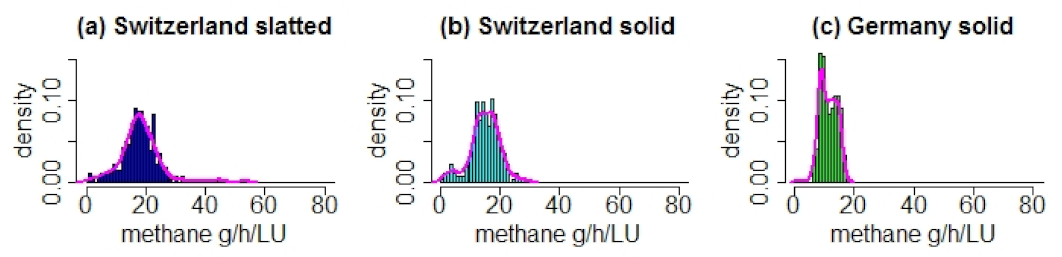
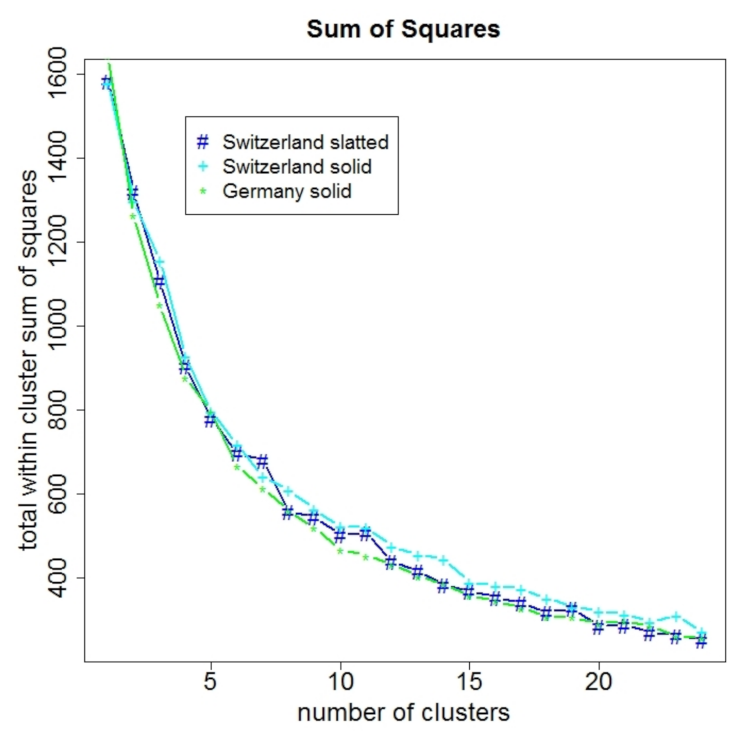
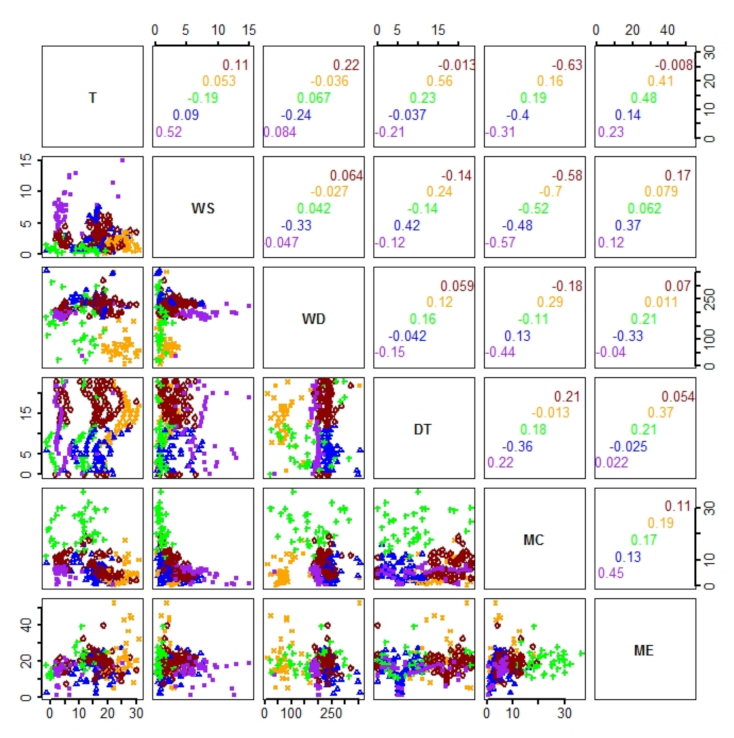
Methane (CH4) emissions from dairy husbandry are a hot topic in the context of active climate protection, where housing systems with slatted floors and slurry storage inside are in general expected to emit more than systems with solid floors. There are multiple factors, including climate conditions, that modulate the emission pattern. In this study, we investigated interrelations between CH4 emission patterns and climate conditions as well as differences between farm locations versus floor effects. We considered three data sets with 265, 264 and 275 hourly emission values from two housing systems (one slatted, one solid floor) in Switzerland and one system with solid floors in Germany. Each data set incorporated measurements in summer, winter and a transition season. The average CH4 emission was highest for the slatted floor system. For the solid floor systems, CH4 emissions at the Swiss location were around 30% higher compared to the German location. The shape of the distributions for the two solid floor systems was rather similar but very different from the distribution for the slatted floor system, which showed higher prevalence for extreme emissions. Rank correlations, which measure the degree of similarity between two rankings in terms of linear relation, were not able to detect dependencies at the selected significance level. In contrast, mutual information, which measures more general statistical dependencies in terms of shared information, revealed highly significant dependencies for almost all variable pairs. The weakest statistical relation was found between winds speed and CH4 emission, but the convection regime was found to play a key role. Clustering was consistent among the three data sets with five typical clusters related to high/low temperature and wind speed, respectively, as well as in some cases to morning and evening hours. Our analysis showed that despite the disparate and often insignificant correlation between environmental variables and CH4 emission, there is a strong relation between both, which shapes the emission pattern in many aspects much more in addition to differences in the floor type. Although a clear distinction of high and low emission condition clusters based on the selected environmental variables was not possible, trends were clearly visible. Further research with larger data sets is advisable to verify the detected trends and enable prognoses for husbandry systems under different climate conditions.
Keywords: greenhouse gas; convection regime; statistical moments; rank correlation; mutual information; clustering greenhouse gas; convection regime; statistical moments; rank correlation; mutual information; clustering