Abstract
This study aimed to evaluate and compare the physiological traits, productivity, and seed quality of nine faba bean varieties grown in a field trial under the Boreal climate conditions. A two-factor field experiment was laid out in a split-plot design: The seeds in the main plots were sown and treated with seed fungicide (SF) and untreated (without SF) (factor A). The sub-plots were assigned to nine varieties (factor B). The physiological traits of faba bean significantly varied among the varieties, and the behavior of faba bean varieties differed between the two growing seasons. The values of physiological traits for varieties Julia and Boxer significantly surpassed the trial mean under wet conditions, while the trait values for Fuego and Bioro were surpassed under conditions of a lack of moisture. Fungicidal seed treatment had a negligible effect on the physiological traits, while it had a significant negative influence on the leaf area index at the beginning of the flowering stage. SF had a noticeable effect on seed yield only for the varieties Nida DS and Fuego. The findings of the study revealed that Fuego and Isabell were the most suitable faba bean varieties for cultivation in the Boreal climate zone as they were distinguished from the other tested ones by the highest seed yields.
Keywords:
CO2 assimilation; faba bean; photosynthesis; physiological traits; productivity; varieties 1. Introduction
Faba bean (Vicia faba L.) is an important source of protein for humans and a valuable feed for livestock [1,2,3]. Due to its great diversity and adaptability, it has a long history of utilization outside the center of origin in diverse agroecological settings from the Boreal and Atlantic Maritime climates to arid and sub-tropical regions [4,5,6]. Legumes, including faba bean, can play an important role in contributing to climate change mitigation [7,8]. Faba bean is an important crop for the diversification of farming systems [6,9] and for preservation the sustainability of agricultural systems, due to the ability to fix atmospheric nitrogen [9,10,11].
Notwithstanding its importance, this crop is exposed to many biotic and abiotic stresses that seriously constrain the final productivity of the faba bean [12,13,14,15]. Under climate change, it becomes increasingly difficult to grow beans due to higher-than-normal temperatures, lack of moisture, and changes in soil fertility [8,16,17]. The response of the genotype to a change in the environment is different among the genotypes; therefore, genotype × environment (G × E) interaction is very important for faba bean breeders [18,19,20]. To curb the potential stresses caused by climate change, it is important to breed new genotypes capable of tolerating or avoiding the impact of unfavorable factors [13,17,20].
Various biotic and abiotic factors negatively affect the productivity of faba bean. A lot of damage to faba beans is caused by a leaf disease chocolate spot (Botrytis fabae Sard.). This disease is one of the most economically important diseases that injures the foliage, inhibits the photosynthesis process, and reduces faba bean productivity [21,22]. Integration of the effective seed fungicides with management options like crop rotation could be economically feasible. Chang et al. [23] stated that the effect of seed fungicide was significant for seedling emergence, disease severity, and seed yield.
Leaf photosynthesis is the fundamental process for faba bean biomass and yield formation and to improve photosynthesis and has been recently recognized as additional and one of the most promising options to achieve yield improvement [24]. Knowledge of the physiological properties that limit yield under inimical conditions provides new opportunities for future breeding and growing strategies of faba bean [5,14,16]. The process of photosynthesis is markedly affected by climate warming and a changing moisture regime [17]. The response of faba bean varieties to various environmental stresses may vary [25].
Photosynthetic active radiation (PAR) is an essential factor that governs the productivity of plants [26], because PAR is a fundamental source of energy for the accumulation of dry matter and protein [27,28]. The leaf area index (LAI) plays an important role here as a factor affecting the amount of incoming PAR in the foliage [14,27].
In the last years, the interest in faba bean increased worldwide. During the implementation of the EU Greening program and increasing the biodiversity of farm fields, farmers have been obliged to involve more leguminous crops in crop rotations since 2015. Faba bean is suitable for the development of organic farming, which is one of the guidelines of the EU Green Deal. Faba bean is widely grown in the Boreal climate zone [2,3,6,29]. Considering that climate change is also gradually affecting many European regions, it is imperative to breed elite cultivars that feature a higher abiotic–biotic stress resistance and nutritional value than currently used cultivars [8]. The average national productivity is 3.30 t ha−1 [30] and the average yield obtained in Europe is 2.30 t ha−1 [31]. In order to attain the full potential of productivity, it is important to select varieties of faba bean that are best suited to the soil and climatic conditions. The objectives of this study were (i) to estimate the contrasts in the physiological indices of nine varieties of faba bean under open field conditions, (ii) to determine the effect of fungicidal seed treatment on the physiological traits and seed yield of faba bean, and (iii) to compare LAI, PAR capture ratio, productivity, and seed quality of nine faba bean varieties under Boreal climatic conditions.
2. Materials and Methods
2.1. Site and Soil Description
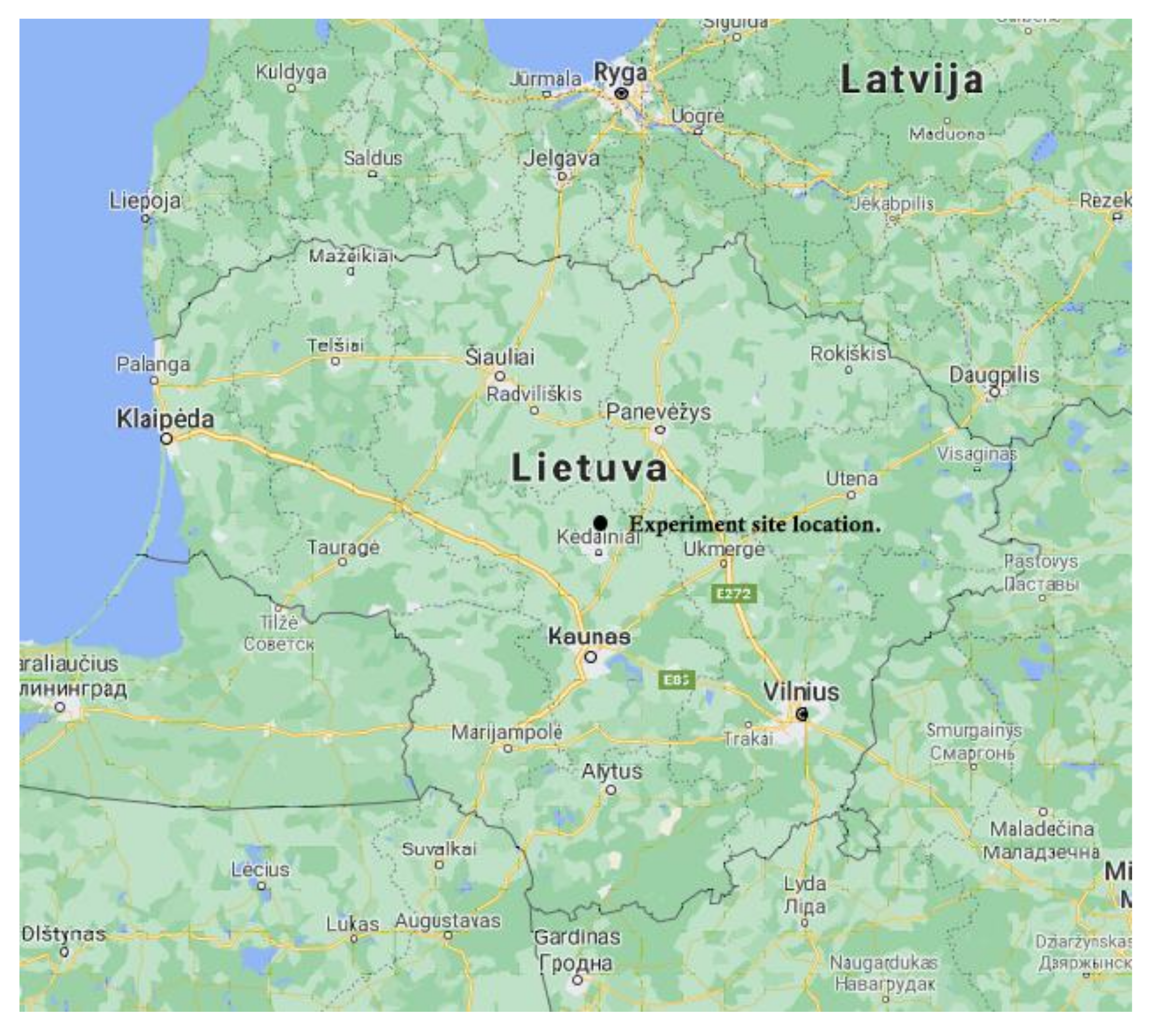
A field experiment was carried out at the Institute of Agriculture, Lithuanian Research Centre for Agriculture and Forestry in Central Lithuania (55°23′50″ N and 23°51′40″ E) (Figure 1) in two growing seasons, 2017 and 2018. The soil of the experimental site was Endocalcari-Epihypogleyic Cambisol. The soil had a high content of phosphorus (206–232 mg kg−1) (A-L method) and potassium (211–236 mg kg−1) (A-L method). The acidity was low (pHKCl 5.3–5.6) (potentiometrically). The content of humus varied from low to moderate (1.4–2.2%) (Tyurin method).
Figure 1.
Experiment site location.
2.2. Experimental Details and Agronomic Management
Experimental plots of 3.0 m × 10.0 m in size were set up (total 54 plots). The crop was sown with 13 cm for the between-row spacing and 8 cm for the within-row spacing at a density of 0.5 million viable seeds ha−1 after spring barley. Before sowing, the entire plot of the experiment was fertilized with a complex fertilizer NPK 4–16–34 at a rate of 300 kg ha−1.
A two-factor field experiment was laid out in a split-plot design in three replications. The seeds in the main plots were sown with seed fungicide (SF) and without SF (factor A). The sub-plots were assigned to nine varieties (Bioro, Nida DS, Reda DS, Fuego, Julia, Alexia, Boxer, Laura, Isabell) (factor B). The country of origin of the tested varieties is provided in Table 1.
Table 1.
The country of origin of the tested faba bean varieties.
The seeds were treated with a seed fungicide Maxim 025 FS (a.i. fludioxonil, 25 g L−1, Syngenta Crop Protection AG, Basel, Switzerland) (2.0 L t−1) in plots with seed fungicidal protection. After sowing, pre-emergence herbicide Fenix (a.i. aclonifen, 600 g L−1, Bayer AG, Leverkusen, Germany) (3.0 L ha−1) was sprayed. Insecticide Fastac EC (a.i. alpha-cypermethrin, 250 g L−1, BASF, Ludwigshafen, Germany) was used (0.20 L ha−1) post emergence. The insecticide Decis Mega (a.i. deltamethrin, 50 g L−1, Bayer AG, Leverkusen, Germany) (0.15 L ha−1) was applied twice after the appearance of black bean aphid (Aphis fabae Scop.). The experimental plots were harvested within the third 10-day period of August at complete maturity (BBCH 89) (BBCH scale—Biologische Bundesanstalt, Bundessortenamt und CHemische Industrie) with a plot harvester “Wintersteiger Delta” (Wintersteiger AG, Bad Sassendorf, Germany).
2.3. Plant Sampling, Measurements, and Calculations
2.3.1. Physiological Parameters
The leaf chlorophyll index (SPAD) was measured using a chlorophyll meter Minolta SPAD 502 (Minolta Camera Co. Ltd., Osaka, Japan). The measurements were made in the middle part of the fully expanded randomly selected leaves of 10 plants per each plot. The mean value of three plots from the same treatments was then calculated. SPAD measurements were made from 10:00 until 14:00 (local time) on clear days twice per growing season (measured at the same time as all physiological parameters), at the beginning of flowering (BBCH 62–63) and at end of flowering beginning of the fruit development stage (BBCH 69–71).
The maximum quantum efficiency of photosystem II (PSII) photochemistry (Fv/Fm). A multi-function pulse modulated handheld chlorophyll fluorometer (model OS-30p; Manufacturer: Opti-Sciences, Inc., Hudson, NH, USA) was used to measure in vivo the emission of chlorophyll-α fluorescence. Fv/Fm was directly read after short dark adaptation on the chlorophyll fluorometer [32]. Leaves of faba bean were adapted to darkness for 1 min using light withholding clips. The actinic light intensity was 1000 µmol m−2 s−1, and a modulation intensity of two arbitrary units. Fv/Fm measurements were made on the first fully expanded and healthy, randomly selected leaves of 5 plants per each plot (15 plants per each treatment) twice per growing season at the beginning of flowering (BBCH 62–63) and at the end of flowering and the beginning of the fruit development stage (BBCH 69–71).
The leaf area index (LAI) and photosynthetic active radiation (PAR) were measured using a SunScan SSI (Delta T Devices Ltd., Cambridge, England, UK). The instrument consists of a handheld device with a 1-metre-long probe with 64 diodes that measure PAR intensities and a separate station that measures the PAR incidence on the canopy top. The measurements were made on typical sunny days, three times per growing season in the 2nd season before the start of flowering (BBCH 60), at the beginning of flowering (BBCH 62–63), and at end of flowering and the beginning of the fruit development stage (BBCH 69–71). The data were obtained using a 1-meter-long sensor, which was kept under the canopy, and placed parallel to the direction of the rows, at the soil surface, near the faba bean stem. The PAR capture ratio was calculated as the ratio of the difference between incident and transmitted radiations to incident radiation; the PAR penetration ratio was calculated as a ratio of transmitted radiation to incident radiation, and the PAR reflection ratio was calculated as the ratio of PAR reflection measured above the canopy to incident radiation [26].
2.3.2. Gas Exchanges Parameters
The photosynthetic rate (A) (µmol m−2 s−1), transpiration rate (E) (mmol m−2 s−1), stomatal conductance (gs) (mol m−2 s−1), and intercellular CO2 concentration (Ci) (µmol moL−1) were measured using a portable infrared gas analyzer (SRS-1000) (ADC BioScientific Ltd., Hoddesdon, UK). The SRS-1000 system consists of the compact programming console and leaf chamber with a 6.25 cm2 window area. The photosynthetic data and calculations were displayed and recorded. Measurements were done under atmospheric CO2 and ambient light conditions. The fully expanded leaf was enclosed in the assimilation chamber, and gas exchange parameters were recorded in a data logger in about 2 min, when no noticeable changes in leaf respiration were registered. The measurements were made on three randomly selected plants per plot on the first fully expanded leaf from the top. The values of A and E were used to calculate the instantaneous water use efficiency (µmol CO2 mmoL−1 H2O) (WUE = A/E) [33]. Photosynthetic water use efficiency (PWUE) (µmol CO2 mmoL−1 H2O) was calculated by dividing A to gs, and mesophyll conductance (gm) (mmol CO2 m−2 s−1) was calculated by dividing A to Ci [34]. The stomatal limitation value was computed as Ls = 1 (Ci / C0), where Ci is the intercellular CO2 concentration and C0 is the original CO2 concentration [35].
2.4. Incidence of Chocolate Spot (Botrytis fabae Sard.)
The incidence of chocolate spot was assessed by scores (0–no damage/clean leaf, 9–100% damage) at BBCH 65.
2.5. Seed Yield (SY) and Seed Quality Analyses
SY as t ha−1 of faba bean was adjusted to a 15% moisture content. Protein content from each plot, from the samples selected after harvesting, were measured using the grain analyzer Infratec 1241 (Foss, Hilleroed, Denmark). A thousand seed weight was counted with a seed counter “Contador” (Pfeuffer GmbH, Kitzingen, Germany) from four samples of 250 seeds per plot.
2.6. Statistical Analysis
A three-way ANOVA was used to determine the effects of SF treatment, growth stage, and variety on the physiological indices, and a two-way ANOVA was used to determine the effects of SF and variety on LAI, PAR, SY, and seed quality parameters. Statistical significance was evaluated at the p ≤ 0.05 and p ≤ 0.01 probability levels. Standard statistical procedures were used for calculating simple correlation coefficients. The statistical analysis was done using STAT ENG software for Excel version 1.55 from the statistical data processing package SELEKCIJA.
2.7. Meteorological Conditions
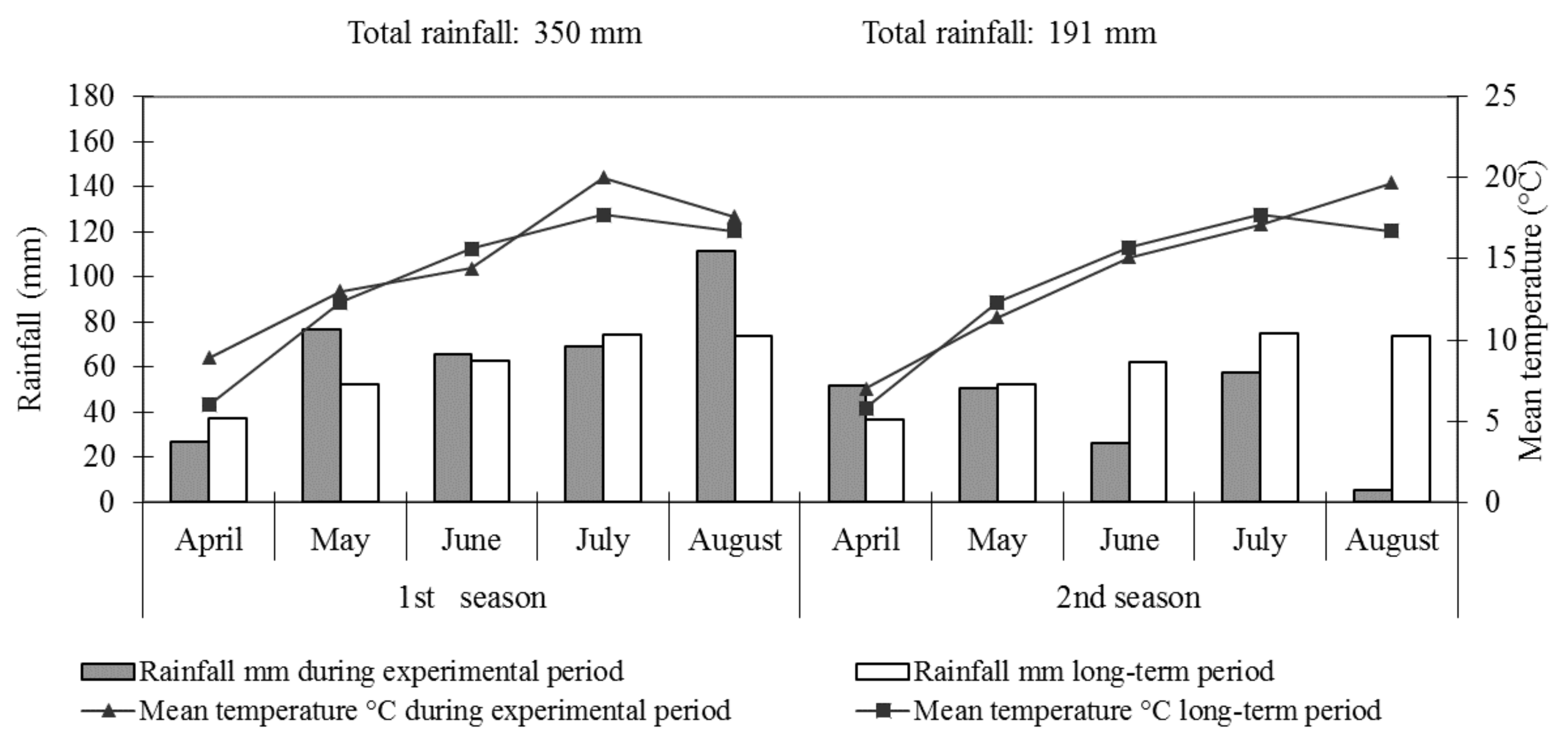
Rainfall and mean air temperature at the experimental site over the two growing seasons (Dotnuva weather station located about 500 m from the experimental field) are provided in Figure 2. The conditions of the plant growing season were described using the hydrothermal coefficient (HTC) as the agrometeorological indicator, which was calculated according to the formula [36]:
where Σ p represents the sum of precipitation (mm) during the test period, when the average daily air temperature is above 10 °C, and Σ t denotes the sum of active temperatures (°C) during the same period. If HTC > 1.6, the irrigation is excessive; HTC = 1.0–1.5 optimal irrigation; HTC = 0.9–0.8 weak drought; HTC = 0.7–0.6 moderate drought (arid); HTC = 0.5–0.4 heavy drought; and HTC < 0.4 very heavy drought [36].
HTC = Σ p/0.1 Σ t,
Figure 2.
The distribution of rainfall and temperature during the growing seasons.
Rainfall differed between the growing seasons, and the amount of rainfall totaled 350 mm (HTC = 1.6) and 191 mm (HTC = 1.0) in the 1st and 2nd season, respectively.
3. Results
3.1. Variation of Physiological Parameters of Faba Bean Varieties
The weather conditions differed in the amount of rainfall and its distribution between the experimental seasons (Figure 2); therefore, the results were discussed separately for the first and second season.
Physiological indices were influenced by seed treatment fungicide (SF) (factor A), growth stages (GSs) (factor B), variety (factor C), and their interaction (A × B, A × C, B × C and A × B × C). In the first season, the results of analysis of variance showed that the variety had a significant influence (p ≤ 0.05 and p ≤ 0.01) on all physiological indices and was the main factor that explained 9.1–70.7% of the total variability of discrete indices (Table 2). The influence of GS on physiological indices was weaker and significant on SPAD, Fv/Fm, WUE, PWUE, and gs. GS was responsible only for 0.9–5.8% of the total variability of the mentioned indices. SF significantly influenced Fv/Fm, A, and gm and explained 1.4%, 6.2%, and 42.0%, respectively, of their total variability. The effects of interaction SF × variety (A × C), GS × variety (B × C), and SF × GS × variety (A × B × C) were significant in most of the tested cases.
Table 2.
Contribution (% of sum of squares) of seed fungicide, growth stage, variety, and their interaction to total variance in physiological indices of faba bean.
In the second season, the impact of factors and their interactions was stronger than in the first season (Table 2). The results of analysis of variance revealed that GS and variety had a significant influence (p ≤ 0.01) on almost all physiological indices. The GS explained from 1.7% to 31.4% and variety explained from 4.8% to 27.5% of the total variability of indices. Interactions SF × variety (A × C), GS × variety (B × C), and SF × GS × variety (A × B × C) were significant in all the tested cases, except for SPAD. Interaction of SF × GS had the least impact on physiological indices in both growing seasons.
In the first season, the data averaged across GS and varieties showed that fungicidal seed treatment significantly increased the photosynthetic rate (A), transpiration rate (E), and mesophyll conductance (gm), by 25.2%, 18.2%, and 33.3%, respectively (Table 3). The SF tended to increase water use efficiency (WUE), but the difference was insignificant. The influence of the SF on Fv/Fm was negative, and Fv/Fm values significantly decreased by 5.9% in comparison with faba bean without seed treatment.
Table 3.
The effects of seed fungicide (SF), growth stages (GSs), and variety on physiological traits of faba bean.
The data averaged across SF treatments and varieties revealed some differences of physiological indices between GS. At later GS (BBCH 69–71), SPAD significantly decreased by 2.2%, WUE by 56.5%, and gs by 22.2%, in comparison with the respective values at the beginning of flowering (BBCH 62–63). Fv/Fm and PWUE values, on the contrary, at the end of flowering (BBCH 69–71), were significantly higher by 8.7% and 61.3%, respectively, than at BBCH 62–63 GS.
The data averaged across SF and GS showed that varieties differed in their physiological traits. Variety was the main factor responsible for the largest part (13.2%) of the total SPAD variability (Table 2). The highest SPAD was for varieties Julia and Alexia, and when compared with the trial mean, SPAD values were significant higher by 3.9% and 4.9%, respectively. Contrasts of SPAD for varieties Bioro, Nida DS, and Reda DS vs. trial mean were negative and significant (−3.2%, −3.2%, and −8.8%, respectively).
The variety significantly (p ≤ 0.01) influenced Fv/Fm and explained 8.4% of Fv/Fm contrasts. Variety Nida DS had the highest Fv/Fm (0.619) and statistically surpassed (+12.8%) the trial mean. The lowest Fv/Fm was recorded for varieties Julia and Isabell and contrasts vs. trial mean was significantly less (−10.6% and −10.7%, respectively).
Photosynthetic rate (A) was significantly influenced by the interactions of GS × variety, and SF × GS × variety and were responsible for the largest part of variability of A total variability (22.7% and 20.0%, respectively) (Table 2). The A values were the highest for varieties Julia and Boxer and were significantly higher by 27.8% and 10.8%, respectively, compared with the trial mean. The smallest A was for the varieties Isabell and the contrasts vs. trial mean was significantly less by -18.8%.
Overall, compared with the trial mean, the variety Julia was characterized by significantly higher water use efficiency (WUE), photosynthetic water use efficiency (PWUE), mesophyll conductance (gm), and stomatal limitation value (Ls) by 92.6%, 52.4%, 50.0%, and 17.7%, respectively (Table 3). The variety Boxes was also distinguished by 91.4%, 28.6%, and 13.4% significantly higher values of PWUE, gm, and Ls, respectively, compared with the trial mean.
In the second season, the data averaged across GS and varieties displayed that SF significantly increased E values and intercellular CO2 concentration (Ci) (by 34.6% and 8.8%, respectively), and significantly decreased Ls (by 12.1%), compared to faba bean without SF (Table 3).
Data, averaged across SF regimes and varieties, demonstrated that at the end of flowering (BBCH 69–71), the values of all physiological indices were significantly lower than at BBCH 62–63. This may have been caused by a lack of moisture during the growing season, especially at the end.
Variety explained 25.5% of the total SPAD variability (Table 2). Data, averaged across SF and GS, showed that the highest SPAD was for varieties Julia and Alexia, and, compared with the trial mean, SPAD was significantly higher by 8.6% and 7.3%, respectively. SPAD for Nida DS, Fuego, and Reda DS was the least and compared with the trial mean was significantly less by 6.9%, 6.7%, and 4.7%, respectively.
Despite small SPAD, varieties Fuego and Bioro exhibited significantly higher values of A, WUE, PWUE, gm, A, WUE, gs, gm, and Ls, respectively, in comparison with the trial mean. Variety Reda DS was characterized by significantly low values of A, WUE, gs, gm, and Ls, as compared with the trial mean.
3.2. Variation of LAI and PAR Capture Ratio and Penetration Ratio of Faba Bean Varieties
Table 4 shows the influence of SF treatments and varieties on LAI, photosynthetic active radiation (PAR) capture ratio, and penetration ratio in the canopy of faba bean in the second season. The results of the analysis of variance confirmed that LAI was highly dependent on SF treatment (factor A), variety (factor B), and their interaction (A × B); however, variety and interaction A × B were the main factors determining the differences between the treatments throughout the growing season (20.1–35.0% and 15.9–39.6%, respectively). The data, averaged across varieties, showed that SF fludioxonil had a significant negative influence on LAI in the first half of flowering, BBCH 60 and BBCH 62–63, and decreased LAI by 11.6% and 10.0% as compared to untreated seeds.
Table 4.
The influence of seed fungicide (SF) and variety on leaf area index (LAI) and photosynthetic active radiation (PAR) capture ratio and penetration ratio in the canopy of faba bean in the second season.
The data averaged across SF treatments showed that the highest LAI was for the varieties Bioro and Isabell, and in comparison with the trial mean, LAI was significantly higher for variety Bioro at BBCH 62–63 and BBCH 69–71 (by 16.6% and 7.3%, respectively) and for variety Isabell at BBCH 60 and BBCH 69–71 (by 16.4% and 8.4%, respectively). Variety Alexia revealed the significantly highest LAI (by 11.6%) only at BBCH 62–63. LAI for Nida DS was significantly lower than the trial mean at BBCH 60 and BBCH 62–63 (by −26.2% and −8.6%, respectively), and for Reda DS at BBCH 62–63 (by −8.6%).
The results of the analysis of variance revealed that both factors, SF treatment (factor A), variety (factor B), and their interaction (A × B) had a significant effect on the PAR capture ratio. Variety was responsible for 20.6–26.5% and interaction A × B for 18.1–43.4% of the PAR capture ratio total variability. Data, averaged across varieties, showed that SF significantly decreased the PAR capture ratio in the first half of flowering (by 3.0% at BBCH 60 and by 2.0% at BBCH 62–63). The data averaged across SF treatments revealed that the highest PAR capture ratio was significantly higher for variety Bioro at BBCH 62–63 and BBCH 69–71 than the trial mean (by 3.1% and 1.8%, respectively). Alexia and Isabell had a significant higher PAR capture ratio at BBCH 62–63 and at BBCH 69–71, respectively (by 2.1% and 1.7%, respectively).
SF used an increased PAR penetration rate by 41.5% and 51.9% at BBCH 62–63 and at BBCH 69–71, respectively.
3.3. Variation of Seed Yield and Quality Parameters of Faba Bean Varieties
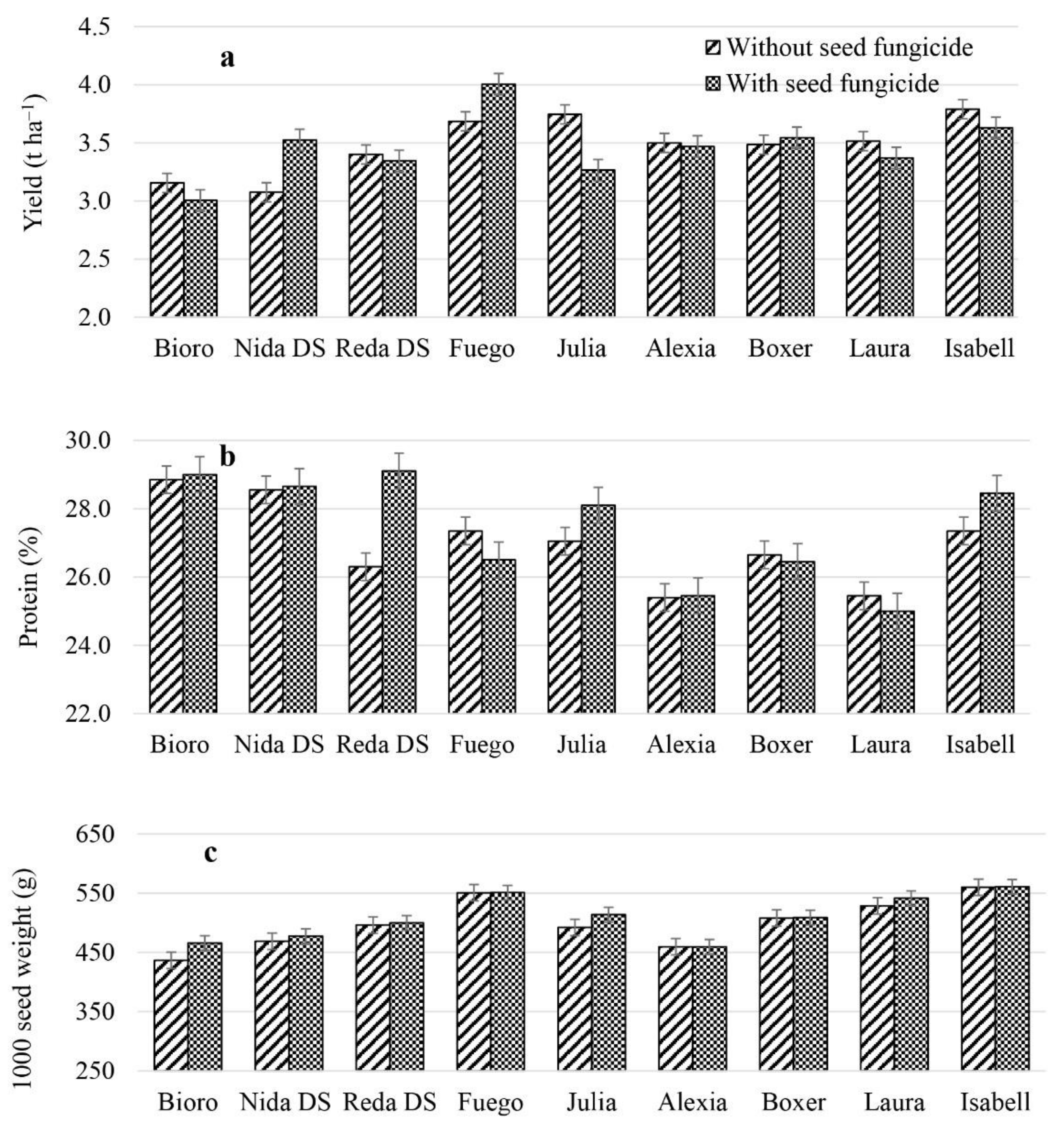
The use of SF had no significant effect on the seed yield of faba bean (Table 5). Variety was the main factor and explained 43.1% and 32.7% of the total variability of yield, respectively, in the 1st and 2nd seasons. In the 1st season, compared with the trial mean, seed yield of Fuego and Isabell was significantly higher by 12.2% and 10.6%, respectively. In the 2nd season, the highest seed yield was for Fuego and Alexia and significantly surpassed the trial mean by 9.2% and 4.0%, respectively. On average across two seasons, regardless of whether the seeds were treated with fungicide or not, the varieties Fuego and Isabell showed the highest yield, whereas Bioro and Nida DS produced the lowest seed yield of all varieties tested (Figure 3a). The use of SF was effective for grain yield only for the varieties Nida DS and Fuego.
Table 5.
Effects of seed fungicide (SF) and variety on seed yield and quality parameters of faba bean, in the first and second seasons.
Figure 3.
Treatment × variety interaction effects on seed yield (a), protein content (b), and 1000 seed weight (c) of nine faba bean varieties, in average in the first and second season. The error bars show standard deviation.
A thousand seed weight (TSW) was dependent on SF, but a significant influence (+2.3%) was found only in the second season. Variety explained the most part (73.0% in the first season and 68.6% in the second season) of TSW data total variability (Table 5). TSW for varieties Fuego, Laura, and Isabell was significantly higher than the trial mean (by 9.4%, 6.1%, 11.2% in the 1st season and by 9.0%, 6.0%, 11.0% in the 2nd season, respectively). Boxer showed significantly high TSW (by 7.8%) only in the 1st season, under normal humidity. On average across two seasons, Fuego, Laura, and Isabell had the highest TSW of all varieties (Figure 3c).
The results of analysis of variance revealed that both factors, SF (factor A), variety (factor B), and their interaction (A × B) had a significant effect on protein content (Table 5). Variety was responsible for the largest part (44.6% in the first season and 48.2% in the second season) of protein total variability, and the influence of interaction SF × variety on protein was less important (A × B contributed 10.8% in the 1st season and 6.4% in the 2nd season). In both seasons, independent of meteorological conditions, the varieties Bioro and Isabell accumulated significantly the highest amount of protein, in comparison with the trial mean (by 6.0 and 2.3 percentage point (pp) in the 1st season and 6.5 and 2.7 pp in the 2nd season, respectively). In the 2nd season, under conditions with less rainfall than usual (191 mm, Figure 1), varieties Nida DS, Reda DS, and Julia also had a significantly higher protein content than the trial mean (by 5.4, 4.2 and 2.3 pp, respectively). On average across two seasons, the highest amount of protein was for the varieties Bioro and Nida DS (Figure 3b).
4. Discussion
Photosynthesis is an important process to generate yield, and it is closely related to the environmental conditions and plant development [20,33]. The negative influence on physiological characteristics is exerted by a water deficit [17,34], heat stress [16,17], cold stress [19], and shortage of nutrients [5,14,29]. There is a lack of knowledge about the effect of SF on faba bean yield and quality in the experiments performed by other researchers. In the present study, not all physiological indices were influenced by SF. SF significantly increased A in the wet first season but had no effect in the dry second season. Whereas E under the effect of SF increased in both seasons, compared without SF.
We found that variety was the main factor that explained the largest part of total variability of physiological indices in most cases. The physiological traits of faba bean significantly differed among the varieties, and the behavior of bean varieties differed between the two growing seasons. Varieties Julia and Alexia were characterized by the highest SPAD in both seasons. Under dry conditions in the 2nd season, the highest A values were for varieties Bioro and Fuego, which were higher by 64.5% and 44.7%, respectively, than under the wet 1st season. These varieties consumed more water (WUE) during the dry season than during the wet season. We found that WUE were higher by 164.7% and 210.2%, respectively, for Bioro and Fuego. A values for the varieties Boxer and Reda DS were lower by 29.6% and 23.1%, respectively, under the dry 2nd season than under the wet 1st season. Under dry conditions, water consumption (WUE) for Boxer was higher by 126.1%; meanwhile, for Reda DS lower by 67.6%, compared to wet conditions. Varieties Boxer and Reda DS were separated by the lowest gs values in both seasons. Our results are consistent with Aniya and Herzog [37], who documented that cultivars differ in response to water shortage, and water deficiency improved WUE approximately in 20% of the tested genotypes, while for 80% of the tested genotypes, water deficit caused sharp decreases.
Faba bean seeds are distinguished by a high protein and energy content, and their potency to grow in various climatic zones. Their production has a long history of abundant and beneficial uses in feed and food [1]. Supposedly, faba bean yield will become increasingly volatile with projected climate change [12,16]. There is a need to develop new more stable varieties that are well-suited to the warming climate [4,18]. It was found that the environment was responsible for 89.27% of the total yield variation, whereas faba bean genotype and G × E interaction effects determined 2.12% and 3.31% yield variation, respectively [18]. The present study showed that variety was the main factor that explained the largest part (32.7–46.1%) of the total yield variability. Additionally, we found that some cultivated varieties revealed unequal productivity responses to meteorological conditions of the growing season. For the variety Fuego, the highest seed yield was in both seasons, whereas the variety Isabell was most productive in the wet season (total rainfall 350 mm), but in dry weather (total rainfall 191 mm), Isabell did not exploit its entire productivity potential and yield was lower 0.72 t ha−1 (or 17.7%) than the trial mean. For the variety Nida DS, in the first season, the yield was close to the trial mean, but in the 2nd season, this variety was sensitive to the dry conditions, the yield sharply decreased and was the lowest among all varieties. The differences in the response of varieties to meteorological conditions for protein accumulation were also revealed (Figure 3b). Under dry growing season conditions, the greatest protein reduction was in the seeds of the varieties Fuego and Boxer, respectively, by −3.5 and −3.2 pp, compared to the wet 1st period (Table 5). Siddiqui et al. [17] lso reported that varieties of faba bean behaved differently under water stress. Faba bean is extremely sensitive to drought and the yield can be reduced by 52% under water stress conditions [38]. Unfavorable conditions were the drought decrease photosynthetic rate, chlorophyll content, and grain yield [15].
The relationship between the photosynthetic rate and plant yield is complicated but strong as has already been reported by Liu et al. [35]. Researchers showed that a normally positive correlation were determined between SPAD and crop yield [5], while it was affected by growth stages [14] and weather conditions [8,27]. Plant growth is a process of biomass accumulation and is a consequence of the interaction of the photosynthesis, transpiration, water relation, and mineral nutrition processes [25,39]. Mansour et al. [40] found that the physiological parameters, such as photosynthetic pigment, photosynthetic rate, transpiration rate, and stomatal conductance, revealed a highly positive relation with the agronomic trait and seed yield (SY) of faba bean. We found that SPAD, Fv/Fm, and PWUE significantly (p ≤ 0.05, p ≤ 0.01) and positively corelated with SY, protein content, and TSW (Table 6). Ci had a positive significant (p ≤ 0.01) relation with protein content and TSW, while gs showed a negative significant (p ≤ 0.05) relation with SY. Even though these results differ from some published results [24], who ascertained a strong correlation between A, WUE, and SY and TSW, they are consistent with those of Anyia and Herzog [37], who found no correlation between A, E, and gm with dry matter and SY.
Table 6.
Correlation coefficients between physiological characters and seed yield (SY), protein content, and 1000 seed weight (TSW), averaged for the first and second seasons.
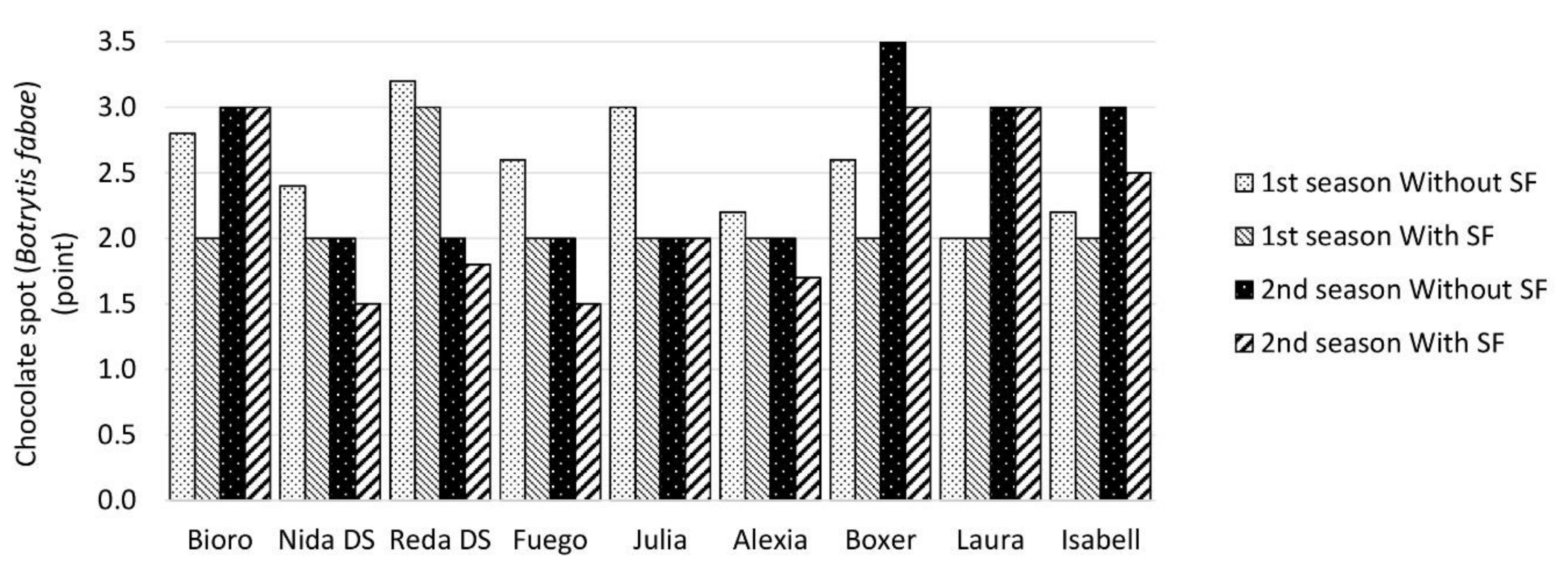
Among the powerful biotic stresses, the chocolate spot disease caused by Botrytis fabae Sard. is the most economically important disease that damages the foliage, inhibits photosynthesis activity, and diminishes faba bean production [21,22]. Therefore, it is necessary to control this disease in faba bean. One way is to use SF. In the present study, SF influenced the incidence of disease in most cultivars, but the most pronounced influence was found for the Nida DS, Reda DS, Fuego, Boxer, and Isabell varieties (Figure 4). Inhibition of the disease with fungicidal seed treatment (SF) had a noticeable effect on SY of the Nida DS and Fuego varieties (+14.6 and +8.7% higher than without SF (Figure 3a) and on the protein content of Reda DS, Julia, and Isabell (+10.6%, 3.9%, and 4.0% higher than without SF) (Figure 3b). SF had the greatest influence on TSW in the Bioro and Julia varieties, respectively, +6.7% and 6.6% than without SF (Figure 3c). Grain legumes are essential components in cropping systems owing to their well-known ecosystem services, such as disruption of cereal disease cycles, and thus help to achieve food and feed security [22,23]. Thus, genetic varietal resistance may often be a better choice for disease control than the use of fungicides in beans. This would be a great opportunity to reduce chemical pressing in crop rotation, which is directly in line with the objectives of the EU Green Deal.
Figure 4.
Effects of seed fungicide (SF) on chocolate spot (Botrytis fabae Sard.) in faba bean varieties.
The research findings obtained while exploring varieties suitable for growing under Boreal climatic zone conditions, evaluating their yield potential, morphological, and physiological characteristics, will provide valuable information to the researchers and faba bean growers. A better understanding of the factors that determine the alteration of physiological and photosynthetic processes and herewith the yields of beans is needed. It will greatly help breeders to develop better varieties suited to different agro-climatic regions and soil conditions.
5. Conclusions
The results of the study demonstrated that faba bean varieties Julia and Alexia had a significantly higher SPAD, and the varieties Bioro, Nida DS, Reda DS, and Fuego had a significantly lower SPAD, compared with the trial mean. The values of the physiological traits for the varieties Julia and Boxer significantly surpassed the trial mean under wet conditions in the first season, while Fuego and Bioro under the conditions of moisture shortage in the second season. SF had a significantly negative influence on LAI in the first half of flowering, in comparison to without SF. Averaged across SF regimes, the variety Bioro showed a significantly higher LAI and PAR capture ratio than the trial mean. SF had a noticeable effect on SY only for the varieties Nida DS and Fuego. The highest 1000 seed weight was recorded for the varieties Fuego, Isabell, and Laura; the highest amount of protein was accumulated by the varieties Bioro and Nida DS. The results of this study revealed that faba bean varieties Fuego and Isabell, which distinguished themselves from the other varieties tested by the highest seed yields, are the most suitable for cultivation in the Boreal climate zone.
Author Contributions
Conceptualization, methodology, investigation, writing original draft, D.J.; conducting of a field experiment, K.R. Both authors have read and agreed to the published version of the manuscript.
Funding
This research received no external funding.
Institutional Review Board Statement
Not applicable.
Informed Consent Statement
Not applicable.
Data Availability Statement
The data presented in this study are available on request from the corresponding author.
Conflicts of Interest
The authors declare no conflict of interest.
References
- Crepon, K.; Marget, P.; Peyronnet, C.; Carroue, B.; Arese, P.; Duc, G. Nutritional value of faba bean (Vicia faba L.) seeds for feed and food. Field Crop. Res. 2010, 115, 329–339. [Google Scholar] [CrossRef]
- Lizarazo, C.I.; Lampi, A.M.; Liu, J.; Sontag-Strohm, T.; Piironen, V.; Stoddard, F.L. Nutritive quality and protein production from grain legumes in a boreal climate. J. Sci. Food Agric. 2015, 95, 2053–2064. [Google Scholar] [CrossRef]
- Lepse, L.; Dane, S.; Zeipina, S.; Domínguez-Perles, R.; Rosa, E.A.S. Evaluation of vegetable-faba bean (Vicia faba L.) intercropping under Latvian agro-ecological conditions. J. Sci. Food Agric. 2017, 97, 4334–4342. [Google Scholar] [CrossRef]
- O’Sullivan, D.M.; Angra, D. Advances in faba bean genetics and genomics. Front. Genet. 2016, 7, 150. [Google Scholar] [CrossRef] [PubMed]
- De Cillis, F.; Leoni, B.; Massaro, M.; Renna, M.; Santamaria, P. Yield and quality of faba bean (Vicia faba L. var. major) genotypes as a vegetable for fresh consumption: A comparison between Italian landraces and commercial varieties. Agriculture 2019, 9, 253. [Google Scholar] [CrossRef]
- Peltonen-Sainio, P.; Jauhiainen, L. Unexploited potential to diversify monotonous crop sequencing at high latitudes. Agric. Syst. 2019, 174, 73–82. [Google Scholar] [CrossRef]
- Knudsen, M.T.; Hermansen, J.E.; Olesen, J.E.; Topp, C.F.E.; Schelde, K.; Angelopoulos, N.; Reckling, M. Climate impact of producing more grain legumes in Europe. In Proceedings of the 9th International Conference on Life Cycle Assessment in the Agri-Food Sector, San Francisco, CA, USA, 8–10 October 2014; Schenck, R., Huizenga, D., Eds.; American Center for Life Cycle Assessment: Vashon, WA, USA, 2014; pp. 641–646. Available online: http://lcacenter.org/lcafood2014/proceedings/LCA_Food_2014_Proceedings.pdf (accessed on 17 December 2020).
- Karkanis, A.; Ntatsi, G.; Lepse, L.; Fernández, J.A.; Vågen, I.M.; Rewald, B.; Alsina, I.; Kronberga, A.; Balliu, A.; Olle, M.; et al. Faba bean cultivation—Revealing novel managing practices for more sustainable and competitive European cropping systems. Front. Plant Sci. 2018, 9, 1115. [Google Scholar] [CrossRef]
- Sanchez-Navarro, V.; Zarnoza, R.; Faz, A.; Fernandez, J.A. Comparison of soil organic carbon pools, microbial activity and crop yield and quality in two vegetable multiple cropping systems under mediterranean conditions. Sci. Hortic. 2020, 261, 109025. [Google Scholar] [CrossRef]
- Ruisi, P.; Amato, G.; Badagliacca, G.; Frenda, A.S.; Giambalvo, D.; Miceli, G. Agro-ecological benefits of faba bean for rainfed Mediterranean cropping systems. Ital. J. Agron. 2017, 12, 233–245. [Google Scholar] [CrossRef]
- Etemadi, F.; Hashemi, M.; Zandvakili, O.; Dolatabadian, A.; Sadeghpour, A. Nitrogen contribution from winter-killed faba bean cover crop to spring-sown sweet corn in conventional and no-till systems. Agron. J. 2018, 110, 455–462. [Google Scholar] [CrossRef]
- Cernay, C.; Ber-Ari, T.; Pelzer, E.; Meynard, J.M.; Makowski, D. Estimating variability in grain legume yields across Europe and the Americas. Sci. Rep. 2015, 5, 11171. [Google Scholar] [CrossRef]
- Maalouf, F.; Hu, J.; O’Sullivan, D.; Zong, X.; Hamwieh, A.; Kumar, S.; Baum, M. Breeding and genomics status in faba bean (Vicia faba). Plant Breed. 2019, 138, 465–473. [Google Scholar] [CrossRef]
- Lake, L.; Godoy-Kutchartt, D.E.; Calderini, D.F.; Verrell, A.; Sadras, V.O. Yield determination and the critical period of faba bean (Vicia faba L.). Field Crop. Res. 2019, 241, 107575. [Google Scholar] [CrossRef]
- Alharbi, N.H.; Adhikari, K.N. Factors of yield determination in faba bean (Vicia faba). Crop Pasture Sci. 2020, 71, 305–321. [Google Scholar] [CrossRef]
- Bishop, J.; Potts, S.G.; Jones, H.E. Susceptibility of faba bean (Vicia faba L.) to heat stress during floral development and anthesis. J. Agro. Crop. Sci. 2016, 202, 508–517. [Google Scholar] [CrossRef] [PubMed]
- Siddiqui, M.H.; Al-Khaishany, M.Y.; Al-Qutami, M.A.; Al-Whaibi, M.H.; Grover, A.; Ali, H.M.; Al-Wahibi, M.S.; Bukhari, N.A. Response of different genotypes of faba bean plant to drought stress. Int. J. Mol. Sci. 2015, 16, 10214–10227. [Google Scholar] [CrossRef] [PubMed]
- Temesgen, T.; Keneni, G.; Sefera, T.; Jarso, M. Yield stability and relationships among stability parameters in faba bean (Vicia faba L.) genotypes. Crop J. 2015, 3, 258–268. [Google Scholar] [CrossRef]
- Zhou, R.; Hyldgaard, B.; Yu, X.; Rosenqvist, E.; Ugarte, R.M.; Yu, S.; Wu, Z.; Ottosen, C.; Zhao, T. Phenotyping of faba beans (Vicia faba L.) under cold and heat stresses using chlorophyll fluorescence. Euphytica 2018, 214, 68. [Google Scholar] [CrossRef]
- Manning, B.K.; Adhikari, K.N.; Trethowan, R. Impact of sowing time, genotype, environment and maturity on biomass and yield components in faba bean (Vicia faba). Crop Pasture Sci. 2020, 71, 147–154. [Google Scholar] [CrossRef]
- El-Hendawy, S.; Shaban, W.; Sakagami, J.I. Does treating faba bean seeds with chemical inducers simultaneously increase chocolate spot disease resistance and yield under field conditions? Turk. J. Agric. For. 2010, 34, 475–485. [Google Scholar] [CrossRef]
- Brauna-Morževska, E.; Bankina, B.; Kaneps, J. Botrytis genus fungi as causal agents of legume diseases: A review. Res. Rural Dev. 2019, 2, 63–69. [Google Scholar] [CrossRef]
- Chang, K.F.; Conner, R.L.; Hwang, S.F.; Ahmed, H.U.; McLaren, D.L.; Gossen, B.D.; Turnbull, G.D. Effects of seed treatments and inoculum density of Fusarium avenaceum and Rhizoctonia solani on seedling blight and root rot of faba bean. Can. J. Plant Sci. 2014, 94, 693–700. [Google Scholar] [CrossRef]
- Ninou, E.; Tsialtas, J.T.; Dordas, C.A.; Papakosta, D.K. Effect of irrigation on the relationships between leaf gas exchange related traits and yield in dwarf dry bean grown under Mediterranean conditions. Agr. Water Manag. 2013, 116, 235–241. [Google Scholar] [CrossRef]
- Abid, G.; Hessini, K.; Aouida, M.; Aroua, I.; Baudoin, J.P.; Muhovski, Y.; Mergeai, G.; Sassi, K.; Machraoui, M.; Souissi, F.; et al. Agro-physiological and biochemical responses of faba bean (Vicia faba L. var. ‘minor’) genotypes to water deficit stress. Biotechnol. Agron. Soc. Environ. 2017, 21, 1–14. [Google Scholar]
- Liu, J.; Fan, Y.; Ma, Y.; Li, Q. Response of photosynthetic active radiation interception, dry matter accumulation, and grain yield to tillage in two winter wheat genotypes. Arch. Agron. Soil Sci. 2020, 66, 1103–1114. [Google Scholar] [CrossRef]
- Confalone, A.; Lizaso, J.I.; Ruiz-Nogueira, B.; Lopez-Cedron, F.X.; Sau, F. Growth, PAR use efficiency, and yield components of field-grown Vicia faba L. under different temperature and photoperiod regimes. Field Crop. Res. 2010, 115, 140–148. [Google Scholar] [CrossRef]
- Sandana, P.; Ramirez, M.; Pinochet, D. Radiation interception and radiation use efficiency of wheat and pea under different P availabilities. Field Crop. Res. 2012, 127, 44–50. [Google Scholar] [CrossRef]
- Barlog, P.; Grzebisz, W.; Lukowiak, R. Faba bean yield and growth dynamics in response to soil potassium availability and sulfur application. Field Crop. Res. 2018, 219, 87–97. [Google Scholar] [CrossRef]
- Statistics Lithuania. Official Statistics Portal: Agriculture. 2020. Available online: https://osp.stat.gov.lt/en_GB/zemes-ukis1 (accessed on 23 November 2020).
- FAOSTAT 2018. Database. Food and Agriculture Organization of the United Nations. Available online: www.fao.org/faostat/ (accessed on 23 November 2020).
- Rohaček, K.; Soukupova, J.; Bartak, M. Chlorophyll fluorescence: A wonderful tool to study plant physiology and plant stress. In Plant Cell Compartments—Selected Topisc; Schoefs, B., Ed.; Res Signpost: Kerala, India, 2008; pp. 41–104. [Google Scholar]
- Cosentino, S.L.; Patane, C.; Sanzone, E.; Testa, G.; Scordia, D. Leaf gas exchange, water status and radiation use efficiency of giant reed (Arundo donax L.) in a changing soil nitrogen fertilization and soil water availability in a semi-arid Mediterranean area. Europ. J. Agron. 2016, 72, 56–69. [Google Scholar] [CrossRef]
- Saeidi, M.; Abdoli, M. Effect of drought stress during grain filling on yield and its components, gas exchange variables, and some physiological traits of wheat cultivars. J. Agric. Sci. Tech. 2015, 17, 885–898. [Google Scholar]
- Liu, H.; Song, J.; Dong, L.; Wang, D.; Zhang, S.; Liu, J. Physiological responses of three soybean species (Glycine soja, G. gracilis, and G. max cv. Melrose) to salinity stress. J. Plant Res. 2017, 130, 723–733. [Google Scholar] [CrossRef]
- Dirsė, A.; Taparauskienė, L. Humidity fluctuations in plant vegetation periods and a comparison of its assessment methods. Žemės ūkio Moksl. 2010, 17, 9–17. (in Lithuanian). [Google Scholar]
- Anyia, A.O.; Herzog, H. Water-use efficiency, leaf area and leaf gas exchange of cowpeas under mid-season drought. Eur. J. Agron. 2004, 20, 327–339. [Google Scholar] [CrossRef]
- Zeleke, K.; Nendel, C. Growth and yield response of faba bean to soil moisture regimes and sowing dates: Field experiment and modelling study. Agric. Water Manag. 2019, 213, 1063–1077. [Google Scholar] [CrossRef]
- Girma, F.; Haile, D. Effects of supplemental irrigation on physiological parameters and yield of faba bean (Vicia faba L.) varieties in the highlands of Bale, Ethiopia. J. Agron. 2014, 1–6. [Google Scholar] [CrossRef]
- Mansour, E.; Desoky, E.M.; Ali, M.M.A.; Abdul-Hamid, M.I.; Ullah, H.; Attia, A.; Datta, A. Identifying drought-tolerant genotypes of faba bean and their agro-physiological responses to different water regimes in an arid Mediterranean environment. Agric. Water Manag. 2021, 247, 106754. [Google Scholar] [CrossRef]
Publisher’s Note: MDPI stays neutral with regard to jurisdictional claims in published maps and institutional affiliations. |
© 2021 by the authors. Licensee MDPI, Basel, Switzerland. This article is an open access article distributed under the terms and conditions of the Creative Commons Attribution (CC BY) license (https://creativecommons.org/licenses/by/4.0/).