


Exploring the Versatility and Sustainability of Hydroxypropyl Methylcellulose (HPMC) in Modern Chemical Industry



Abstract
1. Introduction
- HPMC characterization by reported analytical protocols and its classification.
- Raw materials and manufacturing.
- HPMC primarily in food, construction, and pharmaceuticals.
- Environmental impacts.
- Life cycle assessments considerations.
- Concluding thoughts and future directions.
2. Physicochemical Properties and Analytical Techniques for Hydroxypropyl Methylcellulose Characterization
2.1. Physicochemical Properties
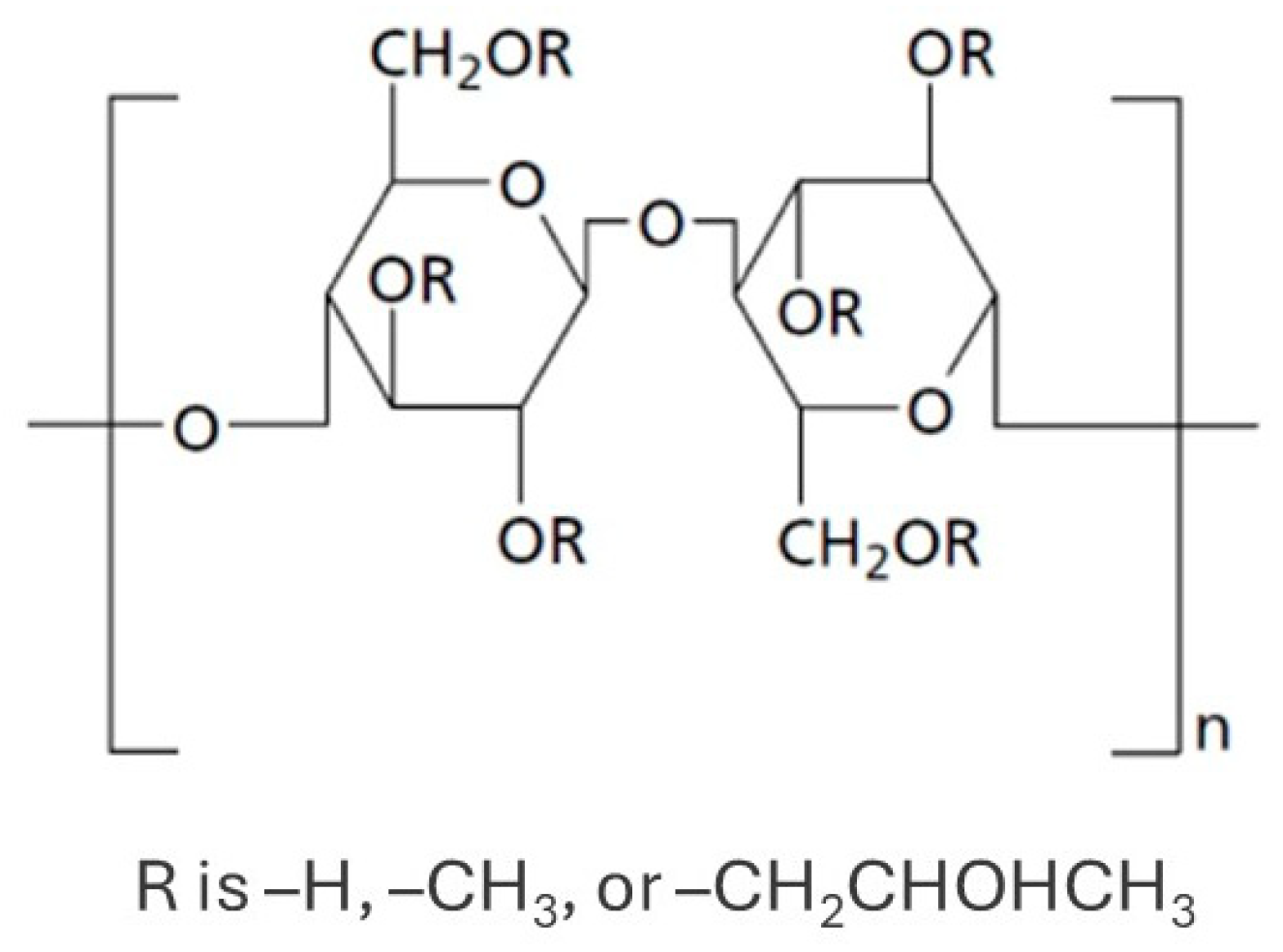
2.1.1. Substitution and Viscosity Types
2.1.2. Thermal Gelation
2.1.3. Molecular Weight
2.1.4. Water Solubility
2.2. Analytical Techniques and Methodologies for Hydroxypropyl Methylcellulose Characterization
2.2.1. Scanning Electron Microscopy (SEM)
2.2.2. Transmission Electron Microscopy (TEM)
2.2.3. Fourier Transform Infrared Spectroscopy (FTIR)
2.2.4. Raman Spectroscopy
2.2.5. X-Ray Diffraction (XRD)
2.2.6. Nuclear Magnetic Resonance (NMR)
2.2.7. Differential Scanning Calorimetry (DSC)
2.2.8. Thermogravimetric Analysis (TGA)
2.2.9. Rheological Techniques
3. Classification of Hydroxypropyl Methylcellulose
3.1. Classification Based on the Substitution Degree
3.2. Classification Based on Viscosity
4. Raw Materials and Manufacturing Process
4.1. Raw Material Selection
4.2. Etherification Reaction
4.3. Purification and Washing
4.4. Particle Size Control
4.5. Blending and Formulation
4.6. Quality Control
4.6.1. Analytical Quantifications and Testing
4.6.2. Determination of the Substitution Pattern
4.6.3. Impurities Monitoring
4.7. Packaging and Storage
4.7.1. Packaging Materials
4.7.2. Storage Conditions
4.7.3. Shelf Life
5. Applications of Hydroxypropyl Methylcellulose
5.1. Construction Applications
5.2. Food Industry Applications
5.3. Pharmaceutical Application
5.4. Other Applications
6. Environmental Impact of Hydroxypropyl Methylcellulose and Life Cycle
6.1. Main Environmental Impacts
6.2. Life Cycle Assessment (LCA) and Environmental Product Declarations (EPD)
7. Conclusions
- Deeper understanding of the relationships between substitution patterns, molecular architecture, and end-use performances.
- More standardized comparisons among commercial HPMC grades to ensure predictability in formulations.
- Improved knowledge of processing–structure–property relationships across different industrial contexts.
- Sustainability metrics, greener production routes, and comprehensive life cycle assessments.
- Advanced applications of HPMC in functional materials, active packaging, controlled release systems, and sustainable formulations.
Supplementary Materials
Author Contributions
Funding
Institutional Review Board Statement
Data Availability Statement
Conflicts of Interest
References
- Vlad, R.-A.; Pintea, A.; Pintea, C.; Rédai, E.-M.; Antonoaea, P.; Bîrsan, M.; Ciurba, A. Hydroxypropyl Methylcellulose—A Key Excipient in Pharmaceutical Drug Delivery Systems. Pharmaceutics 2025, 17, 784. [Google Scholar] [CrossRef]
- Li, C.L.; Martini, L.G.; Ford, J.L.; Roberts, M. The Use of Hypromellose in Oral Drug Delivery. J. Pharm. Pharmacol. 2005, 57, 533–546. [Google Scholar] [CrossRef]
- Cuers, J.; Rinken, M.; Adden, R.; Mischnick, P. Critical Investigation of the Substituent Distribution in the Polymer Chains of Hydroxypropyl Methylcelluloses by (LC-)ESI-MS. Anal. Bioanal. Chem. 2013, 405, 9021–9032. [Google Scholar] [CrossRef]
- Niazi, S.K. Stability Testing of New Drug Substances and Products. In Handbook of Pharmaceutical Manufacturing Formulations; CRC Press: Boca Raton, FL, USA, 2004; pp. 31–40. [Google Scholar]
- Shi, J.; Sheng, L.; Chen, M.; Wu, X.; Li, X.; Tan, Y.Q. PH-Responsive Collagen Nanocomposite Films Reinforced by Curcumin-Loaded Laponite Nanoplatelets for Dynamic Visualization of Shrimp Freshness. Food Hydrocoll. 2024, 157, 110447. [Google Scholar] [CrossRef]
- Shi, J.; He, J.; Sheng, L.; Wu, X.; Mao, S.; Zhang, Y.; Xiang, C.; Sun, L. Stimuli-Responsive Multicolor Nacre-Mimetic Phosphorescent Bionanocomposite Thin Films via Network-Confinement Coupling. Adv. Mater. 2026, 38, e17075. [Google Scholar] [CrossRef] [PubMed]
- Mobilawon, F.E.; Iroegbu, A.O.C.; Zinyemba, O.; Meijboom, R. Hydroxypropyl Methylcellulose (HPMC) in Sustainable Pharmaceutical Synthesis—Mechanistic Insights, Green Metrics and Outlook. Sustain. Chem. Pharm. 2025, 48, 102233. [Google Scholar] [CrossRef]
- Gadaleta, G.; Ferrara, C.; De Gisi, S.; Notarnicola, M.; De Feo, G. Life Cycle Assessment of End-of-Life Options for Cellulose-Based Bioplastics When Introduced into a Municipal Solid Waste Management System. Sci. Total Environ. 2023, 871, 161958. [Google Scholar] [CrossRef]
- Kaynak, E.; Piri, I.S.; Das, O. Revisiting the Basics of Life Cycle Assessment and Lifecycle Thinking. Sustainability 2025, 17, 7444. [Google Scholar] [CrossRef]
- Onwukamike, K.N.; Grelier, S.; Grau, E.; Cramail, H.; Meier, M.A.R. Critical Review on Sustainable Homogeneous Cellulose Modification: Why Renewability Is Not Enough. ACS Sustain. Chem. Eng. 2019, 7, 1826–1840. [Google Scholar] [CrossRef]
- Abolore, R.S.; Jaiswal, S.; Jaiswal, A.K. Green and Sustainable Pretreatment Methods for Cellulose Extraction from Lignocellulosic Biomass and Its Applications: A Review. Carbohydr. Polym. Technol. Appl. 2024, 7, 100396. [Google Scholar] [CrossRef]
- Ibrahim, I.D.; Hamam, Y.; Sadiku, E.R.; Ndambuki, J.M.; Kupolati, W.K.; Jamiru, T.; Eze, A.A.; Snyman, J. Need for Sustainable Packaging: An Overview. Polymers 2022, 14, 4430. [Google Scholar] [CrossRef]
- EPD International AB Hydroxypropyl Methylcellulose (HPMC) Produced in Europe. Available online: https://www.environdec.com/library/epd13216 (accessed on 10 March 2026).
- Burdock, G.A. Safety Assessment of Hydroxypropyl Methylcellulose as a Food Ingredient. Food Chem. Toxicol. 2007, 45, 2341–2351. [Google Scholar] [CrossRef]
- Amanzholkyzy, A.; Zhumagaliyeva, S.; Sultanova, N.; Abilov, Z.; Ongalbek, D.; Donbayeva, E.; Niyazbekova, A.; Mukazhanova, Z. Hydrogel Delivery Systems for Biological Active Substances: Properties and the Role of HPMC as a Carrier. Molecules 2025, 30, 1354. [Google Scholar] [CrossRef] [PubMed]
- Perez-Robles, S.; Carotenuto, C.; Minale, M. Effect on the Thermo-Gelation Process of the Degree and Molar Substitution of HPMC Polymer Hydrogels. Macromol. Symp. 2022, 405, 2100277. [Google Scholar] [CrossRef]
- Svoboda, R.; Nevyhoštěná, M.; Macháčková, J.; Vaculík, J.; Knotková, K.; Chromčíková, M.; Komersová, A. Thermal Degradation of Affinisol HPMC: Optimum Processing Temperatures for Hot Melt Extrusion and 3D Printing. Pharm. Res. 2023, 40, 2253–2268. [Google Scholar] [CrossRef]
- Giang, H.N.; Le, A.T.K.; Huynh, T.N.A.; Phung, T.K.; Sakai, W. Effect of Additives on Fabrication and Properties of Hydroxypropyl Methylcellulose-Based Hydrogels. Polym. Bull. 2023, 80, 11121–11137. [Google Scholar] [CrossRef]
- Larsson, M.; Viridén, A.; Stading, M.; Larsson, A. The Influence of HPMC Substitution Pattern on Solid-State Properties. Carbohydr. Polym. 2010, 82, 1074–1081. [Google Scholar] [CrossRef]
- Viridén, A.; Wittgren, B.; Andersson, T.; Abrahmsén-Alami, S.; Larsson, A. Influence of Substitution Pattern on Solution Behavior of Hydroxypropyl Methylcellulose. Biomacromolecules 2009, 10, 522–529. [Google Scholar] [CrossRef]
- Li, Y.; Shen, H.; Lyons, J.W.; Sammler, R.L.; Brackhagen, M.; Meunier, D.M. Size-Exclusion Chromatography of Ultrahigh Molecular Weight Methylcellulose Ethers and Hydroxypropyl Methylcellulose Ethers for Reliable Molecular Weight Distribution Characterization. Carbohydr. Polym. 2016, 138, 290–300. [Google Scholar] [CrossRef]
- Knarr, M.; Rogers, T.L.; Petermann, O.; Adden, R. Investigation and Rank-Ordering of Hydroxypropyl Methylcellulose (HPMC) Properties Impacting Controlled Release Performance. J. Drug Deliv. Sci. Technol. 2025, 104, 106425. [Google Scholar] [CrossRef]
- Sakkal, M.; Arafat, M.; Yuvaraju, P.; Beiram, R.; AbuRuz, S. Preparation and Characterization of Theophylline Controlled Release Matrix System Incorporating Poloxamer 407, Stearyl Alcohol, and Hydroxypropyl Methylcellulose: A Novel Formulation and Development Study. Polymers 2024, 16, 643. [Google Scholar] [CrossRef] [PubMed]
- Goldoozian, S.; Mohylyuk, V.; Dashevskiy, A.; Bodmeier, R. Gel Strength of Hydrophilic Matrix Tablets in Terms of In Vitro Robustness. Pharm. Res. 2021, 38, 1297–1306. [Google Scholar] [CrossRef]
- HPMC Factory Technical Guidelines for Hydroxypropyl Methylcellulose (HPMC). Available online: https://www.hpmcfactory.com/technical-guidelines-for-hydroxypropyl-methylcellulose-hpmc.html (accessed on 10 March 2026).
- Saepang, K.; Pitaksuteepong, T.; Buranrat, B.; Boontha, S. Optimization of HPMC-Based Oral Fast Dissolving Film of Cetirizine Dihydrochloride. Nat. Life Sci. Commun. 2024, 23, 1–16. [Google Scholar] [CrossRef]
- DuPont. Polymers for Industrial Applications METHOCELTM Water-Soluble Cellulosic Polymers for Industrial Applications. Available online: https://cms.chempoint.com/ChemPoint/media/Methocel-brochure/Methocel-Brochure-2019-1.pdf (accessed on 9 March 2026).
- De Simone, V.; Dalmoro, A.; Lamberti, G.; Caccavo, D.; d’Amore, M.; Barba, A.A. Effect of Binder and Load Solubility Properties on HPMC Granules Produced by Wet Granulation Process. J. Drug Deliv. Sci. Technol. 2019, 49, 513–520. [Google Scholar] [CrossRef]
- Muehlenfeld, C.; Duffy, P.; Yang, F.; Zermeño Pérez, D.; El-Saleh, F.; Durig, T. Excipients in Pharmaceutical Additive Manufacturing: A Comprehensive Exploration of Polymeric Material Selection for Enhanced 3D Printing. Pharmaceutics 2024, 16, 317. [Google Scholar] [CrossRef]
- Allenspach, C.; Timmins, P.; Sharif, S.; Minko, T. Characterization of a Novel Hydroxypropyl Methylcellulose (HPMC) Direct Compression Grade Excipient for Pharmaceutical Tablets. Int. J. Pharm. 2020, 583, 119343. [Google Scholar] [CrossRef] [PubMed]
- Shetty, G.R.; Rao, B.L.; Asha, S.; Wang, Y.; Sangappa, Y. Preparation and Characterization of Silk Fibroin/Hydroxypropyl Methyl Cellulose (HPMC) Blend Films. Fibers Polym. 2015, 16, 1734–1741. [Google Scholar] [CrossRef]
- Akinosho, H.; Hawkins, S.; Wicker, L. Hydroxypropyl Methylcellulose Substituent Analysis and Rheological Properties. Carbohydr. Polym. 2013, 98, 276–281. [Google Scholar] [CrossRef]
- Filimon, A.; Onofrei, M.D.; Bargan, A.; Stoica, I.; Dunca, S. Bioactive Materials Based on Hydroxypropyl Methylcellulose and Silver Nanoparticles: Structural-Morphological Characterization and Antimicrobial Testing. Polymers 2023, 15, 1625. [Google Scholar] [CrossRef]
- Wan, S.; Dai, C.; Bai, Y.; Xie, W.; Guan, T.; Sun, H.; Wang, B. Application of Multivariate Methods to Evaluate Differential Material Attributes of HPMC from Different Sources. ACS Omega 2021, 6, 28598–28610. [Google Scholar] [CrossRef]
- Malatesta, M. Transmission Electron Microscopy as a Powerful Tool to Investigate the Interaction of Nanoparticles with Subcellular Structures. Int. J. Mol. Sci. 2021, 22, 12789. [Google Scholar] [CrossRef]
- Zhou, X.; Wang, M.; Zhang, L.; Liu, Z.; Su, C.; Wu, M.; Wei, X.; Jiang, L.; Hou, J.; Jiang, Z. Hydroxypropyl Methylcellulose (HPMC) Reduces the Hardening of Fructose-Containing and Maltitol-Containing High-Protein Nutrition Bars during Storage. LWT 2022, 163, 113607. [Google Scholar] [CrossRef]
- Zhang, Z.; Shi, Y.; Zheng, H.; Zhou, Z.; Wu, Z.; Shen, D.; Wang, Y.; Zhang, Y.; Wang, Z.; Fu, B. A Hydroxypropyl Methylcellulose Film Loaded with AFCP Nanoparticles for Inhibiting Formation of Enamel White Spot Lesions. Int. J. Nanomed. 2021, 16, 7623–7637. [Google Scholar] [CrossRef]
- Gong, Y.; Chen, X.; Wu, W. Application of Fourier Transform Infrared (FTIR) Spectroscopy in Sample Preparation: Material Characterization and Mechanism Investigation. Adv. Sample Prep. 2024, 11, 100122. [Google Scholar] [CrossRef]
- Bashir, S.; Zafar, N.; Lebaz, N.; Mahmood, A.; Elaissari, A. Hydroxypropyl Methylcellulose-Based Hydrogel Copolymeric for Controlled Delivery of Galantamine Hydrobromide in Dementia. Processes 2020, 8, 1350. [Google Scholar] [CrossRef]
- Soe, M.T.; Chitropas, P.; Pongjanyakul, T.; Limpongsa, E.; Jaipakdee, N. Thai Glutinous Rice Starch Modified by Ball Milling and Its Application as a Mucoadhesive Polymer. Carbohydr. Polym. 2020, 232, 115812. [Google Scholar] [CrossRef]
- Hong, T.; Yin, J.-Y.; Nie, S.-P.; Xie, M.-Y. Applications of Infrared Spectroscopy in Polysaccharide Structural Analysis: Progress, Challenge and Perspective. Food Chem. X 2021, 12, 100168. [Google Scholar] [CrossRef]
- Chang, Y.; Hu, C.; Yang, R.; He, D.; Wang, X.; Ning, B.; Sun, H.; Xiong, Y.; Tu, J.; Sun, C. A Raman Imaging-Based Technique to Assess HPMC Substituent Contents and Their Effects on the Drug Release of Commercial Extended-Release Tablets. Carbohydr. Polym. 2020, 244, 116460. [Google Scholar] [CrossRef]
- Cherniienko, A.; Lesyk, R.; Zaprutko, L.; Pawełczyk, A. IR-EcoSpectra: Exploring Sustainable Ex Situ and in Situ FTIR Applications for Green Chemical and Pharmaceutical Analysis. J. Pharm. Anal. 2024, 14, 100951. [Google Scholar] [CrossRef] [PubMed]
- Bumbrah, G.S.; Sharma, R.M. Raman Spectroscopy—Basic Principle, Instrumentation and Selected Applications for the Characterization of Drugs of Abuse. Egypt. J. Forensic Sci. 2016, 6, 209–215. [Google Scholar] [CrossRef]
- Rodríguez, I.; Gautam, R.; Tinoco, A.D. Using X-Ray Diffraction Techniques for Biomimetic Drug Development, Formulation, and Polymorphic Characterization. Biomimetics 2020, 6, 1. [Google Scholar] [CrossRef]
- Holder, C.F.; Schaak, R.E. Tutorial on Powder X-Ray Diffraction for Characterizing Nanoscale Materials. ACS Nano 2019, 13, 7359–7365. [Google Scholar] [CrossRef] [PubMed]
- von Schantz, L.; Schagerlöf, H.; Nordberg Karlsson, E.; Ohlin, M. Characterization of the Substitution Pattern of Cellulose Derivatives Using Carbohydrate-Binding Modules. BMC Biotechnol. 2014, 14, 113. [Google Scholar] [CrossRef] [PubMed]
- Gill, P.; Moghadam, T.T.; Ranjbar, B. Differential Scanning Calorimetry Techniques: Applications in Biology and Nanoscience. Available online: https://pmc.ncbi.nlm.nih.gov/articles/PMC2977967/ (accessed on 10 March 2026).
- Elgharbawy, A.S.; El Demerdash, A.-G.M.; Sadik, W.A.; Kasaby, M.A.; Lotfy, A.H.; Osman, A.I. Enhancing the Biodegradability, Water Solubility, and Thermal Properties of Polyvinyl Alcohol through Natural Polymer Blending: An Approach toward Sustainable Polymer Applications. Polymers 2024, 16, 2141. [Google Scholar] [CrossRef]
- Katona, J.; Njaradi, S.; Sovilj, V.; Petrovic, L.; Marceta, B.; Milanovic, J. Rheological Properties of Hydroxypropylmethyl Cellulose/Sodium Dodecylsulfate Mixtures. J. Serbian Chem. Soc. 2014, 79, 457–468. [Google Scholar] [CrossRef]
- Yoo, Y.J.; Um, I.C. Examination of Thermo-Gelation Behavior of HPMC and HEMC Aqueous Solutions Using Rheology. Korea-Aust. Rheol. J. 2013, 25, 67–75. [Google Scholar] [CrossRef]
- Reinoso, D.; Martín-Alfonso, M.J.; Luckham, P.F.; Martínez-Boza, F.J. Rheological Characterisation of Xanthan Gum in Brine Solutions at High Temperature. Carbohydr. Polym. 2019, 203, 103–109. [Google Scholar] [CrossRef]
- Zhang, Q.; Li, X.; Jasti, B.R. Role of Physicochemical Properties of Some Grades of Hydroxypropyl Methylcellulose on in Vitro Mucoadhesion. Int. J. Pharm. 2021, 609, 121218. [Google Scholar] [CrossRef]
- HPMCTop Hypromellose (HPMC): Excipient Uses, Suppliers and Specifications. Available online: https://www.hpmctop.com/resources/hypromellose-excipient-uses-suppliers-and-specifications.html (accessed on 10 March 2026).
- Iglesias, N.; Galbis, E.; Romero-Azogil, L.; Benito, E.; Lucas, R.; García-Martín, M.G.; de-Paz, M.-V. In-Depth Study into Polymeric Materials in Low-Density Gastroretentive Formulations. Pharmaceutics 2020, 12, 636. [Google Scholar] [CrossRef]
- Ghori, M.U.; Ginting, G.; Smith, A.M.; Conway, B.R. Simultaneous Quantification of Drug Release and Erosion from Hypromellose Hydrophilic Matrices. Int. J. Pharm. 2014, 465, 405–412. [Google Scholar] [CrossRef]
- Viridén, A.; Larsson, A.; Wittgren, B. The Effect of Substitution Pattern of HPMC on Polymer Release from Matrix Tablets. Int. J. Pharm. 2010, 389, 147–156. [Google Scholar] [CrossRef]
- Jiang, Z.; Ngai, T. Recent Advances in Chemically Modified Cellulose and Its Derivatives for Food Packaging Applications: A Review. Polymers 2022, 14, 1533. [Google Scholar] [CrossRef]
- Sarkar, J.; Mollick, M.M.R.; Chattopadhyay, D.; Acharya, K. An Eco-Friendly Route of γ-Fe2O3 Nanoparticles Formation and Investigation of the Mechanical Properties of the HPMC-γ-Fe2O3 Nanocomposites. Bioprocess Biosyst. Eng. 2017, 40, 351–359. [Google Scholar] [CrossRef] [PubMed]
- Hivechi, A.; Bahrami, S.H. A New Cellulose Purification Approach for Higher Degree of Polymerization: Modeling, Optimization and Characterization. Carbohydr. Polym. 2016, 152, 280–286. [Google Scholar] [CrossRef]
- Taokaew, S. Bacterial Nanocellulose Produced by Cost-Effective and Sustainable Methods and Its Applications: A Review. Fermentation 2024, 10, 316. [Google Scholar] [CrossRef]
- Paramitasari, D.; Amelia, O.; Pudjianto, K.; Musa, M.; Rustiaty, B.; Supriyanti, A.; Meidiawati, D.P.; Putra, O.N.; Pramana, Y.S.; Yassaroh, Y.; et al. Hydroxypropyl Cellulose Research over Two Decades (2005–2024): A Systematic Review with Bibliometric Analysis and Translational Insights. Polysaccharides 2025, 6, 104. [Google Scholar] [CrossRef]
- Isikgor, F.H.; Becer, C.R. Lignocellulosic Biomass: A Sustainable Platform for the Production of Bio-Based Chemicals and Polymers. Polym. Chem. 2015, 6, 4497–4559. [Google Scholar] [CrossRef]
- Hamed, O.; Al-Kerm, R.; Al-Kerm, R.; Qrareya, H.; Deghles, A.; Dagdag, O. Carboxymethylated Pulp as Starting Point to Prepare Hydroxypropylmethyl Cellulose with Enhanced Gel Rheological Properties in an Aqueous Medium. Bioresources 2021, 16, 1453–1468. [Google Scholar] [CrossRef]
- Li, W.; Mortha, G.; Otsuka, I.; Ogawa, Y.; Nishiyama, Y. Comparative Analysis of Molecular Weight Determination Techniques for Cellulose Oligomers. Cellulose 2023, 30, 8245–8258. [Google Scholar] [CrossRef]
- Fox, S.C.; Li, B.; Xu, D.; Edgar, K.J. Regioselective Esterification and Etherification of Cellulose: A Review. Biomacromolecules 2011, 12, 1956–1972. [Google Scholar] [CrossRef]
- Klemm, D.; Philipp, B.; Heinze, T.; Heinze, U.; Wagenknecht, W. Comprehensive Cellulose Chemistry; Wiley: Hoboken, NJ, USA, 1998; ISBN 9783527294893. [Google Scholar]
- Hu, H.; You, J.; Gan, W.; Zhou, J.; Zhang, L. Synthesis of Allyl Cellulose in NaOH/Urea Aqueous Solutions and Its Thiol–Ene Click Reactions. Polym. Chem. 2015, 6, 3543–3548. [Google Scholar] [CrossRef]
- Adali, M.B.; Barresi, A.A.; Boccardo, G.; Pisano, R. Spray Freeze-Drying as a Solution to Continuous Manufacturing of Pharmaceutical Products in Bulk. Processes 2020, 8, 709. [Google Scholar] [CrossRef]
- Li, J.; Zhao, L.; Lin, X.; Shen, L.; Feng, Y. Co-Spray Drying with HPMC as a Platform to Improve Direct Compaction Properties of Various Tablet Fillers. AAPS PharmSciTech 2017, 18, 3105–3115. [Google Scholar] [CrossRef] [PubMed]
- Singh, D. Advancements in Hydroxypropyl Methylcellulose–Polyethylene Glycol Hybrid Excipients and Their Nanoformulations for Controlled and Ligand-Directed Biologic Delivery. Naunyn-Schmiedeberg’s Arch. Pharmacol. 2025, 398, 16849–16869. [Google Scholar] [CrossRef]
- Martínez, L.M.; Cruz-Angeles, J.; Vázquez-Dávila, M.; Martínez, E.; Cabada, P.; Navarrete-Bernal, C.; Cortez, F. Mechanical Activation by Ball Milling as a Strategy to Prepare Highly Soluble Pharmaceutical Formulations in the Form of Co-Amorphous, Co-Crystals, or Polymorphs. Pharmaceutics 2022, 14, 2003. [Google Scholar] [CrossRef]
- Virden, A. Method Development for Laser-Diffraction Particle-Size Analysis. Available online: https://www.pharmtech.com/view/method-development-laser-diffraction-particle-size-analysis (accessed on 12 March 2026).
- Moussa, E.; Siepmann, F.; Flament, M.P.; Benzine, Y.; Penz, F.; Siepmann, J.; Karrout, Y. Controlled Release Tablets Based on HPMC:Lactose Blends. J. Drug Deliv. Sci. Technol. 2019, 52, 607–617. [Google Scholar] [CrossRef]
- Rana, R.H.; Rana, M.S.; Tasnim, S.; Haque, M.R.; Kabir, S.; Amran, M.S.; Chowdhury, A.A. Characterization and Tableting Properties of Microcrystalline Cellulose Derived from Waste Paper via Hydrothermal Method. J. Appl. Pharm. Sci. 2022, 12, 140–147. [Google Scholar] [CrossRef]
- Pani, N.R.; Nath, L.K. Development of Controlled Release Tablet by Optimizing HPMC: Consideration of Theoretical Release and RSM. Carbohydr. Polym. 2014, 104, 238–245. [Google Scholar] [CrossRef] [PubMed]
- Pan, P.; Svirskis, D.; Waterhouse, G.I.N.; Wu, Z. Hydroxypropyl Methylcellulose Bioadhesive Hydrogels for Topical Application and Sustained Drug Release: The Effect of Polyvinylpyrrolidone on the Physicomechanical Properties of Hydrogel. Pharmaceutics 2023, 15, 2360. [Google Scholar] [CrossRef]
- Galata, D.L.; Könyves, Z.; Nagy, B.; Novák, M.; Mészáros, L.A.; Szabó, E.; Farkas, A.; Marosi, G.; Nagy, Z.K. Real-Time Release Testing of Dissolution Based on Surrogate Models Developed by Machine Learning Algorithms Using NIR Spectra, Compression Force and Particle Size Distribution as Input Data. Int. J. Pharm. 2021, 597, 120338. [Google Scholar] [CrossRef] [PubMed]
- Greiderer, A.; Steeneken, L.; Aalbers, T.; Vivó-Truyols, G.; Schoenmakers, P. Characterization of Hydroxypropylmethylcellulose (HPMC) Using Comprehensive Two-Dimensional Liquid Chromatography. J. Chromatogr. A 2011, 1218, 5787–5793. [Google Scholar] [CrossRef]
- Boonen, J.; Veryser, L.; Taevernier, L.; Roche, N.; Peremans, K.; Burvenich, C.; De Spiegeleer, B. Risk Evaluation of Impurities in Topical Excipients: The Acetol Case. J. Pharm. Anal. 2014, 4, 303–315. [Google Scholar] [CrossRef]
- Amarji, B.; Kulkarni, A.; Deb, P.K.; Deepika, D.; Maheshwari, R.; Tekade, R.K. Package Development of Pharmaceutical Products. In Dosage Form Design Parameters; Elsevier: Amsterdam, The Netherlands, 2018; Volume 2, pp. 521–552. [Google Scholar]
- Guo, J.; Dong, S.; Ye, M.; Wu, X.; Lv, X.; Xu, H.; Li, M. Effects of Hydroxypropyl Methylcellulose on Physicochemical Properties and Microstructure of κ-Carrageenan Film. Foods 2022, 11, 3023. [Google Scholar] [CrossRef] [PubMed]
- Zhang, Y.; Jiang, Z.; Zhu, Y.; Zhang, J.; Ren, Q.; Huang, T. Effects of Redispersible Polymer Powders on the Structural Build-up of 3D Printing Cement Paste with and without Hydroxypropyl Methylcellulose. Constr. Build. Mater. 2021, 267, 120551. [Google Scholar] [CrossRef]
- Gu, X.; Li, X.; Zhang, W.; Gao, Y.; Kong, Y.; Liu, J.; Zhang, X. Effects of HPMC on Workability and Mechanical Properties of Concrete Using Iron Tailings as Aggregates. Materials 2021, 14, 6451. [Google Scholar] [CrossRef]
- Batista, I.L.R.; Cabral, K.C.; de Souza, W.R.M.; de Sousa Fontes, A.É.M.; Martinelli, A.E. Influence of Hydroxypropylmethylcellulose (HPMC) on Thermal and Mechanical Performance of Cementitious Rendering Mortars. Mater. Struct. 2024, 57, 25. [Google Scholar] [CrossRef]
- Milenkova, S.; Marudova, M.; Viraneva, A. Biodegradable Polymer Films Based on Hydroxypropyl Methylcellulose and Blends with Zein and Investigation of their Potential as Active Packaging Material. Coatings 2026, 16, 66. [Google Scholar] [CrossRef]
- López de Dicastillo, C.; Velásquez, E.; Rojas, A.; Garrido, L.; Moreno, M.C.; Guarda, A.; Galotto, M.J. Developing Core/Shell Capsules Based on Hydroxypropyl Methylcellulose and Gelatin through Electrodynamic Atomization for Betalain Encapsulation. Polymers 2023, 15, 361. [Google Scholar] [CrossRef]
- Dave, S.; Soni, V.; Shah, S.A.; Kraft, W.K.; Kaushal, G. Hydroxypropyl Methylcellulose as a Mucoadhesive Polymer in Ethanol-Free Buprenorphine Gel for Neonatal Sublingual Delivery. Polymers 2026, 18, 435. [Google Scholar] [CrossRef]
- Kraisit, P.; Hirun, N.; Limpamanoch, P.; Sawaengsuk, Y.; Janchoochai, N.; Manasaksirikul, O.; Limmatvapirat, S. Effect of Cremophor RH40, Hydroxypropyl Methylcellulose, and Mixing Speed on Physicochemical Properties of Films Containing Nanostructured Lipid Carriers Loaded with Furosemide Using the Box–Behnken Design. Polymers 2024, 16, 1605. [Google Scholar] [CrossRef]
- Khiste, R.; Bhapkar, N.; Kulkarni, N. A Review on Applications of Hydroxy Propyl Methyl Cellulose and Natural Polymers for the Development of Modified Release Drug Delivery Systems. Res. J. Pharm. Technol. 2021, 14, 1163–1170. [Google Scholar] [CrossRef]
- Ozon, E.A.; Burloiu, A.M.; Musuc, A.M.; Manda, G.; Anuta, V.; Dinu-Pîrvu, C.E.; Lupuliasa, D.; Neagoe, I.V.; Anastasescu, M.; Socoteanu, R.P.; et al. Cellulose-Derived Gels for Topical Delivery: HPMC as a Functional Matrix for Porphyrinic Photosensitizers. Gels 2025, 11, 824. [Google Scholar] [CrossRef] [PubMed]
- Kadry, H.; Al-Hilal, T.A.; Keshavarz, A.; Alam, F.; Xu, C.; Joy, A.; Ahsan, F. Multi-Purposable Filaments of HPMC for 3D Printing of Medications with Tailored Drug Release and Timed-Absorption. Int. J. Pharm. 2018, 544, 285–296. [Google Scholar] [CrossRef]
- Hardy, I.J.; Cook, W.G.; Melia, C.D. Compression and Compaction Properties of Plasticised High Molecular Weight Hydroxypropylmethylcellulose (HPMC) as a Hydrophilic Matrix Carrier. Int. J. Pharm. 2006, 311, 26–32. [Google Scholar] [CrossRef]
- Phaechamud, T.; Mesnukul, A.; Yodkhum, K. Solid Dispersion Matrix Tablet Comprising Indomethacin-PEG-HPMC Fabricated with Fusion and Mold Technique. Indian J. Pharm. Sci. 2009, 71, 413. [Google Scholar] [CrossRef]
- Andonova, V.; Zagorchev, P.; Katsarov, P.; Kassarova, M. Eye Drops with Nanoparticles as Drug Delivery Systems. Int. J. Pharm. Pharm. Sci. 2015, 7, 431–435. [Google Scholar]
- Akbal Dağistan, Ö.; Arslan, M. Selection of the Polymers Used in Oral Dispersible Films via Analytical Hierarchy Process. J. Res. Pharm. 2024, 28, 1331–1343. [Google Scholar] [CrossRef]
- Wang, X.; Sun, H. Synergistic Effect of Microbial-Induced Carbonate Precipitation Modified with Hydroxypropyl Methylcellulose on Improving Loess Disintegration and Seepage Resistance. Polymers 2025, 17, 548. [Google Scholar] [CrossRef] [PubMed]
- Lim, C.; Song, Y.H.; Song, Y.; Seo, J.H.; Hwang, D.S.; Lee, D.W. Adaptive Amphiphilic Interaction Mechanism of Hydroxypropyl Methylcellulose in Water. Appl. Surf. Sci. 2021, 565, 150535. [Google Scholar] [CrossRef]
- Polamaplly, P.; Cheng, Y.; Shi, X.; Manikandan, K.; Kremer, G.E.; Qin, H. 3D Printing and Characterization of Hydroxypropyl Methylcellulose and Methylcellulose for Biodegradable Support Structures. Procedia Manuf. 2019, 34, 552–559. [Google Scholar] [CrossRef]
- Zhu, W.; Yuan, M.; He, F.; Zhao, Y.; Xiao, Z.; Wang, Q.; Meng, F.; Tang, Q. Effects of Hydroxypropyl Methylcellulose (HPMC) on the Reinforcement of Sand by Microbial-Induced Calcium Carbonate Precipitation (MICP). Appl. Sci. 2022, 12, 5360. [Google Scholar] [CrossRef]
- Wang, S.; Liu, C.; Chen, H.; Zhu, A.; Qian, F. Impact of Surfactants on Polymer Maintained Nifedipine Supersaturation in Aqueous Solution. Pharm. Res. 2020, 37, 113. [Google Scholar] [CrossRef] [PubMed]
- Bading, M.; Olsson, O.; Kümmerer, K. Analysis of Environmental Biodegradability of Cellulose-Based Pharmaceutical Excipients in Aqueous Media. Chemosphere 2024, 352, 141298. [Google Scholar] [CrossRef]
- Hart-Cooper, W.M.; Kalla, N.; Klamczynski, A.; Torres, L.; Glenn, G.M.; Cunniffe, J.; Johnson, K.; Orts, W.J. Predicting Environmental Biodegradability Using Initial Rates: Mineralization of Cellulose, Guar and Their Semisynthetic Derivatives in Wastewater and Soil. Front. Mater. 2024, 10, 1331308. [Google Scholar] [CrossRef]
- The Dow Chemical Company Environment, Health and Safety (EH&S) Policy. Available online: https://corporate.dow.com/en-us/about-dow/company/public-policy/environment-health-safety.html (accessed on 10 March 2026).
- U.S. Environmental Protection Agency (EPA) Cellulose Products Manufacturing: National Emission Standards for Hazardous Air Pollutants (NESHAP). Available online: https://www.epa.gov/stationary-sources-air-pollution/cellulose-products-manufacturing-national-emission-standards (accessed on 10 March 2026).
- Kamide, K. Characterization of Molecular Structure of Cellulose Derivatives. In Cellulose and Cellulose Derivatives; Elsevier: Amsterdam, The Netherlands, 2005; pp. 25–188. [Google Scholar]
- Jin, C.; Wu, F.; Hong, Y.; Shen, L.; Lin, X.; Zhao, L.; Feng, Y. Updates on Applications of Low-Viscosity Grade Hydroxypropyl Methylcellulose in Coprocessing for Improvement of Physical Properties of Pharmaceutical Powders. Carbohydr. Polym. 2023, 311, 120731. [Google Scholar] [CrossRef] [PubMed]

| USP | Grade | Viscosity (cP) | Methoxy (%) | Hydroxypropyl (%) | Properties | Construction | Food | Pharma |
|---|---|---|---|---|---|---|---|---|
| 2910 | E 3 Premium LV | 3 | 28–30 | 7–12 | Low viscosity, fast hydration, clear solution | Tile adhesives, wall putty, cement renders | Food emulsifier, stabilizer | Tablet film coating, binder |
| 2910 | E 5 Premium LV | 5 | 28–30 | 7–12 | Low viscosity, easily dispersible | Paints, plasters, joint fillers | Bakery product texture, sauce thickener | Tablet film coating, binder |
| 2910 | E 6 Premium LV | 6 | 28–30 | 7–12 | Low–medium viscosity, stabilizer | Gypsum and cement plasters, renders | Dairy dessert stabilizer, ice cream | Sustained-release agent, granulation binder |
| 2910 | E 15 Premium LV | 15 | 28–30 | 7–12 | Moderate viscosity, good film-former | Wall skim coat, repair mortars, putty | Dairy thickener, cream stabilizer | Film coating, capsule production |
| 2910 | E 50 Premium LV | 50 | 28–30 | 7–12 | Moderate viscosity, thickening and binding | Cement renders, mortars, adhesives | Food sauce and soup thickener | Sustained-release matrix, film coating |
| 2910 | E 4M Premium | 4000 | 28–30 | 7–12 | High viscosity, gel forming, water retention | Tile adhesives, EIFS, self-leveling compounds | Bread improver, texture modifier | Controlled-release agent, matrix design |
| 2910 | E 4M Premium CR | 4000 | 28–30 | 7–12 | High viscosity, controlled rheology | Tile adhesives, repair mortars | Meat binder, emulsifier | Modified release coatings, hydrophilic matrix |
| 2910 | E 10M Premium CR | 10,000 | 28–30 | 7–12 | Very high viscosity, gel structure | Self-leveling compounds, tile adhesives | Gel desserts, food thickeners | Extended-release matrices |
| 2906 | F 4M Premium | 4000 | 27–30 | 4–7.5 | High viscosity, lower hydroxypropyl | Plaster and putty improvement | Frozen dough stabilizer, emulsifier | Binder in direct compression, film coating |
| 2208 | K 3 Premium LV | 3 | 19–24 | 4–12 | Low viscosity, good solubility | Self-level flooring, sprayable mortars | Fat replacer, beverage clouding agent | Artificial tears, ophthalmic lubricants |
| 2208 | K 100 Premium LV | 100 | 19–24 | 4–12 | Medium viscosity, effective thickener | Cement tile adhesives, grout, putty | Ice cream stabilizer and thickener | Tablet binder, controlled release |
| 2208 | K 100 Premium LV CR | 100 | 19–24 | 4–12 | Medium viscosity, controlled rheology | Skim coat mortar, brick mortars | Food suspending agent, beverage stabilizer | Controlled-release matrix, film formation |
| 2208 | K 100 Premium LV LH | 100 | 19–24 | 4–12 | Medium viscosity, low hydroxypropyl | Smoothing compounds, repair mortars | Milk and cream foaming agent | Sustained-release matrix, capsule coating |
| 2208 | K 100 Premium LV LH CR | 100 | 19–24 | 4–12 | Medium viscosity, slow-release properties | Leveling compounds, masonry mortars | Emulsifier and extender in foods | Extended-release agent, oral suspensions |
| 2208 | K 4M Premium | 4000 | 19–24 | 4–12 | High viscosity, excellent water retention | Mortars, grouts, tile adhesives | Frozen dessert stabilizer, bread dough enhancer | Hydrophilic matrix, binder in tablets |
| 2208 | K 4M Premium CR | 4000 | 19–24 | 4–12 | High viscosity, controlled rheology | Repair mortars, high thixotropy adhesives | Meat product binder, processed food thickener | Controlled-release, matrix for osmotic tablets |
| 2208 | K 15M Premium | 15,000 | 19–24 | 4–12 | Very high viscosity, strong thickener | Joint compounds, thick render pastes | Dough improver for bakery applications | Modified-release tablet cores, binder |
| 2208 | K 15M Premium CR | 15,000 | 19–24 | 4–12 | Very high viscosity, controlled release | Tile adhesives, grouting | Emulsifier and texturizer in processed foods | Matrix agent for extended-release tablets |
| 2208 | K 100M Premium | 100,000 | 19–24 | 4–12 | Ultra-high viscosity, highly water-retentive | Highly thixotropic plasters, adhesives | Food gelling agent, dessert gels | Hydrophilic matrix, texturizer for pharmaceuticals |
| 2208 | K 100M Premium CR | 100,000 | 19–24 | 4–12 | Ultra-high viscosity, modified rheology | Grout and mortar additives, repair mortars | Food texture modifier, stabilizer in gels | Controlled-release matrix, capsule gelling agent |
| Stage | Purpose | Inputs | Key Process Controls | Output | Main Quality Risks |
|---|---|---|---|---|---|
Raw Material Selection | Selection of cellulose source and confirmation of purity for consistent reactivity and final performance | Cotton linters or wood pulp; incoming specs/CoA | Source qualification; impurity limits (lignin/hemicellulose/ash); incoming QC | Qualified cellulose feedstock | Variability in starting cellulose affects DS/MW and downstream reproducibility |
| Etherification Reaction | Chemical modification of cellulose to introduce methoxy and hydroxypropyl substituents (HPMC formation) | NaOH/KOH (alkalization); methyl chloride; propylene oxide | Temperature, pressure, pH (alkaline), time; in-process sampling (DSMe, MSHP, MW) | Etherified HPMC reaction mass | Under-/over-substitution; degradation/crosslinking; residual reagents/by-products |
| Removal of Impurities (Purification and Washing) | Removal of soluble residues, salts, catalysts, residual reagents, and low-MW by-products; conditioning | Water; possible alcohols (ethanol/isopropanol); pH adjustment agents (as needed) | Washing cycles; solid–liquid separation efficiency; pH/conductivity; residuals tracking | Purified wet HPMC cake | Insufficient washing → residual solvents/salts; product losses; inconsistent purity |
| Filtration and Drying | Separation from wash liquor and controlled drying to stable powder/granules | Filtration aids (if used); drying air/energy | Filtration mode (vacuum/pressure/centrifuge); drying temperature/time; residual moisture/solvent | Dried HPMC | Over-drying/thermal stress; residual moisture → clumping/instability |
| Particle Size Control | Milling and classification to meet target PSD and handling/performance | Dried HPMC; milling/sieving equipment | Milling parameters (speed/feed/time/heat); sieve cuts; PSD testing (laser diffraction/microscopy) | HPMC with specified particle size distribution | Too fine → dusting; too coarse → slow hydration; PSD variability affects performance |
| Blending and Formulation | Homogenization and tailoring (when applicable) to meet application specs | HPMC + excipients/additives/actives (as relevant) | Mixing time/speed/order; blend uniformity; DoE-based optimization (as needed) | Homogeneous blend/formulated product | Segregation; inconsistent functionality; interaction effects (e.g., viscosity/release) |
| Quality Control | Analytical verification of identity, substitution pattern, impurities, and performance attributes | QC methods (IR, NMR, GC/HPLC, rheology, DSC, XRD, PSD, microbiology, ICP-MS) | Release specs: DSMe/MSHP, viscosity, MW, residual solvents, metals, microbes, moisture, etc. | Released batch (compliant) | Non-compliance with pharmacopeias/food regs; batch-to-batch drift |
| Packaging and Storage | Protection from moisture/contamination; stability through shelf life | Moisture barrier packs (bags/drums/liners); labels | RH/temperature control; sealing integrity; FIFO; stability checks | Packaged HPMC with defined shelf life | Moisture uptake → caking/property changes; contamination; label/traceability issues |
| Key Observations | Sector | Research Gaps and Challenges |
|---|---|---|
| General |
|
| Construction |
|
| Food |
|
| Pharma |
|
| Other |
|
| Parameter/Degree of Substitution | Low DSMe/Low MSHP | High DSMe/Low MSHP | Low DSMe/High MSHP | High DSMe/High MSHP | General Remarks |
|---|---|---|---|---|---|
| Substituent Groups | Few methoxy, few hydroxypropyl | Many methoxy, few hydroxypropyl | Few methoxy, many hydroxypropyl | Many methoxy, many hydroxypropyl | DSMe—methoxy degree of substitution (typical 1.3–2.1); MSHP—hydroxypropyl molar (typical 0.1–1.0) |
| Viscosity | Low | Medium | Medium | High | Increases with MW and substitution; commercial grades of 3–100,000 cP |
| Thermal Gelation | High gelation temperature | Low gelation temperature. | Medium gelation temperature. | Low gelation temperature. | Higher DSMe and lower MSHP = lower gelation temperature |
| Water Solubility | High | Medium | Very high | Medium | Higher MSHP/DSMe favors solubility; low viscosity = higher solubility |
| Organic Solubility | Very low | Very low | Very low | Very low | Insoluble in acetone, chloroform, etc. |
| Applications | Fast drug release, coatings | Controlled-release matrices, ophthalmic gels | Hydrophilic matrices, food, cosmetics | Sustained-release systems, adhesives | Viscosity and gelation determine use in pharma, food, cosmetics |
| Environmental Impact | Biodegradable, low impact | Biodegradable, low impact | Biodegradable, low impact | Biodegradable, low impact | Cellulose-derived, non-toxic, low environmental risk |
| Life-Cycle Stage | Description | Environmental Impact/Remarks |
|---|---|---|
| Raw Material Extraction | Cellulose source: the main raw material for HPMC is cellulose, typically derived from cotton or wood. | Impacts: deforestation, energy consumption, and emissions from harvesting and processing cellulose. |
| Production | Chemical processing: HPMC production involves chemical reactions, including etherification. | Impacts: use of chemicals and energy, with significant emissions. |
| Energy use: the manufacturing process is energy intensive. | Impacts: contribution to greenhouse gas emissions. | |
| Transport | Logistics: the transport of raw materials to the production plant and the distribution of the final product to consumers. | Impacts: fuel consumption and emissions associated with transportation. |
| Use | Application: in its various applications, HPMC generally has a low environmental impact. | Note: specific use may influence the overall environmental footprint. |
| End of Life | Disposal: the biodegradability of HPMC is a positive factor, but disposal methods (landfill, incineration) can generate impacts. | Impacts: depending on the disposal method, environmental effects may occur. |
| Sustainability efforts: companies aim to reduce environmental impact by improving energy efficiency, using sustainable raw materials, and optimizing processes. | Note: growing trend towards sustainability in HPMC production. | |
| Regulatory compliance: complying with environmental regulations and standards is essential to minimize the ecological footprint. | Note: regulatory compliance helps to reduce the environmental impact of HPMC production. |
| Indicator | Unit | Upstream | Core | Downstream | Total |
|---|---|---|---|---|---|
| Global Warming Potential (total) | kg CO2 | 3.75 | 4.81 | 2.35 | 10.9 |
| GWP—Fossil | kg CO2 | 6.06 | 4.78 | 0.349 | 11.2 |
| GWP—Biogenic | kg CO2 | −2.31 | 0.0287 | 2.00 | −0.286 |
| GWP—LULUC | kg CO2 | 0.00493 | 0.00135 | 0.000181 | 0.00647 |
| Ozone Depletion Potential (ODP) | kg CFC11 | 3.77 × 10⁻⁵ | 3.39 × 10⁻⁸ | 4.75 × 10⁻⁹ | 3.77 × 10⁻⁵ |
| Acidification Potential (AP) | mol H+ | 0.0591 | 0.0211 | 0.00148 | 0.0816 |
| Eutrophication (freshwater, EP) | kg P | 0.0105 | 0.000755 | 0.0000297 | 0.0113 |
| Eutrophication (marine, EP) | kg N | 0.0697 | 0.00438 | 0.00229 | 0.0764 |
| Eutrophication (terrestrial, EP) | mol N | 0.182 | 0.0434 | 0.00529 | 0.231 |
| Photochemical Ozone Creation (POCP) | kg NMVOC | 0.0258 | 0.0136 | 0.00235 | 0.0417 |
| Abiotic Depletion—Minerals/Metals (ADP-M&M) | kg Sb | 2.39 × 10⁻⁵ | 2.30 × 10⁻⁶ | 1.04 × 10⁻⁶ | 2.72 × 10⁻⁵ |
| Abiotic Depletion—Fossil (ADP-fossil) | MJ | 75.5 | 51.3 | 4.32 | 131 |
| Water Deprivation Potential (WDP) | m3 | 2.63 | −1.24 | 0.0297 | 1.42 |
| Renewable Primary Energy (PERE) | MJ | 0 | 1.04 | 0.0345 | 1.07 |
| Renewable Mat. Energy (PERM) | MJ | 28.8 | 0 | 0 | 28.8 |
| Non-Renewable Primary Energy (PENRT) | MJ | 75.5 | 51.3 | 4.32 | 131 |
| Net Freshwater Use (FW) | m3 | 0 | 0.011 | 0 | 0.011 |
| Hazardous Waste Disposed (HWD) | kg | 0 | 0.00395 | 0 | 0.00395 |
| Non-Hazardous Waste Disposed (NHWD) | kg | 0 | 0.417 | 1.00 | 1.42 |
| Radioactive Waste Disposed (RWD) | kg | 0 | 0 | 0 | 0 |
| Particulate Matter (PM) | disease inc. | 7.00 × 10⁻⁷ | 2.87 × 10⁻⁷ | 2.42 × 10⁻⁸ | 1.01 × 10⁻⁶ |
| Ionizing Radiation (IRP) | kBq U235 | 0.264 | 0.0965 | 0.00511 | 0.366 |
| Ecotoxicity—Freshwater (ETP-fw) | CTUe | 179 | 29.5 | 6.68 | 216 |
| Human Toxicity—Cancer (ETP-c) | CTUh | 2.79 × 10⁻¹⁰ | 1.01 × 10⁻¹⁰ | 1.51 × 10⁻¹⁰ | 1.44 × 10⁻⁹ |
| Human Toxicity—Non-Cancer (HTP-nc) | CTUh | −9.31 × 10⁻⁸ | 3.36 × 10⁻⁸ | 6.21 × 10⁻⁹ | −5.33 × 10⁻⁸ |
| Land Use/Soil Quality (SQP) | dimensionless | 548 | 7.55 | 2.80 | 558 |
Disclaimer/Publisher’s Note: The statements, opinions and data contained in all publications are solely those of the individual author(s) and contributor(s) and not of MDPI and/or the editor(s). MDPI and/or the editor(s) disclaim responsibility for any injury to people or property resulting from any ideas, methods, instructions or products referred to in the content. |
© 2026 by the authors. Licensee MDPI, Basel, Switzerland. This article is an open access article distributed under the terms and conditions of the Creative Commons Attribution (CC BY) license.
Share and Cite
Matilla, S.; Mudhoo, A.; Díez, C.; Otero, M. Exploring the Versatility and Sustainability of Hydroxypropyl Methylcellulose (HPMC) in Modern Chemical Industry. Polymers 2026, 18, 1105. https://doi.org/10.3390/polym18091105
Matilla S, Mudhoo A, Díez C, Otero M. Exploring the Versatility and Sustainability of Hydroxypropyl Methylcellulose (HPMC) in Modern Chemical Industry. Polymers. 2026; 18(9):1105. https://doi.org/10.3390/polym18091105
Chicago/Turabian StyleMatilla, Sonia, Ackmez Mudhoo, Carlos Díez, and Marta Otero. 2026. "Exploring the Versatility and Sustainability of Hydroxypropyl Methylcellulose (HPMC) in Modern Chemical Industry" Polymers 18, no. 9: 1105. https://doi.org/10.3390/polym18091105
APA StyleMatilla, S., Mudhoo, A., Díez, C., & Otero, M. (2026). Exploring the Versatility and Sustainability of Hydroxypropyl Methylcellulose (HPMC) in Modern Chemical Industry. Polymers, 18(9), 1105. https://doi.org/10.3390/polym18091105

