Article

Comparative Reaction Modelling and k-Nearest Neighbors Analysis of Cocos nucifera Shell Thermal Degradation


by
Abdulrazak Jinadu Otaru
1,*,
Zaid Abdulhamid Alhulaybi Albin Zaid
1,
Abdulrahman Salah Almithn
1,
Ige Bori
2 and
Obinna Onyebuchi Barah
3
1
Department of Chemical Engineering, College of Engineering, King Faisal University, Al Ahsa 31982, Saudi Arabia
2
Department of Mechanical Engineering, Kabale University, Plot 364, Kabale Municipality, Kabale P.O. Box 317, Uganda
3
Department of Mechanical Engineering, School of Engineering and Applied Sciences, Kampala International University, Kampala P.O. Box 20000, Uganda
*
Author to whom correspondence should be addressed.
Polymers 2026, 18(9), 1070; https://doi.org/10.3390/polym18091070
Submission received: 25 February 2026 / Revised: 23 April 2026 / Accepted: 24 April 2026 / Published: 28 April 2026
(This article belongs to the Special Issue Polymers in the Face of Sustainable Development)

Abstract

This study presents a definitive framework for Cocos nucifera (coconut) shell valorization, integrating high-resolution thermogravimetry with advanced machine learning. Physicochemical analysis confirms a high-energy feedstock (45.7% carbon, 71.5% volatiles), with SEM/XEDS and FTIR revealing heterogeneous, lignocellulosic, catalytic-rich structural matrix. TG/DTG analysis identified distinct degradation windows: hemicellulose (135–395 °C), cellulose (270–430 °C), and protracted lignin decomposition (275–675 °C). Kinetic modeling indicates that pyrolysis follows a third-order (F3) continuous degradation mechanism across the studied range, supported by high correlation coefficients ( R 2 = 0.93–0.96). The mean kinetic and thermodynamic parameters—specifically an activation energy of 165 kJ·mol−1 (calculated across the 10–60 wt% conversion range during hemicellulose and cellulose pyrolysis), a positive activation enthalpy (159 kJ·mol−1), and a Gibbs free energy of activation (155 kJ·mol−1)—suggest that the thermochemical conversion of coconut shell is an endothermic, non-spontaneous process with moderate energy requirements. Furthermore, the integration of kNN machine learning yielded near-perfect predictive metrics ( R 2 1.000 ) using optimized hyperparameters ( k = 85 for TG, k = 100 for DTG, and k = 50 for conversion). These findings suggest that coconut shells can be efficiently valorized as a high-energy feedstock, with data enabling reliable and optimized prediction of thermal degradation to minimize experimental waste.

Graphical Abstract

1. Introduction

The United Nations Sustainable Development Goal 7 (SDG 7) and the Saudi Green Initiative (SGI) establish frameworks aimed at achieving affordable and clean energy by 2030. These frameworks emphasize the diversification of the energy mix, the reduction in over-reliance on fossil fuels, and the promotion of efficient waste management and environmental sustainability. The Kingdom of Saudi Arabia’s (KSA) policy regarding the exploration of bioenergy derived from biomass, particularly agricultural waste, is informed by Vision 2030. This policy promotes significant research initiatives focused on converting biomass waste into usable biofuels, while also targeting environmental sustainability through effective solid waste management and the reduction in greenhouse gas emissions [1]. Consequently, understanding the bioenergy potential of biomass waste—whether through experimental research or predictive modeling—is vital for the realization of sustainable energy strategies, the mitigation of climate change, and the implementation of effective waste management practices (the 4R’s: reduce, reuse, recycle, and recovery). This approach aligns with the principles of a circular economy and resource efficiency.
The bioenergy potential of various agricultural wastes has been extensively documented in the literature, with most of these studies focusing on the quantification of biomass mass loss during thermal processing. This approach facilitates the analysis of key compositional components and the application of kinetic models to estimate potential reaction mechanisms, as well as to predict the quality and quantity of products generated from biomass conversion processes. For example, El-Sayed et al. [2] conducted a thermokinetic analysis of palm fronds (PFs), olive leaves (OLs), and wheat straw (WS) utilizing thermogravimetric analysis (TG) data collected at three distinct heating rates—10, 20, and 30 °C·min−1—and a degradation temperature range extending from ambient conditions to 1000 °C. The estimated activation energies for the thermal degradation of hemicellulose, cellulose, and lignin determined over a conversion range of 0.2 to 0.8 using the Flynn–Wall–Ozawa (FWO) and Kissinger–Akahira–Sunose (KAS) regular integral isoconversional methods were found to be 91.9, 69.1, and 65.2 kJ·mol−1 (FWO) and 87.5, 101.8, and 63.4 kJ·mol−1 (KAS), respectively. The calculated Gibbs free energy of the activated complex ( G ) reported in the study indicated that greater thermal energy is required to depolymerize the biomass materials into simpler monomers and oligomers.
Uddin Monir et al. [3] assessed the bioenergy potential of coconut shell using TG data collected over a temperature range of 30 to 1000 °C at a heating rate of 5 °C·min−1 under an inert N2 atmosphere. Thermokinetic evaluation of TG data via the Coats–Redfern method indicates an activation energy ( E A ) of 68.9 kJ·mol−1 and a pre-exponential factor ( A ) of 0.1 min−1 for the primary pyrolysis stage within the 315–600 °C range [3]. These findings characterize the kinetic parameters of the active devolatilization phase during the pyrolysis of the coconut shell. Values reported for the activation enthalpy ( H ), Gibbs free energy of the activation ( G ), and the entropy of activation ( S ) are 65.2 kJ·mol−1, 193.1 kJ·mol−1, and −0.3 kJ·mol−1·K−1, respectively. Although this study [3] provides valuable insights into the pyrolysis of coconut shell, the application of the Coats–Redfern model-fitting kinetic method at a single heating rate has been discouraged by the International Confederation on Thermal Analysis and Calorimetry (ICTAC) [4], which recommends the use of model-free kinetic methods across multiple heating rates as more efficient and reliable for estimating kinetic data.
Several studies related to the bioenergy potential of agricultural wastes have been documented in the literature, including those focusing on walnut shells [5], oil palm waste [6], woody biomass [7], and mustard stalks [8], among others. Research in the field of thermochemical conversion of biomass materials has also expanded to include modeling and simulation, particularly through the application of machine learning algorithms. For instance, [9] employed four distinct machine learning algorithms—namely artificial neural networks (ANNs), decision trees (DTs), k-nearest neighbors (kNN), and random forest (RF)—to predict the mass loss profiles derived from the thermal devolatilization of oxidatively torrefied spent coffee grounds (SCGs). The RF model was reported to exhibit the highest accuracy ( R 2 ~ 0.998 ) for both the training and testing (unseen) datasets. Similarly, Faroque et al. [10] implemented sixteen distinct regression models to predict the thermogravimetric analysis (TGA) traces obtained from the thermal decomposition of biocomposites, which were produced by incorporating chemically treated (alkali NaOH treatment) wheat straw residual fillers into an epoxy resin matrix. Their findings indicated that kNN regression outperformed the other fifteen (15) regression models, achieving a coefficient of determination value of 0.999. Furthermore, an ANN-based machine learning model was utilized to predict the influence of hemicellulose, cellulose, and lignin on the pyrolysis kinetics of 32 types of biomasses at varying conversion rates, ranging from 0.1 to 0.9 [11]. The optimal number of hidden neurons was reported to be between 7 and 11 [11], with deviations between the modeled and experimental data for hemicellulose, cellulose, and lignin degradation being 14.1%, 20.8%, and 12.9%, respectively.
While numerous machine learning models have been utilized to predict and optimize biomass pyrolysis kinetics and TG traces, research specifically focusing on the direct application of the k-nearest neighbors (kNN) algorithm for analyzing thermogravimetric data from coconut shell thermal devolatilization is limited. Building on the proven success of machine learning models in analyzing other biomass types, this study explores the potential of kNN for coconut shell pyrolysis. Despite the extensive literature on biomass pyrolysis kinetics, only a limited number of studies have been conducted in strict adherence to the International Confederation for Thermal Analysis and Calorimetry (ICTAC) recommendations for reliable thermogravimetric (TG) data acquisition and kinetic analysis. Stringent experimental protocols are essential for accurate kinetic parameter estimation, which include adhering to a maximum heating rate of 20 °C·min−1, maintaining sample weight variations within 10% between experiments, and ensuring the product of sample weight and heating rate remains below 100 mg·°C·min−1 to mitigate heat and mass transfer limitations [4,12]. Furthermore, achieving high-reliability in kinetic estimation necessitates conducting multiple TG runs at different heating rates (minimum of three), allowing for the application of model-free isoconversional methods. This study provides a comprehensive assessment of the thermal devolatilization behavior of Cocos nucifera (coconut) shells, featuring the novel application of the k-nearest neighbors (kNN) machine learning model to predict and optimize TG, derivative thermogravimetry (DTG), and conversion profiles. The investigation was conducted through the following structured objectives:
  • Feedstock Characterization: Comprehensive assessment of coconut shell through proximate and ultimate analysis, coupled with morphological and chemical analysis utilizing SEM/XEDS and FTIR.
  • Thermal Analysis: Investigation of the non-isothermal pyrolysis of coconut shell at multiple heating rates, in strict compliance with ICTAC recommendations to ensure data reliability.
  • Kinetic Mechanism Analysis: Deconvolution of DTG traces using Bi-Gaussian functions to resolve overlapping peaks and estimate the lignocellulosic composition (hemicellulose, cellulose, lignin) and constituent-specific fuel yields.
  • Thermokinetic Investigation: Elucidation of biomass pyrolysis kinetics, thermodynamic parameters, and reaction mechanisms via model-fitting and model-free isoconversional methods applied to non-isothermal thermogravimetric data.
  • Predictive Modeling: Application of kNN algorithms to pyrolytic kinetic data for the prediction and optimization of TG, DTG, and conversion profiles.
Integrating thermokinetic and kNN machine learning models is crucial for maximizing the bioenergy potential of coconut shell pyrolysis. The key difference lies in approach: reaction modeling offers mechanistic insight into the underlying kinetics (“why”), while kNN uses historical data to predict specific outcomes (“what”). This combined strategy is expected to provide insights into the production and optimization of valuable bioenergy carriers (biofuel, biochar, biogas) and to streamline the design and scale-up of industrial reactors. Secondly, this methodology will support comparative analyses across various lignocellulosic biomass feedstocks to determine optimal conversion routes and specific high-value uses, such as biocatalyst acceleration in biopolymer systems or soil fertility enhancement. Collectively, this is expected to advance sustainable waste management practices and promote the transition to a circular economy.
While the existing literature confirms the successful application of various machine learning and deep learning models to the analysis of biomass waste pyrolysis, the kNN model was specifically selected as the preferred choice for this study. This preference is attributed to several key advantages: its simplicity (an intuitive and straightforward algorithm to implement), ease of hyperparameter tuning, low computational demands, high interpretability, and robust performance with small- to moderately sized datasets [13]. This reliable modeling approach facilitates the optimization of operating conditions for maximizing bioenergy potential, circumventing the need for costly and time-consuming physical experiments.

2. Research Methodology

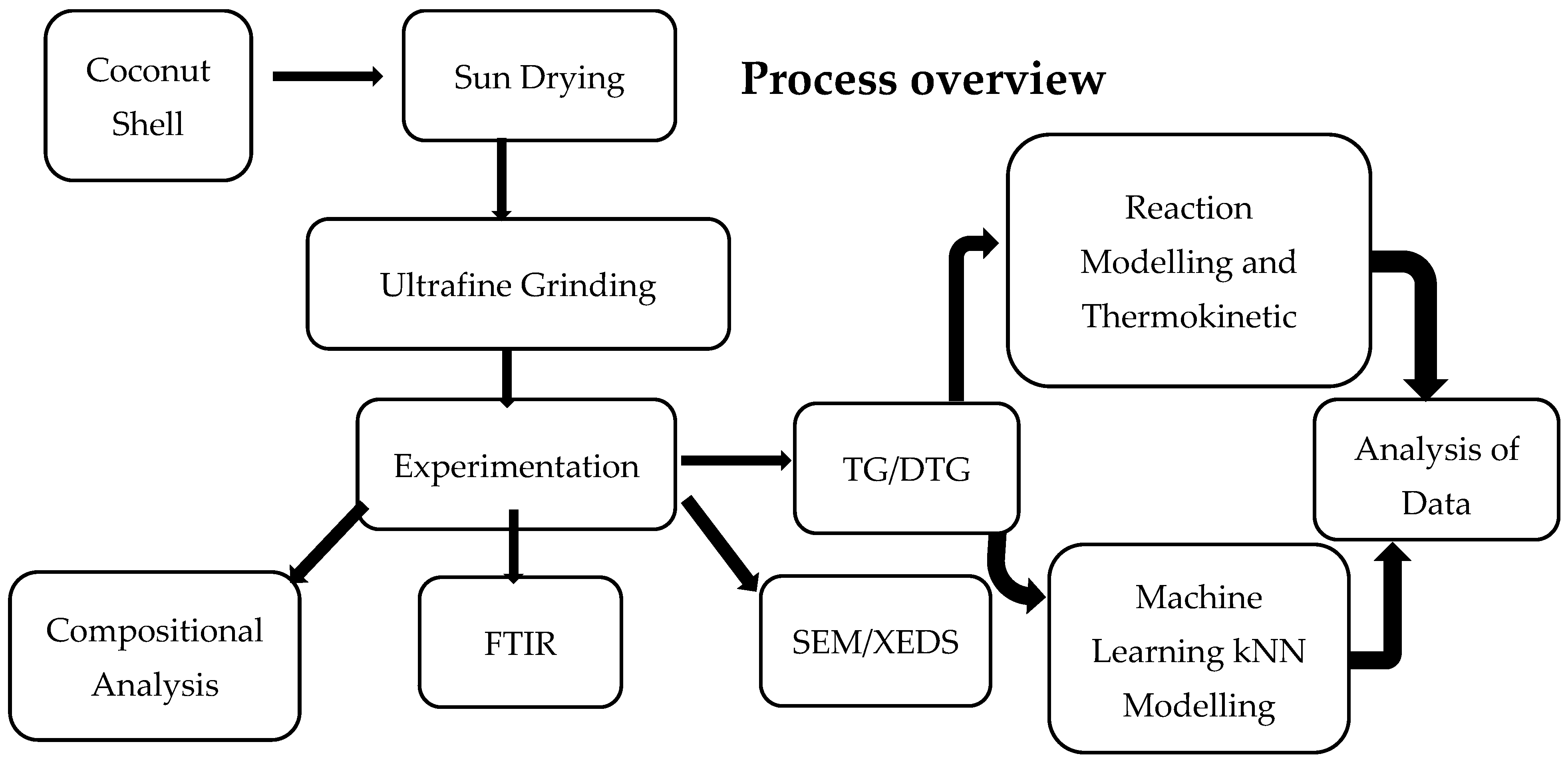
Figure 1 illustrates an overview of the experimental and modeling process, delineating the sequential utilization of coconut shell as a feedstock for pyrolysis operations. This process commences with material pre-treatment and pulverization, followed by the experimental characterization of the fine powdered sample. Subsequently, the analysis of experimental data is conducted through reaction modeling, thermokinetic analysis, and machine learning k-nearest neighbors (kNN) modeling.

2.1. Pre-Treatment of Biomass Material

The primary material examined in this study was Cocos nucifera shell (CCS), which was sourced from Al Ahsa, located in the Eastern Region of Saudi Arabia. The CCS material was sun-dried for a period of 20 days to reduce its moisture content, increase its energy density, facilitate the breakdown of complex structures, and enhance the yield of valuable products during pyrolysis operations [14]. The dried sample was subsequently milled into a powder and sieved to obtain a desired particle size range of 75–300 µm for characterization. The pulverization process involved a two-stage size reduction: initial crushing of the shells into smaller chunks, followed by ultrafine grinding (pulverizing) using a BN801ME Ninja Blender (1200 W). The final product was then sieved to achieve the required fineness. The selection of this narrow size range is based on minimizing the effects imposed by thermal contact surfaces [15], as smaller particles exhibit less internal resistance to heat and volatile gas release [16], resulting in a more rapid devolatilization of biomass material during pyrolysis operations.
Both the apparent and compressed densities of the sample were measured at 0.5 g·cm−3 and 0.6 g·cm−3, respectively, which fall within the lower expected range of apparent densities (0.5–0.6 g·cm−3) for milled coconut shell [17], and can be attributed to the extended drying time of the biomass sample. Following the density measurements, several additional experimental analyses, including proximate and ultimate analyses, Fourier transform infrared spectroscopy (FTIR), scanning electron microscopy (SEM), energy-dispersive X-ray spectroscopy (EDS), and thermogravimetric analysis (TGA), were conducted on the milled dried sample of the CCS biomass, and the data obtained from these analyses were subsequently evaluated.

2.2. Proximate and Ultimate Analysis

The proximate analysis of the CCS sample, determining its moisture, volatile matter, ash, and fixed carbon contents, was conducted using a TG analyser in accordance with [5,18]. The TG analyser measures weight changes over specific temperatures and time intervals to estimate these components. A 10 mg sample of CCS biomass underwent thermo-oxidative heating from room temperature at a constant rate of 10 °C⋅min−1 to enable distinct decomposition stages and accurate analysis [19]. Moisture, volatile matter, and carbon residue contents were determined via sequential isothermal holds: 105 °C for 1.5 h (moisture), 600 °C for 8 min (volatile matter), and 900 °C for 1.5 h (ash). Fixed carbon percentage was calculated by subtracting the sum of these components from 100%, as defined by the formula: Fixed   Carbon % = 100 % ( Moisture % + Volatile   Matter % + Ash % ) .
The ultimate analysis of the CCS biomass was performed using a VELP Scientifica EMA 502 Elemental Micro Analyzer with dual carrier gases (Helium/Argon), following a procedure like that in [20]. A 2.3 mg sample, wrapped in an aluminum crucible, was combusted in an oxygen-rich atmosphere within the analyser. The elements were converted into their respective gases (CO2, H2O, N2, SO2). Helium carrier gas transported the products through a gas chromatography (GC) column for separation. A thermal conductivity detector (TCD) measured the quantity of each gas produced, and the data was subsequently processed and analyzed.

2.3. SEM/XEDS Procedure

The scanning electron microscopy (SEM) and energy-dispersive X-ray spectroscopy (EDS) measurements of the milled CCS biomass were conducted by capturing images of the material surfaces to analyze its morphology, microstructure, and elemental composition using the Joel JCM-700 NeoScope SEM system. A similar experimental procedure to that described in [21] was employed during this measurement. Prior to this analysis, the CCS material was mounted on a stub and coated with gold–palladium to enhance the emission of secondary electrons, thereby improving the signal-to-noise ratio and facilitating the enhancement of image clarity [22]. The prepared sample was subsequently placed onto the sample stage within the sample chamber of the SEM system, followed by the application of the JCM-7000’s advanced automatic functions to obtain high-quality images of the surfaces of the CCS biomass. The chemical elements present on the surface of the CCS biomass materials were also detected and recorded with the assistance of the EDS detector, which is fully integrated into the SEM system.

2.4. FTIR Procedure

The identification of functional groups and molecular compositions present in the CCS biomass sample was conducted using an Agilent Cary 630 Fourier transform infrared (FTIR) spectrometer, equipped with Agilent MicroLab software (version 5.8). This analysis involved measuring light absorption by the material across a wavenumber range of 500 to 4500 cm−1 [23,24]. A resolution of 4 cm−1 was used, with 74 scans taking a total measurement time of approximately 30 s. This resolution provides a reasonable balance between obtaining detailed information to distinguish key spectral features and maintaining a short measurement time.
The methodology employed for FTIR measurement commenced with the cleaning of the crystal surface (sample position) of the spectrometer using acetone to facilitate the acquisition of reliable data, thereby preventing interference from contaminants and ensuring an accurate spectral background. The auto sample presser of the FTIR analyser was securely positioned against the clean crystal surface to measure the background of the attenuated total reflectance, with the objective of isolating and removing any interfering signals, thereby yielding a final spectrum that is representative solely of the sample. A small quantity of the milled CCS biomass sample was subsequently applied to cover the crystal section of the spectrometer and was firmly held in place by the presser. Upon initiation, the sample absorbed beams of infrared light at various frequencies, resulting in the unique spectrum that was recorded by the software.
Furthermore, the resulting FTIR data were used to estimate the lateral order index (LOI), hydrogen bond index (HBI), and total crystallinity index (TCI), the latter of which is also referred to as the total order index (TOI). These indices quantify the structural arrangement and crystallinity of cellulose—the primary component influencing bio-oil yield—and its reactivity toward thermal degradation [25]. The LOI of the CCS biomass was determined using the absorbance ratio of the bands at 1429 cm−1 and 898 cm−1. These peaks correspond to CH2 scissoring (indicative of crystalline regions) and C-O-C stretching at the β-glycosidic linkage (representative of the amorphous phase), respectively [26]. The HBI was estimated as the ratio of the broad O–H stretching absorbance (typically 3300–3400 cm−1) to a reference peak, such as the CH2 bending (e.g., around 1320 cm−1 for CH2 bending) [25,27]. Finally, the TCI was calculated as the ratio of the crystallinity-sensitive peak at 1370 cm−1 (peak sensitive to crystallinity) to the C-H stretching peak (2884 cm−1 in this study), representing total material volume [27].

2.5. TG/DTG Procedure

Thermogravimetric data for the pyrolysis of milled CCS biomass were acquired using a Mettler Toledo TGA/SDTA 851e TGA analyzer. The experimental procedure followed that reported in [21], with strict adherence to the ICTAC recommendations for kinetic studies [12]. The TG measurements were conducted at heating rates of 5, 10, and 20 °C·min−1, with degradation temperatures ranging from 25 to 1000 °C. A 4.0 ± 0.1 sample of the powdered CCS biomass was accurately placed in the TG analyser’s crucible, ensuring that the sample uniformly covered the bottom of the crucible. This was done to facilitate representative reactions across the sample, prevent thermal lag, and improve the reliability and reproducibility of the pyrolysis data [28]. The selected sample mass was maintained within ±10% of the mean weight, ensuring gravimetric uniformity and adherence to the standard heuristic rule reported in [12], which requires the product of sample weight and heating rate to remain below 100 mg·°C·min−1. The crucible containing the biomass material was then positioned within the heating chamber of the TG system, which was rendered inert by the introduction of nitrogen gas (N2) at a flow rate of 20 mL.min−1. The temperature range and heating rate of 5 °C·min−1 were entered into the data acquisition software (STARe Software Version 15.00, Build 8668), followed by the measurement of the sample weight within the software.
Upon initiation of the experiment, sample weight loss as a function of degradation temperature was measured and recorded in the software. The operation continued until the maximum input temperature of 1000 °C was reached. The heating chamber of the TG system was then allowed to cool before conducting subsequent experiments to prevent thermal damage to the equipment and to ensure accurate and reproducible data, thereby mitigating the impact of residual heat on subsequent measurements [29]. The experiment was conducted in triplicate using similar TG procedure. The mean weight losses and associated standard deviations for triplicate experimental runs at heating rates of 5, 10, and 20 °C min−1 were 34.2 ± 0.9 wt.%, 38.5 ± 0.3 wt.%, and 45.5 ± 0.8 wt.%, respectively. The low data dispersion indicates high precision and experimental reproducibility. Furthermore, the observed trend of increasing weight loss with higher heating rates aligns with established biomass thermal degradation behavior [30].
The DTG data for the thermochemical conversion of the CCS biomass material were calculated by taking the ratio of differences between sample weight loss and degradation temperature obtained from the TG profiles. Deconvolution of the DTG traces was performed using a custom MATLAB script (Version 2025a) to isolate pseudo-components corresponding to the degradation pathways of moisture, hemicellulose, cellulose, and lignin. The MATLAB deconvolution code employs a bimodal Gaussian mixture (Bi-Gaussian) kernel to account for the potentially asymmetric shape of the peaks. This kernel is defined by four parameters: two means (μ1, μ2) and two standard deviations (σ1, σ2). Initial values for peak amplitude, peak width, and half-width were specified based on the actual DTG peaks. An interactive optimization algorithm, specifically the Levenberg–Marquardt least squares curve-fitting function, was utilized to fit the model parameters to the convolved data [31]. A trial-and-error approach involving initial guesses of the peak parameters (amplitude, width, and half-width) for each lignocellulosic component was implemented until the individual deconvoluted signals closely matched the raw DTG data. The resulting deconvoluted data were subsequently exported to Microsoft Excel for further analysis. The deconvoluted profiles were analyzed to determine the lignocellulosic fractional composition of the CCS biomass using Simpson’s 1/3 rule (Equations (S1) and (S2), Supplementary Data). Furthermore, the yields of the thermochemical conversion products—bio-oil, biochar, and syngas—were calculated using the stoichiometric and empirical relations defined in Equations (S3)–(S7) (Supplementary Data).

2.6. Reaction Mechanisms and Thermokinetic Equations

The estimation of kinetic triplet and thermodynamic parameters for the thermal decomposition of CCS biomass material commences with a thorough understanding of the governing equations pertinent to their estimation. These thermokinetic equations are presented in the Supplementary Data of this study. The kinetic triplet comprises the potential reaction mechanism(s) for the formation of activation complexes, the activation energy ( E A ) and the pre-exponential factor ( A ). The thermodynamic parameters include the activation enthalpy ( H ), the Gibbs free energy of the activation complex ( G ), the entropy of activation ( S ) and the equilibrium constant ( k ). The Coats–Redfern (CR) model-fitting method (Equation (S8)) [32] was employed to evaluate the pyrolysis kinetics of CCS biomass across heating rates of 5, 10, and 20 °C·min−1. To identify the most probable reaction mechanisms, 26 distinct solid-state kinetic models were tested, as detailed in Table S1 [21]. These models are categorized by their underlying physical geometry and rate-controlling steps, including geometrical contraction (GCM), reaction-order (ROM), power law (PLM), diffusion (DFM), sigmoidal rate (SRE), and Carter models. Also, the integrating reaction models with combined CR methods facilitated the determination of kinetic compensation parameters via Equation (S10), which, in turn, enabled the estimation of the pre-exponential ( A ) factor for activated complex formation using Equation (S11) [33,34].
The activation energy ( E ) for the formation of activated complexes was determined using several isoconversional methods, including the Standard Flynn–Wall–Ozawa (FWO) (Equation (S12)) [21,35,36] and its fourth-order Senum–Yang Iterative variant (Equations (S13) and (S14)) [37]. Additionally, the Kissinger–Akahira–Sunose (KAS) (Equation (S15)), Vyazovkin method (Equation (S16)) [38], and the Friedman (Equation (S18)) [5,39,40] method were employed. These models facilitate the estimation of robust kinetic parameters without requiring a predefined reaction mechanism [40]. Conversely, the Friedman kinetic model is classified as a model-free differential method, facilitating a direct assessment of how the activation energy varies with conversion [40], without necessitating prior knowledge of the specific solid-state reaction model. It is essential to reiterate that the selection of model-free kinetic methods for the estimation of kinetic parameters in this study is based on recommendations outlined in the ICTAC committee report published in [4], which provides detailed information regarding the analysis of kinetic data. The report [4] emphasizes the reliability of model-free kinetic methods in comparison to model-fitting kinetic methods and specifies the requirement of a minimum of three heating rates (TG traces) for the estimation of kinetic parameters, contrasting with single heating rate model-fitting kinetic methods. Equations (S19)–(S22) present mathematical models for the estimation of activation enthalpy ( H ) [20], Gibbs free energy of activation complex ( G ) [38,41], entropy of activation ( S ) [41,42], and equilibrium constants ( k ) [42].

2.7. Machine Learning kNN Approach

The application of the k-nearest neighbors (kNN) algorithm in this study was employed for the prediction and optimization of the thermogravimetric analysis (TGA) traces obtained from the pyrolysis of CCS biomass. The selection of this supervised learning algorithm is attributed to its capacity to manage non-linear and complex relationships within the data without imposing strong assumptions [43]. This characteristic renders it particularly suitable for modeling the intricate chemical processes encountered in the thermochemical conversion of biomass, exemplified by the TG traces analyzed in this study. Machine learning kNN is categorized as a lazy learner [43] or distance-based algorithm that does not necessitate a training phase; instead, it identifies “k” nearest training examples and classifies them based on averaging (for regression, as in this study) or majority voting (for classification) [44,45]. The accuracy of the model is contingent upon the estimated k-value utilized, which functions as a hyperparameter throughout the learning process. In summary, a low k-value may result in overfitting, while a high k-value may lead to underfitting, thereby producing oversimplified decision boundaries, elevated bias, and inaccuracies.
The prediction of TG, DTG, and conversion profiles for the pyrolysis of milled CCS biomass was implemented using a kNN algorithm, developed in MATLAB™. Initial data pre-processing involved categorizing the datasets into features (inputs) and an output (label). Specifically, the input parameters consisted of heating rate, time, and temperature, while the outputs comprised percentage weight loss derived from TG, DTG, and conversion data. These operating parameters are selected for their direct influence on the kinetic, mass transfer, and thermodynamic mechanisms of coconut shell decomposition. Heating rate determines the energy flux, governing internal thermal lag [46] and providing essential data for high-speed reactor modeling. Pyrolysis temperature serves as the thermodynamic threshold for bond dissociation, regulating degradation stages and bioproduct distribution [47]. Finally, residence time—which is intrinsically linked to temperature—facilitates secondary cracking of volatiles, shifting the product yield from bio-oil toward non-condensable gases [48]. To maximize predictive accuracy, each output parameter was trained independently using a dedicated kNN model, as a single, unified model would likely fail to capture the distinct, specialized relationships within the TG/DTG, conversion data. By isolating individual kNN models, each instance can independently optimize its hyperparameters—specifically the neighborhood size (k) and distance metric—to align with the unique statistical characteristics of its respective data stream [49,50]. The selected input parameters are considered the primary operational conditions that influence decomposition process [51]. Consequently, they directly affect the resulting weight loss profile, which is why they were chosen as input parameters for the kNN modeling in this study.
Each input variable or dataset consisted of 588 data points, which were selected based on a systematic sampling of data selection using a temperature interval of 5 °C. All experimental data were assessed to ensure the absence of outliers and categorical data. A 70/15/15 data splitting strategy was employed, utilizing 70% (412 data points) of the data for training, 15% (88 data points) for validation, and 15% (88 data points) for testing. This type of data splitting strategy is justified because it provides a large enough training set (70%) to model complex biomass kinetics, a dedicated validation set (15%) for precise hyperparameter optimization of TG/DTG peaks, and an independent test set (15%) to ensure the model generalizes accurately to new experimental data without overfitting [52]. While TG and conversion profiles exhibit inherent structural continuity, the DTG traces provide more granular insights into biomass degradation stages, including moisture removal and the decomposition of hemicellulose, cellulose, lignin, and char. Despite the unstructured nature of DTG data, the density of the 588-point dataset allows a kNN model to precisely map these distinct thermal regions. By utilizing 412 training points (via a 70/15/15 split), the model effectively captures the fundamental pyrolysis kinetics of coconut shell, ensuring high predictive accuracy on unseen test data. Min-Max normalization was applied to the three data subsets to scale features into a specific range, typically [0, 1]. This pre-processing technique is essential for preventing features with larger magnitudes from dominating the model, thereby facilitating improved training performance and accelerated convergence [53].
To optimize the kNN model, a hyperparameter grid search was conducted to determine the ideal configuration for the number of neighbors (k), the distance metric, and the weighting scheme. The search space was defined as the interval [1, 100]. Evaluated distance metrics included Euclidean, Manhattan (City Block), Chebyshev, Minkowski, and Hamming distances. Additionally, three weighting schemes were assessed: Uniform (Equal), Inverse Distance, and Squared Inverse Distance. This methodology utilizes a systematic and exhaustive search to mitigate the inherent weaknesses of distance-based models—specifically sensitivity to noise, attribute scaling, and neighborhood size—thereby accommodating the distinct kinetic characteristics of coconut shell pyrolysis and enhancing the accuracy of weight loss and conversion rate predictions [50,54]. The kNN function in MATLAB was subsequently applied to the training datasets to generate a predictive model capable of replicating both the training, validation and testing datasets. To demonstrate model reliability, statistical metrics were computed between predicted and experimental data. Furthermore, Pearson correlation matrices were analyzed to determine feature sensitivity regarding TG, DTG, and conversion outputs.

3. Results and Discussion

3.1. Proximate and Ultimate Analysis Data

Table 1 presents the proximate analysis of the powdered CCS material, detailing its percentage compositions of moisture, fixed carbon, volatile matter, and ash, which are 6.3%, 17.8%, 72.3%, and 3.6%, respectively. Although the estimated moisture content falls slightly below the 7.4–11.0% range recommended by Irawan et al. [55], this lower value is advantageous, as it reduces the energy demand for pre-pyrolysis drying. Furthermore, lower feedstock moisture generally enhances the calorific value of the resulting bio-oil by minimizing water dilution in the liquid product [56]. The high volatile matter content of 72.3% suggests that the CCS biomass material is energetically efficient for ignition and has potential for releasing combustible gases and vapor during thermochemical conversion [57]. The estimated fixed carbon content for the CCS biomass (17.8%) is within the moderate limit of the range (10–30%) [58] specified for biomass pyrolysis. This moderate fixed carbon content indicates a high proportion of volatile matter, which could be harnessed for energy. The estimated ash content of 3.6% falls the 2–5% range reported for woody biomass [59] and is well within the broader 0.1–67% range for biomass [60]. Consequently, this material can be classified as having a medium ash content, making it a viable feedstock for thermochemical conversion.
Table 1 presents the ultimate analysis data for the CCS biomass material, indicating carbon (C), hydrogen (H), nitrogen (N), sulfur (S), and oxygen (O2) compositions of 45.7%, 4.9%, 2.8%, 0%, and 46.6%, respectively. The combination of higher percentages of carbon and oxygen in the dried sample suggests that the CCS material is characterized by substantial proportions of oxygen-rich hemicellulose and cellulose, which decompose at lower temperatures, and carbon-rich lignin [61], which decomposes at higher temperatures, thereby contributing significantly to the solid biochar produced after the thermochemical conversion process. The hydrogen composition of 4.9% in the CCS biomass feedstock is notably low, indicating a limited availability of hydrogen atoms to facilitate the formation of hydrogen-rich gases during pyrolysis [62]. This situation may potentially result in increased CO and CO2 formation from the thermal devolatilization of carbonyl and carbonyl groups present in the lignocellulosic biomass material. The low nitrogen content of 2.8% characterizing this material falls within the moderate range (0.3–6.0%) [63] of acceptable values, suggesting lower emissions of nitrogen oxides (NOx) during the pyrolysis operation of the CCS biomass material. Furthermore, Table 1 indicates that there are no traces of sulfur present in the CCS biomass, suggesting that such material will not emit sulfur-based pollutants during its thermochemical conversion, which is remarkably advantageous in achieving cleaner and more sustainable forms of energy.

3.2. Analysis of SEM/XEDS Data

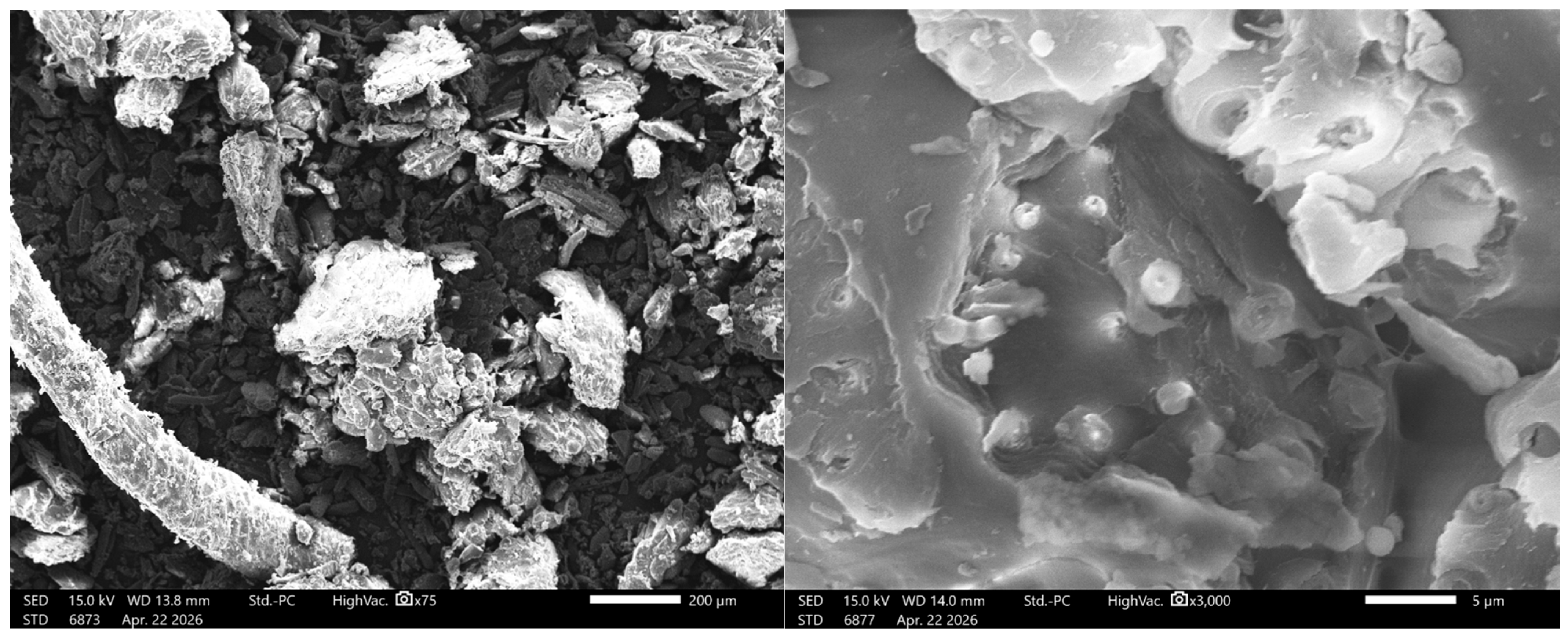
As shown in Figure 2, SEM images of dried and pulverized coconut shell reveal a heterogeneous, lignocellulosic structure that strongly influences its pyrolysis behavior. At low magnification (×75, left), the material shows irregular, angular particles with fibrous fragments and dense agglomerates, reflecting fracture along cellulose microfibrils embedded in a rigid lignin matrix. This confirms the highly lignified and compact nature of coconut shell biomass [64]. At higher magnification (×3000, right), rough surfaces, microcracks, pits, and globular features are observed. These correspond to collapsed cell lumens, intercellular voids, and lignin-rich or extractive domains. Lignin’s amorphous structure promotes the formation of such rounded features, while microcracks enhance internal accessibility [65].
These structural characteristics imply limited initial porosity and diffusion constraints, leading to slower heat and mass transfer during pyrolysis. However, the high lignin content enhances thermal stability and promotes higher char yields, as lignin decomposes over a wide temperature range [66]. The observed microcracks and pits act as precursors for pore development during devolatilization, making coconut shell an excellent precursor for biochar and activated carbon [67].
The SEM-observed dense, lignin-rich morphology of coconut shell is consistent with the XEDS composition (C = 49.34%, O = 39.05%) in Table 2, which reflects a typical lignocellulosic framework dominated by carbonized biopolymers. The relatively high oxygen content yields an O/C mass ratio ≈ 0.79, indicating abundant oxygenated functional groups (e.g., hydroxyl, carbonyl) associated with cellulose and hemicellulose. This supports the SEM evidence of limited porosity and compact structure, as oxygen-rich polymers promote strong intermolecular bonding and structural rigidity [66].
According to Mohan et al. [65], during pyrolysis, a high O/C ratio favors devolatilization and bio-oil formation, producing oxygenated compounds such as phenols, acids, and aldehydes, but reduces energy density of the resulting fuel. As temperature increases, progressive deoxygenation lowers the O/C ratio, enhancing aromaticity and stability of the resulting biochar [65]. The presence of inorganic elements (K = 4.27%, Ca = 2.53%, Na = 2.64%, P = 1.50%) indicates significant ash-forming minerals. Alkali and alkaline earth metals (AAEMs), particularly K and Ca, act as catalysts for pyrolysis, promoting char formation, cracking reactions, and gas evolution [64]. These minerals also facilitate pore development, complementing the microcracks observed in SEM. However, they may reduce bio-oil yield and influence slagging behavior at high temperatures. While present in trace quantities, magnesium (Mg = 0.4%) serves as a moderate catalyst that facilitates char formation and the stabilization of carbonaceous structures during coconut shell pyrolysis, albeit with lower catalytic efficacy than K or calcium (Ca). In contrast, chlorine (Cl) primarily undergoes volatilization as hydrogen chloride (HCl); while this contributes to equipment corrosion and alters ash chemistry, its direct catalytic influence on the process is negligible [64,68].
Overall, while structural heterogeneity may cause non-uniform heating, the CCS biomass remains a highly suitable pyrolysis feedstock due to its high carbon content, stability, and pore-forming potential. Combined SEM-XEDS analyses demonstrate that the biomass is mineral-rich and moderately oxygenated, enhancing char yield, catalytic reactivity, and pore development. Consequently, CCS biomass is an ideal precursor for producing high-quality biochar and activated carbon.

3.3. Analysis FTIR Data

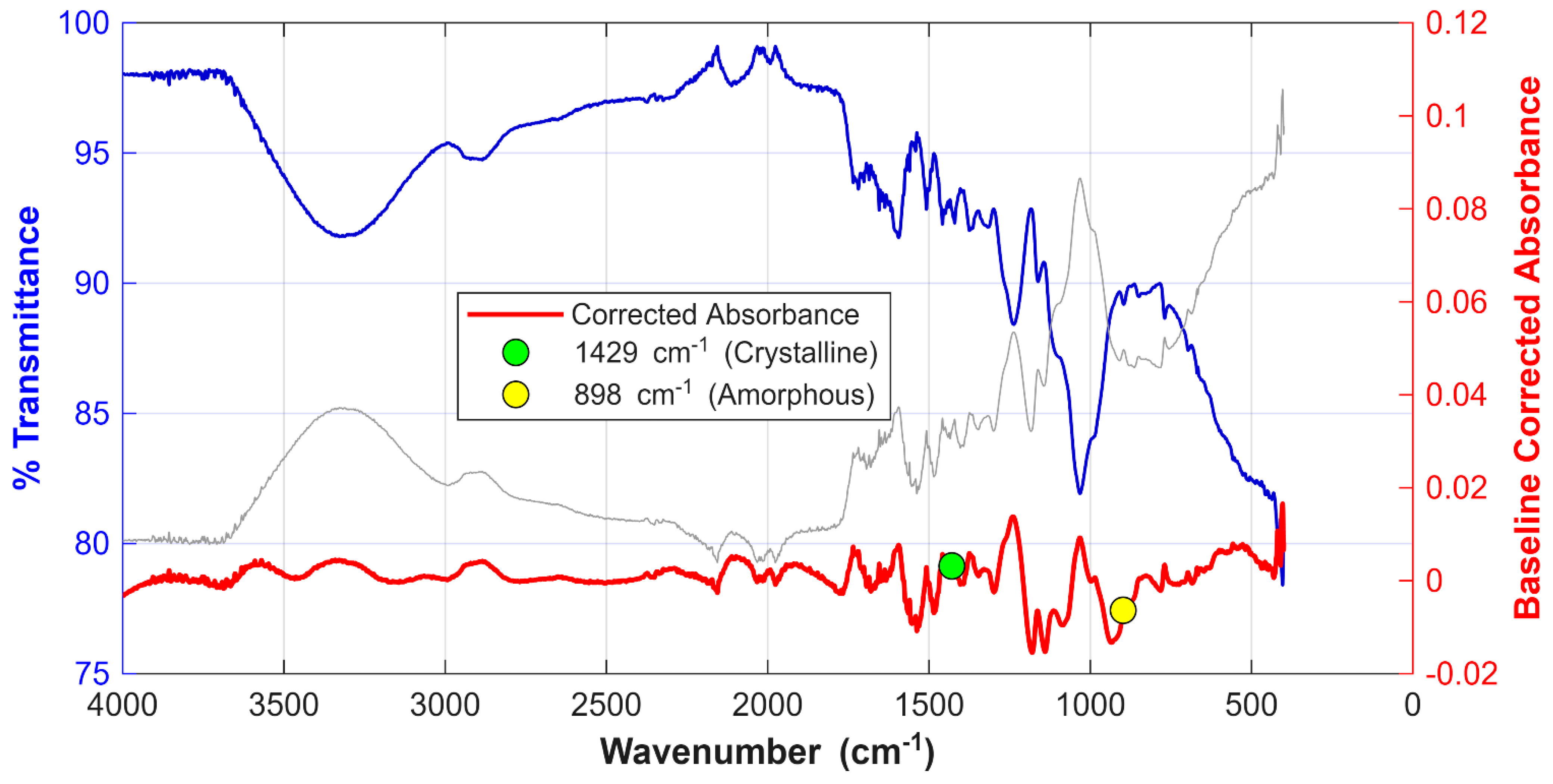
An FTIR spectrum of the CCS biomass is illustrated in Figure 3, plotting percentage transmittance and absorbance against wavenumber [cm−1]. The broad peak at 3309 cm−1 is indicative of O-H stretching associated with hydroxyl groups, likely originating from cellulose, lignin, and absorbed water [24,69]. In contrast, the peak at 2884 cm−1 falls within the absorption band of 2800–2900 cm−1, corresponding to the stretching vibrations of CH, CH2, and CH3 groups [70] present in the lignocellulosic biomass. The peak observed at 2096 cm−1 falls outside the standard spectral range for typical functional groups found in raw lignocellulosic biomass; however, it might point to an unusual C=O (carbonyl overtone) or could be an artifact related to sample preparation or the presence of a specific inorganic impurity [71]. The prominent peak at 1593 cm−1 is highly suggestive of aromatic C=C bonds within the material’s aromatic rings, a characteristic feature frequently associated with the presence of lignin [72,73]. In addition, the peak at 1370 cm−1 falls within the 1300–1400 cm−1 region, which is often assigned to a mix of aliphatic CH, CH2, and CH3 bending modes related to lignin or cellulose structures [70].
The peak at 1719 cm−1 signifies the presence of acetyl groups, commonly found in hemicellulose, lignin, pectin, and other oxygen-containing functional groups [73]. The peaks at 1236 cm−1 and 1030 cm−1 fall within the fingerprint region. While this region is generally less suitable for precise molecular identification [74,75], these specific peaks are nonetheless indicatives of several key structural components. The peak 1236 cm−1 may indicate the presence of C-O stretching in ester groups and aromatic ethers, which are predominantly found within the complex structure of lignin, while the peak 1030 cm−1 may suggest the presence of C-O-C glycosidic linkages of oligosaccharides or C-O deformation in primary alcohols [76].
The estimated LOI, calculated as the absorbance ratio of the peaks at 1429 cm−1 and 898 cm−1 [26], was found to be 0.507. This estimated LOI value indicates that the coconut shell has a moderate-to-low level of crystalline order compared to chemically treated coconut shell fibers, which can reach values as high as 0.8 or more [73,77]. This suggests that the coconut shell used in this study contains a significant amount of amorphous cellulose, which will likely undergo rapid thermal decomposition and produce a high yield of volatiles and bio-oil during the early stages of pyrolysis. The calculated HBI and TOI values are 0.750 and 1.401, respectively. The estimated HBI of 0.750 suggests a less rigid structure, which can translate to faster thermal degradation and a lower activation energy for the initiation of pyrolysis. Furthermore, the TOI value of 1.401 indicates a moderately organized lignocellulosic matrix. This combination of lower structural rigidity and moderate organization is conducive to high bio-oil yields (reported up to 45–50%) and high-quality char [78,79].

3.4. Analysis of TGA/DTG and Deconvoluted DTG Data

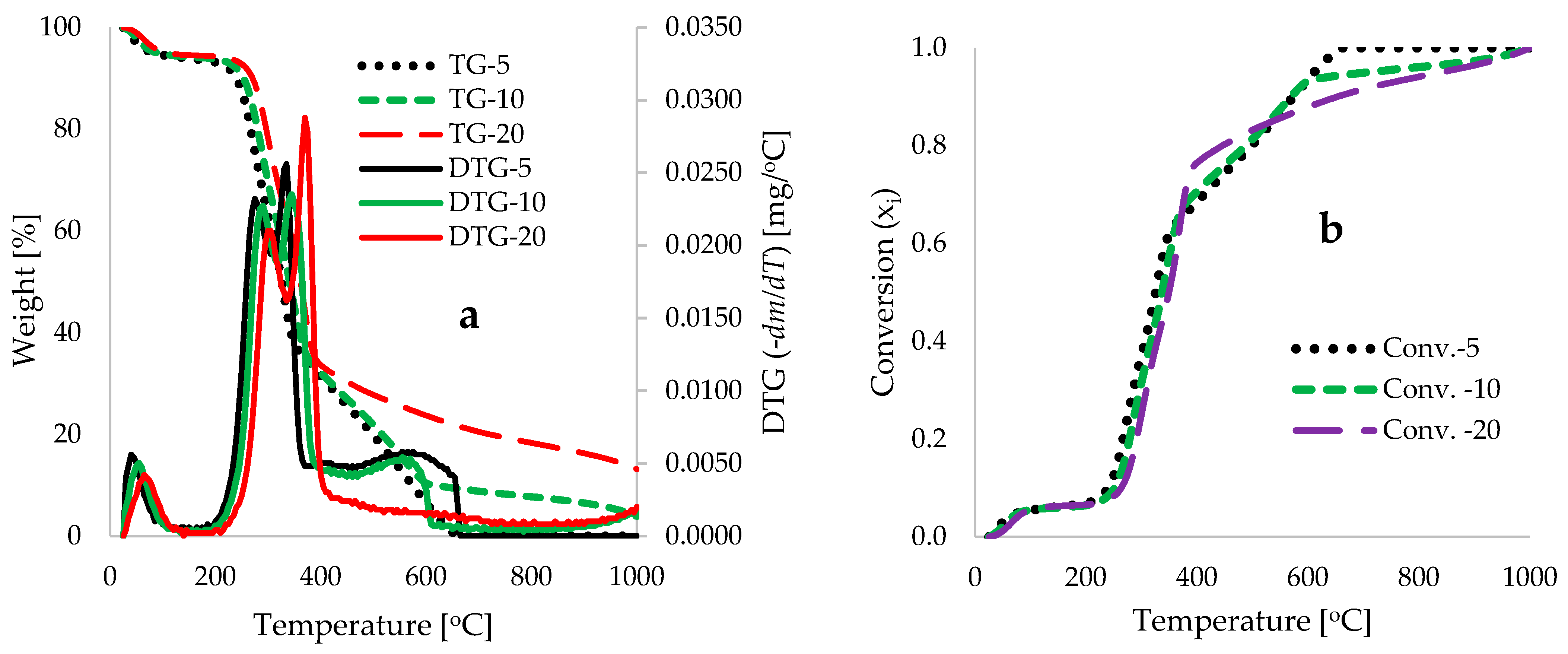
Figure 4a presents the TG traces at varying heating rates of 5, 10, and 20 °C·min−1, with degradation temperatures ranging between 25 and 1000 °C. It is evident that the TG traces shift to higher temperature maxima with increasing heating rate, which can be attributed to the rate of heat transfer into the sample becoming limited by the rate of the chemical decomposition process itself [80]. A similar shift in temperature is seen with increasing heating rates in Figure 4a, which shows the DTG traces for the three heating rates. The TG/DTG experiment detailed in Figure 4a concluded at 1000 °C due to equipment temperature limitations. At elevated temperatures, typically above 600 °C, material degradation was still actively occurring for traces run at lower heating rates (5 and 10 °C·min−1). Conversely, traces at a higher heating rate of 20 °C·min−1 exhibited a nearly plateauing effect at these elevated temperatures. This observation suggests that decomposition reactions in this range were either approaching completion or that the rate-limiting step transitioned from a kinetically controlled process to a mass transfer-controlled process [81]. The plateau stage is considered the region of thermal stability, wherein no mass change occurs over time; consequently, it may not yield useful information for kinetic analysis [82,83].
Figure 4b presents the extent of conversion (xi) in relation to degradation temperature for the pyrolysis of CCS biomass, demonstrating its characteristic thermal decomposition across various material compositions and the slow mass conversion observed at elevated temperatures for the analyses conducted at high heating rate of 20 °C·min−1. Notably, the slow heating rate pyrolysis of this material at elevated temperatures resulted in further decomposition of the sample (significant mass loss), which can be ascribed to the longer residence time associated with slow pyrolysis at 5 and 10 °C·min−1, facilitating secondary reactions that further depolymerize the intermediate complex structures into smaller molecules [84]. This also suggests that the rate of conversion over time during the thermochemical conversion of the CCS biomass material is influenced by the heating rate, with the depolymerization of the hemicellulose and cellulose components occurring rapidly through the cleavage of glycosidic bonds, leading to the formation of levoglucosan (1,6-anhydro-β-D-glucopyranose) [85].
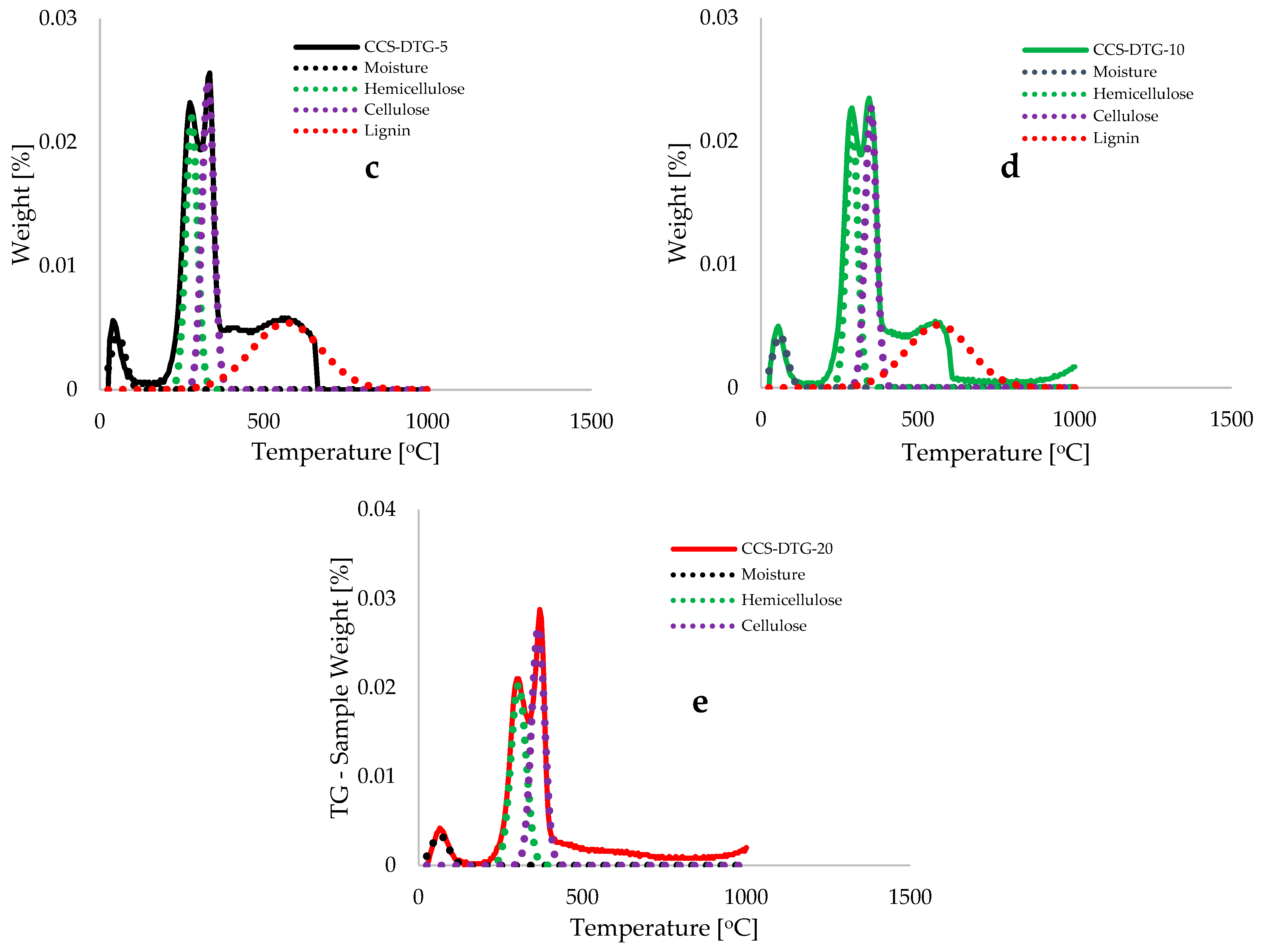
Figure 4c–e present the experimental and deconvoluted DTG profiles at heating rates of 5, 10, and 20 °C·min−1. These plots facilitate the characterization of peak widths, heights, and centers corresponding to the degradation of moisture, hemicellulose, and cellulose, alongside the extended decomposition of lignin at higher temperatures. The associated lignocellulosic compositions, temperature ranges, and bioproduct yields derived from the deconvoluted data are summarized in Table 3. The deconvoluted profiles indicate overlapping thermal degradation regions for moisture (25–160 °C), hemicellulose (135–395 °C), cellulose (270–430 °C), and lignin (275–675 °C). The broad degradation range observed for lignin, relative to the hemicellulose and cellulose fractions, is attributed to its complex, amorphous, three-dimensional aromatic framework, which comprises various chemical bonds with disparate thermal stabilities [86]. This aligns with findings by Yang et al. [66], who reported that hemicellulose and cellulose degrade within 220–315 °C and 315–400 °C, respectively, while the passive pyrolysis of the stable lignin structure spans 160–900 °C, Conversely, Rizal et al. [87] observed that Cocos nucifera shell decomposition began at 180 °C (hemicellulose) and 350 °C (cellulose), with lignin degrading between 300 and 500 °C.
Table 3 shows moisture contents derived from DTG deconvolution (5.2–5.8 wt%) were consistent with the proximate analysis results in Table 1 (6.3 wt%). Initial mass loss (up to 8 wt% conversion) is attributed to dehydration and the volatilization of low-molecular-weight phytochemicals, such as tannins and saponins [88,89], preceding rapid depolymerization. While Table 4 details compositions across all rates, the literature suggests that lower heating rates (5–10 °C·min−1) minimize thermal lag and improve peak resolution [90,91,92]. Notably, the lignin DTG peak is distinct at these lower rates but obscured at 20 °C·min−1 (Figure 4a). Consequently, the active pyrolysis stage of the CCS biomass was characterized by the degradation of hemicellulose (23.9–24.5 wt%), cellulose (25.4–27.1 wt%), and residual lignin (26.8–28.5 wt%).
Table 4 shows the calculated yields of bioproducts derived from deconvoluted TG data using the empirical relations in Equations (S3)–(S7). Under optimized slow-to-intermediate pyrolysis conditions (heating rates of 5–10 °C·min−1), the calculated yields range from 6.5–10.4 wt% biochar, 24.7–31.0 wt% bio-oil/light component (LC), 56.4–59.2 wt% bio-oil/gas-formation (GF), to 5.8–6.1 wt% syngas. The product distribution—characterized by moderate bio-oil, high liquid–gas mixture, and moderate-to-low char—is dictated by the chemical structure of the lignocellulosic biomass and specific reactor parameters. The high proportion of bio-oil/GF indicates that the low heating rate effectively facilitates the staged decomposition of hemicellulose and cellulose, while intermediate temperatures promote the maximum release of these volatile liquids/vapors, mitigating extensive secondary cracking into non-condensable gases. Furthermore, the calculated moderate bio-oil/LC yield indicates moderate secondary cracking reactions, forming light-weight molecules rather than heavy tars [93]. Consequently, the data indicates that this slow-intermediate pyrolysis process, utilizing controlled heating, optimizes liquid–gas production over solid char, consistent with the prior literature on coconut shell pyrolysis efficiency.

3.5. Model-Free and Model-Fitting Thermokinetic Data

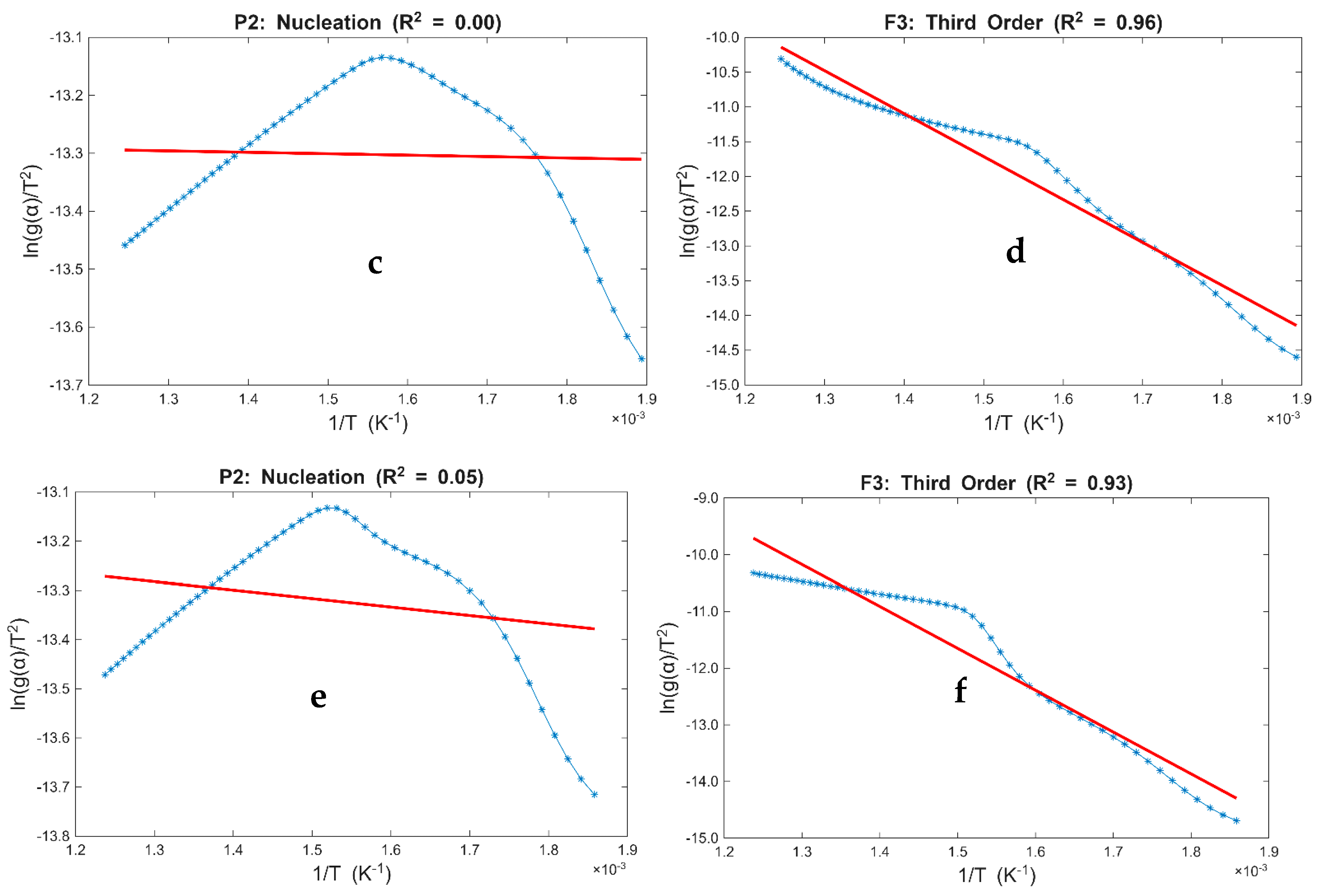
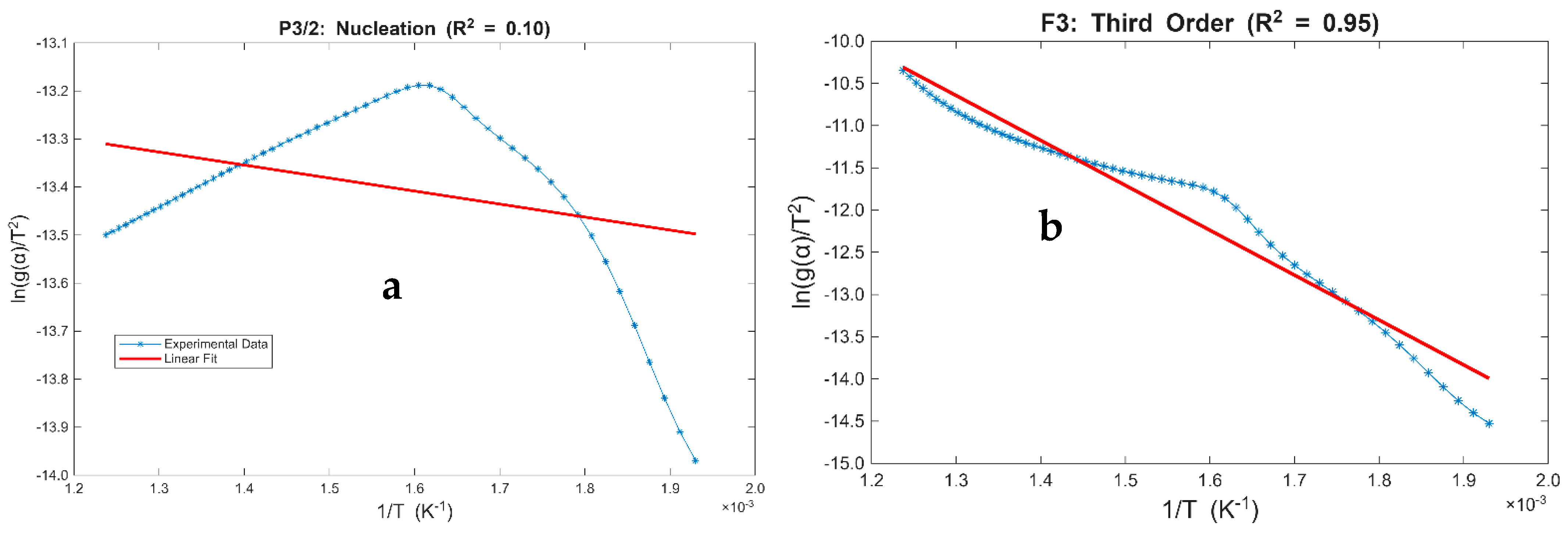
Figure 5 illustrates the Coats–Redfern (CR) model-fitting plots, depicting l n g ( x i ) T 2 as a function of the inverse of conversion temperature for conversions between 10 and 85%. The upper limit of 85% was established due to the plateauing of the TG trace observed at 20 °C·min−1, which reached approximately 87% conversion at the 1000 °C maximum temperature threshold. Conversely, the 10% lower limit was selected to exclude initial mass loss associated with volatile impurities, ensuring the kinetic analysis reflects the intrinsic thermal degradation of the sample [94]. The kinetic parameters derived from the CR method at heating rates of 5, 10, and 20 °C·min−1 are summarized in Table 4. Evaluation of the reaction models indicates that the P3/2 (nucleation) model yields the poorest fit for the 5 °C·min−1 data, while the P2 (nucleation) model shows significant deviations at 10 and 20 °C·min−1. Conversely, the F3 reaction model (third order) consistently yielded the best fit formal kinetic model within the specified conversion range for all heating rates, achieving R 2   values of 0.95, 0.96, and 0.93, respectively.
While some biomass types exhibit nucleation-driven char formation, the complex structural matrix of coconut shell—characterized by robust lignin–lignin and lignin–cellulose linkages—is more accurately described by continuous degradation mechanisms. The F3 kinetic model suggests that pyrolysis is not driven by the physical growth of nuclei, but rather by the simultaneous, progressive breakdown of its three primary constituents. Lignin contributes to a protracted degradation profile that extends into higher temperature ranges, necessitating higher-order kinetic descriptions [95,96]. This consistency across various heating rates implies that while thermal lag shifts the reaction peaks, the underlying chemical decomposition mechanism remains unchanged. These findings align with the existing literature on high-lignin woody biomass, where nucleation models typically fail to represent the “distributed activation energy” inherent in complex lignocellulosic matrices [97,98].
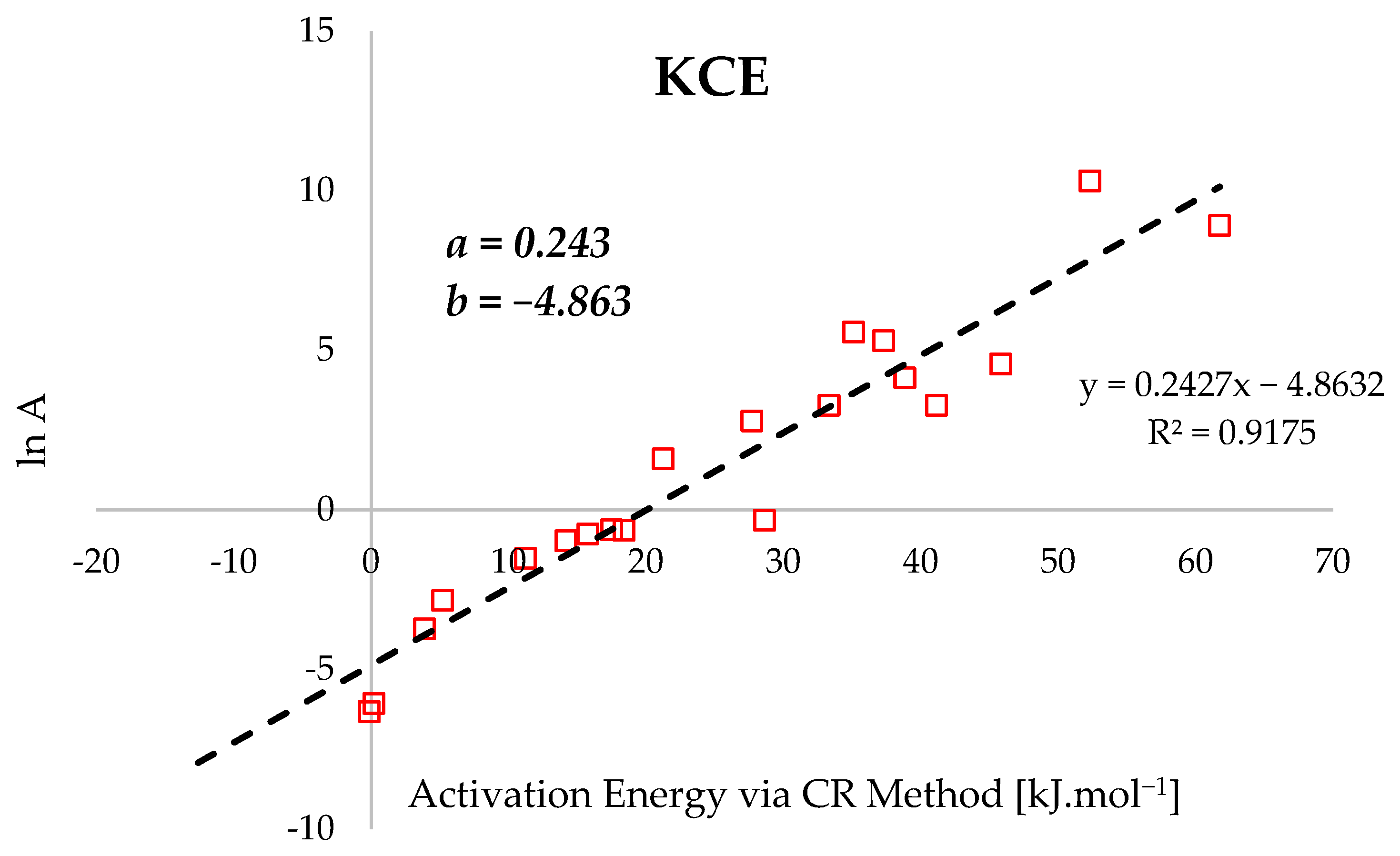
Figure 6 illustrates the kinetic compensation effect (KCE) via the linear relationship between the natural logarithm of the pre-exponential factor (lnA) and the activation energy derived from the CR method. The regression analysis yields a slope (a) of 0.243 (a) and an intercept (b) of −4.863. This strong linear correlation suggests that despite the heterogeneous composition of the coconut shell—comprising hemicellulose, cellulose, and lignin—the pyrolytic conversion follows a consistent reaction mechanism [99,100].
The KCE parameters indicate a stable kinetic regime where the isokinetic temperature is governed by the slope, and the intercept represents the baseline frequency factor. This confirms that the various decomposition stages of the biomass components are kinetically interrelated [101,102]. The positive slope signifies that increases in the energy barrier are compensated by a higher frequency of molecular collisions and active site availability. Regarding valorization, the high volatile content (71.5%) and relatively low ash (9.2%) facilitate sustained reactivity [103]. Consequently, these constants suggest that the pyrolysis process remains mechanically uniform across varying operational conditions, providing a predictable framework for bioreactor design and industrial scaling.
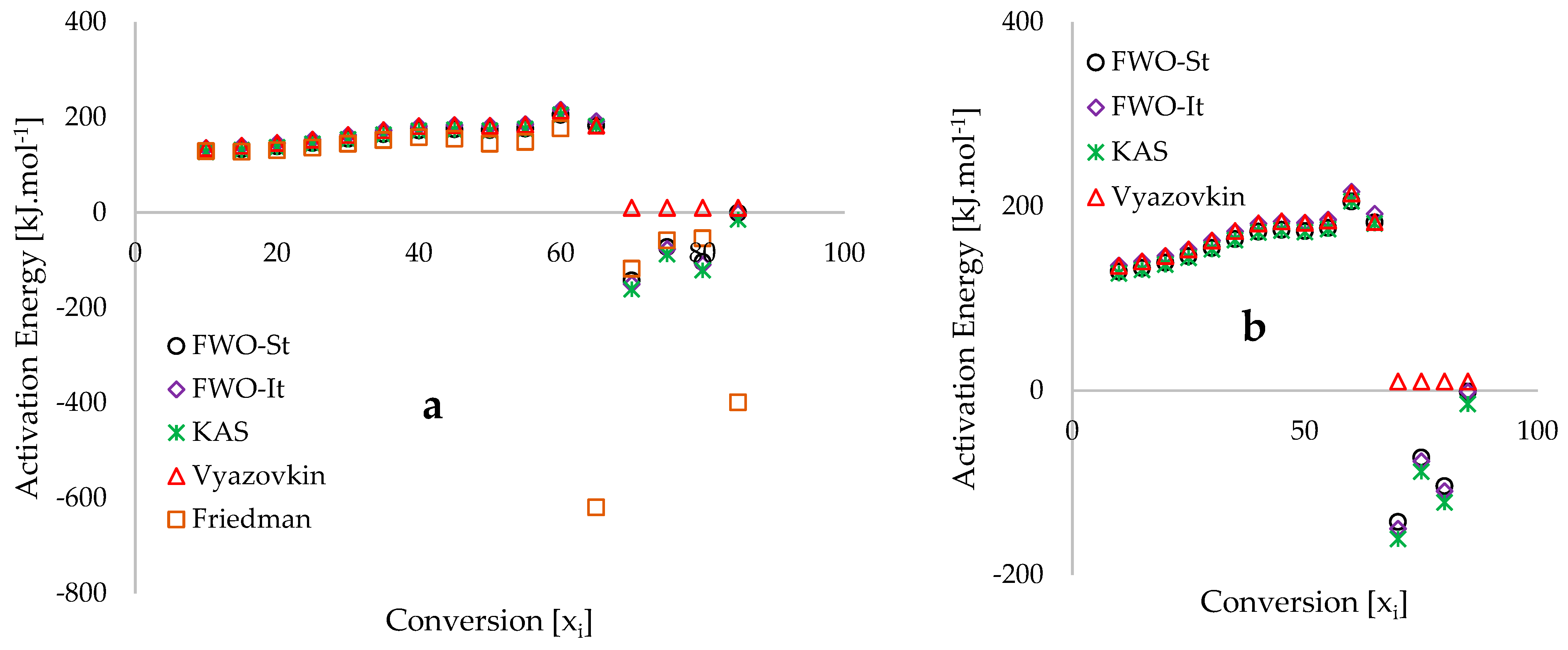
Figure 7 illustrates the activation energy profiles as a function of conversion ( x i ), derived using several isoconversional methods: FWO-St, FWO-It, KAS, Vyazovkin, and Friedman. Within the 0.10   x i 0.65 range, a consistent increase in activation energy is observed. However, beyond x i = 0.65 , the models exhibit a sharp decline, yielding physically inconsistent negative activation energy values. This phenomenon is a known mathematical artifact arising from the overlapping conversion traces observed in Figure 4b at higher temperatures. This region corresponds to lignin degradation and secondary char reactions, which constitute approximately 30 wt% of the coconut shell (Table 3). At a heating rate of 20 °C·min−1, the reaction exhibits a lower relative rate or shifts toward lower temperatures due to complex thermal transitions. Consequently, the slopes of the linear isoconversional plots (FWO, KAS, and Friedman) become positive, while the Vyazovkin estimates drop significantly to 10   k J . m o l 1 . Such deviations highlight the limitations of applying Arrhenius kinetics to complex, non-Arrhenius systems where multiple simultaneous reactions occur [104,105].
To ensure kinetic reliability, the analysis focuses on the 0.10   x i 0.60 range, representing the primary hemicellulose and cellulose decomposition stages (135–430 °C). In this interval, the four integral models (FWO-St, FWO-It, KAS, and Vyazovkin) show high convergence, with activation energy values ranging from 127.1 to 215.8 k J . m o l 1 . Conversely, the Friedman differential method exhibits significant divergence. This inconsistency is attributed to the model’s high sensitivity to experimental noise and its reliance on the derivative of conversion ( d x i / d t ), which tends to amplify inaccuracies in heterogeneous biomass materials compared to the more stable mass loss data used by integral methods [106,107,108].
Table 5 summarizes the activation energy values derived from selected model-fitting and model-free isoconversional methods over a conversion range of 10–60 wt%. Utilizing recommended integral approaches—specifically FWO-St, FWO-It, KAS, and the Vyazovkin method—the mean activation energy data for this hemicellulose/cellulose fraction was determined to be 165 ± 5.2 kJ·mol−1, with a corresponding pre-exponential factor of 2.9 × 10¹⁵ min−1. These kinetic parameters offer critical insights into the pyrolytic mechanisms of coconut shells. The average activation energy of 165 kJ·mol−1 represents the mean energy barrier required for the thermal cleavage of chemical bonds within the lignocellulosic matrix. This value aligns with the moderate reactivity typically observed in high-performance lignocellulosic biomass. Although the results are consistent with the previously reported literature (Table 6), variations in activation energy are often associated with experimental differences in heating rates, sample mass, and the specific kinetic models employed. Consequently, kinetic data are heavily influenced by the experimental setup and the subsequent mathematical treatment [109,110]. Furthermore, the high magnitude of the pre-exponential factor suggests a significant frequency of effective molecular collisions, facilitating rapid bond dissociation and subsequent volatile matter evolution [111].
Table 6 presents the activation enthalpies calculated using both model-fitting and model-free kinetic methods. All derived values are positive, with the four integral isoconversional models yielding a mean value of 159 ± 5.2 kJ·mol−1. These enthalpies closely align with the estimated activation energies, maintaining a consistent difference of approximately 5.2 kJ·mol−1. This disparity corresponds to the magnitude of R . T M , where R is the universal gas constant and T M is the peak temperature. The positive activation enthalpies suggest that the formation of activation complexes is an endothermic process, requiring a net input of energy to break the chemical bonds within the milled CCS biomass materials [112]. The small difference of 5.2 kJ·mol−1 between the overall activation energy and the activation enthalpy suggest that the process is thermodynamically favorable and can proceed once the energy barrier is met. This also correlates with an efficient devolatilization process of CCS biomass, meaning volatile components like organic acids, hydrocarbons, and alcohol are readily released during heating [3]. Furthermore, the calculated Gibbs free energy of activation yielded consistently positive values across all four integral isoconversional methods, with a mean value of 155 ± 1.4 kJ·mol−1. Based on literature-reported Gibbs free energy of activation values for hard woody biomass—including Sterculia guttata shell (152.1–158.8 kJ·mol−1) [113], Melocanna baccifera (165.3–193.7 kJ·mol−1) [114], Brazil nut residues (135.6–153.9 kJ·mol−1) [115], Poplar (157–187 kJ·mol−1) [116], and Oak (160–230 kJ·mol−1) [117]—the positive magnitudes of the Gibbs free energy of activation obtained for coconut shell pyrolysis in this study indicate that the formation of the activated complex is non-spontaneous, requires moderate energy, and is thermodynamically feasible. The comparative proximity of the estimated G to these lignocellulosic feedstocks highlights a similar, efficient reaction pathway for thermal degradation. The very low negative estimated values of entropy of activation in Table 6 signify that the activated complexes are highly ordered and structured compared to the reactants, classifying these reactions as slow [118]. Additionally, the estimated equilibrium constants for the formation of activation complexes in Table 7 are notably low and approach zero, suggesting that the thermochemical conversion of the CCS material strongly favors the reactants [42], indicating that the reactants are considerably more concentrated than the product at equilibrium.

3.6. Machine Learning kNN Modeling Data

Table 8 summarizes the optimized hyperparameters determined through a k-nearest neighbors (kNN) grid search, specifically identifying the optimal number of neighbors ( k ), distance metric, and weighting scheme for TG kNN modeling. The results indicate that a k -value of 85, Euclidean distance metric, and squared inverse weight scheme yielded the lowest validation Root Mean Squared Error (RMSE) of 0.646. Figure 4a shows that the thermal degradation of coconut shell involves complex, overlapping decomposition stages of hemicellulose, cellulose, and lignin. Consequently, the high optimal k -value ( k = 85 ) demonstrates that a larger neighborhood of data points improves model performance by capturing the consistent, underlying relationship between temperature and weight loss across the dataset, effectively filtering out minor experimental “noise” or fluctuations in the TG curves. The application of a squared inverse weight scheme, where closer neighbors have a greater influence, ensures the model remains sensitive to local thermal behavior variations while maintaining stability through a wide neighborhood perspective [121]. While several hyperparameter combinations yielded acceptable RMSE values (typically 1 ), the combination of k = 1 , Euclidean distance, and equal weighting—despite showing an RMSE < 1 —is not optimal for this application. A k = 1 model acts as a direct look-up, leading to high-variance overfitting, whereby the model mimics experimental noise rather than generalizable thermal degradation trends. Therefore, the k = 85 model offers superior generalization, crucial for predicting the pyrolysis behavior of coconut shell under varying operational conditions.
For DTG modeling, the combination of k = 100 , Euclidean distance, and a squared inverse weight scheme yielded the lowest validation RMSE (0.007) among the five randomly selected kNN subsets. The high k -value indicates that the DTG curve, representing the rate of mass loss, possesses a relatively smooth, global structure. In this context, a larger k acts as a low-pass filter, smoothing experimental noise or minor fluctuations in the degradation rates of hemicellulose, cellulose, and lignin. Furthermore, Euclidean distance is well-suited for continuous physical data where “straight-line” similarity between temperature-dependent mass loss rates is meaningful. The squared inverse scheme allows for 100 neighbors to be considered while ensuring closer neighbors in the “pyrolysis state” space exert greater influence, preserving local features—such as distinct DTG peaks—while benefiting from the stability of a large neighbor set.
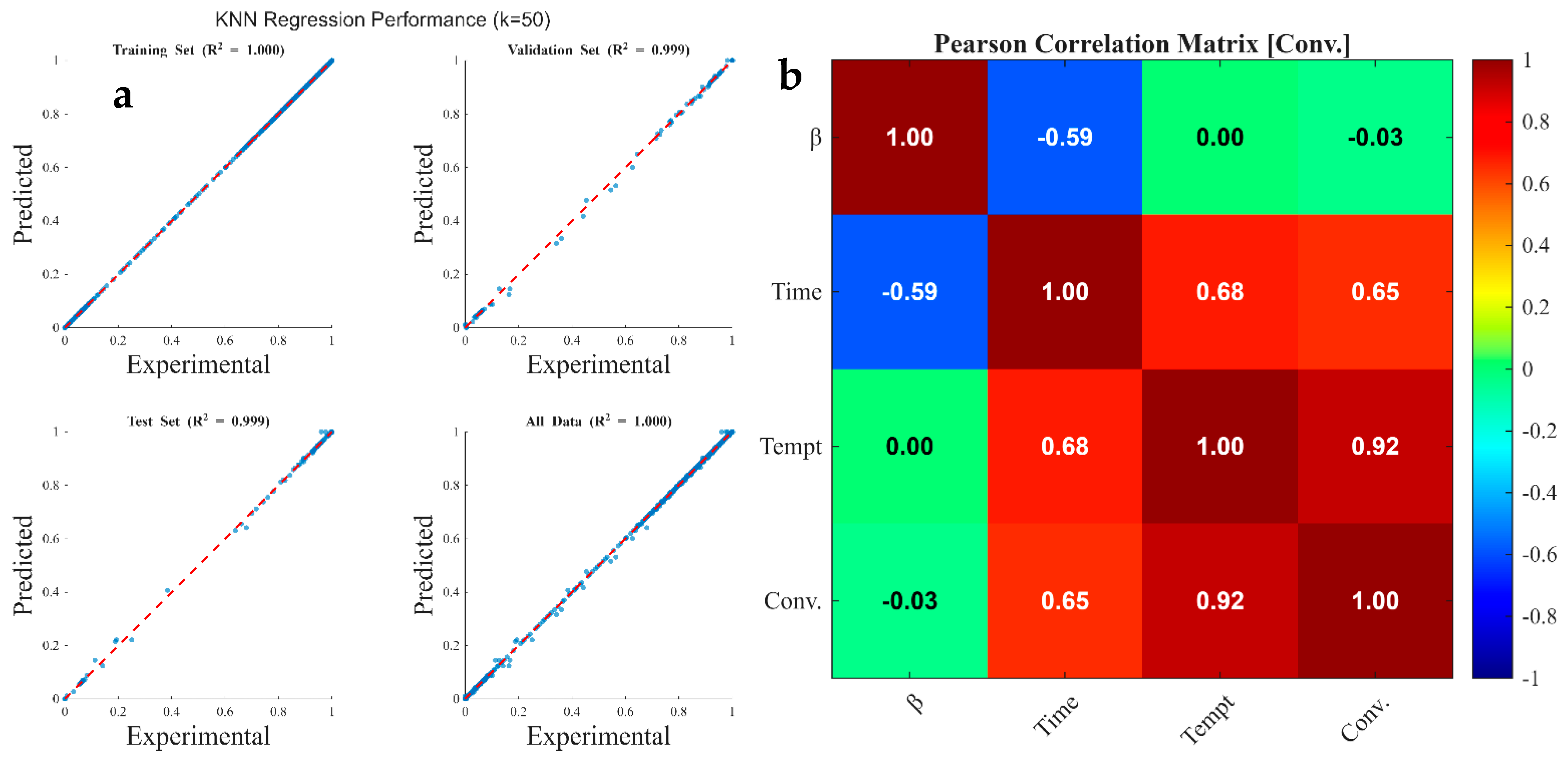
Conversely, for conversion traces, the lowest RMSE (0.0104) was achieved with k = 50 , City Block distance and squared inverse weighting. This indicates that conversion traces require a more localized approach than DTG. Because conversion curves are cumulative, monotonic, and transition through specific kinetic regimes, they are highly sensitive to temperature-dependent Arrhenius-type behavior and phase-specific mechanisms [122,123,124]. Furthermore, City Block distance (also known as Manhattan or L1 distance) is more robust to outliers and “stepped” data patterns [125]. As shown in Figure 4b, coconut shell pyrolysis involves distinct “knees” between macromolecular components (e.g., cellulose to lignin), which City Block distance captures efficiently. Consequently, k = 50 provides the sensitivity necessary to capture these local kinetic transitions, whereas the DTG modeling requires a broader, smoother approach.
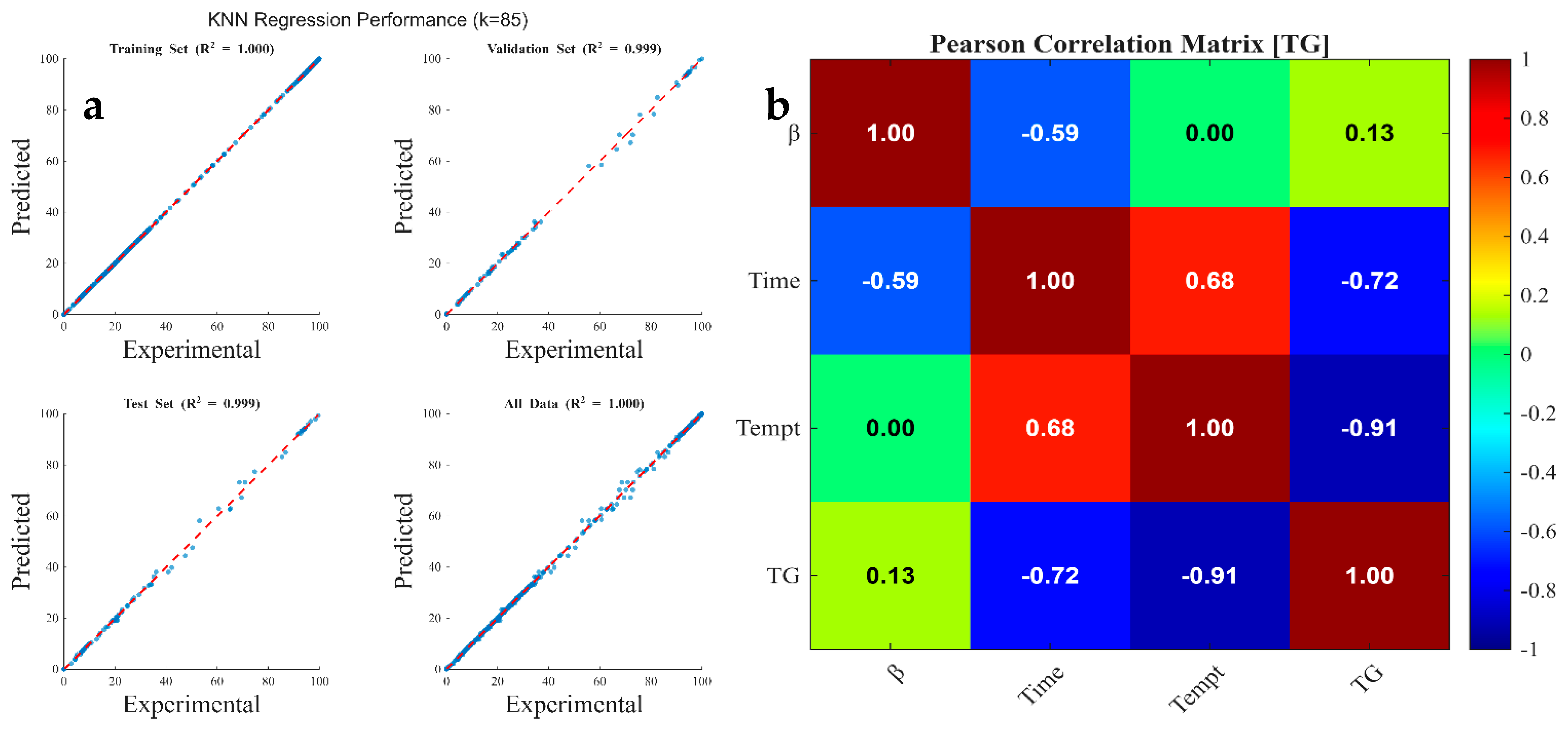
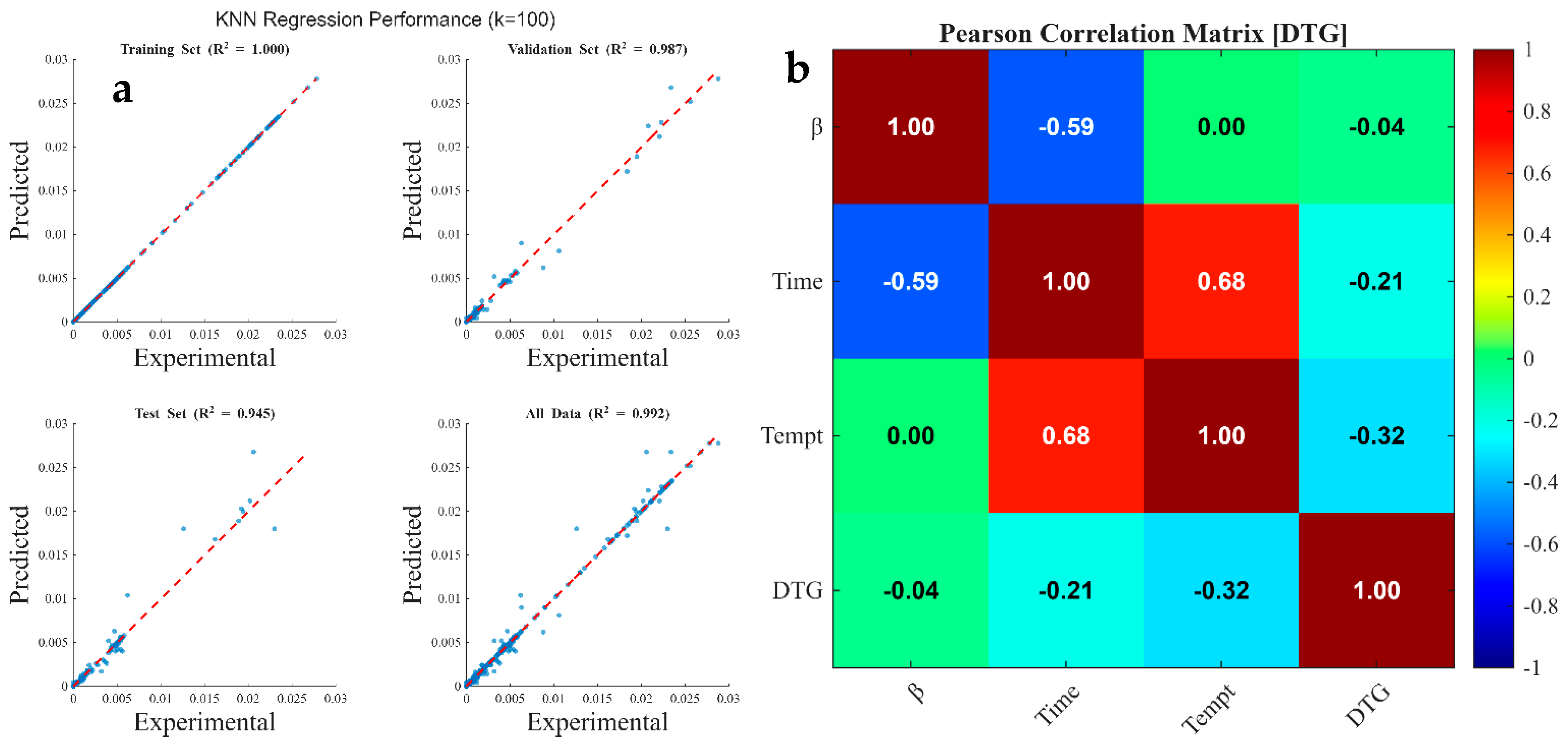
Figure 8, Figure 9 and Figure 10 illustrate the regression plots comparing kNN predictions against experimentally measured values for TG, DTG, and conversion traces, respectively. Additionally, the Pearson Correlation Matrix (Figure 8) delineates feature sensitivity regarding the predicted output. The kNN model achieved highly accurate predictions, with R 2 values approaching 1.000 for both TG and conversion datasets across all training, validation, and test subsets. For the DTG prediction, R 2 values were 1.000, 0.987, 0.945, and 0.992 for the 70% train, 15% validation, 15% test, and 100% total data subsets, respectively. These findings indicate that while kNN models effectively capture the integral, monotonic behavior of TG and conversion curves (high R 2 1.000 ), they exhibit slightly lower performance when predicting the instantaneous rate of mass loss (DTG). The marginal decrease in R 2 during validation and testing for the DTG profiles (down to 0.945) highlights the algorithm’s sensitivity to the derivative nature of the data. Since the DTG curves (Figure 4a) contain sharp peaks and overlapping signals corresponding to complex biomass decomposition (hemicellulose, cellulose, and lignin), minor experimental noise in the TG data is amplified within the DTG domain.
In summary, the high accuracy in TG/conversion prediction stems from the smooth, consistent nature of high-density data, while the slight reduction in DTG test accuracy reflects the greater sensitivity of kNN to differential, noisy, and non-linear kinetic rates. This reliability is corroborated by the statistical error indices in Table 9, where the low MAE, MBE, MSE, and RMSE values indicate minimal dispersion and high model precision relative to experimental measurements.
Figure 8b, Figure 9b and Figure 10b illustrate the Pearson correlation matrices, quantifying the linear relationship between independent process parameters (heating rate, time, and temperature) and dependent thermogravimetric outputs (TG, DTG, and conversion). The Pearson correlation coefficient ( r ) serves as a metric for both the strength and direction of these associations, where values approaching ± 1 indicate strong linearity [126]. The statistical analysis reveals that temperature and residence time are the primary determinants of mass degradation. For the TG output (Figure 8b), temperature exhibits a dominant strong negative correlation ( r = 0.91 ), complemented by a significant negative correlation with time ( r = 0.72 ). This inverse relationship confirms that as thermal energy and duration increase, the residual mass of the coconut shell decreases due to the volatilization of hemicellulose, cellulose, and lignin. Conversely, the conversion data (Figure 10b) shows strong positive correlations with temperature ( r = 0.92 ) and time ( r = 0.65 ), validating that these factors are the fundamental drivers for the transformation of solid biomass into volatile products [127].
In contrast to the cumulative metrics of TG and conversion, the DTG coefficients (Figure 9b) remain notably low, with values of 0.04 (heating rate), 0.21   (time), and 0.32   (temperature). These weak correlations indicate that the rate of mass loss ( d m / d t ) does not follow a simple linear progression with respect to the input variables. Instead, DTG peaks are governed by complex, stage-specific kinetic mechanisms—such as the rapid decomposition of specific polymers within narrow temperature windows—rather than a continuous linear acceleration. Across all outputs, the heating rate demonstrates negligible linear influence, with coefficients ranging from 0.04 to 0.13 . This suggests that within the investigated experimental range, the magnitude of the heating rate is secondary to the absolute temperature achieved. While heating rate may influence the kinetics and heat transfer gradients, its statistical contribution to the overall variance in mass loss and conversion is minimal compared to the dominant effects of temperature and time. Overall, the Pearson correlation coefficients indicate that temperature and time are the dominant factors in coconut shell pyrolysis, directly impacting mass loss (TG) and conversion, while the heating rate has a negligible linear effect.
Though the present study successfully utilized the kNN model for predicting and optimizing CCS biomass thermal decomposition, few machine learning applications have tackled the complexity of biomass degradation processes like pyrolysis or torrefaction in the general literature. A notable exception is the work by Yin et al. [128], which deployed a BP-NN and a sophisticated stacked ensemble model (combining eXtreme Gradient Boosting, Light Gradient Boosting Machine, and a Multi-Layer Perceptron) for co-pyrolysis. That study reported excellent agreement with experimental data, with both models yielding R-squared values greater than 0.99. Pambudi et al. [9] evaluated multiple models (ANN, RF, DT, and kNN) for predicting the thermogravimetric data of oxidatively torrefied spent coffee grounds (SCGs). Their findings indicated that the kNN model outperformed the others, yielding R-squared values exceeding 0.99 for both mass loss (TG) and derivative mass loss (DTG) predictions. Complementing this, Otaru et al. [129] employed a k-nearest neighbors (kNN) model to successfully predict TGA traces for date palm waste pyrolysis, achieving a high R-squared value of 0.975 and identifying degradation temperature as the primary operational driver.
It is important to emphasize that the kNN modeling approach demonstrated high fidelity in capturing data subsets. Furthermore, the average activation energy (165 ± 5.2 kJ·mol−1), which is consistent with the standard literature for lignocellulosic biomass. However, the inherent complexity of coconut shell pyrolysis—specifically the extensive thermal stable degradation of high lignin content—resulted in the kinetic and thermodynamic parameters of the activated complex being statistically representative only within the 10 to 60 wt% conversion range. This interval primarily characterizes the active pyrolysis stage, dominated by hemicellulose and cellulose decomposition. To resolve the overlapping lignin degradation profiles, future research will utilize significantly lower heating rates ( β < 10   ° C . m i n 1 ) to improve peak resolution, integrated with hybrid machine learning architectures for the multi-objective optimization of the pyrolysis thermokinetics.

4. Conclusions

This study provides a definitive framework for the valorization of Cocos nucifera (coconut) shells, bridging experimental material science with advanced computational modeling to accelerate the global transition toward sustainable bioenergy. The comprehensive characterization confirms that coconut shells are a premier feedstock, featuring high volatile matter (72.3%), significant carbon content (45.7%), and a complete absence of sulfur, ensuring clean energy production with minimal pollutant emissions. FTIR and SEM/XEDS analyses further reveal a robust, aromatic-rich structural matrix, specifically characterized by resilient lignin–cellulose linkages and the presence of endogenous potassium (4.27%) which acts as a natural catalyst during thermal degradation.
The thermogravimetric investigation (TG/DTG) successfully decoupled the complex pyrolysis process into its primary lignocellulosic constituents. Deconvolution of DTG traces identified specific degradation windows: hemicellulose (135–395 °C), cellulose (270–430 °C), and the broad, stable degradation of lignin (275–675 °C). Under optimized slow-to-intermediate pyrolysis conditions, the process yielded up to 31.0 wt.% bio-oil and 10.4 wt.% biochar, demonstrating high efficiency in volatile recovery. Reaction modeling identified the F3 (third order) mechanism as the best-fitting kinetic model within the studied conversion range. Achieving high coefficients of determination (up to 0.96), this model proves that pyrolysis proceeds via continuous, progressive degradation rather than discrete nucleation.
The thermokinetic analysis within the 10–60% conversion range established a mean activation energy of 165 ± 5.2 kJ·mol−1 and a pre-exponential factor of 2.9 × 10¹⁵ min−1. The positive activation enthalpy (159 kJ·mol−1) and Gibbs free energy of activation (155 kJ·mol−1) indicate an endothermic, non-spontaneous process. These values suggest moderate energy requirements consistent with literature data for various hardwood biomass materials.
The pioneering integration of kNN machine learning modeling achieved near-perfect predictive accuracy, with R 2 values approaching 1.000 for TG and conversion profiles. Optimized hyperparameters—specifically k = 85 for TG, k = 100 for DTG, and k = 50 for conversion—demonstrated the model’s ability to filter experimental noise while capturing intricate kinetic transitions. While this study’s kinetic and thermodynamic assessments demonstrate the viability of coconut shell for bioenergy, the active pyrolysis phase—driven by cellulose and hemicellulose decomposition—requires more granular analysis. Therefore, future investigations will employ low-heating-rate TG analysis to mitigate confounding effects from lignin overlap, combined with hybrid artificial intelligence architectures to optimize the kinetic model.

Supplementary Materials

The following supporting information can be downloaded at https://www.mdpi.com/article/10.3390/polym18091070/s1.

Author Contributions

A.J.O.: Conceptualization, Experimentation, Data Curation, Methodology, Resources, Modeling and Simulation, Software, Project Administration, Formal Analysis, Writing-Reviewing and Edition, and Validation. Z.A.A.A.Z.: Methodology, Resources, Project Administration, and Validation. A.S.A.: Project Administration, Formal Analysis, Reviewing, and Validation. I.B.: Project Administration, Reviewing, and Validation. O.O.B.: Project Administration, Reviewing, and Validation. All authors have read and agreed to the published version of the manuscript.

Funding

This work was supported by the Deanship of Scientific Research, Vice Presidency for Graduate Studies and Scientific Research, King Faisal University, Saudi Arabia [Grant No. KFU262137].

Data Availability Statement

The original contributions presented in this study are included in the article/Supplementary Materials. Further inquiries can be directed to the corresponding author.

Acknowledgments

The authors wish to express their sincere gratitude to King Faisal University (KFU), Saudi Arabia, Kabale University (KU), Uganda, and Kampala International University (KIU), Uganda, for providing conducive environments for research and learning, which significantly contributed to the success of this study.

Conflicts of Interest

The authors declare that they have no known competing financial interests or personal relationships that could have appeared to influence the work reported in this paper.

References

  1. Saudi Arabia Biomass Market Size, Share & Forecast 2034. Available online: https://www.imarcgroup.com/saudi-arabia-biomass-market (accessed on 17 March 2026).
  2. El-Sayed, S.A.; Khass, T.M.; Mostafa, M.E. Mostafa Thermal degradation behaviour and chemical kinetic characteristics of biomass pyrolysis using TG/DTG/DTA techniques. Biomass Convers. Biorefinery 2023, 14, 17779–17803. [Google Scholar] [CrossRef]
  3. Monir, M.U.; Shovon, S.M.; Akash, F.A.; Habib, A.; Techato, K.; Aziz, A.A.; Chowdhury, S.; Prasetya, T.A.E. Comprehensive characterization and kinetic analysis of coconut shell thermal degradation: Energy potential evaluated via the Coats-Redfern method. Case Stud. Therm. Eng. 2024, 55, 104186. [Google Scholar] [CrossRef]
  4. Vyazovkin, S.; Burnham, A.K.; Favergeon, L.; Koga, N.; Moukhina, E.; Pérez-Maqueda, L.A.; Sbirrazzuoli, N. ICTAC Kinetics Committee recommendations for analysis of multi-step kinetics. Thermochim. Acta 2020, 689, 178597. [Google Scholar] [CrossRef]
  5. Otaru, A.J. Circular economy: Kinetic-Triplet, thermodynamic, and gradient descent optimisation algorithm of deep learning models for the thermal degradation of walnut shell. Case Stud. Therm. Eng. 2025, 74, 106942. [Google Scholar] [CrossRef]
  6. Babinszki, B.; Jakab, E.; Terjék, V.; Sebestyén, Z.; Várhegyi, G.; May, Z.; Mahakhant, A.; Attanatho, L.; Suemanotham, A.; Thanmongkhon, Y.; et al. Thermal decomposition of biomass wastes derived from palm oil production. J. Anal. Appl. Pyrolysis 2021, 155, 105069. [Google Scholar] [CrossRef]
  7. Saddawi, A.; Jones, J.M.; Williams, A.; Wójtowicz, M.A. Kinetics of the Thermal Decomposition of Biomass. Energy Fuels 2009, 24, 1274–1282. [Google Scholar] [CrossRef]
  8. Narnaware, S.L.; Panwar, N. Kinetic study on pyrolysis of mustard stalk using thermogravimetric analysis. Bioresour. Technol. Rep. 2022, 17, 100942. [Google Scholar] [CrossRef]
  9. Pambudi, S.; Jongyingcharoen, J.S.; Saechua, W. Machine learning based prediction and iso-conversional assessment of oxidatively torrefied spent coffee grounds pyrolysis. Renew. Energy 2024, 237, 121657. [Google Scholar] [CrossRef]
  10. Alam Faroque, F.; Garimella, A.; Naganna, S.R. Analysis and Modeling of Thermogravimetric Curves of Chemically Modified Wheat Straw Filler-Based Biocomposites Using Machine Learning Techniques. J. Compos. Sci. 2025, 9, 221. [Google Scholar] [CrossRef]
  11. Xiao, K.; Zhu, X. Machine Learning Approach for the Prediction of Biomass Waste Pyrolysis Kinetics from Preliminary Analysis. ACS Omega 2024, 9, 48125–48136. [Google Scholar] [CrossRef]
  12. Vyazovkin, S.; Chrissafis, K.; Di Lorenzo, M.L.; Koga, N.; Pijolat, M.; Roduit, B.; Sbirrazzuoli, N.; Suñol, J.J. ICTAC Kinetics Committee recommendations for collecting experimental thermal analysis data for kinetic computations. Thermochim. Acta 2011, 590, 1–23. [Google Scholar] [CrossRef]
  13. Halder, R.K.; Uddin, M.N.; Uddin, A.; Aryal, S.; Khraisat, A. Enhancing K-nearest neighbor algorithm: A comprehensive review and performance analysis of modifications. J. Big Data 2024, 11, 113. [Google Scholar] [CrossRef]
  14. da Silva, A.S.; Espinheira, R.P.; Teixeira, R.S.S.; de Souza, M.F.; Ferreira-Leitão, V.; Bon, E.P.S. Constraints and advances in high-solids enzymatic hydrolysis of lignocellulosic biomass: A critical review. Biotechnol. Biofuels 2020, 13, 58. [Google Scholar] [CrossRef] [PubMed]
  15. Otaru, A.J.; Adeniyi, O.D.; Bori, I.; Olugboji, O.A.; Odigure, J.O. Numerical Simulation and Analysis of the Acoustic Properties of Bimodal and Modulated Macroporous Structures. Appl. Sci. 2023, 13, 12518. [Google Scholar] [CrossRef]
  16. Yang, S.; Wang, S.; Wang, H. Particle-scale evaluation of the pyrolysis process of biomass material in a reactive gas-solid spouted reactor. Chem. Eng. J. 2021, 421, 127787. [Google Scholar] [CrossRef]
  17. Bellow, S.A.; Agunsoye, J.O.; Adebisi, J.A.; Kolawole, F.O.; Hassan, S.B. Physical properties of coconut shell nanoparticles. Kathmandu Univ. J. Sci. Eng. Technol. 2016, 12, 63–79. [Google Scholar] [CrossRef]
  18. Park, S.; Kim, S.J.; Oh, K.C.; Cho, L.; Jeon, Y.; Lee, C.; Kim, D. Thermogravimetric analysis-based proximate analysis of agro-byproducts and prediction of calorific value. Energy Rep. 2022, 8, 12038–12044. [Google Scholar] [CrossRef]
  19. Chouhan, A.P.S.; Husain, A.; Mukherjee, S. Thermogravimetric Analysis of Pinus Wood For Kinetic Analysis by Using Coats and Redfern Method. J. Phys. Conf. Ser. 2020, 1531, 012116. [Google Scholar] [CrossRef]
  20. Otaru, A.J.; Zaid, Z.A.A.A.; Almithn, A.S.; Kovo, A.S.; Adeniyi, O.D. Thermokinetics, reaction modelling, and machine learning DNN and LSTM analysis of heat-induced pulverised Citrus clementina peel. Ind. Crops Prod. 2026, 241, 122707. [Google Scholar] [CrossRef]
  21. Zaid, Z.A.A.A.; Otaru, A.J. Sustainable valorization of mixed Saudi coffee waste and polystyrene via co-pyrolysis: Thermokinetic analysis and machine learning-based modelling using DNN and kNN. Therm. Sci. Eng. Prog. 2026, 72, 104610. [Google Scholar] [CrossRef]
  22. Höflinger, G. Brief Introduction to Coating Technology for Electron Microscopy; Leica: Wetzlar, Germany, 2013. [Google Scholar]
  23. Higgins, F.; Rein, A. Quantitative Analysis of Copolymers Using the Cary 630 FTIR Spectrometer Application Note Author; Agilent Technologies: Santa Clara, CA, USA, 2011. [Google Scholar]
  24. FTIR Functional Group Database Table with Search—InstaNANO. Available online: https://instanano.com/all/characterization/ftir/ftir-functional-group-search/ (accessed on 17 March 2026).
  25. Morales, A.; Yang, S.; la Cruz, D.S.-D. Understanding the Morphology of Cellulose Nanocrystal Films via Evaporated-Induced Self-Assembly. ACS Omega 2025, 10, 34930–34940. [Google Scholar] [CrossRef]
  26. Lee, Y.J.; Lee, D.Y.; Lee, T.-J.; Kim, H.J. Cellulose I crystallinity estimation using a combination of infrared spectroscopy and machine learning approaches. Carbohydr. Polym. 2025, 368, 124210. [Google Scholar] [CrossRef]
  27. Spiridon, I.; Anghel, N.; Dinu, M.V.; Vlad, S.; Bele, A.; Ciubotaru, B.I.; Verestiuc, L.; Pamfil, D. Development and Performance of Bioactive Compounds-Loaded Cellulose/Collagen/Polyurethane Materials. Polymers 2020, 12, 1191. [Google Scholar] [CrossRef] [PubMed]
  28. Czajka, K.M. The impact of the thermal lag on the interpretation of cellulose pyrolysis. Energy 2021, 236, 121497. [Google Scholar] [CrossRef]
  29. de Blasio, C. Thermogravimetric analysis (TGA). In Green Energy and Technology; Springer: Berlin/Heidelberg, Germany, 2019; pp. 91–102. [Google Scholar] [CrossRef]
  30. Chen, D.; Zhou, J.; Zhang, Q. Effects of heating rate on slow pyrolysis behavior, kinetic parameters and products properties of moso bamboo. Bioresour. Technol. 2014, 169, 313–319. [Google Scholar] [CrossRef]
  31. Yu, T.; Peng, H. Quantification and deconvolution of asymmetric LC-MS peaks using the bi-Gaussian mixture model and statistical model selection. BMC Bioinform. 2010, 11, 559. [Google Scholar] [CrossRef]
  32. Li, B.Y.; Tee, M.Y.; Nge, K.S.; Ng, A.K.L.; Chong, W.W.F.; Ng, J.H.; Mong, G.R. Comparison Kinetic Analysis between Coats-Redfern and Criado’s Master Plot on Pyrolysis of Horse Manure. Chem. Eng. Trans. 2023, 106, 1273–1278. [Google Scholar] [CrossRef]
  33. Barrie, P.J. The mathematical origins of the kinetic compensation effect: 1. the effect of random experimental errors. Phys. Chem. Chem. Phys. 2011, 14, 318–326. [Google Scholar] [CrossRef]
  34. Akhtar, M.A.; Zhang, S.; Shao, X.; Dang, H.; Liu, Y.; Li, T.; Zhang, L.; Li, C.-Z. Kinetic compensation effects in the chemical reaction-controlled regime and mass transfer-controlled regime during the gasification of biochar in O2. Fuel Process. Technol. 2018, 181, 25–32. [Google Scholar] [CrossRef]
  35. Ozawa, T. A New Method of Analyzing Thermogravimetric Data. Bull. Chem. Soc. Jpn. 1965, 38, 1881–1886. [Google Scholar] [CrossRef]
  36. Flynn, J.H.; Wall, L.A. A quick, direct method for the determination of activation energy from thermogravimetric data. J. Polym. Sci. Part B Polym. Lett. 1966, 4, 323–328. [Google Scholar] [CrossRef]
  37. Fotsop, C.G.; Lieb, A.; Scheffler, F. Elucidation of the thermo-kinetics of the thermal decomposition of cameroonian kaolin: Mechanism, thermodynamic study and identification of its by-products. RSC Adv. 2025, 15, 32172–32187. [Google Scholar] [CrossRef]
  38. Mianowski, A.; Sciazko, M.; Radko, T. Vyazovkin’s isoconversional method as a universal approach. Thermochim. Acta 2021, 696, 178822. [Google Scholar] [CrossRef]
  39. Friedman, H.L. Kinetics of thermal degradation of char-forming plastics from thermogravimetry. Application to a phenolic plastic. J. Polym. Sci. Part C Polym. Symp. 1964, 6, 183–195. [Google Scholar] [CrossRef]
  40. Uknowledge, U.; Han, Y. Theoretical Study of Thermal Analysis Kinetics. Available online: https://uknowledge.uky.edu/me_etds/35 (accessed on 17 March 2026).
  41. Farrukh, M.A.; Butt, K.M.; Chong, K.-K.; Chang, W.S. Photoluminescence emission behavior on the reduced band gap of Fe doping in CeO2-SiO2 nanocomposite and photophysical properties. J. Saudi Chem. Soc. 2019, 23, 561–575. [Google Scholar] [CrossRef]
  42. Vyazovkin, S. Misinterpretation of Thermodynamic Parameters Evaluated from Activation Energy and Preexponential Factor Determined in Thermal Analysis Experiments. Thermo 2024, 4, 373–381. [Google Scholar] [CrossRef]
  43. What Are KNN’s Advantages and Disadvantages Compared to the Other Popular Machine Learning Models?|by Jing Wang|Medium. Available online: https://medium.com/@jing.wang.ds/what-are-knns-advantages-and-disadvantages-compared-to-the-other-popular-machine-learning-models-b171c48dd817 (accessed on 17 March 2026).
  44. Shen, J.; Yan, M.; Fang, M.; Gao, X. Machine learning-based modeling approaches for estimating pyrolysis products of varied biomass and operating conditions. Bioresour. Technol. Rep. 2022, 20, 101285. [Google Scholar] [CrossRef]
  45. Deep Dive on KNN: Understanding and Implementing the K-Nearest Neighbors Algorithm–ML Course. Available online: https://arize.com/blog-course/knn-algorithm-k-nearest-neighbor/ (accessed on 17 March 2026).
  46. Mian, I.; Rehman, N.; Li, X.; Ullah, H.; Khan, A.; Choi, C.; Han, C. Effect of Heating Rate on the Pyrolysis Behavior and Kinetics of Coconut Residue and Activated Carbon: A Comparative Study. Energies 2024, 17, 4605. [Google Scholar] [CrossRef]
  47. Hanif, M.U.; Capareda, S.C.; Iqbal, H.; Arazo, R.O.; Baig, M.A. Effects of Pyrolysis Temperature on Product Yields and Energy Recovery from Co-Feeding of Cotton Gin Trash, Cow Manure, and Microalgae: A Simulation Study. PLoS ONE 2016, 11, e0152230. [Google Scholar] [CrossRef]
  48. Ahmad, R.K.; A Sulaiman, S.; Inayat, M.; A Umar, H. The effects of temperature, residence time and particle size on a charcoal produced from coconut shell. IOP Conf. Ser. Mater. Sci. Eng. 2020, 863, 012005. [Google Scholar] [CrossRef]
  49. Uddin, S.; Haque, I.; Lu, H.; Moni, M.A.; Gide, E. Comparative performance analysis of K-nearest neighbour (KNN) algorithm and its different variants for disease prediction. Sci. Rep. 2022, 12, 6256. [Google Scholar] [CrossRef]
  50. Çetin, A.I.; Büyüklü, A.H. A new approach to K-nearest neighbors distance metrics on sovereign country credit rating. Kuwait J. Sci. 2025, 52, 100324. [Google Scholar] [CrossRef]
  51. Li, J.; Wang, A.; Wang, S.; Zhang, G.; Sun, K. Constructing Coconut Shell-based Hard Carbon Materials for Sodium-ion Battery Anodes by Instantaneous High-temperature Method. Chem. Ind. For. Prod. 2025, 45, 47–54. [Google Scholar] [CrossRef]
  52. Gholamy, A.; Kreinovich, V.; Kosheleva, O. Why 70/30 or 80/20 Relation Between Training and Testing Sets: A Pedagogical Explanation. Int. J. Intell. Technol. Appl. Stat. 2018, 11, 105–111. Available online: https://scholarworks.utep.edu/cs_techrep/1209 (accessed on 17 March 2026).
  53. Singh, D.; Singh, B. Investigating the impact of data normalization on classification performance. Appl. Soft Comput. 2020, 97, 105524. [Google Scholar] [CrossRef]
  54. Manurung, J.; Saragih, H.; Prabukusumo, M.A.; Firdaus, E.A. Optimizing the performance of the K-Nearest Neighbors algorithm using grid search and feature scaling to improve data classification accuracy. J. Mandiri IT 2025, 14, 260–268. [Google Scholar] [CrossRef]
  55. Irawan, A.; Upe, S.L.; Dwi, I.P.M. Effect of torrefaction process on the coconut shell energy content for solid fuel. AIP Conf. Proc. 2017, 1826, 20010. [Google Scholar] [CrossRef]
  56. Eke, J.; Onwudili, J.A.; Bridgwater, A.V. Influence of Moisture Contents on the Fast Pyrolysis of Trommel Fines in a Bubbling Fluidized Bed Reactor. Waste Biomass Valorization 2019, 11, 3711–3722. [Google Scholar] [CrossRef]
  57. García, R.; Pizarro, C.; Lavín, A.G.; Bueno, J.L. Biomass proximate analysis using thermogravimetry. Bioresour. Technol. 2013, 139, 1–4. [Google Scholar] [CrossRef]
  58. Weber, K.; Quicker, P. Properties of biochar. Fuel 2018, 217, 240–261. [Google Scholar] [CrossRef]
  59. Maj, I.; Niesporek, K.; Płaza, P.; Maier, J.; Łój, P. Biomass Ash: A Review of Chemical Compositions and Management Trends. Sustainability 2025, 17, 4925. [Google Scholar] [CrossRef]
  60. Vassilev, S.V.; Vassileva, C.G.; Song, Y.C.; Li, W.Y.; Feng, J. Ash contents and ash-forming elements of biomass and their significance for solid biofuel combustion. Fuel 2017, 208, 377–409. [Google Scholar] [CrossRef]
  61. Demirbas, A. Pyrolysis mechanisms of biomass materials. Energy Sources Part A Recovery Util. Environ. Eff. 2009, 31, 1186–1193. [Google Scholar] [CrossRef]
  62. Liu, P.; Wang, Y.; Zhou, Z.; Yuan, H.; Zheng, T.; Chen, Y. Effect of carbon structure on hydrogen release derived from different biomass pyrolysis. Fuel 2020, 271, 117638. [Google Scholar] [CrossRef]
  63. Cheng, S.; Yao, K.; Tian, H.; Yang, T.; Chen, L. Synergistic Catalytic Effects on Nitrogen Transformation during Biomass Pyrolysis: A Focus on Proline as a Model Compound. Molecules 2024, 29, 3118. [Google Scholar] [CrossRef]
  64. Basu, P.; Kaushal, P. Biomass Gasification, Pyrolysis, and Torrefaction: Practical Design, Theory, and Climate Change Mitigation, 4th ed.; Academic Press: Cambridge, MA, USA, 2023; pp. 1–681. [Google Scholar] [CrossRef]
  65. Mohan, D.; Pittman, C.U.; Steele, P.H. Pyrolysis of Wood/Biomass for Bio-oil: A Critical Review. Energy Fuels 2006, 20, 848–889. [Google Scholar] [CrossRef]
  66. Yang, H.; Yan, R.; Chen, H.; Lee, D.H.; Zheng, C. Characteristics of hemicellulose, cellulose and lignin pyrolysis. Fuel 2007, 86, 1781–1788. [Google Scholar] [CrossRef]
  67. Ioannidou, O.; Zabaniotou, A. Agricultural residues as precursors for activated carbon production—A review. Renew. Sustain. Energy Rev. 2007, 11, 1966–2005. [Google Scholar] [CrossRef]
  68. Jenkins, B.M.; Baxter, L.L.; Miles, T.R., Jr.; Miles, T.R. Combustion properties of biomass. Fuel Process. Technol. 1998, 54, 17–46. [Google Scholar] [CrossRef]
  69. Kaur, M.; Mubarak, N.M.; Chin, B.L.F.; Khalid, M.; Karri, R.R.; Walvekar, R.; Abdullah, E.; Tanjung, F.A. Extraction of reinforced epoxy nanocomposite using agricultural waste biomass. IOP Conf. Ser. Mater. Sci. Eng. 2020, 943, 012021. [Google Scholar] [CrossRef]
  70. Rampe, M.J.; Santoso, I.R.S.; Rampe, H.L.; Tiwow, V.A.; Apita, A. Infrared Spectra Patterns of Coconut Shell Charcoal as Result of Pyrolysis and Acid Activation Origin of Sulawesi, Indonesia. E3S Web Conf. 2021, 328, 08008. [Google Scholar] [CrossRef]
  71. Caine, S.; Heraud, P.; Tobin, M.J.; McNaughton, D.; Bernard, C.C.A. The application of Fourier transform infrared microspectroscopy for the study of diseased central nervous system tissue. NeuroImage 2012, 59, 3624–3640. [Google Scholar] [CrossRef]
  72. Khan, A.A.; Ling, Y.S.; Chowdhury, Z.Z. Improvement of adsorption properties of coconut shell activated carbon using atmospheric pressure dielectric barrier discharge plasma jet. Eur. Phys. J. Plus 2024, 139, 673. [Google Scholar] [CrossRef]
  73. Bichang’A, D.O.; Oladele, I.O.; Alabi, O.O.; Aramide, F.O.; Oluseye, O.; Borisade, S.G.; Githinji, D.N.; Ojemaye, M.O. Comparative property investigation of raw and treated coconut shell biomass for potential polymer composite application. Heliyon 2024, 10, e40704. [Google Scholar] [CrossRef] [PubMed]
  74. Otaru, A.J.; Zaid, Z.A.A.A. On the thermal degradation of palm frond and PLA 3251D biopolymer: TGA/FTIR experimentation, thermo-kinetics, and machine learning CDNN analysis. Fuel 2025, 391, 134724. [Google Scholar] [CrossRef]
  75. Danilczuk, M.; Lin, L.; Schlick, S.; Hamrock, S.J.; Schaberg, M.S. Understanding the fingerprint region in the infra-red spectra of perfluorinated ionomer membranes and corresponding model compounds: Experiments and theoretical calculations. J. Power Sources 2011, 196, 8216–8224. [Google Scholar] [CrossRef]
  76. Andreansyah, I.; Mentari, P.R.A.; Rahman, H.; Syamani, F.A. Ultraviolet Shielding Performance of Coconut Coir as a Filler in Low-Density Polyethylene (LDPE) Plastic Mulch. Wood Res. J. 2024, 14, 13–24. [Google Scholar] [CrossRef]
  77. Rout, T.; Pradhan, D.; Singh, R.K.; Kumari, N. Exhaustive study of products obtained from coconut shell pyrolysis. J. Environ. Chem. Eng. 2016, 4, 3696–3705. [Google Scholar] [CrossRef]
  78. Onokwai, A.O.; Akuru, U.B.; Desai, D.A. Predictive accuracy and characterisation of bio-oil yield from pyrolysis of Cocos nucifera: A comparison of traditional RSM and hybrid models. Int. J. Renew. Energy Dev. 2025, 14, 1125–1145. [Google Scholar] [CrossRef]
  79. Ashwini, K.; Resmi, R.; Reghu, R. Pyrolysis characteristics and kinetic analysis of coconut shell and nutmeg shell for potential source of bioenergy. Eng. Sci. Technol. Int. J. 2024, 50, 101615. [Google Scholar] [CrossRef]
  80. Liu, M.; Zhang, C.; Bai, J.; Wang, X.; Xing, L.; Li, X.; Han, B.; Kong, L.; Bai, Z.; Li, H.; et al. Comparative study on the effects of heating rate on char gasification behaviors by thermogravimetric analyzer and high-temperature stage microscope under non-isothermal condition. Fuel 2023, 343, 127972. [Google Scholar] [CrossRef]
  81. Parthasarathy, P.; Al-Ansari, T.; Mackey, H.R.; McKay, G. Effect of heating rate on the pyrolysis of camel manure. Biomass Convers. Biorefinery 2021, 13, 6023–6035. [Google Scholar] [CrossRef]
  82. Valente, J.S.; Rodriguez-Gattorno, G.; Valle-Orta, M.; Torres-Garcia, E. Thermal decomposition kinetics of MgAl layered double hydroxides. Mater. Chem. Phys. 2012, 133, 621–629. [Google Scholar] [CrossRef]
  83. Silva, J.; Teixeira, S.; Teixeira, J. A Review of Biomass Thermal Analysis, Kinetics and Product Distribution for Combustion Modeling: From the Micro to Macro Perspective. Energies 2023, 16, 6705. [Google Scholar] [CrossRef]
  84. Wang, L.; Chang, Y.; Li, A. Hydrothermal carbonization for energy-efficient processing of sewage sludge: A review. Renew. Sustain. Energy Rev. 2019, 108, 423–444. [Google Scholar] [CrossRef]
  85. Cheng, K.; Winter, W.T.; Stipanovic, A.J. A modulated-TGA approach to the kinetics of lignocellulosic biomass pyrolysis/combustion. Polym. Degrad. Stab. 2012, 97, 1606–1615. [Google Scholar] [CrossRef]
  86. Dorez, G.; Ferry, L.; Sonnier, R.; Taguet, A.; Lopez-Cuesta, J.M. Effect of cellulose, hemicellulose and lignin contents on pyrolysis and combustion of natural fibers. J. Anal. Appl. Pyrolysis 2014, 107, 323–331. [Google Scholar] [CrossRef]
  87. A Rizal, W.; Nisa’, K.; Maryana, R.; Prasetyo, D.J.; Pratiwi, D.; Jatmiko, T.H.; Ariani, D.; Suwanto, A. Chemical composition of liquid smoke from coconut shell waste produced by SME in Rongkop Gunungkidul. IOP Conf. Ser. Earth Environ. Sci. 2020, 462, 012057. [Google Scholar] [CrossRef]
  88. Abdel-Shafy, H.I.; Mansour, M.S.M. Biochar production techniques utilizing biomass waste-derived materials and environmental applications—A review. J. Hazard. Mater. Adv. 2022, 7, 100134. [Google Scholar] [CrossRef]
  89. Mazaya, G.; Karseno, K.; Yanto, T. Antimicrobial and Phytochemical Activity of Coconut Shell Extracts. Turk. J. Agric.-Food Sci. Technol. 2020, 8, 1090–1097. [Google Scholar] [CrossRef]
  90. Castells, B.; Amez, I.; Medic, L.; Fernandez-Anez, N.; Garcia-Torrent, J. Study of lignocellulosic biomass ignition properties estimation from thermogravimetric analysis. J. Loss Prev. Process. Ind. 2021, 71, 104425. [Google Scholar] [CrossRef]
  91. Cano-Díaz, G.S.; Rosas-Aburto, A.; Vivaldo-Lima, E.; Flores-Santos, L.; Vega-Hernández, M.A.; Hernández-Luna, M.G.; Martinez, A. Determination of the Composition of Lignocellulosic Biomasses from Combined Analyses of Thermal, Spectroscopic, and Wet Chemical Methods. Ind. Eng. Chem. Res. 2021, 60, 3502–3515. [Google Scholar] [CrossRef]
  92. Díez, D.; Urueña, A.; Piñero, R.; Barrio, A.; Tamminen, T. Determination of Hemicellulose, Cellulose, and Lignin Content in Different Types of Biomasses by Thermogravimetric Analysis and Pseudocomponent Kinetic Model (TGA-PKM Method). Processes 2020, 8, 1048. [Google Scholar] [CrossRef]
  93. Han, Y.; Gholizadeh, M.; Tran, C.-C.; Kaliaguine, S.; Li, C.-Z.; Olarte, M.; Garcia-Perez, M. Hydrotreatment of pyrolysis bio-oil: A review. Fuel Process. Technol. 2019, 195, 106140. [Google Scholar] [CrossRef]
  94. Jain, A.A.; Mehra, A.; Ranade, V.V. Processing of TGA data: Analysis of isoconversional and model fitting methods. Fuel 2016, 165, 490–498. [Google Scholar] [CrossRef]
  95. Sahu, P.; Gangil, S.; Guru, P.K.; Durga, M.L.; Shukla, P.; Kumar, M.; Diwan, P.; Kamendra; Rath, I.; Sahu, R.K.; et al. Pyrolysis-induced lignin transformation and its thermo-kinetic implications for biochar development. Results Eng. 2026, 30, 110216. [Google Scholar] [CrossRef]
  96. Zhang, W.; Diao, C.; Wang, L. Degradation of lignin in different lignocellulosic biomass by steam explosion combined with microbial consortium treatment. Biotechnol. Biofuels Bioprod. 2023, 16, 55. [Google Scholar] [CrossRef] [PubMed]
  97. Manić, N.G.; Janković, B.B.; Dodevski, V.M.; Stojiljković, D.D.; Jovanović, V.V. Multicomponent modelling kinetics and simultaneous thermal analysis of apricot kernel shell pyrolysis. J. Sustain. Dev. Energy Water Environ. Syst. 2020, 8, 766–787. [Google Scholar] [CrossRef]
  98. Tsamba, A.J.; Yang, W.; Blasiak, W. Pyrolysis characteristics and global kinetics of coconut and cashew nut shells. Fuel Process. Technol. 2006, 87, 523–530. [Google Scholar] [CrossRef]
  99. Janković, B.; Manić, N.; Popović, M.; Cvetković, S.; Dželetović, Ž.; Stojiljković, D. Kinetic and thermodynamic compensation phenomena in C3 and C4 energy crops pyrolysis: Implications on reaction mechanisms and product distributions. Ind. Crops Prod. 2023, 194, 116275. [Google Scholar] [CrossRef]
  100. Brillard, A.; Brilhac, J.F. Improved relationships between kinetic parameters associated with biomass pyrolysis or combustion. Bioresour. Technol. 2021, 342, 126053. [Google Scholar] [CrossRef] [PubMed]
  101. Lopes, F.C.R.; Tannous, K. Coconut fiber pyrolysis decomposition kinetics applying single- and multi-step reaction models. Thermochim. Acta 2020, 691, 178714. [Google Scholar] [CrossRef]
  102. Lai, V.M.F.; Lii, C.Y.; Hung, W.L.; Lu, T.J. Kinetic compensation effect in depolymerisation of food polysaccharides. Food Chem. 2000, 68, 319–325. [Google Scholar] [CrossRef]
  103. Jahiding, M.; Mashuni; Ilmawati, W.; Ermawati; Rahmat; Arsyad, J.; Riskayanti, S.S. Characterization of Coconut Shell Liquid Volatile Matter (CS-LVM) by Using Gas Chomatroghaphy. J. Phys. Conf. Ser. 2017, 846, 012025. [Google Scholar] [CrossRef]
  104. Agrizzi, T.; Oliveira, M.A.; Faria, E.V.; Santos, K.G.; Xavier, T.P.; Lira, T.S. Assessing coconut shell pyrolysis: Biomass characterization, activation energy estimation, and statistical analysis of operating conditions. Bioresour. Technol. Rep. 2024, 26, 101831. [Google Scholar] [CrossRef]
  105. Bayón, R.; García-Rojas, R.; Rojas, E.; Rodríguez-García, M.M. Assessment of isoconversional methods and peak functions for the kinetic analysis of thermogravimetric data and its application to degradation processes of organic phase change materials. J. Therm. Anal. Calorim. 2024, 149, 13879–13899. [Google Scholar] [CrossRef]
  106. Li, J.; Shang, Y.; Wei, W.; Liu, Z.; Qiao, Y.; Qin, S.; Tian, Y. Comparative Study on Pyrolysis Kinetics Behavior and High-Temperature Fast Pyrolysis Product Analysis of Coastal Zone and Land Biomasses. ACS Omega 2022, 7, 10144–10155. [Google Scholar] [CrossRef]
  107. Ali, I.; Bahaitham, H.; Naebulharam, R. A comprehensive kinetics study of coconut shell waste pyrolysis. Bioresour. Technol. 2017, 235, 1–11. [Google Scholar] [CrossRef]
  108. Phuakpunk, K.; Chalermsinsuwan, B.; Assabumrungrat, S. Pyrolysis kinetic parameters investigation of single and tri-component biomass: Models fitting via comparative model-free methods. Renew. Energy 2022, 182, 494–507. [Google Scholar] [CrossRef]
  109. Liao, Y.; Huang, K. Kinetic Study on Pyrolysis of Tung Seed Shells and In Situ Characterization by Using TG–FTIR Analysis. Energies 2025, 18, 5842. [Google Scholar] [CrossRef]
  110. Koga, N.; Tanaka, H. Effect of sample mass on the kinetics of thermal decomposition of a solid. Part 3. Non-isothermal mass-loss process of molten NH4NO3. Thermochim. Acta 1994, 240, 141–151. [Google Scholar] [CrossRef]
  111. AMishra; Sonowal, M.; Turlapati, V.Y.; Maiti, P.; Meikap, B.C. A comprehensive thermo-kinetics devolatilization analysis of waste motor oil: Thermal degradation kinetics, kinetic model, thermodynamic analysis, and ANN. Int. J. Green Energy 2023, 20, 1191–1203. [Google Scholar] [CrossRef]
  112. Chen, D.; Cen, K.; Zhuang, X.; Gan, Z.; Zhou, J.; Zhang, Y.; Zhang, H. Insight into biomass pyrolysis mechanism based on cellulose, hemicellulose, and lignin: Evolution of volatiles and kinetics, elucidation of reaction pathways, and characterization of gas, biochar and bio-oil. Combust. Flame 2022, 242, 112142. [Google Scholar] [CrossRef]
  113. Sivaraman, S.; Selvasembian, R. Pyrolysis behavior of Sterculia guttata shell biomass: Kinetics, thermodynamics, techno-economic and life cycle assessment of industrial-scale biochar production. RSC Adv. 2026, 16, 10380–10399. [Google Scholar] [CrossRef] [PubMed]
  114. Kumar, P.; Mohanty, K. Insight into the Pyrolysis of Melocanna baccifera Biomass: Pyrolysis Behavior, Kinetics, and Thermodynamic Parameters Analysis Based on Iso-conversional Methods. ACS Omega 2025, 10, 8420–8432. [Google Scholar] [CrossRef] [PubMed]
  115. Colpani, D.; Santos, V.O.; Araujo, R.O.; Lima, V.M.; Tenório, J.A.; Coleti, J.; Chaar, J.S.; de Souza, L.K. Bioenergy potential analysis of Brazil nut biomass residues through pyrolysis: Gas emission, kinetics, and thermodynamic parameters. Clean. Chem. Eng. 2022, 1, 100002. [Google Scholar] [CrossRef]
  116. Slopiecka, K.; Bartocci, P.; Fantozzi, F. Thermogravimetric analysis and kinetic study of poplar wood pyrolysis. Appl. Energy 2012, 97, 491–497. [Google Scholar] [CrossRef]
  117. Park, Y.H.; Kim, J.; Kim, S.S.; Park, Y.K. Pyrolysis characteristics and kinetics of oak trees using thermogravimetric analyzer and micro-tubing reactor. Bioresour. Technol. 2009, 100, 400–405. [Google Scholar] [CrossRef] [PubMed]
  118. Turmanova, S.; Genieva, S.; Vlaev, L. Kinetics of Nonisothermal Degradation of Some Polymer Composites: Change of Entropy at the Formation of the Activated Complex from the Reagents. J. Thermodyn. 2011, 2011, 605712. [Google Scholar] [CrossRef]
  119. Said, M.; John, G.; Mhilu, C.; Manyele, S. The Study of Kinetic Properties and Analytical Pyrolysis of Coconut Shells. J. Renew. Energy 2015, 2015, 307329. [Google Scholar] [CrossRef]
  120. Cheng, C.; Guo, Q.; Ding, L.; Gong, Y.; Yu, G. Insights into pyrolysis process of coconut shell waste hydrochar: In-situ structural evolution and reaction kinetics. J. Clean. Prod. 2024, 448, 141701. [Google Scholar] [CrossRef]
  121. Wan, B.; Sheng, Z.; Zhu, W.; Hu, Z. Compactness-Weighted KNN Classification Algorithm. IJACSA Int. J. Adv. Comput. Sci. Appl. 2024, 15, 229. Available online: www.ijacsa.thesai.org (accessed on 11 April 2026).
  122. Vyazovkin, S. Kissinger Method in Kinetics of Materials: Things to Beware and Be Aware of. Molecules 2020, 25, 2813. [Google Scholar] [CrossRef] [PubMed]
  123. Liu, B.; Vanierschot, M.; Buysschaert, F. Comparison study of the k − k L − ω and γ − Re θ transition models in the open water performance prediction of a rim-driven thruster. Int. J. Turbomach. Propuls. Power 2024, 9, 2. [Google Scholar] [CrossRef]
  124. Knies, J.L.; Kingsolver, J.G. Erroneous Arrhenius: Modified Arrhenius Model Best Explains the Temperature Dependence of Ectotherm Fitness. Am. Nat. 2010, 176, 227–233. [Google Scholar] [CrossRef]
  125. Di, N.F.M.; Satari, S.Z. The effect of different distance measures in detecting outliers using clustering-based algorithm for circular regression model. AIP Conf. Proc. 2017, 1842, 030016. [Google Scholar] [CrossRef]
  126. Mukaka, M.M. A guide to appropriate use of Correlation coefficient in medical research. Malawi Med. J. 2012, 24, 69. Available online: https://pmc.ncbi.nlm.nih.gov/articles/PMC3576830/ (accessed on 11 April 2026).
  127. Martínez, M.G.; Dupont, C.; Thiéry, S.; Meyer, X.M.; Gourdon, C. Impact of biomass diversity on torrefaction: Study of solid conversion and volatile species formation through an innovative TGA-GC/MS apparatus. Biomass Bioenergy 2018, 119, 43–53. [Google Scholar] [CrossRef]
  128. Yin, H.; Huang, X.; Song, X.; Miao, H.; Mu, L. Co–pyrolysis of de–alkalized lignin and coconut shell via TG/DTG–FTIR and machine learning methods: Pyrolysis characteristics, gas products, and thermo–kinetics. Fuel 2022, 329, 125517. [Google Scholar] [CrossRef]
  129. Otaru, A.J.; Zaid, Z.A.A.A.; Alkhaldi, M.M.; Zaid, S.M.A.A.; AlShuaibi, A. The Bioenergy Potential of Date Palm Branch/Waste Through Reaction Modeling, Thermokinetic Data, Machine Learning KNN Analysis, and Techno-Economic Assessments (TEA). Polymers 2025, 17, 3182. [Google Scholar] [CrossRef]
Figure 1. Experimental and modeling process overview.
Polymers 18 01070 g001
Figure 2. SEM micrographs of the milled CCS biomass at ×75 (left) and ×3000 (right) magnifications.
Polymers 18 01070 g002
Figure 3. FTIR spectrum of the CCS biomass showing percentage transmittance [%] and baseline corrected absorbance against wavenumber [cm−1].
Polymers 18 01070 g003
Figure 4. Graphs illustrating plots of TG and DTG profiles as a function of degradation temperature: (a) weight loss (wt%) and DTG (−dW/dT, [mg·°C−1]) at multiple heating rates; (b) extent of conversion (xi); and deconvoluted DTG curves at (c) 5 °C·min−1, (d) 10 °C·min−1, and (e) 20 °C·min−1.
Polymers 18 01070 g004aPolymers 18 01070 g004b
Figure 5. Graphs illustrating plots of Coats–Redfern l n g ( x i ) T 2 against the inverse of conversion temperature for the (a) nucleation [P3/2] at a heating rate of 5 °C·min−1; (b) Third Order [F3] at a heating rate of 5 °C·min−1; (c) nucleation [P2] at a heating rate of 10 °C·min−1; (d) Third Order [F3] at a heating rate of 10 °C·min−1; (e) nucleation [P2] at a heating rate of 20 °C·min−1, and (f) Third Order [F3] at a heating rate of 20 °C·min−1.
Polymers 18 01070 g005aPolymers 18 01070 g005b
Figure 6. Kinetic compensation effect illustrating the plot of lnA against ECR.
Polymers 18 01070 g006
Figure 7. Plots of activation energy against the extent of conversion (xi [%]) derived from the multiple isoconversional kinetic analyses for the selected (a) 5 isoconversional models and (b) excluding Friedman differential isoconversional method.
Polymers 18 01070 g007
Figure 8. Graphical representations of (a) kNN-predicted TG data against experimental measurement for all data subset and (b) Pearson Correlation Matrix showing feature sensitivity to TG data.
Polymers 18 01070 g008
Figure 9. Graphical representations of (a) kNN-predicted DTG data against experimental measurement for all data subset and (b) Pearson Correlation Matrix showing feature sensitivity to DTG data.
Polymers 18 01070 g009
Figure 10. Graphical representations of (a) kNN-predicted conversion data against experimental measurement for all data subset and (b) Pearson Correlation Matrix showing feature sensitivity to Conversion data.
Polymers 18 01070 g010
Table 1. Proximate and ultimate analysis of the milled CCS biomass.
Proximate AnalysisUltimate Analysis
Moisture [%]Fixed Carbon [%]Volatile Matter [%]Ash [%]Carbon [%]Hydrogen [%]Nitrogen [%]Sulfur [%]Oxygen [%]
6.317.872.33.645.74.92.80.046.6
Table 2. XEDS data of CCS biomass.
ElementCONaMgPClKCaTotal
Mass [%]49.34 ± 0.1939.05 ± 0.402.64 ± 0.070.40 ± 0.021.50 ± 0.040.27 ± 0.024.27 ± 0.082.53 ± 0.07100
Atom [%]59.46 ± 0.0235.33 ± 0.371.66 ± 0.040.24 ± 0.010.70 ± 0.020.11 ± 0.011.58 ± 0.030.92 ± 0.02100
Magnification is ×3000Fitting ration = 0.2898Acceleration voltage = 15 kV
Table 3. Temperature and CCS biomass composition data.
β [oC·min−1]CompositionPeak Centre (Tp, oC)Initial Temperature (Ti, oC)Final Temperature (Tf, oC)ΔT = Tf − Ti (Tf, oC)Weight [%]Biochar Yield [%]Bio-Oil Yield LC [%] Bio-Oil Yield GF [%] Syngas Yield [%]
5Moisture55251351105.26.531.056.46.1
Hemicellulose28013533520023.9
Cellulose33028041513527.1
Lignin57027567540028.5
10Moisture60251601355.710.424.759.25.8
Hemicellulose29016035019024.5
Cellulose35027042015025.4
Lignin56529062533526.8
20Moisture65251551305.823.716.354.55.4
Hemicellulose30516539523032.9
Cellulose36529043014037.5
Lignin-----
Table 4. Tabulated kinetic data for the application of CR kinetic methods and the 36 selected solid-state reaction mechanisms.
β = 5 °C·min−1β = 10 °C·min−1β = 20 °C·min−1
Solid-State Reaction ModelsR2ECR
[kJ.mol−1]
A [min−1]R2ECR
[kJ.mol−1]
A [min−1]R2ECR
[kJ.mol−1]
A [min−1]
A3/2: Avrami (n = 1.5)0.81431.61.2 × 1010.83337.07.1 × 1010.82443.45.2 × 102
A2: Avrami (n = 2)0.2783.48.1 × 10−30.4305.13.3 × 10−20.5087.21.3 × 10−1
A3: Avrami (n = 3)0.109−1.3−1.4 × 10−30.002−0.2−4.7 × 10−40.0511.17.2 × 10−3
A4: Avrami (n = 4)0.601−3.7−2.5 × 10−30.435−2.8−4.5 × 10−30.196−1.9−7.0 × 10⁻³
Au: Prout-Tomkins0.603−11.9−3.5 × 10−40.571−12.2−6.7 × 10−40.593−13.8−1.0 × 10⁻³
F1/3: One-Third Order0.56211.35.2 × 10−20.62614.12.1 × 10−10.64817.18.6 × 10−1
F3/4: Three-Quarter Order0.68415.06.2 × 10−20.72918.22.7 × 10−10.73522.01.2 × 100
F3/2: One and Half Order0.83323.01.3 × 1000.85527.46.4 × 1000.84132.84.1 × 101
F1: First Order0.74317.55.2 × 10−10.77921.12.4 × 1000.77725.31.2 × 101
F2: Second Order0.89229.41.4 × 1010.90434.68.3 × 1010.88441.36.9 × 102
F3: Third Order0.95144.26.4 × 1020.95651.45.3 × 1030.92961.48.3 × 104
D1: 1D Diffusion0.69028.22.1 × 1000.72133.21.2 × 1010.72538.56.5 × 101
D2: 2D Diffusion0.74333.03.9 × 1000.76838.72.4 × 1010.76744.81.6 × 102
D3: 3D Diffusion (Jander)0.79739.14.3 × 1000.81645.53.1 × 1010.81052.82.5 × 102
D4: Ginstling-Brounshtein0.76335.11.5 × 1000.78640.99.5 × 1000.78347.46.8 × 101
D5: Zhuravlev, Lesokin, Tempelman0.87552.91.5 × 1020.88561.11.5 × 1030.87171.22.1 × 104
D6: Anti-Jander0.64724.16.6 × 10−20.68428.63.4 × 10−10.69333.31.7 × 100
R1: One-Dimension0.4458.73.3 × 10−20.52711.21.3 × 10−10.56313.84.9 × 10−1
R2: GCM (Contracting Cylinder)0.61412.76.2 × 10−20.67015.72.5 × 10−10.68519.01.1 × 100
R3: GCM (Contracting Sphere)0.66214.26.5 × 10−20.71017.42.8 × 10−10.71920.91.2 × 100
P1: Nucleation)0.4458.73.3 × 10−20.52711.21.3 × 10−10.56313.84.9 × 10−1
P3/2: Nucleation0.1012.33.1 × 10−30.2213.91.4 × 10−20.3105.65.4 × 10−2
P2: Nucleation0.036−1.0−8.5 × 10−40.0010.24.3 × 10−40.0481.47.3 × 10−3
P3: Nucleation0.575−4.2−2.2 × 10−30.438−3.5−4.1 × 10−30.270−2.7−7.3 × 10⁻³
P4: Nucleation0.806−5.9−2.4 × 10−30.747−5.3−4.7 × 10−30.653−4.8−9.3 × 10⁻³
Carter0.66214.26.5 × 10−20.71017.42.8 × 10−10.71920.91.2 × 100
Table 5. Estimated activation energy (E) values for the pyrolysis of CCS biomass at 10–60 wt% conversion.
FWO-StFWO-ItKASVyazovkinFriedman
Conversion xi [-]R2E [kJ.mol−1]R2E [kJ.mol−1]R2E [kJ.mol−1]R2E [kJ.mol−1]R2E [kJ.mol−1]
101.000129.11.000135.91.000127.11.000135.40.752128.7
151.000133.01.000139.90.999130.91.000140.20.620127.5
201.000138.81.000146.01.000136.81.000146.10.443130.6
251.000145.71.000153.31.000144.01.000153.20.510136.3
301.000154.71.000162.71.000153.31.000162.90.540144.1
351.000164.41.000172.91.000163.31.000173.20.523152.2
401.000172.41.000181.41.000171.61.000181.60.453158.0
451.000174.51.000183.61.000173.61.000183.70.300154.7
501.000173.11.000182.11.000171.91.000182.20.230144.2
551.000176.41.000185.61.000175.31.000184.70.371148.0
600.998205.20.998215.80.998205.41.000214.10.445176.7
Table 6. Summary of thermokinetic parameters for the CCS biomass within the 10–60 wt% conversion range.
ModelR2E [kJ.mol−1]A [min−1] H [kJ·mol−1] G [kJ·mol−1] S
[kJ·mol−1·K−1]
k [-]
CR0.945252.329,810.547.1173.4−0.2004.9 × 10−15
FWO-St0.9997160.77.0 × 1014155.4156.1−0.0011.3 × 10−13
FWO-It0.9997169.05.3 × 1015163.8153.70.0162.1 × 10−13
KAS0.9997159.45.1 × 1014154.1156.4−0.0041.2 × 10−13
Vyazovkin0.9998168.85.1 × 1015163.6153.80.0152.1 × 10−13
Friedman0.4716145.51.8 × 1013140.3160.3−0.0326.0 × 10−14
Average: E = 165 ± 5.2 kJ·mol−1; A = 2.9 × 10¹⁵ min−1; H  = 159 ± 5.2 kJ·mol−1; G   = 155 ± 1.4 kJ·mol−1; S   = 0.007 kJ·mol−1.K−1; k = 1.7 × 10⁻¹³ [-].
Table 7. Kinetic parameters for coconut shell pyrolysis.
SourceConversionKinetic MethodHeating Rate [oC·min−1] Temperature [oC]E [kJ.mol−1]A [min−1]
Current0.1–0.6FWO-St, FWO-It, KAS, & Vyazovkin5, 10, and 2025–10001652.90 × 1015
Said et al. [119]Main PyrolysisCR10227–727122.81.31 × 1011
Agrizzi et al. [104]0.1–0.9FWO and KAS5, 10, and 2030–1000182.8–192.45.2 × 1014
Mian et al. [46]0.1–0.8CR3, 5, and 1025–900159.6–177.58.4 × 1012
Tsamba et al. [98]0.2–0.8Isoconversional20250–400180–2161.5 × 1015
C. Cheng et al. [120]0.1–0.7Isoconversional10, 15, and 20150–600194.5–238.34.7 × 1016
Table 8. Optimized kNN hyperparameter tuning.
TG
Simulationk-valueDistanceWeightVal RMSERemark
1100EuclideanSquared Inverse1.0570
2100City BlockSquared Inverse0.8351
385EuclideanSquared Inverse0.6458✓✓
41EuclideanEqual0.9119×
550EuclideanSquared Inverse0.7580
DTG
Simulationk-valueDistanceWeightVal RMSERemark
185EuclideanSquared Inverse0.0011
220City BlockInverse0.0009
315EuclideanSquared Inverse0.0009
4100EuclideanSquared Inverse0.0007✓✓
55EuclideanSquared Inverse0.0012
Conversion
Simulationk-valueDistanceWeightVal RMSERemark
11EuclideanEqual0.0128×
2100City BlockSquared Inverse0.0120
33EuclideanInverse0.0089
45EuclideanInverse0.0108
550City BlockSquared Inverse0.0104✓✓
× means Not Recommended; ✓ means Recommended; ✓✓ mean Highly Recommended.
Table 9. Estimated measures of dispersion for the TG, DTG, and conversion prediction for all data subsets.
TG
Performance MetricsTrainValidationTestOverall
Std Dev8.73 × 10−160.6491.0060.462
MAE1.62 × 10−160.3630.5230.133
MBE−1.62 × 10−160.021−0.071−0.007
MSE7.87 × 10−310.4171.0060.213
RMSE8.87 × 10−160.6461.0030.462
R21.0000.9990.9991.000
DTG
Performance MetricsTrainValidationTestOverall
Std Dev1.71 × 10−197.22 × 10−41.47 × 10−36.35 × 10⁻⁴
MAE9.21 × 10−213.07 × 10−45.65 × 10−41.30 × 10⁻⁴
MBE−8.16 × 10⁻²¹−6.82 × 10⁻⁵−2.35 × 10⁻⁴−4.54 × 10⁻⁵
MSE2.94 × 10−385.20 × 10−72.18 × 10−64.05 × 10⁻⁷
RMSE1.71 × 10−197.21 × 10−41.48 × 10−36.36 × 10⁻⁴
R21.0000.9870.9450.992
Conversion
Performance MetricsTrainValidationTestOverall
Std Dev0.0001.01 × 10−21.20 × 10−26.13 × 10−3
MAE0.0005.56 × 10−37.33 × 10−31.93 × 10−3
MBE0.000−2.84 × 10⁻³−9.91 × 10⁻⁴−5.74 × 10⁻⁴
MSE0.0001.09 × 10−41.44 × 10−43.79 × 10−5
RMSE0.0001.04 × 10−21.20 × 10−26.15 × 10−3
R21.0000.9990.9991.000
Disclaimer/Publisher’s Note: The statements, opinions and data contained in all publications are solely those of the individual author(s) and contributor(s) and not of MDPI and/or the editor(s). MDPI and/or the editor(s) disclaim responsibility for any injury to people or property resulting from any ideas, methods, instructions or products referred to in the content.