Extracting Caprolactam from PA6 Waste: Progress in Chemical Recycling and Sustainable Practices



Abstract
1. Introduction
2. Closed-Loop Opportunity for PA6
3. Environmental Problems of PA6 Waste
- (i)
- Microplastic pollution: Synthetic fibers such as PA6 degrade into microplastics, which can contaminate water bodies. These fragments are ingested by aquatic organisms, threatening marine life and disrupting ecosystems [19].
- (ii)
- Non-biodegradability: PA6 does not break down naturally, remaining in landfills and the environment for decades and causing lasting ecological harm. This complicates its disposal [20].
- (iii)
- Cost constraints: The purification of recovered monomers is a critical economic factor. High-purity caprolactam is required for repolymerization into “virgin-quality” PA6, often involving vacuum distillation or solvent-based recovery methods [21].
- (iv)
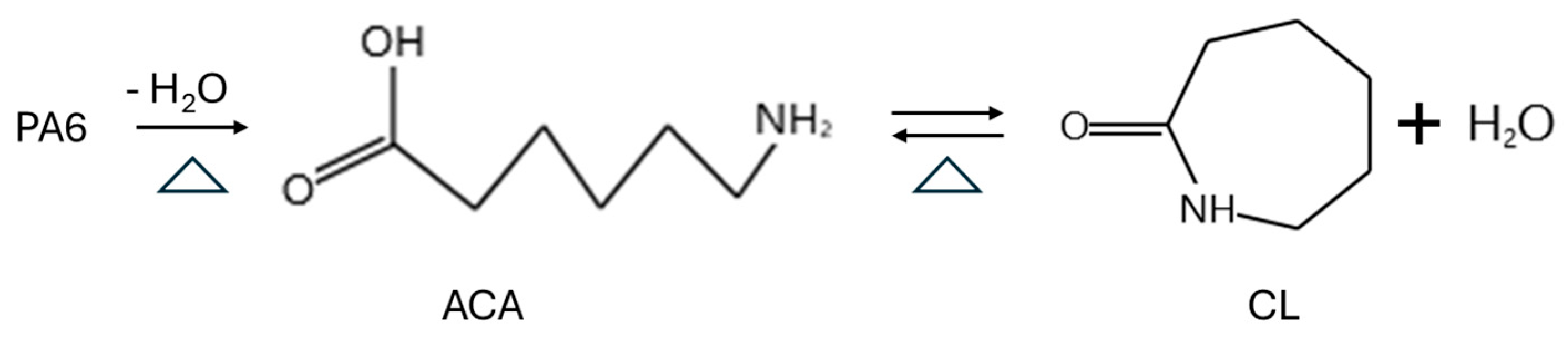
- Feedstock contamination: Recycling streams often contain multiple types of plastics or contaminants like dyes, adhesives, and other additives that complicate the process. Chen et al. presented a green, simple, and cost-effective method for the closed-loop chemical recycling of PA6 to its monomer CL and back to PA6, achieving high yield (88 mol%) and purity (97 mol%). Kinetic and theoretical mechanistic investigations revealed that this alkali-catalyzed depolymerization proceeds via deprotonation of amide groups, followed by intramolecular cyclization to form lactam units, which sequentially drop from the chain end [22].
- (v)
- High energy consumption and greenhouse gas emissions: PA6 production is energy-intensive and depends on fossil fuels. Polymerization of CL emits greenhouse gases that contribute to global warming. Because PA6 can be converted back into its base monomer with high selectivity, chemical recycling is often preferred over general pyrolysis, which tends to produce lower-value decomposition products [21].
- (vi)
- Challenges in recycling: Recycling PA6 is challenging due to its complex structure and contamination in post-consumer products (e.g., textiles blended with other fibers). While mechanical and chemical recycling processes exist, the overall recycling rate remains low, and much of the PA6 waste ends up in landfills. The quality of the recycled material may be lower than that of the original polymer, so it is often used for less demanding applications (such as plastic). This process can be performed with post-industrial materials, such as scrap or processing waste, and post-consumer nylon waste [23].
- (vii)
- Landfill overload: PA6 waste contributes to landfill accumulation, mainly when disposed of as part of non-recycled consumer products like carpets, apparel, and packaging materials. Landfills cannot break down these synthetic polymers, leading to long-term environmental contamination [24].
- (viii)
- Water and soil contamination: PA6 waste that finds its way into the environment can leach chemicals into water sources or soil, posing risks to aquatic ecosystems and soil health. Over time, these contaminants can affect wildlife and human populations throughout the food chain [25].
4. The Common Recycling of PA6
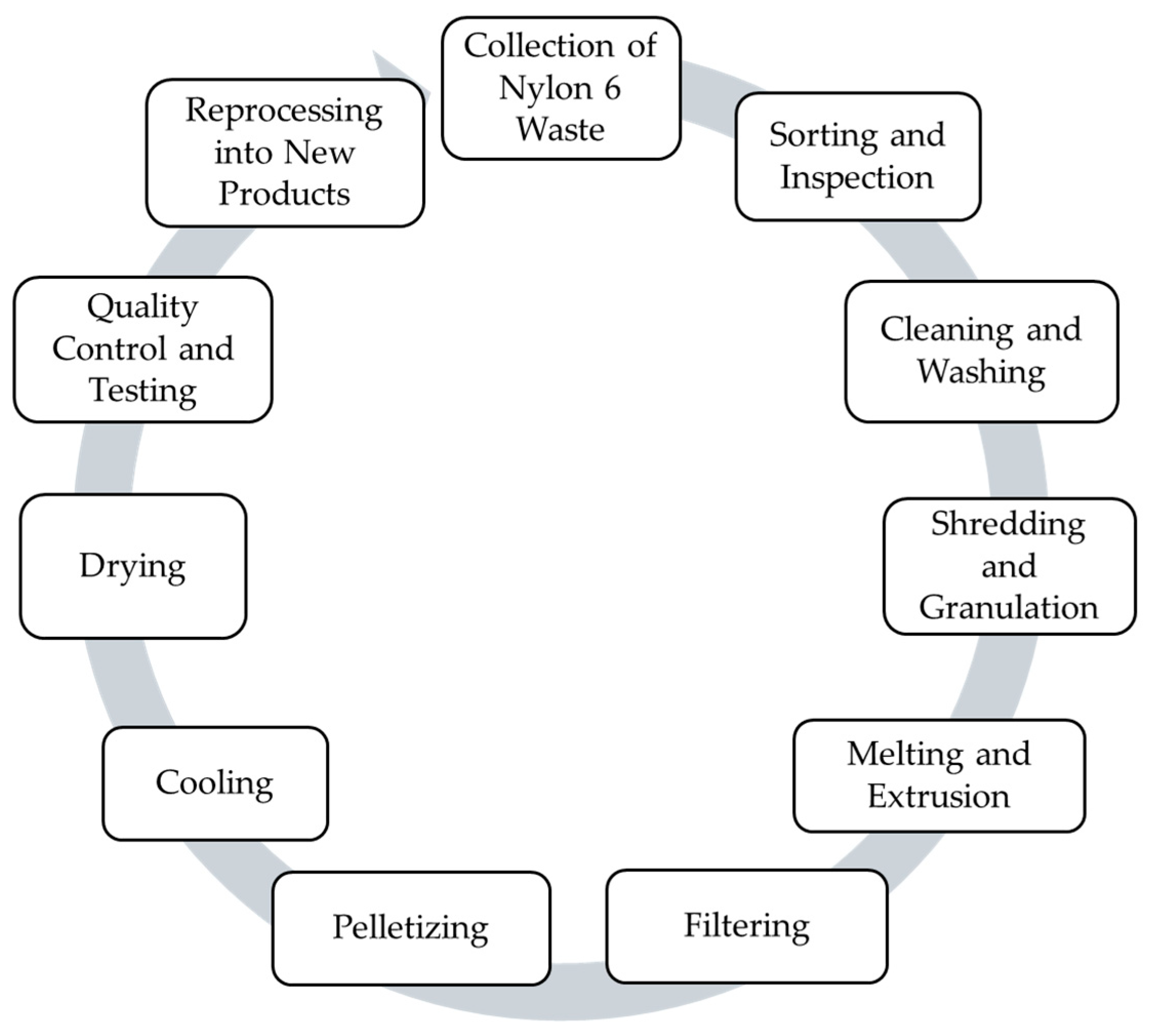
4.1. Mechanical Recycling
- (i)
- Environmental impact: Reduces landfill waste and conserves resources by reusing existing materials.
- (ii)
- Energy Efficiency: Generally, it consumes less energy compared to producing virgin PA6 from raw materials.
- (iii)
- Economic advantages: Can be cost-effective due to lower material costs and potential regulatory incentives.
- (iv)
- Quality degradation: Mechanical recycling may cause some loss in mechanical properties due to thermal degradation.
- (v)
- Contamination: Other plastics or contaminants can affect the quality of recycled PA6.
- (vi)
- Market Demand: The success of recycling efforts depends on the demand for products made from recycled materials.
4.2. Chemical Recycling
4.2.1. Pyrolysis
- (A)
- Thermal degradation kinetics using thermal gravimetric analysis
- (i)
- Kissinger method
- (ii)
- Flynn–Wall–Ozawa method (FWO)
- (iii)
- Kissinger–Akihira–Sunose (KAS)
4.2.2. Glycolysis
4.2.3. Ammonolysis
4.2.4. Hydrolysis
4.2.5. Degradation Kinetics by the Hydrolytic Method
4.2.6. Biological Treatment Practices for CL Waste
4.2.7. Hydrothermal
4.2.8. Monomer Design Strategy
4.2.9. Ionic Liquid
4.2.10. Reactor Design Considerations for PA6 Chemical Recycling
- (i)
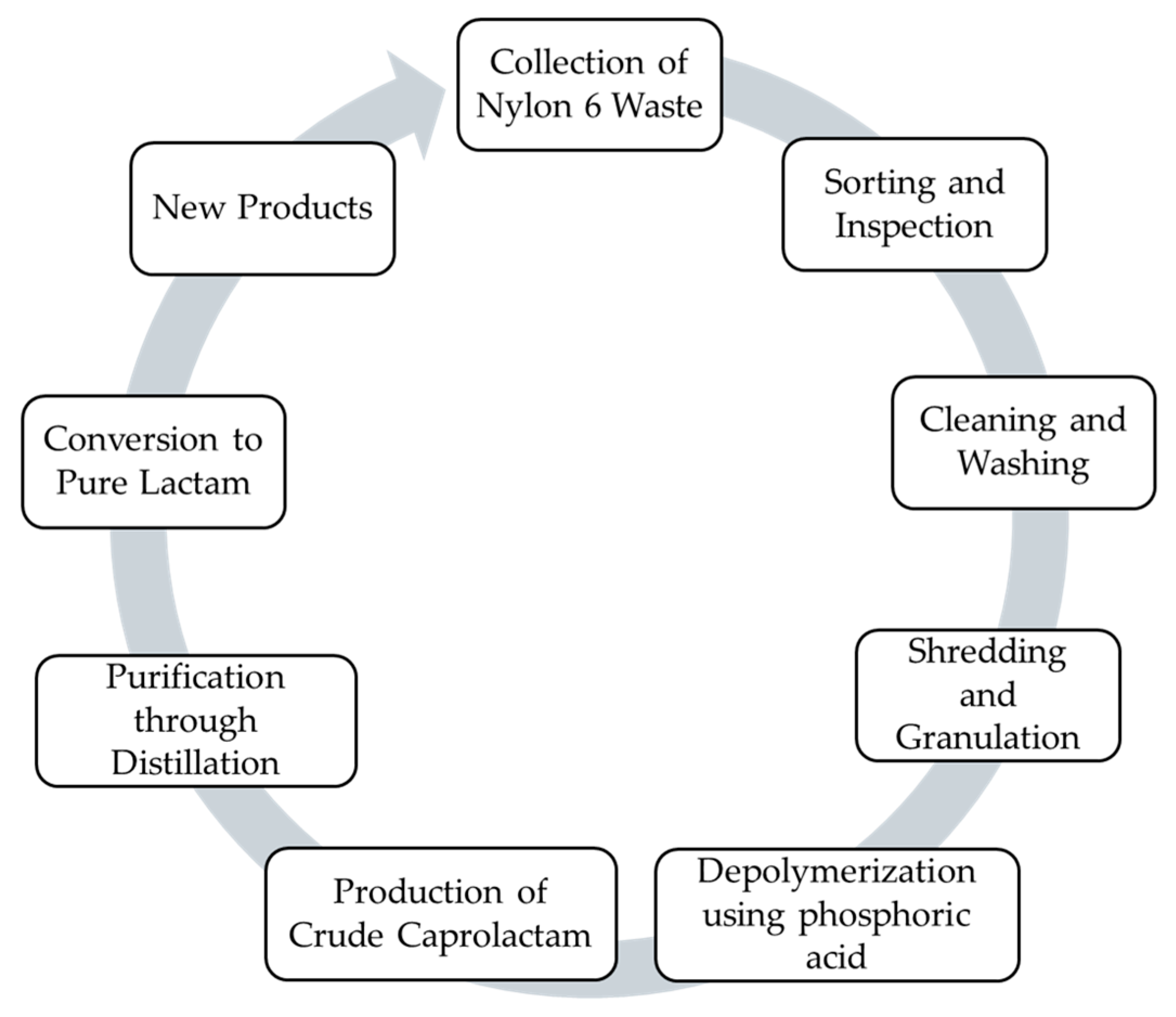
- Continuous Stirred-Tank Reactors (CSTRs) or Baffled Variants. CSTRs operate in liquid-phase hydrolysis at temperatures of 250–330 °C and pressures of 2–20 bar, using excess water (10:1 w/w ratio). They employ mechanical agitation or baffles to maintain a homogeneous molten PA6-water-catalyst slurry. Injecting superheated steam improves mass transfer, breaking amide bonds through acid-catalyzed hydrolysis (e.g., H3PO4 at 5–10 wt%). Applications include industrial-scale processing of pre-separated textile wastes or industrial scrap, where consistent feeding via pumps supports continuous operation. Key advantages are uniform temperature control (±2 °C), which helps prevent hotspots that can degrade oligomers, and high throughput (10–100 t/day). Residence times of 1–4 h can produce 75–96 wt% caprolactam, with recycle streams for water and catalyst decreasing costs by 20–30 wt% compared to batch systems. For technologists, CSTRs are effective at handling variable impurity loads after solvent extraction, as their robust mixing prevents fouling—crucial for achieving >94 wt% yields from mixed PA6 sources. Energy integration through heat recovery from overhead vapors further enhances efficiency, making CSTRs ideal for mid-scale plants [125].
- (ii)
- Fluidized-Bed or Vertical Stripping Reactors. These processes use steam stripping at 260–350 °C and 0.6–1.5 bar, with countercurrent superheated steam (ratios of 2–17:1) to fluidize PA6 particles or melt while stripping water-soluble caprolactam vapor overhead. Vertical designs, such as DSM/Antron’s, incorporate multi-stage trays to promote plug-flow behavior and minimize backmixing. Primary applications target post-carpet or composite wastes, where inorganic fillers (such as glass fibers) pass through as residue. Benefits include over 95 wt% yields with phosphoric acid catalysts, short residence times (0.5–2 h), and the natural volatilization of impurities during stripping—reducing downstream distillation by 15–25 wt%. Fluidization ensures excellent heat and mass transfer (kLa > 0.1 s−1), preventing char formation from flame retardants, while modular stacking scales capacity to over 50 tons per day. Experts value the energy efficiency: steam acts as both reactant and stripping agent, with exergy losses below 40 wt% through integration. Proven in plants from the 1990s recovering 30 kt/year of caprolactam, these reactors are preferred for their robustness and low-maintenance operation on dirty feeds [21].
- (iii)
- Extruder/Pre-Melter + Tubular Reactors. Solvent-free hydrolysis employs twin-screw extruders (220–300 °C, 0.013–2 kPa vacuum) to pre-melt and devolatilize PA6, which then feeds into wiped-film or tubular reactors for thin-film hydrolysis. Lanthanide catalysts (e.g., La-Organic frameworks) speed up reactions under mild conditions. The focus is on producing clean, separated composites or films, enabling small footprints for on-site recycling. Benefits include the fastest kinetics (over 90 wt% conversion in less than 30 min), the lowest energy consumption (50–70 kWh/t compared to over 100 for steam), and minimal water use (<1:1 ratio), reducing effluent by 80 wt%. Wiped-film systems auto-clean and tolerate 1–5 wt% additives without clogging, while overhead vacuum removes impurities such as plasticizers. This method provides over 99 wt% monomer purity directly, eliminating multi-stage distillation, and reduces CAPEX by 30% for plants processing 5–20 tons per day. Emerging pilot projects emphasize modularity for decentralized waste management [21,125].
- (iv)
- Microwave Reactors. Microwave-assisted hydrolysis (150–250 °C, 5–30 min) uses dielectric heating to selectively excite water-PA6 interfaces, increasing rates 5–10 times through hotspots and pressure build-up in sealed vessels. Batch or semi-continuous setups using SiC susceptors handle small-scale (1–10 kg/batch) post-textile waste. These applications are suitable for R&D or specialized recycling of dyed PA6, where rapid energy delivery helps degrade colorants. Benefits include very short processing times (yielding over 92 wt% compared to 4 h with conventional methods) and 40 mol% for catalyst optimization. Unlike convective heating, microwaves penetrate deeply (wavelength ~2.8 cm at 2.45 GHz), enabling uniform depolymerization even in thick feeds. Challenges such as scale-up and hotspot formation are addressed using continuous-flow methods with screw feeders. Technologists benefit from easy integration with pre-separation processes (e.g., glycol dissolution), producing low-oligomer crude (<2 wt%) that simplifies purification [126].
4.3. Techno-Economic and Carbon Intensity Assessment of PA6 Chemical Recycling
4.4. Effect of Additives on PA6 Depolymerization and Caprolactam Purity

| Additive Type | Typical Compounds | Effect on Depolymerization | Impact on CL Selectivity | Impact on Product Purity | Process Implication | Ref. |
|---|---|---|---|---|---|---|
| Thermal stabilizers | Hindered phenols, phosphites | Radical scavenging inhibits chain scission, especially in thermal processes | Slight decrease | Minor organic residues | Slower kinetics; residue accumulation | [132,133] |
| Flame retardants (halogenated) | Brominated FRs | Decomposes to halogenated volatiles during pyrolysis | Moderate decrease | Significant contamination (toxic/halogenated species) | Requires gas scrubbing and advanced purification | [9,134,135] |
| Flame retardants (inorganic) | Al(OH)3, Mg(OH)2 | Remain as solid residues; alter heat transfer | Minimal | Low (solid-phase impurities) | Reactor fouling; filtration required | [136] |
| Plasticizers/low-MW additives | Phthalates, adipates | Volatilize or dissolve; may co-distill with CL | Slight decrease | Moderate contamination | Increased separation load (distillation) | [137] |
| Dyes/pigments | Organic dyes, metal-complex pigments | Mostly inert; possible decomposition or metal release | Negligible | Trace metals/color impurities | Requires adsorption or ion-exchange polishing | [138] |
| Fillers/reinforcements | Glass fibers, CaCO3 | Inert; affects mixing and heat transfer | None | Low (solid separation needed) | Mechanical separation and filtration are required | [139] |
4.5. Decision Framework for PA6 Recycling Pathway Selection
5. Conclusions
Author Contributions
Funding
Institutional Review Board Statement
Informed Consent Statement
Data Availability Statement
Acknowledgments
Conflicts of Interest
Abbreviations
| ACA | 6-Aminocaproic acid |
| CL | Caprolactam |
| CAPEX | Capital expenditure |
| Ea | Activation energy |
| HPA | Phosphotungstic heteropoly acid |
| PTC | Phase-transfer catalyst |
References
- Hirschberg, V.; Rodrigue, D. Recycling of polyamides: Processes and conditions. J. Polym. Sci. 2023, 61, 1937–1958. [Google Scholar] [CrossRef]
- Tonsi, G.; Maesani, C.; Alini, S.; Ortenzi, M.A.; Pirola, C. Nylon recycling processes: A brief overview. Chem. Eng. Trans. 2023, 100, 727–732. [Google Scholar]
- Bormann, A.; Albrecht, M.; Samlitschka, F. Process for the Recovery of ε-Caprolactam from Extract Water. U.S. Patent 9562008B2, 7 February 2017. [Google Scholar]
- Damayanti, D.; Wulandari, L.A.; Bagaskoro, A.; Rianjanu, A.; Wu, H.S. Possibility Routes for Textile Recycling Technology. Polymer 2021, 13, 3834. [Google Scholar] [CrossRef]
- Hay, J.N.; Booth, A. The effect of a secondary process on the course of polymer crystallisation. Br. Polym. J. 1972, 4, 19–26. [Google Scholar] [CrossRef]
- Reimschuessel, H.K. Nylon 6. Chemistry and mechanisms. J. Polym. Sci. Macromol. Rev. 1977, 12, 65–139. [Google Scholar] [CrossRef]
- Zhang, S.; Wu, Y.; Ji, P.; Ran, Q.; Wang, H.; Chen, B.; Wang, C. Sustainable Production of Polyamide 6 Fibers: Direct Melt Spinning and Efficient Reuse of Residual Oligomers during Polymerization. ACS Sustain. Chem. Eng. 2023, 11, 3789–3800. [Google Scholar] [CrossRef]
- Schyns, Z.O.G.; Shaver, M.P. Mechanical Recycling of Packaging Plastics: A Review. Macromol. Rapid Commun. 2021, 42, 2000415. [Google Scholar] [CrossRef]
- Dogu, O.; Pelucchi, M.; Van de Vijver, R.; Van Steenberge, P.H.M.; D’Hooge, D.R.; Cuoci, A.; Mehl, M.; Frassoldati, A.; Faravelli, T.; Van Geem, K.M. The chemistry of chemical recycling of solid plastic waste via pyrolysis and gasification: State-of-the-art, challenges, and future directions. Prog. Energy Combust. Sci. 2021, 84, 100901. [Google Scholar] [CrossRef]
- Feng, Y.; Quan, X.; Wang, Q.; Zhang, Y.; Liu, C.; Yuan, X.; Zhao, S.; Yang, J.; He, W.; Guo, K. Recent Advances in the Chemical Recycling of Polyamide for a Sustainable Circular Economy. Ind. Eng. Chem. Res. 2025, 64, 2516–2530. [Google Scholar] [CrossRef]
- Minor, A.-J.; Goldhahn, R.; Rihko-Struckmann, L.; Sundmacher, K. Chemical Recycling Processes of Nylon 6 to Caprolactam: Review and Techno-Economic Assessment. Chem. Eng. J. 2023, 474, 145333. [Google Scholar] [CrossRef]
- Clark, R.A.; Shaver, M.P. Depolymerization within a Circular Plastics System. Chem. Rev. 2024, 124, 2617–2650. [Google Scholar] [CrossRef]
- Bäckström, E.; Odelius, K.; Hakkarainen, M. Microwave Assisted Selective Hydrolysis of Polyamides from Multicomponent Carpet Waste. Glob. Chall. 2021, 5, 2000119. [Google Scholar] [CrossRef]
- Pristiani, M.; Damayanti, D.; Wu, H.-S. Microwave-Assisted Acid Hydrolysis of PA6 Wastes in PA6 Process: Kinetics, Activation Energies, and Monomer Recovery. Processes 2025, 13, 3175. [Google Scholar] [CrossRef]
- Barr, M.L.; Cai, H.; Esposito, A.; Freundlich, J.; King, D.W.; Mendolia, M.; Moghe, B.; Petroff, L.J.; Schamper, T.; Skinner, M.W. Cosmetic Composition Containing Siloxane-Based Polyamides as Thickening Agents. U.S. Patent No. 6353076 B1, 5 March 2002. [Google Scholar]
- McDevitt, M.R.; Chattopadhyay, D.; Jaggi, J.S.; Finn, R.D.; Zanzonico, P.B.; Villa, C.; Rey, D.; Mendenhall, J.; Batt, C.A.; Njardarson, J.T.; et al. PET Imaging of Soluble Yttrium-86-Labeled Carbon Nanotubes in Mice. PLoS ONE 2007, 2, e907. [Google Scholar] [CrossRef] [PubMed]
- Hosoda, S.; Uemura, A. Effect of the Structural Distribution on the Mechanical Properties of Linear Low-Density Polyethylenes. Polym. J. 1992, 24, 939–949. [Google Scholar] [CrossRef]
- Le, K. Textile recycling technologies, colouring and finishing methods. Solid Waste Serv. Vancoover 2018, 23–50. [Google Scholar]
- Ajith, N.; Arumugam, S.; Parthasarathy, S.; Manupoori, S.; Janakiraman, S. Global distribution of microplastics and its impact on marine environment—A review. Environ. Sci. Pollut. Res. 2020, 27, 25970–25986. [Google Scholar] [CrossRef]
- O’Brine, T.; Thompson, R.C. Degradation of plastic carrier bags in the marine environment. Mar. Pollut. Bull. 2010, 60, 2279–2283. [Google Scholar] [CrossRef]
- McNeeley, A.; Liu, Y.A. Assessment of Nylon-6 Depolymerization for Circular Economy: Kinetic Modeling, Purification, Sustainable Process Design, and Industrial Practice. Ind. Eng. Chem. Res. 2024, 63, 16953–16989. [Google Scholar] [CrossRef]
- Chen, X.-H.; Wu, G.; Chen, S.-C.; Wang, Y.-Z. Facile, high-efficiency, and low-cost depolymerization of PA6 to ϵ-caprolactam enables closed-loop chemical recycling. Polymer 2023, 283, 126201. [Google Scholar] [CrossRef]
- Ndagano, U.N.; Cahill, L.; Smullen, C.; Gaughran, J.; Kelleher, S.M. The Current State-of-the-Art of the Processes Involved in the Chemical Recycling of Textile Waste. Molecules 2025, 30, 299. [Google Scholar] [CrossRef]
- Andrady, A.L. Chapter 3. Persistence of plastic litter in the oceans. In Marine Anthropogenic Litter; Springer International Publishing: Cham, Switzerland, 2015; pp. 57–72. [Google Scholar]
- Browne, M.A.; Crump, P.; Niven, S.J.; Teuten, E.; Tonkin, A.; Galloway, T.; Thompson, R. Accumulation of microplastic on shorelines woldwide: Sources and sinks. Environ. Sci. Technol. 2011, 45, 9175–9179. [Google Scholar] [CrossRef] [PubMed]
- Damayanti, D.; Saputri, D.R.; Marpaung, D.S.S.; Yusupandi, F.; Sanjaya, A.; Simbolon, Y.M.; Asmarani, W.; Ulfa, M.; Wu, H.-S. Current Prospects for Plastic Waste Treatment. Polymers 2022, 14, 3133. [Google Scholar] [CrossRef]
- Damayanti; Wu, H.S. Strategic Possibility Routes of Recycled PET. Polymer 2021, 13, 1475. [Google Scholar] [CrossRef]
- CorbinAlan, T.F.; Handermann, C.; Kotek, R.; Porter, W.D.; Dellinger, J.A.; Davis, E.A. Reclaiming Epsilon-Caprolactam from Nylon 6 Carpet. U.S. Patent No 5,977,193, 2 November 1999. [Google Scholar]
- Mihut, C.; Captain, D.K.; Gadala-Maria, F.; Amiridis, M.D. Review: Recycling of nylon from carpet waste. Polym. Eng. Sci. 2004, 41, 1457–1470. [Google Scholar] [CrossRef]
- Eimontas, J.; Yousef, S.; Striūgas, N.; Abdelnaby, M.A. Catalytic pyrolysis kinetic behaviour and TG-FTIR-GC–MS analysis of waste fishing nets over ZSM-5 zeolite catalyst for caprolactam recovery. Renew. Energy 2021, 179, 1385–1403. [Google Scholar] [CrossRef]
- Skvorčinskienė, R.; Striūgas, N.; Navakas, R.; Paulauskas, R.; Zakarauskas, K.; Vorotinskienė, L. Thermal Analysis of Waste Fishing Nets for Polymer Recovery. Waste Biomass Valorization 2019, 10, 3735–3744. [Google Scholar] [CrossRef]
- Ackermann, Y.S.; Li, W.-J.; Op de Hipt, L.; Niehoff, P.-J.; Casey, W.; Polen, T.; Köbbing, S.; Ballerstedt, H.; Wynands, B.; O’Connor, K.; et al. Engineering adipic acid metabolism in Pseudomonas putida. Metab. Eng. 2021, 67, 29–40. [Google Scholar] [CrossRef]
- Ragaert, K.; Delva, L.; Van Geem, K. Mechanical and chemical recycling of solid plastic waste. Waste Manag. 2017, 69, 24–58. [Google Scholar] [CrossRef]
- Hu, K.; Tian, W.; Yang, Y.; Nie, G.; Zhou, P.; Wang, Y.; Duan, X.; Wang, S. Microplastics remediation in aqueous systems: Strategies and technologies. Water Res. 2021, 198, 117144. [Google Scholar] [CrossRef]
- Zheng, L.; Wang, M.; Li, Y.; Xiong, Y.; Wu, C. Recycling and Degradation of Polyamides. Molecules 2024, 29, 1742. [Google Scholar] [CrossRef]
- Zhao, Y.-B.; Lv, X.-D.; Ni, H.-G. Solvent-based separation and recycling of waste plastics: A review. Chemosphere 2018, 209, 707–720. [Google Scholar] [CrossRef] [PubMed]
- Fan, S.-P.; Zakaria, S.; Chia, C.-H.; Jamaluddin, F.; Nabihah, S.; Liew, T.-K.; Pua, F.-L. Comparative studies of products obtained from solvolysis liquefaction of oil palm empty fruit bunch fibres using different solvents. Bioresour. Technol. 2011, 102, 3521–3526. [Google Scholar] [CrossRef]
- Iwaya, T.; Sasaki, M.; Goto, M. Kinetic analysis for hydrothermal depolymerization of nylon 6. Polym. Degrad. Stab. 2006, 91, 1989–1995. [Google Scholar] [CrossRef]
- Silge, J.; Robinson, D. tidytext: Text mining and analysis using tidy data principles in R. J. Open Source Softw. 2016, 1, 37. [Google Scholar] [CrossRef]
- Ye, L.; Liu, X.; Beckett, K.B.; Rothbaum, J.O.; Lincoln, C.; Broadbelt, L.J.; Kratish, Y.; Marks, T.J. Catalyst metal-ligand design for rapid, selective, and solventless depolymerization of Nylon-6 plastics. Chem 2024, 10, 172–189. [Google Scholar] [CrossRef]
- Al-Salem, S.M. 3—Energy Production From Plastic Solid Waste (PSW). In Plastics to Energy; Al-Salem, S.M., Ed.; William Andrew Publishing: Norwich, NY, USA, 2019; pp. 45–64. [Google Scholar]
- Chen, H.; Wan, K.; Zhang, Y.; Wang, Y. Waste to Wealth: Chemical Recycling and Chemical Upcycling of Waste Plastics for a Great Future. ChemSusChem 2021, 14, 4123–4136. [Google Scholar] [CrossRef]
- Chen, J.; Liu, G.; Jin, L.; Ni, P.; Li, Z.; He, H.; Xu, Y.; Zhang, J.; Dong, J. Catalytic hydrolysis of waste nylon 6 to produce ɛ-caprolactam in sub-critical water. J. Anal. Appl. Pyrolysis 2010, 87, 50–55. [Google Scholar] [CrossRef]
- Kumar, A.; von Wolff, N.; Rauch, M.; Zou, Y.-Q.; Shmul, G.; Ben-David, Y.; Leitus, G.; Avram, L.; Milstein, D. Hydrogenative Depolymerization of Nylons. J. Am. Chem. Soc. 2020, 142, 14267–14275. [Google Scholar] [CrossRef]
- Kim, S.; Lee, N.; Lee, J. Pyrolysis for Nylon 6 Monomer Recovery from Teabag Waste. Polymers 2020, 12, 2695. [Google Scholar] [CrossRef]
- Kamimura, A.; Yamamoto, S. An Efficient Method To Depolymerize Polyamide Plastics: A New Use of Ionic Liquids. Org. Lett. 2007, 9, 2533–2535. [Google Scholar] [CrossRef]
- Yuan, X.-X.; Zhou, Q.; Li, X.-Y.; Yang, P.; Yang, K.-K.; Wang, Y.-Z. Degradation of nylon 6 to produce a “pseudo” amino acid ionic liquid. Polym. Degrad. Stab. 2014, 109, 171–174. [Google Scholar] [CrossRef]
- Shukla, S.R.; Harad, A.M.; Mahato, D. Depolymerization of nylon 6 waste fibers. J. Appl. Polym. Sci. 2006, 100, 186–190. [Google Scholar] [CrossRef]
- Wang, W.; Meng, L.; Leng, K.; Huang, Y. Hydrolysis of waste monomer casting nylon catalyzed by solid acids. Polym. Degrad. Stab. 2017, 136, 112–120. [Google Scholar] [CrossRef]
- Khuntia, S.P.; Gadgeel, A.; Mestry, S.; Mhaske, S.T. Organo-sulfonic acid catalyzed degradation kinetics and thermodynamic studies of nylon-6 by hydrothermal method. Polym. Adv. Technol. 2022, 33, 411–426. [Google Scholar] [CrossRef]
- Wu, Y.-H.; Wu, M.-L.; Lin, C.-C.; Chu, W.-L.; Yang, C.-C.; Lin, R.T.; Deng, J.-F. Determination of caprolactam and 6-aminocaproic acid in human urine using hydrophilic interaction liquid chromatography-tandem mass spectrometry. J. Chromatogr. B 2012, 885–886, 61–65. [Google Scholar] [CrossRef]
- Fuchs, H.; Neubauer, G.; Ritz, J.; Priester, C.-U. Recovery of Caprolactam from Polycaprolactam. U.S. Patent 5359062A, 25 October 1994. [Google Scholar]
- Kembłowski, Z.; Torzecki, J. Determination of the weight-average molecular weight of polyamide-6 on the basis of melt viscosity. Rheol. Acta 1983, 22, 186–196. [Google Scholar] [CrossRef]
- Wang, R.; Liu, X.; Meng, C.; Wu, Y.; Zeng, C.; Zhang, S.; Ji, P.; Wang, C.; Wang, H. Highly efficient de-volatilization of PA6 melt before spinning, enabling oligomer content control and direct melt spinning. Polymer 2025, 323, 128173. [Google Scholar] [CrossRef]
- Mark, J.E. Polymer Data Handbook; Oxford University Press: New York, NY, USA, 1999. [Google Scholar]
- ASTM D2074-07; Standard Test Methods for Total, Primary, Secondary, and Tertiary Amine Values of Fatty Amines by Alternative Indicator Method. ASTM International: West Conshohocken, PA, USA, 2019. Available online: https://www.astm.org/d2074-07r19.html (accessed on 1 January 2025).
- Kulkarni, R.S.; Kanekar, P.P. Bioremediation of ε-Caprolactam from Nylon-6 Waste Water by Use of Pseudomonas aeruginosa MCM B-407. Curr. Microbiol. 1998, 37, 191–194. [Google Scholar] [CrossRef] [PubMed]
- Žagar, E.; Češarek, U.; Drinčić, A.; Sitar, S.; Shlyapnikov, I.M.; Pahovnik, D. Quantitative Determination of PA6 and/or PA66 Content in Polyamide-Containing Wastes. ACS Sustain. Chem. Eng. 2020, 8, 11818–11826. [Google Scholar] [CrossRef]
- Aquafil, S.p.A. ECONYL® Regeneration System: Closing the Loop for Nylon 6. Sustain. Rep. 2022. Available online: https://www.aquafil.com (accessed on 26 March 2026).
- DOMO Chemicals GmbH. Chemically Recycled PA6. Sustain. Rep. 2024. Available online: https://www.domochemicals.com (accessed on 26 March 2026).
- BASF SE. From Plastic Waste to Virgin-Grade Products. ChemCyclingTM Proj. 2021. Available online: https://www.basf.com (accessed on 26 March 2026).
- Toray Industries, Inc.; Honda Motor Co., Ltd. Honda and Toray Begin Joint Demonstration of Closed-loop Recycling of Nylon Resin. News Release, 19 September 2023. Available online: https://www.toray.com (accessed on 26 March 2026).
- RadiciGroup S.p.A. RENYCLE® Let’s Write a New Sustainable Story. Available online: https://www.radicigroup.com/en/products/plastics/sustainable-engineering-polymers-renycle (accessed on 26 March 2026).
- Williams, P.T.; Slaney, E. Analysis of products from the pyrolysis and liquefaction of single plastics and waste plastic mixtures. Resour. Conserv. Recycl. 2007, 51, 754–769. [Google Scholar] [CrossRef]
- Quartey, E.T.; Tosefa, H.; Danquah, K.A.B.; Obrsalova, I. Theoretical Framework for Plastic Waste Management in Ghana through Extended Producer Responsibility: Case of Sachet Water Waste. Int. J. Environ. Res. Public Health 2015, 12, 9907–9919. [Google Scholar] [CrossRef]
- Badia, J.; Ribes-Greus, A. Mechanical recycling of polylactide, upgrading trends and combination of valorization techniques. Eur. Polym. J. 2016, 84, 22–39. [Google Scholar] [CrossRef]
- Morales, J.; Rodrigue, D. The Effect of Reprocessing and Moisture on Polyamide Recycling: A Focus on Neat, Composites, and Blends. Macromol. Mater. Eng. 2024, 310, 2400304. [Google Scholar] [CrossRef]
- Liu, X.; Bertilsson, H. Recycling of ABS and ABS/PC blends. J. Appl. Polym. Sci. 1999, 74, 510–515. [Google Scholar] [CrossRef]
- Abdelwahab, M.A.; Chang, B.P.; Mohanty, A.K.; Misra, M. Waste valorization in sustainable engineering materials: Reactive processing of recycled carpets waste with polyamide 6. Polym. Test. 2022, 114, 107681. [Google Scholar] [CrossRef]
- Ellis, L.D.; Rorrer, N.A.; Sullivan, K.P.; Otto, M.; McGeehan, J.E.; Román-Leshkov, Y.; Wierckx, N.; Beckham, G.T. Chemical and biological catalysis for plastics recycling and upcycling. Nat. Catal. 2021, 4, 539–556. [Google Scholar] [CrossRef]
- Georgiopoulou, I.; Pappa, G.D.; Vouyiouka, S.N.; Magoulas, K. Recycling of post-consumer multilayer Tetra Pak® packaging with the Selective Dissolution-Precipitation process. Resour. Conserv. Recycl. 2021, 165, 105268. [Google Scholar] [CrossRef]
- Wan, Z.; Huang, Y.; Xiang, L.; Zhao, J.; Song, Z.; Feng, H.; Zhang, S.; Wu, C. Molecular Insights into Hydrolysis, Alcoholysis, Ammonolysis, and Acidolysis of Polyamide 6. J. Phys. Chem. A 2025, 129, 7345–7351. [Google Scholar] [CrossRef] [PubMed]
- Jagodzińska, K.; Yang, W.; Jönsson, P.G.; Forsgren, C. Can torrefaction be a suitable method of enhancing shredder fines recycling? Waste Manag. 2021, 128, 211–220. [Google Scholar] [CrossRef] [PubMed]
- Bockhorn, H.; Donner, S.; Gernsbeck, M.; Hornung, A.; Hornung, U. Pyrolysis of polyamide 6 under catalytic conditions and its application to reutilization of carpets. J. Anal. Appl. Pyrolysis 2001, 58–59, 79–94. [Google Scholar] [CrossRef]
- Nikje, M.M.A.; Nikrah, M. Chemical Recycling and Liquefaction of Rigid Polyurethane Foam Wastes through Microwave Assisted Glycolysis Process. J. Macromol. Sci. Part A 2007, 44, 613–617. [Google Scholar] [CrossRef]
- Mukherjee, A.; Goel, D. Depolymerization of poly-ϵ-caprolactam catalyzed by sodium hydroxide. J. Appl. Polym. Sci. 1978, 22, 361–368. [Google Scholar] [CrossRef]
- Czernik, S.; Elam, C.C.; Evans, R.J.; Meglen, R.R.; Moens, L.; Tatsumoto, K. Catalytic pyrolysis of nylon-6 to recover caprolactam. J. Anal. Appl. Pyrolysis 1998, 46, 51–64. [Google Scholar] [CrossRef]
- Bryson, L.G. Monomer Recovery from Nylon Carpets via Reactive Extrusion. Ph.D. Thesis, School of Chemical & Biomolecular Engineering, Georgia Institute of Technology, Atlanta, GA, USA, 2008. [Google Scholar]
- Yang, W.; Jung, S.; Lee, J.; Lee, S.W.; Kim, Y.T.; Kwon, E.E. Selective recovery of caprolactam from the thermo-catalytic conversion of textile waste over γ-Al2O3 supported metal catalysts. Environ. Pollut. 2023, 329, 121684. [Google Scholar] [CrossRef]
- Pashaei, S.; Avval, M.M.; Syed, A.A. Thermal degradation kinetics of nylon6/GF/crysnano nanoclay nanocomposites by TGA. Chem. Ind. Chem. Eng. Q. CICEQ 2011, 17, 141–151. [Google Scholar] [CrossRef]
- Khedri, S.; Elyasi, S. Kinetic analysis for thermal cracking of HDPE: A new isoconversional approach. Polym. Degrad. Stab. 2016, 129, 306–318. [Google Scholar] [CrossRef]
- Herrera, M.; Matuschek, G.; Kettrup, A. Main products and kinetics of the thermal degradation of polyamides. Chemosphere 2001, 42, 601–607. [Google Scholar] [CrossRef] [PubMed]
- Hu, S.; Jess, A.; Xu, M. Kinetic study of Chinese biomass slow pyrolysis: Comparison of different kinetic models. Fuel 2007, 86, 2778–2788. [Google Scholar] [CrossRef]
- Slopiecka, K.; Bartocci, P.; Fantozzi, F. Thermogravimetric analysis and kinetic study of poplar wood pyrolysis. Appl. Energy 2012, 97, 491–497. [Google Scholar] [CrossRef]
- Lim, A.C.R.; Chin, B.L.F.; Jawad, Z.A.; Hii, K.L. Kinetic analysis of rice husk pyrolysis using Kissinger-Akahira-Sunose (KAS) method. Procedia Eng. 2016, 148, 1247–1251. [Google Scholar] [CrossRef]
- Eimontas, J.; Striūgas, N.; Abdelnaby, M.A.; Yousef, S. Catalytic Pyrolysis Kinetic Behavior and TG-FTIR-GC–MS Analysis of Metallized Food Packaging Plastics with Different Concentrations of ZSM-5 Zeolite Catalyst. Polymers 2021, 13, 702. [Google Scholar] [CrossRef]
- Pannase, A.M.; Singh, R.K.; Ruj, B.; Gupta, P. Decomposition of polyamide via slow pyrolysis: Effect of heating rate and operating temperature on product yield and composition. J. Anal. Appl. Pyrolysis 2020, 151, 104886. [Google Scholar] [CrossRef]
- Huczkowski, P.; Kapko, J.; Olesiak, R. Degradation of nylon-6 in ethylene glycol. Polymer 1978, 19, 77–80. [Google Scholar] [CrossRef]
- Hommez, B.; Goethals, E.J. Degradation of Nylon-6 By Glycolysis. Part 1: Identification of Degradation Products. J. Macromol. Sci. Part A 1998, 35, 1489–1505. [Google Scholar] [CrossRef]
- Huczkowski, P.; Kapko, J. Degradation of nylon-6 in ethylene glycol: 2. Mathematical illustration of degradation. Polymer 1980, 21, 86–88. [Google Scholar] [CrossRef]
- Lan, J.; Deng, C.; Zhao, Z.-Y.; Wang, Y.-Z. An upcycling strategy for polyamide 6: Preparing thermoplastic polyamide elastomers from glycolysates produced by controlled degradation. Green Chem. 2025, 27, 1183–1193. [Google Scholar] [CrossRef]
- Kumar, P.; Go, J.; Letteri, R.; Saito, T.; Davis, R.J. Novel insight into the kinetics of amide bond glycolysis for Nylon-6 depolymerization. Chem. Eng. J. 2026, 531, 173794. [Google Scholar] [CrossRef]
- Telli, A.; Özdil, N. Effect of Recycled PET Fibers on the Performance Properties of Knitted Fabrics. J. Eng. Fibers Fabr. 2015, 10, 155892501501000206. [Google Scholar] [CrossRef]
- Brodrero, S. Chemical recycling of polyamide 6, 6 and polyamide 6 through a two step AMI-/ammonolysis process. In Proceedings of the 4th Annual Conference on Recycling of Fibrous Textile and Carpet Waste, Dalton, Georgia, 17–18 May 1999. [Google Scholar]
- Wang, Y.; Zhang, Y.; Polk, M.; Kumar, S.; Muzzy, J. Recycling of carpet and textile fibers. Plast. Environ. 2003, 1, 697–725. [Google Scholar]
- Coeck, R.; De Bruyne, A.; Borremans, T.; Stuyck, W.; De Vos, D.E. Ammonolytic Hydrogenation of Secondary Amides: An Efficient Method for the Recycling of Long-Chain Polyamides. ACS Sustain. Chem. Eng. 2022, 10, 3048–3056. [Google Scholar] [CrossRef]
- Kalfas, G.A. Mathematical Modeling of the Depolymerization of Polyamide Mixtures—Part I: Kinetic Mechanism and Parametric Studies in Batch Reactors. Polym. React. Eng. 1998, 6, 41–67. [Google Scholar] [CrossRef]
- Brette, M.M.; Holm, A.H.; Drozdov, A.D.; Christiansen, J.d.C. Pure Hydrolysis of Polyamides: A Comparative Study. Chemistry 2024, 6, 13–50. [Google Scholar] [CrossRef]
- Hernández, A.R.; Contreras, O.C.; Acevedo, J.C.; Navarro Moreno, L.G. Poly(ε-caprolactone) Degradation Under Acidic and Alkaline Conditions. Am. J. Polym. Sci. 2013, 3, 70–75. [Google Scholar]
- Braun, M.; Levy, A.; Sifniades, S. Recycling nylon 6 carpet to caprolactam. Polym.-Plast. Technol. Eng. 1999, 38, 471–484. [Google Scholar] [CrossRef]
- Jenczewski, T.J.; Crescentini, L.; Mayer, R.E. Monomer Recovery from Multi-Component Materials. U.S. Patent 5656757A, 12 August 1997. [Google Scholar]
- Moran, E.F., Jr.; McKinney, R.J. Conversion of Nylon 6 and/or Nylon 6, 6 to Adipic Acid. U.S. Patent 5468900A, 21 November 1995. [Google Scholar]
- Gama, N.; Araújo, J.; Godinho, B.; Ferreira, A.; Barros-Timmons, A. Solvolysis of Nylon: A Pathway to Sustainable Recycling and Circular Economy. Sustainability 2024, 16, 9725. [Google Scholar] [CrossRef]
- Zhang, H.; Zhao, Y.; Wang, Y.; Li, R.; Tang, M.; Zeng, W.; Wang, Y.; Chang, X.; Han, B.; Liu, Z. Valorization of polycaprolactone for the production of nylon-6 monomers. Green Chem. 2024, 26, 3159–3164. [Google Scholar] [CrossRef]
- Pope, S.; Wæraas, A. CSR-washing is rare: A conceptual framework, literature review, and critique. J. Bus. Ethics 2016, 137, 173–193. [Google Scholar] [CrossRef]
- Khawam, A.; Flanagan, D.R. Basics and applications of solid-state kinetics: A pharmaceutical perspective. J. Pharm. Sci. 2006, 95, 472–498. [Google Scholar] [CrossRef]
- Price, D.M.; Hourston, D.J.; Dumont, F. Thermogravimetry of polymers. In Encyclopedia of Analytical Chemistry; Meyers, R.A., Ed.; John Wiley & Sons Ltd: Chichester, UK, 2000; pp. 8094–8105. [Google Scholar]
- Beyler, C.L.; Hirschler, M.M. Thermal decomposition of polymers. In SFPE Handbook of Fire Protection Engineering; National Fire Protection Association: Quincy, MA, USA, 2002; Volume 2, pp. 111–131. [Google Scholar]
- Klun, U.; Kržan, A. Rapid microwave induced depolymerization of polyamide-6. Polymer 2000, 41, 4361–4365. [Google Scholar] [CrossRef]
- Ludlow-Palafox, C.; Chase, H.A. Microwave-Induced Pyrolysis of Plastic Wastes. Ind. Eng. Chem. Res. 2001, 40, 4749–4756. [Google Scholar] [CrossRef]
- Chen, H.; Yang, R.; Dong, B.; Sun, H.; Xu, G.; Wang, Q. Closed-loop recycling of Nylon-6 to Caprolactam catalyzed by a green and effective phosphazene base. J. Polym. Sci. 2024, 62, 5609–5617. [Google Scholar] [CrossRef]
- Dellinger, J.A. Constant Composition Recycle of Nylon 6 Polymerization Wash Water. U.S. Patent No. 5,218,080, 8 June 1993. [Google Scholar]
- Damayanti, D.; Marpaung, D.S.S.; Kodarif, A.R.; Sanjaya, A.; Saputri, D.R.; Fahni, Y.; Rahmiyati, L.; Silvia, P.Z.; A’Yuni, D.Q.; Imalia, C.L.; et al. Biocatalytic Recycling of Polyethylene Terephthalate: From Conventional to Innovative Routes for Transforming Plastic and Textile Waste into Renewable Resources. Resources 2025, 14, 176. [Google Scholar] [CrossRef]
- Friedrich, J.; Zalar, P.; Mohorčič, M.; Klun, U.; Kržan, A. Ability of fungi to degrade synthetic polymer nylon-6. Chemosphere 2007, 67, 2089–2095. [Google Scholar] [CrossRef] [PubMed]
- Bell, E.L.; Rosetto, G.; Ingraham, M.A.; Ramirez, K.J.; Lincoln, C.; Clarke, R.W.; Gado, J.E.; Lilly, J.L.; Kucharzyk, K.H.; Erickson, E.; et al. Natural diversity screening, assay development, and characterization of nylon-6 enzymatic depolymerization. Nat. Commun. 2024, 15, 1217. [Google Scholar] [CrossRef] [PubMed]
- Turk, S.C.; Kloosterman, W.P.; Ninaber, D.K.; Kolen, K.P.; Knutova, J.; Suir, E.; Schürmann, M.; Raemakers-Franken, P.C.; Müller, M.; de Wildeman, S.M.; et al. Metabolic Engineering toward Sustainable Production of Nylon-6. ACS Synth. Biol. 2016, 5, 65–73. [Google Scholar] [CrossRef]
- Meng, C.; Wu, Y.; Wang, R.; Zhang, S.; Ji, P.; Wang, C.; Wang, H. Efficient hydrolytic recycling of PA6 supported by kinetic modeling. Polym. Degrad. Stab. 2025, 233, 111178. [Google Scholar] [CrossRef]
- Zhang, Y.; Zhan, L.; Xu, Z. Closed-Loop Upcycling of Waste Nylon Plastic under Hydrothermal Clean Water Atmosphere. Environ. Sci. Technol. 2024, 59, 935–944. [Google Scholar] [CrossRef] [PubMed]
- dos Passos, J.S.; Skibsted, S.K.G.; Biller, P. Enhancing Recycling of Polyamide 6 and Polyethylene Multilayer Plastics through Sequential Hydrothermal Liquefaction. Energy Fuels 2025, 39, 571–576. [Google Scholar] [CrossRef]
- Cheung, E.; Alberti, C.; Bycinskij, S.; Enthaler, S. Zinc-Catalyzed Chemical Recycling of Poly(ϵ-caprolactone) Applying Transesterification Reactions. ChemistrySelect 2021, 6, 8063–8067. [Google Scholar] [CrossRef]
- Alberti, C.; Figueira, R.; Hofmann, M.; Koschke, S.; Enthaler, S. Chemical Recycling of End-of-Life Polyamide 6 via Ring Closing Depolymerization. ChemistrySelect 2019, 4, 12638–12642. [Google Scholar] [CrossRef]
- Kamimura, A.; Shiramatsu, Y.; Kawamoto, T. Depolymerization of polyamide 6 in hydrophilic ionic liquids. Green Energy Environ. 2019, 4, 166–170. [Google Scholar] [CrossRef]
- Wursthorn, L.; Beckett, K.; Rothbaum, J.O.; Cywar, R.M.; Lincoln, C.; Kratish, Y.; Marks, T.J. Selective Lanthanide-Organic Catalyzed Depolymerization of Nylon-6 to ϵ-Caprolactam. Angew. Chem. 2023, 135, e202212543. [Google Scholar] [CrossRef]
- Fieser, M.E.; Knight, K.D. Catalyst design strategies for solventless chemical recycling of Nylon-6. Chem 2024, 10, 19–21. [Google Scholar] [CrossRef]
- Bertolla, M.; Cecchetto, M.; Dal Moro, A.; Modesti, M.; Guerra, S. Process for Producing Epsilon-Caprolactam by Depolymerization of Polycaprolactam (pa6). U.S. Patent No. 18/688,863, 21 November 2024. [Google Scholar]
- Češarek, U.; Pahovnik, D.; Žagar, E. Chemical Recycling of Aliphatic Polyamides by Microwave-Assisted Hydrolysis for Efficient Monomer Recovery. ACS Sustain. Chem. Eng. 2020, 8, 16274–16282. [Google Scholar] [CrossRef]
- Minor, A.-J.; Goldhahn, R.; Rihko-Struckmann, L.; Sundmacher, K. Techno-Economic Process Analysis of the Chemical Recycling of Nylon 6 Using Phosphoric Acid. In Computer Aided Chemical Engineering; Kokossis, A.C., Georgiadis, M.C., Pistikopoulos, E., Eds.; Elsevier: Amsterdam, The Netherlands, 2023; Volume 52, pp. 2393–2398. [Google Scholar]
- Tonsi, G.; Caccia, M.; Maesani, C.; Simon Ostan, P.; Ortenzi, M.A.; Alini, S.; Pirola, C. Polyamide recycling by selective dissolution approach: Life Cycle Assessment study and environmental impacts comparison with different recycling technologies. Polym. Eng. Sci. 2025, 65, 765–782. [Google Scholar] [CrossRef]
- Minor, A.-J.; Goldhahn, R.; Ganzer, C.; Lejeune, M.; Rihko-Struckmann, L.; Sundmacher, K. Parametric Life Cycle Assessment of Chemical Recycling of Nylon-6 to Caprolactam. Environ. Sci. Technol. 2026, 60, 6770–6783. [Google Scholar] [CrossRef]
- Corbin, T.F.; Dellinger, J.A.; Wagener, K.B. Method for Removing Impurities from Caprolactam. U.S. Patent No. 4,720,328, 19 January 1988. [Google Scholar]
- Crescentini, L.; DeCaprio, J.D.; Fisher, W.B.; Lilley, R.J., Jr. Removal of Light Impurities from Caprolactam by Distillation with Water. U.S. Patent US4767503A, 30 August 1988. [Google Scholar]
- Shu, Y.; Ye, L.; Yang, T. Study on the long-term thermal-oxidative aging behavior of polyamide 6. J. Appl. Polym. Sci. 2008, 110, 945–957. [Google Scholar] [CrossRef]
- Allen, N.S.; Edge, M. Fundamentals of Polymer Degradation and Stabilization; Springer Science & Business Media: Berlin/Heidelberg, Germany, 1992. [Google Scholar]
- Laoutid, F.; Bonnaud, L.; Alexandre, M.; Lopez-Cuesta, J.M.; Dubois, P. New prospects in flame retardant polymer materials: From fundamentals to nanocomposites. Mater. Sci. Eng. R Rep. 2009, 63, 100–125. [Google Scholar] [CrossRef]
- Al-Salem, S.M.; Lettieri, P.; Baeyens, J. Recycling and recovery routes of plastic solid waste (PSW): A review. Waste Manag. 2009, 29, 2625–2643. [Google Scholar] [CrossRef] [PubMed]
- Camino, G.; Costa, L. Performance and mechanisms of fire retardants in polymers—A review. Polym. Degrad. Stab. 1988, 20, 271–294. [Google Scholar] [CrossRef]
- Rahman, M.; Brazel, C.S. The plasticizer market: An assessment of traditional plasticizers and research trends to meet new challenges. Prog. Polym. Sci. 2004, 29, 1223–1248. [Google Scholar] [CrossRef]
- Hunger, K. Industrial Dyes: Chemistry, Properties, Applications; John Wiley & Sons: Hoboken, NJ, USA, 2007. [Google Scholar]
- Pickering, S.J. Recycling technologies for thermoset composite materials—Current status. Compos. Part A Appl. Sci. Manuf. 2006, 37, 1206–1215. [Google Scholar] [CrossRef]


| Method | Summary | Advantages | Disadvantages | Ref. |
|---|---|---|---|---|
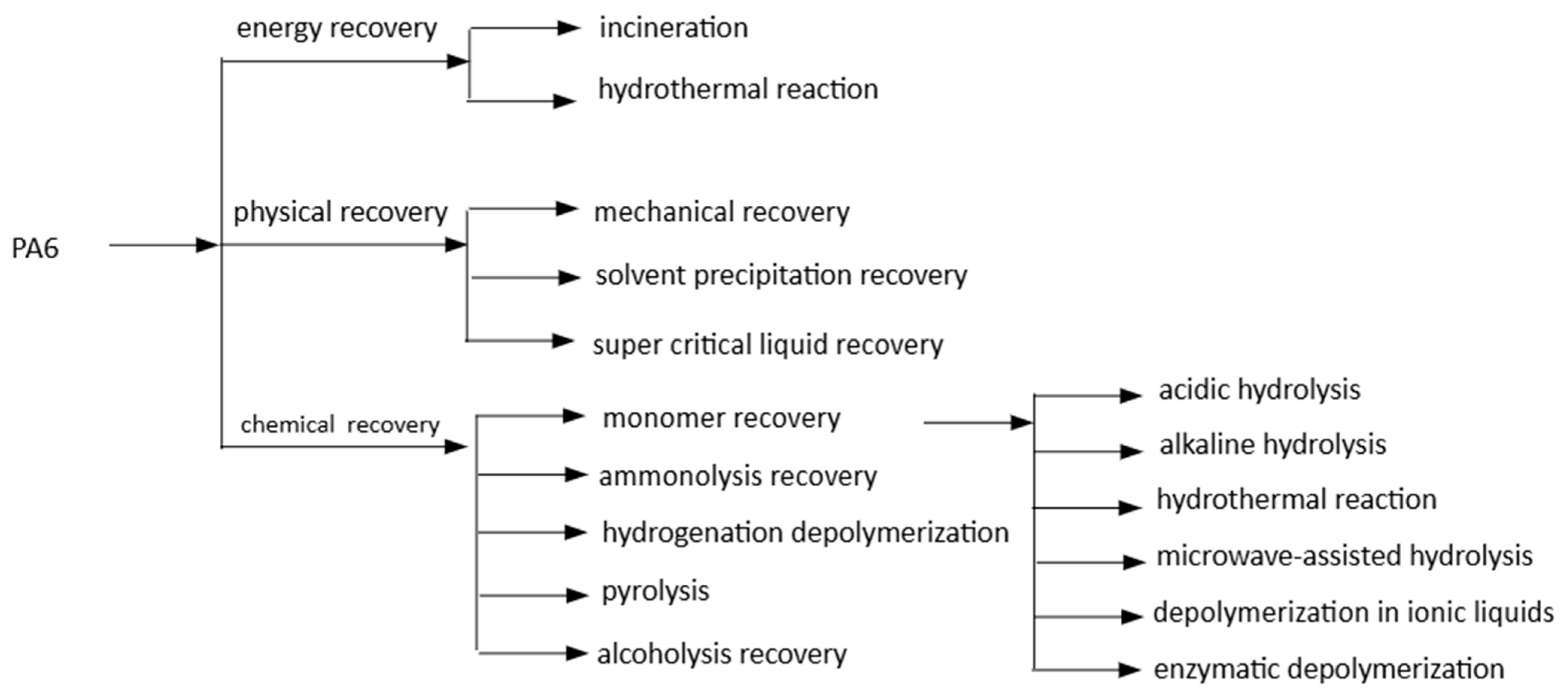
| Incineration | High-temperature burning. | Recovery energy. Relatively mature energy. | Produce poisonous gas. Serious pollution and public hazard. The installation is expensive. | [41] |
| Mechanical | Only change the physical form, such as the packaging of raw materials, for reuse. | Simple operation, less pollutant efficiency. Relatively less equipment investment. | Certain requirements for wastes. Product performance reduced the range. Low economic benefit. Products from recycled waste may not be durable. | [8] |
| Chemical | Degradation reaction to lower molecular weight. | Get pure material monomer. The product can be used as a raw material for the product or to prepare new products. | High temperature and high pressure (cost-intensive). | [42] |
| Material | Product (%) | Method | Catalyst | T (°C) | Time | Solid:Solution | Ref. |
|---|---|---|---|---|---|---|---|
| PA6 | 77.9 wt% CL | hydrolysis | HPA | 330 | 85 min | 1:15 | [43] |
| PA6 | 55 wt% oligomer | hydrogenative | Ruthenium | 150 | 48 h | 1:2.5 | [44] |
| Teabag waste | 59.2 wt% CL | pyrolysis | - | 700 | - | - | [45] |
| PA6 plastic | 86 wt% CL | ionic liquids | PP13 TFSI | 300 | 6 h | - | [46] |
| PA6 | 85 wt% ACA | ionic liquids | HCl, 30 wt% | 109 | 24 h | - | [47] |
| PA6 fiber | 93 wt% ACA | hydrolysis | HCl, 30 wt% | 90 | 4 h | 1:25 | [48] |
| PA6 | 85 wt% CL | hydrothermal | - | 360 | 60 min | - | [38] |
| PA6 | 78 wt% CL | Sub-critical water | HPA | 300 | 85 min | [43] | |
| PA6 | 62.3 wt% CL | Hydrolysis | Zeolite Hβ-25 | 345 | 30 min | 1:10 | [49] |
| PA6 carpet waste | monomeric | Hydrolysis | HCl 10 wt% | 200 | 3 h | 1:20 | [13] |
| PA6 | 96 wt%, unidentified | Hydrolysis | toluene sulfonic acid PTC | 100 | 10 h | 1:6 | [50] |
| Recycling Route | Temp (°C) | CL Yield (wt%) | Reaction Time | Activation Energy (kJ/mol) | Separation Complexity | Energy Intensity | Carbon Reduction Potential | Industrial Feasibility |
|---|---|---|---|---|---|---|---|---|
| Mechanical recycling | 220–260 | N/A | Minutes | N/A | Low | Low | Moderate (50–70%) | High (Downcycling) |
| Acid hydrolysis | 250–400 | 85–96 | 1–4 h | 160–220 | High (distillation-heavy) | Moderate | High (30–50%) | High |
| Hydrothermal (Subcritical Water) | 240–325 | 80–94 | 0.5–2 h | ~180–210 | Moderate–High | Moderate | High | Medium–high |
| Microwave-Assisted Hydrolysis | 200–300 | >90 | <30 min | - | Moderate | Moderate (electricity-based) | High (if renewable electricity) | Medium |
| Catalytic Solvent-Free Depolymerization | 220–260 | ≥99 (lab scale) | <2 h | - | Moderate | Low–Moderate | Potentially high | Low–medium (scale challenge) |
| Pyrolysis | 330–800 | 70–90 | 1–4 h | ~200–240 | Low | High | Low–moderate | Medium |
| Glycolysis/alcoholysis | 200–300 | Oligomer-dominant | 2–10 h | Variable | High | Moderate | Moderate | low–medium |
| Ionic liquid-assisted | 250–300 | 85–95 | 1–2 h | - | High (solvent recovery) | Moderate–High | Uncertain | Low |
| Biological/enzymatic | 40–70 | <1% film conversion | Days–Weeks | Enzymatic | Low | Very Low | Very high (theoretical) | Academic Stage |
| Energy recovery (Incineration) | >800 | 0 | Immediate | N/A | Very Low | Very High | Negative | Mature but non-circular |
| Company | Year of Launch | Technology | Final Product | Processing Capacity | Ref. |
|---|---|---|---|---|---|
| Aquafil (ECONYL®), Arco, Italy. | 2011 | Hydrolysis-based depolymerization | CL → regenerated PA6 | 35,000 ton/year | [59] |
| DOMO Chemicals (TECHNYL® 4EARTH®), Leuna, Germany | 2018 | Chemical recycling (hydrolysis + purification) | Virgin-grade PA6 | Not publicly disclosed | [60] |
| BASF (ChemCycling™), Ludwigshafen, Germany. | 2018 | Pyrolysis-based feedstock recycling | Secondary raw materials for polymers (incl. PA) | Pilot → industrial scale | [61] |
| Toray Industries, Tokyo, Japan | 2010 | Depolymerization and purification | CL/Nylon 6 | Demonstration scale | [62] |
| RadiciGroup, Bergamo, Italy | 2018 | Mechanical + chemical recycling | Engineering PA6 materials | Industrial scale | [63] |
| Method | Expression | Plots | Slope Value |
|---|---|---|---|
| Kissinger | −Ea/R | ||
| Kissinger–Akahira–Sunose | ln versus 1/T | −Ea/R | |
| Flynn–Wall–Ozzawa | ln versus 1/T | −1.0516 Ea/R |
| Microwave Heating | Conventional Heating |
|---|---|
| Inverse thermal conventional de-outside | Thermal gradient (outside–inside) |
| Gradient | Conduction and convection currents |
| Very short and instant heating | Longer processing times |
| No or lower solvent is possible. | No or lower solvent savings |
| Higher product quality and quantity are possible | Product quality and quantity can be quantified. |
| Moderate to low consumption and quantity of energy | High energy consumption |
| Straightforward process configuration | Simple process configuration |
| Metric | Virgin PA6 (Conventional) | Chemically Recycled PA6 |
|---|---|---|
| Primary feedstock | Crude oil/benzene | Post-consumer/industrial waste |
| Energy consumption | High (synthesis + polymerization) | Moderate (depolymerization + purification) |
| GWP (kg CO2-eq) | 8.0–9.5 | 1.5–4.5 (Reduction of ~50–70 wt%) |
| Technical quality | Standard grade | Near-virgin (high purity CL) |
| Economic barrier | Market volatility of oil | Cost of collection & sorting |
Disclaimer/Publisher’s Note: The statements, opinions and data contained in all publications are solely those of the individual author(s) and contributor(s) and not of MDPI and/or the editor(s). MDPI and/or the editor(s) disclaim responsibility for any injury to people or property resulting from any ideas, methods, instructions or products referred to in the content. |
© 2026 by the authors. Licensee MDPI, Basel, Switzerland. This article is an open access article distributed under the terms and conditions of the Creative Commons Attribution (CC BY) license.
Share and Cite
Damayanti, D.; Pristiani, M.; Wu, H.-S. Extracting Caprolactam from PA6 Waste: Progress in Chemical Recycling and Sustainable Practices. Polymers 2026, 18, 940. https://doi.org/10.3390/polym18080940
Damayanti D, Pristiani M, Wu H-S. Extracting Caprolactam from PA6 Waste: Progress in Chemical Recycling and Sustainable Practices. Polymers. 2026; 18(8):940. https://doi.org/10.3390/polym18080940
Chicago/Turabian StyleDamayanti, Damayanti, Mega Pristiani, and Ho-Shing Wu. 2026. "Extracting Caprolactam from PA6 Waste: Progress in Chemical Recycling and Sustainable Practices" Polymers 18, no. 8: 940. https://doi.org/10.3390/polym18080940
APA StyleDamayanti, D., Pristiani, M., & Wu, H.-S. (2026). Extracting Caprolactam from PA6 Waste: Progress in Chemical Recycling and Sustainable Practices. Polymers, 18(8), 940. https://doi.org/10.3390/polym18080940