Types of Resin Composite and Filling Techniques: How They Affect Internal Void Volume and Compressive Strength

 ,
,
Abstract
1. Introduction
2. Materials and Methods
2.1. Specimen Preparation
2.2. Micro-CT Scanning and Void Analysis
2.3. Compressive Strength Evaluation
2.4. Statistical Methods and Data Processing
3. Results
4. Discussion
5. Conclusions
Author Contributions
Funding
Institutional Review Board Statement
Data Availability Statement
Acknowledgments
Conflicts of Interest
References
- Arbildo-Vega, H.I.; Lapinska, B.; Panda, S.; Lamas-Lara, C.; Khan, A.S.; Lukomska-Szymanska, M. Clinical Effectiveness of Bulk-Fill and Conventional Resin Composite Restorations: Systematic Review and Meta-Analysis. Polymers 2020, 12, 1786. [Google Scholar] [CrossRef] [PubMed]
- Ferracane, J.L. Resin composite—State of the art. Dent Mater. 2011, 27, 29–38. [Google Scholar] [CrossRef] [PubMed]
- Francois, P.; Izart, M.; Fasham, T.; Smail, Y.; Jannot, M.; Le Goff, S.; Beres, F.; Troizier-Cheyne, M.; Bergman, S.; Moussally, C.; et al. Proposal of a Modular Classification System for Direct Dental Resin Composites Based on Clinical Applications. Polymers 2025, 17, 564. [Google Scholar] [CrossRef] [PubMed]
- Samet, N.; Kwon, K.R.; Good, P.; Weber, H.P. Voids and interlayer gaps in Class 1 posterior composite restorations: A comparison between a microlayer and a 2-layer technique. Quintessence Int. 2006, 10, 803–809. Available online: https://pubmed.ncbi.nlm.nih.gov/17078279/ (accessed on 25 February 2026).
- Jarisch, J.; Lien, W.; Guevara, P.; Greenwood, W.J.; Dunn, W. Microcomputed tomographic comparison of posterior composite resin restorative techniques: Sonicated bulk fill versus incremental fill. Gen. Dent. 2016, 45, 71–79. [Google Scholar]
- Hirata, R.; Pacheco, R.; Caceres, E.; Janal, M.; Romero, M.; Giannini, M.; Coelho, P.; Rueggeberg, F.; Hirata, R.; Pacheco, R.; et al. Effect of Sonic Resin Composite Delivery on Void Formation Assessed by Micro-computed Tomography. Oper. Dent. 2018, 43, 144–150. [Google Scholar] [CrossRef] [PubMed]
- Demirel, G.; Baltacıoğlu, İ.H.; Kolsuz, M.E.; Ocak, M.; Orhan, K. Micro-computed tomography evaluation of internal void formation of bulk-fill resin composites in Class II restorations. Polym. Compos. 2019, 40, 2984–2992. [Google Scholar] [CrossRef]
- Díaz, C.P.; Shimokawa, C.; Sampaio, C.; Freitas, A.; Turbino, M.; Díaz, C.P.; Shimokawa, C.; Sampaio, C.; Freitas, A.; Turbino, M. Characterization and Comparative Analysis of Voids in Class II Composite Resin Restorations by Optical Coherence Tomography. Oper. Dent. 2020, 45, 71–79. [Google Scholar] [CrossRef] [PubMed]
- Kwon, Y.; Ferracane, J.; Lee, I.B. Effect of layering methods, composite type, and flowable liner on the polymerization shrinkage stress of light cured composites. Dent. Mater. 2012, 28, 801–809. [Google Scholar] [CrossRef] [PubMed]
- Lee, M.R.; Cho, B.H.; Son, H.H.; Um, C.M.; Lee, I.B. Influence of cavity dimension and restoration methods on the cusp deflection of premolars in composite restoration. Dent. Mater. 2007, 23, 288–295. [Google Scholar] [CrossRef] [PubMed]
- Ferracane, J.L.; Hilton, T.J.; Stansbury, J.W.; Watts, D.C.; Silikas, N.; Ilie, N.; Heintze, S.; Cadenaro, M.; Hickel, R. Academy of Dental Materials guidance—Resin composites: Part II—Technique sensitivity (handling, polymerization, dimensional changes). Dent. Mater. 2017, 33, 1171–1191. [Google Scholar] [CrossRef] [PubMed]
- Kaisarly, D.; Meierhofer, D.; El Gezawi, M.; Rösch, P.; Kunzelmann, K.H. Effects of flowable liners on the shrinkage vectors of bulk-fill composites. Clin. Oral. Investig. 2021, 25, 4927–4940. [Google Scholar] [CrossRef] [PubMed]
- Soares, C.J.; Rosatto, C.M.P.; Carvalho, V.F.; Bicalho, A.A.; Henriques, J.C.G.; Faria-e-Silva, A.L. Radiopacity and Porosity of Bulk-fill and Conventional Composite Posterior Restorations-Digital X-ray Analysis. Oper. Dent. 2017, 42, 616–625. [Google Scholar] [CrossRef] [PubMed]
- Pereira, R.; Soares, P.; Bicalho, A.A.; Barcelos, L.M.; Oliveira, L.; Soares, C.J. Impact of the Porosity from Incremental and Bulk Resin Composite Filling Techniques on the Biomechanical Performance of Root-Treated Molars. Oper. Dent. 2021, 46, 197–207. [Google Scholar] [CrossRef] [PubMed]
- Abbas, G.; Fleming, G.J.P.; Harrington, E.; Shortall, A.C.C.; Burke, F.J.T. Cuspal movement and microleakage in premolar teeth restored with a packable composite cured in bulk or in increments. J. Dent. 2003, 31, 437–444. [Google Scholar] [CrossRef] [PubMed]
- Kwon, S.R.; Oyoyo, U.; Li, Y. Influence of application techniques on contact formation and voids in anterior resin composite restorations. Oper. Dent. 2014, 39, 213–220. [Google Scholar] [CrossRef] [PubMed]
- Kim, E.H.; Jung, K.H.; Son, S.A.; Hur, B.; Kwon, Y.H.; Park, J.K. Effect of resin thickness on the microhardness and optical properties of bulk-fill resin composites. Restor. Dent. Endod. 2015, 40, 128. [Google Scholar] [CrossRef] [PubMed]
- Gale, M.S.; Darvell, B.W. Thermal cycling procedures for laboratory testing of dental restorations. J. Dent. 1999, 27, 89–99. [Google Scholar] [CrossRef] [PubMed]
- Opdam, N.J.M.; Roeters, J.J.M.; Peters, T.C.R.B.; Burgersdijk, R.C.W.; Teunis, M. Cavity wall adaptation and voids in adhesive Class I resin composite restorations. Dent. Mater. 1996, 12, 230–235. [Google Scholar] [CrossRef] [PubMed]
- Roggendorf, M.J.; Krämer, N.; Appelt, A.; Naumann, M.; Frankenberger, R. Marginal quality of flowable 4-mm base vs. conventionally layered resin composite. J. Dent. 2011, 39, 643–647. [Google Scholar] [CrossRef] [PubMed]
- Gigova, R.; Hristov, K. Micro-Computed Tomography Assessment of Voids and Volume Changes in Bulk-Fill Restoration with Stamp Technique. Materials 2025, 18, 4027. [Google Scholar] [CrossRef] [PubMed]
- Ilie, N.; Stark, K. Curing behaviour of high-viscosity bulk-fill composites. J. Dent. 2014, 42, 977–985. [Google Scholar] [CrossRef] [PubMed]
- Chaidarun, S.; Leevailoj, C. Evaluation of Voids in Class II Restorations Restored with Bulk-fill and Conventional Nanohybrid Resin Composite. J. Dent. Assoc. Thail. 2018, 68, 132–143. Available online: https://www.researchgate.net/publication/327631259_Evaluation_of_Voids_in_Class_II_Restorations_Restored_with_Bulk-fill_and_Conventional_Nanohybrid_Resin_Composite (accessed on 25 February 2026).
- Hegde, V.; Sali, A. Fracture resistance of posterior teeth restored with high-viscosity bulk-fill resin composites in comparison to the incremental placement technique. J. Conserv. Dent. 2017, 20, 360. [Google Scholar] [CrossRef] [PubMed]
- Lagouvardos, P.; Nikolinakos, N.; Oulis, C. Volume fraction and location of voids and gaps in ultraconservative restorations by X-ray computed micro-tomography. Dent. Res. J. 2015, 12, 520–527. [Google Scholar] [CrossRef] [PubMed]
- Oglakci, B.; Kazak, M.; Donmez, N.; Dalkilic, E.E.; Koymen, S.S. The use of a liner under different bulk-fill resin composites: 3D GAP formation analysis by x-ray microcomputed tomography. J. Appl. Oral Sci. 2019, 28, e20190042. [Google Scholar] [CrossRef] [PubMed]
- Sheikh, R.A. Marginal Adaptation of Different Bulk-fill Composites: A Microcomputed Tomography Evaluation. Oman. Med. J. 2022, 37, e339. [Google Scholar] [CrossRef] [PubMed]
- Sá, V.A.; Bittencourt, H.R.; Burnett Júnior, L.H.; Spohr, A.M. Preheated and Injected Bulk-Fill Resin Composites: A Micro-CT Analysis of Internal Voids and Marginal Adaptation in Class II Restorations. Materials 2025, 18, 327. [Google Scholar] [CrossRef]
- Noel, C.M.; Suhana, N.; Satapa, A.; Azlin Yahya, N.; Omar, R.A. Evaluation of internal adaptation of flowable and bulk-fill resin-based composites. Ann. Dent. Univ. Malaya 2021, 28, 23–31. [Google Scholar] [CrossRef]
- Aggarwal, V.; Singla, M.; Yadav, S.; Yadav, H. Effect of flowable composite liner and glass ionomer liner on class II gingival marginal adaptation of direct composite restorations with different bonding strategies. J. Dent. 2014, 42, 619–625. [Google Scholar] [CrossRef] [PubMed]
- Paolone, G. Direct composite restorations in anterior teeth. Managing symmetry in central incisors. Int. J. Esthet. Dent. 2014, 9, 12–25. Available online: https://pubmed.ncbi.nlm.nih.gov/24757696/ (accessed on 19 March 2026). [PubMed]
- de Mendonça, B.C.; Soto-Montero, J.R.; de Castro, E.F.; Pecorari, V.G.A.; Rueggeberg, F.A.; Giannini, M. Flexural strength and microhardness of bulk-fill restorative materials. J. Esthet. Restor. Dent. 2021, 33, 628–635. [Google Scholar] [CrossRef] [PubMed]
- Lindberg, A.; Peutzfeldt, A.; Van Dijken, J.W.V. Curing depths of a universal hybrid and a flowable resin composite cured with quartz tungsten halogen and light-emitting diode units. Acta Odontol. Scand. 2004, 62, 97–101. [Google Scholar] [CrossRef] [PubMed]
- Balthazard, R.; Jager, S.; Dahoun, A.; Gerdolle, D.; Engels-Deutsch, M.; Mortier, E. High-resolution tomography study of the porosity of three restorative resin composites. Clin. Oral. Investig. 2014, 18, 1613–1618. [Google Scholar] [CrossRef] [PubMed]
- Ghavami-Lahiji, M.; Davalloo, R.T.; Tajziehchi, G.; Shams, P. Micro-computed tomography in preventive and restorative dental research: A review. Imaging Sci. Dent. 2021, 51, 341–350. [Google Scholar] [CrossRef] [PubMed]
- Liu, L.; Zhang, B.M.; Wang, D.F.; Wu, Z.J. Effects of cure cycles on void content and mechanical properties of composite laminates. Compos. Struct. 2006, 73, 303–309. [Google Scholar] [CrossRef]
- Huysmans, M.C.; van der Varst, P.G.; Lautenschlager, E.P.; Monaghan, P. The influence of simulated clinical handling on the flexural and compressive strength of posterior composite restorative materials. Dent. Mater. 1996, 12, 116–120. [Google Scholar] [CrossRef] [PubMed]
- Mehdikhani, M.; Gorbatikh, L.; Verpoest, I.; Lomov, S.V. Voids in fiber-reinforced polymer composites: A review on their formation, characteristics, and effects on mechanical performance. J. Compos. Mater. 2019, 53, 1579–1669. [Google Scholar] [CrossRef]
- Rey, L.; Duchet, J.; Galy, J.; Sautereau, H.; Vouagner, D.; Carrion, L. Structural heterogeneities and mechanical properties of vinyl/dimethacrylate networks synthesized by thermal free radical polymerisation. Polymer 2002, 43, 4375–4384. [Google Scholar] [CrossRef]
- Mitra, S.B.; Wu, D.; Holmes, B.N. An application of nanotechnology in advanced dental materials. J. Am. Dent. Assoc. 2003, 134, 1382–1390. [Google Scholar] [CrossRef] [PubMed]
- Rodríguez, H.A.; Kriven, W.M.; Casanova, H. Development of mechanical properties in dental resin composite: Effect of filler size and filler aggregation state. Mater. Sci. Eng. C 2019, 101, 274–282. [Google Scholar] [CrossRef] [PubMed]
- Shah, P.K.; Stansbury, J.W. Role of filler and functional group conversion in the evolution of properties in polymeric dental restoratives. Dent. Mater. 2014, 30, 586–593. [Google Scholar] [CrossRef] [PubMed]
- Moezzyzadeh, M. Evaluation of the Compressive Strength of Hybrid and Nanocomposites. Shahid Beheshti Univ. Dent. J. 2012, 30, 23–28. [Google Scholar]
- Brandão, L.; Adabo, G.L.; Vaz, L.G.; Saad, J.R.C. Compressive strength and compressive fatigue limit of conventional and high viscosity posterior resin composites. Braz. Oral. Res. 2005, 19, 272–277. [Google Scholar] [CrossRef] [PubMed]
- Khalis Bilal, P.; Othman Hamafaraj, B.; Author, C. Evaluation of Compressive Strength Among Different Types of Composite Resin: An in Vitro Study. Erbil Dent. J. (EDJ) 2025, 8, 142–149. [Google Scholar] [CrossRef]
- Mirica, I.C.; Furtos, G.; Bâldea, B.; Lucaciu, O.; Ilea, A.; Moldovan, M.; Câmpian, R.S. Influence of filler loading on the mechanical properties of flowable resin composites. Materials 2020, 13, 1477. [Google Scholar] [CrossRef]
- Randolph, L.D.; Palin, W.M.; Leloup, G.; Leprince, J.G. Filler characteristics of modern dental resin composites and their influence on physico-mechanical properties. Dental Mater. 2016, 32, 1586–1599. [Google Scholar] [CrossRef] [PubMed]
- Chadwick, R.G.; McCabe, J.F.; Walls, A.W.G.; Storer, R. The effect of placement technique upon the compressive strength and porosity of a composite resin. J. Dent. 1989, 17, 230–233. [Google Scholar] [CrossRef] [PubMed]
- McCabe, J.F.; Ogden, A.R. The relationship between porosity, compressive fatigue limit and wear in composite resin restorative materials. Dental Mater. 1987, 3, 9–12. [Google Scholar] [CrossRef] [PubMed]
- Fronza, B.M.; Rueggeberg, F.A.; Braga, R.R.; Mogilevych, B.; Soares, L.E.S.; Martin, A.A.; Ambrosano, G.; Giannini, M. Monomer conversion, microhardness, internal marginal adaptation, and shrinkage stress of bulk-fill resin composites. Dental Mater. 2015, 31, 1542–1551. [Google Scholar] [CrossRef] [PubMed]



| Materials/Devices | Compositions/Descriptions | Lot No. |
|---|---|---|
| Filtek™ One Bulk Fill Restorative | AFM (dynamic stress-relieving monomer), AUDMA, UDMA, and 1,12-dodecane-DMA Fillers: a combination of a non-agglomerated/non-aggregated 20 nm silica filler, a non-agglomerated/non-aggregated 4 to 11 nm zirconia filler, an aggregated zirconia/silica cluster filler (comprising 20 nm silica and 4 to 11 nm zirconia particles), and a ytterbium trifluoride filler consisting of agglomerate 100 nm particles. The inorganic filler loading is about 76.5% by weight (58.5% by volume). (3 M Oral Care, St Paul, MN, USA) | 9189369 |
| Filtek™ Z350XT Flow | Bis-GMA, TEGDMA, and bis-EMA Fillers: a combination of 5 nm diameter of non-agglomerated/non-aggregated silica nanofiller, 5–10 nm diameter of non-agglomerated/non-aggregated zirconia nanofiller, loosely bound agglomerated zirconia/silica nanocluster, consisting of agglomerates of 5 to 20 nm primary zirconia/silica particles and a cluster particle size range of 0.6 to 1.4 microns. The inorganic filler loading is about 65% by weight (55% by volume). (3 M Oral Care, St Paul, MN, USA) | NF42375 |
| Filtek™ Z350XT | Bis-GMA, Bis-EMA, UDMA and TEGDMA Filler: 59.5 vol.% combination of aggregated zirconia/silica cluster ranging from 0.6 to 1.4 µm with primary particle size of 5–20 nm and non-agglomerated 20 nm silica filler. (3 M Oral Care, St Paul, MN, USA) | NF31573 |
| Demi™ Plus | An LED light curing device. (Kerr, Orange, CA, USA) | |
| Bruker Skyscan 1173 | A desktop Micro-CT system (Kontich, Belgium). X-ray source is 40–130 kV, 8 W. The X-ray detector is a distortion-free flat panel sensor (2240 × 2240). The resolution is 5 microns. | |
| Instron model 5566 | A universal testing machine (Canton, MA, USA) |
| Group | Material and Filling Technique | Application Method and Illustration | Number of Layers |
|---|---|---|---|
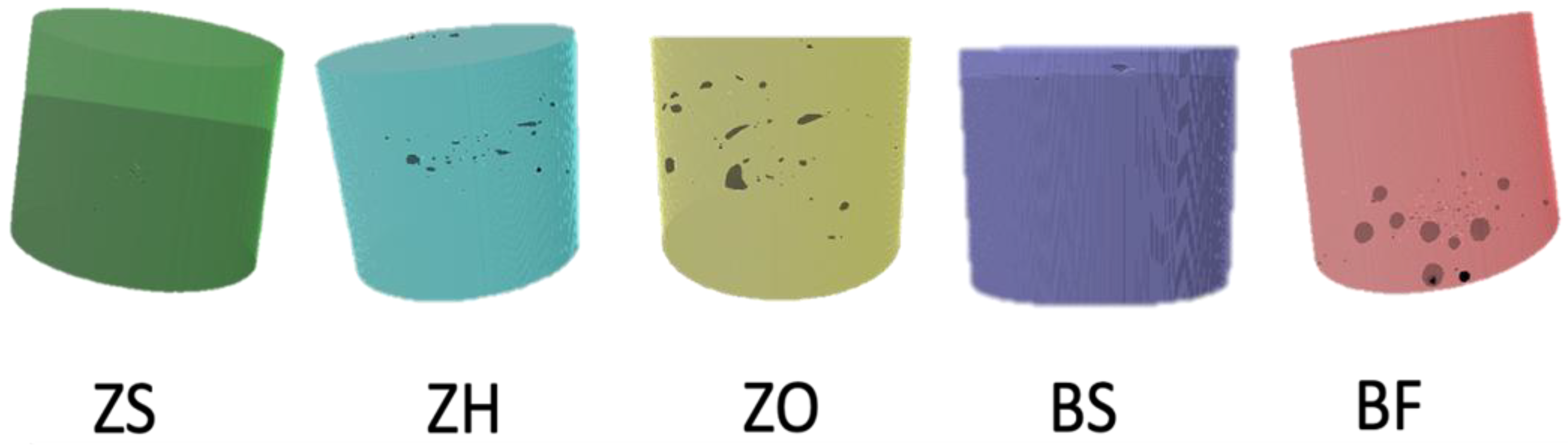
| ZS | Filtek Z350 Single layer | A 4 mm resin composite layer was placed in a mold on a glass slab. The surface was leveled with an IPC instrument and light-cured from top and bottom for 40 s each.  | 1 |
| ZH | Filtek Z350 Horizontal increment | A 2 mm resin composite layer was placed in a mold on a glass slab. The surface was leveled with an IPC instrument and light-cured for 40 s from the top. This was repeated to create a 4 mm specimen. | 2 |
| ZO | Filtek Z350 Oblique increment | A 2 mm resin composite layer was placed in a mold on a glass slab. Its top was leveled diagonally with an IPC instrument and light-cured for 40 s. Another layer was applied, leveled horizontally with an IPC hand instrument, and light-cured for 40 s. This process was repeated to create a 4 mm high resin specimen. | 4 |
| BS | Filtek One Bulk Fill Single layer | A 4 mm layer of bulk-fill resin composite was placed in a mold on a glass slab. The top was leveled with an IPC instrument and light-cured for 40 s. | 1 |
| BF | Filtek One Bulk Fill with flowable resin composite lining | A 1 mm layer of flowable resin composite was placed in a mold and light-cured for 40 s. Then, a 3 mm layer of bulk-fill resin was applied, leveled with an IPC instrument, and light-cured for 40 s. | 2 |
| Group | Void Volume (%) | Compressive Strength (MPa) |
|---|---|---|
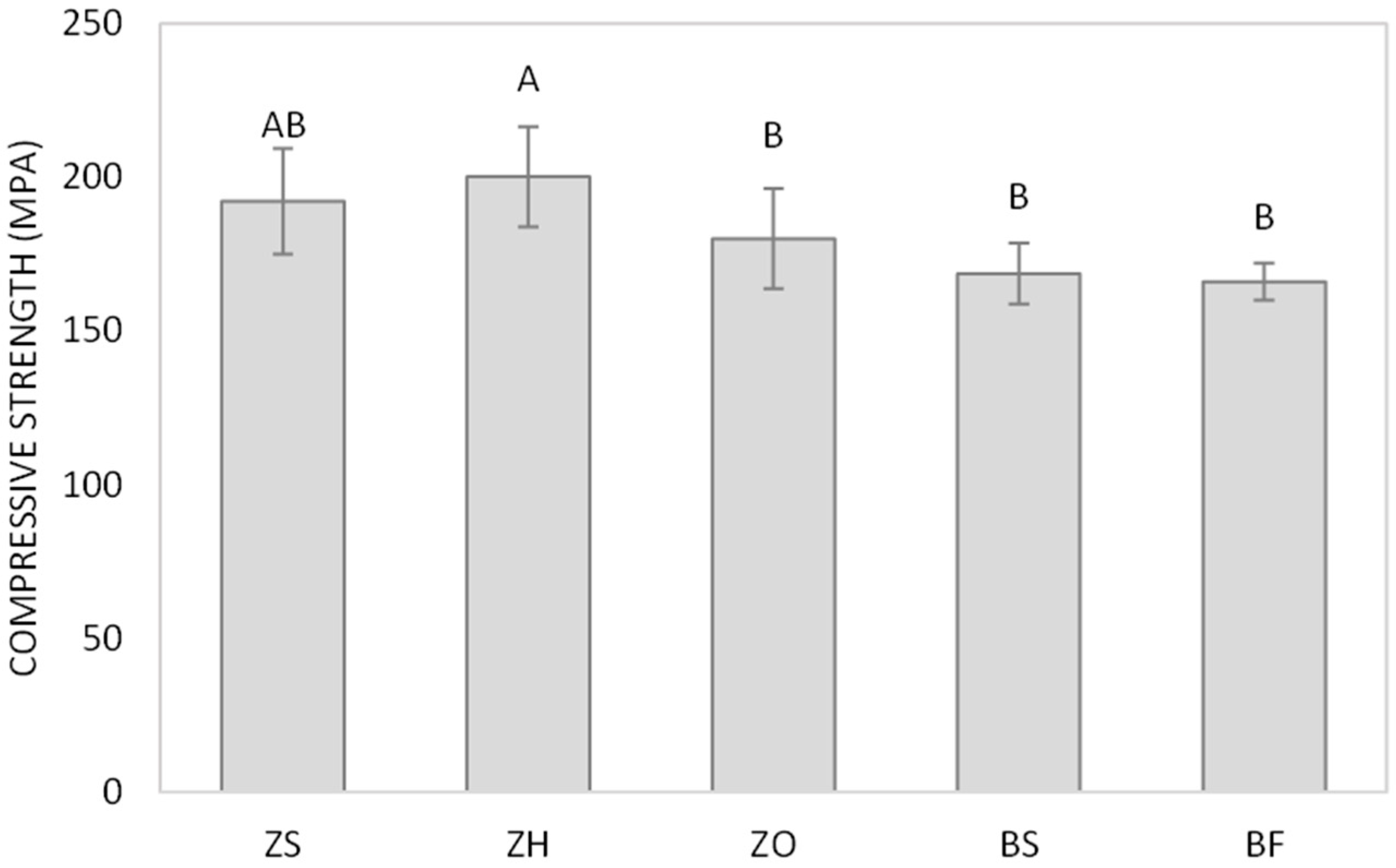
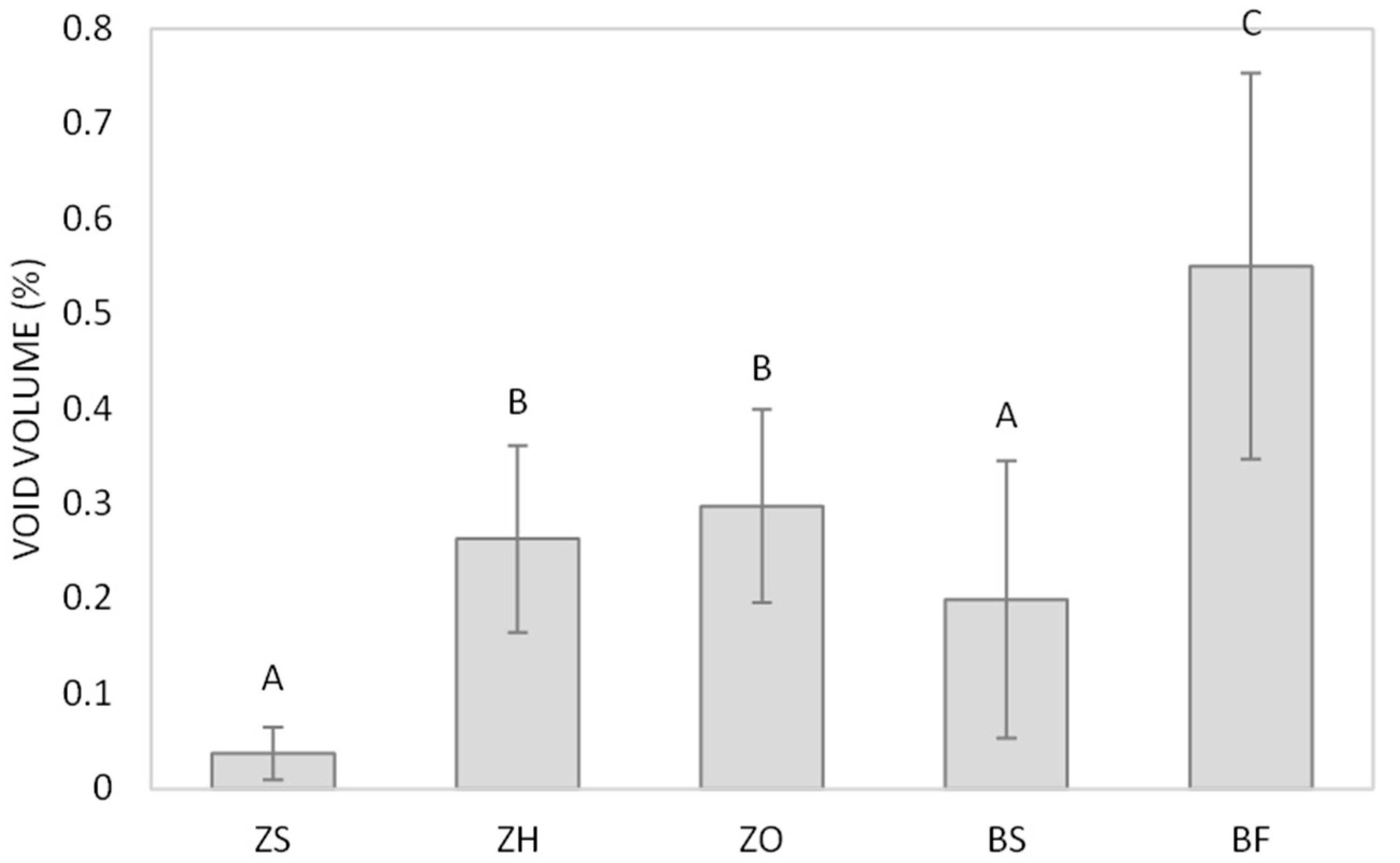
| ZS | 0.0366 ± 0.0279 A | 192.18 ± 17.23 ab |
| ZH | 0.263 ± 0.0984 B | 200.18 ± 16.32 a |
| ZO | 0.2974 ± 0.1018 B | 180.01 ± 16.21 b |
| BS | 0.1991 ± 0.1463 A | 168.59 ± 9.92 b |
| BF | 0.5501 ± 0.2031 C | 166.04 ± 5.97 b |
Disclaimer/Publisher’s Note: The statements, opinions and data contained in all publications are solely those of the individual author(s) and contributor(s) and not of MDPI and/or the editor(s). MDPI and/or the editor(s) disclaim responsibility for any injury to people or property resulting from any ideas, methods, instructions or products referred to in the content. |
© 2026 by the authors. Licensee MDPI, Basel, Switzerland. This article is an open access article distributed under the terms and conditions of the Creative Commons Attribution (CC BY) license.
Share and Cite
Karntiang, P.; Chaimanakarn, C.; Chaimanakarn, D.; Niyomdee, T.; Ikeda, H. Types of Resin Composite and Filling Techniques: How They Affect Internal Void Volume and Compressive Strength. Polymers 2026, 18, 885. https://doi.org/10.3390/polym18070885
Karntiang P, Chaimanakarn C, Chaimanakarn D, Niyomdee T, Ikeda H. Types of Resin Composite and Filling Techniques: How They Affect Internal Void Volume and Compressive Strength. Polymers. 2026; 18(7):885. https://doi.org/10.3390/polym18070885
Chicago/Turabian StyleKarntiang, Pirat, Chitpol Chaimanakarn, Daranee Chaimanakarn, Thanyaporn Niyomdee, and Hiroshi Ikeda. 2026. "Types of Resin Composite and Filling Techniques: How They Affect Internal Void Volume and Compressive Strength" Polymers 18, no. 7: 885. https://doi.org/10.3390/polym18070885
APA StyleKarntiang, P., Chaimanakarn, C., Chaimanakarn, D., Niyomdee, T., & Ikeda, H. (2026). Types of Resin Composite and Filling Techniques: How They Affect Internal Void Volume and Compressive Strength. Polymers, 18(7), 885. https://doi.org/10.3390/polym18070885