Article

Enhanced Electromechanical Performance of Dielectric Elastomer by Co-Crosslinking of Silane-Functionalized TiO2 with Polyacrylate


1
State Key Laboratory of Organic-Inorganic Composites, Beijing University of Chemical Technology, Beijing 100029, China
2
Department of Urology, China-Japan Friendship Hospital, Beijing 100029, China
*
Authors to whom correspondence should be addressed.
These authors contributed equally to this work.
Polymers 2026, 18(7), 872; https://doi.org/10.3390/polym18070872
Submission received: 30 January 2026 / Revised: 19 March 2026 / Accepted: 27 March 2026 / Published: 1 April 2026
(This article belongs to the Collection Polymers and Polymer Composites: Structure-Property Relationship)

Abstract

Dielectric elastomer actuators (DEAs) are attracting much attention as candidates for next-generation flexible actuation. Among various DE matrices, polyacrylate rubber (AR) is especially promising owing to their intrinsically high dielectric constant (εr) and good mechanical performance. In particular, its mechanical behavior is close to that of porcine bladder tissue, making it a potentially good material for soft biomedical actuators for artificial bladder constructs. To achieve high actuated strain, which requires high εr, high breakdown strength, and low elastic modulus, an AR DE composite filled with silane-functionalized TiO2 was fabricated, exhibiting good electromechanical performance enabled by strengthened interfacial polarization. To improve compatibility between TiO2 and AR matrix, TiO2 was preferentially modified with a silane coupling agent (CA) that features a double bond as its functional group, which can be introduced on TiO2 surface and participate in vulcanization with AR, thereby forming co-crosslinking bridges that strengthen interfacial bonding, improve filler dispersion, and increase interfacial polarizability within the matrix. As a result, at relatively low filler loadings, the composite exhibits a significantly increased εr, while maintaining low modulus, low dielectric loss and high elasticity. The 10 CA@TiO2/AR composite exhibits a maximal actuated strain of 7.9% at 31.9 kV/mm without pre-stretch, which is 1.48 times that of pure AR and 1.32 times that of the 10 TiO2/AR composite.

1. Introduction

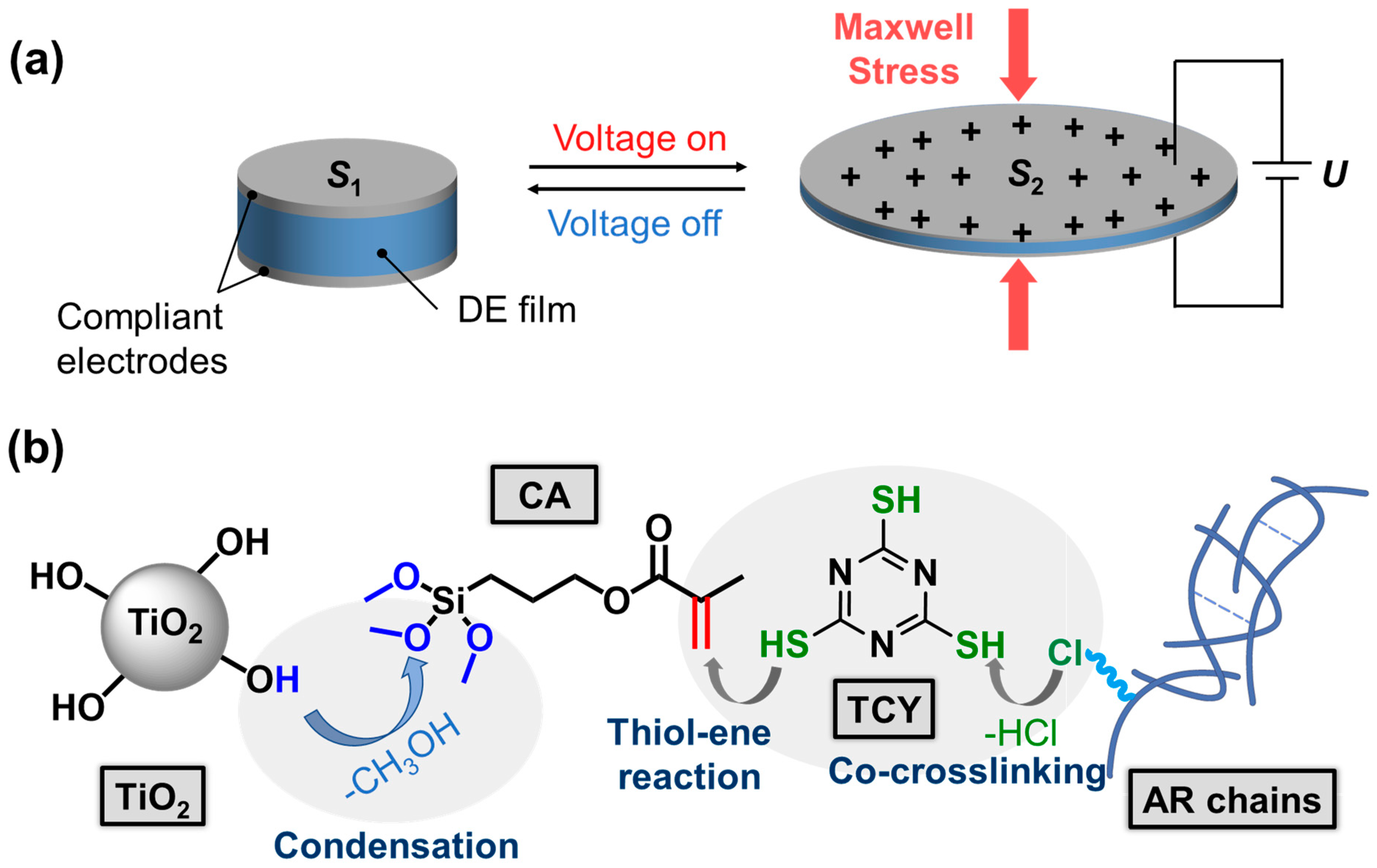
Flexible actuators capable of generating large, rapid, and energy-efficient deformation are pivotal for the next-generation of microrobots, wearable and biomedical devices, and adaptive optical systems [1,2]. Among electroactive polymer technologies, dielectric elastomer actuators (DEAs) have emerged as a leading option thanks to their lightweight, large actuated strain, high output force, and remarkable energy density [3,4]. These characteristics make them suitable for use in artificial bladder applications, offering potential therapeutic benefits for patients with bladder dysfunction by helping restore normal urinary storage and release capabilities. A DEA comprises a flexible dielectric elastomer (DE) film sandwiched between compliant electrodes (Figure 1a). When a high voltage is applied, the resulting Maxwell stress compresses the film in thickness and drives in-plane expansion, directly converting electrical input into mechanical work. The actuated strain (Sa) of a DE can be evaluated using the widely accepted theory proposed by Perline et al. [5].
S a = P Y = ε 0 ε r E 2 Y
where ε0 is the vacuum permittivity, εr, and Y are the dielectric constant and elastic modulus of DE, respectively, and E is the applied electric field. According to Equation (1), an ideal DE with excellent electromechanical performance should possess a high εr and a low Y, which together yield high electromechanical sensitivity (β = εr/Y), as well as a high electrical breakdown strength (Eb) [6,7]. Such an ideal DE can further be adapted for artificial bladder applications, where large, rapid, and reliable long-term actuation performance is essential.
Thanks to increased chain mobility from plasticizers, the Y of DEs can be reduced by introducing additives such as polyethylene glycol [8], silicone oil [9], epoxidized soybean oil [10], and ionic liquid [11] into the polymer matrix. For example, Ruan et al. used tri-n-butyl phosphate to plasticize brominated butyl rubber (BIIR), which weakened intermolecular interactions among BIIR chains and disrupted the filler network, thereby lowering Y [12]. However, introducing plasticizers can cause viscoelastic issues such as creep, stress relaxation and increase hysteresis loss [13]. In addition, limited compatibility with many polymer matrices promotes migration of plasticizer molecules and shortens device service life.
Beyond mechanical softening strategies, increasing εr is a practical way to enhance the electromechanical response of DEs. This can be achieved through three main strategies. A representative choice is using polarized rubber matrix such as polyacrylate rubber (AR) [14,15], with abundant ester groups providing strong dipolar polarization or grafting dipole functional groups onto the non-polar rubber molecular chains. The second strategy is to blend the DE matrix with conductive fillers such as carbon nanotubes [16], carbon nanospheres [17], and graphene [18]. Thanks to interfacial polarization and microcapacitor networks formed by sub-percolating conductive fillers, εr increases sharply as the filler content approaches the percolation threshold [19]. The drawback is that they also raise electrical conductivity, which markedly lowers Eb and increases dielectric loss (ε″), reducing energy conversion efficiency. The third strategy is to introduce high-εr ceramic fillers such as TiO2 [20,21] or BaTiO3 [22], a widely used and effective approach. However, their high surface energy promotes agglomeration, which degrades dispersion and easily forms defect sites, thereby harming electromechanical performance. Surface modification of the inorganic fillers can mitigate these issues by improving compatibility and dispersion [23]. For example, Yang et al. coated TiO2 with poly(dopamine) to strengthen interfacial adhesion with the rubber matrix, yielding simultaneous improvements in mechanical integrity and dielectric properties in polymer composites [24]. A disadvantage is that the cost of dopamine remains a barrier to large-scale industrial use [25].
In this study, we aim to investigate the potential application of DEAs in artificial bladders. For this purpose, a commercial chlorine cure-site AR was selected owing to its intrinsically high εr and good mechanical performance with its mechanical behavior close to that of porcine bladder tissue (Figure S1). This AR consists mainly of poly(ethyl acrylate) and contains approximately 5 wt% chlorine cure-site monomer [26]. These chlorine sites allow curing with trithiocyanuric acid (TCY) via nucleophilic substitution to form stable thioether crosslinking and a robust network [27]. However, the ester-rich, polar matrix requires tailored interfaces between the filler and the matrix to achieve good dispersion and electromechanical performance. In this work, TiO2 modified with a low-cost silane coupling agent (CA), γ-methacryloxypropyl trimethoxy silane, was employed to enhance the electromechanical performance of AR DEs (Figure 1b). Within AR composites, the purpose of using CA@TiO2 was to form a siloxane-rich interphase on the filler surface and create co-crosslinking bridges to the AR network via reactions of its double bond with thiol-bearing crosslinkers. This interfacial architecture improves compatibility and stabilizes dispersion. As a result, the interfacial area increases and interfacial polarization strengthens, yielding a higher εr at the same filler content. Meanwhile, fewer defects and a more uniform local field raise Eb. At low content (10 wt%) of CA@TiO2, the εr increases, while maintaining low Y low dielectric loss and low hysteresis loss (high elasticity), the electromechanical sensitivity (β = εr/Y) increases, delivering significantly enhanced actuated strain.

2. Experimental

2.1. Materials

Polyacrylate rubber (grade AR71) was supplied by Zeon Corporation (Tokyo, Japan). TiO2 nanoparticles with an average particle size of 15–25 nm were purchased from Beijing Dekedaojin Technology Co., Ltd. (Beijing, China). Trithiocyanuric acid (TCY, 99%, Shanghai Jinghai Chemical Co., Ltd., Shanghai, China), 2-mercaptobenzothiazole (BZ, 99%, Kemiou Chemical Co., Ltd., Tianjin, China), γ-methacryloxypropyl trimethoxy silane (CA, 99%, Aladdin, Shanghai, China) and anhydrous ethanol (≥99.7%, Beijing Chemical Works, Beijing, China) were used as received without further purification.

2.2. Preparation of CA@TiO2 Filler

TiO2 particles were first mixed with 5 wt% CA (dissolved in ethanol) using a high-speed mixer at a rotating speed of 30,000 r/min for 4 min, then placed in an oven and dried at 80 °C for 2 h. The pretreated TiO2 was subsequently washed three times with ethanol and dried again at 80 °C for 8 h to obtain CA@TiO2 filler.

2.3. Preparation of Composites

TiO2/AR or CA@TiO2/AR compounds containing TiO2 or CA@TiO2 (0, 10, 30, or 50 phr), TCY (0.25 phr, vulcanizing agent), BZ (0.5 phr, accelerator), and AR (100 phr) were prepared by physical mixing on a 6-inch two-roll mill at room temperature for 30 min, with detailed formulations provided in Table S1. The TiO2/AR and CA@TiO2/AR dielectric composite films were obtained by vulcanizing the corresponding compounds under a pressure of 15 MPa at 170 °C.

2.4. Characterization Methods

3. Results and Discussion

3.1. Structural Characterization of CA@TiO2

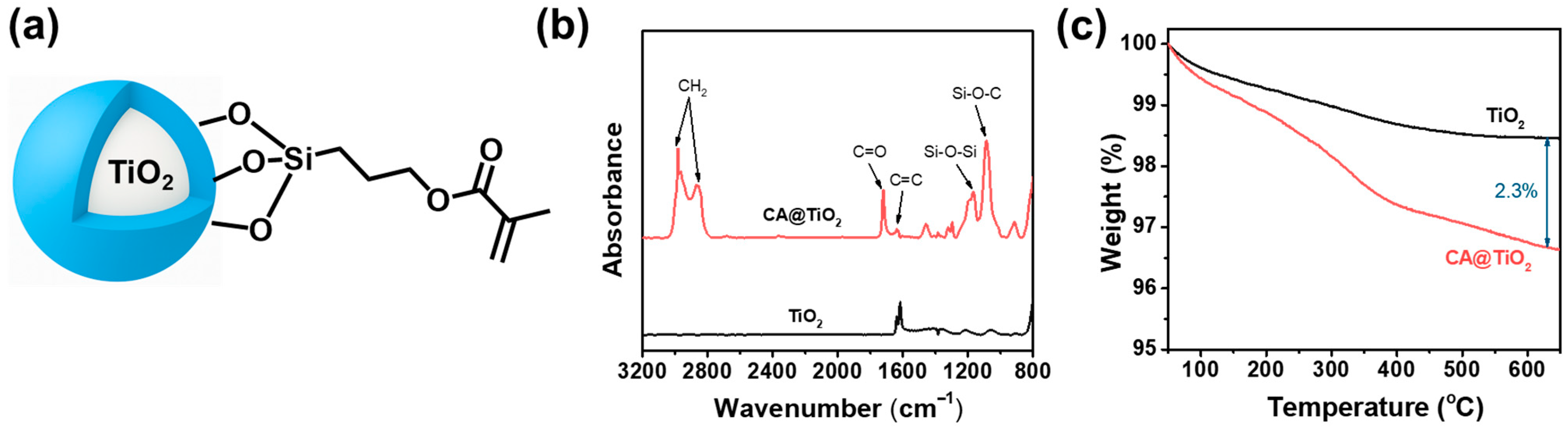
The CA-functionalized TiO2 filler is schematically illustrated in Figure 2a, while the corresponding FT-IR spectra of TiO2 and CA@TiO2 are presented in Figure 2b. Compared with the pristine TiO2 filler, the CA@TiO2 exhibits new characteristic peaks at 1162 cm−1 and 1197 cm−1, corresponding to the Si-O-Si bond stretching vibration of CA, as well as peaks at 2981 cm−1 and 2865 cm−1, which are attributed to -CH2- stretching vibrations from CA. In addition, new absorption peaks appear at 912 cm−1, 1085 cm−1, 1640 cm−1, and 1721 cm−1, representing the stretching vibrations of Si-OH, Si-O-C, C=C, and C=O groups of CA, respectively [28]. These results confirm that CA was successfully grafted onto the TiO2 surface. TGA was used to determine the grafting amount of CA on the TiO2 surface. As shown in Figure 2c, when heated from 200 to 650 °C, pristine TiO2 and CA@TiO2 show weight losses of 1.5% and 3.8%, respectively. Based on Equation (S1), the grafting density on TiO2 was calculated as 0.12 mmol/g.

3.2. Microstructure of AR Composites

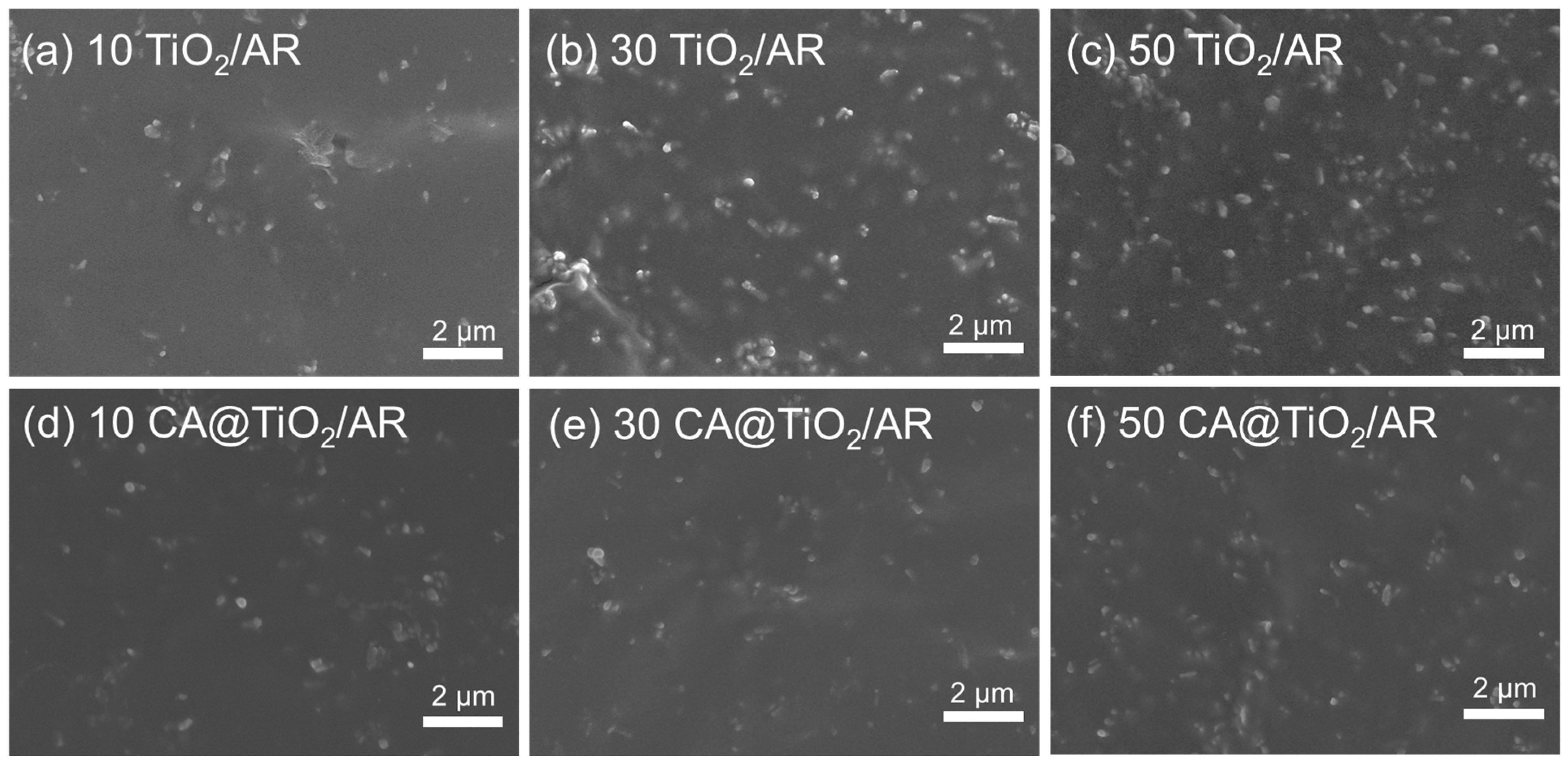
The morphology of TiO2/AR and CA@TiO2/AR composites was examined by SEM, and the results are shown in Figure 3. The unmodified TiO2 exhibits poor dispersion, with pronounced particle agglomeration due to the large surface energy mismatch between TiO2 and the AR matrix. In contrast, CA@TiO2 fillers are dispersed more uniformly in the AR matrix. This improvement arises from CA serving as a co-crosslinking bridge through interfacial covalent bonding, which enhances the compatibility between TiO2 particles and the AR matrix.

3.3. Mechanical Properties of AR Composites

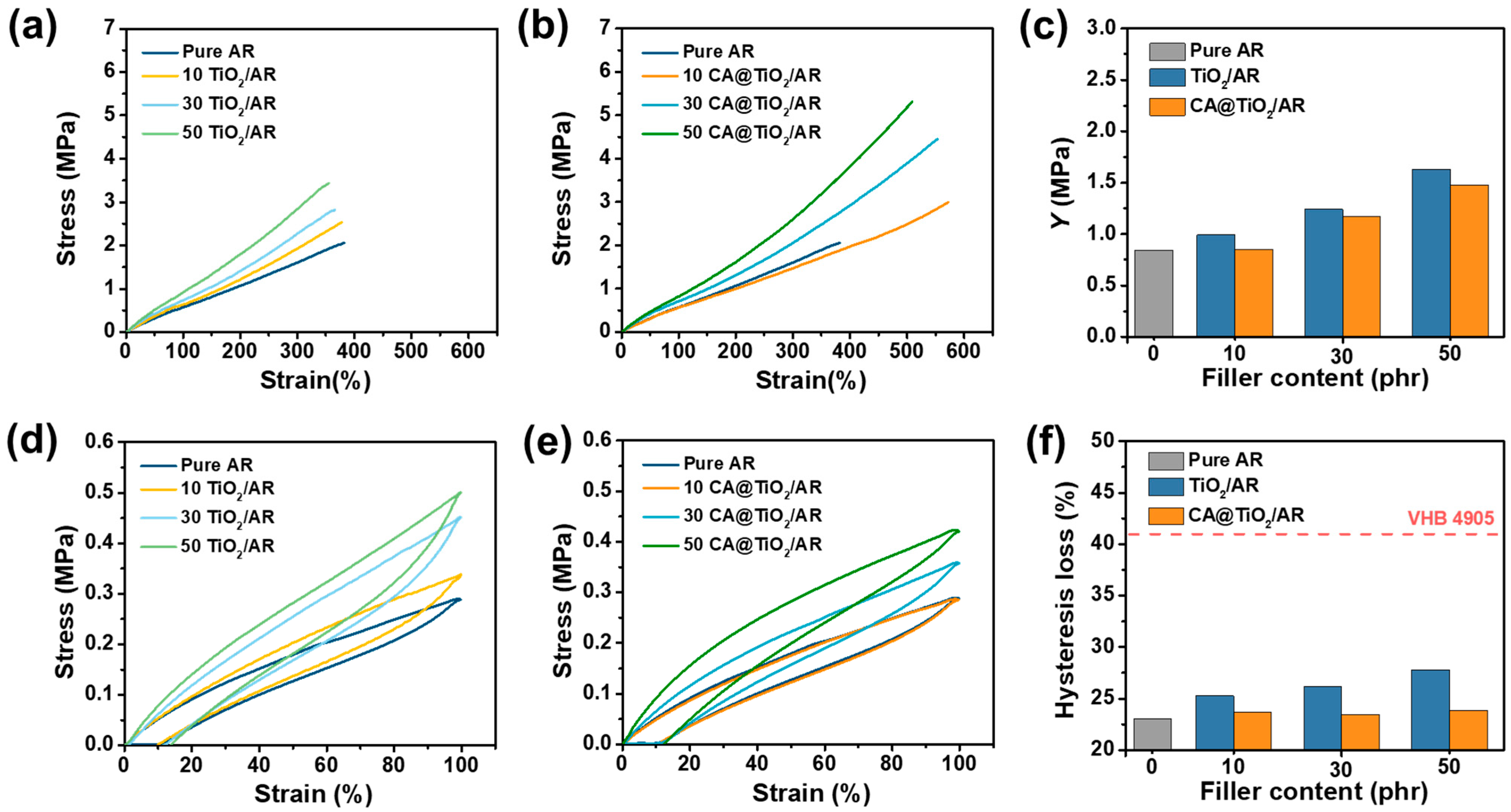
The stress–strain curves of TiO2/AR and CA@TiO2/AR composites are shown in Figure 4a and Figure 4b, respectively, and the mechanical properties of all AR composites are summarized in Table S2. The tensile strength of the AR composites exceeds that of pure AR and increases with filler content, owing to the reinforcing effect of rigid fillers. Specifically, the filler particles can promote stress transfer from the flexible AR matrix to the rigid inorganic filler during stretching. At the same filler loading, the CA@TiO2/AR composites exhibit higher tensile strength and elongation at break than the TiO2/AR composites, owing to the better filler dispersion and stronger filler–matrix interaction, which reduce stress concentration and improve load transfer efficiency.
The Y of the AR composites is shown in Figure 4c. At 10 phr TiO2 or CA@TiO2, Y differs only slightly from pure AR, indicating that the filler network structure has not been formed yet under low filler fraction. At higher contents, Y increases significantly because of the formation of filler networks that stiffen the matrix. In addition, at the same filler content, the Y of CA@TiO2/AR composites is lower than that of TiO2/AR composites, which is attributed to better dispersion and a more compliant siloxane interphase that reduces the compactness of the network structure.
In addition, low hysteresis loss (also known as viscoelastic hysteresis) is an important evaluation criterion for elasticity of DEs. The cyclic stress–strain curves of TiO2/AR and CA@TiO2/AR composites are shown in Figure 4d and Figure 4e, respectively, and the hysteresis loss of all AR composites are summarized in Figure 4f. Whether or not the fillers are surface-modified, the hysteresis loss of AR composites increases with TiO2 content, which is attributed to increased interfacial friction, interfacial sliding, and the strengthening of filler network at higher loadings. At the same filler content, CA@TiO2/AR composites show a lower hysteresis loss than TiO2/AR composites due to a robust interphase and the better dispersion of TiO2. These interfacial interactions provide stronger anchoring points and suppress interfacial slippage, facilitating chain recovery and reducing energy dissipation. The hysteresis loss of the 10 CA@TiO2/AR composite is comparable to that of pure AR (23%), indicating the high elasticity being maintained. Moreover, the hysteresis loss of all AR composites remains below 28%, well below that of VHB 4905 (41%), a widely used acrylic-based DE [29].

3.4. Dielectric Properties of AR Composites

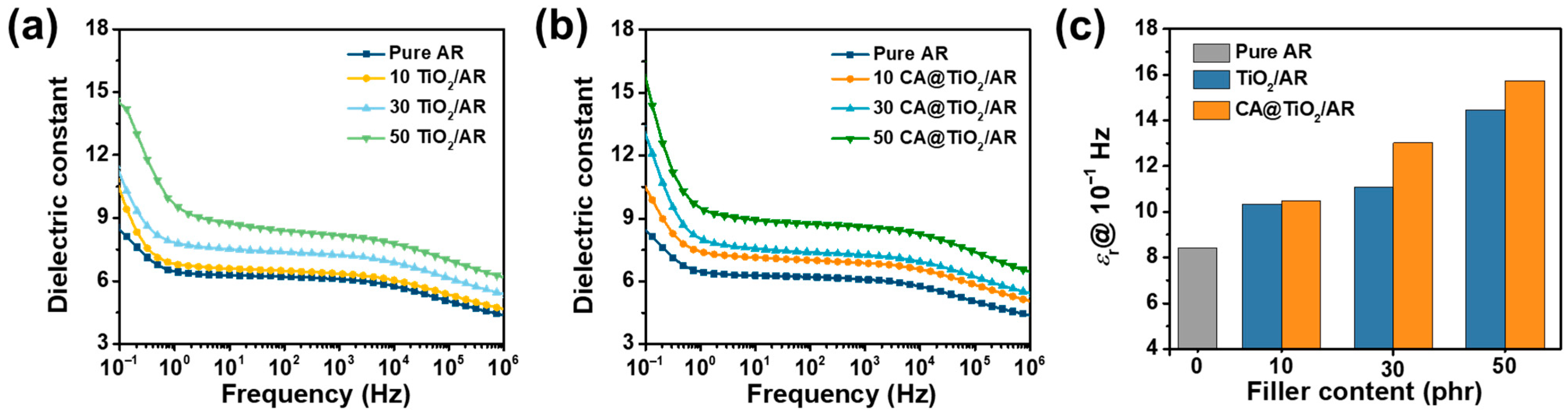
The εr of TiO2/AR and CA@TiO2/AR composites over 10−1–106 Hz is shown in Figure 5a and Figure 5b, respectively. The εr of all composites decreases with increasing frequency, indicating strong frequency dependence arising from dipolar relaxation. At low frequencies, dipoles associated with the ester side groups in AR can follow the alternating field, yielding high polarization and therefore higher εr. As the frequency increases, dipole reorientation cannot keep pace, polarization diminishes, and εr falls. In addition, εr increases with TiO2 content, whether or not the fillers are surface-modified, because of interfacial polarization between the dielectric filler and the rubber matrix.
More importantly, the εr @ 10−1 Hz of CA@TiO2/AR composites is higher than that of TiO2/AR composites at the same filler content (Figure 5c). This enhancement mainly originates from the improved dispersion of CA@TiO2 in the AR matrix, which increases the number of effective polymer-filler phase interfaces and thereby enhances the overall contribution of interfacial polarization. Notably, this trend is different from our previous reported SiO2/SiR system, where the εr @ 10−1 Hz of CA@SiO2/SiR composites is lower than that of SiO2/SiR composites at the same filler loading [30]. Although surface modification in the CA@SiO2/SiR system improves dispersion and enlarges the total interfacial area, the CA layer weakens the interfacial polarization at each individual SiO2-SiR interface, leading to an overall decrease in εr. These opposite trends indicate a trade-off between filler dispersion and interfacial structure in determining the overall interfacial polarization contribution. As a result, the 50 CA@TiO2/AR composite shows the highest εr @ 10−1 Hz of 15.73, which is 1.87 times than that of neat AR (8.43).
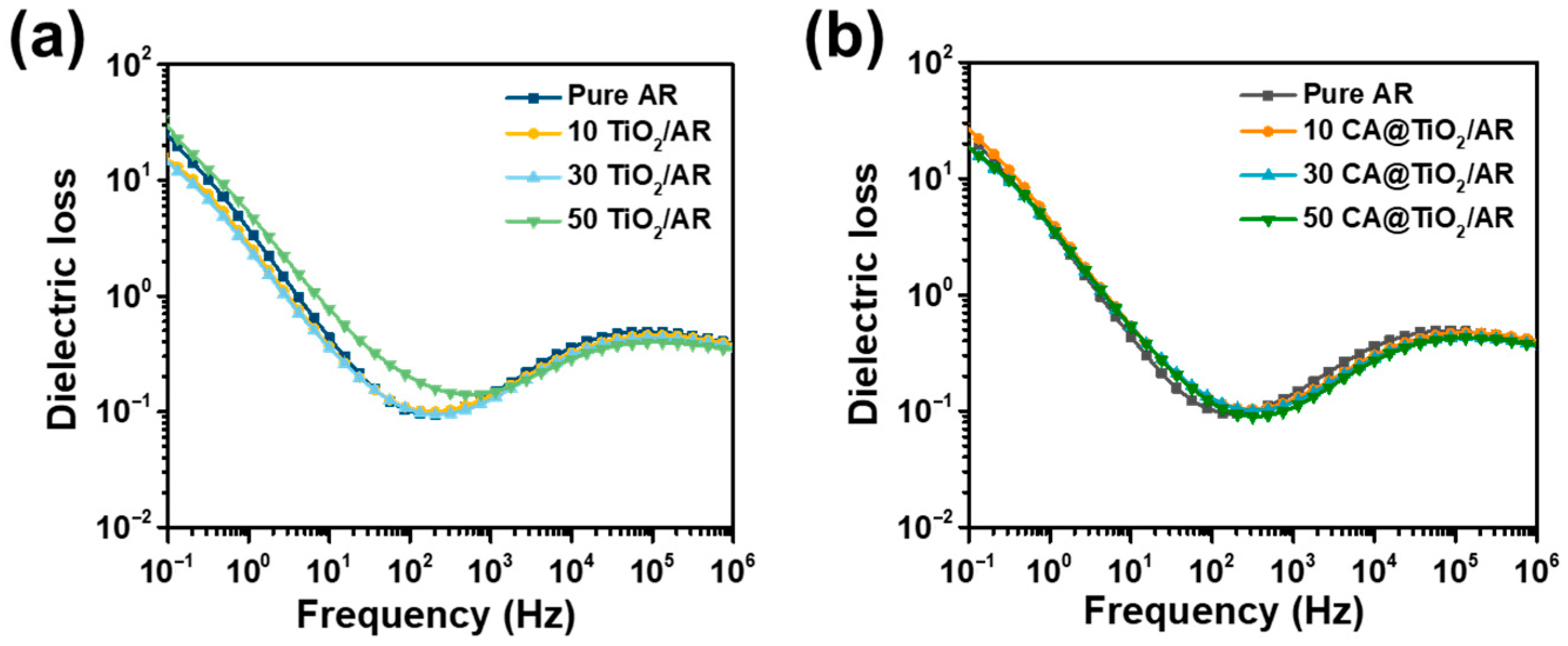
Consistent with the frequency dependence of εr, the ε″ of all composites also exhibits an obvious frequency-dependent behavior (Figure 6). At low frequencies, the ε″ is relatively high, mainly because interfacial polarization and dipolar relaxation can fully respond to the slowly varying electric field, resulting in greater energy dissipation. With increasing frequency, the ε″ gradually decreases because the dipoles and interfacial charges can no longer follow the rapid alternation of the electric field in a timely manner. Therefore, the polarization process becomes progressively suppressed, leading to reduced ε″ at higher frequencies.
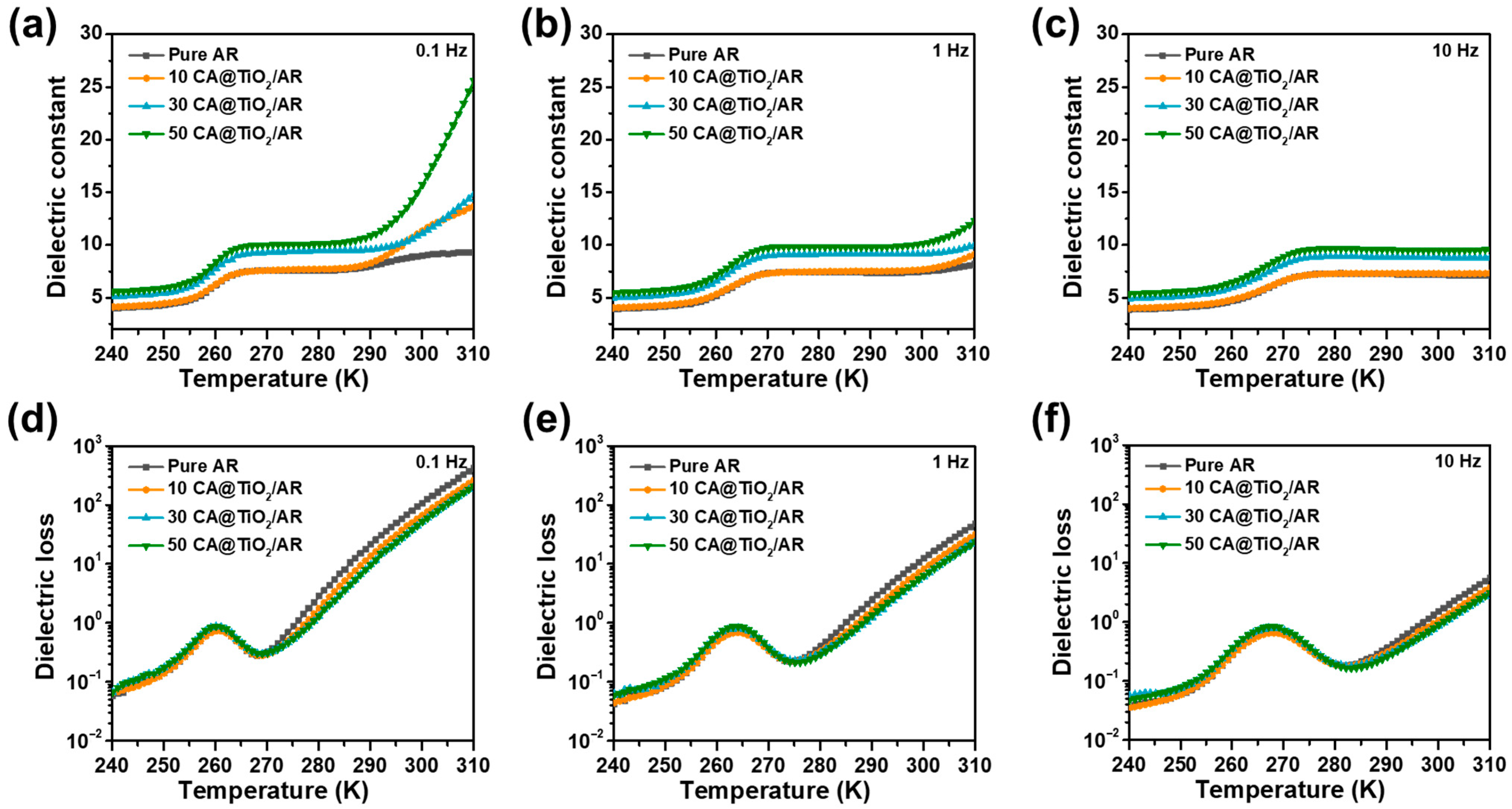
To clarify the physical origin of the dielectric properties, the dielectric relaxation behavior of pure AR and CA@TiO2/AR composites was investigated over a wide temperature range at three low frequencies (0.1, 1, and 10 Hz), which are relevant to the expected operating conditions of the artificial bladder (Figure 7) [31,32]. As shown in Figure 7a–c, the εr of all samples gradually increases with increasing temperature. In addition, the composites with higher CA@TiO2 content exhibit higher εr, especially at low frequencies. This behavior can be attributed to the enhanced interfacial polarization and the increased mobility of polar groups at elevated temperature. Meanwhile, as shown in Figure 7d–f, all samples exhibit a broad temperature-dependent dielectric-loss relaxation feature. However, no obvious change in peak position or peak intensity with increasing filler content, suggesting that the introduction of CA@TiO2 does not significantly alter the dipolar relaxation behavior of the AR matrix.
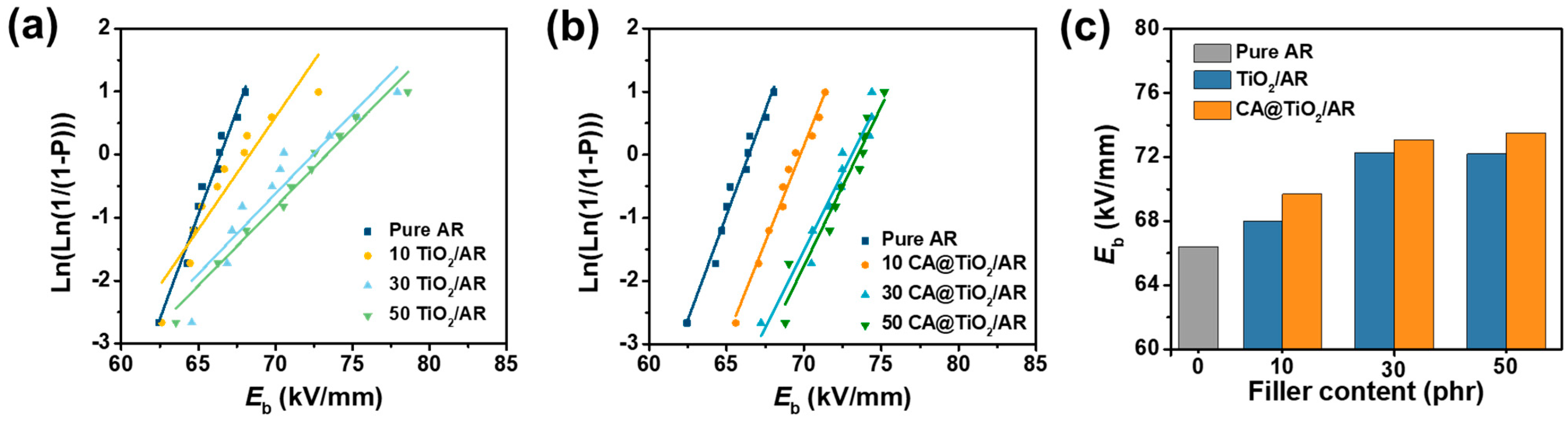
In addition, the Eb is a key parameter that limits the maximum actuated strain, as indicated by Equation (1). As shown in Figure 8a,b, Eb of all composites increases with TiO2 content for both pristine and CA-modified fillers, consistent with previous reports [22,33]. This can be attributed to the introduction of rigid TiO2 particles, which restrict the segmental mobility of AR chains and increase the tortuosity of charge transport pathways, thereby suppressing space charge migration and electrical treeing and improving the local electric field distribution [34]. Moreover, CA@TiO2/AR composites show a higher electrical breakdown field than TiO2/AR composites at the same filler content, which is attributed to improved filler dispersion and fewer defect sites, and the formation of an insulating layer on the filler surface (Figure 8c). Accordingly, the 50 CA@TiO2/AR composite shows the highest Eb of 73.5 kV/mm, which is 1.11 times that of neat AR (66.4 kV/mm).

3.5. Actuation Performance of Composite

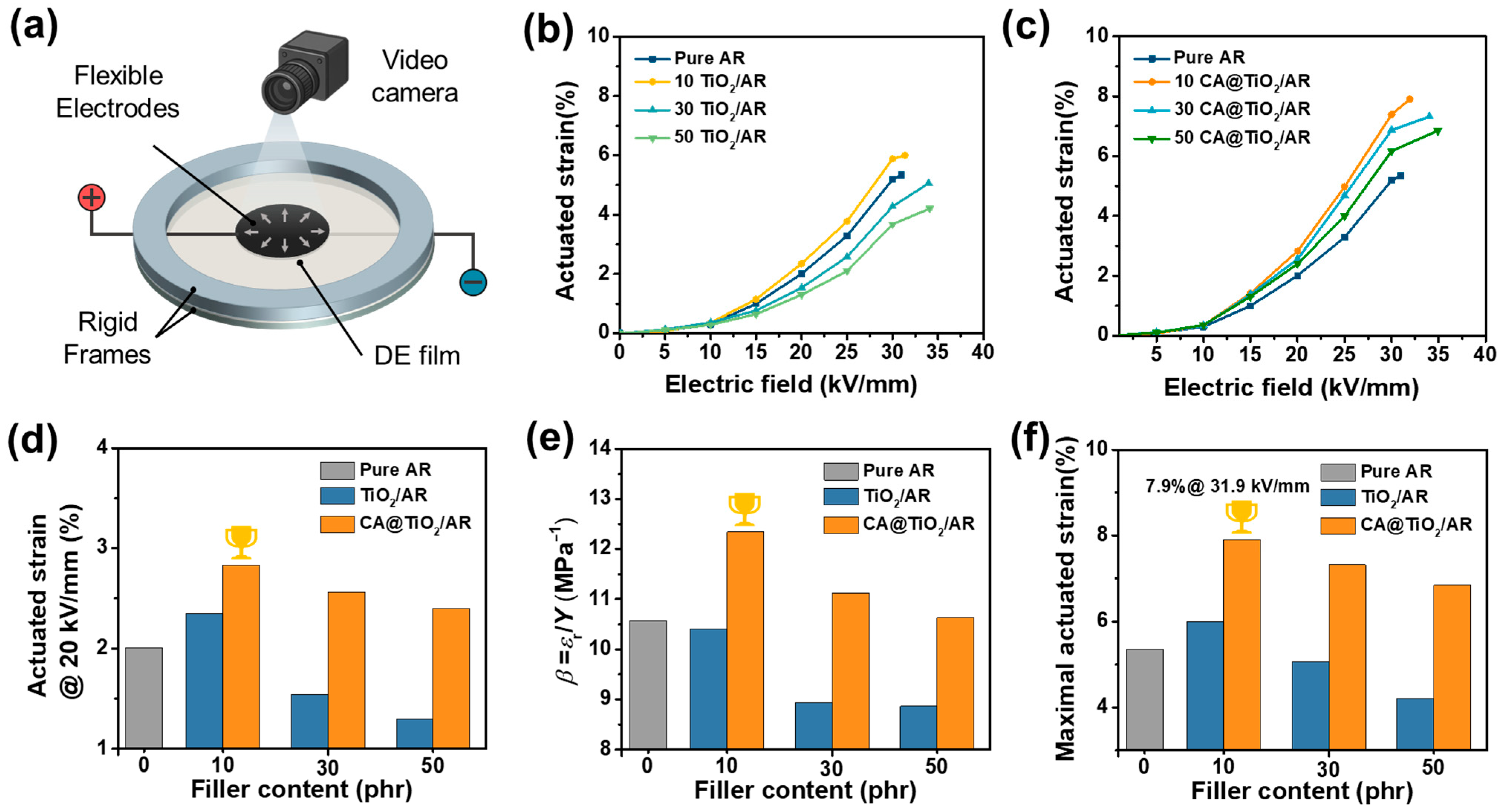
Actuated strain is central to evaluating actuation performance. We measured it with a circular in-plane actuator without any pre-stretch (Figure 9a). The actuated strain at different electric fields for TiO2/AR and CA@TiO2/AR composites is shown in Figure 9b and Figure 9c, respectively, and the corresponding actuation performance is summarized in Table S3. For all samples, the actuated strain increases with electric field and follows a quadratic dependence on the electric field, as shown in Equation (1). At a given electric field (e.g., 20 kV/mm), CA@TiO2/AR composites exhibit larger actuated strain than TiO2/AR composites at the same filler content, with the 10 CA@TiO2 composite showing the largest actuated strain (Figure 9d). These results arise from the differences in electromechanical sensitivity (β = εr/Y), consistent with Equation (1). As shown in Figure 9e, CA@TiO2/AR composites have higher β than TiO2/AR composites at the same filler content, because they combine a higher εr with a lower Y. Meanwhile, β in CA@TiO2/AR composites first increases and then decreases with filler content. At the 10 phr CA@TiO2 loading, εr increases with only a slight change in Y, leading to the highest β. By comparison, at higher filler contents, εr still increases while Y rises more rapidly, leading to a drop in β. As a result, owing to its highest β and a relatively high Eb, the 10 CA@TiO2/AR composite reaches the maximal actuation strain of 7.9% at 31.9 kV/mm, which is 1.48 times that of pure AR and 1.32 times that of the 10 TiO2/AR composite (Figure 9f).

4. Conclusions

In summary, we demonstrated a simple and effective route to enhance the electromechanical performance of AR DEs by incorporating silane-functionalized TiO2. Compared with pristine TiO2, CA@TiO2 forms a siloxane-rich interphase and covalent bridges to the AR network, which improves compatibility, stabilizes dispersion, and thus increases the number of effective polymer-filler phase interfaces and thereby enhances the overall contribution of interfacial polarization. Therefore, at the same filler content, CA@TiO2/AR composites show lower Y, higher tensile strength, lower hysteresis loss (indicating good elasticity), higher εr, and higher Eb. Overall, the electromechanical sensitivity (β = εr/Y) of AR composites reaches a maximal value at 10 phr CA@TiO2 and declines at higher loadings as Y increases more rapidly than εr. As a result, the 10 CA@TiO2/AR composite exhibits a maximal actuated strain of 7.9% at 31.9 kV/mm without pre-stretch, which is 1.48 times that of pure AR and 1.32 times that of the 10 TiO2/AR composite. This low-cost surface modification strategy is broadly applicable for improving the electromechanical performance of DE composites and provides a practical route to high-performance, scalable soft actuators with potential use in artificial bladder applications.

Supplementary Materials

The following supporting information can be downloaded at: https://www.mdpi.com/article/10.3390/polym18070872/s1, Figure S1: Stress-strain curves of porcine bladder in the longitudinal and transverse directions; Table S1: Experimental formulation of AR composites; Table S2: Mechanical and dielectric properties of AR composites; Table S3: Electrical actuation performance of AR composites.

Author Contributions

Conceptualization, L.P. and W.S.; Methodology, L.P. and W.S.; Software, L.P. and W.S.; Validation, L.P. and W.S.; Formal analysis, L.P. and W.S.; Investigation, L.P. and W.S.; Resources, L.P. and W.S.; Data curation, L.P. and W.S.; Writing—original draft, L.P. and W.S.; Writing—review and editing, L.P. and W.S.; Visualization, L.P. and W.S.; Supervision, Y.H., N.N. and J.W.; Project administration, Y.H., N.N. and J.W.; Funding acquisition, Y.H., N.N. and J.W. All authors have read and agreed to the published version of the manuscript.

Funding

This research was funded by National High Level Hospital Clinical Research Funding grant number 2025-NHLHCRF-JBGS-B-WZ-13.

Institutional Review Board Statement

Not applicable.

Data Availability Statement

The original contributions presented in this study are included in the article/Supplementary Material. Further inquiries can be directed to the corresponding authors.

Acknowledgments

We would like to thank the National High Level Hospital Clinical Research Funding (2025-NHLHCRF-JBGS-B-WZ-13).

Conflicts of Interest

The authors declare no conflicts of interest.

References

  1. Ahn, J.; Gu, J.; Choi, J.; Han, C.; Jeong, Y.; Park, J.; Cho, S.; Oh, Y.S.; Jeong, J.H.; Amjadi, M.; et al. A review of recent advances in electrically driven polymer-based flexible actuators: Smart materials, structures, and their applications. Adv. Mater. Technol. 2022, 7, 2200041. [Google Scholar] [CrossRef]
  2. Yang, Y.; Wu, Y.; Li, C.; Yang, X.; Chen, W. Flexible actuators for soft robotics. Adv. Intell. Syst. 2020, 2, 1900077. [Google Scholar] [CrossRef]
  3. Bruschi, A.; Donati, D.M.; Choong, P.; Lucarelli, E.; Wallace, G. Dielectric elastomer actuators, neuromuscular interfaces, and foreign body response in artificial neuromuscular prostheses: A review of the literature for an in vivo application. Adv. Healthc. Mater. 2021, 10, 2100041. [Google Scholar] [CrossRef]
  4. Qiu, Y.; Zhang, E.; Plamthottam, R.; Pei, Q. Dielectric elastomer artificial muscle: Materials innovations and device explorations. Acc. Chem. Res. 2019, 52, 316–325. [Google Scholar] [CrossRef] [PubMed]
  5. Pelrine, R.; Kornbluh, R.; Pei, Q.; Joseph, J. High-speed electrically actuated elastomers with strain greater than 100%. Science 2000, 287, 836–839. [Google Scholar] [CrossRef]
  6. Yang, L.; Wang, H.; Zhang, D.; Yang, Y.; Leng, D. Large deformation, high energy density dielectric elastomer actuators: Principles, factors, optimization, applications, and prospects. Chem. Eng. J. 2024, 489, 151402. [Google Scholar] [CrossRef]
  7. Ellingford, C.; Bowen, C.; McNally, T.; Wan, C. Intrinsically tuning the electromechanical properties of elastomeric dielectrics: A chemistry perspective. Macromol. Rapid Commun. 2018, 39, 1800340. [Google Scholar] [CrossRef] [PubMed]
  8. Tian, M.; Yan, B.; Yao, Y.; Zhang, L.; Nishi, T.; Ning, N. Largely improved actuation strain at low electric field of dielectric elastomer by combining disrupting hydrogen bonds with ionic conductivity. J. Mater. Chem. C 2014, 2, 8388–8397. [Google Scholar] [CrossRef]
  9. Yang, D.; Huang, S.; Ruan, M.; Li, S.; Wu, Y.; Guo, W.; Zhang, L. Improved electromechanical properties of silicone dielectric elastomer composites by tuning molecular flexibility. Compos. Sci. Technol. 2018, 155, 160–168. [Google Scholar] [CrossRef]
  10. Yang, D.; Huang, S.; Wu, Y.; Ruan, M.; Li, S.; Shang, Y.; Cui, X.; Zhou, J.; Guo, W.; Zhang, L. All-organic non-percolative dielectric composites with enhanced electromechanical actuating performances by controlling molecular interaction. RSC Adv. 2015, 5, 102157–102166. [Google Scholar] [CrossRef]
  11. Liu, X.; Yu, L.; Nie, Y.; Skov, A.L. Silicone elastomers with high-permittivity ionic liquids loading. Adv. Eng. Mater. 2019, 21, 1900481. [Google Scholar] [CrossRef]
  12. Ruan, M.; Yang, D.; Guo, W.; Huang, S.; Wu, Y.; Wang, H.; Wang, H.; Zhang, L. Improved electromechanical properties of brominated butyl rubber filled with modified barium titanate. RSC Adv. 2017, 7, 37148–37157. [Google Scholar] [CrossRef]
  13. Yao, J.; Liu, X.; Sun, H.; Liu, S.; Jiang, Y.; Yu, B.; Ning, N.; Tian, M.; Zhang, L. Thermoplastic polyurethane dielectric elastomers with high actuated strain and good mechanical strength by introducing ester group grafted polymethylvinylsiloxane. Ind. Eng. Chem. Res. 2021, 60, 4883–4891. [Google Scholar] [CrossRef]
  14. Yin, L.-J.; Du, B.; Hu, H.-Y.; Dong, W.-Z.; Zhao, Y.; Zhang, Z.; Zhao, H.; Zhong, S.-L.; Yin, C.; Qu, L.; et al. A high-response-frequency bimodal network polyacrylate elastomer with ultrahigh power density under low electric field. Nat. Commun. 2024, 15, 9819. [Google Scholar] [CrossRef]
  15. Zhao, Y.; Zha, J.-W.; Yin, L.-J.; Gao, Z.-S.; Wen, Y.-Q.; Dang, Z.-M. Remarkable electrically actuation performance in advanced acrylic-based dielectric elastomers without pre-strain at very low driving electric field. Polymer 2018, 137, 269–275. [Google Scholar] [CrossRef]
  16. Liu, S.; Sun, H.; Ning, N.; Zhang, L.; Tian, M.; Zhu, W.; Chan, T.W. Aligned carbon nanotubes stabilized liquid phase exfoliated graphene hybrid and their polyurethane dielectric elastomers. Compos. Sci. Technol. 2016, 125, 30–37. [Google Scholar] [CrossRef]
  17. Yao, Y.; Ning, N.; Zhang, L.; Nishi, T.; Tian, M. Largely improved electromechanical properties of thermoplastic polyurethane dielectric elastomer by carbon nanospheres. RSC Adv. 2015, 5, 23719–23726. [Google Scholar] [CrossRef]
  18. Panahi-Sarmad, M.; Zahiri, B.; Noroozi, M. Graphene-based composite for dielectric elastomer actuator: A comprehensive review. Sens. Actuators A Phys. 2019, 293, 222–241. [Google Scholar] [CrossRef]
  19. Sun, H.; Zhang, H.; Liu, S.; Ning, N.; Zhang, L.; Tian, M.; Wang, Y. Interfacial polarization and dielectric properties of aligned carbon nanotubes/polymer composites: The role of molecular polarity. Compos. Sci. Technol. 2018, 154, 145–153. [Google Scholar] [CrossRef]
  20. Carpi, F.; Rossi, D.D. Improvement of electromechanical actuating performances of a silicone dielectric elastomer by dispersion of titanium dioxide powder. IEEE Trans. Dielectr. Electr. Insul. 2005, 12, 835–843. [Google Scholar] [CrossRef]
  21. Yang, D.; Ni, Y.; Kong, X.; Xue, H.; Guo, W.; Zhang, L. Enhanced electromechanical properties of natural rubber using highly efficient and cost-effective mussel-inspired modification of TiO2 nanoparticles. Appl. Surf. Sci. 2019, 495, 143638. [Google Scholar] [CrossRef]
  22. Yang, D.; Ni, Y.; Kong, X.; Wang, Y.; Zhang, L. A mussel-like inspired modification of BaTiO3 nanoparticles using catechol/polyamine co-deposition and silane grafting for high-performance dielectric elastomer composites. Compos. Part B 2019, 172, 621–627. [Google Scholar] [CrossRef]
  23. Luo, H.; Zhou, X.; Ellingford, C.; Zhang, Y.; Chen, S.; Zhou, K.; Zhang, D.; Bowen, C.R.; Wan, C. Interface design for high energy density polymer nanocomposites. Chem. Soc. Rev. 2019, 48, 4424–4465. [Google Scholar] [CrossRef]
  24. Yang, D.; Huang, S.; Wu, Y.; Ruan, M.; Li, S.; Shang, Y.; Cui, X.; Wang, Y.; Guo, W. Enhanced actuated strain of titanium dioxide/nitrile–butadiene rubber composite by the biomimetic method. RSC Adv. 2015, 5, 65385–65394. [Google Scholar] [CrossRef]
  25. Kong, X.; Yang, D.; Ni, Y.; Hao, J.; Guo, W.; Zhang, L. Enhanced actuation strains of rubber composites by combined covalent and noncovalent modification of TiO2 nanoparticles. Ind. Eng. Chem. Res. 2019, 58, 19890–19898. [Google Scholar] [CrossRef]
  26. Hesami, M.; Jalali-Arani, A. Morphology development via static crosslinking of (polylactic acid/acrylic rubber) as an immiscible polymer blend. Macromol. Mater. Eng. 2018, 303, 1700446. [Google Scholar] [CrossRef]
  27. Quan, Y.; Lu, M.; Tian, M.; Yan, S.; Yu, Z.; Zhang, L. Functional and mechanical properties of acrylate elastomer/expanded graphite nanocomposites. J. Appl. Polym. Sci. 2013, 130, 680–686. [Google Scholar] [CrossRef]
  28. Wang, Y.; Jiang, Y.; Zang, W.; Ma, X.; Wu, W.; Yao, J.; Ning, N.; Tian, M. A dual cone actuator with high energy density and long fatigue life by developing a nano-silica reinforced dielectric elastomer composite. Compos. Part A 2024, 180, 106039. [Google Scholar] [CrossRef]
  29. Shi, Y.; Askounis, E.; Plamthottam, R.; Libby, T.; Peng, Z.; Youssef, K.; Pu, J.; Pelrine, R.; Pei, Q. A processable, high-performance dielectric elastomer and multilayering process. Science 2022, 377, 228–232. [Google Scholar] [CrossRef]
  30. Jiang, Y.; Tian, C.; Yao, J.; Wu, W.; Ning, N.; Tian, M.; Zhang, L. Nano-Silica/Polydimethyl(methylvinyl)siloxane dielectric elastomer generator with high generating energy density, high efficiency and long fatigue life. Chem. Eng. J. 2022, 439, 135339. [Google Scholar] [CrossRef]
  31. Belovickis, J.; Macutkevic, J.; Svirskas, S.; Samulionis, V.; Banys, J.; Shenderova, O.; Borjanovic, V. Ultrasonic and dielectric relaxations in PDMS/ZnO nanocomposite. Phys. Status Solidi B 2015, 252, 2778–2783. [Google Scholar] [CrossRef]
  32. Vanskeviče, I.; Kinka, M.; Banys, J.; Macutkevič, J.; Schaefer, S.; Selskis, A.; Fierro, V.; Celzard, A. Dielectric and Ultrasonic Properties of PDMS/TiO2 Nanocomposites. Polymers 2024, 16, 603. [Google Scholar] [CrossRef]
  33. Wei, Q.; Yang, D. Improved actuation performance and dielectric strength of natural rubber composites by introducing covalent bonds between dielectric filler and polymeric chains. Polymer 2022, 257, 125282. [Google Scholar] [CrossRef]
  34. Yang, D.; Ruan, M.; Huang, S.; Wu, Y.; Li, S.; Wang, H.; Shang, Y.; Li, B.; Guo, W.; Zhang, L. Improved electromechanical properties of NBR dielectric composites by poly(dopamine) and silane surface functionalized TiO2 nanoparticles. J. Mater. Chem. C 2016, 4, 7724–7734. [Google Scholar] [CrossRef]
Figure 1. (a) The construction and electrical actuation mechanism of a typical DEA. (b) Schematic illustration of the fabrication method for CA@TiO2/AR composites.
Polymers 18 00872 g001
Figure 2. (a) Schematic representation of CA@TiO2 filler. (b) FTIR spectra and (c) TGA thermograms of pristine TiO2 and CA@TiO2 filler.
Polymers 18 00872 g002
Figure 3. SEM micrographs of AR composites filled with (a) 10 phr TiO2, (b) 30 phr TiO2, (c) 50 phr TiO2, (d) 10 phr CA@TiO2 (e) 30 phr CA@TiO2 and (f) 50 phr CA@TiO2.
Polymers 18 00872 g003
Figure 4. Stress–strain curves of (a) TiO2/AR and (b) CA@TiO2/AR composites. (c) Y of all AR composites. Cyclic stress–strain curves of (d) TiO2/AR and (e) CA@TiO2/AR composites. (f) Hysteresis loss of all AR composites.
Polymers 18 00872 g004
Figure 5. εr versus frequency of (a) TiO2/AR and (b) CA@TiO2/AR composites. (c) εr @ 10−1 Hz of all AR composites.
Polymers 18 00872 g005
Figure 6. ε″ versus frequency at room temperature of (a) TiO2/AR and (b) CA@TiO2/AR composites.
Polymers 18 00872 g006
Figure 7. εr versus temperature of CA@TiO2/AR composites at (a) 0.1 Hz, (b) 1 Hz, and (c) 10 Hz; ε″ versus temperature of CA@TiO2/AR composites at (d) 0.1 Hz, (e) 1 Hz, and (f) 10 Hz.
Polymers 18 00872 g007
Figure 8. Eb in electric insulating oil calculated from Weibull distribution of (a) TiO2/AR and (b) CA@TiO2/AR composites, and (c) Comparison of Eb among all AR composites.
Polymers 18 00872 g008
Figure 9. (a) Schematic of actuated strain measurement using a circular in-plane actuator. Actuated strain versus electrical field of (b) TiO2/AR composites and (c) CA@TiO2/AR composites. (d) Actuated strain @ 20 kV/mm, (e) electromechanical sensitivity, and (f) maximum actuated strain of all AR composites.
Polymers 18 00872 g009
Disclaimer/Publisher’s Note: The statements, opinions and data contained in all publications are solely those of the individual author(s) and contributor(s) and not of MDPI and/or the editor(s). MDPI and/or the editor(s) disclaim responsibility for any injury to people or property resulting from any ideas, methods, instructions or products referred to in the content.