Innovation in Orthotics: Development of Technical Textiles from Bamboo Cellulose




Abstract
1. Introduction
2. Materials and Methods
2.1. Materials
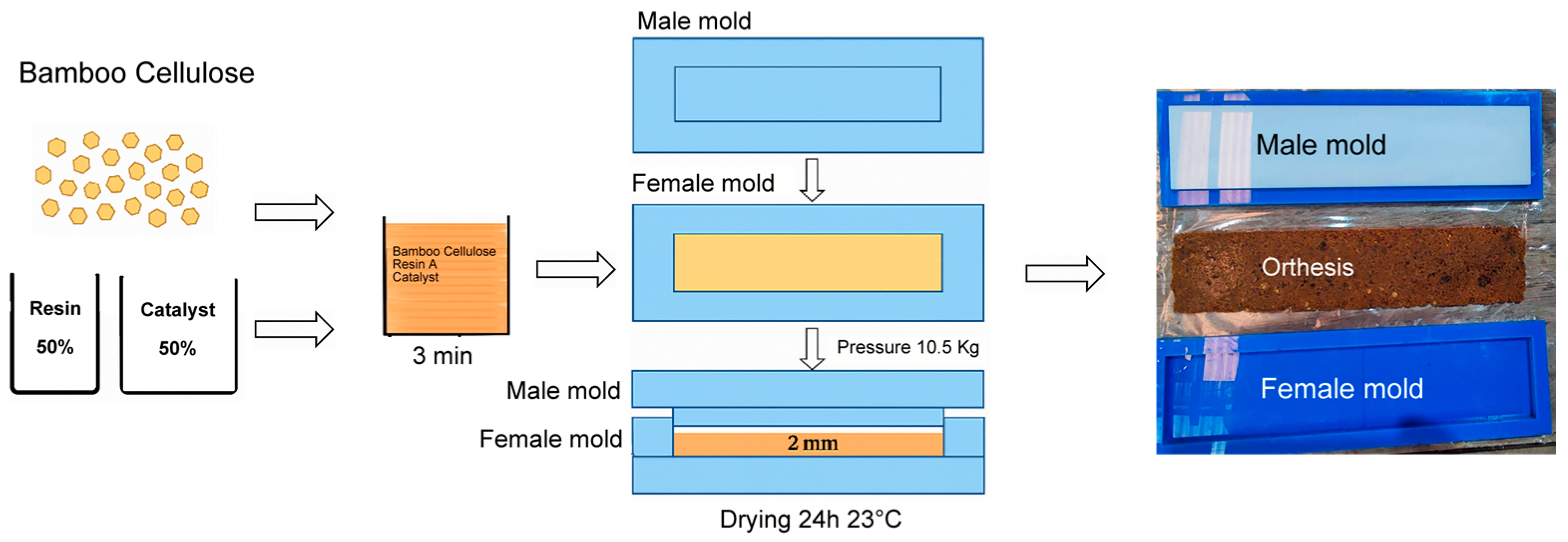
2.2. Methods
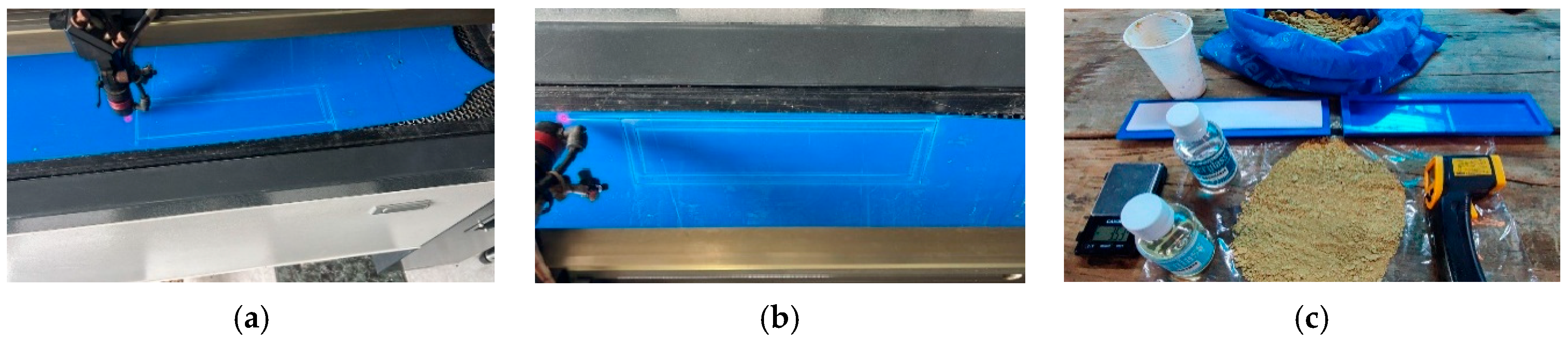
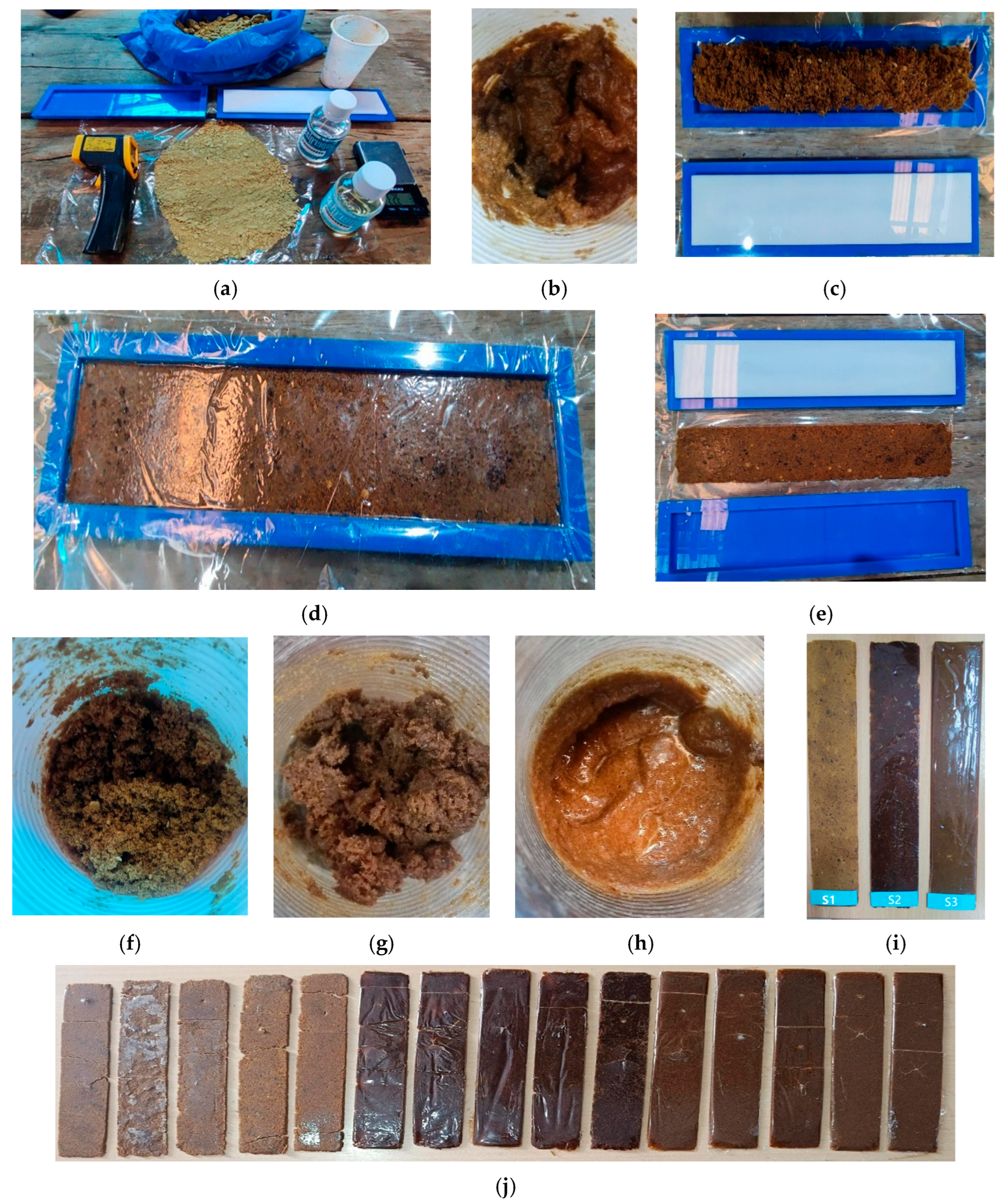
2.3. Preparing the Molds
2.4. Preparation of Formulations
2.5. Sample Manufacturing
3. Characterization Tests on Cured Samples
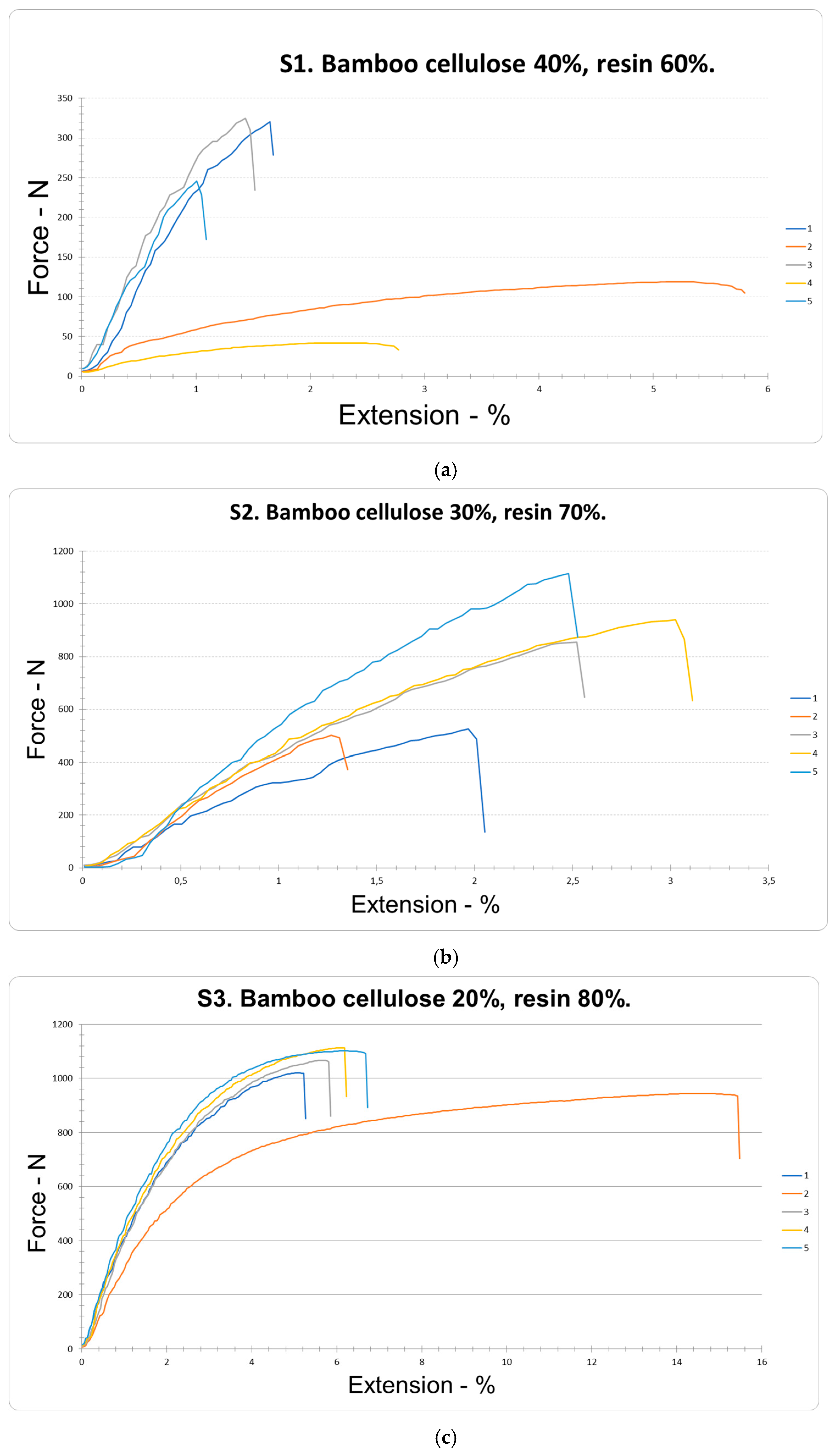
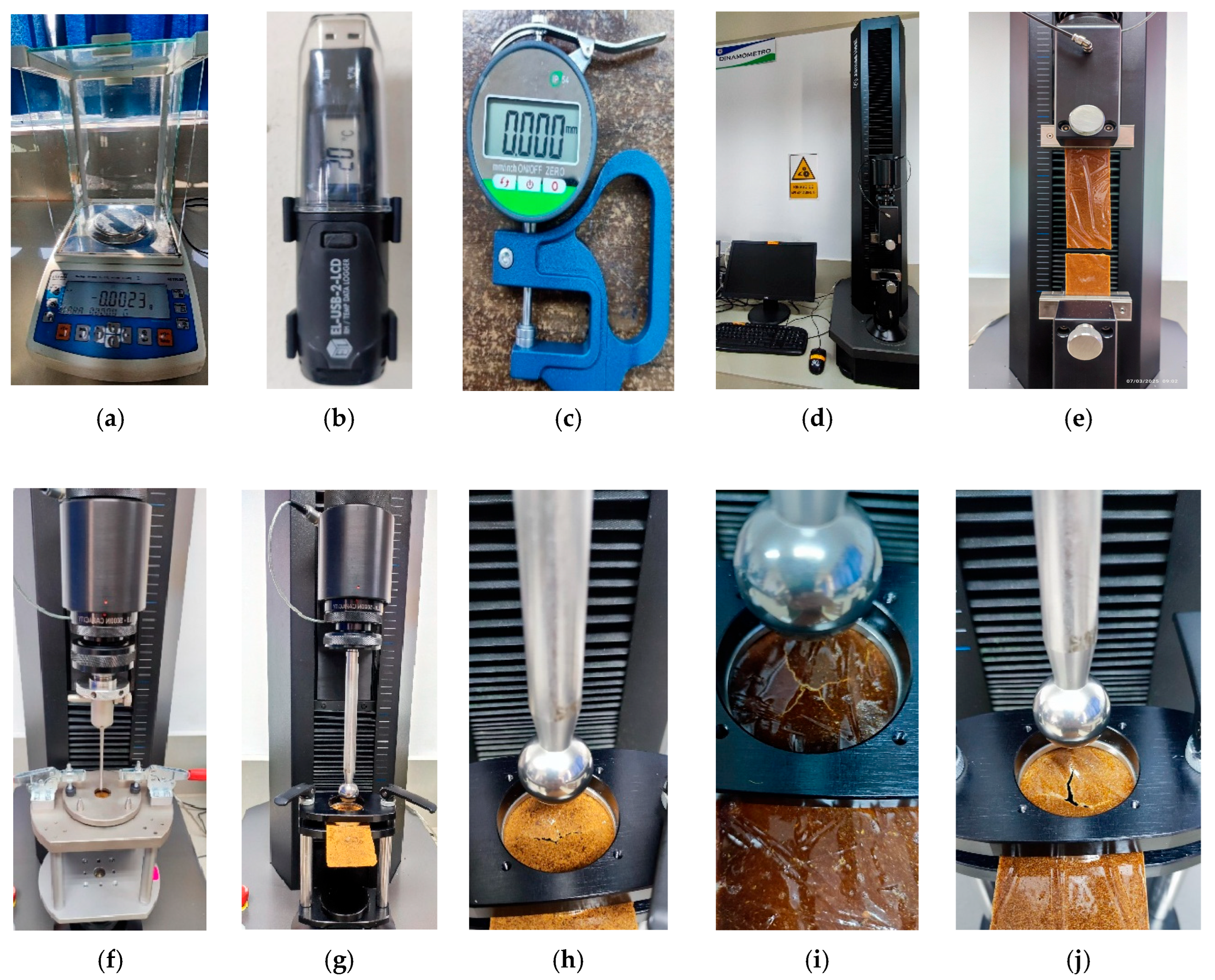
3.1. Tensile Strength and Elongation Resistance
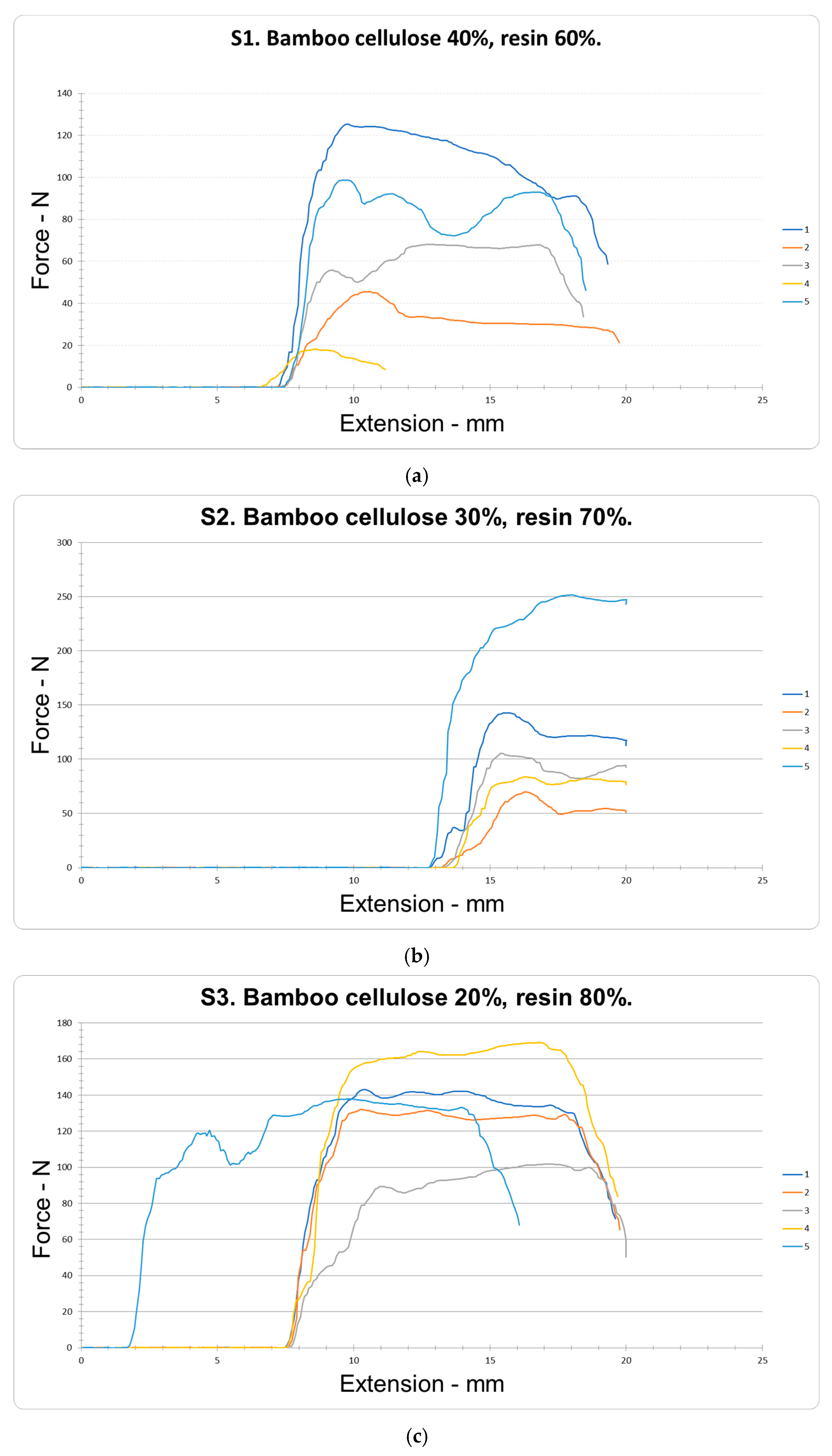
3.2. Puncture Resistance and Extension
3.3. Resistance and Extension to Ball Penetration
3.4. Determination of Mass per Unit Area
3.5. Thickness Determination
4. Results and Analysis
4.1. Appearance of Samples After Curing
4.2. Tensile Strength and Elongation at Break
4.3. Resistance and Extension to Punching
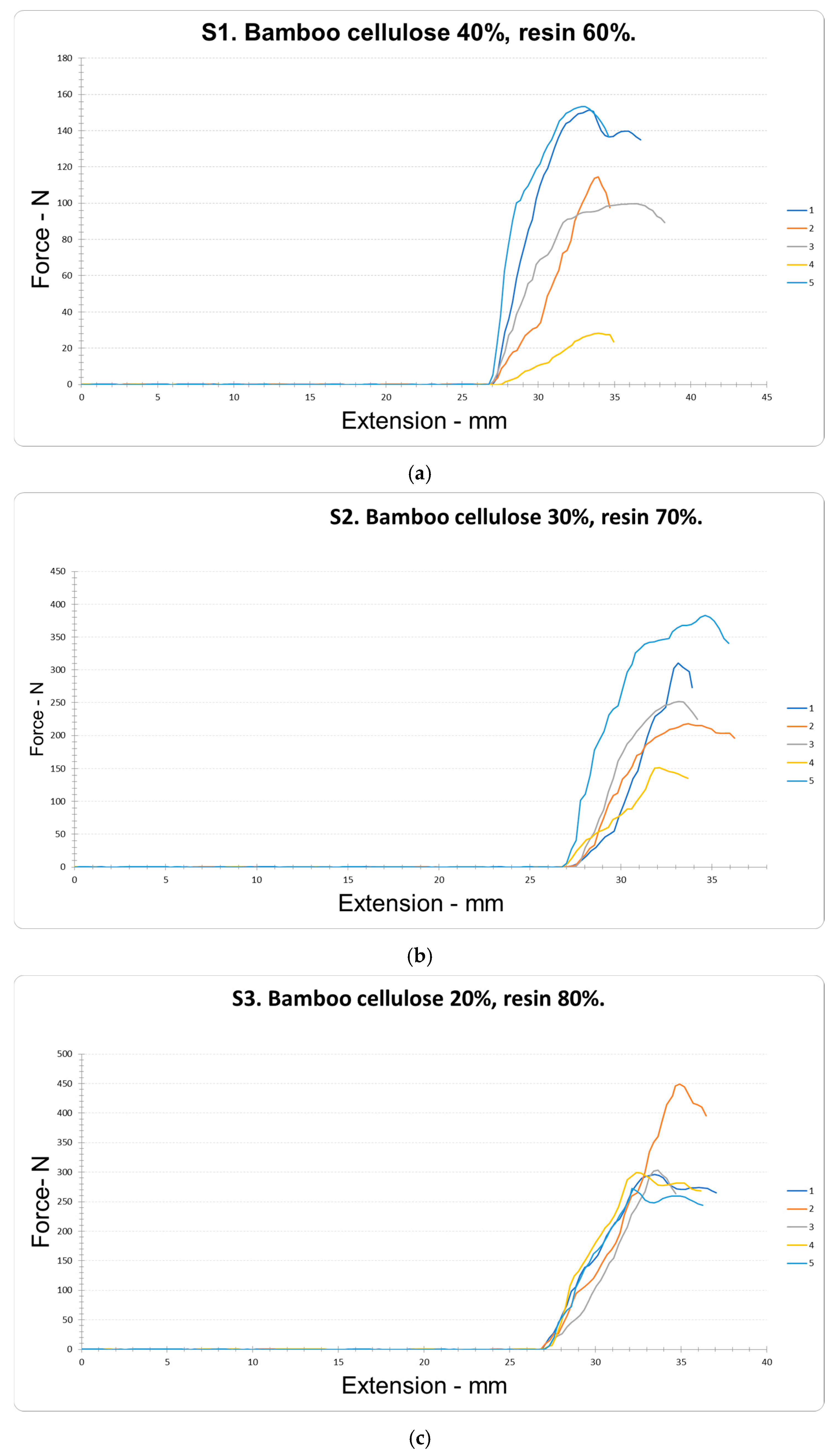
4.4. Analysis of Resistance and Extension to Ball Penetration
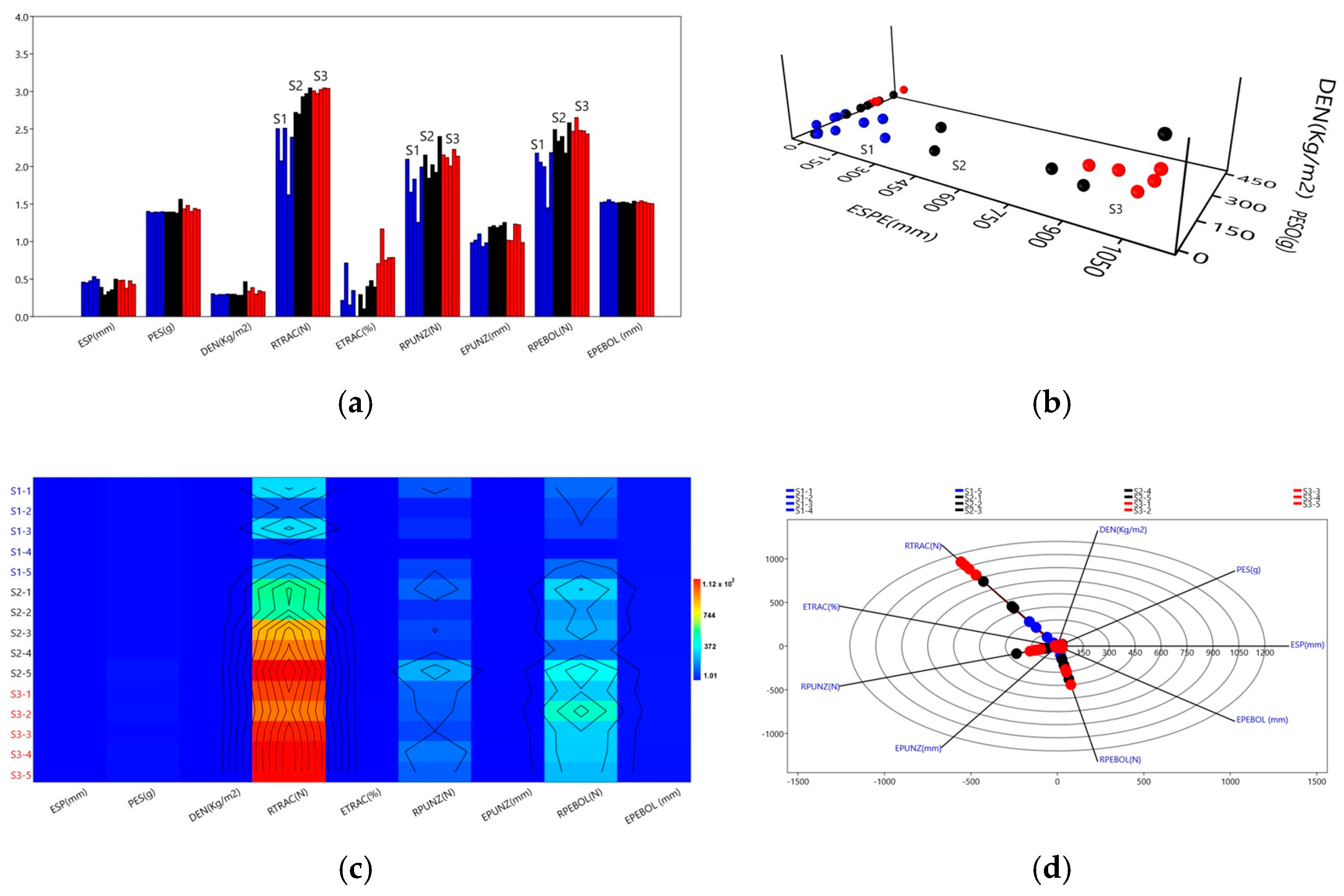
4.5. Correlation Between Samples
5. Conclusions
Author Contributions
Funding
Institutional Review Board Statement
Data Availability Statement
Conflicts of Interest
References
- Jin, Y.-A.; Plott, J.; Chen, R.; Wensman, J.; Shih, A. Additive Manufacturing of Custom Orthoses and Prostheses—A Review. Procedia CIRP 2015, 36, 199–204. [Google Scholar] [CrossRef] [Scilit]
- Shahar, F.S.; Sultan, M.T.H.; Lee, S.H.; Jawaid, M.; Shah, A.U.M.; Safri, S.N.A.; Sivasankaran, P.N. A review on the orthotics and prosthetics and the potential of kenaf composites as alternative materials for ankle-foot orthosis. J. Mech. Behav. Biomed. Mater. 2019, 99, 169–185. [Google Scholar] [CrossRef] [Scilit] [PubMed]
- Zhang, Y.; Liu, X.; Wan, M.; Zhu, Y.; Zhang, K. Recent Development of Functional Bio-Based Epoxy Resins. Molecules 2024, 29, 4428. [Google Scholar] [CrossRef] [Scilit] [PubMed]
- Abas, M.; Habib, T.; Noor, S. Design and analysis of solid ankle foot orthosis by employing mechanical characterization and a low-cost scanning approach for additive manufacturing. Rapid Prototyp. J. 2024, 30, 782–797. [Google Scholar] [CrossRef] [Scilit]
- Jones, A.W.; Makanjuola, A.; Bray, N.; Prior, Y.; Parker, D.; Nester, C.; Tang, J.; Jiang, L. The efficacy of custom-made offloading devices for diabetic foot ulcer prevention: A systematic review. Diabetol. Metab. Syndr. 2024, 16, 172. [Google Scholar] [CrossRef] [Scilit]
- Naili, J.E.; Åström, E.; Löwing, J.; Reimeringer, M.; Löwing, K. The impact of foot orthoses on gait in children with Osteogenesis Imperfecta type I, III and IV—A cross-sectional study. BMC Musculoskelet. Disord. 2024, 25, 560. [Google Scholar] [CrossRef] [Scilit]
- Nouri, A.; Wang, L.; Bakhtiari, H.; Li, Y.; Wen, C. Finger Orthoses for Rehabilitation―Part I: Biomedical Insights and Additive Manufacturing Innovations. Prosthesis 2025, 7, 62. [Google Scholar] [CrossRef] [Scilit]
- Franco, S.; Ramos, M.; Cordova, R.; Ochoa, E.; Ccama, G.; Molina, A. Design, Manufacturing and Mechanical Evaluation of a 3D Printed Customized Wrist-Hand Orthosis for the Treatment of De Quervain Tenosynovitis. In Proceedings of the CITIIC 2023, Nanjing, China, 18–20 September 2023; Volume 83. [Google Scholar]
- Loor, R.B.S.; Martínez-Gómez, J.; Anchundia, J.S. Material Selection for the Development of Orthoses Using Multicriteria Methods (MCDMs) and Simulation. Processes 2025, 13, 1796. [Google Scholar] [CrossRef] [Scilit]
- Humadi, R.Q.; Abbas, S.M.; Ibraheem, M.Q. Calf-corset patella tendon weightbearing orthosis modeling and manufacturing. Adv. Sci. Technol. Res. J. 2024, 19, 418–428. [Google Scholar] [CrossRef] [Scilit]
- Tao, Y.; Shao, J.; Li, P.; Shi, S.Q. Application of a thermoplastic polyurethane/polylactic acid composite filament for 3D-printed personalized orthosis. Mater. Technol. 2019, 53, 71–76. [Google Scholar] [CrossRef] [Scilit]
- Sosiati, H.; Kosasih, M.; Pamasti, A.; Adi, R.K.; Hamdan, S.; Yusuf, Y. Properties of Abaca/Epoxy Composites Modified by Activated Carbon Particles for Orthosis Application. BioResources 2023, 18, 7510–7523. [Google Scholar] [CrossRef] [Scilit]
- Le, H.H.; Nguyen, T.H.; Nguyen, B.Q.H. Customized Ankle–Foot Orthoses Fabrication via the Combined Approach of Design of Experiment, Additive Manufacturing, and Finite Element Analysis. Arab. J. Sci. Eng. 2025. [Google Scholar] [CrossRef] [Scilit]
- Szary, J.; Barburski, M.; Świniarski, J. Multi-layered composite for custom production: Integrating 3D-printed core with fiber-reinforced composites. J. Mater. Sci. 2025, 60, 16934–16951. [Google Scholar] [CrossRef] [Scilit]
- Abdelgawad, N.; Hadhoud, M.M.A.; El-Wakad, M.T.; Abdelbaset, R. Assessment of hybrid nanocomposite AFOs for pediatric cerebral palsy: Mechanical, spectroscopic, and finite element analysis. Sci. Rep. 2025, 15, 28865. [Google Scholar] [CrossRef] [Scilit] [PubMed]
- Husariman, S.A.F.; Mazlan, M.A.; Abdullah, A.H. Topology Optimization and Structural Analysis of a 3D-Printed PETG Hand Orthosis for Upper Limb Support. Int. Exch. Innov. Conf. Eng. Sci. 2025, 11, 1102–1108. [Google Scholar] [CrossRef] [Scilit]
- Sonaye, S.Y.; Dal-Fabbro, R.; Bottino, M.C.; Sikder, P. Osseointegration of 3D-Printable Polyetheretherketone–Magnesium Phosphate Bioactive Composites for Craniofacial and Orthopedic Implants. ACS Biomater. Sci. Eng. 2025, 11, 1060–1071. [Google Scholar] [CrossRef] [Scilit]
- Khan, A.-U.; Fareed, S.; Zahid, B. Use of high strength technical textiles in strengthening of reinforced concrete structural elements. J. Text. Inst. 2021, 113, 281–291. [Google Scholar] [CrossRef] [Scilit]
- Laghaei, R.; Hejazi, S.M.; Fashandi, H.; Akbarzadeh, S.; Shaghaghi, S.; Shamaei-Kashani, A.; Jahanara, B.; Shahsavari, E. Reinforcement contribution of cellulose nanocrystals (CNCs) to tensile properties and fracture behavior of triaxial E-glass fabric/epoxy composites. Compos. Part A Appl. Sci. Manuf. 2022, 164, 107258. [Google Scholar] [CrossRef] [Scilit]
- Hsu, Y.-I.; Huang, L.; Asoh, T.-A.; Uyama, H. Anhydride-cured epoxy resin reinforcing with citric acid-modified cellulose. Polym. Degrad. Stab. 2020, 178, 109213. [Google Scholar] [CrossRef] [Scilit]
- Zhao, Y.; Xu, R.; Xiao, Y.; Wang, H.; Zhang, W.; Zhang, G. Mechanical Performances of Phenolic Modified Epoxy Resins at Room and High Temperatures. Coatings 2022, 12, 643. [Google Scholar] [CrossRef] [Scilit]
- Mora-Muñoz, E.S.; Vaca-Sierra, T.N.; Posso-Pasquel, J.R.; Rivera-Yépez, J. Manufacture of a Custom-Made AFO Orthosis Based on Abaca Nonwoven Composite (Musa Textilis) and Resin. In Proceedings of the XVIII Multidisciplinary International Congress on Science and Technology, Ispra, Italy, 23–27 October 2023; pp. 135–148. [Google Scholar]
- Deb, S.; Sen, T. Bamboo reinforcement towards sustainability: An overview. Interactions 2025, 246, 28. [Google Scholar] [CrossRef] [Scilit]
- Liu, T.-H.; Wu, J.-Y.; Cheng, M.-C.; Chen, B.-Y.; Tsai, T.-Y. Evaluation of extracts from Phyllostachys makinoi for their antibacterial and accelerated wound healing potential. AMB Express 2025, 15, 13. [Google Scholar] [CrossRef] [Scilit] [PubMed]
- Alkhatib, F.; Al-Ghamdi, S.A.; Alatawi, N.M.; Munshi, A.M.; Almotairy, A.R.Z.; Mogharbel, R.T.; Alenazy, D.M.; El-Metwaly, N.M. Technical Viscose Textiles Treated with Ln-Metal Organic Framework: Photochromic/UV-Protective/Antimicrobial Potentiality. Fibers Polym. 2025, 26, 621–637. [Google Scholar] [CrossRef] [Scilit]
- Hou, Q.; Liu, Z.; Shi, Z.; Yang, H.; Wang, D.; Yang, J. A deep eutectic solvent pretreatment with self-cleaning lignin droplets function to efficiently improve the enzymatic saccharification and ethanol production of bamboo residues. Ind. Crop. Prod. 2024, 216, 118730. [Google Scholar] [CrossRef] [Scilit]
- Chen, Y.; Xiao, Y.; Long, J.; Xu, K.; Zhong, T. Highly transparent-hazy multiscale films made of bamboo cellulose micro-and nanomaterials through a one-pot approach. Ind. Crop. Prod. 2024, 216, 118707. [Google Scholar] [CrossRef] [Scilit]
- Verma, Y.K.; Singh, A.K.; Paswan, M.; Gurmaita, P.K. Preparation and characterization of bamboo based nanocellulose by ball milling and used as a filler for preparation of nanocomposite. Polymer 2024, 308, 127396. [Google Scholar] [CrossRef] [Scilit]
- Banerji, B. A preliminary report on the use of cane and bamboo as basic construction materials for orthotic and prosthetic appliances. Prosthet. Orthot. Int. 1984, 8, 91–96. [Google Scholar] [CrossRef] [Scilit]
- Hua, W.; Peng, G.; Miao, X.; Yang, S.; Shang, L.; Li, X. Investigating radial gradient variations of nanostructure of cellulose microfibrils in bamboo culm by synchrotron X-ray scattering. Ind. Crop. Prod. 2024, 219, 119136. [Google Scholar] [CrossRef] [Scilit]
- Manamoongmongkol, K.; Suwapanich, R.; Phumjan, L.; Narkrugsa, W.; Sriprom, P. Production of Cellulose From Bamboo Shoot Shell Using Hydrothermal Technique. Nihon Enerugi Gakkaishi/J. Jpn. Inst. Energy 2021, 100, 307–312. [Google Scholar] [CrossRef] [Scilit]
- Pei-jie, D.; Wen-bo, Z.; Wei, L. A NIR Study on Hydrogen Bonds of Bamboo-Based Cellulose II. Spectrosc. Spectr. Anal. 2021, 41, 1260–1264. [Google Scholar]
- Jena, G.K.; Parhi, R. Chapter 5—Applications of Composite Materials in Drug Delivery Systems. In Green Sustainable Process for Chemical and Environmental Engineering and Science; Inamuddin, D., Altalhi, T., Eds.; Elsevier: Amsterdam, The Netherlands, 2023; pp. 111–130. [Google Scholar]
- Zhang, K.; Liu, L.; Li, N.; Junjie, S.; Yang, C.; Changzhao, L.; Yang, X.; Sun, W.; Cui, S.; Sun, Y.; et al. Supramolecular cross-linking affords superelastic and fatigue-resistant cellulose-based nanocomposites with excellent thermomechanical properties and waterproofing performance. Ind. Crop. Prod. 2024, 218, 118936. [Google Scholar] [CrossRef] [Scilit]
- Xing, T.; Dong, C.; Hu, X.; Zheng, Q.; Zhang, J.; Zhao, Y.; Xue, J.; Wang, X. Cellulose membranes via a top-down approach from loofah for oil/water separation. Biomass Convers. Biorefinery 2023, 14, 17167–17175. [Google Scholar] [CrossRef] [Scilit]
- Liu, L.; Peng, H.; Shen, Y.; Shen, L.; Fu, G.; Wan, Y.; Xu, Z. 1-Butyl-3-methylimidazolium halide based ionic liquids as solvents for the pretreatment of bamboo slices: Effect of electronegativity of anions. Ind. Crop. Prod. 2024, 217, 118877. [Google Scholar] [CrossRef] [Scilit]
- Fang, C.-H.; Jiang, Z.-H.; Sun, Z.-J.; Liu, H.-R.; Zhang, X.-B.; Zhang, R.; Fei, B.-H. An overview on bamboo culm flattening. Constr. Build. Mater. 2018, 171, 65–74. [Google Scholar] [CrossRef] [Scilit]
- Moisan, G.; Ma, C.Z.-H. «Advances in prosthetics and orthotics» (Avances en prótesis y ortesis). BMC Musculoskelet. Disord. 2024, 25, 135. [Google Scholar] [CrossRef] [Scilit]
- Bekmezci, M.; Ay, H.; Sen, F. Kapitel 7—Grüne Verbundwerkstoffe und ihre Anwendungen. In Green Sustainable Process for Chemical and Environmental Engineering and Science; Altalhi, T.I., Alrooqi, A., Eds.; Elsevier: Amsterdam, The Netherlands, 2023; pp. 159–182. [Google Scholar]
- Das, R.; Bhattacharjee, C. Kapitel 4—Grüne Verbundwerkstoffe, die nachhaltige Verbundwerkstoffe der nächsten Generation: Besondere Merkmale und Anwendungen. In Green Sustainable Process for Chemical and Environmental Engineering and Science; Altalhi, T., Inamuddin, Eds.; Elsevier: Amsterdam, The Netherlands, 2022; pp. 55–70. [Google Scholar]
- Encalada, W.E.; Tituaña, B.J.; Moreno, J.N.; Pasquel, J.P. Charakterisierung eines Bambus-Zellulose-Aktivkohle-Filaments und -Harzes. In Emerging Research in Intelligent Systems; Springer: Berlin/Heidelberg, Germany, 2024; pp. 163–175. [Google Scholar]
- Esparza, W.; Chamorro, L.; Herrera, W. El Tamaño De La Partícula De Bambú Angustifolia “Bambusoideae” Factor Determinante Del Porcentaje De Celulosa Extraido. In Desenvolvimento e Transferência de Tecnologia na Engenharia Química 2; Atena: Ponta Grossa, Brazil, 2021; pp. 95–104. Available online: https://atenaeditora.com.br/catalogo/post/el-tamano-de-la-particula-de-bambu-angustifolia-bambusoideae-factor-determinante-del-porcentaje-de-celulosa-extraido (accessed on 26 January 2026).
- Nayak, L.; Mishra, S.P. Prospect of bamboo as a renewable textile fiber, historical overview, labeling, controversies and regulation. Fash. Text. 2016, 3, 2. [Google Scholar] [CrossRef] [Scilit]
- Feng, H.; Peng, Z.-R.; Ning, X.; Wang, J.-L.; Liu, P.; Guo, Z.-H. The Influences of Proportion of Flexible Epoxy Resin on Dielectric Properties. In Proceedings of the 2014 IEEE Conference on Electrical Insulation and Dielectric Phenomena (CEIDP), Des Moines, IA, USA, 19–22 October 2014; pp. 320–323. [Google Scholar]
- Jiang, G.; Cai, L.; Wang, S.; Laaksonen, A.; Feng, X.; Mu, L.; Lu, X.; Zhu, J. Critical Role of Carbonized Cellulose in the Evolution of Highly Porous Biocarbon: Seeing the Structural and Compositional Changes of Spent Mushroom Substrate by Deconvoluted Thermogravimetric Analysis. Ind. Eng. Chem. Res. 2020, 59, 22541–22548. [Google Scholar] [CrossRef] [Scilit]
- Chutimasakul, T.; Uetake, Y.; Tantirungrotechai, J.; Asoh, T.-A.; Uyama, H.; Sakurai, H. Größenkontrollierte Herstellung von Goldnanopartikeln, die auf durch Zitronensäuremodifizierung erhaltener oberflächenfibrillierter Cellulose abgeschieden sind. ACS Omega 2020, 5, 33206–33213. [Google Scholar] [CrossRef] [Scilit]
- Nissilä, T.; Hietala, M.; Oksman, K. A method for preparing epoxy-cellulose nanofiber composites with an oriented structure. (Verfahren zur Herstellung von Epoxid-Cellulose-Nanofaserverbundwerkstoffen mit orientierter Struktur). Compos. Part A Appl. Sci. Manuf. 2019, 125, 105515. [Google Scholar] [CrossRef] [Scilit]
- Fourari, A.; Chakkour, M.; Moussa, M.O.; Khay, I.; Ben Zineb, T. Thermische Alterungseffekte auf die mikrostrukturellen, sorptionellen und mechanischen Eigenschaften von Bambusfasern. Cellulose 2025, 33, 695–716. [Google Scholar] [CrossRef] [Scilit]
- Iwasaki, K.M.K.; Reis, P.A.; De Medeiros, R. Charakterisierung von langen Bambusfaserverbundwerkstoffen aus Guadua Angustifolia, die mittels Rotationsschälverfahren extrahiert wurden. J. Braz. Soc. Mech. Sci. Eng. 2022, 44, 135. [Google Scholar] [CrossRef] [Scilit]
- Xu, D.; He, S.; Leng, W.; Chen, Y.; Wu, Z. Ersetzen von Kunststoff durch Bambus: Eine Übersicht über die Eigenschaften und umweltfreundlichen Anwendungen von bambusfaserverstärkten Polymerverbundwerkstoffen. Polymers 2023, 15, 4276. [Google Scholar] [CrossRef] [Scilit]
- Tang, H.; Tong, Z.; Zhang, R.; Li, X.; Zeng, S.; Zhao, D.; Yu, H. Hochfester, multimodal verarbeitbarer molekularer Biokunststoff aus Bambus durch Regulierung der Lösungsmittelformung. Nat. Commun. 2025, 16, 8729. [Google Scholar] [CrossRef] [Scilit] [PubMed]
- Chen, C. Structural Epoxy Adhesives. In Structural Adhesives: Properties, Characterization and Applications; Mittal, K.L., Panigrahi, S.K., Eds.; Springer: Berlin/Heidelberg, Germany, 2023; pp. 3–29. [Google Scholar]
- Xu, H.; Kong, L.; Zhang, Y.; He, Z.; Ran, L. Herstellung und Charakterisierung von Polyurethan-Verbundwerkstoff-modifiziertem Epoxidharz für neuartige farbige rutschfeste Straßenbelagsmaterialien. Mater. Lett. 2024, 369, 136760. [Google Scholar] [CrossRef] [Scilit]
- Bao, M.; Zhao, S.; Tang, R.; Wei, J.; Bao, Y.; Li, N.; Lin, F.; Zhang, W. Auswirkung einer hygro-mechanischen Behandlung in Kombination mit gesättigtem Dampf auf die Zellwand von Bambus: Strukturelle, chemische und hygroskopische Eigenschaften. Ind. Crop. Prod. 2024, 219, 119085. [Google Scholar] [CrossRef] [Scilit]
- Chen, C.; Song, J.; Cheng, J.; Pang, Z.; Gan, W.; Chen, G.; Kuang, Y.; Huang, H.; Ray, U.; Li, T.; et al. Hoch elastische hydratisierte Cellulosematerialien mit dauerhafter Kompressibilität und einstellbarer Leitfähigkeity. ACS Nano 2020, 14, 16723–16734. [Google Scholar] [CrossRef] [Scilit]
- Mautner, A.; Nawawi, W.M.; Lee, K.-Y.; Bismarck, A. High porosity cellulose nanopapers as reinforcement in multi-layer epoxy laminates. (Hochporöse Zellulose-Nanopapiere als Verstärkung in mehrschichtigen Epoxidlaminaten). Compos. Part A Appl. Sci. Manuf. 2020, 131, 105779. [Google Scholar] [CrossRef] [Scilit]
- Wang, D.; Yang, H.; Wang, Q.; Lu, Y.; Yan, J.; Cheng, W.; Rojas, O.J.; Han, G. Composite membranes of polyacrylonitrile cross-linked with cellulose nanocrystals for emulsion separation and regeneration. Compos. Part A Appl. Sci. Manuf. 2022, 164, 107300. [Google Scholar] [CrossRef] [Scilit]
- Liao, H.; Wu, Y.; Wu, M.; Zhan, X.; Liu, H. Ausgerichtete elektrogesponnene Zellulosefasern, verstärkt mit Epoxidharz-Verbundfolien mit hoher Durchlässigkeit für sichtbares Licht. Cellulose 2011, 19, 111–119. [Google Scholar] [CrossRef] [Scilit]
- Nair, S.S.; Dartiailh, C.; Levin, D.B.; Yan, N. Hochfeste und transparente biobasierte Epoxid-Verbundwerkstoffe, verstärkt mit Cellulose-Nanofibrillen. Polymers 2019, 11, 612. [Google Scholar] [CrossRef] [Scilit]
- Matos Ruiz, M.; Cavaille, J.Y.; Dufresne, A.; Gerard, J.F.; Graillat, C. Processing and Characterization of New Thermoset Nanocomposites Based on Cellulose Whiskers. Compos. Interfaces 2000, 7, 117–131. [Google Scholar] [CrossRef] [Scilit]
- Uniyal, P.; Gaur, P.; Yadav, J.; Bhalla, N.A.; Khan, T.; Junaedi, H.; Sebaey, T.A. Eine umfassende Übersicht über die Rolle von Nanosilica als Zähigkeitsmittel für verbesserte Epoxid-Verbundwerkstoffe für Luft- und Raumfahrtanwendungen. ACS Omega 2025, 10, 15810–15839. [Google Scholar] [CrossRef] [Scilit]





| Sample (S) | Bamboo Cellulose (BC) (%) | Resin (R) (%) |
|---|---|---|
| S1 | 40 | 60 |
| S2 | 30 | 70 |
| S3 | 20 | 80 |
| Test Details | |
| Test Name: | Resistance sample |
| Test tubes: | 5 |
| Required addresses: | MD |
| Gag Plan: | T27 |
| Jaw separation: | 200.00 mm |
| Force Control Gain: | 25 |
| Load cell: | 5000 N |
| Load Cell SN: | SERIAL NUMBER |
| Version: | 5.0.10.0 |
| Firmware: | V2.7 |
| Titan SN: | Not Licensed |
| Tested by: | Administrator |
| Procedure configuration | |
| Breakage detection: | 10% |
| Claim: | 5.00 N |
| Speed: | 100.00 mm/min |
| Test Details | |
| Required addresses: | Punching |
| Test tubes: | 5 |
| Required addresses: | Not applicable |
| Gag Plan: | T32 |
| Jaw Separation(s): | 0.00 |
| Force Control Gain: | 25 |
| Load cell: | 5000 N |
| Version: | SERIAL NUMBER |
| Firmware: | 5.0.10.0 |
| Tested by: | V2.7 |
| Titan SN: | Not Licensed |
| Tested by: | Administrator |
| Procedure configuration | |
| Breakage detection: | 50% |
| Claim: | 20.00 N |
| Speed: | 100.00 mm/min |
| Test Details | |
| Test Name: | Ball penetration |
| Test tubes: | 5 |
| Required addresses: | Not applicable |
| Gag Plan: | T20A |
| Force Control Gain: | 25 |
| Load Cell SN: | SERIAL NUMBER |
| Version: | 5.0.10.0 |
| Firmware: | V2.7 |
| Titan SN: | Not Licensed |
| Tested by: | Administrator |
| Procedure configuration | |
| Breakage detection: | 10% |
| Claim: | There is no claim (disconnected claim) |
| Speed: | 305.00 mm/min |
| Sample (S) | Thickness (mm) | Weight (g) | Density (Kg/m2) | Tensile Strength (N) | Elongation at Tensile Strength (%) | Punching Resistance (N) | Extension in the Punching (mm) | Ball Penetration Resistance (N) | Extension in Ball Penetration (mm) |
|---|---|---|---|---|---|---|---|---|---|
| S1-1 | 2.89 | 25.27 | 2.02 | 320.77 | 1.65 | 125.24 | 9.72 | 151.43 | 33.35 |
| S1-2 | 2.83 | 24.27 | 1.94 | 119.04 | 5.19 | 45.57 | 10.47 | 114.42 | 33.94 |
| S1-3 | 3.00 | 24.79 | 1.98 | 324.64 | 1.43 | 68.07 | 12.66 | 99.77 | 36.25 |
| S1-4 | 3.42 | 24.61 | 1.97 | 41.90 | 2.23 | 18.05 | 8.64 | 28.26 | 33.94 |
| S1-5 | 3.15 | 25.04 | 2.00 | 245.90 | 1.01 | 98.75 | 9.63 | 153.33 | 32.84 |
| S2-1 | 2.46 | 24.61 | 1.99 | 526.31 | 1.97 | 142.59 | 15.65 | 310.58 | 33.15 |
| S2-2 | 1.95 | 24.83 | 1.99 | 502.23 | 1.27 | 69.96 | 16.30 | 217.89 | 33.69 |
| S2-3 | 2.15 | 24.73 | 1.92 | 855.08 | 2.52 | 105.55 | 15.39 | 251.64 | 33.16 |
| S2-4 | 2.28 | 23.97 | 1.92 | 938.65 | 3.02 | 83.67 | 16.33 | 151.23 | 32.12 |
| S2-5 | 3.16 | 36.65 | 2.93 | 1115.03 | 2.48 | 251.64 | 17.99 | 383.35 | 34.62 |
| S3-1 | 3.03 | 27.31 | 2.19 | 1019.90 | 5.10 | 143.04 | 10.40 | 296.3 | 33.46 |
| S3-2 | 3.06 | 30.43 | 2.43 | 944.44 | 14.74 | 132.12 | 10.32 | 449.09 | 34.93 |
| S3-3 | 2.40 | 25.14 | 2.01 | 1067.02 | 5.65 | 101.76 | 17.15 | 303.20 | 33.66 |
| S3-4 | 3.00 | 27.69 | 2.22 | 1113.56 | 6.10 | 169.03 | 16.77 | 299.06 | 32.37 |
| S3-5 | 2.70 | 26.70 | 2.14 | 1101.78 | 6.14 | 137.76 | 9.73 | 272.24 | 32.13 |
| MD Results | |||||||
|---|---|---|---|---|---|---|---|
| S1 (BC 40%, R 60%) | S2 (BC 30%, R 70%) | S3 (BC 20%, R 80%) | |||||
| Test Specimen | Maximum Force (N) | Elongation (%) | Extension (mm) | Maximum Force (N) | Elongation (%) | Maximum Force (N) | Elongation (%) |
| 1 | 320.77 | 1.65 | 3.3 | 526.31 | 1.97 | 1019.9 | 5.1 |
| 2 | 119.04 | 5.19 | 10.38 | 502.23 | 1.27 | 944.44 | 14.74 |
| 3 | 324.64 | 1.43 | 2.86 | 855.08 | 2.52 | 1067.02 | 5.65 |
| 4 | 41.9 | 2.23 | 4.46 | 938.65 | 3.02 | 1113.56 | 6.1 |
| 5 | 245.9 | 1.01 | 2.02 | 1115.03 | 2.48 | 1101.78 | 6.14 |
| Mean | 210.45 | 2.3 | 4.6 | 787.46 | 2.25 | 1049.34 | 7.55 |
| Standard deviation | 125.73 | 1.67 | - | 266.59 | 0.6655 | 69.03 | 4.04 |
| Confidence limits | ±155.87 | ±2.07 | - | ±330.49 | ±0.8250 | ±85.57 | ±5.01 |
| Coefficient of variation | 59.74% | 72.67% | - | 33.85% | 29.55% | 6.58% | 53.58% |
| S1 (BC 40%, R 60%) | S2 (BC 30%, R 70%) | S3 (BC 20%, R 80%) | ||||
|---|---|---|---|---|---|---|
| Test Specimen | Puncture Resistance (N) | Extension (mm) | Puncture Resistance (N) | Extension (mm) | Puncture Resistance (N) | Extension (mm) |
| 1 | 125.24 | 9.72 | 142.59 | 15.65 | 143.04 | 10.4 |
| 2 | 45.57 | 10.47 | 69.96 | 16.3 | 132.12 | 10.32 |
| 3 | 68.07 | 12.66 | 105.55 | 15.39 | 101.76 | 17.15 |
| 4 | 18.05 | 8.64 | 83.67 | 16.33 | 169.03 | 16.77 |
| 5 | 98.75 | 9.63 | 251.64 | 17.99 | 137.76 | 9.73 |
| Mean | 71.14 | 10.22 | 130.68 | 16.33 | 136.74 | 12.87 |
| Standard deviation | 42.34 | 1.51 | 72.97 | 1.01 | 24.12 | 3.74 |
| Confidence limits | ±52.49 | ±1.87 | ±90.47 | ±1.25 | ±29.91 | ±4.64 |
| Coefficient of variation | 59.52% | 14.76% | 55.84% | 6.20% | 17.64% | 29.05% |
| S1 (BC 40%, R 60%) | S2 (BC 30%, R 70%) | S3 (BC 20%, R 80%) | ||||
|---|---|---|---|---|---|---|
| Test Specimen | Maximum Force (N) | Extension (mm) | Maximum Force (N) | Extension (mm) | Maximum Force (N) | Extension (mm) |
| 1 | 151.43 | 33.35 | 310.58 | 33.15 | 296.3 | 33.46 |
| 2 | 114.42 | 33.94 | 217.89 | 33.69 | 449.09 | 34.93 |
| 3 | 99.77 | 36.25 | 251.64 | 33.16 | 303.2 | 33.66 |
| 4 | 28.26 | 33.94 | 151.23 | 32.12 | 299.06 | 32.37 |
| 5 | 153.33 | 32.84 | 383.35 | 34.62 | 272.24 | 32.13 |
| Mean | 109.44 | 34.07 | 262.94 | 33.35 | 323.98 | 33.31 |
| Standard deviation | 50.98 | 1.31 | 88.61 | 0.9111 | 70.97 | 1.12 |
| Confidence limits | ±63.21 | ±1.61 | ±109.85 | ±1.13 | ±87.98 | ±1.39 |
| Coefficient of variation | 46.59% | 3.83% | 33.70% | 2.73% | 21.91% | 3.37% |
Disclaimer/Publisher’s Note: The statements, opinions and data contained in all publications are solely those of the individual author(s) and contributor(s) and not of MDPI and/or the editor(s). MDPI and/or the editor(s) disclaim responsibility for any injury to people or property resulting from any ideas, methods, instructions or products referred to in the content. |
© 2026 by the authors. Licensee MDPI, Basel, Switzerland. This article is an open access article distributed under the terms and conditions of the Creative Commons Attribution (CC BY) license.
Share and Cite
Esparza, W.R.; Herrera-Villarreal, W.A.; Lara Castro, L.O. Innovation in Orthotics: Development of Technical Textiles from Bamboo Cellulose. Polymers 2026, 18, 669. https://doi.org/10.3390/polym18060669
Esparza WR, Herrera-Villarreal WA, Lara Castro LO. Innovation in Orthotics: Development of Technical Textiles from Bamboo Cellulose. Polymers. 2026; 18(6):669. https://doi.org/10.3390/polym18060669
Chicago/Turabian StyleEsparza, Willam Ricardo, Wilson A. Herrera-Villarreal, and Lenin Omar Lara Castro. 2026. "Innovation in Orthotics: Development of Technical Textiles from Bamboo Cellulose" Polymers 18, no. 6: 669. https://doi.org/10.3390/polym18060669
APA StyleEsparza, W. R., Herrera-Villarreal, W. A., & Lara Castro, L. O. (2026). Innovation in Orthotics: Development of Technical Textiles from Bamboo Cellulose. Polymers, 18(6), 669. https://doi.org/10.3390/polym18060669