A Comprehensive Review of Polymeric Materials and Additive Manufacturing in Dental Crown Fabrication: State of the Art, Challenges, and Opportunities

Abstract
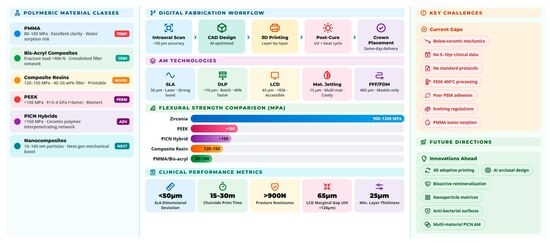
1. Introduction
1.1. Historical Evolution: From Ancient Gold to Digital Polymers
1.2. Contemporary Material Options: A Complex Decision Matrix
1.3. Manufacturing Fundamental Change: From Subtractive to Additive
2. Polymer Chemistry and Material Classes for Dental Crowns
2.1. Methacrylate-Based Photopolymers: Foundation of Dental 3D Printing
2.2. Composite Resins: Optimizing the Polymer–Filler Balance
2.3. High-Performance Polymers: PEEK and the Quest for Permanent Restorations
2.4. Hybrid Materials: Engineering Interpenetrating Networks
3. Additive Manufacturing Technologies: Principles, Capabilities, and Limitations
3.1. Vat Photopolymerization: The Premier Technology for Dental Applications
3.1.1. Stereolithography: Precision Through Laser Scanning
3.1.2. Digital Light Processing: Parallel Processing for Speed
3.1.3. LCD-Based Systems: Democratizing Dental 3D Printing
3.2. Material Jetting: Multi-Material Possibilities and Precision
3.3. Fused Filament Fabrication: Low-Cost Access with Limitations
4. Mechanical and Functional Performance: Meeting Clinical Demands
4.1. Fundamental Mechanical Requirements for Dental Crowns
4.1.1. Flexural Strength and Fracture Resistance
4.1.2. Elastic Modulus and Stress Distribution
4.1.3. Wear Behavior: The Long-Term Challenge
4.1.4. Fatigue Endurance and Long-Term Reliability
4.2. Dimensional Accuracy: Achieving Clinical Fit
4.2.1. Marginal Fit: The Critical Interface
4.2.2. Internal Fit: Foundation for Retention
5. Biocompatibility and Clinical Integration
5.1. Biocompatibility: Safety at the Molecular Level
5.2. Aesthetic Performance and Color Stability
5.3. Patient Acceptance and Clinical Workflow Integration
6. Post-Processing: Optimizing Properties and Finishing
6.1. Post-Curing: Completing Polymerization
6.2. Support Removal and Surface Finishing
6.3. Quality Assurance and Verification
7. Current Challenges and Limitations Requiring Research
7.1. The Clinical Evidence Gap: Long-Term Data Deficit
7.2. Mechanical Property Limitations: The Strength Gap
7.3. Lack of Standardization: Comparing Apples and Oranges
7.4. Regulatory Pathways: Navigating Approval Processes
8. Future Directions and New Developments
8.1. Next-Generation Materials: Nanocomposites and Bioactive Formulations
8.2. Artificial Intelligence and Machine Learning: Automating Design Excellence
8.3. Four-Dimensional Printing: Adaptive Restorations
8.4. Sustainability: Environmentally Conscious Manufacturing
9. Conclusions and Future Outlook
9.1. Current State: Achievements and Limitations
- Methacrylate-based resins have matured into reliable, well-characterized materials for provisional crown fabrication, offering an optimal combination of printability, mechanical properties, aesthetics, and biocompatibility for short-term applications.
- Vat photopolymerization technologies, particularly DLP and LCD systems, deliver the resolution, surface quality, and build speed necessary for clinical implementation, with a dimensional accuracy meeting or exceeding clinical requirements.
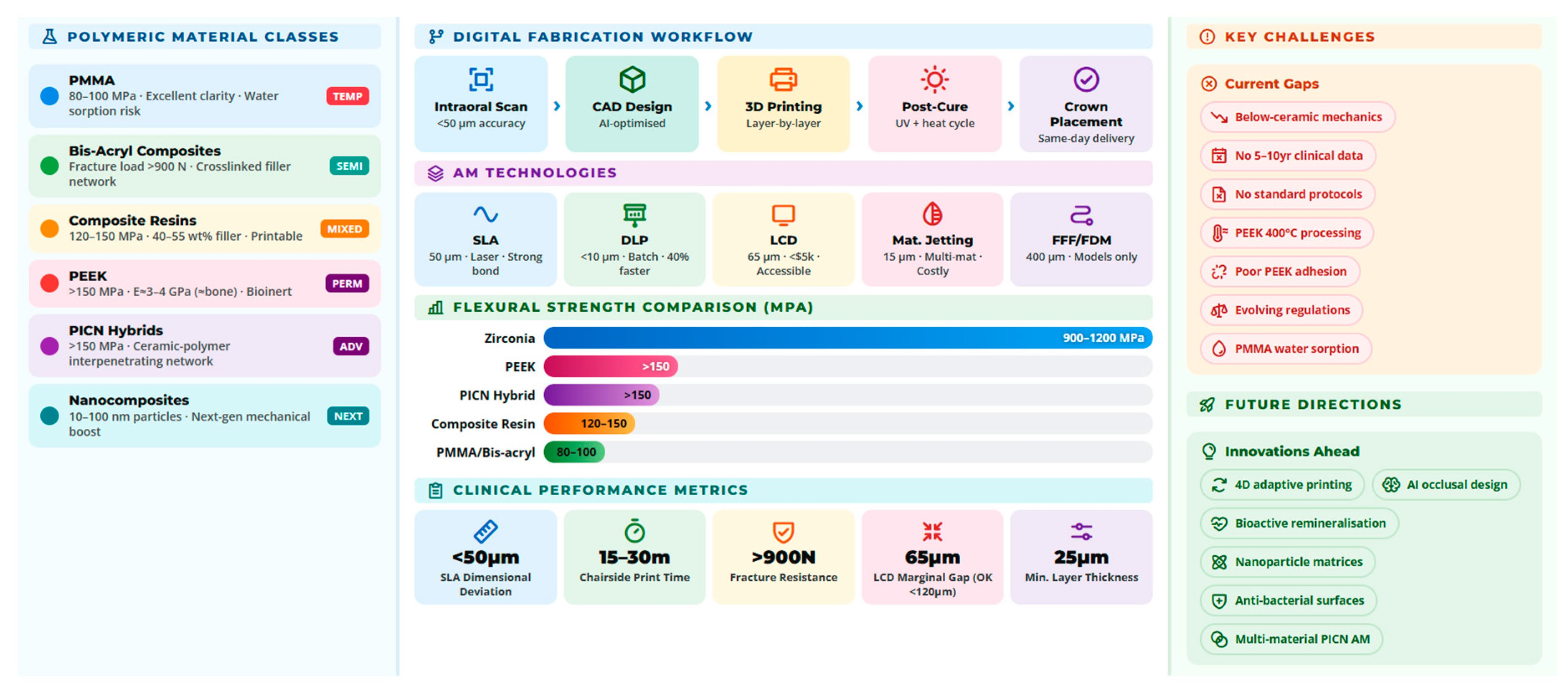
- High-performance polymers like PEEK exhibit mechanical properties superior to conventional composites, though still substantially below high-strength ceramics such as zirconia (flexural strength 300–1200 MPa vs. PEEK’s 150–200 MPa), and exceptional biocompatibility, though processing challenges and poor adhesion currently limit clinical adoption.
- Composite formulations successfully bridge the gap between pure polymers and ceramics. For mechanical properties, though, achieving optimal filler loading while maintaining printability remains an active research challenge.
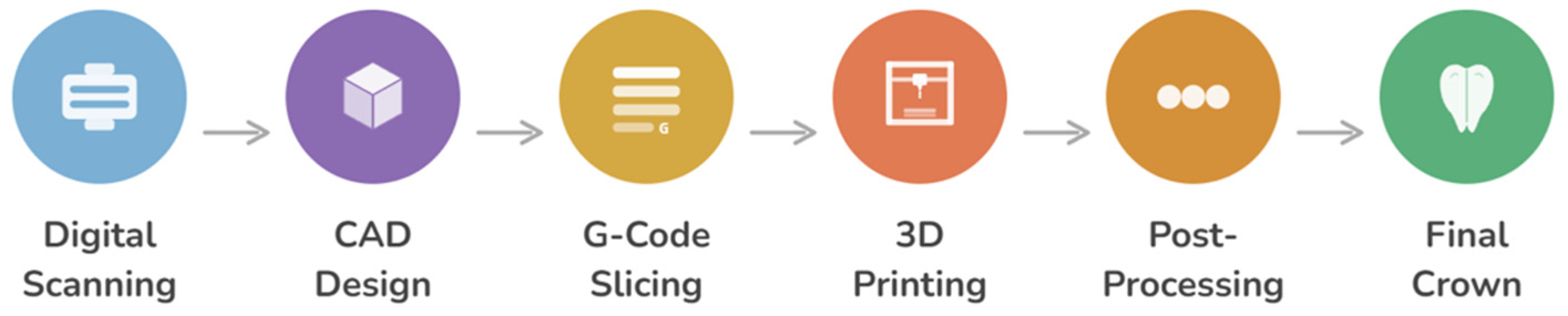
- The digital workflow enabled by 3D printing offers significant advantages in efficiency, customization capability, and patient satisfaction compared to traditional manufacturing methods.
9.2. Critical Knowledge Gaps Requiring Research
- Long-term clinical evidence spanning 5–10 years is essentially nonexistent for permanent polymeric crown applications, creating a fundamental barrier to widespread clinical acceptance and regulatory approval.
- The mechanical properties of current printable polymers, particularly wear resistance and fatigue endurance, remain inferior to those of ceramics, limiting their use in permanent restorations until material innovations address these deficiencies.
- The standardization of materials, processing protocols, and testing methodologies is urgently needed to enable objective comparisons across materials and systems, guiding clinical decision-making and regulatory evaluation.
- Biocompatibility over extended periods, particularly as materials age and degrade in the oral environment, requires investigation through long-term animal studies and eventual clinical trials.
- Economic analyses comparing total treatment costs, including potential complications and remakes, are needed to objectively assess the value proposition of polymeric versus ceramic permanent restorations.
9.3. Pathways Forward: Promising Research Directions
- Advanced material formulations incorporating optimized nanocomposite structures, bioactive components, and novel toughening mechanisms show potential to significantly improve the mechanical properties while maintaining printability.
- Artificial intelligence and machine-learning applications promise to automate design optimization, predict clinical performance, and personalize restorations based on patient-specific risk factors and functional demands.
- Four-dimensional printing technologies enabling adaptive material responses could create restorations that adjust to changing oral conditions, potentially improving long-term clinical performance.
- Multi-material printing capabilities could enable gradient structures optimized for different functions, stiff occlusal surfaces for wear resistance, compliant cervical regions for stress distribution, and bioactive margins for caries resistance.
- The integration with broader digital dentistry workflows, including AI-assisted diagnosis, virtual treatment planning, and outcomes tracking, could position 3D-printed crowns within comprehensive, data-driven care models.
9.4. Final Perspective
- The evolution of polymeric 3D-printed dental crowns mirrors the broader trajectory of additive manufacturing: initial applications in prototyping and tooling, gradual expansion into functional end-use parts, and eventual acceptance as a mainstream production technology. Dentistry is further along this curve than many industries, with provisional restorations already established in clinical practice.
- Whether polymeric crowns will someday rival ceramics for permanent restorations remains an open question. This mechanical property gap is significant, and decades of clinical evidence support the longevity of ceramics. Polymers may never fully replace ceramics, but could carve out specific niches, patients with limited budgets, situations requiring rapid delivery, cases where ceramic aesthetics are unnecessary, or applications where polymer-specific advantages (like repairability or stress distribution) prove clinically valuable.
- More likely, the future involves diversification rather than replacement. Clinicians will have expanded treatment options spanning a spectrum from temporary to permanent, from economical to premium, and from ceramic to polymeric. Patient-specific factors, anatomy, function, finances, aesthetics, and systemic health will guide material selection from this broader palette. Advanced materials, such as bioactive nanocomposites, may create entirely new restoration categories that transcend current classifications.
- The technology is advancing rapidly. Materials science innovations occur continuously. Manufacturing capabilities improve year by year. Digital workflow integration deepens. Clinical evidence accumulates gradually. Regulatory frameworks adapt to new paradigms. In this dynamic field, today’s limitations may well become tomorrow’s historical footnotes. This field requires continued rigorous research, a honest assessment of the capabilities and limitations, and thoughtful clinical application guided by evidence rather than enthusiasm. With such a disciplined development, polymeric 3D-printed crowns will likely secure an important and enduring place in the prosthodontic armamentarium.
Funding
Institutional Review Board Statement
Data Availability Statement
Acknowledgments
Conflicts of Interest
References
- Ring, M.E. Dentistry: An Illustrated History; Abrams: New York, NY, USA, 1985. [Google Scholar]
- Kelly, J.R. Ceramics in restorative and prosthetic dentistry. Annu. Rev. Mater. Sci. 1997, 27, 443–468. [Google Scholar] [CrossRef]
- Weinstein, L.K.; Weinstein, A.B. Fused Porcelain-to-Metal Teeth. U.S. Patent No. 3,052,982, 11 September 1962. [Google Scholar]
- Duret, F.; Preston, J.D. CAD/CAM imaging in dentistry. Curr. Opin. Dent. 1991, 1, 150–154. [Google Scholar]
- Beuer, F.; Schweiger, J.; Edelhoff, D. Digital dentistry: An overview of recent developments for CAD/CAM generated restorations. Br. Dent. J. 2008, 204, 505–511. [Google Scholar] [CrossRef] [PubMed]
- Rosenstiel, S.F.; Land, M.F.; Fujimoto, J. Contemporary Fixed Prosthodontics, 5th ed.; Elsevier: St. Louis, MO, USA, 2015. [Google Scholar]
- Zarone, F.; Russo, S.; Sorrentino, R. From porcelain-fused-to-metal to zirconia: Clinical and experimental considerations. Dent. Mater. 2011, 27, 83–96. [Google Scholar] [CrossRef] [PubMed]
- Gracis, S.; Thompson, V.P.; Ferencz, J.L.; Silva, N.R.F.A.; Bonfante, E.A. A New Classification System for All-Ceramic and Ceramic-like Restorative Materials. Int. J. Prosthodont. 2015, 28, 227–235. [Google Scholar] [CrossRef]
- Manicone, P.F.; Iommetti, P.R.; Raffaelli, L. An Overview of Zirconia Ceramics: Basic Properties and Clinical Applications. J. Dent. 2007, 35, 819–826. [Google Scholar] [CrossRef]
- Ban, S. Reliability and Properties of Core Materials for All-Ceramic Dental Restorations. Jpn. Dent. Sci. Rev. 2008, 44, 3–21. [Google Scholar] [CrossRef]
- Wataha, J.C. Alloys for prosthodontic restorations. J. Prosthet. Dent. 2002, 87, 351–363. [Google Scholar] [CrossRef] [PubMed]
- Heintze, S.D.; Rousson, V. Survival of zirconia- and metal-supported fixed dental prostheses: A systematic review. Int. J. Prosthodont. 2010, 23, 493–502. [Google Scholar]
- Nguyen, J.F.; Migonney, V.; Ruse, N.D.; Sadoun, M. Resin composite blocks via high-pressure high-temperature polymerization. Dent. Mater. 2012, 28, 529–534. [Google Scholar] [CrossRef]
- Stawarczyk, B.; Beuer, F.; Wimmer, T.; Jahn, D.; Sener, B.; Roos, M.; Schmidlin, P.R. Polyetheretherketone—A suitable material for fixed dental prostheses? J. Biomed. Mater. Res. Part B 2013, 101, 1209–1216. [Google Scholar] [CrossRef] [PubMed]
- Van Noort, R. The future of dental devices is digital. Dent. Mater. 2012, 28, 3–12. [Google Scholar] [CrossRef]
- Shillingburg, H.T.; Hobo, S.; Whitsett, L.D.; Jacobi, R.; Brackett, S.E. Fundamentals of Fixed Prosthodontics, 3rd ed.; Quintessence Publishing: Chicago, IL, USA, 1997. [Google Scholar]
- Davidowitz, G.; Kotick, P.G. The use of CAD/CAM in dentistry. Dent. Clin. N. Am. 2011, 55, 559–570. [Google Scholar] [CrossRef]
- Alghazzawi, T.F. Advancements in CAD/CAM technology: Options for practical implementation. J. Prosthodont. Res. 2016, 60, 72–84. [Google Scholar] [CrossRef]
- Sriram, S.; Shankari, V.; Chacko, Y. Computer aided designing/computer aided manufacturing in dentistry (CAD/CAM)—A Review. Int. J. Curr. Res. Rev. 2018, 10, 20–24. [Google Scholar] [CrossRef]
- Dawood, A.; Marti, B.M.; Sauret-Jackson, V.; Darwood, A. 3D printing in dentistry. Br. Dent. J. 2015, 219, 521–529. [Google Scholar] [CrossRef] [PubMed]
- Revilla-León, M.; Özcan, M. Additive manufacturing technologies used for processing polymers: Current status and potential application in prosthetic dentistry. J. Prosthodont. 2019, 28, 146–158. [Google Scholar] [CrossRef]
- Tahayeri, A.; Morgan, M.; Fugolin, A.P.; Bompolaki, D.; Athirasala, A.; Pfeifer, C.S.; Bertassoni, L.E. 3D printed versus conventionally cured provisional crown and bridge dental materials. Dent. Mater. 2018, 34, 192–200. [Google Scholar] [CrossRef] [PubMed]
- Stansbury, J.W.; Idacavage, M.J. 3D printing with polymers: Challenges among expanding options and opportunities. Dent. Mater. 2016, 32, 54–64. [Google Scholar] [CrossRef]
- Shrivastava, S.P.; Dable, R.; Nirmal Raj, A.P.; Saxena, S.; Mahesh, C.M.; Kaurani, P. Comparison of Mechanical Properties of PEEK and PMMA: An In Vitro Study. J. Contemp. Dent. Pract. 2021, 22, 179–183. [Google Scholar] [CrossRef]
- Liu, Y.; Fang, M.; Zhao, R.; Liu, H.; Li, K.; Tian, M.; Niu, L.; Xie, R.; Bai, S. Clinical Applications of Polyetheretherketone in Removable Dental Prostheses: Accuracy, Characteristics, and Performance. Polymers 2022, 14, 4615. [Google Scholar] [CrossRef]
- Walczak, A.; Pabisiak, K.; Giers, M.; Polański, J. Polymeric Denture Base Materials: A Review. Polymers 2023, 15, 3258. [Google Scholar] [CrossRef]
- Zafar, M.S. Prosthodontic applications of polymethyl methacrylate (PMMA): An update. Polymers 2020, 12, 2299. [Google Scholar] [CrossRef] [PubMed]
- Digholkar, S.; Madhav, V.N.V.; Palaskar, J. Evaluation of the flexural strength and microhardness of provisional crown and bridge materials fabricated by different methods. J. Indian Prosthodont. Soc. 2016, 16, 328–334. [Google Scholar] [CrossRef] [PubMed]
- Sulaiman, T.A.; Suliman, A.A.; Mohamed, E.A.; Rodgers, B.; Altak, A.; Johnston, W.M. Mechanical properties of bisacryl-, composite-, and ceramic-resin restorative materials. Oper. Dent. 2022, 47, 97–106. [Google Scholar] [CrossRef]
- Karaokutan, I.; Sayin, G.; Kara, O. In vitro study of fracture strength of provisional crown materials. J. Adv. Prosthodont. 2015, 7, 27–31. [Google Scholar] [CrossRef]
- Ferracane, J.L. Resin composite—State of the art. Dent. Mater. 2011, 27, 29–38. [Google Scholar] [CrossRef] [PubMed]
- Ilie, N.; Hickel, R. Resin composite restorative materials. Aust. Dent. J. 2011, 56, 59–66. [Google Scholar] [CrossRef]
- Bagheri, A.; Jin, J. Photopolymerization in 3D printing. ACS Appl. Polym. Mater. 2019, 1, 593–611. [Google Scholar] [CrossRef]
- Duarte, S., Jr.; Phark, J.H. Advances in Dental Restorations: A Comprehensive Review of Machinable and 3D-Printed Ceramic-Reinforced Composites. J. Esthet. Restor. Dent. 2025, 37, 257–276. [Google Scholar] [CrossRef]
- Alshali, R.Z.; Silikas, N.; Satterthwaite, J.D. Degree of conversion of bulk-fill compared to conventional resin-composites at two time intervals. Dent. Mater. 2013, 29, e213–e217. [Google Scholar] [CrossRef]
- Kurtz, S.M. (Ed.) PEEK Biomaterials Handbook; William Andrew/Elsevier: Oxford, UK, 2012. [Google Scholar]
- Qin, L.; Yao, S.; Zhao, J.; Zhou, C.; Oates, T.W.; Weir, M.D.; Wu, J.; Xu, H.H.K. Review on Development and Dental Applications of Polyetheretherketone-Based Biomaterials and Restorations. Materials 2021, 14, 408. [Google Scholar] [CrossRef]
- Guo, H.; Wang, Y.; Zhao, Y.; Liu, H. Computer-Aided Design of Polyetheretherketone for Application to Removable Pediatric Space Maintainers. BMC Oral Health 2020, 20, 201. [Google Scholar] [CrossRef]
- Soares, C.J.; Soares, P.V.; Santos-Filho, P.C.F.; Armstrong, S.R. Microtensile Specimen Attachment and Resin Cement Elastic Modulus: Influence on Stress Distribution. Dent. Mater. 2008, 24, 1436–1442. [Google Scholar] [CrossRef]
- Della Bona, A.; Corazza, P.H.; Zhang, Y. Characterization of a polymer-infiltrated ceramic-network material. Dent. Mater. 2014, 30, 564–569. [Google Scholar] [CrossRef]
- Coldea, A.; Swain, M.V.; Thiel, N. Mechanical properties of polymer-infiltrated-ceramic-network materials. Dent. Mater. 2013, 29, 419–426. [Google Scholar] [CrossRef] [PubMed]
- Swain, M.V.; Coldea, A.; Bilkhair, A.; Guess, P.C. Interpenetrating network ceramic-resin composite dental restorative materials. Dent. Mater. 2016, 32, 34–42. [Google Scholar] [CrossRef] [PubMed]
- Unkovskiy, A.; Bui, P.H.B.; Schille, C.; Geis-Gerstorfer, J.; Huettig, F.; Spintzyk, S. Objects build orientation, positioning, and curing influence dimensional accuracy and flexural properties of stereolithographically printed resin. Dent. Mater. 2018, 34, e324–e333. [Google Scholar] [CrossRef] [PubMed]
- Melchels, F.P.; Feijen, J.; Grijpma, D.W. A review on stereolithography and its applications in biomedical engineering. Biomaterials 2010, 31, 6121–6130. [Google Scholar] [CrossRef]
- Alharbi, N.; Wismeijer, D.; Osman, R.B. Additive manufacturing techniques in prosthodontics: Where do we currently stand? A critical review. Int. J. Prosthodont. 2017, 30, 474–484. [Google Scholar] [CrossRef]
- Osman, R.B.; Alharbi, N.; Wismeijer, D. Build angle: Does it influence the accuracy of 3D-printed dental restorations using digital light-processing technology? Int. J. Prosthodont. 2017, 30, 182–188. [Google Scholar] [CrossRef] [PubMed]
- Wu, J.; Zhao, Z.; Hamel, C.M.; Mu, X.; Kuang, X.; Guo, Z.; Qi, H.J. Evolution of material properties during free radical photopolymerization. J. Mech. Phys. Solids 2018, 112, 25–49. [Google Scholar] [CrossRef]
- Crenn, M.J.; Rohman, G.; Fromentin, O.; Benoit, A. Polylactic acid as a biocompatible polymer for three-dimensional printing of interim prosthesis: Mechanical characterization. Dent. Mater. J. 2022, 41, 110–116. [Google Scholar] [CrossRef]
- Shim, J.S.; Kim, J.E.; Jeong, S.H.; Choi, Y.J.; Ryu, J.J. Printing accuracy, mechanical properties, surface characteristics, and microbial adhesion of 3D-printed resins with various printing orientations. J. Prosthet. Dent. 2020, 124, 468–475. [Google Scholar] [CrossRef]
- Quan, H.; Zhang, T.; Xu, H.; Luo, S.; Nie, J.; Zhu, X. Photo-curing 3D printing technique and its challenges. Bioact. Mater. 2020, 5, 110–115. [Google Scholar] [CrossRef]
- Reymus, M.; Fabritius, R.; Keßler, A.; Hickel, R.; Edelhoff, D.; Stawarczyk, B. Fracture load of 3D-printed fixed dental prostheses compared with milled and conventionally fabricated ones: The impact of resin material, build direction, post-curing, and artificial aging—An in vitro study. Clin. Oral Investig. 2020, 24, 701–710. [Google Scholar] [CrossRef]
- Maalihan, R.D.; Aggari, J.C.V.; Alon, A.S.; Latayan, R.B.; Montalbo, F.J.P.; Javier, A.D. On the optimized fused filament fabrication of polylactic acid using multiresponse central composite design and desirability function algorithm. Proc. Inst. Mech. Eng. Part E J. Process Mech. Eng. 2024, 240, 873–887. [Google Scholar] [CrossRef]
- Khorsandi, D.; Fahimipour, A.; Abasian, P.; Saber, S.S.; Seyedi, M.; Ghanavati, S.; Makvandi, P. 3D and 4D printing in dentistry and maxillofacial surgery: Printing techniques, materials, and applications. Acta Biomater. 2021, 122, 26–49. [Google Scholar] [CrossRef]
- Kessler, A.; Hickel, R.; Reymus, M. 3D printing in dentistry—State of the art. Oper. Dent. 2020, 45, 30–40. [Google Scholar] [CrossRef] [PubMed]
- Oberoi, G.; Nitsch, S.; Edelmayer, M.; Janjić, K.; Müller, A.S.; Agis, H. 3D printing—Encompassing the facets of dentistry. Front. Bioeng. Biotechnol. 2018, 6, 172. [Google Scholar] [CrossRef]
- Piedra-Cascón, W.; Krishnamurthy, V.R.; Att, W.; Revilla-León, M. 3D printing parameters, supporting structures, slicing, and post-processing procedures of vat-polymerization additive manufacturing technologies: A narrative review. J. Dent. 2021, 109, 103630. [Google Scholar] [CrossRef]
- Kinney, J.H.; Marshall, S.J.; Marshall, G.W. The Mechanical Properties of Human Dentin: A Critical Review and Re-Evaluation of the Dental Literature. Crit. Rev. Oral Biol. Med. 2003, 14, 13–29. [Google Scholar] [CrossRef]
- Ma, R.; Tang, T. Current Strategies to Improve the Bioactivity of PEEK. Int. J. Mol. Sci. 2014, 15, 5426–5445. [Google Scholar] [CrossRef]
- Angker, L.; Swain, M.V. Nanoindentation: Application to Dental Hard Tissue Investigations. J. Mater. Res. 2006, 21, 1893–1905. [Google Scholar] [CrossRef]
- Mörmann, W.H.; Stawarczyk, B.; Ender, A.; Sener, B.; Attin, T.; Mehl, A. Wear Characteristics of Current Aesthetic Dental Restorative CAD/CAM Materials: Two-Body Wear, Gloss Retention, Roughness and Martens Hardness. J. Mech. Behav. Biomed. Mater. 2013, 20, 113–125. [Google Scholar] [CrossRef]
- Marchetti, E.; Mummolo, S.; Di Mattia, J.; Casalena, F.; Di Martino, S.; Mattei, A.; Marzo, G. Influence of Luting Cement on the Retention of Metallic and Zirconia Abutments. J. Prosthodont. 2012, 21, 112–118. [Google Scholar] [CrossRef]
- Scherer, M.D.; Husain, N.A.H.; Barmak, A.B.; Kois, J.C.; Özcan, M.; Revilla-León, M. Influence of postprocessing rinsing solutions and duration on flexural strength of aged and nonaged additively manufactured interim dental material. J. Prosthet. Dent. 2024, 131, 959–968. [Google Scholar] [CrossRef] [PubMed]
- Holmes, J.R.; Bayne, S.C.; Holland, G.A.; Sulik, W.D. Considerations in measurement of marginal fit. J. Prosthet. Dent. 1989, 62, 405–408. [Google Scholar] [CrossRef] [PubMed]
- Revilla-León, M.; Methani, M.M.; Morton, D.; Zandinejad, A. Internal and marginal discrepancies associated with stereolithography (SLA) additively manufactured zirconia crowns. J. Prosthet. Dent. 2020, 124, 730–737. [Google Scholar] [CrossRef]
- Revilla-León, M.; Supaphakorn, A.; Barmak, A.B.; Rutkunas, V.; Kois, J.C. Influence of print orientation on the intaglio surface accuracy (trueness and precision) of tilting stereolithography definitive resin-ceramic crowns. J. Prosthet. Dent. 2025, 133, 246–251. [Google Scholar] [CrossRef] [PubMed]
- Çakmak, G.; Cuellar, A.R.; Donmez, M.B.; Schimmel, M.; Abou-Ayash, S.; Lu, W.E.; Yilmaz, B. Effect of printing layer thickness on the trueness and margin quality of 3D-printed interim dental crowns. Appl. Sci. 2021, 11, 9246. [Google Scholar] [CrossRef]
- Alifui-Segbaya, F.; Varma, S.; Lieschke, G.J.; George, R. Biocompatibility of photopolymers in 3D printing. 3D Print. Addit. Manuf. 2017, 4, 185–191. [Google Scholar] [CrossRef]
- Li, P.; Lambart, A.L.; Stawarczyk, B.; Reymus, M.; Spintzyk, S. Postpolymerization of a 3D-printed denture base polymer: Impact of post-curing methods on surface characteristics, flexural strength, and cytotoxicity. J. Dent. 2021, 115, 103856. [Google Scholar] [CrossRef]
- Par, M.; Gamulin, O.; Marovic, D.; Klaric, E.; Tarle, Z. Raman spectroscopic assessment of degree of conversion of bulk-fill resin composites—Changes at 24 hours post cure. Oper. Dent. 2015, 40, E92–E101. [Google Scholar] [CrossRef]
- Bayarsaikhan, E.; Lim, J.H.; Shin, S.H.; Park, K.H.; Park, Y.B.; Lee, J.H.; Kim, J.E. Effects of postcuring temperature on the mechanical properties and biocompatibility of three-dimensional printed dental resin material. Polymers 2021, 13, 1180. [Google Scholar] [CrossRef]
- Methani, M.M.; Cesar, P.F.; de Paula Miranda, R.B.; Morimoto, S.; Özcan, M.; Revilla-León, M. Additive manufacturing in dentistry: Current technologies, clinical applications, and limitations. Curr. Oral Health Rep. 2020, 7, 327–334. [Google Scholar] [CrossRef]
- Della Bona, A.; Cantelli, V.; Britto, V.T.; Collares, K.F.; Stansbury, J.W. 3D printing restorative materials using a stereolithographic technique: A systematic review. Dent. Mater. 2021, 37, 336–350. [Google Scholar] [CrossRef] [PubMed]
- El Naggar, S.M.; Helal, E.; Khalil, M.F.; Esmat, A.M.; Elboraey, A.N. Color stability of heat polymerized complete dentures and 3D printed CAD/CAM dentures: A cross-over clinical study. J. Arab Soc. Med. Res. 2022, 17, 139–144. [Google Scholar] [CrossRef]
- Schubert, A.; Wassmann, T.; Holtappels, M.; Kurbad, O.; Krohn, S.; Bürgers, R. Predictability of microbial adhesion to dental materials by roughness parameters. Coatings 2019, 9, 456. [Google Scholar] [CrossRef]
- Joda, T.; Zarone, F.; Ferrari, M. The complete digital workflow in fixed prosthodontics: A systematic review. BMC Oral Health 2017, 17, 124. [Google Scholar] [CrossRef] [PubMed]
- Katsoulis, J.; Takeichi, T.; Sol Gaviria, A.; Peter, L.; Katsoulis, K. Misfit of implant prostheses and its impact on clinical outcomes. Definition, assessment and a systematic review of the literature. Eur. J. Oral Implantol. 2017, 10, 121–138. [Google Scholar]
- Reymus, M.; Lümkemann, N.; Stawarczyk, B. 3D-printed material for temporary restorations: Impact of print layer thickness and post-curing method on degree of conversion. Int. J. Comput. Dent. 2019, 22, 231–237. [Google Scholar] [PubMed]
- Katheng, A.; Kanazawa, M.; Iwaki, M.; Minakuchi, S. Evaluation of dimensional accuracy and degree of polymerization of stereolithography photopolymer resin under different postpolymerization conditions: An in vitro study. J. Prosthet. Dent. 2021, 125, 695–702. [Google Scholar] [CrossRef]
- Bayarsaikhan, E.; Gu, H.; Hwangbo, N.K.; Lim, J.H.; Shim, J.S.; Lee, K.W.; Kim, J.E. Influence of different postcuring parameters on mechanical properties and biocompatibility of 3D printed crown and bridge resin for temporary restorations. J. Mech. Behav. Biomed. Mater. 2022, 128, 105127. [Google Scholar] [CrossRef]
- Flury, S.; Peutzfeldt, A.; Lussi, A. Influence of surface roughness on mechanical properties of two computer-aided design/computer-aided manufacturing (CAD/CAM) ceramic materials. Oper. Dent. 2012, 37, 617–624. [Google Scholar] [CrossRef]
- Dal Piva, A.D.O.; Contreras, L.P.C.; Ribeiro, F.C.; Anami, L.C.; Camargo, S.E.A.; Jorge, A.O.C.; Bottino, M.A. Monolithic ceramics: Effect of finishing techniques on surface properties, bacterial adhesion and cell viability. Oper. Dent. 2018, 43, 315–325. [Google Scholar] [CrossRef]
- Anadioti, E.; Kane, B.; Soulas, E. Current and emerging applications of 3D printing in restorative dentistry. Curr. Oral Health Rep. 2018, 5, 133–139. [Google Scholar] [CrossRef]
- Zimmermann, M.; Ender, A.; Mehl, A. Local accuracy of actual intraoral scanning systems for single-tooth preparations in vitro. J. Am. Dent. Assoc. 2020, 151, 127–135. [Google Scholar] [CrossRef] [PubMed]
- ISO 10477:2020; Dentistry—Polymer-Based Crown and Veneering Materials. International Organization for Standardization: Geneva, Switzerland, 2020.
- Sampaio, C.S.; Niemann, K.D.; Schweitzer, D.D.; Hirata, R.; Atria, P.J. Microcomputed tomography evaluation of cement film thickness of veneers and crowns made with conventional and 3D printed provisional materials. J. Esthet. Restor. Dent. 2021, 33, 487–495. [Google Scholar] [CrossRef] [PubMed]
- Wemken, G.; Spies, B.C.; Pieralli, S.; Adali, U.; Beuer, F.; Wesemann, C. Do hydrothermal aging and microwave sterilization affect the trueness of milled, additive manufactured and injection molded denture bases? J. Mech. Behav. Biomed. Mater. 2020, 111, 103975. [Google Scholar] [CrossRef]
- Mühlemann, S.; Kraus, R.D.; Hämmerle, C.H.; Thoma, D.S. Is the use of digital technologies for the fabrication of implant-supported reconstructions more efficient and/or more effective than conventional techniques: A systematic review. Clin. Oral Implants Res. 2018, 29, 184–195. [Google Scholar] [CrossRef] [PubMed]
- Zhang, Y.; Mai, Z.; Barani, A.; Bush, M.; Lawn, B. Fracture-resistant monolithic dental crowns. Dent. Mater. 2016, 32, 442–449. [Google Scholar] [CrossRef]
- Kalberer, N.; Mehl, A.; Schimmel, M.; Müller, F.; Srinivasan, M. CAD-CAM milled versus rapidly prototyped (3D-printed) complete dentures: An in vitro evaluation of trueness. J. Prosthet. Dent. 2019, 121, 637–643. [Google Scholar] [CrossRef]
- Di Prima, M.; Coburn, J.; Hwang, D.; Kelly, J.; Khairuzzaman, A.; Ricles, L. Additively manufactured medical products—The FDA perspective. 3D Print. Med. 2016, 2, 1. [Google Scholar] [CrossRef] [PubMed]
- Ricles, L.M.; Coburn, J.C.; Di Prima, M.; Oh, S.S. Regulating 3D-printed medical products. Sci. Transl. Med. 2018, 10, eaan6521. [Google Scholar] [CrossRef]
- Moszner, N.; Klapdohr, S. Nanotechnology for dental composites. Int. J. Nanotechnol. 2004, 1, 130–156. [Google Scholar] [CrossRef]
- Cheng, L.; Zhang, K.; Zhang, N.; Melo, M.A.S.; Weir, M.D.; Zhou, X.D.; Xu, H.H.K. Developing a new generation of antimicrobial and bioactive dental resins. J. Dent. Res. 2017, 96, 855–863. [Google Scholar] [CrossRef]
- Zhang, K.; Baras, B.; Lynch, C.D.; Weir, M.D.; Melo, M.A.S.; Li, Y.; Xu, H.H. Developing a new generation of therapeutic dental polymers to inhibit oral biofilms and protect teeth. Materials 2018, 11, 1747. [Google Scholar] [CrossRef]
- Omid, R.; Banakar, M.; Mousavi, S.M.; Lai, C.W. Bio-based nanomaterials in dentistry. In Biobased Nanomaterials: Applications in Biomedicine, Food Industry, Agriculture, and Environmental Sustainability; Springer Nature: Singapore, 2024; pp. 249–313. [Google Scholar] [CrossRef]
- Shan, T.; Tay, F.R.; Gu, L. Application of artificial intelligence in dentistry. J. Dent. Res. 2021, 100, 232–244. [Google Scholar] [CrossRef]
- Carrillo-Perez, F.; Pecho, O.E.; Morales, J.C.; Paravina, R.D.; Della Bona, A.; Ghinea, R.; Herrera, L.J. Applications of artificial intelligence in dentistry: A comprehensive review. J. Esthet. Restor. Dent. 2022, 34, 259–280. [Google Scholar] [CrossRef] [PubMed]
- Rekow, E.D. Digital dentistry: The new state of the art—Is it disruptive or destructive? Dent. Mater. 2020, 36, 9–24. [Google Scholar] [CrossRef] [PubMed]
- Smith, L.; Ali, M.; Agrissais, M.; Mulligan, S.; Koh, L.; Martin, N. A comparative life cycle assessment of dental restorative materials. Dent. Mater. 2023, 39, 13–24. [Google Scholar] [CrossRef] [PubMed]



| Material Class | Main Components | Primary Applications | Key Advantages | Main Limitations | Ref. |
|---|---|---|---|---|---|
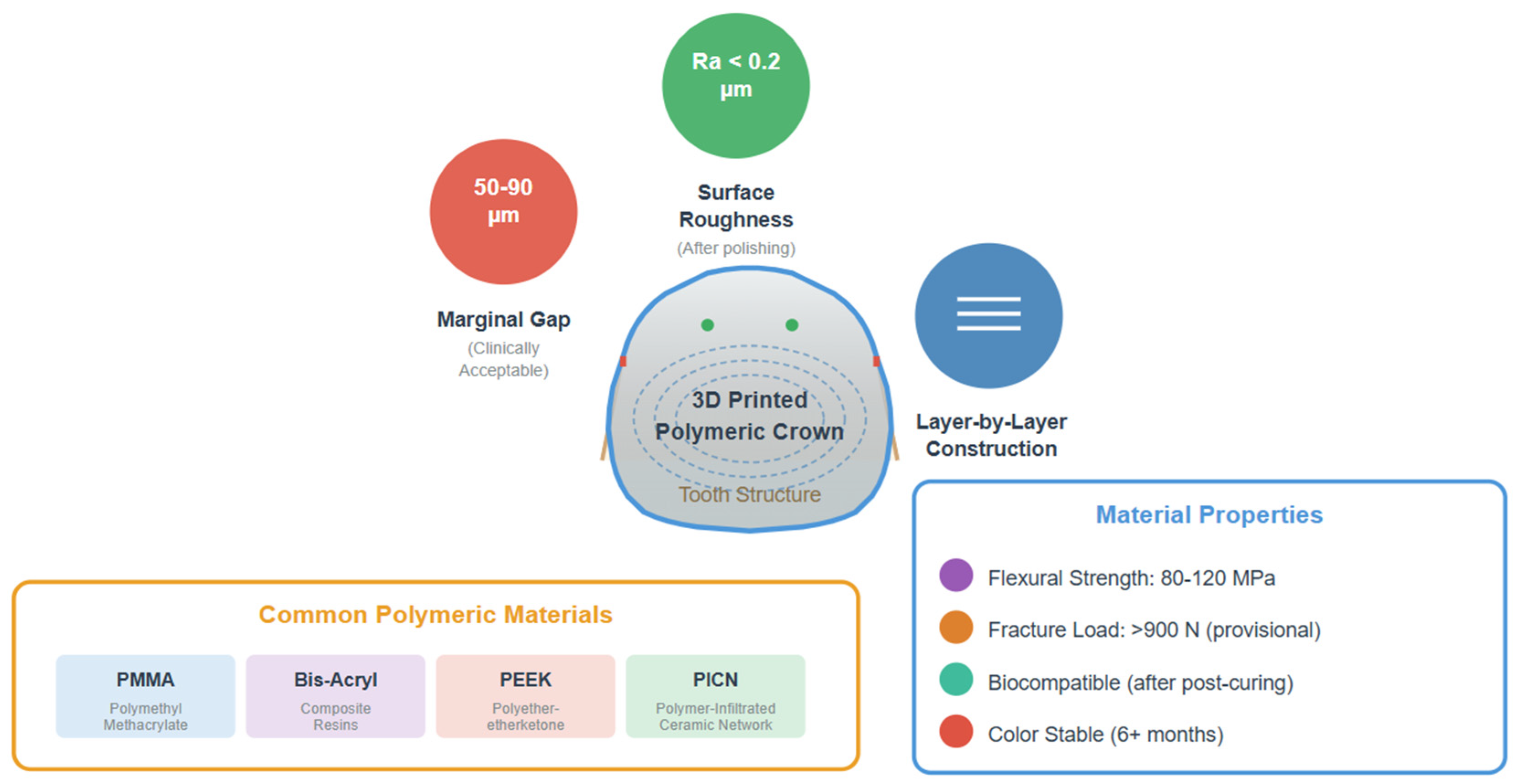
| PMMA | Polymethyl methacrylate | Provisional crowns | Excellent aesthetics, ease of processing, and cost-effectiveness | Water sorption, plasticization, and limited long-term stability | [24,25,27] |
| Bis-acryl Composite Resins | Methacrylate monomers with inorganic fillers | Provisional crowns | Improved mechanical properties, adequate fracture resistance (>900 N) | Inferior to ceramics for permanent use | [28,29,30] |
| Composite Resins | Resin matrix with ceramic fillers | Provisional to semi-permanent crowns | Enhanced mechanical properties, good processability | Inferior wear resistance vs. milled composites, dependent on degree of conversion | [31,32,34,35] |
| PEEK | Polyetheretherketone | Permanent posterior crowns | Elastic modulus similar to bone, exceptional biocompatibility, and high strength | High melting temperature, requires specialized equipment, and adhesion challenges | [14,36,37,38,39] |
| Hybrid Resins (PICN) | Polymer-infiltrated ceramic networks | Permanent crowns | Improved fracture toughness vs. ceramics, interpenetrating network structure | Limited clinical data | [40,41,42] |
| Technology | Working Principle | Resolution | Build Speed | Surface Quality | Material Options | Clinical Applications | Ref. |
|---|---|---|---|---|---|---|---|
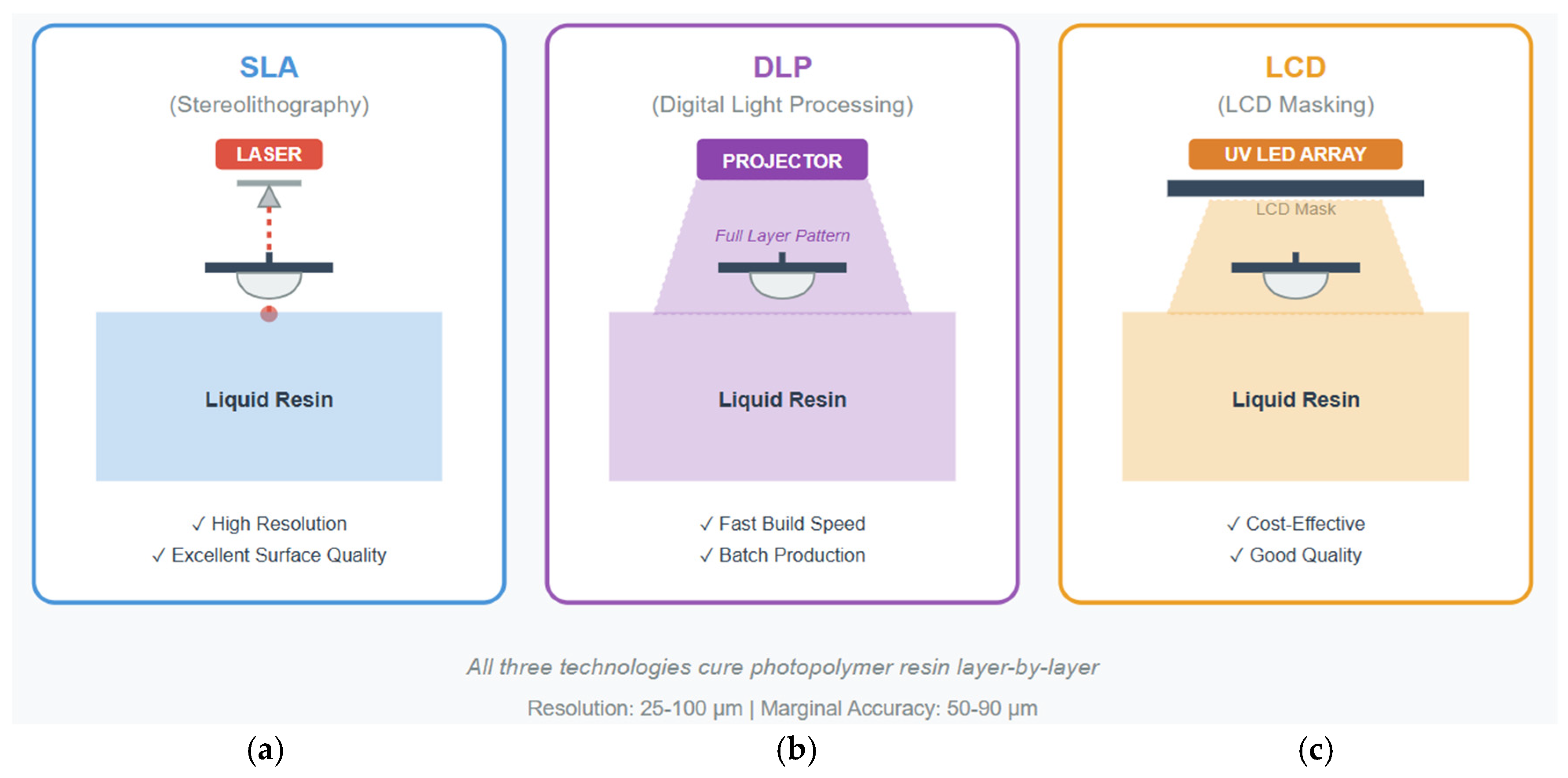
| Stereolithography (SLA) | Focused laser scanning, layer-by-layer curing | High | Moderate | Excellent | Photopolymer resins | Provisional and definitive crowns, high accuracy (marginal gaps 50–90 μm) | [23,44,45,46] |
| Digital Light Processing (DLP) | Projects entire layer patterns simultaneously | High | Fast (faster than SLA) | Excellent | Photopolymer resins | Batch production of crowns, comparable accuracy to SLA | [47,48,49] |
| LCD Technology | Uses LCD screens as dynamic masks | Moderate to High | Fast | Good to Excellent | Photopolymer resins | Provisional crowns are a cost-effective alternative | [50,51] |
| Material Jetting | Multi-material droplet deposition | Very High | Slow | Excellent | Multi-material capability | Multi-colour crowns, gradient properties | [52,53,54] |
| Fused Filament Fabrication (FFF) | Thermoplastic extrusion | Low to Moderate | Moderate | Poor (visible layer lines) | Limited medical-grade filaments | Study models, surgical guides, and limited provisional use | [20,55,56] |
| Property | 3D Printed Polymers | Traditional Ceramics | Clinical Requirement | Test Method/Notes | References |
|---|---|---|---|---|---|
| Flexural Strength | 80–120 MPa | 300–1200 MPa | Varies by location | Depends on printing parameters and post-processing | [58,59] |
| Fracture Resistance | >900 N | >1500 N | >600 N (posterior), >300 N (anterior) | Sufficient for provisional applications | [22,59] |
| Marginal Gap | 50–90 μm | 40–80 μm | <120 μm | Clinically acceptable, influenced by print orientation | [63,64,65] |
| Internal Fit | Comparable to milled | Comparable to milled | Adequate for retention | Micro-CT analysis shows similar performance | [66] |
| Wear Resistance | Higher wear rates | Low wear rates | Long-term durability needed | Concern for permanent applications includes abrasive and fatigue components | [60,61] |
| Fatigue Performance | Adequate for provisional use | Excellent | Must survive cyclic loading | Limited durability for permanent applications under accelerated ageing | [62] |
| Post-Processing Step | Parameters | Effect on Properties | Impact on Clinical Performance | Optimal Protocol | References |
|---|---|---|---|---|---|
| Post-Curing | UV wavelength: 405 nm; duration: 20 min | Optimizes mechanical properties, reduces residual monomer | Improved biocompatibility, enhanced strength | Temperature control during post-curing affects dimensional stability | [77,78,79] |
| Surface Finishing | Progressive polishing with diamond pastes | Reduces surface roughness to Ra < 0.2 μm | Decreases bacterial adhesion, improves aesthetics | Essential for bacterial retention prevention | [80,81] |
| Degree of Conversion | Influenced by post-curing time and temperature | Directly affects the mechanical properties and biocompatibility | Higher conversion = better clinical performance | Critical for long-term success | [35,69] |
| Quality Verification | Digital scanning and superimposition | Ensures dimensional accuracy | Quantitative assessment of fit | Standardized testing protocols under development | [82,83,84] |
| Challenge Category | Specific Issues | Current Limitations | Proposed Solutions/Future Directions | Impact on Clinical Adoption | Ref. |
|---|---|---|---|---|---|
| Clinical Evidence | Limited long-term data | Most studies < 12 months follow-up | Prospective clinical trials spanning 5–10 years are needed | Prevents permanent crown applications | [85,86,87] |
| Mechanical Properties | Inferior to ceramics | Strength and wear resistance are inadequate for permanent use | Nanocomposite resins, bioactive components, and advanced polymer development | Critical for permanent restoration approval | [33,88,92,93] |
| Standardization | Lack of consensus standards | Variability in materials, processes, and testing methods | ISO and ADA committees are developing protocols | Essential for regulatory approval | [84,89] |
| Regulatory Approval | Evolving FDA pathways | Specific requirements for dental applications under development | Clear guidelines needed for 3D-printed dental devices | Necessary for commercial adoption | [90,91] |
| Material Innovation | Need for improved polymers | Current materials are limited for permanent use | 4D printing, nanocomposites, bio-based polymers, stimuli-responsive materials | Expands clinical applications | [53,94,95] |
| Design Optimization | Manual design limitations | Time-consuming, operator-dependent | AI-driven design, machine-learning algorithms for crown morphology and occlusion | Improves efficiency and outcomes | [96,97,98] |
| Sustainability | Environmental concerns | Petroleum-based polymers, waste generation | Bio-based polymers, life cycle assessment studies | Aligns with sustainable dental practice | [95,99] |
Disclaimer/Publisher’s Note: The statements, opinions and data contained in all publications are solely those of the individual author(s) and contributor(s) and not of MDPI and/or the editor(s). MDPI and/or the editor(s) disclaim responsibility for any injury to people or property resulting from any ideas, methods, instructions or products referred to in the content. |
© 2026 by the author. Licensee MDPI, Basel, Switzerland. This article is an open access article distributed under the terms and conditions of the Creative Commons Attribution (CC BY) license.
Share and Cite
Aldawood, F.K. A Comprehensive Review of Polymeric Materials and Additive Manufacturing in Dental Crown Fabrication: State of the Art, Challenges, and Opportunities. Polymers 2026, 18, 667. https://doi.org/10.3390/polym18060667
Aldawood FK. A Comprehensive Review of Polymeric Materials and Additive Manufacturing in Dental Crown Fabrication: State of the Art, Challenges, and Opportunities. Polymers. 2026; 18(6):667. https://doi.org/10.3390/polym18060667
Chicago/Turabian StyleAldawood, Faisal Khaled. 2026. "A Comprehensive Review of Polymeric Materials and Additive Manufacturing in Dental Crown Fabrication: State of the Art, Challenges, and Opportunities" Polymers 18, no. 6: 667. https://doi.org/10.3390/polym18060667
APA StyleAldawood, F. K. (2026). A Comprehensive Review of Polymeric Materials and Additive Manufacturing in Dental Crown Fabrication: State of the Art, Challenges, and Opportunities. Polymers, 18(6), 667. https://doi.org/10.3390/polym18060667