Hydrophobicity Strategies of Starch-Based Films: Recent Advances and Perspectives



Abstract
1. Introduction
2. Starch-Based Films: Processing and Properties
2.1. Starch Structure and Properties

2.2. Production of Starch-Based Films
2.2.1. Wet Processing
2.2.2. Dry Processing
2.2.3. Role of Ingredients During Processing
2.2.4. Post-Processing Conditioning
2.3. Physicochemical and Functional Properties of Starch-Based Films
2.3.1. Thickness and Structural Uniformity
2.3.2. Water Resistance and Surface Hydrophobicity
2.3.3. Mechanical Properties
2.3.4. Barrier Properties
2.3.5. Optical Properties
3. Hydrophilic Nature of Starch-Based Films
4. Composition Strategies for Improving the Hydrophobicity of Starch-Based Films
4.1. Chemical Modification of Starch
4.2. Incorporation of Hydrophobic Additives
4.2.1. Waxes, Lipids, and Oils
4.2.2. Organic Nanofillers
4.2.3. Inorganic Nanofillers
4.3. Reinforcement with Natural Fibers and Nanocellulosic Materials
4.4. Polymer Blending
5. Processing Strategies for Improving the Hydrophobicity of Starch-Based Films
5.1. Homogenization of the Film-Forming System

| Homogenization Technique | Shear/Energy Input | Main Functions | Effects on Film Microstructure and Hydrophobicity | Key Advantages | Main Limitations | Representative Literature Review |
|---|---|---|---|---|---|---|
| Rotor–Stator Homogenization | Low–moderate shear | Mixing, coarse dispersion, emulsification | Relatively large droplets or particles; possible heterogeneity in multiphase systems Limited improvement in hydrophobicity; moderate or inconsistent WVP reduction | Simple, low cost, easy scale-up | Insufficient dispersion for lipids/nanofillers; aggregation risk | [126] |
| High-Pressure Homogenization (HPH) | High shear, turbulence, cavitation | Fine emulsification, droplet size reduction, interfacial stabilization | Uniform microstructure; small and stable lipid droplets Significant increase in WCA; marked WVP reduction | Excellent dispersion; reproducible barrier improvement | High energy consumption; equipment cost | [115,125] |
| Ultrasonic Homogenization | Localized very high energy (acoustic cavitation) | Nanofiller dispersion, deagglomeration, emulsification | Improved nanoparticle distribution; increased diffusion tortuosity Moderate–high WVP reduction; indirect hydrophobicity enhancement | Highly effective for nanocomposites; lab-scale precision | Risk of polymer degradation; limited scalability | [127] |
5.2. Thermal and Shear Treatment During Film Formation
5.3. Post-Drying Conditioning and Physical Aging of Films
6. Scale-Up Feasibility, Industrial Compatibility, Cost, and Process Stability
7. Practical Packaging Applications and Regulatory Considerations
8. Conclusions
Author Contributions
Funding
Institutional Review Board Statement
Data Availability Statement
Acknowledgments
Conflicts of Interest
Abbreviations
| TPS | Thermoplastic starch |
| TS | Tensile strength |
| YM | Young’s modulus |
| EAB | Elongation at Break |
| WVP | Water vapor permeability |
| WCA | Water contact angle |
References
- Gautam, B.P.S.; Qureshi, A.; Gwasikoti, A.; Kumar, V.; Gondwal, M. Global scenario of plastic production, consumption, and waste generation and their impacts on environment and human health. In Advanced Strategies for Biodegradation of Plastic Polymers; Soni, R., Debbarma, P., Suyal, D.C., Goel, R., Eds.; Springer: Cham, Switzerland, 2024. [Google Scholar] [CrossRef]
- Anwar, M.; jacnova, M.E.; Dastgir, S. Circular plastic economy for sustainable development: Current advances and future perspectives. RSC Sustain. 2025, 3, 3724–3840. [Google Scholar] [CrossRef]
- Watt, E.; Picard, M.; Maldonado, B.; Abdelwahab, M.A.; Mielewski, D.F.; Drzal, L.T.; Mohanty, A.K. Ocean plastics: Environmental implications and potential routes for mitigation—A perspective. RSC Adv. 2021, 11, 21447–21462. [Google Scholar] [CrossRef] [PubMed]
- Pottinger, A.S.; Geyer, R.; Biyani, N.; Martinez, C.C.; Nathan, N.; Morse, M.R.; McCauley, D.J. Pathways to reduce global plastic waste mismanagement and greenhouse gas emissions by 2050. Science 2024, 386, 1168–1173. [Google Scholar] [CrossRef] [PubMed]
- Mishra, A.K.; Singh, J.; Mishra, P.P. Microplastics in polar regions: An early warning to the world’s pristine ecosystem. Sci. Total Environ. 2021, 784, 147149. [Google Scholar] [CrossRef]
- Das, T.; Das, N.; Zuthi, M.F.R.; Pal, S.K.; Kraft, E.; Haupt, T.; Kuehlewindt, S. Plastic waste in marine ecosystems: Identification techniques and policy interventions. Water Air Soil Pollut. 2025, 236, 478. [Google Scholar] [CrossRef]
- Visco, A.; Scolaro, C.; Facchin, M.; Brahimi, S.; Belhamdi, H.; Gatto, V.; Beghetto, V. Agri-food wastes for bioplastics: European prospective on possible applications in their second life for a circular economy. Polymers 2022, 14, 2752. [Google Scholar] [CrossRef]
- Dilshad, E.; Waheed, H.; Ali, U.; Amin, A.; Ahmed, I. General structure and classification of bioplastics and biodegradable plastics. In Bioplastics for Sustainable Development; Kuddus, M., Roohi, Eds.; Springer: Singapore, 2021; pp. 61–82. [Google Scholar] [CrossRef]
- Arruda, T.R.; Machado, G.D.O.; Marques, C.S.; Souza, A.L.D.; Pelissari, F.M.; Oliveira, T.V.D.; Silva, R.R.A. An overview of starch-based materials for sustainable food packaging: Recent advances, limitations, and perspectives. Macromol 2025, 5, 19. [Google Scholar] [CrossRef]
- Vicente, D.; Proença, D.N.; Morais, P.V. The role of bacterial polyhydroalkanoate (PHA) in a sustainable future: A review on the biological diversity. Int. J. Environ. Res. Public Health 2023, 20, 2959. [Google Scholar] [CrossRef]
- Santhosh, R.; Ahmed, J.; Thakur, R.; Sarkar, P. Starch-based edible packaging: Rheological, thermal, mechanical, microstructural, and barrier properties—A review. Sustain. Food Technol. 2024, 2, 307–330. [Google Scholar] [CrossRef]
- Zhu, F. Impact of ultrasound on structure, physicochemical properties, modifications, and applications of starch. Trends Food Sci. Technol. 2015, 43, 1–17. [Google Scholar] [CrossRef]
- Zhu, W.; Zhang, D.; Liu, X.; Ma, T.; He, J.; Dong, Q.; Cai, J. Improving the hydrophobicity and mechanical properties of starch nanofibrous films by electrospinning and cross-linking for food packaging applications. LWT 2022, 169, 114005. [Google Scholar] [CrossRef]
- Koch, K. Starch-based films. In Starch in Food; Woodhead Publishing: Cambridge, UK, 2018; pp. 747–767. [Google Scholar] [CrossRef]
- Agarwal, S. Major factors affecting the characteristics of starch based biopolymer films. Eur. Polym. J. 2021, 160, 110788. [Google Scholar] [CrossRef]
- Dorantes-Fuertes, M.G.; López-Méndez, M.C.; Martínez-Castellanos, G.; Meléndez-Armenta, R.Á.; Jiménez-Martínez, H.E. Starch extraction methods in tubers and roots: A systematic review. Agronomy 2024, 14, 865. [Google Scholar] [CrossRef]
- Ribba, L.; Garcia, N.L.; D’Accorso, N.; Goyanes, S. Disadvantages of starch-based materials, feasible alternatives in order to overcome these limitations. In Starch-Based Materials in Food Packaging: Processing, Characterization and Applications; Elsevier: Amsterdam, The Netherlands, 2017; pp. 37–76. [Google Scholar] [CrossRef]
- Muñoz-Gimena, P.F.; Oliver-Cuenca, V.; Peponi, L.; López, D. A review on reinforcements and additives in starch-based composites for food packaging. Polymers 2023, 15, 2972. [Google Scholar] [CrossRef] [PubMed]
- Kalita, P.; Bora, N.S.; Gogoi, B.; Goswami, A.; Pachuau, L.; Das, P.J.; Roy, S. Improving the hydrophobic nature of biopolymer based edible packaging film: A review. Food Chem. 2025, 479, 143793. [Google Scholar] [CrossRef]
- Nazrin, A.; Ilyas, R.A.; Rajeshkumar, L.; Hazrati, K.Z.; Jamal, T.; Mahardika, M.; Radzi, A.M. Lignocellulosic fiber-reinforced starch thermoplastic composites for food packaging application: A review. Food Packag. Shelf Life 2025, 47, 101431. [Google Scholar] [CrossRef]
- Fatima, S.; Khan, M.R.; Ahmad, I.; Sadiq, M.B. Recent advances in modified starch based biodegradable food packaging: A review. Heliyon 2024, 10, e27453. [Google Scholar] [CrossRef]
- Kalu, A.O.; Omonije, O.O.; Egwim, E.C.; Jigam, A.A.; Muhammad, H.L. Crosslinking modification for starch and starch-based films (a review). Starch/Stärke 2025, 77, e70071. [Google Scholar] [CrossRef]
- Xie, Q.; Fan, B.; Tao, R.; Wang, F.; Sun, Y. A comprehensive review of starch: Structure, properties, chemical modification, and application in food preservation. Food Front. 2025, 6, 1645–1657. [Google Scholar] [CrossRef]
- Gao, S.; Liu, R.; Song, H.; Huang, D.; Dai, Y.; Hou, H.; Wang, W. Regulation of fine structure of different types of natural waxes by octenyl succinate starch in starch bioplastics. Food Biosci. 2024, 59, 103920. [Google Scholar] [CrossRef]
- Rammak, T.; Boonsuk, P.; Kaewtatip, K. Mechanical and barrier properties of starch blend films enhanced with kaolin for application in food packaging. Int. J. Biol. Macromol. 2021, 192, 1013–1020. [Google Scholar] [CrossRef] [PubMed]
- Singh, G.P.; Bangar, S.P.; Yang, T.; Trif, M.; Kumar, V.; Kumar, D. Effect on the properties of edible starch-based films by the incorporation of additives: A review. Polymers 2022, 14, 1987. [Google Scholar] [CrossRef] [PubMed]
- Shapi’i, R.A.; Othman, S.H.; Basha, R.K.; Naim, M.N. Mechanical, thermal, and barrier properties of starch films incorporated with chitosan nanoparticles. Nanotechnol. Rev. 2022, 11, 1464–1477. [Google Scholar] [CrossRef]
- Mukaila, T.; Adeniyi, A.; Bello, I.; Sarker, N.C.; Monono, E.; Hammed, A. Optimizing film mechanical and water contact angle properties via PLA/starch/lecithin concentrations. Clean. Circ. Bioeconomy 2024, 8, 100095. [Google Scholar] [CrossRef]
- Żołek-Tryznowska, Z.; Jeznach, A.; Bednarczyk, E.; Murawski, T.; Piłczyńska, K.; Sikora, S.; Tryznowski, M. Effect of hydrophobic nano-silica content on the surface properties of corn-starch films. Ind. Crops Prod. 2024, 214, 118582. [Google Scholar] [CrossRef]
- Abdullah; Cai, J.; Hafeez, M.A.; Wang, Q.; Farooq, S.; Huang, Q.; Xiao, J. Biopolymer-based functional films for packaging applications: A review. Front. Nutr. 2022, 9, 1000116. [Google Scholar] [CrossRef]
- Jayarathna, S.; Andersson, M.; Andersson, R. Recent advances in starch-based blends and composites for bioplastics applications. Polymers 2022, 14, 4557. [Google Scholar] [CrossRef]
- Cui, C.; Gao, L.; Dai, L.; Ji, N.; Qin, Y.; Shi, R.; Sun, Q. Hydrophobic biopolymer-based films: Strategies, properties, and food applications. Food Eng. Rev. 2023, 15, 360–379. [Google Scholar] [CrossRef]
- Trinh, B.M.; Chang, C.C.; Mekonnen, T.H. Facile fabrication of thermoplastic starch/poly (lactic acid) multilayer films with superior gas and moisture barrier properties. Polymer 2021, 223, 123679. [Google Scholar] [CrossRef]
- Bayer, I.S. Biopolymers in multilayer films for long-lasting protective food packaging: A review. In Sustainable Food Packaging Technology; Wiley: Weinheim, Germany, 2021; pp. 395–426. [Google Scholar] [CrossRef]
- Kiattijiranon, P.; Auras, R.A.; Sane, A. Enhanced functional properties for packaging applications using sodium alginate/starch bilayer and multilayer films. ACS Appl. Polym. Mater. 2024, 6, 4642–4650. [Google Scholar] [CrossRef]
- Amaral, L.; Rodrigues, F.; Silva, A.; Costa, P.; Delerue-Matos, C.; Vieira, E.F. Reinforcement of starch film with Castanea sativa shells polysaccharides: Optimized formulation and characterization. Food Chem. 2022, 396, 133609. [Google Scholar] [CrossRef] [PubMed]
- Freitas, G.P.; Cunha, P.I.; Maia, A.A.; Santos, D.S.; Lorevice, M.V.; Gouveia, R.F. Starch-based films: Tuning physical properties driven by nanocellulose–natural rubber latex composites. Ind. Crops Prod. 2024, 221, 119375. [Google Scholar] [CrossRef]
- Siddiqui, S.A.; Yang, X.; Deshmukh, R.K.; Gaikwad, K.K.; Bahmid, N.A.; Munoz, R.C. Recent advances in reinforced bioplastics for food packaging—A critical review. Int. J. Biol. Macromol. 2024, 263, 130399. [Google Scholar] [CrossRef]
- Silva, S.B.; Freitas, O.M.; Vieira, E.F.; Delerue-Matos, C.; Domingues, V.F. Valorization of chestnut processing wastes into bio-based composites and bioplastics: A review. Polym. Compos. 2025, 46, 7838–7857. [Google Scholar] [CrossRef]
- Tan, S.X.; Andriyana, A.; Ong, H.C.; Lim, S.; Pang, Y.L.; Ngoh, G.C. Roles of nanofillers and plasticizers towards sustainable starch-based bioplastic fabrication. Polymers 2022, 14, 664. [Google Scholar] [CrossRef]
- Suleman, A.; Bora, J.; Kalita, A.J.; Chetia, B. Starch-based nanocomposite for food packaging applications. In Engineering Applications of Polymer-Based Nanocomposites; Visakh, P.M., Ed.; Springer: Cham, Switzerland, 2025. [Google Scholar] [CrossRef]
- Basavegowda, N.; Baek, K.H. Advances in functional biopolymer-based nanocomposites for active food packaging applications. Polymers 2021, 13, 4198. [Google Scholar] [CrossRef]
- Hakke, V.S.; Landge, V.K.; Sonawane, S.H.; Babu, G.U.B.; Ashokkumar, M.; Flores, E.M. Physical, mechanical, thermal and barrier properties of starch nanoparticle/polyurethane nanocomposite films synthesized by an ultrasound-assisted process. Ultrason. Sonochem. 2022, 88, 106069. [Google Scholar] [CrossRef]
- Kesari, A.K.; Mandava, S.; Munagala, C.K.; Nagar, H.; Aniya, V. DES-ultrasonication processing for cellulose nanofiber and its compounding in biodegradable starch-based packaging films through extrusion. Ind. Crops Prod. 2022, 188, 115566. [Google Scholar] [CrossRef]
- Huang, X.; Chen, L.; Liu, Y. Effects of ultrasonic and ozone modification on the morphology, mechanical, thermal and barrier properties of corn starch films. Food Hydrocoll. 2024, 147, 109376. [Google Scholar] [CrossRef]
- Mileti, O.; Mammolenti, D.; Baldino, N.; Lupi, F.R.; Gabriele, D. Starch films loaded with tannin: Study of rheological and physical properties. Int. J. Biol. Macromol. 2024, 254, 127973. [Google Scholar] [CrossRef]
- Thakur, R.; Pristijono, P.; Scarlett, C.J.; Bowyer, M.; Singh, S.P.; Vuong, Q.V. Starch-based films: Major factors affecting their properties. Int. J. Biol. Macromol. 2019, 132, 1079–1089. [Google Scholar] [CrossRef] [PubMed]
- Bertoft, E. Understanding starch structure: Recent progress. Agronomy 2017, 7, 56. [Google Scholar] [CrossRef]
- Zou, Y.; Yuan, C.; Cui, B.; Liu, P.; Wu, Z.; Zhao, H. Formation of high amylose corn starch/konjac glucomannan composite film with improved mechanical and barrier properties. Carbohydr. Polym. 2021, 251, 117039. [Google Scholar] [CrossRef] [PubMed]
- Zhong, Y.; Tai, L.; Blennow, A.; Ding, L.; Herburger, K.; Qu, J.; Liu, X. High-amylose starch: Structure, functionality and applications. Crit. Rev. Food Sci. Nutr. 2023, 63, 8568–8590. [Google Scholar] [CrossRef]
- Hsieh, C.F.; Liu, W.; Whaley, J.K.; Shi, Y.C. Structure and functional properties of waxy starches. Food Hydrocoll. 2019, 94, 238–254. [Google Scholar] [CrossRef]
- Sengupta, A.; Chakraborty, I.; Mazumder, N. An insight into the physicochemical characterisation of starch-lipid complex and its importance in food industry. Food Rev. Int. 2023, 39, 4198–4212. [Google Scholar] [CrossRef]
- Domene-López, D.; García-Quesada, J.C.; Martin-Gullon, I.; Montalbán, M.G. Influence of starch composition and molecular weight on physicochemical properties of biodegradable films. Polymers 2019, 11, 1084. [Google Scholar] [CrossRef]
- Wang, Y.; Ju, J.; Diao, Y.; Zhao, F.; Yang, Q. The application of starch-based edible film in food preservation: A comprehensive review. Crit. Rev. Food Sci. Nutr. 2025, 65, 2731–2764. [Google Scholar] [CrossRef]
- Jia, H.; Ren, F.; Liu, H. Innovative non-thermal processing: Unraveling structural and functional transformations in food macromolecules—Starch, proteins, and lipids. Food Res. Int. 2025, 212, 116500. [Google Scholar] [CrossRef]
- Yu, W.; Yu, Y.; Li, J.; Liang, H.; Li, Y.; Li, B. Effects of deacetylated konjac glucomannan on retrogradation properties of pea, mung bean and potato starches during storage. Int. J. Biol. Macromol. 2025, 304, 140922. [Google Scholar] [CrossRef]
- Müller, C.M.O.; Laurindo, J.B.; Yamashita, F. Effect of cellulose fibers addition on the mechanical properties and water vapor barrier of starch-based films. Food Hydrocoll. 2009, 23, 1328–1333. [Google Scholar] [CrossRef]
- Chang, Q.; Zheng, B.; Zhang, Y.; Zeng, H. A comprehensive review of the factors influencing the formation of retrograded starch. Int. J. Biol. Macromol. 2021, 186, 163–173. [Google Scholar] [CrossRef]
- Żołek-Tryznowska, Z.; Kałuża, A. The influence of starch origin on the properties of starch films: Packaging performance. Materials 2021, 14, 1146. [Google Scholar] [CrossRef]
- Bangar, S.P.; Purewal, S.S.; Trif, M.; Maqsood, S.; Kumar, M.; Manjunatha, V.; Rusu, A.V. Functionality and applicability of starch-based films: An eco-friendly approach. Foods 2021, 10, 2181. [Google Scholar] [CrossRef] [PubMed]
- Dang, K.M.; Yoksan, R. Thermoplastic starch blown films with improved mechanical and barrier properties. Int. J. Biol. Macromol. 2021, 188, 290–299. [Google Scholar] [CrossRef] [PubMed]
- Qiu, C.; Hu, H.; Chen, B.; Lin, Q.; Ji, H.; Jin, Z. Research progress on the physicochemical properties of starch-based foods by extrusion processing. Foods 2024, 13, 3677. [Google Scholar] [CrossRef] [PubMed]
- Tavassoli, M.; Bahramian, B.; Majlesi, M.; Ghaderi, S. Starch-Based polymers in food packaging: Recent advances. In Biomaterials for Sustainable Food Packaging. Environmental Footprints and Eco-Design of Products and Processes; Roy, S., Shahid, M., Eds.; Springer: Cham, Switzerland, 2026. [Google Scholar] [CrossRef]
- Shakil, F. Reactive extrusion: Filled polymer compounds and its applications. In Polymer Composites: From Computational to Experimental Aspects; Springer: Singapore, 2024; pp. 245–268. [Google Scholar]
- González-Torres, B.; Robles-García, M.Á.; Gutiérrez-Lomelí, M.; Padilla-Frausto, J.J.; Navarro-Villarruel, C.L.; Del-Toro-Sánchez, C.L.; Reynoso-Marín, F.J. Combination of sorbitol and glycerol, as plasticizers, and oxidized starch improves physicochemical characteristics of films for food preservation. Polymers 2021, 13, 3356. [Google Scholar] [CrossRef] [PubMed]
- Abera, G.; Woldeyes, B.; Demash, H.D.; Miyake, G. The effect of plasticizers on thermoplastic starch films developed from Anchote starch. Int. J. Biol. Macromol. 2020, 155, 581–587. [Google Scholar] [CrossRef]
- Ren, J.; Zhang, W.; Lou, F.; Wang, Y.; Guo, W. Characteristics of starch-based films produced using glycerol and 1-butyl-3-methylimidazolium chloride as combined plasticizers. Starch/Stärke 2016, 69, 201600161. [Google Scholar] [CrossRef]
- Domene-López, D.; Delgado-Marín, J.J.; García-Quesada, J.C.; Martín-Gullón, I.; Montalbán, M.G. Electroconductive starch/multiwalled carbon nanotube films plasticized by 1-ethyl-3-methylimidazolium acetate. Carbohydr. Polym. 2020, 229, 115545. [Google Scholar] [CrossRef]
- Saberi, B.; Thakur, R.; Vuong, Q.V.; Chockchaisawasdee, S.; Golding, J.B.; Scarlett, C.J.; Stathopoulos, C.E. Optimization of physical and optical properties of biodegradable edible films based on pea starch and guar gum. Ind. Crops Prod. 2016, 86, 342–352. [Google Scholar] [CrossRef]
- Podshivalov, A.; Zakharova, M.; Glazacheva, E.; Uspenskaya, M. Gelatin/potato starch edible biocomposite films: Correlation between morphology and physical properties. Carbohydr. Polym. 2017, 157, 1162–1172. [Google Scholar] [CrossRef]
- Ortega-Toro, R.; Collazo-Bigliardi, S.; Roselló, J.; Santamarina, P.; Chiralt, A. Antifungal starch-based edible films containing Aloe vera. Food Hydrocoll. 2017, 72, 1–10. [Google Scholar] [CrossRef]
- Cano, A.; Chafer, M.; Chiralt, A.; González-Martínez, C. Strategies to improve the functionality of starch-based films. In Handbook of Composites from Renewable Materials, Vol. 4: Functionalization; Thakur, V.K., Thakur, M.K., Kessler, M.R., Eds.; Wiley: Hoboken, NJ, USA, 2017. [Google Scholar]
- Sethi, S.; Choudhary, P.; Nath, P.; Chauhan, O.P. Starch gelatinization and modification. In Advances in Food Chemistry; Chauhan, O.P., Ed.; Springer: Singapore, 2022. [Google Scholar] [CrossRef]
- ASTM D882; Standard Test Method for Tensile Properties of Thin Plastic Sheeting. Annual Book of Astm Standards. American Society for Testing and Materials: Philadelphia, PA, USA, 2002; pp. 1–9. Available online: https://www.instron.us/en-us/testing-solutions/by-test-type/tension/astm-d882 (accessed on 7 January 2026).
- Gutiérrez, T.J.; Ollier, R.; Alvarez, V.A. Surface properties of thermoplastic starch materials reinforced with natural fillers. In Functional Biopolymers; Springer International Publishing: Cham, Switzerland, 2017; pp. 131–158. [Google Scholar]
- Zhang, M.; Jia, H.; Wang, B.; Ma, C.; He, F.; Fan, Q.; Liu, W. A prospective review on the research progress of citric acid modified starch. Foods 2023, 12, 458. [Google Scholar] [CrossRef] [PubMed]
- Hsu, Y.-I. Development of functional degradable materials by precise crosslinking design of biobased polymers. Polym. J. 2025, 57, 1095–1105. [Google Scholar] [CrossRef]
- Kumar, Y.; Singh, S.; Saxena, D.C. A comprehensive review on methods, mechanisms, properties, and emerging applications of crosslinked starches. Int. J. Biol. Macromol. 2025, 306, 141526. [Google Scholar] [CrossRef]
- Ruhul Amin, M.; Anannya, F.R.; Mahmud, M.A.; Raian, S. Esterification of starch in search of a biodegradable thermoplastic material. J. Polym. Res. 2020, 27, 3. [Google Scholar] [CrossRef]
- Xu, J.; Andrews, T.D.; Shi, Y.C. Recent advances in the preparation and characterization of intermediately to highly esterified and etherified starches: A review. Starch/Stärke 2020, 72, 1900238. [Google Scholar] [CrossRef]
- Li, X.; Gao, J.; Chen, W.; Liang, J.; Gao, W.; Bodjrenou, D.M.; Zheng, B. Properties and functions of acylated starch with short-chain fatty acids: A comprehensive review. Crit. Rev. Food Sci. Nutr. 2025, 65, 3334–3347. [Google Scholar] [CrossRef]
- Sinhmar, A.; Pathera, A.K.; Sharma, S.; Nehra, M.; Thory, R.; Nain, V. Impact of various modification methods on physicochemical and functional properties of starch: A review. Starch/Stärke 2023, 75, 2200117. [Google Scholar] [CrossRef]
- Matheus, J.R.V.; Dalsasso, R.R.; Rebelatto, E.A.; Andrade, K.S.; Andrade, L.M.D.; Andrade, C.J.D.; Fai, A.E.C. Biopolymers as green-based food packaging materials: A focus on modified and unmodified starch-based films. Compr. Rev. Food Sci. Food Saf. 2023, 22, 1148–1183. [Google Scholar] [CrossRef] [PubMed]
- Karma, V.; Gupta, A.D.; Yadav, D.K.; Singh, A.A.; Verma, M.; Singh, H. Recent developments in starch modification by organic acids: Aeview. Starch/Stärke 2022, 74, 2200025. [Google Scholar] [CrossRef]
- Zahid, M.K.; Ahmad, D.; Amin, R.; Bao, J. Sorghum starch: Composition, structure, functionality, and strategies for its improvement. Compr. Rev. Food Sci. Food Saf. 2025, 24, e70101. [Google Scholar] [CrossRef] [PubMed]
- Galus, S.; Kadzińska, J. Food applications of emulsion-based edible films and coatings. Trends Food Sci. Technol. 2015, 45, 273–283. [Google Scholar] [CrossRef]
- Cheng, Y.; Cai, X.; Zhang, X.; Zhao, Y.; Song, R.; Xu, Y.; Gao, H. Applications in Pickering emulsions of enhancing preservation properties: Current trends and future prospects in active food packaging coatings and films. Trends Food Sci. Technol. 2024, 151, 104643. [Google Scholar] [CrossRef]
- Zhu, F. Starch based Pickering emulsions: Fabrication, properties, and applications. Trends Food Sci. Technol. 2019, 85, 129–137. [Google Scholar] [CrossRef]
- Gupta, R.K.; Pipliya, S.; Patel, J.; Srivastav, P.P.; Castro-Muñoz, R.; Wang, C.K.; Nemţanu, M.R. Essential oil-embedded starch based films for active packaging: Insights into migration, stability, and preservation efficiency. Trends Food Sci. Technol. 2025, 163, 105149. [Google Scholar] [CrossRef]
- Akhila, V.; Badwaik, L.S. Recent advancement in improvement of properties of polysaccharides and proteins based packaging film with added nanoparticles: A review. Int. J. Biol. Macromol. 2022, 203, 515–525. [Google Scholar] [CrossRef]
- Rivadeneira-Velasco, K.E.; Utreras-Silva, C.A.; Díaz-Barrios, A.; Sommer-Márquez, A.E.; Tafur, J.P.; Michell, R.M. Green nanocomposites based on thermoplastic starch: A review. Polymers 2021, 13, 3227. [Google Scholar] [CrossRef]
- La Fuente Arias, C.I.; Kubo, M.T.K.N.; Tadini, C.C.; Augusto, P.E.D. Bio-based multilayer films: A review of the principal methods of production and challenges. Crit. Rev. Food Sci. Nutr. 2023, 63, 2260–2276. [Google Scholar] [CrossRef]
- Periyasamy, T.; Asrafali, S.P.; Lee, J. Recent advances in functional biopolymer films with antimicrobial and antioxidant properties for enhanced food packaging. Polymers 2025, 17, 1257. [Google Scholar] [CrossRef] [PubMed]
- Sun, Q. Starch nanoparticles. In Starch in Food; Elsevier: Amsterdam, The Netherlands, 2018; pp. 691–745. ISBN 9780081008683. [Google Scholar]
- Minakawa, A.F.K.; Faria-Tischer, P.C.S.; Mali, S. Simple ultrasound method to obtain starch micro- and nanoparticles from cassava, corn and yam starches. Food Chem. 2019, 283, 11–18. [Google Scholar] [CrossRef] [PubMed]
- Patel, C.M.; Chakraborty, M.; Murthy, Z.V.P. Fast and scalable preparation of starch nanoparticles by stirred media milling. Adv. Powder Technol. 2016, 27, 1287–1294. [Google Scholar] [CrossRef]
- Apostolidis, E.; Mandala, I. Modification of resistant starch nanoparticles using high-pressure homogenization treatment. Food Hydrocoll. 2020, 103, 105677. [Google Scholar] [CrossRef]
- Shang, Y.; Chao, C.; Yu, J.; Copeland, L.; Wang, S.; Wang, S. Starch spherulites prepared by a combination of enzymatic and acid hydrolysis of normal corn starch. J. Agric. Food Chem. 2018, 66, 6357–6363. [Google Scholar] [CrossRef]
- Dai, L.; Li, C.; Zhang, J.; Cheng, F. Preparation and characterization of starch nanocrystals combining ball milling with acid hydrolysis. Carbohydr. Polym. 2018, 180, 122–127. [Google Scholar] [CrossRef]
- Maryam; Kasim, A.; Novelina; Emriadi. Preparation and characterization of sago (Metroxylon sp.) starch nanoparticles using hydrolysis-precipitation method. J. Phys. Conf. Ser. 2020, 1481, 012021. [Google Scholar] [CrossRef]
- Harsanto, B.W.; Pranoto, Y.; Supriyanto; Kartini, I. Breadfruit-based starch nanoparticles prepared using nanoprecipitation to stabilize a Pickering emulsion. J. Southwest Jiaotong Univ. 2021, 56, 372–383. [Google Scholar] [CrossRef]
- Bernardo, C.N.; Kling, I.C.S.; Ferreira, W.H.; Andrade, C.T.; Simão, R.A. Starch films containing starch nanoparticles as produced in a single step green route. Ind. Crops Prod. 2022, 177, 114481. [Google Scholar] [CrossRef]
- Oliveira, A.V.; da Silva, A.P.M.; Barros, M.O.; de Sá, M.; Souza Filho, M.; Rosa, M.F.; Azeredo, H.M.C. Nanocomposite films from mango kernel or corn starch with starch nanocrystals. Starch/Stärke 2018, 70, 1800028. [Google Scholar] [CrossRef]
- Garavand, Y.; Taheri-Garavand, A.; Garavand, F.; Shahbazi, F.; Khodaei, D.; Cacciotti, I. Starch-polyvinyl alcohol-based films reinforced with chitosan nanoparticles: Physical, mechanical, structural, thermal and antimicrobial properties. Appl. Sci. 2022, 12, 1111. [Google Scholar] [CrossRef]
- Amaregouda, Y.; Kamanna, K. Carboxymethyl cellulose/starch-based films incorporating chitosan nanoparticles for multifunctional food packaging. Cellulose 2024, 31, 2413–2428. [Google Scholar] [CrossRef]
- Liu, Q.; Gao, L.; Qin, Y.; Ji, N.; Dai, L.; Xiong, L.; Sun, Q. Incorporation of oxidized debranched starch/chitosan nanoparticles for enhanced hydrophobicity of corn starch films. Food Packag. Shelf Life 2023, 35, 101032. [Google Scholar] [CrossRef]
- Zare, Y. The roles of nanoparticles accumulation and interphase properties in properties of polymer particulate nanocomposites by a multi-step methodology. Compos. Part A Appl. Sci. Manuf. 2016, 91, 127–132. [Google Scholar] [CrossRef]
- Anugrahwidya, R.; Armynah, B.; Tahir, D. Composites bioplastic film for various concentration of zinc oxide (ZnO) nanocrystals towards physical properties for high biodegradability in soil and seawater. J. Polym. Environ. 2022, 30, 2589–2601. [Google Scholar] [CrossRef]
- Babapour, H.; Jalali, H.; Mohammadi Nafchi, A. The synergistic effects of zinc oxide nanoparticles and fennel essential oil on physicochemical, mechanical, and antibacterial properties of potato starch films. Food Sci. Nutr. 2021, 9, 3893–3905. [Google Scholar] [CrossRef]
- Arezoo, E.; Mohammadreza, E.; Maryam, M.; Abdorreza, M.N. The synergistic effects of cinnamon essential oil and nano TiO2 on antimicrobial and functional properties of sago starch films. Int. J. Biol. Macromol. 2020, 157, 743–751. [Google Scholar] [CrossRef]
- Sani, I.K.; Geshlaghi, S.P.; Pirsa, S.; Asdagh, A. Composite film based on potato starch/apple peel pectin/ZrO2 nanoparticles/microencapsulated Zataria multiflora essential oil: Investigation of physicochemical properties and use in quail meat packaging. Food Hydrocoll. 2021, 117, 106719. [Google Scholar] [CrossRef]
- Sun, J.; Wang, S.; Duan, J.A.; Xiao, P. Eco-friendly processing and application of food-derived polysaccharides: Advances in extraction, separation and drying. Food Rev. Int. 2025, 1–35. [Google Scholar] [CrossRef]
- Nath, D.; Santhosh, R.; Pal, K.; Sarkar, P. Nanoclay-based active food packaging systems: A review. Food Packag. Shelf Life 2022, 31, 100803. [Google Scholar] [CrossRef]
- Ren, J.; Dang, K.; Pollet, E.; Avérous, L. Preparation and characterization of thermoplastic potato starch/halloysite nano-biocomposites: Effect of plasticizer nature and nanoclay content. Polymers 2018, 10, 808. [Google Scholar] [CrossRef] [PubMed]
- Sun, J.; Yang, X.; Bai, Y.; Fang, Z.; Zhang, S.; Wang, X.; Guo, Y. Recent advances in cellulose nanofiber modification and characterization and cellulose nanofiber-based films for eco-friendly active food packaging. Foods 2024, 13, 3999. [Google Scholar] [CrossRef] [PubMed]
- Jonoobi, M.; Oladi, R.; Davoudpour, Y.; Oksman, K.; Dufresne, A.; Hamzeh, Y.; Davoodi, R. Different preparation methods and properties of nanostructured cellulose from various natural resources and residues: A review. Cellulose 2015, 22, 935–969. [Google Scholar] [CrossRef]
- de Souza Coelho, C.C.; Silva, R.B.S.; Carvalho, C.W.P.; Rossi, A.L.; Teixeira, J.A.; Freitas-Silva, O.; Cabral, L.M.C. Cellulose nanocrystals from grape pomace and their use for the development of starch-based nanocomposite films. Int. J. Biol. Macromol. 2020, 159, 1048–1061. [Google Scholar] [CrossRef]
- Balakrishnan, P.; Gopi, S.; Thomas, S. UV resistant transparent bionanocomposite films based on potato starch/cellulose for sustainable packaging. Starch/Stärke 2018, 70, 1700139. [Google Scholar] [CrossRef]
- Fazeli, M.; Keley, M.; Biazar, E. Preparation and characterization of starch-based composite films reinforced by cellulose nanofibers. Int. J. Biol. Macromol. 2018, 116, 272–280. [Google Scholar] [CrossRef]
- Chang, C.C.; Trinh, B.M.; Mekonnen, T.H. Robust multiphase and multilayer starch/polymer (TPS/PBAT) film with simultaneous oxygen/moisture barrier properties. J. Colloid Interface Sci. 2021, 593, 290–303. [Google Scholar] [CrossRef]
- Nair, M.; Tomar, S.; Punia, W.; Kukula-Koch, W.; Kumar, M. Enhancing the functionality of chitosan- and alginate-based active edible coatings/films for the preservation of fruits and vegetables: A review. Int. J. Biol. Macromol. 2020, 164, 304–320. [Google Scholar] [CrossRef]
- Kumar, S.; Mukherjee, A.; Dutta, J. Chitosan based nanocomposite films and coatings: Emerging antimicrobial food packaging alternatives. Trends Food Sci. Technol. 2020, 97, 196–209. [Google Scholar] [CrossRef]
- Ren, L.; Yan, X.; Zhou, J.; Tong, J.; Su, X. Influence of chitosan concentration on mechanical and barrier properties of corn starch/chitosan films. Int. J. Biol. Macromol. 2017, 105, 1636–1643. [Google Scholar] [CrossRef]
- Fonseca-García, A.; Jiménez-Regalado, E.J.; Aguirre-Loredo, R.Y. Preparation of a novel biodegradable packaging film based on corn starch-chitosan and poloxamers. Carbohydr. Polym. 2021, 251, 117009. [Google Scholar] [CrossRef] [PubMed]
- Beikzadeh, S.; Ghorbani, M.; Shahbazi, N.; Izadi, F.; Pilevar, Z.; Mortazavian, A.M. The effects of novel thermal and nonthermal technologies on the properties of edible food packaging. Food Eng. Rev. 2020, 12, 333–345. [Google Scholar] [CrossRef]
- de Carvalho-Guimarães, F.B.; Correa, K.L.; de Souza, T.P.; Rodriguez Amado, J.R.; Ribeiro-Costa, R.M.; Silva-Júnior, J.O.C. A review of Pickering emulsions: Perspectives and applications. Pharmaceuticals 2022, 15, 1413. [Google Scholar] [CrossRef] [PubMed]
- Mi, T.; Zhang, X.; Liu, P.; Gao, W.; Li, J.; Xu, N.; Cui, B. Ultrasonication effects on physicochemical properties of biopolymer-based films: A comprehensive review. Crit. Rev. Food Sci. Nutr. 2023, 63, 5044–5062. [Google Scholar] [CrossRef] [PubMed]
- Xu, W.; Yan, S.; Xu, X.; Wang, B.; Abd El-Aty, A.M. Investigation of film physical properties under various starch thermal treatments with emphasis on retrogradation effects. Food Chem. 2024, 458, 140269. [Google Scholar] [CrossRef]
- Basiak, E.; Lenart, A.; Debeaufort, F. How glycerol and water contents affect the structural and functional properties of starch-based edible films. Polymers 2018, 10, 412. [Google Scholar] [CrossRef]
- Hazrati, K.Z.; Sapuan, S.M.; Zuhri, M.Y.M.; Jumaidin, R. Effect of plasticizers on physical, thermal, and tensile properties of thermoplastic films based on Dioscorea hispida starch. Int. J. Biol. Macromol. 2021, 185, 219–228. [Google Scholar] [CrossRef]
- Qin, Y.; Wang, W.; Zhang, H.; Dai, Y.; Hou, H.; Dong, H. Effects of Citric Acid on Structures and Properties of Thermoplastic Hydroxypropyl Amylomaize Starch Films. Materials 2019, 12, 1565. [Google Scholar] [CrossRef]
- Castro, J.M.; Montalbán, M.G.; Martínez-Pérez, N.; Domene-López, D.; Pérez, J.M.; Arrabal-Campos, F.M.; Fernández, I.; Martín-Gullón, I.; García-Quesada, J.C. Thermoplastic starch/polyvinyl alcohol blends modification by citric acid–glycerol polyesters. Int. J. Biol. Macromol. 2023, 244, 125478. [Google Scholar] [CrossRef]
- Djafari Petroudy, S.R.; Chabot, B.; Loranger, E.; Naebe, M.; Shojaeiarani, J.; Gharehkhani, S.; Ahvazi, B.; Hu, J.; Thomas, S. Recent Advances in Cellulose Nanofibers Preparation through Energy-Efficient Approaches: A Review. Energies 2021, 14, 6792. [Google Scholar] [CrossRef]
- Signori-Iamin, G.; Aguado, R.J.; Putaux, J.L.; Santos, A.F.; Thielemans, W.; Delgado-Aguilar, M. Energy and property trade-offs in nanocellulose production: High-pressure homogenization at different processing consistencies. Chem. Eng. J. 2025, 509, 161257. [Google Scholar] [CrossRef]
- Dong, M.; Mastroianni, G.; Bilotti, E.; Zhang, H.; Papageorgiou, D.G. Biodegradable starch-based nanocomposite films with exceptional water and oxygen barrier properties. ACS Sustain. Chem. Eng. 2024, 12, 11056–11066. [Google Scholar] [CrossRef]
- Regulation (EC) No 1935/2004 of the European Parliament and of the Council of 27 October 2004 on materials and articles intended to come into contact with food. Off. J. Eur. Union 2004, L338, 4–17.

| Processing Route | Typical Scale | Key Advantages | Main Limitations | Implications for Hydrophobicity |
|---|---|---|---|---|
| Solution casting | Laboratory | Simple; precise formulation control | Long drying time; high water use; limited scalability | Sensitive to drying-induced migration; good for screening hydrophobic additives |
| Extrusion/ film extrusion | Industrial | Continuous; scalable; good dispersion under shear | Narrow processing window; moisture control critical | Enables bulk barrier improvement if dispersion is optimized |
| Thermocompression | Pilot/ industrial | Dense films; controlled thickness | Requires pre-processed TPS | Often improves barrier via densification |
| Reactive extrusion | Emerging industrial | Solvent-free; integrated modification | High sensitivity to residence time and moisture | Strong potential for durable hydrophobicity via network fixation |
| Limitation | Macroscopic Manifestation | Molecular/ Structural Origin | Key Consequences for Applications |
|---|---|---|---|
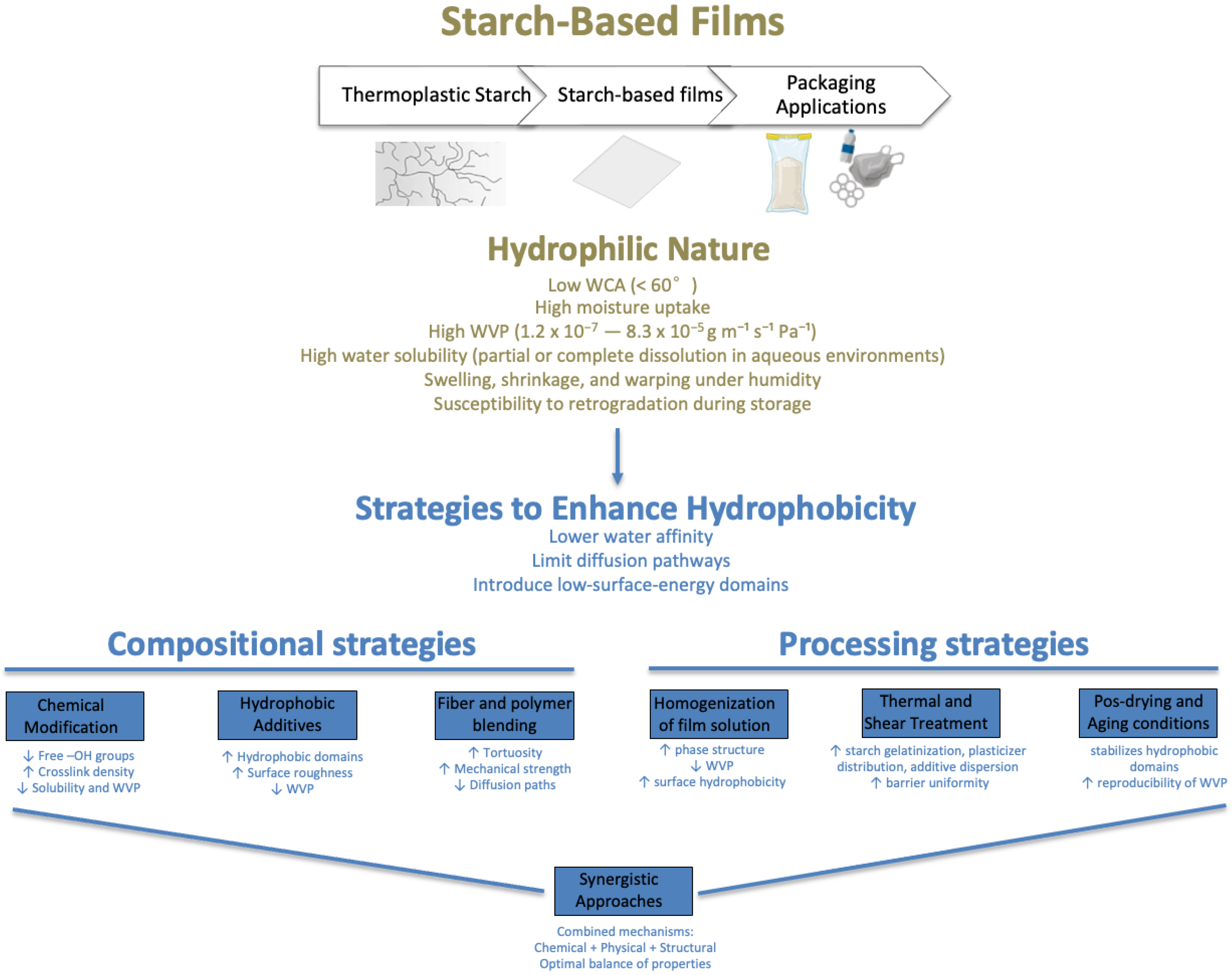
| High hydrophilicity | Low WCA (<60°); rapid moisture uptake | High density of hydroxyl (–OH) groups along amylose and amylopectin chains promotes strong starch–water hydrogen bonding | Poor resistance to humidity and liquid water; unsuitable for moist foods |
| High water solubility | Partial or complete dissolution in aqueous environments | Disruption of starch–starch hydrogen bonds by water molecules; amorphous regions highly accessible to diffusion | Loss of film integrity; limited use in aqueous or high-humidity conditions |
| High WVP | Inefficient moisture barrier | Hydrophilic polymer matrix with low tortuosity and high free volume | Poor shelf-life protection in food packaging |
| Brittleness | Low EB; brittle fracture | Strong intermolecular hydrogen bonding and lack of flexible chain segments | Mechanical failure during handling and processing |
| Low TS | Limited load-bearing capacity | Weak intermolecular cohesion under hydrated conditions; plasticization by absorbed water | Restricted use in structural or protective packaging |
| Dimensional instability | Swelling, shrinkage, and warping under humidity changes | Water-induced expansion of amorphous regions and disruption of crystalline domains | Poor shape retention during storage and transport |
| Retrogradation | Increased stiffness, opacity, and embrittlement over time | Recrystallization and reassociation of amylose and amylopectin chains | Deterioration of long-term mechanical and barrier properties |
| Plasticizer-induced moisture sensitivity | Increased moisture content and WVP after plasticization | Hygroscopic nature of glycerol, sorbitol, and PEG; enhanced water binding | Trade-off between flexibility and water resistance |
| Plasticizer migration | Surface stickiness; loss of mechanical properties over time | Phase separation and diffusion of low-molecular-weight plasticizers | Reduced durability and shelf stability |
| Modification Strategy | Targeted Limitation(s) | Mechanism of Improvement | Improvements |
|---|---|---|---|
| Chemical crosslinking (e.g., citric acid) | High hydrophilicity; high solubility; dimensional instability | Formation of covalent ester bonds reduces free hydroxyl groups and restricts chain mobility | ↓ Water solubility ↓ WVP; ↑ WCA; improved dimensional stability |
| Esterification with long-chain reagents | Low water resistance; low surface hydrophobicity | Substitution of –OH groups with hydrophobic alkyl chains; surface energy reduction | WCA > 100° ↓ moisture uptake |
| Grafting of hydrophobic polymers | Poor barrier properties; moisture sensitivity | Introduction of hydrophobic side chains and microphase separation | ↑ WCA; ↓ WVP |
| Incorporation of natural waxes (beeswax, candelilla) | High WVP; low WCA | Formation of hydrophobic domains and increased surface roughness | ↑ WCA; ↓ WVP |
| Incorporation of vegetable or essential oils | High moisture uptake; poor barrier properties | Reduction in hydrophilic site accessibility; disruption of hydrogen bonding | ↓ moisture content; ↓ WVP (at optimal oil content) |
| Nanoparticle reinforcement (ZnO, AgO) | High WVP; poor moisture barrier | Increased tortuosity and surface roughening; barrier path elongation | ↓ WVP; ↑ WCA |
| Cellulose nanocrystals | Low mechanical strength; high permeability | High crystallinity and strong interfacial hydrogen bonding increase matrix tortuosity | ↑ TS; ↓ WVP; moderate ↑ WCA |
| Cellulose nanofibrils | Brittleness; poor mechanical stability | Formation of entangled fibrillar network reinforcing matrix cohesion | ↑ TS; ↓ moisture diffusion |
| Chemical modification of fibers (e.g., tannic acid, acid treatment) | Fiber-induced hydrophilicity; interfacial incompatibility | Reduction in surface polarity and improved fiber–matrix adhesion | ↑ WCA; ↓ moisture absorption |
| Hybrid strategies (e.g., wax + nanocellulose) | Multiple limitations simultaneously | Synergistic effects combining hydrophobic domains and tortuous diffusion pathways | ↑ WCA; ↓ WVP; balanced mechanical properties |
| Strategy | WCA 1 | WVP (g m−1 s−1 Pa−1) 1 | Impact | Representative Literature Review |
|---|---|---|---|---|
| Native TPS | 20–60° | 1.2 × 10⁻⁷ — 8.3 × 10⁻⁵ | Highly hydrophilic; poor moisture barrier | [57,75,76] |
| Citric acid (CA) crosslinking | 50–80° | (1–4) × 10−10 | Reduced solubility and WVP at optimal CA content; excessive CA may plasticize | [22,77,78,79] |
| Esterification (short-chain, e.g., acetylation) | 60–90° | (0.8–3) × 10−10 | Moderate hydrophobicity improvement; depends on degree of substitution | [80,81,82] |
| Esterification (long-chain hydrophobic moieties) | 90–120° | (0.5–2) × 10−10 | Strong hydrophobicity; increased surface roughness and polarity reduction | [82,83] |
| Combined chemical modification + mild plasticization | 70–100° | (0.7–3) × 10−10 | Balanced hydrophobicity and flexibility | [84] |
| Hydrophobic Additive Class | WCA 1 | WVP Reduction (Mean Values) 1 | Dominant Mechanisms | Key Advantages | Main Limitations | Representative Literature Review |
|---|---|---|---|---|---|---|
| Natural waxes (beeswax, candelilla, carnauba) | 80–110 | 20–60% (0.8–3.5) × 10−10 g·m−1·s−1·Pa−1 | Surface-energy reduction; surface roughness; hydrophobic domain formation | Food-grade; strong surface hydrophobicity; scalable | Phase separation; brittleness at high loading; dispersion challenges | [87,88] |
| Vegetable oils (soybean, sunflower, rice bran) | 60–95 | 15–45% (1.5–4.0) × 10−10 g·m−1·s−1·Pa−1 | Hydroxyl shielding; partial plasticization; hydrophobic phase dispersion | Low cost; improves flexibility; food compatibility | Migration during storage; limited long-term barrier stability | [89] |
| Essential oils (clove, oregano, geranium) | 65–95 | 20–50% (1.2–3.8) × 10−10 g·m−1·s−1·Pa−1 | Hydrophobic domains + antimicrobial activity | Active packaging functionality; moderate hydrophobicity | Volatility; aroma transfer; stability issues | [89] |
| Pickering-stabilized lipid systems | 90–120 | 40–70% | Stable hydrophobic domains; controlled spatial distribution | Superior dispersion; improved stability | More complex formulation | [87,88] |
| Hydrophobic nanoparticles (ZnO, SiO2, organoclays) | 80–120 | 30–70% (0.7–2.5) × 10−10 g·m−1·s−1·Pa−1 | Diffusion-path tortuosity; surface roughening | Strong bulk barrier improvement; multifunctionality | Agglomeration risk; opacity; regulatory concerns | [90] |
| Carbon-based nanomaterials (CNFs, CNCs, MMT, O-MMT) | 85–120 | 40–75% (0.6–2.0) × 10−10 g·m−1·s−1·Pa−1 | High-aspect-ratio tortuosity; interfacial reinforcement | Excellent WVP reduction at low loadings | Cost; dispersion difficulty; sustainability concerns | [91] |
| Multilayer/gradient architectures | 90–120 | 35–65% | Surface-localized hydrophobicity | High WCA with low additive content | Additional processing steps | [92] |
| Nanocellulose | WCA 1 | WVP 1 (g·m−1·s−1·Pa−1) | TS 1 (MPa) | Mechanisms | Representative Literature Review |
|---|---|---|---|---|---|
| CNCs | 65–95° | (0.8–3.0) × 10−10 | 5–35 | ↑ tortuosity; high crystallinity restricts diffusion pathways | [26] |
| CNFs | 60–90° | (1.0–3.5) × 10−10 | 10–45 | Entangled fibrillar network; strong interfacial bonding and stress transfer | [26,115] |
Disclaimer/Publisher’s Note: The statements, opinions and data contained in all publications are solely those of the individual author(s) and contributor(s) and not of MDPI and/or the editor(s). MDPI and/or the editor(s) disclaim responsibility for any injury to people or property resulting from any ideas, methods, instructions or products referred to in the content. |
© 2026 by the authors. Licensee MDPI, Basel, Switzerland. This article is an open access article distributed under the terms and conditions of the Creative Commons Attribution (CC BY) license.
Share and Cite
Vieira, E.F.; Amaral, T.; Domingues, V.F.; Delerue-Matos, C. Hydrophobicity Strategies of Starch-Based Films: Recent Advances and Perspectives. Polymers 2026, 18, 490. https://doi.org/10.3390/polym18040490
Vieira EF, Amaral T, Domingues VF, Delerue-Matos C. Hydrophobicity Strategies of Starch-Based Films: Recent Advances and Perspectives. Polymers. 2026; 18(4):490. https://doi.org/10.3390/polym18040490
Chicago/Turabian StyleVieira, Elsa F., Tomás Amaral, Valentina F. Domingues, and Cristina Delerue-Matos. 2026. "Hydrophobicity Strategies of Starch-Based Films: Recent Advances and Perspectives" Polymers 18, no. 4: 490. https://doi.org/10.3390/polym18040490
APA StyleVieira, E. F., Amaral, T., Domingues, V. F., & Delerue-Matos, C. (2026). Hydrophobicity Strategies of Starch-Based Films: Recent Advances and Perspectives. Polymers, 18(4), 490. https://doi.org/10.3390/polym18040490