A Review of Computational Modeling of Polymer Composites and Nanocomposites

Abstract
1. Introduction
2. Fundamentals of Polymer Composites and Nanocomposites
2.1. Polymer Matrix
2.1.1. Molecular Motion and Relaxation
2.1.2. Influence of Confinement
2.1.3. Mechanical Properties
2.2. Reinforcements
2.2.1. Reinforcements of Composites
2.2.2. Reinforcements of Nanocomposites
2.2.3. Influence of Dispersion and Orientation
2.3. Interphase Region
2.4. Multiscale Architectures
3. Computational Modeling of Polymer Composites
3.1. Overview of Computational Modeling of Polymer Composites
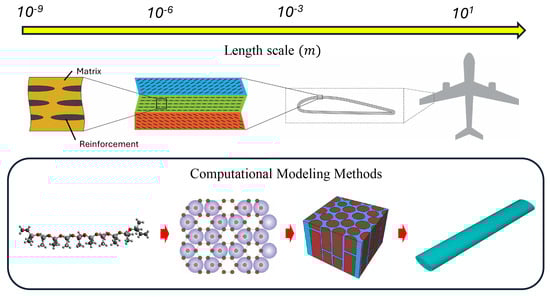
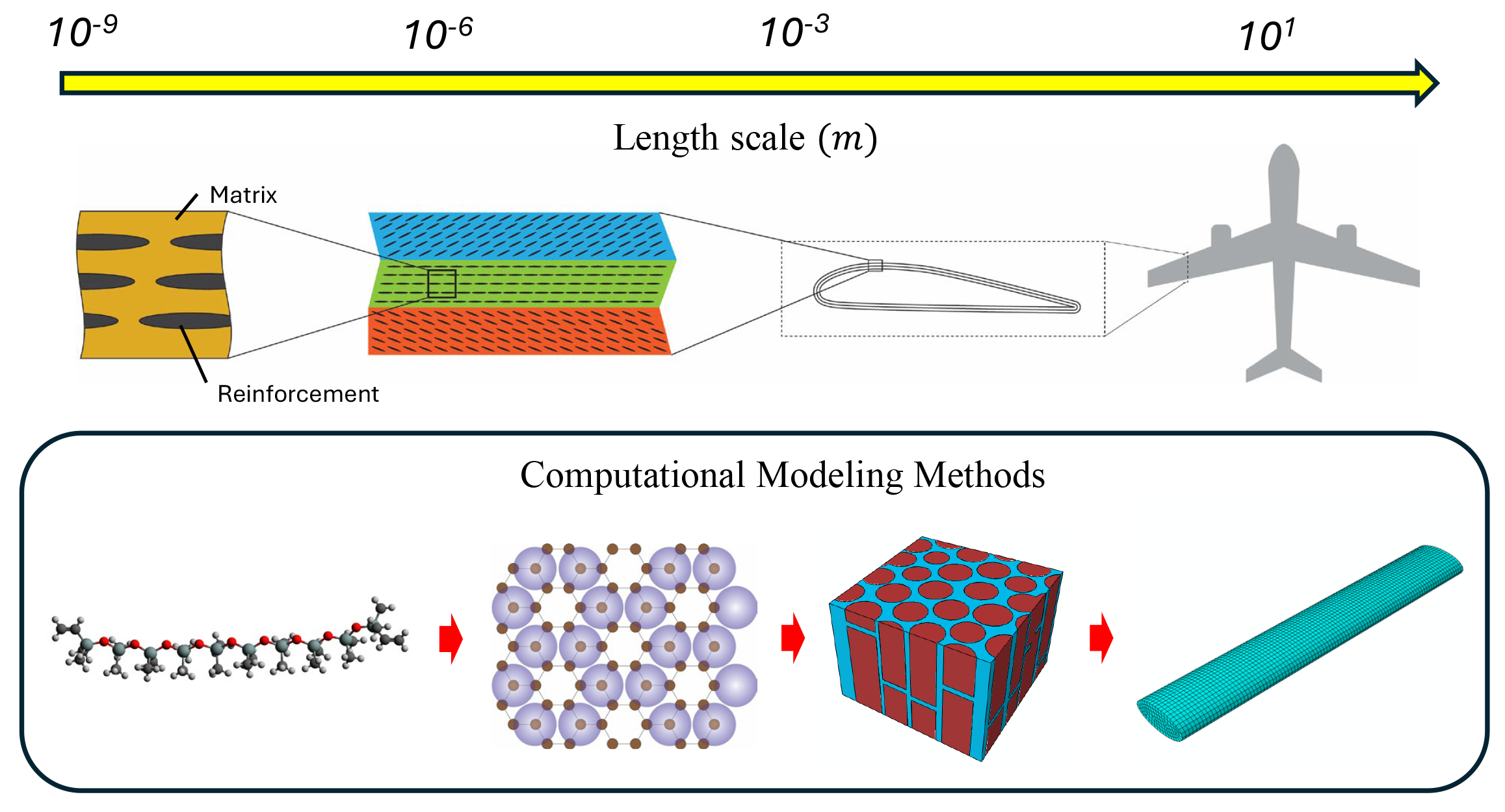
3.2. Length Scales and Modeling Methods
3.3. Modeling of Polymer Composites at the Constituent Scale
3.4. Microscale Modeling of Polymer Composites
3.5. Mesoscale Modeling of Polymer Composites
3.6. Macroscale Modeling of Polymer Composites
3.7. Discussion
3.8. Summary
4. Computational Modeling of Polymer Nanocomposites
4.1. Atomistic MD Modeling
4.2. CG MD Modeling
4.3. Continuum, Mesoscale, and Scale-Bridging Modeling
4.3.1. Continuum-Scale Modeling of Polymer Nanocomposites
4.3.2. Mesoscale Modeling of Polymer Nanocomposites
4.3.3. Scale-Bridging in Modeling of Polymer Nanocomposites
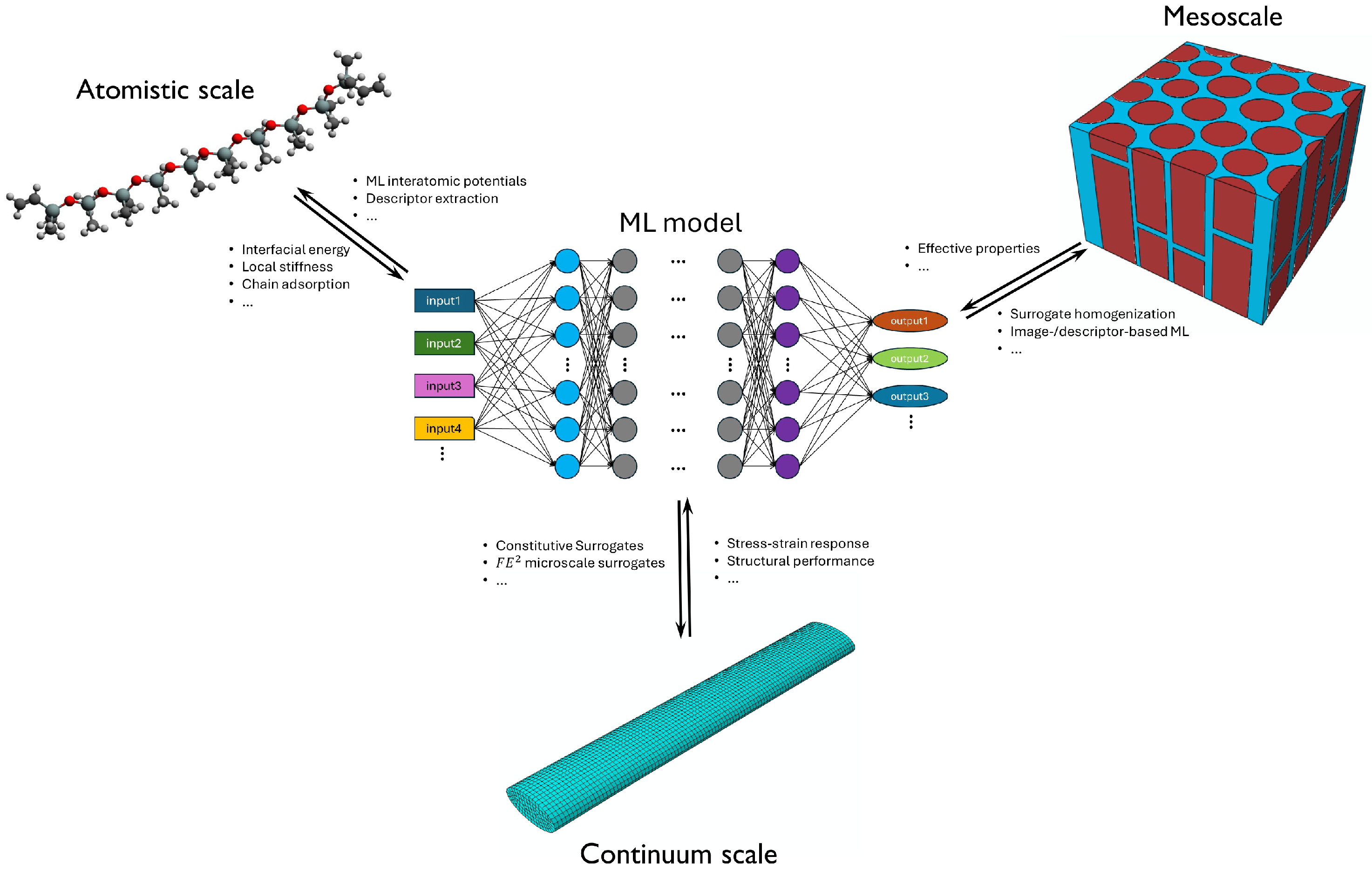
- Sequential parameter passing: MD/CGMD interphase/interface properties mesoscale RVE continuum FE. This is the most widely used approach but requires careful uncertainty propagation because errors in interfacial parameters can amplify at higher scales [222].
- Concurrent coupling: local regions treated with molecular resolution embedded within a continuum domain. While conceptually appealing for capturing localized interfacial processes, concurrent schemes are often difficult to deploy for large systems due to computational cost and coupling complexity [210].
- Reduced order and surrogate bridging: molecular and mesoscale simulations used to train surrogates that rapidly predict effective properties as functions of morphology descriptors, such as volume fraction, aspect ratio, and dispersion metrics. This approach is increasingly attractive for design and optimization but demands careful validation and physically consistent feature selection [195].
4.4. Multiscale Modeling of Polymer Nanocomposites
4.5. Discussion
4.6. Summary
5. Machine Learning for Modeling Polymer Composites and Nanocomposites

5.1. Data Requirements and Model Development
5.2. Model Validation and Generalization
5.3. Physical Consistency and Interpretability
5.4. Integration with Physics-Based Multiscale Models
5.4.1. Machine Learning for Surrogate Modeling Multiscale Frameworks
5.4.2. Machine Learning for Multiscale Bridging and Scale Coupling
5.4.3. Machine Learning-Driven Inverse Design of Materials
5.5. Hybrid Data-Driven Mechanics for Fracture and Damage Evolution
5.6. Outlook and Challenges
6. Conclusions and Discussion
Author Contributions
Funding
Data Availability Statement
Conflicts of Interest
References
- Ashby, M.F.; Cebon, D. Materials selection in mechanical design. J. Phys. IV 1993, 3, C7-1–C7-9. [Google Scholar] [CrossRef]
- Clyne, T.W.; Hull, D. An Introduction to Composite Materials; Cambridge University Press: Cambridge, UK, 2019. [Google Scholar]
- Mat Yazik, M.H.; Ismail, I. Chapter Fifteen—Aerospace structures and engines from polymer composites. In Aerospace Materials; Sultan, M.T.H., Uthayakumar, M., Korniejenko, K., Mashinini, P.M., Najeeb, M.I., Krishnamoorthy, R.R., Eds.; Elsevier: Amsterdam, The Netherlands, 2025; pp. 349–383. [Google Scholar]
- Fitri, M.; Mahzan, S.; Anggara, F. The mechanical properties requirement for polymer composite automotive parts-a review. Int. J. Adv. Technol. Mech. Mechatron. Mater. 2020, 1, 125–133. [Google Scholar] [CrossRef]
- Zhou, K.; Dai, K.; Liu, C.; Shen, C. Flexible conductive polymer composites for smart wearable strain sensors. SmartMat 2020, 1, e1010. [Google Scholar] [CrossRef]
- Ramesh, M.; Manickam, T.S.; Arockiasamy, F.S.; Ponnusamy, B.; Sivakumar, R.; Sivakumar, P.; Kandasamy, P. Powering the Future: A Comprehensive Review of Polymer Composite Energy Storage Applications. Eng. Proc. 2024, 61, 24. [Google Scholar]
- Ganguly, S.; Margel, S. Fabrication and applications of magnetic polymer composites for soft robotics. Micromachines 2023, 14, 2173. [Google Scholar] [CrossRef]
- Ramakrishna, S.; Mayer, J.; Wintermantel, E.; Leong, K.W. Biomedical applications of polymer-composite materials: A review. Compos. Sci. Technol. 2001, 61, 1189–1224. [Google Scholar] [CrossRef]
- Müller, K.; Bugnicourt, E.; Latorre, M.; Jorda, M.; Echegoyen Sanz, Y.; Lagaron, J.M.; Miesbauer, O.; Bianchin, A.; Hankin, S.; Bölz, U.; et al. Review on the Processing and Properties of Polymer Nanocomposites and Nanocoatings and Their Applications in the Packaging, Automotive and Solar Energy Fields. Nanomaterials 2017, 7, 74. [Google Scholar] [CrossRef] [PubMed]
- Fredricks, J.L.; Jimenez, A.M.; Grandgeorge, P.; Meidl, R.; Law, E.; Fan, J.; Roumeli, E. Hierarchical biopolymer-based materials and composites. J. Polym. Sci. 2023, 61, 2585–2632. [Google Scholar] [CrossRef]
- Fu, S.; Sun, Z.; Huang, P.; Li, Y.; Hu, N. Some basic aspects of polymer nanocomposites: A critical review. Nano Mater. Sci. 2019, 1, 2–30. [Google Scholar] [CrossRef]
- Zhou, H.; Zha, H.; Zhang, Z.; Huang, J.; Liu, M. Advanced mechanical polymer nanocomposites: From confined interphase to structural synergy. Chem. Commun. 2025, 61, 16132–16149. [Google Scholar] [CrossRef]
- Huang, J.; Zhou, J.; Liu, M. Interphase in Polymer Nanocomposites. JACS Au 2022, 2, 280–291. [Google Scholar] [CrossRef]
- Huang, J.; Zhou, H.; Zhang, L.; Zhang, L.; Shi, W.; Yang, Y.; Zhou, J.; Zhao, T.; Liu, M. Full-scale polymer relaxation induced by single-chain confinement enhances mechanical stability of nanocomposites. Nat. Commun. 2024, 15, 6747. [Google Scholar] [CrossRef]
- Frankland, S.; Caglar, A.; Brenner, D.; Griebel, M. Molecular simulation of the influence of chemical cross-links on the shear strength of carbon nanotube− polymer interfaces. J. Phys. Chem. B 2002, 106, 3046–3048. [Google Scholar] [CrossRef]
- Varshney, V.; Patnaik, S.S.; Roy, A.K.; Farmer, B.L. A molecular dynamics study of epoxy-based networks: Cross-linking procedure and prediction of molecular and material properties. Macromolecules 2008, 41, 6837–6842. [Google Scholar] [CrossRef]
- Groot, R.D.; Warren, P.B. Dissipative particle dynamics: Bridging the gap between atomistic and mesoscopic simulation. J. Chem. Phys. 1997, 107, 4423–4435. [Google Scholar] [CrossRef]
- Milano, G.; Müller-Plathe, F. Mapping atomistic simulations to mesoscopic models: A systematic coarse-graining procedure for vinyl polymer chains. J. Phys. Chem. B 2005, 109, 18609–18619. [Google Scholar] [CrossRef]
- Yang, Z.; Chiang, C.-C.; Meng, Z. Investigation of dynamic impact responses of layered polymer-graphene nanocomposite films using coarse-grained molecular dynamics simulations. Carbon 2023, 203, 202–210. [Google Scholar] [CrossRef]
- Yang, J.; Chen, Y.; Yang, Z.; Dai, L.; Choi, H.; Meng, Z. Unveiling the Nanoconfinement Effect on Crystallization of Semicrystalline Polymers Using Coarse-Grained Molecular Dynamics Simulations. Polymers 2024, 16, 1155. [Google Scholar] [CrossRef] [PubMed]
- Caviness, C.; Chen, Y.; Yang, Z.; Wang, H.; Wu, Y.; Meng, Z. Improved Ballistic Impact Resistance of Nanofibrillar Cellulose Films With Discontinuous Fibrous Bouligand Architecture. J. Appl. Mech. 2023, 91, 021003. [Google Scholar] [CrossRef] [PubMed]
- Chen, Y.; Yang, Z.; Dai, L.; Meng, Z. Impact of graphene oxide arrangement on the mechanical and viscoelastic properties of polymer nanocomposites. Int. J. Mech. Sci. 2025, 297–298, 110351. [Google Scholar] [CrossRef]
- Yang, Z.; Meng, Z. Porous nanoparticles overcome the conventional stiffness-damping tradeoff in polymer nanocomposites. npj Soft Matter 2025, 1, 7. [Google Scholar] [CrossRef]
- Mori, T.; Tanaka, K. Average stress in matrix and average elastic energy of materials with misfitting inclusions. Acta Metall. 1973, 21, 571–574. [Google Scholar] [CrossRef]
- Yang, Z.; Gordon, D.; Chen, Y.; Li, H.; Wu, Y.; Meng, Z. Understanding the effects of mineralization and structure on the mechanical properties of tendon-bone insertion using mesoscale computational modeling. J. Mech. Behav. Biomed. Mater. 2024, 160, 106735. [Google Scholar] [CrossRef]
- Bourchak, M.; Kada, B.; Alharbi, M.; Aljuhany, K. Nanocomposites damage characterisation using finite element analysis. Int. J. Nanopart. 2009, 2, 467–475. [Google Scholar] [CrossRef]
- Yang, Z.; Niksiar, P.; Meng, Z. Identifying structure-property relationships of micro-architectured porous scaffolds through 3D printing and finite element analysis. Comput. Mater. Sci. 2022, 202, 110987. [Google Scholar] [CrossRef]
- Bishara, D.; Xie, Y.; Liu, W.K.; Li, S. A State-of-the-Art Review on Machine Learning-Based Multiscale Modeling, Simulation, Homogenization and Design of Materials. Arch. Comput. Methods Eng. 2023, 30, 191–222. [Google Scholar] [CrossRef]
- Michaloglou, A.; Papadimitriou, I.; Gialampoukidis, I.; Vrochidis, S.; Kompatsiaris, I. Physics-Informed Neural Networks in Materials Modeling and Design: A Review. Arch. Comput. Methods Eng. 2025. [Google Scholar] [CrossRef]
- Pei, Z.; Rozman, K.A.; Doğan, Ö.N.; Wen, Y.; Gao, N.; Holm, E.A.; Hawk, J.A.; Alman, D.E.; Gao, M.C. Machine-Learning Microstructure for Inverse Material Design. Adv. Sci. 2021, 8, e2101207. [Google Scholar] [CrossRef] [PubMed]
- Szigeti, B. Torsional vibrations of long-chain hydrocarbons. Proc. R. Soc. Lond. A Math. Phys. Sci. 1961, 264, 198–211. [Google Scholar] [CrossRef]
- Colmenero, J.; Moreno, A.J.; Alegría, A. Neutron scattering investigations on methyl group dynamics in polymers. Prog. Polym. Sci. 2005, 30, 1147–1184. [Google Scholar] [CrossRef]
- Winkler, R.; Beena Unni, A.; Tu, W.; Chat, K.; Adrjanowicz, K. On the Segmental Dynamics and the Glass Transition Behavior of Poly(2-vinylpyridine) in One- and Two-Dimensional Nanometric Confinement. J. Phys. Chem. B 2021, 125, 5991–6003. [Google Scholar] [CrossRef]
- Ni, Y.; Medvedev, G.A.; Curliss, D.B.; Caruthers, J.M. Linear viscoelastic relaxation in the α and α+ regions of linear polymers, crosslinked polymers and small molecules. Polymer 2020, 202, 122745. [Google Scholar] [CrossRef]
- Des Cloizeaux, J. Relaxation and viscosity anomaly of melts made of long entangled polymers: Time-dependent reptation. Macromolecules 1990, 23, 4678–4687. [Google Scholar] [CrossRef]
- Klein, J. Evidence for reptation in an entangled polymer melt. Nature 1978, 271, 143–145. [Google Scholar] [CrossRef]
- Barba, D.; Arias, A.; Garcia-Gonzalez, D. Temperature and strain rate dependences on hardening and softening behaviours in semi-crystalline polymers: Application to PEEK. Int. J. Solids Struct. 2020, 182–183, 205–217. [Google Scholar] [CrossRef]
- Drozdov, A.D. Effect of temperature on the viscoelastic and viscoplastic behavior of polypropylene. Mech. Time-Depend. Mater. 2010, 14, 411–434. [Google Scholar] [CrossRef]
- Popov, I.; Carroll, B.; Bocharova, V.; Genix, A.-C.; Cheng, S.; Khamzin, A.; Kisliuk, A.; Sokolov, A.P. Strong Reduction in Amplitude of the Interfacial Segmental Dynamics in Polymer Nanocomposites. Macromolecules 2020, 53, 4126–4135. [Google Scholar] [CrossRef]
- Smith, G.D.; Bedrov, D.; Borodin, O. Structural Relaxation and Dynamic Heterogeneity in a Polymer Melt at Attractive Surfaces. Phys. Rev. Lett. 2003, 90, 226103. [Google Scholar] [CrossRef]
- Shimokita, K.; Yamamoto, K.; Miyata, N.; Shibata, M.; Nakanishi, Y.; Arakawa, M.; Takenaka, M.; Kida, T.; Tokumitsu, K.; Tanaka, R.; et al. Neutron Reflectivity Study on the Adsorption Layer of Polyethylene Grown on Si Substrate. Langmuir 2024, 40, 15758–15766. [Google Scholar] [CrossRef]
- Hagita, K.; Morita, H. Effects of polymer/filler interactions on glass transition temperatures of filler-filled polymer nanocomposites. Polymer 2019, 178, 121615. [Google Scholar] [CrossRef]
- Chiang, C.-C.; Breslin, J.; Weeks, S.; Meng, Z. Dynamic mechanical behaviors of nacre-inspired graphene-polymer nanocomposites depending on internal nanostructures. Extrem. Mech. Lett. 2021, 49, 101451. [Google Scholar] [CrossRef]
- Sabari Narayanan, G.; Senthil Kumar, K. Study of mechanical properties of the polymer matrix composite material (solid wool). Mater. Today Proc. 2020, 33, 2907–2911. [Google Scholar] [CrossRef]
- Li, Y.; Feng, H.; Xiong, J.; Li, L. A Group-Enriched Viscoelastic Model for High-Damping Vitrimers with Many Dangling Chains. Materials 2024, 17, 5062. [Google Scholar]
- Chakravartula, A.; Komvopoulos, K. Viscoelastic properties of polymer surfaces investigated by nanoscale dynamic mechanical analysis. Appl. Phys. Lett. 2006, 88, 131901. [Google Scholar] [CrossRef]
- Estevez, R.; Tijssens, M.G.A.; Van der Giessen, E. Modeling of the competition between shear yielding and crazing in glassy polymers. J. Mech. Phys. Solids 2000, 48, 2585–2617. [Google Scholar] [CrossRef]
- Guo, S.; Torres, D.; Weygand, S.; Olagnon, C.; Estevez, R. 3D study of the competitions between shear yielding and crazing for a variable thickness on ductile polymers. Eng. Fract. Mech. 2015, 149, 230–249. [Google Scholar] [CrossRef]
- Mousavi, S.R.; Estaji, S.; Paydayesh, A.; Arjmand, M.; Jafari, S.H.; Nouranian, S.; Khonakdar, H.A. A review of recent progress in improving the fracture toughness of epoxy-based composites using carbonaceous nanofillers. Polym. Compos. 2022, 43, 1871–1886. [Google Scholar] [CrossRef]
- Lee, C.H.; Khalina, A.; Lee, S.H. Importance of Interfacial Adhesion Condition on Characterization of Plant-Fiber-Reinforced Polymer Composites: A Review. Polymers 2021, 13, 438. [Google Scholar] [CrossRef]
- Kuan, H.T.N.; Tan, M.Y.; Shen, Y.; Yahya, M.Y. Mechanical properties of particulate organic natural filler-reinforced polymer composite: A review. Compos. Adv. Mater. 2021, 30, 26349833211007502. [Google Scholar] [CrossRef]
- Li, Z.; Liu, M.; Young, R.J. Dependence of the reinforcement of polymer-based nanocomposites upon the nanofiller geometry. Nano Mater. Sci. 2024, in press. [Google Scholar] [CrossRef]
- Opelt, C.V.; Becker, D.; Lepienski, C.M.; Coelho, L.A.F. Reinforcement and toughening mechanisms in polymer nanocomposites—Carbon nanotubes and aluminum oxide. Compos. Part B Eng. 2015, 75, 119–126. [Google Scholar] [CrossRef]
- Chung, D.D. Carbon Fiber Composites; Butterworth-Heinemann: Amsterdam, The Netherlands, 1994. [Google Scholar]
- Sathishkumar, T.; Satheeshkumar, S.; Naveen, J. Glass fiber-reinforced polymer composites—A review. J. Reinf. Plast. Compos. 2014, 33, 1258–1275. [Google Scholar] [CrossRef]
- Bertram, B.; Gerhardt, R.A. Properties and applications of ceramic composites containing silicon carbide whiskers. In Properties and Applications of Silicon Carbide; IntechOpen: London, UK, 2011; pp. 197–230. [Google Scholar]
- Abraham, R.; Thomas, S.; Kuryan, S.; Isac, J.; Varughese, K.; Thomas, S. Mechanical properties of ceramic-polymer nanocomposites. Express Polym. Lett. 2009, 3, 177–189. [Google Scholar] [CrossRef]
- Hsueh, C.-H. Interfacial debonding and fiber pull-out stresses of fiber-reinforced composites III: With residual radial and axial stresses. Mater. Sci. Eng. A 1991, 145, 135–142. [Google Scholar] [CrossRef]
- Qin, Q.-H.; Ye, J. Toughening Mechanisms in Composite Materials; Elsevier: Amsterdam, The Netherlands, 2015. [Google Scholar]
- Teklal, F.; Djebbar, A.; Allaoui, S.; Hivet, G.; Joliff, Y.; Kacimi, B. A review of analytical models to describe pull-out behavior—Fiber/matrix adhesion. Compos. Struct. 2018, 201, 791–815. [Google Scholar] [CrossRef]
- Chen, J.; Liu, B.; Gao, X.; Xu, D. A review of the interfacial characteristics of polymer nanocomposites containing carbon nanotubes. RSC Adv. 2018, 8, 28048–28085. [Google Scholar] [CrossRef]
- Lee, S.J.; Yoon, S.J.; Jeon, I.Y. Graphene/Polymer Nanocomposites: Preparation, Mechanical Properties, and Application. Polymers 2022, 14, 4733. [Google Scholar] [CrossRef] [PubMed]
- Rasul, M.G.; Kiziltas, A.; Arfaei, B.; Shahbazian-Yassar, R. 2D boron nitride nanosheets for polymer composite materials. npj 2D Mater. Appl. 2021, 5, 56. [Google Scholar] [CrossRef]
- Guo, F.; Aryana, S.; Han, Y.; Jiao, Y. A Review of the Synthesis and Applications of Polymer–Nanoclay Composites. Appl. Sci. 2018, 8, 1696. [Google Scholar] [CrossRef]
- Mariano, M.; El Kissi, N.; Dufresne, A. Cellulose nanocrystals and related nanocomposites: Review of some properties and challenges. J. Polym. Sci. Part B Polym. Phys. 2014, 52, 791–806. [Google Scholar] [CrossRef]
- Jeon, I.-Y.; Baek, J.-B. Nanocomposites derived from polymers and inorganic nanoparticles. Materials 2010, 3, 3654–3674. [Google Scholar] [CrossRef]
- Wu, S.; Peng, S.; Wang, C.H. Multifunctional Polymer Nanocomposites Reinforced by Aligned Carbon Nanomaterials. Polymers 2018, 10, 542. [Google Scholar] [CrossRef] [PubMed]
- Govindaraj, P.; Sokolova, A.; Salim, N.; Juodkazis, S.; Fuss, F.K.; Fox, B.; Hameed, N. Distribution states of graphene in polymer nanocomposites: A review. Compos. Part B Eng. 2021, 226, 109353. [Google Scholar] [CrossRef]
- Daniel, I.M.; Ishai, O.; Daniel, I.M.; Daniel, I. Engineering Mechanics of Composite Materials; Oxford University Press: New York, NY, USA, 1994; Volume 3. [Google Scholar]
- Hollister, S.J. Porous scaffold design for tissue engineering. Nat. Mater. 2005, 4, 518–524. [Google Scholar] [CrossRef] [PubMed]
- Ciprari, D.; Jacob, K.; Tannenbaum, R. Characterization of Polymer Nanocomposite Interphase and Its Impact on Mechanical Properties. Macromolecules 2006, 39, 6565–6573. [Google Scholar] [CrossRef]
- Gao, S.-L.; Mäder, E. Characterisation of interphase nanoscale property variations in glass fibre reinforced polypropylene and epoxy resin composites. Compos. Part A Appl. Sci. Manuf. 2002, 33, 559–576. [Google Scholar] [CrossRef]
- Park, H.; Lee, S.H. Review on Interfacial Bonding Mechanism of Functional Polymer Coating on Glass in Atomistic Modeling Perspective. Polymers 2021, 13, 2244. [Google Scholar] [CrossRef]
- Layek, R.K.; Nandi, A.K. A review on synthesis and properties of polymer functionalized graphene. Polymer 2013, 54, 5087–5103. [Google Scholar] [CrossRef]
- Spalla, O. Nanoparticle interactions with polymers and polyelectrolytes. Curr. Opin. Colloid Interface Sci. 2002, 7, 179–185. [Google Scholar] [CrossRef]
- Kun, D.; Kárpáti, Z.; Fekete, E.; Móczó, J. The Role of Interfacial Adhesion in Polymer Composites Engineered from Lignocellulosic Agricultural Waste. Polymers 2021, 13, 3099. [Google Scholar] [CrossRef]
- Fu, S.-Y.; Feng, X.-Q.; Lauke, B.; Mai, Y.-W. Effects of particle size, particle/matrix interface adhesion and particle loading on mechanical properties of particulate–polymer composites. Compos. Part B Eng. 2008, 39, 933–961. [Google Scholar] [CrossRef]
- Wu, D.; Feng, Y.; Li, R.; Ozisik, R.; Akcora, P. Entanglement density and particle dynamics in rigid interfacial layers of polymer nanocomposites. J. Appl. Phys. 2021, 130, 064701. [Google Scholar] [CrossRef]
- Cheng, S.; Carroll, B.; Bocharova, V.; Carrillo, J.-M.; Sumpter, B.G.; Sokolov, A.P. Focus: Structure and dynamics of the interfacial layer in polymer nanocomposites with attractive interactions. J. Chem. Phys. 2017, 146, 203201. [Google Scholar] [CrossRef]
- Harms, S.; Rätzke, K.; Faupel, F.; Schneider, G.J.; Willner, L.; Richter, D. Free Volume of Interphases in Model Nanocomposites Studied by Positron Annihilation Lifetime Spectroscopy. Macromolecules 2010, 43, 10505–10511. [Google Scholar] [CrossRef]
- Priestley, R.D.; Ellison, C.J.; Broadbelt, L.J.; Torkelson, J.M. Structural Relaxation of Polymer Glasses at Surfaces, Interfaces, and In Between. Science 2005, 309, 456–459. [Google Scholar] [CrossRef]
- Ning, N.; Fu, S.; Zhang, W.; Chen, F.; Wang, K.; Deng, H.; Zhang, Q.; Fu, Q. Realizing the enhancement of interfacial interaction in semicrystalline polymer/filler composites via interfacial crystallization. Prog. Polym. Sci. 2012, 37, 1425–1455. [Google Scholar] [CrossRef]
- Pukánszky, B. Interfaces and interphases in multicomponent materials: Past, present, future. Eur. Polym. J. 2005, 41, 645–662. [Google Scholar] [CrossRef]
- Mahmoodi, M.J.; Khamehchi, M. Random distribution of interphase characteristics on the overall electro-mechanical properties of CNT piezo nanocomposite: Micromechanical modeling and Monte Carlo simulation. Probabilistic Eng. Mech. 2024, 75, 103577. [Google Scholar] [CrossRef]
- Brosseau, C. Modeling the Interface Between Phases in Dense Polymer-Carbon Black Nanoparticle Composites by Dielectric Spectroscopy: Where Are We Now and What are the Opportunities? Macromol. Theory Simul. 2024, 33, 2400009. [Google Scholar] [CrossRef]
- Sharifzadeh, E.; Ader, F.; Moradi, G. Multi-layer structural representation of polymer/particle interphase region based on De Gennes’s scaling theory. J. Reinf. Plast. Compos. 2026, 45, 424–441. [Google Scholar] [CrossRef]
- Chipara, D.; Trevino, A.; Martirosyan, K.S.; Chipara, M. Interphase in polymer-based nanocomposites: Polyoctenamer—Single-walled carbon nanotubes. Surf. Interfaces 2023, 40, 103011. [Google Scholar] [CrossRef]
- Saito, I.; Sheridan, R.J.; Zauscher, S.; Brinson, L.C. Pushing AFM to the boundaries—Interphase mechanical property measurements near a rigid body. Macromolecules 2025, 58, 980–988. [Google Scholar] [CrossRef]
- Sharifzadeh, E. Energy-based characterization of polymer/particle interphase region as piled-up equilibrated molecular layers: The impact of different distribution patterns of adsorption energy. Polym. Eng. Sci. 2025, 65, 384–400. [Google Scholar] [CrossRef]
- Vogiatzis, G.G.; Theodorou, D.N. Multiscale Molecular Simulations of Polymer-Matrix Nanocomposites. Arch. Comput. Methods Eng. 2018, 25, 591–645. [Google Scholar] [CrossRef]
- Jancar, J.; Douglas, J.F.; Starr, F.W.; Kumar, S.K.; Cassagnau, P.; Lesser, A.J.; Sternstein, S.S.; Buehler, M.J. Current issues in research on structure–property relationships in polymer nanocomposites. Polymer 2010, 51, 3321–3343. [Google Scholar] [CrossRef]
- Balazs, A.C.; Emrick, T.; Russell, T.P. Nanoparticle polymer composites: Where two small worlds meet. Science 2006, 314, 1107–1110. [Google Scholar] [CrossRef]
- Beena Unni, A.; Chat, K.; Duarte, D.M.; Wojtyniak, M.; Geppert-Rybczyńska, M.; Kubacki, J.; Wrzalik, R.; Richert, R.; Adrjanowicz, K. Experimental evidence on the effect of substrate roughness on segmental dynamics of confined polymer films. Polymer 2020, 199, 122501. [Google Scholar] [CrossRef]
- Almeida, J.H.S.; Miettinen, A.; Léonard, F.; Falzon, B.G.; Withers, P.J. Microstructure and damage evolution in short carbon fibre 3D-printed composites during tensile straining. Compos. Part B Eng. 2025, 292, 112073. [Google Scholar] [CrossRef]
- Nairn, J.A. On the use of shear-lag methods for analysis of stress transfer in unidirectional composites. Mech. Mater. 1997, 26, 63–80. [Google Scholar] [CrossRef]
- Mortazavian, S.; Fatemi, A. Effects of fiber orientation and anisotropy on tensile strength and elastic modulus of short fiber reinforced polymer composites. Compos. Part B Eng. 2015, 72, 116–129. [Google Scholar] [CrossRef]
- Wang, W.; Sadeghipour, K.; Baran, G. Finite element analysis of the effect of an interphase on toughening of a particle-reinforced polymer composite. Compos. Part A Appl. Sci. Manuf. 2008, 39, 956–964. [Google Scholar] [CrossRef]
- Nettles, A.T. Basic Mechanics of Laminated Composite Plates; NASA Marshall Space Flight Center: Huntsville, AL, USA, 1994. [Google Scholar]
- Li, Y.; Feng, Z.; Hao, L.; Huang, L.; Xin, C.; Wang, Y.; Bilotti, E.; Essa, K.; Zhang, H.; Li, Z.; et al. A Review on Functionally Graded Materials and Structures via Additive Manufacturing: From Multi-Scale Design to Versatile Functional Properties. Adv. Mater. Technol. 2020, 5, 1900981. [Google Scholar] [CrossRef]
- Aghajani, S.; Wu, C.; Li, Q.; Fang, J. Additively manufactured composite lattices: A state-of-the-art review on fabrications, architectures, constituent materials, mechanical properties, and future directions. Thin-Walled Struct. 2024, 197, 111539. [Google Scholar] [CrossRef]
- Mognhod Bezzie, Y.; Paramasivam, V.; Tilahun, S.; Selvaraj, S.K. A review on failure mechanisms and analysis of multidirectional laminates. Mater. Today Proc. 2021, 46, 7380–7388. [Google Scholar] [CrossRef]
- Harik, V.M. Control of Damage in Composite Laminates by Ply-Stacking Designs: Characteristic Failure Signatures and Safety Criteria. J. Eng. Mater. Technol. 2003, 125, 385–393. [Google Scholar] [CrossRef]
- Boddeti, N.; Rosen, D.W.; Maute, K.; Dunn, M.L. Multiscale optimal design and fabrication of laminated composites. Compos. Struct. 2019, 228, 111366. [Google Scholar] [CrossRef]
- Rajak, D.K.; Pagar, D.D.; Menezes, P.L.; Linul, E. Fiber-Reinforced Polymer Composites: Manufacturing, Properties, and Applications. Polymers 2019, 11, 1667. [Google Scholar] [CrossRef] [PubMed]
- Simões, S. High-Performance Advanced Composites in Multifunctional Material Design: State of the Art, Challenges, and Future Directions. Materials 2024, 17, 5997. [Google Scholar] [CrossRef]
- Reddy, J.N. An Introduction to the Finite Element Method; McGraw-Hill Education: Columbus, OH, USA, 2005; p. 27. [Google Scholar]
- Nikishkov, G.P. Introduction to the Finite Element Method; University of Aizu: Aizu-Wakamatsu, Japan, 2004; pp. 1–70. [Google Scholar]
- Wriggers, P. Nonlinear Finite Element Methods; Springer Science & Business Media: Berlin/Heidelberg, Germany, 2008. [Google Scholar]
- David Müzel, S.; Bonhin, E.P.; Guimarães, N.M.; Guidi, E.S. Application of the Finite Element Method in the Analysis of Composite Materials: A Review. Polymers 2020, 12, 818. [Google Scholar] [CrossRef]
- Liu, P. Damage Modeling of Composite Structures: Strength, Fracture, and Finite Element Analysis; Elsevier: Amsterdam, The Netherlands, 2021. [Google Scholar]
- Hinterhoelzl, R.M.; Schapery, R.A. FEM Implementation of a Three-Dimensional Viscoelastic Constitutive Model for Particulate Composites with Damage Growth. Mech. Time-Depend. Mater. 2004, 8, 65–94. [Google Scholar] [CrossRef]
- Tikarrouchine, E.; Chatzigeorgiou, G.; Chemisky, Y.; Meraghni, F. Fully coupled thermo-viscoplastic analysis of composite structures by means of multi-scale three-dimensional finite element computations. Int. J. Solids Struct. 2019, 164, 120–140. [Google Scholar] [CrossRef]
- Zhou, M. Thermomechanical continuum representation of atomistic deformation at arbitrary size scales. Proc. R. Soc. A Math. Phys. Eng. Sci. 2005, 461, 3437–3472. [Google Scholar] [CrossRef]
- Tadmor, E.B.; Legoll, F.; Kim, W.K.; Dupuy, L.M.; Miller, R.E. Finite-Temperature Quasi-Continuum. Appl. Mech. Rev. 2013, 65, 010803. [Google Scholar] [CrossRef]
- Larsson, F.; Runesson, K.; Saroukhani, S.; Vafadari, R. Computational homogenization based on a weak format of micro-periodicity for RVE-problems. Comput. Methods Appl. Mech. Eng. 2011, 200, 11–26. [Google Scholar] [CrossRef]
- Ostoja-Starzewski, M. Material spatial randomness: From statistical to representative volume element. Probabilistic Eng. Mech. 2006, 21, 112–132. [Google Scholar] [CrossRef]
- Gould, P.L.; Feng, Y. Introduction to Linear Elasticity; Springer: Berlin/Heidelberg, Germany, 1994; Volume 2. [Google Scholar]
- Tee, T.T.; Dealy, J.M. Nonlinear Viscoelasticity of Polymer Melts. Trans. Soc. Rheol. 1975, 19, 595–615. [Google Scholar] [CrossRef]
- Tervoort, T.A.; Klompen, E.T.J.; Govaert, L.E. A multi-mode approach to finite, three-dimensional, nonlinear viscoelastic behavior of polymer glasses. J. Rheol. 1996, 40, 779–797. [Google Scholar] [CrossRef]
- Drozdov, A.D.; Kalamkarov, A.L. A constitutive model for nonlinear viscoelastic behavior of polymers. Polym. Eng. Sci. 1996, 36, 1907–1919. [Google Scholar] [CrossRef]
- Zaïri, F.; Naït-Abdelaziz, M.; Gloaguen, J.M.; Lefebvre, J.M. Modelling of the elasto-viscoplastic damage behaviour of glassy polymers. Int. J. Plast. 2008, 24, 945–965. [Google Scholar] [CrossRef]
- Calzada, K.A.; Kapoor, S.G.; DeVor, R.E.; Samuel, J.; Srivastava, A.K. Modeling and interpretation of fiber orientation-based failure mechanisms in machining of carbon fiber-reinforced polymer composites. J. Manuf. Process. 2012, 14, 141–149. [Google Scholar] [CrossRef]
- Chawla, N.; Sidhu, R.S.; Ganesh, V.V. Three-dimensional visualization and microstructure-based modeling of deformation in particle-reinforced composites. Acta Mater. 2006, 54, 1541–1548. [Google Scholar] [CrossRef]
- Elmasry, A.; Azoti, W.; El-Safty, S.A.; Elmarakbi, A. A comparative review of multiscale models for effective properties of nano-and micro-composites. Prog. Mater. Sci. 2023, 132, 101022. [Google Scholar] [CrossRef]
- Jesson, D.A.; Watts, J.F. The Interface and Interphase in Polymer Matrix Composites: Effect on Mechanical Properties and Methods for Identification. Polym. Rev. 2012, 52, 321–354. [Google Scholar] [CrossRef]
- Balasubramani, N.K.; Zhang, B.; Chowdhury, N.T.; Mukkavilli, A.; Suter, M.; Pearce, G.M. Micro-mechanical analysis on random RVE size and shape in multiscale finite element modelling of unidirectional FRP composites. Compos. Struct. 2022, 282, 115081. [Google Scholar] [CrossRef]
- Wang, H.; Fang, C.; Zhang, Y.; Zhang, M.; Shen, T.; Du, J. Prediction of Aging Performance of Particle-Filled Polymer Composites Based on RVE Model. Polymers 2023, 15, 4724. [Google Scholar] [CrossRef] [PubMed]
- Trias, D.; Costa, J.; Turon, A.; Hurtado, J.E. Determination of the critical size of a statistical representative volume element (SRVE) for carbon reinforced polymers. Acta Mater. 2006, 54, 3471–3484. [Google Scholar] [CrossRef]
- Shu, W.; Stanciulescu, I. Computational modeling and multiscale homogenization of short fiber composites considering complex microstructure and imperfect interfaces. Compos. Struct. 2023, 306, 116592. [Google Scholar] [CrossRef]
- Higuchi, R.; Yokozeki, T.; Nishida, K.; Kawamura, C.; Sugiyama, T.; Miyanaga, T. High-fidelity computational micromechanics of composite materials using image-based periodic representative volume element. Compos. Struct. 2024, 328, 117726. [Google Scholar] [CrossRef]
- Jiang, J.; Wu, J.; Chen, Q.; Chatzigeorgiou, G.; Meraghni, F. Physically informed deep homogenization neural network for unidirectional multiphase/multi-inclusion thermoconductive composites. Comput. Methods Appl. Mech. Eng. 2023, 409, 115972. [Google Scholar] [CrossRef]
- Ye, S.; Li, B.; Li, Q.; Zhao, H.-P.; Feng, X.-Q. Deep neural network method for predicting the mechanical properties of composites. Appl. Phys. Lett. 2019, 115, 161901. [Google Scholar] [CrossRef]
- Thorsson, S.I.; Waas, A.M.; Rassaian, M. Low-velocity impact predictions of composite laminates using a continuum shell based modeling approach part A: Impact study. Int. J. Solids Struct. 2018, 155, 185–200. [Google Scholar] [CrossRef]
- Xu, W.; Liu, L.; Xu, W. Experiments and Finite Element Simulations of Composite Laminates Following Low Velocity On-Edge Impact Damage. Polymers 2022, 14, 1744. [Google Scholar] [CrossRef]
- Robbins, D.H., Jr.; Reddy, J.N. Modelling of thick composites using a layerwise laminate theory. Int. J. Numer. Methods Eng. 1993, 36, 655–677. [Google Scholar] [CrossRef]
- Krueger, R.; O’Brien, T.K. A shell/3D modeling technique for the analysis of delaminated composite laminates. Compos. Part A Appl. Sci. Manuf. 2001, 32, 25–44. [Google Scholar] [CrossRef]
- Turon, A.; Costa, J.; Camanho, P.P.; Dávila, C.G. Simulation of delamination in composites under high-cycle fatigue. Compos. Part A Appl. Sci. Manuf. 2007, 38, 2270–2282. [Google Scholar] [CrossRef]
- Esqué-de los Ojos, D.; Ghisleni, R.; Battisti, A.; Mohanty, G.; Michler, J.; Sort, J.; Brunner, A.J. Understanding the mechanical behavior of fiber/matrix interfaces during push-in tests by means of finite element simulations and a cohesive zone model. Comput. Mater. Sci. 2016, 117, 330–337. [Google Scholar] [CrossRef]
- Park, K.; Paulino, G.H. Cohesive Zone Models: A Critical Review of Traction-Separation Relationships Across Fracture Surfaces. Appl. Mech. Rev. 2013, 64, 060802. [Google Scholar] [CrossRef]
- Bourdin, B.; Francfort, G.A.; Marigo, J.J. Numerical experiments in revisited brittle fracture. J. Mech. Phys. Solids 2000, 48, 797–826. [Google Scholar] [CrossRef]
- Amor, H.; Marigo, J.-J.; Maurini, C. Regularized formulation of the variational brittle fracture with unilateral contact: Numerical experiments. J. Mech. Phys. Solids 2009, 57, 1209–1229. [Google Scholar] [CrossRef]
- Miehe, C.; Hofacker, M.; Welschinger, F. A phase field model for rate-independent crack propagation: Robust algorithmic implementation based on operator splits. Comput. Methods Appl. Mech. Eng. 2010, 199, 2765–2778. [Google Scholar] [CrossRef]
- Cowin, S.C. Properties of the anisotropic elasticity tensor. Q. J. Mech. Appl. Math. 1989, 42, 249–266. [Google Scholar] [CrossRef]
- Barbero, E.J.; Cortes, D.H. A mechanistic model for transverse damage initiation, evolution, and stiffness reduction in laminated composites. Compos. Part B Eng. 2010, 41, 124–132. [Google Scholar] [CrossRef]
- Darabi, M.K.; Abu Al-Rub, R.K.; Little, D.N. A continuum damage mechanics framework for modeling micro-damage healing. Int. J. Solids Struct. 2012, 49, 492–513. [Google Scholar] [CrossRef]
- Xin, Y.; Gao, H.; Ma, L.; Yang, S.; Zheng, L.; Wu, Q. Thermo–mechanical coupling effects on mechanical properties and damage evolution of continuous fiber-reinforced thermoplastic composites. Compos. Part B Eng. 2025, 307, 112788. [Google Scholar] [CrossRef]
- Holzapfel, G.A.; Gasser, T.C. A viscoelastic model for fiber-reinforced composites at finite strains: Continuum basis, computational aspects and applications. Comput. Methods Appl. Mech. Eng. 2001, 190, 4379–4403. [Google Scholar] [CrossRef]
- Ryou, H.; Chung, K.; Yu, W.-R. Constitutive modeling of woven composites considering asymmetric/anisotropic, rate dependent, and nonlinear behavior. Compos. Part A Appl. Sci. Manuf. 2007, 38, 2500–2510. [Google Scholar] [CrossRef]
- Naresh, K.; Khan, K.A.; Umer, R.; Vasudevan, A. Temperature-Frequency-Dependent Viscoelastic Properties of Neat Epoxy and Fiber Reinforced Polymer Composites: Experimental Characterization and Theoretical Predictions. Polymers 2020, 12, 1700. [Google Scholar] [CrossRef]
- Muliana, A.H.; Sawant, S. Responses of viscoelastic polymer composites with temperature and time dependent constituents. Acta Mech. 2009, 204, 155–173. [Google Scholar] [CrossRef]
- Zhi, J.; Yang, B.; Li, Y.; Tay, T.-E.; Tan, V.B.C. Multiscale thermo-mechanical analysis of cure-induced deformation in composite laminates using Direct FE2. Compos. Part A Appl. Sci. Manuf. 2023, 173, 107704. [Google Scholar] [CrossRef]
- Zhang, N.; Gao, S.; Song, M.; Chen, Y.; Zhao, X.; Liang, J.; Feng, J. A Multiscale Study of CFRP Based on Asymptotic Homogenization with Application to Mechanical Analysis of Composite Pressure Vessels. Polymers 2022, 14, 2817. [Google Scholar] [CrossRef]
- Kari, S.; Berger, H.; Rodriguez-Ramos, R.; Gabbert, U. Computational evaluation of effective material properties of composites reinforced by randomly distributed spherical particles. Compos. Struct. 2007, 77, 223–231. [Google Scholar] [CrossRef]
- Dai, Q.; Ng, K. Investigation of electromechanical properties of piezoelectric structural fiber composites with micromechanics analysis and finite element modeling. Mech. Mater. 2012, 53, 29–46. [Google Scholar] [CrossRef]
- Yi, H.; Wang, S.; Mei, S.; Li, Z. Conductive polymer composites for resistive flexible strain sensors. Polymer 2024, 307, 127286. [Google Scholar] [CrossRef]
- Sun, Q.; Zhou, G.; Yang, Z.; Breslin, J.; Meng, Z. Chapter Seven—Multiscale modeling of failure behaviors in carbon fiber-reinforced polymer composites. In Fundamentals of Multiscale Modeling of Structural Materials; Xia, W., Ruiz Pestana, L.A., Eds.; Elsevier: Amsterdam, The Netherlands, 2023; pp. 239–292. [Google Scholar]
- Xu, H.; Gao, C.; Meng, Z.; Wang, A.; Keten, S.; Wu, Z. Atomistic investigation of fracture mechanisms in phosphorus-functionalized epoxy resins. Int. J. Mech. Sci. 2022, 227, 107412. [Google Scholar] [CrossRef]
- Tang, H.; Zhou, G.; Sun, Q.; Avinesh, O.; Meng, Z.; Engler-Pinto, C.; Su, X. Experimental and computational analysis of bending fatigue failure in chopped carbon fiber chip reinforced composites. Compos. Struct. 2021, 275, 114402. [Google Scholar] [CrossRef] [PubMed]
- Sun, Q.; Zhou, G.; Tang, H.; Chen, Z.; Fenner, J.; Meng, Z.; Jain, M.; Su, X. A combined experimental and computational analysis of failure mechanisms in open-hole cross-ply laminates under flexural loading. Compos. Part B Eng. 2021, 215, 108803. [Google Scholar] [CrossRef] [PubMed]
- Sun, Q.; Zhou, G.; Tang, H.; Meng, Z.; Jain, M.; Su, X.; Han, W. In-situ effect in cross-ply laminates under various loading conditions analyzed with hybrid macro/micro-scale computational models. Compos. Struct. 2021, 261, 113592. [Google Scholar] [CrossRef]
- Zhou, G.; Sun, Q.; Meng, Z.; Li, D.; Peng, Y.; Zeng, D.; Su, X. Experimental investigation on the effects of fabric architectures on mechanical and damage behaviors of carbon/epoxy woven composites. Compos. Struct. 2021, 257, 113366. [Google Scholar] [CrossRef]
- Sun, Q.; Zhou, G.; Meng, Z.; Jain, M.; Su, X. An integrated computational materials engineering framework to analyze the failure behaviors of carbon fiber reinforced polymer composites for lightweight vehicle applications. Compos. Sci. Technol. 2021, 202, 108560. [Google Scholar] [CrossRef]
- Zhou, G.; Sun, Q.; Li, D.; Meng, Z.; Peng, Y.; Chen, Z.; Zeng, D.; Su, X. Meso-scale modeling and damage analysis of carbon/epoxy woven fabric composite under in-plane tension and compression loadings. Int. J. Mech. Sci. 2021, 190, 105980. [Google Scholar] [CrossRef] [PubMed]
- Zhou, G.; Sun, Q.; Li, D.; Meng, Z.; Peng, Y.; Zeng, D.; Su, X. Effects of fabric architectures on mechanical and damage behaviors in carbon/epoxy woven composites under multiaxial stress states. Polym. Test. 2020, 90, 106657. [Google Scholar] [CrossRef]
- Tang, H.; Chen, Z.; Avinesh, O.; Guo, H.; Meng, Z.; Engler-Pinto, C.; Kang, H.; Su, X. Notch insensitivity in fatigue failure of chopped carbon fiber chip-reinforced composites using experimental and computational analysis. Compos. Struct. 2020, 244, 112280. [Google Scholar] [CrossRef]
- Sun, Q.; Zhou, G.; Guo, H.; Meng, Z.; Chen, Z.; Liu, H.; Kang, H.; Su, X. Failure mechanisms of cross-ply carbon fiber reinforced polymer laminates under longitudinal compression with experimental and computational analyses. Compos. Part B Eng. 2019, 167, 147–160. [Google Scholar] [CrossRef]
- Sun, Q.; Zhou, G.; Meng, Z.; Guo, H.; Chen, Z.; Liu, H.; Kang, H.; Keten, S.; Su, X. Failure criteria of unidirectional carbon fiber reinforced polymer composites informed by a computational micromechanics model. Compos. Sci. Technol. 2019, 172, 81–95. [Google Scholar] [CrossRef]
- Sun, Q.; Guo, H.; Zhou, G.; Meng, Z.; Chen, Z.; Kang, H.; Keten, S.; Su, X. Experimental and computational analysis of failure mechanisms in unidirectional carbon fiber reinforced polymer laminates under longitudinal compression loading. Compos. Struct. 2018, 203, 335–348. [Google Scholar] [CrossRef]
- Sun, Q.; Meng, Z.; Zhou, G.; Lin, S.-P.; Kang, H.; Keten, S.; Guo, H.; Su, X. Multi-scale computational analysis of unidirectional carbon fiber reinforced polymer composites under various loading conditions. Compos. Struct. 2018, 196, 30–43. [Google Scholar] [CrossRef]
- Brenner, D.W. The Art and Science of an Analytic Potential. Phys. Status Solidi (B) 2000, 217, 23–40. [Google Scholar] [CrossRef]
- Gedde, U.W. Chain Conformations in Polymers. In Polymer Physics; Springer: Dordrecht, The Netherlands, 1999; pp. 19–38. [Google Scholar]
- Lee, S.; Choi, J.; Choe, J.; Kim, M.; Paeng, K. Segmental dynamics of polymer by rotational fluorescence correlation microscopy. J. Chem. Phys. 2018, 149, 164910. [Google Scholar] [CrossRef] [PubMed]
- Davies, J.E.K. Interfacial Phenomena; Academic Press: London, UK, 1963. [Google Scholar]
- Aboudi, J.; Hidde, J.; Herakovich, C. Thermo-mechanical response predictions for metal matrix composite laminates. Sci. Eng. Compos. Mater. 1993, 2, 151–170. [Google Scholar] [CrossRef]
- Jorgensen, W.L.; Tirado-Rives, J. The OPLS [optimized potentials for liquid simulations] potential functions for proteins, energy minimizations for crystals of cyclic peptides and crambin. J. Am. Chem. Soc. 1988, 110, 1657–1666. [Google Scholar] [CrossRef]
- Brooks, B.R.; Bruccoleri, R.E.; Olafson, B.D.; States, D.J.; Swaminathan, S.; Karplus, M. CHARMM: A program for macromolecular energy, minimization, and dynamics calculations. J. Comput. Chem. 1983, 4, 187–217. [Google Scholar] [CrossRef]
- Weiner, P.K.; Kollman, P.A. AMBER: Assisted model building with energy refinement. A general program for modeling molecules and their interactions. J. Comput. Chem. 1981, 2, 287–303. [Google Scholar] [CrossRef]
- Sun, H. COMPASS: An ab Initio Force-Field Optimized for Condensed-Phase ApplicationsOverview with Details on Alkane and Benzene Compounds. J. Phys. Chem. B 1998, 102, 7338–7364. [Google Scholar] [CrossRef]
- Sun, H.; Jin, Z.; Yang, C.; Akkermans, R.L.C.; Robertson, S.H.; Spenley, N.A.; Miller, S.; Todd, S.M. COMPASS II: Extended coverage for polymer and drug-like molecule databases. J. Mol. Model. 2016, 22, 47. [Google Scholar] [CrossRef]
- Langbein, D.; Langhoff, P. Van der Waals Attraction; Springer Tracts in Modern Physics: Berlin/Heidelberg, Germany, 1976; Volume 72. [Google Scholar]
- Griffiths, D.J. Introduction to Electrodynamics, 4th ed.; Cambridge University Press: Cambridge, UK, 2017; pp. 296–354. [Google Scholar]
- Pauling, L. The nature of the chemical bond. Application of results obtained from the quantum mechanics and from a theory of paramagnetic susceptibility to the structure of molecules. J. Am. Chem. Soc. 1931, 53, 1367–1400. [Google Scholar] [CrossRef]
- Al-Ostaz, A.; Pal, G.; Mantena, P.R.; Cheng, A. Molecular dynamics simulation of SWCNT–polymer nanocomposite and its constituents. J. Mater. Sci. 2008, 43, 164–173. [Google Scholar] [CrossRef]
- Jia, X.-M.; Qian, H.-J.; Lu, Z.-Y. The interfacial structure and dynamics in a polymer nanocomposite containing small attractive nanoparticles: A full atomistic molecular dynamics simulation study. Phys. Chem. Chem. Phys. 2020, 22, 11400–11408. [Google Scholar] [CrossRef] [PubMed]
- Lin, F.; Xiang, Y.; Shen, H.-S. Temperature dependent mechanical properties of graphene reinforced polymer nanocomposites—A molecular dynamics simulation. Compos. Part B Eng. 2017, 111, 261–269. [Google Scholar] [CrossRef]
- Griebel, M.; Hamaekers, J. Molecular dynamics simulations of the elastic moduli of polymer–carbon nanotube composites. Comput. Methods Appl. Mech. Eng. 2004, 193, 1773–1788. [Google Scholar] [CrossRef]
- Cummings, P.T.; Evans, D.J. Nonequilibrium molecular dynamics approaches to transport properties and non-Newtonian fluid rheology. Ind. Eng. Chem. Res. 1992, 31, 1237–1252. [Google Scholar] [CrossRef]
- Xu, X.; Chen, J.; An, L. Shear thinning behavior of linear polymer melts under shear flow via nonequilibrium molecular dynamics. J. Chem. Phys. 2014, 140, 174902. [Google Scholar] [CrossRef]
- J Evans, D.; P Morriss, G. Statistical Mechanics of Nonequilbrium Liquids; ANU Press: Canberra, Australia, 2007. [Google Scholar]
- Todd, B.D.; Daivis, P.J. Nonequilibrium Molecular Dynamics Simulations of Planar Elongational Flow with Spatially and Temporally Periodic Boundary Conditions. Phys. Rev. Lett. 1998, 81, 1118–1121. [Google Scholar] [CrossRef]
- Dobson, M. Periodic boundary conditions for long-time nonequilibrium molecular dynamics simulations of incompressible flows. J. Chem. Phys. 2014, 141, 184103. [Google Scholar] [CrossRef] [PubMed]
- Frascoli, F.; Todd, B.D. Molecular dynamics simulation of planar elongational flow at constant pressure and constant temperature. J. Chem. Phys. 2007, 126, 044506. [Google Scholar] [CrossRef]
- Kairn, T.; Daivis, P.J.; Ivanov, I.; Bhattacharya, S.N. Molecular-dynamics simulation of model polymer nanocomposite rheology and comparison with experiment. J. Chem. Phys. 2005, 123, 194905. [Google Scholar] [CrossRef] [PubMed]
- Li, H.; Wu, H.; Zhang, W.; Zhao, X.; Zhang, L.; Gao, Y. Rheological mechanism of polymer nanocomposites filled with spherical nanoparticles: Insight from molecular dynamics simulation. Polymer 2021, 231, 124129. [Google Scholar] [CrossRef]
- Gooneie, A.; Schuschnigg, S.; Holzer, C. A Review of Multiscale Computational Methods in Polymeric Materials. Polymers 2017, 9, 16. [Google Scholar] [CrossRef]
- Li, E.J.; Semnani, S.J. Molecular dynamics enabled data-driven modeling of constitutive behavior and failure in composite materials. Comput. Methods Appl. Mech. Eng. 2025, 446, 118230. [Google Scholar] [CrossRef]
- Kmiecik, S.; Gront, D.; Kolinski, M.; Wieteska, L.; Dawid, A.E.; Kolinski, A. Coarse-Grained Protein Models and Their Applications. Chem. Rev. 2016, 116, 7898–7936. [Google Scholar] [CrossRef]
- Ingólfsson, H.I.; Lopez, C.A.; Uusitalo, J.J.; de Jong, D.H.; Gopal, S.M.; Periole, X.; Marrink, S.J. The power of coarse graining in biomolecular simulations. WIREs Comput. Mol. Sci. 2014, 4, 225–248. [Google Scholar] [CrossRef]
- Hsu, D.D.; Xia, W.; Arturo, S.G.; Keten, S. Systematic Method for Thermomechanically Consistent Coarse-Graining: A Universal Model for Methacrylate-Based Polymers. J. Chem. Theory Comput. 2014, 10, 2514–2527. [Google Scholar] [CrossRef]
- Ruiz, L.; Xia, W.; Meng, Z.; Keten, S. A coarse-grained model for the mechanical behavior of multi-layer graphene. Carbon 2015, 82, 103–115. [Google Scholar] [CrossRef]
- Wang, Y.; Li, Z.; Sun, D.; Jiang, N.; Niu, K.; Giuntoli, A.; Xia, W. Understanding the thermomechanical behavior of graphene-reinforced conjugated polymer nanocomposites via coarse-grained modeling. Nanoscale 2023, 15, 17124–17137. [Google Scholar] [CrossRef]
- Duan, K.; Li, L.; Wang, F.; Meng, W.; Hu, Y.; Wang, X. Importance of Interface in the Coarse-Grained Model of CNT /Epoxy Nanocomposites. Nanomaterials 2019, 9, 1479. [Google Scholar] [CrossRef]
- Wang, Y.; Meng, Z. Mechanical and viscoelastic properties of wrinkled graphene reinforced polymer nanocomposites—Effect of interlayer sliding within graphene sheets. Carbon 2021, 177, 128–137. [Google Scholar] [CrossRef]
- De Luca, S.; Chen, F.; Seal, P.; Stenzel, M.H.; Smith, S.C. Binding and Release between Polymeric Carrier and Protein Drug: pH-Mediated Interplay of Coulomb Forces, Hydrogen Bonding, van der Waals Interactions, and Entropy. Biomacromolecules 2017, 18, 3665–3677. [Google Scholar] [CrossRef]
- Muller, P. Glossary of terms used in physical organic chemistry (IUPAC Recommendations 1994). Pure Appl. Chem. 1994, 66, 1077–1184. [Google Scholar] [CrossRef]
- Frenking, G.; Krapp, A. Unicorns in the world of chemical bonding models. J. Comput. Chem. 2007, 28, 15–24. [Google Scholar] [CrossRef] [PubMed]
- Levine, D.S.; Head-Gordon, M. Clarifying the quantum mechanical origin of the covalent chemical bond. Nat. Commun. 2020, 11, 4893. [Google Scholar] [CrossRef] [PubMed]
- Noid, W.G. Perspective: Coarse-grained models for biomolecular systems. J. Chem. Phys. 2013, 139, 090901. [Google Scholar] [CrossRef] [PubMed]
- Noid, W.; Szukalo, R.J.; Kidder, K.M.; Lesniewski, M.C. Rigorous progress in coarse-graining. Annu. Rev. Phys. Chem. 2024, 75, 21–45. [Google Scholar] [CrossRef]
- Schmid, F. Understanding and Modeling Polymers: The Challenge of Multiple Scales. ACS Polym. Au 2023, 3, 28–58. [Google Scholar] [CrossRef]
- Wang, J.; Olsson, S.; Wehmeyer, C.; Pérez, A.; Charron, N.E.; de Fabritiis, G.; Noé, F.; Clementi, C. Machine Learning of Coarse-Grained Molecular Dynamics Force Fields. ACS Cent. Sci. 2019, 5, 755–767. [Google Scholar] [CrossRef] [PubMed]
- Volgin, I.V.; Larin, S.V.; Lyulin, A.V.; Lyulin, S.V. Coarse-grained molecular-dynamics simulations of nanoparticle diffusion in polymer nanocomposites. Polymer 2018, 145, 80–87. [Google Scholar] [CrossRef]
- Singh, P.P.; Ranganathan, R. Mechanical and Viscoelastic Properties of Stacked and Grafted Graphene/Graphene Oxide–Polyethylene Nanocomposites: A Coarse-Grained Molecular Dynamics Study. ACS Omega 2024, 9, 9063–9075. [Google Scholar] [CrossRef]
- Alger, M. Polymer Science Dictionary; Springer Science & Business Media: Berlin/Heidelberg, Germany, 1996. [Google Scholar]
- Halpin, J. Stiffness and expansion estimates for oriented short fiber composites. J. Compos. Mater. 1969, 3, 732–734. [Google Scholar] [CrossRef]
- Hill, R. A self-consistent mechanics of composite materials. J. Mech. Phys. Solids 1965, 13, 213–222. [Google Scholar] [CrossRef]
- Eshelby, J.D. The determination of the elastic field of an ellipsoidal inclusion, and related problems. Proc. R. Soc. Lond. Ser. A Math. Phys. Sci. 1957, 241, 376–396. [Google Scholar] [CrossRef]
- Soudmand, B.H.; Biglari, H.; Fotouhi, M.; Seyedzavvar, M.; Choupani, N. A finite element approach for addressing the interphase modulus and size interdependency and its integration into micromechanical elastic modulus prediction in polystyrene/SiO2 nanocomposites. Polymer 2024, 309, 127463. [Google Scholar] [CrossRef]
- Valavala, P.K.; Clancy, T.C.; Odegard, G.M.; Gates, T.S.; Aifantis, E.C. Multiscale modeling of polymer materials using a statistics-based micromechanics approach. Acta Mater. 2009, 57, 525–532. [Google Scholar] [CrossRef][Green Version]
- Hu, A.; Li, X.; Ajdari, A.; Jiang, B.; Burkhart, C.; Chen, W.; Brinson, L.C. Computational analysis of particle reinforced viscoelastic polymer nanocomposites–statistical study of representative volume element. J. Mech. Phys. Solids 2018, 114, 55–74. [Google Scholar] [CrossRef]
- Htira, T.; Zid, S.; Zinet, M.; Espuche, E. Finite Element Analysis of Gas Diffusion in Polymer Nanocomposite Systems Containing Rod-like Nanofillers. Polymers 2021, 13, 2615. [Google Scholar] [CrossRef]
- Kim, B.; Choi, J.; Yang, S.; Yu, S.; Cho, M. Multiscale modeling of interphase in crosslinked epoxy nanocomposites. Compos. Part B Eng. 2017, 120, 128–142. [Google Scholar] [CrossRef]
- Jin, J.; Pak, A.J.; Durumeric, A.E.P.; Loose, T.D.; Voth, G.A. Bottom-up Coarse-Graining: Principles and Perspectives. J. Chem. Theory Comput. 2022, 18, 5759–5791. [Google Scholar] [CrossRef]
- Li, Y.; Seidel, G.D. Multiscale modeling of the interface effects in CNT-epoxy nanocomposites. Comput. Mater. Sci. 2018, 153, 363–381. [Google Scholar] [CrossRef]
- Khan, P.; Kaushik, R.; Jayaraj, A. Approaches and Perspective of Coarse-Grained Modeling and Simulation for Polymer-Nanoparticle Hybrid Systems. ACS Omega 2022, 7, 47567–47586. [Google Scholar] [CrossRef]
- Liu, J.; Gao, Y.; Cao, D.; Zhang, L.; Guo, Z. Nanoparticle Dispersion and Aggregation in Polymer Nanocomposites: Insights from Molecular Dynamics Simulation. Langmuir 2011, 27, 7926–7933. [Google Scholar] [CrossRef] [PubMed]
- Zeng, Q.H.; Yu, A.B.; Lu, G.Q. Multiscale modeling and simulation of polymer nanocomposites. Prog. Polym. Sci. 2008, 33, 191–269. [Google Scholar] [CrossRef]
- Chandrashekar, A.; Hegde, M.; Krishna, S.; Ayippadath Gopi, J.; Kotresh, T.M.; Prabhu, T.N. Non-covalent surface functionalization of nanofillers towards the enhancement of thermal conductivity of polymer nanocomposites: A mini review. Eur. Polym. J. 2023, 198, 112379. [Google Scholar] [CrossRef]
- Wang, J.; Duan, X.; Gong, L.; Nie, S. Interfacial and Filler Size Effects on Mechanical/Thermal/Electrical Properties of CNTs-Reinforced Nanocomposites. Polymers 2024, 16, 808. [Google Scholar] [CrossRef]
- Kanoun, O.; Bouhamed, A.; Ramalingame, R.; Bautista-Quijano, J.R.; Rajendran, D.; Al-Hamry, A. Review on Conductive Polymer/CNTs Nanocomposites Based Flexible and Stretchable Strain and Pressure Sensors. Sensors 2021, 21, 341. [Google Scholar] [CrossRef]
- Jung, S.; Choi, H.W.; Mocanu, F.C.; Shin, D.-W.; Chowdhury, M.F.; Han, S.D.; Suh, Y.-H.; Cho, Y.; Lee, H.; Fan, X.; et al. Modeling Electrical Percolation to optimize the Electromechanical Properties of CNT/Polymer Composites in Highly Stretchable Fiber Strain Sensors. Sci. Rep. 2019, 9, 20376. [Google Scholar] [CrossRef]
- Xia, X.; Zhong, Z.; Weng, G.J. Maxwell–Wagner–Sillars mechanism in the frequency dependence of electrical conductivity and dielectric permittivity of graphene-polymer nanocomposites. Mech. Mater. 2017, 109, 42–50. [Google Scholar] [CrossRef]
- Peng, X.-L.; Fathidoost, M.; Lin, B.; Yang, Y.; Xu, B.-X. What can machine learning help with microstructure-informed materials modeling and design? arXiv 2024, arXiv:2405.18396. [Google Scholar] [CrossRef]
- Pütz, F.; Henrich, M.; Fehlemann, N.; Roth, A.; Münstermann, S. Generating Input Data for Microstructure Modelling: A Deep Learning Approach Using Generative Adversarial Networks. Materials 2020, 13, 4236. [Google Scholar] [CrossRef]
- Liu, Y.; Zheng, W.; Ai, H.; Cheng, L.; Guo, R.; Song, X. Predicting the thermal conductivity of polymer composites with one-dimensional oriented fillers using the combination of deep learning and ensemble learning. Energy AI 2024, 18, 100445. [Google Scholar] [CrossRef]
- Gavallas, P.; Stefanou, G.; Savvas, D.; Mattrand, C.; Bourinet, J.-M. CNN-based prediction of microstructure-derived random property fields of composite materials. Comput. Methods Appl. Mech. Eng. 2024, 430, 117207. [Google Scholar] [CrossRef]
- Maurizi, M.; Gao, C.; Berto, F. Predicting stress, strain and deformation fields in materials and structures with graph neural networks. Sci. Rep. 2022, 12, 21834. [Google Scholar] [CrossRef] [PubMed]
- Fink, O.; Sharma, V.; Nejjar, I.; Von Krannichfeldt, L.; Garmaev, S.; Zhang, Z.; Wei, A.; Frusque, G.; Forest, F.; Zhao, M.; et al. From physics to machine learning and back: Part I—Learning with inductive biases in prognostics and health management (PHM). Reliab. Eng. Syst. Saf. 2026, 271, 112213. [Google Scholar] [CrossRef]
- Xu, P.; Ji, X.; Li, M.; Lu, W. Small data machine learning in materials science. npj Comput. Mater. 2023, 9, 42. [Google Scholar] [CrossRef]
- Yamada, H.; Liu, C.; Wu, S.; Koyama, Y.; Ju, S.; Shiomi, J.; Morikawa, J.; Yoshida, R. Predicting Materials Properties with Little Data Using Shotgun Transfer Learning. ACS Cent. Sci. 2019, 5, 1717–1730. [Google Scholar] [CrossRef]
- Lookman, T.; Balachandran, P.V.; Xue, D.; Yuan, R. Active learning in materials science with emphasis on adaptive sampling using uncertainties for targeted design. npj Comput. Mater. 2019, 5, 21. [Google Scholar] [CrossRef]
- Ramprasad, R.; Batra, R.; Pilania, G.; Mannodi-Kanakkithodi, A.; Kim, C. Machine learning in materials informatics: Recent applications and prospects. npj Comput. Mater. 2017, 3, 54. [Google Scholar] [CrossRef]
- Nemani, V.; Biggio, L.; Huan, X.; Hu, Z.; Fink, O.; Tran, A.; Wang, Y.; Zhang, X.; Hu, C. Uncertainty quantification in machine learning for engineering design and health prognostics: A tutorial. Mech. Syst. Signal Process. 2023, 205, 110796. [Google Scholar] [CrossRef]
- Olivier, A.; Shields, M.D.; Graham-Brady, L. Bayesian neural networks for uncertainty quantification in data-driven materials modeling. Comput. Methods Appl. Mech. Eng. 2021, 386, 114079. [Google Scholar] [CrossRef]
- Deringer, V.L.; Bartók, A.P.; Bernstein, N.; Wilkins, D.M.; Ceriotti, M.; Csányi, G. Gaussian Process Regression for Materials and Molecules. Chem. Rev. 2021, 121, 10073–10141. [Google Scholar] [CrossRef]
- Raissi, M.; Perdikaris, P.; Karniadakis, G.E. Physics-informed neural networks: A deep learning framework for solving forward and inverse problems involving nonlinear partial differential equations. J. Comput. Phys. 2019, 378, 686–707. [Google Scholar] [CrossRef]
- Upadhyay, K.; Fuhg, J.N.; Bouklas, N.; Ramesh, K.T. Physics-informed data-driven discovery of constitutive models with application to strain-rate-sensitive soft materials. Comput. Mech. 2024. [Google Scholar] [CrossRef]
- Taç, V.; Linka, K.; Sahli-Costabal, F.; Kuhl, E.; Tepole, A.B. Benchmarking physics-informed frameworks for data-driven hyperelasticity. Comput. Mech. 2024, 73, 49–65. [Google Scholar] [CrossRef]
- Jame, H.A.; Shao, J.; Dong, J.; Karve, P.; Mumm, K.; Webler, B.A.; Rollett, A.D.; Mahadevan, S.; Sun, T.; Taheri-Mousavi, S.M. Global sensitivity analysis for microstructural features to variability in elemental concentration of additively manufactured alloy 718. Materialia 2026, 45, 102630. [Google Scholar] [CrossRef]
- Akbari, P.; Zamani, M.; Mostafaei, A. Machine learning prediction of mechanical properties in metal additive manufacturing. Addit. Manuf. 2024, 91, 104320. [Google Scholar] [CrossRef]
- Kim, Y.; Park, H.K.; Jung, J.; Asghari-Rad, P.; Lee, S.; Kim, J.Y.; Jung, H.G.; Kim, H.S. Exploration of optimal microstructure and mechanical properties in continuous microstructure space using a variational autoencoder. Mater. Des. 2021, 202, 109544. [Google Scholar] [CrossRef]
- Ahmed, S.E.; Pawar, S.; San, O.; Rasheed, A.; Iliescu, T.; Noack, B.R. On closures for reduced order models—A spectrum of first-principle to machine-learned avenues. Phys. Fluids 2021, 33, 091301. [Google Scholar] [CrossRef]
- Schweidtmann, A.M.; Zhang, D.; von Stosch, M. A review and perspective on hybrid modeling methodologies. Digit. Chem. Eng. 2024, 10, 100136. [Google Scholar] [CrossRef]
- Behler, J.; Parrinello, M. Generalized Neural-Network Representation of High-Dimensional Potential-Energy Surfaces. Phys. Rev. Lett. 2007, 98, 146401. [Google Scholar] [CrossRef]
- Bartók, A.P.; Payne, M.C.; Kondor, R.; Csányi, G. Gaussian Approximation Potentials: The Accuracy of Quantum Mechanics, without the Electrons. Phys. Rev. Lett. 2010, 104, 136403. [Google Scholar] [CrossRef] [PubMed]
- Shapeev, A.V. Moment Tensor Potentials: A Class of Systematically Improvable Interatomic Potentials. Multiscale Model. Simul. 2016, 14, 1153–1173. [Google Scholar] [CrossRef]
- Bostanabad, R.; Zhang, Y.; Li, X.; Kearney, T.; Brinson, L.C.; Apley, D.W.; Liu, W.K.; Chen, W. Computational microstructure characterization and reconstruction: Review of the state-of-the-art techniques. Prog. Mater. Sci. 2018, 95, 1–41. [Google Scholar] [CrossRef]
- Liu, M.; Ahmad, R.; Cai, W.; Mukerji, T. Hierarchical Homogenization With Deep-Learning-Based Surrogate Model for Rapid Estimation of Effective Permeability From Digital Rocks. J. Geophys. Res. Solid Earth 2023, 128, e2022JB025378. [Google Scholar] [CrossRef]
- Zhao, Y.; Chen, Z.; Jian, X. A High-Generalizability Machine Learning Framework for Analyzing the Homogenized Properties of Short Fiber-Reinforced Polymer Composites. Polymers 2023, 15, 3962. [Google Scholar] [CrossRef]
- Cang, R.; Xu, Y.; Chen, S.; Liu, Y.; Jiao, Y.; Yi Ren, M. Microstructure representation and reconstruction of heterogeneous materials via deep belief network for computational material design. J. Mech. Des. 2017, 139, 071404. [Google Scholar] [CrossRef]
- Yang, Z.; Yabansu, Y.C.; Al-Bahrani, R.; Liao, W.-k.; Choudhary, A.N.; Kalidindi, S.R.; Agrawal, A. Deep learning approaches for mining structure-property linkages in high contrast composites from simulation datasets. Comput. Mater. Sci. 2018, 151, 278–287. [Google Scholar] [CrossRef]
- Ghaboussi, J.; Pecknold, D.A.; Zhang, M.; Haj-Ali, R.M. Autoprogressive training of neural network constitutive models. Int. J. Numer. Methods Eng. 1998, 42, 105–126. [Google Scholar] [CrossRef]
- Jung, S.; Ghaboussi, J. Neural network constitutive model for rate-dependent materials. Comput. Struct. 2006, 84, 955–963. [Google Scholar] [CrossRef]
- Eivazi, H.; Tröger, J.-A.; Wittek, S.; Hartmann, S.; Rausch, A. FE2 Computations with Deep Neural Networks: Algorithmic Structure, Data Generation, and Implementation. Math. Comput. Appl. 2023, 28, 91. [Google Scholar] [CrossRef]
- Rocha, I.B.C.M.; Kerfriden, P.; van der Meer, F.P. On-the-fly construction of surrogate constitutive models for concurrent multiscale mechanical analysis through probabilistic machine learning. J. Comput. Phys. X 2021, 9, 100083. [Google Scholar] [CrossRef]
- Khoei, A.R.; Kianezhad, M. A machine learning-based atomistic-continuum multiscale technique for modeling the mechanical behavior of Ni3Al. Int. J. Mech. Sci. 2023, 239, 107858. [Google Scholar] [CrossRef]
- Nguyen, D.; Tao, L.; Li, Y. Integration of Machine Learning and Coarse-Grained Molecular Simulations for Polymer Materials: Physical Understandings and Molecular Design. Front. Chem. 2021, 9, 820417. [Google Scholar] [CrossRef] [PubMed]
- Cecen, A.; Dai, H.; Yabansu, Y.C.; Kalidindi, S.R.; Song, L. Material structure-property linkages using three-dimensional convolutional neural networks. Acta Mater. 2018, 146, 76–84. [Google Scholar] [CrossRef]
- Mozaffar, M.; Bostanabad, R.; Chen, W.; Ehmann, K.; Cao, J.; Bessa, M.A. Deep learning predicts path-dependent plasticity. Proc. Natl. Acad. Sci. USA 2019, 116, 26414–26420. [Google Scholar] [CrossRef] [PubMed]
- Li, B.; Deng, B.; Shou, W.; Oh, T.-H.; Hu, Y.; Luo, Y.; Shi, L.; Matusik, W. Computational discovery of microstructured composites with optimal stiffness-toughness trade-offs. Sci. Adv. 2024, 10, eadk4284. [Google Scholar] [CrossRef]
- Karniadakis, G.E.; Kevrekidis, I.G.; Lu, L.; Perdikaris, P.; Wang, S.; Yang, L. Physics-informed machine learning. Nat. Rev. Phys. 2021, 3, 422–440. [Google Scholar] [CrossRef]
- Ferreira, B.P.; Bessa, M.A. Automatically Differentiable Model Updating (ADiMU): Conventional, hybrid, and neural network material model discovery including history-dependency. J. Mech. Phys. Solids 2026, 206, 106408. [Google Scholar] [CrossRef]
- Bessa, M.A.; Glowacki, P.; Houlder, M. Bayesian Machine Learning in Metamaterial Design: Fragile Becomes Supercompressible. Adv. Mater. 2019, 31, 1904845. [Google Scholar] [CrossRef]
- Ferdousi, S.; Chen, Q.; Soltani, M.; Zhu, J.; Cao, P.; Choi, W.; Advincula, R.; Jiang, Y. Characterize traction–separation relation and interfacial imperfections by data-driven machine learning models. Sci. Rep. 2021, 11, 14330. [Google Scholar] [CrossRef] [PubMed]
- Dammaß, F.; Kalina, K.A.; Kästner, M. Neural networks meet phase-field: A hybrid fracture model. Comput. Methods Appl. Mech. Eng. 2025, 440, 117937. [Google Scholar] [CrossRef]
- Manav, M.; Molinaro, R.; Mishra, S.; De Lorenzis, L. Phase-field modeling of fracture with physics-informed deep learning. Comput. Methods Appl. Mech. Eng. 2024, 429, 117104. [Google Scholar] [CrossRef]
- Chen, Y.; Dodwell, T.; Chuaqui, T.; Butler, R. Full-field prediction of stress and fracture patterns in composites using deep learning and self-attention. Eng. Fract. Mech. 2023, 286, 109314. [Google Scholar] [CrossRef]
- Karapiperis, K.; Kochmann, D.M. Prediction and control of fracture paths in disordered architected materials using graph neural networks. Commun. Eng. 2023, 2, 32. [Google Scholar] [CrossRef]
- Generale, A.P.; Hall, R.B.; Brockman, R.A.; Joseph, V.R.; Jefferson, G.; Zawada, L.; Pierce, J.; Kalidindi, S.R. Bayesian calibration of continuum damage model parameters for an oxide-oxide ceramic matrix composite using inhomogeneous experimental data. Mech. Mater. 2022, 175, 104487. [Google Scholar] [CrossRef]
- Varivoda, D.; Dong, R.; Omee, S.S.; Hu, J. Materials property prediction with uncertainty quantification: A benchmark study. Appl. Phys. Rev. 2023, 10, 021409. [Google Scholar] [CrossRef]


| System | Naon- Reinforcement | Method | Force Field/ Potential | Software | Focus | Ref. |
|---|---|---|---|---|---|---|
| SWCNT–polymer nanocomposite | SWCNT | MD | COMPASS | Materials Studio | Elastic and engineering properties | [183] |
| Grafted OAPS nanoparticle nanocomposite | Grafted nanoparticles | MD | OPLS-AA | GROMACS | Interfacial structure and dynamics | [184] |
| Graphene-reinforced polymer nanocomposite | Graphene | MD | COMPASS | LAMMPS | Temperature-dependent mechanical properties | [185] |
| CNT-polymer nanocomposite | CNT | MD | REBO; LJ | In-house code | Elastic moduli | [186] |
| layered polymer-graphene nanocomposite film | Graphene | CG MD | MARTINI-type CG; custom LJ | LAMMPS | Impact response | [19] |
| Porous nanoparticle nanocomposite | Nanoparticles | CG MD | Custom CG; LJ | LAMMPS | Stiffness-damping tradeoff | [23] |
| Wrinkled graphene polymer nanocomposite | Wrinkled graphene | CG MD | Custom CG; LJ | LAMMPS | Viscoelastic properties | [203] |
| Fullerene polymer nanocomposite | Fullerene | CG MD | IBI-derived CG potential | N/A | Diffusive properties | [212] |
| Stacked and grafted graphene/graphene oxide polymer nanocomposite | Graphene/graphene oxide | CG MD | Drieding united-atom CG potential; LJ | LAMMPS | Mechanical and viscoelastic properties | [213] |
| ML Application | Primary Function | Key Advantage | Key Challenge |
|---|---|---|---|
| Physics-informed ML | Enforce physical consistency | Prevents nonphysical predictions | Model formulation complexity |
| Surrogate modeling | Approximate expensive simulations | Orders-of-magnitude speed up | Limited extrapolation |
| Scale bridging | Map lower-scale descriptors to higher-scale properties | Efficient multiscale coupling | Loss of interpretability if unconstrained |
| Inverse design | Identify structure/composition for target performance | Enables optimal materials design efficiently | Optimization instability and local minima |
| Model validation & UQ | Assess reliability and extrapolation | Improves robustness | Added computational complexity |
| Data-driven feature learning | Learn representations from limited data | Reduces manual feature engineering | Risk of spurious correlations |
Disclaimer/Publisher’s Note: The statements, opinions and data contained in all publications are solely those of the individual author(s) and contributor(s) and not of MDPI and/or the editor(s). MDPI and/or the editor(s) disclaim responsibility for any injury to people or property resulting from any ideas, methods, instructions or products referred to in the content. |
© 2026 by the authors. Licensee MDPI, Basel, Switzerland. This article is an open access article distributed under the terms and conditions of the Creative Commons Attribution (CC BY) license.
Share and Cite
Yang, Z.; Meng, Z. A Review of Computational Modeling of Polymer Composites and Nanocomposites. Polymers 2026, 18, 443. https://doi.org/10.3390/polym18040443
Yang Z, Meng Z. A Review of Computational Modeling of Polymer Composites and Nanocomposites. Polymers. 2026; 18(4):443. https://doi.org/10.3390/polym18040443
Chicago/Turabian StyleYang, Zhangke, and Zhaoxu Meng. 2026. "A Review of Computational Modeling of Polymer Composites and Nanocomposites" Polymers 18, no. 4: 443. https://doi.org/10.3390/polym18040443
APA StyleYang, Z., & Meng, Z. (2026). A Review of Computational Modeling of Polymer Composites and Nanocomposites. Polymers, 18(4), 443. https://doi.org/10.3390/polym18040443