Article

Mechanical, Fatigue, and Thermal Characterization of ASA, Nylon 12, PC, and PC-ABS Manufactured by Fused Filament Fabrication (FFF)

1
UNIDEMI, Department of Mechanical and Industrial Engineering, NOVA School of Science and Technology, Campus de Caparica, 2829-516 Caparica, Portugal
2
CEMMPRE, ARISE, Department of Mechanical Engineering, University of Coimbra, Rua Luís Reis Santos, Pinhal de Marrocos, 3030-788 Coimbra, Portugal
3
Centre for Rapid and Sustainable Product Development, Polytechnic Institute of Leiria, Rua de Portugal, 2430-028 Marinha Grande, Portugal
4
Department of Mechanical Engineering, Coimbra Polytechnic—ISEC, Rua Pedro Nunes, 3030-199 Coimbra, Portugal
5
Laboratório Associado de Sistemas Inteligentes, LASI, 4800-058 Guimarães, Portugal
*
Author to whom correspondence should be addressed.
Polymers 2026, 18(2), 302; https://doi.org/10.3390/polym18020302
Submission received: 19 December 2025 / Revised: 19 January 2026 / Accepted: 21 January 2026 / Published: 22 January 2026
(This article belongs to the Special Issue Research Progress on Mechanical Behavior of Polymers, 2nd Edition)

Abstract

Additive manufacturing has been widely adopted in industry as an alternative to traditional manufacturing processes for complex component production. In fact, a diverse range of materials, particularly polymers, can be processed using 3D printing for biomechanical applications (e.g., prosthetics). However, in-depth evaluation of these materials is necessary to determine their suitability for demanding applications, such as those involving cyclic loading. Following previous work that studied Polylactic Acid (PLA) and Polyethylene Terephthalate Glycol-modified (PETG) under experimental fatigue testing, this study examines the fatigue behaviour of other current 3D-printed polymeric materials, namely Acrylonitrile Styrene Acrylate (ASA), Polycarbonate (PC), Polyamide 12 (Nylon 12), and Polycarbonate–Acrylonitrile Butadiene Styrene (blend) (PC-ABS), for which fatigue data remain limited or even non-existent. The findings revealed performance differences on Tensile Strength (σR), Young’s Modulus and Ultimate Strain among tensile specimens made from these materials and characterised S-N curves for both high-cycle (HCF) and low-cycle (LCF) fatigue regimes at room temperature, with a tensile load ratio (R = 0.05). These results establish relationships among fatigue limit and quasi-static mechanical properties, namely 25% × σr for ASA (8 MPa), 7% × σr for PC (3.6 MPa), 17% × σr for Nylon 12 (7.4 MPa), and 15% × σr for PC-ABS (4.7 MPa), as well as between mechanical properties and preliminary potential biomechanical applications. Main conclusions were further supported by micro-computed tomography (micro-CT), which revealed levels of porosity in between 4% and 11%, thermogravimetric analysis (TGA), differential scanning calorimetry (DSC), and Fourier transform infrared spectroscopy (FTIR).

1. Introduction

Following previous work that studied PLA and PETG under experimental fatigue testing [1], this study examines the fatigue behaviour of other current 3D-printed polymeric materials, namely ASA, PC, Nylon 12, and PC-ABS, for which fatigue data remain limited or even non-existent, as summarised in Table 1.
Additive manufacturing is a technology used to produce components by building three-dimensional parts layer by layer, eliminating the need for moulds, turning or milling. In contrast to traditional subtractive manufacturing processes, additive manufacturing enables the rapid production of complex geometries with minimal material waste [2], which contributes to its cost-effectiveness. This technology is widely adopted in industry, particularly in design for manufacturing and assembly applications. Additionally, additive manufacturing can produce a diverse range of parts from various materials, including thermoplastics, metals, ceramics, and composites [3]. Material extrusion, also referred to as Fused Filament Fabrication (FFF) [4], is among the most widely used processes. Therefore, this study focuses primarily on the FFF process.
A primary advantage of the FFF process is, as mentioned above, the extensive range of materials available for part fabrication, with new materials introduced regularly, supporting broad applicability across multiple industrial sectors. However, the process also presents drawbacks, including relatively low surface finish quality, which is critical for fatigue resistance. Because material is deposited layer by layer, small strings and material residues may form during printing, particularly when the nozzle moves between distant points on the part. During these movements, the filament may continue to extrude in small amounts, resulting in undesired strings. Additionally, voids may develop due to the arrangement of deposited layers, reducing component density, and manufacturing speed is strongly influenced by printer parameters, such as layer height and infill density, which can increase production time. Furthermore, the mechanical properties of printed materials vary with the filament deposition direction (anisotropy), and warping is a common issue. In fact, residual stresses form due to temperature differences experienced by the material during deposition and non-uniform cooling, leading to shrinkage and warpage. This often manifests as separation of the part edges from the build platform, resulting in deformations [5,6]. To address this, most printers are equipped with a build platform with adjustable temperature, which is crucial for controlling part cooling and heating [7]. The primary function of this parameter is to ensure effective adhesion between the first deposited filaments. It is essential that the glass transition temperature of the material is similar than the build platform temperature; otherwise, warping may occur, compromising the part’s stability and integrity [8,9,10].
Additionally, polymeric materials used in additive manufacturing are classified by chemical structure as either amorphous or semicrystalline. Amorphous materials, such as ASA, ABS (Acrylonitrile Butadiene Styrene), PETG, PC, and PC-ABS, are characterised by a disordered arrangement of polymer chains, resulting in lower mechanical strength. In contrast, semicrystalline materials, including PLA, Nylon, and PEEK (Polyether Ether Ketone), possess a more organised polymer chain structure with chains aligned along a primary direction, which enhances mechanical strength [11]. Although a wide range of materials can be processed using material extrusion, thermoplastics are most commonly used because they become viscous and malleable at specific temperatures [12]. Table 1 presents experimental results from a literature review of tensile and fatigue tests conducted on each material under study.
The four polymers under investigation were chosen because they are high-performance thermoplastics that are relatively easy to print, cost-effective, suitable for engineering applications, including biomechanical ones, and for which limited information exist under cyclic loading (fatigue).
In fact, the current literature on additively manufactured ASA, PC, PC-ABS, and Nylon 12 is notably limited regarding their fatigue resistance (Table 1), particularly under comparable testing conditions, and most available studies are focused on static mechanical properties, such as tensile or flexural strength, while fatigue behaviour, which is critical for components subjected to cyclic loading in real applications, has received considerably less attention. Furthermore, the existing fatigue data (Table 1) lack a systematic and comparative assessment conducted under a consistent experimental protocol. This does not allow designers and engineers to carry out an informed material selection for applications where fatigue is critical. Hence, the present investigation addresses this gap by providing a consistent, comparative, and detailed dataset on the fatigue behaviour of ASA, PC, PC-ABS, and Nylon 12 under controlled and comparable conditions, thereby extending the existing literature and contributing to a deeper understanding of the fatigue behaviour of newly additively manufactured engineering thermoplastics.
This specific set of polymers, namely ASA, PC, PC-ABS, and Nylon 12, was selected because it represents a group of widely used engineering thermoplastics with overlapping application domains but distinctly different polymer chemistries. Together, they cover amorphous, semi-crystalline, and polymer-blend systems, enabling a meaningful comparative assessment of fatigue behaviour that cannot be achieved by studying materials with similar molecular structures. Moreover, these polymers are extensively used in industrial and additive manufacturing applications where cyclic loading is critical. In addition, PEEK, PETG, and PLA have been previously studied. Hence, the aim was to provide fatigue behaviour data for representative materials with dissimilar molecular structures to support informed material selection by designers and engineers.
ASA is an amorphous thermoplastic material used in a wide range of applications, such as exterior components in the automotive sector. It has emerged as an alternative to ABS and exhibits superior resistance to UV radiation, maintaining its integrity and avoiding colour changes even when exposed to UV radiation for long periods.
PC is an amorphous thermoplastic polymer known for its good impact resistance and high transparency. It is frequently used to manufacture components that require better mechanical properties than materials such as ASA or ABS, particularly in terms of impact resistance (fracture toughness).
Nylon 12 is a semi-crystalline, hygroscopic thermoplastic material widely used in engineering applications. It is characterised by good impact resistance and high toughness. In addition, it is known for its flexibility and ductility, allowing bending without easy fracture and exhibiting high elongation. Nylon 12 also shows good chemical resistance and good electrical insulation properties.
PC-ABS is a polycarbonate-ABS blend that combines the properties of PC and ABS. It is an amorphous thermoplastic cost-effective material that provides a good surface finish and is a toughness-optimised blend.
Table 1. Quasi-static and fatigue properties of materials under study: Tensile Strength [MPa], σR, Yield Strength [MPa], σy, Young’s Modulus [MPa], E, and Fatigue limit [MPa], σf0. Stress range, Δσ [MPa] and Number of cycles, N.
MaterialType of TestPrinting ParametersResults
[MPa]
No. of Specimens
ASA
[13,14]
Uniaxial Tensile testsNozzle diameter: 0.4 mm
Extrusion temperature: 240 °C
Build platform temperature: 60 °C
Raster angle: 45°
Infill density: 100%
Infill pattern: Rectilinear
Printing speed: 30 mm/s
σ R = 16.82 ± 0.31 5
PC
[15]
Uniaxial Tensile testsNozzle diameter: 0.4 mm
Extrusion temperature: 275 °C
Build platform temperature: 110 °C
Infill density: 100%
Layer thickness: 0.2 mm
σ R = 61.6 E = 305.9 3
PC
[16]
Uniaxial Tensile testsNozzle diameter: 0.4 mm
Extrusion temperature: 275 °C
Build platform temperature: 115 °C
Raster angle: multiple values
Infill density: 100%
Infill pattern: Rectangular
Printing speed: 30 mm/s
σ R = 48.8   t o   55.2 13
Layer thickness: multiple values
Nylon 12
[17]
Uniaxial Tensile testsExtrusion temperature: 270 °C
Build platform temperature: 90 °C
Raster angle: 45°
σ R = 32.2 ± 2.7 -
Infill density: 100%
Printing speed: 40 mm/s
E = 109.5 ± 9.0
Layer thickness: 0.2 mm
Nylon 12
[18]
Uniaxial Tensile testsExtrusion temperature: 255 °C
Build platform temperature: 85 °C
Raster angle: 45°
σ R = 32.9 ± 2.5 5
Infill density: 100%
Printing speed: 40 mm/s
E = 153.5 ± 9.6
Layer thickness: 0.2 mm
Nylon 12
[19]
FatigueSLS manufacturedBasquin Law:
Load applied parallel to deposition layers:
Δ σ = 111.1 × N 0.11
69
R 2 = 0.76
Load applied perpendicular to deposition layers:
Δ σ = 83.1 × N 0.09
R 2 = 0.55
PC-ABS
[20]
Uniaxial Tensile tests- σ R = 52.7 ± 0.6 6
Fatigue- σ f 0 = 45.2 ± 0.6
As stated previously, Table 1 indicates that research on fatigue behaviour in fused filament fabrication (FFF)-printed polymeric materials remains limited. Furthermore, fatigue failure predominantly occurs in filaments near areas with non-uniform layer bonding, such as voids, and under continuous cyclic loading, these conditions facilitate plastic deformation and promote crack propagation along the polymers’ filaments [21]. Additionally, uniaxial tensile tests have shown a decreasing trend in tensile strength for PC/PC-ABS, Nylon, and ASA materials, in that order.
Polymer components produced by additive manufacturing through material extrusion have become increasingly significant in biomechanics. This approach has gained traction in the biomechanical services by enabling the development of cost-effective, efficient prototypes. However, not all polymers are suitable for use within the human body. In fact, a material is defined as biocompatible only when it demonstrates compatibility with the host organism. Surface compatibility involves the effective integration of the implant with body tissues, considering chemical, physical, and biological factors, whereas structural compatibility pertains to how the implant material fits and performs mechanically with both soft and hard tissues. Therefore, prosthetic materials must exhibit mechanical properties, such as elastic modulus, ultimate tensile strength, and yield strength, which are compatible with the surrounding tissues [22,23].
For example, during routine activities, bones typically experience stresses of approximately 4 MPa, whereas tendons and ligaments are subjected to stresses of 40 to 80 MPa. The hip joint, for example, can withstand average loads of about 3000 N, with this value increasing substantially during high-impact activities such as jumping, where forces may reach up to ten times the body weight [22]. Additionally, S. Ramakrishna et al. estimate that finger and hip joints undergo more than 1 × 10⁶ cycles annually [22].
Georg Bergmann et al. [24] also analysed the forces and moments acting on hip implants, emphasizing the importance of ISO standards and recommending that fatigue tests be performed at frequencies between 1 Hz and 30 Hz. For external-use prostheses, Merel van der Stelt et al. [25] investigated the additive manufacturing of tibial prostheses using Tough PLA. Fatigue tests at 2 Hz demonstrated that these prostheses could endure 2.27 × 10⁶ cycles under a load of 1.2 kN. Tensile tests further indicated a maximum supported load of 6700 N [25].
Studies examining forces and induced stresses in dentistry also report that the compressive stress range in mandibular trabecular bone is 0.22 to 10.44 MPa [26]. The force applied during mastication typically ranges from 50 to 260 N, with a frequency range of 1.2 to 6 Hz. However, estimates of the number of mastication cycles per year vary widely, ranging from 2.5 × 10⁵ to 1 × 10⁶ cycles [27].
Therefore, fatigue behaviour is a critical consideration for both internal and external prostheses, as well as biomedical devices produced by additive manufacturing for human use.

2. Materials and Methods

2.1. Materials

Table 2 presents the technical specifications of the materials tested, including their commercial name, grade, color, glass transition temperature, and density. All feedstock materials, namely ASA, PC-ABS, Nylon 12, and PC, were supplied in filament form by Stratasys Ltd. (Eden Prairie, MN, USA).

2.2. Specimens

The production of the ASA, PC, Nylon 12, and PC-ABS specimens was carried out using a Stratasys Fortus 450 printer (Stratasys Ltd., Eden Prairie, MN, USA). Table 3 presents the printing parameters used for the specimens.
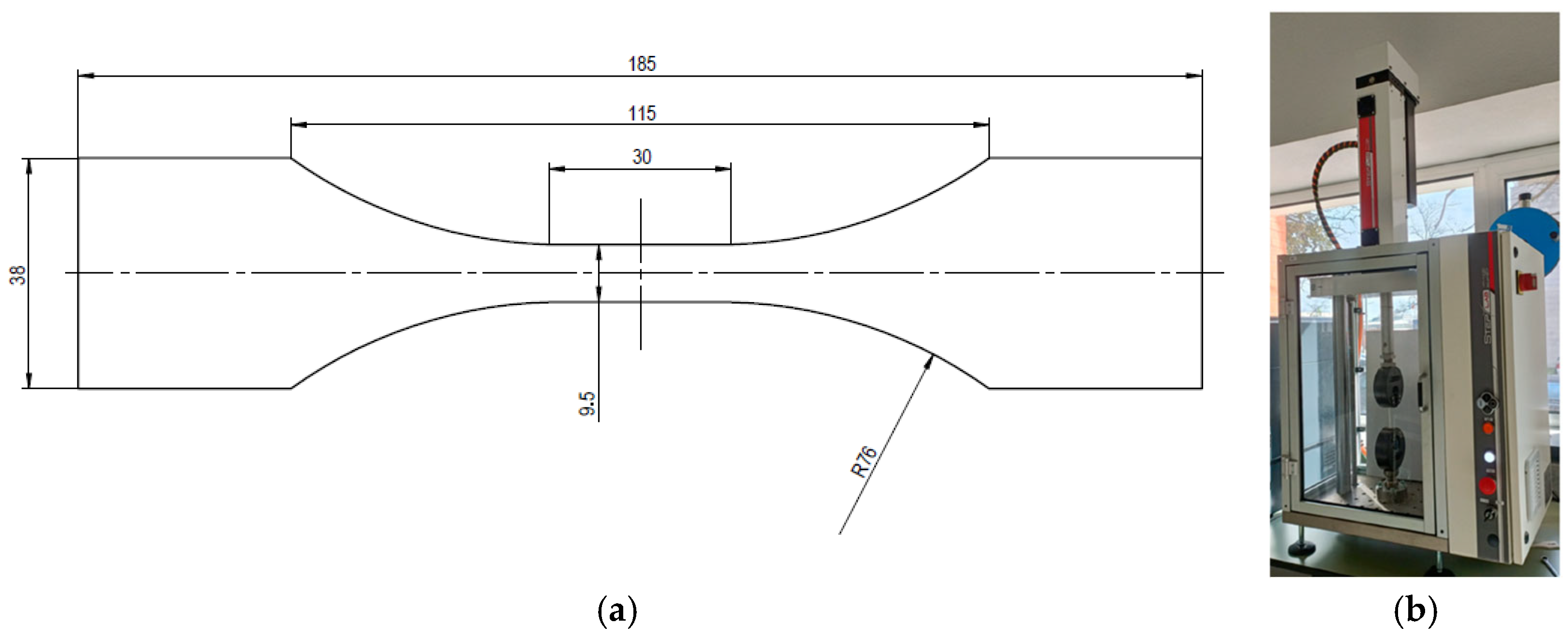
Specimens for tensile and fatigue testing were prepared in accordance with ASTM D638-03 [28] and Figure 1a presents the specimen dimensions. All specimens had a thickness of approximately 5.2 mm.

2.3. Uniaxial Quasi-Static Monotonic Tensile Tests and Fatigue Tests

Uniaxial quasi-static monotonic tensile tests and fatigue tests were performed using a STEP Lab EA05 electromechanical machine (Figure 1b). The quasi-static monotonic tensile tests employed a displacement rate of 2 mm/min, while the fatigue tests were conducted at 10 Hz with a load ratio (R) of 0.05 and a load-controlled sinusoidal waveform. The load cell capacity was 10 kN for quasi-static tests and 5 kN for fatigue tests.
The staircase (up-and-down) method was used to determine the fatigue limit values for all tested materials. Initially, higher stress levels were applied to obtain finite fatigue lives. Subsequently, the stress levels were decreased to identify fatigue life near 1,000,000 cycles (run-out). Stress levels were then increased again to assess the new finite fatigue life. This process was repeated until the fatigue limit and remaining fatigue resistance values were established for all the tested materials.

2.4. Micro-CT

Computed tomography (CT) is a non-destructive technique that uses X-rays to produce images of a sample’s internal structure. From these images, it is possible to study, for example, voids and porosity, and, in the case of FFF samples, to determine the printing orientation used as well [29]. Micro-computed tomography (micro-CT) analyses were conducted using a Skyscan 1174 system (Bruker Corporation, Billerica, MA, EUA).

2.5. TGA and DSC

Thermogravimetric analysis (TGA) is a widely used thermal analysis technique for assessing the thermal stability and properties of polymers. This type of analysis records the mass variation in a sample when subjected to high temperatures, often associated with the corresponding material degradation. On the other hand, differential scanning calorimetry (DSC) is mainly used to evaluate phase transitions, such as melting or glass transition [30,31]. Thermal tests were conducted using an STA 6000 instrument (PerkinElmer, Inc. Shelton, CT, EUA). Samples were heated from 30 °C to 800 °C at a rate of 10 °C per minute. The tests were performed under an inert nitrogen atmosphere with a flow rate of 20 mL per minute. An aluminium oxide sample holder was employed during the analyses.

2.6. FTIR

Fourier transform infrared spectroscopy (FTIR) is an analytical technique frequently used to identify the presence and distribution of various functional and structural groups. This technique is based on the absorption of infrared radiation by molecules at specific frequencies, corresponding to the vibrational modes of their chemical bonds [32,33]. The FTIR analyses were carried out using an FTIR-ATR Alpha P instrument (Bruker Corporation, Billerica, MA, EUA).

2.7. Scanning Electron Microscopy (SEM)

The fracture surfaces of the specimens tested under fatigue loading for the four additively manufacture materials were examined using scanning electron microscopy to analyse the fracture topography and identify the main failure characteristics associated with the different 3D-printed polymers. The analysis was carried out using a Carl-Zeiss Gemini 500 field emission scanning electron microscope (Carl Zeiss AG, Oberkochen, Germany). Before examination by SEM, the samples were ultrasonically cleaned for 10 min and then sputter-coated with a thin layer of gold to prevent charging during imaging.

3. Results and Discussion

3.1. Uniaxial Quasi-Static Monotonic Tensile Tests

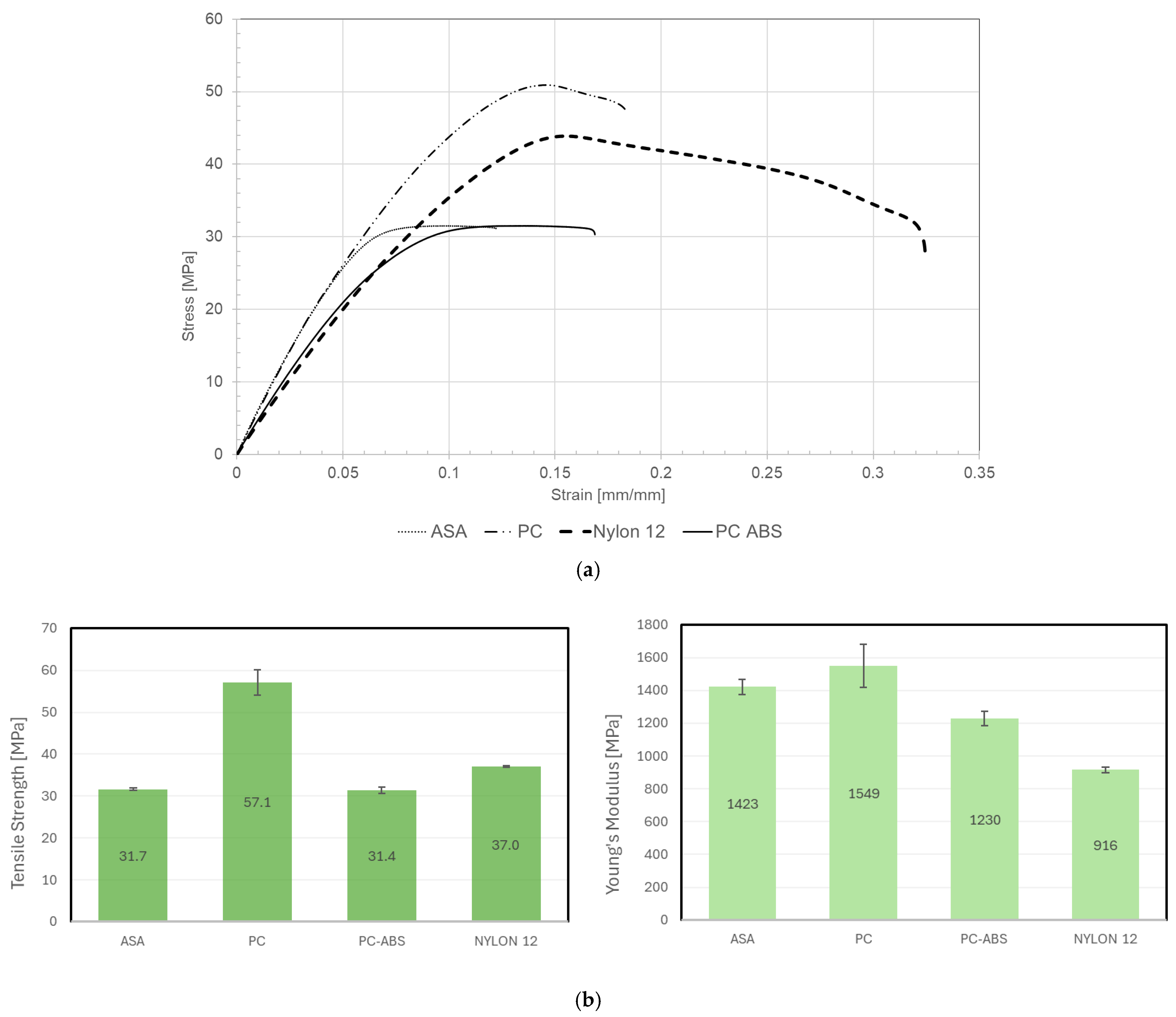
Uniaxial tensile tests were conducted to determine the quasi-static properties of the materials. The initial cross-sectional area of the ASA, PC, Nylon 12, and PC-ABS specimens was about 49 mm2, and the initial length considered for l0 was 30 mm. Figure 2 shows an example of stress–strain curves obtained for each material tested, and Table 4 presents the values of Young’s modulus, and tensile strength obtained from the uniaxial tensile tests carried out on the four materials. A total of five specimens were tested for each material under study.
Analysis of Figure 2 and the data presented in Table 4 indicate that all tested materials exhibit ductility, with values exceeding around 6%. Nylon 12 demonstrates the highest ductility, surpassing 30%. Moreover, based on the areas under the stress–strain curves, in the elastic and plastic regimes, it can be concluded that all materials display resilience and toughness, respectively, with Nylon identified as the toughest polymer, followed by polycarbonate (PC). The ASA and PC-ABS polymers exhibit mechanical behaviour characteristic of perfectly elastic-plastic materials. Polycarbonate (PC) is the strongest polymer, followed by Nylon, ASA, and PC-ABS.

3.2. Fatigue Tests

As previously mentioned, all fatigue tests were carried out at 10 Hz with a load ratio (R) of 0.05, using the staircase (up-and-down) method to determine the fatigue limit values for all tested materials. Moreover, each specimen’s cross-section was measured before testing to determine the maximum and minimum forces to be applied. The tests always started with high-stress-range (Δσ) values, defined relative to the Tensile Strength (σR) of each material (Table 3), in the low-cycle fatigue (LCF) regime (<104 cycles). Thereafter, the applied stress range values were progressively reduced to determine the Basquin Law in the high-cycle fatigue (HCF) regime (>104 cycles) and the fatigue limit for each material tested (1 × 10⁶ cycles, run-out). The definition of run-out for 1,000,000 cycles is also consistent with the biomechanical loading cycles cited in Section 1.

3.2.1. ASA

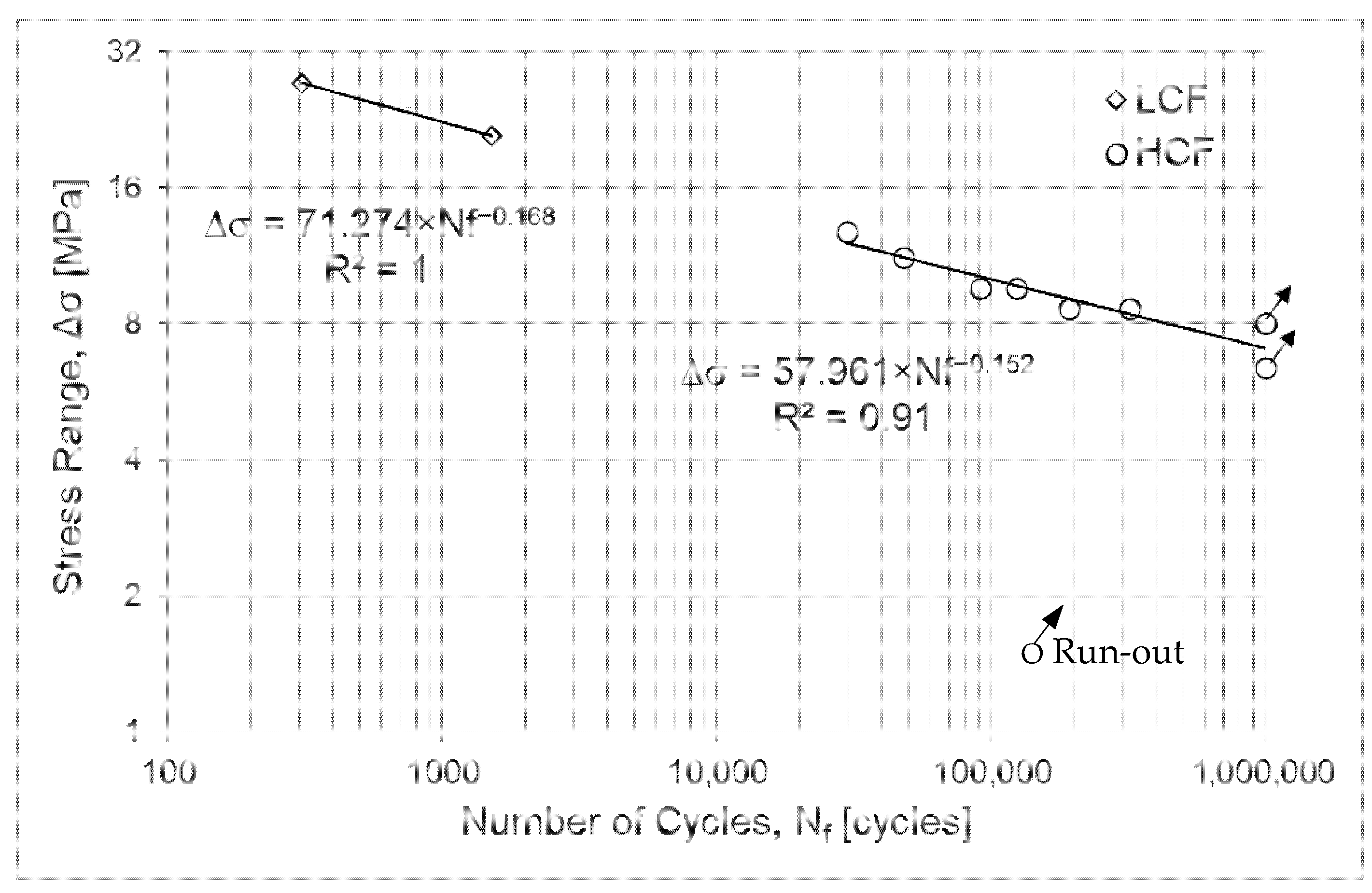
The testing parameters for ASA are presented in Table 5, and the S-N fatigue curves are shown in Figure 3. For the first specimen, a stress range (Δσ) corresponding to 85% of the ultimate tensile strength (σR) of the ASA material was defined. The number of cycles obtained was low (308), so the applied stress range was subsequently reduced.
Specimens 4 and 5 (Table 5) exhibited a fatigue life of 1,000,000 cycles and can thus be considered to have infinite life (run-out).
Figure 3 presents the S-N curve for the ASA material. The values on the Y-axis are displayed on a base-2 logarithmic scale to facilitate reading. Conversely, a base-10 logarithmic scale was chosen for the X-axis values, as is typically used for S-N curves. Thus, the behaviour of ASA at low cycle fatigue and high cycle fatigue can be described by Equations (1) and (2), respectively.
Δ σ L C F = 71.274   ×   N f 0.168
Δ σ H C F = 57.961   ×   N f 0.152

3.2.2. PC

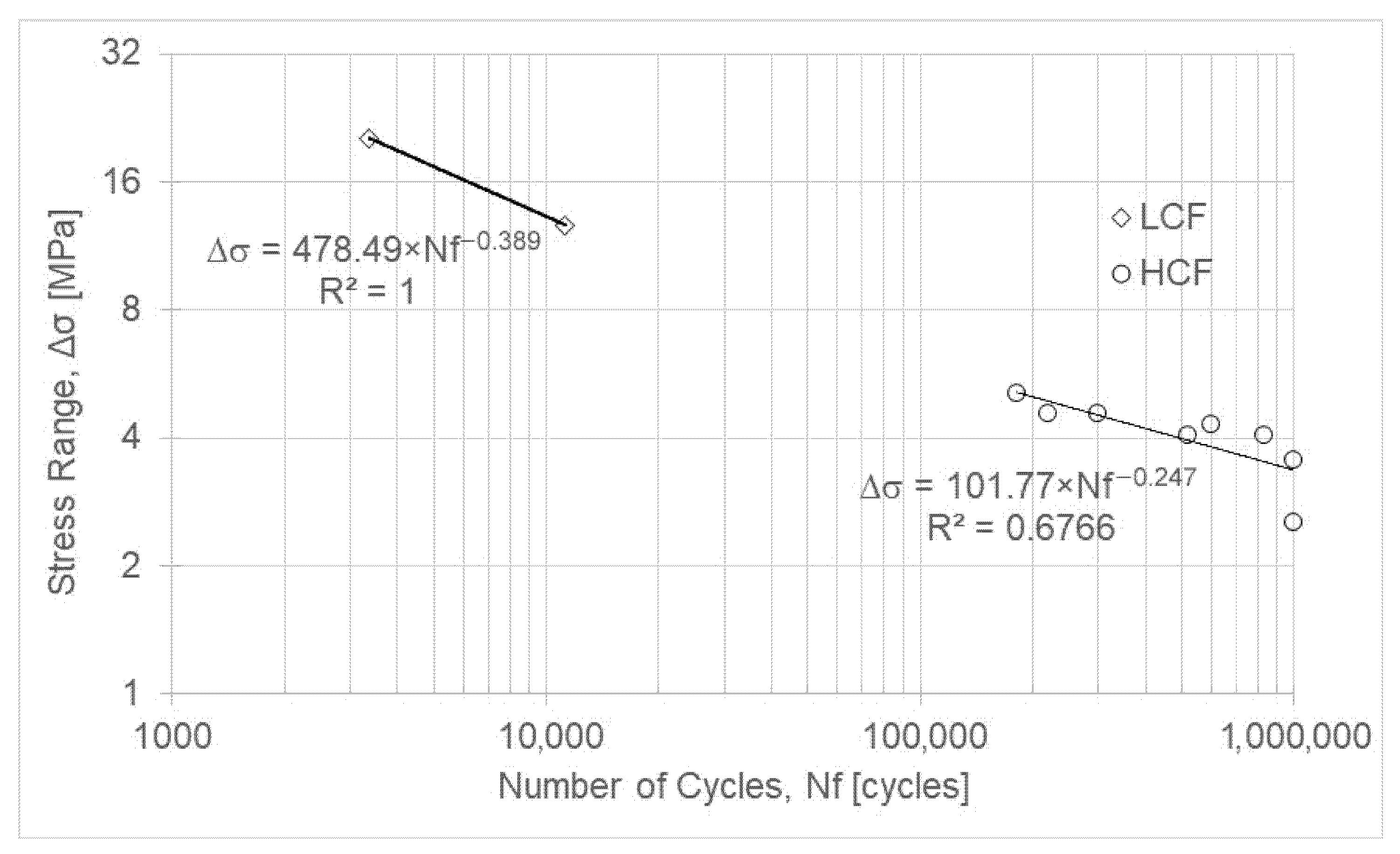
The selection of the percentages used to define the stress range was based on the same criteria applied to the ASA material. For the first specimen tested, a 40% tensile-strength criterion was chosen (Table 6), allowing assessment of the number of cycles to failure. Based on this result, the strategy for the subsequent tests was to significantly reduce the stress range percentage to determine the threshold at which the material fails by fatigue or exhibits infinite life. PC exhibited the lowest fatigue strength among the tested materials (Table 6, Figure 4). In addition, a significant variation is noted between the 8% and 9% of the tensile strength. Therefore, two specimens were tested for each of these percentages, and one specimen was tested at the intermediate value of 8.5%.
Equations (3) and (4) represent the fatigue life of PC for low-cycle fatigue and high-cycle fatigue, respectively.
Δ σ L C F = 478.49   ×   N f 0.389
Δ σ H C F = 101.77   ×   N f 0.247

3.2.3. Nylon-12

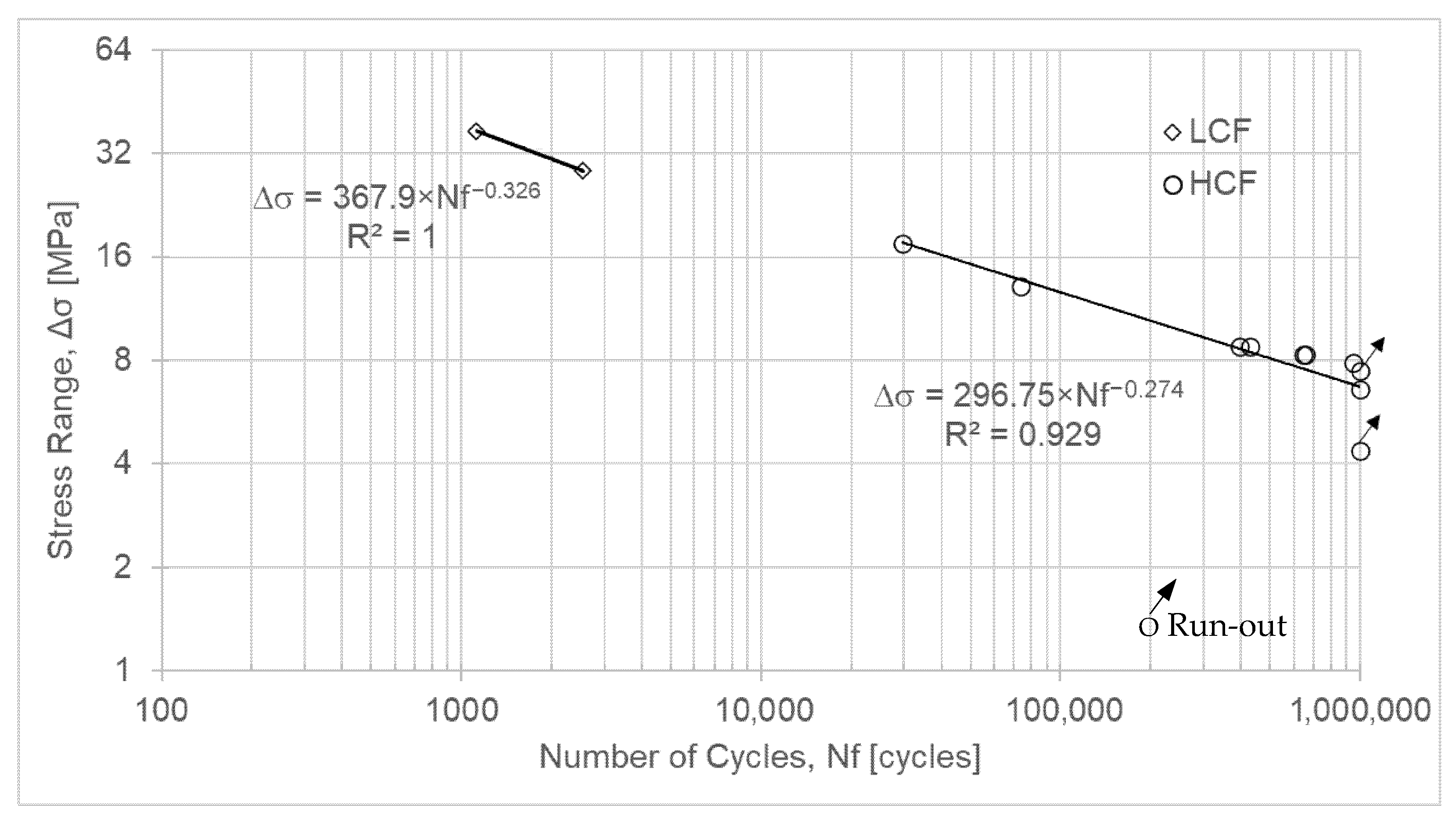
It should be noted that, as observed for PC, this material exhibits a very narrow range of variation (Table 7, Figure 5). Infinite life lies between the threshold values of 17% and 18% of σR. It is observed that the three specimens tested at load levels below 17% of σR did not fail by fatigue. However, it is worth noting that there is a marked difference in the number of cycles obtained within the 18% to 20% range.
Equations (5) and (6) represent the fatigue life of Nylon-12 for low-cycle fatigue and high-cycle fatigue, respectively.
Δ σ L C F = 367.9   ×   N f 0.326
Δ σ H C F = 296.75   ×   N f 0.274

3.2.4. PC-ABS

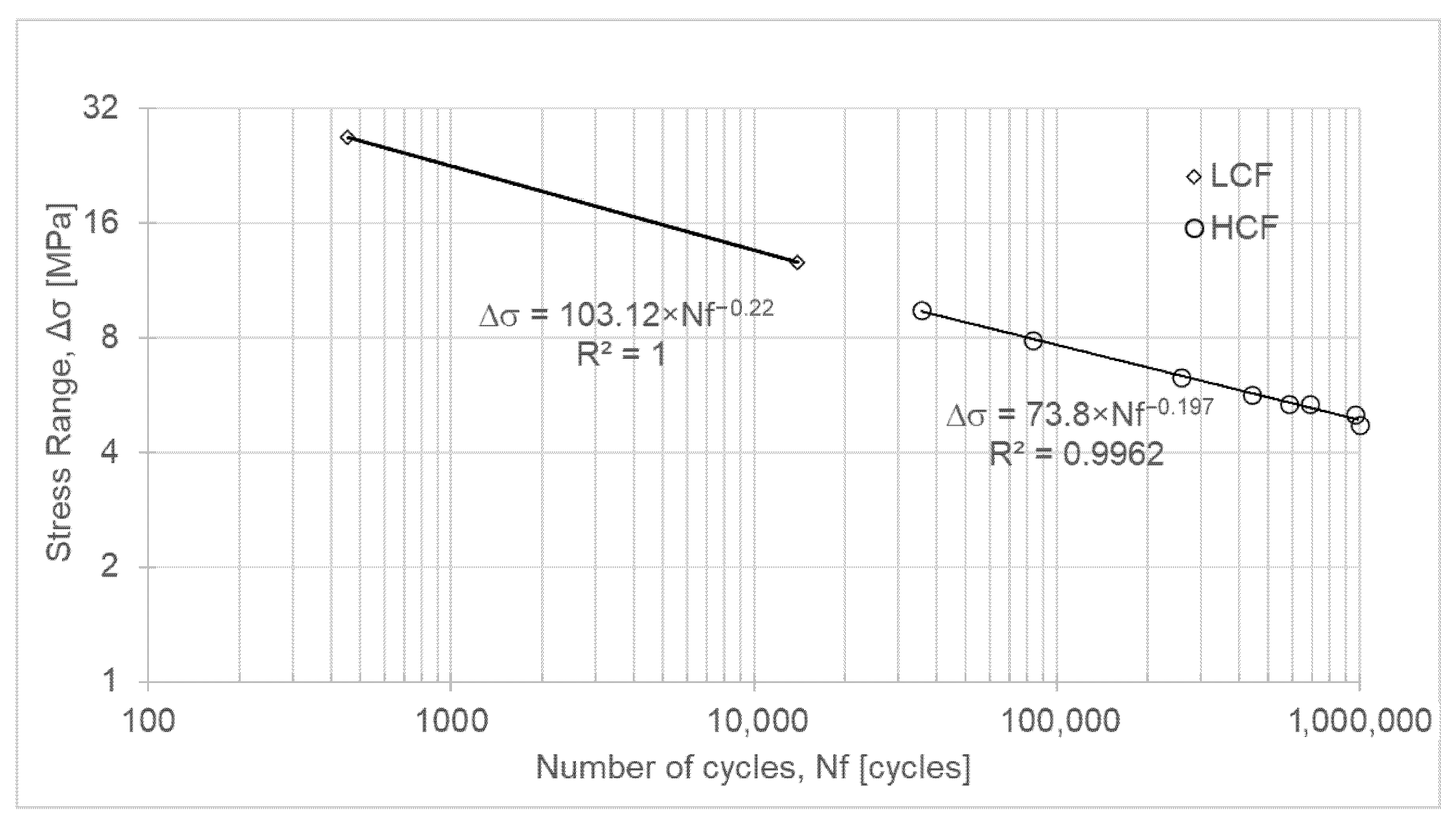
It should be noted that this material, composed of PC and ABS, exhibits fatigue resistance properties (Table 8, Figure 6) superior to those observed for the PC material (Table 6, Figure 4). Thus, with the addition of ABS, the material has a longer fatigue life.
Equations (7) and (8) represent the fatigue life of PC-ABS for low-cycle fatigue and high-cycle fatigue, respectively.
Δ σ L C F = 103.12   ×   N f 0.22
Δ σ H C F = 73.8   ×   N f 0.197

3.3. Micro-CT

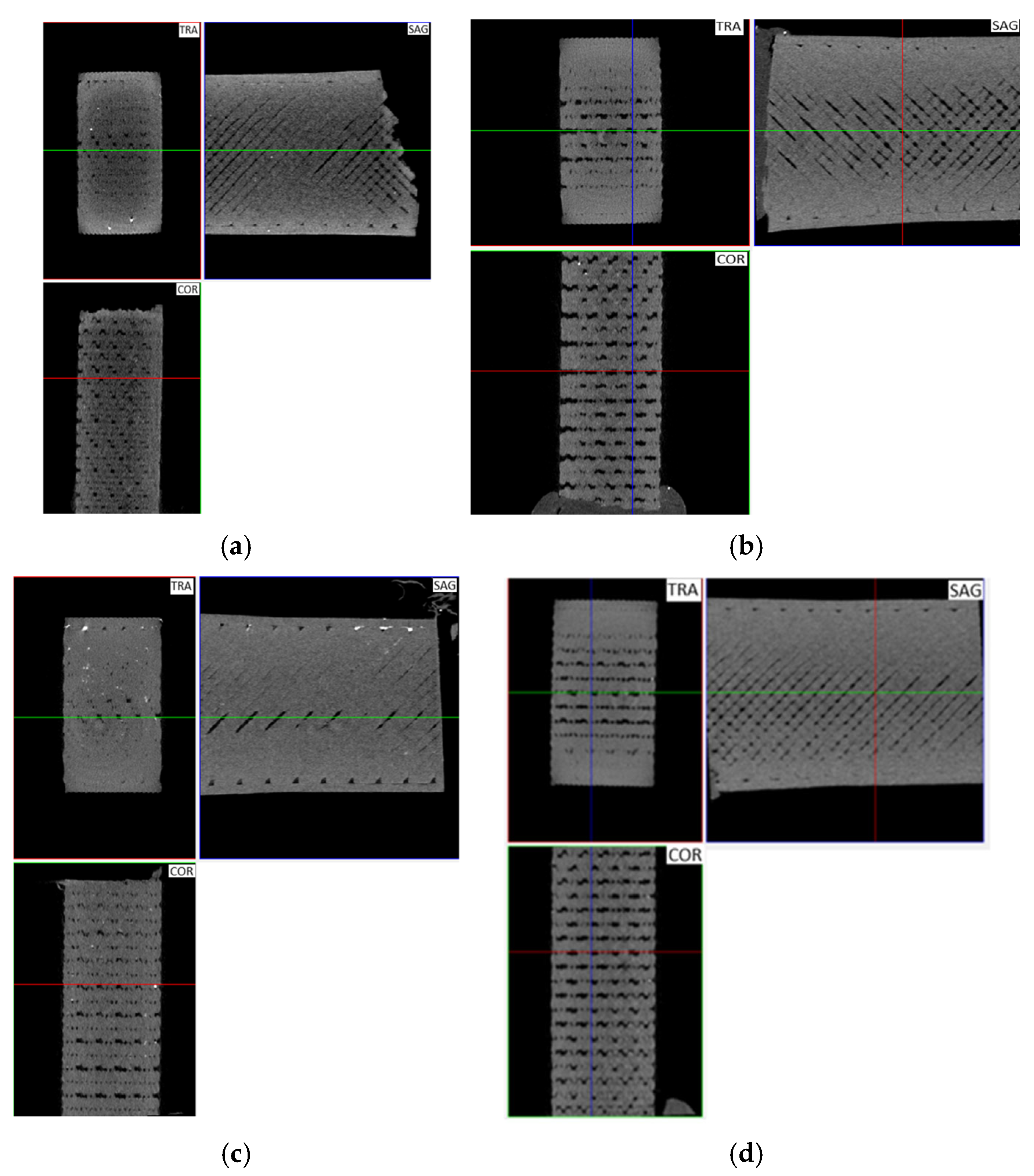
From the micro-CT analysis of the polymers under study, it is possible to identify in the SAG views (Figure 7) that the infill angle is 45°/−45° and that, although the specimens were produced with a 100% infill density, regions with some voids between the filaments can be observed. In the TRA and SAG views, a higher concentration of voids is observed at the centre of the sample. This may have promoted crack propagation in this region during fatigue and indicates that alternative printing orientations should be adopted to obtain structures at the centre of components that are as dense as those at their periphery and contour.
Furthermore, the printing orientation of the specimens is clearly identifiable as the XY plane; that is, the specimens were printed horizontally, with growth along the vertical Z-axis.
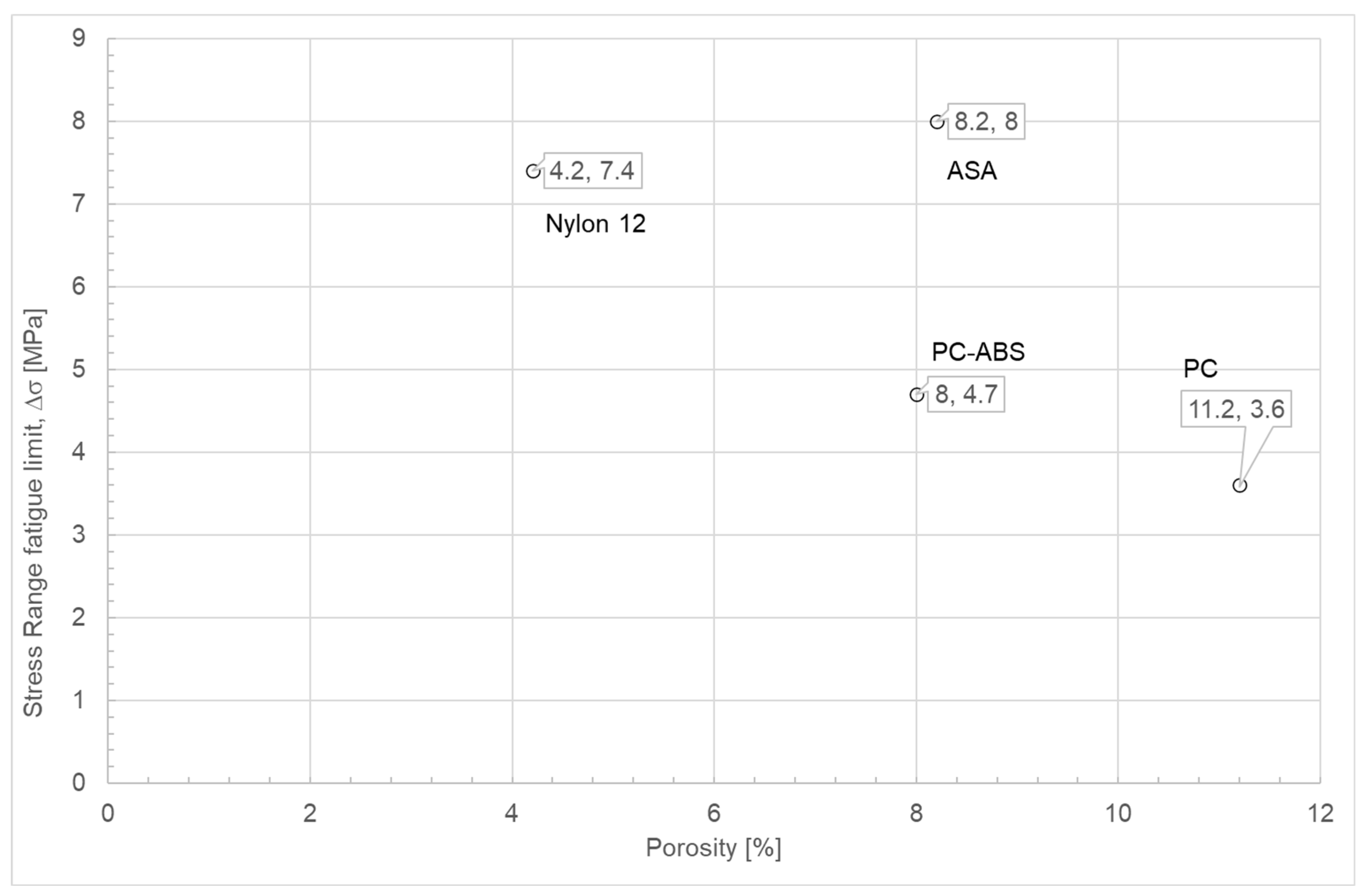
Table 9 shows the amount of porosity observed in each sample. Note that this table presents the porosity values obtained for each polymer under study. In addition, to compare the porosity percentages obtained for each polymer, the same sample volume was used for all materials. The porosity ranged from 4.2% for Nylon 12 to 11% for polycarbonate (PC), which helps to explain the differences in fatigue life among the various materials and PC’s relatively low fatigue life. Therefore, it may be helpful to correlate the estimate fatigue limit of additively manufactured materials with their porosity level [34].

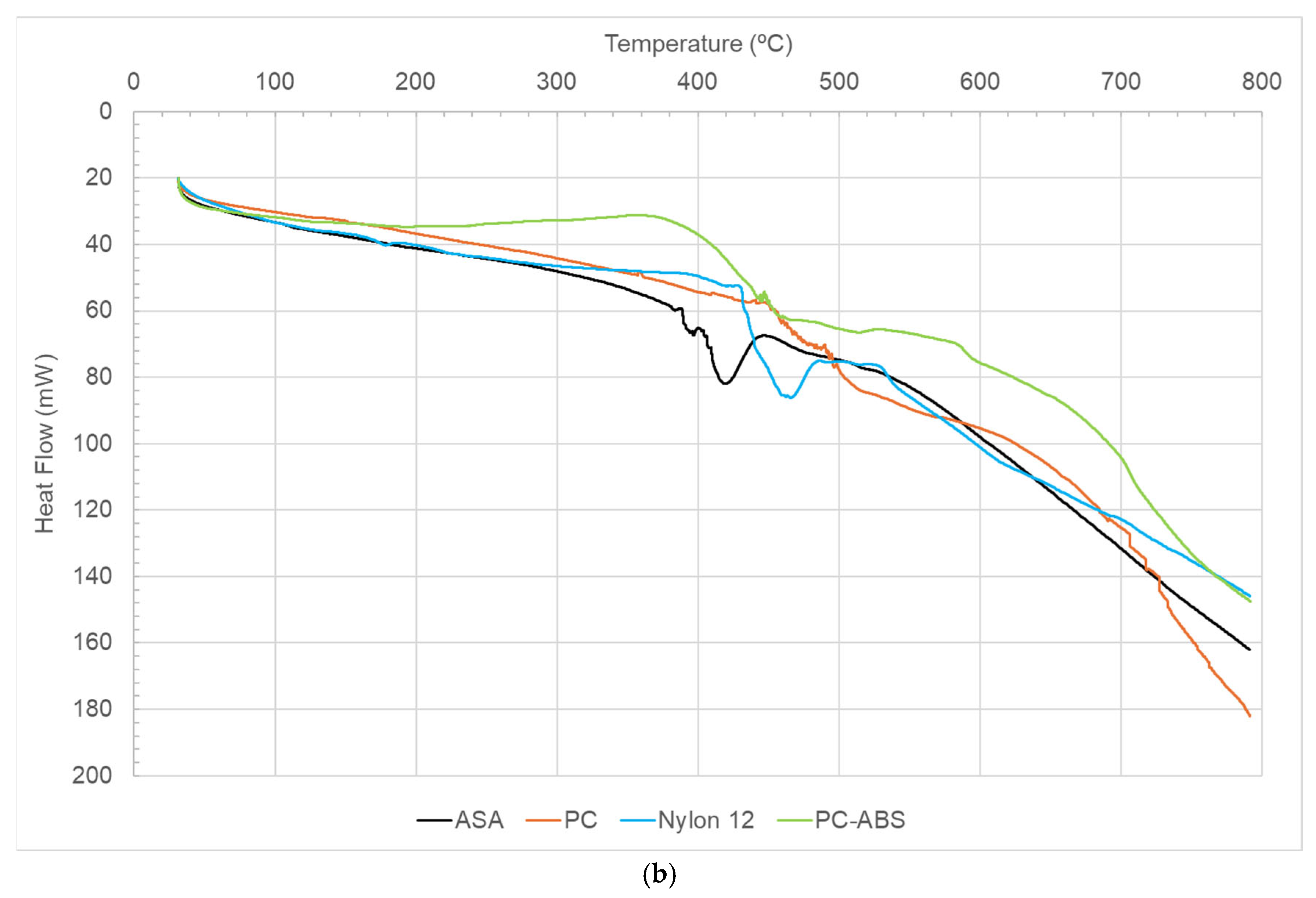
3.4. TGA and DSC

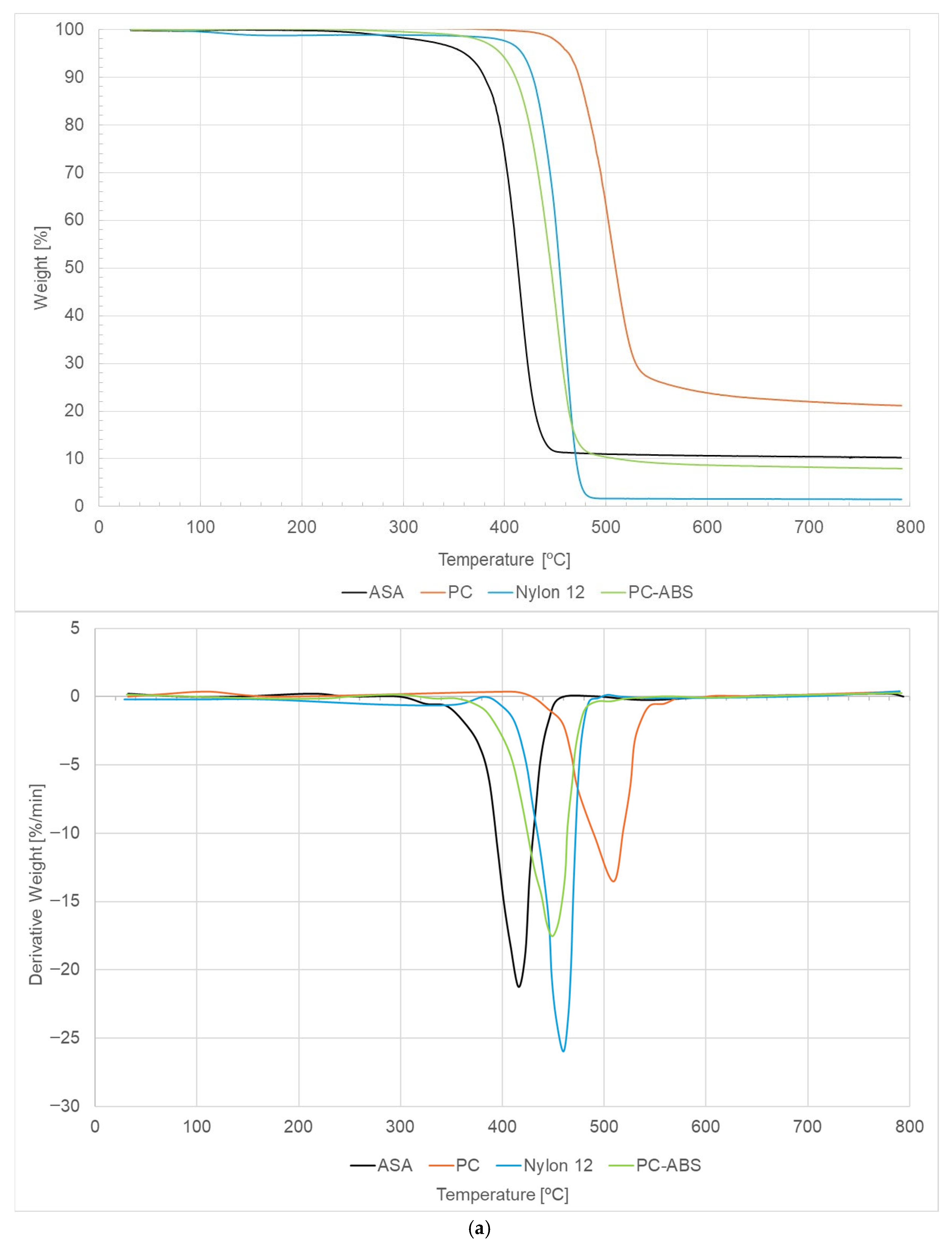
These thermal analysis techniques, thermogravimetric analysis (TGA) and differential scanning calorimetry (DSC), were carried out for all the materials under study. Table 10 summarizes all the results obtained. Materials such as PC and PC-ABS show a graphical interpretation like that of the ASA material. However, it should be highlighted that Nylon 12, due to being a semi-crystalline polymer, exhibits a different DSC curve.
Thermogravimetric analysis (TGA) (Figure 8a) and differential scanning calorimetry (DSC) results (Figure 8b) indicate that all studied materials (ASA, PC, PC-ABS, and Nylon 12) exhibit thermal degradation temperatures above 400 °C (Table 10). This confirms that the selected printing and testing conditions do not cause thermal degradation that could affect mechanical or fatigue performance and establishes the limiting design and operating temperatures.
Additionally, PC shows the highest degradation temperature, indicating superior thermal stability and a wider safety margin for high-temperature applications, whereas ASA, Nylon 12 and PC-ABS present slightly lower degradation temperatures but still sufficiently high for engineering use (Table 10).
Concerning the mass loss rate, it reflects the kinetics of thermal degradation. Therefore, materials with higher absolute mass loss rates, such as Nylon 12 and ASA (Table 10), degrade more rapidly once degradation begins, which may imply greater sensitivity to prolonged thermal exposure or thermal ageing. Conversely, lower mass loss rates, such as those occurring on PC, suggest a more gradual degradation process, better supporting high temperature and showing improved thermal durability for a long-term period.
Nevertheless, it is important to note that all materials tested in this investigation are thermally stable within the studied processing window.

3.5. FTIR

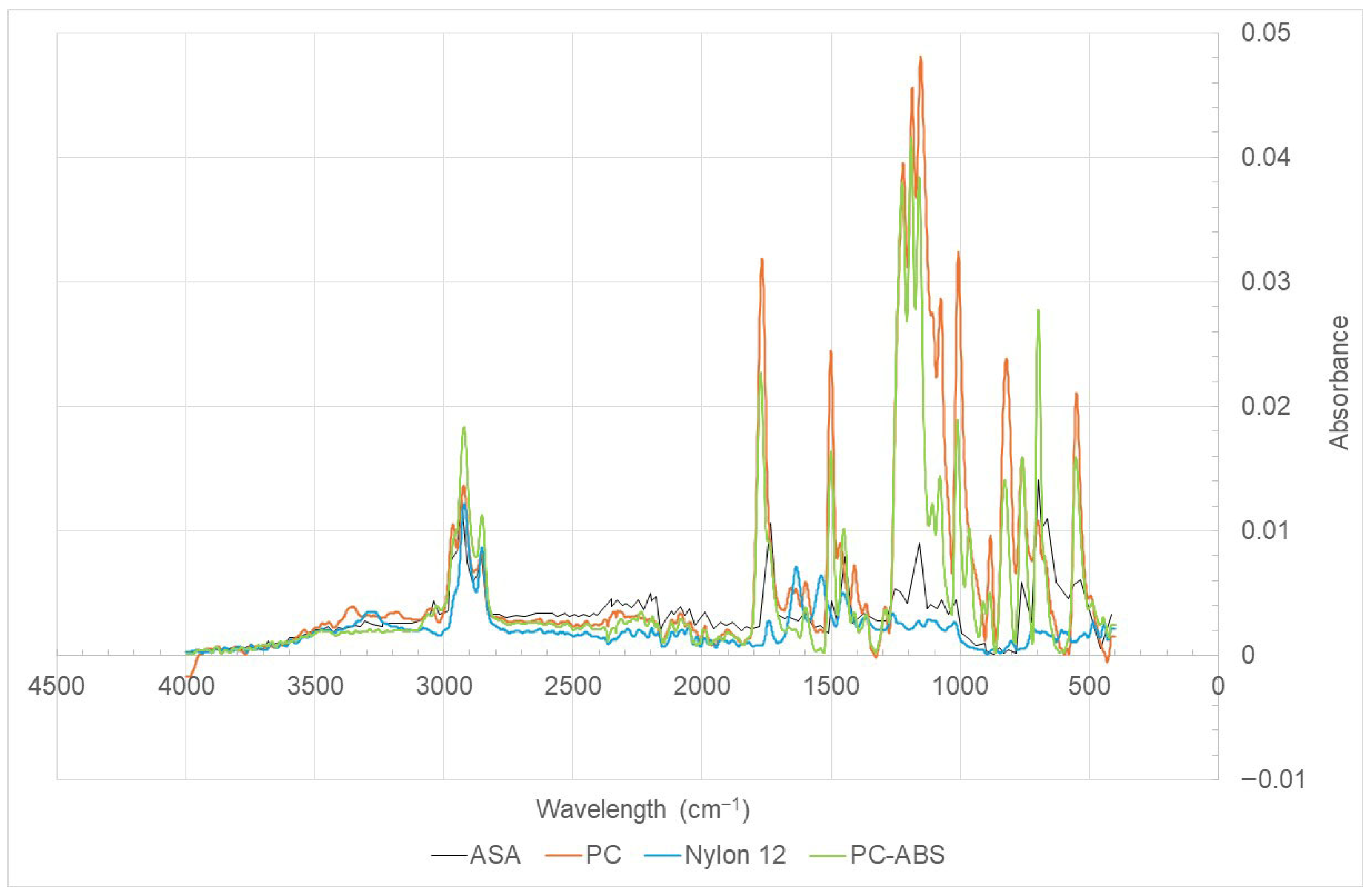
The result of this analysis is generally presented as a graph: the X-axis shows the wavelength (cm−1), which indicates the frequency of the infrared light absorbed, while the Y-axis shows the absorbance, i.e., the amount of light absorbed at that frequency. The peaks in the graph indicate where molecules absorb energy to vibrate, allowing identification of chemical bonds [32,33]. It is important to emphasise that FTIR analysis is an essential tool, e.g., in biomedicine. This technique enables, for example, the study of tissues to identify molecular changes associated with diseases, such as osteoporosis. In addition, it allows analysis of the chemical bonds of the main molecules that constitute bone, such as phosphate, carbonate, and amides I, II, and III.
The aim of this analysis was to relate the peaks observed in the FTIR spectrum to characteristic wavelength ranges to determine the functional groups present in each specimen. Figure 9 shows the results obtained for the polymers under study.
As Nylon 12 is a potential biocompatible polymer, a preliminary verification was made between the chemical bonds of bone and those of the polymer. Nikolaos et al. [35] report that the amide I band occurs in the 1600–1720 cm−1 range, with C=O as its functional group. Amide II lies in the 1500–1600 cm−1 region, corresponding to a combination of the C–N and N–H functional groups. Finally, they also refer to the 1300–1220 cm−1 range as being attributed to amide III, which is based on the same functional groups as amide II. Some similarities can be highlighted between the peaks observed in Figure 9 and those of bone structure:
  • The amide I band appears at a value close to 1650 cm−1. In Figure 9, a peak with a similar value, 1636 cm−1, is observed;
  • Amide II presents a value close to 1550 cm−1. In the FTIR analysis of Nylon 12 (Figure 9), a similar peak at 1540 cm−1 was identified;
  • Amide III appears at a value of approximately 1240 cm−1. A similar peak is also present in Nylon 12 at 1261 cm−1.
For the remaining polymers, i.e., ASA, PC, and PC-ABS, this comparison will only be relevant once their cytotoxicity and, therefore, biocompatibility with the human body have been confirmed.

3.6. SEM Analyses

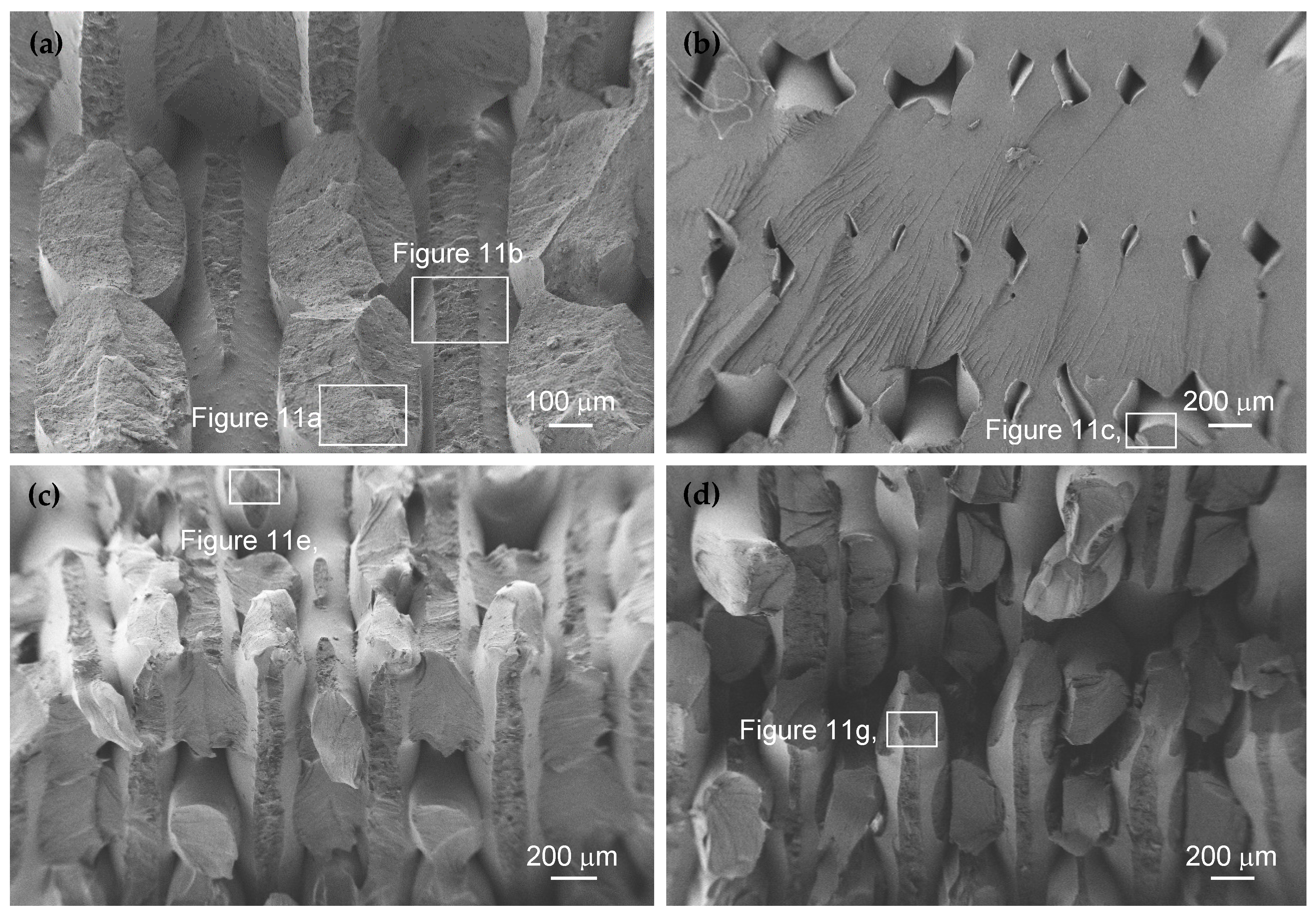
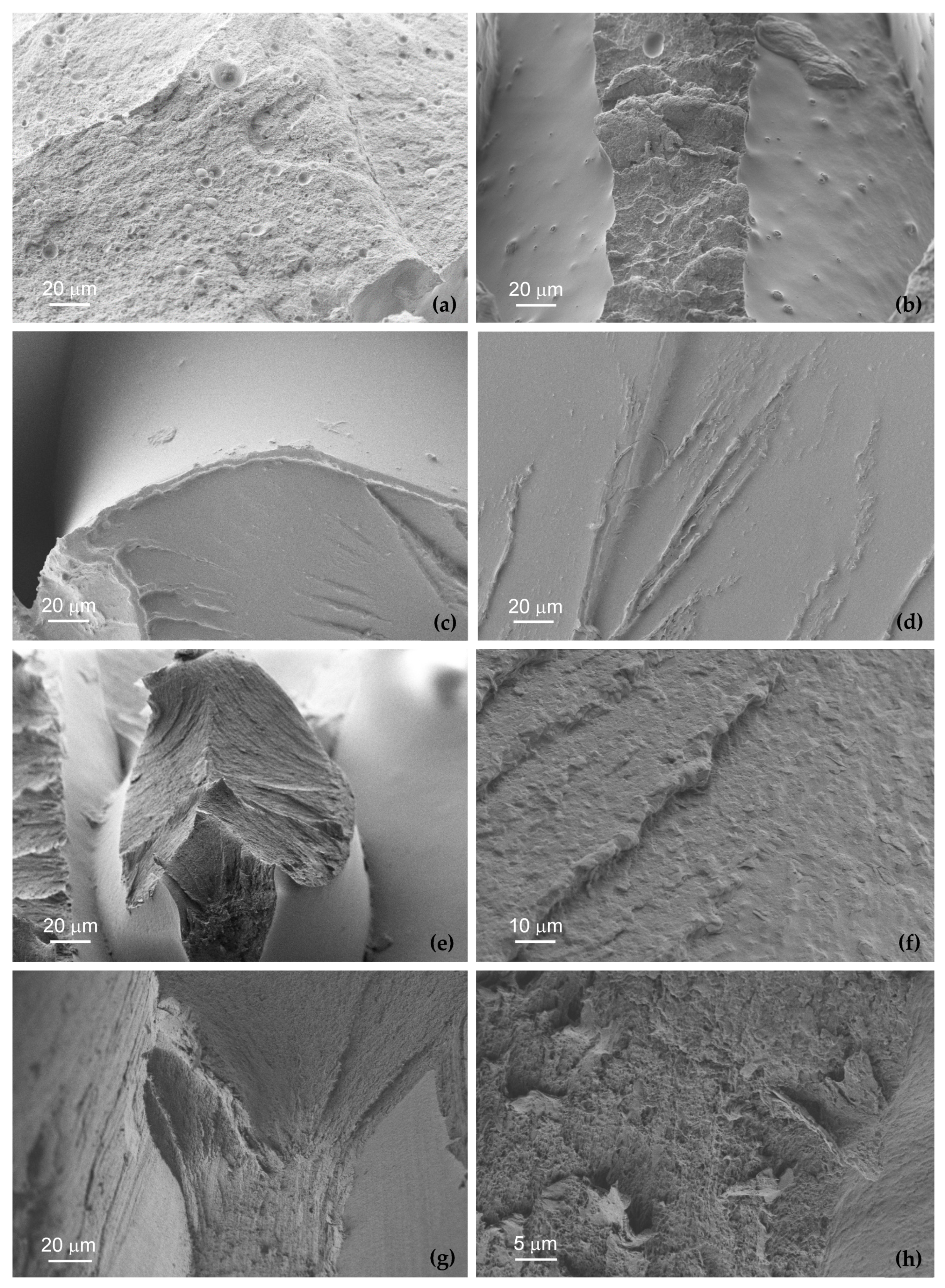
Figure 10 and Figure 11 display typical SEM images of fracture surfaces of the tested polymers caused by fatigue loading. Figure 10 shows an overview of the typical appearance of fracture surfaces while Figure 11 shows high-magnification micrographs of the additively manufactured materials investigated in this study.
Regarding the overview images, see Figure 10, it is possible to observe satisfactory interlayer diffusion and good bonding between adjacent extruded filaments along the build layers, indicating adequate thermal fusion during the material deposition process.
In general, the filament pairing pattern associated with the selected raster strategy can be clearly inferred from the micrographs. Overall, some randomly distributed internal voids are observed on the fracture surfaces, particularly in the PC specimens, where the defects appear more systematically and exhibit larger sizes, in agreement with the X-ray computed tomography observations discussed above.
These internal voids are associated with the deposition of adjacent filaments by the imposed hatch distance, highlighting the critical role of the printing strategy and the selected processing parameters (including the hatch spacing, extrusion temperature, and deposition speed) in controlling the internal defect formation. Such voids can also significantly influence the mechanical response of additively manufactured polymers, and particularly the fatigue performance, since they reduce the effective load-bearing cross-section, lowering the cyclic tensile-compressive strength and stiffness. Moreover, they can act as potential fatigue crack initiation sites due to the localised stress–strain concentrations within the material, reducing its suitability for applications subjected to cyclic loading. The presence of voids can also lower fracture toughness, increasing the susceptibility to unstable and unpredictable failure.
Although porosity is detrimental for structural applications requiring high strength and high durability, additively manufactured polymers with controlled amount of voids can be suitable for applications where lightweight design is a priority and mechanical loading is relatively moderate. Previous studies have correlated the fatigue performance with the population of defects, more precisely their size and location, and have shown that optimising processing parameters and improving interlayer bonding can substantially enhance the mechanical properties and fatigue resistance of additively manufactured polymers [1,34,36,37]. Similar conclusions were reported by Martins et al. [1] regarding the improvement of fatigue performance in 3D-printed PLA and PETG materials.
The different fracture surface morphologies of the tested additively manufactured materials can be more clearly observed in the magnified micrographs presented in Figure 11. Regarding the ASA material, the typical fracture surface shown in Figure 10a reveals two distinct failure mechanisms associated with the filament orientation relative to the loading direction. Figure 11a shows filaments failing through their cross-sections, while Figure 11b shows a decohesion mechanism between filaments and regions with incomplete fusion, which is consistent with the typical failure mechanisms reported for this additively manufactured polymer [38]. Furthermore, it is also possible to observe characteristic porosity with variable size and depth dispersed across the entire fracture surface, particularly in Figure 11a.
Concerning the PC material, voids with different sizes and shapes were observed across the entire fracture surface, see Figure 10b. Figure 11c shows, in detail, one of these so-called opened-up crazes, with a characteristic V-shaped morphology, which indicates plastic deformation prior to the final failure. Their presence on the fracture surface, predominantly located along interfilament boundaries, suggests craze initiation followed by the breakdown of fibrillar bridges, promoted by limited interlayer bonding and ultimately leading to crack formation [39]. Figure 11d exhibits a relatively flat fracture region with converging line patterns, often called river patterns, which correspond to crack propagation paths generally caused by craze growth and coalescence. These converging markings indicate the direction towards the crack initiation region and reflect the fracture mechanisms of PC.
As far as the Nylon-12 is concerned, the failure mechanisms are similar to those reported for ASA. Figure 11e displays a typical example of a filament failing through its cross-section, as well as a failure mode caused by decohesion between adjacent filaments. Filaments primarily failed through shear-dominated mechanisms and filament pull-out, with localised plastic deformation contributing to the overall fracture. Figure 11f shows beach marks which are associated with the fatigue crack propagation stage and highlight the ductile fatigue response of the material under cyclic loading.
In relation to the PC-ABS material, it is possible to observe, see Figure 11h, two distinct types of failure within the same filament (see Figure 11h and the white-outlined area of Figure 10d): failure through the filament cross-section; and interlayer failure resulting in decohesion between adjacent filaments. A high magnification of this region, as shown in Figure 11h, reveals a complex fracture surface topography, characterised by irregular dimples with varying diameters and shapes, interconnected by numerous ligaments. These ligaments appear to facilitate the stress distribution and energy absorption, contributing to enhanced ductility compared to pure PC, resulting in improved mechanical performance [40].

4. Discussion and Future Work

4.1. Experimentally Supported Main Findings

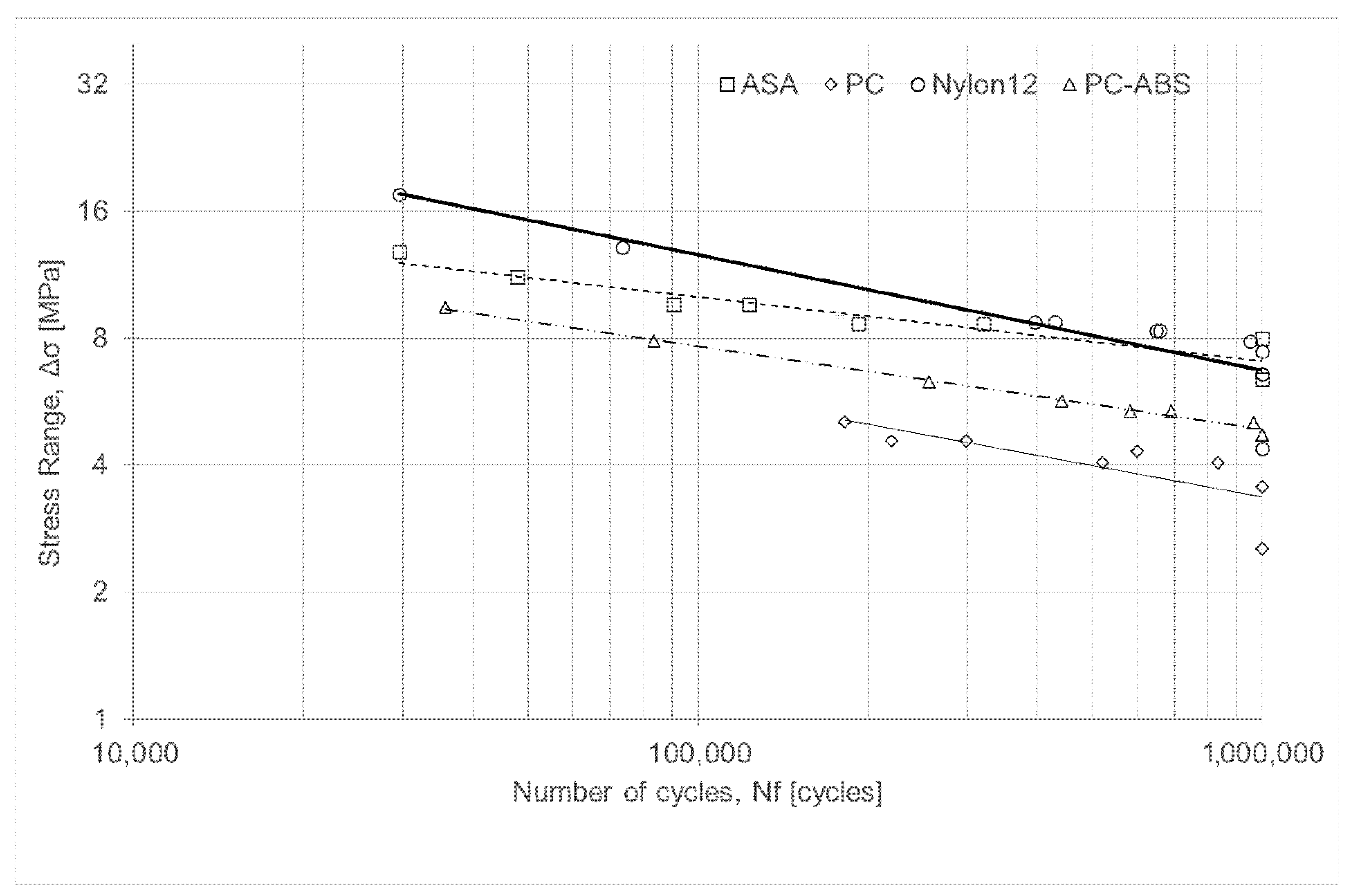
As previously seen (Section 3), it was possible to describe the fatigue behaviour of the materials under study for high-cycle fatigue (HCF) using Basquin’s law and to obtain the corresponding S-N curves (Figure 12). In addition, the experimental programme was extensive, and the resulting fatigue dataset, particularly for ASA and PC, is of interest due to the limited availability of such data in the literature (Table 1). In addition, the study is limited to a single printing orientation (±45°), a single stress ratio (R = 0.05, i.e., representative of pulsating-type loading), and a single loading frequency (10 Hz, which, as discussed in the Introduction section, may arise under biomechanical loading conditions). Nevertheless, for transparency, it is important to reiterate the loading conditions applied in this investigation, which may need adjustment for conditions beyond those studied. Moreover, the ±45° orientation is particularly beneficial for structural components subjected to complex loading, such as tension-bending or bending-torsion, and to cyclic loading (fatigue), where fatigue resistance and damage tolerance are more critical than maximum strength along a single direction, as it activates shear deformation mode, reduces the likelihood of brittle failure along a single interface/filament, and leads to a more quasi-isotropic in-plane behaviour.
Concerning the study of low-cycle fatigue (LCF), it was not the main focus of this investigation, since the objective was to understand the durability of polymers for long-term biomechanical applications. Nevertheless, unlike what frequently occurs in metals, the slopes of the lines relating the stress range to the number of cycles to fracture obtained for ASA, Nylon 12, and PC-ABS (S-N curves), in the LCF and HCF regimes, were practically the same and shared the same intercept, for each of these materials, suggesting the existence of a single fatigue resistance line in the two aforementioned regimes, LCF and HCF. Indeed, only for the PC material did the slopes and intercepts differ between the LCF and HCF regimes. Therefore, for ASA, Nylon 12, and PC-ABS, the fatigue strength decreases continuously with the number of cycles, without an abrupt change in behaviour between LCF and HCF, indicating that the dominant fatigue damage mechanism is essentially the same in both regimes (LCF and HCF). Therefore, unlike what frequently occurs in metals, where LCF is dominated by plastic deformation and HCF by elastic behaviour, ASA, Nylon 12 and PC-ABS do not exhibit a clear transition in damage mechanism between the two regimes.
On the other hand, Table 11 presents the percentages of the ultimate tensile strength, σR, together with the corresponding results and the maximum force values from which the materials exhibited infinite life. ASA, Nylon 12, and PC-ABS can reach infinite life when subjected to stresses below 25% × σR, 17% × σR, and 15% × σR, respectively. However, PC proved to be a material with poor resistance to cyclic loading, reaching infinite life only at stresses below 7% × σR, which is certainly related to the higher porosity measured in specimens manufactured from this material. In addition, from Figure 12, it is possible to conclude that Nylon 12 is the most fatigue-resistant material compared to the other materials investigated in this study, that the fatigue limit value of Nylon 12 and ASA are approximately the same, and that Nylon 12, PC, and PC-ABS revealed almost the same slope in the Basquin Law.
Additionally, by comparing the experimental results obtained for Nylon 12 with those reported in the literature [19], see Table 1, it can be concluded that the specimens tested in the present study yielded higher fatigue strength values than those previously reported. Indeed, the experimentally determined intercept of the Basquin curve in the HCF regime (296.8 MPa), as shown in Figure 5, is higher than the 111.1 MPa reported in [19], while the slope of the line (−0.274) is steeper than the −0.110 reported in [19], see Table 1. Concurrently, about the fatigue limit stress of PC-ABS, the experimentally obtained value (4.7 MPa), see Figure 6, is one order of magnitude lower than that reported in [20], see Table 1.
Moreover, the fatigue strength of components produced by fused filament fabrication (FFF) is determined by microstructural aspects inherent to the production process, including interlayer bonding quality, raster-induced anisotropy, and the tendency for crack initiation and propagation along filament interfaces. In fact, insufficient interlayer bonding, caused by insufficient diffusion between adjacent layers, results in weak interfaces that serve as crack-nucleation sites that can grow under fatigue loading. Furthermore, printing strategies, namely different raster angles, can introduce mechanical anisotropy, leading to stress concentrations when the loading direction is misaligned with the filament orientation. Therefore, beyond nucleation, fatigue crack growth predominantly propagates along inter-bead and interlayer boundaries, where reduced cohesion and increased porosity promote crack propagation and accelerate failure. These failure mechanisms were observed in the experimental fatigue tests (Section 3) and were confirmed through scanning electron microscopy (SEM) analyses (Section 3.6).
When comparing the porosity levels of each tested material (Table 9) with the stress–fatigue limit values (Table 11), it can be inferred that, in general, increasing porosity leads to lower fatigue limit stress values (Figure 13). At the same time, the porosity of the ASA and PC-ABS materials, which is comparable and around 8% for both materials, allows the inference of a higher fatigue resistance for ASA compared with PC-ABS, and with values similar to those of Nylon 12, even though Nylon 12 exhibited only 4.2% porosity. Thus, it appears that ASA would likely have the highest fatigue resistance if all materials had the same level of porosity.
Furthermore, PC-ABS has a significantly higher fatigue strength than PC, achieving infinite life at 15% × σR vs. 7% × σR for PC (see Table 11). This result may be counterintuitive, as PC typically shows higher strength than PC-ABS in quasi-static tests (Figure 2a). The micro-CT porosity data (PC: 11.2%, PC-ABS: 8.0%) partly explain this difference, once the higher porosity in PC (see Figure 10b), which seems to be highly sensitive to stress concentrations due to internal defects, increases the number and severity of internal stress concentrators. These internal defects are critical in fatigue, as voids act as initiation sites and accelerate crack propagation under cyclic loads, reducing the apparent fatigue limit. However, from the observation of Figure 10b,d, together with Figure 11c,d,g,h, it is also evident that, from the crack propagation mechanism point of view, PC tends to fail via more brittle microcrack linkage under cyclic loading, whereas PC-ABS may exhibit more tortuous and ductile crack propagation paths. Therefore, PC-ABS, as a polymer blend, appears to benefit from a more compliant ABS phase that dissipates cyclic energy more effectively than PC, blunts crack tips, and delays fatigue crack nucleation and propagation.

4.2. Engineering Implications and Biomedical Applications

For Nylon 12, its biocompatibility has already been confirmed in the literature. In the fatigue tests performed, specimens of this material withstood forces (fatigue limit) of up to 387.1 N. Therefore, according to [41], Nylon 12 could be used in dental applications, as it falls within the force ranges observed during mastication. Moreover, the experimentally determined fatigue limit stress of Nylon 12 was 7.4 MPa, which exceeds the typical range observed in cortical bone. In fact, in routine activities, bones generally experience stresses of approximately 4 MPa, a value that falls within the design range of Nylon 12. In parallel with the thermal analysis, it should be noted that the greatest degradation was observed in Nylon 12; therefore, its use at ambient or low temperatures is recommended. Furthermore, cytotoxicity, among other tests are required to confirm the suitability of Nylon 12 for bone-related applications.
Regarding ASA, research into its biocompatibility remains very limited. Although it exhibits infinite life at loads below 416 N and also falls within the values reported in [41], it is not possible to state that this polymer is a suitable option for dental applications. For the PC and PC-ABS polymers, compared with the other materials under study, they exhibit low fatigue resistance. As with ASA, the information available regarding their biocompatibility is still very limited.

4.3. Future Work

This study has advanced the understanding of the mechanical behaviour of polymeric parts produced by 3D printing. However, the application of such polymers in the biomechanical applications remains limited. Therefore, in vivo biocompatibility tests, cytotoxicity tests, long-term environmental degradation (including hydrolysis and enzymatic activity), wear resistance, stress shielding potential (particularly given the low modulus compared to cortical bone), osseointegration, and sterilisation compatibility tests are required to allow potential future biomechanical applications of the materials used in this investigation.
Future research should also determine the effects of fatigue test parameters, including frequency and stress ratio, on the mechanical behaviour of the studied materials. Additionally, conducting fatigue tests on 3D-printed models of internal and external prostheses, fabricated from the most promising materials identified in previous experiments, is recommended.

Author Contributions

Conceptualization, R.F.M., R.B. and C.M.; methodology, R.F.M., R.B. and C.M.; investigation, Â.R., R.F.M., R.B., R.S., M.F. and C.M.; resources, R.F.M., R.B. and C.M.; data curation, Â.R., R.F.M., M.F., R.B. and C.M.; writing—original draft preparation, R.F.M.; writing—review and editing, Â.R., R.F.M., R.B., M.F., R.S. and C.M.; supervision, R.F.M. and R.B.; funding acquisition, R.F.M., R.B. and C.M. All authors have read and agreed to the published version of the manuscript.

Funding

The authors acknowledge Fundação para a Ciência e a Tecnologia (FCT, I.P.) for its financial support through the UID/00667 project: Unidade de Investigação e Desenvolvimento em Engenharia Mecânica e Industrial, CEMMPRE Funding (DOI: 10.54499/UID/00285/2025), CDRSP Funding (DOI: 10.54499/UID/04044/2025) and ARISE funding (DOI: 10.54499/LA/P/0112/2020).

Institutional Review Board Statement

Not applicable.

Data Availability Statement

The raw data supporting the conclusions of this article will be made available by the authors on request.

Acknowledgments

The authors would like to thank NM3D IBERICA (Marinha Grande) for their support in providing the X-ray computed tomography (XCT) data used in this study.

Conflicts of Interest

The authors declare that this study received funding from FCT, I.P. The funder was not involved in the study design, collection, analysis, interpretation of data, the writing of this article or the decision to submit it for publication.

References

  1. Martins, R.F.; Branco, R.; Martins, M.; Macek, W.; Marciniak, Z.; Silva, R.; Trindade, D.; Moura, C.; Franco, M.; Malça, C. Mechanical Properties of Additively Manufactured Polymeric Materials—PLA and PETG—For Biomechanical Applications. Polymers 2024, 16, 1868. [Google Scholar] [CrossRef]
  2. da Silva, E. Fabrico Aditivo para a Construção Metálica: Projeto, Realização e Caracterização. Master’s Thesis, University of Coimbra, Coimbra, Portugal, 2021. (In Portuguese) [Google Scholar]
  3. Geraldo, M.S. Caraterização e Otimização do Comportamento Mecânico de PEEK Produzido por Impressão 3D. Master’s Thesis, NOVA School of Science and Technology, Caparica, Portugal, 2022. (In Portuguese) [Google Scholar]
  4. Dilberoglu, U.M.; Gharehpapagh, B.; Yaman, U.; Dolen, M. The Role of Additive Manufacturing in the Era of Industry 4.0. In Procedia Manufacturing; Elsevier B.V.: Amsterdam, The Netherlands, 2017; pp. 545–554. [Google Scholar] [CrossRef]
  5. Naranjo, M.R. Prototipado rápido de un álabe Mediante Impresión 3D por Deposición de Fundido. Master’s Thesis, Universidad de Sevilla, Seville, Spain, 2017. (In Spanish) [Google Scholar]
  6. Moon, J.; Park, K.; Park, S. Intelligent Warping Detection for Fused Filament Fabrication of a Metal-Polymer Composite Filament. In IFIP Advances in Information and Communication Technology; Springer Nature: Cham, Switzerland, 2022; pp. 267–273. [Google Scholar] [CrossRef]
  7. Pereira, A.L. Estudo do Efeito dos Parâmetros de Impressão 3D na Resistência Mecânica de peças Impressas. Master’s Thesis, Instituto Superior de Engenharia de Lisboa-Departamento de Engenharia Mecânica, Lisbon, Portugal, 2022. (In Portuguese) [Google Scholar]
  8. Melo, J.M. 3D Printer Nozzle: Effects of Die Dimension, Geometry, and Material on the Quality of FFF Printed Parts in PLA. Master’s Thesis, Faculty of Engineering of University of Porto (FEUP), Porto, Portugal, 2022. (In Portuguese) [Google Scholar]
  9. Pivar, M.; Gregor-Svetec, D.; Muck, D. Effect of Printing Process Parameters on the Shape Transformation Capability of 3D Printed Structures. Polymers 2022, 14, 117. [Google Scholar] [CrossRef]
  10. Lanzotti, A.; Grasso, M.; Staiano, G.; Martorelli, M. The impact of process parameters on mechanical properties of parts fabricated in PLA with an open-source 3-D printer. Rapid Prototyp. J. 2015, 21, 604–617. [Google Scholar] [CrossRef]
  11. Machado, D.A.A. Desenvolvimento de Impressora 3D para Caracterização dos Efeitos de Parâmetros de Impressão nas Propriedades Mecânicas do PEEK. Master’s Thesis, NOVA School of Science and Technology, Caparica, Portugal, 2019. (In Portuguese) [Google Scholar]
  12. Martins, T.S. Influência dos Parâmetros de Fabrico nas Propriedades Mecânicas de Peças Obtidas por Impressão 3D com um Único Material. Master’s Thesis, Instituto Superior Técnico-University of Lisbon, Lisbon, Portugal, 2017. (In Portuguese) [Google Scholar]
  13. Głowacki, M.; Mazurkiewicz, A.; Skórczewska, K.; Lewandowski, K.; Smyk, E.; Branco, R. Effect of Thermal Shock Conditions on the Low-Cycle Fatigue Performance of 3D-Printed Materials: Acrylonitrile Butadiene Styrene, Acrylonitrile-Styrene-Acrylate, High-Impact Polystyrene, and Poly(lactic acid). Polymers 2024, 16, 1823. [Google Scholar] [CrossRef] [PubMed]
  14. Głowacki, M.; Skórczewska, K.; Lewandowski, K.; Szewczykowski, P.; Mazurkiewicz, A. Effect of Shock-Variable Environmental Temperature and Humidity Conditions on 3D-Printed Polymers for Tensile Properties. Polymers 2024, 16, 1. [Google Scholar] [CrossRef]
  15. Djokikj, J.; Tuteski, O.; Doncheva, E.; Hadjieva, B. Experimental investigation on mechanical properties of FFF parts using different materials. In Procedia Structural Integrity; Elsevier B.V.: Amsterdam, The Netherlands, 2022; pp. 670–679. [Google Scholar] [CrossRef]
  16. Pezer, D.; Ćelić, Š.; Katić, Z. The impact of 3D printing parameters on the tensile strength of polycarbonate (PC). Int. J. Res. Eng. Sci. (IJRES) 2024, 12, 73–79. [Google Scholar]
  17. Petousis, M.; Vidakis, N.; Mountakis, N.; Papadakis, V.; Tzounis, L. Three-Dimensional Printed Polyamide 12 (PA12) and Polylactic Acid (PLA) Alumina (Al2O3) Nanocomposites with Significantly Enhanced Tensile, Flexural, and Impact Properties. Nanomaterials 2022, 12, 4292. [Google Scholar] [CrossRef]
  18. Vidakis, N.; Petousis, M.; Velidakis, E.; Korlos, A.; Kechagias, J.D.; Tsikritzis, D.; Mountakis, N. Medical-Grade Polyamide 12 Nanocomposite Materials for Enhanced Mechanical and Antibacterial Performance in 3D Printing Applications. Polymers 2022, 14, 440. [Google Scholar] [CrossRef]
  19. Salazar, A.; Aragón, A.J.C.; Rodríguez, J. Fatigue life assessment of polyamide 12 processed by selective laser sintering. Damage modelling according to fracture mechanics. Rapid Prototyp. J. 2021, 28, 814–823. [Google Scholar] [CrossRef]
  20. Mura, A.; Ricci, A.; Canavese, G. Investigation of fatigue behavior of ABS and PC-ABS polymers at different temperatures. Materials 2018, 11, 1818. [Google Scholar] [CrossRef]
  21. Shanmugam, V.; Das, O.; Babu, K.; Marimuthu, U.; Veerasimman, A.; Johnson, D.J.; Neisiany, R.E.; Hedenqvist, M.S.; Ramakrishna, S.; Berto, F. Fatigue behaviour of FDM-3D printed polymers, polymeric composites and architected cellular materials. Int. J. Fatigue 2021, 143, 106007. [Google Scholar] [CrossRef]
  22. Ramakrishna, S.; Mayer, J.; Wintermantel, E.; Leong, K.W. Biomedical applications of polymer-composite materials: A review. Compos. Sci. Technol. 2021, 61, 1189–1224. [Google Scholar] [CrossRef]
  23. da Costa Duarte, P.R. Impressão 3D de Polímeros Biocompatíveis. Master’s Thesis, NOVA School of Science and Technology, Caparica, Portugal, 2018. (In Portuguese) [Google Scholar]
  24. Bergmann, G.; Bender, A.; Dymke, J.; Duda, G.; Damm, P. Standardized Loads Acting in Hip Implants. PLoS ONE 2016, 11, e0155612. [Google Scholar] [CrossRef]
  25. van der Stelt, M.; Stenveld, F.; Bitter, T.; Maal, T.J.J.; Janssen, D. Design Evaluation of FFF-Printed Transtibial Prosthetic Sockets Using Follow-Up and Finite Element Analysis. Prosthesis 2022, 4, 589–599. [Google Scholar] [CrossRef]
  26. Senatov, F.S.; Niaza, K.V.; Stepashkin, A.A.; Kaloshkin, S.D. Low-cycle fatigue behavior of 3d-printed PLA-based porous scaffolds. Compos. B Eng. 2016, 97, 193–200. [Google Scholar] [CrossRef]
  27. Dorado, S.; Arias, A.; Jimenez-Octavio, J.R. Biomechanical Modelling for Tooth Survival Studies: Mechanical Properties, Loads and Boundary Conditions—A Narrative Review. Materials 2022, 15, 7852. [Google Scholar] [CrossRef]
  28. ASTM D638; Standard Test Method for Tensile Properties of Plastics. ASTM International: West Conshohocken, PA, USA, 2014.
  29. Goyal, A.; Timpano, C.S.; Melenka, G.W. Mapping internal strain fields of fused filament fabrication metal filled polylactic acid structure using digital volume correlation. J. Compos. Mater. 2023, 57, 2311–2324. [Google Scholar] [CrossRef]
  30. Golebiewski, J.; Galeski, A. Thermal stability of nanoclay polypropylene composites by simultaneous DSC and TGA. Compos. Sci. Technol. 2007, 67, 3442–3447. [Google Scholar] [CrossRef]
  31. Sorolla-Rosario, D.; Llorca-Porcel, J.; Pérez-Martínez, M.; Lozano-Castelló, D.; Bueno-López, A. Study of microplastics with semicrystalline and amorphous structure identification by TGA and DSC. J. Environ. Chem. Eng. 2022, 10, 106886. [Google Scholar] [CrossRef]
  32. Pasieczna-Patkowska, S.; Cichy, M.; Flieger, J. Application of Fourier Transform Infrared (FTIR) Spectroscopy in Characterization of Green Synthesized Nanoparticles. Molecules 2025, 30, 684. [Google Scholar] [CrossRef]
  33. Coelhas, A.M.B. Caracterização de Produtos Petrolíferos por Técnicas Espectroscópicas. Master’s Thesis, NOVA School of Science and Technology, Caparica, Portugal, 2013. (In Portuguese) [Google Scholar]
  34. Garcias, J.F.; Martins, R.F.; Branco, R.; Marciniak, Z.; Macek, W.; Pereira, C.; Santos, C. Quasistatic and fatigue behavior of an AISI H13 steel obtained by additive manufacturing and conventional method. Fatigue Fract. Eng. Mater. Struct. 2021, 44, 3384–3398. [Google Scholar] [CrossRef]
  35. Kourkoumelis, N.; Lani, A.; Tzaphlidou, M. Infrared spectroscopic assessment of the inflammation-mediated osteoporosis (IMO) model applied to rabbit bone. J. Biol. Phys. 2012, 38, 623–635. [Google Scholar] [CrossRef]
  36. Al-Maharma, A.Y.; Patil, S.P.; Markert, B. Effects of porosity on the mechanical properties of additively manufactured components: A critical review. Mater. Res. Express 2020, 7, 122001. [Google Scholar] [CrossRef]
  37. Gajdoš, I.; Slota, J.; Spišák, E.; Jachowicz, T.; Tor-Swiatek, A.A. Structure and tensile properties evaluation of samples produced by Fused Deposition Modeling. Open Eng. 2016, 6, 86–89. [Google Scholar] [CrossRef]
  38. Cicero, S.; Devito, F.; Sánchez, M.; Arrieta, S.; Arroyo, B. Notch Effect in Acrylonitrile Styrene Acrylate (ASA) Single-Edge-Notch Bending Specimens Manufactured by Fused Filament Fabrication. Materials 2024, 17, 5207. [Google Scholar] [CrossRef] [PubMed]
  39. Torrado Perez, A.R.; Roberson, D.A.; Wicker, R.B. Fracture Surface Analysis of 3D-Printed Tensile Specimens of Novel ABS-Based Materials. J. Fail. Anal. Preven. 2014, 14, 343–353. [Google Scholar] [CrossRef]
  40. Nguyen, H.T.; Ma, Q.-P.; Prochazka, J.; Studeny, Z.; Dobrocky, D.; Mesicek, J.; Petru, J. Development of in-house PC/ABS blends and optimization of printing parameters for material extrusion method. Mater. Des. 2025, 260, 115290. [Google Scholar] [CrossRef]
  41. Lee, W.T.; Koak, J.Y.; Lim, Y.J.; Kim, S.K.; Kwon, H.B.; Kim, M.J. Stress shielding and fatigue limits of poly-ether-ether-ketone dental implants. J. Biomed. Mater. Res. B Appl. Biomater. 2012, 100B, 1044–1052. [Google Scholar] [CrossRef]
Figure 1. (a) The 3D-printed specimens (dimensions are in millimetres); (b) STEP Lab EA05 testing machine.
Polymers 18 00302 g001
Figure 2. (a) Typical stress–strain curves obtained in the uniaxial quasi-static tensile tests carried out for the four materials under study, namely ASA, PC, Nylon 12 and PC-ABS; (b) Mechanical properties of the tested materials.
Polymers 18 00302 g002
Figure 3. S-N curve for ASA.
Polymers 18 00302 g003
Figure 4. S-N curve for PC.
Polymers 18 00302 g004
Figure 5. S-N curve for Nylon 12.
Polymers 18 00302 g005
Figure 6. S-N curve for PC-ABS.
Polymers 18 00302 g006
Figure 7. Micro-CT analyses: (a) ASA; (b) PC; (c) Nylon 12; (d) PC-ABS.
Polymers 18 00302 g007
Figure 8. ASA, PC, Nylon 12 and PC-ABS: (a) TGA curves; (b) DSC curves—Onset temperature of final degradation (ASA: 420.12 °C; PC: 505.95 °C; Nylon 12: 462.21 °C; PC-ABS: 447.71 °C).
Polymers 18 00302 g008aPolymers 18 00302 g008b
Figure 9. Nylon 12, ASA, PC, PC-ABS. FTIR analyses.
Polymers 18 00302 g009
Figure 10. Scanning electron microscopy images of fracture surfaces caused by fatigue loading: (a) ASA; (b) PC; (c) Nylon-12; and (d) PC-ABS. The areas outlined in white are magnified in Figure 11.
Polymers 18 00302 g010
Figure 11. High-magnification SEM images of fracture surfaces caused by fatigue loading: (a,b) ASA; (c,d) PC; (e,f) Nylon-12; and (g,h) PC-ABS.
Polymers 18 00302 g011
Figure 12. Comparison of mean S-N curves (50% survival probability) for the high-cycle fatigue regime of Nylon 12, ASA, PC, and PC-ABS.
Polymers 18 00302 g012
Figure 13. Fatigue limit versus level of porosity for the materials under study.
Polymers 18 00302 g013
Table 2. Technical specifications from Stratasys of the materials tested: ASA, PC, Nylon 12 and PC-ABS.
ASAPCNylon 12PC-ABS
Commercial name355-02141355-02210310-21800310-20500
Grade92.3 cu in.—Plus92.3 cu in.—Plus92.3 cu in.—Classic92.3 cu in—Classic
ColorWhiteWhiteBlackBlack
Glass transition temperature, Tg [°C]104142.534.03105.3
Density [g/cm3]1.081.201.011.10
Table 3. Printing parameters used for specimen manufacturing.
Printing orientation: XY
Layer thickness: 0.254 mm
Infill density: 100%
Raster angle: 45°/−45°
Extrusion temperature: ASA (250 °C), PC (275 °C), Nylon 12 (255 °C), PC-ABS (265 °C)
Build platform temperature: Nylon 12 (85 °C), ASA (100 °C), PC and PC-ABS (110 °C)
Table 4. Mechanical properties for each material tested.
MaterialsYoung’s Modulus
[MPa]
Tensile Strength
[MPa]
Ultimate Strain
[%]
ASA1423 ± 46.131.7 ± 0.311.2 ± 0.7
PC1549 ± 132.757.1 ± 3.19.6 ± 0.8
Nylon 12916 ± 16.937 ± 0.235.4 ± 2.1
PC-ABS1230 ± 44.331.43 ± 0.75.6 ± 0.3
Table 5. Fatigue data for ASA.
Specimen (#)Stress Range, Δ σ
[MPa]
Maximum Stress, σ max [MPa]Minimum Stress, σ min [MPa]Stress Amplitude, σ a [MPa]Maximum Force, F max [N]Minimum Force, F min [N]Number of Cycles, N f [Cycles]
185% × σR28.631.4313.61414.470.72308
265% × σR21.891.0910.41081.654.081519
330% × σR10.110.514.8499.224.96123,460
420% × σR6.740.343.2332.816.641,000,000
525% × σR8.420.42441620.81,000,000
640% × σR13.470.676.4665.633.2829,658
727% × σR9.090.454.32449.2822.46320,571
835% × σR11.790.595.6582.429.1247,978
927% × σR9.090.454.32449.2822.46192,376
1030% × σR10.110.514.8499.224.9690,640
Table 6. Fatigue data for PC.
Specimen (#)Stress Range, Δ σ
[MPa]
Maximum Stress, σ max [MPa]Minimum Stress, σ min [MPa]Stress Amplitude, σ a [MPa]Maximum Force, F max [N]Minimum Force, F min [N]Number of Cycles, N f [Cycles]
140% × σR21.351.0710.141054.7752.743368
225% × σR13.350.676.34659.2332.9611,269
310% × σR5.340.272.54263.6913.19182,224
45% × σR2.670.131.27131.856.591,000,000
57% × σR3.740.191.78184.589.231,000,000
69% × σR4.800.242.28237.3211.87220,112
78% × σR4.270.212.03210.9510.55834,070
88% × σR4.270.212.03210.9510.55520,942
99% × σR4.800.242.28237.3211.87299,132
108.5% × σR4.540.232.16224.1411.21600,516
Table 7. Fatigue data for Nylon 12.
Specimen (#)Stress Range, Δ σ
[MPa]
Maximum Stress, σ max [MPa]Minimum Stress, σ min [MPa]Stress Amplitude, σ a [MPa]Maximum Force, F max [N]Minimum Force, F min [N]Number of Cycles, N f [Cycles]
185% × σR39.181.9618.611935.5296.781121
240% × σR18.440.928.76910.8345.5429,657
320% × σR9.220.464.38455.4222.77429,098
410% × σR4.610.232.19227.7111.391,000,000
515% × σR6.910.353.28341.5617.081,000,000
617% × σR7.840.393.72387.1019.361,000,000
719% × σR8.760.444.16432.6521.63658,938
818% × σR8.290.423.94409.8720.49951,076
919% × σR8.760.444.16432.6521.63647,745
1020% × σR9.220.464.38455.4222.77395,066
1130% × σR13.830.696.57683.1234.1673,546
1265% × σR29.961.4914.231480.1074.012551
Table 8. Fatigue data for PC-ABS.
Specimen (#)Stress Range, Δ σ
[MPa]
Maximum Stress, σ max [MPa]Minimum Stress, σ min [MPa]Stress Amplitude, σ a [MPa]Maximum Force, F max [N]Minimum Force, F min [N]Number of Cycles, N f [Cycles]
185% × σR28.181.4113.391392.369.62455
240% × σR13.260.666.3655.232.7613,927
315% × σR4.970.252.36245.712.291,000,000
420% × σR6.630.333.15327.616.38256,682
517% × σR5.640.282.68278.513.92688,867
616% × σR5.310.272.52262.113.10964,381
717% × σR5.640.282.68278.4613.92583,107
818% × σR5.970.302.84294.8414.74441,289
925% × σR8.290.423.94409.520.4883,566
1030% × σR9.950.504.73491.424.5735,769
Table 9. Porosity measured from the micro-CT analyses.
MaterialVolume of Solid Material (μm3)Percentage of the Identified VolumePorosity
ASA 5.6512 × 10 10 91.801%8.199%
PC 5.4656 × 10 10 88.786%11.214%
Nylon 12 5.8951 × 10 10 95.763%4.237%
PC-ABS 5.6660 × 10 10 92.041%7.959%
Table 10. Results from the TGA and DSC analysis. Temperatures at 5, 10 and 50% mass loss, T5%, T10%, and T50%, respectively. Onset decomposition temperature, Tonset. Glass transition temperature, Tg. Melting temperature, Tm.
MaterialInitial Mass (mg)Degradation
(%)
Final Mass (mg)Mass Loss Rate
(%/min)
Temperature of Degradation (°C)T5%
(°C)
T10%
(°C)
T50%
(°C)
Tonset
(°C)
Tg
(°C)
Tm
(°C)
ASA5.99289.630.621−20.631 415.24360.73380.59413.37370100-
PC6.32478.831.339−14.119509.47462.82473.45509.51460150-
Nylon 127.83398.490.118−24.166460.23417.37426.33454.1142045178
PC-ABS8.28592.030.661−18.802451.02396.59410.93445.19400105; 145-
Table 11. Fatigue limits, Δσ.
MaterialStress RangeStress Range, Δσ [MPa]Maximum Force, Fmax [N]
ASA 20 % × σ R 6.4332.8
25 % × σ R 8416
PC 5 % × σ R 2.5131.9
7 % × σ R 3.6184.6
Nylon 12 10 % × σ R 4.4227.7
15 % × σ R 6.6341.6
17 % × σ R 7.4387.1
PC-ABS 15 % × σ R 4.7245.7
Disclaimer/Publisher’s Note: The statements, opinions and data contained in all publications are solely those of the individual author(s) and contributor(s) and not of MDPI and/or the editor(s). MDPI and/or the editor(s) disclaim responsibility for any injury to people or property resulting from any ideas, methods, instructions or products referred to in the content.