Adhesive Gelatin-Based Eutectogels: A Review of Synthesis, Properties, and Applications




Abstract
1. Introduction
2. Deep Eutectic Solvents (DESs)
3. Adhesion as an Essential Quality of Gels: General Principles and Examples
3.1. Adhesive Strengths
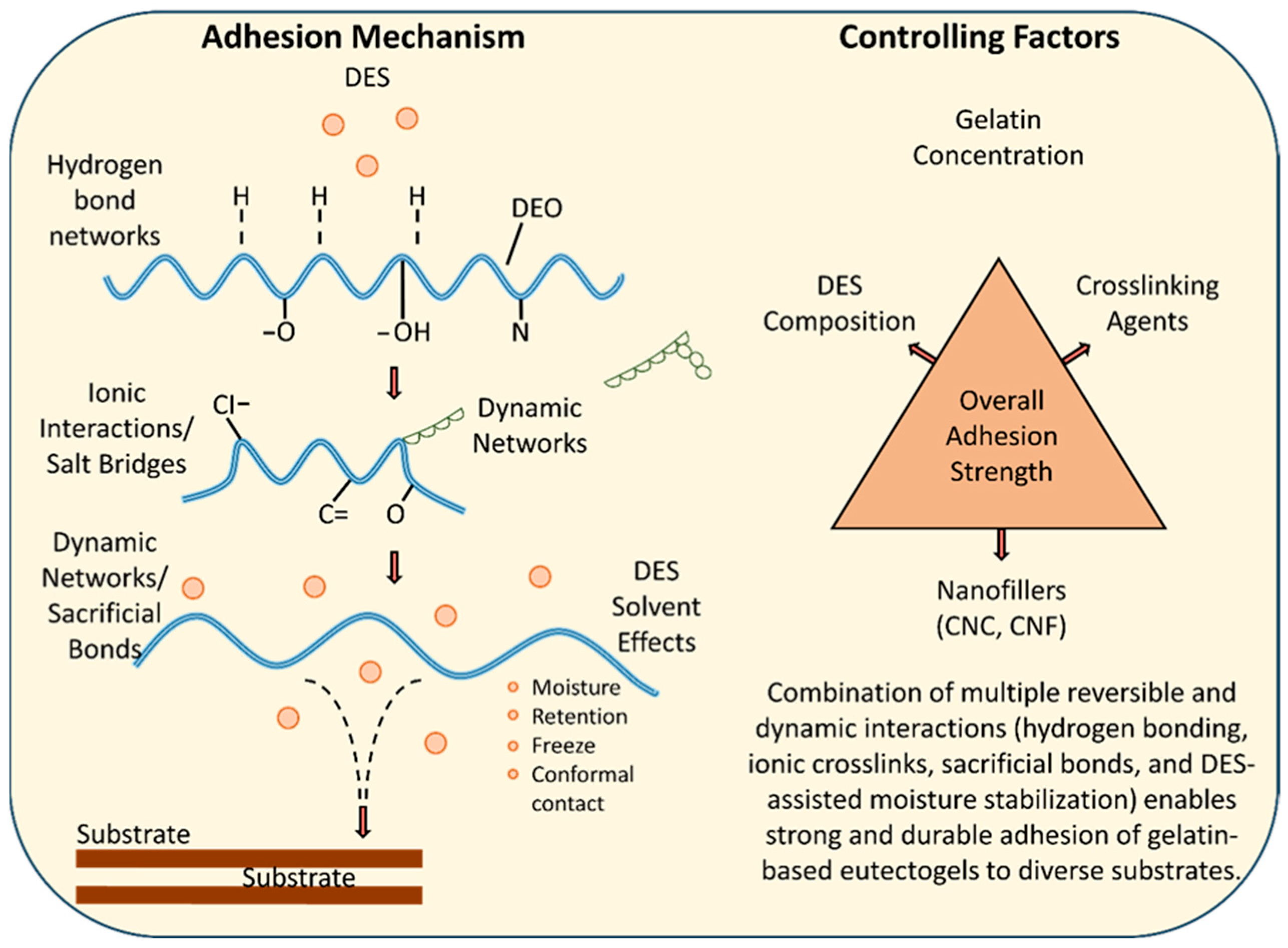
3.2. Mechanisms Controlling Gelatin-Based Gels’ Adhesion Features
- (i)
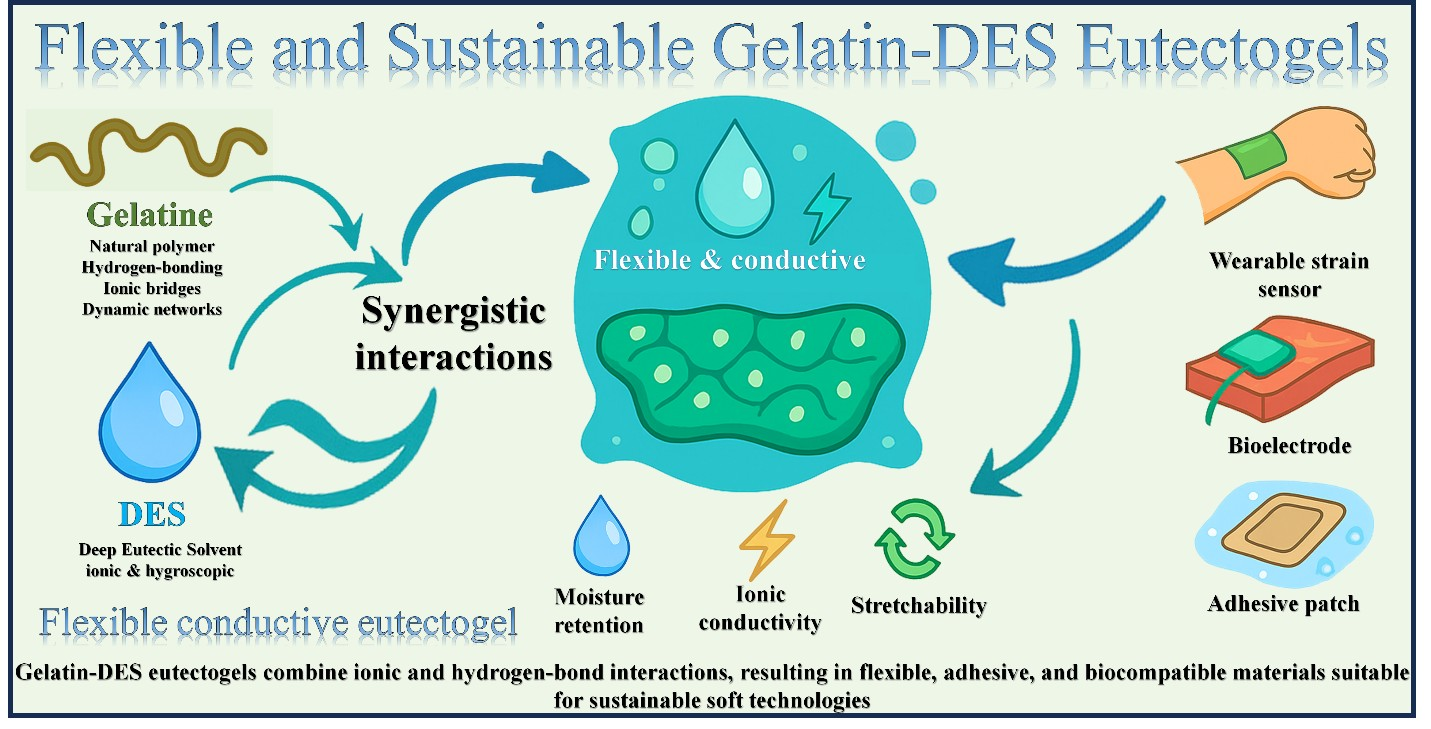
- Hydrogen bond networks—The amide, carboxyl and hydroxyl groups of gelatin interact with polar species of DESs, generating a dense network of reversible hydrogen bonds. These interactions contribute to the formation of stable contact with substrates such as glass, metals, polymers or skin, ensuring good surface agreement [70].
- (ii)
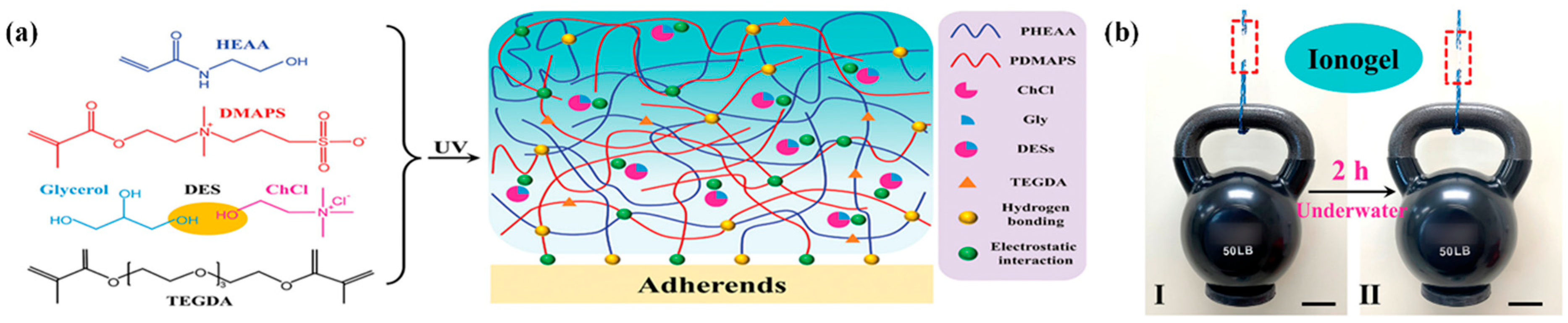
- Ionic interactions and salt bridges—The ionic components of DES, especially ChCl and monomeric acids (such as acrylic acid), participate in the formation of electrostatic bridges between the gelatin chains and the adherent substrate. These Columbic interactions enhance the energy dissipation at the interface and increase the shear and exfoliation resistance [36].
- (iii)
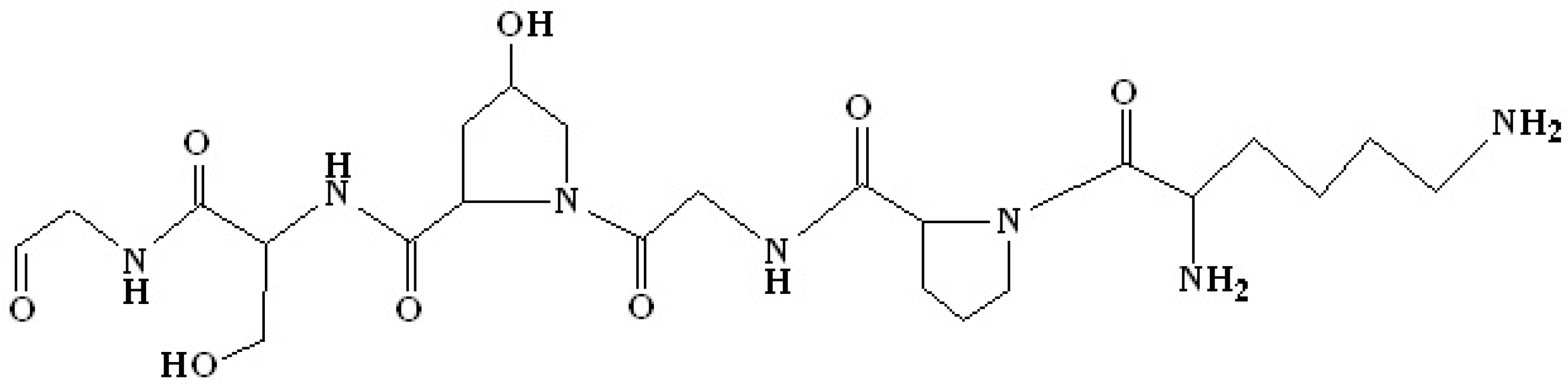
- Dynamic networks—The presence of peptide motifs or polyphenols (e.g., tannic acid) in the eutectogel matrix allows the formation of dynamic bonds that can break and re-form under mechanical stress. These bonds contribute significantly to the hardness and mechanical resilience of the material, allowing for efficient dissipation of interfacial energy and persistent adhesion over time [71].
- (iv)
- Eutectic solvent effects—DES acts not only as an ionic medium but also as an adhesion-stabilizing agent. Due to its high hygroscopicity, DES suppresses gel drying and freezing, maintaining a conformal and stable contact at different temperatures and humidity levels—thus preventing one of the major causes of failure of conventional hydrogels [71].
- -
- Gelatin concentration—determines the network density and the number of active functional groups (–OH, –COOH, –NH2) [71];
- -
- DES solvent composition—type of hydrogen bond donor/acceptor (choline, urea, organic acids) and their molar ratio influence cohesion energy and interfacial stability [36];
- -
- Crosslinking agents—polyphenols (e.g., tannic acid) or peptide agents form additional networks that improve mechanical integrity and adhesion [67];
- -
- Nanoscale fillers—cellulose nanocrystals (CNC) and nanofibers (CNF) increase the roughness of the interface and favor ionic transport, which strengthens the bonds at the interface [72].
3.3. Underwater Adhesives
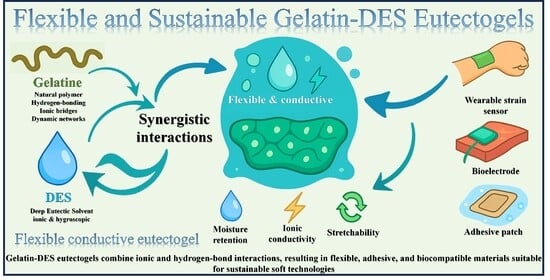
4. DES-Gelatin Based Flexible Eutectogels
- Anti-freeze and anti-evaporation stability, due to the non-volatile and hygroscopic nature of DES;
- High ionic conductivity, useful in sensor and electroactive material applications;
- Self-healing and tuned adhesion, due to dynamic hydrogen bond networks;
4.1. Gelatin—A Brief Overview
4.2. Cytotoxicity and Biocompatibility of Gelatin-DES Eutectogels
4.2.1. In Vitro Cytotoxicity of DES-Based and Gelatin-Containing Hydrogels
4.2.2. In Vivo Biocompatibility
4.2.3. Effect of DES Composition on Cytocompatibility
4.2.4. Comparative Overview of Reported Studies
4.3. Gelatin-Based Eutectogels for the Sensitive Strain Sensor
5. Conclusions
Author Contributions
Funding
Institutional Review Board Statement
Data Availability Statement
Acknowledgments
Conflicts of Interest
References
- Baron, R.I.; Biliuta, G.; Bejan, D.; Darie-Nita, R.N.; Coseri, S.; Dinu, M.V. Advancing the Design of Conductive Composite Cryogels Based on Hydroxypropyl Cellulose Derivatives for Improving the Compressibility and Anti-Freezing Properties. Int. J. Biol. Macromol. 2025, 296, 139764. [Google Scholar] [CrossRef]
- Yao, X.; Zhang, S.; Qian, L.; Wei, N.; Nica, V.; Coseri, S.; Han, F. Super Stretchable, Self-Healing, Adhesive Ionic Conductive Hydrogels Based on Tailor-Made Ionic Liquid for High-Performance Strain Sensors. Adv. Funct. Mater. 2022, 32, 2204565. [Google Scholar] [CrossRef]
- Yao, X.; Zhang, S.; Wei, N.; Qian, L.; Coseri, S. Cellulose-Based Conductive Hydrogels for Emerging Intelligent Sensors. Adv. Fiber Mater. 2024, 6, 1256–1305. [Google Scholar] [CrossRef]
- Ali, S.M.; Noghanian, S.; Khan, Z.U.; Alzahrani, S.; Alharbi, S.; Alhartomi, M.; Alsulami, R. Wearable and Flexible Sensor Devices: Recent Advances in Designs, Fabrication Methods, and Applications. Sensors 2025, 25, 1377. [Google Scholar] [CrossRef] [PubMed]
- Wu, X.; Han, Y.; Zhang, X.; Zhou, Z.; Lu, C. Large-Area Compliant, Low-Cost, and Versatile Pressure-Sensing Platform Based on Microcrack-Designed Carbon Black@Polyurethane Sponge for Human–Machine Interfacing. Adv. Funct. Mater. 2016, 26, 6246–6256. [Google Scholar] [CrossRef]
- Zhao, J.; Dai, K.; Liu, C.; Zheng, G.; Wang, B.; Liu, C.; Chen, J.; Shen, C. A Comparison between Strain Sensing Behaviors of Carbon Black/Polypropylene and Carbon Nanotubes/Polypropylene Electrically Conductive Composites. Compos. Part A Appl. Sci. Manuf. 2013, 48, 129–136. [Google Scholar] [CrossRef]
- Liu, H.; Li, Y.; Dai, K.; Zheng, G.; Liu, C.; Shen, C.; Yan, X.; Guo, J.; Guo, Z. Electrically Conductive Thermoplastic Elastomer Nanocomposites at Ultralow Graphene Loading Levels for Strain Sensor Applications. J. Mater. Chem. C 2016, 4, 157–166. [Google Scholar] [CrossRef]
- Dickey, M. Stretchable and Soft Electronics Using Liquid Metals. Adv. Mater. 2017, 29, 1606425. [Google Scholar] [CrossRef] [PubMed]
- Ryu, S.; Lee, P.; Chou, J.B.; Xu, R.; Zhao, R.; Hart, A.J.; Kim, S.G. Extremely Elastic Wearable Carbon Nanotube Fiber Strain Sensor for Monitoring of Human Motion. ACS Nano 2015, 9, 5929–5936. [Google Scholar] [CrossRef]
- Shao, B.; Chen, X.; Chen, X.; Peng, S.; Song, M. Advancements in MXene Composite Materials for Wearable Sensors: A Review. Sensors 2024, 24, 4092. [Google Scholar] [CrossRef]
- Gogotsi, Y.; Huang, Q. MXenes: Two-Dimensional Building Blocks for Future Materials and Devices. ACS Nano 2021, 15, 5775–5780. [Google Scholar] [CrossRef] [PubMed]
- Jeong, B.; Han, H.; Park, C.; Jeong, B.; Han, H.; Park, C. Micro- and Nanopatterning of Halide Perovskites Where Crystal Engineering for Emerging Photoelectronics Meets Integrated Device Array Technology. Adv. Mater. 2020, 32, 2000597. [Google Scholar] [CrossRef]
- Liu, Y.; Wang, W.; Gu, K.; Yao, J.; Shao, Z.; Chen, X. Poly(Vinyl Alcohol) Hydrogels with Integrated Toughness, Conductivity, and Freezing Tolerance Based on Ionic Liquid/Water Binary Solvent Systems. ACS Appl. Mater. Interfaces 2021, 13, 29008–29020. [Google Scholar] [CrossRef]
- Wan, X.; Mu, T.; Yin, G. Intrinsic Self-Healing Chemistry for Next-Generation Flexible Energy Storage Devices. Nano-Micro Lett. 2023, 15, 99. [Google Scholar] [CrossRef]
- Guo, W.Y.; Ma, M.G. Conductive Nanocomposite Hydrogels for Flexible Wearable Sensors. J. Mater. Chem. A 2024, 12, 9371–9399. [Google Scholar] [CrossRef]
- Lo, C.Y.; Zhao, Y.; Kim, C.; Alsaid, Y.; Khodambashi, R.; Peet, M.; Fisher, R.; Marvi, H.; Berman, S.; Aukes, D.; et al. Highly Stretchable Self-Sensing Actuator Based on Conductive Photothermally-Responsive Hydrogel. Mater. Today 2021, 50, 35–43. [Google Scholar] [CrossRef]
- Zhao, D.; Jia, W.; Feng, X.; Yang, H.; Xie, Y.; Shang, J.; Wang, P.; Guo, Y.; Li, R.W. Flexible Sensors Based on Conductive Polymer Composites. Sensors 2024, 24, 4664. [Google Scholar] [CrossRef]
- Abbott, A.P.; Capper, G.; Davies, D.L.; Rasheed, R.K.; Tambyrajah, V. Novel Solvent Properties of Choline Chloride/Urea Mixtures. Chem. Commun. 2003, 1, 70–71. [Google Scholar] [CrossRef] [PubMed]
- Yang, J.; Fan, J.; Liu, Z.; Zhang, B.; Qin, G.; Liu, S.; Shi, X.; Zhu, L.; Sun, G.; Chen, Q. Deep Eutectic Solvent-Based Ultra-Stretchable, Anti-Freezing, and Ambient-Stable Supramolecular Ionogel for Wearable Sensor. Macromol. Mater. Eng. 2022, 307, 2200248. [Google Scholar] [CrossRef]
- Aloka Weerasinghe, U.; Wu, T.; Lin Chee, P.; Yin Michelle Yew, P.; Kwee Lee, H.; Jun Loh, X.; Dan, K. Deep Eutectic Solvents towards Green Polymeric Materials. Green Chem. 2024, 26, 8497–8527. [Google Scholar] [CrossRef]
- Huang, Z.; Xie, J.; Li, T.; Xu, L.; Liu, P.; Peng, J. Highly Transparent, Mechanically Robust, and Conductive Eutectogel Based on Oligoethylene Glycol and Deep Eutectic Solvent for Reliable Human Motions Sensing. Polymers 2024, 16, 2761. [Google Scholar] [CrossRef]
- Wang, Z.; Ma, Z.; Sun, J.; Yan, Y.; Bu, M.; Huo, Y.; Li, Y.-F.; Hu, N.; Anh Nguyen, T. Recent Advances in Natural Functional Biopolymers and Their Applications of Electronic Skins and Flexible Strain Sensors. Polymers 2021, 13, 813. [Google Scholar] [CrossRef]
- Baron, R.I.; Coseri, S. Preparation of Water-Soluble Cellulose Derivatives Using TEMPO Radical-Mediated Oxidation at Extended Reaction Time. React. Funct. Polym. 2020, 157, 104768. [Google Scholar] [CrossRef]
- Vakili, M.; Qiu, W.; Cagnetta, G.; Huang, J.; Yu, G. Solvent-free mechanochemical mild oxidation method to enhance adsorption properties of chitosan. Front. Environ. Sci. Eng. 2021, 15, 128. [Google Scholar] [CrossRef]
- Zarski, A.; Kapusniak, K.; Ptak, S.; Rudlicka, M.; Coseri, S.; Kapusniak, J. Functionalization Methods of Starch and Its Derivatives: From Old Limitations to New Possibilities. Polymers 2024, 16, 597. [Google Scholar] [CrossRef] [PubMed]
- Yan, P.; Lan, W.; Xie, J. Modification on Sodium Alginate for Food Preservation: A Review. Trends Food Sci. Technol. 2024, 143, 104217. [Google Scholar] [CrossRef]
- Hernandez-Tenorio, F.; Giraldo-Estrada, C. Synthesis of Pullulan Derivatives: Postharvest Application in Fruit Preservation. Carbohydr. Res. 2025, 558, 109711. [Google Scholar] [CrossRef]
- Zhu, J.; Shao, C.; Hao, S.; Xue, K.; Zhang, J.; Sun, Z.; Xiao, L.P.; Ren, W.; Yang, J.; Cao, B.; et al. Green Synthesis of Multifunctional Cellulose-Based Eutectogel Using a Metal Salt Hydrate-Based Deep Eutectic Solvent for Sustainable Self-Powered Sensing. Chem. Eng. J. 2025, 506, 159636. [Google Scholar] [CrossRef]
- Chakraborty, S.; Debnath, S.; Mahipal Malappuram, K.; Parasuram, S.; Chang, H.T.; Chatterjee, K.; Nain, A. Flexible and Robust Piezoelectric Chitosan Films with Enhanced Bioactivity. Biomacromolecules 2025, 26, 1128–1140. [Google Scholar] [CrossRef]
- Berillo, D.; Volkova, N. Preparation and Physicochemical Characteristics of Cryogel Based on Gelatin and Oxidised Dextran. J. Mater. Sci. 2014, 49, 4855–4868. [Google Scholar] [CrossRef]
- Reji, R.E.; Mathew, C.B.; V, J.; Sabu, C.S.; Roy, S.; Reji, R.E.; Mathew, C.B.; V, J.; Sabu, C.S.; Roy, S. A Review on Gelatin Films and Coatings for Active Food Packaging Functional Properties and Applications. Food Innov. Adv. 2025, 4, 423–436. [Google Scholar] [CrossRef]
- Willems, C.; Qi, F.; Trutschel, M.L.; Groth, T. Functionalized Gelatin/Polysaccharide Hydrogels for Encapsulation of Hepatocytes. Gels 2024, 10, 231. [Google Scholar] [CrossRef]
- Doublier, J.L.; Garnier, C.; Renard, D.; Sanchez, C. Protein–Polysaccharide Interactions. Curr. Opin. Colloid Interface Sci. 2000, 5, 202–214. [Google Scholar] [CrossRef]
- Li, L.; Lai, B.; Yan, J.-N.; Yambazi, M.H.; Wang, C.; Wu, H.-T. Characterization of Complex Coacervation between Chia Seed Gum and Whey Protein Isolate: Effect of PH, Protein/Polysaccharide Mass Ratio and Ionic Strength. Food Hydrocoll. 2024, 148, 109445. [Google Scholar] [CrossRef]
- Patino, J.; Pilosof, A. Protein–Polysaccharide Interactions at Fluid Interfaces. Food Hydrocoll. 2011, 25, 1925–1937. [Google Scholar] [CrossRef]
- Xu, L.; Li, X.; Gao, J.; Yan, M.; Wang, Q. Environmentally Stable, Adhesive, Self-Healing, Stretchable and Transparent Gelatin Based Eutectogels for Self-Powered Humidity Sensors. Int. J. Biol. Macromol. 2024, 280, 136105. [Google Scholar] [CrossRef] [PubMed]
- Singh, G.; Singh, G.; Damarla, K.; Sharma, P.K.; Kumar, A.; Kang, T.S. Gelatin-Based Highly Stretchable, Self-Healing, Conducting, Multiadhesive, and Antimicrobial Ionogels Embedded with Ag2O Nanoparticles. ACS Sustain. Chem. Eng. 2017, 5, 6568–6577. [Google Scholar] [CrossRef]
- Xu, L.; Yin, J.; He, J.; Li, H.; Zhu, L.; Ning, H.; Jie, K.; Zhu, W.; Li, H.; Dai, S.; et al. Completely Inorganic Deep Eutectic Solvents for Efficient and Recyclable Liquid–Liquid Interface Catalysis. Adv. Mater. 2024, 36, 2313853. [Google Scholar] [CrossRef]
- Abbott, A.P.; Bell, T.J.; Handa, S.; Stoddart, B. Cationic Functionalisation of Cellulose Using a Choline Based Ionic Liquid Analogue. Green Chem. 2006, 8, 784–786. [Google Scholar] [CrossRef]
- Zhou, J.; Bingkun, C.; Tong, L.; Chong, G.; Abdullah, L.C.; Guo, H. Recent Advances of Microwave-Assisted Deep Eutectic Solvent for Lignocellulosic Biorefining. Cellulose 2025, 32, 8669–8702. [Google Scholar] [CrossRef]
- Smith, E.L.; Abbott, A.P.; Ryder, K.S. Deep Eutectic Solvents (DESs) and Their Applications. Chem. Rev. 2014, 114, 11060–11082. [Google Scholar] [CrossRef]
- Zou, R.; Zhou, X.; Qian, M.; Wang, C.; Boldor, D.; Lei, H.; Zhang, X. Advancements and Applications of Microwave-Assisted Deep Eutectic Solvent (MW-DES) Lignin Extraction: A Comprehensive Review. Green Chem. 2024, 26, 1153–1169. [Google Scholar] [CrossRef]
- Sharma, A.; Lee, B.S. Toxicity Test Profile for Deep Eutectic Solvents: A Detailed Review and Future Prospects. Chemosphere 2024, 350, 141097. [Google Scholar] [CrossRef]
- Radošević, K.; Cvjetko Bubalo, M.; Gaurina Srček, V.; Grgas, D.; Landeka Dragičević, T.; Redovniković, R.I. Evaluation of Toxicity and Biodegradability of Choline Chloride Based Deep Eutectic Solvents. Ecotoxicol. Environ. Saf. 2015, 112, 46–53. [Google Scholar] [CrossRef]
- Teh, S.S.; Loh, S.K.; Mah, S.H. Development of Choline-Based Deep Eutectic Solvents for Efficient Concentrating of Hemicelluloses in Oil Palm Empty Fruit Bunches. Korean J. Chem. Eng. 2019, 36, 1619–1625. [Google Scholar] [CrossRef]
- Yang, Y.; Zhao, L.; Ren, J.; He, B. Effect of Ternary Deep Eutectic Solvents on Bagasse Cellulose and Lignin Structure in Low-Temperature Pretreatment. Processes 2022, 10, 778. [Google Scholar] [CrossRef]
- Durand, E.; Lecomte, J.; Villeneuve, P. Deep Eutectic Solvents: Synthesis, Application, and Focus on Lipase-Catalyzed Reactions. Eur. J. Lipid Sci. Technol. 2013, 115, 379–385. [Google Scholar] [CrossRef]
- Abbott, A.P.; Boothby, D.; Capper, G.; Davies, D.L.; Rasheed, R.K. Deep Eutectic Solvents Formed between Choline Chloride and Carboxylic Acids: Versatile Alternatives to Ionic Liquids. J. Am. Chem. Soc. 2004, 126, 9142–9147. [Google Scholar] [CrossRef]
- Zhang, Q.; De Oliveira Vigier, K.; Royer, S.S.; Jérôme, F. Deep Eutectic Solvents: Syntheses, Properties and Applications. Chem. Soc. Rev. 2012, 41, 7108–7146. [Google Scholar] [CrossRef] [PubMed]
- Francisco, M.; Van Den Bruinhorst, A.; Kroon, M.C. New Natural and Renewable Low Transition Temperature Mixtures (LTTMs): Screening as Solvents for Lignocellulosic Biomass Processing. Green Chem. 2012, 14, 2153–2157. [Google Scholar] [CrossRef]
- Procentese, A.; Raganati, F.; Olivieri, G.; Russo, M.E.; Rehmann, L.; Marzocchella, A. Deep Eutectic Solvents Pretreatment of Agro-Industrial Food Waste. Biotechnol. Biofuels 2018, 11, 37. [Google Scholar] [CrossRef] [PubMed]
- Xia, Q.; Liu, Y.; Meng, J.; Cheng, W.; Chen, W.; Liu, S.; Liu, Y.; Li, J.; Yu, H. undefined Multiple Hydrogen Bond Coordination in Three-Constituent Deep Eutectic Solvents Enhances Lignin Fractionation from Biomass. Green Chem. 2018, 20, 2711–2721. [Google Scholar] [CrossRef]
- Dai, Y.; van Spronsen, J.; Witkamp, G.J.; Verpoorte, R.; Choi, Y.H. Natural Deep Eutectic Solvents as New Potential Media for Green Technology. Anal. Chim. Acta 2013, 766, 61–68. [Google Scholar] [CrossRef]
- Malaeke, H.; Housaindokht, M.; Monhemi, H.; Izadyar, M. Deep Eutectic Solvent as an Efficient Molecular Liquid for Lignin Solubilization and Wood Delignification. J. Mol. Liq. 2018, 263, 193–199. [Google Scholar] [CrossRef]
- Zdanowicz, M.; Wilpiszewska, K.; Spychaj, T. Deep Eutectic Solvents for Polysaccharides Processing. A Review. Carbohydr. Polym. 2018, 200, 361–380. [Google Scholar] [CrossRef]
- Xiong, Y.; Zhang, X.; Ma, X.; Wang, W.; Yan, F.; Zhao, X.; Chu, X.; Xu, W.; Sun, C. A Review of the Properties and Applications of Bioadhesive Hydrogels. Polym. Chem. 2021, 12, 3721–3739. [Google Scholar] [CrossRef]
- Zhang, X.; Wusiman, H.; Wang, Y.; Wang, L.; Chen, W.; Huang, D. The Mussel-Inspired GelMA/Dopamine/Hyaluronic Acid Composite Hydrogel Dressing for Wet Surface Adhesion. Int. J. Biol. Macromol. 2025, 302, 140448. [Google Scholar] [CrossRef]
- Yang, J.; Wang, S. Polysaccharide-Based Multifunctional Hydrogel Bio-Adhesives for Wound Healing: A Review. Gels 2023, 9, 138. [Google Scholar] [CrossRef]
- Yang, X.; Liu, X.; Chau, Y.Y.; Qin, X.; Zhu, H.; Peng, L.; Chan, K.W.Y.; Wang, Z. Role of Chemistry in Nature-Inspired Skin Adhesives. Chem. Sci. 2025, 16, 10665–10690. [Google Scholar] [CrossRef] [PubMed]
- Xing, Y.; Qing, X.; Xia, H.; Hao, S.; Zhu, H.; He, Y.; Mao, H.; Gu, Z. Injectable Hydrogel Based on Modified Gelatin and Sodium Alginate for Soft-Tissue Adhesive. Front. Chem. 2021, 9, 744099. [Google Scholar] [CrossRef] [PubMed]
- Liu, B.; Wang, Y.; Miao, Y.; Zhang, X.; Fan, Z.; Singh, G.; Zhang, X.; Xu, K.; Li, B.; Hu, Z.; et al. Hydrogen Bonds Autonomously Powered Gelatin Methacrylate Hydrogels with Super-Elasticity, Self-Heal and Underwater Self-Adhesion for Sutureless Skin and Stomach Surgery and E-Skin. Biomaterials 2018, 171, 83–96. [Google Scholar] [CrossRef]
- Chen, T.; Mai, X.; Ma, L.; Li, Z.; Wang, J.; Yang, S. Poly(Vinyl Alcohol)/Gelatin-Based Eutectogels for the Sensitive Strain Sensor with Recyclability and Multienvironmental Suitability. ACS Appl. Polym. Mater. 2022, 4, 3982–3993. [Google Scholar] [CrossRef]
- Qiao, Z.; Chen, Y.; Pan, H.; Li, J.; Meng, Q.; Wang, J.; Cao, Y.; Wang, W.; Yang, Y. Environment-Tolerant, Inherently Conductive and Self-Adhesive Gelatin-Based Supramolecular Eutectogel for Flexible Sensor. Int. J. Biol. Macromol. 2024, 282, 137219. [Google Scholar] [CrossRef]
- Picchio, M.L.; Gallastegui, A.; Casado, N.; Lopez-Larrea, N.; Marchiori, B.; del Agua, I.; Criado-Gonzalez, M.; Mantione, D.; Minari, R.J.; Mecerreyes, D. Mixed Ionic and Electronic Conducting Eutectogels for 3D-Printable Wearable Sensors and Bioelectrodes. Adv. Mater. Technol. 2022, 7, 2101680. [Google Scholar] [CrossRef]
- Lee, Y.; Yim, S.G.; Lee, G.W.; Kim, S.; Kim, H.S.; Hwang, D.Y.; An, B.S.; Lee, J.H.; Seo, S.; Yang, S.Y. Self-Adherent Biodegradable Gelatin-Based Hydrogel Electrodes for Electrocardiography Monitoring. Sensors 2020, 20, 5737. [Google Scholar] [CrossRef] [PubMed]
- Zhang, H.J.; Zha, S.; Wang, X.; Xie, L.; Liang, S.; Zou, X.; Liu, X.; Dang, X.; Wang, X. Dual Cross-Linked Gelatin-Based Adhesive for Leather with Low Curing Temperature and Improved Bonding Strength. ACS Appl. Polym. Mater. 2023, 5, 10515–10525. [Google Scholar] [CrossRef]
- Mercadal, P.A.; Romero, M.R.; Montesinos, M.d.M.; Real, J.P.; Picchio, M.L.; González, A. Natural, Biocompatible, and 3D-Printable Gelatin Eutectogels Reinforced with Tannic Acid-Coated Cellulose Nanocrystals for Sensitive Strain Sensors. ACS Appl. Electron. Mater. 2023, 5, 2184–2196. [Google Scholar] [CrossRef]
- Carnicero, A.; González, A.; Dalosto, S.D.; Passeggi, M.C.G.; Minari, R.J.; Alvarez Igarzabal, C.I.; Martinelli, M.; Picchio, M.L. Ascidian-Inspired Supramolecular Cellulose Nanocomposite Hydrogels with Antibacterial Activity. ACS Biomater. Sci. Eng. 2022, 8, 5027–5037. [Google Scholar] [CrossRef]
- Li, Z.; Yu, C.; Kumar, H.; He, X.; Lu, Q.; Bai, H.; Kim, K.; Hu, J. The Effect of Crosslinking Degree of Hydrogels on Hydrogel Adhesion. Gels 2022, 8, 682. [Google Scholar] [CrossRef]
- Nicolau, A.; Mutch, A.L.; Thickett, S.C. Applications of Functional Polymeric Eutectogels. Macromol. Rapid Commun. 2024, 45, 2400405. [Google Scholar] [CrossRef]
- Zhang, Y.; Wang, Y.; Guan, Y.; Zhang, Y. Peptide-Enhanced Tough, Resilient and Adhesive Eutectogels for Highly Reliable Strain/Pressure Sensing under Extreme Conditions. Nat. Commun. 2022, 13, 6671. [Google Scholar] [CrossRef] [PubMed]
- Sahoo, D.; Karan, A.K.; Manik, N.B. Influence of SWCNT on the Electrical Behavior of an Environmentally Friendly CH3NH3SnI3 Perovskite-Based Optoelectronic Schottky Device. ACS Appl. Electron. Mater. 2023, 5, 2203–2214. [Google Scholar] [CrossRef]
- Fan, H.; Gong, J.P. Bioinspired Underwater Adhesives. Adv. Mater. 2021, 33, 2102983. [Google Scholar] [CrossRef]
- Narayanan, A.; Dhinojwala, A.; Joy, A. Design Principles for Creating Synthetic Underwater Adhesives. Chem. Soc. Rev. 2021, 50, 13321–13345. [Google Scholar] [CrossRef] [PubMed]
- Yu, Z.; Wu, P. Water-resistant Ionogel Electrode with Tailorable Mechanical Properties for Aquatic Ambulatory Physiological Signal Monitoring. Adv. Funct. Mater. 2021, 31, 2107226. [Google Scholar] [CrossRef]
- Zhang, J.; Wang, W.; Zhang, Y.; Wei, Q.; Han, F.; Dong, S.; Liu, D.; Zhang, S. Small-Molecule Ionic Liquid-Based Adhesive with Strong Room-Temperature Adhesion Promoted by Electrostatic Interaction. Nat. Commun. 2022, 13, 5214. [Google Scholar] [CrossRef]
- Ge, G.; Mandal, K.; Haghniaz, R.; Li, M.; Xiao, X.; Carlson, L.; Jucaud, V.; Remzi Dokmeci, M.; Wei Ho, G.; Khademhosseini, A.; et al. Deep Eutectic Solvents-based Ionogels with Ultrafast Gelation and High Adhesion in Harsh Environments. Adv. Funct. Mater. 2023, 33, 2207388. [Google Scholar] [CrossRef]
- Wu, S.J.; Yuk, H.; Wu, J.; Nabzdyk, C.S.; Zhao, X.; Wu, S.J.; Yuk, H.; Wu, J.; Zhao, X.; Nabzdyk, C.S. A Multifunctional Origami Patch for Minimally Invasive Tissue Sealing. Adv. Mater. 2021, 33, 2007667. [Google Scholar] [CrossRef]
- Li, J.; Celiz, A.D.; Yang, J.; Yang, Q.; Wamala, I.; Whyte, W.; Seo, B.R.; Vasilyev, N.V.; Vlassak, J.J.; Suo, Z.; et al. Tough Adhesives for Diverse Wet Surfaces. Science 2017, 357, 378–381. [Google Scholar] [CrossRef]
- Picchio, M.L.; Minudri, D.; Mantione, D.; Criado-Gonzalez, M.; Guzmán-González, G.; Schmarsow, R.; Müller, A.J.; Tomé, L.C.; Minari, R.J.; Mecerreyes, D. Natural Deep Eutectic Solvents Based on Choline Chloride and Phenolic Compounds as Efficient Bioadhesives and Corrosion Protectors. ACS Sustain. Chem. Eng. 2022, 10, 8135–8142. [Google Scholar] [CrossRef]
- Lu, Q.; Li, H.; Tan, Z. Zwitterionic Eutectogel-Based Wearable Strain Sensor with Superior Stretchability, Self-Healing, Self-Adhesion, and Wide Temperature Tolerance. ACS Appl. Mater. Interfaces 2023, 15, 34055–34063. [Google Scholar] [CrossRef]
- Zhang, D.; Chen, H.; Zhang, Y.; Yang, J.; Chen, Q.; Wu, J.; Liu, Y.; Zhao, C.; Tang, Y.; Zheng, J. Antifreezing Hydrogels: From Mechanisms and Strategies to Applications. Chem. Soc. Rev. 2025, 54, 5292–5341. [Google Scholar] [CrossRef]
- Reuter, D.; Binder, C.; Lunkenheimer, P.; Loidl, A. Ionic Conductivity of Deep Eutectic Solvents: The Role of Orientational Dynamics and Glassy Freezing. Phys. Chem. Chem. Phys. 2019, 21, 6801–6809. [Google Scholar] [CrossRef] [PubMed]
- Cordier, P.; Tournilhac, F.; Soulié-Ziakovic, C.; Leibler, L. Self-Healing and Thermoreversible Rubber from Supramolecular Assembly. Nature 2008, 451, 977–980. [Google Scholar] [CrossRef]
- Hu, L.; Gao, S.; Zhao, L.; Dai, L.; Zhang, D.; Wang, C.; Fang, X.; Chu, F. Highly Conductive, Anti-Freezing Hemicellulose-Based Hydrogels Prepared via Deep Eutectic Solvents and Their Applications. Gels 2023, 9, 725. [Google Scholar] [CrossRef]
- Karim, A.; Bhat, R. Gelatin Alternatives for the Food Industry: Recent Developments, Challenges and Prospects. Trends Food Sci. Technol. 2008, 19, 644–656. [Google Scholar] [CrossRef]
- Schrieber, R.; Gareis, H. Gelatine Handbook: Theory and Industrial Practice; John Wiley & Sons: Hoboken, NJ, USA, 2007. [Google Scholar]
- Berker Demiral, R.; Çağlar Kurtuluş, O.; Ondaral, S. Characterization of hydroxyethylcellulose-gelatin based composites. Cellul. Chem. Technol. 2025, 59, 237–248. [Google Scholar] [CrossRef]
- Gomez-Guillen, M.C.; Gimenez, B.; Lopez-Caballero, M.E.; Montero, M.P. Functional and Bioactive Properties of Collagen and Gelatin from Alternative Sources: A Review. Food Hydrocoll. 2011, 25, 1813–1827. [Google Scholar] [CrossRef]
- Djagny, K.B.; Wang, Z.; Xu, S. Gelatin: A Valuable Protein for Food and Pharmaceutical Industries: Review. Crit. Rev. Food Sci. Nutr. 2001, 41, 481–492. [Google Scholar] [CrossRef]
- Bigi, A.; Cojazzi, G.; Panzavolta, S.; Rubini, K.; Roveri, N. Mechanical and Thermal Properties of Gelatin Films at Different Degrees of Glutaraldehyde Crosslinking. Biomaterials 2001, 22, 763–768. [Google Scholar] [CrossRef]
- Van, A.I.; Bulcke, D.; Bogdanov, B.; De Rooze, N.; Schacht, E.H.; Cornelissen, M.; Berghmans, H. Structural and Rheological Properties of Methacrylamide Modified Gelatin Hydrogels. Biomacromolecules 2000, 1, 31–38. [Google Scholar] [CrossRef]
- Nichol, J.; Koshy, S.; Bae, H.; Hwang, C.; Yamanlar, S. Cell-Laden Microengineered Gelatin Methacrylate Hydrogels. Biomaterials 2010, 31, 5536–5544. [Google Scholar] [CrossRef]
- Yue, K.; Trujillo-de Santiago, G.; Alvarez, M.M.; Tamayol, A.; Annabi, N.; Khademhosseini, A. Synthesis, Properties, and Biomedical Applications of Gelatin Methacryloyl (GelMA) Hydrogels. Biomaterials 2015, 73, 254–271. [Google Scholar] [CrossRef] [PubMed]
- Levato, R.; Jungst, T.; Scheuring, R.G.; Blunk, T.; Groll, J.; Malda, J. From Shape to Function: The next Step in Bioprinting. Adv. Mater. 2020, 32, 1906423. [Google Scholar] [CrossRef] [PubMed]
- Shi, W.; Sun, M.; Hu, X.; Ren, B.; Cheng, J.; Li, C.; Duan, X.; Fu, X.; Zhang, J.; Chen, H.; et al. Structurally and Functionally Optimized Silk-Fibroin–Gelatin Scaffold Using 3D Printing to Repair Cartilage Injury In Vitro and In Vivo. Adv. Mater. 2017, 29, 1701089. [Google Scholar] [CrossRef]
- Lai, T.; Yu, J.; Tsai, W.B. Gelatin Methacrylate/Carboxybetaine Methacrylate Hydrogels with Tunable Crosslinking for Controlled Drug Release. J. Mater. Chem. B 2016, 4, 2304–2313. [Google Scholar] [CrossRef] [PubMed]
- Fu, R.; Zhong, X.; Xiao, C.; Lin, J.; Guan, Y.; Tian, Y.; Zhou, Z.; Tan, G.; Hu, H.; Zhou, L.; et al. A Stretchable, Biocompatible, and Self-Powered Hydrogel Multichannel Wireless Sensor System Based on Piezoelectric Barium Titanate Nanoparticles for Health. Nano Energy 2023, 114, 108617. [Google Scholar] [CrossRef]
- Pedro, S.N.; Mendes, M.S.M.; Neves, B.M.; Almeida, I.F.; Costa, P.; Correia-Sá, I.; Vilela, C.; Freire, M.G.; Silvestre, A.J.D.; Freire, C.S.R. Deep Eutectic Solvent Formulations and Alginate-Based Hydrogels as a New Partnership for the Transdermal Administration of Anti-Inflammatory Drugs. Pharmaceutics 2022, 14, 827. [Google Scholar] [CrossRef]
- Yang, J.Y.; Zhou, E.Y.; Cheng, T.H.; Liu, P.H.; Hsieh, W.C.; Cheng, H.C.; Hong, Y.K.; Lin, Y.C.; Hsu, Y.C.; Yang, C.C.; et al. Injectable Deep Eutectic Solvent-Based Ionic Gel With Rapid Gelation and Broad Hemostatic Functionality. Adv. Healthc. Mater. 2025, e03038. [Google Scholar] [CrossRef]
- Del, M.; Morán, C.; Grifoni, A.C.; Cirisano, F.; Ferrari, M. Development of Drug-Loaded Gelatin-Based Hydrogel Films for Impaired Wound Healing in Simulated Chronic Conditions. Pharmaceutics 2025, 18, 43. [Google Scholar] [CrossRef]
- Liu, R.; Qiao, C.; Liu, Q.; Liu, L.; Yao, J. Fabrication and Properties of Anti-Freezing Gelatin Hydrogels Based on a Deep Eutectic Solvent. ACS Appl. Polym. Mater. 2023, 5, 4546–4553. [Google Scholar] [CrossRef]
- Qin, H.; Owyeung, R.E.; Sonkusale, S.R.; Panzer, M.J. Highly Stretchable and Nonvolatile Gelatin-Supported Deep Eutectic Solvent Gel Electrolyte-Based Ionic Skins for Strain and Pressure Sensing. J. Mater. Chem. C 2019, 7, 601–608. [Google Scholar] [CrossRef]
- Filip, D.; Macocinschi, D.; Balan-Porcarasu, M.; Varganici, C.D.; Dumitriu, R.P.; Peptanariu, D.; Tuchilus, C.G.; Zaltariov, M.F. Biocompatible Self-Assembled Hydrogen-Bonded Gels Based on Natural Deep Eutectic Solvents and Hydroxypropyl Cellulose with Strong Antimicrobial Activity. Gels 2022, 8, 666. [Google Scholar] [CrossRef]
- Wang, J.; Deng, Y.; Ma, Z.; Wang, Y.; Zhang, S.; Yan, L. Lignin Promoted the Fast Formation of a Robust and Highly Conductive Deep Eutectic Solvent Ionic Gel at Room Temperature for a Flexible Quasi-Solid-State Supercapacitor. Green Chem. 2021, 23, 5120–5128. [Google Scholar] [CrossRef]
- Li, T.; Qi, H.; Zhao, C.; Li, Z.; Zhou, W.; Li, G.; Zhuo, H.; Zhai, W. Robust Skin-Integrated Conductive Biogel for High-Fidelity Detection under Mechanical Stress. Nat. Commun. 2025, 16, 88. [Google Scholar] [CrossRef] [PubMed]
- Wei, S.; Xu, J.; Zhao, W.; Li, X.; Zhao, W.; Yan, S. Mechanically Robust Gelatin Gel for Sensitive Touch Sensor Based on Electrode Potential. Adv. Funct. Mater. 2024, 34, 2408648. [Google Scholar] [CrossRef]
- Li, X.; Fan, S.; Ma, J.; Zhu, Z.; Guan, D.; Ren, S.; Ma, Y.; Li, S. Tough, Highly Resilient and Fatigue-Resistant Cellulose-Based Double-Network Elastomers with Environmental Tolerance for Multi-Domain Sensing. Chem. Eng. J. 2025, 523, 168273. [Google Scholar] [CrossRef]
- Chen, C.; Liu, P.; Gu, Y.; Pan, W.; Liu, Y.; Li, X.; Yu, Y.; Shan, X. Stretchable Adhesive Eutectic Organohydrogel Based on Gelatin-Quaternized Chitosan for Wearable Human Motion Monitoring. Int. J. Biol. Macromol. 2025, 322, 146939. [Google Scholar] [CrossRef]


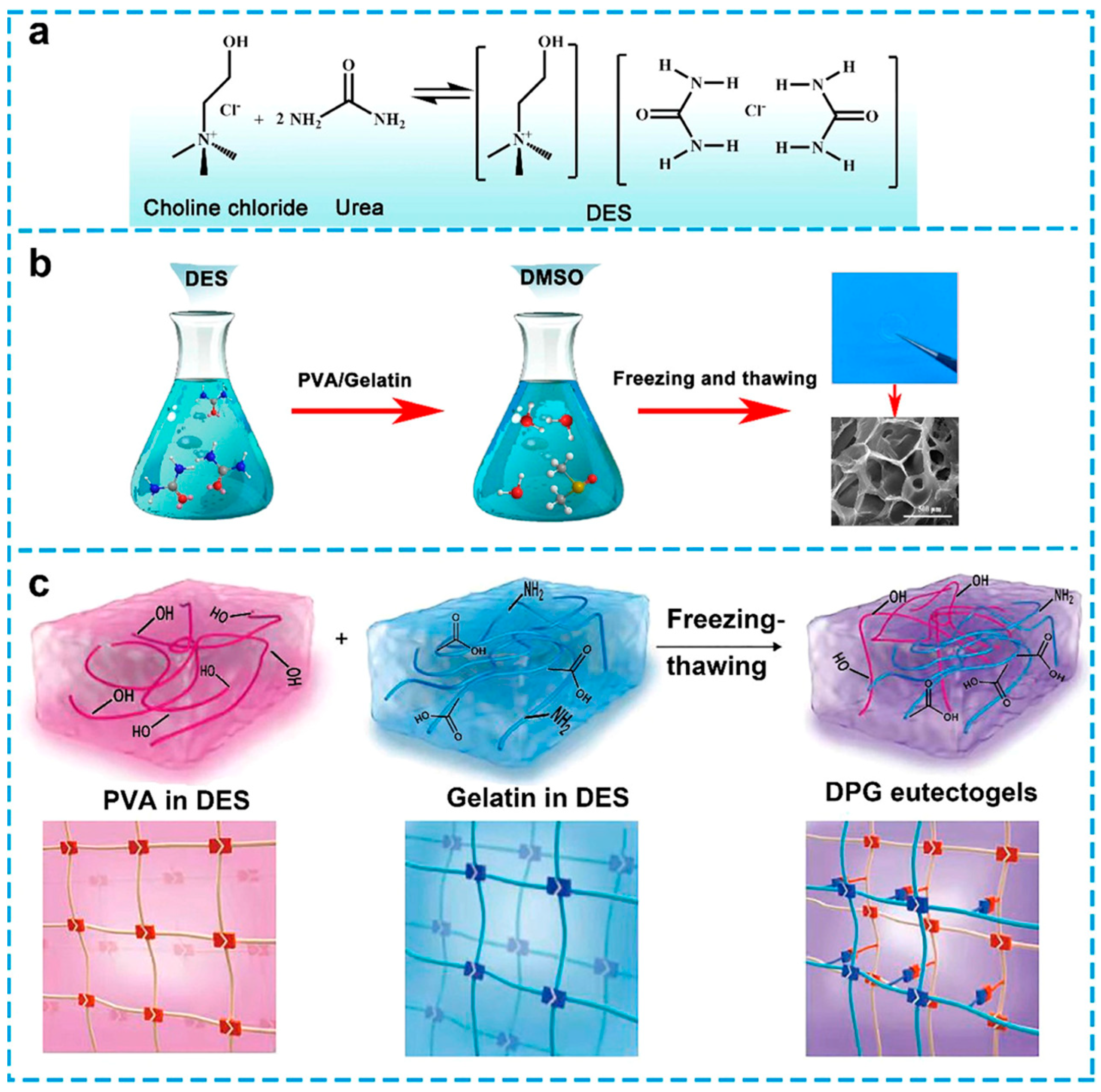
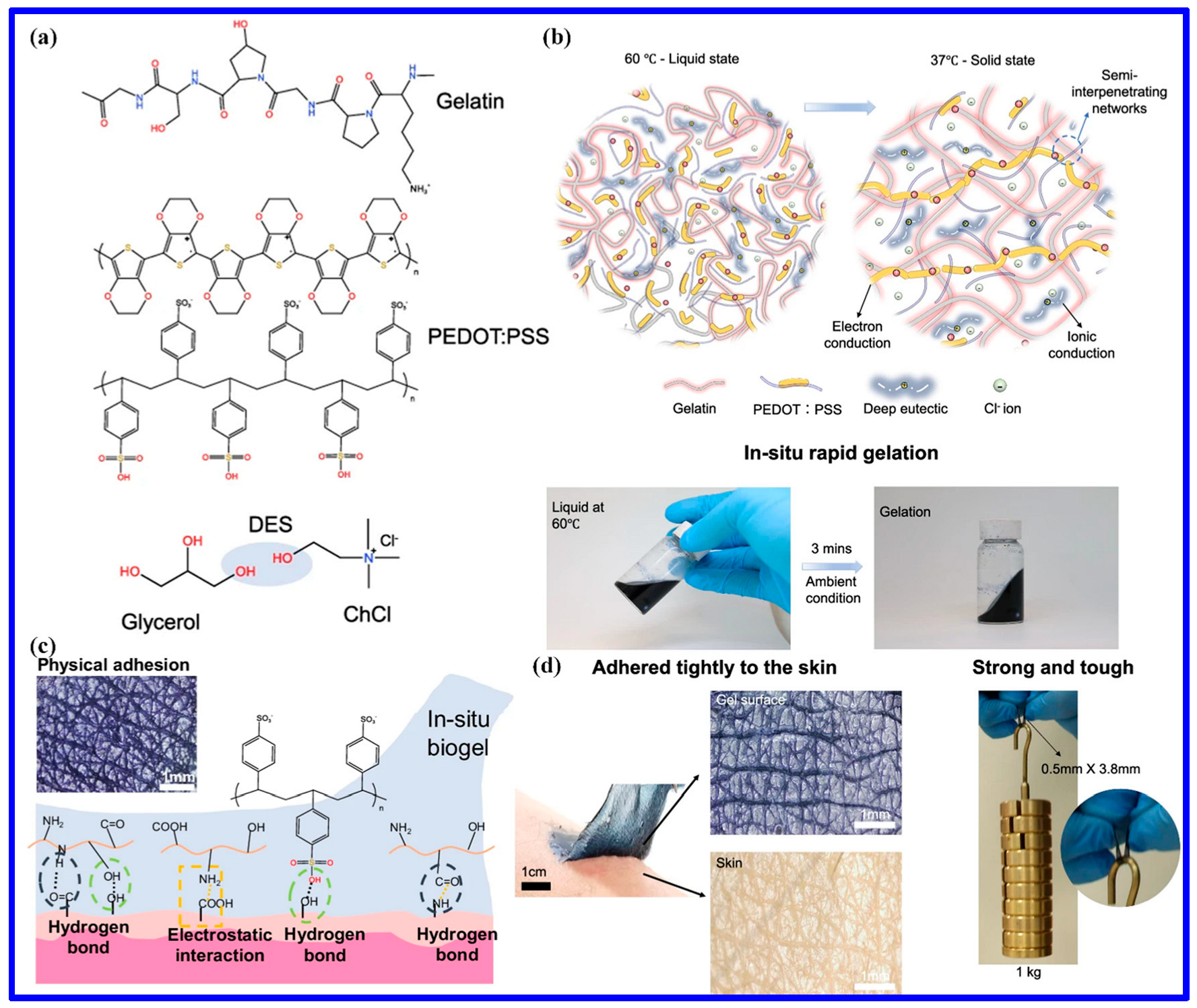
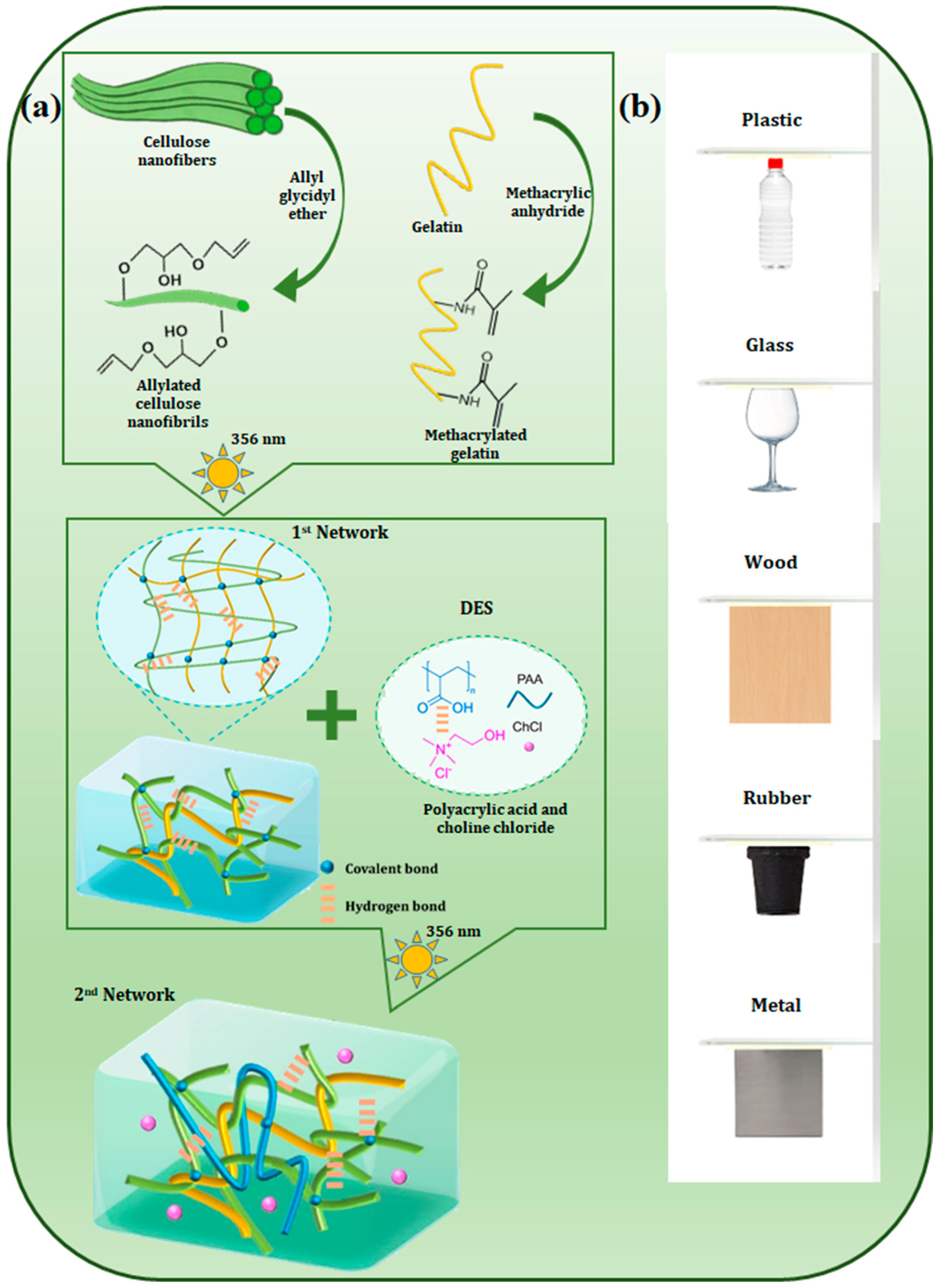

| DES Type/System | HBA | HBD | Molar Ratio | Main Application(s) | Reference(s) |
|---|---|---|---|---|---|
| Type I—Metal salt–based | Cl− + FeCl3 | – | 1:2 | High conductivity, electroplating, metallurgical processes | [18,48] |
| Type II—Hydrated metal salts | Cl− + ZnCl2·× H2O | – | 1:2 | Metal extraction, catalysis | [49] |
| ChCl:Urea (“Reline”) | Choline chloride | Urea | 1:2 | Cellulose swelling, biomass pretreatment | [18,49] |
| ChCl:Glycerol (“Glyceline”) | Choline chloride | Glycerol | 1:2 | Biocompatible medium, agricultural residue pretreatment | [50] |
| ChCl:Ethylene glycol | Choline chloride | Ethylene glycol | 1:2 | Moderate delignification, improved enzymatic digestibility | [51] |
| ChCl:Lactic acid | Choline chloride | Lactic acid | 1:1–1:15 | Strong delignification, selective lignin extraction | [52] |
| ChCl:Oxalic acid | Choline chloride | Oxalic acid | 1:2 | Hemicellulose and lignin removal under mild conditions | [49] |
| NADES (Glucose:Lactic acid) | Glucose | Lactic acid | 1:1 | Extraction of natural products, biodegradable medium | [53] |
| NADES (Choline:Fructose) | Choline | Fructose | 1:1 | Extraction of thermosensitive compounds | [53] |
| Composition | Mechanical Properties | Conductivity | Adhesion | Applications | Reference |
|---|---|---|---|---|---|
| Gelatin + Poly(vinyl alcohol) + DES, combined network | Tensile strength ~6.8 MPa | ~0.12 S/m (ionic) | Adhesive to skin (tested as strain sensor) | Wearable strain sensors | [62] |
| Gelatin (1 wt%) + DES, supramolecular interactions | Good strength despite low polymer content | Intrinsic conductivity (from DES) | Exceptional adhesion on PE/PTFE, stable at extreme temperatures | Versatile substrates, harsh environments | [63] |
| Gelatin + DES, one-pot preparation | Elastic, self-healing | Ionic conductive | Sufficient adhesion on skin/substrates | Electrolyte for humidity sensors | [36] |
| Gelatin (20% w/v) + PEDOT:LS + DES | Stable via triple helix | Mixed ionic + electronic | Lignin sulfonate enhances adhesion | 3D-printable wearable sensors | [64] |
| Gelatin + PEDOT:PSS + genipin | Flexible | Electronic conductivity | Peel force ~0.85 N on skin | Biodegradable ECG electrodes | [65] |
| Gelatin + dialdehyde-TOCNF + polymethacrylate | High bonding strength (T-peel: 5.52 MPa dry, 4.71 MPa wet, wood) | Non-conductive | Strong adhesion on wood/rigid substrates | Structural adhesive | [66] |
| Gelatin + DES + TA@CNC | Good elasticity | Ionic | Self-adhesion tunable; adhesion energy with TA | Strain sensors; skin patches | [67] |
| System Type | DES Composition | Polymer Matrix | Measurement Methods | Key Reported Properties | Reference |
|---|---|---|---|---|---|
| DES fundamental system | Choline chloride/carboxylic acids | – | Thermal analysis, spectroscopy | Low vapor pressure, extensive hydrogen bonding, suppressed evaporation | [48] |
| DES-based hydrogels (review) | Various DES formulations | Biopolymer-based hydrogels | DSC, rheology, thermal tests | Freezing-point depression and antifreezing behavior via donor–acceptor interactions | [82] |
| DES electrolytes | Various DES systems | Polymer gels | Dielectric spectroscopy, EIS | Ionic transport dominated by hydrogen-bond-assisted hopping mechanisms | [83] |
| DES-induced conductive hydrogels | ChCl-based DES | Polysaccharide hydrogels | DSC, conductivity tests | Combined ionic conductivity and anti-freezing stability | [85] |
| Supramolecular soft networks | Non-DES supramolecular systems | Soft polymer networks | Tensile tests, healing cycles | Efficient self-healing via reversible non-covalent interactions | [84] |
| Material System | DES/Hydrogel Composition | Biological Assay | Cell Line/Model | Key Findings | Ref. |
|---|---|---|---|---|---|
| Injectable DES-based ionic gel | ChCl:ethylene glycol + natural polymers | Cell viability, proliferation | Fibroblasts, keratinocytes | High cell viability (>90%); no cytotoxicity | [100] |
| DES-based hemostatic gel | DES + collagen | In vivo biocompatibility | Rat injury model | Good tissue compatibility; minimal inflammation | [100] |
| Gelatin-based eutectogel | Gelatin + ChCl-based DES | — | — | No biological tests reported; stable gel network | [102] |
| Gelatin-supported DES gel electrolyte | Gelatin (22 wt%) + DES | — | — | No cytotoxicity reported; structural stability | [103] |
| NADES/HPC hydrogel | NADES (organic acids) + HPC | Cell viability | Human gingival fibroblasts | Viability >85%; biocompatible | [104] |
| DES solution (bio-based) | ChCl + natural HBD | Cell viability | Macrophages | Viability ~97% at low concentrations | [99] |
| Gelatin hydrogel (reference) | Gelatin (DES-free) | MTT, Live/Dead | Fibroblasts, keratinocytes | Viability 80–95% | [101] |
Disclaimer/Publisher’s Note: The statements, opinions and data contained in all publications are solely those of the individual author(s) and contributor(s) and not of MDPI and/or the editor(s). MDPI and/or the editor(s) disclaim responsibility for any injury to people or property resulting from any ideas, methods, instructions or products referred to in the content. |
© 2026 by the authors. Licensee MDPI, Basel, Switzerland. This article is an open access article distributed under the terms and conditions of the Creative Commons Attribution (CC BY) license.
Share and Cite
Baron, R.I.; Chibac-Scutaru, A.L.; Biliuta, G.; Coseri, S. Adhesive Gelatin-Based Eutectogels: A Review of Synthesis, Properties, and Applications. Polymers 2026, 18, 222. https://doi.org/10.3390/polym18020222
Baron RI, Chibac-Scutaru AL, Biliuta G, Coseri S. Adhesive Gelatin-Based Eutectogels: A Review of Synthesis, Properties, and Applications. Polymers. 2026; 18(2):222. https://doi.org/10.3390/polym18020222
Chicago/Turabian StyleBaron, Raluca Ioana, Andreea Laura Chibac-Scutaru, Gabriela Biliuta, and Sergiu Coseri. 2026. "Adhesive Gelatin-Based Eutectogels: A Review of Synthesis, Properties, and Applications" Polymers 18, no. 2: 222. https://doi.org/10.3390/polym18020222
APA StyleBaron, R. I., Chibac-Scutaru, A. L., Biliuta, G., & Coseri, S. (2026). Adhesive Gelatin-Based Eutectogels: A Review of Synthesis, Properties, and Applications. Polymers, 18(2), 222. https://doi.org/10.3390/polym18020222