
Fire Performance of FRP-Composites and Strengthened Concrete Structures: A State-of-the-Art Review




Abstract
1. Introduction
2. Thermal and Mechanical Degradation of FRP Components
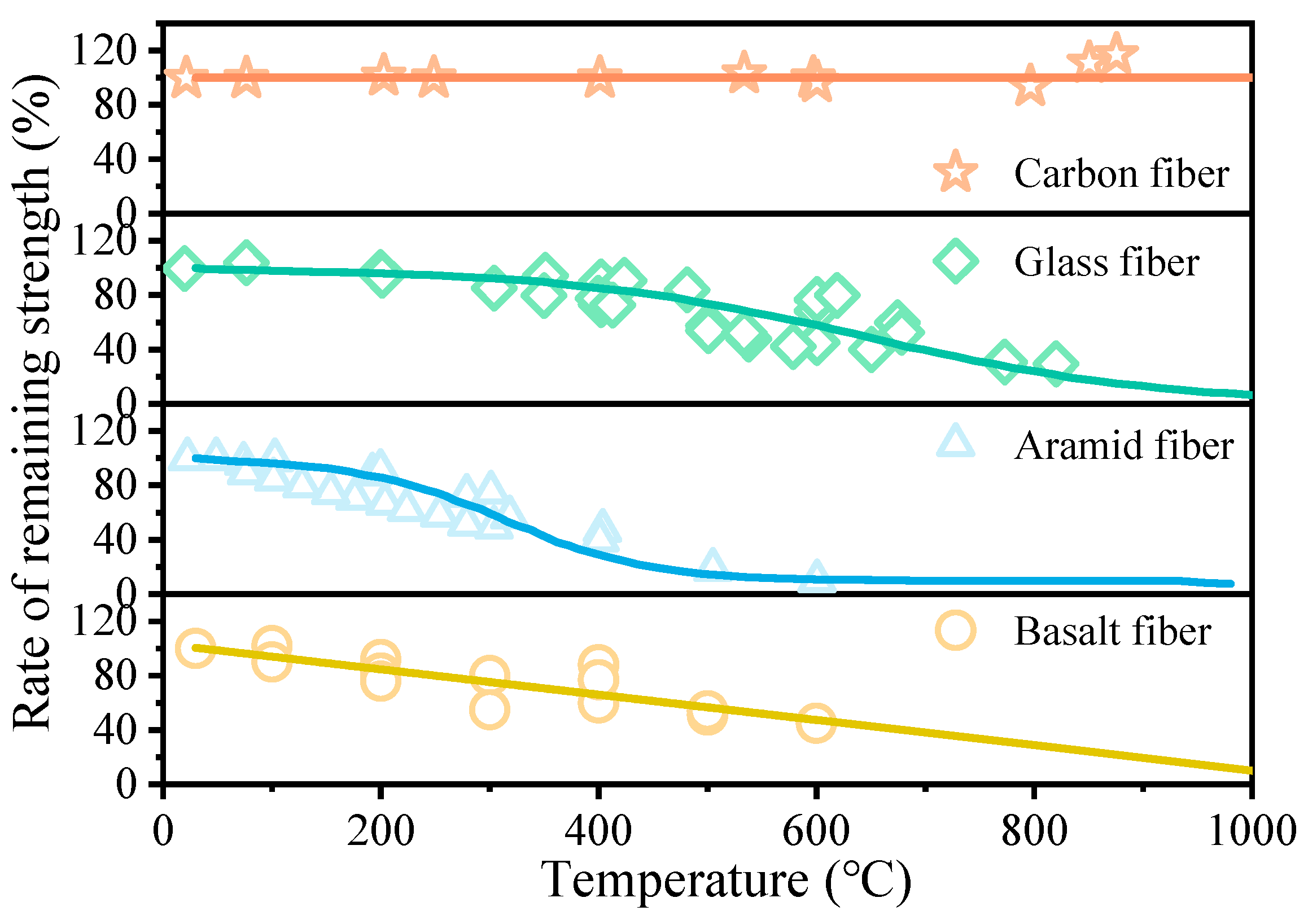
2.1. Mechanical Properties of Fiber at Elevated Temperature
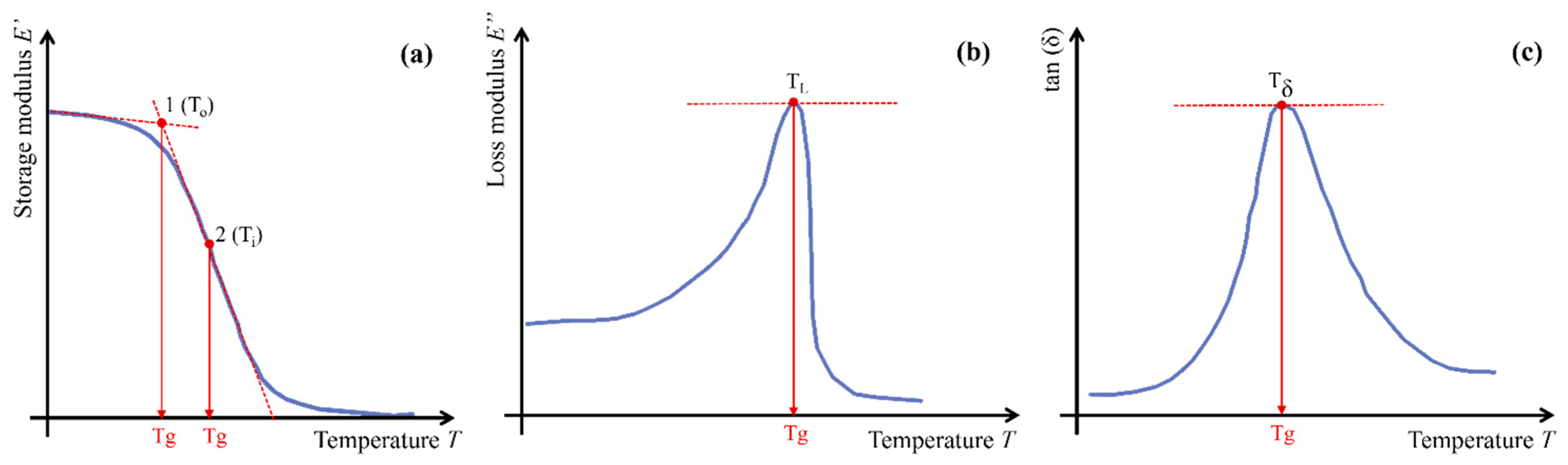
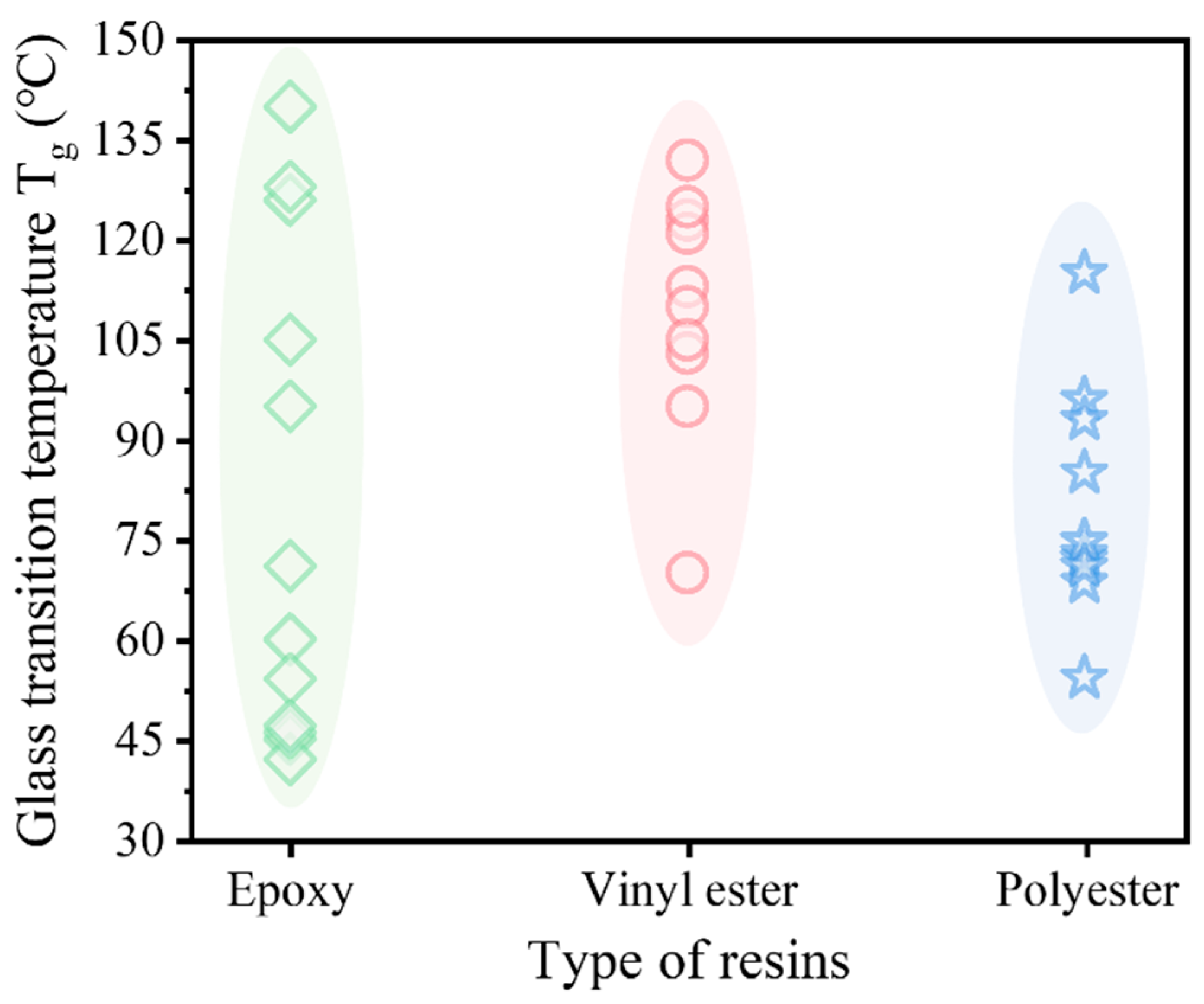
2.2. Mechanical Properties of Organic Matrix at Elevated Temperature
2.3. Mechanical Properties of FRP Composite Structures
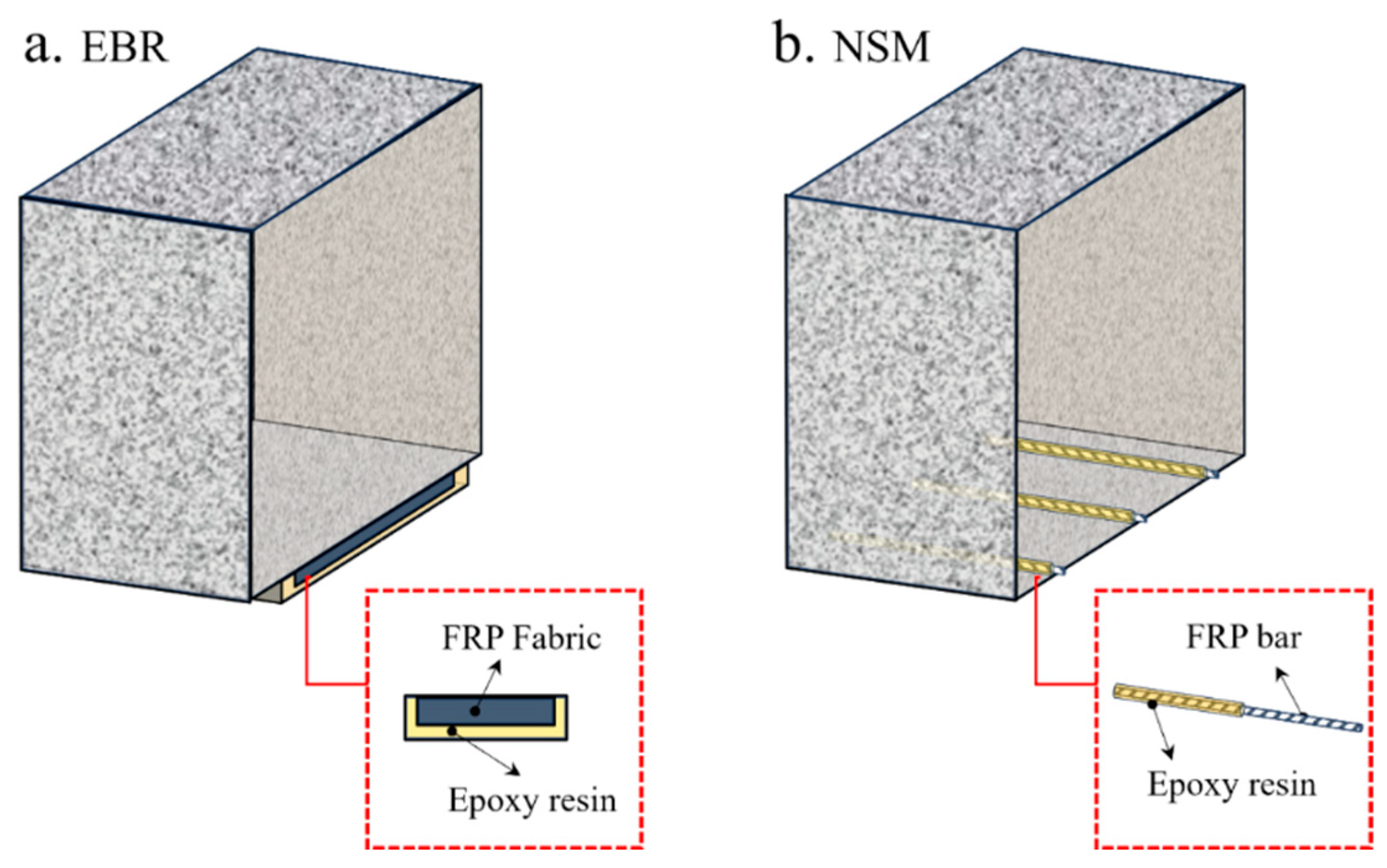
2.3.1. FRP-Based External Strengthening Materials
2.3.2. FRP Reinforcing Bars
2.4. Summary
3. Strategies for Enhancing Fire Resistance of FRP Structures
3.1. Comparative Analysis of Organic and Inorganic Binders
3.1.1. Bonding Strength with Beam

| Ref | Fiber Layer | Adhesive Type | Fy (kN) | Fu (kN) | Δy (mm) | Δu (mm) | Δu/Δy | Failure Mode |
|---|---|---|---|---|---|---|---|---|
| [96] | 2 | Epoxy resin | 18.9 | 27.8 | 7.3 | 15.6 | 2.1 | FD |
| 3 | 19.9 | 27.9 | 7.6 | 15.9 | 2.1 | |||
| 4 | 22.3 | 32.9 | 8.3 | 16.9 | 2.0 | |||
| 2 | Geopolymer | 18.5 | 22.6 | 6.5 | 10.7 | 1.6 | FR | |
| 3 | 22.9 | 27.8 | 7.7 | 14.5 | 1.9 | |||
| 4 | 25.3 | 32.8 | 8.5 | 15.6 | 1.8 | |||
| [100] | 3 | Cement | 40.7 | 52.9 | 7.1 | 12.4 | 1.8 | FR |
| 4 | 45.5 | 55.4 | 7.0 | 13.1 | 1.9 | FR | ||
| 5 | 50.1 | 62.3 | 6.8 | 13.2 | 2.0 | FD | ||
| 6 | 52.3 | 63.2 | 7.2 | 12.1 | 1.7 | FD | ||
| [95] | 0 | Cement | 57.8 | 74.5 | 11.0 | 94.0 | 8.55 | Flexural |
| 2 | 73.4 | 80.5 | 13.0 | 20.1 | 1.6 | FR | ||
| 3 | 75.6 | 91.9 | 12.9 | 23.3 | 1.8 | FR | ||
| 5 | 84.5 | 110.1 | 14.0 | 24.1 | 1.7 | FR | ||
| [75] | 1 | Epoxy resin | 185 | 220 | 7.0 | 14.0 | 2 | FR |
| 1 | Geopolymer | 200 | 230 | 7.3 | 11.5 | 1.6 | FR | |
| 2 | 245 | 270 | 8.0 | 11.2 | 1.4 | FR | ||
| [94] | 1 | Magnesium phosphate cement | 34.6 | 0.508 | Flexural | |||
| Magnesium oxychloride cement | 34.3 | 0.57 | Flexural | |||||
| Geopolymer | 21.2 | 0.155 | Flexural | |||||
| Polymer-modified mortar | 33.5 | 0.404 | Flexural | |||||
| Epoxy resin | 53.3 | 1.018 | Shear | |||||
| [98] | NSM | Epoxy resin | 36.8 | 53.3 | Rod pull-out | |||
| Mortar | 35.3 | 43.9 | Debonding at adhesive-concrete interface | |||||
| [101] | NSM | Epoxy resin | 150.7 | 34.8 | Debonding of concrete cover | |||
| [99] | Self-compacting cement | 134.3 | 106.4 | FR | ||||
| [100] | NSM | Cement | 93.9 | 114.5 | 35.7 | FD | ||
| 127.9 | 140.9 | 22.9 | FD |
3.1.2. Effect of High Temperature on Bonding Properties
| Ref | Dimension of Specimen (mm) | Concrete | Adhesive | FRP | F (kN) | T (°C) | Exposure Duration (min) | |||||||||
|---|---|---|---|---|---|---|---|---|---|---|---|---|---|---|---|---|
| fcc (MPa) | ftc (MPa) | Groove w × h (mm) | fca (MPa) | fta (MPa) | Type | Type | ffu (MPa) | Ef (GPa) | Δ (%) | Cross-Section w × t (mm) | Bonding Length (mm) | |||||
| [102] | 60 × 60 × 100 | C25/C30 | 4 × 11 | N/A | N/A | Inorganic | CFRP plate | 2800 | 165 | 10 × 1.2 | 70/90 | 0.40 | 530 | 20.22 | ||
| 0.84 | 632.6 | 23.3 | ||||||||||||||
| N/A | 81.4 | Organic | 0.40 | 837.8 | ||||||||||||
| 0.84 | 543.7 | |||||||||||||||
| [103] | 75 × 75 × 250 | 41 | 3.84 | 4 × 18 | 88 | 6.2 | Inorganic | CFRP textile | 1500 | 135 | 14 × 1.5 | 50 | 4.57 | 240 | N/A | |
| 100 | 5.62 | 250 | ||||||||||||||
| 60 | 30 | Organic | 50 | 5.67 | 140 | |||||||||||
| [101] | 75 × 75 × 250 | 32 | 3.6 | 5 × 30 | 113 | 14.3 | Inorganic | CFRP strip | 3697 | 210 | 1.74 | 20 × 1.52 | 180 | 34.53 | 21 | N/A |
| 21.24 | 400 | |||||||||||||||
| 6.53 | 600 | |||||||||||||||
| 3.14 | 700 | |||||||||||||||
| 2.82 | 800 | |||||||||||||||
| [104] | 100 × 100 × 200 | 10 × 20 | 78.59 | Inorganic | CFRP | 1909 | 171 | 10 × 1.4 | 125 | 6 | 383.7 | |||||
| 6 | 455.5 | |||||||||||||||
| [105] | 40 × 40 × 160 | 49.7 | N/A | EBR | N/A | N/A | Inorganic Organic | CFRP sheet | 3085 | N/A | N/A | 40 (wide) | 30 | 3.61 | 20 | N/A |
| 1.79 | 100 | |||||||||||||||
| 1.73 | 200 | |||||||||||||||
| 1.74 | 300 | |||||||||||||||
| 3.94 | 20 | |||||||||||||||
| 1.51 | 50 | |||||||||||||||
| 0.76 | 100 | |||||||||||||||
| 0.11 | 150 | |||||||||||||||
| [75] | 100 × 100 × 100 | 30.95 | N/A | EBR | 35 | N/A | N/A | CFRP | 4125 | 244 | 1.71 | 70 × 0.167 | 100 | 13.7 | RT | N/A |
| 9.87 | 105 | |||||||||||||||
| 8.89 | 200 | |||||||||||||||
| 7.49 | 300 | |||||||||||||||
| 5.53 | 400 | |||||||||||||||
| 2.87 | 500 | |||||||||||||||
| [106] | 160 × 160 × 1500 | 33.7 | N/A | EBR | 80.88 | 3.24 | N/A | CFRP | 4125 | 244 | 1.71 | 70 × 0.167 | 325 | 11.61 | 100 | N/A |
| 325 | 10.55 | 200 | ||||||||||||||
| 325 | 13.98 | 300 | ||||||||||||||
| 325 | 10.67 | 400 | ||||||||||||||
| 300 | 12.59 | 500 | ||||||||||||||
3.1.3. Thermal Performance of FRP Strengthening Beam
| Ref | Dimension of Specimen l × w × h (mm) | Strengthen Technique | FRP Type | Adhesive | Thermal Insulation (mm) | Applied Load/Unstrengthened Ultimate Capacity (%) | Applied Load/Strengthened Ultimate Capacity (%) | Heating Rate (°C/min) | T (°C) | Fire Resistance Period (min) | |
|---|---|---|---|---|---|---|---|---|---|---|---|
| fca (MPa) | fta (MPa) | ||||||||||
| [107] | 1600 × 120 × 180 | EBR | CFRP textile | 65 | 6.8 | 0 | 57.8–59.4 | 41.1–41.9 | 20 | 100 | |
| [108] | 5300 × 250 × 400 | EBR | CFRP sheet | 10 | 50 | ISO834 | 80–200 | 20–60 | |||
| [110] | 3300 × 150 × 300 | EBR | CFRP textile | 113.3 | 15 | 60 | ISO834 | 380–430 | 150 | ||
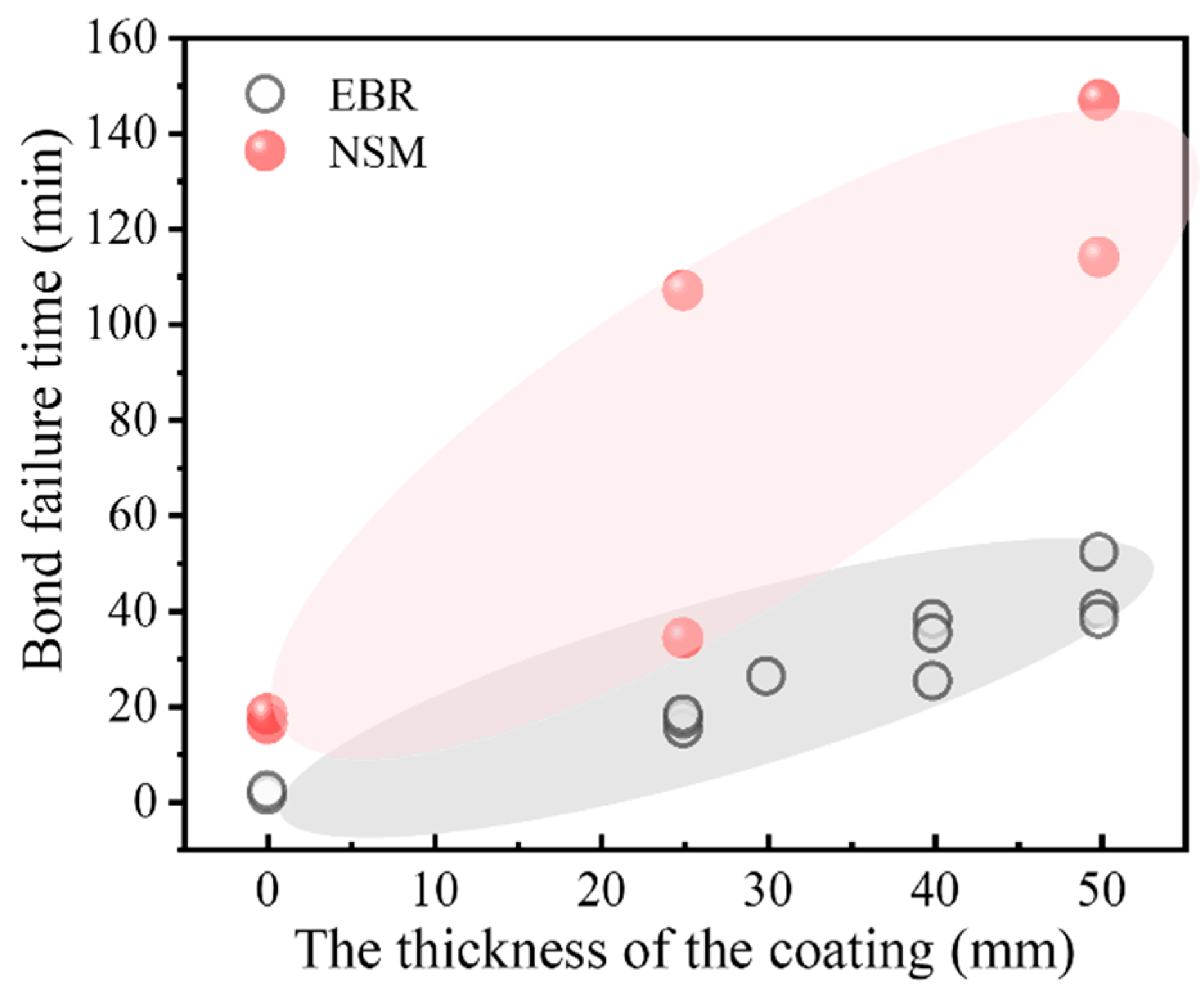
| [70] | 1500 × 100 × 120 | NSM | CFRP strips | 6.6 | 25 | 78 | 37 | ISO834 | 88.5–279 | 17–114 | |
| 50 | |||||||||||
| [73] | 3000 × 200 × 300 | NSM | CFRP rod | 4.1 | 20 | 63–71 | 37–54 | ISO834 | 163 | 60 (just heat 1 h) | |
| [112] | 3900 × 200 × 450 | NSM | CFRP rod | 52.4/41.9 | 0 | 77.1 | 50 | ISO834 | 94–126 | ||
| [113] | 2600 × 200 × 300 | NSM EBR | CFRP strips | 109.2 | 10.5 | 2 | 85–115 | 54–73 | ISO834 | 85–580 | 72–180 |
| 55 | 3.75 | 10 | |||||||||
| 13.6 | 3.79 | 25 | |||||||||
| [64] | 1524 × 254 × 102 | NSM EBR | CFRP tape | 0 | 166 | 59.9–77.4 | 10–20 | 100 | 300 not fail * | ||
| 200 | 74.5 | ||||||||||
3.1.4. Thermal Performance of FRP Confined Columns
| Ref | Dimension of Specimen d × h (mm) | Strengthen Technique | FRP Type | Adhesive Type | Thermal Insulation | Heating Rate (°C/min) | Heating Time (min) | Strengthened Ultimate Strength/ Unstrengthened Ultimate Strength (%) | Strengthened Ultimate Strain/ Unstrengthened Ultimate Strain (%) | |
|---|---|---|---|---|---|---|---|---|---|---|
| Type | Thickness (mm) | |||||||||
| [114] | 400 × 3180 | EBR | CFRP | Epoxy resin | cementitious matrix | 53 | ASTM E119 | 300 | \ | 75 |
| [115] | 200 × 800 | EBR | Bidirectional PBO | cementitious matrix | cementitious matrix | 30 | ASTM E119 | 130 | \ | 169.2 |
| [119] | 242 × 900 | EBR | CFRP | Epoxy resin | cementitious matrix | 30 | ASTM E119 | 300 | 175.8 | 147.6 |
| [118] | 100 × 200 | EBR | Bidirectional jute and basalt fiber | Epoxy resin | \ | \ | 10 °C/min | 40 + 120 (held) (held) | 131.0 | 159.5 |
| 100 × 200 | EBR | Bidirectional jute and basalt fiber | cementitious matrix | \ | \ | 10 °C/min | 40 + 120 (held) | 160.1 | 167.7 | |
| [120] | 200 × 600 | EBR | CFRP | Epoxy resin | ECC | 25 | ISO-834 | 30 | 175.8 | 372.5 |
| 200 × 600 | EBR | CFRP | Epoxy resin | concrete | 25 | ISO-834 | 30 | 176.8 | 293.3 | |
| 200 × 600 | EBR | CFRP | None | ECC | 25 | ISO-834 | 30 | 185.8 | 239.5 | |
| [121] | 150 × 500 | NSM | BFRP | Epoxy resin | UHPC | 20 | 2.5 °C/min | 200 | 131.2 | 88.0 |
| 150 × 500 | NSM | BFRP | Epoxy resin | UHPC | 20 | 2.5 °C/min | 300 | 140.9 | 86.1 | |
| [122] | 200 × 800 | EBR | Bidirectional PBO | cementitious matrix | cementitious matrix | 40 | ASTM E119 | 180 | \ | 27 |
| 200 × 800 | EBR | Bidirectional PBO | cementitious matrix | intumescent paint | <3 | ASTM E119 | 180 | \ | 128.1 | |
3.2. Fire Resistance Coatings
3.3. Summary
4. Conclusions
- (1)
- The fire resistance of FRP systems is fundamentally constrained by the low Tg of the polymer matrix and adhesive, typically below 100 °C. Consequently, the governing failure mode is the premature loss of interfacial bond rather than fiber rupture. While alternative binders, including specialty high-Tg resins (e.g., phenolic or cyanate esters) and inorganic matrices, offer improved thermal stability, they currently exhibit limitations in ductility, cost, or processing that prevent them from serving as standalone solutions for all engineering scenarios.
- (2)
- The presence and integrity of fire insulation are the dominant factors determining the fire survival time of both EBR and NSM-strengthened members, overshadowing the inherent differences between the two strengthening configurations. Adequate insulation thickness (e.g., 20–50 mm) can extend fire resistance from tens of minutes to 2–4 h. Without such protection, the structural efficacy of the FRP-concrete interface—even in NSM systems with partial concrete cover—is typically compromised within a very short duration upon reaching critical temperatures.
5. Prospects
- (1)
- Develop high-thermal-stability matrices (e.g., high-Tg epoxies, hybrid organic-inorganic binders) and advanced surface treatments (e.g., nano-coatings, sand-coated textures) to enhance bond retention and mitigate thermal mismatch with concrete at elevated temperatures.
- (2)
- Conduct high-load-ratio fire tests incorporating realistic constraint effects (e.g., thermal expansion, restraint-induced stresses) to simulate real-world structural behavior and establish failure criteria for FRP-concrete systems. It is imperative to capture the true creep behavior and failure precursors of FRP systems under service loads.
- (3)
- Establish standardized testing protocols and performance-based design frameworks to resolve inconsistencies in existing studies, particularly regarding strengthening configurations, adhesive types, and interfacial mechanics.
- (4)
- The development of thin, high-efficiency fire-protective coatings (e.g., intumescent materials, nanocomposite insulators) should be accelerated to achieve comparable or superior thermal insulation performance at reduced thicknesses, particularly by enhancing early-stage fire resistance to mitigate epoxy resin degradation during critical initial fire phases. Additionally, hybrid systems integrating coatings with lightweight insulating materials should be explored to balance cost-effectiveness, constructability, and fire endurance through synergistic performance optimization.
- (5)
- Prioritize protection of critical zones (e.g., anchorage regions, beam-column joints) to promote FRP cable mechanisms and delay debonding. Concurrently, develop post-fire assessment guidelines addressing residual strength and repair strategies, as FRP lacks the recovery capacity of steel after cooling.
- (6)
- Establish temperature-dependent constitutive models and bond-slip relationships to enable reliable numerical simulations of FRP–concrete systems under coupled thermal-mechanical loads. Machine learning-driven predictive tools could further optimize fire design parameters.
Author Contributions
Funding
Institutional Review Board Statement
Data Availability Statement
Conflicts of Interest
References
- Tan, Y. Hong Kong Leader Orders Investigation into Deadly Fire That Killed 151. BBC News, 2 December 2025. Available online: https://www.bbc.co.uk/news/articles/ce8ng18p7v3o (accessed on 19 December 2025).
- Song, A. Fire Ravages Shanghai Skyscraper. NBC News, 16 November 2010. Available online: https://www.nbcnews.com/slideshow/amp/fire-ravages-shanghai-skyscraper-40196455 (accessed on 19 December 2025).
- Ahmed, A.; Guo, S.; Zhang, Z.; Shi, C.; Zhu, D. A review on durability of fiber reinforced polymer (FRP) bars reinforced seawater sea sand concrete. Constr. Build. Mater. 2020, 256, 119484. [Google Scholar] [CrossRef]
- Zaman, A.; Gutub, S.A.; Wafa, M.A. A review on FRP composites applications and durability concerns in the construction sector. J. Reinf. Plast. Compos. 2013, 32, 1966–1988. [Google Scholar] [CrossRef]
- Zhang, B.; Teng, J.; Yu, T. Experimental behavior of hybrid FRP–concrete–steel double-skin tubular columns under combined axial compression and cyclic lateral loading. Eng. Struct. 2015, 99, 214–231. [Google Scholar] [CrossRef]
- Naser, M.; Hawileh, R.; Abdalla, J. Fiber-reinforced polymer composites in strengthening reinforced concrete structures: A critical review. Eng. Struct. 2019, 198, 109542. [Google Scholar] [CrossRef]
- Teng, J.-G.; Chen, J.-F.; Smith, S.T.; Lam, L. FRP: Strengthened RC Structures; Wiley: Hoboken, NJ, USA, 2002. [Google Scholar]
- Bank, L.C. Composites for Construction: Structural Design with FRP Materials; John Wiley & Sons: Hoboken, NJ, USA, 2006. [Google Scholar]
- Ye, Z.; Zhao, D.; Sui, L.; Huang, Z.; Zhou, X. Behaviors of large-rupture-strain fiber-reinforced polymer strengthened reinforced concrete beams under static and impact loads. Front. Mater. 2020, 7, 578749. [Google Scholar] [CrossRef]
- Chellapandian, M.; Prakash, S.S.; Sharma, A. Experimental and finite element studies on the flexural behavior of reinforced concrete elements strengthened with hybrid FRP technique. Compos. Struct. 2019, 208, 466–478. [Google Scholar] [CrossRef]
- Krishna, G.V.; Narayanamurthy, V.; Viswanath, C. Effectiveness of FRP strengthening on buckling characteristics of metallic cylindrical shells. Compos. Struct. 2021, 262, 113653. [Google Scholar] [CrossRef]
- Al-Saawani, M.A.; El-Sayed, A.K.; Al-Negheimish, A. Effect of shear-span/depth ratio on debonding failures of FRP-strengthened RC beams. J. Build. Eng. 2020, 32, 101771. [Google Scholar]
- Dong, Z.; Sun, Y.; Wu, G.; Zhu, H.; Zhao, X.-L.; Wei, Y.; Zhang, P. Flexural behavior of seawater sea-sand concrete beams reinforced with BFRP bars/grids and BFRP-wrapped steel tubes. Compos. Struct. 2021, 268, 113956. [Google Scholar]
- Al-Saadi, A.U.; Aravinthan, T.; Lokuge, W. Structural applications of fibre reinforced polymer (FRP) composite tubes: A review of columns members. Compos. Struct. 2018, 204, 513–524. [Google Scholar] [CrossRef]
- Keller, T.; Haas, C.; Vallée, T. Structural concept, design, and experimental verification of a glass fiber-reinforced polymer sandwich roof structure. J. Compos. Constr. 2008, 12, 454–468. [Google Scholar] [CrossRef]
- Al-Saadi, N.T.K.; Mohammed, A.; Al-Mahaidi, R.; Sanjayan, J. A state-of-the-art review: Near-surface mounted FRP composites for reinforced concrete structures. Constr. Build. Mater. 2019, 209, 748–769. [Google Scholar]
- Wang, T.; Yang, F.; Jiang, R. Degradation of mechanical properties of FRP bars under coupled environmental and load effects: A review. Case Stud. Constr. Mater. 2025, 22, e04764. [Google Scholar] [CrossRef]
- Tatar, J.; Milev, S. Durability of Externally Bonded Fiber-Reinforced Polymer Composites in Concrete Structures: A Critical Review. Polymers 2021, 13, 765. [Google Scholar] [CrossRef]
- Lau, D.; Qiu, Q.; Zhou, A.; Chow, C.L. Long term performance and fire safety aspect of FRP composites used in building structures. Constr. Build. Mater. 2016, 126, 573–585. [Google Scholar] [CrossRef]
- Bai, Y.; Vallée, T.; Keller, T. Modeling of thermal responses for FRP composites under elevated and high temperatures. Compos. Sci. Technol. 2008, 68, 47–56. [Google Scholar] [CrossRef]
- Ge, W.; Chen, K.; Guan, Z.; Ashour, A.; Lu, W.; Cao, D. Eccentric compression behaviour of concrete columns reinforced with steel-FRP composite bars. Eng. Struct. 2021, 238, 112240. [Google Scholar] [CrossRef]
- Correia, J.R.; Bai, Y.; Keller, T. A review of the fire behaviour of pultruded GFRP structural profiles for civil engineering applications. Compos. Struct. 2015, 127, 267–287. [Google Scholar] [CrossRef]
- Karataş, M.A.; Gökkaya, H. A review on machinability of carbon fiber reinforced polymer (CFRP) and glass fiber reinforced polymer (GFRP) composite materials. Def. Technol. 2018, 14, 318–326. [Google Scholar] [CrossRef]
- Bisby, L.A. Fire Behaviour of Fibre-Reinforced Polymer (FRP) Reinforced or Confined Concrete. Ph.D. Thesis, Queen’s University Kingston (Kanada), Kingston, ON, Canada, 2003. [Google Scholar]
- Feih, S.; Mouritz, A. Tensile properties of carbon fibres and carbon fibre–polymer composites in fire. Compos. Part A Appl. Sci. Manuf. 2012, 43, 765–772. [Google Scholar]
- Proença, M.; Garrido, M.; Correia, J.; Gomes, M. Fire resistance behaviour of GFRP-polyurethane composite sandwich panels for building floors. Compos. Part B Eng. 2021, 224, 109171. [Google Scholar]
- Monaldo, E.; Nerilli, F.; Vairo, G. Basalt-based fiber-reinforced materials and structural applications in civil engineering. Compos. Struct. 2019, 214, 246–263. [Google Scholar]
- Xing, D.; Chang, C.; Xi, X.-Y.; Hao, B.; Zheng, Q.; Gutnikov, S.I.; Lazoryak, B.I.; Ma, P.-C. Morphologies and mechanical properties of basalt fibre processed at elevated temperature. J. Non-Cryst. Solids 2022, 582, 121439. [Google Scholar]
- Wang, Q.; Zhang, Q.; Luo, L.; Yan, T.; Liu, J.; Ding, L.; Jiang, W. Effects of high-temperature treatment and iron reduction index on tensile strength of basalt continuous fiber. J. Non-Cryst. Solids 2021, 564, 120836. [Google Scholar] [CrossRef]
- Militký, J.; Mishra, R.; Jamshaid, H. 20—Basalt fibers. In Handbook of Properties of Textile and Technical Fibres, 2nd ed.; Bunsell, A.R., Ed.; Woodhead Publishing: Sawston, UK, 2018; pp. 805–840. [Google Scholar]
- Dimitrienko, Y.I. Modelling of carbon–carbon composite manufacturing processes. Compos. Part A Appl. Sci. Manuf. 1999, 30, 221–230. [Google Scholar]
- Sumida, A.; Fujisaki, T.; Watanabe, K.; Kato, T. Heat resistance of continuous fiber reinforced plastic rods. In FRPRCS-5: Fibre-Reinforced Plastics for Reinforced Concrete Structures Volume 1: Proceedings of the Fifth International Conference on Fibre-Reinforced Plastics for Reinforced Concrete Structures, Cambridge, UK, 16–18 July 2001; Thomas Telford Publishing: London, UK, 2001; pp. 557–565. [Google Scholar]
- Rostasy, F.S.; Budelmann, H.; Hankers, C. Faserverbundwerkstoffe im Stahlbeton-und Spannbetonbau. Beton Stahlbetonbau 1992, 87, 123–129. [Google Scholar]
- Sen, R.; Mariscal, D.; Shahawy, M. Investigation of S-2 glass/epoxy strands in concrete. Am. Concr. Inst. 1993, 138, 15–34. [Google Scholar]
- Rehm, G.; Franke, L.; Patzak, M. Zur Frage der Krafteinleitung in Kunstharzgebundene Glasfaserstäbe; Ernst & Sohn: Berlin, Germany, 1979. [Google Scholar]
- Ke, L.; Li, C.; He, J.; Dong, S.; Chen, C.; Jiao, Y. Effects of elevated temperatures on mechanical behavior of epoxy adhesives and CFRP-steel hybrid joints. Compos. Struct. 2020, 235, 111789. [Google Scholar] [CrossRef]
- Saafi, M. Effect of fire on FRP reinforced concrete members. Compos. Struct. 2002, 58, 11–20. [Google Scholar] [CrossRef]
- Zhang, Y.; Vassilopoulos, A.P.; Keller, T. Effects of low and high temperatures on tensile behavior of adhesively-bonded GFRP joints. Compos. Struct. 2010, 92, 1631–1639. [Google Scholar] [CrossRef]
- Michels, J.; Widmann, R.; Czaderski, C.; Allahvirdizadeh, R.; Motavalli, M. Glass transition evaluation of commercially available epoxy resins used for civil engineering applications. Compos. Part B Eng. 2015, 77, 484–493. [Google Scholar]
- Cao, S.; Zhis, W.; Wang, X. Tensile properties of CFRP and hybrid FRP composites at elevated temperatures. J. Compos. Mater. 2009, 43, 315–330. [Google Scholar] [CrossRef]
- Ji, H.-B.; Zhang, H.; Zheng, H.; Sun, Y.-L.; Li, K. Study on conditions for determining the glass transition temperature of shellac resin by differential scanning calorimetry. Mater. Rev. 2014, 28, 98–104+121. [Google Scholar]
- ISO 6721-11: 2019; Plastics: Determination of Dynamic Mechanical Properties—Part 11: Glass Transition Temperature. International Organization for Standardization: Geneva, Switzerland, 2019.
- Korayem, A.H.; Chen, S.J.; Zhang, Q.H.; Li, C.Y.; Zhao, X.L.; Duan, W.H. Failure of CFRP-to-steel double strap joint bonded using carbon nanotubes modified epoxy adhesive at moderately elevated temperatures. Compos. Part B Eng. 2016, 94, 95–101. [Google Scholar]
- Yu, B. Material and Structural Performance of Fiber-Reinforced Polymer Composites at Elevated and High Temperatures. Ph.D. Thesis, École Polytechnique Fédérale de Lausanne, Lausanne, Switzerland, 2009. [Google Scholar]
- Korayem, A.H.; Barati, M.R.; Simon, G.P.; Zhao, X.L.; Duan, W.H. Reinforcing brittle and ductile epoxy matrices using carbon nanotubes masterbatch. Compos. Part A Appl. Sci. Manuf. 2014, 61, 126–133. [Google Scholar] [CrossRef]
- Xian, G.; Karbhari, V.M. Segmental relaxation of water-aged ambient cured epoxy. Polym. Degrad. Stab. 2007, 92, 1650–1659. [Google Scholar] [CrossRef]
- Goyal, S.; Cochran, E.W. Cyanate ester composites to improve thermal performance: A review. Polym. Int. 2022, 71, 583–589. [Google Scholar] [CrossRef]
- Kumar, S.; Samal, S.K.; Mohanty, S.; Nayak, S.K. Recent Development of Biobased Epoxy Resins: A Review. Polym.-Plast. Technol. Eng. 2018, 57, 133–155. [Google Scholar] [CrossRef]
- Ramadan, N.; Taha, M.; La Rosa, A.D.; Elsabbagh, A. Towards Selection Charts for Epoxy Resin, Unsaturated Polyester Resin and Their Fibre-Fabric Composites with Flame Retardants. Materials 2021, 14, 1181. [Google Scholar] [CrossRef]
- Plecnik, J.M.; Plecnik, J.M.; Fogarty, J.H.; Kurfees, J.R. Behavior of epoxy repaired beams under fire. J. Struct. Eng. 1986, 112, 906–922. [Google Scholar] [CrossRef]
- Benmokrane, B.; Ali, A.H.; Mohamed, H.M.; ElSafty, A.; Manalo, A. Laboratory assessment and durability performance of vinyl-ester, polyester, and epoxy glass-FRP bars for concrete structures. Compos. Part B Eng. 2017, 114, 163–174. [Google Scholar] [CrossRef]
- Iftikhar, A.; Manalo, A.; Senselova, Z.; Ferdous, W.; Peerzada, M.; Seligmann, H.; Nguyen, K.; Benmokrane, B. Effects of resin types on the durability of single yarn polymer composites exposed to hygrothermal environment. Compos. Part C Open Access 2025, 18, 100676. [Google Scholar] [CrossRef]
- Shahid, A.T.; Garrido, M.; Correia, J.R. Durability under natural outdoor weathering of sustainable composites developed with bio-based unsaturated polyester and epoxy resins reinforced with glass, basalt, and carbon fibres. Constr. Build. Mater. 2025, 505, 144651. [Google Scholar] [CrossRef]
- Sousa, J.M.; Garrido, M.; Correia, J.R.; Cabral-Fonseca, S. Hygrothermal ageing of pultruded GFRP profiles: Comparative study of unsaturated polyester and vinyl ester resin matrices. Compos. Part A Appl. Sci. Manuf. 2021, 140, 106193. [Google Scholar] [CrossRef]
- Spagnuolo, S.; Meda, A.; Rinaldi, Z.; Nanni, A. Residual behaviour of glass FRP bars subjected to high temperatures. Compos. Struct. 2018, 203, 886–893. [Google Scholar] [CrossRef]
- Wu, C.; Meng, B.C.; Tam, L.-h.; He, L. Yellowing mechanisms of epoxy and vinyl ester resins under thermal, UV and natural aging conditions and protection methods. Polym. Test. 2022, 114, 107708. [Google Scholar] [CrossRef]
- Yadav, A.; Ganesh Gupta K, B.N.V.S.; Fulmali, A.O.; Prusty, R.K.; Ray, B.C. Effect of cure kinetics and nanomaterials on glass fiber/vinyl ester composites: An assessment on mechanical, thermal and fracture morphology. Mater. Today Proc. 2020, 33, 4937–4941. [Google Scholar] [CrossRef]
- Lanzón, M.; Castellón, F.J.; Ayala, M. Effect of the expanded perlite dose on the fire performance of gypsum plasters. Constr. Build. Mater. 2022, 346, 128494. [Google Scholar] [CrossRef]
- Hin, Y.-Z. Fire Resistance Rating and Post-Fire Flexural Performance of Reinforced Concrete Beams Strengthened with Externally Bonded CFRP. Master’s Thesis, Tianjin University, Tianjin, China, 2018. [Google Scholar]
- Liu, Z.-Q.; Yue, Q.-R.; Li, R. Development status of fire resistance research on FRP-strengthened reinforced concrete beams. Ind. Constr. 2020, 50, 102–111. [Google Scholar] [CrossRef]
- GB 50608-2010; Technical Code for Infrastructure Application of FRP Composites. Building Press: Beijing, China, 2010; p. 195.
- Firmo, J.P.; Correia, J.R.; França, P. Fire behaviour of reinforced concrete beams strengthened with CFRP laminates: Protection systems with insulation of the anchorage zones. Compos. Part B Eng. 2012, 43, 1545–1556. [Google Scholar]
- ISO 834-1:1999; Fire-Resistance Tests—Elements of Building Construction—Part 1: General Requirements. International Organization for Standardization: Geneva, Switzerland, 1999.
- Burke, P.J.; Bisby, L.A.; Green, M.F. Effects of elevated temperature on near surface mounted and externally bonded FRP strengthening systems for concrete. Cem. Concr. Compos. 2013, 35, 190–199. [Google Scholar] [CrossRef]
- Li, Y.; Liu, X.; Wu, M. Mechanical properties of FRP-strengthened concrete at elevated temperature. Constr. Build. Mater. 2017, 134, 424–432. [Google Scholar] [CrossRef]
- Yu, B.; Kodur, V. Fire behavior of concrete T-beams strengthened with near-surface mounted FRP reinforcement. Eng. Struct. 2014, 80, 350–361. [Google Scholar] [CrossRef]
- ASTM E119-20; Standard Test Methods for Fire Tests of Building Construction and Materials. ASTM International: West Conshohocken, PA, USA, 2020.
- Ahmed, A.; Kodur, V. The experimental behavior of FRP-strengthened RC beams subjected to design fire exposure. Eng. Struct. 2011, 33, 2201–2211. [Google Scholar] [CrossRef]
- Wu, B.; Wan, Z.-J. Fire resistance tests on RC beams strengthened in flexure with CFRP sheets. J. South China Univ. Technol. (Nat. Sci. Ed.) 2009, 37, 76–82+88. [Google Scholar]
- Firmo, J.; Correia, J. Fire behaviour of thermally insulated RC beams strengthened with NSM-CFRP strips: Experimental study. Compos. Part B Eng. 2015, 76, 112–121. [Google Scholar]
- Azevedo, A.; Firmo, J.; Correia, J.; Chastre, C.; Biscaia, H.; Franco, N. Fire behaviour of CFRP-strengthened RC slabs using different techniques–EBR, NSM and CREatE. Compos. Part B Eng. 2022, 230, 109471. [Google Scholar] [CrossRef]
- Palmieri, A.; Matthys, S.; Taerwe, L. Experimental investigation on fire endurance of insulated concrete beams strengthened with near surface mounted FRP bar reinforcement. Compos. Part B Eng. 2012, 43, 885–895. [Google Scholar] [CrossRef]
- Palmieri, A.; Matthys, S.; Taerwe, L. Fire endurance and residual strength of insulated concrete beams strengthened with near-surface mounted reinforcement. J. Compos. Constr. 2013, 17, 454–462. [Google Scholar] [CrossRef]
- Zhu, H.; Wu, G.; Zhang, L.; Zhang, J.; Hui, D. Experimental study on the fire resistance of RC beams strengthened with near-surface-mounted high-Tg BFRP bars. Compos. Part B Eng. 2014, 60, 680–687. [Google Scholar]
- Azevedo, A.S.; Firmo, J.P.; Correia, J.R.; Tiago, C. Influence of elevated temperatures on the bond behaviour between concrete and NSM-CFRP strips. Cem. Concr. Compos. 2020, 111, 103603. [Google Scholar] [CrossRef]
- Firmo, J.; Correia, J.; Pitta, D.; Tiago, C.; Arruda, M. Experimental characterization of the bond between externally bonded reinforcement (EBR) CFRP strips and concrete at elevated temperatures. Cem. Concr. Compos. 2015, 60, 44–54. [Google Scholar] [CrossRef]
- Park, R.; Gamble, W.L. Reinforced Concrete Slabs; John Wiley & Sons: Hoboken, NJ, USA, 1999. [Google Scholar]
- Shi, X.-D.; Guo, Z.-H. Experimental study on the mechanical behavior of reinforced concrete at high temperature. China Civ. Eng. J. 2000, 6, 6–16. [Google Scholar]
- Hamad, R.J.; Johari, M.M.; Haddad, R.H. Mechanical properties and bond characteristics of different fiber reinforced polymer rebars at elevated temperatures. Constr. Build. Mater. 2017, 142, 521–535. [Google Scholar] [CrossRef]
- Özkal, F.M.; Polat, M.; Yağan, M.; Öztürk, M.O. Mechanical properties and bond strength degradation of GFRP and steel rebars at elevated temperatures. Constr. Build. Mater. 2018, 184, 45–57. [Google Scholar] [CrossRef]
- Wang, Y.C.; Kodur, V. Variation of strength and stiffness of fibre reinforced polymer reinforcing bars with temperature. Cem. Concr. Compos. 2005, 27, 864–874. [Google Scholar] [CrossRef]
- Qin, W.; Liu, X.; Xi, Z.; Huang, Z.; Al-Mansour, A.; Fernand, M. Experimental research on the progressive collapse resistance of concrete beam-column sub-assemblages reinforced with steel-FRP composite bar. Eng. Struct. 2021, 233, 111776. [Google Scholar]
- Sun, Y.; Wu, T.; Liu, X.; Zhang, B. Failure mode and flexural capacity of concrete beams prestressed with unbonded FRP tendons. Compos. Struct. 2022, 283, 114956. [Google Scholar] [CrossRef]
- Zhao, J.; Li, G.; Wang, Z.; Zhao, X.-L. Fatigue behavior of concrete beams reinforced with glass-and carbon-fiber reinforced polymer (GFRP/CFRP) bars after exposure to elevated temperatures. Compos. Struct. 2019, 229, 111427. [Google Scholar]
- Al-Rousan, R.Z. Integration of CFRP strips as an internal shear reinforcement in reinforced concrete beams exposed to elevated temperature. Case Stud. Constr. Mater. 2021, 14, e00508. [Google Scholar] [CrossRef]
- Tian, J.-B.; Zhu, P.; Qu, W.-J.; Yab, B. Experimental study on flexural behavior of hybrid reinforced concrete beams after fire. J. Nat. Disasters 2019, 28, 22–31. [Google Scholar] [CrossRef]
- Sakashita, M.; Masuda, Y.; Nakamura, K.; Tanano, H.; Nishida, I.; Hashimoto, T. Deflection of continuous fiber reinforced concrete beams subjected to loaded heating. In Proceedings of the Third International Symposium on Non-Metallic (FRP) Reinforcement for Concrete Structures, Sapporo, Japan, 14–16 October 1997; Japan Concrete Institute: Tokyo, Japan, 1997; pp. 51–58. [Google Scholar]
- Calvet, V.; Valcuende, M.; Benlloch, J.; Cánoves, J. Influence of moderate temperatures on the bond between carbon fibre reinforced polymer bars (CFRP) and concrete. Constr. Build. Mater. 2015, 94, 589–604. [Google Scholar] [CrossRef]
- López, F.C.-G.; Marco, J.B.; Rodríguez, V.C. Influence of high temperatures on the bond between carbon Fibre-Reinforced polymer bars and concrete. Constr. Build. Mater. 2021, 309, 124967. [Google Scholar] [CrossRef]
- Yoo, S.-J.; Kim, Y.-H.; Yuan, T.-F.; Yoon, Y.-S. Evaluation of residual bond behavior of CFRP and steel bars embedded in UHPC after exposure to elevated temperature. J. Build. Eng. 2022, 56, 104768. [Google Scholar] [CrossRef]
- Rosa, I.C.; Firmo, J.P.; Correia, J.R.; Mazzuca, P. Influence of elevated temperatures on the bond behaviour of ribbed GFRP bars in concrete. Cem. Concr. Compos. 2021, 122, 104119. [Google Scholar] [CrossRef]
- Zailani, W.W.A.; Apandi, N.M.; Adesina, A.; Alengaram, U.J.; Faris, M.A.; Tahir, M.F.M. Physico-mechanical properties of geopolymer mortars for repair applications: Impact of binder to sand ratio. Constr. Build. Mater. 2024, 412, 134721. [Google Scholar] [CrossRef]
- Lu, X.; Teng, J.; Ye, L.; Jiang, J. Bond–slip models for FRP sheets/plates bonded to concrete. Eng. Struct. 2005, 27, 920–937. [Google Scholar]
- Dai, J.-G.; Munir, S.; Ding, Z. Comparative study of different cement-based inorganic pastes towards the development of FRIP strengthening technology. J. Compos. Constr. 2014, 18, A4013011. [Google Scholar] [CrossRef]
- Kurtz, S.; Balaguru, P. Comparison of inorganic and organic matrices for strengthening of RC beams with carbon sheets. J. Struct. Eng. 2001, 127, 35–42. [Google Scholar] [CrossRef]
- Toutanji, H.; Deng, Y. Comparison between organic and inorganic matrices for RC beams strengthened with carbon fiber sheets. J. Compos. Constr. 2007, 11, 507–513. [Google Scholar] [CrossRef]
- Toutanji, H.; Zhao, L.; Zhang, Y. Flexural behavior of reinforced concrete beams externally strengthened with CFRP sheets bonded with an inorganic matrix. Eng. Struct. 2006, 28, 557–566. [Google Scholar] [CrossRef]
- Al-Mahmoud, F.; Castel, A.; François, R.; Tourneur, C. Strengthening of RC members with near-surface mounted CFRP rods. Compos. Struct. 2009, 91, 138–147. [Google Scholar] [CrossRef]
- Al-Saadi, N.T.K.; Mohammed, A.; Al-Mahaidi, R. Performance of RC beams rehabilitated with NSM CFRP strips using innovative high-strength self-compacting cementitious adhesive (IHSSC-CA) made with graphene oxide. Compos. Struct. 2017, 160, 392–407. [Google Scholar]
- Saeed, I.A.; Al-Mahaidi, R.; Al-Attar, T.S.; Al-Shathr, B.S. Flexural behavior of RC beams strengthened by NSM-CFRP laminates or bars. Eng. Technol. J. 2018, 36, 358–367. [Google Scholar] [CrossRef]
- Mohammed, A.; Al-Saadi, N.T.K.; Al-Mahaidi, R. Bond behaviour between NSM CFRP strips and concrete at high temperature using innovative high-strength self-compacting cementitious adhesive (IHSSC-CA) made with graphene oxide. Constr. Build. Mater. 2016, 127, 872–883. [Google Scholar]
- Nguyen, P.L.; Vu, X.H.; Ferrier, E. Elevated temperature thermomechanical behaviour of near surface mounted CFRP reinforced concrete specimens: Effect of adhesive at concrete/CFRP interface. Eng. Struct. 2019, 197, 109361. [Google Scholar] [CrossRef]
- Al-Abdwais, A.; Al-Mahaidi, R.; Al-Tamimi, A. Performance of NSM CFRP strengthened concrete using modified cement-based adhesive at elevated temperature. Constr. Build. Mater. 2017, 132, 296–302. [Google Scholar] [CrossRef]
- MohammadiFirouz, R.; Pereira, E.; Barros, J. Thermo-mechanical bonding behaviour of CFRP NSM system using cement-based adhesive. In Proceedings of the International Conference on Fibre-Reinforced Polymer (FRP) Composites in Civil Engineering, Istanbul, Turkey, 30 June–2 July 2021; Springer: Berlin/Heidelberg, Germany, 2021; pp. 287–299. [Google Scholar]
- Zhang, H.Y.; Kodur, V.; Qi, S.L.; Wu, B. Characterizing the bond strength of geopolymers at ambient and elevated temperatures. Cem. Concr. Compos. 2015, 58, 40–49. [Google Scholar] [CrossRef]
- Zhu, J. High-Temperature Resistance of Alkali-Activated Slag Cementitious Materials and Its Fundamental Research for Engineering Applications. Ph.D. Thesis, Harbin Institute of Technology, Harbin, China, 2014. [Google Scholar]
- Hashemi, S.; Al-Mahaidi, R. Flexural performance of CFRP textile-retrofitted RC beams using cement-based adhesives at high temperature. Constr. Build. Mater. 2012, 28, 791–797. [Google Scholar] [CrossRef]
- Zhang, H.Y.; Lv, H.R.; Kodur, V.; Qi, S.L. Comparative fire behavior of geopolymer and epoxy resin bonded fiber sheet strengthened RC beams. Eng. Struct. 2018, 155, 222–234. [Google Scholar] [CrossRef]
- Chen, Z.-F.; Wan, L.-L.; Li, J.-L.; Li, Z.-J. Experimental study on high-temperature performance of reinforced concrete beams strengthened with fibre sheets bonded using inorganic adhesives. Sichuan Build. Sci. Res. 2007, S1, 169–173. [Google Scholar]
- Zhang, T.-T. Experimental Study on High-Temperature Performance of Reinforced Concrete Beams Strengthened with CFRP Sheets Bonded Using Inorganic Adhesives. Master’s Thesis, Shandong Jianzhu University, Jinan, China, 2011. [Google Scholar]
- Zheng, W.-Z.; Wan, F.-X.; Li, S.-G. Experimental study on post-fire mechanical performance of beams strengthened with CFRP sheets bonded using inorganic adhesives. J. Harbin Inst. Technol. 2010, 42, 1194–1198. [Google Scholar]
- Zhu, H.; Li, T.; Zhu, G.; Wang, X.; Wu, G.; Fan, S. Fire Resistance of strengthened RC members using NSM CFRP bars with a cladding layer. J. Compos. Constr. 2019, 23, 04018066. [Google Scholar] [CrossRef]
- Jiangtao, Y.; Yichao, W.; Kexu, H.; Kequan, Y.; Jianzhuang, X. The performance of near-surface mounted CFRP strengthened RC beam in fire. Fire Saf. J. 2017, 90, 86–94. [Google Scholar] [CrossRef]
- Chowdhury, E.U.; Bisby, L.A.; Green, M.F.; Kodur, V.K.R. Investigation of insulated FRP-wrapped reinforced concrete columns in fire. Fire Saf. J. 2007, 42, 452–460. [Google Scholar] [CrossRef]
- Talo, R.; Khalaf, S.; Abed, F.; Refai, A.E. Fire Performance of FRCM-Confined RC Columns: Experimental Investigation and Parametric Analysis. Compos. Part C Open Access 2024, 15, 100514. [Google Scholar] [CrossRef]
- Talo, R.; Abed, F.; El Refai, A.; Alhoubi, Y. Experimental Investigation of Concrete Cylinders Confined with PBO FRCM Exposed to Elevated Temperatures. Fire 2023, 6, 322. [Google Scholar] [CrossRef]
- Al-Salloum, Y.A.; Almusallam, T.H.; Elsanadedy, H.M.; Iqbal, R.A. Effect of elevated temperature environments on the residual axial capacity of RC columns strengthened with different techniques. Constr. Build. Mater. 2016, 115, 345–361. [Google Scholar] [CrossRef]
- Demir, U.; İlki, A. Repair and strengthening of fire damaged concrete cylinders using FRP confinement: Tests and analytical modelling. Structures 2025, 82, 110498. [Google Scholar] [CrossRef]
- Varma, D.A.; Sarker, P.K.; Madhavan, M.K.; Jayanarayanan, K. Performance comparison of fiber reinforced polymer (FRP) systems and textile reinforced mortar (TRM) for concrete confinement at elevated temperature. Compos. Part C Open Access 2025, 17, 100628. [Google Scholar] [CrossRef]
- Gan, R. Research on Axial Compressive Behavior of FRP Strips Spiral Confined Concrete Columns with ECC Jacket After High Temperature. Master’s Thesis, South China University of Technology, Guangzhou, China, 2024. [Google Scholar]
- Zheng, M. Research on Axial Compressive Performance of High-Temperature Damaged Concrete Columns Strengthened with BFRP Grid Reinforced UHPC. Master’s Thesis, Guangdong University of Technology, Guangzhou, China, 2025. [Google Scholar]
- Khalaf, S.; Abed, F.; El Refai, A.; Roshan, N.; Hajiloo, H. Circular RC columns wrapped with PBO-FRCM and CFRP strengthening systems in a standard fire. Fire Saf. J. 2025, 155, 104424. [Google Scholar] [CrossRef]
- Shin, J.; Lee, H.; Choi, I.-R.; Min, J.-K.; Choi, S.-M. Fire performance of CFRP-strengthened piloti-type columns with fire-resistant materials during standard fire exposure. Sci. Rep. 2024, 14, 23597. [Google Scholar] [CrossRef] [PubMed]
- Turkowski, P. Fire Resistance of Fire-Protected Reinforced Concrete Beams Strengthened with Externally Bonded Reinforcement Carbon Fibre-Reinforced Polymers at the Full Utilisation Degree. Materials 2023, 16, 5234. [Google Scholar] [CrossRef] [PubMed]
- Firmo, J.P.; Correia, J.R.; Arruda, M. Fire behaviour of NSM-CFRP-strengthened reinforced concrete beams. Experimental and numerical study. In Proceedings of the 8th International Conference on Fibre-Reinforced Polymer (FRP) Composites in Civil Engineering, CICE, Hong Kong, China, 14–16 December 2016; Department of Civil and Environmental Engineering and Research Institute for Sustainable Urban Development, The Hong Kong Polytechnic University: Hong Kong, China, 2016. [Google Scholar]
- Haris, M.; Xiong, E.; Gao, W.; Samuel, M.A.; Sahar, N.U.; Saleem, A. Strengthening Reinforced Concrete Members Using FRP—Evaluating Fire Performance, Challenges, and Future Research Directions: A State-of-the-Art Review. Polymers 2025, 17, 13. [Google Scholar] [CrossRef]


| Fiber Type | Tensile Strength (MPa) | Elastic Modulus (GPa) | Ultimate Elongation (%) |
|---|---|---|---|
| Carbon Fiber | |||
| High-strength type | 3500–4800 | 214–235 | 1.4–2.0 |
| Ultra-high-strength type | 3500–6000 | 214–235 | 1.5–2.3 |
| High-modulus type | 2500–3100 | 350–500 | 0.5–1.0 |
| Ultra-high-modulus type | 2100–2400 | 600–700 | 0.2–0.4 |
| Glass Fiber | |||
| E-type | 1900–3000 | 70–80 | 2.5–4.0 |
| S-type | 3500–4800 | 80–90 | 4.4–5.2 |
| Aramid Fiber | |||
| Low-modulus type | 3500–4100 | 70–80 | 4.3–5.0 |
| High-modulus type | 3500–4000 | 120–130 | 4.5–5.5 |
| Basalt Fiber | 3450–4900 | 88–91 | 1.5–3.2 |
| Ref. | Type of FRP Composites | Applications | Research Methods | Fire Behavior Results | Mechanical Properties Results |
|---|---|---|---|---|---|
| [62] | CFRP laminates | To upgrade flexural strength of concrete beam | Four-point bending test ISO 834 standard fire test [63] | Without protection system/Debonding at 23 min 25 mm/Debonding at 60–89 min 40 mm/Debonding at 137–167 min | |
| [64] | CFRP tape | Comparing method NSM and EBR Investigating the effect of different kinds adhesive | Four-point bending test Heating rate: 10–20 °C/min Predetermined temperature: 100 °C and 200 °C | Without protection system Debonding at 11–84 min | |
| [65] | CFRP sheet | To investigate effect of elevated temperature on mechanical behavior of FRP strengthened concrete | Four-point bending test Heating rate: 4–5 °C/min Target temperature: 80, 160, 240 °C | The flexural strength decreases by 18.5% to 34% after exposure to 160 °C and 240 °C | |
| [66] | CFRP strip | To investigate fire of concrete T-beams strengthened with NSM method | Four-point bending test ASTM E119 [67] | The NSM is better than EB in respect of fire behavior Temperature in rebars remained below 300 °C throughout fire exposure (3 h) (25 mm thickness fire insulation) | When the high load is applied (65%), the deflection of beam remained below 10 mm after 2 h heating, and that of 25 mm for 3 h heating |
| [68] | CFRP sheet | To investigate the fire behavior of FRP-strengthened beam, and the variables including type of fire exposure, anchorage zone, insulation type, restraint conditions | Four-point bending test Eurocode 1 parametric fire ASTM E119 standard fire | The rebar’s temperature is below 300 °C expect B2 (early development of crack) The test data showed similar temperature tend under different fire exposure | The deflection of beam remained below 20 mm, after 3 h heating. Cooler anchorage zone can result in cable action, which can restrain the development of deflection. |
| Ref | Bar Type | Diameter (mm) | Surface Configuration | Bond Length (mm) | Test Method | Temperature (°C) | Fu (kN) | τmax (MPa) |
|---|---|---|---|---|---|---|---|---|
| [79] | CFRP | 10 | Sand coating | 100 | Pull-out | 23 | 26.2 | 8.3 |
| 125 | 22.0 | 7.0 | ||||||
| 250 | 14.8 | 4.7 | ||||||
| 325 | 4.8 | 1.5 | ||||||
| 375 | 2.7 | 0.9 | ||||||
| GFRP | 10 | Helically wrapped | 100 | Pull-out | 23 | 6.3 | 2.0 | |
| 125 | 4.6 | 1.5 | ||||||
| 250 | 3.2 | 1.0 | ||||||
| 325 | 1.3 | 0.4 | ||||||
| BFRP | 10 | Helically wrapped | 100 | Pull-out | 23 | 8.3 | 2.6 | |
| 125 | 6.5 | 2.1 | ||||||
| 250 | 3.2 | 1.0 | ||||||
| 325 | 1.7 | 0.6 | ||||||
| [89] | CFRP | 14 | Sand coating | N/A | Pull-out | 20 | N/A | 5.8 |
| 50 | 7.0 | |||||||
| 80 | 7.7 | |||||||
| CFRP | 12 | Ribbed | N/A | Pull-out | 20 | N/A | 12.7 | |
| 50 | 10.8 | |||||||
| 80 | 11.0 | |||||||
| [88] | CFRP | 12.7 | Sand coating | 63.5 | Pull-out | 5 | N/A | 15.4 |
| 20 | 13.3 | |||||||
| 40 | 11.6 | |||||||
| 80 | 12.4 | |||||||
| CFRP | 9.5 | Ribbed | 47.5 | Pull-out | 5 | N/A | 20.6 | |
| 20 | 18.6 | |||||||
| 40 | 18.2 | |||||||
| 80 | 12.5 | |||||||
| CFRP | 9.5 | Deformed and textured | 47.5 | Pull-out | 5 | N/A | 8.5 | |
| 20 | 7.9 | |||||||
| 40 | 7.4 | |||||||
| 80 | 7.1 | |||||||
| [90] | CFRP | 12 | Sand coating | 48 | Pull-out | 20 | 34.9 | 23.6 |
| 150 | 31.3 | 21.2 | ||||||
| 250 | 20.7 | 13.9 | ||||||
| [80] | GFRP | 9 | Sand coating | 45 | Pull-out | 23 | N/A | 9.9 |
| 100 | 8.2 | |||||||
| 150 | 7.7 | |||||||
| 200 | 7.7 | |||||||
| 250 | 6.9 | |||||||
| 300 | 6.2 | |||||||
| 400 | 5.7 | |||||||
| 500 | 4.5 | |||||||
| 600 | 3.4 | |||||||
| [91] | GFRP | 8 | Ribbed | 40 | Pull-out | 20 | 8.9 | 7.2 |
| 60 | 7.6 | 6.2 | ||||||
| 100 | 6.5 | 5.2 | ||||||
| 140 | 6.7 | 5.4 | ||||||
| 200 | 5.0 | 4.0 | ||||||
| 250 | 2.2 | 1.8 | ||||||
| 300 | 2.1 | 1.7 | ||||||
| GFRP | 12 | Ribbed | 60 | Pull-out | 20 | 32.8 | 12.2 | |
| 60 | 28.9 | 10.7 | ||||||
| 100 | 21.4 | 7.9 | ||||||
| 140 | 22.6 | 8.4 | ||||||
| 170 | 19.1 | 7.1 | ||||||
| 200 | 9.6 | 3.6 | ||||||
| 250 | 4.8 | 1.8 | ||||||
| GFRP | 12 | Ribbed | 60 | Pull-out | 20 | 52.9 | 19.0 | |
| 60 | 48.8 | 17.6 | ||||||
| 100 | 42.1 | 15.2 | ||||||
| 120 | 22.8 | 8.2 | ||||||
| 140 | 14.1 | 5.1 | ||||||
| 220 | 6.0 | 2.2 | ||||||
| 300 | 3.0 | 1.1 |
Disclaimer/Publisher’s Note: The statements, opinions and data contained in all publications are solely those of the individual author(s) and contributor(s) and not of MDPI and/or the editor(s). MDPI and/or the editor(s) disclaim responsibility for any injury to people or property resulting from any ideas, methods, instructions or products referred to in the content. |
© 2026 by the authors. Licensee MDPI, Basel, Switzerland. This article is an open access article distributed under the terms and conditions of the Creative Commons Attribution (CC BY) license.
Share and Cite
Zhou, J.; Zhou, Y.; Guo, M.; Xiang, S. Fire Performance of FRP-Composites and Strengthened Concrete Structures: A State-of-the-Art Review. Polymers 2026, 18, 181. https://doi.org/10.3390/polym18020181
Zhou J, Zhou Y, Guo M, Xiang S. Fire Performance of FRP-Composites and Strengthened Concrete Structures: A State-of-the-Art Review. Polymers. 2026; 18(2):181. https://doi.org/10.3390/polym18020181
Chicago/Turabian StyleZhou, Junhao, Yingwu Zhou, Menghuan Guo, and Sheng Xiang. 2026. "Fire Performance of FRP-Composites and Strengthened Concrete Structures: A State-of-the-Art Review" Polymers 18, no. 2: 181. https://doi.org/10.3390/polym18020181
APA StyleZhou, J., Zhou, Y., Guo, M., & Xiang, S. (2026). Fire Performance of FRP-Composites and Strengthened Concrete Structures: A State-of-the-Art Review. Polymers, 18(2), 181. https://doi.org/10.3390/polym18020181