Article

Catalytic Pyrolysis of Copper-Incorporated Nylon Fishing-Net Waste: Thermal Behavior, Evolved-Vapor Analysis, Kinetics, Thermodynamics, and Artificial Neural Networks


by
Samy Yousef
1,*,
Justas Eimontas
2,
Nerijus Striūgas
2,
Vilmantė Kudelytė
2,
Deimantė Čepauskienė
3 and
Mohammed Ali Abdelnaby
4
1
Department of Production Engineering, Faculty of Mechanical Engineering and Design, Kaunas University of Technology, LT-51424 Kaunas, Lithuania
2
Laboratory of Combustion Processes, Lithuanian Energy Institute, Breslaujos 3, LT-44403 Kaunas, Lithuania
3
Laboratory of Heat–Equipment Research and Testing, Lithuanian Energy Institute, Breslaujos st. 3, LT-44403 Kaunas, Lithuania
4
Mechatronics Systems Engineering Department, October University for Modern Sciences and Arts-MSA, Giza 12451, Egypt
*
Author to whom correspondence should be addressed.
Polymers 2026, 18(17), 2073; https://doi.org/10.3390/polym18172073
Submission received: 10 August 2026 / Revised: 20 August 2026 / Accepted: 23 August 2026 / Published: 26 August 2026
(This article belongs to the Special Issue Upcycling and Resource Recovery of Waste Polymers)

Abstract

In this research, the catalytic pyrolysis properties, kinetics, thermodynamic characteristics, and composition of the vapor evolved from the thermal decomposition of copper-incorporated nylon fishing net (CuFN) waste were investigated. The analysis was performed on CuFN composed mainly of nylon and copper (3 wt.%) as an anti-corrosion element. A comparative catalytic study was conducted using two types of zeolite catalysts, ZSM-5 (CuFNz) and Y-type (CuFNy). Reaction complexity in the presence of both catalysts was investigated through linear and nonlinear kinetic approaches, along with estimation of the relevant thermodynamic parameters. In addition, a well-trained artificial neural network was used to predict the catalytic thermal decomposition properties of both batches under untested heating conditions. Thermogravimetric results indicated that the catalyst type moderately influenced the decomposition profiles, with CuFNz achieving complete decomposition at 495 °C (44 wt.%), compared to 475 °C (52 wt.%) for CuFNy. Also, the type of catalyst did not affect the functional groups in TG-FTIR, which showed two main peaks at 1712 cm−1 (Carbonyl group) and 2933 cm−1 (C-H stretching band), but the alkyl C-H band was dominant in the case of CuFNy. Meanwhile, gas-chromatography–mass-spectrometry results indicated that caprolactam (88.21%) was a major GC compound in the CuFNz sample and 5-Cyano-1-pentene (70.43%) was dominant in the vapor of the CuFNy sample. However, the presence of the catalyst increases the complexity of the reaction, reflected by higher pyrolytic activation energies of 244.8 kJ/mol (CuFNz) and 296.3 kJ/mol (CuFNy). Moreover, the mysterious catalytic thermal decomposition of CuFN was fully recognized by the optimized ANN algorithm with R = 1. The study demonstrates that catalytic pyrolysis can convert CuFN into valuable products, including caprolactam using a ZSM-5 catalyst and 5-Cyano-1-pentene using a Y-type catalyst, potentially leading to significant environmental and economic benefits.

1. Introduction

Fishing nets are an essential component of marine environments, and their global market demand is estimated at approximately $2 billion [1]. Polyamide 6 (nylon) fishing nets are the most popular in the global net market, with an estimated market size of $1.5 billion in 2024 [2], representing more than 75% of global fishing net production. This high demand is a result of their being cheap, having a low weight, and exhibiting acceptable stability against chemicals, as these nets operate continuously in an environment rich in salts and strong acids [3,4,5]. However, they have very poor corrosion resistance, allowing pollutants and bacteria to settle and accumulate on their surfaces, causing biological contamination [6,7]. This accelerates their structural degradation in the form of tiny debris called microplastics [8,9], which have serious environmental repercussions and quickly end up as plastic waste [10,11]. To extend their service life, they are now reinforced with anti-corrosion elements in the form of a coating or filler [6,12,13,14]. Copper has shown great potential in this direction as it is added to polymer filaments during extrusion manufacturing, helping to reduce biological corrosion activity, keep mesh openings clean, and reduce cleaning and maintenance, nearly doubling their lifespan with good cost-effective performance [15,16,17,18,19]. Despite the promising results of these nets, the addition of copper makes their waste resistant to biodegradation, as well as to the decomposition of the plastic itself, which is usually treated as municipal solid waste and ends up in landfills [20]. Copper is also classified as a heavy metal that can leach into the soil and from there into groundwater, contaminating it with heavy metals [21,22]. According to the current regulations for managing net waste, there is no specific system for managing it. It is typically classified as plastic waste and is commonly referred to as marine or ocean plastic waste [23,24], along with fishing net (FN) waste and a portion of marine plastic waste, which usually ends up in landfills or is incinerated, the most common traditional methods for disposing of plastic waste [25]. Since many countries have recently adopted legislation to halt such practices due to their economic inefficiencies and emissions, investments have been made in some advanced technologies to treat marine plastic waste in general and FNs individually [11,26]. These solutions suggested using FNs for textile reproduction [27]. Others have suggested using fibers derived from FNs in the production of porous asphalt mixtures for the purpose of building sustainable road paving [28]. They can also be utilized in the transition zone between concrete and the fibrous mortar composite [29]. It also has applications in enhancing the microstructure of mortars and the mechanical performance of gypsum composites and concrete and cementitious composites [30,31,32,33]. In another solution, waste fishing nets were used in the production of clean energy (hydrogen) [34]. Since caprolactam is the main compound of nets, many studies have focused on recovering it using chemicals and pyrolysis as an eco-friendly approach, which helps in closing the loop. Chemical recycling processes (alkaline and acidic hydrolysis and supercritical processes) have been suggested for this purpose and for the extraction of caprolactam from polyamide 6 in general and have shown good performance in terms of high economic performance [35]. However, it requires too many chemicals and requires energy-intensive separation. Therefore, thermal treatment using solutions of pyrolysis has received a lot of attention and has proven to be very effective in extracting caprolactam. In fact, research on this topic began very early in this century, starting with a study of the thermal behavior of fresh materials and FNs in a micro-scale tubular pyrolysis reactor, which showed that the principal pyrolysis region lies in the range of 340 and 440 °C [36]. Then, the thermal decomposition of FN was investigated using a thermogravimetric system (TGA), Fourier transform infrared (FTIR) spectroscopy, and a pyrolyzer (Py)–gas chromatography/mass spectrometry (GC/MS) system as analytical reactors under the effect of several factors such as seawater aging [37]. Also, pyrolysis of FN was examined using Py-GC/MS at various temperatures (400–700 °C), and the results indicated that 64–86% of alternative caprolactam could be produced from the process [38]. In addition, FN pyrolysis over different catalysts like scallop shells, carbon dioxide, and zeolite is used to improve caprolactam recovery (up to 83% and 60.31% from typical pyrolysis without catalysts) using an analytical reactor, and its decomposition mechanism is determined based on extensive kinetic studies of its behavior [39,40,41]. For upscaling, studies have started to focus on performing pyrolysis experiments using real and large-scale reactors for converting FNs over catalysts into value-added chemicals and energy products, especially caprolactam compounds, and determining their productivity and composition. When ZSM-5 and Y-Type catalysts were used, the conversion process successfully recovered 96% of caprolactam abundance at 700 °C (Y-Type) [42], while metallized seaweed-derived bio-char catalysts contributed to increasing the liquid pyrolysis product of nets to 78.36 wt.% [43]. Meanwhile, the FN catalytic pyrolysis process in a quartz-based pyrolysis reactor in an ambient CO2 reaction using a seashell-derived catalyst resulted in 77.7% caprolactam at 500 °C [44]. Copper-incorporated nylon fishing-net (CuFN) waste is a modern type of FN and represents an environmental challenge due to the persistence of nylon and the potential release of copper into marine environments [45]. Pyrolysis provides a promising route for CuFN valorization by converting the nylon fraction into caprolactam-rich vapor while retaining copper in the solid residue for subsequent recovery. Recent studies reported caprolactam abundances of up to 89.45% in the pyrolysis vapor of CuFN, with the copper fraction remaining largely in the solid residue and subsequently recoverable through a chemical leaching process [46,47]. To enhance the abundance of caprolactam in the released vapor up to 96%, chemical leaching was used to extract the copper fraction before exposure to pyrolysis as the main treatment [48], which confirms that the pyrolysis process has high potential in the treatment of CuFN. However, the catalytic pyrolysis of CuFN has not yet been investigated, which requires future research to discover its possibilities in this regard. This is reinforced by the fact that studies in this field have confirmed that the catalytic pyrolysis process of FN can increase caprolactam extraction and reduce the complexity of the reaction or perhaps develop new value-added chemicals (depending on the catalysts used) that need to be discovered [41,42,43,44]. To explore this, this research aims to discover the catalytic pyrolysis of CuFN and simulate its thermal behavior, kinetics, and thermodynamic analysis. The CuFN pyrolysis experiments were carried out using a thermogravimetric analyzer (TGA) in the presence of commercial ZSM-5 and Y-Type catalysts, which had previously been used for this purpose with FN [42,43]. The effect of catalyst composition on the released catalytic evolved vapors was noted using TG-FTIR and GC/MS spectroscopy. Based on the catalytic thermal decomposition measurements at varying heating rates, the kinetic–thermodynamic behavior of CuFN over the listed catalysts was simulated, followed by prediction of their TGA data under previously unmeasured heating conditions using a well-trained artificial neural network (ANN).

2. Experiment and Methodology

2.1. CuFN Feedstock Preparation

The CuFN feedstock tested in the present experiments was sourced from the Baltic region. This CuFN consists of nylon and copper (3 wt.%) and contains 87.4% volatile matter and 59% carbon, as shown in our previous work [46]. The supplied CuFN was initially sun-dried, cut into small pieces, and crushed into short segments. The crushed material was subsequently milled and sieved to obtain fine particles with a size of less than 200 µm. The milled samples were then dried under sunlight at 25 ± 2 °C and 86 ± 3% relative humidity for 72 h before the experiments. ZSM-5 and Y-Type catalysts were selected for the present work as they showed a high caprolactam yield [41,42]. Both catalysts were obtained from Sigma-12 Aldrich, and their properties have been reported elsewhere [49]. The crushed CuFNs were mixed with 20 wt.% of ZSM-5 (CuFNz) and Y-type zeolite (CuFNy) catalysts, where this ratio is considered the optimal mixing ratio to provide higher caprolactam production [41]. The thermal decomposition of CuFN samples was initially investigated, and the resulting vapors were analyzed using TG-FTIR and GC/MS techniques. Subsequently, the kinetics of the catalytic thermal decomposition of CuFN were modeled in terms of kinetics and thermodynamics, and finally, its decomposition profile was predicted using ANN machine learning.

2.2. Thermogravimetric Analysis

The thermal degradation of CuFNz and CuFNy samples was determined using TGA (NETZSCH). Approximately 10 mg of each CuFN sample was analyzed under a nitrogen atmosphere acting as a non-reactive medium with a pumping flow rate of 60 mL/min. The measurements were taken from room temperature to 900 °C at heating rates (β) ranging from 5 to 30 °C/min in increments of 5 °C/min. The effect of these conditions on the weight loss of CuFNz and CuFNy samples was recorded to plot their TGA curves, followed by plotting their derivative thermogravimetric (DTG) profiles using Proteus software. The TGA and DTG data measured subsequently were used to calculate the catalytic pyrolysis index (CPI) for both CuFN samples using formula (1) [50]. In this formula, Rmax, Ravg, and Mf items are defined as the maximum thermal catalytic decomposition rate (%/°C), average mass loss rate of CuFN samples, and residual mass (wt.%) at the end of reaction, respectively. Meanwhile, Ti, Tm, and Δ T 1 / 2 refer to initial devolatilization temperature (°C), the maximum decomposition peak (°C), and temperature range corresponding to R/Rpeak = 0.5 [51].
CPI = ( R m a x ) × ( R a v g ) × M f T i × T m × Δ T 1 / 2

2.3. Analysis of the Evolved Vapor

The functional groups of the evolved-vapor phase that evolved throughout the catalytic pyrolysis of CuFNz and CuFNy samples in the key decomposition zone (detected via DTG profiles) under the applied heating conditions were examined via a TG-FTIR integrated system. To ensure leak-free transfer of evolved vapors and their compounds, TGA vapors were directly introduced into the FTIR instrument through an infrared gas cell with a potassium bromide inner window and a zinc selenide outer window. All TG-FTIR measurements were acquired using 32 scans per wavelength and a liquid nitrogen-cooled mercury and cadmium detector, while the evolved vapors from catalytic pyrolysis of CuFN samples were analyzed for their composition and quantity using a GC/MS system (Agilent 7890 A GC coupled with a 5975 MSD). The GC/MS measurement was performed in a high-purity helium atmosphere at ≥99.9999 % and a pressure of 20 psi. The evolved vapors were sent to the GC/MS examination system through the quartz tube inlet with the help of an external pump for injection purposes at 250 °C. The chromatographic separation process was performed using an HP-5MS column (inner diameter: 0.25 μm; outer diameter: 250 μm; length: 60 m) over a temperature range of 40 °C to 270 °C with a ramp of 10 °C/min. The mass spectra of the evolved vapors were recorded over a range of 30–600 m/z, and compound identification was implemented by comparison with the National Institute of Standards and Technology (NIST) database. Finally, to ensure the accuracy, reliability, and reproducibility of the experimental results, the TGA, TG-FTIR, and GC-MS instruments were calibrated, and their performance was verified in accordance with the manufacturer’s recommendations prior to analysis. To assess experimental repeatability, the CuFNz sample was analyzed in triplicate at a heating rate of 5 °C/min under identical experimental conditions. The repeated measurements showed a deviation of less than 1% for weight loss in TGA, transmittance in FTIR, and relative peak area in GC-MS, confirming excellent repeatability. Following this validation, experiments at the other selected heating rates were performed once under the same controlled operating conditions. This approach ensured consistent and reliable measurements while minimizing experimental variability.

2.4. Kinetic and Thermodynamics Analysis

The catalytic thermochemical decomposition process of CuFNz and CuFNy samples was revealed by the single reaction approach, as DTG analysis showed a single major peak even after the inclusion of copper (multi-component system: nylon and copper) in the reaction [41,46]. Model-free techniques are the most common approaches for this, and they are classified into linear methods and modeling processes, which do not require the assumption of a specific reaction mechanism, unlike model-fitting methods, which require several assumptions about the nature of the reaction mechanism and its orders [52]. Accordingly, isoconversional (model-free) techniques were applied in the current work to simulate the catalytic thermochemistry of CuFN using KAS (Kissinger–Akahira–Sunose), FWO (Flynn–Wall–Ozawa), and FM (Friedman), which allowed us to investigate the impact of adding ZSM-5 and Y-Type catalysts on the reaction complexity in the form of pyrolytic activation energy (Ea) and pre-exponential factor (A) items [53]. Using these approaches, Ea at a given conversion rate can be computed by fitting the distinctive relationship outlined for each model based on formulas (2)–(4). The slope of each fitted line then provides the Ea value according to the following expressions: KAS (-Ea/R), FWO (-1.0516Ea/R), and FM (-Ea/R) [54,55]. The complexity of the interaction was also determined using the Vyazovkin (VN) algorithm as a popular nonlinear strategy developed based on an optimization process to minimize the objective function in MATLAB software until constant Ea values are obtained, which increases the accuracy of the results with the help of Equation (5) [56]. This variety in the models used, as well as the working mechanisms, provides more space to select the most suitable model to simulate the kinetic catalytic pyrolysis of CuFN. Finally, using the estimated Ea and A items obtained from the kinetic models, the thermodynamic parameters of CuFN catalytic pyrolysis—namely enthalpy (ΔH), Gibbs free energy (ΔG), and entropy (ΔS)—were calculated according to Equations (6)–(8) [57]. In these thermodynamic formulas, KB = 1.3819 ×10⁻²³ J/K, R = 8.314 J/mol K, and h = 6.6269 ×1034 Js [58,59].
ln ( β T 2 )   = l n ( A R E a g ( y ) )   E a R T
l n β   = l n ( A E a R g ( y ) )   5.331 1.0516 E a R T
l n [ β ( d y d T ) ] = l n ( A f ( y ) ) ( E a R T )
g ( y ) = 0 y d y f ( y ) = A 0 t e x p ( E a / R T ) d t
Δ H = E a RT m
Δ G = E a + RT m   ln ( K B T m h A )
Δ S = Δ H Δ G T m

2.5. Artificial Neural Network Analysis

The thermal decomposition behavior of any feedstock is significantly affected by many parameters, and heating rates are one of them [60]. As is well known, there are a huge number of heating rates, and to know the thermal decomposition of all of them, a huge effort of laboratory tests must be carried out, which consumes a large amount of time and cost. To overcome this problem, ANN was used as an advanced learning mechanism for training and prediction in the present research to predict the catalytic thermochemical behavior of CuFN under untested pyrolytic heating rates. This is because ANN has an exceptional capacity to model nonlinear relationships and to treat the noisy measured data that can be generated from TGA measurements through rigorous training and the use of advanced algorithms [61]. In the present research, an ANN model with a multi-layer architecture was built via MATLAB software and optimized using Levenberg–Marquardt back-propagation (LMB) configuration. The developed model was divided into three layers dedicated to an input layer, a processing layer (for capture of complex data), and an output layer. Temperature, heating rate, and conversion rate (0.1–0.9) served as the key input data, while the resulting TGA weight loss versus catalytic reaction temperature was the primary output [62]. The model was trained, tested, and validated at 70%, 15%, and 15%, respectively. These percentages are taken from the literature, which has demonstrated good prediction performance [63]. The developed ANN algorithm was trained and optimized based on mean absolute error (MAE), mean bias error (MBE), root mean square error (RMSE), and correlation coefficient R2, which can be expressed as shown in Equations (9)–(12) [64]. Finally, the optimized ANN algorithm predicted the catalytic thermal decomposition of CuFN at 17 °C/min, a pyrolytic heating rate that was not observed in laboratory experiments.
MAE = 1 N i = 1 N | H i H i , m o l |  
MBE = 1 N i = 1 N ( H i H i , m o l )
RMSE = 1 N i = 1 N ( H i H i , m o l ) 2
R 2 = 1 i = 1 N ( H i H i , m o l ) 2 / i = 1 N ( H i H i , a v g ) 2

3. Results and Discussion

3.1. Thermogravimetric Analysis

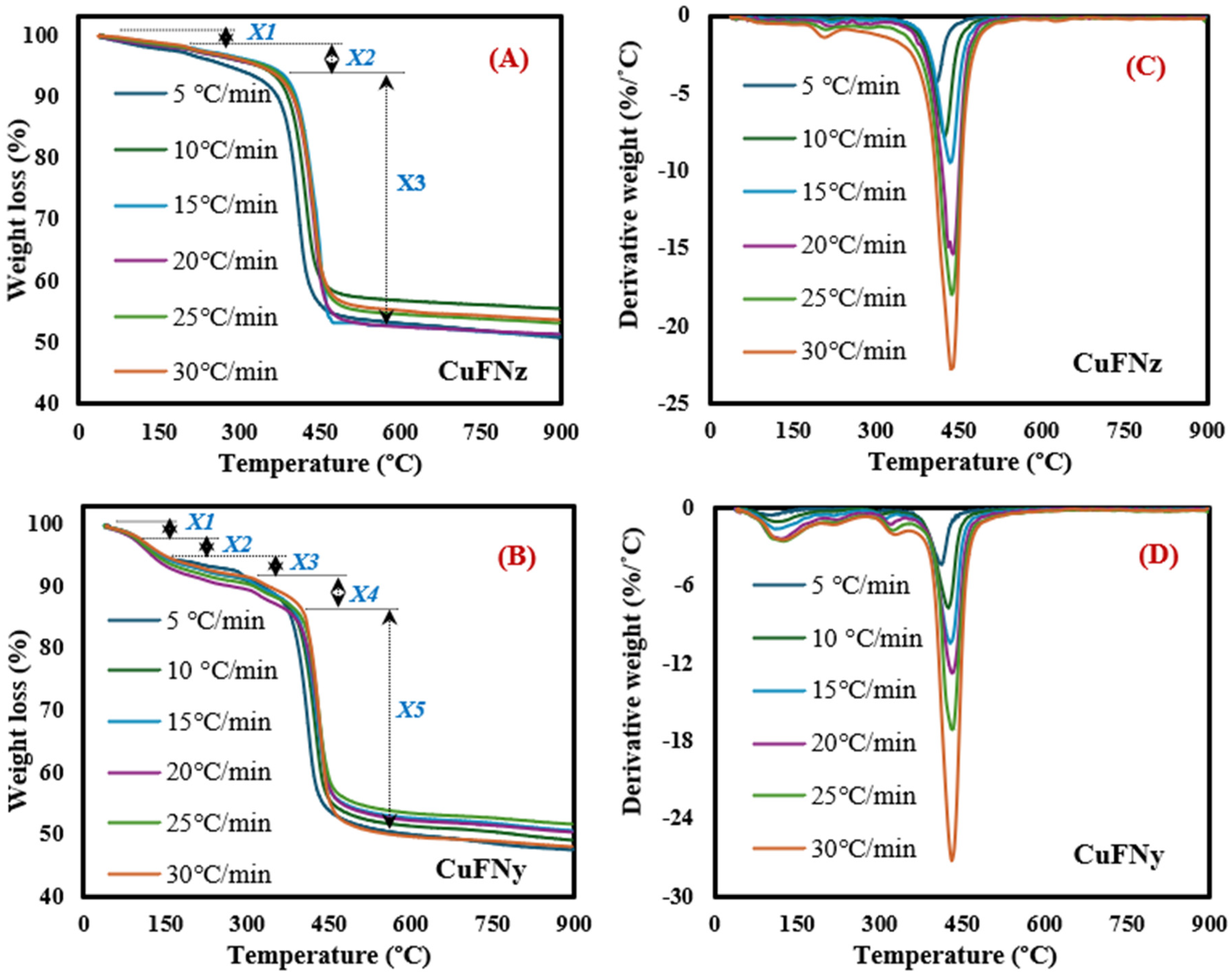
Figure 1 displays the measured TGA and DTG relationships of the CuFNz and CuFNy samples. According to the TGA analysis, the CuFNz sample (Figure 1A) undergoes complete decomposition up to 495 °C, with a total weight loss of approximately 44 wt.%. Also, it was noticed that the CuNz decomposed into three distinct regions described as X1 up to 200 °C, X2 up to 375 °C, and X3 up to 495 °C, with a mass loss estimated at 2 wt.%, 5 wt.%, and 37 wt.%, respectively. The first region refers to the release of moisture content in the feedstock and catalyst [41]. The second region refers to the release of light volatile content and copper debris [46], while the last stage, with significant mass drop, refers to active catalytic pyrolysis of this sample. On the other hand, the TGA of the CuFNy sample (Figure 1B) showed a slightly lower decomposition temperature (475 °C) and higher overall weight loss (52 wt.%). Also, the decomposition process of the CuFNy sample occurs in five distinct stages distributed as follows: X1 up to 120 °C (3 wt.%), X2 up to 170 °C (3 wt.%), X3 up to 320 °C (3 wt.%), X4 up to 390 °C (4 wt.%), and X5 up to 575 °C (35 wt.%). In this sample, the moisture content is released in the X1 and X2 regions, followed by the release of light volatile matter content in X3, then copper debris separation in X4. In the final stage (X5: active catalytic pyrolysis), the released vapor started to be emitted with high intensity and was accompanied by intensive reactions combined with significant mass loss. Once the active catalytic pyrolysis of both samples had ended, a solid carbonaceous formation stage (solid residue) was developed that had undercomposed fractions, including copper debris and char fraction [46]. Simultaneously, the DTG curves of both samples exhibited a solitary decomposition peak, and their characterizations under various heating rates are summarized in Table 1. As shown in the table, the maximum decomposition temperature (Tpeak) is estimated in the range of 409–441 °C (CuFNz) and 412–433 °C (CuFNy). In fact, this range is lower than the results obtained from typical pyrolysis without a catalyst, which was up to 456 °C [46]. It was observed that an increase in heating rate led to a progressive shift in the peak toward higher temperatures, due to thermal hysteresis delaying decomposition of CuFN samples [64]. Finally, CPI calculations showed that the CuFNz sample had an average CPI of 1.27 × 10⁻⁴ versus 1.46 × 10⁻⁴ for the CuFNy sample (Table 1), meaning that the catalytic thermal decomposition of CuFNy provides higher performance with a 15% improvement, which enhances the synthesis of more value-added chemicals [65].

3.2. TG-FTIR Analysis of the Evolved Vapor

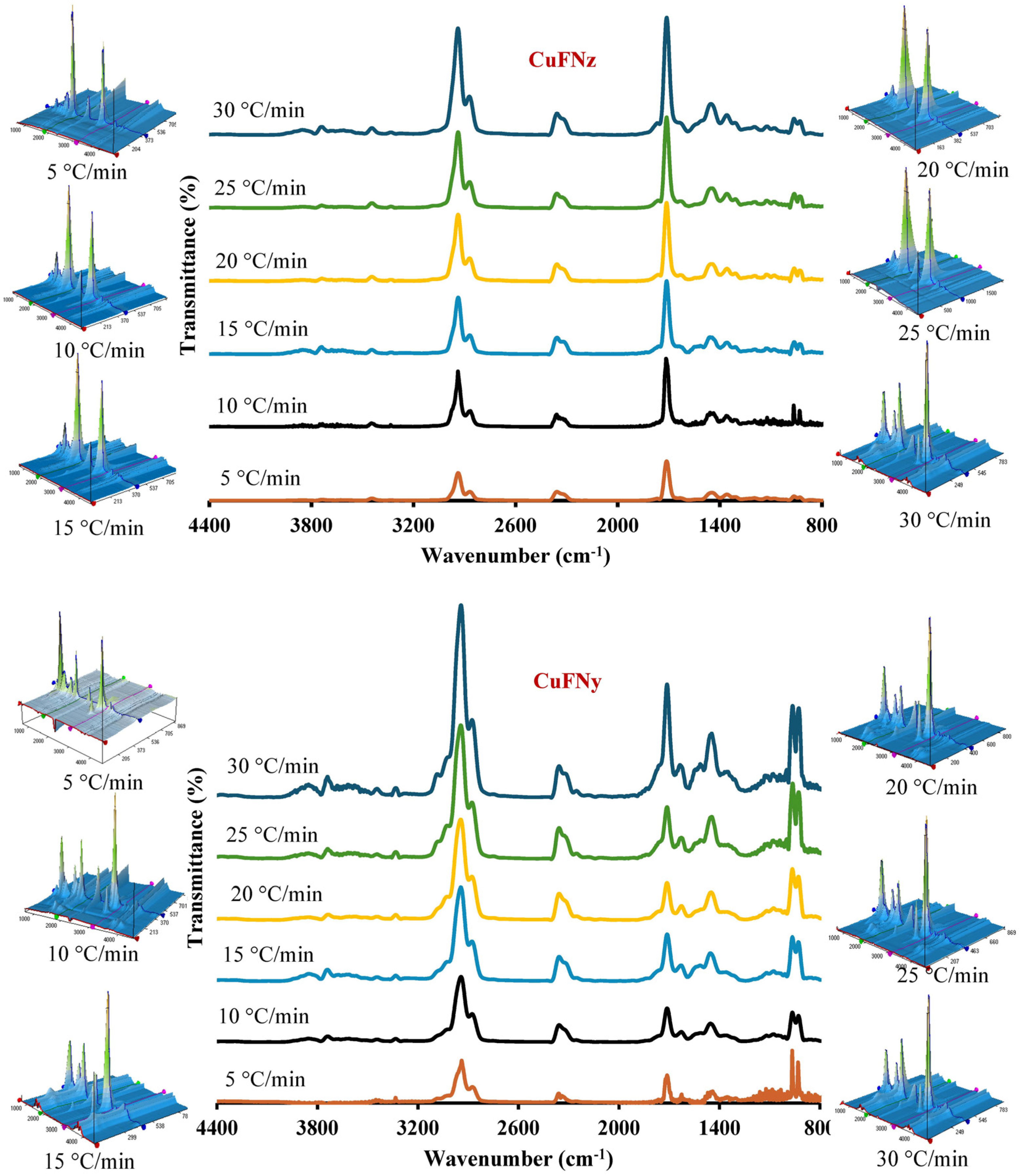
The functional groups of the evolved vapor from the principal catalytic pyrolysis region of CuFNz and CuFNy samples under various heating steps are presented in Figure 2. The analysis of the vapors of the CuFNz sample indicated that its vapors consisted of 1712 cm−1 (a C=O bond refers to a carbonyl group) and 2933 cm−1 (C-H stretching) as major functional groups. There were also some weak peaks, at 916–964 cm−1 (OH bending), 1436 cm−1 (C–H bond refers to aromatic), and 2308 cm−1 (the C=O stretching band refers to CO2), as shown in its two-dimensional (2D)-FTIR spectra. These FTIR spectra are largely identical to those obtained from the functional groups of FN and CuFN [41,46]. Meanwhile, the 2D-FTIR spectra of vapors of the CuFNy sample showed FTIR spectra almost like those obtained from the decomposition of the CuFNz sample, but the alkyl C-H stretch (2948 cm−1) peak became dominant. Also, the intensity of the C=O bond (carbonyl) (1712 cm−1) decreased significantly and became almost equal to the OH bending peak (923–968 cm−1). It was observed that the intensity of all functional groups of both samples became stronger and sharper with the gradually enhanced heating rate because of an improvement in the rate of heat flux generation, which promotes the degradation rate of CuFNz and CuFNy molecules and limits the unwanted reactions [46]. This feature also helps in providing a smooth spectrum, as shown in three-dimensional (3D)-FTIR. These results demonstrate that the catalytic pyrolytic process produces vapors rich in esters, alkyl compounds, and certain by-products, which can be identified using GC/MS analysis.

3.3. GC/MS Analysis of the Evolved Vapor

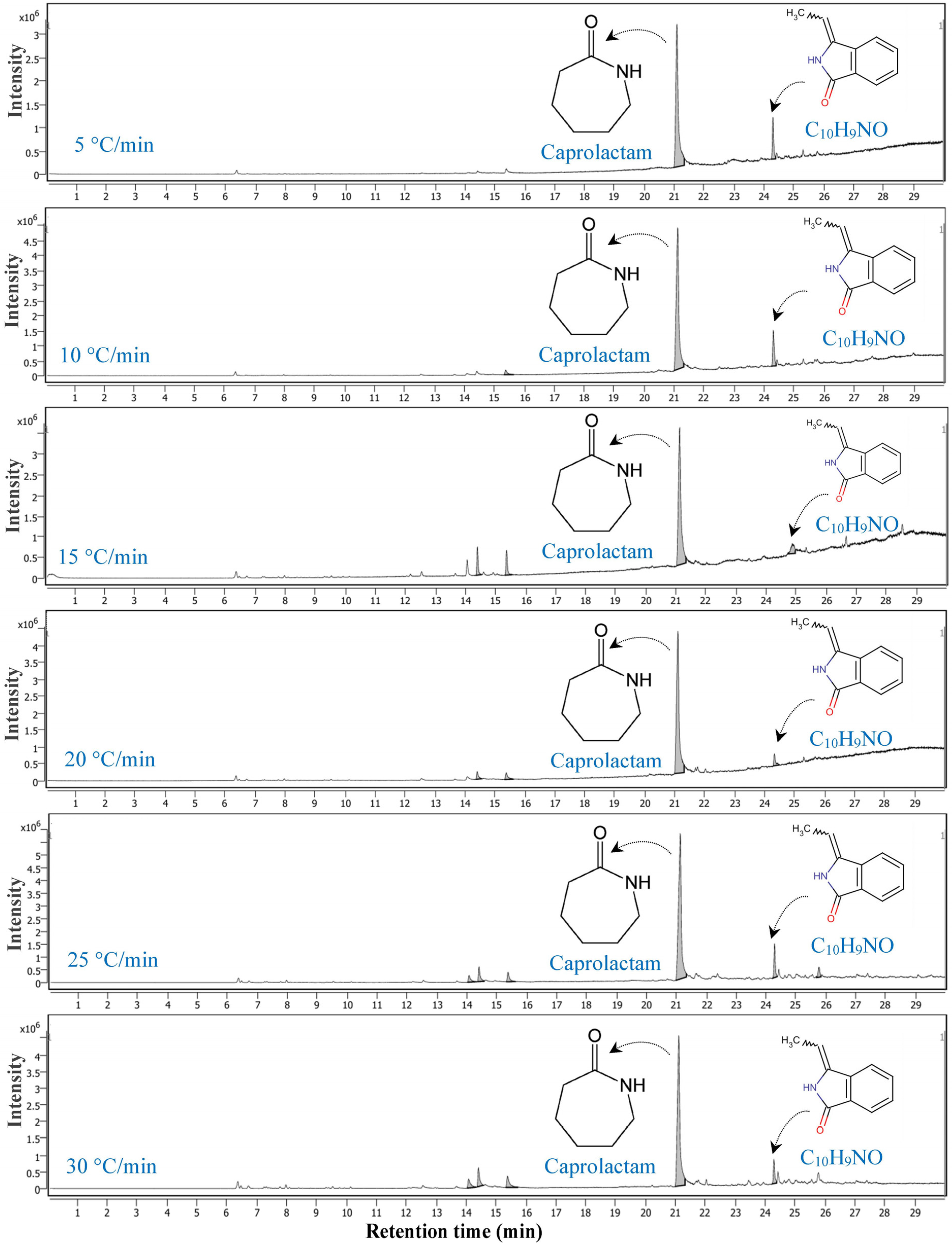
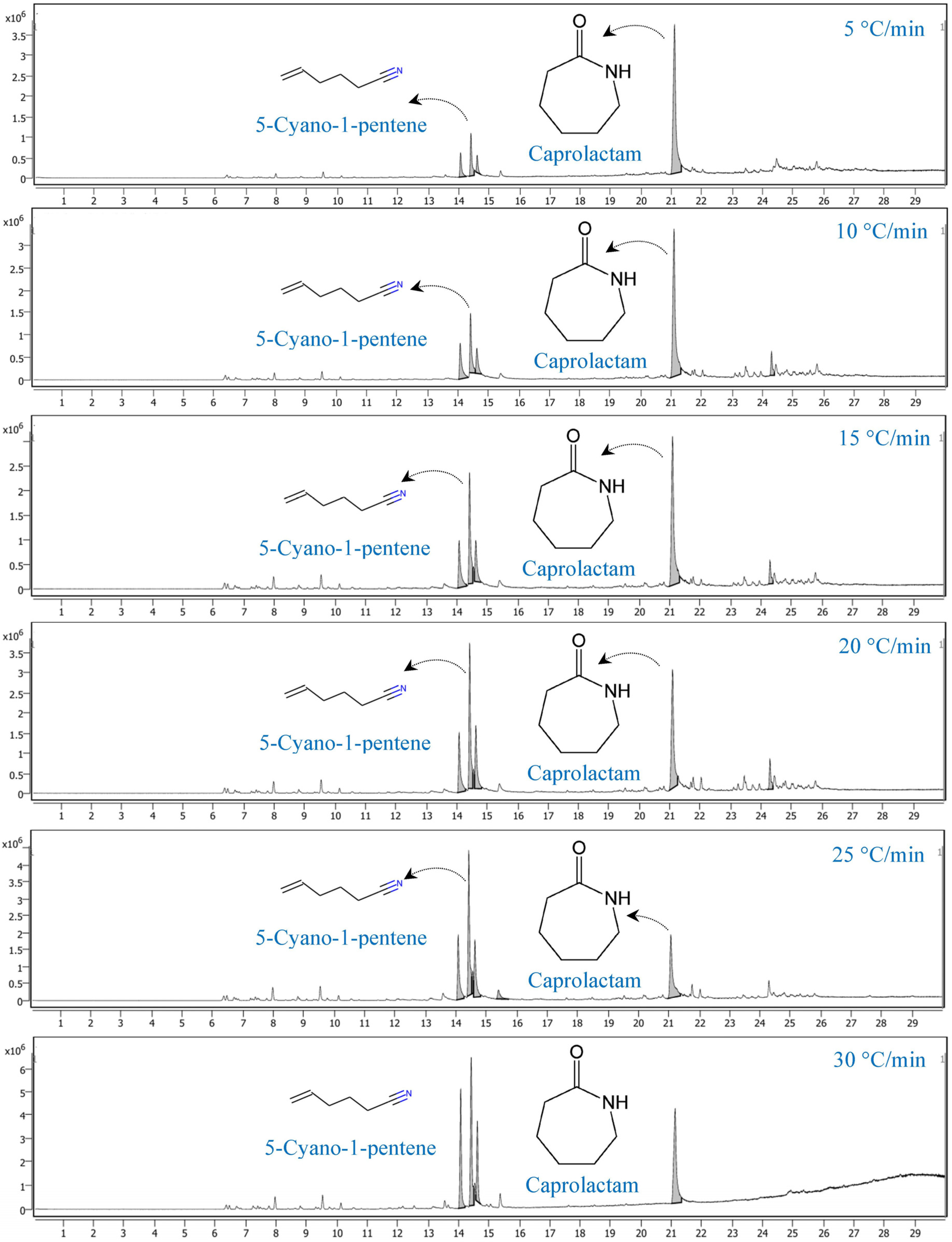
Figure 3 and Figure 4 show the GC/MS spectra of the evolved catalytic pyrolysis vapors from CuFNz and CuFNy samples, and their peak composition and quantity (relative peak areas) are defined in Table 2 and Table 3. The analysis indicated that caprolactam was the dominant chemical compound in the CuFNz sample, and its maximum yield was 87.25 (5 °C/min) and 88.21% (20 °C/min), while 1H-Indole-3-carboxaldehyde 7-methyl- (C10H9NO) was the major compound in the other GC/MS composition, with its abundance reaching 12.75% (5 °C/min). In the case of the CuFNy sample, the composition of vapors changed a lot, where the maximum caprolactam was less than that obtained from the CuFNz sample in the range of 25.92% (25 °C/min)–75.19% (5 °C/min). It was also noted that 5-Cyano-1-pentene (C6H9N) was present in significant amounts, ranging from 24.82% at (5 °C/min) to 70.43% at 25 °C/min. These findings confirm that the structure of the catalyst used and the applied heating step play a crucial role in determining the composition of the released catalytic pyrolytic vapors. Since caprolactam is the basic chemical compound of the nylon polymer used in the production of FN as well [35,41,66], these results prove that the catalytic thermochemical treatment can be applied to recover it again as a renewable and cheaper source. Also, the CuFN catalytic pyrolysis has more potential in the extraction of caprolactam (88.21%) compared to the traditional pyrolysis of FN (60%) and CuFN (89.45%), or even the catalytic pyrolysis of FNW in the presence of a ZSM-5 catalyst (83%) [41,46]. In addition, the 5-Cyano-1-pentene compound has huge applications in organic synthesis reactions, in synthesizing organic compounds (ketones, esters, carboxylic acids, etc.), as a solvent, and as a catalyst in several chemical processes [67].

3.4. Catalytic Thermal Decomposition Pathway of CuFN

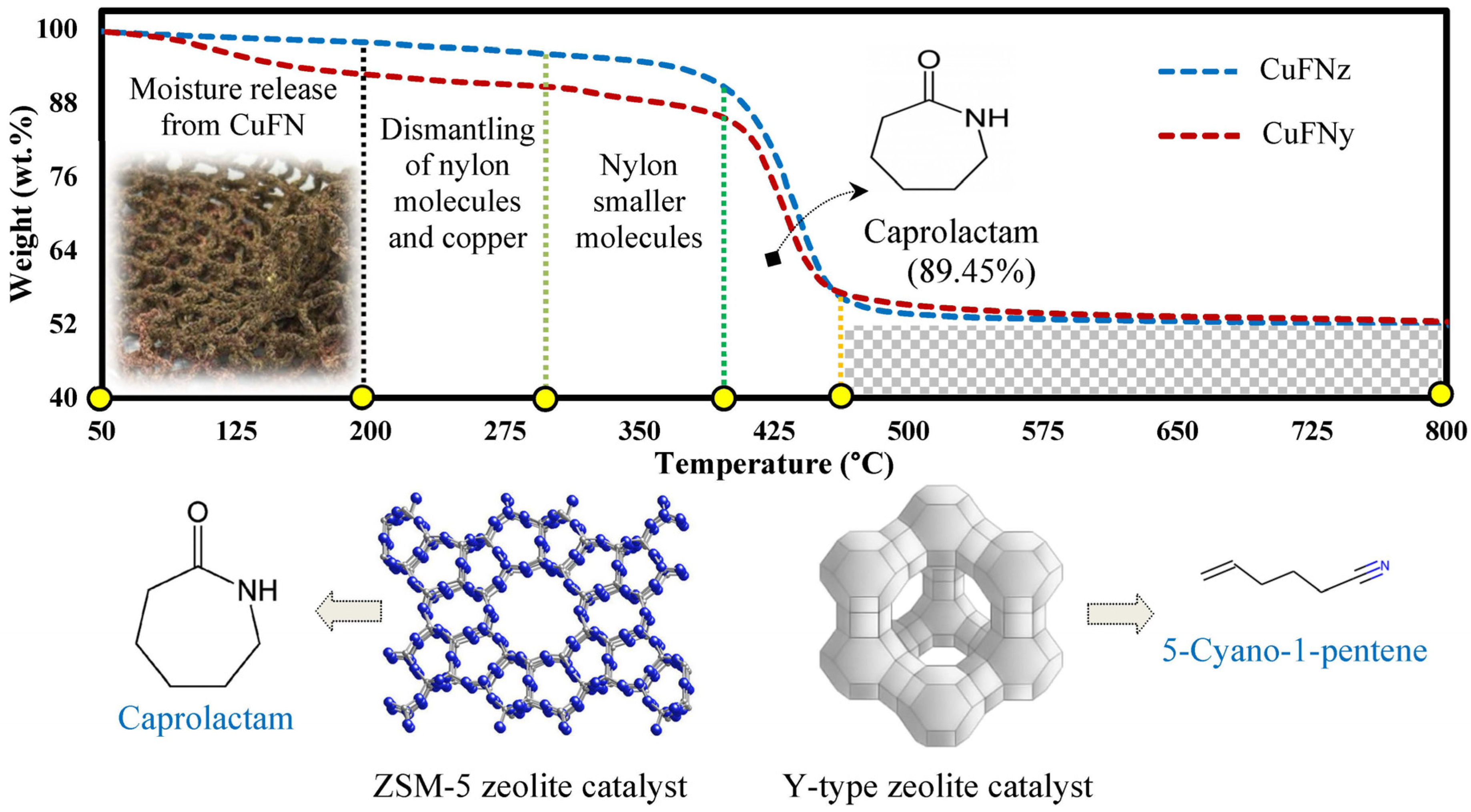
The nylon polymeric material used in CuFN production is typically manufactured by caprolactam polymerization [66]. The GC/MS results demonstrate that catalytic pyrolysis can be used to extract it with a yield reaching 88.21% (20 °C/min) in the case of CuFNz, while in the CuFNy sample, the caprolactam yield decreased significantly up to 25.92% (25 °C/min)–75.19% (5 °C/min). Also, it was noted that a new compound was synthesized from the decomposition of CuFNy, with a high yield in particular of the 5-Cyano-1-pentene compound, up to 70.43% (25 °C/min). This section was prepared to understand the pathway and catalytic thermal decomposition mechanism of both samples (CuFNz and CuFNy). The catalytic thermal decomposition pathway of CuFN is discussed based on TGA measurements supported by GC/MS measurements, and the results are formulated in Figure 5. The schematic was focused on only TGA profiles of CuFNz at 20 °C/min and CuFNy at 25 °C/min, as they showed the maximum amount of caprolactam (88.21%) and 5-Cyano-1-pentene compound, respectively. As shown, the CuFNz sample exhibited higher thermal resistance up to 200 °C, with small degradation due to moisture release, unlike the CuFNy sample, which showed early degradation starting at around 100 °C and continuing up to 200 °C to release its moisture content. The significant drop at this stage is likely due to the elimination of water that was adsorbed during the reaction [68]. After that, the applied temperature started to spread between CuFN molecules and dismantle nylon molecules and copper debris up to 300 °C [69]. With increasing temperature, its diffusion rate increased too, which allowed it to move from the external circumference of CuFN molecules to the interior, followed by fragmenting nylon particles into smaller molecules until 385 °C [70]. Subsequently, active catalytic pyrolysis was conducted for both CuFN samples. During this stage, the long polymer chains of nylon break down into smaller fragments through random chain scission reactions, promoting depolymerization and converting the feedstock back into its ε-Caprolactam monomer, especially caprolactam [71,72]. The catalysts used help promote the synthesis of the compounds and facilitate the reaction through dehydroxylation and cracking processes. However, it was noted that a Y-type zeolite catalyst provides another composition (5-Cyano-1-pentene) given its enhanced porosity and acidity, which permitted the caprolactam compound to diffuse into its structure, followed by decomposition into 5-Cyano-1-pentene [73,74,75]. Although the separated copper debris does not decompose or participate in the reaction, it can act as a heat transfer substrate that can be used to accelerate heat and pass through the nylon molecules, allowing heat to be retained and reducing the leakage energy (Ea) used in the decomposition process, resulting in improved decomposition, especially when compared to virgin nets [41,46]. After the full breakdown of the nylon polymer material, the solid material remaining in the final stage is called the by-product, and it contains undecomposed copper debris [76].

3.5. Catalytic Pyrolytic Activation Energies

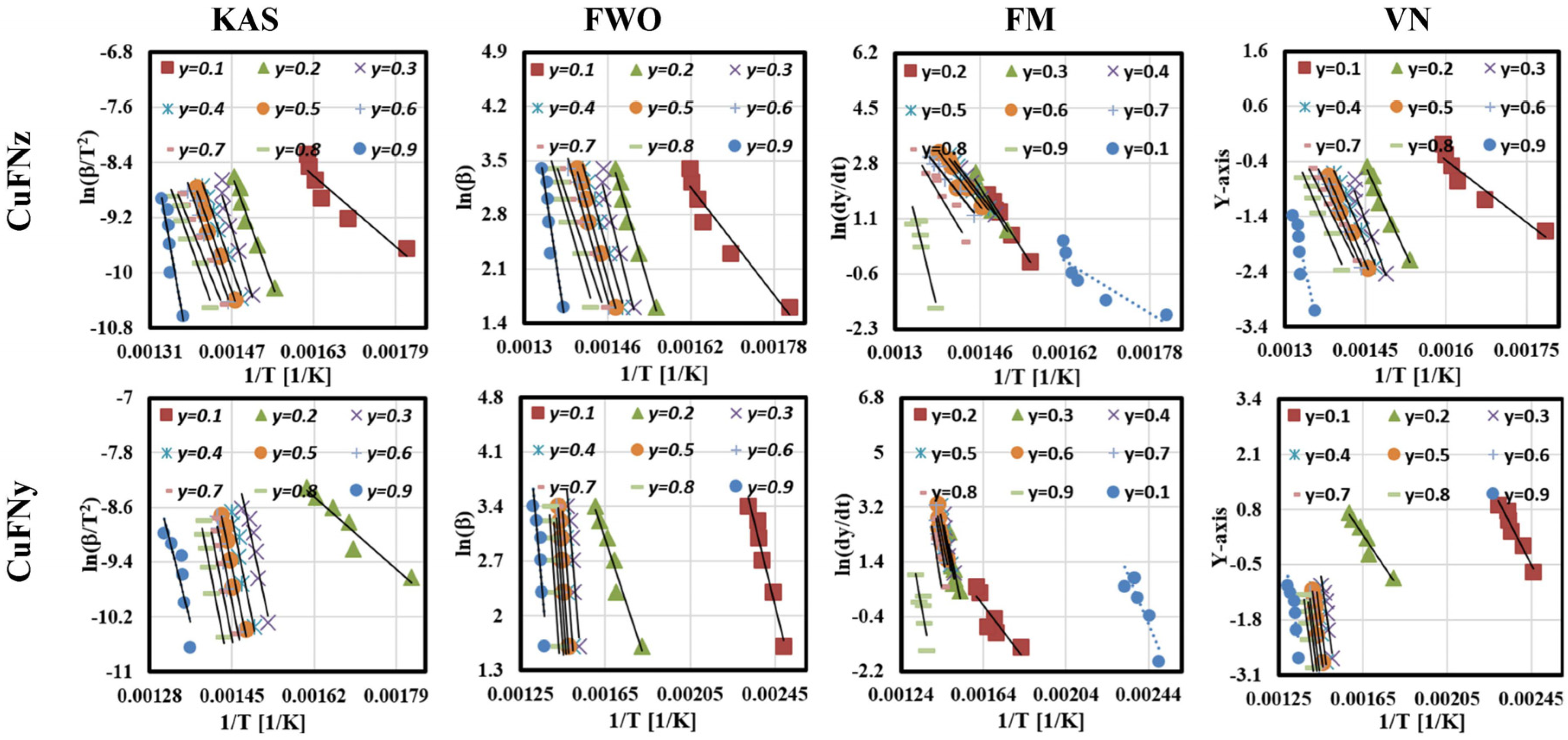
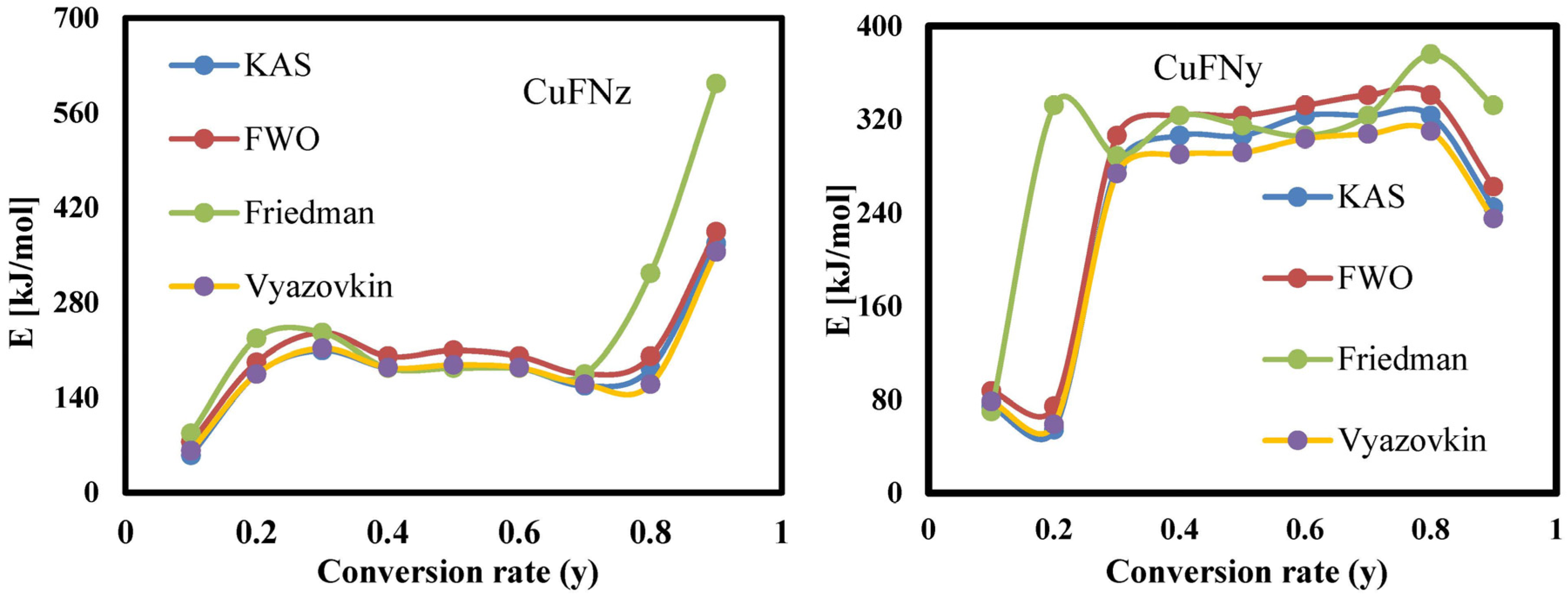
The activation energies of the catalytic decomposition of CuFNz and CuFNy samples were estimated using model-free techniques using KAS, FWO and FM for curve fitting (Figure 6) with the specified relationships with the help of Equations (2)–(4), and then their slopes were extracted, allowing Ea to be calculated at each conversion rate. As illustrated, the KAS, FWO, and FM plots feature nine lines, corresponding to the decomposition of CuFN samples at conversion rates ranging from 0.1 to 0.9. It is also observed that these lines, in the case of the KAS and FWO models, are very close and parallel in the conversion rate range of 0.2 to 0.8, where the reaction at a low conversion rate is more complex and unstable due to the development of many simultaneous reactions, which makes it difficult to predict them at the same time [77]. Moreover, certain features may also appear at the end of the reaction, along with the formation of a solid carbon fragment, which introduces some variation at the extreme conversion point [78]. Concerning the FM approach, significant randomness was noted in the arrangement of fitted lines due to the presence of fatness, as this approach is highly sensitive to simulated distorted data, which in turn impacts its fitting performance and the reliability of the computed Ea [79,80]. From the calculated slopes, the average values of the Ea item of the CuFNz sample were determined to be 188.8 kJ/mol (KAS: R2 = 0.95), 208.4 kJ/mol (FWO: R2 = 0.96), and 244.8 kJ/mol (FM: R2 = 0.93), while the Ea of the CuFNy sample was 248.4 kJ/mol (KAS: R2 = 0.94), 265.7 kJ/mol (FWO: R2 = 0.93), and 296.3 kJ/mol (FM: R2 = 0.83), as shown in Figure 7 and Table 4. The CuFNy sample consumed more energy for decomposition in the range of 17–24% due to the development of more reactions to transfer caprolactam to the 5-cyano-1-pentene compound, as mentioned above in Section 3.3. Some variation in the calculated Ea values was also observed, with KAS and FWO models providing somewhat similar values, with higher R2 values in the range of 0.93–0.96, while the FM model gave much larger values compared to the other models, with lower R2 values in the range of 0.83–0.93. This difference is due to the different mathematical mechanism used in modeling each model [81], which leads to this variation. Regarding the VN model, the calculations showed that the estimated average Ea of the CuFNz sample is 186.7 kJ/mol with R2 = 0.97 after several iterations, as shown in Table 5. The CuFNy sample was assigned a value of 238.8 kJ/mol, with an R2 of 0.92 (Table 3). These values are very close to those obtained using KAS, which means both models are recommended for the simulation of the catalytic pyrolysis of CuFN. However, these results are a little bit higher than those obtained from the typical pyrolysis of CuFN, which falls within the range of 167–193 kJ/mol [46]. This complexity can be explained by the high energy required to separate the copper and the energy required for the upgrading process.

3.6. Thermodynamic Analysis

The thermodynamic parameters of CuFNz and CuFNy samples were estimated with Equations (6)–(8), and the corresponding results are listed in Table 6. The results indicated that the thermodynamic parameters for the CuFNz sample fall within the ranges of 242.5–290 kJ mol−1 (ΔH), 24.6–158.8 Jmol−1K−1 (ΔS), and 148.4–224.9 kJ mol−1 (ΔG). In the case of the CuFNy sample, these values are 188.8–238.9 kJ mol−1 (ΔH), −0.275 to −355 Jmol−1K−1 (ΔS), and 377.5–487.6 kJ mol−1 (ΔG). CuFNy exhibits the lowest ΔH and ΔS values, which means that the reaction is stable, exothermic, and associated with a significant decrease in the system’s disorder and randomness [46,82].

3.7. Artificial Neural Network Analysis

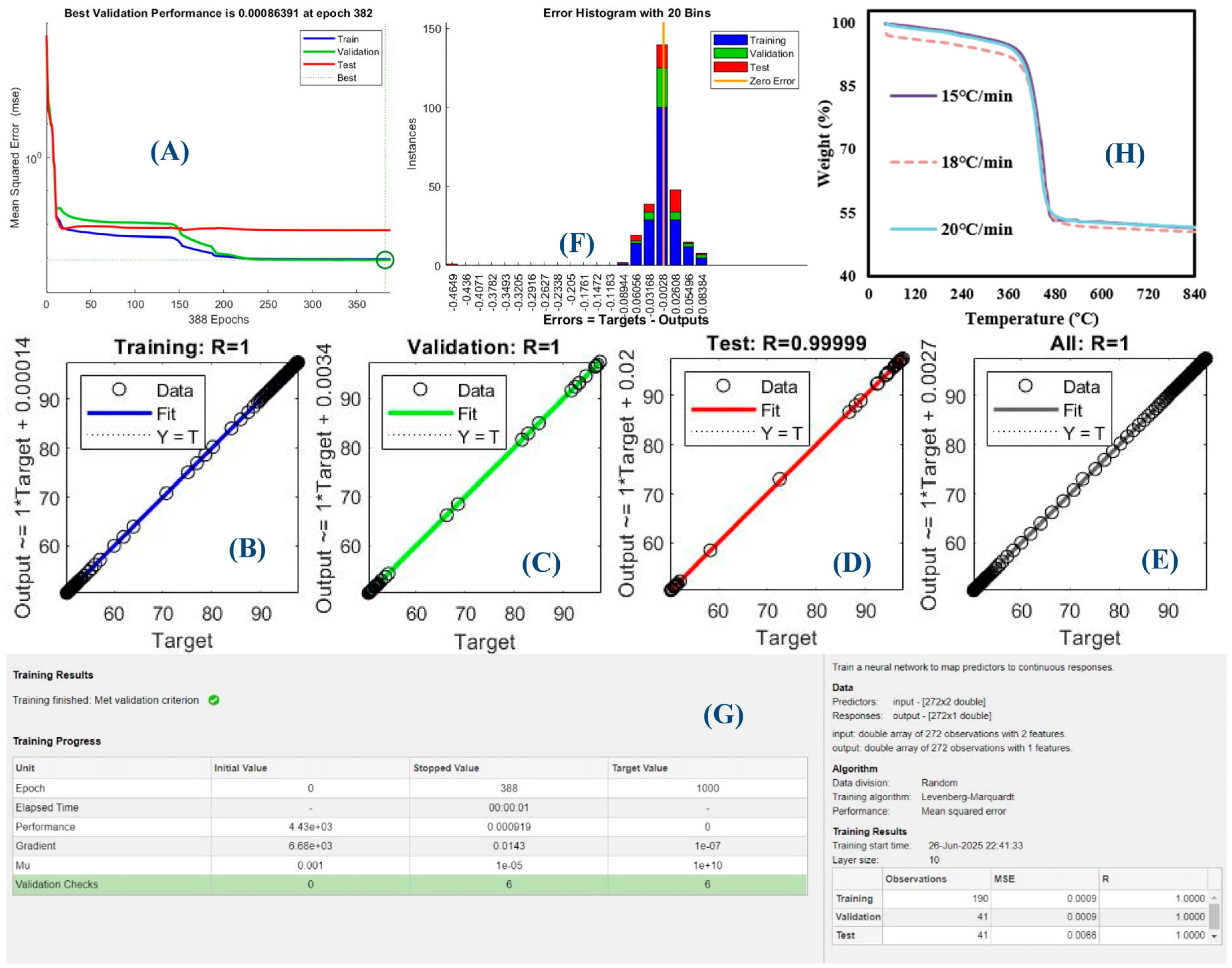
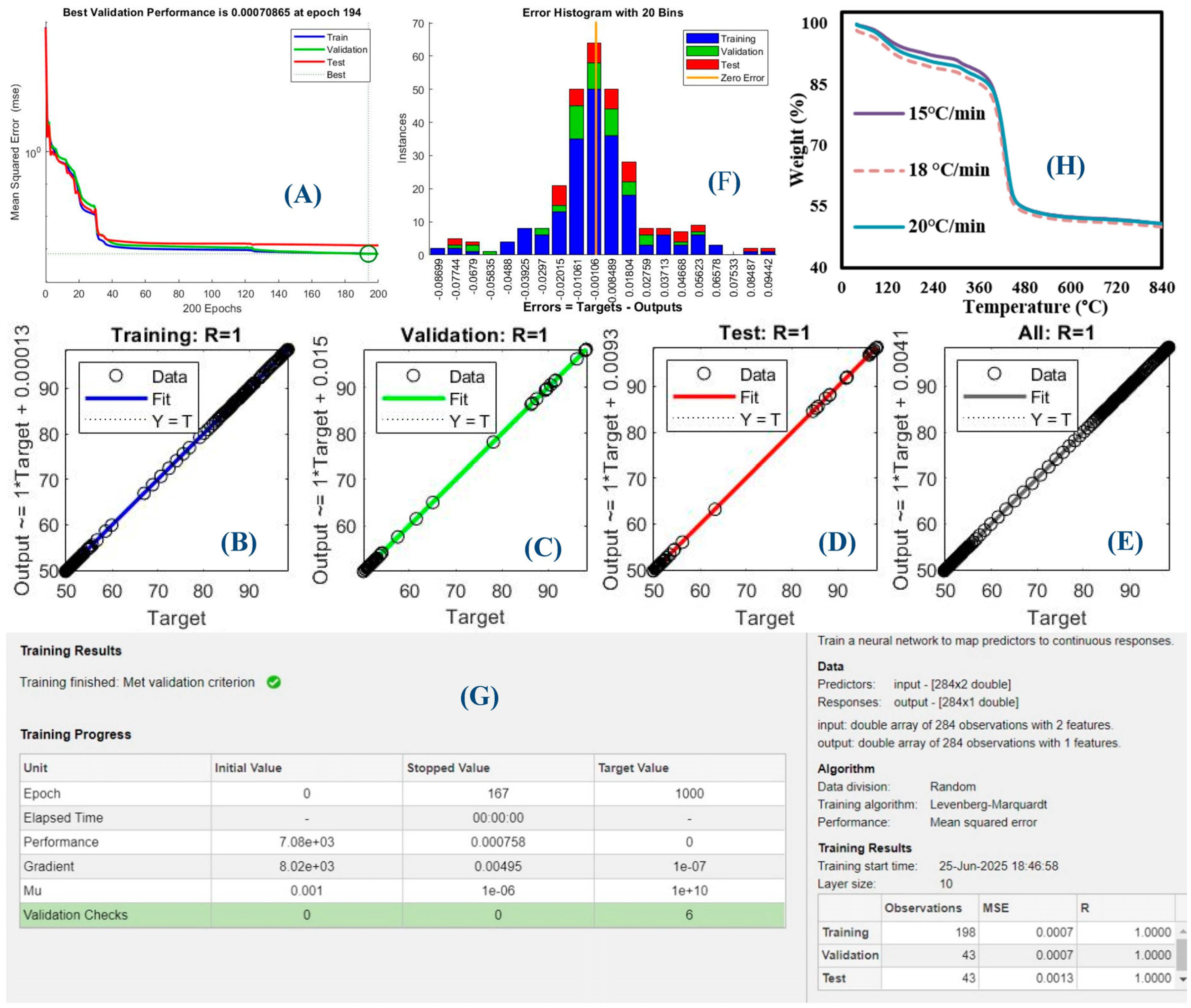
The ANN model, optimized with the LMB configuration and a 3 × 5 × 1 network topology, was employed to predict the CuFN catalytic pyrolysis at a heating rate of 17 °C/min under unspecified conditions. The optimized ANN model demonstrates a swift decrease in MSE, achieving its lowest validation error of 0.00086391 at epoch 382 for the CuFNz sample (Figure 8A) and 0.00070865 at epoch 194 for the CuFNy sample (Figure 9A). The model demonstrates excellent performance, achieving very high R2 values (0.99999–1) across the training, validation, and testing datasets for the CuFNz sample (Figure 8B–E) and an R2 of 1 for all stages of the CuFNy sample (Figure 9B–E). These results confirm that the LMB configuration is very suitable to optimize the ANN model and record the main degradation regions of catalytic pyrolytic CuFN even when using different catalysts. Meanwhile, the error histogram (at 20 bins) of all stages, including training, validation and testing of both samples, displays a distribution like a normal distribution profile of −0.03168 to 0.02608 (CuFNz (Figure 8F)) and −0.01061 to 0.008489 (CuFNy (Figure 9F)). As shown, the distribution profiles of the two CuFN samples closely follow the zero-error line and remain within the ±1 acceptable error margin for this type of distribution [83], indicating that the ANN model is expected to predict CuFN decomposition with high accuracy. Finally, all training results and their features are summarized in Figure 8G and Figure 9G. Also, these results were used to model the catalytic pyrolysis of CuFNz and CuFNy samples (17 °C/min), and the predictions were fitted against the experimental TGA data for comparison (Figure 8H and Figure 9H). It is clear that the predicted curves match the measured data trend and fall between its limits, which means the ANN model was built well with excellent performance and high simulation capabilities.

4. Conclusions

This study investigates the catalytic pyrolysis of copper-incorporated nylon fishing-net (CuFN) waste in the presence of ZSM-5 (CuFNz) and Y-type (CuFNy) zeolite catalysts using thermogravimetric analysis (TGA), thermogravimetric infrared analysis (TG-FTIR), and gas chromatography/mass spectrometry (GC/MS). Kinetic and thermodynamic parameters were extracted from the TGA data, and an optimized artificial neural network model (ANN) was developed to predict the decomposition behavior of both CuFN samples. The TGA showed that CuFNy decomposed at a lower temperature (475 °C) with a higher total weight loss of 52 wt.% compared to CuFNz, which decomposed at 495 °C with a 44 wt.%. Additionally, the CuFNy sample exhibited a narrower and lower maximum decomposition peak temperature range (412–433 °C) relative to CuFNz (409–441 °C). While TG-FTIR analysis of the evolved vapors indicated that the C=O (carbonyl) group was the predominant functional group in the vapors of the CuFNz sample, alkyl C-H stretching was the main functional group in the vapors of the CuFNy sample. Meanwhile, GC-MS analysis showed that caprolactam (88.21% at 20 °C/min) is the main compound of CuFNz’s vapor, while 5-Cyano-1-pentene (70.43% at 25 °C/min) was the major GC/MS compound of vapors that escaped from the CuFNy sample. On the other hand, the CuFNz sample exhibited activation energies between 188.8 and 244.8 kJ/mol (R2 = 0.83–0.94), while the CuFNy sample showed higher values, ranging from 248.4 to 296.3 kJ/mol (R2 = 0.93–0.97). Finally, the optimized ANN model shows high capabilities in predicting the main decomposition features of both samples, with a high correlation coefficient in training and validation reaching R2 = 1. Based on that, catalytic pyrolysis is highly recommended in managing CuFN and decomposing its polymeric part into caprolactam when using a ZSM-5 catalyst and 5-Cyano-1-pentene in the case of a Y-type zeolite catalyst.

Author Contributions

Conceptualization, S.Y., J.E., N.S. and V.K.; Methodology, S.Y., J.E. and M.A.A.; Software, S.Y., J.E. and M.A.A.; Validation, S.Y., J.E., V.K. and M.A.A.; Formal analysis, S.Y., J.E., N.S., V.K., D.Č. and M.A.A.; Investigation, S.Y., J.E. and N.S.; Resources, S.Y., J.E., N.S. and D.Č.; Data curation, S.Y. and J.E.; Writing—original draft, S.Y. and J.E.; Writing—review & editing, S.Y. and J.E.; Visualization, S.Y. and J. E.; Supervision, S.Y. and J.E.; Project administration, S.Y. and J.E.; Funding acquisition, S.Y. and J.E. All authors have read and agreed to the published version of the manuscript.

Funding

This project has received funding from the Research Council of Lithuania (LMTLT), agreement No. S-MIP-25-11.

Institutional Review Board Statement

Not applicable.

Data Availability Statement

The original contributions presented in this study are included in the article. Further inquiries can be directed to the corresponding author.

Conflicts of Interest

The authors declare no conflicts of interest.

References

  1. Fishing Nets Market. Available online: https://www.marketresearchfuture.com/reports/fishing-nets-market-21822 (accessed on 8 August 2026).
  2. Global Nylon Fishing Nets Market Size, Share, Growth Trends & Forecast 2026–2034. Available online: https://www.verifiedmarketreports.com/product/nylon-fishing-nets-market/ (accessed on 8 August 2026).
  3. Pasciucco, F.; Rossi, D.; Maccaferri, E.; Pecorini, I.; Giorgini, L.; Seggiani, M. Recycling polyamide 6 fishing nets and carbon fibers for the development of novel sustainable composites: Properties and LCA process analysis. J. Clean. Prod. 2024, 486, 144634. [Google Scholar] [CrossRef] [Scilit]
  4. Movilla-Quesada, D.; Raposeiras, A.C.; Ramos-Gavilán, A.B.; Lagos-Varas, M. Transforming end-of-life fishing nets into solutions for sustainable infrastructure: A strategy for circular development. J. Environ. Manag. 2025, 380, 124933. [Google Scholar] [CrossRef] [Scilit]
  5. Rossi, D.; Cappello, M.; Filippi, S.; Bartoli, M.; Malucelli, G.; Cinelli, P.; Seggiani, M. Polyamide 6 Recycled Fishing Nets Modified with Biochar Fillers: An Effort Toward Sustainability and Circularity. Mater. Today Commun. 2024, 41, 110650. [Google Scholar] [CrossRef] [Scilit]
  6. Loizidou, X.I.; Orthodoxou, D.L.; Godet, R. Bioplastic fishing nets as a sustainable alternative against ghost fishing: Results from the year-long testing among artisanal fishermen for operational effectiveness and social acceptance. Mar. Pollut. Bull. 2024, 209, 117300. [Google Scholar] [CrossRef] [Scilit]
  7. Intanon, N.; Wisitsoraat, A.; Saikaew, C. An application of statistical quality tools for process robustness and sustainability of titanium nitride coating on a machine component of a fishing net weaving machine. J. Clean. Prod. 2022, 363, 132603. [Google Scholar] [CrossRef] [Scilit]
  8. Liotta, I.; Avolio, R.; Castaldo, R.; Gentile, G.; Ambrogi, V.; Errico, M.E.; Cocca, M. Mitigation approach of plastic and microplastic pollution through recycling of fishing nets at the end of life. Process. Saf. Environ. Prot. 2023, 182, 1143–1152. [Google Scholar] [CrossRef] [Scilit]
  9. Piskuła, P.; Astel, A.; Pawlik, M. Microplastics in seawater and fish acquired from the corresponding fishing zones of the Baltic Sea. Mar. Pollut. Bull. 2024, 211, 117485. [Google Scholar] [CrossRef] [Scilit]
  10. Song, Y.K.; Kim, T.-H.; Shim, W.J.; Hong, S.H.; Im, D.-H. Microplastic emissions from fishing ropes: Quantification, characteristics, and implications for marine pollution. Mar. Pollut. Bull. 2025, 217, 118049. [Google Scholar] [CrossRef] [Scilit]
  11. Sheriff, S.S.; Yusuf, A.A.; Akiyode, O.O.; Hallie, E.F.; Odoma, S.; Yambasu, R.A.; Thompson-Williams, K.; Asumana, C.; Gono, S.Z.; Kamara, M.A. A comprehensive review on exposure to toxins and health risks from plastic waste: Challenges, mitigation measures, and policy interventions. Waste Manag. Bull. 2025, 3, 100204. [Google Scholar] [CrossRef] [Scilit]
  12. Swain, G.; Shinjo, N. Comparing Biofouling Control Treatments for Use on Aquaculture Nets. Int. J. Mol. Sci. 2014, 15, 22142–22154. [Google Scholar] [CrossRef] [Scilit]
  13. Dusacre, E.; Le Picard, C.; Hausard, V.; Rigolet, C.; Ekoja, F.; Jean, M.; Clérandeau, C.; Villette, S.; Lagarde, F.; Lecomte, S.; et al. Distinct toxicity profiles of conventional and biodegradable fishing nets’ leachates after artificial aging. J. Hazard. Mater. 2025, 489, 137609. [Google Scholar] [CrossRef] [Scilit]
  14. Kartal, G.E.; Sarıışık, A.M. Providing antifouling properties to fishing nets with encapsulated econea. J. Ind. Text. 2020, 51, 7569S–7586S. [Google Scholar] [CrossRef] [Scilit]
  15. Huang, J.-R.; Lin, W.-T.; Huang, R.; Lin, C.-Y.; Wu, J.-K. Marine biofouling inhibition by polyurethane conductive coatings used for fishing net. J. Coat. Technol. Res. 2009, 7, 111–117. [Google Scholar] [CrossRef] [Scilit]
  16. She, X.; Peng, J.; Qiang, Y.; Zhou, Y.; Zhang, S. Recent advances in protective technologies against copper corrosion. J. Mater. Sci. Technol. 2024, 201, 75–94. [Google Scholar] [CrossRef] [Scilit]
  17. Khalifa, M.; Lammer, H.; Gadad, M.S.; Varsavas, S.D.; Weng, Z. Recent advances on copper/polymer nanocomposites: Processing strategies, mechanisms, and antibacterial efficacy. Eur. Polym. J. 2024, 223, 113637. [Google Scholar] [CrossRef] [Scilit]
  18. Tamayo, L.; Azócar, M.; Kogan, M.; Riveros, A.; Páez, M. Copper-polymer nanocomposites: An excellent and cost-effective biocide for use on antibacterial surfaces. Mater. Sci. Eng. C 2016, 69, 1391–1409. [Google Scholar] [CrossRef] [Scilit]
  19. Komeily-Nia, Z.; Montazer, M.; Latifi, M. Synthesis of nano copper/nylon composite using ascorbic acid and CTAB. Colloids Surf. A Physicochem. Eng. Asp. 2013, 439, 167–175. [Google Scholar] [CrossRef] [Scilit]
  20. Nanda, S.; Berruti, F. Municipal solid waste management and landfilling technologies: A review. Environ. Chem. Lett. 2021, 19, 1433–1456. [Google Scholar] [CrossRef] [Scilit]
  21. Tchounwou, P.B.; Yedjou, C.G.; Patlolla, A.K.; Sutton, D.J. Heavy Metal Toxicity and the Environment. In Molecular, Clinical and Environmental Toxicology; Luch, A., Ed.; Springer: Basel, Swizerland, 2012; pp. 133–164. [Google Scholar] [CrossRef] [Scilit]
  22. Briffa, J.; Sinagra, E.; Blundell, R. Heavy metal pollution in the environment and their toxicological effects on humans. Heliyon 2020, 6, e04691. [Google Scholar] [CrossRef] [Scilit] [PubMed]
  23. Kibuta, C.; Akin, O.; Withoeck, D.; He, Q.; Schmidt, M.; Varghese, R.J.; Schlummer, M.; De Meester, S.; Calik, F.D.; Denton, M.; et al. Assessing the feasibility of ocean plastic waste as secondary feedstock for the production of base chemicals. Waste Manag. 2025, 195, 167–176. [Google Scholar] [CrossRef] [Scilit]
  24. Higuchi, C.; Isobe, A. Reduction scenarios of plastic waste emission guided by the probability distribution model to avoid additional ocean plastic pollution by 2050s. Mar. Pollut. Bull. 2024, 207, 116791. [Google Scholar] [CrossRef] [Scilit]
  25. Hu, B.; Wang, S.; Yan, J.; Zhang, H.; Qiu, L.; Liu, W.; Guo, Y.; Shen, J.; Chen, B.; Shi, C.; et al. Review of waste plastics treatment and utilization: Efficient conversion and high value utilization. Process. Saf. Environ. Prot. 2024, 183, 378–398. [Google Scholar] [CrossRef] [Scilit]
  26. Qian, K.; Wang, L.; Teng, J.; Liu, G. Strategies and technologies for sustainable plastic waste treatment and recycling. Environ. Funct. Mater. 2025, 4, 33–54. [Google Scholar] [CrossRef] [Scilit]
  27. Li, P.-C.; Tsao, F.-W.; Shih, H.-C.; Ma, H.-W.; Hou, N.-H. Unlocking the economic potential of recycling waste fishing nets for textile reproduction. Ecol. Econ. 2025, 239, 108752. [Google Scholar] [CrossRef] [Scilit]
  28. Celauro, C.; Graziano, F.; Garofalo, S.; Teresi, R. Use of fibres from waste fishing nets in porous asphalt mixtures for road pavement. Constr. Build. Mater. 2025, 462, 140004. [Google Scholar] [CrossRef] [Scilit]
  29. Truong, V.D.; Noh, H.W.; Kil Park, J.; Han, T.H.; Kim, D.J. Pullout resistance of waste fishing net embedded in the interface between the concrete and fibrous mortar matrix: Test method and experimental investigation. Constr. Build. Mater. 2024, 418, 135397. [Google Scholar] [CrossRef] [Scilit]
  30. Chung, S.-Y.; Oh, S.-E.; Jo, S.-S.; Lehmann, C.; Won, J.; Elrahman, M.A. Microstructural investigation of mortars incorporating cockle shell and waste fishing net. Case Stud. Constr. Mater. 2022, 18, e01719. [Google Scholar] [CrossRef] [Scilit]
  31. Romero-Gómez, M.; Silva, R.; Flores-Colen, I.; Rubio-De-Hita, P. Mechanical performance of waste fishing net fibre-reinforced gypsum composites. Constr. Build. Mater. 2023, 387, 131675. [Google Scholar] [CrossRef] [Scilit]
  32. Truong, V.D.; Kil Park, J.; Lee, S.Y.; Han, T.H.; Kim, D.J. Feasibility of hybrid waste fishing net textile and fiber reinforced cementitious composites in strengthening concrete and retrofitting damaged concrete. J. Build. Eng. 2023, 74, 106926. [Google Scholar] [CrossRef] [Scilit]
  33. Pae, J.; Kim, M.O.; Han, T.H.; Moon, J. Tomographic microstructural investigation of waste fishing net-reinforced high performance cementitious composites. J. Build. Eng. 2022, 56, 104829. [Google Scholar] [CrossRef] [Scilit]
  34. Lee, H.; Im, J.; Cho, H.; Jung, S.; Choi, H.; Choi, D.; Kim, J.; Lee, J.; Kwon, E.E. Hydrogen production from fishing net waste for sustainable clean fuel: Techno-economic analysis and life cycle assessment. Chem. Eng. J. 2024, 481, 148741. [Google Scholar] [CrossRef] [Scilit]
  35. Minor, A.-J.; Goldhahn, R.; Rihko-Struckmann, L.; Sundmacher, K. Chemical recycling processes of nylon 6 to caprolactam: Review and techno-economic assessment. Chem. Eng. J. 2023, 474, 145333. [Google Scholar] [CrossRef] [Scilit]
  36. Kim, S.-S.; Jeon, J.-K.; Park, Y.-K. Thermal pyrolysis of fresh and waste fishing nets. Waste Manag. 2005, 25, 811–817. [Google Scholar] [CrossRef] [Scilit]
  37. Jang, E.-S.; Song, E.; Siddiqui, M.Z.; Lim, S.J.; Shin, G.H.; Kim, D.; Kim, Y.-M. The effect of seawater aging on the pyrolysis of fishing nets. J. Anal. Appl. Pyrolysis 2021, 156, 105160. [Google Scholar] [CrossRef] [Scilit]
  38. Atong, D.; Soongprasit, K.; Sricharoenchaikul, V.; Hawangchu, Y. Thermal Conversion of Non-Recyclable Discarded Fishing Nets from the Gulf of Thailand for Marketable Resource Recovery. Process Saf. Environ. Prot. 2025, 198, 107228. [Google Scholar] [CrossRef] [Scilit]
  39. Chaihad, N.; Kurnia, I.; Yoshida, A.; Watanabe, C.; Tei, K.; Reubroycharoen, P.; Kasai, Y.; Abudula, A.; Guan, G. Catalytic pyrolysis of wasted fishing net over calcined scallop shells: Analytical Py-GC/MS study. J. Anal. Appl. Pyrolysis 2019, 146, 104750. [Google Scholar] [CrossRef] [Scilit]
  40. Choi, D.; Jung, S.; Lee, S.S.; Lin, K.-Y.A.; Park, Y.-K.; Kim, H.; Tsang, Y.F.; Kwon, E.E. Leveraging carbon dioxide to control the H2/CO ratio in catalytic pyrolysis of fishing net waste. Renew. Sustain. Energy Rev. 2020, 138, 110559. [Google Scholar] [CrossRef] [Scilit]
  41. Eimontas, J.; Yousef, S.; Striūgas, N.; Abdelnaby, M.A. Catalytic pyrolysis kinetic behaviour and TG-FTIR-GC–MS analysis of waste fishing nets over ZSM-5 zeolite catalyst for caprolactam recovery. Renew. Energy 2021, 179, 1385–1403. [Google Scholar] [CrossRef] [Scilit]
  42. Eimontas, J.; Striūgas, N.; Zakarauskas, K.; Kiminaitė, I. Catalytical thermal conversion of waste fishing nets for a higher added value energy products generation and caprolactam recovery. Fuel 2022, 334, 126735. [Google Scholar] [CrossRef] [Scilit]
  43. Eimontas, J.; Striūgas, N.; Zakarauskas, K.; Kiminaitė, I.; Pitak, I. Metallised seaweed-derived bio-char catalyst preparation and its application in the pyrolysis process for the waste fishing nets and marine biomass utilisation. Fuel 2023, 357, 129922. [Google Scholar] [CrossRef] [Scilit]
  44. Ryou, H.; Kim, S.W.; Byun, J.; Han, J.; Lee, J. Energy-efficient eco-friendly marine waste treatment: Recovery of caprolactam from fishing net waste using seashell-derived catalyst. Energy 2024, 312, 133574. [Google Scholar] [CrossRef] [Scilit]
  45. Apete, L.; Martin, O.V.; Iacovidou, E. Fishing plastic waste: Knowns and known unknowns. Mar. Pollut. Bull. 2024, 205, 116530. [Google Scholar] [CrossRef] [Scilit]
  46. Yousef, S.; Eimontas, J.; Kudelytė, V.; Striūgas, N.; Abdelnaby, M.A. Pyrolysis and ANN-based modeling of copper-impregnated nylon fishing net waste. Sustain. Chem. Pharm. 2025, 46, 102054. [Google Scholar] [CrossRef] [Scilit]
  47. Eimontas, J.; Striūgas, N.; Zakarauskas, K.; Kudelytė, V.; Yousef, S. Recovery of caprolactam, copper, hydrogen-rich gas and char flakes from copper-impregnated nylon fishing net waste using a bench-scale pyrolysis plant. Chem. Eng. Sci. 2026, 338, 124920. [Google Scholar] [CrossRef]
  48. Eimontas, J.; Yousef, S.; Striūgas, N.; Abdelnaby, M.A. Caprolactam-rich vapor from copper leaching and pyrolysis of copper-impregnated nylon fishing net waste: Kinetics, thermodynamics and artificial neural network. J. Environ. Chem. Eng. 2026, 14, 121497. [Google Scholar] [CrossRef] [Scilit]
  49. Yousef, S.; Eimontas, J.; Zakarauskas, K.; Striūgas, N.; Pitak, I. Catalytic reforming of tar for enhancing hydrogen production from gasification of hazardous medical waste. Energy 2024, 313, 134184. [Google Scholar] [CrossRef] [Scilit]
  50. Yousef, S.; Eimontas, J.; Meile, K.; Striūgas, N.; Abdelnaby, M.A. Co-pyrolysis of Baltic wheat straw and low-density polyethylene bags and its kinetic and thermodynamic behaviour. Ind. Crop. Prod. 2024, 218, 118970. [Google Scholar] [CrossRef] [Scilit]
  51. Yousef, S.; Eimontas, J.; Striūgas, N.; Abdelnaby, M.A. Synthesis of benzoic acid from catalytic co-pyrolysis of waste wind turbine blades and biomass and their kinetic analysis. J. Anal. Appl. Pyrolysis 2024, 182, 106684. [Google Scholar] [CrossRef] [Scilit]
  52. Yousef, S.; Eimontas, J.; Striūgas, N.; Praspaliauskas, M.; Abdelnaby, M.A. Pyrolysis kinetic behaviour, TG-FTIR, and GC/MS analysis of cigarette butts and their components. Biomass-Convers. Biorefinery 2022, 14, 6903–6923. [Google Scholar] [CrossRef] [Scilit]
  53. Yousef, S.; Eimontas, J.; Striūgas, N.; Abdelnaby, M.A. Recovery of styrene from waste wind turbine blades (fiberglass/polyester resin composites) using pyrolysis treatment and its kinetic behavior. J. Therm. Anal. Calorim. 2023, 149, 521–538. [Google Scholar] [CrossRef] [Scilit]
  54. Yousef, S.; Eimontas, J.; Striūgas, N.; Abdelnaby, M.A. Pyrolysis kinetic behaviour and TG-FTIR-GC–MS analysis of Coronavirus Face Masks. J. Anal. Appl. Pyrolysis 2021, 156, 105118. [Google Scholar] [CrossRef] [Scilit]
  55. Yousef, S.; Eimontas, J.; Striūgas, N.; Praspaliauskas, M.; Abdelnaby, M.A. Pyrolysis Kinetic behaviour of glass Fibre-Reinforced epoxy resin composites using linear and nonlinear isoconversional methods. Polymers 2021, 13, 1543. [Google Scholar] [CrossRef] [Scilit]
  56. Yousef, S.; Eimontas, J.; Striūgas, N.; Abdelnaby, M.A. Influence of carbon black filler on pyrolysis kinetic behaviour and TG-FTIR-GC–MS analysis of glass fibre reinforced polymer composites. Energy 2021, 233, 121167. [Google Scholar] [CrossRef] [Scilit]
  57. Yousef, S.; Eimontas, J.; Striūgas, N.; Mohamed, A.; Praspaliauskas, M.; Abdelnaby, M.A. Phenol and benzoic acid recovery from end-of-life of polysulfone ultrafiltration membranes and its thermochemical kinetic behaviour. Energy Sour. Part A Recover. Util. Environ. Eff. 2023, 45, 6043–6061. [Google Scholar] [CrossRef] [Scilit]
  58. Yousef, S.; Eimontas, J.; Striūgas, N.; Mohamed, A.; Abdelnaby, M.A. Pyrolysis kinetic behavior and thermodynamic analysis of PET nonwoven fabric. Materials 2023, 16, 6079. [Google Scholar] [CrossRef] [Scilit]
  59. Yousef, S.; Eimontas, J.; Striūgas, N.; Abdelnaby, M.A. Pyrolysis kinetic behaviour and thermodynamic analysis of waste wind turbine blades (carbon fibres/unsaturated polyester resin). Energy Sour. Part A Recover. Util. Environ. Eff. 2023, 45, 10505–10522. [Google Scholar] [CrossRef] [Scilit]
  60. Muravyev, N.V.; Luciano, G.; Ornaghi, H.L., Jr.; Svoboda, R.; Vyazovkin, S. Artificial Neural Networks for Pyrolysis, Thermal Analysis, and Thermokinetic Studies: The Status Quo. Molecules 2021, 26, 3727. [Google Scholar] [CrossRef] [Scilit]
  61. Yousef, S.; Eimontas, J.; Striūgas, N.; Praspaliauskas, M.; Abdelnaby, M.A. Pyrolysis behavior of non-textile components (buttons) and their kinetic analysis using artificial neural network. J. Anal. Appl. Pyrolysis 2024, 186, 106880. [Google Scholar] [CrossRef] [Scilit]
  62. Yousef, S.; Eimontas, J.; Striūgas, N.; Mohamed, A.; Abdelnaby, M.A. Pyrolysis behaviour of ultrafiltration polymer composite membranes (PSF/PET): Kinetic, thermodynamic, prediction modelling using artificial neural network and volatile product analysis. Fuel 2024, 369, 131779. [Google Scholar] [CrossRef] [Scilit]
  63. Gajera, B.; Tyagi, U.; Sarma, A.K.; Jha, M.K. Pyrolysis of cattle manure: Kinetics and thermodynamic analysis using TGA and artificial neural network. Biomass-Convers. Biorefinery 2023, 14, 23605–23621. [Google Scholar] [CrossRef] [Scilit]
  64. Wang, Y.; Yang, S.; Bao, G.; Wang, H. Pyrolytic characteristics of abutilon stalk waste using TG-FTIR, Py-GC/MS, and artificial neural networks: Kinetics, thermodynamics, and gaseous products distribution. J. Anal. Appl. Pyrolysis 2024, 178, 106403. [Google Scholar] [CrossRef] [Scilit]
  65. Cárdenas-Aguiar, E.; Méndez, A.; Gascó, G.; Lado, M.; Paz-González, A. The Effects of Feedstock, Pyrolysis Temperature, and Residence Time on the Properties and Uses of Biochar from Broom and Gorse Wastes. Appl. Sci. 2024, 14, 4283. [Google Scholar] [CrossRef] [Scilit]
  66. Mao, Y.; Li, M.; Tao, Y. Scalable access to functional nylon 6 via ring-opening copolymerization of biobased δ-valerolactam with ε-caprolactam. Polym. Chem. 2025, 16, 1409–1417. [Google Scholar] [CrossRef] [Scilit]
  67. 5-Hexenenitrile. Available online: https://www.chembk.com/en/chem/5-CYANO-1-PENTENE (accessed on 8 August 2026).
  68. Pala-Rosas, I.; Contreras, J.L.; Salmones, J.; López-Medina, R.; Angeles-Beltrán, D.; Zeifert, B.; Navarrete-Bolaños, J.; González-Hernández, N.N. Effects of the Acidic and Textural Properties of Y-Type Zeolites on the Synthesis of Pyridine and 3-Picoline from Acrolein and Ammonia. Catalysts 2023, 13, 652. [Google Scholar] [CrossRef] [Scilit]
  69. Lehrle, R.S.; Parsons, I.W.; Rollinson, M. Thermal degradation mechanisms of nylon 6 deduced from kinetic studies by pyrolysis-g.c. Polym. Degrad. Stab. 2000, 67, 21–33. [Google Scholar] [CrossRef] [Scilit]
  70. Lehrle, R.S.; Parsons, I.W.; Rollinson, M. Kinetics and Mechanisms of the Thermal Degradation of Nylon 6. In Ageing Studies and Lifetime Extension of Materials; Mallinson, L.G., Ed.; Springer: Boston, MA, USA, 2001. [Google Scholar] [CrossRef] [Scilit]
  71. Pannase, A.M.; Singh, R.K.; Ruj, B.; Gupta, P. Decomposition of polyamide via slow pyrolysis: Effect of heating rate and operating temperature on product yield and composition. J. Anal. Appl. Pyrolysis 2020, 151, 104886. [Google Scholar] [CrossRef] [Scilit]
  72. Smith, J.N.; White, G.V.; White, M.I.; Bernstein, R.; Hochrein, J.M. Characterization of volatile Nylon 6.6 Thermal-Oxidative degradation products by selective isotopic labeling and Cryo-GC/MS. J. Am. Soc. Mass Spectrom. 2012, 23, 1579–1592. [Google Scholar] [CrossRef] [Scilit]
  73. Miskolczi, N.; Juzsakova, T.; Sója, J. Preparation and application of metal loaded ZSM-5 and y-zeolite catalysts for thermo-catalytic pyrolysis of real end of life vehicle plastics waste. J. Energy Inst. 2017, 92, 118–127. [Google Scholar] [CrossRef] [Scilit]
  74. Locatel, W.d.R.; Mohabeer, C.; Laurenti, D.; Schuurman, Y.; Guilhaume, N. Co-pyrolysis of beech wood and polyamide-6: Impact of plastic concentration and wood/plastic synergistic effects. J. Anal. Appl. Pyrolysis 2022, 168, 105779. [Google Scholar] [CrossRef] [Scilit]
  75. Locatel, W.d.R.; Mohabeer, C.; Laurenti, D.; Schuurman, Y.; Guilhaume, N. Co-pyrolysis of beech wood and polyamide-6: Effect of HZSM-5 catalyst on the properties of pyrolysis oils. J. Anal. Appl. Pyrolysis 2022, 167, 105696. [Google Scholar] [CrossRef] [Scilit]
  76. Eimontas, J.; Striūgas, N.; Abdelnaby, M.A.; Yousef, S. Catalytic Pyrolysis Kinetic Behavior and TG-FTIR-GC–MS Analysis of Metallized Food Packaging Plastics with Different Concentrations of ZSM-5 Zeolite Catalyst. Polymers 2021, 13, 702. [Google Scholar] [CrossRef] [Scilit]
  77. Yousef, S.; Kiminaitė, I.; Eimontas, J.; Striūgas, N.; Abdelnaby, M.A. Catalytic pyrolysis kinetic behaviour of glass fibre-reinforced epoxy resin composites over ZSM-5 zeolite catalyst. Fuel 2022, 315, 123235. [Google Scholar] [CrossRef] [Scilit]
  78. Yousef, S.; Eimontas, J.; Striūgas, N.; Mohamed, A.; Abdelnaby, M.A. Pyrolysis kinetic behavior and TG-FTIR-GC–MS analysis of end-life ultrafiltration polymer nanocomposite membranes. Chem. Eng. J. 2021, 428, 131181. [Google Scholar] [CrossRef] [Scilit]
  79. Vyazovkin, S.; Sbirrazzuoli, N. Isoconversional methods as single-step kinetic approximation. Thermochim. Acta 2024, 733, 179692. [Google Scholar] [CrossRef] [Scilit]
  80. Yousef, S.; Eimontas, J.; Striūgas, N.; Zakarauskas, K.; Praspaliauskas, M.; Abdelnaby, M.A. Pyrolysis kinetic behavior and TG-FTIR-GC–MS analysis of metallised food packaging plastics. Fuel 2020, 282, 118737. [Google Scholar] [CrossRef] [Scilit]
  81. Tarani, E.; Chrissafis, K. Isoconversional methods: A powerful tool for kinetic analysis and the identification of experimental data quality. Thermochim. Acta 2024, 733, 179690. [Google Scholar] [CrossRef] [Scilit]
  82. Zhang, Z.; Li, Y.; Luo, L.; Yellezuome, D.; Rahman, M.; Zou, J.; Hu, H.; Cai, J. Insight into kinetic and Thermodynamic Analysis methods for lignocellulosic biomass pyrolysis. Renew. Energy 2022, 202, 154–171. [Google Scholar] [CrossRef] [Scilit]
  83. Ni, Z.; Bi, H.; Jiang, C.; Sun, H.; Zhou, W.; Qiu, Z.; Lin, Q. Research on the co-pyrolysis of coal slime and cellulose based on TG-FTIR-MS, artificial neural network, and principal component analysis. Fuel 2022, 320, 123960. [Google Scholar] [CrossRef] [Scilit]
Figure 1. (A,B) TGA and (C,D) DTG relationships of CuFNz and CuFNy samples.
Polymers 18 02073 g001
Figure 2. TG-FTIR spectra of the evolved vapors during the pyrolysis of CuFNz and CuFNy samples.
Polymers 18 02073 g002
Figure 3. GC/MS chromatogram of the evolved vapors from the catalytic decomposition of the CuFNz sample.
Polymers 18 02073 g003
Figure 4. GC/MS chromatogram of the evolved vapors from the catalytic decomposition of the CuFNy sample.
Polymers 18 02073 g004
Figure 5. Schematic sketch of the catalytic pyrolysis mechanism of CuFNz and CuFNy.
Polymers 18 02073 g005
Figure 6. Catalytic pyrolysis kinetics fitting curves of the CuFNz and CuFNy samples.
Polymers 18 02073 g006
Figure 7. Activation energy distribution of the catalytic pyrolysis of the CuFNz and CuFNy samples.
Polymers 18 02073 g007
Figure 8. ANN modeling and thermal decomposition characteristics of the CuFNz sample: (A) training performance, (BE) regression analysis, (F) error histogram, (G) training results, and (H) predicted TGA curves compared with the measured data.
Polymers 18 02073 g008
Figure 9. ANN modeling and thermal decomposition characteristics of the CuFNy sample: (A) training performance, (BE) regression analysis, (F) error histogram, (G) training results, and (H) predicted TGA curves compared with the measured data.
Polymers 18 02073 g009
Table 1. Catalytic thermal decomposition characteristics of CuFNz and CuFNy samples.
ParameterCuFNzCuFNy
Heating rate (°C/min)5101520253051015202530
T i (°C)339341358348334339321344351366357363
T p e a k (°C)409424434441438441412426429432433431
R m a x (%/min)4.37.79.415.317.922.64.277.6810.3712.5417.0627.23
R a v g (%/min)0.290.520.671.131.371.620.310.590.861.151.411.81
M f (%)51.055.451.551.553.153.647.549.150.550.551.748.1
ΔT1/2343942414342343942413537
CPI (%3 °C−3 min−2)1.3 × 10−53.9 × 10−55.0 × 10−51.5 × 10−42.2 × 10−43.3 × 10−41.3 × 10−53.9 × 10−57.1 × 10−51.1 × 10−42.3 × 10−44.1 × 10−4
Table 2. GC/MS-identified products from catalytic pyrolysis of the CuFNz sample.
5 °C/min10 °C/min15 °C/min20 °C/min25 °C/min30 °C/min
Time (min)GC CompoundArea (%)Time (min)GC CompoundArea (%)Time (min)GC CompoundArea (%)Time (min)GC CompoundArea (%)Time (min)GC CompoundArea (%)Time (min)GC CompoundArea (%)
21.085Caprolactam87.2515.3814-Pentenenitrile, 2-
methylene-
2.6014.398Hexanenitrile7.7214.415Hexanenitrile3.2814.0745-Cyano-1-pentene2.9014.0855-Cyano-1-pentene4.50
24.2961H-Indole-3
carboxaldehyde, 7-
methyl-
12.7521.115Caprolactam85.2115.3674-Pentenenitrile, 2-
methylene-
7.5915.3784-Pentenenitrile, 2-
methylene-
3.7714.411Hexanenitrile4.8214.415Hexanenitrile6.58
24.3051-Methyl-3-formylindole12.1921.126Caprolactam77.5821.102Caprolactam88.2115.3774-Pentenenitrile, 2-
methylene-
3.7215.3814-Pentenenitrile, 2-
methylene-
6.07
24.8645-Imidazol-1-ylmethyl-
quinolin-8-ol
7.1024.3201-Methyl-3-formylindole4.7421.132Caprolactam77.3721.109Caprolactam76.30
24.2821H-Indole-3-
carboxaldehyde, 7-
methyl-
7.8624.2861H-Indole-3
carboxaldehyde, 7-
methyl-
6.55
25.765Julolidine3.33
Table 3. GC/MS-identified products from catalytic pyrolysis of the CuFNy sample.
5 °C/min10 °C/min15 °C/min20 °C/min25 °C/min30 °C/min
Time (min)GC CompoundArea (%)Time (min)GC CompoundArea (%)Time (min)GC CompoundArea (%)Time (min)GC CompoundArea (%)Time (min)GC CompoundArea (%)Time (min)GC CompoundArea (%)
14.0615-Cyano-1-pentene7.6714.0785-Cyano-1-pentene12.6314.0815-Cyano-1-pentene13.0114.0805-Cyano-1-pentene14.6714.0805-Cyano-1-pentene17.3714.0745-Cyano-1-pentene22.55
14.4045-Cyano-1-pentene12.5414.4145-Cyano-1-pentene15.3914.4215-Cyano-1-pentene23.1414.4255-Cyano-1-pentene28.4714.4255-Cyano-1-pentene33.0014.4215-Cyano-1-pentene29.78
14.6085-Cyano-1-pentene4.6114.6255-Cyano-1-pentene7.8514.6255-Cyano-1-pentene10.4814.6285-Cyano-1-pentene15.0014.5515-Cyano-1-pentene4.1314.6195-Cyano-1-pentene13.37
21.098Caprolactam75.1921.091Caprolactam58.4421.088Caprolactam48.6321.088Caprolactam35.9114.6295-Cyano-1-pentene15.9321.122Caprolactam34.30
24.2891-Methyl-3-formylindole5.6824.2851-Methyl-3-formylindole4.7424.2851-Methyl-3-formylindole5.9515.4014-Pentenenitrile, 2-methylene-3.65
21.064Caprolactam25.92
Table 4. Catalytic pyrolytic activation energy of the CuFNz and CuFNy samples.
yKASFWOFMVN
Ea (kJ/mol)A (1/s)R2Ea (kJ/mol)A (1/s)R2Ea (kJ/mol)A (1/s)R2Ea (kJ/mol)R2
CuFNy sample
0.174.35.3 × 1070.9587.41.4 × 10140.9769.91.2 × 1080.8278.60.96
0.254.21.2 × 1020.9374.36.0 × 1080.96332.21.3 × 10230.7858.90.95
0.3279.89.6 × 10170.91306.08.5 × 10240.92288.55.8 × 10220.77273.80.92
0.4306.01.1 × 10190.93323.53.6 × 10250.94323.51.3 × 10250.88290.10.93
0.5306.02.6 × 10180.95323.58.4 × 10240.95314.73.1 × 10240.89291.80.95
0.6323.51.3 × 10190.95332.24.3 × 10250.96306.02.9 × 10230.86303.50.96
0.7323.59.6 × 10180.90341.03.2 × 10250.91323.51.6 × 10240.82307.50.91
0.8323.57.4 × 10180.93341.02.4 × 10250.94375.91.2 × 10240.88309.90.94
0.9244.86.6 × 10110.98262.38.7 × 10200.86332.26.4 × 10210.76235.20.78
Avg.248.45.0 × 10180.94265.71.7 × 10250.93296.32.2 × 10240.83238.80.92
CuFNz sample
0.155.15.5 × 1020.8774.32.4 × 1090.9387.48.9 × 1080.7761.60.97
0.2174.93.3 × 10100.98192.31.1 × 10170.98227.35.9 × 10180.99174.71.00
0.3209.85.9 × 10120.95236.11.9 × 10190.96236.17.1 × 10180.96212.80.97
0.4183.68.2 × 1090.99201.12.7 × 10161.00183.61.3 × 10151.00184.31.00
0.5183.65.3 × 1090.98209.84.7 × 10160.98183.68.6 × 10140.95188.40.99
0.6183.61.3 × 1090.98201.11.2 × 10160.98183.66.0 × 10140.91184.30.98
0.7157.41.8 × 1070.99174.95.9 × 10130.99174.95.9 × 10130.98159.60.99
0.8183.62.8 × 1080.96201.12.5 × 10150.97323.53.7 × 10170.90159.60.96
0.9367.23.2 × 10200.87384.71.0 × 10270.89603.38.2 × 10400.88355.00.89
Avg.188.83.5 × 10190.95208.41.2 × 10260.96244.89.1 × 10390.93186.70.97
Table 5. Ea values of the CuFNz and CuFNy samples calculated using the VN model.
yCuFNy SampleCuFNz Sample
First IterationSecond IterationThird IterationFourth IterationFirst IterationSecond IterationThird IterationFourth Iteration
0.178.7104.478.678.661.7137.061.661.6
0.259.258.958.958.9174.7174.7174.7174.7
0.3273.7273.8273.8273.8212.8212.8212.8212.8
0.4290.0290.1290.1290.1184.3184.3184.3184.3
0.5291.7291.8291.8291.8188.4188.4188.4188.4
0.6304.1304.2303.5303.5184.3184.3184.3184.3
0.7308.0308.1307.5307.5159.7159.6159.6159.6
0.8310.1309.9309.9309.9183.6184.3159.6159.6
0.9234.9235.0235.2235.2355.2355.4355.0355.0
Average238.9241.8238.8238.8189.4197.9186.7186.7
Table 6. Thermodynamic parameters of the CuFNz and CuFNy samples.
yKASFWOFM
ΔH (kJ mol−1)ΔG (kJ mol−1)ΔS
(Jmol−1K−1)
ΔH (kJ mol−1)ΔG (kJ mol−1)ΔS (Jmol−1K−1)ΔH (kJ mol−1)ΔG (kJ mol−1)ΔS (Jmol−1K−1)
CuFNz sample
0.168.36148.77−112.6281.4674.0910.3263.96139.52−105.82
0.248.26205.83−220.6868.36134.37−92.44326.26196.32182.00
0.3273.86214.0683.76300.06145.30216.75282.56157.41175.29
0.4300.06225.78104.04317.56154.23228.76317.56160.28220.29
0.5300.06234.3492.04317.56162.87216.66308.76159.99208.37
0.6317.56242.29105.42326.26161.88230.23300.06165.35188.67
0.7317.56244.09102.90335.06172.43227.78317.56172.72202.87
0.8317.56245.64100.74335.06174.14225.38369.96226.82200.48
0.9238.86263.29−34.22256.36156.14140.37326.26214.19156.96
Avg.242.46224.9024.60259.75148.38155.98290.33176.96158.79
CuFNy sample
0.149.23110.22−86.3968.43148.61−113.5781.53174.81−132.12
0.2169.03349.81−256.06186.43384.59−280.68221.43454.59−330.25
0.3203.93419.60−305.48230.23472.19−342.71230.23472.19−342.71
0.4177.73367.21−268.38195.23402.19−293.15177.73367.20−268.36
0.5177.73367.21−268.38203.93419.59−305.47177.73367.20−268.36
0.6177.73367.21−268.38195.23402.19−293.15177.73367.20−268.37
0.7151.53314.81−231.28169.03349.80−256.05169.03349.80−256.05
0.8177.73367.21−268.39195.23402.19−293.15317.63646.99−466.51
0.9361.33734.38−528.40378.83769.37−553.17597.431206.54−862.76
Avg.188.80377.52−275.68208.40416.75−303.45238.94489.61−355.06
Disclaimer/Publisher’s Note: The statements, opinions and data contained in all publications are solely those of the individual author(s) and contributor(s) and not of MDPI and/or the editor(s). MDPI and/or the editor(s) disclaim responsibility for any injury to people or property resulting from any ideas, methods, instructions or products referred to in the content.