Heteroatom-Rich Carbon Nanomaterials from Conjugated Polymers for Electrochemical Sensors



Abstract
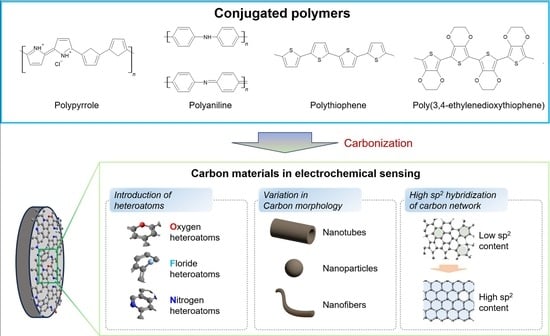
1. Introduction
2. Carbon Nanomaterials Derived from Polymer Precursors
2.1. Aliphatic and Non-Conjugated Polymer Precursors
2.2. Linear Conjugated Polymer Precursors
2.3. Ring-Containing Conjugated Polymer Precursors
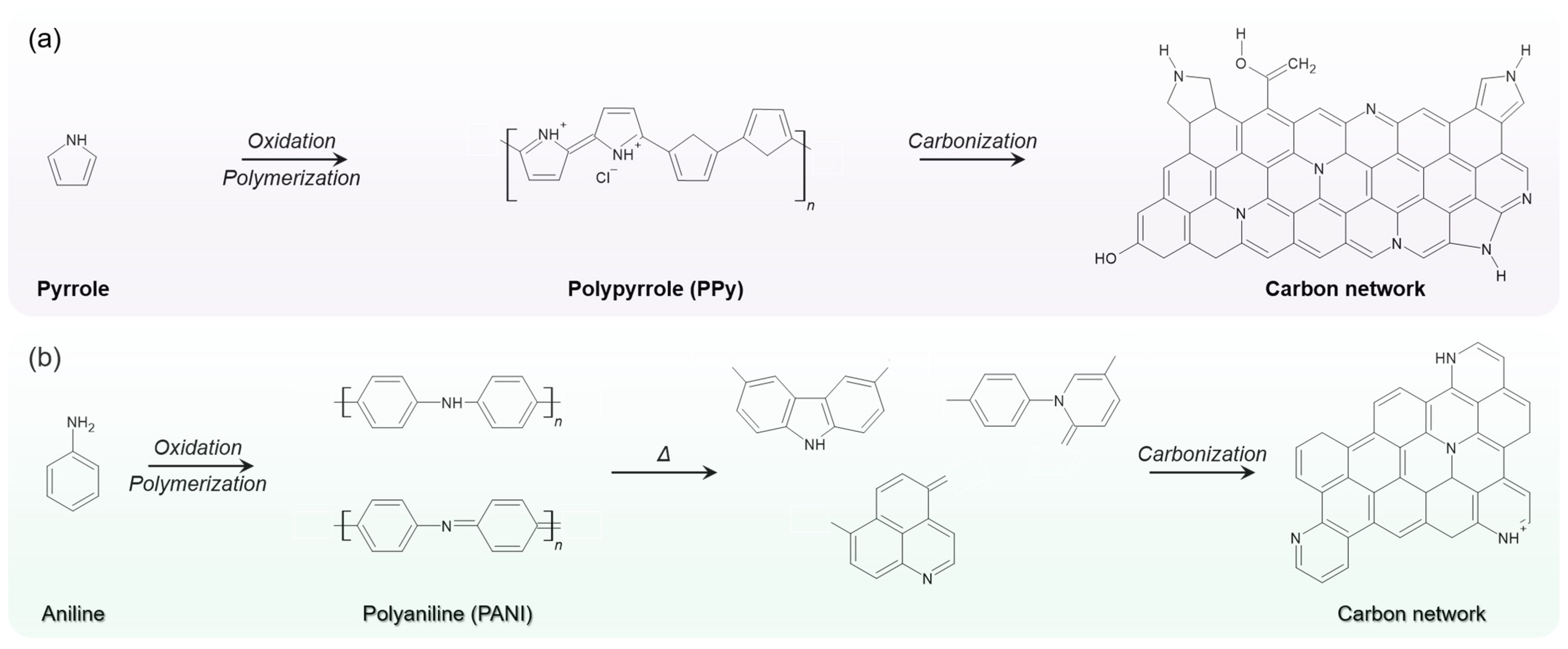
2.3.1. Nitrogen-Containing Conjugated Polymers: PPy and PANI
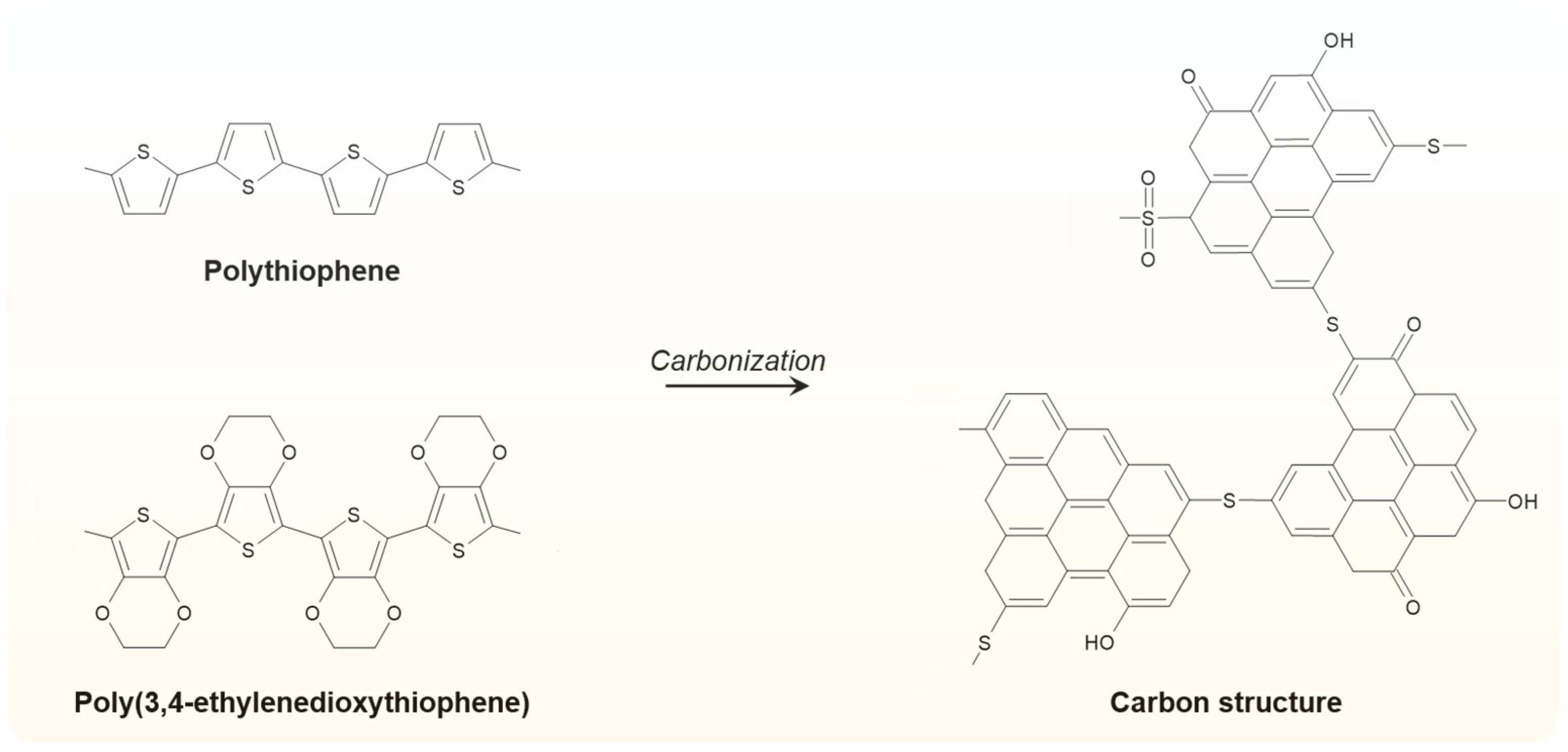
2.3.2. Sulfur-Containing Conjugated Polymers: PT and PEDOT
3. Morphological Control of Conjugated-Polymer-Derived Carbon Nanomaterials
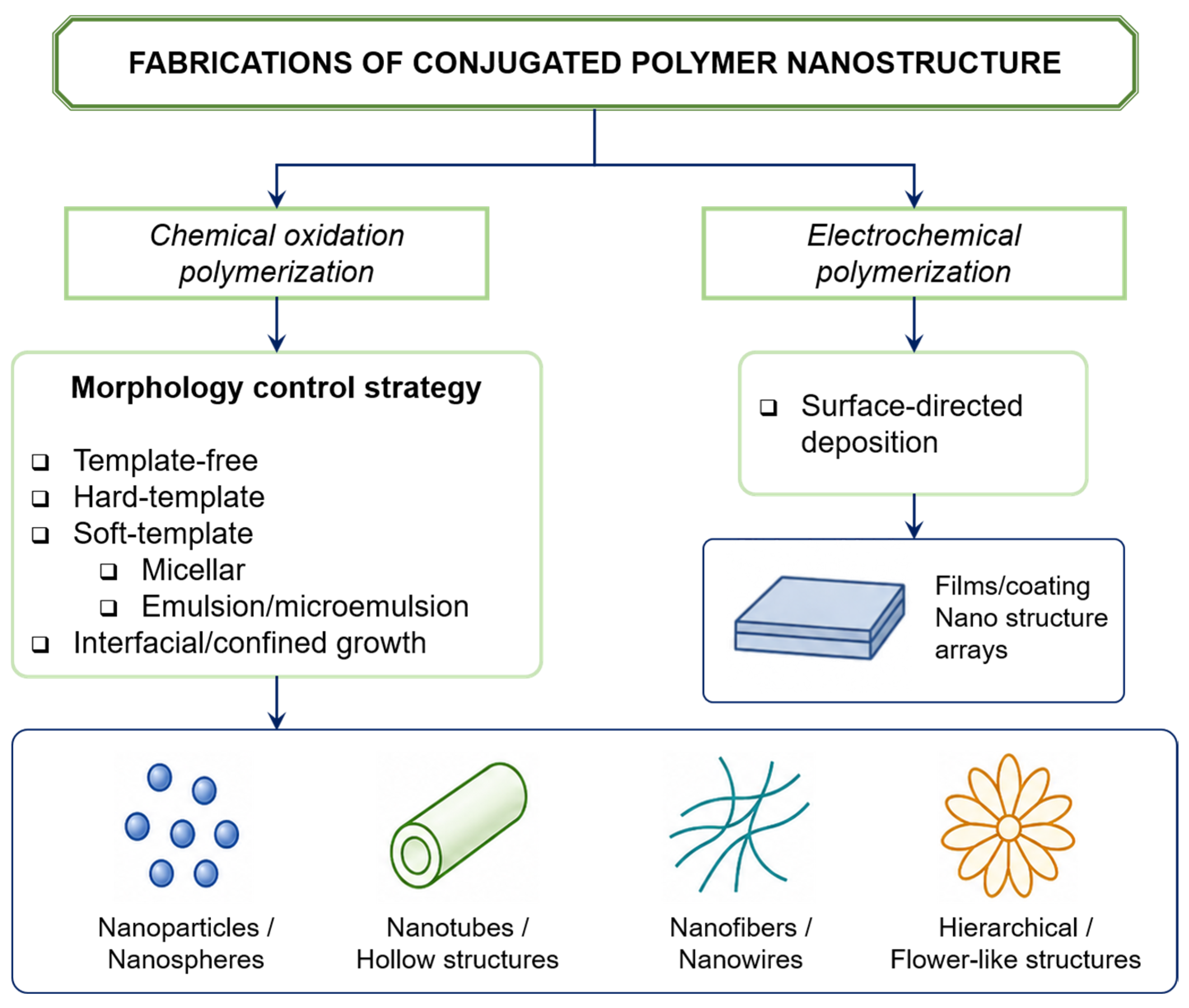
3.1. Morphological Design of Conjugated Polymer Precursors
3.2. Morphological Retention During Carbonization
3.3. Morphology-Dependent Sensing Characteristics
4. Surface Chemical Regulations Beyond Intrinsic Heteroatoms
4.1. Oxygen-Containing Surface Functional Groups and Electrochemical Interfaces
4.2. Additional Heteroatom Incorporation Beyond the Intrinsic N and S
5. Metal and Inorganic Decoration of Carbon Nanomaterials
5.1. Pre-Carbonization Metal Incorporation
5.2. In Situ Transformation During Carbonization
5.3. Metal Oxide and Inorganic Interfaces
6. Electrochemical Sensor Applications
6.1. Sensors Based on Intrinsic Carbon Structure and Morphology
6.2. Sensors Enhanced by Surface Chemical Regulation
6.3. Sensors Enhanced by Metal and Inorganic Decoration

7. Challenges and Perspectives
8. Conclusions
Author Contributions
Funding
Institutional Review Board Statement
Data Availability Statement
Conflicts of Interest
Abbreviations
| Ppy | Polypyrrole |
| PANI | Polyaniline |
| EDOT | 3,4-ethylenedioxythiophene |
| PEDOT | Poly (3,4-ethylenedioxythiophene) |
| PT | Polythiophene |
References
- Singh, R.; Gupta, R.; Bansal, D.; Bhateria, R.; Sharma, M. A Review on Recent Trends and Future Developments in Electrochemical Sensing. ACS Omega 2024, 9, 7336–7356. [Google Scholar] [CrossRef] [Scilit]
- Jayaraman, J.; Thanikachalam, V.; Ramaiyan, S.; Raj Kumar, M.; Davidrichetson, A. Recent Progress in Nanomaterial-Enabled Electrochemical Biosensors: A Comprehensive Review up to 2025. ACS Appl. Bio Mater. 2026, 9, 4977–5017. [Google Scholar] [CrossRef] [Scilit]
- Zabitler, D.; Ülker, E.; Turan, K.; Erdoğan, N.Ö.; Aydoğdu Tığ, G. Electrochemical Sensor for Biological Samples Monitoring. Top. Catal. 2026, 69, 95–125. [Google Scholar] [CrossRef] [Scilit]
- Hosseinikebria, S.; Khazaei, M.; Dervisevic, M.; Judicpa, M.A.; Tian, J.; Razal, J.M.; Voelcker, N.H.; Nilghaz, A. Electrochemical biosensors: The beacon for food safety and quality. Food Chem. 2025, 475, 143284. [Google Scholar] [CrossRef] [Scilit]
- Yang, C.; Denno, M.E.; Pyakurel, P.; Venton, B.J. Recent trends in carbon nanomaterial-based electrochemical sensors for biomolecules: A review. Anal. Chim. Acta 2015, 887, 17–37. [Google Scholar] [CrossRef] [Scilit]
- Chen, P.; Fryling, M.A.; McCreery, R.L. Electron Transfer Kinetics at Modified Carbon Electrode Surfaces: The Role of Specific Surface Sites. Anal. Chem. 1995, 67, 3115–3122. [Google Scholar] [CrossRef] [Scilit]
- Tiwari, J.N.; Vij, V.; Kemp, K.C.; Kim, K.S. Engineered Carbon-Nanomaterial-Based Electrochemical Sensors for Biomolecules. ACS Nano 2016, 10, 46–80. [Google Scholar] [CrossRef] [Scilit]
- Kirchner, E.-M.; Hirsch, T. Recent developments in carbon-based two-dimensional materials: Synthesis and modification aspects for electrochemical sensors. Microchim. Acta 2020, 187, 441. [Google Scholar] [CrossRef] [Scilit]
- Zhu, J.; Mu, S. Defect Engineering in Carbon-Based Electrocatalysts: Insight into Intrinsic Carbon Defects. Adv. Funct. Mater. 2020, 30, 2001097. [Google Scholar] [CrossRef] [Scilit]
- Wang, H.; Shao, Y.; Mei, S.; Lu, Y.; Zhang, M.; Sun, J.-K.; Matyjaszewski, K.; Antonietti, M.; Yuan, J. Polymer-Derived Heteroatom-Doped Porous Carbon Materials. Chem. Rev. 2020, 120, 9363–9419. [Google Scholar] [CrossRef] [Scilit] [PubMed]
- Pašti, I.A.; Janošević Ležaić, A.; Gavrilov, N.M.; Ćirić-Marjanović, G.; Mentus, S.V. Nanocarbons derived from polymers for electrochemical energy conversion and storage—A review. Synth. Met. 2018, 246, 267–281. [Google Scholar] [CrossRef] [Scilit]
- Ćirić-Marjanović, G.; Pašti, I.; Mentus, S. One-dimensional nitrogen-containing carbon nanostructures. Prog. Mater. Sci. 2015, 69, 61–182. [Google Scholar] [CrossRef] [Scilit]
- Qie, L.; Chen, W.; Xiong, X.; Hu, C.; Zou, F.; Hu, P.; Huang, Y. Sulfur-Doped Carbon with Enlarged Interlayer Distance as a High-Performance Anode Material for Sodium-Ion Batteries. Adv. Sci. 2015, 2, 1500195. [Google Scholar] [CrossRef] [Scilit]
- Deng, H.; Li, Q.; Liu, J.; Wang, F. Active sites for oxygen reduction reaction on nitrogen-doped carbon nanotubes derived from polyaniline. Carbon 2017, 112, 219–229. [Google Scholar] [CrossRef] [Scilit]
- Wang, X.; Sun, G.; Routh, P.; Kim, D.-H.; Huang, W.; Chen, P. Heteroatom-doped graphene materials: Syntheses, properties and applications. Chem. Soc. Rev. 2014, 43, 7067–7098. [Google Scholar] [CrossRef] [Scilit]
- Langer, J.J.; Golczak, S. Highly carbonized polyaniline micro- and nanotubes. Polym. Degrad. Stab. 2007, 92, 330–334. [Google Scholar] [CrossRef] [Scilit]
- Han, J.; Xu, G.; Ding, B.; Pan, J.; Dou, H.; MacFarlane, D.R. Porous nitrogen-doped hollow carbon spheres derived from polyaniline for high performance supercapacitors. J. Mater. Chem. A 2014, 2, 5352–5357. [Google Scholar] [CrossRef] [Scilit]
- Ning, X.; Li, Y.; Ming, J.; Wang, Q.; Wang, H.; Cao, Y.; Peng, F.; Yang, Y.; Yu, H. Electronic synergism of pyridinic- and graphitic-nitrogen on N-doped carbons for the oxygen reduction reaction. Chem. Sci. 2019, 10, 1589–1596. [Google Scholar] [CrossRef] [Scilit]
- Poh, H.L.; Pumera, M. P-Element-Doped Graphene: Heteroatoms for Electrochemical Enhancement. ChemElectroChem 2015, 2, 190–199. [Google Scholar] [CrossRef] [Scilit]
- Tylus, U.; Jia, Q.; Strickland, K.; Ramaswamy, N.; Serov, A.; Atanassov, P.; Mukerjee, S. Elucidating Oxygen Reduction Active Sites in Pyrolyzed Metal–Nitrogen Coordinated Non-Precious-Metal Electrocatalyst Systems. J. Phys. Chem. C 2014, 118, 8999–9008. [Google Scholar] [CrossRef] [Scilit]
- Goldie, S.J.; Coleman, K.S. Graphitization by Metal Particles. ACS Omega 2023, 8, 3278–3285. [Google Scholar] [CrossRef] [Scilit]
- Liu, S.; Sui, Z.-Y.; Wang, T.-X.; Zhou, H.-Y.; Liu, Y.-W.; Han, B.-H. Tuning Both Surface Chemistry and Porous Properties of Polymer-Derived Porous Carbons for High-Performance Gas Adsorption. Langmuir 2019, 35, 7650–7658. [Google Scholar] [CrossRef] [Scilit]
- Zou, W.; Zhang, S.; Abbas, Y.; Liu, W.; Zhang, Y.; Wu, Z.; Xu, B. Structurally designed heterochain polymer derived porous carbons with high surface area for high-performance supercapacitors. Appl. Surf. Sci. 2020, 530, 147296. [Google Scholar] [CrossRef] [Scilit]
- Yao, S.; Li, C.; Jackson, M.; Strachan, A. Molecular Modeling of Stabilization during Processing of Polyacrylonitrile-Based Carbon Fibers. Macromolecules 2024, 57, 5578–5588. [Google Scholar] [CrossRef] [Scilit]
- Li, C.; Gong, Y.; Tian, X.; Yao, J.; Wang, X.; Niu, B.; Li, G.; Long, D. From Organic Network to Graphitic Structure: Atomistic Insights into Carbonization Mechanisms of Representative Carbonaceous Precursors. J. Phys. Chem. C 2026, 130, 4968–4981. [Google Scholar] [CrossRef] [Scilit]
- Zhang, P.; Zhu, B.; Du, P.; Travas-Sejdic, J. Electrochemical and Electrical Biosensors for Wearable and Implantable Electronics Based on Conducting Polymers and Carbon-Based Materials. Chem. Rev. 2024, 124, 722–767. [Google Scholar] [CrossRef] [Scilit]
- Zhao, Z.; Chen, H.; Zhang, W.; Yi, S.; Chen, H.; Su, Z.; Niu, B.; Zhang, Y.; Long, D. Defect engineering in carbon materials for electrochemical energy storage and catalytic conversion. Mater. Adv. 2023, 4, 835–867. [Google Scholar] [CrossRef] [Scilit]
- Buchmeiser, M.R.; Muks, E.; Schowner, R.; Frank, E.; Hageroth, U.; Henzler, S.; Spörl, J.; Ota, A.; Beyer, R.; Müller, A. Structure evolution in all-aromatic, poly(p-phenylene-vinylene)-derived carbon fibers. Carbon 2019, 144, 659–665. [Google Scholar] [CrossRef] [Scilit]
- Lomakin, S.M.; Brown, J.E.; Breese, R.S.; Nyden, M.R. An investigation of the thermal stability and char-forming tendency of cross-linked poly(methyl methacrylate). Polym. Degrad. Stab. 1993, 41, 229–243. [Google Scholar] [CrossRef] [Scilit]
- Rahaman, M.S.A.; Ismail, A.F.; Mustafa, A. A review of heat treatment on polyacrylonitrile fiber. Polym. Degrad. Stab. 2007, 92, 1421–1432. [Google Scholar] [CrossRef] [Scilit]
- Zhang, S.-J.; Yu, H.-Q.; Feng, H.-M. PVA-based activated carbon fibers with lotus root-like axially porous structure. Carbon 2006, 44, 2059–2068. [Google Scholar] [CrossRef] [Scilit]
- Morancho, J.M.; Salla, J.M.; Cadenato, A.; Fernández-Francos, X.; Ramis, X.; Colomer, P.; Calventus, Y.; Ruíz, R. Kinetic studies of the degradation of poly(vinyl alcohol)-based proton-conducting membranes at low temperatures. Thermochim. Acta 2011, 521, 139–147. [Google Scholar] [CrossRef] [Scilit]
- Hayashi, T.; Kinashi, K.; Sakai, W.; Tsutsumi, N.; Fujii, A.; Inada, S.; Yamamoto, H. Spin-trapping analysis for thermal degradation of poly(vinyl alcohol). Polymer 2021, 217, 123416. [Google Scholar] [CrossRef] [Scilit]
- Fatema, U.K.; Tomizawa, C.; Harada, M.; Gotoh, Y. Iodine-aided fabrication of hollow carbon fibers from solid poly(vinyl alcohol) fibers. Carbon 2011, 49, 2158–2161. [Google Scholar] [CrossRef] [Scilit]
- Devasia, R.; Nair, C.P.R.; Sadhana, R.; Babu, N.S.; Ninan, K.N. Fourier transform infrared and wide-angle X-ray diffraction studies of the thermal cyclization reactions of high-molar-mass poly(acrylonitrile-co-itaconic acid). J. Appl. Polym. Sci. 2006, 100, 3055–3062. [Google Scholar] [CrossRef] [Scilit]
- Holland, B.J.; Hay, J.N. The thermal degradation of poly(vinyl alcohol). Polymer 2001, 42, 6775–6783. [Google Scholar] [CrossRef] [Scilit]
- Lee, B.-M.; Jung, J.-M.; Hwang, I.-T.; Shin, J.; Hong, S.-K.; Jung, C.-H.; Jeong, Y.G.; Choi, J.-H. Fabrication and electric heating behavior of carbon thin films from water-soluble poly(vinyl alcohol) via simple dry and ambient stabilization and carbonization. Appl. Surf. Sci. 2018, 456, 561–567. [Google Scholar] [CrossRef] [Scilit]
- Kowalik, M.; Ashraf, C.; Damirchi, B.; Akbarian, D.; Rajabpour, S.; van Duin, A.C.T. Atomistic Scale Analysis of the Carbonization Process for C/H/O/N-Based Polymers with the ReaxFF Reactive Force Field. J. Phys. Chem. B 2019, 123, 5357–5367. [Google Scholar] [CrossRef] [Scilit]
- Yan, X.; Jia, Y.; Yao, X. Defects on carbons for electrocatalytic oxygen reduction. Chem. Soc. Rev. 2018, 47, 7628–7658. [Google Scholar] [CrossRef] [Scilit]
- Wang, Z.; Dai, Z. Carbon nanomaterial-based electrochemical biosensors: An overview. Nanoscale 2015, 7, 6420–6431. [Google Scholar] [CrossRef] [Scilit]
- Bashir, Z. A critical review of the stabilisation of polyacrylonitrile. Carbon 1991, 29, 1081–1090. [Google Scholar] [CrossRef] [Scilit]
- Khayyam, H.; Jazar, R.N.; Nunna, S.; Golkarnarenji, G.; Badii, K.; Fakhrhoseini, S.M.; Kumar, S.; Naebe, M. PAN precursor fabrication, applications and thermal stabilization process in carbon fiber production: Experimental and mathematical modelling. Prog. Mater. Sci. 2020, 107, 100575. [Google Scholar] [CrossRef] [Scilit]
- Kim, J.; Jang, J.-S.; Peck, D.-H.; Lee, B.; Yoon, S.-H.; Jung, D.-H. Control of nitrogen content and its effects on the electrochemical behavior of nitrogen-doped carbon nanofibers. J. Electroanal. Chem. 2016, 768, 34–40. [Google Scholar] [CrossRef] [Scilit]
- Cordero-Lanzac, T.; Rosas, J.M.; García-Mateos, F.J.; Ternero-Hidalgo, J.J.; Palomo, J.; Rodríguez-Mirasol, J.; Cordero, T. Role of different nitrogen functionalities on the electrochemical performance of activated carbons. Carbon 2018, 126, 65–76. [Google Scholar] [CrossRef] [Scilit]
- Mittal, J.; Konno, H.; Inagaki, M.; Bahl, O.P. Denitrogenation behavior and tensile strength increase during carbonization of stabilized pan fibers. Carbon 1998, 36, 1327–1330. [Google Scholar] [CrossRef] [Scilit]
- Chakraborty, A.; Devivaraprasad, R.; Bera, B.; Neergat, M. Electrochemical estimation of the active site density on metal-free nitrogen-doped carbon using catechol as an adsorbate. Phys. Chem. Chem. Phys. 2017, 19, 25414–25422. [Google Scholar] [CrossRef] [Scilit]
- Shirakawa, H. The Discovery of Polyacetylene Film: The Dawning of an Era of Conducting Polymers (Nobel Lecture). Angew. Chem. Int. Ed. 2001, 40, 2574–2580. [Google Scholar] [CrossRef] [Scilit]
- Goto, A.; Kyotani, M.; Tsugawa, K.; Piao, G.; Akagi, K.; Koga, Y. Structure of pyrolytic carbon from polyacetylene. Carbon 2001, 39, 2082–2086. [Google Scholar] [CrossRef] [Scilit]
- Gibson, H.W.; Kaplan, S.; Mosher, R.A.; Prest, W.M.; Weagley, R.J. Isomerization of polyacetylene films of the Shirakawa type—Spectroscopy and kinetics. J. Am. Chem. Soc. 1986, 108, 6843–6851. [Google Scholar] [CrossRef] [Scilit]
- Yen, S.P.S.; Somoano, R.; Khanna, S.K.; Rembaum, A. Stability of polyacetylene films. Solid State Commun. 1980, 36, 339–343. [Google Scholar] [CrossRef] [Scilit]
- Billingham, N.C.; Calvert, P.D.; Foot, P.J.S.; Mohammad, F. Stability and degradation of some electrically conducting polymers. Polym. Degrad. Stab. 1987, 19, 323–341. [Google Scholar] [CrossRef] [Scilit]
- Zong, J.; Wu, W.; Mao, L.; Yu, P. Insight into active sites of nitrogen-doped carbon catalyst by stochastic collision electrochemistry. Chem. Commun. 2023, 59, 13163–13166. [Google Scholar] [CrossRef] [Scilit]
- Ait El Fakir, A.; Anfar, Z.; Enneiymy, M.; Jada, A.; El Alem, N. Conjugated polymers templated carbonization to design N, S co-doped finely tunable carbon for enhanced synergistic catalysis. Appl. Catal. B Environ. 2022, 300, 120732. [Google Scholar] [CrossRef] [Scilit]
- Villora-Picó, J.-J.; Gil-Muñoz, G.; Sepúlveda-Escribano, A.; Pastor-Blas, M.M. Doped activated carbons obtained from nitrogen and sulfur-containing polymers as metal-free catalysts for application in nitroarenes hydrogenation. Int. J. Hydrogen Energy 2024, 53, 490–502. [Google Scholar] [CrossRef] [Scilit]
- Rozlívková, Z.; Trchová, M.; Exnerová, M.; Stejskal, J. The carbonization of granular polyaniline to produce nitrogen-containing carbon. Synth. Met. 2011, 161, 1122–1129. [Google Scholar] [CrossRef] [Scilit]
- Xu, G.; Ding, B.; Nie, P.; Shen, L.; Wang, J.; Zhang, X. Porous Nitrogen-Doped Carbon Nanotubes Derived from Tubular Polypyrrole for Energy-Storage Applications. Chem. Eur. J. 2013, 19, 12306–12312. [Google Scholar] [CrossRef] [Scilit]
- Sevilla, M.; Fuertes, A.B. Highly porous S-doped carbons. Microporous Mesoporous Mater. 2012, 158, 318–323. [Google Scholar] [CrossRef] [Scilit]
- Villora-Picó, J.J.; Pastor-Blas, M.M.; Sepúlveda-Escribano, A. N-Doped Activated Carbons from Polypyrrole—Effect of Steam Activation Conditions. Chem. Ing. Tech. 2022, 94, 94–100. [Google Scholar] [CrossRef] [Scilit]
- Mutyala, S.; Jayaraman, M. Synthesis of Nitrogen Doped Carbon and Its Enhanced Electrochemical Activity towards Ascorbic Acid Electrooxidation. Int. J. Electrochem. 2014, 2014, 246746. [Google Scholar] [CrossRef] [Scilit]
- Yuan, D.; Yuan, X.; Zhou, S.; Zou, W.; Zhou, T. N-Doped carbon nanorods as ultrasensitive electrochemical sensors for the determination of dopamine. RSC Adv. 2012, 2, 8157–8163. [Google Scholar] [CrossRef] [Scilit]
- Baker, C.O.; Huang, X.; Nelson, W.; Kaner, R.B. Polyaniline nanofibers: Broadening applications for conducting polymers. Chem. Soc. Rev. 2017, 46, 1510–1525. [Google Scholar] [CrossRef] [Scilit]
- Liu, Y.; Wu, F. Synthesis and application of polypyrrole nanofibers: A review. Nanoscale Adv. 2023, 5, 3606–3618. [Google Scholar] [CrossRef] [Scilit] [PubMed]
- Kopecká, J.; Mrlík, M.; Olejník, R.; Kopecký, D.; Vrňata, M.; Prokeš, J.; Bober, P.; Morávková, Z.; Trchová, M.; Stejskal, J. Polypyrrole Nanotubes and Their Carbonized Analogs: Synthesis, Characterization, Gas Sensing Properties. Sensors 2016, 16, 1917. [Google Scholar] [CrossRef] [Scilit]
- Stejskal, J.; Kohl, M.; Trchová, M.; Kolská, Z.; Pekárek, M.; Křivka, I.; Prokeš, J. Conversion of conducting polypyrrole nanostructures to nitrogen-containing carbons and its impact on the adsorption of organic dye. Mater. Adv. 2021, 2, 706–717. [Google Scholar] [CrossRef] [Scilit]
- Kuroki, S.; Nabae, Y.; Chokai, M.; Kakimoto, M.-A.; Miyata, S. Oxygen reduction activity of pyrolyzed polypyrroles studied by 15N solid-state NMR and XPS with principal component analysis. Carbon 2012, 50, 153–162. [Google Scholar] [CrossRef] [Scilit]
- Pels, J.R.; Kapteijn, F.; Moulijn, J.A.; Zhu, Q.; Thomas, K.M. Evolution of nitrogen functionalities in carbonaceous materials during pyrolysis. Carbon 1995, 33, 1641–1653. [Google Scholar] [CrossRef] [Scilit]
- Zhu, J.; Xu, Y.; Zhang, Y.; Feng, T.; Wang, J.; Mao, S.; Xiong, L. Porous and high electronic conductivity nitrogen-doped nano-sheet carbon derived from polypyrrole for high-power supercapacitors. Carbon 2016, 107, 638–645. [Google Scholar] [CrossRef] [Scilit]
- Kuroki, S.; Hosaka, Y.; Yamauchi, C. A solid-state NMR study of the carbonization of polyaniline. Carbon 2013, 55, 160–167. [Google Scholar] [CrossRef] [Scilit]
- Trchová, M.; Matějka, P.; Brodinová, J.; Kalendová, A.; Prokeš, J.; Stejskal, J. Structural and conductivity changes during the pyrolysis of polyaniline base. Polym. Degrad. Stab. 2006, 91, 114–121. [Google Scholar] [CrossRef] [Scilit]
- Peng, H.; Liu, F.; Liu, X.; Liao, S.; You, C.; Tian, X.; Nan, H.; Luo, F.; Song, H.; Fu, Z.; et al. Effect of Transition Metals on the Structure and Performance of the Doped Carbon Catalysts Derived From Polyaniline and Melamine for ORR Application. ACS Catal. 2014, 4, 3797–3805. [Google Scholar] [CrossRef] [Scilit]
- Yang, W.; Zhang, Y.; Wang, J.; Xia, M.; Zhang, J.; He, J.; Guo, W.; Tian, K.; Liu, S.; Li, X.; et al. Unprecedented 100% conversion from pyridinic to pyrrolic nitrogen configuration for electrochemically active nitrogen-doped carbon materials. J. Colloid Interface Sci. 2024, 662, 883–892. [Google Scholar] [CrossRef] [Scilit]
- Wang, H.; Maiyalagan, T.; Wang, X. Review on Recent Progress in Nitrogen-Doped Graphene: Synthesis, Characterization, and Its Potential Applications. ACS Catal. 2012, 2, 781–794. [Google Scholar] [CrossRef] [Scilit]
- Inagaki, M.; Toyoda, M.; Soneda, Y.; Morishita, T. Nitrogen-doped carbon materials. Carbon 2018, 132, 104–140. [Google Scholar] [CrossRef] [Scilit]
- Wiench, P.; González, Z.; Gryglewicz, S.; Menéndez, R.; Gryglewicz, G. Enhanced performance of pyrrolic N-doped reduced graphene oxide-modified glassy carbon electrodes for dopamine sensing. J. Electroanal. Chem. 2019, 852, 113547. [Google Scholar] [CrossRef] [Scilit]
- Kang, W.; Li, H.; Ai, M.; Wei, S.; Gao, H.; Liu, J.; Qian, Y. Synthesis of nitrogen-doped carbon and application in highly selective and sensitive dopamine sensing. Mater. Lett. 2014, 116, 374–377. [Google Scholar] [CrossRef] [Scilit]
- Wang, E.-J.; Sui, Z.-Y.; Sun, Y.-N.; Ma, Z.; Han, B.-H. Effect of Porosity Parameters and Surface Chemistry on Carbon Dioxide Adsorption in Sulfur-Doped Porous Carbons. Langmuir 2018, 34, 6358–6366. [Google Scholar] [CrossRef] [Scilit]
- Kiciński, W.; Szala, M.; Bystrzejewski, M. Sulfur-doped porous carbons: Synthesis and applications. Carbon 2014, 68, 1–32. [Google Scholar] [CrossRef] [Scilit]
- Gueye, M.N.; Carella, A.; Faure-Vincent, J.; Demadrille, R.; Simonato, J.-P. Progress in understanding structure and transport properties of PEDOT-based materials: A critical review. Prog. Mater. Sci. 2020, 108, 100616. [Google Scholar] [CrossRef] [Scilit]
- Matsushita, S.; Yan, B.; Matsui, T.; Kim, J.-D.; Akagi, K. Conjugated polymer-based carbonaceous films as binder-free carbon electrodes in supercapacitors. RSC Adv. 2018, 8, 19512–19523. [Google Scholar] [CrossRef] [Scilit]
- Gu, W.; Sevilla, M.; Magasinski, A.; Fuertes, A.B.; Yushin, G. Sulfur-containing activated carbons with greatly reduced content of bottle neck pores for double-layer capacitors: A case study for pseudocapacitance detection. Energy Environ. Sci. 2013, 6, 2465–2476. [Google Scholar] [CrossRef] [Scilit]
- Casanova, A.; Iniesta, J.; Gomis-Berenguer, A. Recent progress in the development of porous carbon-based electrodes for sensing applications. Analyst 2022, 147, 767–783. [Google Scholar] [CrossRef] [Scilit]
- Cheng, Q.; Ji, L.; Wu, K.; Zhang, W. Morphology-dependent Electrochemical Enhancements of Porous Carbon as Sensitive Determination Platform for Ascorbic Acid, Dopamine and Uric Acid. Sci. Rep. 2016, 6, 22309. [Google Scholar] [CrossRef] [Scilit]
- Ndamanisha, J.C.; Guo, L.-P. Ordered mesoporous carbon for electrochemical sensing: A review. Anal. Chim. Acta 2012, 747, 19–28. [Google Scholar] [CrossRef] [Scilit]
- Ćirić-Marjanović, G.; Pašti, I.; Gavrilov, N.; Janošević, A.; Mentus, S. Carbonised polyaniline and polypyrrole: Towards advanced nitrogen-containing carbon materials. Chem. Pap. 2013, 67, 781–813. [Google Scholar] [CrossRef] [Scilit]
- Zhang, X.; Zhang, J.; Song, W.; Liu, Z. Controllable Synthesis of Conducting Polypyrrole Nanostructures. J. Phys. Chem. B 2006, 110, 1158–1165. [Google Scholar] [CrossRef] [Scilit]
- Stejskal, J.; Sapurina, I.; Trchová, M. Polyaniline nanostructures and the role of aniline oligomers in their formation. Prog. Polym. Sci. 2010, 35, 1420–1481. [Google Scholar] [CrossRef] [Scilit]
- Musumeci, C.; Hutchison, J.A.; Samorì, P. Controlling the morphology of conductive PEDOT by in situ electropolymerization: From thin films to nanowires with variable electrical properties. Nanoscale 2013, 5, 7756–7761. [Google Scholar] [CrossRef] [Scilit]
- Cho, S.; Lee, J.S. Recent Development of Morphology Controlled Conducting Polymer Nanomaterial-Based Biosensor. Appl. Sci. 2020, 10, 5889. [Google Scholar] [CrossRef] [Scilit]
- Nguyen, T.D.; Phan, T.T.T.; Lee, J.S. Fabrication and Characterization of Self-Healable Polydisulfide Network-Based Composites. ACS Appl. Polym. Mater. 2023, 5, 485–493. [Google Scholar] [CrossRef] [Scilit]
- Nguyen, T.D.; Phan, T.T.T.; Nam, Y.J.; Lee, J.S. Dynamic Covalent Bond Network-Based Carbon Nanocomposite for a Self-Healing Tactile Sensor. ACS Appl. Electron. Mater. 2023, 5, 4417–4425. [Google Scholar] [CrossRef] [Scilit]
- Liu, Y.; Goebl, J.; Yin, Y. Templated synthesis of nanostructured materials. Chem. Soc. Rev. 2013, 42, 2610–2653. [Google Scholar] [CrossRef] [Scilit]
- Nguyen, D.N.; Yoon, H. Recent Advances in Nanostructured Conducting Polymers: From Synthesis to Practical Applications. Polymers 2016, 8, 118. [Google Scholar] [CrossRef] [Scilit]
- Wan, M. A Template-Free Method Towards Conducting Polymer Nanostructures. Adv. Mater. 2008, 20, 2926–2932. [Google Scholar] [CrossRef] [Scilit]
- Wang, S.; Chen, Y.; Hu, B.; Wang, Y.; Jing, X.; Li, Y. Polypyrrole micro/nanostructures and their soft materials in versatile forms: Construction and applications. Mater. Chem. Front. 2024, 8, 434–454. [Google Scholar] [CrossRef] [Scilit]
- Xia, L.; Wei, Z.; Wan, M. Conducting polymer nanostructures and their application in biosensors. J. Colloid Interface Sci. 2010, 341, 1–11. [Google Scholar] [CrossRef] [Scilit]
- Culebras, M.; Serrano-Claumarchirant, J.F.; Sanchis, M.J.; Landfester, K.; Cantarero, A.; Gómez, C.M.; Muñoz-Espí, R. Conducting PEDOT Nanoparticles: Controlling Colloidal Stability and Electrical Properties. J. Phys. Chem. C 2018, 122, 19197–19203. [Google Scholar] [CrossRef] [Scilit]
- Thomas, A.; Goettmann, F.; Antonietti, M. Hard Templates for Soft Materials: Creating Nanostructured Organic Materials. Chem. Mater. 2008, 20, 738–755. [Google Scholar] [CrossRef] [Scilit]
- Martin, C.R. Template Synthesis of Electronically Conductive Polymer Nanostructures. Acc. Chem. Res. 1995, 28, 61–68. [Google Scholar] [CrossRef] [Scilit]
- Liu, P.; Zhu, Y.; Torres, J.; Lee, S.H.; Yun, M. Facile and template-free method toward chemical synthesis of polyaniline film/nanotube structures. J. Polym. Sci. A Polym. Chem. 2017, 55, 3973–3979. [Google Scholar] [CrossRef] [Scilit]
- Oueiny, C.; Berlioz, S.; Perrin, F.X. Assembly of polyaniline nanotubes by interfacial polymerization for corrosion protection. Phys. Chem. Chem. Phys. 2016, 18, 3504–3509. [Google Scholar] [CrossRef] [Scilit]
- Stejskal, J.; Trchová, M.; Hromádková, J.I.; Kovár̆ová, J.; Kalendová, A. The carbonization of colloidal polyaniline nanoparticles to nitrogen-containing carbon analogues. Polym. Int. 2010, 59, 875–878. [Google Scholar] [CrossRef] [Scilit]
- Trchová, M.; Konyushenko, E.N.; Stejskal, J.; Kovářová, J.; Ćirić-Marjanović, G. The conversion of polyaniline nanotubes to nitrogen-containing carbon nanotubes and their comparison with multi-walled carbon nanotubes. Polym. Degrad. Stab. 2009, 94, 929–938. [Google Scholar] [CrossRef] [Scilit]
- Mentus, S.; Ćirić-Marjanović, G.; Trchová, M.; Stejskal, J. Conducting carbonized polyaniline nanotubes. Nanotechnology 2009, 20, 245601. [Google Scholar] [CrossRef] [Scilit]
- Janošević, A.; Pašti, I.; Gavrilov, N.; Mentus, S.; Ćirić-Marjanović, G.; Krstić, J.; Stejskal, J. Micro/mesoporous conducting carbonized polyaniline 5-sulfosalicylate nanorods/nanotubes: Synthesis, characterization and electrocatalysis. Synth. Met. 2011, 161, 2179–2184. [Google Scholar] [CrossRef] [Scilit]
- Janošević, A.; Pašti, I.; Gavrilov, N.; Mentus, S.; Krstić, J.; Mitrić, M.; Travas-Sejdic, J.; Ćirić-Marjanović, G. Microporous conducting carbonized polyaniline nanorods: Synthesis, characterization and electrocatalytic properties. Microporous Mesoporous Mater. 2012, 152, 50–57. [Google Scholar] [CrossRef] [Scilit]
- Orleans-Boham, H.; Elessawy, N.A.; El-Shazly, A.; Elkady, M.F. Production and characterization of nano-polyaniline and carbonized polyaniline for potential application as energy storage devices. Mater. Today Proc. 2020, 33, 1909–1912. [Google Scholar] [CrossRef] [Scilit]
- Sevilla, M.; Valle-Vigón, P.; Fuertes, A.B. N-Doped Polypyrrole-Based Porous Carbons for CO2 Capture. Adv. Funct. Mater. 2011, 21, 2781–2787. [Google Scholar] [CrossRef] [Scilit]
- Ćirić-Marjanović, G.; Mentus, S.; Pašti, I.; Gavrilov, N.; Krstić, J.; Travas-Sejdic, J.; Strover, L.T.; Kopecká, J.; Moravková, Z.; Trchová, M.; et al. Synthesis, Characterization, and Electrochemistry of Nanotubular Polypyrrole and Polypyrrole-Derived Carbon Nanotubes. J. Phys. Chem. C 2014, 118, 14770–14784. [Google Scholar] [CrossRef] [Scilit]
- Ejima, H.; Iwata, T.; Yoshie, N. Morphology-Retaining Carbonization of Honeycomb-Patterned Hyperbranched Poly(phenylene vinylene) Film. Macromolecules 2008, 41, 9846–9848. [Google Scholar] [CrossRef] [Scilit]
- Liu, X.; Xi, X.; Chen, C.; Liu, F.; Wu, D.; Wang, L.; Ji, W.; Su, Y.; Liu, R. Ordered mesoporous carbon-covered carbonized silk fabrics for flexible electrochemical dopamine detection. J. Mater. Chem. B 2019, 7, 2145–2150. [Google Scholar] [CrossRef] [Scilit]
- Rattanaumpa, T.; Maensiri, S.; Ngamchuea, K. Microporous carbon in the selective electro-oxidation of molecular biomarkers: Uric acid, ascorbic acid, and dopamine. RSC Adv. 2022, 12, 18709–18721. [Google Scholar] [CrossRef] [Scilit]
- Schierholz, R.; Kröger, D.; Weinrich, H.; Gehring, M.; Tempel, H.; Kungl, H.; Mayer, J.; Eichel, R.-A. The carbonization of polyacrylonitrile-derived electrospun carbon nanofibers studied by in situ transmission electron microscopy. RSC Adv. 2019, 9, 6267–6277. [Google Scholar] [CrossRef] [Scilit]
- Asadian, E.; Ghalkhani, M.; Shahrokhian, S. Electrochemical sensing based on carbon nanoparticles: A review. Sens. Actuators B Chem. 2019, 293, 183–209. [Google Scholar] [CrossRef] [Scilit]
- Wang, L.; Gu, C.; Wu, L.; Tan, W.; Shang, Z.; Tian, Y.; Ma, J. Recent advances in carbon dots for electrochemical sensing and biosensing: A systematic review. Microchem. J. 2024, 207, 111687. [Google Scholar] [CrossRef] [Scilit]
- Wang, J. Carbon-Nanotube Based Electrochemical Biosensors: A Review. Electroanalysis 2005, 17, 7–14. [Google Scholar] [CrossRef] [Scilit]
- Zhang, L.; Yin, M.; Wei, X.; Sun, J.; Xu, D. Recent advances in morphology, aperture control, functional control and electrochemical sensors applications of carbon nanofibers. Anal. Biochem. 2022, 656, 114882. [Google Scholar] [CrossRef] [Scilit]
- Agüí, L.; Yáñez-Sedeño, P.; Pingarrón, J.M. Role of carbon nanotubes in electroanalytical chemistry: A review. Anal. Chim. Acta 2008, 622, 11–47. [Google Scholar] [CrossRef] [Scilit]
- Huang, J.; Liu, Y.; You, T. Carbon nanofiber based electrochemical biosensors: A review. Anal. Methods 2010, 2, 202–211. [Google Scholar] [CrossRef] [Scilit]
- Prilutsky, S.; Zussman, E.; Cohen, Y. The effect of embedded carbon nanotubes on the morphological evolution during the carbonization of poly(acrylonitrile) nanofibers. Nanotechnology 2008, 19, 165603. [Google Scholar] [CrossRef] [Scilit]
- Wang, H.; Ren, F.; Yue, R.; Wang, C.; Zhai, C.; Du, Y. Macroporous flower-like graphene-nanosheet clusters used for electrochemical determination of dopamine. Colloids Surf. A Physicochem. Eng. Asp. 2014, 448, 181–185. [Google Scholar] [CrossRef] [Scilit]
- Wang, Y.; Huang, Y.; Wang, B.; Fang, T.; Chen, J.; Liang, C. Three-dimensional porous graphene for simultaneous detection of dopamine and uric acid in the presence of ascorbic acid. J. Electroanal. Chem. 2016, 782, 76–83. [Google Scholar] [CrossRef] [Scilit]
- Cao, Q.; Puthongkham, P.; Venton, B.J. Review: New insights into optimizing chemical and 3D surface structures of carbon electrodes for neurotransmitter detection. Anal. Methods 2019, 11, 247–261. [Google Scholar] [CrossRef] [Scilit]
- Gao, Y.; Wang, Q.; Ji, G.; Li, A.; Niu, J. Doping strategy, properties and application of heteroatom-doped ordered mesoporous carbon. RSC Adv. 2021, 11, 5361–5383. [Google Scholar] [CrossRef] [Scilit]
- Roberts, J.G.; Moody, B.P.; McCarty, G.S.; Sombers, L.A. Specific Oxygen-Containing Functional Groups on the Carbon Surface Underlie an Enhanced Sensitivity to Dopamine at Electrochemically Pretreated Carbon Fiber Microelectrodes. Langmuir 2010, 26, 9116–9122. [Google Scholar] [CrossRef] [Scilit]
- Behan, J.A.; Grajkowski, F.; Jayasundara, D.R.; Vilella-Arribas, L.; García-Melchor, M.; Colavita, P.E. Influence of carbon nanostructure and oxygen moieties on dopamine adsorption and charge transfer kinetics at glassy carbon surfaces. Electrochim. Acta 2019, 304, 221–230. [Google Scholar] [CrossRef] [Scilit]
- Sreeprasad, T.S.; Berry, V. How Do the Electrical Properties of Graphene Change with its Functionalization? Small 2013, 9, 341–350. [Google Scholar] [CrossRef] [Scilit]
- Chua, C.K.; Pumera, M. Monothiolation and Reduction of Graphene Oxide via One-Pot Synthesis: Hybrid Catalyst for Oxygen Reduction. ACS Nano 2015, 9, 4193–4199. [Google Scholar] [CrossRef] [Scilit]
- Boehm, H.P. Some aspects of the surface chemistry of carbon blacks and other carbons. Carbon 1994, 32, 759–769. [Google Scholar] [CrossRef] [Scilit]
- Qiu, C.; Jiang, L.; Gao, Y.; Sheng, L. Effects of oxygen-containing functional groups on carbon materials in supercapacitors: A review. Mater. Des. 2023, 230, 111952. [Google Scholar] [CrossRef] [Scilit]
- Wang, S.C.; Chang, K.S.; Yuan, C.J. Enhancement of electrochemical properties of screen-printed carbon electrodes by oxygen plasma treatment. Electrochim. Acta 2009, 54, 4937–4943. [Google Scholar] [CrossRef] [Scilit]
- Guo, Z.; Seol, M.-L.; Kim, M.-S.; Ahn, J.-H.; Choi, Y.-K.; Liu, J.-H.; Huang, X.-J. Sensitive and selective electrochemical detection of dopamine using an electrode modified with carboxylated carbonaceous spheres. Analyst 2013, 138, 2683–2690. [Google Scholar] [CrossRef] [Scilit]
- Sun, J.; Xu, J.; Jiang, H.; Zhang, X.; Niu, D. Roles of Oxygen Functional Groups in Carbon Nanotubes-Supported Ag Catalysts for Electrochemical Conversion of CO2 to CO. ChemElectroChem 2020, 7, 1869–1876. [Google Scholar] [CrossRef] [Scilit]
- Feng, W.; Ji, P. Enzymes immobilized on carbon nanotubes. Biotechnol. Adv. 2011, 29, 889–895. [Google Scholar] [CrossRef] [Scilit]
- He, Y.; Zhang, Y.; Li, X.; Lv, Z.; Wang, X.; Liu, Z.; Huang, X. Capacitive mechanism of oxygen functional groups on carbon surface in supercapacitors. Electrochim. Acta 2018, 282, 618–625. [Google Scholar] [CrossRef] [Scilit]
- Zhang, C.; Fan, Q.; Xu, J.; Huang, M.; Luo, F.; Wang, D.; Zheng, Z. Surface oxygen-containing functional groups: A key tradeoff in carbon-based energy storage devices. Chem. Eng. J. 2025, 505, 159162. [Google Scholar] [CrossRef] [Scilit]
- Paraknowitsch, J.P.; Thomas, A. Doping carbons beyond nitrogen: An overview of advanced heteroatom doped carbons with boron, sulphur and phosphorus for energy applications. Energy Environ. Sci. 2013, 6, 2839–2855. [Google Scholar] [CrossRef] [Scilit]
- Antonietti, M.; Oschatz, M. The Concept of “Noble, Heteroatom-Doped Carbons,” Their Directed Synthesis by Electronic Band Control of Carbonization, and Applications in Catalysis and Energy Materials. Adv. Mater. 2018, 30, 1706836. [Google Scholar] [CrossRef] [Scilit]
- Chu, K.; Wang, F.; Tian, Y.; Wei, Z. Phosphorus doped and defects engineered graphene for improved electrochemical sensing: Synergistic effect of dopants and defects. Electrochim. Acta 2017, 231, 557–564. [Google Scholar] [CrossRef] [Scilit]
- Emran, M.Y.; El-Safty, S.A.; Selim, M.M.; Reda, A.; Morita, H.; Shenashen, M.A. Electrochemical sensors-based phosphorus-doped carbon for determination of adenine DNA-nucleobases in living cells. Carbon 2021, 173, 1093–1104. [Google Scholar] [CrossRef] [Scilit]
- Emran, M.Y.; El-Safty, S.A.; Selim, M.M.; Shenashen, M.A. Selective monitoring of ultra-trace guanine and adenine from hydrolyzed DNA using boron-doped carbon electrode surfaces. Sens. Actuators B Chem. 2021, 329, 129192. [Google Scholar] [CrossRef] [Scilit]
- Deng, C.; Chen, J.; Wang, M.; Xiao, C.; Nie, Z.; Yao, S. A novel and simple strategy for selective and sensitive determination of dopamine based on the boron-doped carbon nanotubes modified electrode. Biosens. Bioelectron. 2009, 24, 2091–2094. [Google Scholar] [CrossRef] [Scilit]
- Wang, T.; Zang, X.; Wang, X.; Gu, X.; Shao, Q.; Cao, N. Recent advances in fluorine-doped/fluorinated carbon-based materials for supercapacitors. Energy Storage Mater. 2020, 30, 367–384. [Google Scholar] [CrossRef] [Scilit]
- Zhang, G.; Colin, M.; Yang, X.; Sun, S.; Dodelet, J.-P.; Dubois, M. CF bonding in fluorinated N-Doped carbons. Appl. Surf. Sci. 2022, 577, 151721. [Google Scholar] [CrossRef] [Scilit]
- Choi, C.H.; Park, S.H.; Woo, S.I. Binary and Ternary Doping of Nitrogen, Boron, and Phosphorus into Carbon for Enhancing Electrochemical Oxygen Reduction Activity. ACS Nano 2012, 6, 7084–7091. [Google Scholar] [CrossRef] [Scilit]
- Sivaraman, N.; Duraisamy, V.; Lucious, L.; Saraswathyamma, B.; Kumar, S.M.S.; Thangamuthu, R. In-situ construction of N and doped hollow sphere carbon for electrochemical sensing of antibiotic drug from poultry sustenance. Electrochim. Acta 2023, 441, 141773. [Google Scholar] [CrossRef] [Scilit]
- Fayemi, O.E.; Adekunle, A.S.; Kumara Swamy, B.E.; Ebenso, E.E. Electrochemical sensor for the detection of dopamine in real samples using polyaniline/NiO, ZnO, and Fe3O4 nanocomposites on glassy carbon electrode. J. Electroanal. Chem. 2018, 818, 236–249. [Google Scholar] [CrossRef] [Scilit]
- Białas, K.; Moschou, D.; Marken, F.; Estrela, P. Electrochemical sensors based on metal nanoparticles with biocatalytic activity. Microchim. Acta 2022, 189, 172. [Google Scholar] [CrossRef] [Scilit]
- Durante, C. Metal–carbon interaction in metal nanoparticles and implication in the electrocatalysis of oxygen reduction. Curr. Opin. Electrochem. 2022, 36, 101119. [Google Scholar] [CrossRef] [Scilit]
- Li, K.; Meng, F.; Li, J.; Wu, H.; Jia, H.; Ji, Q. Engineering accessible Fe-N sites in polypyrrole-derived catalysts via a dynamic coordination strategy. Sustain. Energy Fuels. 2026, 10, 587–595. [Google Scholar] [CrossRef] [Scilit]
- Wang, G.; Jiang, K.; Xu, M.; Min, C.; Ma, B.; Yang, X. A high activity nitrogen-doped carbon catalyst for oxygen reduction reaction derived from polyaniline-iron coordination polymer. J. Power Sources 2014, 266, 222–225. [Google Scholar] [CrossRef] [Scilit]
- Han, A.; Chen, W.; Zhang, S.; Zhang, M.; Han, Y.; Zhang, J.; Ji, S.; Zheng, L.; Wang, Y.; Gu, L.; et al. A Polymer Encapsulation Strategy to Synthesize Porous Nitrogen-Doped Carbon-Nanosphere-Supported Metal Isolated-Single-Atomic-Site Catalysts. Adv. Mater. 2018, 30, 1706508. [Google Scholar] [CrossRef] [Scilit]
- Peng, H.; Mo, Z.; Liao, S.; Liang, H.; Yang, L.; Luo, F.; Song, H.; Zhong, Y.; Zhang, B. High Performance Fe- and N- Doped Carbon Catalyst with Graphene Structure for Oxygen Reduction. Sci. Rep. 2013, 3, 1765. [Google Scholar] [CrossRef] [Scilit]
- Tran, T.-N.; Song, M.Y.; Singh, K.P.; Yang, D.-S.; Yu, J.-S. Iron–polypyrrole electrocatalyst with remarkable activity and stability for ORR in both alkaline and acidic conditions: A comprehensive assessment of catalyst preparation sequence. J. Mater. Chem. A 2016, 4, 8645–8657. [Google Scholar] [CrossRef] [Scilit]
- Jiang, Y.; Xu, H.; Ma, B.; Zhang, Z.; Zhou, Y. Polypyrrole derived carbon nanotube aerogel based single-site Fe-N-C catalyst with superior ORR activity and durability. Fuel 2024, 366, 131404. [Google Scholar] [CrossRef] [Scilit]
- Daems, N.; Sheng, X.; Alvarez-Gallego, Y.; Vankelecom, I.F.J.; Pescarmona, P.P. Iron-containing N-doped carbon electrocatalysts for the cogeneration of hydroxylamine and electricity in a H2–NO fuel cell. Green Chem. 2016, 18, 1547–1559. [Google Scholar] [CrossRef] [Scilit]
- Yang, S.; Zhang, J.; Peng, L.; Asgari, M.; Stoian, D.; Kochetygov, I.; Luo, W.; Oveisi, E.; Trukhina, O.; Clark, A.H.; et al. A metal–organic framework/polymer derived catalyst containing single-atom nickel species for electrocatalysis. Chem. Sci. 2020, 11, 10991–10997. [Google Scholar] [CrossRef] [Scilit]
- He, Q.; Chen, X.; Jia, F.; Ding, W.; Zhou, Y.; Wang, J.; Song, X.; Jiang, J.; Liao, Q.; Li, J.; et al. The Role of Polyaniline Molecular Structure in Producing High-Performance Fe-N-C Catalysts for Oxygen Reduction Reaction. ChemistrySelect 2019, 4, 8135–8141. [Google Scholar] [CrossRef] [Scilit]
- Huang, Y.; Chen, Y.; Xu, M.; Asset, T.; Tieu, P.; Gili, A.; Kulkarni, D.; De Andrade, V.; De Carlo, F.; Barnard, H.S.; et al. Catalysts by pyrolysis: Direct observation of chemical and morphological transformations leading to transition metal-nitrogen-carbon materials. Mater. Today 2021, 47, 53–68. [Google Scholar] [CrossRef] [Scilit]
- Chen, M.-X.; Tong, L.; Liang, H.-W. Understanding the Catalytic Sites of Metal–Nitrogen–Carbon Oxygen Reduction Electrocatalysts. Chem. Eur. J. 2021, 27, 145–157. [Google Scholar] [CrossRef] [Scilit]
- Li, B.; Holby, E.F.; Wang, G. Mechanistic insights into metal, nitrogen doped carbon catalysts for oxygen reduction: Progress in computational modeling. J. Mater. Chem. A 2022, 10, 23959–23972. [Google Scholar] [CrossRef] [Scilit]
- Guan, W.; Shao, H.; Zhang, C.; Qiu, X.; Zhao, J.; Wang, Y.; Zhang, L.; Shao, M.; Hu, J. Strategies for the regulation of specific active sites in metal−nitrogen−carbon. Nano Energy 2024, 120, 109149. [Google Scholar] [CrossRef] [Scilit]
- Alexander, A.-M.; Hargreaves, J.S.J. Alternative catalytic materials: Carbides, nitrides, phosphides and amorphous boron alloys. Chem. Soc. Rev. 2010, 39, 4388–4401. [Google Scholar] [CrossRef] [Scilit]
- Yao, Y.; Zhong, J.; Lu, Z.; Liu, X.; Wang, Y.; Liu, T.; Zou, P.; Dai, X.; Wang, X.; Ding, F.; et al. Nitrogen-doped carbon frameworks decorated with palladium nanoparticles for simultaneous electrochemical voltammetric determination of uric acid and dopamine in the presence of ascorbic acid. Microchim. Acta 2019, 186, 795. [Google Scholar] [CrossRef] [Scilit]
- Hunter, R.D.; Ramírez-Rico, J.; Schnepp, Z. Iron-catalyzed graphitization for the synthesis of nanostructured graphitic carbons. J. Mater. Chem. A 2022, 10, 4489–4516. [Google Scholar] [CrossRef] [Scilit]
- Li, Q.; Shao, Q.; Wu, Q.; Duan, Q.; Li, Y.; Wang, H.-G. In situ anchoring of metal nanoparticles in the N-doped carbon framework derived from conjugated microporous polymers towards an efficient oxygen reduction reaction. Catal. Sci. Technol. 2018, 8, 3572–3579. [Google Scholar] [CrossRef] [Scilit]
- Gou, W.; Bian, J.; Zhang, M.; Xia, Z.; Liu, Y.; Yang, Y.; Dong, Q.; Li, J.; Qu, Y. Interfacial metal-nitrogen units of NiCo/nitrogen-doped carbon for robust oxygen reduction reaction. Carbon 2019, 155, 545–552. [Google Scholar] [CrossRef] [Scilit]
- Luo, J.; Waterhouse, G.I.N.; Peng, L.; Chen, Q. Recent progress in high-loading single-atom catalysts and their applications. Ind. Chem. Mater. 2023, 1, 486–500. [Google Scholar] [CrossRef] [Scilit]
- Elugoke, S.E.; Ganesh, P.-S.; Kim, S.-Y.; Ebenso, E.E. Common Transition Metal Oxide Nanomaterials in Electrochemical Sensors for the Diagnosis of Monoamine Neurotransmitter-Related Disorders. ChemElectroChem 2024, 11, e202300578. [Google Scholar] [CrossRef] [Scilit]
- Balkourani, G.; Brouzgou, A.; Tsiakaras, P. A review on recent advancements in electrochemical detection of dopamine using carbonaceous nanomaterials. Carbon 2023, 213, 118281. [Google Scholar] [CrossRef] [Scilit]
- Elmanzalawy, M.; Innocenti, A.; Zarrabeitia, M.; Peter, N.J.; Passerini, S.; Augustyn, V.; Fleischmann, S. Mechanistic understanding of microstructure formation during synthesis of metal oxide/carbon nanocomposites. J. Mater. Chem. A 2023, 11, 17125–17137. [Google Scholar] [CrossRef] [Scilit]
- Gonçalves, J.M.; Martins, P.R.; Rocha, D.P.; Matias, T.A.; Julião, M.S.S.; Munoz, R.A.A.; Angnes, L. Recent trends and perspectives in electrochemical sensors based on MOF-derived materials. J. Mater. Chem. C 2021, 9, 8718–8745. [Google Scholar] [CrossRef] [Scilit]
- Wang, J.; Zhao, J.; Yang, J.; Cheng, J.; Tan, Y.; Feng, H.; Li, Y. An electrochemical sensor based on MOF-derived NiO@ZnO hollow microspheres for isoniazid determination. Microchim. Acta 2020, 187, 380. [Google Scholar] [CrossRef] [Scilit]
- Iftikhar, T.; Aziz, A.; Ashraf, G.; Xu, Y.; Li, G.; Zhang, T.; Asif, M.; Xiao, F.; Liu, H. Engineering MOFs derived metal oxide nanohybrids: Towards electrochemical sensing of catechol in tea samples. Food Chem. 2022, 395, 133642. [Google Scholar] [CrossRef] [Scilit]
- Savić, M.; Janošević Ležaić, A.; Gavrilov, N.; Pašti, I.; Nedić Vasiljević, B.; Krstić, J.; Ćirić-Marjanović, G. Carbonization of MOF-5/Polyaniline Composites to N,O-Doped Carbon/ZnO/ZnS and N,O-Doped Carbon/ZnO Composites with High Specific Capacitance, Specific Surface Area and Electrical Conductivity. Materials 2023, 16, 1018. [Google Scholar] [CrossRef] [Scilit]
- Pham, C.D.; Nguyen, N.-T.; Nguyen, T.-K. Engineering Active Metal Oxide Interfaces on MOF-Derived 3D Carbon Architecture for Small-Molecule Biosensing. Adv. Mater. Interfaces 2026, 13, e01098. [Google Scholar] [CrossRef] [Scilit]
- Power, A.C.; Gorey, B.; Chandra, S.; Chapman, J. Carbon nanomaterials and their application to electrochemical sensors: A review. Nanotechnol. Rev. 2018, 7, 19–41. [Google Scholar] [CrossRef] [Scilit]
- Micić, D.; Šljukić, B.; Zujovic, Z.; Travas-Sejdic, J.; Ćirić-Marjanović, G. Electrocatalytic Activity of Carbonized Nanostructured Polyanilines for Oxidation Reactions: Sensing of Nitrite Ions and Ascorbic Acid. Electrochim. Acta 2014, 120, 147–158. [Google Scholar] [CrossRef] [Scilit]
- Yang, Y.; Zhang, Z.; Li, J.; Zhao, Z.; Xie, Y.; Zhao, P.; Fei, J. Ultrathin polypyrrole-derived porous carbon nanosheets integrated with Fe3O4 nanoparticles for enhanced electrochemical detection of catechin. Microchim. Acta 2025, 192, 353. [Google Scholar] [CrossRef] [Scilit]
- Feng, Z.-Y.; Jiang, J.-C.; Meng, L.-Y. Carbons confined silver nanoclusters decorated carbon fiber electrodes toward electrochemical sensor of dihydroxyphenol and heavy metal ions. Diam. Relat. Mater. 2024, 145, 111074. [Google Scholar] [CrossRef] [Scilit]
- Madhuvilakku, R.; Yen, Y.-K. Self-affinity of AuNPs on polyethyleneimine (PEI) functionalized polypyrrole-derived carbon nanotubes hybrid nanocomposite: A novel interference-free electrochemical sensing platform for caffeine detection. J. Electroanal. Chem. 2022, 924, 116882. [Google Scholar] [CrossRef] [Scilit]
- Ramachandran, A.; Arya Nair, J.S.; Karunakaran Yesodha, S. Polyaniline-Derived Nitrogen-Doped Graphene Quantum Dots for the Ultratrace Level Electrochemical Detection of Trinitrophenol and the Effective Differentiation of Nitroaromatics: Structure Matters. ACS Sustain. Chem. Eng. 2019, 7, 6732–6743. [Google Scholar] [CrossRef] [Scilit]
- Saisree, S.; Aswathi, R.; Arya Nair, J.S.; Sandhya, K.Y. Radical sensitivity and selectivity in the electrochemical sensing of cadmium ions in water by polyaniline-derived nitrogen-doped graphene quantum dots. New J. Chem. 2021, 45, 110–122. [Google Scholar] [CrossRef] [Scilit]
- Datta, K.K.R.; Balasubramanian, V.V.; Ariga, K.; Mori, T.; Vinu, A. Highly Crystalline and Conductive Nitrogen-Doped Mesoporous Carbon with Graphitic Walls and Its Electrochemical Performance. Chem. Eur. J. 2011, 17, 3390–3397. [Google Scholar] [CrossRef] [Scilit]
- Temcheon, P.; Chienthavorn, O.; Siriwatcharapiboon, W.; Hasin, P. In situ formation of nitrogen doped mesoporous carbon via directly carbonizing polyaniline as an efficient electrocatalyst for determination of capsaicin. Microporous Mesoporous Mater. 2019, 278, 327–339. [Google Scholar] [CrossRef] [Scilit]
- Wang, Y.; Yao, W.; Huang, H.; Huang, J.; Li, L.; Yu, X. Polypyrrole-derived carbon nanotubes for potential application in electrochemical detection of dopamine. Solid State Sci. 2022, 134, 107038. [Google Scholar] [CrossRef] [Scilit]
- Bath, B.D.; Martin, H.B.; Wightman, R.M.; Anderson, M.R. Dopamine Adsorption at Surface Modified Carbon-Fiber Electrodes. Langmuir 2001, 17, 7032–7039. [Google Scholar] [CrossRef] [Scilit]
- Xiao, L.; Xu, H.; Zhou, S.; Song, T.; Wang, H.; Li, S.; Gan, W.; Yuan, Q. Simultaneous detection of Cd(II) and Pb(II) by differential pulse anodic stripping voltammetry at a nitrogen-doped microporous carbon/Nafion/bismuth-film electrode. Electrochim. Acta 2014, 143, 143–151. [Google Scholar] [CrossRef] [Scilit]
- Castagnola, E.; Thongpang, S.; Hirabayashi, M.; Nava, G.; Nimbalkar, S.; Nguyen, T.; Lara, S.; Oyawale, A.; Bunnell, J.; Moritz, C.; et al. Glassy carbon microelectrode arrays enable voltage-peak separated simultaneous detection of dopamine and serotonin using fast scan cyclic voltammetry. Analyst 2021, 146, 3955–3970. [Google Scholar] [CrossRef] [Scilit]
- Jiang, G.; Jiang, T.; Zhou, H.; Yao, J.; Kong, X. Preparation of N-doped carbon quantum dots for highly sensitive detection of dopamine by an electrochemical method. RSC Adv. 2015, 5, 9064–9068. [Google Scholar] [CrossRef] [Scilit]
- Liu, C.; Lin, X.; Liao, J.; Yang, M.; Jiang, M.; Huang, Y.; Du, Z.; Chen, L.; Fan, S.; Huang, Q. Carbon dots-based dopamine sensors: Recent advances and challenges. Chin. Chem. Lett. 2024, 35, 109598. [Google Scholar] [CrossRef] [Scilit]
- Bartlett, P.N.; Denuault, G.; Sousa, M.F.B. A study of the preconcentration and stripping voltammetry of Pb(ii) at carbon electrodes. Analyst 2000, 125, 1135–1138. [Google Scholar] [CrossRef] [Scilit]
- Li, L.; Liu, D.; Shi, A.; You, T. Simultaneous stripping determination of cadmium and lead ions based on the N-doped carbon quantum dots-graphene oxide hybrid. Sens. Actuators B Chem. 2018, 255, 1762–1770. [Google Scholar] [CrossRef] [Scilit]
- Qin, D.; Xu, R.; Shen, H.; Mamat, X.; Wang, L.; Gao, S.; Wang, Y.; Yalikun, N.; Wagberg, T.; Zhang, S.; et al. Protic salt-based nitrogen-doped mesoporous carbon for simultaneous electrochemical detection of Cd(ii) and Pb(ii). RSC Adv. 2017, 7, 36929–36934. [Google Scholar] [CrossRef] [Scilit]
- Wang, J.; Zhang, H.; Zhao, J.; Zhang, R.; Zhao, N.; Ren, H.; Li, Y. Simultaneous determination of paracetamol and p-aminophenol using glassy carbon electrode modified with nitrogen- and sulfur- co-doped carbon dots. Microchim. Acta 2019, 186, 733. [Google Scholar] [CrossRef] [Scilit]
- Fu, Y.; Sheng, Q.; Zheng, J. The novel sulfonated polyaniline-decorated carbon nanosphere nanocomposites for electrochemical sensing of dopamine. New J. Chem. 2017, 41, 15439–15446. [Google Scholar] [CrossRef] [Scilit]
- Zhao, L.; Cai, Z.; Yao, Q.; Zhao, T.; Lin, H.; Xiao, Y.; Chen, X. Electropolymerization fabrication of three-dimensional N, P-co-doped carbon network as a flexible electrochemical dopamine sensor. Sens. Actuators B Chem. 2017, 253, 1113–1119. [Google Scholar] [CrossRef] [Scilit]
- Saisree, S.; Arya Nair, J.S.; Sandhya, K.Y.; Karunakaran Yesodha, S. Graphene Quantum Dots Doped with Sulfur and Nitrogen as Versatile Electrochemical Sensors for Heavy Metal Ions Cd(II), Pb(II), and Hg(II). ACS Appl. Nano Mater. 2023, 6, 1224–1234. [Google Scholar] [CrossRef] [Scilit]
- Phan, T.T.T.; Nguyen, T.D.; Lee, J.S. Vacuum plasma treatment on carbon nanoparticles for highly sensitive square wave voltammetric sensor of heavy metal ions. Synth. Met. 2022, 291, 117203. [Google Scholar] [CrossRef] [Scilit]
- Bekhoukh, A.; Moulefera, I.; Sabantina, L.; Benyoucef, A. Development, Investigation, and Comparative Study of the Effects of Various Metal Oxides on Optical Electrochemical Properties Using a Doped PANI Matrix. Polymers 2021, 13, 3344. [Google Scholar] [CrossRef] [Scilit]
- Lawaniya, S.D.; Pandey, G.; Yu, Y.; Awasthi, K. Efficient detection of p-nitrophenol via a polypyrrole flower-decorated nickel foam-based electrochemical sensor. Nanoscale 2024, 16, 13915–13924. [Google Scholar] [CrossRef] [Scilit]
- Jiang, H.; Zhang, Y.; Guo, S.; Zhao, P.; Li, X.; Fei, J.; Xie, Y. Highly sensitive myricetin electrochemical sensor based on spinel ferrite MnFe2O4 anchored on polypyrrole-derived carbon nanotube composites. Microchem. J. 2026, 228, 119086. [Google Scholar] [CrossRef] [Scilit]
- Xue, J.; Han, C.; Yang, Y.; Xu, S.; Li, Q.; Nie, H.; Qian, J.; Yang, Z. Partially Oxidized Carbon Nanomaterials with Ni/NiO Heterostructures as Durable Glucose Sensors. Inorg. Chem. 2023, 62, 3288–3296. [Google Scholar] [CrossRef] [Scilit]
- Qu, K.; Qiu, Y.; Li, J. Electro-catalytic behavior by polypyrrole-derived carbon supported iron for simultaneous electrochemical sensing of dopamine and uric acid. J. Electroanal. Chem. 2022, 910, 116188. [Google Scholar] [CrossRef] [Scilit]
- Jović, A.; Milikić, J.; Bajuk-Bogdanović, D.; Milojević-Rakić, M.; Vasiljević, B.N.; Krstić, J.; Cvjetićanin, N.; Šljukić, B. 12-phosphotungstic Acid Supported on BEA Zeolite Composite with Carbonized Polyaniline for Electroanalytical Sensing of Phenols in Environmental Samples. J. Electrochem. Soc. 2018, 165, H1013. [Google Scholar] [CrossRef] [Scilit]
- Wang, Y.; Liu, Z.; Li, J.; Ge, C.; Ye, X.; Xie, Y.; Zhao, P.; Fei, J. Polyaniline-on-MOF protects the MOF structure during carbonization for the construction of a portable sensor to detect tert-butylhydroquinone. Nano Energy 2025, 135, 110655. [Google Scholar] [CrossRef] [Scilit]
- Jović, A.; Đorđević, A.; Čebela, M.; Stojković Simatović, I.; Hercigonja, R.; Šljukić, B. Composite zeolite/carbonized polyaniline electrodes for p–nitrophenol sensing. J. Electroanal. Chem. 2016, 778, 137–147. [Google Scholar] [CrossRef] [Scilit]
- Jia, S.; Wang, Q.; Wang, S. Ni-MOF/PANI-Derived CN-Doped NiO Nanocomposites for High Sensitive Nonenzymic Electrochemical Detection. J. Inorg. Organomet. Polym. Mater. 2021, 31, 865–874. [Google Scholar] [CrossRef] [Scilit]
- Saisree, S.; Arya Nair, J.S.; Sandhya, K. A highly stable copper nano cluster on nitrogen-doped graphene quantum dots for the simultaneous electrochemical sensing of dopamine, serotonin, and nicotine: A possible addiction scrutinizing strategy. J. Mater. Chem. B 2022, 10, 3974–3988. [Google Scholar] [CrossRef] [Scilit]
- Šljukić, B.; Stojković, I.; Cvijetićanin, N.; Ćirić-Marjanović, G. Hydrogen peroxide sensing at MnO2/carbonized nanostructured polyaniline electrode. Russ. J. Phys. Chem. A 2011, 85, 2406–2409. [Google Scholar] [CrossRef] [Scilit]
- Quintero-Jaime, A.F.; Quílez-Bermejo, J.; Cazorla-Amorós, D.; Morallón, E. Metal free electrochemical glucose biosensor based on N-doped porous carbon material. Electrochim. Acta 2021, 367, 137434. [Google Scholar] [CrossRef] [Scilit]
- Gao, Y.; Li, T.; Zhang, T.; Wang, M.; Gao, L.; Yang, Z.; Yang, Z. Rational design of ultrahigh sensitive sunset yellow sensor based on 3D hierarchical porous graphitic carbon with sub-nanopores. Food Chem. 2021, 365, 130631. [Google Scholar] [CrossRef] [Scilit]
- Gao, Y.; Wang, J.; Du, Y.; Wu, C.; Li, H.; Yang, Z.; Chen, Z.; Yang, Z. N, O-codoped hierarchical porous graphitic carbon for electrochemical immunosensing of Lactobacillus rhamnosus GG. Microchim. Acta 2021, 189, 5. [Google Scholar] [CrossRef] [Scilit]



| Conjugated Polymer Precursor | Template/Dopant/Precursor Morphology | Carbonization/Activation | Atmosphere | BET 1 Surface Area (m2 g−1) | Heteroatom Content/Chemical States | Resulting Carbon Morphology/Structure | Ref. |
|---|---|---|---|---|---|---|---|
| PANI | Granular PANI base | Heating up to 800 °C; ~650 °C/1 h identified as favorable carbonization condition | Inert | NR | N retained in carbon; N content decreases with increasing treatment severity | Granular morphology largely retained; N-containing carbon | [55] |
| PANI | Colloidal PANI nanoparticles stabilized with PVP 2 | 650 °C | Inert | ~200 | Up to 10.8 wt% N; C/N atomic ratio ~7–8 | Carbon nanoparticles with precursors morphology retained | [101] |
| Colloidal PANI nanoparticles stabilized with silica | 650 °C | Inert | ~205 | N-containing carbon | Nanoparticulate morphology retained after carbonization | ||
| PANI | Self-assembled PANI nanotubes | Heating to ~830 °C | N2 | NR | N-containing carbon; thermal conversion modifies N configurations | Carbon nanotubes, with tubular precursor morphology substantially retained | [102] |
| PANI | PANI micro-/nanotubes | Carbonization studied to 1100 °C; strong carbonization at ≥800 °C | Inert | NR | N progressively lost with increasing temperature | Highly carbonized micro-/nanotubes; morphology remains recognizable | [16] |
| PANI | H2SO4-protonated PANI nanotubes | 800 °C, 10 °C min−1 | N2 | NR | ~9 wt% N; N remains incorporated into carbon network | Conducting carbonized nanotubes | [103] |
| PANI-SSA 3 | 5-Sulfosalicylic-acid-doped PANI nanorods/nanotubes | 800 °C | N2 | ~317 | Approximately 10 wt% N retained | Micro/mesoporous carbonized nanorods/nanotubes | [104] |
| PANI-DNSA 4 | 3,5-Dinitrosalicylic-acid-doped PANI nanorods | Gradual heating to 800 °C | N2 | ~441 | 9.8 wt% N; multiple N configurations observed by XPS 5 | Microporous N-containing carbon nanorods | [105] |
| Nano-PANI | Sol–gel-derived nano-PANI | 1000 °C | N2 | 14.42 | N-containing carbon; exact surface speciation NR | Carbonized nanoscale particles; precursor morphology substantially preserved | [106] |
| PANI | Chemically synthesized PANI | 800 °C; residence time varied | Inert | NR | N content/C:N ratio strongly dependent on carbonization duration | PANI-derived N-doped carbon | [59] |
| PPy | Tubular PPy precursor | Carbonization followed by porosity development/activation | Inert | ~1765 | N-doped carbon; pyridinic/pyrrolic/graphitic-type N present | Porous N-doped carbon nanotubes; inner diameter ~55 nm, wall ~22 nm | [56] |
| PPy | PPy + KOH chemical activation | 600–800 °C | Inert | ~1700 under mild 600 °C activation | Up to ~10 wt% N at milder activation; N decreases at higher severity | Highly microporous N-doped carbon | [107] |
| PPy | PPy-derived carbon followed by steam activation | Pyrolysis at ~900 °C, followed by steam activation | Inert → steam | Strongly increased by steam activation | N functionalities progressively decrease during activation | N-doped activated porous carbon | [58] |
| PPy | Globules, nanofibers and nanotubes | 100–700 °C | Ar | Morphology-dependent | N retained but progressively transformed/lost during heating | Carbon morphology strongly inherits initial PPy morphology | [64] |
| PPy | Pyrolyzed PPy | Temperature-dependent pyrolysis | Inert | NR | Pyrrolic, pyridinic and graphitic/quaternary N evolve systematically with temperature | N-containing carbonaceous framework | [65] |
| PPy | Methyl-orange-assisted PPy nanotubes; FeCl3 oxidant | Carbonization of PPy nanotubes | Inert | NR | N-containing carbon; pyridinic/pyrrolic-type surface N | Mesoporous PPy-derived carbon nanotubes, tubular structure preserved | [108] |
| PT | Sulfur-rich polymeric carbon precursor; activation | Carbonization + activation | Inert/activating treatment | Up to ~2000 m2 g−1 class depending on treatment | S-doped carbon; residual S decreases as activation severity increases | Highly porous S-doped carbon | [57] |
| N/S-containing conjugated polymers | N- and S-containing polymer precursors | Carbonization + activation | Inert/activating treatment | Treatment-dependent | N-, S- and N/S-doped surfaces | Heteroatom-doped activated porous carbons | [54] |
| N/S-containing conjugated polymer system | Conjugated-polymer-templated precursor | Controlled carbonization | Inert | Treatment-dependent | N,S co-doped carbon; heteroatom ratio tunable through precursor design | Tunable porous N,S-co-doped carbon structure | [53] |
| Polymer Precursor | Derived Carbon/Composite | Target Analyte | Electrode/Method | Linear Range | LOD 1 | Sensitivity/Key Response | Real Sample/Practical Test | Ref. |
|---|---|---|---|---|---|---|---|---|
| PANI | MnO2/carbonized nanostructured PANI | H2O2 | Modified electrode; voltammetric electroanalysis | NR | NR | High electrocatalytic activity toward H2O2 | Aqueous medium | [209] |
| PANI | PANI-derived N-doped carbon | Ascorbic acid | Carbon-modified electrode; CV 2 | NR | NR | Carbonization considerably enhances AA electrooxidation relative to precursor | NR | [59] |
| PANI | N-doped carbon nanorods/Nafion | Dopamine | GCE 3; DPV 4/CV | 0.008–15 µM | 8.9 nM | Strong discrimination of DA in presence of excess AA | NR | [60] |
| PANI, PANI-SSA 5, PANI-DNSA 6 | Carbonized nanostructured PANIs | Nitrite; ascorbic acid | GC 7/carbonized PANI; LSV 8/CV | NR | NR | Lower oxidation overpotential and enhanced oxidation current; performance depends on precursor dopant | Aqueous analysis | [177] |
| PANI | PANI-derived N-doped graphene quantum dots | 2,4,6-Trinitrophenol and nitroaromatics | N-GQD 9/GCE; voltammetric detection | NR | ~0.2 ppb (~nM level) | Ultra trace detection, electrochemical differentiation of structurally related nitroaromatics | Water samples | [181] |
| PANI | PANI-derived N-doped porous carbon + glucose oxidase | Glucose | Enzyme/N-carbon electrode; amperometric O2-consumption route | 5 µM–5 mM | NR | 23.57 ± 1.77 µA mM−1 cm−2 | Human urine; commercial sugary drink; AA 10/DA 11/UA 12 showed negligible interference | [210] |
| PANI | PANI-derived N-GQDs | Cd(II) | N-GQD/GCE; voltammetric detection | Very broad LDR 13 reported | Down to 10−15 M with pre-reduction | ~3.57 µA µM−1 cm−2 | Environmental water samples; good reusability/selectivity | [182] |
| PANI hydrogel | 3D HPG 14 carbon | Sunset Yellow | HPG/GCE; voltammetric sensor | Broad range reported | 0.15 nM | 5285.7 A M−1 cm−2 | Beverage/food analysis | [211] |
| PANI hydrogel | N,O-co-doped 3D hierarchical porous graphitic carbon | Lactobacillus rhamnosus GG | Label-free electrochemical immunosensor | Linear response; R2 = 0.9976 | 2 CFU 15 mL−1 | BET 4859 m2 g−1 provides very high antibody-loading/interface area | Dairy products and drinks; good specificity and long-term stability | [212] |
| PPy | PPy-derived carbon nanotubes/PEI 16/AuNPs | Caffeine | Hybrid/GCE; CV/DPV | 10 nM–10 mM | 2.8 nM | Carbonized-CNT hybrid response ≈ 4.5 × higher than corresponding nanotube system | Beverage-related samples; good reproducibility/interference resistance | [180] |
| PPy | Hierarchical PPy-derived porous carbon nanosheets/Fe3O4 | Catechin | mNPC/Fe3O4/GCE; DPV | 0.1 nM–1.1 µM | 0.36 nM | High response attributed to hierarchical porosity + conductive carbon + Fe3O4 catalytic sites | Complex sample matrices; strong anti-interference performance | [178] |
Disclaimer/Publisher’s Note: The statements, opinions and data contained in all publications are solely those of the individual author(s) and contributor(s) and not of MDPI and/or the editor(s). MDPI and/or the editor(s) disclaim responsibility for any injury to people or property resulting from any ideas, methods, instructions or products referred to in the content. |
© 2026 by the authors. Licensee MDPI, Basel, Switzerland. This article is an open access article distributed under the terms and conditions of the Creative Commons Attribution (CC BY) license.
Share and Cite
Nguyen, T.D.; Lee, J.S. Heteroatom-Rich Carbon Nanomaterials from Conjugated Polymers for Electrochemical Sensors. Polymers 2026, 18, 2067. https://doi.org/10.3390/polym18172067
Nguyen TD, Lee JS. Heteroatom-Rich Carbon Nanomaterials from Conjugated Polymers for Electrochemical Sensors. Polymers. 2026; 18(17):2067. https://doi.org/10.3390/polym18172067
Chicago/Turabian StyleNguyen, Trong Danh, and Jun Seop Lee. 2026. "Heteroatom-Rich Carbon Nanomaterials from Conjugated Polymers for Electrochemical Sensors" Polymers 18, no. 17: 2067. https://doi.org/10.3390/polym18172067
APA StyleNguyen, T. D., & Lee, J. S. (2026). Heteroatom-Rich Carbon Nanomaterials from Conjugated Polymers for Electrochemical Sensors. Polymers, 18(17), 2067. https://doi.org/10.3390/polym18172067