Article

Production of FeCl3-Treated Amine Functional Polymer Gel for Enhanced Removal of Methyl Orange and Congo Red Anionic Dyes

1
Department of Chemistry and Chemical Process Technology, Zonguldak Bülent Ecevit University, 67900 Zonguldak, Turkey
2
Department of Nano Technology Engineering, Zonguldak Bülent Ecevit University, 67100 Zonguldak, Turkey
3
Department of Chemistry, Zonguldak Bülent Ecevit University, 67100 Zonguldak, Turkey
4
Department of Aircraft Airframe Engine Maintenance, Kapadokya University, 50420 Nevşehir, Turkey
*
Authors to whom correspondence should be addressed.
Polymers 2026, 18(15), 1838; https://doi.org/10.3390/polym18151838
Submission received: 24 June 2026 / Revised: 24 July 2026 / Accepted: 25 July 2026 / Published: 27 July 2026
(This article belongs to the Special Issue Polymer Materials for Ecological and Environmental Applications)

Abstract

Synthetic dyes such as Methyl Orange (MO) and Congo Red (CR) are recalcitrant, toxic, mutagenic and resistant to conventional biodegradation, and their industrial discharge continues to contaminate aqueous ecosystems worldwide. This study reports the synthesis and characterization of a poly(MMA-co-2-AEMA) copolymer gel (Fe-Copolymergel-NH2) treated with FeCl3. It evaluates its adsorption performance from aqueous solution against the anionic azo dyes MO and CR. Extensive characterization using N2 adsorption–desorption at 77 K, FTIR-ATR, XPS, SEM, and TEM revealed that Fe modification significantly improved the material’s textural properties, increasing its specific surface area from 8.11 m2/g to 12.55 m2/g and creating a highly irregular, interconnected, sponge-like morphology. Adsorption experiments showed that Fe-Copolymergel-NH2 achieved competitive Langmuir maximum monolayer adsorption capacities of 3201.9 mg/g for CR and 1089.8 mg/g for MO. Kinetic modeling demonstrated that adsorption strictly followed the PSO model, primarily governed by chemisorption via electrostatic attractions and complexation within the internal structure at Fe3+ coordination centers. Thermodynamic analysis revealed that the dye removal process was spontaneous and exothermic. Consequently, the successful integration of Fe3+ coordination centers resolves the adsorption and structural limitations of pure polymer matrices, positioning Fe-Copolymergel-NH2 as a highly promising and efficient adsorbent for the remediation of dye-contaminated industrial wastewater.

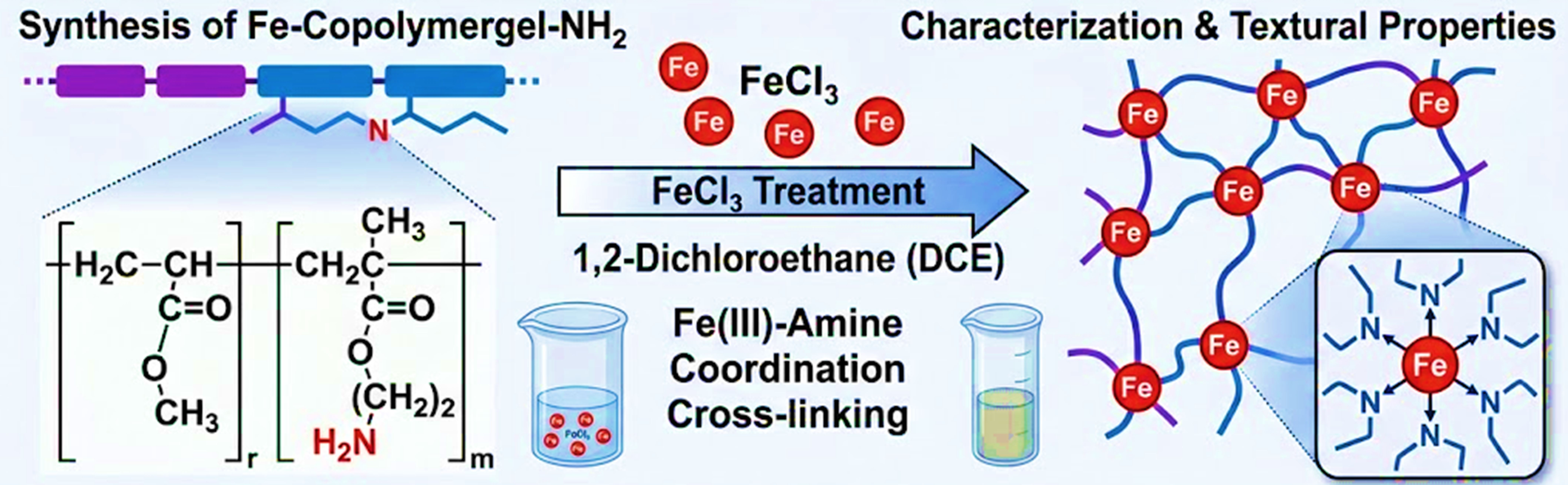
Graphical Abstract

1. Introduction

The pervasive contamination of aqueous environments by synthetic dyes poses a critical environmental concern, driving the urgent development of highly efficient, structurally robust adsorbent materials for effective wastewater remediation [1]. The widespread discharge of synthetic dyes from industrial activities, particularly in the textile, paper, and food manufacturing sectors, poses significant threats to aquatic ecosystems and human health [2]. These risks are compounded by the dyes’ recalcitrant nature, chemical stability, inherent toxicity, and resistance to conventional biodegradation processes [3,4]. Among these, MO and CR, both anionic azo dyes extensively used in textile industries, are particularly problematic owing to their widespread application and potential to induce severe toxic effects, including skin and eye damage, mutagenicity, carcinogenicity, kidney failure, genetic mutations, cancer, and disruptions to respiratory and reproductive systems in aquatic life and humans [5,6]. Consequently, the effective removal of these dyes from industrial wastewater streams is critical for environmental protection and public health [3,7]. This imperative has catalyzed extensive research into various advanced wastewater treatment technologies, including chemical precipitation, photocatalysis, membrane separation, electrochemical treatment, coagulation-flocculation, ion exchange, biological methods, membrane filtration, photochemical degradation, and anaerobic bioremediation [8,9,10]. Among these techniques, adsorption has emerged as a prominent method owing to its cost-effectiveness, operational simplicity, high efficiency in removing a broad spectrum of pollutants, absence of toxic byproducts, ease of application, straightforward and scalable synthesis of adsorbents, flexibility, and environmental benignity [11]. Polymer-based adsorbents, particularly hydrogels, have garnered considerable interest due to their tunable physicochemical properties, high surface area, exceptional adsorption capacities for various organic pollutants, including anionic dyes like MO and CR, high swelling ratios, and porous microstructures enabling mechanisms such as electrostatic attraction, hydrogen bonding, van der Waals forces, and π–π interactions [12,13,14]. However, current hydrogel adsorbents often suffer from limitations, such as low adsorption capacities, poor mechanical stability, and difficulty in regeneration, which hinder their large-scale practical deployment for wastewater treatment [15]. Consequently, there is an urgent need to develop novel, mechanically robust, and highly efficient polymeric hydrogel systems—such as those utilizing metal-ligand coordination—to overcome these deficiencies and enable sustainable remediation [16,17]. Such modifications facilitate superior adsorption of recalcitrant organic pollutants, including anionic dyes, by introducing specific interactions that extend beyond conventional physisorption. Furthermore, incorporating positively charged moieties within these polymeric networks significantly enhances their affinity and removal efficiency for anionic dyes [18]. Within this landscape, cationic polyelectrolyte hydrogels bearing protonatable –NH2 and quaternary-ammonium groups together with related Fe3+-coordinated networks have attracted particular interest as high-capacity platforms for anionic azo-dye removal because the electrostatic pairing with the –SO3 substituents of MO and CR drives q0 values that exceed those of activated carbons and biochars of comparable cost [6,14,15].
When recent studies on dye adsorption of polymer gels are examined, Toprak et al. synthesized an NH2-functionalized copolymer gel from vinyl benzyl chloride and 2-aminoethyl methacrylate, followed by FeCl3-catalyzed Friedel-Crafts hyper-crosslinking to yield HyPolygel-NH2 with superior capacities of 5234 mg/g for CR and 1816 mg/g for MO via electrostatic interactions and hydrogen bonding [4]. Similarly, Zhang et al. fabricated maleic anhydride-acrylamide copolymer-based sodium alginate hydrogels (MAH@AA-P/SA/H) that demonstrated maximum adsorption capacities of 685 mg/g for CR and 653 mg/g for methylene blue, alongside high removal of metal ions such as Cu2+ (754 mg/g) and Cr6+ (738 mg/g) [19]. Further advancements include the development of trimethylammonium chloride- and methacrylamide-based hydrogels, which achieved impressive methyl orange adsorption capacities of 950 and 994 mg/g, respectively [14]. Furthermore, poly(acrylamide-co-methacryloxyethyltrimethylammonium chloride) hydrogels have demonstrated remarkable adsorption capacities of 840.85 mg/g for CR within 10 min, with the overall process being governed by chemisorption and exhibiting good reusability [3]. In a different approach, Li et al. developed quaternary ammonium hydrogels that achieved over 99% removal efficiency for Direct Red 23, with a maximum adsorption capacity of 1540.19 mg/g, highlighting the potential for highly efficient anionic dye removal through targeted cationic polymer design [20]. These high adsorption capacities and efficiencies underscore the potential of cationic hydrogels as effective adsorbents for anionic dyes. Conversely, cyclodextrin-acrylamide-based adsorbents have demonstrated high efficiency in removing both cationic and anionic dyes, achieving rapid equilibrium times of 15–20 min and significant adsorption capacities for MO [21]. Despite these advancements, many hydrogels still face challenges related to mechanical robustness, reusability, and broad applicability across diverse wastewater matrices. For instance, while xanthan gum-based hydrogels show promise for dye removal, their efficacy is often limited by factors such as ionic strength and pH, necessitating careful optimization for practical applications [22]. These limitations highlight the ongoing need for novel hydrogel architectures that balance enhanced structural integrity and chemical stability with high adsorptive performance across a broader range of environmental conditions.
In this study, we synthesized a mesoporous amine hydrogel, Fe-Copolymergel-NH2, by treating a poly(MMA-co-2-AEMA) copolymer gel with FeCl3. The textural characterization, surface chemistry, and adsorption behavior of this hydrogel for MO and CR were investigated. The adsorption kinetics (PFO and PSO), equilibrium (Langmuir/Freundlich isotherm), and thermodynamics of copolymergel-NH2 and Fe-copolymergel-NH2 were systematically studied. It was determined that Fe-copolymergel-NH2 is highly effective in CR adsorption.

2. Materials and Methods

2.1. Materials

2,2′-Azobisisobutyronitrile (AIBN) was purchased from Sigma-Aldrich (St. Louis, MO, USA), and CR≥75.0% was obtained from Acros Organics (Geel, Belgium). FeCl3 was supplied by Isolab Chemical (Istanbul, Turkey). MO, 1,2-dichloroethane (DCE), N, N-dimethylformamide (DMF), methyl methacrylate (MMA), and 2-aminoethyl methacrylate (2-AEMA) were purchased from Merck (Darmstadt, Germany). All chemicals were of analytical grade and used as received without further purification.

2.2. Preparation of Copolymergel-NH2

The NH2-functionalized copolymer gel was synthesized via free-radical polymerization [4,23]. In a typical experimental procedure, 5.21 g of DMF, 3.24 g of 2-AEMA, and 7.12 g of MMA were dissolved in a Pyrex tube, and the reaction mixture was prepared by adding 17 mg of AIBN. Prior to the reaction, the mixture was purged with Ar gas to remove dissolved oxygen and prevent potential inhibition of the radical species. Polymerization was then carried out in a temperature-controlled reaction vessel at 80 °C for 2 h. After the reaction was complete, the resulting gel-like product was purified and washed with pure H2O to remove unreacted monomers and residual initiator. The purified copolymer gel was then dried at 40 °C, yielding 6.82 g.

2.3. Preparation of Fe-Copolymergel-Nh2

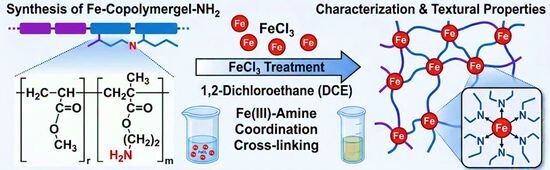
The Fe-modified polymer hydrogel, designated as Fe-Copolymergel-NH2, was synthesized via FeCl3-mediated coordination crosslinking following the literature procedure, and the proposed binding geometry is illustrated in Scheme 1 [4]. Initially, the previously synthesized Copolymergel-NH2 was placed in a reaction vessel and subjected to swelling in DCE for 2 h. This process was conducted under an argon atmosphere with slow magnetic stirring to ensure the polymer network was sufficiently expanded. Subsequently, the mixture was cooled to approximately 0 °C in an ice bath. 1.52 g of anhydrous FeCl3 was then added to the cooled PolygelNH2 mixture, and the mixture was stirred for 10 min to achieve a homogeneous dispersion. The reaction temperature was then gradually increased to 80 °C, and the mixture was stirred continuously for 24 h. Following the reaction, the resulting Fe-Copolymergel-NH2 was purified by multiple washes with methanol and deionized water, then centrifuged. As a result of this step, Fe-Copolymergel-NH2 with improved surface and pore properties was synthesized by removing FeCl3 and unreacted substances.

2.4. Characterization

The specific surface area (SBET) and pore size distributions (PSD) of Copolymergel-NH2 and Fe-Copolymergel-NH2 were determined through N2 adsorption/desorption isotherms using a surface area and pore size analyzer, Quantachrome-Autosorb 1C (Quantachrome, Boynton Beach, FL, USA). The surface morphology and internal structural characteristics were examined via scanning electron microscopy (SEM, FEI QUANTA FEG 450, Graz, Austria) and transmission electron microscopy (TEM, Hitachi HT-7700, Tokyo, Japan), respectively. To evaluate the surface functional groups, Fourier transform infrared spectroscopy (FTIR-ATR, PerkinElmer, Santa Clara, CA, USA) was used. Additionally, changes in the crystalline structure were analyzed using X-ray diffraction (XRD; PANalytical Empyrean, Worcestershire, UK) over a 2θ range of 10–90°. The surface chemical components and electronic states were further characterized by X-ray photoelectron spectroscopy (XPS; Thermo Scientific K-Alpha, East Grinstead, UK) using an Al Kα monochromatic X-ray source.

2.5. Adsorption Experiments

Batch adsorption experiments were conducted to evaluate the performance of copolymer gel-NH2 and Fe-copolymer gel-NH2 adsorbents for the removal of anionic dyes from aqueous solutions. The procedure involved a 50 mL solution volume maintained at a constant agitation speed of 400 rpm, with dye concentrations quantified by UV-Vis spectrophotometry over the 200–800 nm spectral range. Adsorption isotherm and kinetic equilibrium studies were carried out for MO and CR anionic dyes at 100 mg/L in 50 mL using varying dosages of the polymer gel adsorbents (1, 2, 3, 4, and 5 mg). Furthermore, the influence of temperature and thermodynamic parameters was evaluated over the range of 20 °C to 40 °C. The equilibrium adsorption capacities (qe) of the dyes were calculated according to the following equation [24]:
q e = ( C 0 C e ) V m

2.6. Adsorption Kinetics

To elucidate the rate-controlling mechanisms and investigate the temporal behaviour of the adsorption process for Copolymergel-NH2 and Fe-Copolymergel-NH2, the experimental data were fitted to pseudo-first-order (PFO) and pseudo-second-order (PSO) kinetic models. The PFO kinetic model implies that the adsorption process is governed by physical interactions, including H2 bonding, π-π stacking, and van der Waals forces, established between the functional groups of the adsorbent matrix and the aromatic structure of the dye molecule. The following equation expresses the linear form of the PFO model [24,25]:
ln(qe - qt) = ln qe - k1 t
where qe and qt (mg/g) represent the adsorption capacities at equilibrium and at time t (min), respectively, and k1 (min−1) denotes the PFO rate constant.
The PSO kinetic model, which posits that the rate-limiting step involves chemisorption through electron sharing or exchange between the adsorbent and the dye molecules, is expressed as [26]:
t q t = 1 k 2 q e 2 + t q e
in this expression, k2 (g mg−1 min−1) is the PSO rate constant.

2.7. Adsorption Isotherms Models

To investigate the equilibrium relationship between the target anionic dyes and the synthesized adsorbents, the experimental data were analyzed using the Langmuir and the Freundlich isotherm models. These models are essential for characterizing the interaction between the dye molecules and the Fe-Copolymergel-NH2 surface. The Langmuir model, which assumes that adsorption occurs on a homogeneous surface through monolayer coverage with no interaction between adsorbed molecules, is expressed in its linear form as follows [4]:
C e q e = 1 K L q 0 + C e q 0
In this equation, Ce (mg/L) is the equilibrium concentration of the dye, qe (mg/g) is the amount of dye adsorbed at equilibrium, q0 (mg/g) represents the maximum monolayer adsorption capacity, and KL (L/mg) is the Langmuir constant related to the energy of adsorption [27].
The Freundlich isotherm model is employed to describe multilayer adsorption on heterogeneous surfaces with sites of varying affinities. The linear mathematical representation of the Freundlich model is given by [28]:
ln q e = ln K F + 1 n ln C e
where KF (mg/g) is the Freundlich constant representing the adsorption capacity and 1/n is the heterogeneity factor. These parameters, derived from the intercept and slope of the linear regression, provide a comprehensive understanding of the maximum adsorption potential and the interaction favorability between the adsorbent’s surface and anions [24,29].

2.8. Adsorption Thermodynamics

To characterize the energetic changes associated with the adsorption process, the thermodynamic parameters, specifically the Gibbs free energy change (ΔG0), enthalpy change (ΔH0), and entropy change (ΔS0), were determined using the van’t Hoff equation [30]. The distribution coefficient (Kd) employed in the thermodynamic analysis was calculated as:
K d = q e C e
where is the equilibrium adsorption capacity, and is the equilibrium dye concentration. The values of ΔH0 and ΔS0 were obtained from the slope and intercept of the van’t Hoff plot of ln Kd versus 1/T, according to:
ln K d = Δ S 0 R Δ H 0 R T
Negative values of ΔG0 indicate the spontaneous nature of the adsorption process. At the same time, the signs of ΔH0 and ΔS0 provide insight into the endothermic or exothermic nature and the degree of disorder at the solid–liquid interface [31]. The standard Gibbs free energy change was computed using the relation:
Δ G 0 = R T ln K d
where a decrease in these values with increasing temperature indicates a greater favorability of the adsorption process under thermal influence. The calculated ΔH0 and ΔS0 values, obtained from the slope and intercept of the van’t Hoff plot, indicate whether the mechanism is dominated by physisorption or chemisorption [32]. Spontaneity was further evaluated through the fundamental Gibbs–Helmholtz relation:
Δ G 0 = Δ H 0 T Δ S 0

2.9. Water Swelling Percentage

The swelling behavior of the synthesized copolymer gel was evaluated by immersing a known mass of the dried sample in deionized water until equilibrium swelling was attained. The swollen hydrogel was then removed, carefully blotted with filter paper to eliminate excess surface moisture, and weighed to determine the equilibrium water content. The swelling percentage (Sw %) was subsequently calculated using the formula:
S w ( % ) = W s W d W d × 100
where Ws and Wd represent the weight of the swollen hydrogel at equilibrium and the weight of the dried polymer sample, respectively.

3. Results and Discussion

3.1. Surface Area and Pore Volume Characterization of Fe-Copolymergel-Nh2

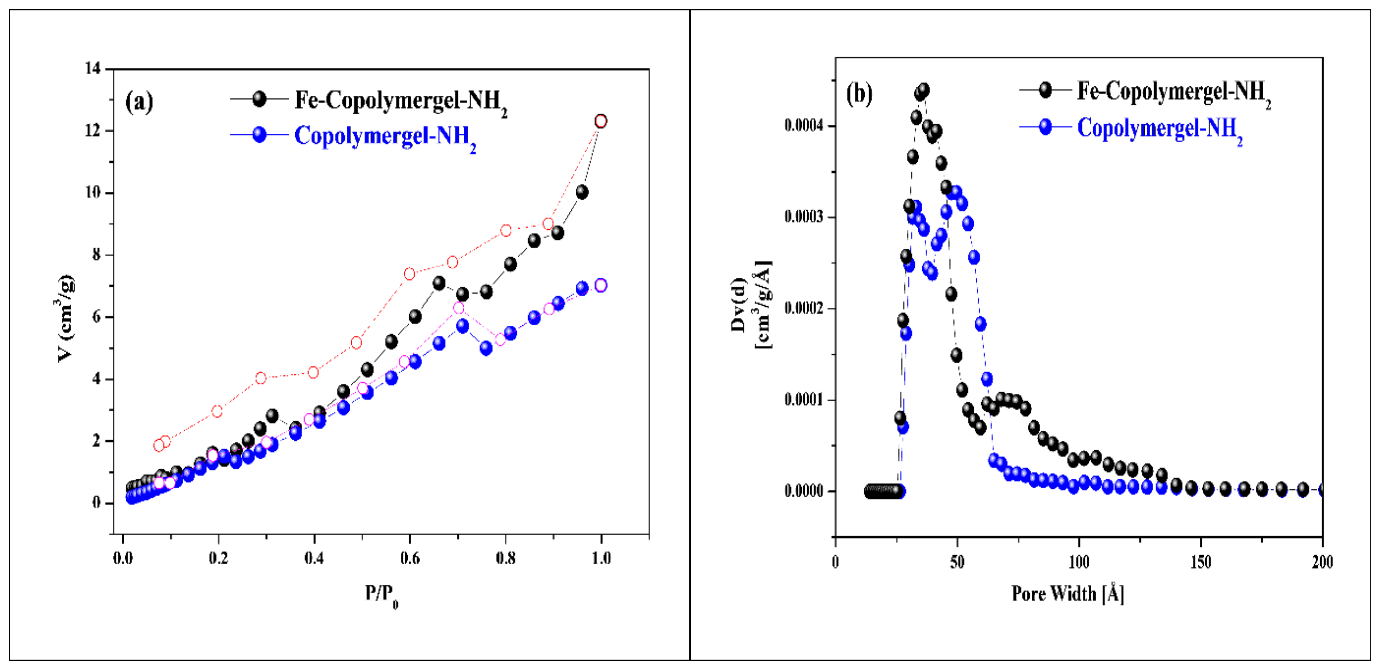
The textural properties of Copolymergel-NH2 and Fe-Copolymergel-NH2 were evaluated through N2 adsorption–desorption isotherms and Non-Local Density Functional Theory (NLDFT) pore size distributions, as illustrated in Figure 1. Figure 1a displays the N2 adsorption–desorption isotherms for both materials. According to the IUPAC classification, both samples exhibit Type IV isotherms with a distinct H3-type hysteresis loop occurring at relative pressures (P/P0) between 0.4 and 1.0 [33,34]. This behaviour is characteristic of mesoporous materials with slit-shaped pores. Notably, the adsorption volume of Fe-Copolymergel-NH2 is significantly higher than that of the pristine Copolymergel-NH2 across the entire pressure range. The increased N2 uptake at high relative pressures (P/P0 > 0.8) suggests that the FeCl3 treatment and subsequent crosslinking process enhanced the total pore volume and specific surface area, likely due to structural rearrangement or the formation of new coordination sites within the polymer matrix [4].
The pore-size distribution curves, calculated using the NLDFT method, are shown in Figure 1b. Both materials exhibit a predominant pore diameter of 20–60 Å, confirming the mesoporous nature of the copolymer gels. For Fe-Copolymergel-NH2, the peak intensity is markedly higher compared to Copolymergel-NH2, indicating a higher density of mesopores within this size regime. This increase in porosity and available surface area is expected to facilitate the diffusion and sequestering of bulky anionic dye molecules, such as MO and CR, thereby enhancing the overall adsorption capacity [35].
The textural properties of Copolymergel-NH2 and Fe-Copolymergel-NH2 were calculated through N2 adsorption–desorption isotherms and NLDFT pore size distributions at 77 K, as shown in Table 1. The FeCl3 treatment of the NH2-copolymergel resulted in a significant enhancement of the specific surface area and pore structure. The BET surface area increased from 8.11 m2/g for Copolymergel-NH2 to 12.55 m2/g for Fe-Copolymergel-NH2, representing an increase of approximately 55%. This improvement suggests that incorporating Fe3+ ions and their subsequent coordination with amine groups within the polymer matrix likely prevented the collapse of the polymer network or induced structural rearrangements that exposed more active surface sites.
Analysis of the pore volume data reveals a clear shift toward higher porosity following the iron treatment. The total pore volume (Vt) increased from 0.0096 to 0.0135 cm3/g, primarily driven by the expansion of the mesoporous volume (Vmeso), which rose from 0.0109 to 0.0125 cm3/g. Conversely, the microporous volume (VDRmicro) showed a slight decrease from 0.0013 to 0.0010 cm3/g, suggesting that some micropores may have been merged into larger mesopores or partially obstructed by the iron coordination complexes. The high mesoporous-to-micropore volume ratio minimizes mass-transfer resistance for these large dye molecules, allowing efficient diffusion into the internal active sites of the Fe-Copolymergel-NH2 adsorbent.

3.2. FTIR and XPS Analysis

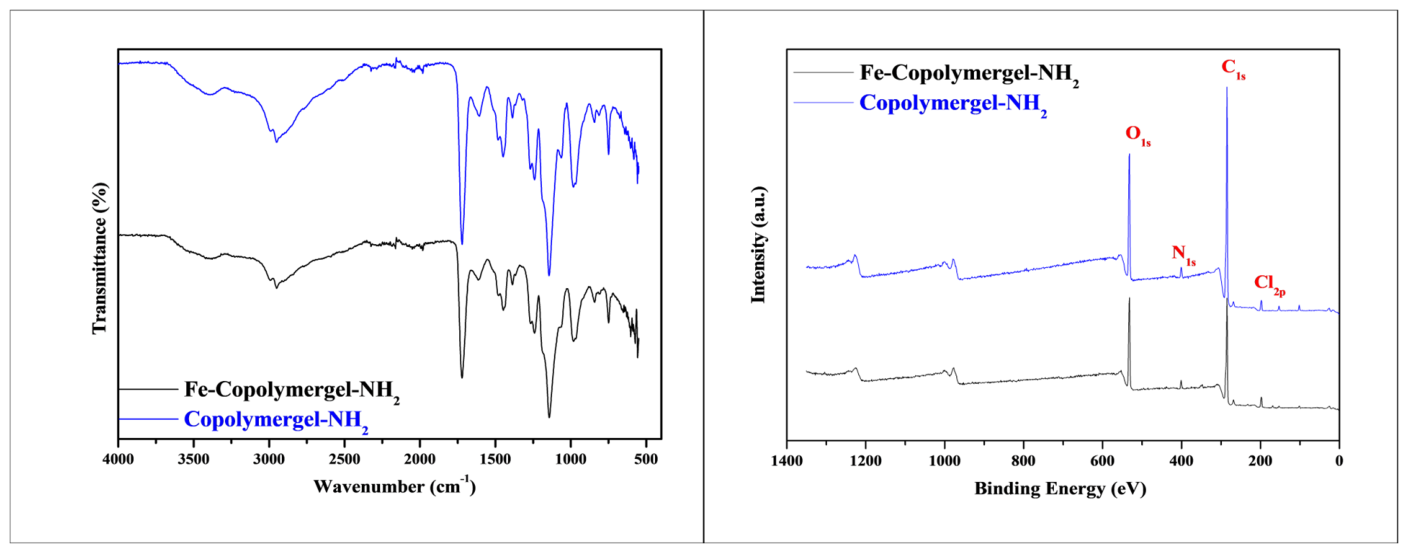
As shown in Figure 2, the chemical structures and functional groups of pure Copolymer Gel-NH2 and modified Fe-Copolymer Gel-NH2 were investigated using FTIR-ATR spectroscopy and XPS. The spectrum of the copolymergel-NH2 exhibits the characteristic peaks of the poly(MMA-co-2-AEMA) structure. A broad absorption band at approximately 3400–3500 cm−1 is assigned to the N–H stretching vibrations of the primary amine groups [4]. The peaks observed at 2950 cm−1 and 2870 cm−1 correspond to the C–H asymmetric and symmetric stretching of the CH2 and CH3 groups in the polymer chain. The sharp, intense peak at 1723 cm−1 is a defining feature of ester groups, corresponding to the C=O stretching vibration. Additionally, it shows a strong band at 1145 cm−1 attributed to the C–O–C stretching vibration of the ester bond [36,37]. Following the treatment with FeCl3, the spectrum of Fe-Copolymergel-NH2 retains the primary features, indicating structural stability. However, changes occur in the amine and carbonyl regions. The shift and broadening of the N–H/O–H band around 3400 cm−1 suggest the participation of amine lone pairs in coordination with Fe3+ ions [38]. Both samples exhibit prominent peaks at C 1s (~285 eV) and O 1s (~532 eV), originating from the PMMA and 2-AEMA monomer units, respectively. The presence of a distinct N 1s peak (~400 eV) in both spectra confirms the successful copolymerization of the amino-functionalized monomer into the gel matrix.

3.3. SEM and TEM Analysis

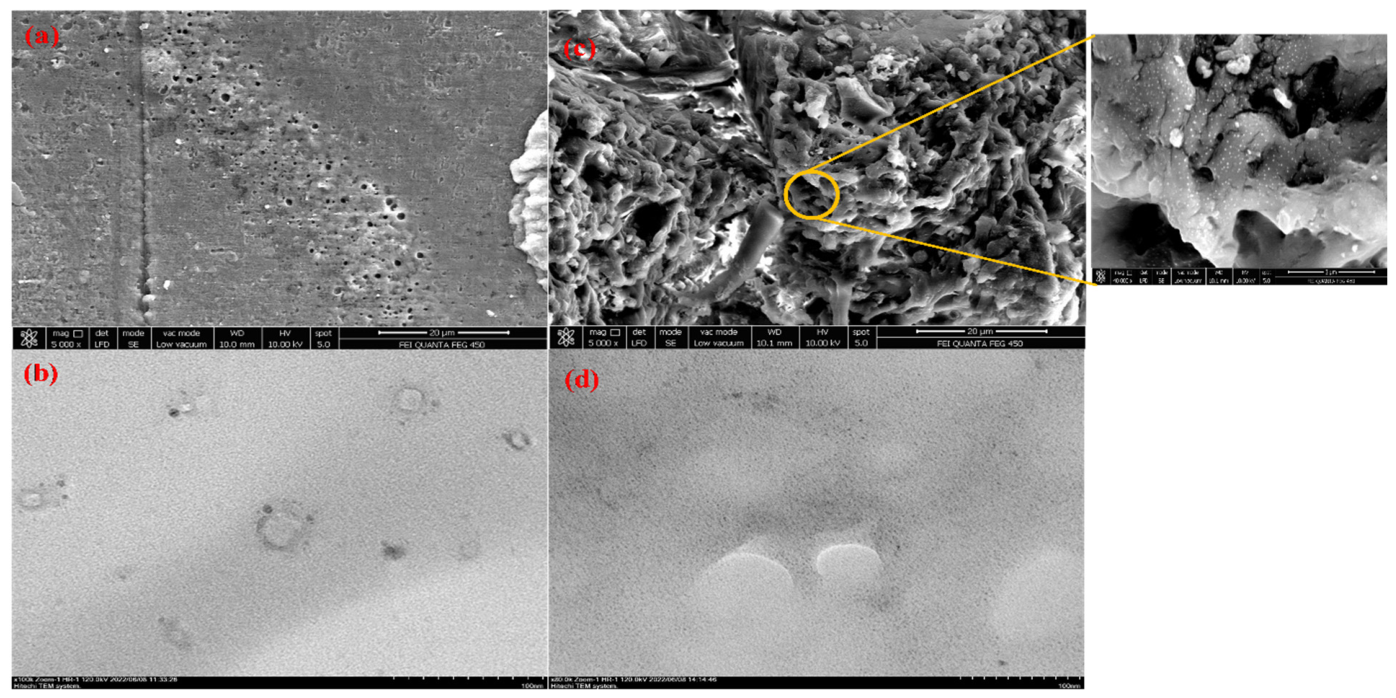
The surface morphology and internal structural properties of the synthesized materials were investigated using SEM and TEM to explore the effect of iron modification on the polymer framework. Figure 3 illustrates the significant morphological transition between the pristine Copolymergel-NH2 and the modified Fe-Copolymergel-NH2. As shown in the SEM micrograph in Figure 3a, the surface of the pristine Copolymergel-NH2 is relatively smooth and continuous, exhibiting only minor surface irregularities and a few visible micropores. This relatively uniform surface suggests a stable but less accessible polymer matrix. In stark contrast, the SEM image of Fe-Copolymergel-NH2 (Figure 3c) reveals a dramatic shift toward a highly irregular, rough, and complex morphology. The surface appears highly fragmented, with a sponge-like structure characterized by deep voids and a high density of interconnected pores. Furthermore, in the magnified view of a section of Figure 3c, a regular distribution of iron compounds is identified. This open, rough surface is highly advantageous for wastewater treatment applications, as it provides a larger active area and minimizes mass-transfer resistance for large anionic dye molecules.
The TEM image of Copolymergel-NH2 (Figure 3b) shows a relatively low-density internal network with a light, uniform contrast, indicating a standard polymer gel matrix without heavy atom clusters. However, the TEM image of Fe-Copolymergel-NH2 (Figure 3d) exhibits a more complex internal density. The appearance of dark, speckled regions and increased contrast across the matrix signifies the successful incorporation of Fe3+ species and the formation of a more rigid, dense network.
The successful incorporation of Fe species and the associated structural rearrangement of the polymer matrix were quantitatively confirmed through XPS and SEM-EDS analyses, and the elemental weight percentages are summarized in Tables S1 and S2, respectively. A consistent decrease in C content was observed across both techniques following the FeCl3 treatment, with XPS recording a decline from 67.30% to 56.22% and SEM-EDS recording a reduction from 58.32% to 56.22%. This decrease results not from the degradation of the organic skeleton, but rather from the quantitative incorporation of higher-mass Fe and Cl species into the polymer matrix. The appearance of a 4.42 wt.% signal directly confirms Fe loading. Fe signal in SEM-EDS-absent in the pristine sample and indirectly corroborated by the substantial increase in Cl content, which rose from 3.74% to 5.65% in XPS and from 2.19% to 2.88% in SEM-EDS. The redistribution of N (increase from 2.90% to 3.38% in XPS) and O (increase from 22.50% to 27.52% in XPS) further supports the metal-ligand coordination mechanism; it can be said that amine functional units move towards the surface and coordinate with Fe3+ ions.
The equilibrium water Sw of the pristine Copolymergel-NH2 was determined to be approximately 1551.6%, whereas the FeCl3-modified Fe-Copolymergel-NH2 exhibited a substantially higher swelling capacity of 2104.5% (Figure S1). This increase in hydrogel hydrophilicity is attributed to modifications in the polymer network, where the introduction of Fe-coordinated centers creates additional space and enhances the availability of polar active sites for interaction with water molecules [18].

3.4. Adsorption Studies

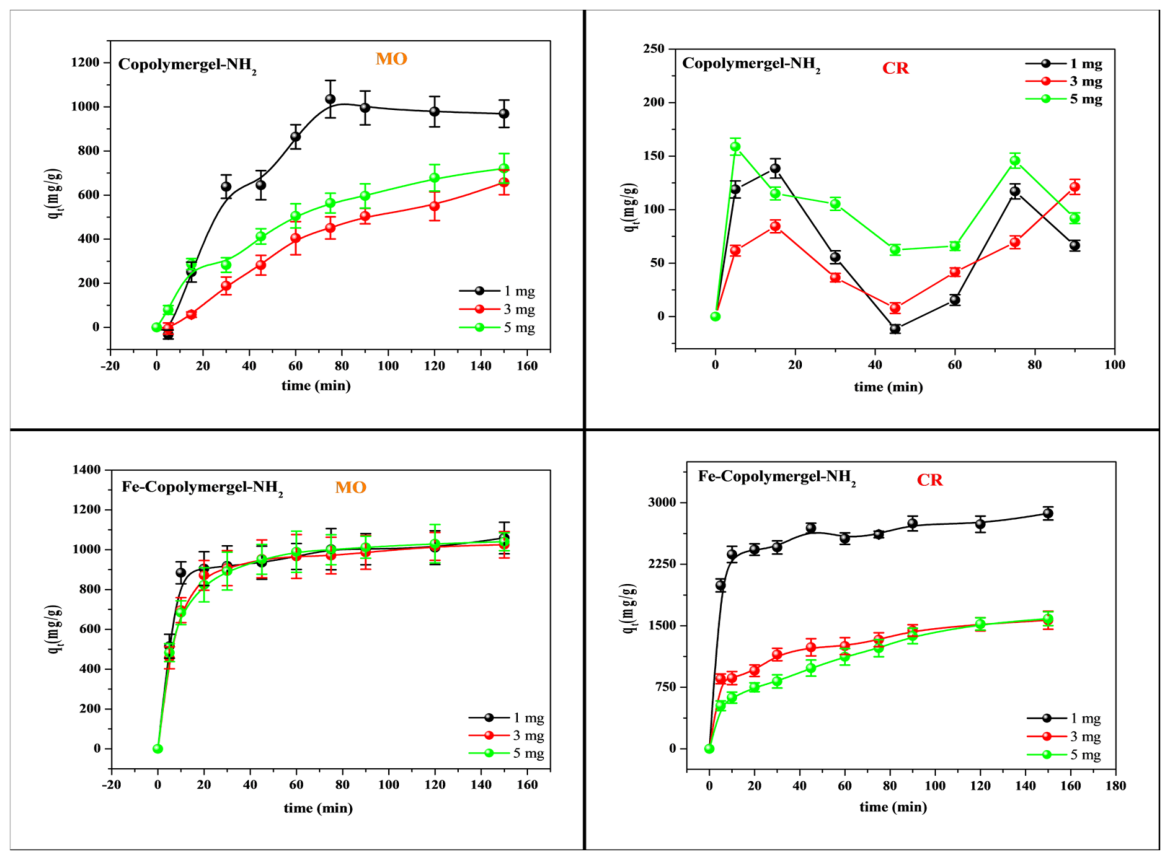
The time variation (t, min.) of the adsorption capacity (qt, mg/g) for MO and CR on pure copolymer gel-NH2 and Fe-copolymer gel-NH2 is given in Figure 4. A significant increase in capacity and stability was observed after the modification process, with the equilibrium qt value for CR adsorption on Fe-copolymer gel-NH2 reaching approximately 2800 mg/g at a dosage of 1 mg. In contrast, copolymer gel-NH2 exhibited significantly lower qt with considerable unstable fluctuations. The kinetic curves showed a rapid initial uptake phase, during which 80–90% of the total adsorption occurred within the first 20 min, followed by a gradual approach to an equilibrium plateau between 120 and 180 min; this suggests film diffusion control and intraparticle diffusion within the porous network. Importantly, while pure Copolymergel-NH2 exhibited irregular qt-t due to its smooth, non-porous morphology and insufficient active site density, Fe-Copolymergel-NH2 formed smooth curves thanks to its highly porous, structurally robust matrix produced by FeCl3-mediated coordination crosslinking.
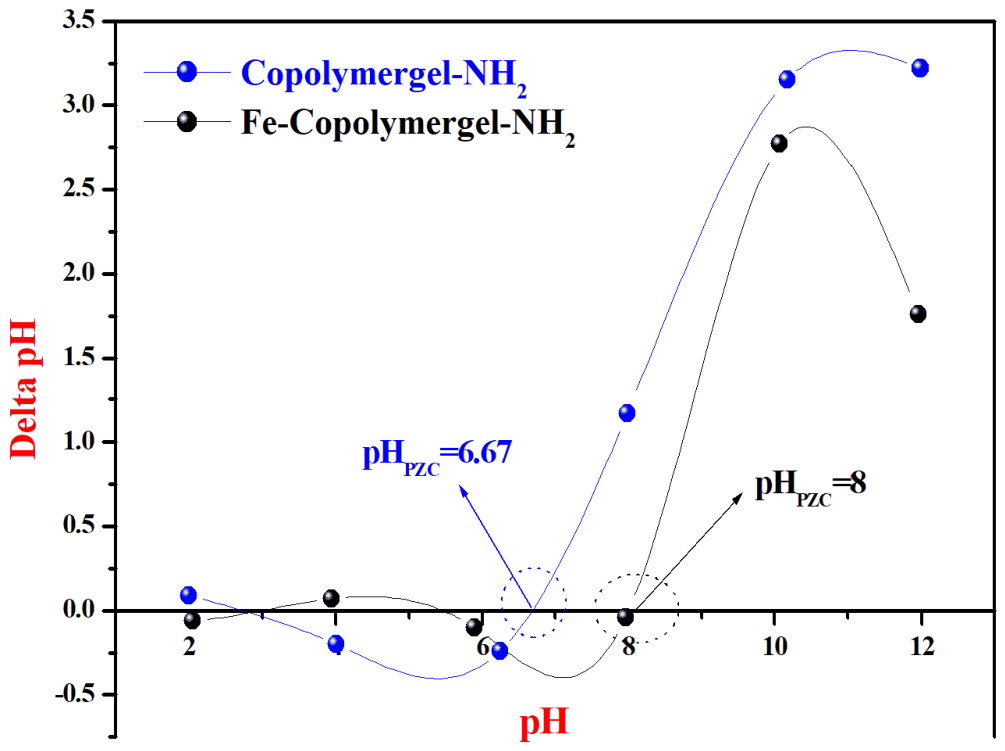
In Figure 5, the pH zero charge point (pHPZC), determined using the pH drift method, corresponds to the pH at which the net electrical charge on the adsorbent surface drops to zero, thereby defining the electrostatic nature of the interface under aqueous conditions [25]. The Copolymergel-NH2 exhibits a pHPZC value of 6.67. In contrast, the FeCl3 treatment elevates this parameter to 8.0 in the resultant Fe-Copolymergel-NH2, reflecting an increase of approximately 1.33 pH units driven by the redistribution of surface functional groups and the modulation of protonation equilibria following iron coordination. This pHPZC value fundamentally determines the surface ionization state: below this threshold, protonation of surface functionalities generates a net positive charge, whereas above it, deprotonation yields a net negative charge [39]. Consequently, Copolymergel-NH2 exhibits a cationic surface only up to pH 6.67. In contrast, the Fe-Copolymergel-NH2 counterpart maintains a positive surface potential up to pH 8.0, thereby extending the operational window favorable for electrostatic interactions with target solutes.

3.5. Kinetic Studies of Adsorption Processes

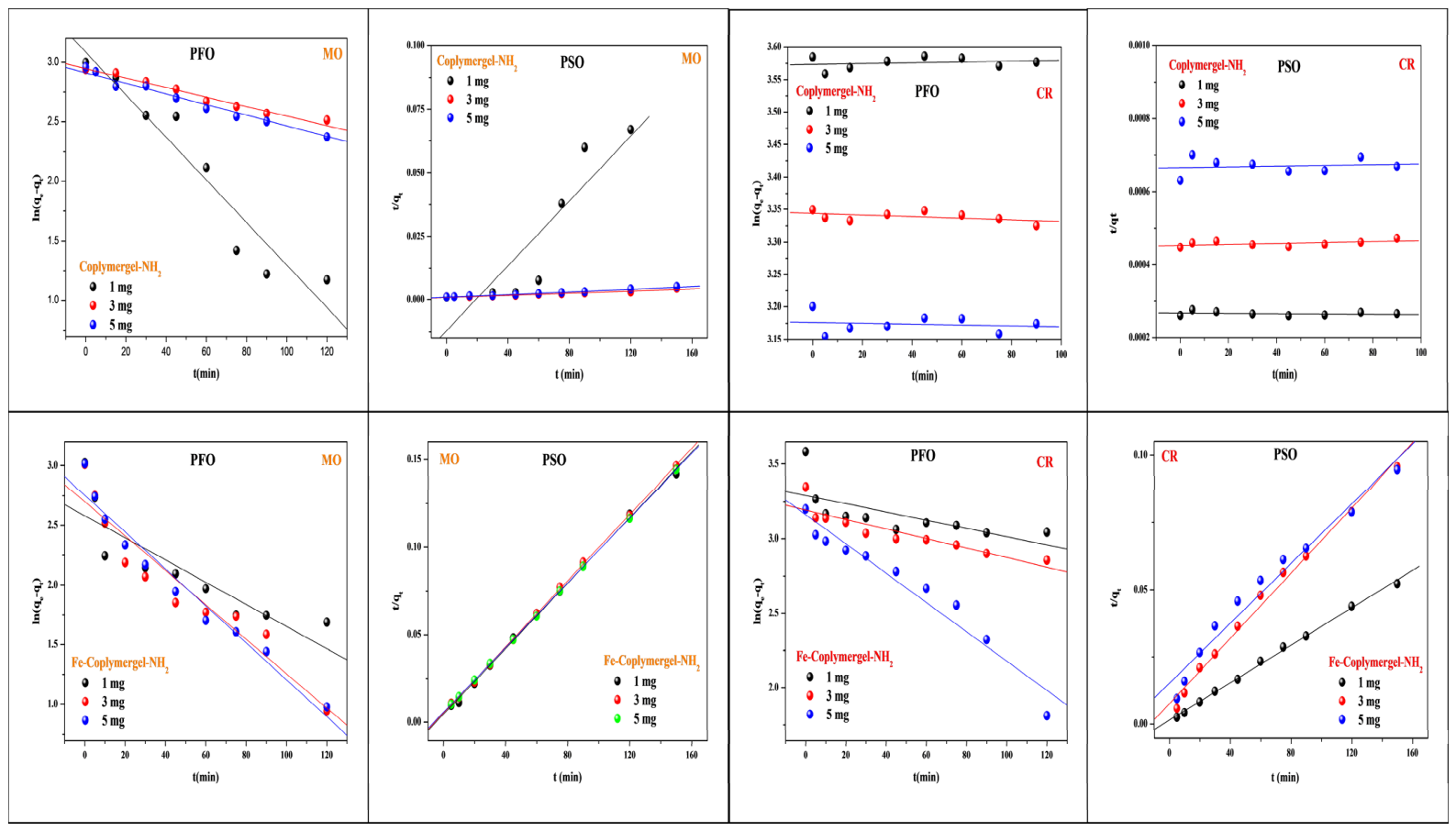
The PFO and PSO kinetic modelling results are summarized in Table 2 and Figure 6. Because both kinetic models are empirical rate laws, neither is, in isolation, evidence of a particular adsorption mechanism; PSO nonetheless localizes the rate-limiting step at the adsorption sites, while PFO localizes it at film diffusion within the bulk solution. For Fe-Copolymergel-NH2, the PSO model provided near-perfect fits (R2 = 0.968 for CR and R2 = 0.999 for MO) with calculated equilibrium capacities close to experiment (qe,exp = 2870 mg g−1 vs. qe,cal = 2872 mg g−1 for CR). Mechanistically, the highly porous and therefore interacting Fe-copolymergel-NH2 reflects synergistic interactions, including electrostatic attraction between protonated –NH3+ sites and anionic dye –SO3 groups, and inner sphere complexation occurring via added Fe3+ centers [40].
In contrast, the low-porosity Copolymergel-NH2 exhibited nonphysical compatibility, confirming the structural inadequacy of the unmodified matrix for effective dye uptake. The relatively low CR uptake of pure Copolymergel-NH2, despite a certain level of MO adsorption was due to the inability of CR molecules to penetrate the inner parts of the gel because of their larger molecular structure compared to MO, due to its low porosity, and the low level of interaction being solely due to surface interaction. The kinetic graphs in Figure 6 show well-defined linearity for the PSO model and a pronounced curvature for the PFO model, reinforcing that Fe-functionalization successfully establishes a robust chemisorption-driven mechanism.

3.6. Adsorption Isotherms

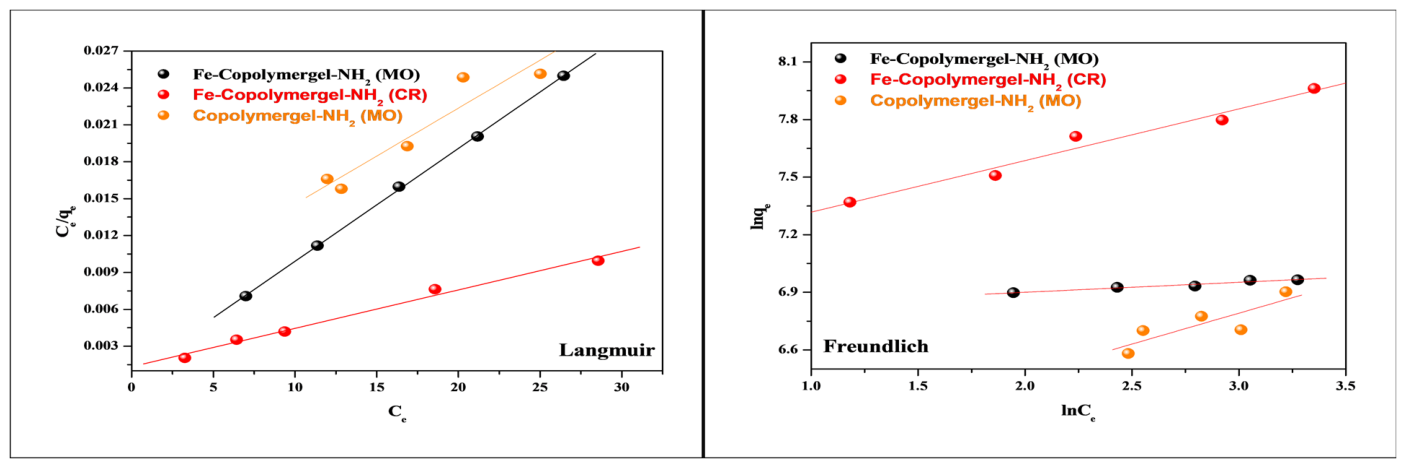
The Langmuir and the Freundlich isotherm plots for CR and MO are presented in Figure 7, and the parameters derived from these plots are summarized in Table 3. The higher R2 observed for the Langmuir model, particularly for the Fe-modified adsorbent, suggests that the adsorption process is primarily governed by monolayer coverage on a structurally homogeneous surface with a uniform distribution of active sites. Furthermore, the high n values obtained from the Freundlich model indicate strong, favorable adsorption intensity, confirming the energetic heterogeneity of the surface sites facilitated by the Fe3+ modifications [41]. This alignment with the Langmuir isotherm underscores the prevalence of localized chemical interactions where dye molecules occupy specific, equivalent coordination centers. These results reflect a monolayer-type chemisorption process in which the saturation of these high-affinity Fe-based sites effectively restricts multilayer deposition. The findings demonstrate that the Fe-functionalized gel possesses one of the highest reported monolayer capacities for CR, with q0 reaching 3201.9 mg/g alongside KL of 0.23 L/mg, and similarly elevated Langmuir parameters for MO. In contrast, the pristine Copolymergel-NH2 yielded only a moderate MO fit and failed to converge for CR, confirming the indispensable role of Fe3+ in establishing well-defined coordination sites. Parallel examination of the Freundlich constants corroborates this conclusion: KF rose from 338.9 for the unmodified matrix to 894.6 for Fe-Copolymergel-NH2 toward MO, and from a non-convergent value for CR to KF = 1150.8 with n = 3.72 for the dye on the Fe-modified gel, where n > 1 throughout signals spontaneous and energetically favorable sorption across both substrates [25]. Comparable trends in the energetic favorability of the adsorption process, as indicated by these intensity parameters, align with findings observed in similar metal-doped porous adsorbents such as CoMgAl-LDH and α-Mn2O3 architectures, where Fe3+- or transition-metal-mediated coordinative anchoring dictates the partitioning of anionic contaminants [42,43]. Moreover, the Fe-Copolymergel-NH2 exhibits a higher adsorption capacity for CR compared to MO, which is attributed to the larger molecular size of the CR molecule in conjunction with the high porosity of the Fe-Copolymergel-NH2 matrix [44]. As summarized in Table 4, Copolymergel-NH2 and Fe-Copolymergel-NH2 exhibit superior CR and MO adsorption capacities compared to many previously reported adsorbents [44,45,46,47,48,49,50,51,52,53,54,55,56,57,58,59].

3.7. Thermodynamic Studies

The thermodynamic parameters for the adsorption of CR and MO onto pristine Copolymergel-NH2 and FeCl3-mediated Fe-Copolymergel-NH2 are compiled in Table 5. These values reveal four distinct thermodynamic behaviors that clarify the impact of the Fe3+-amine coordination chemistry. For CR on the pristine Copolymergel-NH2, ΔH0 = +15.09 kJ mol−1 and ΔS0 = +58.78 J mol−1 K−1 together drive an endothermic, entropy-controlled process in which the increasingly negative ΔG0 values (−2.14, −2.73, −3.32 and −3.91 kJ mol−1 at 293, 303, 313 and 323 K, respectively) reflect the dominant contribution of the positive entropy term as temperature rises, consistent with the release of ordered hydration water molecules from the dye and polymer interface upon adsorption on a structurally under-activated, low-affinity matrix [60]. In contrast, the MO/Copolymergel-NH2 system is exothermic and exhibits low entropy (ΔH0 = −1.50 kJ mol−1, ΔS0 = −3.91 J mol−1 K−1). This confirms the unmodified matrix’s limited capacity for MO adsorption. In contrast, Fe-Copolymergel-NH2 exhibits a fundamental thermodynamic shift. CR adsorption becomes strongly exothermic (ΔH0 = −34.60$ kJ mol−1), with significantly lower ΔG0 values (−11.29 to −8.91 kJ mol−1). Since |ΔH0| >> |TΔS0|, the rate-limiting step is governed by valence-strength bond formation; this is the electrostatic attraction between –NH3+ and –SO3 groups, reinforced by the internal structure Fe3+ ← :N coordination [61]. A negative ΔS0 = −79.50 J/mol · K value indicates that the dye molecules have lost rotational and translational freedom within these coordination structures, consistent with results for similar metal-coordinated hydrogels [60,62].
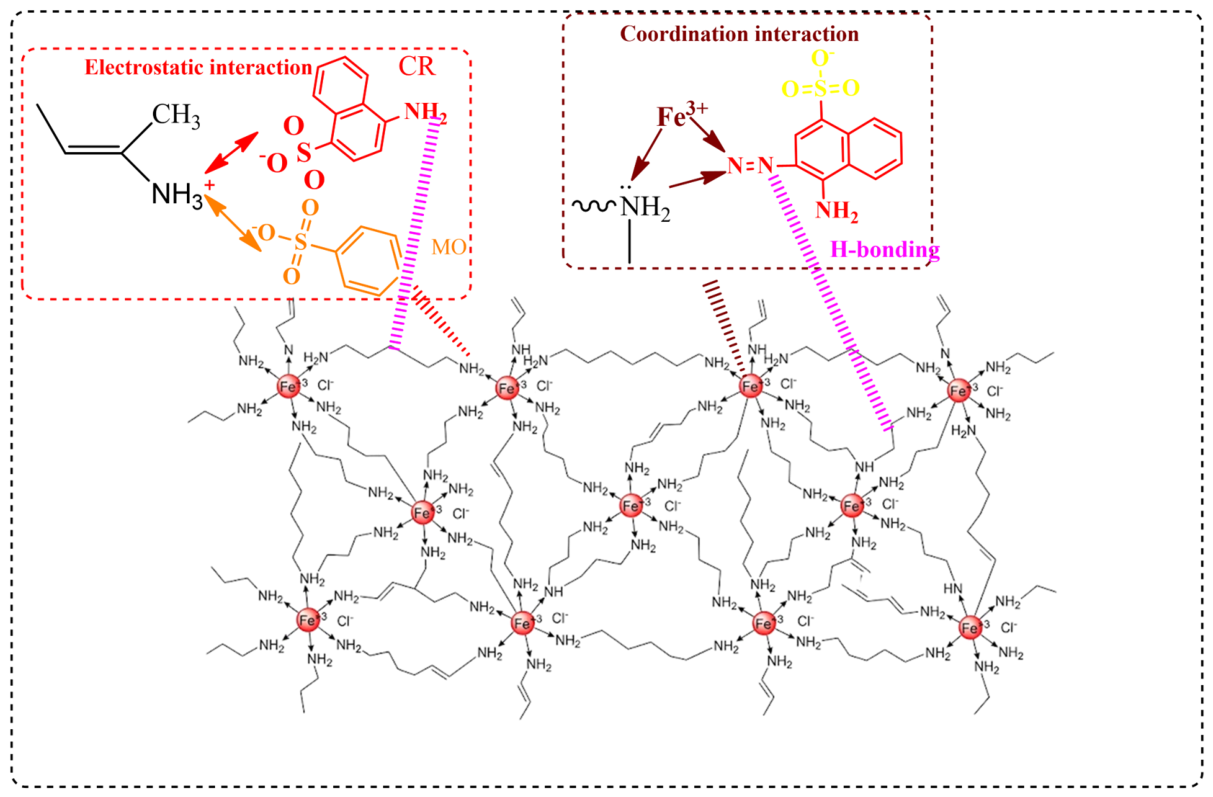
MO adsorption on Fe-Copolymergel-NH2 also shifts to an exothermic, enthalpy-controlled process (ΔH0 = −16.23 kJ mol−1, ΔS0 = −22.67 J/molK). The systematically more negative ΔG0 values demonstrate the effectiveness of the Fe3+-induced coordination. The smaller ΔH0 value of MO compared to CR can be attributed to its smaller molecular size and lower charge density. Finally, the temperature dependence confirms that room temperature is optimal for adsorption on the Fe-modified gel, as predicted by the Gibbs–Helmholtz relation. Together, these thermodynamic signatures confirm that FeCl3-mediated coordination successfully establishes a high-affinity chemisorption mechanism, validating the structural and kinetic evidence presented in earlier sections. As shown in Figure 8, the uptake of CR and MO onto Fe-Copolymer Gel-NH2 is governed by three synergistic interactions: electrostatic, coordination, and H-bonding interactions, which operate in parallel at the dative Fe3+ ← :NH2 coordination nodes placed during the FeCl3-catalyzed cross-linking step. In the electrostatic interaction, both CR and MO are dianionic azo dyes bearing -SO3 ends, and the protonated -NH3+ sites formed in the 2-AEMA segments below pH_PZC 7.22 provide a net positive surface charge [4]. Within the Fe-copolymer gel-NH2 framework, Fe3+ centers doubly chelated by –NH2 donors exhibit Fe3+ ← :NH2 coordination interactions. Unprotonated –NH2 groups in the gel structure can donate N–H···N H bonds to dye guests. CR’s higher aromatic ring density and larger molecular footprint compared to MO may allow for stronger π–π stacking and H-bonding with the polymer, supporting the systematically higher uptake of CR compared to MO.

3.8. Reusability Studies

The reusability of Fe-Copolymergel-NH2 is a crucial parameter for evaluating its industrial viability. To assess this, 3 mg of the adsorbent underwent CR adsorption, followed by regeneration with 0.1 M NaOH (10 min), centrifugation, and drying at 70 °C. Five successive adsorption–desorption cycles were performed, as shown in Figure S2. As illustrated in the bar graph, the material achieved near-quantitative initial CR removal. However, the capacity declined consistently across the five cycles, with removal percentages dropping to roughly 78%, 64%, 51%, and 38% in cycles 2 through 5, respectively. This represents a consistent decrease of approximately 14–17 percentage points per cycle, resulting in ~40% residual activity by the fifth cycle. This disadvantageous performance degradation is attributed to alkali-induced leaching of Fe3+–NH2 coordination crosslinks formed during FeCl3-mediated processing, progressive erosion of the mesoporous skeleton, and irreversible accumulation of CR residues at high-affinity Fe3+–amine nodes.

4. Conclusions

This study demonstrated that coordination crosslinking of copolymergel-NH2, containing primary amine groups, with FeCl3 produced a mesoporous adsorbent (Fe-Copolymergel-NH2) with high affinity for anionic azo dyes, especially MO and CR. FTIR-ATR, XPS, and SEM-EDS confirmed the characterization of the copolymer gels. FeCl3 treatment resulted in a significant increase in the mesoporous properties and surface area (BET, from 8.11 to 12.55 m2 g−1) of Fe-Copolymergel-NH2. These structural changes led to Langmuir maximum capacities Q0 = 3201.9 mg g−1 and 1089.8 mg g−1 for CR and MO in Fe-Copolymergel-NH2, respectively. Kinetic modeling revealed that Fe-Copolymergel-NH2 exhibits PSO behavior governed by chemisorption of Copolymergel-NH2. Thermodynamically, the adsorption of CR and MO is exothermic, facilitating the spontaneous, self-initiated adsorption of Fe-Copolymergel-NH2. The reported findings demonstrate that the synthesized Fe-Copolymergel-NH2, with its improved pore structure, has significant potential as an effective adsorbent for the removal of anionic dyes such as CR and MO from textile wastewater.

Supplementary Materials

The following supporting information can be downloaded at: https://www.mdpi.com/article/10.3390/polym18151838/s1, Figure S1: Swelling degree of Fe- and Copolymergel-NH2 in water; Figure S2: Fe-Copolymergel-NH2 CR reusability; Table S1: Elemental composition of Fe- and Copolymergel-NH2 by XPS analysis; Table S2: SEM-EDS analysis of Fe- and Copolymergel-NH2.

Author Contributions

Conceptualization, A.T., Ş.G. and B.H.; methodology, A.T., Ş.G. and B.H.; software, A.T.; validation, A.T., Ş.G. and B.H.; formal analysis, A.T. and Ş.G.; investigation, A.T., Ş.G. and B.H.; resources, A.T.; data curation, A.T. and Ş.G.; writing—original draft preparation, A.T. and Ş.G.; writing—review and editing, A.T. and Ş.G.; visualization, A.T.; supervision, A.T. and B.H.; project administration, A.T. and B.H.; funding acquisition, A.T., Ş.G. and B.H. All authors have read and agreed to the published version of the manuscript.

Funding

This research was funded by the Kapadokya University Research Funds grant number (#KÜN.2020-BAGP-001) and The APC was funded by Zonguldak Bülent Ecevit University Scientific Research Projects.

Institutional Review Board Statement

Not applicable.

Data Availability Statement

The original contributions presented in this study are included in the article/Supplementary Materials. Further inquiries can be directed to the corresponding authors.

Conflicts of Interest

The authors declare no conflicts of interest.

References

  1. Chen, H.; Song, Y. Gel-Inspired Trapping Networks: Fe (III)-Activated Palygorskite Nanorod Aggregates for Enhanced Congo Red Sequestration. Gels 2026, 12, 184. [Google Scholar] [CrossRef] [Scilit] [PubMed]
  2. Slama, H.B.; Chenari Bouket, A.; Pourhassan, Z.; Alenezi, F.N.; Silini, A.; Cherif-Silini, H.; Oszako, T.; Luptakova, L.; Golińska, P.; Belbahri, L. Diversity of synthetic dyes from textile industries, discharge impacts and treatment methods. Appl. Sci. 2021, 11, 6255. [Google Scholar] [CrossRef] [Scilit]
  3. Yang, H.; Zhang, G.; Chen, X.; Zhang, W. Quaternized fenugreek gum grafted poly (acrylamide-co-methacryloxyethyltrimethyl ammonium chloride) novel composite hydrogel for efficient removal of Congo red dye. Int. J. Biol. Macromol. 2025, 320, 146090. [Google Scholar] [CrossRef] [Scilit] [PubMed]
  4. Toprak, A.; Getir, Ş.; Hazer, B. Synthesis of NH2-functionalized crosslinked polymer hydrogel and investigation of its adsorption properties: Effective adsorption of Congo red and Methyl orange and separation of Methylene blue. Surf. Interfaces 2025, 72, 107350. [Google Scholar] [CrossRef] [Scilit]
  5. Al-Tohamy, R.; Ali, S.S.; Li, F.; Okasha, K.M.; Mahmoud, Y.A.-G.; Elsamahy, T.; Jiao, H.; Fu, Y.; Sun, J. A critical review on the treatment of dye-containing wastewater: Ecotoxicological and health concerns of textile dyes and possible remediation approaches for environmental safety. Ecotoxicol. Environ. Saf. 2022, 231, 113160. [Google Scholar] [CrossRef] [Scilit] [PubMed]
  6. Berradi, M.; Hsissou, R.; Khudhair, M.; Assouag, M.; Cherkaoui, O.; El Bachiri, A.; El Harfi, A. Textile finishing dyes and their impact on aquatic environs. Heliyon 2019, 5, e02711. [Google Scholar] [CrossRef] [Scilit] [PubMed]
  7. Aljeboree, A.M.; Alkaim, A.F. Studying removal of anionic dye by prepared highly adsorbent surface hydrogel nanocomposite as an applicable for aqueous solution. Sci. Rep. 2024, 14, 9102. [Google Scholar] [CrossRef] [Scilit] [PubMed]
  8. Dutta, S.; Gupta, B.; Srivastava, S.K.; Gupta, A.K. Recent advances on the removal of dyes from wastewater using various adsorbents: A critical review. Mater. Adv. 2021, 2, 4497–4531. [Google Scholar] [CrossRef] [Scilit]
  9. Ma, D.; Liang, F.; Xue, Q.; Liu, Y.; Zhuang, C.; Li, S. Interfacial engineering of Cd0.5Zn0.5S/BiOBr S-scheme heterojunction with oxygen vacancies for effective photocatalytic antibiotic removal. Acta Phys.-Chim. Sin. 2025, 41, 100190. [Google Scholar] [CrossRef] [Scilit]
  10. Ma, D.; Xue, Q.; Liu, Y.; Liang, F.; Li, W.; Liu, T.; Zhuang, C.; Zhao, Z.; Li, S. Manipulating interfacial charge redistribution in Mn0.5Cd0.5S/N-rich C3N5 S-scheme heterojunction for high-performance photocatalytic removal of emerging contaminants. J. Mater. Sci. Technol. 2026, 243, 265–274. [Google Scholar] [CrossRef] [Scilit]
  11. Yagub, M.T.; Sen, T.K.; Afroze, S.; Ang, H.M. Dye and its removal from aqueous solution by adsorption: A review. Adv. Colloid Interface Sci. 2014, 209, 172–184. [Google Scholar] [CrossRef] [Scilit] [PubMed]
  12. Ahmaruzzaman, M.; Roy, P.; Bonilla-Petriciolet, A.; Badawi, M.; Ganachari, S.V.; Shetti, N.P.; Aminabhavi, T.M. Polymeric hydrogels-based materials for wastewater treatment. Chemosphere 2023, 331, 138743. [Google Scholar] [CrossRef] [Scilit] [PubMed]
  13. Alfei, S.; Grasso, F.; Orlandi, V.; Russo, E.; Boggia, R.; Zuccari, G. Cationic polystyrene-based hydrogels as efficient adsorbents to remove methyl orange and fluorescein dye pollutants from industrial wastewater. Int. J. Mol. Sci. 2023, 24, 2948. [Google Scholar] [CrossRef] [Scilit] [PubMed]
  14. Demir, H.N.D.; Delibaş, A.; Benk, A.; Coşkun, R. Preparation of MOEAMCl and MAAm Based Hydrogels and Effective Use in Anionic Dye Adsorption. J. Appl. Polym. Sci. 2025, 142, e56774. [Google Scholar] [CrossRef] [Scilit]
  15. Sandu, T.; Chiriac, A.-L.; Zaharia, A.; Iordache, T.-V.; Sarbu, A. New trends in preparation and use of hydrogels for water treatment. Gels 2025, 11, 238. [Google Scholar] [CrossRef] [Scilit] [PubMed]
  16. Sahoo, S.D. Tunable pH-Responsive Hydrogels for Targeted Dye Adsorption: Advances and Mechanistic Insights. ChemistrySelect 2025, 10, e02294. [Google Scholar] [CrossRef] [Scilit]
  17. Li, X.; Li, K. Multifunctional pH-responsive carbon-based hydrogel adsorbent for ultrahigh capture of anionic and cationic dyes in wastewater. J. Hazard. Mater. 2023, 449, 131045. [Google Scholar] [CrossRef] [Scilit] [PubMed]
  18. Guembe-García, M.; Utzeri, G.; Valente, A.J.; Ibeas, S.; Trigo-López, M.; García, J.M.; Vallejos, S. Efficient extraction of textile dyes using reusable acrylic-based smart polymers. J. Hazard. Mater. 2024, 476, 135006. [Google Scholar] [CrossRef] [Scilit] [PubMed]
  19. Zhang, P.; Raza, S.; Cheng, Y.; Claudine, U.; Hayat, A.; Bashir, T.; Ali, T.; Ghasali, E.; Orooji, Y. Fabrication of maleic anhydride-acrylamide copolymer based sodium alginate hydrogel for elimination of metals ions and dyes contaminants from polluted water. Int. J. Biol. Macromol. 2024, 261, 129146. [Google Scholar] [CrossRef] [Scilit] [PubMed]
  20. Li, D.; Li, Q.; Bai, N.; Dong, H.; Mao, D. One-step synthesis of cationic hydrogel for efficient dye adsorption and its second use for emulsified oil separation. ACS Sustain. Chem. Eng. 2017, 5, 5598–5607. [Google Scholar] [CrossRef] [Scilit]
  21. Wang, L.; Hu, R.; Wang, S.; Li, Y.; Yu, E. High-Efficiency Removal of Cationic and Anionic Dyes From Wastewater Using β–Cyclodextrin-Phytic Acid–Acrylamide Hydrogel. J. Appl. Polym. Sci. 2025, 142, e57336. [Google Scholar] [CrossRef] [Scilit]
  22. Njuguna, D.G.; Schönherr, H. Xanthan gum hydrogels as high-capacity adsorbents for dye removal. ACS Appl. Polym. Mater. 2021, 3, 3142–3152. [Google Scholar] [CrossRef] [Scilit]
  23. Elik, A.; Tuzen, M.; Hazer, B.; Kaya, S.; Katin, K.; Altunay, N. Development of sensitive and accurate solid-phase microextraction procedure for preconcentration of As (III) ions in real samples. Sci. Rep. 2021, 11, 5481. [Google Scholar] [CrossRef] [Scilit] [PubMed]
  24. Toprak, A.; Çokal, M.H. Hydrothermal synthesis of high surface area magnetically activated carbon nanocomposites from spinal chestnut shells for effective methylene blue removal. Fuel Process. Technol. 2026, 289, 108507. [Google Scholar] [CrossRef] [Scilit]
  25. Toprak, A.; Kefeli, F. Synthesis of high surface area and different properties of N-doped porous carbon/iron oxide materials via a one-step solvent-free self-assembly method; effective anionic and cationic dye adsorption. J. Sci. Adv. Mater. Devices 2026, 11, 101162. [Google Scholar] [CrossRef] [Scilit]
  26. Crispi, S.; Filice, S.; Scuderi, V.; Zimbone, M.; Iannazzo, D.; Celesti, C.; Scalese, S. Kinetic and Isotherm Studies of Organic and Inorganic Anions Adsorption from Water by Quaternized Pentablock Copolymeric Film (PTBr). Polymers 2025, 17, 1624. [Google Scholar] [CrossRef] [Scilit] [PubMed]
  27. Mostafa, A.G.; Abd El-Hamid, A.I.; Akl, M.A. Surfactant-supported organoclay for removal of anionic food dyes in batch and column modes: Adsorption characteristics and mechanism study. Appl. Water Sci. 2023, 13, 163. [Google Scholar] [CrossRef] [Scilit]
  28. Toprak, A.; Hazer, B. Novel porous carbon microtubes and microspheres produced from poly (CL-b-VbC) triarm block copolymer as high performance adsorbent for dye adsorption and separation. J. Mol. Liq. 2020, 314, 113565. [Google Scholar] [CrossRef] [Scilit]
  29. Pan, J.; Zhou, L.; Chen, H.; Liu, X.; Hong, C.; Chen, D.; Pan, B. Mechanistically understanding adsorption of methyl orange, indigo carmine, and methylene blue onto ionic/nonionic polystyrene adsorbents. J. Hazard. Mater. 2021, 418, 126300. [Google Scholar] [CrossRef] [Scilit] [PubMed]
  30. Al-Musawi, T.J.; Mengelizadeh, N.; Al Rawi, O.; Balarak, D. Capacity and modeling of acid blue 113 dye adsorption onto chitosan magnetized by Fe2O3 nanoparticles. J. Polym. Environ. 2022, 30, 344–359. [Google Scholar]
  31. Mahmoud, S.A.; Orabi, A.S.; Mohamedein, L.I.; El-Moselhy, K.M.; Saad, E.M. Eco-friend shellfish powder of the mussel Brachidontes variabilis for uptake lead (II) ions. Biomass Convers. Biorefinery 2024, 14, 17201–17218. [Google Scholar] [CrossRef] [Scilit]
  32. Adebayo, M.A.; Jabar, J.M.; Amoko, J.S.; Openiyi, E.O.; Shodiya, O.O. Coconut husk-raw clay-Fe composite: Preparation, characteristics and mechanisms of Congo red adsorption. Sci. Rep. 2022, 12, 14370. [Google Scholar] [CrossRef] [Scilit] [PubMed]
  33. Thommes, M.; Kaneko, K.; Neimark, A.V.; Olivier, J.P.; Rodriguez-Reinoso, F.; Rouquerol, J.; Sing, K.S. Physisorption of gases, with special reference to the evaluation of surface area and pore size distribution (IUPAC Technical Report). Pure Appl. Chem. 2015, 87, 1051–1069. [Google Scholar] [CrossRef] [Scilit]
  34. Yuan, Z.; Li, F.; Zhang, X.; Li, M.-C.; Chen, Y.; de Hoop, C.F.; Qi, J.; Huang, X. Bio-based adsorption foam composed of MOF and polyethyleneimine-modified cellulose for selective anionic dye removal. Environ. Res. 2024, 248, 118263. [Google Scholar] [CrossRef] [Scilit] [PubMed]
  35. Gao, L.; Gao, T.; Zhang, Y.; Hu, T. A bifunctional 3D porous Zn-MOF: Fluorescence recognition of Fe3+ and adsorption of congo red/methyl orange dyes in aqueous medium. Dye. Pigment. 2022, 197, 109945. [Google Scholar] [CrossRef] [Scilit]
  36. Kenawy, E.-R.; Ghazy, A.R.; Al-Hossainy, A.F.; Bishr, M.; Azzam, M.M. Synthesis, electrospinning, and molecular docking of poly (methyl methacrylate) Schiff bases and their applications as polymeric antimicrobial agents and for dye removal. Environ. Sci. Pollut. Res. 2023, 30, 109250–109265. [Google Scholar] [CrossRef] [Scilit]
  37. Galhoum, A.A. Facile synthesis of functionalized polyglycidyl methacrylate-magnetic nanocomposites for enhanced uranium sorption. RSC Adv. 2019, 9, 38783–38796. [Google Scholar] [CrossRef] [Scilit] [PubMed]
  38. Foley, K.; Condes, L.; Walters, K.B. Influence of metal-coordinating comonomers on the coordination structure and binding in magnetic poly(ionic liquid)s. Mol. Syst. Des. Eng. 2023, 8, 1402–1417. [Google Scholar] [CrossRef] [Scilit]
  39. Azari, A.; Nabizadeh, R.; Nasseri, S.; Mahvi, A.H.; Mesdaghinia, A.R. Comprehensive systematic review and meta-analysis of dyes adsorption by carbon-based adsorbent materials: Classification and analysis of last decade studies. Chemosphere 2020, 250, 126238. [Google Scholar] [CrossRef] [Scilit] [PubMed]
  40. Et-tanteny, R.; Allaoui, I.; Haloui, R.; Elkhattabi, S.; Draoui, K.; El Khadiri, K. Mechanistic insights into dye adsorption on chitosan-functionalized bentonite: Synergizing experiments and computational study. Chem. Phys. Impact 2025, 11, 100919. [Google Scholar] [CrossRef] [Scilit]
  41. Ali, H.; Ismail, A. Fabrication of magnetic Fe3O4/Polypyrrole/carbon black nanocomposite for effective uptake of congo red and methylene blue dye: Adsorption investigation and mechanism. J. Polym. Environ. 2023, 31, 976–998. [Google Scholar]
  42. Miao, J.; Zhao, X.; Zhang, Y.-X.; Lei, Z.-L.; Liu, Z.-H. Preparation of hollow hierarchical porous CoMgAl-borate LDH ball-flower and its calcinated product with extraordinary adsorption capacity for Congo red and methyl orange. Appl. Clay Sci. 2021, 207, 106093. [Google Scholar] [CrossRef] [Scilit]
  43. Mousavi, S.H.; Yaghoobi, M.; Asjadi, F. Highly efficient adsorption of congo red and methyl orange dyes using mesoporous α-Mn2O3 nanoparticles synthesized with Pyracantha angustofolia fruit extract. Sci. Rep. 2024, 14, 18505. [Google Scholar] [CrossRef] [Scilit] [PubMed]
  44. Simonescu, C.M.; Tătăruş, A.; Culiţă, D.C.; Stănică, N.; Ionescu, I.A.; Butoi, B.; Banici, A.-M. Comparative study of CoFe2O4 nanoparticles and CoFe2O4-chitosan composite for Congo red and methyl orange removal by adsorption. Nanomaterials 2021, 11, 711. [Google Scholar] [CrossRef] [Scilit] [PubMed]
  45. Peng, L.; Li, M.; Liu, X.; Liu, A.; Tan, Y.; Zhao, M. Adsorption Behavior of a Core-Shell Microsphere Material Polymethyl Methacrylate/Sodium Montmorillonite on Organic Dye Congo Red and Copper Ions in Wastewater. ChemistrySelect 2025, 10, e202405775. [Google Scholar] [CrossRef] [Scilit]
  46. Patel, S.; Hota, G. Synthesis of novel surface functionalized electrospun PAN nanofibers matrix for efficient adsorption of anionic CR dye from water. J. Environ. Chem. Eng. 2018, 6, 5301–5310. [Google Scholar] [CrossRef] [Scilit]
  47. Wang, C.; Yin, J.; Wang, R.; Jiao, T.; Huang, H.; Zhou, J.; Zhang, L.; Peng, Q. Facile preparation of self-assembled polydopamine-modified electrospun fibers for highly effective removal of organic dyes. Nanomaterials 2019, 9, 116. [Google Scholar] [CrossRef] [Scilit] [PubMed]
  48. Lee, J.J.L.; Ang, B.C.; Andriyana, A.; Shariful, M.I.; Amalina, M. Fabrication of PMMA/zeolite nanofibrous membrane through electrospinning and its adsorption behavior. J. Appl. Polym. Sci. 2017, 134, 44450. [Google Scholar]
  49. Mei, Q.; Lv, W.; Du, M.; Zheng, Q. Morphological control of poly (vinylidene fluoride)@ layered double hydroxide composite fibers using metal salt anions and their enhanced performance for dye removal. RSC Adv. 2017, 7, 46576–46588. [Google Scholar] [CrossRef] [Scilit]
  50. Fan, Y.; Liu, H.-J.; Zhang, Y.; Chen, Y. Adsorption of anionic MO or cationic MB from MO/MB mixture using polyacrylonitrile fiber hydrothermally treated with hyperbranched polyethylenimine. J. Hazard. Mater. 2015, 283, 321–328. [Google Scholar] [CrossRef] [Scilit] [PubMed]
  51. Ma, F.-F.; Zhang, D.; Zhang, N.; Huang, T.; Wang, Y. Polydopamine-assisted deposition of polypyrrole on electrospun poly (vinylidene fluoride) nanofibers for bidirectional removal of cation and anion dyes. Chem. Eng. J. 2018, 354, 432–444. [Google Scholar] [CrossRef] [Scilit]
  52. Ren, J.; Yan, C.; Liu, Q.; Yang, Q.; Lu, G.; Song, Y.; Li, Y. Preparation of amidoxime-modified polyacrylonitrile nanofibrous adsorbents for the extraction of copper (II) and lead (II) ions and dye from aqueous media. J. Appl. Polym. Sci. 2018, 135, 45697. [Google Scholar]
  53. Chen, S.; Li, C.; Hou, T.; Cai, Y.; Liang, L.; Chen, L.; Li, M. Polyhexamethylene guanidine functionalized chitosan nanofiber membrane with superior adsorption and antibacterial performances. React. Funct. Polym. 2019, 145, 104379. [Google Scholar] [CrossRef] [Scilit]
  54. Jia, Y.; Ding, L.; Ren, P.; Zhong, M.; Ma, J.; Fan, X. Performances and mechanism of methyl orange and Congo red adsorbed on the magnetic ion-exchange resin. J. Chem. Eng. Data 2020, 65, 725–736. [Google Scholar] [CrossRef] [Scilit]
  55. Shabbir, R.; Gu, A.; Chen, J.; Khan, M.M.; Wang, P.; Jiao, Y.; Zhang, Z.; Liu, Y.; Yang, Y. Highly efficient removal of congo red and methyl orange by using petal-like Fe-Mg layered double hydroxide. Int. J. Environ. Anal. Chem. 2022, 102, 1060–1077. [Google Scholar]
  56. Shi, L.; Dang, Q.; Liu, C.; Niu, S.; Zhao, Y.; Wang, S.; Sang, F.; Su, J.; Zhang, B.; Cha, D. Novel versatile 5-aminoisophthalic acid modified chitosan nanofiber pads for adsorption toward Congo red, methyl orange, crystal violet, and methylene blue. Chem. Eng. J. 2024, 500, 156804. [Google Scholar] [CrossRef] [Scilit]
  57. Habiba, U.; Lee, J.J.L.; Joo, T.C.; Ang, B.C.; Afifi, A.M. Degradation of methyl orange and congo red by using chitosan/polyvinyl alcohol/TiO2 electrospun nanofibrous membrane. Int. J. Biol. Macromol. 2019, 131, 821–827. [Google Scholar] [CrossRef] [Scilit] [PubMed]
  58. Djezar, H.; Rida, K.; Salhi, M. Efficient adsorbent for the removal of methyl orange and Congo red by calcined Zn-Al layered double hydroxide. Inorg. Nano-Metal. Chem. 2022, 52, 161–172. [Google Scholar]
  59. Zheng, Y.; Cheng, B.; You, W.; Yu, J.; Ho, W. 3D hierarchical graphene oxide-NiFe LDH composite with enhanced adsorption affinity to Congo red, methyl orange and Cr (VI) ions. J. Hazard. Mater. 2019, 369, 214–225. [Google Scholar] [CrossRef] [Scilit] [PubMed]
  60. Basaleh, A.A.; Al-Malack, M.H.; Saleh, T.A. Poly (acrylamide acrylic acid) grafted on steel slag as an efficient magnetic adsorbent for cationic and anionic dyes. J. Environ. Chem. Eng. 2021, 9, 105126. [Google Scholar] [CrossRef] [Scilit]
  61. Cong, Y.; Liu, S.; Wu, F.; Zhang, H.; Fu, J. Shape memory effect and rapid reversible actuation of nanocomposite hydrogels with electrochemically controlled local metal ion coordination and crosslinking. J. Mater. Chem. B 2020, 8, 9679–9685. [Google Scholar] [CrossRef] [Scilit] [PubMed]
  62. Li, R.; Chen, J.; Zhang, H.; Rehman, F.; Siddique, J.; Shahab, A.; Mo, Z.; Luo, L. Facile synthesis of magnetic-activated nanocomposites for effective removal of cationic and anionic dyes in an aqueous environment: An equilibrium isotherm, kinetics and thermodynamic studies. Chem. Eng. Res. Des. 2023, 189, 319–332. [Google Scholar] [CrossRef] [Scilit]
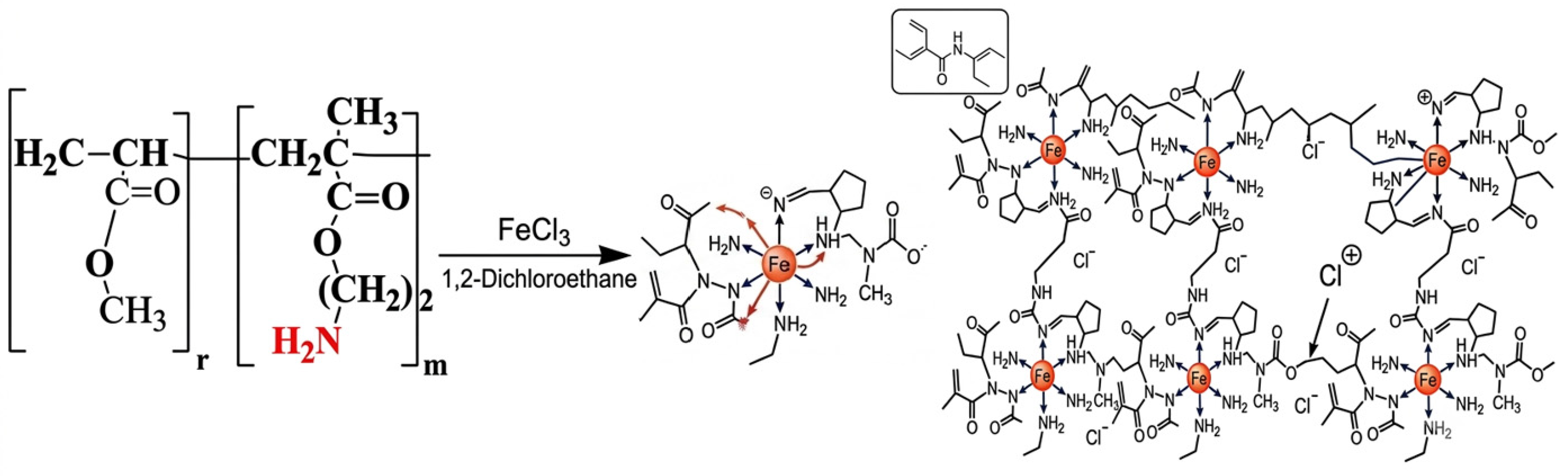
Scheme 1. Experimental mechanism diagram of Fe- and Copolymergel-NH2.
Polymers 18 01838 sch001
Figure 1. (a) N2 adsorption/desorption isotherms and (b) NLDFT pore size distribution of Fe- and Copolymergel-NH2.
Polymers 18 01838 g001
Figure 2. The FTIR spectra of Fe- and Copolymergel-NH2.
Polymers 18 01838 g002
Figure 3. SEM (a,b), TEM images (c,d) of Fe- and Copolymergel-NH2.
Polymers 18 01838 g003
Figure 4. MO and CR adsorption-time graphs of Fe- and Coploymergel-NH2 at different doses.
Polymers 18 01838 g004
Figure 5. Determination of pHPZC for Fe- and Copolymergel-NH2.
Polymers 18 01838 g005
Figure 6. PFO and PSO kinetic models of MO and CR adsorption onto Fe- and Copolymergel-NH2 at different doses.
Polymers 18 01838 g006
Figure 7. Langmuir and Freundlich isotherms for Fe- and Copolymergel-NH2 adsorption of MB and MO at different doses.
Polymers 18 01838 g007
Figure 8. Proposed adsorption mechanism of CR and MO onto Fe-Copolymergel-NH2.
Polymers 18 01838 g008
Table 1. Pore and surface structural parameters of Fe- and Copolymergel-NH2.
AdsorbentBET
(m2/g)
VDRmicro (cm3/g)
(<20 Å)
Vmeso (cm3/g)
(20 Å < Vμp)
Vt (cm3/g)
(P/P0 = 0.995)
Copolymergel-NH28.110.00130.01090.0096
Fe-Copolymergel-NH212.550.00100.01250.0135
Table 2. PFO and PSO kinetic model parameters of CR and MO adsorption onto Fe- and Copolymergel-NH2.
AdsorbentsAdsorbent Dosage (mg)qe [exp] (mg/g)PFOPSO
qe [cal] (mg/g)k1R2qe [cal] (mg/g)k2
(10−5)
R2
Copolymergel-NH2 (MO)1995134,0280.0110.39525843.760.945
3875311.190.0120.9684037.370.989
5914257.50.0100.8743538.590.889
Copolymergel-NH2 (CR)1219-−0.0090.050-5.670.053
3121-0.0010.261-3.770.263
592-0.0010.0215-1.290.019
Fe-Copolymergel-NH2 (CR)1287019580.0060.47228728.540.998
3223615610.0070.80916494.870.991
5158614540.0230.94718002.030.968
Fe-Copolymergel-NH2 (MO)110593810.0210.74107019.250.999
310255010.0330.911105917.120.999
510405680.0360.96108315.070.999
Table 3. Langmuir and Freundlich adsorption isotherm parameters of Fe- and Copolymergel-NH2.
AdsorbentCopolymergel-NH2Fe-Copolymergel-NH2
MOCRMOCR
Langmuir Model
q0 (mg/g)1281.6-1089.83201.9
KL0.12-1.250.23
R20.90-0.9990.989
Freundlich Model
KF338.9-894.61150.8
n3.11-19.253.72
R20.71-0.9510.968
Table 4. Adsorption capacities of CR and MO on different adsorbents.
Adsorbentsqmax (CR) (mg/g)qmax (MO) (mg/g)Ref.
CoFe2O4162.6894.46[44]
PMMA-Na-MT355.5 mg/g-[45]
EDA-PAN130-[46]
PDA@PCL/PEO-60.2[47]
PMMA/zeo-95.33[48]
PVDF@CoAl-LDH-621.17[49]
PAN-g-HPEI-194[50]
PPy@PVDF/PDA384.6-[51]
AOPAN-68.07[52]
PHMG-OCS-PVA289-[53]
MIEX resin254.58607.68[54]
Fe-Mg LDH894.17370.36[55]
CS-A nanofiber pads1140.70505.31[56]
Chitosan/PVA/TiO2131314[57]
cLDH584.56451.2[58]
GO-NiFe LDH450403[59]
Copolymergel-NH2-1281.6This study
Fe-Copolymergel-NH23201.91089.8This study
Table 5. Thermodynamic parameters of CR and MO adsorption onto Fe- and Copolymergel-NH2 at different temperatures.
Copolymergel-NH2ΔG0 (kJ/mol)
DyesΔH0 (kJ/mol)ΔS0 (J/Kmol)293 K303 K313 K323 K
CR15.0958.78−2.14−2.73−3.32−3.91
MO−1.5−3.91−0.35−0.31−0.28−0.24
Fe-Copolymergel-NH2ΔG0 (kJ/mol)
DyesΔH0 (kJ/mol)ΔS0 (J/Kmol)293 K303 K313 K323 K
CR−34.6−79.5−11.29−10.5−9.7−8.91
MO−16.23−22.67−9.58−9.36−9.13−8.9
Disclaimer/Publisher’s Note: The statements, opinions and data contained in all publications are solely those of the individual author(s) and contributor(s) and not of MDPI and/or the editor(s). MDPI and/or the editor(s) disclaim responsibility for any injury to people or property resulting from any ideas, methods, instructions or products referred to in the content.