2.1. Theoretical Framework and Constitutive Equations
Estimating pressure drop within extrusion dies for corrugated plastic pipes is inherently complex due to the non-Newtonian nature of the polymer melt. Unlike Newtonian fluids, molten plastics exhibit shear-thinning behavior, where viscosity decreases significantly as the shear rate increases. This dependency complicates pressure drop predictions across the varying flow conditions characteristic of complex die geometries.
To model this behavior analytically, the Power Law model is widely adopted. While it possesses known limitations—specifically its inability to describe the Newtonian plateau and its physically unrealistic prediction of infinite viscosity at zero-shear rates (for
), its mathematical simplicity makes it a robust tool for engineering calculations within the relevant processing window. The model defines the relationship between shear stress (
) and shear rate (
) as follows:
where
C: is the flow consistency index (a measure of the fluid’s resistance to flow) ;
n: is the flow behavior index [dimensionless].
For Newtonian fluids, , and the relationship simplifies to Newtonian behavior. For non-Newtonian fluids, , indicating shear-thinning behavior.
The relationship between dynamic viscosity (
) and shear rate for non-Newtonian fluids described by the Power Law model can be expressed as:
where
and
.
Rearranging Equation (2) yields:
As shown in Equation (3) the Power Law model dictates a linear relationship between the logarithms of dynamic viscosity and shear rate, enabling the straightforward extraction of model parameters from experimental data. Crucially, for a fluid that perfectly adheres to the Power Law model, and would be constant material properties across all shear rates at a given temperature.
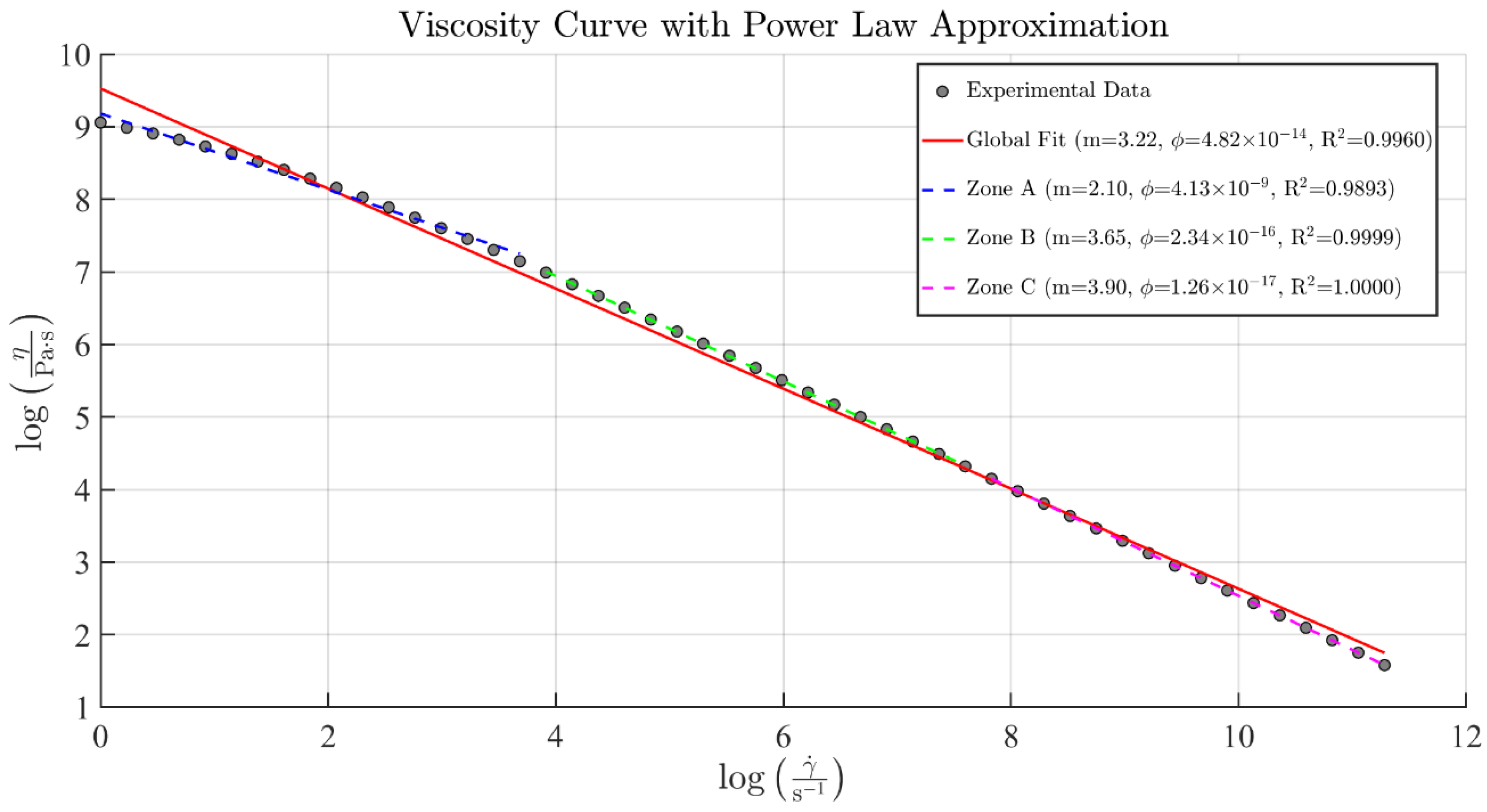
However, in reality, experimental viscosity data for polymer melts, when plotted on a
log-log scale, often present a non-linear curve, as illustrated in
Figure 1. This non-linearity arises because polymers deviate from ideal Power Law behavior, particularly at very low and very high shear rates where Newtonian plateaus typically occur (corresponding to the zero-shear and infinite-shear rate viscosities, respectively). Therefore, a single set of constant Power Law parameters may not accurately represent the fluid’s behavior across a wide range of shear rates.
From an engineering perspective, maintaining predictive accuracy across the broad shear rate ranges found in complex extrusion dies requires a pragmatic approach. Rather than using a single, generalized set of Power Law parameters (
and
) for all conditions, we determine the best-fit values specifically for the shear rate range experienced by a given die. Because complex die geometries—especially those with converging sections—induce a wide range of local shear rates, we first discretize the die into numerous small annular straight segments to identify the representative wall shear rates for a given flow condition. We then determine the specific
and
values that are uniquely tailored to the shear rate distribution characteristic of that die’s response. This approach ensures that the Power Law parameters accurately represent the material’s behavior within the actual operating window of the die. As shown in
Figure 1, distinct effective parameters are necessary to capture the material response accurately across different shear rate regimes.
The Power Law model allows for the development of analytical solutions for various flow geometries, including those relevant to extrusion die design [
19]. The volumetric flow rate (
) [m
3/s] through an annulus can be expressed as:
where
is the die conductance, a geometric factor influencing flow rate, and
[Pa] is the pressure drop.
For a straight concentric annulus, the die conductance (
) is given by:
where
Also, in [
19], an expression for the shear rate at the wall (
in [1/s]) for a concentric straight annulus is proposed:
It is important to note that the relationships presented in Equations (5) and (6) are derived under the following assumptions:
While these analytical assumptions represent a simplified view of complex non-Newtonian flow, their physical validity and range of applicability within this data-driven framework are justified as follows:
Isothermal Flow: True isothermal behavior is rarely achieved in converging dies due to viscous dissipation (shear heating). However, because our methodology relies on macroscopic pressure drops measured directly from the operational die, the empirically back-calculated parameters (, ) intrinsically capture and average out these thermal gradients across the evaluated operating window.
Incompressible Flow: Polymeric melts are widely modeled as incompressible under the relatively low-pressure gradients typical of the die-forming phase in extrusion. (see [
20] for
-
-
diagrams).
No-Slip Boundary Condition: While certain polymers (e.g., HDPE) can exhibit wall slip at elevated shear stresses, standard processing conditions for corrugated pipes are maintained below the critical shear stress threshold for gross melt fracture. Furthermore, any minor, steady-state microscopic slip is inherently lumped into the global effective parameters during the back-calculation process.
Steady-State Flow: Maintaining a stable extrusion process is essential for ensuring the quality of products.
Laminar Flow: Due to the extremely high viscosity of polymer melts, the Reynolds number in pipe extrusion is typically in the creeping flow regime (), rendering the assumption of strictly laminar flow physically robust.
Inlet and Outlet Effects: In this proposed workflow, converging geometries and inlet pressure drops are not ignored; rather, they are mathematically incorporated into the overall equivalent die conductance () derived from the reference experimental data. The empirical extraction ensures that these geometry-induced pressure losses are reflected in the global effective parameters.
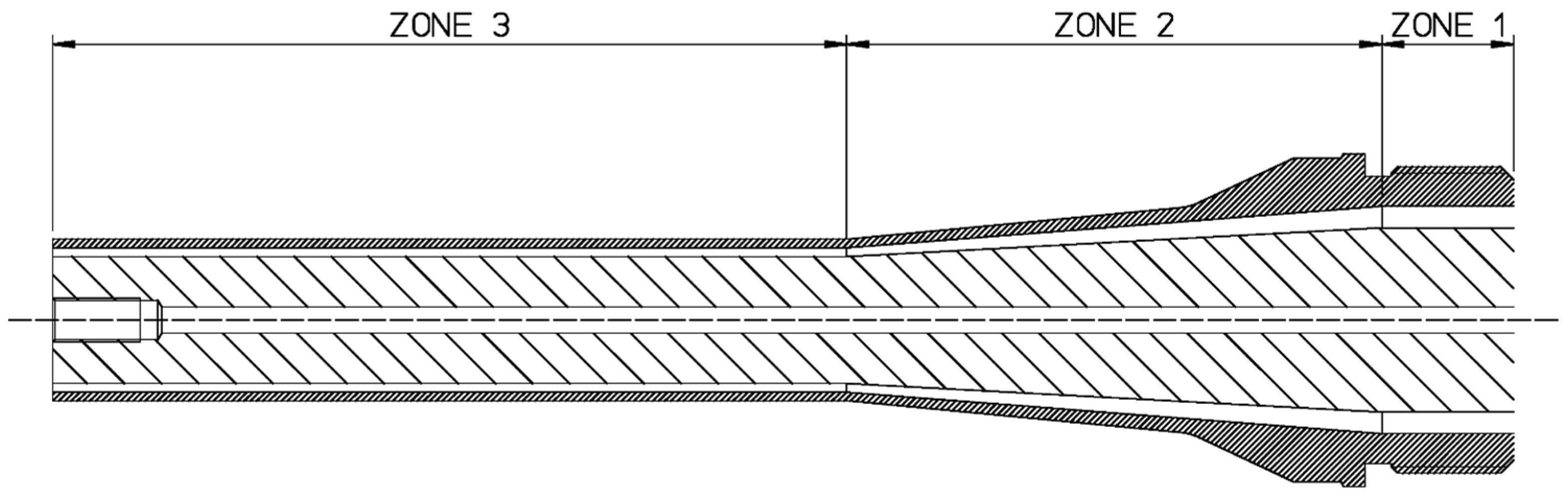
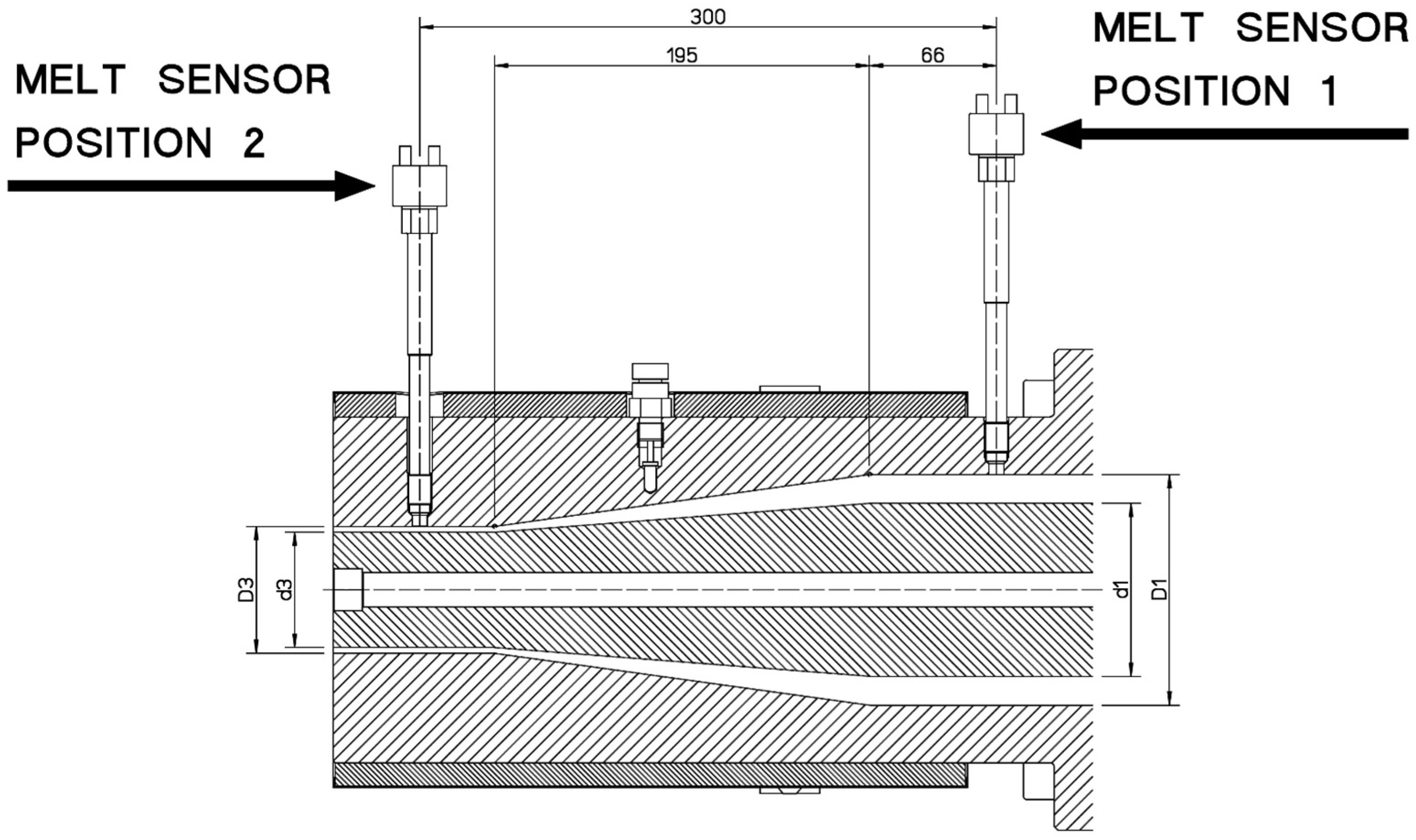
Figure 2 shows a typical extrusion die for the production of single-wall round corrugated plastic pipes. A typical extrusion die for corrugated plastic pipes consists of three main zones: a straight inlet section (Zone 1), a converging section (Zone 2), and a straight outlet section (Zone 3). In some cases, a further constriction section can be added. As previously established, the non-linear viscosity curve means that the true effective Power Law parameters would differ in each segment due to varying local shear rates. However, determining these numerous local parameters is impractical for a predictive model.
Therefore, we model the system by characterizing the entire die’s integrated flow response with a single set of overall effective parameters, and . These parameters represent the global flow behavior of the material within the specific die geometry across the intended operating range.
Under this unified approach, the total pressure drop (
) is the sum of the pressure drops in each segment, all governed by the same
and
. The die conductance for each segment (
) is calculated using the constant
, making the total pressure drop:
where the subscript
in
identifies the die zone and the second zone (
) was divided in
subparts.
The challenge, addressed in the following section, is to determine the two unknown effective parameters, and , using experimental data. Accurate material rheology is the cornerstone of any predictive flow model. We are now at a juncture identical to that of a CFD simulation: the model is defined, but it requires the input of a viscosity curve to produce results.
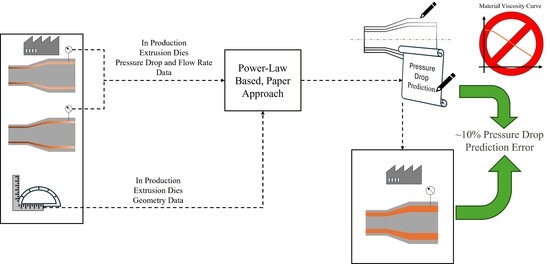
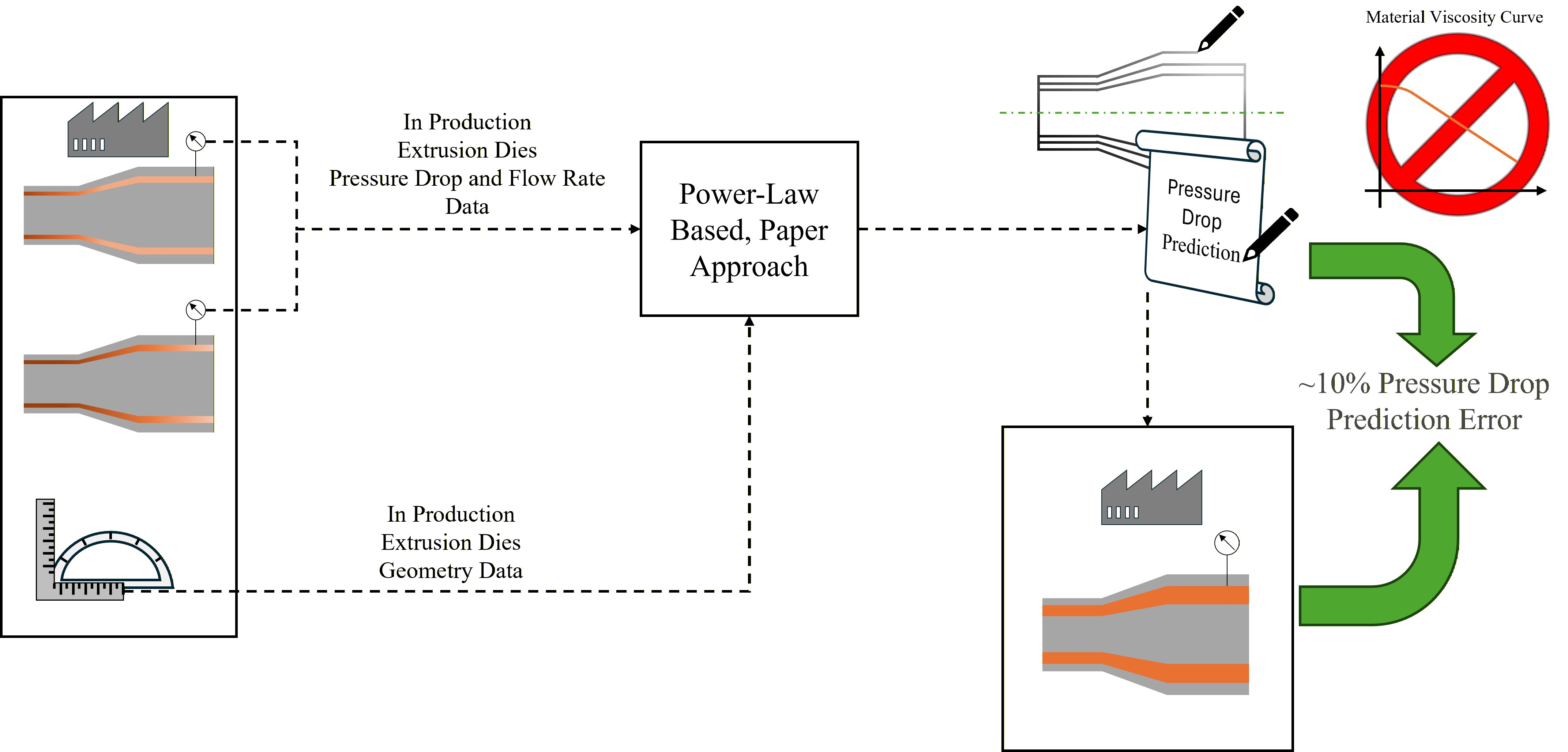
While CFD excels at calculating detailed local shear distributions, its industrial utility is often bottlenecked by the requirement for comprehensive, precise viscosity data—which is frequently unavailable, proprietary, or too costly to obtain for every new material blend. Our methodology offers a pragmatic bypass to this hurdle. Instead of relying on laboratory rheometry, we leverage the existing production equipment as a rheometer, using overall pressure drop measurements from operational setups to empirically determine the global effective parameters.
This approach turns existing production data into actionable rheological insight, providing an efficient means for pressure drop estimation when full laboratory characterization is impractical. It serves as a complementary engineering tool, enabling rapid design iterations by deriving the necessary and parameters directly from the actual processing environment.
2.2. Extrapolation of and from Existing Pressure Drop Data
Pressure drop data from existing extrusion dies are often available to designers. Alternatively, this data can be gathered from operational feedback from existing dies. Many extruders are equipped with a melt sensor [
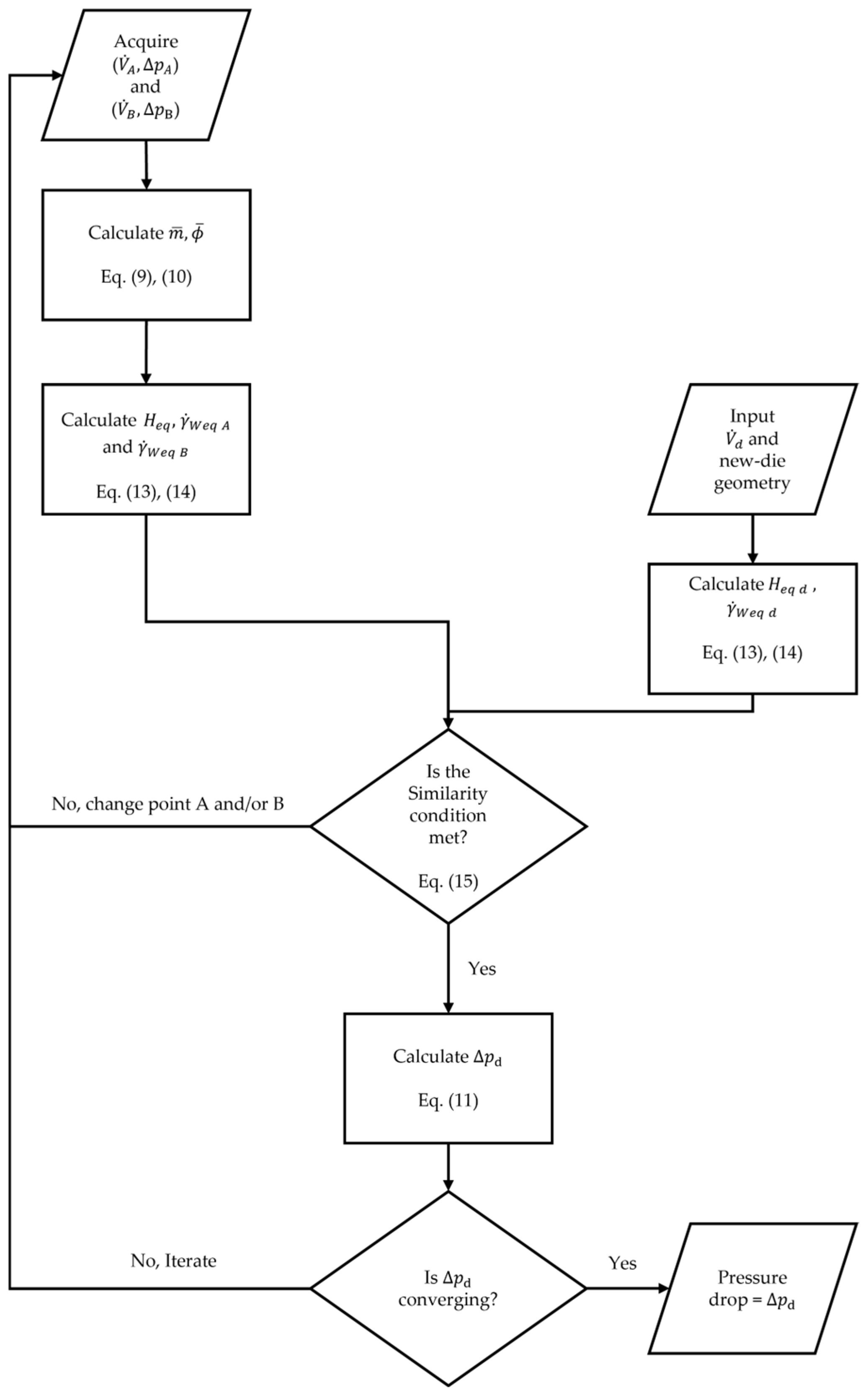
21] that detects pressure and temperature at the extruder’s end, allowing for measurement of the combined pressure drop of the extrusion head (the main body that distributes the molten plastic) and the die (the interchangeable tooling that forms the final shape). By detaching the die and performing a test at the same flow rate, the pressure drop of the head alone can be found. The pressure drop due to the die is then isolated by subtraction:
To determine the two unknown effective parameters,
and
, in the pressure drop model, Equation (7), we use two experimental data points from an existing die. Let (
,
) and (
,
) be two pairs of volumetric flow rate and the corresponding measured overall die pressure drop. Applying these two conditions to the model yields the following system of equations:
Since the geometric term in the square brackets represents the fixed geometry of the die and is therefore identical for both operating conditions (
and
), dividing the two equations allows us to cancel out the geometric factors and rearrange the terms to yield a direct solution for
:
The deliberate choice to utilize exactly two operating conditions (
A and
B) to calibrate the model is rooted in both mathematical necessity and industrial practicality. Mathematically, deriving the two unknown effective parameters (
,
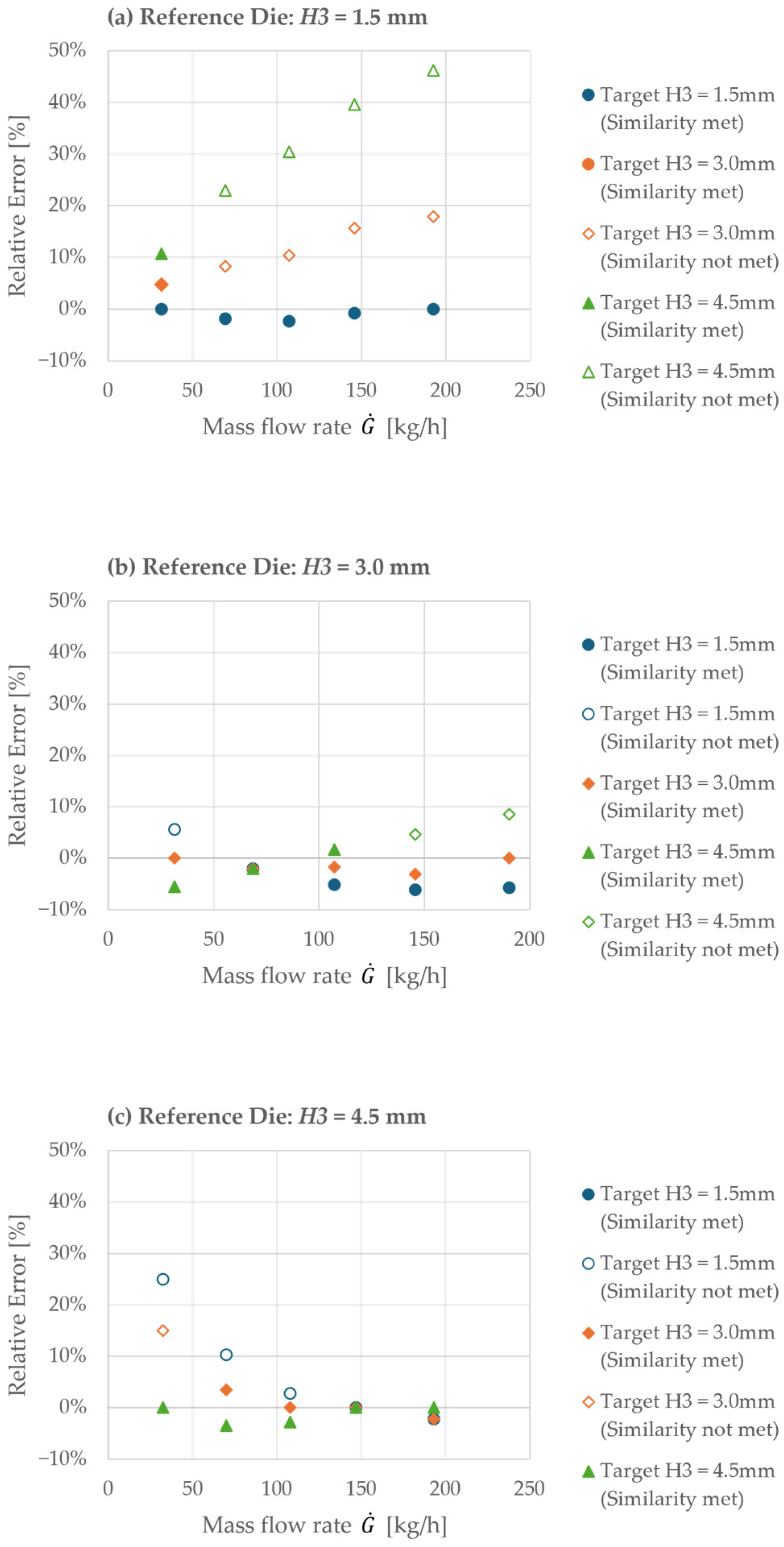
) requires a minimum of two independent data points to yield a deterministic algebraic solution. From an industrial standpoint, this drastically minimizes the data-gathering burden: a machine operator only needs to record the pressure drop at two distinct extruder speeds rather than conducting a comprehensive, multi-point rheological campaign. Furthermore, while a multi-point least-squares regression could generate a single set of parameters over a broader range, this global fit inevitably sacrifices local accuracy due to the non-linear nature of the polymer’s actual viscosity curve. Therefore, by purposefully selecting two calibration points that closely bracket the expected shear rate of the new in-design die, the protocol extracts a highly optimized local approximation. As demonstrated later in
Section 3.3, this localized parameter identification yields superior predictive accuracy for the specific operational window of interest.
By substituting the calculated value of
back into either equation in (9), the value of
can be determined. With both
and
known, the pressure drop (
) for a new, in-design die with a geometry (
) and target volume flow rate (
) can be predicted, under the strict condition that it processes the exact same material or proprietary blend:
2.3. Validation via Similarity Condition
For this extrapolation to be valid, the new in-design die must process the same material, operate at the same temperature and within a similar shear rate range as the reference die. However, comparing the overall shear rate of two different, complex geometries is not straightforward. To address this, we introduce the mathematical construct of an
equivalent straight annulus. This allows us to calculate a single, representative shear rate (
) that characterizes the entire die’s integrated response for a specific flow condition. This metric enables a direct and meaningful comparison of the shear intensity experienced by the material across different geometries. We define an equivalent die conductance,
, by equating the aggregate geometric term bracketed in Equation (9) to the standard definition of conductance for a straight annulus given in Equation (5):
This
can be mapped to the geometry of the equivalent straight annulus (
,
and
). We define
and
as consistent reference values (e.g.,
and
). Since these values are used consistently for both the reference and in-design dies, their specific magnitudes are not physically relevant and serve only to calculate a characteristic equivalent thickness,
:
Using this equivalent geometry, we can calculate the equivalent shear rate at the wall for the two
i-th experimental condition
and
on the reference die:
These two shear rates define the valid operating range. The extrapolation is considered acceptable if the equivalent shear rate of the in-design die, , falls within this range.
This
similarity condition is expressed as:
where the value for
is obtained using the geometric parameters of the new in-design die to calculate the equivalent thickness
.
2.5. Data Collection
To validate the proposed method, experiments were conducted using an industrial extrusion setup designed for processing PP and PE. The setup comprised:
The three interchangeable internal dies provided different outlet diameters ( = 63, 60, and 57 mm) to achieve the target outlet gaps, , of 1.5, 3.0, and 4.5 mm, respectively.
The external die was equipped with two melt sensors (pressure range: 0–50 MPa ± 0.5 MPa; temperature: type thermocouple) connected to a PLC with a 1 Hz sampling rate. Heaters with feedback control maintained constant temperatures on the extrusion head and die surface.
Once the external and internal dies are coupled, the system is heated to the working temperature of 200 °C using the heating resistances. After the thermocouples installed in the extruder zones reach the desired temperature, several extrusion trials are conducted with the selected material.
The material is allowed to flow until a stable and uniform melt flow is achieved. Throughout the experiment, careful attention is paid to maintaining stable operating conditions, such as constant screw speed, consistent material feed rate, and uniform temperature distribution.
After stabilizing at the initial RPM, the extruder speed is increased to achieve the next mass flow rate. A waiting period of one minute is observed for each new RPM setting. Then, three samples of material are collected for one minute each and weighed on an analytical balance (to a precision of 0.01 g). The weight is recorded, and the system is monitored under steady-state conditions for 60 s to collect pressure and temperature data, yielding 60 continuous measurements per variable at the established 1 Hz sampling rate.
This process is repeated for each subsequent mass flow rate until the desired range is covered.
After completing the experiments with one internal extrusion die, the process is repeated with each of the other available internal extrusion dies to evaluate the effect of different outlet gaps.
The entire experiment is conducted with three different polymer blends: Polypropylene PP Borealis BB125MO (Borealis AG, Vienna, Austria), High-density polyethylene HDPE Hiplex® HHM5502 (HIP-Petrohemija, Pančevo, Serbia), and Polypropylene PP Moplen EP440G (LyondellBasell, Rotterdam, The Netherlands).
A comprehensive evaluation of measurement errors, process variance, and standard uncertainty propagation is detailed in
Appendix B.
Table 1 presents a representative sample of the experimental data collected for Polypropylene PP Borealis BB125MO (Borealis AG, Vienna, Austria). Complete datasets are available in
Appendix A.