A Review of the Application Research on Inorganic Clay Minerals Synergising with Bio-Based Flame-Retardant Systems to Enhance Polymer Performance


Abstract
1. Introduction
2. The Synergistic Flame-Retardant Mechanism of Inorganic Clay Minerals and Bio-Based Systems
2.1. Inorganic Clay Mineral
2.2. Bio-Based Flame Retardant
2.3. Inorganic Clay Minerals/Bio-Based Synergistic System
3. Preparation of Inorganic Clay Mineral/Bio-Based Flame-Retardant Composites
3.1. Solution Intercalation Method
3.2. Co-Precipitation Method
3.3. Hydrothermal Method
3.4. Physical Adsorption Method
3.5. Layer-by-Layer Self-Assembly Method
4. Inorganic Clay Synergistic Bio-Based Flame-Retardant Polymer Composites
4.1. Sepiolite/Bio-Based Flame-Retardant System
4.2. Montmorillonite/Bio-Based Flame-Retardant System
4.3. Kaolinite/Bio-Based Flame-Retardant System
4.4. Attapulgite/Bio-Based Flame-Retardant System
4.5. Layered Double Hydroxide/Bio-Based Flame-Retardant System
4.6. Other Inorganic Clay Minerals/Bio-Based Flame-Retardant System
5. Conclusions
Author Contributions
Funding
Institutional Review Board Statement
Data Availability Statement
Acknowledgments
Conflicts of Interest
Abbreviations
| Abbreviation | Full name |
| PLA | Polylactic acid |
| PBS | Polybutylene succinate |
| PUA | Polyurethane acrylate |
| PU | Polyurethane |
| PP | Polypropylene |
| EP | Epoxy resin |
| AMEO | 3-Aminopropyltriethoxysilane |
| PVC | Polyvinyl chloride |
| TA | Tannic acid |
| APP | Ammonium polyphosphate |
| MA | Melamine |
| IFR | Intumescent flame retardant |
| SEP | Sepiolite |
| DOPO | 9,10-Dihydro-9-oxa-10-phosphaphenanthrene-10-oxide |
| DDM | 4,4′-diaminodiphenylmethane |
| MMT | Montmorillonite |
| CF | Chicken feather protein |
| PASP | Polyaspartic acid |
| PA | Phytic acid |
| MEL | Melamine |
| PEI | Polyethyleneimine |
| ATP | Attapulgite |
| LDH | Layered double hydroxide |
| LBL | Layer-by-layer self-assembly |
| SLS | Sodium lignosulfonate |
| LS | lignin sulfonate |
| LOI | Limiting oxygen index |
| HRR | Heat release rate |
| pHRR | Peak heat release rate |
| THR | Total heat release |
| TSP | Total smoke production |
| UL-94 | Underwriters Laboratories 94 vertical burning tes |
| MH | Magnesium hydroxide |
| ATH | Aluminium hydroxide |
| CS | Chitosan |
| CST | Cationic starch |
| CONE | Cone calorimeter |
| TGA | Thermogravimetric analysis |
| SEM | Scanning electron microscopy |
| XPS | X-ray photoelectron spectroscopy |
| FTIR | Fourier transform infrared spectroscopy |
| XRD | X-ray diffraction |
| VFT | Vertical flame Test |
| OFT | Open flame Test |
| MBA | Methylene bisacrylamide |
| PFT | Polyamide fibre textiles |
References
- Wang, X.; Xing, W.Y.; Tang, G. Advances in novel flame-retardant technologies for fire-safe polymeric materials. Molecules 2024, 29, 573. [Google Scholar] [CrossRef]
- Sabet, M. Innovative halogen-free polymers: Enhancing fire safety and electrical conductivity for sustainable industrial applications. Iran. Polym. J. 2025, 35, 1355–1373. [Google Scholar] [CrossRef]
- Morgan, A.B. The future of flame retardant polymers—Unmet needs and likely new approaches. Polym. Rev. 2019, 59, 25–54. [Google Scholar] [CrossRef]
- Abbasi, G.; Li, L.; Breivik, K. Global historical stocks and emissions of pbdes. Environ. Sci. Technol. 2019, 53, 6330–6340. [Google Scholar] [CrossRef] [PubMed]
- Jiang, L.J.S.; Yang, J.; Yang, H.J.; Kong, L.X.; Ma, H.N.; Zhu, Y.P.; Zhao, X.; Yang, T.Y.; Liu, W. Advanced understanding of the polybrominated diphenyl ethers (pbdes): Insights from total environment to intoxication. Toxicology 2024, 509, 19. [Google Scholar] [CrossRef] [PubMed]
- Marques, M.; Nadal, M.; Domingo, J.L. Human exposure to polybrominated diphenyl ethers (pbdes) through the diet: An update of the scientific literature. Food Chem. Toxicol. 2022, 167, 11. [Google Scholar] [CrossRef]
- Zacs, D.; Perkons, I.; Abdulajeva, E.; Pasecnaja, E.; Bartkiene, E.; Bartkevics, V. Polybrominated diphenyl ethers (pbdes), hexabromocyclododecanes (hbcdd), dechlorane-related compounds (drcs), and emerging brominated flame retardants (ebfrs) in foods: The levels, profiles, and dietary intake in latvia. Sci. Total Environ. 2021, 752, 10. [Google Scholar] [CrossRef]
- Wang, X.T.; Zhou, J.; Lei, B.L.; Zhou, J.M.; Xu, S.Y.; Hu, B.P.; Wang, D.Q.; Zhang, D.P.; Wu, M.H. Atmospheric occurrence, homologue patterns and source apportionment of short- and medium-chain chlorinated paraffins in shanghai, china: Biomonitoring with masson pine (Pinus massoniana L.) needles. Sci. Total Environ. 2016, 560, 92–100. [Google Scholar] [CrossRef] [PubMed]
- Zhang, X.F.; Fan, R.; Xu, Y.; Gao, Y.Z.; Bizimana, A.; Naidoo, A.R.; Han, B.C.; Meng, X.Z. Occurrence, distribution and health risk of short-chain chlorinated paraffins (sccps) in china: A critical review. Separations 2022, 9, 208. [Google Scholar] [CrossRef]
- Ji, X.W.; Xie, X.C.; Ding, J.; Cheng, Y.; He, H.H.; Huang, Y.; Qin, L.; Zhu, H.X.; Zhao, C.C.; Li, A.M.; et al. Chlorinated flame retardant dechlorane plus: Environmental pollution in china. Environ. Rev. 2018, 26, 273–285. [Google Scholar] [CrossRef]
- Huang, C.C.; Zeng, Y.H.; Liu, Y.E.; Zhang, Y.T.; Guo, J.; Luo, X.J.; Mai, B.X. Historical occurrence and composition of novel brominated flame retardants and dechlorane plus in sediments from an electronic waste recycling site in south china. Toxics 2024, 12, 84. [Google Scholar] [CrossRef]
- Richard Horrocks, A.; Zhang, S. Enhancing polymer char formation by reaction with phosphorylated polyols. 1. Cellulose. Polymer 2001, 42, 8025–8033. [Google Scholar] [CrossRef]
- Kramer, N.E.; Fillmore, C.E.; Slane, E.G.; Barnett, L.M.A.; Wagner, J.J.; Cummings, B.S. Insights into brominated flame retardant neurotoxicity: Mechanisms of hippocampal neural cell death and brain region-specific transcriptomic shifts in mice. Toxicol. Sci. 2024, 201, 282–299. [Google Scholar] [CrossRef] [PubMed]
- Szabo, D.T.; Pathmasiri, W.; Sumner, S.; Birnbaum, L.S. Serum metabolomic profiles in neonatal mice following oral brominated flame retardant exposures to hexabromocyclododecane (hbcd) alpha, gamma, and commercial mixture. Environ. Health Perspect. 2017, 125, 651–659. [Google Scholar] [CrossRef] [PubMed]
- Wang, C.F.; Wang, Y.L.; Han, Z.D. Enhanced flame retardancy of polyethylene/magnesium hydroxide with polycarbosilane. Sci. Rep. 2018, 8, 10. [Google Scholar] [CrossRef]
- Sonnier, R.; Viretto, A.; Dumazert, L.; Longerey, M.; Buonomo, S.; Gallard, B.; Longuet, C.; Cavodeau, F.; Lamy, R.; Freitag, A. Fire retardant benefits of combining aluminum hydroxide and silica in ethylene-vinyl acetate copolymer (eva). Polym. Degrad. Stab. 2016, 128, 228–236. [Google Scholar] [CrossRef]
- Sun, B.B.; Dang, L.; Bi, Q.Y.; Li, R.J.; Gong, Q.H.; Wan, Z.H.; Xu, S.I. Effect of different compatibilizers on the mechanical, flame retardant, and rheological properties of highly filled linear low-density polyethylene/magnesium hydroxide composites. Polymers 2023, 15, 4115. [Google Scholar] [CrossRef]
- Xie, W.; Guo, S.W.; Liu, Y.; Chen, R.; Wang, Q. Organic-inorganic hybrid strategy based on ternary copolymerization to prepare flame retardant poly(methyl methacrylate) with high performance. Compos. Part B Eng. 2020, 203, 12. [Google Scholar] [CrossRef]
- Kong, Q.H.; Zhang, Y.; Zhang, X.; Xiang, B.; Yi, Y.Z.; Zhu, J.Y.; Zhang, F.; Zhu, J.; Zhang, J.H. Functionalized montmorillonite intercalation iron compounds for improving flame retardancy of epoxy resin nanocomposites. J. Nanosci. Nanotechnol. 2019, 19, 5803–5809. [Google Scholar] [CrossRef]
- Fan, H.Z.; Zhao, J.M.; Zhang, J.F.; Li, H.F.; Zhang, S.; Sun, J.; Xin, F.; Liu, F.; Qin, Z.D.; Tang, W.F. Tio 2/sio2/kaolinite hybrid filler to improve the flame retardancy, smoke suppression and anti-aging characteristics of epoxy resin. Mater. Chem. Phys. 2022, 277, 9. [Google Scholar] [CrossRef]
- Pappalardo, S.; Russo, P.; Acierno, D.; Rabe, S.; Schartel, B. The synergistic effect of organically modified sepiolite in intumescent flame retardant polypropylene. Eur. Polym. J. 2016, 76, 196–207. [Google Scholar] [CrossRef]
- Zhan, Z.S.; Xu, M.J.; Li, B. Synergistic effects of sepiolite on the flame retardant properties and thermal degradation behaviors of polyamide 66/aluminum diethylphosphinate composites. Polym. Degrad. Stab. 2015, 117, 66–74. [Google Scholar] [CrossRef]
- Prabhakar, M.N.; Chalapathi, K.V.; Shah, A.U.R.; Song, J. Effect of a synthesized chitosan flame retardant on the flammability, thermal properties, and mechanical properties of vinyl ester/bamboo nonwoven fiber composites. Cellulose 2021, 28, 11625–11643. [Google Scholar] [CrossRef]
- Fang, F.; Huo, S.Q.; Shen, H.F.; Ran, S.Y.; Wang, H.; Song, P.A.; Fang, Z.P. A bio-based ionic complex with different oxidation states of phosphorus for reducing flammability and smoke release of epoxy resins. Compos. Commun. 2020, 17, 104–108. [Google Scholar] [CrossRef]
- Liu, J.K.; Dai, J.Y.; Wang, S.P.; Peng, Y.Y.; Cao, L.J.; Liu, X.Q. Facile synthesis of bio-based reactive flame retardant from vanillin and guaiacol for epoxy resin. Compos. Part B-Eng. 2020, 190, 13. [Google Scholar] [CrossRef]
- Li, C.H.; Wang, B.K.; Zhou, L.J.; Hou, X.; Su, S.P. Effects of lignin-based flame retardants on flame-retardancy and insulation performances of epoxy resin composites. Iran. Polym. J. 2022, 31, 949–962. [Google Scholar] [CrossRef]
- Kong, Z.M.; Chen, Y.J.; Qian, L.J. The synergistic flame retardant effect of biobased phytic acid arginine salt and hydroxylated montmorillonite in polybutylenes succinate. Int. J. Biol. Macromol. 2024, 254, 9. [Google Scholar] [CrossRef]
- Geng, J.M.; Qin, J.Y.; He, J.Y. Preparation of intercalated organic montmorillonite dopo-mmt by melting method and its effect on flame retardancy to epoxy resin. Polymers 2021, 13, 3496. [Google Scholar] [CrossRef]
- Kong, Z.M.; Chen, Y.J.; Ye, T.; Hao, J.L.; Shi, H.R.; Hao, F.H.; Zheng, R.; Qian, L.J. Comparison of blending and bonding of phytic acid arginine salt and cellulose nanofibers on their synergistic flame-retardant effect in poly (butylene succinate). Int. J. Biol. Macromol. 2025, 294, 8. [Google Scholar] [CrossRef]
- Orzan, E.; Barrio, A.; Biegler, V.; Schaubeder, J.B.; Bismarck, A.; Spirk, S.; Nypelö, T. Foaming and cross-linking of cellulose fibers using phytic acid. Carbohydr. Polym. 2025, 347, 8. [Google Scholar] [CrossRef]
- Jiang, P.; Zhang, S.; Bourbigot, S.; Chen, Z.; Duquesne, S.; Casetta, M. Surface grafting of sepiolite with a phosphaphenanthrene derivative and its flame-retardant mechanism on pla nanocomposites. Polym. Degrad. Stab. 2019, 165, 68–79. [Google Scholar] [CrossRef]
- Yue, X.P.; Li, C.F.; Li, Y. Using colloidal lignin intercalated montmorillonite nanosheets as synergistic and reinforced agent for flame-retardant poly(butylene succinate) composites. Polym. Adv. Technol. 2021, 32, 2552–2565. [Google Scholar] [CrossRef]
- Han, S.S.; Li, S.S.; Zhang, X.R.; Liu, D.Y.; Guo, S.; Wang, B.Z.; Meng, Q.S. Enhancing the protective performance of anti-impact, corrosion resistant and flame retardant polyurea coatings using bio-based supramolecular decorated montmorillonite. Constr. Build. Mater. 2024, 435, 13. [Google Scholar] [CrossRef]
- Carosio, F.; Alongi, J. Flame retardant multilayered coatings on acrylic fabrics prepared by one-step deposition of chitosan/montmorillonite complexes. Fibers 2018, 6, 36. [Google Scholar] [CrossRef]
- Sun, W.; Sun, Y. Growth of biobased flakes on the surface and within interlayer of metakaolinite to enhance the fire safety and mechanical properties of intumescent flame-retardant polyurea composites. Chem. Eng. J. 2022, 450, 138350. [Google Scholar] [CrossRef]
- Tang, W.; Liao, X.; Qin, Z.; Zeng, Y.; Chen, C.; Zhu, Q.; Mo, Z.; Jin, X. Improving the flame retardancy of epoxy resin by incorporating a bio-based flame retardant and kaolinite. Polym. Degrad. Stab. 2024, 227, 110895. [Google Scholar] [CrossRef]
- Kang, M.J.; Chen, S.L.; Yang, R.J.; Li, D.H.; Zhang, W.C. Fabrication of an eco-friendly clay-based coating for enhancing flame retardant and mechanical properties of cotton fabrics via lbl assembly. Polymers 2022, 14, 4994. [Google Scholar] [CrossRef]
- Yan, W.J.; Xu, S.; Ding, C.J.; Liu, Z.H.; Hu, Y.; Fan, Q.X.; Li, J.S.; Tian, X.Y.; Zeng, H.Y. Novel bio-derived phytic acid and melamine interlayered/surface dual modified layered double hydroxide by one-pot method and its highly efficient flame retardant performance for polypropylene. Appl. Clay Sci. 2022, 228, 13. [Google Scholar] [CrossRef]
- Wu, K.; Xu, S.; Tian, X.-Y.; Zeng, H.-Y.; Hu, J.; Guo, Y.-H.; Jian, J. Renewable lignin-based surfactant modified layered double hydroxide and its application in polypropylene as flame retardant and smoke suppression. Int. J. Biol. Macromol. 2021, 178, 580–590. [Google Scholar] [CrossRef] [PubMed]
- Durgut, E.; Cinar, M.; Terzi, M.; Unver, I.K.; Yildirim, Y.; Ozdemir, O. Evaluation of different dispersants on the dispersion/sedimentation behavior of halloysite, kaolinite, and quartz suspensions in the enrichment of halloysite ore by mechanical dispersion. Minerals 2022, 12, 1426. [Google Scholar] [CrossRef]
- Moud, A.A. Colloidal and sedimentation behavior of kaolinite suspension in presence of non-ionic polyacrylamide (pam). Gels 2022, 8, 807. [Google Scholar] [CrossRef]
- Adak, B.; Butola, B.S.; Joshi, M. Effect of organoclay-type and clay-polyurethane interaction chemistry for tuning the morphology, gas barrier and mechanical properties of clay/polyurethane nanocomposites. Appl. Clay Sci. 2018, 161, 343–353. [Google Scholar] [CrossRef]
- Mustafayeva, F.; Kakhramanov, N.; Allahverdiyeva, K.; Babayeva, T.; Ashurova, N. Fire-resistant polymer composites based on mineral fillers. RSC Adv. 2026, 16, 6257–6287. [Google Scholar] [CrossRef]
- Boraei, S.B.A.; Bakhshandeh, B.; Mohammadzadeh, F.; Haghighi, D.M.; Mohammadpour, Z. Clay-reinforced pvc composites and nanocomposites. Heliyon 2024, 10, 21. [Google Scholar] [CrossRef]
- Kiliaris, P.; Papaspyrides, C.D. Polymer/layered silicate (clay) nanocomposites: An overview of flame retardancy. Prog. Polym. Sci. 2010, 35, 902–958. [Google Scholar] [CrossRef]
- Yi, D.Q.; Yang, R.J.; Wilkie, C.A. Full scale nanocomposites: Clay in fire retardant and polymer. Polym. Degrad. Stab. 2014, 105, 31–41. [Google Scholar] [CrossRef]
- Ferreira, C.R.; Santilli, C.V.; Briois, V.; Pulcinelli, S.H. Relevance of the iron distribution in natural smectite clays for the thermal stability of pmma-clay nanocomposites. ACS Omega 2024, 9, 36579–36588. [Google Scholar] [CrossRef]
- Lee, I.Y.; Kim, J.; Yun, S.H.; Jang, J.; Cho, S.Y.; Cho, J.S.; Ryu, J.H.; Choi, D.; Cho, C. Synergistic combination of dual clays in multilayered nanocomposites for enhanced flame retardant properties. ACS Omega 2024, 9, 6606–6615. [Google Scholar] [CrossRef] [PubMed]
- Carosio, F.; Cuttica, F.; Medina, L.; Berglund, L.A. Clay nanopaper as multifunctional brick and mortar fire protection coating-wood case study. Mater. Des. 2016, 93, 357–363. [Google Scholar] [CrossRef]
- Wang, Y.H.; Zhang, S.; Wu, X.M.; Lu, C.L.; Cai, Y.Q.; Ma, L.J.; Shi, G.; Yang, L.T. Effect of montmorillonite on the flame-resistant and mechanical properties of intumescent flame-retardant poly(butylene succinate) composites. J. Therm. Anal. Calorim. 2017, 128, 1417–1427. [Google Scholar] [CrossRef]
- Chen, X.L.; Zeng, F.R.; Li, W.X.; Zhang, L.; Deng, C.; Tan, Y.; Chen, M.J.; Huang, S.C.; Liu, B.W.; Wang, Y.Z.; et al. Durable flame-retardant, smoke-suppressant, and thermal-insulating biomass polyurethane foam enabled by a green bio-based system. J. Mater. Sci. Technol. 2023, 162, 179–188. [Google Scholar] [CrossRef]
- Yu, F.J.; Ba, Z.C.; Gao, Z.Z.; Wang, Y.G.; Xie, Y.J.; Wang, H.G.; Qiu, Z.; Xiao, Z.F. Modification with lignin-based n-p flame retardant to improve the flame retardancy and smoke suppression of wood. Chem. Eng. J. 2024, 493, 11. [Google Scholar] [CrossRef]
- Zhu, J.H.; Fang, Y.Q.; Yang, R.F.; Fu, Y.Q.; Li, G.Q.; Bai, X.Y.; Wang, W.H.; Song, Y.M.; Wang, Q.W. A fully bio-based intumescent flame retardant for enhancing the flame retardancy and smoke suppression properties of wood flour polypropylene composites. Polym. Degrad. Stab. 2025, 231, 10. [Google Scholar] [CrossRef]
- Salasinska, K.; Barczewski, M.; Kirpluks, M.; Pomilovskis, R.; Sulima, P.; Michalowski, S.; Mietlinski, P.; Przyborowski, J.A.; Boczkowska, A. Bio-based flame-retardant systems for polymers obtained via michael 1,4-addition. Molecules 2025, 30, 2556. [Google Scholar] [CrossRef]
- Zhao, Z.H.; Prabhakar, M.N.; Zhang, Z.H.; Li, C.F.; Le, L.; Liu, M.L.; Yu, R.W. A comprehensive review of phytic acid as a bio-based flame retardant for polymer composites. J. Vinyl Addit. Technol. 2025, 32, 390–409. [Google Scholar] [CrossRef]
- Deng, J.; Xiong, T.Y.; Wang, H.Y.; Zheng, A.M.; Wang, Y. Effects of cellulose, hemicellulose, and lignin on the structure and morphology of porous carbons. Acs Sustain. Chem. Eng. 2016, 4, 3750–3756. [Google Scholar] [CrossRef]
- Shen, S.G.; Cai, B.; Wang, C.Y.; Li, H.M.; Dai, G.; Qin, H.F. Preparation of a novel carbon-based solid acid from cocarbonized starch and polyvinyl chloride for cellulose hydrolysis. Appl. Catal. A Gen. 2014, 473, 70–74. [Google Scholar] [CrossRef]
- Mhlabeni, T.L.; Chemere, E.B.; Jamiru, T.; Mhike, W. Flame retardancy of biopolymers enhanced by bio-based flame retardants: A review. J. Fire Sci. 2025, 43, 79–114. [Google Scholar] [CrossRef]
- Chen, M.; Guo, Q.H.; Yuan, Y.; Li, A.; Lin, B.; Xiao, Y.; Xu, L.L.; Wang, W. Recent advancements of bio-derived flame retardants for polymeric materials. Polymers 2025, 17, 249. [Google Scholar] [CrossRef]
- Li, J.; Cao, Q.; Weng, Z. Producing n-containing chemicals from biomass for high performance thermosets. In Production of N-Containing Chemicals and Materials from Biomass; Fang, Z., Smith, R.L., Jr., Xu, L., Eds.; Springer: Singapore, 2023; pp. 271–303. [Google Scholar]
- Chen, J.S.; Liu, K.; Du, H.S.; Pan, X.J. Nitrogen-functionalized lignin: Current status, applications, and challenges. ChemSusChem 2025, 18, 21. [Google Scholar] [CrossRef]
- Mokhena, T.C.; Sadiku, E.R.; Ray, S.S.; Mochane, M.J.; Matabola, K.P.; Motloung, M. Flame retardancy efficacy of phytic acid: An overview. J. Appl. Polym. Sci. 2022, 139, 36. [Google Scholar] [CrossRef]
- Peter, S.; Lyczko, N.; Gopakumar, D.; Maria, H.J.; Nzihou, A.; Thomas, S. Chitin and chitosan based composites for energy and environmental applications: A review. Waste Biomass Valorization 2021, 12, 4777–4804. [Google Scholar] [CrossRef]
- Malucelli, G. Flame-retardant systems based on chitosan and its derivatives: State of the art and perspectives. Molecules 2020, 25, 4046. [Google Scholar] [CrossRef]
- Vasile, C.; Baican, M. Lignins as promising renewable biopolymers and bioactive compounds for high-performance materials. Polymers 2023, 15, 3177. [Google Scholar] [CrossRef]
- Shi, K.; Liu, G.S.; Sun, H.; Weng, Y.X. Polylactic acid/lignin composites: A review. Polymers 2023, 15, 2807. [Google Scholar] [CrossRef]
- Xia, S.L.; Zhai, Y.C.; Wang, X.; Fan, Q.R.; Dong, X.Y.; Chen, M.; Han, T. Phosphorylation of polysaccharides: A review on the synthesis and bioactivities. Int. J. Biol. Macromol. 2021, 184, 946–954. [Google Scholar] [CrossRef]
- Illy, N.; Fache, M.; Ménard, R.; Negrell, C.; Caillol, S.; David, G. Phosphorylation of bio-based compounds: The state of the art. Polym. Chem. 2015, 6, 6257–6291. [Google Scholar] [CrossRef]
- Tripathi, M.; Sarkar, A.; Mahilang, M. Chapter 3—Nucleic acids: Components, nomenclature, types, and protection method. In Handbook of Biomolecules; Verma, C., Verma, D.K., Eds.; Elsevier: Amsterdam, The Netherlands, 2023; pp. 57–76. [Google Scholar]
- Li, J.W.; Zhao, H.H.; Liu, H.Y.; Sun, J.C.; Wu, J.; Liu, Q.Y.; Zheng, Y.; Zheng, P.L. Recent advances in metal-family flame retardants: A review. RSC Adv. 2023, 13, 22639–22662. [Google Scholar] [CrossRef]
- Yao, Z.Q.; Wang, Y.N.; Zhang, K.N.; Xia, A.Q.; Li, Q.; Yang, L.L.; Yu, M.D.; Wang, D.Z. Synthesis of a fully bio-based tannic acid/chitosan/ferric ions double cross-linked coating: A green and sustainable strategy to enhance the carbon fiber/epoxy composites. Acs Sustain. Chem. Eng. 2025, 13, 6367–6378. [Google Scholar] [CrossRef]
- Guo, Z.H.; Xie, W.S.; Lu, J.S.; Guo, X.X.; Xu, J.Z.; Xu, W.L.; Chi, Y.J.; Takuya, N.; Wu, H.; Zhao, L.Y. Tannic acid-based metal phenolic networks for bio-applications: A review. J. Mat. Chem. B 2021, 9, 4098–4110. [Google Scholar] [CrossRef]
- Guan, X.Y.; Zhang, B.Y.; Wang, Z.Q.; Han, Q.X.; An, M.; Ueda, M.; Ito, Y. Natural polyphenol tannin-immobilized composites: Rational design and versatile applications. J. Mat. Chem. B 2023, 11, 4619–4660. [Google Scholar] [CrossRef] [PubMed]
- Kulkarni, S.; Xia, Z.Y.; Yu, S.R.; Kiratitanavit, W.; Morgan, A.B.; Kumar, J.; Mosurkal, R.; Nagarajan, R. Bio-based flame-retardant coatings based on the synergistic combination of tannic acid and phytic acid for nylon-cotton blends. ACS Appl. Mater. Interfaces 2021, 13, 61620–61628. [Google Scholar] [CrossRef]
- Gao, Y.-Y.; Deng, C.; Du, Y.-Y.; Huang, S.-C.; Wang, Y.-Z. A novel bio-based flame retardant for polypropylene from phytic acid. Polym. Degrad. Stab. 2019, 161, 298–308. [Google Scholar] [CrossRef]
- Carosio, F.; Kochumalayil, J.; Cuttica, F.; Camino, G.; Berglund, L. Oriented clay nanopaper from biobased components mechanisms for superior fire protection properties. ACS Appl. Mater. Interfaces 2015, 7, 5847–5856. [Google Scholar] [CrossRef] [PubMed]
- Xiao, D.; Zheng, M.T.; Gohs, U.; Wagenknecht, U.; Voit, B.; Wang, D.Y. Highly efficient flame retardant and smoke suppression mechanism of polypropylene nanocomposites based on clay and allylamine polyphosphate. J. Appl. Polym. Sci. 2022, 139, 10. [Google Scholar] [CrossRef]
- Beryl, J.R.; Xavier, J.R. Halloysite for clay-polymer nanocomposites: Effects of nanofillers on the anti-corrosion, mechanical, microstructure, and flame-retardant properties-a review. J. Mater. Sci. 2023, 58, 10943–10974. [Google Scholar] [CrossRef]
- Gomes, C.S.; Rautureau, M. General data on clay science, crystallochemistry and systematics of clay minerals, clay typologies, and clay properties and applications. In Minerals Latu Sensu and Human Health: Benefits, Toxicity and Pathologies; Springer: Berlin/Heidelberg, Germany, 2021; pp. 195–269. [Google Scholar]
- Howell, B.A. Flame retardants of the future: Biobased, organophosphorus, reactive or oligomeric. Front. Chem. 2024, 12, 1500782. [Google Scholar] [CrossRef]
- Zhang, X.; Sun, S.M.; Yuan, D.H.; Wang, Z.; Xie, H. Use of montmorillonite to improve flame retardancy, thermal stability and reducing smoke toxicity of chicken feather protein-based rigid polyurethane foam. J. Vinyl Addit. Technol. 2024, 30, 483–498. [Google Scholar] [CrossRef]
- Katsiki, A. Aluminosilicate phosphate cements—A critical review. Adv. Appl. Ceram. 2019, 118, 274–286. [Google Scholar] [CrossRef]
- Zhi, M.Y.; Yang, X.; Fan, R.; Yue, S.; Zheng, L.L.; Liu, Q.Y.; He, Y.H. Sustainable vanillin-based epoxy resin with excellent flame retardancy and mechanical properties. ACS Appl. Polym. Mater. 2023, 5, 1312–1324. [Google Scholar] [CrossRef]
- Yan, W.-J.; Ding, C.-J.; Min, J.-J.; Liu, S.-C.; Jian, J.; Hu, J.; Xu, S. Fabrication of green and scalable n/p/s/mn containing biobased layered double hydroxide as a novel flame retardant and efficient char forming agent for polypropylene. ACS Sustain. Chem. Eng. 2023, 11, 5216–5228. [Google Scholar] [CrossRef]
- Leal, P.V.B.; Pereira, D.H.; Papini, R.M.; Magriotis, Z.M. Effect of dimethyl sulfoxide intercalation into kaolinite on etheramine adsorption: Experimental and theoretical investigation. J. Environ. Chem. Eng. 2021, 9, 14. [Google Scholar] [CrossRef]
- Su, H.T.; Zhang, Y.C.; Zhou, J.H.; Hou, Q.F. Molecular dynamics simulation of dodecyl dimethyl benzyl ammonium cation-intercalated montmorillonite. Clay Min. 2023, 58, 415–423. [Google Scholar] [CrossRef]
- Zare, Y.; Rhee, K.Y. Multistep modeling of young’s modulus in polymer/clay nanocomposites assuming the intercalation/exfoliation of clay layers and the interphase between polymer matrix and nanoparticles. Compos. Part A Appl. Sci. Manuf. 2017, 102, 137–144. [Google Scholar] [CrossRef]
- Tang, L.W.; Xie, X.L.; Li, C.J.; Xu, Y.Q.; Zhu, W.F.; Wang, L.J. Regulation of structure and anion-exchange performance of layered double hydroxide: Function of the metal cation composition of a brucite-like layer. Materials 2022, 15, 7983. [Google Scholar] [CrossRef]
- Greenwell, H.C.; Harvey, M.J.; Boulet, P.; Bowden, A.A.; Coveney, P.V.; Whiting, A. Interlayer structure and bonding in nonswelling primary amine intercalated clays. Macromolecules 2005, 38, 6189–6200. [Google Scholar] [CrossRef]
- Sangian, D.; Naficy, S.; Dehghani, F.; Yamauchi, Y. A review on layered mineral nanosheets intercalated with hydrophobic/hydrophilic polymers and their applications. Macromol. Chem. Phys. 2018, 219, 14. [Google Scholar] [CrossRef]
- Gao, P.Y.; Liu, X.D.; Guo, Z.J.; Tournassat, C. Acid-base properties of cis-vacant montmorillonite edge surfaces: A combined first-principles molecular dynamics and surface complexation modeling approach. Environ. Sci. Technol. 2023, 57, 1342–1352. [Google Scholar] [CrossRef]
- Niraula, G.; Shrivastava, N.; Akhtar, K.; Javed, Y.; Coaquira, J.A.H.; Sharma, S.K. Liquid-phase synthesis of multifunctional nanomaterials: A recent update. In Magnetic Nanoheterostructures: Diagnostic, Imaging and Treatment; Sharma, S.K., Javed, Y., Eds.; Springer International Publishing: Cham, Switzerland, 2020; pp. 1–56. [Google Scholar]
- Li, Z.L.; Sun, Y.J.; Ge, S.W.; Zhu, F.; Yin, F.; Gu, L.A.; Yang, F.; Hu, P.; Chen, G.J.; Wang, K.S.; et al. An overview of synthesis and structural regulation of magnetic nanomaterials prepared by chemical coprecipitation. Metals 2023, 13, 152. [Google Scholar] [CrossRef]
- Richetta, M.; Varone, A.; Mattoccia, A.; Medaglia, P.G.; Kaciulis, S.; Mezzi, A.; Soltani, P.; Pizzoferrato, R. Preparation, intercalation, and characterization of nanostructured (zn, al) layered double hydroxides (ldhs). Surf. Interface Anal. 2018, 50, 1094–1098. [Google Scholar] [CrossRef]
- Karim, A.V.; Hassani, A.; Eghbali, P.; Nidheesh, P.V. Nanostructured modified layered double hydroxides (ldhs)-based catalysts: A review on synthesis, characterization, and applications in water remediation by advanced oxidation processes. Curr. Opin. Solid State Mater. Sci. 2022, 26, 100965. [Google Scholar] [CrossRef]
- Farhan, A.; Khalid, A.; Maqsood, N.; Iftekhar, S.; Sharif, H.M.A.; Qi, F.; Sillanpaa, M.; Asif, M.B. Progress in layered double hydroxides (ldhs): Synthesis and application in adsorption, catalysis and photoreduction. Sci. Total Environ. 2024, 912, 169160. [Google Scholar] [CrossRef]
- Zhao, W.; Jin, J.; Guang, Z.; Chen, H.; Liu, Y.; Cheng, X.; Liu, Y.; Wei, X.; He, J.; Zhao, W. Phosphotungstic acid intercalated mgalla ternary layered double hydroxides as high-efficiency additives for epoxy resin: Synergistic enhancement of flame retardancy and smoke suppression. Coatings 2025, 15, 523. [Google Scholar] [CrossRef]
- Zhang, Y.; Li, L.; Chen, N.; Shi, D.; Song, X.; Ji, L.; Song, F. The effect of anion species in the interlayer of layered double hydroxides on the flame retardancy of composites. Appl. Clay Sci. 2025, 271, 107812. [Google Scholar] [CrossRef]
- Thi, N.H.; Doanh, T.C.; Nguyen, H.T.; Oanh, H.T.; Doan, T.D.; Hoang, M.H. Dopo-intercalated layered double hydroxide: A synergistic flame-retardant nanohybrid for high performance epoxy composite. J. Appl. Polym. Sci. 2026, 143, e57993. [Google Scholar] [CrossRef]
- Liu, X.H.; Wang, Z.; Chen, M.Z.; Guo, Y.T.; Lin, L.K.; Wang, Q.; Zhou, X.Y. Phytic acid/cellulose nanofibers modified layered double hydroxides flame retardants: Synthesis, properties and applications. Int. J. Biol. Macromol. 2024, 283, 11. [Google Scholar] [CrossRef]
- Mani, N.P.; Cyriac, J. Green approach to synthesize various mos2 nanoparticles via hydrothermal process. Bull. Mater. Sci. 2022, 45, 9. [Google Scholar] [CrossRef]
- Lu, Z.Y.; Lin, Q.Q.; Cao, Z.T.; Li, W.Y.; Gong, J.J.; Wang, Y.; Hu, K.H.; Hu, X.G. Mos2 nanomaterials as lubricant additives: A review. Lubricants 2023, 11, 527. [Google Scholar] [CrossRef]
- Makova, A.S.; Mashkin, M.Y.; Mishin, I.V.; Kapustin, G.I.; Tkachenko, O.P.; Kalmykov, K.B.; Kustov, A.L.; Kustov, L.M. Synthesis of zeolites with a ferrierite structure by hydrothermal and solvothermal methods and their activity in n2o decomposition. Colloid. Surf. A Physicochem. Eng. Asp. 2025, 727, 8. [Google Scholar] [CrossRef]
- Tran, M.H.; Lee, E.Y. Production of polyols and polyurethane from biomass: A review. Environ. Chem. Lett. 2023, 21, 2199–2223. [Google Scholar] [CrossRef]
- Zhu, J.C.; Li, L.J.; Ji, L.M.; Lan, S.J.; Tao, S.J.; Zhu, D.H. Tannic acid-mediated assembly of ultrafine fe(oh)3 on the surface of phytic acid intercalated ldh to reduce fire hazard and improve mechanical properties of epoxy resin. Constr. Build. Mater. 2025, 476, 13. [Google Scholar] [CrossRef]
- Cui, B.; Cui, J.; Liu, C.; Fang, G.; Wang, S.; Du, X.; Li, Z. Synthesis of mgal-ldh from three alkali sources for boosting flame retardancy of ep with app. Constr. Build. Mater. 2024, 447, 14. [Google Scholar] [CrossRef]
- Islam, D.A.; Choudhury, G.M.; Acharya, H. Layered double hydroxide (ldh)-derived zinc oxide (zno) nanorod on exfoliated graphene oxide (go) nanosheet for photocatalytic dye degradation and hexavalent chromium reduction. J. Solid. State Chem. 2024, 336, 124776. [Google Scholar] [CrossRef]
- Yan, L.; Zhou, M.; Pang, X.; Gao, K. One-step in situ synthesis of reduced graphene oxide/zn-al layered double hydroxide film for enhanced corrosion protection of magnesium alloys. Langmuir 2019, 35, 6312–6320. [Google Scholar] [CrossRef]
- Karnes, J.J.; Benjamin, I. Mechanism and dynamics of molecular exchange at the silica/binary solvent mixtures interface. J. Phys. Chem. A 2015, 119, 12073–12081. [Google Scholar] [CrossRef]
- Anders, J.; Wiedenhaupt, H.; Kreuter, F.; Tonner-Zech, R.; Paulus, B. Chemical bonding of hf, hcl, and h2o onto yf3 surfaces: Quantification by first principles. J. Comput. Chem. 2023, 44, 1986–1997. [Google Scholar] [CrossRef]
- Aljamali, N.; Khdur, R.; Alfatlawi, I. Physical and chemical adsorption and its applications. Int. J. Thermodyn. Chem. Kinet. 2021, 7, 1–8. [Google Scholar]
- Brahmi, M.; Essifi, K.; Bakirhan, N.K.; El Bachiri, A.; Ouldriane, S.D.; Tahani, A. New insights into physicochemical aspects involved in the formation of chitosan@alginate biobased polyelectrolyte complexes on natural montmorillonite clay surface. J. Mol. Liq. 2023, 387, 15. [Google Scholar] [CrossRef]
- Tu, Z.; Ou, H.X.; Ran, Y.N.; Xue, H.L.; Zhu, F. Chitosan-based biopolyelectrolyte complexes intercalated montmorillonite: A strategy for green flame retardant and mechanical reinforcement of polypropylene composites. Int. J. Biol. Macromol. 2024, 277, 14. [Google Scholar] [CrossRef]
- Jung, A.; Ha, N.; Kim, N.; Oh, J.; Son, J.G.; Lim, H.K.; Yeom, B. Multiple transfer of layer-by-layer nanofunctional films by adhesion controls. ACS Appl. Mater. Interfaces 2019, 11, 48476–48486. [Google Scholar] [CrossRef] [PubMed]
- Özenler, S.; Alkan, A.A.; Gunay, U.S.; Daglar, O.; Durmaz, H.; Yildiz, U.H. Thickness gradient in polymer coating by reactive layer-by-layer assembly on solid substrate. ACS Omega 2023, 8, 37413–37420. [Google Scholar] [CrossRef]
- Zhang, X.L.; Xu, Y.; Zhang, X.; Wu, H.; Shen, J.B.; Chen, R.; Xiong, Y.; Li, J.; Guo, S.Y. Progress on the layer-by-layer assembly of multilayered polymer composites: Strategy, structural control and applications. Prog. Polym. Sci. 2019, 89, 76–107. [Google Scholar] [CrossRef]
- Patil, N.; Kelsey, J.; White, J.L. Self-assembled polymer nanocomposites and their networks. J. Appl. Polym. Sci. 2014, 131, 12. [Google Scholar] [CrossRef]
- Wang, X.; Pan, Y.T.; Wan, J.T.; Wang, D.Y. An eco-friendly way to fire retardant flexible polyurethane foam: Layer-by-layer assembly of fully bio-based substances. RSC Adv. 2014, 4, 46164–46169. [Google Scholar] [CrossRef]
- Kang, S.C.; Zhao, Y.L.; Wang, W.; Zhang, T.T.; Chen, T.X.; Yi, H.; Rao, F.; Song, S.X. Removal of methylene blue from water with montmorillonite nanosheets/chitosan hydrogels as adsorbent. Appl. Surf. Sci. 2018, 448, 203–211. [Google Scholar] [CrossRef]
- Fang, Y.C.; Sun, W.H.; Li, J.W.; Liu, H.L.; Liu, X.H. Eco-friendly flame retardant and dripping-resistant of polyester/cotton blend fabrics through layer-by-layer assembly fully bio-based chitosan/phytic acid coating. Int. J. Biol. Macromol. 2021, 175, 140–146. [Google Scholar] [CrossRef] [PubMed]
- Ariga, K.; Ahn, E.; Park, M.; Kim, B.S. Layer-by-layer assembly: Recent progress from layered assemblies to layered nanoarchitectonics. Chem.-Asian J. 2019, 14, 2553–2566. [Google Scholar] [CrossRef]
- Borges, J.; Mano, J.F. Molecular interactions driving the layer-by-layer assembly of multilayers. Chem. Rev. 2014, 114, 8883–8942. [Google Scholar] [CrossRef]
- Srivastava, S.; Kotov, N.A. Composite layer-by-layer (lbl) assembly with inorganic nanoparticles and nanowires. Acc. Chem. Res. 2008, 41, 1831–1841. [Google Scholar] [CrossRef]
- Cuomo, F.; Lopez, F.; Ceglie, A. Templated globules—Applications and perspectives. Adv. Colloid. Interface Sci. 2014, 205, 124–133. [Google Scholar] [CrossRef]
- Al-Ani, A.; Gertisser, R.; Zholobenko, V. Structural features and stability of spanish sepiolite as a potential catalyst. Appl. Clay Sci. 2018, 162, 297–304. [Google Scholar] [CrossRef]
- Sarikaya, Y.; Onal, M.; Pekdemir, A.D. Kinetic and thermodynamic approaches on thermal degradation of sepiolite crystal using xrd-analysis. J. Therm. Anal. Calorim. 2020, 140, 2667–2672. [Google Scholar] [CrossRef]
- Suárez, M.; García-Romero, E. Chapter 2—Advances in the crystal chemistry of sepiolite and palygorskite. In Developments in Clay Science; Galàn, E., Singer, A., Eds.; Elsevier: Amsterdam, The Netherlands, 2011; pp. 33–65. [Google Scholar]
- Galán, E.; Pozo, M. Chapter 6—Palygorskite and sepiolite deposits in continental environments. Description, genetic patterns and sedimentary settings. In Developments in Clay Science; Galàn, E., Singer, A., Eds.; Elsevier: Amsterdam, The Netherlands, 2011; pp. 125–173. [Google Scholar]
- Ruiz, A.I.; Ruiz-García, C.; Ruiz-Hitzky, E. From old to new inorganic materials for advanced applications: The paradigmatic example of the sepiolite clay mineral. Appl. Clay Sci. 2023, 235, 12. [Google Scholar] [CrossRef]
- Fajdek-Bieda, A.; Wróblewska, A.; Miadlicki, P.; Szymanska, A.; Dzieciol, M.; Booth, A.M.; Michalkiewicz, B. Influence of technological parameters on the isomerization of geraniol using sepiolite. Catal. Lett. 2020, 150, 901–911. [Google Scholar] [CrossRef]
- Xu, T.; Qian, D.; Hu, Y.L.; Zhu, Y.Z.; Zhong, Y.; Zhang, L.P.; Xu, H.; Mao, Z.P. Assembled hybrid films based on sepiolite, phytic acid, polyaspartic acid and fe3+ for flame-retardant cotton fabric. J. Polym. Eng. 2022, 42, 744–754. [Google Scholar] [CrossRef]
- Uddin, F. Clays, nanoclays, and montmorillonite minerals. Metall. Mater. Trans. A 2008, 39, 2804–2814. [Google Scholar] [CrossRef]
- Igwe Idumah, C.; Okonkwo, U.C.; Obele, C.M. Recently emerging advancements in montmorillonite polymeric nanoarchitectures and applications. Clean. Mater. 2022, 4, 100071. [Google Scholar] [CrossRef]
- Idumah, C.I.; Ogbu, J.E. Flame retardant mechanisms of montmorillonites, layered double hydroxides and molybdenum disulfide polymeric nanoarchitectures for safety in extreme environments. Polym.-Plast. Tech. Mater. 2024, 63, 639–666. [Google Scholar] [CrossRef]
- Wang, R.Z.; Li, H.J.; Ge, G.X.; Dai, N.; Rao, J.S.; Ran, H.D.; Zhang, Y.X. Montmorillonite-based two-dimensional nanocomposites: Preparation and applications. Molecules 2021, 26, 2521. [Google Scholar] [CrossRef] [PubMed]
- Tian, N.A.; Meng, F.J.; Wang, Y.M.; He, Q.; Liu, S.X.; Zou, S.L.; Jin, F.M.; Tang, T. Synergistic effect of organo-modified montmorillonite and intumescent flame retardant on improving flame retardancy and thermal stability of polypropylene composites. Colloid. Polym. Sci. 2025, 303, 713–721. [Google Scholar] [CrossRef]
- Kasprzhitskii, A.; Kruglikov, A.; Ermolov, Y.; Lazorenko, G. Structural and electronic characteristic dataset of the water on basal surface the cis- and trans-vacant variety of a montmorillonite. Data Brief 2023, 51, 109668. [Google Scholar] [CrossRef]
- Wang, Q.Y.; Guo, J.H.; Xu, D.F.; Cai, J.; Qiu, Y.T.; Ren, J.H.; Zhang, L.N. Facile construction of cellulose/montmorillonite nanocomposite biobased plastics with flame retardant and gas barrier properties. Cellulose 2015, 22, 3799–3810. [Google Scholar] [CrossRef]
- Bryant, S.J.; Calabrese, V.; da Silva, M.A.; Hossain, K.Z.M.; Scott, J.L.; Edler, K.J. Rheological modification of partially oxidised cellulose nanofibril gels with inorganic clays. PLoS ONE 2021, 16, 14. [Google Scholar] [CrossRef]
- Choi, K.W.; Kim, J.W.; Kwon, T.S.; Kang, S.W.; Song, J.I.; Park, Y.T. Mechanically sustainable starch-based flame-retardant coatings on polyurethane foams. Polymers 2021, 13, 1286. [Google Scholar] [CrossRef]
- Maalihan, R.D.; Briones, L.I.B.; Canarias, E.P.; Lanuza, G.P. On the 3d printing and flame retardancy of expandable graphite-coated polylactic acid. Mater. Today Proc. 2023, 77, 433–438. [Google Scholar] [CrossRef]
- Zhan, W.; Chen, C.; Zhang, Q.W.; Kong, Q.H.; Chen, L.; Chen, M.Y.; Li, L.X.; Jiang, J.C. Effects of two-dimensional layered composite functional filler on intumescent fire-retardant coatings. ACS Appl. Polym. Mater. 2025, 7, 8223–8233. [Google Scholar] [CrossRef]
- Detellier, C. Functional kaolinite. Chem. Rec. 2018, 18, 868–877. [Google Scholar] [CrossRef]
- Zhang, X.L.; Zhao, Y.L.; Zhang, Z.H.; Wang, S.X. Investigation of the interaction between xanthate and kaolinite based on experiments, molecular dynamics simulation, and density functional theory. J. Mol. Liq. 2021, 336, 12. [Google Scholar] [CrossRef]
- Huang, X.Z.; Du, C.J.; Chen, X.X.; Li, G.Q. Investigations of the improved insulation properties of flame-retardant ethylene vinyl acetate copolymer in the presence of nanocalcined kaolin. Polym. Bull. 2024, 81, 1789–1801. [Google Scholar] [CrossRef]
- Rouibah, K.; Ferkous, H.; Abdessalam-Hassan, M.; Mossab, B.L.; Boublia, A.; Pierlot, C.; Abdennouri, A.; Avramova, I.; Alam, M.; Benguerba, Y.; et al. Exploring the efficiency of algerian kaolinite clay in the adsorption of cr(iii) from aqueous solutions: Experimental and computational insights. Molecules 2024, 29, 2135. [Google Scholar] [CrossRef] [PubMed]
- Ingtipi, K.; Choudhury, B.J.; Moholkar, V.S. Kaolin-embedded cellulose hydrogel with tunable properties as a green fire retardant. Carbohydr. Polym. 2023, 313, 120871. [Google Scholar] [CrossRef] [PubMed]
- Mao, S.D.; Zhang, M.; Lin, F.H.; Li, X.Y.; Zhao, Y.Y.; Zhang, Y.L.; Gao, Y.F.; Luo, J.; Chen, X.D.; Wang, B. Attapulgite structure reset to accelerate the crystal transformation of isotactic polybutene. Polymers 2022, 14, 3820. [Google Scholar] [CrossRef]
- Wang, Y.B.; He, J.; Meng, X.Y.; Duan, Z.Y.; Li, Y.J.; Zhou, F.; Zhao, L.B.; Zhang, P.; Su, Q.; Pang, S.F. A simple construction strategy for fabrication of sulfur-doped silicate materials from attapulgite. New J. Chem. 2020, 44, 401–414. [Google Scholar] [CrossRef]
- Zhu, J.D.; Zhao, F.X.; Xiong, R.J.; Peng, T.P.; Ma, Y.Y.; Hu, J.; Xie, L.; Jiang, C.W. Thermal insulation and flame retardancy of attapulgite reinforced gelatin-based composite aerogel with enhanced strength properties. Compos. Part A Appl. Sci. Manuf. 2020, 138, 9. [Google Scholar] [CrossRef]
- Duan, F.Z.; Zhu, Y.F.; Zhang, H.; Lu, Y.S.; Wang, A.Q. Effect of structural evolution of attapulgite on pickering foam and fabrication of porous materials for removal methylene blue. Chem. Eng. J. 2023, 474, 14. [Google Scholar] [CrossRef]
- Zheng, Y.S.; Guo, W.J.; Xu, J.; Zhang, Y.H. Semiconductor-attapulgite composites in environmental and energy applications: A review. Rev. Inorg. Chem. 2025, 45, 437–452. [Google Scholar] [CrossRef]
- Wang, J.; Wang, H.; Wang, X. Sustainable, nonflammable and superoleophobic chitosan-phytic acid@attapulgite coating on polyamide textile: Efficient remediation of corrosive high-temperature oily water. J. Environ. Chem. Eng. 2025, 13, 116163. [Google Scholar] [CrossRef]
- Kong, H.; Li, Q.; Zheng, X.; Chen, P.; Zhang, G.; Huang, Z. Lanthanum modified chitosan-attapulgite composite for phosphate removal from water: Performance, mechanisms and applicability. Int. J. Biol. Macromol. 2023, 224, 984–997. [Google Scholar] [CrossRef]
- Di Michele, A.; Boccalon, E.; Costantino, F.; Bastianini, M.; Vivani, R.; Nocchetti, M. Insight into the synthesis of ldh using the urea method: Morphology and intercalated anion control. Dalton Trans. 2024, 53, 12543–12553. [Google Scholar] [CrossRef]
- Semmeq, A.; Anand, K.; Carof, A.; Bastida, A.; Ingrosso, F. On the local structure of water surrounding inorganic anions within layered double hydroxides. Molecules 2025, 30, 1678. [Google Scholar] [CrossRef]
- Silva, B.A.; Piçarra, S.; Pinto, A.P.F.; Pereira, M.F.; Rucha, M.; Montemor, M.F.; Fonseca, B.S.D. Layer double hydroxide (ldh): Synthesis and incorporation in alkoxysilanes for stone conservation. Appl. Clay Sci. 2025, 266, 14. [Google Scholar] [CrossRef]
- Zhou, D.J.; Li, P.S.; Lin, X.; McKinley, A.; Kuang, Y.; Liu, W.; Lin, W.F.; Sun, X.M.; Duan, X. Layered double hydroxide-based electrocatalysts for the oxygen evolution reaction: Identification and tailoring of active sites, and superaerophobic nanoarray electrode assembly. Chem. Soc. Rev. 2021, 50, 8790–8817. [Google Scholar] [CrossRef]
- Guo, W.Y.; Li, S.Y.; Sun, D.H.; Li, Y.X.; Yu, X.Y.; Liu, Z.Y. Tandem oppositely charged nanoclay membranes with 2d nanofluidic channels for osmotic energy conversion. Small 2025, 21, 8. [Google Scholar] [CrossRef]
- Li, Z.J.; Zhao, M.H.; Tian, R.; Shi, Y.L.; Tian, W.L.; Bai, Y.Q.; Xu, M.; Xu, K.; Gao, D.L.; Feng, Y.J. An efficient synthesis and organic-modification coupling strategy to produce highly dispersed ultrathin antioxidant intercalated layered double hydroxides for enhancing performance of polypropylene composites. Chem. Eng. J. 2024, 483, 10. [Google Scholar] [CrossRef]
- Chida, C.; Aisawa, S.; Yokoyama, K.; Kumagai, R.; Sang, J.; Hirahara, H.; Kimura, H.; Futaba, D.N. Catalytic mechanism of co-containing layered double hydroxide (co-ldh) as a precursor in carbon nanotube (cnt) synthesis. Chem. Lett. 2024, 53, 5. [Google Scholar] [CrossRef]
- Han, N.; Kaang, B.K.; Choi, W.S. Alkali-treated mg-al layered double hydroxides for general use: Oxidative polymerization, metal and nanocarbon oxidation, and catalytic decomposition of pollutants. Adv. Mater. Interfaces 2018, 5, 12. [Google Scholar] [CrossRef]
- Rashad, A.M. Vermiculite as a construction material—A short guide for civil engineer. Constr. Build. Mater. 2016, 125, 53–62. [Google Scholar] [CrossRef]
- Rumi, M.K.; Urazaeva, E.M.; Nurmatov, S.R.; Irmatova, S.K.; Faiziev, S.A.; Mansurova, E.P.; Zufarov, M.A.; Iskandarov, N.E. Mineralogical aspects of expanded vermiculite ores. Glass Ceram. 2023, 79, 386–392. [Google Scholar] [CrossRef]
- Li, S.Y.; He, H.P.; Tao, Q.; Du, P.X.; Chen, A.Q.; He, Y.L.; Zhu, J.X. Multiple growth mechanisms of 2:1 type layered aluminosilicates during mineral transformation. ACS Earth Space Chem. 2022, 6, 1930–1936. [Google Scholar] [CrossRef]
- Su, X.L.; Ma, L.Y.; Wei, J.M.; Zhu, R.L. Structure and thermal stability of organo-vermiculite. Appl. Clay Sci. 2016, 132, 261–266. [Google Scholar] [CrossRef]
- Pang, L.; Ma, Q.T.; Wang, L.X.; Zhang, D.; Wang, Z.Y. Production of vermiculite nanosheets by liquid exfoliation for efficient capacitive deionization. ACS Omega 2025, 10, 63158–63167. [Google Scholar] [CrossRef]
- Chai, R.; Sun, X.; An, S.; Lin, T.; Wang, H.; Chen, W.; Song, Y.-F. Effect of vermiculite on in-situ super-stable mineralization and amelioration on sodic soil. Environ. Technol. Innov. 2025, 38, 104156. [Google Scholar] [CrossRef]
- Petersen, R.R.; Olesen, M.B.; König, J.; Yue, Y.Z. Expansion and shrinkage of lightweight vermiculite material at high temperatures. Ceram. Int. 2023, 49, 23605–23611. [Google Scholar] [CrossRef]
- Cetin, M.S.; Toprakci, O.; Taskin, O.S.; Aksu, A.; Toprakci, H.A.K. Expanded vermiculite-filled flexible polymer composites. J. Elastomers Plast. 2022, 54, 145–168. [Google Scholar] [CrossRef]
- Miedzinska, K.; Czlonka, S.; Strakowska, A.; Strzelec, K. Vermiculite filler modified with casein, chitosan, and potato protein as a flame retardant for polyurethane foams. Int. J. Mol. Sci. 2021, 22, 10825. [Google Scholar] [CrossRef]





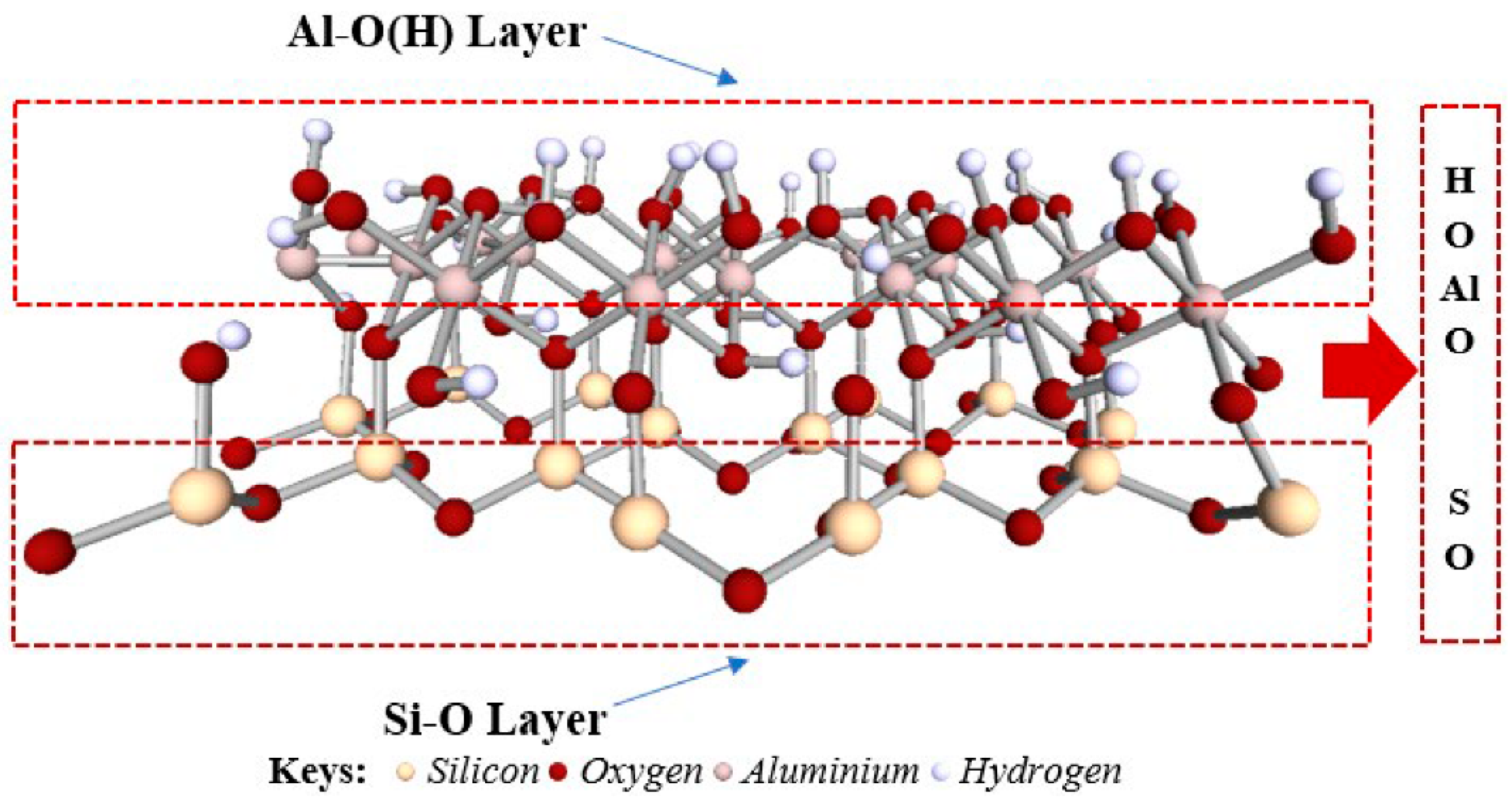

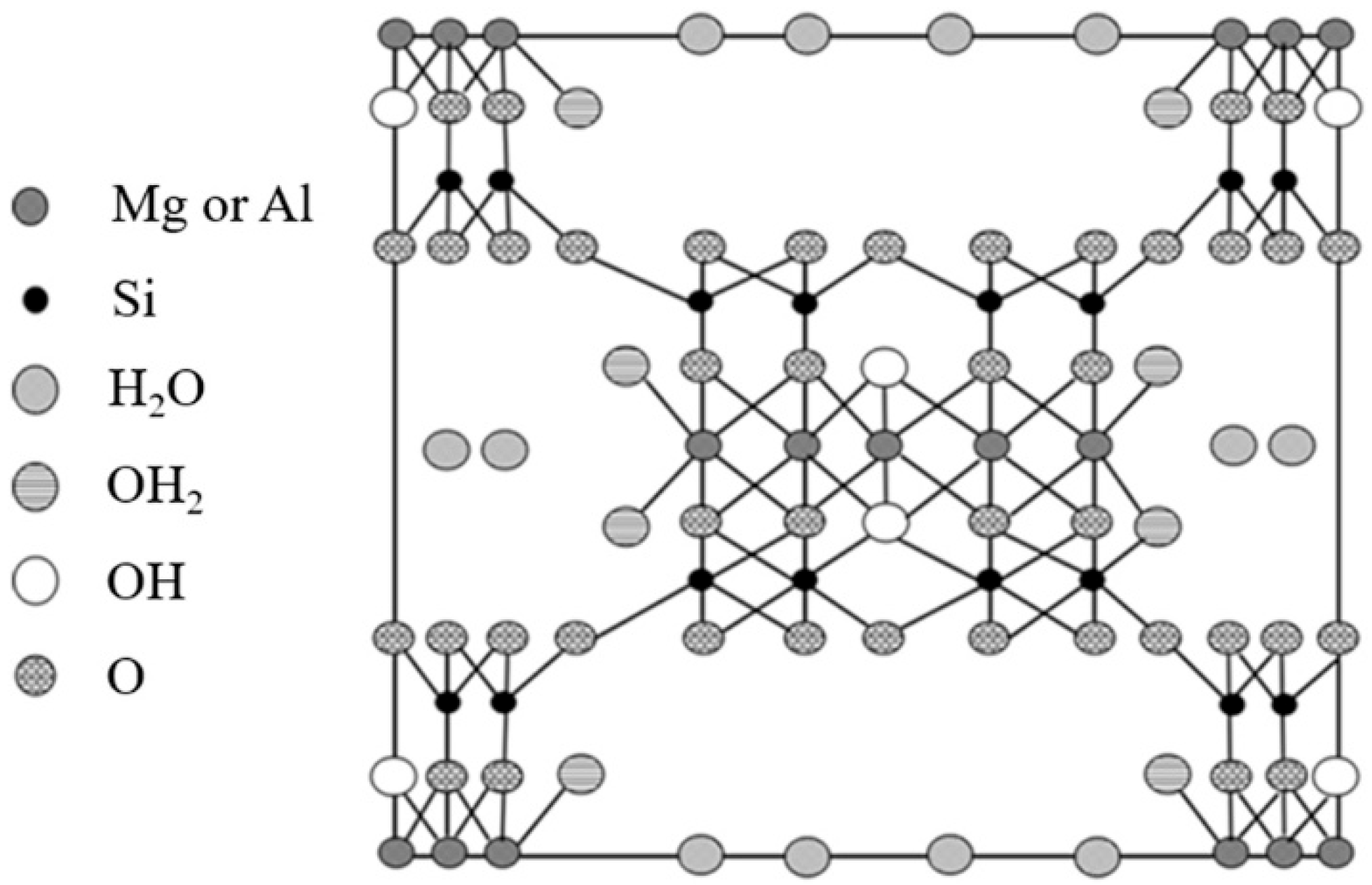

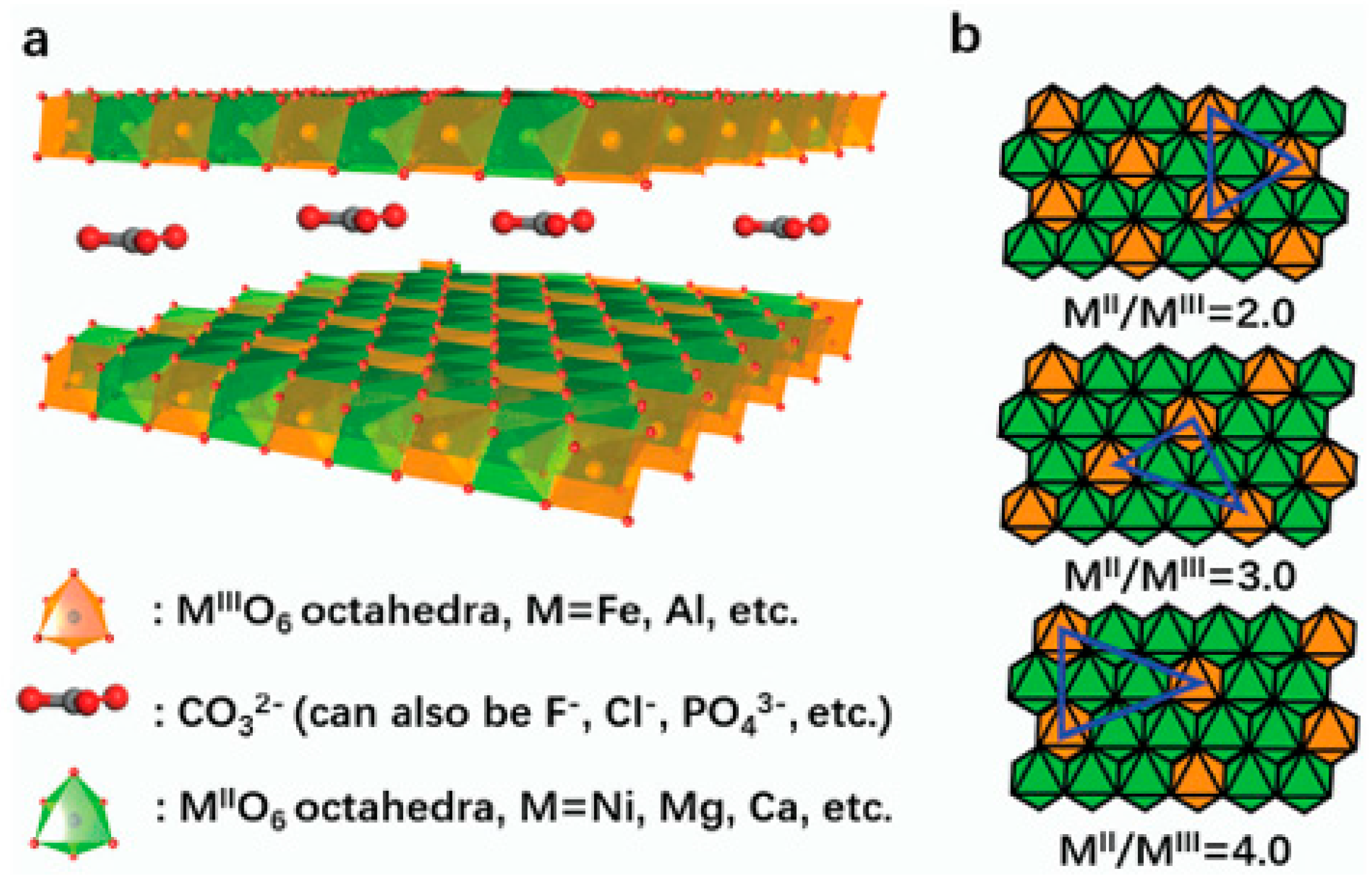

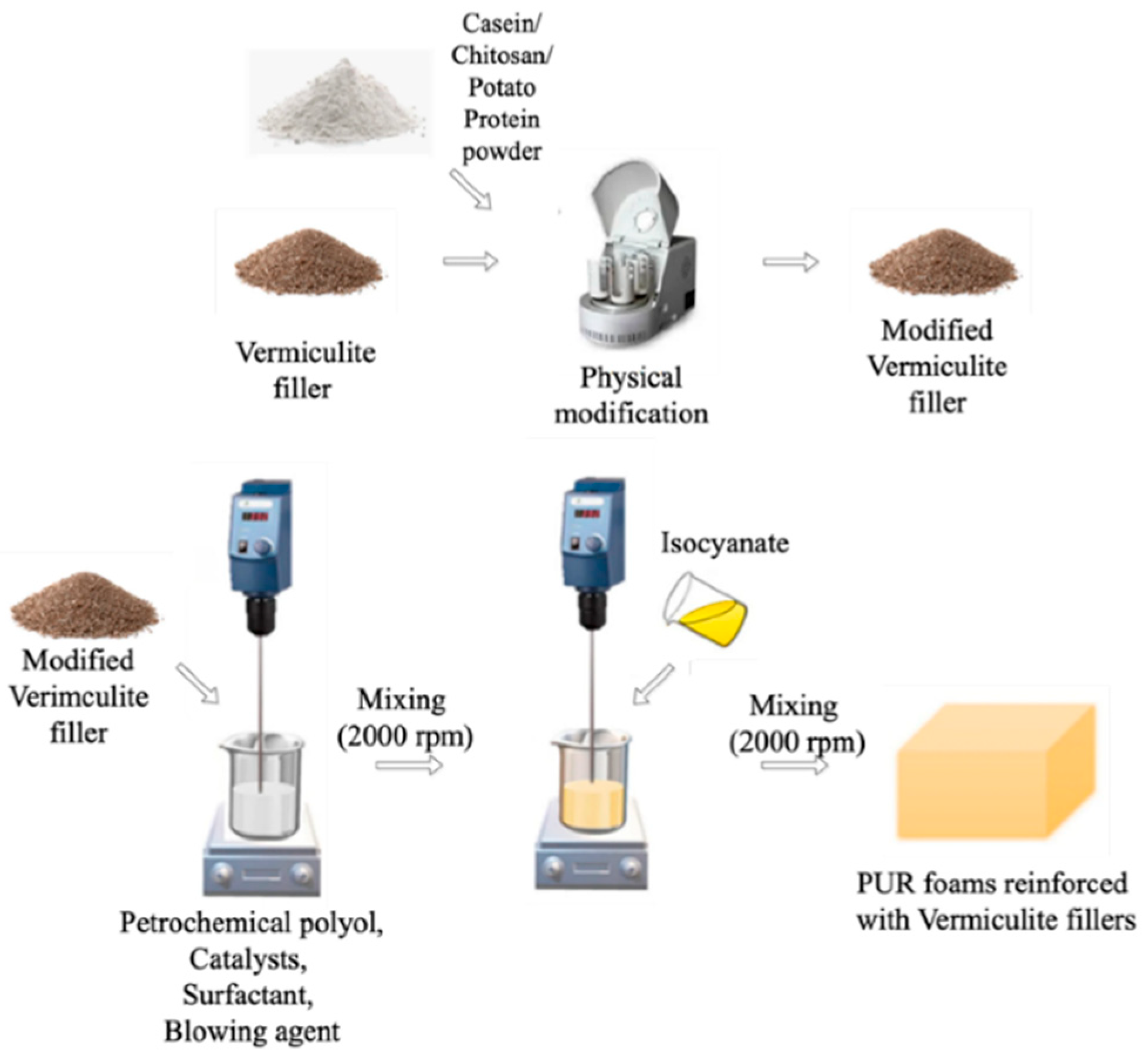

| Clay/Bio-Based Flame Retardant | Polymer Matrix | LOI (%) | UL-94 | pHRR Reduction (%) | THR Reduction (%) | TSP (m3) | Ref. |
|---|---|---|---|---|---|---|---|
| 10DOPO-SEP | PLA | 31.5 | V-0 | 40.7 | 43.1 | / | [31] |
| 22I/3LM | PBS | 36.5 | V-0 | 57.4 | 28.7 | 33.8 | [32] |
| 3CPN@MMT | PUA | / | / | 34.1 | 19.6 | 44.6 | [33] |
| 20CH/MMT | Acrylic fibre | 29.3 | / | 62.0 | 49.0 | 49.0 | [34] |
| PI-1.0MK0 | PUA | 32.2 | / | 74.6 | 46.1 | 57.0 | [35] |
| 3.2V-Cc-PP/0.8Kaol | EP | 27.8 | / | 38.6 | / | / | [36] |
| PEI/ATP/PA | cotton fabric | 27.0 | / | 41.0 | 22.6 | / | [37] |
| 20LDHs@PA-MEL | PP | 29.6 | V-0 | 63.6 | 26.2 | 43.7 | [38] |
| LDH-LS | PP | 29.4 | V-0 | 62.9 | 25.1 | 43.3 | [39] |
| Clay/Bio-Based Flame Retardant | The Synthetic Route of Flame Retardants | The Preparation Scheme of Flame Retardants | Ref. |
|---|---|---|---|
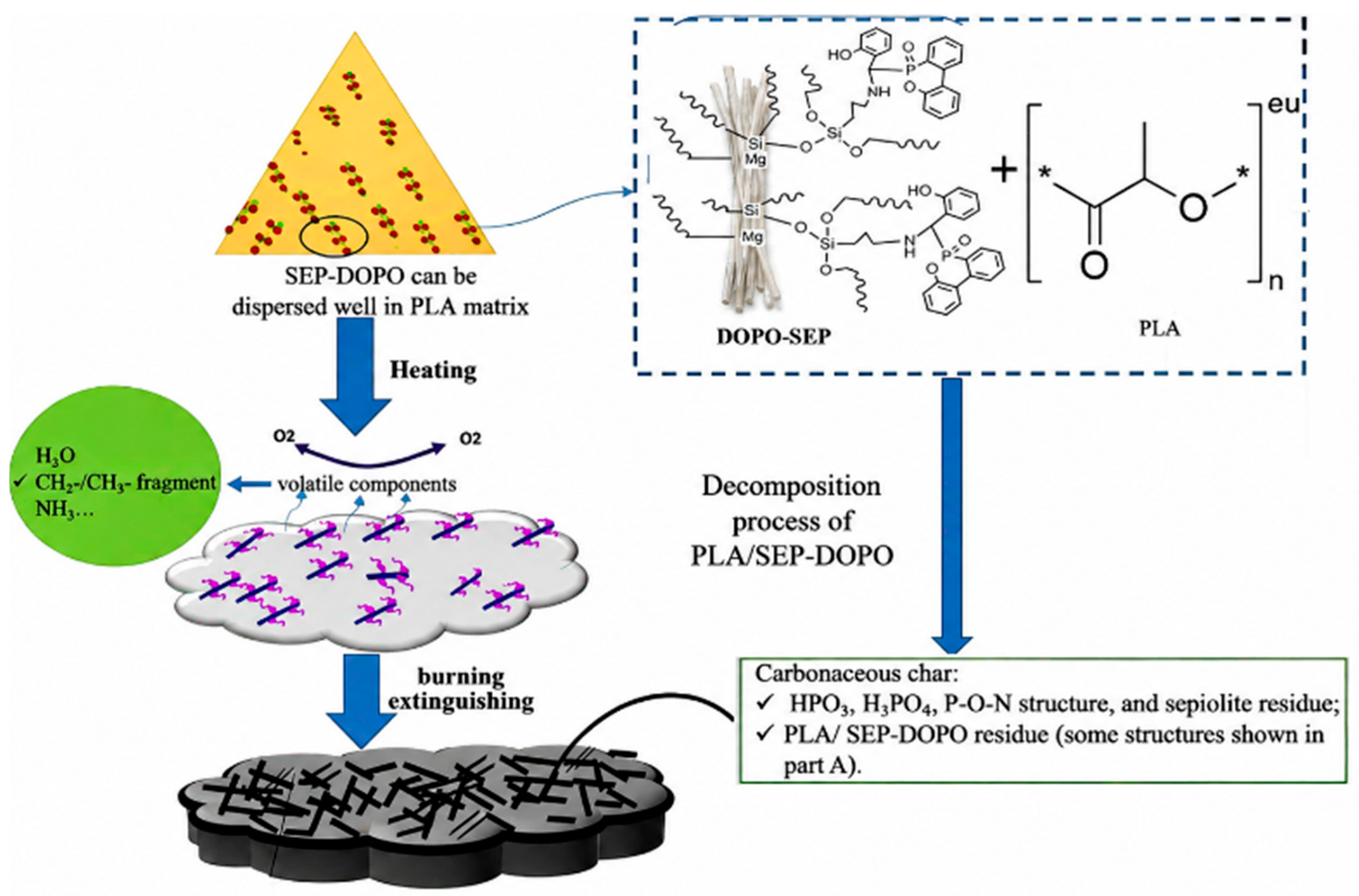
| DOPO-SEP |  | SEP-DOPO was synthesised by reacting SEP with excess AMEO, followed by 4-hydroxybenzaldehyde and DOPO in toluene at 90 °C under nitrogen atmosphere. | [31] Redesigned the image |
| I/LM |  | Lignin/MMT nanocomposites were prepared by mixing lignin solutions with adjusted pH (3.5–12.0) into ultrasonically dispersed MMT suspension, followed by spray drying. | [32] Redesigned the image |
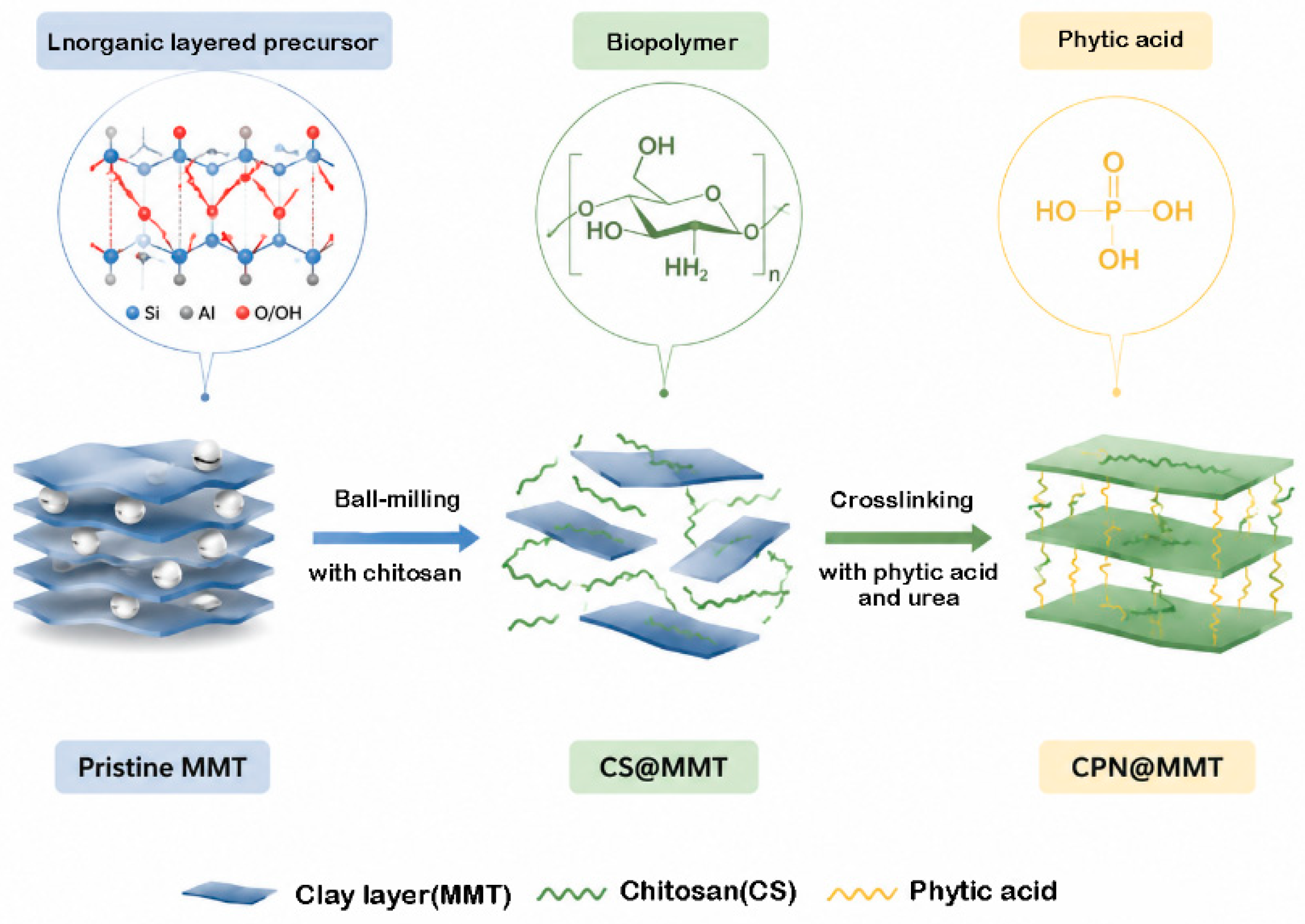
| CPN@MMT | 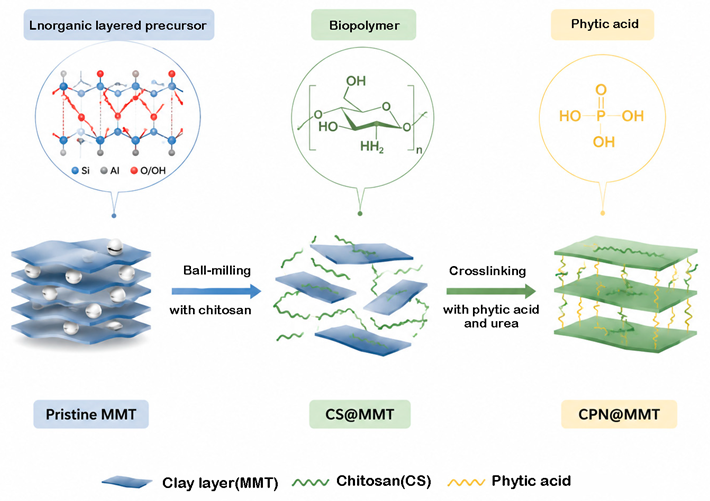 | CPN@MMT nanohybrid was synthesised by ball-milling montmorillonite with chitosan, followed by co-assembly with phytic acid and urea. | [33] Redesigned the image |
| CH/MMT |  | The CH/MMT gel was prepared by mixing chitosan solution and MMT suspension (1:1 v/v) under magnetic stirring for 20 min, followed by centrifugation at 4400 rpm for 5 min. | [34] open access |
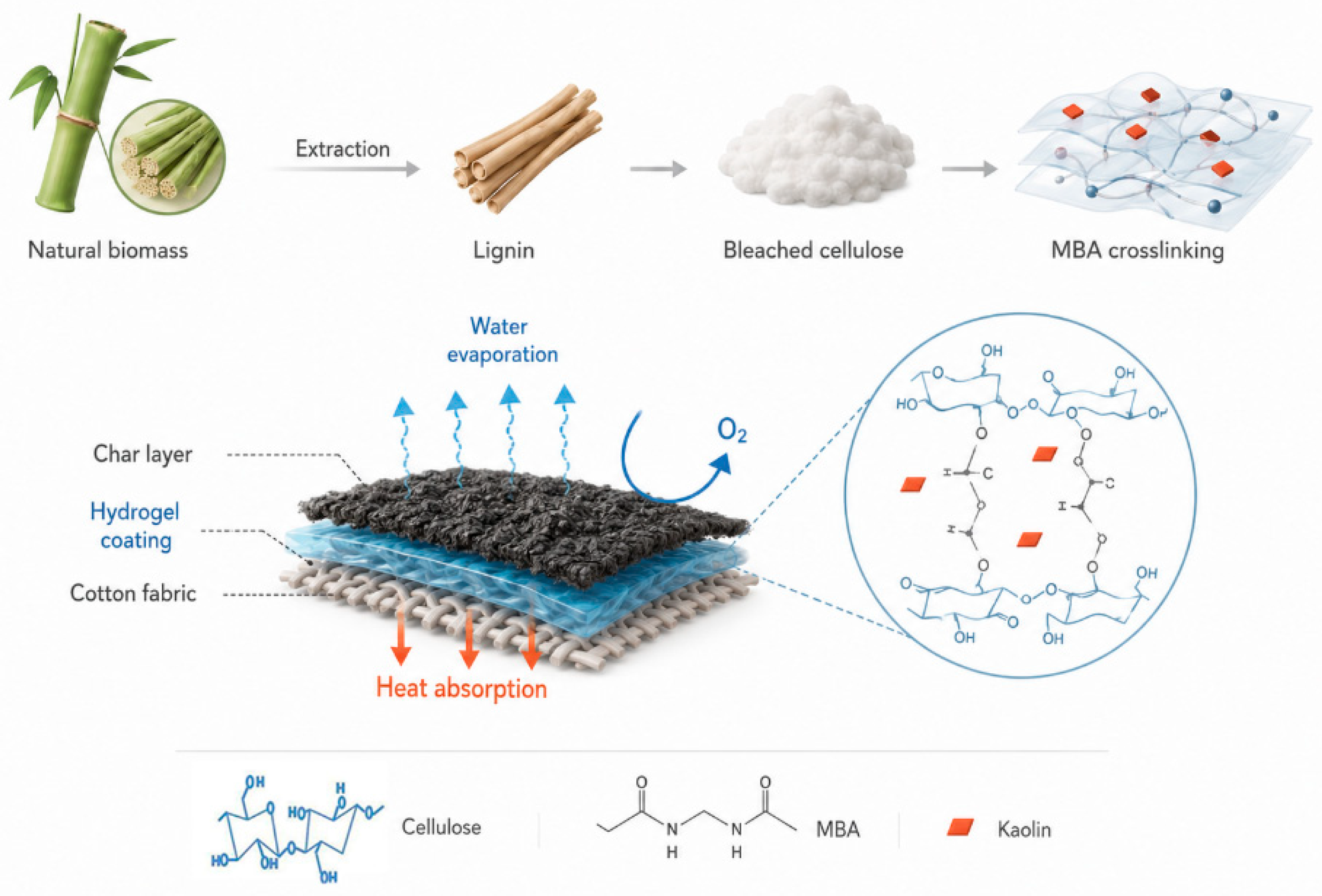
| Mul-K0 | 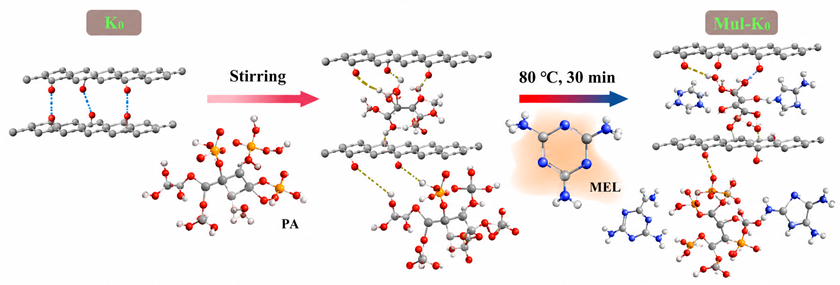 | Mul-K0 was synthesised by sequentially modifying K0 with phytic acid (PA) and melamine (MEL) in an aqueous ethanol solution at 80 °C under pH 4–5. | [35] Redesigned the image |
| V-Cc-PP/Kaol |  | V-Cc-PP was synthesised by sequentially reacting cyanuric chloride with vanillin, followed by polyethyleneimine (PEI) and sodium phytate (PA-Na) in organic solvents under heating. Subsequently, it was compounded with kaolinite to obtain V-Cc-PP/Kaol. | [36] Redesigned the image |
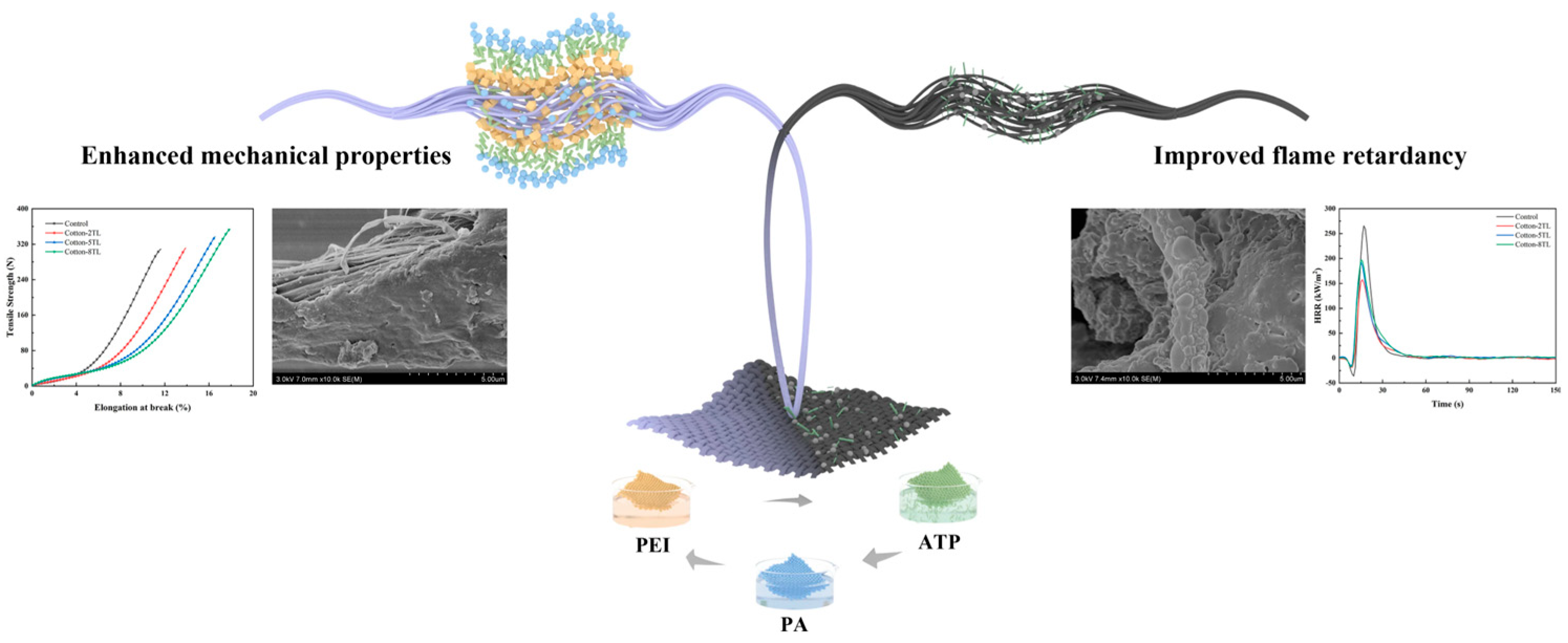
| PEI/ATP/PA |  | (a) Chemical structures of polyethyleneimine (PEI), hydrochloric acid-treated attapulgite (ATP), and phytic acid (PA), the key components for layer-by-layer (LbL) assembly; (b) schematic diagram of the LbL assembly process of these components on pristine cotton fabrics to produce flame-retardant (FR) cotton fabrics; (c) structural and morphological changes of a single cotton fiber after the LbL treatment. | [37] open access |
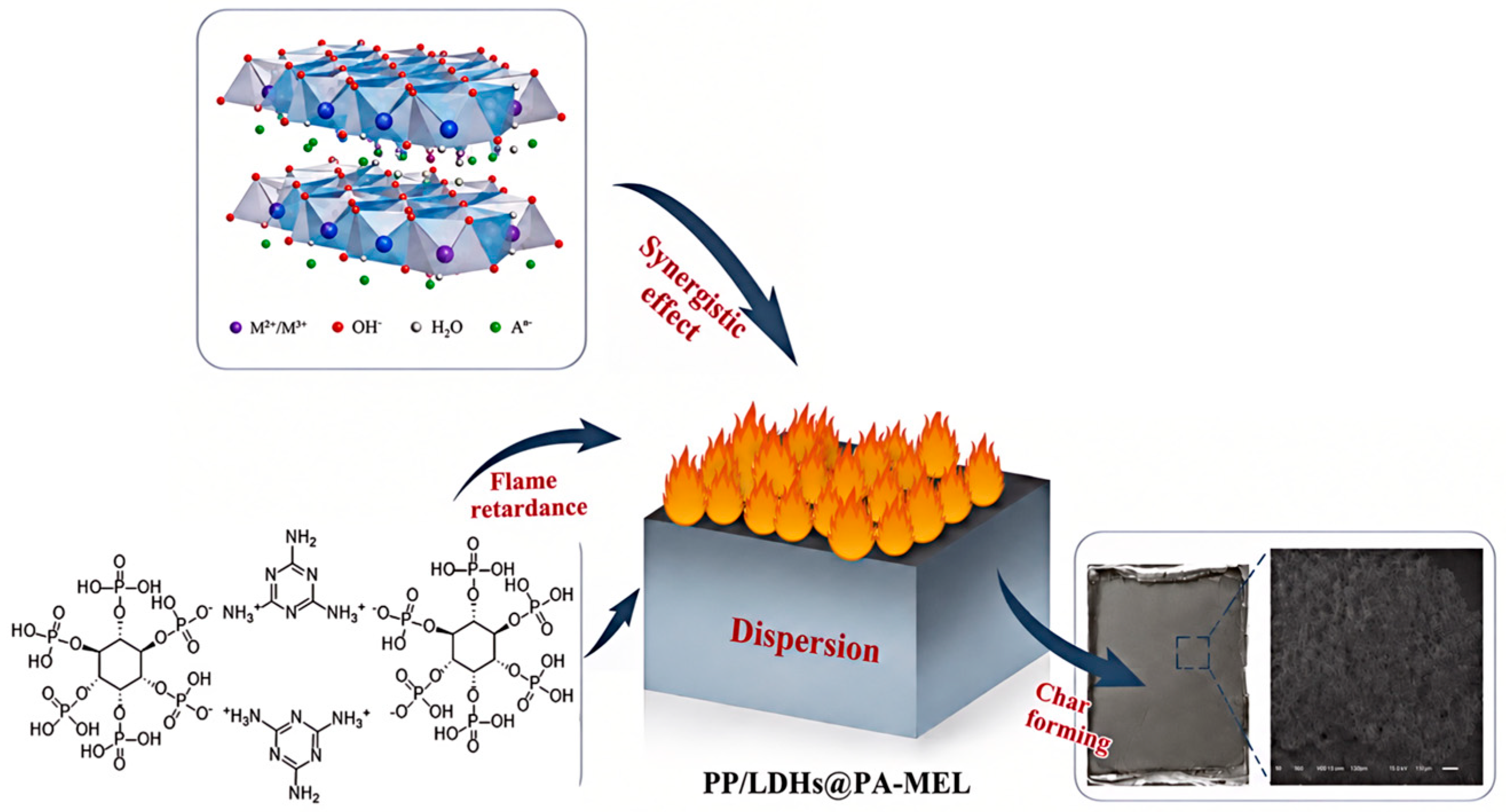
| LDHs@PA-MEL | 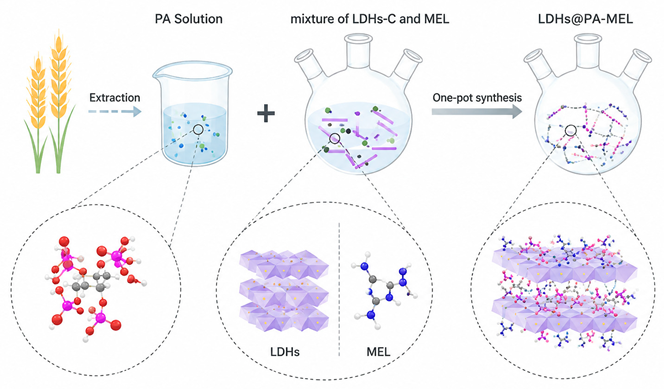 | MgAl–CO3–LDHs (LDHs-C) with a Mg/Al molar ratio of 3.0 was prepared by a hydrothermal method. LDHs@PA-MEL was then synthesised via a one-pot reaction of LDHs-C with melamine (MEL) and phytic acid (PA) at 70 °C in the presence of NaOH. | [38] Redesigned the image |
| LDH-LS | 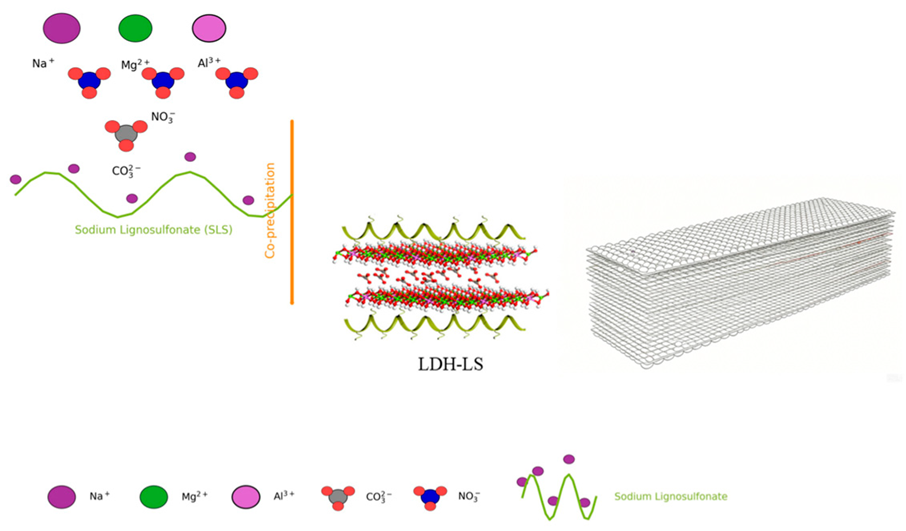 | LDH-LS was synthesised by dropwise adding Mg(NO3)2·6H2O and Al(NO3)3·9H2O into a solution of sodium lignosulfonate (SLS) and Na2CO3 under pH 9–10, followed by dynamic crystallisation at 90 °C for 6 h, filtration, washing, and drying at 80 °C for 24 h. | [39] Redesigned the image |
| Flame-Retardant Mechanism | Mode of Flame Retardancy | Flame-Retardant Properties | Ref. |
|---|---|---|---|
| Physical barrier | A protective, densified carbon layer with a ‘carbon-silicate’ structure that exhibits a nano-dispersive effect is formed. | Block the transfer of heat and material, as well as the circulation of oxygen and other combustible gases. This will delay the combustion process. | [45,48] |
| Reducing the fluidity of the matrix | Increase the viscosity of the polymer melt in order to prevent the large-scale diffusion of molecular chains. | The flame suppresses the melting and dripping of the substrate, thus preventing the fire from spreading. | [46,48] |
| Free radical scavenging (weak) | Capturing gas-phase free radicals through impurities, such as excess iron compounds, within clay minerals. | It inhibits chain reactions in combustion and exhibits a very slight gas-phase flame-retardant effect. | [47] |
| Bio-Based Materials | Principal Ingredients | The Predominant Flame-Retardant Mechanism | Typical Application Polymers | Ref. |
|---|---|---|---|---|
| PA | Phosphorus-rich organic acids | A strong acid source is used for highly efficient catalytic dehydration to form carbon. | PLA, EP, and fibre membrane | [55,62] |
| Chitosan (CS) | Aminoglycoside-containing polysaccharide | It can be used as a carbon and gas source. It possesses excellent carbonisation properties and can be used in combination with acid sources. | PLA, PU, and rubber | [63,64] |
| Lignin | Three-dimensional, complex phenolic polymers | It can be used as a carbon source. Due to its rich aromatic ring structures, it can produce a high residual carbon content. | PLA, PP, and PBS | [65,66] |
| Starch and its derivatives | Polyhydroxy polysaccharide | Carriers of carbon and acid sources. | PLA, PP | [67,68] |
| DNA | Deoxyribonucleic acid (DNA) contains phosphorus and nitrogen | Natural IFR system. The acid source is phosphate, the carbon source is deoxyribose, and the nitrogen source is the nitrogenous bases. | Cotton fabrics, PLA film | [69,70] |
| Tannic acid (TA) | Polyphenolic compounds | A carbon source and a metal ion chelating agent. It easily cross-links with metal ions to form a stable network structure that promotes carbon formation. | Polymer foam, coating | [71,72,73] |
Disclaimer/Publisher’s Note: The statements, opinions and data contained in all publications are solely those of the individual author(s) and contributor(s) and not of MDPI and/or the editor(s). MDPI and/or the editor(s) disclaim responsibility for any injury to people or property resulting from any ideas, methods, instructions or products referred to in the content. |
© 2026 by the authors. Licensee MDPI, Basel, Switzerland. This article is an open access article distributed under the terms and conditions of the Creative Commons Attribution (CC BY) license.
Share and Cite
Zheng, S.; Liu, Y.; Zhou, F.; Yuan, H. A Review of the Application Research on Inorganic Clay Minerals Synergising with Bio-Based Flame-Retardant Systems to Enhance Polymer Performance. Polymers 2026, 18, 1487. https://doi.org/10.3390/polym18121487
Zheng S, Liu Y, Zhou F, Yuan H. A Review of the Application Research on Inorganic Clay Minerals Synergising with Bio-Based Flame-Retardant Systems to Enhance Polymer Performance. Polymers. 2026; 18(12):1487. https://doi.org/10.3390/polym18121487
Chicago/Turabian StyleZheng, Shihao, Yong Liu, Fang Zhou, and Hao Yuan. 2026. "A Review of the Application Research on Inorganic Clay Minerals Synergising with Bio-Based Flame-Retardant Systems to Enhance Polymer Performance" Polymers 18, no. 12: 1487. https://doi.org/10.3390/polym18121487
APA StyleZheng, S., Liu, Y., Zhou, F., & Yuan, H. (2026). A Review of the Application Research on Inorganic Clay Minerals Synergising with Bio-Based Flame-Retardant Systems to Enhance Polymer Performance. Polymers, 18(12), 1487. https://doi.org/10.3390/polym18121487