Effect of Preheating Conditions on the Mechanical Reliability of HDPE Extrusion-Welded Structures for Medical Devices


Abstract
1. Introduction
2. Materials and Methods
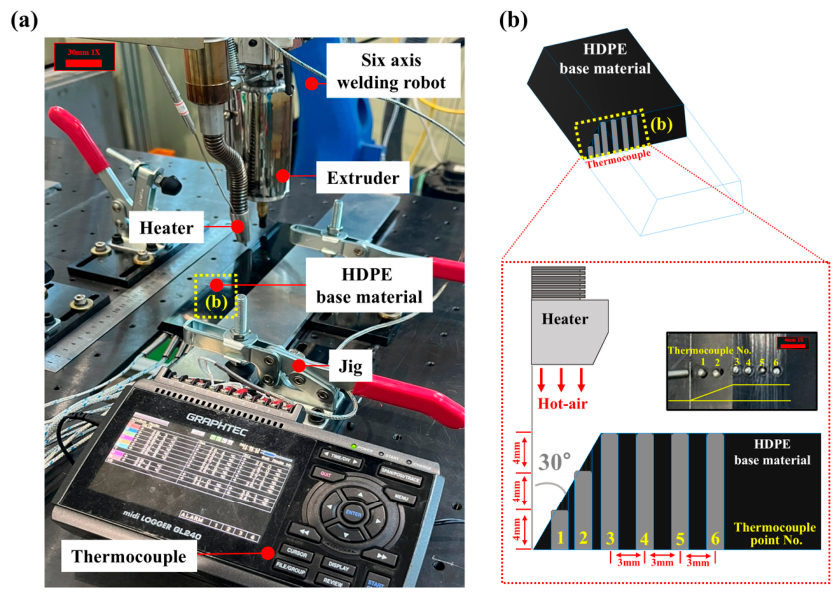
2.1. Materials and Equipment
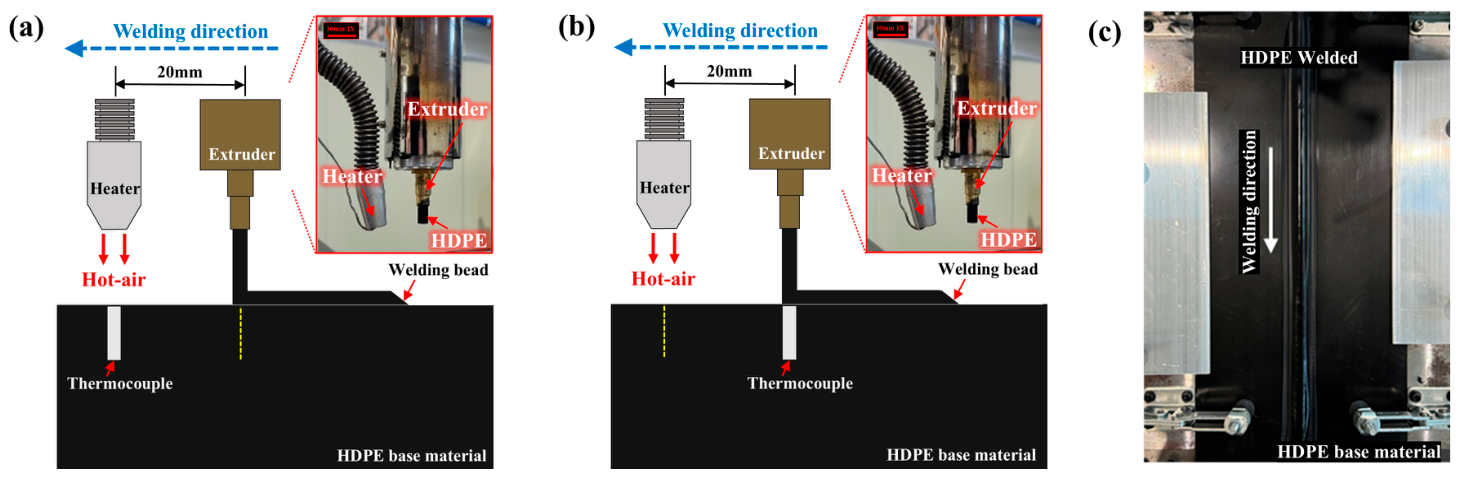
2.2. Experimental Design
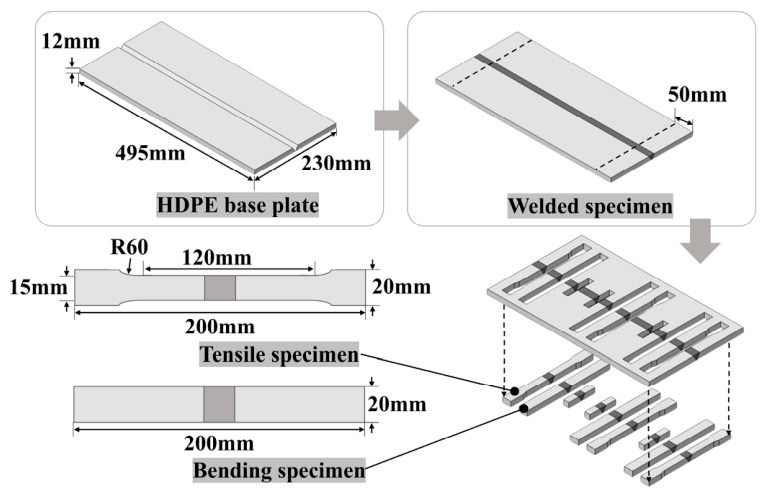
2.3. Evaluation Method
3. Experimental Results
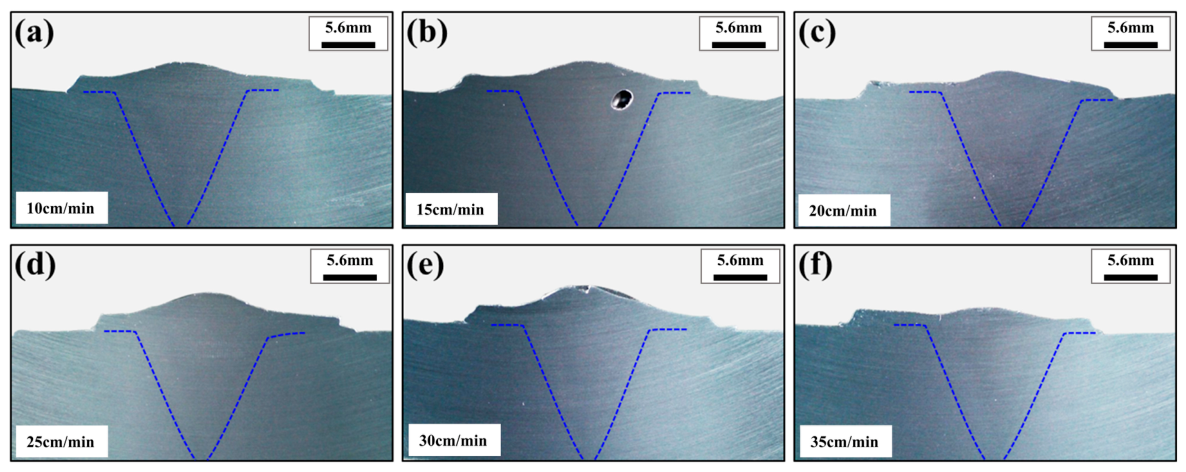
3.1. Welding Results
3.2. Preheating Results over Time
3.3. Preheating Results by Location
4. Analysis and Discussion
4.1. Tensile Strength Results
4.2. Bending Strength Results
4.3. Discussion
5. Conclusions
- The surface temperature distribution during preheating depended primarily on the lateral distance from the heat source rather than the vertical position, confirming that heat conduction within HDPE governs thermal uniformity during hot-air preheating.
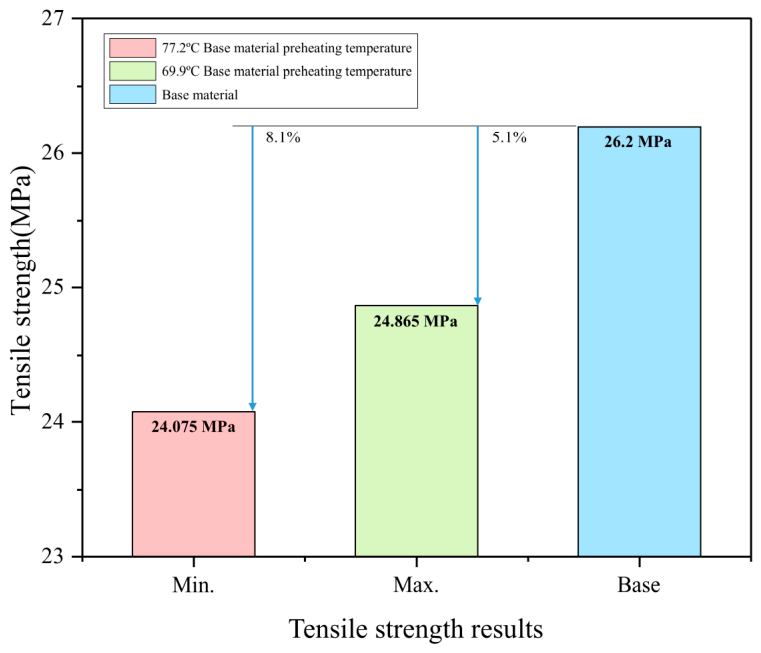
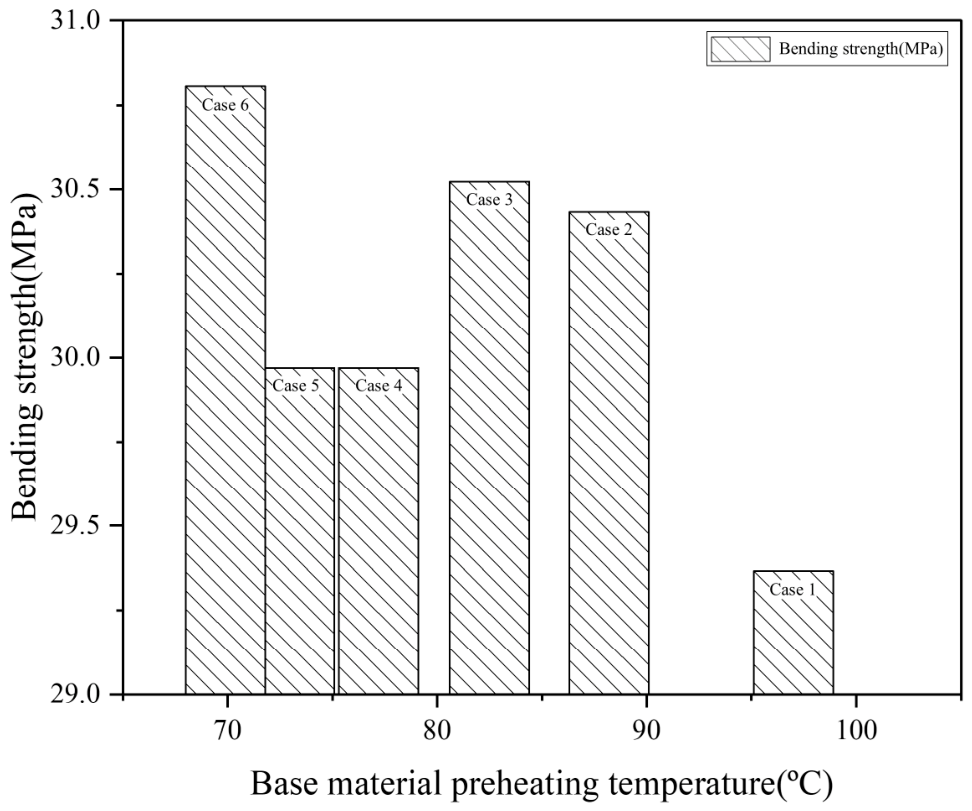
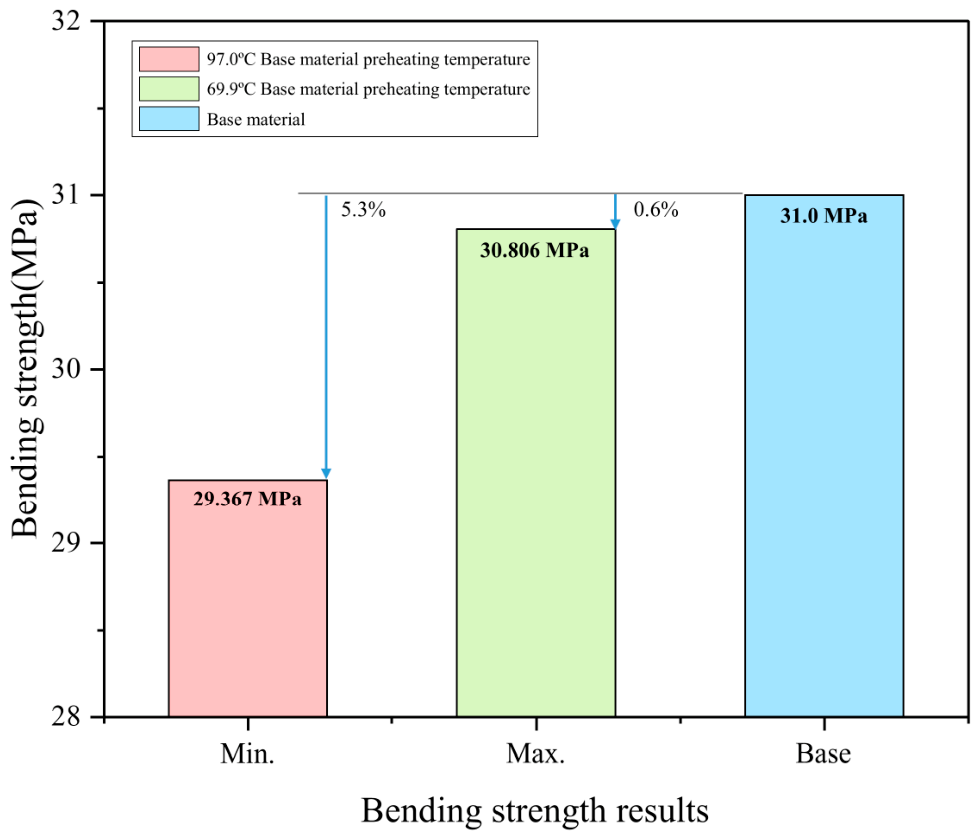
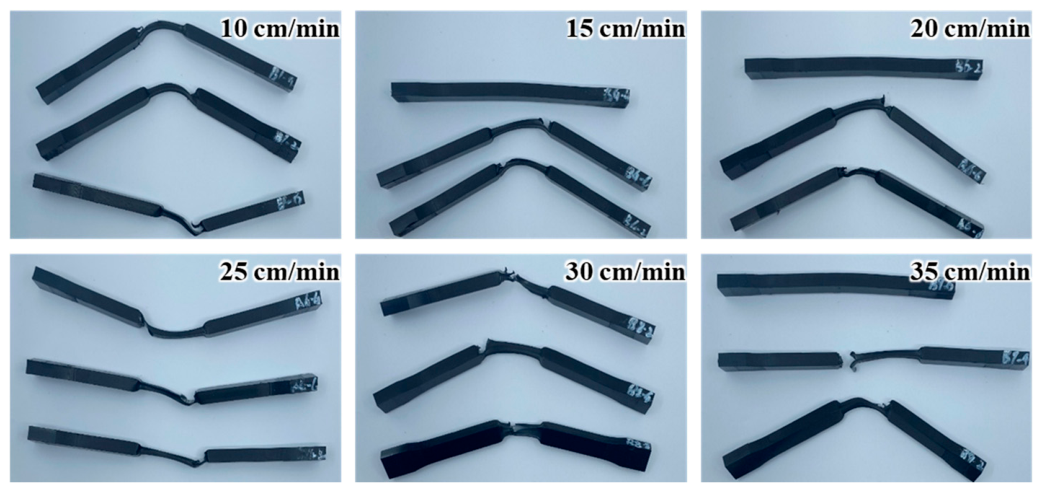
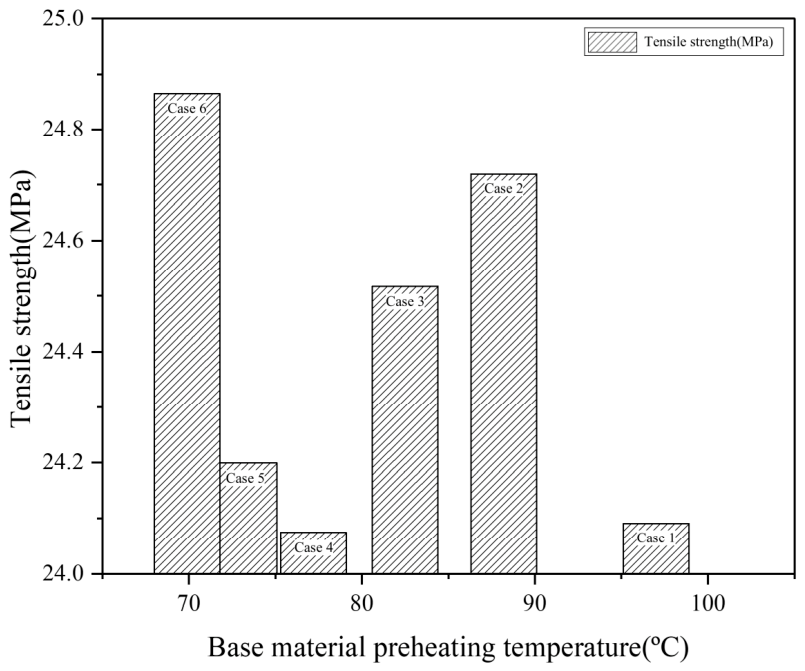
- Increasing the hot-air movement speed reduced the surface preheating temperature linearly due to shortened exposure time. However, these temperature variations produced less than a 5% change in tensile and bending strengths, indicating that HDPE joints remain structurally reliable across a wide preheating range.
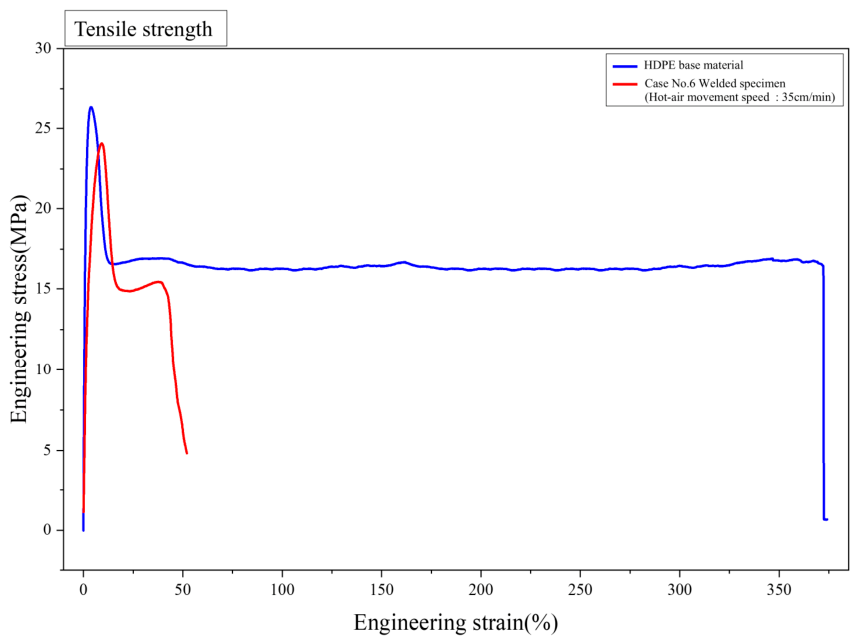
- All weld specimens fractured within the welded region but still achieved tensile strengths exceeding 90% of the base material, satisfying the acceptance criteria defined in DVS standards.
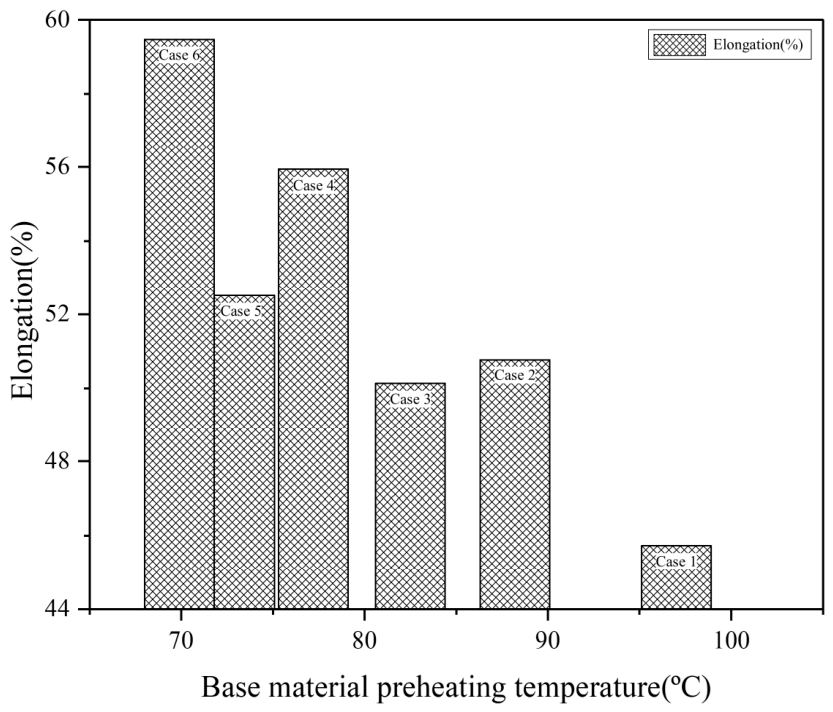
- Elongation decreased with increasing preheating temperature, likely due to polymer chain relaxation or localized degradation at elevated temperatures. Nevertheless, an optimal trade-off between strength and ductility was achieved at a surface temperature of approximately 70 °C with a hot-air speed of 35 cm/min.
- These findings demonstrate that excessive preheating offers limited mechanical benefit, whereas moderate preheating ensures consistent joint strength, stable ductility, and reduced thermal distortion. The results provide practical guidance for selecting energy-efficient and reproducible process parameters in HDPE extrusion welding for medical electrical equipment applications.
Author Contributions
Funding
Institutional Review Board Statement
Data Availability Statement
Conflicts of Interest
References
- Vidakis, N.; Petousis, M.; Michailidis, N.; Mountakis, N.; Papadakis, V.; Argyros, A.; Charou, C. Polyethylene glycol and polyvinylpyrrolidone reduction agents for medical grade polyamide 12/silver nanocomposites development for material extrusion 3D printing: Rheological, thermomechanical, and biocidal performance. React. Funct. Polym. 2023, 190, 105623. [Google Scholar] [CrossRef]
- Chauhan, P.; Sharma, A.K.; Lamba, B.Y. Transforming medical plastic waste into valuable hydrocarbon fuels: Advances, challenges, and future opportunities. J. Anal. Appl. Pyrolysis 2026, 195, 107697. [Google Scholar] [CrossRef]
- Mejia, E.; Cherupurakal, N.; Mourad, A.-H.I.; Al Hassanieh, S.; Rabia, M. Effect of Processing Techniques on the Microstructure and Mechanical Performance of High-Density Polyethylene. Polymers 2021, 13, 3346. [Google Scholar] [CrossRef] [PubMed]
- Gopanna, A.; Rajan, K.P.; Thomas, S.P.; Chavali, M. Polyethylene and Polypropylene Matrix Composites for Biomedical Applications. Mater. Biomed. Eng. 2019, 11, 175–216. [Google Scholar] [CrossRef]
- Niu, S.; Bellala, V.; Qureshi, D.A.; Srivastava, V. A Method to Measure the Embedded Crack Length and Position in High-Density Polyethylene Using Ultrasound. arXiv 2024. [Google Scholar] [CrossRef]
- Luo, H.; Liu, X.; Chen, X.; Pu, Z.; Jia, Z.; Yue, J. Engineering surfaces of polymer-based medical implants for tissue repair and regeneration. J. Control. Release 2026, 390, 114540. [Google Scholar] [CrossRef]
- Langer, R.; Tirrell, D.A. Designing materials for biology and medicine. Nature 2004, 428, 487–492. [Google Scholar] [CrossRef]
- Jones, D.S.; McCoy, C.P.; Andrews, G.P. Physicochemical and drug diffusion analysis of rifampicin containing polyethylene glycol–poly(ɛ-caprolactone) networks designed for medical device applications. Chem. Eng. J. 2011, 172, 1088–1095. [Google Scholar] [CrossRef]
- Maro, M.D.; Faga, M.G.; Malucelli, G.; Mussano, F.D.; Genova, T.; Morsi, R.E.; Hamdy, A.; Duraccio, D. Influence of Chitosan on the Mechanical and Biological Properties of HDPE for Biomedical Applications. Polym. Test. 2020, 91, 106610. [Google Scholar] [CrossRef]
- Paxton, N.C.; Allenby, M.C.; Lewis, P.M.; Woodruff, M.A. Biomedical applications of polyethylene. Eur. Polym. J. 2019, 118, 412–428. [Google Scholar] [CrossRef]
- Amjadi, M.; Fatemi, A. Tensile Behavior of High-Density Polyethylene Including the Effects of Processing Technique, Thickness, Temperature, and Strain Rate. Polymers 2020, 12, 1857. [Google Scholar] [CrossRef] [PubMed]
- Al-mugren, K.S.; Almalki, L.; Alshehri, R.; Alamri, S.; Almurayshid, M.; Alsuhybani, M.; Alharbi, R.; Khandaker, M.U. Development of lead-free metal carbides and ceramic decorated HDPE composites for low energy X-ray shielding applications. Radiat. Phys. Chem. 2024, 220, 111688. [Google Scholar] [CrossRef]
- Gebrehiwot, S.Z.; Espinosa-Leal, L.; Anukka, H.; Remes, H. Modelling the Effect of Temperature on the Plastic Deformation of High-Density Polyethylene (HDPE): A Semi-Empirical Approach. Mech. Mater. 2025, 211, 105501. [Google Scholar] [CrossRef]
- Mehdikhani, H.; Mostafapour, A.; Laieghi, H.; Najjar, R.; Lionetto, F. Mechanical and Microstructural Properties of HDPE Pipes Manufactured via Orbital Friction Stir Welding. Materials 2022, 15, 3810. [Google Scholar] [CrossRef]
- Ageorges, C.; Ye, L.; Hou, M. Advances in Fusion Bonding Techniques for Joining Thermoplastic Matrix Composites: A Review. Compos. Part A Appl. Sci. Manuf. 2001, 32, 839–857. [Google Scholar] [CrossRef]
- Grimm, R.A. Welding processes for plastics. Adv. Mater. Process. 1995, 147, 27–30. [Google Scholar]
- Huang, Y.; Meng, X.; Xie, Y.; Wan, L.; Lv, Z.; Cao, J.; Feng, J. Friction stir welding/processing of polymers and polymer matrix composites. Compos. Part A Appl. Sci. Manuf. 2018, 105, 223–257. [Google Scholar] [CrossRef]
- Schmachtenberg, E.; Tüchert, C. Long-term properties of butt-welded poly(propylene). Macromol. Mater. Eng. 2003, 288, 291–300. [Google Scholar] [CrossRef]
- Lee, C.; Woo, S.; Kwon, S.; Kim, J. Effect of Preheating Parameters on Extrusion Welding of High-Density Polyethylene Materials. Polymers 2024, 16, 2992. [Google Scholar] [CrossRef]
- Amanat, N.; James, N.L.; McKenzie, D.R. Welding Methods for Joining Thermoplastic Polymers for the Hermetic Enclosure of Medical Devices. Med. Eng. Phys. 2010, 32, 690–699. [Google Scholar] [CrossRef] [PubMed]
- Rowe, R.K.; Ali, M.M. Effect of Welding Parameters on Properties of HDPE Geomembrane Extrusion Welds. Geotext. Geomembr. 2024, 52, 355–367. [Google Scholar] [CrossRef]
- Lai, H.; Fan, D.; Liu, K. The Effect of Welding Defects on the Long-Term Performance of HDPE Pipes. Polymers 2022, 14, 3936. [Google Scholar] [CrossRef]
- Ting, G.; Grest, G.S.; Robbins, M.O. Tensile Fracture of Welded Polymer Interfaces: Miscibility, Entanglements, and Crazing. Macromolecules 2014, 47, 6982–6989. [Google Scholar] [CrossRef]
- Wang, S.; Shi, J.; Shimizu, T.; Xu, J.; Xu, Z. Two-Step Heat Fusion Kinetics and Mechanical Performance of Thermoplastic Interfaces. Sci. Rep. 2022, 12, 5701. [Google Scholar] [CrossRef]
- Bai, C.; Lin, R.; Lai, H.S. Investigation of Creep Behavior of HDPE Pipe Butt Fusion Welded Joints Using a Stepped Isostress Method. Polymers 2024, 16, 1803. [Google Scholar] [CrossRef]
- Ge, T.; Pierce, F.; Perahia, D.; Grest, G.S.; Robbins, M.O. Molecular Dynamics Simulations of Polymer Welding: Strength from Interfacial Entanglements. Phys. Rev. Lett. 2013, 110, 098301. [Google Scholar] [CrossRef]
- Pokharel, P.; Kim, Y.; Choi, S. Microstructure and Mechanical Properties of the Butt Joint in High Density Polyethylene Pipe. Int. J. Polym. Sci. 2016, 2016, 6483295. [Google Scholar] [CrossRef]
- Cai, Z.; Dai, H.; Fu, X. Investigation on the Hot Melting Temperature Field Simulation of HDPE Water Supply Pipeline in Gymnasium Pool. Results Phys. 2018, 9, 146–151. [Google Scholar] [CrossRef]
- Dai, H.; Peng, J. The Effects of Welded Joint Characteristics on Its Properties in HDPE Thermal Fusion Welding. Mod. Phys. Lett. B 2017, 31, 1750185. [Google Scholar] [CrossRef]
- Luchinsky, D.G.; Hafiychuk, H.; Hafiychuk, V.; Chaki, K.; Nitta, H.; Ozawa, T.; Wheeler, K.R.; Prater, T.J.; McClintock, P.V.E. Welding Dynamics in an Atomistic Model of an Amorphous Polymer Blend with Polymer–Polymer Interface. J. Polym. Sci. Part B Polym. Phys. 2020, 58, 2051–2061. [Google Scholar] [CrossRef]
- Schnell, R.; Stamm, M.; Creton, C. Direct Correlation between Interfacial Width and Adhesion in Glassy Polymers. Macromolecules 1998, 31, 2284–2292. [Google Scholar] [CrossRef]
- Riahi, M.; Kooshayan, K.; Ghanati, M.F. Analysis of effect of pressure and heat on mechanical characteristics of butt fusion welding of polyethylene pipes. Polym. Plast. Technol. Eng. 2011, 50, 907–915. [Google Scholar] [CrossRef]
- Ezekoye, O.A.; Lowman, C.D.; Fahey, M.T.; Hulme-Lowe, A.G. Polymer Weld Strength Predictions Using a Thermal and Polymer Chain Diffusion Analysis. Polym. Eng. Sci. 1998, 38, 976–991. [Google Scholar] [CrossRef]
- Rehman, R.U.; Sheikh-Ahmad, J.; Deveci, S. Effect of Preheating on Joint Quality in the Friction Stir Welding of Bimodal High Density Polyethylene. Int. J. Adv. Manuf. Technol. 2021, 117, 455–468. [Google Scholar] [CrossRef]
- Djoković, V. Stress relaxation in high-density polyethylene: Effects of orientation and irradiation. Polym. J. 1999, 31, 605–611. [Google Scholar] [CrossRef]
- Lomovskoy, V.A. Relaxation phenomena in low-density and high-density polyethylenes. Polymers 2024, 16, 3510. [Google Scholar] [CrossRef]
- Gao, Y.; Jayswal, A.; Das, A.; Carrillo, J.M.Y.; Damron, J.T.; Bowland, C.C.; Yu, Z.; Toomey, M.; Angelopoulou, P.P.; Kharal, S.; et al. Enhanced interfacial bonding of graft copolymers. ACS Appl. Mater. Interfaces 2025, 17, 51094–51104. [Google Scholar] [CrossRef]






| Properties | Base Material | Filler Wire |
|---|---|---|
| Density (g/cm3) | 0.95 | 0.945 |
| Elongation (%) | ≤500 | - |
| Tensile strength (MPa) | 26.2 | - |
| Bending strength (MPa) | 31 | - |
| Melt index (g/10 min), 190 °C/5 kg | 0.22 | 0.27 |
| Melting point (°C) | 120 | 120 |
| Case No. | Hot-Air Moving Speed (cm/min) | Material Throughput (g/s) | Wire Melting Temperature (°C) | Hot-Air Temperature (°C) | Pressure (kgf) |
|---|---|---|---|---|---|
| 1 | 10 | 0.2 | 240 | 260 | 10 |
| 2 | 15 | 0.3 | 240 | 260 | 10 |
| 3 | 20 | 0.4 | 240 | 260 | 10 |
| 4 | 25 | 0.5 | 240 | 260 | 10 |
| 5 | 30 | 0.6 | 240 | 260 | 10 |
| 6 | 35 | 0.7 | 240 | 260 | 10 |
| Case No. | Hot-Air Moving Speed (cm/min) | Material Throughput (g/s) | Bead Width (mm) | Bead Height (mm) |
|---|---|---|---|---|
| 1 | 10 | 0.2 | 25.50 | 3.48 |
| 2 | 15 | 0.3 | 25.15 | 2.62 |
| 3 | 20 | 0.4 | 25.89 | 3.22 |
| 4 | 25 | 0.5 | 25.48 | 3.37 |
| 5 | 30 | 0.6 | 24.10 | 3.05 |
| 6 | 35 | 0.7 | 25.05 | 2.45 |
Disclaimer/Publisher’s Note: The statements, opinions and data contained in all publications are solely those of the individual author(s) and contributor(s) and not of MDPI and/or the editor(s). MDPI and/or the editor(s) disclaim responsibility for any injury to people or property resulting from any ideas, methods, instructions or products referred to in the content. |
© 2026 by the authors. Licensee MDPI, Basel, Switzerland. This article is an open access article distributed under the terms and conditions of the Creative Commons Attribution (CC BY) license.
Share and Cite
Lee, C.-W.; Choe, E. Effect of Preheating Conditions on the Mechanical Reliability of HDPE Extrusion-Welded Structures for Medical Devices. Polymers 2026, 18, 1467. https://doi.org/10.3390/polym18121467
Lee C-W, Choe E. Effect of Preheating Conditions on the Mechanical Reliability of HDPE Extrusion-Welded Structures for Medical Devices. Polymers. 2026; 18(12):1467. https://doi.org/10.3390/polym18121467
Chicago/Turabian StyleLee, Chung-Woo, and Eunho Choe. 2026. "Effect of Preheating Conditions on the Mechanical Reliability of HDPE Extrusion-Welded Structures for Medical Devices" Polymers 18, no. 12: 1467. https://doi.org/10.3390/polym18121467
APA StyleLee, C.-W., & Choe, E. (2026). Effect of Preheating Conditions on the Mechanical Reliability of HDPE Extrusion-Welded Structures for Medical Devices. Polymers, 18(12), 1467. https://doi.org/10.3390/polym18121467