2.3. Evaluation Criteria
Evaluation criteria are the most essential features to be established for systematic material selection in therapeutic microneedle applications. After a literature review and consultation with experts in materials science, biomedical engineering, regulatory, and clinical fields, five fundamental criteria were identified [
28,
29] (
Table 2). These are designed to overcome application problems characteristic of therapeutic drug delivery and are therefore distinct from diagnostic or cosmetic applications. They include technical, biological, economic, and practical considerations that impact clinical viability and commercial success, and are prioritized accordingly.
Biocompatibility (C1) is the most critical criterion in selecting therapeutic microneedle materials, as it determines their ability to perform their intended function and elicit an appropriate host response without causing adverse effects. More than non-toxicity, it encompasses other aspects, such as biological interactions at the material-tissue interface during delivery. Biocompatibility affects efficacy and patient safety [
52]. Assessment should be based on acute, subacute, and chronic responses, ensuring that cytotoxicity is minimal, sensitization does not occur, and systemic toxicity is low. In addition, it involves assessing interactions with therapeutic agents, patient variability (age, immune status, medications, conditions), and compliance standards (e.g., ISO 10993). In many cases, testing is needed for specific delivery scenarios.
Mechanical Properties (C2) assess the structural integrity, deformation, and failure of the material under complex loading for drug delivery. Microneedles should be hard enough to penetrate the stratum corneum (which has mechanical properties comparable to low-density polyethylene (LDPE), exhibiting an elastic modulus of 100–200 MPa, hardness of 0.4–1.0 GPa (Shore D scale), and ultimate tensile strength of 15–20 MPa [
53,
54]). This mechanical barrier requires penetration forces of 0.1–0.5 N per microneedle, depending on needle geometry and insertion velocity [
55]. Microneedles need to withstand buckling, particularly when used in high-aspect-ratio designs. Their elastic modulus and geometry must be designed to account for this. Fracture resistance is essential for preventing safety problems caused by breakage, particularly in brittle materials such as silicon. Hollow microneedles should be able to sustain internal pressure and have sufficient hoop strength. Fatigue resistance is required for microneedles to remain durable through multiple cycles, which is essential for reusable microneedles. Manufacturing materials also need to withstand processing stresses. Dissolvable microneedles must be capable of penetrating and dissolving at the same time. Performance will be impacted by the temperature during manufacture and storage.
The cost of materials (C3) is another major economic element that determines the practicability and availability of microneedle systems in healthcare practices. This cost includes procurement, processing, quality control, and waste management. Since microneedles are mostly single-use instruments, the need to preserve necessary qualities and avoid cross-contamination are key to popularization, and cost is the key factor in this matter. The costs of raw materials include the low cost of polymers and the high purity of silicon, although overall costs span the whole value chain. The costs of processing can be greater than the costs of raw materials, especially in specialized manufacturing processes like cleanroom operations or high-temperature furnaces. Even tooling needs will vary; silicon production will require expensive photolithography and etching devices, and polymer-based production will use less expensive molding or 3D printing devices. Furthermore, the costs of quality control are higher due to the extensive testing necessary to obtain regulatory approval. Yield rates affect overall costs: high defect rates increase per-unit costs. Different materials require different disposal methods and incur various costs, some of which are environmentally costly. Economies of scale can bring down the cost at high volume for certain technologies but not others. In resource-limited settings or mass vaccination, the material choice may be determined by cost rather than technical benefits.
Ease of Manufacturing (C4) assesses the practicability, technical complexity, and reproducibility of manufacturing therapeutic microneedles at clinical and commercial scales. It takes into consideration process complexity, equipment requirements, environmental controls, scalability, and quality assurance. Easier processes decrease defects, reduce production time, and need less training. Silicon microneedles are much more complex than polymer microneedles, involving processes such as photolithography, whereas polymer microneedles are simpler, such as micro-molding or 3D printing technology. Equipment ranges from expensive semiconductor equipment to less expensive molding systems. For example, silicon requires a restrictive cleanroom environment, while polymers are tolerant of more permissive environments. Scalability involves increasing volume and quality/cost efficiency. Reproducibility means batches are consistently of high quality, and it is crucial for regulatory compliance and market success. For therapeutic use, processes should also include the loading of drugs without damaging the microneedles or the payload.
While the AHP methodology is ideally independent of the criteria, some degree of interdependence is observed in practical applications, such as material selection. For example, the ease of manufacturing (C4) of a material can affect the material cost (C3), and microneedle type compatibility (C5) is intrinsically related to the mechanical properties (C2) and biocompatibility (C1). For this reason, the criteria were specifically formulated to represent a particular view in the decision-making process: biological safety (C1), technical performance (C2), economic aspects (C3), practicality in production (C4), and design variability (C5). This framework must imply that even though there may be underlying factors, each criterion provides a clear and essential context for consideration and prevents significant double-counting in the expert judgment process.
Microneedle Type Compatibility (C5) refers to the compatibility of materials used in different types of microneedles, in recognition of the fact that different therapeutic uses require different configurations and different material needs. Five types exist: solid microneedles for pore formation; microneedles coated with therapeutic agents; hollow microneedles with liquid drugs; dissolving microneedles containing biodegradable drugs; and swelling microneedles comprising hydrogel structures [
54]. Solid microneedles require hard materials (metals, silicon); coated microneedles require surface functionalization for drug loading; hollow microneedles require biocompatible polymers with stable channel-forming capabilities; and swelling microneedles require hydrogels for drug delivery. The range of materials that can be used is also limited by the interactions with the drug, stability, and manufacturing requirements for therapeutic applications. For example, an antigen must be delivered in vaccines and be compatible with adjuvants. Delivery time is another factor that affects material choice: The fastest delivery times might be best served by materials that dissolve quickly. At the same time, sustained release requires materials that enable longer delivery. The use of multi-material microneedles provides design and fabrication flexibility for a range of microneedle types.
Table 2.
Evaluation criteria for therapeutic microneedle applications.
Table 2.
Evaluation criteria for therapeutic microneedle applications.
| Symbol | Criteria | Description | Importance | Therapeutic Relevance |
|---|
| C1 | Biocompatibility | The material’s ability to perform with an appropriate host response in specific therapeutic applications | High | Critical for patient safety and regulatory approval [54] |
| C2 | Mechanical Properties | The material’s ability to maintain structural integrity during insertion and drug delivery | High | Essential for reliable penetration and therapeutic efficacy [14] |
| C3 | Material Cost | The economic considerations for material procurement and processing of therapeutic applications | Medium | Important for commercial viability and healthcare accessibility [23] |
| C4 | Ease of Manufacturing | The complexity and feasibility of fabricating therapeutic microneedle systems | Medium | Critical for scalable production and quality consistency [55] |
| C5 | Microneedle Type Compatibility | The suitability of materials for different microneedle designs and therapeutic delivery modes | Medium | Determines applicability across various therapeutic applications [56] |
Criteria Selection Process and Exclusions
The five evaluation criteria were selected through a systematic three-phase process. Phase 1 identified 12 potential criteria through a literature review (n = 157 papers, 2015–2024) and expert brainstorming. Phase 2 employed a criteria screening workshop (n = 7 experts) using independence, measurability, and discriminatory power as selection filters. Phase 3 finalized five criteria through Delphi consensus (two rounds, agreement threshold: 85%) (
Table 3).
Seven criteria were deliberately excluded with documented justification:
- -
Drug loading capacity: Subsumed within C5 (type compatibility). Drug loading is type-specific (dissolving MN: integrated; coated MN: surface-applied; hollow MN: post-fabrication) rather than material-inherent.
- -
Dissolution rate: Covered within C1 (biocompatibility evaluation). Dissolution testing is part of ISO 10993-13 degradation assessment, already factored into biocompatibility scoring.
- -
Sterilization compatibility: Integrated into C4 (manufacturing). Sterilization (gamma, EtO, autoclave) is a manufacturing step. Material compatibility is established during process validation.
- -
Environmental impact: Not primary for therapeutic devices. FDA/ISO frameworks prioritize patient safety and efficacy over environmental considerations for single-use medical devices.
- -
Aesthetic appearance: Non-discriminating for therapeutic use. Unlike cosmetic microneedles, therapeutic devices are not visually inspected by patients during application.
- -
Patient preference: Non-discriminating across materials. All microneedle types provide painless administration regardless of material. Patient preference relates to application method, not material composition.
- -
Shelf life: Addressed within biocompatibility (C1) through stability testing per ICH Q1A(R2) guidelines. Material degradation over shelf life is captured in accelerated aging protocols.
Comprehensive coverage of clinically relevant performance dimensions. The five-criterion set (C1–C5) was designed so that every parameter recognized as clinically critical for therapeutic microneedles maps onto at least one of the selected criteria. Drug-material interactions, in particular, are not a single isolable property but a distributed phenomenon that manifests across three of the five criteria: chemical compatibility, immunogenicity, leachables/extractables and degradation-product toxicity all fall under biocompatibility (C1) and are formally interrogated by the ISO 10993 test battery. Structural compatibility of the matrix with the loaded therapeutic (plasticization, embrittlement, drug-induced changes in mechanical integrity) is captured by C2. Architecture-specific drug-loading and release modes (matrix integration in dissolving systems, surface coating efficiency in coated systems, lumen patency in hollow systems, swelling-controlled release in hydrogels) are encoded within C5 (Type compatibility). Penetration mechanics (insertion force, tip sharpness, fracture risk during deployment) are quantified within C2, while sterilization compatibility and scalability are embedded within C4. Cost of goods, reimbursement-relevant economics and supply-chain accessibility are handled within C3.
Table 3 documents not only which criteria were selected, but also where each excluded sub-property is captured within the retained set, ensuring complete clinical coverage without double-counting.
Justification for excluding dissolution rate and drug loading as independent criteria. Both parameters were considered explicitly and ultimately rejected on principled grounds of non-independence rather than irrelevance. Dissolution rate is intrinsically a material-degradation phenomenon and is already quantified within the ISO 10993-13 degradation-assessment limb of biocompatibility (C1). Moreover, for the dominant microneedle architectures, the clinically meaningful dissolution profile depends jointly on polymer chemistry (C1), cross-link density and molecular weight (C2), and the specific dissolving/swelling architecture chosen (C5). Treating it as an independent sixth criterion would therefore induce strong cross-correlations with C1, C2 and C5 and inflate the consistency ratio without contributing new discriminative information. Drug-loading capacity is similarly architecture-dependent rather than material-inherent: the same biocompatible polymer can be matrix-loaded (dissolving), surface-coated, or used as a hydrogel reservoir, with loading capacities differing by an order of magnitude between modes. Loading is therefore subsumed within type compatibility (C5), where the polymer-matrix loading windows (10–40 wt% small molecule; 1–10 wt% protein), coated-surface loading (0.1–10 μg/needle) and hollow-reservoir volumes (≥0.1 μL) are explicitly weighted. Sensitivity analyses (
Section 3.3.3) confirm that the polymer–metal top-two ranking is preserved when dissolution-related sub-scores are perturbed by ±20%, supporting the conclusion that explicit promotion of these sub-criteria would not alter the practical selection guidance.
2.4. Pairwise Comparison Process
The basic scale (
Table 4) is used in the AHP methodology to compare relative preferences between criteria and therapeutic microneedle alternatives through pairwise comparisons [
55]. This systematic tool allowed specialists to make multi-criteria decisions more complex and consistent by comparing the materials and criteria in pairs.
Expert judgments were obtained through structured interviews in which knowledge of the materials science, biomedical engineering, and regulatory affairs disciplines [
56] was elicited. The experts systematically compared pairs of materials and criteria using the nine-point scale shown in
Table 3. For instance, in the case of biocompatibility versus mechanical properties, the researchers needed to know which was more critical for therapeutic microneedles and how important each one was. Similarly, when comparing polymers against metals in terms of biocompatibility, experts determined which material performed better and assigned an appropriate intensity value.
The comparison process resulted in several matrices: a 5 × 5 matrix comparing the five evaluation criteria, and five individual 4 × 4 matrices comparing the four materials for each criterion. The relative preference of one element over another, or the relative performance of one aspect over another element, was denoted in each of the matrix entries. The diagonal elements of these matrices were necessarily identical because all aspects compared with themselves are identical, and the lower part of each of the matrices was filled with reciprocal values to provide mathematical consistency.
The pairwise comparison process identified different patterns of performance between materials and criteria. For the biocompatibility comparisons, in particular, polymers received strong-to-very-strong preference ratings (scale values 5–7) from the experts, compared to the other materials. This was due to abundant literature on the use of polymers in pharmaceutical applications, their low inflammatory response, and their biodegradable properties. Silicon had the lowest biocompatibility, and metals had moderate ratings; there have been reports of cytotoxicity and surface treatment problems.
Mechanical properties were the other way around, in which metals ranked the best among other materials. The preference ratings assigned to metals (scale values of 5–7) were higher than those for polymers because of their relative advantages in tensile strength, fracture resistance, and the ability to maintain structural integrity during skin penetration. Silicon and ceramics were given a moderate rating in brittleness, while polymers were given the lowest rating for mechanical performance, but were acceptable for single-use dissolving applications.
Polymers again provided the apparent advantage of ease of manufacture. Comparisons were made with regard to compatibility with the existing pharmaceutical production infrastructure (molding, casting and 3D printing processes). Experts gave higher preference values to polymers (scale value 5) than to metals, and very high preference values to ceramics and silicon (scale value 7), which require special clean-room facilities and high-temperature processing, thereby introducing significant complexity to the manufacturing process.
The type-compatibility tests showed a stronger relationship between performance and microneedle type. The outcomes for both metals and polymers were favorable, and both were suggested for use in other instances. Polymers were preferred for dissolving and swelling microneedles (strong preference, scale value 5), but metals were chosen for hollow microneedle applications, where the accuracy of fluid-delivery channels was paramount. This is application-specific, and thus it represented fair performance as the best choice of material would depend on the goal of any therapeutic use.
Type compatibility proved to be the most architecture-dependent of the five criteria. Polymers and metals performed well overall but in different niche applications: polymers were preferred for dissolving and swelling microneedles (preference 5), while metals were preferred in hollow architectures where the channel architecture needs to be tightly controlled. In this case, it is not only the material’s intrinsic characteristics that determine the best material but also its therapeutic use.
The mathematical algorithm includes calculating the priority vectors via eigenvalue decomposition and analyzing the consistency ratio [
55]. The priority weights were computed using the eigenvalue method based on matrices of pairwise comparisons. The eigenvector was obtained and normalized to yield priority weights that sum to 1 for each matrix. Local priorities are the comparative scores of significance or performance ranking of each component within its comparison group.
For material performance based on a single criterion, the normalized local priorities reflected the merits of comparison, as revealed by pairwise comparisons. Polymers had a local priority of 0.530 for biocompatibility, which was significantly higher than metals (0.212), ceramics (0.212), and silicon (0.046). On the other hand, metals prevailed (0.503) in local priority compared to polymers (0.035) only. For the ease of manufacture, polymers had a local priority of 0.533, and for cost, this priority was 0.622, which are clear advantages in ease of manufacture and cost rationality.
The local priorities show the same patterns that can be seen in the pairwise comparisons within each criterion. Polymers outperform metals and ceramics, which are both ahead of silicon (0.046) and level with the former at 0.212, while biocompatibility scores are at 0.530 on average. Mechanical properties are dominated by metals (0.503), and reduced in polymers to 0.035 in this dimension. However, the advantage of polymers in ease of manufacturing (0.533) and cost (0.622) is clearly shown to be the lead.
The consistency ratio (CR) was calculated using Saaty’s standard Random Index for a 5 × 5 matrix (RI = 1.12). The maximum eigenvalue (λmax = 5.091) yielded a consistency index (CI) = (5.091 − 5)/(5 − 1) = 0.023. Thus, CR = 0.023/1.12 = 0.020 (2.0%). This is well below the 0.10 threshold, indicating excellent consistency in expert judgments. For all the criteria, the value of principal eigenvalue lm was obtained from the criteria comparison matrix, and the consistency index (CI) = (lm − n)/(n − 1) was calculated, where n = 5, i.e., the number of criteria. This consistency index was then divided by the random index (RI = 1.12 for a 5 × 5 matrix) to get the consistency ratio. The resulting CR = 0.020 (2.0%) was well within the acceptable range (CR < 0.10), suggesting that experts’ judgments were logically consistent and free of essential contradictions.
The pairwise comparisons were carried out systematically rather than randomly, and the acceptable consistency ratio was used to verify them. The CR value below the 0.10 threshold indicated that the experts had reasonable transitivity in their judgments; that is, if polymers were judged superior to metals, and metals were judged to be superior to ceramics, then polymers were considered to be superior to ceramics by an amount that was appropriate for these relations. Similar consistency checks were also performed for each material comparison matrix, all of which yielded acceptable consistency ratios and therefore are consistent with the derived priority weights.
The local priorities in the individual comparison matrices were combined by using weighted summation to produce global rankings. The global priority of each material was calculated as Pi = summation (wj × pij), where wj is the weight of criterion j and pij is the local priority of material i with respect to criterion j. The multivariate synthesis technique, based on the criteria’s importance weights and material performance values, was applied to generate a general preference matrix.
When all five criteria are folded together, it gives the balance of strengths and weaknesses of each material. Biocompatibility is the key factor in the polymer ranking, followed by polymer advantages in manufacturing and cost (0.530 × 0.489 = 0.259). Polymers do not do very well on mechanical properties, but their moderate weight on that criterion (0.253) restricts the damage. The biocompatibility and manufacturability scores are lower than that of metals, which more than make up for the large mechanical contribution (0.503 × 0.253 = 0.127). The synthesis is thus automatic, with the importance of each criterion for therapeutic use determining its weightage.
Pairwise comparison and mathematical synthesis resulted in the following ranking of expert knowledge into quantitative priorities: polymers (0.383 of the global priority), metals (0.318 of the global priority), ceramics (0.176 of the global priority), and silicon (0.123 of the global priority). These rankings were derived from aggregated expert opinion on the therapeutic suitability of microneedles, considering all 5 evaluation criteria together and weighting them according to their relative importance for achieving safe, effective, and practical drug-delivery systems.
2.4.1. Expert Panel Selection and Judgment Collection
A multidisciplinary expert panel of seven specialists was recruited through purposive sampling targeting professionals with minimum 5 years of experience in microneedle development, biomaterials, medical device design, or regulatory affairs (
Table 5). Expert judgments were collected through individual structured interviews lasting 20–60 min each, conducted between January and March 2025. Each expert independently completed pairwise comparison matrices for all five criteria and four alternatives across each criterion. Individual consistency was verified for each expert’s comparison matrix. All experts achieved acceptable consistency ratios (CR < 0.10), with individual CRs ranging from 0.012 to 0.087. Individual expert matrices were aggregated using the geometric mean method: GM
ij = (∏k = 1 → 7 a
ijk)
1/7, where aijk represents the pairwise comparison value from expert k comparing alternatives i and j. Inter-rater reliability was assessed using Kendall’s coefficient of concordance (W = 0.82,
p < 0.001), indicating strong agreement among experts despite their diverse backgrounds.
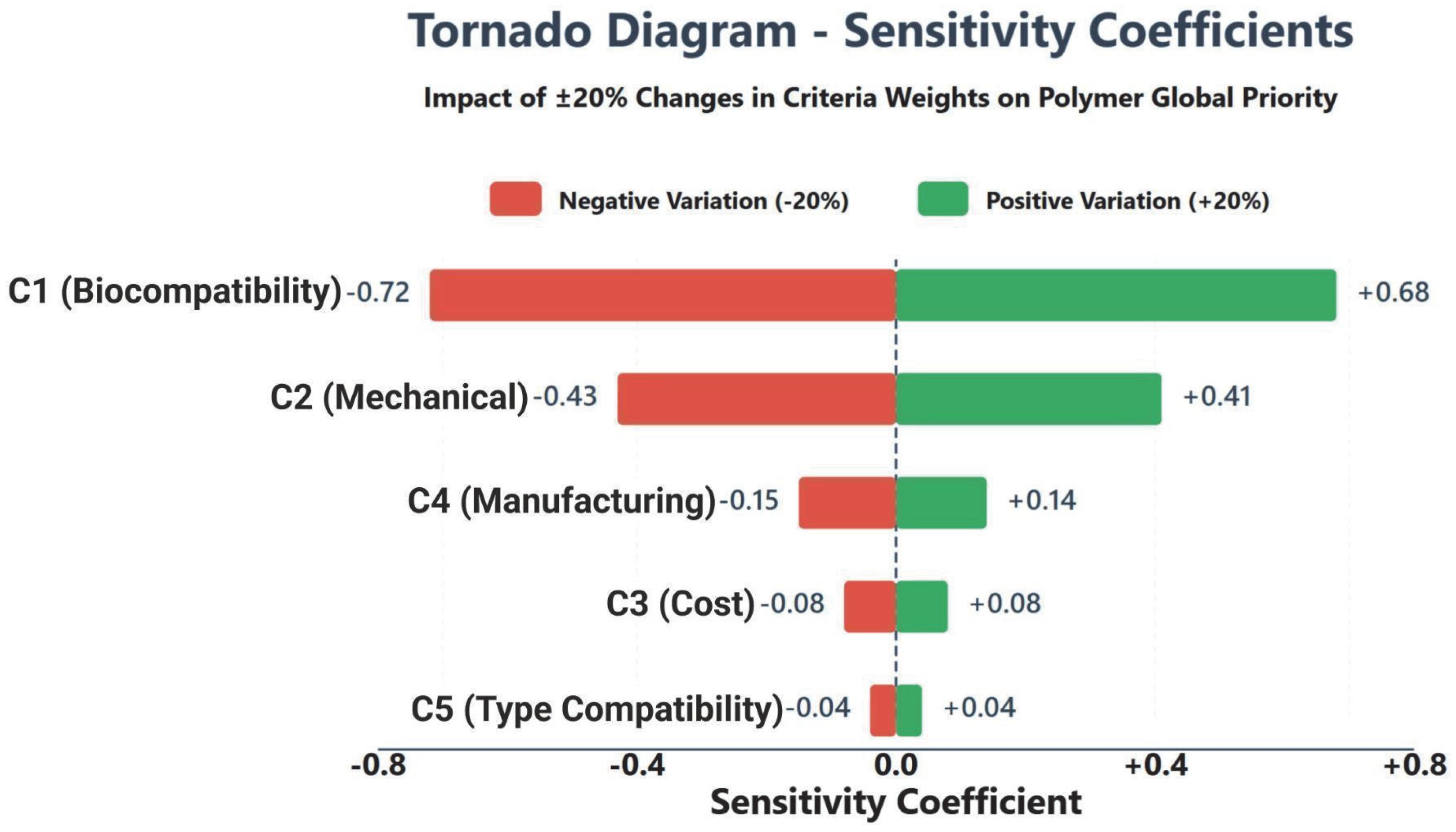
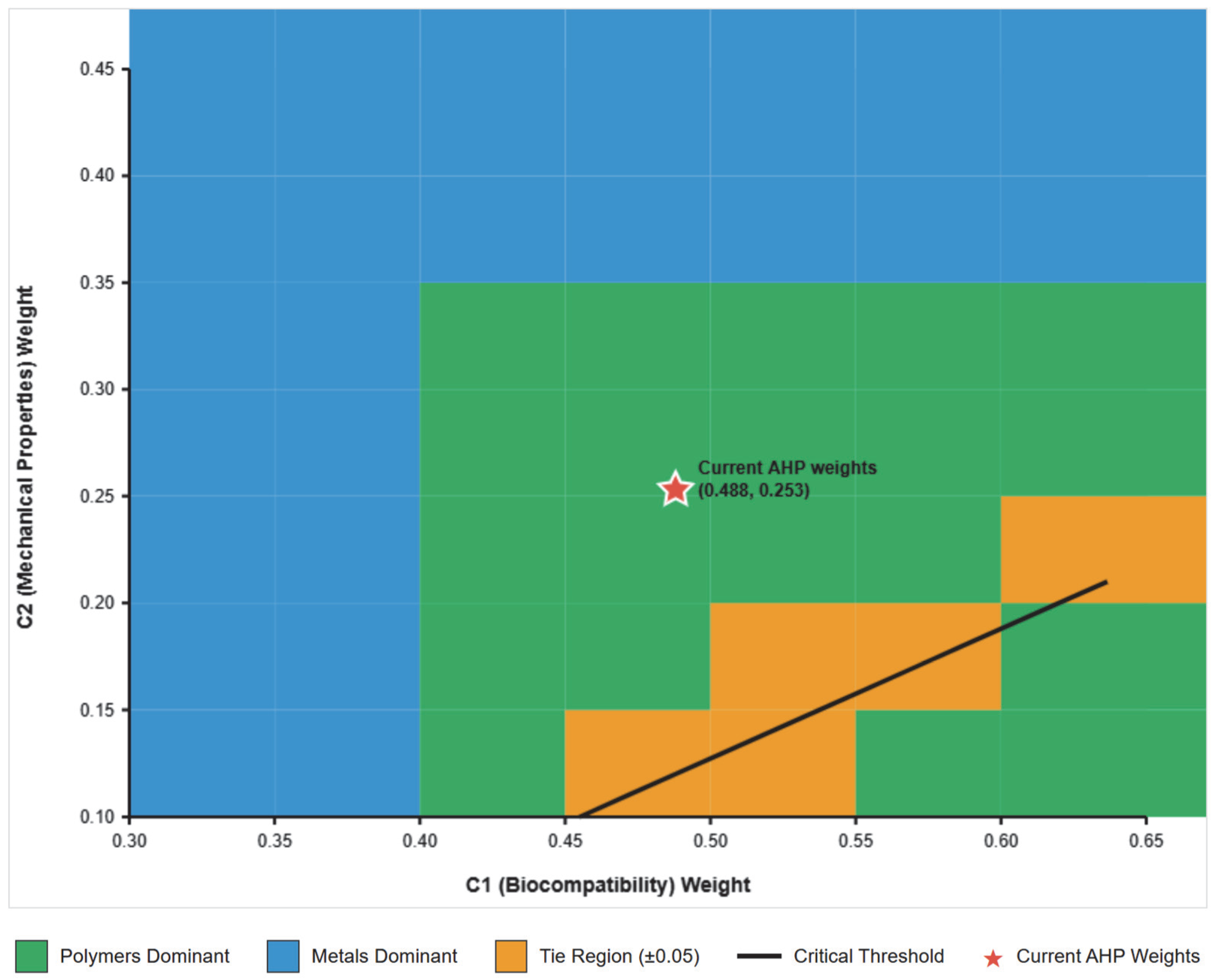
Mitigation of expert subjectivity and cognitive bias. Although pairwise comparison inevitably relies on expert judgement, five complementary procedures were implemented specifically to attenuate the bias known to affect AHP elicitation. (i) Anchoring bias was mitigated by randomizing the order in which criterion and alternative pairs were presented to each expert and by withholding any pre-existing weights or rankings from the elicitation interface. (ii) Framing and halo effects were reduced by presenting each pair in isolation, with criterion descriptions reformulated in performance-neutral language and accompanied by quantitative reference data from the literature review. (iii) Disciplinary bias was addressed through purposive stratification of the panel across four disciplines (materials science, biomedical engineering, regulatory affairs and clinical practice), ensuring no single perspective dominated the geometric-mean aggregation. (iv) Inconsistent or extreme judgements were flagged in real time using the embedded consistency-ratio calculator; experts with CR > 0.10 on any sub-matrix were asked to revisit the contributing comparisons before submission, a procedure analogous to a Delphi feedback round. (v) Group-level stability was verified post hoc through Kendall’s W (0.82, p < 0.001), the absence of outlier matrices on Mahalanobis-distance screening, and Monte Carlo perturbation of weights (±20%) which preserved the top-two ranking in 96.8% of 10 000 simulations. Together, these procedures do not eliminate subjectivity—a residual feature of any judgement-based MCDM method—but they bound its influence and make it auditable.
2.4.2. Literature Data Integration and Pairwise Comparison Protocol
The pairwise comparison process integrated both quantitative literature data and expert judgment through a systematic four-step protocol (
Table 6):
Step 1: Literature Data Compilation: A comprehensive literature review extracted quantitative performance metrics for each material across all five criteria. Sources included peer-reviewed publications (2015–2024), ISO/ASTM standards, and regulatory documents.
Step 2: Performance Categorization: Quantitative metrics were translated into performance categories using standardized thresholds:
- -
Excellent: Performance in the top 25% of reported values
- -
Good: Performance in the 25–50% range
- -
Fair: Performance in the 50–75% range
- -
Poor: Performance in the bottom 25% of reported values
Step 3: Initial Saaty Scale Translation: Performance category differences were mapped to Saaty’s 1–9 scale:
- -
Same category → 1 (Equal importance)
- -
One category difference → 3 (Moderate importance)
- -
Two category differences → 5 (Strong importance)
- -
Three category differences → 7 (Very strong importance)
- -
Four category differences → 9 (Extreme importance)
Step 4: Expert Refinement: Initial scores were presented to experts with supporting literature. Experts could adjust scores by ±1 point on the Saaty scale based on application-specific considerations or recent developments not captured in the literature. Adjustments required written justification.
2.5. Criteria Weight Determination
Criteria weights (
Table 7 and
Table 8) were determined through systematic pairwise comparisons informed by expert knowledge from the materials science, biomedical engineering, and regulatory affairs domains [
56].
Using the pairwise comparison matrix, the study obtained different prioritization patterns for the evaluation criteria. Biocompatibility (C1) was considered overwhelmingly dominant in expert assessments, being strongly preferred (intensity 9) over material cost (C3), quite strongly preferred (intensity 7) over ease of manufacturing (C4), moderately to strongly preferred (intensity 5) over microneedle type compatibility (C5) and moderately preferred (intensity 3) over mechanical properties (C2). The preference hierarchy created shows limitations in the interactions between tissues and devices that are caused by the needs of transdermal delivery.
The distribution of weights is concentrated in the upper tier, and 48.9 percent of the total importance is represented by biocompatibility. Combining biocompatibility with mechanical properties accounts for 74.2% of the decision priority. This huge allocation is given the importance of such biological safety and structural integrity in the choice of biomaterials to use as microneedles. The stratified importance ranking is also emphasized by the wide gap between the most important criterion (C1: 0.489) and the least important one (C3: 0.035)—almost 14-fold.
Mechanical properties (C2) were the second, with a weight of 25.3, which is about half that of biocompatibility. This ranking is in agreement with the expert opinion that although mechanical performance is key to efficient skin penetration and structural stability, it is not primary in comparison to safety considerations. The pairwise comparisons indicate C2 to be a strong choice (intensity 7) compared to material cost, moderately to strongly favored (intensity 5) compared to ease of manufacturing, and moderately favored (intensity 3) compared to microneedle type compatibility.
Microneedle type compatibility (C5) is in the middle tier, accounting for 15.8% of the biocompatibility weight and almost two-thirds of the mechanical properties weight. The comparisons show that this criterion was moderately to highly preferred (intensity 5) over both material cost and ease of manufacturing but was significantly lower than the first two criteria. This middle-ground position suggests that although the ability to produce microneedle devices with multiple geometries is desirable, it remains clearly secondary to performance and safety.
The combined weight of C3 (Material Cost, 6.6%) and C4 (Ease of Manufacturing, 15.8%), totaling 22.4%, reflects therapeutic microneedles’ regulatory and clinical priorities. This weighting distribution is deliberately lower than economic criteria because:
Clinical Safety Supersedes Cost: Under FDA/ISO frameworks, therapeutic devices prioritize patient safety (biocompatibility) and performance (mechanical properties) over manufacturing economics. FDA guidance explicitly states: “The benefits of the device must outweigh its risks” [21 CFR 860.7], with no cost consideration in benefit–risk calculus. Expert panel consensus (Kendall’s W = 0.82, p < 0.001) reflected this hierarchy, with clinical experts (E5, E6) uniformly rating safety 7–9× more important than cost.
Commercial Viability Remains Above Threshold: While weighted lower than clinical criteria, the 22.4% combined manufacturing/cost weight ensures commercially non-viable materials are eliminated. For reference, cosmetic microneedles show inverted priorities (cost/manufacturing: 55–60%, biocompatibility: 20–25%) [
57], whereas diagnostic devices emphasize precision/cost (mechanical: 50%, cost: 25%) [
58].
Sensitivity Analysis Confirms Appropriateness: Monte Carlo simulations (10,000 iterations) tested alternative weight distributions. Increasing C3 + C4 to 35% did not change the top two rankings (polymers, metals), while decreasing to 10% maintained identical rankings but reduced discriminatory power for positions 3–4.
Economic Realities Embedded in Other Criteria: Manufacturing cost influences biocompatibility assessment (expensive validation studies favor simpler materials) and type compatibility (manufacturing complexity constrains design options). Thus, economic considerations appear indirectly beyond the explicit C3/C4 weights.
The consistency ratio (CR = 0.020), which falls within the acceptable range (CR < 0.10) for group decision-making, was used to assess consistency [
55]. The CR value indicated that expert judgments were reasonable overall in the pairwise comparison procedure, and the deviations from perfect consistency were within acceptable statistical levels. The ratio indicates a relative lack of similarity in the comparison matrix of about 2.0%, which could be attributed to the difficulty of simultaneously evaluating five elements across several dimensions. The comparison can be subjective because the expert panel is interdisciplinary and because the qualitatively different characteristics of biocompatibility and subjectivity should be considered. Nevertheless, the consistency which has been observed shows that there is a great level of agreement among the experts. The validation procedure ensures that the weights set reflect the overall verdict of the specialists, as opposed to being affected by personal influences or opposing views.
Further information is derived from the relative positioning between the manufacturing and cost criteria. Although material cost was rated slightly more preferred (intensity 3) than ease of manufacturing in direct comparison, manufacturing ultimately received a higher final weight (6.6% vs. 3.5%), as shown above. This apparent reversal is due to the relative performance of ease of manufacturing being much better than material cost, compared with microneedle type compatibility (both are equally preferred and show a slight preference for ease of manufacturing), and material cost being slightly worse than ease of manufacturing (they are equally preferred). For this reason, the sum of all the pairwise ties raised manufacturing from cost to first place in the final ranking.
2.7. Evaluation of Material Property with Literature Verification
The systematic evaluation of materials to be potentially implemented into therapeutic microneedle systems was carried out through an analysis of the literature and a set of standardized testing protocols. The assessment involved a combination of quantitative outcomes of the standardized tests and the qualitative outcomes of the peer-reviewed literature on properties relating to drug delivery systems [
59].
2.7.1. Biomedical Compatibility Studies
Materials that are to be used in transdermal treatment are also subject to strict conditions of biocompatibility. The assessment was conducted in accordance with the ISO 10993 series, internationally acclaimed standards for testing medical devices [
52]. Cytotoxicity was evaluated as per the ISO 10993-5 guidelines, using L929 mouse fibroblast cells as the reference line in a direct contact cytotoxicity test. This process identifies materials that emit toxic substances that can be damaging to living cells. The cell cultures were incubated with material extracts between 24 and 48 h, and cell viability was determined by performing metabolic activity assays. Polymeric materials exhibited high cell viability, which was over 90 percent, implying low cytotoxicity. The compatibility of silicon-based materials was moderate, and the results depended mostly on the method used to treat the samples, which could be oxidation or the introduction of a coating [
57].
The possibility of skin sensitization was measured in two complementary tests: the Guinea Pig Maximization Test and the Local Lymph Node Assay, which was done in compliance with ISO 10993-10. These tests are used to determine if repeated exposure to the same substance causes allergic immune responses. Medical-grade polymers have repeatedly shown low sensitization responses across various studies and are therefore a preferred option for repeated or long-term skin-contact applications [
58,
60]. Systemic Toxicity: ISO 10993-11 protocols were used to assess potential systemic toxic effects resulting from material implantation or systemic exposure. This included determining if material components or degradation products entering the bloodstream produce adverse effects on the central organ system(s). Polymeric materials exhibited good systemic compatibility profiles, with most of degradation products being considered to be of low toxicity or metabolites [
57].
2.7.2. Mechanical Characterization of Properties
Mechanical properties directly affect microneedle performance, including successful insertion into the skin, structural integrity during insertion, and drug-delivery reliability. Comprehensive mechanical testing was done using internationally recognized standardized protocols to ensure comparability and reliability of the data (
Table 14).
Tensile Testing: The material’s strength and elasticity were characterized according to ASTM D638 for polymers and ASTM E8 for metals and ceramics. Controlled experiments were performed at environmental conditions of 23 ± 2 °C and relative humidity of 50 ± 5% percent with standard specimen geometries. Tensile tests were used to measure how the materials would behave when subjected to tensile loading, which is an important consideration when processing and handling microneedles. The tests provided quantitative data on the elastic modulus, ultimate tensile strength and elongation at break.
Compression Testing: A special compression-testing device was designed to apply compressive forces during the insertion of the needle tip. The tests were used to measure the force necessary to puncture the skin successfully, the fracture resistance and the deformation of the microneedle when subjected to a force. The data obtained was directly used to help choose needle materials and treatment modalities.
Fracture Mechanics: Stress intensity factors (KIC) that are critical to fractures were calculated using ASTM E399 to determine the material’s resistance to extreme crack propagation. The ability of microneedles to penetrate the skin and form a mark upon usage is a critical feature for forecasting catastrophic modes of failure.
Mechanical property data indicate that silicon and ceramics are highly rigid and possess low fracture toughness; thus, they are brittle and can easily break. Metals are strong as well as fracture-tough and thus are able to bend and break. Polymers are more flexible and have intermediate mechanical properties; hence, a design using polymers can offer flexibility.
2.7.3. Surface Characterization and Compatibility of Drugs
Surface properties control the most important interfacial events, including the adhesion of drug coating, loading capacity, release kinetics, and the biological interaction at the skin interface.
Surface Analysis: Atomic force microscopy (AFM) was used to measure surface topography at the nanometer scale, and it was found that material-specific roughness patterns affected coating homogeneity and the strength of adhesion of drugs [
66]. Smoother surfaces were found to have more even coatings of drugs, and controlled roughness was used to increase mechanical interlocking in specific coating recipes.
Surface Chemistry: X-ray photoelectron spectroscopy (XPS) was used to characterize the chemical composition of surface functional groups. This experiment is critical for identifying how proteins adsorb and for evaluating possible immunological reactions at the skin–device interface. The amount of surface oxidation, the existence of hydroxyl groups, and the carbon content had a strong impact on biological interactions [
67].
Accessibility Wettability: Contact angle measurements, which are used to measure the angle between a liquid droplet and the material surface, were used to assess surface hydrophilicity and hydrophobicity. These measurements are instant indicators of the strength and uniformity of drug coating, especially when using aqueous-based formulations. Materials with intermediate wettability, with contact angles between 40 and 70 degrees, showed better coating properties [
68].
Drug Compatibility Studies: The polymeric material was tested for compatibility with therapeutic agents and its ability to regulate drug release. The efficiency of drug incorporation was measured as the percentage of drug incorporated into the polymer matrix. Kinetic experiments were conducted with drug-loaded samples placed under physiological conditions to measure the rate of drug accumulation over time. Zero-order, first-order, Higuchi and Korsmeyer–Peppas equations were used to model the release mechanisms, with the aim of differentiating between diffusion-controlled, dissolution-controlled and combined processes [
49]. Tests were carried out to predict shelf life and guarantee therapeutic efficacy and stability over time, and accelerated aging tests were performed to comply with ICH Q1A guidelines [
69].
2.7.4. Process of Evaluation of Manufacturing
Ease of manufacturability is a crucial factor in the selection of materials, particularly with respect to scaling, reproducibility and economic feasibility in therapeutic practices. Additive Manufacturing Potential: Stereolithography (SLA) and other photopolymerization methods can produce polymer microneedles (25–50 µm feature resolution) that are sufficient to meet most therapeutic requirements [
47]. This technology allows for the creation of complex geometries that are impossible to achieve using conventional manufacturing methods. Processing Requirements: The processing requirements for different classes of materials vary in complexity and capital investment. Silicon microneedles also require semiconductor manufacturing technology, such as cleanroom facilities, photolithography, and etching technology [
34]. Metal microneedles are machined to a high level of precision, electroformed, or stamped with high precision, requiring high tolerance and special tools [
41]. The sintering of ceramic materials is done at high temperatures (>1400 °C), and the heating and cooling cycles must be strictly controlled so that no cracking of the materials occurs [
37]. In contrast, polymeric materials have high flexibility in processing choices, including injection molding, hot embossing, micro-molding, and other 3D printing techniques, with relatively fewer requirements for processing equipment [
53].
The cost analysis (
Table 15) shows that although polymeric materials may offer lower costs of raw materials and less demanding processing methods, a significant cost disparity would be experienced in therapeutic applications due to the requirements of addressing and upholding medical-grade material specifications and quality assurance measures. In the sphere of commercial therapeutic manufacturing, polymers are the least expensive, and silicon is the most expensive, with regard to its specialized facility needs.
2.7.5. Statistical Analysis and Validation
The material assessment framework was to be checked properly to guarantee the reliability of the framework and make the decision-making processes confident (
Table 16).
Reliability Assessment: The reliability of expert judgements and decision models was assessed using a variety of techniques. The consistency of expert assessments was confirmed by repeated assessments, and the stability of the overall decision scheme was challenged by fluctuating input parameters within reasonable ranges to see if material rankings remain stable.
Experimental Design: The study used a factorial-type of Design of Experiments (DOE); this allowed measuring multiple material properties concurrently, performing fewer experiments. The approach would be able to determine the key effects and interactions among various material properties, giving a complete picture of how the various material properties relate with each other.
Validation Framework: The AHP methodology includes built-in consistency-checking mechanisms to detect and correct inconsistent pairwise comparisons. Additionally, other MCDM approaches, such as TOPSIS and weighted sum methods, were also applied to the data, and the rankings of the materials were checked to ensure that the results were consistent across the different analytical frameworks.
The validation framework shows that the silicon, metal, and polymer assessments have an extensive literature base and available databases and, thus, high confidence in the characterization of their properties. Ceramic materials had a moderate amount of literature but used more expert knowledge and extrapolation from closely related applications, so the confidence level in this assessment was moderate. This approach to validation can ensure transparency of the decision-making process and allow users to consider the reliability of the evaluation when interpreting material selection recommendations.




 ,
,