Article

Green Synthesis of Castor Oil-Modified Waterborne Polyurethanes via a Solvent-Free Approach

1
Department of Molecular Science and Engineering, National Taipei University of Technology, Taipei 106, Taiwan
2
Process Insights—Tiger Optics, LLC, 275 Gibraltar Rd., Horsham, PA 19044, USA
*
Author to whom correspondence should be addressed.
These authors contributed equally to this work.
Polymers 2026, 18(12), 1449; https://doi.org/10.3390/polym18121449 (registering DOI)
Submission received: 29 April 2026 / Revised: 2 June 2026 / Accepted: 4 June 2026 / Published: 10 June 2026
(This article belongs to the Special Issue Eco-Friendly Polymeric Coatings and Adhesive Technology, 3rd Edition)

Abstract

The conventional production of waterborne polyurethane (WPU) typically relies on organic solvents to regulate viscosity; additionally, traditional ionic WPU systems still utilize volatile neutralizers, raising environmental and health concerns. To overcome these limitations and reduce dependence on petrochemical resources, this study presents a solvent-free approach for WPU synthesis using isophorone diisocyanate (IPDI), polytetrahydrofuran (PTMG), and the nonionic PEG derivative YmerTM A-130. In addition, castor oil (CO), a renewable and hydroxyl-rich bio-based material, was incorporated as a partial substitute for PTMG to improve both sustainability and material performance. The effects of varying substitution ratios of castor oil on the physical properties of the resulting dispersions, dried films, and coatings were initially investigated. The results indicate that increasing the castor oil content from 0 wt% to 11.8 wt% led to an enhancement in tensile strength, rising from 1.45 MPa to 2.40 MPa. Concurrently, the temperature at 5% weight loss (Td5%) shifted upward from 263.84 °C to 285.36 °C, indicating a favorable trend in thermal stability. Furthermore, the preliminary solvent resistance, surface wetting characteristics, and environmental durability of the prepared coatings were evaluated and discussed.

1. Introduction

Waterborne polyurethanes (WPUs) drastically lower volatile organic compound (VOC) emissions by employing water as a dispersion medium [1,2]. Despite this eco-friendly advantage, conventional WPU synthesis remains dependent on non-renewable, petrochemical-derived raw materials [3]. To mitigate fossil resource depletion and environmental footprints, the development of biomass-derived alternatives has become a key priority in polymer research.
Consequently, bio-based polyols sourced from sustainable materials—such as starch, lignin [4,5,6], and vegetable oils [7,8,9]—have gained prominence due to their low toxicity and cost-effectiveness [10,11,12]. Castor oil (CO) stands out as a highly effective renewable monomer. When formulated alongside polytetrahydrofuran (PTMG) and isophorone diisocyanate (IPDI), it yields high-performance bio-based WPUs [13]. Mechanistically, the multifunctional hydroxyl groups of CO establish a robust crosslinked network [14], complemented by the flexible soft segments of PTMG [15] and the weather-resistant, aliphatic hard segments of IPDI. This structural synergy ultimately optimizes the mechanical strength, hydrophobicity, and thermal stability of the resulting WPU films.
Due to increasingly stringent environmental policies and regulations, the polyurethane industry has gradually shifted from solvent-based polyurethane systems to WPU coatings. However, during the synthesis of WPU—in both academic research and industrial production—a small amount of organic solvents, such as acetone and N-methyl-2-pyrrolidone (NMP), is often introduced. These solvents are used to reduce the viscosity of the prepolymer, thereby facilitating its emulsification in water to form a stable polyurethane dispersion [16,17].
Although the amount of solvent used in this process is significantly lower than that in conventional solvent-based polyurethane systems, concerns regarding solvent volatilization, environmental impact, and occupational safety persist. In addition, the post-synthesis removal of these solvents via vacuum concentration increases both energy consumption and operational costs. To address these issues, solvent-free preparation methods have been developed, in which no organic solvents are introduced during the synthesis process [18].
However, many reports still focus on using ionic agents to provide the hydrophilicity necessary to ensure the smooth dispersion of the prepolymer [19,20,21]. Particularly in reports involving renewable sources that utilize CO as a polyol, 2,2-bis (hydroxymethyl) propionic acid (DMPA) is generally used [22,23,24]. Yet, DMPA requires a toxic and volatile neutralizer, triethylamine (TEA), to neutralize the carboxylic acid groups into carboxylates to enhance the hydrophilicity of the WPU system. This dependency makes it difficult for such systems to comply with regulations in regions enforcing strict indoor air quality and environmental laws.
This study seeks an environmentally friendly approach to synthesize bio-based WPUs, enabling stable emulsification without organic solvents while minimizing the use of volatile neutralizers. To date, PEG derivatives (such as YmerTM N-120) have been reported as nonionic chain extenders in WPUs capable of yielding low-viscosity dispersions [25]. Nevertheless, their systematic utilization in the synthesis of solvent-free WPUs, where CO serves as a partial polyol substitute, remains unreported. In this research, a series of WPUs were designed based on IPDI and PTMG, utilizing CO as a partial substitute for petroleum-based polyols in combination with a nonionic PEG derivative (YmerTM A-130, supplied by Jollity Enterprise Co., Ltd., Taoyuan, Taiwan). This work provides an initial exploration into the effects of CO incorporation at different weight ratios on the properties of the WPU dispersions, as well as the fundamental mechanical performance, thermal stability of the dried films, and overall weather resistance as coatings.

2. Materials and Methods

2.1. Synthesis of Castor Oil-Modified WPUs (CWPUs)

This study does not employ organic solvents, such as acetone, ethanol, or NMP, for controlling the viscosity of the prepolymer system or dissolving monomers during the reaction. Instead, a solvent-free synthesis was carried out in a moisture-sealed three-necked flask equipped with a mechanical stirrer and a condenser.
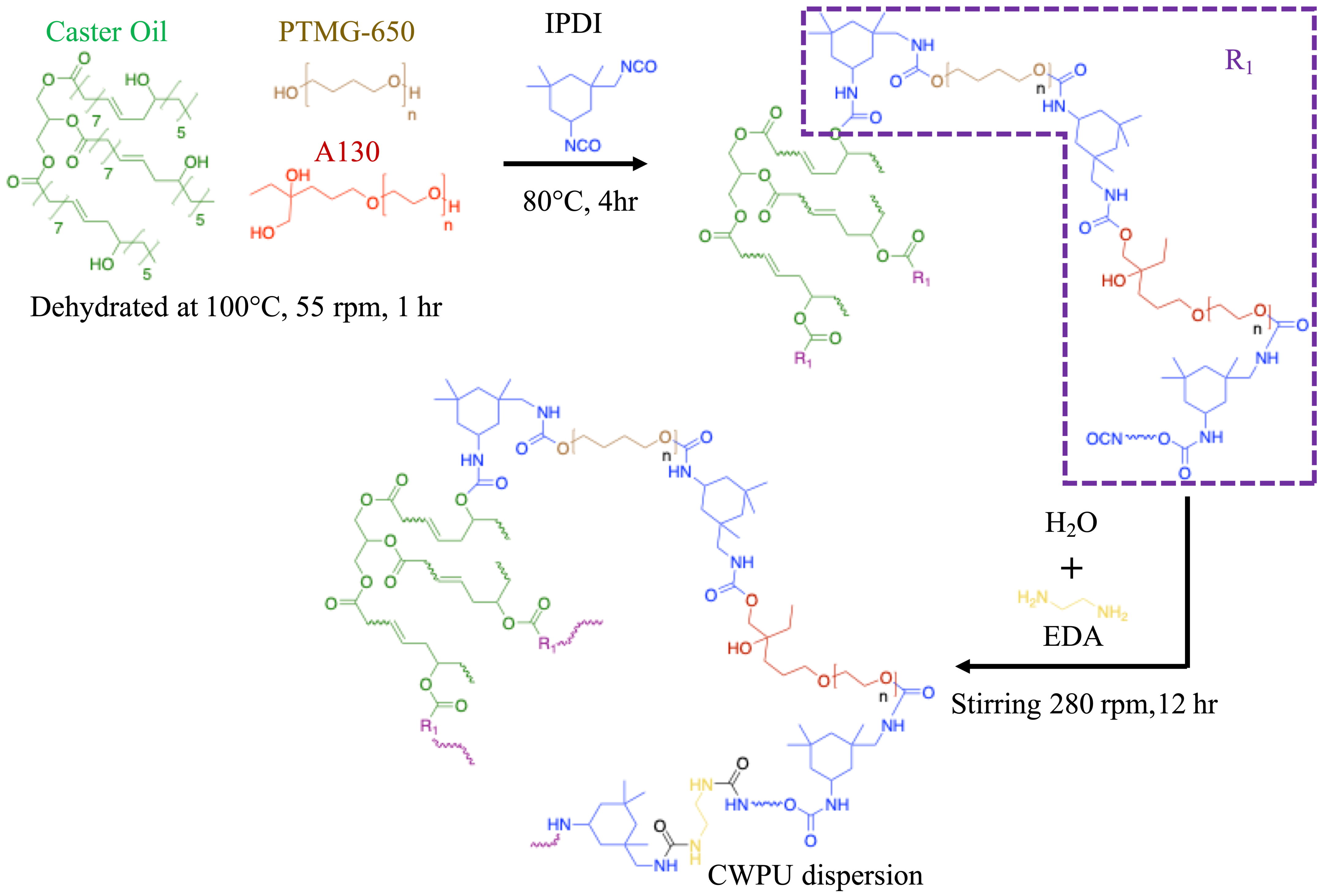
The synthesis process of castor oil-modified waterborne polyurethanes (CWPUs) is illustrated in Figure 1, and the corresponding molar ratios of each reagent are summarized in Table A1. Polytetrahydrofuran (PTMG, Mn = 650 g/mol, Sigma-Aldrich, St. Louis, MI, USA), castor oil (CO, First Chemical Co., Ltd., Taipei, Taiwan), and PEG derivatives (YmerTM A-130, supplied by Jollity Enterprise Co., Ltd., Taoyuan, Taiwan) were vacuum-dehydrated at 100 °C (55 rpm) for 1 h, followed by the introduction of a nitrogen atmosphere. The system was then cooled to 80 °C, after which isophorone diisocyanate (IPDI, Sigma-Aldrich, St. Louis, MI, USA) and dibutyltin dilaurate (DBTDL, Sigma-Aldrich, St. Louis, MI, USA) were added, and the prepolymerization proceeded for 4 h.
Once the temperature decreased to 55 °C, deionized water was introduced under high-speed stirring (500 rpm) for 5 min to disperse the prepolymer. Chain extension was subsequently carried out by the gradual addition of diluted 1,2-diaminoethane (EDA, Sigma-Aldrich, St. Louis, MI, USA) in deionized water, followed by stirring at 280 rpm for 12 h. The resulting CWPU dispersion was then cast into a mold, air-dried at room temperature for 3 days, and further dried at 40 °C for 12 h to obtain the final CWPU film. The sample codes were designated based on the weight percentage of castor oil relative to the total monomer content, ranging from CWPU0 to CWPU11.8.

2.2. Parallel Coating of Dispersion

Glass substrates were sequentially cleaned with a mild detergent, acetone (99.5%, Echo Chemical Co., Ltd., Toufen, Taiwan), and ethanol (95%, Echo Chemical Co., Ltd., Toufen, Taiwan), followed by thorough drying. The cleaned glass substrates were positioned on a motorized parallel coating machine. The WPU dispersion was then cast using a 25 μm doctor blade at a constant coating speed of 20 cm min−1 to ensure a uniform distribution. Finally, the coated samples were dried in an oven at 50 °C for 12 h to remove residual water and yield the final CWPU films.

2.3. Characterizations

FTIR spectra were obtained using a PerkinElmer spectrum (Waltham, MA, USA). The particle size of the CWPU dispersion was measured using DLS (Nano Brook 90 Plus, Brookhaven, GA, USA) measurement. The viscosity of the CWPU dispersion was determined with a DV-E viscometer (Brookfield, WI, USA), using an LV-4 spindle for 60 s at 125 s−1 and 25 °C. The mass loss of all samples was determined by TGA (TG 209 F3, Netzsch, Selb, Bavaria, Germany), with a heating rate of 10 °C/min from 30 to 700 °C in N2. The static water contact angle (WCA) of the coatings was measured by a Phoenix 150 contact-angle meter through a 5 μL distilled water droplet at five different positions on each sample. Mechanical testing was performed using a universal testing machine (A2 TYPE, HUNG TA, Taichung, Taiwan) at a crosshead speed of 500 mm/min. Specimens were die-cut into a Type V dumbbell shape (0.9 ± 0.1 mm thickness), in accordance with ASTM D638 [26].

2.3.1. Isocyanate Content Titration

The isocyanate (–NCO) group content of the prepolymer was determined via back-titration according to ASTM D2572 [27]. Approximately 1 g of sample was dissolved in 25 mL of toluene, followed by the addition of 25 mL of 0.1 N di-n-butylamine. After 30 min of reaction, 100 mL of isopropanol and bromophenol blue indicator were added. The solution was titrated with 0.1 N HCl to a yellow endpoint (V1). A blank titration (V0) was performed under identical conditions. The actual NCO% was calculated from these results and compared to the theoretical value.
T h e o r e t i c a l   N C O ( % ) = E q u i v a l e n t   w e i g h t   o f   N C O E q u i v a l e n t   w e i g h t   o f   O H × 0.042 T o t a l   w e i g h t   o f   t h e   r e a c t a n t s
T i t r a t e d   N C O ( % ) = V 0 V 1 × N × 0.042 W
where V0 and V1 are the volumes of HCl (mL) consumed by the blank and the sample, respectively; N is the normality of the HCl solution (mol/L); W is the sample weight (g); and 0.042 represents the milliequivalent weight of the NCO groups.

2.3.2. Calculation of Crosslinking Density

The crosslinking density (n) of the WPU films was determined using the Flory–Rehner equation based on solvent swelling [28]. Samples (5 mm × 5 mm) were weighed, measured for thickness, and immersed in toluene for 24 h to reach swelling equilibrium. The swollen samples were then removed, wiped dry, and re-measured. The crosslinking density was calculated using the following parameters:
[ ln 1 v 2 + v 2 + χ v 2 2 ] = v 1 × n [ v 2 v 2 2 ]
The crosslinking density was calculated using the following parameters: Molar volume of toluene (v1): 106.3 cm3/mol; Interaction parameter ( χ ): 0.225 (derived from solubility parameters δPU = 20.5 and δtol = 18.2 MPa1/2 at 303 K); Absolute temperature (T); and Ideal gas constant (R): 8.314 cm3·MPa/K·mol. The polymer volume fraction after swelling (v2) was determined by the ratio of the original volume to the equilibrium swollen volume.
χ = V 1 × ( δ 2 δ 1 ) 2 R T

2.3.3. Chemical Resistance

Chemical resistance was evaluated according to ASTM D543-21 [29] by immersing WPU films in tetrahydrofuran (THF), methyl ethyl ketone (MEK) and toluene for 24 h. The initial weight of the film (W0) was recorded before immersion. After 24 h, the samples were removed, wiped dry to remove surface solvent, and weighed again to obtain the final weight (W1). The relative weight ratio (%) was calculated as follows:
R e l a t i v e   w e i g h t   r a t i o ( % ) = W 1 W 0 × 100 %

2.3.4. Water Absorption

Water absorption was evaluated following the ASTM D570-22 standard [30]. Film specimens (1 cm × 1 cm) were weighed (W0) and fully immersed in distilled water at room temperature. After 24 h or 48 h, the samples were removed, blotted dry to eliminate surface moisture, and immediately reweighed (W1). The water absorption (%) was calculated as follows:
W a t e r   a b s o r p t i o n   r a t e ( % ) = W 1 W 0 W 0 × 100 %

3. Results and Discussion

3.1. Monitoring of the Polyurethane Synthesis

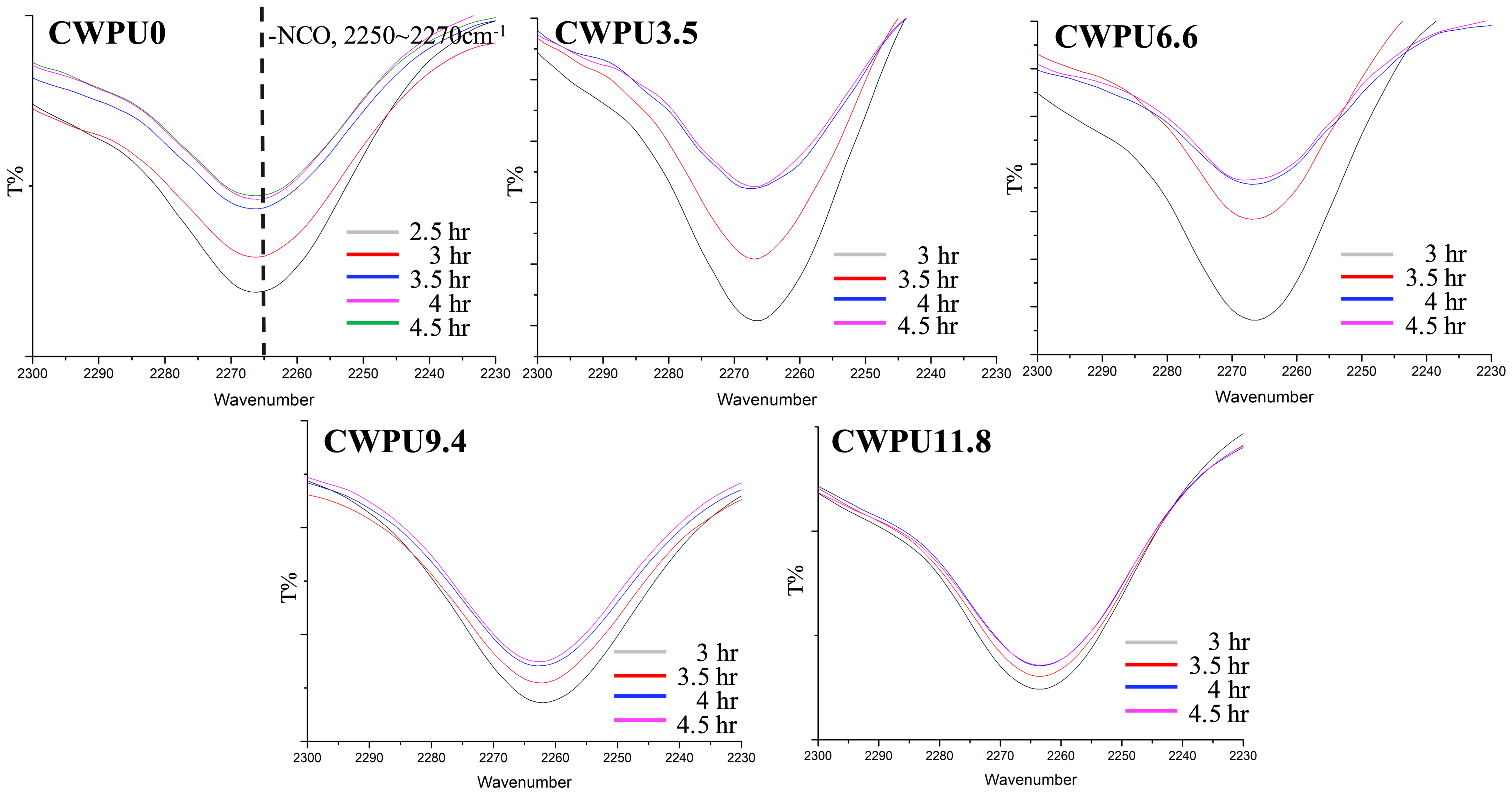
The prepolymerization progress was monitored via FT-IR spectroscopy and –NCO titration (ASTM D2572). As shown in Figure 2, FT-IR was used to track the characteristic isocyanate absorption peak at 2250–2270 cm−1. This peak intensity decreased rapidly as –NCO groups reacted with the hydroxyl (–OH) groups of PTMG and castor oil, eventually stabilizing after 4 h. This plateau indicated that the prepolymerization stage had reached completion, thereby establishing 4 h as the optimal reaction time for the synthesis process. To further confirm the extent of reaction, back-titration was conducted by reacting the prepolymer with an excess of di-n-butylamine in toluene, followed by titration of the unreacted amine with a standard HCl solution. The reaction was considered complete when the experimentally determined NCO% was equal to or lower than the theoretical value (as summarized in Table A2, Table A3, Table A4, Table A5 and Table A6), indicating the complete consumption of hydroxyl groups from the polyols. A representative calculation for the theoretical NCO% remaining after complete –OH reaction is detailed below, using CWPU3.5 as an example.

3.2. Flow Behavior and Storage Stability of CWPU Dispersions

3.2.1. Particle Size and Viscosity Analysis

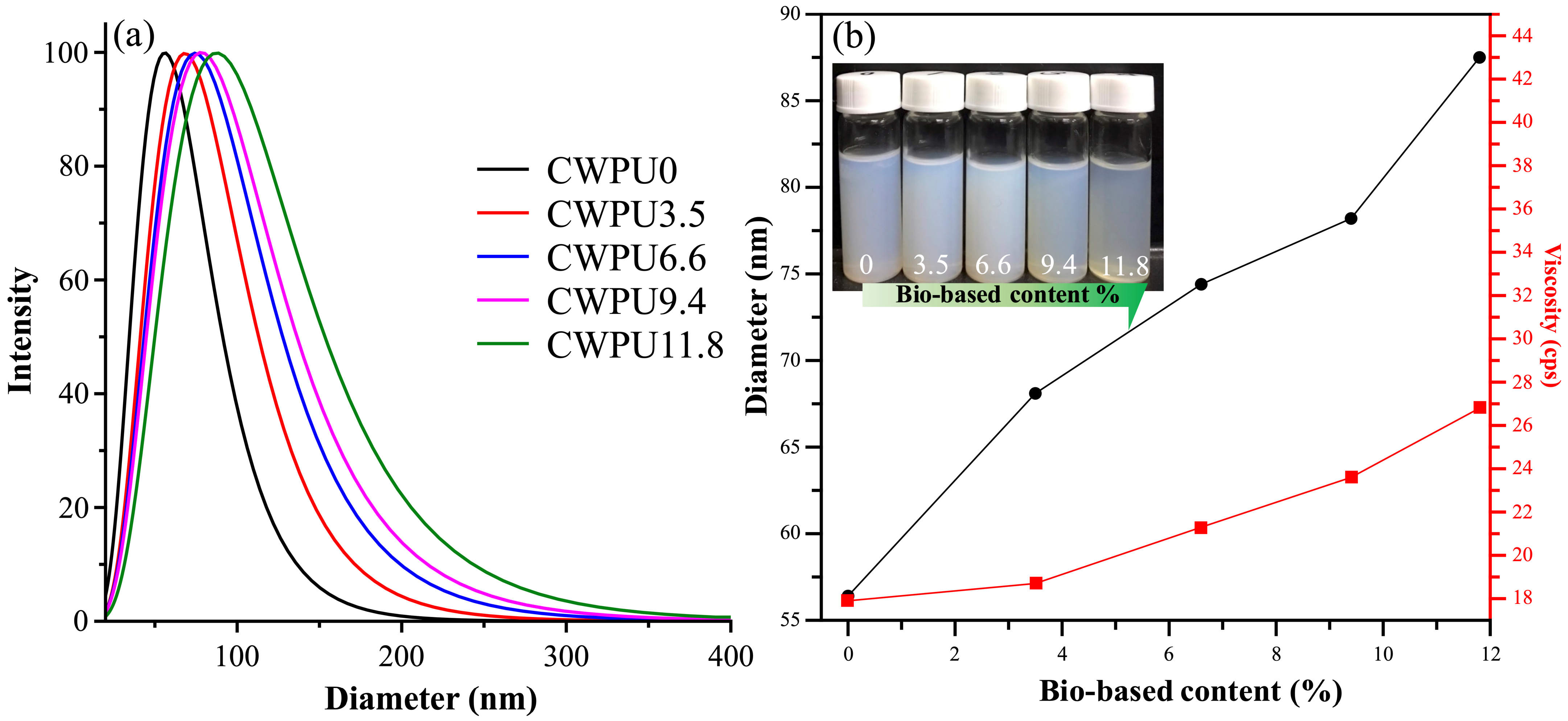
The particle size and distribution of the CWPU dispersions were determined by DLS, while viscosity measurements were conducted to evaluate their flow behavior and colloidal stability—both critical parameters for industrial processing. Although dispersion properties are influenced by the post-chain extension process (reaction with water and EDA) and hydrophilic group ratios, the CO content served as the primary variable in this study.
As shown in Figure 3a, all samples (CWPU0 to CWPU11.8) displayed a translucent bluish appearance, characteristic of the Tyndall effect in stable colloidal dispersions. As presented in Figure 3b and summarized in Table A7, both the average particle size and the breadth of the distribution increased gradually with increasing CO content. This trend suggests that the incorporation of the hydrophobic CO structure significantly influences the micellar formation and packing density of the polyurethane chains during the dispersion phase.
Larger particle sizes can be attributed to the fatty acid side chains of CO, which enhance the WPU backbone’s hydrophobicity and strengthen intermolecular attractions. Moreover, the trifunctional architecture of CO promotes the formation of a crosslinked network, further increasing particle dimensions [31]. As the CO content increases, the extent of this network structure also increases, resulting in greater molecular chain entanglement. Consequently, the dispersion and emulsification of the polyurethane prepolymer in water become more difficult. As a result, both the particle size and viscosity of the dispersion gradually increase [19].

3.2.2. Storage Stability

CWPU dispersions may experience chain scission or particle aggregation over time due to environmental exposure and continuous Brownian motion. To evaluate long-term stability, the samples were stored in a cool, dark environment at room temperature and monitored every 10 days for signs of sedimentation, phase separation, or solidification.
As summarized in Table 1, all dispersions—regardless of CO content—maintained excellent fluidity and homogeneity throughout the 90-day observation period. No signs of stratification or precipitation were observed, indicating that these WPU systems possess a shelf life of at least 90 days under standard storage conditions. This demonstrates that the incorporation of CO does not compromise the colloidal stability of the dispersions.

3.3. Properties of CWPU Films

3.3.1. FT-IR Analysis of CWPU Films

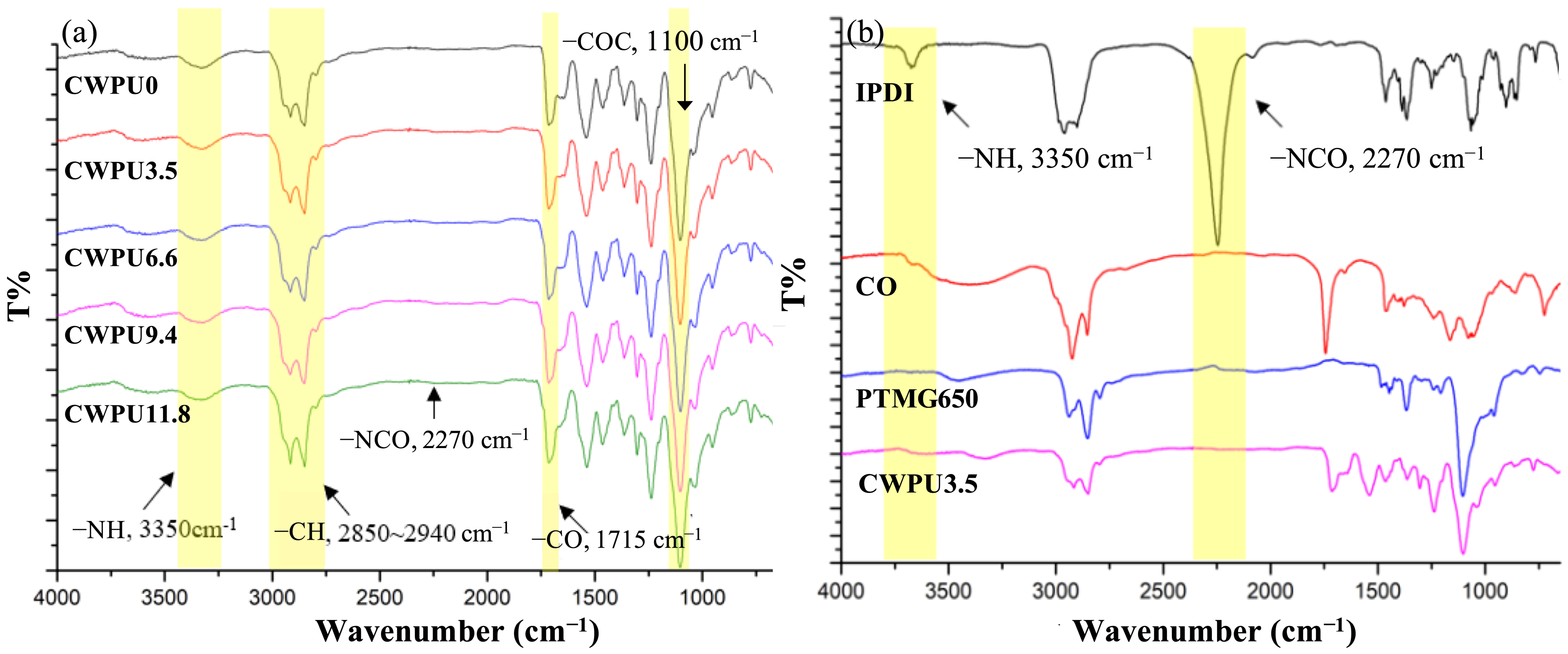
For subsequent characterization, CWPU films were prepared by casting and drying the dispersions. As shown in Figure 4a, FT-IR spectra confirmed the successful synthesis of the expected polymer architecture. Characteristic vibrations included N–H stretching/bending (3350, 1540 cm−1), asymmetric and symmetric –CH2 stretching (2940, 2850 cm−1), and C–O–C stretching from the PTMG soft segments (1100 cm−1). The complete absence of the 2270 cm−1 peak (Figure 4b) indicates total consumption of isocyanate (–N=C=O) groups.

3.3.2. Crosslinking Density

The results of equilibrium swelling in toluene are summarized in Table 2, and the crosslinking density (n) is presented as a reference determined according to Section 2.3.2. First, it can be observed that the sample structure of CWPU0 (without CO) lost its integrity and partially dissolved after 24 h in toluene, indicating that the control sample lacks a crosslinked polymer network. With the incorporation of CO into the system, samples CWPU3.5 to CWPU11.8 exhibited stable swelling behavior, which serves as an indication of crosslinking within the material. The calculated density increased progressively from CWPU3.5 to CWPU11.8 (from 3.77 × 10⁻² to 4.38 × 10⁻² mol/cm3). This trend is attributed to the trifunctional triglyceride structure of CO, whereby a 3D urethane network is formed within the polymer matrix.

3.3.3. Mechanical Properties

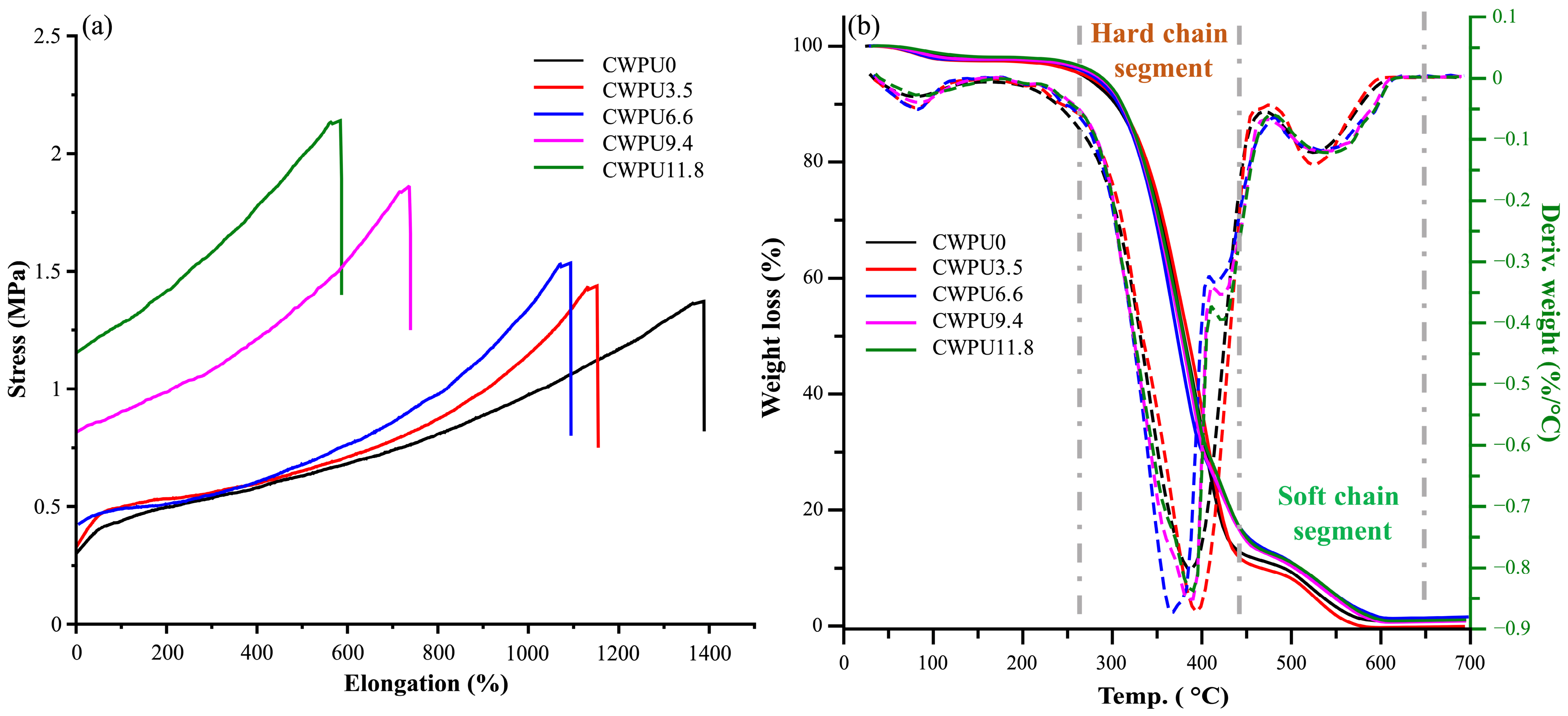
The stress–strain behavior of the CWPU films is presented in Figure 5a. With increasing CO content, the tensile strength rose from 1.45 MPa to 2.40 MPa, while the elongation at break decreased markedly from 1382.8% to 570.37%. Overall, the films transitioned toward higher stress and lower strain capacity.
This behavior can be attributed to the formation of a 3D cross-linked network and enhanced interchain hydrogen bonding within the hard segments. These structures restrict molecular chain mobility and inhibit chain slippage during deformation [24], thereby enhancing tensile strength at the expense of flexibility and elongation at break [32].

3.3.4. Thermal Stability

The thermal stability of the CWPU films was evaluated via TGA under a N2 atmosphere, with the resulting thermograms presented in Figure 5b and Table 3. The decomposition process generally occurs in two stages: the first (260 to 430 °C) is associated with the degradation of the hard segments, while the second (430 to 600 °C) corresponds to the decomposition of the soft segments. However, a similar Tdmax (The temperature of maximum thermal degradation) around 390 °C was observed for all samples, which is related to the dissociation of the urethane group [33]. Regarding the residual mass of all samples at 700 °C, the char residue remained below 2%.
As the CO content increased, the temperatures for the 5% (Td5%) and 10% (Td10%) weight losses rose from 263.84 °C and 303.84 °C to 285.36 °C and 310.36 °C, respectively. This enhancement is attributed to the incorporation of castor oil, which promotes a more robust crosslinked network. This dense structure restricts molecular chain mobility and acts as a barrier to thermal energy, thereby delaying the onset of degradation and significantly improving the thermal stability of the films [24].

3.3.5. Chemical Resistance, Water Absorption, and Surface Wetting Properties

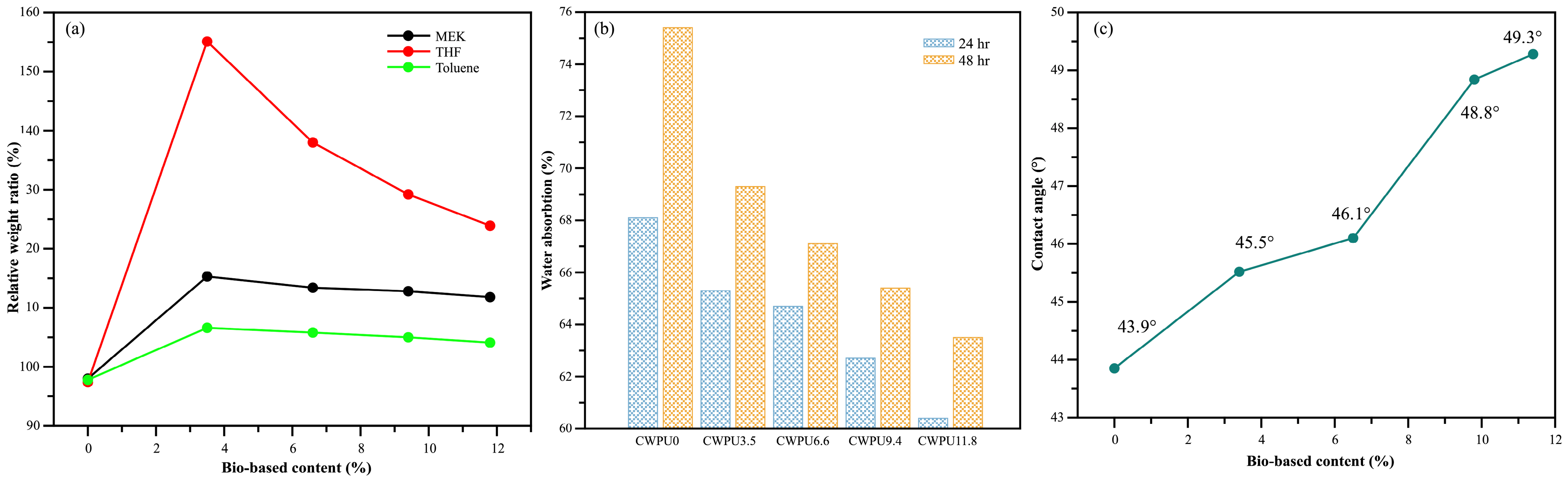
The chemical and water resistance of the CWPU films were evaluated as described in Section 2.3.3 and Section 2.3.4, with results presented in Figure 6a,b. To quantify the chemical resistance of the CWPU films, the relative weight ratio after immersion was calculated using Equation (5), where a value of 100% signifies zero net mass change, while values exceeding 100% reflect weight gain from solvent uptake and swelling. As shown in Figure 6a, the control sample (CWPU0) exhibited a ~2% weight loss in MEK, THF, and toluene solvents, which can be reasonably attributed to partial component dissolution or leaching, because CWPU0 lacks a crosslinked polymer network. In contrast, the castor oil-modified films (CWPU3.5–11.8) maintained their structural integrity and showed a net weight gain from solvent absorption rather than mass loss.
Particularly, CWPU3.5 showed the highest solvent uptake in THF. As this work represents an initial evaluation, this behavior is proposed to occur because THF has strong compatibility with the polyurethane matrix, and the low crosslinking density at 3.5 wt% CO presumably creates a loose network that allows a high volume of solvent to penetrate.
Regarding water resistance (Figure 6b), water absorption decreased progressively as the CO content increased, suggesting an improvement in stability. As the CO content increases from CWPU6.6 to CWPU11.8, the chemical resistance and water absorption show gradual improvements. This transition may be attributed to the potential 3D crosslinked network formed by the trifunctional castor oil, indicating that a denser network can help to reduce swelling [34,35].
Also, the surface wettability of the CWPU films was evaluated using static contact angle measurements. As shown in Figure 6c, all films exhibited contact angles below 90°, confirming an inherently hydrophilic nature. However, increasing the castor oil content led to a gradual rise in the contact angle from 43.85° to 49.28°, indicating a slight reduction in surface hydrophilicity. This trend may be due to the higher concentration of hydrophobic alkyl groups introduced by castor oil incorporation [19,36].
Overall, the water absorption values appear relatively high, approximately in the range of 60 to 75% when soaking for 48 h. Compared with other similar studies using CO with ionic agents—such as anionic dimethylol butyric acid (DMBA) or cationic N-methyl diethanolamine (MDEA)—the water absorption can reach <10% for 48 h with 90° of contact angles in the DMBA system, and <10% of water absorption for 20 days with <50° of contact angles in the MDEA system [32,37]. This comparison suggests that the nonionic A-130 puts this system at a relative disadvantage concerning water absorption.

3.3.6. Weather Resistance (Jungle Test)

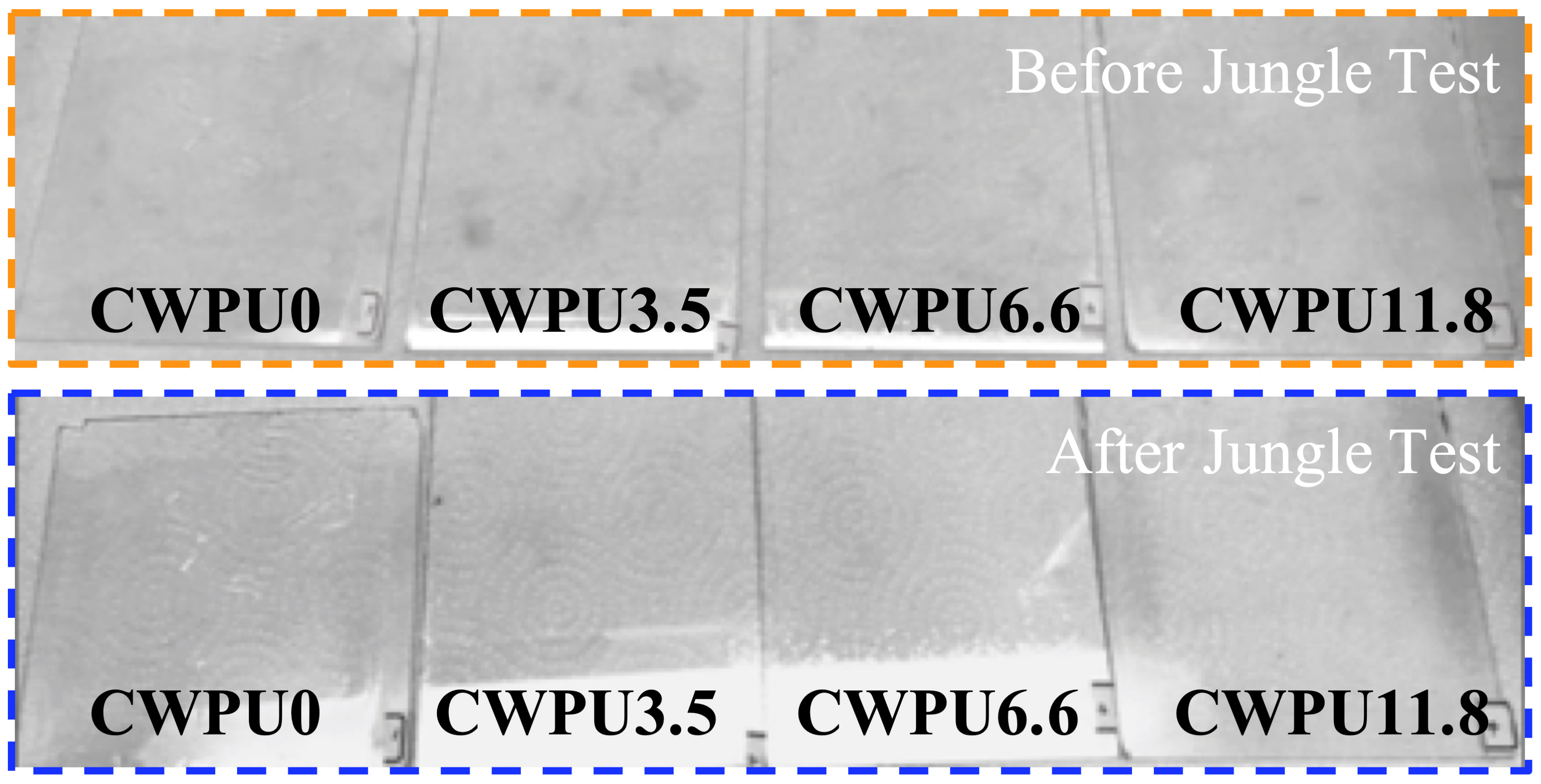
For a preliminary study on the environmental durability of the CWPU series, the samples were prepared via a doctor blade to obtain a coating thickness of approximately 7.5 μm. The test method followed ISO 1419 [38], commonly referred to as the “jungle test”. This accelerated aging procedure involved exposing samples (CWPU0 to CWPU11.8) to 70° and 90% relative humidity for one week, simulating long-term exposure to combined heat and moisture. As shown in Figure 7, the preliminary results show that no visible whitening, peeling, or surface degradation was observed in any of the tested samples [39].

4. Conclusions

In this study, a series of nonionic castor oil (CO)-modified waterborne polyurethanes (CWPUs) incorporating A-130 was successfully synthesized by a truly solvent-free process. The effects of CO content on the properties of the dispersions, mechanical performance, thermal stability of the dried films, and overall weather resistance as coatings were initially investigated. The results suggest that increasing the castor oil content led to positive effects on the overall performance. The prepared CWPU with a CO content of 11.8 wt% exhibited a dispersion particle size of 87.5 nm and a viscosity of 26.8 cP, maintaining excellent colloidal stability for at least 90 days under standard storage conditions. Furthermore, the maximum tensile strength reached up to 2.40 MPa with 570.37% of elongation, while the Td5% and Td10% reached 285.36 °C and 310.36 °C, respectively. However, the incorporation of A-130 led the overall CWPU series to exhibit a hydrophilic nature, with a maximum water contact angle of 49.3° and water absorption higher than 60% after 48 h. As for solvent resistance, the films showed less than 20% weight change in MEK and toluene, but showed greater swelling in THF over 24 h. For preliminary environmental durability, the CWPU coatings showed no visible whitening or peeling during a one-week standard jungle test. Due to the crosslinking and limited solubility of the CWPU series, standard GPC/SEC analysis was unfortunately not feasible. A thorough investigation involving DMA, gel fraction, or rheological testing will be pursued in our follow-up research to further differentiate the effects of crosslinking versus molecular weight changes. Overall, this work provides a new system of nonionic WPU combining CO and A-130 via an environmentally friendly synthesizing process without any organic solvents or volatile neutralizers, representing a sustainable strategy for the exploration of eco-friendly waterborne polyurethanes.

Author Contributions

Conceptualization, K.-Y.C. and S.-M.C.; data curation, K.-Y.C. and Y.-H.L.; formal analysis, K.-Y.C. and Y.-H.L.; investigation, K.-Y.C. and Y.-H.L.; methodology, K.-Y.C., Y.-H.L. and S.-M.C.; project administration, K.-Y.C. and Y.-H.L.; supervision, A.S. and S.-M.C.; writing—original draft, K.-Y.C. and A.S.; writing—review and editing, A.S., G.L. and S.-M.C. All authors have read and agreed to the published version of the manuscript.

Funding

This research was funded by the National Science and Technology Council (NSTC 114-2637-E-027-012).

Institutional Review Board Statement

Not applicable.

Data Availability Statement

The original contributions presented in this study are included in the article. Further inquiries can be directed to the corresponding author.

Conflicts of Interest

Author Dr. Graham Leggett was employed by the company Process Insights—Tiger Optics, LLC. The remaining authors declare that the research was conducted in the absence of any commercial or financial relationships that could be construed as a potential conflict of interest.

Appendix A

Table A1. Equivalent ratio of CWPU series.
Sample
Code
PTMGCOIPDIA-130EDASolid Content
(%)
Bio-Based Content *
(%)
CWPU0102.520.40.56350
CWPU3.50.90.072.460.40.55353.5
CWPU6.60.80.132.40.40.53356.6
CWPU9.40.70.22.340.40.52359.4
CWPU11.80.60.272.280.40.53511.8
* Bio-based contents (%) = (mass of castor oil)/(total mass of monomers) × 100.
Table A2. Results of NCO functional group titration of CWPU0.
Theoretical Value0.0584
TimeBlank Titration (V0)Titration Endpoint (V1)Sample WeightRemaining NCO%
2.0 h24.721.50.967.00%
2.5 h24.721.11.16.87%
3.0 h24.721.31.076.67%
3.5 h24.721.51.056.40%
4.0 h24.722.10.965.69%
Table A3. Results of NCO functional group titration of CWPU3.5.
Theoretical Value0.0535
TimeBlank Titration (V0)Titration Endpoint (V1)Sample WeightRemaining NCO%
2.0 h24.921.11.117.19%
2.5 h24.921.31.116.81%
3.0 h24.921.91.016.24%
3.5 h24.921.91.065.94%
4.0 h24.922.21.105.15%
Table A4. Results of NCO functional group titration of CWPU6.6.
Theoretical Value0.0489
TimeBlank Titration (V0)Titration Endpoint (V1)Sample WeightRemaining NCO%
2.0 h24.821.10.928.45%
2.5 h24.821.21.047.27%
3.0 h24.821.31.096.74%
3.5 h24.822.11.055.40%
4.0 h24.822.60.954.86%
Table A5. Results of NCO functional group titration of CWPU9.4.
Theoretical Value0.0489
TimeBlank Titration (V0)Titration Endpoint (V1)Sample WeightRemaining NCO%
2.0 h25.221.11.187.30%
2.5 h25.222.01.096.17%
3.0 h25.222.61.065.15%
3.5 h25.222.81.114.54%
4.0 h25.223.21.004.20%
Table A6. Results of NCO functional group titration of CWPU11.8.
Theoretical Value0.0489
TimeBlank Titration (V0)Titration Endpoint (V1)Sample WeightRemaining NCO%
2.0 h25.121.80.848.25%
2.5 h25.122.30.847.09%
3.0 h25.122.216.09%
3.5 h25.123.10.884.77%
4.0 h25.123.40.913.92%
Table A7. Viscosity and microparticle size of CWPU series dispersion.
SampleParticle Size (nm)PDIViscosity (cP)
CWPU 056.40.18917.9
CWPU3.568.10.20218.7
CWPU6.674.40.23321.3
CWPU9.478.20.25123.6
CWPU11.887.50.25526.8

References

  1. Wu, Y.; Guo, P.; Zhao, Y.; Liu, X.; Du, Z. Hydrophobic, transparent waterborne polyurethane-polydimethylsiloxane composites prepared from aqueous sol-gel process and applied in corrosion protection. Prog. Org. Coat. 2019, 127, 231–238. [Google Scholar] [CrossRef]
  2. Deng, H.; Xie, F.; Shi, H.; Li, Y.; Liu, S.; Zhang, C. UV resistance, anticorrosion and high toughness bio-based waterborne polyurethane enabled by a Sorbitan monooleate. Chem. Eng. J. 2022, 446, 137124. [Google Scholar] [CrossRef]
  3. Zarzyka, I.; Krzykowska, B.; Hęclik, K.; Frącz, W.; Janowski, G.; Bąk, Ł.; Klepka, T.; Bieniaś, J.; Ostapiuk, M.; Tor-Świątek, A.; et al. Modification of Poly(3-Hydroxybutyrate) with a Linear Polyurethane Modifier and Organic Nanofiller—Preparation and Structure–Property Relationship. Materials 2024, 17, 5542. [Google Scholar] [CrossRef]
  4. Diao, M.; Wang, D.; Wu, H.; Liu, L.; Lipponen, J.; Yao, J. Mechanically robust, waterproof, fast curing lignin-based waterborne polyurethane with hierarchical hydrogen bonding network. Ind. Crops Prod. 2024, 218, 119028. [Google Scholar] [CrossRef]
  5. Kurańska, M.; Pinto, J.A.; Salach, K.; Barreiro, M.F.; Prociak, A. Synthesis of thermal insulating polyurethane foams from lignin and rapeseed based polyols: A comparative study. Ind. Crops Prod. 2020, 143, 111882. [Google Scholar] [CrossRef]
  6. Dîrloman, F.-M.; Diacon, A.; Brincoveanu, O.; Toader, G.; Dinescu, M.A.; Calinescu, I.; Chipurici, P.; Rusen, E.; Mocanu, A. Synthesis of rigid polyurethane foam from bio-based polyol obtained from microwave-assisted depolymerization of corn cob waste. RSC Adv. 2025, 15, 18158–18172. [Google Scholar] [CrossRef]
  7. Zhao, Y.; Xu, J.; Xie, X.; Yu, H. An integrated environmental impact assessment of corn-based polyols compared with petroleum-based polyols production. J. Clean. Prod. 2014, 68, 272–278. [Google Scholar] [CrossRef]
  8. Park, J.H.; Jo, K.I.; Kim, I.J.; Kwon, T.; Yu, S.; Ko, J.W.; Lee, J.H. Optimizing the preparation parameters of eco-friendly flexible polyurethane foams derived from a corn-based bio-polyol. J. Appl. Polym. Sci. 2024, 141, e55554. [Google Scholar] [CrossRef]
  9. Kairytė, A.; Vaitkus, S.; Pundienė, I.; Balčiūnas, G. Effect of propylene glycol, rapeseed glycerine, and corn starch modified polyol blends parameters on the properties of thermal insulating polyurethane foams. J. Cell. Plast. 2019, 55, 365–384. [Google Scholar] [CrossRef]
  10. Shen, R.; Long, M.; Lei, C.; Dong, L.; Yu, G.; Tang, J. Anticorrosive waterborne polyurethane coatings derived from castor oil and renewable diols. Chem. Eng. J. 2022, 433, 134470. [Google Scholar] [CrossRef]
  11. Chen, L.; Li, P.; Guan, J.; Xu, C.; Xu, C.; Yang, Z. Castor oil-based paper packaging coating with water resistance and degradability obtained by thiol-ene click reaction. J. Appl. Polym. Sci. 2024, 141, e55269. [Google Scholar] [CrossRef]
  12. Zhong, Y.; Zhang, T.; Zhang, W.; Wang, G.; Zhang, Z.; Zhao, P.; Liu, X.; Li, H. Antibacterial castor oil-based waterborne polyurethane/gelatin films for packaging of strawberries. Food Packag. Shelf Life 2023, 36, 101055. [Google Scholar] [CrossRef]
  13. Ren, L.; Guo, X.; Zhao, Y.; Qiang, T. Synthesis and properties of waterborne polyurethane incorporated with phenolic acid grafted oligochitosan. Prog. Org. Coat. 2019, 135, 410–416. [Google Scholar] [CrossRef]
  14. Liu, R.; Li, S.; Yao, N.; Xia, J.; Li, M.; Ding, H.; Xu, L.; Yang, X. Castor oil-based polyurethane networks containing diselenide bonds: Self-healing, shape memory, and high flexibility. Prog. Org. Coat. 2022, 163, 106615. [Google Scholar] [CrossRef]
  15. Xiu, T.; Shen, Q.; Wan, J. Synthesis of a biomass coating: Castor oil-based waterborne polyurethane coatings with high transparency, hydrophobicity and corrosion resistance. Prog. Org. Coat. 2026, 210, 109675. [Google Scholar] [CrossRef]
  16. Hu, W.; Zhang, X.; Li, H.; Liang, H.; Lin, C.; Li, Z.; Liu, J.; Feng, F. Solvent-Free Dual-Curable Waterborne Polyurethane Adhesives Based on Vanillin and Acrylate Monomers. Polymers 2026, 18, 975. [Google Scholar] [CrossRef]
  17. Zhen, A.; Zhang, G.; Wang, A.; Luo, F.; Li, J.; Tan, H.; Li, Z. Synthesis of completely solvent-free biomedical waterborne polyurethane with excellent mechanical property retention and satisfactory water absorption. J. Mater. Chem. A 2024, 12, 1259–1273. [Google Scholar] [CrossRef]
  18. Lee, S.K.; Kim, B.K. High solid and high stability waterborne polyurethanes via ionic groups in soft segments and chain termini. J. Colloid Interface Sci. 2009, 336, 208–214. [Google Scholar] [CrossRef]
  19. Liu, Z.; Wu, B.; Jiang, Y.; Lei, J.; Zhou, C.; Zhang, J.; Wang, J. Solvent-free and self-catalysis synthesis and properties of waterborne polyurethane. Polymer 2018, 143, 129–136. [Google Scholar] [CrossRef]
  20. Yang, Z.; Zang, H.; Wu, G. Study of solvent-free sulfonated waterborne polyurethane as an advanced leather finishing material. J. Polym. Res. 2019, 26, 213. [Google Scholar] [CrossRef]
  21. Xiao, Y.; Fu, X.; Zhang, Y.; Liu, Z.; Jiang, L.; Lei, J. Preparation of waterborne polyurethanes based on the organic solvent-free process. Green Chem. 2016, 18, 412–416. [Google Scholar] [CrossRef]
  22. Duan, Y.; Qiu, L.; Zhang, M.; Ding, Y.; Wang, P.; Shen, L. Eco-friendly solvent-free waterborne hydroxyacrylate dispersions based on bio-based castor oil hyperbranched polyols for two-component polyurethane coatings with damping performance. Prog. Org. Coat. 2026, 213, 109961. [Google Scholar] [CrossRef]
  23. Deng, H.; Chen, Q.; Xie, F.; Zhao, C.; Pan, J.; Cheng, Q.; Zhang, C. Castor oil-based waterborne polyurethane/tunicate cellulose nanocrystals nanocomposites for wearable strain sensors. Carbohydr. Polym. 2023, 302, 120313. [Google Scholar] [CrossRef]
  24. Shi, M.; Yang, J.; Wang, X. Preparation castor oil-modified high bio-based waterborne polyurethane and its application. J. Polym. Res. 2021, 28, 351. [Google Scholar] [CrossRef]
  25. Li, J.; Cui, M.; Wang, L.; Zhang, A.; Chen, Y.; Xiang, J.; Fan, H. Nonionic waterborne polyurethane/polypyrrole/silver nanowires coating film with high-efficient electromagnetic interference shielding. Chem. Phys. Lett. 2022, 804, 139882. [Google Scholar] [CrossRef]
  26. ASTM D638-22; Standard Test Method for Tensile Properties of Plastics. ASTM International: West Conshohocken, PA, USA, 2022.
  27. Kim, E.; Choi, J.W.; Sun, F.; Eom, S.Y.; Choi, Y.W.; Jeong, B.; Park, J.S. Self-Healing Waterborne Polyurethanes as a Sustainable Gel Electrolyte for Flexible Electrochromic Devices. Adv. Eng. Mater. 2024, 26, 2400993. [Google Scholar] [CrossRef]
  28. Chung, Y.-C.; Nguyen, D.K.; Choi, J.W.; Chun, B.C. Glucose cross-linking of polyurethane copolymer and its impact on the elevation of mechanical properties and shape memory effect. Fibers Polym. 2010, 11, 952–959. [Google Scholar] [CrossRef]
  29. ASTM D543-21; Practices for Evaluating the Resistance of Plastics to Chemical Reagents. D20 Committee: West Conshohocken, PA, USA, 2021. [CrossRef]
  30. ASTM D570-22; Test Method for Water Absorption of Plastics. D20 Committee: West Conshohocken, PA, USA, 2022. [CrossRef]
  31. Lu, Y.; Larock, R.C. Soybean-Oil-Based Waterborne Polyurethane Dispersions: Effects of Polyol Functionality and Hard Segment Content on Properties. Biomacromolecules 2008, 9, 3332–3340. [Google Scholar] [CrossRef] [PubMed]
  32. Liang, H.; Liu, L.; Lu, J.; Chen, M.; Zhang, C. Castor oil-based cationic waterborne polyurethane dispersions: Storage stability, thermo-physical properties and antibacterial properties. Ind. Crops Prod. 2018, 117, 169–178. [Google Scholar] [CrossRef]
  33. Zhang, J.; Wu, Y.; Zhang, H.; Yan, T.; Huang, Y.; Jiang, J.; Tang, J.-J. Castor oil-glycerol-based waterborne polyurethane dispersions. Prog. Org. Coat. 2021, 157, 106333. [Google Scholar] [CrossRef]
  34. Panda, S.S.; Panda, B.P.; Mohanty, S.; Nayak, S.K. The castor oil based water borne polyurethane dispersion; effect of -NCO/OH content: Synthesis, characterization and properties. Green Process. Synth. 2017, 6, 341–351. [Google Scholar] [CrossRef]
  35. Li, Y.; Chen, S.; Shen, J.; Zhang, S.; Liu, M.; Lv, R.; Xu, W. Preparation and Properties of Biobased, Cationic, Waterborne Polyurethanes Dispersions from Castor Oil and Poly (Caprolactone) Diol. Appl. Sci. 2021, 11, 4784. [Google Scholar] [CrossRef]
  36. Malkappa, K.; Jana, T. Hydrophobic, Water-Dispersible Polyurethane: Role of Polybutadiene Diol Structure. Ind. Eng. Chem. Res. 2015, 54, 7423–7435. [Google Scholar] [CrossRef]
  37. Tuo, Y.; Luo, X.; Xiong, Y.; Xu, C.-A.; Yuan, T. A Novel Polyfunctional Polyurethane Acrylate Derived from Castor Oil-Based Polyols for Waterborne UV-Curable Coating Application. Polymers 2024, 16, 949. [Google Scholar] [CrossRef]
  38. ISO 1419:2019; Rubber- or Plastics-Coated Fabrics—Accelerated-Ageing Tests. International Organization for Standardization: Geneva, Switzerland, 2019.
  39. De Smet, D.; Wéry, M.; Uyttendaele, W.; Vanneste, M. Bio-Based Waterborne PU for Durable Textile Coatings. Polymers 2021, 13, 4229. [Google Scholar] [CrossRef] [PubMed]
Figure 1. Reaction process scheme of CWPU.
Polymers 18 01449 g001
Figure 2. Variation of –NCO content during CWPU prepolymerization over time.
Polymers 18 01449 g002
Figure 3. CWPU dispersion properties: (a) particle size distribution; (b) particle size and viscosity trends.
Polymers 18 01449 g003
Figure 4. FT−IR spectra of (a) CWPU films with varying castor oil content and (b) comparison between the films and starting raw materials.
Polymers 18 01449 g004
Figure 5. (a) Stress–strain curves and (b) TGA/DTG profiles of the CWPU films with varying castor oil content.
Polymers 18 01449 g005
Figure 6. CWPU film properties as a function of castor oil content: (a) relative weight ratio after 24 h immersion, (b) water absorption, and (c) static contact angles.
Polymers 18 01449 g006
Figure 7. Visual appearance of CWPU coatings (CWPU0 to CWPU11.8) after accelerated ageing (jungle test) at 70 °C and 90% relative humidity for one week.
Polymers 18 01449 g007
Table 1. Ninety-day shelf life of CWPU dispersions.
CWPU 0CWPU 3.5CWPU 6.6CWPU 9.4CWPU 11.8
0 dayVVVVV
10 daysVVVVV
20 daysVVVVV
30 daysVVVVV
40 daysVVVVV
50 daysVVVVV
60 daysVVVVV
70 daysVVVVV
80 daysVVVVV
90 daysVVVVV
Table 2. Crosslinking degree data of CWPU films.
SampleVp (cm3)Vs (cm3)V2n (mol/cm3)
CWPU00.0190.017--
CWPU3.50.0190.0210.9383.77 × 10−2
CWPU6.60.0280.030.9463.94 × 10−2
CWPU9.40.0230.0250.9534.14 × 10−2
CWPU11.80.0310.0320.964.38 × 10−2
Vp: Original sample volume, Vs: Sample volume after soaking, V2: Ratio of original sample volume to swollen sample volume.
Table 3. Mechanical and thermal properties of the CWPU film series.
SampleTensile Strength
(MPa)
Elongation at Break (%)Td5%
(°C)
Td10%
(°C)
Tdmax
(°C)
CWPU01.451382.8263.84303.84388.84
CWPU3.51.551152.7268.90303.90395.95
CWPU6.61.641086.5273.04308.04368.04
CWPU9.42.15728.9280.22310.22390.22
CWPU11.82.40570.37285.36310.36390.65
Disclaimer/Publisher’s Note: The statements, opinions and data contained in all publications are solely those of the individual author(s) and contributor(s) and not of MDPI and/or the editor(s). MDPI and/or the editor(s) disclaim responsibility for any injury to people or property resulting from any ideas, methods, instructions or products referred to in the content.