Article

Fabrication of Breathable Coating and Its Hydrophobization Applied for the Rust Stabilization of Weathering Steels

1
State Key Laboratory of Advanced Marine Materials, Shandong Key Laboratory of Marine Environmental Corrosion and Bio-Fouling, Institute of Oceanology, Chinese Academy of Sciences, Qingdao 266071, China
2
School of Materials Science and Engineering, Qilu University of Technology, Jinan 250353, China
3
National and Provincial Joint Engineering Laboratory of Road & Bridge Disaster Prevention and Control, Lanzhou Jiaotong University, 88 An’ning West Road, Lanzhou 730070, China
*
Authors to whom correspondence should be addressed.
Polymers 2026, 18(11), 1379; https://doi.org/10.3390/polym18111379
Submission received: 20 April 2026 / Revised: 26 May 2026 / Accepted: 29 May 2026 / Published: 2 June 2026
(This article belongs to the Section Polymer Membranes and Films)

Abstract

The self-formed rust layer is significant for weathering steels because their corrosion resistance in a marine atmospheric environment mainly relies on the stability, uniformity and compactness of the rust layer. However, the initial stage of rust formation is vulnerable and prone to being disturbed by the external environment, compromising the protectiveness of the rust layer at a later stage. Therefore, weathering steel often requires the application of rust stabilization techniques. This study has developed a waterborne polyurethane (WPU)-based coating incorporated with mesoporous/hollow SiO2 nanoparticles, acting as the primary components for the construction of pathways for gaseous H2O and O2, as well as for Cl dissolved in moisture, while blocking liquid water. Salt spray was applied to accelerate the rust formation process, and rust can form beneath the coating, which provides shelter for rust formation against the external environment. Hexamethyldisilazane (HMDS) was applied to further hydrophobize the nanoparticles, and a hydrophobic surface with self-cleaning properties was achieved. The hydrophobized and non-hydrophobized coatings with different thicknesses (10–80 µm) were systematically compared: the morphology of the rust layer and coating surface after salt spray was investigated, the ability of the rust layer to inhibit chloride ingress was compared, and the electrochemical behaviors were analyzed. This study presents a new strategy for weathering steel rust stabilization that features maneuverability, environmental friendliness and low cost.

1. Introduction

Corrosion of infrastructure has attracted public attention globally [1,2]. Weathering steel is a significant material and is widely applied in infrastructure (industries and constructions), which possesses good corrosion resistance via a dense and stable rust layer [3,4,5]; therefore, it can be used in an atmospheric environment in an uncoated (unpainted) state. However, the development of naturally formed protective rust layer normally requires an extended period (often in several years [6,7]), and the environmental factors such as air pollution, rainwater and its local accumulation, combined with structural complexities, can impede the development of a protective rust layer [7,8,9,10,11].
Rust stabilization technologies are necessarily required to promote the protectiveness of the rust layer or accelerate its formation process. The primary available technologies involve spray-based and coating-based methods. Spray-based techniques typically involve spraying an aqueous solution containing soluble salts onto the steel surface [12,13,14]. The key elements (e.g., CuSO4, FeSO4, Na2WO4, Na2MoO4) in the salts may accelerate the formation of rust and promote the conversion of preliminary corrosion products into the stable α-FeOOH [15,16]. However, it needs to be addressed that the presence of typical heavy metal ions such as Cr3+ would induce environmental concerns [13,15]. In addition, periodic spraying of water can also promote the formation of a stable rust layer by increasing the frequency and number of wet–dry cycles, which is easy to operate with low cost. However, its effectiveness is influenced by local environmental conditions, spraying cycles and the rust layer evolution process, and the rust layer formed on different surface conditions such as welds and cut edges tends to be less effective [13,17,18,19].
Coating technology accelerates the formation of a protective rust layer by incorporating rust-promoting agents (e.g., Cr2(SO4)3 and CuSO4) [6]. Permeable coating is also applied, which allows a controlled amount of corrosive media to penetrate, promoting rust formation while preventing the dripping and splashing of rust runoff [20,21]. The coating process can be complex, and the coating film may fail prematurely as a result of water penetration [21,22].
There are also other rust stabilization technologies reported in the literature, including synthesizing SiO2 on the rust layer to achieve hydrophobicity [23] and the development of microalloying steel (e.g., Ce, Ca, V) to promote the formation of a dense and protective rust layer [24,25,26]. Other attempts include cleaning the rust layer surface of weathering steel using continuous-wave laser or abrasive water jet to improve the corrosion resistance of the rust layer [27].
In terms of the base material for coating, polyurethane (PU) is one of the most widely used high-performance organic coating materials. It offers wear resistance, high elasticity, excellent thermal stability, mechanical performance and resistance to corrosion. These properties make it widely applied in marine engineering, the oil and gas industry, etc. [28,29]. However, traditional solvent-based PU coatings release a large amount of VOCs during production and application. Waterborne polyurethane (WPU) uses water instead of organic solvents, so the VOC emissions are effectively decreased. It is also non-toxic, non-flammable and easy to apply—fitting well with the green manufacturing demands [30,31]. Meanwhile, with fossil resources running out and the push for sustainable development, bio-based waterborne polyurethane has become a hot research topic [32]. Bio-based polyols made from renewable resources like vanillin, castor oil or algae can partly or fully replace petroleum-based polyols in PU production [32,33]. WPU has advantages in terms of safety, reliability, environmental degradability and cost. Table 1 summarizes different types of polyurethane-based coatings and their properties.
Recently, the authors of this work reported a novel technique based on the “breathable coating” inspired by its application in the textile industry, which selectively allowed water vapor but not liquid water to penetrate through and provided a shelter for the formation of a rust layer beneath the coating film [44]. It improved the quality of the rust layer, but the hydrophilicity of the WPU substrate led to early blistering and compromised its durability. Hydrophobicity can usually be achieved by increasing surface roughness and reducing surface energy, minimizing the contact area between water and the substrate and inhibiting the adhesion, retention, penetration and diffusion of liquid water [45,46]. Meanwhile, water droplets that roll off in a spherical shape can adsorb and carry away dust and contaminants attached to the surface, thereby keeping the coating clean [47]. Therefore, the hydrophobization of the coating would be an effective and promising way to enhance its performance.
Many studies have utilized various hydrophobically modified micro-/nanoscale particles (e.g., SiC, TiO2, PTFE) as fillers to obtain hydrophobic coatings [48,49,50]. This work involved the synthesis of hollow silica nanoparticles (HSNs) followed by hydrophobic modification. Both modified and unmodified HSNs were used as fillers and blended with WPU to form breathable coatings. The permeability (breathability) of the coatings and the protectiveness of the rust initially formed beneath the coating were analyzed. The hydrophobically modified HSNs facilitated the formation of a hydrophobic and breathable coating, which demonstrated an enhanced barrier effect against the ingress of liquid water, offering shelter during the process of rust layer formation beneath the coating film. This research improves the performance of the breathable coating, especially in terms of waterproof properties, and provides a reference for the development of new rust stabilization technology on weathering steels.

2. Materials and Methods

2.1. Materials

The material used in this work was Q420qDNH weathering steel (see Table 2 for its chemical composition). The sample dimensions were 50 mm in length, 25 mm in width and 3 mm in thickness. The sample surfaces were successively ground with 600-grit and 1000-grit sandpaper, cleaned with anhydrous ethanol and dried with cold air.

2.2. The Fabrication of Hollow SiO2 Nanoparticles

At room temperature, a 200 mL ethanol/water mixture with a volume ratio of 0.6 was stirred using a magnetic stirrer, and then 0.40 g of cetyltrimethylammonium bromide (CTAB), used as the templating agent, was added into the solution. After complete and uniform dissolution, 2.50 mL of ammonia solution (providing an alkaline environment) and 2.25 mL of the silica source tetraethyl orthosilicate (TEOS) were added. Under constant stirring conditions, the mixture was left to react for 6 h. Afterwards, the solution was centrifuged, and the collected solid material (presented as white powder) was rinsed with ethanol. It was eventually dried in a vacuum so that hollow SiO2 nanoparticles were obtained.
The hollow SiO2 particles (2.0 g) were added to 40 mL of absolute ethanol, and the suspension was stirred vigorously until a uniform mixture was obtained. Subsequently, 1.5 mL of the surface hydrophobic modifier hexamethyldisilazane (HMDS) was added, and the mixture was allowed to react under continuous stirring for 6 h. Surface-hydrophobized hollow SiO2 nanoparticles were thus produced following centrifugation, washing and drying under vacuum conditions.

2.3. The Characterization of Hollow SiO2 Nanoparticles

The hollow SiO2 nanoparticles, as stated above, were dispersed in ethanol, and the suspension liquid was dripped onto an aluminum foil. After the ethanol evaporated, the nanoparticles on the aluminum foil were sputter-coated with gold, and the morphology was observed using a scanning electron microscope (Hitachi Regulus 8100, Hitachi High-Tech Corporation, Tokyo, Japan) in InLens signal mode with an accelerating voltage (EHT) of 1.00 kV. The suspension liquid of the nanoparticles was also dropped onto copper grids. Once the ethanol evaporated, a JEM-F200 transmission electron microscope (JEOL Ltd., Tokyo, Japan) was applied for the investigation of the structure of the nanoparticles in transmission mode at an accelerating voltage of 200 kV. A Fourier Transform Infrared Spectroscopy (FTIR, Nicolet iS20, Thermo Fisher Scientific, Waltham, MA, USA) was used to record the IR spectrum of the hydrophobized hollow/mesoporous SiO2 nanoparticles using the transmission mode (KBr pellet method). The spectrum was collected in the wavenumber range of 400–4000 cm−1 at a resolution of 4.00 cm−1 with 32 scans.

2.4. The Fabrication of the Coating

A total of 2.0 g of SiO2 nanoparticles was dispersed in 20.0 mL of anhydrous ethanol, and 2.0 g of waterborne polyurethane (WPU) with a solid content of 40% was added to obtain the SiO2/WPU mixture. The waterborne polyurethane (WPU) used in this study was an anionic polyester-based Macklin waterborne polyurethane produced by Shandong Keyuan Biochemical Co., Ltd. (Heze, China), with a solid content of 40%. The coatings were then applied to the steel sample surface using a spray gun at a pressure of 0.2 MPa from a distance of 10–15 cm from the surface. The wet coating required 6 h to cure.

2.5. Water Vapor Transmission Assessment of the Coating Film

A cup for the water vapor transmission test was filled with 30 mL of deionized water. The coating film described in Section 2.4 was deposited onto a piece of non-woven fabric and put into the cup. It was subsequently sealed using hot liquid paraffin. Once the paraffin was solidified, the initial mass of the cup was measured and designated as m1. The cup was placed in a constant temperature and humidity chamber (TB-80Z, Guangdong Tongbiao Precision Instrument Co., Ltd., Dongguan, China) under conditions of 38 ± 0.5 °C and 90 ± 2% RH for 24 h. Afterward, the mass of the cup was recorded as m2.
Equation (1) was employed to calculate the water vapor transmission of the coating film. The symbol P stands for the sample’s water vapor transmission rate (WVTR), with units of mg/(10 cm2·24 h). “m1” and “m2” are expressed in mg. “A” stands for the cup’s effective area for water vapor transmission (28.3 cm2).
The series resistance model (Equation (2)) was applied to subtract the water vapor transmission contribution of the non-woven fabric, thereby obtaining the intrinsic water vapor transmission of the SiO2/WPU coating alone [51]. “Pcoating” represents the water vapor transmission rate (WVTR) of the coating, and “Pfabric” corresponds to the WVTR of the fabric.
P = m 1     m 2 A ,
P coating = 1 1 P 1 P fabric ,

2.6. Water Contact Angle Measurement

The hollow SiO2 particles were placed on a glass slide. A dyed water droplet was then placed on the particles to investigate the hydrophilic or hydrophobic nature of the particles. The water contact angles of the coating surfaces (Section 2.4) were measured using a goniometer (OCA25, DataPhysics Instruments GmbH, Filderstadt, Germany). For each sample, five different locations were selected, and the contact angle was measured at each location. The average of the five measurements was calculated, and their standard deviation was reported.
Common liquid contaminants such as stained water, cola, juice and milk were separately dropped onto the coating surface, and their wetting behavior was observed and photographed. On the coating surface tilted at an angle of 10°, sand was used to simulate the contaminants, while stained water was continuously dripped onto the surface. The self-cleaning capability of the coating was then evaluated by rinsing sand with water.

2.7. Salt Spray Test

Coated steel samples with varying thicknesses prepared using the two types of hollow SiO2 nanoparticles (hydrophobized and non-hydrophobized), along with uncoated bare steel samples, were placed in a salt spray test chamber (CYP-90, Suga Test Instruments Co., Ltd., Tokyo, Japan), and the test lasted for 28 days. The salt spray test applied a temperature of 35 ± 2 °C (GB/T 10125-2021 [52]), a relative humidity of 98%, and a spray pressure of 0.1–0.15 MPa. A 5.0% NaCl solution was prepared using analytical-grade sodium chloride reagent from Sinopharm Chemical Reagent Co., Ltd. (Shanghai, China), which was used to obtain a neutral salt spray environment. All samples were placed at a 30° tilt in the test chamber.

2.8. Characterization of the Rust Layer

Rusted samples after a certain period of salt spray test were sputter-coated with gold and observed using SEM (Hitachi Regulus 8100, Hitachi High-Tech Corporation, Tokyo, Japan) in SE2 signal mode with an accelerating voltage (EHT) of 3.00 kV to examine the surface morphology of the rust layer. The samples were embedded in epoxy resin and cut to reveal the cross-section of the rust layer and then polished using abrasive papers of 600–3000 grit. Subsequently, a scanning electron microscope (SEM) equipped with an energy-dispersive X-ray spectroscopy (EDS, 550i, IXRF Systems, Inc., Austin, TX, USA) was used. It was operated in SE2 signal mode at an accelerating voltage (EHT) of 15.00 kV. The cross-sectional morphology was examined, and the distribution of Fe, O, and Cl within the rust layer was analyzed via mapping mode. The rust formed on the surface of each sample was scraped off and ground into powder. Then, an X-ray diffractometer (XRD, SmartLab, Rigaku Corporation, Tokyo, Japan) was used for phase identification and semi-quantitative analysis. The diffractometer used a copper target, with a diffraction angle scanning range from 10° to 75°, a step size of 0.02°, and a scanning speed of 1°/min.
After a 28-day salt spray test, the open-circuit potential, electrochemical impedance spectroscopy and the potentiodynamic polarization test were carried out on the rust layer using a three-electrode setup. An Ivium CompactStat.h workstation (Ivium Technologies B.V., Eindhoven, The Netherlands) was used, where the working electrode (WE) consisted of a 10 × 10 mm2 exposed area, the counter electrode (CE) was a 20 × 20 mm2 platinum sheet, and the reference electrode (RE) was a saturated calomel electrode (SCE). The electrolyte was a 3.5 wt% NaCl solution. Once the open-circuit potential (OCP) had stabilized (ΔOCP < 3 mV/5 min) during free immersion, electrochemical impedance spectroscopy (EIS) was carried out. The frequency range was from 105 Hz to 10−2 Hz with a 10 mV amplitude. Afterwards, a potentiodynamic polarization test was performed, scanning from −0.25 V to +0.25 V versus the open-circuit potential at a scan rate of 1 mV/s, to obtain the polarization curve of the rust layer. Fitting of the EIS data was performed using ZView software (version 2).

3. Results

3.1. The Hollow SiO2 Nanoparticles and Their Hydrophobization

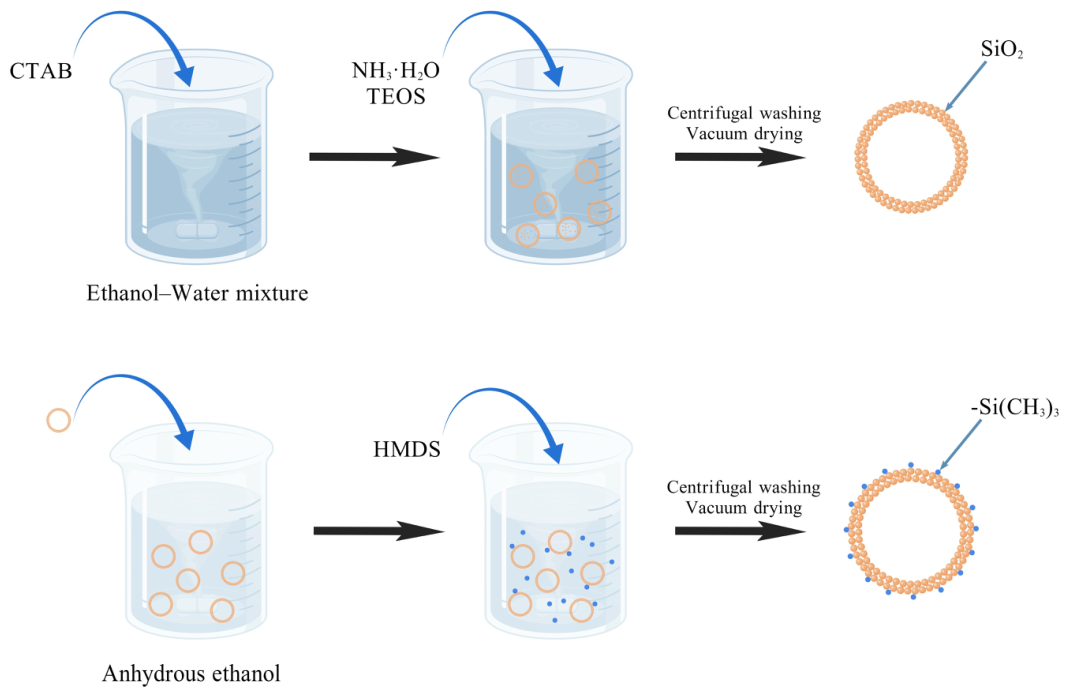
The synthesis and hydrophobization method for the hollow SiO2 nanoparticles is schematically shown in Figure 1. Section 2.2 already provides the details of the preparation method of the nanoparticle. The micelles formed by the soft template CTAB in the mixed solution of ethanol and water possess hydrophobic tails in the interior and hydrophilic heads in the exterior. Consequently, the interior of the micelles constitutes an ethanol-rich phase, while the exterior is a water-rich phase. The SiO2 precursor exhibits higher solubility in ethanol than in water; therefore, TEOS tends to accumulate within the ethanol-rich phase inside the micelles due to similar polarity. The alkaline ammonia facilitates the hydrolysis and condensation reactions of TEOS. The resulting primary SiO2 nanoparticles densely pack on the inner surface of the micelles, forming a SiO2 shell with a hollow structure.
The molecular structure of hexamethyldisilazane (HMDS) features reactive Si-NH-Si bonds, enabling a chemical reaction with the Si-OH (silanol) groups on the surface of the hollow SiO2 nanoparticles as described above, thereby achieving hydrophobic modification of the particle surface. As shown in Equation (3), in an anhydrous ethanol solution, the Si-N bond in HMDS cleaves and undergoes a deamination reaction (releasing NH3) with the hydroxyl groups from the Si-OH on the SiO2 surface. This process (known as a silanization reaction) generates stable Si-O-Si covalent bonds and grafts the trimethylsilyl groups (-Si(CH3)3) of the HMDS molecule onto the SiO2 particle surface.
2 SiOH + ( CH 3 ) 3 - Si - NH - Si - ( CH 3 ) 3     2 Si - O - Si - ( CH 3 ) 3 + NH 3
By grafting HMDS onto the surface, the original hydrophilic Si-OH groups of hollow SiO2 nanoparticles are replaced with nonpolar -Si(CH3)3 groups. This substitution greatly lowers the surface energy, making the particle surface hydrophobic.
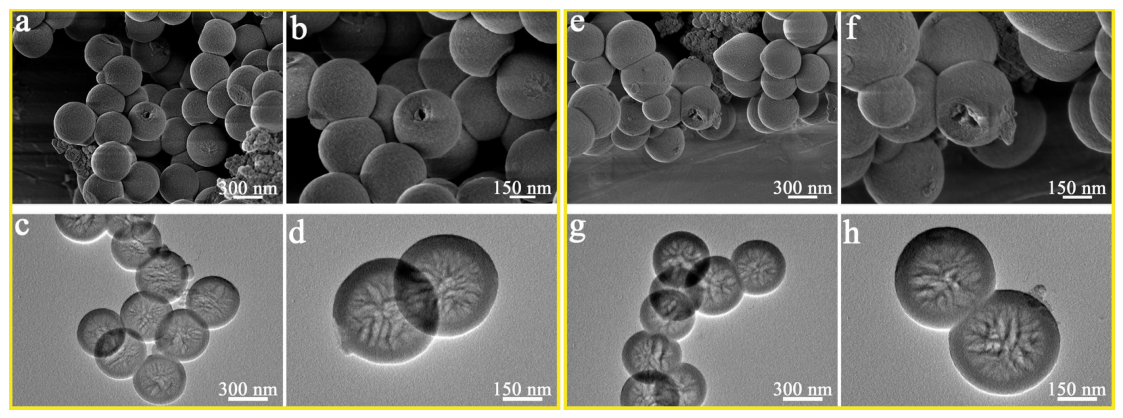
Figure 2 presents the SEM and TEM images of the two types of hollow SiO2 nanoparticles before and after hydrophobic modification. Both nanoparticles have a well-defined hollow structure with a diameter of ca. 200 nm. The nanoparticle shells are composed of aggregated primary SiO2 particles, with numerous inter-particle voids. No significant morphological or structural differences are observed between the two types of nanoparticles, indicating that the hydrophobic modification with HMDS does not alter the hollow structural characteristics.
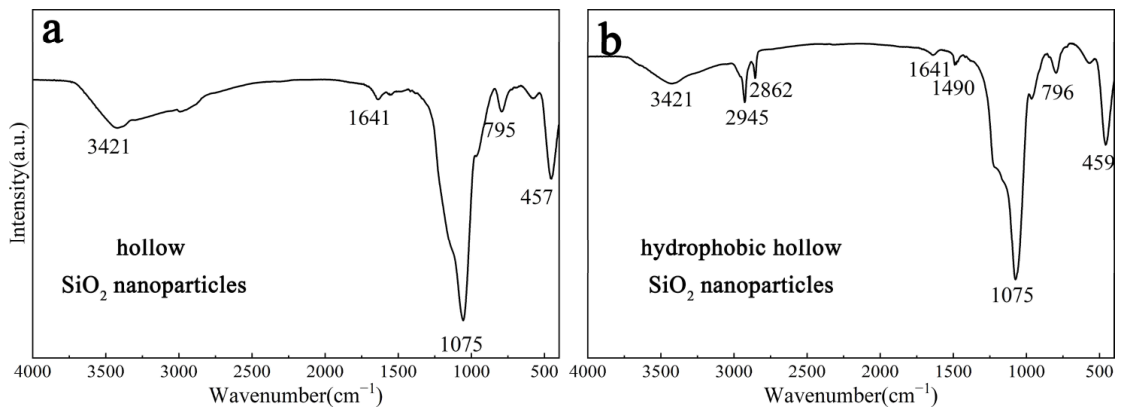
The FTIR spectra of the unmodified and modified hollow SiO2 nanoparticles are presented in Figure 3. For the unmodified hollow SiO2 nanoparticles, the peak at 459 cm−1 arises from the bending mode of the Si–O bond. The peak at 796 cm−1 arises from the symmetric stretching of the Si–O–Si bond. The peak at 1075 cm−1 corresponds to the asymmetric stretching of Si–O–Si linkages [53]. The peak at 1641 cm−1 is due to the H–O–H bending vibration of water molecules [53,54]. The broad peak at 3421 cm−1 is attributed to the stretching vibration of –OH bonds in adsorbed water [55,56]. For the hydrophobic hollow SiO2 nanoparticles, an additional small peak near 1490 cm−1 was observed, which is due to the bending vibration of methyl (–CH3) groups [57,58]. The peaks at 2862 cm−1 and 2945 cm−1 are assigned to the symmetric stretching vibration and the asymmetric stretching vibration of –CH3, respectively [59]. These features confirm the grafting of hydrophobic methyl groups onto the SiO2 surface.

3.2. Water Vapor Transmission Rate (WVTR) of the Coating

The specimens (coated and uncoated, non-hydrophobic and hydrophobic) have been numbered accordingly. The specimen codes denote the coating thickness and the type of SiO2 nanoparticles used: the W10Si, W40Si and W80Si incorporated SiO2 hollow nanoparticles as the coating filler with thicknesses of 10, 40 and 80 µm, respectively; the W10h-Si, W40h-Si and W80h-Si incorporated hydrophobic hollow SiO2 nanoparticles as the filler with thicknesses of 10, 40 and 80 µm, respectively. In all these coatings, the mass ratio of SiO2 nanoparticles to WPU was maintained at 1:1. A pure WPU coating designated as W10 served as the blank control.
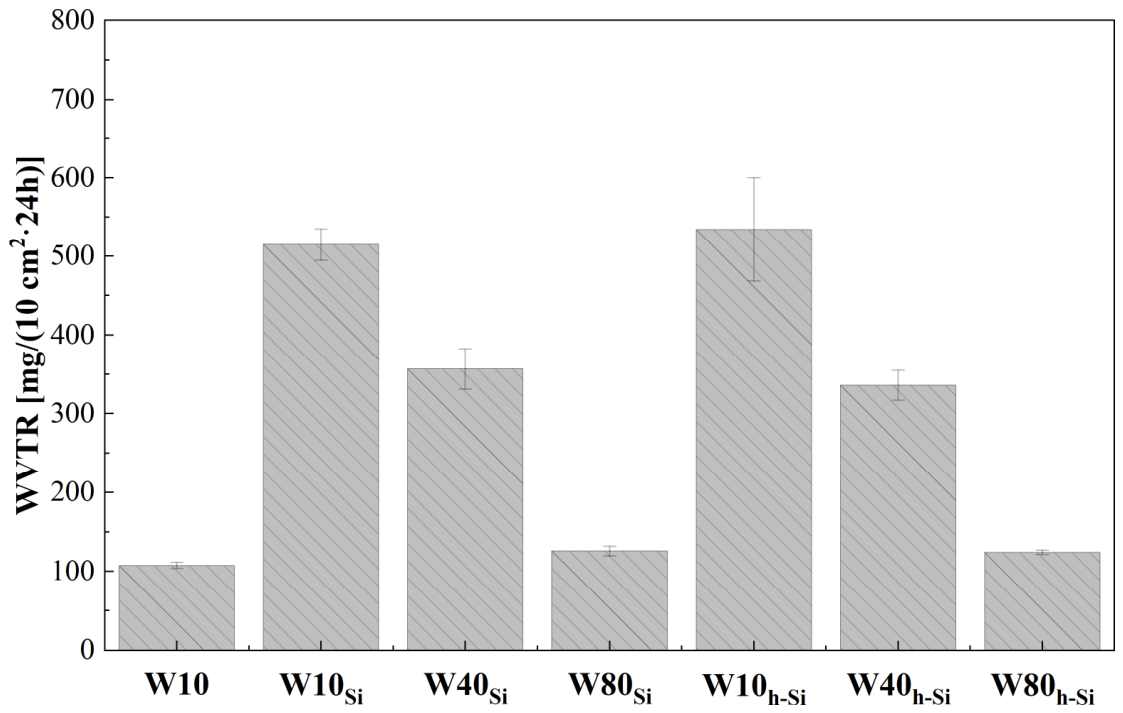
Figure 4 compares the water vapor transmission rate (WVTR) of the coating films for all specimens. All the coatings incorporated with hollow SiO2 nanoparticles showed higher WVTR than the blank control (W10), and the WVTR decreased with increasing coating thickness. The hydrophobized or non-hydrophobized nanoparticles did not exert a significant influence on the WVTR for coatings with the same thickness.

3.3. Water Contact Angle of the Coating

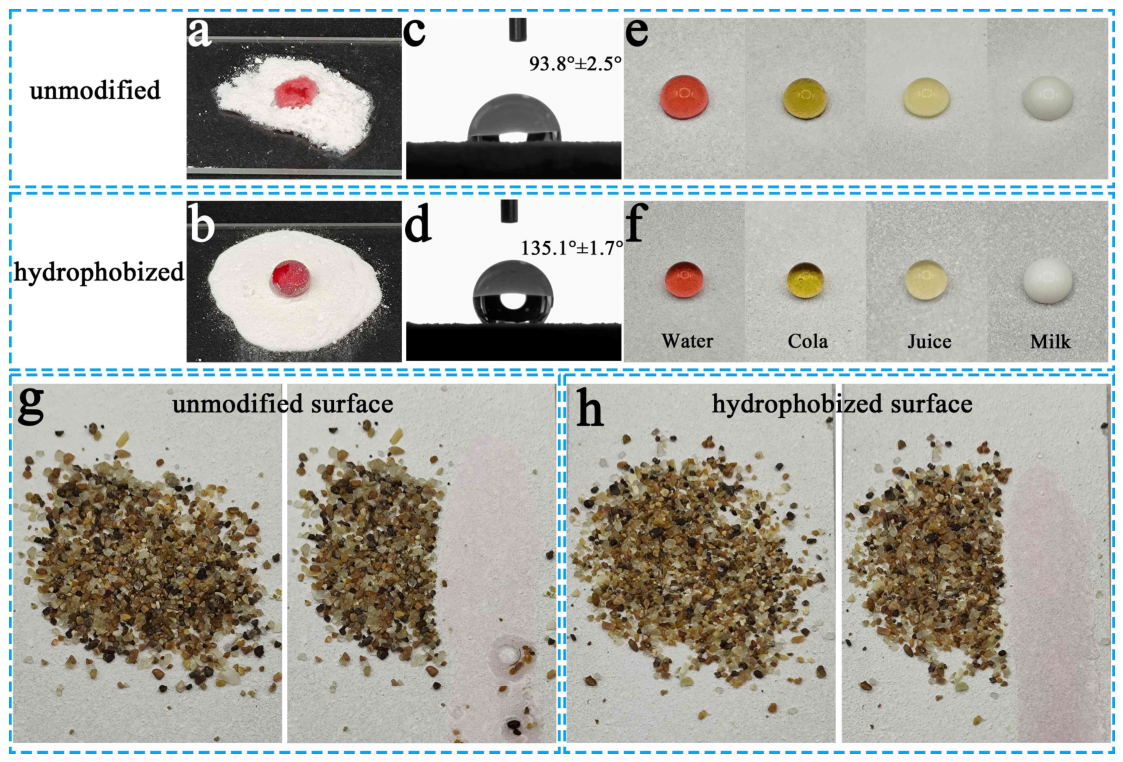
Figure 5a,b show the state of stained water droplets on the surfaces of hollow SiO2 nanoparticles before and after hydrophobic modification. The unmodified nanoparticles were hydrophilic, whereas the water droplets remained spherical on the powder surface after hydrophobic modification. The static water contact angles on the coating surfaces incorporating the two different nanoparticles are shown in Figure 5c,d. After modification, the coating surface became more hydrophobic, with the contact angle rising from 93.8 ± 2.5° to 135.1 ± 1.7°, and the scale bar was calculated based on five different locations on each surface. The shape of some common liquid droplets on the coating surfaces shown in Figure 5e,f further confirms the improvement of hydrophobicity. The self-cleaning behavior of both coatings was tested with sand particles acting as solid contaminants (Figure 5g,h). Compared with the unmodified coating, solid contaminants are more efficiently removed from the surface of the hydrophobic coating.

3.4. Macroscopic Observation After Salt Spray Test

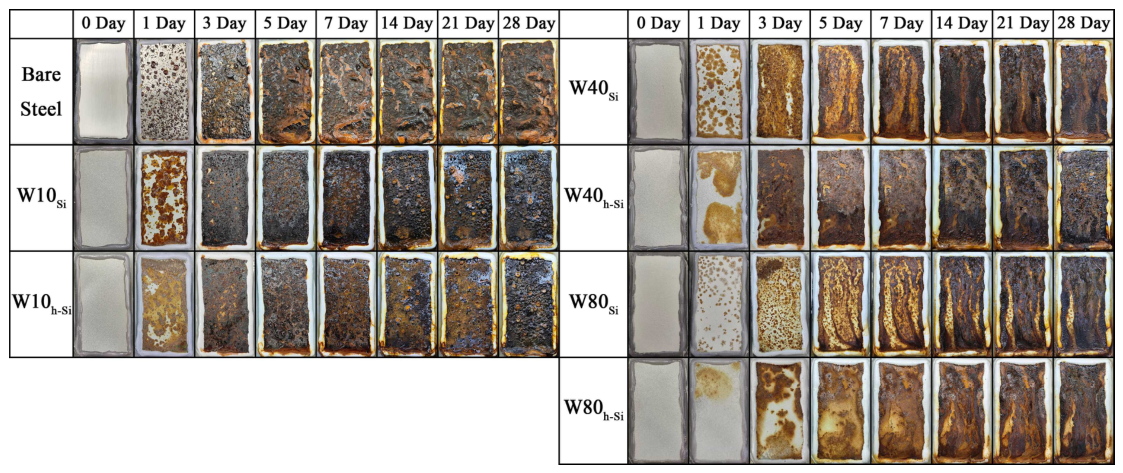
After different periods of salt spray test, the macroscopic images of the sample surface are provided in Figure 6. The bare metal surface rusted rapidly, with loosely adherent rust layers (flaked and partially detached at day 5 and after). In contrast, the occurrence of rust flaking was markedly reduced for the coated specimens.
During the salt spray test, a cotton bud was periodically used to check whether the rust layer was exposed or not. The W10 group showed that the cotton bud was stained and rust layers were exposed as early as the seventh day. The W40 group began to exhibit local coating damage on the 14th day, while no obvious stain on the cotton bud was observed on the W80 group until the end of the test.
A clear delay in rust development was observed with greater thickness for both coatings. The rust exhibited a speckled morphology for the non-hydrophobized group. The size of the speckle and the coverage of the rust were both decreased with increasing thickness, which is ascribed to the decreasing WVTR and inhibited penetration of corrosive media (chloride ions and oxygen).
On day 14, scar-like defects began to appear on W10Si, indicating the localized failure of the coating (as a result of coating damage after rust expansion) and the premature exposure and damage of the rust layer. By day 28, the surfaces of both W10Si and W40Si were completely covered by a rust layer (with scar-like defects presented in the rust layer on W10Si, while the rust layer on W40Si seemed to be less dense), whereas W80Si had not yet developed a complete rust layer.
Unlike the isolated speckled morphology observed on the coatings in the non-hydrophobized group, the rust formed on the hydrophobic group during the initial stage exhibited a relatively continuous rust layer, which can favor the subsequent development of a more uniform rust layer. However, for the relatively thin coating (W10h-Si), the damage to the coating still occurred by day 14, resulting in irregular scar-like defects on the rust layer. When the coating thickness increased (W40h-Si), a more uniform and complete rust layer was formed after 28 days. For the thickest coating (W80h-Si), the rust layer formed beneath the coating still remained incomplete after 28 days.

3.5. Microscopic Observation of the Coating and Rust Layer

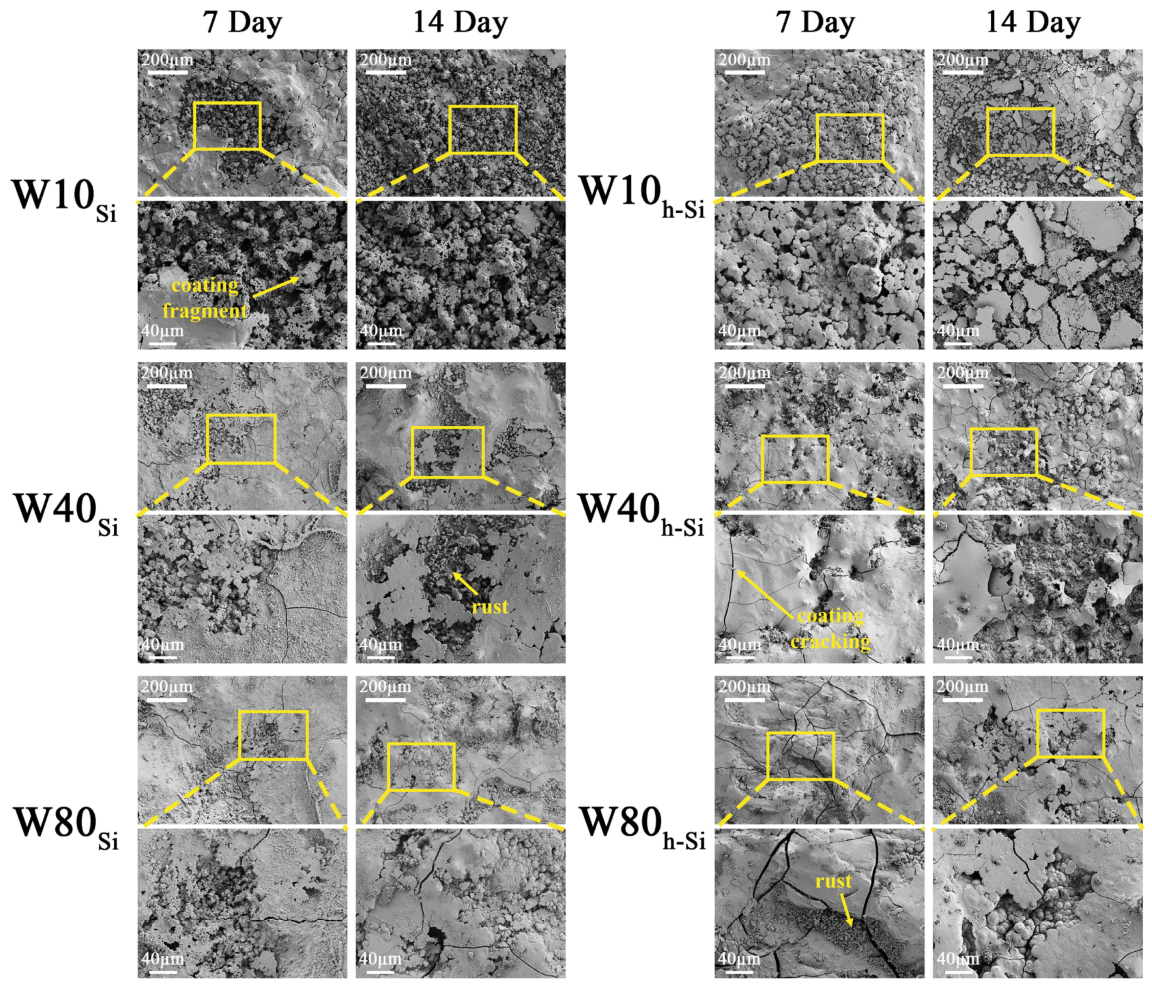
After 7 and 14 days of salt spray test, the coating surface morphologies investigated by SEM are displayed in Figure 7. Generally, the failure of the coating was initiated with the appearance of cracks, followed by fragmentation and spallation of the coating around the cracks. For the W10Si sample, the coating surface exhibited failure of a large area and the rust was clearly exposed on day 7, and the coating almost fell off completely on day 14. The failure appeared as fragments for the W40Si sample on day 7, while a significant portion of the coating still remained on day 14. Local spallation with cracks was observed on the W80Si sample on day 7, while the failure mode still remained the same on day 14, and the rust was only locally exposed.
For the hydrophobized group, the rust was also largely exposed on day 7 for the W10h-Si sample, and the failure became fragmented on day 14, but the rust layer was still partially covered, indicating a delayed failure of the coating compared to the premature failure of W10Si. The failure mode can be described as local spots with a few cracks on day 7 for the W40h-Si sample, while a large area of failure appeared on day 14. The failure mode was in cracks on day 7 for the W80h-Si sample, and the exposed rust was also in small areas. The rust particles seemed to be pushed out through the cracks (day 7) and distributed near these cracks, while there was no rust elsewhere.
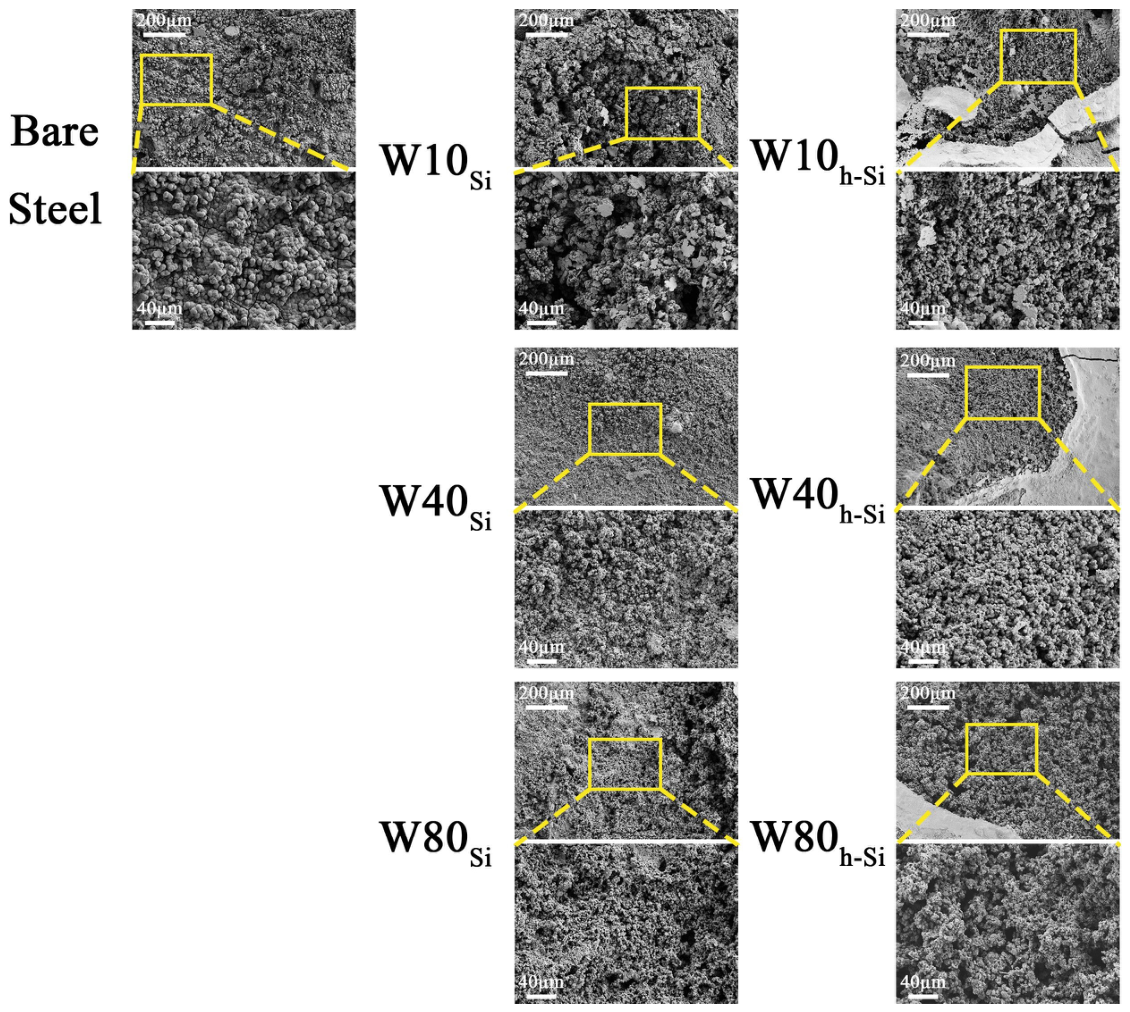
During the period from day 1 to day 14 of the salt spray test, the rust development was in the initial stage. By day 21, a complete rust layer was formed on the surfaces of most samples, but the degree of uniformity was different. Therefore, the analysis of the rust layer morphology was conducted after day 21. The rust morphologies of the samples after 21 days of salt spray test are shown in Figure 8. The rust particles on the bare steel were relatively large in size and appeared loose, with a large number of voids and cracks. For the W10Si, the rust also appeared loose, whereas the structure of the rust on W40Si was obviously denser than that of W10Si. The rust on W80Si was not yet fully developed (see Figure 6), and small voids were present. The amount of voids in the rust layer was reduced on W10h-Si than W10Si, while it presented as a finer and more uniform structure on W40h-Si. In comparison, a loose structure with a large number of voids was presented on W80h-Si.

3.6. The Compositional Analysis of the Rust Layer

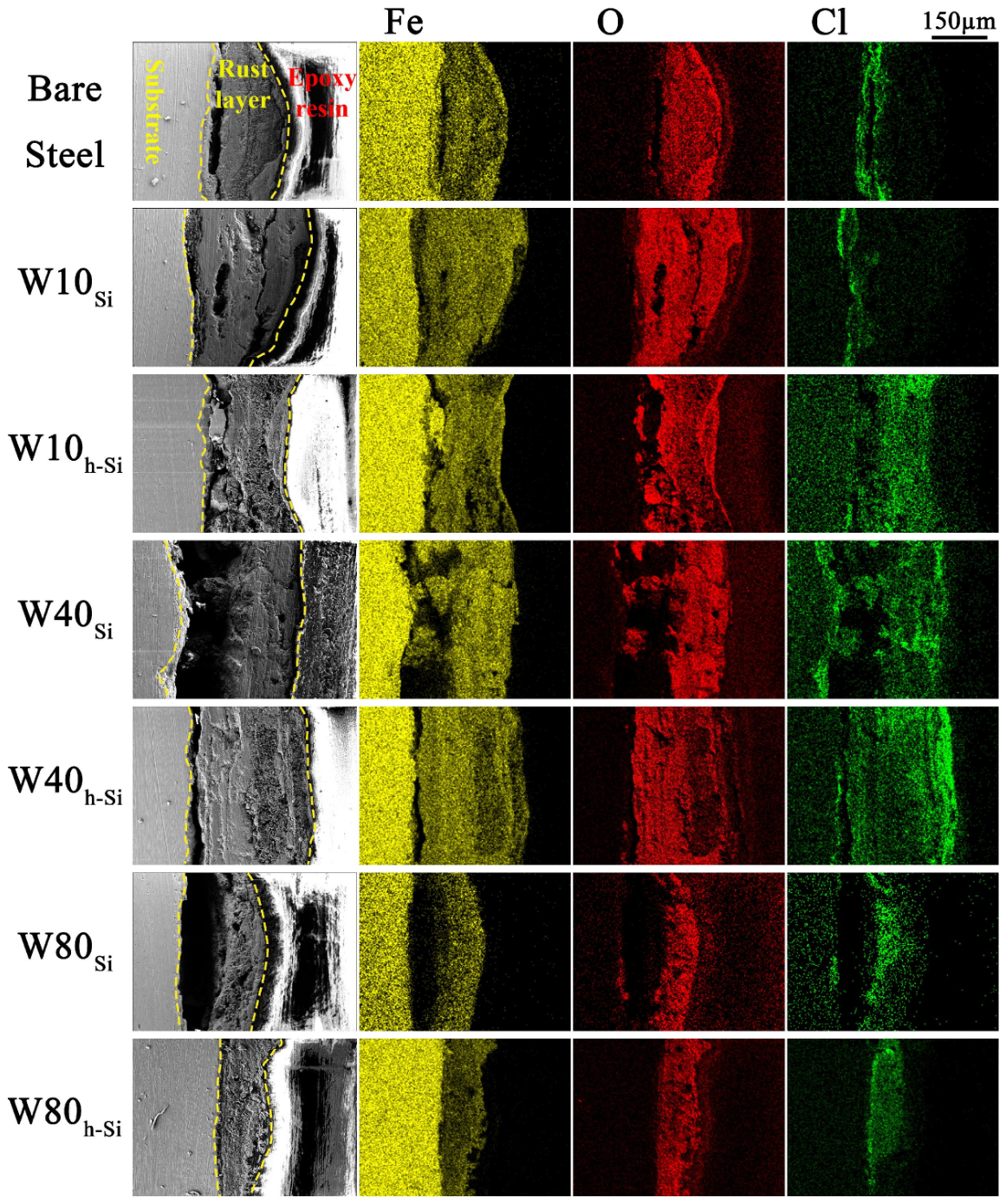
Figure 9 presents the cross-sectional views and EDS mappings of the rust layers formed on different specimens after 28 days salt spray test. The oxygen enrichment and iron depletion clearly distinguish the range of the rust layer. The detachment of the rust layer from the steel substrate was caused by grinding.
In the bare steel specimen, chloride was distributed in the inner region of the rust layer, indicating complete chloride ingress through the rust layer, which threatened the substrate, and it was similar for the W10Si specimen. The W40Si specimen presents the chloride distribution through the thickness of the rust layer without clear local accumulation either in the inner or the outer layer, while chloride accumulation in the inner part was observed on the W80Si specimen. The chloride distribution was also all over the rust layer without noticeable local accumulation for W10h-Si and W80h-Si specimens, but it was very clear for the W40h-Si specimen that chloride was largely distributed in the outer layer of the rust and depleted in the inner layer, indicating that chloride ingress was blocked.
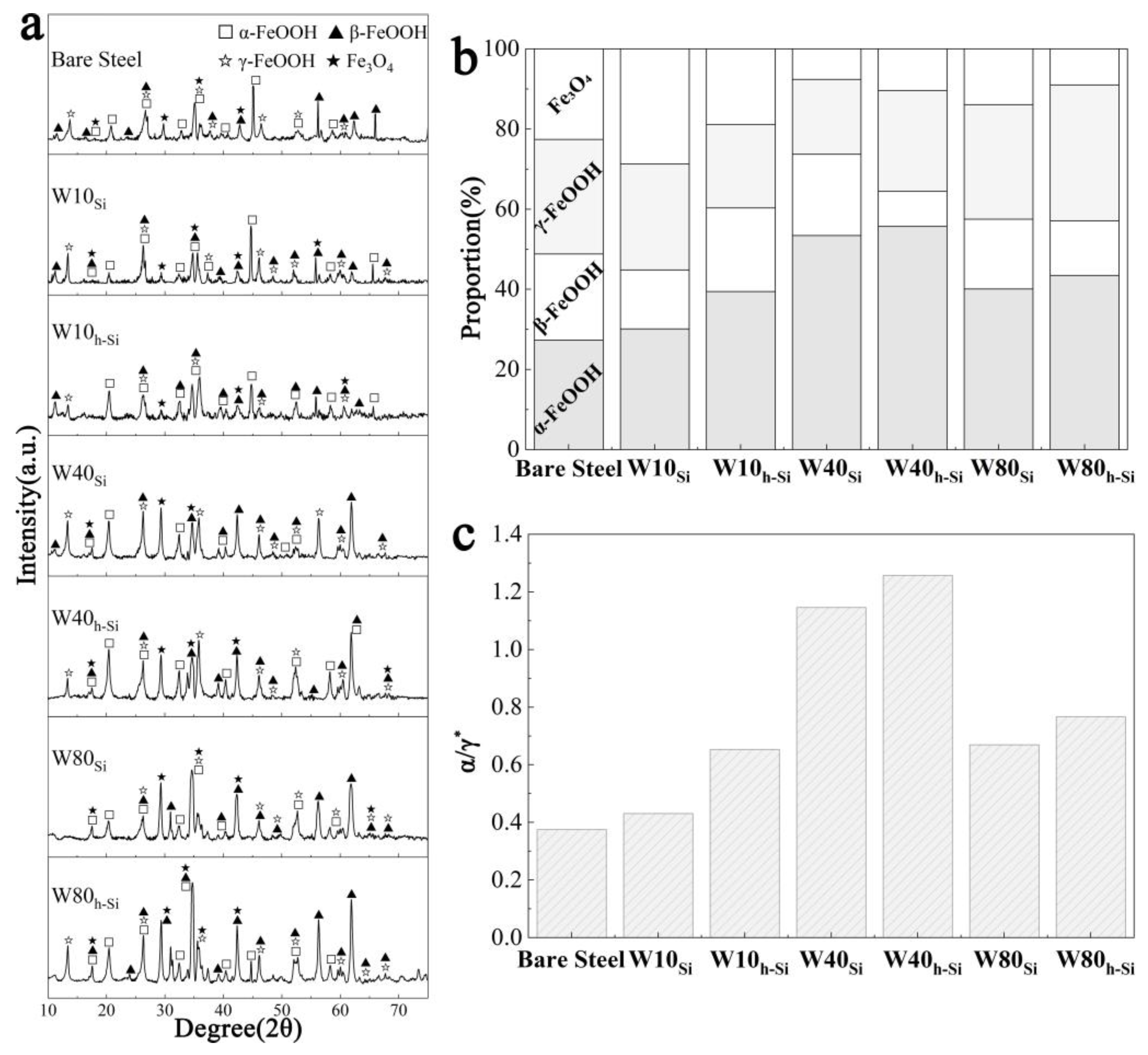
Additionally, XRD analysis (semi-quantitative analysis) was performed on the rust powders collected from the samples after the 28-day salt spray test. Previous research employed the ratio of the amount of α-FeOOH to the combined amount of γ-FeOOH, β-FeOOH and Fe3O4 (designated as α/γ*) as a metric for the assessment of the rust layer stability and protective ability on weathering steel [60]. An α/γ* value greater than one indicates good protective performance. All samples exhibited the corrosion products α-FeOOH, γ-FeOOH, β-FeOOH and Fe3O4 within their rust layers, as shown in Figure 10. The α/γ* values for W40Si and W40h-Si were both greater than one, and the α/γ* value for W40h-Si was the highest at 1.26.

3.7. Electrochemical Analysis on the Rust Layer

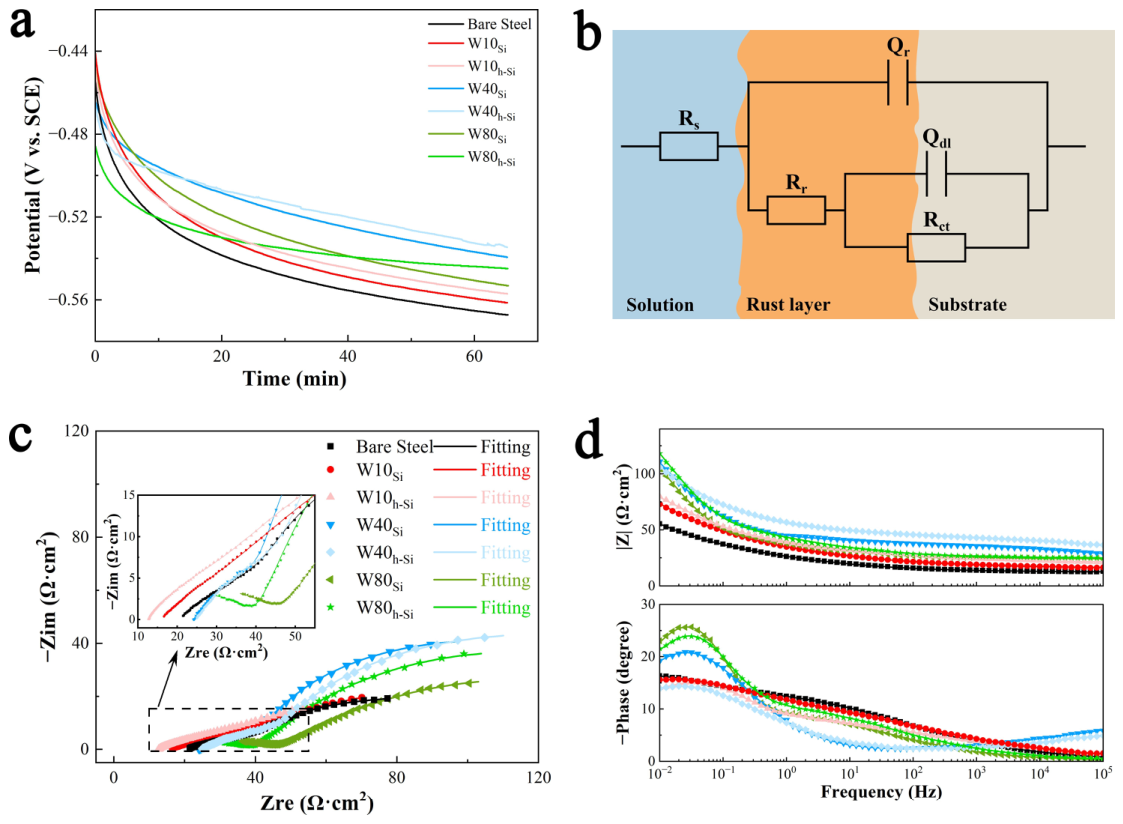
The electrochemical data obtained from different samples after a 28-day salt spray test are shown in Figure 11. In a 3.5 wt% NaCl electrolyte, the open-circuit potential of all samples initially decreased and stabilized after approximately 1 h (Figure 11a). Afterwards, electrochemical impedance spectroscopy (EIS) tests were conducted. Figure 11b illustrates the equivalent circuit. Rs is the resistance of the solution, Rr is the rust layer resistance, and Rct is the charge transfer resistance. A constant phase element (CPE) was employed instead of a pure capacitor. The Nyquist and Bode diagrams are given in Figure 11c,d.
Table 3 presents the fitting results according to the EIS data. Defects such as cracks and pores within the rust layer would reduce its compactness and provide pathways for chloride ions in the solution to penetrate toward the weathering steel surface. A denser rust layer would inhibit the ion transport, leading to a higher Rr value. The value of Rr serves as a reflection of the inhibition of chloride ingress and rust layer protectiveness. A higher Rct generally corresponds to a lower metal dissolution rate. The W40 group exhibited higher values of stabilized open-circuit potential as well as higher Rct and Rr values than all the other groups (bare steel, W10 and W80). Specifically, W40h-Si demonstrated the highest Rct and Rr values. In addition, W40h-Si showed the smallest Yr and Ydl values, and its dispersion exponents nr and ndl were the highest, indicating that the rust layer on its surface possessed lower porosity and higher uniformity.
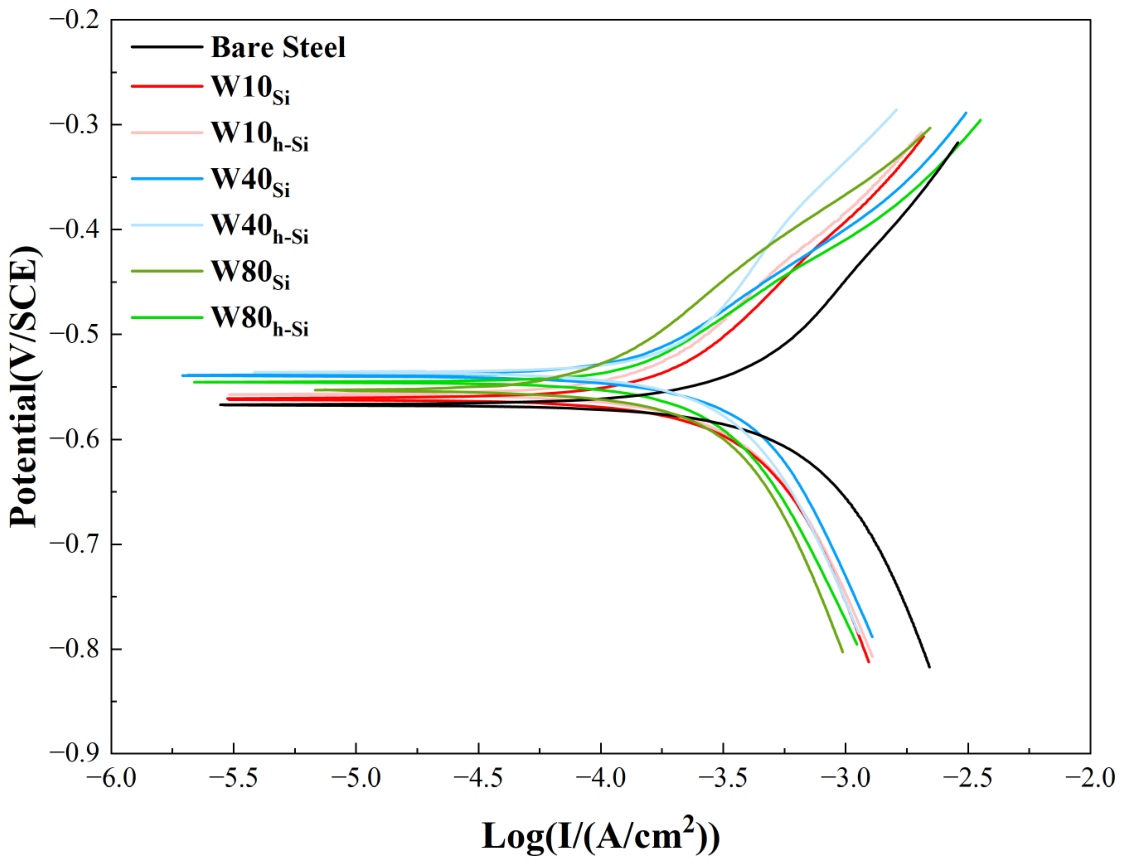
Figure 12 presents the electrochemical polarization curves of the different samples after 28 days of salt spray test. Table 4 lists the Ecorr and Icorr values calculated from the polarization curves. All the coated samples (W10, W40 and W80) presented higher Ecorr values than the bare steel. The W40 group showed obviously lower corrosion current density than the other samples, implying good protectiveness of the rust layer formed beneath the coating film. The hydrophobically modified sample W40h-Si presented the best corrosion resistance, and the corrosion current density was only 17% of that of the bare steel.

4. Discussion

4.1. Rust Development Beneath Coatings

As a physical barrier, a coating is inherently expected to block corrosive media such as H2O, O2, and Cl dissolved in moisture [61]. However, due to the special corrosion-resistant mechanism of weathering steel that relies on the protectiveness of a self-formed rust layer, the complete blocking of the corrosive media would compromise the self-protection ability of weathering steels [62]. The ideal coating designed for the stabilization of self-formed rust layer should possess selective permeability, i.e., allowing the ingress of necessary corrosive media (H2O, O2, and Cl dissolved in moisture) that were required to form the rust layer (preferentially in vapor state) while effectively preventing the ingress of undesired liquid water and dust (the main factors to compromise the protectiveness of the rust layer). This is especially significant in the initial stage of the rust formation process, which is vulnerable but crucial for the following rust formation stage. It has already been found that the uniformity of the initial rust layer is very likely to result in a compact and uniform mature rust layer [21,44]. This is the core idea of the designed coating film in this work.
The hollow SiO2 nanoparticles in this work can construct nanoscale channels within the coating, which selectively allow the transport of corrosive media in vapor state. The effective connection from the outer surface of the coating all the way to the substrate/coating interface is the key to breathability, while those built halfway cannot act as effective pathways. Additionally, the uniform distribution of nanoparticles in a thick coating is difficult, resulting in the tortuosity of the effective pathways. As shown in Figure 4, water vapor transmission rate (WVTR) is inversely related to the coating thickness, because the longer distance between the outer surface of the coating and the substrate/coating interface would increase the difficulty in constructing the effective pathway for water vapor. It was also demonstrated by the delayed rust development beneath thicker coatings (see Figure 6). Although a thick coating can enhance the physical barrier effect, it significantly compromises the breathability [63,64], which is detrimental to the sustained growth and evolution of the rust layer. However, the excessively fast rust development process beneath the thin coating resulted in the premature failure of the coating (see Figure 7, the W10 groups showed the early failure as fragmentation). Therefore, a balance between breathability and thickness is required to ensure the unimpeded permeation of the gaseous corrosive media with coating shelter lasting for a period of long enough time.

4.2. The Effect of Hydrophobization

During the salt spray test process, the fine water droplets would reach the sample surface and may accumulate into bigger droplets or form a continuous thin electrolyte film [65,66]. In more practical conditions, the condensate water and rainwater would influence the weathering steel. It may lead to the premature failure of the hydrophilic waterborne polyurethane (WPU) coating, presented as coating delamination, swelling, blistering and other phenomena [67,68,69].
When the accumulated liquid water stays on the surface of a WPU coating with high surface energy, the liquid water, together with dissolved corrosive ions, gradually penetrates into the coating through hydrogen-bonding adsorption along hydrophilic groups such as hydroxyl groups in the molecular chains [70]. The process has been reported to weaken the intermolecular forces of the coating, causing swelling and compromising the coating adhesion [71].
The undesired local penetration of liquid water would induce the non-uniformity of the rust layer and may result in “rust liquid” at a later stage. In other words, the concept seeks to block the ingress of liquid water, but the application of hydrophilic WPU would inevitably induce water damage on the coating [72], leading to the premature failure of the coating before the formation of a protective rust layer.
By incorporating hydrophobically modified hollow SiO2 nanoparticles, the low-surface-energy functional groups (-Si(CH3)3) together with the nanoscale size effect of the nanoparticles themselves, construct a rough structure on the WPU coating surface. This process significantly decreases the surface free energy of the coating and reduces the contact area with water droplets, altering the WPU coating from hydrophilic to hydrophobic [73]. The hydrophobic modification improves the wetting behavior of the coating surface, inhibiting the formation of a continuous thin electrolyte film or the accumulation of liquid water droplets. Thus, the actual contact area or the contact time of water droplets or a thin film can be reduced [74]. In addition, the self-cleaning property also largely avoids the influence of rust on the coating surface. Therefore, the negative effects of a thin electrolyte film or liquid water on the coating surface can be ruled out, ensuring the durability of the WPU-based coating. The maintenance of coating coverage was found to be improved after hydrophobization, especially at the early stage of rust formation, and the premature failure of the coating film was also mitigated (Figure 7, 7 days), implying an improved sheltering period for rust formation at an initial stage.

4.3. The Early Shelter of the Coating

As the protective rust layer gradually forms, the coating will undergo local damage due to rust expansion and eventually detach from the steel surface after the rust layer completely covers the substrate, replacing the coating [75]. Therefore, the concept of the breathable coating is to provide early shelter at the initial stage of rust formation, rather than offering protection throughout the service life, which does not obey the concept of self-protection for weathering steels.
Since it is impossible to directly and quickly form a compact and stable rust layer, the early failure of the coating would lead to insufficient time of shelter and the early exposure of an unstable and premature rust layer, so the initial stage (the most significant stage) would be disturbed. As shown in Figure 6, Figure 7 and Figure 8, the W10 (thickness 10 µm) coatings were prone to premature failure, resulting in early direct exposure of the rust layer to the salt spray environment and thus a loose rust layer, and chloride ingress could not be effectively inhibited (Figure 9).
In contrast, the W40 (thickness 40 µm) coating effectively delayed the coating failure and the direct exposure of the rust layer, offering a longer time of shelter, thereby enhancing the compactness and protective performance of the rust layer. The W80 (thickness 80 µm) coating did not experience severe failure or detachment even at the end of the 28-day salt spray. However, its rust layer formation process was very slow, and the metal surface was not completely covered at the end of the test (Figure 6). Furthermore, as observed in Figure 7, obvious cracks appeared on the W80h-Si sample, with rust particles being pushed out from these cracks and distributed nearby, while there was still no obvious rust elsewhere. Although a remarkable area of coating was undamaged and the substrate was still covered by coating, this process actually exacerbated the non-uniformity of the rust layer and disfavored its protectiveness.

4.4. The Prospects of the Application

The breathable coating developed in this work employs waterborne polyurethane (WPU) and hollow SiO2 nanoparticles as the main raw materials, which are of low cost and contain no hazardous components, thereby avoiding the risk of environmental pollution. The coating film is based on a one-step spraying process that simplifies the application procedure and eliminates the influence of construction quality. The coating is able to provide effective shelter at the most important initial stage of rust layer formation, which helps fulfill the self-protection ability of weathering steels through a protective rust layer. In particular, the hydrophobic modification prevents the retention of liquid water on the steel surface and exhibits self-cleaning properties on the coating surface, largely mitigating the influence of typical factors that inhibit rust layer formation in the practical service environment, such as rainwater, pollutants and dust. As a novel rust layer stabilization technology for weathering steel, the breathable coating developed in this work can be widely applied in prospect for new constructions.

5. Conclusions

This study synthesized SiO2 nanoparticles with a mesoporous shell and hollow interior structure, followed by hydrophobic modification. The nanoparticles were used as fillers in waterborne polyurethane (WPU), and a hydrophobic and breathable coating film was fabricated to be applied for the rust stabilization of weathering steels. The main findings are summarized as follows.
(1) The coating facilitates the inward diffusion of gaseous corrosive media (H2O, O2 and Cl dissolved in moisture) while inhibiting the ingress of liquid water and dust to the coating/substrate interface, and a rust layer can form beneath the coating, which provides shelter for the initial stage of rust development against the disturbance of the external environment.
(2) The breathability of the coating is achieved by the effective interconnection of SiO2 nanoparticles across the coating film thickness, which provides a pathway for gaseous corrosive media. The breathability is inversely related to coating thickness, but shows no significant correlation with the hydrophobic modification.
(3) There exists a balance between the thickness (related to breathability) and effective sheltering period. The uniformity, the compactness, the stability, the inhibition of chloride ingress and corrosion resistance of the rust layer have been found to be optimized for the 40 μm thick hydrophobized coating film. A 10 μm thickness resulted in premature failure of the coating film, while an 80 μm thickness resulted in poor breathability, largely delayed rust development and the non-uniformity of the rust layer.
(4) The hydrophobization of the nanoparticles helps achieve a hydrophobic coating surface, which enhances the water resistance of the naturally hydrophilic WPU and mitigates the premature failure of the coating film.
(5) The breathable coating developed in this study demonstrates prospects owing to its maneuverability, environmental friendliness and low cost, which provides a new technical route for rust stabilization of weathering steels.

Author Contributions

Conceptualization, W.X., D.T.G. and R.Z.; methodology, W.X. and B.Z.; validation, J.G.; formal analysis, J.G. and W.X.; investigation, J.G. and W.X.; resources, W.X., B.Z. and B.H.; data curation, J.G.; writing—original draft preparation, J.G.; writing—review and editing, W.X.; supervision, B.H. and W.X.; project administration, R.Z. and B.H.; funding acquisition, R.Z. and B.H. All authors have read and agreed to the published version of the manuscript.

Funding

This work was supported by the Shandong Provincial Natural Science Foundation, China (ZR2025QB07), the National Natural Science Foundation of China (42476211) and the Shandong Special Steel Materials and Equipment Innovation and Entrepreneurship Community (2022TGGTT0103).

Data Availability Statement

The raw data supporting the conclusions of this article will be made available by the authors on request.

Conflicts of Interest

The authors declare no conflicts of interest.

References

  1. Xu, W.C.; Zhang, R.Y.; Duan, J.Z.; Greenfield, D.T. Corrosion is a global menace to crucial infrastructure—Act to stop the rot now. Nature 2024, 629, 41. [Google Scholar] [CrossRef] [PubMed]
  2. Hou, B.R. The Cost of Corrosion in China, 1st ed.; Science Press: Beijing, China, 2017. [Google Scholar]
  3. Bernardi, E.; Vassura, I.; Raffo, S.; Nobili, L.; Passarini, F.; de la Fuente, D.; Morcillo, M. Influence of inorganic anions from atmospheric depositions on weathering steel corrosion and metal release. Constr. Build. Mater. 2020, 236, 117515. [Google Scholar] [CrossRef]
  4. Herting, G.; Virolainen, E.; Odnevall, I. Patina formation and diffuse dispersion of alloying metals from weathering steels at urban atmospheric conditions—A combined laboratory and field investigation. Mater. Corros. 2024, 75, 1282–1296. [Google Scholar] [CrossRef]
  5. Wang, Z.; Xu, W.; Zhang, B.; Gao, J.; Li, C.; Li, G.; Zhang, R.; Hou, B. The effect of rust layer damage on the corrosion resistance of Q420 bridge steels. J. Mater. Res. Technol. 2025, 34, 1894–1907. [Google Scholar] [CrossRef]
  6. Yu, Q.; Li, B.; Wang, F.; Tai, J.; Liu, P. The role of stabilization technology on the enhancement of corrosion resistance and corrosion mechanism for weathering steel. Mater. Today Commun. 2024, 40, 109694. [Google Scholar] [CrossRef]
  7. Yang, X.; Yang, Y.; Sun, M.; Jia, J.; Cheng, X.; Pei, Z.; Li, Q.; Xu, D.; Xiao, K.; Li, X. A new understanding of the effect of Cr on the corrosion resistance evolution of weathering steel based on big data technology. J. Mater. Sci. Technol. 2022, 104, 67–80. [Google Scholar] [CrossRef]
  8. Palsson, N.S.; Wongpinkaew, K.; Khamsuk, P.; Sorachot, S.; Pongsaksawad, W. Outdoor atmospheric corrosion of carbon steel and weathering steel exposed to the tropical-coastal climate of Thailand. Mater. Corros. 2020, 71, 1019–1034. [Google Scholar] [CrossRef]
  9. Křivý, V.; Kubzová, M.; Konečný, P.; Kreislová, K. Corrosion Processes on Weathering Steel Bridges Influenced by Deposition of De-Icing Salts. Materials 2019, 12, 1089. [Google Scholar] [CrossRef]
  10. Zhang, W.; Yang, S.; Geng, W.T.; Hu, Q. Corrosion behavior of the low alloy weathering steels in stagnant water. Mater. Chem. Phys. 2023, 302, 127745. [Google Scholar] [CrossRef]
  11. Zhao, T.; Liu, K.; Li, Q. Comparison of the rusting behaviors of S450EW weathering steel under continuous spray and wet/dry cycling. Constr. Build. Mater. 2021, 309, 125211. [Google Scholar] [CrossRef]
  12. Ma, S.; Sun, L.; Sun, H.; Sun, H.; Jiang, J.; Yin, Y.; Qu, S.; Liu, Z.; Xu, S. Stabilization technology and corrosion mechanism of rust layer on Q370 weathering steel surface. J. Iron. Steel Res. Int. 2022, 29, 1694–1709. [Google Scholar] [CrossRef]
  13. Yu, Q.; Wang, S.; Fan, Y.; Cai, J.; Wang, Q. Research on the Applicability of Stabilizing Water Treatment Process for Rust Layer of Q500qENH Weathering Steel in Different Typical Environments. Mater. Prot. 2022, 55, 41–47. (In Chinese) [Google Scholar] [CrossRef]
  14. Gao, L.J.; Yang, J.W.; Zhang, X.; Cao, J.P.; Jiang, S.; Wang, S.R. Rust stabilization treatment of weathering steel surface. Surf. Technol. 2020, 49, 255–261. (In Chinese) [Google Scholar] [CrossRef]
  15. Yang, J.; Zhao, K.; Fan, M.; Luo, D.; Fan, C.; Ke, J.; Xiao, J.; Liu, X.; Xiong, X.; Chen, Q.; et al. Study on the Stabilization Technology of Rust Layer on Q420qNH Weathering Steel Surface Under a Simulated Marine environment. Met. Mater. Int. 2026, 32, 524–538. [Google Scholar] [CrossRef]
  16. Li, Z.; Ma, L.; Ren, C.; Wang, J.; Tian, R.; Chen, Z.; Chen, W.; Li, X.; Zhang, D. Accelerated rust stabilization for weathering steels via a high-throughput approach. Corros. Sci. 2025, 244, 112645. [Google Scholar] [CrossRef]
  17. Zhu, S.; Yu, Q.; Chen, K.; Dai, S.; Wang, Q. Exploration on rust layer stabilization treatment technology for a weathering steel bridge. Mater. Prot. 2020, 53, 139–143. (In Chinese) [Google Scholar] [CrossRef]
  18. Zhang, Y.; Wu, X. Study on stabilizing rust layer treatment technology of weathering steel. Mod. Paint. Finish. 2025, 28, 69–72. (In Chinese) [Google Scholar]
  19. Lu, C.; Liu, X. Review on global development of weathering steel bridges. Steel Constr. 2024, 39, 21–31. (In Chinese) [Google Scholar] [CrossRef]
  20. Shi, Z.J.; Wang, L.; Chen, N.; Hao, L.; Dong, J.H.; Ke, W. Weathering steel surface rust layer and its stabilization treatment status and development trend. Corros. Sci. Prot. Technol. 2015, 27, 503–508. (In Chinese) [Google Scholar]
  21. Hu, Q.; Yang, S.W.; Zhang, X.; Da, G.J.; Zhang, W.H. Accelerating stabilization of weathering steel through rust modification pre-corrosion treatment. Heliyon 2024, 10, e23842. [Google Scholar] [CrossRef]
  22. Effendy, S.; Zhou, T.; Eichman, H.; Petr, M.; Bazant, M. Blistering failure of elastic coatings with applications to corrosion resistance. Soft Matter 2021, 17, 9480–9498. [Google Scholar] [CrossRef] [PubMed]
  23. Sun, B.; Yan, L.; Gao, K. Hydrophobicity and Improved Corrosion Resistance of Weathering Steel via a Facile Sol-Gel Process with a Natural Rust Film. ACS Appl. Mater. Inter. 2023, 15, 46400–46407. [Google Scholar] [CrossRef] [PubMed]
  24. Li, J.; Li, M.; Hua, Z.; Mo, Y.; Guan, K.; Zha, M.; Gao, Y.; Wang, H. A corrosion-resistant and age-hardenable Mg-Al-Mn-Ca-Ce dilute alloy with fine-grained structure processed by controlled rolling. J. Mater. Sci. Technol. 2023, 163, 223–236. [Google Scholar] [CrossRef]
  25. Liu, H.; Zhang, X.; Nakata, T.; Xu, C.; Zhou, F.; Wu, Z.; Zhang, X.; Cong, S.; Wang, X.; Kamado, S.; et al. Enhanced corrosion resistance of high-strength and high-thermal-conductivity Mg-Mn-Ce alloy via trace Ca addition. J. Alloys Compd. 2025, 1042, 184120. [Google Scholar] [CrossRef]
  26. Feng, C.; Zhu, L.; Cheng, X.; Li, Z.; Gui, X.; Gao, G. Mechanistic role of vanadium microalloying in improving corrosion resistance of low carbon bainitic steel. J. Mater. Res. Technol. 2024, 33, 982–993. [Google Scholar] [CrossRef]
  27. Cai, L.; Kim, A.; Kainuma, S. Optimizing surface characteristics of severely corroded weathering steel via efficient preparation processes in high-corrosivity marine atmospheres. Appl. Surf. Sci. 2025, 707, 163613. [Google Scholar] [CrossRef]
  28. Zafar, S.; Ramazan, K.; Shakoor, R.A. Recent developments and future prospective of polyurethane coatings for corrosion protection—A focused review. Eur. Polym. J. 2024, 220, 113421. [Google Scholar] [CrossRef]
  29. Hu, J.; Tian, S.; Li, R.; Lu, G.; Wang, N. A review on polyurethane anti-fouling coatings. Corros. Commun. 2025, 20, 53–64. [Google Scholar] [CrossRef]
  30. Liu, J.; Ye, D. Photo-curable waterborne polyurethane acrylates with low VOCs and low odor by devolatilization and deodorizing. Prog. Org. Coat. 2023, 185, 107930. [Google Scholar] [CrossRef]
  31. Chai, K.L.; Aung, M.M.; Yew, D.Y.K.; Su’ait, M.S.; Ahmad, A.; Ataollahi, N.; Khoon, L.T. Contemporary breakthroughs and diverse chemistry innovations in waterborne polyurethane. J. Polym. Environ. 2025, 33, 599–630. [Google Scholar] [CrossRef]
  32. Zhang, Y.; Dong, H.; Yang, W.; Lu, H.; Wei, C.; Yang, W. Recent progress on bio-based polyurethanes: Synthesis, structure and cutting-edge applications. Mater. Today Commun. 2025, 45, 112279. [Google Scholar] [CrossRef]
  33. Chaudhary, M.L.; Patel, Y.N.; Chaudhari, S.; Patel, R.; Gupta, R.K. Enhancing the mechanical strength of soy-based polyurethane adhesives through incorporation of schiff base diols. Int. J. Adhes. Adhes. 2025, 142, 104118. [Google Scholar] [CrossRef]
  34. Jakhmola, S.; Das, S.; Dutta, K. Emerging research trends in the field of polyurethane and its nanocomposites: Chemistry, synthesis, characterization, application in coatings and future perspectives. J. Coat. Technol. Res. 2024, 21, 137–172. [Google Scholar] [CrossRef]
  35. Lee, S.-H.; Jeong, Y.-S.; Kim, I.-T. Long-term durability comparison of commercial waterborne and solvent-based polyurethane coatings for steel bridges. Prog. Org. Coat. 2026, 213, 109924. [Google Scholar] [CrossRef]
  36. Rosu, D.; Rosu, L.; Cascaval, C.N. IR-change and yellowing of polyurethane as a result of UV irradiation. Polym. Degrad. Stab. 2009, 94, 591–596. [Google Scholar] [CrossRef]
  37. Noreen, A.; Zia, K.M.; Zuber, M.; Tabasum, S.; Saif, M.J. Recent trends in environmentally friendly water-borne polyurethane coatings: A review. Korean J. Chem. Eng. 2016, 33, 388–400. [Google Scholar] [CrossRef]
  38. Luo, Y.-S.; Lee, D.-K.; Zeng, W.-S.; Rwei, S.-P. Synthesis and properties of biomass polyether diols based polyurethane dispersions by a solvent-free process. J. Polym. Res. 2022, 29, 492. [Google Scholar] [CrossRef]
  39. You, J.-L.; Chin, K.-Y.; Lai, Y.-T.; Cheng, C.-T.; Chang, S.-M. A method for synthesis of waterborne polyurethane using an eco-friendly surfactant. Colloid Surf. Physicochem. Eng. Asp. 2024, 702, 135013. [Google Scholar] [CrossRef]
  40. Xian, W.; He, M.; Zheng, R.; Liu, Z.; Lu, M.; Chu, Y.; Cao, H.; Lu, Z. The effect of NCO/OH ratio on the synthesis and behavior of solvent-free CO2-based waterborne polyurethane. J. Coat. Technol. Res. 2025, 22, 2253–2263. [Google Scholar] [CrossRef]
  41. Luo, H.; Wei, H.; Li, H.; Yao, A.; Chen, Y.; Zhao, J.; Fan, H. Solvent-free polyurethane coatings based on an in-situ curing strategy at room temperature with self-cleaning, anti-corrosion and anti-graffiti properties. Prog. Org. Coat. 2024, 188, 108261. [Google Scholar] [CrossRef]
  42. Lyu, B.; Cheng, K.; Gao, D.; Ma, J.; Zhang, H.; Shi, L.; Xu, X. Enhanced hygienic property of solvent-free polyurethane film by hollow TiO2 microspheres. J. Clean. Prod. 2019, 209, 608–616. [Google Scholar] [CrossRef]
  43. Ozimek, J.; Pielichowski, K. Sustainability of nonisocyanate polyurethanes (NIPUs). Sustainability 2024, 16, 9911. [Google Scholar] [CrossRef]
  44. Gao, J.; Xu, W.; Zhang, B.; Zhang, R.; Wang, Y.; Greenfield, D.; Hou, B. A novel rust stabilization technology for weathering steels-inspired by the “breathable coating” in the textile industry. Prog. Org. Coat. 2026, 213, 109983. [Google Scholar] [CrossRef]
  45. Zhang, B.; Chen, M.; Greenfield, D.; Hou, B. White corundum armored, fluorine-free, and highly stable superhydrophobic coating against corrosion and icing. Prog. Org. Coat. 2026, 212, 109877. [Google Scholar] [CrossRef]
  46. Kaushal, N.; Singh, A. Advancement in utilization of bio-based materials including cellulose, lignin, chitosan for bio-inspired surface coatings with special wetting behavior: A review on fabrication and applications. Int. J. Biol. Macromol. 2023, 246, 125709. [Google Scholar] [CrossRef]
  47. Zhang, B.; Zhang, W.; Zhang, Q.; Jiang, Y. Claviform Glass Fiber (GF) reinforced superhydrophobic composite coating with highly robustness and corrosion resistance. J. Ind. Eng. Chem. 2025, 151, 534–544. [Google Scholar] [CrossRef]
  48. Cheng, Y.; Miao, D.; Kong, L.; Jiang, J.; Guo, Z. Preparation and Performance Test of the Super-Hydrophobic Polyurethane Coating Based on Waste Cooking Oil. Coatings 2019, 9, 861. [Google Scholar] [CrossRef]
  49. Shen, G.X.; Chen, Y.C.; Lin, L.; Lin, C.J. Study on a hydrophobic nano-TiO2 coating and its properties for corrosion protection of metals. Electrochim. Acta 2005, 50, 5083–5089. [Google Scholar] [CrossRef]
  50. Zhang, B.; Qiao, M.; Xu, W.; Hou, B. All-organic superhydrophobic coating with anti-corrosion, anti-icing capabilities and prospective marine atmospheric salt-deliquesce self-coalesce protective mechanism. J. Ind. Eng. Chem. 2022, 115, 430–439. [Google Scholar] [CrossRef]
  51. Pignères, E.; Gaucel, S.; Coffigniez, F.; Gontard, N.; Baghe, E.; Lyannaz, L.; Martinez, P.; Guillard, V.; Angellier, C. Deciphering the respective roles of coating weight and number of layers on the mass transfer properties of polyvinyl alcohol coated cardboards. Prog. Org. Coat. 2024, 195, 108627. [Google Scholar] [CrossRef]
  52. GB/T 10125-2021; Corrosion Tests in Artificial Atmospheres—Salt Spray Tests. Standards Press of China: Beijing, China, 2021.
  53. Ganie, K.; Mohshim, D.F.; Saaid, I.M.; Sulaiman, W.R.W.; Idris, A.K. Synthesis and characterization of a new surface-modified nanoparticle using fluoroalkanoic acids as a wettability alteration agent. J. Nanomater. 2020, 2020, 8814260. [Google Scholar] [CrossRef]
  54. Marras, G.; Lu, Y.; Stopponi, V.; Tao, R.; Lin, Y.; Stagno, V. High-pressure and temperature investigation of silicic acid ± water with implications for the ice polymorphism, lunar moganite and diamonds growth media. Prog. Earth Planet. Sci. 2025, 12, 78. [Google Scholar] [CrossRef]
  55. Zafar, F.; Bano, H.; Wahab, M.F.; Corvo, F. Mild steel corrosion behavior in a coastal megacity relevant to China pakistan economic corridor. npj Mater. Degrad. 2023, 7, 37. [Google Scholar] [CrossRef]
  56. Surendra, B.S.; Veerabhdraswamy, M.; Anantharaju, K.S.; Nagaswarupa, H.P.; Prashantha, S.C. Green and chemical-engineered CuFe2O4: Characterization, cyclic voltammetry, photocatalytic and photoluminescent investigation for multifunctional applications. J. Nanostruct. Chem. 2018, 8, 45–59. [Google Scholar] [CrossRef]
  57. Abbouti Temsamani, M.; Xu, L.-H.; Lees, R.M. A rotation–torsion–vibration treatment with three-dimensional internal coordinate approach and additional FTIR spectral assignments for the CH3-bending fundamentals of methanol. J. Mol. Spectrosc. 2003, 218, 221–234. [Google Scholar] [CrossRef]
  58. Khan, D.; Ali, S.A. On the novel process of pristine microplastic bio-fragmentation by zebrafish (Danio rerio). Arch. Environ. Contam. Toxicol. 2023, 84, 299–306. [Google Scholar] [CrossRef]
  59. Nešić, M.D.; Dučić, T.; Algarra, M.; Popović, I.; Stepić, M.; Gonçalves, M.; Petković, M. Lipid status of A2780 ovarian cancer cells after treatment with ruthenium complex modified with carbon dot nanocarriers: A multimodal SR-FTIR spectroscopy and MALDI TOF mass spectrometry study. Cancers 2022, 14, 1182. [Google Scholar] [CrossRef]
  60. Chen, J.; Dong, R.; Lei, Y.; Zhou, P.; Yang, X.; Fan, L. Effect of trace rare earth elements (Ce) on the corrosion resistance of high-strength weathering bridge steels. Metals 2025, 15, 85. [Google Scholar] [CrossRef]
  61. Cai, Y.; Yin, Y.; Zhang, Y.; Yang, F.; Zhang, C.; Wang, W. Nanoclay-enabled advanced metal protection: Emerging barrier engineering and smart corrosion inhibition strategies. Coord. Chem. Rev. 2025, 545, 217014. [Google Scholar] [CrossRef]
  62. Gao, J.; Xu, Q.; Yang, S.; Li, C.; Li, X.; Zhang, X. Interfacial corrosion behaviors of coating/Q450NQR1 weathering steel under simulated harsh marine atmosphere. J. Mater. Res. Technol. 2022, 21, 2471–2480. [Google Scholar] [CrossRef]
  63. Sivri, C. A comprehensive thermophysiological comfort analysis of breathable membrane laminated fabrics. Gazi Univ. J. Sci. 2022, 35, 346–358. [Google Scholar] [CrossRef]
  64. Gupta, S.; John, A.; Kumar, V. Studies on effect of coat thickness on the moisture uptake by a hardwood substrate. Maderas-Cienc. Tecnol. 2016, 18, 443–456. [Google Scholar] [CrossRef]
  65. Chen, F.; Breedon, M.; Sapper, E.; Ganther, W.; Lau, D.; Cole, I. A microclimate model to simulate neutral salt spray testing for corrosion inhibitor evaluation and functional coating development. Prog. Org. Coat. 2017, 111, 327–335. [Google Scholar] [CrossRef]
  66. Ding, X.; Liu, Z.; Li, Q.; Zhang, T.; Liu, C. Effect of second phase on the pitting corrosion of ZL101A aluminum alloy in thin electrolyte layer environment containing Cl. Arab. J. Sci. Eng. 2022, 47, 13857–13872. [Google Scholar] [CrossRef]
  67. Corredor, J.; Giraldo, L.; Agudelo, E. Hybrid waterborne polyurethane coating behavior in saline solution. Prog. Org. Coat. 2025, 207, 109378. [Google Scholar] [CrossRef]
  68. Liu, H.; Zhao, D.; Chen, S.; Hua, K.; Deng, M.; Ren, J. PEO-PU block copolymer membrane for air dehumidification. Sep. Purif. Technol. 2023, 313, 123383. [Google Scholar] [CrossRef]
  69. He, Z.; Xue, J.; Ke, Y.; Luo, Y.; Lu, Q.; Xu, Y.; Zhang, C. Enhanced water resistance performance of castor oil—Based waterborne polyurethane modified by methoxysilane coupling agents via thiol-ene photo click reaction. J. Renew. Mater. 2022, 10, 591–604. [Google Scholar] [CrossRef]
  70. Xie, C.; Shi, Y.; Si, Z.; Wu, P.; Sun, B.; Ma, W. Study of water resistance of polyurethane coatings based on microanalytical methods. Polymers 2024, 16, 3529. [Google Scholar] [CrossRef]
  71. Policastro, S.; Anderson, R.; Hangarter, C.; Arcari, A.; Iezzi, E. Experimental and numerical investigation into the effect of water uptake on the capacitance of an organic coating. Materials 2023, 16, 3623. [Google Scholar] [CrossRef] [PubMed]
  72. Zhang, J.; Zhai, R.; Zhang, J.; Li, J.; Hong, C.; Xu, Y.; Zhou, C. Waterborne polyurethane based on dual crosslinked structure with excellent mechanical properties, water and corrosion resistance. Prog. Org. Coat. 2024, 197, 108784. [Google Scholar] [CrossRef]
  73. Liu, H.; Xiong, H.; Chang, Y.; Xu, J.; Xu, C.; Liu, Y. Fabrication of superhydrophobic coating based on waterborne silicone-modified polyurethane dispersion and silica nanoparticles. Polymers 2023, 15, 22. [Google Scholar] [CrossRef]
  74. Pan, S.; Ouyang, Y.; Zhao, Y.; Wang, Q.; Qian, Y.; He, C. Optimization of a low surface energy coating for enhanced water resistance and condensation suppression. Materials 2024, 17, 5238. [Google Scholar] [CrossRef]
  75. Zhang, Z.; Zhong, X.; Li, L.; Hu, J.; Peng, Z. Unmasking the delamination mechanisms of a defective coating under the co-existence of alternating stress and corrosion. Prog. Org. Coat. 2023, 180, 107560. [Google Scholar] [CrossRef]
Figure 1. A schematic diagram of the hollow SiO2 nanoparticles fabrication process.
Polymers 18 01379 g001
Figure 2. The SEM and TEM images of hollow SiO2 nanoparticles (ad) and hydrophobic hollow SiO2 nanoparticles (eh).
Polymers 18 01379 g002
Figure 3. The FT-IR spectrum of the unmodified (a) and modified (b) hollow SiO2 nanoparticles.
Polymers 18 01379 g003
Figure 4. The water vapor transmission rate (WVTR) of different coatings.
Polymers 18 01379 g004
Figure 5. Water droplets on the surfaces of the two types of nanoparticles (a,b); static water contact angle measurement on coating surfaces prepared from the two types of nanoparticles (c,d); common liquid droplets on the surfaces of the two coatings (e,f); self-cleaning capability of the two coatings (g,h).
Polymers 18 01379 g005
Figure 6. The macroscopic images of the bare surface and coated surface (hydrophobized and non-hydrophobized) with different coating thicknesses during the salt spray test (the size of the sample was 50 × 25 mm2).
Polymers 18 01379 g006
Figure 7. The SEM images of the specimen surface covered by hydrophobized and non-hydrophobized coatings with different thicknesses after the 7-day and 14-day salt spray test (in each box, the image on the right was a magnification of the left).
Polymers 18 01379 g007
Figure 8. The SEM images of the rust layer formed on the sample surface with hydrophobized and non-hydrophobized coatings (after coating failure) after 21 days of salt spray test.
Polymers 18 01379 g008
Figure 9. The SEM images of the rust layer cross-sections of different specimens after the 28-day salt spray test with the corresponding EDS mappings of Fe, O and Cl.
Polymers 18 01379 g009
Figure 10. XRD analysis on the rust of different specimens after 28 days salt spray test ((a) XRD patterns of the rust layers; (b) semi-quantitative XRD analysis; (c) mass ratio of α-FeOOH to the sum of γ-FeOOH, β-FeOOH and Fe3O4 (denoted as α/γ*)).
Polymers 18 01379 g010
Figure 11. The results of electrochemical measurements on different samples after the 28-day salt spray test: (a) the curves of OCP vs. time; (b) the equivalent circuit used to fit the EIS results; (c) Nyquist plots; (d) Bode plots.
Polymers 18 01379 g011
Figure 12. Polarization curves of different samples after 28 days of salt spray test.
Polymers 18 01379 g012
Table 1. A summary of different types of polyurethane-based coatings and their properties.
Polyurethane Coating TypesSolvent TypeAdvantagesDefectsPrimary Fields of Application
Solvent-based polyurethane (PU)Organic solventExcellent mechanical strength, along with abrasion, chemical and weather resistance [34].High VOC emissions; flammable organic solvents; deterioration in mechanical properties under UV light [35,36].Harsh environments and mechanical stress, widely used in industries, oil and gas facilities, architectural finishes, etc. [28].
Waterborne polyurethane (WPU)WaterLess VOCs, low temperature flexibility, pH stability, solvent resistance, weather resistance and mechanical properties [37].Residual trace organic solvents; prolonged drying time, insufficient initial tack, and poor water resistance [38,39].Widely applied in anticorrosion coatings, medical products, textiles, leather, etc. [39].
Solvent-free polyurethane (SFPU)No organic solvent addedNo VOC, favorable storage stability, high flexibility and mechanical strength, along with self-cleaning, anticorrosion and antifouling properties [38,40,41].High curing rate deteriorates hygienic performance, such as coating breathability and moisture permeability; long synthesis time and high energy consumption [42,43].Suitable for sustainable textile coatings; extensively used in industrial protection and daily life scenarios [38,41].
Table 2. Chemical composition of Q420qDNH weathering steel.
ElementCSiMnVCrNiCuFe
Mass fraction %0.090.311.240.0080.420.360.35Bal.
Table 3. Results of the fitting analysis after the 28-day salt spray test.
SampleRs (Ω·cm2)Yr × 10−2−1·cm−2·sn)nrRr (Ω·cm2)Ydl × 10−2−1·cm−2·sn)ndlRct (Ω·cm2)Χ2 × 10⁻⁴
Bare steel22.71.9480.68930.0 ± 3.04.0880.64098.9 ± 6.13.663
W10Si17.71.6760.69132.0 ± 3.12.9460.678108.7 ± 11.11.024
W10h-Si13.81.2330.74239.3 ± 0.52.2020.655121.8 ± 4.52.725
W40Si26.00.9360.82055.7 ± 1.20.8100.748138.4 ± 2.55.254
W40h-Si27.60.9290.89065.1 ± 2.00.4710.816149.8 ± 3.93.511
W80Si33.71.4320.72644.3 ± 2.72.0170.707129.6 ± 3.92.090
W80h-Si32.01.2290.79948.8 ± 0.21.6160.780136.3 ± 4.64.193
Table 4. Corrosion potential and corrosion current density values of different samples after the 28-day salt spray test.
SampleEcorr (V/SCE)Icorr (A/cm2)
Bare steel−0.5717.18 × 10−4
W10Si−0.5664.24 × 10−4
W10h-Si−0.5623.62 × 10−4
W40Si−0.5391.38 × 10−4
W40h-Si−0.5361.22 × 10−4
W80Si−0.5593.49 × 10−4
W80h-Si−0.5412.86 × 10−4
Disclaimer/Publisher’s Note: The statements, opinions and data contained in all publications are solely those of the individual author(s) and contributor(s) and not of MDPI and/or the editor(s). MDPI and/or the editor(s) disclaim responsibility for any injury to people or property resulting from any ideas, methods, instructions or products referred to in the content.