Article

Covalent Immobilization of Crown Ether on Cellulose Acetate Membranes for Enhanced Heavy Metal Ion Retention

by
Eduard Ionut Piscanu
1,
Andreea Madalina Pandele
1,2,
Madalina Oprea
1,2,
Adrian Ionut Nicoara
3 and
Stefan Ioan Voicu
1,2,4,*
1
Department of Analytical Chemistry and Environmental Engineering, Faculty of Chemical Engineering and Biotechnologies, National University of Science and Technology POLITEHNICA Bucharest, 1-7 Gheorghe Polizu, 011061 Bucharest, Romania
2
Advanced Polymer Materials Group, National University of Science and Technology POLITEHNICA Bucharest, 1-7 Gheorghe Polizu, 011061 Bucharest, Romania
3
Department of Science and Engineering of Oxide Materials and Nanomaterials, Faculty of Chemical Engineering and Biotechnologies, National University of Science and Technology POLITEHNICA Bucharest, 1-7 Gheorghe Polizu, 011061 Bucharest, Romania
4
Academy of Romanian Scientists, 54 Splaiul Independentei Street, District 5, 050094 Bucharest, Romania
*
Author to whom correspondence should be addressed.
Polymers 2026, 18(11), 1371; https://doi.org/10.3390/polym18111371
Submission received: 26 April 2026 / Revised: 24 May 2026 / Accepted: 27 May 2026 / Published: 31 May 2026
(This article belongs to the Special Issue Plant-Derived Biopolymers and Natural Polymers)

Abstract

Heavy metal contamination in water remains a major environmental concern due to the persistence, toxicity, and bioaccumulation potential of metal ions such as Ni2+ and Cu2+. Therefore, the development of sustainable membrane materials with improved permeability and metal ion retention capacity is of significant interest for advanced water purification applications. In this research, crown ether-functionalized cellulose acetate membranes were developed by employing cyanuric chloride as a linker in order to enable advanced heavy metal ion retention capacity. In order to achieve this, the modification process involved a multi-step approach comprising successive hydroxylation, silanization, triazine activation, and crown ether grafting. The successful functionalization was confirmed by FTIR (Fourier Transform Infrared Spectroscopy) and XPS (X-ray Photoelectron Spectroscopy) analyses, while thermal characterization demonstrated improved stability over a wide range of temperatures without compromising the integrity of the cellulose acetate backbone. The crown-ether-functionalized membranes exhibited enhanced performance in terms of heavy metal ion separation, demonstrating significantly higher retention of Ni2+ (30%) and Cu2+ (27%) as compared to pristine CA membranes (<10%) over repeated filtration cycles. These results demonstrate that crown ether functionalization is a versatile approach for tuning the interfacial features of cellulose acetate membranes in order to achieve increased permeability and selectivity toward heavy metal removal, highlighting their potential for advanced water purification applications.

1. Introduction

Access to clean and safe water is fundamental for human health and environmental sustainability. Over the last decades, the considerable increase in industrial activities, mining, and urbanization have led to an extensive contamination of water resources by heavy metals [1,2,3,4,5,6]. Various ions such as copper (Cu2+) [7,8], nickel (Ni2+) [9,10], and other transition metals [11,12] can accumulate in aquatic systems and subsequently in living organisms, leading to harmful effects to both environment and health even at low concentrations. According to drinking water guidelines, the limit value for Ni is 0.07 mg/L, while Cu is commonly regulated at 2 mg/L in drinking water. Concentrations above these value may pose risks depending on the exposure time and water chemistry [13]. Thus, it is vital to remove or manage such contaminants by employing advanced purification techniques [14] in order to maintain extremely low concentrations in water sources.
Several methods have been developed for the removal of heavy metal ions from contaminated water sources including coagulation, flocculation [15,16,17], chemical precipitation, ion exchange, electrochemical treatments and membrane-based separation. Chemical precipitation is one of the most used techniques at the industrial scale due to its simplicity and capacity to treat large volumes. However, it often generates sludge, and its efficiency decreases at low metallic ions concentration. Adsorption is a strong alternative due to its ease of operation and potential use at low contaminant concentration, but its performance is strongly influenced and depends on sorption capacity, regeneration and mass-transfer limitations. On the other hand, coagulation and flocculation can remove particle and colloids but these techniques imply the use of specific reagents and additional post-treatment operations. Ion exchange is another technique with high selectivity and good removal efficiency, although the costs associated with the resin and regeneration as well as sensitivity to competing ions may limit its applications. Membrane-based purification processes provide continuous separation and compact operation, although several parameters such as fouling, permeability and material stability remain one of the most important challenges imposed by this technique [18,19]. In this context, the functionalization of polymeric membranes represents an important approach through which advanced filtration performance and specific binding interactions can be achieved. Therefore, the need for advanced purification technologies that can efficiently target and remove heavy metals is imperative.
Cellulose acetate is one of the most used polymeric materials for membrane fabrication due to its good film-forming ability, low cost, moderate hydrophilicity, and accessibility [20,21,22,23]. Cellulose acetate membranes exhibit favorable mechanical properties, chemical stability, and ease of processing. These properties make it an attractive candidate for water treatment and separation applications such as desalination, ultrafiltration, and pollutant removal [24,25,26,27]. Additionally, its abundant ester and hydroxyl functionalities provide valuable sites for further surface modification, enabling the introduction of specific chemical functionalities without altering the bulk membrane structure [28,29]. However, when it comes to specific applications, pristine cellulose acetate membranes generally lack selectivity toward precise metal ions, which limits their effectiveness in advanced water purification applications. Consequently, surface functionalization strategies are necessary to enhance their affinity and selectivity for targeted contaminants, such as heavy metal ions.
Crown ethers (CE) are well-known macrocyclic ligands with an ether (oxygen–carbon–carbon) ring structure and multiple electron-donating oxygen atoms [30,31]. Their distinct architecture favors strong and selective complexation of metal ions, making them attractive candidates for specific separation and removal applications [32,33,34]. When grafted onto the surface of polymeric membranes, crown ether moieties combine supramolecular chemistry with membrane filtration, enhancing metal ion retention without influencing permeability [35,36]. Previous studies on polymeric membranes functionalized with crown ether [32,37,38,39] have shown superior results in terms of ion selectivity, transport efficiency, and chemical stability. These characteristics make crown ether-functionalized membranes of particular interest for efficient and selective heavy-metal ion removal from water systems.
Recent work on crown ether-based nanofiltration membranes has demonstrated that crown ether functionalities can significantly improve selective ion separation performance [40,41,42]. For instance, a polyamide membrane modified with diazo-18-crown-6 ether exhibited strong resistance to Mg2+ transport while favoring Li+ permeation achieving a Mg2+ rejection of 87.7% and an Mg2+/Li+ separation factor up to 18 [35]. Retention of Li+ ions up to 5.5 mg/g was achieved when crown ethers were integrated into a hydrogel that developed for lithium recovery from salt-lake brine [43].
Du et al. [33] developed 18-crown-6 ether-functionalized polyimide nanofiber membranes synthesized by in situ grafting and electrospinning. The resulting membranes showed a higher Cs+ adsorption capacity (~85.2 mg g−1) as compared with unmodified membranes (~68.2 mg g−1) and excellent selectivity over competing ions, with separation factors up to 29.5. Simulation studies confirmed that the concentration of crown ether influences Cs+ retention through strong ion–dipole interactions, highlighting the effectiveness of macrocyclic coordination sites for selective ion capture.
In this context, the present study introduces a stepwise functionalization approach for cellulose acetate membranes, in which crown ether moieties are covalently immobilized to improve the selective retention of heavy metal ions while preserving the integrity of the membrane. In this study, Ni2+ and Cu2+ ions were selected as representative divalent heavy metal contaminants to evaluate the retention performance of the developed membranes. These ions were chosen due to their environmental relevance and their ability to coordinate with oxygen- and nitrogen-containing functional groups, including those present in crown ether-functionalized structures.
Although crown ether-containing materials have been previously explored for the adsorption or complexation of metal ions, their covalent immobilization onto cellulose acetate membranes through a cyanuric chloride-mediated functionalization route remains less explored. The novelty of the present work lies in the design of a bio-based membrane platform in which crown ether moieties are chemically anchored onto the cellulose acetate surface, allowing the combination of membrane filtration properties with metal ion-recognition functionality. Unlike conventional adsorbent systems, this approach aims to improve both permeability and heavy metal ion retention by tailoring the interfacial chemistry of the membrane.

2. Materials and Methods

2.1. Materials

Commercial Cellulose Acetate membranes (diameter 47 mm, porosity 0.45 μm) from Prat Dumas France were used as received. Sodium hydroxide 98% (NaOH), Ethanol, (3-Aminopropyl) triethoxysilane ≥ 98.0% (APTS), Cyanuric chloride 99% (CN) and 4′-Aminobenzo-15-crown-5 ether 97% (CE) from Sigma Aldrich (St. Louis, MO, USA) were used without further purification. For the heavy metal retention tests, Nickel(II) acetate tetrahydrate 98% (Ni(C2H3O2)2 × 4H2O) and Copper(II) sulfate pentahydrate (CuSO4 × 5H2O), ACS reagent, ≥98.0% from Sigma Aldrich were employed. The water utilized in all experiments was distilled water.

2.2. Chemical Modification of Cellulose Acetate Membranes Surface with CE

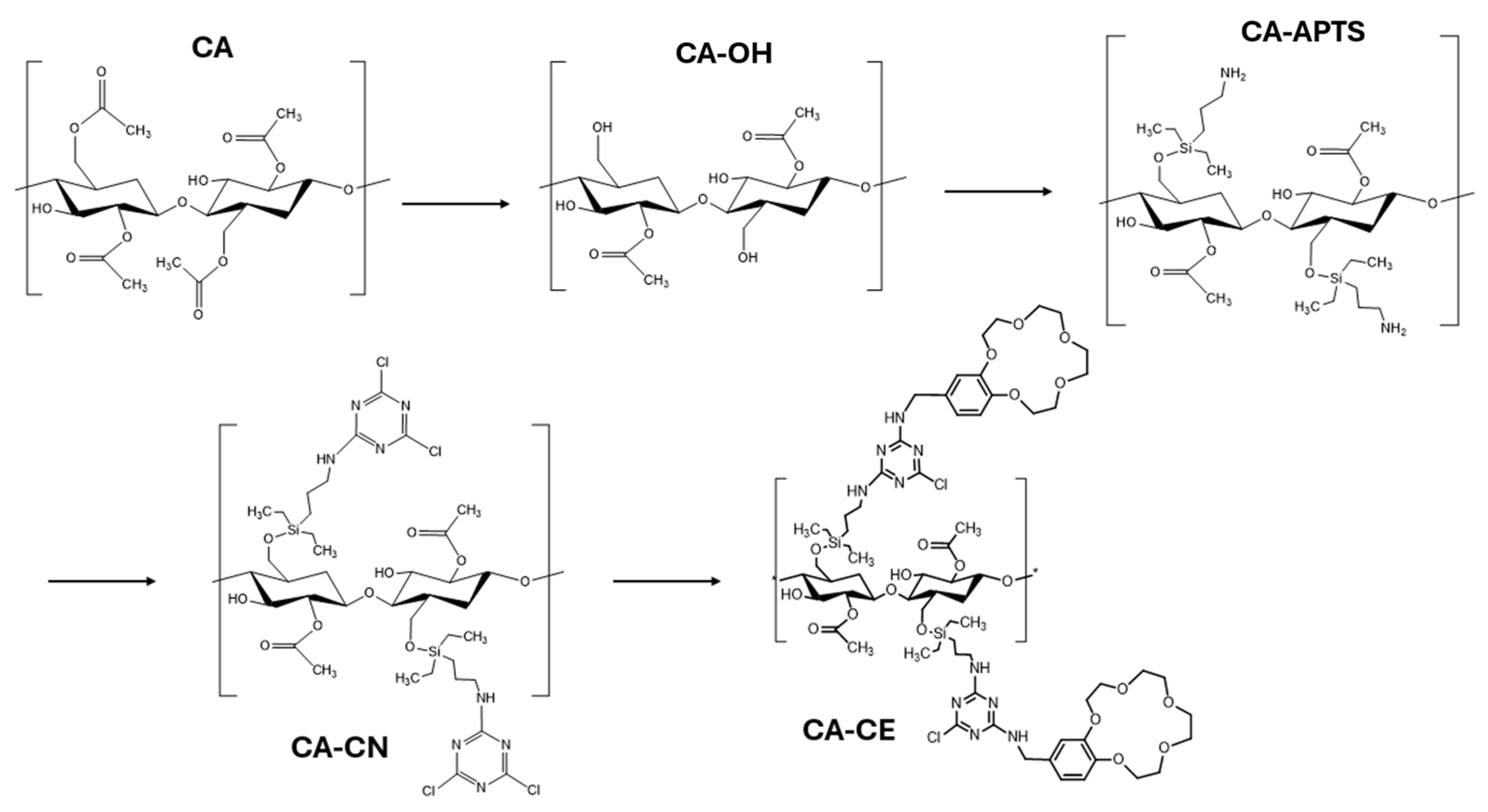
The grafting of crown ether moieties onto a CA membrane surface was performed by following a multi-step protocol adapted from ref. [44]. The theoretical mechanism of the functionalization process is schematically represented in Figure 1.
The first step of the functionalization process of the CA membrane surface consisted of a partial deacetylation to introduce hydroxyl groups. Thus, CA membranes were reacted for 24 h at room temperature with 5% NaOH (20 mL NaOH solution per membrane). After the synthesis, the membranes were washed with distilled water until neutral pH and dried. The deacetylated CA membranes will further be referred to as CA-OH. Then, the free OH groups from CA-OH were reacted with APTS by immersing them in 20 mL mild basic solution per membrane (2 mL of 0.1 N NaOH per membrane) of 20% APTS in ultra-pure water for 24 h at 37 °C. After the completion of the reaction, membranes were washed with distilled water to remove unreacted silane molecules and dried. The product of this step will be further referred to as CA-APTS. The third step was to react the free amino groups from CA-APTS with the chlorine atoms of cyanuric chloride by immersing the membranes into an absolute ethanol solution (20 mL per membrane) containing CN in a concentration of 1 mg/mL (for 2 h at 50 °C (CA-CN)). After this step, the functionalized membranes were washed with ethanol and water to remove unreacted cyanuric chloride and soluble by-products and dried. After purification, the crown ether molecules were grafted onto CA-CN membranes through chemical bonding between the free chlorine atoms from the CN linked to the CA precursor and the free amino groups of CE (CA-CE). This reaction was performed by impregnation of the CA-CN membranes in an aqueous solution (20 mL per membrane) containing the crown ether at a concentration of 0.2 mg/mL for 2 h at 60 °C. After the completion of the reaction, the resulting CA-CE membranes were rinsed with distilled water to remove any unreacted compounds and dried. All the samples were dried prior to characterization.

2.3. Characterization

Fourier Transform Infrared Spectroscopy (FTIR) spectra were recorded on a Bruker Vertex 70 equipment (Bruker Optics GmbH & Co. KG, Ettlingen, Germany) in the 400–4000 cm−1 range with 4 cm−1 resolution and 32 scans. The samples were analyzed on the attenuated total reflection (ATR) module.
X-ray photoelectron spectrometry (XPS) analysis was performed on a K-Alpha spectrometer (Thermo Fisher Scientific, East Grinstead, UK) with a monochromatic Al Kα source (1486.6 eV) in a vacuum base pressure of 2 × 10⁻⁹ mbar. Charging effects were compensated using a flood gun, and binding energy was calibrated by placing the C1s peak at 284.8 eV as internal standard. Deconvolution of C1s signals was performed through a smart background algorithm with a convolved Gaussian–Lorentzian ratio. The pass energy for the survey spectrum was set at 200 eV, while for the high-resolution C1s spectra was 20 eV.
Thermogravimetric analysis (TGA) was performed using Netzsch TG 209 F1 Libra, NETZSCH-Gerätebau GmbH, Selb, Germany equipment, from RT to 700 °C under a nitrogen atmosphere with a heating rate of 10 °C/min.
Differential scanning calorimetry (DSC) curves were recorded on a Netzsch DSC 204 F1 Phoenix equipment, NETZSCH-Gerätebau GmbH, using a heating–cooling program from RT to 300 °C at a heating rate of 10 °C/min under a nitrogen atmosphere (20 mL/min flow rate). Based on DSC results, relative crystallinity XC was computed with the aid of the following formula:
X c = H m e l t H c r y s t H 100 % × 100
where ΔHmelt represents the enthalpy associated with the melting transition and ΔHcryst represents the enthalpy associated with the crystallization transition. ΔH100% corresponds to the proposed fusion enthalpy of a perfect crystal of cellulose triacetate. For the computations implied in the determination of relative crystallinity, a value of 58.8 J/g was used according to the literature data [45].
Contact angle (CA) measurements were performed with the aid of a Drop Shape Analyzer-DSA100 from Krüss Scientific GmbH, Hamburg, Germany using water and ethylene glycol as probing liquids at room temperature by using the sessile drop method and the contact angle values were determined using the Young–Laplace equation in Advance software. Contact angle values were calculated from 20 measurements performed at each of three different positions on the membrane surface. The results are expressed as mean ± standard deviation. No inferential statistical tests were applied, as the analysis was limited to evaluating reproducibility and variability between replicate measurements.
The membranes’ performance in terms of water flux and metallic ions retention was measured at room temperature using a dead-end filtration setup. Water flux measurements were performed by passing 250 mL through a 47 mm diameter membrane disks at a transmembrane pressure of 0.8 bar. The feed solution was recirculated 5 times during the measurement for calculating and presenting the error bars. For metallic ions, retention solutions of 1 g/L for both ions were prepared. UV-Vis analysis was performed on feed solutions before and after circulation through the membrane at wavelengths of λ = 742 nm (for Cu2+) and λ = 392 nm (for Ni2+) using a Shimadzu UV-3600 UV-VIS spectrometer (Shimadzu Corporation, Kyoto, Japan) equipped with a quartz cell having a light path of 10 mm. All experiments were performed in triplicate, and the results are presented as mean ± standard deviation (SD).
The water flux (Wf) expressed in L·m−2·h−1 is calculated by the following equation:
W f =   V A · t
where Wf is the water flux, V is the volume (L) of the feed solution, A is the area (m2) of the membrane and t is the time (h).
Retention efficiency (R%) was calculated based on the following equation:
R % =   C f C p C f   × 100
where Cf is the solute concentration in the feed (mol·L−1) and Cp is the solute concentration in the permeate (mol·L−1).
Membrane performances and water flux measurements were performed in triplicate, and the results are expressed as mean values ± standard deviation. No inferential statistical tests were applied, as the analysis was limited to evaluating experimental reproducibility and variability between replicate measurements.
Scanning electron microscopy (SEM) was performed using a Quanta Inspect F microscope (Thermo Fisher Scientific, Hillsboro, OR, USA), equipped with an energy-dispersive X-ray spectrophotometer (EDX), with the accelerating voltage being set at 30 kV.

3. Results

3.1. Structural Characterization

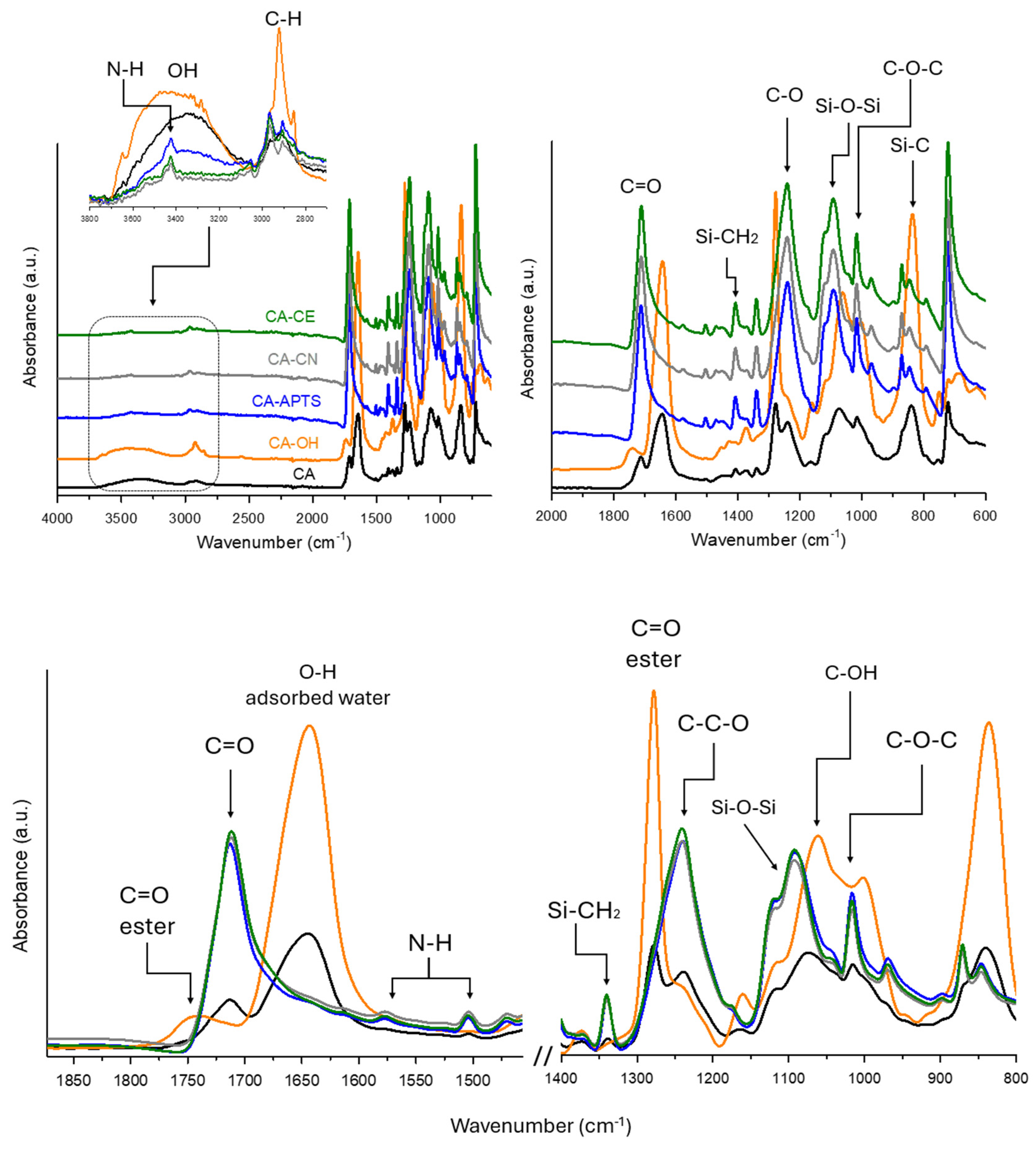
FTIR analysis was employed to evaluate the chemical structure of CA and its derivatives after each functionalization step, and the corresponding spectra are presented in Figure 2. The spectra of the pristine CA membrane display the characteristic absorption bands associated with its acetyl and polysaccharide backbone. The peak from 1713 cm−1 corresponds to the C=O stretching of acetyl groups, while the bands from 1374 cm−1 and 1240 cm−1 arise from the C–H bending and C–O stretching vibrations of the acetyl functionalities [46].
All samples display several common peaks that are characteristic for the cellulose acetate backbone such as the signal corresponding to the C–H stretching of CH2 and CH3 groups between 2800 and 3000 cm−1, the broad signal between 1016 and 1073 cm−1 that is associated with the C–O–C stretching of the pyranose ring, and the peak from 839 cm−1 which corresponds to the C–H and O–H bending vibrations that are characteristic of the β-glycosidic linkages between the sugar units of the cellulose backbone [47].
After the first step of the functionalization reactions, the appearance of new absorption bands and the variation in existing peaks confirm the success of the partial deacetylation reaction. Thus, the CA-OH membrane exhibits a broad O–H stretching band in the 3300–3500 cm−1 region, consistent with the formation of numerous hydroxyl groups [48]. Additionally, a new signal appears at 1061 cm−1 which corresponds to C–O stretching of hydroxyl groups and glycosidic linkages in cellulose [49]. The characteristic signal for acetyl groups from 1713 cm−1 shifts to 1745 cm−1 which corresponds to stretching of C=O from ester [45] and the peak from 1240 considerably decreases. These findings sustain the success of the deacetylation reaction.
Moreover, the peaks associated with the CA backbone become sharper and more intense after the NaOH-induced deacetylation. This effect may arise from the increased number of hydroxyl functionalities, which favors the formation of a strong hydrogen-bonds network within the polymer, as well as from residual acetate species that may remain entrapped within the membrane pores.
The spectrum of CA-APTS shows several distinctive features associated with silane grafting onto the CA-OH surface, including N-H-related absorptions bands at 3400 and in the 1504–1576 cm−1 region, Si-CH2 vibrations around 1337–1409 cm−1, and pronounced Si-O-Si and Si-O-C bands between 1093 and 960 cm−1. All these new peaks confirm the successful introduction of aminopropyl silane groups onto CA membranes [50,51].
For the CA-CN and CA-CE membranes, only small differences can be observed compared to the neat CA membrane. This is expected since the characteristic vibrations of cyanuric chloride and crown ether overlap with the strong C–O and C–O–C bands of the CA backbone in the 1200–900 cm−1 region. Therefore, their signals appear mainly as slight intensity changes or band broadening rather than distinct new peaks. These small modifications, although not very pronounced, are consistent with the successful introduction of the CN and CE functional groups [52].
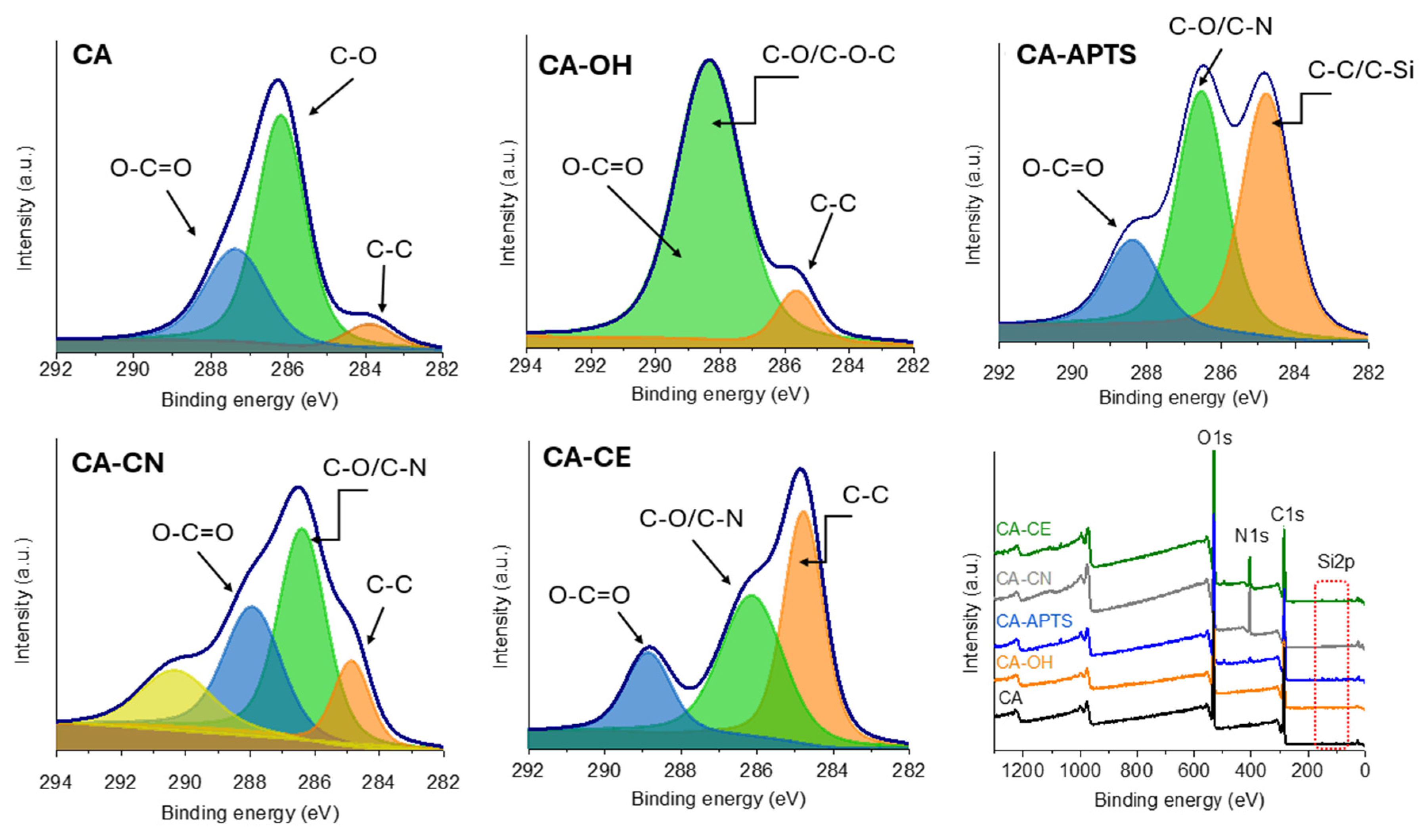
XPS was employed to investigate the surface elemental composition of CA and its chemically modified derivatives, and the corresponding results are presented in Figure 3 and Table 1. Due to the surface-sensitive nature of the XPS technique, the elemental composition was assessed qualitatively.
Following the alkaline deacetylation stage (CA-OH), the data comprised in Table 1 show a decrease in the C–C/C–O ratio as a quantitative indicator for the removal of acetyl functional groups and the formation of a hydroxyl-rich surface in a strong basic medium. The 2.5% nitrogen recorded for this sample is attributed to adventitious surface contamination or absorbed nitrogen-containing species. For the CA–OH membrane, the residual O–C=O contribution coming from the partial deacetylation may partially overlap with the broad C–O/C–O–C region. Subsequent silanization with APTS (CA-APTS) introduced the characteristic hetero-elements Si and N and led to an increase in the aliphatic carbon contribution, confirming the grafting of silane moieties [53,54]. Additionally, the increase in nitrogen content of 10.17% sustains the grafting of the amino silane moieties. However, the N/Si ratio was not considered a direct stoichiometric indication since the elemental composition may be influenced by non-uniform silane deposition, partial hydrolysis, as well as surface orientation effects [55]. In the CA-APTS sample, the APTS structure also contains C–Si bonds. However, the C–Si contribution in the C1s spectrum may overlap with the C–C/C–H region and therefore could not be clearly separated as an individual component. Consequently, the incorporation of APTS was mainly supported by the presence of Si2p and N1s signals, while the possible C–Si contribution was considered within the low-binding-energy carbon component.
The elemental surface composition of the modified membranes shown in Table 1 is in accordance with the reaction steps undertaken for their functionalization. Thus, the variation in N 1s atomic percent values during the functionalization process is well correlated with the availability of corresponding nitrogenous functional groups, as illustrated in Figure 1.
After coupling with cyanuric chloride (CA-CN) and final attachment of the amine-terminated crown ether (CA-CE), Si remained present, demonstrating the stability of the silane anchoring layer, while N persisted throughout the functionalization sequence, consistent with nitrogen-containing linkers [52]. The decreased content of N% recorded for these two samples (CA-CN and CA-CE) can be a consequence of the partial substitution of hydrolysis of both triazine and APTS moieties as well as surface rearrangement during the purification process. The absence of chlorine on the XPS survey spectra may be related to the low amount of chlorine-containing moieties at the membrane surface and partial hydrolysis of the reactive triazine chloride groups [56].
A deeper view into the structural changes obtained after surface functionalization of CA membranes was done through the deconvolution of high-resolution C1s spectra (Figure 3) in order to sustain the above findings. Thus, neat CA deconvolutes spectrum display in three secondary peaks: the first at 284.8 eV assigned to C–C/C–H, the second one at 286.1 eV corresponding to C–O, and the third at 287.9 eV coming from the O–C=O groups as ester components. In the spectrum of CA-OH, a pronounced reduction in the O-C=O contribution after deacetylation can be observed, with subsequent increase in the contribution of C–O species [57]. Similarly, the silanization process led to an increased area for the peak assigned to C–O/C–N induced by the C–N species from attached APTES, while cyanuric chloride coupling led to an increase in the species-related carbon contributions and introduced higher-binding-energy carbon signals, consistent with the formation of triazine moieties as also demonstrated by Fatona and colleagues [58]. The final crown ether functionalization was evidenced by a considerable increase in ether-type C–O contributions while preserving only a part of C-N signals due to the possible steric hindrance effect caused by molecular volumes of the attached crown ether, thus confirming the successful covalent immobilization of the crown ether through the triazine linker. Due to the complex surface chemistry, of both CA–CN and CA–CE membranes, the C1s deconvolutions contain partially overlapping contributions from the cellulose acetate backbone, silane and triazine linker and grafted crown ether units. Therefore, the deconvolution was completed by considering the main expected carbon species and the results were interpreted qualitatively.

3.2. Thermal Properties

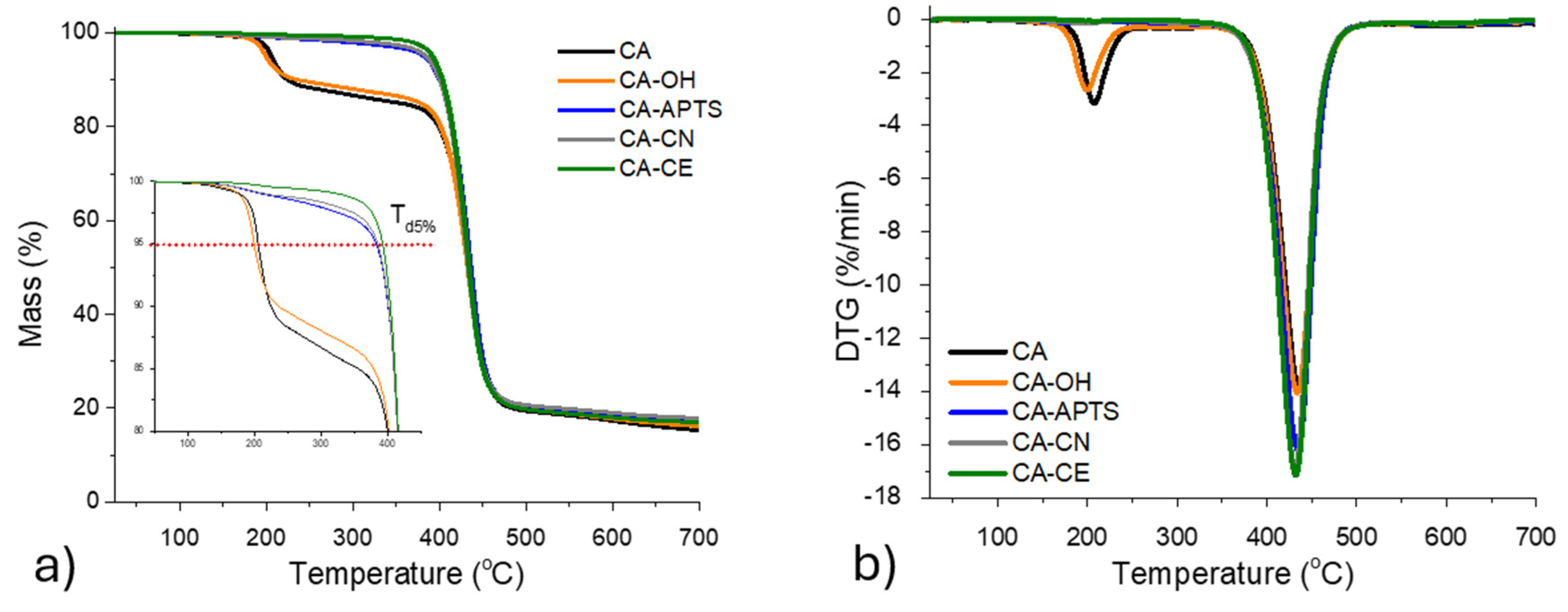
When it comes to the industrial water-purification process, the membranes need to withstand higher temperatures, thus the evaluation of thermal behavior is important. Additionally, it can provide valuable insights into surface chemistry and chemical modification of the samples. Thermal behavior was evaluated using TGA (and the corresponding DTG curves) as well as DSC. The corresponding thermograms are presented in Figure 4 and Figure 5 and the corresponding data in Table 2.
Thermal stability graphs revealed that all samples exhibit a major degradation step around 430 °C associated with the scission of the cellulose backbone [59]. Neat CA and the CA-OH membrane display an additional thermal event at ~200 °C which can be attributed to the removal of physically absorbed water as well as thermal-induced deacetylation [60]. Temperatures around 200 °C induce the cleavage of acetyl groups from the polymer backbone resulting in a mass loss of ~10%. Along with the functionalization reaction, the APTS, CN and CE-modified membranes display considerably higher onset degradation temperatures, with Td3% values ranging from 348 to 381 °C and an increased char yield. These indicate that the incorporation of APTS, cyanuric chloride, and crown ether enhances the thermal stability of the CA matrix, likely due to the introduction of more thermally robust moieties or additional crosslinking effects [61,62].
Nevertheless, all samples exhibit close values for Tmax between 431 and 436 °C and residual masses, implying that the primary decomposition mechanism of the cellulose backbone remains constant after functionalization.
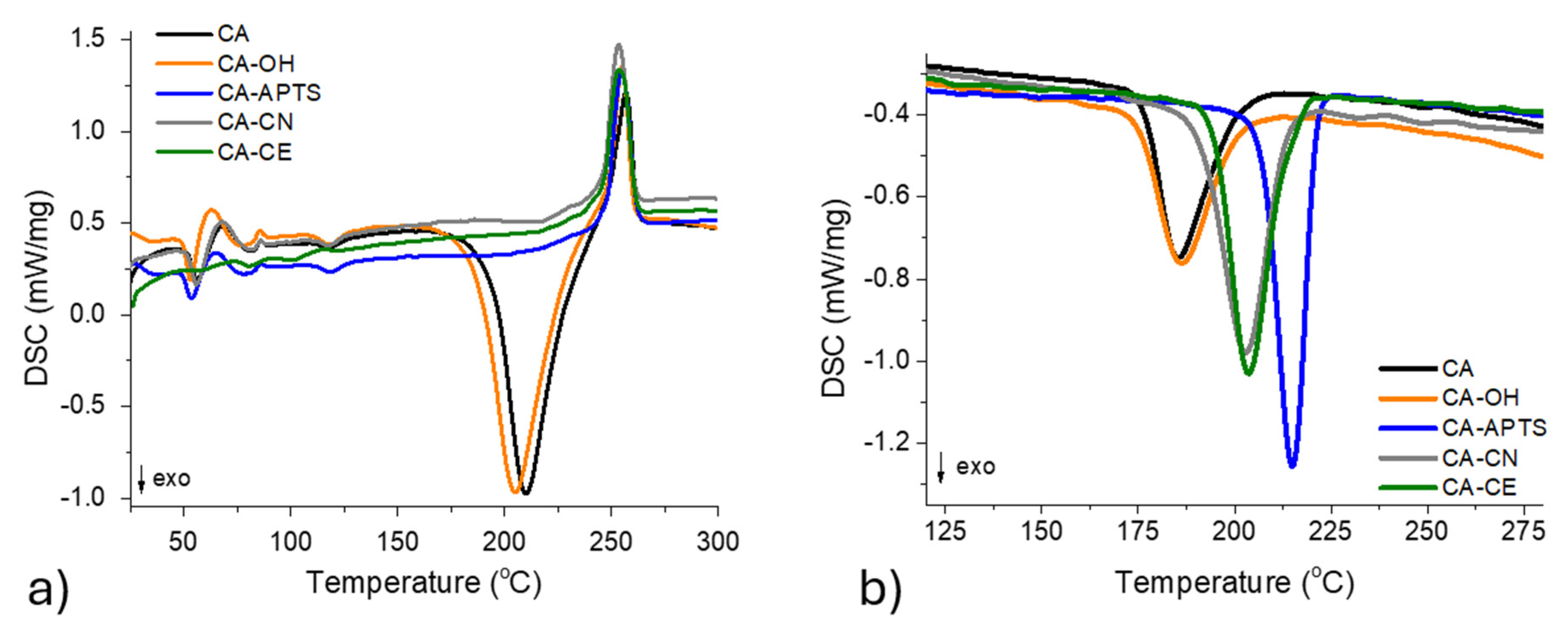
To support the observations derived from the TGA measurements, DSC [63] was carried out as a complementary thermal analysis technique as it can provide additional insight into the thermal transitions and stability of the pristine and functionalized CA membranes (Figure 5). The CA and CA-OH samples displayed a prominent exothermal event around 210–220 °C. These findings correlate well with the TGA results highlighting the occurrence of a chemical process [64]. This conduct is consistent with the thermal-induced deacetylation or oxidation processes that take place with the release of volatile products such as acetic acid. However, previous studies concluded that, around 220 °C [65], crystallization process of the amorphous regions of cellulose acetate occur and thus these processes may overlap on the thermogram.
As functionalization reactions proceed, exothermal events are no longer present in the DSC curves of CA-APTE, CA-CN and CA-CE samples. These results correlate with the TGA, where the 10% mass loss does not occur. This suggests that additional moieties such as silane, triazine and crown ether increase thermal stability by creating a more stable layer.
The second endothermal event around 250 °C may describe a melting-like thermochemical transition of cellulose acetate domains. The maximum temperature of this peak gradually decreases after each functionalization step. The introduction of additional functional groups leads to a decreased fraction of the polymeric domain, and they are then able to undergo crystallization and formation of more rigid segments with limited mobility. This may be a consequence of multiple interactions and crosslinking processes that may take place after each grafting step. Thus, APTS leads to the formation of a silane layer that will reduce the mobility at the surface; cyanuric chloride induces rigidity while the bulky structure of crown ether will increase stability and create more sterically hindered interfacial regions.
DSC results were employed to compute the relative crystallinity (XC) which, in the case of cellulose acetate, can be correlated with the degree of molecular order and the influence of secondary interactions. Along with functionalization, it can be observed from Table 3 that the XC value decreases. This indicates that more flexible substituents are introduced that may act as plasticizers [66,67]. The same conduct is indicated by the values for Tg. The introduction of rigid and bulky substituents leads to an increase in both XC and Tg in comparison with the CA sample. In this case, the rigid triazine rings and crown ether units may increase the molecular order through strong interactions such as π-π, or the host guest reducing mobility of the macromolecular segments [68,69].

3.3. Surface Properties and Membrane Performances

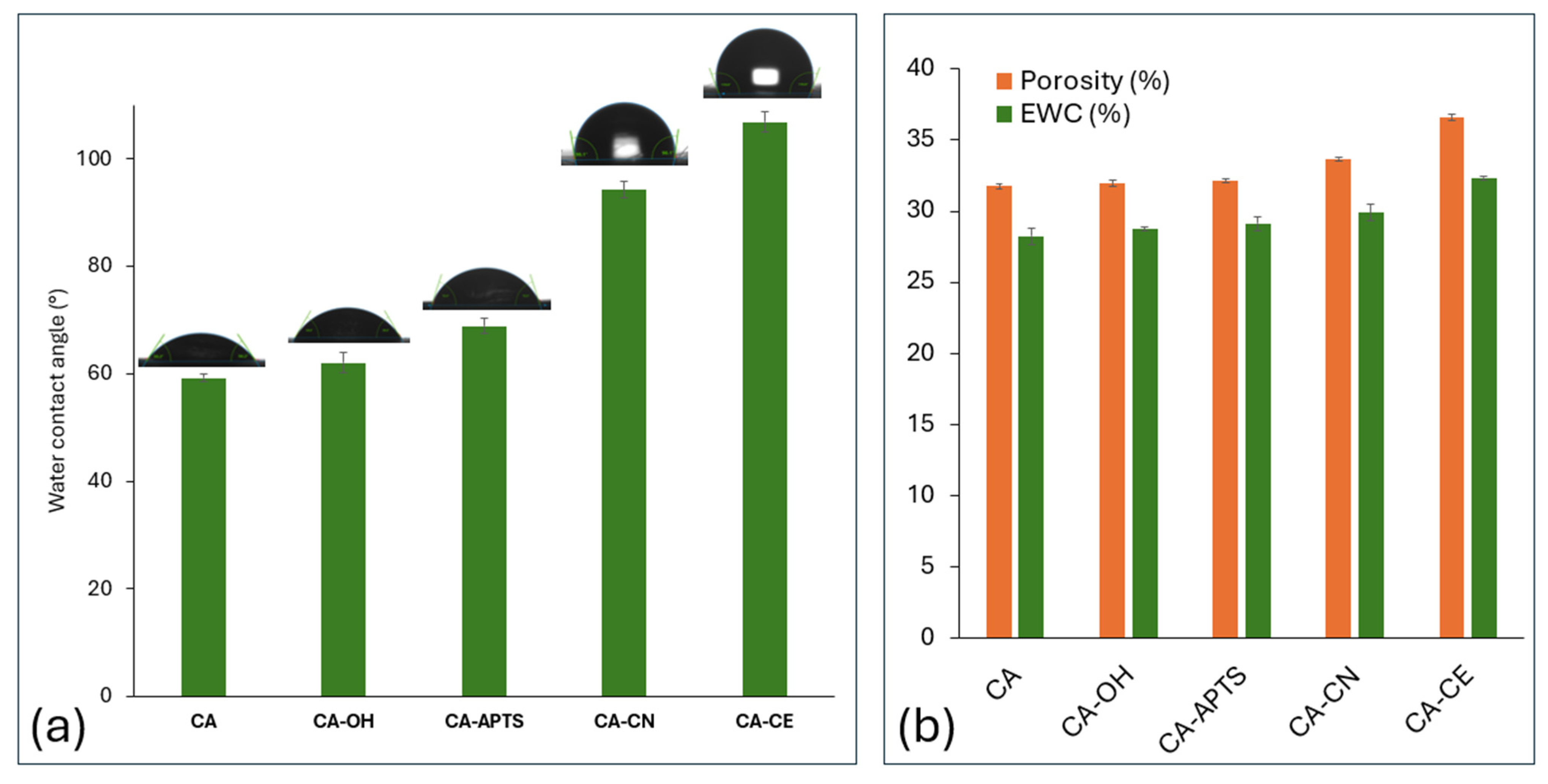
Water contact angle measurements were performed to evaluate the changes in surface wettability of CA and its chemically modified derivatives, and the corresponding results are presented in Figure 6a. As expected, the CA sample exhibited a hydrophilic conduct (60° WCA) as a consequence of its polar acetate and residual hydroxyl groups [70]. After treatment with sodium hydroxide (CA-NaOH), a slight increase in the contact angle can be noticed. This effect arises from the partial deacetylation process that, beside acetate group removal, sustained a redistribution of surface hydroxyl groups, which may consequently reduce wettability. Additionally, surface rearrangements may take place, exposing fewer polar domains or morphological heterogeneity of the membrane surface. Subsequent functionalization with APTS resulted in a further increase in the contact angle (~70°) which can be attributed to the incorporation of hydrophobic propyl and silane moieties [70].
After the modification of CA-APTES with cyanuric chloride (CA-CN), the contact angle significantly increased to approximately 95°, indicating a transition toward a more hydrophobic surface [58]. This is a consequence of the introduction of aromatic triazine structures and their reduced surface polarity. Finally, crown ether-functionalized CA (CA-CE) shows the highest contact angle vales (~105°), denoting an enhanced hydrophobic character [71]. This may be due to steric hindrance, increased surface roughness, and due to the nonpolar character of crown ether units. At the same time, the rigid and bulky triazine and crown ether moieties can create a surface layer that protects the underlying polar groups present on the cellulose backbone.
In contrast, the porosity and EWC values (Figure 6b) remain relatively high for all membranes and even show a slight increase for CA-CN and CA-CE in comparison with the CA membrane [72]. This suggests that, although the outer surface becomes more hydrophobic, the functionalization steps do not alter the density and the internal structure of the membranes. Additionally, the pore volume and the capacity of the membranes to absorb water are preserved. Overall, these results show that the surface and the bulk of the membranes have a distinct conduct. Although the CN and CE-modified membranes have a hydrophobic surface, they maintain high porosity and a good ability to absorb water.

3.4. Membrane Performances

The metallic ion rejection performance was evaluated over five consecutive filtration cycles against Ni2+ and Cu2+ ions. These metallic species were considered, as it was previously demonstrated that divalent cations can interact with the polymeric matrix through various interactions such as electrostatic and hydrogen bonds, increasing the removal efficiency [73,74]. Since pH and ionic strength can strongly affect metal ion speciation and competitive ion transport, their influence should be systematically investigated in future works. In the present study, the experiments were conducted under fixed conditions to primarily assess the effect of crown ether functionalization on membrane performance.
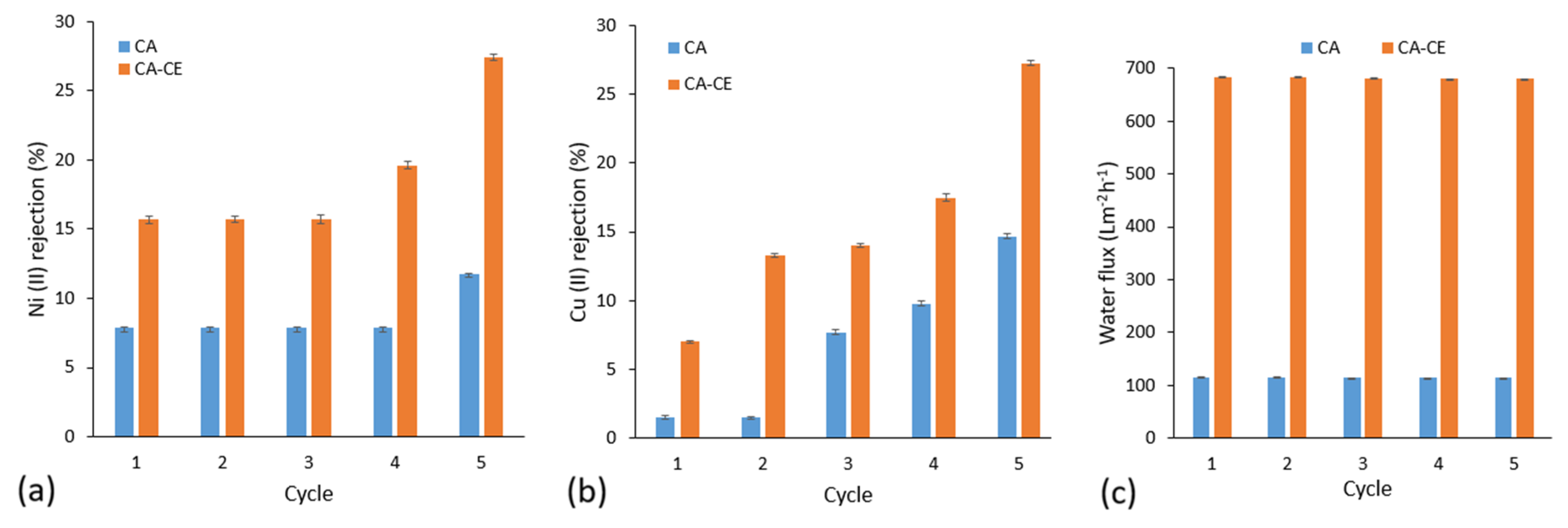
As shown in Figure 7, the incorporation of crown ether moieties leads to a substantial improvement in retention performance as the results highlight a clear distinction between the CA and the CA-CE membranes. For Ni2+, the CA-CE membranes exhibit a progressive increase from approximately 15% in the first cycle to ~30% in the fifth cycle, whereas the CA membranes maintain consistently low rejection values below 10%. A similar trend is observed for Cu2+, where the CA-CE membranes achieve rejection efficiencies almost three times higher than those of CA, reaching ~27% in the final cycle. During the fifth cycle, the CA-CE membranes showed an increase in rejection that may take place due to complexation interactions occurring between the crown ether groups grafted onto the CA membranes’ surface and Ni2+ and Cu2+ ions [75]. This is due to progressive membrane conditioning during filtration. Repeated exposure to the aqueous solution may improve wetting of the functionalized membrane and stabilize water transport pathways, thereby increasing pore accessibility and flux.
The retention efficiency of the crown ether units is strongly influenced by the ion radius which will exert strong binding interactions with a cavity with a suitable dimension [76]. Since Ni2+ and Cu2+ have smaller ionic radii than the typical cavity preference of the 15-crown-5 ether, the retention of the metallic species takes place through combined chemical and membrane-related effects. The grafter macrocyclic ligands provide oxygen-rich coordination sites that can interact with the metallic ions at the membrane surface while neighboring functional groups of the functional membranes such as silane and triazine may also contribute to multi-site interactions atoms [76,77].
The improved Ni2+ and Cu2+ retention of CA-CE is attributed to combined effects of crow-ether-assisted surface interactions, neighboring functional groups and modified membrane transport properties. However, adsorption isotherms and quantitative crown ether loading were not determined in this study and will be addressed in future work.
Complexation involving one or multiple CE units may lead to localized crosslinking or densification of the functionalized surface layer. Such structural rearrangements can enhance the barrier properties of the membrane during repeated operation, therefore contributing to the pronounced increase in rejection in the later cycles [44].
Since studies addressing cellulose acetate membranes covalently functionalized with crown ether for Ni2+ and Cu2+ retention are limited, the present system was compared with representative systems (Table 4) containing polymers and crown ether units developed for heavy metal ion removal.
Additionally, water flux for CA and CA-CE membranes was evaluated and the corresponding results are presented in Figure 7. The CA membrane displays an initial flow of ~120 Lm−2h−1 with a small decrease over the five cycles. This is a consequence of the gradual compression of the polymer chains within the porous layer under hydraulic pressure, which stabilizes the internal structure of the membrane over repeated operation [44]. The CA-CE membranes display a remarkably higher water flux, maintaining values around 620–650 Lm−2h−1 throughout all cycles. The stability of the water flux indicates that CE grafting not only improves water transport but also contributes to structural integrity and hinders the fouling during repeated operation.
The higher water flux observed for the functionalized membranes indicates that permeability was influenced not only by surface wettability. The progressive modification and purification steps may have also improved pore accessibility, promoted membrane conditioning and included structural rearrangements that facilitated water transport.
Although the CA-CE membrane exhibits a higher apparent contact angle than the neat CA membrane, an increased flow rate was observed. This indicates that water transport is not governed only by the surface wettability. The contact angle mainly reflects the interaction between water and the exterior membrane surface, whereas the flow rate is strongly influenced by the internal structure of the membrane, including pore accessibility, water transport pathways, swelling behavior and morphological changes induced by functionalization. Therefore, the higher flow rate of CA-CE may be attributed to improved pore accessibility and membrane conditioning after modification, rather than hydrophobicity itself.
Overall, the enhancement in both permeability and metal ion rejection demonstrates the synergistic effect of CE functionalization, confirming that the developed CA-CE membranes exhibit good performance and long-term stability compared to unmodified CA membranes.
The retention studies were performed using single-solute Cu2+ and Ni2+ solutions to evaluate the effect of crown ether functionalization under controlled conditions. Building on these results, future work will consider multicomponent systems and simulated wastewater matrices in order to further assess ion selectivity and performance under conditions closer to practical water treatment applications.
XPS was further used to confirm the presence and surface retention of Cu2+ and Ni2+ ions on CA and CA-CE membranes after the adsorption experiments. As shown in Table 5, pristine CA membranes exhibit only a trace amount of copper (0.09 at.%), indicating weak interaction between the polymer matrix and metal ions. In contrast, CA-CE membranes show higher metal atomic percentages, with Cu reaching 0.12 at.% and Ni 1.47 at.%, demonstrating enhanced metal ion retention upon crown ether functionalization.

3.5. Surface Morphology

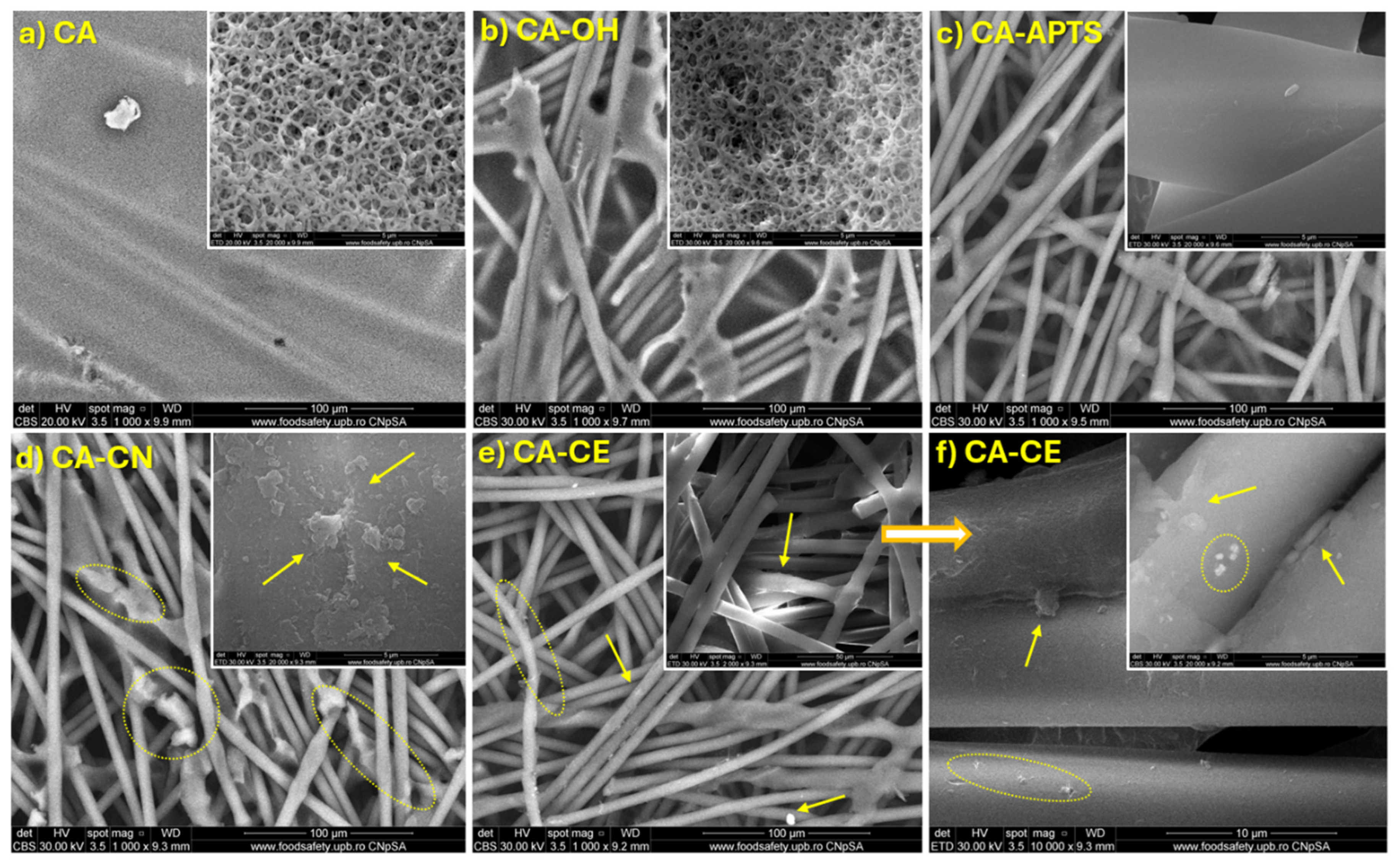
Surface morphology and roughness of CA and functionalized derivative membranes were evaluated through SEM, and the corresponding micrographs are presented in Figure 8. The pristine CA membrane exhibits a smooth surface with uniform and well-defined pores. After deacetylation with NaOH, the CA-OH sample displays a slightly rougher surface with more defined fibers. Additionally, NaOH treatment opens the dense surface layer and removes internal additives from the commercial CA membrane, creating more open spaces and increasing the overall porosity and roughness. It can clearly be observed that along with the functionalization process, fiber morphology changes accordingly after each step.
APTS functionalization produces a distinct morphology characterized by a smoother and more continuous coating on the fiber surfaces. In the case of the CA-CN sample, the bulky domains are consistent with surface grafting of triazine rings and partial crosslinking, as previously reported for cyanuric chloride-modified membranes [62,83]. The resulting increase in surface roughness and functionality indicates a high density of reactive sites. CA-CE fibers display increased roughness, localized surface protrusions and heterogeneous domains, attributed to the covalent grafting and partial aggregation of bulky crown ether moieties [75] (Figure 8e,f). These surface features are attributed to the attachment of bulky macrocyclic crown ether moieties, which commonly form non-uniform surface coatings due to their size, hydrophobic character, and tendency to aggregate [84]. Overall, a progression from smooth (CA) to increasingly rough, chemically active surfaces (CA-CN, CA-CE) is observed, confirming the success of the functionalization reaction. Moreover, the morphological changes correlate with the improvements in metal ion affinity and retention.

4. Discussion

The retention of heavy metal ions represents a continuous challenge in the current context of concerns for a clean environment. If for large quantities of heavy metals we have the possibility to use ion exchangers, regardless of the nature of the ions, for small quantities, the solutions are quite limited [85,86]. The use of crown ethers for ion complexation is an elegant solution to this problem [87,88,89]. Their use is limited by their immobilization on particles or membranes to carry out the separation process. In the context of the circular economy, the use of ‘green’ polymers has led to an increase in research in this field, one of the main candidates being cellulose acetate due to its versatility in the synthesis of polymeric membranes [90,91]. The retention capacity of cellulose acetate for heavy metal ions can be explained by its ability to complex ions with the help of free electrons from acetyl groups [92]. The problem with its use in the membrane form is that multiple recirculation steps are required to increase the efficiency of the process [93]. The functionalization of cellulose acetate membranes with crown ether has been successfully reported for Gd(III) retention in aqueous solutions [44]. In this case, the crown ether was immobilized by means of the APTES and glutaraldehyde linker molecules. Also, for Gd(III) retention, cellulose acetate membranes functionalized with calmagite were used, in this case the membrane having the advantage that the membrane changes its surface color as the separation occurs [59]. Crown ethers immobilized on cellulose acetate by means of ethanolamine were also used for the retention of Ca2+ ions [52]. Also, the binding was achieved with the help of the APTES and glutaraldehyde linker molecules. Cellulose acetate was functionalized with Rhodamine B hydrazide for Cu(II) retention to optimize its detection, with the maximum efficiency of retention at the detection of solutions with concentrations in the range of 0–100 ppm of CuCl2 solution [94]. By preparing CA composite membranes with montmorillonite, a separation efficiency of 60 mg/g Cu(II)/membrane weight was obtained for a concentration of 5% montmorillonite in CA [95]. Other effective fillers for metal retention using cellulose acetate membranes are hydroxyapatite [96,97,98], magnetic particles [99,100], carbon nanotubes [101] or layered double hydroxide [102].
The use of cyanuric chloride for linking crown ethers represents another advantage reported in this work, given the fact that after the first substitution of a chlorine atom, the aromatic ring is deactivated and the crosslinking effect during membrane functionalization is avoided. Also, the immobilization of crown ethers onto cellulose acetate opens the possibility of retention of heavy metal ions for a wide range of other elements.
Although the CA-CE membrane showed improved Ni2+ and Cu2+ retention compared with neat CA, the rejection efficiencies remain moderate when considered from the perspective of practical water treatment. Therefore, the present system should be considered as a proof-of-concept functional membrane platform rather than an optimized treatment material. Further studies are required to improve retention efficiency and validate membrane performance under more realistic water-treatment conditions.

5. Conclusions

In this work, a stepwise functionalization strategy was successfully applied to cellulose acetate membranes to achieve the covalent immobilization of crown ether moieties via a cyanuric chloride linker. FTIR and XPS results confirmed the progressive introduction of hydroxyl, silane, triazine, and crown ether functionalities, demonstrating the effectiveness and stability of the surface modification. Thermal analyses further indicate that the functionalized membranes exhibit improved thermal stability while preserving the integrity of the cellulose backbone.
Crown ether functionalization led to a significant enhancement in membrane performance such as a substantial increase in water flux and excellent operational stability. The CA-CE membranes showed higher retention of Ni2+ and Cu2+ ions, reaching ~30% and ~27%, respectively, after five filtration cycles, compared with values below 10% for pristine CA, indicating strong affinity and stable metal coordination at the membrane surface.
These results demonstrate that crown ether immobilization is an effective approach for simultaneously enhancing permeability and heavy metal ion retention in cellulose acetate membranes, highlighting their potential for advanced water purification applications.

Author Contributions

Conceptualization, S.I.V. and E.I.P.; methodology, E.I.P., A.M.P., M.O., A.I.N. and S.I.V.; validation, E.I.P., A.M.P., M.O., A.I.N. and S.I.V.; formal analysis, E.I.P., A.M.P., A.I.N. and M.O.; investigation, E.I.P., A.M.P., A.I.N. and M.O.; data curation, S.I.V. and M.O.; writing—original draft preparation E.I.P.; writing—review and editing, E.I.P. and M.O.; supervision, S.I.V. All authors have read and agreed to the published version of the manuscript.

Funding

This work received no funding.

Data Availability Statement

The original contributions presented in this study are included in the article. Further inquiries can be directed to the corresponding author.

Conflicts of Interest

The authors declare no conflicts of interest.

References

  1. Singh, V.; Ahmed, G.; Vedika, S.; Kumar, P.; Chaturvedi, S.K.; Rai, S.N.; Vamanu, E.; Kumar, A. Toxic heavy metal ions contamination in water and their sustainable reduction by eco-friendly methods: Isotherms, thermodynamics and kinetics study. Sci. Rep. 2024, 14, 7595. [Google Scholar] [CrossRef]
  2. Nagar, V.; Verma, R.K.; Awasthi, G.; Pandit, P.P.; Chopde, R.L.; Sankhla, M.S.; Singh, A.; Sharma, A.; Awasthi, K.K.; Aseri, V.; et al. Heavy Metal Contamination of Water and Their Toxic Effect on Living Organisms. In The Toxicity of Environmental Pollutants; Junqueira Dorta, D., Palma De Oliveira, D., Eds.; IntechOpen: London, UK, 2022. [Google Scholar]
  3. Zamora-Ledezma, C.; Negrete-Bolagay, D.; Figueroa, F.; Zamora-Ledezma, E.; Ni, M.; Alexis, F.; Guerrero, V.H. Heavy metal water pollution: A fresh look about hazards, novel and conventional remediation methods. Environ. Technol. Innov. 2021, 22, 101504. [Google Scholar] [CrossRef]
  4. Kapoor, D.; Singh, M.P. 10—Heavy metal contamination in water and its possible sources. In Heavy Metals in the Environment; Kumar, V., Sharma, A., Cerdà, A., Eds.; Elsevier: Amsterdam, The Netherlands, 2021; pp. 179–189. [Google Scholar]
  5. Madjar, R.M.; Vasile Scăețeanu, G. An Overview of Heavy Metal Contamination in Water from Agriculture: Origins, Monitoring, Risks, and Control Measures. Sustainability 2025, 17, 7368. [Google Scholar] [CrossRef]
  6. Dagdag, O.; Quadri, T.W.; Haldhar, R.; Kim, S.-C.; Daoudi, W.; Berdimurodov, E.; Akpan, E.D.; Ebenso, E.E. An Overview of Heavy Metal Pollution and Control. In Heavy Metals in the Environment: Management Strategies for Global Pollution; ACS Symposium Series; American Chemical Society: New York, NY, USA, 2023; Volume 1456, pp. 3–24. [Google Scholar]
  7. Liu, Z.; Sang, J.; Zhu, M.; Feng, R.; Ding, X. Prediction and countermeasures of heavy metal copper pollution accident in the Three Gorges Reservoir Area. J. Hazard. Mater. 2024, 465, 133208. [Google Scholar] [CrossRef] [PubMed]
  8. Hama Aziz, K.H.; Mustafa, F.S.; Omer, K.M.; Hama, S.; Hamarawf, R.F.; Rahman, K.O. Heavy metal pollution in the aquatic environment: Efficient and low-cost removal approaches to eliminate their toxicity: A review. RSC Adv. 2023, 13, 17595–17610. [Google Scholar] [CrossRef]
  9. Salehi, F.; Esmaeilbeigi, M.; Kazemi, A.; Sharafi, S.; Sahebi, Z.; Asl, A.G. Spatial health risk assessments of nickel in the groundwater sources of a mining-impacted area. Sci. Rep. 2024, 14, 11017. [Google Scholar] [CrossRef] [PubMed]
  10. Genchi, G.; Carocci, A.; Lauria, G.; Sinicropi, M.S.; Catalano, A. Nickel: Human Health and Environmental Toxicology. Int. J. Environ. Res. Public Health 2020, 17, 679. [Google Scholar] [CrossRef]
  11. Oladimeji, T.E.; Oyedemi, M.; Emetere, M.E.; Agboola, O.; Adeoye, J.B.; Odunlami, O.A. Review on the impact of heavy metals from industrial wastewater effluent and removal technologies. Heliyon 2024, 10, e40370. [Google Scholar] [CrossRef]
  12. Piwowarska, D.; Kiedrzyńska, E.; Jaszczyszyn, K. A global perspective on the nature and fate of heavy metals polluting water ecosystems, and their impact and remediation. Crit. Rev. Environ. Sci. Technol. 2024, 54, 1436–1458. [Google Scholar] [CrossRef]
  13. WHO Guidelines Approved by the Guidelines Review Committee. In Guidelines for Drinking-Water Quality: Fourth Edition Incorporating the First Addendum; World Health Organization Copyright © World Health Organization 2017; WHO: Geneva, Switzerland, 2017.
  14. Lei, W.; Sun, M.; Zhang, W.; Liang, L.; Ding, Z.; Tang, X.; Dai, H.; Liu, X.; Qi, P.; Wang, Y. Synergistic interfacial engineering of CNF@MN@MX composite membranes for highly efficient and recyclable photocatalytic detoxification of Cr(VI). Chem. Eng. J. 2026, 530, 173410. [Google Scholar] [CrossRef]
  15. Ayach, J.; El Malti, W.; Duma, L.; Lalevée, J.; Al Ajami, M.; Hamad, H.; Hijazi, A. Comparing Conventional and Advanced Approaches for Heavy Metal Removal in Wastewater Treatment: An In-Depth Review Emphasizing Filter-Based Strategies. Polymers 2024, 16, 1959. [Google Scholar] [CrossRef] [PubMed]
  16. Song, S.; Li, Q.; Leslie, G.; Shen, Y. Water treatment methods in heavy metals removal during photovoltaic modules recycling: A review. Resour. Conserv. Recycl. 2024, 208, 107701. [Google Scholar] [CrossRef]
  17. Qasem, N.A.A.; Mohammed, R.H.; Lawal, D.U. Removal of heavy metal ions from wastewater: A comprehensive and critical review. npj Clean Water 2021, 4, 36. [Google Scholar] [CrossRef]
  18. Razzak, S.A.; Faruque, M.O.; Alsheikh, Z.; Alsheikhmohamad, L.; Alkuroud, D.; Alfayez, A.; Hossain, S.M.Z.; Hossain, M.M. A comprehensive review on conventional and biological-driven heavy metals removal from industrial wastewater. Environ. Adv. 2022, 7, 100168. [Google Scholar] [CrossRef]
  19. Vo, T.S.; Hossain, M.M.; Jeong, H.M.; Kim, K. Heavy metal removal applications using adsorptive membranes. Nano Converg. 2020, 7, 36. [Google Scholar] [CrossRef] [PubMed]
  20. Vatanpour, V.; Pasaoglu, M.E.; Barzegar, H.; Teber, O.O.; Kaya, R.; Bastug, M.; Khataee, A.; Koyuncu, I. Cellulose acetate in fabrication of polymeric membranes: A review. Chemosphere 2022, 295, 133914. [Google Scholar] [CrossRef] [PubMed]
  21. Hasri; Pratiwi, D.E.; Muharram; Syahrir, M.; Putri, F.N.N. Cellulose Acetate Membrane Synthesis of Banana Peel. IOP Conf. Ser. Earth Environ. Sci. 2023, 1209, 012010. [Google Scholar] [CrossRef]
  22. Abu-Zurayk, R.; Alnairat, N.; Khalaf, A.; Ibrahim, A.A.; Halaweh, G. Cellulose Acetate Membranes: Fouling Types and Antifouling Strategies—A Brief Review. Processes 2023, 11, 489. [Google Scholar] [CrossRef]
  23. Islam, M.D.; Uddin, F.J.; Rashid, T.U.; Shahruzzaman, M. Cellulose acetate-based membrane for wastewater treatment—A state-of-the-art review. Mater. Adv. 2023, 4, 4054–4102. [Google Scholar] [CrossRef]
  24. Morsy, A.; Hatem, N.; Ewais, H.A.; Mohamed, S.; Morsy, A.; Fathi, H.; Tarek, A.; Nassef, E. High-performance self-cleaning cellulose acetate membranes reinforced with nanochitosan for heavy metal removal. Environ. Res. 2026, 288, 123197. [Google Scholar] [CrossRef]
  25. Basta, A.H.; Lotfy, V.F.; Salem, A.M. Multifunctional esterified versus carbon-based cellulose acetate membranes: Structural, thermal, and fluorescence insights into copper ion adsorption and detection. Int. J. Biol. Macromol. 2025, 334, 149101. [Google Scholar] [CrossRef] [PubMed]
  26. Fatima, A.; Saif, H.M.; Nascimento, F.X.; Pawlowski, S.; Crespo, J.G. Selective lithium recovery using bacterial cellulose acetate membranes: Toward green recycling of spent Li-ion batteries. J. Membr. Sci. 2026, 737, 124776. [Google Scholar] [CrossRef]
  27. Mo, M.; Lin, Y.; Lin, D.; Ma, X.; Hong, Y.; Chen, L.; Wang, D.; Huang, L. Regulating the morphological structure of cellulose acetate ultrafiltration membrane by adjusting the ratio of N, N-dimethylacetamide: N-methyl pyrrolidone in co-solvent to enhance separation and anti-fouling performance. Desalination 2025, 615, 119295. [Google Scholar] [CrossRef]
  28. Yang, X.; Ma, H.; Chen, Y.; Venkateswaran, S.; Hsiao, B.S. Functionalization of cellulose acetate nanofibrous membranes for removal of particulate matters and dyes. Int. J. Biol. Macromol. 2024, 269, 131852. [Google Scholar] [CrossRef] [PubMed]
  29. Pandele, A.M.; Neacsu, P.; Cimpean, A.; Staras, A.I.; Miculescu, F.; Iordache, A.; Voicu, S.I.; Thakur, V.K.; Toader, O.D. Cellulose acetate membranes functionalized with resveratrol by covalent immobilization for improved osseointegration. Appl. Surf. Sci. 2018, 438, 2–13. [Google Scholar] [CrossRef]
  30. Gokel, G.W.; Leevy, W.M.; Weber, M.E. Crown Ethers: Sensors for Ions and Molecular Scaffolds for Materials and Biological Models. Chem. Rev. 2004, 104, 2723–2750. [Google Scholar] [CrossRef]
  31. Ullah, F.; Khan, T.A.; Iltaf, J.; Anwar, S.; Khan, M.F.; Khan, M.R.; Ullah, S.; Fayyaz ur Rehman, M.; Mustaqeem, M.; Kotwica-Mojzych, K.; et al. Heterocyclic Crown Ethers with Potential Biological and Pharmacological Properties: From Synthesis to Applications. Appl. Sci. 2022, 12, 1102. [Google Scholar] [CrossRef]
  32. Xiong, L.; Wang, L.; Zhang, F.; Zhang, Y.; Zhang, S.; Xiao, S.; Wang, S.; Wang, J. Crown ether-based polyamine-type polymers for high-performance anion exchange membrane. Polymer 2025, 340, 129268. [Google Scholar] [CrossRef]
  33. Du, J.; Xiao, J.; Ma, X.; Li, J. Crown ether-functionalized polyimide nanofiber membranes fabricated by in-situ grafting and electrospinning for efficient selective adsorption of cesium. Desalination 2026, 618, 119445. [Google Scholar] [CrossRef]
  34. Jaehnke, S.; Abetz, V. Electrospun, crown ether functionalized PS-b-PMAA block copolymer fibers for Li extraction from aqueous media. Desalination 2025, 616, 119343. [Google Scholar] [CrossRef]
  35. Zhao, H.; Zhang, L.; Hui, H.; Pei, H.; Li, X. Construction of crown ether-based polyamide composite nanofiltration membrane with high Mg2+ transportation barrier for efficient Mg2+/Li+ separation. J. Membr. Sci. 2026, 738, 124866. [Google Scholar] [CrossRef]
  36. Zhang, S.; Zhang, Y.; Zhang, F.; Wang, L.; Xiong, L.; Xiao, S.; Wang, S.; Wang, J. High-performance twisted ether-free polymer based anion exchange membranes with crown ether units. J. Mol. Struct. 2026, 1351, 144192. [Google Scholar] [CrossRef]
  37. Shahbabaei, M.; Elawadly, R.; Lin, H.; Tu, Q.H. Molecular understanding of Li+ separation from divalent cations across GO-crown-ether functionalized membrane: A molecular dynamics study. J. Phys. Chem. Solids 2026, 208, 113217. [Google Scholar] [CrossRef]
  38. Tian, L.; Sun, Y.; Chen, Y.; Hu, Y.; Lu, Z. Quaternized benzoxazine oligomers and crown ethers dual-regulated nanofiltration membranes for efficient Mg2+/Li+ separation from salt-lake brine. Sep. Purif. Technol. 2026, 387, 136683. [Google Scholar] [CrossRef]
  39. He, J.; Hua, J.; Ma, X.; Li, J. Ionic liquid-based supported liquid membranes for enhanced cesium continuous separation via crown-ether facilitated transport. J. Membr. Sci. 2025, 731, 124239. [Google Scholar] [CrossRef]
  40. Liang, Y.; Pan, R.; Yang, B.; Li, X.; Wang, M.; Cui, Z.; He, B.; Yan, F. Synergistic integration of crown ether and Girard’s reagent T in nanofiltration membranes for high-efficiency lithium extraction from salt lake brine. J. Membr. Sci. 2026, 738, 124740. [Google Scholar] [CrossRef]
  41. Du, Y.; Lei, D.; Hao, X.; Liu, Z.; Du, X. Crown ether-functionalized 3D COF membrane with ion-recognition sites for enhanced monovalent cation selectivity. Sep. Purif. Technol. 2025, 376, 133979. [Google Scholar] [CrossRef]
  42. Zhou, Z.; Han, S.; Gan, N.; Zhang, Q.; Xue, H.; Li, M.; Wu, H.; Gu, Q.; Wang, Q.; Low, Z.-X.; et al. Thin-film composite membranes featuring open-chain crown ether aromatic diacyl chloride for monovalent/divalent ion separation. J. Membr. Sci. 2025, 730, 124165. [Google Scholar] [CrossRef]
  43. Li, E.; Yuan, Y.; Li, Z.; Zhu, H.; Qiu, X.; Li, S.; Xia, Q.; Gao, G.; Cheng, W.; Pan, Z. Precisive lithium extraction based on synergistic effect of water-rich 3D network in hydrogel and covalent grafted crown ether. Desalination 2026, 617, 119411. [Google Scholar] [CrossRef]
  44. Serbanescu, O.S.; Pandele, A.M.; Oprea, M.; Semenescu, A.; Thakur, V.K.; Voicu, S.I. Crown Ether-Immobilized Cellulose Acetate Membranes for the Retention of Gd (III). Polymers 2021, 13, 3978. [Google Scholar] [CrossRef]
  45. Barud, H.S.; de Araújo Júnior, A.M.; Santos, D.B.; de Assunção, R.M.N.; Meireles, C.S.; Cerqueira, D.A.; Rodrigues Filho, G.; Ribeiro, C.A.; Messaddeq, Y.; Ribeiro, S.J.L. Thermal behavior of cellulose acetate produced from homogeneous acetylation of bacterial cellulose. Thermochim. Acta 2008, 471, 61–69. [Google Scholar] [CrossRef]
  46. Elkony, Y.; Mansour, E.-S.; Elhusseiny, A.; Ebrahim, S. Effect of cellulose acetate/cellulose triacetate ratio on reverse osmosis blend membrane performance. Polym. Eng. Sci. 2020, 60, 2852–2863. [Google Scholar] [CrossRef]
  47. Lin, D.; Hu, S.; Zhou, L.; Ma, X.; Chen, L.; Wang, D.; Huang, L. Enhancing separation and anti-fouling performance of cellulose acetate ultrafiltration membranes by introducing natural deep eutectic solvent. J. Water Process Eng. 2025, 79, 109042. [Google Scholar] [CrossRef]
  48. Tan, J.; Liang, Y.; Sun, L.; Yang, Z.; Xu, J.; Dong, D.; Liu, H. Degradation Characteristics of Cellulose Acetate in Different Aqueous Conditions. Polymers 2023, 15, 4505. [Google Scholar] [CrossRef]
  49. Poletto, M.; Ornaghi, H.L.; Zattera, A.J. Native Cellulose: Structure, Characterization and Thermal Properties. Materials 2014, 7, 6105–6119. [Google Scholar] [CrossRef] [PubMed]
  50. Nanta, K.; Yimlamai, P.; Chitbanyong, K.; Wanitpinyo, K.; Lueangjaroenkit, P.; Pisutpiched, S.; Khantayanuwong, S.; Puangsin, B. Functionalization of cellulose nanofibrils using aminopropyltrimethoxysilane (APTMS) for antibacterial applications. Mater. Today Commun. 2025, 49, 114187. [Google Scholar] [CrossRef]
  51. Kawalerczyk, J.; Walkiewicz, J.; Dziurka, D.; Mirski, R.; Brózdowski, J. APTES-Modified Nanocellulose as the Formaldehyde Scavenger for UF Adhesive-Bonded Particleboard and Strawboard. Polymers 2022, 14, 5037. [Google Scholar] [CrossRef]
  52. Oprea, M.; Pandele, A.M.; Nicoara, A.I.; Nicolescu, A.; Deleanu, C.; Voicu, S.I. Crown ether-functionalized cellulose acetate membranes with potential applications in osseointegration. Int. J. Biol. Macromol. 2023, 230, 123162. [Google Scholar] [CrossRef] [PubMed]
  53. Cerny, P.; Bartos, P.; Kriz, P.; Olsan, P.; Spatenka, P. Highly Hydrophobic Organosilane-Functionalized Cellulose: A Promising Filler for Thermoplastic Composites. Materials 2021, 14, 2005. [Google Scholar] [CrossRef]
  54. Akshaya, S.; Nathanael, A.J. Influence of amino silane-modified nanocellulose on the physico-chemical and mechanical properties of alginate films. Mater. Adv. 2025, 6, 4313–4324. [Google Scholar] [CrossRef]
  55. Sypabekova, M.; Hagemann, A.; Rho, D.; Kim, S. Review: 3-Aminopropyltriethoxysilane (APTES) Deposition Methods on Oxide Surfaces in Solution and Vapor Phases for Biosensing Applications. Biosensors 2022, 13, 36. [Google Scholar] [CrossRef]
  56. Yan, Z.; Xue, W.-L.; Zeng, Z.-X.; Gu, M.-R. Kinetics of Cyanuric Chloride Hydrolysis in Aqueous Solution. Ind. Eng. Chem. Res. 2008, 47, 5318–5322. [Google Scholar] [CrossRef]
  57. Weishaupt, R.; Zünd, J.N.; Heuberger, L.; Zuber, F.; Faccio, G.; Robotti, F.; Ferrari, A.; Fortunato, G.; Ren, Q.; Maniura-Weber, K.; et al. Antibacterial, Cytocompatible, Sustainably Sourced: Cellulose Membranes with Bifunctional Peptides for Advanced Wound Dressings. Adv. Healthc. Mater. 2020, 9, 1901850. [Google Scholar] [CrossRef] [PubMed]
  58. Fatona, A.; Berry, R.M.; Brook, M.A.; Moran-Mirabal, J.M. Versatile Surface Modification of Cellulose Fibers and Cellulose Nanocrystals through Modular Triazinyl Chemistry. Chem. Mater. 2018, 30, 2424–2435. [Google Scholar] [CrossRef]
  59. Serbanescu, O.S.; Pandele, A.M.; Miculescu, F.; Voicu, S.I. Synthesis and Characterization of Cellulose Acetate Membranes with Self-Indicating Properties by Changing the Membrane Surface Color for Separation of Gd(III). Coatings 2020, 10, 468. [Google Scholar] [CrossRef]
  60. Rana, J.; Goindi, G.; Kaur, N.; Sahu, O. Optimization and synthesis of cellulose acetate based grafted gel and study of swelling characteristics. Mater. Today Proc. 2022, 48, 1614–1619. [Google Scholar] [CrossRef]
  61. Pandele, A.M.; Iovu, H.; Orbeci, C.; Tuncel, C.; Miculescu, F.; Nicolescu, A.; Deleanu, C.; Voicu, S.I. Surface modified cellulose acetate membranes for the reactive retention of tetracycline. Sep. Purif. Technol. 2020, 249, 117145. [Google Scholar] [CrossRef]
  62. Tian, Z.; Yin, Y.; Wang, J.; Ao, X.; Liu, D.; Jin, Y.; Li, J.; Chen, J. Cyanuric Chloride with the s-Triazine Ring Fabricated by Interfacial Polymerization for Acid-Resistant Nanofiltration. Membranes 2025, 15, 231. [Google Scholar] [CrossRef]
  63. Ratri, C.R.; Sabrina, Q.; Nugraha, A.F.; Astutiningsih, S.; Chalid, M. Green Chemistry of Cellulose Acetate Membrane Plasticized by Citric Acid and Succinonitrile for Lithium-Ion Battery Application. J. Renew. Mater. 2024, 12, 1863–1878. [Google Scholar] [CrossRef]
  64. de Freitas, R.R.M.; Senna, A.M.; Botaro, V.R. Influence of degree of substitution on thermal dynamic mechanical and physicochemical properties of cellulose acetate. Ind. Crops Prod. 2017, 109, 452–458. [Google Scholar] [CrossRef]
  65. Candido, R.G.; Godoy, G.G.; Gonçalves, A.R. Characterization and application of cellulose acetate synthesized from sugarcane bagasse. Carbohydr. Polym. 2017, 167, 280–289. [Google Scholar] [CrossRef]
  66. Kontos, G.; Tsioptsias, C.; Tsivintzelis, I. Cellulose Acetate–Ionic Liquid Blends as Potential Polymers for Efficient CO2 Separation Membranes. Polymers 2024, 16, 554. [Google Scholar] [CrossRef]
  67. Erdmann, R.; Kabasci, S.; Heim, H.-P. Thermal Properties of Plasticized Cellulose Acetate and Its β-Relaxation Phenomenon. Polymers 2021, 13, 1356. [Google Scholar] [CrossRef]
  68. Houben, M.; Borneman, Z.; Nijmeijer, K. Plasticization behavior of crown-ether containing polyimide membranes for the separation of CO2. Sep. Purif. Technol. 2021, 255, 117307. [Google Scholar] [CrossRef]
  69. Peter, S.E.; Thomas, P.; Vairavel, P.; Anil Kumar, N.V. Cyanuric chloride as a linker towards the synthesis of covalent triazine polymers: A review. Mater. Adv. 2024, 5, 9175–9209. [Google Scholar] [CrossRef]
  70. Li, T.; Wang, Y.; Wang, X.; Cheng, C.; Zhang, K.; Yang, J.; Han, G.; Wang, Z.; Wang, X.; Wang, L. Desalination Characteristics of Cellulose Acetate FO Membrane Incorporated with ZIF-8 Nanoparticles. Membranes 2022, 12, 122. [Google Scholar] [CrossRef]
  71. Wang, Y.-X.; Bi, Y.-P.; Cui, Y.-Y.; Yang, C.-X. Synthesis of crown ether-based microporous organic networks: A new type of efficient adsorbents for chlorophenols. J. Hazard. Mater. 2023, 443, 130268. [Google Scholar] [CrossRef]
  72. Krason, J.; Pietrzak, R. Membranes obtained on the basis of cellulose acetate and their use in removal of metal ions from liquid phase. Pol. J. Chem. Technol. 2016, 18, 104–110. [Google Scholar] [CrossRef]
  73. Long, T.; El Idrissi, A.; Fu, L.; Liu, Y.; Ruan, B.; Ma, M.; Li, Z.; Lu, L. Molecularly Engineered Aza-Crown Ether Functionalized Sodium Alginate Aerogels for Highly Selective and Sustainable Cu2+ Removal. Gels 2026, 12, 78. [Google Scholar] [CrossRef]
  74. Vareda, J.P.; Valente, A.J.M.; Durães, L. Ligands as copper and nickel ionophores: Applications and implications on wastewater treatment. Adv. Colloid Interface Sci. 2021, 289, 102364. [Google Scholar] [CrossRef]
  75. Oprea, M.; Pandele, A.M.; Enachescu, C.I.; Antoniac, I.V.; Voicu, S.I.; Fratila, A.M. Crown Ether-Functionalized Polyethersulfone Membranes with Potential Applications in Hemodialysis. Polymers 2025, 17, 2184. [Google Scholar] [CrossRef]
  76. Wang, D.-M.; Aso, Y.; Ohara, H.; Tanaka, T. Synthesis and Characterization of Alkali Metal Ion-Binding Copolymers Bearing Dibenzo-24-crown-8 Ether Moieties. Polymers 2018, 10, 1095. [Google Scholar] [CrossRef]
  77. Oral, I.; Ott, F.; Abetz, V. Thermodynamic study of crown ether–lithium/magnesium complexes based on benz-1,4-dioxane and its homologues. Phys. Chem. Chem. Phys. 2022, 24, 11687–11695. [Google Scholar] [CrossRef]
  78. Fakhre, N.A.; Ibrahim, B.M. The use of new chemically modified cellulose for heavy metal ion adsorption. J. Hazard. Mater. 2018, 343, 324–331. [Google Scholar] [CrossRef]
  79. Ibrahim, B.M.; Fakhre, N.A. Crown ether modification of starch for adsorption of heavy metals from synthetic wastewater. Int. J. Biol. Macromol. 2019, 123, 70–80. [Google Scholar] [CrossRef]
  80. Patrinoiu, G.M.; Ianculescu, A.; Calderon-Moreno, J.; Musuc, A.M.; Cucos, A.; Neatu, F.; Avramescu, S.; Florea, M.; Ionita, P. Crown ether-functionalized hydrochars: Novel hybrid materials as potential adsorbents for copper and lead ions from water. Colloids Surf. A Physicochem. Eng. Asp. 2026, 740, 140154. [Google Scholar] [CrossRef]
  81. Jing, W.; Tang, M.; Lin, X.; Yang, C.; Lian, D.; Yu, Y.; Liu, D. Microwave Irradiation-Assisted Synthesis of Anisotropic Crown Ether-Grafted Bamboo Pulp Aerogel as a Chelating Agent for Selective Adsorption of Heavy Metals (Mn+). Gels 2024, 10, 778. [Google Scholar] [CrossRef]
  82. Tas, S.; Kaynan, O.; Ozden-Yenigun, E.; Nijmeijer, K. Polyacrylonitrile (PAN)/crown ether composite nanofibers for the selective adsorption of cations. RSC Adv. 2016, 6, 3608–3616. [Google Scholar] [CrossRef]
  83. Sadeghi-Kiakhani, M.; Tehrani-Bagha, A.R.; Safapour, S. Enhanced anti-microbial, anti-creasing and dye absorption properties of cotton fabric treated with Chitosan–Cyanuric Chloride hybrid. Cellulose 2018, 25, 883–893. [Google Scholar] [CrossRef]
  84. Wang, B.; Li, R.; Cui, Z.; Wang, Z.; Fu, W.; Yan, J.; Jiang, C.; Wu, L.; Xu, T.; Wang, Y. Facile design of a crown ether-functionalized polymeric membrane for highly efficient lithium and magnesium separation during electrodialysis. Chem. Eng. Sci. 2025, 302, 120865. [Google Scholar] [CrossRef]
  85. Acquah, G.; Skinner, W.; Abaka-Wood, G.; Spiridonov, P.; Addai-Mensah, J.; Asamoah, R. Extraction of Nickel and Cobalt from Complex Low-Grade Lateritic Ores: Challenges and Opportunities. Minerals 2026, 16, 287. [Google Scholar] [CrossRef]
  86. Balintova, M.; Junakova, N.; Luptakova, A.; Estokova, A. Removal of Zn(II), Cu(II), Fe(II), and Sulphate Ions from Model Solutions Using Ion Exchange Resins. Eng. Proc. 2025, 116, 24. [Google Scholar]
  87. Nguyen, M.T.N.; Cho, S.; Lee, J.S. Ionophore-Based Electrochemical Sensors for Metal Ion Detection: Materials, Designs and Applications. Chemosensors 2025, 13, 422. [Google Scholar] [CrossRef]
  88. Nechifor, A.C.; Albu, P.C.; Motelica, L.; Man, G.T.; Grosu, A.R.; Tanczos, S.-K.; Grosu, V.-A.; Marinescu, V.E.; Nechifor, G. Thorium Recovery with Crown Ether–Polymer Composite Membranes. Appl. Sci. 2024, 14, 9937. [Google Scholar] [CrossRef]
  89. Palla-Papavlu, A.; Voicu, S.I.; Dinescu, M. Sensitive Materials and Coating Technologies for Surface Acoustic Wave Sensors. Chemosensors 2021, 9, 105. [Google Scholar] [CrossRef]
  90. Oprea, M.; Voicu, S.I. Cellulose Acetate-Based Materials for Water Treatment in the Context of Circular Economy. Water 2023, 15, 1860. [Google Scholar] [CrossRef]
  91. Oprea, M.; Voicu, S.I. Cellulose acetate-based membranes for the removal of heavy metals from water in the context of circular economy. Ind. Crops Prod. 2023, 206, 117716. [Google Scholar] [CrossRef]
  92. Stiriba, S.-E.; Bahsis, L.; Benhadria, E.; Oudghiri, K.; Taourirte, M.; Julve, M. Cellulose Acetate-Supported Copper as an Efficient Sustainable Heterogenous Catalyst for Azide-Alkyne Cycloaddition Click Reactions in Water. Int. J. Mol. Sci. 2023, 24, 9301. [Google Scholar] [CrossRef]
  93. Voicu, S.I.; Thakur, V.K. Graphene-based composite membranes for nanofiltration: Performances and future perspectives. Emergent Mater. 2022, 5, 1429–1441. [Google Scholar] [CrossRef]
  94. Morsi, R.E.; Elsawy, M.; Manet, I.; Ventura, B. Cellulose Acetate Fabrics Loaded with Rhodamine B Hydrazide for Optical Detection of Cu(II). Molecules 2020, 25, 3751. [Google Scholar] [CrossRef]
  95. Zhang, H.; Mu, Q.; Yu, X.; Zhou, K.; Chen, X.; Hao, H.; Li, Y. Preparation of Copper Ion Adsorbed Modified Montmorillonite/Cellulose Acetate Porous Composite Fiber Membrane by Centrifugal Spinning. Polymers 2022, 14, 5458. [Google Scholar] [CrossRef]
  96. Oprea, M.; Voicu, S.I. Recent Advances in Applications of Cellulose Derivatives-Based Composite Membranes with Hydroxyapatite. Materials 2020, 13, 2481. [Google Scholar] [CrossRef] [PubMed]
  97. Streza, A.; Antoniac, A.; Manescu, V.; Paltanea, G.; Robu, A.; Dura, H.; Verestiuc, L.; Stanica, E.; Voicu, S.I.; Antoniac, I.; et al. Effect of Filler Types on Cellulose-Acetate-Based Composite Used as Coatings for Biodegradable Magnesium Implants for Trauma. Materials 2023, 16, 554. [Google Scholar] [CrossRef]
  98. Voicu, S.I.; Pandele, A.M.; Nicoara, A.I.; Antoniac, I.V.; Oprea, M.; Bica, C. Chitosan–Hydroxyapatite Composite Membranes for the Controlled Release of Clindamycin Phosphate to Prevent Infections at the Implantation Site. Ceramics 2025, 8, 138. [Google Scholar] [CrossRef]
  99. Oprea, M.; Pandele, A.M.; Nechifor, A.C.; Nicoara, A.I.; Antoniac, I.V.; Semenescu, A.; Voicu, S.I.; Enachescu, C.I.; Fratila, A.M. Improved Biomineralization Using Cellulose Acetate/Magnetic Nanoparticles Composite Membranes. Polymers 2025, 17, 209. [Google Scholar] [CrossRef]
  100. Kuo, S.-H.; Wu, P.-T.; Huang, J.-Y.; Chiu, C.-P.; Yu, J.; Liao, M.-Y. Fabrication of Anisotropic Cu Ferrite-Polymer Core-Shell Nanoparticles for Photodynamic Ablation of Cervical Cancer Cells. Nanomaterials 2020, 10, 2429. [Google Scholar] [CrossRef] [PubMed]
  101. Pandele, A.M.; Serbanescu, O.S.; Voicu, S.I. Polysulfone Composite Membranes with Carbonaceous Structure. Synthesis and Applications. Coatings 2020, 10, 609. [Google Scholar] [CrossRef]
  102. Radu, E.-R.; Pandele, A.M.; Tuncel, C.; Miculescu, F.; Voicu, S.I. Preparation and Characterization of Chitosan/LDH Composite Membranes for Drug Delivery Application. Membranes 2023, 13, 179. [Google Scholar] [CrossRef]
Figure 1. Schematic representation of the main steps involved in the synthesis of crown ether-modified CA membranes.
Polymers 18 01371 g001
Figure 2. FTIR spectra of CA and its functionalized derivatives.
Polymers 18 01371 g002
Figure 3. High-resolution C1s spectra of CA membranes and their functionalized derivatives.
Polymers 18 01371 g003
Figure 4. TGA (a) and DTG (b) curves of CA-based membranes.
Polymers 18 01371 g004
Figure 5. DSC thermograms of CA membrane and its functionalized derivatives. Heating (a) and cooling (b).
Polymers 18 01371 g005
Figure 6. Water contact angle (a) and porosity and (EWC) (b) of functionalized CA membranes.
Polymers 18 01371 g006
Figure 7. Performance of CA and CA-CE membranes in terms of Ni(II) rejection (a), Cu(II) rejection (b), and water flux (c) over five filtration cycles.
Polymers 18 01371 g007
Figure 8. SEM micrographs of CA and its functionalized derivatives.
Polymers 18 01371 g008
Table 1. Elemental composition and quantification of surface analysis from XPS data.
SampleC at.%O at.%N at.%Si at.%C–C/C–O
CA61.5338.47--0.36
CA-OH62.1734.622.51-0.11
CA-APTS46.0643.0210.170.761.02
CA-CN69.4528.460.621.470.32
CA-CE68.8128.680.931.581.05
Table 2. TGA-derived thermal properties of CA membranes.
SampleTd3% (°)Td5% (°)Tmax (°) from DTGResidual Mass (%)
CA199.8205.9206.4435.815.3
CA-OH193.2199.4199.9434.016.2
CA-APTS348.0382.4434.417.3
CA-CN362.1400.8431.317.9
CA-CE381.3392.4432.717.0
Table 3. DSC parameter for CA and functionalized derivatives.
SampleTmax1 (°C)ΔH1 (J/g)Tmelt (°C)ΔHmelt (J/g)Tcryst (°C)ΔHcryst (J/g)XC (%)Tg (°C)
CA210.2211.7256.346.38185.436.5716.6861.3
CA-OH205.1242.6255.143.51186.135.3313.9157.1
CA-APTS--255.255.41215.048.6211.5557.7
CA-CN--253.461.22202.849.4120.0960.0
CA-CE--253.560.23203.549.1318.8864.3
Table 4. Crown ether-modified materials for heavy metal ion retention.
MembraneMethod/Test ConditionsTarget IonsPerformanceRef.
Cellulose modified with dibenzo-18-crown 6Batch adsorptionCd2+, Zn2+, Ni2+, Pb2+, Cu2+High removal efficiency depending on surface chemistry[78]
Dibenzo-18-crown-6 crown ether-modified starchBatch adsorptionCd2+, Zn2+, Ni2+, Cu2+After four filtration cycles, the adsorbent demonstrates high recyclability and high adsorption efficiency.[79]
4′-aminobenzo-15-crown-5 ether functionalized hydrocharBatch adsorptionPb2+, Cu2+The adsorption capacities from 10.15 to 16.86 mg∙g−1 for Cu2+ and from 8 to 11.93 mg∙g−1 for Pb2+[80]
Dibenzo-18-crown-6-grafted bamboo pulp aerogelBatch adsorptionPb2+, Cu2+, Cd2+Maximum Pb2+ adsorption capacity of 129.15 mg/g; adsorption of Pb2+, Cu2+, and Cd2+ followed mainly pseudo-second-order kinetics[81]
Polyacrylonitrile dibenzo-18-crown-6 electrospun nanofibersBatch adsorptionK+, Ba2+, Na2+, Li+Maximum K+ adsorption capacity of 0.37 mmol/g; selectivity sequence K+ > Ba2+ > Na+ ≈ Li+; only ~10% capacity loss after four adsorption–desorption cycles[82]
Table 5. Surface elemental composition (at.%) of CA and CA-CE membranes after Cu2+ and Ni2+ retention determined by XPS.
SampleC at.%O at.%N at.%Si at.%Cu at.%Ni at.%
CA-Cu53.6245.231.06-0.09-
CA-CE-Cu69.1328.081.51.170.12-
CA-Ni50.0942.773.532.29-1.31
CA-CE-Ni70.2725.380.752.12-1.47
Disclaimer/Publisher’s Note: The statements, opinions and data contained in all publications are solely those of the individual author(s) and contributor(s) and not of MDPI and/or the editor(s). MDPI and/or the editor(s) disclaim responsibility for any injury to people or property resulting from any ideas, methods, instructions or products referred to in the content.