Strong, Biodegradable Lignocellulosic Films as Potential Bioplastics
 , , ,
, , ,  ,
,
Abstract
1. Introduction
2. Materials and Methods
2.1. Materials
2.2. Synthesis of Lignocellulosic Film (LCF)
2.3. Structural Characterization
2.4. Mechanical Properties
3. Results and Discussion
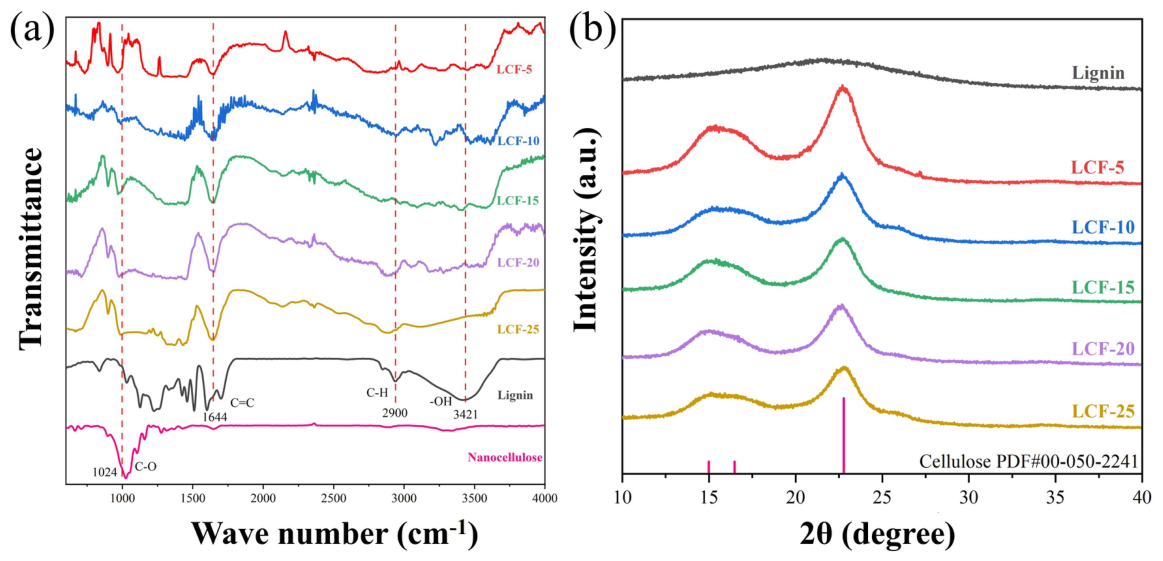
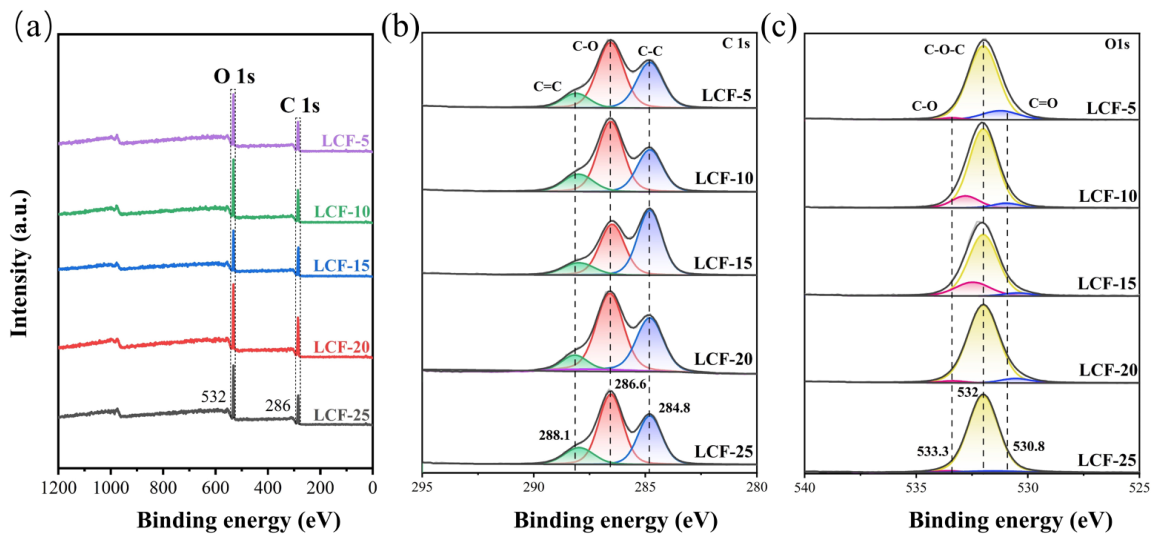
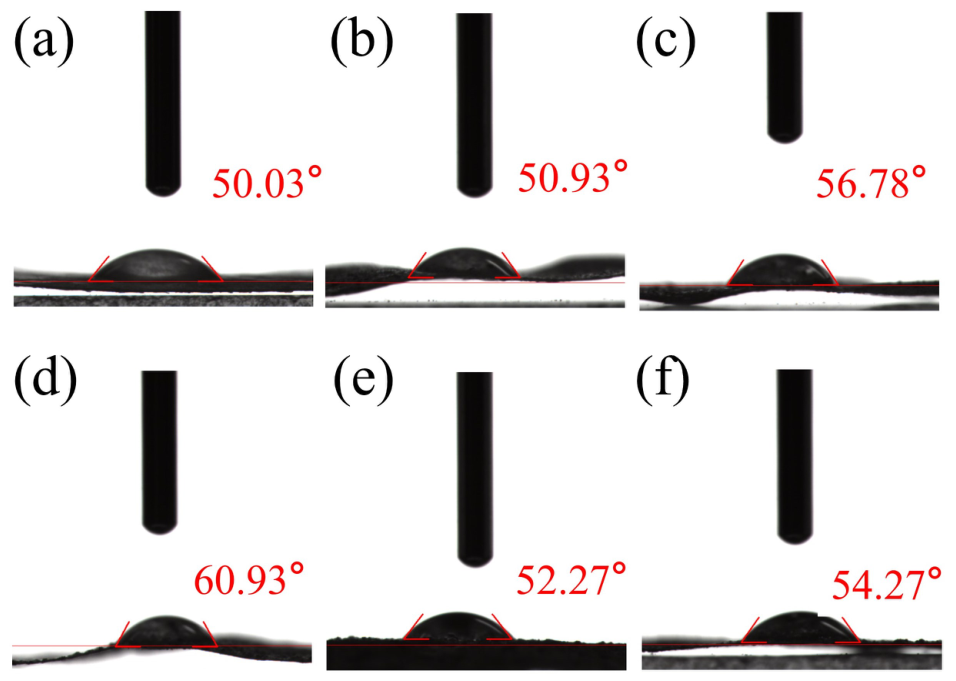
3.1. Surface Properties and Structural Analysis
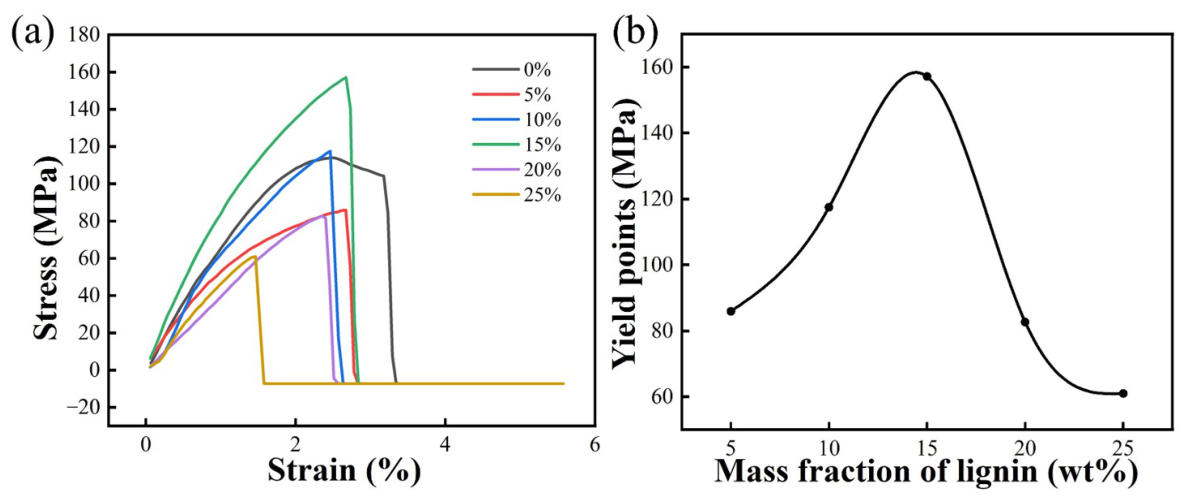
3.2. Mechanical Properties of LCF
4. Conclusions
Author Contributions
Funding
Institutional Review Board Statement
Informed Consent Statement
Data Availability Statement
Conflicts of Interest
Abbreviations
| LCF | Lignocellulosic films |
| NC | Nanocellulose |
| DEL | Enzymatic hydrolysis |
| FTIR | Fourier transform infrared |
| FE-SEM | Field emission scanning electron microscopy |
| RED | X-ray diffraction |
References
- Lau, W.W.Y.; Shiran, Y.; Bailey, R.M.; Cook, E.; Stuchtey, M.R.; Koskella, J.; Velis, C.A.; Godfrey, L.; Boucher, J.; Murphy, M.B.; et al. Evaluating scenarios toward zero plastic pollution. Science 2020, 369, 1455–1461. [Google Scholar] [CrossRef]
- Cordier, M.; Uehara, T.; Jorgensen, B.; Baztan, J. Reducing plastic production: Economic loss or environmental gain? Camb. Prism. Plast. 2024, 2, e2. [Google Scholar] [CrossRef]
- Singh, N.; Walker, T.R. Plastic recycling: A panacea or environmental pollution problem. npj Mater. Sustain. 2024, 2, 17. [Google Scholar] [CrossRef]
- Mansoor, Z.; Tchuenbou-Magaia, F.; Kowalczuk, M.; Adamus, G.; Manning, G.; Parati, M.; Radecka, I.; Khan, H. Polymers Use as Mulch Films in Agriculture—A Review of History, Problems and Current Trends. Polymers 2022, 14, 5062. [Google Scholar] [CrossRef]
- Huang, Z.; Zhang, Y.; Zhang, C.; Yuan, F.; Gao, H.; Li, Q. Lignin-Based Composite Film and Its Application for Agricultural Mulching. Polymers 2024, 16, 2488. [Google Scholar] [CrossRef] [PubMed]
- Kassab, Z.; Bahloul, A.; Hassani, F.Z.S.A.; Ablouh, E.H.; Bouhfid, R.; Qaiss, A.E.K.; Sehaqui, H.; El Achaby, M. Structure and Properties of Cellulose and Its Derivatives. In Annual Plant: Sources of Fibres, Nanocellulose and Cellulosic Derivatives; Springer Nature: Singapore, 2023; pp. 443–463. [Google Scholar] [CrossRef]
- Guo, R.; Zhang, L.; Lu, Y.; Zhang, X.; Yang, D. Research progress of nanocellulose for electrochemical energy storage: A review. J. Energy Chem. 2020, 51, 342–361. [Google Scholar] [CrossRef]
- Hamad, W. On the Development and Applications of Cellulosic Nanofibrillar and Nanocrystalline Materials. Can. J. Chem. Eng. 2008, 84, 513–519. [Google Scholar] [CrossRef]
- Pei, Z.; Liu, X.; Chen, J.; Wang, H.; Li, H. Research Progress on Lignin Depolymerization Strategies: A Review. Polymers 2024, 16, 2388. [Google Scholar] [CrossRef]
- Sirviö, J.A.; Ismail, M.Y.; Zhang, K.; Tejesvi, M.V.; Ämmälä, A. Transparent lignin-containing wood nanofiber films with UV-blocking, oxygen barrier, and anti-microbial properties. J. Mater. Chem. A 2020, 8, 7935–7946. [Google Scholar] [CrossRef]
- Sadeghifar, H.; Ragauskas, A. Lignin as a bioactive polymer and heavy metal absorber- an overview. Chemosphere 2022, 309, 136564. [Google Scholar] [CrossRef]
- Lu, F.; Wang, Y.; Sun, D.; Fu, Y.; Zhang, F.; Sun, R. Research progress on the preparation of lignin micro/nano-particles and their biomedical applications. Green Chem. 2025, 27, 5400–5422. [Google Scholar] [CrossRef]
- Sulis, D.B.; Lavoine, N.; Sederoff, H.; Jiang, X.; Marques, B.M.; Lan, K.; Cofre-Vega, C.; Barrangou, R.; Wang, J.P. Advances in lignocellulosic feedstocks for bioenergy and bioproducts. Nat. Commun. 2025, 16, 1244. [Google Scholar] [CrossRef]
- Ewulonu, C.M.; Liu, X.; Wu, M.; Yong, H. Lignin-Containing Cellulose Nanomaterials: A Promising New Nanomaterial for Numerous Applications. J. Bioresour. Bioprod. 2019, 4, 3–10. [Google Scholar] [CrossRef]
- Zor, M.; Şen, F.; Yazıcı, H.; Candan, Z. Thermal, Mechanical and Morphological Properties of Cellulose/Lignin Nanocomposites. Forests 2023, 14, 1715. [Google Scholar] [CrossRef]
- Nevárez, L.A.M.; Casarrubias, L.B.; Celzard, A.; Fierro, V.; Muñoz, V.T.; Davila, A.C.; Lubian, J.R.T.; Sánchez, G.G. Biopolymer-based nanocomposites: Effect of lignin acetylation in cellulose triacetate films. Sci. Technol. Adv. Mater. 2011, 12, 045006. [Google Scholar] [CrossRef] [PubMed]
- Bai, F.; Dong, T.; Chen, W.; Wang, J.; Li, X. Nanocellulose Hybrid Lignin Complex Reinforces Cellulose to Form a Strong, Water-Stable Lignin–Cellulose Composite Usable as a Plastic Replacement. Nanomaterials 2021, 11, 3426. [Google Scholar] [CrossRef] [PubMed]
- Auras, R.; Harte, B.; Selke, S. An Overview of Polylactides as Packaging Materials. Macromol. Biosci. 2004, 4, 835–864. [Google Scholar] [CrossRef]
- Razzaq, S.; Shahid, S.; Nawab, Y. Applications and environmental impact of biodegradable polymers in textile industry: A review. Int. J. Biol. Macromol. 2024, 282, 136791. [Google Scholar] [CrossRef]
- Masek, A.; Kosmalska, A. Technological limitations in obtaining and using cellulose biocomposites. Front. Bioeng. Biotechnol. 2022, 10, 912052. [Google Scholar] [CrossRef]
- Lindstrom, T.; Aulin. Market and technical challenges and opportunities in the area of innovative new materials and composites based on nanocellulosics. Scand. J. For. Res. 2014, 29, 345–351. [Google Scholar] [CrossRef]
- Fredi, G.; Dorigato, A. Recycling of bioplastic waste: A review. Adv. Ind. Eng. Polym. Res. 2021, 4, 159–177. [Google Scholar] [CrossRef]
- Gigli, M.; Fellet, G.; Pilotto, L.; Sgarzi, M.; Marchiol, L.; Crestini, C. Lignin-based nano-enabled agriculture: A mini-review. Front. Plant Sci. 2022, 13, 976410. [Google Scholar] [CrossRef]
- Zhang, B.; Wang, G.; Huang, X.; Fang, Y.; Sui, W.; Parvez, A.M.; Si, C.; Jia, H. Formulation and application assessment of lignin-based biodegradable composite mulching film with emphasis on lignin enhancement. Ind. Crop. Prod. 2024, 215, 118634. [Google Scholar] [CrossRef]
- Albertsson, A.C. Biodegradable polymers and environmental interaction. Polym. Eng. Sci. 1998, 38, 1251–1253. [Google Scholar] [CrossRef]
- Kliem, S.; Kreutzbruck, M.; Bonten, C. Review on the Biological Degradation of Polymers in Various Environments. Materials 2020, 13, 4586. [Google Scholar] [CrossRef]
- Wang, G.; Huang, D.; Ji, J.; Völker, C.; Wurm, F. Seawater-Degradable Polymers—Fighting the Marine Plastic Pollution. Adv. Sci. 2020, 8, 2001121. [Google Scholar] [CrossRef]
- Zykova, A.; Pantyukhov, P.; Popov, A. Degradation of Highly Filled Biocomposites Based on Synthetic Polymers and Natural Polysaccharides Under the Action of Climatic Weathering and Biodegradation (Review). IOP Conf. Ser. Earth Environ. Sci. 2021, 720, 012136. [Google Scholar] [CrossRef]
- Barreira-Pinto, R.; Carneiro, R.; Miranda, M.; Guedes, R. Polymer-Matrix Composites: Characterising the Impact of Environmental Factors on Their Lifetime. Materials 2023, 16, 3913. [Google Scholar] [CrossRef]
- Wu, J.; Hua, Q.; Russell, K.; Zou, T.; Fang, L.; Huang, Z.; Ao, T.; Zhang, H.; Rojas, O.J.; Renneckar, S. Surface-acylated lignin-rich fines as strength and functional fillers for micro/nano fibrillated cellulose. Carbohydr. Polym. 2026, 375, 124754. [Google Scholar] [CrossRef]
- Abdel Aziz, Y.S.; Liu, A.; Yu, S.; Hsiao, B.S. Nitro-oxidation process for sustainable production of carboxylated lignin-containing cellulose nanofibers from sugarcane bagasse. Carbohydr. Polym. 2025, 368, 124109. [Google Scholar] [CrossRef] [PubMed]
- Dong, H.; Ping, X.; Zhou, Y.; Wang, H.; Zhou, X.; Shao, L.; Xiao, X.; Li, W.; Wang, C.; Ling, Z. Nature-Inspired Nanocellulose/Lignin Janus Films via Layered Assembly: The Enhanced Strength, UV Resistance, and Photothermal Conversion. ACS Appl. Polym. Mater. 2025, 7, 17032–17041. [Google Scholar] [CrossRef]
- Papapetros, K.; Mathioudakis, G.N.; Vroulias, D.; Koutroumanis, N.; Soto Beobide, A.; Kotrotsiou, O.; Penloglou, G.; Andrikopoulos, K.S.; Voyiatzis, G.A. Nanocellulose Filled Bio-Based PVA/Chitosan Nanocomposites: Structure–Property Relationships Toward Advanced Food Packaging Films. Polymers 2025, 17, 3122. [Google Scholar] [CrossRef]
- Du, J.; Guo, J.; Zhu, Q.; Guo, J.; Gu, J.; Wu, Y.; Ren, L.; Yang, S.; Jiang, J. Enhancement of Polyvinyl Alcohol-Based Films by Chemically Modified Lignocellulosic Nanofibers Derived from Bamboo Shoot Shells. Polymers 2025, 17, 1571. [Google Scholar] [CrossRef]
- Ryu, J.; Choi, S.R.; Lee, J.M. Comparison of NaOH-Based Solvents for Lignocellulosic Microfines (LCMFs) Dissolution and Properties of Regenerated Cellulose Film. Gels 2026, 12, 199. [Google Scholar] [CrossRef]
- Paudel, S.; Janaswamy, S. Green Valorization of Alfalfa into Sustainable Lignocellulosic Films for Packaging Applications. Appl. Sci. 2025, 15, 11889. [Google Scholar] [CrossRef]
- Froment, L.; Lease, J.; Sejati, P.S.; Akong, F.O.; Charbonnier, C.G.; Ando, Y.; Gérardin, P. Aromatic Ester Bioplastics from Wood and Cellulose: Cinnamates as Greener Alternatives to Benzoates. Materials 2026, 19, 574. [Google Scholar] [CrossRef]
- Chen, T.Y.; Wang, B.; Wu, Y.Y.; Wen, J.L.; Liu, C.F.; Yuan, T.Q.; Sun, R.C. Structural variations of lignin macromolecule from different growth years of Triploid of Populus tomentosa Carr. Int. J. Biol. Macromol. 2017, 101, 747–757. [Google Scholar] [CrossRef] [PubMed]
- Wibowo, E.S.; Park, B.D.; Koo, B.; Shin, Y.J.; Lee, J.W. Relevance of Molecular Structure to the Morphological Properties of Lignin Extracted by Various Methods: X-ray Scattering Analysis. Macromolecules 2025, 58, 4147–4159. [Google Scholar] [CrossRef]
- Marcuello, C.; Bercu, N.; Foulon, L.; Chabbert, B.; Molinari, M.; Aguié-Béghin, V. Impact of lignin structuration on its chemical and adhesive properties at the nanoscale: Involvement with native and polymer matrices. Nanoscale 2025, 17, 24657–24668. [Google Scholar] [CrossRef]


Disclaimer/Publisher’s Note: The statements, opinions and data contained in all publications are solely those of the individual author(s) and contributor(s) and not of MDPI and/or the editor(s). MDPI and/or the editor(s) disclaim responsibility for any injury to people or property resulting from any ideas, methods, instructions or products referred to in the content. |
© 2026 by the authors. Licensee MDPI, Basel, Switzerland. This article is an open access article distributed under the terms and conditions of the Creative Commons Attribution (CC BY) license.
Share and Cite
Zhang, Z.; Duan, Z.; Wang, J.; Jiang, J.; Wei, Z.; Wu, S.; Albina, J.-M. Strong, Biodegradable Lignocellulosic Films as Potential Bioplastics. Polymers 2026, 18, 1359. https://doi.org/10.3390/polym18111359
Zhang Z, Duan Z, Wang J, Jiang J, Wei Z, Wu S, Albina J-M. Strong, Biodegradable Lignocellulosic Films as Potential Bioplastics. Polymers. 2026; 18(11):1359. https://doi.org/10.3390/polym18111359
Chicago/Turabian StyleZhang, Zhenzhen, Ziyu Duan, Juan Wang, Jungang Jiang, Zhishun Wei, Silong Wu, and Jan-Michael Albina. 2026. "Strong, Biodegradable Lignocellulosic Films as Potential Bioplastics" Polymers 18, no. 11: 1359. https://doi.org/10.3390/polym18111359
APA StyleZhang, Z., Duan, Z., Wang, J., Jiang, J., Wei, Z., Wu, S., & Albina, J.-M. (2026). Strong, Biodegradable Lignocellulosic Films as Potential Bioplastics. Polymers, 18(11), 1359. https://doi.org/10.3390/polym18111359