Peculiarities of Bacterial Cellulose




Abstract
1. Introduction
2. Cellulose
3. Bacterial Cellulose
3.1. Bacterial Cellulose Peculiarities
3.2. Bacterial Cellulose Production from Non-Waste Sources
3.3. Bacterial Cellulose Production from Waste
- Room-temperature drying: Capillary forces caused marked structural densification. SEM analysis showed fibril aggregation and pore reduction, resulting in relatively high density (~0.63 g/cm3) and moderate porosity (~59.4%). Despite structural collapse, cellulose chemistry remained unchanged, as confirmed by EDX (C and O dominance) and FTIR, which preserved cellulose I [7].
- Supercritical CO2 (ScCO2) drying: Minimization of capillary stresses preserved the nanofibrillar network. SEM revealed a highly porous isotropic structure (~46–56 nm fibers), while BET analysis showed the highest surface accessibility (~123–124 m2/g, pore volume ~0.35–0.36 cm3/g). The BC exhibited ultralow density (~0.01 g/cm3) and >99% porosity, though thermal conductivity (~0.040–0.042 W·m−1·K−1) remained slightly higher than the freeze-dried samples.
- Freeze-drying: Pore architecture was governed by ice-templating during pre-freezing. Freezing at −18 °C produced heterogeneous pores, whereas liquid nitrogen freezing produced more homogeneous, interconnected networks. In situ freezing in a lyophilizer enabled additive-free porous BC cryogels, although environmental conditions during drying influenced structural reproducibility.
3.4. Properties of Bacterial Cellulose
3.5. Advantages and Limitations of BC
3.6. Applications and Modifications of BC
4. Conclusions
Author Contributions
Funding
Institutional Review Board Statement
Data Availability Statement
Conflicts of Interest
References
- Khan, S.B.; Kamal, T. (Eds.) Bacterial Cellulose, Synthesis, Production, and Applications; CRC Press: Boca Raton, FL, USA, 2022. [Google Scholar]
- Jittaut, P.; Hongsachart, P.; Audtarat, S.; Dasri, T. Production and characterization of bacterial cellulose produced by Gluconacetobacter xylinus BNKC 19 using agricultural waste products as nutrient source. Arab J. Basic Appl. Sci. 2023, 30, 221–230. [Google Scholar] [CrossRef]
- Zhong, C. Industrial-Scale Production and Applications of Bacterial Cellulose. Front. Bioeng. Biotechnol. 2020, 8, 605374. [Google Scholar] [CrossRef] [PubMed]
- Catarino, R.P.F.; Mascareli, V.A.B.; Leite da Costa, V.L.; Pavanello, A.C.L.; Spinosa, W.A. Sustainability and Influencing Factors in Bacterial Cellulose Production: A Review of the Impact of Microorganisms, Culture Media and Cultivation Methods. Food Technol. Biotechnol. 2025, 63, 332–350. [Google Scholar] [CrossRef]
- Quijano, L.; Fischer, D.; Ferrero-Regis, T.; Navone, L. Exploring bacterial cellulose as an engineered living and programmable biomaterial across disciplines through qualitative thematic analysis. Sci. Rep. 2025, 15, 17980. [Google Scholar] [CrossRef]
- Moreno-Díaz, C.; González-Arranz, S.; Martínez-Cerezo, C. Bacterial Cellulose Production within a Circular Economy Framework: Utilizing Organic Waste. Polymers 2024, 16, 2735. [Google Scholar] [CrossRef]
- Klemm, D.; Philip, B.; Heinze, T.; Heinze, U.; Wagenknecht, W. Comprehensive Cellulose Chemistry, Volume l: Fundamentals and Analytical Methods; Wiley-VCH Verlag: Weinheim, Germany, 1998. [Google Scholar]
- Tashiro, K.; Kobayashi, M. Theoretical evaluation of three-dimensional elastic constants of native and regenerated celluloses: Role of hydrogen bonds. Polymer 1991, 32, 1516–1526. [Google Scholar] [CrossRef]
- Vasanth Kumar, U.; Narayanasamy, S.; Uthandi, S. Bacterial cellulose: A comprehensive review on biosynthesis, sustainable production, and multifaceted industrial applications. Food Bioprod. Process. 2025, 154, 153–174. [Google Scholar] [CrossRef]
- Hamed, D.A.; Maghrawy, H.H.; Abdel Kareem, H. Biosynthesis of bacterial cellulose nanofibrils in black tea media by a symbiotic culture of bacteria and yeast isolated from commercial kombucha beverage. World J. Microbiol. Biotechnol. 2022, 39, 48. [Google Scholar] [CrossRef] [PubMed]
- Reis, D.T.; Pereira, A.K.d.S.; Scheidt, G.N.; Pereira, D.H. Plant and Bacterial Cellulose: Production, Chemical Structure, Derivatives and Applications. Orbital Electron. J. Chem. 2019, 11, 321–329. [Google Scholar] [CrossRef]
- Militký, J.; Mishra, R.; Venkataraman, M. Geotextiles and Environmental Protection Textiles. In High Performance Technical Textiles; John Wiley & Sons, Ltd.: Hoboken, NJ, USA, 2019; pp. 239–278. [Google Scholar] [CrossRef]
- Kaczmarek, M.; Białkowska, A.M. Enzymatic functionalization of bacterial nanocellulose: Current approaches and future prospects. J. Nanobiotechnol. 2025, 23, 82. [Google Scholar]
- Çalhan, A.; Hasanoğlu, A. Bacterial cellulose as a next-generation membrane material for selective transport: Properties, fabrication, and applications. Cellulose 2026, 33, 1167–1211. [Google Scholar] [CrossRef]
- Gorgieva, S.; Trček, J. Bacterial Cellulose: Production, Modification and Perspectives in Biomedical Applications. Nanomaterials 2019, 9, 1352. [Google Scholar] [CrossRef]
- Marriam, S.; Ghazal, S.; Shahzadi, S.; Fatima, S.N. Production and Characterization of Bacterial Cellulose from Food waste: A sustainable approach. Preprint 2024. [Google Scholar] [CrossRef]
- Ul-Islam, M.; Khan, S.; Ullah, M.W.; Park, J.K. Comparative study of plant and bacterial cellulose pellicles regenerated from dissolved states. Int. J. Biol. Macromol. 2019, 137, 247–252. [Google Scholar] [CrossRef] [PubMed]
- Bulkina, A.; Prilepskii, A. Bacterial cellulose: Is it really a promising biomedical material? Carbohydr. Polym. 2025, 357, 123427. [Google Scholar] [CrossRef]
- Martirani-VonAbercron, S.-M.; Pacheco-Sánchez, D. Bacterial cellulose: A highly versatile nanomaterial. Microb. Biotechnol. 2023, 16, 1174–1178. [Google Scholar] [CrossRef] [PubMed]
- Sözcü, S. Advanced Fibrous Structures Based on Bacterial Cellulose. Ph.D. Thesis, Textile Faculty, Technical University of Liberec, Liberec, Czech Republic, 2026. [Google Scholar]
- Römling, U.; Galperin, M.Y. Bacterial cellulose biosynthesis: Diversity of operons, subunits, products, and functions. Trends Microbiol. 2015, 23, 545–557. [Google Scholar] [CrossRef]
- Sozcu, S.; Frajova, J.; Wiener, J.; Venkataraman, M.; Tomkova, B.; Militky, J. Synthesis of Acetobacter xylinum Bacterial Cellulose Aerogels and Their Effect on the Selected Properties. Gels 2025, 11, 272. [Google Scholar] [CrossRef]
- Potočnik, V.; Gorgieva, S.; Trček, J. From Nature to Lab: Sustainable Bacterial Cellulose Production and Modification with Synthetic Biology. Polymers 2023, 15, 3466. [Google Scholar] [CrossRef]
- Ullah, M.W.; Ul Islam, M.; Khan, S.; Shah, N.; Park, J.K. Recent advancements in bioreactions of cellular and cell-free systems: A study of bacterial cellulose as a model. Korean J. Chem. Eng. 2017, 34, 1591–1599. [Google Scholar] [CrossRef]
- Abidi, W.; Torres-Sánchez, L.; Siroy, A.; Krasteva, P.V. Weaving of bacterial cellulose by the Bcs secretion systems. FEMS Microbiol. Rev. 2022, 46, fuab051. [Google Scholar]
- Zhang, H.; Chen, C.; Yang, J.; Sun, B.; Lin, J.; Sun, D. Effect of Culture Conditions on Cellulose Production by a Komagataeibacter xylinus Strain. Macromol. Biosci. 2022, 22, 2100476. [Google Scholar] [CrossRef]
- Gorgieva, S. Bacterial Cellulose as a Versatile Platform for Research and Development of Biomedical Materials. Processes 2020, 8, 624. [Google Scholar] [CrossRef]
- Azeredo, H.M.C.; Barud, H.; Farinas, C.S.; Vasconcellos, V.M.; Claro, A.M. Bacterial Cellulose as a Raw Material for Food and Food Packaging Applications. Front. Sustain. Food Syst. 2019, 3, 7. [Google Scholar] [CrossRef]
- Liu, X.; Cao, L.; Wang, S.; Huang, L.; Zhang, Y.; Tian, M.; Li, X.; Zhang, J. Isolation and characterization of bacterial cellulose produced from soybean whey and soybean hydrolyzate. Sci. Rep. 2023, 13, 16024. [Google Scholar] [CrossRef]
- Sukara, E.; Meliawati, R. Potential values of bacterial cellulose for industrial applications. J. Selulosa 2014, 4, 7–16. [Google Scholar]
- Popa, L.; Ghica, M.V.; Tudoroiu, E.-E.; Ionescu, D.-G.; Dinu-Pîrvu, C.-E. Bacterial Cellulose—A Remarkable Polymer as a Source for Biomaterials Tailoring. Materials 2022, 15, 1054. [Google Scholar] [CrossRef]
- Rasool, K. Comprehensive insights into agro-industrial waste-derived bacterial cellulose advancing green technologies across industries. Mater. Today Sustain. 2026, 33, 101274. [Google Scholar] [CrossRef]
- Akintunde, M.O.; Adebayo-Tayo, B.C.; Ishola, M.M.; Zamani, A.; Horváth, I.S. Bacterial Cellulose Production from agricultural Residues by two Komagataeibacter sp. Strains. Bioengineered 2022, 13, 10010–10025. [Google Scholar] [CrossRef]
- Liu, Z.; Zhao, R.; Zhang, X.; Wang, H.; Zhang, C.; Liu, J.; Zhu, P. Comparison of bacterial cellulose production by various biomass wastes as culture media. Int. J. Biol. Macromol. 2025, 309, 143091. [Google Scholar] [CrossRef] [PubMed]
- Molina-Ramírez, C.; Castro, M.; Osorio, M.; Torres-Taborda, M.; Gómez, B.; Zuluaga, R.; Gómez, C.; Gañán, P.; Rojas, O.J.; Castro, C. Effect of Different Carbon Sources on Bacterial Nanocellulose Production and Structure Using the Low pH Resistant Strain Komagataeibacter Medellinensis. Materials 2017, 10, 639. [Google Scholar] [CrossRef] [PubMed]
- Nguyen, H.T.; Saha, N.; Ngwabebhoh, F.A.; Zandraa, O.; Saha, T.; Saha, P. Kombucha-derived bacterial cellulose from diverse wastes: A prudent leather alternative. Cellulose 2021, 28, 9335–9353. [Google Scholar] [CrossRef]
- Nguyen Ngo, T.T.; Phan, T.H.; Le, T.M.T.; Le, T.N.T.; Huynh, Q.; Phan, T.P.T.; Hoang, M.; Vo, T.P.; Nguyen, D.Q. Producing bacterial cellulose from industrial recycling paper waste sludge. Heliyon 2023, 9, e17663. [Google Scholar] [CrossRef]
- Quijano, L.; Rodrigues, R.; Fischer, D.; Tovar-Castro, J.D.; Payne, A.; Navone, L.; Hu, Y.; Yan, H.; Pinmanee, P.; Poon, E.; et al. Bacterial cellulose cookbook: A systematic review on sustainable and cost-effective substrates. J. Bioresour. Bioprod. 2024, 9, 379–409. [Google Scholar] [CrossRef]
- Silva, F.A.G.S.; Branco, S.; Dourado, F.; Neto, B.; Gama, M. Life cycle assessment of bacterial cellulose and comparison to other cellulosic sources. J. Clean. Prod. 2025, 493, 144876. [Google Scholar] [CrossRef]
- Tsouko, E.; Kourmentza, C.; Ladakis, D.; Kopsahelis, N.; Mandala, I.; Papanikolaou, S.; Paloukis, F.; Alves, V.; Koutinas. Bacterial Cellulose Production from Industrial Waste and by-Product Streams. Int. J. Mol. Sci. 2015, 16, 14832–14849. [Google Scholar] [CrossRef] [PubMed]
- Ul-Islam, M.; Ullah, M.W.; Khan, S.; Park, J.K. Production of bacterial cellulose from alternative cheap and waste resources: A step for cost reduction with positive environmental aspects. Korean J. Chem. Eng. 2020, 37, 925–937. [Google Scholar] [CrossRef]
- Venturelli, G.; Villa, F.; Petraretti, M.; Guagliano, G.; Levi, M.; Petrini, P. Bacterial Cellulose for Scalable and Sustainable Bio-Gels in the Circular Economy. Gels 2025, 11, 262. [Google Scholar] [CrossRef] [PubMed]
- Kadier, A.; Ilyas, R.A.; Huzaifah, M.R.M.; Harihastuti, N.; Sapuan, S.M.; Harussani, M.M.; Azlin, M.N.M.; Yuliasni, R.; Ibrahim, R.; Atikah, M.S.N.; et al. Use of Industrial Wastes as Sustainable Nutrient Sources for Bacterial Cellulose (BC) Production: Mechanism, Advances, and Future Perspectives. Polymers 2021, 13, 3365. [Google Scholar] [CrossRef]
- Kamal, T.; Ul-Islam, M.; Fatima, A.; Ullah, M.W.; Manan, S. Cost-Effective Synthesis of Bacterial Cellulose and Its Applications in the Food and Environmental Sectors. Gels 2022, 8, 552. [Google Scholar] [CrossRef] [PubMed]
- Mishra, S.; Singh, P.K.; Pattnaik, R.; Kumar, S.; Ojha, S.K.; Srichandan, H.; Parhi, P.K.; Jyothi, R.K.; Sarangi, P.K. Biochemistry, Synthesis, and Applications of Bacterial Cellulose: A Review. Front. Bioeng. Biotechnol. 2022, 10, 780409. [Google Scholar] [CrossRef] [PubMed]
- Corujo, V.F.; Cerrutti, P.; Foresti, M.L.; Vázquez, A. Production of Bacterial Nanocellulose from Non-Conventional Fermentation Media. In Multifunctional Polymeric Nanocomposites Based on Cellulosic Reinforcements; William Andrew Publishing: Norwich, NY, USA, 2016; pp. 39–59. [Google Scholar] [CrossRef]
- Hasanin, M.S.; Abdelraof, M.; Hashem, A.H.; El Saied, H. Sustainable bacterial cellulose production by Achromobacter using mango peel waste. Microb. Cell Fact. 2023, 22, 24. [Google Scholar] [CrossRef] [PubMed]
- Suryanto, H.; Yanuhar, U.; Mansingh, B.B.; Binoj, J.S. Bacterial Nanocellulose from Agro-Industrial Wastes. In Handbook of Biopolymers; Springer: Singapore, 2022; pp. 1–39. [Google Scholar] [CrossRef]
- Taokaew, S. Bacterial Nanocellulose Produced by Cost-Effective and Sustainable Methods and Its Applications: A Review. Fermentation 2024, 10, 316. [Google Scholar] [CrossRef]
- Nitodas, S.; Skehan, M.; Liu, H.; Shah, R. Current and Potential Applications of Green Membranes with Nanocellulose. Membranes 2023, 13, 694. [Google Scholar] [CrossRef]
- Jedrzejczak-Krzepkowska, M.; Kubiak, K.; Ludwicka, K.; Bielecki, S. Bacterial NanoCellulose Synthesis, Recent Findings. In Bacterial Nanocellulose; Elsevier: Amsterdam, The Netherlands, 2016; pp. 19–46. [Google Scholar] [CrossRef]
- Cazón, P.; Vázquez, M. Bacterial cellulose as a biodegradable food packaging material. In Antimicrobial Materials and Coatings; Woodhead Publishing: Cambridge, UK, 2025; pp. 375–423. [Google Scholar] [CrossRef]
- Chua, G.K.; Mahadi, N.I.F.; Tan, F.H.Y. Bacterial Cellulose Production from Agro-Industrial and Food Wastes. In Bio-Valorization of Waste: Trends and Perspectives; Shah, S., Venkatramanan, V., Prasad, R., Eds.; Springer: Singapore, 2021; pp. 169–186. [Google Scholar] [CrossRef]
- Makharita, R.R.; El-Ahmady El-Naggar, N.; Baghdadi, A.M.; Hamouda, R.A. Sustainable production of bacterial nanocellulose from date fruit waste using Bacillus haynesii for waste valorisation and crystal violet dye removal. Sci. Rep. 2025, 15, 25133. [Google Scholar] [CrossRef]
- Mouro, C.; Gomes, A.; Gomes, A.P.; Gouveia, I.C. Sustainable Bacterial Cellulose Production Using Low-Cost Fruit Wastewater Feedstocks. Nanomaterials 2025, 15, 271. [Google Scholar] [CrossRef] [PubMed]
- Lahiri, D.; Nag, M.; Dutta, B.; Dey, A.; Sarkar, T.; Pati, S.; Edinur, H.A.; Kari, Z.A.; Noor, N.H.M.; Ray, R.R. Bacterial Cellulose: Production, Characterization, and Application as Antimicrobial Agent. Int. J. Mol. Sci. 2021, 22, 12984. [Google Scholar] [CrossRef] [PubMed]
- Wang, X.; Cheah, W.Y.; Srinuanpan, S.; Ng, E.-P.; Juan, J.C.; Ling, T.C. Towards efficient production and application of bacterial cellulose: The progress from conventional to advanced production. Mater. Today Sustain. 2026, 33, 101299. [Google Scholar] [CrossRef]
- Amr, A.; Ibrahim, H.; Amr, A.; Ibrahim, H. Bacterial Cellulose: Biosynthesis and Applications. In Next-Generation Textiles; IntechOpen: London, UK, 2022. [Google Scholar] [CrossRef]
- Ge, H. Mechanism and influencing factors of bacterial cellulose synthesis based on Minitab. J. Comput. Methods Sci. Eng. 2022, 22, 1333–1348. [Google Scholar] [CrossRef]
- Talero, E.; García-Mauriño, S.; Ávila-Román, J.; Rodríguez-Luna, A.; Alcaide, A.; Motilva, V. Bioactive Compounds Isolated from Microalgae in Chronic Inflammation and Cancer. Mar. Drugs 2015, 13, 6152–6209. [Google Scholar] [CrossRef]
- Esmail, A.; Morais, M.; Yilmazer, U.D.; Neves, L.A.; Freitas, F. Bacterial cellulose production through the valorization of waste apple pulp and stale bread. Biomass Convers. Biorefin. 2025, 15, 14587–14602. [Google Scholar] [CrossRef]
- Martinez, J.C.; Davila, L.; Zuluaga, R.; Ricardo, A.; Figueroa, J.; Goreti, M.; Oliveira, A.; Meriño-Cabrera, Y. Production of bacterial cellulose from banana waste (Musa paradisiaca): A sustainable material for making cardboard paper. Biocatal. Agric. Biotechnol. 2025, 63, 103484. [Google Scholar] [CrossRef]
- Hu, J.; Wang, L.; Xiao, M.; Chen, W.; Zhou, M.; Hu, Y.; Zhang, Y.; Lai, M.; He, A.; Zhao, M. Insights into bacterial cellulose for adsorption and sustained-release mechanism of flavors. Food Chem. X 2025, 25, 102110. [Google Scholar] [CrossRef] [PubMed]
- Ma, S.; Feng, X.; Yang, Q.; Peng, Z.; Qiu, D.; Hu, Y.; Zhao, X.; Cheng, L.; Duan, S. Bio-synthesis of bacterial cellulose from ramie textile waste for high-efficiency Cu(II) adsorption. Sci. Rep. 2025, 15, 18715. [Google Scholar] [CrossRef] [PubMed]
- Zhao, H.; Li, J.; Zhu, K. Bacterial Cellulose Production from Waste products and Fermentation conditions optimization. IOP Conf. Ser. Mater. Sci. Eng. 2018, 394, 022041. [Google Scholar] [CrossRef]
- Belkozhayev, A.M.; Abaildayev, A.; Kossalbayev, B.D.; Tastambek, K.T.; Kadirshe, D.K.; Toleutay, G. Microbial Valorization of Agricultural and Agro-Industrial Waste into Bacterial Cellulose: Innovations for Circular Bioeconomy Integration. Microorganisms 2025, 13, 2686. [Google Scholar] [CrossRef]
- Rezaei, N.; Satvati, P.R.; Mousavi, S.M.; Khorasani, A.C. Food waste-derived bacterial cellulose biosorbents as a cost-effective solution for sustainable heavy metal and dye removal. Int. J. Biol. Macromol. 2025, 330, 147686. [Google Scholar] [CrossRef]
- Cavka, A.; Guo, X.; Tang, S.J.; Winestrand, S.; Jönsson, L.J.; Hong, F. Production of bacterial cellulose and enzyme from waste fiber sludge. Biotechnol. Biofuels 2013, 6, 25. [Google Scholar] [CrossRef] [PubMed]
- Revin, V.; Liyaskina, E.; Nazarkina, M.; Bogatyreva, A.; Shchankin, M. Cost-effective production of bacterial cellulose using acidic food industry by-products. Braz. J. Microbiol. 2018, 49, 151–159. [Google Scholar] [CrossRef]
- Andree, V.; Niopek, D.; Müller, C.; Eiselt, J.-P.; Foh, N.; Rzany, A.; Hensel, B. Influence of drying methods on the physical properties of bacterial nanocellulose. Mater. Res. Express 2021, 8, 025402. [Google Scholar] [CrossRef]
- Fernandes, A.M.; Silva, T.L.; Silva, C.J. Bacterial cellulose: A new biomaterial for the textile industry. Next Sustain. 2025, 6, 100211. [Google Scholar] [CrossRef]
- Rathinamoorthy, R. Influence of Drying Method on the Properties of Bacterial Cellulose Nonwovens—Review on the Textile and Fashion Application Potential. J. Nat. Fibers 2022, 19, 12596–12613. [Google Scholar] [CrossRef]
- Anwar, B.; Bundjali, B.; Sunarya, Y.; Arcana, I.M. Properties of Bacterial Cellulose and Its Nanocrystalline Obtained from Pineapple Peel Waste Juice. Fibers Polym. 2021, 22, 1228–1236. [Google Scholar] [CrossRef]
- Utoiu, E.; Manoiu, V.S.; Oprita, E.I.; Craciunescu, O. Bacterial Cellulose: A Sustainable Source for Hydrogels and 3D-Printed Scaffolds for Tissue Engineering. Gels 2024, 10, 387. [Google Scholar] [CrossRef] [PubMed]
- Salehizadeh, H.; Yan, N.; Farnood, R. Recent advances in polysaccharide bio-based flocculants. Biotechnol. Adv. 2018, 36, 92–119. [Google Scholar] [CrossRef]
- Wu, G.; Cheng, Y.; Huang, C.; Yong, C.; Fu, Y. Deep eutectic solvent engineering: A novel ternary system for efficient lignocellulose extraction. Green Chem. 2025, 27, 1556–1569. [Google Scholar] [CrossRef]
- Abol-Fotouh, D.; Hassan, M.A.; Shokry, H.; Roig, A.; Azab, M.S.; Kashyout, A.H.B. Bacterial nanocellulose from agro-industrial wastes: Low-cost and enhanced production by Komagataeibacter saccharivorans MD1. Sci. Rep. 2020, 10, 3491. [Google Scholar] [CrossRef]
- Betlej, I.; Rybak, K.; Nowacka, M.; Antczak, A.; Borysiak, S.; Krochmal-Marczak, B.; Lipska, K.; Boruszewski, P. Structural Properties of Bacterial Cellulose Film Obtained on a Substrate Containing Sweet Potato Waste. Crystals 2022, 12, 1191. [Google Scholar] [CrossRef]
- Qian, H.; Liu, J.; Wang, X.; Pei, W.; Fu, C.; Ma, M.; Huang, C. The state-of-the-art application of functional bacterial cellulose-based materials in biomedical fields. Carbohydr. Polym. 2023, 300, 120252. [Google Scholar] [CrossRef] [PubMed]
- Ye, M.; Mei, N.; Zheng, H.; Wu, B.; Wei, W.; Dong, W.; Song, D.; Ding, W.; Ye, N.; Tremblay, P.-L.; et al. Production of bacterial cellulose from diverse food wastes: Effects on physical properties, structure, and performance. Cellulose 2025, 32, 8845–8861. [Google Scholar] [CrossRef]
- Aditya, T.; Allain, J.P.; Jaramillo, C.; Restrepo, A.M. Surface Modification of Bacterial Cellulose for Biomedical Applications. Int. J. Mol. Sci. 2022, 23, 610. [Google Scholar] [CrossRef]
- Choi, S.M.; Rao, K.M.; Zo, S.M.; Shin, E.J.; Han, S.S. Bacterial Cellulose and Its Applications. Polymers 2022, 14, 1080. [Google Scholar] [CrossRef] [PubMed]
- Deshpande, P.; Wankar, S.; Mahajan, S.; Patil, Y.; Rajwade, J.; Kulkarni, A. Bacterial Cellulose: Natural Biomaterial for Medical and Environmental Applications. J. Nat. Fibers 2023, 20, 2218623. [Google Scholar] [CrossRef]
- Pandit, A.; Kumar, R. Bacterial Cellulose-Based Materials for Biomedical Applications. In Encyclopedia of Green Materials; Springer: Singapore, 2025; pp. 105–112. [Google Scholar] [CrossRef]
- Ujjwal, R.R.; Slaughter, G. Advances in Bacterial Cellulose-Based Scaffolds for Tissue Engineering: Review. J. Biomed. Mater. Res. Part A 2025, 113, e37912. [Google Scholar] [CrossRef]
- Campano, C.; Rivero-Buceta, V.; Hernandez-Arriaga, A.M.; Manoli, M.T.; Prieto, M.A. Pushing the limits of bacterial cellulose for biomedicine: A review. Int. J. Biol. Macromol. 2025, 323, 146701. [Google Scholar] [CrossRef]
- Dogaru, A.-I.; Oprea, O.-C.; Isopencu, G.-O.; Banciu, A.; Jinga, S.-I.; Busuioc, C. Bacterial Cellulose-Based Nanocomposites for Wound Healing Applications. Polymers 2025, 17, 1225. [Google Scholar] [CrossRef] [PubMed]
- Pandey, A.; Singh, M.K.; Singh, A. Bacterial cellulose: A smart biomaterial for biomedical applications. J. Mater. Res. 2024, 39, 2–18. [Google Scholar]
- Swingler, S.; Gupta, A.; Gibson, H.; Kowalczuk, M.; Heaselgrave, W.; Radecka, I. Recent Advances and Applications of Bacterial Cellulose in Biomedicine. Polymers 2021, 13, 412. [Google Scholar] [CrossRef] [PubMed]
- Joseph, A.; Umamaheswari, S.; Vassou, M.C. Bacterial cellulose: A versatile biomaterial for biomedical application. Carbohydr. Res. 2025, 552, 109350. [Google Scholar]
- Horue, M.; Silva, J.M.; Berti, I.R.; Brandão, L.R.; Barud, H.D.S.; Castro, G.R. Bacterial Cellulose-Based Materials as Dressings for Wound Healing. Pharmaceutics 2023, 15, 424. [Google Scholar] [CrossRef]
- Patel, D.K.; Cha, J.; Won, S.-Y.; Han, S.S. Upcycled coffee waste into nanocellulose-reinforced alginate–carboxymethyl cellulose hydrogels for tunable drug delivery. Int. J. Biol. Macromol. 2025, 333, 148942. [Google Scholar] [CrossRef] [PubMed]
- Tran Vo, T.M.; Mori, M.; Ohnuma, K.; Chen, X.; Potiyaraj, P. Development of Oxidized Bacterial Cellulose Scaffolds Impregnated with Chitosan and Collagen Peptides for Potential Implant Tissue Engineering Approaches. J. Appl. Polym. Sci. 2026, 143, e70114. [Google Scholar] [CrossRef]
- Barja, F. Bacterial nanocellulose production and biomedical applications. J. Biomed. Res. 2021, 35, 310–317. [Google Scholar] [CrossRef] [PubMed]
- Oliveira, D.N.; Oliveira, L.L.; Macedo, H.L.R.Q.; Ruiz, Y.P.M.; Galembeck, A.; Xavier, D.E.; Aguiar, J.L.A.; Campos, L.A.A.; Cavalcanti, I.M.F. Bacterial Cellulose Hydrogel Incorporating Silver Nanoparticles: A Nanobiotechnological Approach for Skin Infections Caused by MRSA and MRSE. Pharmaceuticals 2026, 19, 409. [Google Scholar] [CrossRef] [PubMed]
- Yildirim, M.; Ermis, E.; Amangeldinova, M.; Yabalak, E. Recent advances in bacterial cellulose: From sustainable production to environmental, biomedical, and 3D bioprinting applications. Chem. Eng. Res. Des. 2026, 226, 515–535. [Google Scholar] [CrossRef]


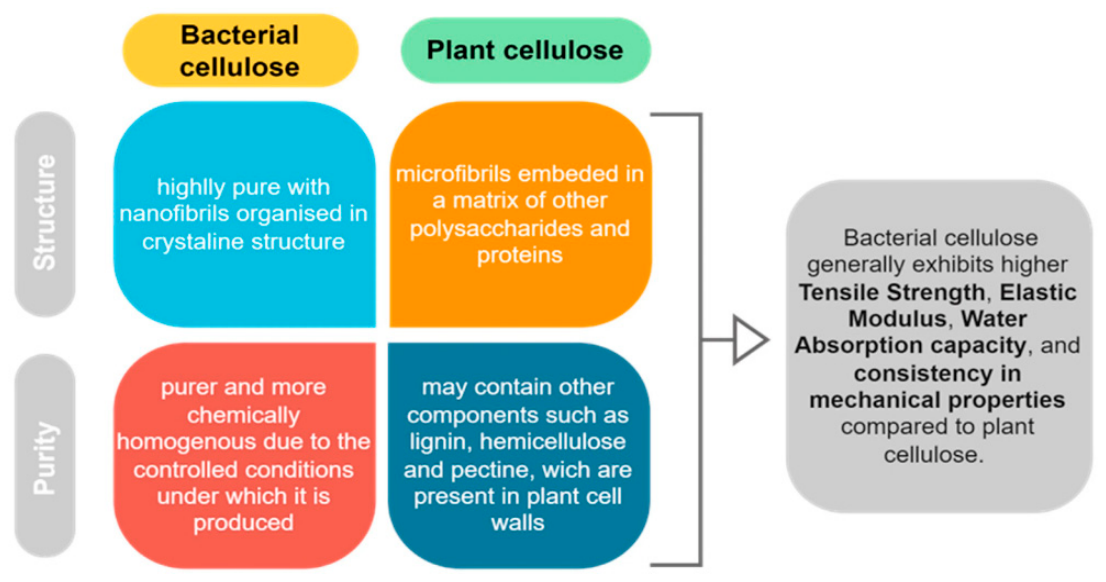


| Feature | Bacterial Cellulose (BC) | Plant Cellulose (PC) |
|---|---|---|
| Purity | Extremely high (no lignin/hemicellulose) | Low (requires chemical removal) |
| Structure | 3D reticulated nanofiber network | Microfibrillar bundles |
| Strength | High tensile strength and crystallinity | Variable; generally lower crystallinity |
| Hydration | High water retention (up to 100× weight) | Moderate to low |
| Feature | Waste-Derived BC (e.g., Fruit Peels, Molasses) | Non-Waste BC (e.g., Glucose, HS Media) |
|---|---|---|
| Cost | Very low; utilization of wastes | Higher commercial sugars/nutrients are more expensive. |
| Sustainability | High; supports waste treatment and reduces pollution | Lower, dependent on the agricultural products. |
| Crystallinity | Often higher (77.39% for vegetable waste) | Relatively high (66.88%) |
| Consistency | Dependent on waste composition and pretreatment, as hydrolysis | Standard nutrient concentrations |
| Yield Potential | Often 4–6 times higher than HS medium Range 13–30 g/L (based on substrate) | Stable but lower than optimized waste-derived (1.1–2.0 g/L) |
| Pre-treatment | Commonly by hydrolysis or sterilization | Not necessary; ready for fermentation |
| Method | Product State | Structural Effect | Best Application |
|---|---|---|---|
| ScCO2 Drying | Aerogel | Preserves nanopores | Tissue engineering, super-insulation |
| Freeze-drying | Cryogel | High porosity, light | Biomedical, drug delivery |
| Heat-press | Dense Film | Dense, flat, high crystallinity | Textiles, electronics, packaging |
| Microwave | Dry Sheet | Smooth, Energy Efficient | Rapid production, bio-packaging |
| Oven Drying | Dense Film | Shrinkage, high density | Basic material production |
Disclaimer/Publisher’s Note: The statements, opinions and data contained in all publications are solely those of the individual author(s) and contributor(s) and not of MDPI and/or the editor(s). MDPI and/or the editor(s) disclaim responsibility for any injury to people or property resulting from any ideas, methods, instructions or products referred to in the content. |
© 2026 by the authors. Licensee MDPI, Basel, Switzerland. This article is an open access article distributed under the terms and conditions of the Creative Commons Attribution (CC BY) license.
Share and Cite
Militký, J.; Venkataraman, M.; Sözcü, Ş. Peculiarities of Bacterial Cellulose. Polymers 2026, 18, 1271. https://doi.org/10.3390/polym18111271
Militký J, Venkataraman M, Sözcü Ş. Peculiarities of Bacterial Cellulose. Polymers. 2026; 18(11):1271. https://doi.org/10.3390/polym18111271
Chicago/Turabian StyleMilitký, Jiří, Mohanapriya Venkataraman, and Şebnem Sözcü. 2026. "Peculiarities of Bacterial Cellulose" Polymers 18, no. 11: 1271. https://doi.org/10.3390/polym18111271
APA StyleMilitký, J., Venkataraman, M., & Sözcü, Ş. (2026). Peculiarities of Bacterial Cellulose. Polymers, 18(11), 1271. https://doi.org/10.3390/polym18111271