Structure–Property Relationships and Surface Engineering of Natural Biopolymers for Triboelectric Applications: The Role of Additive Manufacturing


Abstract
1. Introduction
2. Materials and Methods
3. Cellulose-Based Triboelectric Biopolymers
3.1. Processing–Structure Relationships in Cellulose-Based TENGs
3.2. Additive Manufacturing Approaches for Cellulose-Based TENGs
3.3. Surface Engineering and Dielectric Modulation of Cellulose-Based TENGs
3.4. Tribological Behavior and Triboelectric Performance of Cellulose-Based TENGs
4. Chitosan-Based Triboelectric Biopolymers
4.1. Processing–Structure Relationships in Chitosan-Based TENGs
4.2. Additive Manufacturing Approaches for Chitosan-Based TENGs
4.3. Surface Engineering and Dielectric Modulation of Chitosan-Based TENGs
4.4. Tribological Behavior and Triboelectric Performance of Chitosan-Based TENGs
5. Silk Fibroin-Based Triboelectric Biopolymers
5.1. Processing–Structure Relationships in Silk Fibroin-Based TENGs
5.2. Additive Manufacturing Approaches for Silk Fibroin-Based TENGs
5.3. Surface Engineering and Dielectric Modulation of Silk Fibroin-Based TENGs
5.4. Tribological Behavior and Triboelectric Performance of Silk Fibroin-Based TENGs
6. Comparative Analysis of Natural Biopolymers for Triboelectric Applications
6.1. Comparative Assessment of Natural Biopolymers AM Integration
6.2. Comparative Assessment of Surface Triboelectric Behavior Across Natural Biopolymer Systems
7. Discussion
8. Current Challenges and Future Perspectives
8.1. Additive Manufacturing Challenges
8.2. Surface Engineering and Dielectric Modulation Limitations
8.3. Comparative Material-Specific Limitations
- Despite being abundant, the thermal stability and mechanical stiffness of native cellulose occupy a nearly neutral position in the triboelectric series, resulting in a characteristically low charge density [12,48,54]. To render cellulose highly tribopositive or tribonegative, complex chemical functionalization (such as amination, sulfonation, fluorination or cyanoethylation) is required [42]. In addition, its moisture sensitivity may degrade its electrical output in ambient environments, necessitating advanced hydrophobic surface treatments that complicate AM processing [12,54].
- Since CS contains many free primary amine groups, it exhibits a more naturally tribopositive character than cellulose [101]. Still, CS films and hydrogels are characteristically plagued by high mechanical brittleness and an exceptionally high water affinity [97,104]. Although incorporating plasticizers (e.g., glycerol) can enhance its flexibility and wearability for electronic skin applications, excessive plasticization disrupts the intermolecular hydrogen-bonding networks, which can inadvertently lower the material’s dielectric constant and significantly degrade its triboelectric output performance [89].
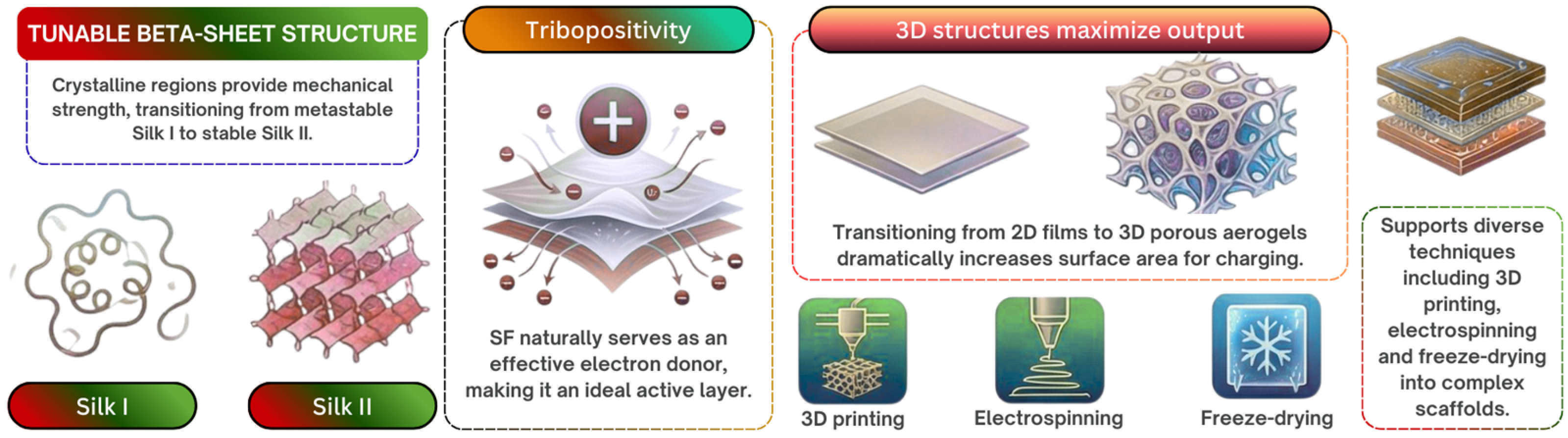
- SF usually achieves the highest baseline triboelectric output among the three biopolymers owing to its outstanding electron-donating capabilities and dense amide linkages [153,173]. The most important limitation of silk is its notable processing complexity [2]. The structural performance of silk is entirely dependent on the ratio of random coils to sheet crystals. While a higher sheet content improves water resistance and mechanical resilience, it concurrently markedly reduces the material’s flexibility, complicates extrusion-based 3D printing and decreases the surface conformability required for efficient triboelectric contact electrification [153,160,192].
8.4. Standardization Issues
8.5. Future Perspectives
- Research must transition from laboratory-scale manual casting to high-throughput, scalable AM techniques [2,41,48]. Developing photocurable biopolymer derivatives (e.g., methacrylated silk or carboxymethyl cellulose) for use in high-resolution DLP or stereolithography can avoid the rheological limitations of extrusion, allowing accurate, nozzle-free fabrication of complex, hierarchical micro-architectures [121].
- Future material designs must refine dielectric engineering by seamlessly integrating advanced 2D nanomaterials (such as MXene, MoS2, or functionalized graphene) and core–shell nanostructures into the biopolymer matrix [12,54,172]. These multifunctional nanocomposites may optimize interfacial polarization and trap states to maximize charge density, while reducing filler agglomeration, mechanical degradation and dielectric loss [12,54].
- A particular opportunity can be found in the development of environmentally stable, fully biodegradable TENGs for continuous human health monitoring [12,109,153]. Advanced surface hydrophobization strategies (e.g., silanization or the integration of natural hydrophobic waxes) must be optimized to repel moisture without compromising the material’s biocompatibility. This will pave the way for self-powered, bioresorbable implantable sensors that can operate safely in vivo and degrade harmlessly after their operational lifespan, thereby eliminating secondary electronic waste [153].
- The integration of 4D printing introduces the smart concept, self-morphing triboelectric structures [58,202]. By designing biopolymers in order to adapt their macroscopic geometry in response to specific environmental stimuli (such as temperature, pH or moisture), TENGs can significantly self-optimize their contact mechanics and surface area, leading to very adaptive, self-regulating energy harvesting systems.
- Given the broad parameter space involving ink rheology, functional group density, dielectric constant and structural porosity, the integration of artificial intelligence (AI) and machine learning (ML) algorithms is important [42,48,50,60,109,110]. Data-driven, AI-assisted material optimization can swiftly screen complex biopolymer formulations and predict triboelectric outputs, linking the gap between molecular surface engineering and macroscopic device performance.
9. Conclusions
Author Contributions
Funding
Data Availability Statement
Conflicts of Interest
Abbreviations
| 0D | Zero-Dimensional (nanostructures with all dimensions at the nanoscale) |
| 2D | Two-Dimensional |
| 3D | Three-Dimensional |
| 4D | Four-Dimensional |
| 3DP | 3D Printing |
| AC | Activated Carbon |
| AM | Additive Manufacturing |
| BaTiO3 | Barium Titanate |
| BC | Bacterial Cellulose |
| BC/ZnO | Bacterial Cellulose/Zinc Oxide Composite |
| BAPO-OH | Bisacylphosphine Oxide-type Photoinitiator (water-compatible photoinitiator) |
| CB | Carbon Black |
| CEC | Cyanoethyl Cellulose |
| CMC | Carboxymethyl Cellulose |
| CMC-Na | Sodium Carboxymethyl Cellulose |
| CNC | Cellulose Nanocrystals |
| CNF | Cellulose Nanofibrils |
| CNT | Carbon Nanotube |
| CQ-TENG | Chitosan/Quartz Triboelectric Nanogenerator |
| CQAS | Chitosan Quaternary Ammonium Salt |
| CS | Chitosan |
| CS-AC | Chitosan/Activated Carbon Composite |
| CS/Plasticizer | Chitosan/Plasticizer Composite (e.g., with glycerol/PEG) |
| CS/Quartz | Chitosan/Quartz Fiber Composite |
| DC | Direct Current |
| DIW | Direct Ink Writing |
| DLP | Digital Light Processing |
| DMSO | Dimethyl Sulfoxide |
| EC | Ethyl Cellulose |
| ESE | Electrospray-Etching/Water Electrospray-Etching |
| FDA | Food and Drug Administration (U.S.) |
| FEP | Fluorinated Ethylene Propylene |
| GNPs | Graphene Nanoplatelets |
| hBN | Hexagonal Boron Nitride |
| HEC | Hydroxyethylcellulose |
| His | Histidine |
| HRP | Horseradish Peroxidase (enzyme used for enzymatic crosslinking) |
| LAP | Lithium Phenyl-2,4,6-Trimethylbenzoylphosphinate (photoinitiator) |
| m-CMC | Methacrylated Carboxymethyl Cellulose |
| MBA | N,N′-Methylenebisacrylamide (chemical crosslinker) |
| MCC | Microcrystalline Cellulose |
| MO-PPy | Modified Polypyrrole Composite |
| MXene | Two-Dimensional Transition-Metal Carbide/Nitride (MXene-type nanomaterial) |
| MWCNTs | Multiwalled Carbon Nanotubes |
| NaCl | Sodium Chloride |
| NaOH | Sodium Hydroxide |
| NC | Nanocellulose |
| PA6 | Polyamide 6 (Nylon-6) |
| PANIs | Polyanilines |
| PCL | Poly(ε-Caprolactone) |
| PDMS | Polydimethylsiloxane |
| PDOTES | 1H,1H,2H,2H-Perfluorodecyltriethoxysilane |
| PEDOT:PSS | Poly(3,4-ethylenedioxythiophene):poly(styrene sulfonate) |
| PEG | Polyethylene Glycol |
| PEO | Poly(ethylene oxide) |
| PLLA | Poly(L-Lactic Acid) |
| PPy | Polypyrrole |
| PTFE | Polytetrafluoroethylene |
| PVA | Poly(vinyl alcohol) |
| PVDF | Poly(vinylidene fluoride) |
| RMS | Root-Mean-Square |
| RSF | Regenerated Silk Fibroin |
| SF | Silk Fibroin |
| SF-MXene | Silk Fibroin/MXene Composite |
| SF-TENG | Silk Fibroin-Based Triboelectric Nanogenerator |
| SIL | Soft Imprinting Lithography |
| Sil-MA | Methacrylated Silk Fibroin (photocurable silk derivative) |
| SMP | Silk Microparticles |
| STENG | Silk-Based Triboelectric Nanogenerator (e.g., silk aerogel STENG) |
| SWCNTs | Single-Walled Carbon Nanotubes |
| TBAH | Tetrabutylammonium Hydroxide |
| TECD | Triboelectric Charge Density |
| TENG | Triboelectric Nanogenerator |
| UV | Ultraviolet |
| ZIF-8 | Zeolitic Imidazolate Framework-8 (metal–organic framework) |
| Nomenclature | |
| Isc | Short-Circuit Current |
| Ra | Root-Mean-Square Surface Roughness |
| Voc | Open-Circuit Voltage |
| wt% | Weight percentage/percentage by weight |
References
- Du, G.; Wang, J.; Liu, Y.; Yuan, J.; Liu, T.; Cai, C.; Chen, X.; Nie, S. Fabrication of advanced cellulosic triboelectric materials via dielectric modulation. Adv. Sci. 2023, 10, 2206243. [Google Scholar] [CrossRef]
- Gan, N.; Wei, M.; Zhou, Q.; Dong, K.; Gao, B. Silk fibroin-based triboelectric nanogenerators for energy harvesting and biomedical applications. ACS Appl. Nano Mater. 2024, 7, 8407–8423. [Google Scholar] [CrossRef]
- Mi, H.Y.; Li, H.; Jing, X.; He, P.; Feng, P.Y.; Tao, X.; Liu, Y.; Shen, C. Silk and silk composite aerogel-based biocompatible triboelectric nanogenerators for efficient energy harvesting. Ind. Eng. Chem. Res. 2020, 59, 12399–12408. [Google Scholar] [CrossRef]
- Wang, N.; Yang, D.; Zhang, W.; Feng, M.; Li, Z.; Ye, E.; Zhang, X.; Wang, D. Deep trap boosted ultrahigh triboelectric charge density in nanofibrous cellulose-based triboelectric nanogenerators. ACS Appl. Mater. Interfaces 2022, 15, 997–1009. [Google Scholar] [CrossRef]
- Maity, S.K.; Tyagi, U.; Sharma, A.K.; Bisht, P.; Sirohi, S.; Kumar, K.; Singh, A.; Kumar, G. Enhancing the electrical performance of chitosan-based triboelectric nanogenerator using graphene nanoplatelets for real-time sports application. Cellulose 2025, 32, 1787–1804. [Google Scholar] [CrossRef]
- Zheng, Z.; Wei, Y.; Wang, G.; Ao, A.W.Q.; Gong, Y.; Zhang, X. Surface properties of chitosan films modified with polycations and their effects on the behavior of PC12 cells. J. Bioact. Compat. Polym. 2009, 24, 63–82. [Google Scholar] [CrossRef]
- Tan, X.; Huang, Z.; Pei, H.; Jia, Z.; Zheng, J. Highly porous, ultralight, biocompatible silk fibroin aerogel-based triboelectric nanogenerator. ACS Sens. 2024, 9, 3938–3946. [Google Scholar] [CrossRef]
- Chaturvedi, E.; Roy, P. Tailoring Ionic Salt in Chitosan-Activated Carbon-Based Triboelectric Nanogenerators for Enhanced Mechanical Energy Harvesting. ACS Appl. Energy Mater. 2024, 7, 9735–9745. [Google Scholar] [CrossRef]
- Hidaka, M.; Sakai, S. Photo-and Schiff Base-Crosslinkable Chitosan/Oxidized Glucomannan Composite Hydrogel for 3D Bioprinting. Polysaccharides 2025, 6, 19. [Google Scholar] [CrossRef]
- Zhang, J.; Allardyce, B.J.; Rajkhowa, R.; Zhao, Y.; Dilley, R.J.; Redmond, S.L.; Wang, X.; Liu, X. 3D printing of silk particle-reinforced chitosan hydrogel structures and their properties. ACS Biomater. Sci. Eng. 2018, 4, 3036–3046. [Google Scholar] [CrossRef] [PubMed]
- Qin, L.; Sun, H.; Hafezi, M.; Zhang, Y. Polydopamine-assisted immobilization of chitosan brushes on a textured CoCrMo alloy to improve its tribology and biocompatibility. Materials 2019, 12, 3014. [Google Scholar] [CrossRef]
- Zhou, J.; Wang, H.; Du, C.; Zhang, D.; Lin, H.; Chen, Y.; Xiong, J. Cellulose for sustainable triboelectric nanogenerators. Adv. Energy Sustain. Res. 2022, 3, 2100161. [Google Scholar] [CrossRef]
- Seong, J.; Bak, B.U.; Lee, D.; Jin, J.; Kim, J. Tribo-piezoelectric synergistic BaTiO3/PDMS micropyramidal structure for high-performance energy harvester and high-sensitivity tactile sensing. Nano Energy 2024, 122, 109264. [Google Scholar] [CrossRef]
- Zeng, Q.; Chen, A.; Zhang, X.; Luo, Y.; Tan, L.; Wang, X. A Dual-Functional Triboelectric Nanogenerator Based on the Comprehensive Integration and Synergetic Utilization of Triboelectrification, Electrostatic Induction, and Electrostatic Discharge to Achieve Alternating Current/Direct Current Convertible Outputs. Adv. Mater. 2023, 35, 2208139. [Google Scholar] [CrossRef] [PubMed]
- Yang, S.; Zhao, C.; Yang, Y.; Ren, J.; Ling, S. The fractal network structure of silk fibroin molecules and its effect on spinning of silkworm silk. ACS Nano 2023, 17, 7662–7673. [Google Scholar] [CrossRef] [PubMed]
- Zhang, H.; Wang, H.; Wen, B.; Lu, L.; Zhao, Y.; Chai, R. Ultrasound-responsive composited conductive silk conduits for peripheral nerve regeneration. Small Struct. 2023, 4, 2300045. [Google Scholar] [CrossRef]
- Xiong, Q.; Yang, Z.; Zhang, X. Flexible triboelectric nanogenerator based on silk fibroin-modified carbon nanotube arrays. Chem. Eng. J. 2024, 482, 148986. [Google Scholar] [CrossRef]
- Yang, Y.; Song, W.; Murugesan, B.; Cheng, X.; Jiang, M.; Chen, Z.; Wang, H.; Cai, Y. Oriented Ti3C2Tx MXene-doped silk fibroin/hyaluronic acid hydrogels for sensitive compression strain monitoring with a wide resilience range and high cycling stability. Colloids Surf. A Physicochem. Eng. Asp. 2023, 665, 131221. [Google Scholar] [CrossRef]
- Sarkar, L.; Sushma, M.V.; Yalagala, B.P.; Rengan, A.K.; Singh, S.G.; Vanjari, S.R.K. ZnO nanoparticles embedded silk fibroin—A piezoelectric composite for nanogenerator applications. Nanotechnology 2022, 33, 265403. [Google Scholar] [CrossRef]
- Lima, R.M.A.P.; de Oliveira, M.C.A.; de Oliveira, H.P. The State of the Art of Energy Harvesting and Storage in Silk Fibroin-Based Wearable and Implantable Devices. Electrochem 2020, 1, 344–357. [Google Scholar] [CrossRef]
- Romero, I.S.; Schurr, M.L.; Lally, J.V.; Kotlik, M.Z.; Murphy, A.R. Enhancing the interface in silk–polypyrrole composites through chemical modification of silk fibroin. ACS Appl. Mater. Interfaces 2013, 5, 553–564. [Google Scholar] [CrossRef] [PubMed]
- Wu, Q.; Therriault, D.; Heuzey, M.C. Processing and properties of chitosan inks for 3D printing of hydrogel microstructures. ACS Biomater. Sci. Eng. 2018, 4, 2643–2652. [Google Scholar] [CrossRef] [PubMed]
- Yadav, L.R.; Chandran, S.V.; Lavanya, K.; Selvamurugan, N. Chitosan-based 3D-printed scaffolds for bone tissue engineering. Int. J. Biol. Macromol. 2021, 183, 1925–1938. [Google Scholar] [CrossRef]
- Ramezani, H.; Mohammad Mirjamali, S.; He, Y. Simulations of extrusion 3D printing of chitosan hydrogels. Appl. Sci. 2022, 12, 7530. [Google Scholar] [CrossRef]
- Ayers, L.C.; Johnson, R.M.; Tolfree, A.R.; Al Kharji, N.M.; Senarathna, M.C.; Arora, N.; Smaldone, R.A. Effects of the chitosan source on the properties of 3D printed polymer composites. ACS Appl. Polym. Mater. 2025, 7, 2644–2651. [Google Scholar] [CrossRef]
- Zhang, R. The opportunities of cellulose for triboelectric nanogenerators: A critical review. Nanoenergy Adv. 2024, 4, 209–220. [Google Scholar] [CrossRef]
- Turganova, R.; Tuleyeva, R.; Belkozhayev, A.; Gizatullina, N.; Yelemessova, G.; Taubatyrova, A.; Myrzabayeva, A.; Akishev, M.; Toleutay, G. Bacterial Cellulose for Sustainable Food Packaging: Production Pathways, Structural Design, and Functional Modification Strategies. Polymers 2025, 17, 3165. [Google Scholar] [CrossRef] [PubMed]
- Darmenbayeva, A.; Rajasekharan, R.; Idrisheva, Z.; Aubakirova, R.; Dautova, Z.; Abylkassova, G.; Shitybayeva, L.; Massalimova, B. Sustainable Cellulose Production from Agro-Industrial Waste: A Comprehensive Review. Polymers 2026, 18, 153. [Google Scholar] [CrossRef]
- Wang, H.; Huo, G.; Xu, G.; Yu, D.; Liu, S.; Wang, Q. Flexible Intelligence on a Green Skeleton: Progress and Challenges of CNF-Enabled Multimodal Sensing Platforms. Polymers 2025, 17, 2941. [Google Scholar] [CrossRef]
- Won, T.; Goh, M.; Lim, C.; Moon, J.; Lee, K.; Park, J.; Sahu, A.; Gwon, K. Recent progress in cellulose nanofibril hydrogels for biomedical applications. Polymers 2025, 17, 2272. [Google Scholar] [CrossRef]
- Kossalbayev, B.D.; Belkozhayev, A.M.; Abaildayev, A.; Kadirshe, D.K.; Tastambek, K.T.; Kurmanbek, A.; Toleutay, G. Biodegradable packaging from agricultural wastes: A comprehensive review of processing techniques, material properties, and future prospects. Polymers 2025, 17, 2224. [Google Scholar] [CrossRef]
- Motshabi, N.; Lenetha, G.G.; Malimabe, M.A.; Gumede, T.P. Cellulose Nanofibril-Based Biodegradable Polymers from Maize Husk: A Review of Extraction, Properties, and Applications. Polymers 2025, 17, 1947. [Google Scholar] [CrossRef] [PubMed]
- González, J.; Ghaffarinejad, A.; Ivanov, M.; Ferreira, P.; Vilarinho, P.M.; Borrás, A.; López-Valencia, O.; Wicklein, B. Advanced cellulose–nanocarbon composite films for high-performance triboelectric and piezoelectric nanogenerators. Nanomaterials 2023, 13, 1206. [Google Scholar] [CrossRef] [PubMed]
- Troncoso, O.P.; Corman-Hijar, J.I.; Torres, F.G. Lignocellulosic biomass for the fabrication of triboelectric nano-generators (TENGs)—A Review. Int. J. Mol. Sci. 2023, 24, 15784. [Google Scholar] [CrossRef]
- Fernandes, A.; Cruz-Lopes, L.; Esteves, B.; Evtuguin, D. Nanotechnology applied to cellulosic materials. Materials 2023, 16, 3104. [Google Scholar] [CrossRef]
- Asrafali, S.P.; Periyasamy, T.; Lee, J. Biopolymer-Based Active and Intelligent Food Packaging: Recent Advances in Materials, Technologies, and Applications. Polymers 2026, 18, 196. [Google Scholar] [CrossRef] [PubMed]
- Yermagambetova, A.; Tazhibayeva, S.; Takhistov, P.; Tyussyupova, B.; Tapia-Hernández, J.A.; Musabekov, K. Microbial Polysaccharides as Functional Components of Packaging and Drug Delivery Applications. Polymers 2024, 16, 2854. [Google Scholar] [CrossRef]
- Shishparenok, A.N.; Furman, V.V.; Dobryakova, N.V.; Zhdanov, D.D. Protein immobilization on bacterial cellulose for biomedical application. Polymers 2024, 16, 2468. [Google Scholar] [CrossRef]
- Jakmuangpak, S.; Prada, T.; Mongkolthanaruk, W.; Harnchana, V.; Pinitsoontorn, S. Engineering bacterial cellulose films by nanocomposite approach and surface modification for biocompatible triboelectric nanogenerator. ACS Appl. Electron. Mater. 2020, 2, 2498–2506. [Google Scholar] [CrossRef]
- Candido, I.C.M.; Freire, A.L.; Costa, C.A.R.; Oliveira, H.P.D. Doped-Cellulose Acetate Membranes as Friction Layers for Triboelectric Nanogenerators: The Influence of Roughness Degree and Surface Potential on Electrical Performance. Nanoenergy Adv. 2024, 4, 196–208. [Google Scholar] [CrossRef]
- Niu, Z.; Cheng, W.; Cao, M.; Wang, D.; Wang, Q.; Han, J.; Zhou, J.; Han, G. Recent advances in cellulose-based flexible triboelectric nanogenerators. Nano Energy 2021, 87, 106175. [Google Scholar] [CrossRef]
- Liao, H.; Na, J.; Zhou, W.; Hur, S.; Chien, P.M.; Wang, C.; Jeong, C.K.; Yuan, Z. Enhancing energy harvesting performance and sustainability of cellulose-based triboelectric nanogenerators: Strategies for performance enhancement. Nano Energy 2023, 116, 108769. [Google Scholar] [CrossRef]
- Qian, C.; Li, L.; Gao, M.; Yang, H.; Cai, Z.; Chen, B.; Xiang, Z.; Song, Y. All-printed 3D hierarchically structured a. nanogenerator for multi-functional sensors. Nano Energy 2019, 63, 103885. [Google Scholar] [CrossRef]
- Shi, R.; Zhang, J.; Yang, J.; Xu, Y.; Li, C.; Chen, S.; Xu, F. Direct-ink-write printing and electrospinning of cellulose derivatives for conductive composite materials. Materials 2022, 15, 2840. [Google Scholar] [CrossRef]
- Ding, Z.; Tian, Z.; Ji, X.; Wang, D.; Ci, X.; Shao, X.; Rojas, O.J. Cellulose-based superhydrophobic wrinkled paper and electrospinning film as green tribolayer for water wave energy harvesting. Int. J. Biol. Macromol. 2023, 234, 122903. [Google Scholar] [CrossRef]
- Yamklang, W.; Prada, T.; Bunriw, W.; Kaeochana, W.; Harnchana, V. Fe3O4-filled cellulose paper for triboelectric nanogenerator application. Polymers 2022, 15, 94. [Google Scholar] [CrossRef]
- Shao, Y.; Luo, B.; Liu, T.; Cai, C.; Meng, X.; Wang, S.; Nie, S. Harvesting energy from extreme environmental conditions with cellulosic triboelectric materials. Mater. Today 2023, 66, 348–370. [Google Scholar] [CrossRef]
- Liao, J.; Shamshina, J.L.; Wang, Y.; Sun, D.; Shen, X.; Zhao, D.; Sun, Q. Emerging cellulosic materials for sustainable mechanosensing and energy harvesting devices: Advances and prospect. Nano Today 2024, 56, 102232. [Google Scholar] [CrossRef]
- Jayakumar, A.; Ambekar, R.S.; Mahapatra, P.L.; Singh, A.K.; Kundu, T.K.; PR, S.; Chandra, S.; Tiwary, C.S. Energy harvesting using high-strength and flexible 3D-printed cellulose/hexagonal boron nitride nanosheet composites. ACS Appl. Nano Mater. 2023, 6, 14278–14288. [Google Scholar] [CrossRef]
- Charoonsuk, T.; Ukasi, S.; Mokthaisong, P.; Khuntakaew, P.; Hajra, S.; Kim, H.J.; Sahu, M.; Vittayakorn, N. Acidic dynamics: Unveiling mechanistic insights for improved performance in chitosan triboelectric nanogenerators. Cellulose 2024, 31, 6453–6470. [Google Scholar] [CrossRef]
- Yar, A.; Okbaz, A.; Parlayıcı, Ş. A biocompatible, eco-friendly, and high-performance triboelectric nanogenerator based on sepiolite, bentonite, and kaolin decorated chitosan composite film. Nano Energy 2023, 110, 108354. [Google Scholar] [CrossRef]
- Yao, C.; Yin, X.; Yu, Y.; Cai, Z.; Wang, X. Chemically functionalized natural cellulose materials for effective triboelectric nanogenerator development. Adv. Funct. Mater. 2017, 27, 1700794. [Google Scholar] [CrossRef]
- Yu, Y.; Li, H.; Zhao, D.; Gao, Q.; Li, X.; Wang, J.; Wang, Z.; Cheng, T. Material’s selection rules for high performance triboelectric nanogenerators. Mater. Today 2023, 64, 61–71. [Google Scholar] [CrossRef]
- Cho, H.C.; Latif, M.; Jiang, Y.; Kim, J. Environment-Friendly triboelectric nanogenerator based on 3D-Printed nanocellulose films for human motion monitoring. ACS Appl. Energy Mater. 2024, 8, 267–275. [Google Scholar] [CrossRef]
- Freire, A.L.; Lima, L.R.; Candido, I.C.; Silva, L.G.; Ribeiro, S.J.; Carrilho, E.; Longo, E.; de Oliveira, H.P. Metal-Free, Bio-Triboelectric Nanogenerator Based on a Single Electrode of Bacterial Cellulose Modified with Carbon Black. Nanoenergy Adv. 2024, 4, 110–121. [Google Scholar] [CrossRef]
- Yuan, R.; Wu, K.; Fu, Q. 3D printing of all-regenerated cellulose material with truly 3D configuration: The critical role of cellulose microfiber. Carbohydr. Polym. 2022, 294, 119784. [Google Scholar] [CrossRef] [PubMed]
- Maity, K.; Mondal, A.; Saha, M.C. Cellulose nanocrystal-based all-3D-printed pyro-piezoelectric nanogenerator for hybrid energy harvesting and self-powered cardiorespiratory monitoring toward the human–machine interface. ACS Appl. Mater. Interfaces 2023, 15, 13956–13970. [Google Scholar] [CrossRef]
- Jiang, J.; Oguzlu, H.; Jiang, F. 3D printing of lightweight, super-strong yet flexible all-cellulose structure. Chem. Eng. J. 2021, 405, 126668. [Google Scholar] [CrossRef]
- Dai, L.; Cheng, T.; Duan, C.; Zhao, W.; Zhang, W.; Zou, X.; Aspler, J.; Ni, Y. 3D printing using plant-derived cellulose and its derivatives: A review. Carbohydr. Polym. 2019, 203, 71–86. [Google Scholar] [CrossRef]
- Huang, J.; Zhang, Y.; Yu, H.; Han, G.; Cheng, W. Cellulose-based triboelectric nanogenerator prepared by multi-fluid electrospinning for respiratory protection and self-powered sensing. Actuators 2024, 13, 178. [Google Scholar] [CrossRef]
- Cao, M.; Chen, Y.; Sha, J.; Xu, Y.; Chen, S.; Xu, F. All-cellulose nanofiber-based sustainable triboelectric nanogenerators for enhanced energy harvesting. Polymers 2024, 16, 1784. [Google Scholar] [CrossRef] [PubMed]
- Cafiso, D.; Septevani, A.A.; Noè, C.; Schiller, T.; Pirri, C.F.; Roppolo, I.; Chiappone, A. 3D printing of fully cellulose-based hydrogels by digital light processing. Sustain. Mater. Technol. 2022, 32, e00444. [Google Scholar] [CrossRef]
- Xiao, N.; He, L.; Wang, K. Self-Driven Miniature Sensing Technology Based on Cellulose-Based Triboelectric Nanogenerators in a Wearable Human Health Status Monitoring System. Coatings 2025, 15, 149. [Google Scholar] [CrossRef]
- Hausmann, M.K.; Ruhs, P.A.; Siqueira, G.; Läuger, J.; Libanori, R.; Zimmermann, T.; Studart, A.R. Dynamics of cellulose nanocrystal alignment during 3D printing. ACS Nano 2018, 12, 6926–6937. [Google Scholar] [CrossRef]
- Dallaev, R. Conductive polymer thin films for energy storage and conversion: Supercapacitors, batteries, and solar cells. Polymers 2025, 17, 2346. [Google Scholar] [CrossRef]
- Liang, Q.; Wu, X.; Yan, Y.; Kang, S.; Liu, J.; Shi, M.; Tong, G. Recent Design Principles and Construction Strategies of Polyaniline-Based Composites: Toward Electrochemical and Non-Electrochemical Adsorption Applications. Polymers 2025, 17, 3151. [Google Scholar] [CrossRef]
- Sun, Z.; Yang, L.; Liu, S.; Zhao, J.; Hu, Z.; Song, W. A green triboelectric nano-generator composite of degradable cellulose, piezoelectric polymers of PVDF/PA6, and nanoparticles of BaTiO3. Sensors 2020, 20, 506. [Google Scholar] [CrossRef] [PubMed]
- Li, Q.; An, X.; Qian, X. Methyl orange-doped polypyrrole promoting growth of ZIF-8 on cellulose fiber with tunable tribopolarity for triboelectric nanogenerator. Polymers 2022, 14, 332. [Google Scholar] [CrossRef] [PubMed]
- Zhu, Q.; Wang, T.; Sun, X.; Wei, Y.; Zhang, S.; Wang, X.; Luo, L. Effects of fluorine-based modification on triboelectric properties of cellulose. Polymers 2022, 14, 3536. [Google Scholar] [CrossRef]
- Chenkhunthod, S.; Yamklang, W.; Kaeochana, W.; Prada, T.; Bunriw, W.; Harnchana, V. Ag–cellulose hybrid filler for boosting the power output of a triboelectric nanogenerator. Polymers 2023, 15, 1295. [Google Scholar] [CrossRef]
- Nie, S.; Fu, Q.; Lin, X.; Zhang, C.; Lu, Y.; Wang, S. Enhanced performance of a cellulose nanofibrils-based triboelectric nanogenerator by tuning the surface polarizability and hydrophobicity. Chem. Eng. J. 2021, 404, 126512. [Google Scholar] [CrossRef]
- Zhang, C.; Lin, X.; Zhang, N.; Lu, Y.; Wu, Z.; Liu, G.; Nie, S. Chemically functionalized cellulose nanofibrils-based gear-like triboelectric nanogenerator for energy harvesting and sensing. Nano Energy 2019, 66, 104126. [Google Scholar] [CrossRef]
- Liu, Y.; Fu, Q.; Mo, J.; Lu, Y.; Cai, C.; Luo, B.; Nie, S. Chemically tailored molecular surface modification of cellulose nanofibrils for manipulating the charge density of triboelectric nanogenerators. Nano Energy 2021, 89, 106369. [Google Scholar] [CrossRef]
- Cui, P.; Parida, K.; Lin, M.F.; Xiong, J.; Cai, G.; Lee, P.S. Transparent, flexible cellulose nanofibril–phosphorene hybrid paper as triboelectric nanogenerator. Adv. Mater. Interfaces 2017, 4, 1700651. [Google Scholar] [CrossRef]
- Phanthong, P.; Reubroycharoen, P.; Hao, X.; Xu, G.; Abudula, A.; Guan, G. Nanocellulose: Extraction and application. Carbon Res. Convers. 2018, 1, 32–43. [Google Scholar] [CrossRef]
- Oprea, M.; Ficai, A.; Ilie, C.; Trușcă, R.; Oprea, O.C.; Șerbănescu, O.S.; Voicu, Ș.I. Zinc-loaded cellulose acetate membranes with potential biomedical applications. UPB Sci. Bull. Ser. B Chem. Mater. Sci. 2022, 84, 16–30. [Google Scholar]
- Sönmez, M.; Ficai, A.; Ficai, D.; Trusca, R.; Andronescu, E. Alginate/cellulose composite beads for environmental applications. UPB Sci. Bull. Ser. B Chem. Mater. Sci. 2016, 78, 165–176. [Google Scholar]
- Dufresne, A. Nanocellulose processing properties and potential applications. Curr. For. Rep. 2019, 5, 76–89. [Google Scholar] [CrossRef]
- Thomas, B.; Raj, M.C.; Athira, K.B.; Joy, J.; Moores, A.; Drisko, G.L.; Sanchez, C. Nanocellulose, a versatile green platform: From biosources to materials and their applications. Chem. Rev. 2018, 118, 11575–11625. [Google Scholar] [CrossRef]
- Xue, Y.; Mou, Z.; Xiao, H. Nanocellulose as a sustainable biomass material: Structure, properties, present status and future prospects in biomedical applications. Nanoscale 2017, 9, 14758–14781. [Google Scholar] [CrossRef]
- Choi, G.J.; Sohn, S.H.; Kim, S.J.; Park, I.K. Polymer composite-based triboelectric nanogenerators: Recent progress, design principles, and future perspectives. Polymers 2025, 17, 1962. [Google Scholar] [CrossRef]
- Oh, H.; Kwak, S.S.; Kim, B.; Han, E.; Lim, G.H.; Kim, S.W.; Lim, B. Highly conductive ferroelectric cellulose composite papers for efficient triboelectric nanogenerators. Adv. Funct. Mater. 2019, 29, 1904066. [Google Scholar] [CrossRef]
- Dahlström, C.; Eivazi, A.; Nejström, M.; Zhang, R.; Pettersson, T.; Iftikhar, H.; Örtegren, J.; Norgren, M. Regenerated cellulose properties tailored for optimized triboelectric output and the effect of counter-tribolayers. Cellulose 2024, 31, 2047–2061. [Google Scholar] [CrossRef]
- McDonagh, B.H.; Chinga-Carrasco, G. Characterization of porous structures of cellulose nanofibrils loaded with salicylic acid. Polymers 2020, 12, 2538. [Google Scholar] [CrossRef]
- He, Y.; Zhang, Y.; Zhou, Y.; Yuan, J.; Men, X. Construction of 3D aerogels consisting of cellulose and BNNSs bridged by AgNPs for enhancing thermal and tribological properties of polyurethane composites. Nano Mater. Sci. 2024, 6, 752–763. [Google Scholar] [CrossRef]
- Abdul Khalil, H.P.S.; Adnan, A.S.; Yahya, E.B.; Olaiya, N.G.; Safrida, S.; Hossain, M.S.; Balakrishnan, T.; Pasquini, D. A review on plant cellulose nanofibre-based aerogels for biomedical applications. Polymers 2020, 12, 1759. [Google Scholar] [CrossRef]
- Sakai, S.; Yamamoto, S.; Hirami, R.; Hidaka, M.; Elvitigala, K.C.M.L. Enzymatically gellable chitosan inks with enhanced printability by chitosan nanofibers for 3D printing of wound dressings. Eur. Polym. J. 2024, 210, 112960. [Google Scholar] [CrossRef]
- Ma, C.; Gao, S.; Gao, X.; Wu, M.; Wang, R.; Wang, Y.; Ding, Z.; Wu, W. Chitosan biopolymer-derived self-powered triboelectric sensor with optimized performance through molecular surface engineering and data-driven learning. InfoMat 2019, 1, 116–125. [Google Scholar] [CrossRef]
- Gao, C.; Tong, W.; Liu, S.; Li, X.; Feng, Y.; Zhang, Y. Dual–plasticizing strategy for an enhanced performance of degradable chitosan-based triboelectric nanogenerators. ACS Appl. Electron. Mater. 2024, 6, 1982–1991. [Google Scholar] [CrossRef]
- Mohan, K.; Muralisankar, T.; Jayakumar, R.; Rajeevgandhi, C. A study on structural comparisons of α-chitin extracted from marine crustacean shell waste. Carbohydr. Polym. Technol. Appl. 2021, 2, 100037. [Google Scholar] [CrossRef]
- González-Lara, H.; Parra-Pacheco, B.; Rico-García, E.; Aguirre-Becerra, H.; Feregrino-Pérez, A.A.; García-Trejo, J.F. Black soldier fly culture as a source of chitin and chitosan for its potential use in concrete: An overview. Polymers 2025, 17, 717. [Google Scholar] [CrossRef] [PubMed]
- Wu, Q.; Jungstedt, E.; Šoltésová, M.; Mushi, N.E.; Berglund, L.A. High strength nanostructured films based on well-preserved β-chitin nanofibrils. Nanoscale 2019, 11, 11001–11011. [Google Scholar] [CrossRef]
- Pandele, A.M.; Ioniţă, M.; Iovu, H. Molecular modeling of mechanical properties of the chitosan based graphene composites. UPB Sci. Bull. Ser. B Chem. Mater. Sci. 2014, 76, 107–112. [Google Scholar]
- Apetroaei, M.; Manea, A.M.; Tihan, G.; Zgarian, R.; Schroder, V.; Rău, I. Improved method of chitosan extraction from different crustacean species of Romanian Black Sea coast. UPB Sci. Bull. Ser. B Chem. Mater. Sci. 2017, 79, 25–36. [Google Scholar]
- Chen, W.; Li, C.; Tao, Y.; Lu, J.; Du, J.; Wang, H. Chitosan-based triboelectric materials for self-powered sensing at high temperatures. Int. J. Miner. Metall. Mater. 2024, 31, 2518–2527. [Google Scholar] [CrossRef]
- Ezeldeen, M.; Loos, J.; Mousavi Nejad, Z.; Cristaldi, M.; Murgia, D.; Braem, A.; Jacobs, R. 3D-printing-assisted fabrication of chitosan scaffolds from different sources and cross-linkers for dental tissue engineering. Eur. Cells Mater. 2021, 40, 485–501. [Google Scholar] [CrossRef] [PubMed]
- Fang, Z.; Guan, X.; He, J. Effectively altering the triboelectric charging behavior of chitosan films via tannic acid surface modification. Nano Energy 2025, 133, 110498. [Google Scholar] [CrossRef]
- Guo, W.; Ding, X.; Zhang, H.; Liu, Z.; Han, Y.; Wei, Q.; Zhou, J.; Wang, J.; Li, S. Recent advances of chitosan-based hydrogels for skin-wound dressings. Gels 2024, 10, 175. [Google Scholar] [CrossRef]
- He, J.; Wang, L.; Zheng, K.; Hu, S.; Zhang, X.; Mu, Z. Coordination of Mg2+ with Chitosan for Enhanced Triboelectric Performance. Polymers 2025, 17, 1001. [Google Scholar] [CrossRef] [PubMed]
- Ramírez-Campas, U.; Aubourg, S.P.; Torres-Arreola, W.; Plascencia-Jatomea, M.; Ezquerra-Brauer, J.M. Physical and structural properties of chitosan–squid gelatin hydrogels. Gels 2025, 11, 109. [Google Scholar] [CrossRef]
- Charoonsuk, T.; Pongampai, S.; Pakawanit, P.; Vittayakorn, N. Achieving a highly efficient chitosan-based triboelectric nanogenerator via adding organic proteins: Influence of morphology and molecular structure. Nano Energy 2021, 89, 106430. [Google Scholar] [CrossRef]
- Maneechan, W.; Khumfu, P.; Charoensit, P.; Tuanchai, A.; Ross, S.; Ross, G.M.; Ngoenkam, J.; Viyoch, J. Bioactive Hydrogel Scaffolds Integrating Chitosan, Silk Fibroin, and Aloe vera Extract for Enhanced Cartilage Tissue Regeneration. Polymers 2025, 17, 1409. [Google Scholar] [CrossRef]
- Desai, K.; Kit, K.; Li, J.; Zivanovic, S. Morphological and surface properties of electrospun chitosan nanofibers. Biomacromolecules 2008, 9, 1000–1006. [Google Scholar] [CrossRef]
- Fang, Z.; Lou, W.; Zhang, W.; Guan, X.; He, J.; Lin, J. Modulating crystallinity and dielectric constant of chitosan film for triboelectric polarity shift and performance enhancement in triboelectric nanogenerators. Nano Energy 2023, 117, 108923. [Google Scholar] [CrossRef]
- Kim, J.N.; Lee, J.; Go, T.W.; Rajabi-Abhari, A.; Mahato, M.; Park, J.Y.; Khan, H.; Hur, J.; Oh, I.K. Skin-attachable and biofriendly chitosan-diatom triboelectric nanogenerator. Nano Energy 2020, 75, 104904. [Google Scholar] [CrossRef]
- Han, J.; Wang, Y.; Ma, Y.; Wang, C. Enhanced energy harvesting performance of triboelectric nanogenerators via dielectric property regulation. ACS Appl. Mater. Interfaces 2023, 15, 31795–31802. [Google Scholar] [CrossRef] [PubMed]
- Gao, C.; Tong, W.; Wang, X.; Zhang, Y.; Zhang, Y. Degradable triboelectric nanogenerators based on chitosan fibers for smart sensing. ACS Appl. Electron. Mater. 2023, 5, 3865–3874. [Google Scholar] [CrossRef]
- Han, J.; Li, J.; Zhang, X.; Zhao, L.; Wang, C. Enhancing the performance of triboelectric nanogenerator via chitosan films surface modification. Chem. Eng. J. 2024, 489, 151493. [Google Scholar] [CrossRef]
- Gao, C.; Tong, W.; Liu, S.; Wang, X.; Zhang, Y. Fully degradable chitosan–based triboelectric nanogenerators applying in disposable medical products for information transfer. Nano Energy 2023, 117, 108876. [Google Scholar] [CrossRef]
- Zheng, K.; Wang, L.; Zhang, X.; Hou, C.; Su, A.; Hu, S.; Mu, Z.; Han, Y.; Shan, X. The influence of functional groups on the triboelectric properties of chitosan derivatives and the electron transfer mechanism of insulators. Nano Energy 2025, 136, 110709. [Google Scholar] [CrossRef]
- Xie, T.; Ou, F.; Ning, C.; Tuo, L.; Zhang, Z.; Gao, Y.; Sun, Q.; Deng, L.; Gao, W. Dual–network carboxymethyl chitosan conductive hydrogels for multifunctional sensors and high–performance triboelectric nanogenerators. Carbohydr. Polym. 2024, 333, 121960. [Google Scholar] [CrossRef]
- Chen, T.; Liu, A.; Lei, W.; Wu, G.; Xiang, J.; Dong, Y.; Sun, Z.; Ye, S.; Guo, W. Anti-Freezing Conductive Ionic Hydrogel-Enabled Triboelectric Nanogenerators for Wearable Speech Recognition. Materials 2025, 18, 2014. [Google Scholar] [CrossRef]
- Charoonsuk, T.; Supansomboon, S.; Pakawanit, P.; Vittayakorn, W.; Pongampai, S.; Woramongkolchai, S.; Vittayakorn, N. Simple enhanced charge density of chitosan film by the embedded ion method for the flexible triboelectric nanogenerator. Carbohydr. Polym. 2022, 297, 120070. [Google Scholar] [CrossRef]
- Alves, S.J.D.M.; Santos, M.A.; Neto, J.E.D.S.; Silva, H.N.D.; Barbosa, M.C.; Fook, M.V.L.; Canedo, E.L.; Wellen, R.M.R.; Silva, S.M.D.L. Combined effect of ph and neutralizing solution molarity on the rheological properties of chitosan hydrogels for biomedical applications. Gels 2025, 11, 212. [Google Scholar] [CrossRef]
- Liu, B.; Zhang, P.; Guo, J.; Yang, Y.; Zhang, H. Enhancing the performance and wearability of chitosan-based triboelectric nanogenerators with quartz fibers for self-powered movement sensing. ACS Appl. Mater. Interfaces 2025, 17, 10360–10368. [Google Scholar] [CrossRef]
- Somseemee, O.; Sae-Oui, P.; Siriwong, C. Bio-based epoxidized natural rubber/chitosan/cellulose nanocrystal composites for enhancing mechanical properties, self-healing behavior and triboelectric nanogenerator performance. Cellulose 2022, 29, 8675–8693. [Google Scholar] [CrossRef]
- Dey, K.; Sandrini, E.; Gobetti, A.; Ramorino, G.; Lopomo, N.F.; Tonello, S.; Abate, G.; Uberti, D.; Sartore, L. Designing biomimetic conductive gelatin-chitosan–carbon black nanocomposite hydrogels for tissue engineering. Biomimetics 2023, 8, 473. [Google Scholar] [CrossRef]
- Wang, H.; Hu, L.; Peng, L.; Du, J.; Lan, M.; Cheng, Y.; Wu, Q.; Zhang, M.; Zhang, Y. Dual encapsulation of β-carotene by β-cyclodextrin and chitosan for 3D printing application. Food Chem. 2022, 378, 132088. [Google Scholar] [CrossRef] [PubMed]
- Rajabi, M.; McConnell, M.; Cabral, J.; Ali, M.A. Chitosan hydrogels in 3D printing for biomedical applications. Carbohydr. Polym. 2021, 260, 117768. [Google Scholar] [CrossRef] [PubMed]
- Bergonzi, C.; Di Natale, A.; Zimetti, F.; Marchi, C.; Bianchera, A.; Bernini, F.; Silvestri, M.; Bettini, R.; Elviri, L. Study of 3D-printed chitosan scaffold features after different post-printing gelation processes. Sci. Rep. 2019, 9, 362. [Google Scholar] [CrossRef] [PubMed]
- Zanon, M.; Cue-López, R.; Martinez-Campos, E.; Bosch, P.; Versace, D.L.; Hayek, H.; Liska, R.; Roppolo, I.; Chiappone, A. Bioderived dyes-mediated vat photopolymerization 3D printing of chitosan hydrogels for tissue engineering. Addit. Manuf. 2023, 69, 103553. [Google Scholar] [CrossRef]
- Ko, Y.G.; Yu, S.M.; Park, S.J.; Chun, H.J.; Kim, C.H. Characterization of surface properties and cytocompatibility of ion-etched chitosan films. Langmuir 2012, 28, 7223–7232. [Google Scholar] [CrossRef]
- Zhang, Y.H.; Shao, Y.; Luo, C.; Ma, H.Z.; Yu, H.; Liu, X.; Liang, J.; Yang, M.B. Preparation of a high-performance chitosan-based triboelectric nanogenerator by regulating the surface microstructure and dielectric constant. J. Mater. Chem. C 2023, 11, 260–268. [Google Scholar] [CrossRef]
- Matica, M.A.; Aachmann, F.L.; Tøndervik, A.; Sletta, H.; Ostafe, V. Chitosan as a wound dressing starting material: Antimicrobial properties and mode of action. Int. J. Mol. Sci. 2019, 20, 5889. [Google Scholar] [CrossRef]
- Tian, B.; Liu, Y. Chitosan-based biomaterials: From discovery to food application. Polym. Adv. Technol. 2020, 31, 2408–2421. [Google Scholar] [CrossRef]
- Ramirez Caballero, S.S.; Saiz, E.; Montembault, A.; Tadier, S.; Maire, E.; David, L.; Delair, T.; Grémillard, L. 3-D printing of chitosan-calcium phosphate inks: Rheology, interactions and characterization. J. Mater. Sci. Mater. Med. 2019, 30, 6. [Google Scholar] [CrossRef]
- Thambiliyagodage, C.; Jayanetti, M.; Mendis, A.; Ekanayake, G.; Liyanaarachchi, H.; Vigneswaran, S. Recent advances in chitosan-based applications—A review. Materials 2023, 16, 2073. [Google Scholar] [CrossRef]
- Ukasi, S.; Jutapukti, P.; Ninthub, C.; Pinpru, N.; Pakawanit, P.; Vittayakorn, W.; Woramongkolchai, S.; Charoonsuk, T. Gamma glycine enhances efficiency of organic hybrid piezoelectric-triboelectric nanogenerators. Nano Energy 2024, 119, 109045. [Google Scholar] [CrossRef]
- Tian, Z.; Li, J.; Liu, L.; Wu, H.; Hu, X.; Xie, M.; Zhang, C.; Deng, T.; Ou-Yang, W. Machine learning-assisted self-powered intelligent sensing systems based on triboelectricity. Nano Energy 2023, 113, 108559. [Google Scholar] [CrossRef]
- Yu, H.; Shao, Y.; Luo, C.; Li, Y.; Ma, H.Z.; Zhang, Y.H.; Liang, J.; Yang, M.B. Bacterial cellulose nanofiber triboelectric nanogenerator based on dielectric particles hybridized system. Compos. Part A Appl. Sci. Manuf. 2021, 151, 106646. [Google Scholar] [CrossRef]
- Qi, Y.; Wang, H.; Wei, K.; Yang, Y.; Zheng, R.Y.; Kim, I.S.; Zhang, K.Q. A review of structure construction of silk fibroin biomaterials from single structures to multi-level structures. Int. J. Mol. Sci. 2017, 18, 237. [Google Scholar] [CrossRef] [PubMed]
- Choi, J.; Lee, S.H.; Kim, T.; Min, K.; Lee, S.N. Capacitance and dielectric properties of spin-coated silk fibroin thin films for bioelectronic capacitors. Materials 2025, 18, 1408. [Google Scholar] [CrossRef]
- Mu, X.; Sahoo, J.K.; Cebe, P.; Kaplan, D.L. Photo-crosslinked silk fibroin for 3D printing. Polymers 2020, 12, 2936. [Google Scholar] [CrossRef]
- Ion, A.C.; Radu, I.C.; Vasile, E.; Biru, E.I.; Hudita, A.; Galateanu, B.; Costache, M.; Iovu, H. Development of Pegylated silk fibroin nanoparticles for drug delivery systems. UPB Sci. Bull. Ser. B Chem. Mater. Sci. 2021, 83, 3–18. [Google Scholar]
- Zhu, S.; Zhang, Q.; Xu, X.; Liu, Z.; Cheng, G.; Long, D.; Wang, L.; Zhang, Y.; Dai, F. Recent advances in silk fibroin-based composites for bone repair applications: A review. Polymers 2025, 17, 772. [Google Scholar] [CrossRef] [PubMed]
- Dong, X.; Liu, Q.; Liu, S.; Wu, R.; Ma, L. Silk fibroin based conductive film for multifunctional sensing and energy harvesting. Adv. Fiber Mater. 2022, 4, 885–893. [Google Scholar] [CrossRef]
- Tudora, M.R.; Zaharia, C.; Stancu, I.C.; Vasile, E.; Truşcă, R.; Cincu, C. Natural silk fibroin micro-and nanoparticles with potential uses in drug delivery systems. UPB Sci. Bull. Ser. B Chem. Mater. Sci. 2013, 75, 43–52. [Google Scholar]
- Su, M.; Kim, B. Silk fibroin-carbon nanotube composites based fiber substrated wearable triboelectric nanogenerator. ACS Appl. Nano Mater. 2020, 3, 9759–9770. [Google Scholar] [CrossRef]
- Neven, G.; Jayaramudu, T.; Mao, M.; Ozdemir, T. Inhibition of Pseudomonas aeruginosa Biofilms Using Robust Silk Fibroin-Poly (ethyleneimine) Microparticles. Polymers 2025, 17, 2470. [Google Scholar] [CrossRef]
- Xia, Z.; Liu, C.; Li, J.; Huang, B.; Pan, C.; Lai, Y.; Lin, X.; Lu, J. Toward Versatile Transient Electronics: Electrospun Biocompatible Silk Fibroin/Carbon Quantum Dot-Based Green-Emission, Water-Soluble Piezoelectric Nanofibers. Polymers 2025, 17, 1579. [Google Scholar] [CrossRef]
- Laomeephol, C.; Ferreira, H.; Yodmuang, S.; Reis, R.L.; Damrongsakkul, S.; Neves, N.M. Exploring the gelation mechanisms and cytocompatibility of gold (III)-mediated regenerated and thiolated silk fibroin hydrogels. Biomolecules 2020, 10, 466. [Google Scholar] [CrossRef]
- Li, J.X.; Zhao, S.X.; Zhang, Y.Q. Silk protein composite bioinks and their 3D scaffolds and in vitro characterization. Int. J. Mol. Sci. 2022, 23, 910. [Google Scholar] [CrossRef]
- Yankov, G.; Atanassova, V.; Karatodorov, S.; Stefanov, R.; Shumanov, K.; Iordanova, E.; Dobreva, A.; Filipov, E. Investigation of the Nonlinear Optical Properties of Silk Fibroin (SF) Using the Z-Scan Method. Materials 2025, 18, 1052. [Google Scholar] [CrossRef]
- Xu, H.; Huang, M.; Zhou, M.; Guo, R.; Qin, K.; Dong, Z. Construction of Silk Fibroin 3D Microfiber Scaffolds and Their Applications in Anti-Osteoporosis Drug Prediction. Molecules 2024, 29, 5681. [Google Scholar] [CrossRef]
- Kim, S.H.; Nam, Y.S.; Lee, T.S.; Park, W.H. Silk fibroin nanofiber. Electrospinning, properties, and structure. Polym. J. 2003, 35, 185–190. [Google Scholar] [CrossRef]
- Jeong, L.; Yeo, I.S.; Kim, H.N.; Yoon, Y.I.; Jang, D.H.; Jung, S.Y.; Min, B.M.; Park, W.H. Plasma-treated silk fibroin nanofibers for skin regeneration. Int. J. Biol. Macromol. 2009, 44, 222–228. [Google Scholar] [CrossRef]
- Maia, M.V.; Egito, E.S.T.D.; Sapin-Minet, A.; Viana, D.B.; Kakkar, A.; Soares, D.C.F. Fibroin-Hybrid Systems: Current Advances in Biomedical Applications. Molecules 2025, 30, 328. [Google Scholar] [CrossRef]
- Oguntade, E.; Fougnier, D.; Meyer, S.; O’Grady, K.; Kudlack, A.; Henderson, J.H. Tuning the topography of dynamic 3d scaffolds through functional protein wrinkled coatings. Polymers 2024, 16, 609. [Google Scholar] [CrossRef]
- Li, Q.; Gong, H.; Jia, X.; Wang, R.; Liu, Z.; Zhang, L.; Zhang, S.; Jiao, T. Electrospinning Silk-Fibroin-Based Fibrous Membranes with AgNPs for Antimicrobial Application. Polymers 2024, 16, 648. [Google Scholar] [CrossRef]
- Chen, J.; Liu, J.; Yang, W.; Pei, Y. Collagen and silk fibroin as promising candidates for constructing catalysts. Polymers 2023, 15, 375. [Google Scholar] [CrossRef]
- Nettey-Oppong, E.E.; Muhammad, R.; Ali, A.; Jeong, H.W.; Seok, Y.S.; Kim, S.W.; Choi, S.H. The Impact of Temperature and Pressure on the Structural Stability of Solvated Solid-State Conformations of Bombyx Mori Silk Fibroins: Insights from Molecular Dynamics Simulations. Materials 2024, 17, 5686. [Google Scholar] [CrossRef] [PubMed]
- Zhang, X.S.; Brugger, J.; Kim, B. A silk-fibroin-based transparent triboelectric generator suitable for autonomous sensor network. Nano Energy 2016, 20, 37–47. [Google Scholar] [CrossRef]
- Niu, Q.; Wei, H.; Hsiao, B.S.; Zhang, Y. Biodegradable silk fibroin-based bio-piezoelectric/triboelectric nanogenerators as self-powered electronic devices. Nano Energy 2022, 96, 107101. [Google Scholar] [CrossRef]
- Sencadas, V.; Garvey, C.; Mudie, S.; Kirkensgaard, J.J.; Gouadec, G.; Hauser, S. Electroactive properties of electrospun silk fibroin for energy harvesting applications. Nano Energy 2019, 66, 104106. [Google Scholar] [CrossRef]
- Luo, Y.; Li, Y.; Feng, X.; Pei, Y.; Zhang, Z.; Wang, L.; Zhang, L.; Zhu, B. Triboelectric nanogenerators with porous and hierarchically structured silk fibroin films via water electrospray-etching technology. Nano Energy 2020, 75, 104974. [Google Scholar] [CrossRef]
- Gu, Y.; Niu, Q.; Cao, Q.; Zhou, X.; Zhao, W.; Hu, Z.; Lu, T.; Zhang, Y. Biodegradable silk fibroin-based triboelectric nanogenerator with enhanced output regulated by interfacial and ionic polarization. Int. J. Biol. Macromol. 2025, 304, 140832. [Google Scholar] [CrossRef]
- Dudem, B.; Graham, S.A.; Dharmasena, R.I.G.; Leem, J.W.; Patnam, H.; Mule, A.R.; Silva, S.R.P.; Yu, J.S. Exploring the theoretical and experimental optimization of high-performance triboelectric nanogenerators using microarchitectured silk cocoon films. Nano Energy 2020, 74, 104882. [Google Scholar] [CrossRef]
- Nashchekina, Y.; Militsina, A.; Elokhovskiy, V.; Ivan’kova, E.; Nashchekin, A.; Kamalov, A.; Yudin, V. Precisely printable silk fibroin/carboxymethyl cellulose/alginate bioink for 3D printing. Polymers 2024, 16, 1027. [Google Scholar] [CrossRef]
- Wen, D.L.; Sun, D.H.; Huang, P.; Huang, W.; Su, M.; Wang, Y.; Han, M.D.; Zhang, X.S. Recent progress in silk fibroin-based flexible electronics. Microsyst. Nanoeng. 2021, 7, 35. [Google Scholar] [CrossRef]
- Li, X.; Hu, N.; Fan, Q.; Sun, M.; Hu, T.; Ni, Z. High-performance triboelectric nanogenerator based on natural silk fibroin and microstructured polytetrafluoroethylene for self-powered electronics and wearable sensing. Mater. Today Commun. 2024, 38, 108418. [Google Scholar] [CrossRef]
- Liu, C.; Li, J.; Che, L.; Chen, S.; Wang, Z.; Zhou, X. Toward large-scale fabrication of triboelectric nanogenerator (TENG) with silk-fibroin patches film via spray-coating process. Nano Energy 2017, 41, 359–366. [Google Scholar] [CrossRef]
- Sommer, M.R.; Schaffner, M.; Carnelli, D.; Studart, A.R. 3D printing of hierarchical silk fibroin structures. ACS Appl. Mater. Interfaces 2016, 8, 34677–34685. [Google Scholar] [CrossRef]
- Mu, X.; Gonzalez-Obeso, C.; Xia, Z.; Sahoo, J.K.; Li, G.; Cebe, P.; Kaplan, D.L. 3D printing of monolithic proteinaceous cantilevers using regenerated silk fibroin. Molecules 2022, 27, 2148. [Google Scholar] [CrossRef]
- Brooks, A.K.; Yadavalli, V.K. Enhancing the Versatility of Photocrosslinkable Silk Fibroin Using an Eco-Friendly Solvent. Adv. Eng. Mater. 2025, 27, 2402401. [Google Scholar] [CrossRef]
- Gong, D.; Lin, Q.; Shao, Z.; Chen, X.; Yang, Y. Preparing 3D-printable silk fibroin hydrogels with robustness by a two-step crosslinking method. RSC Adv. 2020, 10, 27225–27234. [Google Scholar] [CrossRef] [PubMed]
- Bucciarelli, A.; Petretta, M.; Grigolo, B.; Gambari, L.; Bossi, A.M.; Grassi, F.; Maniglio, D. Methacrylated silk fibroin additive manufacturing of shape memory constructs with possible application in bone regeneration. Gels 2022, 8, 833. [Google Scholar] [CrossRef]
- Whyte, D.; Allardyce, B.J.; Kouzani, A.Z.; Wang, X.; Rajkhowa, R. Understanding Morphology, Bulk Properties, and Binding of Silk Particles for 3D Printing. Powders 2022, 1, 111–128. [Google Scholar] [CrossRef]
- Sultan, M.T.; Lee, O.J.; Lee, J.S.; Park, C.H. Three-dimensional digital light-processing bioprinting using silk fibroin-based bio-ink: Recent advancements in biomedical applications. Biomedicines 2022, 10, 3224. [Google Scholar] [CrossRef]
- Li, L.; Zhang, X.; Xu, Y.; Shao, Z.; Ma, J.; Zhu, T. Preparation and Performance Study of Dual-Network Photo-Curable Conductive Silk Fibroin Composite Hydrogel. Materials 2025, 18, 779. [Google Scholar] [CrossRef]
- Kim, S.H.; Yeon, Y.K.; Lee, J.M.; Chao, J.R.; Lee, Y.J.; Seo, Y.B.; Shin, Y.S.; Lee, O.J.; Park, C.H. Precisely printable and biocompatible silk fibroin bioink for digital light processing 3D printing. Nat. Commun. 2018, 9, 1620. [Google Scholar] [CrossRef] [PubMed]
- Li, Y.; Xiao, S.; Zhang, X.; Jia, P.; Tian, S.; Pan, C.; Wang, J.; Xiong, J. Silk inspired in-situ interlocked superelastic microfibers for permeable stretchable triboelectric nanogenerator. Nano Energy 2022, 98, 107347. [Google Scholar] [CrossRef]
- Tan, X.; Huang, Z.; Chang, L.; Pei, H.; Jia, Z.; Zheng, J. High-performance triboelectric nanogenerator based on silk fibroin-MXene composite film for diagnosing insomnia symptoms. ACS Sens. 2024, 9, 5782–5791. [Google Scholar] [CrossRef] [PubMed]
- Wang, Q.; Liu, X.; Han, J.; Xiao, Y.; Tan, D.; Yang, Y.; Han, G.; Xu, B. High-performance naturally crosslinked silk-based triboelectric nanogenerators for multimodal sensing and energy harvesting. Nano Energy 2025, 135, 110620. [Google Scholar] [CrossRef]
- Dudem, B.; Graham, S.A.; Dharmasena, R.I.G.; Silva, S.R.P.; Yu, J.S. Natural silk-composite enabled versatile robust triboelectric nanogenerators for smart applications. Nano Energy 2021, 83, 105819. [Google Scholar] [CrossRef]
- Joshi, S.R.; Kim, S. Functional silk-protein-based nanocomposites for light-stimulated and highly efficient triboelectric nanogenerators and charge storage devices. J. Power Sources 2024, 624, 235538. [Google Scholar] [CrossRef]
- Johari, N.; Moroni, L.; Samadikuchaksaraei, A. Tuning the conformation and mechanical properties of silk fibroin hydrogels. Eur. Polym. J. 2020, 134, 109842. [Google Scholar] [CrossRef]
- Ceccarini, M.R.; Palazzi, V.; Salvati, R.; Chiesa, I.; De Maria, C.; Bonafoni, S.; Mezzanotte, P.; Valentini, L. Biomaterial inks from peptide-functionalized silk fibers for 3D printing of futuristic wound-healing and sensing materials. Int. J. Mol. Sci. 2023, 24, 947. [Google Scholar] [CrossRef]
- Hu, X.; Park, S.H.; Gil, E.S.; Xia, X.X.; Weiss, A.S.; Kaplan, D.L. The influence of elasticity and surface roughness on myogenic and osteogenic-differentiation of cells on silk-elastin biomaterials. Biomaterials 2011, 32, 8979–8989. [Google Scholar] [CrossRef]
- Candido, I.C.; Oliveira, G.D.S.; Ribeiro, S.J.; Cavicchioli, M.; Barud, H.S.; Silva, L.G.; de Oliveira, H.P. PVA-silk fibroin bio-based triboelectric nanogenerator. Nano Energy 2023, 105, 108035. [Google Scholar] [CrossRef]
- Terada, D.; Yokoyama, Y.; Hattori, S.; Kobayashi, H.; Tamada, Y. The outermost surface properties of silk fibroin films reflect ethanol-treatment conditions used in biomaterial preparation. Mater. Sci. Eng. C 2016, 58, 119–126. [Google Scholar] [CrossRef]
- Li, Z.; Xu, S.; Xu, Z.; Shu, S.; Liu, G.; Zhou, J.; Wang, T.; Tang, W. Enhancing cellular behavior in repaired tissue via silk fibroin-integrated triboelectric nanogenerators. Microsyst. Nanoeng. 2024, 10, 68. [Google Scholar] [CrossRef]
- Markstedt, K.; Escalante, A.; Toriz, G.; Gatenholm, P. Biomimetic inks based on cellulose nanofibrils and cross-linkable xylans for 3D printing. ACS Appl. Mater. Interfaces 2017, 9, 40878–40886. [Google Scholar] [CrossRef]
- Chen, R.D.; Huang, C.F.; Hsu, S.H. Composites of waterborne polyurethane and cellulose nanofibers for 3D printing and bioapplications. Carbohydr. Polym. 2019, 212, 75–88. [Google Scholar] [CrossRef]
- Wattanaanek, N.; Suttapreyasri, S.; Samruajbenjakun, B. 3D printing of calcium phosphate/calcium sulfate with alginate/cellulose-based scaffolds for bone regeneration: Multilayer fabrication and characterization. J. Funct. Biomater. 2022, 13, 47. [Google Scholar] [CrossRef]
- Temirel, M.; Hawxhurst, C.; Tasoglu, S. Shape fidelity of 3D-bioprinted biodegradable patches. Micromachines 2021, 12, 195. [Google Scholar] [CrossRef]
- Demina, T.; Zaytseva-Zotova, D.; Yablokov, M.; Gilman, A.; Akopova, T.; Markvicheva, E.; Zelenetskii, A. DC discharge plasma modification of chitosan/gelatin/PLLA films: Surface properties, chemical structure and cell affinity. Surf. Coat. Technol. 2012, 207, 508–516. [Google Scholar] [CrossRef]
- Stoleru, E.; Dumitriu, R.P.; Munteanu, B.S.; Zaharescu, T.; Tănase, E.E.; Mitelut, A.; Popescu, C.; Vasile, C. Novel procedure to enhance PLA surface properties by chitosan irreversible immobilization. Appl. Surf. Sci. 2016, 367, 407–417. [Google Scholar] [CrossRef]
- Luo, J.; Xia, G.; Liu, L.; Ji, A.; Luo, Q. Fabrication of chitosan/hydroxyethyl cellulose/TiO2 incorporated mulberry anthocyanin 3D-printed bilayer films for quality of litchis. Foods 2022, 11, 3286. [Google Scholar] [CrossRef]
- Sahranavard, M.; Zamanian, A.; Ghorbani, F.; Shahrezaee, M.H. A critical review on three dimensional-printed chitosan hydrogels for development of tissue engineering. Bioprinting 2020, 17, e00063. [Google Scholar] [CrossRef]
- Bari, E.; Di Gravina, G.M.; Scocozza, F.; Perteghella, S.; Frongia, B.; Tengattini, S.; Segale, L.; Marrubini, G.; Calleri, E. Silk fibroin bioink for 3D printing in tissue regeneration: Controlled release of MSC extracellular vesicles. Pharmaceutics 2023, 15, 383. [Google Scholar] [CrossRef]
- Tao, H.; Marelli, B.; Yang, M.; An, B.; Onses, M.S.; Rogers, J.A.; Kaplan, D.L.; Omenetto, F.G. Inkjet printing of regenerated silk fibroin: From printable forms to printable functions. Adv. Mater. 2015, 27, 4273–4279. [Google Scholar] [CrossRef]
- Zhao, Y.; Zhu, Z.S.; Guan, J.; Wu, S.J. Processing, mechanical properties and bio-applications of silk fibroin-based high-strength hydrogels. Acta Biomater. 2021, 125, 57–71. [Google Scholar] [CrossRef]
- Su, D.; Yao, M.; Liu, J.; Zhong, Y.; Chen, X.; Shao, Z. Enhancing mechanical properties of silk fibroin hydrogel through restricting the growth of β-sheet domains. ACS Appl. Mater. Interfaces 2017, 9, 17489–17498. [Google Scholar] [CrossRef]
- Lian, X.J.; Wang, S.; Zhu, H.S. Surface properties and cytocompatibillity of silk fibroin films cast from aqueous solutions in different concentrations. Front. Mater. Sci. 2010, 4, 57–63. [Google Scholar] [CrossRef]
- Hu, X.; Yang, Z.; Kang, S.; Jiang, M.; Zhou, Z.; Gou, J.; Wang, P.; He, J. Cellulose hydrogel skeleton by extrusion 3D printing of solution. Nanotechnol. Rev. 2020, 9, 345–353. [Google Scholar] [CrossRef]
- Li, V.C.F.; Kuang, X.; Hamel, C.M.; Roach, D.; Deng, Y.; Qi, H.J. Cellulose nanocrystals support material for 3D printing complexly shaped structures via multi-materials-multi-methods printing. Addit. Manuf. 2019, 28, 14–22. [Google Scholar] [CrossRef]
- Kim, S.H.; Hong, H.; Ajiteru, O.; Sultan, M.T.; Lee, Y.J.; Lee, J.S.; Fang, J.E.; Kim, H.A.; Park, C.H. 3D bioprinted silk fibroin hydrogels for tissue engineering. Nat. Protoc. 2021, 16, 5484–5532. [Google Scholar] [CrossRef]
- Huo, X.; Li, S.; Sun, B.; Wang, Z.L.; Wei, D. Recent progress of chemical reactions induced by contact electrification. Molecules 2025, 30, 584. [Google Scholar] [CrossRef]
- Lin, C.; Chen, D.; Hua, Z.; Wang, J.; Cao, S.; Ma, X. Cellulose paper modified by a zinc oxide nanosheet using a ZnCl2-urea eutectic solvent for novel applications. Nanomaterials 2021, 11, 1111. [Google Scholar] [CrossRef]
- Lin, C.; Zhao, H.; Huang, H.; Ma, X.; Cao, S. PEO/cellulose composite paper based triboelectric nanogenerator and its application in human-health detection. Int. J. Biol. Macromol. 2023, 228, 251–260. [Google Scholar] [CrossRef]
- Motora, K.G.; Wu, C.M.; Jose, C.R.M. Boosting the triboelectric performances of biowaste chitosan keratin triboelectric nanogenerator using carbon composite film as charge storage and charge recombination blocking intermediate layer. Chem. Eng. J. 2024, 492, 152413. [Google Scholar] [CrossRef]
- Singh, S.; Singh, G.; Prakash, C.; Ramakrishna, S.; Lamberti, L.; Pruncu, C.I. 3D printed biodegradable composites: An insight into mechanical properties of PLA/chitosan scaffold. Polym. Test. 2020, 89, 106722. [Google Scholar] [CrossRef]



| Cellulose Form | Primary Processing Route | Structural Morphology Obtained | Physicochemical Characteristic | Functional Implication for TENG Behavior | Ref. |
|---|---|---|---|---|---|
| Cellulose II/Cellulose Nanofiber (CNF) | Dissolution–regeneration (e.g., NaOH/urea, ionic liquids) and freeze-drying | 3D interconnected hierarchical porous network (aerogel) | High specific surface area and macroscopic structural elasticity | Mechanically amplifies relative capacitance and maximizes effective interfacial contact area under cyclic compressive stimuli | [1,34,41,42] |
| CNF/Cellulose Nanocrystal (CNC)/Cellulose Inks | Extrusion-based additive manufacturing (direct ink writing) | 3D micro/nano hierarchically patterned architectures with programmed geometries | Shear-induced nanofibrillar alignment and viscoelastic shape fidelity | Markedly amplifies effective triboelectric contact area and ensures mechanical resilience against structural fatigue | [42,43,44] |
| Cellulose Acetate (CA)/Cellulose Ethers | Electrohydrodynamic processing (electrospinning)/solution blowing | Ultra-porous, nonwoven nanofibrous webs | Exceptional surface-area-to-volume ratio and tunable multiscale roughness | Enhances charge-trapping capability and contact electrification efficiency while maintaining structural flexibility and breathability | [1,44,45] |
| Cellulose Fibers/Cellulose Paper | Mechanical creping/template-assisted molding (e.g., sandpaper imprinting, leaf venation) | Wrinkled macroscopic architectures with programmed spatial wavelengths and amplitudes | High topographical compliance and enhanced microroughness | Optimizes wave-driven contact-separation dynamics, conforms to soft counter-layers, and amplifies friction-induced charge generation | [1,41,44,45] |
| Cellulose Composites with 0D-2D Fillers | Physical doping/liquid-phase exfoliation/co-precipitation | Embedded 3D network of metallic, high-k, or carbonaceous nanofillers | Formation of dense microcapacitors and intensive interfacial polarization | Lowers intrinsic impedance, triggers coupled power output surges and accelerates electron transfer while restricting leakage currents below the percolation threshold | [1,42,46] |
| Covalently Functionalized Nanocellulose | Surface chemical engineering (e.g., sulfonation, fluorination, amination, silanization) | Molecular-scale functionalized backbone without disrupting core fibrillar morphology | Alteration of local electronic band structure, engineered deep traps and shifted surface potential phase | Significantly shifts tribo-polarity, expands hole deep trap density and systematically suppresses the kinetic dissipation of trapped triboelectric charges into the environment | [1,4,12] |
| AM Technique | Printable Cellulose Formulation | Rheological Requirement | Structural Advantage | Main Processing Limitation | Triboelectric Relevance | Ref. |
|---|---|---|---|---|---|---|
| Direct Ink Writing (DIW)/Microextrusion | Cellulose nanofiber (CNF) hydrogels and partially dissolved cellulose suspensions | Shear-thinning behavior with rapid viscoelastic recovery to maintain extrusion stability and prevent pattern collapse | Fabrication of hierarchical porous architectures with programmable geometries and fibrillar alignment | Post-print treatments (e.g., freeze-drying, solvent exchange) may induce contraction and structural collapse, reducing shape fidelity | Enhances compressibility and effective interfacial contact area during cyclic deformation, resulting in higher output compared to planar structures | [41,43,56,58,59] |
| Extrusion-Based 3D Printing (Conductive/Dielectric Inks) | Ethyl cellulose (EC) or carboxymethyl cellulose (CMC) blended with conductive or dielectric fillers (e.g., CNTs, hBN) | Yield-stress behavior and controlled rheology are required to ensure filament stability and homogeneous filler dispersion | Enables spatial integration of conductive pathways and localized dielectric phases within 3D architectures | High filler loading may cause nozzle clogging and reduced ink extrudability | Modulates dielectric polarization and facilitates charge transfer through embedded conductive and dielectric networks | [44,49] |
| Electrohydrodynamic Processing (Electrospinning) | Cellulose acetate (CA), cyanoethyl cellulose (CEC), or nanocellulose combined with dielectric polymers | Sufficient polymer chain entanglement and viscosity are required to maintain stable jet formation during spinning | Produces porous nanofibrous membranes with high surface area and tunable roughness | Limited capability for generating controlled 3D macroscopic geometries and dependence on solvent evaporation dynamics | Enhances contact electrification efficiency through increased surface area, porosity and charge-trapping capability | [44,45,60,61] |
| Surface Modification Strategy | Mechanism of Action | Structural/Surface Effect | Electrical Effect | Main Drawback | Ref. |
|---|---|---|---|---|---|
| Deep Trap Engineering (Sulfonation) | Substitution of hydroxyl groups with sulfonic acid (–SO3H) functionalities on the cellulose backbone | Modifies local surface electronic structure while preserving fibrillar morphology at controlled substitution levels | Increases deep trap density and dielectric constant, improving triboelectric charge retention | Excessive substitution reduces cellulose crystallinity and mechanical integrity | [4] |
| Tribo-Polarity Reversal (Fluorination/Silanization) | Surface grafting of fluorinated silanes with strong electron-withdrawing capability | Increases nano-roughness and surface hydrophobicity | Shifts surface potential toward negative polarity and enhances electron-capturing capability | Multi-step processing and reduced environmental sustainability due to fluorinated compounds | [42,69] |
| Electron-Donation Enhancement (Amination) | Grafting of amino (–NH2) groups through etherification, crosslinking or aminosilane coupling | Reconstructs hydrogen-bonding networks and modifies surface wettability | Enhances electron-donating capability and promotes positive surface polarization | Requires complex synthesis routes and potentially toxic crosslinking agents | [1,42] |
| Dielectric Modulation (High-k Nanoparticles) | Incorporation of high-k nanoparticles (e.g., BaTiO3, Fe3O4) to form localized microcapacitor networks | Increases structural heterogeneity and localized defect density | Enhances interfacial polarization and equivalent capacitance | High filler loading may induce agglomeration, charge leakage and electrical breakdown | [1,46] |
| Conductive Network Integration (AgNWs, PPy, CNTs) | In situ polymerization or physical incorporation of conductive phases within the cellulose matrix | Enhance internal conductivity and localized surface roughness | Facilitates charge transfer and electrostatic induction | Excessive conductive loading may cause short-circuiting and reduced biocompatibility | [1,34,44,70] |
| Hierarchical Micro/Nano-Texturing | Surface structuring through lithography, creping, template-assisted molding or 3D printing | Produces porous or wrinkled architectures with increased deformability | Enhances frictional contact area and triboelectric charge generation | Surface microstructures may undergo abrasive wear and cyclic fatigue | [34,45,63] |
| Chitosan Form | Primary Processing Route | Structural Morphology Obtained | Physicochemical Characteristics | Functional Implication for TENG Behavior | Ref. |
|---|---|---|---|---|---|
| Semicrystalline Dense Film | Solution casting with pH/solvent modulation | Compact morphology with dense polymer chain packing | Controlled molecular chain arrangement (c-axis) and varied degree of surface protonation (NH3+) | Crystallization shifts triboelectric polarity, while excessive acidification may induce charge screening and structural collapse | [50,104] |
| Polymeric Nanocomposite | Nanoparticle incorporation | Matrix-embedded dispersion with localized phase boundaries | Increased dielectric permittivity and interfacial heterogeneity | High-k nanofillers promote interfacial charge trapping and restrict electrostatic dissipation; excessive loading may induce agglomeration and leakage currents | [51,104,105,106] |
| Nanofibrous Structure | Electrospinning | Interconnected nonwoven fibrillar network | High surface area and mechanical compressibility | Enhanced structural deformation increases effective contact area and electrostatic interactions; limited cyclic durability without secondary plasticization | [106,107] |
| Micro-Patterned Membrane | Soft lithography/templating | Hierarchical anisotropic microstructures | Increased surface roughness and topographical heterogeneity | Surface protrusions enhance contact deformation and triboelectric interactions; excessively coarse templates reduce active contact density | [108,109] |
| Chemically Modified Derivative | Chemical crosslinking/surface functionalization | Continuous film with covalently modified side groups | Altered hydrogen bonding and dipole distribution | Enhanced dipole polarization and triboelectric polarity with improved moisture resistance; requires complex synthesis routes | [97,110] |
| Dual-Network Hydrogel | Dynamic covalent crosslinking | Hydrated interconnected porous matrix | High stretchability, ionic conductivity and stress relaxation | Ionic mobility enhances interfacial polarization and capacitance; high moisture sensitivity reduces long-term stability | [111,112] |
| Ion-Doped Composite | Ion embedding (e.g., CaCl2 addition) | Ion-coordinated polymer matrix | Increased ionic mobility and localized structural flexibility | Ion coordination enhances dipole density and contact electrification; excessive salt loading induces hygroscopicity and rheological instability | [113] |
| AM Technique | Printable Chitosan Formulation | Rheological Requirement | Structural Advantage | Main Processing Limitation | Triboelectric Relevance | Ref. |
|---|---|---|---|---|---|---|
| Extrusion-Based DIW | Pure chitosan dissolved in multi-acidic mixtures followed by alkaline neutralization | Shear-thinning behavior with rapid viscosity recovery to maintain extrusion stability | Flexible micro-fibrous networks with wrinkled and porous morphologies | Drying-induced shrinkage, nozzle clogging at high viscosities, and structural collapse without controlled gelation | Hierarchical roughness increases effective contact area, while acid-base neutralization modulates surface charge density | [22,51,119] |
| Electrohydrodynamic Processing (Electrospinning) | High-molecular-weight chitosan blended with plasticizers or processed in concentrated acetic acid | Polymer concentration must ensure stable jet formation and prevent bead defects | Interconnected nonwoven nanofibrillar architectures with high compressibility and large solid–air interfaces | Restricted solubility window, limited cyclic durability and high humidity sensitivity | Enhanced deformation and contact area improve electrostatic induction and charge transfer | [103,108] |
| Vat Photopolymerization (DLP) | Methacrylated chitosan with photoinitiators or bio-derived photoactive dyes | Low prepolymer viscosity and rapid photo-curing response are required | High-resolution anisotropic 3D geometries with high hydration capability | Complex synthesis, limited crosslinking efficiency, and reduced long-term stability under excessive hydration | Enables controlled geometries for tailored contact mechanics, although moisture retention suppresses charge accumulation | [119,121] |
| Templated Biofabrication (Reverse Molding) | Chitosan matrix containing dual plasticizers (e.g., glycerol and polyethylene glycol) | Moderate viscosity and sufficient flowability for accurate template replication | Hierarchical anisotropic micro-asperities integrated into flexible films | Limited resolution due to surface tension and reduced mechanical strength under excessive plasticization | Surface protrusions and plasticizer-induced polarity shifts enhance triboelectric output | [89,108,109] |
| Hybrid Composite Extrusion Printing | Chitosan hydrogels doped with inorganic or organic particulate fillers | Optimized filler loading is required to preserve shear-thinning and enhance storage modulus | Improved compressive modulus, mechanical resilience, and shape fidelity | Excessive filler loading induces agglomeration, brittle fracture, nozzle occlusion, and leakage currents | Fillers enhance interfacial polarization, charge trapping, and TENG output density | [10,115] |
| Surface Modification Strategy | Mechanism of Action | Structural/Surface Effect | Electrical Effect | Main Drawback | Ref. |
|---|---|---|---|---|---|
| Dielectric Nanofiller Incorporation (e.g., SWCNTs, MWCNTs, AgNWs, Clay) | Maxwell–Wagner relaxation at filler–biopolymer interfaces creates heterogeneous dielectric boundaries | Increased micro-roughness and interfacial heterogeneity within the polymer matrix | Enhances interfacial charge trapping, dielectric constant and contact electrification | Excessive filler loading induces agglomeration, leakage currents and mechanical embrittlement | [104,106,123] |
| Chemical Functionalization (e.g., Quaternization, Tannic Acid Grafting) | Covalent modification introduces electron-donating or electron-withdrawing functional groups | Alters hydrogen bonding, surface potential and electron affinity | Enhances dipole orientation and dielectric constant or reverses triboelectric polarity | Complex synthesis and sensitivity to pH and substitution degree | [97,110] |
| Ionic Modulation & Salt Embedding (e.g., Mg2+, Ca2+, NaCl Doping) | Metal cations coordinate with hydroxyl and amino groups of chitosan | Modifies hydrogen bonding, structural organization and surface roughness | Enhances dipole density, ionic mobility and surface charge density | High salt loading causes hygroscopicity, rheological instability and charge screening | [99,113] |
| Hierarchical Micro/Nanostructuring (e.g., Reverse Templating, Electrospinning) | Geometric surface structuring through templating or electrohydrodynamic processing | Produces porous fibrillar architectures and anisotropic microstructures | Increases contact area and electrostatic induction during deformation | High-porosity structures are susceptible to fatigue, collapse and moisture entrapment | [108] |
| Dual-Plasticizing & Polymeric Blending (e.g., Glycerol/PEG, Lignin) | Addition of plasticizers or secondary polymeric chains increases chain mobility and polar domains | Reduces Young’s modulus and improves conformal flexibility | Enhances surface electro-positivity and restricts triboelectric charge dissipation | Over-plasticization reduces tensile strength and dimensional stability | [89,95] |
| Silk Fibroin (SF) Form | Primary Processing Route | Structural Morphology Obtained | Physicochemical Characteristics | Functional Implication for TENG Behavior | Ref. |
|---|---|---|---|---|---|
| Dense 2D Planar SF Film | Spin coating/solvent casting followed by alcohol or water vapor annealing | Smooth, dense 2D planar layer | Transition from random coil to β-sheet crystal structure; water-insoluble and transparent | Amide groups provide electron-donating ability, although limited contact area restricts charge density; high humidity reduces cyclic stability | [152] |
| SF Nanofibrous Mats | Electrospinning | 1D nonwoven, interconnected nanofiber network | High surface-to-volume ratio and C–O–N–H dipole alignment along fiber axis | Increased contact area enhances contact electrification and apparent piezoelectricity; high flexibility but limited fatigue durability | [153,154] |
| Highly Porous SF Aerogels | Directional freeze-drying/ice-templating | 3D porous micro/nanofibrillated network | Ultralight structure with high compressibility and large internal surface area | Structural deformation enhances capacitance and charge trapping; excessive compression may induce structural collapse | [7] |
| Micro/Nano-architectured SF Films | Water electrospray-etching (ESE) | Hierarchical nanoporous surface | Localized dissolution of water-soluble domains and integration of nano-electrets (e.g., SiO2) | Increased surface roughness and improved charge retention; fabrication complexity limits large-scale processing | [155] |
| SF/Carbon Nanotube (CNT) Composites | Solution blending/electrospinning + electrospray | 3D bridging network with CNTs wrapping or interconnecting SF fibers | Conductive percolation pathways with strong mechanical interlocking | Facilitates rapid charge transfer and improves flexibility; excessive CNT loading causes agglomeration and unstable output | [17,136] |
| MXene-Doped SF Composites | Vacuum filtration/solution mixing | Lamellar and biomimetic composite structure | Electronegative functional groups (–O, –F, –OH) and extensive hydrogen bonding with SF | Enhances surface polarity and power density; excessive MXene loading induces embrittlement and performance degradation | [17] |
| Ion-Doped SF Films (e.g., Li+, His) | Solution doping and casting | Flexible smooth film with disrupted hydrogen bonding | Enhanced dipole reorientation, ionic polarization and dielectric constant | Improves output voltage and current; salt hygroscopicity promotes charge dissipation under high humidity | [156] |
| AM Technique | Printable Silk Fibroin Formulation | Rheological Requirement | Structural Advantage | Main Processing Limitation | Triboelectric Relevance | Ref. |
|---|---|---|---|---|---|---|
| Direct Ink Writing (DIW)/Extrusion | Concentrated aqueous SF or SF with rheological modifiers (e.g., Konjac gum, cellulose) | Shear-thinning behavior with rapid viscoelastic recovery for filament stability | Hierarchical 3D lattices with interconnected macropores and high deformability | High viscosity may induce nozzle clogging; solvent removal can compromise structural integrity | Macroporous architectures increase compressibility, contact area and electrical output | [162,163] |
| Digital Light Processing (DLP) | Methacrylated SF (Sil-MA) with photoinitiators and conductive dopants | Low-viscosity formulation enabling rapid photo-curing under UV/visible light | High-resolution anisotropic architectures with tunable mechanical stability | Photoinitiator toxicity, limited light penetration and post-curing brittleness | Conductive dual-networks enhance interfacial polarization and charge transfer | [168,169,170] |
| Synchronous Electrospinning & Electrospraying | SF dissolved in formic acid with nanoparticles or liquid metal inks | Controlled viscosity and surface tension to ensure stable fiber formation | Interlocked superelastic nanofibrous networks with high permeability | Solvent evaporation and mismatch between SF and conductors may induce phase instability | High surface area enhances contact electrification, while nano-electrets improve charge retention | [171] |
| Water Electrospray-Etching (ESE) | Water-soluble SF films with optional SiO2 nano-electrets | Controlled droplet atomization and dissolution kinetics | Hierarchical nanoporous surface topologies | Requires precise electric field calibration; porous structures remain humidity-sensitive | Surface roughness and nano-electrets improve contact area and charge retention | [155] |
| Soft Imprinting Lithography (SIL) | Regenerated aqueous SF cast onto patterned elastomeric molds | Low viscosity and sufficient fluidity for conformal mold wetting | Ordered 3D micro-architectures with increased specific surface area | Structural shrinkage and collapse during alcohol annealing limit scalability | Micro-patterned surfaces improve deformability and triboelectric charge generation | [157,160] |
| Surface Modification Strategy | Mechanism of Action | Structural/Surface Effect | Electrical Effect | Main Drawback | Ref. |
|---|---|---|---|---|---|
| Ionic Modulation and Amino Acid Doping | Li+ disrupts hydrogen bonds to enhance ionic polarization, while Histidine promotes interfacial polarization between crystalline and amorphous regions | Modifies intermolecular spacing and induces internal dipole heterogeneity while maintaining a smooth surface | Increases dielectric constant and electron-donating/absorbing differential, greatly improving power density | Hygroscopic dopants induce moisture sensitivity and rapid charge dissipation at high humidity | [156] |
| 2D MXene (Ti3C2Tx) Nanosheet Incorporation | Electronegative surface groups (–O, –F, –OH) promote hydrogen bonding, interfacial polarization and conductive pathways | Produces porous, wrinkled, biomimetic lamellar architectures | Enhance surface charge density, contact electrification and reduce internal impedance | Excessive loading causes agglomeration, dielectric loss and charge leakage | [172,173] |
| Water Electrospray-Etching (ESE) + Nano-Electrets | Localized dissolution of SF domains under micro-patterned electric fields; SiO2 nanospheres act as charge-trapping nano-electrets | Generates hierarchical nanopores with increased surface roughness | Increases contact area, charge trapping and prolongs charge retention | Water-soluble etched domains remain unstable under humid conditions without methanol annealing | [155] |
| Electrospinning with Fluorinated Nanoparticle Electrospraying | Fluorinated SiO2 nanoparticles are anchored onto electrospun fibers and act as electron-withdrawing nano-electrets | Forms interlocked superelastic fibrillar networks with amplified roughness | Enhances contact area and deep-trap charge retention during deformation | Surface tension and modulus mismatch complicate scalability; humidity suppresses charge retention | [171] |
| 3D Conductive Carbon Nanotube (CNT) Network Integration | CNT arrays establish conductive percolation pathways for rapid charge transport | SF-coated CNTs form porous vertically aligned 3D bridging networks | Enhances contact electrification and minimizes internal impedance | Excessive SF coating blocks pores and reduces effective contact area | [17] |
| Crystallinity Modulation via Alcohol/Vapor Annealing | Solvent or vapor treatment induces transition from random coils to β-sheet nanocrystals | Produces crystalline water-insoluble structures with improved stability | Stabilizes dipole alignment and improves environmental stability | Excessive β-sheet crystallization reduces dipole mobility and increases brittleness | [154,157] |
| Surface Dipole and Work Function Engineering (SMP Doping) | Electron-donating silk microparticles shift the work function and reduce electron transfer barriers | Introduces localized morphological and interfacial heterogeneity | Enhances surface potential and triboelectric charge transfer | Excessive filler loading reduces flexibility and mechanical integrity | [174] |
| 2D Transition Metal Dichalcogenide (MoS2) Integration | Non-covalent interactions modulate dielectric permittivity and photo-stimulated charge dynamics | Enables homogeneous nanosheet dispersion and reduced structural defects | Enhances dielectric constant, lowers resistance and improves light-assisted output | Excessive loading causes nanosheet agglomeration and unstable electrical performance | [175] |
| Biopolymer System | Processing Technique | Ink Type and Solvent | Rheological Features | Crosslinking/ Stabilization | Printing Conditions/ Constraints | Geometrical Complexity/ Resolution | Ref. |
|---|---|---|---|---|---|---|---|
| Cellulose (cotton cellulose) | Extrusion 3D printing | 6.3–6.7 wt% cellulose in DMSO/TBAH/H2O (8:1:1) | Solid-like at room temperature, strong shear-thinning | Solvent exchange (H2O) + chemical crosslinking (MBA) | Room temperature, 564 µm nozzle, 2 mm/s speed, 30 µL/s injecting speed | Complex 3D patterns, stable dimensions | Hu et al. [195] |
| Cellulose (cotton pulp/filter paper) | Direct ink writing (DIW) | 3–10 wt% cellulose in NaOH/urea or NaOH/urea/ZnO | Thixotropic, shear-thinning, instantaneous self-support | Water bath coagulation (solvent removal), freeze-drying | Room temperature, 110–1070 µm nozzles, 1–10 mm/s speed, 10–800 kPa | Honeycombs, anatomical shapes/~250 µm resolution | Yuan et al. [56], Jiang et al. [58] |
| Cellulose (methacrylated CMC + CNCs) | Digital Light Processing (DLP) | Aqueous m-CMC and nanocrystals + BAPO-OH photoinitiator | n.r. * | Photo-crosslinking | n.r. | Lattice vascular networks, complex 3D parts | Cafiso et al. [62] |
| Cellulose (cellulose nanocrystals) | DIW/Inkjet | Aqueous CNC dispersion/gel | High viscosity, shear-thinning | Used as sacrificial support, water-removable | n.r. | Complex structures (boxes, spirals) | Li et al. [196] |
| Chitosan | Extrusion/DIW | 6–10 wt% chitosan in acetic, lactic and citric acid mixture | Shear-thinning, Newtonian at low shear | Solvent evaporation, neutralization | Room temperature in air, 100–510 µm nozzles, 0.4–4.1 MPa pressure | 3D scaffolds, starfish, leaf/~30 µm resolution | Wu et al. [22] |
| Chitosan/silk (chitosan + silk particles) | Extrusion | 4 wt% chitosan in acidic solvent + milled silk particles | Shear-thinning, yield stress | Coagulation bath (NaOH/ethanol) | 20 °C | Scaffolds with well-defined pores, reduced shrinkage | Zhang et al. [10] |
| Chitosan (phenolated chitosan + nanofibers) | Extrusion | Aqueous | High viscosity at low shear rates | Enzymatic (HRP-mediated) | n.r. | Tubular and nose structures with high fidelity | Sakai et al. [87] |
| Silk fibroin (Sil-MA) | DLP bioprinting | Aqueous Sil-MA + LAP photoinitiator | Low-viscosity liquid | Photo-crosslinking (UV 365 nm) | Room temperature, 50 µm thickness, 4 s curing per layer | Trachea, brain, ear/down to 200 µm resolution | Kim et al. [197] |
| Biopolymer | Modification Strategy | Structural Morphology | Voc (V) | Isc (µA) | Output Metric | Key Advantage | Key Limitation | Ref. |
|---|---|---|---|---|---|---|---|---|
| Cellulose | Amine functionalization and polymer blending | Composite paper | 222.1 | 4.3 | 39.7 µC/m2 | High electron-losing ability and facile fabrication | Output performance degrades under high relative humidity | Lin et al. [200] |
| Cellulose | High-k nanoparticle doping | Nanofibrous composite paper | 170 | 9.8 | n.r. * | Enhanced dielectric constant improves surface charge density | Filler wear and friction reduce long-term durability | Fernandes et al. [35] |
| Chitosan | Natural clay decoration (1 wt% bentonite) | Composite biofilm | 996 | n.r. | 26.5 W/m2 | High power density achieved using biocompatible additives | Excess additive loading reduces performance stability | Yar et al. [51] |
| Chitosan | Carboxylic acid doping (citric acid) | Flexible solid film | 157 | 53 | 45.5 W/cm2 | Flexible network obtained through simple processing | Moisture sensitivity reduces ambient electrical stability | Charoonsuk et al. [50] |
| Chitosan | Quaternary ammonium modification | Smooth cast film | 157 | 2.7 | n.r | Enhanced surface potential and charge transfer behavior | Strong dependence on optimized hydrogen bonding to avoid brittleness | Zheng et al. [110] |
| Silk Fibroin | 3D porous aerogel structuring | Ultralight porous aerogel | 365 | 11.8 | 7.52 W/m2 | Large specific surface area enhances contact electrification | Structural collapse may occur under prolonged cyclic compression | Tan et al. [7] |
| Silk Fibroin | MXene incorporation | SF@MXene composite film | 418 | 11.6 | 9.92 W/m2 | Synergistic interfacial charge trapping improves output performance | Complex processing required for uniform filler dispersion | Tan et al. [172] |
| Silk Fibroin | Natural crosslinking and MXene doping | Hierarchical porous film | 748 | n.r. | 35.76 W/m2 | Very high reported power density for single-electrode configurations | Multicomponent formulation complicates large-scale manufacturing | Wang et al. [173] |
| Biopolymer | Advantages | Limitations | Ref. |
|---|---|---|---|
| Cellulose | Abundant; tunable polarity; high mechanical stiffness | High porosity can reduce effective dielectric constant; neat cellulose has low intrinsic charge density | [1,4,34,54,69] |
| Chitosan | Biodegradable; antimicrobial properties; easily functionalized amine groups | High brittleness is a limitation on durability; high water affinity is a potential cause for deterioration in output in humid conditions | [22,89,99,106,115] |
| Silk Fibroin | Excellent biocompatibility; high tribopositivity; controllable degradation | β-sheet crystallization can cause nozzle clogging in AM; advanced formulations need complex composite processing | [2,3,7,172,190,197] |
Disclaimer/Publisher’s Note: The statements, opinions and data contained in all publications are solely those of the individual author(s) and contributor(s) and not of MDPI and/or the editor(s). MDPI and/or the editor(s) disclaim responsibility for any injury to people or property resulting from any ideas, methods, instructions or products referred to in the content. |
© 2026 by the authors. Licensee MDPI, Basel, Switzerland. This article is an open access article distributed under the terms and conditions of the Creative Commons Attribution (CC BY) license.
Share and Cite
Brăileanu, P.I.; Pascu, N.E.; Dobrescu, T.G. Structure–Property Relationships and Surface Engineering of Natural Biopolymers for Triboelectric Applications: The Role of Additive Manufacturing. Polymers 2026, 18, 1260. https://doi.org/10.3390/polym18101260
Brăileanu PI, Pascu NE, Dobrescu TG. Structure–Property Relationships and Surface Engineering of Natural Biopolymers for Triboelectric Applications: The Role of Additive Manufacturing. Polymers. 2026; 18(10):1260. https://doi.org/10.3390/polym18101260
Chicago/Turabian StyleBrăileanu, Patricia Isabela, Nicoleta Elisabeta Pascu, and Tiberiu Gabriel Dobrescu. 2026. "Structure–Property Relationships and Surface Engineering of Natural Biopolymers for Triboelectric Applications: The Role of Additive Manufacturing" Polymers 18, no. 10: 1260. https://doi.org/10.3390/polym18101260
APA StyleBrăileanu, P. I., Pascu, N. E., & Dobrescu, T. G. (2026). Structure–Property Relationships and Surface Engineering of Natural Biopolymers for Triboelectric Applications: The Role of Additive Manufacturing. Polymers, 18(10), 1260. https://doi.org/10.3390/polym18101260