Integrating Polymeric 3D-Printed Microneedles with Wearable Devices: Toward Smart and Personalized Healthcare Solutions


Abstract
1. Introduction
2. Polymeric 3D-Printed Microneedle Arrays
2.1. Advantages and Emerging Applications of Microneedle Arrays
2.2. Three-Dimensional-Printing Techniques for Polymeric MNAs
2.3. Material Selection for 3D Printing of Microneedle Arrays
2.4. Computational Modeling and Simulation-Guided Design of Microneedle Arrays
3. Integration of Microneedle Arrays with Wearable Devices
4. Biomedical Applications of MNA-Integrated Wearables
4.1. Biosensing and Continous Health Monitoring
4.2. Drug Delivery
4.3. Painless Vaccination Platforms
4.4. Personalized and On-Demand Drug Delivery
5. Challenges and Future Perspectives
6. Conclusions
Funding
Data Availability Statement
Acknowledgments
Conflicts of Interest
Abbreviations
| 2PP | Two-Photon Polymerization |
| 3D | Three-Dimensional |
| AI | Artificial Intelligence |
| cGMP | Current Good Manufacturing Practice |
| CPC | Cooperative Patent Classification |
| DLP | Digital Light Processing |
| ECG | Electrocardiography |
| EEG | Electroencephalography |
| EMG | Electromyography |
| FDM | Fused Deposition Modeling |
| FEA | Finite Element Analysis |
| GelMA | Gelatin Methacryloyl |
| GOD | Glucose Oxidase |
| ID | Inner Diameter |
| ISF | Interstitial Fluid |
| LCD | Liquid Crystal Display |
| LED | Light-Emitting Diode |
| MCBM | Microneedle-based Continuous Biomarker Monitoring |
| MEMS | Microelectromechanical System |
| MNA | Microneedle Array |
| NFC | Near-Field Communication |
| NIR | Near-Infrared |
| OD | Outer Diameter |
| PB | Prussian Blue |
| PCL | Poly(ε-caprolactone) |
| PEGDA | Poly(ethylene glycol) Diacrylate |
| PK–PD | Pharmacokinetics–Pharmacodynamics |
| PLA | Poly(lactic acid) |
| PVA | Poly(vinyl alcohol) |
| PVP | Poly(vinylpyrrolidone) |
| ROS | Reactive Oxygen Species |
| SLA | Stereolithography |
| SOPL | Static Optical Projection Lithography |
| UV | Ultraviolet |
References
- Luo, X.; Tan, H.; Wen, W. Recent Advances in Wearable Healthcare Devices: From Material to Application. Bioengineering 2024, 11, 358. [Google Scholar] [CrossRef]
- Abhinav, V.; Basu, P.; Verma, S.S.; Verma, J.; Das, A.; Kumari, S.; Yadav, P.R.; Kumar, V. Advancements in Wearable and Implantable BioMEMS Devices: Transforming Healthcare Through Technology. Micromachines 2025, 16, 522. [Google Scholar] [CrossRef]
- Szabó, A.; De Decker, I.; Semey, S.; Claes, K.E.Y.; Blondeel, P.; Monstrey, S.; Dorpe, J.V.; Van Vlierberghe, S. Photo-crosslinkable polyester microneedles as sustained drug release systems toward hypertrophic scar treatment. Drug Deliv. 2024, 31, 2305818. [Google Scholar] [CrossRef]
- Kim, J.; Kim, M.Y.; Han, Y.; Lee, G.Y.; Kim, D.H.; Heo, Y.J.; Park, M. Development of an electrochemical biosensor for non-invasive cholesterol monitoring via microneedle-based interstitial fluid extraction. Talanta 2024, 280, 126771. [Google Scholar] [CrossRef] [PubMed]
- Sun, H.; Zheng, Y.; Shi, G.; Haick, H.; Zhang, M. Wearable Clinic: From Microneedle-Based Sensors to Next-Generation Healthcare Platforms. Small 2023, 19, 2207539. [Google Scholar] [CrossRef]
- Korkmaz, E.; Balmert, S.C.; Carey, C.D.; Erdos, G.; Falo, L.D., Jr. Emerging skin-targeted drug delivery strategies to engineer immunity: A focus on infectious diseases. Expert. Opin. Drug Deliv. 2021, 18, 151–167. [Google Scholar] [CrossRef]
- Hu, Y.; Chatzilakou, E.; Pan, Z.; Traverso, G.; Yetisen, A.K. Microneedle Sensors for Point-of-Care Diagnostics. Adv. Sci. 2024, 11, 2306560. [Google Scholar] [CrossRef] [PubMed]
- Wang, Y.; Wu, Y.; Lei, Y. Microneedle-based glucose monitoring: A review from sampling methods to wearable biosensors. Biomater. Sci. 2023, 11, 5727–5757. [Google Scholar] [CrossRef]
- Patil, S.N.; Jain, S.N.; Patil, S.N.; Bhise, Y.V. Microneedle-based wearable sensors: A new frontier in real-time biomarker monitoring. Drug Dev. Ind. Pharm. 2025, 51, 1149–1166. [Google Scholar] [CrossRef]
- Rabiee, N. Revolutionizing biosensing with wearable microneedle patches: Innovations and applications. J. Mater. Chem. B 2025, 13, 5264–5289. [Google Scholar] [CrossRef]
- Ghanbariamin, D.; Samandari, M.; Ghelich, P.; Shahbazmohamadi, S.; Schmidt, T.A.; Chen, Y.; Tamayol, A. Cleanroom-Free Fabrication of Microneedles for Multimodal Drug Delivery. Small 2023, 19, 2207131. [Google Scholar] [CrossRef] [PubMed]
- Vanwersch, P.; Evens, T.; Van Bael, A.; Castagne, S. Design, fabrication, and penetration assessment of polymeric hollow microneedles with different geometries. Int. J. Adv. Manuf. Technol. 2024, 132, 533–551. [Google Scholar] [CrossRef]
- Turner, J.G.; Lay, E.; Jungwirth, U.; Varenko, V.; Gill, H.S.; Estrela, P.; Leese, H.S. 3D-Printed Hollow Microneedle-Lateral Flow Devices for Rapid Blood-Free Detection of C-Reactive Protein and Procalcitonin. Adv. Mater. Technol. 2023, 8, 2300259. [Google Scholar] [CrossRef]
- Sarker, S.; Colton, A.; Wen, Z.; Xu, X.; Erdi, M.; Jones, A.; Kofinas, P.; Tubaldi, E.; Walczak, P.; Janowski, M.; et al. 3D-Printed Microinjection Needle Arrays via a Hybrid DLP-Direct Laser Writing Strategy. Adv. Mater. Technol. 2023, 8, 2201641. [Google Scholar] [CrossRef] [PubMed]
- Monou, P.K.; Andriotis, E.G.; Tsongas, K.; Tzimtzimis, E.K.; Katsamenis, O.L.; Tzetzis, D.; Anastasiadou, P.; Ritzoulis, C.; Vizirianakis, I.S.; Andreadis, D.; et al. Fabrication of 3D Printed Hollow Microneedles by Digital Light Processing for the Buccal Delivery of Actives. ACS Biomater. Sci. Eng. 2023, 9, 5072–5083. [Google Scholar] [CrossRef] [PubMed]
- Li, X.; Wan, S.; Suza Pronay, T.; Yang, X.; Gao, B.; Teck Lim, C. Toward next-generation smart medical care wearables: Where microfluidics meet microneedles. Nanoscale Horiz. 2025, 10, 1815–1837. [Google Scholar] [CrossRef]
- Li, R.; Zhang, L.; Jiang, X.; Li, L.; Wu, S.; Yuan, X.; Cheng, H.; Jiang, X.; Gou, M. 3D-printed microneedle arrays for drug delivery. J. Control. Release 2022, 350, 933–948. [Google Scholar] [CrossRef]
- Loh, J.M.; Lim, Y.J.L.; Tay, J.T.; Cheng, H.M.; Tey, H.L.; Liang, K. Design and fabrication of customizable microneedles enabled by 3D printing for biomedical applications. Bioact. Mater. 2024, 32, 222–241. [Google Scholar] [CrossRef]
- Li, R.; Liu, X.; Yuan, X.; Wu, S.; Li, L.; Jiang, X.; Li, B.; Jiang, X.; Gou, M. Fast Customization of Hollow Microneedle Patches for Insulin Delivery. Int. J. Bioprint. 2022, 8, 553. [Google Scholar] [CrossRef]
- Prabhu, A.; Baliga, V.; Shenoy, R.; Dessai, A.D.; Nayak, U.Y. 3D printed microneedles: Revamping transdermal drug delivery systems. Drug Deliv. Transl. Res. 2024, 15, 436–454. [Google Scholar] [CrossRef]
- Peñas-Núñez, S.J.; Rai, R.; Criado-Gonzalez, M. Key Trends and Insights in Smart Polymeric Skin Wearable Patches. Adv. Eng. Mater. 2025, 27, 2500823. [Google Scholar] [CrossRef]
- Silva, T.E.A.-R.; Kohler, S.; Bartzsch, N.; Beuschlein, F.; Guentner, A.T. 3D printing by two-photon polymerization of hollow microneedles for interstitial fluid extraction. arXiv 2024, arXiv:2410.11631. [Google Scholar] [CrossRef]
- Kawre, S.; Suryavanshi, P.; Lalchandani, D.S.; Deka, M.K.; Kumar Porwal, P.; Kaity, S.; Roy, S.; Banerjee, S. Bioinspired labrum-shaped stereolithography (SLA) assisted 3D printed hollow microneedles (HMNs) for effectual delivery of ceftriaxone sodium. Eur. Polym. J. 2024, 204, 112702. [Google Scholar] [CrossRef]
- Liu, H.; Nail, A.; Meng, D.; Zhu, L.; Guo, X.; Li, C.; Li, H.-J. Recent progress in the 3D printing of microneedle patches for biomedical applications. Int. J. Pharm. 2025, 668, 124995. [Google Scholar] [CrossRef]
- Sekeroglu, M.O.; Pekgor, M.; Algin, A.; Toros, T.; Serin, E.; Uzun, M.; Cerit, G.; Onat, T.; Ermis, S.A. Transdisciplinary Innovations in Athlete Health: 3D-Printable Wearable Sensors for Health Monitoring and Sports Psychology. Sensors 2025, 25, 1453. [Google Scholar] [CrossRef]
- Razzaghi, M.; Ninan, J.A.; Azimzadeh, M.; Askari, E.; Najafabadi, A.H.; Khademhosseini, A.; Akbari, M. Remote-Controlled Sensing and Drug Delivery via 3D-Printed Hollow Microneedles. Adv. Healthc. Mater. 2024, 13, 2400881. [Google Scholar] [CrossRef]
- Ghaznavi, A.; Xu, J.; Lee, C.U.; Hara, S.A. 3D-Printed Hollow Microneedles Array with Luer Lock Connection for Facile and Painless Intradermal Injection: A Proof of Concept. Adv. Mater. Technol. 2024, 9, 2400286. [Google Scholar] [CrossRef]
- Liu, Y.; He, C.; Qiao, T.; Liu, G.; Li, X.; Wan, Q.; Zhu, Z.; He, Y. Coral-Inspired Hollow Microneedle Patch with Smart Sensor Therapy for Wound Infection. Adv. Funct. Mater. 2024, 34, 2314071. [Google Scholar] [CrossRef]
- Liu, H.; Zhou, X.; Nail, A.; Yu, H.; Yu, Z.; Sun, Y.; Wang, K.; Bao, N.; Meng, D.; Zhu, L.; et al. Multi-material 3D printed eutectogel microneedle patches integrated with fast customization and tunable drug delivery. J. Control. Release 2024, 368, 115–130. [Google Scholar] [CrossRef] [PubMed]
- Pereira, R.L.; Vinayakumar, K.B.; Sillankorva, S. Polymeric Microneedles for Health Care Monitoring: An Emerging Trend. ACS Sens. 2024, 9, 2294–2309. [Google Scholar] [CrossRef]
- Ben Halima, H.; Lakard, B.; Jaffrezic-Renault, N. Microneedle-Based Sensors for Wearable Diagnostics. Chemosensors 2025, 13, 68. [Google Scholar] [CrossRef]
- Shahi, F.; Afshar, H.; Dawi, E.A.; Khonakdar, H.A. Smart Microneedles in Biomedical Engineering: Harnessing Stimuli-Responsive Polymers for Novel Applications. Polym. Adv. Technol. 2024, 35, e70020. [Google Scholar] [CrossRef]
- Yin, S.; Liang, M.; Ma, J. A Novel Hollow Microneedle and its Preparation and Application Method. 28 April 2023. Available online: https://patents.google.com/patent/CN116024557A/en (accessed on 23 April 2025).
- Naik, N.; Adeyanju, O.; Samrot, A.V.; Bhat, P.; Salmataj, S.A. Drug Delivery Through Microneedles for Improved Permeability and Efficacy: Fabrication, Methodology and Applications. Eng. Sci. 2023, 26, 1065. [Google Scholar]
- Sil, D.; Bhowmik, S.; Patel, P.; Kurmi, B.D. Promising role of microneedles in therapeutic and biomedical applications. J. Drug Deliv. Sci. Technol. 2024, 91, 105273. [Google Scholar] [CrossRef]
- Wang, L.; Wang, Y.; Wu, X.; Wang, P.; Luo, X.; Lv, S. Advances in microneedles for transdermal diagnostics and sensing applications. Microchim. Acta 2024, 191, 406. [Google Scholar] [CrossRef] [PubMed]
- Kaur, R.; Arora, V. Advancements in microneedle-based drug delivery systems: A painless revolution in transdermal medicine. E3S Web Conf. 2024, 509, 02002. [Google Scholar] [CrossRef]
- Li, J.; Ge, R.; Lin, K.; Wang, J.; He, Y.; Lu, H.; Dong, H. Advances in the Application of Microneedles in the Treatment of Local Organ Diseases. Small 2024, 20, 2306222. [Google Scholar] [CrossRef]
- Chakraborty, C.; Bhattacharya, M.; Lee, S.-S. Current Status of Microneedle Array Technology for Therapeutic Delivery: From Bench to Clinic. Mol. Biotechnol. 2023, 66, 3415–3437. [Google Scholar] [CrossRef]
- Ghaferi, M.; Alavi, S.E.; Phan, K.; Maibach, H.; Mohammed, Y. Transdermal Drug Delivery Systems (TDDS): Recent Advances and Failure Modes. Mol. Pharm. 2024, 21, 5373–5391. [Google Scholar] [CrossRef] [PubMed]
- Chen, B.Z.; He, Y.T.; Zhao, Z.Q.; Feng, Y.H.; Liang, L.; Peng, J.; Yang, C.Y.; Uyama, H.; Shahbazi, M.-A.; Guo, X.D. Strategies to develop polymeric microneedles for controlled drug release. Adv. Drug Deliv. Rev. 2023, 203, 115109. [Google Scholar] [CrossRef]
- Dongre, A.; Nale, T.; Ramavajhala, A.; Mahanta, D.; Sharma, O.; Wadhwa, H.H.; Dhingra, K.; Verma, S. The evolution of transdermal drug delivery: From patches to smart microneedle-biosensor systems. J. Knowl. Learn. Sci. Technol. 2024, 3, 160–168. [Google Scholar] [CrossRef]
- Joshi, N.; Azizi Machekposhti, S.; Narayan, R.J. Evolution of Transdermal Drug Delivery Devices and Novel Microneedle Technologies: A Historical Perspective and Review. JID Innov. 2023, 3, 100225. [Google Scholar] [CrossRef]
- Mdanda, S.; Ubanako, P.; Kondiah, P.P.D.; Kumar, P.; Choonara, Y.E. Recent Advances in Microneedle Platforms for Transdermal Drug Delivery Technologies. Polymers 2021, 13, 2405. [Google Scholar] [CrossRef]
- Dabbagh, S.R.; Sarabi, M.R.; Rahbarghazi, R.; Sokullu, E.; Yetisen, A.K.; Tasoglu, S. 3D-printed microneedles in biomedical applications. iScience 2021, 24, 102012. [Google Scholar] [CrossRef] [PubMed]
- Elahpour, N.; Pahlevanzadeh, F.; Kharaziha, M.; Bakhsheshi-Rad, H.R.; Ramakrishna, S.; Berto, F. 3D printed microneedles for transdermal drug delivery: A brief review of two decades. Int. J. Pharm. 2021, 597, 120301. [Google Scholar] [CrossRef]
- Schmidleithner, C.; Kalaskar, D.M.; Schmidleithner, C.; Kalaskar, D.M. Stereolithography. In 3D Printing; IntechOpen: London, UK, 2018. [Google Scholar] [CrossRef]
- Yeung, C.; Chen, S.; King, B.; Lin, H.; King, K.; Akhtar, F.; Diaz, G.; Wang, B.; Zhu, J.; Sun, W.; et al. A 3D-printed microfluidic-enabled hollow microneedle architecture for transdermal drug delivery. Biomicrofluidics 2019, 13, 064125. [Google Scholar] [CrossRef] [PubMed]
- Parrilla, M.; Sena-Torralba, A.; Steijlen, A.; Morais, S.; Maquieira, Á.; De Wael, K. A 3D-printed hollow microneedle-based electrochemical sensing device for in situ plant health monitoring. Biosens. Bioelectron. 2024, 251, 116131. [Google Scholar] [CrossRef] [PubMed]
- Ogundele, M.; Okafor, H.K. Transdermal Drug Delivery: Microneedles, Their Fabrication and Current Trends in Delivery Methods. J. Pharm. Res. Int. 2017, 18, 1–14. [Google Scholar] [CrossRef]
- Bhuskute, H.; Shende, P.; Prabhakar, B. 3D Printed Personalized Medicine for Cancer: Applications for Betterment of Diagnosis, Prognosis and Treatment. AAPS PharmSciTech 2021, 23, 8. [Google Scholar] [CrossRef]
- Fitaihi, R.; Abukhamees, S.; Chung, S.H.; Craig, D.Q.M. Optimization of stereolithography 3D printing of microneedle micro-molds for ocular drug delivery. Int. J. Pharm. 2024, 658, 124195. [Google Scholar] [CrossRef]
- Economidou, S.N.; Pere, C.P.P.; Reid, A.; Uddin, M.J.; Windmill, J.F.C.; Lamprou, D.A.; Douroumis, D. 3D printed microneedle patches using stereolithography (SLA) for intradermal insulin delivery. Mater. Sci. Eng. C 2019, 102, 743–755. [Google Scholar] [CrossRef]
- Economidou, S.N.; Uddin, M.J.; Marques, M.J.; Douroumis, D.; Sow, W.T.; Li, H.; Reid, A.; Windmill, J.F.C.; Podoleanu, A. A novel 3D printed hollow microneedle microelectromechanical system for controlled, personalized transdermal drug delivery. Addit. Manuf. 2021, 38, 101815. [Google Scholar] [CrossRef]
- Lu, Y.; Mantha, S.N.; Crowder, D.C.; Chinchilla, S.; Shah, K.N.; Yun, Y.H.; Wicker, R.B.; Choi, J.-W. Microstereolithography and characterization of poly(propylene fumarate)-based drug-loaded microneedle arrays. Biofabrication 2015, 7, 045001. [Google Scholar] [CrossRef]
- Xenikakis, I.; Tzimtzimis, M.; Tsongas, K.; Andreadis, D.; Demiri, E.; Tzetzis, D.; Fatouros, D.G. Fabrication and finite element analysis of stereolithographic 3D printed microneedles for transdermal delivery of model dyes across human skin in vitro. Eur. J. Pharm. Sci. 2019, 137, 104976. [Google Scholar] [CrossRef] [PubMed]
- Johnson, A.R.; Procopio, A.T. Low cost additive manufacturing of microneedle masters. 3D Print. Med. 2019, 5, 2. [Google Scholar] [CrossRef]
- Yadav, V.; Sharma, P.K.; Murty, U.S.; Mohan, N.H.; Thomas, R.; Dwivedy, S.K.; Banerjee, S. 3D printed hollow microneedles array using stereolithography for efficient transdermal delivery of rifampicin. Int. J. Pharm. 2021, 605, 120815. [Google Scholar] [CrossRef]
- Li, Y.; Zhang, X.; Zhang, X.; Zhang, Y.; Hou, D. Recent Progress of the Vat Photopolymerization Technique in Tissue Engineering: A Brief Review of Mechanisms, Methods, Materials, and Applications. Polymers 2023, 15, 3940. [Google Scholar] [CrossRef] [PubMed]
- Tabriz, A.G.; Viegas, B.; Okereke, M.; Uddin, M.J.; Lopez, E.A.; Zand, N.; Ranatunga, M.; Getti, G.; Douroumis, D. Evaluation of 3D Printability and Biocompatibility of Microfluidic Resin for Fabrication of Solid Microneedles. Micromachines 2022, 13, 1368. [Google Scholar] [CrossRef]
- Miller, P.R.; Gittard, S.D.; Edwards, T.L.; Lopez, D.M.; Xiao, X.; Wheeler, D.R.; Monteiro-Riviere, N.A.; Brozik, S.M.; Polsky, R.; Narayan, R.J. Integrated carbon fiber electrodes within hollow polymer microneedles for transdermal electrochemical sensing. Biomicrofluidics 2011, 5, 013415. [Google Scholar] [CrossRef] [PubMed]
- Lijnse, T.; Mendes, M.; Shu, W.; O’Cearbhaill, E. Development of Digital Light Processing 3D Printed Microneedles for Biomedical Applications. Appl. Mater. Today 2024. [Google Scholar] [CrossRef]
- Lu, Y.; Mapili, G.; Suhali, G.; Chen, S.; Roy, K. A digital micro-mirror device-based system for the microfabrication of complex, spatially patterned tissue engineering scaffolds. J. Biomed. Mater. Res. A 2006, 77, 396–405. [Google Scholar] [CrossRef]
- Mathew, E.; Pitzanti, G.; Larrañeta, E.; Lamprou, D.A. 3D Printing of Pharmaceuticals and Drug Delivery Devices. Pharmaceutics 2020, 12, 266. [Google Scholar] [CrossRef] [PubMed]
- Mathew, E.; Pitzanti, G.; Gomes dos Santos, A.L.; Lamprou, D.A. Optimization of Printing Parameters for Digital Light Processing 3D Printing of Hollow Microneedle Arrays. Pharmaceutics 2021, 13, 1837. [Google Scholar] [CrossRef]
- Yao, W.; Li, D.; Zhao, Y.; Zhan, Z.; Jin, G.; Liang, H.; Yang, R. 3D Printed Multi-Functional Hydrogel Microneedles Based on High-Precision Digital Light Processing. Micromachines 2020, 11, 17. [Google Scholar] [CrossRef] [PubMed]
- Liu, Y.; Yu, Q.; Luo, X.; Yang, L.; Cui, Y. Continuous monitoring of diabetes with an integrated microneedle biosensing device through 3D printing. Microsyst. Nanoeng. 2021, 7, 75. [Google Scholar] [CrossRef]
- Chen, Z.; Wu, H.; Zhao, S.; Chen, X.; Wei, T.; Peng, H.; Chen, Z. 3D-Printed Integrated Ultrasonic Microneedle Array for Rapid Transdermal Drug Delivery. Mol. Pharm. 2022, 19, 3314–3322. [Google Scholar] [CrossRef]
- Razzaghi, M.; Akbari, M. The Effect of 3D Printing Tilt Angle on the Penetration of 3D-Printed Microneedle Arrays. Micromachines 2023, 14, 1157. [Google Scholar] [CrossRef]
- Razzaghi, M.; Seyfoori, A.; Pagan, E.; Askari, E.; Hassani Najafabadi, A.; Akbari, M. 3D Printed Hydrogel Microneedle Arrays for Interstitial Fluid Biomarker Extraction and Colorimetric Detection. Polymers 2023, 15, 1389. [Google Scholar] [CrossRef]
- Ngo, T.D.; Kashani, A.; Imbalzano, G.; Nguyen, K.T.Q.; Hui, D. Additive manufacturing (3D printing): A review of materials, methods, applications and challenges. Compos. Part B Eng. 2018, 143, 172–196. [Google Scholar] [CrossRef]
- Vanhooydonck, A.; Vleugels, J.; Parrilla, M.; Clerx, P.; Watts, R. Optimizing high accuracy 8K LCD 3D-printed Hollow Microneedles: Methodology and ISO-7864:2016 Guided Evaluation for Enhanced Skin Penetration. In Health Informatics and Biomedical Engineering Applications; AHFE Open Acces: Louisville, KY, USA, 2024; Volume 142. [Google Scholar] [CrossRef]
- Xenikakis, I.; Tsongas, K.; Tzimtzimis, E.K.; Tzetzis, D. Additive manufacturing of hollow microneedles for insulin delivery. Int. J. Mod. Manuf. Technol. 2021, 13, 185–190. [Google Scholar] [CrossRef]
- Xenikakis, I.; Tsongas, K.; Tzimtzimis, E.K.; Katsamenis, O.L.; Demiri, E.; Zacharis, C.K.; Georgiou, D.; Kalogianni, E.P.; Tzetzis, D.; Fatouros, D.G. Transdermal delivery of insulin across human skin in vitro with 3D printed hollow microneedles. J. Drug Deliv. Sci. Technol. 2022, 67, 102891. [Google Scholar] [CrossRef]
- Quan, H.; Zhang, T.; Xu, H.; Luo, S.; Nie, J.; Zhu, X. Photo-curing 3D printing technique and its challenges. Bioact. Mater. 2020, 5, 110–115. [Google Scholar] [CrossRef] [PubMed]
- Tsolakis, I.A.; Papaioannou, W.; Papadopoulou, E.; Dalampira, M.; Tsolakis, A.I. Comparison in Terms of Accuracy between DLP and LCD Printing Technology for Dental Model Printing. Dent. J. 2022, 10, 181. [Google Scholar] [CrossRef] [PubMed]
- Razzaghi, M. Polymeric 3D-Printed Microneedle Arrays for Non-Transdermal Drug Delivery and Diagnostics. Polymers 2025, 17, 1982. [Google Scholar] [CrossRef]
- Chekkaramkodi, D.; Jacob, L.; C, M.S.; Umer, R.; Butt, H. Review of vat photopolymerization 3D printing of photonic devices. Addit. Manuf. 2024, 86, 104189. [Google Scholar] [CrossRef]
- Cordeiro, A.S.; Tekko, I.A.; Jomaa, M.H.; Vora, L.; McAlister, E.; Volpe-Zanutto, F.; Nethery, M.; Baine, P.T.; Mitchell, N.; McNeill, D.W.; et al. Two-Photon Polymerisation 3D Printing of Microneedle Array Templates with Versatile Designs: Application in the Development of Polymeric Drug Delivery Systems. Pharm. Res. 2020, 37, 174. [Google Scholar] [CrossRef]
- Faraji Rad, Z.; Prewett, P.; Davies, G. High-resolution two-photon polymerization: The most versatile technique for the fabrication of microneedle arrays. Microsyst. Nanoeng. 2021, 7, 71. [Google Scholar] [CrossRef]
- Ovsianikov, A.; Chichkov, B.; Mente, P.; Monteiro-Riviere, N.A.; Doraiswamy, A.; Narayan, R.J. Two Photon Polymerization of Polymer–Ceramic Hybrid Materials for Transdermal Drug Delivery. Int. J. Appl. Ceram. Technol. 2007, 4, 22–29. [Google Scholar] [CrossRef]
- Szeto, B.; Aksit, A.; Valentini, C.; Yu, M.; Werth, E.G.; Goeta, S.; Tang, C.; Brown, L.M.; Olson, E.S.; Kysar, J.W.; et al. Novel 3D-printed hollow microneedles facilitate safe, reliable, and informative sampling of perilymph from guinea pigs. Hear. Res. 2021, 400, 108141. [Google Scholar] [CrossRef]
- Aksit, A.; Rastogi, S.; Nadal, M.L.; Parker, A.M.; Lalwani, A.K.; West, A.C.; Kysar, J.W. Drug delivery device for the inner ear: Ultra-sharp fully metallic microneedles. Drug Deliv. Transl. Res. 2021, 11, 214–226. [Google Scholar] [CrossRef]
- Miller, P.R.; Xiao, X.; Brener, I.; Burckel, D.B.; Narayan, R.; Polsky, R. Microneedle-Based Transdermal Sensor for On-Chip Potentiometric Determination of K+. Adv. Healthc. Mater. 2014, 3, 876–881. [Google Scholar] [CrossRef]
- Olowe, M.; Parupelli, S.K.; Desai, S. A Review of 3D-Printing of Microneedles. Pharmaceutics 2022, 14, 2693. [Google Scholar] [CrossRef] [PubMed]
- Yang, Q.; Zhong, W.; Xu, L.; Li, H.; Yan, Q.; She, Y.; Yang, G. Recent progress of 3D-printed microneedles for transdermal drug delivery. Int. J. Pharm. 2021, 593, 120106. [Google Scholar] [CrossRef]
- Kouassi, M.-C.; Kallel, A.; Abdallah, A.B.; Nouira, S.; Ballut, S.; Fitoussi, J.; Shirinbayan, M. Assessment of fused deposition modeling (FDM) parameters for fabrication of solid and hollow microneedles using polylactic acid (PLA). Polym. Adv. Technol. 2024, 35, e6548. [Google Scholar] [CrossRef]
- Luzuriaga, M.A.; Berry, D.R.; Reagan, J.C.; Smaldone, R.A.; Gassensmith, J.J. Biodegradable 3D printed polymer microneedles for transdermal drug delivery. Lab Chip 2018, 18, 1223–1230. [Google Scholar] [CrossRef] [PubMed]
- Wang, X.; Jiang, M.; Zhou, Z.; Gou, J.; Hui, D. 3D printing of polymer matrix composites: A review and prospective. Compos. Part B Eng. 2017, 110, 442–458. [Google Scholar] [CrossRef]
- Khosraviboroujeni, A.; Mirdamadian, S.Z.; Minaiyan, M.; Taheri, A. Preparation and characterization of 3D printed PLA microneedle arrays for prolonged transdermal drug delivery of estradiol valerate. Drug Deliv. Transl. Res. 2022, 12, 1195–1208. [Google Scholar] [CrossRef]
- Camović, M.; Biščević, A.; Brčić, I.; Borčak, K.; Bušatlić, S.; Ćenanović, N.; Dedović, A.; Mulalić, A.; Osmanlić, M.; Sirbubalo, M.; et al. Coated 3D Printed PLA Microneedles as Transdermal Drug Delivery Systems. In CMBEBIH 2019; Badnjevic, A., Škrbić, R., Gurbeta Pokvić, L., Eds.; Springer International Publishing: Cham, Switzerland, 2020; pp. 735–742. [Google Scholar]
- Rajan, K.; Samykano, M.; Kadirgama, K.; Harun, W.S.W.; Rahman, M.M. Fused deposition modeling: Process, materials, parameters, properties, and applications. Int. J. Adv. Manuf. Technol. 2022, 120, 1531–1570. [Google Scholar] [CrossRef]
- Chen, Y.-F.; Wang, Y.-H.; Tsai, J. Enhancement of surface reflectivity of fused deposition modeling parts by post-processing. Opt. Commun. 2019, 430, 479–485. [Google Scholar] [CrossRef]
- Lijnse, T.; Mendes, M.; Shu, W.; O’Cearbhaill, E.D. Low-cost fabrication of digital light processing 3D printed conical microneedles for biomedical applications. Appl. Mater. Today 2024, 41, 102482. [Google Scholar] [CrossRef]
- Justyna, K.; Patrycja, Ś.; Krzysztof, M.; Rafał, W. Dissolving microneedles fabricated from 3D-printed master molds for application in veterinary medicine. Sci. Rep. 2025, 15, 14102. [Google Scholar] [CrossRef]
- Parhi, R. Recent advances in 3D printed microneedles and their skin delivery application in the treatment of various diseases. J. Drug Deliv. Sci. Technol. 2023, 84, 104395. [Google Scholar] [CrossRef]
- Detamornrat, U.; McAlister, E.; Hutton, A.R.J.; Larrañeta, E.; Donnelly, R.F. The Role of 3D Printing Technology in Microengineering of Microneedles. Small 2022, 18, 2106392. [Google Scholar] [CrossRef]
- Donnelly, R.F.; Singh, T.R.R.; Garland, M.J.; Migalska, K.; Majithiya, R.; McCrudden, C.M.; Kole, P.L.; Mahmood, T.M.T.; McCarthy, H.O.; Woolfson, A.D. Hydrogel-Forming Microneedle Arrays for Enhanced Transdermal Drug Delivery. Adv. Funct. Mater. 2012, 22, 4879–4890. [Google Scholar] [CrossRef]
- Ita, K. Ceramic microneedles and hollow microneedles for transdermal drug delivery: Two decades of research. J. Drug Deliv. Sci. Technol. 2018, 44, 314–322. [Google Scholar] [CrossRef]
- Vinayakumar, K.B.; Kulkarni, P.G.; Nayak, M.M.; Dinesh, N.S.; Hegde, G.M.; Ramachandra, S.G.; Rajanna, K. A hollow stainless steel microneedle array to deliver insulin to a diabetic rat. J. Micromech. Microeng. 2016, 26, 065013. [Google Scholar] [CrossRef]
- ISO 10993-5; Biological Evaluation of Medical Devices—Part 5: Tests for in Vitro Cytotoxicity. International Organization for Standardization: Geneva, Switzerland, 2009.
- ISO 10993-10; Biological Evaluation of Medical Devices—Part 10: Tests for Skin Sensitization. International Organization for Standardization: Geneva, Switzerland, 2021.
- ISO 10993-18; Biological Evaluation of Medical Devices—Part 18: Chemical Characterization of Medical Device Materials Within a Risk Management Process. International Organization for Standardization: Geneva, Switzerland, 2020.
- Wang, W.; Liang, Y.; Yan, X.; Tang, G.; Xu, F.; Li, Z. Based on Finite Element Simulation: Optimization of Microneedle Structure and Mechanical Performance Analysis. J. Phys. Conf. Ser. 2024, 2890, 012059. [Google Scholar] [CrossRef]
- Yolai, N.; Shu, W.; O’cearbhaill, E.D.; Modchang, C.; Annaidh, A.N. Finite element analysis of polymeric microneedle insertion into skin. Mater. Des. 2025, 259, 114936. [Google Scholar] [CrossRef]
- Azarikhah, P.; Saifullah, K.M.; Faraji Rad, Z. Age-Dependent Finite Element Analysis of Microneedle Penetration into Human Skin: Influence of Insertion Velocity, and Microneedle’s Geometry and Material. Macromol. Mater. Eng. 2025, 310, e00123. [Google Scholar] [CrossRef]
- Yan, Q.; Shen, S.; Wang, Y.; Weng, J.; Wan, A.; Yang, G.; Feng, L. The Finite Element Analysis Research on Microneedle Design Strategy and Transdermal Drug Delivery System. Pharmaceutics 2022, 14, 1625. [Google Scholar] [CrossRef]
- Nadda, R.; Das, D.B.; Yalcin, T.E.; Abraham, A.M.; Larrañeta, E.; Donnelly, R.F. Dynamics of insertion and extraction of hollow pyramidal microneedles: Experiments and numerical modelling. Int. J. Pharm. 2025, 682, 125989. [Google Scholar] [CrossRef]
- Shu, W.; Lijnse, T.; McCartney, F.; Brayden, D.J.; Ní Annaidh, A.; O’Cearbhaill, E.D. Computational and Experimental Analysis of Drug-Coated Microneedle Skin Insertion: The Mode of Administration Matters. Adv. Mater. Interfaces 2025, 12, 2500202. [Google Scholar] [CrossRef]
- Keirouz, A.; Mustafa, Y.L.; Turner, J.G.; Lay, E.; Jungwirth, U.; Marken, F.; Leese, H.S. Conductive Polymer-Coated 3D Printed Microneedles: Biocompatible Platforms for Minimally Invasive Biosensing Interfaces. Small 2023, 19, 2206301. [Google Scholar] [CrossRef]
- Zhang, S.; Jia, W.; Xu, T.; Guo, A.; Liu, Y.; Liu, G.; Yang, X.; Liu, P.; Yang, R.; Sui, C. High-sensitivity wearable sensor based on micro-needle structure design assisted by 3D printing. Chem. Eng. J. 2025, 520, 165966. [Google Scholar] [CrossRef]
- Tavafoghi, M.; Nasrollahi, F.; Karamikamkar, S.; Mahmoodi, M.; Nadine, S.; Mano, J.F.; Darabi, M.A.; Jahangiry, J.; Ahadian, S.; Khademhosseini, A. Advances and challenges in developing smart, multifunctional microneedles for biomedical applications. Biotechnol. Bioeng. 2022, 119, 2715–2730. [Google Scholar] [CrossRef] [PubMed]
- Gowda, B.H.J.; Ahmed, M.G.; Sahebkar, A.; Riadi, Y.; Shukla, R.; Kesharwani, P. Stimuli-Responsive Microneedles as a Transdermal Drug Delivery System: A Demand-Supply Strategy. Biomacromolecules 2022, 23, 1519–1544. [Google Scholar] [CrossRef] [PubMed]
- Yang, J.; Gong, X.; Zheng, Y.; Duan, H.; Chen, S.; Wu, T.; Yi, C.; Jiang, L.; Haick, H. Microneedle-based integrated pharmacokinetic and pharmacodynamic evaluation platform for personalized medicine. Nat. Commun. 2025, 16, 6260. [Google Scholar] [CrossRef] [PubMed]
- Zhan, C.; Liu, F.; Shen, Z.; Huang, X.; Huang, S.; Li, X.; Liu, J.; Yang, J.; Xu, J.; Xie, X.; et al. A 3D-printed microneedle extraction system integrated with patterned electrodes for minimally invasive transdermal detection. Biomater. Sci. 2023, 11, 3737–3749. [Google Scholar] [CrossRef]
- Rezapour Sarabi, M.; Nakhjavani, S.A.; Tasoglu, S. 3D-Printed Microneedles for Point-of-Care Biosensing Applications. Micromachines 2022, 13, 1099. [Google Scholar] [CrossRef]
- Liu, Q.; Mkongwa, K.G.; Zhang, C. Performance issues in wireless body area networks for the healthcare application: A survey and future prospects. SN Appl. Sci. 2021, 3, 155. [Google Scholar] [CrossRef]
- Zhang, B.; Chen, C.; Lee, I.; Lee, K.; Ong, K.-L. A survey on security and privacy issues in wearable health monitoring devices. Comput. Secur. 2025, 155, 104453. [Google Scholar] [CrossRef]
- Center for Devices and Radiological Health. Medical Devices. FDA. 30 December 2024. Available online: https://www.fda.gov/medical-devices (accessed on 27 December 2025).
- Liang, S.; Liu, S.; Long, Z.; Li, X.; Han, Q.; Wei, X.; Xing, L.; Xue, X.; Chen, M. A self-powered hydration-monitoring and drug-delivery skin patch for closed-loop treatment of atopic dermatitis. Microsyst. Nanoeng. 2025, 11, 156. [Google Scholar] [CrossRef]
- Zhang, X.; Zhu, J.; Kang, X.; Hu, X.; Gao, Q.; Li, M.; Sun, J.; Zhuang, J. Wireless power supply near-infrared light drug-loaded microneedle system for the treatment of linear skin wounds. Chem. Eng. J. 2024, 500, 157110. [Google Scholar] [CrossRef]
- Kazanskiy, N.L.; Khorin, P.A.; Khonina, S.N. Biochips on the Move: Emerging Trends in Wearable and Implantable Lab-on-Chip Health Monitors. Electronics 2025, 14, 3224. [Google Scholar] [CrossRef]
- Rajabi, M.; Roxhed, N.; Shafagh, R.Z.; Haraldson, T.; Fischer, A.C.; Wijngaart, v.d.W.; Stemme, G.; Niklaus, F. Flexible and Stretchable Microneedle Patches with Integrated Rigid Stainless Steel Microneedles for Transdermal Biointerfacing. PLoS ONE 2016, 11, e0166330. [Google Scholar] [CrossRef]
- Lim, H.-R.; Kim, H.S.; Qazi, R.; Kwon, Y.-T.; Jeong, J.-W.; Yeo, W.-H. Advanced Soft Materials, Sensor Integrations, and Applications of Wearable Flexible Hybrid Electronics in Healthcare, Energy, and Environment. Adv. Mater. 2020, 32, e1901924. [Google Scholar] [CrossRef]
- Xue, H.; Jin, J.; Huang, X.; Tan, Z.; Zeng, Y.; Lu, G.; Hu, X.; Chen, K.; Su, Y.; Hu, X.; et al. Wearable flexible ultrasound microneedle patch for cancer immunotherapy. Nat. Commun. 2025, 16, 2650. [Google Scholar] [CrossRef]
- Zhou, Y.; Jia, X.; Pang, D.; Jiang, S.; Zhu, M.; Lu, G.; Tian, Y.; Wang, C.; Chao, D.; Wallace, G. An integrated Mg battery-powered iontophoresis patch for efficient and controllable transdermal drug delivery. Nat. Commun. 2023, 14, 297. [Google Scholar] [CrossRef] [PubMed]
- Parrilla, M.; Vanhooydonck, A.; Johns, M.; Watts, R.; De Wael, K. 3D-printed microneedle-based potentiometric sensor for pH monitoring in skin interstitial fluid. Sens. Actuators B Chem. 2023, 378, 133159. [Google Scholar] [CrossRef]
- Zhou, Q.; Wang, Y.; Pan, M.; Wang, C.; Chen, L. 3D-printed microneedle arrays for real-time interstitial fluid glucose monitoring. J. Micromech. Microeng. 2025, 35, 035010. [Google Scholar] [CrossRef]
- Qiao, X.; Cai, Y.; Kong, Z.; Xu, Z.; Luo, X. A Wearable Electrochemical Sensor Based on Anti-Fouling and Self-Healing Polypeptide Complex Hydrogels for Sweat Monitoring. ACS Sens. 2023, 8, 2834–2842. [Google Scholar] [CrossRef]
- Bandodkar, A.J.; Wang, J. Non-invasive wearable electrochemical sensors: A review. Trends Biotechnol. 2014, 32, 363–371. [Google Scholar] [CrossRef] [PubMed]
- Liu, Z.; Xu, X.; Huang, S.; Huang, X.; Liu, Z.; Yao, C.; He, M.; Chen, J.; Chen, H.; Liu, J.; et al. Multichannel microneedle dry electrode patches for minimally invasive transdermal recording of electrophysiological signals. Microsyst. Nanoeng. 2024, 10, 72. [Google Scholar] [CrossRef]
- Li, J.; Ma, Y.; Huang, D.; Wang, Z.; Zhang, Z.; Ren, Y.; Hong, M.; Chen, Y.; Li, T.; Shi, X.; et al. High-Performance Flexible Microneedle Array as a Low-Impedance Surface Biopotential Dry Electrode for Wearable Electrophysiological Recording and Polysomnography. Nanomicro Lett. 2022, 14, 132. [Google Scholar] [CrossRef]
- Juillard, S.; Planat-Chrétien, A.; Texier, I. Biodegradable microneedle-based electrodes for electrophysiological measurements. J. Mater. Chem. B 2025, 13, 10009–10019. [Google Scholar] [CrossRef] [PubMed]
- Wei, Q.; Rojas, D.; Wang, Q.; Zapata-Pérez, R.; Xuan, X.; Molinero-Fernández, Á.; Crespo, G.A.; Cuartero, M. Wearable 3D-Printed Microneedle Sensor for Intradermal Temperature Monitoring. ACS Sens. 2025, 10, 4027–4037. [Google Scholar] [CrossRef] [PubMed]
- Parrilla, M.; Claes, N.; Toyos-Rodríguez, C.; Dricot, C.E.M.K.; Steijlen, A.; Lebeer, S.; Bals, S.; De Wael, K. Wearable 3D-printed solid microneedle voltammetric sensors based on nanostructured gold for uric acid monitoring. Biosens. Bioelectron. 2025, 289, 117934. [Google Scholar] [CrossRef]
- Ju, F.; Wang, Y.; Yin, B.; Zhao, M.; Zhang, Y.; Gong, Y.; Jiao, C. Microfluidic Wearable Devices for Sports Applications. Micromachines 2023, 14, 1792. [Google Scholar] [CrossRef]
- Ravindra Babu, M.; Vishwas, S.; Gulati, M.; Dua, K.; Kumar Singh, S. Harnessing the role of microneedles as sensors: Current status and future perspectives. Drug Discov. Today 2024, 29, 104030. [Google Scholar] [CrossRef]
- Zhou, C.; Yao, G.; Gan, X.; Chai, K.; Li, P.; Peng, J.; Pan, T.; Gao, M.; Huang, Z.; Jiang, B.; et al. Modulus-adjustable and mechanically adaptive dry microneedle electrodes for personalized electrophysiological recording. npj Flex. Electron. 2025, 9, 77. [Google Scholar] [CrossRef]
- Razzaghi, M.; Akbari, M. 3D printed hollow microneedles: The latest innovation in drug delivery. Expert. Opin. Drug Deliv. 2025, 22, 1487–1507. [Google Scholar] [CrossRef]
- Ghaznavi, A.; Alavi, S.; Lin, Y.; Hara, S.A.; Gemeinhart, R.A.; Xu, J. 3D Printed Hollow Microneedles for Dermal and Transdermal Drug Delivery: Design, Fabrication, Application, and Perspective. Mol. Pharm. 2025, 22, 2747–2764. [Google Scholar] [CrossRef]
- Guillot, A.J.; Cordeiro, A.S.; Donnelly, R.F.; Montesinos, M.C.; Garrigues, T.M.; Melero, A. Microneedle-Based Delivery: An Overview of Current Applications and Trends. Pharmaceutics 2020, 12, 569. [Google Scholar] [CrossRef]
- Jin, C.; Guo, P.; Li, W.; Zhu, W.; Li, C.; Ma, J.; Li, J.; Li, D.; He, J.; Pu, Z. A wearable self-aid microneedle chip based on actively transdermal delivery of epinephrine. Microsyst. Nanoeng. 2025, 11, 92. [Google Scholar] [CrossRef]
- Tan, Y.; Tan, C.; Luo, M.; Miao, Y.; Wang, J.; Wang, X.; Chen, Z.; Jiang, L.; Yang, J. Battery-free and self-propelled bionic microneedle system for chemically controlled on-demand drug delivery. Microsyst. Nanoeng. 2025, 11, 125. [Google Scholar] [CrossRef]
- Hassan, J.; Haigh, C.; Ahmed, T.; Uddin, M.J.; Das, D.B. Potential of Microneedle Systems for COVID-19 Vaccination: Current Trends and Challenges. Pharmaceutics 2022, 14, 1066. [Google Scholar] [CrossRef]
- Nguyen, H.X.; Nguyen, C.N. Microneedle-Mediated Transdermal Delivery of Biopharmaceuticals. Pharmaceutics 2023, 15, 277. [Google Scholar] [CrossRef]
- Prausnitz, M.R.; Mikszta, J.A.; Cormier, M.; Andrianov, A.K. Microneedle-Based Vaccines. In Vaccines for Pandemic Influenza; Compans, R.W., Orenstein, W.A., Eds.; Springer: Berlin/Heidelberg, Germany, 2009; pp. 369–393. [Google Scholar]
- Deng, Y.; Chen, J.; Zhao, Y.; Yan, X.; Zhang, L.; Choy, K.; Hu, J.; Sant, H.J.; Gale, B.K.; Tang, T. Transdermal Delivery of siRNA through Microneedle Array. Sci. Rep. 2016, 6, 21422. [Google Scholar] [CrossRef] [PubMed]
- Wu, Q.; Pan, C.; Shi, P.; Zou, L.; Huang, S.; Zhang, N.; Li, S.-S.; Chen, Q.; Yang, Y.; Chen, L.-J.; et al. On-demand transdermal drug delivery platform based on wearable acoustic microneedle array. Chem. Eng. J. 2023, 477, 147124. [Google Scholar] [CrossRef]
- Wei, Y.; Chen, W.; Ma, Y.; Zhao, Y.; Dai, Z.; Liu, H.; Zhang, S.; Zhou, Y.; Ye, X.; Liang, B. Integrated individually addressable microneedle arrays for robust glucose monitoring and on-demand insulin releasing. Microsyst. Nanoeng. 2025, 11, 211. [Google Scholar] [CrossRef] [PubMed]
- Doyle, F.J., III; Huyett, L.M.; Lee, J.B.; Zisser, H.C.; Dassau, E. Closed-Loop Artificial Pancreas Systems: Engineering the Algorithms. Diabetes Care 2014, 37, 1191–1197. [Google Scholar] [CrossRef]
- Templer, S. Closed-Loop Insulin Delivery Systems: Past, Present, and Future Directions. Front. Endocrinol. 2022, 13, 919942. [Google Scholar] [CrossRef] [PubMed]
- Biswas, A.A.; Dhondale, M.R.; Agrawal, A.K.; Serrano, D.R.; Mishra, B.; Kumar, D. Advancements in microneedle fabrication techniques: Artificial intelligence assisted 3D-printing technology. Drug Deliv. Transl. Res. 2024, 14, 1458–1479. [Google Scholar] [CrossRef] [PubMed]
- Defelippi, K.M.; Kwong, A.Y.S.; Appleget, J.R.; Altay, R.; Matheny, M.B.; Dubus, M.M.; Eribes, L.M.; Mobed-Miremadi, M. An Integrated Approach to Control the Penetration Depth of 3D-Printed Hollow Microneedles. Appl. Mech. 2024, 5, 233–260. [Google Scholar] [CrossRef]
- Jung, J.H.; Jin, S.G. Microneedle for transdermal drug delivery: Current trends and fabrication. J. Pharm. Investig. 2021, 51, 503–517. [Google Scholar] [CrossRef]
- Center for Devices and Radiological Health. Regulatory Considerations for Microneedling Products. 5 November 2020. Available online: https://www.fda.gov/regulatory-information/search-fda-guidance-documents/regulatory-considerations-microneedling-products (accessed on 21 December 2025).
- Medical Devices; General and Plastic Surgery Devices; Classification of the Microneedling Device for Aesthetic Use. Federal Register. 8 June 2018. Available online: https://www.federalregister.gov/documents/2018/06/08/2018-12335/medical-devices-general-and-plastic-surgery-devices-classification-of-the-microneedling-device-for?referrer=grok.com (accessed on 21 December 2025).
- Quality Documentation for Medicinal Products when Used with a Medical Device—Scientific Guideline|European Medicines Agency (EMA). 3 June 2019. Available online: https://www.ema.europa.eu/en/quality-documentation-medicinal-products-when-used-medical-device-scientific-guideline (accessed on 21 December 2025).
- DeSimone, J.M.; Robbins, G.R.; Johnson, A.R. Polymeric Microneedles and Rapid Additive Manufacturing of the Same. 6 October 2020. Available online: https://patents.google.com/patent/US10792857B2/en?q=(3D+printed+microneedle)&oq=3D+printed+microneedle+ (accessed on 24 February 2025).
- Nguyen, T.D.; Tran, K. Method of Manufacturing a Microneedle Assembly. 1 May 2024. Available online: https://patents.google.com/patent/EP3761864B1/en?q=(microneedle+additive+manufacturing+3D)&oq=microneedle++additive++manufacturing+3D&page=1 (accessed on 24 February 2025).
- Chang, C. Microneedle Array Device, Methods of Manufacturing and Use Thereof. 7 March 2024. Available online: https://patents.google.com/patent/US20240075267A1/en?q=(US+patent+3D+printed+microneedle)&oq=US+patent+3D+printed+microneedle+ (accessed on 24 February 2025).
- Ingrole, R.S.J.; Azizoglu, E.; Dul, M.; Birchall, J.C.; Gill, H.S.; Prausnitz, M.R. Trends of microneedle technology in the scientific literature, patents, clinical trials and internet activity. Biomaterials 2021, 267, 120491. [Google Scholar] [CrossRef]
- Zhang, J.; Li, H.; Albakr, L.; Zhang, Y.; Lu, A.; Chen, W.; Shao, T.; Zhu, L.; Yuan, H.; Yang, G.; et al. Microneedle-enabled therapeutics delivery and biosensing in clinical trials. J. Control. Release 2023, 360, 687–704. [Google Scholar] [CrossRef]
- Creelman, B.; Frivold, C.; Jessup, S.; Saxon, G.; Jarrahian, C. Manufacturing readiness assessment for evaluation of the microneedle array patch industry: An exploration of barriers to full-scale manufacturing. Drug Deliv. Transl. Res. 2022, 12, 368–375. [Google Scholar] [CrossRef]
- Ren, Y.; Li, J.; Chen, Y.; Wang, J.; Chen, Y.; Wang, Z.; Zhang, Z.; Chen, Y.; Shi, X.; Cao, L.; et al. Customized flexible hollow microneedles for psoriasis treatment with reduced-dose drug. Bioeng. Transl. Med. 2023, 8, e10530. [Google Scholar] [CrossRef] [PubMed]
- Cárcamo-Martínez, Á.; Mallon, B.; Domínguez-Robles, J.; Vora, L.K.; Anjani, Q.K.; Donnelly, R.F. Hollow microneedles: A perspective in biomedical applications. Int. J. Pharm. 2021, 599, 120455. [Google Scholar] [CrossRef]
- Bedir, T.; Kadian, S.; Shukla, S.; Gunduz, O.; Narayan, R. Additive manufacturing of microneedles for sensing and drug delivery. Expert. Opin. Drug Deliv. 2024, 21, 1053–1068. [Google Scholar] [CrossRef] [PubMed]



| MNA Type | Key Technologies | Cost Insights | Primary Applications | Key Specifications |
|---|---|---|---|---|
| Solid | SLA, DLP, LCD | Low for prototyping; higher for high-res | Biosensing (e.g., glucose, motion) | High signal stability; minimal drift in wearables |
| Hollow | DLP, 2PP, FDM | Moderate; scalable with LCD | Drug delivery, vaccination | Controlled flow; comparable to injections without pain |
| Dissolving | SLA, FDM | Cost-effective for mass prod | Sustained release, cosmetics | Dose-sparing immunity; reduced waste |
| Coated | SLA, DLP | Variable; post-processing adds cost | Targeted biologics delivery | Enhanced bioavailability; painless administration |
| Hydrogel-Forming | DLP, 2PP | Higher due to material tunability | Continuous sensing, therapy | Swelling enables sustained sampling; minimal irritation |
| Technique | Materials | Resolution | Strengths | Limitations | Estimated TRL |
|---|---|---|---|---|---|
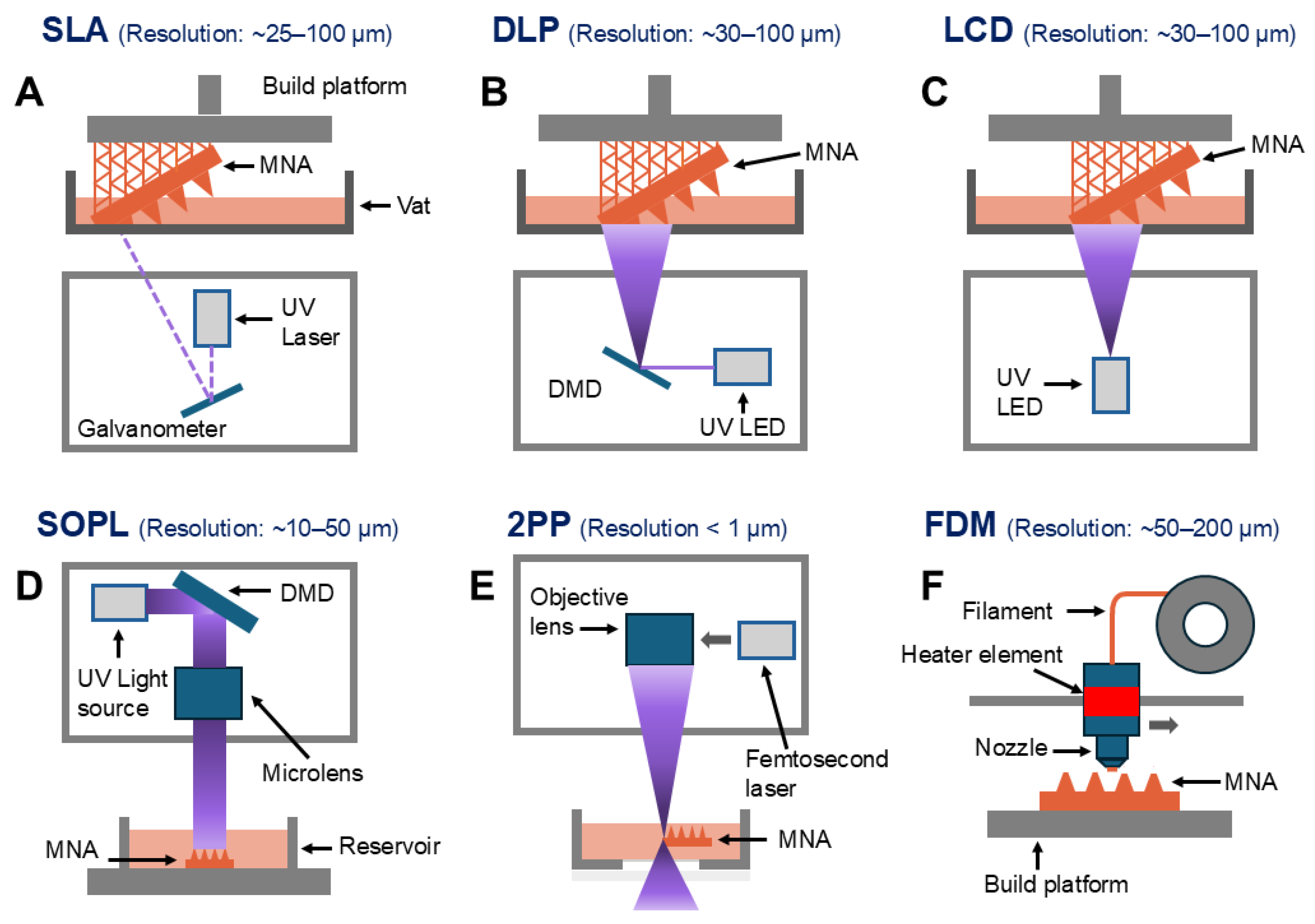
| SLA | Liquid photopolymers (e.g., UV-curable resins, PEGDA, biocompatible Class I resins) | ~25–100 μm | High precision for complex geometries; smooth surfaces; versatile for master molds in ocular/insulin delivery; enables transdermal electrochemical sensing and biomarker detection | Slower point-by-point curing; anisotropy and oxygen inhibition affect mechanical properties; cytotoxicity from residuals requires post-processing; high costs for advanced setups | 5–7 |
| DLP | Photopolymer resins (e.g., PEGDA, biocompatible light-sensitive resins) | ~30–100 μm | Accelerated production vs. SLA; supports on-demand drug delivery and biomarker detection (pH, glucose, lactate); in vivo glucose monitoring; enhanced buccal permeability | Potential pixelation; similar biocompatibility issues as SLA; sensitivity to curing time affects strength; scalability challenges | 5–7 |
| LCD | Light-curable photopolymer resins | ~30–100 μm | Cost-effective for large scale; higher speeds than SLA; minimal distortion; suitable for wearable prototypes with high accuracy | Longer exposure times than DLP; larger tip radii reduce penetration efficiency; reduced light intensity limits curing depth | 4–6 |
| SOPL | Monomer solutions for polymerization | ~10–50 μm | Rapid, high-throughput without mechanical movement; superior mechanical strength vs. DLP; quick customization; minimizes tissue damage | Limited flexibility in pattern changes; less established for diverse applications | 4–5 |
| 2PP | Photosensitive resins (e.g., PVP/PVA, acrylate-based, Ormocer®) | <1 μm | Submicron resolution for detailed structures; excellent control over barbs and arrays; supports stimuli-responsive designs; high-speed potential for scaling | Expensive equipment; time-consuming; limited material options; requires precise control to avoid damage | 4–6 |
| FDM | Thermoplastics (e.g., PLA, biodegradable polymers like ABS, PVA) | ~50–200 μm | Economical and user-friendly; no molds needed; suitable for biodegradable prototypes and simple geometries | Low inherent resolution requires post-processing (e.g., etching causes roughness); heat degrades drugs; poor fidelity for complex MNAs | 5–6 |
| Polymer Type | Young’s Modulus (Typical) | Swelling Behavior | Degradation Profile | Suitability for Drug Loading |
|---|---|---|---|---|
| PVA/PVP | ~0.1–2 GPa (dry) | High (water-soluble) | Rapid dissolution | Excellent for rapid drug release |
| PLGA | ~1–3 GPa | Minimal | Hydrolytic, weeks–months | Good for sustained drug delivery |
| PEGDA hydrogels | ~10 kPa–10 MPa (tunable) | High, tunable | Non-degradable or slow | Suitable for diffusion-controlled loading |
| GelMA | ~10–100 kPa | Moderate–high | Enzymatic, days–weeks | Good for bioactive payloads |
| Photopolymer resins | ~1–3 GPa | Low | Non-degradable | Limited; requires surface modification |
| Electrochemical Mode | Sample Type | Sensitivity (Reported) | Accuracy/Validation | Uncertainty/Variability | Study |
|---|---|---|---|---|---|
| Amperometric (enzymatic) | ISF | High sensitivity (linear response) | Strong correlation with reference glucose | Repeatability reported; explicit uncertainty not quantified | [128] |
| Amperometric (extracted ISF) | ISF | Enhanced signal via patterned electrodes | Reliable detection with minimal tissue damage | Variability discussed qualitatively | [115] |
| Electrochemical dual sensor | ISF | High sensitivity for continuous monitoring | Validated against pharmacokinetic profiles | Long-term stability demonstrated; uncertainty not explicitly reported | [114] |
| MNA Type | Wearable Integration/Technology | Target Function | Key Results/Performance Outcomes |
|---|---|---|---|
| Solid MNAs | Dry electrodes on flexible substrates | Biosensing (ISF glucose) | High correlation with reference glucose values in vivo; stable amperometric response during continuous wear |
| Solid MNAs | Nanostructured electrodes + wearable patch | Electrochemical biosensing | Maintained signal stability after repeated skin insertions; low signal drift during on-body testing |
| Hydrogel-forming MNAs | Swellable MNAs with integrated electrodes | Continuous metabolite sensing | Enabled sustained ISF sampling with minimal skin irritation; improved signal stability over time |
| Hollow MNAs | Microfluidic channels + wearable reservoir | Drug delivery | Delivered drug volumes comparable to hypodermic injection; controlled flow rate under wearable operation |
| Dissolving MNAs | Polymer dissolution in skin | Vaccination | Achieved comparable or enhanced antibody titers with dose-sparing vs. intramuscular injection |
| MNAs + iontophoresis | MNAs with wearable electrodes and power source | On-demand drug delivery | Provided stable current densities (10–100 µA cm−2) enabling controlled transdermal delivery within safety limits |
| MNAs + sensors and actuators | Biosensors, wireless modules | Closed-loop therapy | Demonstrated real-time biomarker monitoring coupled with responsive drug delivery |
| Design Strategy | Materials | Fabrication Method | Functional Integration | Primary Applications |
|---|---|---|---|---|
| Solid, dissolving, hydrogel-forming MNAs | Biodegradable polymers (PVA, PVP), hydrogels | SLA, DLP, molding via 3D-printed masters | Passive release, skin permeability enhancement | Vaccination, low-dose drug delivery, biosensing |
| Hollow MNAs (lumen-based) | Photopolymers, elastomers, composite resins | High-resolution SLA, DLP, 2PP | Reservoir-enabled delivery, microfluidics | High-dose drug delivery, insulin, biologics |
| Skin-conformal MNA wearables | Flexible polymers, conductive composites | Multimaterial 3D printing | Soft electronics, stretchable substrates | Continuous biosensing, wearable diagnostics |
| Actuated/controlled MNAs | Stimuli-responsive polymers | Advanced 3D printing + system integration | Acoustic, iontophoretic, or wireless control | On-demand and closed-loop therapeutics |
| Integrated smart MNA systems | Hybrid polymers, nano/biofunctional coatings | Multimaterial and high-resolution 3D printing | AI control, wireless communication | Personalized medicine, remote healthcare |
Disclaimer/Publisher’s Note: The statements, opinions and data contained in all publications are solely those of the individual author(s) and contributor(s) and not of MDPI and/or the editor(s). MDPI and/or the editor(s) disclaim responsibility for any injury to people or property resulting from any ideas, methods, instructions or products referred to in the content. |
© 2025 by the author. Licensee MDPI, Basel, Switzerland. This article is an open access article distributed under the terms and conditions of the Creative Commons Attribution (CC BY) license.
Share and Cite
Razzaghi, M. Integrating Polymeric 3D-Printed Microneedles with Wearable Devices: Toward Smart and Personalized Healthcare Solutions. Polymers 2026, 18, 123. https://doi.org/10.3390/polym18010123
Razzaghi M. Integrating Polymeric 3D-Printed Microneedles with Wearable Devices: Toward Smart and Personalized Healthcare Solutions. Polymers. 2026; 18(1):123. https://doi.org/10.3390/polym18010123
Chicago/Turabian StyleRazzaghi, Mahmood. 2026. "Integrating Polymeric 3D-Printed Microneedles with Wearable Devices: Toward Smart and Personalized Healthcare Solutions" Polymers 18, no. 1: 123. https://doi.org/10.3390/polym18010123
APA StyleRazzaghi, M. (2026). Integrating Polymeric 3D-Printed Microneedles with Wearable Devices: Toward Smart and Personalized Healthcare Solutions. Polymers, 18(1), 123. https://doi.org/10.3390/polym18010123