Modified Tuber Starches as Sustainable Biopolymers for the Encapsulating Bioactive Compounds: A Comprehensive Review

 ,
,  , and
, and
Abstract
1. Introduction
2. Tuber Starches: Characteristics and Modifications
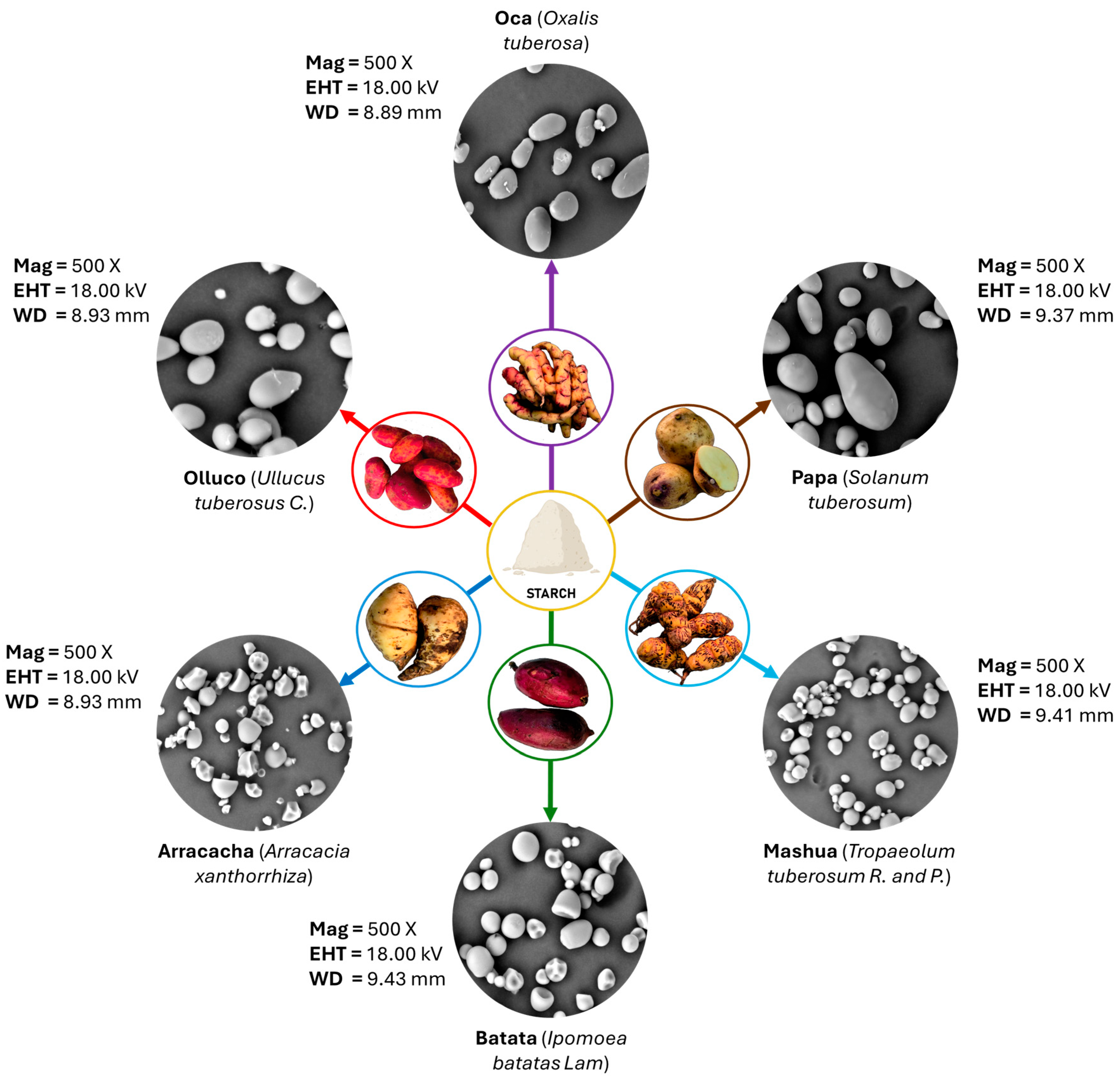
2.1. Composition and Morphology

| Plant Material | Starch Content (%) | Amylose Content (%) | Amylopectin Content (%) | Gelatinization Temperature (°C) | Viscosity (mPa·s) | Reference |
|---|---|---|---|---|---|---|
| Taro (Colocasia esculenta) | 93.55 | 17.89 | 75.66 | 74.52 | 5953.5 | [56] |
| Papa (Solanum tuberosum) | 85.50 | 29.90 | 20.00 | 58.50 | NR | [72] |
| Arracacha (Arracacia xanthorriza) | 98.40 | 34.31 | NR | 63.10 | 960.0 | [58] |
| Yam (Dioscorea bulbifera) | 77.30 | 16.60 | 83.40 | 94.10 | 7701.0 | [59] |
| Olluco (Ullucus tuberosus C.) | 54.48 | 23.92 | NR | 60.80 | 290.0 | [61] |
| Batata (Ipomoea batatas Lam) | 48.38 | 16.40 | 83.60 | 83.50 | 11,600.0 | [60] |
| Mashua (Tropaeolum tuberosum R. and P.) | 22.54 | 26.54 | NR | 61.02 | 370 | [61] |
| Oca (Oxalis tuberosa Mol.) | 32.78 | 24.38 | NR | 58.30 | 340 | [61] |
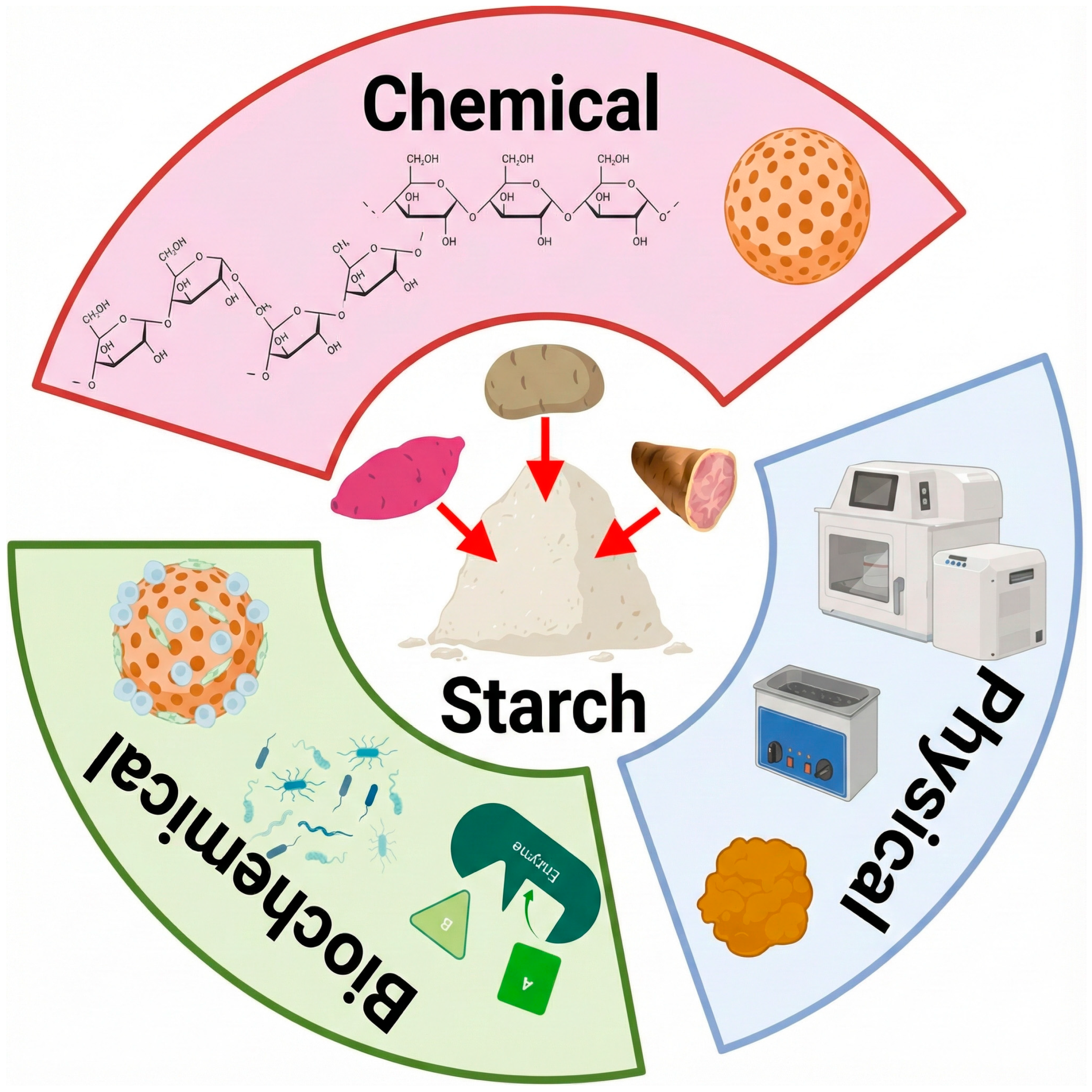
2.2. Starch Modification Techniques and Their Effect on Tuber Starch Characteristics
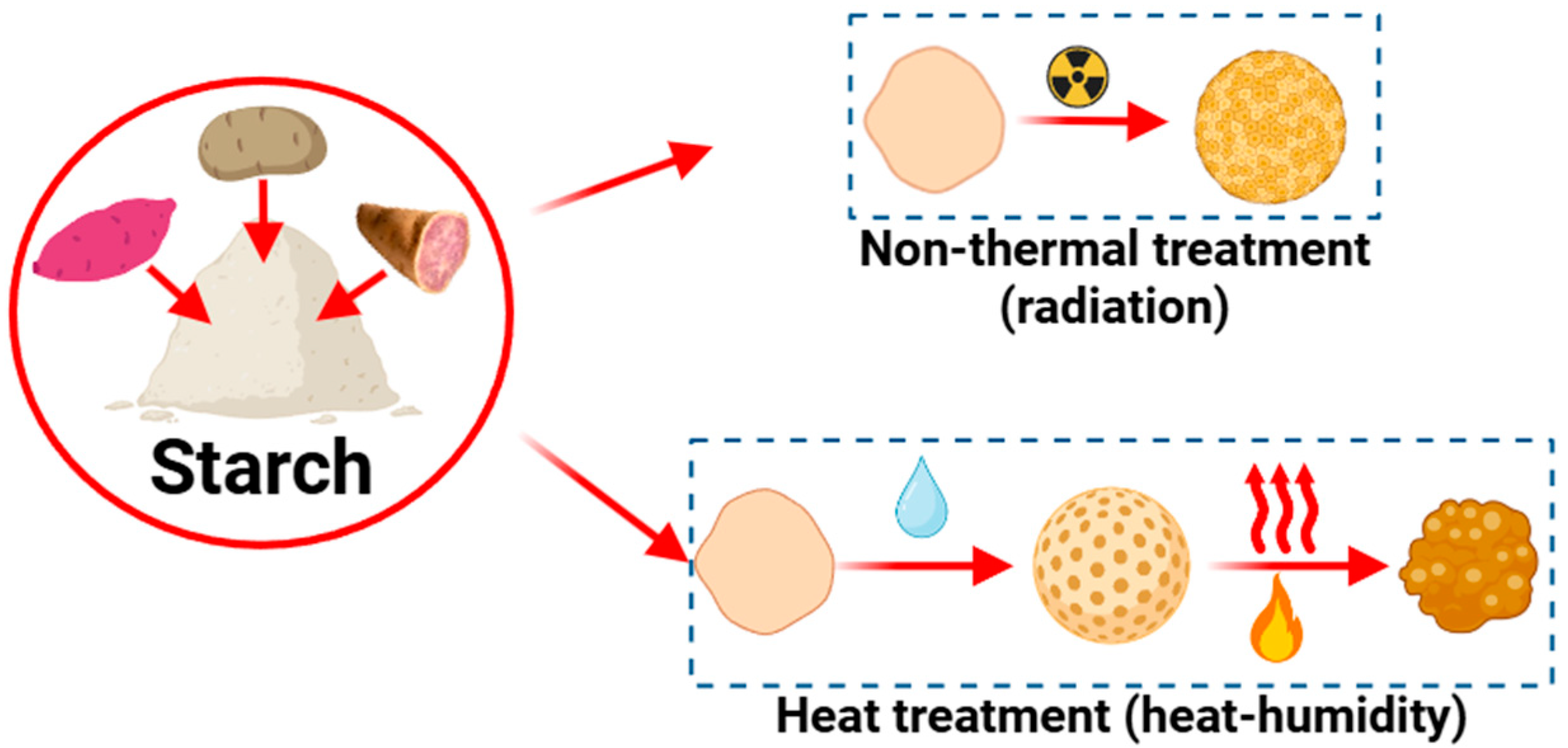
2.2.1. Physical Modifications
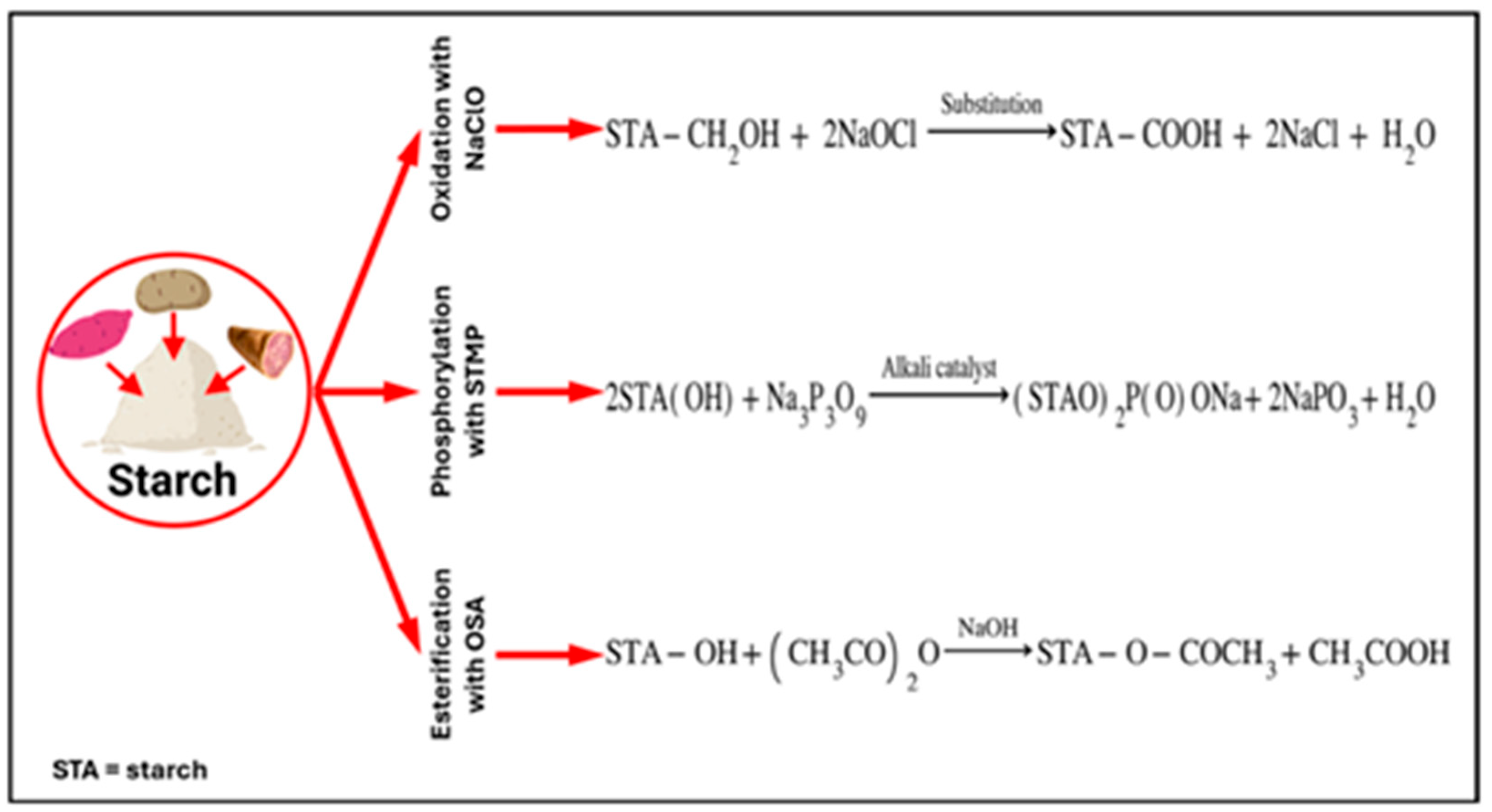
2.2.2. Chemical Modifications
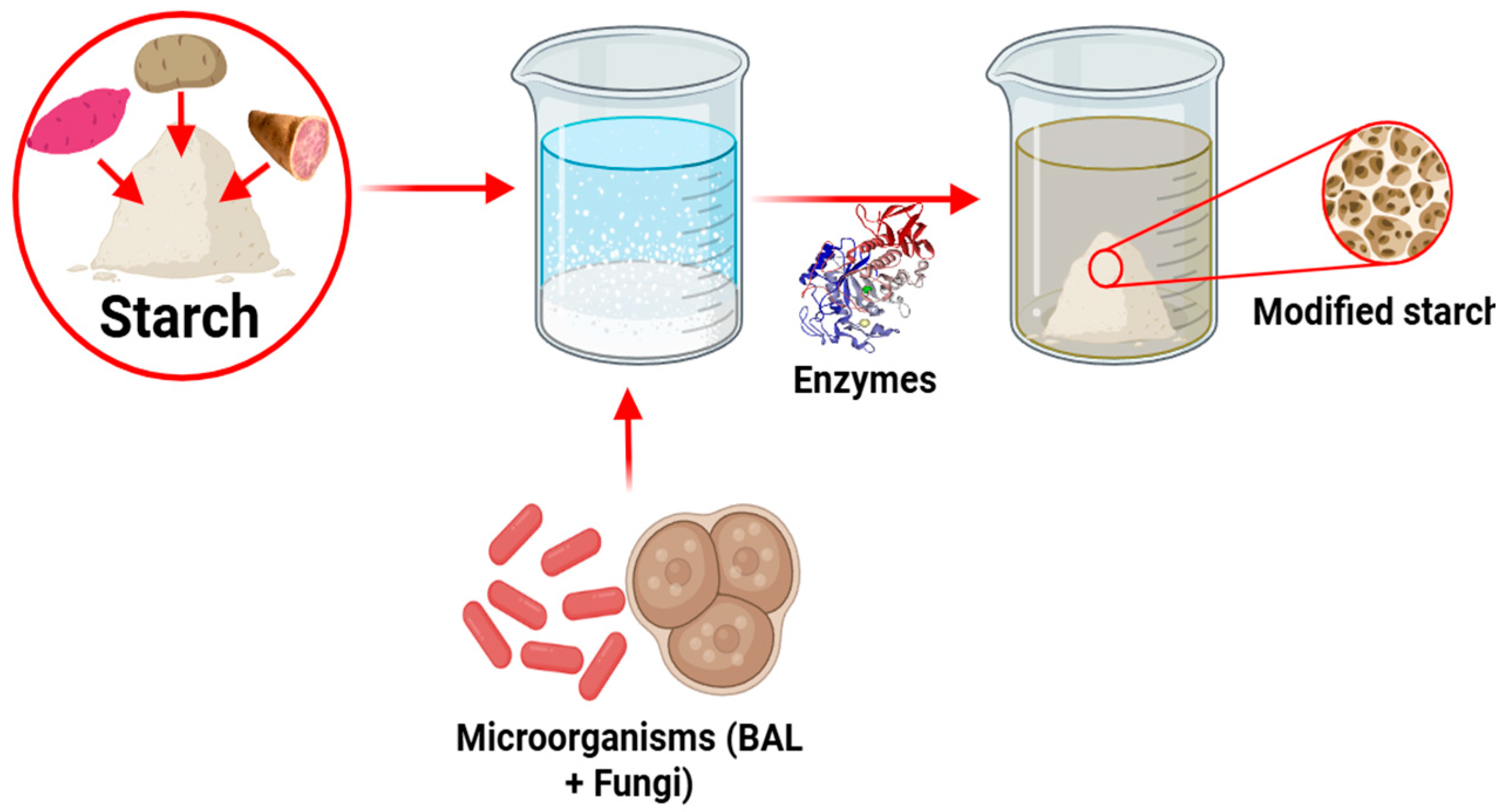
2.2.3. Biochemical Modifications
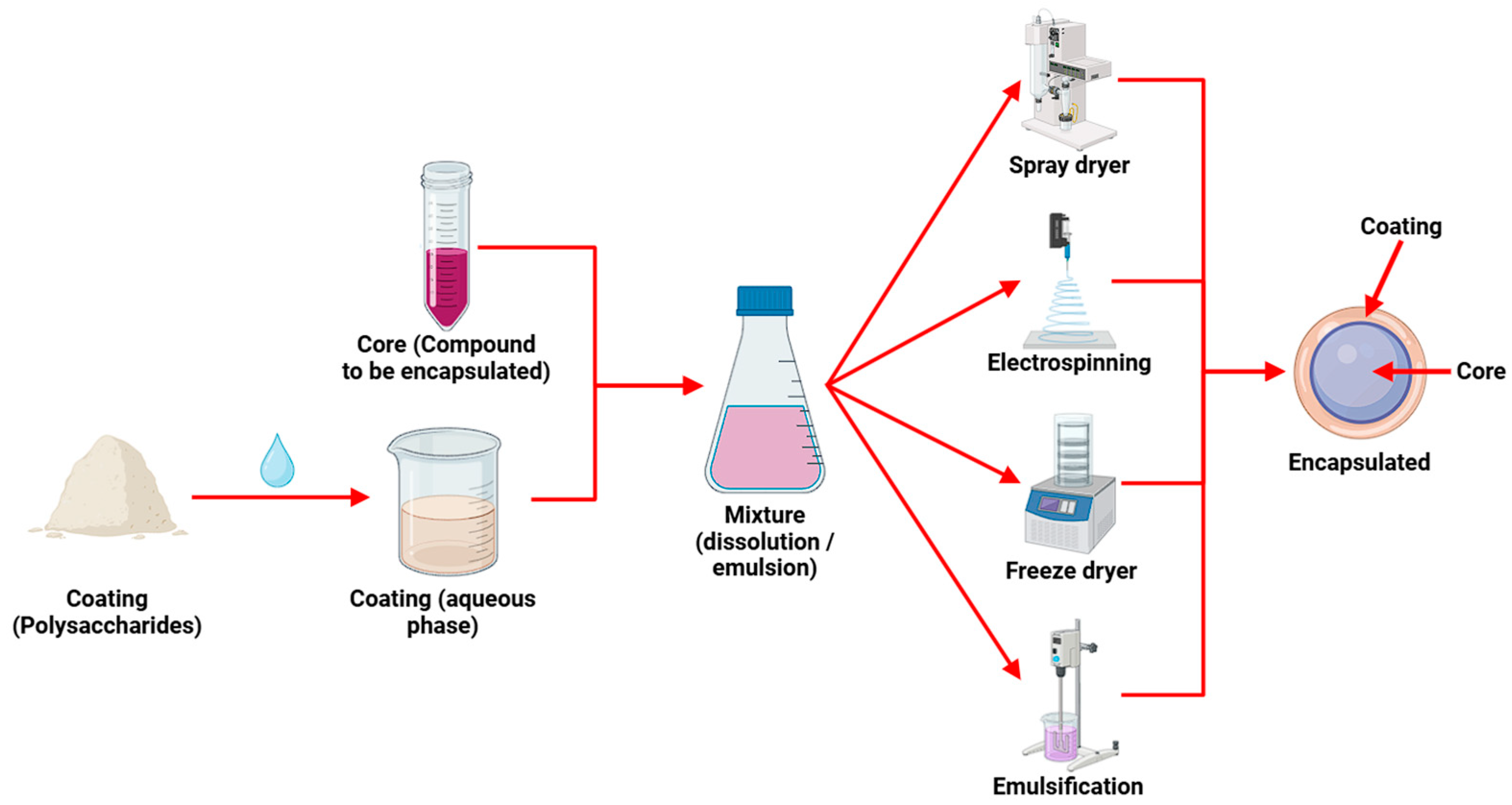
3. Encapsulation with Tuber Starches
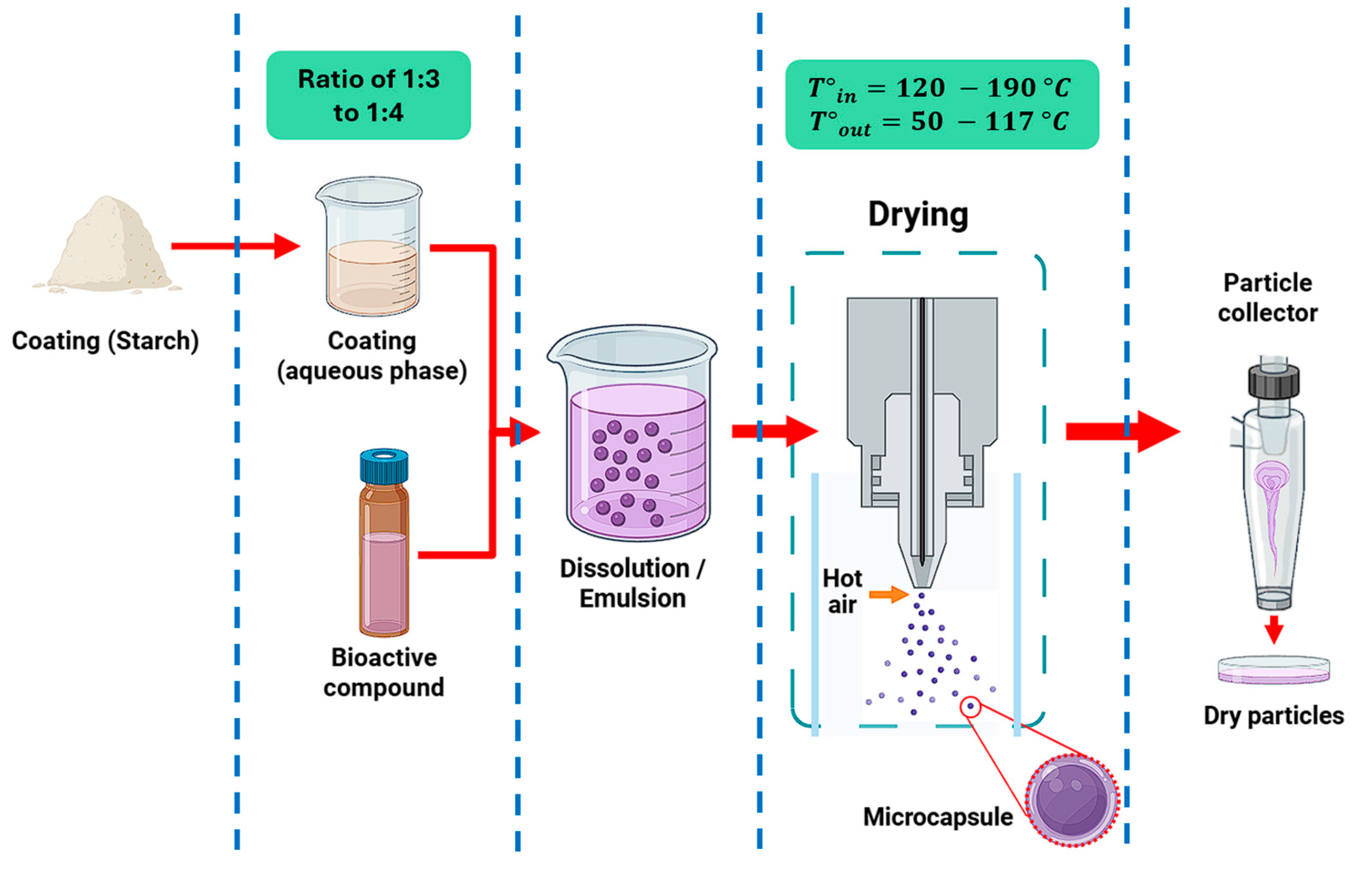
3.1. Spray Drying
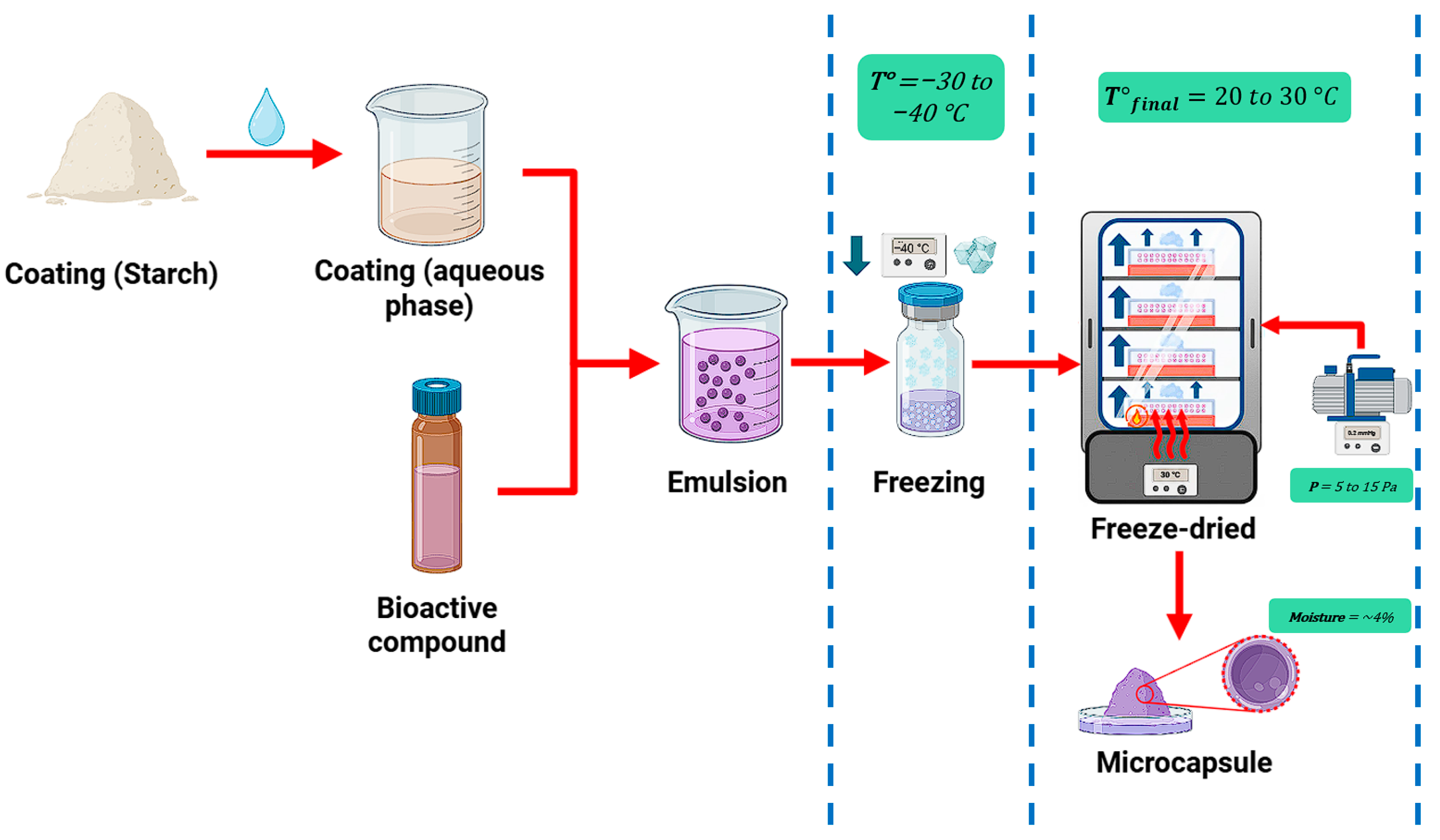
3.2. Freeze-Drying
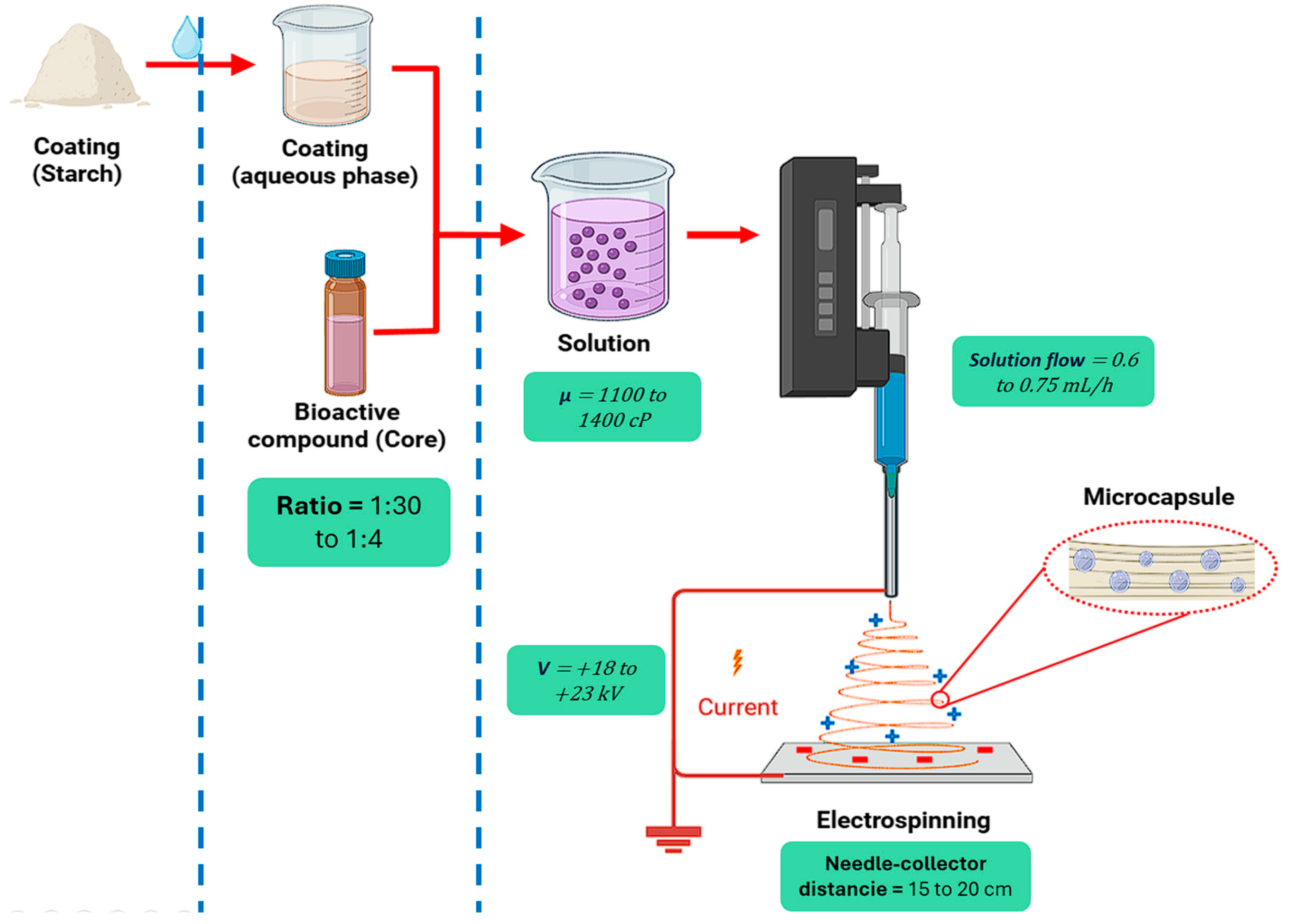
3.3. Electrospinning
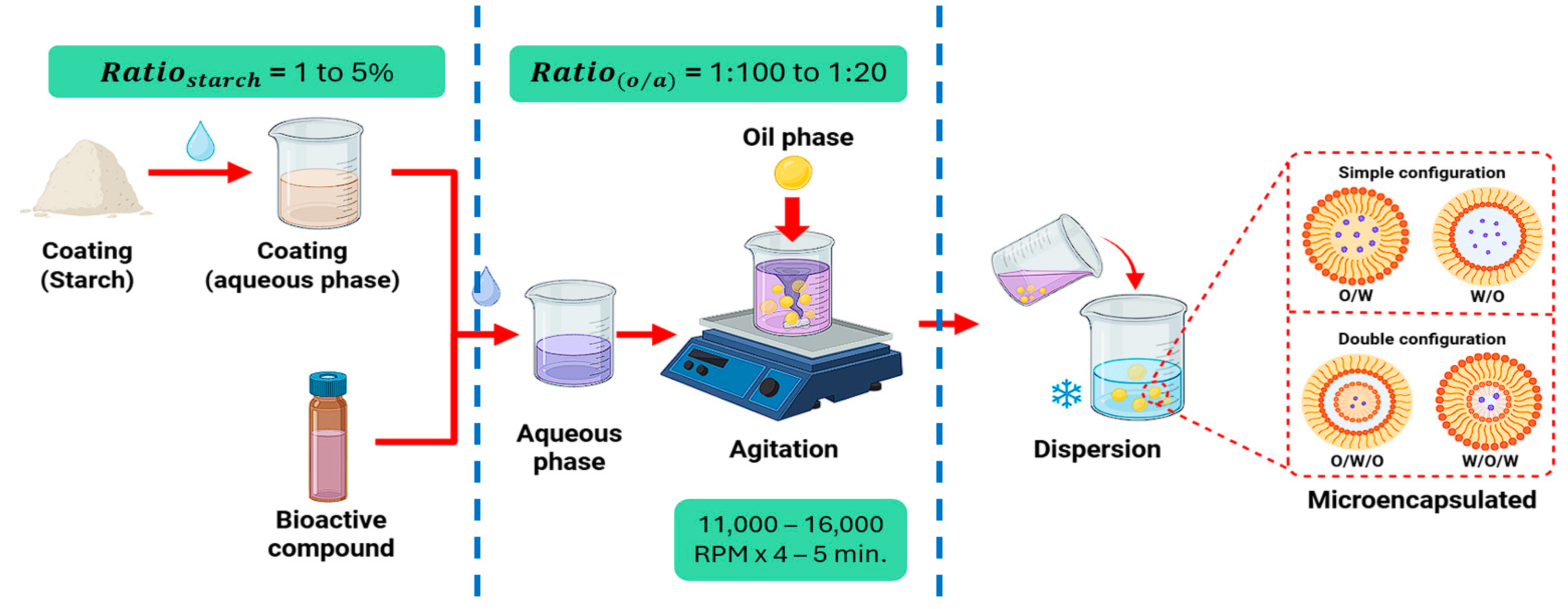
3.4. Emulsification
| Tubers | Encapsulation Technique | Parameters | Properties of the Microencapsulates | Ref. |
|---|---|---|---|---|
| Potato (Solanum tuberosum) | Freeze-drying |
| ↑ Encapsulation efficiency (70–84%) ↑ Pore volume (2.4 × 10⁻³–9.5 × 10⁻³ cm3/g) ↑ Operating cost (4 × higher than spray drying) ↓ Water activity (0.059–0.090) ↓ Surface area (0.632–1.225 /g) Irregular morphology. | [55] |
| Tigernut (Cyperus esculentus) | Freeze-drying |
| ↑ Thermal stability (>346 °C) ↑ Vitamin C content (3.17 ± 0.05 mg/100 g) ↑ Carbohydrate content (65.1%) ↓ Acidification (pH 6.88–6.99) ↓ Particle size (~1.01 µm) ↓ Mesophilic/mold growth (<104 UFC/mL) Smooth and spherical morphology | [172] |
| Sweet potato (Lpomoea batatas) | Electrospinning |
| ↑ Encapsulation efficiency (67–78%) ↑ Fiber diameter (251–611 nm) ↑ Antioxidant activity (92–96.9%) ↑ Lipid medium release (44–100%) ↑ Thermal resistance at 100 °C (51.6–95.4%) ↓ Hydrophilic release (<10%) Antimicrobial activity against E. coli and S. aureus. | [173] |
| Potato (Solanum tuberosum) | Electrohilado |
| ↑ Encapsulation efficiency (79.01–96.20%) ↑ Conductivity (1.2–4.8 mS/cm) ↑ Viscosity (1100–1400 cP) ↓ Thermal loss at 180 °C × 2 h. (17.40–34.08%) ↓ Fiber diameter (108–142 nm) ↓ Antioxidant activity: ABTS (11–45%) Homogeneous cylindrical morphology and formation of low-concentration bead | [128] |
| Oca (Oxalis tuberosa) | Emulsification |
| ↑ Stability (40 days) ↑ Emulsification index (0.6–0.8) ↑ Emulsion droplet size (76.5–92.5) Homogeneous morphology with the formation of a dense layer around the oil droplets. | [174] |
| Potato (Solanum tuberosum) | Emulsification |
| ↓ Viscosity (4.23–10.73 cP) ↑ Emulsification Index (0.41–1.00) ↑ Stability at 400 mg/mL ↑ Fat Binding Capacity (186.57–230.65%) | [76] |
| Sweet potato (Ipomoea batatas) | ↓ Viscosity (3.57–15.23 cP) ↑ Emulsification Index (0.63–1.00) ↑ Stability at 400 mg/mL ↑ Fat Binding Capacity (219.52–261.07%) |
4. Advantages and Challenges of Using Modified Tuber Starch in the Encapsulation of Bioactive Compounds
4.1. Technological Advantages and Challenges
4.2. Nutritional Advantages and Challenges
5. Trends and Future Perspectives
6. Conclusions
Author Contributions
Funding
Institutional Review Board Statement
Data Availability Statement
Conflicts of Interest
References
- Corrêa, A.N.R.; Garrido, E.B.; Timm, N.D.S.; Hoffmann, J.F.; Ferreira, C.D. Rheological, Pasting, and Morphological Properties of Chickpea and Cowpea Starch. In Chickpea and Cowpea; CRC Press: Boca Raton, FL, USA, 2023; pp. 109–136. [Google Scholar] [CrossRef]
- TAhmed, J.; Tiwari, B.K.; Imam, S.H.; Rao, M.E. Starch-Based Polymeric Materials and Nanocomposites; CRC Press: Boca Raton, FL, USA, 2012. [Google Scholar] [CrossRef]
- Koksel, H.; Muti, S.O.; Kahraman, K. Starch. In ICC Handbook of 21st Century Cereal Science and Technology; Elsevier: Amsterdam, The Netherlands, 2023; pp. 45–54. [Google Scholar] [CrossRef]
- Vilpoux, O.F.; Brito, V.H.; Cereda, M.P. Starch Extracted From Corms, Roots, Rhizomes, and Tubers for Food Application. In Starches for Food Application; Elsevier: Amsterdam, The Netherlands, 2019; pp. 103–165. [Google Scholar] [CrossRef]
- Chacon, W.D.C.; Gaviria, Y.A.R.; de Melo, A.P.Z.; Verruck, S.; Monteiro, A.R.; Valencia, G.A. Physicochemical Properties and Potential Food Applications of Starches Isolated from Unconventional Seeds: A Review. Starch-Stärke 2024, 76, 2200228. [Google Scholar] [CrossRef]
- Latip, D.N.H.; Samsudin, H.; Utra, U.; Alias, A.K. Modification methods toward the production of porous starch: A review. Crit. Rev. Food Sci. Nutr. 2021, 61, 2841–2862. [Google Scholar] [CrossRef] [PubMed]
- Kapelko-Żeberska, M.; Gryszkin, A.; Zięba, T.; Singh, A.V. Natural and Artificial Diversification of Starch. In Handbook of Composites from Renewable Materials; Wiley: New York, NY, USA, 2017; pp. 521–539. [Google Scholar] [CrossRef]
- Waterschoot, J.; Gomand, S.V.; Fierens, E.; Delcour, J.A. Production, structure, physicochemical and functional properties of maize, cassava, wheat, potato and rice starches. Starch-Stärke 2015, 67, 14–29. [Google Scholar] [CrossRef]
- Varghese, S.; Awana, M.; Mondal, D.; Rubiya, M.H.; Melethil, K.; Singh, A.; Krishnan, V.; Thomas, B. Amylose–Amylopectin Ratio. In Handbook of Biopolymers; Springer Nature: Singapore, 2023; pp. 1305–1334. [Google Scholar] [CrossRef]
- Romano, A.; Mackie, A.; Farina, F.; Aponte, M.; Sarghini, F.; Masi, P. Characterisation, in vitro digestibility and expected glycemic index of commercial starches as uncooked ingredients. J. Food Sci. Technol. 2016, 53, 4126–4134. [Google Scholar] [CrossRef] [PubMed]
- Jayakody, L.; Hoover, R.; Liu, Q.; Donner, E. Studies on tuber starches. II. Molecular structure, composition and physicochemical properties of yam (Dioscorea sp.) starches grown in Sri Lanka. Carbohydr. Polym. 2007, 69, 148–163. [Google Scholar] [CrossRef]
- Casarrubias-Castillo, M.G.; Méndez-Montealvo, G.; Rodríguez-Ambriz, S.L.; Sánchez-Rivera, M.M.; Bello-Pérez, L.A. Structural and rheological differences between fruit and cereal starches; [Diferencias estructurales y reológicas entre almidones de frutas y cereales]. Agrociencia 2012, 46, 455–466. [Google Scholar]
- Liu, W.; Chen, L.; McClements, D.J.; Zou, Y.; Chen, G.; Jin, Z. Vanillin-assisted preparation of chitosan-betaine stabilized corn starch gel: Gel properties and microstructure characteristics. Food Hydrocoll. 2024, 148, 109510. [Google Scholar] [CrossRef]
- Naveen, R.; Loganathan, M. Role of Varieties of Starch in the Development of Edible Films—A Review. Starch-Stärke 2024, 76, 2300138. [Google Scholar] [CrossRef]
- He, T.; Zhao, L.; Wang, L.; Liu, L.; Liu, X.; Dhital, S.; Hu, Z.; Wang, K. Gallic acid forms V-amylose complex structure with starch through hydrophobic interaction. Int. J. Biol. Macromol. 2024, 260, 129408. [Google Scholar] [CrossRef]
- Oladebeye, A.; Oladebeye, A. Physicochemical Properties of Starches of Sweet Potato (Ipomea batata) and Red Cocoyam (Colocasia esculenta) Cormels. Pak. J. Nutr. 2009, 8, 313–315. [Google Scholar] [CrossRef][Green Version]
- Ramaprabha, K.; Kumar, V.; Saravanan, P.; Rajeshkannan, R.; Rajasimman, M.; Kamyab, H.; Vasseghian, Y. Exploring the diverse applications of Carbohydrate macromolecules in food, pharmaceutical, and environmental technologies. Environ. Res. 2024, 240, 117521. [Google Scholar] [CrossRef]
- Amir, A.; Djalal, T.; Nassima, S.; Fouzi, T.A. Plant Biomass Derived Materials; Wiley: New York, NY, USA, 2024; pp. 63–115. [Google Scholar] [CrossRef]
- Chen, Y.; McClements, D.J.; Peng, X.; Chen, L.; Xu, Z.; Meng, M.; Ji, H.; Long, J.; Qiu, C.; Zhao, J.; et al. Research progresses on enzymatic modification of starch with 4-α-glucanotransferase. Trends Food Sci. Technol. 2023, 131, 164–174. [Google Scholar] [CrossRef]
- Belitz, H.-D.; Grosch, W.; Schieberle, P. Food Chemistry, 4th ed.; Springer: Heidelberg, Germany, 2009. [Google Scholar]
- Mounir, S.; Ghandour, A.; Shatta, A.; Farid, E. Starch: Properties and Functionality. In Starch; CRC Press: Boca Raton, FL, USA, 2024; pp. 1–46. [Google Scholar] [CrossRef]
- Kaur, L.; Singh, J.; Liu, Q. Starch—A Potential Biomaterial for Biomedical Applications. In Nanomaterials and Nanosystems for Biomedical Applications; Springer: Dordrecht, The Netherlands, 2007; pp. 83–98. [Google Scholar] [CrossRef]
- Compart, J.; Singh, A.; Fettke, J.; Apriyanto, A. Customizing Starch Properties: A Review of Starch Modifications and Their Applications. Polymers 2023, 15, 3491. [Google Scholar] [CrossRef] [PubMed]
- Sinhmar, A.; Pathera, A.K.; Sharma, S.; Nehra, M.; Thory, R.; Nain, V. Impact of Various Modification Methods on Physicochemical and Functional Properties of Starch: A Review. Starch-Stärke 2023, 75, 2200117. [Google Scholar] [CrossRef]
- Zhou, T.; Wang, Q.; Hu, Z.; Huang, J.; Zheng, X.; Tang, Y.; Xiang, D.; Peng, L.; Sun, Y.; Zou, L.; et al. The composition, internal interactions, auxiliary preparation methods, and applications of type five resistant starch: A review. Food Hydrocoll. 2025, 160, 110835. [Google Scholar] [CrossRef]
- Mahmood, K.; Kamilah, H.; Shang, P.L.; Sulaiman, S.; Ariffin, F.; Alias, A.K. A review: Interaction of starch/non-starch hydrocolloid blending and the recent food applications. Food Biosci. 2017, 19, 110–120. [Google Scholar] [CrossRef]
- Punia, S. Barley starch modifications: Physical, chemical and enzymatic—A review. Int. J. Biol. Macromol. 2020, 144, 578–585. [Google Scholar] [CrossRef] [PubMed]
- Tharanathan, R.N. Starch—Value Addition by Modification. Crit. Rev. Food Sci. Nutr. 2005, 45, 371–384. [Google Scholar] [CrossRef] [PubMed]
- Shoukat, R.; Cappai, M.; Pilia, L.; Pia, G. Rice Starch Chemistry, Functional Properties, and Industrial Applications: A Review. Polymers 2025, 17, 110. [Google Scholar] [CrossRef]
- Gałkowska, D.; Kapuśniak, K.; Juszczak, L. Chemically Modified Starches as Food Additives. Molecules 2023, 28, 7543. [Google Scholar] [CrossRef]
- Ali, T.M.; Haider, S.; Shaikh, M.; Butt, N.A.; Zehra, N. Chemical Crosslinking, Acid Hydrolysis, Oxidation, Esterification, and Etherification of Starch. In Advanced Research in Starch; Springer Nature: Singapore, 2024; pp. 47–94. [Google Scholar] [CrossRef]
- Milanezzi, G.C.; Silva, E.K. Pulsed electric field-induced starch modification for food industry applications: A review of native to modified starches. Carbohydr. Polym. 2025, 348, 122793. [Google Scholar] [CrossRef]
- Salman, S.; Sharaf, H.K.; Hussein, A.F.; Khalaf, N.J.; Abbas, M.K.; Aned, A.M.; Al-Taie, A.A.T.; Jaber, M.M. Optimization of raw material properties of natural starch by food glue based on dry heat method. Food Sci. Technol. 2022, 42, e78121. [Google Scholar] [CrossRef]
- Olawoye, B.; Popoola-Akinola, O.; Fagbohun, O.F.; Adetola, D.B.; Adeloye, A.E.; Abdulwahab, A.A.; Ogunjemilusi, M.A.; Olaoye, I.O. Starch Modification Using Sustainable Processing Technology: Impacts and Applications. Starch-Stärke 2024, 77, 2400115. [Google Scholar] [CrossRef]
- Qi, X.; Tester, R.F. Starch granules as active guest molecules or microorganism delivery systems. Food Chem. 2019, 271, 182–186. [Google Scholar] [CrossRef]
- Montoya-Yepes, D.F.; Jiménez-Rodríguez, A.A.; Aldana-Porras, A.E.; Velásquez-Holguin, L.F.; Méndez-Arteaga, J.J.; Murillo-Arango, W. Starches in the encapsulation of plant active ingredients: State of the art and research trends. Polym. Bull. 2024, 81, 135–163. [Google Scholar] [CrossRef]
- Guo, Y.; Qiao, D.; Zhao, S.; Zhang, B.; Xie, F. Starch-based materials encapsulating food ingredients: Recent advances in fabrication methods and applications. Carbohydr. Polym. 2021, 270, 118358. [Google Scholar] [CrossRef]
- Wang, X.; Yuan, Y.; Yue, T. The application of starch-based ingredients in flavor encapsulation. Starch-Stärke 2015, 67, 225–236. [Google Scholar] [CrossRef]
- Małyszek, Z.; Lewandowicz, J. Wpływ stopnia podstawienia skrobi E1422 na właściwości reologiczne w układach zawierających chlorek sodu. Zywnosc Nauk. Technol. Jakosc/Food Sci. Technol. Qual. 2018, 116, 89–99. [Google Scholar] [CrossRef]
- Van Hung, P.; Miyazaki, M.; Morita, N. Application of Chemically Modified Starches for Breadmaking. In Advances in Cereal and Pseudocereal Research For Functional Foods; Nova Science Publishers, Inc.: New York, NY, USA, 2013; pp. 151–161. [Google Scholar]
- Remya, R.; Jyothi, A.N.; Sreekumar, J. Effect of chemical modification with citric acid on the physicochemical properties and resistant starch formation in different starches. Carbohydr. Polym. 2018, 202, 29–38. [Google Scholar] [CrossRef]
- Cabrera-Canales, Z.E.; Gómez-Aldapa, C.A.; Castro-Rosas, J.; Díaz-Batalla, L.; Navarro-Cortez, R.O.; Martínez, N.C.; Falfán-Cortés, R.N. Development and application of gelatinized starches as wall materials for Lacticaseibacillus paracasei encapsulation. Int. J. Polym. Anal. Charact. 2023, 28, 684–696. [Google Scholar] [CrossRef]
- Miao, M.; Jiang, B.; Jin, Z.; BeMiller, J.N. Microbial Starch-Converting Enzymes: Recent Insights and Perspectives. Compr. Rev. Food Sci. Food Saf. 2018, 17, 1238–1260. [Google Scholar] [CrossRef] [PubMed]
- Tong, C.; Ma, Z.; Chen, H.; Gao, H. Toward an understanding of potato starch structure, function, biosynthesis, and applications. Food Front. 2023, 4, 980–1000. [Google Scholar] [CrossRef]
- Setiarto, R.H.B.; Kusumaningrum, H.D.; Jenie, B.S.L.; Khusniati, T.; Sulistiani, S. Modified taro starch as alternative encapsulant for microencapsulation of Lactobacillus plantarum SU-LS 36. Czech J. Food Sci. 2021, 38, 293–300. [Google Scholar] [CrossRef]
- Velásquez-Barreto, F.F.; Sánchez, C.E.V. Microencapsulation of Purple Mashua Extracts Using Andean Tuber Starches Modified by Octenyl Succinic Anhydride. Int. J. Food Sci. 2022, 2022, 8133970. [Google Scholar] [CrossRef] [PubMed]
- Fonseca-Santanilla, E.B.; Betancourt-López, L.L. Physicochemical and structural characterization of starches from Andean roots and tubers grown in Colombia. Food Sci. Technol. Int. 2022, 28, 144–156. [Google Scholar] [CrossRef]
- Torres-Gallo, R.; Chávez-Salazar, A.; Castellanos-Galeano, F.J. Patentes relacionadas con el uso de almidones de fuentes no convencionales para microencapsulación y desarrollo de productos en industria alimentaria y farmacéutica: Una revisión. TecnoLógicas 2023, 26, e2569. [Google Scholar] [CrossRef]
- Barreto, F.F.V.; Bello-Pérez, L.A. Chemical, Structural, Technological Properties and Applications of Andean Tuber Starches: A Review. Food Rev. Int. 2023, 39, 1293–1308. [Google Scholar] [CrossRef]
- Moorthy, S.N.; Shanavas, S. Sweet Potato Starch; Nova Science Publishers, Inc.: New York, NY, USA, 2010. [Google Scholar]
- Rolland-Sabaté, A.; Sánchez, T.; Buléon, A.; Colonna, P.; Jaillais, B.; Ceballos, H.; Dufour, D. Structural characterization of novel cassava starches with low and high-amylose contents in comparison with other commercial sources. Food Hydrocoll. 2012, 27, 161–174. [Google Scholar] [CrossRef]
- Daza, L.D.; Umaña, M.; Simal, S.; Váquiro, H.A.; Eim, V.S. Non-conventional starch from cubio tuber (Tropaeolum tuberosum): Physicochemical, structural, morphological, thermal characterization and the evaluation of its potential as a packaging material. Int. J. Biol. Macromol. 2022, 221, 954–964. [Google Scholar] [CrossRef]
- Prakruthi, L.Y.; Krishnan, H.; Medha, T.; Kumarakuru, K.; Kumari, P.V.; Surekha, C.; Alavilli, H.; Kaushik, D.; Hashem, A.; Alotaibi, N.H.; et al. Enhancing starch properties through dual modification: Ultrasonication and acetic acid treatment of non-conventional starches. Ultrason. Sonochem. 2025, 115, 107301. [Google Scholar] [CrossRef]
- Valcárcel-Yamani, B.; Rondán-Sanabria, G.G.; Finardi-Filho, F. The physical, chemical and functional characterization of starches from Andean tubers: Oca (Oxalis tuberosa Molina), olluco (Ullucus tuberosus Caldas) and mashua (Tropaeolum tuberosum Ruiz & Pavón). Braz. J. Pharm. Sci. 2013, 49, 453–464. [Google Scholar] [CrossRef]
- Sepelevs, I.; Stepanova, V.; Galoburda, R. Encapsulation of Gallic Acid with Acid-Modified Low Dextrose Equivalent Potato Starch Using Spray- and Freeze-Drying Techniques. Pol. J. Food Nutr. Sci. 2018, 68, 273–280. [Google Scholar] [CrossRef]
- Ginting, M.; Hasibuan, R.; Lubis, M.; Sirait, T.; Sidabudar, T. Effect of Heating on Tensile Strength and Elongation at Break of Bioplastic from Taro Starch Filled Chitosan (Colocasia esculenta) with Glycerol Plasticizer. Asian J. Chem. 2021, 33, 2347–2352. [Google Scholar] [CrossRef]
- Garcia, E.L.; Carmo, E.L.D.; de Pádua, J.G.; Franco, C.M.L.; Leonel, M. Potato cultivars as a source of starch in Brazil: Physicochemical characteristics of the starches and their correlations. Aust. J. Crop Sci. 2019, 13, 1786–1792. [Google Scholar] [CrossRef]
- Pinzon, M.I.; Sanchez, L.T.; Villa, C.C. Chemical, structural, and thermal characterization of starches from four yellow Arracacha (Arracacia xanthorriza) roots produced in Colombia. Heliyon 2020, 6, e04763. [Google Scholar] [CrossRef]
- Fawale, S.O.; Netzel, M.E.; Nguyen, A.; Akinsanmi, O.A.; Marrie, H.; Sultanbawa, Y. Unlocking the nutritional potential of Australian yam (Dioscorea spp.). Food Biosci. 2025, 63, 105612. [Google Scholar] [CrossRef]
- Pérez, E.; Pacheco De Delahaye, E. Chemical, physical and rheological characteristics of flour and native starch isolated from sweet potato (Ipomoea batatas Lam); [Características químicas, físicas y reológicas de la harina y el almidón nativo aislado de Ipomoea batatas Lam]. Acta Cient. Venez. 2005, 56, 9–15. [Google Scholar]
- Velásquez-Barreto, F.F.; Bello-Pérez, L.A.; Nuñez-Santiago, C.; Yee-Madeira, H.; Sánchez, C.E.V. Relationships among molecular, physicochemical and digestibility characteristics of Andean tuber starches. Int. J. Biol. Macromol. 2021, 182, 472–481. [Google Scholar] [CrossRef]
- Ahmad, D.; Ying, Y.; Bao, J. Understanding starch biosynthesis in potatoes for metabolic engineering to improve starch quality: A detailed review. Carbohydr. Polym. 2024, 346, 122592. [Google Scholar] [CrossRef]
- Hernández-Uribe, J.P.; Meza-Nieto, M.; Palma-Rodríguez, H.M.; Navarro-Cortez, R.O.; Guzmán-Ortiz, F.A.; Bello-Pérez, L.A.; Vargas-Torres, A. Physicochemical, Morphological, and Molecular Properties of Starch Isolated from Dioscorea and Oxalis Tubers from Hidalgo State, Mexico. Starch-Starke 2020, 72, 2000074. [Google Scholar] [CrossRef]
- Helle, S.; Bray, F.; Putaux, J.-L.; Verbeke, J.; Flament, S.; Rolando, C.; D’hulst, C.; Szydlowski, N. Intra-Sample Heterogeneity of Potato Starch Reveals Fluctuation of Starch-Binding Proteins According to Granule Morphology. Plants 2019, 8, 324. [Google Scholar] [CrossRef]
- Azima, F.; Nazir, N.; Efendi, H.C. Characteristics of physico-chemical and functional properties of starch extracts from tubers. J. Phys. Conf. Ser. 2020, 1469, 012002. [Google Scholar] [CrossRef]
- Moorthy, S.; Sajeev, M.; Anish, R. Functionality of tuber starches. In Starch in Food; Elsevier: Amsterdam, The Netherlands, 2024; pp. 327–375. [Google Scholar] [CrossRef]
- Dereje, B. Composition, morphology and physicochemical properties of starches derived from indigenous Ethiopian tuber crops: A review. Int. J. Biol. Macromol. 2021, 187, 911–921. [Google Scholar] [CrossRef]
- El-Sheikh, M.A.; Hamad, S. Starch nanoparticles: Preparation, characterization, and gastro-protective effect on gastric ulcer mice model. Carbohydr. Polym. Technol. Appl. 2025, 11, 100901. [Google Scholar] [CrossRef]
- da Silva, R.S.O.; de Figueiredo, H.M.; Rodrigues, A.M.C. Production of Lactobacillus plantarum ATCC 8014 and microencapsulation using cassava starch and Bactris Gasepaes Kunth palm starch. LWT 2025, 228, 118070. [Google Scholar] [CrossRef]
- Pawde, S.V.; Kaewprachu, P.; Kingwascharapong, P.; Sai-Ut, S.; Karbowiak, T.; Jung, Y.H.; Rawdkuen, S. A comprehensive review on plant protein-based food packaging: Beyond petroleum-based polymers. Curr. Res. Food Sci. 2025, 10, 101104. [Google Scholar] [CrossRef] [PubMed]
- Marta, H.; Chandra, S.; Cahyana, Y.; Sukri, N.; Pangawikan, A.D.; Yuliana, T.; Arifin, H.R. Arrowroot (Maranta arundinaceae L.) starch-based edible coating formulation and its application to shelf-life extension of tomato (Solanum lycopersicum L.). Carbohydr. Polym. Technol. Appl. 2025, 9, 100674. [Google Scholar] [CrossRef]
- Cira-Chávez, L.A.; Gassós-Ortega, L.E.; García-Encinas, N.L.; Castillo-Zamora, M.; Ruíz-Cruz, S.; Bello-Pérez, L.A.; Estrada-Alvarado, M.I. Morphological, Thermal, and Rheological Properties of Starch from Potatoes Grown in Mexico. Starch-Stärke 2021, 73, 2000049. [Google Scholar] [CrossRef]
- Chen, Q.; Yu, H.; Wang, L.; Abdin, Z.U.; Chen, Y.; Wang, J.; Zhou, W.; Yang, X.; Khan, R.U.; Zhang, H.; et al. Recent progress in chemical modification of starch and its applications. RSC Adv. 2015, 5, 67459–67474. [Google Scholar] [CrossRef]
- Paul, A.; Roychowdhury, V.; Ghosh, S. Starch in Food Applications. In Biopolymers in Pharmaceutical and Food Applications; Wiley: New York, NY, USA, 2024; pp. 1–24. [Google Scholar] [CrossRef]
- Hornung, P.S.; Barbi, R.C.T.; Teixeira, G.L.; Ávila, S.; Silva, F.L.d.A.d.; Lazzarotto, M.; Silveira, J.L.M.; Beta, T.; Ribani, R.H. Brazilian Amazon white yam (Dioscorea sp.) starch. J. Therm. Anal. Calorim. 2018, 134, 2075–2088. [Google Scholar] [CrossRef]
- Xiao, X.L.; Yussof, N.S.; Lazim, A.M.; Utra, U. Modified tuber starches as potential stabilizer for food-grade Pickering emulsions. Food Res. 2020, 4, 753–763. [Google Scholar] [CrossRef]
- Sobini, N.; Darsiga, S.; Kananke, T.; Srivijeindran, S. Characterization of modified palmyrah tuber starch by pre-gelatinization, acid and dextrinization processes and its applicability. Food Chem. Adv. 2022, 1, 100143. [Google Scholar] [CrossRef]
- Dorantes-Fuertes, M.-G.; López-Méndez, M.C.; Martínez-Castellanos, G.; Meléndez-Armenta, R.Á.; Jiménez-Martínez, H.-E. Starch Extraction Methods in Tubers and Roots: A Systematic Review. Agronomy 2024, 14, 865. [Google Scholar] [CrossRef]
- Moorthy, S.N.; Sajeev, M.S.; Ambrose, R.P.K.; Anish, R.J. Starch modifications. In Tropical Tuber Starches: Structural and Functional Characteristic; CABI: Oxford, UK, 2021; pp. 177–213. [Google Scholar] [CrossRef]
- BeMiller, J.N. Physical modification of starch. In Starch in Food; Elsevier: Amsterdam, The Netherlands, 2024; pp. 79–96. [Google Scholar] [CrossRef]
- Navaf, M.; Sunooj, K.V. Physical Modifications of Starch. In Advanced Research in Starch; Springer Nature: Singapore, 2024; pp. 1–45. [Google Scholar] [CrossRef]
- Mateti, T.; Kumari, M.; Savita; Chaudhury, S.I.; Likhith, K.; Thakur, G. Modified Starches Used in the Food Industry and Biomedical Applications. In Advanced Research in Starch; Springer Nature: Singapore, 2024; pp. 231–245. [Google Scholar] [CrossRef]
- Park, S.; Kim, Y.-R. Clean label starch: Production, physicochemical characteristics, and industrial applications. Food Sci. Biotechnol. 2021, 30, 1–17. [Google Scholar] [CrossRef] [PubMed]
- Rostamabadi, H.; Rohit, T.; Karaca, A.C.; Nowacka, M.; Colussi, R.; Frasson, S.F.; Aaliya, B.; Sunooj, K.V.; Falsafi, S.R. How non-thermal processing treatments affect physicochemical and structural attributes of tuber and root starches? Trends Food Sci. Technol. 2022, 128, 217–237. [Google Scholar] [CrossRef]
- Mauro, R.R.; Vicente, A.; Ronda, F. Molecular modifications in cereal and tuber starches induced by microwave treatment: A comprehensive analysis using asymmetric flow field-flow fractionation. Int. J. Biol. Macromol. 2025, 316, 144395. [Google Scholar] [CrossRef]
- Wu, Z.; Qiao, D.; Zhao, S.; Lin, Q.; Zhang, B.; Xie, F. Nonthermal physical modification of starch: An overview of recent research into structure and property alterations. Int. J. Biol. Macromol. 2022, 203, 153–175. [Google Scholar] [CrossRef] [PubMed]
- Oh, E.; Choi, S.; Lee, S.; Kim, C.; Moon, T. Modification of Granular Corn Starch with 4-α-Glucanotransferase from Thermotoga maritima: Effects on Structural and Physical Properties. J. Food Sci. 2008, 73, C158–C166. [Google Scholar] [CrossRef] [PubMed]
- dos Santos, T.P.R.; Franco, C.M.L.; Mischan, M.M.; Leonel, M. Behavior of Sweet Potato Starch After Spray-Drying Under Different Pretreatment Conditions. Starch-Stärke 2019, 71, 1800245. [Google Scholar] [CrossRef]
- Olayemi, O.; Adetunji, O.; Isimi, C. Physicochemical, structural characterization and pasting properties of pre-gelatinized Neorautanenia mitis starch. Polym. Med. 2021, 51, 7–16. [Google Scholar] [CrossRef]
- Ashogbon, A.O. Dual modification of various starches: Synthesis, properties and applications. Food Chem. 2021, 342, 128325. [Google Scholar] [CrossRef]
- Chakraborty, I.; N, P.; Mal, S.S.; Paul, U.C.; Rahman, H.; Mazumder, N. An Insight into the Gelatinization Properties Influencing the Modified Starches Used in Food Industry: A review. Food Bioprocess Technol. 2022, 15, 1195–1223. [Google Scholar] [CrossRef]
- Radeloff, M.A.; Beck, R.H. Principles of industrial scale chemical starch modification. Sugar Ind. 2012, 137, 222–226. [Google Scholar] [CrossRef]
- Wronkowska, M.; Krupa-Kozak, U.; Soral-Śmietana, M. Chemically Modified Potato Starch as a Source of Nutritional and Non-nutritional Components. Czech J. Food Sci. 2009, 27, S341. [Google Scholar] [CrossRef]
- Núñez-Bretón, L.C.; Torres-González, C.E.; Del Ángel-Zumaya, J.A.; Peredo-Lovillo, A.; Rivera-Villanueva, J.M.; Perea-Flores, M.d.J.; Guzmán-Gerónimo, R.I.; Manero, O.; González-Jiménez, F.E. Functionalization of starches from Mexican Oxalis tuberosa using dual chemical modification. Food Hydrocoll. 2024, 149, 109500. [Google Scholar] [CrossRef]
- Cai, C.; Wei, B.; Tian, Y.; Ma, R.; Chen, L.; Qiu, L.; Jin, Z. Structural changes of chemically modified rice starch by one-step reactive extrusion. Food Chem. 2019, 288, 354–360. [Google Scholar] [CrossRef] [PubMed]
- Perea-Flores, M.d.J.; Martínez-Luna, K.L.; Núñez-Bretón, L.C.; Sarria-Guzmán, Y.; Jiménez-Guzmán, J.; Alamilla-Beltrán, L.; Vivar-Vera, G.; González-Jiménez, F.E. Modification by lipophilic substitution of Mexican Oxalis tuberosa starch and its effect on functional and microstructural properties. J. Food Meas. Charact. 2022, 16, 1062–1072. [Google Scholar] [CrossRef]
- Rostamabadi, H.; Demirkesen, I.; Taze, B.H.; Karaca, A.C.; Habib, M.; Jan, K.; Bashir, K.; Nemțanu, M.R.; Colussi, R.; Falsafi, S.R. Ionizing and nonionizing radiations can change physicochemical, technofunctional, and nutritional attributes of starch. Food Chem. X 2023, 19, 100771. [Google Scholar] [CrossRef] [PubMed]
- Chiu, C.-W.; Solarek, D. Modification of Starches. In Starch; Elsevier: Amsterdam, The Netherlands, 2009; pp. 629–655. [Google Scholar] [CrossRef]
- Kumari, B.; Sit, N. Comprehensive review on single and dual modification of starch: Methods, properties and applications. Int. J. Biol. Macromol. 2023, 253, 126952. [Google Scholar] [CrossRef] [PubMed]
- Cortez-Trejo, M.; Wall-Medrano, A.; Gaytán-Martínez, M.; Mendoza, S. Microencapsulation of pomegranate seed oil using a succinylated taro starch: Characterization and bioaccessibility study. Food Biosci. 2021, 41, 100929. [Google Scholar] [CrossRef]
- Ligarda-Samanez, C.A.; Choque-Quispe, D.; Moscoso-Moscoso, E.; Huamán-Carrión, M.L.; Ramos-Pacheco, B.S.; De la Cruz, G.; Arévalo-Quijano, J.C.; Muñoz-Saenz, J.C.; Muñoz-Melgarejo, M.; Quispe-Quezada, U.R.; et al. Microencapsulation of Propolis and Honey Using Mixtures of Maltodextrin/Tara Gum and Modified Native Potato Starch/Tara Gum. Foods 2023, 12, 1873. [Google Scholar] [CrossRef] [PubMed]
- Zhao, W.; Zhang, B.; Liang, W.; Liu, X.; Zheng, J.; Ge, X.; Shen, H.; Lu, Y.; Zhang, X.; Sun, Z.; et al. Lutein encapsulated in whey protein and citric acid potato starch ester: Construction and characterization of microcapsules. Int. J. Biol. Macromol. 2022, 220, 1–12. [Google Scholar] [CrossRef]
- Velásquez-Barreto, F.F.; Bello-Pérez, L.A.; Yee-Madeira, H.; Sánchez, C.E.V. Esterification and Characterization of Starch from Andean Tubers. Starch-Starke 2019, 71, 1800101. [Google Scholar] [CrossRef]
- Murúa-Pagola, B.; Beristain-Guevara, C.I.; Martínez-Bustos, F. Preparation of starch derivatives using reactive extrusion and evaluation of modified starches as shell materials for encapsulation of flavoring agents by spray drying. J. Food Eng. 2009, 91, 380–386. [Google Scholar] [CrossRef]
- Zia-ud-Din; Xiong, H.; Fei, P. Physical and chemical modification of starches: A review. Crit. Rev. Food Sci. Nutr. 2017, 57, 2691–2705. [Google Scholar] [CrossRef]
- Huang, G.; Chen, L.; Miao, M. Enzymatic Modifications. In Starch; CRC Press: Boca Raton, FL, USA, 2024; pp. 362–380. [Google Scholar] [CrossRef]
- Bangar, S.P.; Ashogbon, A.O.; Singh, A.; Chaudhary, V.; Whiteside, W.S. Enzymatic modification of starch: A green approach for starch applications. Carbohydr. Polym. 2022, 287, 119265. [Google Scholar] [CrossRef]
- Hutabarat, D.J.C.; Stevensen, J. Physicochemical Properties of Enzymatically Modified Starch: A Review. IOP Conf. Ser. Earth Environ. Sci. 2023, 1169, 012093. [Google Scholar] [CrossRef]
- Setiarto, R.H.B.; Adyeni, W.D.; Puspawati, N.N.; Wardana, A.A.; Anshory, L.; Khusniati, T. Physicochemical, enzymatic and fermentation modifications improve resistant starch levels and prebiotic properties of porang (Amorphophallus oncophyllus) flour. Int. J. Food Sci. Technol. 2024, 59, 9353–9367. [Google Scholar] [CrossRef]
- Paixão e Silva, G.D.L.; Bento, J.A.C.; Júnior, M.S.S.; Caliari, M. Trend of Modification by Autoclave at Low Pressure and by Natural Fermentation in Sweet Potato and Cassava Starches. Polysaccharides 2021, 2, 354–372. [Google Scholar] [CrossRef]
- Jyothi, A.N.; Wilson, B.; Moorthy, S.N.; George, M. Physicochemical properties of the starchy flour extracted from sweet potato tubers through lactic acid fermentation. J. Sci. Food Agric. 2005, 85, 1558–1563. [Google Scholar] [CrossRef]
- Xu, Y.; Zhang, B.; Ni, D.; Yang, Y.; Yang, F.; Kong, X.; Tu, H. The multi-scale structures and physicochemical properties changes of wheat starch during high-temperature Daqu preparation process. Food Chem. X 2025, 29, 102824. [Google Scholar] [CrossRef]
- Zhang, J.; Liu, Y.; Liu, M.; Zhao, Y.; Zhu, Y.; Cui, S.; Xiao, X. Effects of Lactiplantibacillus plantarum dy-1 fermentation on multi-scale structure and physicochemical properties of barley starch. Food Funct. 2024, 15, 1923–1937. [Google Scholar] [CrossRef]
- Prasetya, H.N.; Sakerebau, F.A. Karakteristik Fisik Tepung Talas Bentul (Xanthosoma Sagittifolium) Termodifikasi Berdasarkan Waktu Fermentasi Dan Jenis Ragi Yang Digunakan. J. BisTek PERTANIAN Agribisnis dan Teknol. Has. Pertan. 2023, 10, 39–48. [Google Scholar] [CrossRef]
- Xu, Y.; Ding, J.; Gong, S.; Li, M.; Yang, T.; Zhang, J. Physicochemical properties of potato starch fermented by amylolytic Lactobacillus plantarum. Int. J. Biol. Macromol. 2020, 158, 656–661. [Google Scholar] [CrossRef] [PubMed]
- Ye, F.; Xiao, L.; Liang, Y.; Zhou, Y.; Zhao, G. Spontaneous fermentation tunes the physicochemical properties of sweet potato starch by modifying the structure of starch molecules. Carbohydr. Polym. 2019, 213, 79–88. [Google Scholar] [CrossRef]
- Li, D.; Fu, X.; Mu, S.; Fei, T.; Zhao, Y.; Fu, J.; Lee, B.-H.; Ma, Y.; Zhao, J.; Hou, J.; et al. Potato starch modified by Streptococcus thermophilus GtfB enzyme has low viscoelastic and slowly digestible properties. Int. J. Biol. Macromol. 2021, 183, 1248–1256. [Google Scholar] [CrossRef]
- Abedi, E.; Sayadi, M.; Pourmohammadi, K. Effect of freezing-thawing pre-treatment on enzymatic modification of corn and potato starch treated with activated α-amylase: Investigation of functional properties. Food Hydrocoll. 2022, 129, 107676. [Google Scholar] [CrossRef]
- Lopez-Ochoa, J.D.; Cadena-Chamorro, E.; Ciro-Velasquez, H.; Rodríguez-Sandoval, E. Enzymatically Modified Cassava Starch as a Stabilizer for Fermented Dairy Beverages. Starch-Stärke 2022, 74, 2100242. [Google Scholar] [CrossRef]
- Fujii, M.; Kawamura, Y. Synergistic action of α-amylase and glucoamylase on hydrolysis of starch. Biotechnol. Bioeng. 1985, 27, 260–265. [Google Scholar] [CrossRef] [PubMed]
- Liu, Q.; Wang, Y.; Yang, Y.; Bian, S.; Zhou, X.; Zhu, K.; Xu, L.; Jin, Z.; Jiao, A. Effects of extrusion and enzymatic debranching on the structural characteristics and digestibility of corn and potato starches. Food Biosci. 2022, 47, 101679. [Google Scholar] [CrossRef]
- Lee, D.-J.; Park, E.Y.; Lim, S.-T. Effects of partial debranching and storage temperature on recrystallization of waxy maize starch. Int. J. Biol. Macromol. 2019, 140, 350–357. [Google Scholar] [CrossRef]
- Santos, N.C.; Almeida, R.L.J.; de Brito, A.C.O.; Silva, V.M.d.A.; de Lima, T.L.B.; Nogueira, L.P.d.S.; de Sousa, F.M.; dos Santos, F.S.; Filho, M.T.L.; de Moraes, M.S.; et al. Encapsulation of avocado oil with modified rice starch: Thermal and functional properties and gastrointestinal release. J. Food Meas. Charact. 2024, 18, 4665–4677. [Google Scholar] [CrossRef]
- He, M.; Jiang, H.; Kong, H.; Li, C.; Gu, Z.; Ban, X.; Li, Z. Engineering starch by enzymatic structure design for versatile applications in food industries: A critical review. Syst. Microbiol. Biomanuf. 2023, 3, 12–27. [Google Scholar] [CrossRef]
- Ribeiro, J.S.; Veloso, C.M. Microencapsulation of natural dyes with biopolymers for application in food: A review. Food Hydrocoll. 2021, 112, 106374. [Google Scholar] [CrossRef]
- Singh, R.; Mann, B.; Sharma, R.; Singh, S. Application of Nanotechnology in Functional Foods. In Nanoscience for Sustainable Agriculture; Springer International Publishing: Cham, Switzerland, 2019; pp. 547–579. [Google Scholar] [CrossRef]
- Vila, M.M.; Chaud, M.V.; Balcão, V.M. Microencapsulation of Natural Anti-Oxidant Pigments. In Microencapsulation and Microspheres for Food Applications; Elsevier: Amsterdam, The Netherlands, 2015; pp. 369–389. [Google Scholar] [CrossRef]
- Pires, J.B.; Fonseca, L.M.; Siebeneichler, T.J.; Crizel, R.L.; dos Santos, F.N.; Hackbart, H.C.d.S.; Kringel, D.H.; Meinhart, A.D.; Zavareze, E.d.R.; Dias, A.R.G. Curcumin encapsulation in capsules and fibers of potato starch by electrospraying and electrospinning: Thermal resistance and antioxidant activity. Food Res. Int. 2022, 162, 112111. [Google Scholar] [CrossRef]
- Xian, G.; Qi, X.; Shi, J.; Tian, J.; Xiao, H. Toughened and self-healing carbon nanotube/epoxy resin composites modified with polycaprolactone filler for coatings, adhesives and FRP. J. Build. Eng. 2025, 111, 113207. [Google Scholar] [CrossRef]
- Gidlöf, Z.; Andersson, J.; Nilsson, L.; Nordström, R.; Wahlgren, M.C.; Millqvist-Fureby, A. Starch microsphere preparation and phase behaviour in aqueous two-phase systems—Effect of continuous-phase polymer. Food Hydrocoll. 2026, 171, 111832. [Google Scholar] [CrossRef]
- Iancu, M.-N.; Chevalie, Y.; Popa, M.; Hamaide, T. Internally gelled W/O and W/O/W double emulsions. e-Polymers 2009, 9, 1184–1196. [Google Scholar] [CrossRef]
- Kraithong, S.; Theppawong, A.; Huang, R. Encapsulated starch characteristics and its shell matrix mechanisms controlling starch digestion. Food Chem. 2023, 423, 136322. [Google Scholar] [CrossRef] [PubMed]
- Janaswamy, S. Encapsulation altered starch digestion: Toward developing starch-based delivery systems. Carbohydr. Polym. 2014, 101, 600–605. [Google Scholar] [CrossRef] [PubMed]
- Vaselabadi, S.A.; Gharibzahedi, S.M.T.; Greiner, R.; Vale, J.M.; Ovenseri, A.C.; Rashidinejad, A.; Roohinejad, S. Advancements in Spray-Drying for the Microencapsulation of Fat-Soluble Vitamins: Stability, Bioavailability, and Applications. J. Food Biochem. 2025, 2025, 9974476. [Google Scholar] [CrossRef]
- Shlosman, K.; Rein, D.M.; Shemesh, R.; Cohen, Y. Lyophilized Emulsions of Thymol and Eugenol Essential Oils Encapsulated in Cellulose. Polymers 2024, 16, 1422. [Google Scholar] [CrossRef]
- I Ré, M. Microencapsulation by Spray Drying. Dry. Technol. 1998, 16, 1195–1236. [Google Scholar] [CrossRef]
- Mardani, M.; Siahtiri, S.; Besati, M.; Baghani, M.; Baniassadi, M.; Nejad, A.M. Microencapsulation of natural products using spray drying; an overview. J. Microencapsul. 2024, 41, 649–678. [Google Scholar] [CrossRef]
- Kang, Y.-R.; Lee, Y.-K.; Kim, Y.J.; Chang, Y.H. Characterization and storage stability of chlorophylls microencapsulated in different combination of gum Arabic and maltodextrin. Food Chem. 2019, 272, 337–346. [Google Scholar] [CrossRef]
- Furuta, T.; Neoh, T.L. Microencapsulation of food bioactive components by spray drying: A review. Dry. Technol. 2021, 39, 1800–1831. [Google Scholar] [CrossRef]
- Jovanović, M.; Ćujić-Nikolić, N.; Drinić, Z.; Janković, T.; Marković, S.; Petrović, P.; Šavikin, K. Spray drying of Gentiana asclepiadea L. root extract: Successful encapsulation into powders with preserved stability of bioactive compounds. Ind. Crops Prod. 2021, 172, 114044. [Google Scholar] [CrossRef]
- Díaz-Montes, E. Wall Materials for Encapsulating Bioactive Compounds via Spray-Drying: A Review. Polymers 2023, 15, 2659. [Google Scholar] [CrossRef]
- Chang, C.; Nickerson, M.T. Encapsulation of omega 3-6-9 fatty acids-rich oils using protein-based emulsions with spray drying. J. Food Sci. Technol. 2018, 55, 2850–2861. [Google Scholar] [CrossRef]
- Coimbra, P.P.S.; Cardoso, F.d.S.N.; Gonçalves, É.C.B.d.A. Spray-drying wall materials: Relationship with bioactive compounds. Crit. Rev. Food Sci. Nutr. 2021, 61, 2809–2826. [Google Scholar] [CrossRef]
- Leon-Méndez, G.; Osorio-Fortich, M.; Ortega-Toro, R.; Pajaro-Castro, N.; Torrenegra-Alarcón, M.; Herrera-Barros, A. Design of an Emulgel-Type Cosmetic with Antioxidant Activity Using Active Essential Oil Microcapsules of Thyme (Thymus vulgaris L.), Cinnamon (Cinnamomum verum J.), and Clove (Eugenia caryophyllata T.). Int. J. Polym. Sci. 2018, 2018, 2874391. [Google Scholar] [CrossRef]
- Zhang, J.; Bing, L.; Reineccius, G.A. Comparison of modified starch and Quillaja saponins in the formation and stabilization of flavor nanoemulsions. Food Chem. 2016, 192, 53–59. [Google Scholar] [CrossRef]
- Charles, A.L.; Abdillah, A.A.; Saraswati, Y.R.; Sridhar, K.; Balderamos, C.; Masithah, E.D.; Alamsjah, M.A. Characterization of freeze-dried microencapsulation tuna fish oil with arrowroot starch and maltodextrin. Food Hydrocoll. 2021, 112, 106281. [Google Scholar] [CrossRef]
- Li, Y.; Zhao, Y.; Zhang, H.; Ding, Z.; Han, J. The Application of Natural Carotenoids in Multiple Fields and Their Encapsulation Technology: A Review. Molecules 2024, 29, 967. [Google Scholar] [CrossRef] [PubMed]
- Zabot, G.L.; Rodrigues, F.S.; Ody, L.P.; Tres, M.V.; Herrera, E.; Palacin, H.; Córdova-Ramos, J.S.; Best, I.; Olivera-Montenegro, L. Encapsulation of Bioactive Compounds for Food and Agricultural Applications. Polymers 2022, 14, 4194. [Google Scholar] [CrossRef] [PubMed]
- Li, Q.; Wang, L.; Zheng, M.; Lu, H.; Liu, Y.; Wang, Y.; Lu, S. Microencapsulation with Different Starch-Based Polymers for Improving Oxidative Stability of Cold-Pressed Hickory (Carya cathayensis Sarg.) Oil. Foods 2023, 12, 953. [Google Scholar] [CrossRef] [PubMed]
- Kobo, G.K.; Kaseke, T.; Fawole, O.A. Micro-Encapsulation of Phytochemicals in Passion Fruit Peel Waste Generated on an Organic Farm: Effect of Carriers on the Quality of Encapsulated Powders and Potential for Value-Addition. Antioxidants 2022, 11, 1579. [Google Scholar] [CrossRef]
- Noufeu, T.; Li, Y.; Toure, N.F.; Yao, H.; Zeng, X.; Du, Q.; Pan, D. Overview of Glycometabolism of Lactic Acid Bacteria During Freeze-Drying: Changes, Influencing Factors, and Application Strategies. Foods 2025, 14, 743. [Google Scholar] [CrossRef]
- González-Ortega, R.; Faieta, M.; Di Mattia, C.D.; Valbonetti, L.; Pittia, P. Microencapsulation of olive leaf extract by freeze-drying: Effect of carrier composition on process efficiency and technological properties of the powders. J. Food Eng. 2020, 285, 110089. [Google Scholar] [CrossRef]
- Broeckx, G.; Vandenheuvel, D.; Claes, I.J.J.; Lebeer, S.; Kiekens, F. Drying techniques of probiotic bacteria as an important step towards the development of novel pharmabiotics. Int. J. Pharm. 2016, 505, 303–318. [Google Scholar] [CrossRef]
- Zhao, J.; Qin, X.; Liu, Y.; He, Q.; Qin, J.; Shen, F.; Wu, Z. Comparative Evaluation of Spray-Drying Versus Freeze-Drying Techniques on the Encapsulation Efficiency and Biofunctional Performance of Chenpi Extract Microcapsules. Foods 2025, 14, 1825. [Google Scholar] [CrossRef]
- Coelho, S.C.; Rocha, F.; Estevinho, B.N. Electrospinning of Microstructures Incorporated with Vitamin B9 for Food Application: Characteristics and Bioactivities. Polymers 2022, 14, 4337. [Google Scholar] [CrossRef]
- Fonseca, L.M.; de Oliveira, J.P.; de Oliveira, P.D.; Zavareze, E.d.R.; Dias, A.R.G.; Lim, L.-T. Electrospinning of native and anionic corn starch fibers with different amylose contents. Food Res. Int. 2019, 116, 1318–1326. [Google Scholar] [CrossRef] [PubMed]
- Gan, A.W.; Kang, X.; Goh, S.S.; Wong, S.H.; Loo, S.C.J. Recent advances in the encapsulation of probiotics as functional foods for colorectal cancer prevention. J. Funct. Foods 2025, 128, 106804. [Google Scholar] [CrossRef]
- Locilento, D.A.; Mercante, L.A.; Andre, R.S.; Mattoso, L.H.C.; Luna, G.L.F.; Brassolatti, P.; Anibal, F.d.F.; Correa, D.S. Biocompatible and Biodegradable Electrospun Nanofibrous Membranes Loaded with Grape Seed Extract for Wound Dressing Application. J. Nanomater. 2019, 2019, 2472964. [Google Scholar] [CrossRef]
- Munteanu, B.S.; Vasile, C. Encapsulation of Natural Bioactive Compounds by Electrospinning—Applications in Food Storage and Safety. Polymers 2021, 13, 3771. [Google Scholar] [CrossRef] [PubMed]
- Gomez-Caturla, J.; Ivorra-Martinez, J.; Lascano, D.; Balart, R.; García-García, D.; Dominici, F.; Puglia, D.; Torre, L. Development and evaluation of novel nanofibers based on mango kernel starch obtained by electrospinning. Polym. Test. 2022, 106, 107462. [Google Scholar] [CrossRef]
- Cuahuizo-Huitzil, G. Polyvinyl alcohol and fluorescein electrospun fibers. Revista del Diseño Innovativo 2023, 7, 1–9. [Google Scholar] [CrossRef]
- Huang, C.; Jiang, Y.; Gong, H.; Zhou, J.; Qin, L.; Li, Y. Spatially selective catalysis of OSA starch for preparation of Pickering emulsions with high emulsification properties. Food Chem. 2024, 453, 139571. [Google Scholar] [CrossRef]
- Henao-Ardila, A.; Quintanilla-Carvajal, M.X.; Moreno, F.L. Emulsification and stabilisation technologies used for the inclusion of lipophilic functional ingredients in food systems. Heliyon 2024, 10, e32150. [Google Scholar] [CrossRef]
- Espinosa-Sandoval, L.; Ochoa-Martínez, C.; Ayala-Aponte, A.; Pastrana, L.; Gonçalves, C.; Cerqueira, M.A. Polysaccharide-Based Multilayer Nano-Emulsions Loaded with Oregano Oil: Production, Characterization, and In Vitro Digestion Assessment. Nanomaterials 2021, 11, 878. [Google Scholar] [CrossRef]
- Aktaş, H.; Napiórkowska, A.; Szpicer, A.; Custodio-Mendoza, J.A.; Paraskevopoulou, A.; Pavlidou, E.; Kurek, M.A. Microencapsulation of green tea polyphenols: Utilizing oat oil and starch-based double emulsions for improved delivery. Int. J. Biol. Macromol. 2024, 274, 133295. [Google Scholar] [CrossRef] [PubMed]
- Remanan, M.K.; Zhu, F. Encapsulation of ferulic acid in high internal phase Pickering emulsions stabilized using nonenyl succinic anhydride (NSA) and octenyl succinic anhydride (OSA) modified quinoa and maize starch nanoparticles. Food Chem. 2023, 429, 136748. [Google Scholar] [CrossRef]
- Villalobos-Fernandez, L.; Inga, M.; Betalleluz-Pallardel, I. Properties and emulsifying performance of octenyl succinic anhydride-modified starch from an Andean Pseudocereal: Cañihua (Chenopodium pallidicaulle Aellen). Carbohydr. Polym. Technol. Appl. 2025, 9, 100605. [Google Scholar] [CrossRef]
- Xu, Y.; Yan, X.; Zheng, H.; Li, J.; Wu, X.; Xu, J.; Zhen, Z.; Du, C. The application of encapsulation technology in the food Industry: Classifications, recent Advances, and perspectives. Food Chem. X 2024, 21, 101240. [Google Scholar] [CrossRef]
- Sereti, F.; Alexandri, M.; Papapostolou, H.; Papadaki, A.; Kopsahelis, N. Recent progress in carotenoid encapsulation: Effects on storage stability, bioaccessibility and bioavailability for advanced innovative food applications. Food Res. Int. 2025, 203, 115861. [Google Scholar] [CrossRef]
- Liu, Y.; Yan, C.; Chen, J.; Wang, Y.; Liang, R.; Zou, L.; McClements, D.J.; Liu, W. Enhancement of beta-carotene stability by encapsulation in high internal phase emulsions stabilized by modified starch and tannic acid. Food Hydrocoll. 2020, 109, 106083. [Google Scholar] [CrossRef]
- Reis, D.R.; Ambrosi, A.; Di Luccio, M. Encapsulated essential oils: A perspective in food preservation. Futur. Foods 2022, 5, 100126. [Google Scholar] [CrossRef]
- Neto, J.J.d.C.; Gomes, T.L.; Justo, T.F.; Pereira, K.S.; Amaral, P.F.; Leão, M.H.R.; Sant’ANa, G.C.F. Microencapsulation of tiger nut milk by lyophilization: Morphological characteristics, shelf life and microbiological stability. Food Chem. 2019, 284, 133–139. [Google Scholar] [CrossRef] [PubMed]
- da Cruz, E.P.; Jansen, E.T.; Fonseca, L.M.; Hackbart, H.C.d.S.; Siebeneichler, T.J.; Pires, J.B.; Gandra, E.A.; Rombaldi, C.V.; Zavareze, E.d.R.; Dias, A.R.G. Red onion skin extract rich in flavonoids encapsulated in ultrafine fibers of sweet potato starch by electrospinning. Food Chem. 2023, 406, 134954. [Google Scholar] [CrossRef]
- Estrada-Fernández, A.G.; Dorantes-Bautista, G.; Román-Guerrero, A.; Campos-Montiel, R.G.; Hernández-Uribe, J.P.; Jiménez-Alvarado, R. Modification of Oxalis tuberosa starch with OSA, characterization and application in food-grade Pickering emulsions. J. Food Sci. Technol. 2021, 58, 2896–2905. [Google Scholar] [CrossRef]
- Han, H.; Zhang, H.; Li, E.; Li, C.; Wu, P. Structural and functional properties of OSA-starches made with wide-ranging hydrolysis approaches. Food Hydrocoll. 2019, 90, 132–145. [Google Scholar] [CrossRef]
- Rashwan, A.K.; Younis, H.A.; Abdelshafy, A.M.; Osman, A.I.; Eletmany, M.R.; Hafouda, M.A.; Chen, W. Plant starch extraction, modification, and green applications: A review. Environ. Chem. Lett. 2024, 22, 2483–2530. [Google Scholar] [CrossRef]
- Lemos, P.V.F.; Opretzka, L.C.F.; Almeida, L.S.; Cardoso, L.G.; da Silva, J.B.A.; de Souza, C.O.; Villarreal, C.F.; Druzian, J.I. Preparation and characterization of C-phycocyanin coated with STMP/STPP cross-linked starches from different botanical sources. Int. J. Biol. Macromol. 2020, 159, 739–750. [Google Scholar] [CrossRef]
- Thangrongthong, S.; Puttarat, N.; Ladda, B.; Itthisoponkul, T.; Pinket, W.; Kasemwong, K.; Taweechotipatr, M. Microencapsulation of probiotic Lactobacillus brevis ST-69 producing GABA using alginate supplemented with nanocrystalline starch. Food Sci. Biotechnol. 2020, 29, 1475–1482. [Google Scholar] [CrossRef]
- Bajaj, R.; Singh, N.; Kaur, A.; Inouchi, N. Structural, morphological, functional and digestibility properties of starches from cereals, tubers and legumes: A comparative study. J. Food Sci. Technol. 2018, 55, 3799–3808. [Google Scholar] [CrossRef]
- Wolde, Y.T.; Emire, S.A.; Abebe, W.; Ronda, F. Physicochemical, Morphological, Thermal, and Rheological Properties of Native Starches Isolated from Four Cultivars of Anchote (Coccinia abyssinica (Lam.) Cogn.) Tuber. Gels 2022, 8, 591. [Google Scholar] [CrossRef]
- Zhi, K.; Yang, H.; Shan, Z.; Huang, K.; Zhang, M.; Xia, X. Dual-modified starch nanospheres encapsulated with curcumin by self-assembly: Structure, physicochemical properties and anti-inflammatory activity. Int. J. Biol. Macromol. 2021, 191, 305–314. [Google Scholar] [CrossRef] [PubMed]
- Navikaitė-Šnipaitienė, V.; Liudvinavičiūtė, D.; Rutkaitė, R.; Kitrytė-Syrpa, V.; Syrpas, M. Antioxidant Capacity and Thermal Stability of Arthrospira platensis Extract Encapsulated in Starch Sodium Octenyl Succinate with Freeze-, Spray-, and Nanospray-Drying. Molecules 2025, 30, 1303. [Google Scholar] [CrossRef]
- Song, J.; Jiang, L.; Qi, M.; Suo, W.; Deng, Y.; Ma, C.; Li, H.; Zhang, D. Microencapsulated procyanidins by extruding starch improved physicochemical properties, inhibited the protein and lipid oxidant of chicken sausages. J. Food Sci. 2022, 87, 1184–1196. [Google Scholar] [CrossRef]
- Muhammad, Z.; Ramzan, R.; Zhang, R.; Zhang, M. Resistant Starch-Based Edible Coating Composites for Spray-Dried Microencapsulation of Lactobacillus acidophilus, Comparative Assessment of Thermal Protection, In Vitro Digestion and Physicochemical Characteristics. Coatings 2021, 11, 587. [Google Scholar] [CrossRef]
- Ghandehari-Alavijeh, S.; Karaca, A.C.; Akbari-Alavijeh, S.; Assadpour, E.; Farzaneh, P.; Saidi, V.; Jafari, S.M. Application of encapsulated flavors in food products; opportunities and challenges. Food Chem. 2024, 436, 137743. [Google Scholar] [CrossRef]
- Lemos, P.V.F.; Marcelino, H.R.; Cardoso, L.G.; de Souza, C.O.; Druzian, J.I. Starch chemical modifications applied to drug delivery systems: From fundamentals to FDA-approved raw materials. Int. J. Biol. Macromol. 2021, 184, 218–234. [Google Scholar] [CrossRef]
- Palavecino, P.M.; Penci, M.C.; Ribotta, P.D. Impact of chemical modifications in pilot-scale isolated sorghum starch and commercial cassava starch. Int. J. Biol. Macromol. 2019, 135, 521–529. [Google Scholar] [CrossRef] [PubMed]
- Ashwar, B.A.; Gani, A.; Shah, A.; Wani, I.A.; Masoodi, F.A. Preparation, health benefits and applications of resistant starch—A review. Starch-Stärke 2016, 68, 287–301. [Google Scholar] [CrossRef]
- Lin, J.; Li, E.; Li, C. Increasing degree of substitution inhibits acetate while promotes butyrate production during in vitro fermentation of citric acid-modified rice starch. Int. J. Biol. Macromol. 2024, 281, 136385. [Google Scholar] [CrossRef]
- Liang, D.; Zhang, L.; Chen, H.; Zhang, H.; Hu, H.; Dai, X. Potato resistant starch inhibits diet-induced obesity by modifying the composition of intestinal microbiota and their metabolites in obese mice. Int. J. Biol. Macromol. 2021, 180, 458–469. [Google Scholar] [CrossRef]
- Wahab, M.; Janaswamy, S. Porous corn starch granules as effective host matrices for encapsulation and sustained release of curcumin and resveratrol. Carbohydr. Polym. 2024, 333, 121967. [Google Scholar] [CrossRef]
- Zhang, S.; Zhu, S.; Saqib, N.; Yu, M.; Du, C.; Huang, D.; Li, Y. Extensive inhibition of starch digestion by exogenous proteins and inhibition mechanisms: A comprehensive review. Trends Food Sci. Technol. 2024, 143, 104303. [Google Scholar] [CrossRef]
- Wang, S.; Chao, C.; Cai, J.; Niu, B.; Copeland, L.; Wang, S. Starch–lipid and starch–lipid–protein complexes: A comprehensive review. Compr. Rev. Food Sci. Food Saf. 2020, 19, 1056–1079. [Google Scholar] [CrossRef]
- Wang, K.; Cheng, L.; Li, Z.; Li, C.; Hong, Y.; Gu, Z. The degree of substitution of OSA-modified starch affects the retention and release of encapsulated mint flavour. Carbohydr. Polym. 2022, 294, 119781. [Google Scholar] [CrossRef]
- Mun, S.; Choi, Y.; Park, S.; Surh, J.; Kim, Y.-R. Release properties of gel-type W/O/W encapsulation system prepared using enzymatically-modified starch. Food Chem. 2014, 157, 77–83. [Google Scholar] [CrossRef]
- Sahraeian, S.; Niakousari, M.; Fazaeli, M.; Hosseini, S.M.H. Fabrication and study on dually modified starch embedded in alginate hydrogel as an encapsulation system for Satureja essential oil. Carbohydr. Polym. 2023, 322, 121331. [Google Scholar] [CrossRef]
- Bosscher, D.; Van Caillie-Bertrand, M.; Van Cauwenbergh, R.; Deelstra, H. Availabilities of calcium, iron, and zinc from dairy infant formulas is affected by soluble dietary fibers and modified starch fractions. Nutrition 2003, 19, 641–645. [Google Scholar] [CrossRef]
- Hu, Y.; Ahmad, D.; Ding, L.; Rasheed, H.; Blennow, A.; Kirkensgaard, J.J.K.; Bao, J. The identification of thresholds of starch phosphate and amylose levels on multi-scale structures and functional properties of potato starch. Carbohydr. Polym. Technol. Appl. 2025, 9, 100676. [Google Scholar] [CrossRef]
- Wonglek, S.; Abhilasha, A.; Kaur, L.; Singh, J. Starch modification with cold plasma treatment. In Non-thermal Processing of Major Food Macromolecules; Elsevier: Amsterdam, The Netherlands, 2025; pp. 269–291. [Google Scholar] [CrossRef]
- Mhaske, P.; Farahnaky, A.; Majzoobi, M. Advancements in Pulse Starches: Exploring Non-Thermal Modification Methods. Foods 2024, 13, 2493. [Google Scholar] [CrossRef] [PubMed]
- Vilpoux, O.F. International legislations for the use of modified starches in food and standards for native starches. In Starchy Crops Morphology, Extraction, Properties and Applications; Elsevier: Amsterdam, The Netherlands, 2023; pp. 131–163. [Google Scholar] [CrossRef]
- Li, C.; Dhital, S.; Gidley, M.J. High amylose wheat foods: A new opportunity to improve human health. Trends Food Sci. Technol. 2023, 135, 93–101. [Google Scholar] [CrossRef]
- Lu, Z.; Lu, Y.; Donner, E.; Liu, Q.; Bing, D. Physicochemical and nutritional properties of starches from nine Canadian-grown peas compared with six commercial starches. Legum. Sci. 2022, 4, e133. [Google Scholar] [CrossRef]


| Tuber | Type of Modification | Parameters | Effects on the Starch Characteristics | Reference |
|---|---|---|---|---|
| Amazonian white yam (Dioscorea sp.) | UV radiation |
| Morphological alteration (irregular aggregates with increased porosity) ↓ Granule size (21.1 µm) ↓ Gelatinization enthalpy (3.2 J/g) ↑ Breakdown (1117 mPa·s) ↓ Viscosity (3109.9 mPa·s) ↓ Hysteresis area (89.34%) | [75] |
| Microwave radiation |
| Morphological alteration (swollen and gelatinized granules) ↑ Particle size (36.0 µm) ↑ Viscosity (3816.1 mPa·s) ↓ Setback (2247 mPa·s) ↓ Relative crystallinity (11.8%) | ||
| Neorautanenia mitis tuber | Pre gelatinization | Pregelatinized
| Morphological alteration (rough surface). ↑Swelling capacity (maximum of 112.5% at 80 °C) ↑ Water absorption capacity (59.0%) ↑ Retrogradation (281.92 cP) ↓ Gelatinization enthalpy (5.27 J/g K) ↓ Peak viscosity (585.17 cP) | [89] |
| Palmyra tuber (B. flabellifer L.) | Pre gelatinization | Pregelatinized
| Morphological alteration (irregular aggregates) ↓ Particle size (5.35 µm) ↓ Amylose content (9.2%) ↓ Viscosity (4.0 /s) ↓ Swelling (2.72 SP) ↑ Solubility (9.67%) ↑ Gelatinization temperature (82.27 °C) | [77] |
| Taro (Colocasia esculenta) | Heat–moisture treatment | Hydration:
| ↓ Free amylose ↑ Polymerization (DP > 100) | [45] |
| Autoclave–cooling cycles | Hydration:
| Formation of type 3 resistant starch ↑ Retrogradation ↑ Heat resistance ↓ Polymerization (DP = 40–60) |
| Tuber | Modification Type | Parameters | Effects of Starch Characteristics | Ref. |
|---|---|---|---|---|
| Taro (Colocasia esculenta) | Esterification using OSA | Succinylation:
| ↑ Emulsifying capacity (DS = 0.022) ↑ Oxidative stability (PI = 6.20 meq-O2/kg) ↓ Digestibility (17.31% resistant starch) | [100] |
| Native Potato, “Peruanita” variety” | Esterification using OSA | Succinylation:
| ↑ Colloidal stability (ζ-potential = −37.35 mV) ↓ Solubility (76.14–82.89%) ↑ Particle size (33.9 µm) | [101] |
| Potato (Solanum tuberosum) | Acid hydrolysis with modification | Hydrolysis:
| ↓ Hydrolysis (DE = 2) ↓ Viscosity ↑ Thermal stability (160 °C) Gelatinization onset temperature: 120 °C × 10 min. | [55] |
| Citric acid esterification | Esterification
| ↑ Emulsion stability ↑ Solubility (for aqueous systems) Pseudoplastic behavior (n < 1) | [102] | |
| Olluco (Ollucus tuberosus) | Esterification using OSA | Esterification
| ↓ Peak gelatinization temperature (55.50 °C) ↓ Enthalpy (10.17 J/g) ↓ Pasting temperature (53.9 °C). ↑ Peak viscosity (3.65 Pa·s) Altered β-type X-ray diffraction pattern Functional properties (emulsion and stability) | [103] |
| Oca (Oxalis tuberosa) | Esterification using OSA | Esterification
| ↓ Peak gelatinization temperature (54.6 °C) ↓ Enthalpy (8.60 J/g) ↓ Pasting temperature (54.9 °C). ↑ Peak viscosity (3.81 Pa·s). Altered β-type X-ray diffraction pattern | |
| Oca (Oxalis tuberosa) | Esterification with OSA + crosslinking with sodium trimetaphosphate | Esterification
| ↓ Amylose content (19.61–23.18%) ↓ Transmittance (90.87–92.73%) ↓ Gelatinization enthalpy (3.48–1.95 J/g) ↑ Crystallinity (35.46–47.33%) ↑ Lipid absorption index (280.45–370.12%) ↑ Peak viscosity (1351.46–1558.62 mPa·s) ↑ Water absorption index (5.80–7.95 g/g) ↑ Water solubility index (3.50–6.40%) ↑ Swelling power (8.20–11.20 g/g) | [94] |
| Tuber | Modification Type | Parameters | Effects of Starch Characteristics | Ref. |
|---|---|---|---|---|
| Potato (Solanum tuberosum) | Lactic Fermentation |
| Surface with pits or dents ↓ Available Carbohydrates (21.48%) ↓ Enthalpy (6.26 J/g) ↓ Peak Viscosity (2882 cP). ↑ Amylose Content (34%) ↑ Setback Viscosity (1452 cP) ↑ Crystallinity (27.6%) ↑ Hardness (408.5 g) ↑ Chewiness (393.7 g) | [115] |
| Sweet potato (Ipomoea batatas L.) | Lactic acid fermentation |
| ↓ Amylose content (24.1–27.6%) ↓ Average molecular weight (1.27–1.89 Mw × 107 g/mol) ↓ Enthalpy (11.7–12.1 J/g) ↓ Final viscosity (1237–3185 cP) ↑ Gelatinization onset temperature (68.3–68.7 °C) ↑ Gel hardness (36–136 g) ↑ Gel cohesiveness (0.62–0.72) | [116] |
| Talas Bentul (Xanthosoma sagittifolium) | Enzymatic Fermentation |
| ↑ Whiteness degree (up to 24 h: 87.5–90.3%) ↓Swelling Power (20.6–20.1 g/g) ↑ Viscosity (up to 24 h: 13.5–14.4 cP) | [114] |
| ↑ Whiteness degree (84.2–87.1%) ↑ Amylose content (27.7–29.6%) ↑ Viscosity (28.2–29.6%) ↑Swelling Power (20.10–20.70 g/g) | |||
| Potato (Solanum tuberosum) | Enzymatic Modification |
| ↑ Short-chain ratio–DP < 13 (77.11%) ↑ Polydispersity index (3.47) ↓ Molecular weight g/mol) ↓ Consistency index (0.06 ) ↓ Yield stress (0.14 Pa) ↓ RDS-Rapid digestion (0.14 Pa) ↑ SDS-Slow digestion (53.22%) | [117] |
| Combined Physico-Enzymatic Modification | Physical Treatment
| ↑ Porosity (42.3%) ↑ Solubility (35.2%) ↓ Particle size (22.41 µm) ↓ Crystallinity (19.81 %) ↓ Peak viscosity (1650 cP) ↓ Retrogradation (10.8%) ↓ Swelling capacity (6.1 g/g) | [118] |
| Tubers | Parameters | Effects on the Characteristics of the Microencapsulates | Ref. |
|---|---|---|---|
| Taro (Colocasia esculenta) |
| ↑ Encapsulation efficiency (89.83%) ↑ High-temperature survival to 70 °C × 30 min (52.3%) ↓ Storage reduction rate (0.41 log CFU/g/week) ↓ Microencapsulation yield (40.19%) Spherical morphology (50–60 µm) | [45] |
| ↓ Encapsulation efficiency (22.81–61.09%) ↓ Peroxide index (6.20 /Kg) ↓ Moisture content (1.26%) ↓ Bulk density (230 kg/) ↓ Water activity ( = 0.08) ↓ Water solubility (9.81%) ↓ Bioaccessibility–intestinal release (49.8%) ↓ Process yield (23.1%) Spherical morphology (10.16 ± 3.36 µm) | [100] | |
| Potatoes (Solanum tuberosum) |
| ↓ Encapsulation efficiency (24.66–56.74%) ↓ Process yield (55.0–57.03%) ↓ Water activity ( = 0.26–0.34) ↓ Moisture content (5.26–7.03%) ↓ Particle size (36.7–53.7 µm) ↑ Solubility (76.14–82.89%) ↑ Antioxidant capacity (8.71–20.25 µmol ET/g) Sustained release of phenols between 7 and 13 h (8.13–12.36 mg GAE/g) | [101] |
| Papa (Solanum tuberosum) |
| ↑ Encapsulation efficiency (65–79%) ↓ Porosity (1.2–4.9 /g) ↓ Surface area (0.472–1.296 /g) ↓ Water activity (= 0.170–0.187) Porous spherical morphology (PSM) | [55] |
| ↓ Particle size (1–180 µm) ↓ Residual moisture (1.03–2.32%) ↓ Process yield (7.42–55.97%) ↑ Encapsulation efficiency (26.43–89.36%) ↑ Water solubility (49.71–77.44%) ↑ Lutein retention (56.23–91.54%) | [102] | |
| Oca (Oxalis tuberosa) |
| ↑ Encapsulation efficiency (35.29–84.31%) ↑ Total phenols content (1.96–7.84 mg/g) ↑ Antioxidant capacity (18.07–47.83 µmol Trolox/g) ↑ Solubility (4.34–9.12%) ↓ Water activity (0.24–0.44) ↓ Hygroscopicity (1.29–9.93%) | [46] |
| Olluco (Ollucus tuberosus) |
| ↑ Encapsulation efficiency (68.81 ± 1.05%) ↑ Total phenols content (4.57 ± 0.10 mg/g) ↑ Antioxidant capacity (36.03 ± 0.43 µmol Trolox/g) |
Disclaimer/Publisher’s Note: The statements, opinions and data contained in all publications are solely those of the individual author(s) and contributor(s) and not of MDPI and/or the editor(s). MDPI and/or the editor(s) disclaim responsibility for any injury to people or property resulting from any ideas, methods, instructions or products referred to in the content. |
© 2025 by the authors. Licensee MDPI, Basel, Switzerland. This article is an open access article distributed under the terms and conditions of the Creative Commons Attribution (CC BY) license (https://creativecommons.org/licenses/by/4.0/).
Share and Cite
Samaniego-Rafaele, C.; Salvador-Reyes, R.; Quispe-Santivañez, G.; Barriga-Sánchez, M. Modified Tuber Starches as Sustainable Biopolymers for the Encapsulating Bioactive Compounds: A Comprehensive Review. Polymers 2025, 17, 3257. https://doi.org/10.3390/polym17243257
Samaniego-Rafaele C, Salvador-Reyes R, Quispe-Santivañez G, Barriga-Sánchez M. Modified Tuber Starches as Sustainable Biopolymers for the Encapsulating Bioactive Compounds: A Comprehensive Review. Polymers. 2025; 17(24):3257. https://doi.org/10.3390/polym17243257
Chicago/Turabian StyleSamaniego-Rafaele, César, Rebeca Salvador-Reyes, Grimaldo Quispe-Santivañez, and Maritza Barriga-Sánchez. 2025. "Modified Tuber Starches as Sustainable Biopolymers for the Encapsulating Bioactive Compounds: A Comprehensive Review" Polymers 17, no. 24: 3257. https://doi.org/10.3390/polym17243257
APA StyleSamaniego-Rafaele, C., Salvador-Reyes, R., Quispe-Santivañez, G., & Barriga-Sánchez, M. (2025). Modified Tuber Starches as Sustainable Biopolymers for the Encapsulating Bioactive Compounds: A Comprehensive Review. Polymers, 17(24), 3257. https://doi.org/10.3390/polym17243257