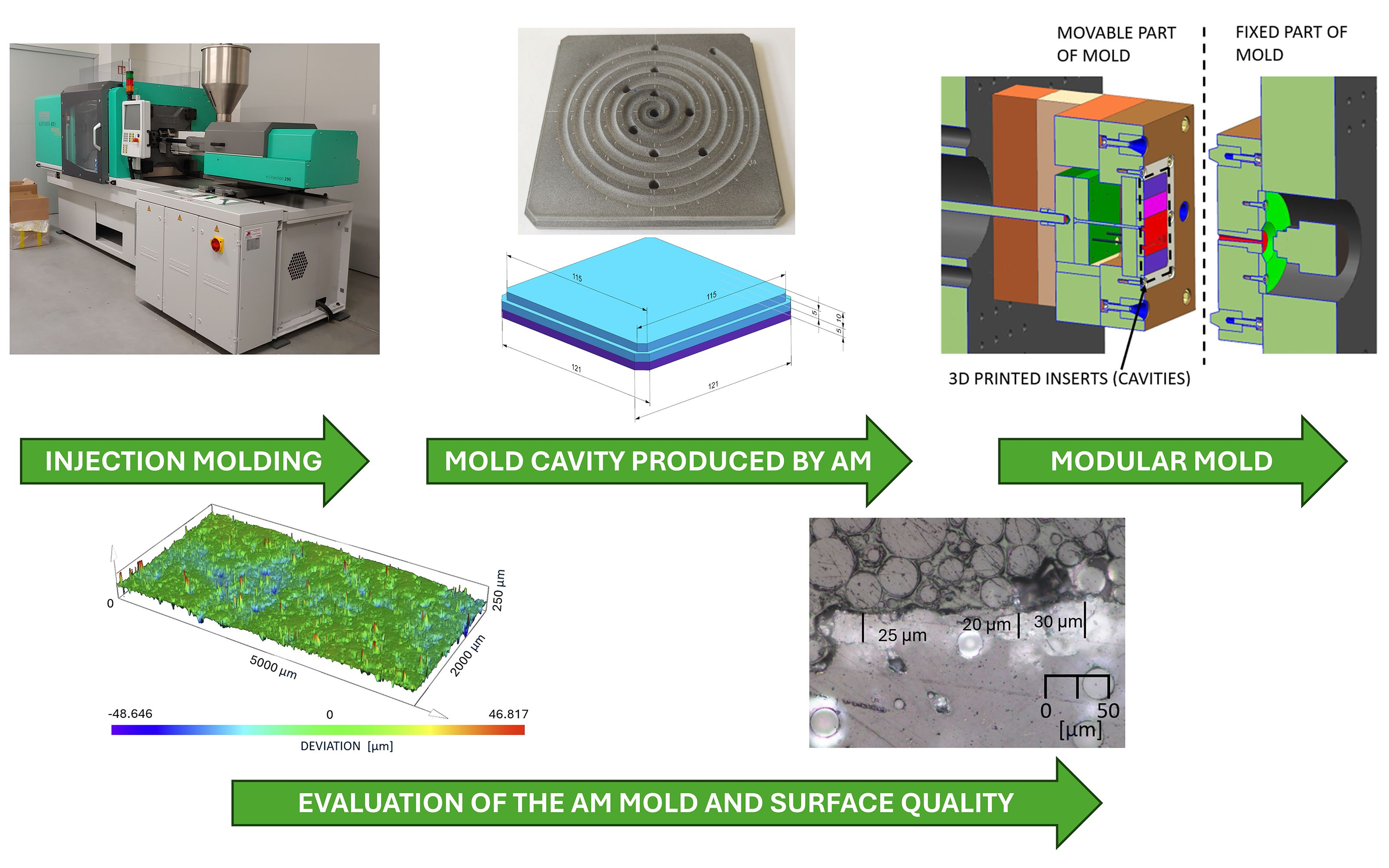

Surface Treatment and Analysis of 3D-Printed Plastic Molds for Prototype and Small-Series Injection Molding



Abstract
1. Introduction
- To evaluate and compare the effectiveness of different surface smoothing technologies and coatings on the surface roughness of PA12 and PA12GB 3D-printed parts.
- To perform a detailed tribological analysis to quantify the wear resistance of the treated surfaces under conditions simulating the injection molding process.
- To analyze the thickness of the applied surface layers to understand their contribution to mold durability and design constraints.
- To correlate the treated molds’ physical properties (roughness, wear) with their functional performance in an injection molding machine, mainly focusing on plastic flowability and final part quality [18].
2. Materials and Methods
2.1. Methods-Injection Molding Process and Equipment
- Granule Feeding: Plastic granules are fed into the injection unit from a hopper.
- Melting and Homogenization: A rotating screw transports the granules through a heated cylinder. The combination of heat from the cylinder and friction from the screw’s rotation melts and homogenizes the plastic into a viscous melt.
- Injection: The screw moves axially, acting as a piston, to inject the molten plastic into the cavity of the closed mold.
- Cooling and Solidification: The plastic cools and solidifies inside the mold.
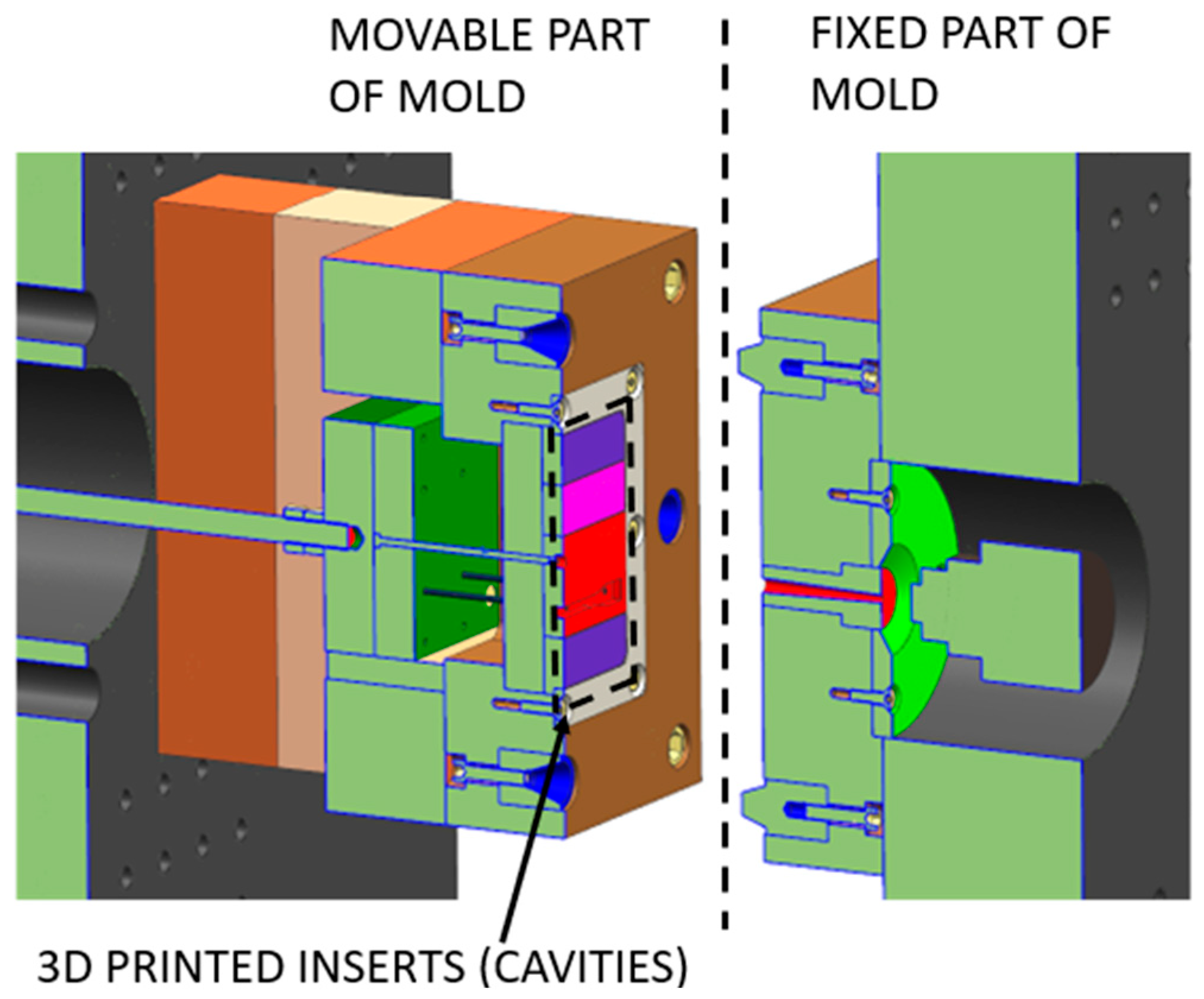
2.2. Materials-Mold Manufacturing via Additive Technology
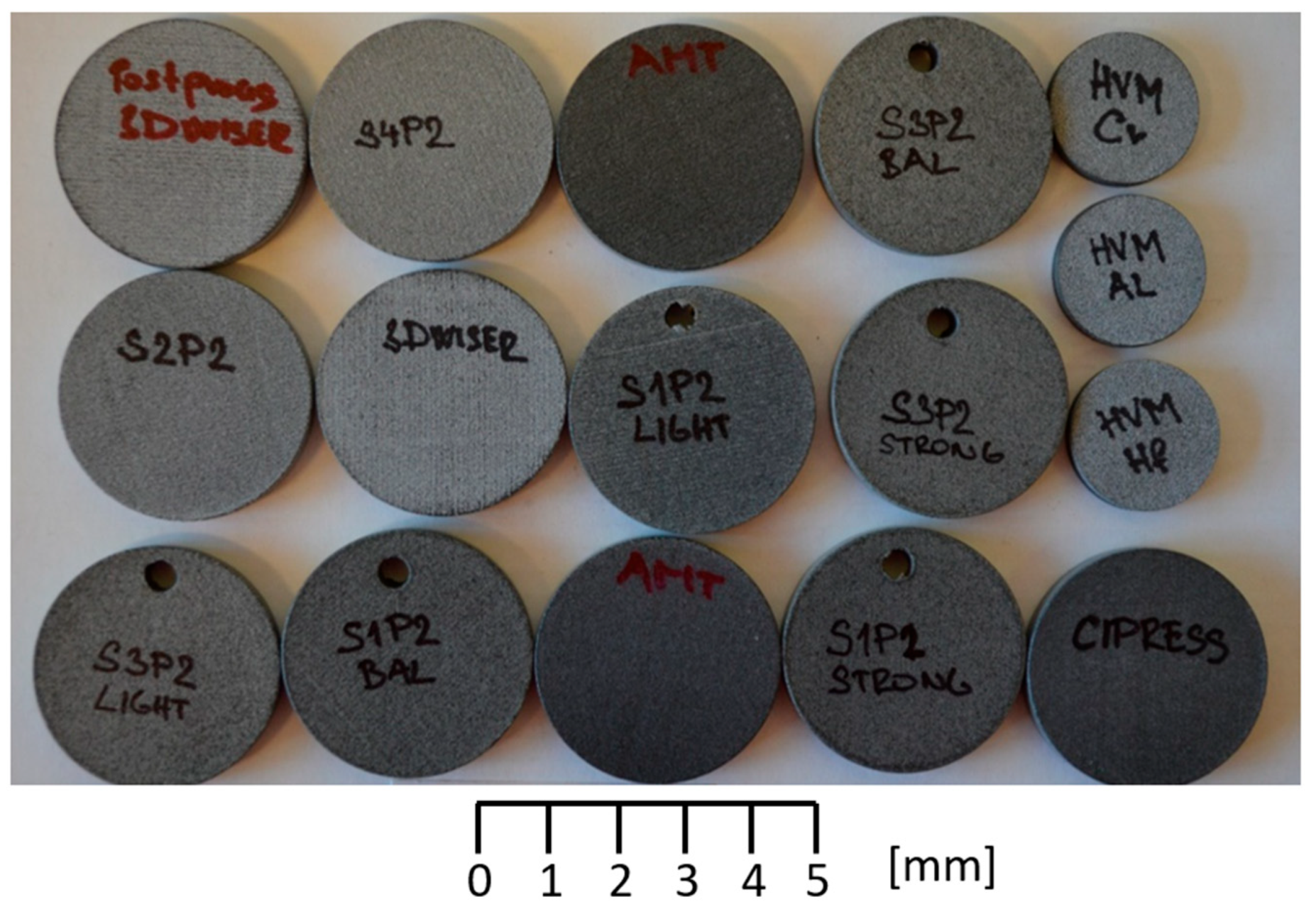
2.3. Characterization-Surface Treatment
- Chemical Vapor Smoothing (DyeMansion)
- Mechanical Smoothing by PostProcess (Buffalo, NY, USA)
- Metal Decomposition Coatings (HVM Plasma)
3. Results
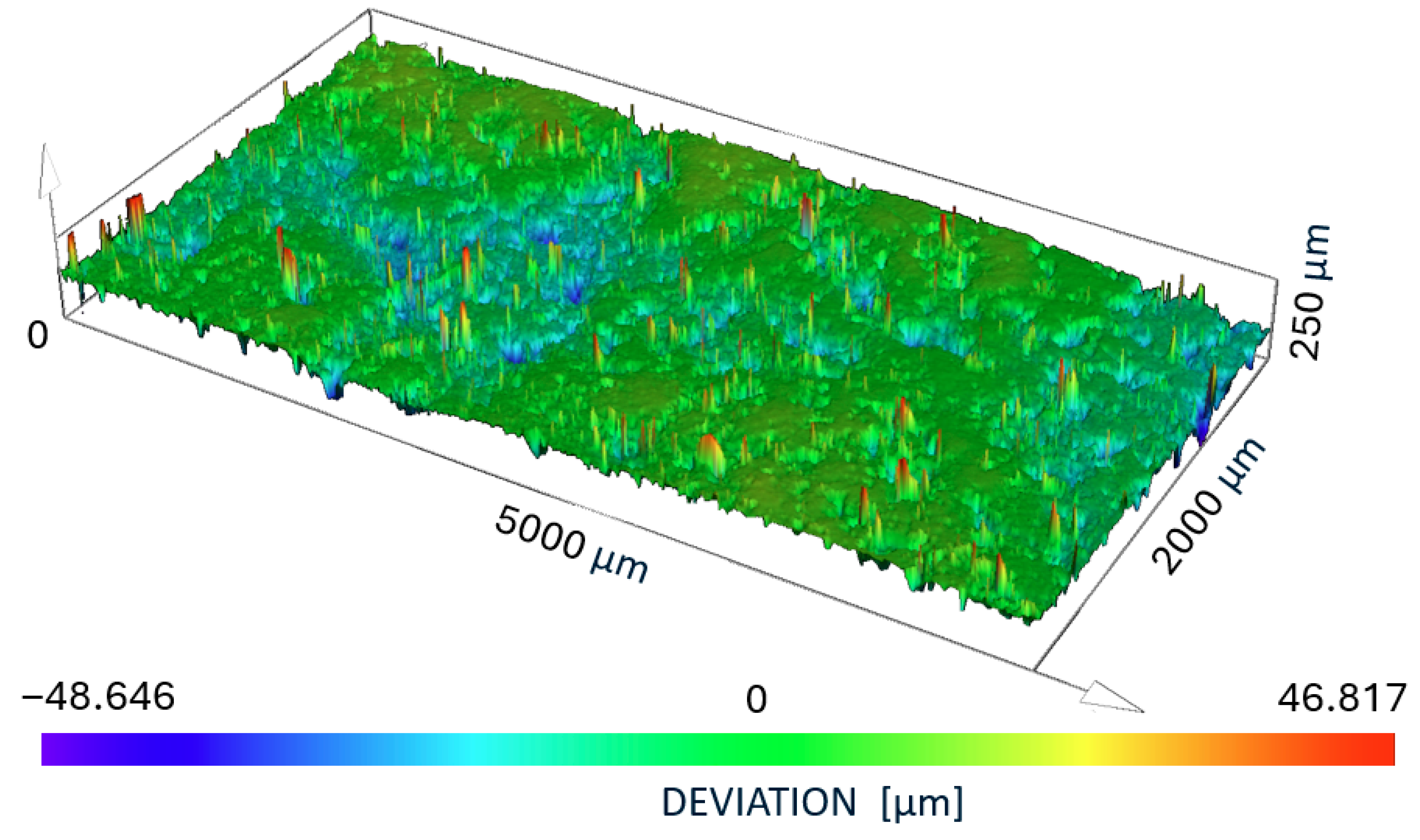
3.1. Surface Roughness Measurement
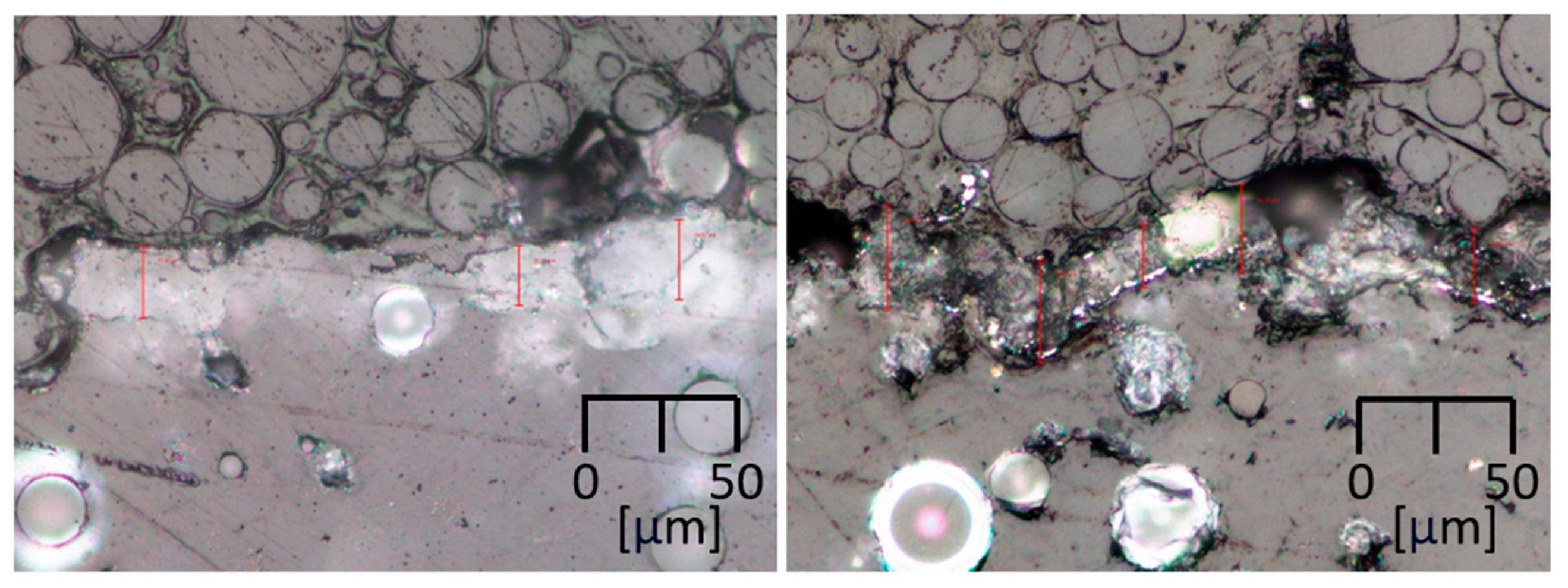
3.2. Surface Layer Thickness
3.3. Tribological Testing
3.4. Surface Roughness
3.5. Surface Layer Thickness-Results
3.6. Tribological Performance
4. Discussion
5. Conclusions
Author Contributions
Funding
Institutional Review Board Statement
Informed Consent Statement
Data Availability Statement
Acknowledgments
Conflicts of Interest
Abbreviations
| MJF | Multi Jet Fusion |
| HP | Hewlett Packard |
| AM | Additive Manufacturing |
| PA | Polyamide |
References
- Farkas, A.Z.; Galatanu, S.-V.; Nagib, R. The Influence of Printing Layer Thickness and Orientation on the Mechanical Properties of DLP 3D-Printed Dental Resin. Polymers 2023, 15, 1113. [Google Scholar] [CrossRef]
- Alghamdi, S.S.; John, S.; Choudhury, N.R.; Dutta, N.K. Additive Manufacturing of Polymer Materials: Progress, Promise, and Challenges. Polymers 2021, 13, 753. [Google Scholar] [CrossRef] [PubMed]
- Chua, C.K.; Wong, C.H.; Yeong, W.Y. Benchmarking for Additive Manufacturing. In Standards, Quality Control and Measurement Sciences in 3D Printing and Additive Manufacturing, 1st ed.; Academic Press: Cambridge, MA, USA, 2017; pp. 181–212. [Google Scholar] [CrossRef]
- Shahrubudin, N.; Lee, T.C.; Ramlan, R. An Overview on 3D Printing Technology: Technological, Materials, and Applications. Procedia Manuf. 2019, 35, 1286–1296. [Google Scholar] [CrossRef]
- 3DPrint.com Company. HP Reveals More Info About Their Multi Jet Fusion 3D Printing Technology, Plans for Second 3D Printer, 2016. Available online: https://3dprint.com/113630/hp-multi-jet-fusion-plans-info/ (accessed on 12 May 2023).
- Farrugia, J.; Vella, P.; Rochman, A. Combining 3D printing and injection moulding for the fabrication of polymer micro-components with internal hollow features. Prog. Addit. Manuf. 2024, 9, 1353–1364. [Google Scholar] [CrossRef]
- Tawlik, M.M.; Nemat-Alla, M.M.; Dewidar, M.M. Enhancing the properties of aluminum alloys fabricated using wire + arc additive manufacturing technique—A review. J. Mater. Res. Technol. 2021, 13, 754–768. [Google Scholar] [CrossRef]
- Lee, P.-H.; Chung, H.; Lee, S.W.; Yoo, J.; Ko, J. Review: Dimensional Accuracy in Additive Manufacturing Processes. In Proceeding of the ASME 2014 International Manufacturing Science and Engineering Conference, Detroit, MI, USA, 9–13 June 2014. [Google Scholar] [CrossRef]
- Alomarah, A.; Ruan, D.; Masood, S.; Gao, Z. Compressive properties of a novel additively manufactured 3d auxetic structure. Smart Mater. Struct. 2019, 28, 085019. [Google Scholar] [CrossRef]
- Kechagias, J.; Chaidas, D.; Vidakis, N.; Salonitis, K.; Vaxevanidis, N.M. Key Parameters Controlling Surface Quality and Dimensional Accuracy: A Critical Review of FFF Process. Mater. Manuf. Process. 2022, 37, 963–984. [Google Scholar] [CrossRef]
- Osswald, P.V.; Obst, P.; Mazzei Capote, G.A.; Friedrich, M.; Rietzel, D.; Witt, G. Failure criterion for pa 12 multi-jet fusion additive manufactured parts. Addit. Manuf. 2021, 37, 101668. [Google Scholar] [CrossRef]
- Compton, B.; Lewis, A. 3D-Printing of Lightweight Cellular Composites. Adv. Mater. 2014, 26, 5930–5935. [Google Scholar] [CrossRef]
- Shen, L.; Wang, T.; Lee, T.; Forrester, M.; Becker, A.; Torres, S.; Pearson, C.; Cochran, E. 3D Printable All-Polymer Epoxy Composites. ACS Appl. Polym. Mater. 2021, 3, 5559–5567. [Google Scholar] [CrossRef]
- Khan, N.; Riccio, A. A systematic review of design for additive manufacturing of aerospace lattice structures: Current trends and future directions. Prog. Aerosp. Sci. 2024, 149, 101021. [Google Scholar] [CrossRef]
- Kantaros, A.; Ganetsos, T.; Piromalis, D. 3D and 4D Printing as Integrated Manufacturing Methods of Industry 4.0. Am. J. Eng. Appl. Sci. 2023, 16, 12–22. [Google Scholar] [CrossRef]
- Issabayeva, Z.; Shishkovsky, I. Prediction of The Mechanical Behavior of Polylactic Acid Parts with Shape Memory Effect Fabricated by FDM. Polymers 2023, 15, 1162. [Google Scholar] [CrossRef] [PubMed]
- Tiwari, A.S.; Yang, S. Energy Consumption Modeling of 3D-Printed Carbon-Fiber-Reinforced Polymer Parts. Polymers 2023, 15, 1290. [Google Scholar] [CrossRef] [PubMed]
- Briouza, S.; Gritli, H.; Khraief, N.; Belghith, S.; Singh, D. A Brief Overview on Machine Learning in Rehabilitation of the Human Arm via an Exoskeleton Robot. In Proceedings of the 2021 International Conference on Data Analytics for Business and Industry (ICDABI), Sakheer, Bahrain, 25–26 October 2021; pp. 129–134. [Google Scholar] [CrossRef]
- Podsiadły, B.; Skalski, A.; Rozpiórski, W.; Słoma, M. Are We Able to Print Components as Strong as Injection Molded?—Comparing the Properties of 3D Printed and Injection Molded Components Made from ABS Thermoplastic. Appl. Sci. 2021, 11, 6946. [Google Scholar] [CrossRef]
- Shim, J.S.; Kim, J.-E.; Jeong, S.H.; Choi, Y.J.; Ryu, J.J. Printing accuracy, mechanical properties, surface characteristics, and microbial adhesion of 3D-printed resins with various printing orientations. J. Prosthet. Dent. 2020, 124, 468–475. [Google Scholar] [CrossRef]
- Nowacki, J.; Sieczkiewicz, N. Problems of determination of MultiJet 3D printing distortions using a 3D scanner. Arch. Mater. Sci. Eng. 2020, 103, 30–41. [Google Scholar] [CrossRef]
- Fradl, D.; Panditaratne, J.; Bi, J.; Fu, R.; Oancea, V. Finite element simulation of the multi-jet fusion (mjf™) process using ABAQUS. In Proceedings of the Scince of the Age of Experience Conference, Boston, MA, USA, 17–19 May 2017. [Google Scholar]
- Mazzanti, V.; Malagutti, L.; Mollica, F. FDM 3D Printing of Polymers Containing Natural Fillers: A Review of Their Mechanical Properties. Polymers 2019, 11, 1094. [Google Scholar] [CrossRef]
- Avanzini, A.; Battini, D.; Pandini, S. Static and fatigue behavior in presence of notches for polyamide 12 (pa12) additively manufactured via multi jet fusion™ process. Int. J. Fatigue 2022, 161, 106912. [Google Scholar] [CrossRef]
- Raz, K.; Chval, Z.; Milsimerova, A. Thermal specification of 3d printed injection moulds made from pa12gb. IOP Conf. Ser. Mater. Sci. Eng. 2021, 1199, 012009. [Google Scholar] [CrossRef]
- Rosso, S.; Meneghello, R.; Biasetto, L.; Grigolato, L.; Concheri, G.; Savio, G. In-depth comparison of polyamide 12 parts manufactured by multi-jet fusion and selective laser sintering. Addit. Manuf. 2020, 36, 101713. [Google Scholar] [CrossRef]
- O’Connor, H.J.; Dowling, D.P. Comparison between the properties of polyamide 12 and glass bead filled polyamide 12 using the multi jet fusion printing process. Addit. Manuf. 2020, 31, 100961. [Google Scholar] [CrossRef]
- Yang, F.; Zobeiry, N.; Mamidala, R.; Chen, X. A review of aging, degradation, and reusability of pa12 powders in selective laser sintering additive manufacturing. Mater. Today Commun. 2023, 34, 105279. [Google Scholar] [CrossRef]
- Suder, J.; Bobovsky, Z.; Mlotek, J.; Vocetka, M.; Zeman, Z.; Safar, M. Experimental analysis of temperature resistance of 3d printed pla components. MM Sci. J. 2021, 1, 4322–4327. [Google Scholar] [CrossRef]
- Geng, Z.; Bidanda, B. Geometric precision analysis for Additive Manufacturing processes: A comparative study. Precis. Eng. 2021, 69, 68–76. [Google Scholar] [CrossRef]
- Belter, J.T.; Dollar, A.M. Strengthening of 3d printed fused deposition manufactured parts using the fill compositing technique. PLoS ONE 2015, 10, e0141101. [Google Scholar] [CrossRef]
- Heitkamp, T.; Girnth, S.; Kuschmitz, S.; Waldt, N.; Klawitter, G.; Vietor, T. Experimental and Numerical Investigation of the Mechanical Properties of 3D-Printed Hybrid and Non-Hybrid Composites. Polymers 2023, 15, 1164. [Google Scholar] [CrossRef]



| Sample | Roughness Ra [µm] | ISO 4287 | Roughness Ry [µm] | Roughness Rz [µm] |
|---|---|---|---|---|
| PostProcess | 4.0303 | 40.187 | 37.762 | 50.2628 |
| Plasma—HVM AL | 7.818 | 48.053 | 45.287 | 68.109 |
| S1P2 STRONG | 3.058 | 15.930 | 13.933 | 19.897 |
| S1P2 LIGHT | 3.168 | 17.936 | 15.667 | 21.056 |
| S1P2 BAL | 3.886 | 20.056 | 18.387 | 25.118 |
| S2P2 | 4.066 | 26.418 | 21.771 | 29.871 |
| S3P2 STRONG | 1.2797 | 6.086 | 7.4969 | 9.5512 |
| S3P2 LIGHT | 3.1667 | 17.9358 | 15.667 | 21.056 |
| S3P2 BAL | 3.372 | 18.422 | 16.597 | 22.138 |
| S4P2 | 4.541 | 27.001 | 23.291 | 31.875 |
| Sample | Thickness [µm] |
|---|---|
| PostProcess | 26.2 |
| HVM_Cr | 31.8 |
| S1P2 STRONG | 1.7 |
| S2P2 | 40.8 |
| Sample | Wear Track Width [µm] | Wear Volume Loss [mm3] |
|---|---|---|
| Untreated PA12 | 250 | 0.85 |
| S1P2 LIGHT | 210 | 0.65 |
| S1P2 STRONG | 185 | 0.58 |
| HVM Plasma Cr | 155 | 0.42 |
| HVM Plasma Al | 190 | 0.61 |
| S3P2 STRONG | 95 | 0.25 |
Disclaimer/Publisher’s Note: The statements, opinions and data contained in all publications are solely those of the individual author(s) and contributor(s) and not of MDPI and/or the editor(s). MDPI and/or the editor(s) disclaim responsibility for any injury to people or property resulting from any ideas, methods, instructions or products referred to in the content. |
© 2025 by the authors. Licensee MDPI, Basel, Switzerland. This article is an open access article distributed under the terms and conditions of the Creative Commons Attribution (CC BY) license (https://creativecommons.org/licenses/by/4.0/).
Share and Cite
Raz, K.; Chval, Z.; Hula, F.; Markopoulos, A. Surface Treatment and Analysis of 3D-Printed Plastic Molds for Prototype and Small-Series Injection Molding. Polymers 2025, 17, 2977. https://doi.org/10.3390/polym17222977
Raz K, Chval Z, Hula F, Markopoulos A. Surface Treatment and Analysis of 3D-Printed Plastic Molds for Prototype and Small-Series Injection Molding. Polymers. 2025; 17(22):2977. https://doi.org/10.3390/polym17222977
Chicago/Turabian StyleRaz, Karel, Zdenek Chval, Frantisek Hula, and Angelos Markopoulos. 2025. "Surface Treatment and Analysis of 3D-Printed Plastic Molds for Prototype and Small-Series Injection Molding" Polymers 17, no. 22: 2977. https://doi.org/10.3390/polym17222977
APA StyleRaz, K., Chval, Z., Hula, F., & Markopoulos, A. (2025). Surface Treatment and Analysis of 3D-Printed Plastic Molds for Prototype and Small-Series Injection Molding. Polymers, 17(22), 2977. https://doi.org/10.3390/polym17222977