Effect of Water Regeneration and Integration on Technical Indicators of PVC Manufacturing Using Process System Engineering



Abstract
1. Introduction
2. Materials and Methods
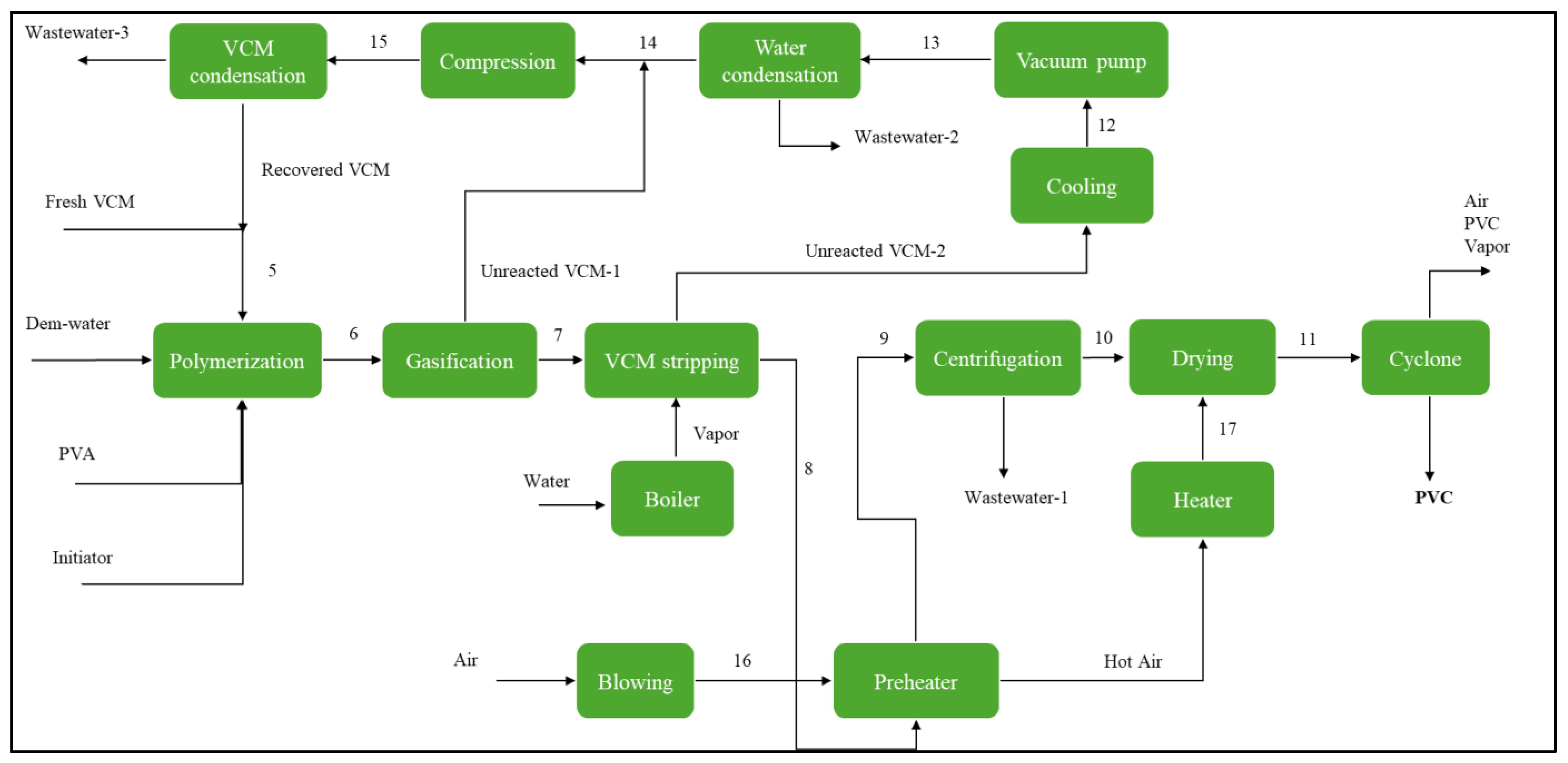
2.1. Description of the Energy-Integrated Suspension PVC Production Process
2.2. Mass Integration of Processes and Water Regeneration
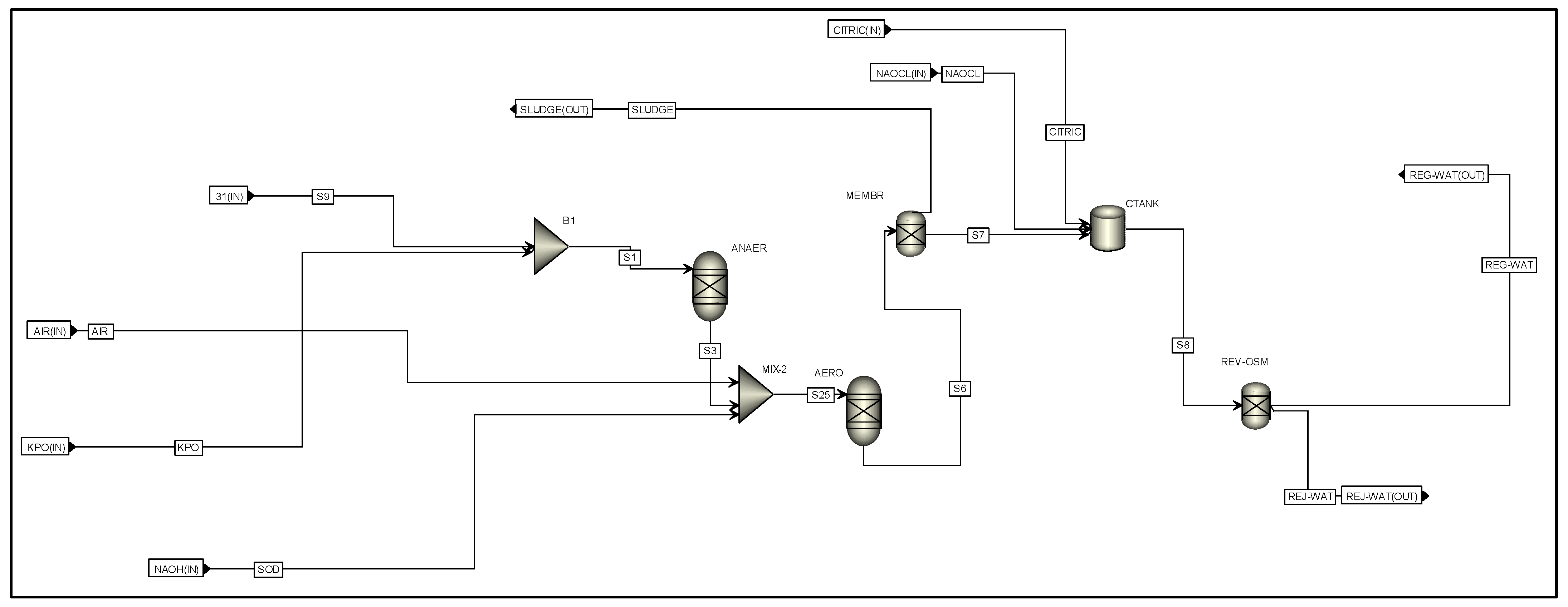
2.2.1. Mass Integration Using Regeneration (Interceptor)
- (1)
- The output concentration of the treated streams should be significantly lower than the original concentration of the selected contaminant, ;
- (2)
- An approximate fixed removal ratio or efficiency, , or a percentage yield (%) is required.
2.2.2. Simulation of the Water Energy and Water Integrated Process
2.2.3. Technical Analysis of the Energy- and Water-Integrated Process
3. Results and Discussion
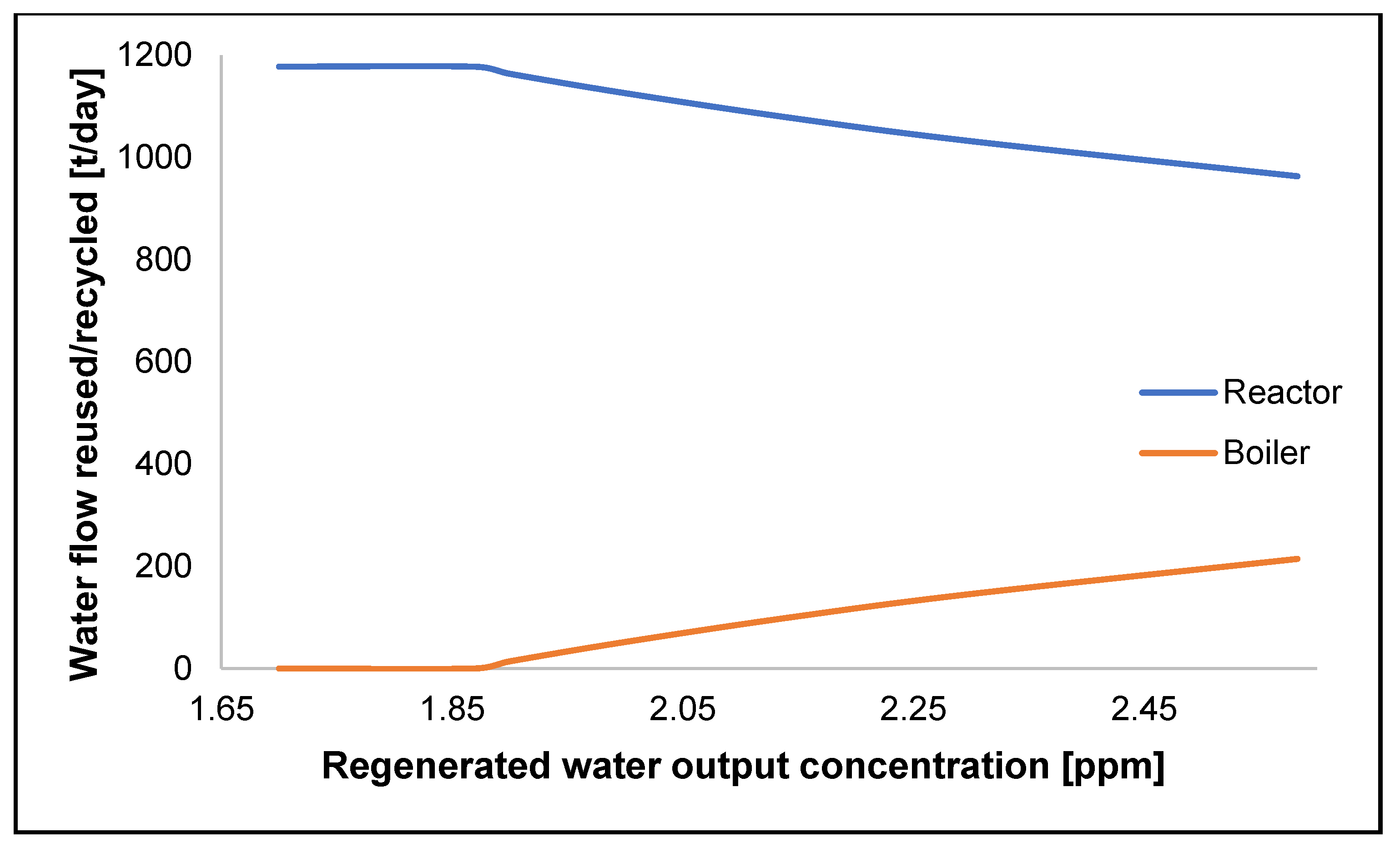
3.1. Results of Mass Integration with Water Regeneration for PVC Production
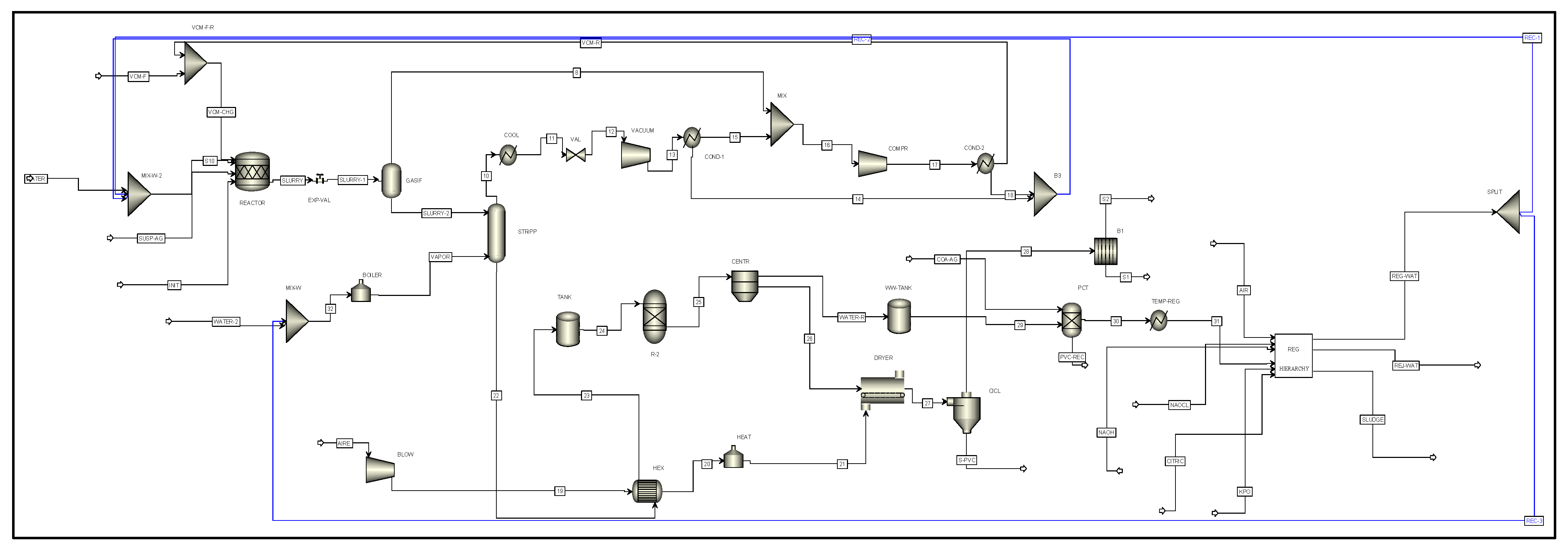
3.2. Simulation of the Mass-Integrated Process
3.3. WEP Analysis of the PVC Production Process Through Regeneration
4. Conclusions
Author Contributions
Funding
Data Availability Statement
Acknowledgments
Conflicts of Interest
References
- United Nations. The United Nations World Water Development Report 2020: Water and Climate Change; United Nations: New York, NY, USA, 2020. [Google Scholar]
- Chowdhary, P.; Bharagava, R.N.; Mishra, S.; Khan, N. Role of Industries in Water Scarcity and Its Adverse Effects on Environment and Human Health. In Environmental Concerns and Sustainable Development: Volume 1: Air, Water and Energy Resources; Springer: Singapore, 2020; pp. 235–256. [Google Scholar] [CrossRef]
- Heldal, R.; Nguyen, N.T.; Moreira, A.; Lago, P.; Duboc, L.; Betz, S.; Coroamă, V.C.; Penzenstadler, B.; Porras, J.; Capilla, R.; et al. Sustainability competencies and skills in software engineering: An industry perspective. J. Syst. Softw. 2024, 211, 111978. [Google Scholar] [CrossRef]
- Maheshwari, A.; Prasad, V.; Gudi, R.D.; Biswas, P. Systems engineering based advanced optimization for sustainable water management in refineries. J. Clean. Prod. 2019, 224, 661–676. [Google Scholar] [CrossRef]
- Meramo-Hurtado, S.I.; González-Delgado, Á.D. Process Synthesis, Analysis, and Optimization Methodologies toward Chemical Process Sustainability. Ind. Eng. Chem. Res. 2021, 60, 4193–4217. [Google Scholar] [CrossRef]
- Chin, H.H.; Varbanov, P.S.; Liew, P.Y.; Klemeš, J.J. Pinch-based targeting methodology for multi-contaminant material recycle/reuse. Chem. Eng. Sci. 2021, 230, 116129. [Google Scholar] [CrossRef]
- Klemes, J.J. Industrial water recycle/reuse. Curr. Opin. Chem. Eng. 2012, 1, 238–245. [Google Scholar] [CrossRef]
- Friedler, F. Process integration, modelling and optimisation for energy saving and pollution reduction. Appl. Therm. Eng. 2010, 30, 2270–2280. [Google Scholar] [CrossRef]
- Tan, Y.L.; Manan, Z.A.; Foo, D.C.Y. Retrofit of water network with regeneration using water pinch analysis. Process Saf. Environ. Prot. 2007, 85, 305–317. [Google Scholar] [CrossRef]
- Rossi, E.; Bertassini, A.C.; Ferreira Cdos, S.; Neves do Amaral, W.A.; Ometto, A.R. Circular economy indicators for organizations considering sustainability and business models: Plastic, textile and electro-electronic cases. J. Clean. Prod. 2020, 247, 119137. [Google Scholar] [CrossRef]
- Willet, J.; Wetser, K.; Vreeburg, J.; Rijnaarts, H.H.M. Review of methods to assess sustainability of industrial water use. Water Resour. Ind. 2019, 21, 100110. [Google Scholar] [CrossRef]
- Mukherjee, R.; Sengupta, D.; Sikdar, S.K. Sustainability in the context of process engineering. Clean Technol. Environ. Policy 2015, 17, 833–840. [Google Scholar] [CrossRef]
- Caldeira, D.C.D.; Silva, C.M.; de Ávila Rodrigues, F.; Zanuncio, A.J.V. Aspen Plus simulation for effluent reuse in thermomechanical pulp mills. Water Sci. Technol. 2023, 88, 751–762. [Google Scholar] [CrossRef] [PubMed]
- Čolnik, M.; Kotnik, P.; Knez, Ž.; Škerget, M. Degradation of Polyvinyl Chloride (PVC) Waste with Supercritical Water. Processes 2022, 10, 1940. [Google Scholar] [CrossRef]
- Carroll, W.F.; Johnson, R.W.; Moore, S.S.; Paradis, R.A. Poly(Vinyl Chloride). In Applied Plastics Engineering Handbook: Processing, Materials, and Applications, 2nd ed.; William Andrew: Norwich, CT, USA, 2017; pp. 73–89. [Google Scholar]
- Comanita, E.-D.; Ghinea, C.; Roșca, M.; Simion, I.M.; Petraru, M.; Gavrilescu, M. Environmental Impacts of Polyvinyl Chloride (PVC) Production Process. In Proceedings of the 5th IEEE International Conference on E-Health and Bioengineering (EHB 2015), Popa University of Medicine and Pharmacy, Iași, Romania, 19–21 November 2015; IEEE: New York, NY, USA, 2015; pp. 1–4, ISBN 978-1-4673-7545-0. [Google Scholar]
- Guo, R.; Yu, E.; Liu, J.; Wei, Z. Agitating transformation during vinyl chloride suspension polymerization: Aggregation morphology and PVC properties. RSC Adv. 2017, 7, 24022–24029. [Google Scholar] [CrossRef]
- Saeki, Y.; Emura, T. Technical progresses for PVC production. Prog. Polym. Sci. 2002, 27, 2055–2131. [Google Scholar] [CrossRef]
- Leadbitter, J. PVC and Sustainability. Prog. Polym. Sci. 2002, 27, 2197–2226. [Google Scholar] [CrossRef]
- Chan, J.H.; Foo, D.C.Y.; Kumaresan, S.; Aziz, R.A.; Abu-Hassan, M.A. An integrated approach for water minimisation in a PVC manufacturing process. Clean Technol. Environ. Policy 2008, 10, 67–79. [Google Scholar] [CrossRef]
- Zheng, P.; Feng, X.; Qian, F.; Cao, D. Water system integration of a chemical plant. Energy Convers. Manag. 2006, 47, 2470–2478. [Google Scholar] [CrossRef]
- Lee, J.Y.; Foo, D.C.Y. Application of a Simultaneous Approach for Process Scheduling and Water Minimisation in Batch Plants; Elsevier Masson SAS: Amsterdam, The Netherlands, 2016. [Google Scholar]
- Skouteris, G.; Ouki, S.; Foo, D.; Saroj, D.; Altini, M.; Melidis, P.; Cowley, B.; Ells, G.; Palmer, S.; O’Dell, S. Water footprint and water pinch analysis techniques for sustainable water management in the brick-manufacturing industry. J. Clean. Prod. 2018, 172, 786–794. [Google Scholar] [CrossRef]
- Espíndola, J.C.; Mierzwa, J.C.; Amaral, M.C.S.; De Andrade, L.H. Water Reuse through Membrane Technologies for a Dairy Plant Using Water Pinch Simulation Software. Sustainability 2023, 15, 2540. [Google Scholar] [CrossRef]
- Esmaeeli, A.; Sarrafzadeh, M.H. Reducing freshwater consumption in pulp and paper industries using pinch analysis and mathematical optimization. J. Water Process Eng. 2023, 53, 103646. [Google Scholar] [CrossRef]
- Wan Alwi, S.R.; Manan, Z.A. Water Pinch Analysis for Water Management and Minimisation: An Introduction. Handbook of Process Integration; Woodhead Publishing Limited: Cambridge, UK, 2013. [Google Scholar]
- Moreno-Sader, K.A.; Martínez-Consuegra, J.; González-Delgado, Á.D. An integrated biorefinery approach via material recycle/reuse networks for the extraction of value-added components from shrimp: Computer-aided simulation and environmental assessment. Food Bioprod. Process. 2021, 127, 443–453. [Google Scholar] [CrossRef]
- Aguilar-Vasquez, E.; Ramos-olmos, M.; González-Delgado, Á.D. A Joint Computer-Aided Simulation and Water-Energy-Product (WEP) Approach for Technical Evaluation of PVC Production. Sustainability 2023, 15, 8096. [Google Scholar] [CrossRef]
- Mendivil-Arrieta, A.; Aguilar-Vasquez, E.A.; Diaz-Perez, J.M.; Ramos-Olmos, M.; Gonzaléz-Delgado, Á.D. Energy Integration and WEP Technical Evaluation of a Large-Scale PVC Production Process. Sci 2025, 7, 41. [Google Scholar] [CrossRef]
- Agaciak, P.; Yahiaoui, S.; Djabourov, M.; Lasuye, T. Dehydration and drying poly(vinyl)chloride (PVC) porous grains: 1. Centrifugation and drying in controlled humid atmospheres. Colloids Surfaces A Physicochem. Eng. Asp. 2015, 469, 132–140. [Google Scholar] [CrossRef]
- El-Halwagi, M. Process integration. Process Systems Engineering; Elsevier: Amsterdam, The Netherlands, 2006; Volume 7. [Google Scholar]
- El-Halwagi, M.M. Pollution prevention through process integration. Systematic Design Tools; Elsevier: Amsterdam, The Netherlands, 1998; Volume 7, p. 35. [Google Scholar]
- Meramo, S.; González-Delgado, Á.D.; Sukumara, S.; Fajardo, W.S.; León-Pulido, J. Sustainable design approach for modeling bioprocesses from laboratory toward commercialization: Optimizing chitosan production. Polymers 2022, 14, 25. [Google Scholar] [CrossRef]
- Chen, C.L.; Lee, J.Y. A graphical technique for the design of water-using networks in batch processes. Chem. Eng. Sci. 2008, 63, 3740–3754. [Google Scholar] [CrossRef]
- Rolsky, C.; Kelkar, V. Degradation of polyvinyl alcohol in us wastewater treatment plants and subsequent nationwide emission estimate. Int. J. Environ. Res. Public Health 2021, 18, 6027. [Google Scholar] [CrossRef]
- Blanco, L.; Hermosilla, D.; Negro, C.; Swinnen, N.; Prieto, D.; Blanco, Á. Assessing demineralization treatments for PVC effluent reuse in the resin polymerization step. Environ. Sci. Pollut. Res. 2017, 24, 16631–16638. [Google Scholar] [CrossRef]
- González-Delgado, Á.D.; Aguilar-Vásquez, E.; Ramos-Olmos, M. Chemical and Process Inherent Safety Analysis of Large-Scale Suspension Poly(Vinyl Chloride) Production. Chem Eng. 2023, 7, 76. [Google Scholar] [CrossRef]
- Gengec, E.; Karayunlu Bozbas, S.; Ayhan, H.H. Treatment of embroidery wastewater containing poly(vinyl alcohol) by electrooxidation process. Int. J. Environ. Sci. Technol. 2024, 21, 1223–1234. [Google Scholar] [CrossRef]
- Hu, K.; Fiedler, T.; Blanco, L.; Geissen, S.U.; Zander, S.; Prieto, D.; Blanco, A.; Negro, C.; Swinnen, N. Model-based performance and energy analyses of reverse osmosis to reuse wastewater in a PVC production site. J. Environ. Sci. Heal. Part A 2017, 52, 1218–1225. [Google Scholar] [CrossRef] [PubMed]
- Prieto, D.; Swinnen, N.; Blanco, L.; Hermosilla, D.; Cauwenberg, P.; Blanco, Á.; Negro, C. Drivers and economic aspects for the implementation of advanced wastewater treatment and water reuse in a PVC plant. Water Resour. Ind. 2016, 14, 26–30. [Google Scholar] [CrossRef]
- Sun, Y.; Hua, X.; Ge, R.; Guo, A.; Guo, Z.; Dong, D.; Sun, W. Investigation on pretreatment of centrifugal mother liquid produced in the production of polyvinyl chloride by air-Fenton technique. Environ. Sci. Pollut. Res. 2013, 20, 5797–5805. [Google Scholar] [CrossRef]
- Song, Q.; Chen, X.; Tang, L.; Zhou, W. Treatment of polyvinyl alcohol containing wastewater in two stage spiral symmetrical stream anaerobic bioreactors coupled a sequencing batch reactor. Bioresour. Technol. 2021, 340, 125702. [Google Scholar] [CrossRef] [PubMed]
- Guardo-Ruiz, R.M.; Puello-Castellón, L.M.; Ortega-Toro, R.; Aguilar-Vásquez, E.A.; González-Delgado, Á.D. Enhancing Technical Performance of PVC Production: A WEP-Based Energy and Water Assessment. Polymers 2025, 17, 1561. [Google Scholar] [CrossRef]
- Lima, A.; Abreu, T.; Figueiredo, S. Water and wastewater optimization in a food processing industry using water pinch technology. Sustain. Water Resour. Manag. 2021, 7, 1–13. [Google Scholar] [CrossRef]
- Sun, P.; Elgowainy, A.; Wang, M.; Han, J.; Henderson, R.J. Estimation of U.S. refinery water consumption and allocation to refinery products. Fuel 2018, 221, 542–557. [Google Scholar] [CrossRef]
- Mohammadnejad, S.; Bidhendi, G.R.N.; Mehrdadi, N. Water pinch analysis in oil refinery using regeneration reuse and recycling consideration. Desalination 2011, 265, 255–265. [Google Scholar] [CrossRef]
- AlMubaddal, F.; AlRumaihi, K.; Ajbar, A. Performance optimization of coagulation/flocculation in the treatment of wastewater from a polyvinyl chloride plant. J. Hazard. Mater. 2009, 161, 431–438. [Google Scholar] [CrossRef]
- González-Delgado, Á.D.; Cogollo-Cárcamo, G.; Bertel-Pérez, F. Mass-Integration and Environmental Evaluation of Chitosan Microbeads Production Modified with of Thiourea and Magnetite Nanoparticles. Processes 2023, 11, 2208. [Google Scholar] [CrossRef]
- García-Maza, S.; González-Delgado, Á.D. Robust simulation and technical evaluation of large-scale gas oil hydrocracking process via extended water-energy-product (E-WEP) analysis. Digit. Chem. Eng. 2024, 13, 100193. [Google Scholar] [CrossRef]
- European Commission. Reference Document on Best Available Duction of Polymers. 2007. Available online: https://bureau-industrial-transformation.jrc.ec.europa.eu/reference/production-polymers (accessed on 10 July 2025).
- Ludmann, S.; Fröhlich, T.; Liebich, A. Eco-profiles and Environmental Product Declarations of the European Plastics Manufacturers-Vinyl Chloride (VCM) and Polynivyl Chloride (PVC). Available online: https://pvc.org/wp-content/uploads/2023/06/230628_Eco-profile-PVC_june23.pdf (accessed on 2 April 2025).
- Acampa, G.; Giustra, M.G.; Parisi, C.M. Water treatment emergency: Cost evaluation tools. Sustainability 2019, 11, 2609. [Google Scholar] [CrossRef]
- Lechtenberg, F.; Somoza-Tornos, A.; Espuña, A.; Graells, M. Targeting economic and environmental benefits associated with the integration of regeneration units in water systems. J. Clean. Prod. 2021, 323, 129022. [Google Scholar] [CrossRef]
- Yang, L.; Salcedo-Diaz, R.; Grossmann, I.E. Water network optimization with wastewater regeneration models. Ind. Eng. Chem. Res. 2014, 53, 17680–17695. [Google Scholar] [CrossRef]
- Sharew, S.S.; Di Pretoro, A.; Yimam, A.; Negny, S.; Montastruc, L. Combining Exergy and Pinch Analysis for the Operating Mode Optimization of a Steam Turbine Cogeneration Plant in Wonji-Shoa, Ethiopia. Entropy 2024, 26, 453. [Google Scholar] [CrossRef] [PubMed]
- Everard, M. Twenty Years of the Polyvinyl Chloride Sustainability Challenges. J. Vinyl Addit. Technol. 2020, 26, 390–402. [Google Scholar] [CrossRef]






| Process | Mass Integration | Water Regeneration | WEP Technical Evaluation | Reference |
|---|---|---|---|---|
| PVC Manufacturing | Yes | No | No | [20] |
| Sodium Hydroxide and Suspension PVC Plant | Yes | No | No | [21] |
| PVC Production (Batch Plant) | Yes | No | No | [22] |
| Energy-Integrated Suspension PVC Production Process | Yes | Yes | Yes | This work |
| Variable | Units | Equation |
|---|---|---|
| Production Yield | % | |
| Fractional Water Consumption (FWC) | m3/t | |
| Total Cost of Freshwater (TCF) | $/day | |
| Wastewater Production Ratio (WPR) | % | |
| Index of Reused Unconverted Material (IRUM) | % | |
| Total Cost of Energy (TCE) | $/day | |
| Energy Specific Intensity (ESI) | MJ/t | |
| Net Energy ratio (NER) | Dimensionless | |
| Energy Usability Index (EUI) | Dimensionless | |
| Natural Gas Consumption Index (NGCI) | m3/t | |
| Electric Energy Consumption Index (EECI) | kWh/t |
| Source | Mass Flow [t/day] | Water Flow [L] | PVA [mgL−1] | Mass Fraction | Load [t/day] | Origin |
|---|---|---|---|---|---|---|
| sr1 | 17.87 | 17,929.7 | 0 | 0 | 0 | Condenser 1 |
| sr2 | 442.5 | 443,862 | 0 | 0 | 0 | Condenser 2 |
| sr3 | 1104.8 | 1,104,228.8 | 1173.7 | 0.00117 | 1292 | centrifuge |
| Sink | Mass Flow [t/day] | Water Flow [L] | PVA [mgL−1] | Mass Fraction | Load [t/day] | Destination |
|---|---|---|---|---|---|---|
| sk1 | 1440 | 1,444,332.999 | 1 | 1.00301 × 10⁻⁶ | 0.0014 | reactor |
| sk2 | 480 | 481,444.333 | 10 | 1.00301 × 10⁻⁵ | 0.0048 | Boiler |
| Parameter | Unit | Value |
|---|---|---|
| Mass flow of raw material (VCM) | t/day | 1152 |
| Mass flow of recycled raw material | t/day | 288 |
| Mass flow of unreacted raw material | t/day | 288 |
| Mass flow of product | t/day | 1150 |
| Total volumetric flow of freshwater | m3/day | 746 |
| Total volumetric flow of wastewater | m3/day | 279 |
| Total energy consumption | GJ/day | 4912.63 |
Disclaimer/Publisher’s Note: The statements, opinions and data contained in all publications are solely those of the individual author(s) and contributor(s) and not of MDPI and/or the editor(s). MDPI and/or the editor(s) disclaim responsibility for any injury to people or property resulting from any ideas, methods, instructions or products referred to in the content. |
© 2025 by the authors. Licensee MDPI, Basel, Switzerland. This article is an open access article distributed under the terms and conditions of the Creative Commons Attribution (CC BY) license (https://creativecommons.org/licenses/by/4.0/).
Share and Cite
Aguilar-Vásquez, E.A.; Rojas-Flores, S.; González-Delgado, Á.D. Effect of Water Regeneration and Integration on Technical Indicators of PVC Manufacturing Using Process System Engineering. Polymers 2025, 17, 2418. https://doi.org/10.3390/polym17172418
Aguilar-Vásquez EA, Rojas-Flores S, González-Delgado ÁD. Effect of Water Regeneration and Integration on Technical Indicators of PVC Manufacturing Using Process System Engineering. Polymers. 2025; 17(17):2418. https://doi.org/10.3390/polym17172418
Chicago/Turabian StyleAguilar-Vásquez, Eduardo Andrés, Segundo Rojas-Flores, and Ángel Darío González-Delgado. 2025. "Effect of Water Regeneration and Integration on Technical Indicators of PVC Manufacturing Using Process System Engineering" Polymers 17, no. 17: 2418. https://doi.org/10.3390/polym17172418
APA StyleAguilar-Vásquez, E. A., Rojas-Flores, S., & González-Delgado, Á. D. (2025). Effect of Water Regeneration and Integration on Technical Indicators of PVC Manufacturing Using Process System Engineering. Polymers, 17(17), 2418. https://doi.org/10.3390/polym17172418